
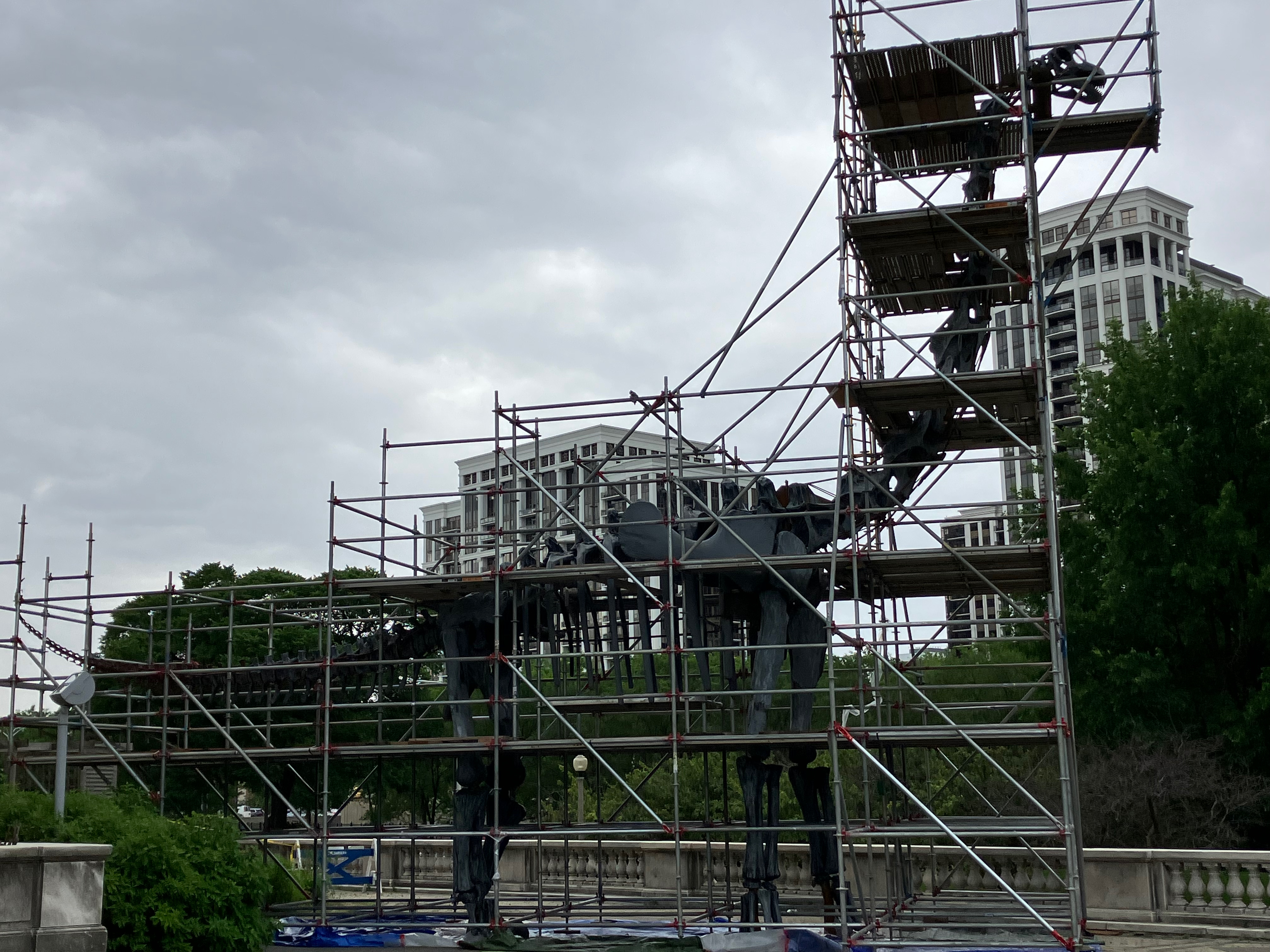
Earlier this year, the Brachiosaurus cast skeleton that stood on the Field Museum’s northwest terrace was retired. On display for 23 years (and 23 brutal Chicago winters), the replica was suffering from a rusting armature and extensive cracking. Deemed structurally unsound, it was dismantled the week of June 12. Though we lament the loss of the long-necked sentinel over DuSable Lake Shore Drive, the legacy of Brachiosaurus—the Field Museum’s first dinosaur—lives on.
The story of Brachiosaurus begins with the museum’s founding, nearly 130 years ago. The Field Columbian Museum opened in Chicago on June 2, 1894 as a permanent home for the collection assembled at the previous year’s World Columbian Exposition. While the collection boasted thousands of zoological, botanical, anthropological, and geological objects, it had but a single dinosaur: a replica skeleton of Hadrosaurus. Based on the original at the Philadelphia Academy of Natural Sciences, the model was badly out of date by the 1890s. Oliver Farrington, the Field’s original geology curator, considered it an embarrassment and petitioned director Frederick Skiff to hire a vertebrate paleontology specialist to collect better material. Skiff passed the request on the board, but was denied—with a building full of uncataloged specimens, they saw no need to obtain anything new.
The board changed their minds in 1898, when the Carnegie Museum and American Museum of Natural History announced plans to find sauropod dinosaurs for display. The resume of Elmer Riggs, a recent University of Kansas graduate with ample fossil hunting experience, happened to be on Skiff’s desk, and so Riggs was hired to collect dinosaurs for the museum.

In 1900, Riggs was prospecting near Grand Junction, Colorado with assistant Harold William Menke and camp cook Victor Dames. Their quarry was an exhibit-worthy specimen of Brontosaurus, the largest known dinosaur at that time. On July 4, Menke made a promising find: a giant limb bone that was the right size to be a Brontosaurus femur. The group began excavating and eventually revealed additional limb bones, nine-foot ribs, an articulated series of dorsal vertebrae, the sacrum, and a scattering of other bones. The course-grained, pebbly matrix suggested burial in a fast-moving river, which probably swept away the missing parts. All told, they had about 25% of a skeleton—not enough to mount for display but still worth collecting.
Once the fossils were back at the museum and undergoing preparation, Riggs confirmed something he had probably suspected in the field. Menke’s six-foot, seven-inch limb bone wasn’t a femur, it was a humerus. The humerus of Brontosaurus was well under five feet, so this animal was substantially larger. With his 1903 publication introducing Brachiosaurus altithorax to the world, Riggs emphasized its record size—and encouraged the press to make a meal of it.
Brachiosaurus was a win for the Field Museum: the first newly described dinosaur to come out of the nascent institution was also the biggest ever (a title Brachiosaurus would hold for the better part of the century). But while many of the individual bones were put on display in 1908, the holotype wasn’t complete enough to assemble into a standing mount. Instead, another find from Riggs’ 1900 Colorado expedition—the Fruita Apatosaurus—became the museum’s first mounted sauropod.

It would be almost ninety years before the museum revisited the prospect of putting Brachiosaurus on display. In the early 1990s, the Exhibitions department was hard at work remaking its paleontology halls from the ground up. This project would eventually open as Life Over Time in 1994, but in the meantime it was agreed that a showstopping symbol was needed outside the exhibit proper.
That showstopper could only be Brachiosaurus. The Field Museum hired Prehistoric Animal Structures, Inc.—a now-shuttered company specializing in mounted fossil skeletons—to make it happen. Commonly abbreviated as PAST, the company was founded by Gilles Danis, who previously created many of the Royal Tyrell Museum’s opening day exhibitions.
Fortunately for Danis and his team, there was more Brachiosaurus (and Brachiosaurus adjacent) fossil material to work with then in Riggs’ day. A handful of specimens referred to Brachiosaurus altithorax (mostly individual bones) had since turned up in the western United States, but the bulk of information came from a pair of Tanzanian skeletons. In 1914, German paleontologist Warner Janensch determined that these specimens were a second species of Brachiosaurus—Brachiosaurus brancai. More recently, the Tanzanian brachiosaur has been moved to its own genus, and is now known as Giraffatitan brancai. While there are a number of key differences, Giraffatitan and Brachiosaurus are one another’s closest known relatives, making the former a reasonable reference for the unknown parts of the latter.

To reconstruct Brachiosaurus for the Field Museum, the PAST crew started by taking molds of the Brachiosaurus holotype bones. Next, Danis and Donna Sloan traveled to the Museum für Naturkunde in Berlin, where the Giraffatitan fossils are housed. While they were not allowed to make casts, Danis and Sloan took extensive measurements. Stephen Godfrey used this information to sculpt the missing parts of Brachiosaurus, including the head, neck, tail, and feet.
A few adjustments were made along the way. First, the PAST crew inflated the limb bones slightly, so that the steel armature would fit inside. Second, the museum wanted visitors to be able to walk under the Brachiosaurus, but its torso wasn’t quite long enough to meet the minimum fire egress requirements. PAST solved the problem by quietly duplicating two of the vertebrae in the dorsal series. In an amusing twist, these stretch-limo proportions may have inadvertently been correct. Danis named the finished replica Ernestine, because “Ernestine is an awkward name and Brachiosaurus is an awkward-looking thing.”
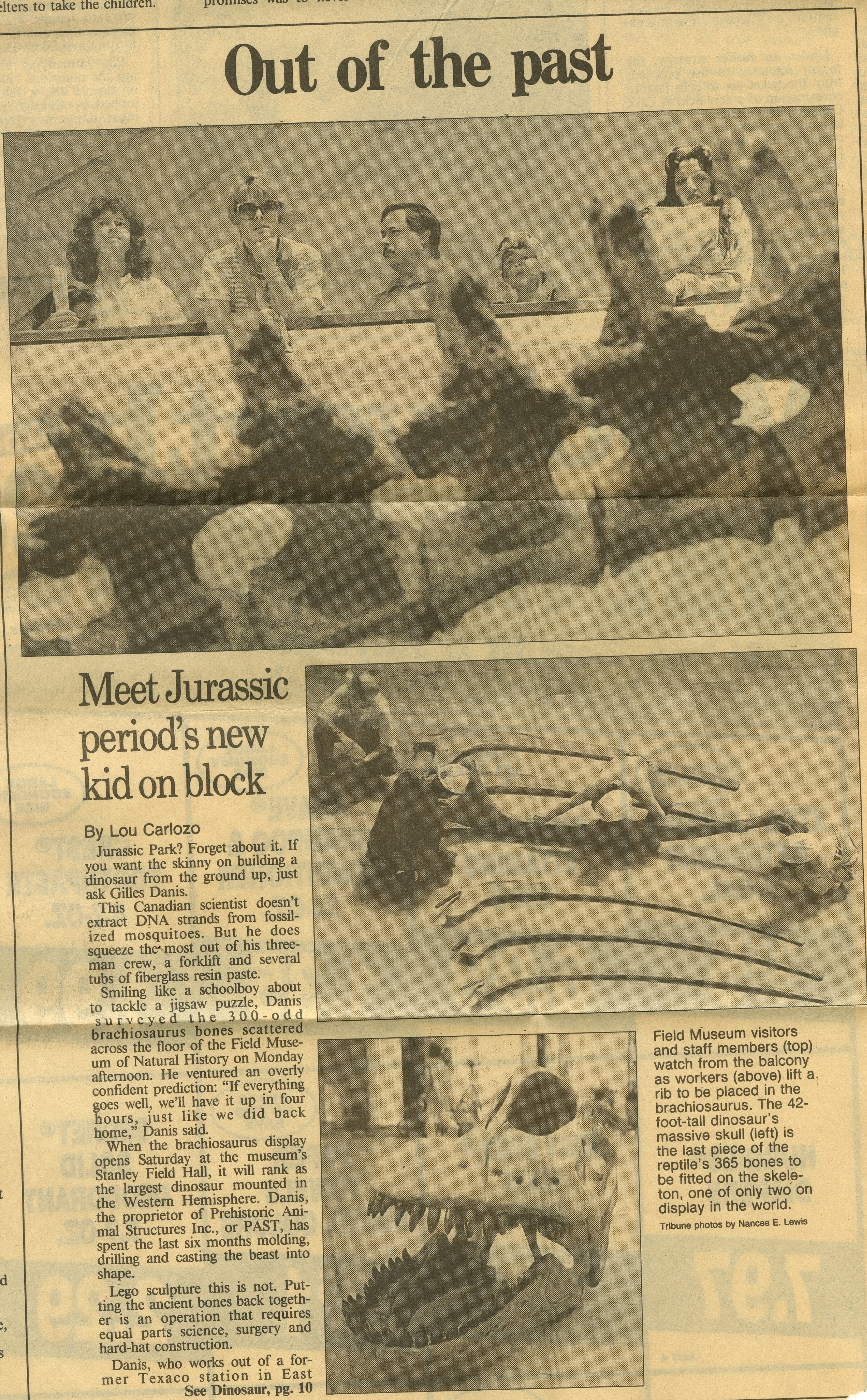
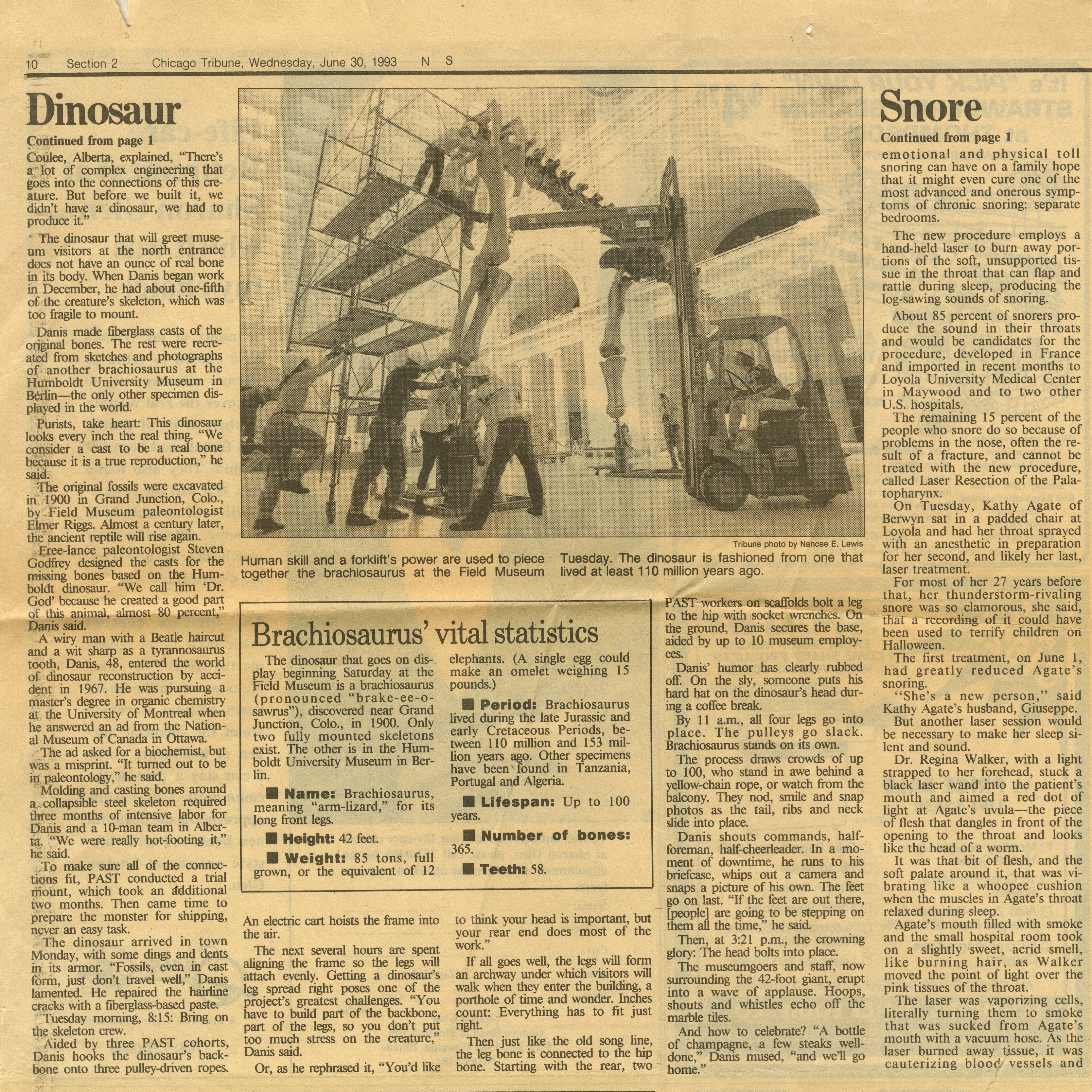
On June 29, 1993 (a Tuesday), Danis, three PAST crew members, and six Field Museum staffers assembled Ernestine in the museum’s central Stanley Field Hall. Reporters from the Chicago Sun-Times and Tribune were present to document the construction (scans of these articles are at the end of this post). Seven hours later, Brachiosaurus was complete, on its feet for the first time in 152 million years. At 41 feet tall, the replica skeleton was tall enough to peer over the second floor mezzanine and into the entrance to Life Over Time.
By coincidence, Ernestine’s debut was less than three weeks after the release of Jurassic Park—which happened to feature a Brachiosaurus in an iconic opening scene. The film quickly became the highest-grossing of all time, and launched a global wave of dino-mania. While he was busy finishing up and installing the Brachiosaurus, Danis was fielding calls left and right for his services. Even hotels were inquiring about putting dinosaur skeletons in their parking lots. His response? “If they can put up the cash for them, we’ll put them up!”

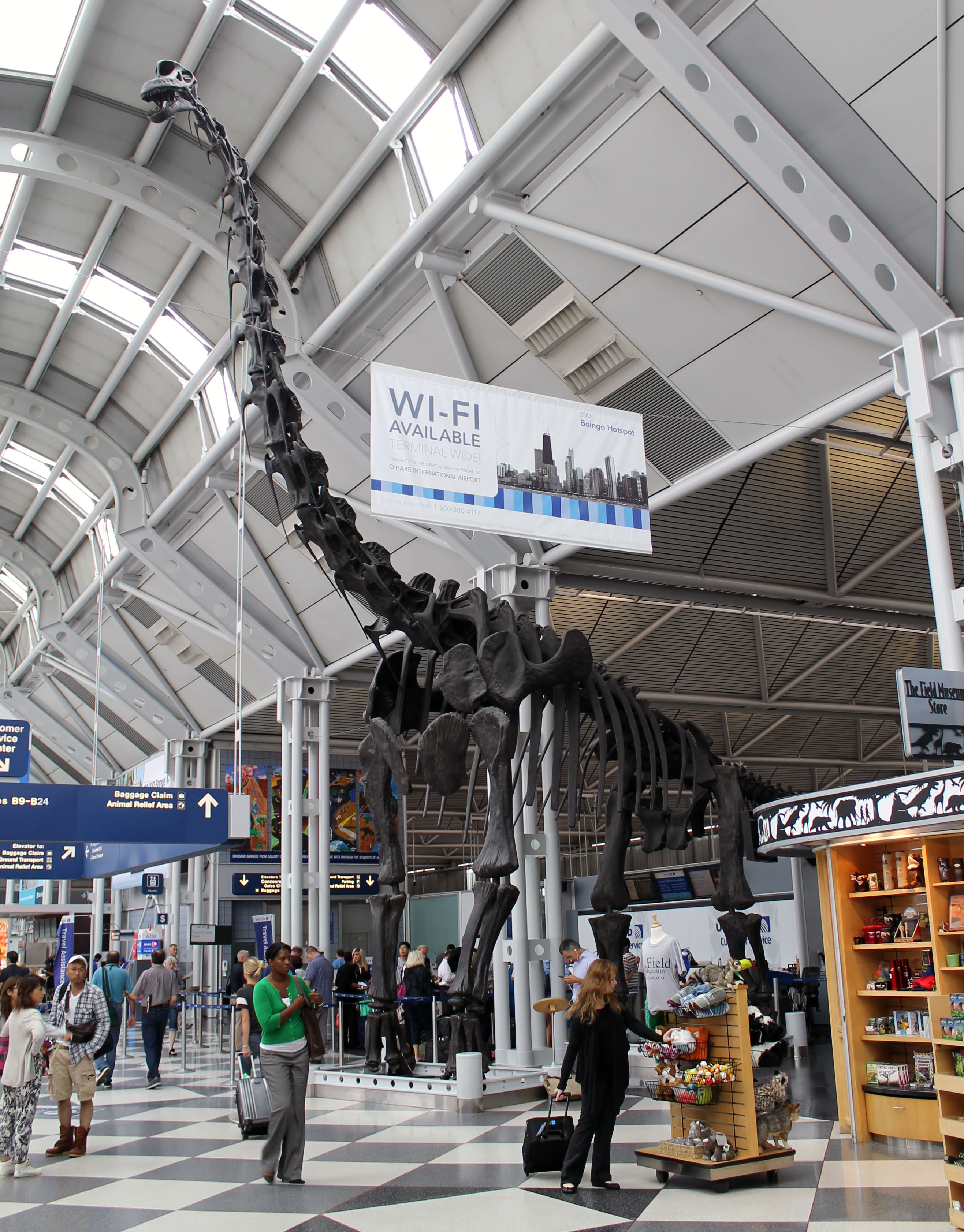
Ernestine’s stint in Stanley Field Hall wound up being short-lived. The Field Museum acquired SUE the Tyrannosaurus in 1997, and the mounted skeleton took the sauropod’s place in May 2000. Ernestine was relocated to O’Hare International Airport, where it remains today. Meanwhile, the museum commissioned a second Brachiosaurus replica to be displayed outdoors. Made from durable, all-weather plastic resin, the outdoor Brachiosaurus stood on the northwest terrace for the next 23 years. Notably, it outlasted SUE’s time in Stanley Field Hall: the Tyrannosaurus was relocated to its own gallery in 2018, and a cast of the Argentinian sauropod Patagotitan now occupies the Field Museum’s central space.

Now that the outdoor Brachiosaurus replica has been retired, it’s fair to ask what’s next for the Field Museum’s first dinosaur. Ernestine will remain at the airport for the foreseeable future, but plans for the northwest terrace have not yet solidified. In the meantime, a popup exhibit rhapsodizing Brachiosaurus recently opened in the Science Hub—a rotating exhibit space where interpreters are always present. I was happy to write the labels for this display, which tells the story of Brachiosaurus from its discovery to the removal of the outdoor skeleton (in far fewer words than this post). The exhibit includes the sculpted skull of the outdoor Brachiosaurus and parts of the holotype—including the tail vertebrae, which haven’t been on public view since the 1920s. Be sure to stop by if you’re in the area, but be quick: Science Hub exhibits typically last only six months or so.
References
Brinkman, P.D. 2010. The Second Jurassic Dinosaur Rush: Museums and Paleontology in America at the Turn of the Twentieth Century. University of Chicago Press: Chicago, IL.
Engh, B. 2020. We Found a Brachiosaurus.
Riggs, E.S. 1903. Brachiosaurus: The Largest Known Dinosaur. American Journal of Science 4:15:299-306.
Simpson, W. 2022. Pers. comm.
Taylor, M.P. 2009. A re-evaluation of Brachiosaurus altithorax Riggs 1903 (Dinosauria, Sauropoda) and its generic separation from Giraffatitan brancai (Janesch 1914). Journal of Vertebrate Paleontology 29:3:787-806.
Taylor, M.P. 2014. Giles Danis of PAST on the Chicago Brachiosaurus mount.





 EXTINCT MONSTERS
