
In the previous “quick bite” post, I introduced the dinosaurs on display at the Field Museum of Natural History (FMNH) that were collected in the early 20th century. This time, we’ll take a look at some of the dinosaurs collected and first displayed “in living memory”—that is to say, in the last three decades or so. I’ve skipped a few that either don’t have much available provenance (like the juvenile Maiasaura) or don’t have a very interesting story (like the off-the-shelf Deinonychus cast).
In comparing the early and more recent dinosaur installations at FMNH, it is immediately apparent that the latter group covers a much wider geographical range. The older mounted skeletons were all recovered in the western United States and Canada, while the new batch comes from all over the world, especially the global south. Local scientists were usually involved in the research, and in most cases the original fossils remained in or were ultimately returned to their countries of origin.
Tyrannosaurus rex (PR 2081)

As one of the world’s most thoroughly-researched and best-known dinosaurs, SUE the T. rex scarcely requires an introduction. SUE is the most complete adult Tyrannosaurus ever found, with 90% of the skeleton intact. Approximately 30 years old at the time of their death, SUE is also the eldest T. rex known, and within the margin of error for the title of largest.
SUE was discovered in 1990 by Sue Hendrickson on ranchland near Faith, South Dakota. At the time, Hendrickson was working with the Black Hills Institute, a private company that specializes in collecting and exhibiting fossils. BHI’s claim to the fossil became the subject of a legal battle involving landowner Maurice Williams, the Cheyenne River Tribal Council, and the US Department of the Interior. With little legal precedent for ownership disputes over fossils, it took until 1995 for the District Court to award Williams the skeleton. Williams announced that he would put SUE on the auction block, and paleontologists initially worried that the priceless specimen would disappear into the hands of a wealthy collector. Those fears were put to rest in 1997 when FMNH won SUE with financial backing from McDonald’s and Disney.

The museum wasted no time making the most of the celebrity specimen. The preparation team expanded to twelve people, who spent 35,000 hours over the next three years extracting SUE’s skeleton from the rock. Chris Brochu was brought on board to write a detailed monograph, which is still a definitive source on Tyrannosaurus rex anatomy. Meanwhile, Phil Fraley built the metal armature upon which the skeleton would be mounted. SUE debuted in FMNH’s cavernous Stanley Field Hall on May 17, 2000 with the dropping of a curtain.
SUE held court in Stanley Field Hall for nearly 20 years, but in 2018 it was time for a change. That year, SUE was relocated to a new, 6,500 square foot gallery within the Evolving Planet exhibition. In contrast with the neoclassical expanse of Stanley Field Hall, this “private suite” gives the T. rex some much-needed context. SUE is now situated in an immersive reconstruction of the waterlogged forests of Late Cretaceous South Dakota. The mounted skeleton itself received an update, overseen by Pete Makovicky, Tom Cullen, and Bill Simpson. Garth Dallman and colleagues from Research Casting International (RCI) modified the original mount to correct a range of issues, like the articulation of the right knee and the position of the shoulders. SUE was also reunited with their gastralia—the rib-like bones that were embedded in the belly muscles.
Cryolophosaurus ellioti (PR 1821)

Excavating fossils is challenging in the best of conditions, but add the treacherous climate of Antarctica to the mix and it becomes a truly astounding feat. In 1991, William Hammer of Augustana College led a team that discovered and excavated the first Antarctic dinosaur to be named and described: the moose-sized theropod Cryolophosaurus. While bad weather prevented them from excavating the entire skeleton, Hammer and colleagues managed to collect the rear portion of the skull and jaw, as well as parts of the pelvis and hind limbs. The specimens were given to FMNH, the largest fossil repository near Hammer’s institution.

Hammer returned to the Cryolophosaurus site in 2010, joined by Nate Smith, Josh Matthews, and FMNH’s Pete Makovicky. Working in minus 15 F conditions, the team excavated more of the holotype skeleton. Some overlapping bones, including a second braincase, clarified that at least two individuals were present in the quarry.
For many years, Cryolophosaurus had only a minor role in FMNH exhibitions. In Evolving Planet, it is represented only by a cast of the partial skull. In 2018, however, the museum debuted Antarctic Dinosaurs, a traveling exhibition all about the 2010 expedition. Cryolophosaurus is the star of the show: most of the holotype is displayed in a series of cases, alongside a complete standing cast created by RCI. While other museums have displayed Cryolophosaurus reconstructions, the Antarctic Dinosaurs cast is more up-to-date in many respects—for instance, it’s narrow skull more closely resembles Dilophosaurus than Allosaurus.
Rapetosaurus krausei (PR 2209)

It’s hard to imagine now, but as recently as the mid-1990s, very little was known about titanosaurs. These Cretaceous sauropods were mostly known from isolated bones, and it wasn’t even clear if they were more closely related to diplodocoids like Diplodocus and Apatosaurus or to macronarians like Camarasaurus and Brachiosaurus. That changed in 2001, when Kristina Curry Rogers and Catherine Forster published the first description of Rapetosaurus krausei.
The new genus and species was based on fossils collected a few years earlier on a Mahajanga Basin Project expedition in northwest Madagascar. Organized by the State University of New York at Stony Brook and the local Universite d’Antananarivo, the Mahajanga Basin Project has been exploring fossil outcrops in this region since 1993. The project has been tremendously successful, yielding numerous new species and revolutionizing our understanding of vertebrate evolution in the southern hemisphere.
Rogers and Forster designated one of two adult Rapetosaurus skulls as the holotype, but most of our information about this animal comes from a 15-foot, 75% complete juvenile skeleton. To this day, this fossil is the most complete titanosaur ever found, and the only titanosaur known from both a skull and the majority of its postcranial skeleton. From their high-set eyes to their ludicrously wide bodies, much of what is known about the shape of titanosaurs comes from this specimen. Details of this skeleton also helped confirm that titanosaurs are macronarian sauropods.
As one of the funders of the MBP expeditions, the Field Museum became the repository for the juvenile Rapetosaurus skeleton. The fossil was mounted for display in 2006, when the paleontology halls were refreshed and retitled as Evolving Planet.
Buitreraptor gonzalezorum (MPCA 245 and others)
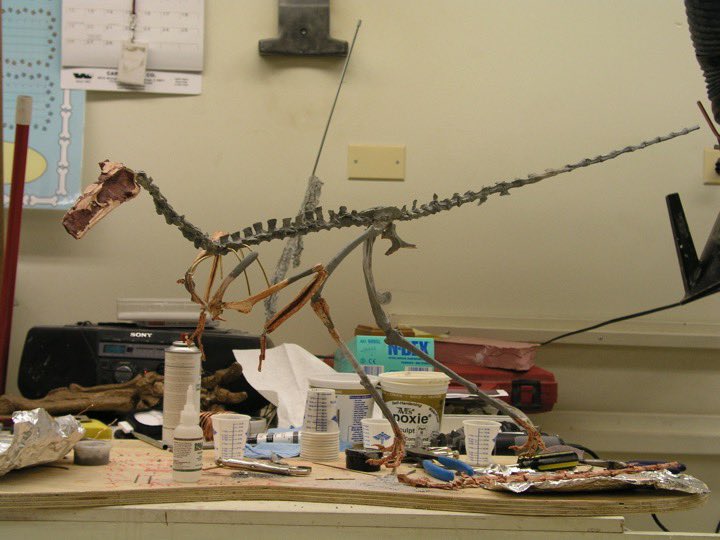
Fossils of Buitreraptor, a goose-sized dromaeosaur, were first collected in Patagonia, Argentina in 2004. The Field Museum’s Pete Makovicky was joined by Sebastián Apesteguia and Federico Agnolín in describing the new dinosaur the following year. Buitreraptor is notable for being the oldest known South American dromaeosaur (about 98 million years old), and for being one of the most completely known unlagiine dromaeosaurs—bizarre creatures with exceptionally long and narrow snouts. The holotype specimen was prepared at FMNH before being returned to the Museo Provincial de Cipolletti Carlos Ameghino in Río Negro, Argentina.

The Evolving Planet team did not originally intend to include Buitreraptor, but as the exhibition neared completion it was noted that the bird evolution display—which only featured Deinonychus and a pair of small models—looked a little sparse. With most of the hall already installed and the opening just months away, preparators Connie Van Beek, Matthew Aaron Brown, and Jim Holstein were tapped to create a mounted cast of Buitreraptor. The preparators first built a prototype by wiring together available casts of the original fossils. They then moved on to the final version, which involved reconstructing the missing extremities (arms, feet, and ribs) and creating a “re-inflated” version of the specimen’s crushed skull. The entire project was completed in less than two months.
Patagotitan mayorum (MPEF 2400 and others)

In 2017, plans took shape to reimagine Stanley Field Hall, as has happened several times since the current FMNH building opened in 1921. Part of the plan was to relocate SUE to a dedicated gallery in Evolving Planet, but what could take the place of the star T. rex? The museum found their answer in Patagotitan, a recently discovered titanosaur that is a contender for the world’s largest dinosaur.
Patagotitan mayorum was discovered on the Mayo family farm near La Flecha, Argentina in 2010. Between 2012 and 2014, Diego Pol and colleagues at the Museo Paleontológico Egidio Feruglio (MEF) excavated the find, which turned out to be a bone bed of six individuals. The new genus and species was named and published in 2018.
The FMNH cast is actually the second Patagotitan display in the United States. In 2015 (before the animal had a name), the American Museum of Natural History commissioned RCI to create a cast for the Wallach Orientation Center, part of the loop of fossil halls on the New York museum’s 4th floor. By placing Patagotitan in a relatively small space, the AMNH designers emphasized the sauropod’s great size. Standing in a slightly crouched pose with its head extending into an adjacent hall, the mount overwhelms the space.

In contrast, the FMNH Patagotitan—nicknamed Máximo—has room to spread out. In the half-acre, four story expanse of Stanley Field Hall, visitors can stand at a reasonable distance and take in the 122-foot skeleton all at once. They can also look Máximo in the eye socket from the upper level balcony. Rather than work with RCI on the project, FMNH commissioned the mount from MEF directly. It was designed and built in Trelew, Argentina, and shipped to Chicago via cargo ship. The installation took four days in May 2018. The process didn’t go entirely without a hitch—under the skylight in Stanley Field Hall, the original paint job on the cast bones looked like raw meat. But even with the need for an emergency repaint of the entire skeleton, Máximo was completed on time and has been greeting FMNH visitors ever since.
Spinosaurus aegyptiacus (FSAC-KK-11888)

The Field Museum’s newest dinosaur debuted just two weeks ago as of this writing (and is, in fact, why I’ve been sitting on this post for months). Postdoctoral researcher Matteo Fabbri approached the Exhibitions department in Fall 2022 with the prospect of acquiring a Spinosaurus cast. Less than a year later, that cast has joined Patagotitan in Stanley Field Hall, suspended twelve feet off the floor in a swimming pose.
Thanks to its dragon-like shape and star turn in Jurassic Park III, Spinosaurus is a very popular dinosaur, but until recently it has been quite poorly known. The 1912 holotype specimen—consisting of a partial jaw, several dorsal vertebrae, and a few other odds and ends—was inadvertently destroyed in the bombing of Munich during World War II. It wasn’t until 2008 that another skeleton was found in southern Morocco. The new specimen revealed that Spinosaurus was even weirder than previously thought: not only did it have an elongated, crocodile-like skull and a sail on its back, it also had a long body, short legs, and a newt-like tail fin.

Very few Spinosaurus casts have ever been displayed. One was made for the retired Spinosaurus: Lost Giant of the Cretaceous traveling exhibit. Another appeared in last year’s The Big Eight: Dinosaur Revelation in Hong Kong. But as far as I can tell, the only other permanent Spinosaurus skeleton on display is at Japan’s Kitakyushu Museum of Natural History. That makes the FMNH cast the only mount of its kind in the western hemisphere.
It’s also the most up-to-date Spinosaurus on display. As part of the team that has been studying Spinosaurus for the last 15 years, Fabbri ensured that cervical vertebrae collected at the original discovery site just six months ago were incorporated into the mount. All told, about 50% of the skeleton is cast from the Morocco specimen, while the rest is reconstructed.
Like Máximo, the Spinosaurus was built overseas. Simone Maganuco and colleagues constructed the skeleton in Italy, then traveled with it to Chicago to help with the installation. The lightweight cast—which only weighs 700 pounds—was hanging in its permanent position after just ten hours of work.
Press coverage of the installation (with appearances from a certain overenthusiastic nerd) can be seen here and here.
References
Brochu, C.A. 2003. Osteology of Tyrannosaurus rex: Insights from a nearly complete skeleton and high-resolution computed tomographic analysis of the skull. Journal of Vertebrate Paleontology 22:1–138.
Curry Rogers, K., Forster, C.A. 2001. The last of the dinosaur titans: a new sauropod from Madagascar. Nature 412:6746:530–534.
Hammer, W.R. and Hickerson, W.J. 1994. A Crested Theropod Dinosaur from Antarctica. Science 264: 828–830.
Grande, L. 2017. Curators: Behind the Scenes of Natural History Museums. Chicago, IL: University of Chicago Press.
Ibrahim, N., Maganuco, S., Dal Sasso, C., Fabbri, M., Auditore, M., Binedellini, G., Martill, D.M., Zourhi, S., Matterelli, D., Unwin, D.M., Wiemann, J., Bonadonna, D., Amane, A., Jakubczak, J., Joger, U., Lauder, G.V., and Pierce, S.E. 2020. Tail-propelled aquatic locomotion in a theropod dinosaur. Nature 581(7806):1–4.
Makovicky, P.J., Apesteguía, S., and Agnolín, F.L. 2005. The earliest dromaeosaurid theropod from South America. Nature 437: 1007–1011.
Smith, N.D., Makovicky, P.J., Hammer, W.R., and Currie, P.J. 2007. Osteology of Cryolophosaurus ellioti from the Early Jurassic of Antarctica and implications for early theropod evolution. Zoological Journal of the Linnean Society 151: 377–421.


 EXTINCT MONSTERS
Nice!