Monthly Archives: March 2013

Another JP4 Feathers Post

Okay, I’ll bite.

A week ago, Jurassic Park 4 director Colin Treverrow tweeted two words and a hashtag that set the corners of the internet I hang out in aflame for days afterward. The dinosaurs in the upcoming third sequel will not have feathers, in defiance of the twenty years of irrefutable fossil evidence that has come to light since the original film’s 1993 release. Reactions to this news demonstrate a clear divide among dinosaur enthusiasts: there are those who hate the idea of scientifically inaccurate dinosaurs appearing in mass media, and those who are enamored with the “classic” dinosaurs of their youth, and vocally resist any change. And in this case, I don’t really agree with either.

The problem is that dinosaurs straddle two different roles in our culture. There is the scientific reality of their existence, informed by careful scrutiny of hard evidence. Brilliant researchers collect and interpret fossils, broadening our understanding of not only the lives of dinosaurs, but how life on earth evolves and adapts to change in general. As a science educator, this is the perspective on dinosaurs I am usually invested in.

But dinosaurs also have what John Conway calls “awesomebro” appeal. From this angle, dinosaurs are appealing because they are monsters with big teeth and are generally super cool. This is coupled with an innate association of dinosaurs with early childhood that people are remarkably protective of. For example, on Brian Switek’s 10 Dinosaur Myths that Need to Go Extinct article for Tor Publishing, commenter Alan B. declares “I don’t care what anyone says, the dinos we learned about when I was in grade school were awesome! And given a choice between factual and awesome, I will choose awesome every time!” Clearly there is a a bit of tongue-in-cheek humor at play here, but comments like this appear virtually anywhere feathered dinosaurs are discussed. Many people genuinely care about their “classic” dinosaurs, and react negatively to new discoveries that threaten the dinosaur paradigm they associate with childhood bliss.

As Conway points out, the typical reaction of anyone with a vested interest actual scientific paleontology is to reject and belittle pop-culture dinosaurs whenever possible. Unfortunately, this we’re-right-and-you’re-wrong approach veers into deficit model territory, and doesn’t seem to accomplish much other than make the rift among dinosaur enthusiasts more antagonistic. It makes our audience of potential learners defensive, even angry, that scientists are “ruining” dinosaurs. And focusing conversations on the fact that popular conceptions of dinosaurs are wrong removes focus from the real benefits of researching past life.

I think it would be more helpful to recognize the validity and significance of pop-culture dinosaurs, but to work towards separating them in the public consciousness from real dinosaurs. A potential conversation: You think the Jurassic Park Raptors are cool? Great, so do I, but I think they’re cool in the way other movie monsters like the Predator or the T-1000 are cool. But perhaps you’d be interested in learning about the real animal Velociraptor mongoliensis that the movie Raptors were inspired by? My point is, the widespread appreciation/nostalgia for pop-culture dinosaurs (or fantasy dinosaurs, or classic dinosaurs, or awesomebro dinosaurs, whatever you want to call them) is potentially valuable, but I think it often gets dismissed too gruffly. If would-be educators are outright dismissing what their audience is bringing to the conversation, that audience has little incentive to learn more.

3 Comments

Filed under dinosaurs, education, movies, opinion, reptiles, science communication

Fossil mounts in the museum environment

Sue and Stan reconstructions from Scott Hartman's DeviantArt page.

Sue and Stan reconstructions from Scott Hartman’s DeviantArt page.

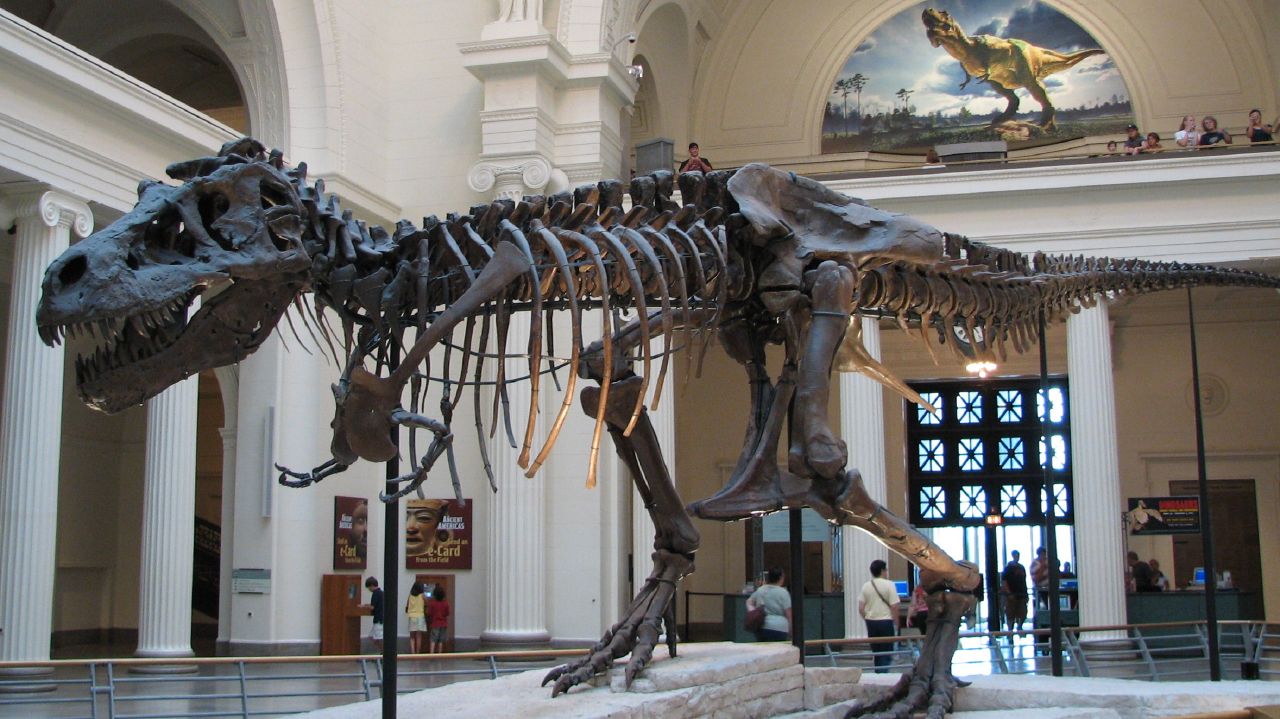
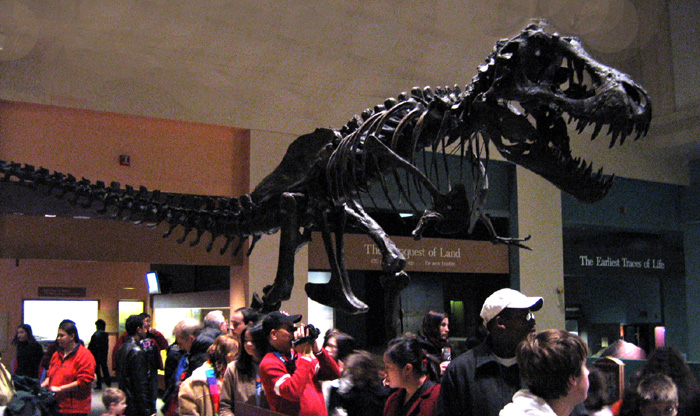
Scott Hartman posted the above image to his DeviantArt page the other day, comparing the Tyrannosaurus specimens Sue and Stan side by side. For those unfamiliar, Hartman is known for his rigorously measured skeletal diagrams of dinosaurs (and sometimes other animals) that are crucial references for many artists and paleontologists. I’m always impressed by Hartman’s work, but this new comparative image really floored me. I knew that Sue is the largest and most complete rex yet found, but I had never properly appreciated what a monster she is. I’ve seen the mounted Sue skeleton at the Field Museum several times, and I’ve seen at least four casts of Stan in various locations, but I never realized what a significant size disparity exists between the two.

Tyrannosaurus Sue at the Field Museum of Natural History.

Tyrannosaurus Sue at the Field Museum of Natural History.

Tyrannosaurus Stan at the National Museum of Natural History.

Tyrannosaurus Stan at the National Museum of Natural History.

It’s not a groundbreaking discovery by any means, but I’m struck by how important the museum environment is when exhibiting a mounted skeleton. I mentioned yesterday that exhibits are never neutral, and this is a particularly clear example. Sue is exhibited in the gigantic central hall of the Field Museum, and in this open, grandiose environment, her size is actually deemphasized. By comparison, the presence of the Stan mount at the National Museum of Natural History was not anticipated during the 1981 renovation of the dinosaur hall (it was added in 2001, I believe) and is sort of crammed into a corner. In the cramped space, Stan looks pretty big, and it’s little wonder I had never appreciated the marked difference in size between the two mounts.

The takeaway, I guess, is that it would do us well to pay careful attention to the design choices (or constraints) in a museum exhibit. We’d like to think that a rare and important specimen like a Tyrannosaurus skeleton speaks for itself, but visitor impressions of even these fossils are shaped by the context they are placed in.

Leave a comment

Filed under dinosaurs, fossil mounts, museums, NMNH, paleoart

Drama and natural history

While running errands this morning a thought came to me: a natural history exhibit in a museum is a lot like a stage performance*. When watching a play, the viewer knows she is seeing a performance, but it willing to suspend disbelief so long as the fantasy is well-created. To varying degrees, most modern natural history exhibits engage in the same theatrical relationship with their audiences. Exhibits re-create reality within the museum environment, and visitors accept the performance as truth.

*Actually, I thought “movie” first, but theater is a better analogy because the actors are real and present.

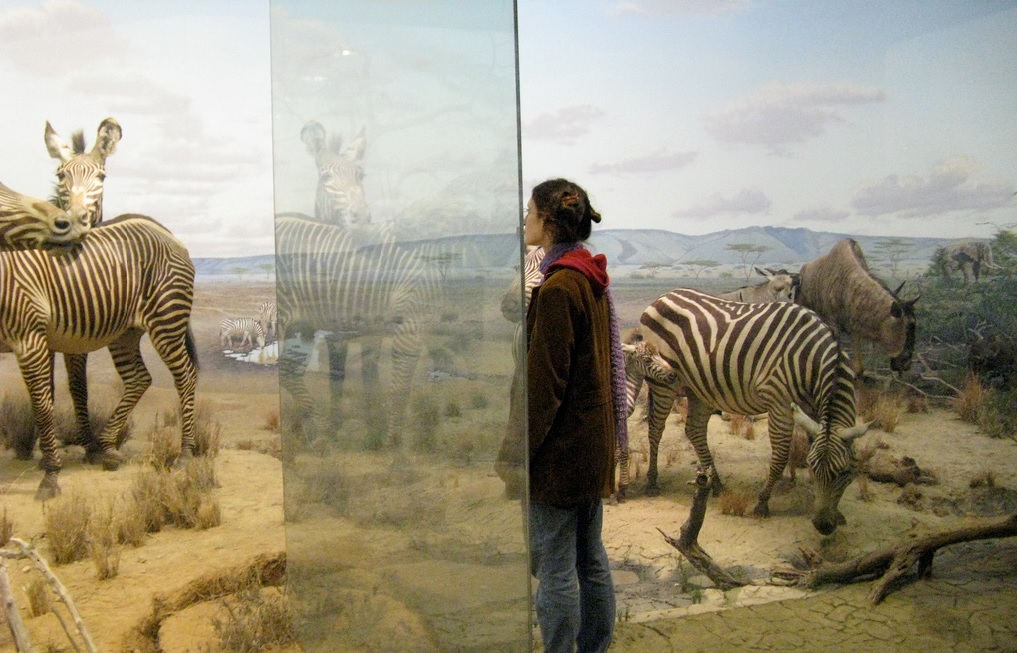
CMNH zebra diorama. Source: amyboemig on flickr.

A rather poignant picture of the CMNH zebra diorama. Source: amyboemig on flickr.

Habitat dioramas featuring taxidermied animals are the most obvious example. Dioramas like the lovely east African savannah scene at the Carnegie Museum of Natural History pictured above are exactingly detailed microcosms modeled after actual environments. The backdrops are typically  based on photographs of real locations. The teams that collected the animal skins would also take samples of leaves and even molds of tree bark, in order to exhibit the ecosystem in toto. And of course, the mannequins on which the animal skins are mounted were sculpted by artists with a strong foundation in anatomical science. And yet, the diorama is clearly not real. Visitors know that they are not looking at an actual game reserve that has been somehow frozen in time. Many viewers might mistake the animals as being “stuffed” (they are in fact sculptures with tanned skins fitted onto them), but  they still recognize some element of artifice.  The animals clearly didn’t end up in the glass-enclosed box on their own accord. And yet, visitors accept the illusion, because they keep coming to museums to learn about the world around us.

The same holds true for most other displays. These dioramas at the New York State Museum are not literally historic Iroquois villages shrunk down to 1/20 scale. The Tyrannosaurus and Triceratops pictured below are not really fighting, nor did they die in a death struggle. Even the Apple Store-eque NMNH Hall of Mammals recreates natural behaviors against a sterile backdrop. Unless the museum is displaying completely decontextualized specimens lying prone on a shelf, there is some degree of theatricality in the exhibit.

Tyrannosaurus and Triceratops at the Children’s Museum of Indianapolis. Source.

The theater analogy begins to go astray, however, when we consider that the performances in natural history exhibits are informed by reality. For the most part, exhibit designers do not place specimens in completely fictitious scenarios; the theatrical element serves to illustrate something real. Perhaps exhibits are more akin to a movie “based on a true story.” But like those movies, there is an undeniable selectivity in how museum workers tell their stories.  Why are the zebra in the CMNH diorama chilling amicably with wildebeest? That is certainly something that real zebra have been known to do, but zebra have also been known to drown lions, trample foals and chew on the cars of obnoxious tourists. For that matter, why does this diorama not include any sign of human pastoralists, who have lived in the same environment as these animals for thousands of years?

Exhibits have human authorship, just like any other document. The manner in which any specimen or object is displayed is inherently subjective, and there will always be emphasis and omissions, intentional or otherwise, that change the way the exhibit is interpreted. Before you misjudge me, dear reader, this is not an argument that there is no objective reality. I wouldn’t even say that it is impossible to understand and perceive objective reality. Scientists do it all the time. But when it comes time to communicate that information, we are creating something new, and choosing what we incorporate and how we express it. Getting back to my original point, we’re putting on a representational show. And that means that what we’re creating only works as long as our audience is willing to participate in the performance.


Leave a comment

Filed under anthropology, fossil mounts, mammals, museums, science communication

A Visit to the Academy of Natural Sciences

I spent yesterday in Philadelphia, my first visit in at least 10 years, and of course made a point of visiting the Academy of Natural Sciences. Founded in 1812, the Academy is the oldest natural science research institution and museum in North America, established “for the encouragement and cultivation of the sciences, and the advancement of useful learning.” Initially formed as a hub for research on the American frontier, the Academy has sponsored scientific expeditions across the world and has amassed a collection of 17 million specimens that is still actively used 200 years after its founding.

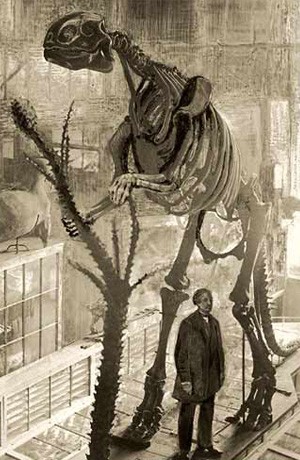
In 1868, the Academy museum made a landmark contribution to paleontology by hosting the first mounted dinosaur skeleton ever constructed. The mount, the work of paleontologist Joseph Leidy and sculptor Benjamin Waterhouse Hawkins, depicted Hadrosaurus foulki, the first dinosaur discovered in North America and at the time the most complete dinosaur ever found. With only two limbs, a section of the spinal column and some other odds and ends to work with, Hawkins invented many of the mounting techniques that are still in use today. For instance, Hawkins created mirrored duplicates of the left limb bones for use on the animal’s right side, and reconstructed best-guess stand-ins for the skull, scapulae and most of the vertebrae using extant animals as reference. By modern standards, the Leidy-Hawkins Hadrosaurus mount wasn’t especially accurate (the sculpted scapulae and vertebrae resemble those of a mammal, not a reptile; the skull, based on that of an iguana, turned out to be completely off the mark; the fully upright, kangaroo-like posture is now known to be anatomically implausible), but it nevertheless presented the first-ever opportunity to stand in the presence of a dinosaur. Extinct animals were already known to the public, and some had even been mounted, but the Hadrosaurus was so bizarre,  so utterly unlike anything alive today, that it really opened people’s eyes to the unexplored depths of the Earth’s primordial history.

Original 1868 Hadrosaurus mount.

Original 1868 Hadrosaurus mount.

The Hadrosaurus display caused public visitation to skyrocket, prompting the Academy to relocate in 1876 to a larger building in central Philadelphia, where it remains today. I haven’t been able to find any photographs or detailed information about it, but for much of the 20th century the Academy had a fossil exhibit with a Corythosaurus mount as its centerpiece. This was replaced in 1986 with an expanded “Discovering Dinosaurs” exhibit, which apparently was among the first to showcase the discoveries of the dinosaur renaissance. This exhibit has just about zero web presence, as well (seriously, any help tracking down details about it would be greatly appreciated). The current version of the Dinosaur Hall opened in 1998, and is what I will discuss below.

This cast of the AMNH Tyrannosaurus is the centerpiece of the Dinosaur gallery. Source: Wikipedia Commons.

What’s Cool

Although crammed into a fairly small space, the Academy’s two-level Dinosaur Hall is packed with mounts of North American fossil reptiles, including Tyrannosaurus, Chasmosaurus, Deinonychus, Tylosaurus, Pachycephalosaurus and many more. Compared to the sterile and coldly scientific displays at larger museums like the American Museum of Natural History, the Academy’s exhibit designers clearly put an emphasis on accessibility, particularly for younger visitors. Signs are attractive, colorful and use simple language, but do not sacrifice scientific accuracy. Although “Do Not Touch” notices abound, guardrails are low and allow visitors to view the mounts up close. Even the fossil prep lab, a staple in paleontology exhibits, is not behind glass but is separated from visitors by a low wall, allowing guests to converse freely with the preparators if they so choose (This might not be so fun for the preparators; I’ve worked in a couple of these labs and I’ll be the first to admit that our conversations are not always for public ears).

The Academy’s Dinosaur Hall is also filled with interactive activities. I question the educational value of a green-screen that places visitors into a scene with dinosaurs running around (the last thing we need is to encourage more people to think humans and dinosaurs coexisted), but many of the other interactives are quite inspired. In one corner, children are encouraged to climb inside a Tyrannosaurus skull cast to find evidence for its diet and lifestyle. Crouching between its jaws, kids find partially-erupted teeth, evidence that the predator broke and regrew teeth throughout its life. My favorite interactive, however, featured parallel rows of theropod and crocodile footprints on the floor. Visitors were directed to walk down each trackway, comparing how it felt different to move with an upright or sprawling gait. At the end, a sign explained that it’s harder, and less energy efficient, to move like a crocodile. I loved this activity because it was simple (just images on the floor, no technology required) and yet conveyed a clear explanation of biomechanics. Visitors use their own bodies to reach the conclusion, finding the answer in a tactile and experiential way that is more memorable than just being told that a sprawling posture is inefficient.

Overall, the Dinosaur Hall is a great overview of dinosaur science. It focuses on the biology of dinosaurs, emphasizing their similarity to animals we know today, and how scientists can draw conclusions about past life by studying the modern world. This content is communicated in a way that is clear and engaging for visitors of all ages, making this exhibit a good example of the old adage that all good science can be explained in simple terms. When I visited, there were a couple children using the open exhibits like a playground, but for the most part I think this highly accessible dinosaur exhibit is quite successful.

What’s Not So Cool

The Academy’s Dinosaur Hall is 15 years old, and is in some places showing its age. Some of the exhibit content is not entirely up-to-date; for instance, a display on the relationship between birds and dinosaurs leaves the question completely open ended. I also saw at least two invalid names, “Majungatholus” and “Ultrasauros”, used on labels. Probably more obvious to most visitors is the general wear and tear visible in certain parts of the exhibit. Some labels, particularly those facing large windows, are badly faded. The Elasmosaurus mount was moved from the Dinosaur Hall proper to the entrance lobby at some point, but Elasmosaurus signage, now labeling an empty space, is still in place in the exhibit. I got the impression that the Academy, like much of Philadelphia, is hurting for funding.

Corythosaurus and Chasmosaurus mounts. Source: TravelMuse.

The story of Leidy’s Hadrosaurus appears in several places throughout the museum. Casts of the original fossil material are displayed over a silhouette of the dinosaur toward the back of the Dinosaur Hall. Elsewhere , there is a new full casted mount of Hadrosaurus (signs explain that it is filled in with Maiasaura material), and the original tibia is displayed as part of a rather cool 200th Anniversary special exhibit. At the time, I wished that these displays were consolidated in one place, since the Hadrosaurus story is an important chapter in the history of science and of museums that can be seen exclusively at the Academy. I later found out that in 2008, the Academy had a major temporary exhibit commemorating the 150th anniversary of the original Hadrosaurus mount, which featured, among other things, a recreation of the victorian-era exhibit and the workshop of Benjamin Waterhouse Hawkins (great videos and interviews about the exhibit here). I wish I had been able to see that, because it blends the scientific, cultural and historic value of fossil mounts in a way that only this museum can.

The sadly closed Hadrosaurus Anniversary exhibit. Note Hawkins’ original sculpted head on the red pillow. Source: The Art Blog.

The current centerpiece of the Dinosaur Hall is a cast of the AMNH Tyrannosaurus. It’s neat, but I imagine most visitors would be more enthused to see the real one just a couple hours down the road. Indeed, most of the dinosaurs on display at the Academy are casts from other institutions. I have no problem with displaying casts, but I can’t help but feel that this generalized dinosaur exhibit is underselling the Academy’s own fossil collections, not to mention its contributions to paleontology. Should the Academy renovate this space again, I’d love to see the institutions’ unique history play a more prominent role, as well as the work that Academy-affiliated researchers are doing today.

Leave a comment

Filed under collections, dinosaurs, exhibits, fossil mounts, history of science, museums, ornithopods, reptiles, reviews, science communication