Monthly Archives: December 2013

Review: Ultimate Dinosaurs at the Cincinnati Museum Center

Ultimate Dinosaurs: Giants from Gondwana premiered in June 2012 with considerable fanfare at the Royal Ontario Museum (ROM) in Toronto. Developed by a ROM team led by David Evans and Matthew Vavrek, Ultimate Dinosaurs showcased the dinosaurs of the southern hemisphere, demonstrating how geographic isolation created Mesozoic ecosystems remarkably different from the menageries we are used to seeing in North American museum displays. The exhibit included 20 dinosaur mounts in all, including many taxa never before seen in museums above the equator.

I never made it to the inaugural showing of Ultimate Dinosaurs, but fortunately the show is now on the road. I saw it at the Cincinnati Museum Center (CMC) earlier this week, where it will remain through January 5th before moving on to Minneapolis. The exhibit assuredly does not disappoint…read on for many pictures and my musings on the design.

DPP_0001

The first room features Triassic and early Jurassic archosaurs.

Huge banners displayed outside the CMC and in the main lobby are impossible to miss, but the Ultimate Dinosaurs exhibit itself is hidden away on the lower level, with the entrance at the end of a quiet corridor. Aside from a video screen showing a shifting map of Gondwana, no proper introduction is provided. Visitors immediately find themselves in the first large room of fossil mounts, featuring Triassic and early Jurassic archosaurs like Herrerasaurus, Eoraptor, Cryolophosaurus and the rauisuchian Prestosuchus. This first batch of mounts is lined up on an elevated platform that runs along the right side of the room. Like all the mounts in Ultimate Dinosaurs, these are casts, and are plainly assembled in “chunks”: numerous bone elements casted together as single pieces. While these shortcuts are obvious up close, this mode of construction does allow for remarkably dynamic poses, and there is no obstructive armature to block one’s view. Behind the dinosaurs is the first of several gorgeous Julius Csotonyi murals, a lively panorama of life reconstructions in a naturalistic setting.

In front of every mount is an array of attractive signs in bright, solid colors. Information is mostly provided in short sound bites or bullet points, highlighting sensible information like the animal’s diet, the meaning of its name, where it was discovered, and why it is scientifically noteworthy. There is also at least one touchscreen in front of each mount, which includes several more pages of information for the more dedicated visitor. I really liked the similar touchscreen displays at the Carnegie Museum, and these are equally impressive. This is technology used intelligently, contributing to but not overwhelming the primary display, while using space in an economical way. I was also impressed by the succinctness of the text. It is very difficult to condense information into short blurbs that visitors can absorb with no more than a quick glance, but the Ultimate Dinosaurs writers balanced accuracy, intrigue and brevity on every single sign. Hats off to them!
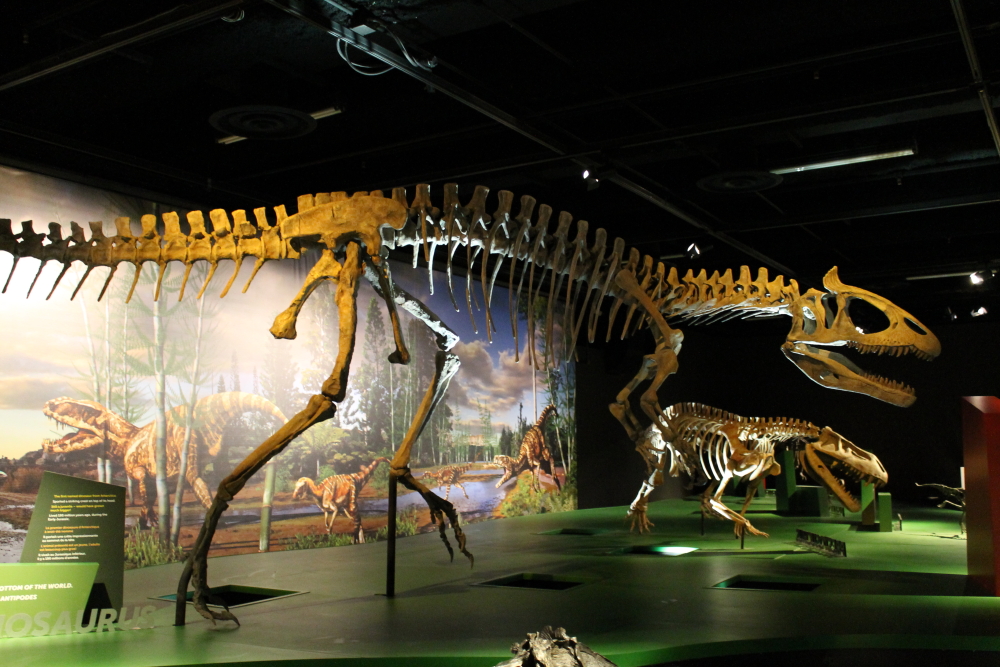
Visitors were having a hell of a time pronouncing Cryolophosaurus.

Visitors were having a hell of a time pronouncing Cryolophosaurus.

Turning left at the Massospondylus at the far end of the first room, visitors enter a long and largely empty corridor. The left wall is adorned with a series of signs explaining the historical discovery of and evidence for continental drift, and herein lies my primary concern with the exhibit as a whole. The story being told in Ultimate Dinosaurs, regarding plate tectonics and its effect on evolution, is an important one. Paleobiogeography is key to understanding how the natural world we know today came to be. What’s more, it’s a great example of science in action, consisting of a handful of intuitive, evidence-based concepts that can be applied to new situations and clarify new discoveries.  As such, paleobiogeography ought to frame the entire exhibit. I would have placed the big ideas and central questions (Why are similar organisms sometimes found on opposite sides of oceans? What happens when populations or ecosystems are isolated from one another?) at the beginning, and ensured that they were reinforced in every display with recurring terms, imagery and motifs. The paleobiogeography story should guide the visitor’s experience and understanding of the exhibit.

Instead, Ultimate Dinosaurs at the CMC relegates the big ideas to secluded corners and easily-missed signs. The text itself is very clear and well-written, and supported by attractive, intuitive graphics, but it’s hidden away and or otherwise overshadowed by lists of factoids about each dinosaur. My largely unsubstantiated suspicion is that the original designers of Ultimate Dinosaurs at the ROM intended for the paleobiogeography story to be much more explicit, but this vision was compromised somewhat in order to fit the exhibit into the space available at the CMC. The unfortunate result is that the most critical information is introduced in an unorganized manner, and the exhibit is weaker for it.

Suchomimus peers in from the right, Amargasaurus and

Suchomimus peers in from the right, Malawisaurus in the middle, Argentina in back.

After passing through the switchbacking corridor, visitors reach the primary showroom. This is an enormous space filled with huge, impressive dinosaur mounts. Like the rest of the exhibit, this gallery is quite dark, with floor lights and the occasional overhead light highlighting the dinosaurs. The darkness helps to hide the unadorned walls and ceilings of the multipurpose space being used, but thankfully does not hinder one’s view of the dinosaurs. And the dinosaurs certainly do not disappoint. Even though they are casts, this exhibit was my first opportunity to see the likes of Armagasaurus, Suchomimus, Ouranosaurus and many others in person. I could walk around them, take in their scale and compare them to one another and to myself, experiences that no image or documentary can provide.

Majungasaurus and Rapetosaurus strike an extreme pose.

Majungasaurus and Rapetosaurus strike an extreme pose.

Most of the dinosaurs are in lively poses, as though the animal was frozen midstride, but a few are especially dynamic. Little Rahonavis is suspended from the ceiling, as though leaping for prey or perhaps engaging in a controlled glide to the forest floor. The Majungasaurus and Rapetosaurus, which are the only mounts directly interacting with one another, are particularly interesting. The attacking Majungasaurus has its foot up on the flank of the Rapetosaurus, and the sauropod is in a rather unusual squatting pose, with its forelimbs at what appears to be maximum flexion. I will leave it to the experts to decide whether this extreme pose is plausible, but this nevertheless serves as a reminder of what can be learned by assembling a skeleton in three-dimensional space.

Carnotaurus

Carnotaurus and Amargasaurus.

The mounts are clustered on three islands, representing Argentina, Madagascar and Niger. I do wish this organization had been made clearer to visitors, perhaps with large banners over the islands naming the dinosaurs’ location of origin. Clustered at the feet of the mounts are small cases containing a mix of original and casted fossils. Some of those are quite relevant and provide further context to the mounts: for instance, a collection of North African fossil fish near the Suchomimus illustrate the spinosaur’s probable diet. Other cases are a bit more perplexing. A series of cervical vertebrae from the North American sauropod Suuwassea is arbitrarily situated among the Madagascar mounts, and cases of cephalopods and Carboniferous plants are similarly out of place. Most of these oddball fossil displays did not come from the ROM, but were added by the CMC from their own collections. Although these fossils are fascinating and should absolutely be on display, I don’t think randomly interjecting them among the Gondwanan dinosaurs was the way to go. These displays interrupt the primary storyline and probably should have been placed elsewhere.

CWC addition

These additions from the CMC are neat, but a bit out of place.

The final room showcases the exhibit’s two largest mounts, Tyrannosaurus and Giganotosaurus. It is undeniably exciting to see these two giant predators side by side, and compare how these ostensibly similar carnivores were nevertheless subtly adapted to tackle different prey. I would have made this point more obvious than the exhibit does, but I suppose sometimes you need to step back and let your specimens speak for themselves.

This room also features the much-ballyhooed “augmented reality” gimmick. These are tablet-sized screens found alongside the mounts. When you point these at the Tyrannosaurus and Giganotosaurus skeletons, a CG version of dinosaur appears on the screen. Panning and tilting the tablet in front of the mount causes your view of the CG version to adjust accordingly. I found these sort of interesting, but they were not nearly as impressive as the mounts themselves. Unfortunately, the CG dinosaurs simply didn’t look very good. I am all for the use of technology in museum exhibits, but only if it plays to our strengths. In this case, the CG dinosaurs are directly and unfavorably comparable to a wide range of films and television shows that people can see without leaving home. As hubs for lifetime learning, museums can and should offer more than that.
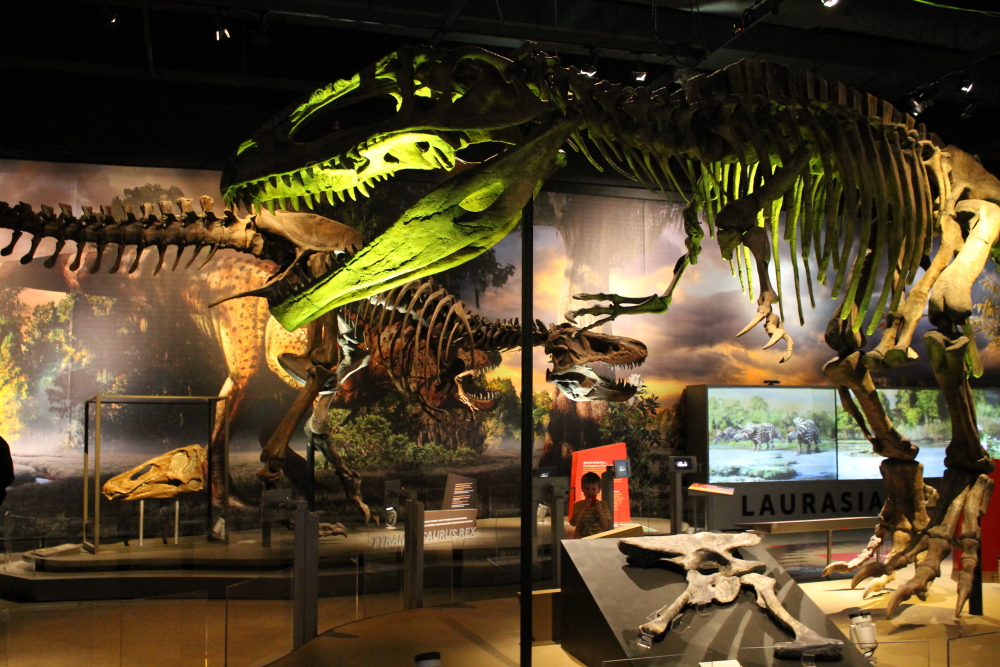
Tyrannosaurus and Giganotosaurus side by side. Eat it up, internet.

Tyrannosaurus and Giganotosaurus side by side. Eat it up, internet.

Despite my nitpicks, Ultimate Dinosaurs really does live up to its name. This is a very handsomely designed exhibit, and an great opportunity to see mounts of exotic dinosaur taxa. If you are at all interested in paleontology, catching this exhibit is a no-brainer. But even if you’re not, this is a rare chance to see what the vertebrate fossil record has to offer beyond T. rex and Triceratops, and learn a bit about how our world came to be.

Edit: I had mistakenly said the murals were created by Raul Martin. They are the work of Julius Csotonyi.
7 Comments

Filed under dinosaurs, exhibits, fossil mounts, museums, ornithopods, reptiles, reviews, sauropods, theropods

Juan Bautista Bru and the First Fossil Mount

The first fossils ever assembled into a freestanding mount belonged to the giant ground sloth Megatherium. The fossils, which were unearthed near Luján in what is now Argentina, were described and mounted in 1795 by Juan Bautista Bru at the Royal Cabinet of Natural History in Madrid. But while the Megatherium mount played an important part in the history of paleontology and in our understanding of the changing Earth, the man who made it possible is scarcely mentioned in the literature. Instead, Bru’s work on Megatherium is typically overshadowed by the involvement of the much better known anatomist Georges Cuvier. Drawing principally from José López Piñero ‘s 1988 paper on Bru, this entry is intended to highlight and acknowledge Bru’s contribution to the practice of mounting fossils for public display.

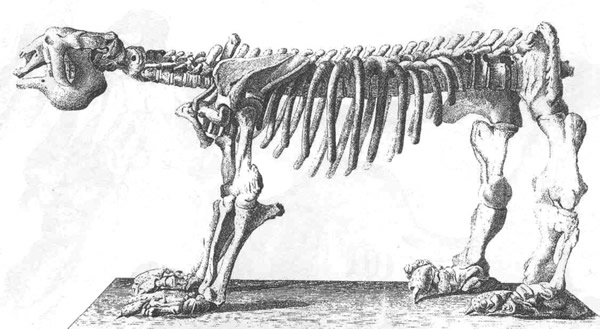
Cuvier's adaptation of Bru's drawing.

Cuvier’s adaptation of Bru’s illustration of the Megatherium mount.

The Megatherium  in question was discovered  in 1789 in what was then the Viceroyalty of Rio de la Plata, on the banks of the Luján River, “a league and a half” from the town of the same name. As region was controlled by the Spanish monarchy at the time (although the Argentine War of Independence was not far off), it was standard procedure for viceroy Marqués de Lorento to ship the important find to Spain with all haste. Packed into seven crates, the nearly complete skeleton was delivered to the Royal Cabinet of Natural History in Madrid, which curated natural specimens from Spanish territories and was among the most respected scientific institutions in Europe.

By the late 1700s, the European Enlightenment was well established, and the pursuit of knowledge about the world through reason and scientific deduction rather than legend or dogma was popular among the societal elite. The study of natural history was deemed particularly important, and institutions like the Royal Cabinet which collected, quantified and published knowledge about the natural world were well-respected and well-funded. However, the meaning of the fossil record still eluded the top minds of the era. A century earlier, Nicolaus Steno had determined that fossils were the remains of once-living organisms, and by the late 1700s some naturalists were starting to come around to the idea that species that once existed had become extinct. Nevertheless, when the Megatherium arrived in Madrid, naturalists still lacked the most important part of the puzzle presented by the fossil record: an understanding of evolution and the interrelatedness of life on Earth.

The task of interpreting the Luján fossils went to Juan Bautista Bru, the “Artist and First Dissector” at the Royal Cabinet. Born in Valencia, Bru had initially tried his hand as a traditional artist, but found little success. After shifting his focus to natural science, Bru joined the Royal Cabinet in 1771 and remained there until his death in 1799. Bru primarily served as a scientific illustrator, combining his artistic skill with his extensive anatomical knowledge to produce gorgeously detailed drawings of biological specimens, as was required before photography became commonplace. He was also responsible for producing taxidermy pieces and occasionally, mounted skeletons of animals.  In 1777, Bru prepared and mounted the skeleton of an elephant that had died at the royal estate in Aranjuez, a task which doubtlessly provided useful practice for mounting the gigantic Megatherium.

Plate from Bru's monograph

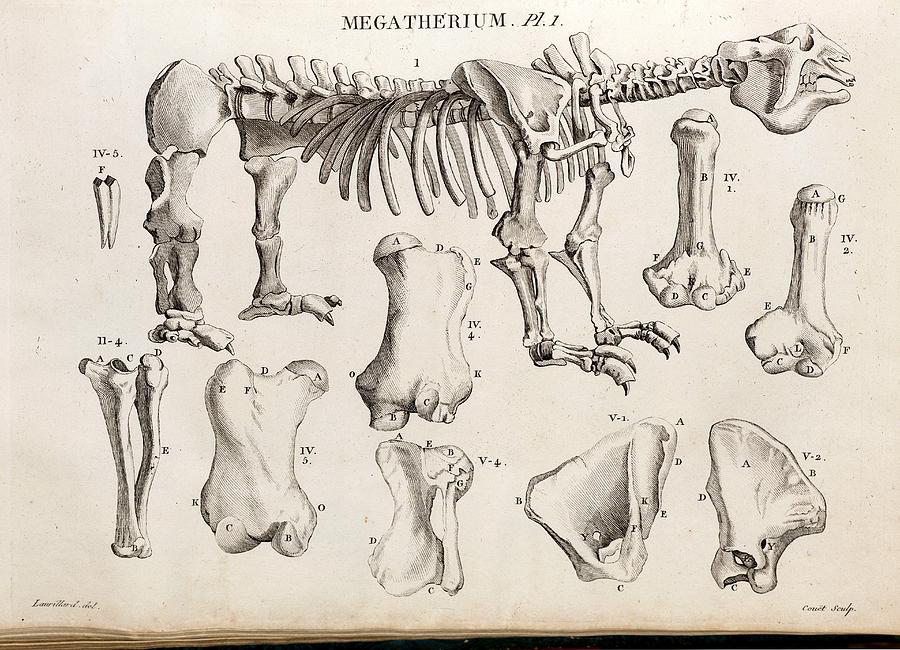
Plate I from Bru’s Megatherium monograph.

Bru devoted four years to studying the Luján fossils, which were complete except for the animal’s tail. He completed his monograph in 1793, which included detailed descriptions of every skeletal element, in addition to 22 plates illustrating the bones from various angles. Among the illustrations was the completely articulated skeleton shown above, which is, incidentally, the first recorded instance of a skeletal drawing illustrating the living form of an extinct animal. Since the mounted skeleton did not go on display until 1795, it is unclear whether Bru based the illustration on the mount or vice versa. Unfortunately, little is known about how Bru created the Megatherium mount, and his drawing provides no information about the armature that supported the massive bones. Since Bru did not discuss the mount’s construction in his monograph, one can only surmise that the techniques he refined over the years building mounts of modern animal skeletons were applicable to the fossils. Wooden armatures were used to mount fossils in the early 1800s, and it is plausible that Bru pioneered this technique. Regardless of how it was supported, the  rhino-sized Megatherium mount was placed on a rectangular wooden platform in a room of the Royal Cabinet already devoted to fossils and minerals.

It is unclear why, but Bru never published his monograph, and this unfortunately resulted in him effectively being scooped by Georges Cuvier in 1796. A representative of the French government working in Santa Domingo acquired a set of proofs of Bru’s monograph and illustration, and passed them along to the Institut de France. The proofs made their way to Cuvier, who was well established as one of the world’s leading experts in anatomy and natural history. Although he had not yet seen the actual fossils, Cuvier wrote a brief article in the journal Magasin Encyclopedique on the South American creature, in which he coined the rather vague name Megatherium americanum, meaning American giant beast. Cuvier’s article was not without error (he claimed the fossils were found in Paraguay), but he did correctly recognize that the animal was an edentate* and was curiously similar to modern tree sloths**. In contrast, Bru’s description of the fossils, while thorough, contained no attempt at classification.

As it happened, Cuvier published a second important article on fossil animals in 1796: his Mémoires sur les espèces d’éléphants vivants et fossiles, in which he established that the mammoth fossils found in the Americas belonged to an extinct relative of modern elephants. The wave of attention Cuvier received that year for his contributions to the young field of paleontology apparently eclipsed any recognition of Bru’s multi-year study of the Megatherium. Bru ended up selling his monograph and illustrations to a publisher, and a translated version eventually appeared in a widely disseminated booklet with Cuvier’s Megatherium article in 1804, five years after Bru’s death.

Megatherium would continue to be important to 19th century paleontologists. Charles Darwin became interested in South American fossils during the second voyage of the HMS Beagle. In particular, the relationship between the extinct ground sloths and their modern relatives contributed to Darwin’s ideas about the succession of species over geologic time. In 1849, the British Museum produced a Megatherium mount of their own, a composite of two skeletons found very near to where the Spanish specimen was first discovered. Plaster casts of this mount would appear in museums on both sides of the Atlantic, and the original cast is still on display in London today (some of the fossils were destroyed during World War II). But while the discovery of Megatherium would be recounted often over the subsequent two centuries, it was Cuvier, not Bru, who was always given credit for introducing the animal to the world. Only in recent years has Bru’s name begun to circulate again in historical accounts.

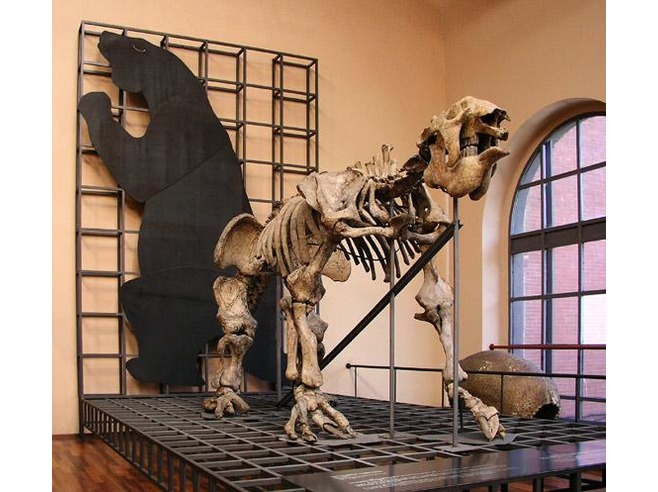
The original Megatherium fossils have been remounted at the Museo Nacional de Ciencias Naturales. Image from TripAdvisor.

The original Megatherium fossils have been remounted at the Museo Nacional de Ciencias Naturales. Image from Virtual Tourist.

However, there is a bit of happiness at the end of this story. Unlike other early mounts like Peale’s mastodon and Hydrarchos, Bru’s Megatherium has survived to the present day. Remounted on a new steel armature in an approximation of the original quadrupedal pose, the Luján Megatherium fossils are on display at the Royal Cabinet’s spiritual successor, the National Museum of Natural Science in Madrid. On public display for a nearly uninterrupted 218 years, this specimen can  surely be said to have taken on a second life. It was once a giant beast that roamed across the ancient Argentinian plains, and now it is a monument to scientific achievement.

*Edentata is a historic paraphyletic group that includes sloths, anteaters, pangolins and aardvarks. Modern biologists recognize that the new world sloths and anteaters and old world pangolins and aardvarks are not closely related. The name Xenarthra is now used for sloths and their new world relatives.

**Cuvier was working many decades before Charles Darwin published On the Origin of Species, and as such, did not subscribe to the idea that species could change and diversify over time. It is therefore worth noting that while he recognized the similarity between Megatherium and modern sloths, he did not conceive of their relationship in an evolutionary sense (that is, related species sharing a common ancestor). 

References

Argot, C. (2008). Changing Views in Paleontology:
The Story of a Giant (Megatherium, Xenarthra). Mammalian Evolutionary Morphology. Pp 37-50.

López Piñero , J.M. (1988). Juan Bautista Bru (1740-1799) and the Description of the Genus Megatherium. Journal of the History of Biology. 21:1:147-163.

1 Comment

Filed under fossil mounts, history of science, mammals, museums, paleoart