

The fleshed-out reconstruction of SUE is the show-stopping highlight of SUE: The T. rex Experience. Photo by Chris Schneider.
Start with Telling SUE’s story (part 1).
Just a few weeks after the new SUE gallery opened at the Field Museum, a smaller team was convened to create a new traveling exhibition about the famous Tyrannosaurus rex. The original traveling exhibit—A T. rex Named SUE—launched in 2000 and ran for more than fifteen years, touring all over North America, Europe, and Asia. But the components were getting worn out, some of the science was lukewarm, and the market for traveling dinosaur exhibits had gotten more competitive. Our task was to build a bigger, better SUE exhibit, using the assets we had just developed for the permanent gallery as a starting point.
Finding an angle
In the permanent SUE gallery, we could rely on the drawing power of the real skeleton of the most complete adult Tyrannosaurus ever found. The traveling exhibit, however, would have to use a cast. That meant we needed to put greater emphasis on storytelling, and as Exhibition Developer, storytelling was my responsibility. To figure out what kind of story we wanted to tell, we started by checking in on our peers. The American Museum of Natural History had just opened the temporary exhibit T. rex: The Ultimate Predator, so the design team and I traveled to New York to have a look.
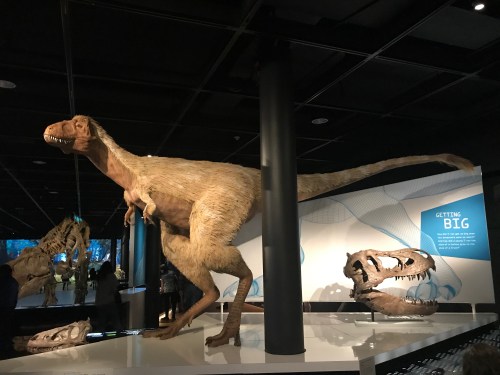
The visual language of T. rex the Ultimate Predator is stark, angular, and black-and-white. Photo by the author.
T. rex: The Ultimate Predator considers the evolutionary history of Tyrannosaurus rex. The exhibition is about the entire tyrannosaur family and explores how the traits that define T. rex gradually accumulated over a hundred million years. Because this story exists in the realm of cladograms and morphometric analyses, the design language is sparse, almost clinical. The life-sized models, fossils, and illustrations seem to float in a black-and-white void. This visual style pairs well with the story being told, and the team behind T. rex: The Ultimate Predator did some phenomenal work. However, it was clear that we wanted to go in a different direction.
We decided that our exhibit—now titled SUE: The T. rex Experience—would be about the relationship between the titular dinosaur and their environment. The Hell Creek Formation (the rock layer in which SUE was found) preserves one of the most well-studied ecosystems from the Age of Dinosaurs. That meant that we could reconstruct SUE’s life and times in detail, showcasing the world this famous predator lived in and giving visitors a sense of what it was like to be a T. rex.
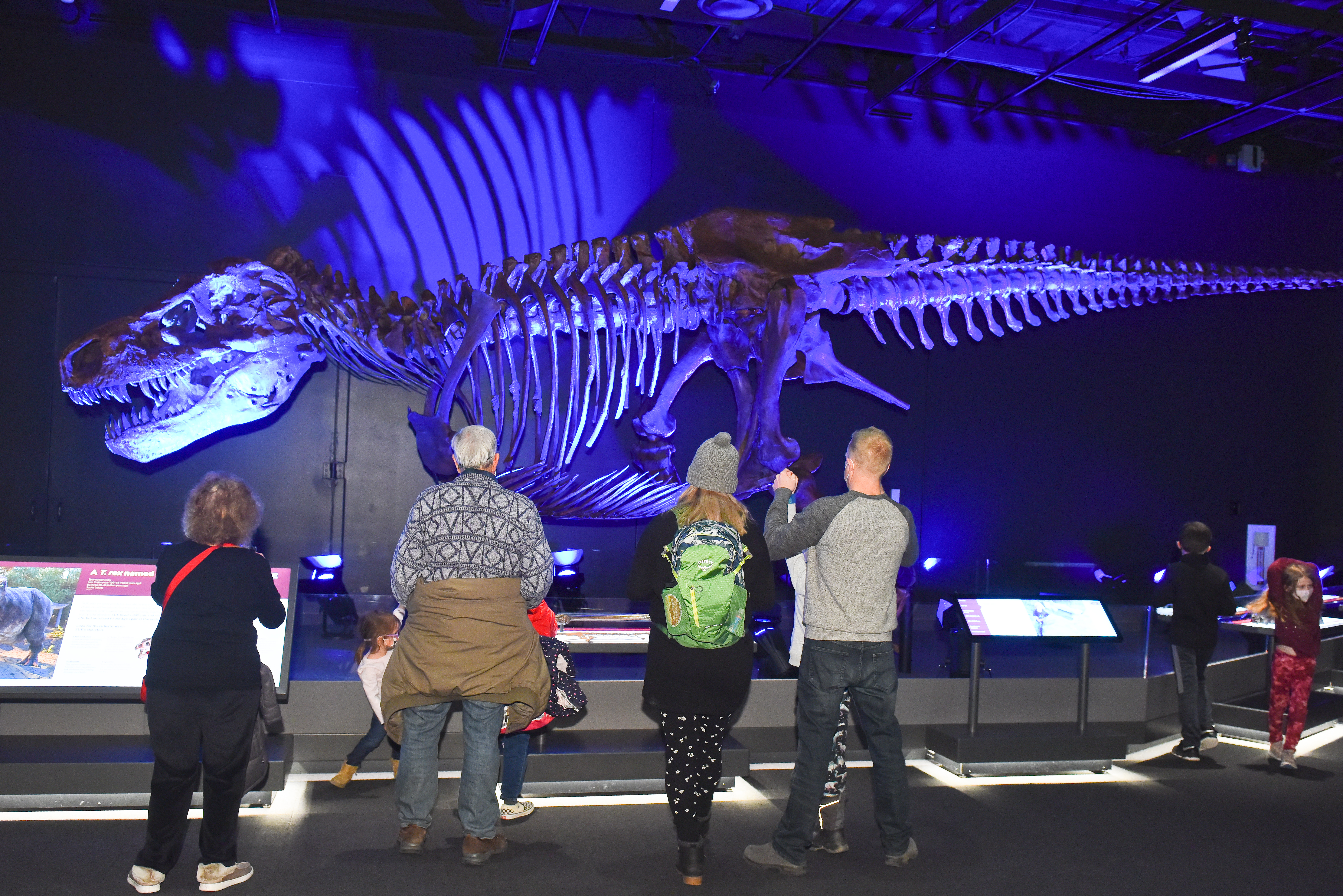
A narrated light show tells SUE’s story. Photo by Chris Schneider.
The Hell Creek environment was a place of danger and opportunity for SUE, and it was important that our star Tyrannosaurus was never divorced from that context. This environmental focus dovetailed with the story told by the SUE fossil itself. SUE is exquisitely preserved and is the subject of dozens of scientific papers—we know more about this individual than almost any other dinosaur. From how SUE grew up and grew old to how they got injured and sick, SUE’s skeleton tells the life story of the oldest—and therefore the most successful—T. rex known to science. Put another way, we wanted to make SUE a character (to the extent that was scientifically credible, of course). By spotlighting the evidence for SUE’s hard life as an apex predator, we hoped the exhibit would inspire visitors to empathize with this long-dead dinosaur, while discouraging them from conceptualizing T. rex as a fantastical monster.
SUE’s world
SUE: The T. rex Experience immerses visitors in the Hell Creek environment. Scientific advisors Tom Cullen and Az Klymiuk were instrumental in this regard, bringing a focus on the methods used to reconstruct paleoenvironments—including isotopic analysis of microfossils and sedimentology. Not only is this ecological perspective something that visitors specifically asked for during our audience studies, I think it sets our exhibit apart from other paleontology exhibits and media. For example, learning that summertime in Hell Creek brought temperatures of 75 to 85° F and around 80 inches of rain (and how we know) makes the prehistoric past tangible and tactile in a way that the usual dinosaur stats and trivia rarely do.

A picture is worth a thousand words: this panoramic mural illustrates both the Hell Creek ecosystem and SUE’s place in it. Photo by Chris Schneider.
An exhibit is more than a collection of facts, of course. It’s a story told through physical space, assembled from words, specimens, images, interactives, and media. We leveraged all of these tools to place visitors in the world of Tyrannosaurus rex. Nearly every display is set against a verdant backdrop of Hell Creek swamps and forests (in fact, we made a point of ensuring every image of T. rex is situated in its habitat). Some of these images are pulled from the animated scenes produced for the permanent SUE gallery, but we also commissioned original artwork by Beth Zaiken. It’s easy to get lost in Zaiken’s extraordinary panoramic mural, which vividly captures the waterlogged, angiosperm-dominated forests of the Hell Creek ecosystem. I’m particularly fond of this take on SUE, shown presiding over their kingdom with the relaxed confidence of modern apex predators (lions and alligators have the same energy).
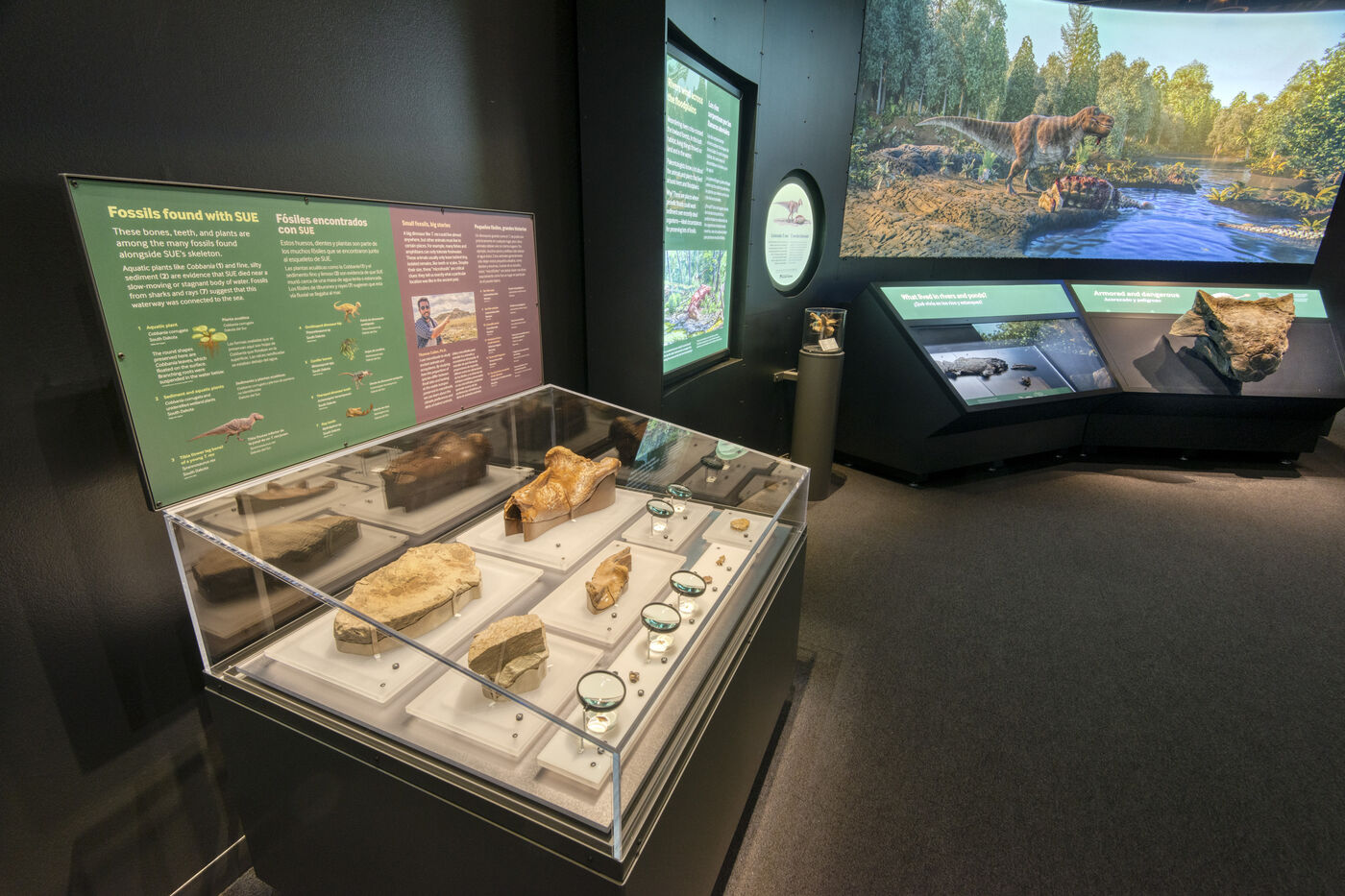
Fossils from SUE’s world are divided into three microhabitats: upland forest, shore of the inland sea, and lowland river (shown here). Photo by Chris Schneider.
The habitat reconstructions are ground-truthed by a variety of Cretaceous fossils, including some never-before-exhibited Field Museum specimens. These include a huge paddlefish, a range of beautiful leaves and fronds, and an articulated Edmontosaurus tail. We rounded out the displays with casts of the most iconic Hell Creek fossils from other museums, such as the AMNH Ankylosaurus and Royal Ontario Museum Acheroraptor. The complete Triceratops skeleton is none other than Hatcher from NMNH. Standing in an imposing, defensive posture, Hatcher ably demonstrates the risks that a top predator like SUE had to face in order to stay fed.
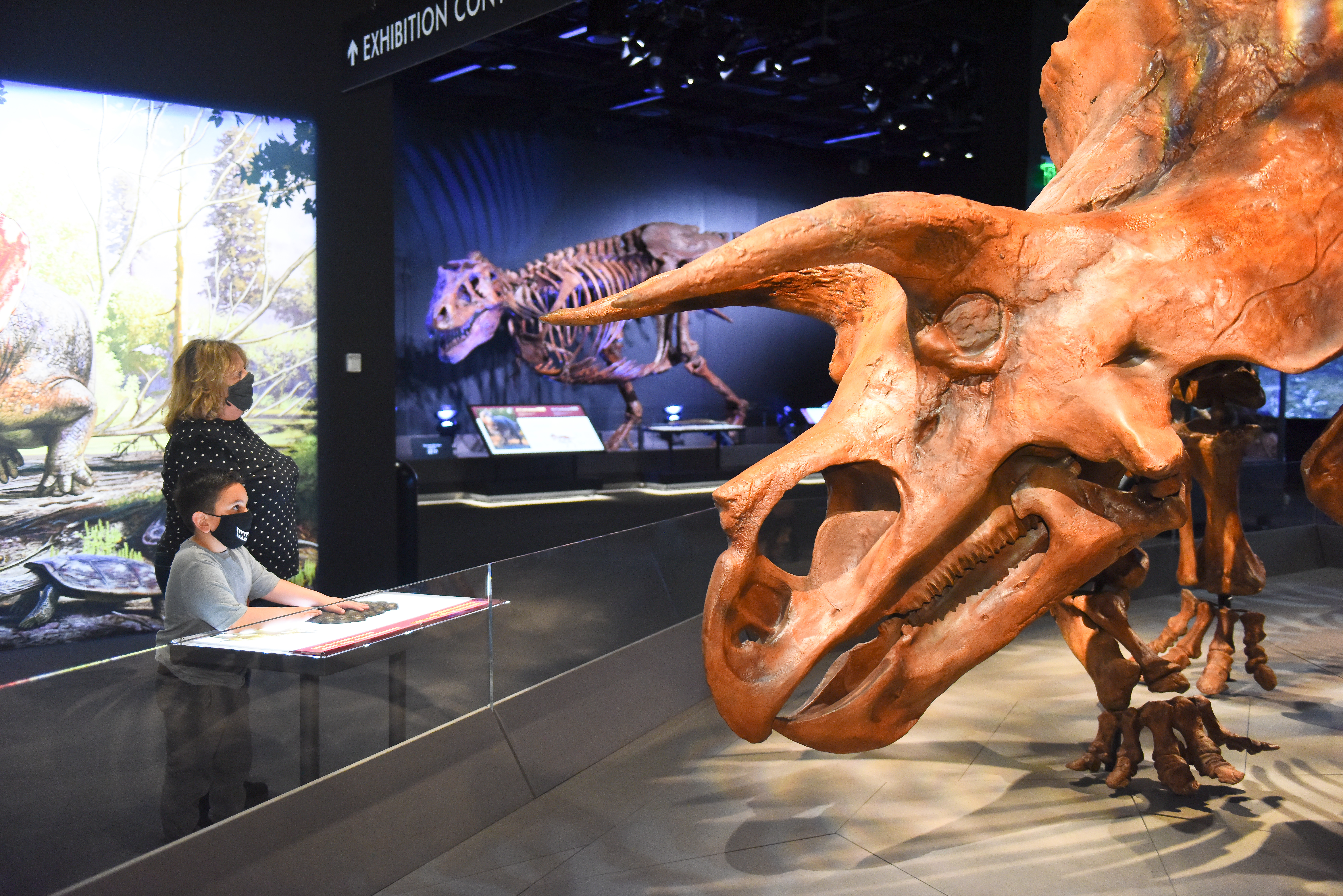
SUE’s caretaker Bill Simpson had wanted to pair the T. rex with a Triceratops for over 20 years. Photo by Chris Schneider.
Visitors to SUE: The T. rex Experience won’t just see Hell Creek—they’ll hear, feel, and smell it too. There are ten touchable casts and replications in the exhibit, including a reconstruction of SUE’s skull as it looked when it was first excavated. Meredith Whitfield developed the physical interactives: you can simultaneously hear and feel the infrasonic rumble a T. rex could have produced at a bone conduction platform, and—if you really want to—you can smell SUE’s rancid breath. The scent is actually synthetic rotting flesh, used for training disaster response dogs. I smelled it once, and have no pressing need to do so again!
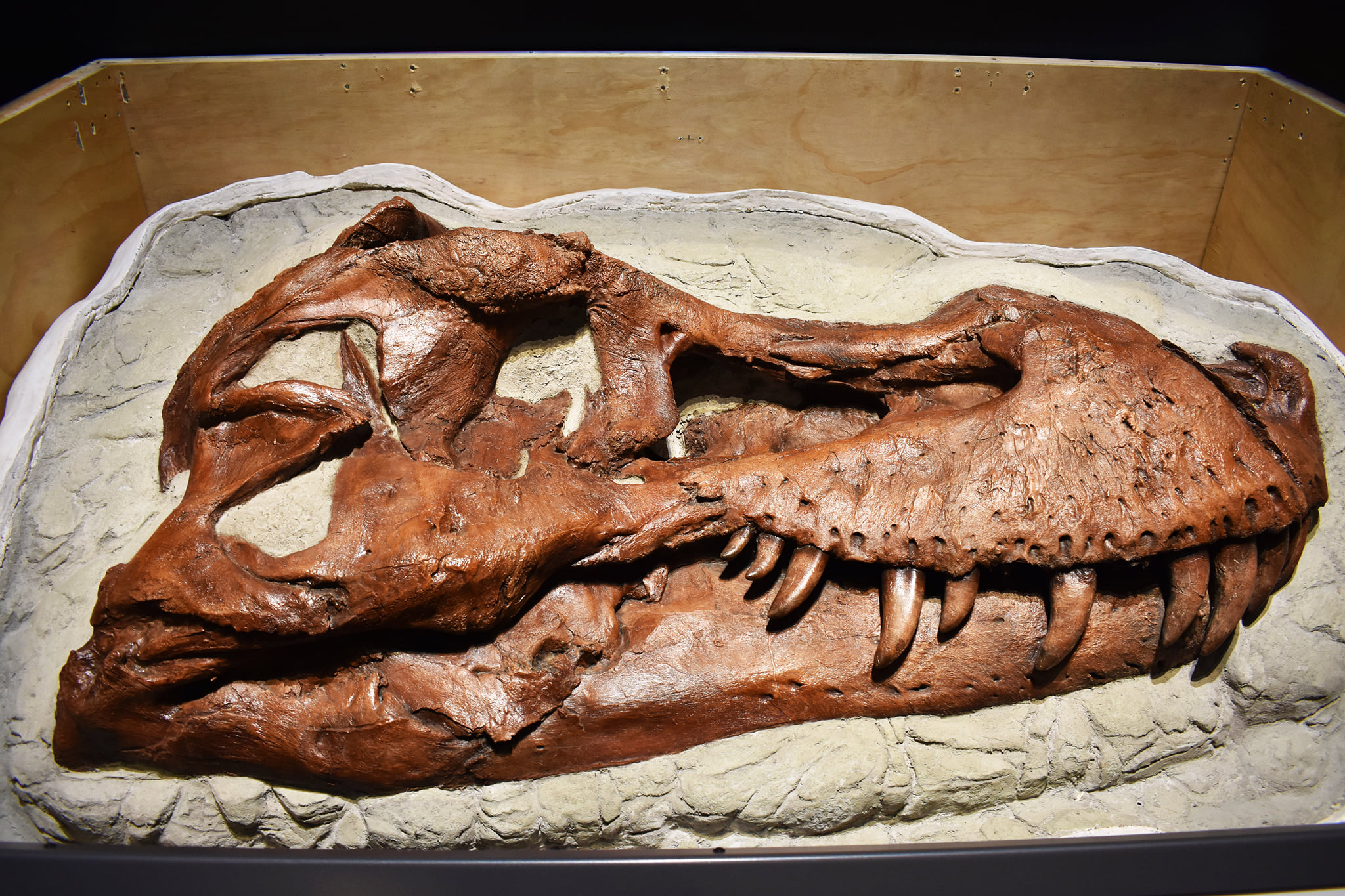
For us 90s kids, the image of SUE’s smushed, partially-prepared skull is at least as iconic as the mounted skeleton, so I was thrilled we could recreate it for this exhibit. Photo by the author.
As in the permanent SUE gallery, a media overlay ties everything together. Animated scenes of the Cretaceous world are projected on a 20-foot screen, and overhead lights change color in sync with the time of day in the animations. A primordial soundscape of birds, frogs, and insects can be heard throughout the hall. Finally, a light show produced by Latoya Flowers and rigged by Paul Horst takes visitors on a tour of SUE’s skeleton. This narrated presentation highlights SUE’s battle scars, signs of illness, and more.
SUE in the flesh
Of course, another way to make an exhibit stand out is to build a really big toy. We partnered with the exhibit fabrication maestros at Blue Rhino Studio to realize SUE in the flesh. Blue Rhino had already collaborated with the Field Museum on Mammoths and Mastodons, Antarctic Dinosaurs, and the flock of pterosaurs in Stanley Field Hall, but SUE was a much bigger undertaking.

The miniature maquette in front of the full-scale model. Photo by the author.
More than a dozen artists took part in building SUE, but I’m told this was primarily Jim Burt’s baby. Burt started the process by sculpting a miniature maquette in clay. The maquette was build directly over a 1/12th scale 3-D print of SUE’s skeleton, ensuring that the proportions were exactly right. At the Field Museum, Tom Cullen and Bill Simpson provided several rounds of anatomical revisions, paying particularly close attention to the arrangement of cornified bumps and knobs on SUE’s face. Of course, it wouldn’t be SUE without also including some of the scars and injuries SUE is famous for. The result is a restoration of not just any T. rex, but a specific old and punch-drunk individual that has lived a tough life but is still thriving.
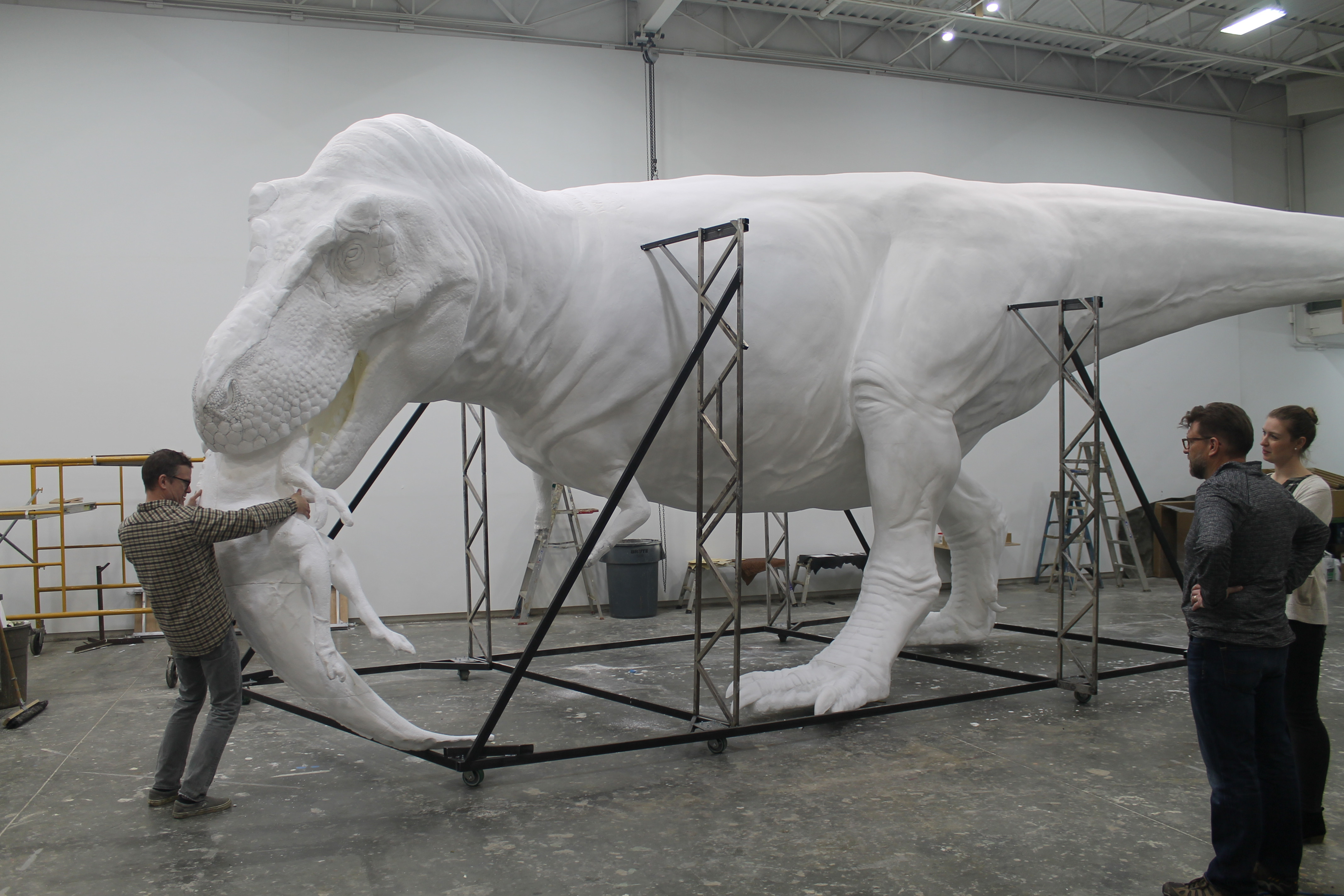
Jim Burt feeds Deadmonto to SUE. Photo by the author.
Why is SUE eating a young Edmontosaurus? The primary reason is gravity. This model doesn’t have the same weight distribution as a real Tyrannosaurus, and it had to be light enough to break down and travel every few months. We needed a third point of contact with the ground to ensure maximum stability, and the Edmontosaurus prey was the coolest way to accomplish that. By design, it’s initially ambiguous whether SUE killed or scavenged this animal, but a close look at the muddy substrate reveals a set of tracks—Deadmonto’s last steps. What happens next? Imagine SUE horking down the Edmontosaurus whole, not unlike this seagull.
After the maquette was approved, the Blue Rhino team had it scanned, then milled out of giant blocks of foam at full size. It then took about six months to sculpt in the fine details (down to each individual scale) and paint SUE’s burgundy hide. In addition to being an extraordinary artistic creation, this model is a feat of engineering. While it looks seamless, it breaks down into chunks that fit through a standard six-foot door. It’s also light enough that a single person can push it across the floor.

The finished model. Photo courtesy of Blue Rhino Studio.
This model must be seen in person to fully appreciate—not just the amount of detail but the sheer size. SUE is absolutely massive, but when you look at the skeleton with gastralia in place and consider the muscles needed to move this beast around, it’s hard to imagine T. rex any other way.
As I’ve said previously, working with SUE is a humbling experience. It means standing on the shoulders of dozens of researchers, preparators, artists, educators, and more who have contributed to our understanding of this incredible fossil since it was unearthed. I’m delighted to have had the opportunity to join their ranks and help bring SUE to the next generation, and am indebted to my colleagues who willed this latest iteration of SUE into reality. It wasn’t lost on us that SUE: The T. rex Experience debuted 30 years after Sue Hendrikson discovered the fossil—approximately the same amount of time that SUE was alive during their previous existence on Earth. SUE’s second life is now longer than their first, so here’s to the next 30 years.
SUE: The T. rex Experience has been touring since August 2020 and is currently at the Liberty Science Center. Upcoming destinations will be posted on the Field Museum’s traveling exhibitions page.



 EXTINCT MONSTERS