The video above was kindly shared by Dave Dolak. He shot it on the last day Life Over Time was open to the public, for use in his historic geology course at Columbia College. It is by far the most complete visual record of the exhibit I’ve come across, including in the Field Museum’s own archives. Many thanks to Dave, as well as former student Marcin Warzick, for creating and sharing this video.
What was Life Over Time?
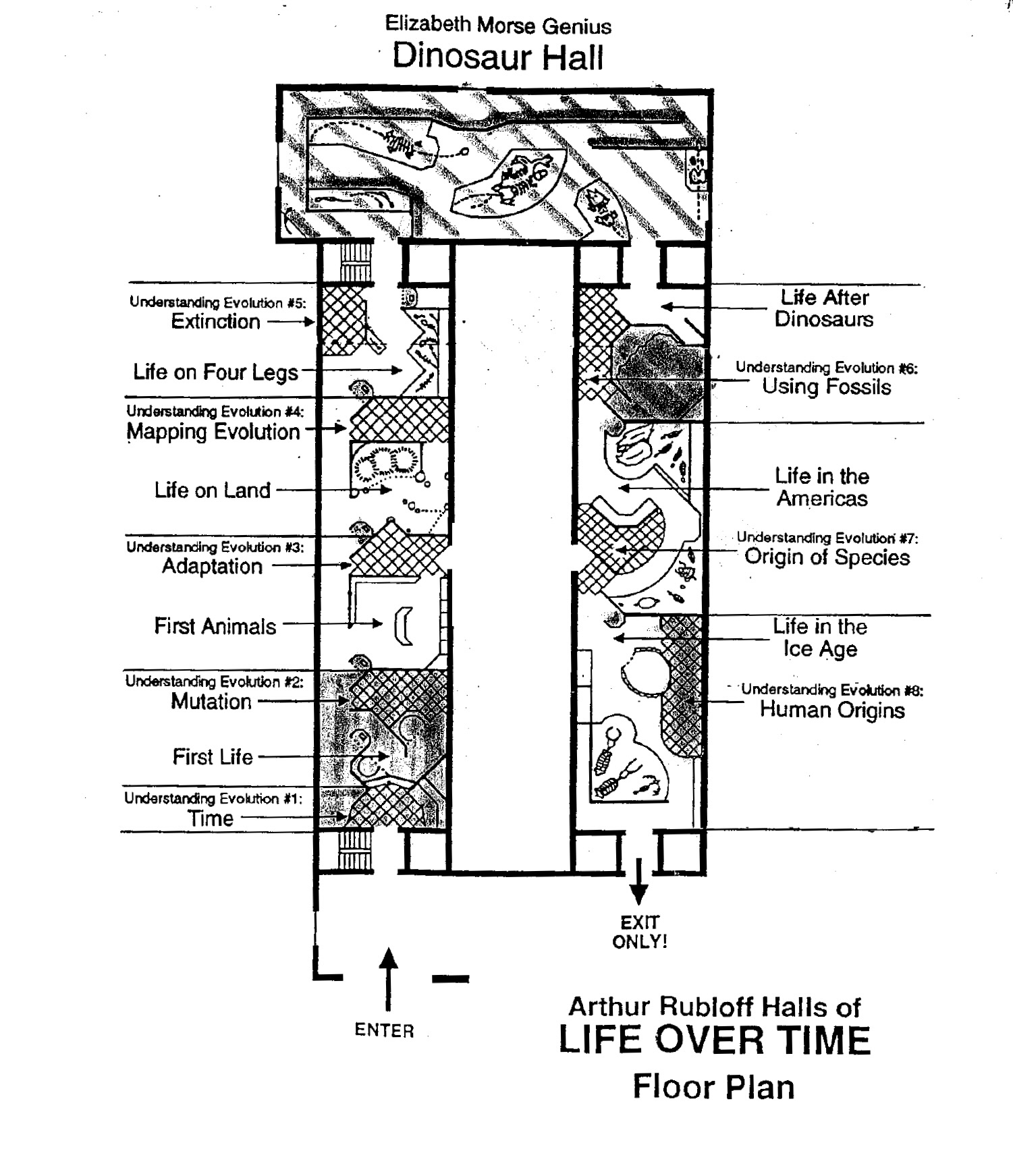
For those not versed in Field Museum lore, Life Over Time was the predecessor to the museum’s current paleontology exhibition, Evolving Planet. If you visited between 1994 and 2004, this was the version you saw. It was the shortest-lived and generally weirdest iteration of the museum’s fossil halls, but it remains a compelling showcase of a particular era in the philosophy behind natural history exhibits.
Life Over Time had a free-wheeling and whimsical tone, and there were examples of this approach almost anywhere you looked. In one gallery, a fish-headed croupier invited visitors to spin a giant roulette wheel to see the average species’ chance of escaping extinction. An automated puppet show put a cartoony spin on the Proterozoic oxygenation crisis. On various video monitors throughout the exhibit, CBS anchor Bill Kurtis provided “weather reports” describing the conditions during each geologic period. There was a cow skeleton in a dentist’s office, and even a bouncy, ridable trilobite.
The primary force behind this approach to exhibit-making was Michael Spock. Recruited from the Children’s Museum of Boston, Spock joined the Field Museum in 1986 as the Vice President of Public Programs. At the time, galleries were organized after the way the museum’s academic curators thought about their subjects. Spock’s approach was very different—as he put it, exhibits should be “for someone, not about something.” He encouraged his staff to experiment with new ways to be relatable and approachable to the museum’s primary audience (generally, families with children). Life Over Time and the other exhibits made during Spock’s tenure were all about meeting visitors where they were—answering the questions they had, rather than the questions curators wanted to answer.
Nevertheless, it was apparently possible to go to far. Many of the allegorical displays (like the cow dentist) were confusing to visitors. Lab-like spaces, which featured lots of interactives but few specimens, were consistently bypassed because they felt like classrooms. Upkeep was also a problem. The high-concept interactives throughout Life Over Time weren’t always designed with durability in mind, and frequent replacement of loose parts was getting expensive and time-consuming.
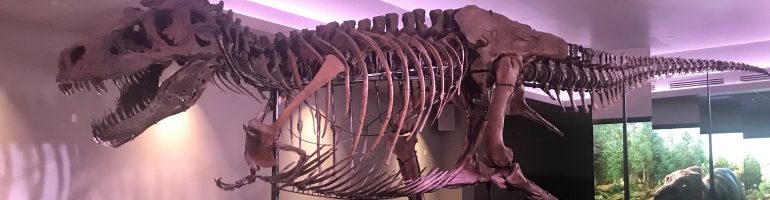
So between 2004 and 2006, Life Over Time was transformed into Evolving Planet. The new exhibit occupies the same space and features several of the same star attractions (the coal forest, Apatosaurus, and Megatherium, among others), but was otherwise completely rewritten and redesigned. The number of fossils on display nearly tripled, and the comic, allegorical displays were replaced with more literal depictions of life in the past. Overall, Evolving Planet swung the pendulum back just a bit. It’s still fun, colorful, and visitor-centric, but the focus is more on the real fossils and the museum’s in-house research.


 EXTINCT MONSTERS
I see what you mean by it being a bit hit and miss. That was a cringeworthy puppet show at the start that’ll make those preschool shows I watched as a kid look mature. I was impressed with how they casually mentioned “sex”, usually I’ve found Americans to be totally puritan over the subject.
Some of the more serious halls and galleries were impressive showing the life of the past in a comprehensive and well-lit series of displays though.
I remember a lot of this exhibition, in particular the long direct hallways of it, though what stuck out to me most from my childhood visits was a windowed-off room in the human origins section where there was a birthday party with all the early human species surrounding a long rectangular table.
That is both silly and cute!
This one, right? The birthday party metaphor doesn’t make much sense to me, but it’s a fun piece of art!
Yes, that’s the one. Nice find! I went through the museum’s photo archives last night after reading your post to see if I could find it there.
Still better than what can be seen where I live.
Ben, this might interest you.
Secrets of the Fossil Hall
Yeah, I was there when they shot some of that! Glad it’s still online, though.
I envy you!!!
I hope someday you travel the world and make reports of displays from those places.
I remember this exhibit fondly, though there were some choices I think worked only on the first visit. There was a lot of watching and not a lot of looking, as I recall. I enjoyed the Bill Kurtis videos and animatronic puppet shows, but tended to skip them when I revisited the museum. It was certainly different from the exhibits it replaced!