Category Archives: art history

A closer look at the “Natural History Museum of North America”

A headless Tyrannosaurus skeleton at the fictional Natural History Museum of North America.

It seems that another Jurassic Park film is upon us. As I’ve written about before, the phenomenon that is Jurassic Park and it’s various sequels and spin-offs has played a central role in the public’s general awareness of dinosaurs for 30 years and counting. Whether we like it or not, every bit of public-facing media concerning dinosaurs (exhibits, books, documentaries, and more) must contend with Jurassic Park‘s long shadow. The latest film—Jurassic World: Rebirth—is just alright, but in a series first, it includes a scene in a natural history museum.

The Jurassic Park films have referenced the century-old association between museums and dinosaurs before. The first Jurassic Park played with this iconography in its classic finale, when the flesh-and-blood Tyrannosaurus and Velociraptor tear down pair of skeletal mounts in the titular park’s visitor center. Those cast skeletons were supplied by Research Casting International: the T. rex was a combination of LACM 23844 and the Royal Terrell Museum’s Black Beauty specimen, while the sauropod was a Camarasaurus with an alternate head. The implication of the scene is clear: the living, cloned dinosaurs represent new technology and scientific progress smashing the old and obsolete incarnations of paleontology to bits. A museum-like setting also features in several scenes in Jurassic World: Fallen Kingdom. In that film, the skeletal mounts—nearly all of which came straight from the Gaston Design catalog—are set up in the home of a wealthy dinosaur enthusiast.

The visitor center rotunda in Jurassic Park.

In Jurassic World: Rebirth, the characters don’t just encounter museum-like displays, they visit an actual museum in New York City. The museum isn’t named in the film, but photos of props reveal that it’s the Natural History Museum of North America, an obvious stand-in for the American Museum of Natural History. As the exposition-heavy scene plays out, we see the dinosaur hall is being dismantled. Pieces of skeletons and other exhibits are carted up and loaded away by a crew of hard-hatted workers.

“It’s a hell of a day here. They’re closing us down,” says paleontologist Henry Loomis, played by Jonathan Bailey. It’s not clear who “they” or “us” is in this scenario. Is the entire museum being shut down? The paleontology department? Or just this dinosaur exhibit? The film doesn’t have an answer to any of these questions, and the scene’s setting seems to be mostly symbolic: the public has grown weary of the feral dinosaur populations that have spread around the world at this point in the Jurassic Park universe. A catastrophic decline in museum attendance is apparently a side effect of that disinterest.

Looking up at the “Titanosaurus” skeleton.

Despite the hazy rationale for its deinstallation, we can still infer a fair amount about this fictional exhibition during the five minutes the characters linger within its walls. There are at least two galleries: an outer gallery flanked by large windows and dominated by a sauropod skeleton that straddles two pedestals, and up a set of stairs, an inner gallery that houses the T. rex skeleton.

The halls are decked in extravagant Baroque trim. This lavish architectural style was popular in Europe during the 17th and 18th centuries, but is somewhat out of place in New York City, where Beaux-Arts was the norm for large public buildings (like museums) built around the turn of the 20th century (like AMNH). A few Baroque revival buildings—mostly churches from the late 19th century—do exist in New York, however. Notably, the Baroque influence extends beyond the walls and ceilings and into the exhibit elements: gilded sauropods adorn a set of columns in the outer hall, and a high-contrast mural depicting what might be Archaeopteryx and Compsognathus is visible in the background of a couple shots.

The Painted Hall at Old Royal Naval College. Image from ornc.org.

The museum scene was actually shot in the UK, at the Old Royal Naval College in Greenwich. The dinosaur galleries are in fact the famous Painted Hall. Designed by James Thornhill and constructed between 1707 and 1726, this space was originally a dining hall but is now a popular tourist attraction. The immense murals depict an assortment of mythological and historical figures: King William III is at the center of mural on the ceiling, while George I holds court in the mural on the rear wall (this virtual tour explores the murals’ subjects in detail). Both murals are visible in Jurassic World: Rebirth (it’s best not to wonder why a New York museum is decorated with images of British monarchs).

The British sensibilities extend to the exhibit elements. In the filmmakers’ commentary, director Gareth Edwards notes that he was inspired by the dinosaur hall at the London Museum of Natural History, which was considered as a shooting location. Much like that real-word exhibit, some of the displays at the North American Museum of Natural History are suspended above visitors’ heads and are partially hidden in shadow. The font and other design elements of the exhibit signage are also similar to the London museum.

Quetzalcoatlus skeleton and Mosasaurus skull on display amongst Baroque decor.

Taking a closer look at the dinosaurs themselves, the T. rex appears to be in an old-fashioned tail-dragging pose, or perhaps it’s mirroring the classic roaring stance from the end of the first film. The “When dinosaurs roamed the Earth” banner that matches the Jurassic Park visitor center is presumably an in-universe coincidence. A Quetzalcoatlus skeleton is suspended in front of the doorway, and a very large Mosasaurus skull hangs to its left. We also see a Triceratops skull and Deinonychus skeleton already crated for removal, along with some unidentified vertebrae and ribs on tables.

The fossils are realized on film with a combination of physical reproductions and CGI. The Triceratops skull is (rather crudely) sculpted, while the T. rex skull and Deinonychus skeleton appear to be casts of actual fossils. The Quetzalcoatlus, Mosasaurus, and T. rex body are CGI. The sauropod legs were likely present on set, but the rest of its body was filled in digitally when it appears in frame. None of the mounts have the supporting armatures needed for real fossils, so we can conclude that within the film universe, this exhibit only featured casts and reproductions.

Note the gilded sauropods on the columns to nowhere and the original Painted Hall red benches.

Taken together, the evidence on screen suggests that the Natural History Museum of North America is of similar age to AMNH, and the space occupied by the dinosaur exhibit was built as a Baroque revival in the late 1800s. Dinosaur-themed trim like gilded sauropods indicates that this has been a paleontology exhibit for all or most of that time. There have been recent updates, however. Some exhibit text is displayed on animated LED screens (this is most visible below the Mosasaurus skull) and other graphics are backlit. Text beneath the header “Incubation and Development” discusses the process of cloning dinosaurs—in the Jurassic Park universe, the existence of cloned dinosaurs became public knowledge when a T. rex briefly rampaged through San Diego in 1997, so this text must have been added sometime after that. An animated video summarizes how the feral dinosaur populations that began to spread in 2018 ultimately did not survive in the temperate latitudes, and most living dinosaurs now only thrive at the equator. This display could not be more than a couple years old at the time of Jurassic World: Rebirth.

The age of the Mesozoic reptiles on display is harder to pinpoint. Let’s ignore for the moment the many differences between these skeletons and their real-life counterparts (yes, there are no real mosasaurs that big, nobody would reconstruct a Quetzalcoatlus skeleton with that crest, and the Triceratops‘s eyes are weirdly placed). Few of these animals were known at the turn of the century, so most would have to be relatively recent additions. Quetzalcoatlus, for instance, was named in 1975, and sauropods the size of the “Titanosaurus” on display weren’t discovered until the late 80s (amusingly, the sauropod skeleton has a Camarasaurus skull, a fate that is apparently not just reserved for apatosaurines).

The blue illustration on this panel is subtly animated.

As discussed, the skulls and skeletons are all clearly plastic casts and models, which would date them to the 1970s at the earliest. The dynamic poses of the sauropod and Quetzalcoatlus also suggest a mid-Dinosaur Renaissance timeframe. What’s really interesting, though, is that all these skeletons are the chocolate brown color of fossilized bone. In a world where living dinosaurs exist, I would imagine that newer displays—whether real or replica—would be made to look like recent animals. Replica skeletons would be ivory-colored, and perhaps accompanied by taxidermy mounts or preserved samples of feathers, skin, and other soft structures. With that in mind, I’d say these skeletal displays were overhauled in the 80s or 90s, before there was widespread access to cloned dinosaurs. Overlays of new text and media were added in subsequent decades in an effort to keep the exhibit relevant in the “neo-Jurassic age.”

Martin Krebs (Rupert Friend), Zora Bennet (Scarlett Johansson), and Henry Loomis (Jonathan Bailey) hang their heads in shame after Loomis calls Quetzalcoatlus an “avian dinosaur.”

Loomis’s comment that “five years ago, you’d have to wait for hours” to get into the exhibit doesn’t make much sense with this timeline—if the public was going to lose interest in prehistoric dinosaurs, surely it would have happened before 2015, when the Jurassic World theme park was going strong. Perhaps the museum saw a brief spike in attendance around the time living dinosaurs started showing up in people’s backyards?

To be honest, much of the timeline of Jurassic World: Rebirth is illogical, and it probably has something to do with the film being hastily written and rushed into production. But I hope you’ll agree that even the worst fiction can be fun playground for thought experiments like this one. Did you catch any details in the Natural History Museum of North America Scene that I missed?
6 Comments

Filed under AMNH, art history, dinosaurs, exhibits, movies, museums

Is it real?

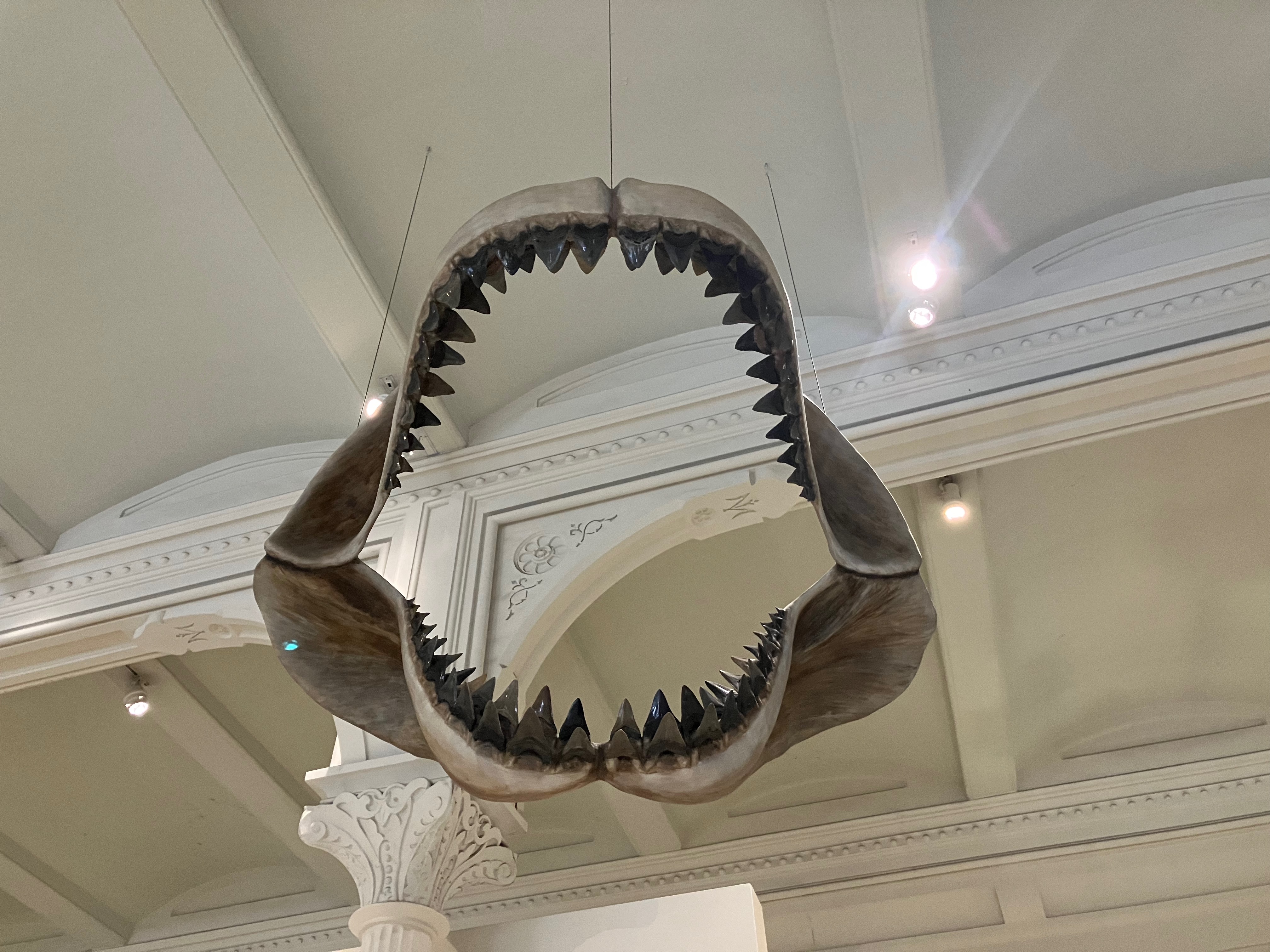
O. megalodon jaws a the American Museum of Natural History. Photo by the author.

You’ve probably seen the gaping jaws of Otodus megalodon (or “megalodon,” as it is colloquially known) in a natural history museum. Perhaps they’re set on the ground where they can frame a group photo, or maybe they’re suspended from the ceiling so you can imagine the rest of the shark rocketing toward you. In any case, every one of these O. megalodon jaws is a sculpted model with real (or cast) teeth embedded in it. Fossil jaws like this have never been found. Nor do scientists expect to ever find intact O. megalodon jaws—shark skeletons are made of cartilage, meaning they lack the mineral content and endurance of bone. Some fossilized shark skeletons are known, but they tend to be from smaller varieties. In the case of O. megalodon, we mostly just have teeth.

Why would a museum display a model of something that has never been found? Because paleontologists are quite confident that a real O. megalodon jaw would look just like this. For one thing, the general shape of modern lamniform shark jaws isn’t especially variable. Comparisons with modern sharks also allow scientists to determine where a fossil tooth fits into the mouth—in the front, to the side, or toward the back. There simply isn’t that much room for guesswork in the reconstruction, at least as far as the jaws are concerned.

I’ve been thinking about the accusation of “fake” again, as it pertains to fossil exhibitions (this is hardly new territory for this blog). One often hears from dissatisfied members of the public that the fossil skeletons on display at any given museum are fake—sometimes with the accusation that the real bones are “hidden” or “in storage” but occasionally with the conspiratorial angle that the creatures on display have been partially or fully invented. Museum workers do their best to explain: casts are exact copies made from molds of original fossils. Fossil skeletons are usually incomplete, but we can substitute casts from other individuals or mirror parts from the opposite side of the body. Plenty of mounted skeletons are made of original fossils, and at bigger museums, most of them are. And so forth.

Thalassomedon casts in pursuit of fish at the Denver Museum of Nature and Science. Photo by the author.

And yet, the cry of “fake” isn’t exactly wrong, either. Many displays contain some amount of sculpted material. In the case of the ubiquitous meg jaws, most of the object by volume is reconstruction. Lukas Rieppel cheekily describes early 20th century dinosaur mounts as “mixed media sculptures, having been cobbled together from a large number of disparate elements that include plaster, steel, and paint, in addition to fossilized bone.” He’s right, and what’s more, even complete skeletons don’t come out of the ground assembled on metal armatures.

So here’s my take: calling fossil mounts fake isn’t wrong, but it also isn’t relevant. The point of the O. megalodon jaws at the start of this post isn’t to show you the real fossil teeth—they’re kind of hard to see suspended fifteen feet off the ground. No, the point is to give the extinct shark that left those teeth behind form, life, and context. The visual and visceral experience of a 10-foot mouth rushing down at you provides a better understanding of what O. megalodon was all about then a case of teeth laid flat in a case ever could.

SUE in the Field Museum’s Evolving Planet exhibition. Photo by the author.

The same applies to just about any mounted fossil skeleton you’ve ever seen, whether it includes original material or is entirely cast. The purpose of these displays isn’t to show fossils as they were found. These are works of installation art, custom built for the space and in dialogue with their surroundings, including with visitors themselves. Take SUE the T. rex in their 2018 gallery on the Field Museum’s second floor. When SUE was in the cavernous, half-acre expanse of Stanley Field Hall, visitors often remarked that SUE looked small. In order to emphasize SUE’s size in the new space, the designers hid the skeleton behind a scrim wall. Instead of first seeing SUE from several hundred feet away, visitors don’t meet the T. rex until it’s looming over them, and they feel quite small in comparison. The T. rex skeleton and the space around it were arranged and composed in order to invoke a precise emotional response.

Often, the display evokes a specific hypothesis. The rearing Barosaurus in the AMNH rotunda is a classic example. We don’t know for sure whether Barosaurus could rear up on its back legs, or whether it would defend its offspring from a charging Allosaurus. But this is the story the exhibit’s creators chose to tell, using articulated fossil casts as their medium. In short, a display like this lets visitors without a detailed background in skeletal anatomy and animal behavior see the fossils the way that scientists do.

Bison diorama at the Denver Museum of Nature and Science. Photo by the author.

It’s worth drawing a comparison between mounted fossil skeletons and the other iconic natural history display, the taxidermy diorama. Imagine looking at this exquisite diorama of a rolling bison at the Denver Museum of Nature and Science, and dismissing it because it’s not real. The bison is, for the most part, a fabrication: it’s mostly clay or foam by volume, and it’s built over a wood and metal armature. It has no bones, muscle, blood, or viscera, and the only original part, the hide, has been treated with an assortment of preservatives. Meanwhile, the grass may well be paper or fabric, the background landscape is a painting, and the warmth from the sun is an electric light. This diorama is almost completely fake, but to say so is to entirely miss the point. If physical reality is all that matters, this display has nothing to offer that you can’t get from a leather sofa.

A well-made taxidermy diorama uses artificial materials to evoke the attitude, behavior, context, and essence of a living animal. A reconstructed fossil skeleton does precisely the same thing (although it is limited to the part of the extinct animal that we know best). So the next time someone dismisses a fossil exhibit as “fake,” try reframing the conversation. The reality of these displays doesn’t come from the material they’re made from, it comes from the combined knowledge and skill of preparators, artists, and scientists.

References

Rieppel, L. 2019. Assembling the Dinosaur: Fossil Hunters, Tycoons, and the Making of a Spectacle. Cambridge, MA: Harvard University Press.

Poliquin, R. 2012. The Breathless Zoo: Taxidermy and the Cultures of Longing. University Park, PA: The Pennsylvania State University Press.

6 Comments

Filed under AMNH, art history, DMNS, exhibits, fish, FMNH, fossil mounts, museums, opinion, paleoart

Meeting Peale’s Mastodon

humboldt4

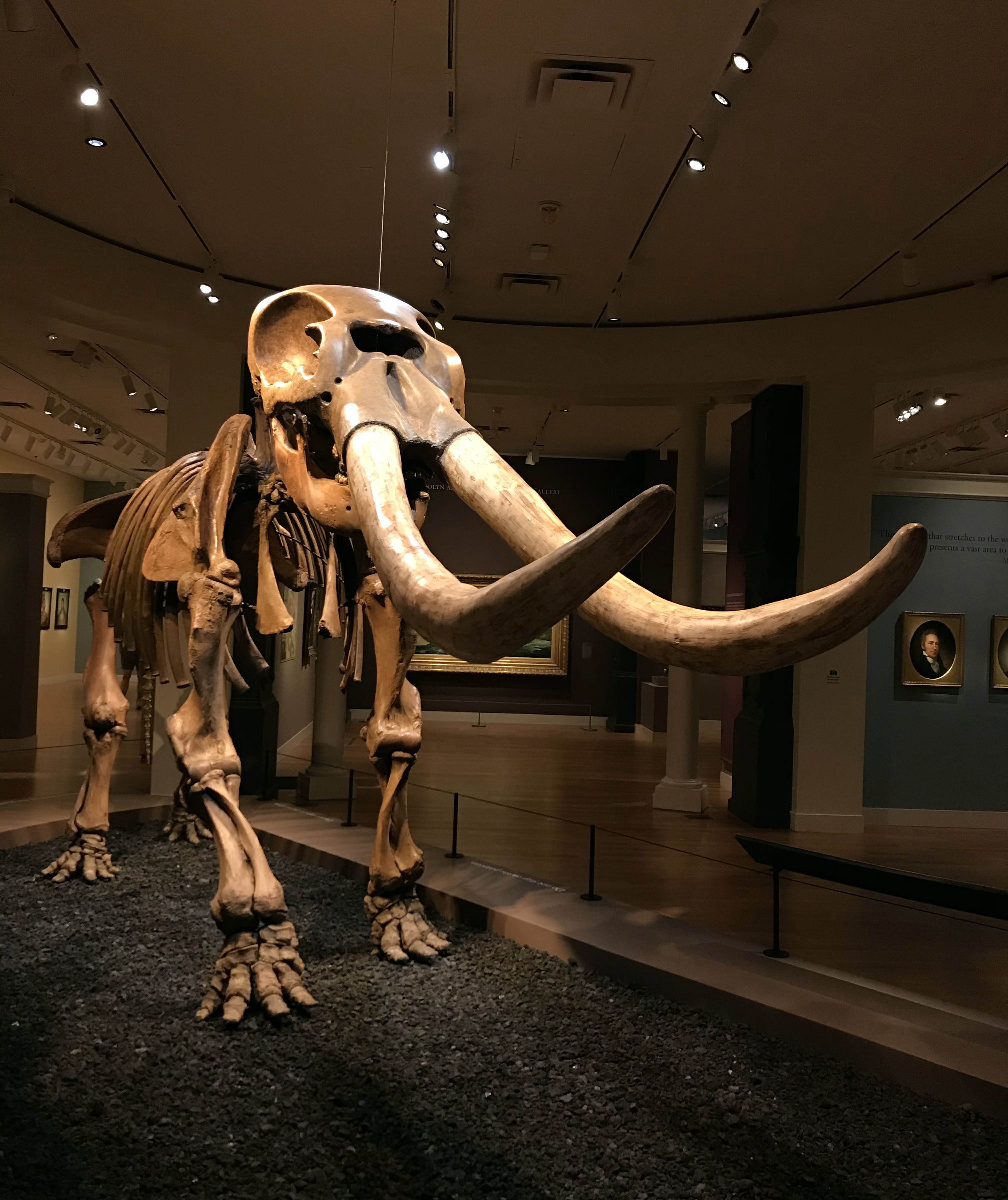
A mastodon in an art museum.

Last week, I met a very special fossil. Pictured above is Charles Wilson Peale’s mastodon, which is currently on display at the Smithsonian American Art Museum. Exhumed in 1799 near the banks of the Hudson River and unveiled to the public on Christmas Eve, 1801, this was the very first mounted skeleton of a prehistoric animal ever exhibited in the United States. Preceding Darwin’s On the Origin of Species by six decades, the mastodon entered public discourse at a time when even the idea of extinction was still hotly debated. The mastodon proved to be a source of national pride for European Americans, demonstrating that North America’s natural wonders could rival Europe’s great architecture and rich history.

After Peale’s Philadelphia museum closed in 1848, the mastodon was sold and wound up at the Hessisches Landesmuseum in Darmstadt, Germany. There it remained for over 170 years, largely forgotten in its home country, until SAAM senior curator Eleanor Harvey had the idea to include it in a new exhibition.

969EC399-BD98-460A-8C8D-3DC442AEEEBB_1_105_c

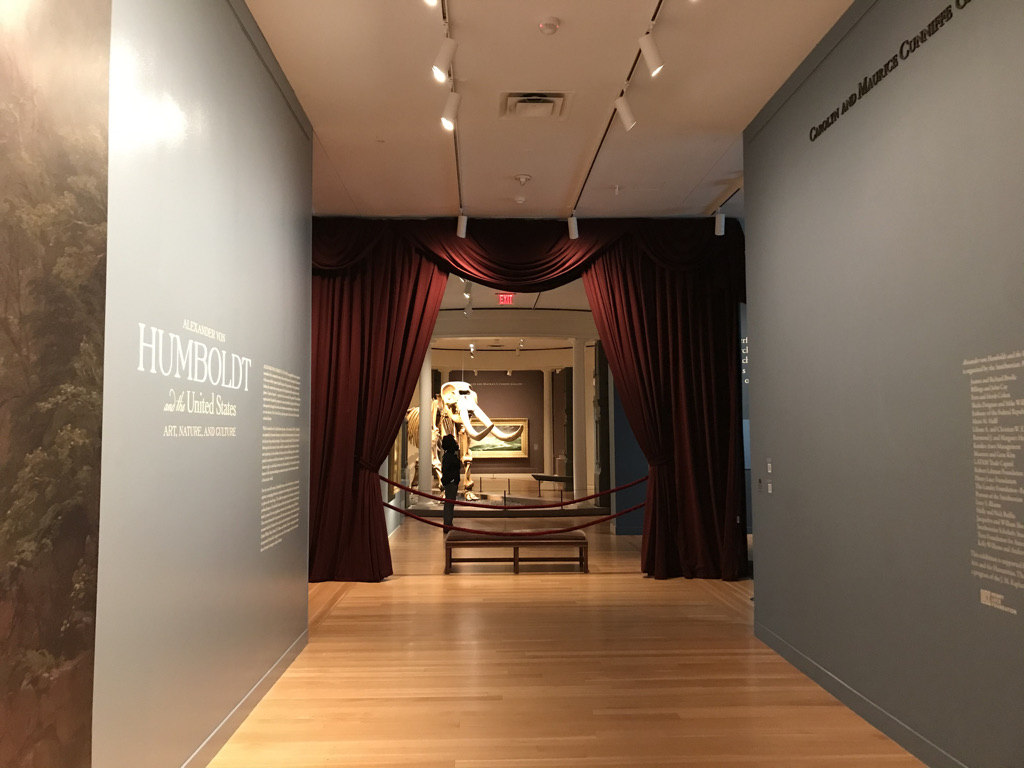
A red curtain evokes Peale’s self portrait, The Artist in his Museum

Harvey’s exhibition isn’t about fossils, or even about Peale. Her subject is Alexander von Humboldt, a 19th-century naturalist who left a profound impact on the scholars, artists, and politicians of the young United States. Alexander von Humboldt and the United States: Art, Nature, and Culture tracks the legacy of Humboldt’s brief but highly influential visit to America. During a six-week tour in 1804, Humboldt met with President Thomas Jefferson and other dignitaries, planting intellectual seeds that would shape America’s aspirational ideals for decades and centuries to come. From his vision of nature as an interconnected network to his advocacy for democracy, the abolition of slavery, and learning from Indigenous knowledge, Humboldt’s influence was wide-reaching*. 

*I personally found the exhibition’s presentation of Humboldt’s influence on US policy a bit doe-eyed. While triumphs like the founding of the National Park Service and Smithsonian Institution can be traced to Humboldt’s legacy, it’s hard to argue that his social ideals had much practical effect in the 19th century

An important stop on Humboldt’s American tour was Peale’s museum in Philadelphia. Humboldt dined with Peale’s family beneath the ribcage of the mounted mastodon, later citing the beast as a key example of America’s incredible natural heritage. For Humboldt, Peale, and Jefferson, the mastodon embodied the young nation’s great potential—if this land was home to creatures as mighty at the mastodon, then its future would have to be equally monumental. 

To Harvey, the mastodon skeleton perfectly encapsulated the story she wanted to tell about Humboldt. She initially thought that shipping the mastodon from Germany for a temporary exhibition was a long shot, but her counterparts at the Landesmuseum were game. Curator Oliver Sandrock oversaw the process of preparing the mastodon for travel, which involved a deep cleaning, as well as breaking down the original 19th century armature into several pieces.

humboldt7

The mastodon is presented primarily as a historical object—there is no discussion of the animal’s life appearance or behavior to be found.

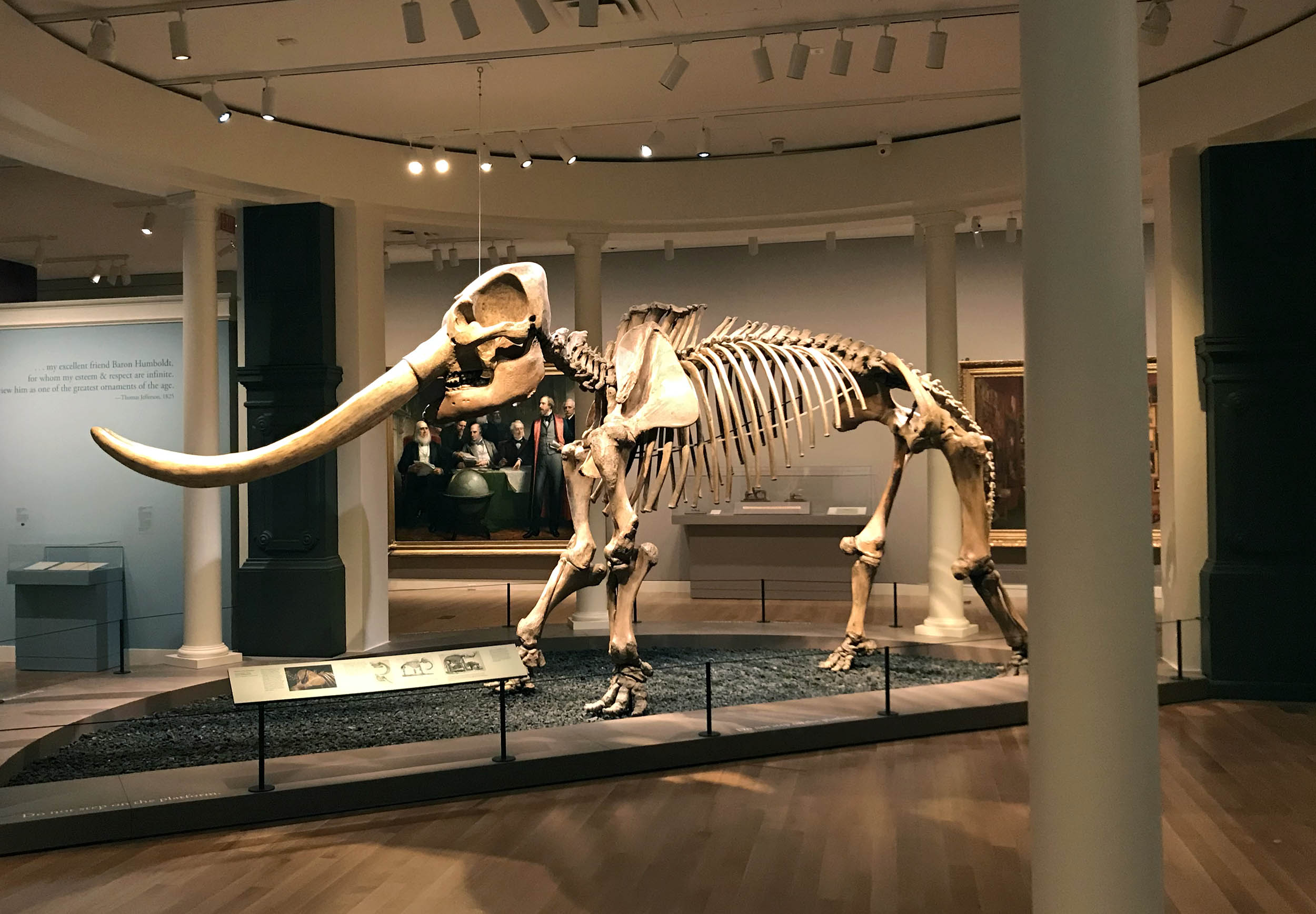
I spoke to Advait Jukar, a Research Associate with the National Museum of Natural History, about his involvement with the mastodon. He inspected the skeleton in early 2020, shortly after it arrived in Washington, DC. As a fossil elephant specialist, Jukar was able to determine that the mastodon was an adult male, and that about 50% of the mount was composed of real, partially mineralized bone. Fascinatingly, most of the reconstructed bones were carved from wood. This was the handiwork of Rembrandt Peale (Charles’ son), William Rush, and Moses Williams. Most of the wooden bones were carved in multiple pieces, which were locked together with nails and pegs. The craftsmanship is exquisite, and the joins are difficult to make out unless you stand quite close. The mandible is entirely wood, but the teeth are real. These teeth probably came from a different individual—one tooth on the right side didn’t fit properly and was inserted sideways!

The mastodon at SAAM differs from the original presentation at Peale’s museum in a few ways. The missing top of the skull was once modeled in papier-mâché, but this reconstruction was destroyed when the Landesmuseum was bombed during the second world war. It has since been remodeled in plaster. While the mastodon was never mounted with real tusks, the mount has traditionally sported strongly curved replica tusks, more reminiscent of a mammoth. While Rembrandt Peale published a pamphlet in 1803 suggesting that the mastodon’s tusks should be positioned downward, like a pair of predatory fangs, it’s unclear if the tusks on the skeleton were ever mounted this way. At SAAM, the mastodon correctly sports a pair of nearly straight replicated tusks, which curve gently upward. 

pealemammoth

Rembrandt Peale’s carnivorous mammoth, with downward-facing tusks. Public domain.

Overall, the work of Peale, Rush, and Williams remains remarkably intact. Although it’s now lit by electric lights instead of oil lamps, this is the same beast that Humboldt encountered 220 years ago. Harvey even included a mouse in a small case at the mastodon’s feet, just as Peale did in Philadelphia. If anything, it’s remarkable how similar the mastodon mount looks to newer displays of fossil skeletons. Its creators pioneered an art form that has not changed enormously to this day.

humboldt1

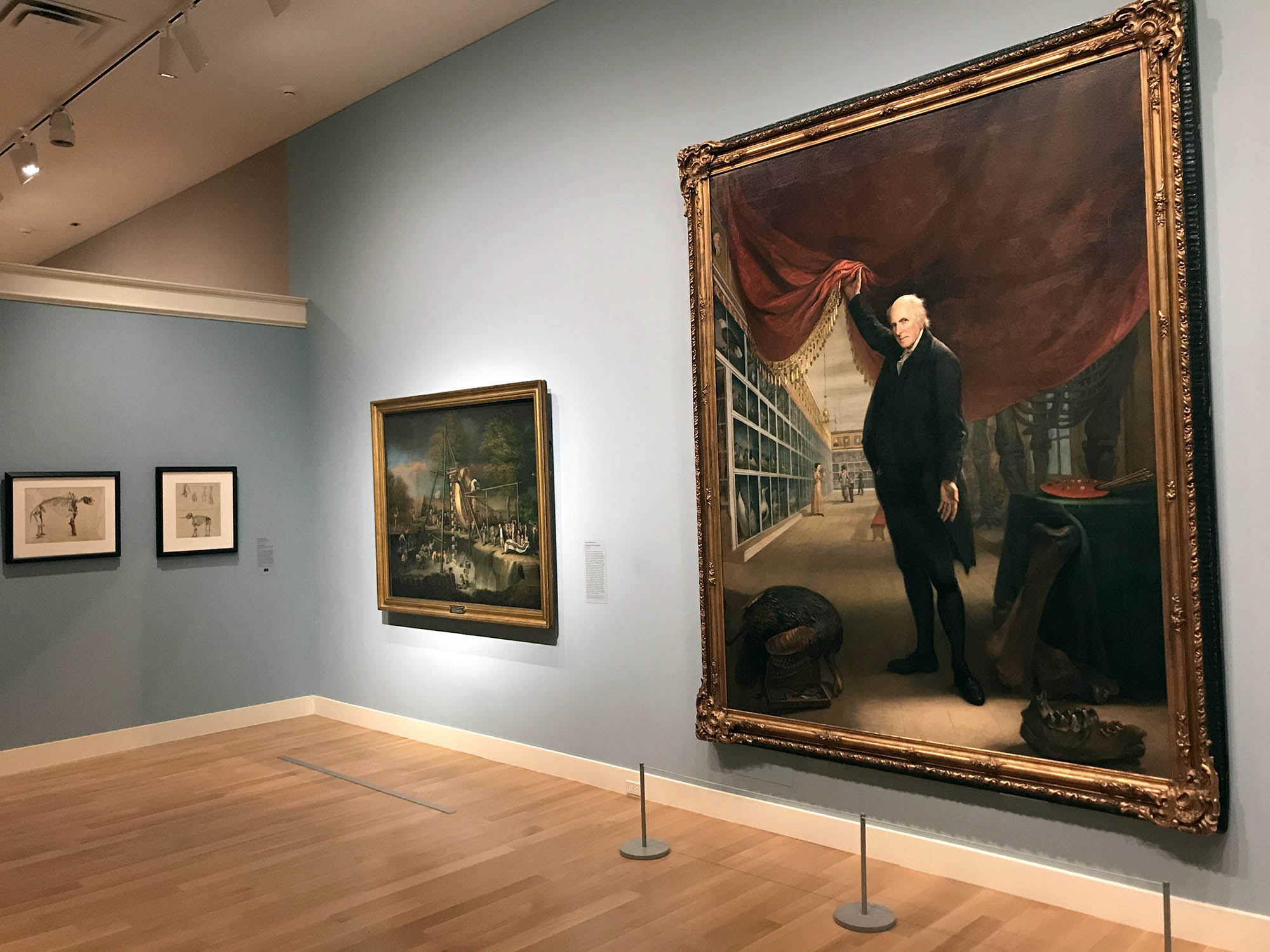
Artwork of the mastodon, its excavation, and its presentation by the Peale family.

While the mastodon is undeniably the star of the show, the exhibition also utilizes artworks from the SAAM collection, loans from other institutions, and three lengthy media presentations to tell Humboldt’s story. I was excited to see Peale’s The Artist in His Museum and Exhumation of the Mastodon reunited, and the collection of George Catlin’s portraits of Native Americans is impressive. However, I was most captivated by a media presentation exploring Frederic Church’s Heart of the Andes. While the original painting had to stay at the Metropolitan Museum of Art, the video—which can be seen online here—explores the details and historical context of the painting with visually arresting style. I’ve been critical in the past of art museums’ proclivity for opaque and unwelcoming interpretive styles, but this video is great and I hope to see more efforts like it.

Overall, I was delighted by the exhibition. Seeing a fossil in an art museum, interpreted as a cultural artifact, is extraordinary. Like Humboldt himself, the mastodon is an interception of art, nature, and culture, and I relished the opportunity to meet such an icon.

Alexander von Humboldt and the United States: Art, Nature, and Culture runs through July 11, 2021. 

References

Jukar, A. 2021. Pers. comm.

O’Connor, A. 2020. Mysteries of the first mastodon.

Semonin, P. 2000. American Monster: How the Nation’s First Prehistoric Creature Became a Symbol of National Identity. New York, NY: New York University Press.

6 Comments

Filed under art history, exhibits, fossil mounts, history of science, mammals, museums, reviews