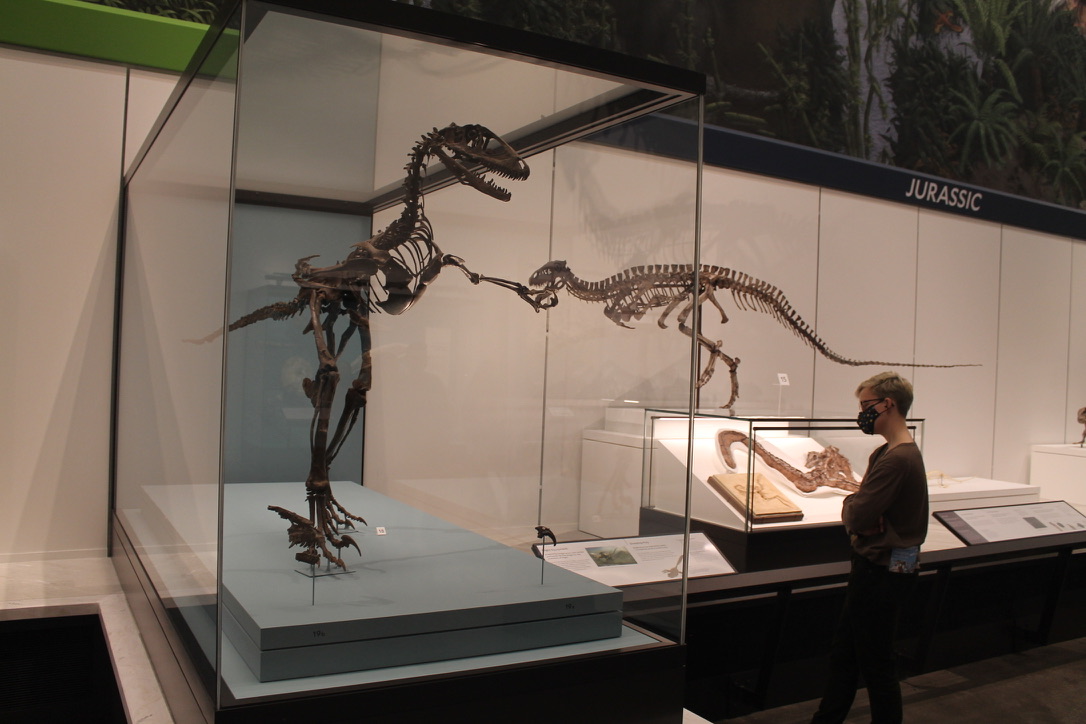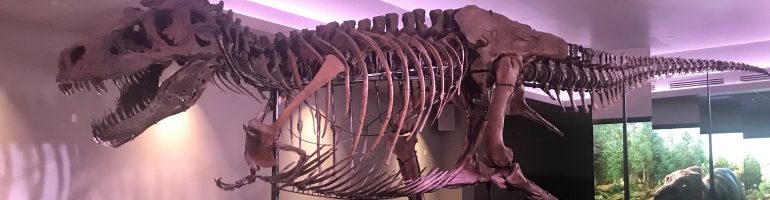
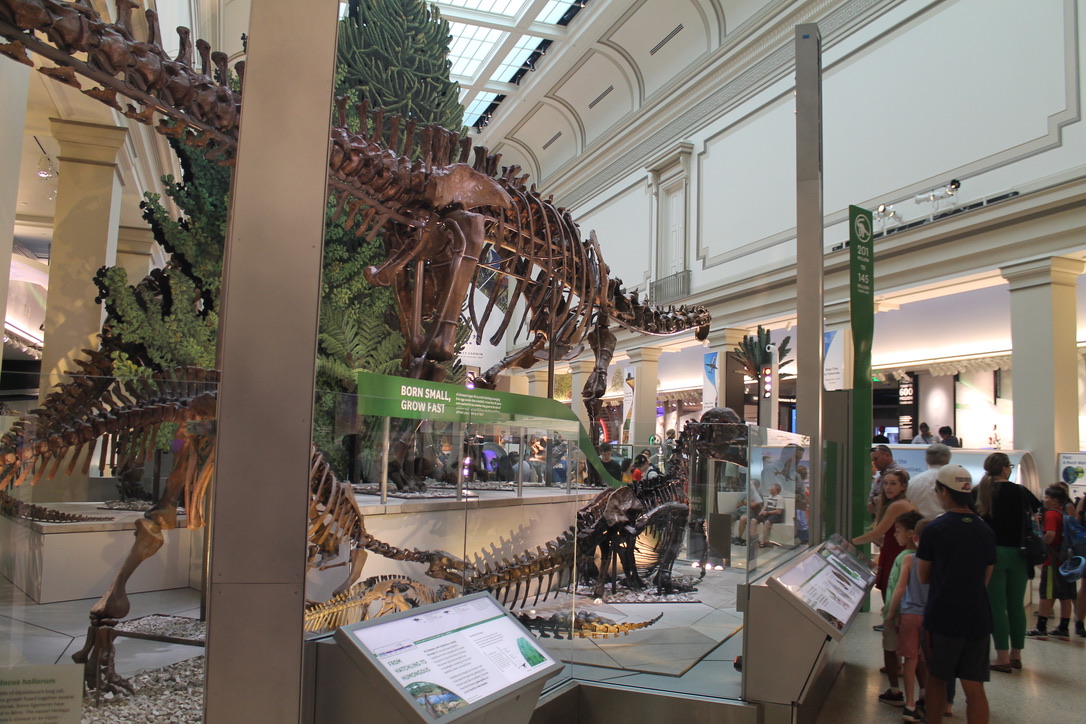
Category Archives: dinosaurs

A closer look at the “Natural History Museum of North America”

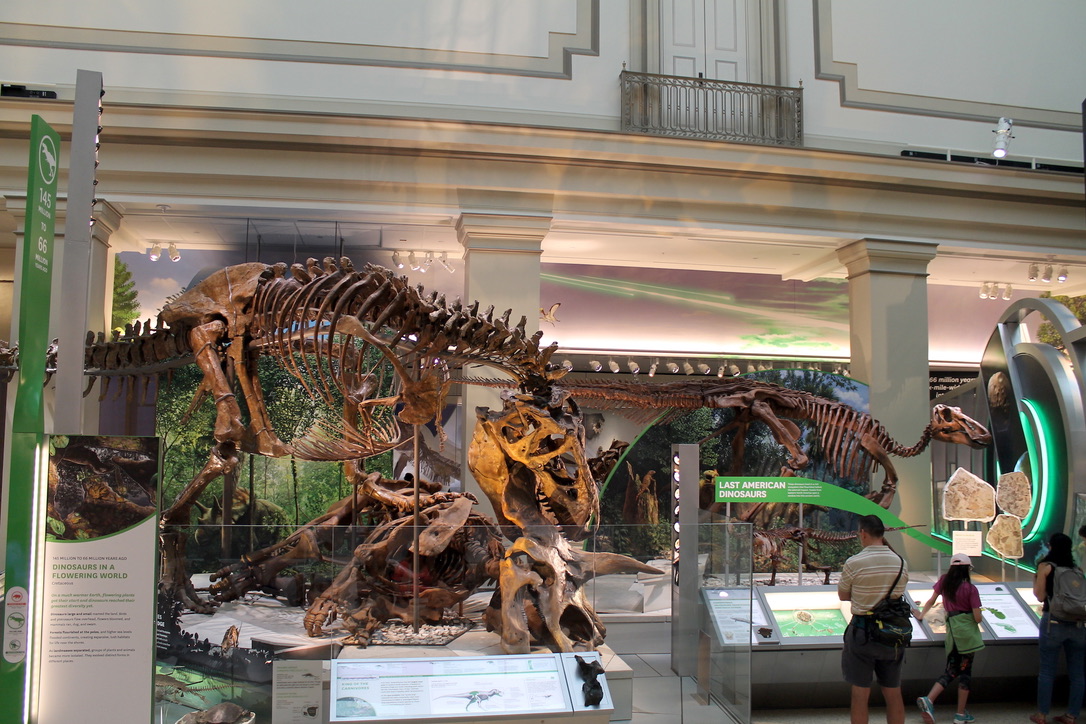
A headless Tyrannosaurus skeleton at the fictional Natural History Museum of North America.

It seems that another Jurassic Park film is upon us. As I’ve written about before, the phenomenon that is Jurassic Park and it’s various sequels and spin-offs has played a central role in the public’s general awareness of dinosaurs for 30 years and counting. Whether we like it or not, every bit of public-facing media concerning dinosaurs (exhibits, books, documentaries, and more) must contend with Jurassic Park‘s long shadow. The latest film—Jurassic World: Rebirth—is just alright, but in a series first, it includes a scene in a natural history museum.
The Jurassic Park films have referenced the century-old association between museums and dinosaurs before. The first Jurassic Park played with this iconography in its classic finale, when the flesh-and-blood Tyrannosaurus and Velociraptor tear down pair of skeletal mounts in the titular park’s visitor center. Those cast skeletons were supplied by Research Casting International: the T. rex was a combination of LACM 23844 and the Royal Terrell Museum’s Black Beauty specimen, while the sauropod was a Camarasaurus with an alternate head. The implication of the scene is clear: the living, cloned dinosaurs represent new technology and scientific progress smashing the old and obsolete incarnations of paleontology to bits. A museum-like setting also features in several scenes in Jurassic World: Fallen Kingdom. In that film, the skeletal mounts—nearly all of which came straight from the Gaston Design catalog—are set up in the home of a wealthy dinosaur enthusiast.

The visitor center rotunda in Jurassic Park.

In Jurassic World: Rebirth, the characters don’t just encounter museum-like displays, they visit an actual museum in New York City. The museum isn’t named in the film, but photos of props reveal that it’s the Natural History Museum of North America, an obvious stand-in for the American Museum of Natural History. As the exposition-heavy scene plays out, we see the dinosaur hall is being dismantled. Pieces of skeletons and other exhibits are carted up and loaded away by a crew of hard-hatted workers.

“It’s a hell of a day here. They’re closing us down,” says paleontologist Henry Loomis, played by Jonathan Bailey. It’s not clear who “they” or “us” is in this scenario. Is the entire museum being shut down? The paleontology department? Or just this dinosaur exhibit? The film doesn’t have an answer to any of these questions, and the scene’s setting seems to be mostly symbolic: the public has grown weary of the feral dinosaur populations that have spread around the world at this point in the Jurassic Park universe. A catastrophic decline in museum attendance is apparently a side effect of that disinterest.

Looking up at the “Titanosaurus” skeleton.

Despite the hazy rationale for its deinstallation, we can still infer a fair amount about this fictional exhibition during the five minutes the characters linger within its walls. There are at least two galleries: an outer gallery flanked by large windows and dominated by a sauropod skeleton that straddles two pedestals, and up a set of stairs, an inner gallery that houses the T. rex skeleton.

The halls are decked in extravagant Baroque trim. This lavish architectural style was popular in Europe during the 17th and 18th centuries, but is somewhat out of place in New York City, where Beaux-Arts was the norm for large public buildings (like museums) built around the turn of the 20th century (like AMNH). A few Baroque revival buildings—mostly churches from the late 19th century—do exist in New York, however. Notably, the Baroque influence extends beyond the walls and ceilings and into the exhibit elements: gilded sauropods adorn a set of columns in the outer hall, and a high-contrast mural depicting what might be Archaeopteryx and Compsognathus is visible in the background of a couple shots.

The Painted Hall at Old Royal Naval College. Image from ornc.org.

The museum scene was actually shot in the UK, at the Old Royal Naval College in Greenwich. The dinosaur galleries are in fact the famous Painted Hall. Designed by James Thornhill and constructed between 1707 and 1726, this space was originally a dining hall but is now a popular tourist attraction. The immense murals depict an assortment of mythological and historical figures: King William III is at the center of mural on the ceiling, while George I holds court in the mural on the rear wall (this virtual tour explores the murals’ subjects in detail). Both murals are visible in Jurassic World: Rebirth (it’s best not to wonder why a New York museum is decorated with images of British monarchs).

The British sensibilities extend to the exhibit elements. In the filmmakers’ commentary, director Gareth Edwards notes that he was inspired by the dinosaur hall at the London Museum of Natural History, which was considered as a shooting location. Much like that real-word exhibit, some of the displays at the North American Museum of Natural History are suspended above visitors’ heads and are partially hidden in shadow. The font and other design elements of the exhibit signage are also similar to the London museum.

Quetzalcoatlus skeleton and Mosasaurus skull on display amongst Baroque decor.

Taking a closer look at the dinosaurs themselves, the T. rex appears to be in an old-fashioned tail-dragging pose, or perhaps it’s mirroring the classic roaring stance from the end of the first film. The “When dinosaurs roamed the Earth” banner that matches the Jurassic Park visitor center is presumably an in-universe coincidence. A Quetzalcoatlus skeleton is suspended in front of the doorway, and a very large Mosasaurus skull hangs to its left. We also see a Triceratops skull and Deinonychus skeleton already crated for removal, along with some unidentified vertebrae and ribs on tables.

The fossils are realized on film with a combination of physical reproductions and CGI. The Triceratops skull is (rather crudely) sculpted, while the T. rex skull and Deinonychus skeleton appear to be casts of actual fossils. The Quetzalcoatlus, Mosasaurus, and T. rex body are CGI. The sauropod legs were likely present on set, but the rest of its body was filled in digitally when it appears in frame. None of the mounts have the supporting armatures needed for real fossils, so we can conclude that within the film universe, this exhibit only featured casts and reproductions.

Note the gilded sauropods on the columns to nowhere and the original Painted Hall red benches.

Taken together, the evidence on screen suggests that the Natural History Museum of North America is of similar age to AMNH, and the space occupied by the dinosaur exhibit was built as a Baroque revival in the late 1800s. Dinosaur-themed trim like gilded sauropods indicates that this has been a paleontology exhibit for all or most of that time. There have been recent updates, however. Some exhibit text is displayed on animated LED screens (this is most visible below the Mosasaurus skull) and other graphics are backlit. Text beneath the header “Incubation and Development” discusses the process of cloning dinosaurs—in the Jurassic Park universe, the existence of cloned dinosaurs became public knowledge when a T. rex briefly rampaged through San Diego in 1997, so this text must have been added sometime after that. An animated video summarizes how the feral dinosaur populations that began to spread in 2018 ultimately did not survive in the temperate latitudes, and most living dinosaurs now only thrive at the equator. This display could not be more than a couple years old at the time of Jurassic World: Rebirth.

The age of the Mesozoic reptiles on display is harder to pinpoint. Let’s ignore for the moment the many differences between these skeletons and their real-life counterparts (yes, there are no real mosasaurs that big, nobody would reconstruct a Quetzalcoatlus skeleton with that crest, and the Triceratops‘s eyes are weirdly placed). Few of these animals were known at the turn of the century, so most would have to be relatively recent additions. Quetzalcoatlus, for instance, was named in 1975, and sauropods the size of the “Titanosaurus” on display weren’t discovered until the late 80s (amusingly, the sauropod skeleton has a Camarasaurus skull, a fate that is apparently not just reserved for apatosaurines).

The blue illustration on this panel is subtly animated.

As discussed, the skulls and skeletons are all clearly plastic casts and models, which would date them to the 1970s at the earliest. The dynamic poses of the sauropod and Quetzalcoatlus also suggest a mid-Dinosaur Renaissance timeframe. What’s really interesting, though, is that all these skeletons are the chocolate brown color of fossilized bone. In a world where living dinosaurs exist, I would imagine that newer displays—whether real or replica—would be made to look like recent animals. Replica skeletons would be ivory-colored, and perhaps accompanied by taxidermy mounts or preserved samples of feathers, skin, and other soft structures. With that in mind, I’d say these skeletal displays were overhauled in the 80s or 90s, before there was widespread access to cloned dinosaurs. Overlays of new text and media were added in subsequent decades in an effort to keep the exhibit relevant in the “neo-Jurassic age.”

Martin Krebs (Rupert Friend), Zora Bennet (Scarlett Johansson), and Henry Loomis (Jonathan Bailey) hang their heads in shame after Loomis calls Quetzalcoatlus an “avian dinosaur.”

Loomis’s comment that “five years ago, you’d have to wait for hours” to get into the exhibit doesn’t make much sense with this timeline—if the public was going to lose interest in prehistoric dinosaurs, surely it would have happened before 2015, when the Jurassic World theme park was going strong. Perhaps the museum saw a brief spike in attendance around the time living dinosaurs started showing up in people’s backyards?

To be honest, much of the timeline of Jurassic World: Rebirth is illogical, and it probably has something to do with the film being hastily written and rushed into production. But I hope you’ll agree that even the worst fiction can be fun playground for thought experiments like this one. Did you catch any details in the Natural History Museum of North America Scene that I missed?

6 Comments

Filed under AMNH, art history, dinosaurs, exhibits, movies, museums

Interpreting the most-touched dinosaur bone of all time

In 1943, sawmill operator Daniel Edward Jones and his wife Vivian went prospecting for uranium west of their home in Delta, Colorado. In a gully near Potter Creek, they came upon a nearly seven foot-long dinosaur bone eroding out of the ground. It’s unclear exactly how and when they managed to excavate and remove the gigantic fossil, but sometime before 1955, the Joneses collected the bone and donated it to the Smithsonian Institution. That bone—identified as the humerus of a Brachiosaurus altithorax—has been on display at the National Museum of Natural History ever since.

The Potter Creek humerus (USNM V 21903) never made much of a splash scientifically. It wasn’t mentioned in any research paper until 1987, when Jim Jensen figured it alongside several other Brachiosaurus bones he collected at the same locality. The referral to Brachiosaurus has been questioned (e.g. Taylor 2009), but without any closely related dinosaurs known from Late Jurassic North America, researchers have generally been happy to use the available name.

Arguably, the Potter Creek humerus has a greater legacy as an object on display, and more specifically as an object to be touched. Since 1955, the fossil has been in easy reach of visitors, and has often been accompanied by signage inviting visitors to touch it. Extrapolating slightly from available visitation statistics and multiplying by the number of years on display, this fossil could easily have been touched by over 200 million people—possibly as many as 400 million. I’m unaware of any other dinosaur specimen that has been handled by that many individuals.

Let’s take a look at how the most-touched dinosaur bone of all time (if you know of other contenders for that title, please let me know!) has been interpreted over the years.

Photo courtesy of the Smithsonian Institution Archives.

One of the largest known dinosaur limb bones

This humerus (upper arm bone) of the sauropod dinosaur Brachiosaurus alithorax was found by Mr. D.E. Jones of Delta, Colorado. It is from the Morrison formation, of late Jurassic age (about 130,000,000 years ago), in Montrose County, Colorado. Brachiosaurus was a giant among dinosaurs, much larger than the familiar Brontosaurus; it may have weighed as much as 55 tons. It is distinguished from other dinosaurs by the fact that its front legs were somewhat longer than its hind legs. This feature, the great length of the neck, and the projecting nostrils on top of the head seem to have been adaptations to its presumed life habits. Brachiosaurus was a plant eater that walked along the bottoms of lakes, lifting its head to breathe above the surface of the water. Brachiosaurus is known from North America, Africa, and Europe. This humerus is 6 feet 10 inches long, its position in the body of Brachiosaurus is shown in the sketch, where the humerus is drawn in red. Note the much smaller humerus in the nearby skeleton of the dinosaur Diplodocus.

As mentioned, the Potter Creek humerus was first put on display at NMNH in 1955. It was mounted on a wooden pedestal in front of the Diplodocus skeleton, near the front of the museum’s spacious fossil hall. As seen in the photo above, the bone’s damaged shaft was not restored, although some sort of consolidant must have been applied to keep it from crumbling all over the floor.

The 181-word text panel accompanying the fossil was likely written by curator Charles Gazin, who had led the Vertebrate Paleontology division since 1946. The text is quite long and meanders through several distinct topics—addressing what the specimen is, who found it, how old it is, where it was found, how big the animal was, what the animal looked like, how the animal behaved, where else the animal lived, the exact size of the bone, and finally how it would fit into a complete skeleton. The text does not address any qualities of the fossil that visitors can actually observe until the very end.

Consideration of how visitors use museum exhibits—and how exhibits can best meet visitors’ needs—was in its infancy at this time. At NMNH and most of its peer institutions, labels were written by curators—experts in their fields but not necessarily in best practices for communicating with broad audiences. Exhibit text was by experts, for experts, and any visitors not up to parsing dense paragraphs like this one were left to make their own meaning of the exhibits.

It is notable, however, that this label compares the Potter Creek humerus to the nearby Diplodocus. As was typical of natural history exhibits at the time, the NMNH fossil hall wasn’t arranged in any particular order. Specimens were placed on platforms or in free-standing cases. This modular design allowed the hall to be rearranged with relative ease when new specimens were acquired, but it did not lend itself to any sort of overarching narrative for the displays. This passing reference to another specimen was as close to narrative cohesion as exhibits of this era could get.

Photo courtesy of the Smithsonian Institution Archives.

Would you like to touch a dinosaur bone?

This is a humerus (arm bone) of the sauropod Brachiosaurus alithorax. The position of the bone and the appearance of the animal are shown in the accompanying drawing. A close relative of Diplodocus and Camarasaurus, Brachiosaurus was the bulkiest land animal that ever lived, weighing about 55 tons. Like other sauropods, he spent most of his time in ponds, lakes, or rivers. If you want to be able to tell your friends that you touched a dinosaur bone, here is your chance.

The NMNH fossil halls were updated in 1963 as part of a decade-long, Smithsonian-wide modernization project. For the first time, an exhibit design specialist worked with the curators to compose the paleontology exhibits. Designer Ann Karras considered how visitors would move through the space, and attempted to create a coherent story of the evolution of life over time. Text panels were part of the aesthetics and organization of the exhibition, and were written with consistent style and terminology.

The text accompanying the Potter Creek humerus may have been written by Barbara Craig, and by modern standards, it’s pretty good (ignoring the now-debunked idea that sauropods spent their time in the water, and the choice to use a masculine pronoun for a dinosaur of unknown sex). The header is a call to action, inviting visitors to touch the fossil. The remaining 82 words are snappy and useful—the object is clearly identified, and the accompanying illustration is referenced right away. Visitors can find the information they want (what am I looking at? What should I do here?) right away, without having to fight through excessively long or wordy prose. It’s remarkable how well this label adheres to the standards for exhibit text that Beverly Serrell would first put forward over twenty years later.

Photo by Michael Brett-Surman.
Photo by Flickr user grafxmangrafxman.

Size in dinosaurs—how big is enormous?

Early dinosaurs were relatively small—about the size of the smaller Camptosaurus displayed to your left. However, these “small” dinosaurs were already larger than most land animals of their time. Although some lines of dinosaurs never got much larger, most produced huge forms. The average live weight of a dinosaur was about 5 tons. No other land-dwelling reptiles have ever approached this size and only about 2 percent of land-dwelling mammals have done so. The smallest dinosaur known, though no larger than a chicken, was still larger than 80 percent of all land mammals living today.

Brachiosaurus leg bone

The bone displayed below and in green in the drawing is from the upper part of the front leg of Brachiosaurus, one of the largest of all dinosaurs. Although Diplodocus had a longer neck and tail, Brachiosaurus was much taller and more massive and outweighed Diplodocus by several tons. Bones of a still larger animal similar to Brachiosaurus have been found in Colorado.

The dinosaur exhibits at NMNH were next updated in 1982. This time, the Potter Creek humerus was relocated to the right side of Diplodocus. With all of the mounted skeletons in a central corral and behind a plexiglass barrier, the role of the humerus as a designated touchable fossil was exceptionally clear. During the renovation, a fiberglass cowl was affixed to the damaged part of the humerus. This restoration makes the bone appear thicker than it actually is.

The accompanying text was written by postdoctoral research associates Jessica Harrison and George Stanley, under advisement from curator Nicolas Hotton. Their task was to balance the needs of visitors with demands for precise language from scientists. The resulting label is twice as long as the previous version and, I would argue, not nearly as useful. The primary text isn’t about the humerus at all—instead it discusses the range of dinosaur sizes and compares them to modern animals. The humerus is finally mentioned toward the bottom of the graphic, where it is once again compared to Diplodocus. For some reason, the donor is listed as Tony Jones.

Photo by the author.

How much heavier?

Sauropod dinosaur (arm bone)

Brachiosaurus altithorax

Lived 152 million years ago

Morrison Formation, Montrose Co., Colorado

USNM 21903

Donated by Eddie and Vivian Jones

You can see by it’s arm bone that Brachiosaurus (right) was bigger than Diplodocus (in front of you). The Brachiosaurus humerus is two times as thick as that of Diplodocus. That means it came from an animal that weighed nearly five times as much, about 140,000 lbs (64,000 kg)!

The most recent renovation of the NMNH fossil halls was completed in 2019. For the first time, the Potter Creek humerus is mounted vertically, in the orientation it would have held in a living Brachiosaurus. While requiring a sturdier and more sophisticated mounting structure, this display gives visitors a clearer understanding of the fossil before them.

Angela Roberts Reeder was the lead writer of the current exhibit text, assisted by several co-writers. At 51 words, this is the shortest label for the Potter Creek humerus yet. Some of the basic information—the animal’s name, how old the fossil is, and where it was found—is collapsed into a standardized and compact “tombstone” ID block. The remaining text covers a single subject: the mathematical relationship between the bone’s width and the living weight of the animal it belonged to.

This is considered good practice. According to Serrell, visitors are primarily concerned with the objects on display, not the exhibit text. They will look for text if they expect it to answer their immediate questions and improve their understanding. Visitors will quickly scan the available text, and if it doesn’t seem to be helping them, they will move on. Therefore, exhibit text needs to get to the point, and fast. Short labels aren’t about dumbing things down—they’re about finding the right words to communicate important ideas to the largest possible number of people.

Reeder’s label for the Potter Creek humerus is a great example. It immediately answers the most likely questions: “what is this thing?” and “how big was the dinosaur it came from?” Then, taking advantage of that momentary attention, it enhances visitors’ understanding by explaining how scientists can know the size of an animal from a single bone. The standardized ID block resolves most further questions without making visitors hunt though a long paragraph. Rather than trying to tackle too many concepts at once, this label omits any information on the life appearance or habits of Brachiosaurus.

Looking at the four generations of interpretation of the Potter Creek humerus, there are some recurring themes. The size of the bone and the animal it belonged to has always been referenced. And there is always an accompanying illustration showing where the bone fits into a complete Brachiosaurus. However, the earlier labels addressed the life habits of living sauropods with greater specificity (and as it turns out, inaccuracy—Brachiosaurus did not spend all its time wallowing in lakes in rivers). The newer labels are somewhat more technical, in that they focus on comparative measurements among fossils. This is surprising—I would have expected that earlier generations of paleontologists would have been more concerned with comparing figures and less interested in the total biology and ecology of extinct animals.

I was also surprised that there was not a clear trend toward shorter text. Instead, the length of the label has oscillated with each generation. And it’s worth noting that the earliest label is not burdened with excessive scientific jargon. The language has always been clear—what varies is how it is organized and how long it is overall.

References

D’Emic, M.D. and Carrano, M.T. 2019. Redescription of brachiosaurid sauropod dinosaur material from the Upper Jurassic Morrison Formation, Colorado, USA. The Anatomical Record 303:4:732–758.

Jensen, J.A. 1987. New brachiosaur material from the Late Jurassic of Utah and Colorado. Great Basin Naturalist 47:592–608.

Marsh, D.E. 2014. From Extinct Monsters to Deep Time: An ethnography of fossil exhibits production at the Smithsonian’s National Museum of Natural History. http://circle.ubc.ca/handle/2429/50177

Serrell, B. 2015. Exhibit Labels: An Interpretive Approach (2nd Edition). Rowman and Littlefield.

Taylor, M.P. 2009. A re-evaluation of Brachiosaurus altithorax Riggs 1903 (Dinosauria, Sauropoda) and its genetic separation from Giraffatitan brancai (Janesch 1914). Journal of Vertebrate Paleontology 29:3:787–803.

3 Comments

Filed under Deep Time, dinosaurs, exhibits, museums, NMNH, sauropods, science communication

Creating a home for the Chicago Archaeopteryx

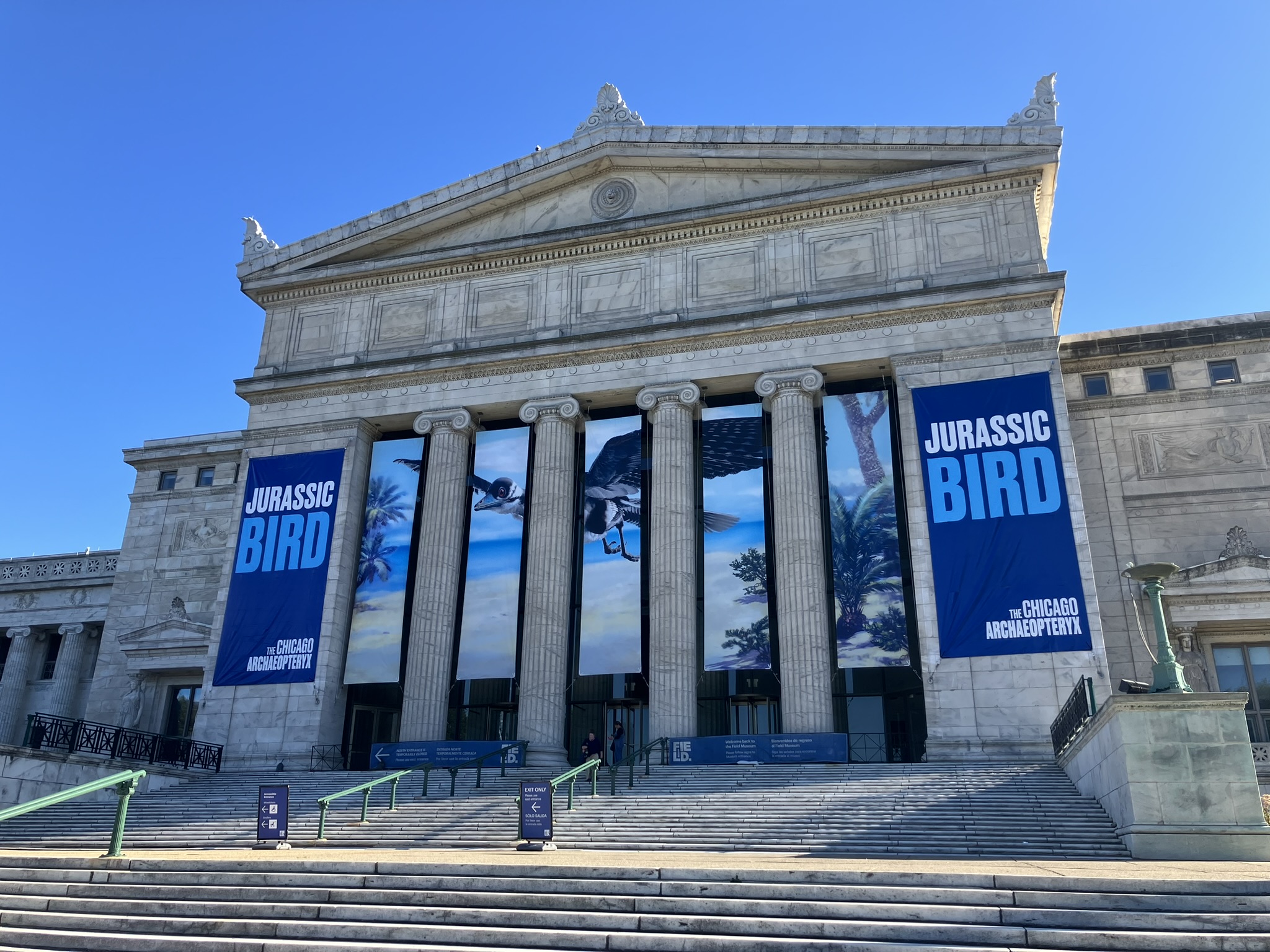
Archaeopteryx banners adorn the Field Museum’s north entrance. Photo by the author.

August 17, 2022. I had just finished a very long drive from Denver to Chicago and wasn’t planning on coming in to the museum that day, but then I heard the news: the fossil was here. The acquisition of the 13th Archaeopteryx by the Field Museum was, by necessity, shrouded in secrecy. There was no reason I needed to know the exact arrival date until the last minute, but I didn’t want to miss the first look at such a historically significant fossil.

That’s how I found myself crammed into the Geology Department’s tiny X-Ray room with a dozen other people. Masks on tight, we all waited with bated breath as Preparator Connie Van Beek pulled up the first images of the slab on the computer. Most of the known Archaeopteryx specimens were commercially prepared before being acquired by museums, but the Field Museum’s new fossil was still sealed in the rock. Aside from the exposed wing feathers—the tell that this was indeed an Archaeopteryx—nobody knew what this block of limestone contained. Would it only preserve the limbs, like the Maxberg and Haarlem specimens, or was there a complete skeleton in there? As we waited for the X-Ray to appear, nobody dared utter the s-word (skull, that is).

Then the image blinked onto the screen. It was a bit faint (these are paper-thin bird bones, after all) but the entire thing was there. Four limbs, a torso, a tail and—folded back in the classic dinosaur death pose—the unmistakable smear of the head and neck. The room erupted into spontaneous applause.

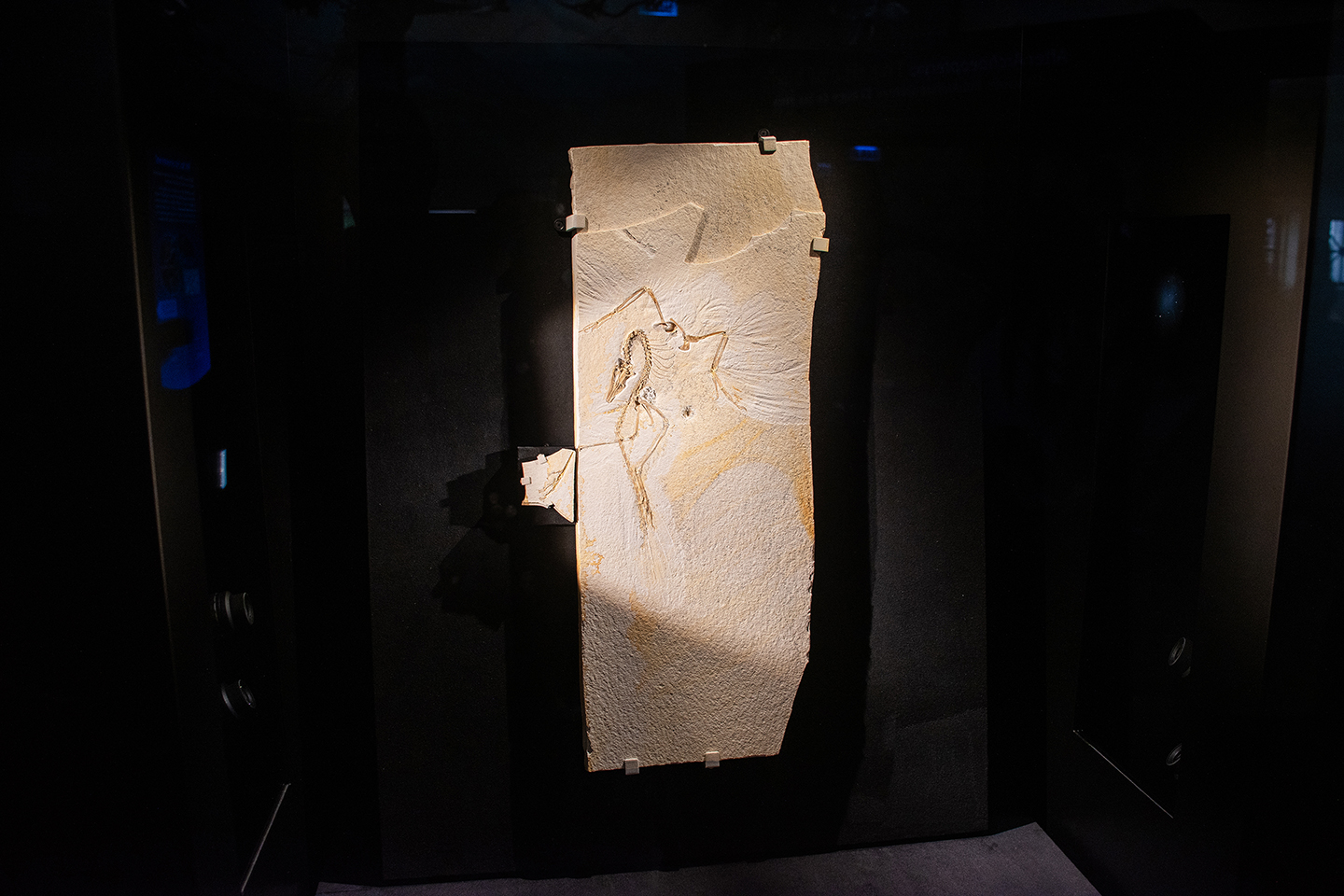
After 1,300 hours of meticulous fossil prep, the Chicago Archaeopteryx is now on display. Photo by the author.

Two years and one month later, the Chicago Archaeopteryx became a permanent resident of Evolving Planet, the Field Museum’s paleontology exhibition. I had the pleasure of serving as the Exhibition Developer for this project, working alongside a brilliant and creative group including Associate Curator Jingmai O’Connor, preparators Akiko Shinya and Connie Van Beek, and all my colleagues in the Exhibitions department. This post is a peek into the thought process behind our new Archaeopteryx display.

Hey, look at me!

A Parasaurolophus-eye view of the Evolving Planet dinosaur hall. Photo by the author.

Once it was decided that the Archaeopteryx should be incorporated into Evolving Planet (rather than being displayed somewhere else in the building) the first order of business was figuring out where exactly to put it. Evolving Planet is arranged chronologically—visitors start at the origin of life 4.5 billion years ago and work their way up to the present. Hailing from the Late Jurassic, Archaeopteryx would need to go somewhere in the central dinosaur hall, which covers both the Jurassic and Cretaceous Periods. But unlike the rest of the exhibition, the dinosaur hall isn’t strictly chronological. There are multiple competing organization schemes in there—the murals on the walls are in Jurassic and Cretaceous clusters, but the central corrals are arranged by evolutionary groups (except when they’re not). And then there’s the big case of marine fossils that span the entire Mesozoic.

I may have lost some sleep over this. Should Archaeopteryx be near the Jurassic Apatosaurus and Stegosaurus (even though it lived on the other side of the world), or near the other theropod dinosaurs? Or maybe it should be with the marine fossils, since it was found in marine limestone. Ultimately, I realized that there was no perfect way to introduce a substantial new display into a space that had already been renovated multiple times, but it wouldn’t ruin visitors’ experience if Archaeopteryx didn’t fit seamlessly into the established flow.

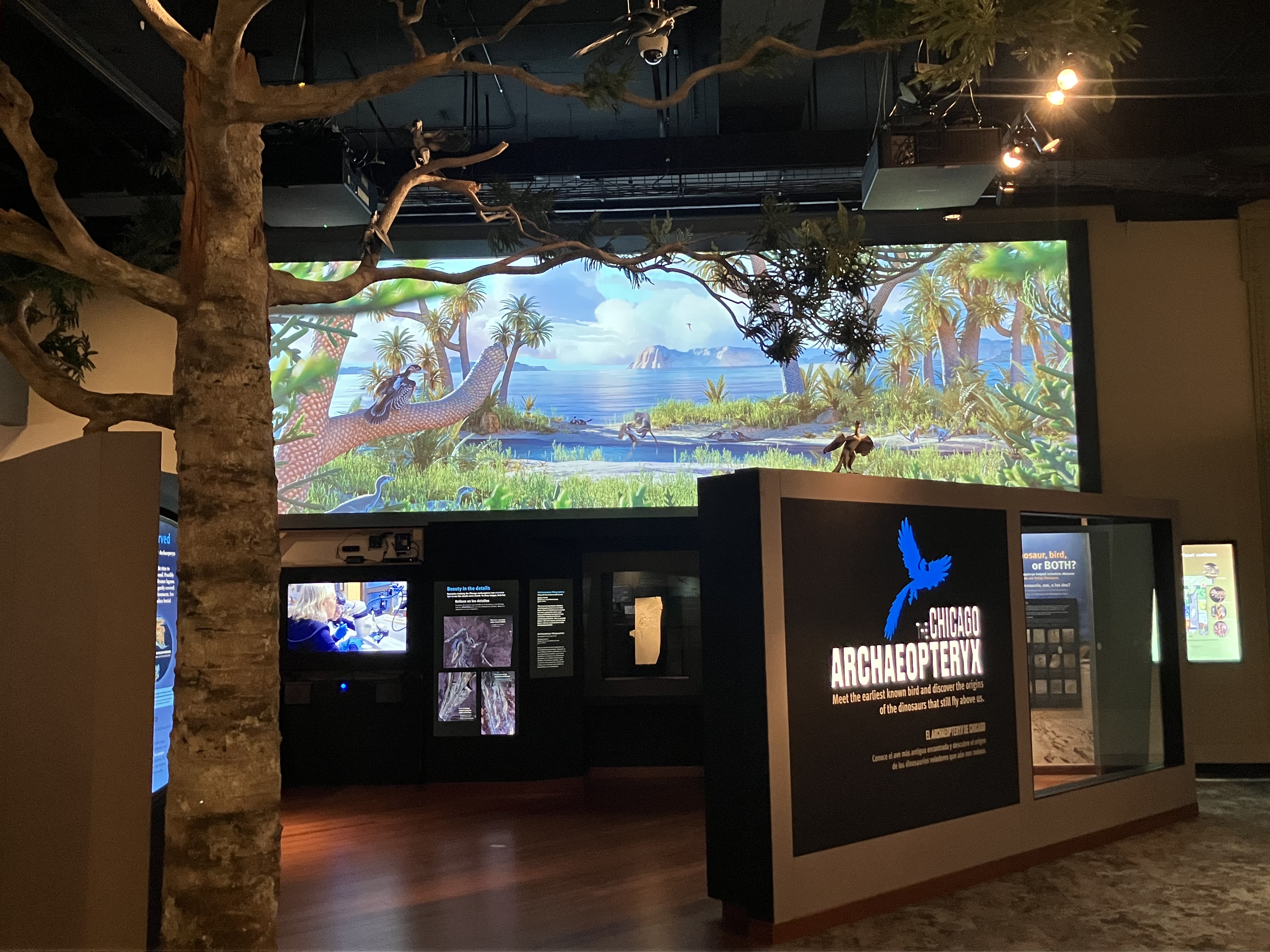
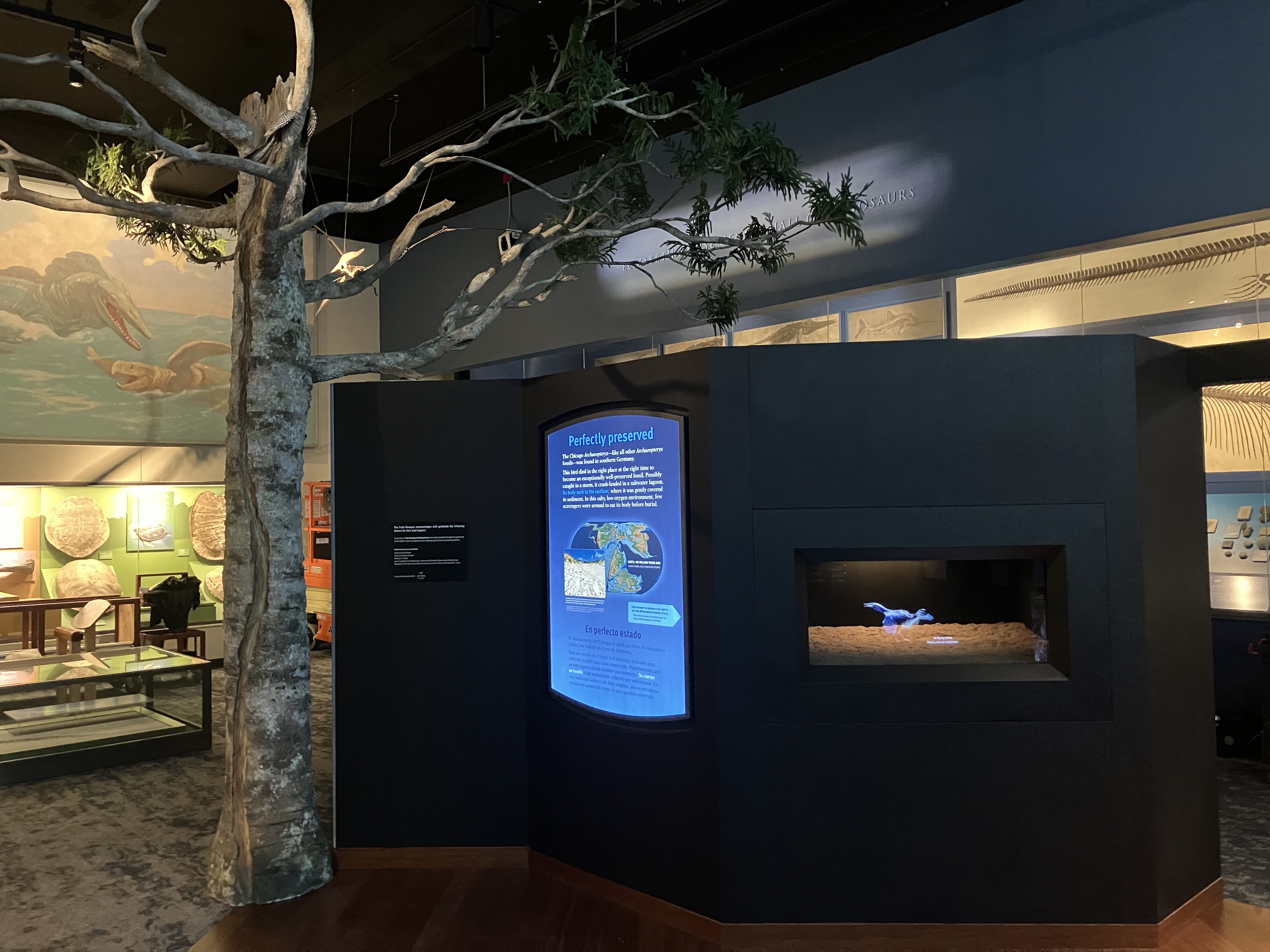
A replica tree and an animated mural beckon visitors to the Archaeopteryx display. Photo by the author.

There was a more pressing issue influencing where to place Archaeopteryx: the fossil itself is really small. The bird, now splayed across an 18-inch flat slab, is no larger than a pigeon. It may be the most complete Mesozoic dinosaur in the Field Museum’s collection and a contender for the best-preserved Archaeopteryx yet found, but its size makes it easy to overlook alongside a half dozen giant skeletons. When Senior Designer Eric Manabat and I first met to discuss the new project, we immediately agreed that the display would need a physical presence comparable to the other dinosaurs.

With that in mind, we decided the best place for Archaeopteryx was the largest open space in the dinosaur hall. That way, we could maximize the amount of interpretive content surrounding the fossil, and also create displays that would signal to visitors that this was something worth paying attention to.

We propose that our Archaeopteryx may have been swept out to sea in a storm. My headcanon is that this tree was struck by lightning during the same event, and has the scar to prove it. Photo by the author.

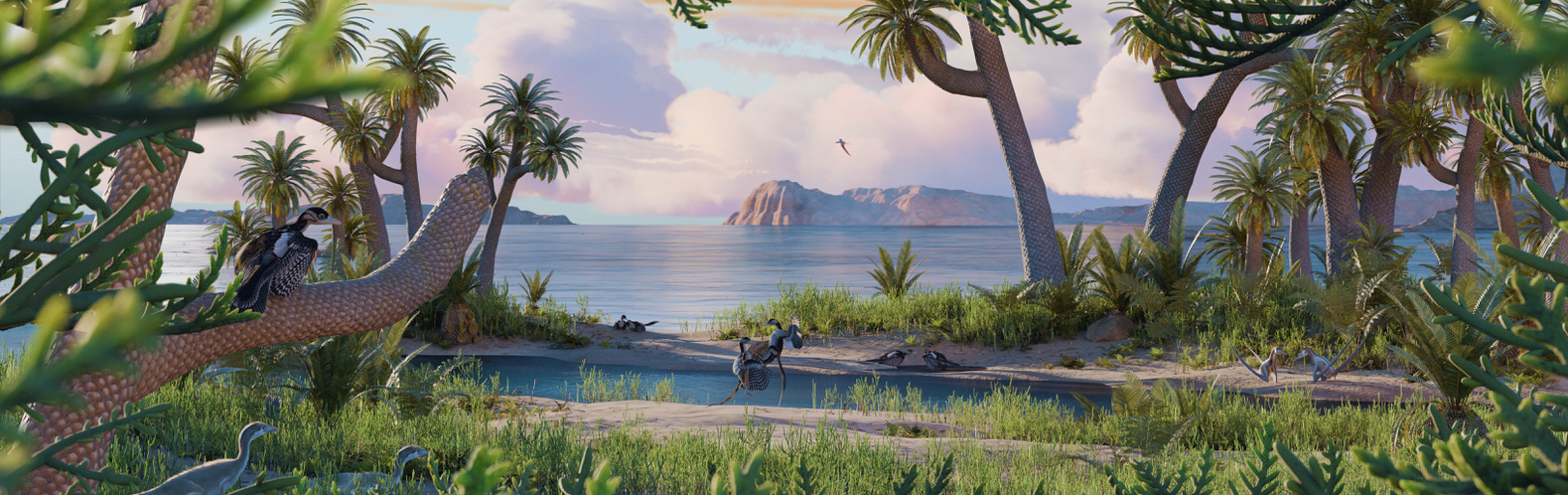
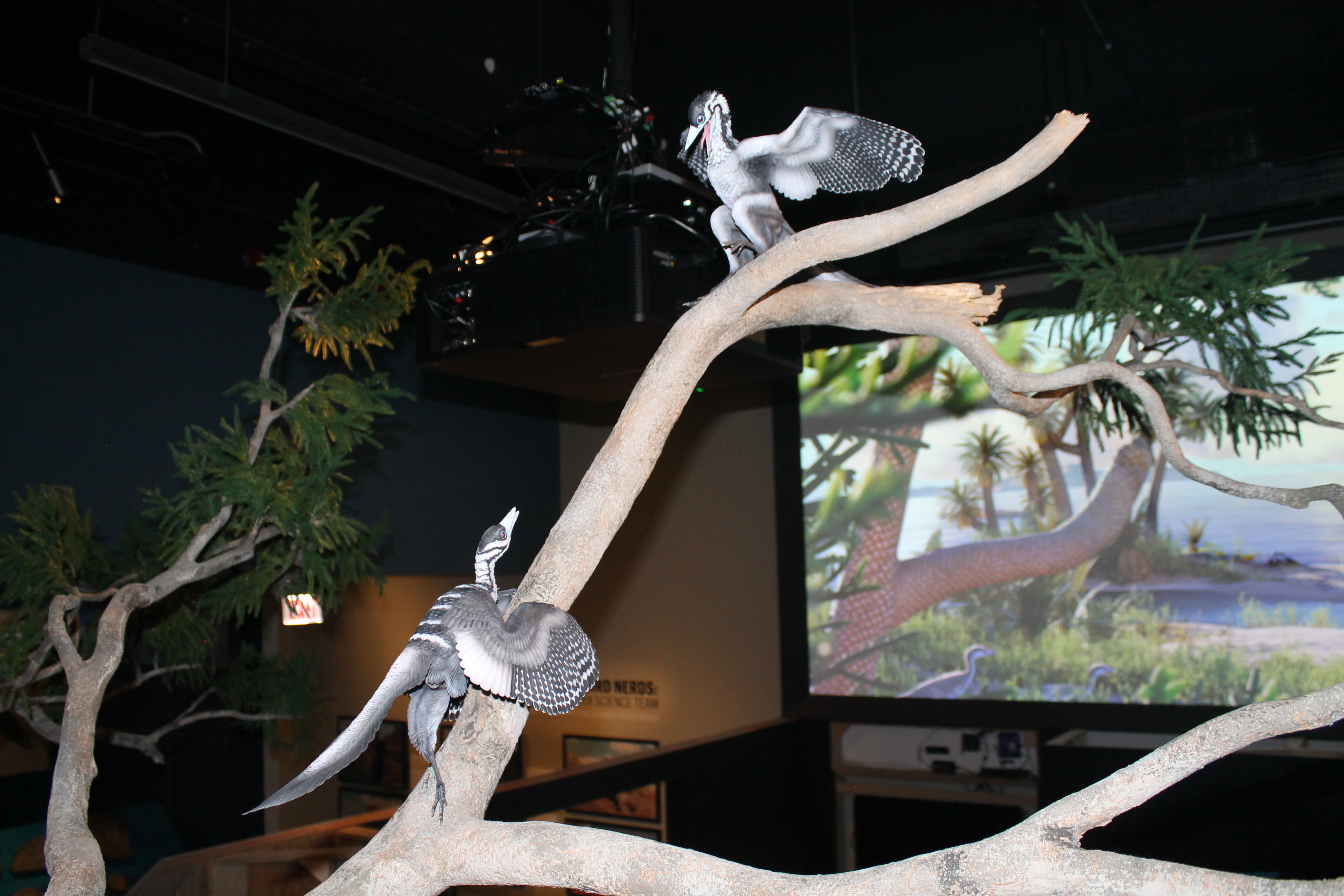
As designed, the Archaeopteryx display has two layers of interpretation. The outer ring, visible from anywhere in the dinosaur hall, showcases the world the first bird lived in. A physical Brachyphyllum tree full of Archaeopteryx models stands in the foreground, and an animated backdrop fills in the rest of the Solnhofen habitat (please notice the coniferous branches peeking into the corners of the animation, which are meant to be an extension of the model tree). We used the habitat reconstruction as the “attractor” because visitors frequently cite these immersive recreations as their favorite parts of our paleontology exhibits.

Casts of Caudipteryx, Anchiornis, and others tell the story of how birds continued to evolve after Archaeopteryx. Photo by the author.

Once visitors enter the exhibit space, the focus changes to Archaeopteryx itself: how it died and was preserved, how it fits into our understanding of dinosaur evolution, and what’s special about this particular fossil. We wanted to create an enclosed, intimate space so visitors could get up close to the fossil and admire it’s delicate details. A program of changing lights helps direct attention to features like feathers, teeth, and claws. And for visitors who prefer a tactile experience, we have a touchable copy of the fossil at three times actual size.

Recreating the World

A moment from the animated mural. © Field Museum.

Much like the permanent and traveling SUE exhibitions, a new reconstruction of the star dinosaur was a major part of the Archaeopteryx project. This time, we worked with the animation studio PaleoVisLab to create the definitive Archaeopteryx and a world for it to inhabit. I joined Jingmai O’Connor, Latoya Flowers, Wesley Lethem, and others in weekly meetings with paleontologist Jing Lu and animation lead Heming Zhang for nearly a year as they brought the first bird to life.

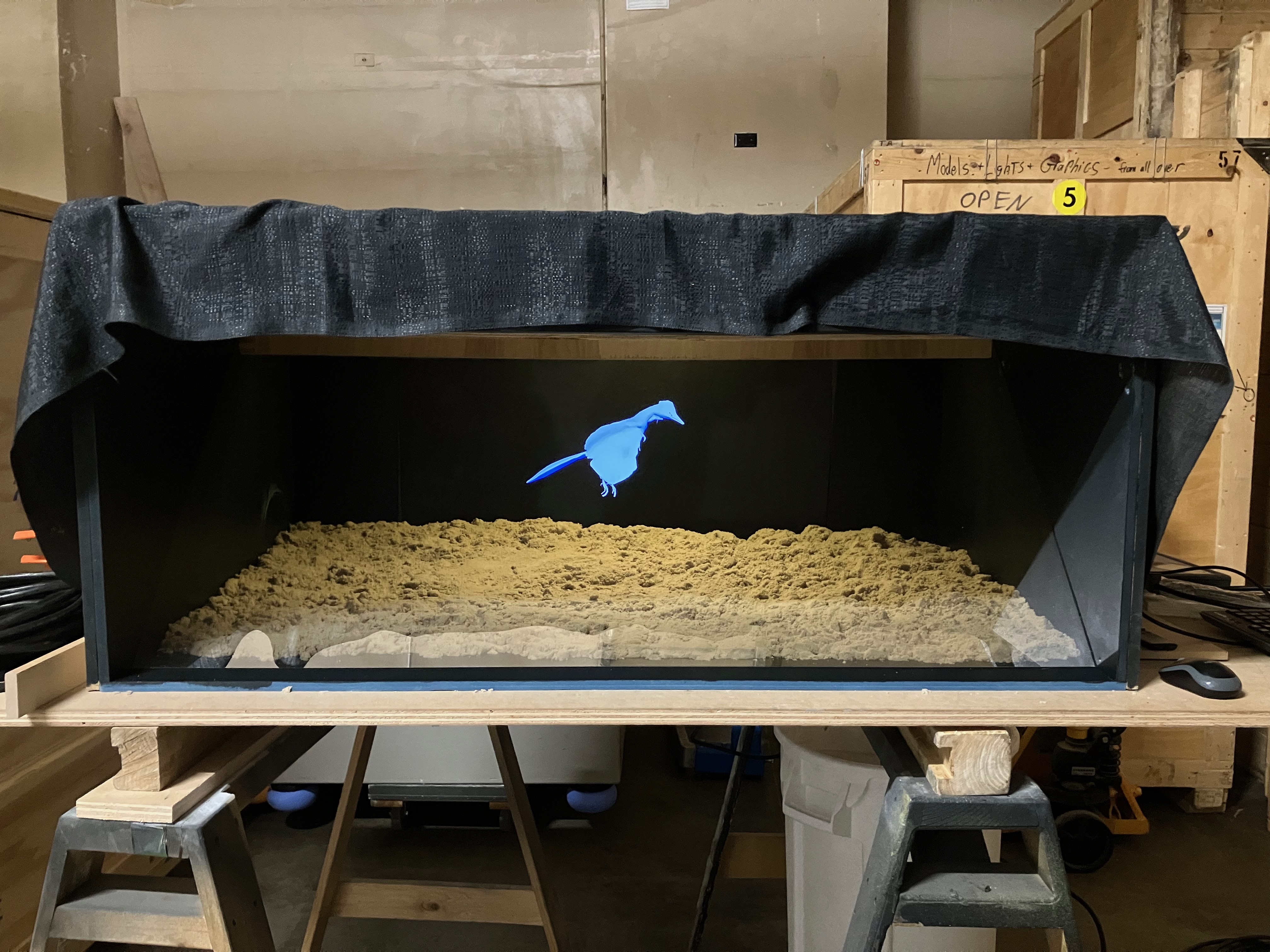
The PaleoVisLab team actually created two animations. The first is a simulated “hologram” which illustrates the taphonomic circumstances that resulted in such a perfectly preserved fossil. This animation resides in a pepper’s ghost chamber, designed and built by Latoya and Wesley. It was fun integrating a 160 year-old magic trick into our exhibit, and I appreciate the cosmic coincidence that the pepper’s ghost technique was first popularized within a few years of the discovery of the first Archaeopteryx.

A prototype of the pepper’s ghost chamber. Getting the image to float in space correctly took months of iteration. Photo by the author.

The second, far more daunting animation was the moving mural. We knew we wanted a big, impressive recreation of Archaeopteryx in its world, but we fretted about how it would fit among the century-old Charles Knight murals that adorn the walls of the dinosaur hall. We wanted something that looked dynamic and modern, but it needed to coexist respectfully with the classic oil paintings, and not attempt to overshadow them. I think we managed to toe the line, and the completed piece even has a few nods to Knight’s Solnhofen scene (which is still on display). The pair of Compsognathus in the lower left corner is the most obvious example.

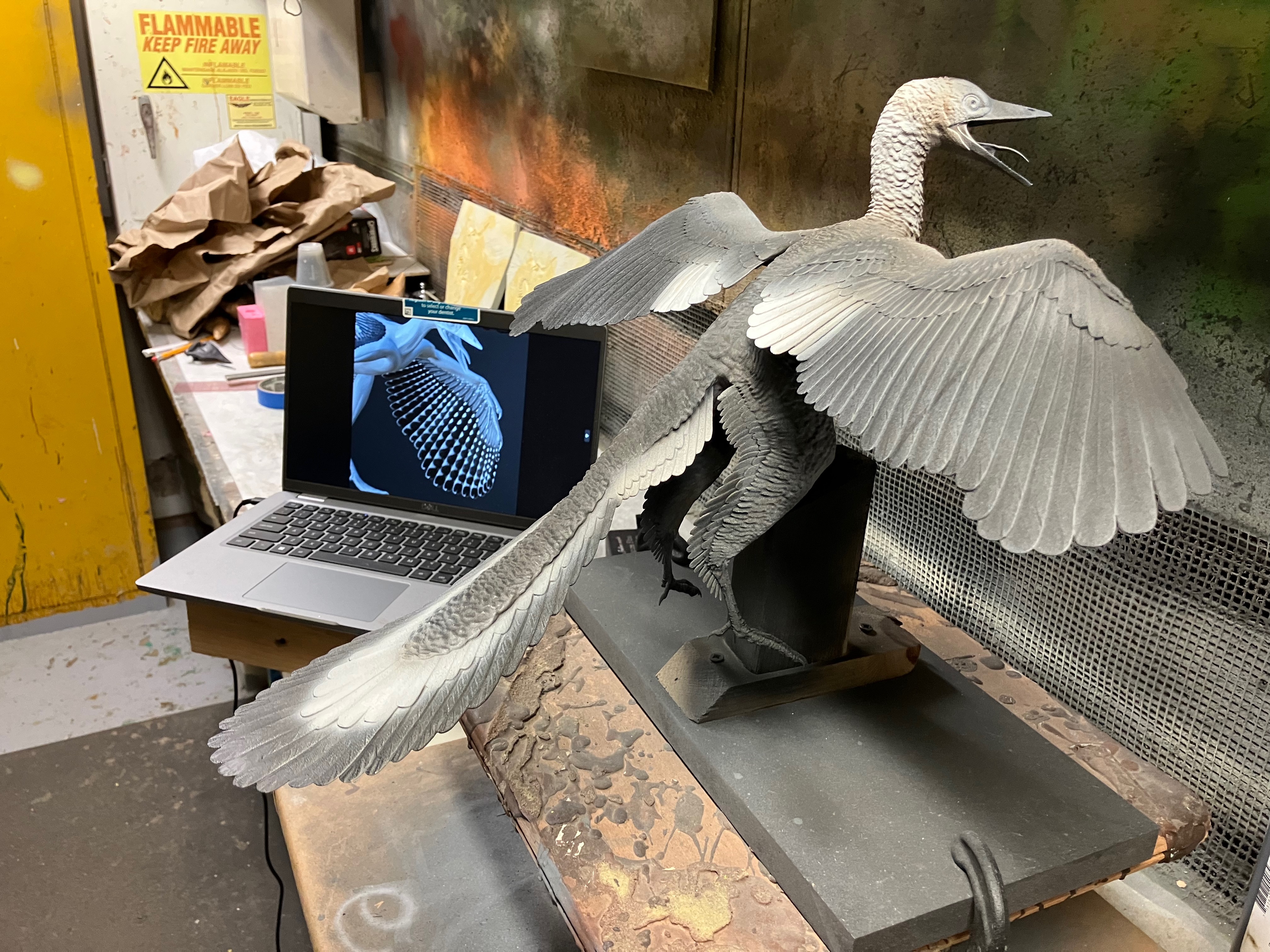
A 3-D printed Archaeopteryx in the early stages of painting. Photo by the author.

Heming could not be restrained from from putting astonishing (one might say insane) amounts of detail into every animal and plant in the scene. I particularly remember the day he turned up for the weekly call and enthusiastically showed us that he had modeled both male and female dragonflies, with hundreds of individual lenses on their compound eyes and even different genitalia. Every creature—from the tiny Homoeosaurus scurrying across the sand to the Aspidorhynchus that jumps out of the water for less than two seconds—was carefully reconstructed from the skeleton up. Naturally, the Archaeopteryx got the most attention. Our model is specifically based on new information gleaned from the Chicago specimen—note the shape of the head in particular.

The physical bird models in and around the tree are 3-D prints of the digital version, which was a new approach for us. This solved a problem we had on the SUE project, where we had different artists simultaneously creating images in different media that somehow had to match. But the 3-D prints also created new challenges: the spindly legs and toes were too fragile to actually hold the model’s weight, so we had to come up with some creative ways to mount them in the tree. Janice Lim constructed the mounts and painted the models so that they perfectly match their animated counterparts. And while I’m shouting out artists, illustrations by Ville Sinkkonen, Gabriel Ugueto, Liam Elward, and Scott Hartman also appear in the exhibit.

These fighting birds poised above the entrance are my favorite part of the exhibit. Photo by the author.

For me at least, the primary goal of the Archaeopteryx display was to get as many visitors excited about this rare fossil as possible. Given that it doesn’t have the size, name recognition, or ferocious appearance of T. rex or Spinosaurus, getting people to pay attention to a little bird with a hard-to-pronounce name wasn’t a sure thing. The solution was to create as many “entry points” as possible. Maybe you’re interested in animals and how they behave. Maybe you’re interested in history, and how our scientific understanding of the world came to be. Maybe your curiosity is activated by seeing something in motion, or by touching things, or by encountering something unique and special. My hope is that whatever interests you bring with you, we’ve created a space where there’s something for you to get excited about.

Leave a comment

Filed under dinosaurs, exhibits, FMNH, museums, paleoart

Past Worlds at NHMU is breathtaking

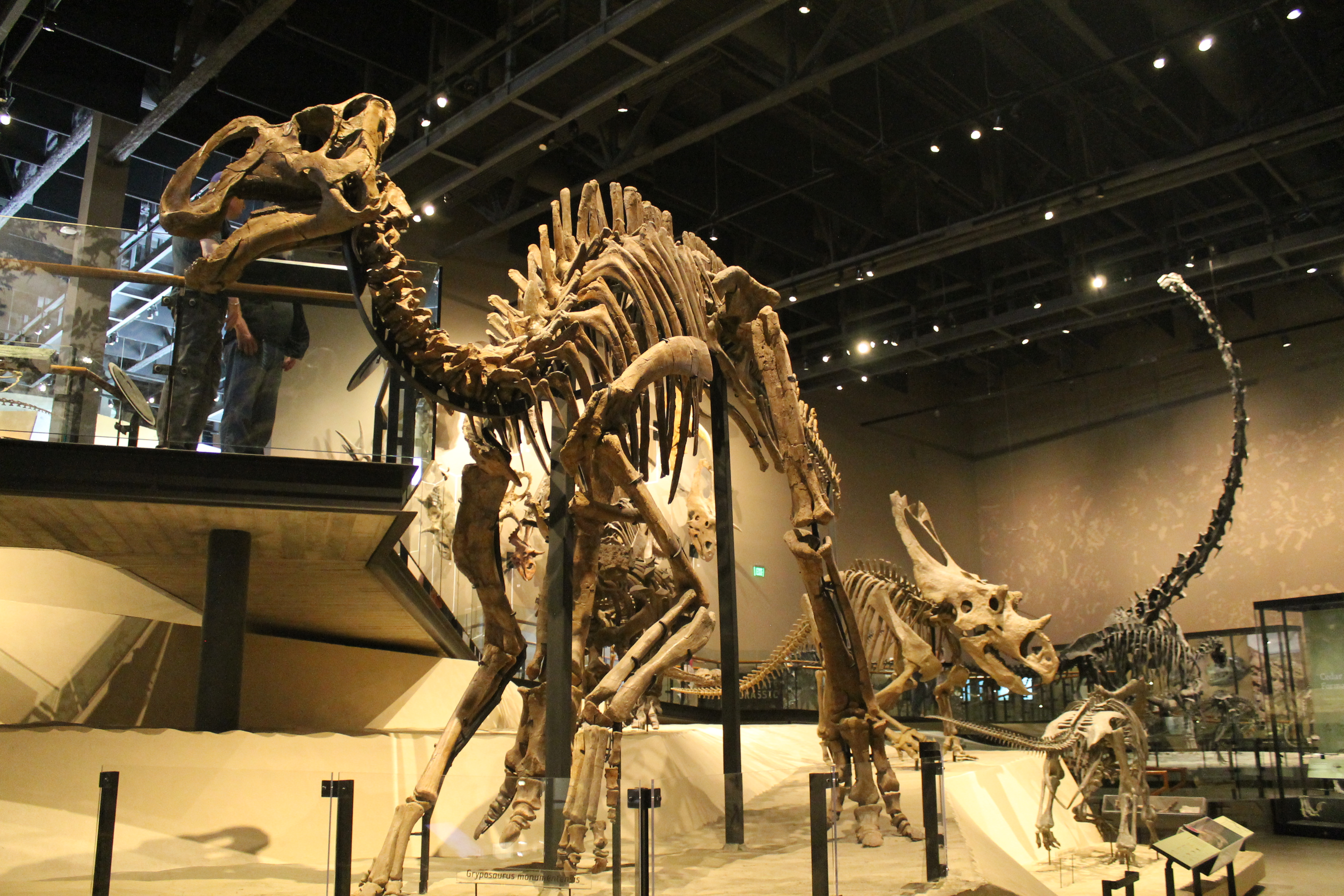
Gryposaurus makes an impression amidst other dinosaurs in Past Worlds, the NHMU paleontology exhibition. Photo by the author.

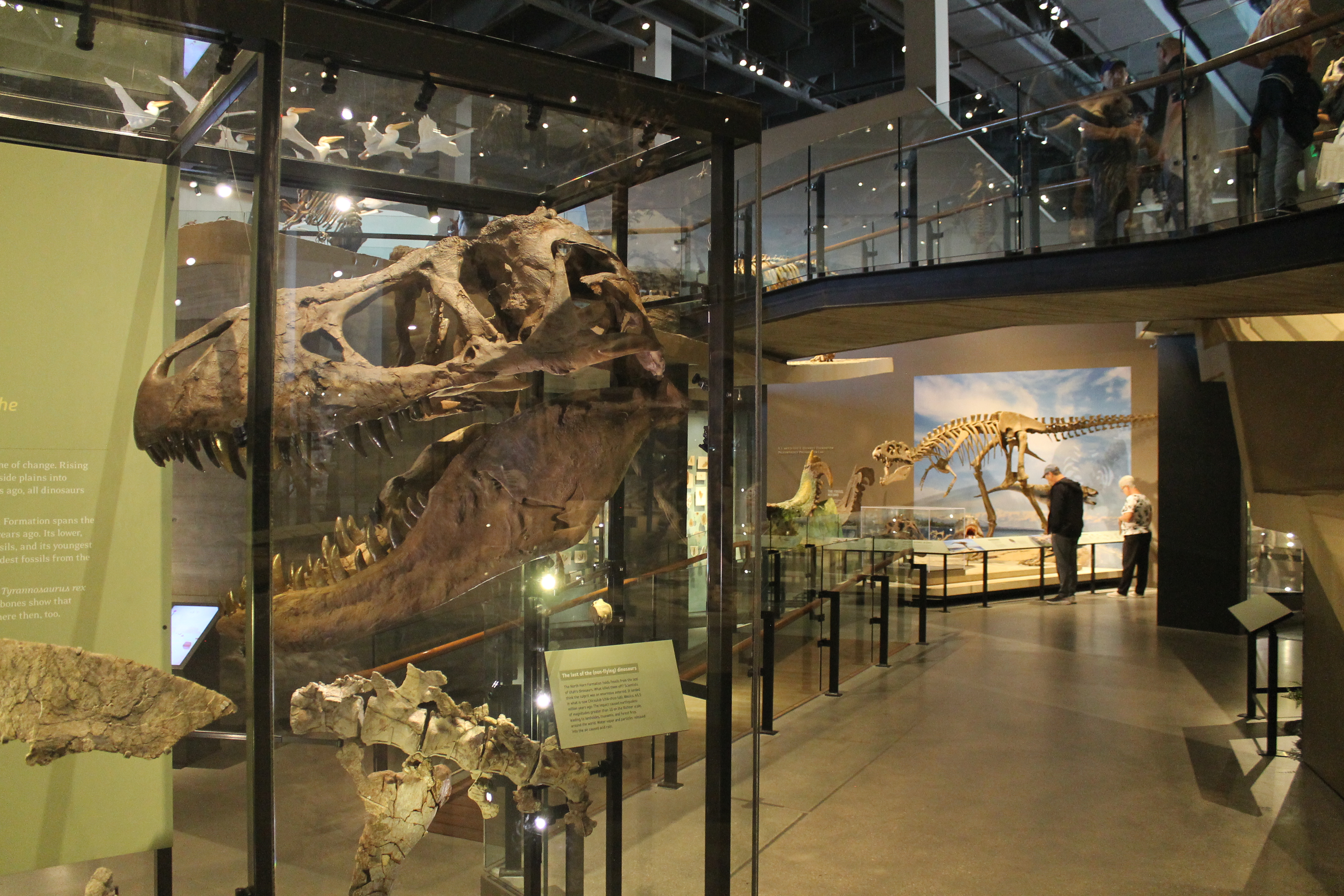
I visited the Natural History Museum of Utah (NHMU) earlier this week, and I need to take a moment to applaud its exceptionally beautiful and well-conceived paleontology hall.

NHMU is part of the University of Utah. It resided in its original home on the Salt Lake City campus from 1969 to 2011, when the museum relocated to a new, purpose-built facility in the foothills near Red Butte Canyon. Several design firms contributed to the Rio Tinto Center (the name for the building in which the museum resides), but the permanent exhibitions—including the paleontology hall—are the work of good ol’ Ralph Appelbaum Associates (RAA). For the unfamiliar, RAA is a dominant player in the field of museum design that is often associated with projects of profound cultural and historic significance, like the US Holocaust Memorial Museum and the National Museum of African American History and Culture. RAA has fewer natural history projects in its lengthy catalog of commissions. Near as I can tell, their only other paleontology-centric project was the fourth floor fossil halls at AMNH. I’m not a huge fan of many of the design choices made in those halls, so it’s interesting to see what 20 years and a different client can mean.

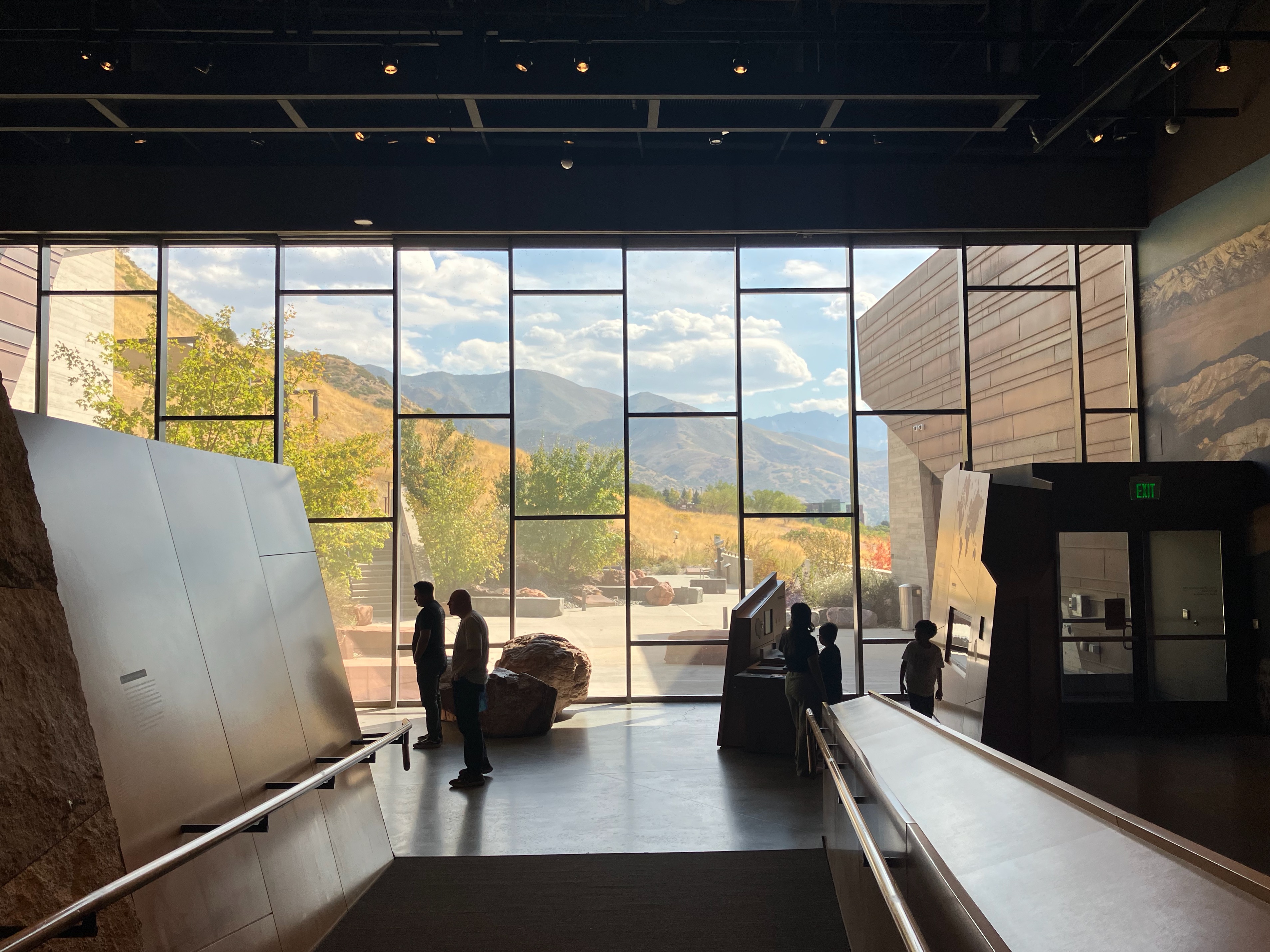
Large windows and frequent access to the outdoors are standout features of the NHMU building. Photo by the author.

The 44,000 square feet of permanent exhibitions at NHMU flow linearly across the building’s five floors, which visitors can explore from bottom to top or top to bottom. Conceived as a single experience, the exhibitions don’t feel like discreet units—instead, they flow seamlessly into one another as visitors climb or descend along switchbacking paths through the building. I want to call attention to the design of the museum as a whole because it manages to be both stylish and meaningful. Unlike some other museums with bold architecture (looking at you, ROM), the building manages to make a visual statement without hindering visitor experience or usable exhibit space.

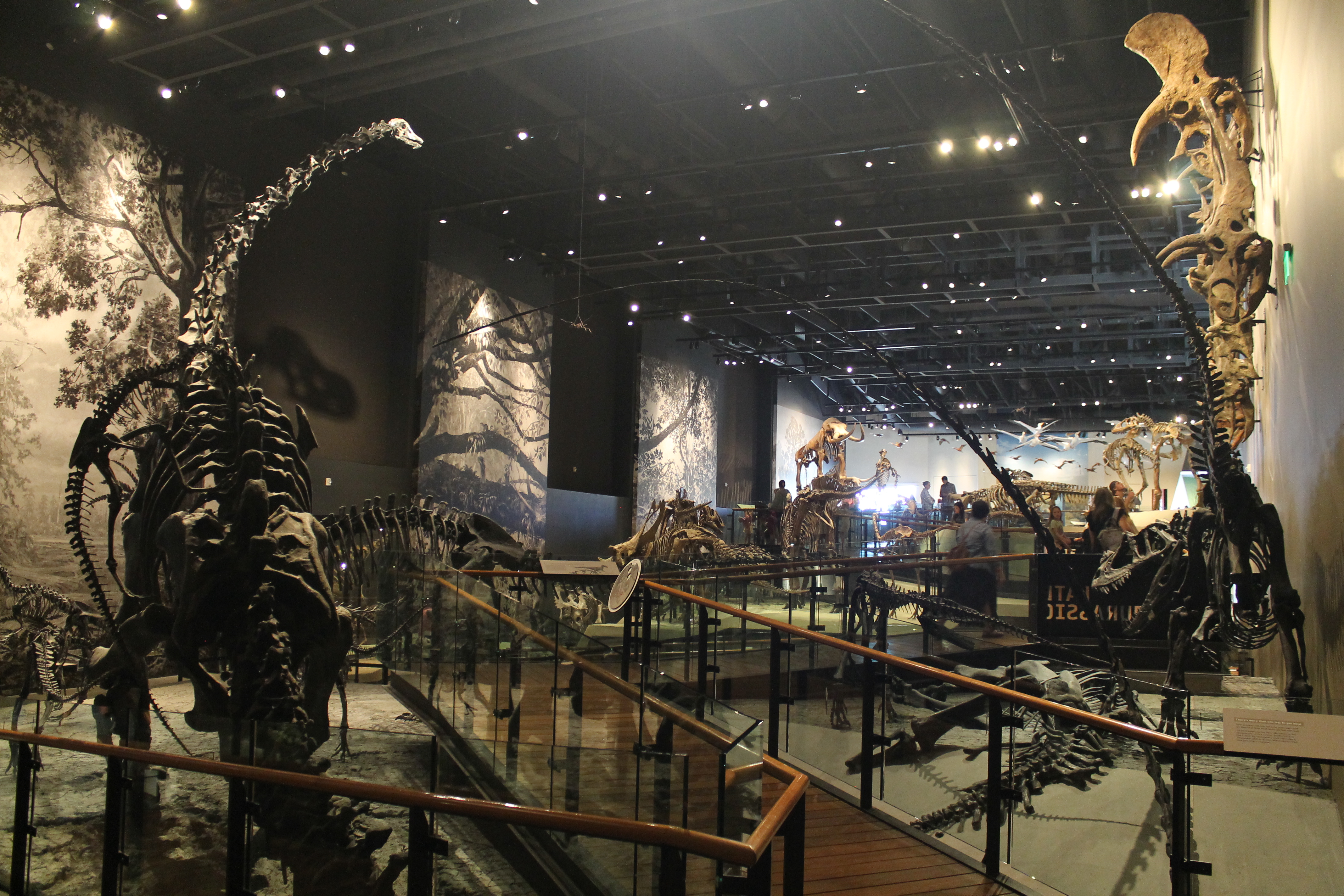
Past Worlds as seen from the Jurassic. Photo by the author.

The paleontology hall—entitled Past Worlds—occupies about half of the total exhibit space, and fittingly it is the first area visitors encounter if they choose to start at the bottom. The hall is open and spacious, but visitors cannot access the entire exhibition at once. Instead, they follow a zigzagging, switchbacking path, with new sight lines opening up as they go. Monumental elements—namely, the dinosaur skeletons, wall murals, and immersive dioramas—are encountered multiple times from different perspectives.

One example is a life-sized diorama of the lake bottom where fossils of the Green River Formation were preserved. Visitors first see this tableau from an “underwater” perspective. Then, some time later, visitors encounter this same scene again, now looking down from the “surface.” Elsewhere, dinosaur skeletons that can be seen from different vantages are interpreted in multiple ways, depending on what else visitors can currently see and compare them to. This series of reveals and payoffs reminds me of the carefully constructed experiential narratives in theme parks, but precisely applied to help visitors learn about ecology and geology. It’s really cool.

Uintatherium and Patriofelis foreground multiple layers of mounted skeletons. Photo by the author.

The hall’s color palate is a mix of earth tones and grayscale. Some of this comes from the mounted skeletons, which range from the charcoal gray of Morrison fossils on one end of the space to brown and beige Cretaceous and Cenozoic fossils on the other. Four giant, vertically oriented murals also contribute to the look and feel of the space. Corresponding to the Jurassic, Cretaceous, Paleogene, and Quaternary areas of the hall, these black-and-white murals focus on the flora and landscapes of these eras—you have to look closely to find the animals. I couldn’t find a label identifying the artist, but the murals’ dark foregrounds and bright backgrounds remind me of the original King Kong (or if you want to be fancy, the engravings of Gustav Doré).

Local tyrants Lythronax and Teratophoneus get the most attention, but an obligatory cast of the Wankel/Nation’s T. rex is also present. Photo by the author.

As suggested by the murals, the overall space is arranged chronologically. However, the switchbacking path through the exhibition means that visitors start in the recent past and move back to the Jurassic, before reversing direction and moving forward in time. While a time axis is present, Past Worlds is less about presenting a comprehensive narrative of the history of life and more about zeroing in on a few particular ecosystems that once existed in Utah. These include the Morrison Formation of the Jurassic, the Cedar Mountain, Kaiparowits, and North Horn Formations of the Cretaceous, the Green River Formation of the Paleogene, and the recent Ice Ages. These deep dives into specific habitat groups are relatable, digestible, and easy to contrast with one another and the modern world—indeed, I have been not-so-subtly trying to coax the paleontology exhibits at my own institution in the same direction.

The mounted skeletons have fared well, considering that they’re all in open air and easy to reach. Photo by the author.

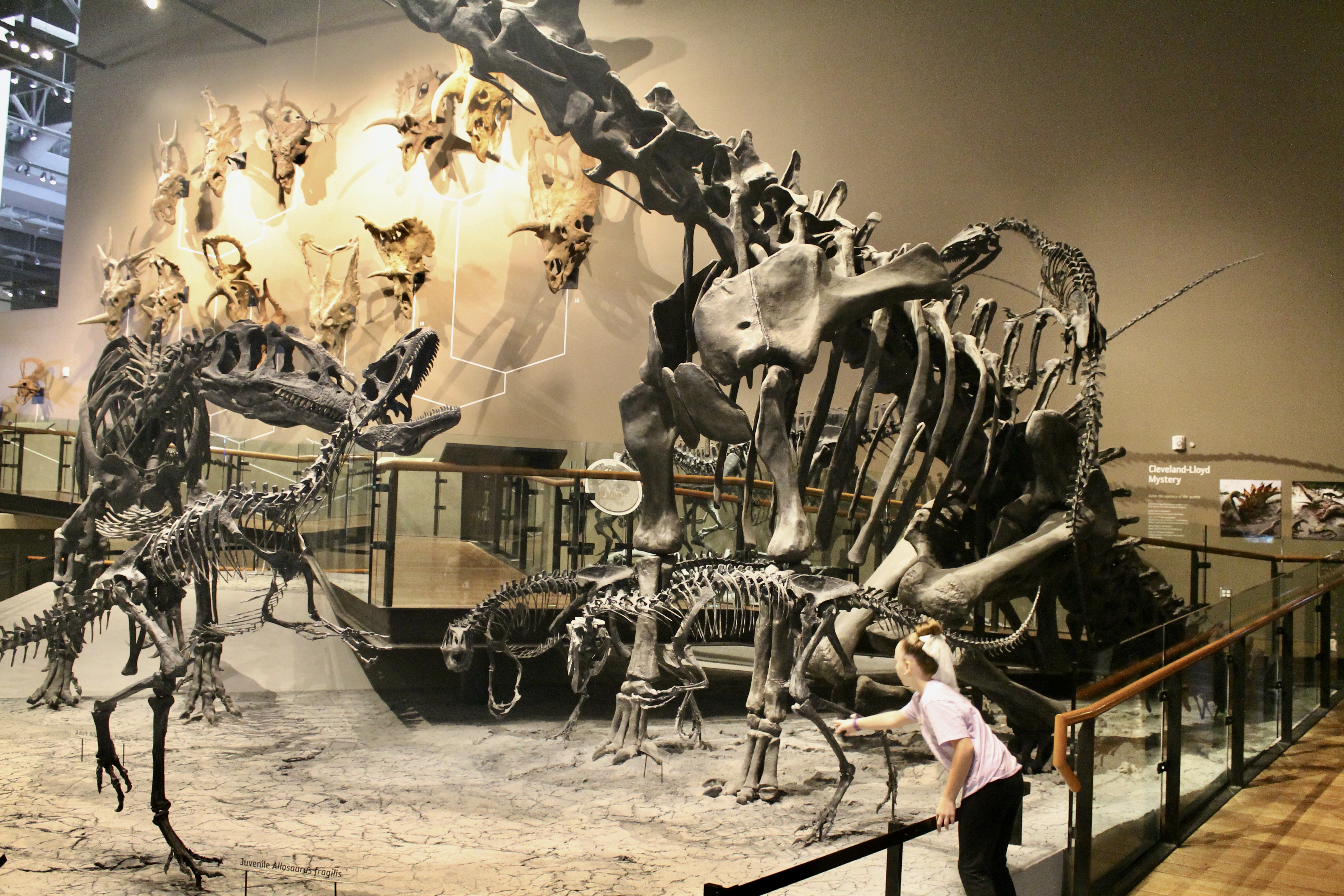
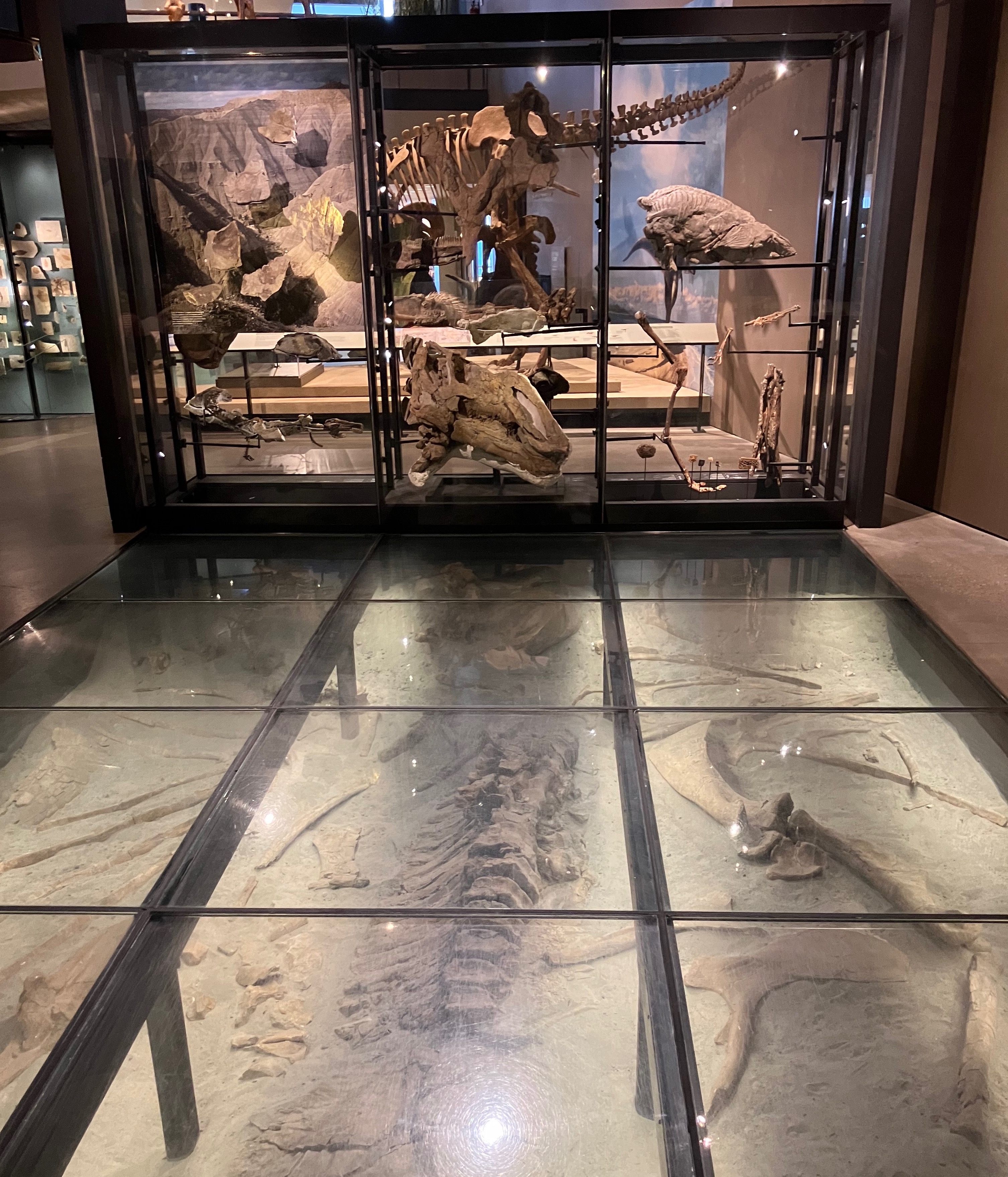
Past Worlds features hundreds of fossil specimens, nearly all from Utah or adjacent states. There are more than 40 mounted skeletons, many of which were firsts for me—I’ve never seen a mounted Marshosaurus, Akainacephalus, or Patriofelis before! Notably, all but one of the standing mounts (the Gryposaurus) are casts. This is not due to a lack of material—most of the mounts are based on fossils from NHMU’s collection. Clearly, somebody made the decision to draw a firm line between the real specimens and the dynamic reconstructions—a line that other museums have traditionally blurred. I think it’s fair for some visitors to be disappointed by this, but using casts allows for some lively and energetic displays. The group of Allosaurus swarming a Barosaurus mired in mud is particularly evocative (and incidentally, the way the sauropod’s tail sweeps under the path and curls overhead is so cool). Besides, there are plenty of real fossils to see, many of which are very strikingly displayed. I was impressed by an in situ hadrosaur skeleton under the floor, which seamlessly merges with a vertical case of Kaiparowits fossils that appears to be rising out of the ground.

I’m not sure how easy this is for scientists to access, but it sure looks neat. Photo by the author.

Individual labels are commendably brief, and tie each fossil to the larger stories being told. I was pleasantly surprised that the ID lists the discoverer and the preparator of each fossil, when known. Most labels also include a skeletal diagram showing where individual bones fit into the larger skeleton, but these were frustratingly small and almost impossible to make out (a problem shared with similar graphics at NMNH).

There are plenty of touchable displays, but media is used sparingly. A highlight is a four-part program in which scientists propose different possible causes for the Cleveland-Lloyd assemblage of Jurassic fossils. Visitors are then prompted to vote on which hypothesis is most convincing. The program is several minutes long, but visitors appeared to be staying for the entire thing, and causing a traffic bottleneck in the process.

As you can assuredly tell, I was extremely impressed by NHMU. Meaningful design and a thoughtful approach to visitor experience combine with accessible interpretation and some extraordinary fossils to create a truly outstanding example of a natural history exhibition.

3 Comments

Filed under dinosaurs, exhibits, fossil mounts, mammals, museums, reviews

The Dueling Dinosaurs: famous fossils in an open lab

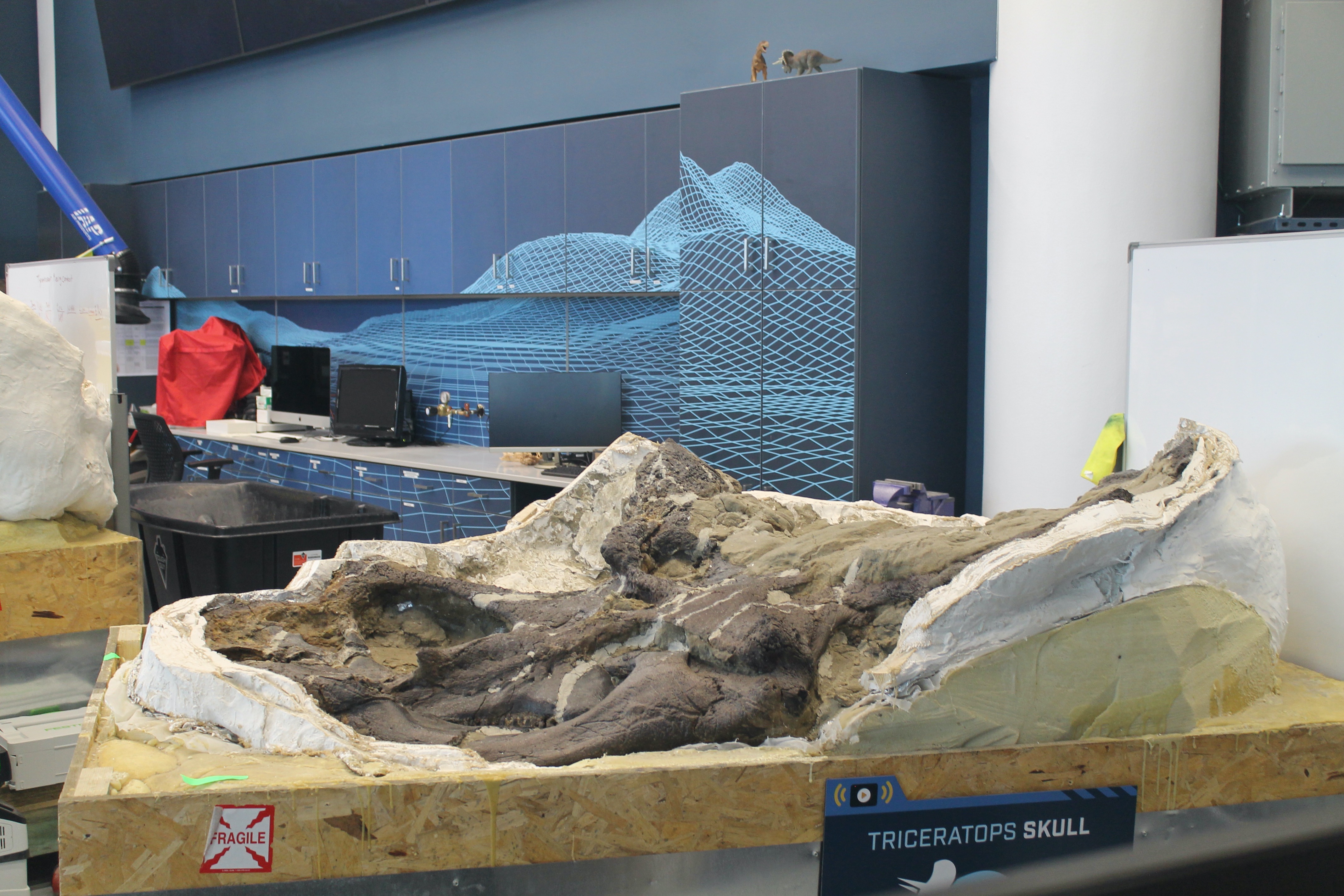
A partially prepared tyrannosaur skeleton in a field jacket. Photo by the author.

Earlier this month, I had the a chance to see the “Dueling Dinosaurs,” which debuted at the North Carolina Museum of Natural Science (NCMNS) in April. Consisting of virtually complete skeletons of a tyrannosaur and Triceratops preserved side-by-side, this fossil is either the find of the century, or just another example of overhyped, overstudied, and overpriced Hell Creek dinosaurs—it depends on who you ask. But NCMNS has made it more than that, placing the fossil at the center of an ambitious project to improve science literacy by removing all barriers to the process.

Commercial collector Clayton Phipps discovered the skeletons in 2006, on private ranchland in Montana. Having never worked on anything so large before, Phipps teamed up with the Black Hills Institute for the initial preparation and assessment of the fossil. The skeletons were put up for auction in 2013, resulting in what has become a familiar din of competing voices. The sellers heralded the rarity and quality of the fossil, proclaiming it to be a clear example of dinosaurs that perished while locked in combat. Paleontologists countered that a fight-to-the-death scenario was unlikely, and without scientific study, the circumstances of the dinosaurs’ demise could not be known. Furthermore, in the event that the fossil went to a private buyer, there would be no opportunity to study it. The so-called Dueling Dinosaurs were poised to become yet another example of a high-profile specimen sold into private hands, where they could never contribute to scientific and public knowledge.

As it happened, the auction was a failure, and bidding never reached the reserve price. Behind the scenes, however, the Friends of the North Carolina Museum of Natural Science—a non-profit organization that supports the state-run museum—had put forth an offer of six million dollars for the fossil. To be clear, a mid-sized public museum like NCMNS absolutely does not have $6 million on hand for specimen acquisition. The funding came from private donations solicited by the Friends organization.

A partially prepared Triceratops skull in a field jacket. Photo by the author.

The offer was accepted, but there was another hurdle: a legal challenge over ownership of the land the fossil was found on. In Montana, surface rights (ranching, farming, etc.) and mineral rights (oil, coal, uranium, etc.) to the same parcel of land can be split among different owners. When the Dueling Dinosaurs fossil was collected, arrangements were made with surface landowners Lige and Mary Ann Murray, but other parties had partial claim to the mineral property. Those individuals—Jerry and Bo Severson—sued, arguing that fossils are minerals and should belong to them. In 2020, the Montana Supreme court ruled that for legal purposes, fossils are “land” and therefore belong to surface landowners. With the sale completed, the next stage in the Dueling Dinosaurs story could begin.

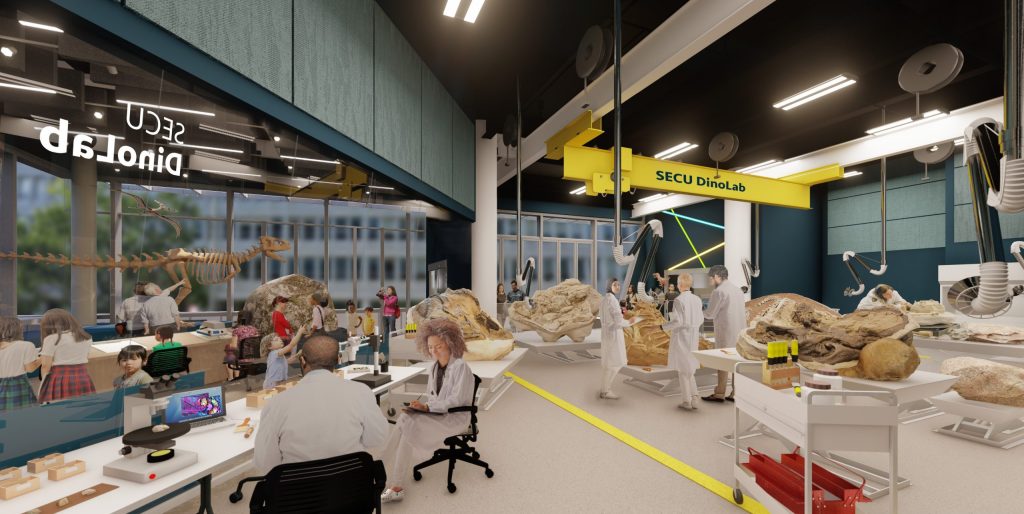
Concept render of Dueling Dinosaurs lab and exhibit by HH Architecture. Source

Having already pushed for the acquisition of the fossil, NCMNS Head of Paleontology Lindsay Zanno took charge of the project. Her vision was to create a completely open fossil preparation lab. Rather than being behind glass, the scientists working on the Dueling Dinosaurs would be available for conversation with the public whenever the museum was open. As Zanno explained in an interview, “I conceived the Dueling Dinosaurs project to take the public on a live scientific journey, to illuminate how science works, to show who scientists are and what we look like, and to increase trust in the scientific process.”

To accomplish this, NCMNS hired local firm HH Architecture. They designed the state-of-the-art lab to Zanno’s specifications within the Nature Research Center, the second wing of NCMNS that opened in 2012. The addition also includes two flanking exhibit galleries and street-facing, floor-to-ceiling windows, which allow passerby to see into the lab.

LED images of the three hypotheses cycle across a central display in the first gallery. Photo by the author.

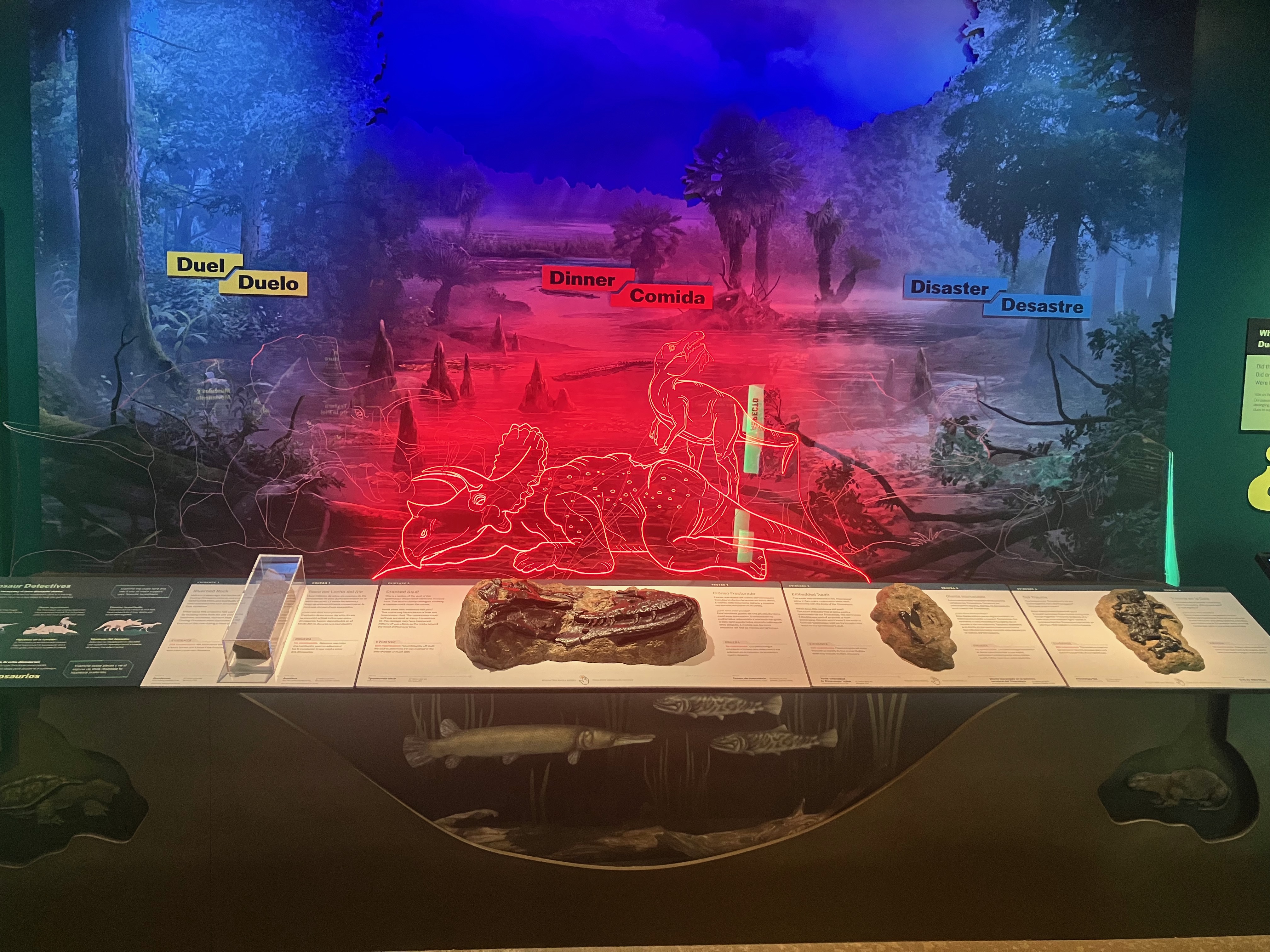
Visitors enter the Dueling Dinosaurs exhibit on the Nature Research Center’s ground floor. The first gallery introduces visitors to the ecosystem of Late Cretaceous Montana. Green panels and walls situate visitors in this verdant environment. After passing small cases with turtle, crocodile, fish, and plant fossils (the purchase of the Dueling Dinosaurs included access to the discovery site, but these are on loan from the Denver Museum of Nature and Science), visitors reach a large display introducing the central mystery of the Dueling Dinosaurs. The exhibit presents three possible scenarios that could have resulted in the dinosaurs being preserved together: duel (a fight to the death), dinner (the tyrannosaur perished while scavenging on Triceratops), or disaster (the animals died separately and were washed together in a flash flood). Color-coded LED outlines of the dinosaurs illustrate the three scenarios in front of an illustrated backdrop.

While these scenarios are presented as being equally plausible, most paleontologists agree that the “disaster” scenario is the likeliest of the three. The real purpose of the exhibit’s presentation is to introduce visitors to the process of stating a hypothesis and finding supporting evidence. Remember, a major part of the rationale behind acquiring the fossil and creating this is exhibit was to show the public what scientists do, and why scientific conclusions are trustworthy. This inquiry-based display attempts to coax visitors through the process of considering the available evidence, and letting it lead them to a conclusion.

Projected images and text augment a sculpture of the fossils. Photo by the author.

Visitors’ next stop is the lab itself, but traffic is controlled by a roughly 4-minute media presentation at the far end of the first gallery. Relief sculptures of the Dueling Dinosaurs skeletons at 50% scale are the centerpiece of this display. Projected images to the left and right—and on the sculpture itself—illustrate the story of where the fossil came from and what scientists hope to learn from it. Certain moments, like a laser scan across the fossil, suggest at least a little inspiration from the SUE show at the Field Museum. The animated tyrannosaur and Triceratops that appear throughout this and other media pieces in the exhibition were created by Urvogel Games, the people behind the dinosaur simulator game Saurian.

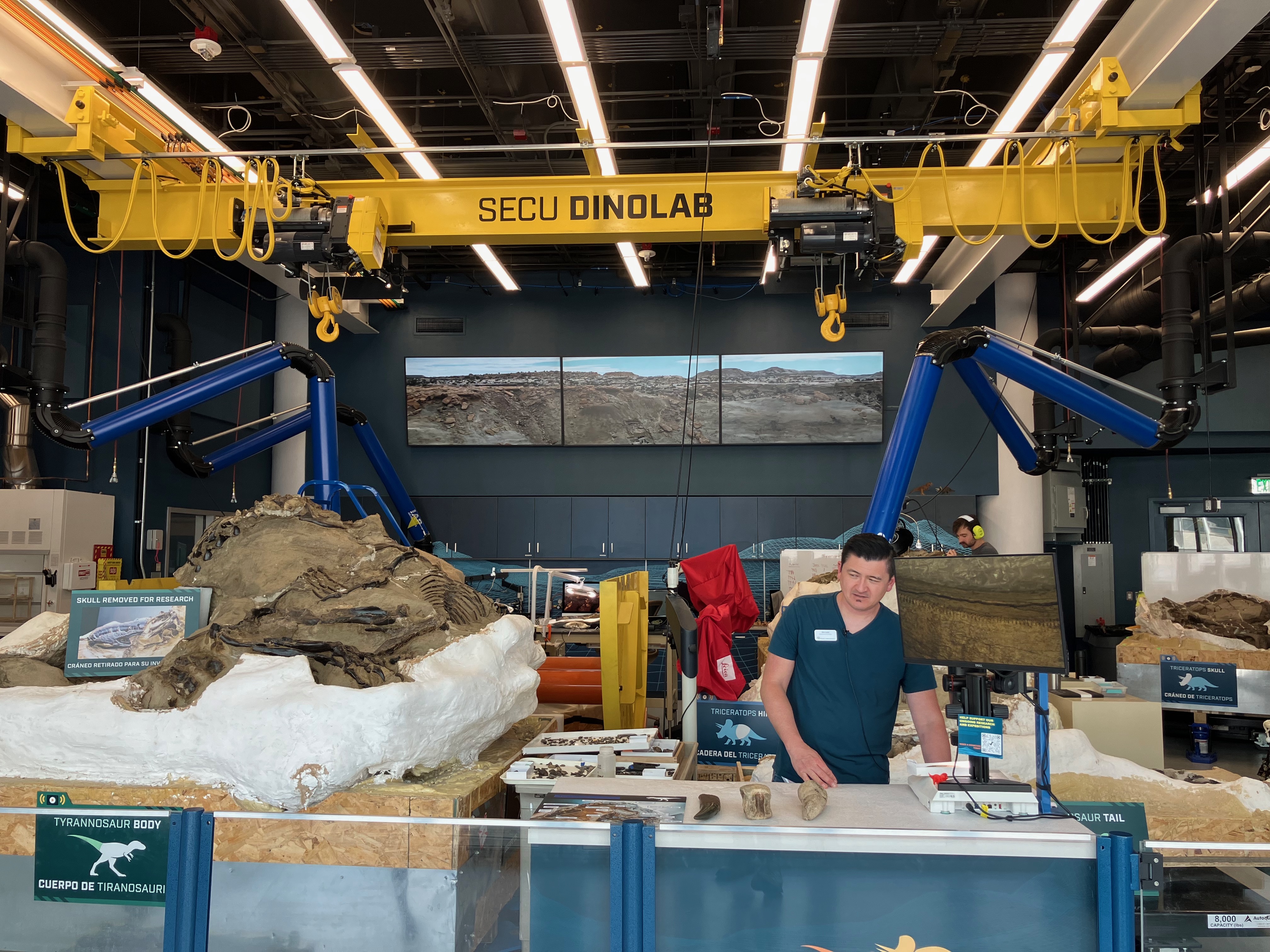
Once inside the lab, nothing but a short plexi barrier separates visitors from the preparators at work. As a former/occasional fossil preparator myself, I can tell you that this space is really, really impressive. It’s not enormous, but it’s big enough to comfortably hold four large jacketed matrix blocks. A 10 ton capacity crane looms overhead, and pneumatic hook-ups for air scribes and dust collectors are within reach throughout the space. I was particularly impressed by a rig that can rotate large jackets on their vertical axis, allowing them to be prepared from multiple directions. No less than seven preparators have been hired to staff this lab, so visitors should find people working all the time. Part of the preparators’ responsibility is to be available to answer questions. Typically, one person is posted by the barrier while the rest of the team works in the background.

An overview of the public lab. Photo by author.

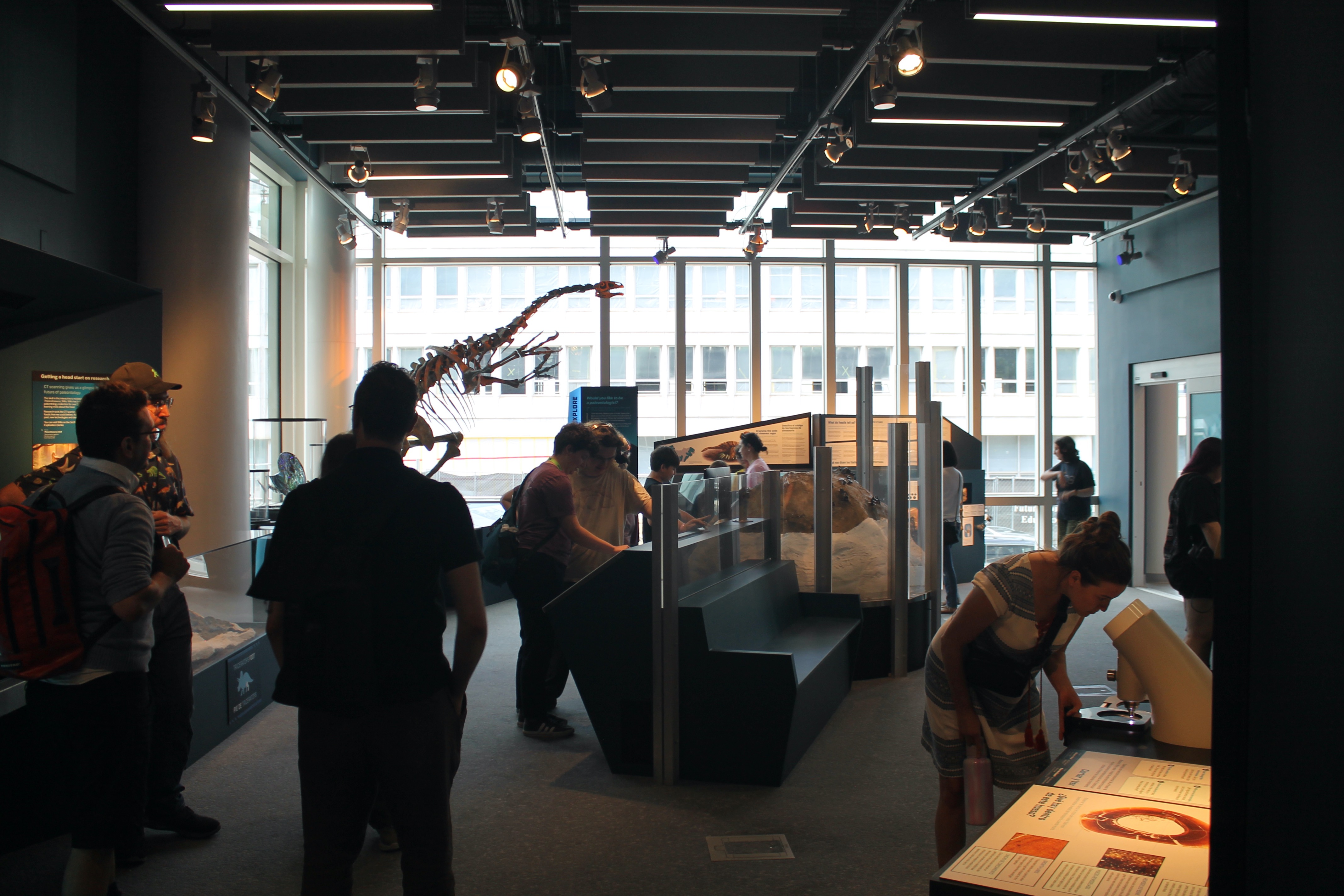
The second gallery space is not about the Dueling Dinosaurs specifically, but about the tools and techniques paleontologists use to learn about the past from fossils. The most prominent displays are a cast of Nothronychus (a dinosaur described by Zanno and colleagues) and a nest of oviraptorosaur eggs from Utah. Visitors can touch the tools used by fossil preparators, perform a simulated CT scan of a Thescelosaurus skull, and look through a microscope at growth lines in a sectioned dinosaur bone. I was told this gallery wasn’t quite finished, which might be why it felt unfocused to me. A more prominent header and summative statement at its entrance about the purpose of the gallery might help.

“Science has an accessibility problem,” Zanno said in an interview, “and mistrust in science is rising. We have to bring science out of the back corners and basements…and let our community see who we are and what we do.” The Dueling Dinosaurs exhibition has done exactly that—visitors could not be closer to the process of preparing and studying these fossils without being handed an air scribe. So how is that working out?

Visitors explore interactive stations in the second gallery. Photo by the author.

I detected a hint of frustration coming from the team members I spoke to. Too many visitors are fundamentally misunderstanding what they are seeing in the lab. They assume the preparators are actors and the fossils are fake, and are often incredulous when told otherwise. The concept that a museum is a place where new science happens is also surprising to a plurality of visitors. One strategy the team has employed is to set up a table of matrix and fragments for the preparator on interpretive duty to sort through. That way, they are clearly working on something when visitors enter and are less likely to be mistaken as an actor or volunteer. Still, if visitors are struggling to recognize real scientists in a real lab when presented with them, the need for access to science in action may be even greater than anticipated.

This might be a “when you have a hammer, everything looks like a nail” situation, but I think some reframing of the exhibition and how its presented could go a long way. Right now, the experience is titled “Dueling Dinosaurs,” which is undoubtedly compelling, but elicits its own set of expectations and assumptions about what visitors will see and do. Why not present the experience as what it really is—an opportunity to meet real paleontologists in their place of work? Would it be possible to reverse the order of visitor flow, so they see the gallery about how paleontology is done first, then visit the lab, then finish by learning about the Dueling Dinosaurs as a case study?

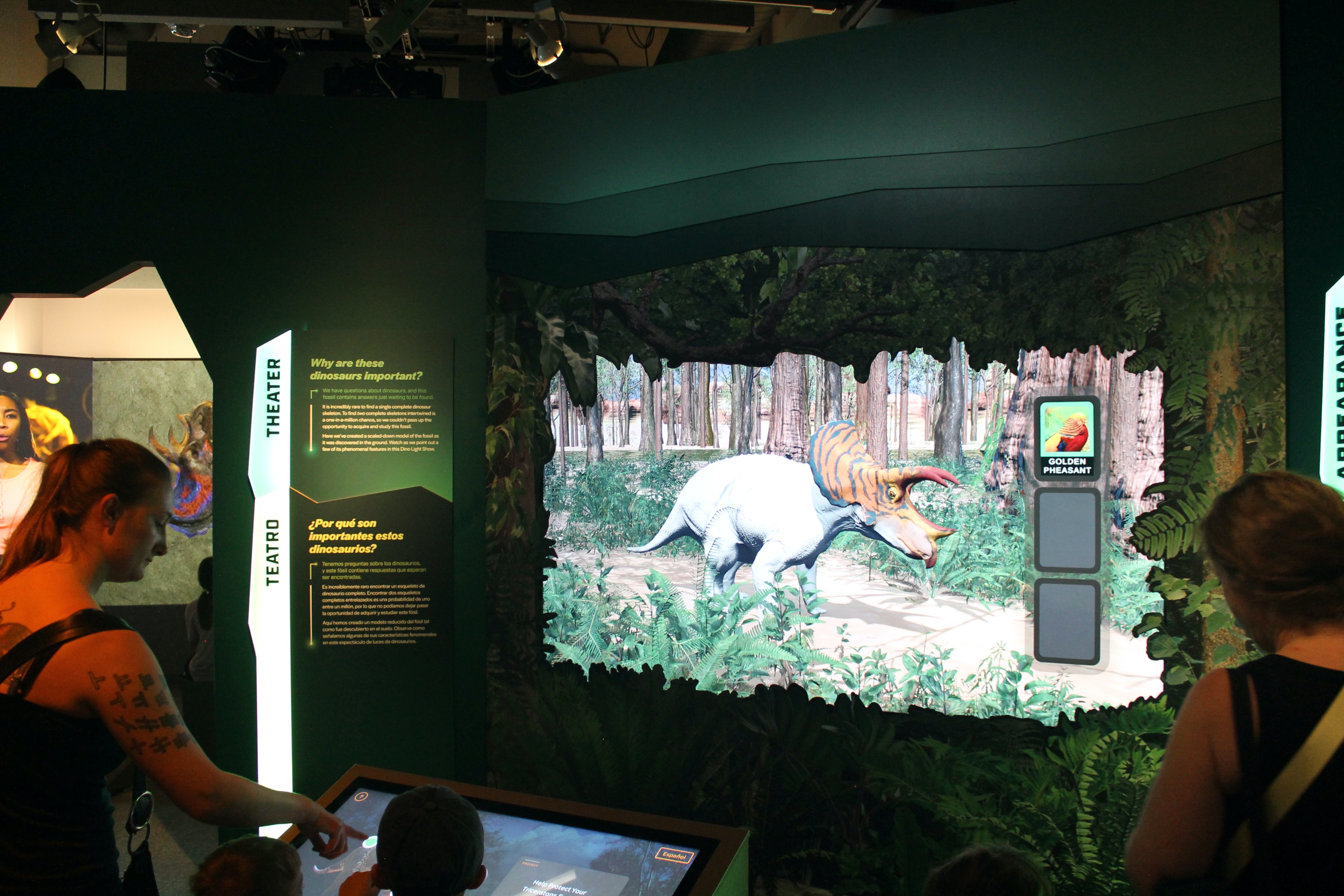
A media-based interactive allows visitors to apply different color patterns to an animated Triceratops, rendered in real time. Photo by the author.

Preparing the fossil is expected to take about five years. The goal is to keep the skeletons in their death positions and eventually display them in relief, somewhat like the model in the media presentation. How much matrix to remove is a moving target. The tyrannosaur’s skull has already been CT scanned multiple times with disappointing results. More matrix will need to be cleared to get a good image of the inside of the skull. Meanwhile, extensive skin impressions are preserved across both skeletons, and the team hopes to leave much of this in place. The process is being slowed somewhat by the need to scrape and chip away irreversible glue that was applied by the original preparators.

Aside from determining whether the dinosaurs actually died fighting (don’t count on it), one of the most anticipated answers the project is expected to provide is the identity of the tyrannosaur. When the fossil was at the Black Hills Institute, Pete Larson concluded that it was a Nanotyrannus—a controversial name applied to fossils that many paleontologists think are actually juvenile Tyrannosaurus rex. Indeed, when the fossil was up for auction, it was marketed as a young T. rex, probably for the sake of name recognition. The NCMNS team will eventually weigh in after studying the skeleton more thoroughly.

The lab itself is expected to remain in place once the Dueling Dinosaurs are prepared. The museum already has other very large fossils awaiting preparation.

If you’re able to visit Raleigh, I highly recommend visiting the Dueling Dinosaurs, the open prep lab, and the rest of NCMNS (the museum is free). You can also monitor the preparation process online. Many thanks to Jennifer Anné, Paul Brinkman, Elizabeth Jones, Christian Kammerer, and Eric Lund for speaking to me about the exhibition. Any factual errors are my own.

3 Comments

Filed under dinosaurs, education, exhibits, marginocephalians, museums, NCMNS, opinion, reviews, science communication, theropods

Where did the Field Museum’s fossil mounts come from?

Last year, I posted a quick and dirty table showing when each of the major display fossils at the Field Museum was first exhibited. This is a quick and dirty followup, based on a suggestion Lukas Rieppel made at a convening of historians of paleontology last week.

These maps illustrate where the Field Museum’s star fossils were collected. I’ve separated them by time chunks to make them easier to look at. Note that these time ranges cover year of first display, which is usually but not necessarily close to the year of collection or acquisition. Lines connect the fossils’ origins back to Chicago. Gray lines indicate fossils collected by Field Museum staff. Red lines indicate fossils that were purchased, traded for, or inherited (e.g. the transfer of the University of Chicago geology museum’s collections to the Field after its 1948 closure). Pink lines represent casts—in most cases, Field Museum scientists were involved in studying the specimens, but the originals are at other institutions.

Illustrations by Julián Bayona, Tracy Heath, Jagged Fang Designs, T. Michael Keesey, Michael Taylor, and Steven Traver, via phylopic.org.

In this first map, we see fossils coming to Chicago from two directions. There are purchased composite mounts of well-known mammals from Ice Age Europe—the Irish elk Megaloceros and the cave bear Ursus speleaus. Then there are the fossils collected by Elmer Riggs in the great plains and Rocky Mountain regions of the United States. Upon being hired in 1898, Riggs spent his first few field seasons in areas that were already known to yield impressive, display-caliber skeletons. He collected brontotheres in the White River badlands of South Dakota, then moved on to sauropod dinosaurs in the Morrison Formation of western Colorado.

Illustrations by Julián Bayona, William Gearty, Scott Hartman, T. Michael Keesey, Thomas W. LaBarge, Steven Traver, and Michael Tripoli, via phylopic.org.

In this map, we start to see the results of the Captain Marshall Field Expeditions to Argentina and Bolivia (1923–1927) on display. South American fossil mammals would become a specialty of Riggs and the Field Museum. The museum also collected early Paleogene fossils from Colorado, including the pantodont Barylambda. They traded with other museums for famous or important species to round out the exhibits—for example, a bison from the La Brea Tar Pits and an “American zebra” from the Hagerman quarry in Idaho.

Illustrations by Julián Bayona, Dmitry Bogdanov, Matt Celeskey, Andrew Farke, FunkMonk, T. Michael Keesey, Roberto Días Sibaja, and Antoine Verriére, via phylopic.org.

The collections inherited from the University of Chicago make a big impact on the midcentury map. All of the Field Museum’s display skeletons of Permian animals from Texas and South Africa were part of that acquisition. Meanwhile, the board of trustees arranged to purchase a Canadian Daspletosaurus from the American Museum of Natural History, which was displayed alongside a Lambeosaurus collected by Riggs and company in 1922.

With the exception of a new cast skull for Apatosaurus, no significant changes or additions were made to the fossil halls between 1961 and the early 1990s.

Illustrations by dannj, Tasman Dixon, Ivan Iofrida, Scott Hartman, Tracy Heath, T. Michael Keesey, Matt Martyniuk, Mathew Wedel, and Emily Willoughby, via phylopic.org.

The last 30 years have seen the greatest range of origin points for fossils on display: everything from Arctodus, collected just a couple hundred miles away in Indiana to Cryolophosaurus from Antarctica. This map also shows a near-total change in focus from Cenozoic and Permian animals to Mesozoic dinosaurs. And while earlier dinosaur displays were mostly from North America, there has been particular interest in this period in dinosaurs from the global south.

I’m going to stop there and leave the rest to you, dear reader. Beyond my brief notes here, what other trends do these maps suggest? What connections to global or local political or cultural trends do you see? Are there other museums where you know or suspect a different pattern? Feel free to comment!

4 Comments

Filed under collections, dinosaurs, exhibits, field work, fossil mounts, history of science, mammals, museums

The Field Museum’s other Archaeopteryx

Many superlatives apply to this gorgeous fossil. Photo by the author.

Earlier today, the Field Museum revealed the Chicago Archaeopteryx to the world. Named for the city it resides in (as is traditional for Archaeopteryx fossils), this is only the 13th specimen of this famous taxon yet discovered, and a contender for the best-preserved. The fossil is currently on display for a limited preview—it will go back to collections for further research on June 9, then return as part of a larger, permanent exhibit toward the end of the year.

Archaeopteryx is famous for being the fossil that proved Darwin right. When he laid out his case for evolution by natural selection in On the Origin of Species (published in 1859), Darwin primarily relied on observations of living organisms, but predicted that transitional forms between groups should appear in the fossil record. Then, just two years later, the first Archaeopteryx fossil turned up—a reptile with feathers like a bird. Archaeopteryx has been synonymous with evolutionary science ever since, and it’s had its part to play as our understanding of the relationship between dinosaurs and living birds gradually solidified. Today, we know that Archaeopteryx wasn’t the first feathered dinosaur, but it was the earliest known dinosaur to use its feathers for flight, rather than for insulation or display. Archaeopteryx fossils have proven stubbornly rare, however, so each individual specimen is celebrated.

The Chicago specimen is not, in fact, the first Archaeopteryx to be displayed at the Field Museum. For two weeks in 1997, the museum hosted a very limited engagement of the fossil now known as the Munich Archaeopteryx. The Munich specimen was found in August of 1992 and was the 7th individual to be discovered. Like all other Archaeopteryx fossils, it was collected in Bavaria, Germany in a spoil pile of Solnhofen limestone. Slabs of this rock have been used for centuries as roofing tiles and for lithographic printing. Indeed, the Munich Archaeopteryx was collected by Jürgen Hüttinger, a quarry worker employed by the Solenhofer Aktien-Verein stone company.

Aktien-Verein owned the quarry and thus, owned the fossil. The company contacted paleontologist and Archaeopteryx specialist Peter Wellnhofer, and loaned the fossil to the Munich Paleontological Museum for preparation and study. The Archaeopteryx was prepared by Ernst Schmieja under Wellnhofer’s supervision. It proved to be nearly complete, but only included the back part of the skull. Both the slab and counterslab were recovered—the skeleton is preserved in the slab but the feather impressions are more visible on the counterslab.

Slab and counterslab of the Munich Archaeopteryx on display at the Field Museum. Photo by John Weinstein, © Field Museum.

Aktien-Verein allowed the fossil to be displayed locally for several years, starting in 1993. But in 1997, plans materialized for the Archaeopteryx to take a little trip. Wellnhofer accompanied the fossil to Chicago so it could make an appearance at the 57th annual meeting of the Society of Vertebrate Paleontology (SVP), which the Field Museum was hosting that year. The fossil was on public display from October 4th through 19th, and Wellnhofer gave a public lecture on the 18th. While the visit was extremely short, it was also historic: this was the first time any Archaeopteryx fossil had ever left Europe. Many of the mostly North American paleontologists attending SVP that year had never seen an Archaeopteryx in person before.

Entrance to Archaeopteryx: The Bird that Rocked the World exhibition. Photo © Field Museum, courtesy of K. Mazanek, CC BY-NC 4.0.

The Exhibitions Department, for their part, went all-out in making the fossil’s brief visit special. The Archaeopteryx was displayed in a small gallery on the museum’s main level, past an impressive facade of angular blocks that recall slabs of Solnhofen limestone. The exhibit was officially titled “Archaeopteryx: The Bird that Rocked the World,” but only the name Archaeopteryx appeared over the entryway.

Once inside the darkened space, visitors could immediately inspect the slab and counterslab, which were mounted under a vitrine on an angled platform. Visible through the fossil case was Charles Knight’s Solnhofen mural from the 1920s, which was brought out of storage for this exhibit. Cases to the right and left contained small Solnhofen fish fossils and casts of Compsognathas and the Eichstätt Archaeopteryx.

Visitors gather near Greg Septon’s Archaeopteryx reconstruction. Photo © Field Museum, courtesy of K. Mazanek, CC BY-NC 4.0.

Another highlight was a new life-sized model of Archaeopteryx, created by Milwaukee Public Museum taxidermist (and accomplished falconer) Greg Septon. This Frankenstein-like creation was assembled from pelts and feathers from seven bird species, including a cormorant and a partridge. The teeth were sourced from a rainbow trout.

Referencing the bird’s German origin and leaning into it’s difficult-to-pronounce name, the museum held a family event on October 18 entitled “Archaeoptoberfest.” Kids could make kites, see other bird specimens, and hear the story of Icarus (really) under the feet of Ernestine the Brachiosaurus.

The brief visit to the Field Museum was the Munich Archaeopteryx‘s only time leaving Germany. Two years later, the Munich Paleontological Museum assembled the funding (nearly 2 million marks) to purchase it from Aktien-Verein. Today, it remains part of the Bavarian state collection and is on display in Munich.

Unlike the Munich specimen, the Chicago Archaeopteryx is a permanent addition to the Field Museum’s collection. You can learn more about its journey so far in Patti Wetli’s in-depth reporting for WTTW. Come see it before June 9 if you can!

References

Archaeopteryx: The Bird that Rocked the World. Earth Science News October 1997.

A rare bird indeed will visit Field Museum. Chicago Tribune Sep 30, 1997. ​​

Maes, N. Rare bird fossil has a Field day. Chicago Tribune October 3, 1997.

8 Comments

Filed under dinosaurs, exhibits, FMNH, museums

Review: the new Peabody Museum

Tylosaurus and Archelon skeletons soar overhead in the Peabody Museum’s brand-new lobby. Photo by the author.

For decades, the Yale Peabody Museum of Natural History (YPM) was a museum frozen in time, with no comprehensive updates to its paleontology halls since the 1950s. Then, around 2010, serious discussions began about overhauling the dinosaur and fossil mammal exhibits. Fundraising started in 2015, and in 2018, the museum announced that it had received a $160 million donation—enough to renovate not just the paleontology halls, but the entire museum. YPM closed its doors at the beginning of 2020, and on March 26 of this year, it reopened to the public once again.

Technically, this is a soft opening. The third floor—which houses the museum’s classic taxidermy dioramas—has not yet opened, and a scattering of cases around the museum are empty as of this writing. Still, there is plenty to see: during the renovation, YPM gained a new, multi-story lobby (connecting the museum to the academic building next door), as well as new collections facilities, classrooms, and 50% more exhibit space. And most importantly, the paleontology halls are open and just about complete.

A Geosternbergia cast demonstrates its quad-launching technique in the museum’s entryway. Photo by the author.

The remaking of the YPM exhibitions was a collaborative effort between internal staff (led by Kailen Rogers, Chris Norris, Susan Butts, Jacques Gauthier, and others) and two outside design firms—Centerbrook Architects and Planners provided the high-level design of museum and surrounding area , while Reich + Petch worked on specific exhibit elements and graphic design.

I spent a few hours at YPM last week, and the new halls were absolutely worth the wait. What I found most striking is that the paleontology halls feel at once new and familiar. The dimensions of the dinosaur and fossil mammal halls (officially, the Burke Hall of Dinosaurs and A World of Change) remain identical, and they are still anchored by Rudolph Zallinger’s magnificent fresco murals—The Age of Reptiles and The Age of Mammals. Charles Beecher’s relief mounted Edmontosaurus was left in place, and the overall layout and flow of the spaces have not been radically altered. On the other hand, white walls and new windows and skylights have transformed what had been fairly gloomy spaces into bright, open expanses. There are dozens of new specimens on display, in addition to plenty of returning ones. And a third gallery has been added to the paleontology wing: called The Human Footprint, this space explores how humans have interacted with the natural world over the past hundred thousand years or so.

The remounted Stegosaurus looks back toward Zallinger’s Age of Reptiles. Photo by the author.

The primary themes of the paleontology exhibits are displayed at the entrance to Burke Hall: “life affects the environment and the environment affects life” and “extinctions change everything.” Much like Deep Time at the National Museum of Natural History, YPM’s exhibits emphasize that the evolution of life on Earth did not occur in a vacuum, but as part of a continuously changing global system. This narrative does have a time axis—visitors follow along from the Edicaran to the present day—but the precise devisions of geologic time are often de-emphasized in favor of the broad environmental transitions that triggered evolutionary innovations.

This presentation of the evolution of life compliments the existing Zallinger murals. Painted between 1942 and 1967, these are among the most iconic images of prehistoric life ever created. Although some of the animal reconstructions are outdated, Zallinger was in other ways ahead of his time. Rather than giving the geologic periods hard borders, he artfully wove the sections together so that each one fades imperceptibly into the next. The viewer can see that the flora, fauna, and climate are changing over time, but it’s a gradient, not a ladder. Incidentally, it was not a given that the Zallinger murals would be preserved. Great credit is due to the YPM team for not only retaining the murals, but utilizing them as a key part of the new exhibition’s narrative.

Brontosaurus reclaims its place as the centerpiece of the dinosaur hall. Photo by the author.

One clear advantage of a wall-to-wall renovation is that the exhibits are much better organized than before. In the old dinosaur hall, visitors encountered an essentially random succession of displays: from modern sea turtles to Triassic trees and from a Cretaceous mosasaur to a Quaternary mastodon. Now, the displays run chronologically, and more or less in sync with the Zallinger mural. Visitors can follow the history of life in the sea on the west side of the hall, and the history of terrestrial life on the east side. I also suspect that placing Brontosaurus and a brontothere as central anchors in their respective halls was a deliberate choice.

A very large Megacerops stands on a central platform in the reimagined Cenozoic hall. Photo by the author.

Research Casting International remounted several historic skeletons with characteristic artistry and skill. I will have a separate article about the mounted skeletons sometime soon, but the remounts are Brontosaurus, Stegosaurus, Deinonychus, Archelon, Moropus, Megaloceros, a mastodon, and a dodo. Brand new mounted skeletons include Tylosaurus, Poposaurus, and a Geosternbergia family of four (plus a few secret mounts outside the neighboring Marsh Auditorium). At least fifteen existing mounts have returned. As Postdoctoral Fellow Advait Jukar explained to me, the goal for the mounted skeletons was to portray “living, breathing animals, rather than looking like they’re posing for a portrait.” For example, the aggressive rutting posture of the Irish elk was directly inspired by the classic bull moose diorama at the American Museum of Natural History.

Mounted skeletons aside, there are some really extraordinary fossils in these halls. Some of the specimens that caught my eye include a geode bird egg with an embryonic skeleton inside, the bizzare Arsinotherium from Egypt’s Fayum region, a Nothrotheriops with patches of hair and skin, and the early Jurassic dinosaurs Podokosaurus and Anchisaurus.

Remounted Irish elk and mastodon in the Human Footprint gallery. Photo by the author.

While many of the fossils speak for themselves, the halls are also populated with several new models and replications, which imbue the extinct species on display with life and personality. The towering Gastornis created by Blue Rhino Studio is the clear standout—I like that it looks like its gazing longingly back toward the Mesozoic dinosaurs in the adjacent hall. Other highlights include a slab of Edicaran weirdos and the mammal Rapenomamus attacking a Psittacosaurus at the feet of Brontosaurus (I would have liked to see a baby sauropod as the prey, but maybe that would be too much for squeamish visitors).

Meanwhile, the YPM team made some selective forays into the realm of media and digital interactives. Most (possibly all?) of these take the form of slideshows on large touchscreens. These are an effective way to condense a lot of information into a limited space, and allow for some visitor choice in what topics interest them. I thought an interactive where visitors could explore the propagation of horses, humans, and tomatoes around the world was particularly well done.

Gastornis is a highlight of the Cenozoic Hall. Photo by the author.

I would expect an institution like Yale to be protective of its legacy and history, so I was surprised to find a prominently placed rebuke of superstar 19th century paleontologist O.C. Marsh in the dinosaur hall. As Advait described it, this is an “and” statement: Marsh was instrumental in shaping our understanding of prehistory and evolution and he collected from Native land without permission, looted graves, and was academically dishonest.

The call-out of Marsh wasn’t the only unexpectedly progressive element in the new exhibits. A brontothere fossil is interpreted with a poem by a trans teenager, which criticizes imperialistic scientists for imposing their way of knowing upon the world. Elsewhere, a display of fossils from the Santa Fe Formation in Argentina is accompanied by printed labels solely in Spanish—perhaps a statement about whose voices should be heard when interpreting the natural heritage of a given region. Natural History Conservator Mariana di Giacomo told me that these displays are part of an effort to include a wider range of perspectives in YPM exhibits. Other examples include musings from artist Ray Troll on being a “highly motivated fish” and psychologist Eli Lobowitz’s take on why kids love dinosaurs.

Deinonychus and Poposaurus are the largest saurian carnivores on display. Photo by the author.

My critiques of the new paleontology halls are pretty limited. There are more typos and inconsistencies in the labels than there ought to be, particularly in the age ranges given for certain specimens. I overheard multiple visitors concluding that the Edmontosaurus skeleton was a T. rex, and I suspect an image of Tyrannosaurus placed in front of the Edmontosaurus is to blame. In one area, the writer uses terms like “stem reptile,” “early stem land egglayer,” and “stem amniote” as common names for various species. Even with some specialized knowledge I don’t understand what distinction they were trying to make, and I can’t imagine those terms are helpful for most visitors.

The most pervasive issue is the inconsistent quality of 2-D life reconstructions used on graphics throughout the halls. With a few exceptions, it appears that the exhibition’s creators used whatever images were available, including stock renders and illustrations pulled from Wikipedia. For many people (especially children) unaccustomed to interpreting bones, life reconstructions can be more meaningful than the actual fossils. It’s worth budgeting for original, quality artwork whenever possible. Put that $41 billion Yale endowment to use!

A graphic with a particularly uninspired illustration from a stock image provider. Photo by the author.

Speaking of Yale’s effectively bottomless pockets, the best news about the new YPM is that it’s 100% free. This is an excellent precedent to set: there’s no better way to welcome a broader audience and remove barriers from engagement with science than doing away with admission fees. I hope other museums follow YPM’s lead on this front and work to free themselves from reliance on admission income.

More on fossils at the Peabody soon!

10 Comments

Filed under dinosaurs, exhibits, fossil mounts, mammals, museums, opinion, paleoart, reviews, science communication, YPM

When were the Field Museum fossil mounts created?

So, I have a confession to make. In January of this year, I started working on an in-depth article about the Hall of Human Origins at the National Museum of Natural History. It was going to cover everything: John Gurche’s sculptures, the design and narrative of the gallery, the challenges of opening an exhibition about human evolution on the National Mall, and even the misguided accusations that the hall contains climate change denial. It’s a great story, and I really want to write it up. So I’m giving myself a public ultimatum: it has to be done before the end of the year.

In the meantime, I’d like to share something I whipped up for social media (I’m primarily on BlueSky these days, if anyone’s looking for me). The annotated photos below show the year that each of these fossil mounts at the Field Museum first went on display. A complete list of currently-displayed mounts and their debut years is at the end of the post.

“Ungulate row” in the current Evolving Planet exhibition. Photo by John Weinstein, modified from original.

I find this interesting for a number of reasons. For one thing, it’s a reminder of the age of many museum exhibits. Multiple generations have come to see these fossils—a few of them predate the current Field Museum building by decades. But these dates are also a succinct recounting of the history of vertebrate paleontology at the Field. The oldest mounts—the mastodon and Irish elk—were leftovers from the Field Columbian Exposition, and presumably were purchased from the Ward’s Natural Science catalog.

The Ice Age menagerie in Evolving Planet. Photo by the author.

After that, a couple of dinosaurs join the fray. These were the result of Elmer Riggs’ first expeditions for the Field Museum. He was hired specifically to collect dinosaurs that could match the displays at AMNH and elsewhere, after all. Riggs’ real interest was in mammals, however, and by the 1910s we see that his department is exclusively mounting North American fossil mammals for display. In 1925, we begin to see the results of the Captain Marshall Field Expeditions (1923–1927) on display, as South American animals like Glyptodon and Aglaocetus join the exhibits.

Around 1948, the University of Chicago’s Museum of Geology closed down, and turned its collections over to the Field Museum. The University of Chicago had a particularly strong collection of Permian animals from Texas and South Africa, and there was an immediate flurry of activity to get those on display at the Field. A few of the University specimens went on exhibit as-is, but many (including Bradysaurus and Aulacephalodon) were disassembled and remounted by Orville Gilpin and others.

The dinosaur hall in Evolving Planet. Photo by the author.

After 1960, there was an extremely long period in which no new fossil mounts were added to the exhibits. The fossil halls languished without update until the end of the 20th century, with the opening of Life Over Time. Up until that point, the Field Museum had very few dinosaurs on display, but Life Over Time made dinosaurs its centerpiece. A growing popular interest in dinosaurs during the late 1980s, not to mention a certain 1993 movie, was probably the cause. Since that time, nearly all the new additions to the fossil exhibits have been dinosaurs. And with the exception of Arctodus in 2006, there have been no additions to the ranks of mounted mammal skeletons since the doldrums began in 1960.

That’s it for now, but let’s see about that Human Origins article before the end of the year!

Name (Common Name)TypeYear Installed (Updated)
Megaloceros giganteus (Irish elk)Mounted skeleton1895
Mammut americanum (mastodon)Mounted skeleton1895
Triceratops horridus (ceratopsian)Skull1905
Apatosaurus sp. (sauropod)Mounted skeleton1907 (1957, 1994)
Oxydactylus longipes (camel)Mounted skeleton1916
Dinictis felina (nimravid)Mounted skeleton1916
Smilodon fatalis (saber-toothed cat)Mounted skeleton1917 (1935, 1941)*
Ursus speleaus (cave bear)Mounted skeleton1917
Megacerops sp. (brontothere)Mounted skeleton1920
Mammuthus columbi (Columbian mammoth)Mounted skeleton1923
Aglaocetus moreni (baleen whale)Skull1925
Glyptodon clavipes (glyptodont)Mounted skeleton1926
Pronothrotherium typicum (ground sloth)Mounted skeleton1931
Mesohippus bairdi (horse)Mounted skeleton1931
Megatherium americanum (ground sloth)Mounted skeleton1935 (1994)
Paramylodon harlani (ground sloth)Mounted skeleton1935 (1941)
Barylambda faberi (pantodont)Mounted skeleton1936
Moropus cooki (chalicothere)Mounted skeleton1938
Equus simplicidens (horse)Mounted skeleton1938
Bison antiquus (bison)Mounted skeleton1940
Castoroides ohioensis (beaver)Mounted skeleton (cast)1940
Andalgalornis ferox (terror bird)Mounted skeleton1940
Menoceras arikarense (rhino)Bone bed1941
Teleoceras major (rhino)Mounted skeleton1942
Pliohippus sp. (horse)Mounted skeleton1944
Homalodotherium cunninghami (notoungulate)Mounted skeleton1948
Captorhinus aguti (early reptile)Mounted skeleton1948
Diasparactus zenos (amphibian)Mounted skeleton1949
Cacops aspidephorus (amphibian)Mounted skeleton1949
Seymouria sanjuanensis (amphibian)Mounted skeleton1949
Acheloma cumminsi (amphibian)Mounted skeleton1949
Eryops megacephalus (amphibian)Mounted skeleton1949
Labidosaurus hamatus (early reptile)Mounted skeleton1949
Bradysaurus baini (pareiasaur)Mounted skeleton1950
Sphenacodon ferox (early synapsid)Mounted skeleton1950
Ophiacodon mirus (early synapsid)Mounted skeleton1951
Dimetrodon grandis (early synapsid)Mounted skeleton1951
Varanops brevirostris (early synapsid)Mounted skeleton1952
Aulacephalodon peavoti (early synapsid)Mounted skeleton1952
Edaphosaurus pogonias (early synapsid)Mounted skeleton1953
Protoceratops andrewsi (ceratopsian)Mounted skeleton1954
Daspletosaurus torosus (tyrannosaur)Mounted skeleton1958 (1994)
Lambeosaurus lambei (hadrosaur)In situ skeleton1958
Dunkleosteus terrelli (placoderm)Skull (cast)1958
Eohippus sp. (horse)Mounted skeleton (cast)1960
Brachiosaurus altithorax (sauropod)Mounted skeleton (cast)1993 (2001)
Herrerasaurus ischigualastensis (early dinosaur)Mounted skeleton (cast)1994
Pteranodon sp. (pterosaur) x3Mounted skeleton (cast)1994
Triceratops horridus (ceratopsian)Mounted skeleton (cast)1994
Parasaurolophus cyrtocristatus (hadrosaur)Mounted skeleton1994 (2006)
Tyrannosaurus rex (SUE)Mounted skeleton2000 (2018)
Deinonychus antirrhopus (dromaeosaur)Mounted skeleton (cast)2006
Buitreraptor gonzalezorum (dromaeosaur)Mounted skeleton (cast)2006
Stegosaurus stenops (stegosaur)Mounted skeleton (cast)2006
Maiasaura peeblesorum juvenile (hadrosaur)Mounted skeleton2006
Rapetosaurus krausei juvenile (titanosaur)Mounted skeleton2006
Notharctus tenebrosus (primate)Mounted skeleton (cast)2006
Arctodus simus (short-faced bear)Mounted skeleton2006
Asilosaurus kongwe (dinosaur relative)Mounted skeleton (cast)2013
Patagotitan mayorum (Máximo)Mounted skeleton (cast)2018
Parringtonia gracilis (crocodile relative)Mounted skeleton (cast)2019
Spinosaurus aegyptiacus (Sobek)Mounted skeleton (cast)2023

5 Comments

Filed under dinosaurs, exhibits, FMNH, fossil mounts, history of science, mammals, museums

Dinosaurs of the Field Museum – Part 2

In the previous “quick bite” post, I introduced the dinosaurs on display at the Field Museum of Natural History (FMNH) that were collected in the early 20th century. This time, we’ll take a look at some of the dinosaurs collected and first displayed “in living memory”—that is to say, in the last three decades or so. I’ve skipped a few that either don’t have much available provenance (like the juvenile Maiasaura) or don’t have a very interesting story (like the off-the-shelf Deinonychus cast).

In comparing the early and more recent dinosaur installations at FMNH, it is immediately apparent that the latter group covers a much wider geographical range. The older mounted skeletons were all recovered in the western United States and Canada, while the new batch comes from all over the world, especially the global south. Local scientists were usually involved in the research, and in most cases the original fossils remained in or were ultimately returned to their countries of origin.

Tyrannosaurus rex (PR 2081)

SUE in Stanley Field Hall, ca. 2015. Photo by the author.

As one of the world’s most thoroughly-researched and best-known dinosaurs, SUE the T. rex scarcely requires an introduction. SUE is the most complete adult Tyrannosaurus ever found, with 90% of the skeleton intact. Approximately 30 years old at the time of their death, SUE is also the eldest T. rex known, and within the margin of error for the title of largest

SUE was discovered in 1990 by Sue Hendrickson on ranchland near Faith, South Dakota. At the time, Hendrickson was working with the Black Hills Institute, a private company that specializes in collecting and exhibiting fossils. BHI’s claim to the fossil became the subject of a legal battle involving landowner Maurice Williams, the Cheyenne River Tribal Council, and the US Department of the Interior. With little legal precedent for ownership disputes over fossils, it took until 1995 for the District Court to award Williams the skeleton. Williams announced that he would put SUE on the auction block, and paleontologists initially worried that the priceless specimen would disappear into the hands of a wealthy collector. Those fears were put to rest in 1997 when FMNH won SUE with financial backing from McDonald’s and Disney. 

SUE has ruled this dedicated hall in Evolving Planet since December 2018. Photo © Field Museum.

The museum wasted no time making the most of the celebrity specimen. The preparation team expanded to twelve people, who spent 35,000 hours over the next three years extracting SUE’s skeleton from the rock. Chris Brochu was brought on board to write a detailed monograph, which is still a definitive source on Tyrannosaurus rex anatomy. Meanwhile, Phil Fraley built the metal armature upon which the skeleton would be mounted. SUE debuted in FMNH’s cavernous Stanley Field Hall on May 17, 2000 with the dropping of a curtain.

SUE held court in Stanley Field Hall for nearly 20 years, but in 2018 it was time for a change. That year, SUE was relocated to a new, 6,500 square foot gallery within the Evolving Planet exhibition. In contrast with the neoclassical expanse of Stanley Field Hall, this “private suite” gives the T. rex some much-needed context. SUE is now situated in an immersive reconstruction of the waterlogged forests of Late Cretaceous South Dakota. The mounted skeleton itself received an update, overseen by Pete Makovicky, Tom Cullen, and Bill Simpson. Garth Dallman and colleagues from Research Casting International (RCI) modified the original mount to correct a range of issues, like the articulation of the right knee and the position of the shoulders. SUE was also reunited with their gastralia—the rib-like bones that were embedded in the belly muscles.

Cryolophosaurus ellioti (PR 1821)

Cryolophosaurus partial skull in the Antarctic Dinosaurs exhibition. Photo by the author.

Excavating fossils is challenging in the best of conditions, but add the treacherous climate of Antarctica to the mix and it becomes a truly astounding feat. In 1991, William Hammer of Augustana College led a team that discovered and excavated the first Antarctic dinosaur to be named and described: the moose-sized theropod Cryolophosaurus. While bad weather prevented them from excavating the entire skeleton, Hammer and colleagues managed to collect the rear portion of the skull and jaw, as well as parts of the pelvis and hind limbs. The specimens were given to FMNH, the largest fossil repository near Hammer’s institution.

Cryolophosaurus cast in the Antarctic Dinosaurs exhibition. Photo © Field Museum

Hammer returned to the Cryolophosaurus site in 2010, joined by Nate Smith, Josh Matthews, and FMNH’s Pete Makovicky. Working in minus 15 F conditions, the team excavated more of the holotype skeleton. Some overlapping bones, including a second braincase, clarified that at least two individuals were present in the quarry.

For many years, Cryolophosaurus had only a minor role in FMNH exhibitions. In Evolving Planet, it is represented only by a cast of the partial skull. In 2018, however, the museum debuted Antarctic Dinosaurs, a traveling exhibition all about the 2010 expedition. Cryolophosaurus is the star of the show: most of the holotype is displayed in a series of cases, alongside a complete standing cast created by RCI. While other museums have displayed Cryolophosaurus reconstructions, the Antarctic Dinosaurs cast is more up-to-date in many respects—for instance, it’s narrow skull more closely resembles Dilophosaurus than Allosaurus.

Rapetosaurus krausei (PR 2209)

Juvenile Rapetosaurus in Evolving Planet. Photo by the author.

It’s hard to imagine now, but as recently as the mid-1990s, very little was known about titanosaurs. These Cretaceous sauropods were mostly known from isolated bones, and it wasn’t even clear if they were more closely related to diplodocoids like Diplodocus and Apatosaurus or to macronarians like Camarasaurus and Brachiosaurus. That changed in 2001, when Kristina Curry Rogers and Catherine Forster published the first description of Rapetosaurus krausei.

The new genus and species was based on fossils collected a few years earlier on a Mahajanga Basin Project expedition in northwest Madagascar. Organized by the State University of New York at Stony Brook and the local Universite d’Antananarivo, the Mahajanga Basin Project has been exploring fossil outcrops in this region since 1993. The project has been tremendously successful, yielding numerous new species and revolutionizing our understanding of vertebrate evolution in the southern hemisphere.

Rogers and Forster designated one of two adult Rapetosaurus skulls as the holotype, but most of our information about this animal comes from a 15-foot, 75% complete juvenile skeleton. To this day, this fossil is the most complete titanosaur ever found, and the only titanosaur known from both a skull and the majority of its postcranial skeleton. From their high-set eyes to their ludicrously wide bodies, much of what is known about the shape of titanosaurs comes from this specimen. Details of this skeleton also helped confirm that titanosaurs are macronarian sauropods.

As one of the funders of the MBP expeditions, the Field Museum became the repository for the juvenile Rapetosaurus skeleton. The fossil was mounted for display in 2006, when the paleontology halls were refreshed and retitled as Evolving Planet.

Buitreraptor gonzalezorum (MPCA 245 and others)

Buitreraptor cast under construction—note the unrestored skull cast being used as a placeholder. Many thanks to Matthew Aaron Brown for sharing this photo.

Fossils of Buitreraptor, a goose-sized dromaeosaur, were first collected in Patagonia, Argentina in 2004. The Field Museum’s Pete Makovicky was joined by Sebastián Apesteguia and Federico Agnolín in describing the new dinosaur the following year. Buitreraptor is notable for being the oldest known South American dromaeosaur (about 98 million years old), and for being one of the most completely known unlagiine dromaeosaurs—bizarre creatures with exceptionally long and narrow snouts. The holotype specimen was prepared at FMNH before being returned to the Museo Provincial de Cipolletti Carlos Ameghino in Río Negro, Argentina.

Finished Buitreraptor cast in Evolving Planet. Photo by the author.

The Evolving Planet team did not originally intend to include Buitreraptor, but as the exhibition neared completion it was noted that the bird evolution display—which only featured Deinonychus and a pair of small models—looked a little sparse. With most of the hall already installed and the opening just months away, preparators Connie Van Beek, Matthew Aaron Brown, and Jim Holstein were tapped to create a mounted cast of Buitreraptor. The preparators first built a prototype by wiring together available casts of the original fossils. They then moved on to the final version, which involved reconstructing the missing extremities (arms, feet, and ribs) and creating a “re-inflated” version of the specimen’s crushed skull. The entire project was completed in less than two months.

Patagotitan mayorum (MPEF 2400 and others)

Field Museum and Museo Paleontológico Egidio Feruglio staff worked together to assemble Máximo in May 2018. Photo by the author.

In 2017, plans took shape to reimagine Stanley Field Hall, as has happened several times since the current FMNH building opened in 1921. Part of the plan was to relocate SUE to a dedicated gallery in Evolving Planet, but what could take the place of the star T. rex? The museum found their answer in Patagotitan, a recently discovered titanosaur that is a contender for the world’s largest dinosaur.

Patagotitan mayorum was discovered on the Mayo family farm near La Flecha, Argentina in 2010. Between 2012 and 2014, Diego Pol and colleagues at the Museo Paleontológico Egidio Feruglio (MEF) excavated the find, which turned out to be a bone bed of six individuals. The new genus and species was named and published in 2018.

The FMNH cast is actually the second Patagotitan display in the United States. In 2015 (before the animal had a name), the American Museum of Natural History commissioned RCI to create a cast for the Wallach Orientation Center, part of the loop of fossil halls on the New York museum’s 4th floor. By placing Patagotitan in a relatively small space, the AMNH designers emphasized the sauropod’s great size. Standing in a slightly crouched pose with its head extending into an adjacent hall, the mount overwhelms the space.

Máximo has plenty of room to spread out in Stanley Field Hall. Photo by the author.

In contrast, the FMNH Patagotitan—nicknamed Máximo—has room to spread out. In the half-acre, four story expanse of Stanley Field Hall, visitors can stand at a reasonable distance and take in the 122-foot skeleton all at once. They can also look Máximo in the eye socket from the upper level balcony. Rather than work with RCI on the project, FMNH commissioned the mount from MEF directly. It was designed and built in Trelew, Argentina, and shipped to Chicago via cargo ship. The installation took four days in May 2018. The process didn’t go entirely without a hitch—under the skylight in Stanley Field Hall, the original paint job on the cast bones looked like raw meat. But even with the need for an emergency repaint of the entire skeleton, Máximo was completed on time and has been greeting FMNH visitors ever since.

Spinosaurus aegyptiacus (FSAC-KK-11888)

The Prehistoric Minds team prepares to add legs to Spinosaurus. Photo by the author.

The Field Museum’s newest dinosaur debuted just two weeks ago as of this writing (and is, in fact, why I’ve been sitting on this post for months). Postdoctoral researcher Matteo Fabbri approached the Exhibitions department in Fall 2022 with the prospect of acquiring a Spinosaurus cast. Less than a year later, that cast has joined Patagotitan in Stanley Field Hall, suspended twelve feet off the floor in a swimming pose.

Thanks to its dragon-like shape and star turn in Jurassic Park III, Spinosaurus is a very popular dinosaur, but until recently it has been quite poorly known. The 1912 holotype specimen—consisting of a partial jaw, several dorsal vertebrae, and a few other odds and ends—was inadvertently destroyed in the bombing of Munich during World War II. It wasn’t until 2008 that another skeleton was found in southern Morocco. The new specimen revealed that Spinosaurus was even weirder than previously thought: not only did it have an elongated, crocodile-like skull and a sail on its back, it also had a long body, short legs, and a newt-like tail fin.

Spinosaurus hangs 12 feet above the floor. Photo by the author.

Very few Spinosaurus casts have ever been displayed. One was made for the retired Spinosaurus: Lost Giant of the Cretaceous traveling exhibit. Another appeared in last year’s The Big Eight: Dinosaur Revelation in Hong Kong. But as far as I can tell, the only other permanent Spinosaurus skeleton on display is at Japan’s Kitakyushu Museum of Natural History. That makes the FMNH cast the only mount of its kind in the western hemisphere. 

It’s also the most up-to-date Spinosaurus on display. As part of the team that has been studying Spinosaurus for the last 15 years, Fabbri ensured that cervical vertebrae collected at the original discovery site just six months ago were incorporated into the mount. All told, about 50% of the skeleton is cast from the Morocco specimen, while the rest is reconstructed. 

Like Máximo, the Spinosaurus was built overseas. Simone Maganuco and colleagues constructed the skeleton in Italy, then traveled with it to Chicago to help with the installation. The lightweight cast—which only weighs 700 pounds—was hanging in its permanent position after just ten hours of work.

Press coverage of the installation (with appearances from a certain overenthusiastic nerd) can be seen here and here.

References

Brochu, C.A. 2003. Osteology of Tyrannosaurus rex: Insights from a nearly complete skeleton and high-resolution computed tomographic analysis of the skull. Journal of Vertebrate Paleontology 22:1–138.

Curry Rogers, K., Forster, C.A. 2001. The last of the dinosaur titans: a new sauropod from Madagascar. Nature 412:6746:530–534.

Hammer, W.R. and Hickerson, W.J. 1994. A Crested Theropod Dinosaur from Antarctica. Science 264: 828–830.

Grande, L. 2017. Curators: Behind the Scenes of Natural History Museums. Chicago, IL: University of Chicago Press.

Ibrahim, N., Maganuco, S., Dal Sasso, C., Fabbri, M., Auditore, M., Binedellini, G., Martill, D.M., Zourhi, S., Matterelli, D., Unwin, D.M., Wiemann, J., Bonadonna, D., Amane, A., Jakubczak, J., Joger, U., Lauder, G.V., and Pierce, S.E. 2020. Tail-propelled aquatic locomotion in a theropod dinosaur. Nature 581(7806):1–4.

Makovicky, P.J., Apesteguía, S., and Agnolín, F.L. 2005. The earliest dromaeosaurid theropod from South America. Nature 437: 1007–1011.

Smith, N.D., Makovicky, P.J., Hammer, W.R., and Currie, P.J. 2007. Osteology of Cryolophosaurus ellioti from the Early Jurassic of Antarctica and implications for early theropod evolution. Zoological Journal of the Linnean Society 151: 377–421.

1 Comment

Filed under AMNH, dinosaurs, exhibits, FMNH, fossil mounts, museums, sauropods, theropods