Category Archives: YPM

A primer on the Sternbergs

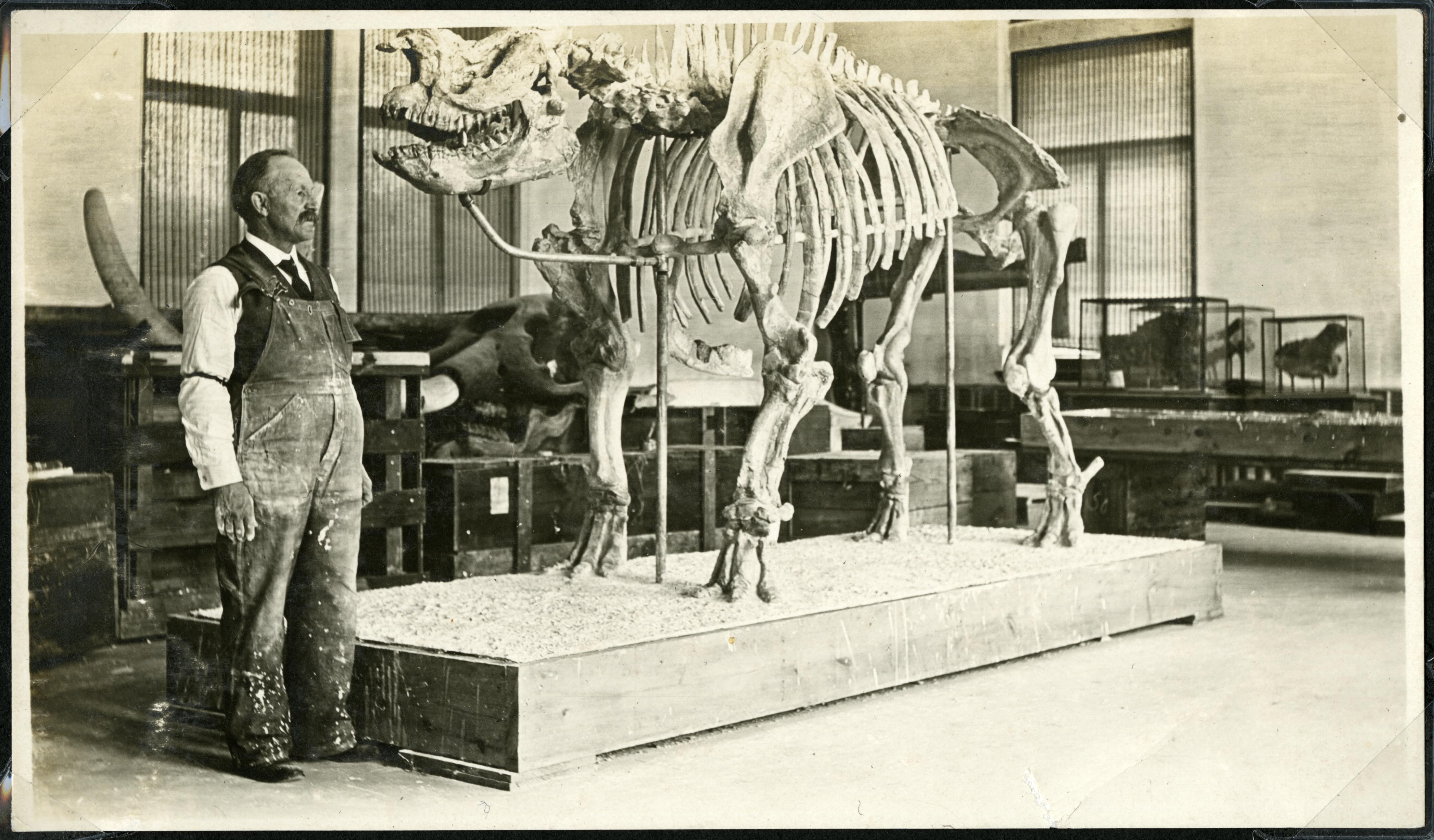
Charles H. Sternberg with a brontothere. © University Archives, Fort Hays State University

The Sternbergs were, in all likelihood, the most talented bunch of fossil hunters that ever lived. Charles Hazelius Sternberg—later joined by his sons George, Levi, and Charles Mortram Sternberg—built a reputation among turn-of-the-century museum leaders as men who could find any fossil they were asked for. From the 1870s to the 1970s, they steadily filled the halls of museums across the United States, Canada, and western Europe with spectacular skeletons of dinosaurs, marine reptiles, and more, many of which remain the best examples of their taxa. If you’ve visited any large natural history museum in the western hemisphere, chances are you’ve seen a Sternberg specimen. Still, it’s a challenge to keep all those Sternbergs straight, so this post is an overview of who was where, and when.

Charles H. Sternberg grew up near Cooperstown, New York in a religious household led by his minster father. The family relocated to western Kansas in 1867. Then a teenager, Charles H. learned of the ancient fish and marine reptile fossils around his new home at Fort Hays from his older brother, George Miller Sternberg. While George M. dabbled in collecting and identifying fossils, he was already busy as a medical doctor and a major in the United States Army. He would go on to be Surgeon General and make great strides in establishing cures for typhoid, yellow fever, and tuberculosis. It would therefore fall on Charles H. to make fossil hunting his life’s work.
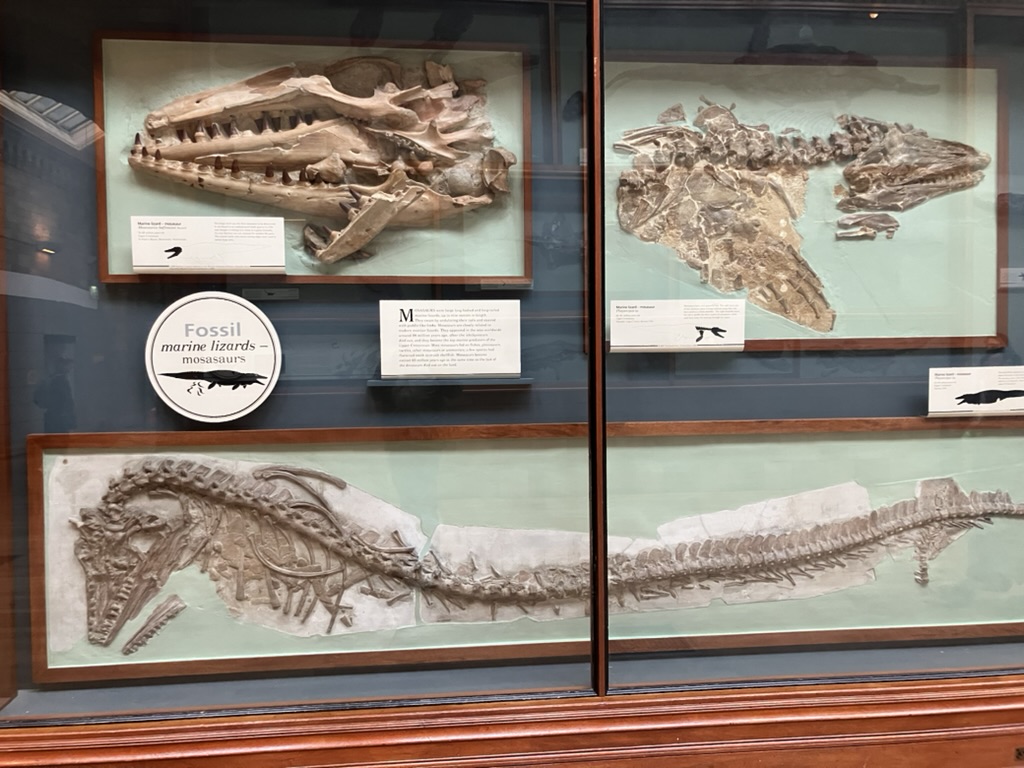
Mosasaurs collected by Charles H. Sternberg (top right and bottom) on display at the London Natural History Museum. Photo by the author.

In 1870, Charles H. sent a package of fossil leaves he had collected to the Smithsonian Institution, hoping to find a buyer. Assistant Secretary Spencer Baird replied with a note of appreciation, but made no offer for remuneration. A decade layer, Charles H. recognized his fossil leaves illustrated in a scientific journal with no credit to him. The experience foreshadowed what a career as a fossil hunter for hire would be like, but Charles H. was not deterred. As he would later write in his first memoir, he was by that point determined “to collect facts from the crust of the Earth so that men might learn more of the introduction and succession of life on our Earth.”

Over the subsequent decade, Charles H. built himself a reputation as a skilled collector. With a recommendation letter from George M., he was hired to collect fossil leaves for Leo Lesquereaux of the American Philosophical Society. By 1876, he was working for Edward Drinker Cope of the Academy of Natural Sciences. Charles was soon Cope’s right hand man in the field. Together, they invented the process of securing fossils for transport by wrapping them in a “jacket” of plaster-soaked burlap—a technique that is still used today.
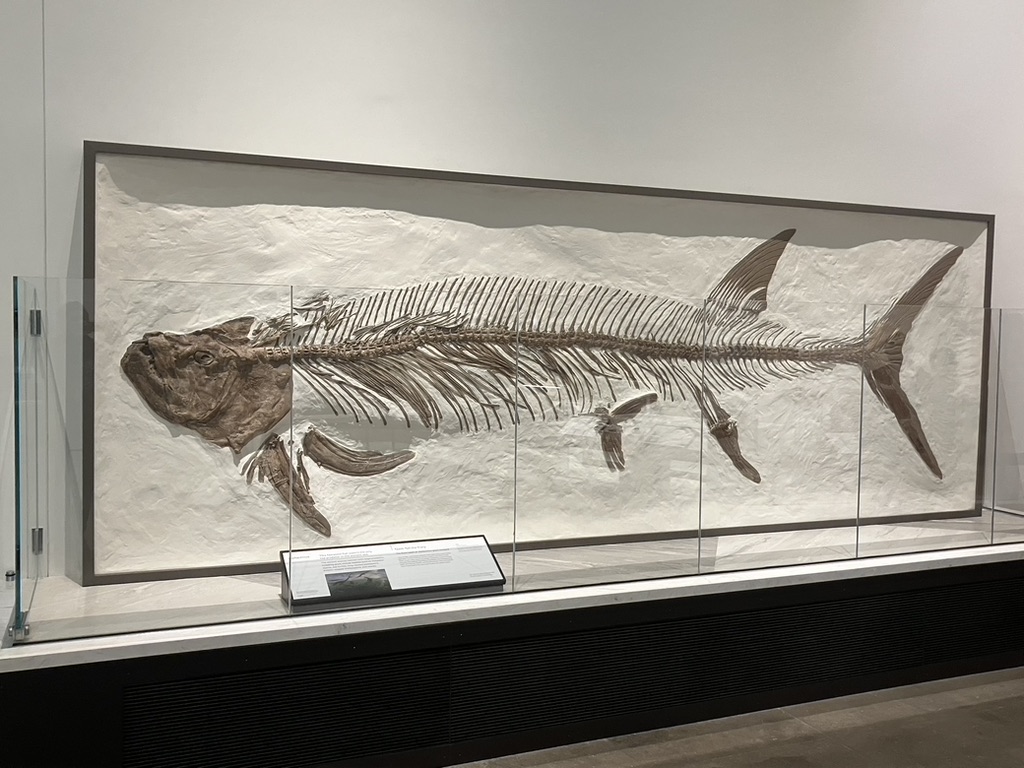
Xiphactinus at the Yale Peabody Museum, collected by George F. Sternberg in 1932. Photo by the author.

Charles H. married Anna Reynolds in 1880. As his client list grew to include Yale, Harvard, the British Museum (now the London Natural History Museum), and other institutions, he settled into something like a routine. Summers were spent chasing fossils across Kansas and neighboring states for various clients, while winters were spent in Lawrence, Kansas with his wife (and writing to prospective clients to secure work for the following field season). Charles and Anna had four children over the next few years. George Fryer Sternberg was born in 1883. Charles Mortram Sternberg was next in 1885, followed by Maud in 1890 and Levi in 1895.

Earning a living finding fossils for museums was hard work. Charles H. moved from gig to gig, often with multiple employers in a single season. He lived for months out of the year at remote campsites only accessible by horseback. In 1892, Anna tried accompanying her husband in the field with young George and Charles M. in tow (Maud stayed in Lawrence with her grandmother). While nine-year-old George found a nearly complete plesiosaur, Anna decided that field life was not for her.
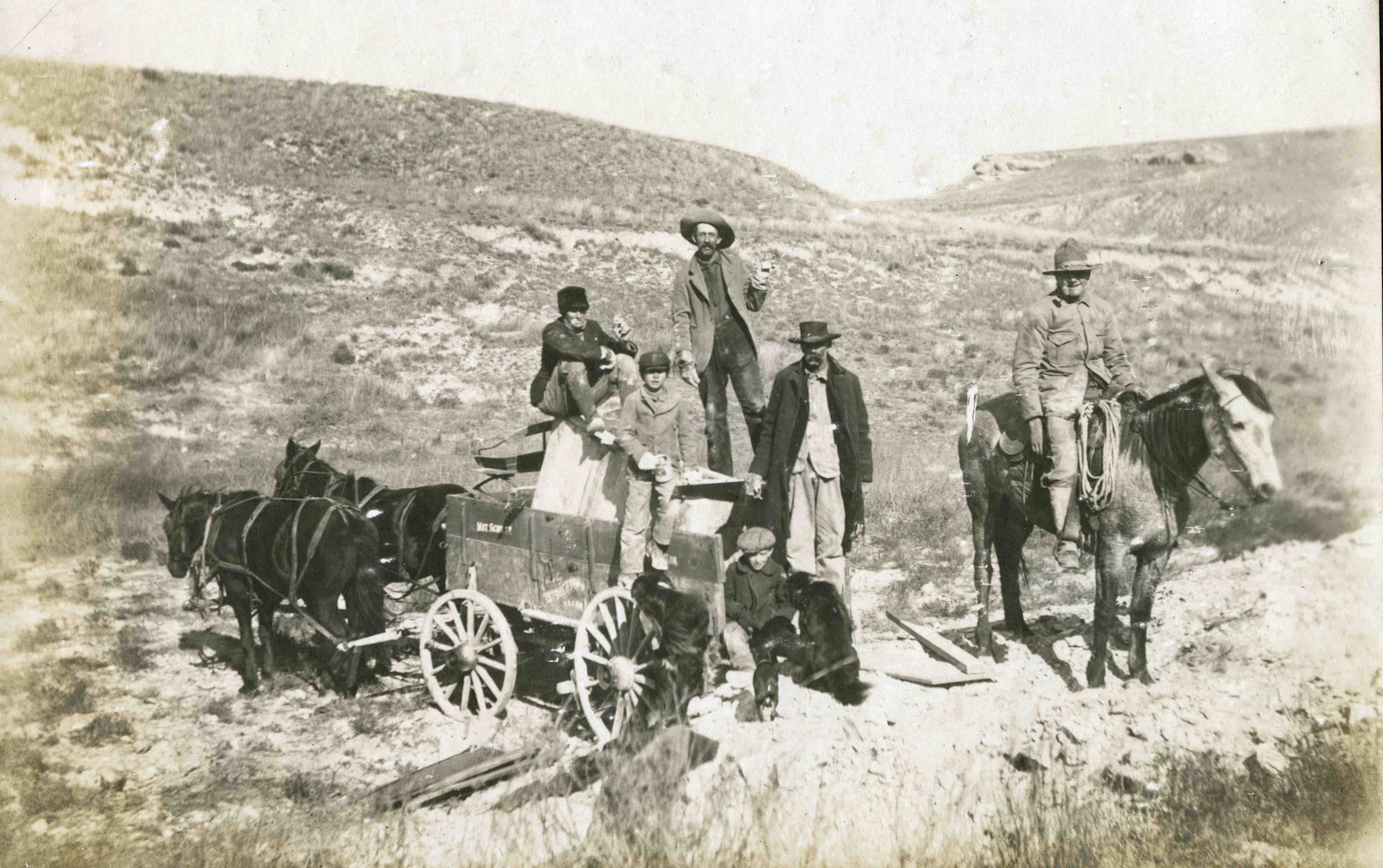
Charles H. with his three young sons and two unidentified men, circa 1906. © University Archives, Fort Hays State University

By 1897, George and Charles M. (then aged 14 and 12) were regular hands on their father’s expeditions. And just like their father, they could apparently smell fossilized bone. Among other innovations, the Sternbergs built a tripodal pulley rig for hoisting plaster jackets out of the ground—a far cry from Charles H.’s early years, when he was prying out individual bones with a butcher knife. In addition to finding fossils on demand, the Sternbergs also accumulated a growing backlog of fossils for sale. Since the family business was never incorporated, records of what they had in inventory at any given time are sparse.
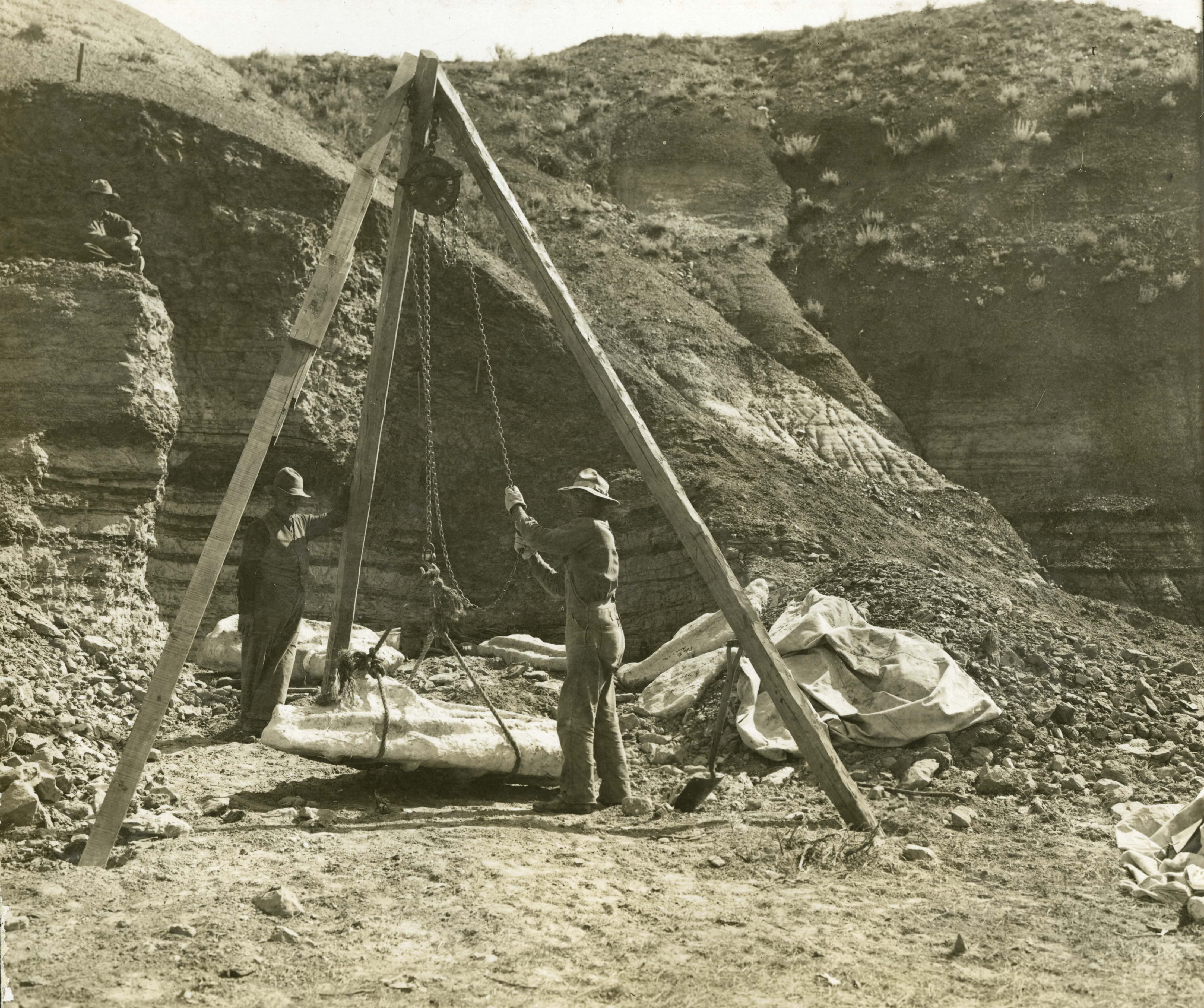
Charles H. (left) and George (right) use their pulley lift to move a jacketed ceratopsian skeleton. Image © University Archives, Fort Hays State University.

In 1908, the Sternbergs found what is arguably their most famous fossil. By that time, they had shifted their focus from the marine fossils of Kansas’s Niobrara Formation to late Cretaceous dinosaurs of Wyoming’s Lance Formation. In late August, George and Levi (now 13) were removing sandstone overburden from a promising site while Charles H. and Charles M. took the wagon on a supply run. It soon became clear to the brothers that they had an articulated dinosaur skeleton lying on its back. Excavating further, George uncovered the unmistakable texture of scaly reptile skin across the animal’s chest—likely the first fossilized dinosaur skin ever found. Although they had nothing but potatoes left to eat, George and Levi stayed by the fossil and continued to excavate for two days until their father and brother returned.

The skeleton—an Edmontosaurus—turned out to be almost entirely wrapped in skin, like a hardened, wet sack draped over the bones. Charles H. told George that it was the most incredible fossil he had ever seen, and later wrote in his memoir that he knew the moment he saw it that it was time for his son to take the lead in the family business. Word of the find made it to Henry Osborn, who immediately sent a representative to buy it for the American Museum of Natural History. The Edmontosaurus “mummy” (as Obsorn called it) was fully prepared and on display within two years, and is still revealing new information about the life appearance of dinosaurs to this day.
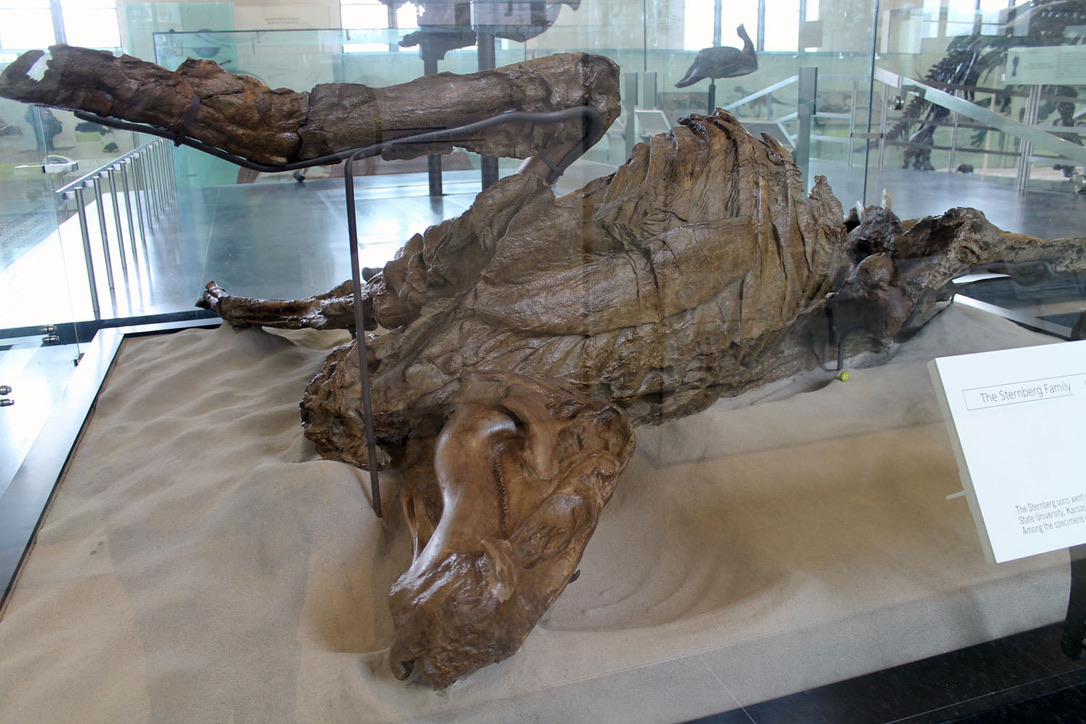
The Edmontosaurus mummy on display at AMNH. Photo by the author.

1911 was an eventful year for the Sternbergs. Charles H. and George embarked eastward to visit the big east coast museums for the first time. They saw the Edmontosaurus mummy on display at AMNH, as well as plenty of their other finds at the Carnegie Museum, the Yale Peabody Museum, the Harvard Comparative Zoology Museum, and the National Museum of Natural History. They also observed how museum preparators Adam Hermann and Arthur Coggeshall were restoring incomplete specimens and mounting them on custom armatures. The Sternbergs would go on to offer these services as part of their trade.

Meanwhile, Charles M. married Myrtle Martin and built a homestead in Wyoming. Even as the Sternbergs began taking separate commissions and working together less frequently, they could still regroup for dinners at Charlie and Myrtle’s whenever they traveled through the area. The news that year wasn’t all happy, however: Maud Sternberg passed away at age 20 after a long illness.
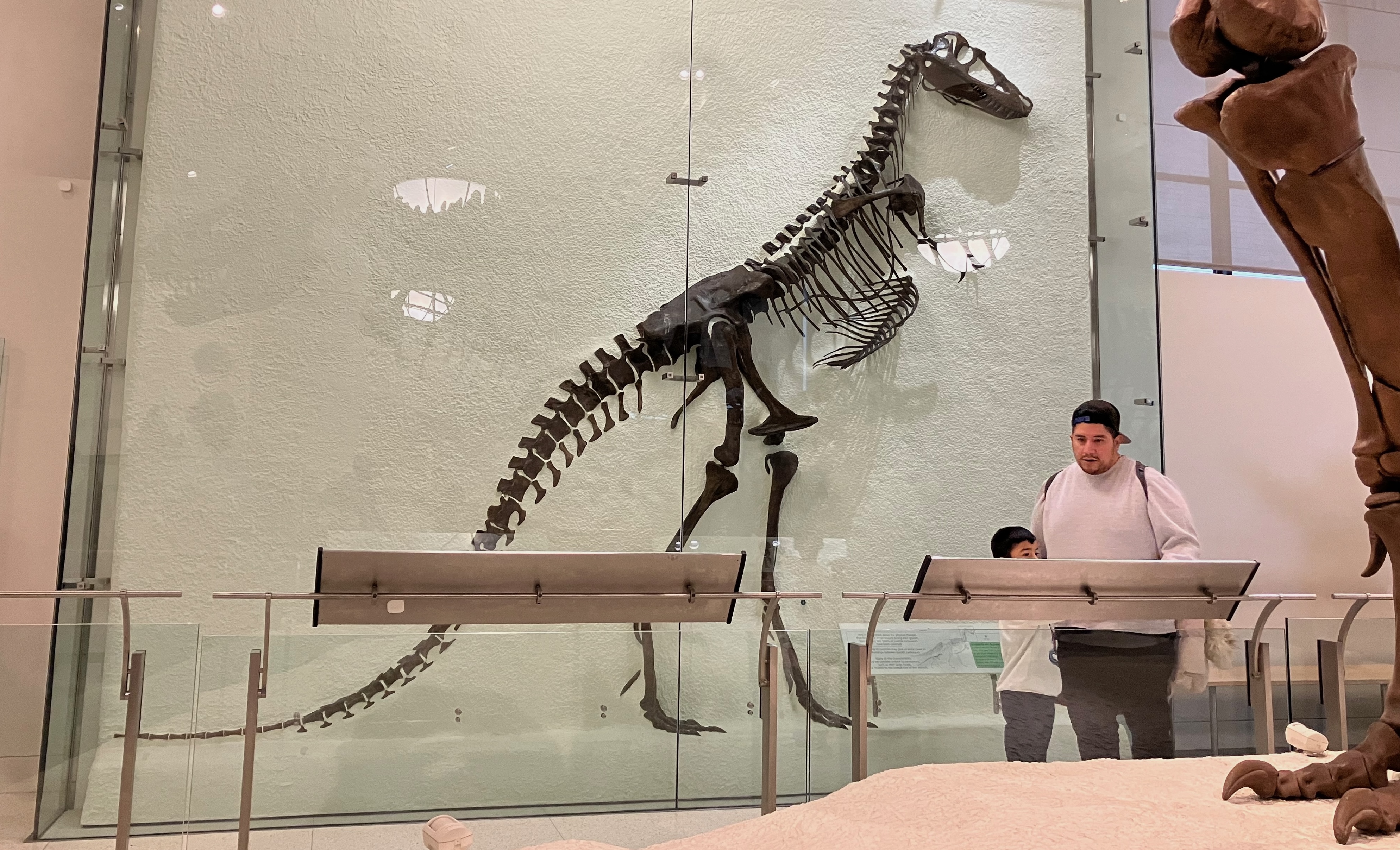
Juvenile Gorgosaurus collected by Charles H. Sternberg and purchased by AMNH. Photo by the author.

Late in 1911, George was hired to join the AMNH’s Barnum Brown, who had been collecting dinosaurs along Alberta’s Red Deer River since the previous year. While Joseph Tyrell had pioneered fossil hunting in that region in the 1880s, Brown’s team was revealing just what a treasure trove of fossils was hidden in those hills. Nevertheless, many Canadians were concerned about how much of their natural heritage was being taken away and shipped to New York, so Reginald Brock of the Geological Survey of Canada organized a competing expedition in 1912. Who could lead such an expedition and promise comparable success to Barnum Brown? The natural choice was Charles H. Sternberg.

With Charles M. and Levi at his side, Charles H. got to work hunting for dinosaurs not far from where Brown was working. The two teams were generally friendly with one another, spending their leisure time together and even sharing Sunday picnics. Charles H. was also able to learn the basics of operating along the Red Deer River from the AMNH crew. A floating barge made for a convenient mobile base camp, but face nets were mandatory to protect from the incessant biting insects. The biggest inconvenience was the need to move water and supplies from the river to the fossil quarries (and fossils back to the river)—often a multi-mile trek over uneven terrain.
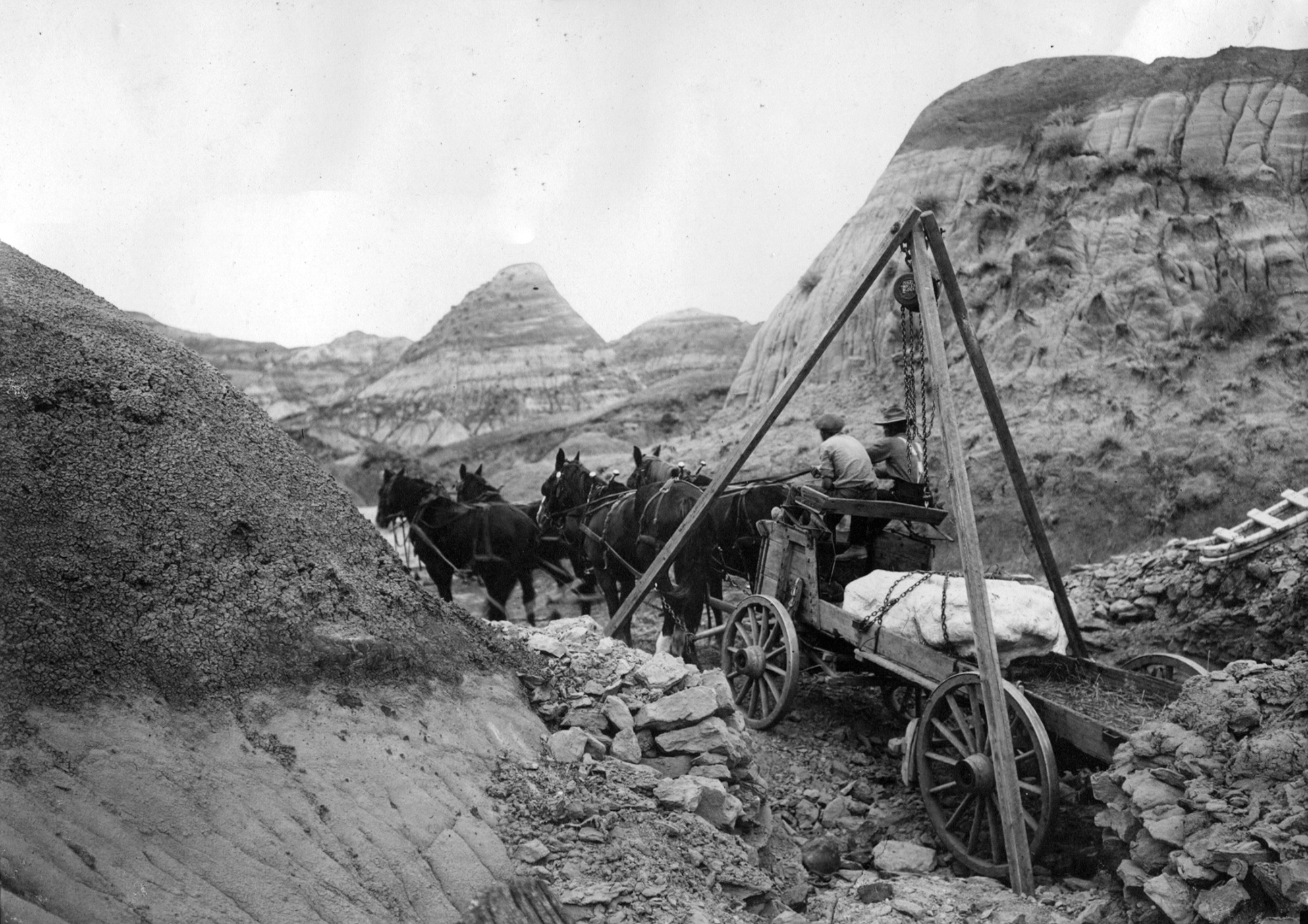
George Sternberg (left) drives a wagon carrying hadrosaur fossils from a quarry back to the river. Image © Field Museum.

Despite these challenges, both teams managed to find, excavate, jacket, and transport around 30 dinosaur specimens every year, for three years straight. Brown wrapped things up in Alberta at the end of 1915, but George and Charles M. continued working for the Geological Survey for several years. Charles H. and Levi also remained in Canada, freelancing for the British Museum in the summer of 1916.

Charles H. collected 45 boxes of fossils that season, including three reasonably complete hadrosaur skeletons. Those fossils were loaded onto the S.S. Mount Temple for transport to London, but they never made it. The ship was intercepted and boarded by a German surface raider, and its crew and passengers taken prisoner (not killed, as Sternberg wrote in his memoir). The Germans then placed explosive charges on the ship and sank it. All of the Mount Temple‘s cargo—including thousands of pounds of food and provisions, 700 horses, and the aforementioned fossils—were lost at the bottom of the north Atlantic. Experiments have shown that mineralized fossils aren’t seriously harmed by immersion in salt water, so there’s every reason to think those hadrosaurs are doing fine down there. If any billionaires happen to read this and want to fund something dramatic in the name of science, you could do far worse than rescuing the lost dinosaur skeletons on the wreck of the Mount Temple (it’s at 46° 43’ N, 34° 8’ W).
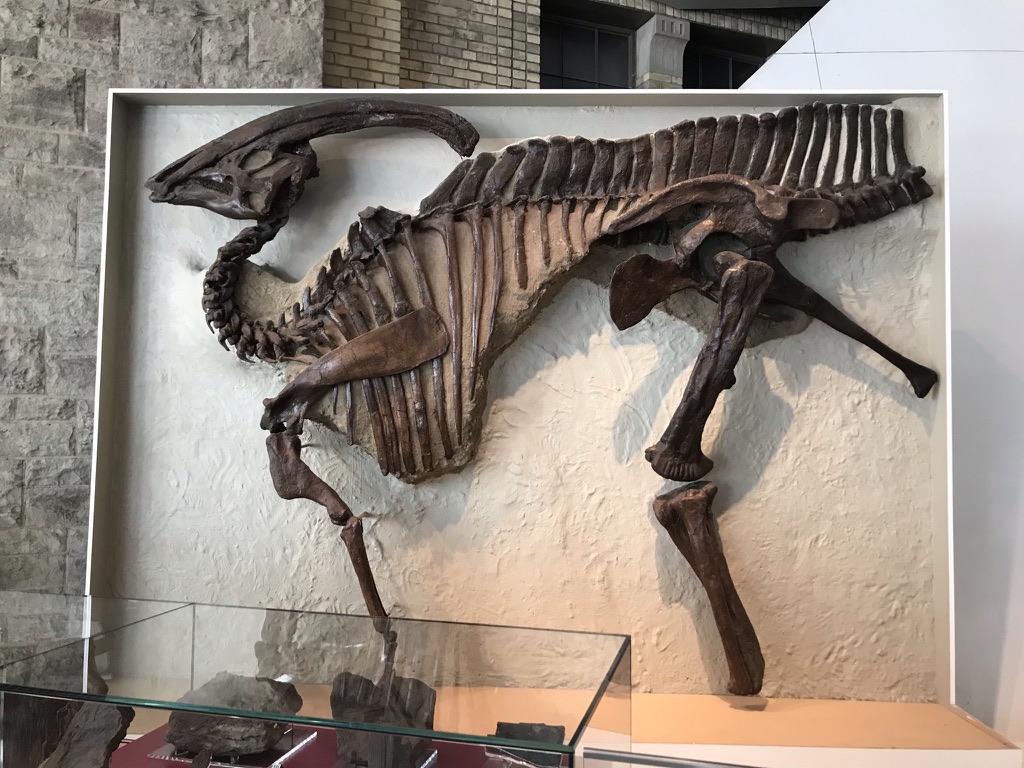
Parasaurolophus collected by Levi Sternberg in 1920, on display at the Royal Ontario Museum. Photo by the author.

Starting in the 1920s, the Sternberg clan began to settle down. Charles H. relocated to California with Anna in 1921 after being hired as Curator of Vertebrate Paleontology at the San Diego Natural History Museum. His final field seasons were spent in the American southwest, collecting dinosaurs in New Mexico and Baja California. Charles M. stayed in Canada, taking a job as lead paleontologist for the Geological Survey in 1919. He became a curator at the National Museum of Canada in 1948, where he continued to study and publish on Canadian dinosaurs. Meanwhile, Levi moved to Toronto with his young family and worked at the Royal Ontario Museum for several decades, first as a preparator and eventually as Associate Curator. After Anna passed away in 1938, Charles H. moved in with Levi until his death in 1950.

George, however, continued the life of the freelance fossil hunter for a bit longer. He collected for a number of institutions, including a four-year stint with the Field Museum starting in 1922. Working with the Field’s Elmer Riggs, George traveled to Argentina and Bolivia to collect ground sloths and other Cenozoic mammals.
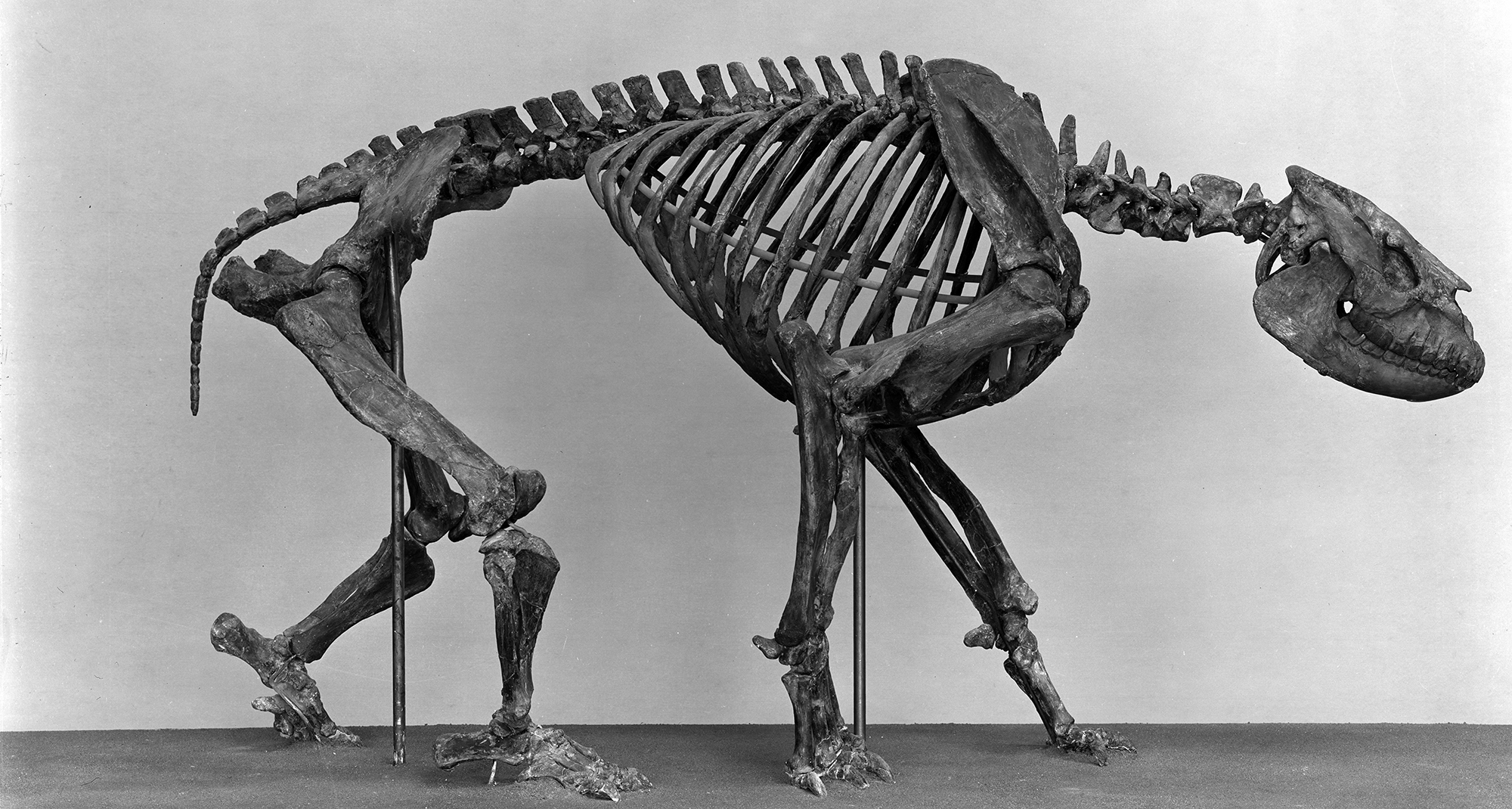
Homalodotherium skeleton collected by George Sternberg in Argentina. Image © Field Museum

In 1927, George decided to return to Hays, Kansas, where his father started collecting fossils some sixty years earlier. He began teaching at Fort Hays State University, and helped found a natural history museum there. When George passed away in 1969, that museum was renamed the Sternberg Museum of Natural History to honor the remarkable Sternberg family and their contributions to our understanding of past worlds.

References

Graham, M.R. 2019. Professional fossil preparators at the British Museum (Natural History), 1843–1990. Archives of Natural History 46:2.

Rogers, K. The Sternberg Fossil Hunters: A Dinosaur Dynasty. Missoula, Montana, 1991: Mountain Press Publishing Company.

Sternberg, C.H. 1909. The Life of a Fossil Hunter

Sternberg, C.H. 1917. Hunting Dinosaurs in the Badlands of the Red Deer River, Alberta, Canada.

Tanke, D.H. and Currie, P.J. 2009. A history of Albertosaurus discoveries in Alberta, Canada. Canadian Journal of Earth Science 47:1197–1211.

Tanke, D.H., Hermes, N.L., and Guldberg, T.E. 2001. The 1916 Sinking of the SS Mount Temple: Historical Perspectives on a Unique Aspect of Alberta’s Paleontological Heritage. Canadian Palaeobiology

4 Comments

Filed under AMNH, field work, FMNH, history of science, museums, NHM, NMNH, YPM

Review: the new Peabody Museum

Tylosaurus and Archelon skeletons soar overhead in the Peabody Museum’s brand-new lobby. Photo by the author.

For decades, the Yale Peabody Museum of Natural History (YPM) was a museum frozen in time, with no comprehensive updates to its paleontology halls since the 1950s. Then, around 2010, serious discussions began about overhauling the dinosaur and fossil mammal exhibits. Fundraising started in 2015, and in 2018, the museum announced that it had received a $160 million donation—enough to renovate not just the paleontology halls, but the entire museum. YPM closed its doors at the beginning of 2020, and on March 26 of this year, it reopened to the public once again.

Technically, this is a soft opening. The third floor—which houses the museum’s classic taxidermy dioramas—has not yet opened, and a scattering of cases around the museum are empty as of this writing. Still, there is plenty to see: during the renovation, YPM gained a new, multi-story lobby (connecting the museum to the academic building next door), as well as new collections facilities, classrooms, and 50% more exhibit space. And most importantly, the paleontology halls are open and just about complete.

A Geosternbergia cast demonstrates its quad-launching technique in the museum’s entryway. Photo by the author.

The remaking of the YPM exhibitions was a collaborative effort between internal staff (led by Kailen Rogers, Chris Norris, Susan Butts, Jacques Gauthier, and others) and two outside design firms—Centerbrook Architects and Planners provided the high-level design of museum and surrounding area , while Reich + Petch worked on specific exhibit elements and graphic design.

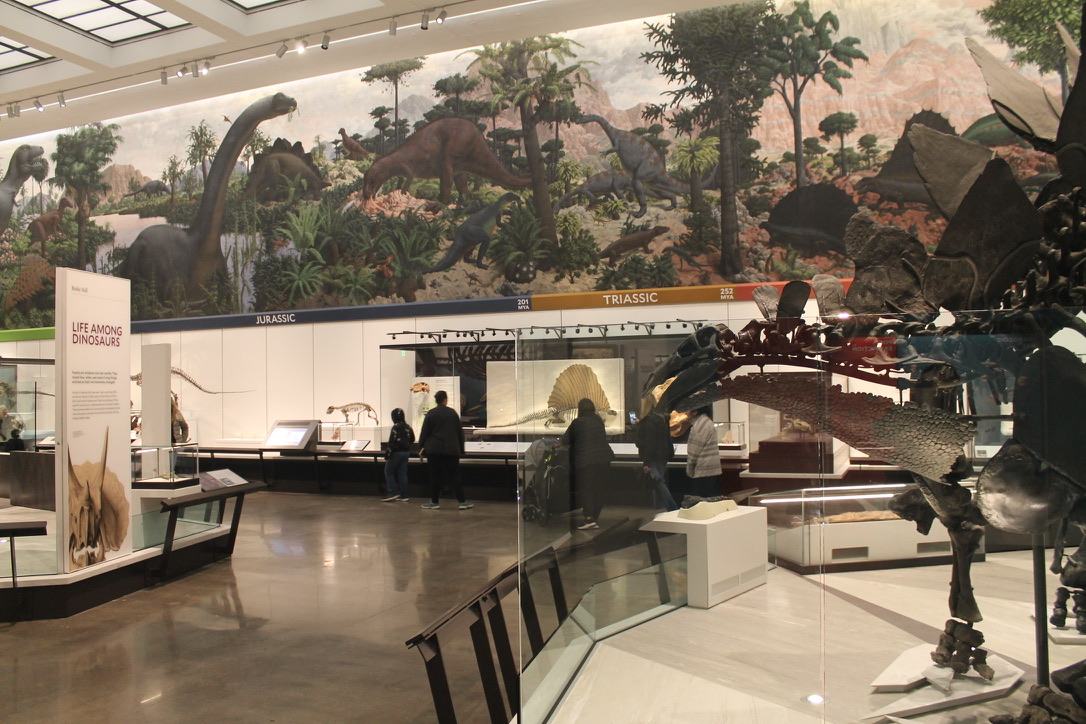
I spent a few hours at YPM last week, and the new halls were absolutely worth the wait. What I found most striking is that the paleontology halls feel at once new and familiar. The dimensions of the dinosaur and fossil mammal halls (officially, the Burke Hall of Dinosaurs and A World of Change) remain identical, and they are still anchored by Rudolph Zallinger’s magnificent fresco murals—The Age of Reptiles and The Age of Mammals. Charles Beecher’s relief mounted Edmontosaurus was left in place, and the overall layout and flow of the spaces have not been radically altered. On the other hand, white walls and new windows and skylights have transformed what had been fairly gloomy spaces into bright, open expanses. There are dozens of new specimens on display, in addition to plenty of returning ones. And a third gallery has been added to the paleontology wing: called The Human Footprint, this space explores how humans have interacted with the natural world over the past hundred thousand years or so.

The remounted Stegosaurus looks back toward Zallinger’s Age of Reptiles. Photo by the author.

The primary themes of the paleontology exhibits are displayed at the entrance to Burke Hall: “life affects the environment and the environment affects life” and “extinctions change everything.” Much like Deep Time at the National Museum of Natural History, YPM’s exhibits emphasize that the evolution of life on Earth did not occur in a vacuum, but as part of a continuously changing global system. This narrative does have a time axis—visitors follow along from the Edicaran to the present day—but the precise devisions of geologic time are often de-emphasized in favor of the broad environmental transitions that triggered evolutionary innovations.

This presentation of the evolution of life compliments the existing Zallinger murals. Painted between 1942 and 1967, these are among the most iconic images of prehistoric life ever created. Although some of the animal reconstructions are outdated, Zallinger was in other ways ahead of his time. Rather than giving the geologic periods hard borders, he artfully wove the sections together so that each one fades imperceptibly into the next. The viewer can see that the flora, fauna, and climate are changing over time, but it’s a gradient, not a ladder. Incidentally, it was not a given that the Zallinger murals would be preserved. Great credit is due to the YPM team for not only retaining the murals, but utilizing them as a key part of the new exhibition’s narrative.

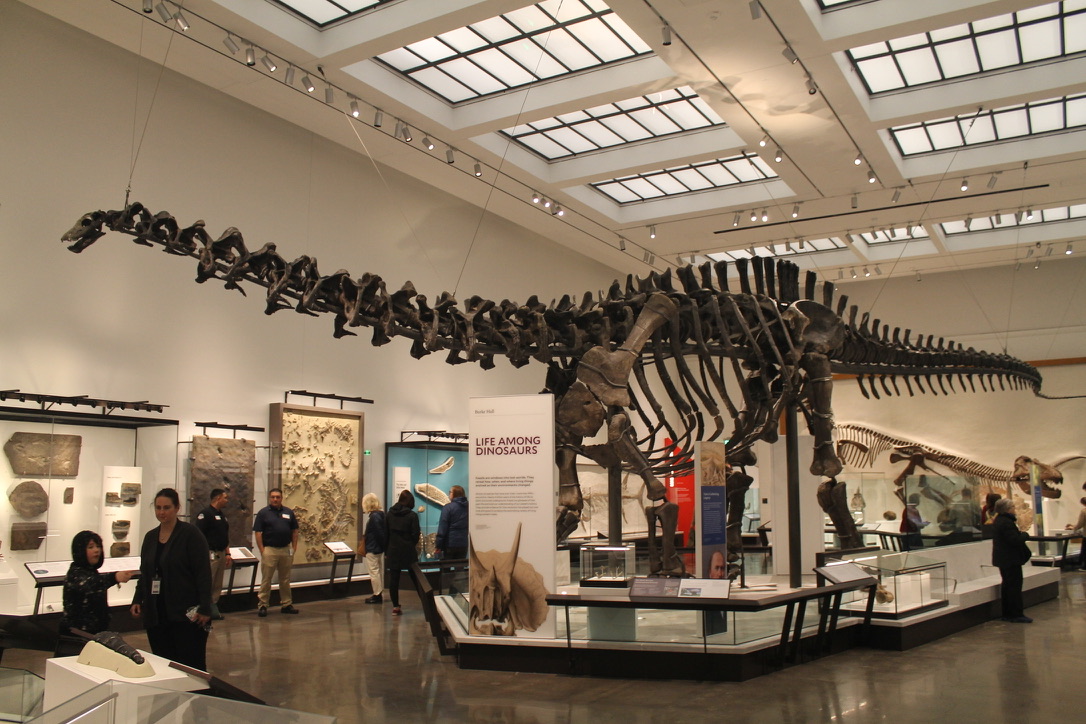
Brontosaurus reclaims its place as the centerpiece of the dinosaur hall. Photo by the author.

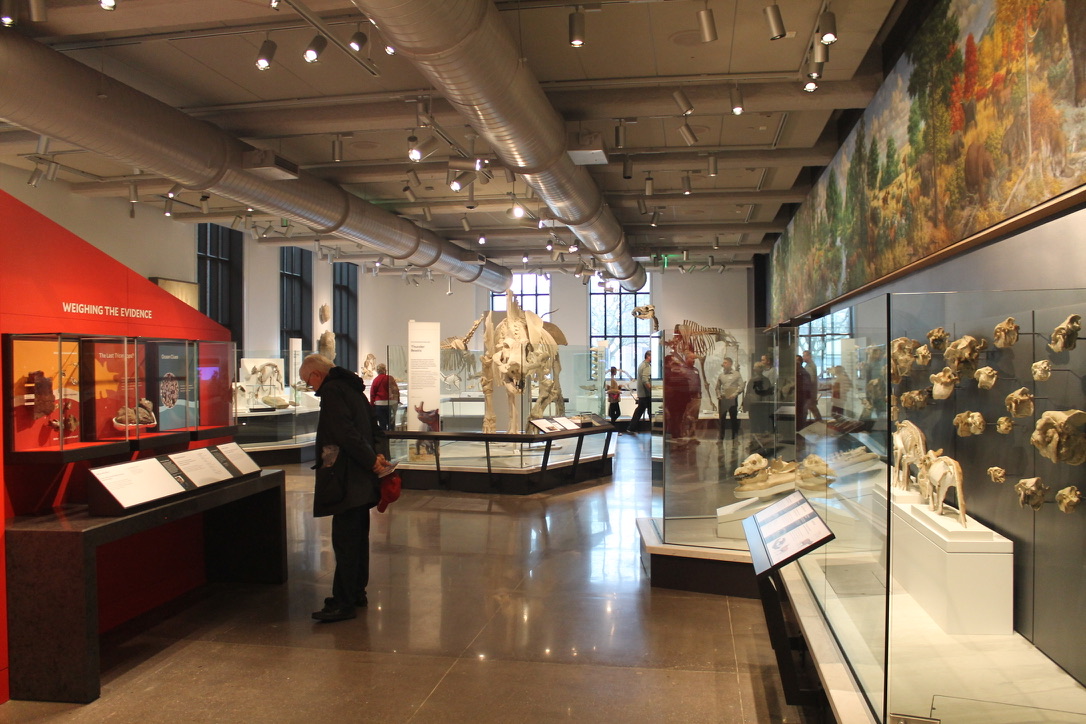
One clear advantage of a wall-to-wall renovation is that the exhibits are much better organized than before. In the old dinosaur hall, visitors encountered an essentially random succession of displays: from modern sea turtles to Triassic trees and from a Cretaceous mosasaur to a Quaternary mastodon. Now, the displays run chronologically, and more or less in sync with the Zallinger mural. Visitors can follow the history of life in the sea on the west side of the hall, and the history of terrestrial life on the east side. I also suspect that placing Brontosaurus and a brontothere as central anchors in their respective halls was a deliberate choice.

A very large Megacerops stands on a central platform in the reimagined Cenozoic hall. Photo by the author.

Research Casting International remounted several historic skeletons with characteristic artistry and skill. I will have a separate article about the mounted skeletons sometime soon, but the remounts are Brontosaurus, Stegosaurus, Deinonychus, Archelon, Moropus, Megaloceros, a mastodon, and a dodo. Brand new mounted skeletons include Tylosaurus, Poposaurus, and a Geosternbergia family of four (plus a few secret mounts outside the neighboring Marsh Auditorium). At least fifteen existing mounts have returned. As Postdoctoral Fellow Advait Jukar explained to me, the goal for the mounted skeletons was to portray “living, breathing animals, rather than looking like they’re posing for a portrait.” For example, the aggressive rutting posture of the Irish elk was directly inspired by the classic bull moose diorama at the American Museum of Natural History.

Mounted skeletons aside, there are some really extraordinary fossils in these halls. Some of the specimens that caught my eye include a geode bird egg with an embryonic skeleton inside, the bizzare Arsinotherium from Egypt’s Fayum region, a Nothrotheriops with patches of hair and skin, and the early Jurassic dinosaurs Podokosaurus and Anchisaurus.

Remounted Irish elk and mastodon in the Human Footprint gallery. Photo by the author.

While many of the fossils speak for themselves, the halls are also populated with several new models and replications, which imbue the extinct species on display with life and personality. The towering Gastornis created by Blue Rhino Studio is the clear standout—I like that it looks like its gazing longingly back toward the Mesozoic dinosaurs in the adjacent hall. Other highlights include a slab of Edicaran weirdos and the mammal Rapenomamus attacking a Psittacosaurus at the feet of Brontosaurus (I would have liked to see a baby sauropod as the prey, but maybe that would be too much for squeamish visitors).

Meanwhile, the YPM team made some selective forays into the realm of media and digital interactives. Most (possibly all?) of these take the form of slideshows on large touchscreens. These are an effective way to condense a lot of information into a limited space, and allow for some visitor choice in what topics interest them. I thought an interactive where visitors could explore the propagation of horses, humans, and tomatoes around the world was particularly well done.

Gastornis is a highlight of the Cenozoic Hall. Photo by the author.

I would expect an institution like Yale to be protective of its legacy and history, so I was surprised to find a prominently placed rebuke of superstar 19th century paleontologist O.C. Marsh in the dinosaur hall. As Advait described it, this is an “and” statement: Marsh was instrumental in shaping our understanding of prehistory and evolution and he collected from Native land without permission, looted graves, and was academically dishonest.

The call-out of Marsh wasn’t the only unexpectedly progressive element in the new exhibits. A brontothere fossil is interpreted with a poem by a trans teenager, which criticizes imperialistic scientists for imposing their way of knowing upon the world. Elsewhere, a display of fossils from the Santa Fe Formation in Argentina is accompanied by printed labels solely in Spanish—perhaps a statement about whose voices should be heard when interpreting the natural heritage of a given region. Natural History Conservator Mariana di Giacomo told me that these displays are part of an effort to include a wider range of perspectives in YPM exhibits. Other examples include musings from artist Ray Troll on being a “highly motivated fish” and psychologist Eli Lobowitz’s take on why kids love dinosaurs.

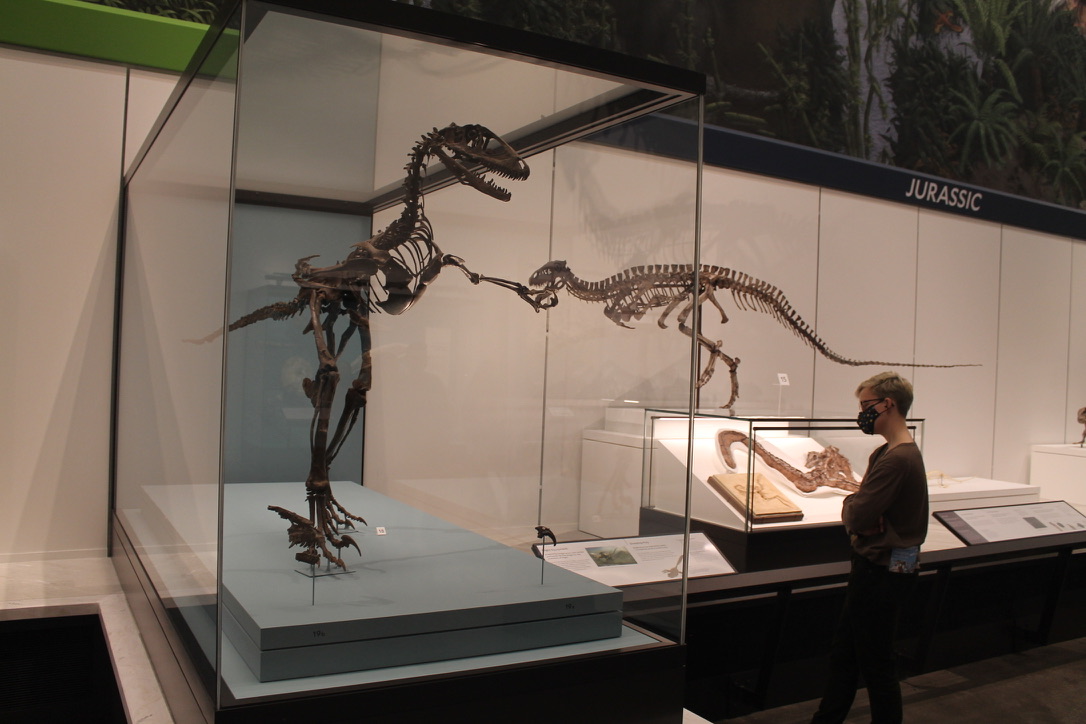
Deinonychus and Poposaurus are the largest saurian carnivores on display. Photo by the author.

My critiques of the new paleontology halls are pretty limited. There are more typos and inconsistencies in the labels than there ought to be, particularly in the age ranges given for certain specimens. I overheard multiple visitors concluding that the Edmontosaurus skeleton was a T. rex, and I suspect an image of Tyrannosaurus placed in front of the Edmontosaurus is to blame. In one area, the writer uses terms like “stem reptile,” “early stem land egglayer,” and “stem amniote” as common names for various species. Even with some specialized knowledge I don’t understand what distinction they were trying to make, and I can’t imagine those terms are helpful for most visitors.

The most pervasive issue is the inconsistent quality of 2-D life reconstructions used on graphics throughout the halls. With a few exceptions, it appears that the exhibition’s creators used whatever images were available, including stock renders and illustrations pulled from Wikipedia. For many people (especially children) unaccustomed to interpreting bones, life reconstructions can be more meaningful than the actual fossils. It’s worth budgeting for original, quality artwork whenever possible. Put that $41 billion Yale endowment to use!

A graphic with a particularly uninspired illustration from a stock image provider. Photo by the author.

Speaking of Yale’s effectively bottomless pockets, the best news about the new YPM is that it’s 100% free. This is an excellent precedent to set: there’s no better way to welcome a broader audience and remove barriers from engagement with science than doing away with admission fees. I hope other museums follow YPM’s lead on this front and work to free themselves from reliance on admission income.

More on fossils at the Peabody soon!

10 Comments

Filed under dinosaurs, exhibits, fossil mounts, mammals, museums, opinion, paleoart, reviews, science communication, YPM

The new Peabody: what to expect

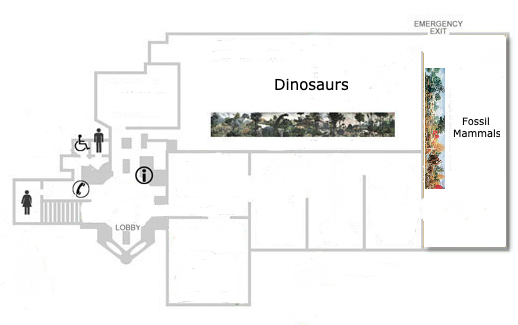
Map of the YPM galleries as they are currently arranged. North is right.

The dinosaur and fossil mammal halls at the Yale Peabody Museum of Natural History (YPM) closed on January 1st of this year. In the last post, I covered some of the exhibition’s history, with a focus on the mounted dinosaur skeletons that won’t be returning when the halls reopen in 2023. This time, I want to explore what the new paleontology exhibits might be like. To be clear, I don’t have any privileged information about the YPM renovation. I only have my own insight from working on exhibits at other museums, and my immoderate interest in historic fossil displays (see the rest of this website). Fortunately, YPM staff have been very generous with news about the project, and there is even a dedicated website with details about the renovation. Let’s see how much we can piece together.

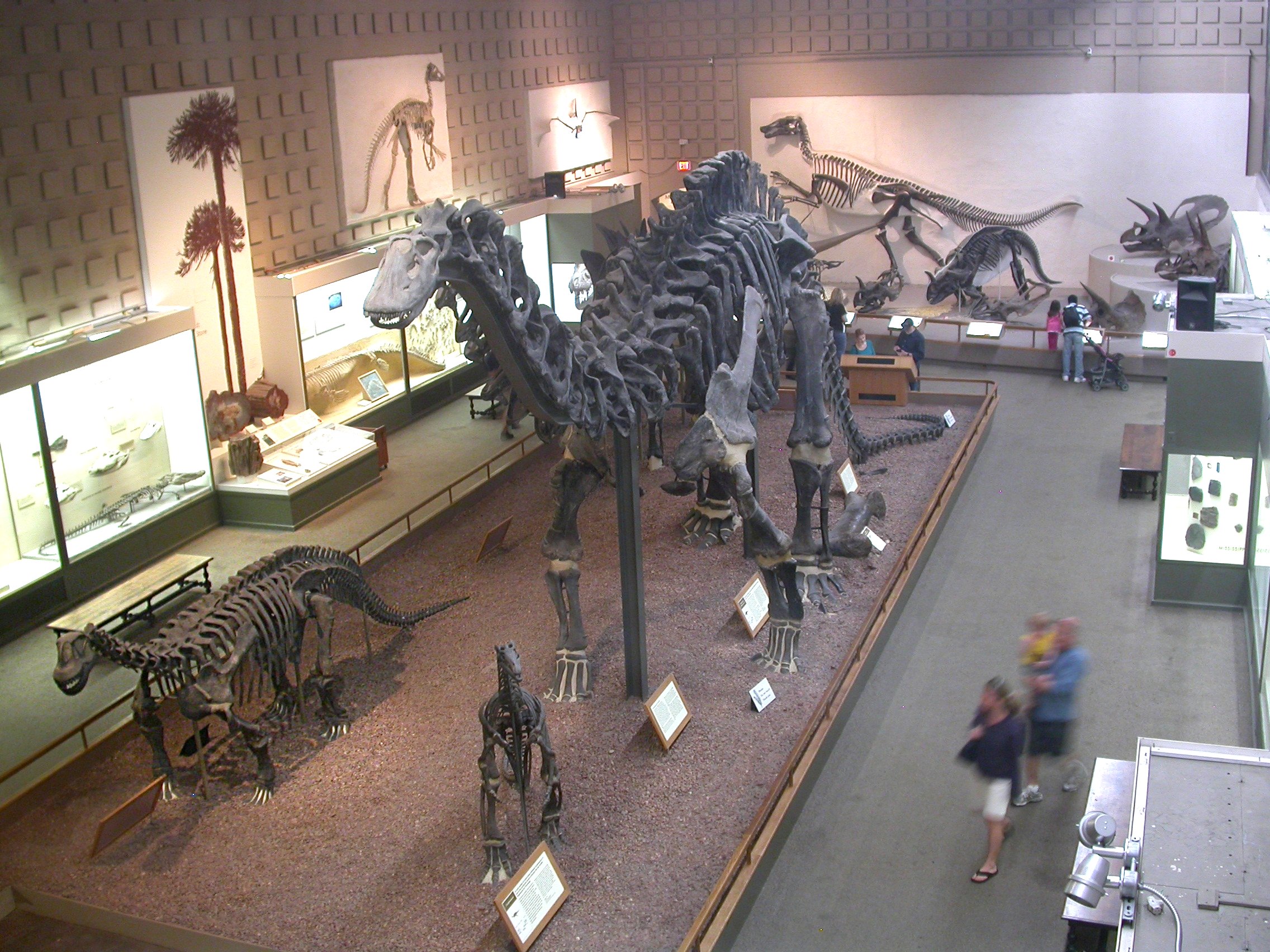
The dinosaur hall in 2014. Photo by Michael Taylor, CC BY.

As I touched on in the previous post, this renovation has been a long time in coming. Few significant changes had been made to the paleontology halls since the 1950s, and these spaces are in many ways time capsules from another era—both in terms of paleontological science and exhibit design. Serious conversations about redeveloping the dinosaur and mammal halls were underway by 2010. During this process, the team noted the disjointed nature of the existing exhibits, which had been installed on an ad hoc basis. For instance, a visitor moving along the west side of the dinosaur hall would encounter modern crocodilians, Triassic trees, and a Cretaceous mosasaur, before passing into the fossil mammal hall and encountering a Quaternary mastodon. These random jumps back and forth through time undoubtably made it difficult for visitors to make much sense of what they were seeing, beyond a menagerie of old dead things.

Seeking to unify the fossils on display within a single, cohesive story, the team proposed a variation on the traditional “walk through time.” Rather than dividing the space into segmented galleries based on the formal divisions of geologic time, the emphasis would be on broad-scale environmental changes. This presentation would synergize with the existing Rudolph Zallinger murals. The 110-foot The Age of Reptiles (completed in 1947) and the 60-foot The Age of Mammals (completed in 1967) are epically-scaled frescos that show the evolution of life over time without hard boundaries. Instead, flora and landscapes from different time periods blend seamlessly into one another. In the same way, the proposed exhibition would present its narrative holistically, encouraging visitors to track the underlying environmental trends that precipitated evolutionary changes. As I discussed some time ago, this is not dissimilar from the approach taken for Deep Time.

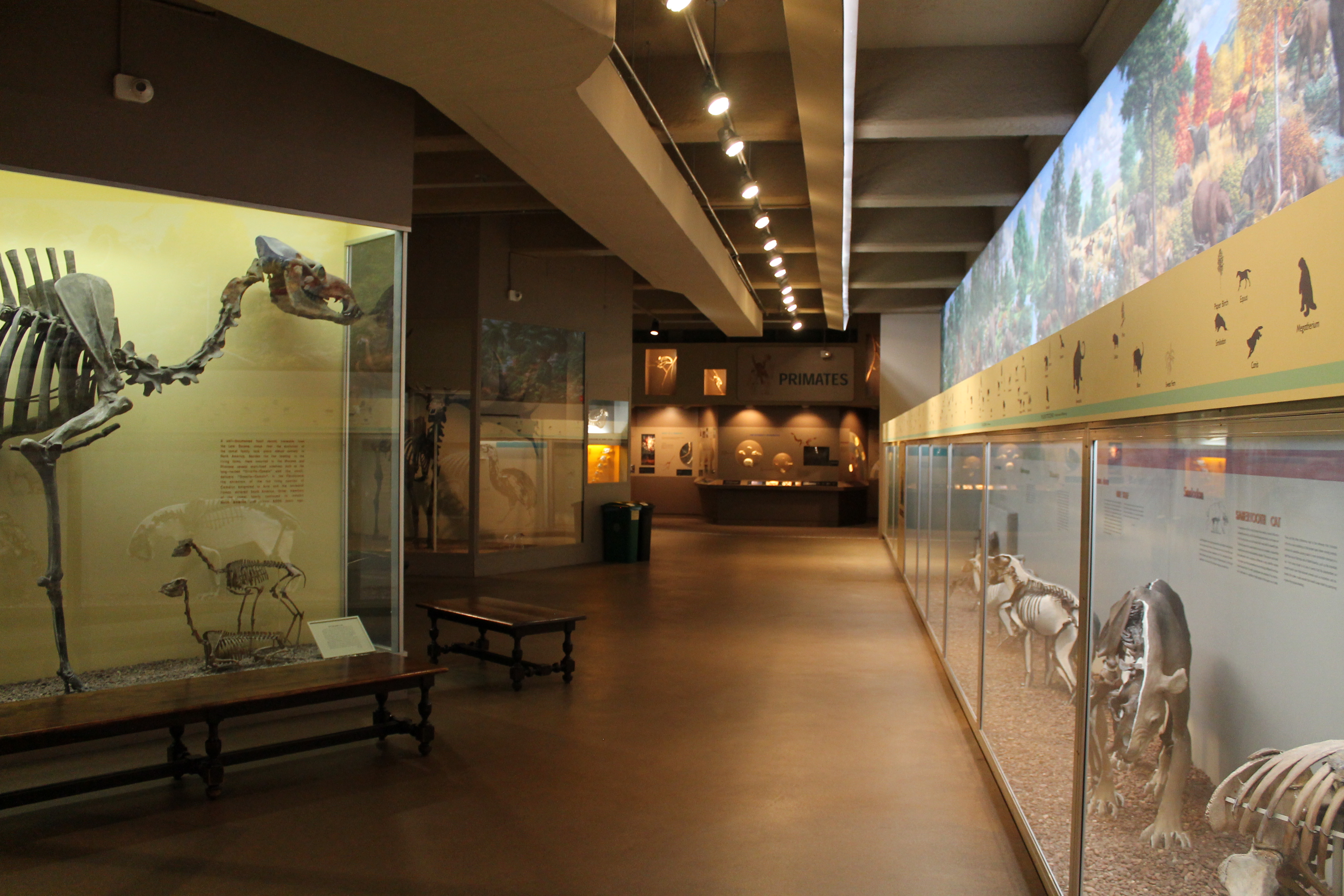
The Hall of Mammal Evolution in 2014. Photo by the author.

These discussions must have been the basis for the set of concept images released alongside the launch of a new fundraising effort in 2013 (why they needed to fundraise when Yale has a $30 billion endowment is beyond me—I promise this will be my only snarky aside about that). Architectural firm Studio Joseph envisioned wide-open and well-lit spaces, in which the grey carpet and grid-patterned walls were replaced by bright earth tones accentuated by ash wood panels. A mezzanine on the west side of the dinosaur hall would have allowed visitors to view The Age of Reptiles directly, rather than from the floor. A long, continuous case directly beneath the mural would contain fossil specimens that corresponded with the scene above.

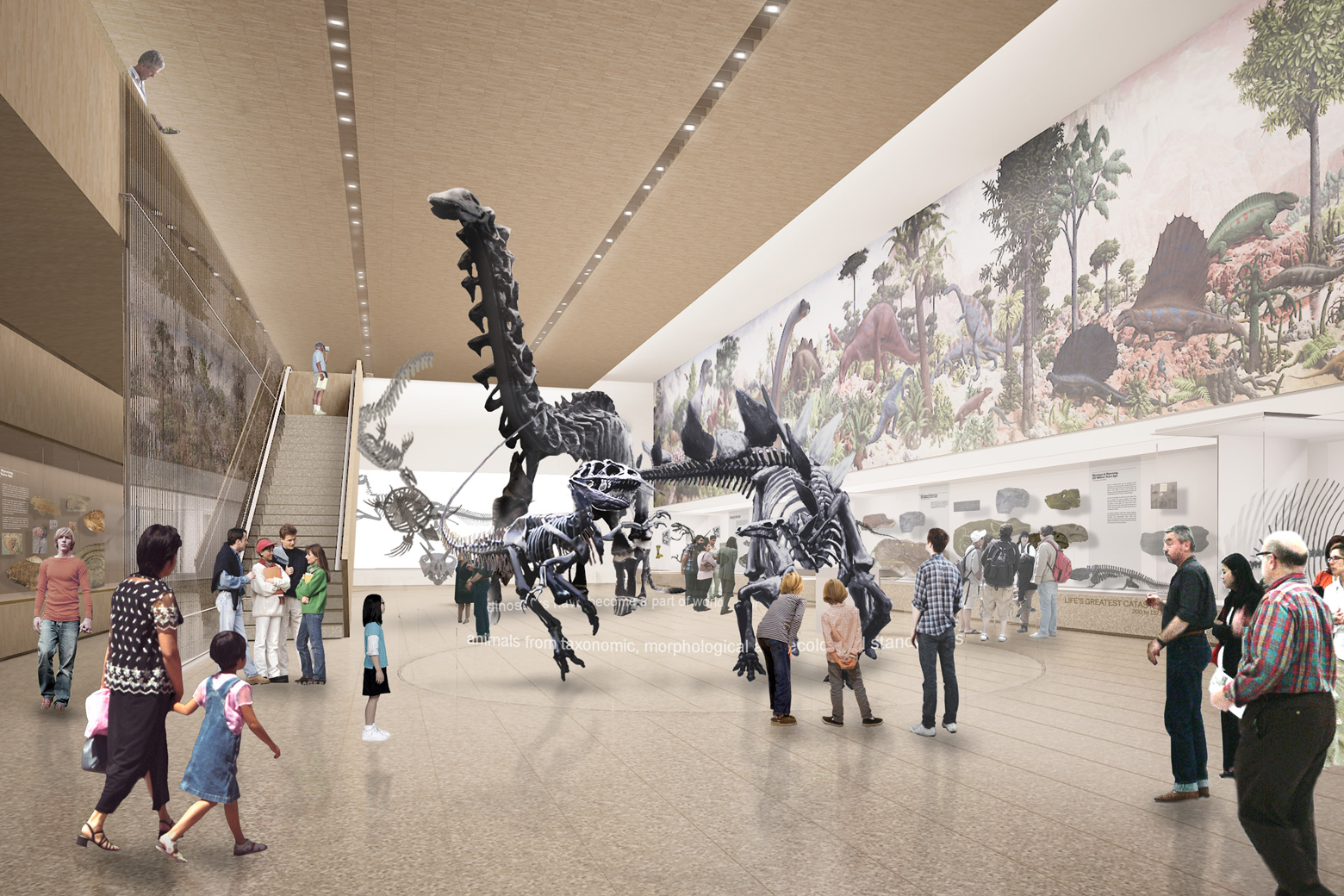
In the center of the hall, remounted Brontosaurus and Stegosaurus skeletons were to be joined by a brand-new Allosaurus, shown attacking the Stegosaurus. In the concept images, the dinosaur skeletons are directly on the floor, rather than on platforms. Barely-visible glass barriers prevent visitors from getting too close to the specimens. In the background, the Beecher Edmontosaurus is in the same position it’s held on the north wall since 1925. A mosasaur attacking an Archelon appears to be suspended from the ceiling in the northwest corner.

2013 concept for the Great Hall of Dinosaurs. Source

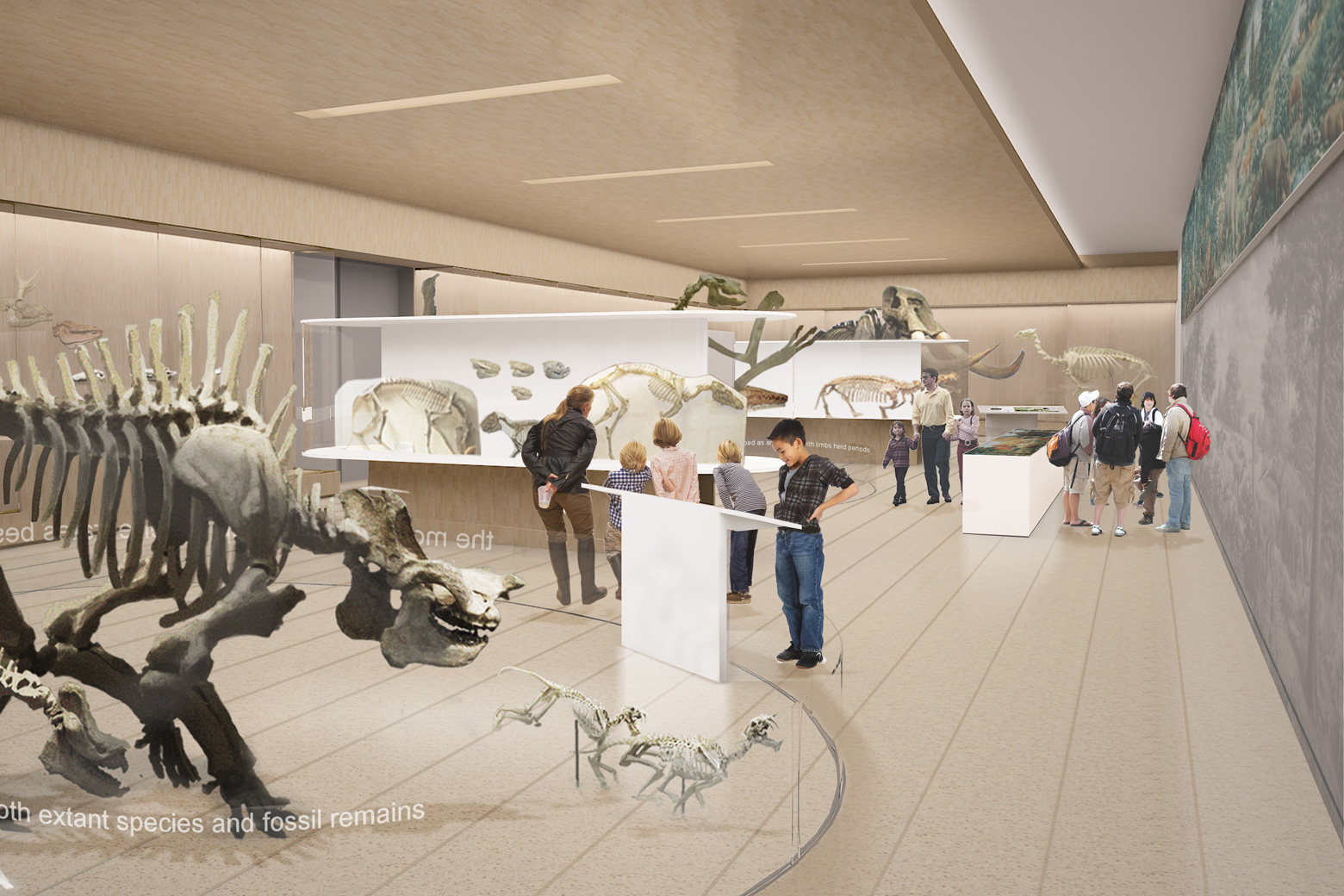
The 2013 mammal hall concept follows the same aesthetic principles as the dinosaur hall. The space-hogging floor-to-ceiling cases are gone, replaced by the same circular glass barriers shown around the dinosaur mounts. Whereas the old hall was loosely organized around a mid-century understanding of evolutionary relationships, this new version would be strictly chronological. The old fundraising page lists a Megacerops display, a Moropus display, and a mastodon display, and indeed, those skeletons appear to anchor the three major areas portrayed in the concept image. One can imagine these early, middle, and late Cenozoic tableaus illustrating the climactic shift from warm and wet to cool and dry. Oddly, the arrangement shown here runs in the opposite direction of The Age of Mammals mural, in which the ice age is on the west side of the hall.

2013 concept for the Hall of Mammal Evolution. Source

But all that was seven years ago. Near as I can tell, everything changed when Yale alumnus Peter Bass made a $160 million donation, apparently the largest single gift ever made to an American natural history museum. YPM also changed directors—in 2014, freshwater ecologist David Skelly took over the position from geologist Derek Briggs. The renovation is no longer limited to the two paleontology halls, but will encompass the entire museum—and more. Over the next four years, the YPM and surrounding area will gain a north courtyard and new museum entrance, a dedicated entrance and gathering area for school groups, a multi-story lobby connecting YPM to the academic building next door, new collections and research facilities, new classrooms, 50% more exhibit space, and a 500-seat lecture hall named for O.C. Marsh.

Centerbrook Architects and Planners—a company already responsible for twelve other projects on the Yale campus—was hired to continue the design process. Centerbrook’s renders (and a video flythrough) are available on the Peabody Evolved website. At this stage, it’s difficult to tell which parts of these renders represent real plans and which parts are placeholder. For the purposes of this discussion, I’ll be taking the renders at face value, but will note when something might be merely suggestive of a to-be-determined element.

It’s clear that after the renovation, fossil displays will range far beyond the dinosaur and mammal halls. Some of these are already complete: in August 2019, a crew from Research Casting International moved a Triceratops skull and a relief-mounted Pteranodon from their traditional home in the dinosaur hall to the lobby of the new Marsh lecture hall (part of the recently-completed Yale Science Building to the north of the museum). Meanwhile, the Centerbrook plans shows a mosasaur to the left of the new north entrance to YPM. It’s the approximate size and shape of the Platecarpus skeleton in the old dinosaur hall, so perhaps that fossil will be relocated, as well.

Tylosaurus and Archelon duel in the new central gallery. Source

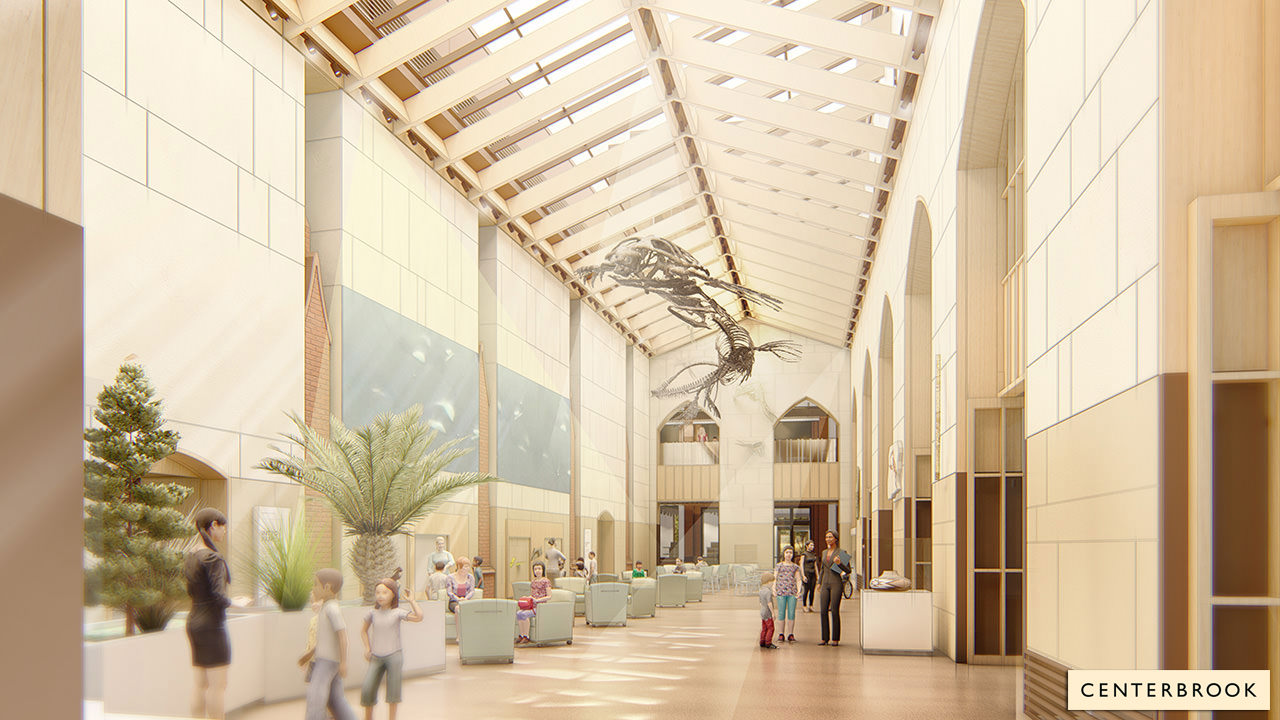
At the heart of the renovated museum will be the central gallery, a brand-new structure filling in an empty space between the YPM and the Environmental Science Center to the east. It will run parallel to the dinosaur hall, sharing a wall on the existing gallery’s west side. Although the overall design is quite modern, the scale and color palette of this new 4-story space is meant to complement the French Gothic revival architecture of the original museum building. Lit by a skylight and filled with comfortable seating, the designers hope that the central gallery will be a space for students and museum visitors to relax and co-mingle, better integrating the museum into the campus community.

Flying high over people’s heads will be battling Archelon and Tylosaurus skeletons. You’ll remember that this scene was originally envisioned for the dinosaur hall. Relocating these skeletons to the central gallery gives them far more room to spread out. The Archelon in question is the holotype (YPM 3000), which was collected in 1885 in South Dakota. Measuring 15 feet across, this Cretaceous sea turtle has been on display since the turn of the 20th century. Given that it will be suspended an inaccessible 30 feet in the air, this new version of Archelon will almost certainly be a cast (Update: In fact, the real Archelon will be remounted). The Tylosaurus is reportedly a specimen from the YPM collection that has never been displayed before.

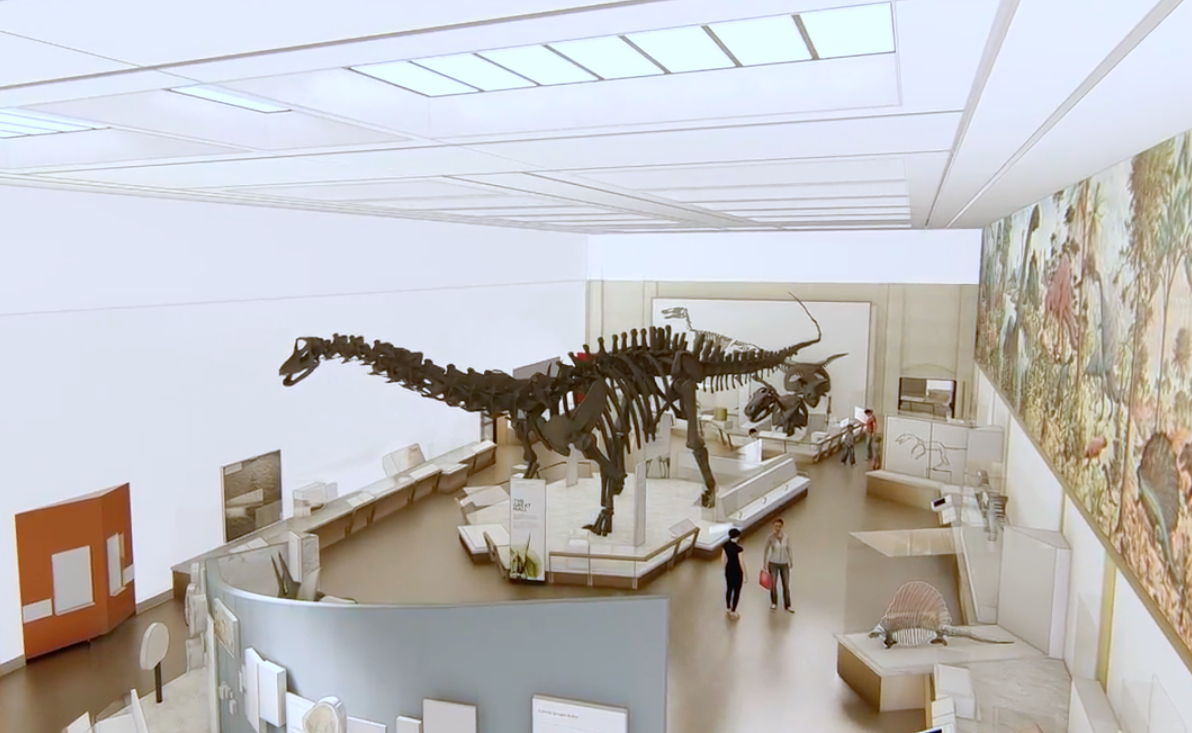
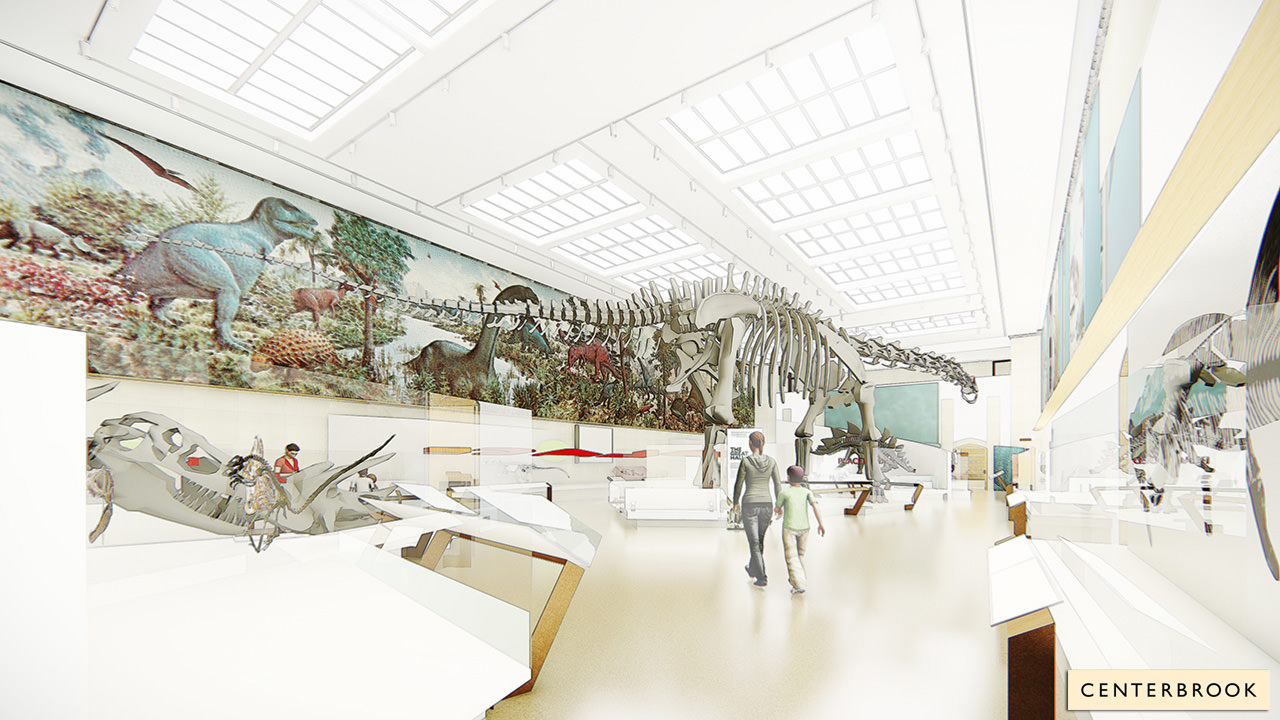
A high angle on the new dinosaur hall. Source

That brings us to Centerbrook’s revised take on the dinosaur hall. Several elements of the Studio Joseph design are still in evidence: the remounted Brontosaurus is at the center of the gallery, the Edmontosaurus remains on the north wall, and the specimen cases below the Zallinger mural are arranged in sync with the artwork above. Nevertheless, many changes have clearly been made. The ash wood panels are gone, and the walls are now austere white. The mezzanine is out, along with the battling Stegosaurus and Allosaurus. The Archelon and Tylosaurus are missing, of course, but we know that they’re in the central gallery. I imagine that these cuts have less to do with money than with real estate: once designers started laying out the proposed elements in 3-D space, it became clear that there was no way everything would fit.

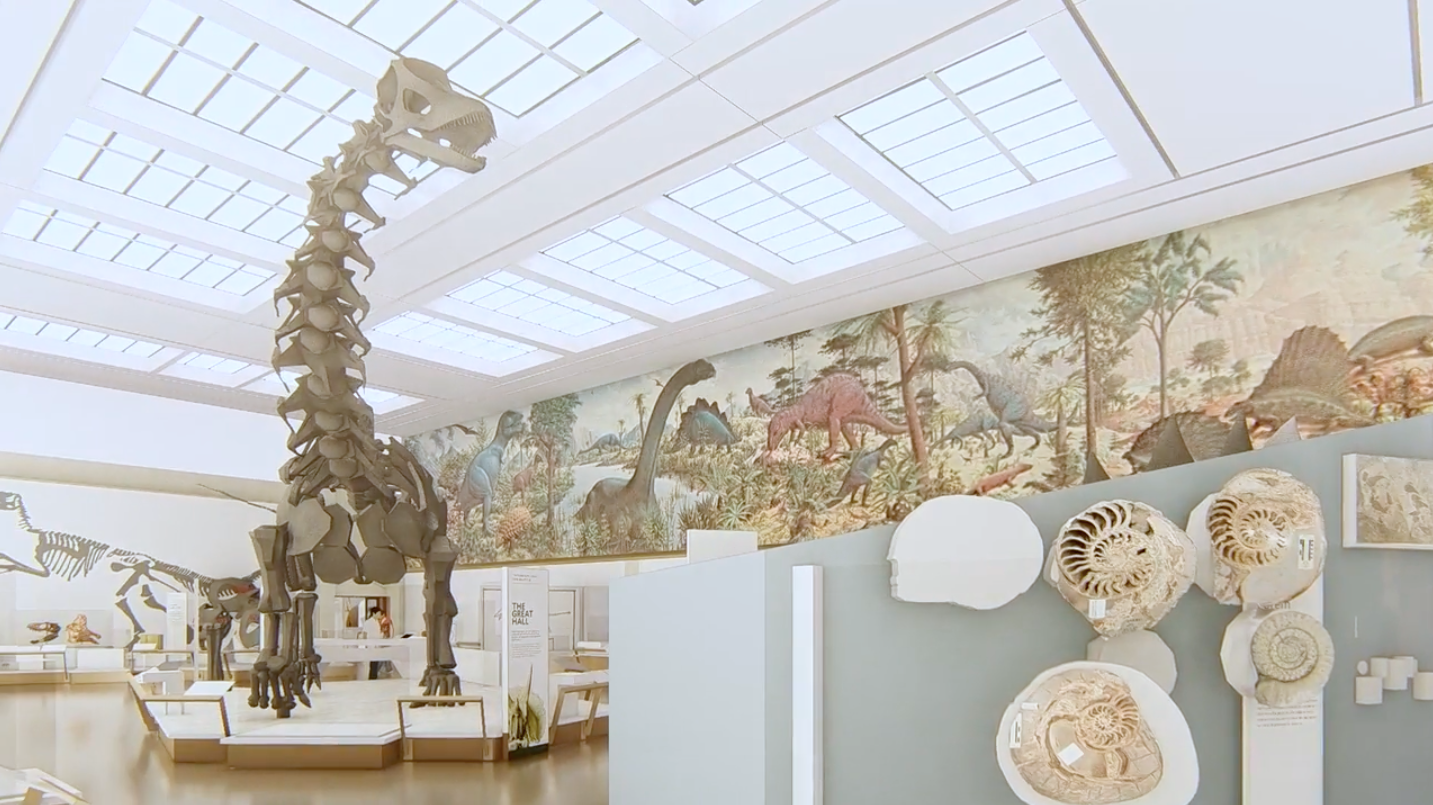
I see five major sections in this version of the dinosaur hall. First is the curved wall, which faces visitors when they enter the exhibit from the south, or from the central gallery. The render shows ammonites on the south side of this wall, but these might be placeholder images. I expect this area to be an introduction to the exhibition and its organization.

On the opposite side of the curved wall and hidden from immediate view is Stegosaurus (YPM 1853), a companion to YPM’s famous Brontosaurus (YPM 1980). We can call this the Jurassic dinosaurs section, which occupies most of the floor space. Both dinosaurs were recovered around 1879 by William Reed’s field crew at Como Bluff, Wyoming, and were subsequently described by Marsh. Richard Lull (who called it “the most grotesque reptile the world ever saw”) oversaw the construction of the Stegosaurus mount in 1910. The great hall was specifically designed to fit the Brontosaurus, which was completed in 1931. Both of these historically-significant specimens will be restored and remounted for the new exhibition. Brontosaurus is afforded a large platform with built-in seating. The designers have included lots of space for visitors around this star attraction, allowing for plenty of photo opportunities. It’s disappointing that Stegosaurus is no longer fighting Allosaurus (this hall could use a large theropod or two), but it’s not like we can’t see similar scenes at other museums.

The view upon entering the dinosaur hall from the central gallery. Source

A row of cases under The Age of Reptiles appears to be arranged chronologically, with fossil specimens corresponding with the mural overhead. On the south end of the east wall, I see YPM’s complete Limnoscelis and the fin-backed Edaphosaurus. In the old hall, Edaphosaurus was mounted in relief, but this render shows a three-dimensional mount. I’m assuming the wire-frame theropod shown under the Cretaceous portion of the mural represents a Deinonychus mount. Including Deinonychus is a must, of course, since John Ostrom did his groundbreaking work demonstrating the theropod origin of birds at YPM. There is a smaller row of a cases on the west wall, and the only specimen I can make out appears to be YPM’s swimming Hesperornis mount. Perhaps this section is about the evolution of marine life, while the displays under the mural are about terrestrial life.

Finally, the relief-mounted Edmontosaurus anchors the Cretaceous dinosaurs section at the north end of the hall. Built in 1901, this is the oldest surviving dinosaur mount in North America. Contrary to the common narrative that all early 20th century paleontologists saw dinosaurs as cumbersome tail-draggers, this mount is downright sprightly, and could be mistaken for a reconstruction from the last 20 years. As such, it’s fitting that Edmontosaurus should remain in its original form. Since the Edmontosaurus was installed in the great hall in 1925, the space in front of it was gradually filled with a myriad of dinosaur skeletons, skulls, and models. In the new exhibition, this will be simplified to feature the skulls of three Edmontosaurus contemporaries: Triceratops, Torosaurus, and Tyrannosaurus.

The new dinosaur hall as seen facing south. I think this render is slightly older than the images above. Source

Although no new images of the mammal hall have been shared yet, there is a telling change visible in the dinosaur hall renders. Currently, the doorway between the two fossil halls is on the west side of the north wall, but the new plans show it moved to the east side (there used to be a door there, but it’s been buried behind exhibit cases for decades). Relocating that door means visitors will enter the mammal hall in the center, and have the choice to move to the left or to the right. Presently the only other entrance to this space is from the human evolution gallery to the east, but perhaps once the central gallery is built the emergency exit to the left can become a regular passageway. What all this means for the content is anyone’s guess. On option would be to place the mounts on a central island—then visitors could circle counterclockwise and generally follow the Zallinger mural (which runs east to west) through time.

One thing these images tell us nothing about is media and interactivity—important parts of many contemporary exhibitions. Speculating wildly for a moment, I think it would be incredible if YPM used projection mapping or similar technology to create a media presentation directly on The Age of Reptiles. I’m imagining something vaguely like a planetarium show, with either pre-recorded or live narration. The show could illustrate how the mural was created, projecting an animated Zallinger on his ladder, looking tiny against the massive canvas. It could also portray the animals in motion, or provide us glimpses of modern reconstructions of the more outdated creatures. A show like this might draw more visitors to pay attention to the mural and appreciate its historical significance.

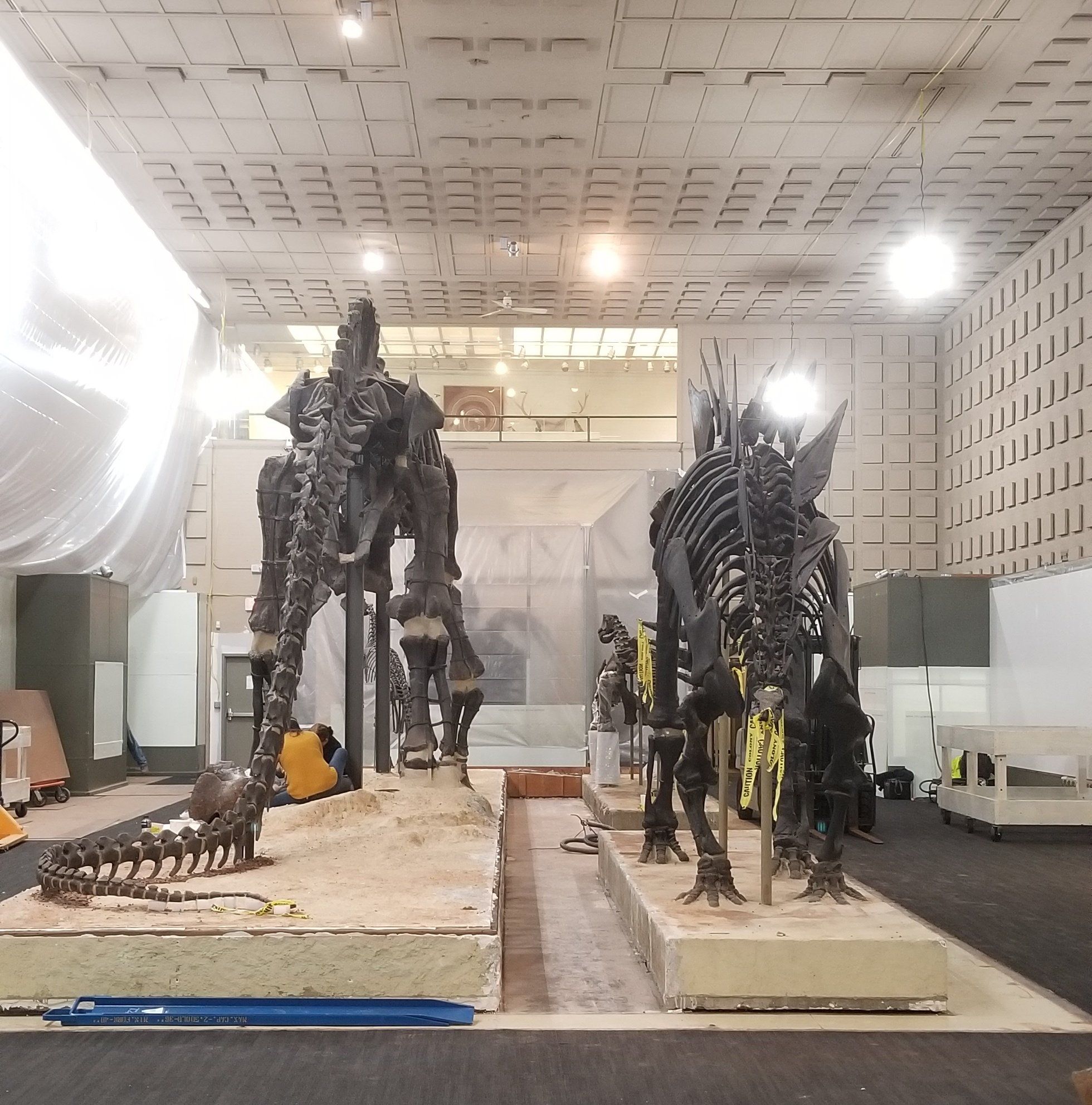
Brontosaurus and Stegosaurus in January 2020, a few days before deinstallation. Photo kindly shared by Mariana Di Giacomo.

Research Casting International—the leading company specializing in preparing and mounting fossil skeletons—started work at YPM on January 20th. The crew has already dismantled several of the dinosaur skeletons, which will travel to their workshop outside Toronto for restoration, and in some cases, remounting. After that, we have a three year wait until the new YPM opens. I guess we’ll see then how many of my predictions here hold true.

11 Comments

Filed under dinosaurs, exhibits, fossil mounts, history of science, opinion, YPM

The retiring dinosaur mounts at the Yale Peabody Museum

Another year, and another major renovation of a historic paleontology exhibition is underway. The dinosaur and fossil mammal halls at the Yale Peabody Museum of Natural History (YPM) closed to the public on January 1st. The rest of the museum will follow in July, with a planned reopening in 2023. This will be the first comprehensive renovation of the museum since the current building opened in 1931, and the upgrades are long overdue. For decades, most of the YPM exhibits have been a museum of a museum—a time capsule preserving the state of natural science and museum design in the mid-20th century. The dinosaur hall in particular looks almost exactly as it did when Rudolph Zallinger completed the spectacular Age of Reptiles mural on the east wall in 1947 (a handful of newer specimens, revised labels, and video terminals notwithstanding).

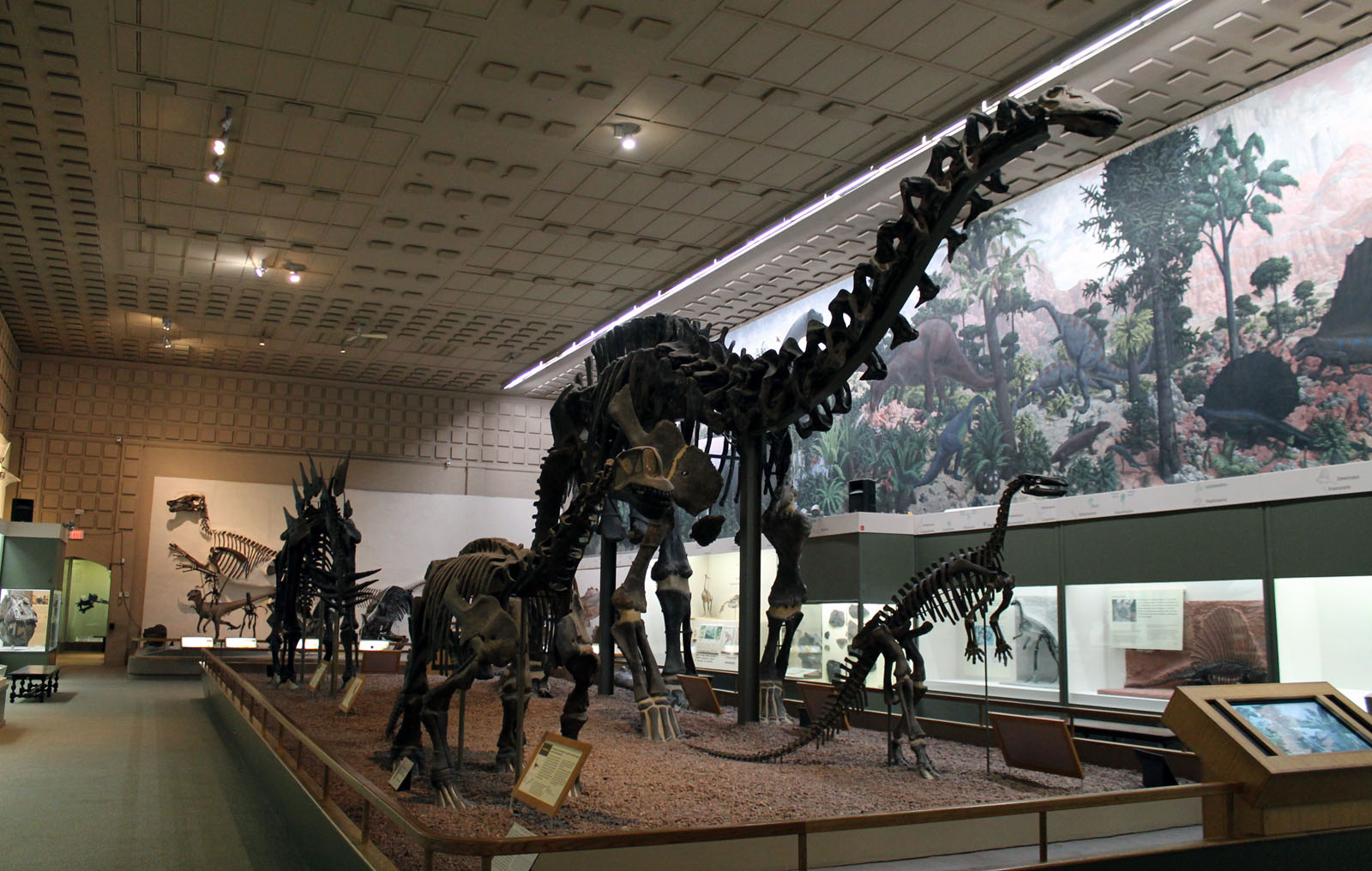
The Great Hall of Dinosaurs upon my last visit in 2014.

It’s exciting to see ground breaking on the new museum and exhibits, because this renovation has been a long time in coming. Serious discussions were underway in 2010, if not earlier, and a set of conceptual images was released as part of a fundraising effort launched in 2013. It appears that a lot has changed since then. The scope of the renovation has expanded to encompass the whole museum, not just the paleontology exhibits. And certain details from the 2013 concept—such as a mezzanine in the dinosaur hall opposite the Age of Reptiles mural—have been dropped. Last year, YPM launched a dedicated website showcasing the latest renovation plans. It’s wonderful that the institution is committed to keeping their community involved in and informed about the transformation of a public space that is near and dear to so many.

Naturally, this renovation is an opportunity to take a deep dive into the YPM fossil displays, and look at the specimens, artwork, and people that defined this institution in the past and which will carry it into the future. Expect upcoming posts exploring the future of these exhibits, but for now let’s start with a look back at the exhibit that once was.

Rendering of the new dinosaur hall, as of late 2019. Source

YPM was founded in 1866 with a gift from George Peabody. Peabody was the uncle of O.C. Marsh, who had been appointed Professor of Vertebrate Paleontology at Yale that same year. Having been awarded tenure and his own museum, Marsh began to lead and send crews into the American west to collect fossils. Many of Marsh’s expeditions were under auspices of the U.S. Geological Survey, and those fossils eventually made their way to the Smithsonian. The remainder, however, entered the YPM collections, where they remain to this day.

After Marsh’s death in 1899, his student Charles Beecher took over vertebrate paleontology at YPM. Beecher was, in turn, succeeded by Richard Lull. Lull never met Marsh (and the two were quite different in many ways), but he nevertheless spent much of his career carrying on his predecessor’s legacy. Like his Smithsonian counterpart Charles Gilmore, Lull expanded Marsh’s often laughably brief descriptions into proper monographs, which are still used by paleontologists today. And like Gilmore, Lull put the Marsh fossils on public display, guiding the assembly of the mounted skeletons that have held court at YPM ever since.

Lull became director of YPM in 1922, and it was in this role that he oversaw the museum’s move from it’s modest original building to the larger, French Gothic-inspired structure where it currently resides. Construction of the new museum was completed in 1925, and Lull spent the next several years developing the dinosaur hall we know today. Marsh, for his part, disliked the idea of display mounts, considering it a waste of time and effort. And limited space at the old facility meant that only two large dinosaur mounts—Edmontosaurus and Stegosaurus—were assembled between 1900 and 1925. The new building, however, had a great hall specifically built to house the Marsh dinosaurs, so Lull and his team got to work filling it.

Camarasaurus and Camptosaurus

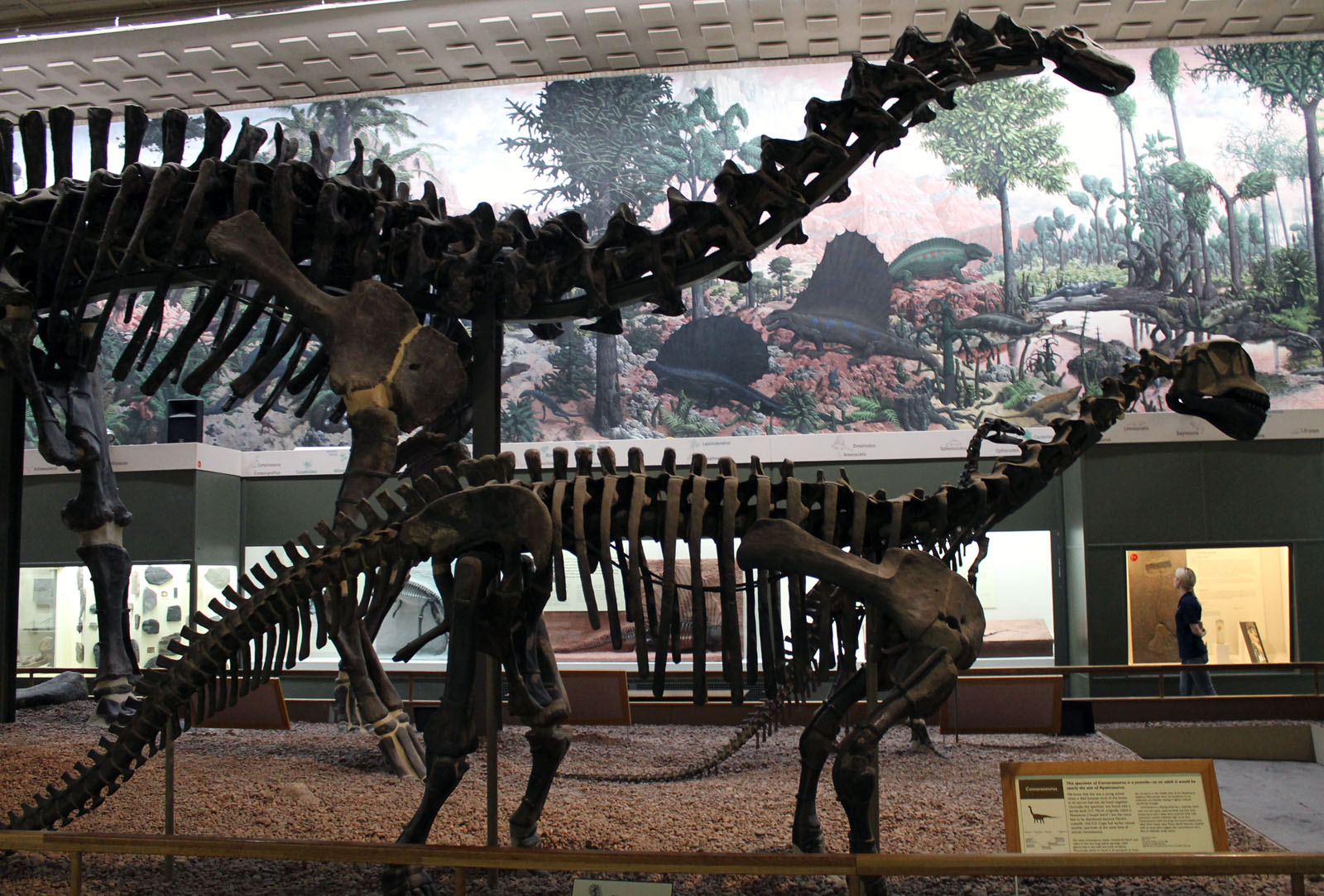
Camarasaurus and Brontosaurus mounted skeletons.

Most of the new mounts were assembled from fossils collected around 1880 at Como Bluff, Wyoming. Working for Marsh, William Reed and his crew amassed a treasure trove of Jurassic dinosaurs there, most famously the Brontosaurus holotype. Naturally, Lull devised Brontosaurus (YPM 1980) as the centerpiece of the dinosaur hall. Because of its size and complexity, it was the first of the new mounts to begin construction and took the longest to complete. The Brontosaurus was literally built into the floor: photos from the 1920s show a latticework of steel beams designed to spread its weight. Once the floor was installed, the Brontosaurus could not be moved.

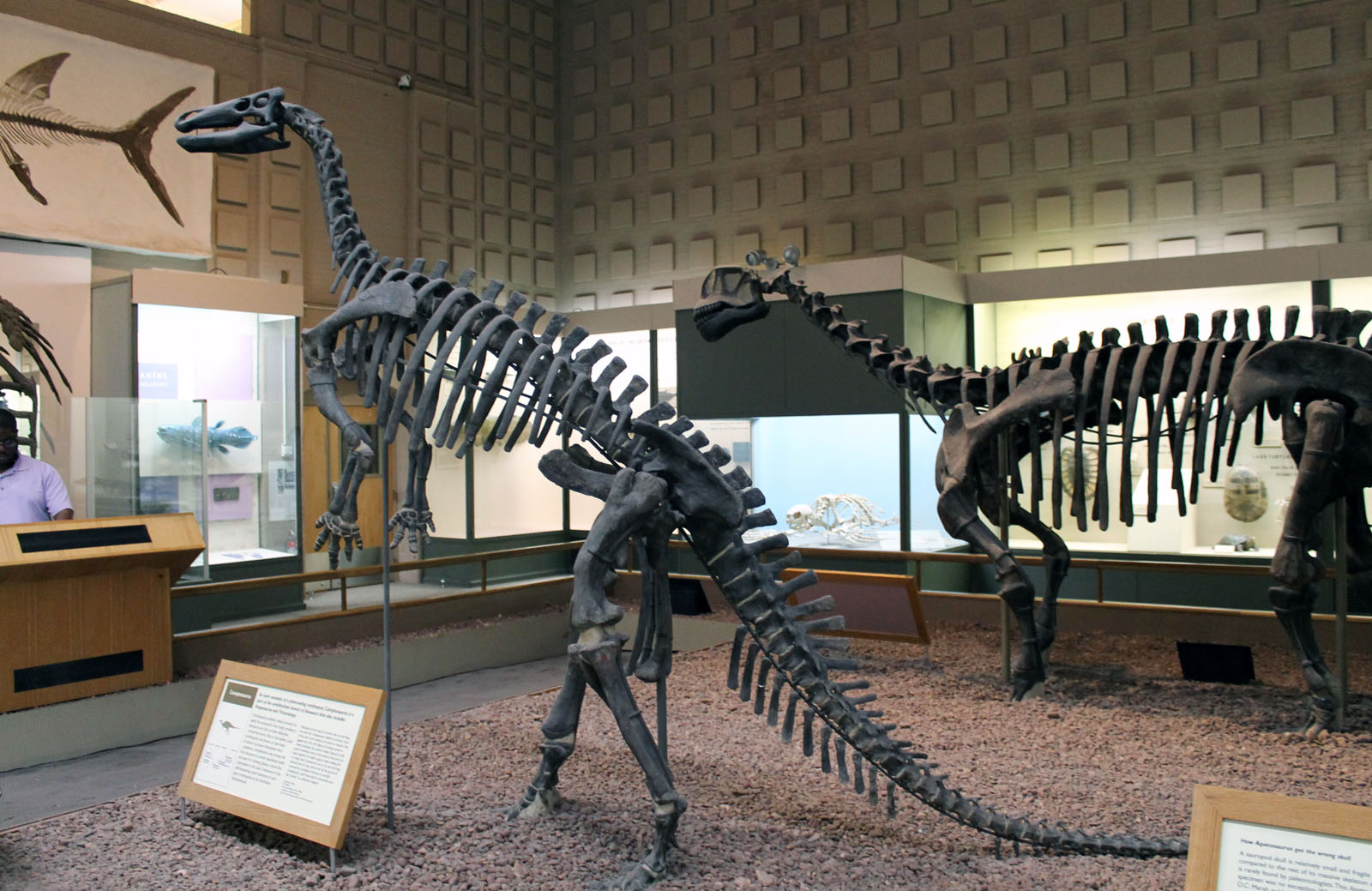
In the meantime, preparator Hugh Gibb assembled two other mounts from Como Bluff material: Camarasaurus and Camptosaurus. The Camarasaurus (YPM 1910) is 21-foot juvenile, consisting of a complete vertebral column from the 2nd or 3rd cervical to middle of the tail, and most of the larger limb bones. The feet and most of the ribs are reconstructed, as is the skull, which is a fairly crude sculpture. In his 1930 publication discussing the mount, Lull commends Gibb for how closely his reconstruction matched the nearly complete and articulated juvenile Camarasaurus collected by the Carnegie Museum at what is now Dinosaur National Monument, despite the fact that Gibb had never studied that specimen. Lull only notes that the YPM mount has one fewer cervical and one fewer caudal than the Carnegie specimen, and that the reconstructed cervical ribs are much too short.

Camptosaurus and Camarasaurus mounted skeletons.

Gibb also assembled the Camptosaurus mount (YPM 1880), which he completed in 1937. Yet another specimen from Reed’s excavations at Como Bluff, the Camptosaurus is notable for how closely it mirrors Marsh’s illustrated reconstruction from 40 years earlier. It seems reasonable to assume this was a deliberate homage, although Gibb did follow Gilmore’s example and removed Marsh’s erroneous lumbar vertebrae. The sculpted skull, modeled after Iguanodon, was typical of Camptosaurus reconstructions at the time but is now known to be inaccurate.

Neither Camarasaurus nor Camptosaurus are slated to return in the renovated exhibit. Marsh originally designated both of these specimens as holotypes for “Morosaurus” (=Camarasaurus) lentus and Camptosaurus medius. Opinions on the validity of those particular species have changed over time, but it’s important that a new generation of paleontologists has an opportunity to study the original fossils up close, which has been virtually impossible in their mounted form.

Claosaurus

Relief mount of Claosaurus.

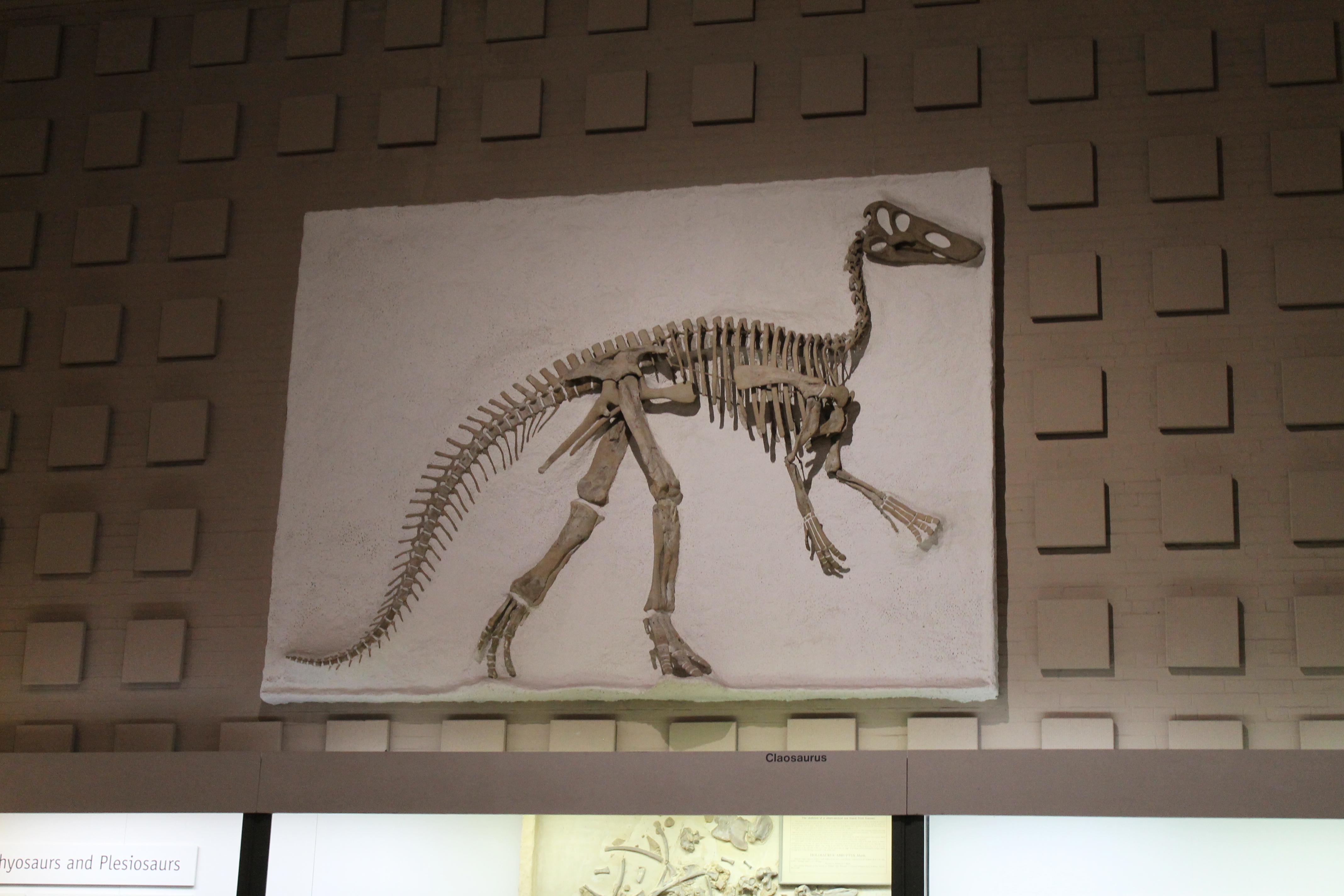
High on the west wall is one of YPM’s most overlooked dinosaurs. This relief mount represents the only confirmed remains of Claosaurus agilis (YPM 1190), a hadrosaur found in the marine deposits of western Kansas. Claosaurus is a bit of a taxonomic mess: Marsh initially announced this fossil as a new species of Hadrosaurus, before upgrading it to its own genus. Then, he decided to sink all of the much younger Lance Formation hadrosaur material (what is now called Edmontosaurus annectens) into the Claosaurus genusIt’s a difficult web to untangle, but Claosaurus is a real taxon that lived alongside animals like Pteranodon and Tylosaurus.

Lull and Wright describe the mount as “recent” in their 1942 monograph on hadrosaurs, so it must have been assembled after the move the current building. Most of the vertebrae and limb bones are real, but the skull is (obviously) a model built around a few fragments of jaw. Although it’s hard to see from the ground, the preservation is apparently poor, and most of the bones are crushed to some degree. Lull and Wright attest to the significance of Claosaurus as the earliest known true hadrosaur, but were clearly frustrated by the quality of the specimen. Perhaps modern paleontologists will have better luck, once it’s taken off display and returned to the collections.

Centrosaurus

The Centrosaurus half-mount and its Cretaceous buddies.

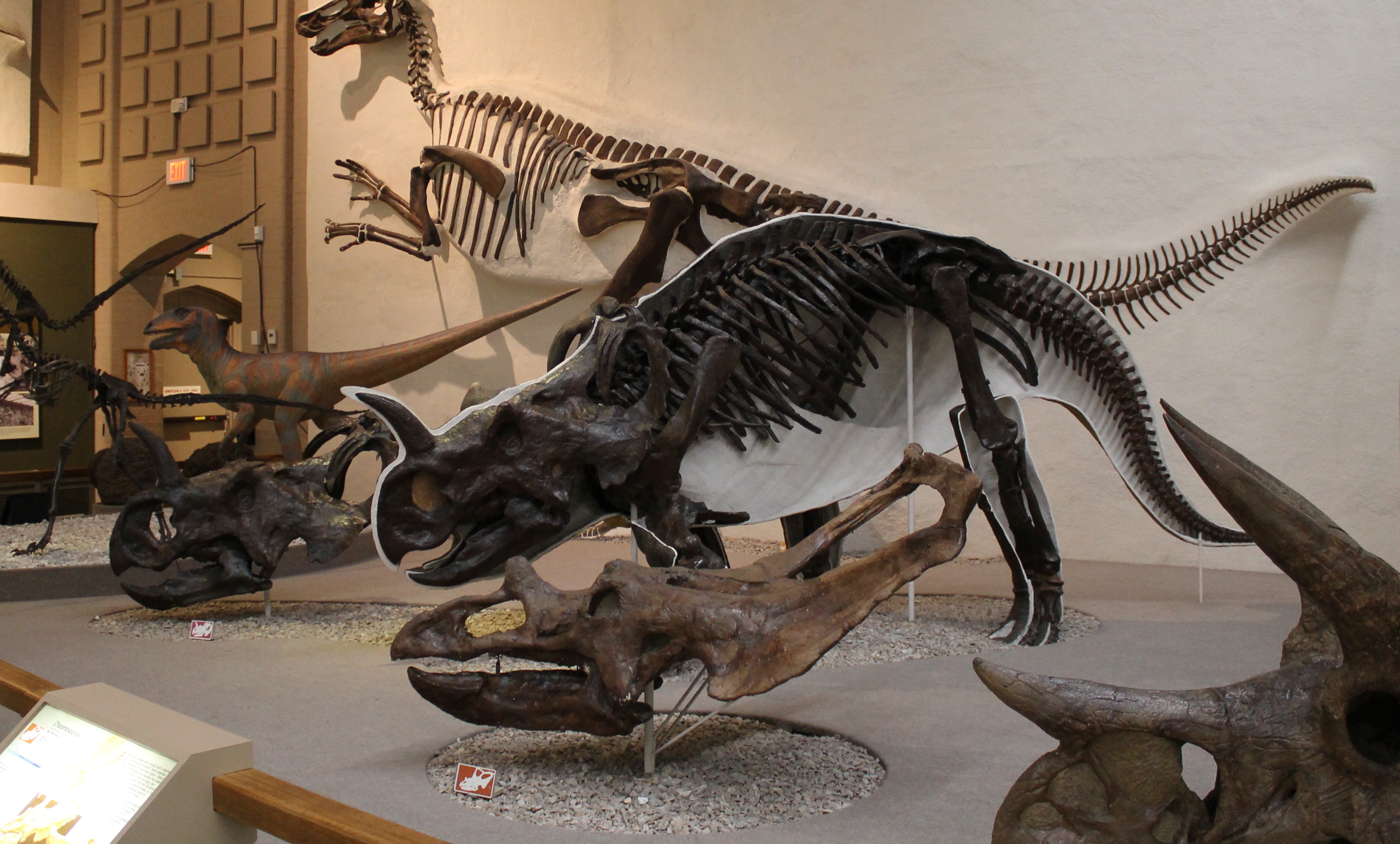
Variably known as Monoclonius flexus, Centrosaurus flexus, and Centrosaurus apertus, this ceratopsian skeleton (YPM 2015) was collected by Barnum Brown on the American Museum of Natural History’s extremely productive expeditions to the Belly River region in Alberta. I’m not sure when YPM acquired the fossil (presumably in a trade), but it was mounted and on display by 1929. At some point during the development of the fossil mammal hall, Lull became enamored of half-mounts like this one, in which the animal appears bisected along its sagittal line. Half the skeleton is assembled on one side, while a fleshed-out model is visible on the other. Several mammal specimens at YPM are displayed this way, but the Centrosaurus is the only dinosaur.

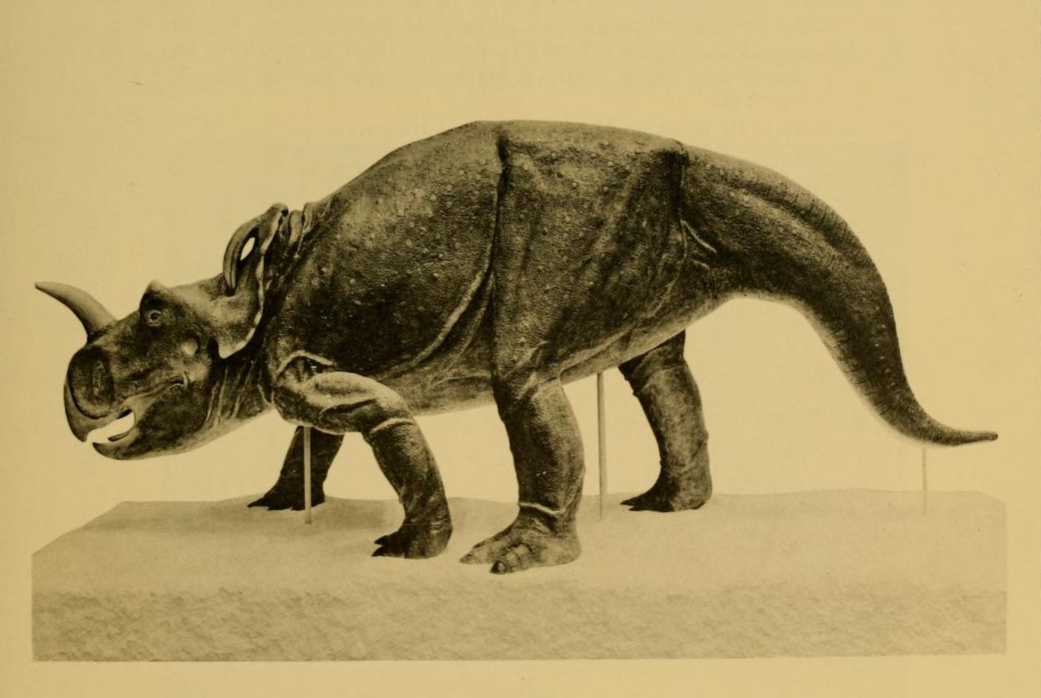
Lull discusses the choices made in reconstructing Centrosaurus at length in his 1933 monograph on ceratopsians. He describes the relief-mounted Centrosaurus at AMNH as an imperfect representation of the animal’s life appearance because it preserves the death pose it was found in. In contrast, the YPM version is reconstructed in a three-dimensional standing posture. Lull specifically points to his Centrosaurus‘s nearly straight neck and sprawling forelimbs (with the humerus nearly horizontal) as superior to the AMNH presentation. The issue of ceratopsian forelimb posture is still not completely resolved, but there is probably some truth to Lull’s sprawling reconstruction.

The life-reconstruction side of Centrosaurus, as figured in Lull 1933.

For the fleshed-out portion of the mount, Lull directed the artist to match the musculature and skin texture of iguanas and alligators. A loggerhead turtle was referenced for the mouth and beak. Lull chose to give the small processes on the lower edges of the frill a horny sheath, rather than the fleshy look popularized by Charles Knight. Overall, the life restoration is on the lean side compared to our modern understanding of ceratopsians, but many details—including the digitigrade fingers and forelimb posture—have held up well.

Next time, we’ll look at how historic specimens like Brontosaurus, Stegosaurus, and Deinonychus might be modernized for the new version of the hall.

References

Lull, R.S. 1930. Skeleton of Camarasaurus lentus recently mounted at Yale. American Journal of Science 19:105:1-5.

Lull, R.S. 1910. Stegosaurus ungulatus Marsh, recently mounted at the Peabody Museum of Yale University. American Journal of Science 30:180:361-377.

Lull, R.S. 1933. A Revision of the Ceratopsia or Horned Dinosaurs. New Haven, CT: Tuttle, Morehouse, and Taylor Co.

Lull, R.S. and Wright, N.E. 1942. Hadrosaurian Dinosaurs of North America.  New York, NY: Geological Society of America.

Marsh, O.C. 1872. Notice on a new species of Hadrosaurus. American Journal of Science 3:16:301.

Marsh, O.C. 1890. Additional characters of the Ceratopsidae, with notice of new Cretaceous dinosaurs. American Journal of Science 39:233:418-426.

3 Comments

Filed under dinosaurs, exhibits, museums, ornithopods, sauropods, YPM