Category Archives: education

Jurassic Park is awesome and a milestone for paleontology…

…deal with it.

What follows was partially written several months ago and never finished. I dug it up again due to the resurgence of JP interest with Steven Spielberg’s announcement.

I was six years old when Jurassic Park came out. I was crazy about dinosaurs, but my parents had been told that the movie was way too scary for a kid my age. Since Aliens was already on my short list of favorite films at that point, this seems a moot point, but by the time my parents warmed up to taking me to see JP, it was at a second run theater. I don’t remember seeing it at the theater, but I do remember my endless viewings of my VHS copy, and the tattered box remembers too.

I still enjoy Jurassic Park immensely. It means a lot to me, but surprisingly, that feeling is not shared by the entirety of the paleontological community (as a student/intern, I put myself in a very broad definition of that collective). As an example, take a look at Dr. David Hone’s admittedly 3-year old post about the film. While Dr. Hone is generally positive, he expresses annoyance about the inaccurate portrayals of dinosaurs and paleontologists that have so firmly entrenched themselves in the public consciousness as a result of Jurassic Park. Similar complaints turn up from time to time on the Dinosaur Mailing List as well.

I, for one, have to disagree. When I’m chatting with people about vert paleo, something I genuinely enjoy, I’m thrilled when Jurassic Park enters the conversation. It’s such a genuinely entertaining movie that people remember it well, 18 years after it’s release. What’s more, it’s a movie that made many people think about what they were watching: what dinosaurs were like, and how we know what we do about them. This is an excellent jumping-off point for any discussion about paleontology, because it is a shared frame of reference. At work, I have become well acquainted with the fact that very few people understand Deep Time, or have ever given it any thought at all. But people know Jurassic Park, and I am very grateful for it as a starting point in the education process.

What’s more, we can complain all we like about what Jurassic Park got wrong, but I’m more impressed by how much it got right. Jurassic Park was the first widely disseminated look at believable dinosaurs, and it single-handedly brought post-Dinosaur Renaissance conceptions of dinosaurs to everyone.

Unfortunately, as I mentioned, Jurassic Park is 18 years old now. It took awhile, but it seems to no longer be the go-to source of dinosaur knowledge for many Americans. The seemingly endless parade of shitty “documentaries” on cable TV, as well as fare like Dinosaur Train, are crowding Jurassic Park off its perch. And that is why I’m optimistic about the announcement of Jurassic Park 4. The original film was a fantastic resource not only for paleontology education, but science education in general. If a new sequel can match or approach that level of quality, then our job as educators will be much easier.

I also have a bunch of thoughts about Jurassic Park that I feel like sharing but don’t really have a place for above. Read on at your own risk.

  • One time when I was watching Jurassic Park with friends, somebody commented that Grant’s jaw dropping and staggering about at the sight of the Brachiosaurus was really bad acting. I beg to differ…I imagine I would do much the same thing.
  • The CGI dinosaurs get all the credit, but they are on screen for less than two minutes. Stan Winston’s flawless puppets and animatronics are the real stars of the show.
  • In fact, the dinosaurs as a whole don’t get much screen time. There’s barely a dinosaur to be seen for the first hour. Credit to Spielberg for great pacing and constructing fantastic set-piece sequences that get the most out of very few dinosaur scenes.
  • Grant’s dig site at the beginning of the film cracks me up. Putting aside the completely articulated skeleton for the moment, the rag-tag assortment of people present doesn’t make much sense, and the assortment of clutter in the trailer seems rather useless too.
  • Jurassic Park can (and has) be used as a basic introduction to cloning, genetics and chaos theory. Molecular biologists and mathematicians can nit-pick the movie as much or more as paleontologists can, but at the end of the day it’s an effective way to introduce the public to ideas they might not otherwise be exposed to.
  • It’s kind of funny that the idea of cloning was science fiction in the late 1980s when Michael Crichton wrote the book.
  • What was Gennaro asking Hammond about “auto-erotica?” What could that possibly mean besides what I think it means? Seriously, I would love an explanation.

Leave a comment

Filed under dinosaurs, education, movies, opinion, science communication

More Fun at the Carnegie Museum

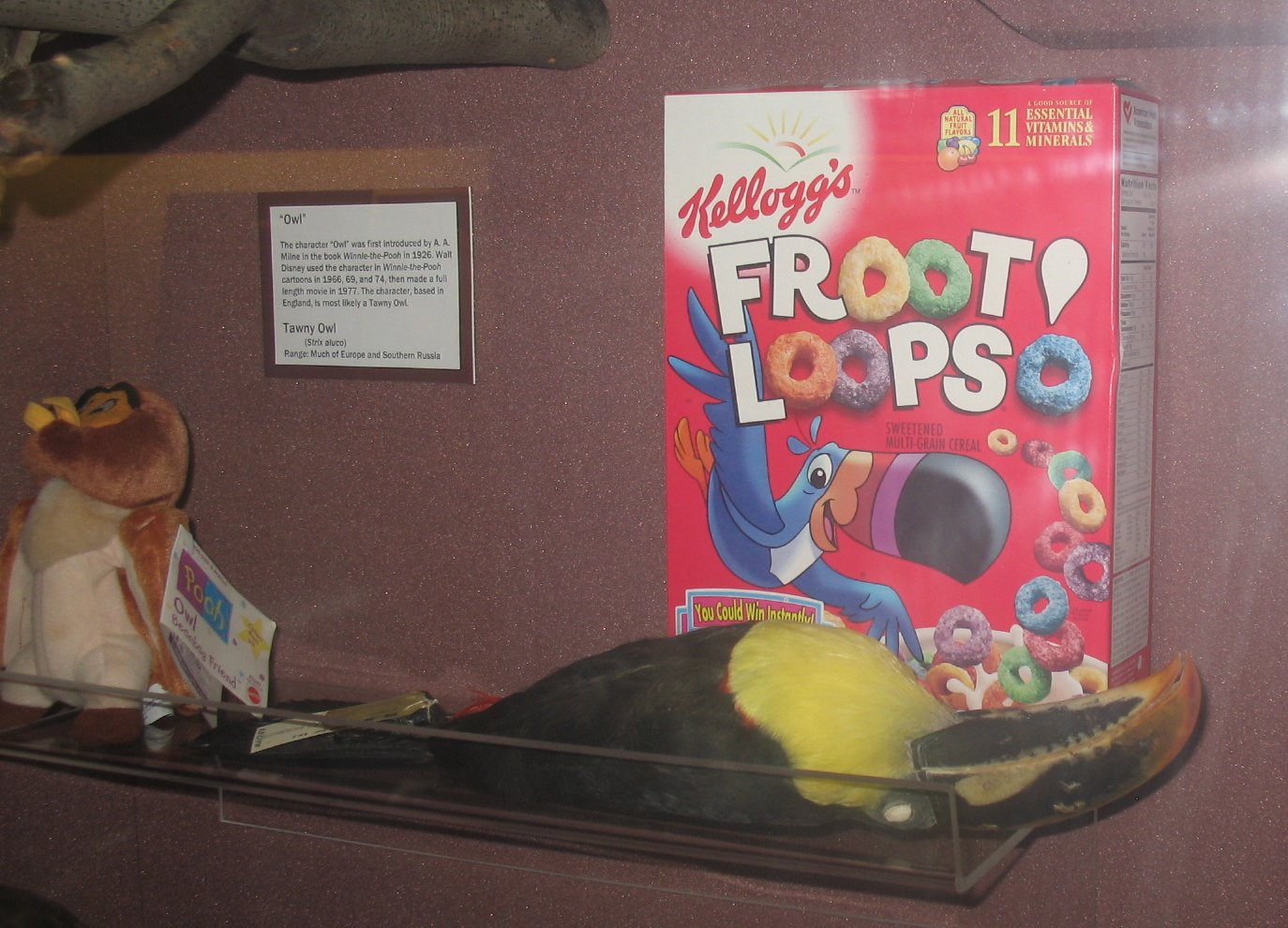
I just have to share this picture, also from the Carnegie Museum of Natural History (see previous post). While the “Dinosaurs in their Time” gallery is fantastic, this has to be one of the worst museum displays I’ve ever seen, as well as one of the most fascinating.

Leave a comment

Filed under CMNH, collections, education, exhibits, museums, opinion, theropods

More on #AAAfail

The AAA’s removal of science from the rhetoric of its statement of purpose has made the internet angry. For a bunch of links to smart people’s discussion of the issue, please see this post at Neuroanthropology. If you want to know what I think, read on!

Old Wording:

“The purposes of the Association shall be to advance anthropology as the science that studies humankind in all its aspects, through archeological, biological, ethnological, and linguistic research; and to further the professional interests of American anthropologists; including the dissemination of anthropological knowledge and its use to solve human problems.”

New Wording:

“The purposes of the Association shall be to advance public understanding of humankind in all its aspects. This includes, but is not limited to, archaeological, biological, social, cultural, economic, political, historical, medical, visual, and linguistic anthropological research. The Association also commits itself and to further the professional interests of anthropologists, including the dissemination of anthropological knowledge, expertise, and interpretation.”

Above is the old statement of purpose followed by the new. Having ruminated on the issue a bit, what most troubles me is that the new statement seems calibrated to make a divided field even more divided. As I mentioned in the previous post, there is a long-standing gap between the methodologies of biological and archaeological anthropologists and social anthropologists. However, there aren’t many of the former camp that don’t recognize the value of relativism and reflexivity, just as few of the latter camp who outright dismiss statistics and hard data. However, instead of encouraging communication across this shared ground, the new statement divvies up the classic four fields approach (archaeology, biology, ethnography and linguistics) used in the original statement into ten categories. The implication is that Anthropologists should continue to narrow their focus rather than collaborate.

If the discipline is to have any meaning in the future, collaboration will be the key. At present, the lack of intra-disciplinary understanding of very basic concepts is, frankly, appalling. Even at my superhappyinterdisciplinaryliberalarts school, most many students specializing in social anthropology had little grasp of the fundamentals of evolution, and more than once I found myself debating with people who thought that biological evolution was, by definition, linear and progressive. Rest assured, I probably annoyed my share of social anthropologists by misunderstanding their field, as well.

Before I ride off into the sunset on my horse of academic harmony, let me reiterate that I think the new AAA statement is inexcusably dismissive of biological and archaeological Anthropologists. Tellingly, six of the seven new categories are aspects of social anthropology/ethnography, with no like divisions of archaeology, biology and linguistics. Certainly the distinctions between primatology, hominid paleoecology and skeletal pathology are just as meaningful as the divisions between political, historical and economic social anthropology? Furthermore, it must be reiterated that abandoning scientific analysis will only hurt the perceived legitimacy of anthropology in both the academic and public spheres.

Leave a comment

Filed under anthropology, education, opinion

Is this the moving picture ship?

Hi, I’m Ben and I’m going to attempt to start a blog. Much like my life, I’m not really sure what I’m going to do with it yet, but I do have some vague ideas that would require a lot of arm waving to articulate. Since I’m not holding my breath for the day either of those get resolved, for the time being I’m just going to post stuff I’m interested in. Mostly, that means stuff about paleontology, museum planning and plastic toys.

To start off with something that does not really fit into any of those categories, whadaya make of this?

American Anthropological Association Abandons Science

Having finished my B.A. last year in Anthropology, this makes me sad and tired. As it is, Anthropology hardly qualifies as a real discipline. Rather, it’s an umbrella field where lots of research vaguely related to “the human condition” (a meaningless phrase in and of itself) gets lumped together. This includes real, rigorous scientific research relating to anatomy, primate evolution, hominid paleobiology and the like, as well as all the varying subfields of Archaeology. Anthropology also includes social/cultural anthropology, which, since the 1970s has become deeply entrenched in the ethereal realm of anti-positivism. As one might expect, researchers on both sides of the field have very little common ground, and indeed, biological and archaeological anthropologists spend much more time collaborating with biologists and geologists than they do with social anthropologists.

I imagine it’s pretty clear that I’ve thrown myself in with the bio/archaeo camp. Perhaps in a later post I’ll explain why I have lost my patience for most social anthropology, but that would require more detail than I would like to get into at this point. For now I’ll just say that I am very troubled by the implications of the AAA’s decision to remove “science” from its agenda. In a country where only 14% of the population believe that evolution is “definitely true”, this is not a decision to be taken lightly, as it only opens the door wider for the very effective anti-science PR machine. The importance of scientific rigor is especially important for Anthropology, which is already a poorly-defined discipline. By eliminating scientific standards from Anthropology, I think the AAA is slitting its own throat.


Update: It has come to my attention that the twitter tag for this discussion is #AAAfail. Awesome.

1 Comment

Filed under anthropology, education, opinion