Category Archives: FMNH

Iguanas, Poodles, and Pantodonts

The blog has been quiet this year, and a major reason for that is that my day job has been anything but. So in lieu of discussion about exhibits from decades past, here’s a bit about the decision making that went into some brand new ones that I worked on this year! New, in-depth articles about traditional Extinct Monsters fare are in progress, I promise.

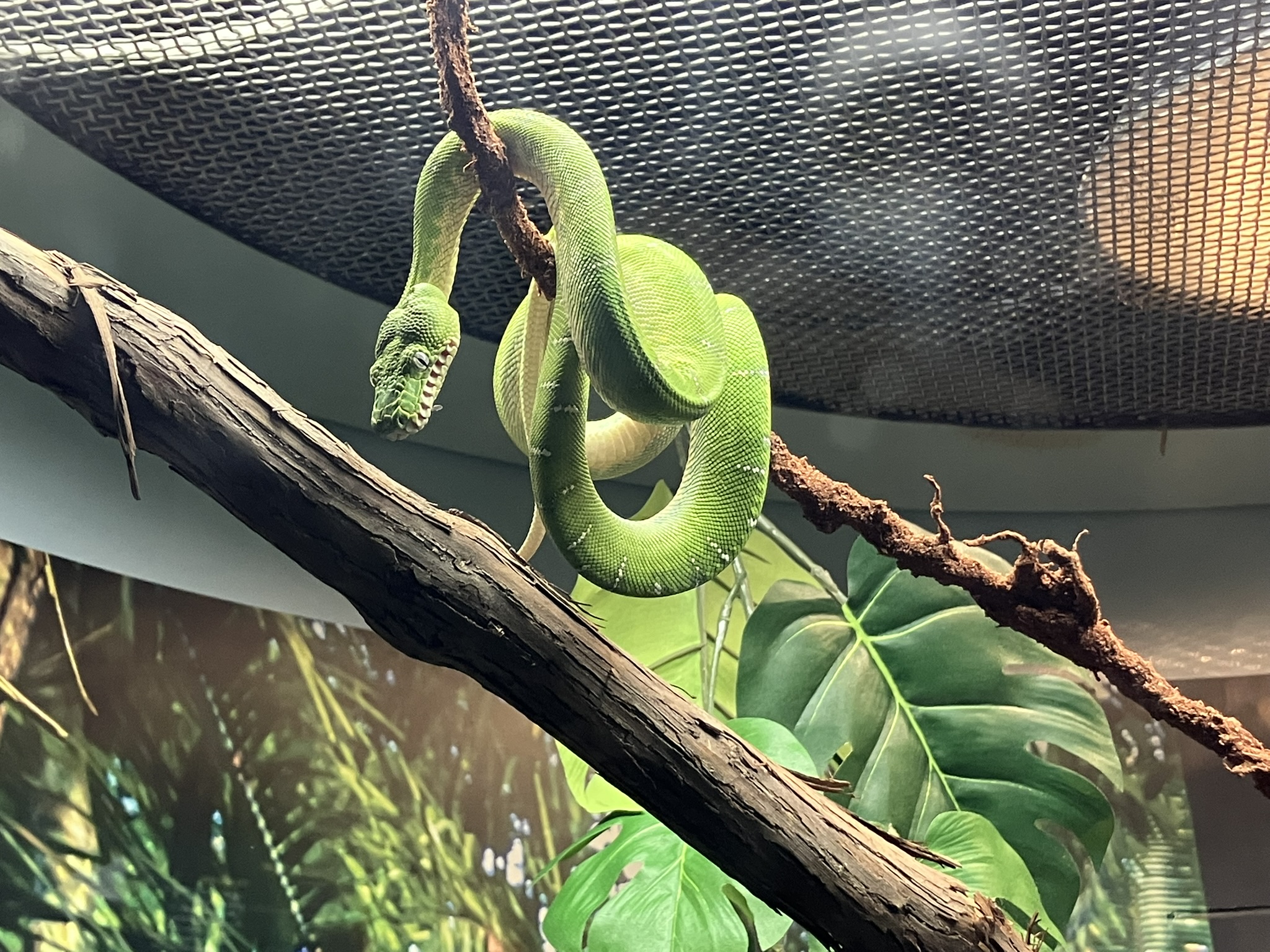
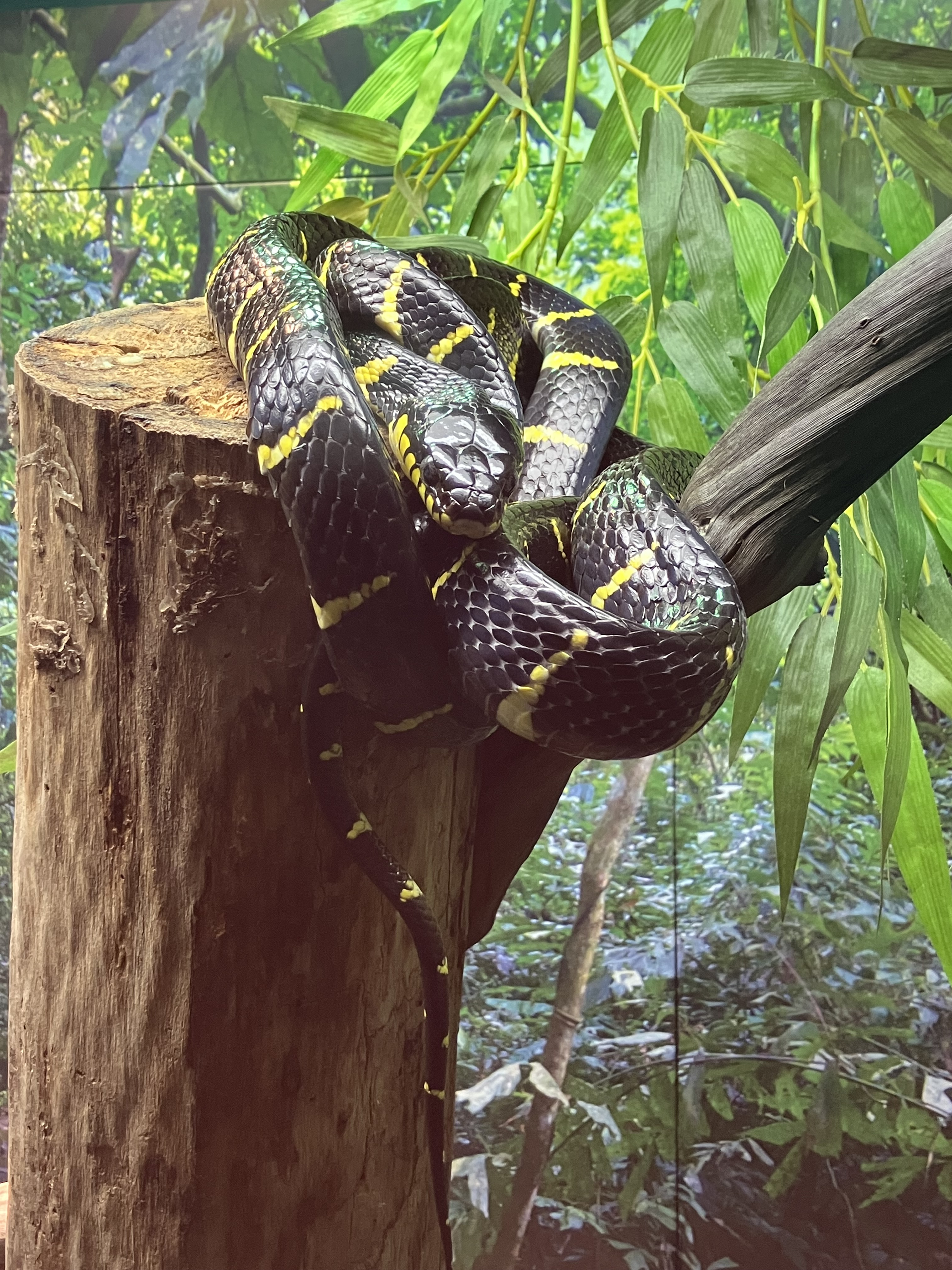
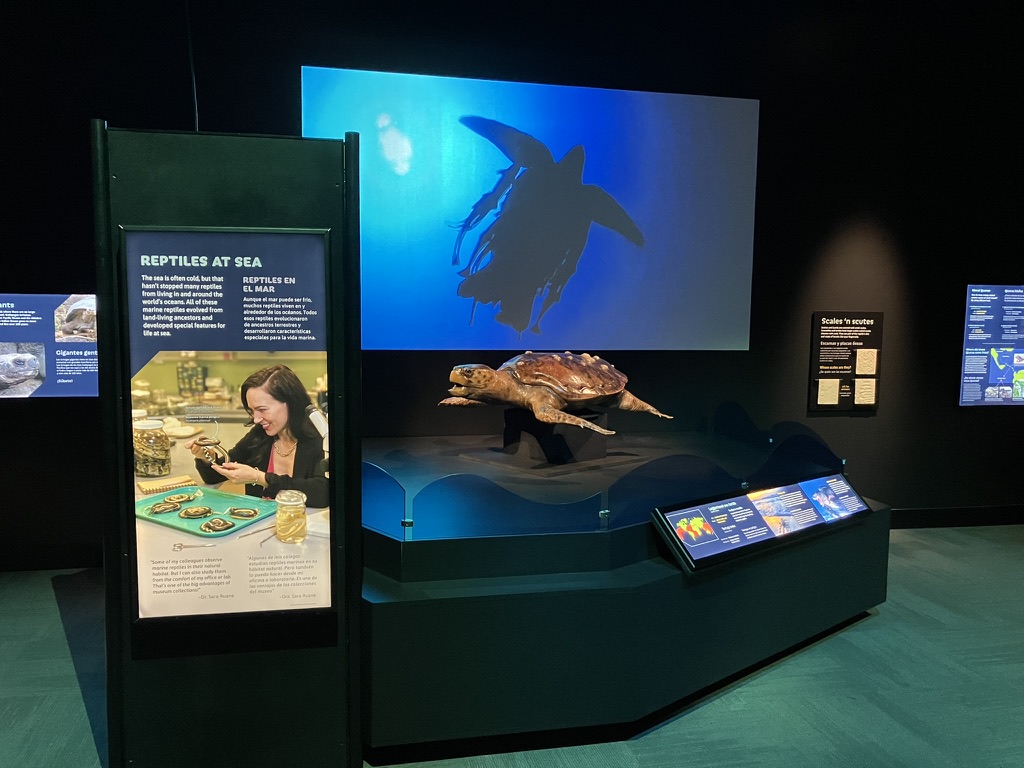
Reptiles Alive

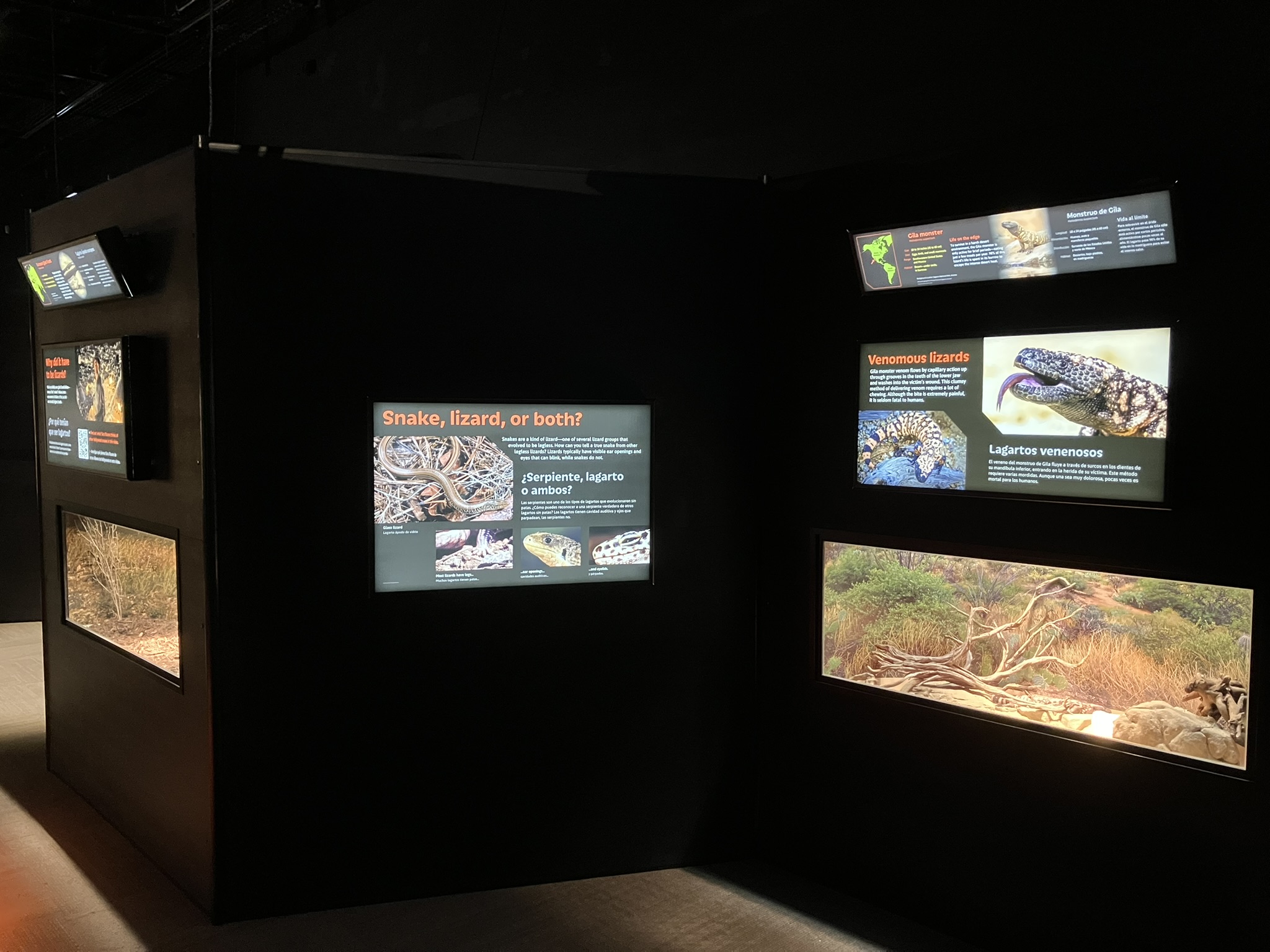
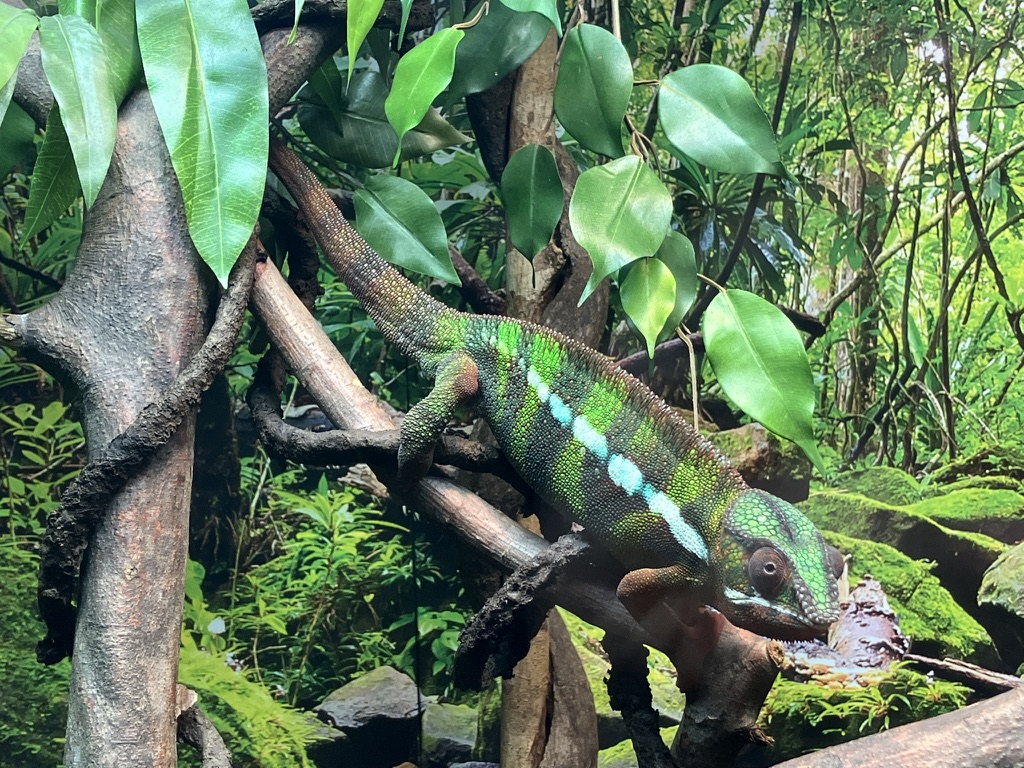
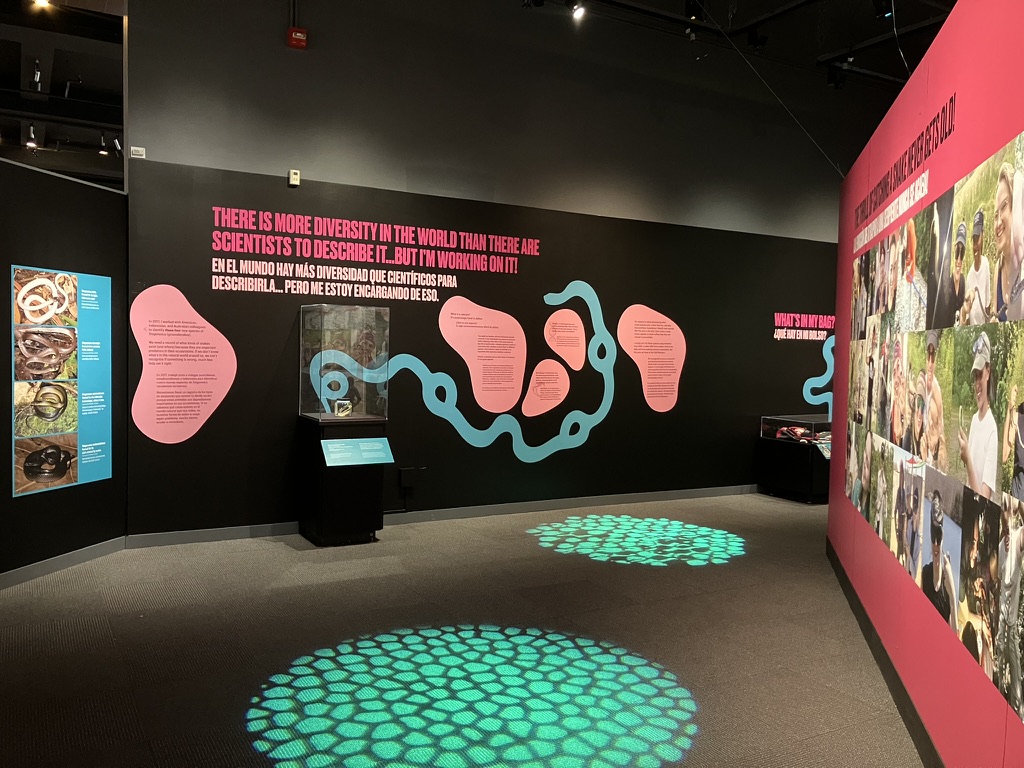
As the title suggests, Reptiles Alive is an exhibition that features live reptiles. This was a collaborative project between the Field Museum and Clyde Peeling’s Reptiland, a zoo in Allenwood, Pennsylvania. Reptiland provided the animals, their enclosures, and their human caretakers, while we designed and built a full-sized exhibition around them. I wrote and developed the new material alongside Associate Curator of Herpetology Sara Ruane.

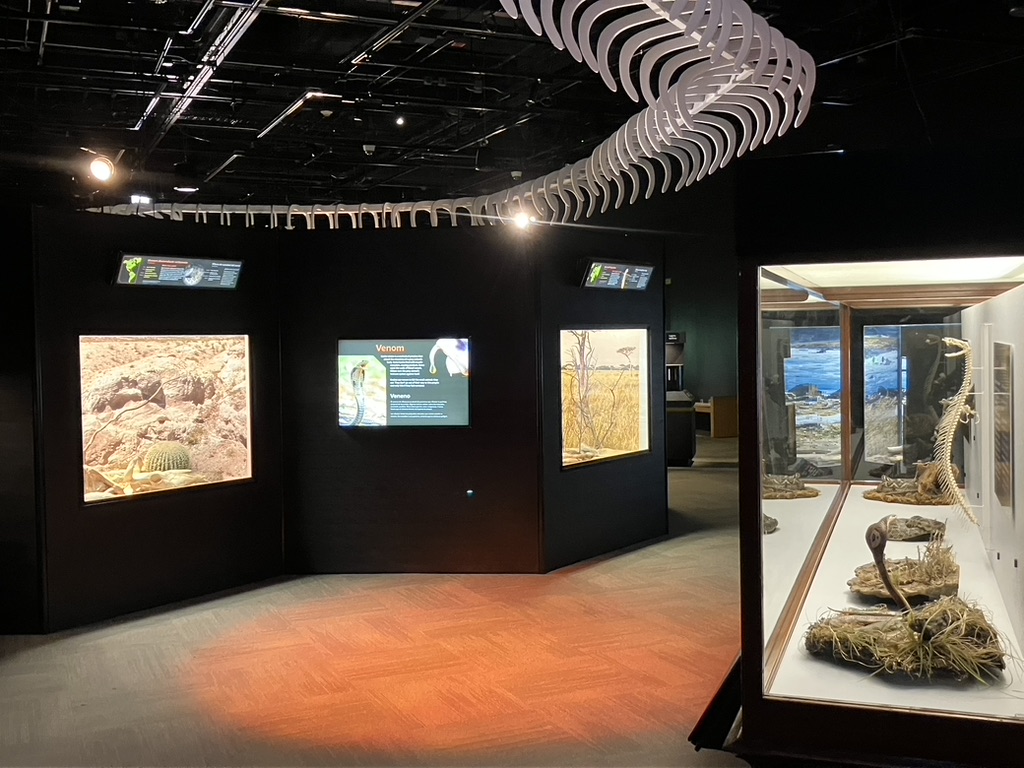
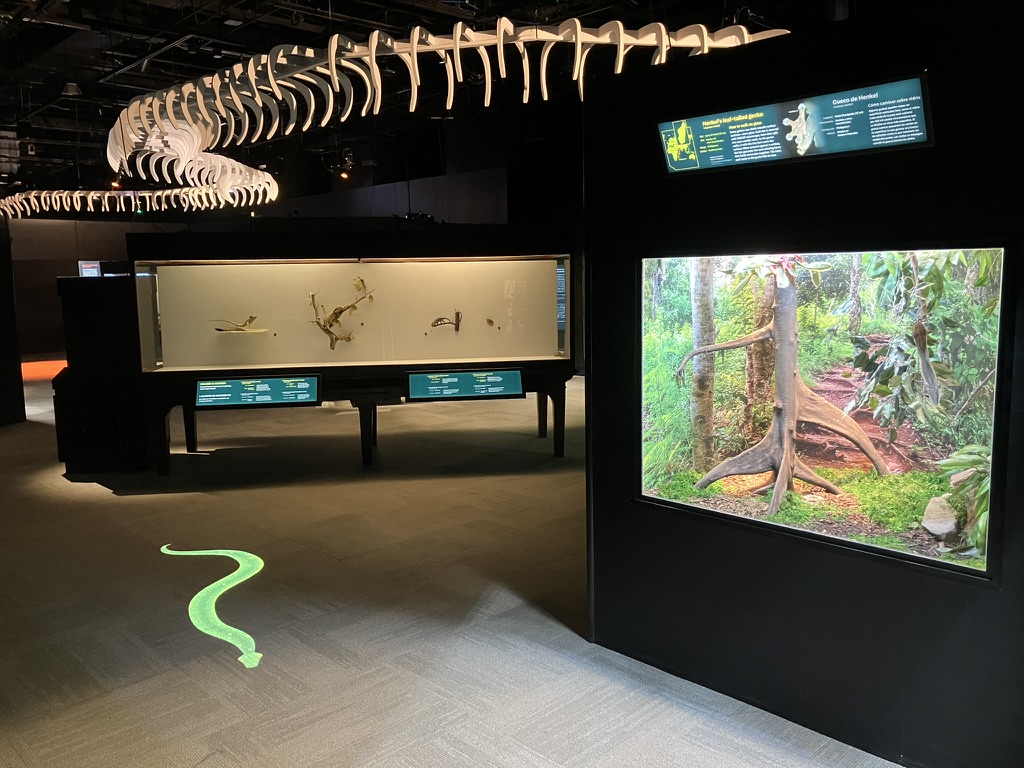
Reptiles Alive is straightforwardly about getting people excited to see and learn about incredible animals. Often, an exhibition calls for a grand narrative or lofty learning goals, but I thought the best approach for this one was to simply follow the “rule of cool.” Does a fact or image or display idea make people say, “wow, that’s amazing?” Then it it belongs in the show. Sometimes “because it rules” is a perfectly valid reason to do something—that’s why we have a 110-foot black mamba skeleton hanging from the ceiling.

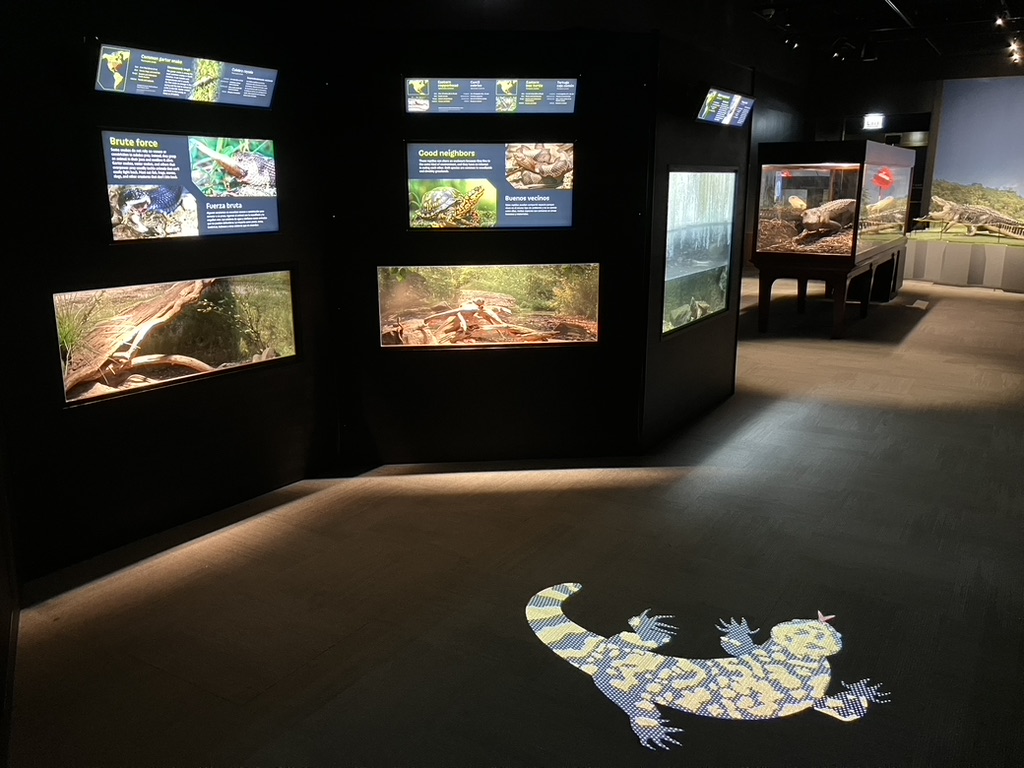
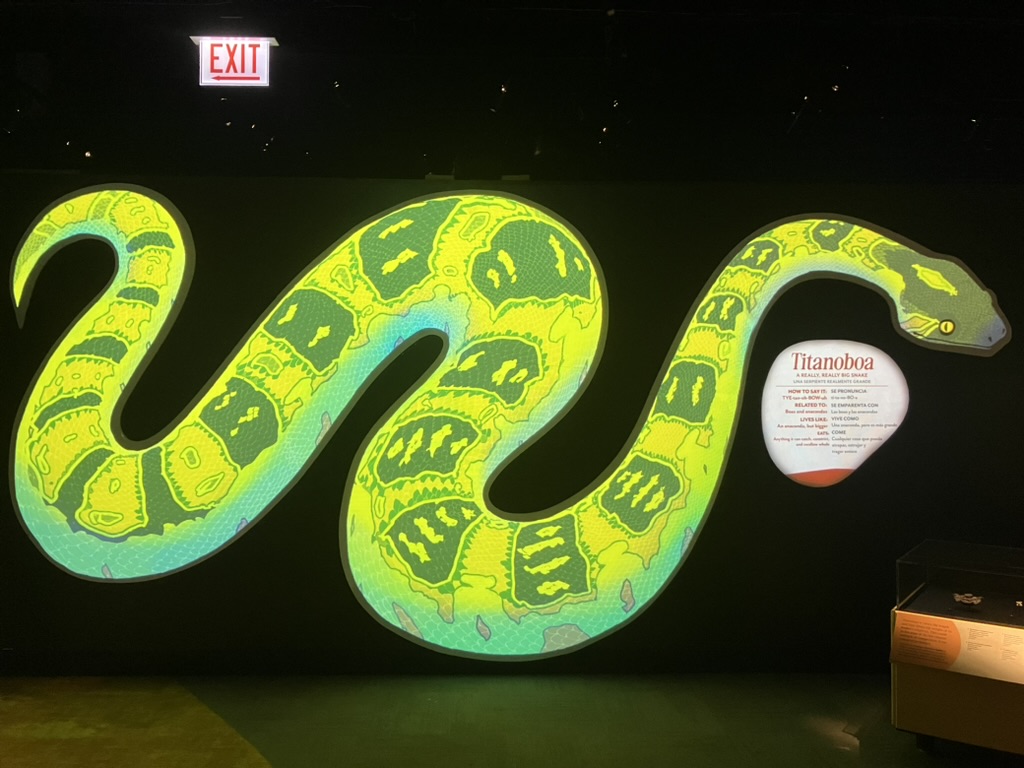
Reptiles Alive is organized Planet Earth-style. Each section features a biome type, but isn’t constrained to a particular part of the world. This allowed us to have some fun with the design and create unique soundtracks and lighting for each area: baking sunlight radiates over the desert section while animated snakes slither across the floor in the tropics.

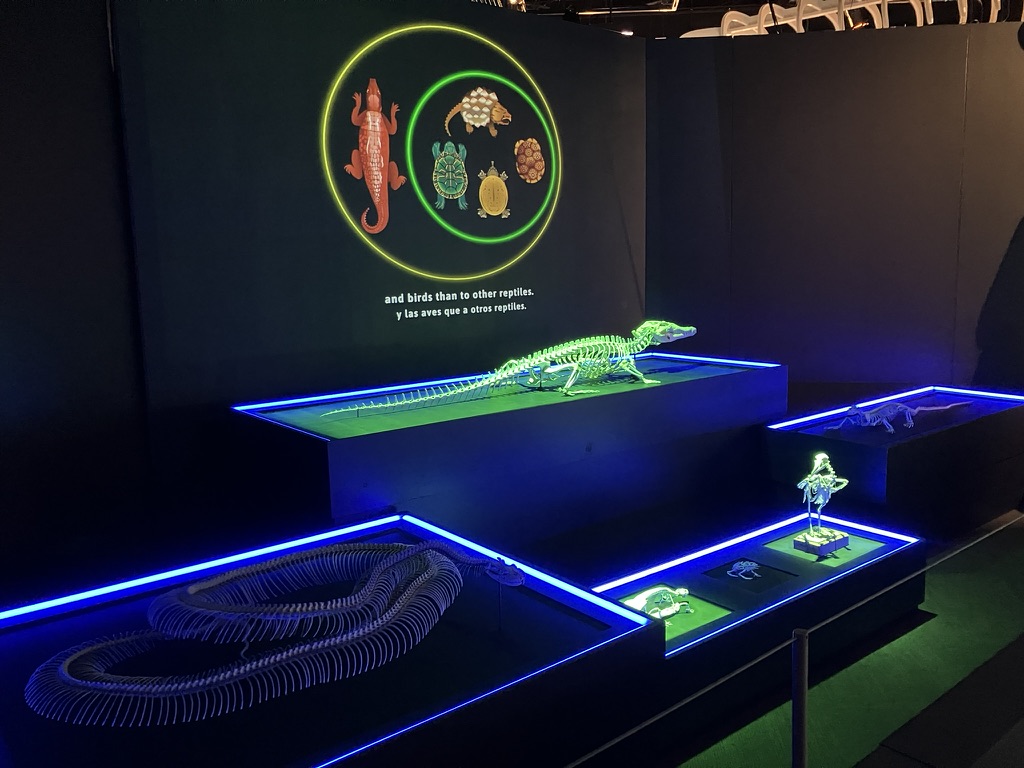
The other benefit of the biome-based organization is that we didn’t have to get bogged down with phylogeny in every label. Reptile classification is full of nested categories and apparent contradictions: for example, a snake is a kind of lizard, but there are are also legless lizards that aren’t snakes. Rather than distracting visitors with constant definitions and explanations, we opted to move the entire classification discussion to a single, prominent “object theater” near the exhibition’s entrance. Spotlights shine on mounted skeletons in different combinations as a narrator walks visitors through the main reptile groups and how to recognize them, while also clarifying that amphibians are not reptiles (but birds are). In under two minutes, visitors gain a shared vocabulary they can use as they explore the rest of the exhibition.

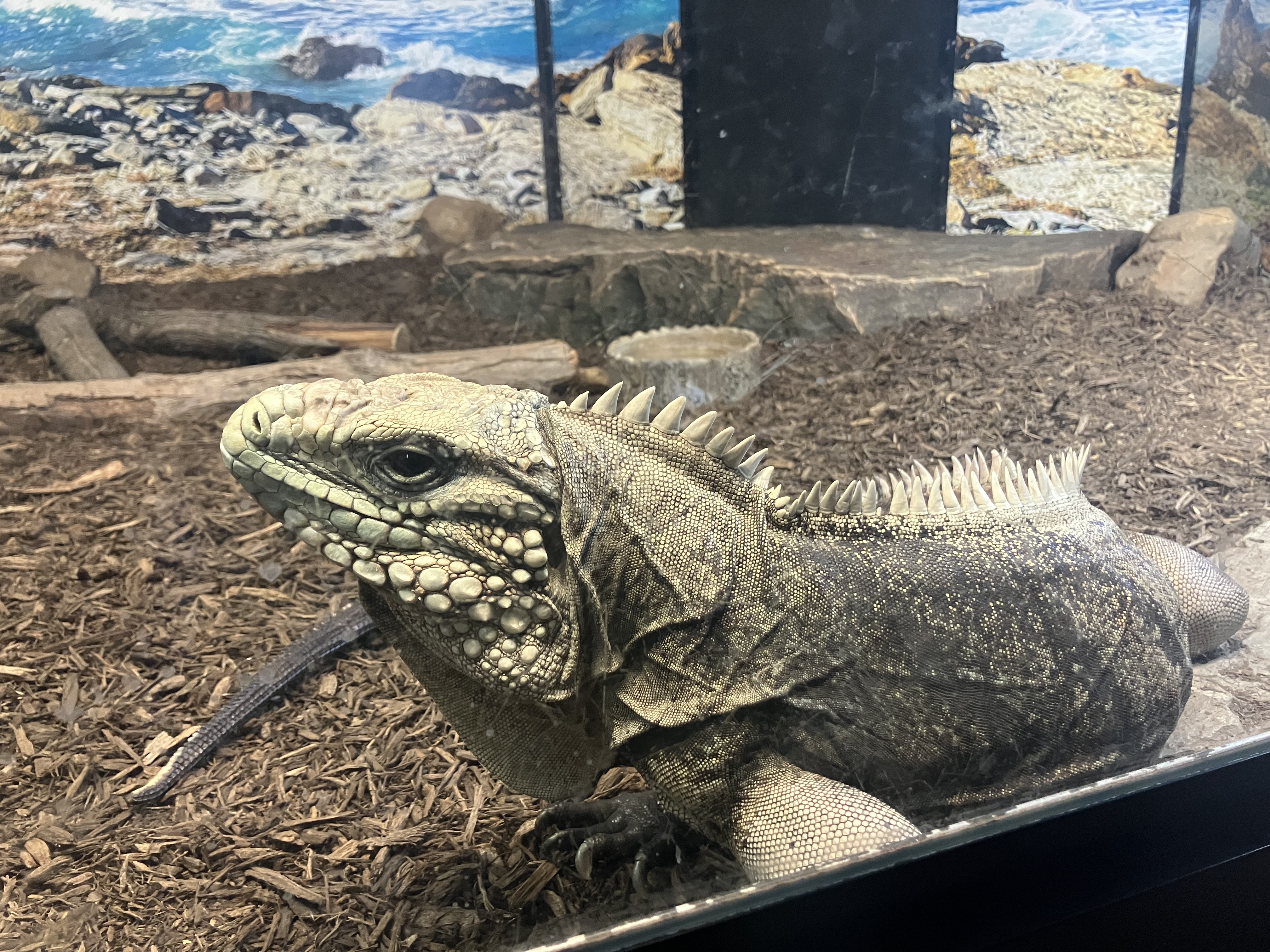
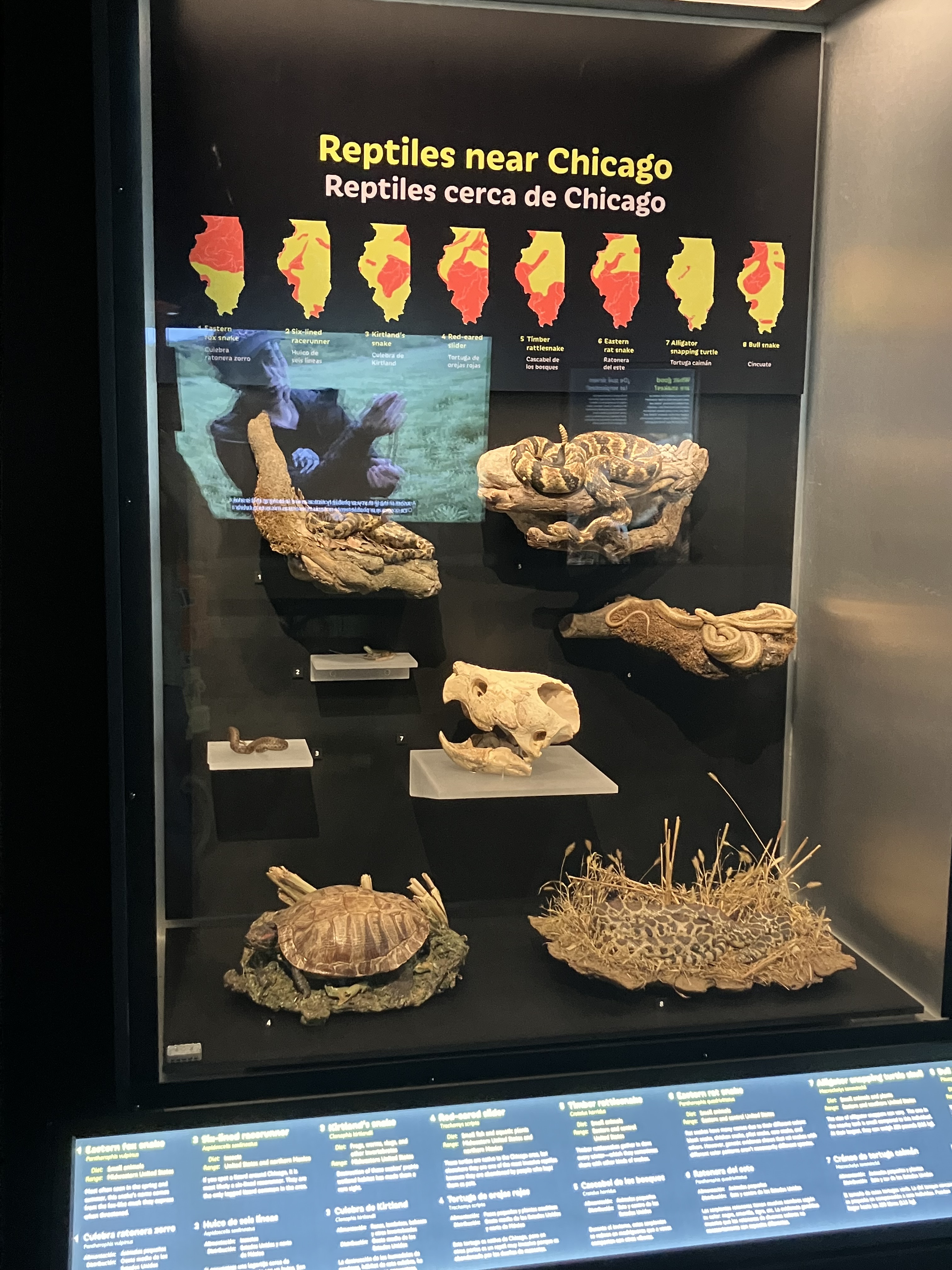
Naturally, the live animals are the stars of the show. Gwangi, a 38-year-old, puppy-tame Cuban rock iguana, is my favorite, but it’s also a lot of fun watching the European glass lizard dig in and out of his bedding, or seeing the reticulated python splash around in the water. We also made use of the museum’s collection of spectacularly life-like model reptiles from the early 20th century, and commissioned a few new ones as well. The models introduce visitors to creatures they might never have heard of, as well as one with a role in Field Museum lore.

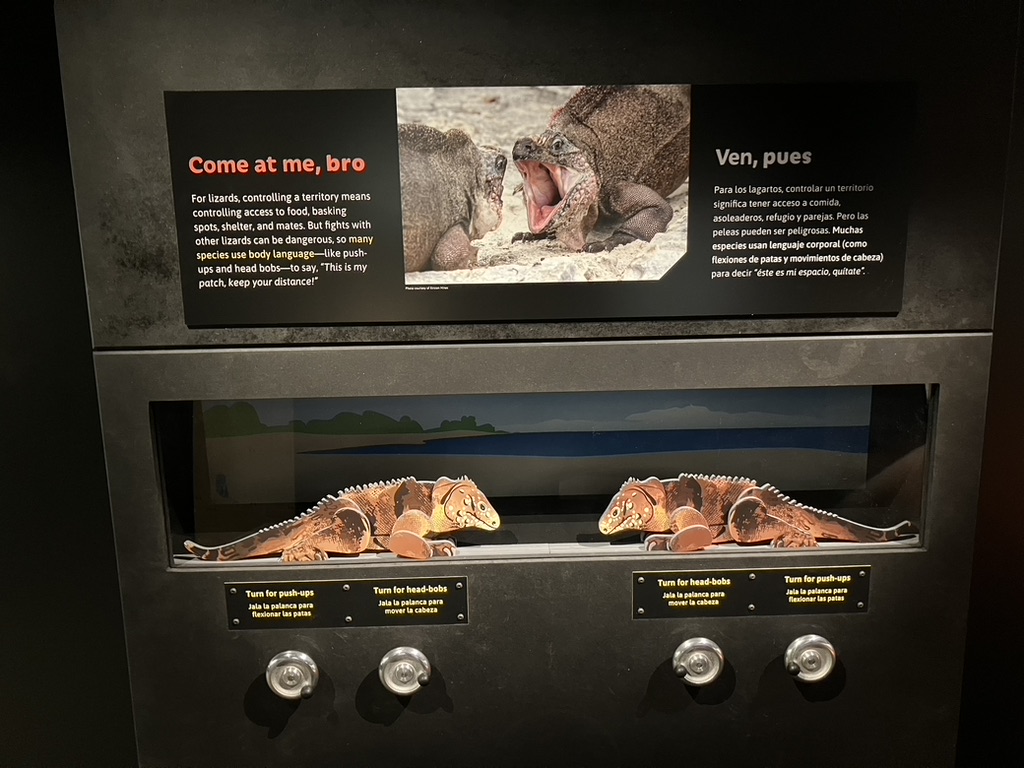
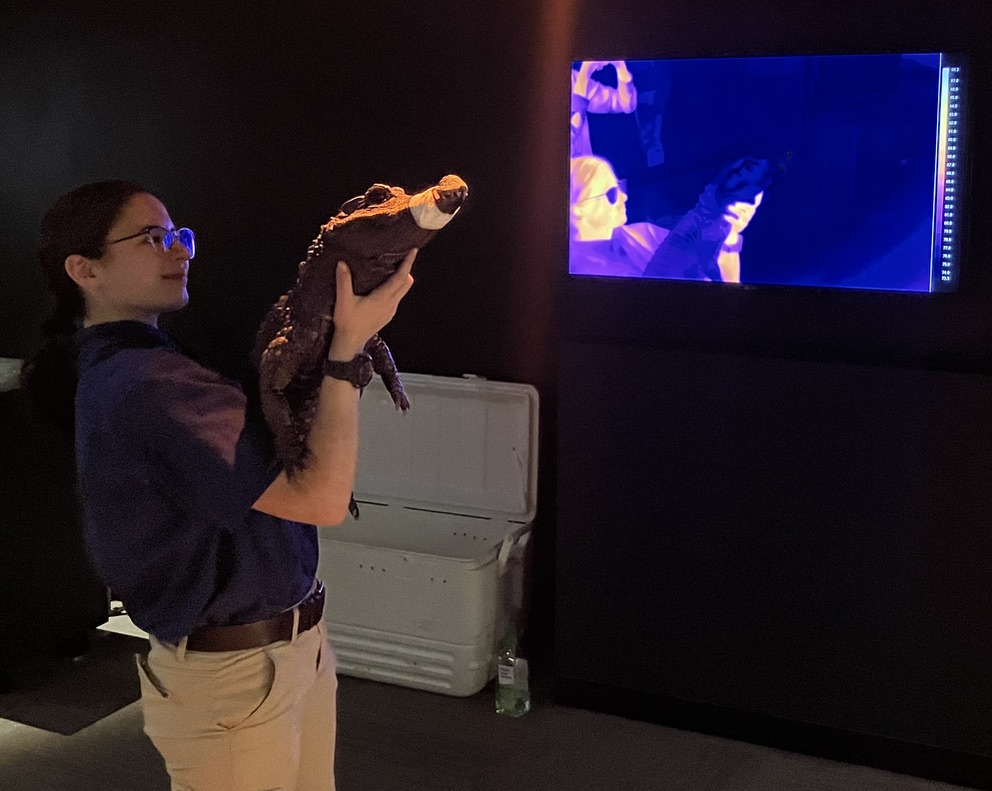
There are no touchscreens in Reptiles Alive. Instead, we went all-in on simple, tactile interactives. Whether you’re puppeteering a pair of iguanas to demonstrate lizard body language or testing your puny human strength against the bite force of a Nile crocodile, the action being performed always directly illustrates the concept under discussion. The fanciest piece of hardware in the exhibition is a thermal camera. It’s one thing to tell visitors that reptiles are cold-blooded, but it’s quite another to see the zookeeper hold a room-temperature snake up to the camera. The human glows orange while the snake matches the blues and purples of the space around it.

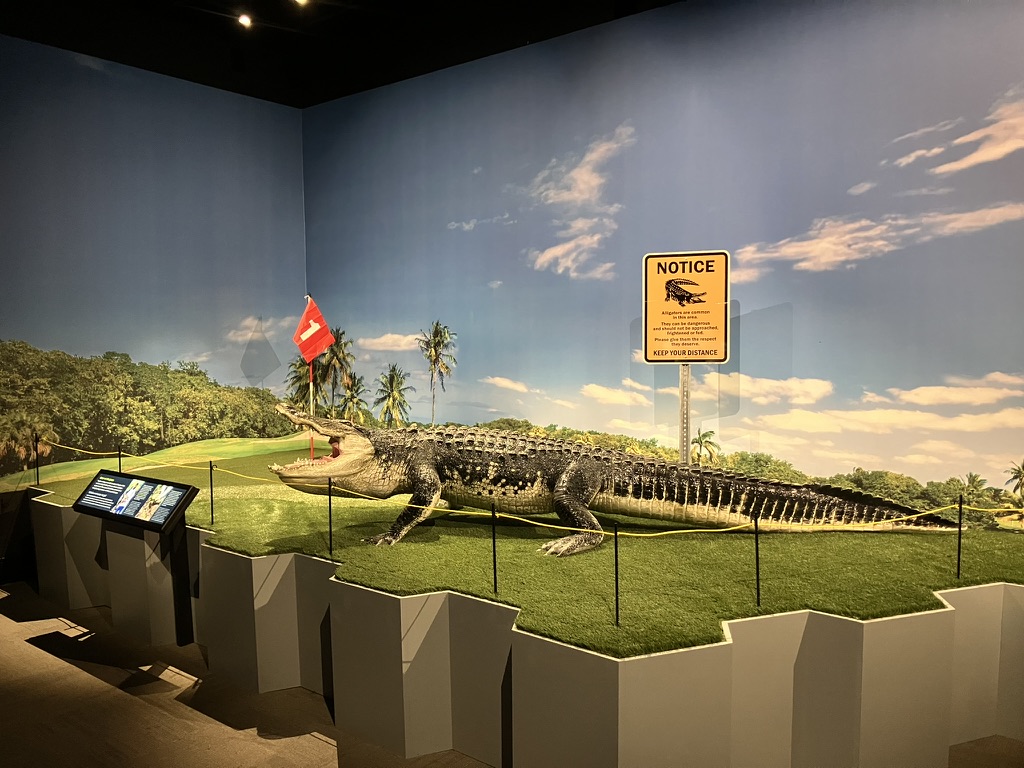
The final display originated as a joke. We wanted to make a big diorama, but detailed botanical models are just about the most expensive and time-consuming thing you can make. Thinking about reptile habitats without much vegetation, I glibly offered that we could recreate the “gator on a golf course” scene from Happy Gilmore. But we soon realized that was the perfect ending for our exhibition: draining swampland to build golf courses is an example of how humans are invading reptile habitats. That means we’re going to encounter reptiles more often, and we’ll need to learn to live alongside them. Hopefully, visitors that came in fearing reptiles will leave with respect and admiration for them.

Reptiles Alive runs until April 2026.

Changing Face of Science: Sara Ruane

In 2022, the Field Museum launched The Changing Face of Science, a series of exhibitions that profile scientists affiliated with the museum who are women or people of color. The series is intended to inspire young visitors and show how how diverse perspectives and backgrounds can contribute to science.

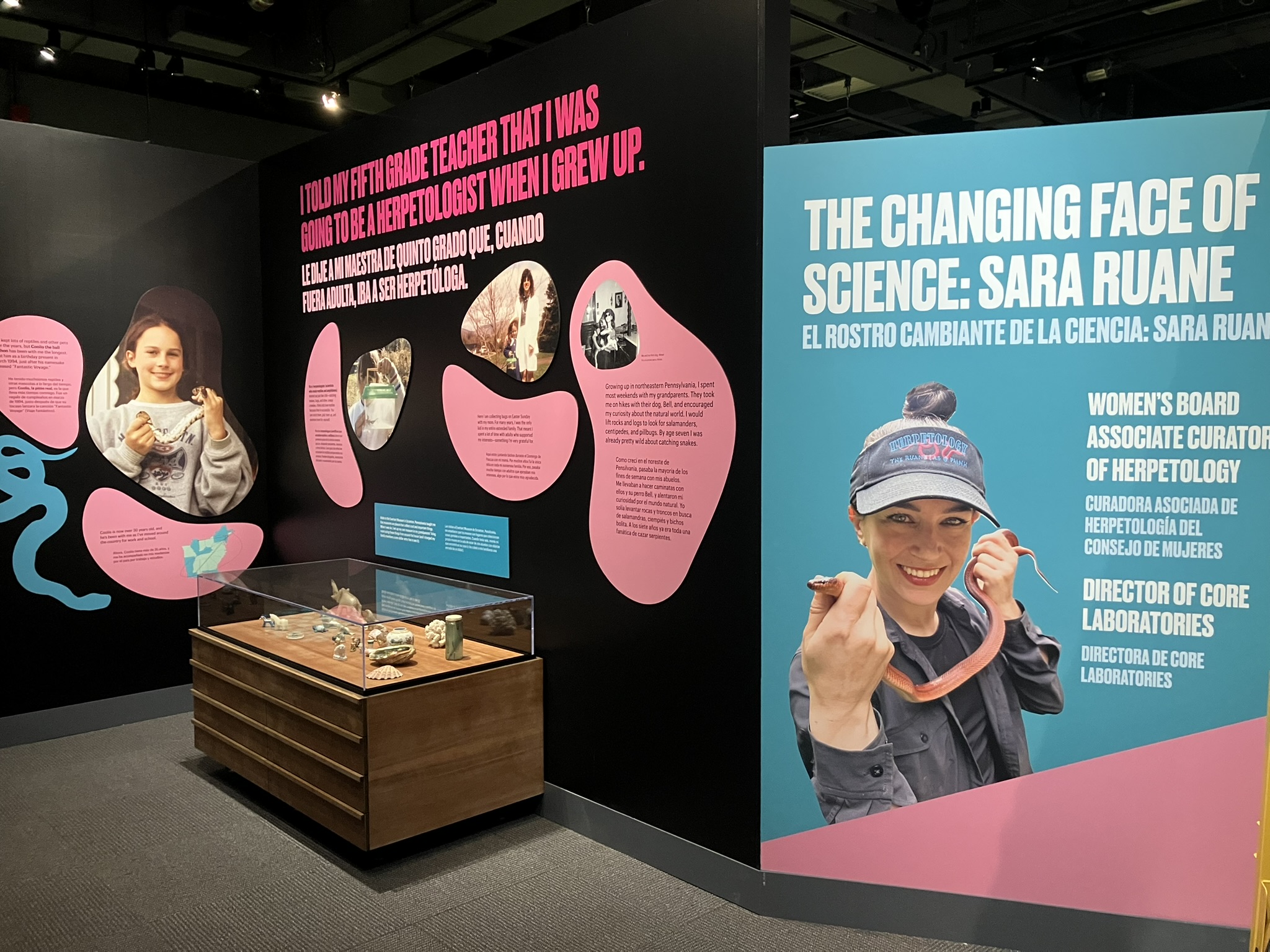
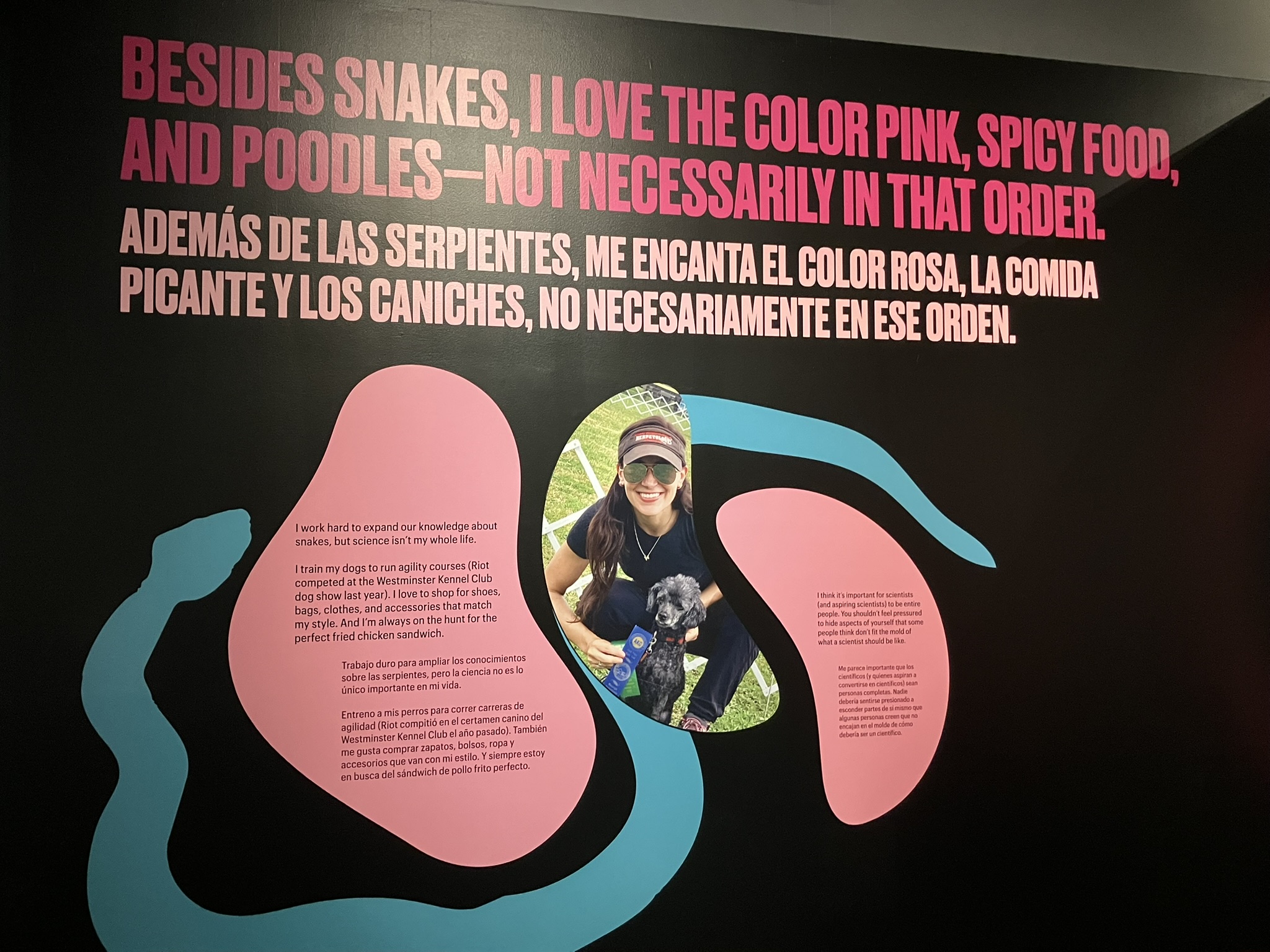
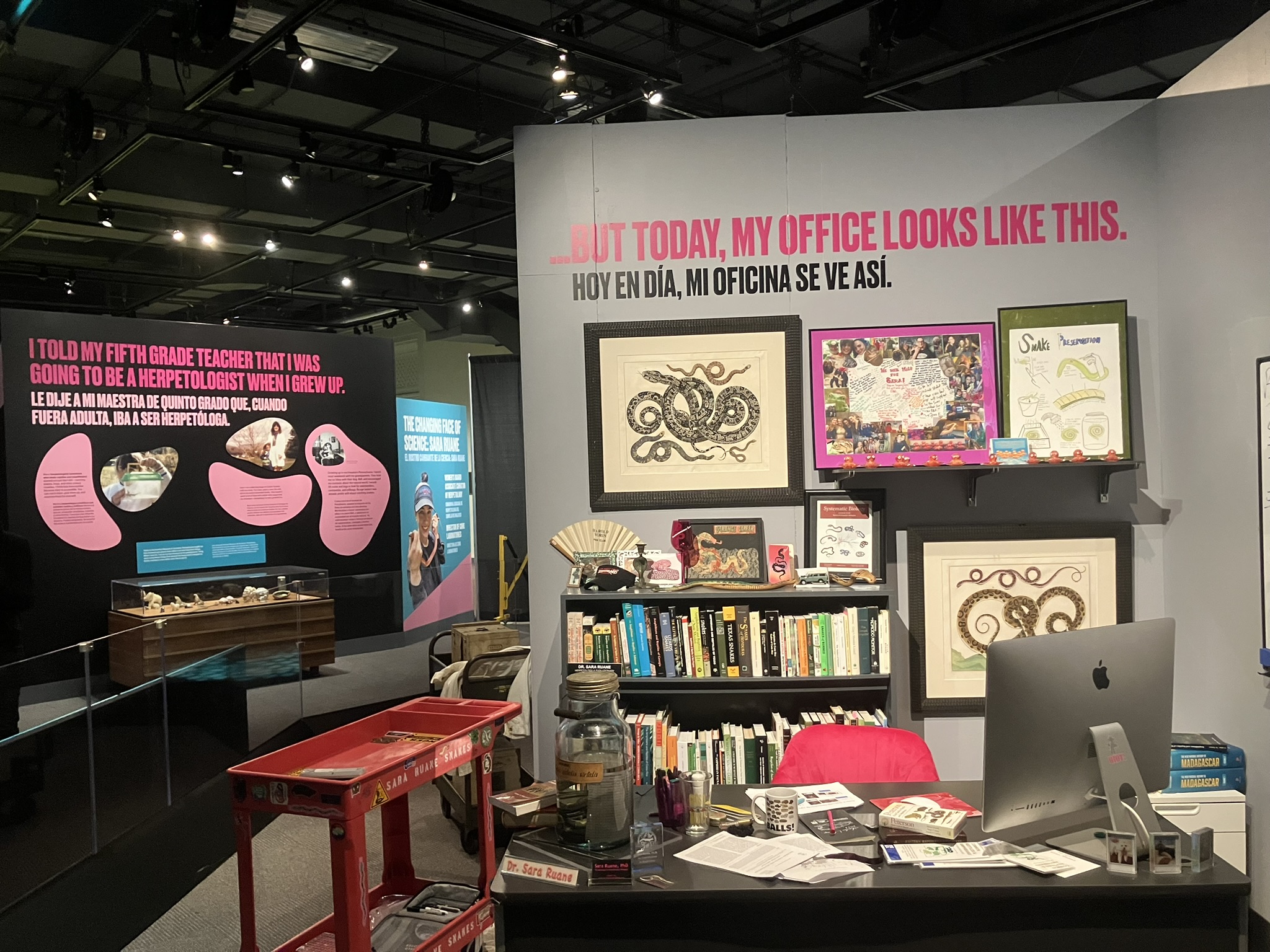
The latest entry in the series features aforementioned herpetology curator Sara Ruane. Sara studies the diversity and evolution of snakes, and has been fascinated by reptiles from a young age. However, Sara also wanted the exhibition to communicate that being a scientist is only part of who she is. Sara loves training her toy poodles, shopping for designer bags, and curating her unique fashion sense—you can be a great scientist while also being a complete person.

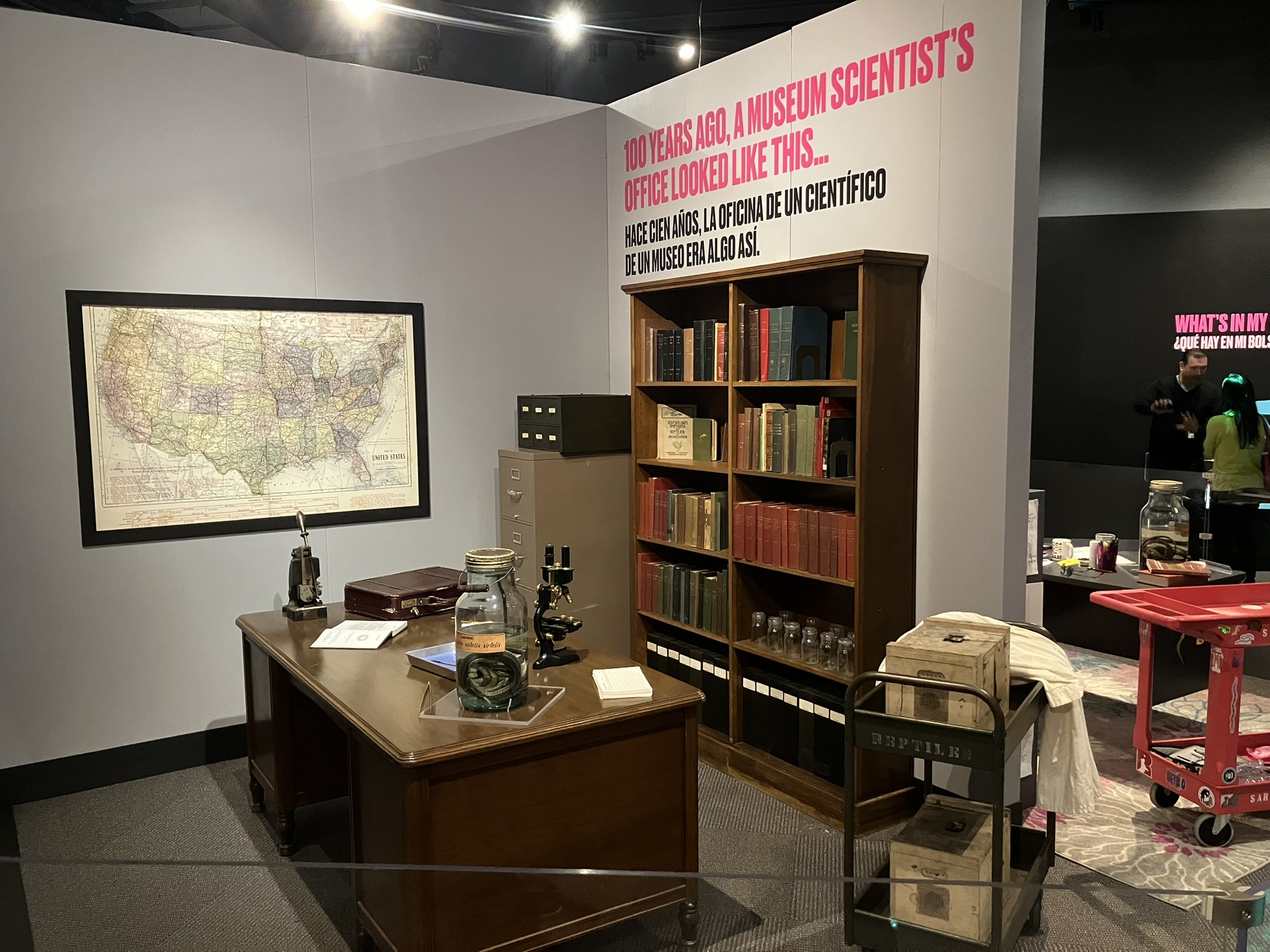
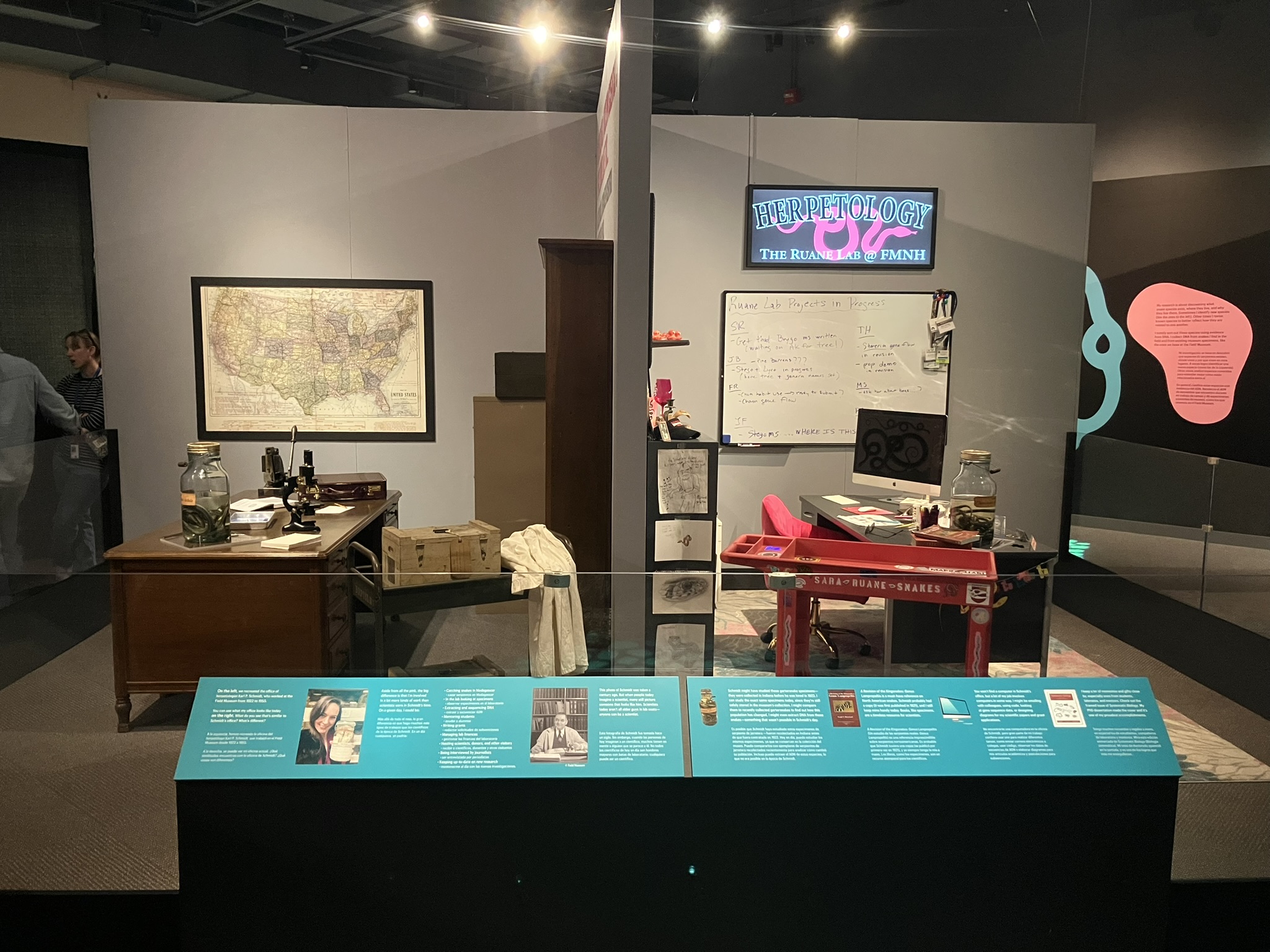
Displays include a recreation of a tabletop “museum” (that Sara made for her family at age six) and the contents of her fieldwork bag (which include everything from a Leatherman multitool to lipgloss). The centerpiece is a pair of office dioramas. One is Sara’s office today, and the other is that of Karl Schmidt, who was the Field Museum herpetology curator a century ago. I think it’s fair to say that we had a blast reconstructing Schmidt’s office, using his original desk and much of his actual book collection. Visitors are encouraged to compare the two spaces: Schmidt’s office is more traditionally professorial, while Ruane’s is full of fun decorations and mementos. But both scientists have the same jar of garter snakes on their desks (museum specimens are an eternal resource), and are referencing the same book (books are also eternal).

Sara’s exhibition runs until January 2026.

After the Age of Dinosaurs

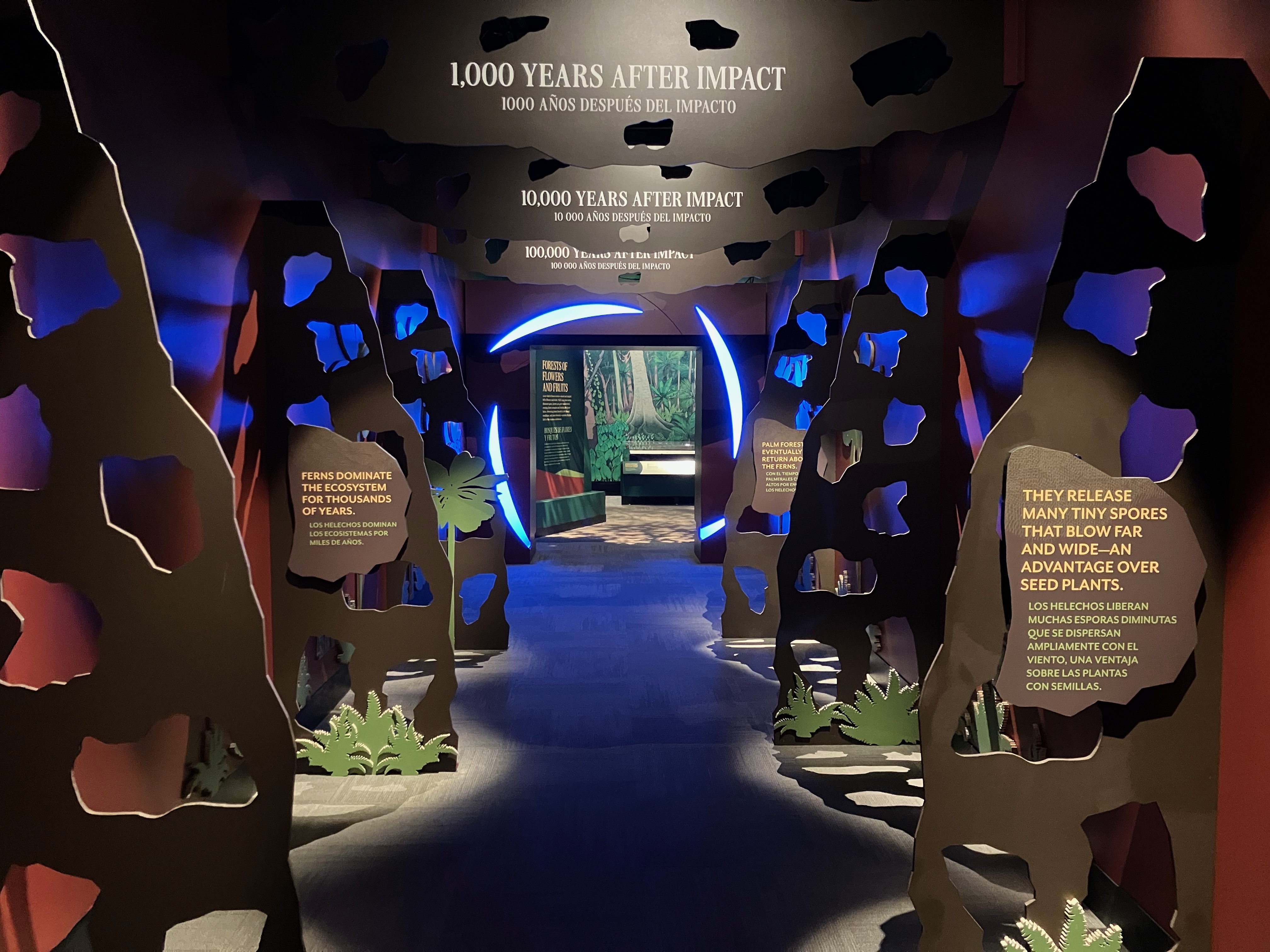
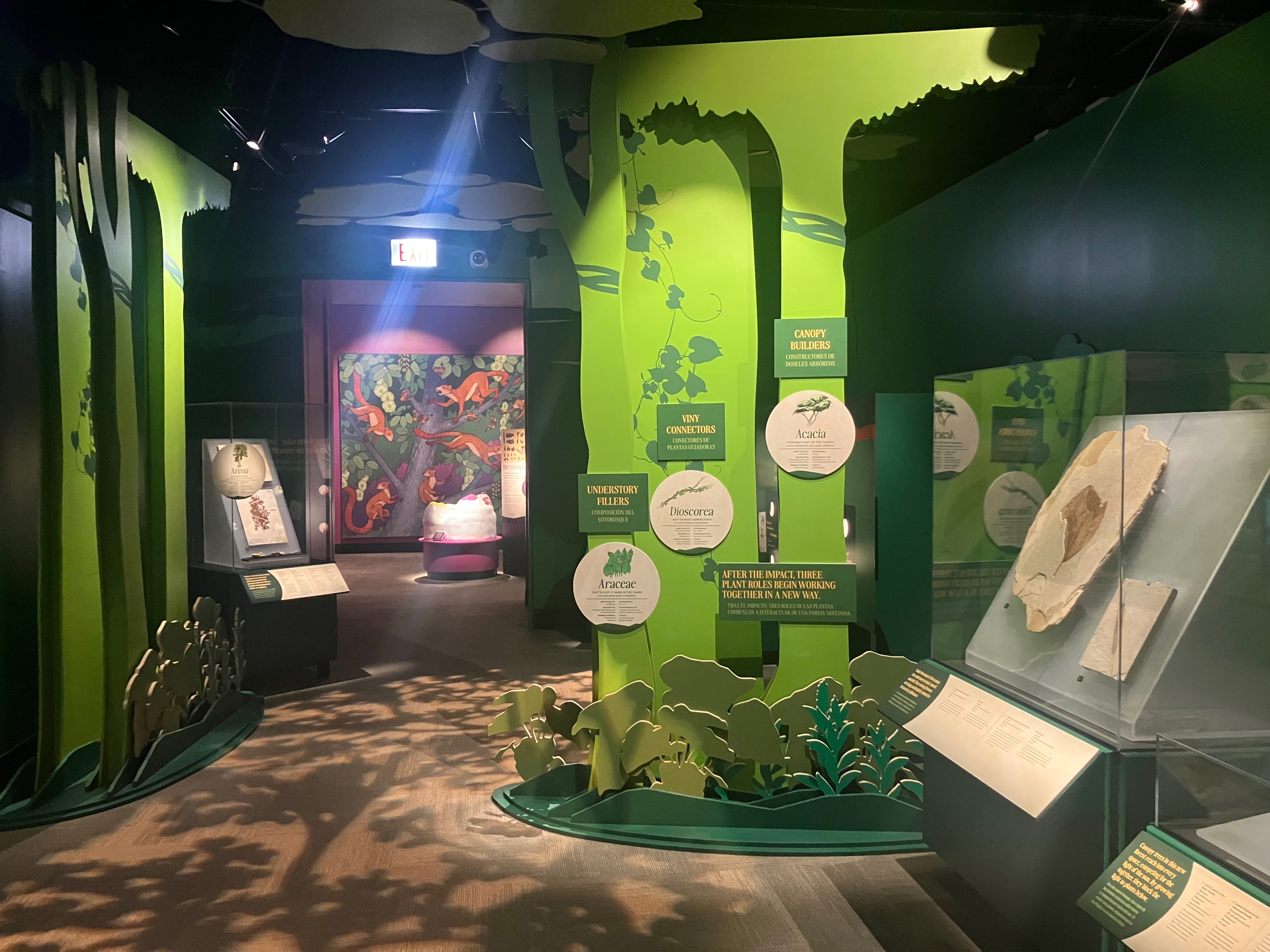
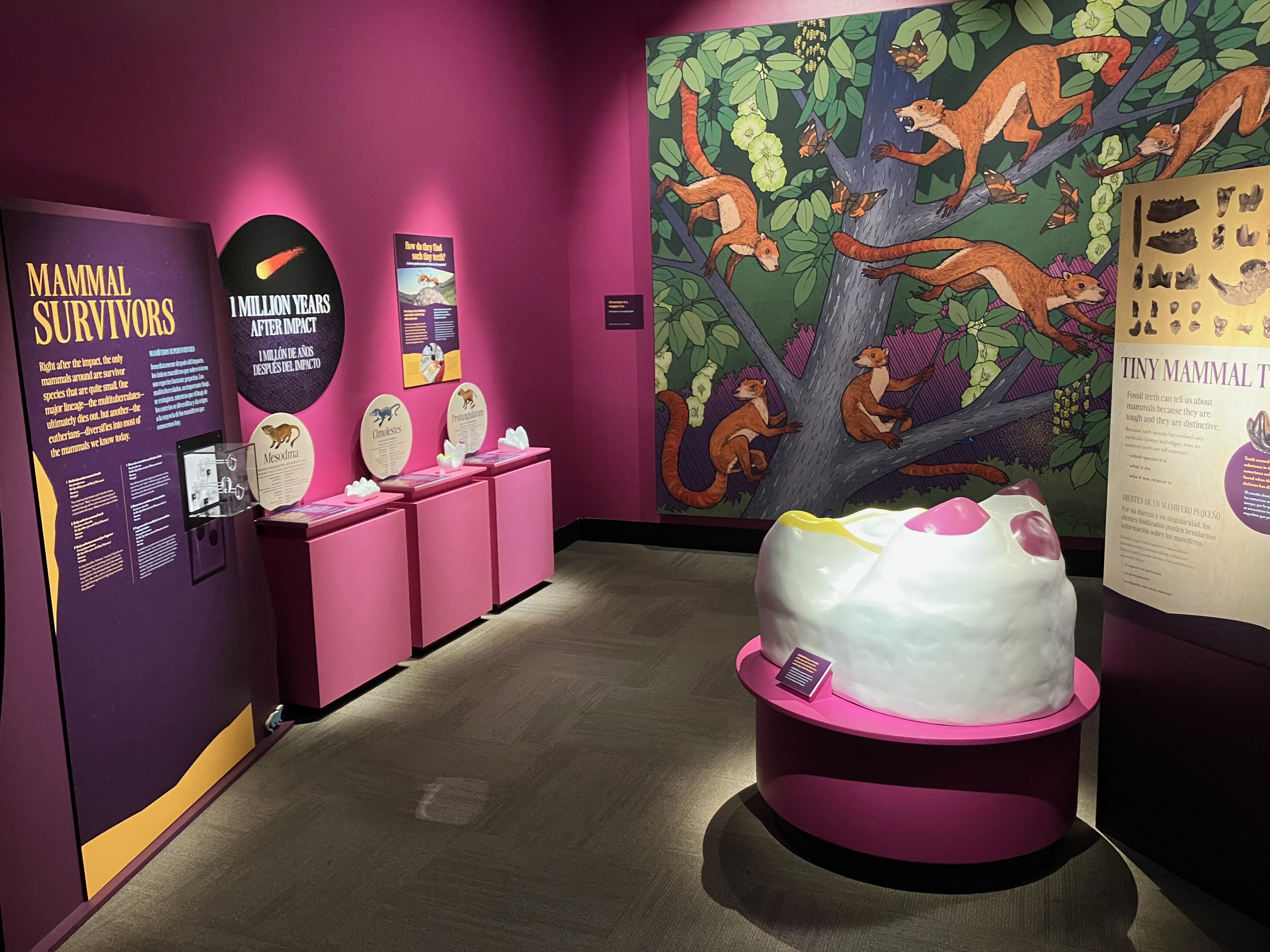
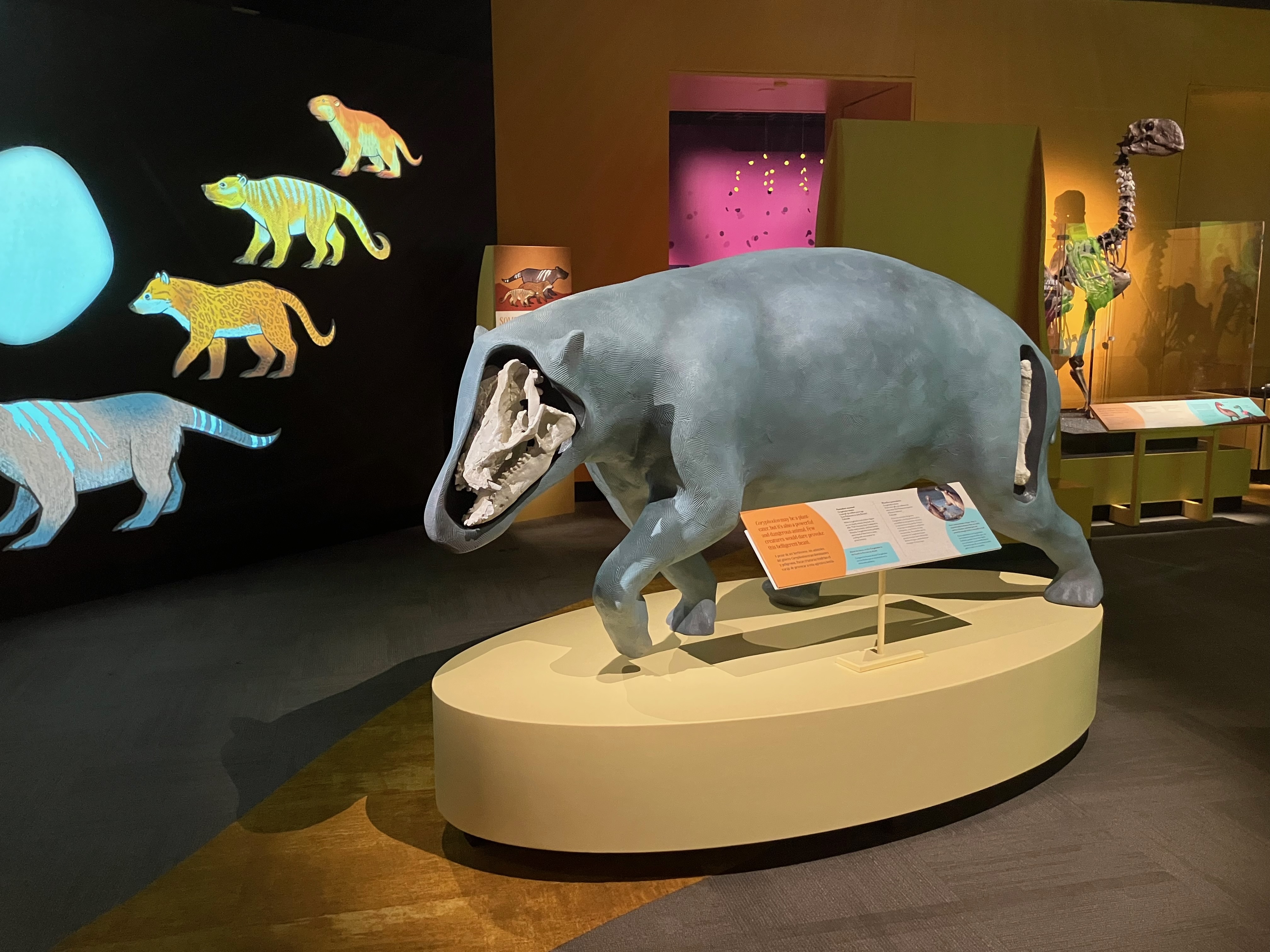
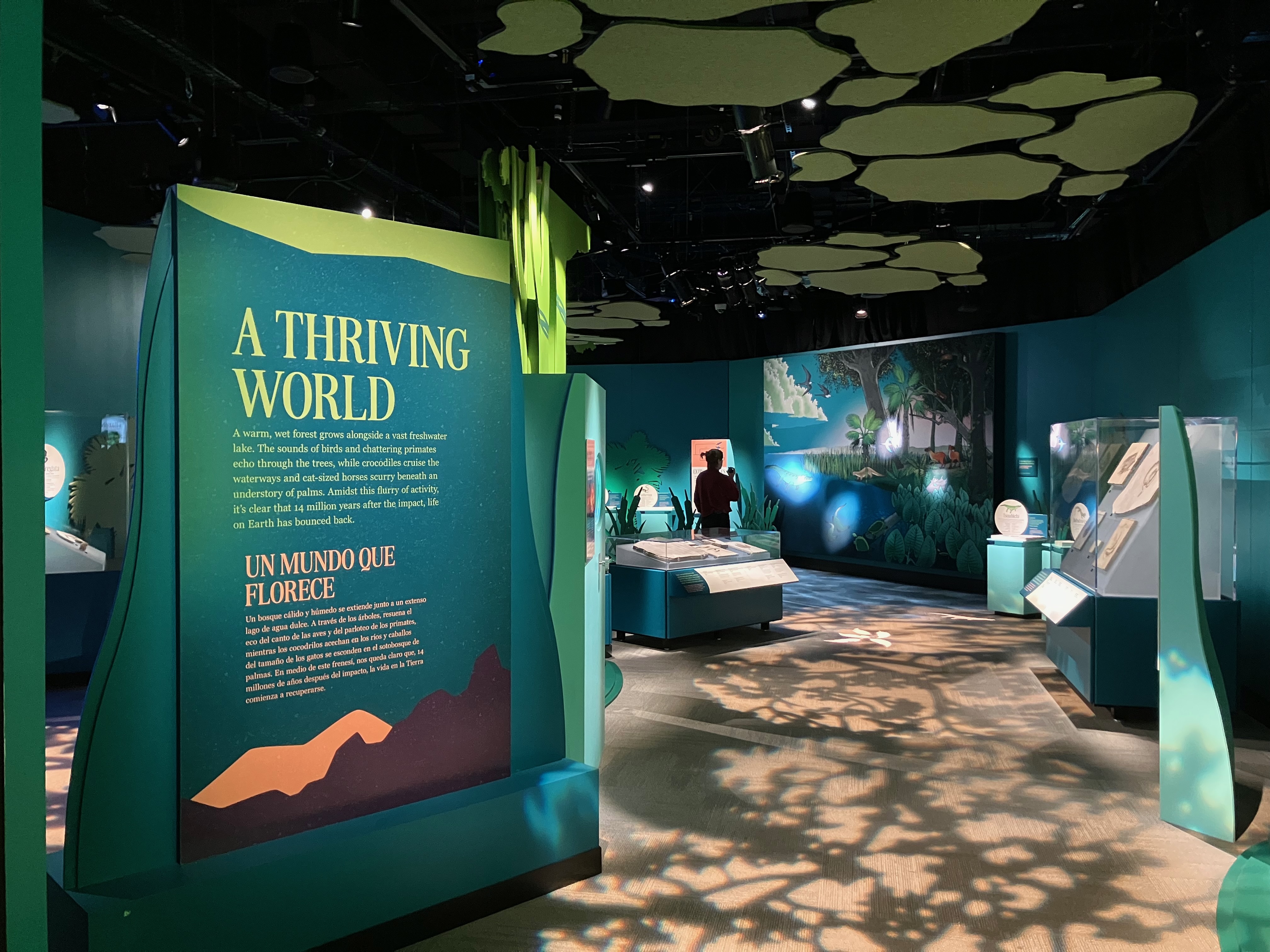
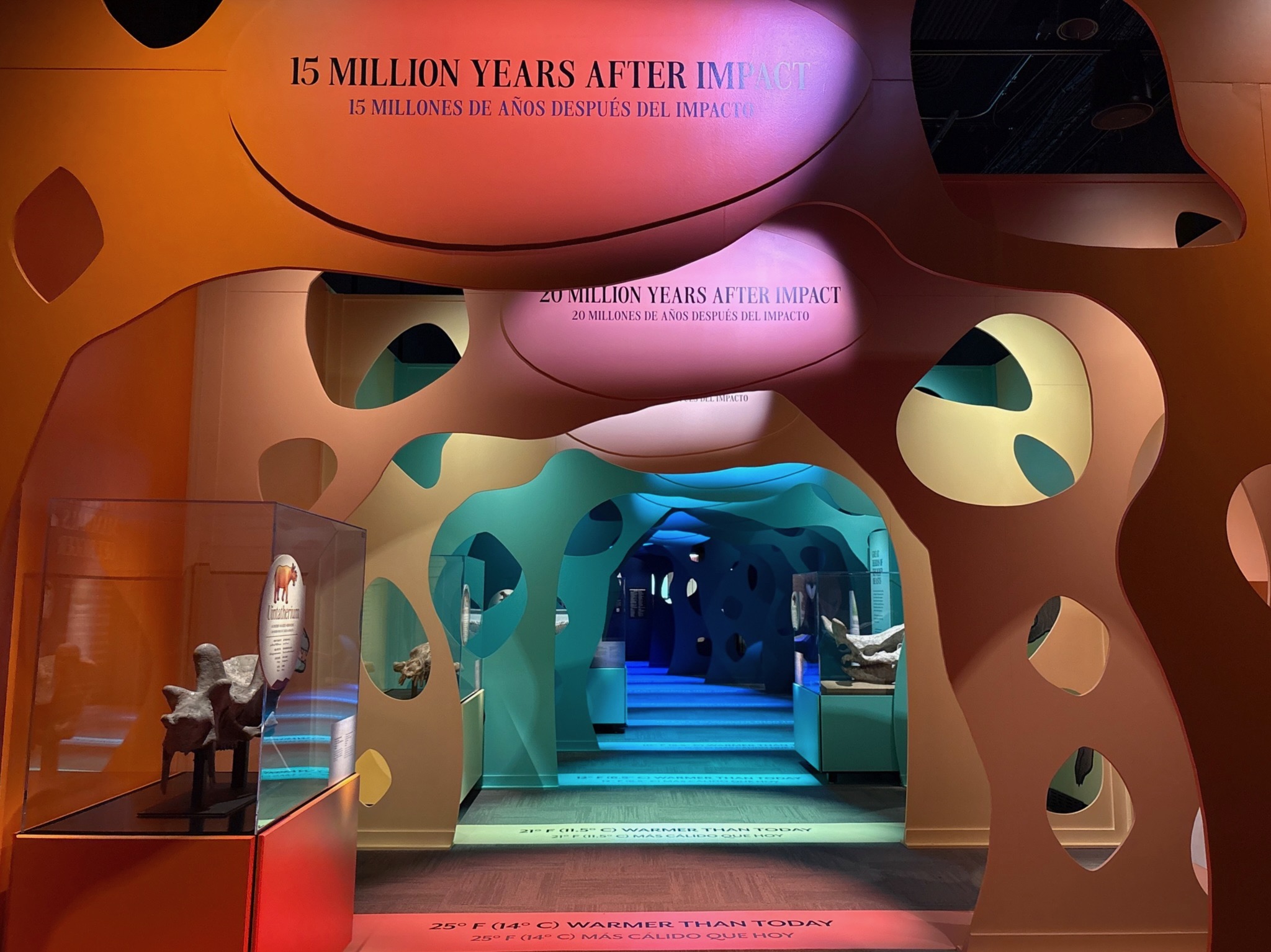
That brings us to After the Age of Dinosaurs. This exhibition is about the immediate aftermath of the end-Cretaceous extinction, and how the world’s ecosystems reassembled after that global catastrophe. But a summary of the subject matter doesn’t fully encapsulate what this show is about. The early Paleogene was famously a time of giant birds and little horses. Taking some inspiration from Alice in Wonderland, we played with the idea that sizes are askew and nothing is as it seems. The exhibition is colorful, whimsical, and full of displays that are just a little weird.

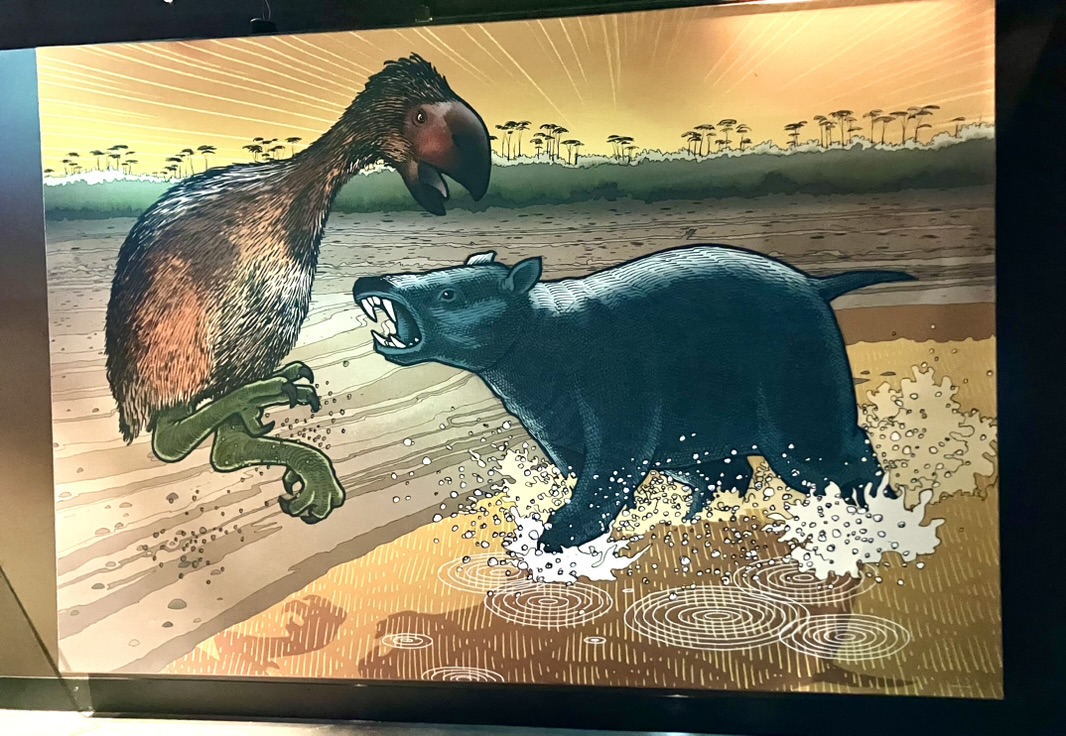
My colleague Marie Georg led the development of this exhibition—I joined a little later on to flesh out and write the second half. Curators Ken Angielczyk and Fabiany Herrera advised on the science, along with nearly a dozen other specialists. Meanwhile, the team worked with Chicago poster artist Jay Ryan to create the look of the show. Jay’s style is bright and bold, with a bit of a pop art feel. He brought those signature qualities to the six murals and nearly sixty standalone illustrations he created for After the Age of Dinosaurs, and the rest of the exhibition’s design follows suit. The result is a paleontology exhibit that looks nothing like the Field Museum’s permanent Evolving Planet, or really any other major fossil exhibit that I’m aware of.

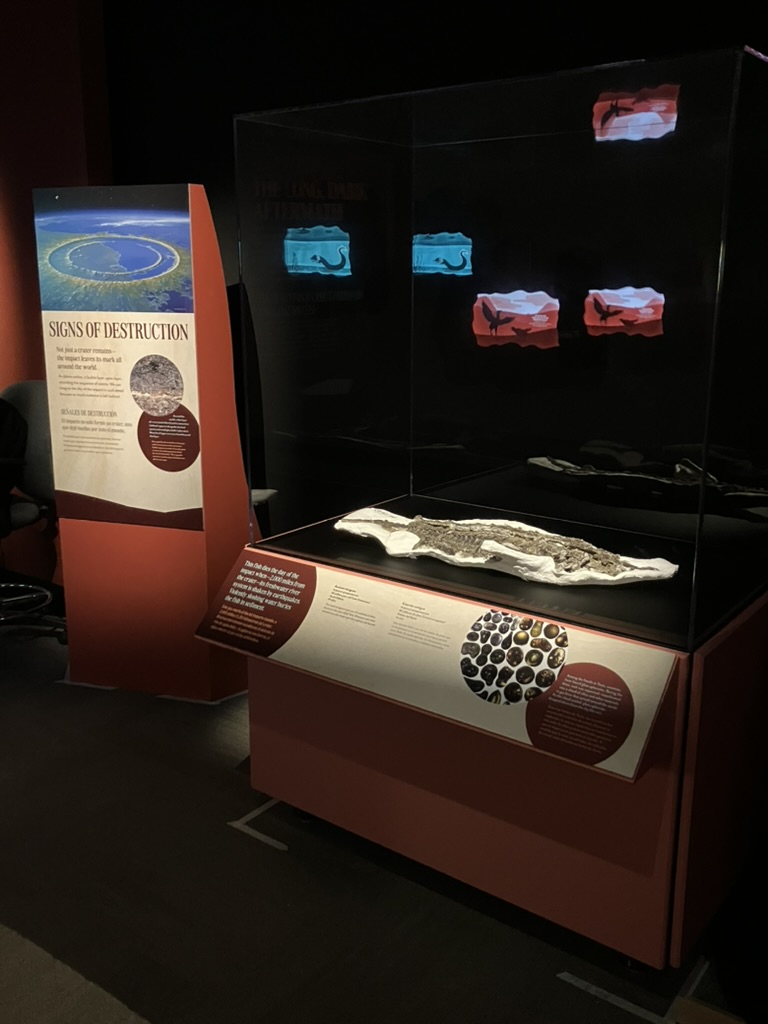
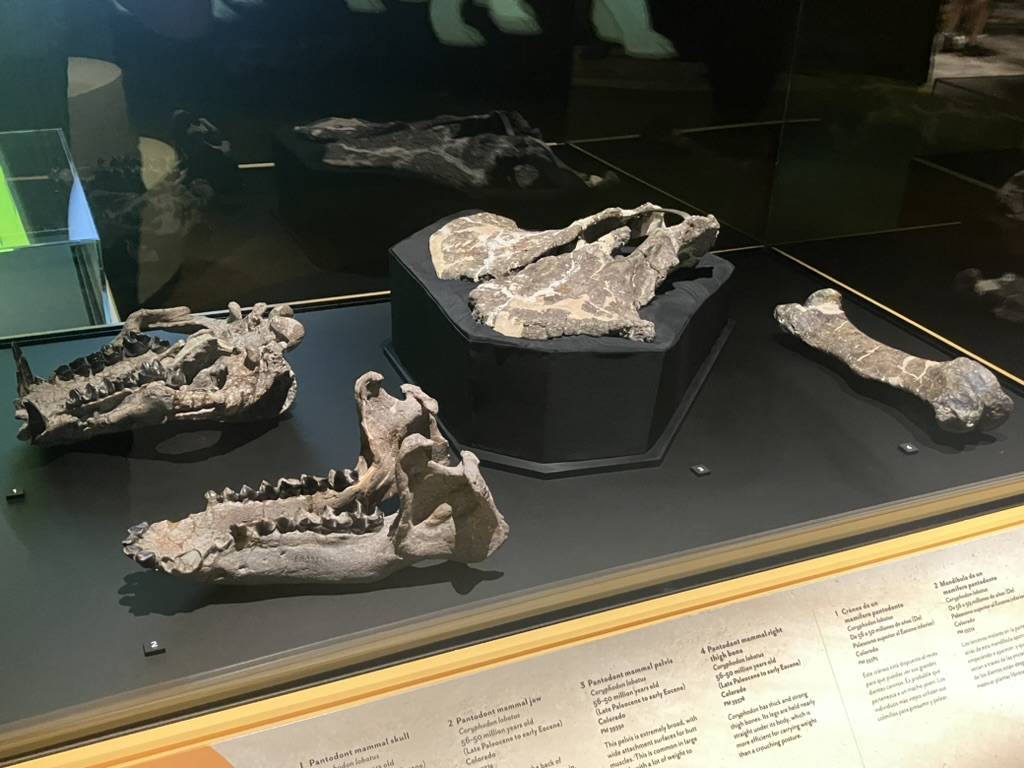
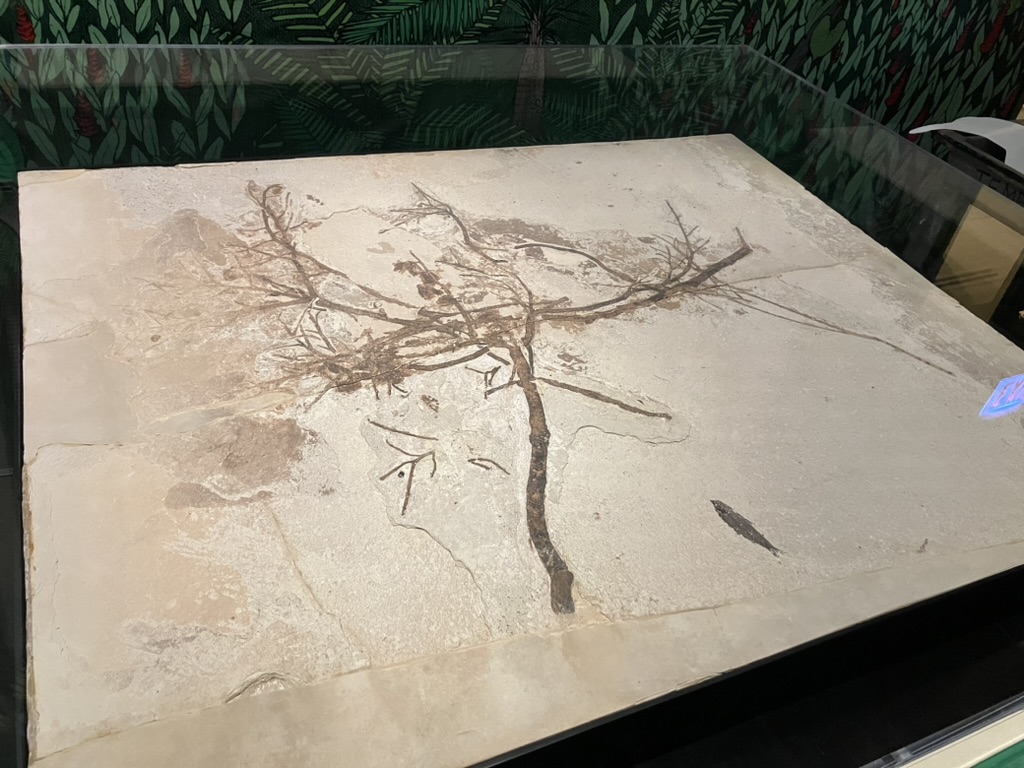
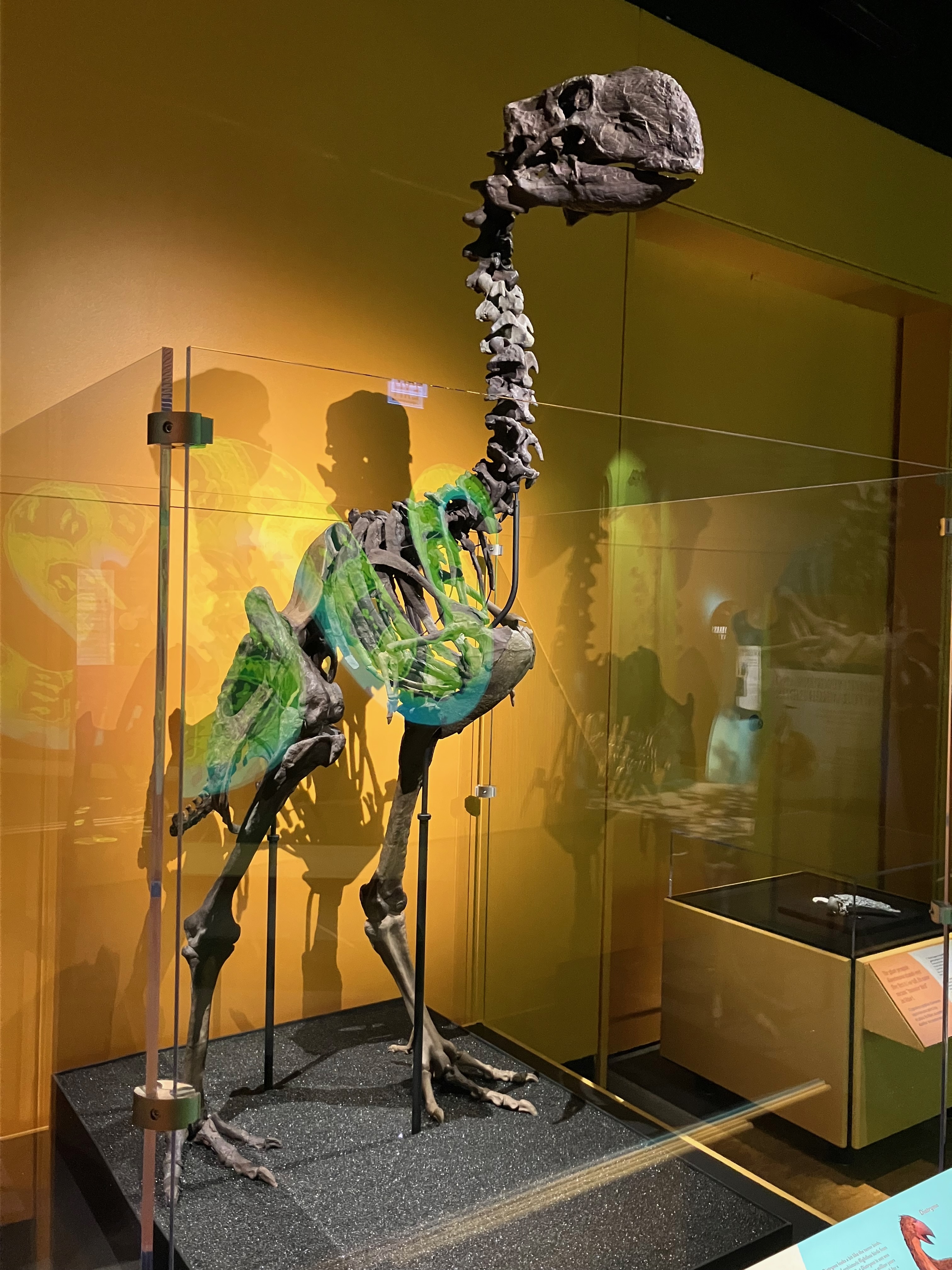
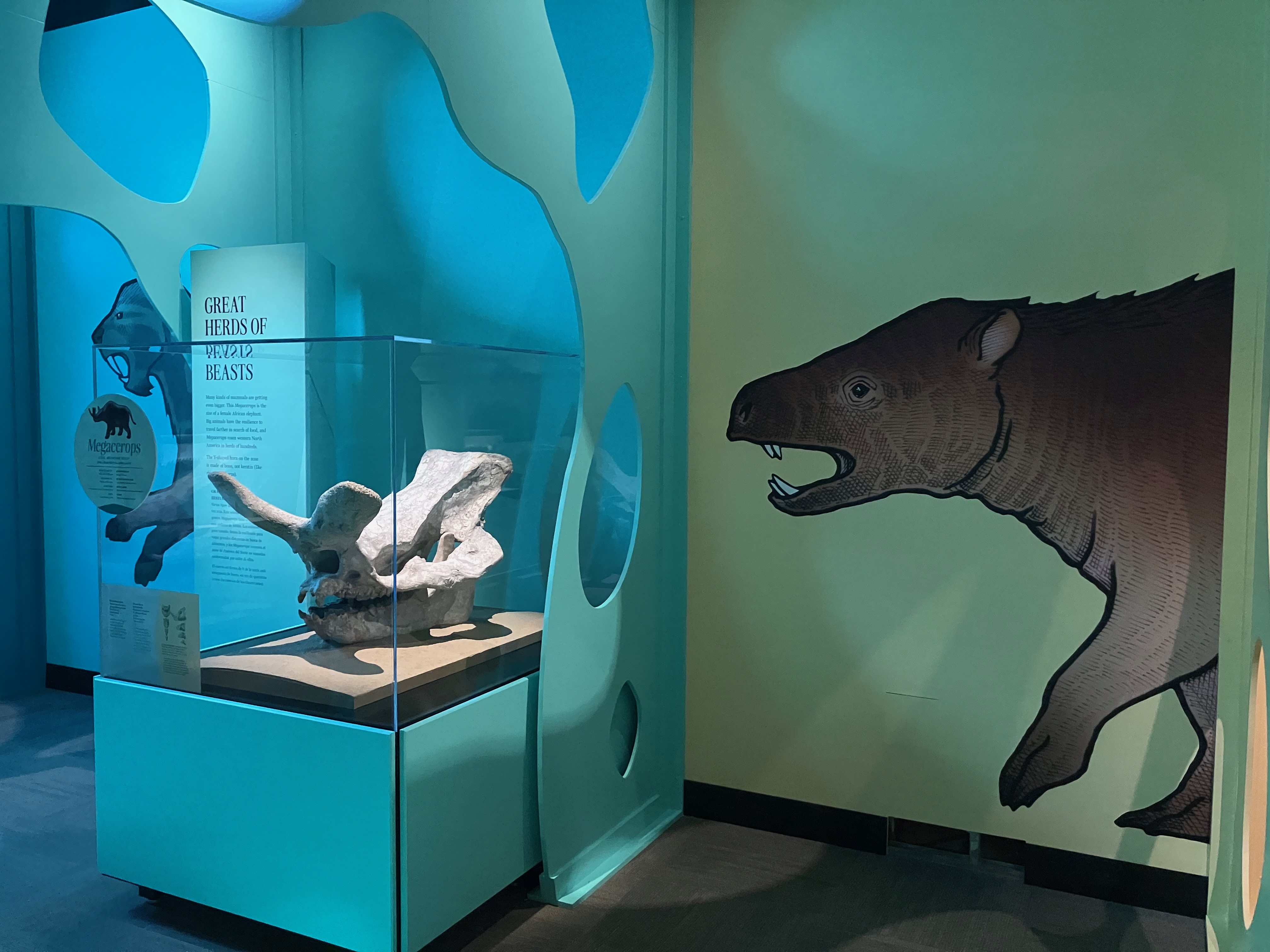
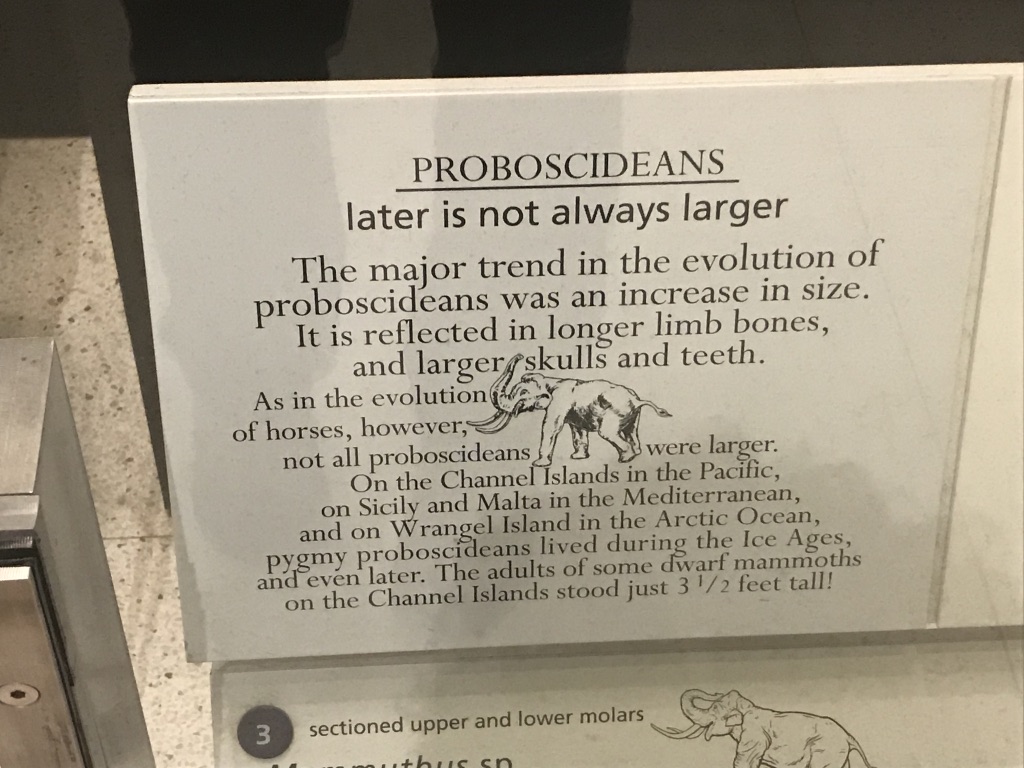
The fossils on display include both brand-new specimens collected during the 2024 field season and classics from the collection that we’d been waiting for an excuse to show off. Visitors can see the largest Megacerops skull ever found, the world’s only known cattail fossil, the oldest grapes from the western hemisphere, a perfectly-preserved passerine bird that was just named this year, and at least four fossils that are in press and so haven’t been formally named yet. The highlight for me is the Diatryma cast skeleton, which was acquired in a trade with the American Museum of Natural History in 1937. This set of disarticulated parts had never made it onto display before, so it was exciting to see it assembled into a standing mount for the first time.

Since so many early Paleogene fossils are on the small side, large media and media-adjacent displays often take center stage. After the Age of Dinosaurs opens with a dramatic presentation of how the asteroid impact devastated global ecosystems, animated in a paper cut-out style by Rachel Oftedahl. A projection of ash billowing through a burnt-out forest adds a somber mood to the next gallery. Look closely at the life-sized projections of pantodonts later in the exhibition and you’ll see their eyes periodically blink. And in the Green River section, visitors can add to the ubiquitous forest soundtrack by standing in spotlights shaped like different animals—these trigger unique sounds that add to the gallery-wide chorus. I’m excited to see how visitors respond to these semi-hidden, playful elements within the exhibition, and how they contribute to the experience overall.

After the Age of Dinosaurs runs until January 2027.

1 Comment

Filed under exhibits, FMNH, mammals, museums, paleoart, reptiles

It’s time to renovate the AMNH fossil halls

An overview of the Hall of Vertebrate Origins. Photo by the author.

Spending a day at the American Museum of Natural History is always a joy. Particularly in its fourth floor fossil halls, AMNH stands head and shoulders above peer museums in the sheer breadth of collections on display. Something in the ballpark of 600 fossil vertebrate specimens are included, including no less than 135 mounted skeletons. Many of these represent taxa that cannot be seen anywhere else in North America. With each visit, however, I feel more and more that the AMNH fossil halls are showing their age. This is not surprising—the current exhibition opened in stages between 1994 and 1996. Strange as it seems to aging millennials like myself, that was 30 years ago. By comparison, the prior iteration of the fossil halls was completed in 1956, and was 31 years old when renovation planning began in 1987.

The “Brontosaur Hall,” part of the midcentury iteration of the AMNH fossil exhibits. Photo courtesy of the AMNH Research Library.

In their time, the current fossil halls were a monumental accomplishment—taking nine years to complete and costing $44 million (which would be more than $90 million today). Steering the ship was Lowell Dingus, a paleontologist by training who assumed the role of Project Director for the renovation. Dingus led a twenty-person team of AMNH researchers, writers, and preparators dedicated to the project, and Ralph Appelbaum Associates was hired to design a new look for the halls.

Initially, the intention was to only replace the two oldest halls, which featured Cenozoic mammal fossils. Some of these displays had not been altered since the 1920s, and others were boarded over because so many specimens had been removed for study or conservation. But when George Langdon and William Moynihan took over museum leadership positions, they decided to expand the project to include the two dinosaur halls. With the further addition of a new Hall of Vertebrate Origins (in a space previously occupied by the library) and a fourth floor Orientation Center, the project rapidly ballooned to cover 40,000 square feet of exhibit space and the entire story of vertebrate evolution.

On the design side, the team sought to restore the original architecture in each hall, ensuring that both the specimens and the spaces they occupied would come, as Dingus put it, “as close to their original grandeur as possible.” In many cases, century-old architectural elements—such as windows and molded ceilings—were still intact behind panels that had been installed over them during previous renovations. These features were painstakingly restored, or when necessary, recreated. Classic decorative elements, from the colonnades to the elegant chandeliers, were reintroduced.

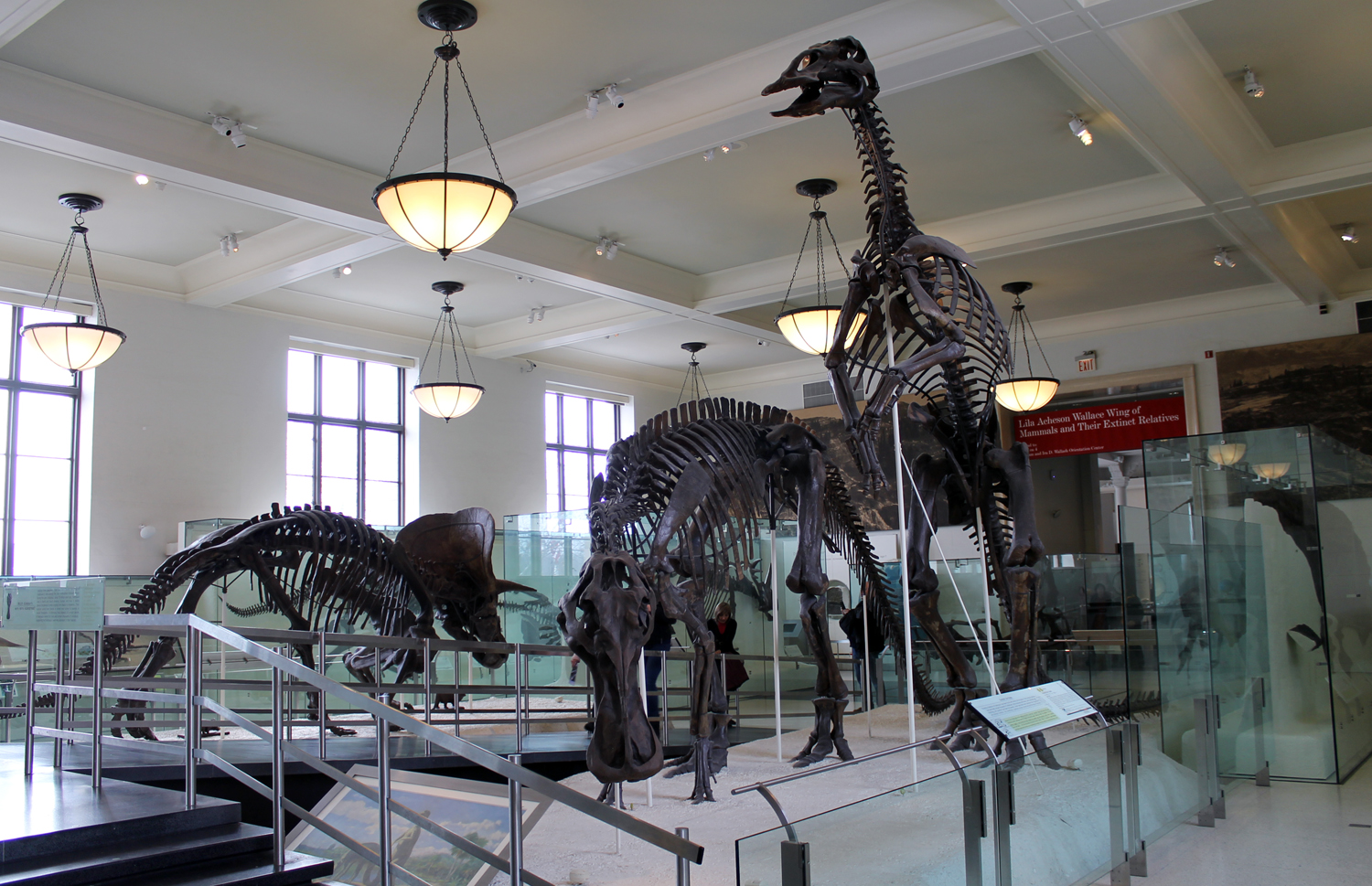
The former “Brontosaur Hall” is now the Hall of Saurischian Dinosaurs. Photo by the author.

Dingus also had transformative plans for the fourth floor’s interpretation and organization. Rather than the traditional walk through time that characterized the midcentury exhibits, the renovated halls would be arranged according to phylogenetic classification: visitors were meant to explore the vertebrate family tree as they moved through the fourth floor galleries. Each large hall represented a major branch, and was further divided into smaller alcoves representing specific groups, like turtles, artiodactyls, or ornithomimid dinosaurs.

While this organization closely matched how paleontologists think about life on Earth (particularly those at AMNH who helped pioneer the cladistic methodology), it is unfamiliar to most visitors. For Dingus and his colleagues, this wasn’t a flaw—it was the point. “Is it enough simply to discuss what visitors want to know about,” Dingus wrote at the time, “or do exhibitions have a responsibility to broaden their audiences’ horizons by presenting challenging information?”

Field Museum visitors play with a zoetrope in the shadow of an Apatosaurus skeleton. Photo by John Weinstein, © Field Museum

Dingus was planting a big, blue AMNH flag on one side of an ongoing debate about the role of museums and the purpose of their exhibits. “There is a prominent, contemporary school of exhibition design that advocates giving the visitor only what he or she asks for,” he wrote. “I vehemently disagree with this philosophy. We cannot pitch all the information to the lowest common denominator of interest and intellect.”

Dingus was likely referring to the philosophy championed by Michael Spock, who was at that time the Vice President for Public Programming at the Field Museum of Natural History. Spock had previously gained industry attention for his exploratory, interactive exhibitions at the Boston Children’s Museum. At the Field Museum, his approach was to make exhibitions “for someone, rather than about something.” Under Spock, projects began by asking community members what they were curious about, rather then by dictating what was important. Spock-era exhibits were filled with interactive and touchable displays meant to illustrate scientific concepts—some more successfully than others. They also tended to embrace a “less is more” aesthetic, taking deep dives into a few examples rather than trying to represent the full breadth of the museum’s collection.

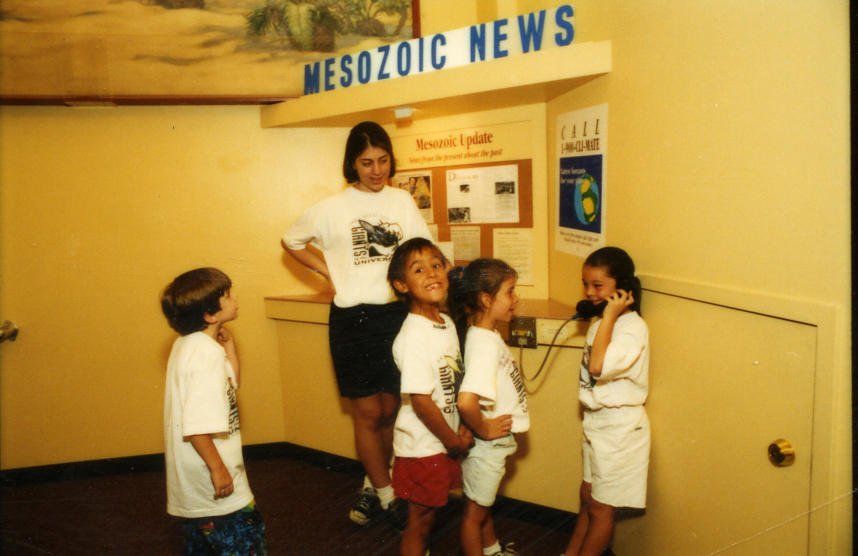
A group of children get updates on climatic changes over time in the form of news reports. Photo by John Weinstein, © Field Museum

For better or worse, Dingus’s fossil halls at AMNH could not be more different than the ones Spock oversaw at the Field Museum. There are no levers to pull, no “Dial-a-Dinosaur” phones, and certainly no rideable trilobites (all features of the early 90s Field Museum). Instead, the focus is on the fossils, and—as mentioned—there are far more of them on display than at any comparable museum. The closest things to interactives are the computer terminals, which allow visitors to select from menus of scientist-narrated videos.

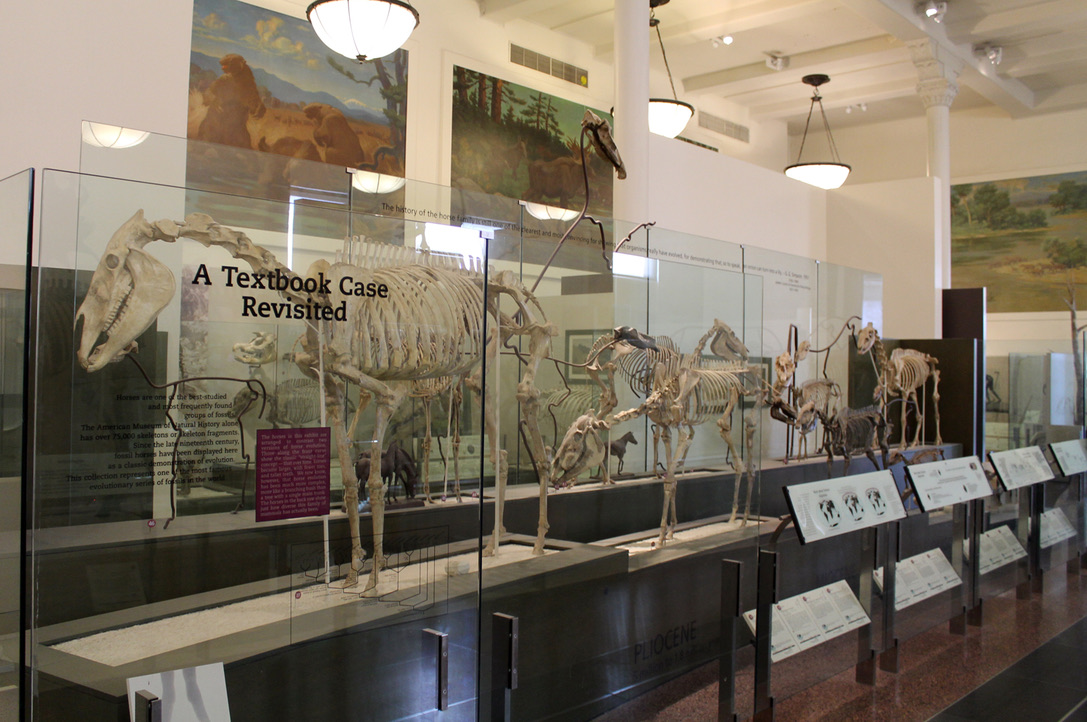
A display of fossil horses at AMNH. Photo by the author.

As it happened, Spock’s version of the Field Museum fossil halls barley lasted a decade, while Dingus’s AMNH exhibits remain mostly unchanged today: aside from the Patagotitan in the Orientation Center, the next largest addition might be a Tiktaalik cast skull in one case in the Hall of Vertebrate Origins. So how have the AMNH halls fared?

I sympathize with Dingus’s aim to “promote science literacy and develop a better awareness of how science can help illuminate the world.” That said, the AMNH fossil halls are clear example of a debunked educational style known as the “deficit model”—briefly, this is an approach to teaching that assumes students are empty vessels that can be simply filled with information. Moreover, I’m not convinced that the phylogenetic arrangement of the halls is particularly helpful for most visitors. The AMNH fossil halls are perfect for college students already learning about the diversity of life. But for most everyone else, the organization is opaque at best and a hindrance to understanding at worst. Making sense of phylogeny requires a lot of groundwork up front—even something as basic as knowing which direction to read a tree is not common knowledge. The Meryl Streep-narrated video in the Orientation Hall attempts to bridge this gap, but it’s overlong and not terribly engaging. Meanwhile, the multi-entrance, cyclical shape of the fourth floor means that only a fraction of visitors are actually starting in the Orientation Hall.

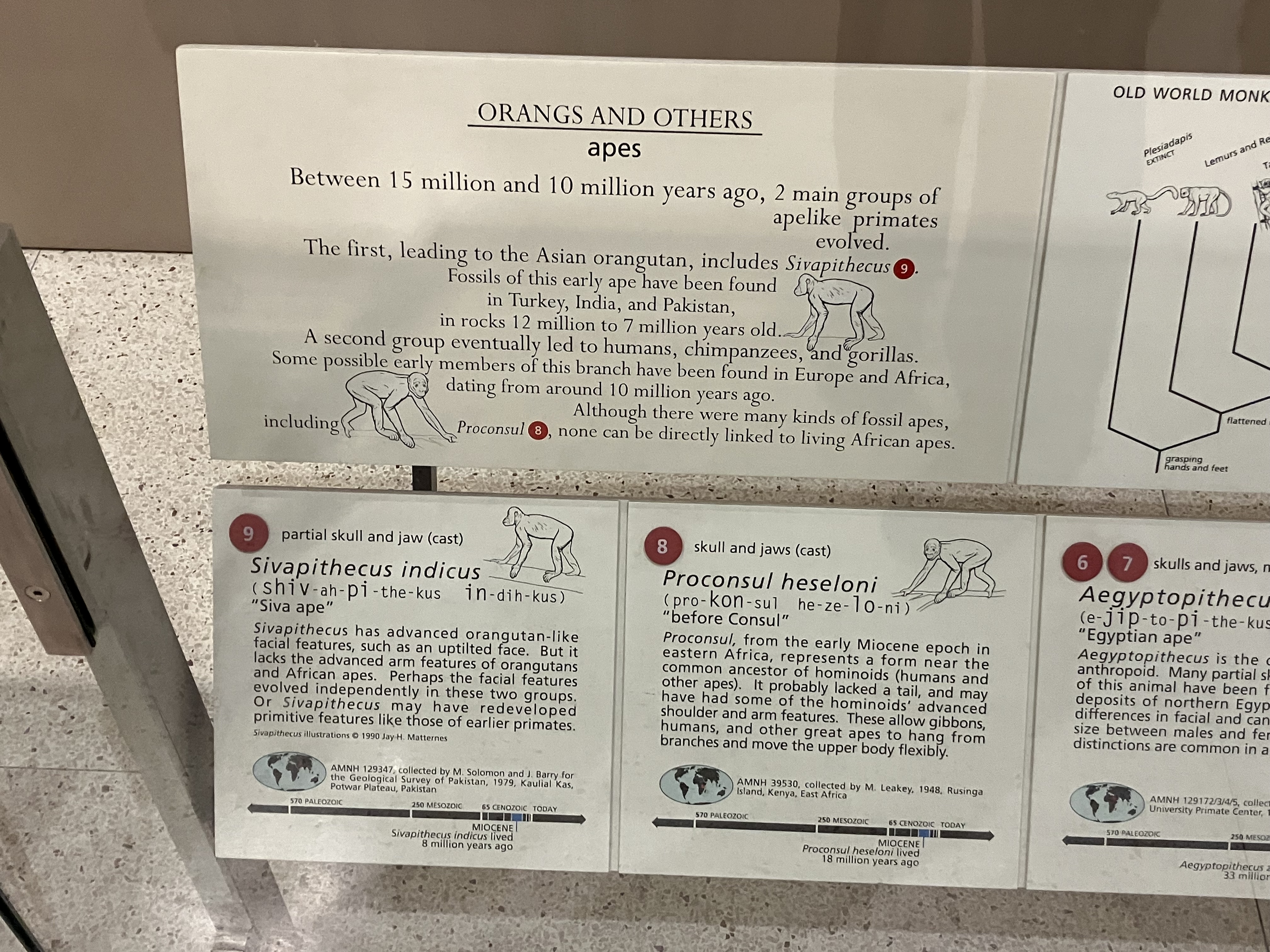
An example of a graphic with bizarre kerning and layout choices. Photo by the author.

Within the galleries, the central pillars that update visitors on where they are in the tree are generally ignored. Part of the problem is that displays which highlight the three-fingered hand, the stirrup-shaped stapes, and other seemingly minor features that unify evolutionary groups are not especially compelling. And although I appreciate the wide open and well-lit spaces, I think the design of the halls might be working against the interpretation. It’s hard to tell where one grouping ends and another begins when every surface is either white or made of glass.

Speaking of unhelpful design, there are some bewildering graphic design choices in these halls. On a single graphic, text may switch from center to left to right justification, randomly change in font and/or size, or be interrupted by illustrations placed in the middle of paragraphs. Sometimes paragraphs or even sentences run across multiple surfaces, and some text is printed on the glass barriers in front of fossils, making it even harder to read. I don’t want to harp on this forever so I’ll just link to some more chaotic examples here, here, here, and here.

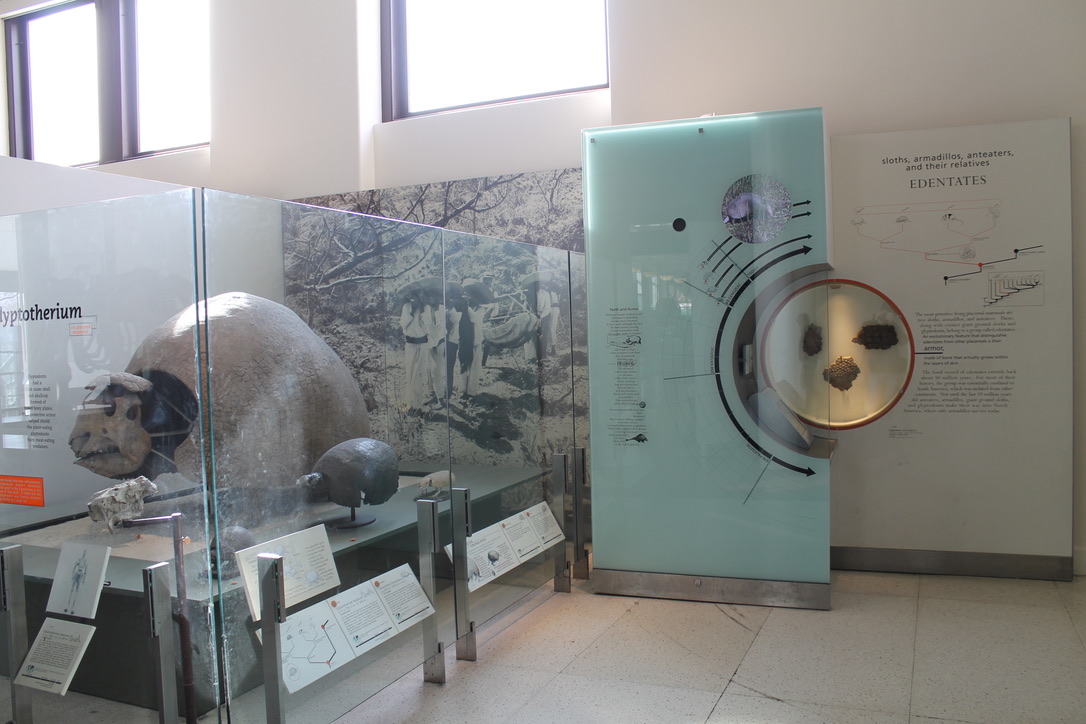
A corner devoted to the Edentates, which is no longer considered a real evolutionary group. Photo by the author.

Simply put, I’d be very surprised if many visitors are engaging with the phylogenetic organization, or even wondering why the fossils they’re looking at are displayed together. Remember: most visitors come in mixed-aged groups. The trip to the museum is a social experience, and interactions occur among visitors as much as they occur between visitors and the exhibits. The best museums anticipate and meet the needs of these visitors. Too much information, or irrelevant information, is just as bad as too little. I’m all for “broadening horizons” with “challenging” content, but the exhibit needs to be accessible first.

Even if the AMNH fossil halls are pitched above most visitors’ levels of interest, background knowledge, and patience, is the information at least reliable? Much of it is, but phylogeny is inherently volatile, and many groupings (to say nothing of particular genera and species) in the exhibit have been out of date for decades. Visitors in 2024 are being told that tyrannosaurs are a kind of carnosaur (they’re actually coelurosaurs), that pangolins, aardvarks, and sloths form a group called Edentates (they’re actually distantly related), and that primates and rodents are closely related to bats (they’re not). But other groupings in these halls have fared better: the exhibition definitively states that birds are a kind of dinosaur, an idea that enjoys near-universal acceptance today but was reasonably disputable in the early 90s.

Early 20th century tail-draggers. Photo by the author.

On top of the outdated information scattered throughout the halls, about a dozen of the mounted dinosaur skeletons are in old-fashioned, tail-dragging poses. These were known to be inaccurate at the time of the last renovation, but the budget only covered remounting two of them (the Apatosaurus and the Tyrannosaurus).

And just to be exhaustive in covering issues with the existing halls, many paleontologists over the years have discovered that the museum has no easy way to open the large glass cases that house some of AMNH’s most unique and significant fossils. Specimens like the Barosaurus, the Gorgosaurus pair, and the Corythosaurus mummy can only be accessed with the help of hired glaziers, and the museum requires scientists to cover the expense. This is well beyond most research budgets, and as a result, many of these world-famous and one-of-a-kind specimens have not been studied closely in decades.

So it’s fair to ask, why haven’t the AMNH fossil halls been updated yet? To be clear, the museum’s scientific and exhibitions staff are fully aware of everything I mentioned above. I’m sure the biggest hurdle is that a thorough renovation would be really, really expensive. For comparison, the NMNH renovation that took place between 2014 and 2019 cost $110 million ($70 million to restore the century-old east wing and $40 million for the exhibition itself). There’s also the cost in visitation to consider: if AMNH is anything like its peers, a big part of its operating budget comes from visitor admissions (for readers outside the United States, most of our museums are private nonprofits and do not get direct government support). Take away the most popular exhibition in the building for any length of time, and that income drops sharply.

A cast of Tyrannosaurus rex in the AMNH traveling exhibition T. rex: The Ultimate Predator. Photo by the author.

From context clues, I don’t think a top-to-bottom renovation of the permanent fossil halls is coming any time soon. AMNH only recently hired a new fossil reptile curator, Roger Benson, in 2023. And the museum just opened a brand-new wing called the Gilder Center, which took five years and $465 million to build. The museum also just announced that it has temporary custody of Apex, a privately-owned Stegosaurus skeleton. According to a press release, Apex will eventually be the centerpiece of a new passageway connecting the Gilder Center to the permanent fossil halls (the real skeleton until 2028 or so, then a cast). I’d be surprised if we hear anything about a full-scale renovation until after Apex has left the building.

To their credit, the AMNH exhibitions team hasn’t exactly been idle when it comes to dinosaur displays. Over the last two decades, they’ve been rolling out a series of fossil-centric traveling exhibitions, including The World’s Largest Dinosaurs, Dinosaurs Among Us, Extreme Mammals, and T. rex: The Ultimate Predator. Each of these temporary shows has been up-to-date with new science and high-tech exhibtry. When the time comes, I’m sure this team could do great work on new permanent fossil galleries.

But for now, what are your hopes for the eventual AMNH renovation? What do you want to see changed or introduced? What should stay the same? Please leave a comment with your ideas!

References

Dingus, L. 1996. Next of Kin: Great Fossils at the American Museum of Natural History. New York, NY: Rizzoli International Publications, Inc. 

Honan, W.H. 1990. Say Goodbye to the Stuffed Elephants. The New York Times Magazine

Solomon, D. 1999. He Turns the Past Into Stories, and the Galleries Fill Up. The New York Times.

Spiegel, A.N., Evans, E.M., Frazier, B., Hazel, A., Tare, M., Gram, W., and Diamond, J. 2012. Changing Museum Visitors’ Conceptions of Evolution. Evolution: Education and Outreach 5:1:43-61.

Torrens, E. and Barahona, A. 2012. Why are Some Evolutionary Trees in Natural History Museums Prone to Being Misinterpreted? Evolution: Education and Outreach 1-25.

11 Comments

Filed under AMNH, education, exhibits, FMNH, museums, opinion, science communication

Creating a home for the Chicago Archaeopteryx

Archaeopteryx banners adorn the Field Museum’s north entrance. Photo by the author.

August 17, 2022. I had just finished a very long drive from Denver to Chicago and wasn’t planning on coming in to the museum that day, but then I heard the news: the fossil was here. The acquisition of the 13th Archaeopteryx by the Field Museum was, by necessity, shrouded in secrecy. There was no reason I needed to know the exact arrival date until the last minute, but I didn’t want to miss the first look at such a historically significant fossil.

That’s how I found myself crammed into the Geology Department’s tiny X-Ray room with a dozen other people. Masks on tight, we all waited with bated breath as Preparator Connie Van Beek pulled up the first images of the slab on the computer. Most of the known Archaeopteryx specimens were commercially prepared before being acquired by museums, but the Field Museum’s new fossil was still sealed in the rock. Aside from the exposed wing feathers—the tell that this was indeed an Archaeopteryx—nobody knew what this block of limestone contained. Would it only preserve the limbs, like the Maxberg and Haarlem specimens, or was there a complete skeleton in there? As we waited for the X-Ray to appear, nobody dared utter the s-word (skull, that is).

Then the image blinked onto the screen. It was a bit faint (these are paper-thin bird bones, after all) but the entire thing was there. Four limbs, a torso, a tail and—folded back in the classic dinosaur death pose—the unmistakable smear of the head and neck. The room erupted into spontaneous applause.

After 1,300 hours of meticulous fossil prep, the Chicago Archaeopteryx is now on display. Photo by the author.

Two years and one month later, the Chicago Archaeopteryx became a permanent resident of Evolving Planet, the Field Museum’s paleontology exhibition. I had the pleasure of serving as the Exhibition Developer for this project, working alongside a brilliant and creative group including Associate Curator Jingmai O’Connor, preparators Akiko Shinya and Connie Van Beek, and all my colleagues in the Exhibitions department. This post is a peek into the thought process behind our new Archaeopteryx display.

Hey, look at me!

A Parasaurolophus-eye view of the Evolving Planet dinosaur hall. Photo by the author.

Once it was decided that the Archaeopteryx should be incorporated into Evolving Planet (rather than being displayed somewhere else in the building) the first order of business was figuring out where exactly to put it. Evolving Planet is arranged chronologically—visitors start at the origin of life 4.5 billion years ago and work their way up to the present. Hailing from the Late Jurassic, Archaeopteryx would need to go somewhere in the central dinosaur hall, which covers both the Jurassic and Cretaceous Periods. But unlike the rest of the exhibition, the dinosaur hall isn’t strictly chronological. There are multiple competing organization schemes in there—the murals on the walls are in Jurassic and Cretaceous clusters, but the central corrals are arranged by evolutionary groups (except when they’re not). And then there’s the big case of marine fossils that span the entire Mesozoic.

I may have lost some sleep over this. Should Archaeopteryx be near the Jurassic Apatosaurus and Stegosaurus (even though it lived on the other side of the world), or near the other theropod dinosaurs? Or maybe it should be with the marine fossils, since it was found in marine limestone. Ultimately, I realized that there was no perfect way to introduce a substantial new display into a space that had already been renovated multiple times, but it wouldn’t ruin visitors’ experience if Archaeopteryx didn’t fit seamlessly into the established flow.

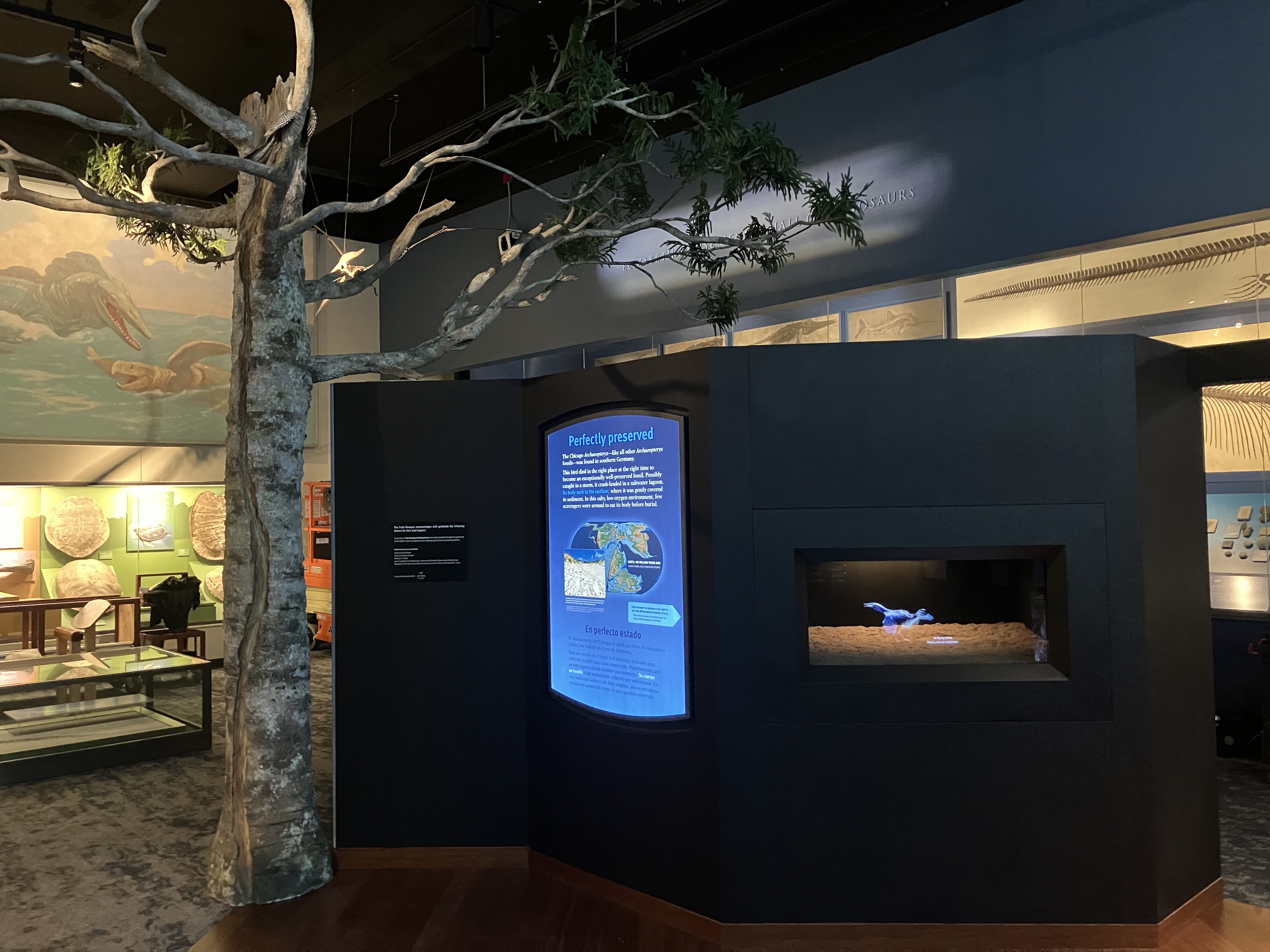
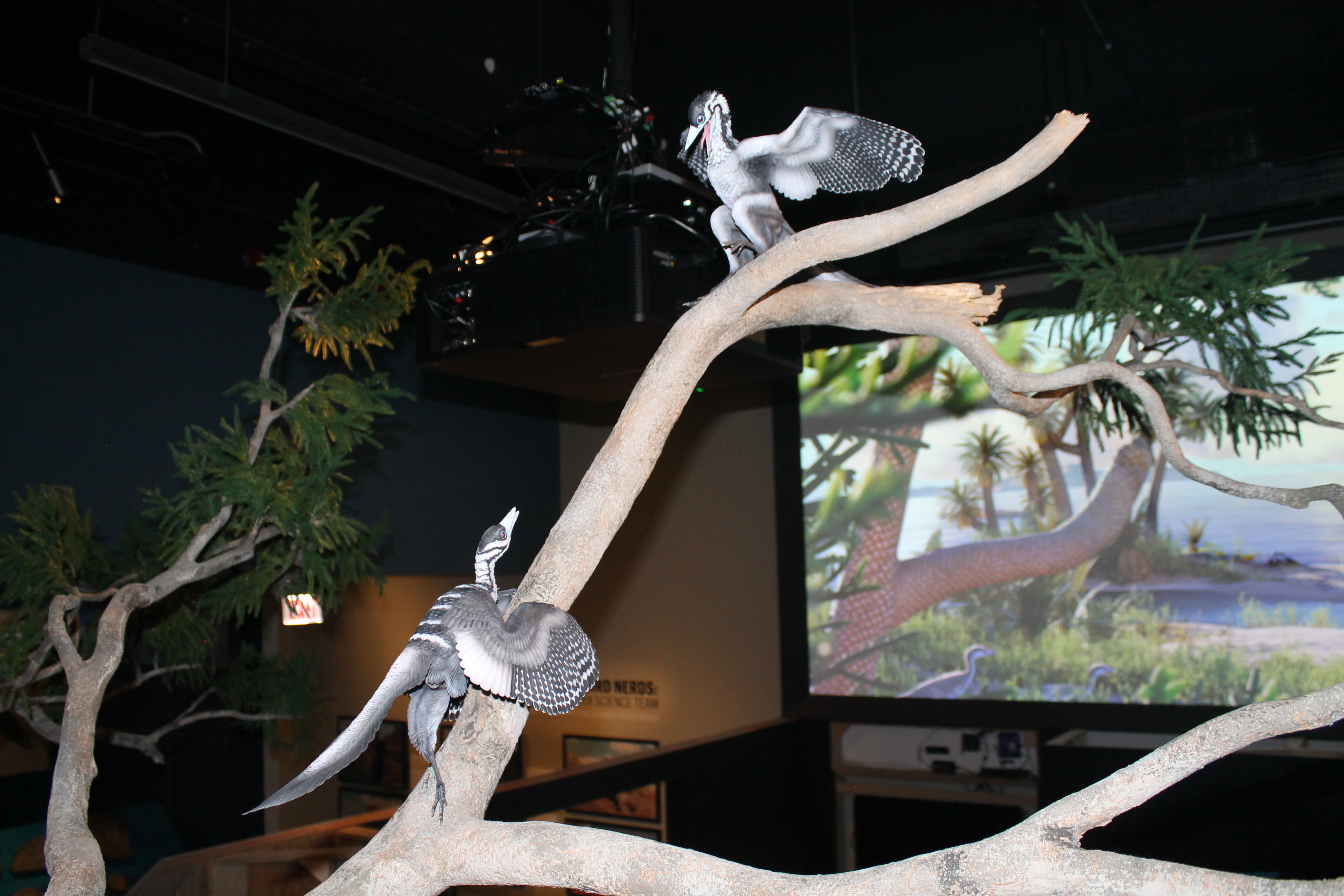
A replica tree and an animated mural beckon visitors to the Archaeopteryx display. Photo by the author.

There was a more pressing issue influencing where to place Archaeopteryx: the fossil itself is really small. The bird, now splayed across an 18-inch flat slab, is no larger than a pigeon. It may be the most complete Mesozoic dinosaur in the Field Museum’s collection and a contender for the best-preserved Archaeopteryx yet found, but its size makes it easy to overlook alongside a half dozen giant skeletons. When Senior Designer Eric Manabat and I first met to discuss the new project, we immediately agreed that the display would need a physical presence comparable to the other dinosaurs.

With that in mind, we decided the best place for Archaeopteryx was the largest open space in the dinosaur hall. That way, we could maximize the amount of interpretive content surrounding the fossil, and also create displays that would signal to visitors that this was something worth paying attention to.

We propose that our Archaeopteryx may have been swept out to sea in a storm. My headcanon is that this tree was struck by lightning during the same event, and has the scar to prove it. Photo by the author.

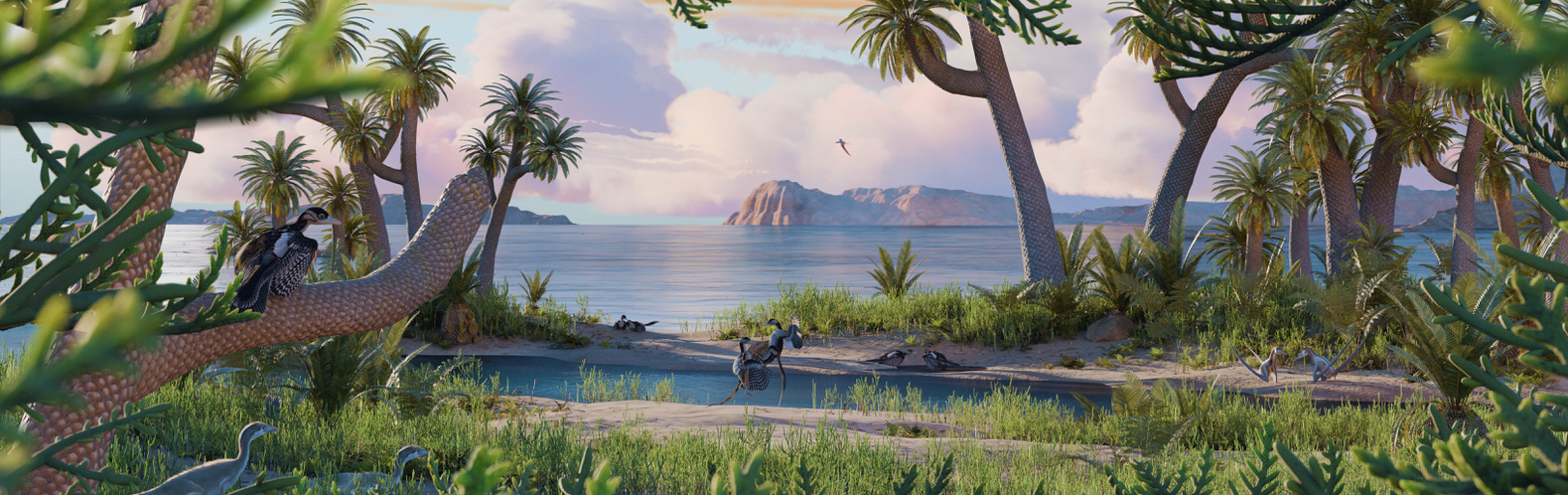
As designed, the Archaeopteryx display has two layers of interpretation. The outer ring, visible from anywhere in the dinosaur hall, showcases the world the first bird lived in. A physical Brachyphyllum tree full of Archaeopteryx models stands in the foreground, and an animated backdrop fills in the rest of the Solnhofen habitat (please notice the coniferous branches peeking into the corners of the animation, which are meant to be an extension of the model tree). We used the habitat reconstruction as the “attractor” because visitors frequently cite these immersive recreations as their favorite parts of our paleontology exhibits.

Casts of Caudipteryx, Anchiornis, and others tell the story of how birds continued to evolve after Archaeopteryx. Photo by the author.

Once visitors enter the exhibit space, the focus changes to Archaeopteryx itself: how it died and was preserved, how it fits into our understanding of dinosaur evolution, and what’s special about this particular fossil. We wanted to create an enclosed, intimate space so visitors could get up close to the fossil and admire it’s delicate details. A program of changing lights helps direct attention to features like feathers, teeth, and claws. And for visitors who prefer a tactile experience, we have a touchable copy of the fossil at three times actual size.

Recreating the World

A moment from the animated mural. © Field Museum.

Much like the permanent and traveling SUE exhibitions, a new reconstruction of the star dinosaur was a major part of the Archaeopteryx project. This time, we worked with the animation studio PaleoVisLab to create the definitive Archaeopteryx and a world for it to inhabit. I joined Jingmai O’Connor, Latoya Flowers, Wesley Lethem, and others in weekly meetings with paleontologist Jing Lu and animation lead Heming Zhang for nearly a year as they brought the first bird to life.

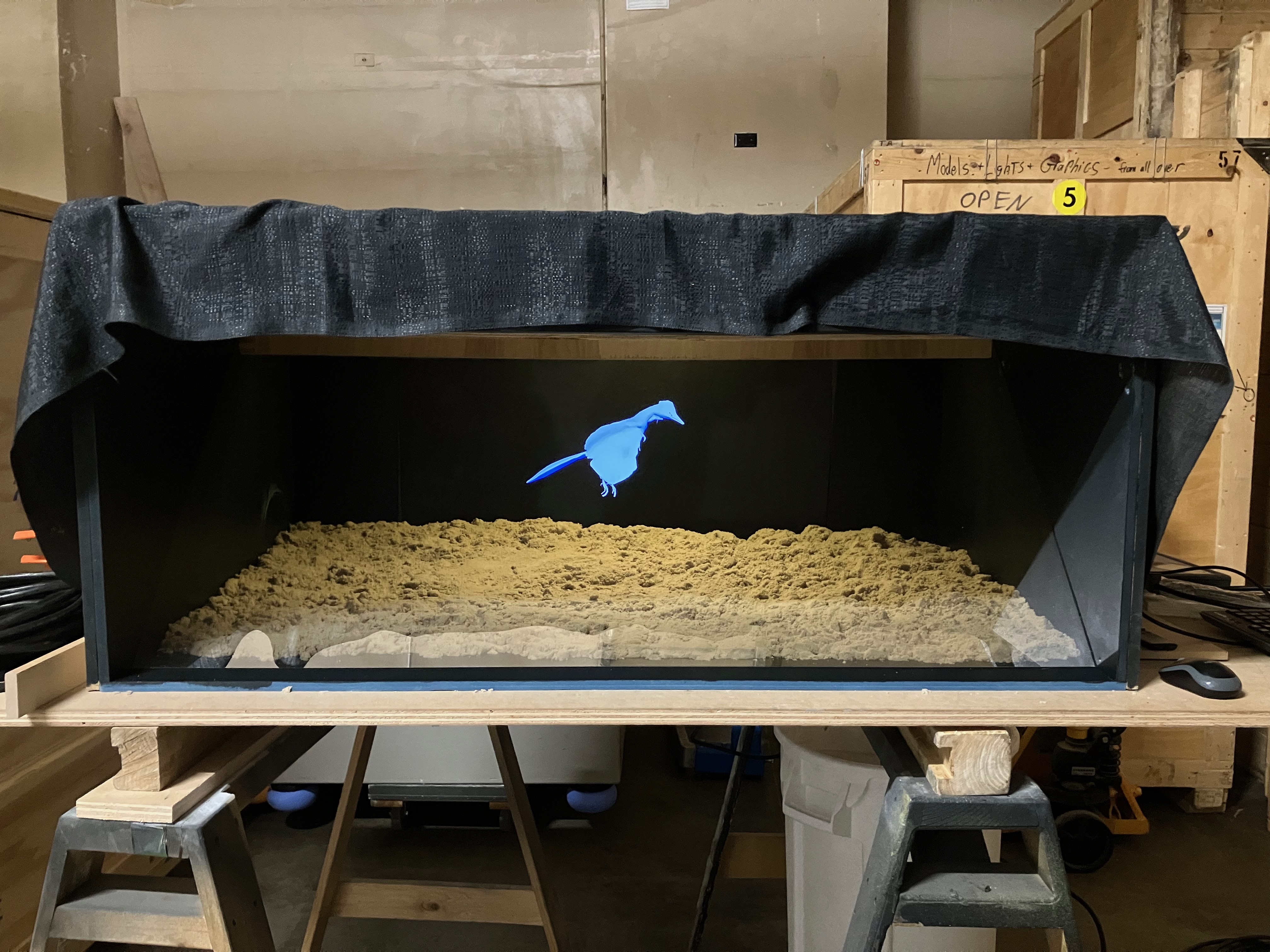
The PaleoVisLab team actually created two animations. The first is a simulated “hologram” which illustrates the taphonomic circumstances that resulted in such a perfectly preserved fossil. This animation resides in a pepper’s ghost chamber, designed and built by Latoya and Wesley. It was fun integrating a 160 year-old magic trick into our exhibit, and I appreciate the cosmic coincidence that the pepper’s ghost technique was first popularized within a few years of the discovery of the first Archaeopteryx.

A prototype of the pepper’s ghost chamber. Getting the image to float in space correctly took months of iteration. Photo by the author.

The second, far more daunting animation was the moving mural. We knew we wanted a big, impressive recreation of Archaeopteryx in its world, but we fretted about how it would fit among the century-old Charles Knight murals that adorn the walls of the dinosaur hall. We wanted something that looked dynamic and modern, but it needed to coexist respectfully with the classic oil paintings, and not attempt to overshadow them. I think we managed to toe the line, and the completed piece even has a few nods to Knight’s Solnhofen scene (which is still on display). The pair of Compsognathus in the lower left corner is the most obvious example.

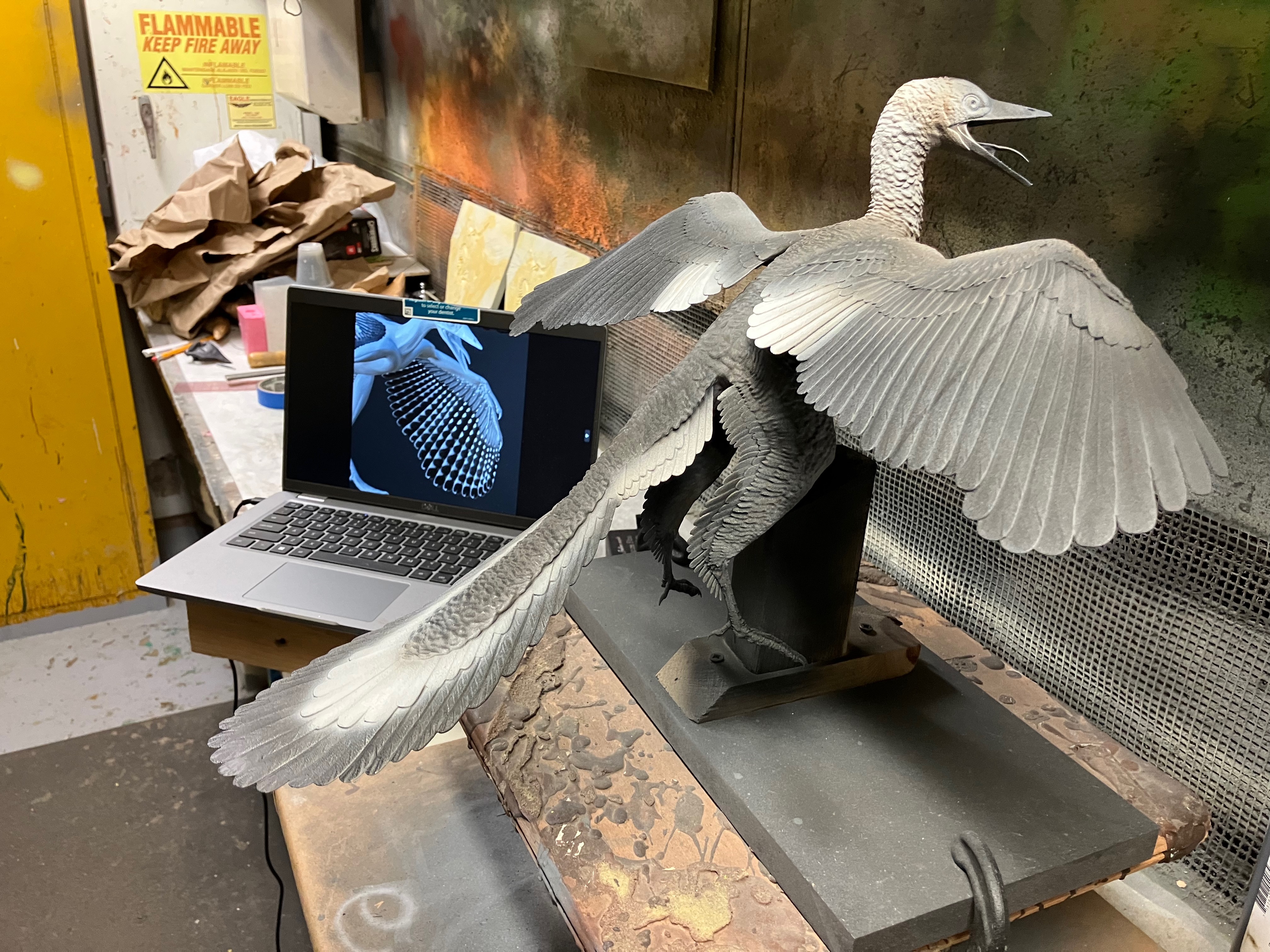
A 3-D printed Archaeopteryx in the early stages of painting. Photo by the author.

Heming could not be restrained from from putting astonishing (one might say insane) amounts of detail into every animal and plant in the scene. I particularly remember the day he turned up for the weekly call and enthusiastically showed us that he had modeled both male and female dragonflies, with hundreds of individual lenses on their compound eyes and even different genitalia. Every creature—from the tiny Homoeosaurus scurrying across the sand to the Aspidorhynchus that jumps out of the water for less than two seconds—was carefully reconstructed from the skeleton up. Naturally, the Archaeopteryx got the most attention. Our model is specifically based on new information gleaned from the Chicago specimen—note the shape of the head in particular.

The physical bird models in and around the tree are 3-D prints of the digital version, which was a new approach for us. This solved a problem we had on the SUE project, where we had different artists simultaneously creating images in different media that somehow had to match. But the 3-D prints also created new challenges: the spindly legs and toes were too fragile to actually hold the model’s weight, so we had to come up with some creative ways to mount them in the tree. Janice Lim constructed the mounts and painted the models so that they perfectly match their animated counterparts. And while I’m shouting out artists, illustrations by Ville Sinkkonen, Gabriel Ugueto, Liam Elward, and Scott Hartman also appear in the exhibit.

These fighting birds poised above the entrance are my favorite part of the exhibit. Photo by the author.

For me at least, the primary goal of the Archaeopteryx display was to get as many visitors excited about this rare fossil as possible. Given that it doesn’t have the size, name recognition, or ferocious appearance of T. rex or Spinosaurus, getting people to pay attention to a little bird with a hard-to-pronounce name wasn’t a sure thing. The solution was to create as many “entry points” as possible. Maybe you’re interested in animals and how they behave. Maybe you’re interested in history, and how our scientific understanding of the world came to be. Maybe your curiosity is activated by seeing something in motion, or by touching things, or by encountering something unique and special. My hope is that whatever interests you bring with you, we’ve created a space where there’s something for you to get excited about.

Leave a comment

Filed under dinosaurs, exhibits, FMNH, museums, paleoart

The Field Museum’s other Archaeopteryx

Many superlatives apply to this gorgeous fossil. Photo by the author.

Earlier today, the Field Museum revealed the Chicago Archaeopteryx to the world. Named for the city it resides in (as is traditional for Archaeopteryx fossils), this is only the 13th specimen of this famous taxon yet discovered, and a contender for the best-preserved. The fossil is currently on display for a limited preview—it will go back to collections for further research on June 9, then return as part of a larger, permanent exhibit toward the end of the year.

Archaeopteryx is famous for being the fossil that proved Darwin right. When he laid out his case for evolution by natural selection in On the Origin of Species (published in 1859), Darwin primarily relied on observations of living organisms, but predicted that transitional forms between groups should appear in the fossil record. Then, just two years later, the first Archaeopteryx fossil turned up—a reptile with feathers like a bird. Archaeopteryx has been synonymous with evolutionary science ever since, and it’s had its part to play as our understanding of the relationship between dinosaurs and living birds gradually solidified. Today, we know that Archaeopteryx wasn’t the first feathered dinosaur, but it was the earliest known dinosaur to use its feathers for flight, rather than for insulation or display. Archaeopteryx fossils have proven stubbornly rare, however, so each individual specimen is celebrated.

The Chicago specimen is not, in fact, the first Archaeopteryx to be displayed at the Field Museum. For two weeks in 1997, the museum hosted a very limited engagement of the fossil now known as the Munich Archaeopteryx. The Munich specimen was found in August of 1992 and was the 7th individual to be discovered. Like all other Archaeopteryx fossils, it was collected in Bavaria, Germany in a spoil pile of Solnhofen limestone. Slabs of this rock have been used for centuries as roofing tiles and for lithographic printing. Indeed, the Munich Archaeopteryx was collected by Jürgen Hüttinger, a quarry worker employed by the Solenhofer Aktien-Verein stone company.

Aktien-Verein owned the quarry and thus, owned the fossil. The company contacted paleontologist and Archaeopteryx specialist Peter Wellnhofer, and loaned the fossil to the Munich Paleontological Museum for preparation and study. The Archaeopteryx was prepared by Ernst Schmieja under Wellnhofer’s supervision. It proved to be nearly complete, but only included the back part of the skull. Both the slab and counterslab were recovered—the skeleton is preserved in the slab but the feather impressions are more visible on the counterslab.

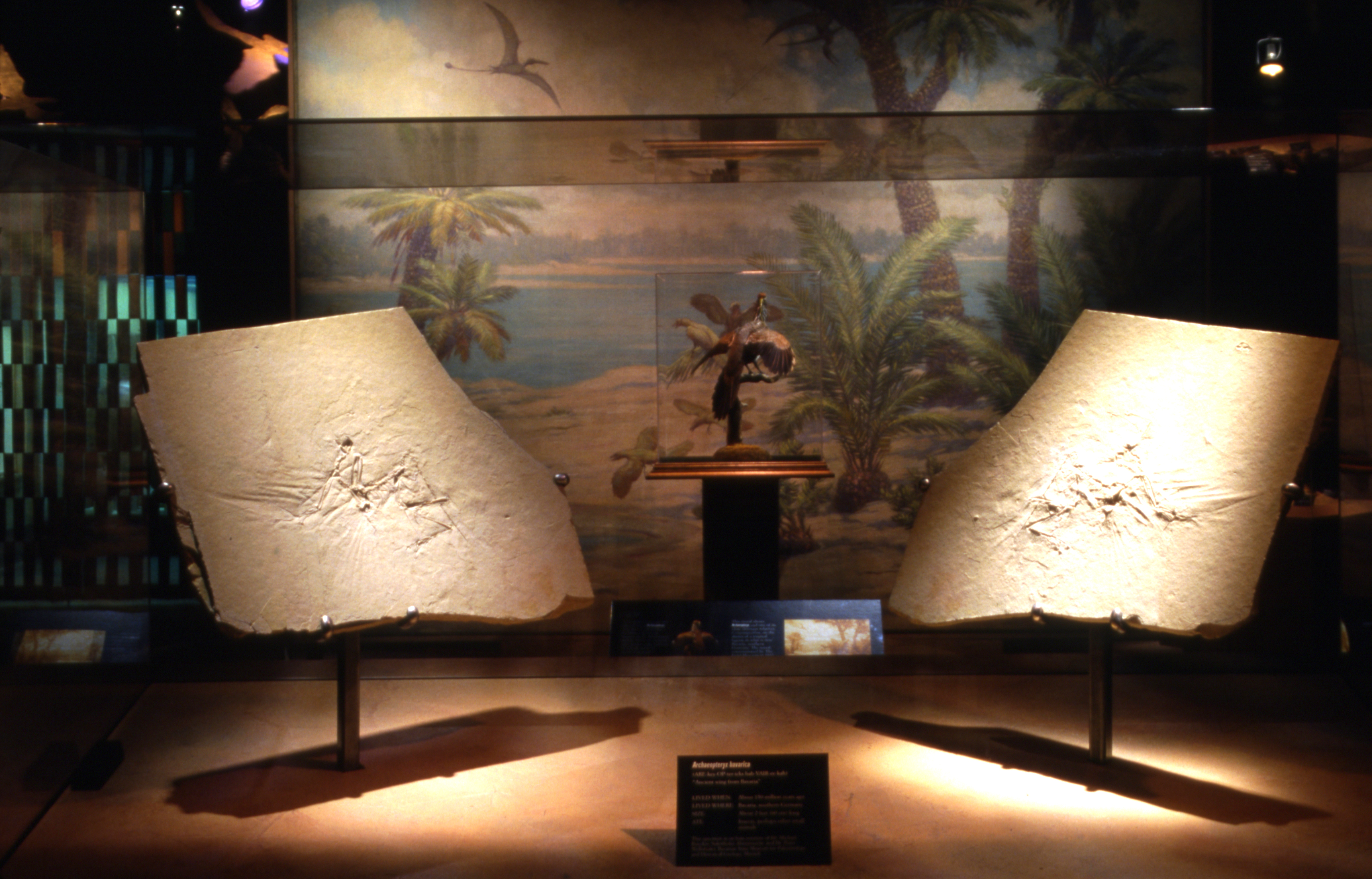
Slab and counterslab of the Munich Archaeopteryx on display at the Field Museum. Photo by John Weinstein, © Field Museum.

Aktien-Verein allowed the fossil to be displayed locally for several years, starting in 1993. But in 1997, plans materialized for the Archaeopteryx to take a little trip. Wellnhofer accompanied the fossil to Chicago so it could make an appearance at the 57th annual meeting of the Society of Vertebrate Paleontology (SVP), which the Field Museum was hosting that year. The fossil was on public display from October 4th through 19th, and Wellnhofer gave a public lecture on the 18th. While the visit was extremely short, it was also historic: this was the first time any Archaeopteryx fossil had ever left Europe. Many of the mostly North American paleontologists attending SVP that year had never seen an Archaeopteryx in person before.

Entrance to Archaeopteryx: The Bird that Rocked the World exhibition. Photo © Field Museum, courtesy of K. Mazanek, CC BY-NC 4.0.

The Exhibitions Department, for their part, went all-out in making the fossil’s brief visit special. The Archaeopteryx was displayed in a small gallery on the museum’s main level, past an impressive facade of angular blocks that recall slabs of Solnhofen limestone. The exhibit was officially titled “Archaeopteryx: The Bird that Rocked the World,” but only the name Archaeopteryx appeared over the entryway.

Once inside the darkened space, visitors could immediately inspect the slab and counterslab, which were mounted under a vitrine on an angled platform. Visible through the fossil case was Charles Knight’s Solnhofen mural from the 1920s, which was brought out of storage for this exhibit. Cases to the right and left contained small Solnhofen fish fossils and casts of Compsognathas and the Eichstätt Archaeopteryx.

Visitors gather near Greg Septon’s Archaeopteryx reconstruction. Photo © Field Museum, courtesy of K. Mazanek, CC BY-NC 4.0.

Another highlight was a new life-sized model of Archaeopteryx, created by Milwaukee Public Museum taxidermist (and accomplished falconer) Greg Septon. This Frankenstein-like creation was assembled from pelts and feathers from seven bird species, including a cormorant and a partridge. The teeth were sourced from a rainbow trout.

Referencing the bird’s German origin and leaning into it’s difficult-to-pronounce name, the museum held a family event on October 18 entitled “Archaeoptoberfest.” Kids could make kites, see other bird specimens, and hear the story of Icarus (really) under the feet of Ernestine the Brachiosaurus.

The brief visit to the Field Museum was the Munich Archaeopteryx‘s only time leaving Germany. Two years later, the Munich Paleontological Museum assembled the funding (nearly 2 million marks) to purchase it from Aktien-Verein. Today, it remains part of the Bavarian state collection and is on display in Munich.

Unlike the Munich specimen, the Chicago Archaeopteryx is a permanent addition to the Field Museum’s collection. You can learn more about its journey so far in Patti Wetli’s in-depth reporting for WTTW. Come see it before June 9 if you can!

References

Archaeopteryx: The Bird that Rocked the World. Earth Science News October 1997.

A rare bird indeed will visit Field Museum. Chicago Tribune Sep 30, 1997. ​​

Maes, N. Rare bird fossil has a Field day. Chicago Tribune October 3, 1997.

8 Comments

Filed under dinosaurs, exhibits, FMNH, museums

When were the Field Museum fossil mounts created?

So, I have a confession to make. In January of this year, I started working on an in-depth article about the Hall of Human Origins at the National Museum of Natural History. It was going to cover everything: John Gurche’s sculptures, the design and narrative of the gallery, the challenges of opening an exhibition about human evolution on the National Mall, and even the misguided accusations that the hall contains climate change denial. It’s a great story, and I really want to write it up. So I’m giving myself a public ultimatum: it has to be done before the end of the year.

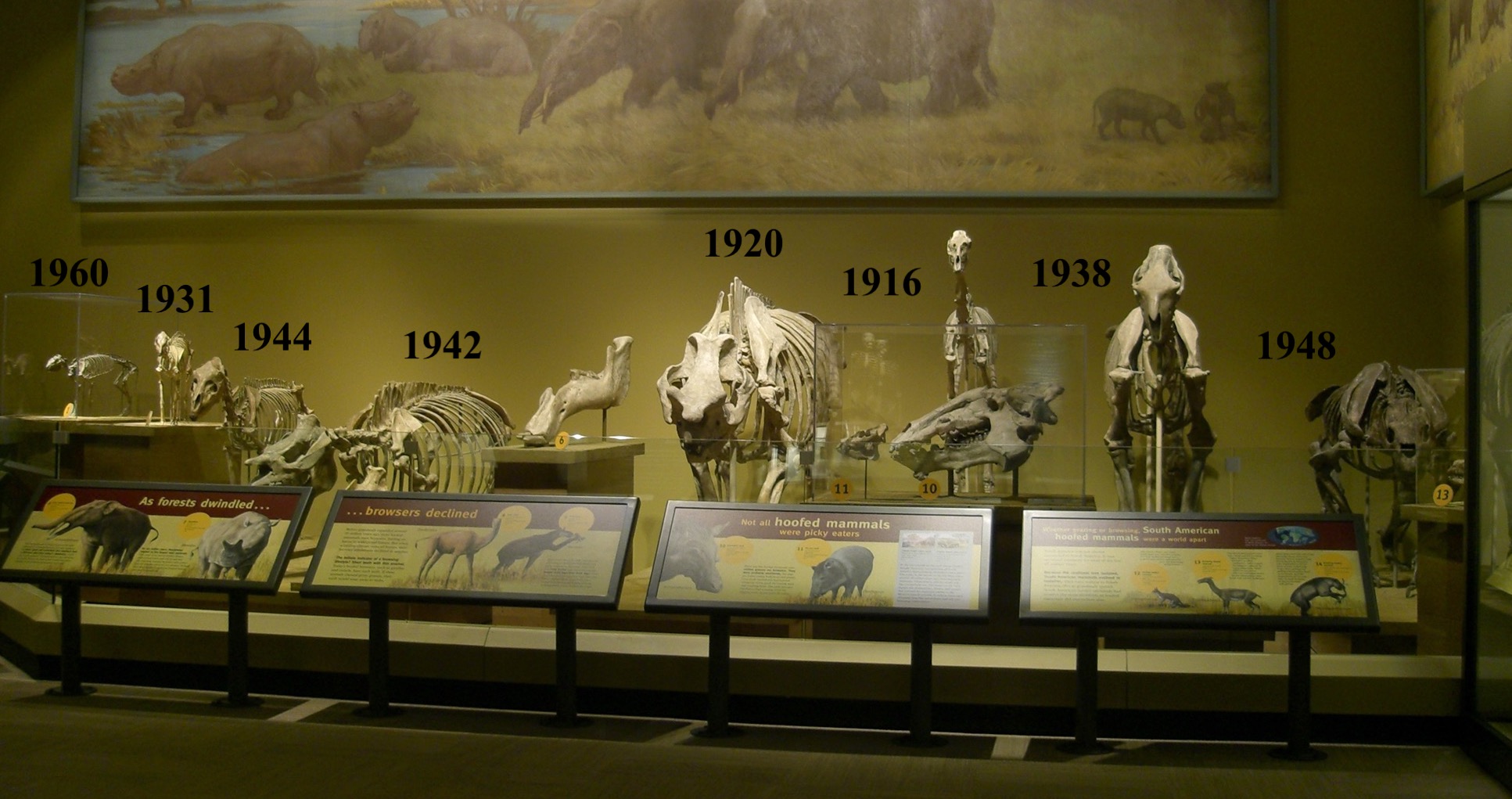
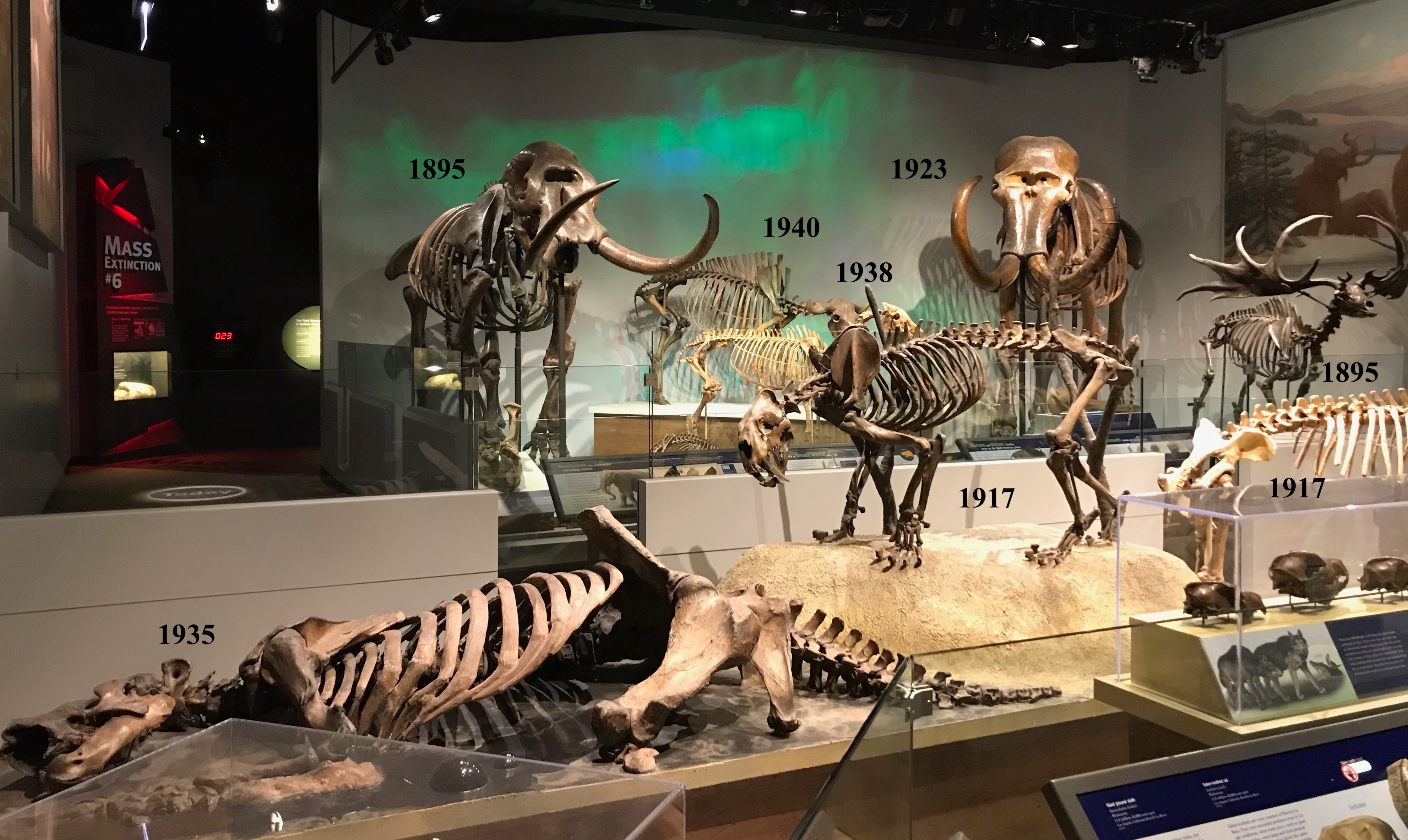
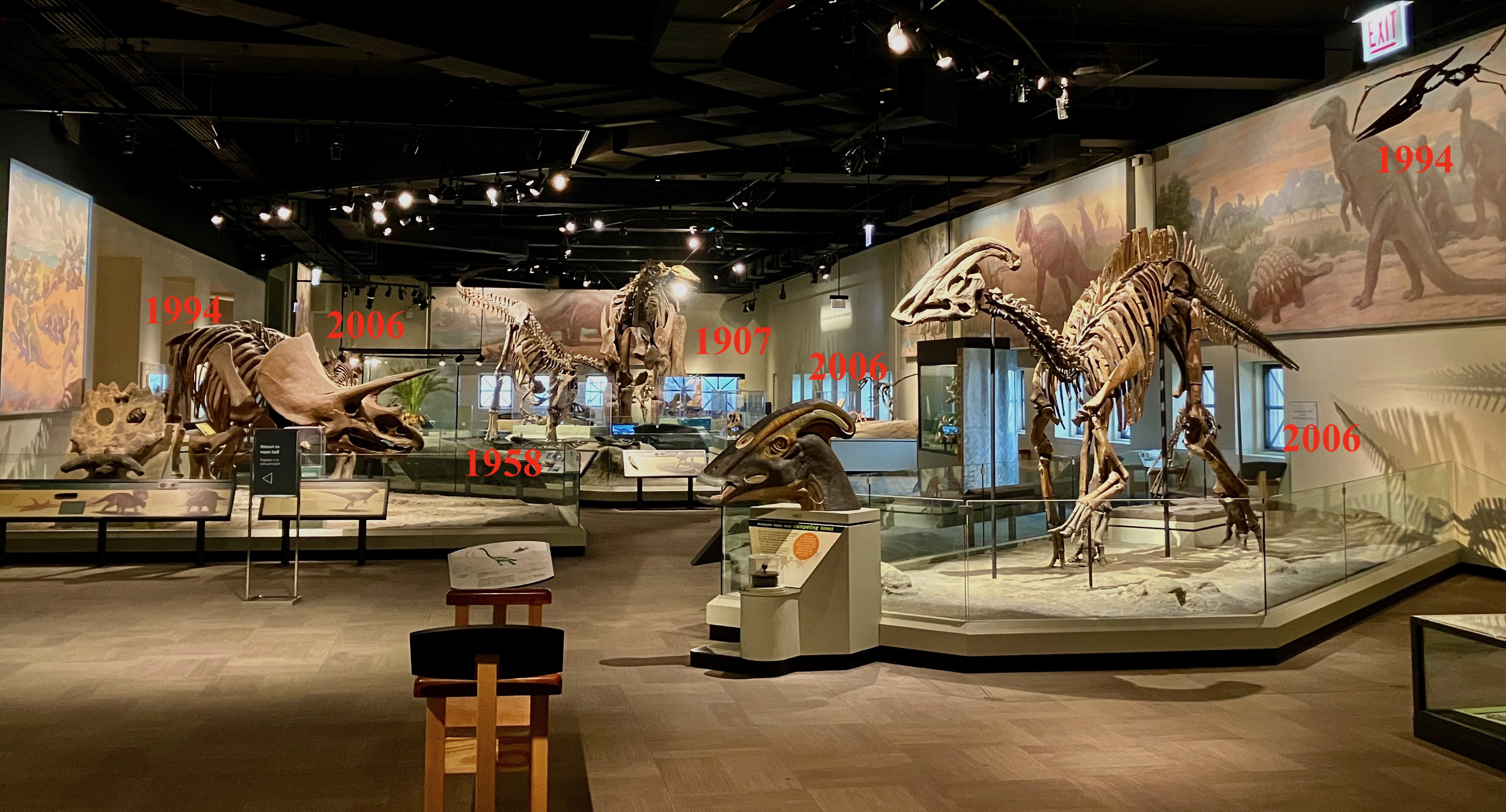
In the meantime, I’d like to share something I whipped up for social media (I’m primarily on BlueSky these days, if anyone’s looking for me). The annotated photos below show the year that each of these fossil mounts at the Field Museum first went on display. A complete list of currently-displayed mounts and their debut years is at the end of the post.

“Ungulate row” in the current Evolving Planet exhibition. Photo by John Weinstein, modified from original.

I find this interesting for a number of reasons. For one thing, it’s a reminder of the age of many museum exhibits. Multiple generations have come to see these fossils—a few of them predate the current Field Museum building by decades. But these dates are also a succinct recounting of the history of vertebrate paleontology at the Field. The oldest mounts—the mastodon and Irish elk—were leftovers from the Field Columbian Exposition, and presumably were purchased from the Ward’s Natural Science catalog.

The Ice Age menagerie in Evolving Planet. Photo by the author.

After that, a couple of dinosaurs join the fray. These were the result of Elmer Riggs’ first expeditions for the Field Museum. He was hired specifically to collect dinosaurs that could match the displays at AMNH and elsewhere, after all. Riggs’ real interest was in mammals, however, and by the 1910s we see that his department is exclusively mounting North American fossil mammals for display. In 1925, we begin to see the results of the Captain Marshall Field Expeditions (1923–1927) on display, as South American animals like Glyptodon and Aglaocetus join the exhibits.

Around 1948, the University of Chicago’s Museum of Geology closed down, and turned its collections over to the Field Museum. The University of Chicago had a particularly strong collection of Permian animals from Texas and South Africa, and there was an immediate flurry of activity to get those on display at the Field. A few of the University specimens went on exhibit as-is, but many (including Bradysaurus and Aulacephalodon) were disassembled and remounted by Orville Gilpin and others.

The dinosaur hall in Evolving Planet. Photo by the author.

After 1960, there was an extremely long period in which no new fossil mounts were added to the exhibits. The fossil halls languished without update until the end of the 20th century, with the opening of Life Over Time. Up until that point, the Field Museum had very few dinosaurs on display, but Life Over Time made dinosaurs its centerpiece. A growing popular interest in dinosaurs during the late 1980s, not to mention a certain 1993 movie, was probably the cause. Since that time, nearly all the new additions to the fossil exhibits have been dinosaurs. And with the exception of Arctodus in 2006, there have been no additions to the ranks of mounted mammal skeletons since the doldrums began in 1960.

That’s it for now, but let’s see about that Human Origins article before the end of the year!

Name (Common Name)TypeYear Installed (Updated)
Megaloceros giganteus (Irish elk)Mounted skeleton1895
Mammut americanum (mastodon)Mounted skeleton1895
Triceratops horridus (ceratopsian)Skull1905
Apatosaurus sp. (sauropod)Mounted skeleton1907 (1957, 1994)
Oxydactylus longipes (camel)Mounted skeleton1916
Dinictis felina (nimravid)Mounted skeleton1916
Smilodon fatalis (saber-toothed cat)Mounted skeleton1917 (1935, 1941)*
Ursus speleaus (cave bear)Mounted skeleton1917
Megacerops sp. (brontothere)Mounted skeleton1920
Mammuthus columbi (Columbian mammoth)Mounted skeleton1923
Aglaocetus moreni (baleen whale)Skull1925
Glyptodon clavipes (glyptodont)Mounted skeleton1926
Pronothrotherium typicum (ground sloth)Mounted skeleton1931
Mesohippus bairdi (horse)Mounted skeleton1931
Megatherium americanum (ground sloth)Mounted skeleton1935 (1994)
Paramylodon harlani (ground sloth)Mounted skeleton1935 (1941)
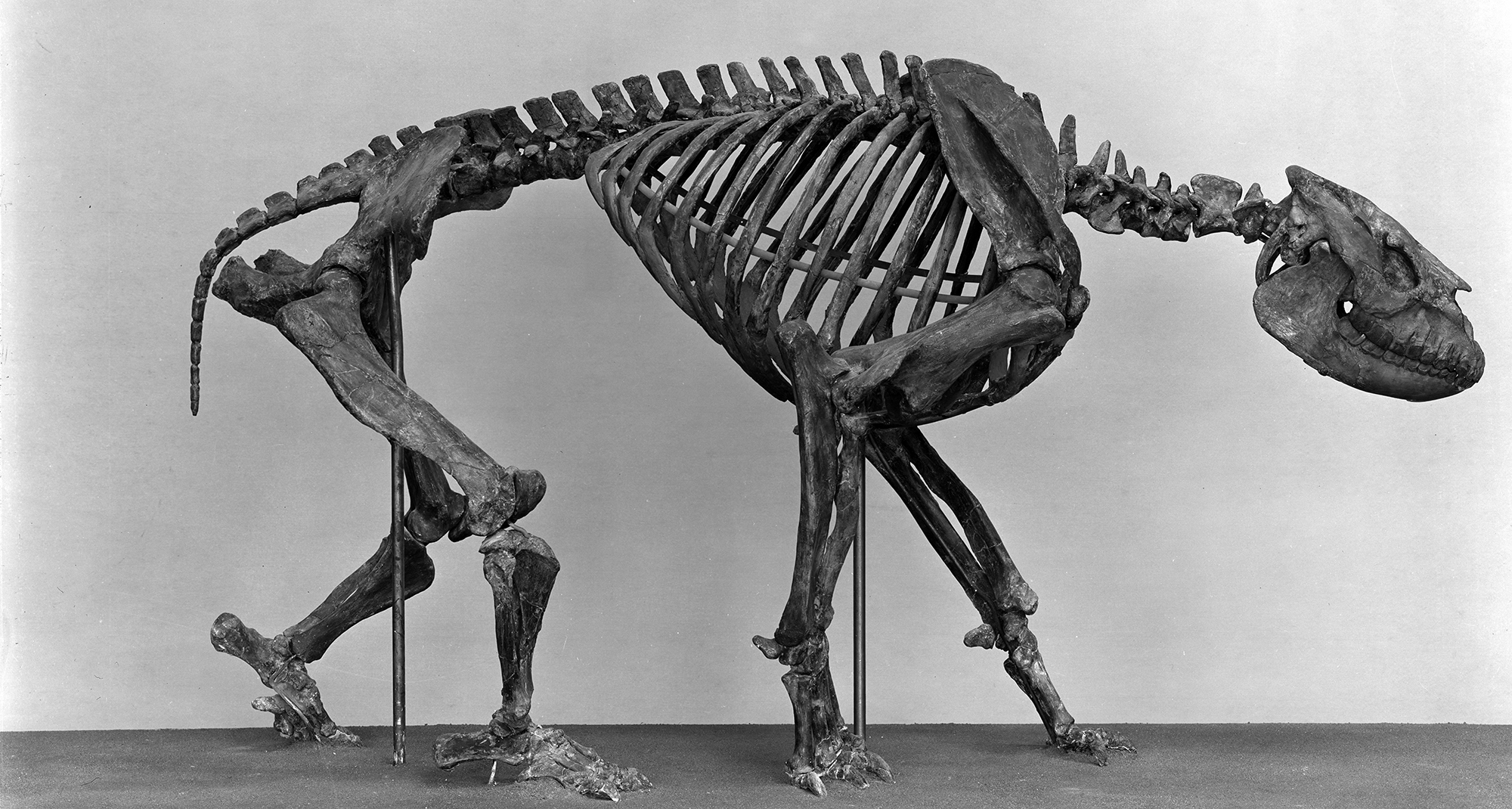
Barylambda faberi (pantodont)Mounted skeleton1936
Moropus cooki (chalicothere)Mounted skeleton1938
Equus simplicidens (horse)Mounted skeleton1938
Bison antiquus (bison)Mounted skeleton1940
Castoroides ohioensis (beaver)Mounted skeleton (cast)1940
Andalgalornis ferox (terror bird)Mounted skeleton1940
Menoceras arikarense (rhino)Bone bed1941
Teleoceras major (rhino)Mounted skeleton1942
Pliohippus sp. (horse)Mounted skeleton1944
Homalodotherium cunninghami (notoungulate)Mounted skeleton1948
Captorhinus aguti (early reptile)Mounted skeleton1948
Diasparactus zenos (amphibian)Mounted skeleton1949
Cacops aspidephorus (amphibian)Mounted skeleton1949
Seymouria sanjuanensis (amphibian)Mounted skeleton1949
Acheloma cumminsi (amphibian)Mounted skeleton1949
Eryops megacephalus (amphibian)Mounted skeleton1949
Labidosaurus hamatus (early reptile)Mounted skeleton1949
Bradysaurus baini (pareiasaur)Mounted skeleton1950
Sphenacodon ferox (early synapsid)Mounted skeleton1950
Ophiacodon mirus (early synapsid)Mounted skeleton1951
Dimetrodon grandis (early synapsid)Mounted skeleton1951
Varanops brevirostris (early synapsid)Mounted skeleton1952
Aulacephalodon peavoti (early synapsid)Mounted skeleton1952
Edaphosaurus pogonias (early synapsid)Mounted skeleton1953
Protoceratops andrewsi (ceratopsian)Mounted skeleton1954
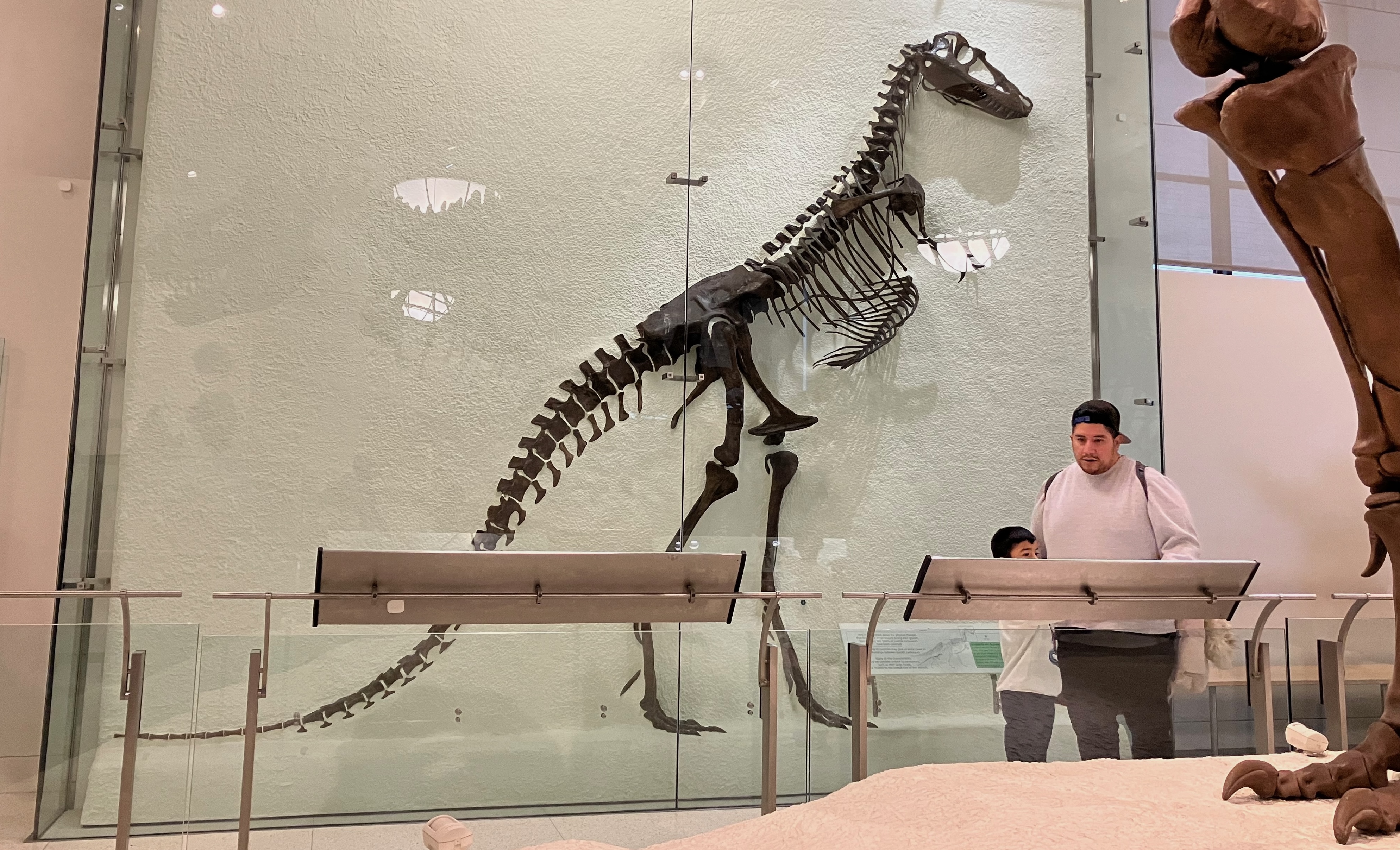
Daspletosaurus torosus (tyrannosaur)Mounted skeleton1958 (1994)
Lambeosaurus lambei (hadrosaur)In situ skeleton1958
Dunkleosteus terrelli (placoderm)Skull (cast)1958
Eohippus sp. (horse)Mounted skeleton (cast)1960
Brachiosaurus altithorax (sauropod)Mounted skeleton (cast)1993 (2001)
Herrerasaurus ischigualastensis (early dinosaur)Mounted skeleton (cast)1994
Pteranodon sp. (pterosaur) x3Mounted skeleton (cast)1994
Triceratops horridus (ceratopsian)Mounted skeleton (cast)1994
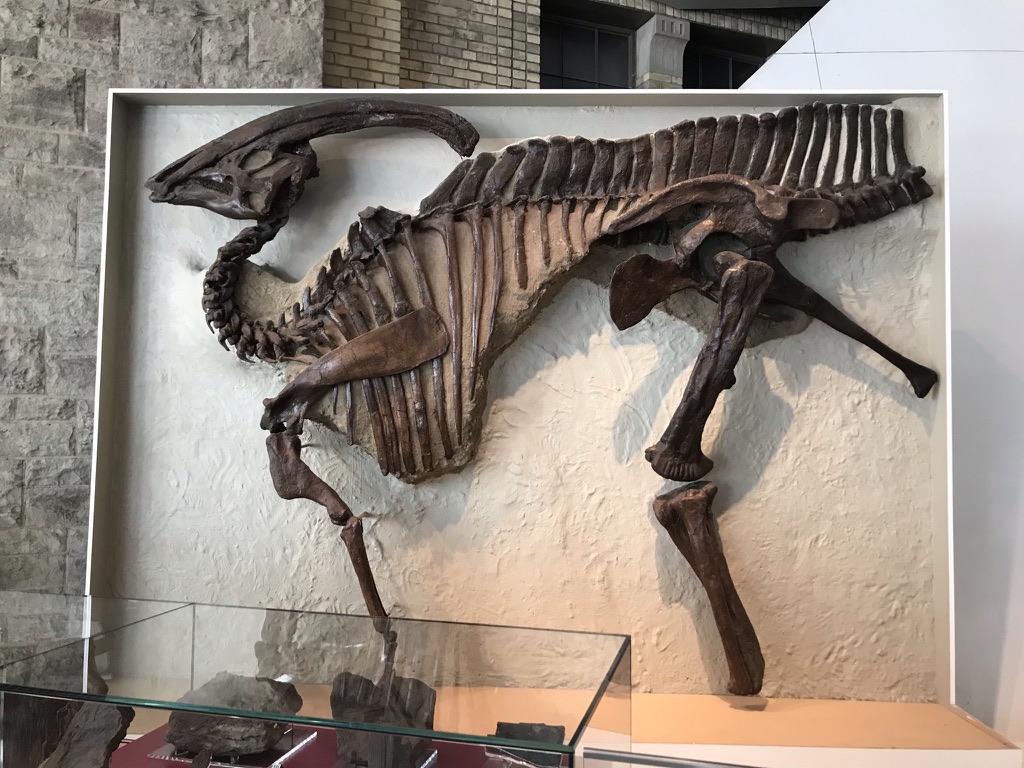
Parasaurolophus cyrtocristatus (hadrosaur)Mounted skeleton1994 (2006)
Tyrannosaurus rex (SUE)Mounted skeleton2000 (2018)
Deinonychus antirrhopus (dromaeosaur)Mounted skeleton (cast)2006
Buitreraptor gonzalezorum (dromaeosaur)Mounted skeleton (cast)2006
Stegosaurus stenops (stegosaur)Mounted skeleton (cast)2006
Maiasaura peeblesorum juvenile (hadrosaur)Mounted skeleton2006
Rapetosaurus krausei juvenile (titanosaur)Mounted skeleton2006
Notharctus tenebrosus (primate)Mounted skeleton (cast)2006
Arctodus simus (short-faced bear)Mounted skeleton2006
Asilosaurus kongwe (dinosaur relative)Mounted skeleton (cast)2013
Patagotitan mayorum (Máximo)Mounted skeleton (cast)2018
Parringtonia gracilis (crocodile relative)Mounted skeleton (cast)2019
Spinosaurus aegyptiacus (Sobek)Mounted skeleton (cast)2023

5 Comments

Filed under dinosaurs, exhibits, FMNH, fossil mounts, history of science, mammals, museums

Is it real?

O. megalodon jaws a the American Museum of Natural History. Photo by the author.

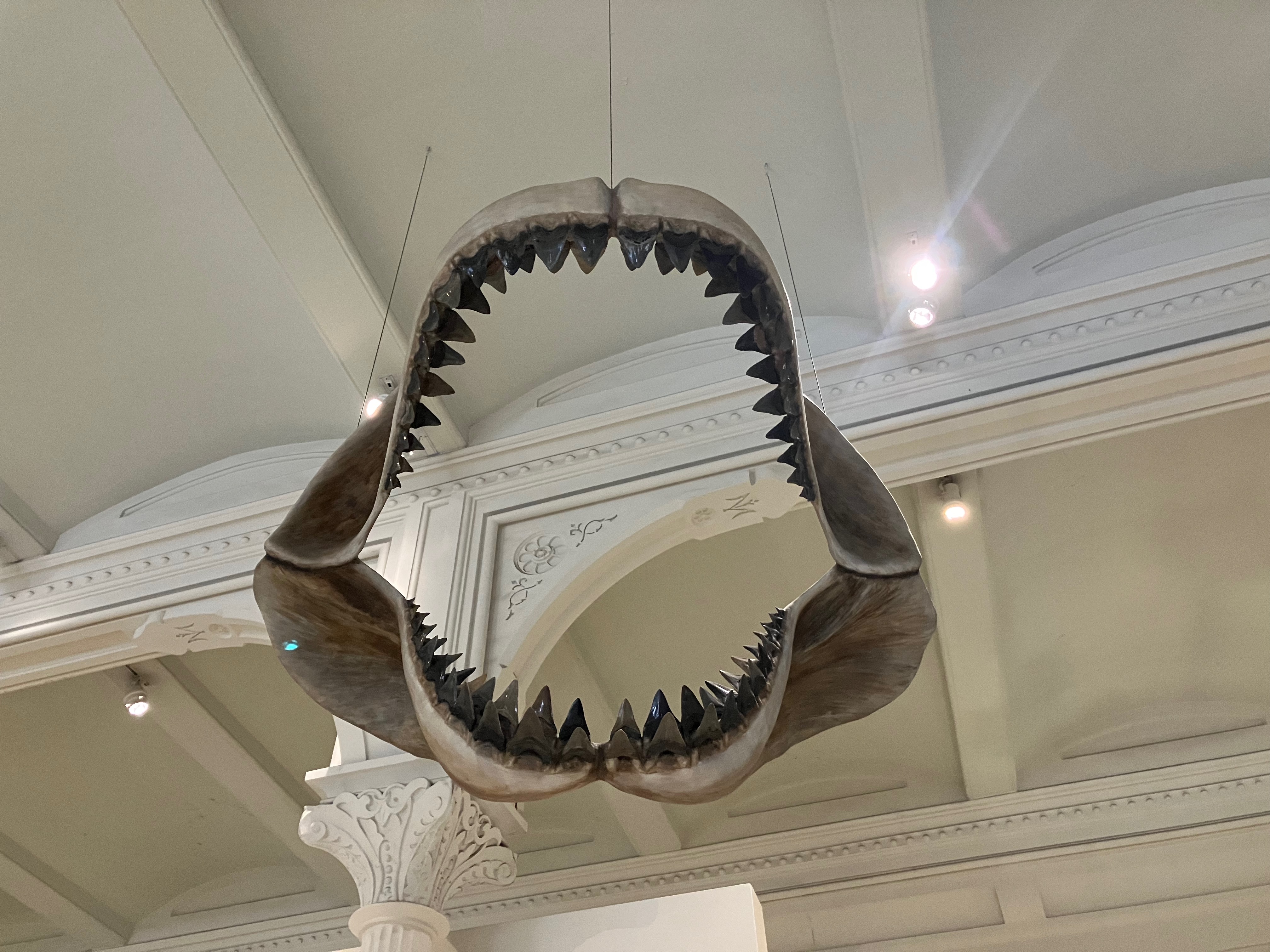
You’ve probably seen the gaping jaws of Otodus megalodon (or “megalodon,” as it is colloquially known) in a natural history museum. Perhaps they’re set on the ground where they can frame a group photo, or maybe they’re suspended from the ceiling so you can imagine the rest of the shark rocketing toward you. In any case, every one of these O. megalodon jaws is a sculpted model with real (or cast) teeth embedded in it. Fossil jaws like this have never been found. Nor do scientists expect to ever find intact O. megalodon jaws—shark skeletons are made of cartilage, meaning they lack the mineral content and endurance of bone. Some fossilized shark skeletons are known, but they tend to be from smaller varieties. In the case of O. megalodon, we mostly just have teeth.

Why would a museum display a model of something that has never been found? Because paleontologists are quite confident that a real O. megalodon jaw would look just like this. For one thing, the general shape of modern lamniform shark jaws isn’t especially variable. Comparisons with modern sharks also allow scientists to determine where a fossil tooth fits into the mouth—in the front, to the side, or toward the back. There simply isn’t that much room for guesswork in the reconstruction, at least as far as the jaws are concerned.

I’ve been thinking about the accusation of “fake” again, as it pertains to fossil exhibitions (this is hardly new territory for this blog). One often hears from dissatisfied members of the public that the fossil skeletons on display at any given museum are fake—sometimes with the accusation that the real bones are “hidden” or “in storage” but occasionally with the conspiratorial angle that the creatures on display have been partially or fully invented. Museum workers do their best to explain: casts are exact copies made from molds of original fossils. Fossil skeletons are usually incomplete, but we can substitute casts from other individuals or mirror parts from the opposite side of the body. Plenty of mounted skeletons are made of original fossils, and at bigger museums, most of them are. And so forth.

Thalassomedon casts in pursuit of fish at the Denver Museum of Nature and Science. Photo by the author.

And yet, the cry of “fake” isn’t exactly wrong, either. Many displays contain some amount of sculpted material. In the case of the ubiquitous meg jaws, most of the object by volume is reconstruction. Lukas Rieppel cheekily describes early 20th century dinosaur mounts as “mixed media sculptures, having been cobbled together from a large number of disparate elements that include plaster, steel, and paint, in addition to fossilized bone.” He’s right, and what’s more, even complete skeletons don’t come out of the ground assembled on metal armatures.

So here’s my take: calling fossil mounts fake isn’t wrong, but it also isn’t relevant. The point of the O. megalodon jaws at the start of this post isn’t to show you the real fossil teeth—they’re kind of hard to see suspended fifteen feet off the ground. No, the point is to give the extinct shark that left those teeth behind form, life, and context. The visual and visceral experience of a 10-foot mouth rushing down at you provides a better understanding of what O. megalodon was all about then a case of teeth laid flat in a case ever could.

SUE in the Field Museum’s Evolving Planet exhibition. Photo by the author.

The same applies to just about any mounted fossil skeleton you’ve ever seen, whether it includes original material or is entirely cast. The purpose of these displays isn’t to show fossils as they were found. These are works of installation art, custom built for the space and in dialogue with their surroundings, including with visitors themselves. Take SUE the T. rex in their 2018 gallery on the Field Museum’s second floor. When SUE was in the cavernous, half-acre expanse of Stanley Field Hall, visitors often remarked that SUE looked small. In order to emphasize SUE’s size in the new space, the designers hid the skeleton behind a scrim wall. Instead of first seeing SUE from several hundred feet away, visitors don’t meet the T. rex until it’s looming over them, and they feel quite small in comparison. The T. rex skeleton and the space around it were arranged and composed in order to invoke a precise emotional response.

Often, the display evokes a specific hypothesis. The rearing Barosaurus in the AMNH rotunda is a classic example. We don’t know for sure whether Barosaurus could rear up on its back legs, or whether it would defend its offspring from a charging Allosaurus. But this is the story the exhibit’s creators chose to tell, using articulated fossil casts as their medium. In short, a display like this lets visitors without a detailed background in skeletal anatomy and animal behavior see the fossils the way that scientists do.

Bison diorama at the Denver Museum of Nature and Science. Photo by the author.

It’s worth drawing a comparison between mounted fossil skeletons and the other iconic natural history display, the taxidermy diorama. Imagine looking at this exquisite diorama of a rolling bison at the Denver Museum of Nature and Science, and dismissing it because it’s not real. The bison is, for the most part, a fabrication: it’s mostly clay or foam by volume, and it’s built over a wood and metal armature. It has no bones, muscle, blood, or viscera, and the only original part, the hide, has been treated with an assortment of preservatives. Meanwhile, the grass may well be paper or fabric, the background landscape is a painting, and the warmth from the sun is an electric light. This diorama is almost completely fake, but to say so is to entirely miss the point. If physical reality is all that matters, this display has nothing to offer that you can’t get from a leather sofa.

A well-made taxidermy diorama uses artificial materials to evoke the attitude, behavior, context, and essence of a living animal. A reconstructed fossil skeleton does precisely the same thing (although it is limited to the part of the extinct animal that we know best). So the next time someone dismisses a fossil exhibit as “fake,” try reframing the conversation. The reality of these displays doesn’t come from the material they’re made from, it comes from the combined knowledge and skill of preparators, artists, and scientists.

References

Rieppel, L. 2019. Assembling the Dinosaur: Fossil Hunters, Tycoons, and the Making of a Spectacle. Cambridge, MA: Harvard University Press.

Poliquin, R. 2012. The Breathless Zoo: Taxidermy and the Cultures of Longing. University Park, PA: The Pennsylvania State University Press.

6 Comments

Filed under AMNH, art history, DMNS, exhibits, fish, FMNH, fossil mounts, museums, opinion, paleoart

Dinosaurs of the Field Museum – Part 2

In the previous “quick bite” post, I introduced the dinosaurs on display at the Field Museum of Natural History (FMNH) that were collected in the early 20th century. This time, we’ll take a look at some of the dinosaurs collected and first displayed “in living memory”—that is to say, in the last three decades or so. I’ve skipped a few that either don’t have much available provenance (like the juvenile Maiasaura) or don’t have a very interesting story (like the off-the-shelf Deinonychus cast).

In comparing the early and more recent dinosaur installations at FMNH, it is immediately apparent that the latter group covers a much wider geographical range. The older mounted skeletons were all recovered in the western United States and Canada, while the new batch comes from all over the world, especially the global south. Local scientists were usually involved in the research, and in most cases the original fossils remained in or were ultimately returned to their countries of origin.

Tyrannosaurus rex (PR 2081)

SUE in Stanley Field Hall, ca. 2015. Photo by the author.

As one of the world’s most thoroughly-researched and best-known dinosaurs, SUE the T. rex scarcely requires an introduction. SUE is the most complete adult Tyrannosaurus ever found, with 90% of the skeleton intact. Approximately 30 years old at the time of their death, SUE is also the eldest T. rex known, and within the margin of error for the title of largest

SUE was discovered in 1990 by Sue Hendrickson on ranchland near Faith, South Dakota. At the time, Hendrickson was working with the Black Hills Institute, a private company that specializes in collecting and exhibiting fossils. BHI’s claim to the fossil became the subject of a legal battle involving landowner Maurice Williams, the Cheyenne River Tribal Council, and the US Department of the Interior. With little legal precedent for ownership disputes over fossils, it took until 1995 for the District Court to award Williams the skeleton. Williams announced that he would put SUE on the auction block, and paleontologists initially worried that the priceless specimen would disappear into the hands of a wealthy collector. Those fears were put to rest in 1997 when FMNH won SUE with financial backing from McDonald’s and Disney. 

SUE has ruled this dedicated hall in Evolving Planet since December 2018. Photo © Field Museum.

The museum wasted no time making the most of the celebrity specimen. The preparation team expanded to twelve people, who spent 35,000 hours over the next three years extracting SUE’s skeleton from the rock. Chris Brochu was brought on board to write a detailed monograph, which is still a definitive source on Tyrannosaurus rex anatomy. Meanwhile, Phil Fraley built the metal armature upon which the skeleton would be mounted. SUE debuted in FMNH’s cavernous Stanley Field Hall on May 17, 2000 with the dropping of a curtain.

SUE held court in Stanley Field Hall for nearly 20 years, but in 2018 it was time for a change. That year, SUE was relocated to a new, 6,500 square foot gallery within the Evolving Planet exhibition. In contrast with the neoclassical expanse of Stanley Field Hall, this “private suite” gives the T. rex some much-needed context. SUE is now situated in an immersive reconstruction of the waterlogged forests of Late Cretaceous South Dakota. The mounted skeleton itself received an update, overseen by Pete Makovicky, Tom Cullen, and Bill Simpson. Garth Dallman and colleagues from Research Casting International (RCI) modified the original mount to correct a range of issues, like the articulation of the right knee and the position of the shoulders. SUE was also reunited with their gastralia—the rib-like bones that were embedded in the belly muscles.

Cryolophosaurus ellioti (PR 1821)

Cryolophosaurus partial skull in the Antarctic Dinosaurs exhibition. Photo by the author.

Excavating fossils is challenging in the best of conditions, but add the treacherous climate of Antarctica to the mix and it becomes a truly astounding feat. In 1991, William Hammer of Augustana College led a team that discovered and excavated the first Antarctic dinosaur to be named and described: the moose-sized theropod Cryolophosaurus. While bad weather prevented them from excavating the entire skeleton, Hammer and colleagues managed to collect the rear portion of the skull and jaw, as well as parts of the pelvis and hind limbs. The specimens were given to FMNH, the largest fossil repository near Hammer’s institution.

Cryolophosaurus cast in the Antarctic Dinosaurs exhibition. Photo © Field Museum

Hammer returned to the Cryolophosaurus site in 2010, joined by Nate Smith, Josh Matthews, and FMNH’s Pete Makovicky. Working in minus 15 F conditions, the team excavated more of the holotype skeleton. Some overlapping bones, including a second braincase, clarified that at least two individuals were present in the quarry.

For many years, Cryolophosaurus had only a minor role in FMNH exhibitions. In Evolving Planet, it is represented only by a cast of the partial skull. In 2018, however, the museum debuted Antarctic Dinosaurs, a traveling exhibition all about the 2010 expedition. Cryolophosaurus is the star of the show: most of the holotype is displayed in a series of cases, alongside a complete standing cast created by RCI. While other museums have displayed Cryolophosaurus reconstructions, the Antarctic Dinosaurs cast is more up-to-date in many respects—for instance, it’s narrow skull more closely resembles Dilophosaurus than Allosaurus.

Rapetosaurus krausei (PR 2209)

Juvenile Rapetosaurus in Evolving Planet. Photo by the author.

It’s hard to imagine now, but as recently as the mid-1990s, very little was known about titanosaurs. These Cretaceous sauropods were mostly known from isolated bones, and it wasn’t even clear if they were more closely related to diplodocoids like Diplodocus and Apatosaurus or to macronarians like Camarasaurus and Brachiosaurus. That changed in 2001, when Kristina Curry Rogers and Catherine Forster published the first description of Rapetosaurus krausei.

The new genus and species was based on fossils collected a few years earlier on a Mahajanga Basin Project expedition in northwest Madagascar. Organized by the State University of New York at Stony Brook and the local Universite d’Antananarivo, the Mahajanga Basin Project has been exploring fossil outcrops in this region since 1993. The project has been tremendously successful, yielding numerous new species and revolutionizing our understanding of vertebrate evolution in the southern hemisphere.

Rogers and Forster designated one of two adult Rapetosaurus skulls as the holotype, but most of our information about this animal comes from a 15-foot, 75% complete juvenile skeleton. To this day, this fossil is the most complete titanosaur ever found, and the only titanosaur known from both a skull and the majority of its postcranial skeleton. From their high-set eyes to their ludicrously wide bodies, much of what is known about the shape of titanosaurs comes from this specimen. Details of this skeleton also helped confirm that titanosaurs are macronarian sauropods.

As one of the funders of the MBP expeditions, the Field Museum became the repository for the juvenile Rapetosaurus skeleton. The fossil was mounted for display in 2006, when the paleontology halls were refreshed and retitled as Evolving Planet.

Buitreraptor gonzalezorum (MPCA 245 and others)

Buitreraptor cast under construction—note the unrestored skull cast being used as a placeholder. Many thanks to Matthew Aaron Brown for sharing this photo.

Fossils of Buitreraptor, a goose-sized dromaeosaur, were first collected in Patagonia, Argentina in 2004. The Field Museum’s Pete Makovicky was joined by Sebastián Apesteguia and Federico Agnolín in describing the new dinosaur the following year. Buitreraptor is notable for being the oldest known South American dromaeosaur (about 98 million years old), and for being one of the most completely known unlagiine dromaeosaurs—bizarre creatures with exceptionally long and narrow snouts. The holotype specimen was prepared at FMNH before being returned to the Museo Provincial de Cipolletti Carlos Ameghino in Río Negro, Argentina.

Finished Buitreraptor cast in Evolving Planet. Photo by the author.

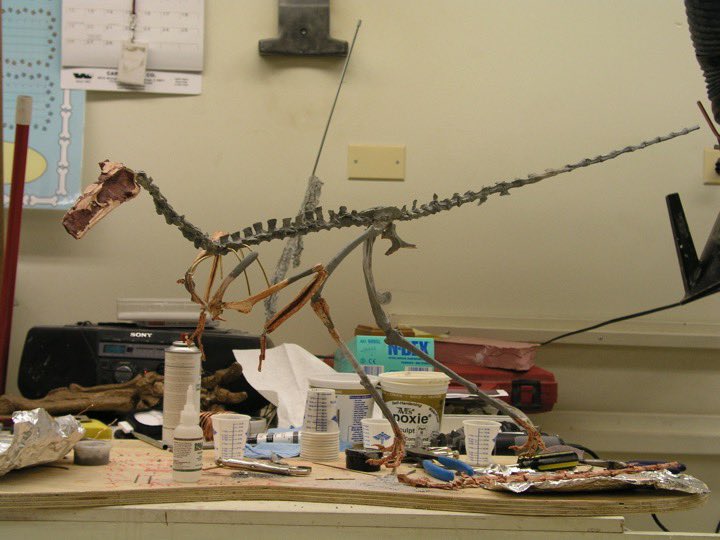
The Evolving Planet team did not originally intend to include Buitreraptor, but as the exhibition neared completion it was noted that the bird evolution display—which only featured Deinonychus and a pair of small models—looked a little sparse. With most of the hall already installed and the opening just months away, preparators Connie Van Beek, Matthew Aaron Brown, and Jim Holstein were tapped to create a mounted cast of Buitreraptor. The preparators first built a prototype by wiring together available casts of the original fossils. They then moved on to the final version, which involved reconstructing the missing extremities (arms, feet, and ribs) and creating a “re-inflated” version of the specimen’s crushed skull. The entire project was completed in less than two months.

Patagotitan mayorum (MPEF 2400 and others)

Field Museum and Museo Paleontológico Egidio Feruglio staff worked together to assemble Máximo in May 2018. Photo by the author.

In 2017, plans took shape to reimagine Stanley Field Hall, as has happened several times since the current FMNH building opened in 1921. Part of the plan was to relocate SUE to a dedicated gallery in Evolving Planet, but what could take the place of the star T. rex? The museum found their answer in Patagotitan, a recently discovered titanosaur that is a contender for the world’s largest dinosaur.

Patagotitan mayorum was discovered on the Mayo family farm near La Flecha, Argentina in 2010. Between 2012 and 2014, Diego Pol and colleagues at the Museo Paleontológico Egidio Feruglio (MEF) excavated the find, which turned out to be a bone bed of six individuals. The new genus and species was named and published in 2018.

The FMNH cast is actually the second Patagotitan display in the United States. In 2015 (before the animal had a name), the American Museum of Natural History commissioned RCI to create a cast for the Wallach Orientation Center, part of the loop of fossil halls on the New York museum’s 4th floor. By placing Patagotitan in a relatively small space, the AMNH designers emphasized the sauropod’s great size. Standing in a slightly crouched pose with its head extending into an adjacent hall, the mount overwhelms the space.

Máximo has plenty of room to spread out in Stanley Field Hall. Photo by the author.

In contrast, the FMNH Patagotitan—nicknamed Máximo—has room to spread out. In the half-acre, four story expanse of Stanley Field Hall, visitors can stand at a reasonable distance and take in the 122-foot skeleton all at once. They can also look Máximo in the eye socket from the upper level balcony. Rather than work with RCI on the project, FMNH commissioned the mount from MEF directly. It was designed and built in Trelew, Argentina, and shipped to Chicago via cargo ship. The installation took four days in May 2018. The process didn’t go entirely without a hitch—under the skylight in Stanley Field Hall, the original paint job on the cast bones looked like raw meat. But even with the need for an emergency repaint of the entire skeleton, Máximo was completed on time and has been greeting FMNH visitors ever since.

Spinosaurus aegyptiacus (FSAC-KK-11888)

The Prehistoric Minds team prepares to add legs to Spinosaurus. Photo by the author.

The Field Museum’s newest dinosaur debuted just two weeks ago as of this writing (and is, in fact, why I’ve been sitting on this post for months). Postdoctoral researcher Matteo Fabbri approached the Exhibitions department in Fall 2022 with the prospect of acquiring a Spinosaurus cast. Less than a year later, that cast has joined Patagotitan in Stanley Field Hall, suspended twelve feet off the floor in a swimming pose.

Thanks to its dragon-like shape and star turn in Jurassic Park III, Spinosaurus is a very popular dinosaur, but until recently it has been quite poorly known. The 1912 holotype specimen—consisting of a partial jaw, several dorsal vertebrae, and a few other odds and ends—was inadvertently destroyed in the bombing of Munich during World War II. It wasn’t until 2008 that another skeleton was found in southern Morocco. The new specimen revealed that Spinosaurus was even weirder than previously thought: not only did it have an elongated, crocodile-like skull and a sail on its back, it also had a long body, short legs, and a newt-like tail fin.

Spinosaurus hangs 12 feet above the floor. Photo by the author.

Very few Spinosaurus casts have ever been displayed. One was made for the retired Spinosaurus: Lost Giant of the Cretaceous traveling exhibit. Another appeared in last year’s The Big Eight: Dinosaur Revelation in Hong Kong. But as far as I can tell, the only other permanent Spinosaurus skeleton on display is at Japan’s Kitakyushu Museum of Natural History. That makes the FMNH cast the only mount of its kind in the western hemisphere. 

It’s also the most up-to-date Spinosaurus on display. As part of the team that has been studying Spinosaurus for the last 15 years, Fabbri ensured that cervical vertebrae collected at the original discovery site just six months ago were incorporated into the mount. All told, about 50% of the skeleton is cast from the Morocco specimen, while the rest is reconstructed. 

Like Máximo, the Spinosaurus was built overseas. Simone Maganuco and colleagues constructed the skeleton in Italy, then traveled with it to Chicago to help with the installation. The lightweight cast—which only weighs 700 pounds—was hanging in its permanent position after just ten hours of work.

Press coverage of the installation (with appearances from a certain overenthusiastic nerd) can be seen here and here.

References

Brochu, C.A. 2003. Osteology of Tyrannosaurus rex: Insights from a nearly complete skeleton and high-resolution computed tomographic analysis of the skull. Journal of Vertebrate Paleontology 22:1–138.

Curry Rogers, K., Forster, C.A. 2001. The last of the dinosaur titans: a new sauropod from Madagascar. Nature 412:6746:530–534.

Hammer, W.R. and Hickerson, W.J. 1994. A Crested Theropod Dinosaur from Antarctica. Science 264: 828–830.

Grande, L. 2017. Curators: Behind the Scenes of Natural History Museums. Chicago, IL: University of Chicago Press.

Ibrahim, N., Maganuco, S., Dal Sasso, C., Fabbri, M., Auditore, M., Binedellini, G., Martill, D.M., Zourhi, S., Matterelli, D., Unwin, D.M., Wiemann, J., Bonadonna, D., Amane, A., Jakubczak, J., Joger, U., Lauder, G.V., and Pierce, S.E. 2020. Tail-propelled aquatic locomotion in a theropod dinosaur. Nature 581(7806):1–4.

Makovicky, P.J., Apesteguía, S., and Agnolín, F.L. 2005. The earliest dromaeosaurid theropod from South America. Nature 437: 1007–1011.

Smith, N.D., Makovicky, P.J., Hammer, W.R., and Currie, P.J. 2007. Osteology of Cryolophosaurus ellioti from the Early Jurassic of Antarctica and implications for early theropod evolution. Zoological Journal of the Linnean Society 151: 377–421.

1 Comment

Filed under AMNH, dinosaurs, exhibits, FMNH, fossil mounts, museums, sauropods, theropods

Dinosaurs of the Field Museum — Part 1

About a year ago, I wrote this post about the dinosaurs of the London Natural History Museum, admittedly in a bit of a hurry. The post has proven very popular, which leads me to conclude there’s interest in more “quick bite” articles about the specimens on display at various museums. I’ll see about putting together more of these in the future.

For now, I’ll start close to home, with the dinosaurs on display at Chicago’s Field Museum of Natural History (FMNH). This entry is about the most notable specimens that were acquired outside the living memory of current staff. I’ll follow up with an article about more recent acquisitions sometime soon. It’s important to note that while I’m focusing on dinosaurs here, the real meat of the Field Museum’s vertebrate paleontology collection is in its Cenozoic holdings. Those too will need to be a topic for another time.

Brachiosaurus altithorax (P 25107)

Menke poses with the Brachiosaurus humerus, unwittingly creating an image that every subsequent sauropod worker is obligated to recreate. Photo © Field Museum.

The first dinosaur discovered by Field Museum paleontologists was nothing less than the biggest land animal known at the time. On July 4, 1900, the museum’s first paleontologist Elmer Riggs and his assistant H.W. Menke came upon a set of enormous bones in western Colorado. Riggs—who was specifically hired two years earlier to find dinosaurs for the nascent museum—named the new dinosaur Brachiosaurus altithorax in 1903. The individual bones were set in display cabinets (left image, below) around the same time. Comprising about 25% of the skeleton, Riggs did not consider the find complete enough to assemble into a standing mount. Nevertheless, the museum commissioned a replica Brachiosaurus skeleton about 90 years later, basing the missing pieces on the related Giraffatitan.

New Brachiosaurus fossils have proven elusive. While several individual bones have been found, the holotype collected by Riggs and Menke remains the most complete example of this famous dinosaur.

Apatosaurus” sp. (P 25112 and P 27021)

The Field Museum’s “Apatosaurus” is a composite of two sauropod specimens, collected 40 years apart. Photos © Field Museum.

Riggs and Menke found another sauropod in western Colorado in 1900, and returned the following year to excavate it. This time, they had the back two-thirds of an apatosaurine sauropod, complete save for the distal portions of the limbs and tail. As museum leaders were unwilling to fund a search for more sauropod material, Riggs mounted the partial skeleton in 1908 (left image, above). 

The sauropod remained in this unfinished state until the 1950s, when preparator Orville Gilpin arranged to acquire another incomplete sauropod. Gilpin had excavated the specimen with Jim Quinn near Moab, Utah in 1941, and knew that it was a perfect complement to the skeleton on display. Long-time museum president Stanley Field (nephew of founder Marshall Field) had repeatedly resisted requests from the paleontology staff to complete the mount, but allegedly relented after overhearing a visitor ask which side of the half-dinosaur was the front. Gilpin built an armature for the neck and shoulders of the newly acquired specimen (right image, above), and finished the mount with casts of Apatosaurus forelimbs and a Camarasaurus skull from the Carnegie Museum of Natural History. The Field Museum finally had a complete sauropod on display, which was unveiled at the April 1958 Members’ Night. 

Apatosaurus” as it is currently displayed in Evolving Planet. Photo by the author.

In 1992, the composite sauropod was dismantled and relocated to the new Life Over Time exhibition on the other side of the building. The museum hired Prehistoric Animal Structures, Inc.—a now-shuttered company specializing in mounting fossil skeletons—to do the work. The updated sauropod debuted in 1994, now posed as though looking at visitors on a nearby elevated walkway. The sauropod remained in place when Life Over Time became Evolving Planet in 2006, though with the walkway gone it now appears to be admiring the Charles Knight murals on the wall.

A note on nomenclature: Riggs identified this skeleton as Apatosaurus, but the label was changed to Brontosaurus in the mid-20th century, when Apatosaurus fell out of common parlance. The name Apatosaurus returned to labels in 1994. However the most recent word on this specimen—from Tschopp et. al 2015—is that it’s not Apatosaurus nor Brontosaurus, but likely another, yet unnamed taxon.

Triceratops horridus (P 12003)

The skull of FMNH P 12003 as it is currently displayed in the SUE gallery. Photo by the author.

In 1904, Riggs moved on from the Jurassic-aged rocks of Colorado to the Cretaceous of Carter County, Montana. Today, this part of southeast Montana is lousy with paleontologists. There’s even an annual shindig for field crews held at the Carter County Museum in Ekalaka. However, Riggs’ expedition was among the first to visit the region from a large museum. The most significant find of the summer was a Triceratops skull and partial skeleton from just west of the Chalk Buttes.

The skull was prepared by 1905 and has been in every iteration of the Field Museum’s paleontology halls. The unusually thick brow horns were recently confirmed to be real bone, but it’s possible that they were originally from another, larger specimen (edit: There is real bone inside the horns, but they are padded with a lot of plaster reconstruction—see comments). The remainder of the skeleton remains in storage.

Gorgosaurus libratus (PR 2211)

Elmer the Gorgosaurus as it was last displayed, in 2017’s Specimens: Unlocking the Secrets of Life. Photo by the author.

Most collecting was paused during World War I, but shortly after the war, Marshall Field III funded new expeditions in all four of the Field Museum’s major research areas (Zoology, Botany, Geology, and Anthropology). Riggs led three of these expeditions, one to Alberta and two to Argentina and Bolivia. Riggs saw the 1922 Alberta trip as something of a practice run, since he hadn’t been in the field in years, and some on his team had never done fieldwork at all. 

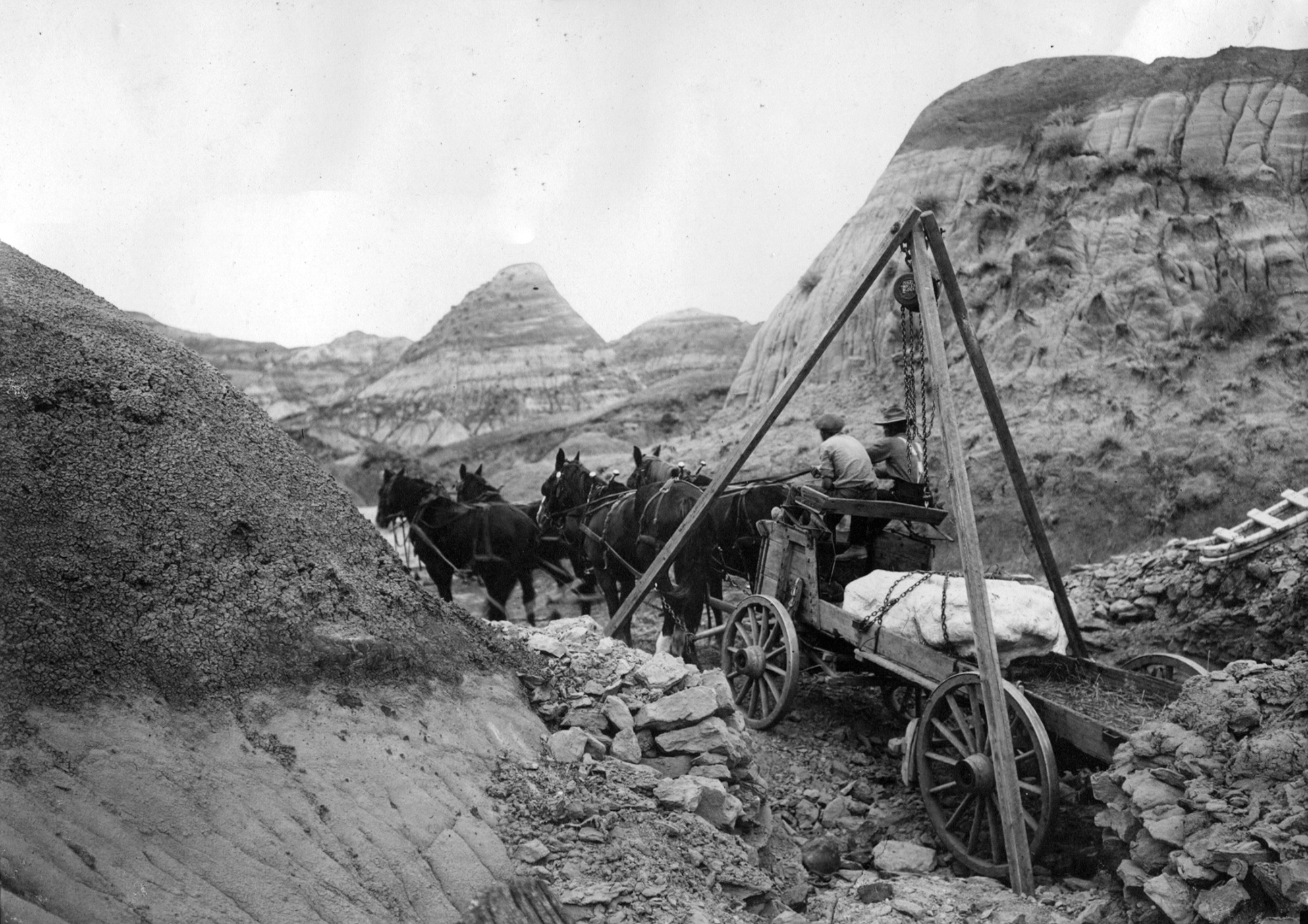
Still, the crew was serious about bringing in fossils. Riggs decided to go to the Red Deer River region of Alberta, a place where his former colleague and classmate Barnum Brown had unearthed numerous near-complete dinosaurs for the American Museum of Natural History. Riggs also hired fossil hunter George F. Sternberg, who already knew the area well, to join him on the 14-week expedition.

After returning from Alberta, Riggs was busy getting ready for the upcoming expeditions to South America, and most of the field jackets remained unopened for years, or even decades. One jacket lingered until 1999, when the large team of preparators assembled to prep SUE the T. rex decided to crack it open. 

Inside, they found the virtually complete hips, hindlimbs, and tail of a four-year-old Gorgosaurus, which they named Elmer. Riggs’ notes indicated that the skull ought to have been present, but the preparators only found a few teeth. Further investigation revealed that the partial skull had been in its own jacket with a different number, and that it had been loaned to the University of California at Berkeley in the 1970s. The Berkeley scientists had subsequently lost the fossil, but (fortunately) made a cast of it, which was later returned to the Field Museum. 

Elmer was included in the touring exhibition Dinosaurs: Ancient Fossils, New Discoveries, and most recently in 2017’s Specimens: Unlocking the Secrets of Life. It is currently off exhibit.

Lambeosaurus lambei (PR 380)

Lambeosaurus under prep in 1955. Photo © Field Museum.

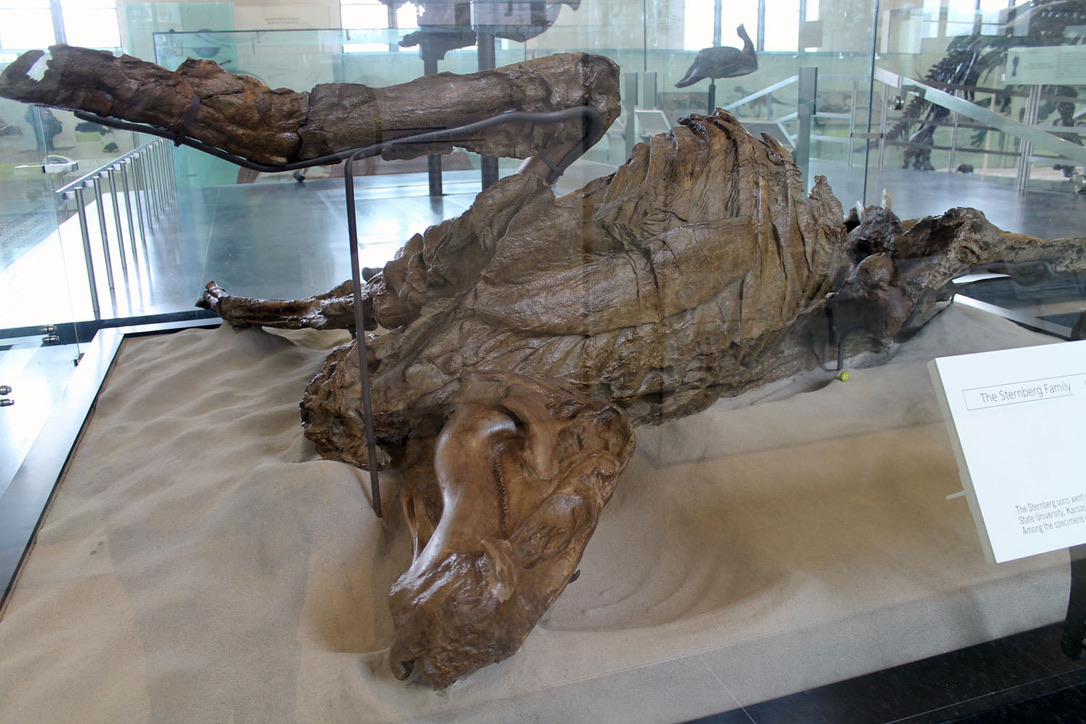
According to Riggs, the “prize find” of the 1922 Alberta expedition was a Lambeosaurus found by Sternberg. Even in the field, it was clear that the skeleton was completely intact, save for the head, part of the neck, and the tip of the tail. Sternberg’s field notes indicate that the weathered side included a number of large skin impressions. The Lambeosaurus was jacketed and excavated in eight sections, totaling about three tons of rock and fossil.

Like Elmer the Gorgosaurus, the Lambeosaurus was left unprepared while Field Museum preparators focused on the fossils from South America. In 1947, the University of Chicago closed its geology museum and donated its collections to the Field Museum, pushing the Alberta fossils even further down the queue. Stanley Kuczek finally prepared the Lambeosaurus in 1954, when it was slated to be paired with Daspletosaurus in a new display (more below).

Kuczek prepared only the unweathered (face-down in the field) side of the skeleton, so the skin impressions Sternberg reported are still embedded in the matrix under the fossil. A Lambeosaurus skull from the University of Chicago collection (UC 1479) was used to complete the display. Sternberg’s Lambeosaurus remains the most complete non-bird dinosaur at the Field Museum, and a (perhaps unsung) highlight of the collection.

Daspletosaurus torosus (PR 308)

Nathan Cochran recently rediscovered the original “Gorgosaurus” and Lambeosaurus label, as seen in this image. Check it out here. Photo © Field Museum.

The Field Museum’s Daspletosaurus, sometimes called “Gorgeous George,” was collected by Barnum Brown of the American Museum of Natural History in 1914. It came from the same region of Alberta that Riggs and company would visit eight years later. At the time, the partial skeleton was considered an example of Gorgosaurus, of which the New York museum already had three. In 1955, Field Museum board member Louis Ware offered to buy the American Museum’s spare tyrannosaur, and soon the fossil was on its way to Chicago.

Orville Gilpin mounted the skeleton—which has been known as Daspletosaurus since 1999—for display. He elected to create a completely free-standing mount, with no visible armature. This required drilling through each of the vertebrae to thread a steel pipe through, as well as splitting the right femur. These destructive practices would never be undertaken today, but in the mid 20th century, dinosaurs were seen as display pieces first and scientific specimens second.

Daspletosaurus in Evolving Planet. Photo by the author.

Like the “Apatosaurus,” Gorgeous George was revealed to the public during Members’ Night. The skeleton was placed at the south end of the museum’s central Stanley Field Hall, standing over Sternberg’s Lambeosaurus as though it had just brought down the herbivore. In 1992, Prehistoric Animal Structures, Inc. remounted the Daspletosaurus in a more accurate horizontal posture, once again poised over its Lambeosaurus prey. The real skull has never been mounted on the skeleton, but it is currently on display near the museum’s east entrance.

Parasaurolophus cyrtocristatus (P 27393)

Parasaurolophus in Evolving Planet. Photo by the author.

The Parasaurolophus cyrtocristatus holotype was found by Charles Sternberg (father of George) in 1923, near Fruitland, New Mexico. It made it to the Field Museum through a series of exchanges, but was not prepared until the 1950s. John Ostrom published a description of the skeleton and partial skull in 1961, noting that it was nearly identical to Parasaurolophus walkeri from Alberta, except for the crest on the back of its head. While P. walkeri has a long, backward-projecting crest, the New Mexico species has a short crest that curves downward.

The Parasaurolophus was first exhibited in 1994, as part of Life Over Time. The 70% complete skeleton was mounted directly to a wall, with illustrations of the missing bones behind it. Ten years later, Research Casting International was brought in to turn the Parasaurolophus into a complete standing mount. Like most modern mounts, the armature is designed so that each bone can be removed individually for study or conservation. Captured in a graceful walking pose, the Parasaurolophus is—in my opinion—the most elegant and evocative dinosaur mount at the Field Museum.

References

Brinkman, P. 2000. Establishing vertebrate paleontology at Chicago’s Field Columbian Museum, 1893–1898. Archives of Natural History 27:81–114.

Brinkman, P. 2010. The Second Jurassic Dinosaur Rush: Museums and Paleontology in America at the Turn of the 20th Century. Chicago: University of Chicago Press.

Brinkman, P. 2013. Red Deer River shakedown: a history of the Captain Marshall Field paleontological expedition to Alberta, 1922, and its aftermath. Earth Sciences History 32:2:204-234. 

Erickson, G.M, Makovicky, P.J., Currie, P.J., Norell, M.A., Yerby, S.A., and Brochu, C.A. 2004. Gigantism and life history parameters of tyrannosaurid dinosaurs. Nature 430:722–775.

Forster, C.A. 1996. Species resolution in Triceratops: cladistic and morphometric approaches. Journal of Vertebrate Paleontology 16:2:259–270.

Gilpin, O. 1959. A free-standing mount of Gorgosaurus. Curator: The Museum Journal 2:2:162–168.

Ostrom, J.H. 1961. A new species of hadrosaurian dinosaur from the Cretaceous of New Mexico. Journal of Paleontology 35:3:575–577.

11 Comments

Filed under dinosaurs, exhibits, field work, FMNH, fossil mounts, history of science, museums, ornithopods, sauropods, theropods

Ernestine lives!

A scaffold of foreboding surrounds the Brachiosaurus cast. Photo by the author.

Earlier this year, the Brachiosaurus cast skeleton that stood on the Field Museum’s northwest terrace was retired. On display for 23 years (and 23 brutal Chicago winters), the replica was suffering from a rusting armature and extensive cracking. Deemed structurally unsound, it was dismantled the week of June 12. Though we lament the loss of the long-necked sentinel over DuSable Lake Shore Drive, the legacy of Brachiosaurus—the Field Museum’s first dinosaur—lives on.

The story of Brachiosaurus begins with the museum’s founding, nearly 130 years ago. The Field Columbian Museum opened in Chicago on June 2, 1894 as a permanent home for the collection assembled at the previous year’s World Columbian Exposition. While the collection boasted thousands of zoological, botanical, anthropological, and geological objects, it had but a single dinosaur: a replica skeleton of Hadrosaurus. Based on the original at the Philadelphia Academy of Natural Sciences, the model was badly out of date by the 1890s. Oliver Farrington, the Field’s original geology curator, considered it an embarrassment and petitioned director Frederick Skiff to hire a vertebrate paleontology specialist to collect better material. Skiff passed the request on the board, but was denied—with a building full of uncataloged specimens, they saw no need to obtain anything new.

The board changed their minds in 1898, when the Carnegie Museum and American Museum of Natural History announced plans to find sauropod dinosaurs for display. The resume of Elmer Riggs, a recent University of Kansas graduate with ample fossil hunting experience, happened to be on Skiff’s desk, and so Riggs was hired to collect dinosaurs for the museum.

The Brachiosaurus site in summer 1900. This excavation was particularly well-documented, thanks to Menke’s long-exposure, plate glass photographs. Photo © Field Museum, CC BY-NC.

In 1900, Riggs was prospecting near Grand Junction, Colorado with assistant Harold William Menke and camp cook Victor Dames. Their quarry was an exhibit-worthy specimen of Brontosaurus, the largest known dinosaur at that time. On July 4, Menke made a promising find: a giant limb bone that was the right size to be a Brontosaurus femur. The group began excavating and eventually revealed additional limb bones, nine-foot ribs, an articulated series of dorsal vertebrae, the sacrum, and a scattering of other bones. The course-grained, pebbly matrix suggested burial in a fast-moving river, which probably swept away the missing parts. All told, they had about 25% of a skeleton—not enough to mount for display but still worth collecting.

Once the fossils were back at the museum and undergoing preparation, Riggs confirmed something he had probably suspected in the field. Menke’s six-foot, seven-inch limb bone wasn’t a femur, it was a humerus. The humerus of Brontosaurus was well under five feet, so this animal was substantially larger. With his 1903 publication introducing Brachiosaurus altithorax to the world, Riggs emphasized its record size—and encouraged the press to make a meal of it.

Brachiosaurus was a win for the Field Museum: the first newly described dinosaur to come out of the nascent institution was also the biggest ever (a title Brachiosaurus would hold for the better part of the century). But while many of the individual bones were put on display in 1908, the holotype wasn’t complete enough to assemble into a standing mount. Instead, another find from Riggs’ 1900 Colorado expedition—the Fruita Apatosaurus—became the museum’s first mounted sauropod.

When the Field Museum was exploring the idea to create a complete replica Brachiosaurus, an unknown staffer (“M”) drew up this illustration to show how much would need to be reconstructed. This image is stitched together from multiple scans.

It would be almost ninety years before the museum revisited the prospect of putting Brachiosaurus on display. In the early 1990s, the Exhibitions department was hard at work remaking its paleontology halls from the ground up. This project would eventually open as Life Over Time in 1994, but in the meantime it was agreed that a showstopping symbol was needed outside the exhibit proper.

That showstopper could only be Brachiosaurus. The Field Museum hired Prehistoric Animal Structures, Inc.—a now-shuttered company specializing in mounted fossil skeletons—to make it happen. Commonly abbreviated as PAST, the company was founded by Gilles Danis, who previously created many of the Royal Tyrell Museum’s opening day exhibitions.

Fortunately for Danis and his team, there was more Brachiosaurus (and Brachiosaurus adjacent) fossil material to work with then in Riggs’ day. A handful of specimens referred to Brachiosaurus altithorax (mostly individual bones) had since turned up in the western United States, but the bulk of information came from a pair of Tanzanian skeletons. In 1914, German paleontologist Warner Janensch determined that these specimens were a second species of BrachiosaurusBrachiosaurus brancai. More recently, the Tanzanian brachiosaur has been moved to its own genus, and is now known as Giraffatitan brancai. While there are a number of key differences, Giraffatitan and Brachiosaurus are one another’s closest known relatives, making the former a reasonable reference for the unknown parts of the latter.

Ernestine the Brachiosaurus in Stanley Field Hall. Photo © Field Museum.

To reconstruct Brachiosaurus for the Field Museum, the PAST crew started by taking molds of the Brachiosaurus holotype bones. Next, Danis and Donna Sloan traveled to the Museum für Naturkunde in Berlin, where the Giraffatitan fossils are housed. While they were not allowed to make casts, Danis and Sloan took extensive measurements. Stephen Godfrey used this information to sculpt the missing parts of Brachiosaurus, including the head, neck, tail, and feet.

A few adjustments were made along the way. First, the PAST crew inflated the limb bones slightly, so that the steel armature would fit inside. Second, the museum wanted visitors to be able to walk under the Brachiosaurus, but its torso wasn’t quite long enough to meet the minimum fire egress requirements. PAST solved the problem by quietly duplicating two of the vertebrae in the dorsal series. In an amusing twist, these stretch-limo proportions may have inadvertently been correct. Danis named the finished replica Ernestine, because “Ernestine is an awkward name and Brachiosaurus is an awkward-looking thing.”

Ernestine the Brachiosaurus has stood in the United terminal at O’Hare since 1999. Photo by the author.

On June 29, 1993 (a Tuesday), Danis, three PAST crew members, and six Field Museum staffers assembled Ernestine in the museum’s central Stanley Field Hall. Reporters from the Chicago Sun-Times and Tribune were present to document the construction (scans of these articles are at the end of this post). Seven hours later, Brachiosaurus was complete, on its feet for the first time in 152 million years. At 41 feet tall, the replica skeleton was tall enough to peer over the second floor mezzanine and into the entrance to Life Over Time.

By coincidence, Ernestine’s debut was less than three weeks after the release of Jurassic Park—which happened to feature a Brachiosaurus in an iconic opening scene. The film quickly became the highest-grossing of all time, and launched a global wave of dino-mania. While he was busy finishing up and installing the Brachiosaurus, Danis was fielding calls left and right for his services. Even hotels were inquiring about putting dinosaur skeletons in their parking lots. His response? “If they can put up the cash for them, we’ll put them up!”

The outdoor Brachiosaurus on a rare sunny day. Photo by the author.

Ernestine’s stint in Stanley Field Hall wound up being short-lived. The Field Museum acquired SUE the Tyrannosaurus in 1997, and the mounted skeleton took the sauropod’s place in May 2000. Ernestine was relocated to O’Hare International Airport, where it remains today. Meanwhile, the museum commissioned a second Brachiosaurus replica to be displayed outdoors. Made from durable, all-weather plastic resin, the outdoor Brachiosaurus stood on the northwest terrace for the next 23 years. Notably, it outlasted SUE’s time in Stanley Field Hall: the Tyrannosaurus was relocated to its own gallery in 2018, and a cast of the Argentinian sauropod Patagotitan now occupies the Field Museum’s central space.

The Brachiosaurus display in the Field Museum’s Science Hub includes parts of the holotype, a replica skull, and more. Photo by the author.

Now that the outdoor Brachiosaurus replica has been retired, it’s fair to ask what’s next for the Field Museum’s first dinosaur. Ernestine will remain at the airport for the foreseeable future, but plans for the northwest terrace have not yet solidified. In the meantime, a popup exhibit rhapsodizing Brachiosaurus recently opened in the Science Hub—a rotating exhibit space where interpreters are always present. I was happy to write the labels for this display, which tells the story of Brachiosaurus from its discovery to the removal of the outdoor skeleton (in far fewer words than this post). The exhibit includes the sculpted skull of the outdoor Brachiosaurus and parts of the holotype—including the tail vertebrae, which haven’t been on public view since the 1920s. Be sure to stop by if you’re in the area, but be quick: Science Hub exhibits typically last only six months or so.

References

Brinkman, P.D. 2010. The Second Jurassic Dinosaur Rush: Museums and Paleontology in America at the Turn of the Twentieth Century. University of Chicago Press: Chicago, IL.

Engh, B. 2020. We Found a Brachiosaurus.

Riggs, E.S. 1903. Brachiosaurus: The Largest Known Dinosaur. American Journal of Science 4:15:299-306.

Simpson, W. 2022. Pers. comm.

Taylor, M.P. 2009. A re-evaluation of Brachiosaurus altithorax Riggs 1903 (Dinosauria, Sauropoda) and its generic separation from Giraffatitan brancai (Janesch 1914). Journal of Vertebrate Paleontology 29:3:787-806.

Taylor, M.P. 2014. Giles Danis of PAST on the Chicago Brachiosaurus mount.

Leave a comment

Filed under dinosaurs, exhibits, field work, FMNH, fossil mounts, history of science, movies, museums, reptiles, sauropods

Telling SUE’s story (part 2)

DMNS T.Rex

The fleshed-out reconstruction of SUE is the show-stopping highlight of SUE: The T. rex Experience. Photo by Chris Schneider.

Start with Telling SUE’s story (part 1).

Just a few weeks after the new SUE gallery opened at the Field Museum, a smaller team was convened to create a new traveling exhibition about the famous Tyrannosaurus rex. The original traveling exhibit—A T. rex Named SUE—launched in 2000 and ran for more than fifteen years, touring all over North America, Europe, and Asia. But the components were getting worn out, some of the science was lukewarm, and the market for traveling dinosaur exhibits had gotten more competitive. Our task was to build a bigger, better SUE exhibit, using the assets we had just developed for the permanent gallery as a starting point.

Finding an angle

In the permanent SUE gallery, we could rely on the drawing power of the real skeleton of the most complete adult Tyrannosaurus ever found. The traveling exhibit, however, would have to use a cast. That meant we needed to put greater emphasis on storytelling, and as Exhibition Developer, storytelling was my responsibility. To figure out what kind of story we wanted to tell, we started by checking in on our peers. The American Museum of Natural History had just opened the temporary exhibit T. rex: The Ultimate Predator, so the design team and I traveled to New York to have a look.

The visual language of T. rex the Ultimate Predator is stark, angular, and black-and-white. Photo by the author.

T. rex: The Ultimate Predator considers the evolutionary history of Tyrannosaurus rex. The exhibition is about the entire tyrannosaur family and explores how the traits that define T. rex gradually accumulated over a hundred million years. Because this story exists in the realm of cladograms and morphometric analyses, the design language is sparse, almost clinical. The life-sized models, fossils, and illustrations seem to float in a black-and-white void. This visual style pairs well with the story being told, and the team behind T. rex: The Ultimate Predator did some phenomenal work. However, it was clear that we wanted to go in a different direction.

We decided that our exhibit—now titled SUE: The T. rex Experience—would be about the relationship between the titular dinosaur and their environment. The Hell Creek Formation (the rock layer in which SUE was found) preserves one of the most well-studied ecosystems from the Age of Dinosaurs. That meant that we could reconstruct SUE’s life and times in detail, showcasing the world this famous predator lived in and giving visitors a sense of what it was like to be a T. rex

DMNS T.Rex

A narrated light show tells SUE’s story. Photo by Chris Schneider.

The Hell Creek environment was a place of danger and opportunity for SUE, and it was important that our star Tyrannosaurus was never divorced from that context. This environmental focus dovetailed with the story told by the SUE fossil itself. SUE is exquisitely preserved and is the subject of dozens of scientific papers—we know more about this individual than almost any other dinosaur. From how SUE grew up and grew old to how they got injured and sick, SUE’s skeleton tells the life story of the oldest—and therefore the most successful—T. rex known to science. Put another way, we wanted to make SUE a character (to the extent that was scientifically credible, of course). By spotlighting the evidence for SUE’s hard life as an apex predator, we hoped the exhibit would inspire visitors to empathize with this long-dead dinosaur, while discouraging them from conceptualizing T. rex as a fantastical monster.

SUE’s world

SUE: The T. rex Experience immerses visitors in the Hell Creek environment. Scientific advisors Tom Cullen and Az Klymiuk were instrumental in this regard, bringing a focus on the methods used to reconstruct paleoenvironments—including isotopic analysis of microfossils and sedimentology. Not only is this ecological perspective something that visitors specifically asked for during our audience studies, I think it sets our exhibit apart from other paleontology exhibits and media. For example, learning that summertime in Hell Creek brought temperatures of 75 to 85° F and around 80 inches of rain (and how we know) makes the prehistoric past tangible and tactile in a way that the usual dinosaur stats and trivia rarely do. 
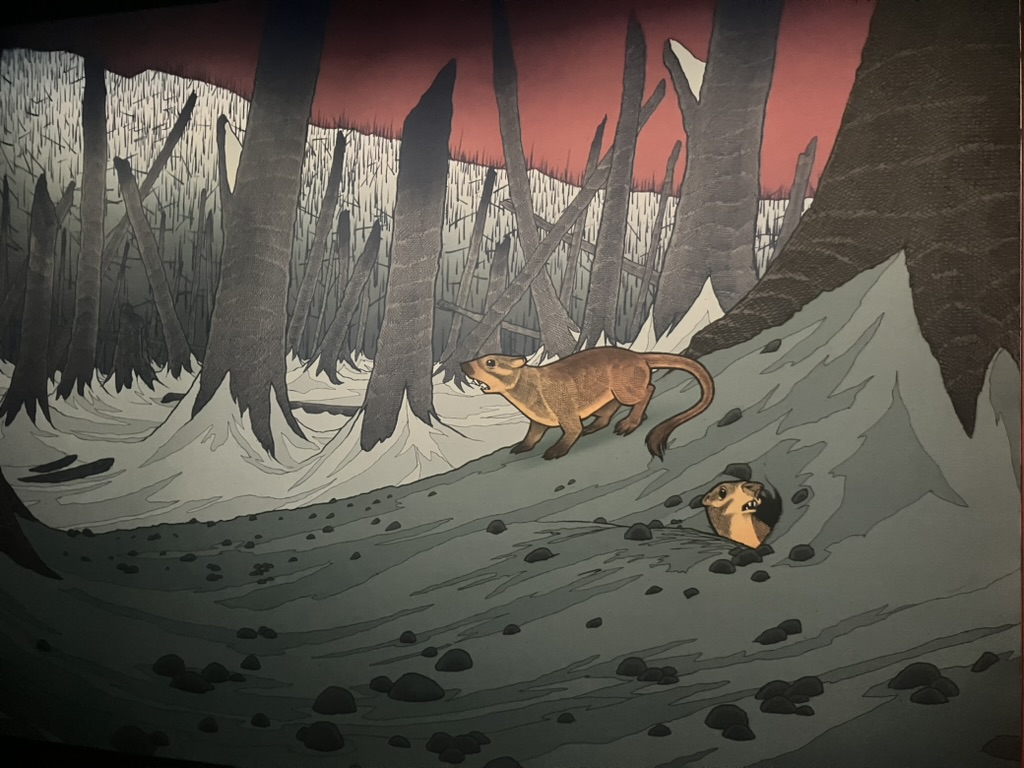
A picture is worth a thousand words: this panoramic mural illustrates both the Hell Creek ecosystem and SUE’s place in it. Photo by Chris Schneider.

An exhibit is more than a collection of facts, of course. It’s a story told through physical space, assembled from words, specimens, images, interactives, and media. We leveraged all of these tools to place visitors in the world of Tyrannosaurus rex. Nearly every display is set against a verdant backdrop of Hell Creek swamps and forests (in fact, we made a point of ensuring every image of T. rex is situated in its habitat). Some of these images are pulled from the animated scenes produced for the permanent SUE gallery, but we also commissioned original artwork by Beth Zaiken. It’s easy to get lost in Zaiken’s extraordinary panoramic mural, which vividly captures the waterlogged, angiosperm-dominated forests of the Hell Creek ecosystem. I’m particularly fond of this take on SUE, shown presiding over their kingdom with the relaxed confidence of modern apex predators (lions and alligators have the same energy).

TEX.S10-1

Fossils from SUE’s world are divided into three microhabitats: upland forest, shore of the inland sea, and lowland river (shown here). Photo by Chris Schneider.

The habitat reconstructions are ground-truthed by a variety of Cretaceous fossils, including some never-before-exhibited Field Museum specimens. These include a huge paddlefish, a range of beautiful leaves and fronds, and an articulated Edmontosaurus tail. We rounded out the displays with casts of the most iconic Hell Creek fossils from other museums, such as the AMNH Ankylosaurus and Royal Ontario Museum Acheroraptor. The complete Triceratops skeleton is none other than Hatcher from NMNH. Standing in an imposing, defensive posture, Hatcher ably demonstrates the risks that a top predator like SUE had to face in order to stay fed.

DMNS T.Rex

SUE’s caretaker Bill Simpson had wanted to pair the T. rex with a Triceratops for over 20 years. Photo by Chris Schneider. 

Visitors to SUE: The T. rex Experience won’t just see Hell Creek—they’ll hear, feel, and smell it too. There are ten touchable casts and replications in the exhibit, including a reconstruction of SUE’s skull as it looked when it was first excavated. Meredith Whitfield developed the physical interactives: you can simultaneously hear and feel the infrasonic rumble a T. rex could have produced at a bone conduction platform, and—if you really want to—you can smell SUE’s rancid breath. The scent is actually synthetic rotting flesh, used for training disaster response dogs. I smelled it once, and have no pressing need to do so again!

crushedskull

For us 90s kids, the image of SUE’s smushed, partially-prepared skull is at least as iconic as the mounted skeleton, so I was thrilled we could recreate it for this exhibit. Photo by the author.

As in the permanent SUE gallery, a media overlay ties everything together. Animated scenes of the Cretaceous world are projected on a 20-foot screen, and overhead lights change color in sync with the time of day in the animations. A primordial soundscape of birds, frogs, and insects can be heard throughout the hall. Finally, a light show produced by Latoya Flowers and rigged by Paul Horst takes visitors on a tour of SUE’s skeleton. This narrated presentation highlights SUE’s battle scars, signs of illness, and more. 

SUE in the flesh

Of course, another way to make an exhibit stand out is to build a really big toy. We partnered with the exhibit fabrication maestros at Blue Rhino Studio to realize SUE in the flesh. Blue Rhino had already collaborated with the Field Museum on Mammoths and Mastodons, Antarctic Dinosaurs, and the flock of pterosaurs in Stanley Field Hall, but SUE was a much bigger undertaking.
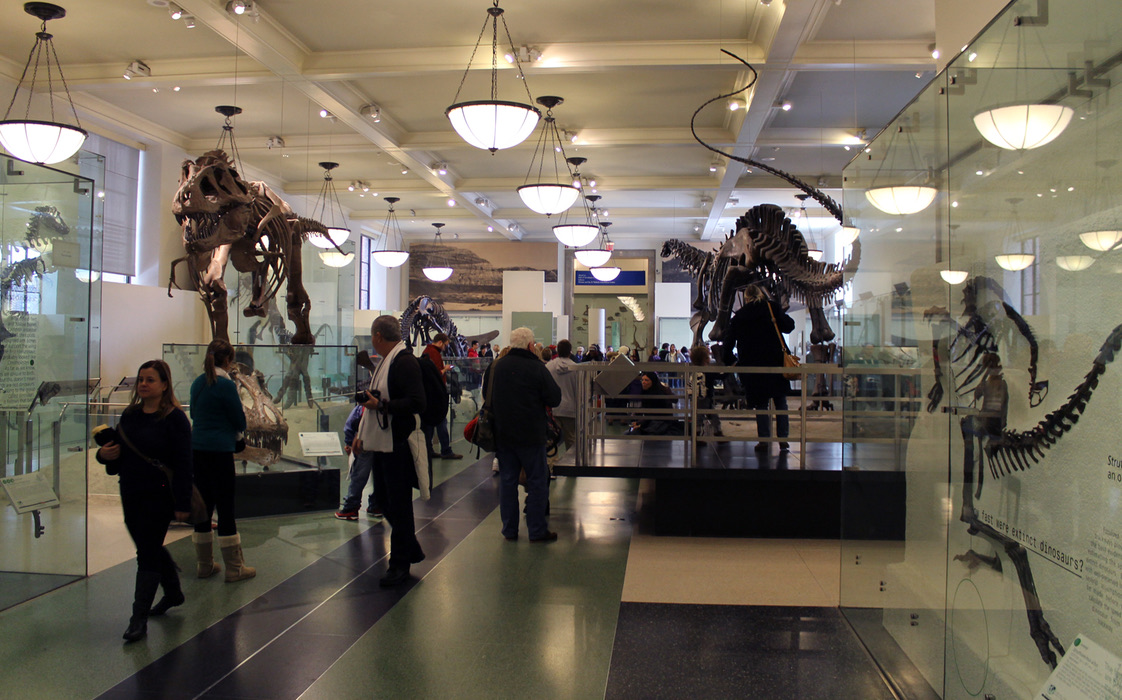
IMG_9769

The miniature maquette in front of the full-scale model. Photo by the author.

More than a dozen artists took part in building SUE, but I’m told this was primarily Jim Burt’s baby. Burt started the process by sculpting a miniature maquette in clay. The maquette was build directly over a 1/12th scale 3-D print of SUE’s skeleton, ensuring that the proportions were exactly right. At the Field Museum, Tom Cullen and Bill Simpson provided several rounds of anatomical revisions, paying particularly close attention to the arrangement of cornified bumps and knobs on SUE’s face. Of course, it wouldn’t be SUE without also including some of the scars and injuries SUE is famous for. The result is a restoration of not just any T. rex, but a specific old and punch-drunk individual that has lived a tough life but is still thriving.

Jim Burt feeds Deadmonto to SUE. Photo by the author.

Why is SUE eating a young Edmontosaurus? The primary reason is gravity. This model doesn’t have the same weight distribution as a real Tyrannosaurus, and it had to be light enough to break down and travel every few months. We needed a third point of contact with the ground to ensure maximum stability, and the Edmontosaurus prey was the coolest way to accomplish that. By design, it’s initially ambiguous whether SUE killed or scavenged this animal, but a close look at the muddy substrate reveals a set of tracks—Deadmonto’s last steps. What happens next? Imagine SUE horking down the Edmontosaurus whole, not unlike this seagull.

After the maquette was approved, the Blue Rhino team had it scanned, then milled out of giant blocks of foam at full size. It then took about six months to sculpt in the fine details (down to each individual scale) and paint SUE’s burgundy hide. In addition to being an extraordinary artistic creation, this model is a feat of engineering. While it looks seamless, it breaks down into chunks that fit through a standard six-foot door. It’s also light enough that a single person can push it across the floor.

0513802B-3AFA-4B10-B4C5-221EE69AB4F3_1_105_c

The finished model. Photo courtesy of Blue Rhino Studio.

This model must be seen in person to fully appreciate—not just the amount of detail but the sheer size. SUE is absolutely massive, but when you look at the skeleton with gastralia in place and consider the muscles needed to move this beast around, it’s hard to imagine T. rex any other way. 

As I’ve said previously, working with SUE is a humbling experience. It means standing on the shoulders of dozens of researchers, preparators, artists, educators, and more who have contributed to our understanding of this incredible fossil since it was unearthed. I’m delighted to have had the opportunity to join their ranks and help bring SUE to the next generation, and am indebted to my colleagues who willed this latest iteration of SUE into reality. It wasn’t lost on us that SUE: The T. rex Experience debuted 30 years after Sue Hendrikson discovered the fossil—approximately the same amount of time that SUE was alive during their previous existence on Earth. SUE’s second life is now longer than their first, so here’s to the next 30 years.

SUE: The T. rex Experience has been touring since August 2020 and is currently at the Liberty Science Center. Upcoming destinations will be posted on the Field Museum’s traveling exhibitions page.  

4 Comments

Filed under dinosaurs, education, exhibits, FMNH, museums, science communication