Category Archives: reptiles

Their hands were everywhere: the Morrison Natural History Museum

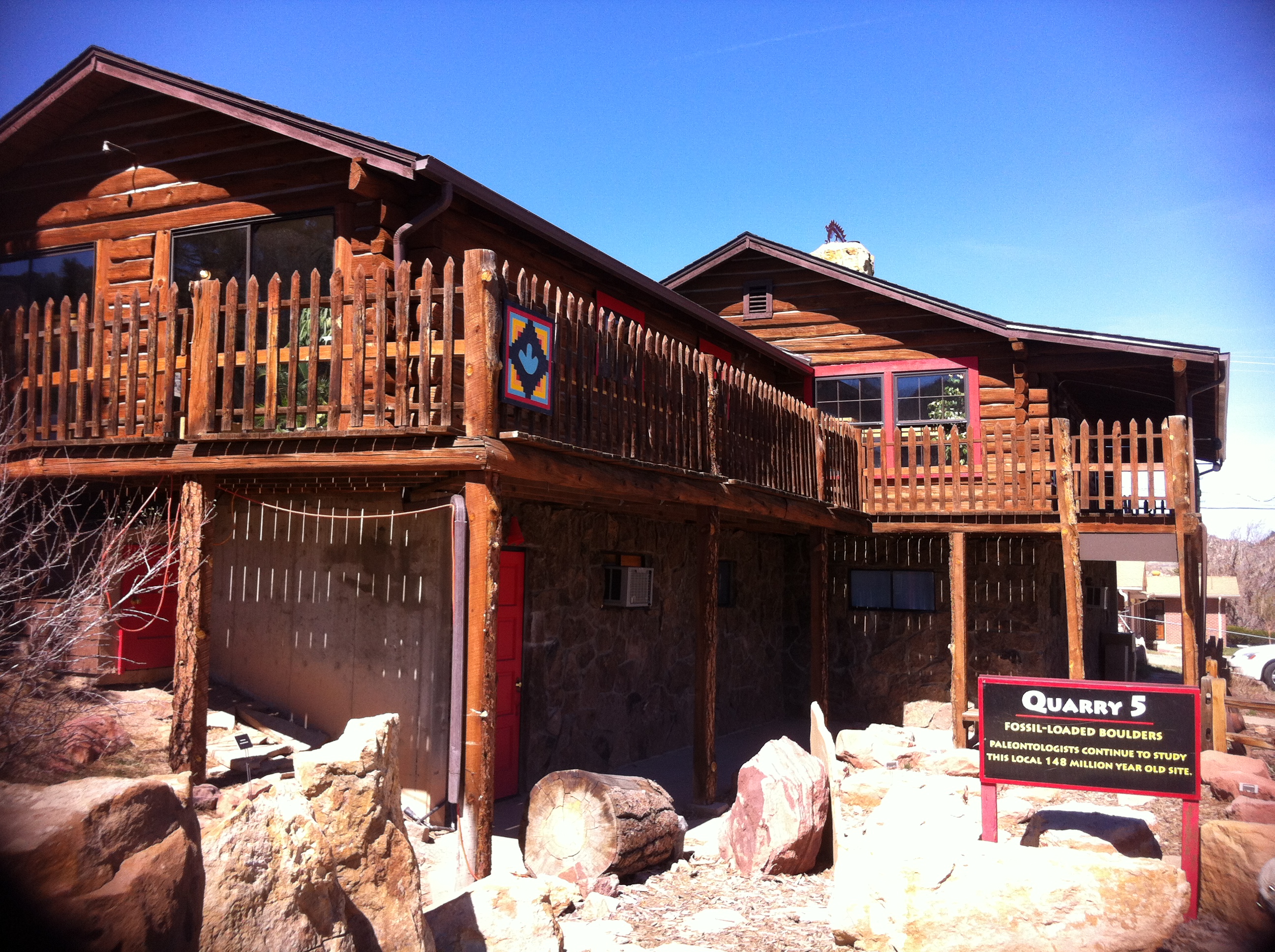
Outside the Morrison Natural History Museum. Doesn’t look like much…

Last week, I had a fantastic experience at the Morrison Natural History Museum, a little gem tucked away in the tiny town of Morrison, Colorado, on the north side of Denver. Since its opening in 1985, the Museum has served as a local educational resource covering the region’s plentiful paleontological resources. According to its website, the Museum is primarily a teaching institution. An affiliated foundation raises funds to bring local students on field trips, in support of the Museum’s mission to nurture “an understanding of and respect for the deep past.” In keeping with this teaching institution, gentle touching of all the fossils and casts is encouraged. This policy, and the design choices that go with it, are what truly set the Morrison Museum exhibits apart.

Paleontologically-inclined people are of course familiar with the Morrison Formation, the sequence of Upper Jurassic beds that extends across much of the western United States. The formation, which extends some 600,000 square miles, was named for the town of Morrison, where fossils were first discovered in 1877. The Morrison formation is probably best known as the epicenter of the “bone wars” between Othniel Charles Marsh and Edward Drinker Cope, who each led competing teams of fossil hunters across the region, attempting to best one another’s discoveries. Marsh and Cope were affiliated with the Peabody Museum in New Haven and the Academy of Natural Sciences in Philadelphia, respectively, so the fossils they collected all ended up back east. Indeed, while the Morrison region is among the most important and productive places for finding dinosaurs in the country, comparatively few of the treasures found there have remained in the region. The Morrison Natural History Museum therefore exists, at least in part, as a dedicated local repository and interpretative center for the region’s natural history.

The 1st floor Jurassic exhibit.

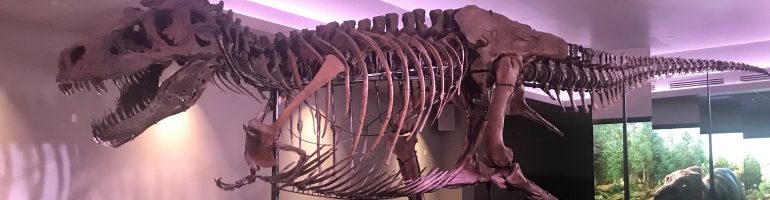
The Museum’s exhibit space is tiny, only 2000 square feet, but it is chock full of awesome. The exhibition consists of three main rooms, each one representing a geological time period. In the first floor Jurassic gallery, highlights include partial casts of Allosaurus and Apatosaurus,  the holotype of Stegosaurus, trackways attributed to Stegosaurus and a baby sauropod, and some original 19th century lithographic prints from Marsh’s monographs. For those interested in the history of paleontology, and of science in general, those prints are particularly fascinating.

Infant sauropod trackway with model of probable trackmaker.

Cretaceous and Cenozoic exhibits are found on the second floor. Most of the objects here are casts, most notably full skeletons of Platycarpus and Pteranodon, and skulls of Triceratops, Tylosaurus and a Columbian Mammoth. There are also a number of live animals on display, including a very charismatic monitor lizard thoughtfully placed next to its close relatives, the mosasaurs.

Original 19th century lithograph prints of fossil illustrations by Marsh’s team.

The signs and labels in the exhibit are noteworthy for their succinctness and clarity. It can be extremely challenging for writers of museum copy to provide appropriate depth of content without confusing, boring or alienating audiences with too much text. Overlong and unfocused labels are particularly common in small museums, where most of the copy is written by a single curator bent on sharing everything he or she knows about a topic. On the other end of the spectrum, larger, committee-designed exhibit labels can be too brief, too simple and too narrowly focused on the exhibit’s educational goals to be of much use to anybody. Happily, the Morrison Museum avoids both of these pitfalls. Labels are simple and attractive, but still informative and up-to-date. I was rather impressed by the economical way in which they addressed the most important topics in paleontology.

An example of a brief but content-rich label.

Obviously, the fossils and other objects on display are fantastic, and many, like the trackways, are quite unique. However, as mentioned above, one of the most remarkable aspects of the Museum is that touching of all the fossils and casts is encouraged.  Few objects are behind glass; everything is out in the open for people to touch and examine up close. There are many in the museum field who would be horrified by such an arrangement. When putting objects on exhibit, it is a given that they are considered consumable. No matter what precautions are taken, anything put on display will inevitably suffer damage. Of course, the flip side is that exhibit designers want to allow visitors to get as close to the objects as possible. The Morrison Museum has taken this to the extreme. The fossils, many one them irreplaceable holotype specimens, are fully exposed to accidental or intentional abuse by visitors. This is a very bold move on the part of the Museum, and it makes the point that the knowledge visitors can gain from full access to objects is more valuable that the objects themselves.

I won’t lie, my initial reaction upon seeing this exhibit layout was open-mouthed horror. But after spending some time in the space, I think the Morrison Museum may be on to something. This is a great way to tap into the multiple intelligences of visitors. Obviously, this system only works because the Museum’s attendance is on the low side (I would hate to see what the summer hordes at NMNH or AMNH would do if they were allowed to run wild among the mounts),  but given these circumstances I think the open-access approach is a great educational tool.

Overall, I was very pleased with my visit to the Morrison Museum. The volunteer staff knowledgable, passionate and helpful, the exhibits were excellent, and the handful of other visitors passing through (mostly young children) seemed genuinely engaged. The Museum is well worth a stop for anyone in the Denver area, and may well be a worthwhile model for other museums to follow.

3 Comments

Filed under dinosaurs, mammals, museums, paleoart, reptiles, reviews, science communication

Medullary Bone and the Dinosaur-Bird Link

One of the coolest lines of evidence that birds are extant dinosaurs is the presence of medullary bone in multiple dinosaur species. Medullary bone (hereafter referred to as MB, to avoid confusion with the medullary surface) is a temporary tissue that forms on the interior surfaces of the long bones of birds. MB is identified by unique collagen organization: it is both densely mineralized and strongly vascularized. This structure helps MB serve its purpose as a readily retrieved source of calcium for use in forming eggshells, and prevents incapacitating bone resorption during this process. Among extant animals, MB is only found in mature female birds in the process of producing eggs. Its creation is triggered by hormones during the onset of ovulation, and it disappears during the laying process. Among extant animals, MB is only known in birds. However, in 2005 Mary Schweitzer and colleagues reported their discovery of medullary bone in a Tyrannosaurus rex individual. Lee and Werning followed up on this research in 2007 by reporting MB in the theropod Allosaurus and the ornithopod Tenontosaurus.

Medullary bone in modern Gallus and fossil Tyrannosaurus. From http://www.abc.net.au/science.

Since MB is unique to reproductively active females, most popular coverage of dinosaur MB  has focused on its potential use for determining the sex and life stage of individual dinosaur specimens. We shouldn’t, however, lose sight of the fact that MB is an independent line of evidence supporting a close phylogenetic relationship between dinosaurs and birds. Nearly all paleontologists agree that the evidence that birds are dinosaurs is overwhelming, and MB is but a drop in the ocean of shared characters between birds and dinosaurs. Nevertheless, it is noteworthy that few authors have attempted to challenge Schweitzer’s initial publication.

The only work I have found  that disputes Schweitzer and colleagues is the dissertation of Dr. Devon Quick  (.pdf link), in which Dr. Quick and Dr. John Ruben investigated the reliability of the methods used to recognize MB in the fossil record using extant animals. This is not, incidentally, the only work by Quick and Ruben challenging the dinosaur-bird connection. As a doe-eyed student, I’d like to take a shot at reviewing this paper. And since I’m posting it publicly, I of course welcome anyone who’d be so kind as to call me out for being wrong.

Quick and Ruben looked at cross-sections of the femora and tibiotarsi of a crocodilian (Alligator mississippiensis) and several birds. Scanning electron microscopy revealed that the medullary surfaces of the tibiotarsi of  reproductively active birds displayed the highly contoured and floccular texture that is characteristic of MB. Likewise, the male and non-reproductively active female birds displayed smooth medullary surfaces. In this regard, Quick and Ruben are in agreement with previous work. However, the authors also reported that the medullary cavity of the alligator femur contained “material superficially similar to…avian medullary bone” (Quick and Ruben 2008). This material was limited to the immediate diaphyseal side of the metaphysis, making it much less extensive than what was observed in birds. Since the alligator individual used in the study was a juvenile male, it was almost certainly not producing reproductively-specific MB. From this observation, the authors conclude from these data that a floccular texture may indicate early-stage bone mineralization and is not a reliable indicator of MB.

Quick and Ruben’s results are unconvincing in part due to a weak experimental design. Their conclusions are dependent on observations gleaned from a single alligator specimen, which is not an adequate sample. The authors’ conclusions would carry more weight if they had looked at multiple individuals. It would also be beneficial to compare males, females, adults and juveniles. Ideally, additionally crocodilian species ought to be included in the study, as well. Schweitzer and colleagues carried out a similar investigation, in which they looked for evidence of MB in multiple alligators, including gravid females, males and juveniles (Schweitzer et al. 2007). Schweitzer and colleagues found no evidence of MB, even with estrogen stimulation, and their larger sample size allows their study to carry more weight than that of Quick and Ruben. Furthermore, although Quick and Ruben assert that that “histological aspects of Tyrannosaurus tissues that are supposedly consistent with an avian-style reproductive physiology were not analyzed carefully”, they did not look at the Tyrannosaurus material as part of their study. Accordingly, no evidence is provided that the structures the authors observed on their alligator were synonymous with those observed by Schweitzer and colleagues on Tyrannosaurus. Finally, Quick and Ruben’s observations are focused on the floccular texture used to identify MB, when in fact Schweitzer and colleagues used several other indicators, including extensive vascularization, to identify MB in Tyrannosaurus. It is notable that the structure, thickness and texture of MB in modern birds varies considerably based on the specifics of the animal’s reproductive biology and the size of the taxa. Given that Tyrannosaurus is several orders of magnitude larger than most extant birds, some structural difference is to be expected (wow, that sentence had some serious science snark).

Quick and Ruben suggest that the floccular texture on the alligator bone may be the result of early-stage mineralization, which would be consistent with the sub-adult status of the individual they used in the study. The authors go on to speculate that a similar explanation might account for the evidence of MB in Tyrannosaurus. Again, it would have been helpful if the authors had amassed more examples of sub-adult archosaurs undergoing skeletal mineralization, and compared them directly to the Tyrannosaurus material in question, rather than merely speculating. If the Tyrannosaurus was forming MB, this would be consistent with information from lines of arrested growth in Tyrannosaurus and other dinosaurs, which indicates that dinosaurs became reproductively active before reaching adult size.

Having reached the somewhat tenuous conclusion that texture is not a reliable indicator of MB, Quick and Ruben go on to argue that even if MB is present in dinosaurs, the fact that it has been reported in both saurischians and ornithiscians “offers no particular insight into the phylogenetic origins of birds.” On the contrary, MB is an independently observable feature that unites the crown group Dinosauria with Avialae, and therefore supports the consensus that Avialae is bracketed by Dinosauria. At the very least, MB suggests marked similarity in reproductive strategies employed by birds and dinosaurs. As demonstrated by Schweitzer and colleagues, MB is not known in crocodilians. Quick and Ruben freely admit this, which makes their statement that MB “may well be a plesiomorphic trait that first evolved in basal archosaurs” nonsensical (Quick and Ruben 2008). The authors could theoretically argue that MB production is primitive but was lost in modern crocodilians, but there is no evidence for this.

Overall, Quick and Ruben’s work is hindered by weak experimental design and vague, unsupported conclusions. Given that a similar but more rigorous study regarding MB in crocodilians has already been carried out by Schweitzer and colleagues, Quick and Ruben’s interpretations are not convincing. Even the broadest interpretation of the available evidence indicates that MB originated after the divergence of crocodilymorphs from the main archosaur line. The phylogeny postulated by Schweitzer and colleagues remains most tenable, in which MB originated in early dinosaurs, and was inherited by ornithiscians, tyrannosaurids and modern birds (Schweitzer et al. 2005).

References

Lee, A. H. and Werning, S. “Sexual maturity in growing dinosaurs does not fit reptilian growth models.” 2007. PNAS 105:2:582-587.

Quick, D. E. and Ruben, J. A. “Amniote bone structure and longbone histology in birds, alligators and the theropod Tyrannosaurus rex.” 2008. Oregon State University.

Schweitzer, M. H., Elsey, R. M., Dacke, C. G., Horner, J. R. and Lamm, E. T. “Do egg-laying crocodilian (Alligator mississippiensis) archosaurs form medullary bone?” 2007. Bone 40: 1152-1158.

Schweitzer, M. H., Wittmeyer, J. L. and Horner, J. R. “Gender-Specific Reproductive Tissue in Ratites and Tyrannosaurus rex.”2005. Science 308: 1456-1460.

Leave a comment

January 20, 2012 · 6:26 am