Tag Archives: fossil mounts

There are “fake” fossil mounts after all…in China

I’m always bummed when I hear museum-goers describe fossil mounts, particularly those that are entirely or partially made up of casts, as “fakes.” It is inaccurate, if not inflammatory to describe mounts in this way, and I always make sure to offer a correction (see this ancient post of mine or Christopher Norris’s much better explanation for details).

Well, it turns out I was wrong, or at least trapped in a western-centric worldview. There are fossil mounts that can and should be called fake…in China. Earlier today, Brian Switek linked to a brief radio story at CRIEnglish about the recent appearance of dinosaur-themed parks throughout China. According to the clip, local governments throughout China have been competing to built the biggest and best dinosaur park. The parks are apparently the equivalent of attention-grabbing and income-building public works projects, such as stadiums or fancy shopping centers, that are created regularly in the U.S. But while these new parks might have been inspired by the torrent of spectacular, paradigm-shifting fossils found in China over the last two decades, they are not museums. These are amusement parks, featuring robotic and fiberglass awesomebro dinosaurs. They are entertainment, not educational or scientific enterprises by any stretch of the imagination.

So where are these municipal dinosaur theme parks getting their dinosaurs? As it turns out, there are literally dozens of new companies in China that exist entirely to supply these attractions. I had encountered some of these sites before, but didn’t know the context of their existence until now. Google “China robotic dinosaurs” or something similar and you’ll find them. Most of these products are what they are: big, goofy looking animatronic dinosaurs that aren’t especially attractive but at least can’t be mistaken for scientific reconstructions. But then I saw the “dinosaur skeletons”:

It’s possible that parts of these might be casts, but I doubt it. These are pretty much abominations, sculpted with little regard for the actual appearance of these dinosaurs, or animal anatomy in general. I’ve written at length about how the public conception of dinosaurs is irreversibly intertwined with its conception of museums. When we think of fossils, we think of grand museum halls populated by towering skeletons. This connection is so ingrained that mounted skeletons have become, in the public eye, the only proper way to display dinosaurs. It’s therefore not unexpected that these companies would capitalize on that association.

The problem is that unlike a mural or life-sized model, which are obviously reproductions, mounted skeletons retain the aura of authenticity that comes from displaying known fossils. To display a skeleton is to imply that we are seeing real specimens, or at least replicas standing in for specimens that exist somewhere else. Displaying “dinosaur skeletons” with no regard for accuracy ruins that association. For nearly 200 years, fossil mounts have been symbols of credible science, and I hate to see that good reputation sullied.

Leave a comment

Filed under dinosaurs, exhibits, fossil mounts, opinion

The Chimeric Missourium and Hydrarchos

In 1802, naturalist and painter John Peale unveiled the first mounted fossil skeleton ever put on display in the United States. The mount, a mastodon (Mammut americanum) collected on a farm near Newburgh, New York, immediately captured public attention and inspired a wave of interest in anything old and big. Although Peale charged admission to view the mastodon and somewhat dramatized its importance as “the first of American animals” and “the largest of terrestrial beings”, his primary intent was to educate the public about the natural world. Nevertheless, many American capitalists saw the crowds of people lining up to see Peale’s mastodon and concluded that there was a profit to be made in exhibiting fossils. The best known of these 19th century fossil showmen was surely Albert Koch. Having immigrated to the United States from Germany in 1835, Koch was a contemporary of P.T. Barnum, and like Barnum, he made a career out of exhibiting “curiosities”, some real and some fraudulent or exaggerated. At “Dr. Koch’s” (he never actually earned a doctorate) exhibition hall in St. Louis, Missouri, visitors paying the 50 cent admission fee could view wax sculptures, exotic animals, artifacts from distant countries, extensive miniature dioramas, and alleged freaks of nature. Koch also had a live grizzly bear and several alligators – sources differ on whether or not they were forced to fight for entertainment.

Missourium

In 1840, Koch received word of something much bigger. A Missouri farmer had discovered large fossil bones, and Koch quickly arranged to purchase the find along with the rights to search the farmer’s land for more. Within four months, Koch had assembled a complete mastodon skeleton. More than complete, actually: Koch’s mount included numerous extra vertebrae and ribs from one or more additional mastodon individuals. Like Peale before him, Koch placed blocks of wood between the vertebrae to further exaggerate the animal’s length. The result was a 32-foot mount, nearly twice as long as a typical mastodon. As a final flourish, Koch positioned the mastodon’s tusks pointing upwards, to make the beast look more fearsome. In order to differentiate his creation from Peale’s earlier exhibit, Koch called the creature “Missourium”, although there was no scientific reason to distinguish it from other mastodon finds. Missourium went on display at Koch’s St. Louis establishment later that same year, and proved to be an instant success. In fact, Koch decided that the composite mastodon mount was worth more than then every other display combined. In 1841, he sold the exhibit hall and took Missourium on tour, traveling to New Orleans, Philadelphia, and several other American cities.

Illustration of Missourium. Out-of-copyright image via Laelaps.

Contemporary academics, including the British naturalist Richard Owen, pointed out that Koch’s mount was clearly an incorrectly assembled composite, and expressed disapproval for Koch’s sensationalized treatment of important fossil specimens. Just like famous P.T. Barnum frauds like Joice Heth and the Feejee mermaid, however, the controversy surrounding Missourium’s legitimacy only increased the enthusiasm of the paying public.  As an interesting side note, Koch claimed to have found stone tools and other human artifacts alongside the Missourium fossils. He included a pamphlet with his traveling exhibit which explained that these tools demonstrated that human populations in North America extended much further back in time than had been previously assumed. Koch may well have been telling the truth about where he found the artifacts and would eventually turn out to be correct about the antiquity of American humans. Nevertheless, because of the obviously fraudulent nature of Missourium, scientists of the day saw fit to ignore Koke’s suggestions entirely.

Hydrarchos

Koch sold Missourium to the British Museum in 1843, but he was soon at it again in 1845, when he began scouring Alabama for new display-worthy fossils. This time, Koch was after the bones of the prehistoric whale Basilosaurus cetoides. The Philadelphia-based naturalist and physician Richard Harlan had first described and named Basilosaurus in 1835 (he erroneously thought it was a reptile, hence the name meaning “king lizard”), but its fossils had been well known in the American south for decades before that. Enslaved men and women often ran into the bones while plowing fields, and these fossils were sometimes used as furniture or foundation posts for houses. Between January and April of 1845, Koch traveled across Clarke, Choctaw, and Washington counties, retrieving Basilosaurus remains. His best find was an articulated partial skeleton, including much of the skull, which he unearthed near the Tombigbee River.

After accumulating parts of at least six Basilosaurus individuals, Koch combined the fossils into a 114-foot mount (he would claim that it was 140 feet). Just as he had with Missourium, Koch strung together the vertebrae of multiple animals, extending his creation’s length to an absurd degree. This time, Koch did not even limit himself to whale fossils: as naturalist Jeffries Wyman would point out, many of the elements in Koch’s chimeric creation were actually ammonite shells. Billed as a sea serpent called “Hydrargos sillimani” (named after Yale professor Benjamin Silliman, who was not involved in the project and immediately requested that the reference be removed), the mount was first exhibited at the Apollo Saloon in New York City. Hydrargos, eventually renamed Hyrarchos, proved to be even more popular and profitable than Missourium. Cleverly, Koch had constructed the skeleton not as a single structure but as several modular components secured to wooden boards. This made it easy for the showman to disassemble, transport, and reassemble the display, which he toured throughout the United States and Europe.

Illustration of Hydrarchos in New York.

Illustration of Hydrarchos in New York’s Apollo Saloon.

As they had with Missourium, scientists confronted Koch over his inaccurate and sensationalized displays. Undaunted, Koch eventually sold the Hydrarchos mount to the Prussian King Friedrich Wilhelm IV, who exhibited it in Berlin’s Royal Anatomical Museum despite the insistence by the museum’s experts that the mount was a fraudulent reconstruction. Koch was still not finished, however. In 1848 he completed a second Basilosaurus composite, this one 96 feet long, and again took it on tour. The Mark II Hydrarchos would eventually be sold to Colonel Wood’s Museum in Chicago. E.L. Wood’s “museum” was yet another exhibition of mostly-bogus oddities, like Koch’s original operation in St. Louis. Still, the Basilosaurus mount’s final home can be credited for correctly identifying it as a prehistoric whale. The composite mount was labeled as “Zeuglodon”, a junior synonym coined by Richard Owen when he determined that the Alabama fossils belonged to marine mammals, not reptiles. Properly identified or not, the mount was destroyed along with the rest of Wood’s Museum during the great Chicago fire in 1871. Most of the original Hydrarchos was lost during World War II, although some parts remain at the Humboldt Museum in Berlin.

Modern Influences

Koch’s fossil mounts were frustrating to 19th century paleontologists because they cast unnecessary doubt on their young discipline. The actual bones that made up Missourium and Hydrarchos were genuine, Koch had merely assembled them incorrectly to enhance the appeal and profitability of his displays. To the scientists’ chagrin, when they criticized Koch’s displays, the popular press and the public often misinterpreted their statements and became skeptical of fossil finds in general. During the 19th century, ideas like extinction and the great age of the Earth were very new, and Koch’s spurious commodification of hard evidence made it harder for legitimate researchers to be taken seriously in the public sphere.

In fact, modern paleontologists still have to do damage control when the occasional forgery turns up. In 1999, the discovery of “Archaeoraptor” was widely publicized in National Geographic magazine and elsewhere as a feathered dinosaur that provided important evidence for the dinosaurian origin of birds. Archaeoraptor was not the first feathered dinosaur ever found, but it was one of the early ones, back when the concept of dinosaurs with feathers was still news. Unfortunately, it was only after the National Geographic article had gone to press that paleontologists Xu Xing and Phil Curie determined that the Archaeoraptor specimen, which had been smuggled into the United States from China by an unknown dealer, was actually a composite. Someone in China knew that a complete skeleton was worth more than an incomplete one, and cemented together partial skeletons of several dinosaurs, including Microraptor and Yanornis. When National Geographic retracted the story, however, many readers misunderstood the extent of the forgery. They thought that the feathers, the most exciting part of the find, had been faked, when in reality all the parts of Archaeoraptor were quite real, they just belonged to different animals.
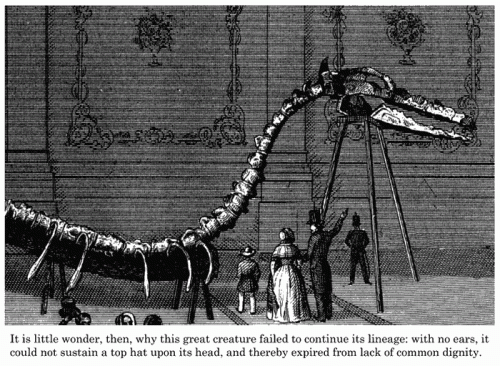
This out-of-copyright image of Hydrarchos provides a good look at the mount's wooden armature. Out-of-copyright image via Laelaps.

This image of Hydrarchos provides a good look at the mount’s wooden armature. Incidentally, the above caption is accurate. Out-of-copyright image via Laelaps.

More than ten years later, writers with creationist agendas and a few scientists who ought to know better are still pushing the myth that Archaeoraptor was a deliberate hoax. Literally hundreds of genuine feathered dinosaur specimens found since then contribute to the scientific consensus that birds area incontrovertibly dinosaurs. And yet, paleontologists are still fighting skepticism inspired by the Archaeoraptor mistake.

19th century paleontologists paid for Koch’s displays in much the same way. Editorials denouncing evolution and the fossil record repeatedly referenced Koch’s ridiculous chimeras, as though these showpieces were representative of paleontologists’ work. I suspect that the general animosity paleontologists of the era felt toward fossil mounts came from dealing with Koch’s legacy. O.C. Marsh, for instance, hated the idea of mounting fossils and refused to let any of his finds be displayed in such a way during his lifetime. It would not be until 1868 and the discovery of the first somewhat complete dinosaur remains that paleontologists would again see mounting as a legitimate means for displaying their finds.

References

Carpenter, K., Madsen, J.H. and Lewis, L. (1994). Mounting of Fossi Vertebrate Skeletons. In Vertebrate Paleontological Techniques, Vol. 1. Cambridge, UK: Cambridge University Press.

Jones, D.E. 1998. Doctor Koch and his “Immense Antidiluvian Monsters.” http://www.alabamaheritage.com/vault/monsters.htm

Rogers, M. 2010. Delia’s Tears: Race, Science and Photography in Nineteenth Century America. New Haven, CT: Yale University Press.

Simpson, G.G. 1942. The Beginnings of Vertebrate Paleontology in North America. Proceedings of the American Philosophical Society. 86:1:130-188.

Switek, B. 2008. “Koch’s “Mammoth” and Human Antiquity.” http://scienceblogs.com/laelaps/2008/06/18/too-little-too-soon/
9 Comments

Filed under fossil mounts, history of science, mammals, museums

Fossil mounts: specimens, showpieces, art and more

A few days ago, Andy Farke posed the following question on twitter:

If fossils are part of our planet’s heritage, and belong to all of us, are museum restrictions on photos ethical?

Farke clarified that he was referring specifically to fossils held in collections, especially those collected on federal land and/or with public funding. Following the same sound logic that makes open access scientific publication a necessity, any scientific work using public resources should be accessible to everyone, including objects in collections.* The question had arisen because some museums bar researchers utilizing collections from using photographs in their published articles (or charge a fee for the privilege). This is a valid concern, but I don’t have enough experience with scientific publishing to explore it properly. Instead, I’d like to hijack the question in order to discuss the murky identity of fossil mounts.

*I’m going to disregard for-profit museums for the time being, suffice it to say such collections exist and can be useful for research as well.

A sampling of fossil collections and curators at the National Museum of Natural History. Source: http://paleobiology.si.edu.

As was already pointed out in response to Farke’s initial question, the public’s right to access photographs of some fossil collections should not necessarily extend to museum exhibits. Any modern museum exhibit worth its salt is far more than specimens on shelves. Exhibits are immersive experiences that use specimens to illustrate a story. A great deal of creative work goes into designing and fabricating an exhibit, and it is not unreasonable for museums to claim ownership of any reproductions, including photographs, if they so choose.

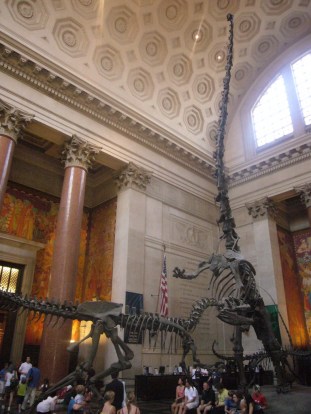
Allosaurus and Barosaurus mount in the Roosevelt rotunda of the American Museum of Natural History. Source: http://www.ourtravelpics.com.

Allosaurus and Barosaurus mounts in the Roosevelt rotunda of the American Museum of Natural History. Source: http://www.ourtravelpics.com.

Fossil mounts, however, are a different beast. These structures are difficult to categorize because they are intended both to educate and to entertain. They may incorporate real fossils, or casts taken directly from them, but I would argue that fossil mounts are primarily constructed pieces. With the exception of some more recently extinct mammal taxa, most mounts are composites of casts, sculpted elements and original fossils collected in different places at different times. Steel armatures are custom-made not only to support the specimens but to appropriately fill the exhibit space. Mounts like the striking Barosaurus and Allosaurus encounter in the Roosevelt rotunda at AMNH (above) are designed to make an aesthetic impression as well as to inform. Overall, mounts require a substantial investment of time, labor, money and artistic skill to create and maintain. Experienced researchers typically guide the construction process and the contributions of knowledgeable scientists cannot be overstated, but fossil specimens certainly do not come out of the ground mount-ready. There is a great deal more to making a good mount than stringing vertebrae together in the right order.

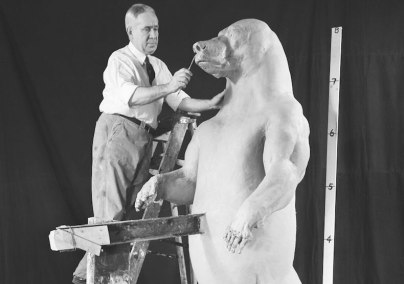
A direct comparison can be made between fossil mounts and the taxidermied animals that are also a staple at natural history museums. A taxidermy mount also incorporates a scientific specimen, the animal’s skin, which if collected using public resources should be accessible to all. Like fossil mounts, however, taxidermy pieces require extensive artistic and technical skill to create, from the steel or wood armature to the clay model that build’s out the animal’s musculature to the eyes and mouth, which are typically sculpted from scratch. It is worth quoting Rachel Poliquin’s excellent The Breathless Zoo at length:

As dead and mounted animals, [taxidermy mounts] are thoroughly cultural objects; yet as pieces of nature, [they] are thoroughly beyond culture. Animal or object? Animal and object? This is the irresolvable tension that defines all taxidermy. (Poliquin 2012, 5-6)

I firmly believe that the results of scientific inquiry belong in the public domain, and it follows that restrictions on the photographic reproduction of collections specimens are inappropriate. Nevertheless, fossil mounts and taxidermied animals are the products of artisans as much as of researchers, and the right to credit and control over this work ought to be respected. This middle ground is awkward to negotiate, and as Poliquin puts it, a means to please all parties might be “irresolvable.”

Robert Rockwell sculpts the internal model for AMNH's taxidermied brown bear. Source: Scientific American.

Robert Rockwell sculpts the internal model for AMNH’s taxidermied brown bear. Source: Scientific American.

To make a non-committal final point, I’d like to mention that it is tempting to be too uptight about copyright, particularly in a museum setting. This past October, I had the pleasure to give a presentation with Alexis Fekete at the Kansas Museum Association’s annual conference. The most interesting part of our session (which was about how web 2.0 tools can help museums) was when audience members, mostly representing small history museums, voiced concerns over making their photography collections available online. There was apprehension about making it too easy for people to copy and sell pictures without permission, which I assume is the primary reasoning behind other museums’ policies prohibiting the publication of fossil images. I’m skeptical, however, that this is the most pressing concern. Perhaps I’m being naïve, but I have no problem with getting information disseminated to genuinely interested people. Creating awareness and enthusiasm for content is part of the general mission of museums, and I’d hate to see overzealous copyright barriers get in the way of that.

References

Poliquin, R. 2012. The Breathless Zoo: Taxidermy and the Cultures of Longing. University Park, PA: Pennsylvania State University Press.

3 Comments

Filed under collections, dinosaurs, fossil mounts, mammals, museums, science communication

Extinct Monsters: History of Smithsonian Fossil Exhibits

Click here to start the Extinct Monsters series from the beginning.

Upon his death in 1829, British scientist James Smithson left his fortune to the United States government to found “at Washington…an establishment for the increase and diffusion of knowledge.” Congress used Smithson’s estate to establish the publicly funded Smithsonian Institution in 1846, which has since grown into an expansive research institute and museum complex that is recognized the world over. Vertebrate paleontology has been an important part of the Smithsonian’s agenda since the beginning, and this article by Ray Rye provides a compelling history of the scientific staff and their research. This post will take a slightly different approach, summarizing the changing public face of Smithsonian paleontology in the form of its genre-defining exhibits.

In 1847, Joseph Henry, the Smithsonian’s first secretary, started construction on the original Smithsonian building, which today is colloquially known as “the castle.” The first vertebrate paleontology exhibit housed within its walls consisted of a trio of casted skeletons: the ground sloth Megatherium, the glyptodont Scistopleurum, and the tortoise Collossochelys. These exhibits were probably obtained through Ward’s Natural Science Establishment. The Smithsonian’s first skeletal mount made from original fossils was a Megaloceros, purchased from antiquities dealers Thomas and Sons in 1872.

Exhibits like this one at USNM were deemed incomprehensible and inspired early reform

Basilosaurus, Megatherium, and Megaloceros are visible in the southwest court of the first United States National Museum. Image courtesy of the Smithsonian Institution Archives.

1881 saw the completion of the original United States National Museum, next door to the castle (this structure is now called the Arts and Industries Building). The southwest court was dedicated to osteology and paleontology, and the existing skeletal mounts were placed here among rows of cases containing smaller specimens. At this point in time, the Smithsonian had very few permanent staff members, instead relying mostly on scholars serving in unpaid “honorary” positions to curate the growing national collection. Famed paleontologist O.C. Marsh (the beardier half of the “bone wars” rivals) was the honorary curator of vertebrate paleontology. Under contract with the United States Geological Survey, Marsh supervised numerous field expeditions to the American west and oversaw the collection of untold thousands of fossil specimens. When Marsh died in 1899 the fossils he collected for the government were relocated from Yale University (his home institution) to the Smithsonian.

Gilmore and the Hall of Extinct Monsters

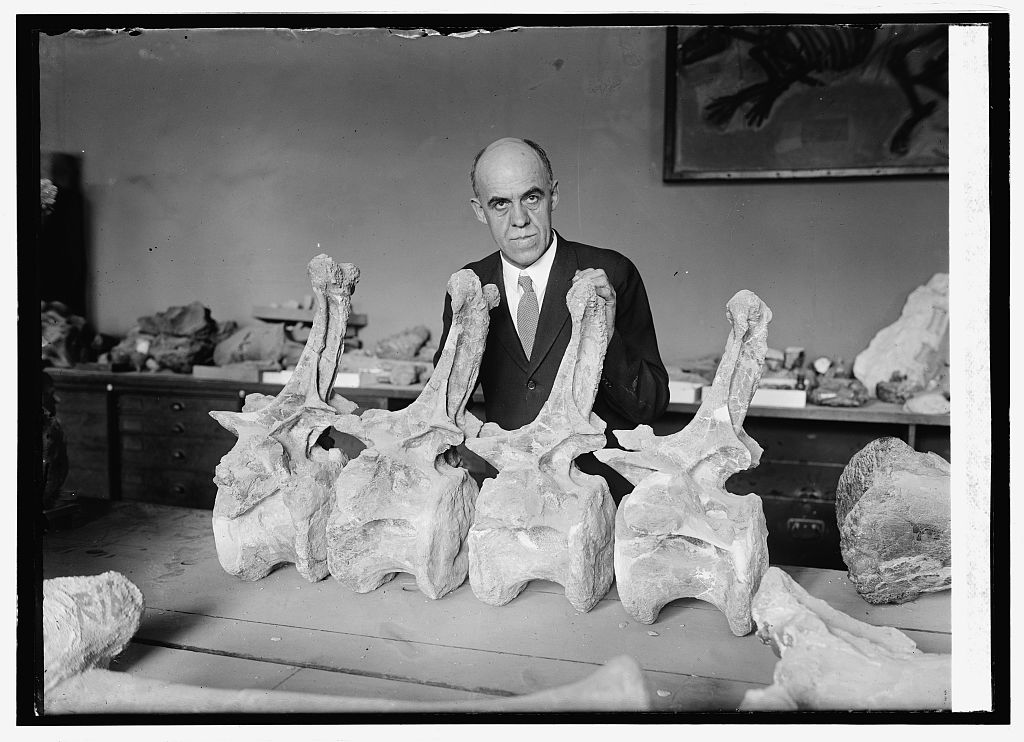
Gilmore with Diplodocus vertebrae.

C.W. Gilmore with some Diplodocus vertebrae. Image courtesy of the Smithsonian Institution Archives.

Charles Whitney Gilmore was a student in mine engineering at the University of Wyoming when he became involved in the Carnegie Museum’s fossil hunting expeditions in 1899. Recognizing the young man’s enthusiasm and talent, John Bell Hatcher hired Gilmore immediately after his graduation in 1901. Gilmore worked with Hatcher for two field seasons, but in 1903 he moved to Washington, DC upon being offered a position as a full-time preparator at the USNM. He was promoted to Curator of Vertebrate Paleontology in 1924, and is fondly remembered as an exceptionally modest but extraordinarily productive scientist. As curator, Gilmore led sixteen fossil-hunting expeditions to the western interior. Gilmore’s most enduring contribution to paleontology, however, is his extensive body of descriptive publications on the Marsh fossils. His monographs on Apatosaurus, Camarasaurus, Ceratosaurus, and many others are still regularly cited today.

Along with preparators Norman Boss and James Gidley, Gilmore is responsible for creating most of the mounted dinosaur skeletons that are on display at the Smithsonian. The first dinosaur mount Gilmore and his team completed was Edmontosaurus, which went on display in the original USNM building in 1904. Gilmore would go on to supervise the construction of Triceratops (the first mount of this taxon in the world), Camptosaurus, Stegosaurus, DimetrodonCeratosaurus, Diplodocus, and numerous other displays that have been enjoyed by generations of museum visitors.

extinctmonstersfront_1913

The Hall of Extinct Monsters, sometime before 1929. Image courtesy of the Smithsonian Institution Archives.

Congress authorized the construction of a new United States National Museum on the north side of the National Mall in 1911. In contrast to the Victorian style of the original building, the new museum sported neoclassical granite construction which matched the aesthetic of the other federal buildings. Exactly when the museum opened is the subject of some debate. Collections and offices began moving across the mall via horse and wagon in 1908, and part of the first floor opened to the public on March 17th, 1910. Nevertheless, it was not until 1911 that all the exhibit spaces were ready for visitors, including the evocatively titled “Hall of Extinct Monsters” in the museum’s east wing. This cavernous space devoted to fossil displays was primarily under Gilmore’s stewardship, and generally resembled a classic “cabinet of curiosity” approach to exhibit design. Gilmore and his team would gradually fill the Hall of Extinct Monsters will new specimens over the coming decades, culminating in the towering Diplodocus mount completed in 1932.

Modernization and Renaissance

Gilmore retired in 1945, and vertebrate paleontology research at the USNM, particularly in dinosaurs, quieted in his absence. Charles Gazin, Gilmore’s successor as Curator of Vertebrate Paleontology, specialized in mammals, and the museum remained without a curator specializing in dinosaurs until Matt Carrano was hired in 2003. In 1957, the USNM split into two subdivisions, the Museum of Natural History and the Museum of History and Technology. The Smithsonian’s history collections were moved to a new building next door, now called the National Museum of American History, and other collections gradually dispersed into 20-some other Smithsonian museums. The site of the disbanded USNM was officially renamed the National Museum of Natural History in 1967, and remains the home of natural sciences and anthropology.

The Diplodocus, as it stood from 1963 through 1981. Image courtesy of the Smithsonian Institution Archives.

The Hall of Fossil Reptiles lasted from 1962 to 1981. Image courtesy of the Smithsonian Institution Archives.

The Hall of Extinct Monsters persisted largely unchanged until 1962, when it was finally renovated as part of a Smithsonian-wide modernization project. The fossil exhibits were among the last to be updated, in part due to ambivalence from the paleontology curators. The department did not employ any staff members exclusively devoted to exhibit work, so the task of reinventing the displays was an added burden for the research staff. As such, the changes to the hall ended up being more cosmetic than structural. The largest mount, Gilmore’s Diplodocus, was too difficult to disassemble and move, so the new exhibit was designed around it. Solid earth tones and wall-to-wall carpet replaced the original neoclassical aesthetic. The John Elliot mural Diana of the Tides, positioned high on the east wall, was simply boarded over during construction (and has remained so ever since).

The 1981 renovation saw the addition of a mezzanine over the dinosaur exhibit. Source

In 1974, the addition of the Hall of Ice Age Mammals and the Rise of Man expanded the paleontology display space beyond the east wing. Further renovations took place in three stages starting in 1979. Entitled “Fossils: The History of Life”, the overhauled exhibit complex represented a significant departure from earlier iterations of this space. While the previous renovation arranged specimens according to taxonomy and curatorial specialties, “The History of Life” followed the evolutionary progression of fossil plants and animals through time. The new exhibits also differed from prior efforts in that they were not put together exclusively by curators. Instead, the design process was led by educators and exhibits specialists, who sought curatorial input at all stages. The new specimens and displays also required the once spacious hall to be carved up into a maze of small rooms and narrow corridors. Even with the additional floor space provided by a new balcony over the dinosaurs, the east wing had become quite crowded.

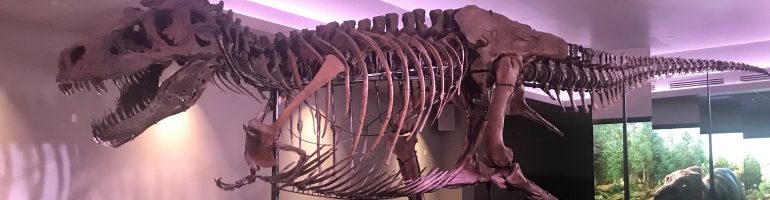
Of course, the science of paleontology has advanced by leaps and bounds since the 1980s, and NMNH staff have made piecemeal updates to the exhibits when possible. These changes include restorations of deteriorating mounts, the addition of a cast of Stan the Tyrannosaurus, and a few revised signs addressing the dinosaurian origin of birds and new dates for geologic time periods. Still, the east wing remained largely the same for over 30 years, and began to look a bit tired next to the brand-new exhibits that have opened at NMNH over the last decade.

Looking Ahead

The NMNH fossil halls closed on April 27th, 2014 for a five year renovation project. For the first time, the east wing was completely gutted and its underlying infrastructure overhauled. Aging specimens like the 1932 Diplodocus and the 1911 Ceratosaurus were be painstakingly disassembled and conserved, and the space itself was restored to its original Beaux Arts splendor. The re-imagined exhibit is arranged in reverse chronological order: visitors  start among mammoths and ground sloths in the Pleistocene and move backward in time through increasingly alien-looking versions of North America. Unlike the present exhibit, however, an open floor plan will allow visitors to get a sense of what they’re in for from the moment they walk into the hall.

4-07

Mesozoic section of the new Hall of Fossils – Deep Time. Concept art on display in the Last American Dinosaurs exhibit at NMNH.

The overall theme is change over geologic time, highlighting the myriad ways that climate, geography, evolution, and other living and nonliving systems interact and shape the world’s environments. Not all the classic mounts will make it into the new space (Brachyceratops, Zygorhiza, and Stegomastodon are among the retirees), but there are many new additions, including the Nation’s T. rex The result will be a compelling mix of classic early 20th century museum aesthetics and modern visitor-focused educational strategies.

References

Gilmore, C.W.  (1941). A History of the Division of Vertebrate Paleontology in the United States National Museum. Proceedings of the United States National Museum No. 90.

Rye, R. (2002.) History of the NMNH Paleobiology Department. http://paleobiology.si.edu/history/rye.html

Sues, H. and Marsh, D. (2013). Charles Whitney Gilmore: The Forgotten Dinosaur Hunter. http://paleobiology.si.edu/history/gilmore.html

Yochelson, E.L. (1985). The National Museum of Natural History: 75 Years in the Natural History Building. Washington, DC: Smithsonian Institution Press.

1 Comment

Filed under collections, dinosaurs, exhibits, Extinct Monsters, fossil mounts, history of science, mammals, museums, NMNH, reptiles