Monthly Archives: May 2013

A Triceratops for Lawrence

In an earlier post, I described how the Smithsonian’s Triceratops was the first free-standing mount of this animal ever created, and the eccentricities of its proportions and posture would define how the species would be depicted in artwork and other reconstructions for the better part of a century. I should have clarified, however, that this was not the first time Triceratops fossils were put on public exhibit. That honor goes to the University of Kansas Natural History Museum, which was founded in 1864 and is still operational today.

Among the Museum’s basement paleontology exhibits is a case of dinosaur fossils that has literally gone unchanged since the 1950s. Although this time capsule of mid-century museum design is of some historical interest, it would be nice if those sauropod limb bones weren’t labeled “Brontosaurus” (to be clear, the whole museum doesn’t look like this, the staff has been slowly but surely modernizing the exhibits). Of particular importance is the Triceratops skull (specimen 422) on the left side of the case. While there is no historical information on its label, this specimen has been with the museum for over 115 years, having been unearthed and put on display only six years after O.C. Marsh first named and described Triceratops.
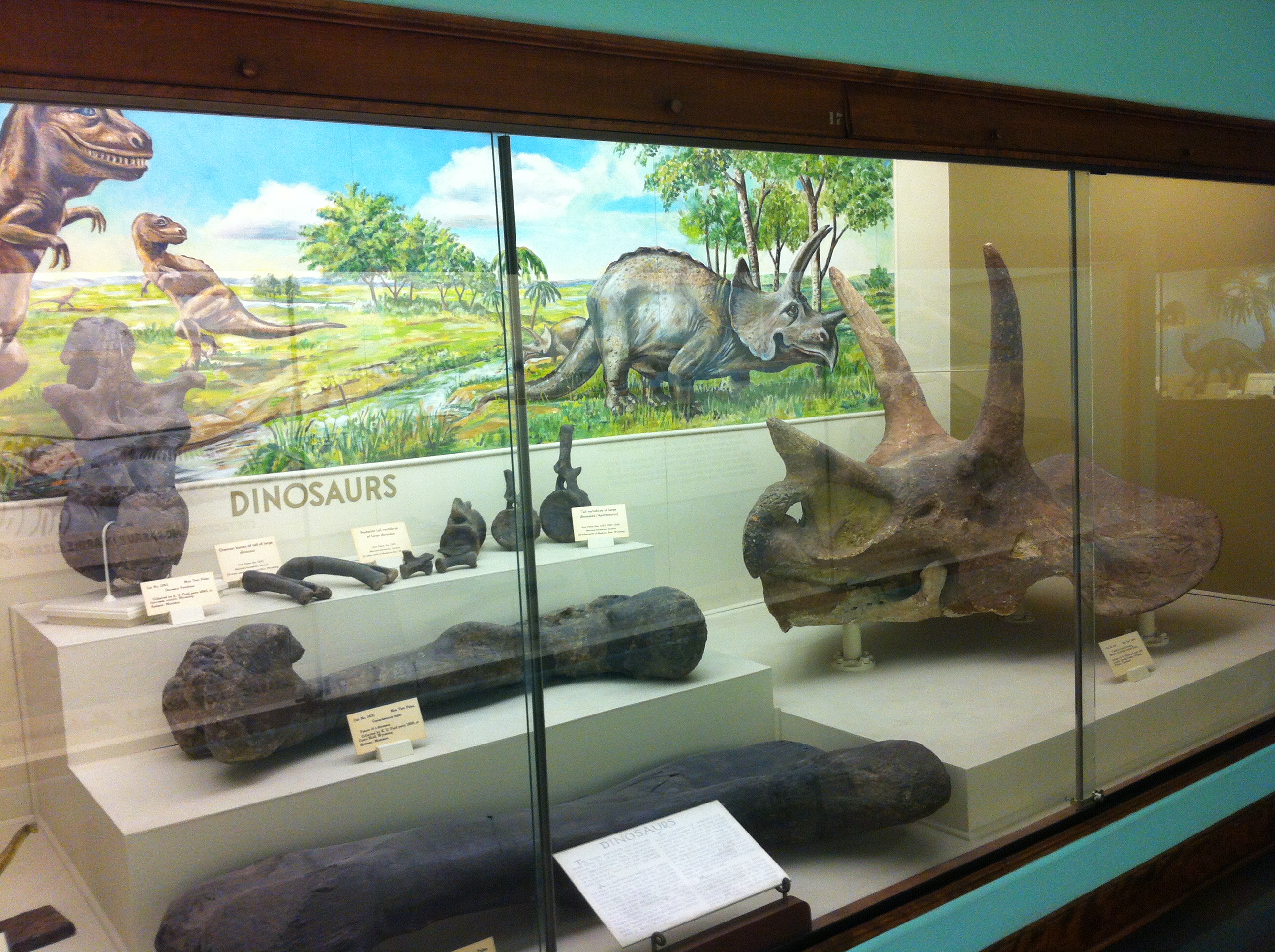
The dinosaur case at the KU Natural History Museum, untouched since the 1950s.

The dinosaur case at the KU Natural History Museum, untouched since the 1950s.

The story of the KU Triceratops is not well-known, although it is the subject of the somewhat hard-to-find book (neither the Museum nor the KU library has a copy) A Triceratops Hunt in Pioneer Wyoming. In the summer of 1895, a team from the University ventured into the frontier lands of of eastern Wyoming with the explicit goal of finding a Triceratops for display at the young Natural History Museum. The team was led by Samuel Wendell Williston, founder of the University’s geology department. Although Williston’s specialty was entomology, he had previously worked under Marsh at Yale and was well-acquainted with the plethora of dinosaurs on which his mentor had published. Also on the expedition were KU Regent James Polk Sams, and two individuals whose names are quite familiar to anyone with an interest in the history of paleontology, Barnum Brown and Elmer Riggs. Brown would, of course, go on to be the star fossil hunter at the American Museum of Natural History, while Riggs would become a curator at the Field Museum of Natural History. In 1895, however, both were students, and not especially interested in fossil collecting or paleontology. 

The team found the Triceratops they were looking for on July 9, near the confluence of Lightning and Lance Creeks. By July 22, the skull was fully excavated and crated for a journey by train back to Lawrence. The fossil apparently garnered a fair amount of attention on the journey; while Triceratops is well known today, in 1895 few had any idea that animals such as this had ever walked the Earth. And yet, here was clear, physical evidence of an extinct animal like nothing alive in the modern world, and it would soon be displayed for all to see in the University of Kansas Museum.
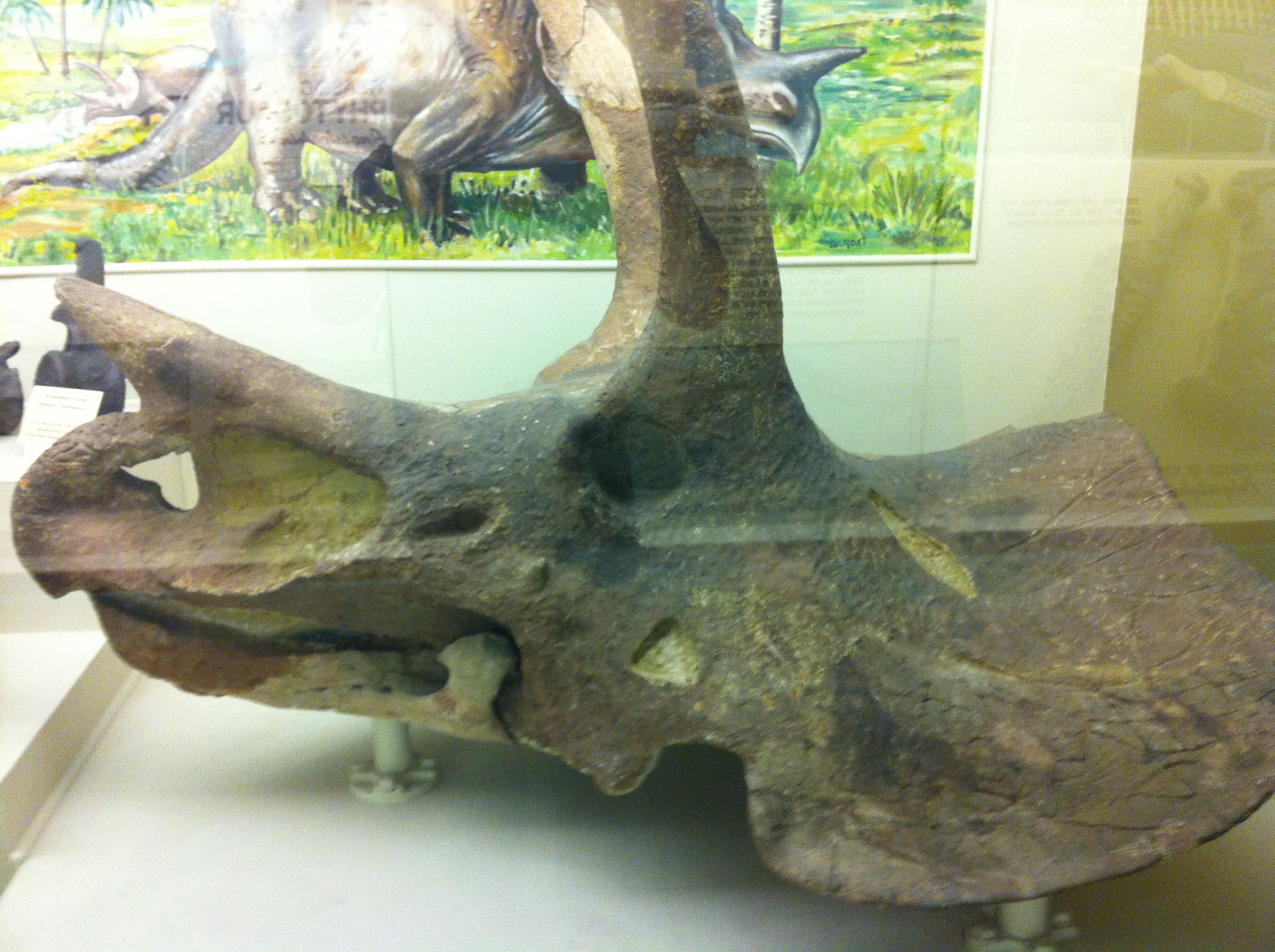
Triceratops skull retrieved by the 1895 Wyoming expedition.

Triceratops skull retrieved by the 1895 Wyoming expedition.

The 1895 expedition was not tremendously productive scientifically, the fossils found that summer resulting in only three short papers. However, the journey, and the Triceratops skull that was brought back, did end up being quite important for paleontology. The expedition inspired Brown and Riggs to pursue careers in paleontology, and as Brinkman and colleagues write in Triceratops Hunt in Pioneer Wyoming, “they would hunt bones for the rest of their lives, to the great benefit of science, and might never have done so had not circumstances landed them in the circle of Williston’s influence in the summer of 1895.”

Furthermore, by setting out with the clear goal to find a dinosaur for display, the University of Kansas team were trailblazers in a movement that would lead to the inseparable connection between dinosaurs and museums in popular culture today. In the first decade of the 20th century, newly burgeoning large urban museums openly competed to find and display the largest and most spectacular dinosaurs. Exhibits like the AMNH Brontosaurus, the Carnegie Museum of Natural History Diplodocus and, of course, the Smithsonian Triceratops brought millions of Americans into museums, ensuring that to this day, when we think of museums, we think of dinosaur skeletons (and vice versa). In spite of the somewhat dingy basement display it currently finds itself in, the University of Kansas Triceratops was an early trendsetter and a profound example of the intersection of science and history.

Reference

Kohl, M.F., Martin, L.D. and Brinkman, P., eds. (2004). Triceratops Hunt in Pioneer Wyoming: The Journals of Barnum Brown and J.P. Sams. Glendoo, WY: High Plains Press.
4 Comments

Filed under dinosaurs, field work, fossil mounts, history of science, marginocephalians, museums, reptiles

Allan McCollum’s fossil art

Click here if the embedded video doesn’t work.

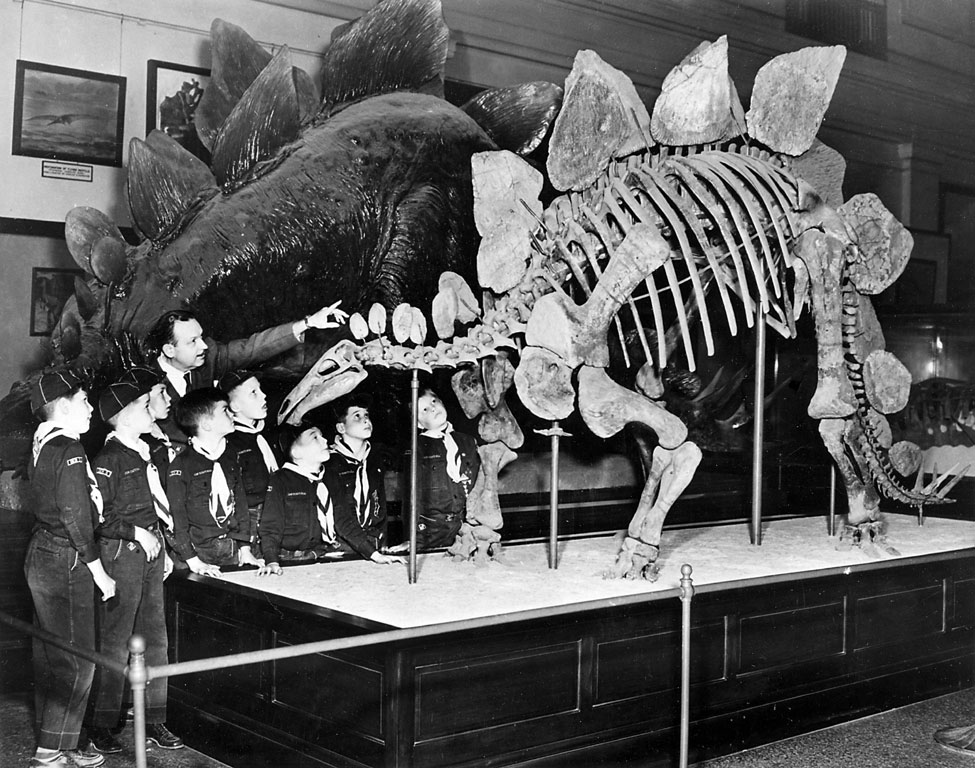
My first love is natural science, but I also fancy myself an amateur art enthusiast, particularly for performance and installation pieces from the last 50 years or so. I am fascinated by art that directly engages the viewer, art that is not complete without the involvement of the spectator. As it happens, mounted fossil skeletons are a great example of  installation art, although they are not deliberately constructed as such. The size and presence of a dinosaur skeleton, such as the Stegosaurus below, necessarily incorporates the viewers’ human scale into the experience. Viewers are not merely spectators but participants in a shared performance. Nevertheless, fossils are nearly always displayed and interpreted as scientific specimens, rather than art objects.

Stegosaurus fossil mount and life-size model circa 1913. Photo courtesy of the Smithsonian Institution Archives.

Stegosaurus fossil mount and life-size model at USNM circa 1913. Photo courtesy of the Smithsonian Institution Archives.

One important exception occurs in the work of prolific New York-based artist Allan McCollum. McCollum’s installations frequently address repetitive labor and industrial manufacturing, often incorporating hundreds or thousands of similar but subtly unique objects. Each piece is the product of many small actions, gradually assembled over time. In the early 1990s, the artist turned his attention to fossils, particularly their historic meaning and aesthetic appeal.

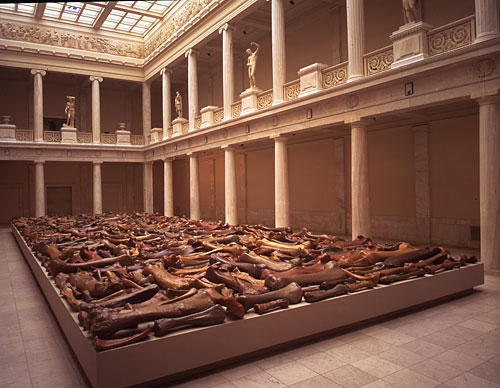
"Lost Objects" by Allan McCollum. Image from Art21.

“Lost Objects” by Allan McCollum. Image from Art21.

In 1991, McCollum collaborated with the Carnegie Museum of Natural History to produce “Lost Objects”, displayed next door at the Carnegie Museum of Art. Using molds taken from dinosaur fossils (apparently all limb bones) in the CMNH collection, the artist produced several hundred fossil casts for the installation shown above. To me, this piece is a reflection on the global sharing of fossil material permitted by casting technology. In the Art21 video at the top of this post, McCollum briefly discusses the prominence of casts among the dinosaur mounts that are a staple at natural history museums. Dinosaur skeletons are virtually never found complete, and mounts are often filled in with casts of specimens held by other museums. For example, the National Museum of Natural History Diplodocus mount incorporates casts of the left hindlimb and much of the neck of the Carnegie Diplodocus. What’s more, casted duplicates of the entire Carnegie Diplodocus can be seen in London, Berlin and several other cities in Europe and Latin America, and casts of the American Museum of Natural History Tyrannosaurus are on display in Denver and  Philadelphia. It would be an impressive sight if all the casts of certain fossil specimens scattered around the world were reunited in one room, a monument to the knowledge gained from a century of scholarly collaboration. It would also commemorate the intangible excitement generated by dinosaur mounts, made possible only through the duplication and sharing of casts.

MCollum also comments that “there aren’t as many dinosaur bones in the world as we think.” Perhaps, then, “Lost Objects” is a reflection on the scarcity of intact fossils, by showing an impossibly large collection that no museum could hope to amass. Let’s just hope he wasn’t trying to comment on the alleged mass-production of casts cheapening the original fossils and the museums that hold them, because he’d be dead wrong (EDIT: He wasn’t, see comments).

mccollumnaturalcopies

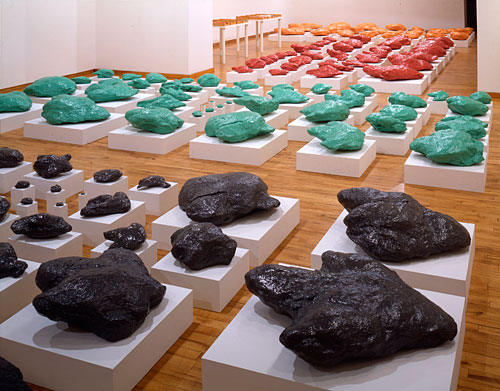
“Natural Copies” by Allan McCollum. Image from Art21.

In 1995, McCollum followed up on “Lost Objects” with “Natural Copies, a series of casted dinosaur footprints produced in collaboration with the College of Eastern Utah Prehistoric Museum. For the artist, this piece was a reflection on the idea that 150 million-year-old fossils can be valued as cultural history. The footprints in question were found by the hundreds in a Utah coal mine. While many ended up at the museum, others were collected by miners to display at home. The fossils took on a second life as symbols the community’s workforce and natural heritage, irrelevant to the dinosaurs that produced the tracks but important all the same. McCollum’s work separates the fossils from their typical scientific context so that viewers may reflect on their cultural meaning and even the aesthetic beauty of their form.

So what’s the point of these installations? These appropriations of fossils as aesthetic pieces has no bearing on the science of paleontology, and in fact may obscure information about how the animals that left these traces lived and behaved. And yet, from the moment a fossil is first seen by human eyes, whether it is an ammonite preserved in a split open rock or the glint of a vertebrate bone weathering out of a hillside, it becomes meaningful on a human scale. For the discoverer, the researcher who describes the fossil, the institution that holds it in its collection and the visitor who sees the fossil on display, that specimen has cultural value. This does not diminish the value of fossils as natural specimens, but rather enhances their importance.

1 Comment

Filed under collections, dinosaurs, fossil mounts, museums, paleoart