
In both paleontology and the museum field, we’ve long contended with what one might call “the Osborn problem.” The legacy of Henry Fairfield Osborn, paleontologist and president of the American Museum of Natural History between 1908 and 1933, is quite important to both fields. To paleontologists, he is known for accumulating at AMNH one of the largest and most exhaustive fossil collections in the world, for financing and supporting the careers of legends like Barnum Brown and Charles R. Knight, and of course for naming and describing saurian celebrities like Tyrannosaurus and Velociraptor.
Osborn is also well-regarded by museum specialists for heightening the standards for public exhibitions, investing in lifelike habitat dioramas of taxidermy animals and spectacular mounted dinosaur skeletons in order to make science exciting for a wide audience. Osborn’s devotion to storytelling and drama in the exhibits he curated brought millions of visitors to AMNH and quite literally defined public expectations for what museums should offer to this day.
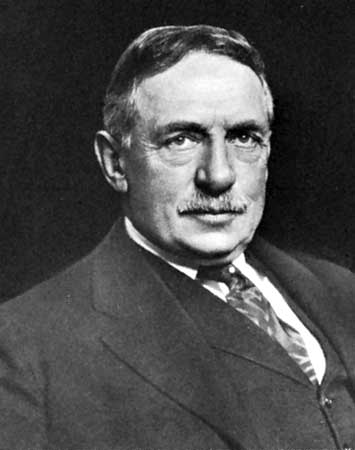
Henry Fairfield Osborn.
In recent decades, however, historical interest in Osborn has been mostly focused on his disreputable personal and political beliefs: Osborn was a flagrant racist and anti-Semite, an admirer of Adolf Hitler and a strong supporter of research in eugenics. Osborn regularly used his clout to bring material harm to the American working class, lobbying for legislation including the Emergency Quota Act and the Immigration Act of 1924. For what it’s worth, Osborn was also apparently unbearably arrogant and truly dreadful to work with, going as far as to demand lower-ranked museum employees leave the elevator car when he got on.
All this puts paleontologists and museum specialists in an awkward position. Is it acceptable to admire Osborn’s positive achievements in light of his personal politics? After all, Osborn’s views were not terribly unusual among the aristocratic class of his day. Perhaps we shouldn’t condemn the man entirely for not “rising above his time and place” (as Stephen Ambrose argues regarding coming to terms with Thomas Jefferson the slave owner).
Unfortunately, Osborn’s case is complicated by the fact that his bigotry inspired (or at least contributed to) much of his work at AMNH*. To start, Osborn’s scientific work was based on an inaccurate orthogenetic interpretation of evolution. He professed that an ill-defined guiding force shaped life from lesser to greater forms, the effect of which could be seen by comparing “primitive” and “advanced” species, and of course, “primitive” and “advanced” expressions of humanity. While we cannot conclusively link Osborn’s pseudo-evolutionary ideas with his bigoted social agenda, it is certainly convenient for him that he saw people of “Nordic” descent as biologically superior.
*To clarify, none of the exhibits curated by Osborn remain on display and none of my comments here apply to the present day AMNH.
Critically, Osborn did not keep his ideas of natural hierarchy in the ivory tower. He explicitly intended that the exhibition halls of AMNH educate visitors not just about natural science but about the naturally graded order he believed to be characteristic of life on earth. Osborn thought that collections of biological specimens implicitly revealed an upward ascent of life, and that those on top had earned their place through innate superiority. Osborn pronounced that his exhibits would teach morality to new American immigrants, presumably by putting them in their place with the rather hideous racial hierarchy on display in the Hall of the Age of Man. As Donna Haraway puts it in her classic essay Teddy Bear Patriarchy, Osborn’s exhibits were a “gospel of wealth and privilege” that appropriated natural specimens to affirm the American elite’s place at the top of the pecking order.

Tyrannosaurus and others in AMNH Dinosaur Hall, 1927. Photo courtesy of AMNH Research Library.
Museums are understood to be sources of intellectual authority, and deservedly so. But exhibits have authorship, same as any other written work, and Osborn’s legacy demonstrates that the influence of authors and their worldviews can be a powerful force. For example, Osborn arranged the Hall of the Age of Man in what he saw as ascending order, from the ancient peoples of Africa, to North America, and finally Europe. Placed at the end of an exhibit series that started with Cambrian invertebrate fossils before passing through Paleozoic, Mesozoic, and Cenozoic fossil displays, the Age of Man gallery deliberately implied that European-descended humans were the culmination of the entire history of life on Earth.
Meanwhile, the exhibit on fossil horses curated by Osborn depicted small, multi-toed horses of the Eocene gradually becoming larger, losing toes and becoming better at being modern Equus. This orthegenetic representation runs counter to evolution via natural selection as originally proposed by Darwin, and as understood today. Indeed, other paleontologists, including O.C. Marsh, had established in the 19th century that horse evolution more closely resembled a tangled bush, with many overlapping morphological offshoots adapted to varying environmental circumstances. But Osborn had rejected Darwinian evolution in favor of his presumed hierarchy of life, and ensured that his inaccurate story was what was seen by millions of visitors.
So what does Osborn’s legacy mean to paleontologists and museum specialists today? Do we need to qualify every mention of his name with a denouncement of his worldview? Should we always write out “Tyrannosaurus rex Osborn, 1905″ as “Tyrannosaurus rex Osborn the racist jerk, 1905″? At minimum, Osborn’s exhibits are a sobering reminder to all us involved in science education that our field is not immune to bias. The subjectivity of cultural and historical museum exhibits has been well-explored by scholars like Ames and Weil, but comparatively little reflection has been done on the authorship of exhibits on science and natural history. We rely on the “naturalness” of the objects we display to speak for itself, and to bear the burden of proof for the statements we make. The world around us is knowable, and science is the best tool to learn about it. But explaining what we have learned in any form (books, technical journals, museum exhibits) is an avenue for personal or cultural bias to slip in, and that is why it remains important to actively and regularly check our assumptions.
References
Ames, M.M. (2004). Museums in the Age of Deconstruction. In Reinventing the Museum: Historical and Contemporary Perspectives on the Paradigm Shift. Lanham, MD: AltaMira Press.
Brinkman, P.D. (2010). The Second Jurassic Dinosaur Rush: Museums and Paleontology in America at the Turn of the Twentieth Century. Chicago, IL: University of Chicago Press.
Colbert, E.H. (1968). Men and Dinosaurs: The Search in Field and Laboratory. New York, NY: E.P. Dutton and Co., Inc.
Haraway, D. (1984). Teddy Bear Patriarchy: Taxidermy in the Garden of Eden, New York City, 1908-1936. Social Text 11:20-64.
Kohlstedt, S.G. (2005). Thoughts in Things: Modernity, History and North American Museums. Isis 96:586-601.
Osborn, H.F. (1921). The Hall of the Age of Man in the American Museum. Nature 107:236-240.


 EXTINCT MONSTERS
A bit late to react, perhaps, but I only found this post recently. First of all, it should perhaps be pointed out that orthogenetic views were the rule rather than the exception ca 1900, and they didn’t need to be tied to a socially reactionary attitude. For example, Ray Lankester, the BMNH’s director whose political and social views were almost the exact opposite of Osborn’s, amended his museum’s exhibits to reflect orthogenetic ideas as well.
But more interesting to me is how we deal with the scientific ideas of otherwise problematic characters. Perhaps the most extreme case is Othenio Abel, the “father of paleobiology” (as he himself would have liked it to be put). On the one hand, Abel was an intelligent and forward-looking scholar who greatly helped to integrate paleontology with the other life sciences. The flipside is that this was a genuinely loathsome individual (I can really find no other words for it) who actively sabotaged the careers of fellow scholars, was a virulent anti-semite, and combined both as a national socialist. In practice, I suspect that Abel the Asshole undermined much of what Abel the Innovator might have accomplished had he shown a more amenable and involving personality. That makes it difficult to separate the two (as some have attempted), as it does with Osborn.
Thanks for weighing in, Ilja! I don’t know much about Lankester, and will have to take a closer look. Do you think people have actively tried to separate Osborn’s (or Abel’s, or Owen’s) personality/politics from his contributions to paleontology, or is it more a case of selective omission?
Ben, Ilja. Wonderful. I am very much enjoying this interchange on Osborn, Lankester, orthogenesis. Just wanted to share that I have taken up the question of separating “personality/politics from his contributions to palaeontology” across several chapters in my book: Articulating Dinosaurs: A Political Anthropology. http://bit.ly/1mD5VrK There I take up his involvements with T. rex, and shows the complex, sometimes obvious sometimes subtle, connections to his thinking in other areas of palaeontology, museology, eugenics, corporate elites, and more. See especially the chapter “Animating Tyrannosaurus rex, Modeling the Perfect Race”
In my discipline of Anthropology we address knowledge as inseparable from politics, culture, milieu, personality, agency, etc. The fact is that Osborn is in many ways the exemplar for exploring this inseparability. At the same time we know how truly important his fossil description of extinct Proboscidea has been. http://bit.ly/2rUNAve That said, I would like to suggest to the paleontological community that it is a boon to it when it does take such matters seriously…. as humans, as social beings, as people living in worlds of complex ecological transformation, we are always moving with those conditions, our knowledges explicitly or implicitly moving with it. I think dinosaur palaeontologists get this better than most. My slow argument in Articulating Dinosaurs is to demonstrate that the best of science is that which reckons with its political and knowledge milieus, showing how science is always constituted with or in relation to all of this. When acknowledged, this can lead to all the more robust, reliable (and if you like ‘accountable’) propositions about the worlds of the natural that we seek to describe and elucidate. Basically, we get better science, not because we are disconnecting knowledge from our milieu, but because we are acknowledging the ways that it is connected, and bringing an analysis of the problems of those to the for so that they too can be assessed and addressed, altered, set aside, etc.
BTW, I’m utterly intrigued by Abel now Ilja, whom I’ve only know of in a cursory way. To understand whether and how he himself, his professional approach, and community worked to separate the ‘person’ from the ‘science’ would be a rich case study in its own right.
Very much looking forward to your book on Carnegie and Diplodocus as well! I trust the defence went well!
Thanks both.
Been reading more of those yearly annuals and am up to 1908 (v.8 1908), the year he got the presidency and apart from remarking on “civilized”, “savage” and “semi-savage” briefly in one part about the Congo (and they may have had to suck up to that legit savage King Leopold II, yeah, he was one!) are still remarkably impartial at this point before he took over.
There are subtle accounts of recovering abounded human remains as well. It seems the worst was yet to come as it got outrageous with him at the helm.
They’re fairly impartial to Native Americans (by the standards of the time), not denying their culture is being lost but apart from recording it are unable to say how to save it despite being respectful of the cultures and artistry.
They claim at the time the human remains were from long lost tribes they found abandoned… yeah right!
I’m honestly surprised Franz Boas a Jew and despite his legit disgrace with Minik Wallace and his companions as his most serious skeleton in the closet stilled stayed in AMNH.
He may have had to do some dubious by modern standards research but concluded that 99% of the stuff involving race that Osborne promoted was BS.
Boas in WW1 got plenty of heat for being German as well, and that wouldn’t have helped.
Apart from Minik Wallace and the Inuit’s which Perry brought back (apparently, they wanted interview one to greater understand them and it went downhill from there) and the shameful handling of it all he usually had higher standards and was probably strongarmed.
I know all too well about management strongarming staff. Regardless, shame on them for it, I have no issue saying I’d break someone’s jaw over it.
Then, Osborne had Clark Wissler to back him up. Ultimately, it seems like the 1% had far more destructive power over the masses then than today.
Everything Osborne believed in and acted out in Eugenics seemed more about elitist snobbery over anything else. Heck, my dad was a 50s kid and has no issues saying the idealized images we have of the time are illusions created to maintain the notion of morality and tranquility and brushed anything outside the mold under the rug and caused untold damage we must deal with today.
The mentioned human remains and the questionable by even the standards of the time in acquiring them are for another time.
It seems they really got disgusting after Osborne got onboard and they got really shocking, as in disgusting and deceitful.
The annual also mentions Māori heads from Horatio Gordon Robley, something I know all too well. The Brits managed to ban it, but not before those in the Musket Wars used it as a means of war profiteering from captured slaves.
And Robley was no real villein, he was complex but unlike many made amazing work to preserve a damaged culture he greatly respected.
I do support displaying human remains but mostly if they’re donated with it in mind and certainly not if they’re still directly connected with a modern culture/people, I draw the line at deception and all past that.
Sorry for rambling!
Thanks for the summary—I’ve never gotten around to reading all those Journal of AMNH back issues so it’s much appreciated. It’s interesting how many of the big, textbook names of anthropology were based at one institution during that period, same as paleontology.
All good.
It seems AMNH was simultaneously two things at once but with a one percenter in charge, it went one way.
Even the writers in this went from impartial (my way of doing things), to glossing over the Congo at the time, the only one that really made my blood boil.
Then Boas’ one seriously shame with Minik can never be understated. And the question of human remains is a complex one, he used it to prove we’re not all different in the end though.