The south-facing entrance to the Hall of Human Origins. Photo by the author.
As covered in the previous post, the National Museum of Natural History’s Hall of Human Origins, which opened in 2010, is an exceptionally well-conceived and well-crafted exhibition. In certain circles, however, there has been a persistent strain of criticism that I feel like I would be remiss not to address.
Shortly after the Hall of Human Origins opened, articles in the New Yorker andThinkProgress called attention to the fact that the exhibition was created with $15 million from David Koch (the full title of the exhibition is the David H. Koch Hall of Human Origins). Koch, who died in 2019, and his brother Charles are probably best known as billionaires who support a range of libertarian causes, including right-wing political candidates and climate change deniers. Their fortune comes from Koch Industries, a massive energy (read: oil) and manufacturing conglomerate.
David Koch bankrolled socially and environmentally destructive policies for decades, and I don’t think it’s a stretch to say that few individuals have left such a damaging anti-science legacy. But credit where it’s due: the Koch Foundation has also supported museums, public broadcasting, and other institutions associated with education and the arts. Many of these contributions are related to Koch’s personal interest in fossils, especially dinosaurs and human ancestors.
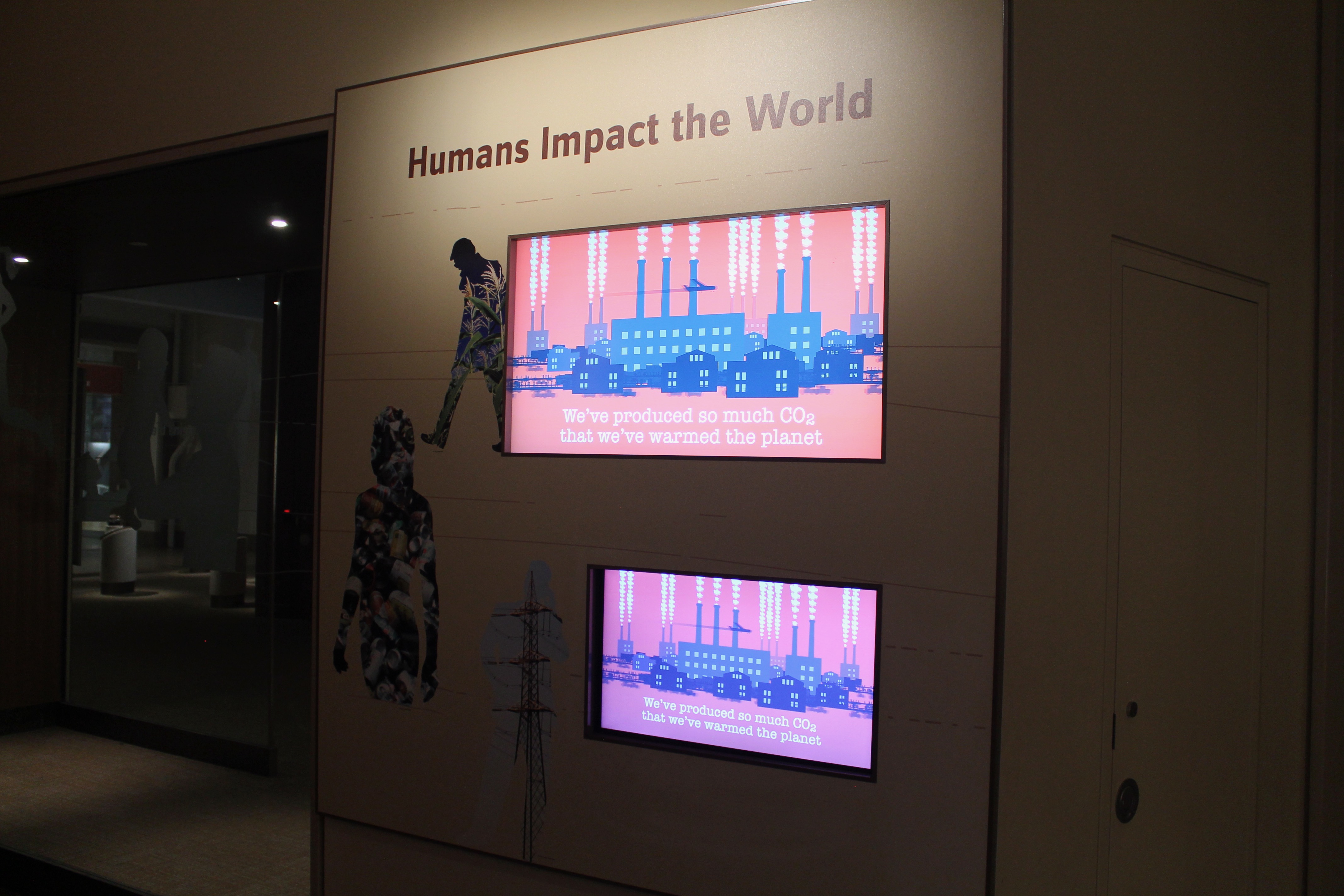
The Humans Change the World sub-section. Photo by the author.
In a ThinkProgress piece published a few months after the Hall of Human Origins opened, author Joe Romm suggested that the exhibition’s creators downplayed the seriousness of anthropogenic climate change at Koch’s behest. According to Romm, the hall’s “huge flaw is that it leaves visitors with the distinct impression that human-caused global warming is no big deal.” Additional articles inThinkProgress,Hyperallergic, and Equinox made similar accusations. Each article zeroed in on a recurring theme in the exhibition’s text: that hominin evolution was driven in part by a need to adapt to a changing climate. As Ryan Little put it in Hyperallergic, the exhibition “craftily insinuates that fluctuating climates, whenever, wherever, and however they occur, are a source of astonishing human ingenuity, while also managing to suggest…that in the grand geological scheme of things, climate change is no big deal.”
There is absolutely a conversation to be had about the pros and cons of museums accepting money from problematic sources (NMNH caught heat a few years earlier when it accepted funding and specimen donations from Kenneth Behring). And there is always cause to be vigilant about corporate interests making their way into public institutions. Nevertheless, a recent re-visit to the Hall of Human Origins has convinced me that any critics suggesting that the exhibition downplays climate change—or that Koch had any influence over its content—are fundamentally misguided.
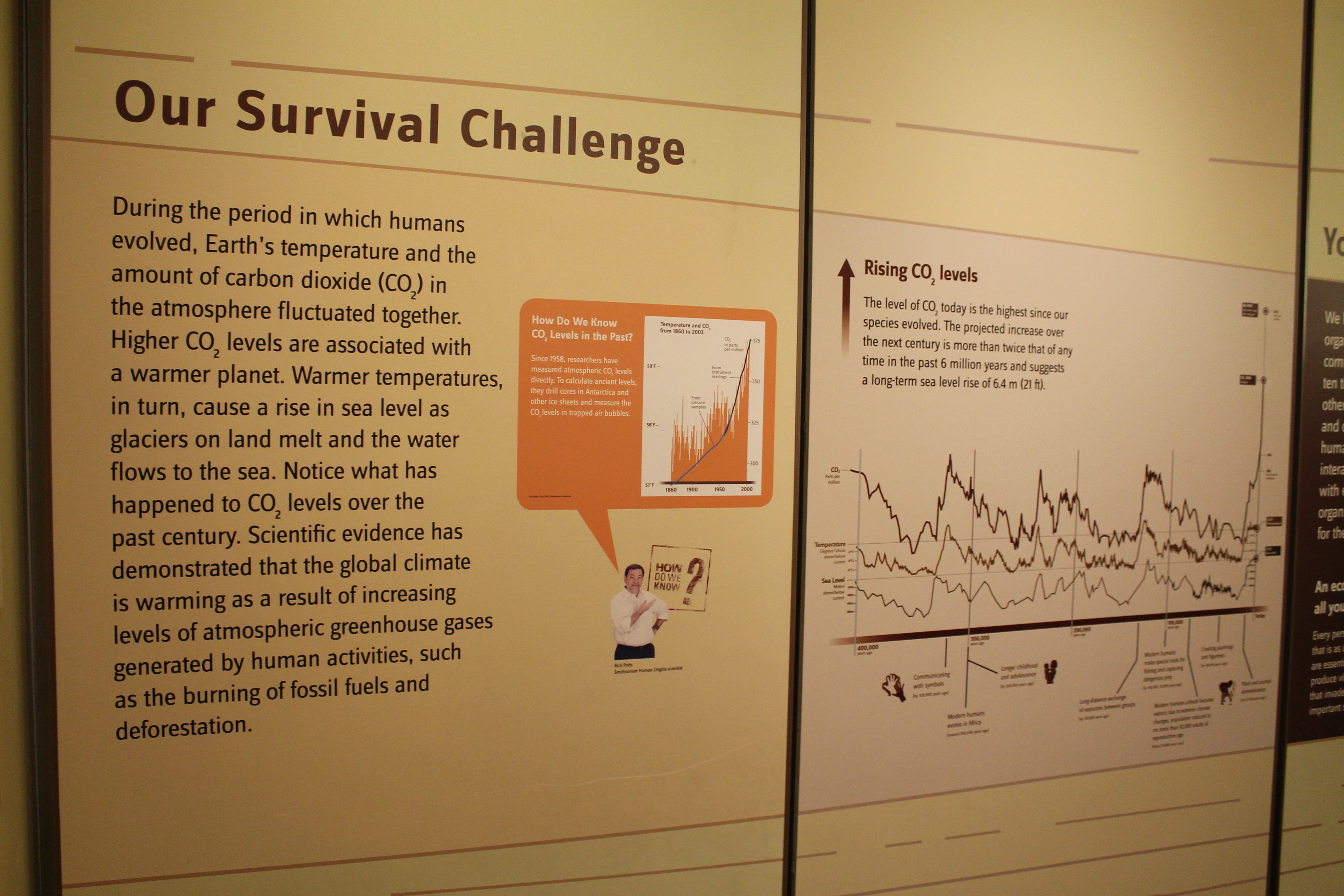
One of multiple graphic panels describing present-day climate change, why it’s happening, and how we know. Photo by the author.
There are two issues in play here. First, I think the authors are missing the bigger evolutionary picture. There is nothing new or untested about the concept of a connection between the changing Earth and the evolution of life on it (that is, interaction between the geosphere and biosphere). Examples are seemingly innumerable. Hoofed mammals evolved long legs for running and large, grazing teeth when grasslands replaced forests in the Miocene. Radiations of new species evolved when North and South America collided, allowing animals access to new habitats. Dire wolves got smaller when the climate got colder and food was harder to come by. And that’s just in the last 30 million years. Why wouldn’t human ancestors evolve in response to a changing environment, when it’s been a primary driver of evolution throughout our planet’s history?
The second issue is that it’s plainly incorrect to say that the Hall of Human Origins does not address recent anthropogenic climate change, or clearly state its cause. There is an entire 1,500 square foot sub-gallery called “Humans Change the World,” which investigates how garbage, livestock, habitat destruction, and yes, carbon dioxide emissions are damaging the planet. The famous hockey stick graph of global temperature, with its spike in the last century, appears at least three times, including at the exhibition’s south-facing entrance. The exhibition states, repeatedly, that “the global climate is warming as a result of increasing levels of atmospheric greenhouse gases generated by human activities.”
A media piece with the caption, “We’ve produced so much CO2 that we’ve warmed the planet.” Photo by the author.
It would be difficult for a visitor to explore the Hall of Human Origins and miss the references to anthropogenic climate change. It would be even more difficult to conclude that the exhibition is somehow putting a positive spin on it—the images of belching smokestacks and piles of garbage are not subtle. And yet, that is exactly what multiple authors have alleged, as recently as 2019. This is fascinating to me, because it speaks to the power of the narratives visitors bring with them to any museum experience.
In the previous post, I mentioned an evaluation of the Hall of Human Biology and Evolution at AMNH, which found that visitors were imposing teleologic narratives onto the exhibition, in spite of deliberate efforts to counteract this. Visitors expected evolution to be a linear, progressive process, and they unwittingly interpreted what they’re seeing in a way that matched those expectations. Perhaps a similar phenomenon is occurring in the Hall of Human Origins. Many of us are used to seeing Koch’s name associated with aggressive lobbying against climate change mitigation. In that context, the narrative that an exhibition bearing his name would have a similar message is compelling, even sensible. But it isn’t borne out by the actual content on display.
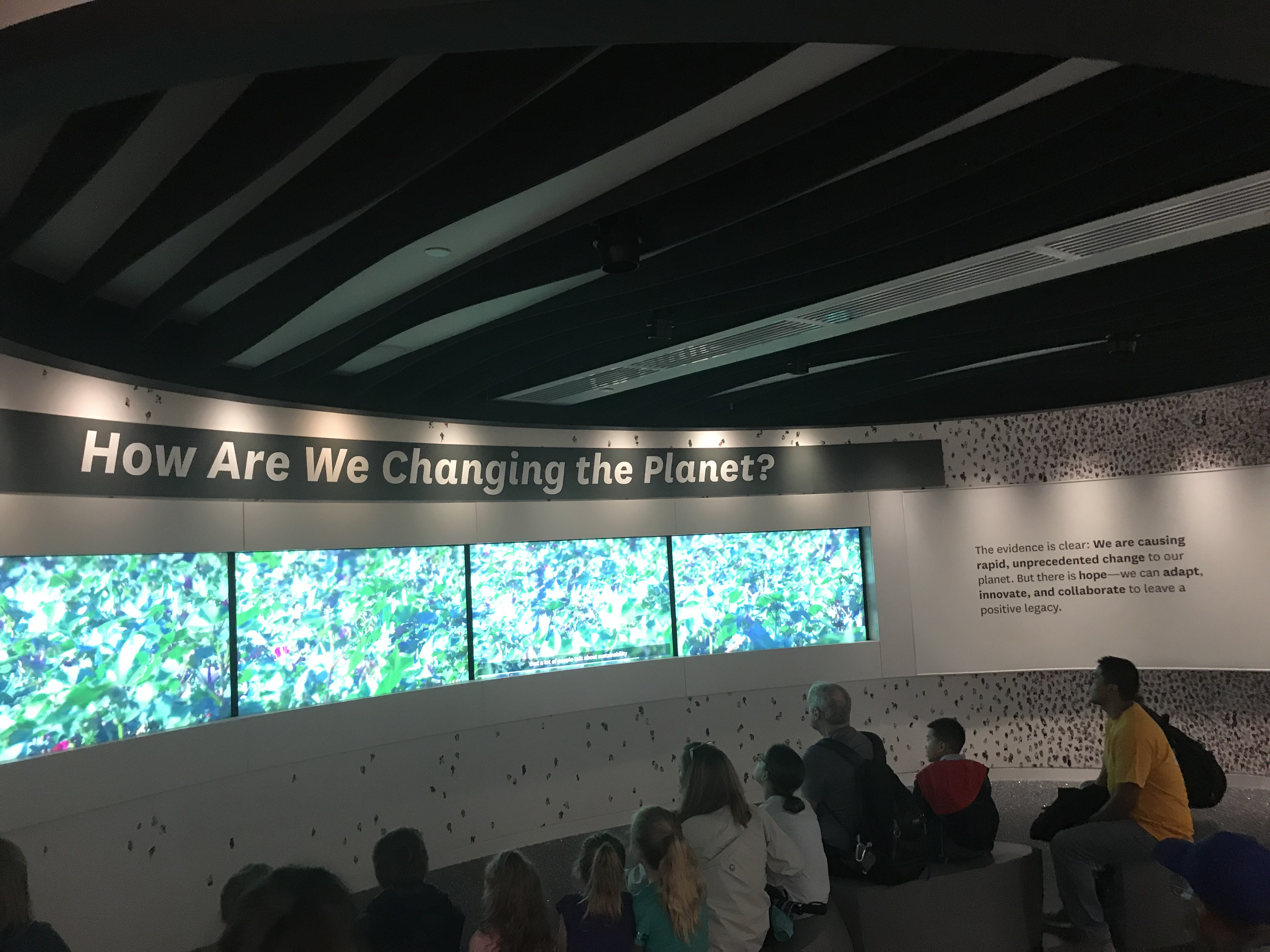
At the heart of the Deep Time exhibition, a theater demonstrates how humans are causing unprecedented change to the planet, while also highlighting potential solutions. Photo by the author.
Again, it’s reasonable to be wary of corporate interests making their way into public institutions. Perhaps museums that accept funding from questionable sources have a responsibility to go above and beyond in assuring their audiences that those funding sources are not influencing exhibition content (or anything else they produce).
To their credit, this seems to be something NMNH has taken very seriously. As discussed, the Hall of Human Origins devotes considerable floorspace to the message that climate change is an unavoidable part of humanity’s legacy. And in 2019, the museum went even further. The massive paleontology exhibition known as Deep Time was also funded in part by the Koch Foundation, and bears David Koch’s name. Here, a central overlook (visible from everywhere in the hall) is devoted to the message that human industrial activity is warming the climate, and that this change comes with dire consequences. Even more so than in the Hall of Human Origins, this statement is presented in clear, matter-of-fact language. The centrality of this location and its proximity to the dinosaurs makes the climate narrative unmissable.
As the third most-visited museum in the world (behind the Louvre and Musée d’Orsay), NMNH is uniquely situated to reach audiences that may never have seen the evidence for climate change presented in a clear, non-political context. They have clearly risen to the occasion, and I just think they deserve some credit for it.
Scott, M. and Giusti, E. 2013. Designing Human Evolution Exhibitions: Insights from Exhibitions and Audiences. Museums and Social Issues 1:1:49–68
Sideris, L. 2019. The Last Biped Standing? Climate Change and Evolutionary Exceptionalism at the Smithsonian Hall of Human Origins. Equinox Publishing.
A bronze Homo heidelbergensis figure crouches over a hearth, offering visitors a piece of meat. Photo by the author.
I don’t know how well you remember the twenty-aughts, but it was a high point for conflict over teaching evolution in the United States. Thanks to lobbying by the Discovery Institute and others, denial of evolution had become an ideological litmus test for conservatives. Organized strategies to impose religious fundamentalism on public school classrooms cropped up nationwide, and these efforts were taken to court on multiple occasions. It was in the midst of all this that the National Museum of Natural History (NMNH) developed and opened its Hall of Human Origins—in sight of Capitol Hill, no less.
In this politically charged climate, one might imagine an exhibition about human evolution would need to be highly didactic, or even combative. But rather than taking an antagonistic stance, the Hall of Human Origins leads with a question: what does it mean to be human? The exhibition presents fossil evidence for how the human species came to be, but also invites visitors to make connections with their own lives and experiences. Fourteen years out from the hall’s March 17, 2010 opening, it’s instructive to look back at the exhibition’s development. How did this visitor-centric interpretive approach come to be, and how has the museum’s audience responded to the exhibition? And in hindsight, would the exhibition’s creators do anything differently?
Origins
More than 50 million visitors have passed through the Hall of Human Origins, but lead curator Rick Potts jokes that about a million of those visits should probably be attributed to him. Indeed, the exhibition and its unique interpretive approach have been on his mind for decades. He first formulated the question “what does it mean to be human?” when teaching anthropology courses at Yale in the early 1980s. The question always inspired a great discussion, and Potts thought it might make an interesting basis for an exhibit about human evolution.
Potts pitched his idea for a human evolution exhibition immediately upon taking a position at NMNH in 1985. Smithsonian secretary Robert Adams liked the concept, but progress on the exhibition stalled within a few years. It was difficult to get any major exhibition off the ground at NMNH during the 80s and 90s because of the lack of consistent leadership. With eleven permanent and acting directors between 1981 and 2003, there was no way to build up momentum for big, multi-year projects. Eventually, Cristián Samper settled into a comparatively lengthy directorship (2003–2012), and greenlit the human evolution exhibition under the working title, What Does it Mean to be Human?
An L-shaped, 15,000 square foot space (which previously contained parts of the North American Mammals and Native American Cultures exhibitions) was designated the future home of the Hall of Human Origins. The core project team began meeting regularly in 2007. Kathleen Gordon was the exhibition developer and Junko Chinen was project manager. Briana Pobiner, Jennifer Clark, and Matt Tocheri joined Potts as in-house scientific advisors. As with most permanent exhibitions at NMNH over the past 25 years, content was developed internally while the 3-D and graphic design was produced in collaboration with the Toronto-based design firm Reich + Petch.
One of the team’s first tasks was to articulate what an exhibition based around a question would actually be about. The objective was to welcome visitors’ perspectives, but the hall itself couldn’t be a blank canvas. Exploring ways in which the exhibition could address varied perspectives led to some dead ends. One early idea was to feature a section about creation stories from around the world. But while the intention was to be inclusive and respectful of visitors coming to the exhibition from religious backgrounds, the section came across as a straw man, set up in order to be knocked down by the scientific perspective taken by the rest of the exhibition. Choosing which creation stories to include was also a problem, as was the use of terms like “story” and “myth” in the first place.
Instead, the team decided to fill out the exhibition with potential answers to a variation on the central question: What makes us human? Walking upright. Making tools. Living in social groups. Communicating with symbols. Creative expression. These are all valid answers. And crucially, they are potentially meaningful to everyone, regardless of whether the visitor is approaching the question from a more scientific perspective, or a more spiritual one. The exhibition presents the evidence for how and when each of these traits evolved, but leaves it up to the visitor to decide which they feel is most important to their humanity. By encouraging each visitor to take part in the process of making meaning, the exhibition implicitly rejects the prevailing perspective that there are only two ways to view the origins of humanity, and that those perspectives are mutually exclusive.
Organizing the exhibition around “things that make us human” also helped the team discourage the misconception that evolution is progressive or teleological. Visitors are often predisposed to think of evolution like a ladder, where each stage is a more advanced, improved form of what came before. An evaluation of the Hall of Human Biology and Evolution at the American Museum of Natural History found that many visitors viewing the dioramas saw a progression from the small, dark-skinned Homo erectus to the tall, white Neanderthals. The exhibition’s designers had specifically tried to avoid this by arranging the dioramas cyclically, and by including labels explaining that evolution does not have a preordained direction or goal—populations merely adapt to maximize their success in the present environment. Nevertheless, preconceived ideas are powerful, and even these mitigative efforts were apparently not enough. In contrast, the NMNH Hall of Human Origins is not strictly chronological, nor does it focus on one hominin species at a time. This reduces the temptation to plot each display onto a directional axis. It also helps that the hall runs in two directions, and can be entered from either end.
Design
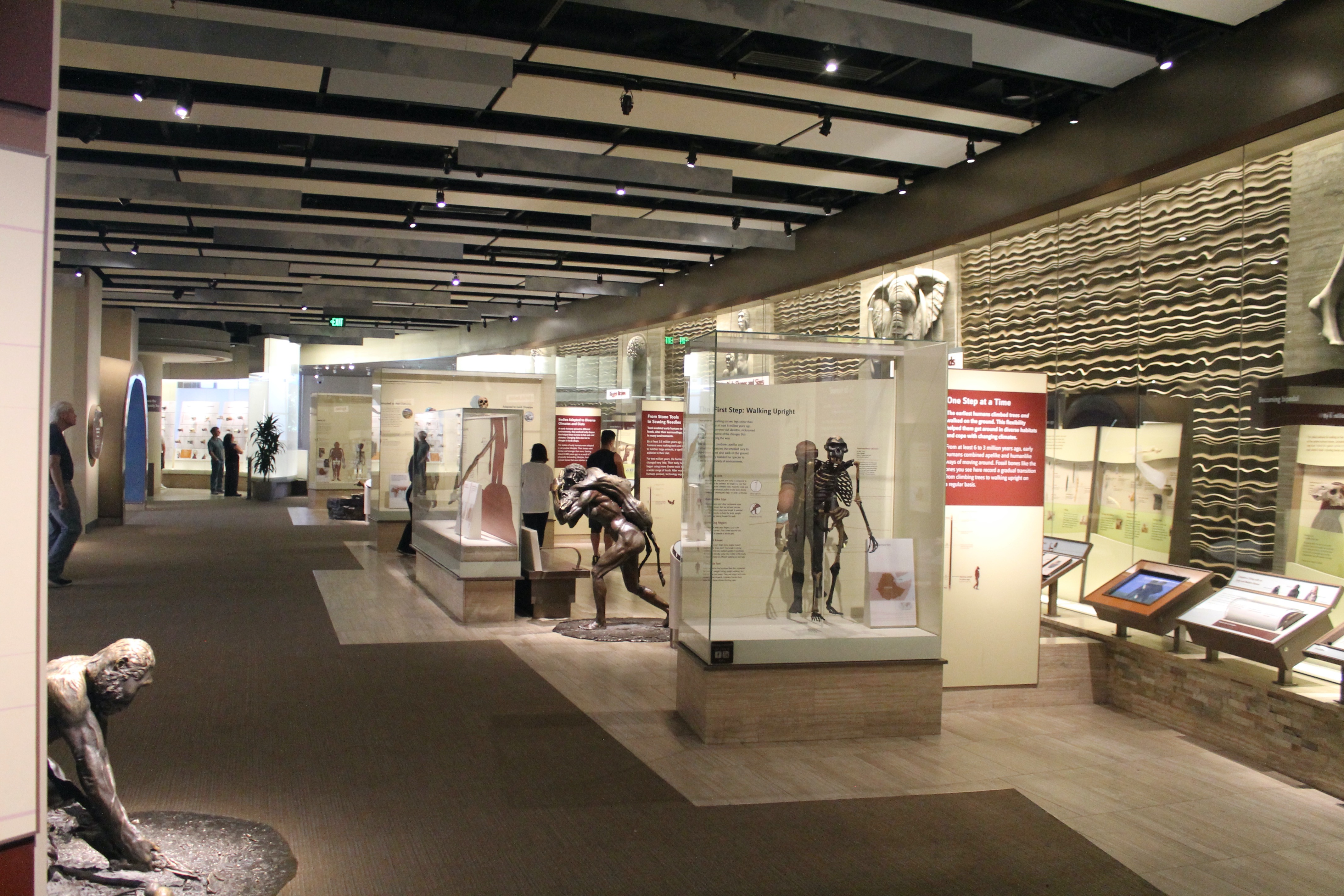
Overview of Hall of Human Origins. Photo by the author.
The design of the Hall of Human Origins feels respectful, even reverent. A palette of tans, browns, and other earth tones keep the space from looking garish, and evokes the importance of exploring the deep ancestry of our species. A core design element is a wall of densely-packed horizontal layers, a refrence to the stratigraphic context in which fossils are found. The wall is punctuated by larger-than-life relief sculptures, each one related to one of the key attributes of humanity covered by the exhibition. For example, a hominin with a spear facing an elephant represents how tool use opened up new food sources.
For Briana Pobiner, it was particularly important that the hall’s design put a human face on science. Many people think of science as something cold and distant, but warm up to it when they get to know the individuals behind it. To that end, the exhibition includes three “snapshots in time”—interactive media installations where a scientist on screen (one of which is Pobiner herself) guides visitors through a particular archaeological puzzle. The hall also includes 24 “how do we know” graphics. Each one includes a photo of a scientist in some way affiliated with the Human Origins Program and who contributed to the exhibition content, with a first-person account of how scientists interpret evidence and reach a conclusion. Pobiner says that teachers are particularly fond of these, and sometimes ask students on field trips to find all of them.
One ring to rule them all. Photo by the author.
The Hall of Human Origins includes nearly 300 objects. Most are casts, as hominin fossils are typically held in their countries of origin. There are a couple dozen originals, however, including archaeological artifacts and a Neanderthal skeleton from Shanidar Cave, in Iraq. This individual was one of several excavated in the 1950s during a collaborative project between the Smithsonian and the Iraqi Director General of Antiquities. The Iraqi government permitted this single skeleton to be held at NMNH, and it remains the only Neanderthal in the western hemisphere. Among the replicas on display is a partial skeleton of Homo floresiensis. Often called “the Hobbit” by its discoverers, this species was brand new to science when the exhibition was under development. Pobiner clued me in to an easter egg I had missed for fourteen years: the Hobbit has a gold ring on its finger.
Reconstructions
Bronze figures of a Neanderthal woman and child. Photo by the author.
Many natural history exhibits have the advantage of large, iconic objects that grab visitor attention, like sauropods, elephants, or whales. But hominin fossils are small, often fragmentary, and difficult to interpret. They wouldn’t be able to carry an exhibition for non-specialists on their own. In order to visualize the lives of past hominins, the team turned to paleoartist John Gurche.
The Hall of Human Origins was not Gurche’s first project with the Smithsonian. Between 1980 and 1985, he painted the iconic Tower of Time for the (now retired) Fossils: History of Life exhibition, as well as a backdrop for a lungfish diorama and a series of fossil horse reconstructions. This also wasn’t his first foray into reconstructing extinct hominins. Among many other projects, Gurche was briefly attached to Potts’s first attempt to get a human evolution exhibition off the ground, and he produced a life-sized model of Lucy the Australopithecus afarensis for the Denver Museum of Nature and Science in 1996.
For the Hall of Human Origins, Gurche created a new Lucy diorama, eight full-color busts, and five bronze figures with landforms. The busts are astonishingly life-like. Each one was sculpted in clay over a replica skull—first the muscle, then the skin. These sculptures were molded in fiberglass and cast in a silicone mix that could be tinted with different skin tones. The eyeballs are acrylic, and required a painstaking 30-step process to create. Finally, the hairs (hundreds of thousands per bust) were punched in one at a time. “If people react to your sculptures by feeling a little creeped out because they sense a living presence there,” Gurche wrote, “you know you’ve done well.”
A promotional image of Gurche’s eight hominin busts. From humanorigins.si.edu.
Gurche began the bronzes in a similar way, sculpting their anatomy layer by layer over a posed cast skeleton. Choosing the behavior to depict for each species was a major point of discussion for the exhibition team. Each figure needed to capture the essence of that species, while also representing a recognizable aspect of the human experience. It was decided early that Paranthropus boisei and Homo erectus should be subtly interacting, since they coexisted in Tanzania and Kenya. In the final exhibition, the Homo erectus is looking warily at Paranthropus as she carries a dead gazelle back to her family. Homo floresiensis is shown being knocked over by an unseen predator, highlighting the species’ vulnerability. And the Neanderthal woman is showing a child how to make clothing by perforating a hide with an awl and clamping it in her teeth. No detail was too small—for example, the Neanderthal woman is squatting because many Neanderthals have ankle joint wear similar to modern populations that spend a lot of time squatting.
Response
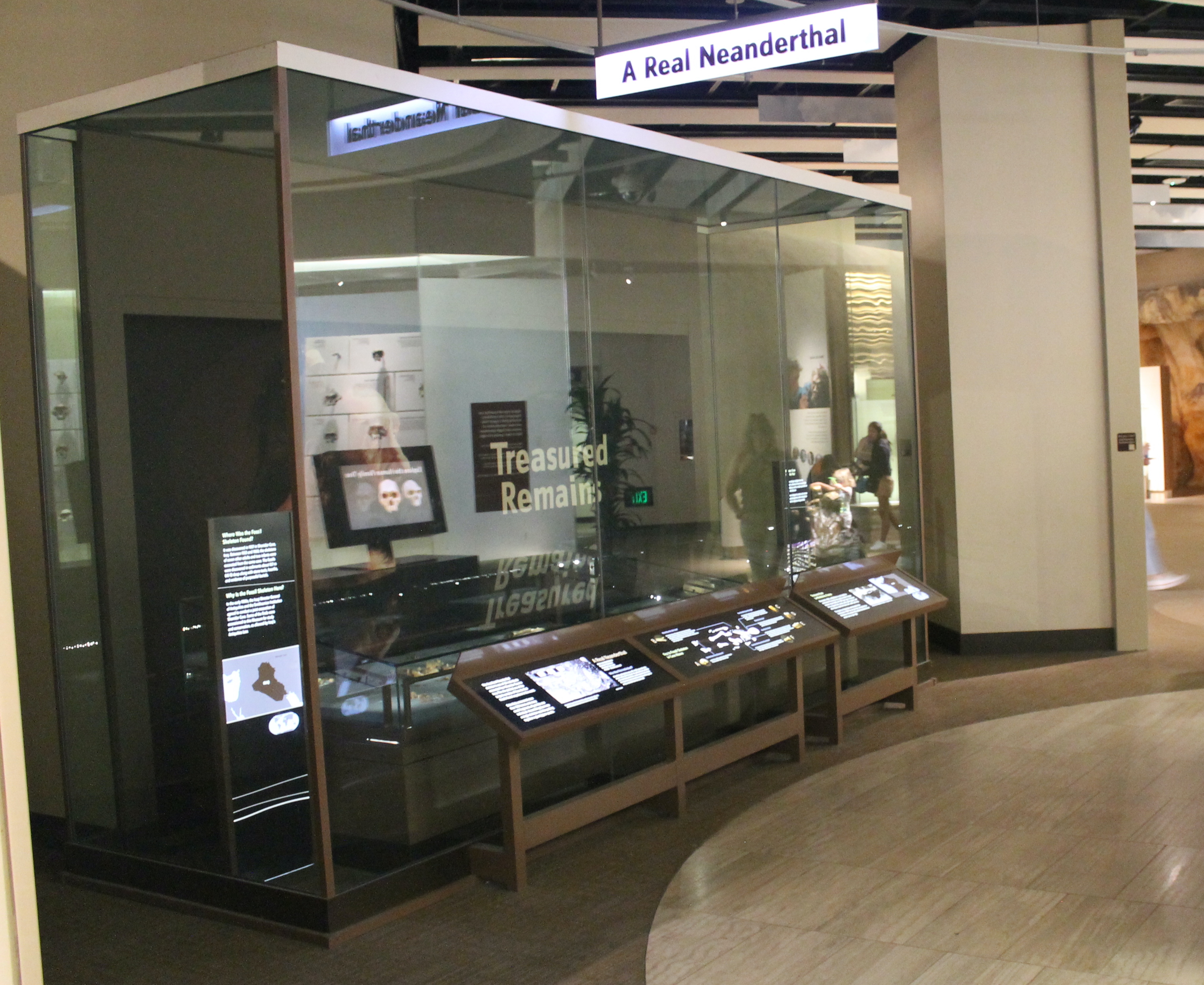
In spite of large headers proclaiming it “treasured remains” of “a real Neanderthal,” this display receives less attention than the development team would like. Photo by the author.
In the years since the Hall of Human Origins opened, the team that created it has gotten a good idea of which aspects are working, and which are not. The bronzes are extremely popular, both as photo ops and as interactive experiences. A display doesn’t need a button or a lever to be interactive—the bronzes are practically crying out to be touched. The fact that they share space with visitors—rather than being captured behind glass—forces people to confront them, size them up, and consider how they are like and unlike themselves. I’m particularly enchanted by the Homo heidelbergensis (top of the page), who appears to be calling visitors to interact by offering a piece of meat. The bronze figures are also toddler magnets. Even at a non-verbal age, children are drawn to them. Museum Educator Margery Gordon recalls there was some internal concern about nudity, but ultimately few, if any, visitors complained.
By timing and tracking visitors, NMNH staff have determined that the “Morphing Station” photo booth is the most popular element in the exhibition. This interactive media piece takes photos of visitors and overlays them onto the face of one of the eight busts, showing what each person might look like as a member of another species. This concept was actually proposed by the science team, and the Reich + Petch designers were surprised that they wanted something so frivolous. But in fact, the photo booth perfectly matched the team’s goal to center each visitor and encourage them to engage with their evolutionary past on their own terms.
Meanwhile, the real Neanderthal skeleton has proven to be the biggest challenge for capturing visitor attention. The development team placed it in the center of the exhibition, and hoped that it would be a must-see focal point. However, conservation requirements mean that the Neanderthal case is dimly lit, and each bone is individually packed in cushioning foam. Hard to see and harder to interpret, the disarticulated skeleton continues to be overlooked by a majority of visitors. The team has re-designed the graphics and lighting around the Neanderthal multiple times in an effort to communicate that this is a rare chance to see a real skeleton.
The educational efforts undertaken with the Hall of Human Origins did not end in 2010. A Broader Social Impacts Committee, with a rotating membership of scientists, clergy, teachers, and others, was formed in 2009 and continues to meet. In-gallery and online talks about how the study of human evolution intersects with social issues are held regularly. A 1200 square foot version of the exhibition travels to libraries, community centers, and even seminaries. And Pobiner continues to work with educators to create better tools for teaching students about evolution. Persistence, it seems, is key in ensuring the exhibition’s content continues to reach new audiences.
When the Hall of Human Origins began development, about 40% of Americans agreed that humans developed over millions of years from other forms of life. This number hadn’t meaningfully changed since Gallup and other polling organizations began asking the question in the early 1980s. But in the last decade, that number has climbed to 55%. Miller and colleagues suggest that this change is related to declining religious affiliation. It’s also possible that agenda-setting right wing lobbyists have moved on to other anti-science projects, like climate change denial and rejection of vaccines. Whether this trend continues remains to be seen, but if more people are indeed open to exploring where our species came from, then there is more need than ever for experiences like the Hall of Human Origins.
Many thanks to Human Origins Education Program Specialist Briana Pobiner and Curator of Biological Anthropology Rick Potts for speaking with me as I was writing this article. Opinions and any factual errors are my own.
References
Gurche, J. 2013. Shaping Humanity: How Science, Art, and Imagination Help Us Understand Our Origins. New Haven: Yale University Press.
Miller, J.D., Scott, E.C., Huffaker, J.S. 2021. Public acceptance of evolution in the United States, 1985–2020. Public Understanding of Science 31:2.
Pobiner, B. 2016. Accepting, understanding, teaching, and learning (human) evolution: Obstacles and opportunities. American Journal of Biological Anthropology. 159:61:232–274
Potts, R. 2010. Presenting Human Evolution to the Public: The Smithsonian’s Hall of Human Origins. Anthronotes 31:1
Scott, M. and Giusti, E. 2013. Designing Human Evolution Exhibitions: Insights from Exhibitions and Audiences. Museums and Social Issues 1:1:49–68
Museum admission, archive visits, travel, and so forth can be expensive. If you can, please consider supporting this blog by leaving a tip. Any amount is appreciated!








 EXTINCT MONSTERS