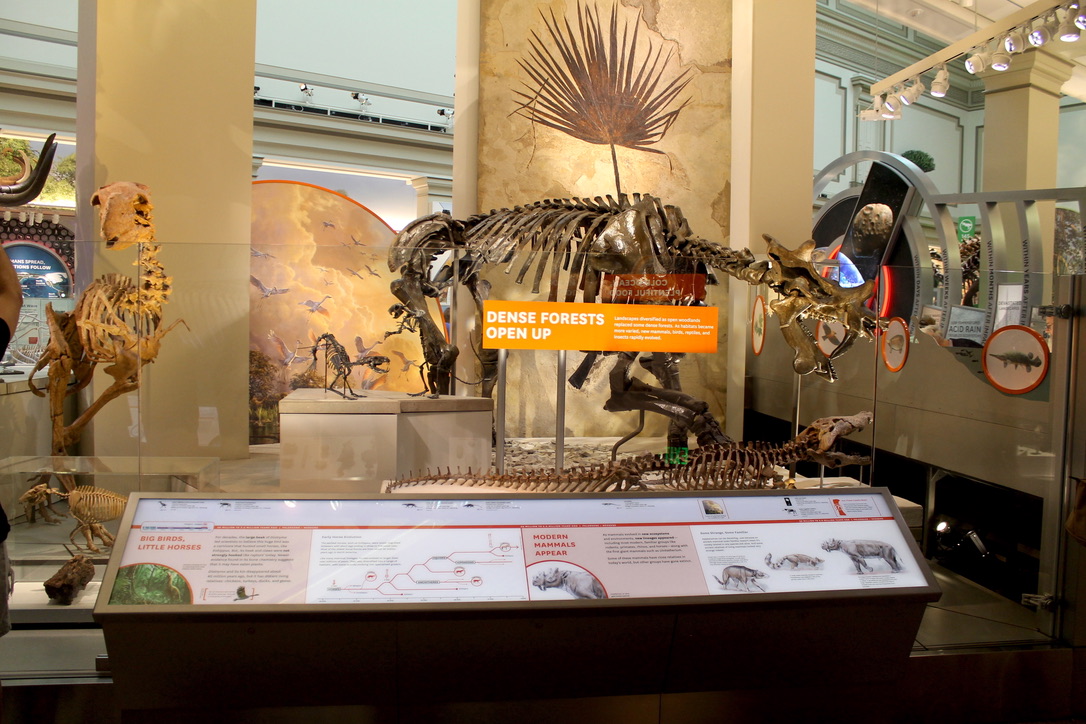
Category Archives: Deep Time

Interpreting the most-touched dinosaur bone of all time

In 1943, sawmill operator Daniel Edward Jones and his wife Vivian went prospecting for uranium west of their home in Delta, Colorado. In a gully near Potter Creek, they came upon a nearly seven foot-long dinosaur bone eroding out of the ground. It’s unclear exactly how and when they managed to excavate and remove the gigantic fossil, but sometime before 1955, the Joneses collected the bone and donated it to the Smithsonian Institution. That bone—identified as the humerus of a Brachiosaurus altithorax—has been on display at the National Museum of Natural History ever since.

The Potter Creek humerus (USNM V 21903) never made much of a splash scientifically. It wasn’t mentioned in any research paper until 1987, when Jim Jensen figured it alongside several other Brachiosaurus bones he collected at the same locality. The referral to Brachiosaurus has been questioned (e.g. Taylor 2009), but without any closely related dinosaurs known from Late Jurassic North America, researchers have generally been happy to use the available name.

Arguably, the Potter Creek humerus has a greater legacy as an object on display, and more specifically as an object to be touched. Since 1955, the fossil has been in easy reach of visitors, and has often been accompanied by signage inviting visitors to touch it. Extrapolating slightly from available visitation statistics and multiplying by the number of years on display, this fossil could easily have been touched by over 200 million people—possibly as many as 400 million. I’m unaware of any other dinosaur specimen that has been handled by that many individuals.

Let’s take a look at how the most-touched dinosaur bone of all time (if you know of other contenders for that title, please let me know!) has been interpreted over the years.

Photo courtesy of the Smithsonian Institution Archives.

One of the largest known dinosaur limb bones

This humerus (upper arm bone) of the sauropod dinosaur Brachiosaurus alithorax was found by Mr. D.E. Jones of Delta, Colorado. It is from the Morrison formation, of late Jurassic age (about 130,000,000 years ago), in Montrose County, Colorado. Brachiosaurus was a giant among dinosaurs, much larger than the familiar Brontosaurus; it may have weighed as much as 55 tons. It is distinguished from other dinosaurs by the fact that its front legs were somewhat longer than its hind legs. This feature, the great length of the neck, and the projecting nostrils on top of the head seem to have been adaptations to its presumed life habits. Brachiosaurus was a plant eater that walked along the bottoms of lakes, lifting its head to breathe above the surface of the water. Brachiosaurus is known from North America, Africa, and Europe. This humerus is 6 feet 10 inches long, its position in the body of Brachiosaurus is shown in the sketch, where the humerus is drawn in red. Note the much smaller humerus in the nearby skeleton of the dinosaur Diplodocus.

As mentioned, the Potter Creek humerus was first put on display at NMNH in 1955. It was mounted on a wooden pedestal in front of the Diplodocus skeleton, near the front of the museum’s spacious fossil hall. As seen in the photo above, the bone’s damaged shaft was not restored, although some sort of consolidant must have been applied to keep it from crumbling all over the floor.

The 181-word text panel accompanying the fossil was likely written by curator Charles Gazin, who had led the Vertebrate Paleontology division since 1946. The text is quite long and meanders through several distinct topics—addressing what the specimen is, who found it, how old it is, where it was found, how big the animal was, what the animal looked like, how the animal behaved, where else the animal lived, the exact size of the bone, and finally how it would fit into a complete skeleton. The text does not address any qualities of the fossil that visitors can actually observe until the very end.

Consideration of how visitors use museum exhibits—and how exhibits can best meet visitors’ needs—was in its infancy at this time. At NMNH and most of its peer institutions, labels were written by curators—experts in their fields but not necessarily in best practices for communicating with broad audiences. Exhibit text was by experts, for experts, and any visitors not up to parsing dense paragraphs like this one were left to make their own meaning of the exhibits.

It is notable, however, that this label compares the Potter Creek humerus to the nearby Diplodocus. As was typical of natural history exhibits at the time, the NMNH fossil hall wasn’t arranged in any particular order. Specimens were placed on platforms or in free-standing cases. This modular design allowed the hall to be rearranged with relative ease when new specimens were acquired, but it did not lend itself to any sort of overarching narrative for the displays. This passing reference to another specimen was as close to narrative cohesion as exhibits of this era could get.

Photo courtesy of the Smithsonian Institution Archives.

Would you like to touch a dinosaur bone?

This is a humerus (arm bone) of the sauropod Brachiosaurus alithorax. The position of the bone and the appearance of the animal are shown in the accompanying drawing. A close relative of Diplodocus and Camarasaurus, Brachiosaurus was the bulkiest land animal that ever lived, weighing about 55 tons. Like other sauropods, he spent most of his time in ponds, lakes, or rivers. If you want to be able to tell your friends that you touched a dinosaur bone, here is your chance.

The NMNH fossil halls were updated in 1963 as part of a decade-long, Smithsonian-wide modernization project. For the first time, an exhibit design specialist worked with the curators to compose the paleontology exhibits. Designer Ann Karras considered how visitors would move through the space, and attempted to create a coherent story of the evolution of life over time. Text panels were part of the aesthetics and organization of the exhibition, and were written with consistent style and terminology.

The text accompanying the Potter Creek humerus may have been written by Barbara Craig, and by modern standards, it’s pretty good (ignoring the now-debunked idea that sauropods spent their time in the water, and the choice to use a masculine pronoun for a dinosaur of unknown sex). The header is a call to action, inviting visitors to touch the fossil. The remaining 82 words are snappy and useful—the object is clearly identified, and the accompanying illustration is referenced right away. Visitors can find the information they want (what am I looking at? What should I do here?) right away, without having to fight through excessively long or wordy prose. It’s remarkable how well this label adheres to the standards for exhibit text that Beverly Serrell would first put forward over twenty years later.

Photo by Michael Brett-Surman.
Photo by Flickr user grafxmangrafxman.

Size in dinosaurs—how big is enormous?

Early dinosaurs were relatively small—about the size of the smaller Camptosaurus displayed to your left. However, these “small” dinosaurs were already larger than most land animals of their time. Although some lines of dinosaurs never got much larger, most produced huge forms. The average live weight of a dinosaur was about 5 tons. No other land-dwelling reptiles have ever approached this size and only about 2 percent of land-dwelling mammals have done so. The smallest dinosaur known, though no larger than a chicken, was still larger than 80 percent of all land mammals living today.

Brachiosaurus leg bone

The bone displayed below and in green in the drawing is from the upper part of the front leg of Brachiosaurus, one of the largest of all dinosaurs. Although Diplodocus had a longer neck and tail, Brachiosaurus was much taller and more massive and outweighed Diplodocus by several tons. Bones of a still larger animal similar to Brachiosaurus have been found in Colorado.

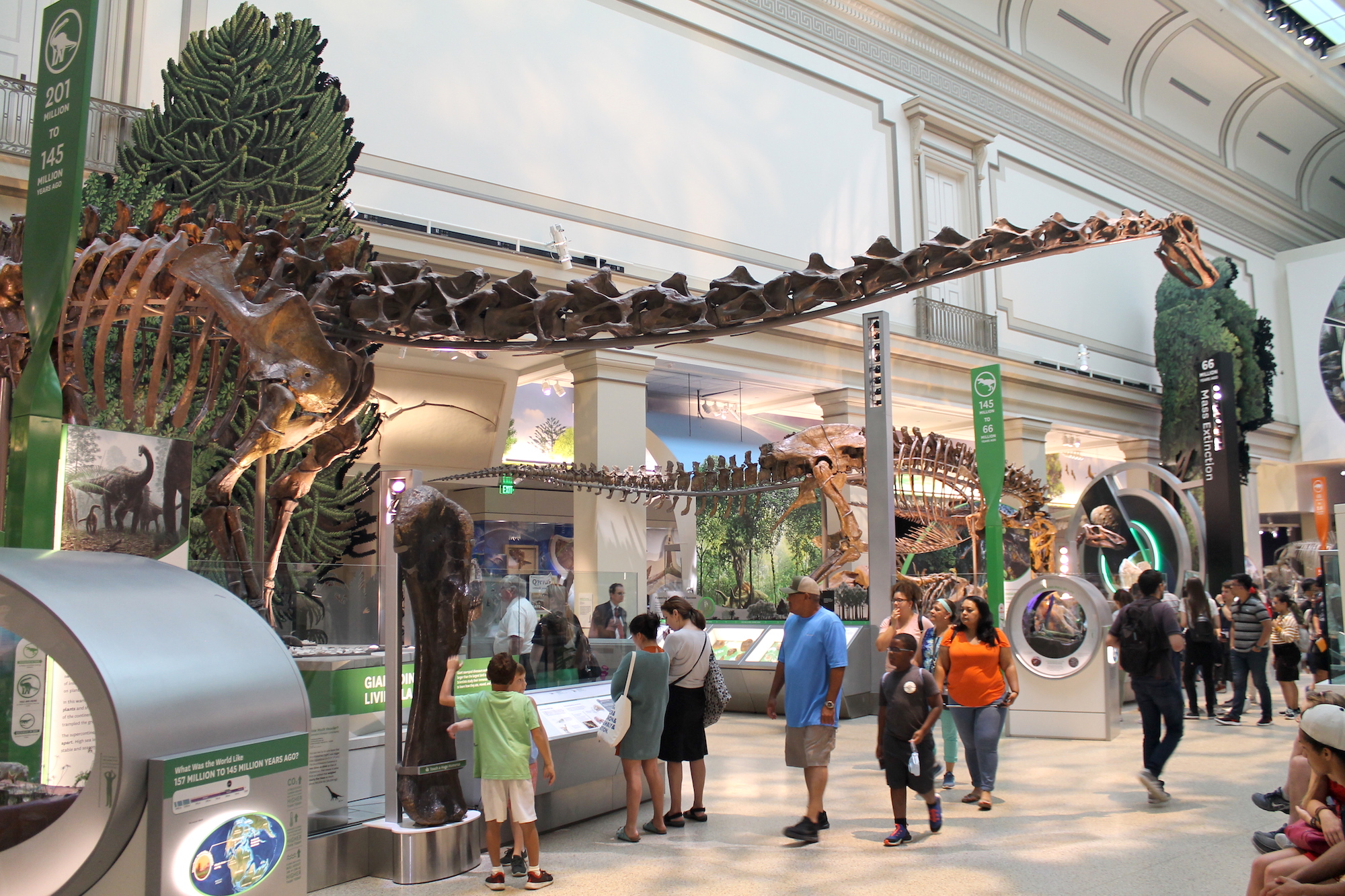
The dinosaur exhibits at NMNH were next updated in 1982. This time, the Potter Creek humerus was relocated to the right side of Diplodocus. With all of the mounted skeletons in a central corral and behind a plexiglass barrier, the role of the humerus as a designated touchable fossil was exceptionally clear. During the renovation, a fiberglass cowl was affixed to the damaged part of the humerus. This restoration makes the bone appear thicker than it actually is.

The accompanying text was written by postdoctoral research associates Jessica Harrison and George Stanley, under advisement from curator Nicolas Hotton. Their task was to balance the needs of visitors with demands for precise language from scientists. The resulting label is twice as long as the previous version and, I would argue, not nearly as useful. The primary text isn’t about the humerus at all—instead it discusses the range of dinosaur sizes and compares them to modern animals. The humerus is finally mentioned toward the bottom of the graphic, where it is once again compared to Diplodocus. For some reason, the donor is listed as Tony Jones.

Photo by the author.

How much heavier?

Sauropod dinosaur (arm bone)

Brachiosaurus altithorax

Lived 152 million years ago

Morrison Formation, Montrose Co., Colorado

USNM 21903

Donated by Eddie and Vivian Jones

You can see by it’s arm bone that Brachiosaurus (right) was bigger than Diplodocus (in front of you). The Brachiosaurus humerus is two times as thick as that of Diplodocus. That means it came from an animal that weighed nearly five times as much, about 140,000 lbs (64,000 kg)!

The most recent renovation of the NMNH fossil halls was completed in 2019. For the first time, the Potter Creek humerus is mounted vertically, in the orientation it would have held in a living Brachiosaurus. While requiring a sturdier and more sophisticated mounting structure, this display gives visitors a clearer understanding of the fossil before them.

Angela Roberts Reeder was the lead writer of the current exhibit text, assisted by several co-writers. At 51 words, this is the shortest label for the Potter Creek humerus yet. Some of the basic information—the animal’s name, how old the fossil is, and where it was found—is collapsed into a standardized and compact “tombstone” ID block. The remaining text covers a single subject: the mathematical relationship between the bone’s width and the living weight of the animal it belonged to.

This is considered good practice. According to Serrell, visitors are primarily concerned with the objects on display, not the exhibit text. They will look for text if they expect it to answer their immediate questions and improve their understanding. Visitors will quickly scan the available text, and if it doesn’t seem to be helping them, they will move on. Therefore, exhibit text needs to get to the point, and fast. Short labels aren’t about dumbing things down—they’re about finding the right words to communicate important ideas to the largest possible number of people.

Reeder’s label for the Potter Creek humerus is a great example. It immediately answers the most likely questions: “what is this thing?” and “how big was the dinosaur it came from?” Then, taking advantage of that momentary attention, it enhances visitors’ understanding by explaining how scientists can know the size of an animal from a single bone. The standardized ID block resolves most further questions without making visitors hunt though a long paragraph. Rather than trying to tackle too many concepts at once, this label omits any information on the life appearance or habits of Brachiosaurus.

Looking at the four generations of interpretation of the Potter Creek humerus, there are some recurring themes. The size of the bone and the animal it belonged to has always been referenced. And there is always an accompanying illustration showing where the bone fits into a complete Brachiosaurus. However, the earlier labels addressed the life habits of living sauropods with greater specificity (and as it turns out, inaccuracy—Brachiosaurus did not spend all its time wallowing in lakes in rivers). The newer labels are somewhat more technical, in that they focus on comparative measurements among fossils. This is surprising—I would have expected that earlier generations of paleontologists would have been more concerned with comparing figures and less interested in the total biology and ecology of extinct animals.

I was also surprised that there was not a clear trend toward shorter text. Instead, the length of the label has oscillated with each generation. And it’s worth noting that the earliest label is not burdened with excessive scientific jargon. The language has always been clear—what varies is how it is organized and how long it is overall.

References

D’Emic, M.D. and Carrano, M.T. 2019. Redescription of brachiosaurid sauropod dinosaur material from the Upper Jurassic Morrison Formation, Colorado, USA. The Anatomical Record 303:4:732–758.

Jensen, J.A. 1987. New brachiosaur material from the Late Jurassic of Utah and Colorado. Great Basin Naturalist 47:592–608.

Marsh, D.E. 2014. From Extinct Monsters to Deep Time: An ethnography of fossil exhibits production at the Smithsonian’s National Museum of Natural History. http://circle.ubc.ca/handle/2429/50177

Serrell, B. 2015. Exhibit Labels: An Interpretive Approach (2nd Edition). Rowman and Littlefield.

Taylor, M.P. 2009. A re-evaluation of Brachiosaurus altithorax Riggs 1903 (Dinosauria, Sauropoda) and its genetic separation from Giraffatitan brancai (Janesch 1914). Journal of Vertebrate Paleontology 29:3:787–803.

3 Comments

Filed under Deep Time, dinosaurs, exhibits, museums, NMNH, sauropods, science communication

Some welcome improvements to Deep Time

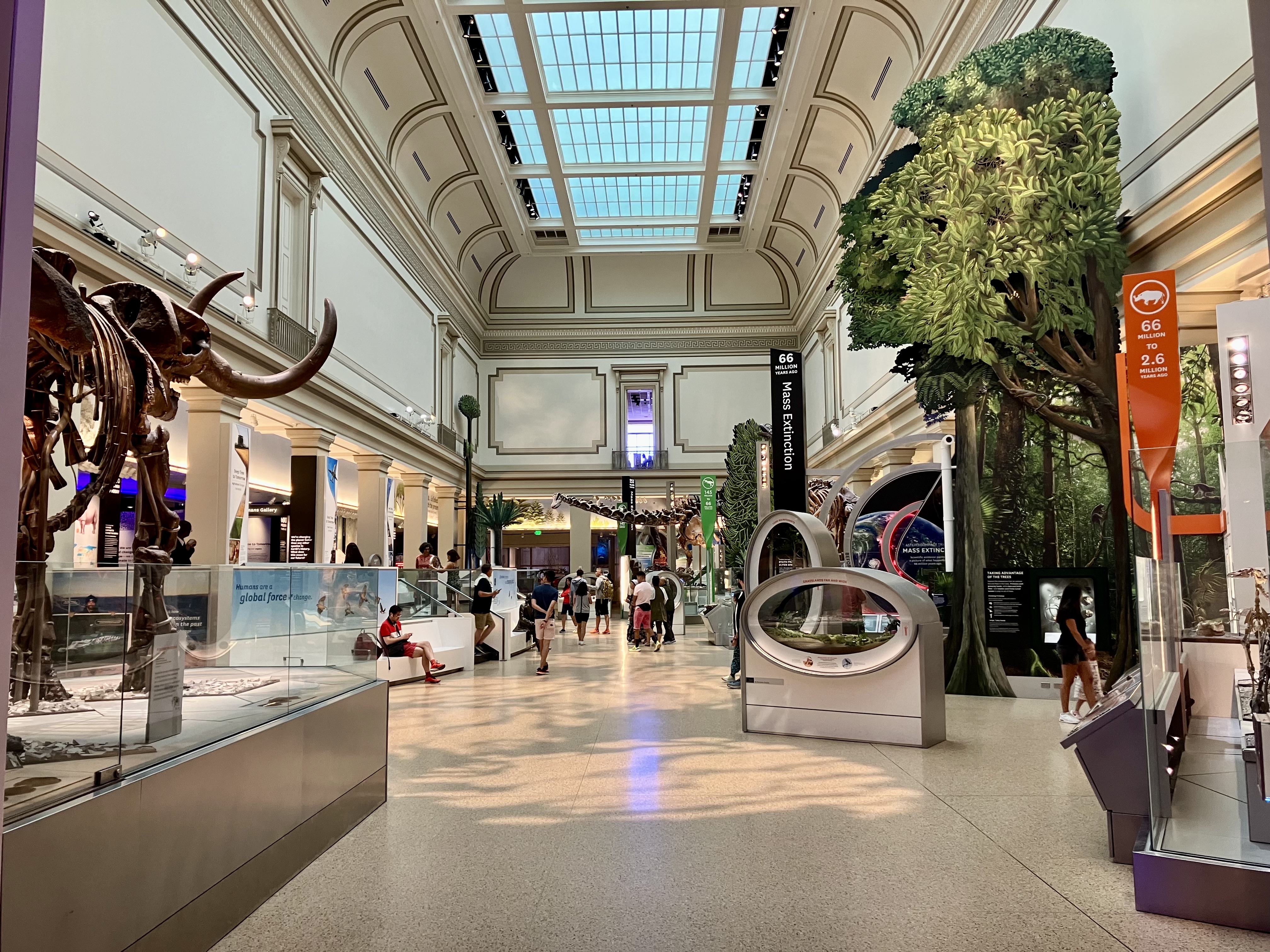
A look down Deep Time’s main drag. Photo by the author.

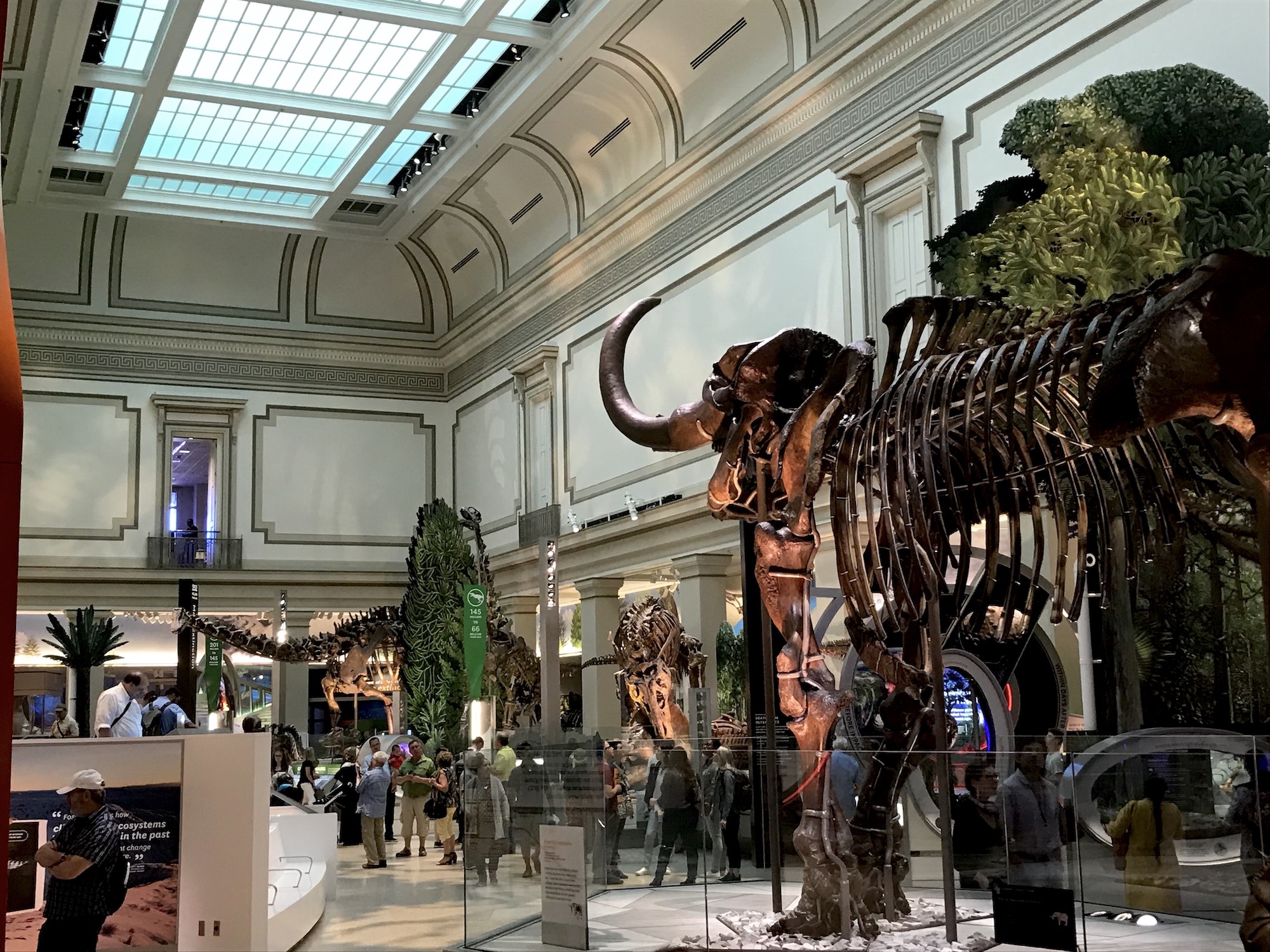
It’s no secret that I love Deep Time, the National Museum of Natural History’s recently renovated paleontology hall. From it’s spacious, open aesthetic to it’s narrative that connects charismatic fossils to global environmental change, this is one of the best presentations of the history of life in any medium, bar none. But like any creative project, it’s not perfect. Creating an exhibition on this scale requires the combined efforts of hundreds of individuals, constantly fighting against the realities of budget and time. Inevitably, compromises have to be made. But I’m happy to report that this year, some of Deep Time’s most significant shortcomings has been corrected.

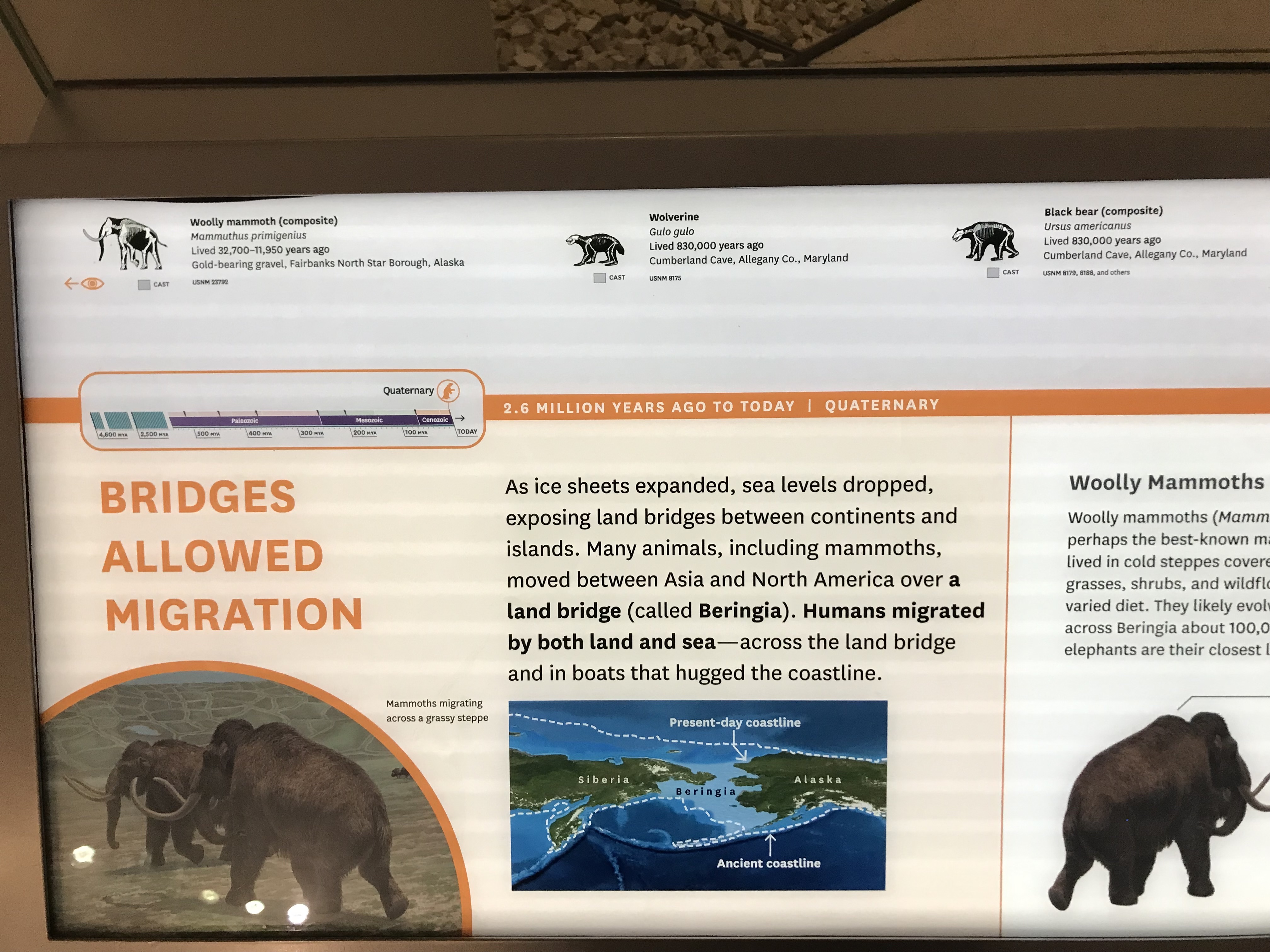
Part of a reading rail near the woolly mammoth and other ice age fossils, as it appeared in 2019. Photo by the author.

Exhibitions of any size have a graphic design “system.” Within the exhibition, there is a limited number of graphic panel types, and each type contains a particular kind of information. Ideally, visitors will understand—consciously or not—what kind of information can be found on what kind of panel. Deep Time makes heavy use of reading rails—long, rectangular panels mounted at an angle in front of specimen displays. These reading rails are all laid out in approximately the same way. There’s a header on the left side (“Bridges Allowed Migration” in the example above) that summarizes the topic of the display. Most of the real estate on each rail is taken up by short paragraphs and images that contextualize the fossils nearby, usually with stories about the time and place they lived in, or the evolutionary lineage they belong to.

Above these contextual stories is a narrow strip that graphically reminds visitors of the time period the display in front of them is concerned with. And above that strip is a white band which identifies the specific fossils on display. Each specimen gets an ID block (sometimes called a tombstone), which lists the common name, scientific name, age, location of discovery, and catalog number. It’s well established from studies of how people use exhibits that ” what is this thing?” is the number one question visitors have at any given time. So it’s good design practice to place the ID blocks in a standardized location that visitors can find at a glance. This is one of many areas where Deep Time is a stellar example of a thoughtfully-constructed exhibition.

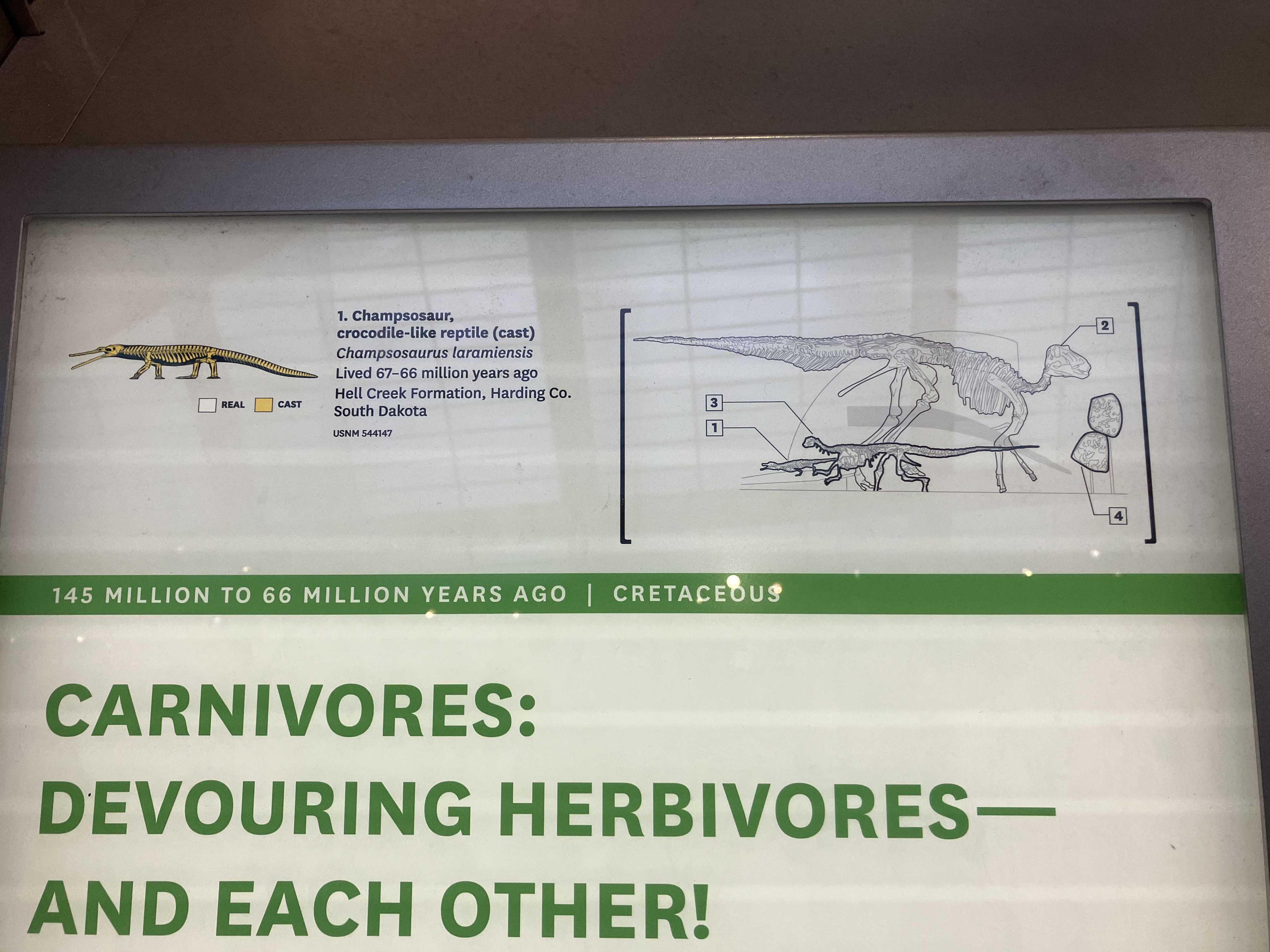
The trouble comes from the skeletal diagrams that accompany each ID block (for the tetrapods at least—not all of the fish, invertebrate, and plant fossils have them). The problem isn’t with the quality of the illustrations, which are excellent—I believe all or most of these were drawn by the irreplaceable Scott Hartman. The diagrams are shaded to show which parts of the fossil specimen on display are real and which are reconstructed. As originally designed, real elements were white and reconstructions were gray (see example above). Unfortunately, the color distinction was too subtle. This coupled with the small size of the diagrams (about two inches long) made them basically unusable for their intended purpose. The key included with each diagram—a gray square marked “cast”—was also confusing. I wouldn’t be surprised if many visitors did not even notice that the diagrams were color coded and assumed that the “cast” squares were telling them that every single fossil was a replica.

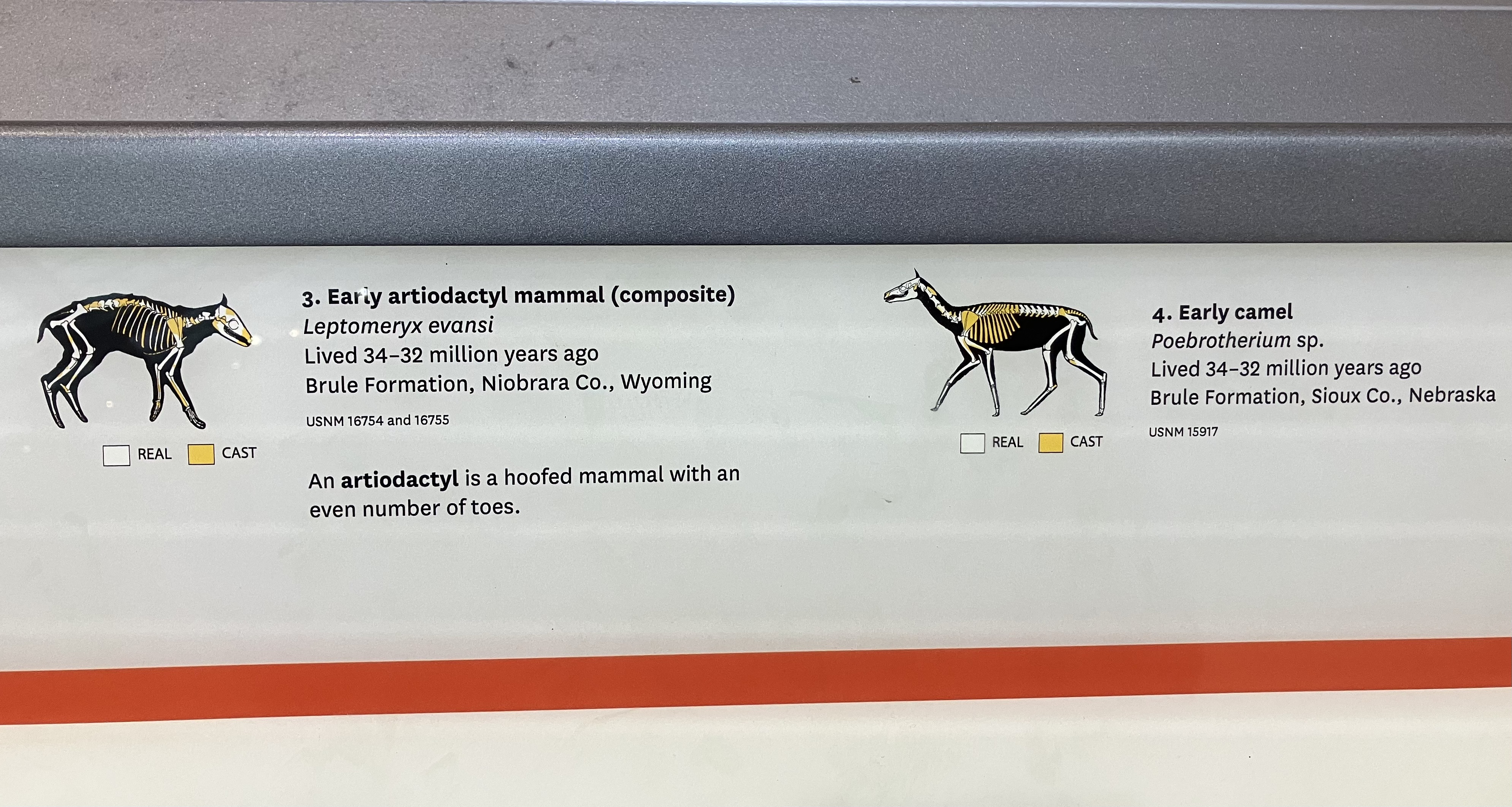
Close-up of the re-designed ID blocks for Leptomeryx and Poebrotherium. Photo by the author.

At some point between March and November of this year, every graphic panel in the exhibition that includes ID blocks was reprinted with subtle but significant design changes. Each skeletal diagram is now much larger, about twice it’s original size. The reconstructed sections are now yellow instead of gray, and the key beneath each diagram includes two squares: white for real and yellow for cast. This is a tremendous improvement. The intended message of these diagrams—that most of the fossils on display are a mixture of real and reconstructed parts—is much more obvious. And for anyone interested in which particular parts are original fossil, the larger images make that possible.

Close-up of the new schematic drawing of the Hell Creek display. Photo by the author.

In addition to the re-designed skeletal diagrams, new schematic drawings of the displays have been added to many of the rails. These are simple line drawings of the specimens as they appear on exhibit, with numbers that correspond to the ID blocks. Another shortcoming of the original design is that the skeletal diagrams are all in standardized, walking poses, which do not match the often dynamic poses of the mounted skeletons. Although there are numbers associated with the specimens in each display, I imagine many visitors still struggled to match the images on the rail with the fossils in front of them. The schematic drawings help bridge that gap, but there is still an extra step involved. Visitors must match the number of the specimen in the display to the number on the schematic drawing, then match that number to the nearby ID block. I think a better approach might be to create skeletal diagrams with same poses as the mounted skeletons.

Close-up of the new schematic drawing for the Neogene rhino display. Photo by the author.

I noticed one more change to the Deep Time reading rails. Many of the rails throughout the exhibition include a note in the corner that discusses the mix of real and replica fossils on display. This is a common preoccupation for visitors, so it makes sense to address it frequently. However, I was never sure that this recurring text as originally written was really answering the right question.

Are These Fossils Real?

Most of the fossils you see are real, but some are casts. Museum-quality casts and scanned replicas aren’t “fakes.” They’re exact copies of real fossils that capture minute details.

This original text from the 2019 version of the exhibition sounds kind of defensive. And by declaring a distinction between “replica” and “fake,” it’s bringing up a more existential discussion about the reality of physical things than I think most visitors are interested in grappling with. The new 2024 text is much improved:

Why Does the Museum Display Casts?

Some fossils are too fragile for exhibition and must be stored to protect them for further scientific study. The Museum displays exact casts so that you can learn about these fossils, too.

This text better addresses what most visitors are likely concerned with. It establishes that some, but not all, of the fossils on display are replicas. And it clearly states the reason that some of the real fossils in the museum’s possession are not on display. Technically, it doesn’t address the casts of fossils held by other institutions, but given that the idea that museums even have behind-the-scenes collections is news for a plurality of visitors, it’s reasonable not to get too in the weeds.

I want to commend the NMNH team for taking the time to make these improvements. Large museum exhibits are organized and funded as projects with discreet timelines, so it’s often difficult to go back and change things. This means that imperfect exhibits can languish for years or decades, so it’s great to see the museum identifying an issue and addressing it just a few years after opening.

Leave a comment

Filed under Deep Time, exhibits, museums, science communication

No, the Hall of Human Origins doesn’t downplay climate change

The south-facing entrance to the Hall of Human Origins. Photo by the author.

As covered in the previous post, the National Museum of Natural History’s Hall of Human Origins, which opened in 2010, is an exceptionally well-conceived and well-crafted exhibition. In certain circles, however, there has been a persistent strain of criticism that I feel like I would be remiss not to address.

Shortly after the Hall of Human Origins opened, articles in the New Yorker and ThinkProgress called attention to the fact that the exhibition was created with $15 million from David Koch (the full title of the exhibition is the David H. Koch Hall of Human Origins). Koch, who died in 2019, and his brother Charles are probably best known as billionaires who support a range of libertarian causes, including right-wing political candidates and climate change deniers. Their fortune comes from Koch Industries, a massive energy (read: oil) and manufacturing conglomerate.

David Koch bankrolled socially and environmentally destructive policies for decades, and I don’t think it’s a stretch to say that few individuals have left such a damaging anti-science legacy. But credit where it’s due: the Koch Foundation has also supported museums, public broadcasting, and other institutions associated with education and the arts. Many of these contributions are related to Koch’s personal interest in fossils, especially dinosaurs and human ancestors.

The Humans Change the World sub-section. Photo by the author.

In a ThinkProgress piece published a few months after the Hall of Human Origins opened, author Joe Romm suggested that the exhibition’s creators downplayed the seriousness of anthropogenic climate change at Koch’s behest. According to Romm, the hall’s “huge flaw is that it leaves visitors with the distinct impression that human-caused global warming is no big deal.” Additional articles in ThinkProgress, Hyperallergic, and Equinox made similar accusations. Each article zeroed in on a recurring theme in the exhibition’s text: that hominin evolution was driven in part by a need to adapt to a changing climate. As Ryan Little put it in Hyperallergic, the exhibition “craftily insinuates that fluctuating climates, whenever, wherever, and however they occur, are a source of astonishing human ingenuity, while also managing to suggest…that in the grand geological scheme of things, climate change is no big deal.”

There is absolutely a conversation to be had about the pros and cons of museums accepting money from problematic sources (NMNH caught heat a few years earlier when it accepted funding and specimen donations from Kenneth Behring). And there is always cause to be vigilant about corporate interests making their way into public institutions. Nevertheless, a recent re-visit to the Hall of Human Origins has convinced me that any critics suggesting that the exhibition downplays climate change—or that Koch had any influence over its content—are fundamentally misguided.

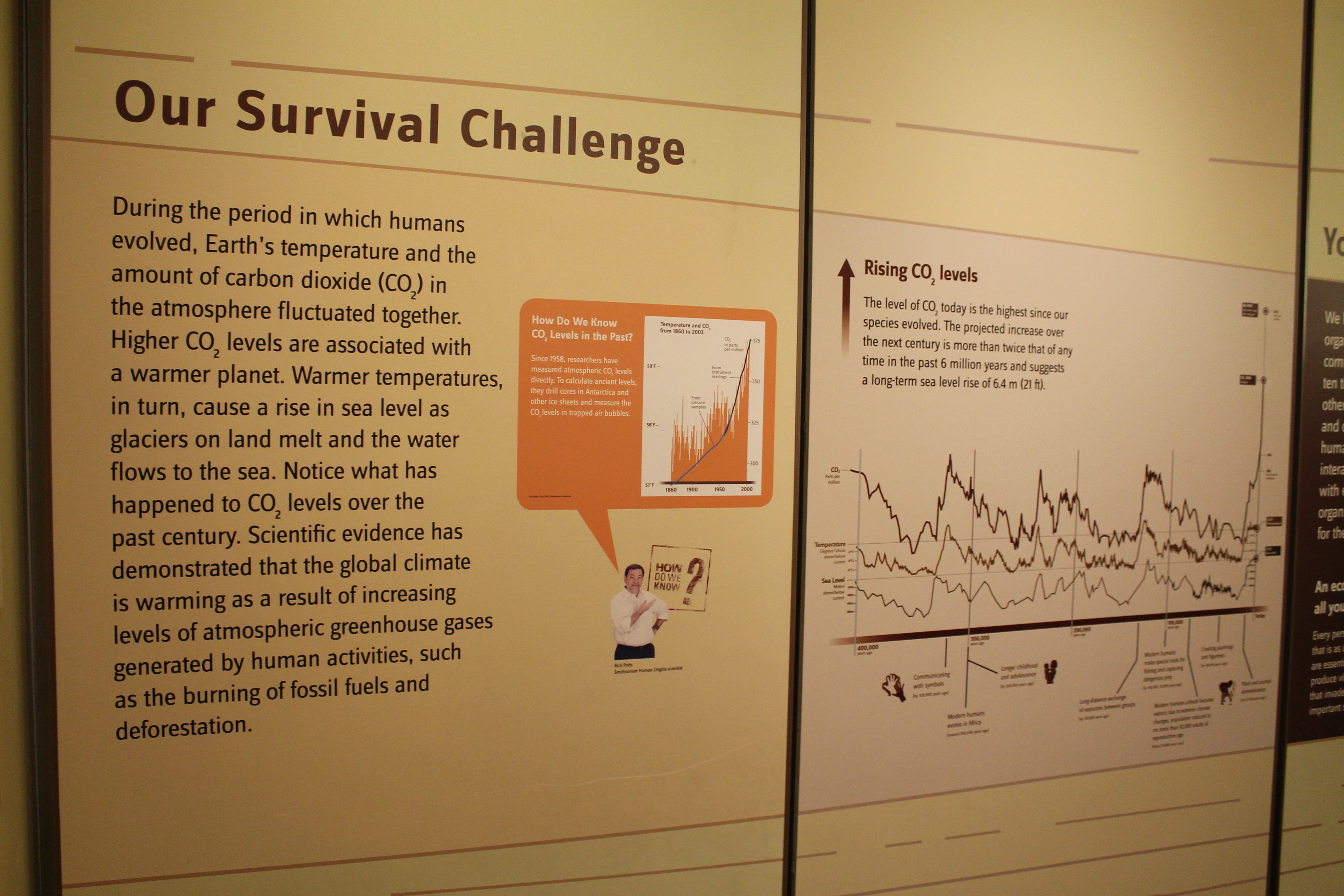
One of multiple graphic panels describing present-day climate change, why it’s happening, and how we know. Photo by the author.

There are two issues in play here. First, I think the authors are missing the bigger evolutionary picture. There is nothing new or untested about the concept of a connection between the changing Earth and the evolution of life on it (that is, interaction between the geosphere and biosphere). Examples are seemingly innumerable. Hoofed mammals evolved long legs for running and large, grazing teeth when grasslands replaced forests in the Miocene. Radiations of new species evolved when North and South America collided, allowing animals access to new habitats. Dire wolves got smaller when the climate got colder and food was harder to come by. And that’s just in the last 30 million years. Why wouldn’t human ancestors evolve in response to a changing environment, when it’s been a primary driver of evolution throughout our planet’s history?

The second issue is that it’s plainly incorrect to say that the Hall of Human Origins does not address recent anthropogenic climate change, or clearly state its cause. There is an entire 1,500 square foot sub-gallery called “Humans Change the World,” which investigates how garbage, livestock, habitat destruction, and yes, carbon dioxide emissions are damaging the planet. The famous hockey stick graph of global temperature, with its spike in the last century, appears at least three times, including at the exhibition’s south-facing entrance. The exhibition states, repeatedly, that “the global climate is warming as a result of increasing levels of atmospheric greenhouse gases generated by human activities.”

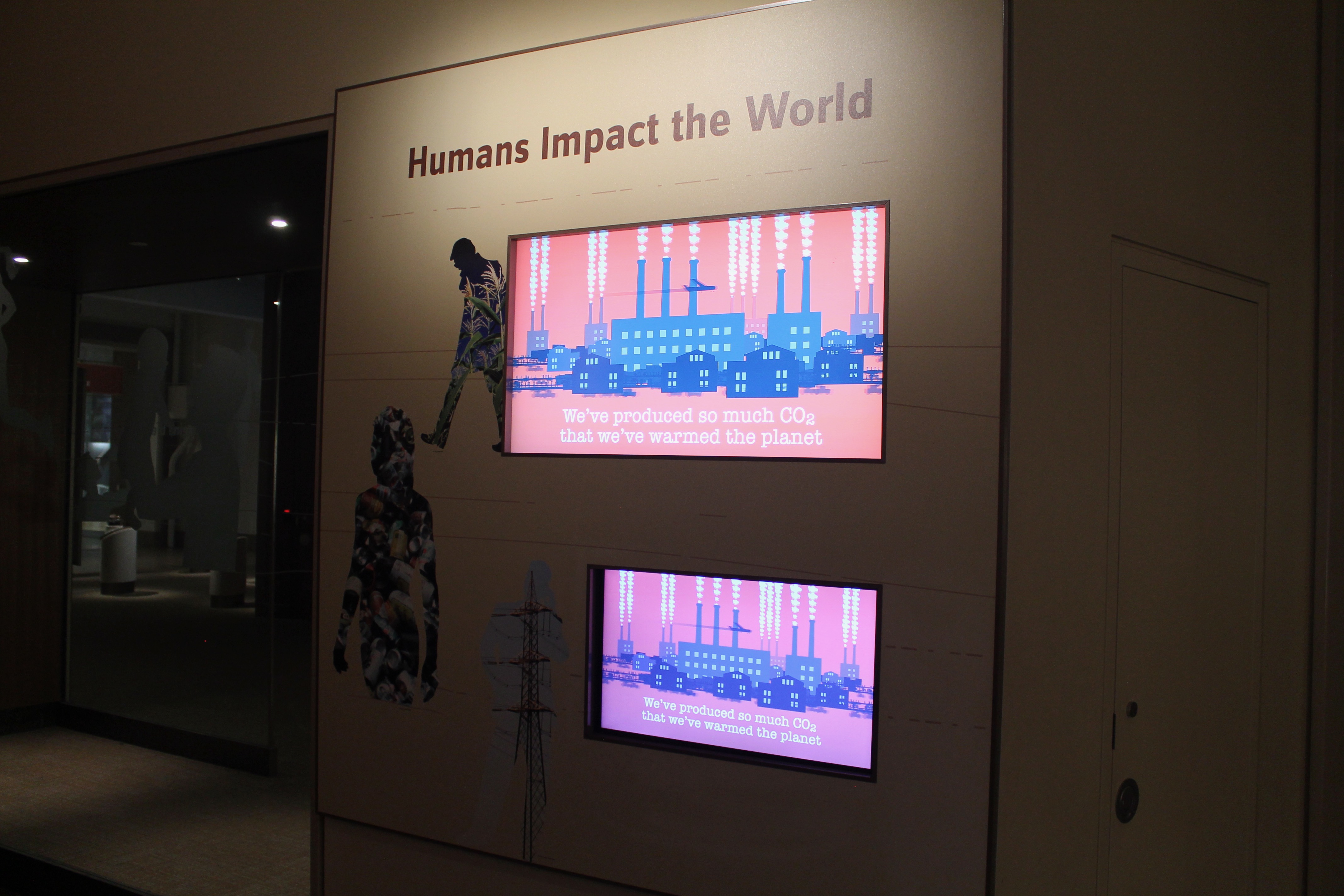
A media piece with the caption, “We’ve produced so much CO2 that we’ve warmed the planet.” Photo by the author.

It would be difficult for a visitor to explore the Hall of Human Origins and miss the references to anthropogenic climate change. It would be even more difficult to conclude that the exhibition is somehow putting a positive spin on it—the images of belching smokestacks and piles of garbage are not subtle. And yet, that is exactly what multiple authors have alleged, as recently as 2019. This is fascinating to me, because it speaks to the power of the narratives visitors bring with them to any museum experience.

In the previous post, I mentioned an evaluation of the Hall of Human Biology and Evolution at AMNH, which found that visitors were imposing teleologic narratives onto the exhibition, in spite of deliberate efforts to counteract this. Visitors expected evolution to be a linear, progressive process, and they unwittingly interpreted what they’re seeing in a way that matched those expectations. Perhaps a similar phenomenon is occurring in the Hall of Human Origins. Many of us are used to seeing Koch’s name associated with aggressive lobbying against climate change mitigation. In that context, the narrative that an exhibition bearing his name would have a similar message is compelling, even sensible. But it isn’t borne out by the actual content on display.

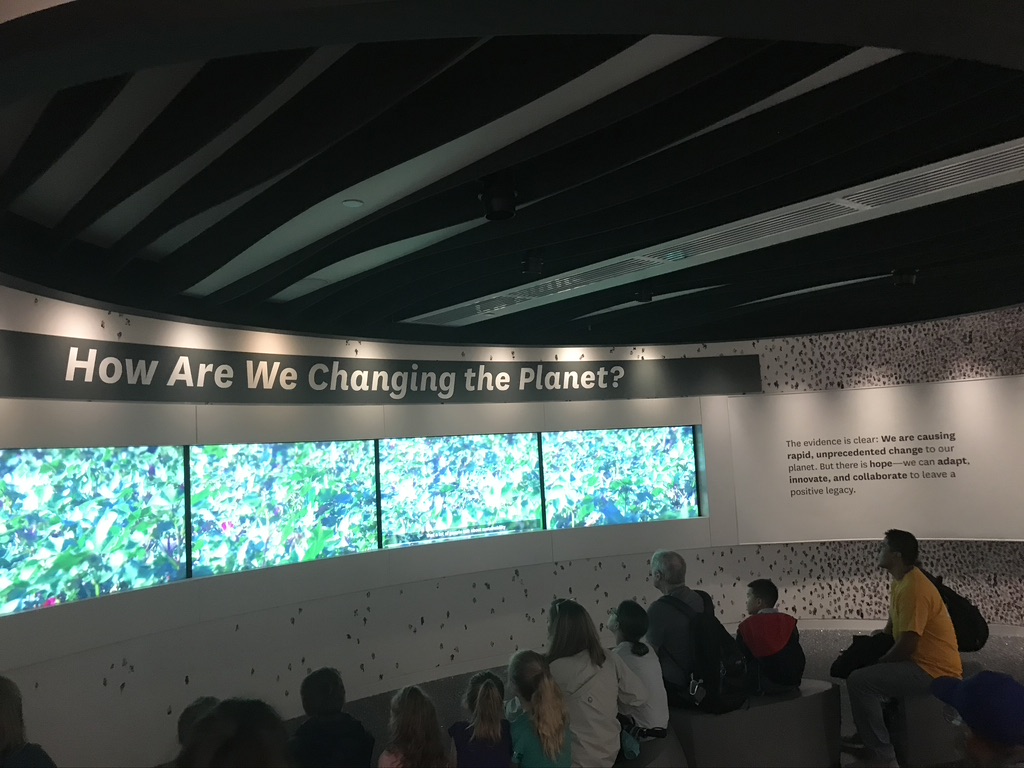
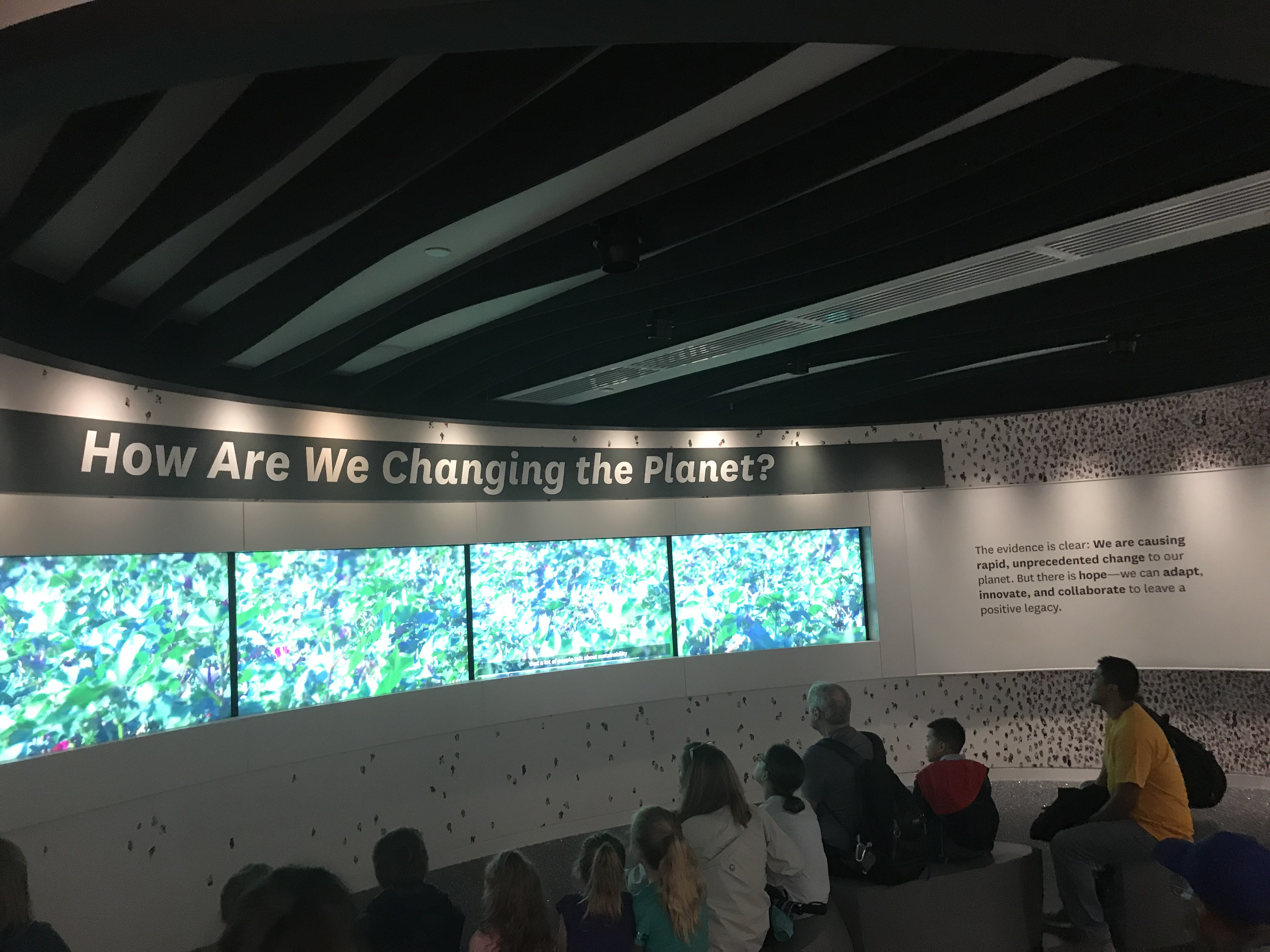
At the heart of the Deep Time exhibition, a theater demonstrates how humans are causing unprecedented change to the planet, while also highlighting potential solutions. Photo by the author.

Again, it’s reasonable to be wary of corporate interests making their way into public institutions. Perhaps museums that accept funding from questionable sources have a responsibility to go above and beyond in assuring their audiences that those funding sources are not influencing exhibition content (or anything else they produce).

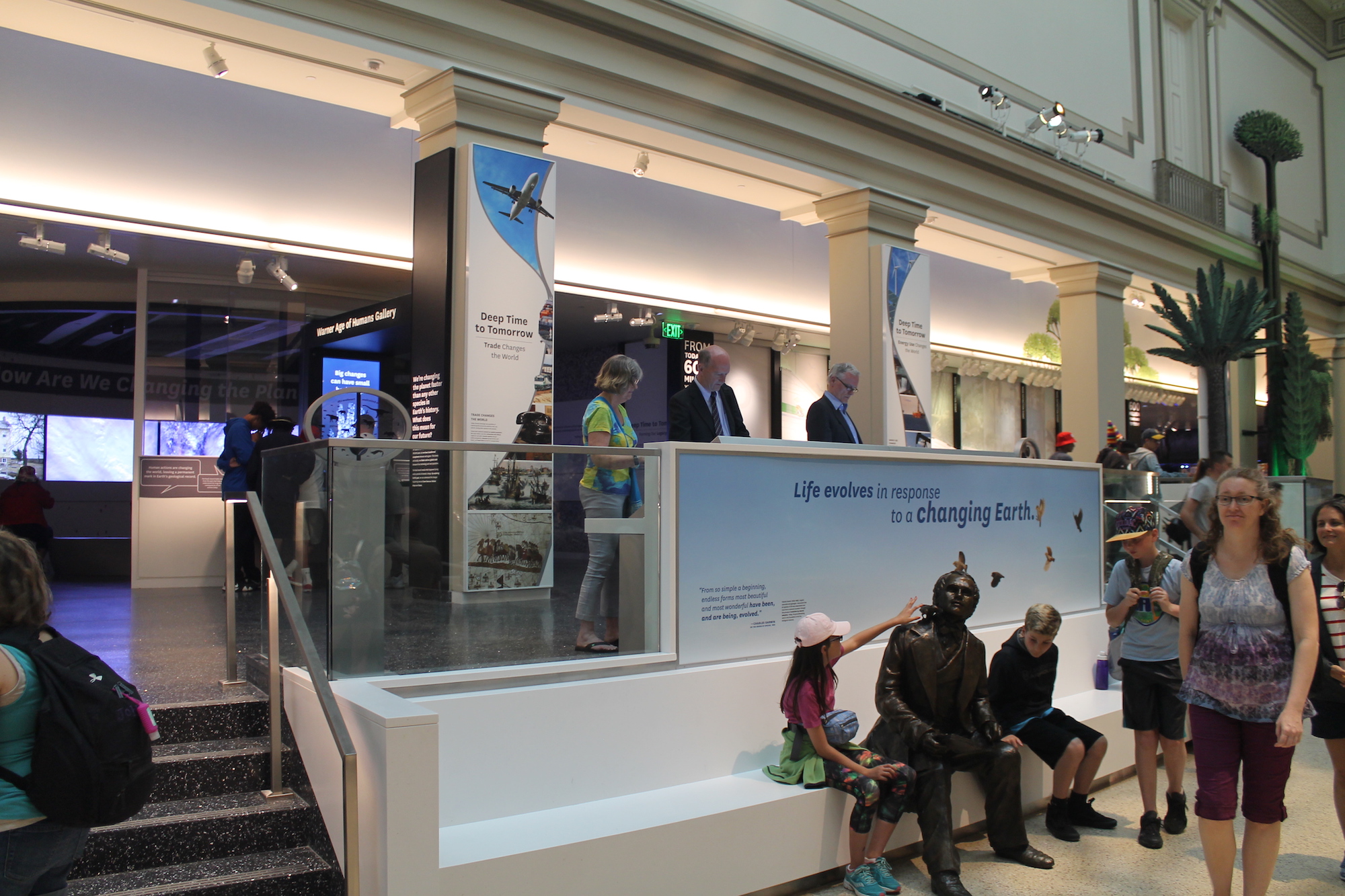
To their credit, this seems to be something NMNH has taken very seriously. As discussed, the Hall of Human Origins devotes considerable floorspace to the message that climate change is an unavoidable part of humanity’s legacy. And in 2019, the museum went even further. The massive paleontology exhibition known as Deep Time was also funded in part by the Koch Foundation, and bears David Koch’s name. Here, a central overlook (visible from everywhere in the hall) is devoted to the message that human industrial activity is warming the climate, and that this change comes with dire consequences. Even more so than in the Hall of Human Origins, this statement is presented in clear, matter-of-fact language. The centrality of this location and its proximity to the dinosaurs makes the climate narrative unmissable.

As the third most-visited museum in the world (behind the Louvre and Musée d’Orsay), NMNH is uniquely situated to reach audiences that may never have seen the evidence for climate change presented in a clear, non-political context. They have clearly risen to the occasion, and I just think they deserve some credit for it.

References

Elbein, A. 2014. The right’s dinosaur fetish: Why the Koch brothers are obsessed with paleontology. Salon.

Levinthal, D. 2015. Spreading the free-market gospel: What’s new and interesting about the Koch brothers approach to funding academics. The Atlantic.

Scott, M. and Giusti, E. 2013. Designing Human Evolution Exhibitions: Insights from Exhibitions and Audiences. Museums and Social Issues 1:1:49–68

Sideris, L. 2019. The Last Biped Standing? Climate Change and Evolutionary Exceptionalism at the Smithsonian Hall of Human Origins. Equinox Publishing.

1 Comment

Filed under anthropology, Deep Time, education, exhibits, mammals, museums, NMNH, opinion, science communication

T. rex in Context: Deep Time’s Cretaceous Display

A little over a year ago, the National Museum of Natural History re-opened its paleontology halls after a five-year renovation. As I detailed in a previous post, the new exhibition—called Deep Time—is exceptional. Breathtaking to look at, intuitive to explore, and (of course) brimming with fascinating specimens, Deep Time sets a high standard for excellence in natural history exhibitions.

Today, I’d like to take a closer look at one display in Deep Time, the Cretaceous tableau, and elaborate on what makes it so effective. Many thanks to Designers Pauline Dolovich and Fang Pin Lee, Developer Siobhan Starrs, and Curator Matt Carrano for discussing their work with me.

The Cretaceous display tells a story through its carefully-composed design.

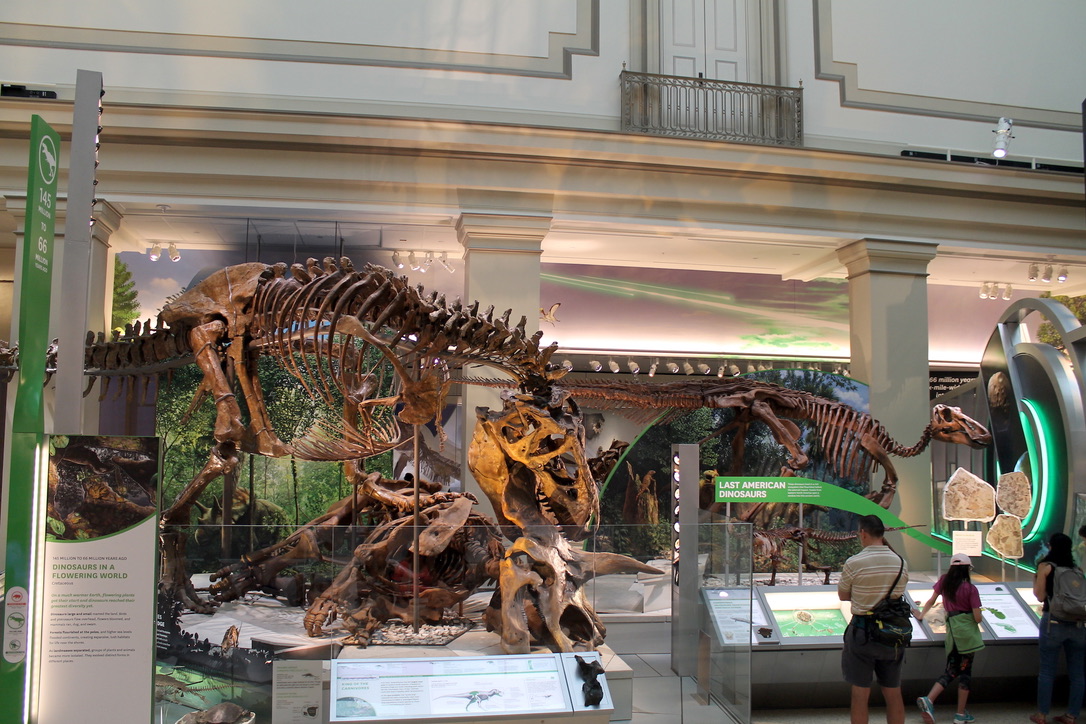
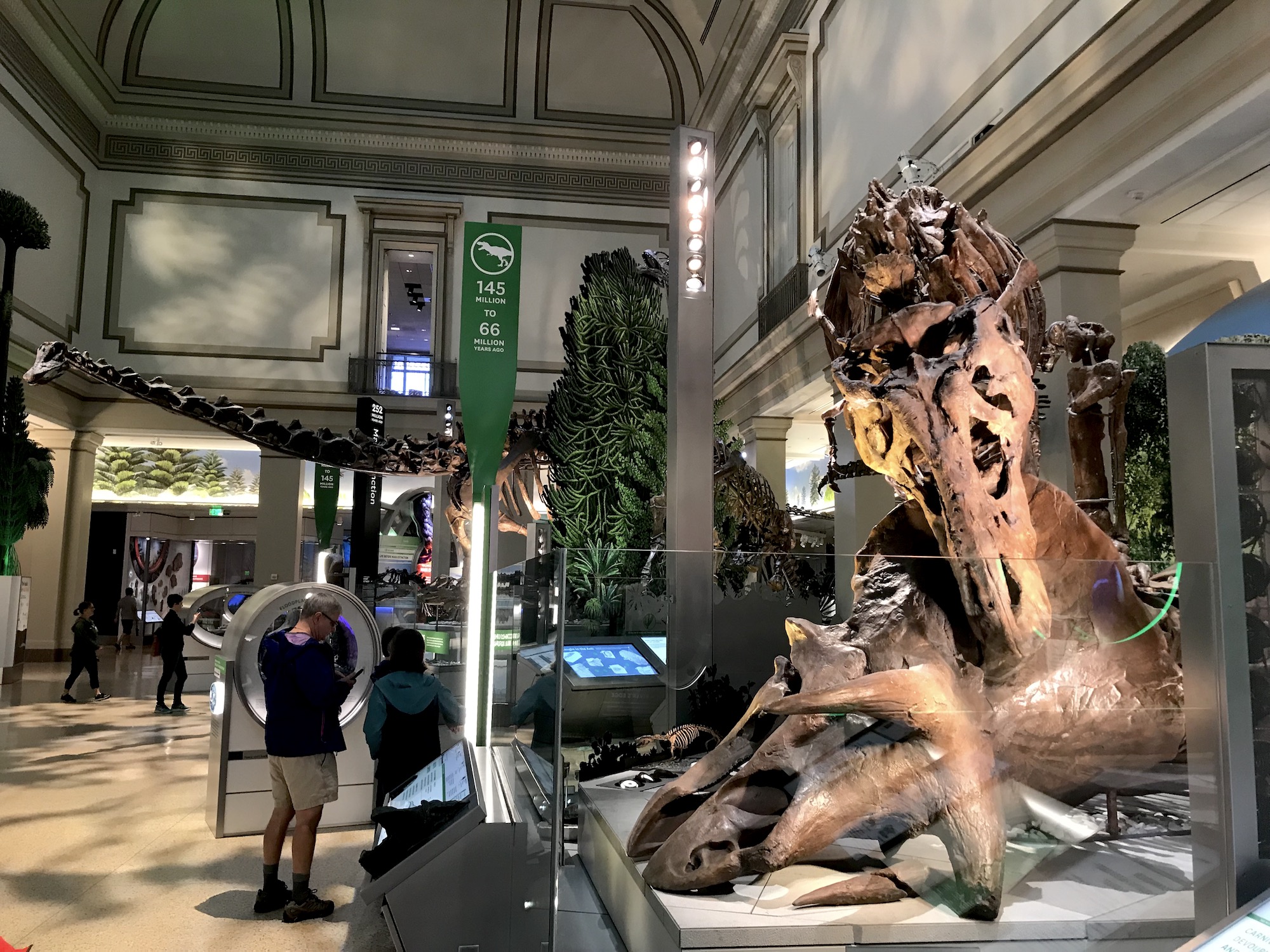
The Cretaceous display is home to Deep Time’s centerpiece, the Tyrannosaurus rex. As was well-covered by various media outlets in the months and years leading up to the exhibition’s opening, the “Nation’s T. rex” was discovered in 1988 on Army Corps of Engineers land, and is now on loan to the Smithsonian. Although it’s one of the most thoroughly-studied Tyrannosaurus specimens around, this is the first time the real skeleton has been assembled into a standing mount. Like many of the mounted skeletons in Deep Time, the T. rex strikes a dynamic pose that evokes the behavior of the living animal. In this case, the Tyrannosaurus is prying the head off a prone Triceratops.

Obviously, the T. rex draws a crowd. It’s hard to imagine any visitor passing through Deep Time without stopping to see it. But while the exhibit team acknowledged and emphasized the spectacular nature of the tyrant king, they also harnessed its star power to make a broader statement. Tyrannosaurus was part of a rich ecosystem of plants and animals, and while this apex predator had an impact on the entire community (eating some animals, providing leftovers for others), T. rex and other meat-eating dinosaurs were far outnumbered by the turtles, lizards, salamanders, and insects they lived alongside. By placing Tyrannosaurus within its ecological context, the display makes the seemingly fantastic dinosaur much more real. This reinforces one of the exhibition’s overarching themes: life in the past functioned much like life in the present, and studying past life can inform our understanding of the world today. It’s no accident that this cross-section of a prehistoric ecosystem is at the center of the hall, and includes its most popular specimen.

To avoid cluttering the historic architecture of the east wing, the designers integrated display lighting into the platforms.

While the Cretaceous display tells a complex story that is integral to the narrative of the exhibition as a whole, its footprint is remarkably compact. This efficient use of space is the result of a long and methodical design process. Designers Fang Pin Lee and Pauline Dolovich envisioned a broad avenue across the entire hall, which would accommodate large crowds (NMNH gets up to eight million visitors each year) and allow quick access to any part of the exhibition. This avenue needed to double as a central social space, where groups could congregate around built-in seating and look out onto the various displays. But more space for visitors means less space for specimens, and dinosaurs need a lot of room. Lee and Dolovich used digital renders and a miniature model to find the optimal position for the 40-foot Tyrannosaurus and its companions. This was a careful balancing act—they had to keep the T. rex visible from multiple approaches while working around the twin rows of structural columns down the center of the hall.

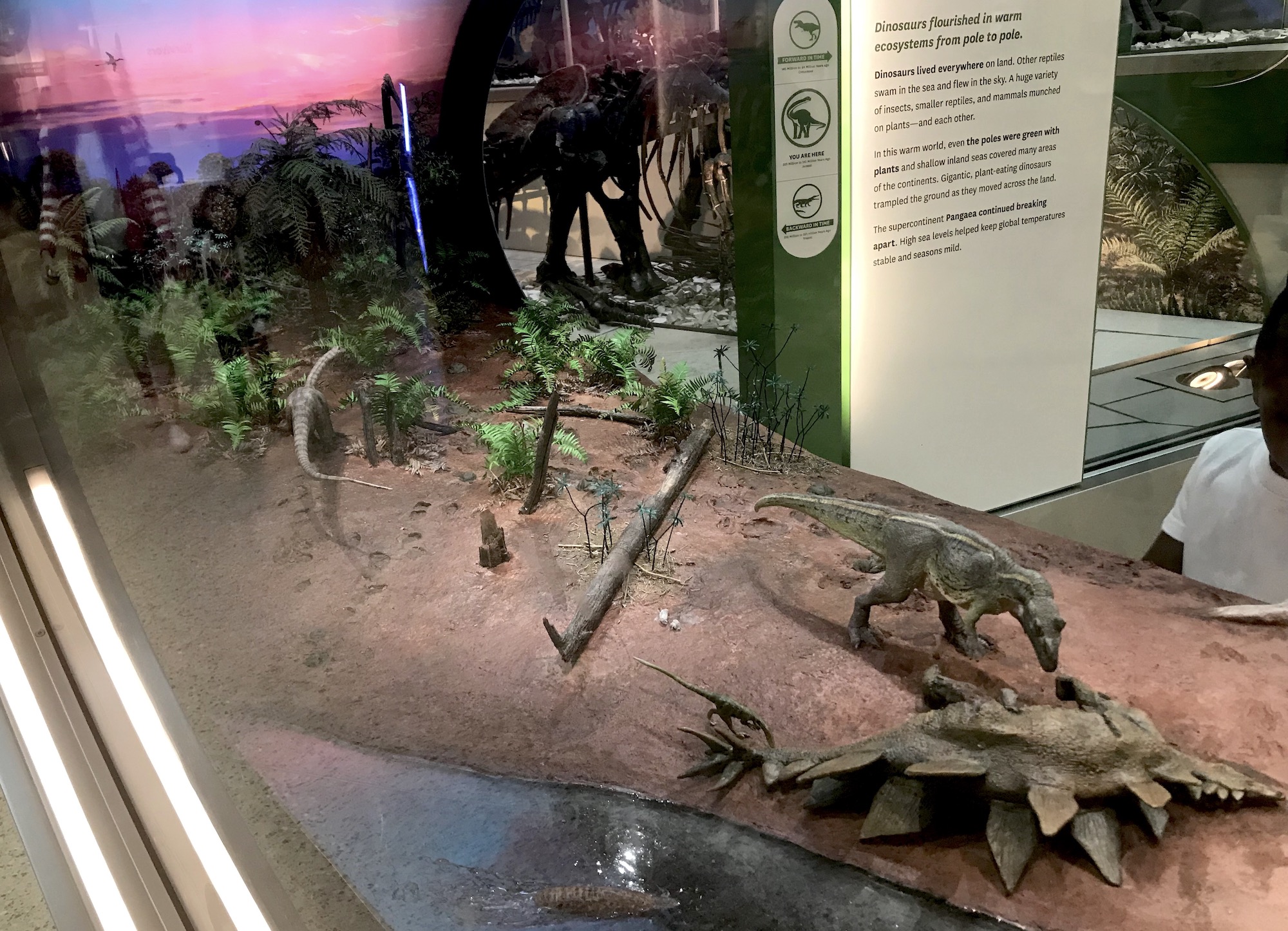
With ample space for visitor traffic, long sight lines, and some very large skeletons in the mix, there was precious little room in the Cretaceous display for text panels. This worked in the display’s favor, because it meant that much of the message had to be communicated through the design. For example, the Tyrannosaurus poised over its Triceratops meal evokes the predator’s role in the ecosystem, while conveniently reducing the footprint the two skeletons would require if displayed independently. Meanwhile, a cutaway in the platform next to the T. rex‘s foot contains an alligator, a turtle, clams, and aquatic plants. While only subtly implying the presence of a pond or river (the alligator skeleton is posed as though swimming along the surface, while lotus-like flowers “float” nearby), this area demonstrates these organisms’ ecological relationship to T. rex by placing them literally underfoot.

Stangerochampsa swims among floating Nelumbago leaves in an implied waterway.

To the right of Tyrannosaurus, a densely-layered series of specimens and display elements provides a nuanced look at the Hell Creek ecosystem within a limited amount of space. In the back, a pair of large murals by Julius Csotonyi set the stage: this was a lush, green world dense with weedy flowering plants (as opposed to the open conifer forests dinosaurs are often depicted in). To the left, a lone Torosaurus is dwarfed by the forest around it. To the right, an Edmontosaurus group tramples through the undergrowth, disturbing the smaller Thescelosaurus and Polyglyphanodon. Skeletons of Edmontosaurus, Thescelosaurus, and the aquatic reptile Champsosaurus stand in front of the murals, alongside three slabs of fossil leaves.

A vivid green panel among the skeletons spells out the key takeaway: these plants and animals were part of a single ecosystem that existed in North America at the end of the Age of Dinosaurs. Similar header panels can be found throughout the exhibition, and the writers iterated on the text for years. These short phrases had to convey the context and significance of a display at a glance, even if these were the only words a visitor read. The team settled on the headline “T. rex in Context” for the Cretaceous display, but when test audiences began visiting the hall, this proved to be a mistake. Because the words appeared so close to the Edmontosaurus, visitors were concluding that the hadrosaur was a T. rex. With weeks to go before opening, the team opted to replace the headline with the tried-and-true “Last American Dinosaurs.

Those vertical mounts for the fossil leaf slabs are incredible.

The final layer in the Cretaceous display is the rail at the very front. Smaller specimens—the lizard Polyglyphanodon, several fossil leaves, and an assortment of microfossils—are mounted in cases, while a dinosaur bone with insect damage is out in the open where it can be touched. The text on the rail is almost superfluous, but it is cleverly divided by trophic level. One panel addresses primary producers, another herbivores, and a third carnivores and decomposers. The plants and small animals are given the same amount of attention as the dinosaurs, reinforcing that all of these organisms have their part to play in the community.

Taken together, the elements of the Cretaceous display encourage deep looking without requiring a great deal of reading. Visitors drawn by the star power of the Tyrannosaurus find themselves surveying the “beautiful density” of specimens and display elements. They may notice minute details, like platform tiles slanted and dislodged as though by the movement of the dinosaurs, or the broken Triceratops horn that has rolled away from the skeleton. Intuitively, they understand that they’re looking at the complete ecological context of T. rex, and that this ecosystem is just as diverse and complex as those of today. If they choose to read the text panels, visitors will learn details like the names of the animals or the feeding strategies of different herbivores, but most of the information is conveyed through the layout alone. This is the mark of an uncommonly well-designed museum display.

5 Comments

Filed under Deep Time, dinosaurs, exhibits, fossil mounts, marginocephalians, museums, NMNH, ornithopods, paleoart, theropods

Deep Time is a masterpiece

A spectacle of evolution.

About ten years ago, a team at the National Museum of Natural History set out to reinvent their aging fossil halls for a new generation. Paleontology exhibitions had occupied the building’s east wing since 1911, and while there had been several renovations and additions, these were always additive. The result was a crowded and jumbled space, a hodge-podge of displays created by different people, at different times, for different reasons. In the early 2000s, a new core team—including Project Manager and Developer Siobhan Starrs, Designer Pauline Dolovich, and Curators Matt Carrano, Kay Behrensmeyer, and Scott Wing—had a once-in-a-lifetime opportunity to clear the east wing from wall to wall and start over with a blank slate. Their task was to fill 31,000 square feet with the story of life on Earth, with the latest science and a modern understanding of how visitors use museums in mind.

The result is breathtaking. Deep Time, as the new exhibition is colloquially known, sets a high standard for excellence in natural history exhibitions. What follows is a brief discussion of some the hall’s many successes. I will undoubtably have more to say in the coming weeks.

Themes

The Time Spiral, illustrated by Julius Csotonyi, appears at both entrances to Deep Time. It is the spiritual successor to John Gurche’s Tower of Time.

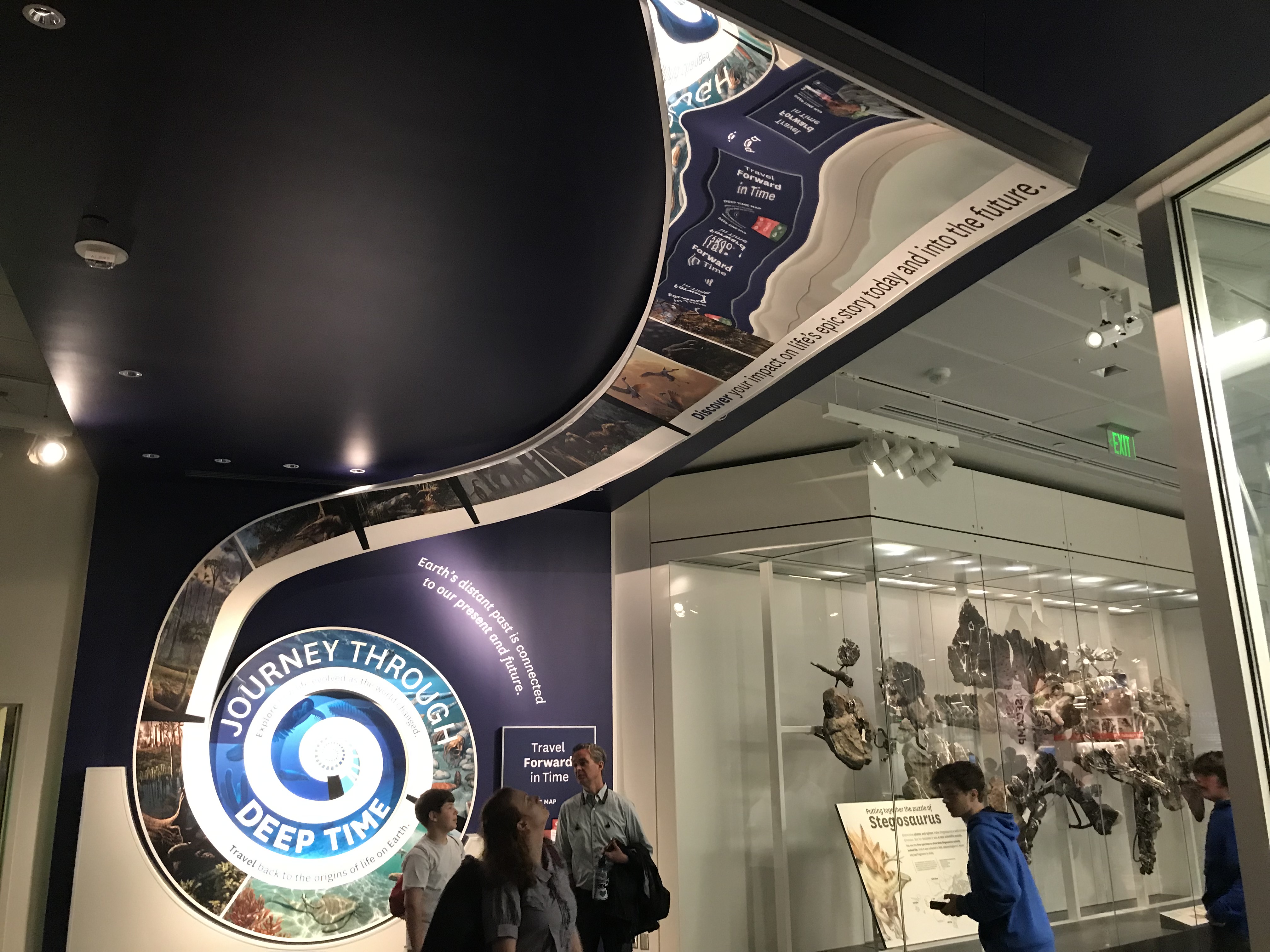
As has been well publicized, Deep Time contains a strong message about how humans are changing the Earth in unprecedented ways. This is introduced the moment visitors enter the exhibition, with an illustrated spiral of time that ends in a mirror. The implication is simple, but direct: we are part of the story of our planet.

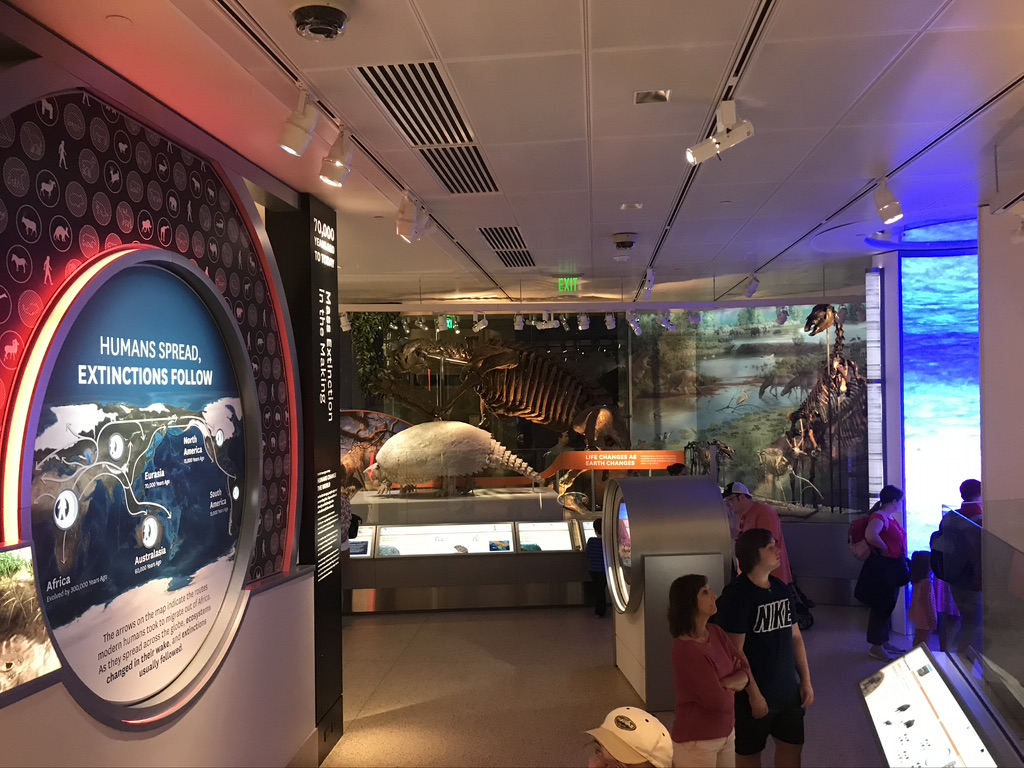
Throughout the hall, visitors are reminded of humanity’s connection to the rest of the planet in different ways. In one corner, an interactive (admirably starring a gender-neutral cartoon host) illustrates the evolutionary origins of different features of the human body. In the Quaternary section, large graphics present the percentage of megafauna on each continent that went extinct as humans spread around the globe.

The bridge is a highly-visible and centrally-located destination in the Deep Time hall.

The hardest-hitting message, however, is about the modern climate crisis. The fact that industrial activity is profoundly warming the climate—a change that comes with dire consequences—is presented in clear, matter-of-fact language. It’s not preachy, it’s not political, it’s just the truth. The exhibition does not explicitly say we should stop harming the planet (although we should), but it clearly presents the evidence that we are, and that we have the ability to stop. This information is centered on an overlook called “the bridge.” The centrality of this location and its proximity to the dinosaurs makes the climate narrative unmissable. The nature of the modern media landscape is such that many NMNH visitors may well have never seen this message presented in non-political terms. I’m eager to see the results.

Layout

The Jurassic and Permian are visible from the Cretaceous.

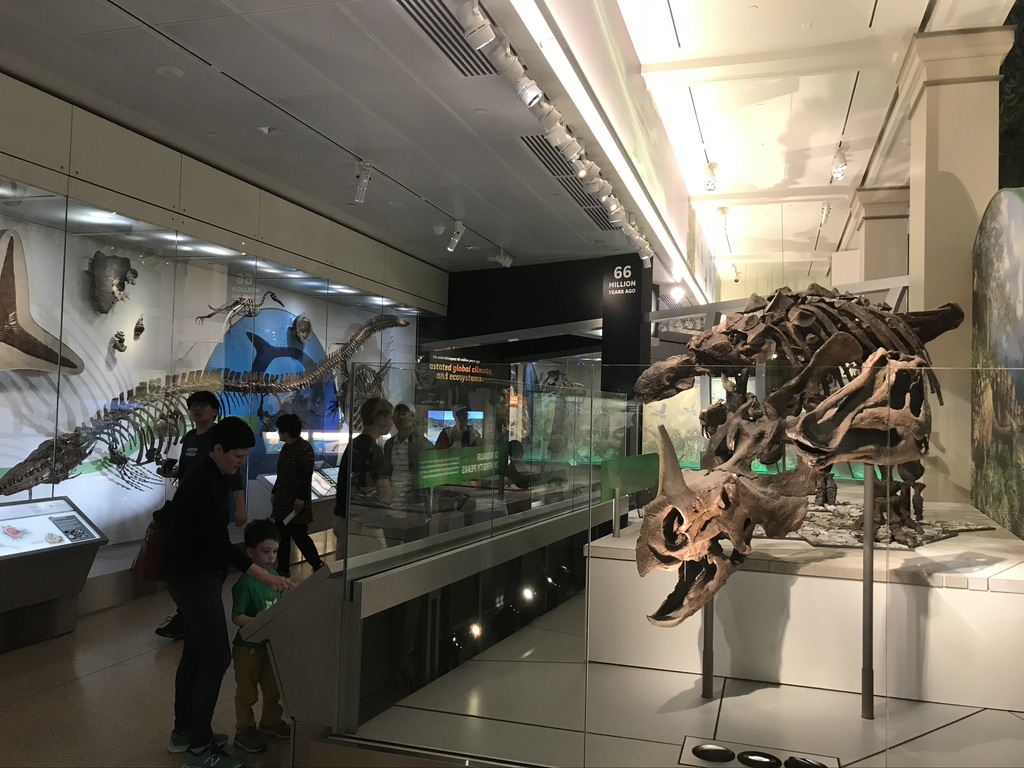
One of the earliest decisions in Deep Time’s development was to restore the original architecture. This had already been done in the north and west wings for the Ocean and Mammals halls, and restoring the east wing would bring back the building’s intended symmetry. This choice dovetailed with an acknowledgement of visitors’ tendency to pinball around an exhibition, rather than view displays in a prescribed order. The team decided to welcome this spirit of exploration. The new hall can be navigated in any order, but still makes sense as a cohesive story.

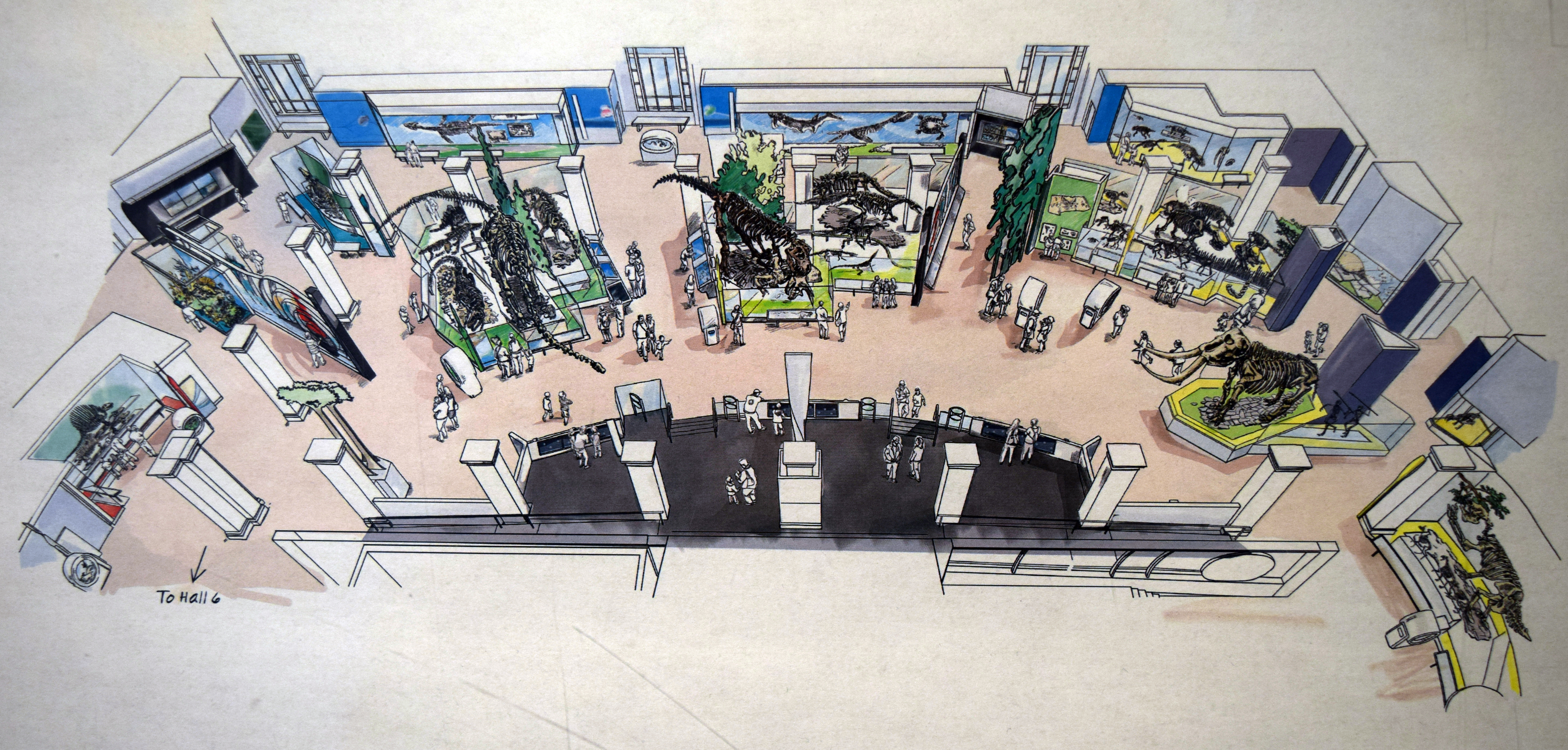
Most of the displays are on island platforms. Each platform represents a particular time period, and for the most part, specimens displayed together represent species that would have coexisted in a single ecosystem. Big, show-stopping skeletons are in the center, while smaller specimens and accompanying labels and interactives can be found around the perimeter. Vertical pillars, which are visible from across the hall, indicate where each platform is in time. Meanwhile, mass extinctions are represented by large walls that physically divide the space. The result is a hall where it’s always clear whether the display you’re looking at is earlier or later in time than any other display, even though you can circulate among the islands at will.

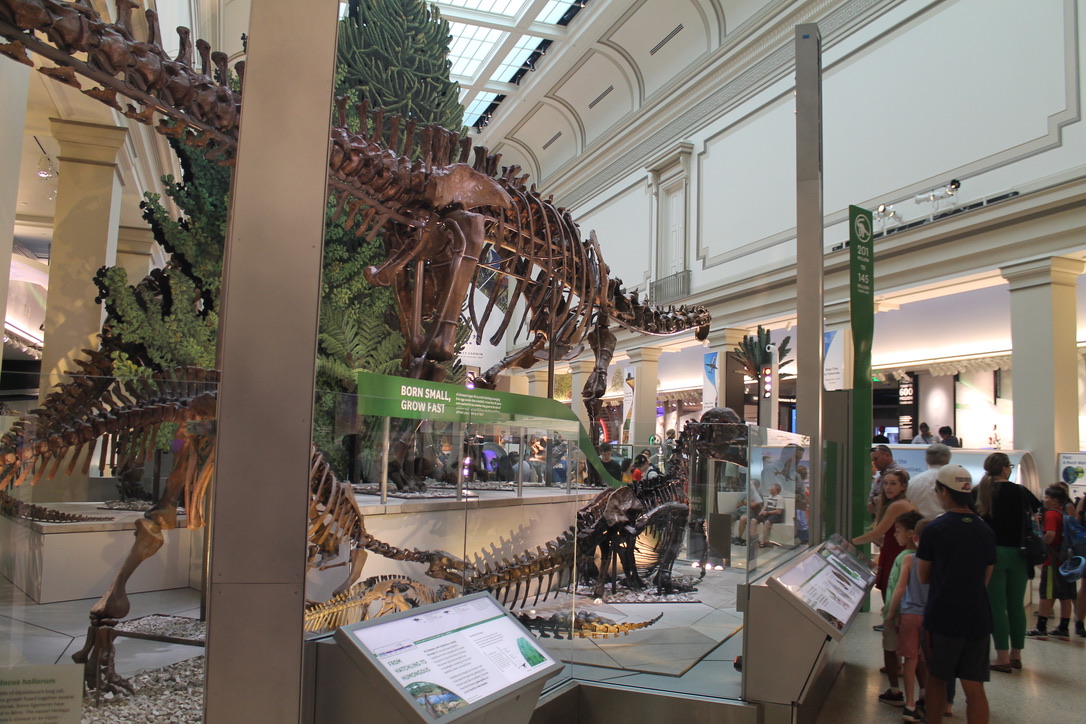
The remounted Diplodocus can be seen from anywhere in Deep Time, as well as from the rotunda.

NMNH gets several million visitors each year, so traffic flow is a major concern. This was a problem in the old hall, where decades of partial renovations had resulted in several frustrating bottlenecks. The new hall allocates nearly 50% of its floor space to visitor movement. A central avenue allows quick movement around the exhibition. Visitors short on time can pop in and “snack” on a few displays, rather than investing in the whole meal. Unlike linear exhibitions, visitors can backtrack without disrupting the traffic flow.

Furthermore, most of the hall can be viewed from multiple perspectives. Another function of the bridge is to provide an elevated vantage point. From the overlook, visitors can see Tyrannosaurus and Diplodocus over the heads of the crowd. Digital interactives show highlights on a 3-D model of the hall, helping visitors think about the entire history of life all at once. Actually, this is one area where I wish the developers had gone further. I would have loved to see displays that encouraged visitors to compare the animals visible on either side of the mass extinctions, or to think about what environmental factors led to the evolution of very different megaherbivores (the sauropods and proboscideans) at different points in time.

Animals

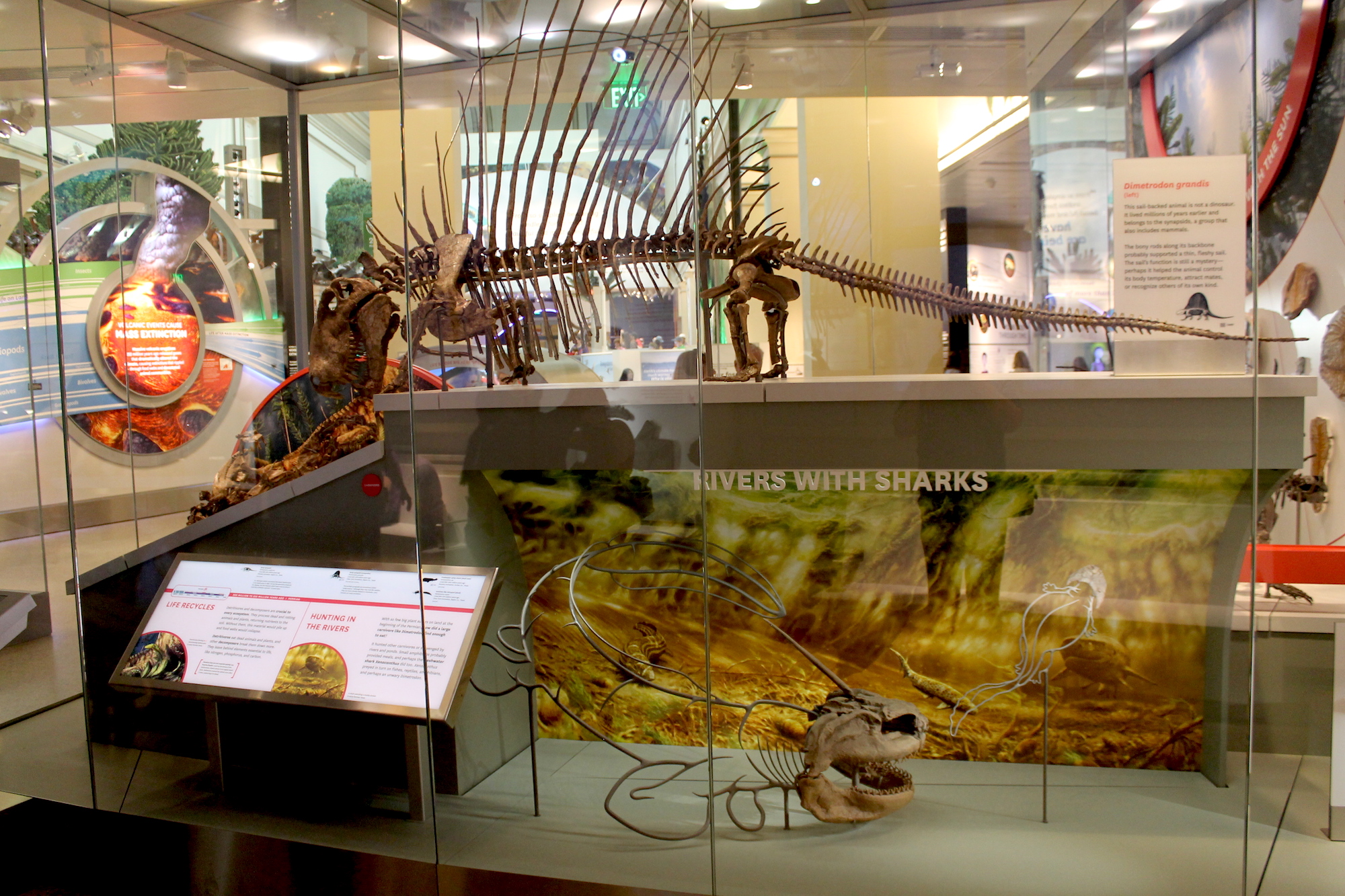
Dimetrodon prepares to scavenge Ophiacodon, while Xenacanthus and Diplocaulus swim below.

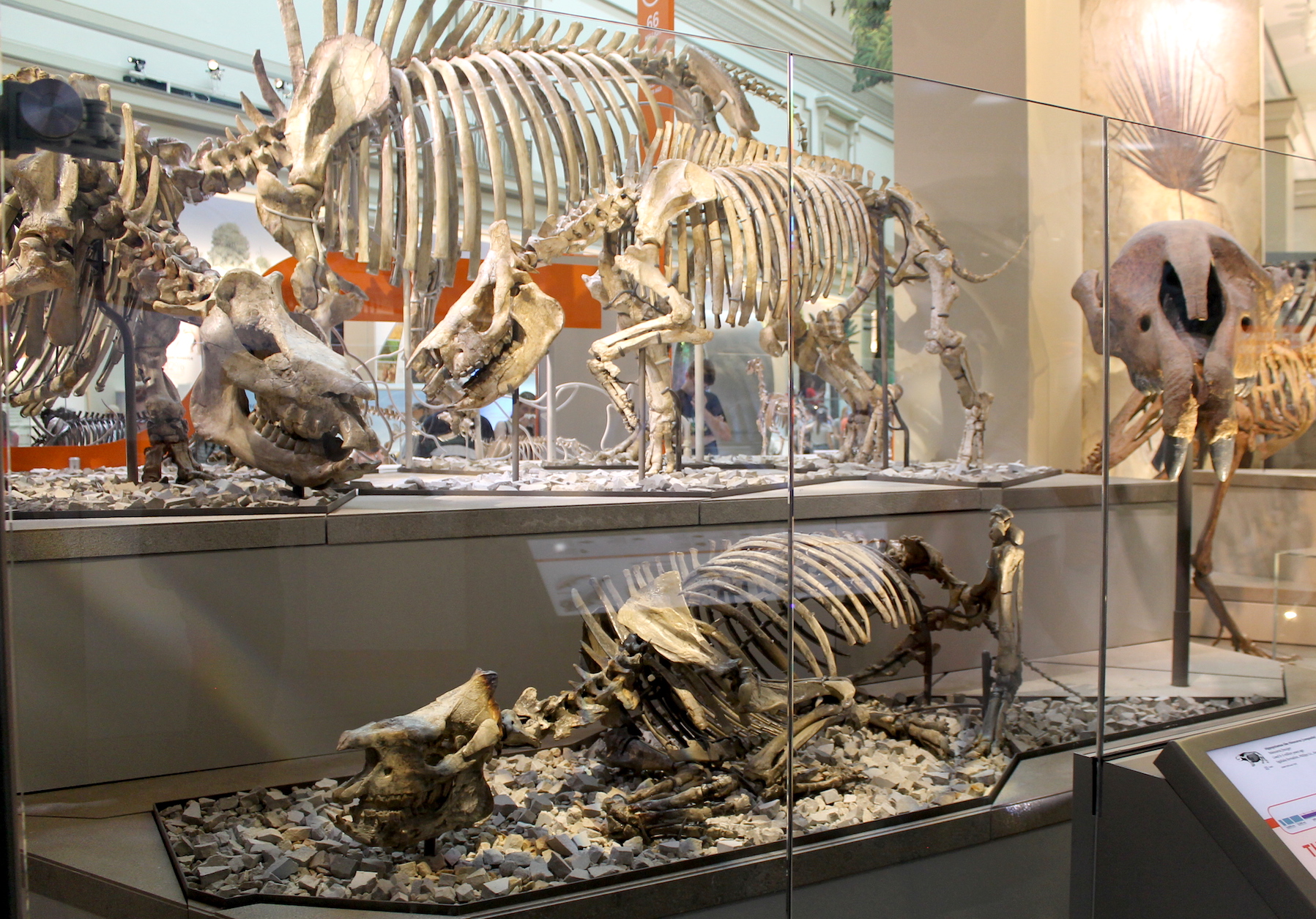
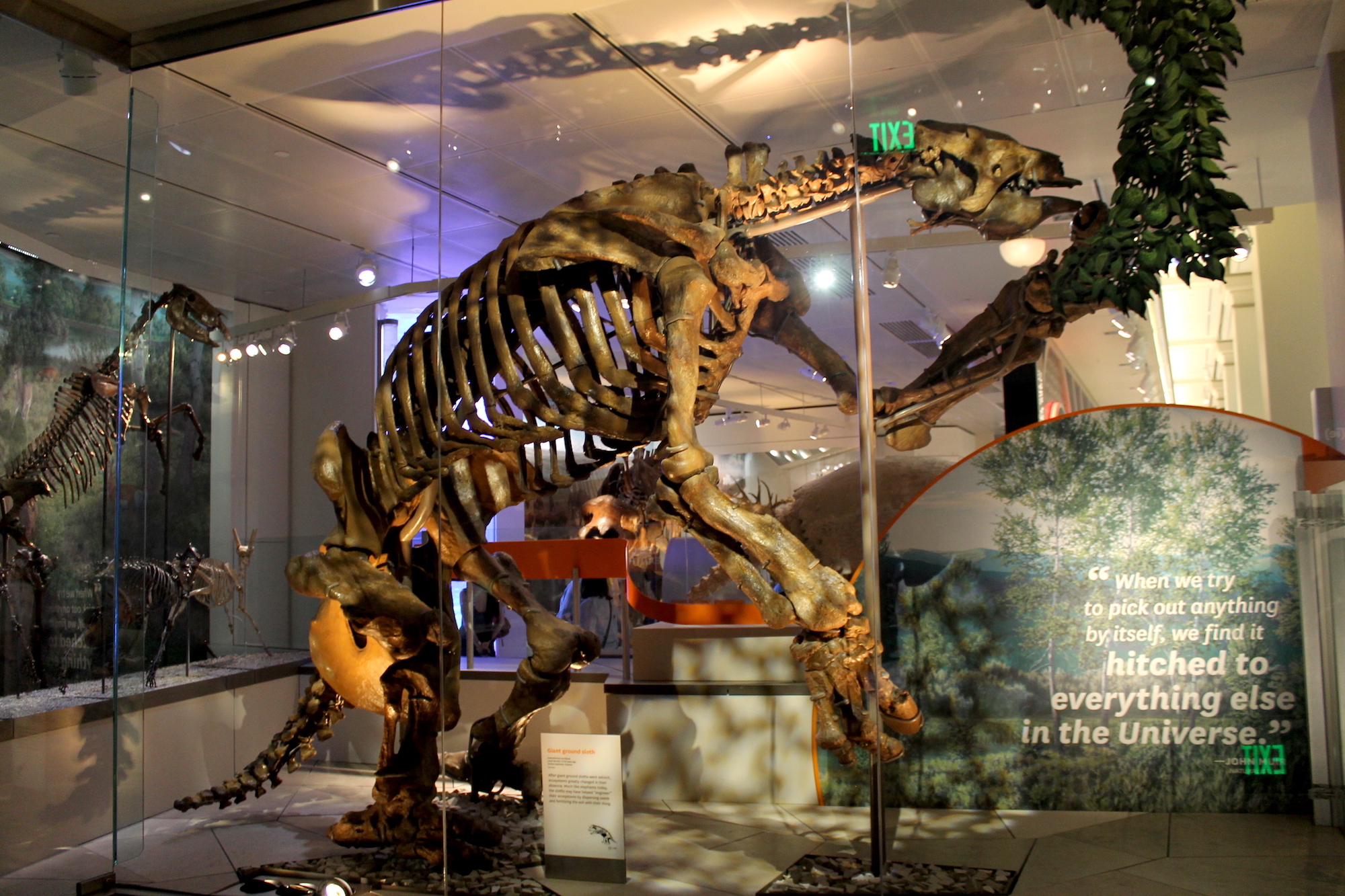
Lead Curator Matt Carrano came to the project with a vision. He wanted the mounted skeletons to read as animals, not as monsters or trophies. That meant they should be doing the sorts of things that animals do. Nearly every mount tells a story. The well-publicized Tyrannosaurus is dismembering a Triceratops: look closely and you’ll see fractured ribs, a broken horn, and that the Triceratops‘s head is actually separated from its body. The Eremotherium is plucking Osage oranges from a tree, referencing the hypothesis that these inedible fruits were cultivated by recently-extinct megafauna. A Menoceras is lying on its side in a characteristic rhino resting pose. The Stegoceras is scratching its jaw. Each pose gives the mounted skeletons a reality that is rarely seen in fossil exhibits. These are the remains of once-living creatures, after all. They got hurt, hungry, tired, and itchy.

Although the resting Menoceras bears a certain resemblance to the Roosevelt white rhino on the other side of the museum, this was a lucky accident rather than a deliberate quote.

Another more subtle reason these mounts are so successful is that the animals’ feet are always touching the ground. Many mounted skeletons are elevated on their supports, which makes the interplay between the armature and the base (typically built separately) easier to manage but also makes the skeletons look like they’re hovering. Grounding the animals’ feet was extremely challenging: ultimately, beds of gravel were used to smooth out the point of contact. Few visitors are likely to notice this achievement specifically, but the result is that each skeleton is imbued with weight and energy rarely seen in similar displays.

Placing the ground sloth at the entrance was an early design decision.

Research Casting International prepared and constructed most of the mounted skeletons, while NMNH preparators handled the rest in-house. The scope of the mounting and remounting of fossil skeletons for Deep Time is probably unprecedented. For comparison, the renovation of the American Museum of Natural History paleontology halls in the mid 90s involved two remounts (Tyrannosaurus and Apatosaurus) and around ten new skeletons. By my rough count, Deep Time has 40 remounts and 13 brand-new mounts, to say nothing of the work that went in to dismantling the skeletons from the old hall that have been returned to collections.

Discovery

The Jurassic diorama, one of more than a dozen new scenes created for Deep Time.

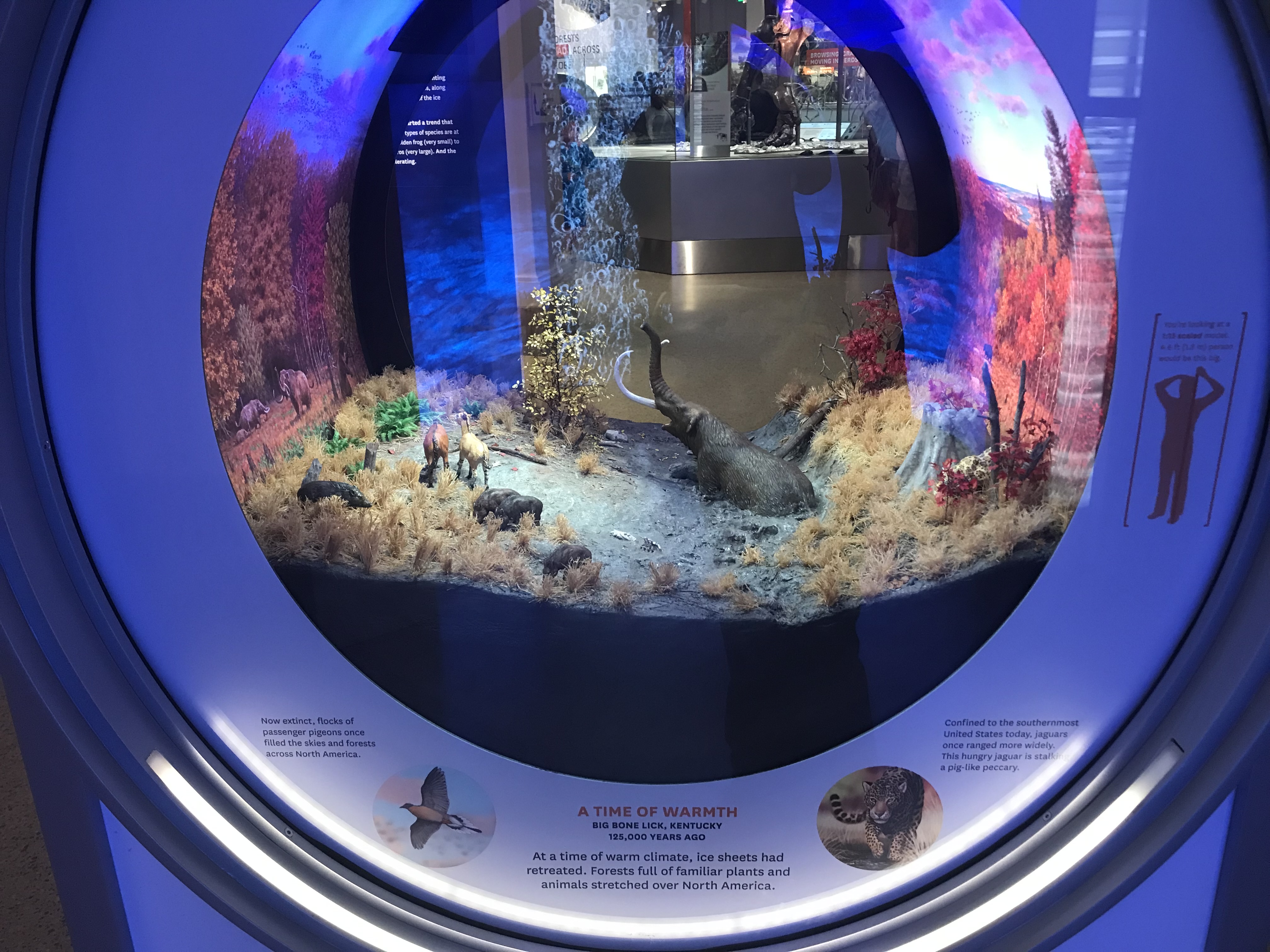
It wasn’t until my second day exploring Deep Time that I noticed the dioramas cycle between day and night. I can only imagine the challenge the designers faced in arguing for this feature. It doesn’t have any particular educational purpose, after all, and only a small fraction of visitors are likely to notice it. Still, for those who do notice (I’m picturing a child poring over every detail of the miniature landscape while their parents wait impatiently), the effect is beautiful and magical. Those are the moments exhibition creators strive for.

Good thing that glass is there or we’d be in a real pickle.

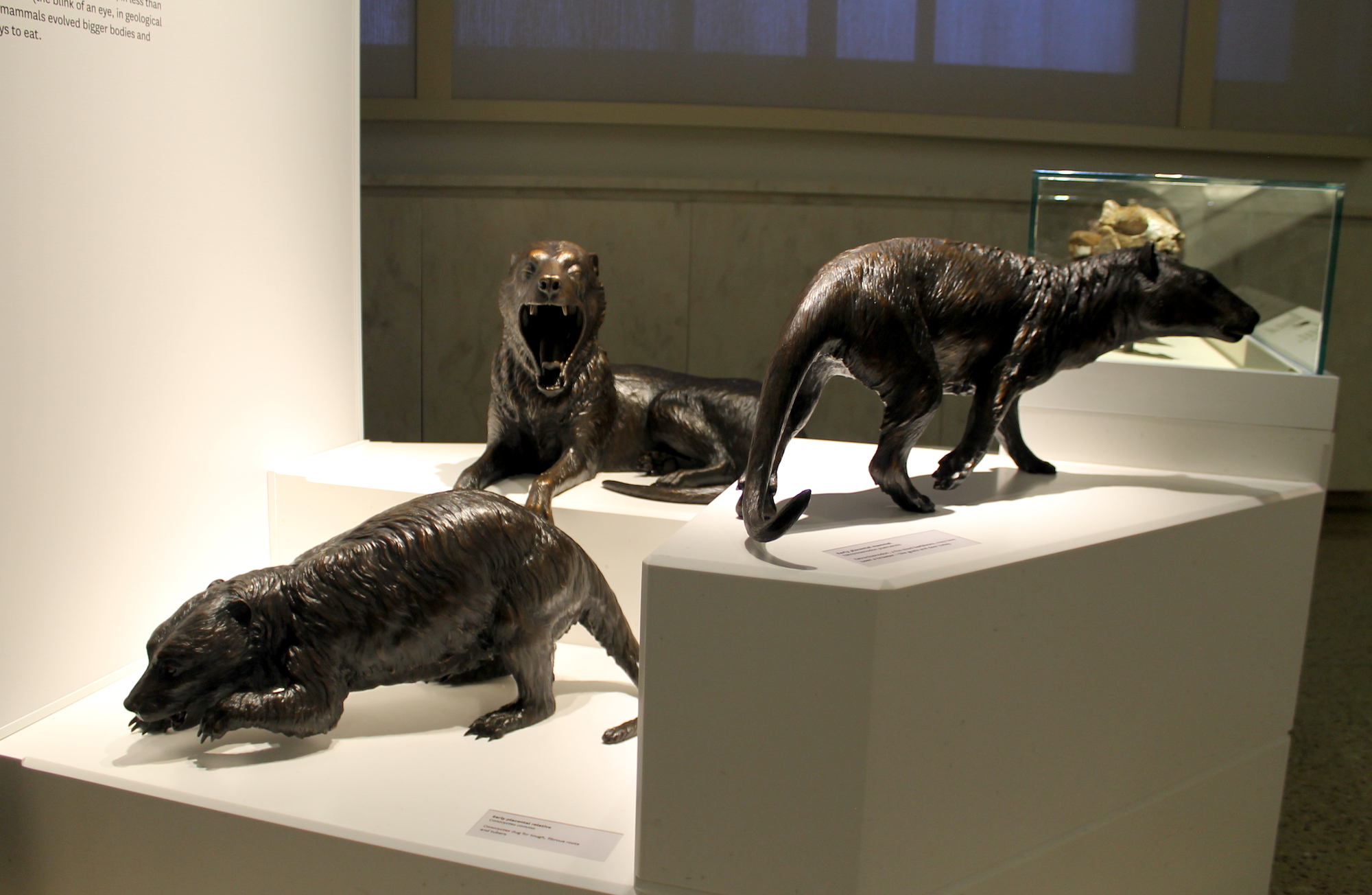
A stroll through Deep Time is filled with similar moments of discovery, on many different scales. Follow the gaze of the two bronze Ice Age humans and you’ll realize they’re reacting to the Smilodon stalking nearby. Look beneath the platforms where Tyrannosaurus and Dimetrodon are standing and find a secret world of freshwater fossils. Although there are few levers to pull and wheels to turn in the exhibition, tactile experiences abound. There are touchable fossil casts, and a plethora of life-sized bronzes to interact with. I’m particularly enamored with the Mesozoic and early Cenozoic mammals: these are difficult to conceptualize with fossils alone and the bronzes bring them to digging, scratching, yawning life.

Seriously, these guys rule.

There are a hundred more examples, but I should stop for now. In short, Deep Time is an incredible exhibition. You should visit, and then visit several more times, because you’ll undoubtably discover new things to wonder at.

Reference

Marsh, D.E. 2019. Extinct Monsters to Deep Time: Conflict, Compromise, and the Making of the Smithsonian’s Fossil Halls. New York, NY: Berghan Books.

6 Comments

Filed under Deep Time, dinosaurs, education, exhibits, fossil mounts, mammals, museums, NMNH, opinion, reviews