Over the last few years, I’ve gradually been assembling what I imaginatively call the Big Spreadsheet. It’s a record of every single vertebrate fossil on display at a number of natural history museums, mostly in the United States (so far I haven’t been bold enough to include invertebrates or plants). The Big Spreadsheet tracks basic “tombstone” information about each fossil—what it is, where it was found, how old it is, and so forth. Where possible, I’m also tracking collectors, preparators, original display dates, remounts, and trades with other institutions, among other things.
The Big Spreadsheet differs from things like the Paleobiology Database in that I’m specifically focused on what is or has been on public display. Museums only display a fraction of their collections, and the decisions concerning what is worth displaying are made by people with varying preferences and goals. Perhaps the objective is to showcase what’s unique or unusual in the collection. Or perhaps it’s to comprehensively tell the story of evolution. Maybe there’s a focus on local fossils, fossils collected by specific people, or fossils that represent species that visitors would (or wouldn’t) recognize. There’s no one right way to make a fossil exhibit, but the choices that individuals make nevertheless influence how audiences understand the history of life on Earth and how we come to know about it.
My hope is that the Big Spreadsheet will eventually be complete enough that it can be used to tease out quantitative answers to the questions that vex those of us that are interested in how the public thinks about prehistory. For example, maybe it could illustrate which taxa are over or under-represented in public displays, or if narratives are skewed toward certain localities. Maybe we could see the influence certain individuals (say, the Sternbergs) have had on the public’s view of paleontology. Or maybe we could track the degree to which western museums exploit specimens extracted from colonized lands.
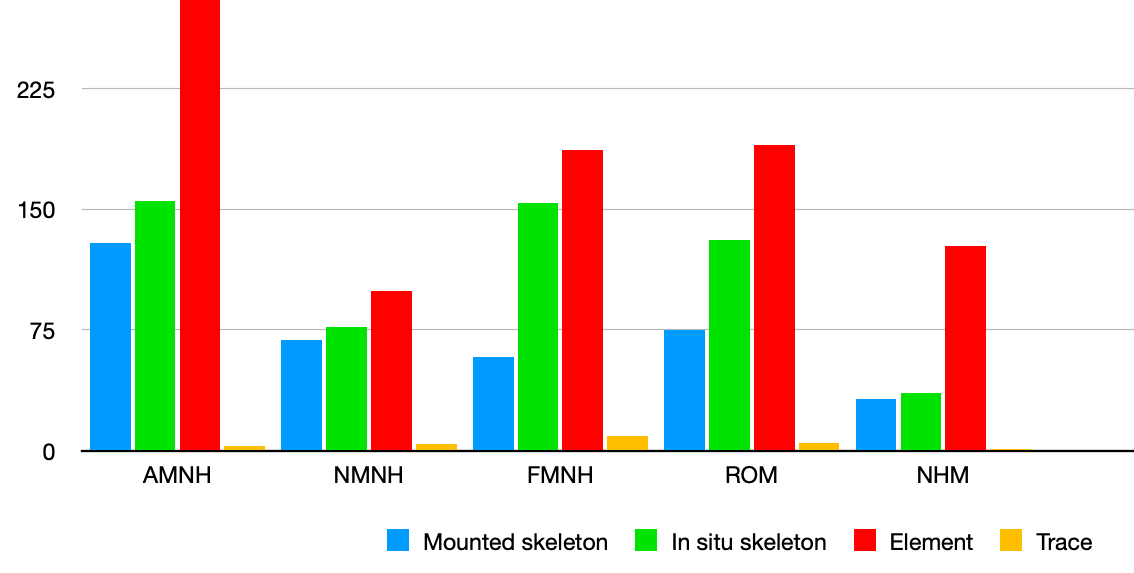
I don’t think the Big Spreadsheet is ready for any of those questions yet. But it is interesting to take a peek at how certain museums measure up to one another with their display collections. The charts below divvy up the data from some of the biggest natural history museums: the American Museum of Natural History (AMNH), the National Museum of Natural History (NMNH), the Field Museum of Natural History (FMNH), the Royal Ontario Museum (ROM), and the Natural History Museum in London (NHM).
Here we can see the overall number of vertebrate fossils on display at each of these museums, and how they sort out by type. One obvious conclusion is that AMNH has an outrageously high number of fossils on display compared to its peers. Note that the difference between a mounted skeleton and an in situ skeleton is sometimes a judgement call (many skeletons displayed in relief are not fully removed from their matrix, but have been partially reposed or have missing elements added).
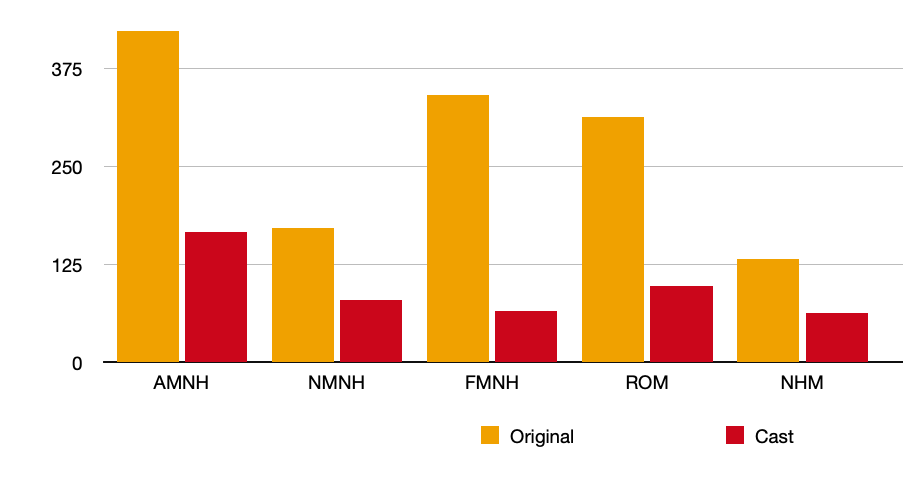
This chart shows how many fossils on display at each museum are “originals” versus replicas (I’ve counted anything that includes at least some real material as original). These five museums mostly display original fossils, although the ratio is highest at FMNH and lowest at NHM and NMNH. Fish fossils really throw the score, however—these numbers would look different if we were only considering big, charismatic tetrapods.
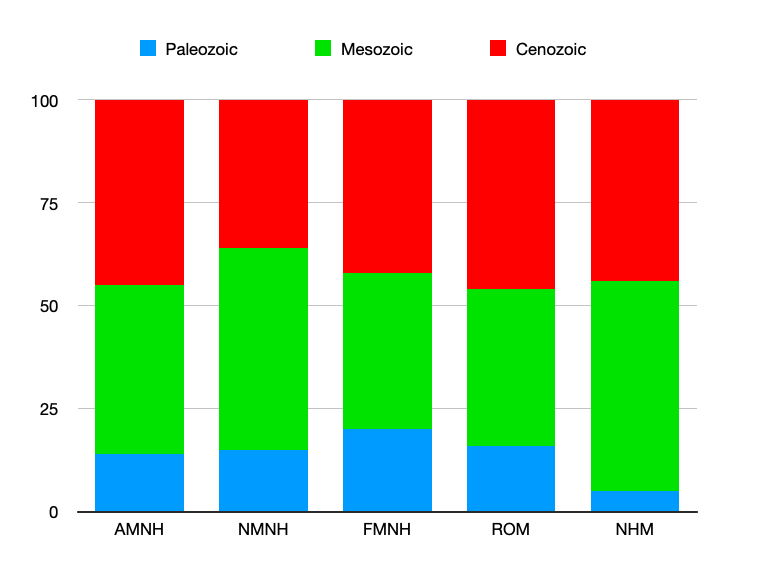
This chart compares the percentage of fossils on display from each era of the Phanerozoic (the last 541 million years). The Paleozoic gets shorted across the board—it represents about 50% of the Phanerozoic but the percentage of Paleozoic vertebrate fossils on display never tops 20%. Meanwhile, the Cenozoic (12% of the Phanerozoic) seems quite over-represented—that is, if temporal proportionality is ever a goal in creating these displays.
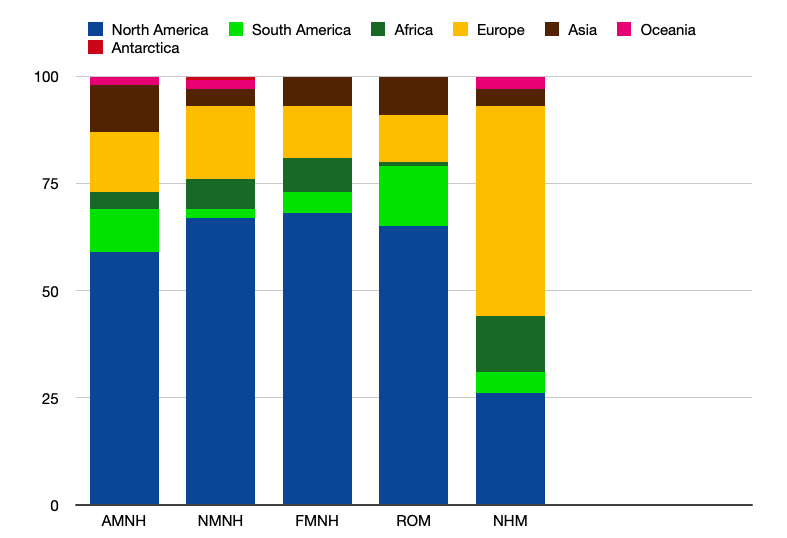
Here, we compare the percentage of fossils on display by region. Any passing familiarity with the history of science will make the focus on North America and Europe rather unsurprising.
This last chart breaks down the percentages by animal type. I’m sure the categories will make some readers squirm, but I’m going for culturally meaningful categories here, not evolutionary meaningful ones. It strikes me that just looking at the numbers of fossils in each category doesn’t necessarily capture the impact on visitors. For instance, dinosaur and mammal skeletons tend to take up a lot more space than fish. I wonder if there’s a way to control for square footage of gallery space and come up with an “impression score” of some kind for each of these groups.
If anyone’s interested in collaborating on the Big Spreadsheet, please give me a shout! I’m particularly keen on connecting with folks with a better statistical background, as well as anyone interested in tallying up fossils on display in the western United States and Canada.
The blog has been quiet this year, and a major reason for that is that my day job has been anything but. So in lieu of discussion about exhibits from decades past, here’s a bit about the decision making that went into some brand new ones that I worked on this year! New, in-depth articles about traditional Extinct Monsters fare are in progress, I promise.
Reptiles Alive
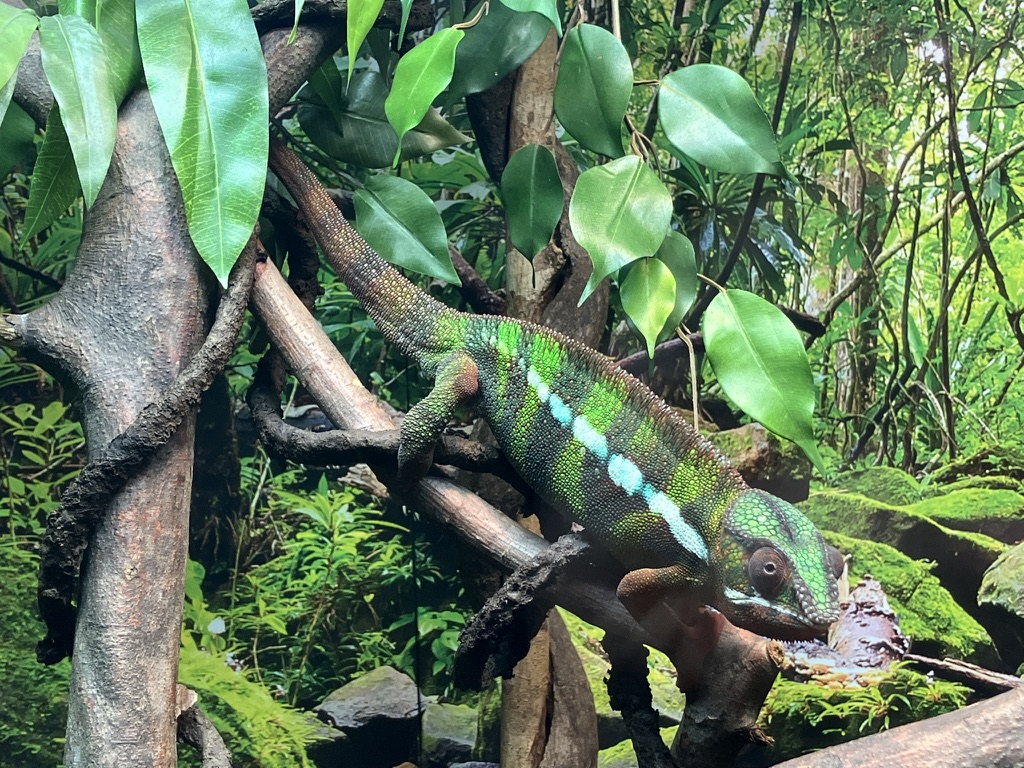
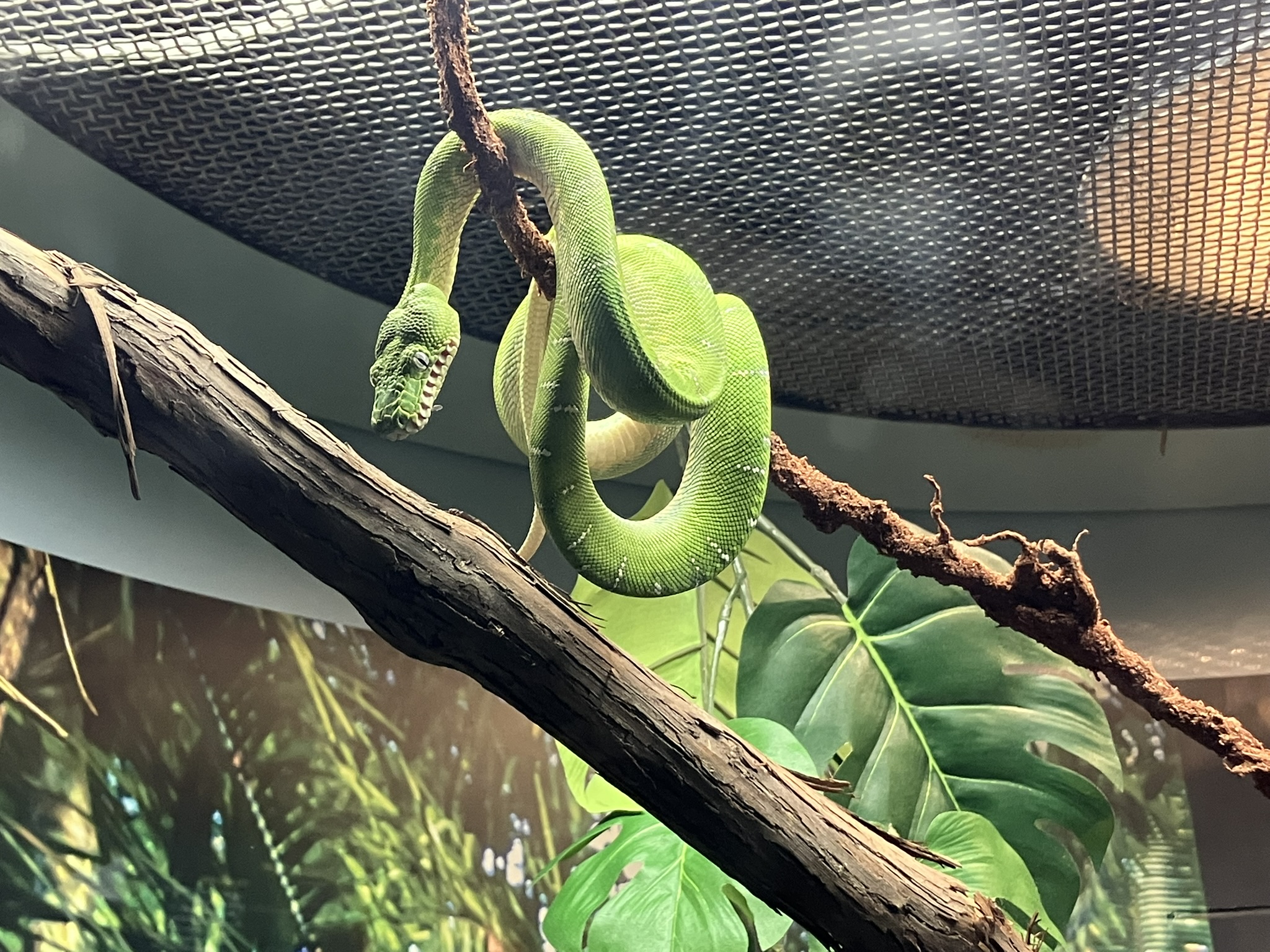
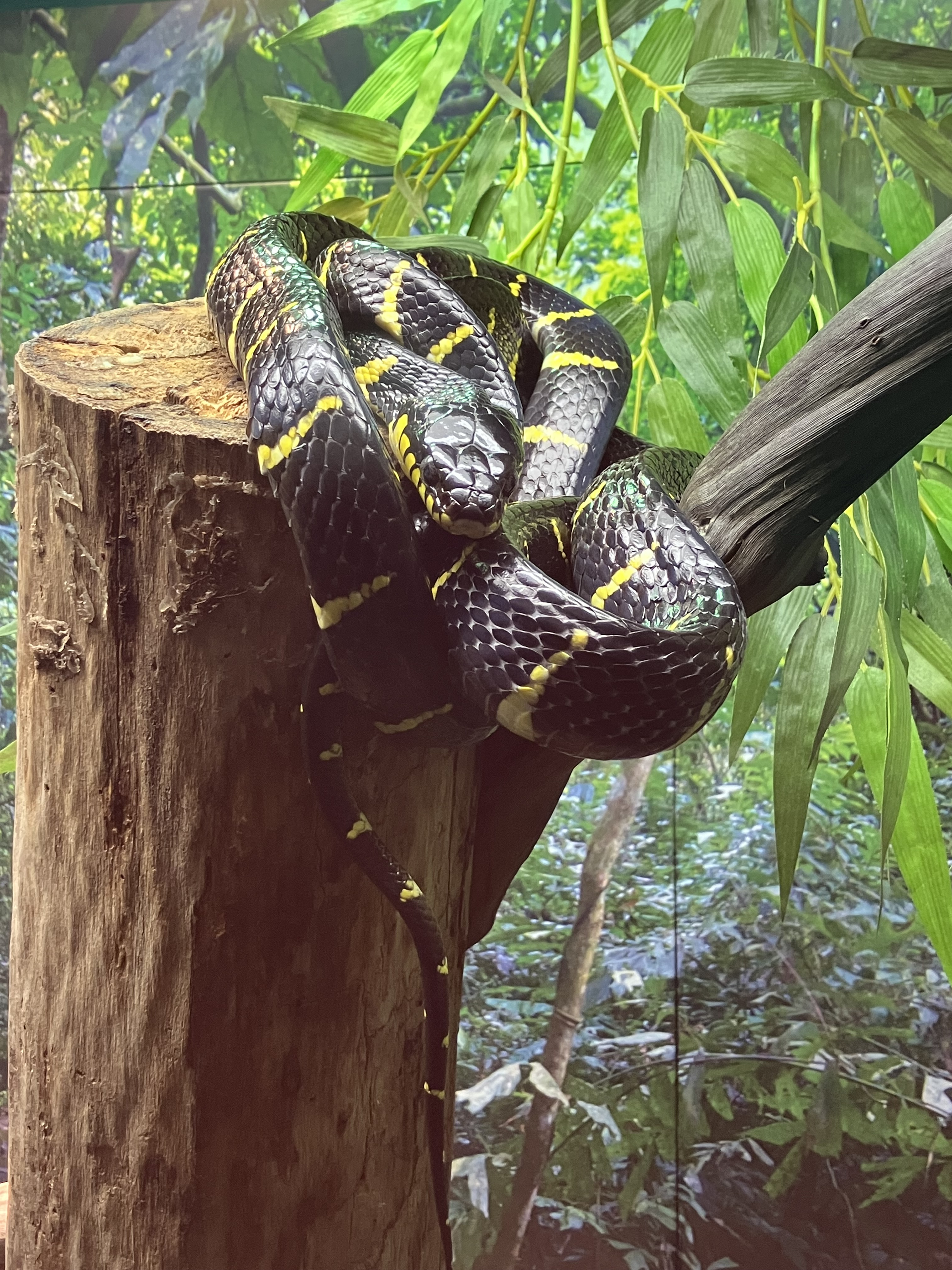
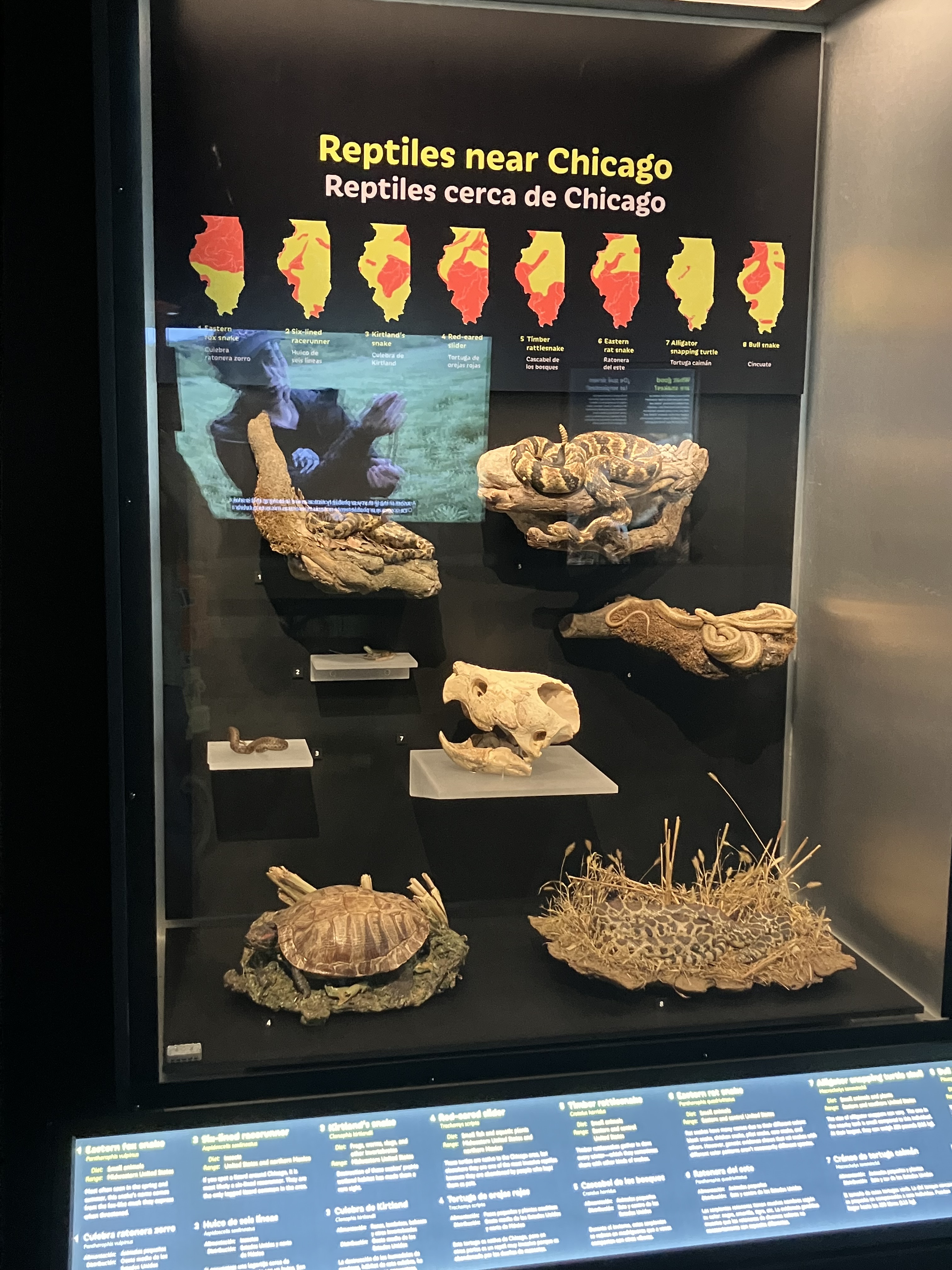
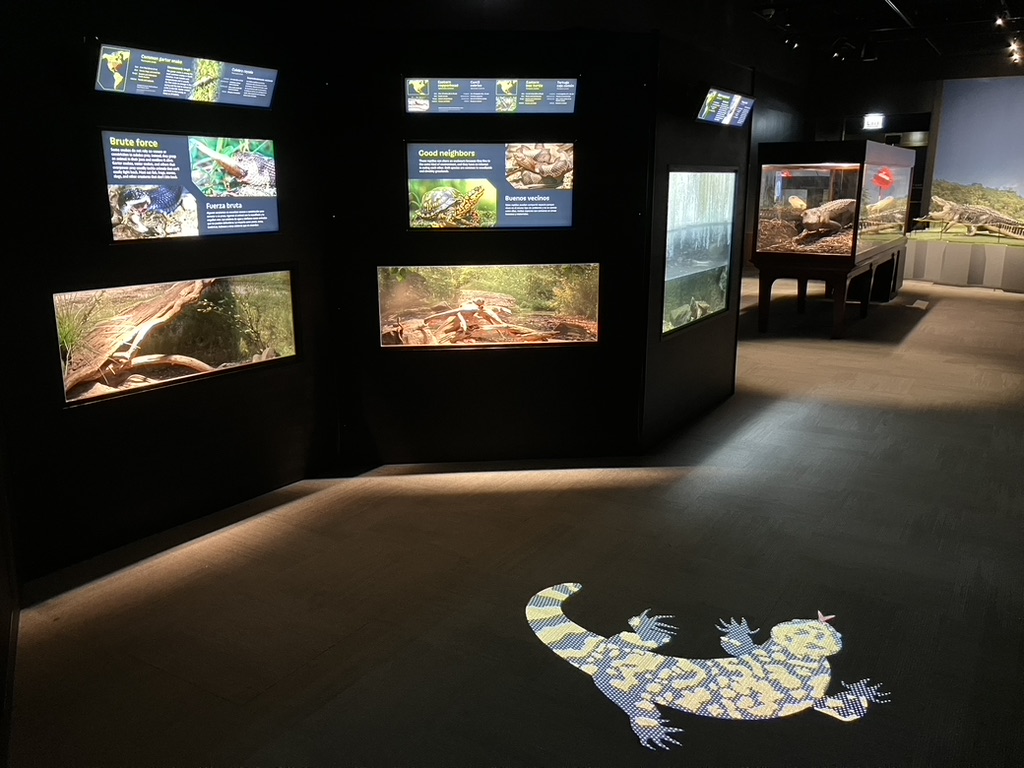
As the title suggests, Reptiles Alive is an exhibition that features live reptiles. This was a collaborative project between the Field Museum and Clyde Peeling’s Reptiland, a zoo in Allenwood, Pennsylvania. Reptiland provided the animals, their enclosures, and their human caretakers, while we designed and built a full-sized exhibition around them. I wrote and developed the new material alongside Associate Curator of Herpetology Sara Ruane.
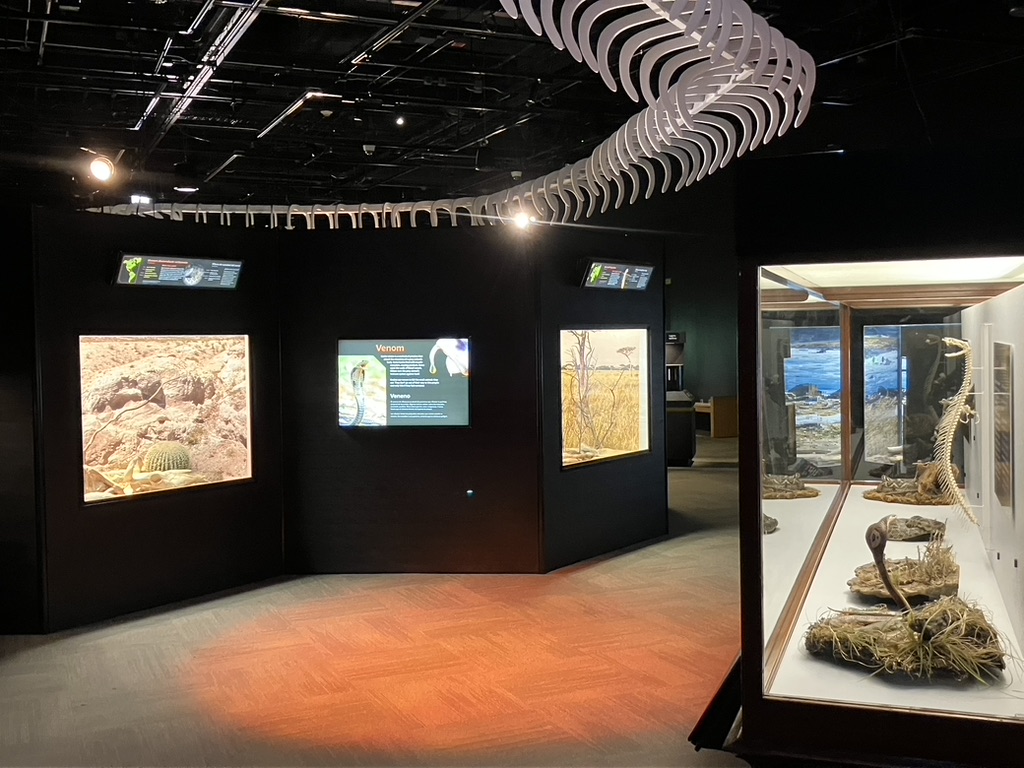
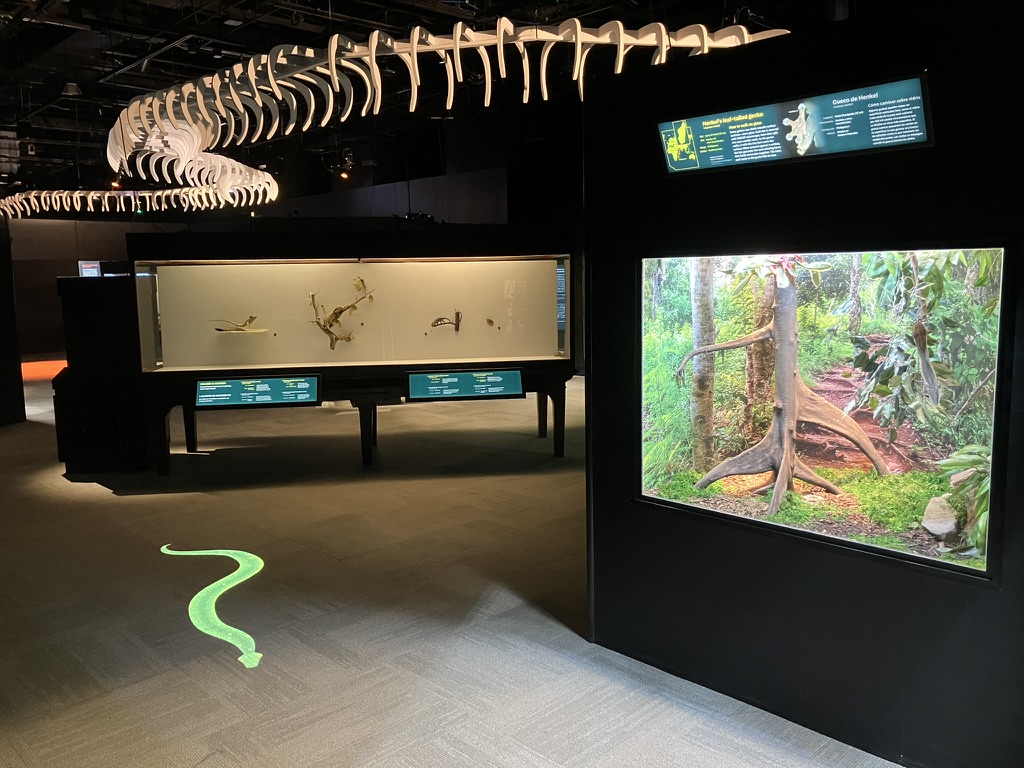
Reptiles Alive is straightforwardly about getting people excited to see and learn about incredible animals. Often, an exhibition calls for a grand narrative or lofty learning goals, but I thought the best approach for this one was to simply follow the “rule of cool.” Does a fact or image or display idea make people say, “wow, that’s amazing?” Then it it belongs in the show. Sometimes “because it rules” is a perfectly valid reason to do something—that’s why we have a 110-foot black mamba skeleton hanging from the ceiling.
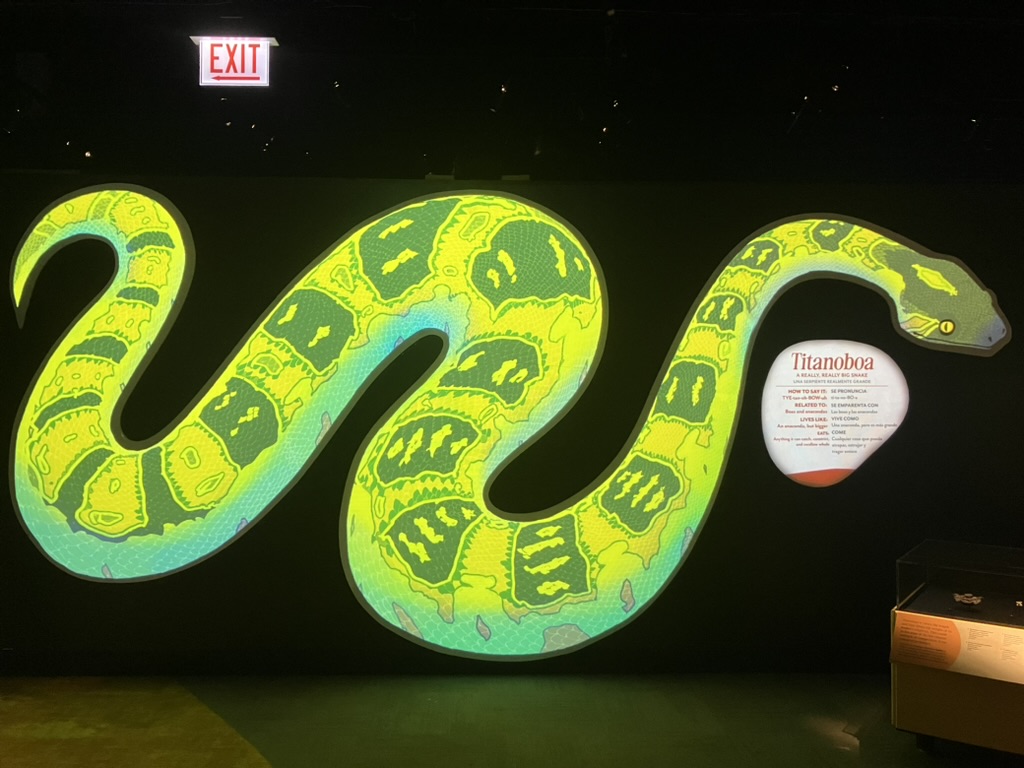
Reptiles Alive is organized Planet Earth-style. Each section features a biome type, but isn’t constrained to a particular part of the world. This allowed us to have some fun with the design and create unique soundtracks and lighting for each area: baking sunlight radiates over the desert section while animated snakes slither across the floor in the tropics.
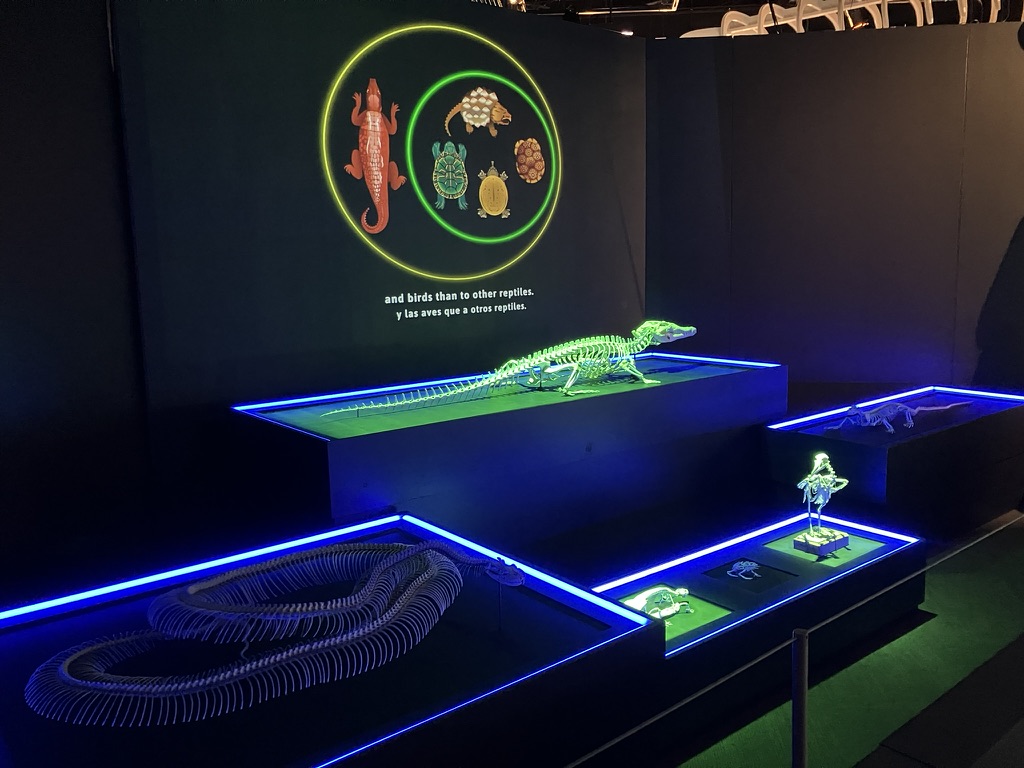
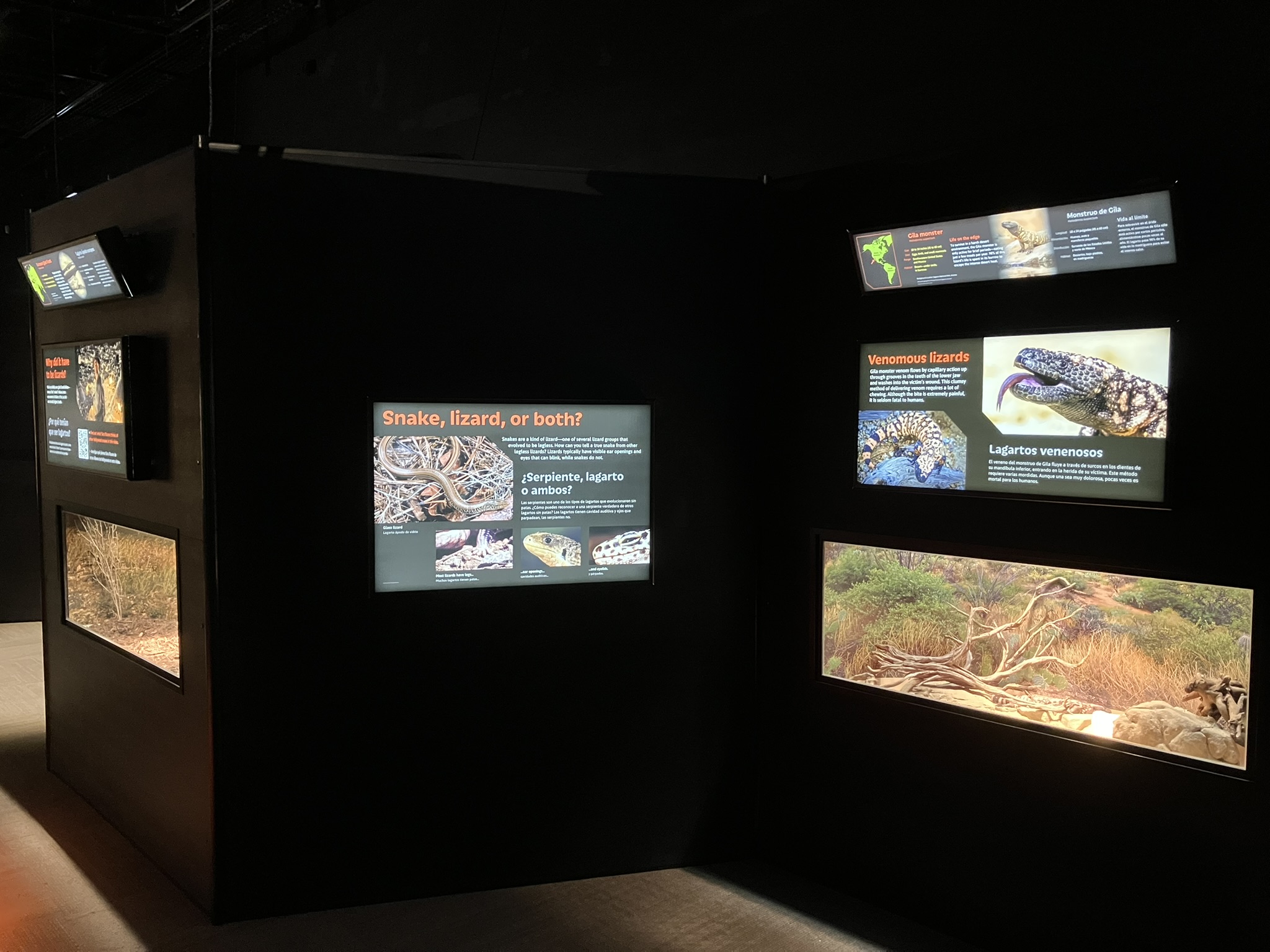
The other benefit of the biome-based organization is that we didn’t have to get bogged down with phylogeny in every label. Reptile classification is full of nested categories and apparent contradictions: for example, a snake is a kind of lizard, but there are are also legless lizards that aren’t snakes. Rather than distracting visitors with constant definitions and explanations, we opted to move the entire classification discussion to a single, prominent “object theater” near the exhibition’s entrance. Spotlights shine on mounted skeletons in different combinations as a narrator walks visitors through the main reptile groups and how to recognize them, while also clarifying that amphibians are not reptiles (but birds are). In under two minutes, visitors gain a shared vocabulary they can use as they explore the rest of the exhibition.
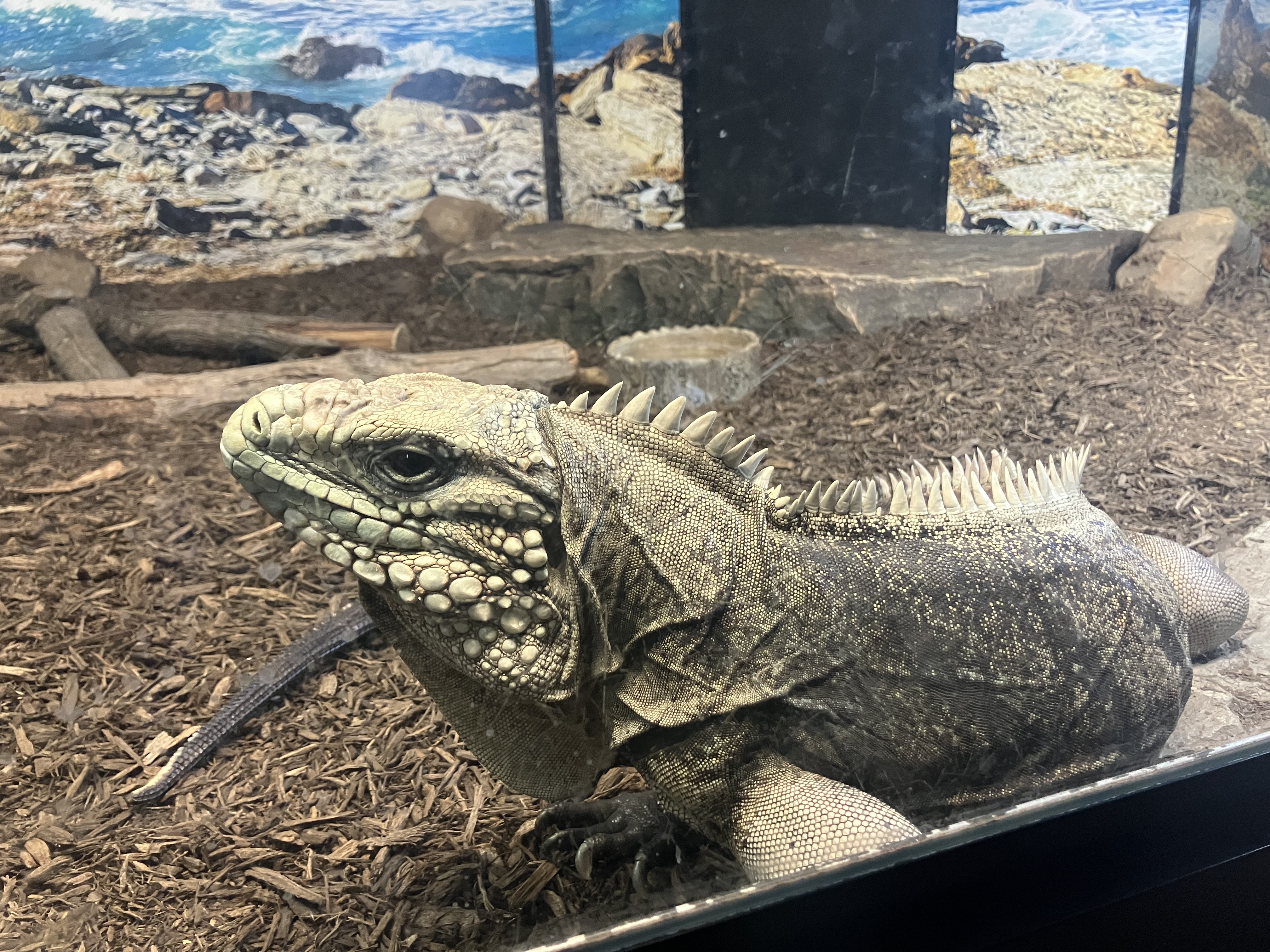
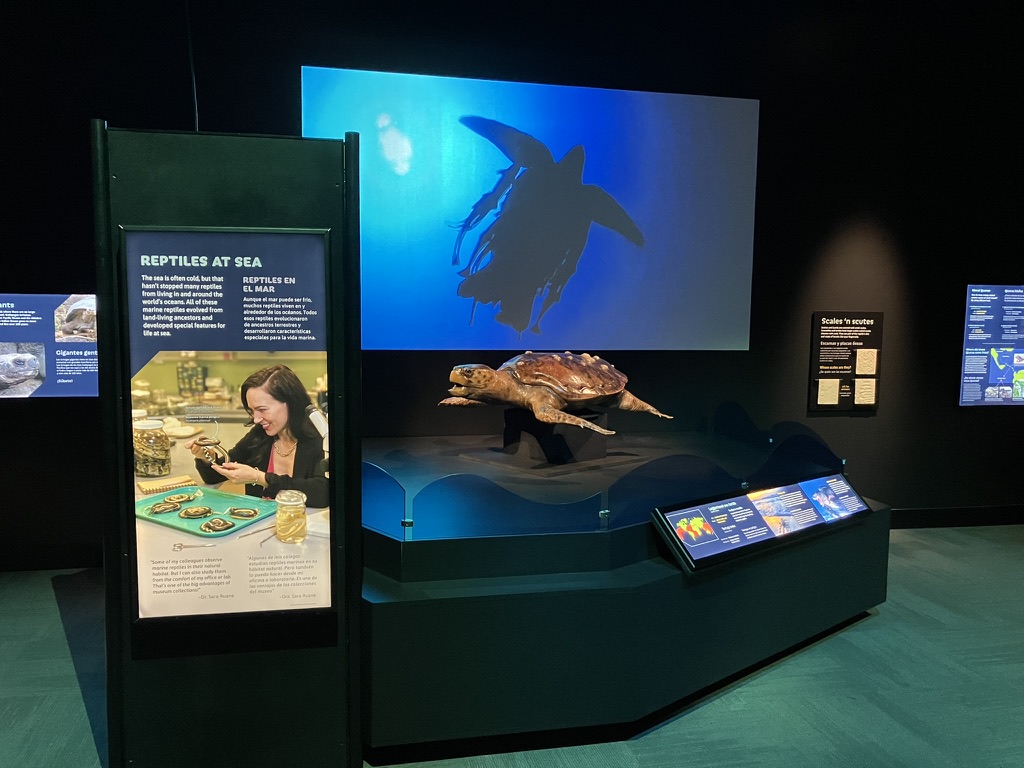
Naturally, the live animals are the stars of the show. Gwangi, a 38-year-old, puppy-tame Cuban rock iguana, is my favorite, but it’s also a lot of fun watching the European glass lizard dig in and out of his bedding, or seeing the reticulated python splash around in the water. We also made use of the museum’s collection of spectacularly life-like model reptiles from the early 20th century, and commissioned a few new ones as well. The models introduce visitors to creatures they might never have heard of, as well as one with a role in Field Museum lore.
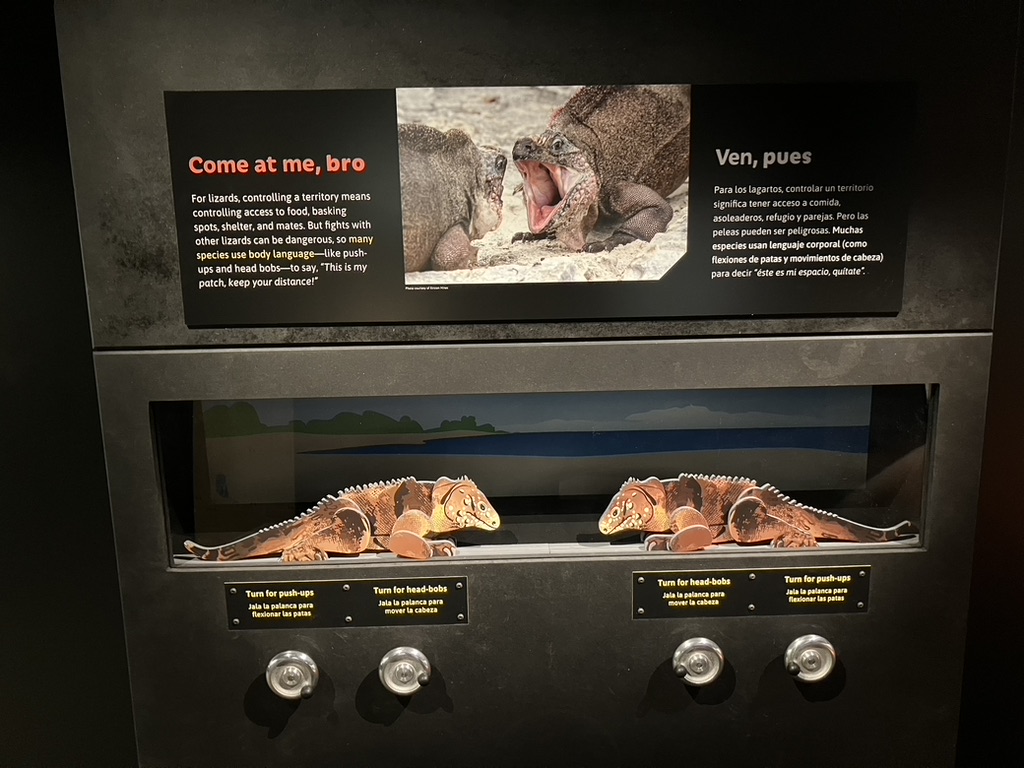
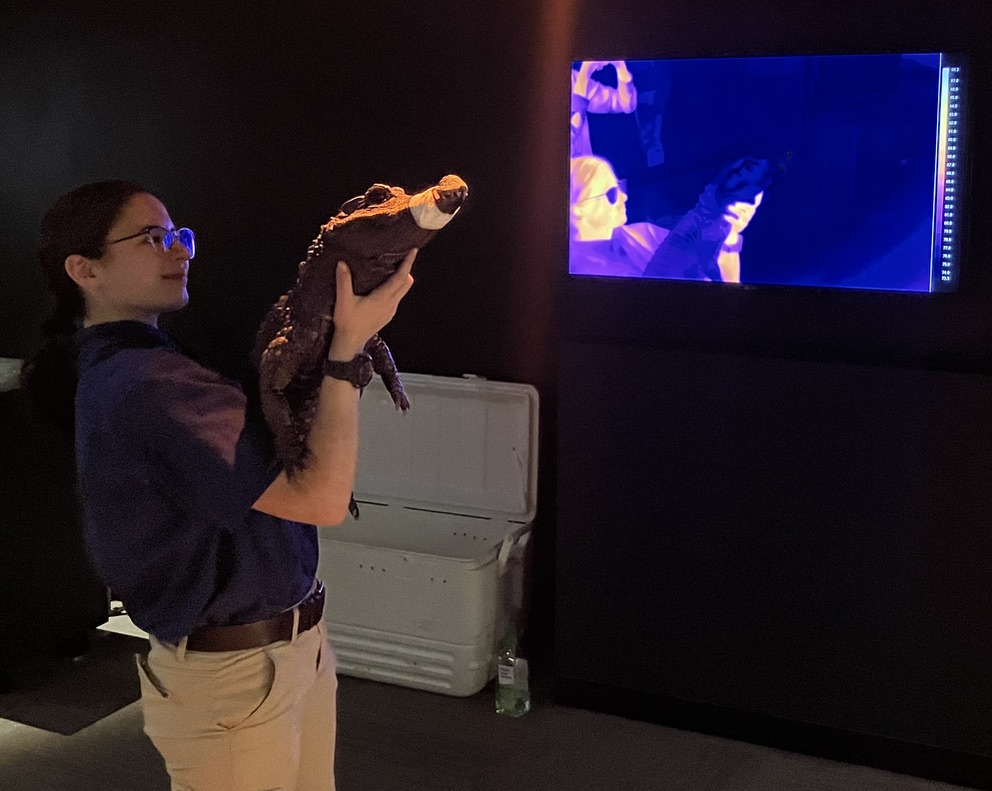
There are no touchscreens in Reptiles Alive. Instead, we went all-in on simple, tactile interactives. Whether you’re puppeteering a pair of iguanas to demonstrate lizard body language or testing your puny human strength against the bite force of a Nile crocodile, the action being performed always directly illustrates the concept under discussion. The fanciest piece of hardware in the exhibition is a thermal camera. It’s one thing to tell visitors that reptiles are cold-blooded, but it’s quite another to see the zookeeper hold a room-temperature snake up to the camera. The human glows orange while the snake matches the blues and purples of the space around it.
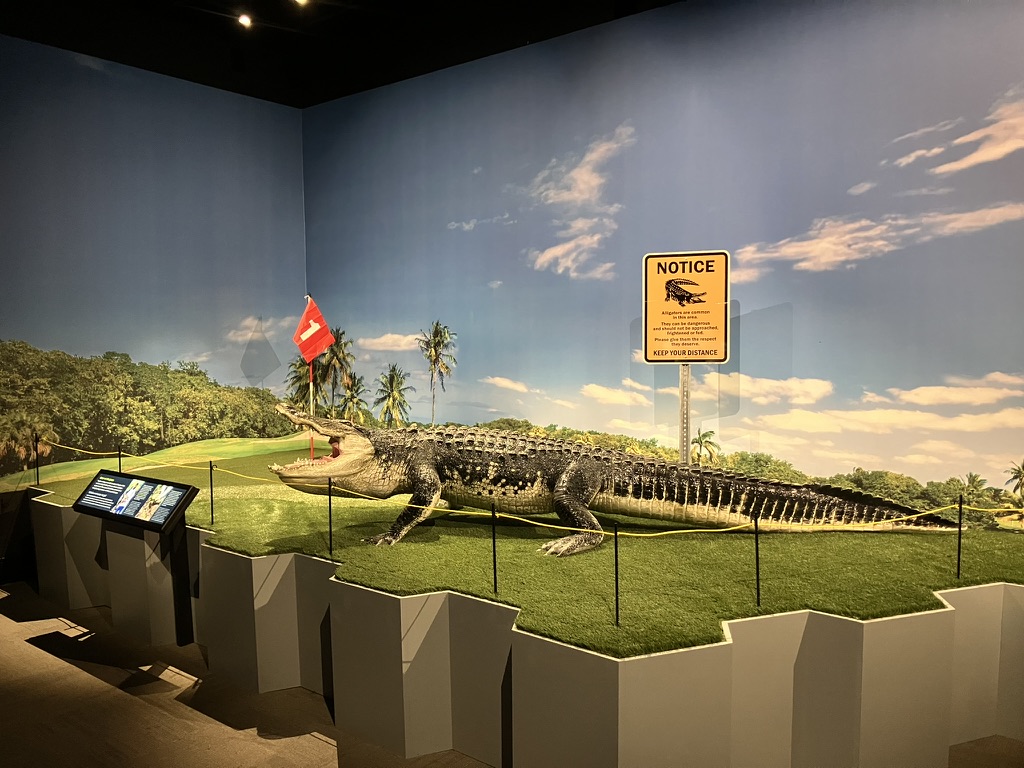
The final display originated as a joke. We wanted to make a big diorama, but detailed botanical models are just about the most expensive and time-consuming thing you can make. Thinking about reptile habitats without much vegetation, I glibly offered that we could recreate the “gator on a golf course” scene from Happy Gilmore. But we soon realized that was the perfect ending for our exhibition: draining swampland to build golf courses is an example of how humans are invading reptile habitats. That means we’re going to encounter reptiles more often, and we’ll need to learn to live alongside them. Hopefully, visitors that came in fearing reptiles will leave with respect and admiration for them.
Reptiles Alive runs until April 2026.
Changing Face of Science: Sara Ruane
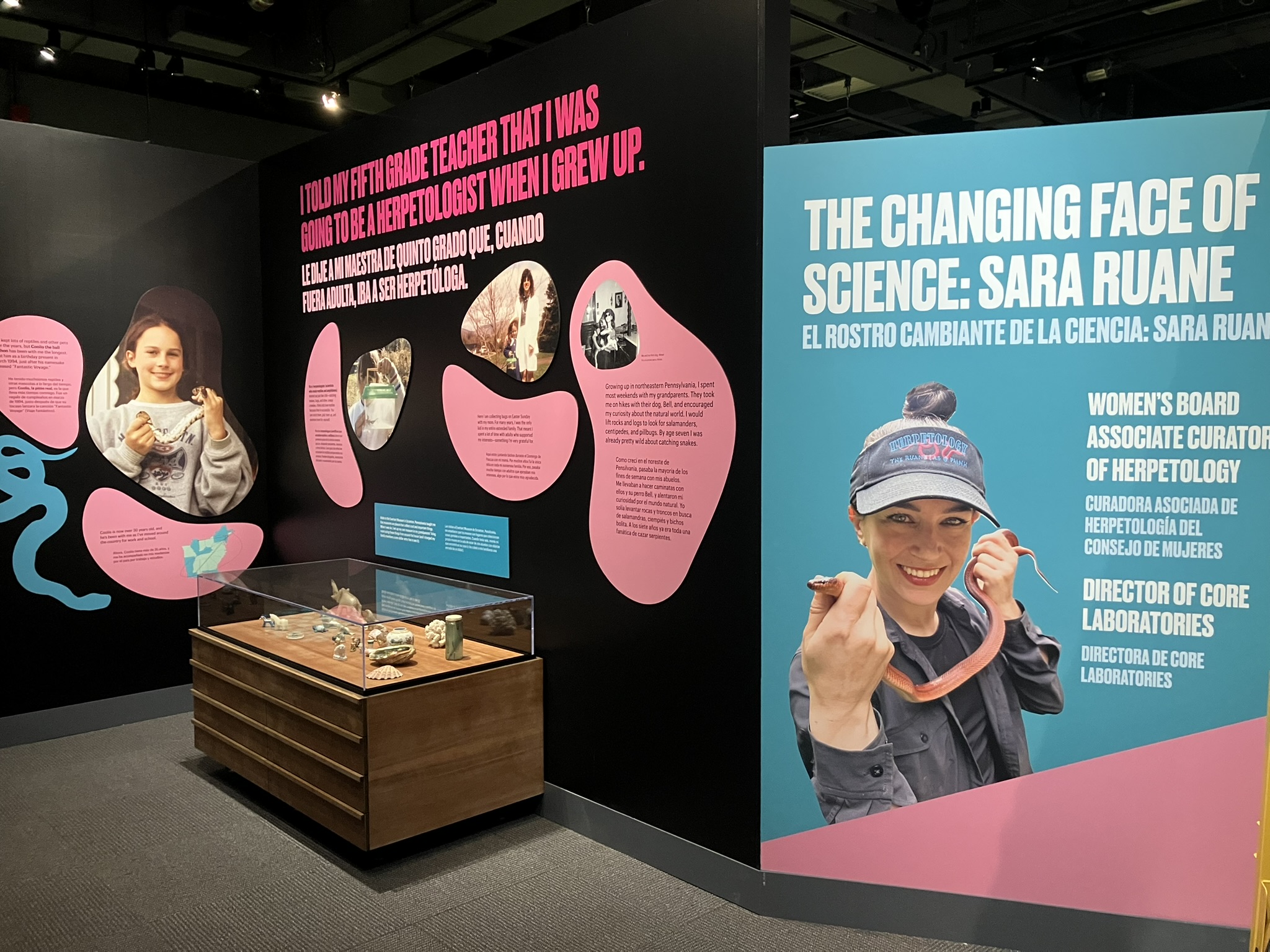
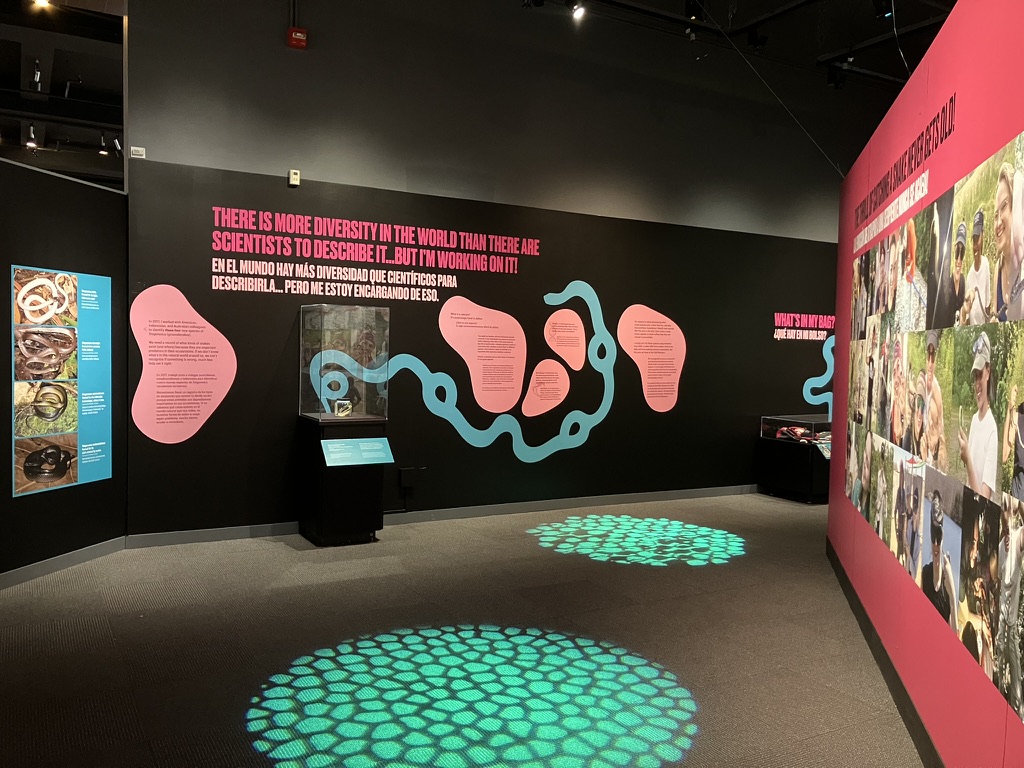
In 2022, the Field Museum launched The Changing Face of Science, a series of exhibitions that profile scientists affiliated with the museum who are women or people of color. The series is intended to inspire young visitors and show how how diverse perspectives and backgrounds can contribute to science.
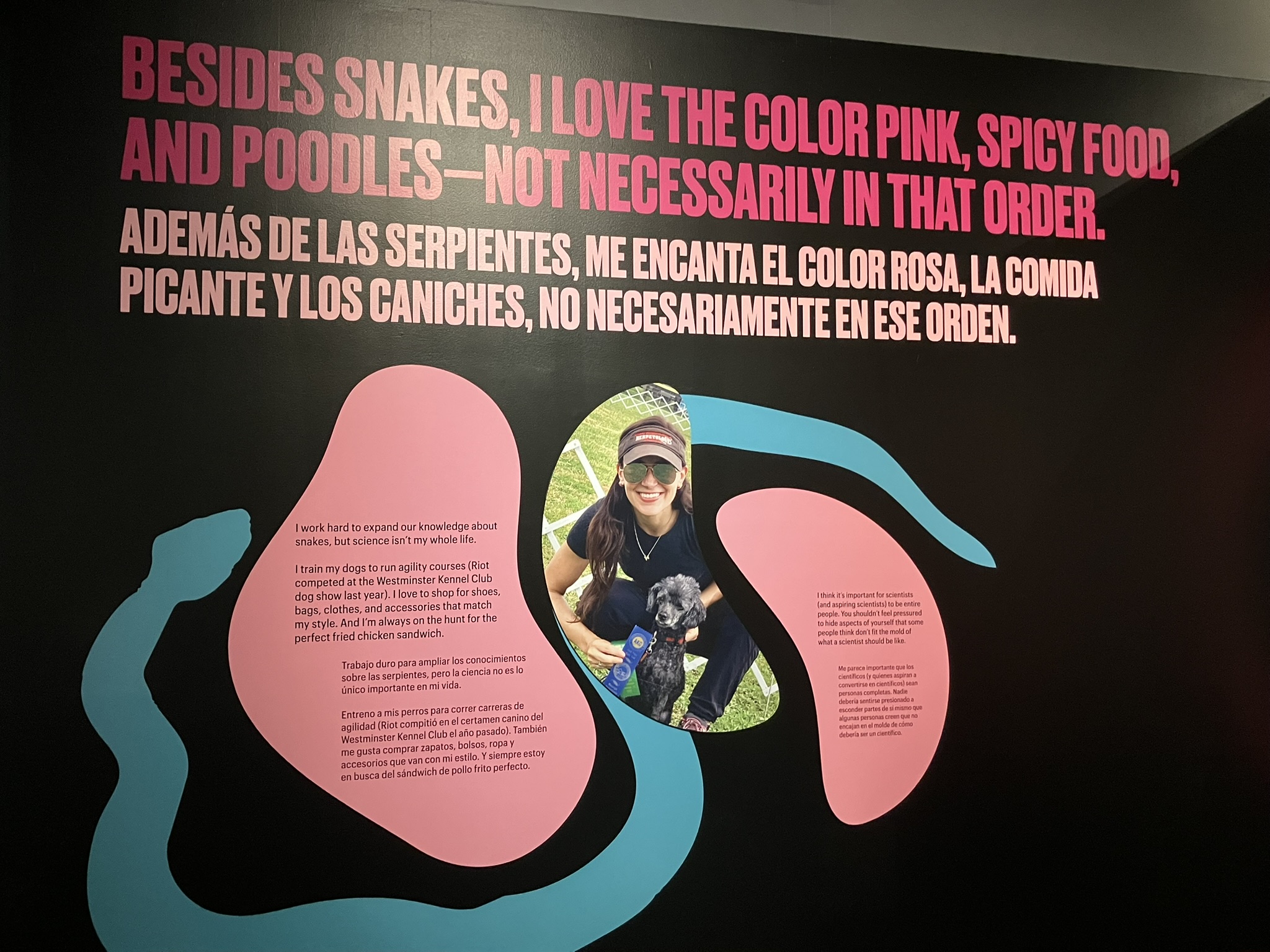
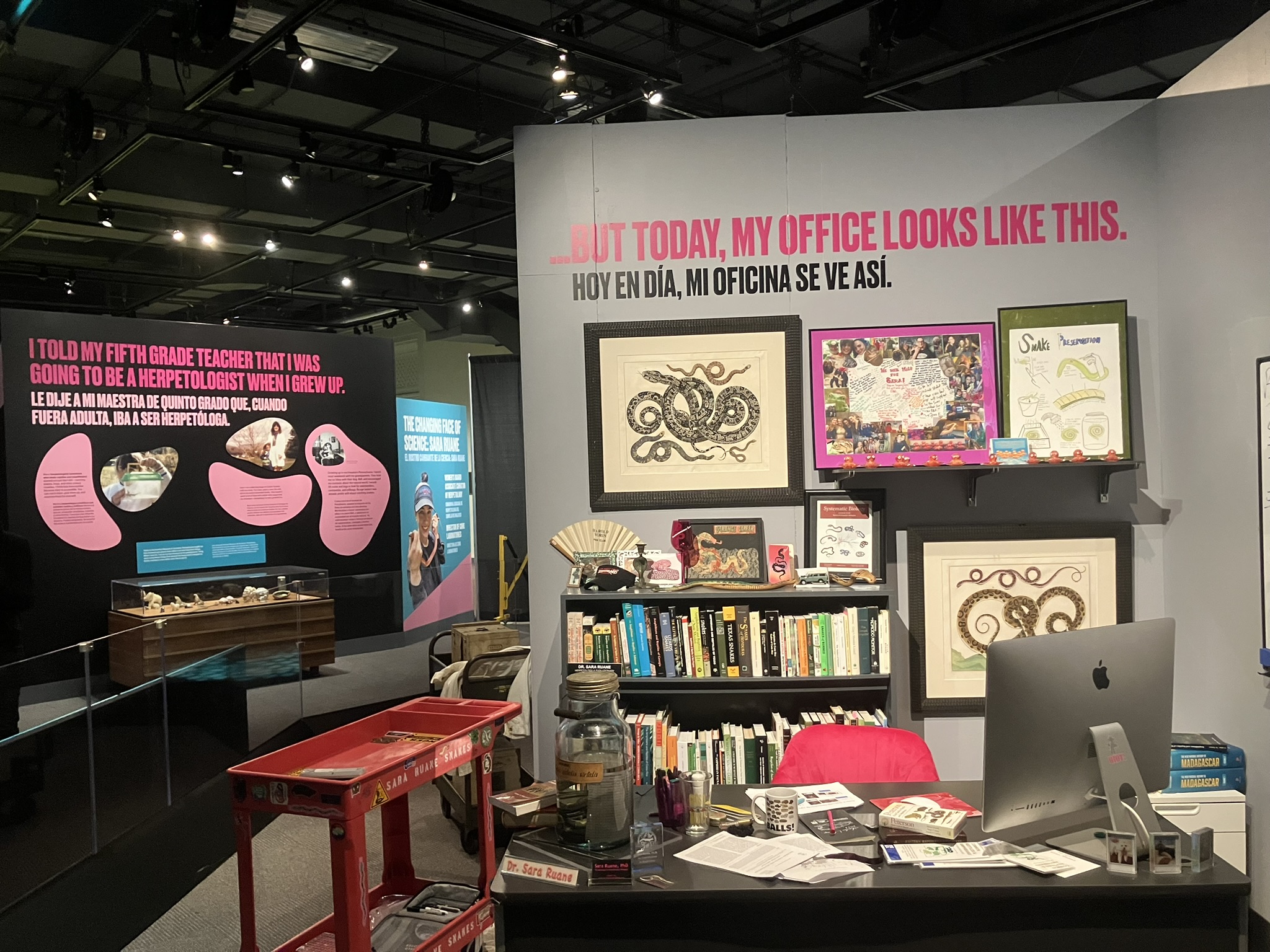
The latest entry in the series features aforementioned herpetology curator Sara Ruane. Sara studies the diversity and evolution of snakes, and has been fascinated by reptiles from a young age. However, Sara also wanted the exhibition to communicate that being a scientist is only part of who she is. Sara loves training her toy poodles, shopping for designer bags, and curating her unique fashion sense—you can be a great scientist while also being a complete person.
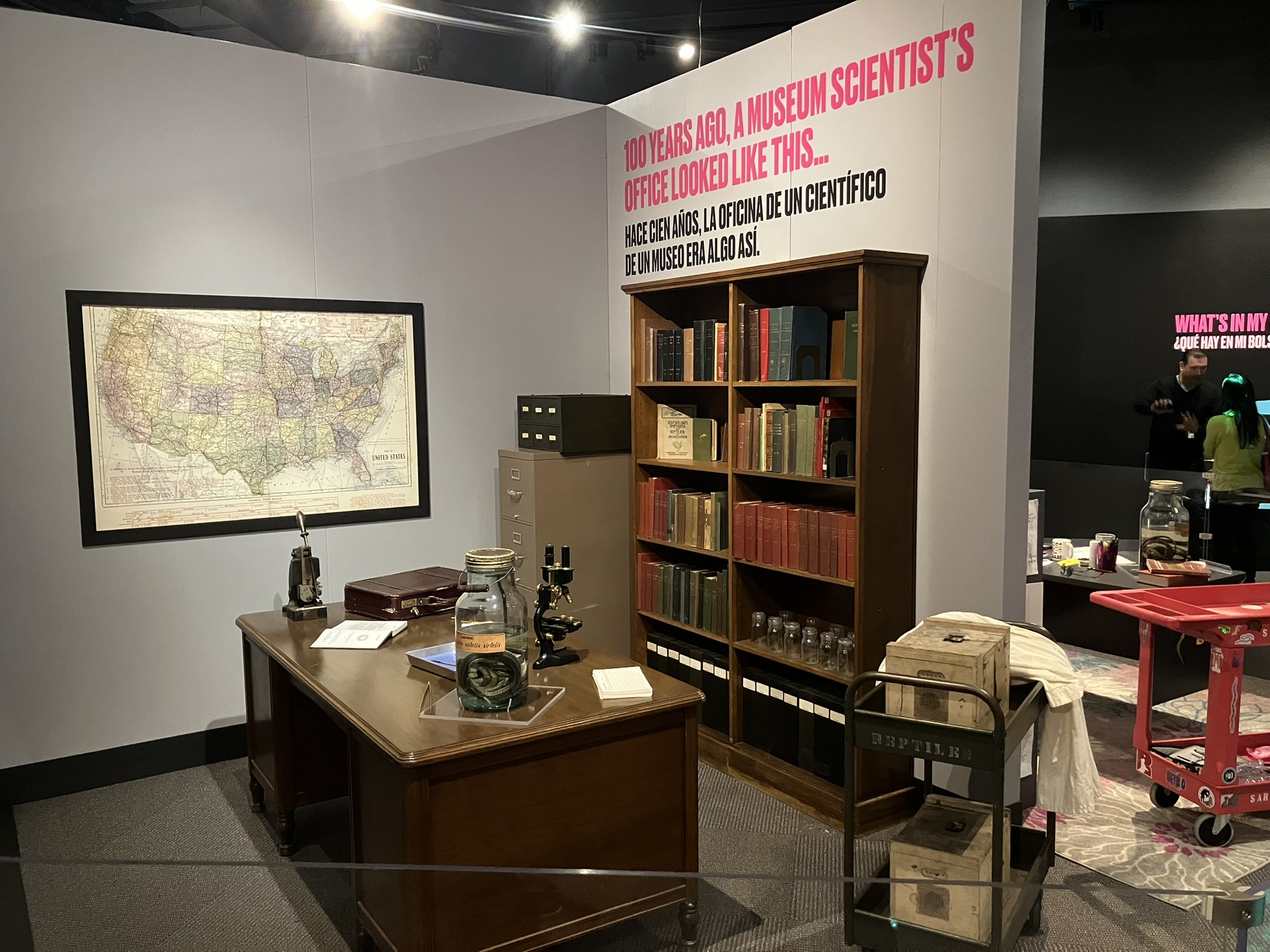
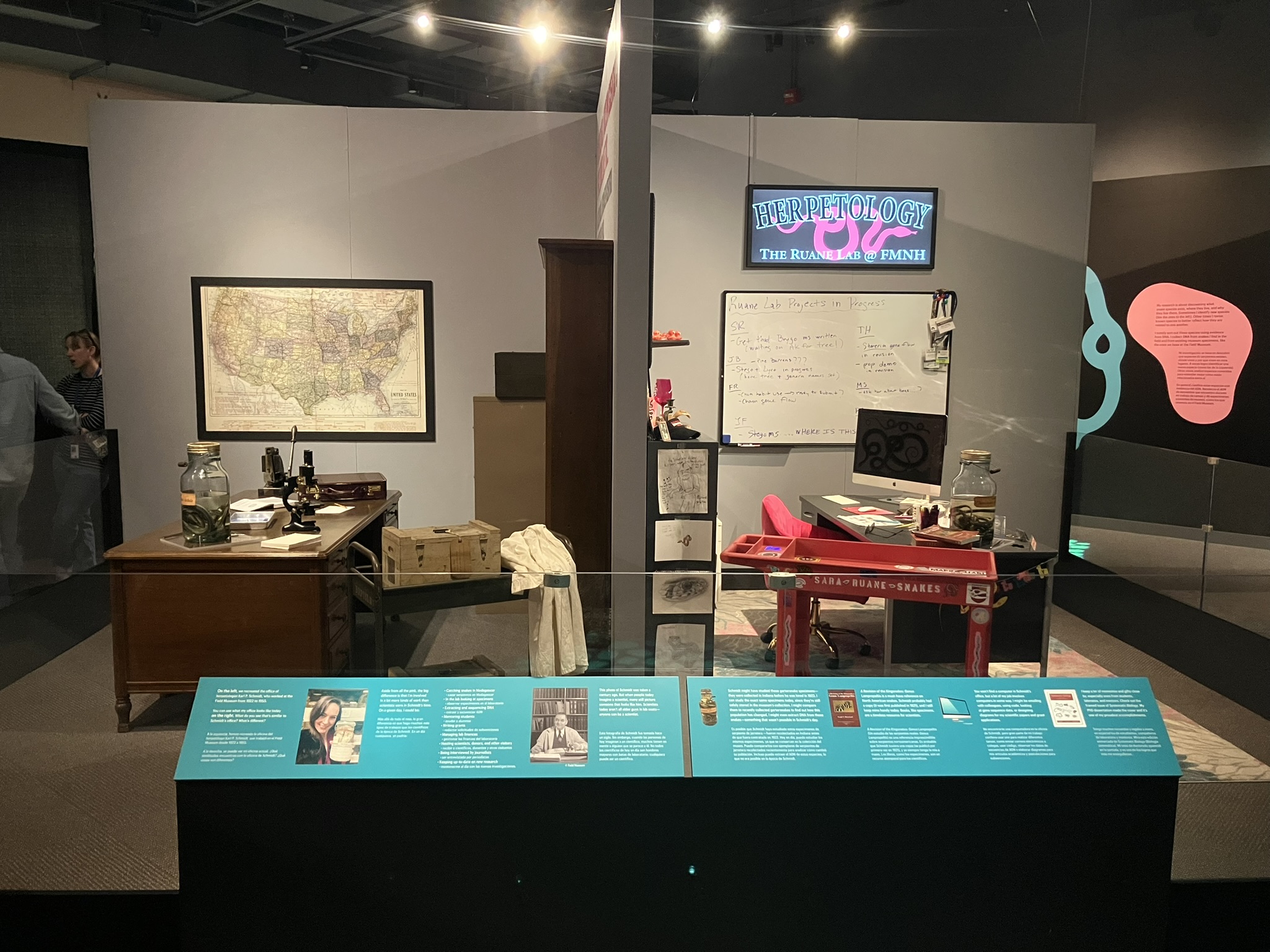
Displays include a recreation of a tabletop “museum” (that Sara made for her family at age six) and the contents of her fieldwork bag (which include everything from a Leatherman multitool to lipgloss). The centerpiece is a pair of office dioramas. One is Sara’s office today, and the other is that of Karl Schmidt, who was the Field Museum herpetology curator a century ago. I think it’s fair to say that we had a blast reconstructing Schmidt’s office, using his original desk and much of his actual book collection. Visitors are encouraged to compare the two spaces: Schmidt’s office is more traditionally professorial, while Ruane’s is full of fun decorations and mementos. But both scientists have the same jar of garter snakes on their desks (museum specimens are an eternal resource), and are referencing the same book (books are also eternal).
Sara’s exhibitionruns until January 2026.
After the Age of Dinosaurs
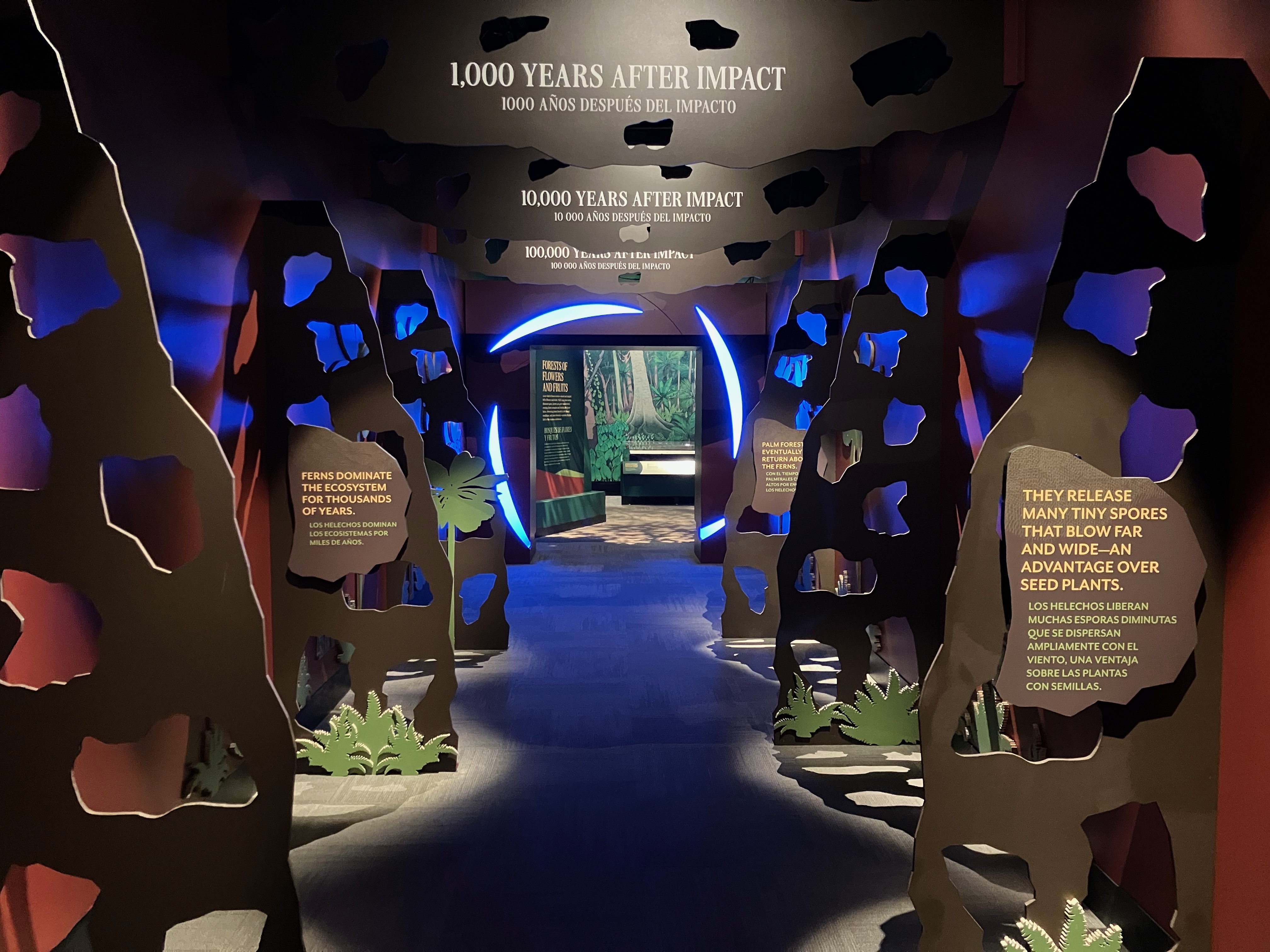
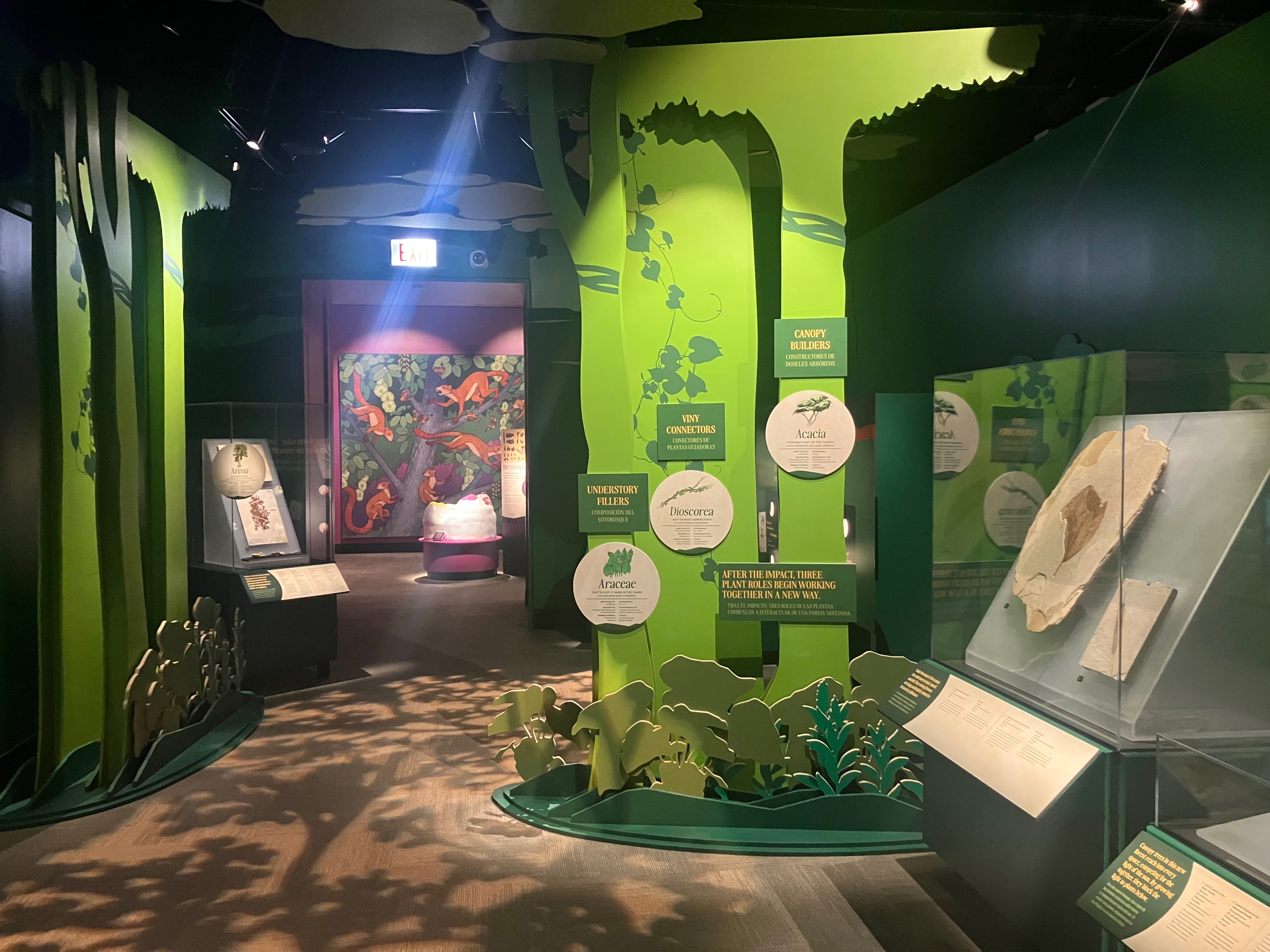
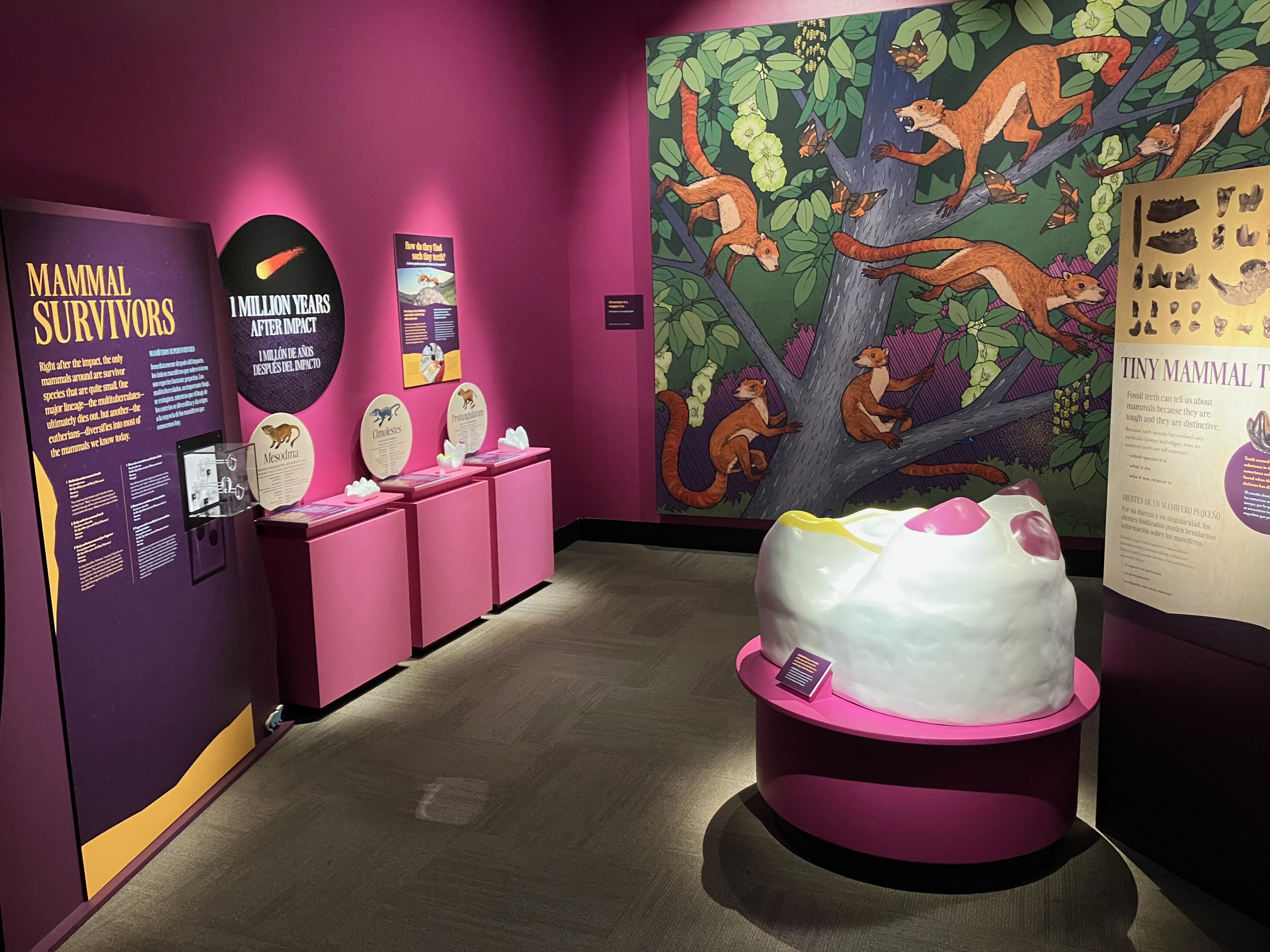
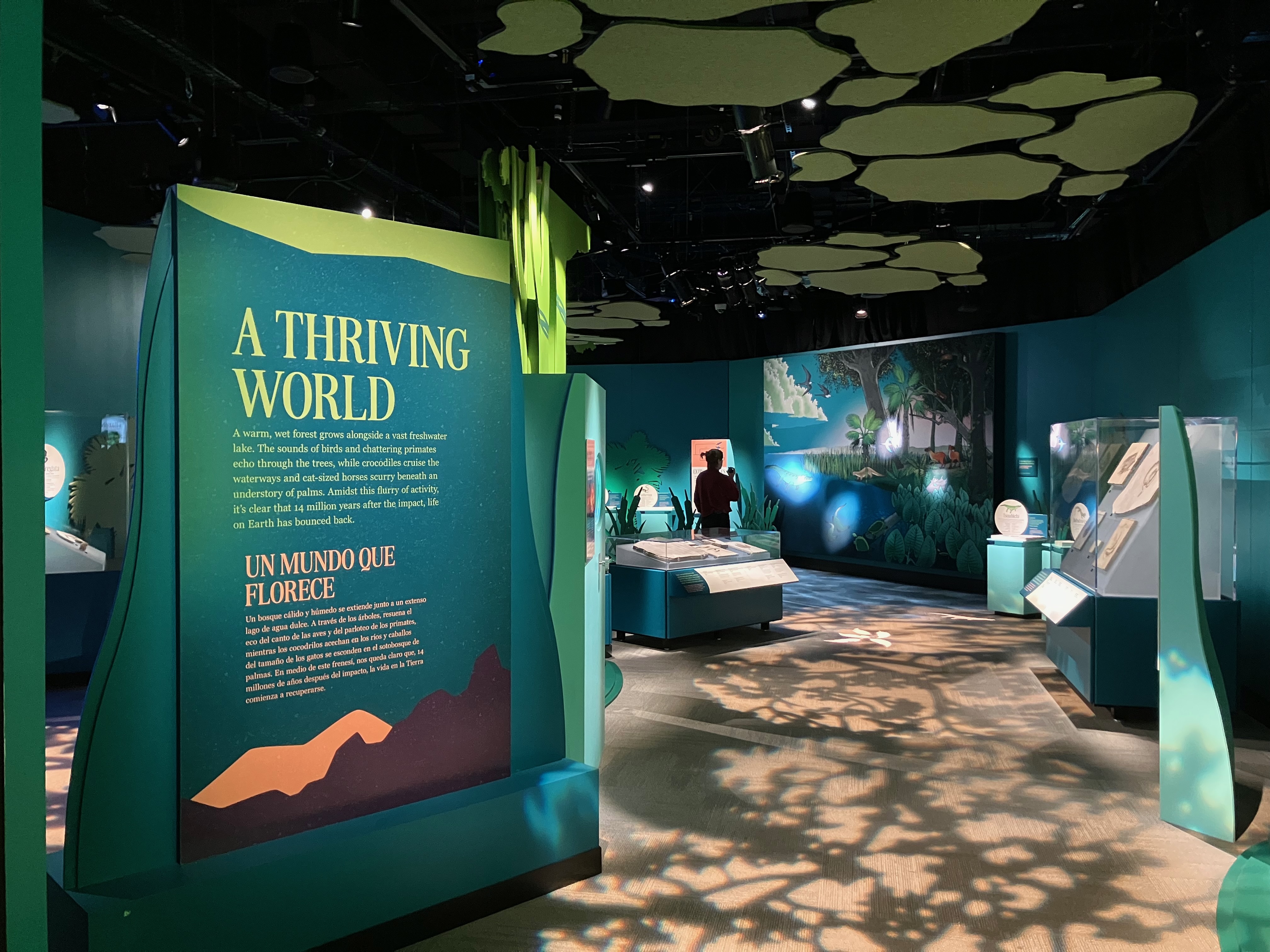
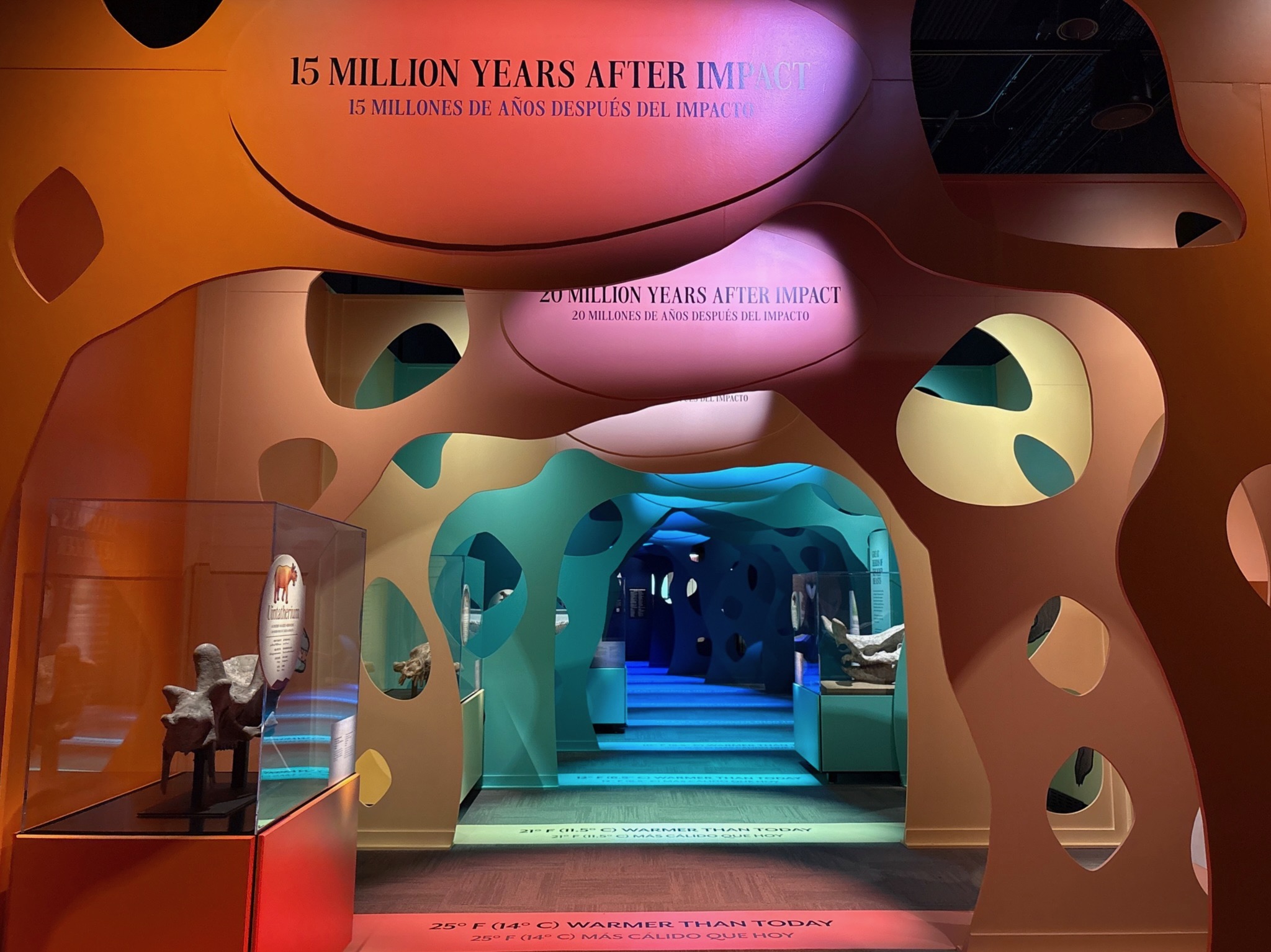
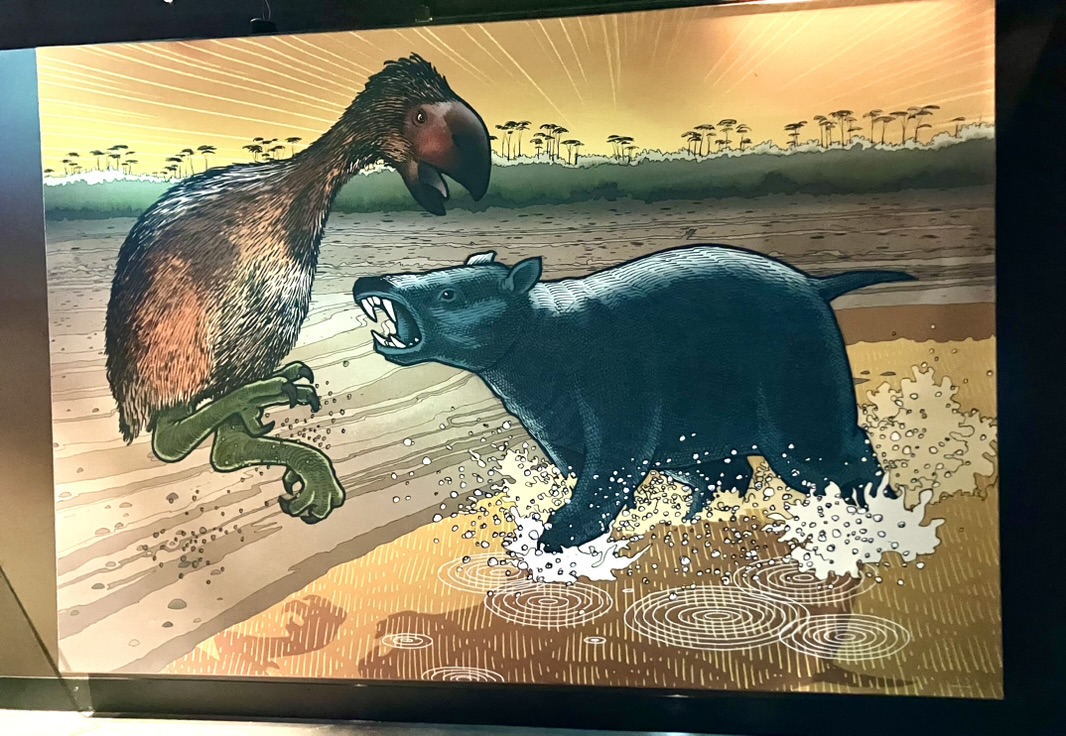
That brings us to After the Age of Dinosaurs. This exhibition is about the immediate aftermath of the end-Cretaceous extinction, and how the world’s ecosystems reassembled after that global catastrophe. But a summary of the subject matter doesn’t fully encapsulate what this show is about. The early Paleogene was famously a time of giant birds and little horses. Taking some inspiration from Alice in Wonderland, we played with the idea that sizes are askew and nothing is as it seems. The exhibition is colorful, whimsical, and full of displays that are just a little weird.
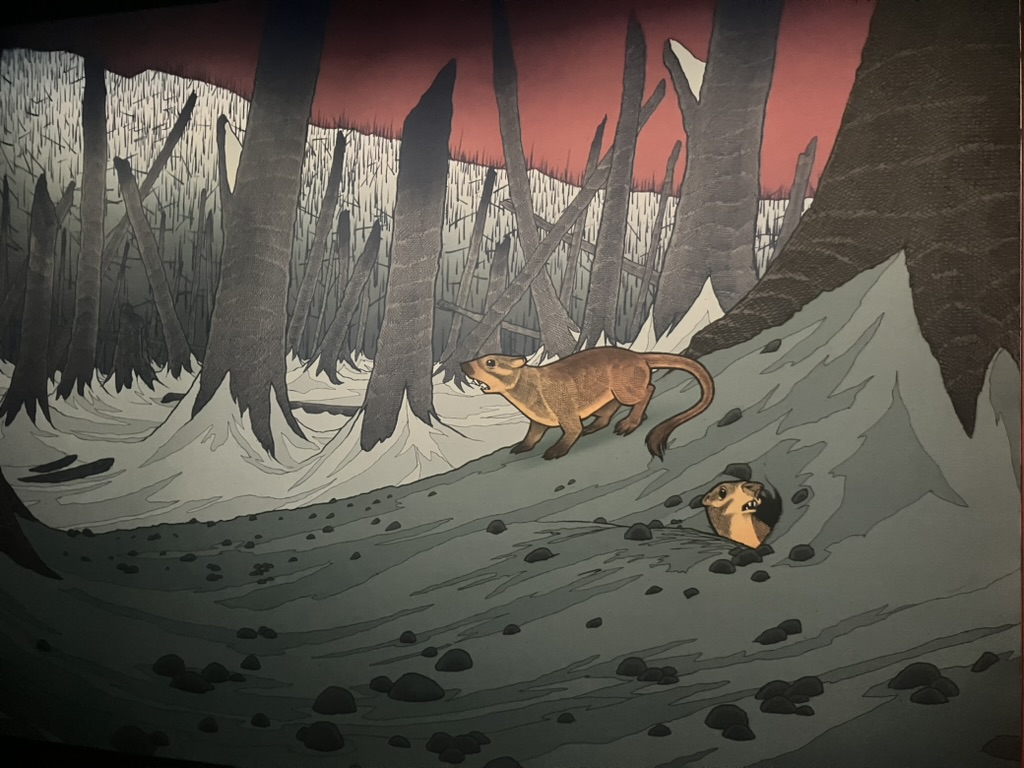
My colleague Marie Georg led the development of this exhibition—I joined a little later on to flesh out and write the second half. Curators Ken Angielczyk and Fabiany Herrera advised on the science, along with nearly a dozen other specialists. Meanwhile, the team worked with Chicago poster artist Jay Ryan to create the look of the show. Jay’s style is bright and bold, with a bit of a pop art feel. He brought those signature qualities to the six murals and nearly sixty standalone illustrations he created for After the Age of Dinosaurs, and the rest of the exhibition’s design follows suit. The result is a paleontology exhibit that looks nothing like the Field Museum’s permanent Evolving Planet, or really any other major fossil exhibit that I’m aware of.
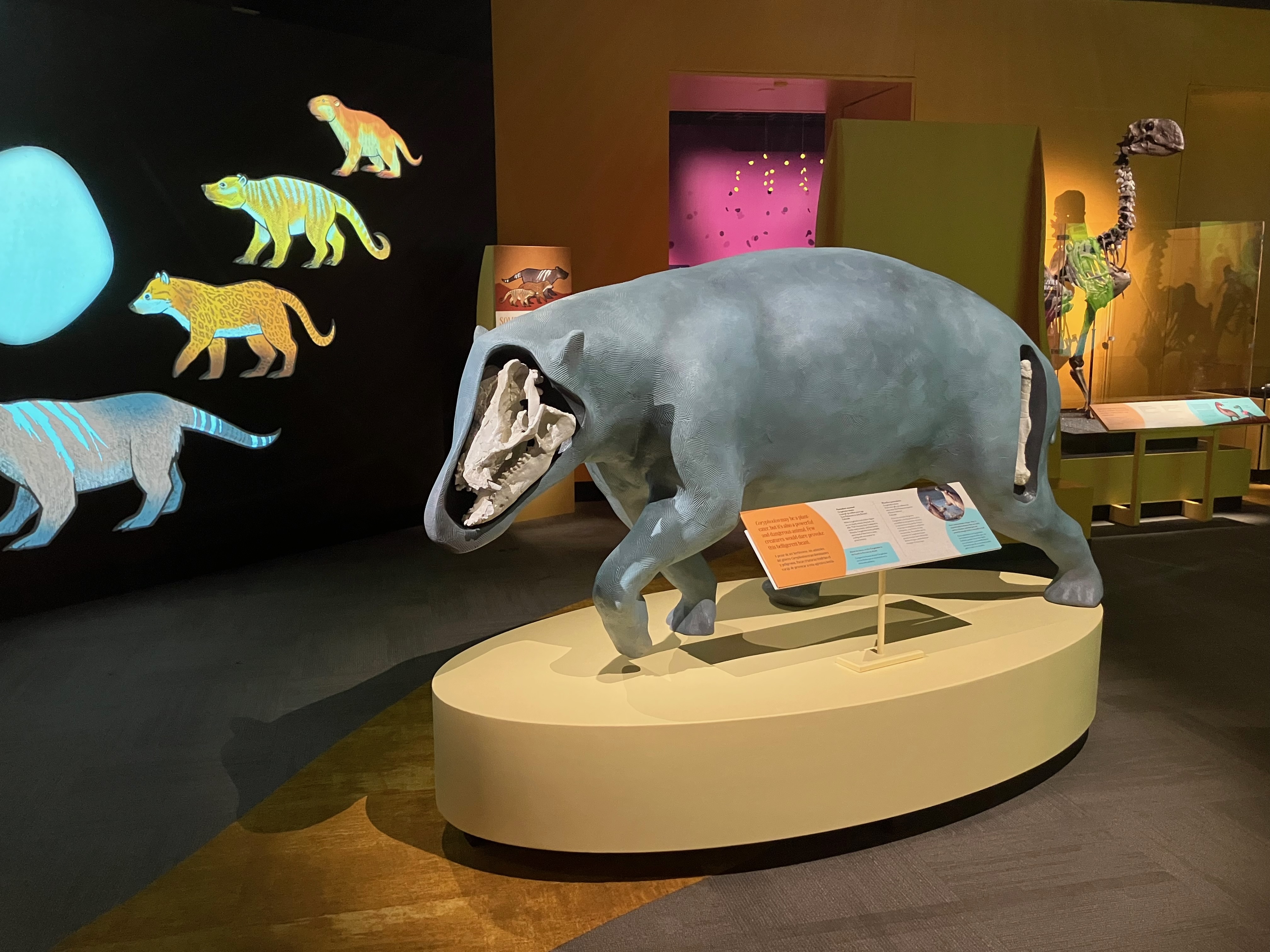
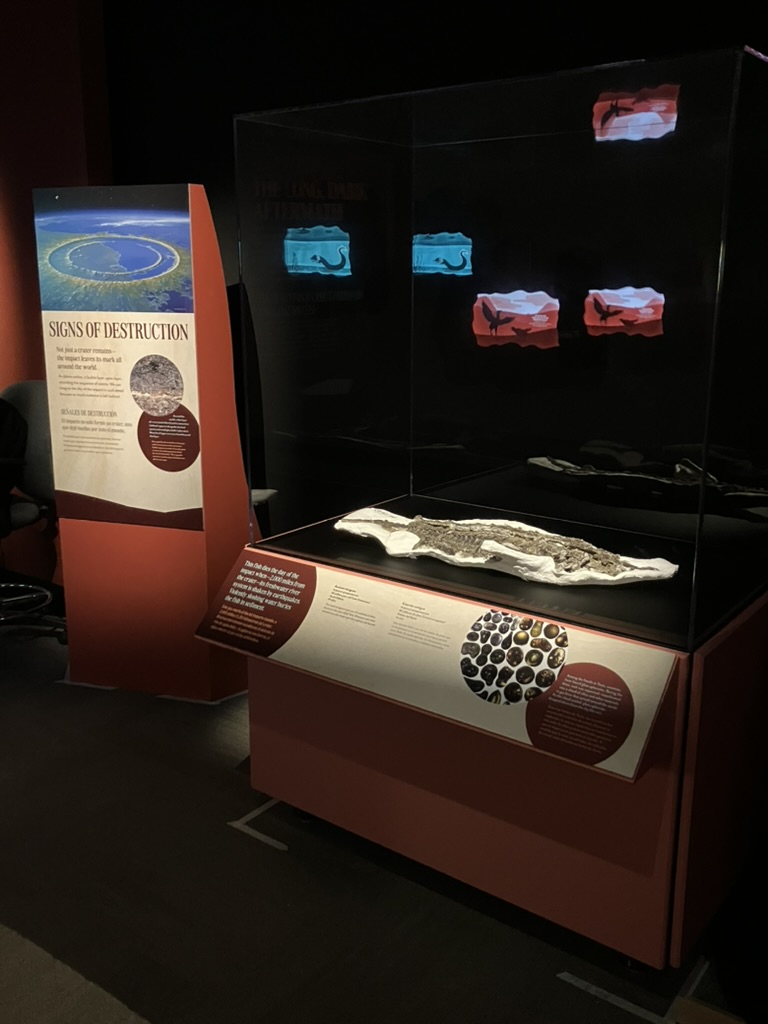
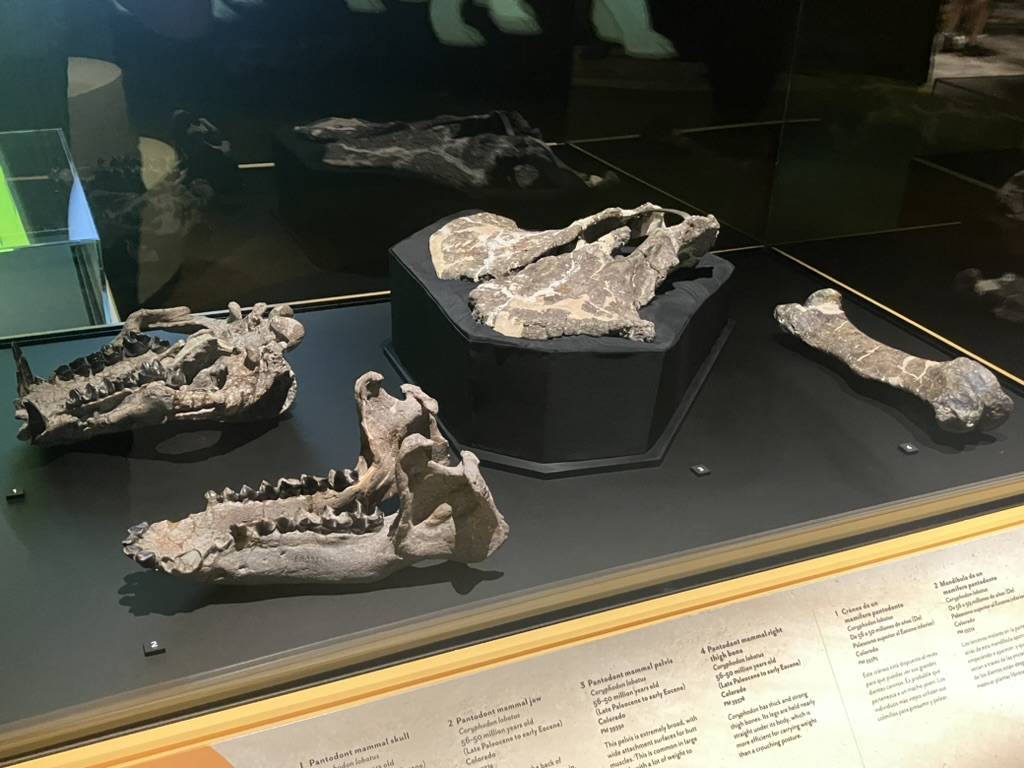
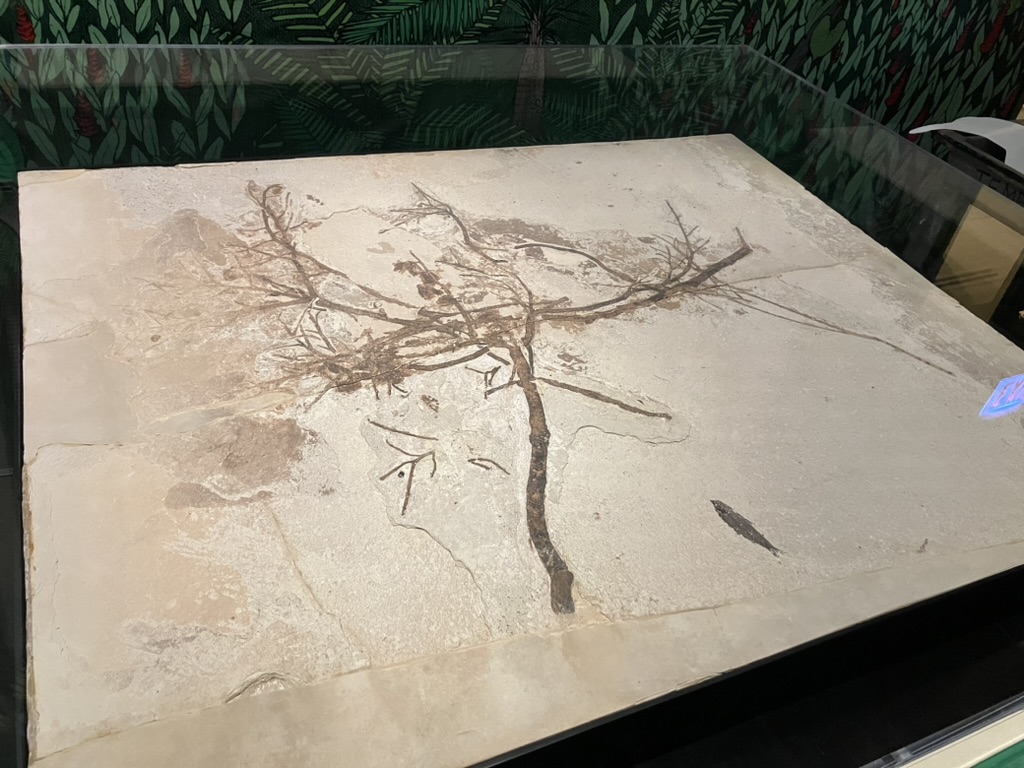
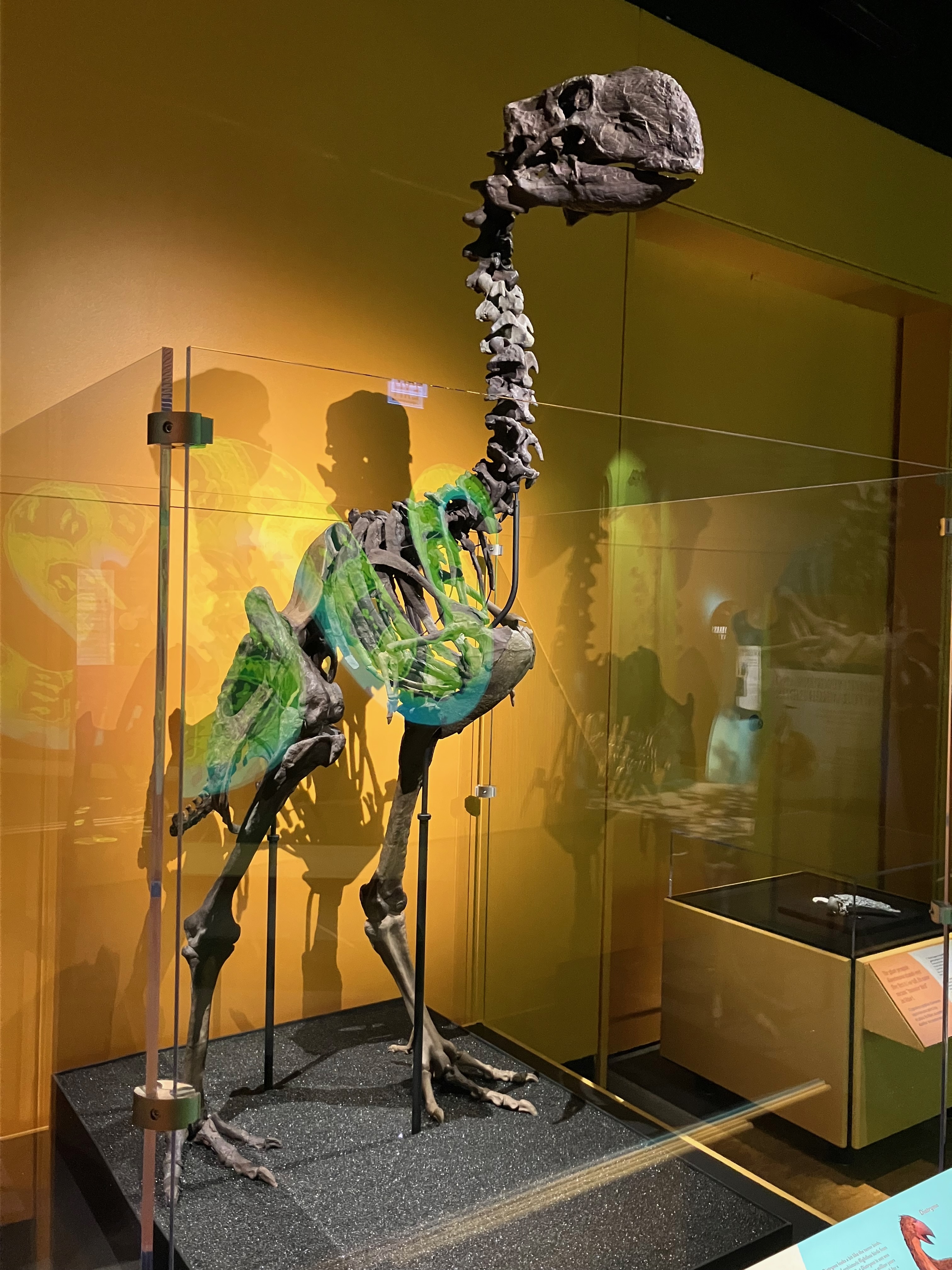
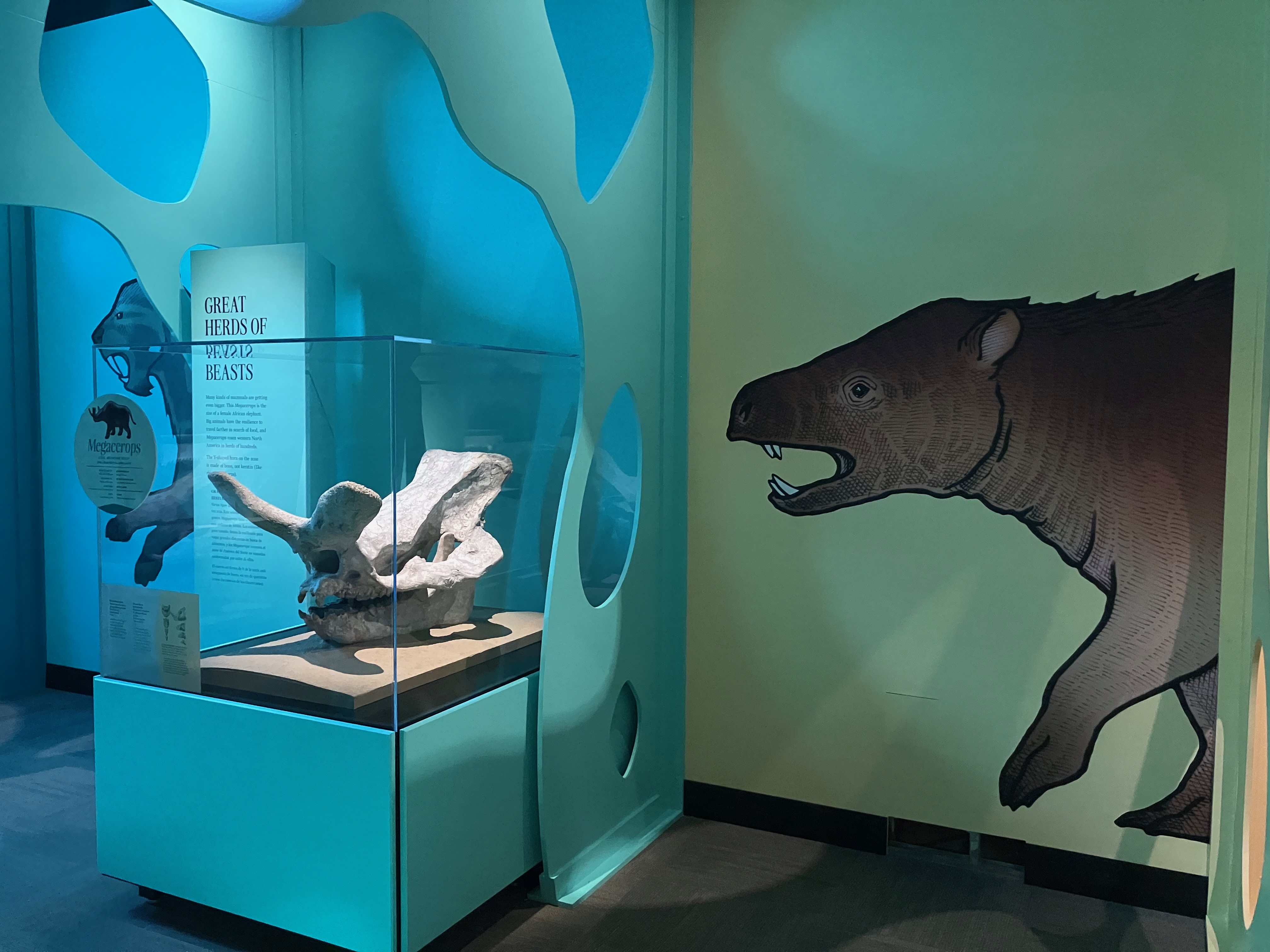
The fossils on display include both brand-new specimens collected during the 2024 field season and classics from the collection that we’d been waiting for an excuse to show off. Visitors can see the largest Megacerops skull ever found, the world’s only known cattail fossil, the oldest grapes from the western hemisphere, a perfectly-preserved passerine bird that was just named this year, and at least four fossils that are in press and so haven’t been formally named yet. The highlight for me is the Diatryma cast skeleton, which was acquired in a trade with the American Museum of Natural History in 1937. This set of disarticulated parts had never made it onto display before, so it was exciting to see it assembled into a standing mount for the first time.
Since so many early Paleogene fossils are on the small side, large media and media-adjacent displays often take center stage. After the Age of Dinosaurs opens with a dramatic presentation of how the asteroid impact devastated global ecosystems, animated in a paper cut-out style by Rachel Oftedahl. A projection of ash billowing through a burnt-out forest adds a somber mood to the next gallery. Look closely at the life-sized projections of pantodonts later in the exhibition and you’ll see their eyes periodically blink. And in the Green River section, visitors can add to the ubiquitous forest soundtrack by standing in spotlights shaped like different animals—these trigger unique sounds that add to the gallery-wide chorus. I’m excited to see how visitors respond to these semi-hidden, playful elements within the exhibition, and how they contribute to the experience overall.
After the Age of Dinosaurs runs until January 2027.
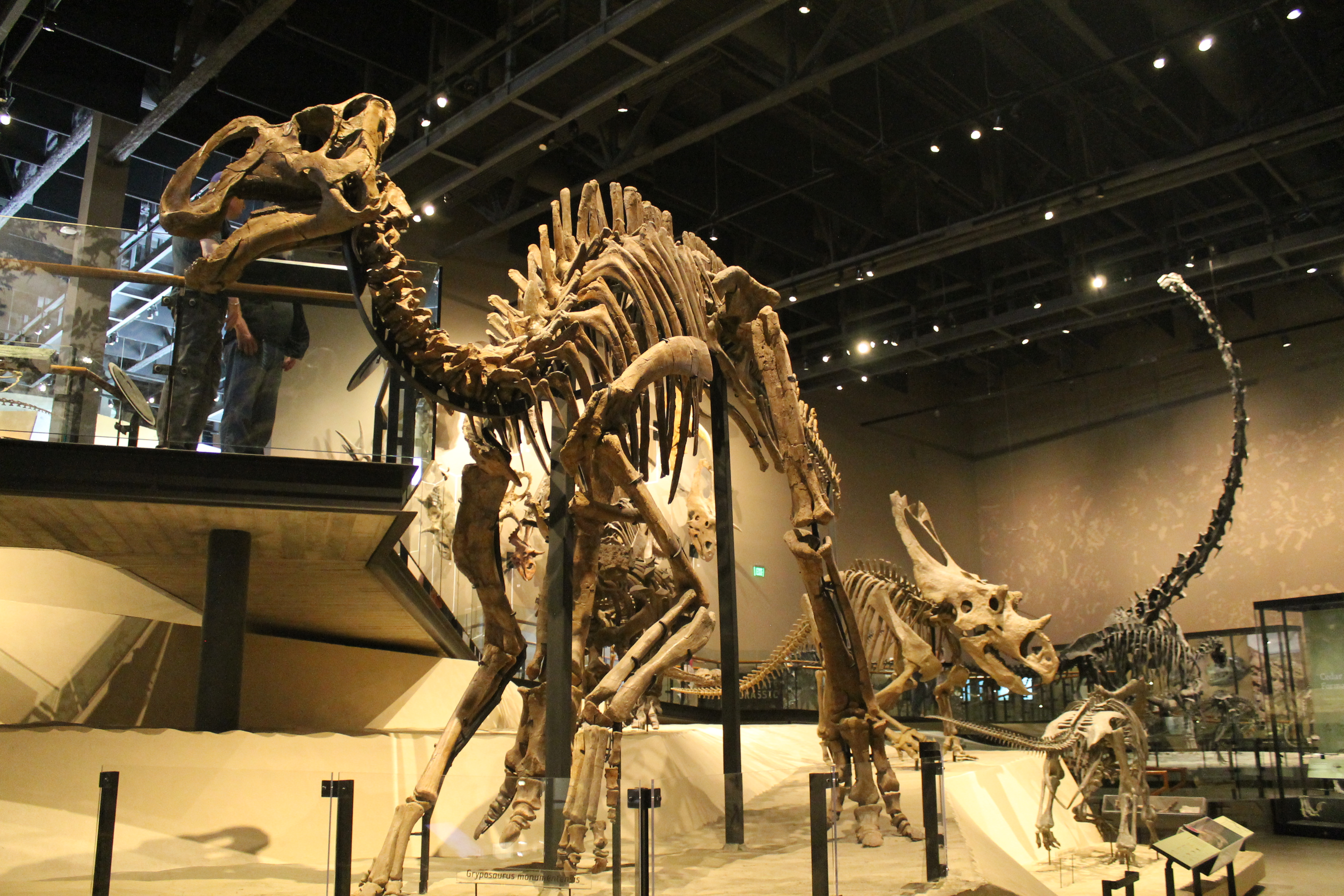
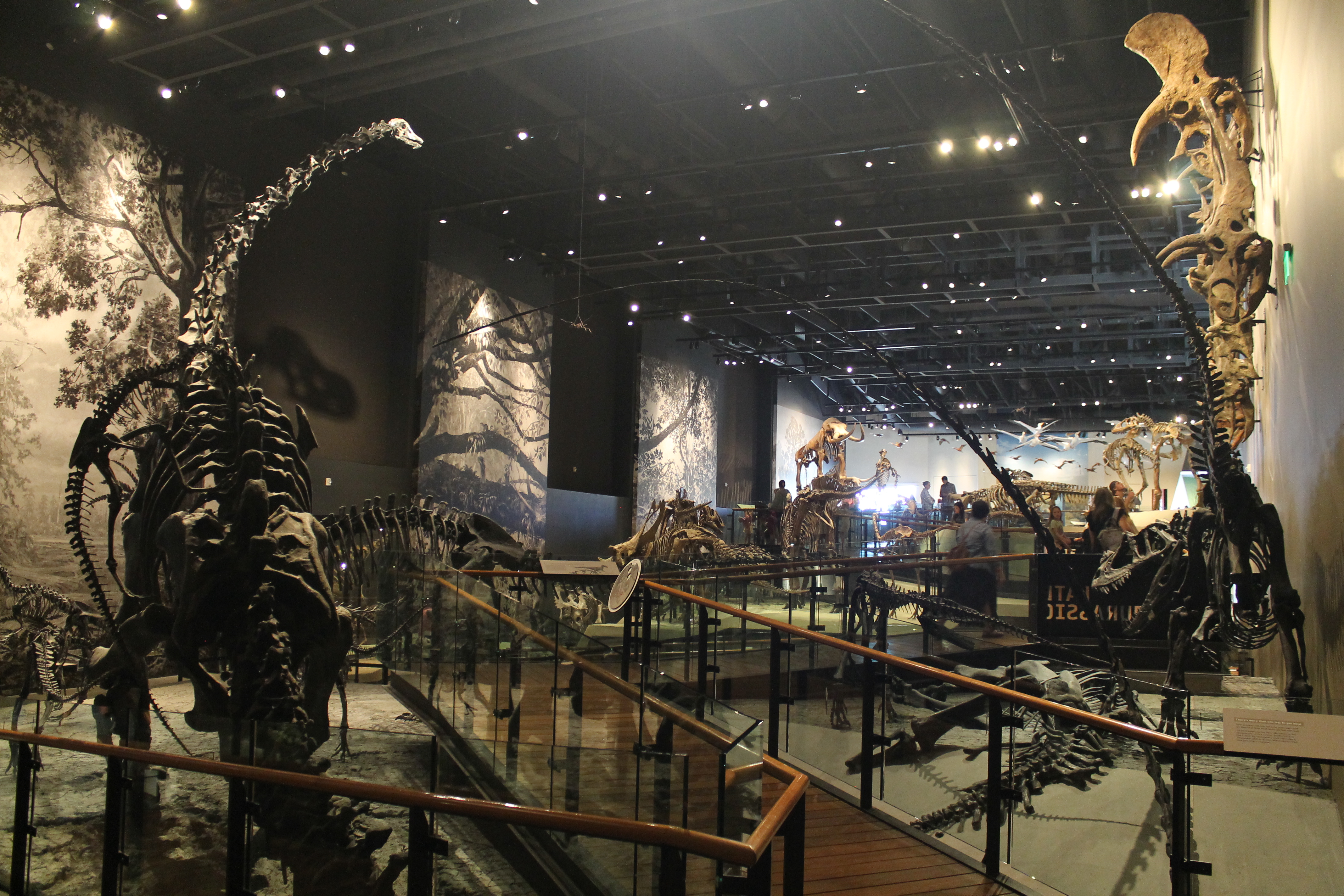
Gryposaurus makes an impression amidst other dinosaurs in Past Worlds, the NHMU paleontology exhibition. Photo by the author.
I visited the Natural History Museum of Utah (NHMU) earlier this week, and I need to take a moment to applaud its exceptionally beautiful and well-conceived paleontology hall.
NHMU is part of the University of Utah. It resided in its original home on the Salt Lake City campus from 1969 to 2011, when the museum relocated to a new, purpose-built facility in the foothills near Red Butte Canyon. Several design firms contributed to the Rio Tinto Center (the name for the building in which the museum resides), but the permanent exhibitions—including the paleontology hall—are the work of good ol’ Ralph Appelbaum Associates (RAA). For the unfamiliar, RAA is a dominant player in the field of museum design that is often associated with projects of profound cultural and historic significance, like the US Holocaust Memorial Museum and the National Museum of African American History and Culture. RAA has fewer natural history projects in its lengthy catalog of commissions. Near as I can tell, their only other paleontology-centric project was the fourth floor fossil halls at AMNH. I’m not a huge fan of many of the design choices made in those halls, so it’s interesting to see what 20 years and a different client can mean.
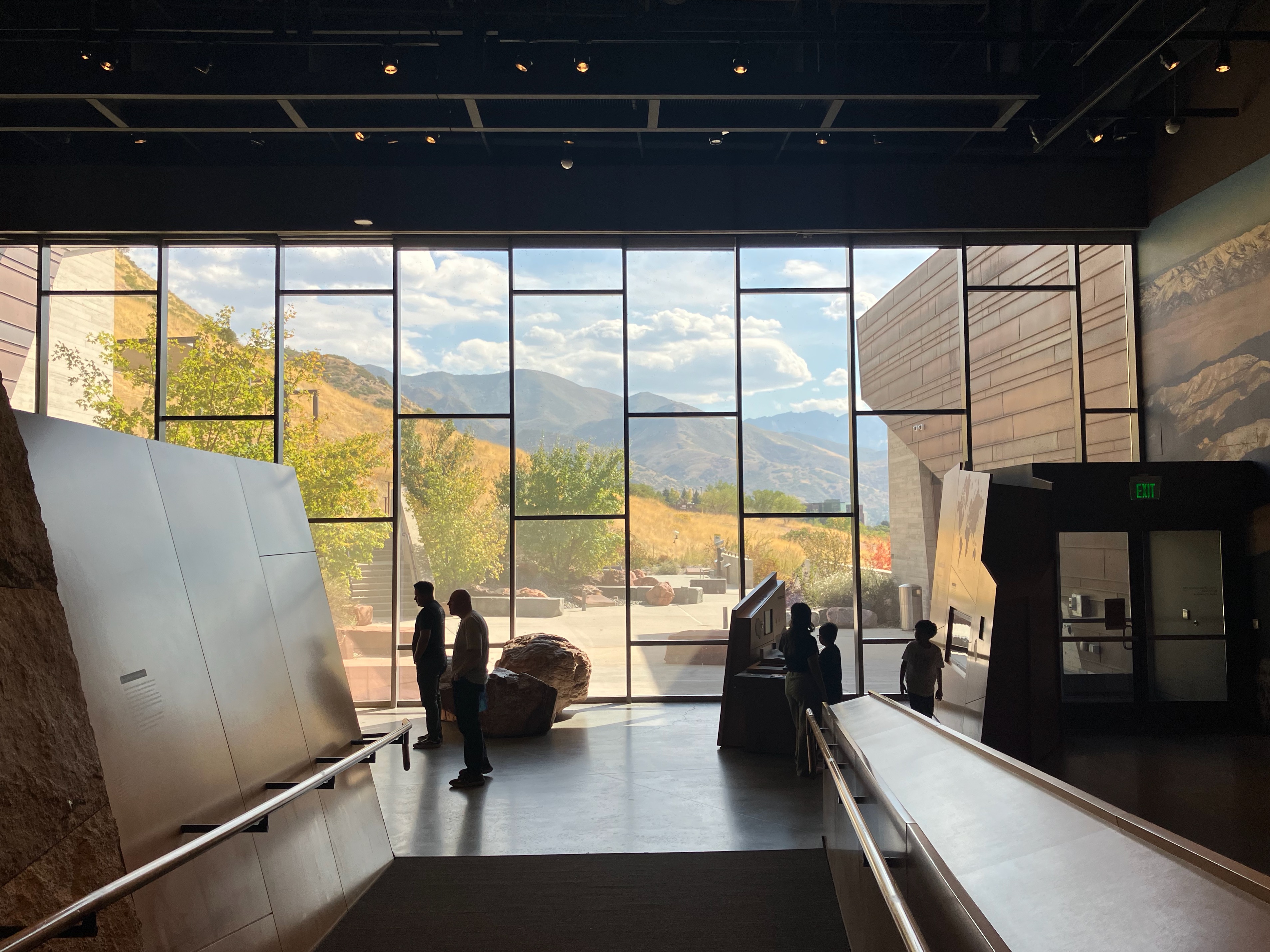
Large windows and frequent access to the outdoors are standout features of the NHMU building. Photo by the author.
The 44,000 square feet of permanent exhibitions at NHMU flow linearly across the building’s five floors, which visitors can explore from bottom to top or top to bottom. Conceived as a single experience, the exhibitions don’t feel like discreet units—instead, they flow seamlessly into one another as visitors climb or descend along switchbacking paths through the building. I want to call attention to the design of the museum as a whole because it manages to be both stylish and meaningful. Unlike some other museums with bold architecture (looking at you, ROM), the building manages to make a visual statement without hindering visitor experience or usable exhibit space.
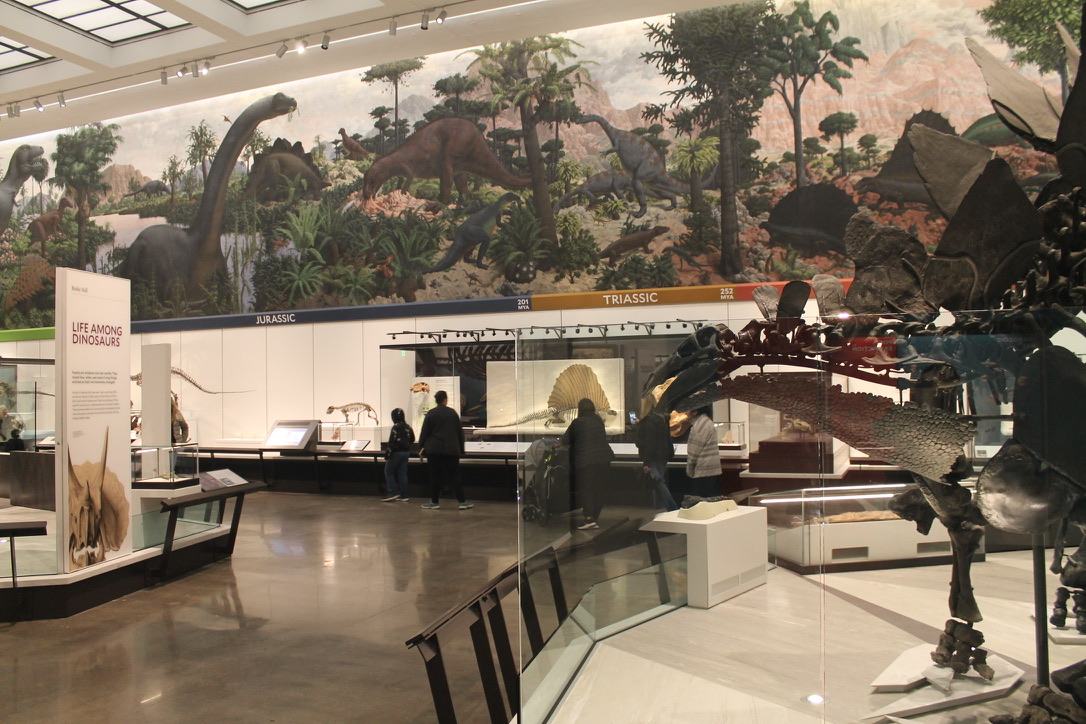
Past Worlds as seen from the Jurassic. Photo by the author.
The paleontology hall—entitled Past Worlds—occupies about half of the total exhibit space, and fittingly it is the first area visitors encounter if they choose to start at the bottom. The hall is open and spacious, but visitors cannot access the entire exhibition at once. Instead, they follow a zigzagging, switchbacking path, with new sight lines opening up as they go. Monumental elements—namely, the dinosaur skeletons, wall murals, and immersive dioramas—are encountered multiple times from different perspectives.
One example is a life-sized diorama of the lake bottom where fossils of the Green River Formation were preserved. Visitors first see this tableau from an “underwater” perspective. Then, some time later, visitors encounter this same scene again, now looking down from the “surface.” Elsewhere, dinosaur skeletons that can be seen from different vantages are interpreted in multiple ways, depending on what else visitors can currently see and compare them to. This series of reveals and payoffs reminds me of the carefully constructed experiential narratives in theme parks, but precisely applied to help visitors learn about ecology and geology. It’s really cool.
Uintatherium and Patriofelis foreground multiple layers of mounted skeletons. Photo by the author.
The hall’s color palate is a mix of earth tones and grayscale. Some of this comes from the mounted skeletons, which range from the charcoal gray of Morrison fossils on one end of the space to brown and beige Cretaceous and Cenozoic fossils on the other. Four giant, vertically oriented murals also contribute to the look and feel of the space. Corresponding to the Jurassic, Cretaceous, Paleogene, and Quaternary areas of the hall, these black-and-white murals focus on the flora and landscapes of these eras—you have to look closely to find the animals. I couldn’t find a label identifying the artist, but the murals’ dark foregrounds and bright backgrounds remind me of the original King Kong (or if you want to be fancy, the engravings of Gustav Doré).
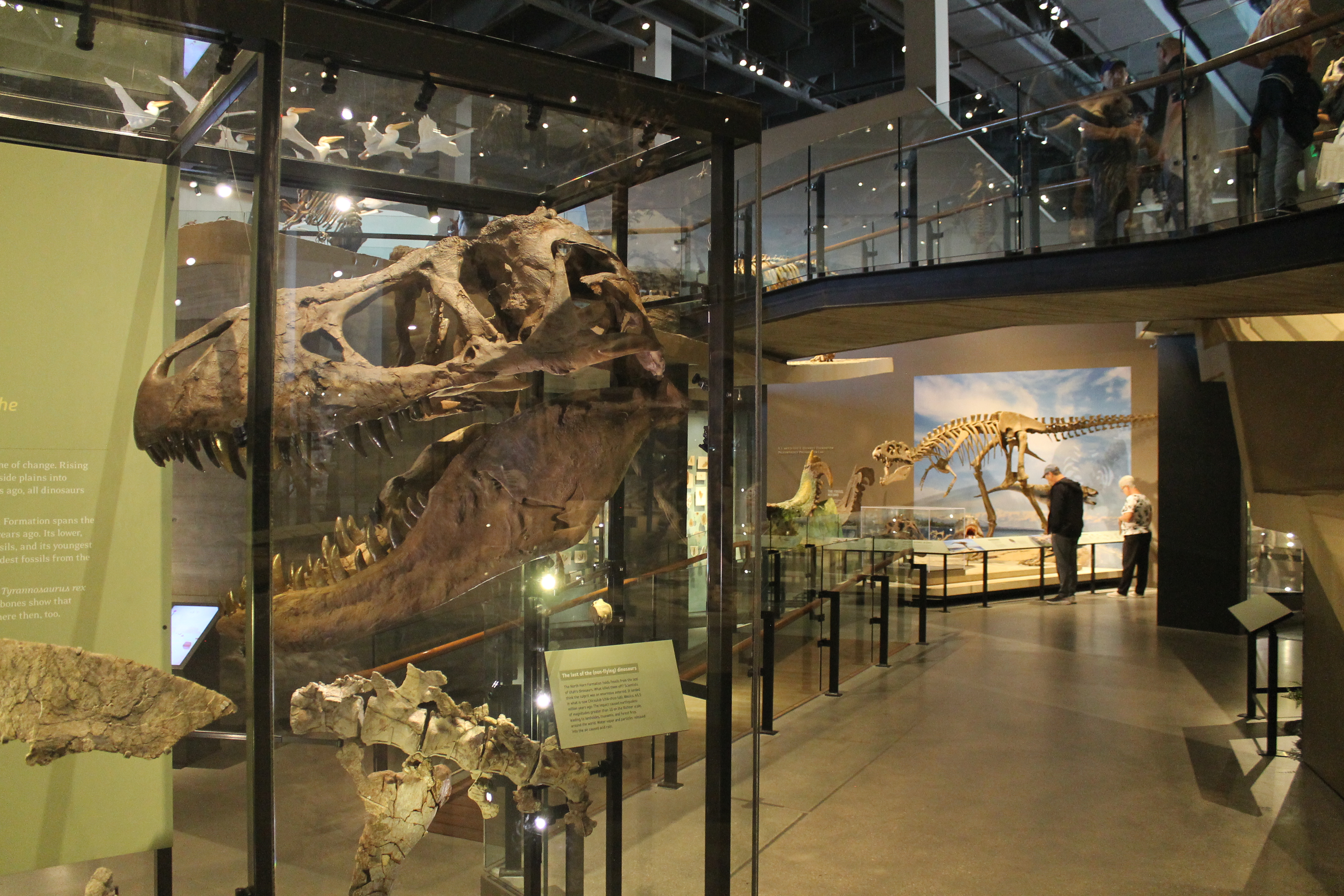
Local tyrants Lythronax and Teratophoneus get the most attention, but an obligatory cast of the Wankel/Nation’s T. rex is also present. Photo by the author.
As suggested by the murals, the overall space is arranged chronologically. However, the switchbacking path through the exhibition means that visitors start in the recent past and move back to the Jurassic, before reversing direction and moving forward in time. While a time axis is present, Past Worlds is less about presenting a comprehensive narrative of the history of life and more about zeroing in on a few particular ecosystems that once existed in Utah. These include the Morrison Formation of the Jurassic, the Cedar Mountain, Kaiparowits, and North Horn Formations of the Cretaceous, the Green River Formation of the Paleogene, and the recent Ice Ages. These deep dives into specific habitat groups are relatable, digestible, and easy to contrast with one another and the modern world—indeed, I have been not-so-subtly trying to coax the paleontology exhibits at my own institution in the same direction.
The mounted skeletons have fared well, considering that they’re all in open air and easy to reach. Photo by the author.
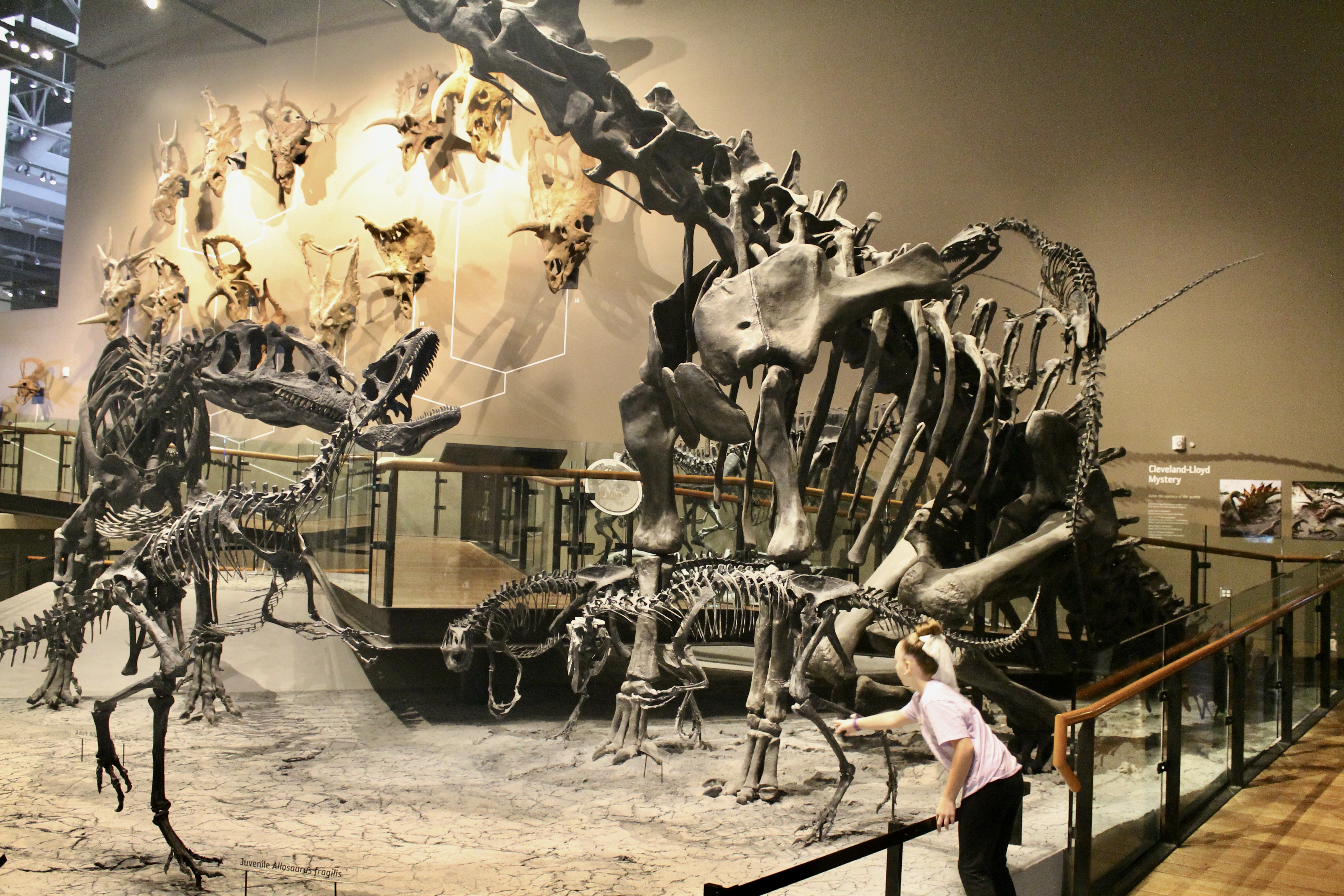
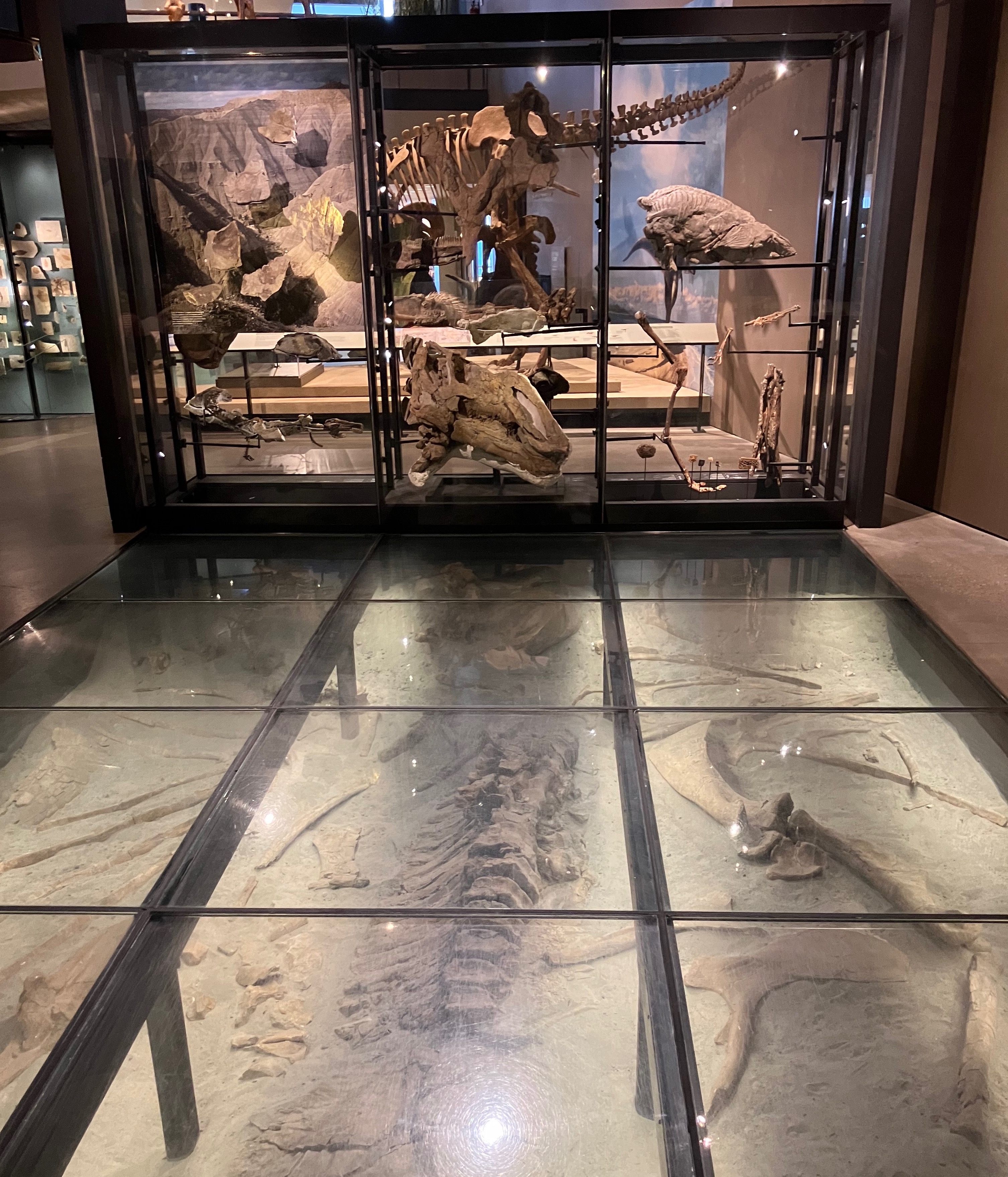
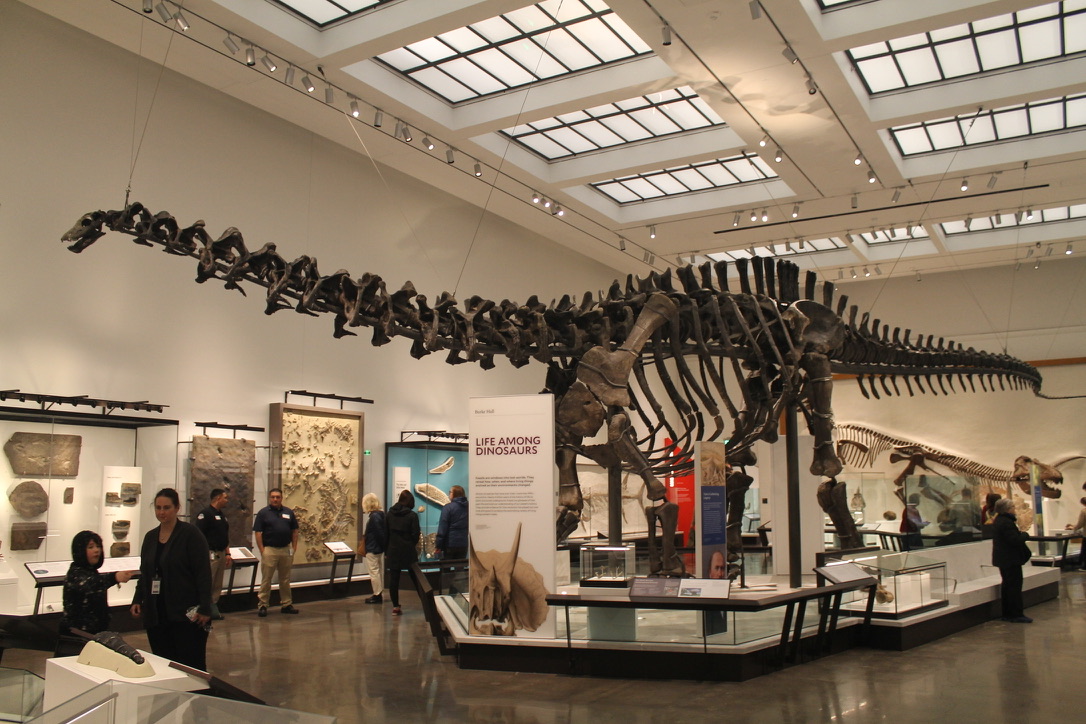
Past Worlds features hundreds of fossil specimens, nearly all from Utah or adjacent states. There are more than 40 mounted skeletons, many of which were firsts for me—I’ve never seen a mounted Marshosaurus, Akainacephalus, or Patriofelis before! Notably, all but one of the standing mounts (the Gryposaurus) are casts. This is not due to a lack of material—most of the mounts are based on fossils from NHMU’s collection. Clearly, somebody made the decision to draw a firm line between the real specimens and the dynamic reconstructions—a line that other museums have traditionally blurred. I think it’s fair for some visitors to be disappointed by this, but using casts allows for some lively and energetic displays. The group of Allosaurus swarming a Barosaurus mired in mud is particularly evocative (and incidentally, the way the sauropod’s tail sweeps under the path and curls overhead is so cool). Besides, there are plenty of real fossils to see, many of which are very strikingly displayed. I was impressed by an in situ hadrosaur skeleton under the floor, which seamlessly merges with a vertical case of Kaiparowits fossils that appears to be rising out of the ground.
I’m not sure how easy this is for scientists to access, but it sure looks neat. Photo by the author.
Individual labels are commendably brief, and tie each fossil to the larger stories being told. I was pleasantly surprised that the ID lists the discoverer and the preparator of each fossil, when known. Most labels also include a skeletal diagram showing where individual bones fit into the larger skeleton, but these were frustratingly small and almost impossible to make out (a problem shared with similar graphics at NMNH).
There are plenty of touchable displays, but media is used sparingly. A highlight is a four-part program in which scientists propose different possible causes for the Cleveland-Lloyd assemblage of Jurassic fossils. Visitors are then prompted to vote on which hypothesis is most convincing. The program is several minutes long, but visitors appeared to be staying for the entire thing, and causing a traffic bottleneck in the process.
As you can assuredly tell, I was extremely impressed by NHMU. Meaningful design and a thoughtful approach to visitor experience combine with accessible interpretation and some extraordinary fossils to create a truly outstanding example of a natural history exhibition.
Last year, I posted a quick and dirty table showing when each of the major display fossils at the Field Museum was first exhibited. This is a quick and dirty followup, based on a suggestion Lukas Rieppel made at a convening of historians of paleontology last week.
These maps illustrate where the Field Museum’s star fossils were collected. I’ve separated them by time chunks to make them easier to look at. Note that these time ranges cover year of first display, which is usually but not necessarily close to the year of collection or acquisition. Lines connect the fossils’ origins back to Chicago. Gray lines indicate fossils collected by Field Museum staff. Red lines indicate fossils that were purchased, traded for, or inherited (e.g. the transfer of the University of Chicago geology museum’s collections to the Field after its 1948 closure). Pink lines represent casts—in most cases, Field Museum scientists were involved in studying the specimens, but the originals are at other institutions.
Illustrations by Julián Bayona, Tracy Heath, Jagged Fang Designs, T. Michael Keesey, Michael Taylor, and Steven Traver, via phylopic.org.
In this first map, we see fossils coming to Chicago from two directions. There are purchased composite mounts of well-known mammals from Ice Age Europe—the Irish elk Megaloceros and the cave bear Ursus speleaus. Then there are the fossils collected by Elmer Riggs in the great plains and Rocky Mountain regions of the United States. Upon being hired in 1898, Riggs spent his first few field seasons in areas that were already known to yield impressive, display-caliber skeletons. He collected brontotheres in the White River badlands of South Dakota, then moved on to sauropod dinosaurs in the Morrison Formation of western Colorado.
Illustrations by Julián Bayona, William Gearty, Scott Hartman, T. Michael Keesey, Thomas W. LaBarge, Steven Traver, and Michael Tripoli, via phylopic.org.
In this map, we start to see the results of the Captain Marshall Field Expeditions to Argentina and Bolivia (1923–1927) on display. South American fossil mammals would become a specialty of Riggs and the Field Museum. The museum also collected early Paleogene fossils from Colorado, including the pantodont Barylambda. They traded with other museums for famous or important species to round out the exhibits—for example, a bison from the La Brea Tar Pits and an “American zebra” from the Hagerman quarry in Idaho.
Illustrations by Julián Bayona, Dmitry Bogdanov, Matt Celeskey, Andrew Farke, FunkMonk, T. Michael Keesey, Roberto Días Sibaja, and Antoine Verriére, via phylopic.org.
The collections inherited from the University of Chicago make a big impact on the midcentury map. All of the Field Museum’s display skeletons of Permian animals from Texas and South Africa were part of that acquisition. Meanwhile, the board of trustees arranged to purchase a Canadian Daspletosaurus from the American Museum of Natural History, which was displayed alongside a Lambeosaurus collected by Riggs and company in 1922.
With the exception of a new cast skull for Apatosaurus, no significant changes or additions were made to the fossil halls between 1961 and the early 1990s.
Illustrations by dannj, Tasman Dixon, Ivan Iofrida, Scott Hartman, Tracy Heath, T. Michael Keesey, Matt Martyniuk, Mathew Wedel, and Emily Willoughby, via phylopic.org.
The last 30 years have seen the greatest range of origin points for fossils on display: everything from Arctodus, collected just a couple hundred miles away in Indiana to Cryolophosaurus from Antarctica. This map also shows a near-total change in focus from Cenozoic and Permian animals to Mesozoic dinosaurs. And while earlier dinosaur displays were mostly from North America, there has been particular interest in this period in dinosaurs from the global south.
I’m going to stop there and leave the rest to you, dear reader. Beyond my brief notes here, what other trends do these maps suggest? What connections to global or local political or cultural trends do you see? Are there other museums where you know or suspect a different pattern? Feel free to comment!
Tylosaurus and Archelon skeletons soar overhead in the Peabody Museum’s brand-new lobby. Photo by the author.
For decades, the Yale Peabody Museum of Natural History (YPM) was a museum frozen in time, with no comprehensive updates to its paleontology halls since the 1950s. Then, around 2010, serious discussions began about overhauling the dinosaur and fossil mammal exhibits. Fundraising started in 2015, and in 2018, the museum announced that it had received a $160 million donation—enough to renovate not just the paleontology halls, but the entire museum. YPM closed its doors at the beginning of 2020, and on March 26 of this year, it reopened to the public once again.
Technically, this is a soft opening. The third floor—which houses the museum’s classic taxidermy dioramas—has not yet opened, and a scattering of cases around the museum are empty as of this writing. Still, there is plenty to see: during the renovation, YPM gained a new, multi-story lobby (connecting the museum to the academic building next door), as well as new collections facilities, classrooms, and 50% more exhibit space. And most importantly, the paleontology halls are open and just about complete.
A Geosternbergia cast demonstrates its quad-launching technique in the museum’s entryway. Photo by the author.
The remaking of the YPM exhibitions was a collaborative effort between internal staff (led by Kailen Rogers, Chris Norris, Susan Butts, Jacques Gauthier, and others) and two outside design firms—Centerbrook Architects and Planners provided the high-level design of museum and surrounding area , while Reich + Petch worked on specific exhibit elements and graphic design.
I spent a few hours at YPM last week, and the new halls were absolutely worth the wait. What I found most striking is that the paleontology halls feel at once new and familiar. The dimensions of the dinosaur and fossil mammal halls (officially, the Burke Hall of Dinosaurs and A World of Change) remain identical, and they are still anchored by Rudolph Zallinger’s magnificent fresco murals—The Age of Reptiles and The Age of Mammals. Charles Beecher’s relief mounted Edmontosaurus was left in place, and the overall layout and flow of the spaces have not been radically altered. On the other hand, white walls and new windows and skylights have transformed what had been fairly gloomy spaces into bright, open expanses. There are dozens of new specimens on display, in addition to plenty of returning ones. And a third gallery has been added to the paleontology wing: called The Human Footprint, this space explores how humans have interacted with the natural world over the past hundred thousand years or so.
The remounted Stegosaurus looks back toward Zallinger’s Age of Reptiles. Photo by the author.
The primary themes of the paleontology exhibits are displayed at the entrance to Burke Hall: “life affects the environment and the environment affects life” and “extinctions change everything.” Much like Deep Time at the National Museum of Natural History, YPM’s exhibits emphasize that the evolution of life on Earth did not occur in a vacuum, but as part of a continuously changing global system. This narrative does have a time axis—visitors follow along from the Edicaran to the present day—but the precise devisions of geologic time are often de-emphasized in favor of the broad environmental transitions that triggered evolutionary innovations.
This presentation of the evolution of life compliments the existing Zallinger murals. Painted between 1942 and 1967, these are among the most iconic images of prehistoric life ever created. Although some of the animal reconstructions are outdated, Zallinger was in other ways ahead of his time. Rather than giving the geologic periods hard borders, he artfully wove the sections together so that each one fades imperceptibly into the next. The viewer can see that the flora, fauna, and climate are changing over time, but it’s a gradient, not a ladder. Incidentally, it was not a given that the Zallinger murals would be preserved. Great credit is due to the YPM team for not only retaining the murals, but utilizing them as a key part of the new exhibition’s narrative.
Brontosaurus reclaims its place as the centerpiece of the dinosaur hall. Photo by the author.
One clear advantage of a wall-to-wall renovation is that the exhibits are much better organized than before. In the old dinosaur hall, visitors encountered an essentially random succession of displays: from modern sea turtles to Triassic trees and from a Cretaceous mosasaur to a Quaternary mastodon. Now, the displays run chronologically, and more or less in sync with the Zallinger mural. Visitors can follow the history of life in the sea on the west side of the hall, and the history of terrestrial life on the east side. I also suspect that placing Brontosaurus and a brontothere as central anchors in their respective halls was a deliberate choice.
A very large Megacerops stands on a central platform in the reimagined Cenozoic hall. Photo by the author.
Research Casting International remounted several historic skeletons with characteristic artistry and skill. I will have a separate article about the mounted skeletons sometime soon, but the remounts are Brontosaurus, Stegosaurus, Deinonychus, Archelon, Moropus, Megaloceros, a mastodon, and a dodo. Brand new mounted skeletons include Tylosaurus, Poposaurus, and a Geosternbergia family of four (plus a few secret mounts outside the neighboring Marsh Auditorium). At least fifteen existing mounts have returned. As Postdoctoral Fellow Advait Jukar explained to me, the goal for the mounted skeletons was to portray “living, breathing animals, rather than looking like they’re posing for a portrait.” For example, the aggressive rutting posture of the Irish elk was directly inspired by the classic bull moose diorama at the American Museum of Natural History.
Mounted skeletons aside, there are some really extraordinary fossils in these halls. Some of the specimens that caught my eye include a geode bird egg with an embryonic skeleton inside, the bizzare Arsinotherium from Egypt’s Fayum region, a Nothrotheriops with patches of hair and skin, and the early Jurassic dinosaurs Podokosaurus and Anchisaurus.
Remounted Irish elk and mastodon in the Human Footprint gallery. Photo by the author.
While many of the fossils speak for themselves, the halls are also populated with several new models and replications, which imbue the extinct species on display with life and personality. The towering Gastornis created by Blue Rhino Studio is the clear standout—I like that it looks like its gazing longingly back toward the Mesozoic dinosaurs in the adjacent hall. Other highlights include a slab of Edicaran weirdos and the mammal Rapenomamus attacking a Psittacosaurus at the feet of Brontosaurus (I would have liked to see a baby sauropod as the prey, but maybe that would be too much for squeamish visitors).
Meanwhile, the YPM team made some selective forays into the realm of media and digital interactives. Most (possibly all?) of these take the form of slideshows on large touchscreens. These are an effective way to condense a lot of information into a limited space, and allow for some visitor choice in what topics interest them. I thought an interactive where visitors could explore the propagation of horses, humans, and tomatoes around the world was particularly well done.
Gastornis is a highlight of the Cenozoic Hall. Photo by the author.
I would expect an institution like Yale to be protective of its legacy and history, so I was surprised to find a prominently placed rebuke of superstar 19th century paleontologist O.C. Marsh in the dinosaur hall. As Advait described it, this is an “and” statement: Marsh was instrumental in shaping our understanding of prehistory and evolution and he collected from Native land without permission, looted graves, and was academically dishonest.
The call-out of Marsh wasn’t the only unexpectedly progressive element in the new exhibits. A brontothere fossil is interpreted with a poem by a trans teenager, which criticizes imperialistic scientists for imposing their way of knowing upon the world. Elsewhere, a display of fossils from the Santa Fe Formation in Argentina is accompanied by printed labels solely in Spanish—perhaps a statement about whose voices should be heard when interpreting the natural heritage of a given region. Natural History Conservator Mariana di Giacomo told me that these displays are part of an effort to include a wider range of perspectives in YPM exhibits. Other examples include musings from artist Ray Troll on being a “highly motivated fish” and psychologist Eli Lobowitz’s take on why kids love dinosaurs.
Deinonychus and Poposaurus are the largest saurian carnivores on display. Photo by the author.
My critiques of the new paleontology halls are pretty limited. There are more typos and inconsistencies in the labels than there ought to be, particularly in the age ranges given for certain specimens. I overheard multiple visitors concluding that the Edmontosaurus skeleton was a T. rex, and I suspect an image of Tyrannosaurus placed in front of the Edmontosaurus is to blame. In one area, the writer uses terms like “stem reptile,” “early stem land egglayer,” and “stem amniote” as common names for various species. Even with some specialized knowledge I don’t understand what distinction they were trying to make, and I can’t imagine those terms are helpful for most visitors.
The most pervasive issue is the inconsistent quality of 2-D life reconstructions used on graphics throughout the halls. With a few exceptions, it appears that the exhibition’s creators used whatever images were available, including stock renders and illustrations pulled from Wikipedia. For many people (especially children) unaccustomed to interpreting bones, life reconstructions can be more meaningful than the actual fossils. It’s worth budgeting for original, quality artwork whenever possible. Put that $41 billion Yale endowment to use!
A graphic with a particularly uninspired illustration from a stock image provider. Photo by the author.
Speaking of Yale’s effectively bottomless pockets, the best news about the new YPM is that it’s 100% free. This is an excellent precedent to set: there’s no better way to welcome a broader audience and remove barriers from engagement with science than doing away with admission fees. I hope other museums follow YPM’s lead on this front and work to free themselves from reliance on admission income.
The south-facing entrance to the Hall of Human Origins. Photo by the author.
As covered in the previous post, the National Museum of Natural History’s Hall of Human Origins, which opened in 2010, is an exceptionally well-conceived and well-crafted exhibition. In certain circles, however, there has been a persistent strain of criticism that I feel like I would be remiss not to address.
Shortly after the Hall of Human Origins opened, articles in the New Yorker andThinkProgress called attention to the fact that the exhibition was created with $15 million from David Koch (the full title of the exhibition is the David H. Koch Hall of Human Origins). Koch, who died in 2019, and his brother Charles are probably best known as billionaires who support a range of libertarian causes, including right-wing political candidates and climate change deniers. Their fortune comes from Koch Industries, a massive energy (read: oil) and manufacturing conglomerate.
David Koch bankrolled socially and environmentally destructive policies for decades, and I don’t think it’s a stretch to say that few individuals have left such a damaging anti-science legacy. But credit where it’s due: the Koch Foundation has also supported museums, public broadcasting, and other institutions associated with education and the arts. Many of these contributions are related to Koch’s personal interest in fossils, especially dinosaurs and human ancestors.
The Humans Change the World sub-section. Photo by the author.
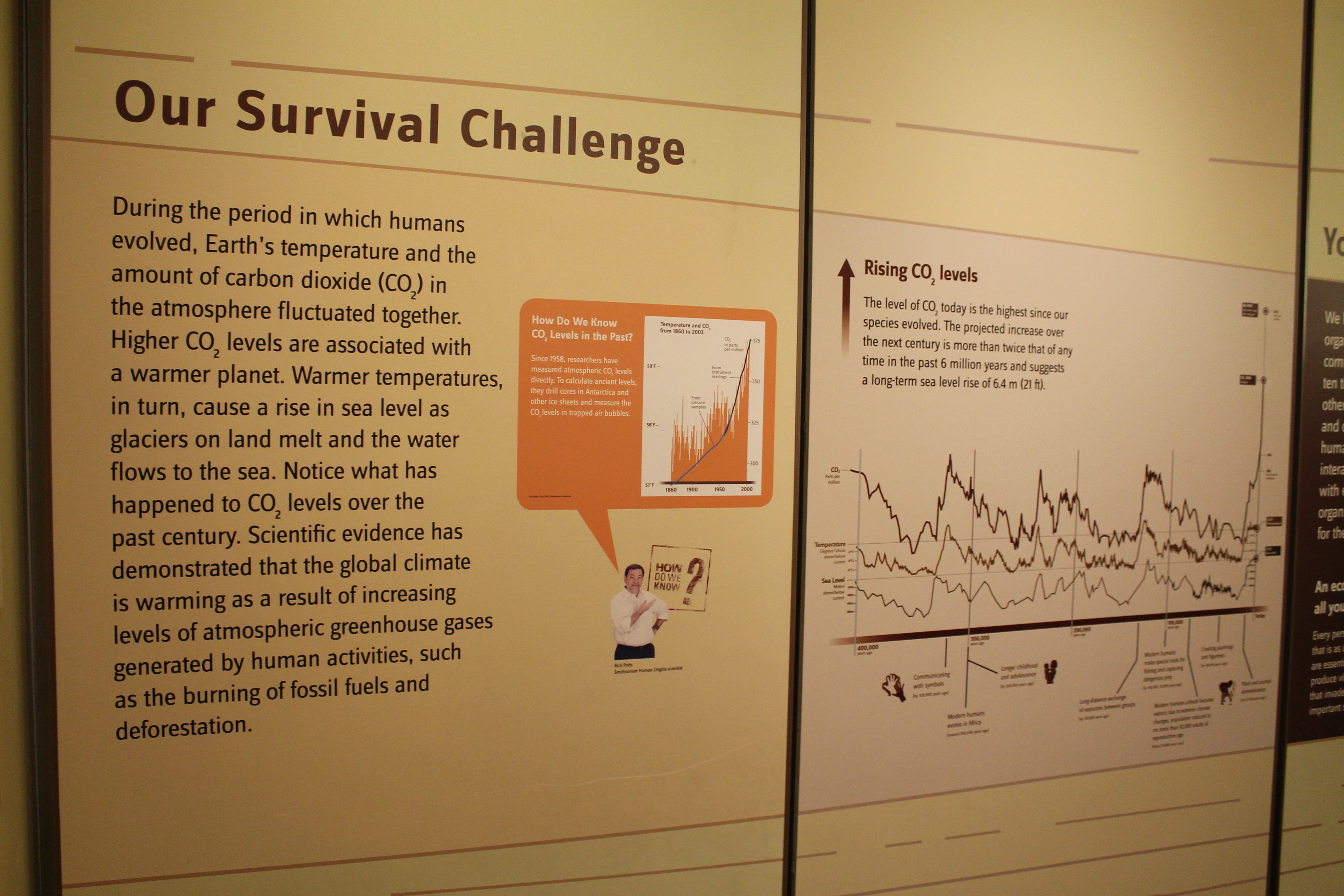
In a ThinkProgress piece published a few months after the Hall of Human Origins opened, author Joe Romm suggested that the exhibition’s creators downplayed the seriousness of anthropogenic climate change at Koch’s behest. According to Romm, the hall’s “huge flaw is that it leaves visitors with the distinct impression that human-caused global warming is no big deal.” Additional articles inThinkProgress,Hyperallergic, and Equinox made similar accusations. Each article zeroed in on a recurring theme in the exhibition’s text: that hominin evolution was driven in part by a need to adapt to a changing climate. As Ryan Little put it in Hyperallergic, the exhibition “craftily insinuates that fluctuating climates, whenever, wherever, and however they occur, are a source of astonishing human ingenuity, while also managing to suggest…that in the grand geological scheme of things, climate change is no big deal.”
There is absolutely a conversation to be had about the pros and cons of museums accepting money from problematic sources (NMNH caught heat a few years earlier when it accepted funding and specimen donations from Kenneth Behring). And there is always cause to be vigilant about corporate interests making their way into public institutions. Nevertheless, a recent re-visit to the Hall of Human Origins has convinced me that any critics suggesting that the exhibition downplays climate change—or that Koch had any influence over its content—are fundamentally misguided.
One of multiple graphic panels describing present-day climate change, why it’s happening, and how we know. Photo by the author.
There are two issues in play here. First, I think the authors are missing the bigger evolutionary picture. There is nothing new or untested about the concept of a connection between the changing Earth and the evolution of life on it (that is, interaction between the geosphere and biosphere). Examples are seemingly innumerable. Hoofed mammals evolved long legs for running and large, grazing teeth when grasslands replaced forests in the Miocene. Radiations of new species evolved when North and South America collided, allowing animals access to new habitats. Dire wolves got smaller when the climate got colder and food was harder to come by. And that’s just in the last 30 million years. Why wouldn’t human ancestors evolve in response to a changing environment, when it’s been a primary driver of evolution throughout our planet’s history?
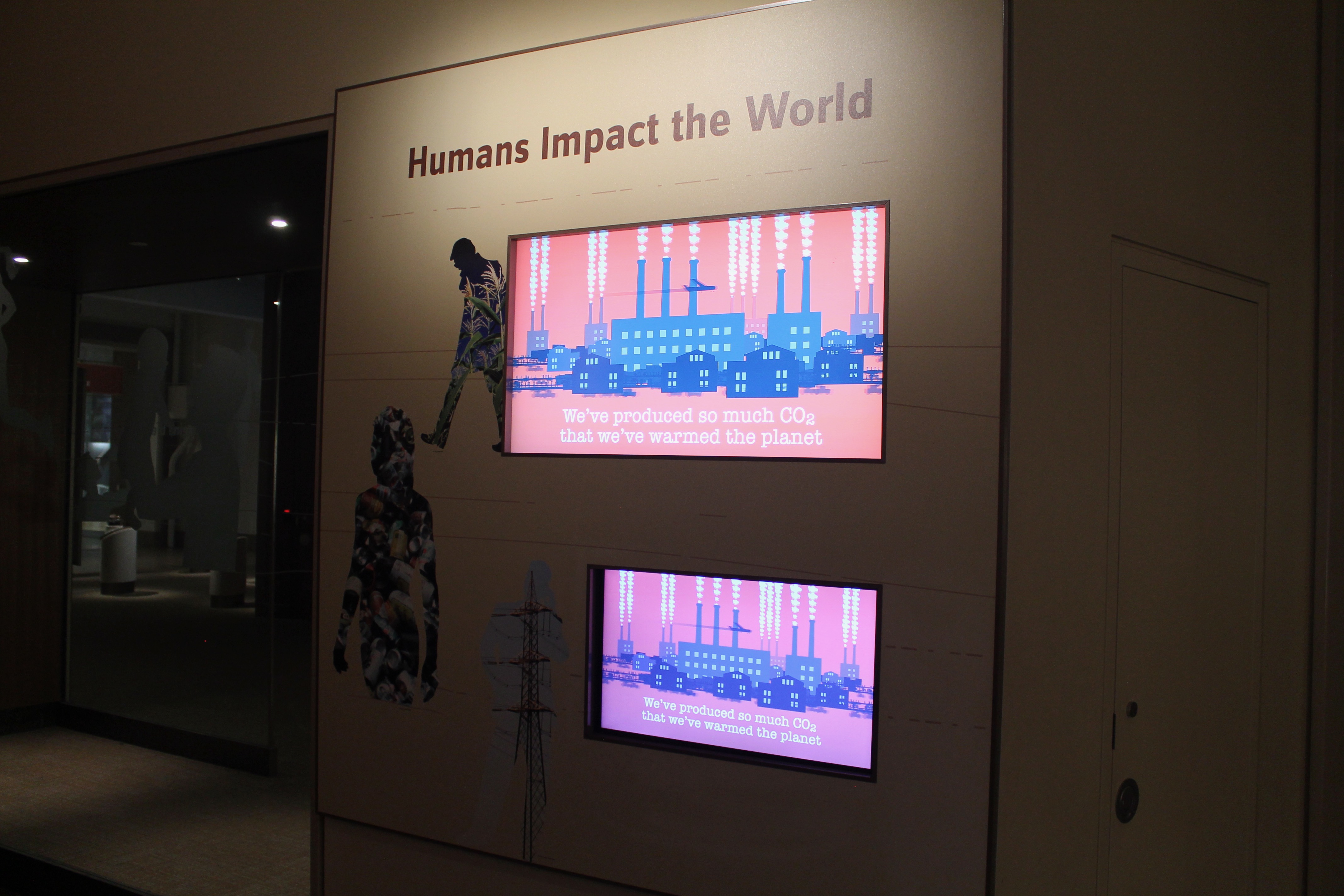
The second issue is that it’s plainly incorrect to say that the Hall of Human Origins does not address recent anthropogenic climate change, or clearly state its cause. There is an entire 1,500 square foot sub-gallery called “Humans Change the World,” which investigates how garbage, livestock, habitat destruction, and yes, carbon dioxide emissions are damaging the planet. The famous hockey stick graph of global temperature, with its spike in the last century, appears at least three times, including at the exhibition’s south-facing entrance. The exhibition states, repeatedly, that “the global climate is warming as a result of increasing levels of atmospheric greenhouse gases generated by human activities.”
A media piece with the caption, “We’ve produced so much CO2 that we’ve warmed the planet.” Photo by the author.
It would be difficult for a visitor to explore the Hall of Human Origins and miss the references to anthropogenic climate change. It would be even more difficult to conclude that the exhibition is somehow putting a positive spin on it—the images of belching smokestacks and piles of garbage are not subtle. And yet, that is exactly what multiple authors have alleged, as recently as 2019. This is fascinating to me, because it speaks to the power of the narratives visitors bring with them to any museum experience.
In the previous post, I mentioned an evaluation of the Hall of Human Biology and Evolution at AMNH, which found that visitors were imposing teleologic narratives onto the exhibition, in spite of deliberate efforts to counteract this. Visitors expected evolution to be a linear, progressive process, and they unwittingly interpreted what they’re seeing in a way that matched those expectations. Perhaps a similar phenomenon is occurring in the Hall of Human Origins. Many of us are used to seeing Koch’s name associated with aggressive lobbying against climate change mitigation. In that context, the narrative that an exhibition bearing his name would have a similar message is compelling, even sensible. But it isn’t borne out by the actual content on display.
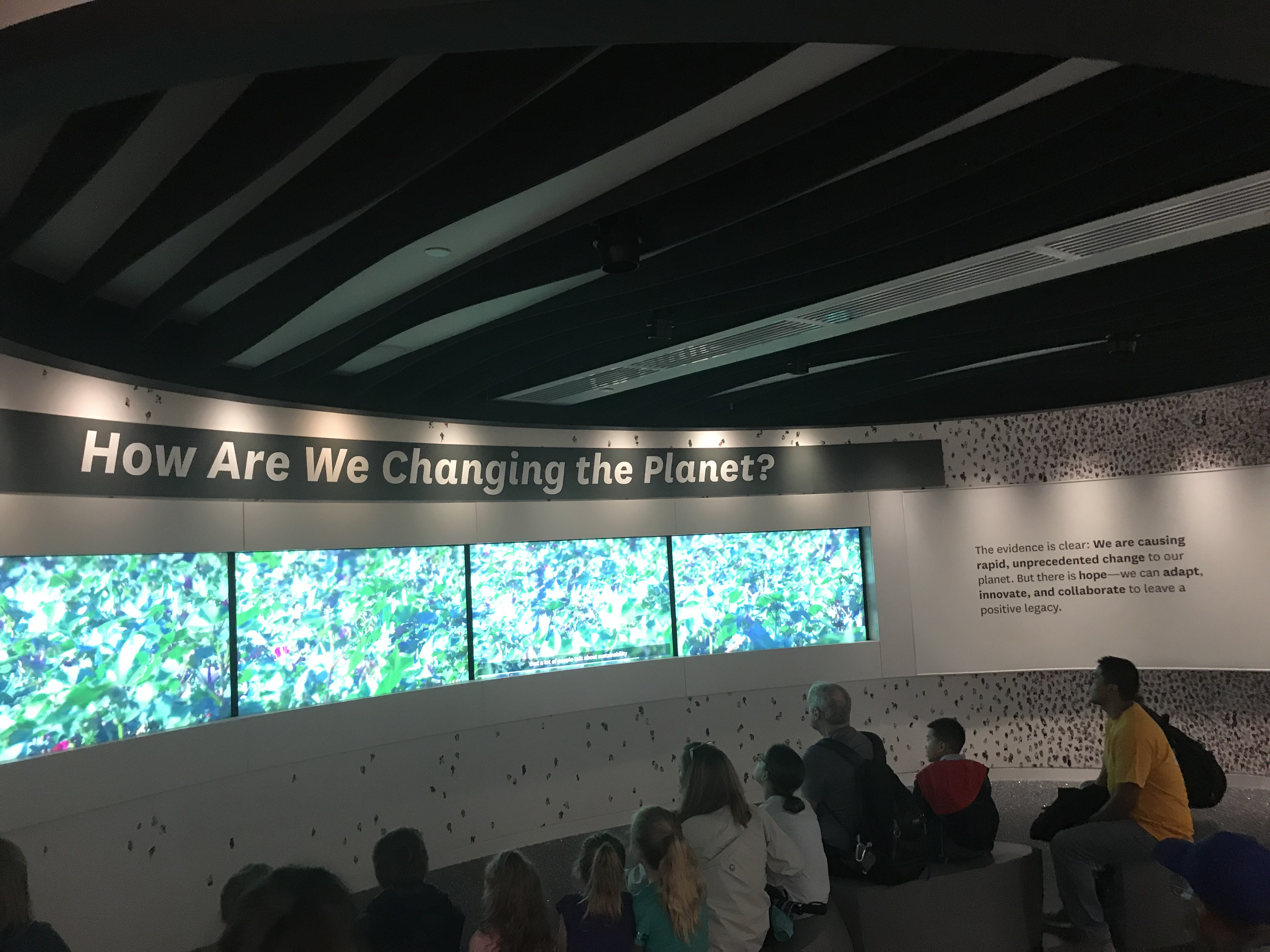
At the heart of the Deep Time exhibition, a theater demonstrates how humans are causing unprecedented change to the planet, while also highlighting potential solutions. Photo by the author.
Again, it’s reasonable to be wary of corporate interests making their way into public institutions. Perhaps museums that accept funding from questionable sources have a responsibility to go above and beyond in assuring their audiences that those funding sources are not influencing exhibition content (or anything else they produce).
To their credit, this seems to be something NMNH has taken very seriously. As discussed, the Hall of Human Origins devotes considerable floorspace to the message that climate change is an unavoidable part of humanity’s legacy. And in 2019, the museum went even further. The massive paleontology exhibition known as Deep Time was also funded in part by the Koch Foundation, and bears David Koch’s name. Here, a central overlook (visible from everywhere in the hall) is devoted to the message that human industrial activity is warming the climate, and that this change comes with dire consequences. Even more so than in the Hall of Human Origins, this statement is presented in clear, matter-of-fact language. The centrality of this location and its proximity to the dinosaurs makes the climate narrative unmissable.
As the third most-visited museum in the world (behind the Louvre and Musée d’Orsay), NMNH is uniquely situated to reach audiences that may never have seen the evidence for climate change presented in a clear, non-political context. They have clearly risen to the occasion, and I just think they deserve some credit for it.
Scott, M. and Giusti, E. 2013. Designing Human Evolution Exhibitions: Insights from Exhibitions and Audiences. Museums and Social Issues 1:1:49–68
Sideris, L. 2019. The Last Biped Standing? Climate Change and Evolutionary Exceptionalism at the Smithsonian Hall of Human Origins. Equinox Publishing.
A bronze Homo heidelbergensis figure crouches over a hearth, offering visitors a piece of meat. Photo by the author.
I don’t know how well you remember the twenty-aughts, but it was a high point for conflict over teaching evolution in the United States. Thanks to lobbying by the Discovery Institute and others, denial of evolution had become an ideological litmus test for conservatives. Organized strategies to impose religious fundamentalism on public school classrooms cropped up nationwide, and these efforts were taken to court on multiple occasions. It was in the midst of all this that the National Museum of Natural History (NMNH) developed and opened its Hall of Human Origins—in sight of Capitol Hill, no less.
In this politically charged climate, one might imagine an exhibition about human evolution would need to be highly didactic, or even combative. But rather than taking an antagonistic stance, the Hall of Human Origins leads with a question: what does it mean to be human? The exhibition presents fossil evidence for how the human species came to be, but also invites visitors to make connections with their own lives and experiences. Fourteen years out from the hall’s March 17, 2010 opening, it’s instructive to look back at the exhibition’s development. How did this visitor-centric interpretive approach come to be, and how has the museum’s audience responded to the exhibition? And in hindsight, would the exhibition’s creators do anything differently?
Origins
More than 50 million visitors have passed through the Hall of Human Origins, but lead curator Rick Potts jokes that about a million of those visits should probably be attributed to him. Indeed, the exhibition and its unique interpretive approach have been on his mind for decades. He first formulated the question “what does it mean to be human?” when teaching anthropology courses at Yale in the early 1980s. The question always inspired a great discussion, and Potts thought it might make an interesting basis for an exhibit about human evolution.
Potts pitched his idea for a human evolution exhibition immediately upon taking a position at NMNH in 1985. Smithsonian secretary Robert Adams liked the concept, but progress on the exhibition stalled within a few years. It was difficult to get any major exhibition off the ground at NMNH during the 80s and 90s because of the lack of consistent leadership. With eleven permanent and acting directors between 1981 and 2003, there was no way to build up momentum for big, multi-year projects. Eventually, Cristián Samper settled into a comparatively lengthy directorship (2003–2012), and greenlit the human evolution exhibition under the working title, What Does it Mean to be Human?
An L-shaped, 15,000 square foot space (which previously contained parts of the North American Mammals and Native American Cultures exhibitions) was designated the future home of the Hall of Human Origins. The core project team began meeting regularly in 2007. Kathleen Gordon was the exhibition developer and Junko Chinen was project manager. Briana Pobiner, Jennifer Clark, and Matt Tocheri joined Potts as in-house scientific advisors. As with most permanent exhibitions at NMNH over the past 25 years, content was developed internally while the 3-D and graphic design was produced in collaboration with the Toronto-based design firm Reich + Petch.
One of the team’s first tasks was to articulate what an exhibition based around a question would actually be about. The objective was to welcome visitors’ perspectives, but the hall itself couldn’t be a blank canvas. Exploring ways in which the exhibition could address varied perspectives led to some dead ends. One early idea was to feature a section about creation stories from around the world. But while the intention was to be inclusive and respectful of visitors coming to the exhibition from religious backgrounds, the section came across as a straw man, set up in order to be knocked down by the scientific perspective taken by the rest of the exhibition. Choosing which creation stories to include was also a problem, as was the use of terms like “story” and “myth” in the first place.
Instead, the team decided to fill out the exhibition with potential answers to a variation on the central question: What makes us human? Walking upright. Making tools. Living in social groups. Communicating with symbols. Creative expression. These are all valid answers. And crucially, they are potentially meaningful to everyone, regardless of whether the visitor is approaching the question from a more scientific perspective, or a more spiritual one. The exhibition presents the evidence for how and when each of these traits evolved, but leaves it up to the visitor to decide which they feel is most important to their humanity. By encouraging each visitor to take part in the process of making meaning, the exhibition implicitly rejects the prevailing perspective that there are only two ways to view the origins of humanity, and that those perspectives are mutually exclusive.
Organizing the exhibition around “things that make us human” also helped the team discourage the misconception that evolution is progressive or teleological. Visitors are often predisposed to think of evolution like a ladder, where each stage is a more advanced, improved form of what came before. An evaluation of the Hall of Human Biology and Evolution at the American Museum of Natural History found that many visitors viewing the dioramas saw a progression from the small, dark-skinned Homo erectus to the tall, white Neanderthals. The exhibition’s designers had specifically tried to avoid this by arranging the dioramas cyclically, and by including labels explaining that evolution does not have a preordained direction or goal—populations merely adapt to maximize their success in the present environment. Nevertheless, preconceived ideas are powerful, and even these mitigative efforts were apparently not enough. In contrast, the NMNH Hall of Human Origins is not strictly chronological, nor does it focus on one hominin species at a time. This reduces the temptation to plot each display onto a directional axis. It also helps that the hall runs in two directions, and can be entered from either end.
Design
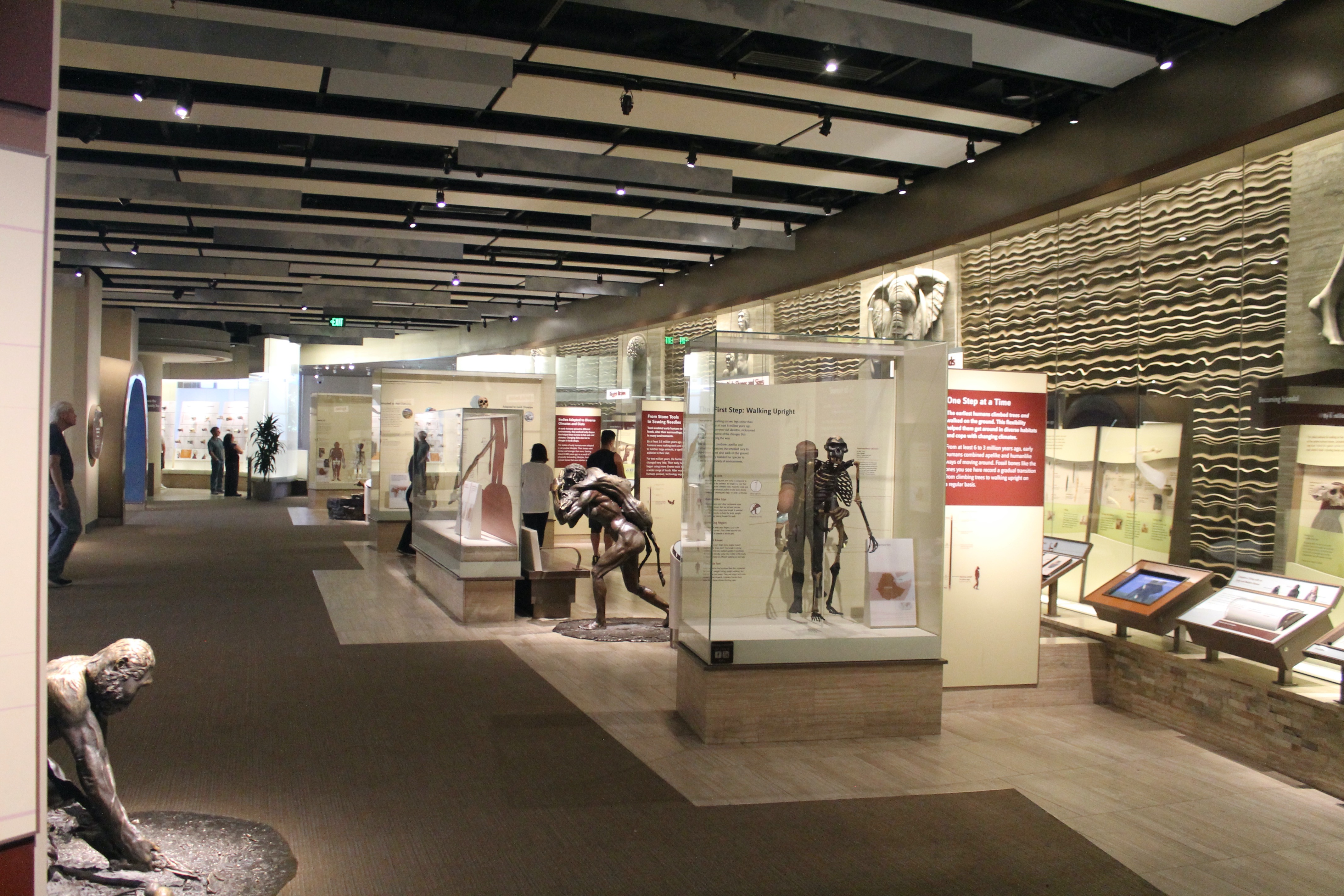
Overview of Hall of Human Origins. Photo by the author.
The design of the Hall of Human Origins feels respectful, even reverent. A palette of tans, browns, and other earth tones keep the space from looking garish, and evokes the importance of exploring the deep ancestry of our species. A core design element is a wall of densely-packed horizontal layers, a refrence to the stratigraphic context in which fossils are found. The wall is punctuated by larger-than-life relief sculptures, each one related to one of the key attributes of humanity covered by the exhibition. For example, a hominin with a spear facing an elephant represents how tool use opened up new food sources.
For Briana Pobiner, it was particularly important that the hall’s design put a human face on science. Many people think of science as something cold and distant, but warm up to it when they get to know the individuals behind it. To that end, the exhibition includes three “snapshots in time”—interactive media installations where a scientist on screen (one of which is Pobiner herself) guides visitors through a particular archaeological puzzle. The hall also includes 24 “how do we know” graphics. Each one includes a photo of a scientist in some way affiliated with the Human Origins Program and who contributed to the exhibition content, with a first-person account of how scientists interpret evidence and reach a conclusion. Pobiner says that teachers are particularly fond of these, and sometimes ask students on field trips to find all of them.
One ring to rule them all. Photo by the author.
The Hall of Human Origins includes nearly 300 objects. Most are casts, as hominin fossils are typically held in their countries of origin. There are a couple dozen originals, however, including archaeological artifacts and a Neanderthal skeleton from Shanidar Cave, in Iraq. This individual was one of several excavated in the 1950s during a collaborative project between the Smithsonian and the Iraqi Director General of Antiquities. The Iraqi government permitted this single skeleton to be held at NMNH, and it remains the only Neanderthal in the western hemisphere. Among the replicas on display is a partial skeleton of Homo floresiensis. Often called “the Hobbit” by its discoverers, this species was brand new to science when the exhibition was under development. Pobiner clued me in to an easter egg I had missed for fourteen years: the Hobbit has a gold ring on its finger.
Reconstructions
Bronze figures of a Neanderthal woman and child. Photo by the author.
Many natural history exhibits have the advantage of large, iconic objects that grab visitor attention, like sauropods, elephants, or whales. But hominin fossils are small, often fragmentary, and difficult to interpret. They wouldn’t be able to carry an exhibition for non-specialists on their own. In order to visualize the lives of past hominins, the team turned to paleoartist John Gurche.
The Hall of Human Origins was not Gurche’s first project with the Smithsonian. Between 1980 and 1985, he painted the iconic Tower of Time for the (now retired) Fossils: History of Life exhibition, as well as a backdrop for a lungfish diorama and a series of fossil horse reconstructions. This also wasn’t his first foray into reconstructing extinct hominins. Among many other projects, Gurche was briefly attached to Potts’s first attempt to get a human evolution exhibition off the ground, and he produced a life-sized model of Lucy the Australopithecus afarensis for the Denver Museum of Nature and Science in 1996.
For the Hall of Human Origins, Gurche created a new Lucy diorama, eight full-color busts, and five bronze figures with landforms. The busts are astonishingly life-like. Each one was sculpted in clay over a replica skull—first the muscle, then the skin. These sculptures were molded in fiberglass and cast in a silicone mix that could be tinted with different skin tones. The eyeballs are acrylic, and required a painstaking 30-step process to create. Finally, the hairs (hundreds of thousands per bust) were punched in one at a time. “If people react to your sculptures by feeling a little creeped out because they sense a living presence there,” Gurche wrote, “you know you’ve done well.”
A promotional image of Gurche’s eight hominin busts. From humanorigins.si.edu.
Gurche began the bronzes in a similar way, sculpting their anatomy layer by layer over a posed cast skeleton. Choosing the behavior to depict for each species was a major point of discussion for the exhibition team. Each figure needed to capture the essence of that species, while also representing a recognizable aspect of the human experience. It was decided early that Paranthropus boisei and Homo erectus should be subtly interacting, since they coexisted in Tanzania and Kenya. In the final exhibition, the Homo erectus is looking warily at Paranthropus as she carries a dead gazelle back to her family. Homo floresiensis is shown being knocked over by an unseen predator, highlighting the species’ vulnerability. And the Neanderthal woman is showing a child how to make clothing by perforating a hide with an awl and clamping it in her teeth. No detail was too small—for example, the Neanderthal woman is squatting because many Neanderthals have ankle joint wear similar to modern populations that spend a lot of time squatting.
Response
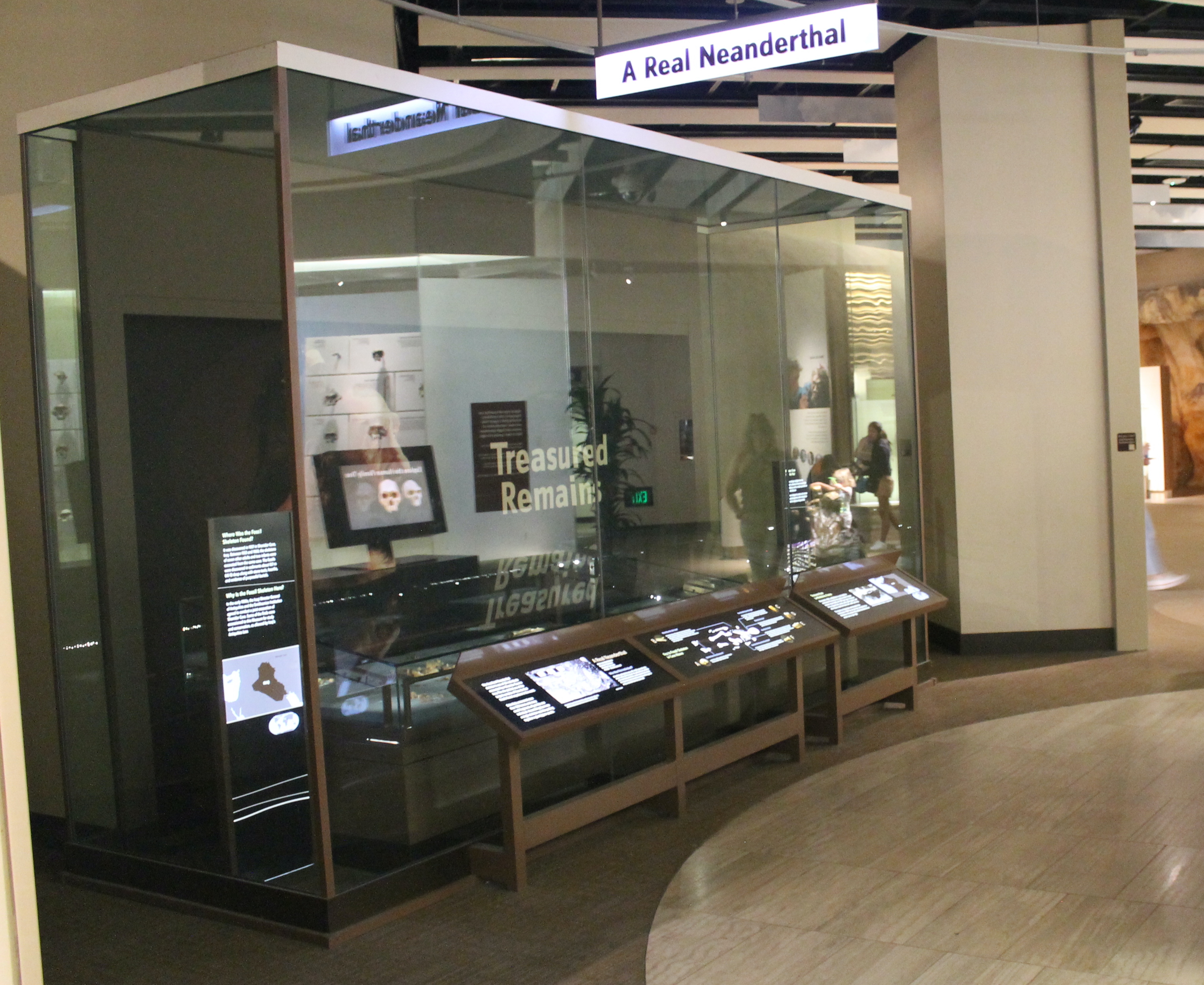
In spite of large headers proclaiming it “treasured remains” of “a real Neanderthal,” this display receives less attention than the development team would like. Photo by the author.
In the years since the Hall of Human Origins opened, the team that created it has gotten a good idea of which aspects are working, and which are not. The bronzes are extremely popular, both as photo ops and as interactive experiences. A display doesn’t need a button or a lever to be interactive—the bronzes are practically crying out to be touched. The fact that they share space with visitors—rather than being captured behind glass—forces people to confront them, size them up, and consider how they are like and unlike themselves. I’m particularly enchanted by the Homo heidelbergensis (top of the page), who appears to be calling visitors to interact by offering a piece of meat. The bronze figures are also toddler magnets. Even at a non-verbal age, children are drawn to them. Museum Educator Margery Gordon recalls there was some internal concern about nudity, but ultimately few, if any, visitors complained.
By timing and tracking visitors, NMNH staff have determined that the “Morphing Station” photo booth is the most popular element in the exhibition. This interactive media piece takes photos of visitors and overlays them onto the face of one of the eight busts, showing what each person might look like as a member of another species. This concept was actually proposed by the science team, and the Reich + Petch designers were surprised that they wanted something so frivolous. But in fact, the photo booth perfectly matched the team’s goal to center each visitor and encourage them to engage with their evolutionary past on their own terms.
Meanwhile, the real Neanderthal skeleton has proven to be the biggest challenge for capturing visitor attention. The development team placed it in the center of the exhibition, and hoped that it would be a must-see focal point. However, conservation requirements mean that the Neanderthal case is dimly lit, and each bone is individually packed in cushioning foam. Hard to see and harder to interpret, the disarticulated skeleton continues to be overlooked by a majority of visitors. The team has re-designed the graphics and lighting around the Neanderthal multiple times in an effort to communicate that this is a rare chance to see a real skeleton.
The educational efforts undertaken with the Hall of Human Origins did not end in 2010. A Broader Social Impacts Committee, with a rotating membership of scientists, clergy, teachers, and others, was formed in 2009 and continues to meet. In-gallery and online talks about how the study of human evolution intersects with social issues are held regularly. A 1200 square foot version of the exhibition travels to libraries, community centers, and even seminaries. And Pobiner continues to work with educators to create better tools for teaching students about evolution. Persistence, it seems, is key in ensuring the exhibition’s content continues to reach new audiences.
When the Hall of Human Origins began development, about 40% of Americans agreed that humans developed over millions of years from other forms of life. This number hadn’t meaningfully changed since Gallup and other polling organizations began asking the question in the early 1980s. But in the last decade, that number has climbed to 55%. Miller and colleagues suggest that this change is related to declining religious affiliation. It’s also possible that agenda-setting right wing lobbyists have moved on to other anti-science projects, like climate change denial and rejection of vaccines. Whether this trend continues remains to be seen, but if more people are indeed open to exploring where our species came from, then there is more need than ever for experiences like the Hall of Human Origins.
Many thanks to Human Origins Education Program Specialist Briana Pobiner and Curator of Biological Anthropology Rick Potts for speaking with me as I was writing this article. Opinions and any factual errors are my own.
References
Gurche, J. 2013. Shaping Humanity: How Science, Art, and Imagination Help Us Understand Our Origins. New Haven: Yale University Press.
Miller, J.D., Scott, E.C., Huffaker, J.S. 2021. Public acceptance of evolution in the United States, 1985–2020. Public Understanding of Science 31:2.
Pobiner, B. 2016. Accepting, understanding, teaching, and learning (human) evolution: Obstacles and opportunities. American Journal of Biological Anthropology. 159:61:232–274
Potts, R. 2010. Presenting Human Evolution to the Public: The Smithsonian’s Hall of Human Origins. Anthronotes 31:1
Scott, M. and Giusti, E. 2013. Designing Human Evolution Exhibitions: Insights from Exhibitions and Audiences. Museums and Social Issues 1:1:49–68
So, I have a confession to make. In January of this year, I started working on an in-depth article about the Hall of Human Origins at the National Museum of Natural History. It was going to cover everything: John Gurche’s sculptures, the design and narrative of the gallery, the challenges of opening an exhibition about human evolution on the National Mall, and even the misguided accusations that the hall contains climate change denial. It’s a great story, and I really want to write it up. So I’m giving myself a public ultimatum: it has to be done before the end of the year.
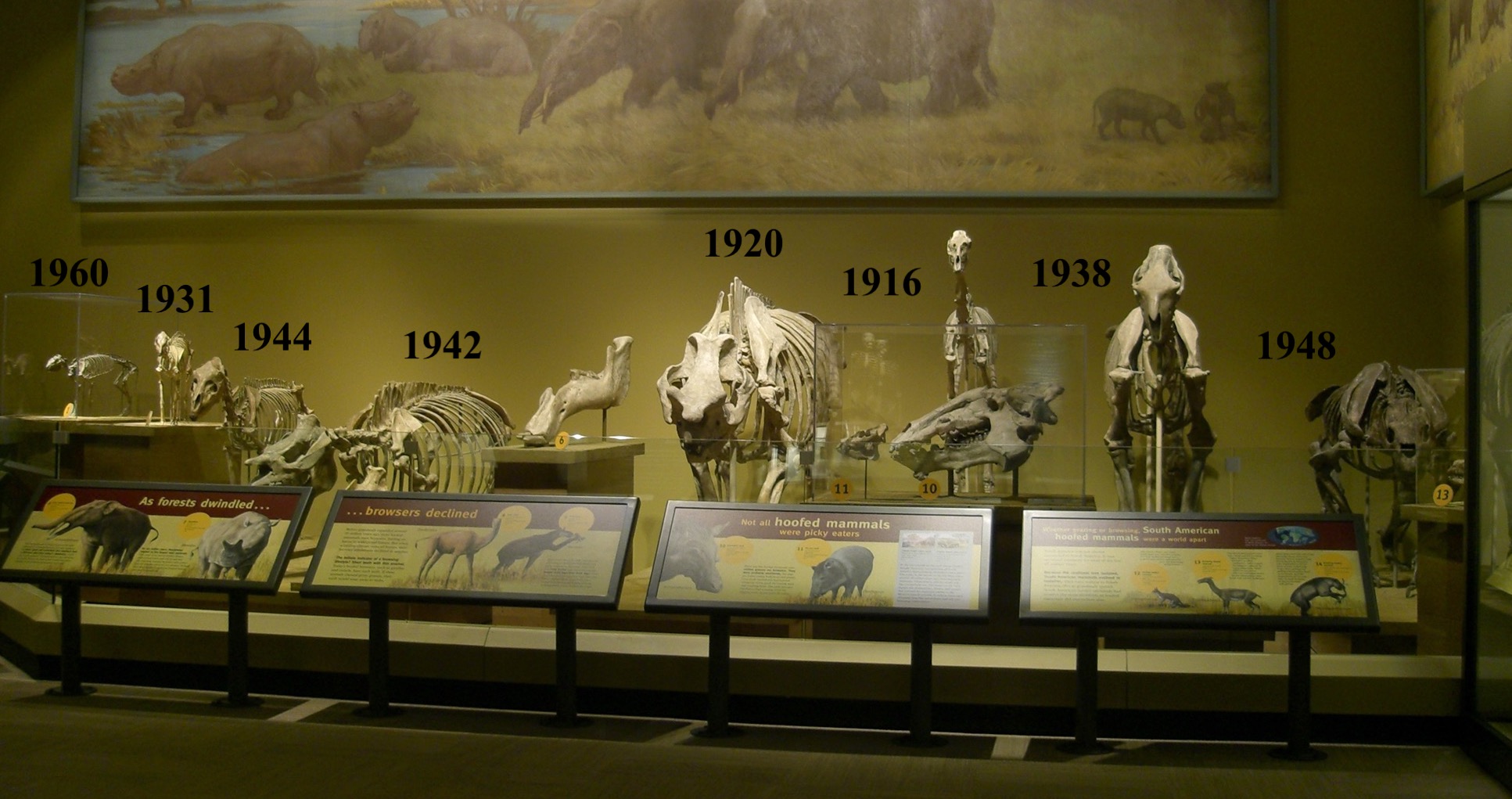
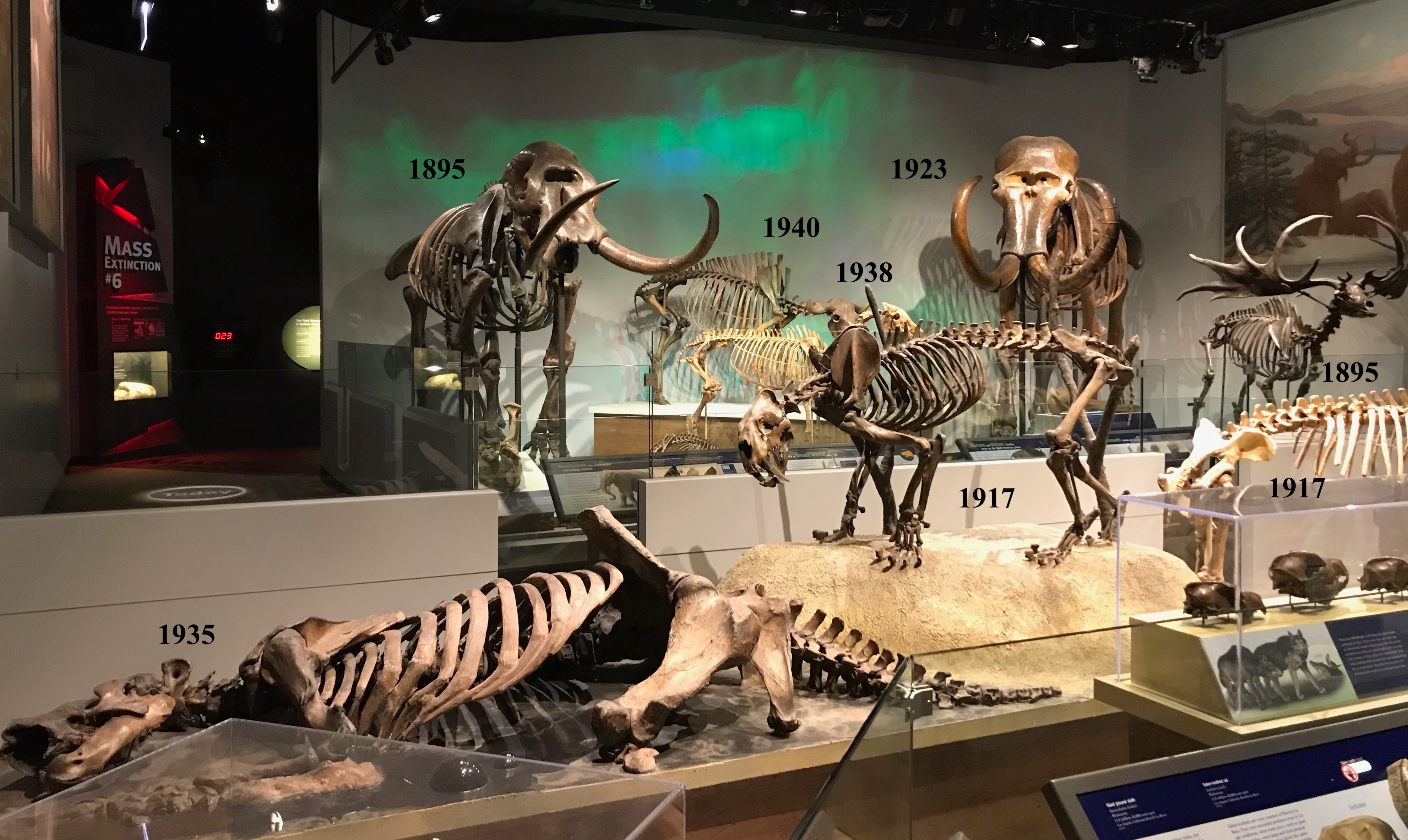
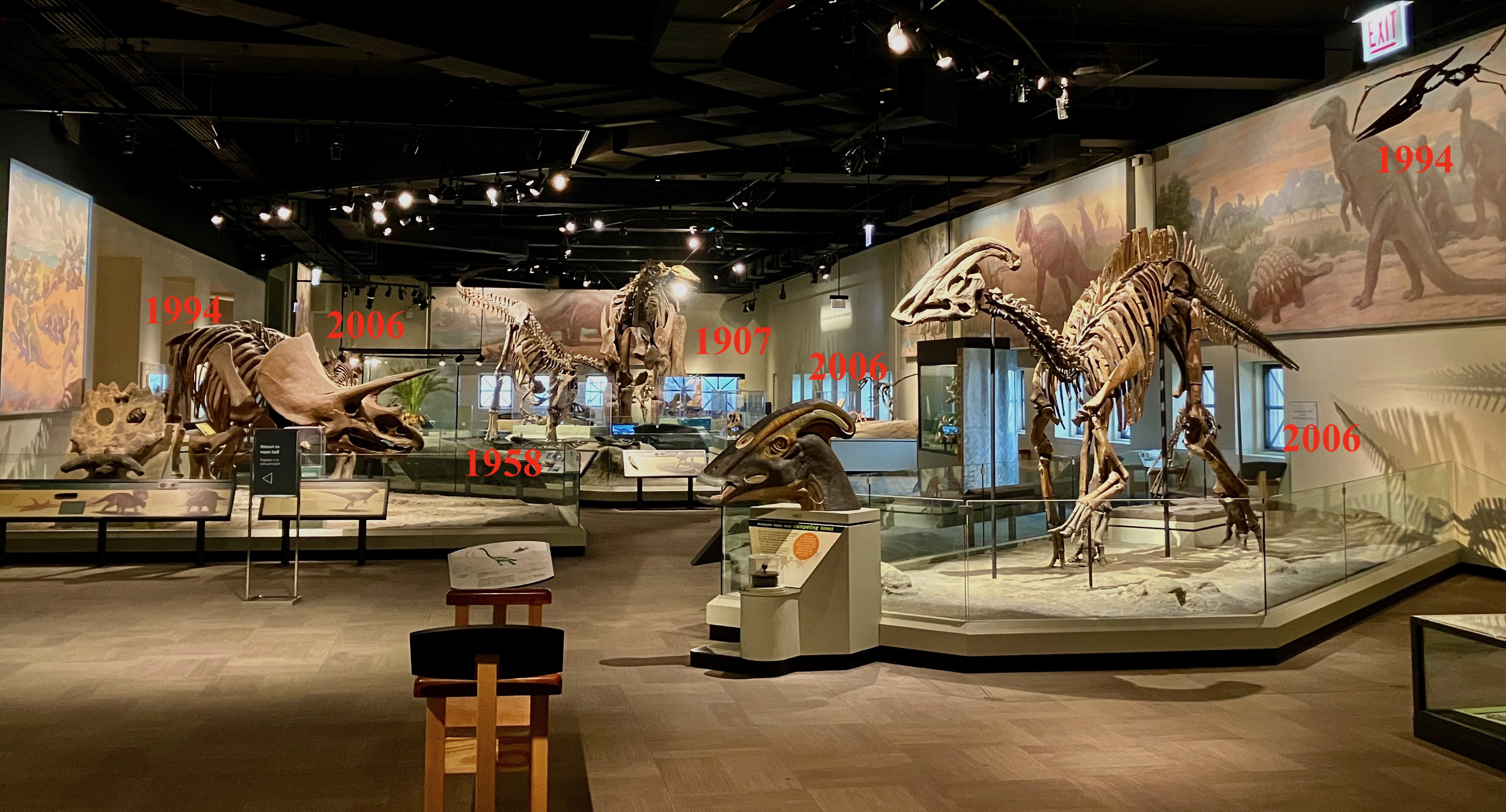
In the meantime, I’d like to share something I whipped up for social media (I’m primarily on BlueSky these days, if anyone’s looking for me). The annotated photos below show the year that each of these fossil mounts at the Field Museum first went on display. A complete list of currently-displayed mounts and their debut years is at the end of the post.
“Ungulate row” in the current Evolving Planet exhibition. Photo by John Weinstein, modified from original.
I find this interesting for a number of reasons. For one thing, it’s a reminder of the age of many museum exhibits. Multiple generations have come to see these fossils—a few of them predate the current Field Museum building by decades. But these dates are also a succinct recounting of the history of vertebrate paleontology at the Field. The oldest mounts—the mastodon and Irish elk—were leftovers from the Field Columbian Exposition, and presumably were purchased from the Ward’s Natural Science catalog.
The Ice Age menagerie in Evolving Planet. Photo by the author.
After that, a couple of dinosaurs join the fray. These were the result of Elmer Riggs’ first expeditions for the Field Museum. He was hired specifically to collect dinosaurs that could match the displays at AMNH and elsewhere, after all. Riggs’ real interest was in mammals, however, and by the 1910s we see that his department is exclusively mounting North American fossil mammals for display. In 1925, we begin to see the results of the Captain Marshall Field Expeditions (1923–1927) on display, as South American animals like Glyptodon and Aglaocetus join the exhibits.
Around 1948, the University of Chicago’s Museum of Geology closed down, and turned its collections over to the Field Museum. The University of Chicago had a particularly strong collection of Permian animals from Texas and South Africa, and there was an immediate flurry of activity to get those on display at the Field. A few of the University specimens went on exhibit as-is, but many (including Bradysaurus and Aulacephalodon) were disassembled and remounted by Orville Gilpin and others.
The dinosaur hall in Evolving Planet. Photo by the author.
After 1960, there was an extremely long period in which no new fossil mounts were added to the exhibits. The fossil halls languished without update until the end of the 20th century, with the opening of Life Over Time. Up until that point, the Field Museum had very few dinosaurs on display, but Life Over Time made dinosaurs its centerpiece. A growing popular interest in dinosaurs during the late 1980s, not to mention a certain 1993 movie, was probably the cause. Since that time, nearly all the new additions to the fossil exhibits have been dinosaurs. And with the exception of Arctodus in 2006, there have been no additions to the ranks of mounted mammal skeletons since the doldrums began in 1960.
That’s it for now, but let’s see about that Human Origins article before the end of the year!
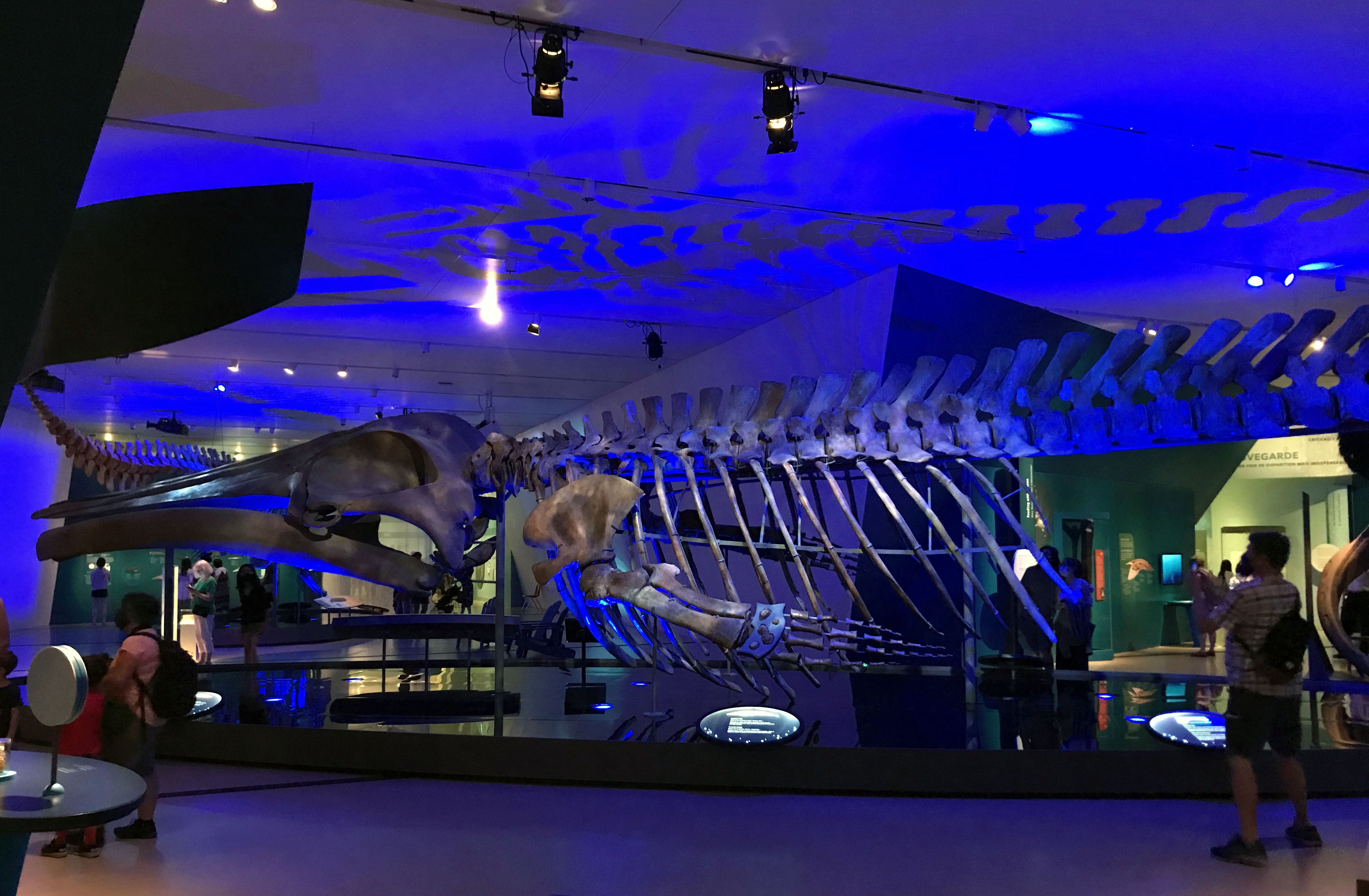
The sperm whale Alulgwet is the first of three skeletons visitors encounter.
This past weekend, I had an opportunity to visit the Royal Ontario Museum, checking another North American natural history museum off my bucket list. There’s plenty to say about the ROM, but I’d like to focus on Great Whales: Up Close and Personal, a temporary exhibition that opened this summer. Great Whales is, in a word, magnificent. It is among the very best natural history exhibits I’ve seen in recent years—no small feat given that much of its development occurred in the midst of the ongoing pandemic.
An exhibit is a story told through physical space, made up of words, objects, images, sounds, and experiences. Great Whales leverages all of these tools to not only immerse visitors in the multi-faceted world of giant whales, but also evoke feelings of awe, reverence, and humility. More than any exhibit or wildlife documentary in recent memory, Great Whales captures the humbling effect of real encounters with the natural world.
Displayed at eye level, the scale of this blue whale—80 tons in life—is particularly apparent.
The presence of three real whales is a major part of this. The colossal skeletons of a sperm whale, a blue whale, and a right whale dominate the space, but they are introduced as individuals, rather than specimens. They each have a name and a story: for example, the right whale Alasuwinu was found dead on Epekwitk/Prince Edward Island in 2017. Scientists had tracked this adult male for many years and he had survived a number of close calls with fishing nets, but he ultimately perished after being struck by a boat.
The ethereal atmosphere of the exhibition is also powerful. The whale skeletons are bathed in a blue glow, casting mesmerizing shadows on the walls and ceilings. Sounds of the ocean—including whale songs—can be heard throughout. In one corner, the whale songs are played at their true volume, which is loud and deep enough to feel in your bones. It’s hard not to imagine sailors from centuries past lying awake at night and hearing those eerie rumbles through the hulls of their ships.
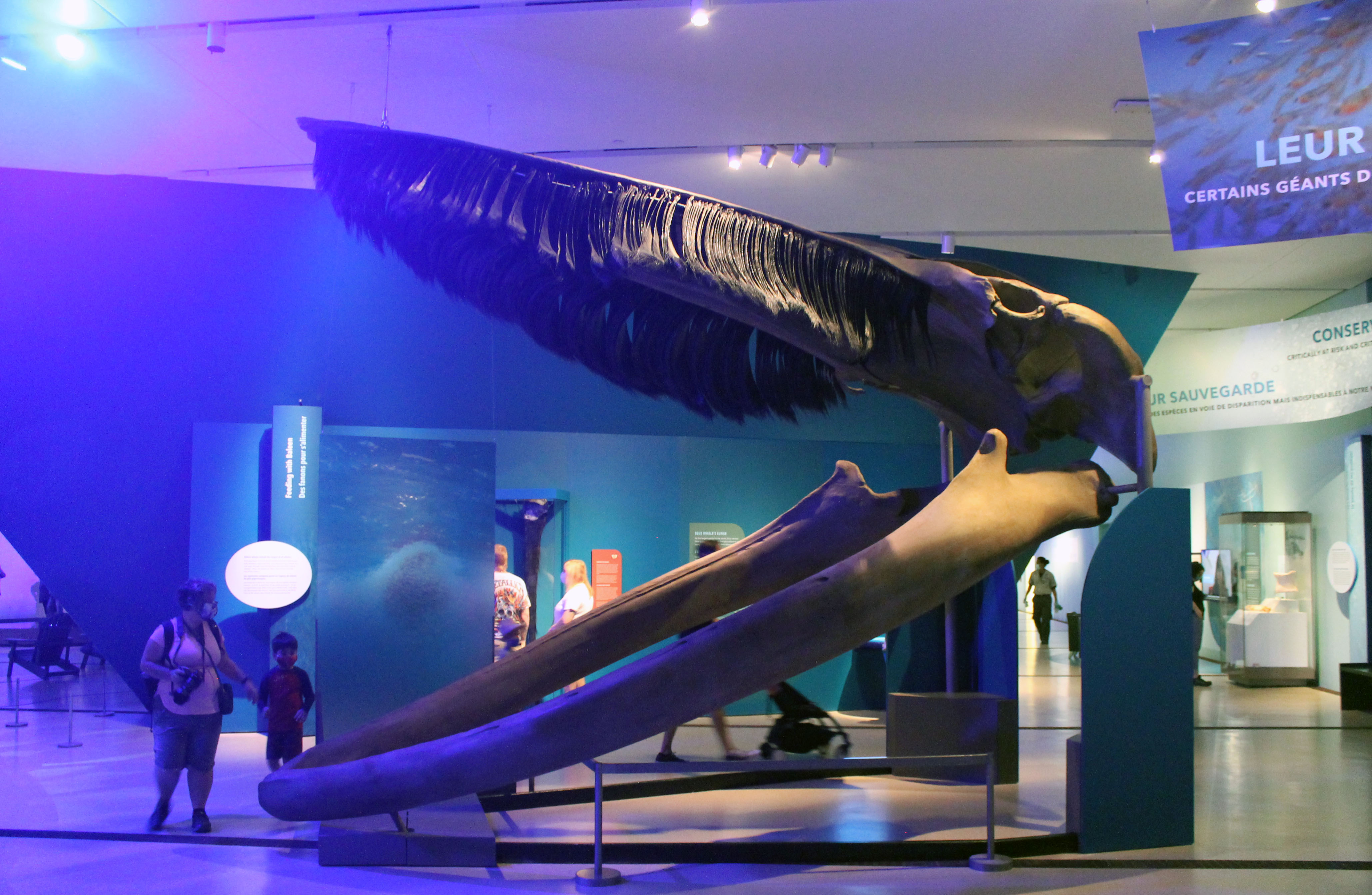
Visitors can step inside the baleen-laden jaws of this replica skull.
However, I think the exhibition’s biggest strength is that it is told through multiple voices. One of those voices is the standard, omniscient museum voice, through which we learn about the biomechanics of hearts and lungs on a massive scale, as well as the evolution of whales (which could be an exhibit all its own). We also hear from scientists, including ROM mammalogy technician Jacqueline Miller. In one video, Miller recounts the experience of breaking down the blue whale (named Blue), which was found trapped by shifting ice in 2014. She describes the overpowering stench and the overwhelming amount of gore, but also the excitement of turning a tragedy into an opportunity to learn something new and maybe help other whales in the future.
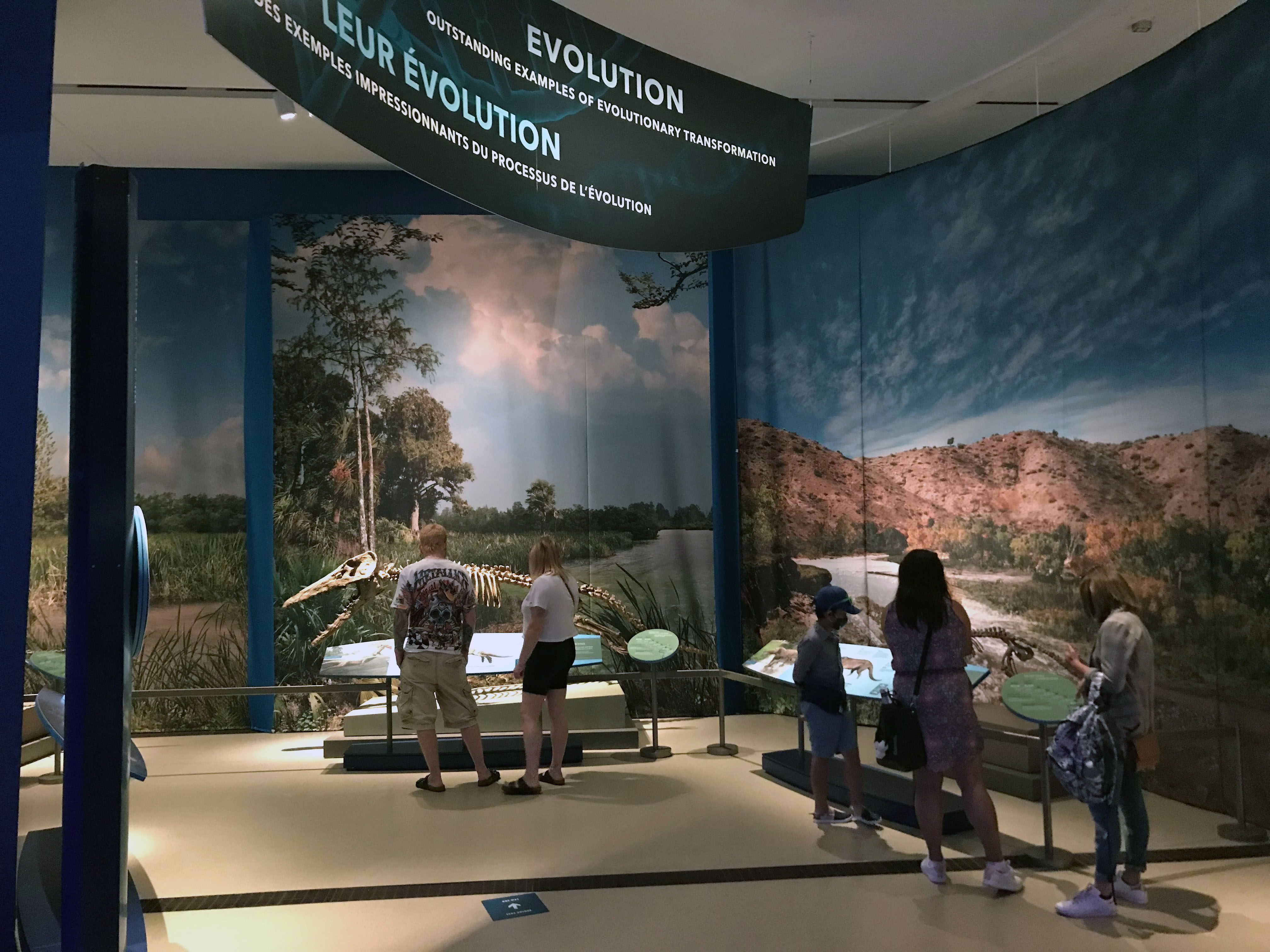
The evolution section includes skeletons of Pakicetus, Ambulocetus, Kutchicetus, and Dorudon.
Most unique to a science exhibition like this one is the recurring presence of Indigenous Elders, artists, and storytellers. Wolastoq artist and cultural educator Possesom Paul describes whales as ancient partners of humans—powerful, mysterious, but also vulnerable. In two areas of the exhibit, we hear Passamaquoddy Elder Maggie Paul singing the song All My People, which honors the whales. As a non-Native person, I felt privileged that these perspectives were being shared with me. These ways of knowing do not conflict with the scientific ones—instead, they complement one another and provide visitors with more pathways to connect with the exhibition content.
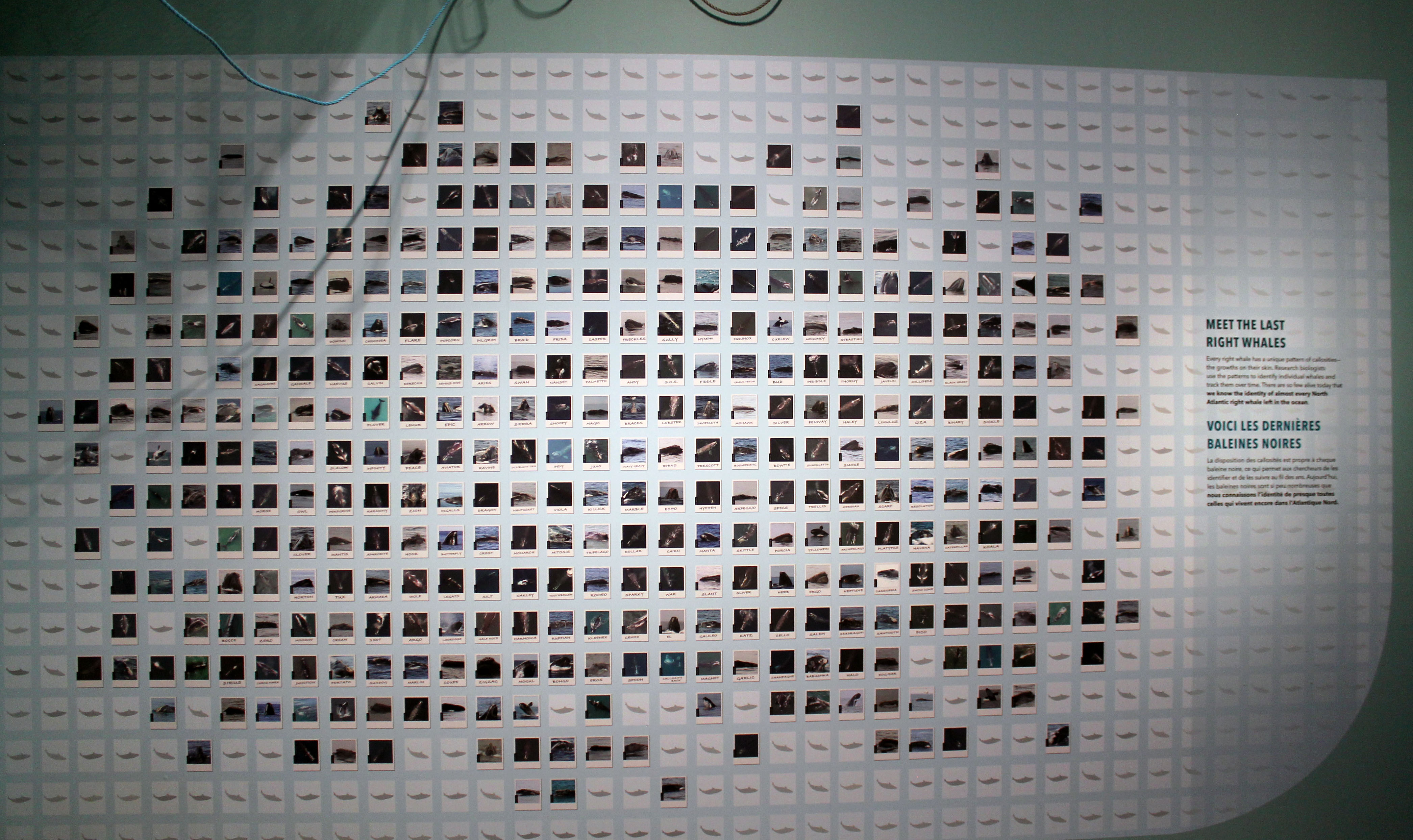
The remaining North Atlantic right whale population, visualized.
Traditional and scientific perspectives converge in the exhibit’s conservation message. Choice statistics make the plight of whales in the industrialized world particularly stark. I’ve been unable to forget one infographic informing me that 10% of the right whale population has died since 2017—equivalent to losing every person in North and South America. Another graphic illustrates how precious each individual whale is: a wall of polaroid photos introduces us to most of the 300-some right whales alive today.
Great Whales is poignant, thought-provoking, and often beautiful, representing the best of what a natural history exhibit can be. It will be on display at the ROM until March 2022. It’s unclear if it will travel after that, but I very much hope it does.
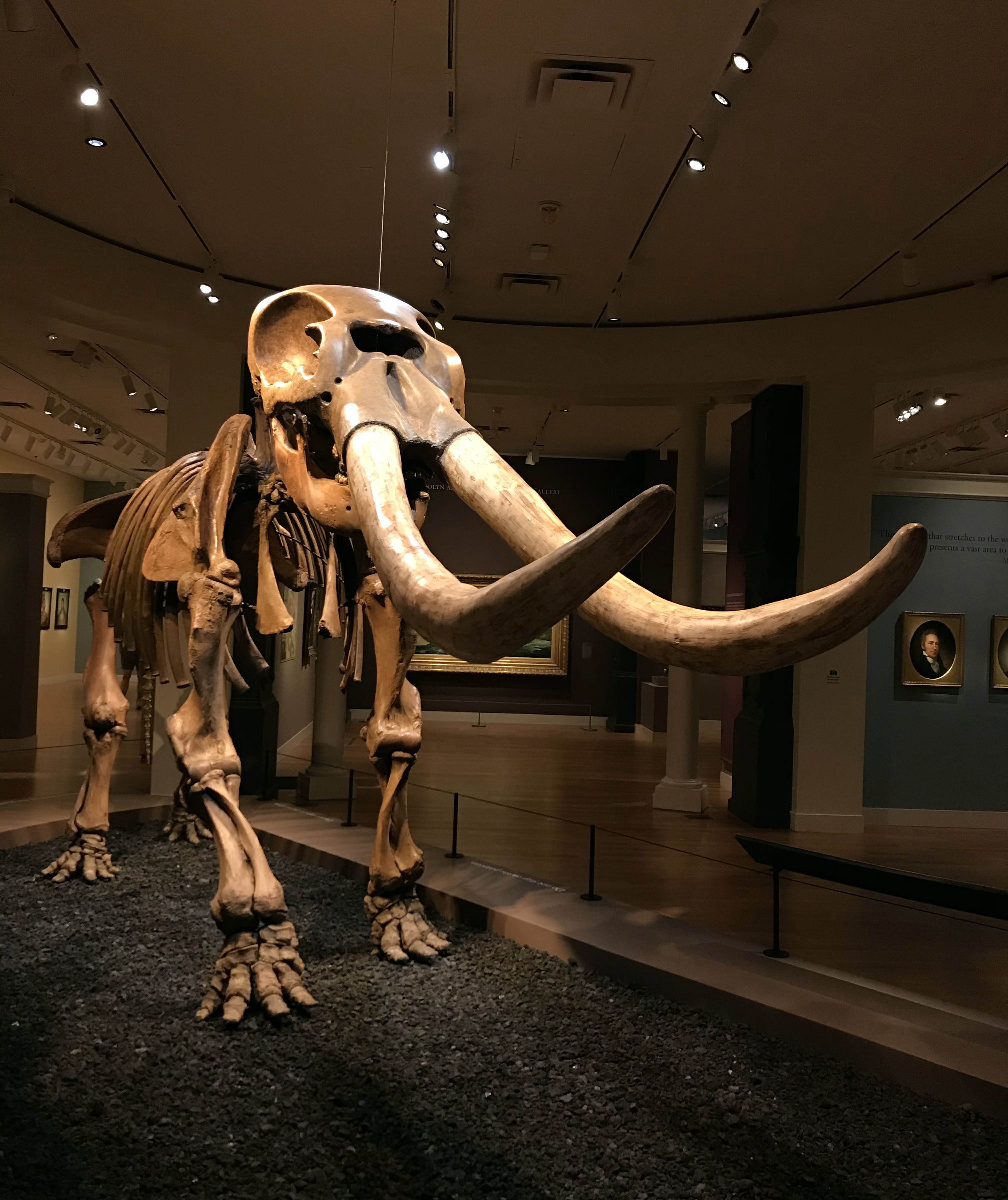
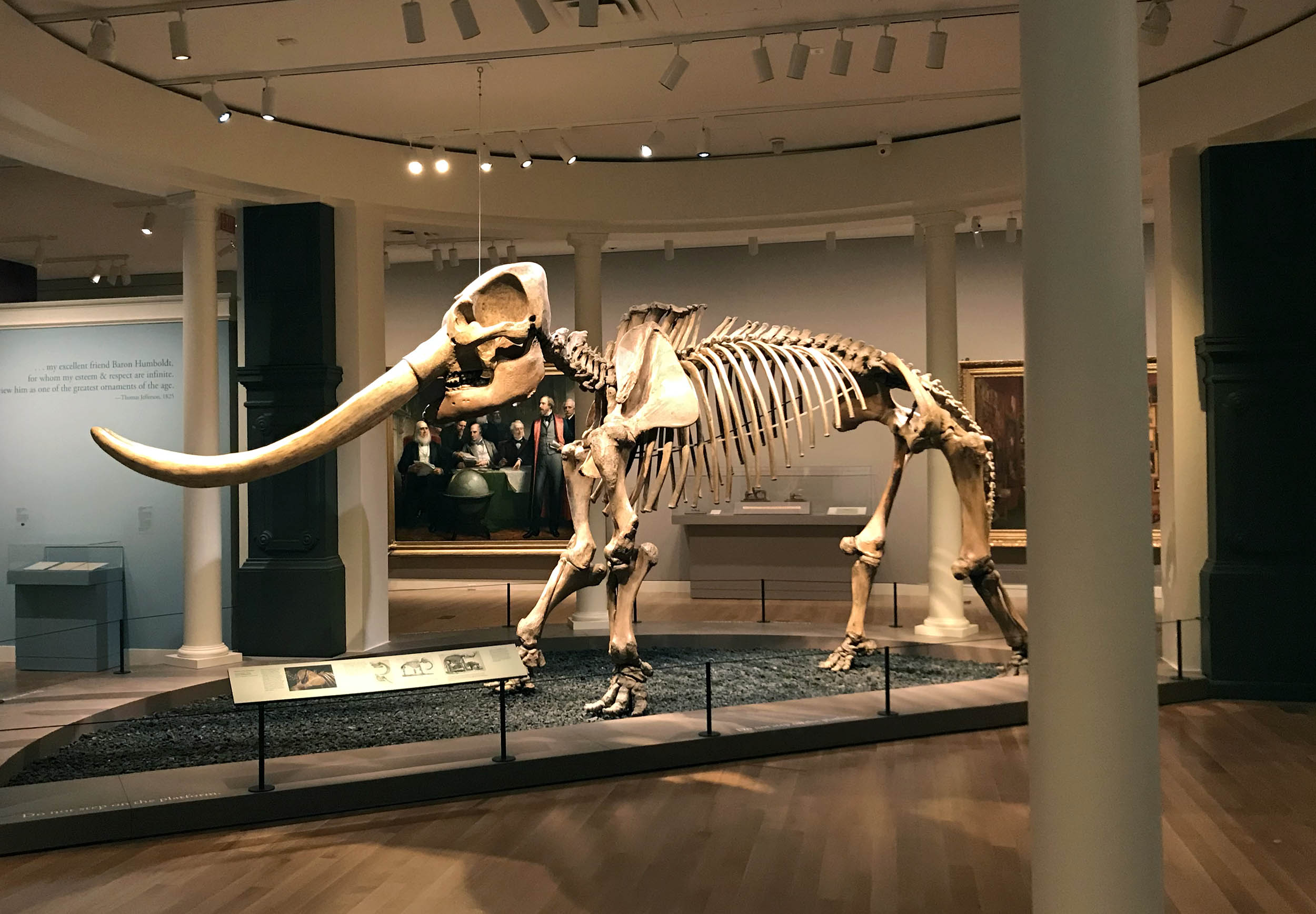
Last week, I met a very special fossil. Pictured above is Charles Wilson Peale’s mastodon, which is currently on display at the Smithsonian American Art Museum. Exhumed in 1799 near the banks of the Hudson River and unveiled to the public on Christmas Eve, 1801, this was the very first mounted skeleton of a prehistoric animal ever exhibited in the United States. Preceding Darwin’s On the Origin of Species by six decades, the mastodon entered public discourse at a time when even the idea of extinction was still hotly debated. The mastodon proved to be a source of national pride for European Americans, demonstrating that North America’s natural wonders could rival Europe’s great architecture and rich history.
After Peale’s Philadelphia museum closed in 1848, the mastodon was sold and wound up at the Hessisches Landesmuseum in Darmstadt, Germany. There it remained for over 170 years, largely forgotten in its home country, until SAAM senior curator Eleanor Harvey had the idea to include it in a new exhibition.
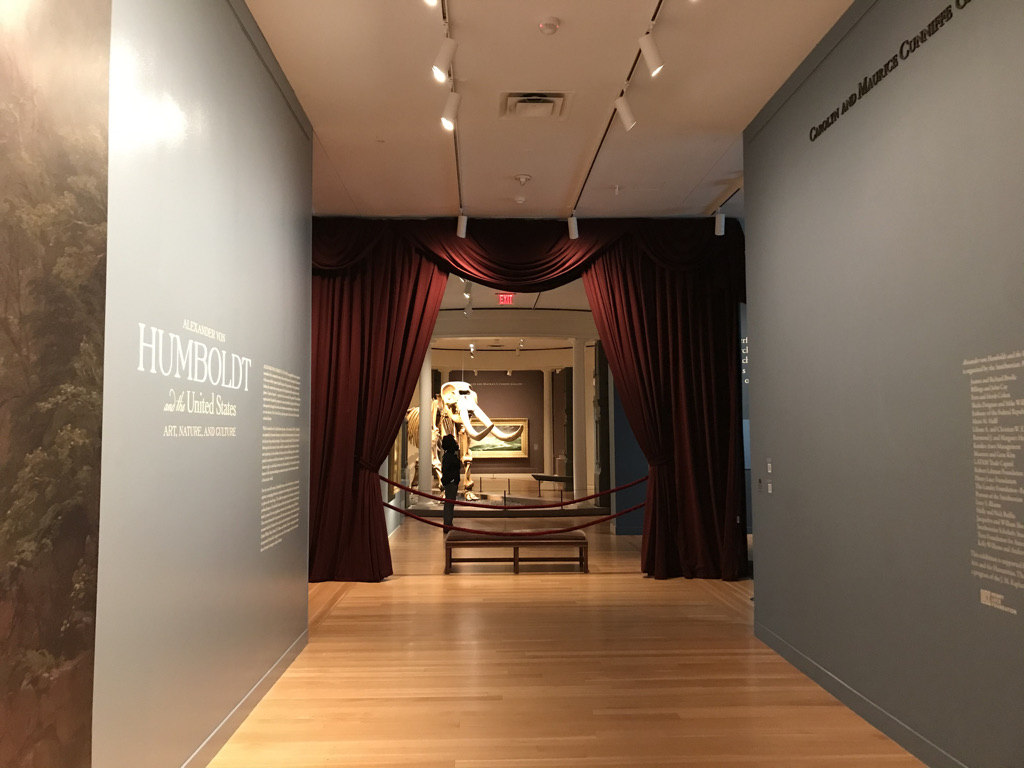
Harvey’s exhibition isn’t about fossils, or even about Peale. Her subject is Alexander von Humboldt, a 19th-century naturalist who left a profound impact on the scholars, artists, and politicians of the young United States. Alexander von Humboldt and the United States: Art, Nature, and Culture tracks the legacy of Humboldt’s brief but highly influential visit to America. During a six-week tour in 1804, Humboldt met with President Thomas Jefferson and other dignitaries, planting intellectual seeds that would shape America’s aspirational ideals for decades and centuries to come. From his vision of nature as an interconnected network to his advocacy for democracy, the abolition of slavery, and learning from Indigenous knowledge, Humboldt’s influence was wide-reaching*.
*I personally found the exhibition’s presentation of Humboldt’s influence on US policy a bit doe-eyed. While triumphs like the founding of the National Park Service and Smithsonian Institution can be traced to Humboldt’s legacy, it’s hard to argue that his social ideals had much practical effect in the 19th century.
An important stop on Humboldt’s American tour was Peale’s museum in Philadelphia. Humboldt dined with Peale’s family beneath the ribcage of the mounted mastodon, later citing the beast as a key example of America’s incredible natural heritage. For Humboldt, Peale, and Jefferson, the mastodon embodied the young nation’s great potential—if this land was home to creatures as mighty at the mastodon, then its future would have to be equally monumental.
To Harvey, the mastodon skeleton perfectly encapsulated the story she wanted to tell about Humboldt. She initially thought that shipping the mastodon from Germany for a temporary exhibition was a long shot, but her counterparts at the Landesmuseum were game. Curator Oliver Sandrock oversaw the process of preparing the mastodon for travel, which involved a deep cleaning, as well as breaking down the original 19th century armature into several pieces.
The mastodon is presented primarily as a historical object—there is no discussion of the animal’s life appearance or behavior to be found.
I spoke to Advait Jukar, a Research Associate with the National Museum of Natural History, about his involvement with the mastodon. He inspected the skeleton in early 2020, shortly after it arrived in Washington, DC. As a fossil elephant specialist, Jukar was able to determine that the mastodon was an adult male, and that about 50% of the mount was composed of real, partially mineralized bone. Fascinatingly, most of the reconstructed bones were carved from wood. This was the handiwork of Rembrandt Peale (Charles’ son), William Rush, and Moses Williams. Most of the wooden bones were carved in multiple pieces, which were locked together with nails and pegs. The craftsmanship is exquisite, and the joins are difficult to make out unless you stand quite close. The mandible is entirely wood, but the teeth are real. These teeth probably came from a different individual—one tooth on the right side didn’t fit properly and was inserted sideways!
The mastodon at SAAM differs from the original presentation at Peale’s museum in a few ways. The missing top of the skull was once modeled in papier-mâché, but this reconstruction was destroyed when the Landesmuseum was bombed during the second world war. It has since been remodeled in plaster. While the mastodon was never mounted with real tusks, the mount has traditionally sported strongly curved replica tusks, more reminiscent of a mammoth. While Rembrandt Peale published a pamphlet in 1803 suggesting that the mastodon’s tusks should be positioned downward, like a pair of predatory fangs, it’s unclear if the tusks on the skeleton were ever mounted this way. At SAAM, the mastodon correctly sports a pair of nearly straight replicated tusks, which curve gently upward.
Rembrandt Peale’s carnivorous mammoth, with downward-facing tusks. Public domain.
Overall, the work of Peale, Rush, and Williams remains remarkably intact. Although it’s now lit by electric lights instead of oil lamps, this is the same beast that Humboldt encountered 220 years ago. Harvey even included a mouse in a small case at the mastodon’s feet, just as Peale did in Philadelphia. If anything, it’s remarkable how similar the mastodon mount looks to newer displays of fossil skeletons. Its creators pioneered an art form that has not changed enormously to this day.
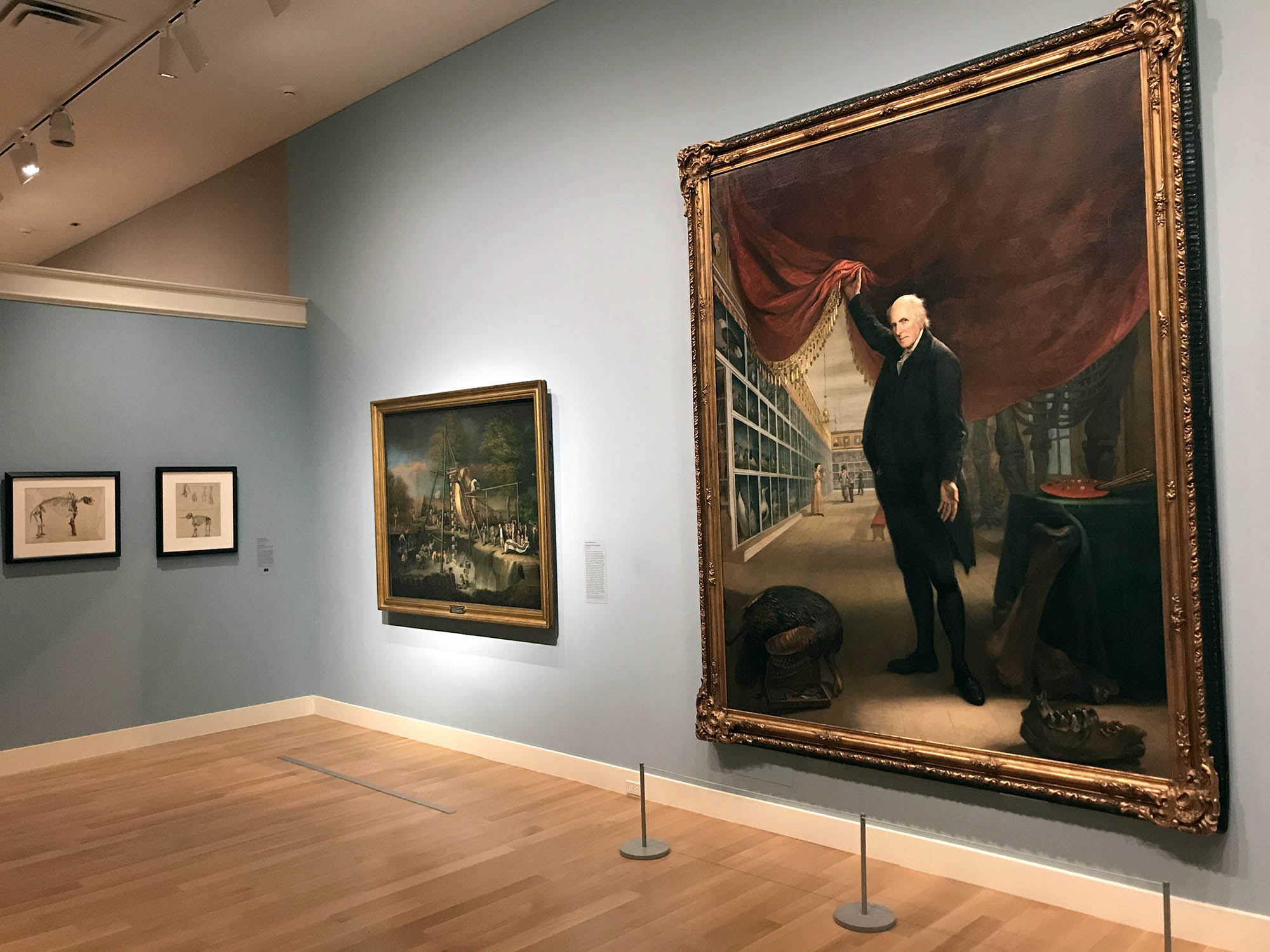
Artwork of the mastodon, its excavation, and its presentation by the Peale family.
While the mastodon is undeniably the star of the show, the exhibition also utilizes artworks from the SAAM collection, loans from other institutions, and three lengthy media presentations to tell Humboldt’s story. I was excited to see Peale’s The Artist in His Museum and Exhumation of the Mastodon reunited, and the collection of George Catlin’s portraits of Native Americans is impressive. However, I was most captivated by a media presentation exploring Frederic Church’s Heart of the Andes. While the original painting had to stay at the Metropolitan Museum of Art, the video—which can be seen online here—explores the details and historical context of the painting with visually arresting style. I’ve been critical in the past of art museums’ proclivity for opaque and unwelcoming interpretive styles, but this video is great and I hope to see more efforts like it.
Overall, I was delighted by the exhibition. Seeing a fossil in an art museum, interpreted as a cultural artifact, is extraordinary. Like Humboldt himself, the mastodon is an interception of art, nature, and culture, and I relished the opportunity to meet such an icon.
Semonin, P. 2000. American Monster: How the Nation’s First Prehistoric Creature Became a Symbol of National Identity. New York, NY: New York University Press.
Museum admission, archive visits, travel, and so forth can be expensive. If you can, please consider supporting this blog by leaving a tip. Any amount is appreciated!

















 EXTINCT MONSTERS