Category Archives: NCMNS

The Dueling Dinosaurs: famous fossils in an open lab

A partially prepared tyrannosaur skeleton in a field jacket. Photo by the author.

Earlier this month, I had the a chance to see the “Dueling Dinosaurs,” which debuted at the North Carolina Museum of Natural Science (NCMNS) in April. Consisting of virtually complete skeletons of a tyrannosaur and Triceratops preserved side-by-side, this fossil is either the find of the century, or just another example of overhyped, overstudied, and overpriced Hell Creek dinosaurs—it depends on who you ask. But NCMNS has made it more than that, placing the fossil at the center of an ambitious project to improve science literacy by removing all barriers to the process.

Commercial collector Clayton Phipps discovered the skeletons in 2006, on private ranchland in Montana. Having never worked on anything so large before, Phipps teamed up with the Black Hills Institute for the initial preparation and assessment of the fossil. The skeletons were put up for auction in 2013, resulting in what has become a familiar din of competing voices. The sellers heralded the rarity and quality of the fossil, proclaiming it to be a clear example of dinosaurs that perished while locked in combat. Paleontologists countered that a fight-to-the-death scenario was unlikely, and without scientific study, the circumstances of the dinosaurs’ demise could not be known. Furthermore, in the event that the fossil went to a private buyer, there would be no opportunity to study it. The so-called Dueling Dinosaurs were poised to become yet another example of a high-profile specimen sold into private hands, where they could never contribute to scientific and public knowledge.

As it happened, the auction was a failure, and bidding never reached the reserve price. Behind the scenes, however, the Friends of the North Carolina Museum of Natural Science—a non-profit organization that supports the state-run museum—had put forth an offer of six million dollars for the fossil. To be clear, a mid-sized public museum like NCMNS absolutely does not have $6 million on hand for specimen acquisition. The funding came from private donations solicited by the Friends organization.
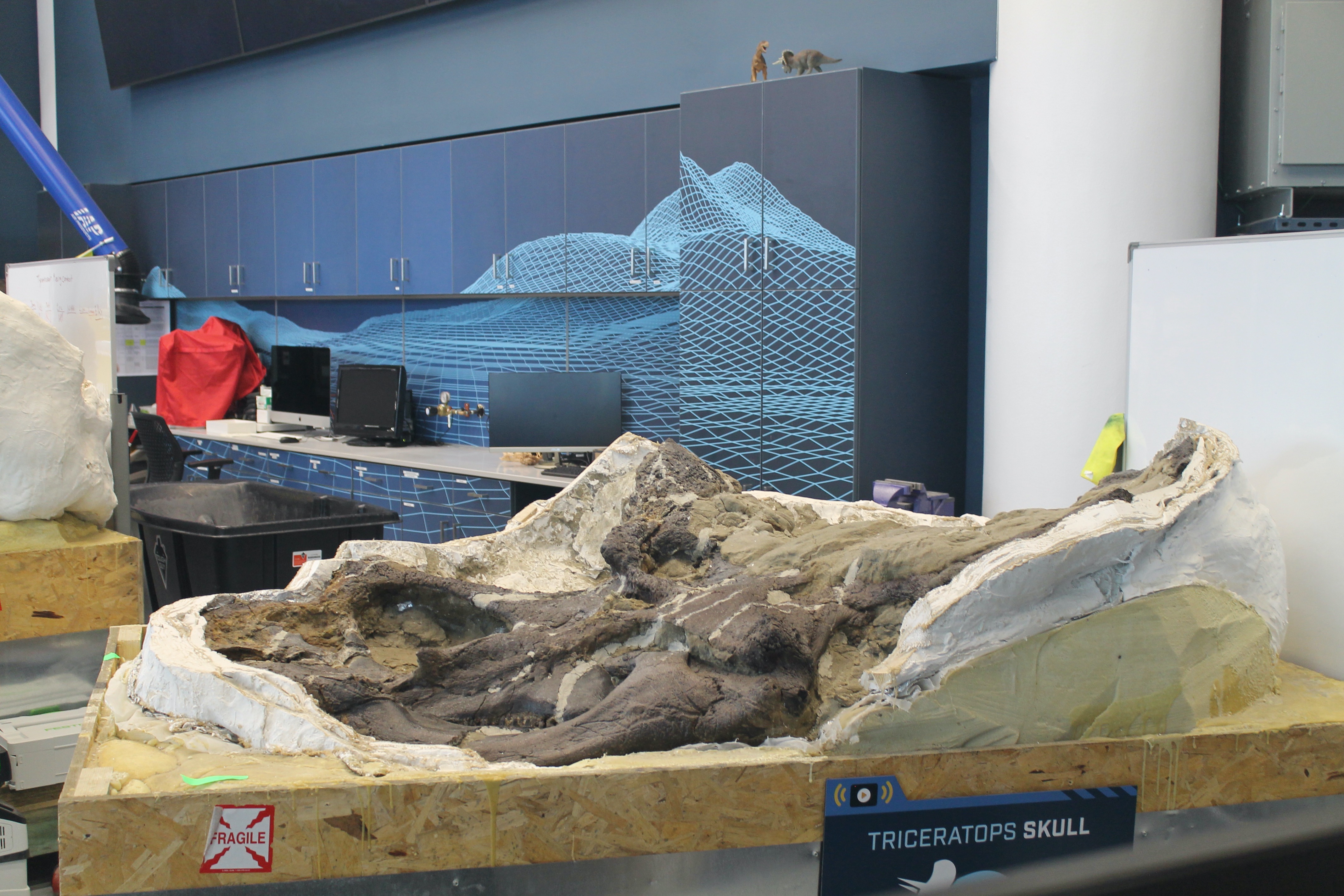
A partially prepared Triceratops skull in a field jacket. Photo by the author.

The offer was accepted, but there was another hurdle: a legal challenge over ownership of the land the fossil was found on. In Montana, surface rights (ranching, farming, etc.) and mineral rights (oil, coal, uranium, etc.) to the same parcel of land can be split among different owners. When the Dueling Dinosaurs fossil was collected, arrangements were made with surface landowners Lige and Mary Ann Murray, but other parties had partial claim to the mineral property. Those individuals—Jerry and Bo Severson—sued, arguing that fossils are minerals and should belong to them. In 2020, the Montana Supreme court ruled that for legal purposes, fossils are “land” and therefore belong to surface landowners. With the sale completed, the next stage in the Dueling Dinosaurs story could begin.
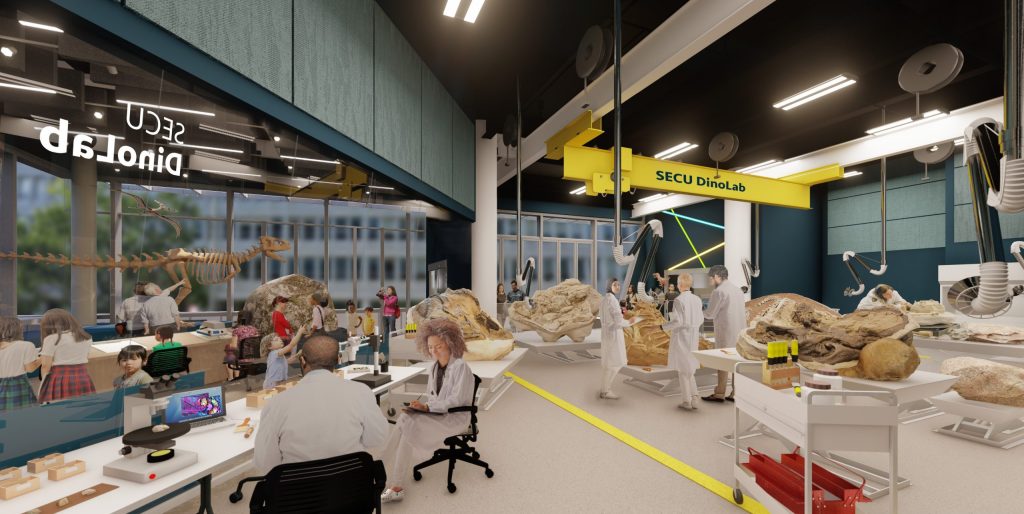
Concept render of Dueling Dinosaurs lab and exhibit by HH Architecture. Source

Having already pushed for the acquisition of the fossil, NCMNS Head of Paleontology Lindsay Zanno took charge of the project. Her vision was to create a completely open fossil preparation lab. Rather than being behind glass, the scientists working on the Dueling Dinosaurs would be available for conversation with the public whenever the museum was open. As Zanno explained in an interview, “I conceived the Dueling Dinosaurs project to take the public on a live scientific journey, to illuminate how science works, to show who scientists are and what we look like, and to increase trust in the scientific process.”

To accomplish this, NCMNS hired local firm HH Architecture. They designed the state-of-the-art lab to Zanno’s specifications within the Nature Research Center, the second wing of NCMNS that opened in 2012. The addition also includes two flanking exhibit galleries and street-facing, floor-to-ceiling windows, which allow passerby to see into the lab.
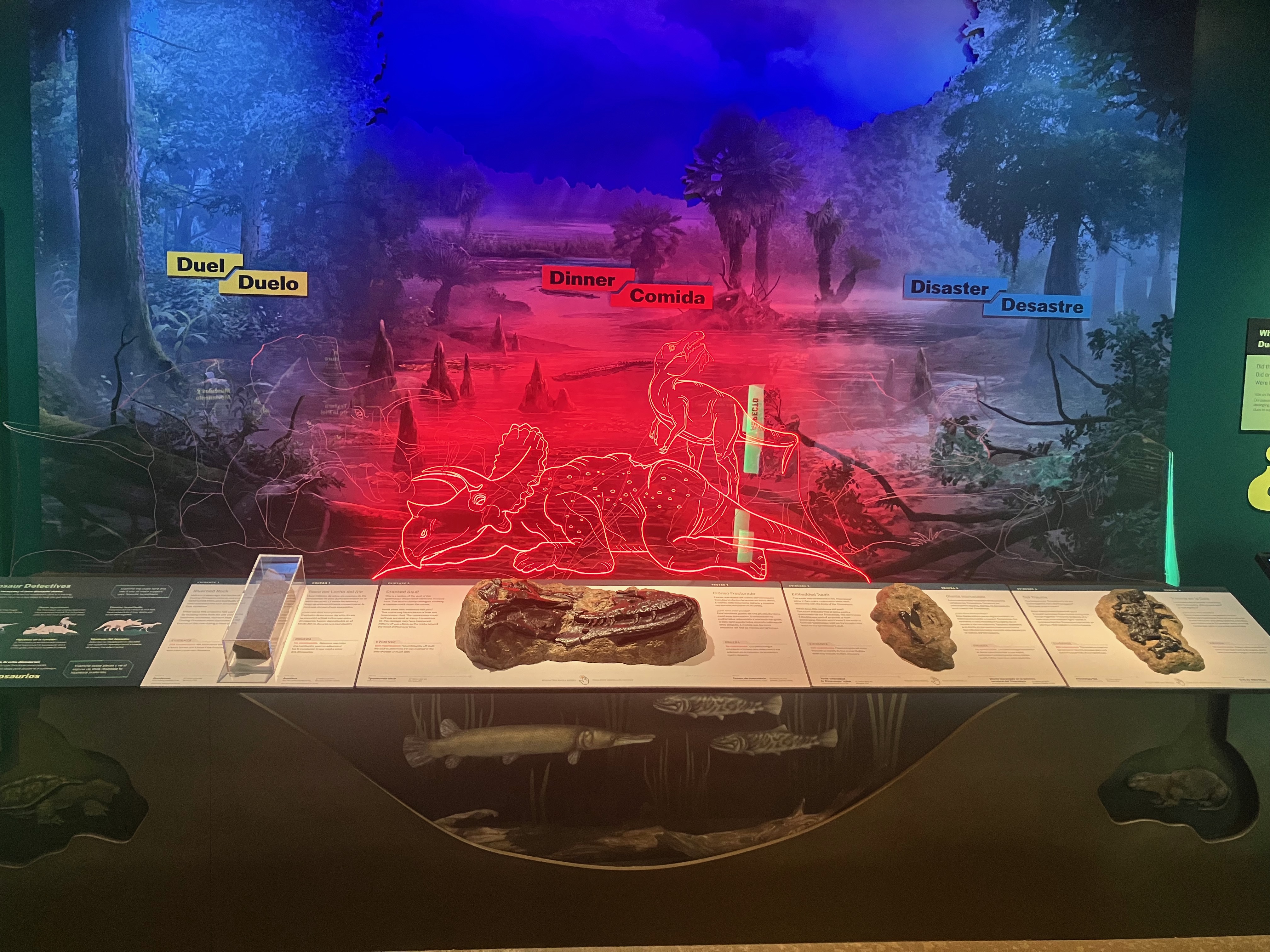
LED images of the three hypotheses cycle across a central display in the first gallery. Photo by the author.

Visitors enter the Dueling Dinosaurs exhibit on the Nature Research Center’s ground floor. The first gallery introduces visitors to the ecosystem of Late Cretaceous Montana. Green panels and walls situate visitors in this verdant environment. After passing small cases with turtle, crocodile, fish, and plant fossils (the purchase of the Dueling Dinosaurs included access to the discovery site, but these are on loan from the Denver Museum of Nature and Science), visitors reach a large display introducing the central mystery of the Dueling Dinosaurs. The exhibit presents three possible scenarios that could have resulted in the dinosaurs being preserved together: duel (a fight to the death), dinner (the tyrannosaur perished while scavenging on Triceratops), or disaster (the animals died separately and were washed together in a flash flood). Color-coded LED outlines of the dinosaurs illustrate the three scenarios in front of an illustrated backdrop.

While these scenarios are presented as being equally plausible, most paleontologists agree that the “disaster” scenario is the likeliest of the three. The real purpose of the exhibit’s presentation is to introduce visitors to the process of stating a hypothesis and finding supporting evidence. Remember, a major part of the rationale behind acquiring the fossil and creating this is exhibit was to show the public what scientists do, and why scientific conclusions are trustworthy. This inquiry-based display attempts to coax visitors through the process of considering the available evidence, and letting it lead them to a conclusion.

Projected images and text augment a sculpture of the fossils. Photo by the author.

Visitors’ next stop is the lab itself, but traffic is controlled by a roughly 4-minute media presentation at the far end of the first gallery. Relief sculptures of the Dueling Dinosaurs skeletons at 50% scale are the centerpiece of this display. Projected images to the left and right—and on the sculpture itself—illustrate the story of where the fossil came from and what scientists hope to learn from it. Certain moments, like a laser scan across the fossil, suggest at least a little inspiration from the SUE show at the Field Museum. The animated tyrannosaur and Triceratops that appear throughout this and other media pieces in the exhibition were created by Urvogel Games, the people behind the dinosaur simulator game Saurian.

Once inside the lab, nothing but a short plexi barrier separates visitors from the preparators at work. As a former/occasional fossil preparator myself, I can tell you that this space is really, really impressive. It’s not enormous, but it’s big enough to comfortably hold four large jacketed matrix blocks. A 10 ton capacity crane looms overhead, and pneumatic hook-ups for air scribes and dust collectors are within reach throughout the space. I was particularly impressed by a rig that can rotate large jackets on their vertical axis, allowing them to be prepared from multiple directions. No less than seven preparators have been hired to staff this lab, so visitors should find people working all the time. Part of the preparators’ responsibility is to be available to answer questions. Typically, one person is posted by the barrier while the rest of the team works in the background.
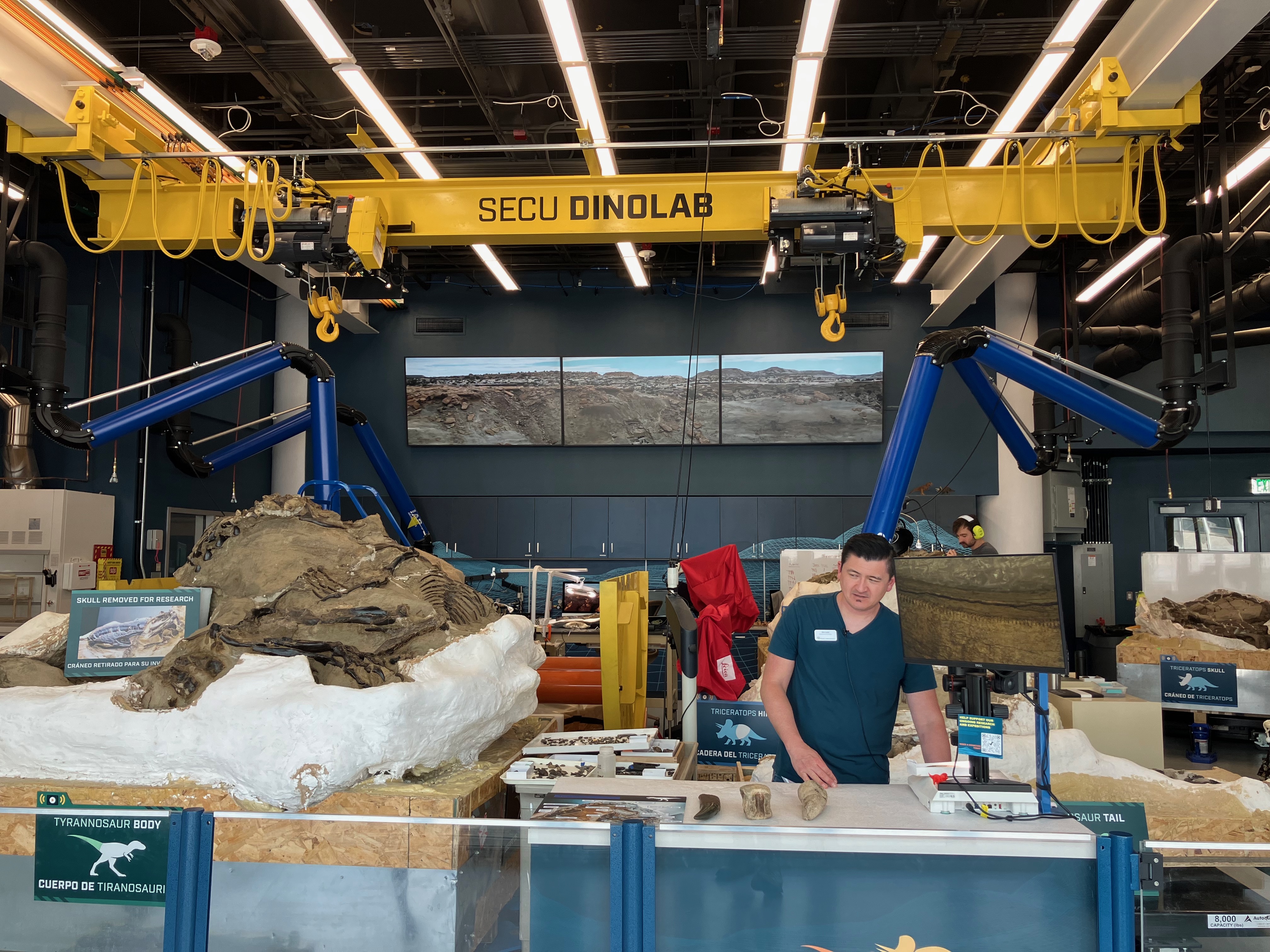
An overview of the public lab. Photo by author.

The second gallery space is not about the Dueling Dinosaurs specifically, but about the tools and techniques paleontologists use to learn about the past from fossils. The most prominent displays are a cast of Nothronychus (a dinosaur described by Zanno and colleagues) and a nest of oviraptorosaur eggs from Utah. Visitors can touch the tools used by fossil preparators, perform a simulated CT scan of a Thescelosaurus skull, and look through a microscope at growth lines in a sectioned dinosaur bone. I was told this gallery wasn’t quite finished, which might be why it felt unfocused to me. A more prominent header and summative statement at its entrance about the purpose of the gallery might help.

“Science has an accessibility problem,” Zanno said in an interview, “and mistrust in science is rising. We have to bring science out of the back corners and basements…and let our community see who we are and what we do.” The Dueling Dinosaurs exhibition has done exactly that—visitors could not be closer to the process of preparing and studying these fossils without being handed an air scribe. So how is that working out?
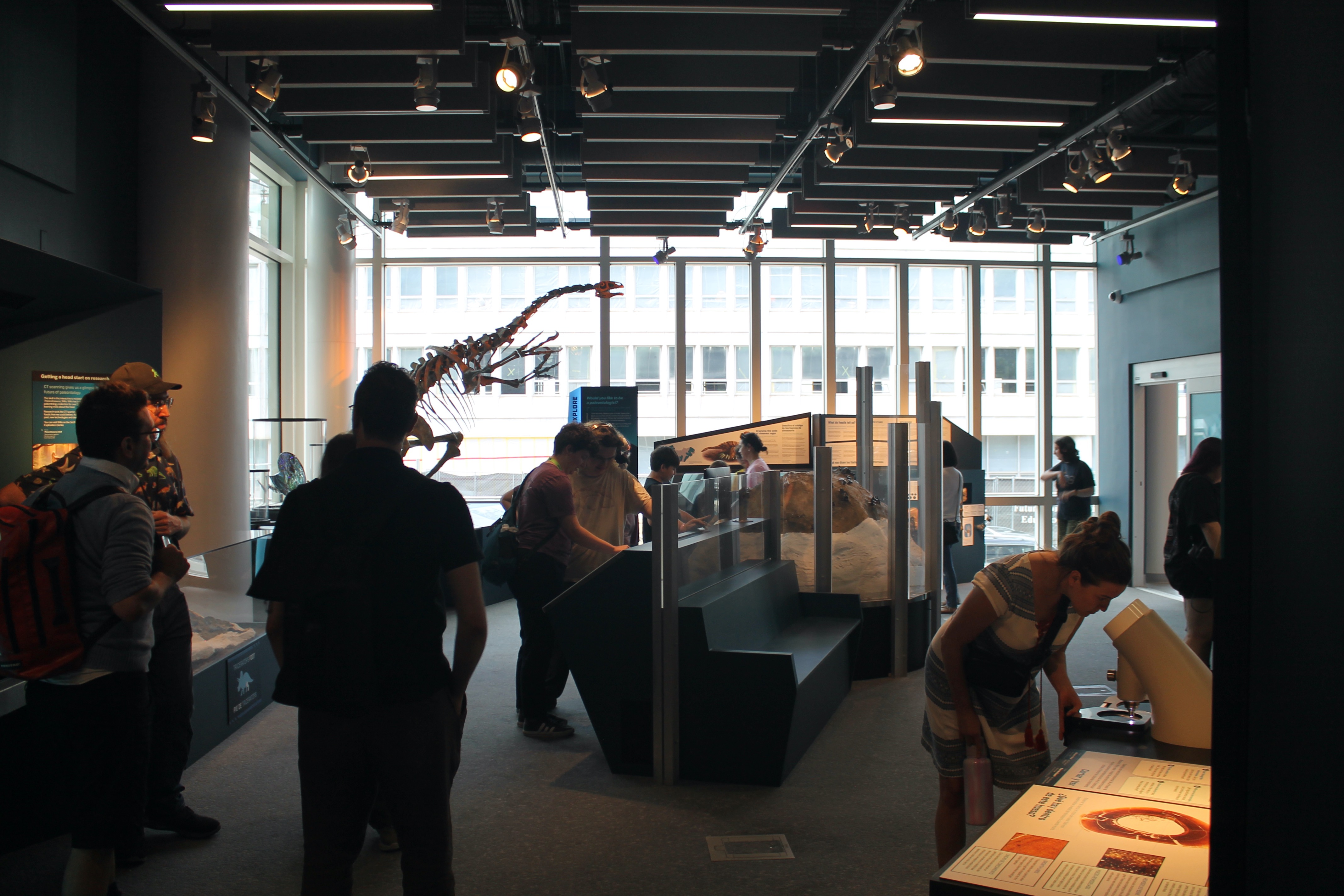
Visitors explore interactive stations in the second gallery. Photo by the author.

I detected a hint of frustration coming from the team members I spoke to. Too many visitors are fundamentally misunderstanding what they are seeing in the lab. They assume the preparators are actors and the fossils are fake, and are often incredulous when told otherwise. The concept that a museum is a place where new science happens is also surprising to a plurality of visitors. One strategy the team has employed is to set up a table of matrix and fragments for the preparator on interpretive duty to sort through. That way, they are clearly working on something when visitors enter and are less likely to be mistaken as an actor or volunteer. Still, if visitors are struggling to recognize real scientists in a real lab when presented with them, the need for access to science in action may be even greater than anticipated.

This might be a “when you have a hammer, everything looks like a nail” situation, but I think some reframing of the exhibition and how its presented could go a long way. Right now, the experience is titled “Dueling Dinosaurs,” which is undoubtedly compelling, but elicits its own set of expectations and assumptions about what visitors will see and do. Why not present the experience as what it really is—an opportunity to meet real paleontologists in their place of work? Would it be possible to reverse the order of visitor flow, so they see the gallery about how paleontology is done first, then visit the lab, then finish by learning about the Dueling Dinosaurs as a case study?
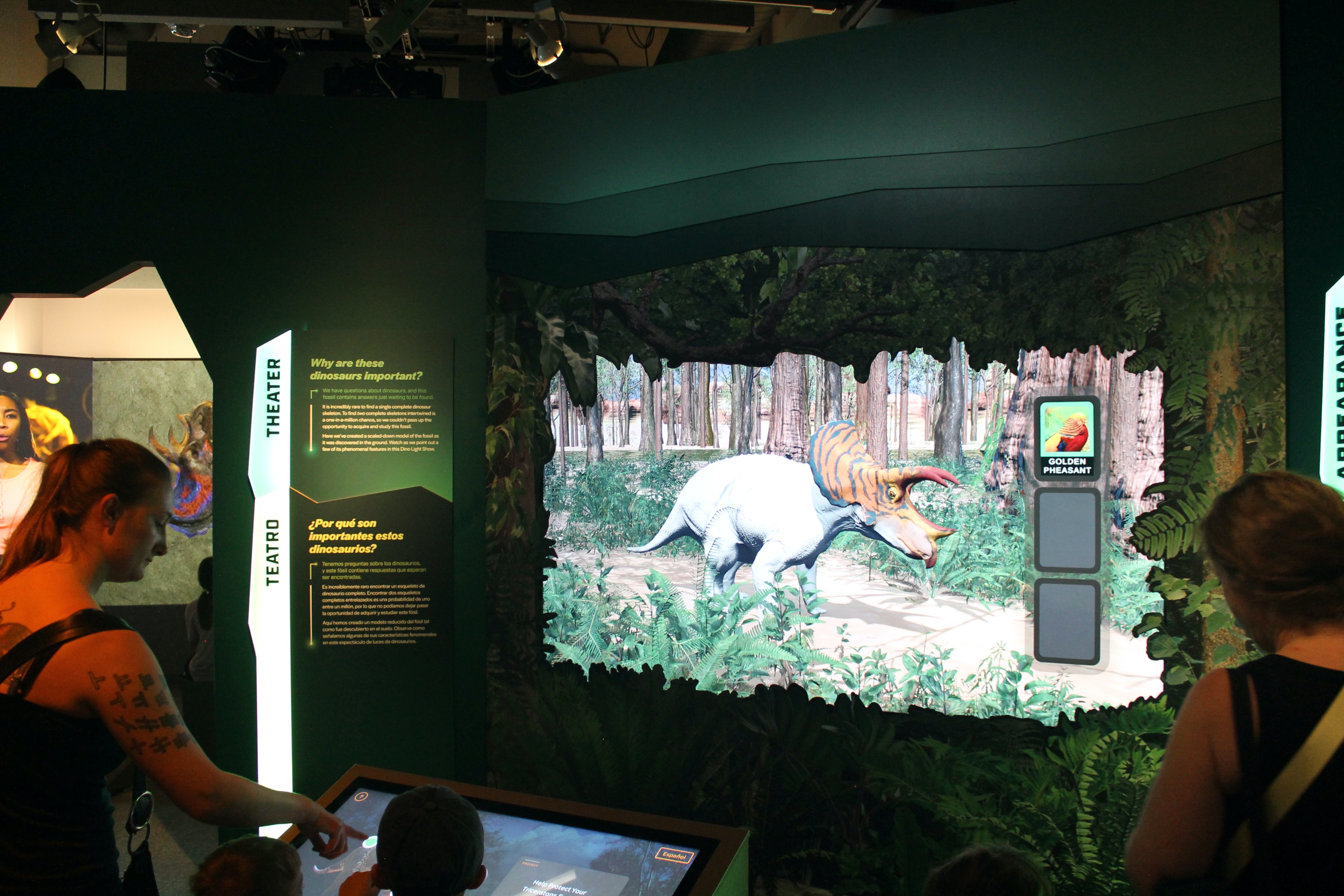
A media-based interactive allows visitors to apply different color patterns to an animated Triceratops, rendered in real time. Photo by the author.

Preparing the fossil is expected to take about five years. The goal is to keep the skeletons in their death positions and eventually display them in relief, somewhat like the model in the media presentation. How much matrix to remove is a moving target. The tyrannosaur’s skull has already been CT scanned multiple times with disappointing results. More matrix will need to be cleared to get a good image of the inside of the skull. Meanwhile, extensive skin impressions are preserved across both skeletons, and the team hopes to leave much of this in place. The process is being slowed somewhat by the need to scrape and chip away irreversible glue that was applied by the original preparators.

Aside from determining whether the dinosaurs actually died fighting (don’t count on it), one of the most anticipated answers the project is expected to provide is the identity of the tyrannosaur. When the fossil was at the Black Hills Institute, Pete Larson concluded that it was a Nanotyrannus—a controversial name applied to fossils that many paleontologists think are actually juvenile Tyrannosaurus rex. Indeed, when the fossil was up for auction, it was marketed as a young T. rex, probably for the sake of name recognition. The NCMNS team will eventually weigh in after studying the skeleton more thoroughly.

The lab itself is expected to remain in place once the Dueling Dinosaurs are prepared. The museum already has other very large fossils awaiting preparation.

If you’re able to visit Raleigh, I highly recommend visiting the Dueling Dinosaurs, the open prep lab, and the rest of NCMNS (the museum is free). You can also monitor the preparation process online. Many thanks to Jennifer Anné, Paul Brinkman, Elizabeth Jones, Christian Kammerer, and Eric Lund for speaking to me about the exhibition. Any factual errors are my own.
3 Comments

Filed under dinosaurs, education, exhibits, marginocephalians, museums, NCMNS, opinion, reviews, science communication, theropods

Acrocanthosaurus, the Terror of the South

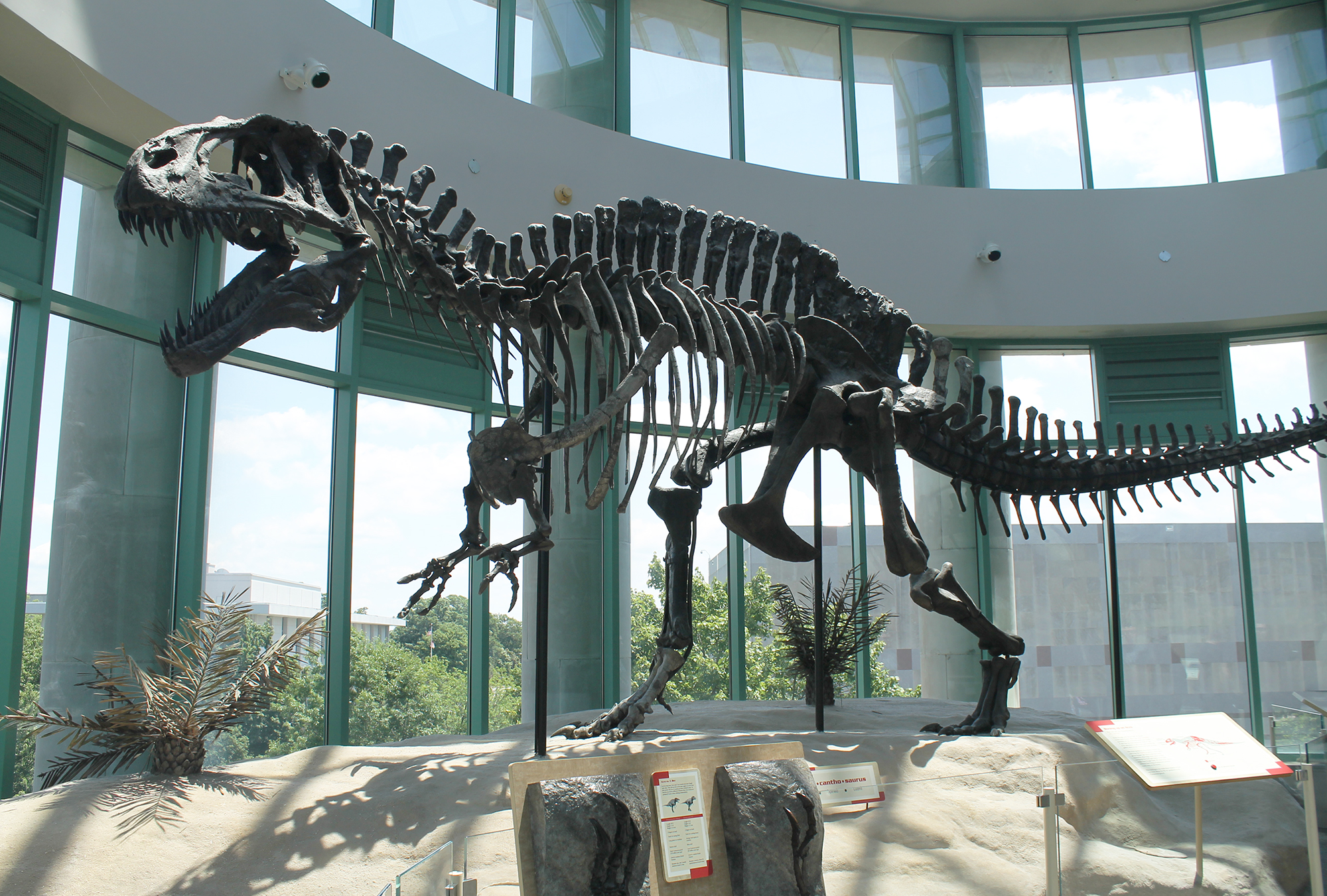
Acrocanthosaurus at the North Carolina Museum of Natural Science. Photo by the author.

Following yesterday’s travelogue about the North Carolina Museum of Natural Science (NCSM), I thought I’d go into a little more depth about the museum’s star fossil. One of only five Acrocanthosaurus specimens ever found, NCSM 14345 is the most complete and the only one on public display. The mounted skeleton has been at the Raleigh museum since 2000. Among other things, its story highlights the challenging relationship between academic paleontologists and the private fossil trade.

Despite its current home in North Carolina, this Acrocanthosaurus hails from the town of Idabel in southeast Oklahoma, more than a thousand miles away. Avocational fossil hunters Cephis Hall and Sid Love (both now deceased) discovered the skeleton in 1983. After making an arrangement with the landowner, the pair spent the next three years carefully excavating the find.

The Acrocanthosaurus was recovered from the early to mid Cretaceous rocks of the Antlers Formation. Found in a deposit of fine sandstone and dark mudstone alongside lots of lignitized wood, the animal’s final resting place was probably a stagnant swamp or pond. Additional evidence for the depositional environment comes from the way the bones are preserved. They contain a great deal of pyrite, and were encrusted with dense concretions of calcium carbonate. Both of these minerals are formed by bacteria blooms in low-oxygen locales, such as the mud at the bottom of a swamp. Gouges in the skull, ribs, and foot indicate scavengers – crocodiles and possibly other Acrocanthosaurus – were feeding on the carcass before it was buried.

All told, the find included a complete skull (the only one of its kind), the pelvis and sacral vertebrae, both arms and shoulder girdles, the right leg, and parts of the rib cage and tail. Paleontologist Richard Cifelli of the Sam Noble Museum in Norman, Oklahoma became aware of the discovery in 1987. Cifelli initially hoped that the museum could acquire the specimen for study and safekeeping, but Hall and Love’s asking price was beyond their means. Instead, Hall and Love loaned the fossils to the University of Texas. They were unsatisfied with this arrangement, however, and drove down to Austin to retrieve their dinosaur (the details of this event are apparently contentious). Hall and Love then sold the fossils to Geological Enterprises, a for-profit outfit based in Ardmore, Oklahoma, for $225,000 plus the promise of a cast once the prep work was completed. Geological Enterprises founder A. Allen Graffham gave the specimen the nickname “Fran,” after his wife.

The meticulously reconstructed Acrocanthosaurus skull. Photo by the author.

The calcium carbonate concretions and heavy pyrite content made the Acrocanthosaurus a particularly challenging fossil to prepare. The concretions are like natural cement and are very difficult to remove without damaging the bones. Meanwhile, pyrite breaks down into sulfur when exposed to oxygen and humidity, which can cause bones to crumble. In 1991, Graffham outsourced the preparation job to the Black Hills Institute in Hill City, South Dakota. Terry Wentz led the preparation project at BHI, which was reportedly one of the most challenging assignments of his career. The concretions encrusting the bones were so dense that they often had to be ground off, rather than chipped. This process could take several hours just to remove a few millimeters of calcium carbonate. To make matters worse, removing pyrite releases acidic particulates into the air. Preparators had to wear respirators and the bones had to be prepared in vacuum boxes.

The most daunting part of the project was reconstructing the specimen’s beautiful and intact skull. Although virtually complete, the skull was found crushed flat. Everyone involved agreed that the skull would be more informative and more impressive if it could be reinflated, but that was easier said then done. Over a year of work went into carefully separating the individual skull bones and reassembling them into their life position.

After five years of what was probably one of the most difficult fossil prep jobs ever attempted, the Acrocanthosaurus was ready to be sold. However, Graffham initially had trouble finding a buyer. There were interested parties in Japan, but he reportedly did not want the fossils to leave the United States.

On October 4, 1997, another well-preserved theropod skeleton went up for auction at Sotheby’s in New York. Sue – the most complete Tyrannosaurus ever found – was already legendary thanks to the protracted legal battle over the fossils. Now that the one-of-a-kind skeleton was being sold at a high profile auction, paleontologists feared that it would disappear into the hands of a private collector. On the night of the auction, most of the museums and other public repositories in the running were outbid within minutes. The North Carolina Museum of Natural Science appeared to be the only museum left after the price topped $5 million, and so the hopes of the paleontological community rested on their shoulders. NCSM dropped out at $7.2 million, and moments later Richard Gray, a veteran of art auctions, won Sue on behalf of a mysterious client. Happily, that client turned out to be the Field Museum (with financial backing from McDonald’s and Disney), and so Sue ended up in a public repository after all.

The Acrocanthosaurus and its sauropod companion can be seen from the ground and from a balcony. Photo by the author.

Still, NCSM had been willing to stake an enormous amount of money on a name brand dinosaur, and they weren’t about to give up. Two months after the Sue auction, the Friends of the North Carolina Museum of Natural Sciences bought the Acrocanthosaurus from Graffham’s company for $3 million. BHI prepared the mount, which debuted along with the rest of the museum’s new building on April 7, 2000. It may not be coincidental that this was just one month before the mounted skeleton of Sue was unveiled in Chicago.

The Acrocanthosaurus occupies a well-lit, circular atrium on the museum’s third floor. Visible both from the ground and from a balcony, the mount is accompanied by a rather goofy-looking sauropod statue. Model pterosaurs circle overhead on a rotating arm, and recreations of theropod and sauropod tracks from Dinosaur State Park in Paluxy, Texas can be seen throughout the room. The original skull is on display in a case outside the atrium.

Sadly, pyrite deterioration has continued to ravage the delicate fossils. Several of the original bones once included in the NCSM mount have been retired to the collections for safekeeping. As of this year, only the arms, right foot, and vertebrae appear to be original material. The rest have been replaced with casts.

Exhibit signs have also changed since the 2000 debut. NCSM exhibits staff learned from surveys that 80% of visitors thought the dinosaur on display was a T. rex, and plenty more assumed the whole skeleton was a replica. In response, most of the signage was redesigned. The displays now highlight the differences between “Acro” and T. rex, and highlight the exceptional rarity of the museum’s Acrocanthosaurus specimen.

A number of NCSM 14345 casts are on display at museums throughout North America, including the Virginia Museum of Natural History, the Houston Museum of Nature and Science, and the Kenosha Public Museum. As promised, Hall and Love were awarded a complete cast of the skeleton,  but without the means to assemble or display it, the replica sat in storage for several years. Eventually, local third and fourth graders successfully raised the $150,000 needed to display the cast at the Museum of the Red River in Idabel.

Acrocanthosaurus cast at the Virginia Museum of Natural History. Photo by the author.

Acrocanthosaurus cast at the Houston Museum of Nature and Science. Photo by the author.

Fossils are precious remains of real organisms, clues about ecosystems from long ago and the making of the world as we know it today. In an ideal world, all significant fossils would, from the moment of their discovery, be accessioned and held in a public collection at a museum or university. A fossil sitting on somebody’s mantelpiece or waiting to be sold at auction is doing nothing to grow our collective knowledge. However, public institutions don’t have the resources to find and excavate every fossil, and in the United States fossils found on private land belong to the landowners. That means that, for better or worse, there is a thriving commercial market for rare fossils.

A plurality of paleontologists do not engage with fossil dealers for ethical reasons. Indeed, even if they wanted to buy rare specimens, academic institutions can seldom match the prices individual collectors are willing to pay. Museums don’t usually have $3 million sitting around. That kind of money could fund a whole research team for years. As such, we’re left with a Catch-22. Paleontologists want important fossils to be in museums where they can be seen and studied by everyone. But if those fossils are in private hands, buying them would support and legitimize the industry that is also keeping fossils out of public collections. If there was an easy solution, it would have been worked out by now.

Nevertheless, serendipity occasionally strikes. This seems to have been the case with the Acrocanthosaurus. News about Sue generated interest in buying a name-brand dinosaur, and donors were willing to put up the money to get the specimen for NCSM. The skeleton is now in a public collection, at a free museum, no less. Meanwhile, the collectors were well compensated for their considerable investment. It’s hard to chalk that up as anything but a win, all around.

References

Carpenter, K. 2016. Acrocanthosaurus Inside and Out. Norman, OK: University of Oklahoma Press.

du Lac, J.F. 2014. The T. rex that got away: Smithsonian’s quest for Sue ends with different dinosaur. The Washington Post

Eddy, D.R. and Clarke, J.A. 2011. New Information on the Cranial Anatomy of Acrocanthosaurus atokensis and Its Implications for the Phylogeny of Allosauroidea (Dinosauria: Theropoda). PLoS ONE 6:3:e17932.

Lovelady, W. 2012. Every Step You Take. Exhibits and Emerging Media, North Carolina Museum of Natural Science. 

9 Comments

Filed under dinosaurs, fossil mounts, museums, NCMNS, reptiles, theropods

North Carolina Museum of Natural Science

This pregnant right whale was killed when it was hit by a boat. Displayed with the fetus skeleton in situ, it now serves as a species ambassador.

The North Carolina Museum of Natural Sciences has been on my list of must-see museums for some time, and I finally had a chance to visit over Memorial Day weekend. Founded in 1879 as the North Carolina State Museum, the institution was initially a showcase for local agricultural and mineral products. Over the years, the interests of both the curators and the visiting public gradually nudged the museum in the direction of more generalized natural history. Now the largest natural history museum in the southeast, NCSM hosts a world-class research staff overseeing a collection of 1.7 million specimens. Since 2000, the museum has occupied a four-story facility in downtown Raleigh. A second wing, called the Nature Research Center, opened in 2012. There are also two satellite nature centers outside the city (which I did not visit) that are under the NCSM banner.

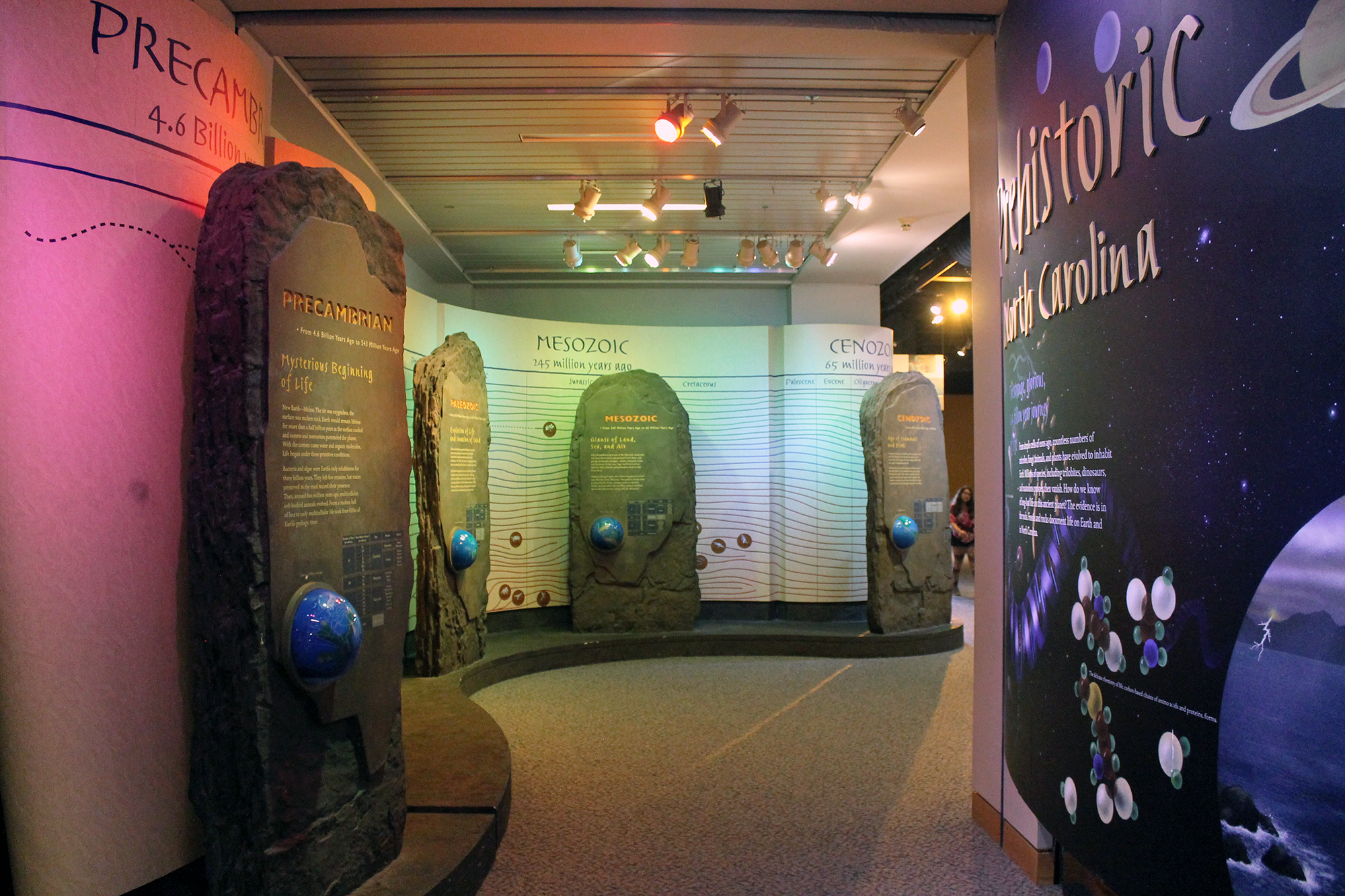
An introduction to geologic time.

First things first: the paleontology exhibit is quite good, although somewhat compact. Perhaps too compact, given its popularity and the amount of exhibit space the museum has to work with overall. Coming up the escalator to the 3rd floor, visitors are strongly encouraged to enter Habitats of North Carolina, a colorful and attractive walk through time. The initial spaces cover the basics. First, a series of pillars introduce the primary stages of life on Earth. This is followed by exhibits about where fossils come from, how we know how old fossils are, and so on. I particularly liked the “What to Fossils Tell Us?” display. Here, a grid of spinning cubes each hold small, conventional fossils. Visitors can rotate the cubes around to see that even these modest-looking remains can be very informative. For example, leaves and pollen provide detailed climate information, and a large croc scute suggests that a substantial body of water was present.

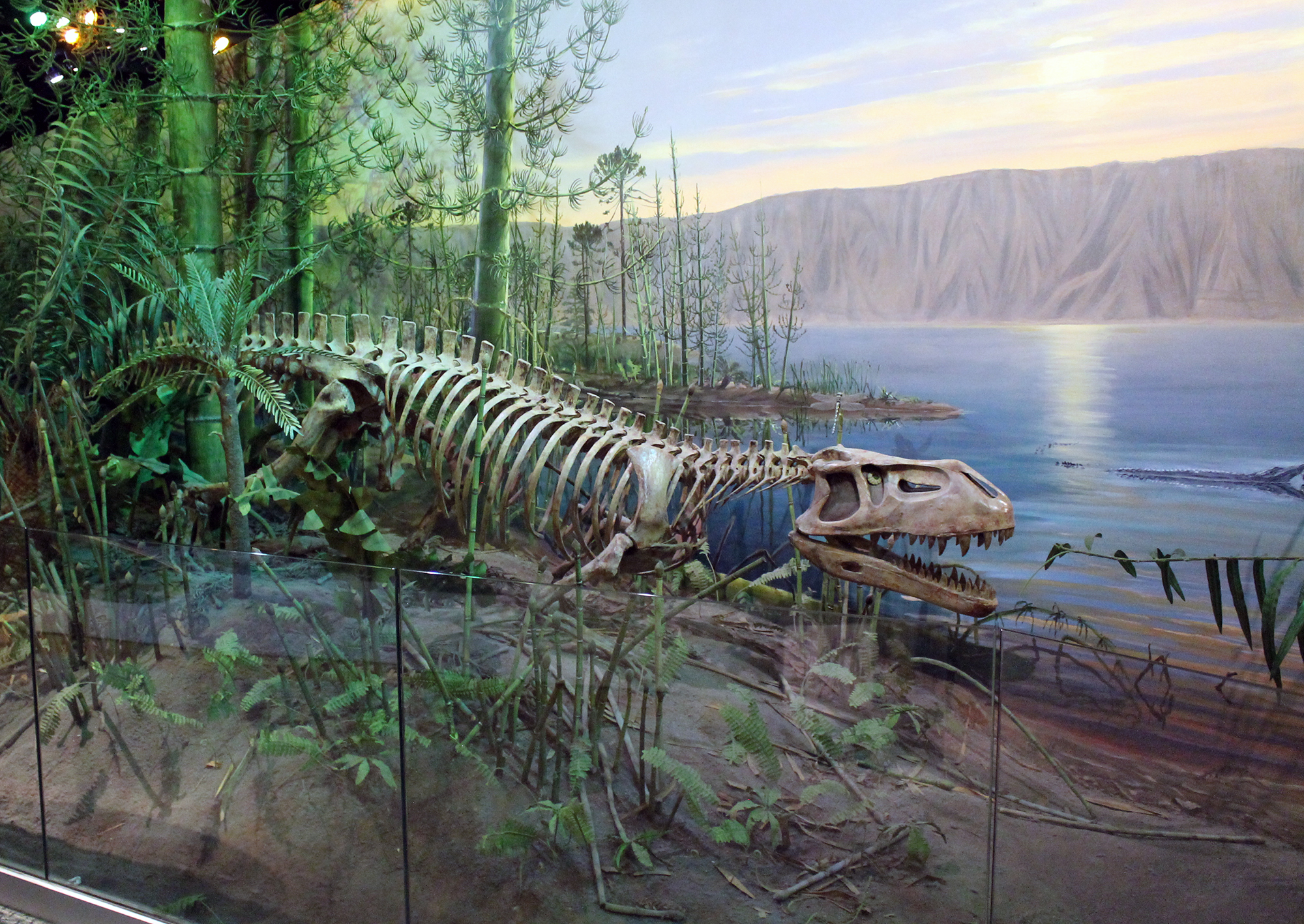
Prestosuchus in the Triassic scene. This appears to be a cast of the Brazilian AMNH 3856.

Edmontosaurus and Albertosaurus casts dominate the Cretaceous tableau.

The rest of the exhibit is built around a series of tableaus in which mounts and models of charismatic animals are placed in landscapes of replica foliage. Small, illustrative fossils are in cases throughout. First up is a cast of Prestosuchus, lurking among some Triassic horsetails. Next, Edmontosaurus, Albertosaurus, and Pachcephlosaurus casts populate the Cretaceous alongside lovely ginkgos and magnolias. A baby hadrosaur model at the feet of the Edmontosaurus was apparently stolen (and recovered) in 2012. The famous Willo – a Thescelosaurus skeleton that maybe/probably doesn’t have mineralized heart tissue in its chest – is on display under glass.

Did you know that most modern fish groups evolved only 20 million years ago? I didn’t!

A ground sloth in the standard pole-dancing pose.

Moving into the Cenozoic, a set of attractive and informative cases describe the origin and evolution of modern fishes and whales. This is followed by glass tunnel through a life-sized diorama of a late Eocene sea. The models here are spectacular, but the space is altogether too dark. I found it difficult to see the diorama, much less read the signs. The final section is home to a real ground sloth skeleton. This is a composite of several specimens recovered in 1999 near Wilmington, North Carolina. Happily, the reconstructed portions of the mount are distinct and easy to see. Habitats of North Carolina ends on an eccentric note with a set of mannequins in pioneer garb discovering fossils in a creek bed. I’m not really sure what this adds to the exhibit narrative.

Acrocanthosaurus holds court in a sunny atrium all to itself.

The star fossil at NCNM is the only real Acrocanthosaurus on display anywhere in the world. Avocational fossil hunters Cephis Hall and Sid Love found this rare skeleton in Oklahoma in 1983. Unfortunately, a bad case of pyrite disease made the fossils an absolute nightmare to prepare, and it exchanged hands several times before ending up with the Black Hills Institute in South Dakota. In 1997, an anonymous donor purchased the skeleton on behalf of NCNM for $3 million, shortly after the museum came in second place in the bidding war for Sue the T. rex.

Acrocanthosaurus is a favorite of mine, and the mount is beautiful. The sunny atrium it’s situated in makes for an attractive display, but I wish it wasn’t so disassociated from the main paleontology exhibit. I’m told the mount included more original material when it debuted in 2000, but the creeping specter of pyrite disease has necessitated the removal of several bones for restoration and safekeeping. Be sure to see it soon, before the rest of the mount gets replaced with casts!

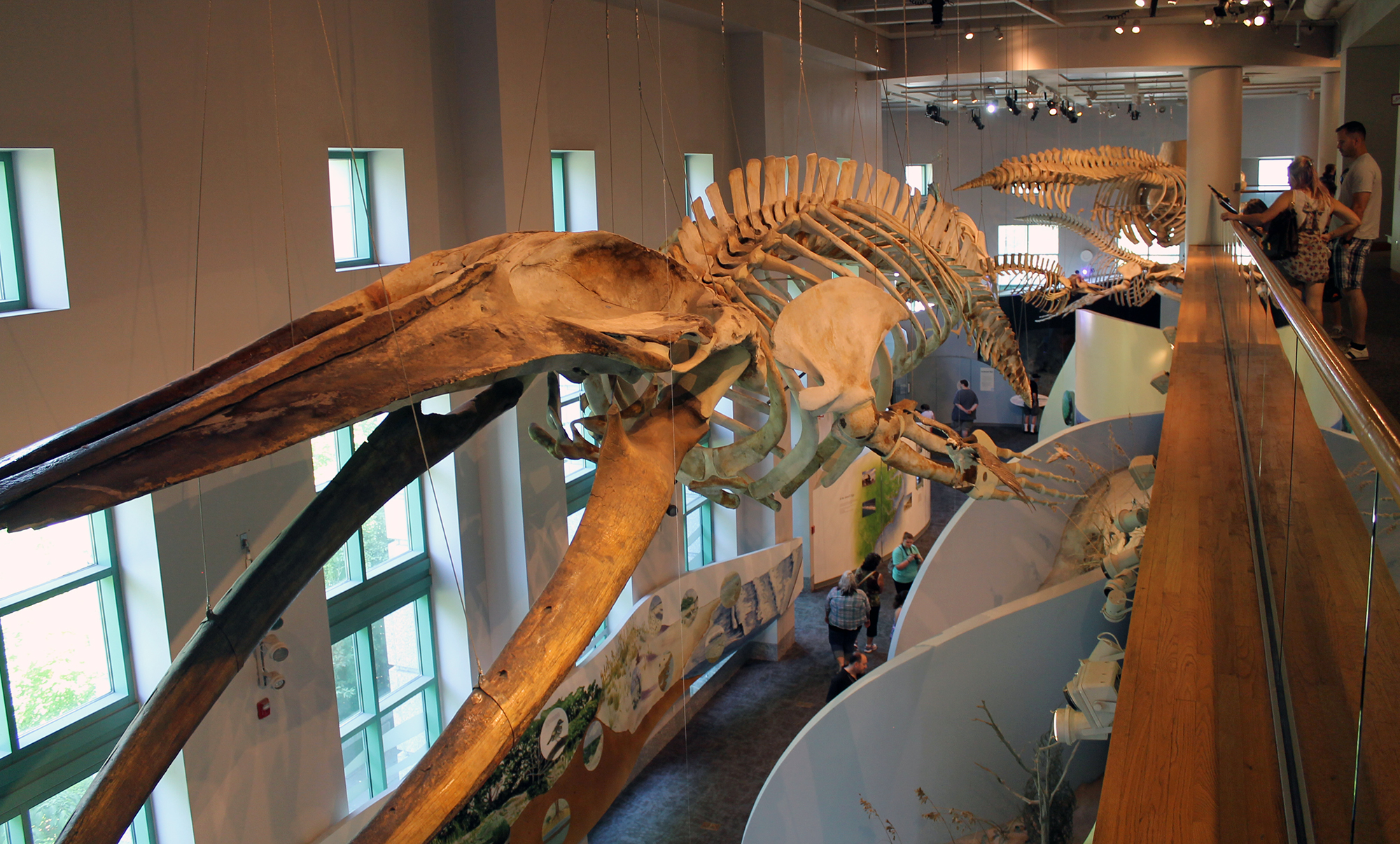
Whales: behold their majesty.

The paleontology exhibits are nice and all, but the real showstoppers at NCSM are the whales. No less than six giant whale skeletons are on display. Suspended over a corridor of sorts, the whales can be viewed from below or from a 2nd story mezzanine. Many museums have a whale skeleton or two, but I’ve never encountered this many cetecean skeletons in one place. From the utterly insane-looking right whale to the colossal blue whale, they are stunning to behold. Be sure to factor in plenty of time to simply stare. Immersive dioramas of local habitats, live animal exhibits, and a look at collecting and exhibition practices past and present round out the museum’s “old wing.”

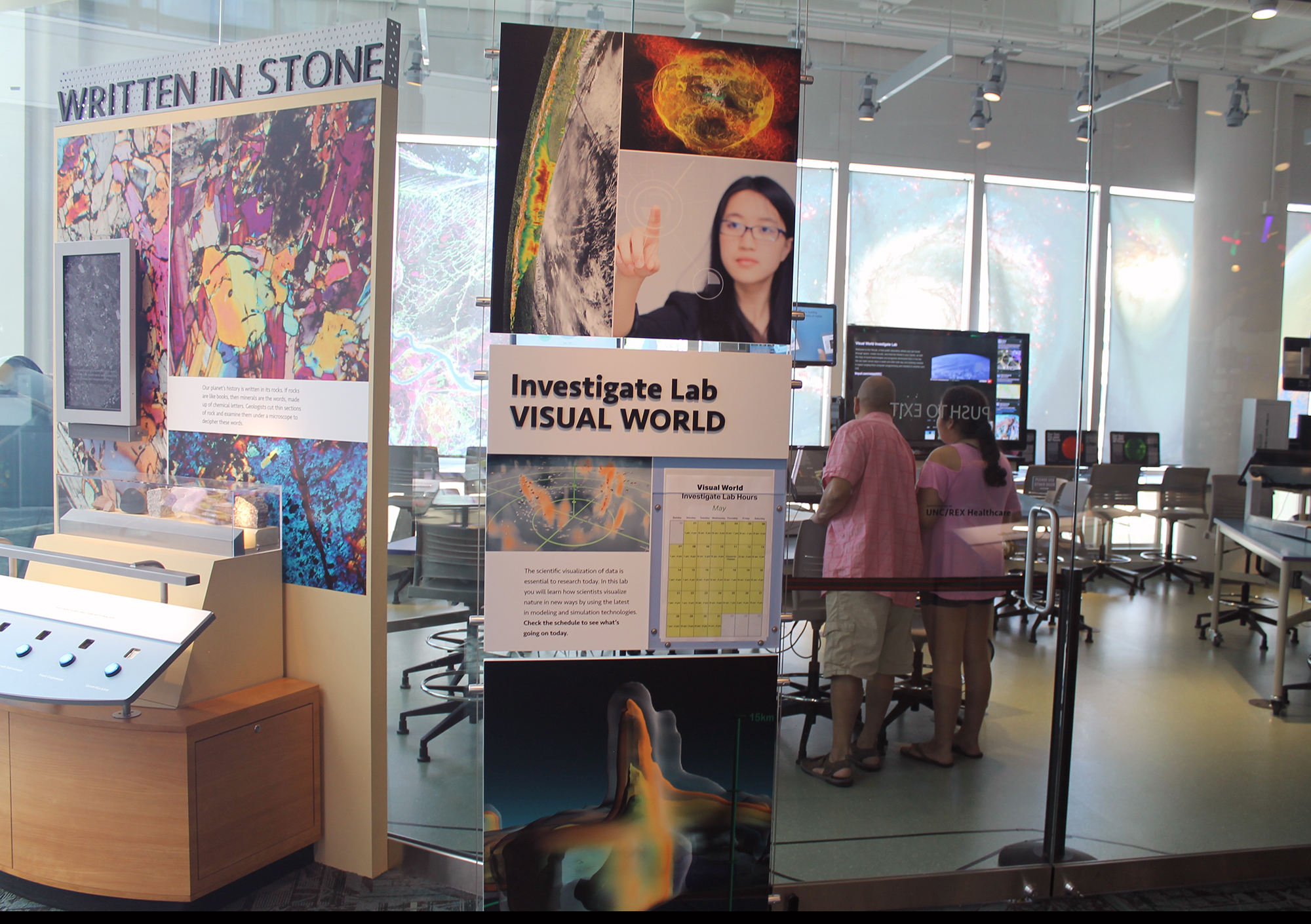
As mentioned, however, a whole new wing of exhibits opened in 2012. Called the Nature Research Center, this is basically the interactive, citizen science-driven Museum of the Future that educators (including myself) have been demanding for years. This three story space is all about getting visitors involved in science. There are multiple drop-in “labs” where knowledgeable staff lead visitors through mini-experiments, designed to get people thinking scientifically. There’s a molecular lab where visitors can isolate and analyze DNA samples. There’s a digital imagery space where visitors can practice using GIS tools, or explore the possibilities of 3-D printing. And there’s a Q?rius-like collections library, where visitors can check out and study real bones, furs, minerals, and fossils. The Nature Research Center also includes several fishbowl-style labs where visitors can watch museum staff and volunteers at work. Even the highly interdisciplinary static displays are less about the “what” and more about the “how”: the tools, techniques, and people that make science possible.

One of the lab spaces in the Nature Research Center.

Distressingly, on the day I visited, the traditional museum exhibits were crowded with visitors, but the Nature Research Center was nearly deserted. Since I was there on a holiday weekend, I was probably seeing a skeleton-crew version of the staff that is usually facilitating the interactive spaces. Still, the Nature Research Center is the embodiment of the modular, interactive exhibits that educators dream about. To see it empty while the story and object-driven exhibits were packed is somewhat disconcerting.

As the scientists say, though, a single anecdotal experience is not data. I’d be very interested to learn how this pioneering exhibit space holds up in the long run.

Leave a comment

Filed under dinosaurs, education, exhibits, fossil mounts, mammals, museums, NCMNS, opinion