Monthly Archives: January 2013

Scientific uses for fossil mounts

I have a question for the paleontological community. I know this blog doesn’t get anywhere near the traffic to expect many answers, if any, but I’m going to ask it anyway.

How do fossil mounts factor into your research? What information can be gained from an assembled and articulated vertebrate skeleton that cannot be determined (or is more difficult to determine) from the study of individual bones? Mounts did have a role in research historically: for instance, Gilmore used the process of creating the Triceratops, Camptosaurus and Diplodocus mounts for the United States National Museum to correct anatomical errors and assumptions previously published by Marsh. But are we still learning from the process of physically assembling skeletons (digital models don’t count)?

I ask because my immediate assumption is that mounts do not benefit research. Fossil mounts clearly have (admittedly difficult to quantify) educational value. They are spectacular, awe-inspiring displays with a physical presence that no book, film or shoddy cable documentary could hope to achieve. For many, including myself, fossil mounts were a first encounter with science in general, inspiring me to ask questions about the natural world and seek ways to answer them. But if we focus entirely on the process of studying and learning from fossils, do mounts have any value?

There is no shortage of reasons why mounts utilizing original fossils are problematic for researchers. Mounted fossils, which are often all-important holotypes, are difficult for researchers to access, and certain parts of the skeleton, like the back of the skull or the vertebral bodies, cannot be reached at all. The mounting process, while better than it was a century ago,  is invasive, destructive and sometimes irreversible.  Mounted fossils in public spaces inevitably suffer damage from fluctuating temperature and humidity (such as pyrite disease), uneven weight distribution and vibration from passing crowds. Many historic mounts used plaster or shellac to seal bones together or to reconstruct broken pieces, which is effectively impossible to remove without damaging the fossils. In the case of the Peabody Museum Apatosaurus, modern researchers do not know how much of certain bones are real and how much was reconstructed.

There is a long, worthwhile discussion to be had on whether the needs of research or the needs of education are more important in this scenario (David Hone and Heinrich Mallison make a case for each side on their respective blogs). But before I get to that point, I’d like to sort out if the distinction is as clear cut as “mounts good for education, mounts bad for research.” Any comments or experience on the matter would be very much appreciated!

8 Comments

Filed under dinosaurs, fossil mounts, history of science, museums, NMNH, science communication

Extinct Monsters: Murals and Dioramas

Click here to start the Extinct Monsters series from the beginning.

Fossils are the hard evidence behind paleontology. They tell us not only that prehistoric organisms existed, but hold clues as to how they lived and behaved. However, it is only through  artwork that extinct animals and ecosystems can be brought back to life. Since Benjamin Waterhouse Hawkins built the first life-sized dinosaur sculptures in 1842, skilled artists have played a critical role in visualizing the results of paleontological research and making that information available to a wider audience.

At the National Museum of Natural History, spectacular works of art have always appeared alongside displays of original fossils, firing up the viewer’s imagination and inviting them to visualize the world of prehistory. Although many of these pieces are now scientifically dated, they were on the cutting edge in their time. These artworks remain exquisite works of craftsmanship, invaluable for their decades of contribution to science education.

The Life-Sized Models

The charmingly ugly Stegosaurus is one of the oldest fixtures of the Smithsonian fossil exhibits. F.A.L. Richardson created this model for the the Smithsonian’s exhibition at the St. Louis, Missouri World’s Fair in 1904. Made from papier mâché with a foam skin, the Stegosaurus was based on small sculpture produced by Charles Gilmore. With its sagging belly, sprawling forelimbs, and head held well below the horizontal plane, this Stegosaurus is typical of reconstructions from the early to mid 20th century.

As legend had it, the paper used to fabricate the Stegosaurus was ground-up money from the National Treasury. The model had even earned the nickname “Mr. Moneybags” among some of the museum staff. Curator Emeritus Ray Rye got to the bottom of this in 1981. He contacted the Treasury to find out what was done with worn-out paper money at the turn of the century – apparently it was burned at a plant in Maryland. Nevertheless, at Rye’s request a group of historians from the Treasury took a sample of the Stegosaurus while the hall was closed for construction, and confirmed that it was made from regular paper.

This pudgy papier mache Stegosaurus has been a fixture at the Smithsonian since 1904.

This pudgy Stegosaurus has been a fixture at the Smithsonian since 1904. Photo courtesy of the Smithsonian Institution Archives.

When the Hall of Extinct Monsters opened in 1910, the Stegosaurus was given a spot of honor right in the center of the room. In 1913, a real Stegosaurus skeleton was placed alongside it. Both dinosaurs would remain in place until the exhibit was renovated in 1963. In the reconfigured and renamed Hall of Fossil Reptiles, the model Stegosaurus was relocated to a corner display.  Most recently, the 1981 renovation saw the Stegosaurus model moved to the south side of the gallery, protected by a low plexiglass barrier. This time, it was given a cycad replica for company, and a mural of lush Jurassic jungle behind it. The Stegosaurus remained in this position until the fossil halls closed in 2014.

quetzalcoatlusprogress

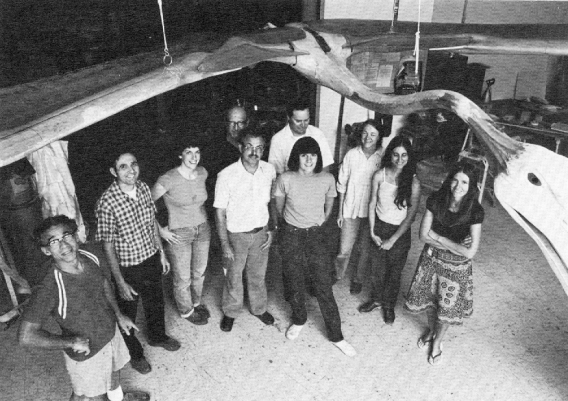
The NMNH exhibits team with their nearly-finished Quetzalcoatlus. Image from Thomson 1985.

quetzal2014

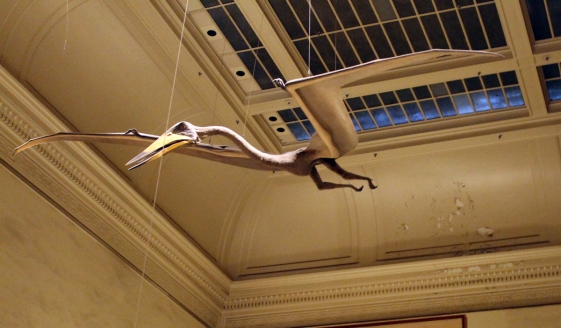
The Quetzalcoatlus survived a 2010 earthquake, although the plaster molding above it was damaged. Photo by the author.

The 1981 renovation also saw the introduction of a life-sized model of the pterosaur Quetzalcoatlus. Having been discovered in 1971, the largest flying animal that ever lived was big news at that time. In-house modelmakers spent two years on the project, first sculpting the animal in clay, then casting it in lightweight fiberglass with a steel armature. Paleontologist Nicholas Hotton served as the scientific consultant. Although he was dubious that pterosaurs had any sort of soft body covering, he okayed the use of deer fur to give the model believable texture. However, Hotton nixed the idea of placing a dangling fish in the mouth of the Quetzalcoatlus. Contemporary wisdom was that even giant pterosaurs were extremely light, weighing as little as 75 pounds, so even a 5-pound fish was thought to be enough to disrupt a Quetzalcoatlus in flight.

The Stegosaurus and Quetzalcoatlus both now reside at the Museum of the Earth in Ithaca, New York.

The Murals

The first dedicated prehistoric mammal exhibit at NMNH opened in the summer of 1961. Alongside the array of Cenozoic fossil mounts, the exhibit featured four brand new murals created by paleoartist Jay Matternes (he painted two more for the Ice Age hall several years later). Still active today, Matternes is a prolific artist of both modern and prehistoric wildlife. In addition to the NMNH murals, Matternes has contributed to exhibits at the American Museum of Natural History and the Cleveland Museum of Natural History, as well as numerous publications including National Geographic Magazine.

c.11

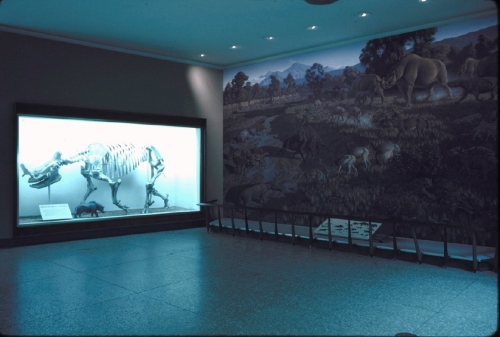
Matternes’ Oligocene mural as first exhibited in the 1960s. Photo courtesy of the Smithsonian Institution Archives.

Oligocene and early Miocene murals, as seen in the 1985-2014 iteration of the exhibit, Mammals in the Limelight. Photo by the author.

Each of the murals Matternes contributed to the exhibit depicts North America during an epoch of the Cenozoic, and is displayed behind corresponding fossil mounts. Most of the animals on display coincide with life reconstructions in the murals, so visitors can match the skeletons to images of how they may have looked in life. Matternes’ hyper-detailed style is particularly striking. The environments look nearly photo-real, and not too far removed from the world today. Likewise, the artist’s knowledge of anatomy plainly shows in the utterly lifelike appearances of the animals. I particularly like Matternes’ use of familiar color patterns on the relatives of modern taxa. The Pliocene and Pleistocene murals will be returning in 2019.

Cenozoic

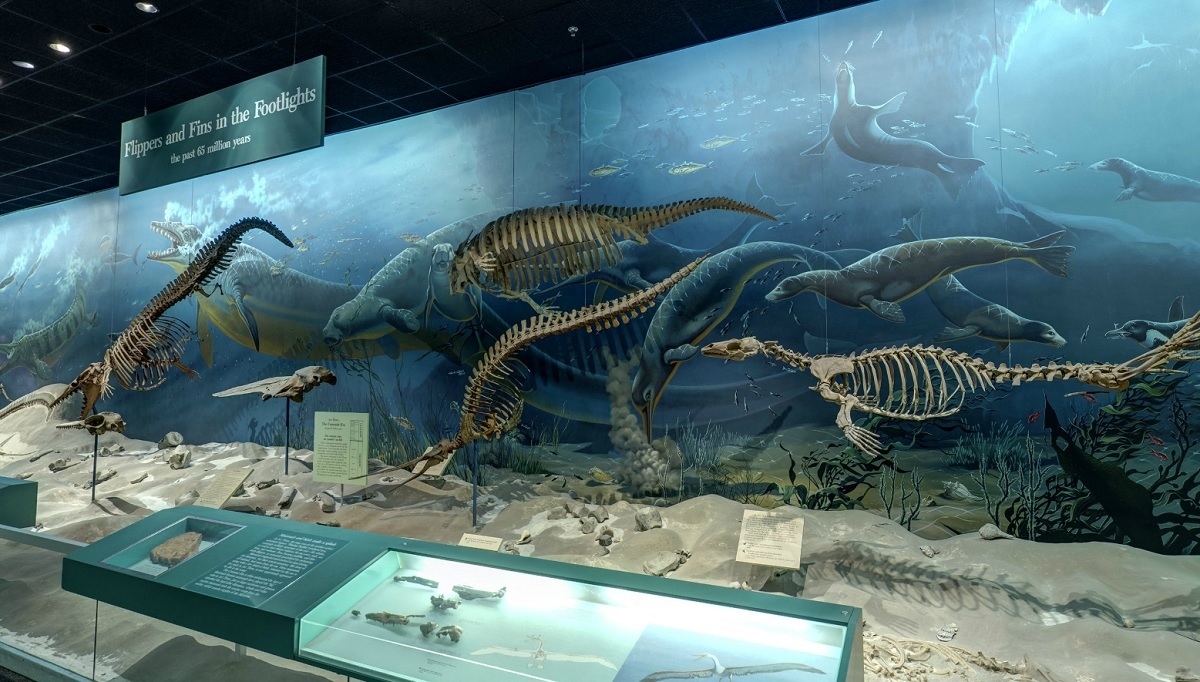
The Cenozoic section of Kish’s 130-foot magnum opus. Source

The “Life in the Ancient Seas” exhibit debuted in 1990 with a monumental 130-foot mural by Eleanor Kish. From the explosion of invertebrate diversity in the Cambrian to the proliferation of aquatic mammals in the recent past, the mural spans 541 years of deep time. The project took Kish two years to complete and is, simply put, a masterpiece. Within the exhibit, this meticulously crafted image defines the space’s layout and color palate. It visually separates concepts and themes, and even directs visitor traffic with its strong leftward momentum.

The Dioramas

The dinosaur dioramas were one of my favorite parts of the old NMNH fossil halls. Norman Neal Deaton created three dioramas, representing North America during the Triassic, Jurassic, and Cretaceous. The Mesozoic dioramas were commissioned for the 1963 exhibit renovation, and were on display until 2014. Each 1″:1′ scale diorama is set into a recessed space in the wall and is protected by glass.  The scenes are populated by a menagerie of outdated but gorgeously detailed dinosaurs and contemporary reptiles, set among dense forests of ferns and craggy rock formations. The complexity of the dioramas allows viewers to get lost in them as their eye wanders from one static encounter to the next. I’ve been admiring these scenes since literally before I could talk and I still notice minute details I hadn’t seen before.

The diorama project began in 1963 and took four years to complete. The scenes were initially blocked out by Jay Matternes and Nicholas Hotton, the Curator of Vertebrate Paleontology at the time. Matternes and Hotton worked together on anatomical drawings for each of the animals to be reconstructed, and planned the basic layout of the dioramas. Deaton created the final dioramas at his studio in Newton, Iowa. Deaton had been previously employed at the Smithsonian as an exhibits specialist, but had left to found his own studio in the late 1950s, where he continued to work on projects for the Smithsonian as a contractor. In addition to the dinosaur dioramas, Deaton led the creation of the iconic Fénykövi elephant that stands in the NMNH rotunda today, and has created sculptures and dioramas for dozens of other museums. Deaton is still active today, and much of his 2-D and 3-D work can be seen at his website.

Deaton mailed these slides of his unpainted models to Hotton for approval. Photos courtesy of the Smithsonian Institution Archives.

Deaton mailed these slides of his unpainted models to Hotton for approval. Photos courtesy of the Smithsonian Institution Archives.

Deaton sculpted each of the animals in clay based on the drawings provided by Matternes and Hotton. Nearly every model went through a few incremental adjustments based on notes from Hotton, changing things like the bulk of the muscles or how visible the scapula or pelvis would be under the skin. The soft anatomy was based on modern reptiles, particularly crocodiles, although Deaton found that some of the animals had no obvious analogs. Once the clay models were approved, they were casted in rubber, then painted. Deaton also created the miniature worlds inhabited by the animals, including foliage, muddy riverbanks, and sheer cliffs. The backdrops, however, were painted by Matternes.

The completed dioramas represented the most up-to-date knowledge of the Mesozoic world at that time. Of course, our understanding of dinosaurs has been overhauled significantly since then. Compared to the active, fleet-footed, and often feathered dinosaurs we know today, the inhabitants of the NMNH dioramas at first look a bit ponderous and inert. Inaccuracies are easy to point out: the Ankylosaurus has a weird clubless armadillo tail, the torso of the Diplodocus is much too long, the Cretaceous diorama mixes Hell Creek and Belly River dinosaurs that were separated by at least 20 million years, and there are sprawly tail-draggers aplenty.

Cretaceous diorama by Norman Deaton. Source: flickr.

Cretaceous diorama by Norman Deaton. Photo by the author.

Triassic diorama

Triassic diorama by Norman Deaton. Source

Still, these issues are easy to overlook when one appreciates just how engaging these scenes are. Little details like footprints behind each animal and mud splattered on their feet fill the motionless dioramas with life and the possibility of more adventures in the imagination of the viewer. And several of the models are surprisingly energetic for 60’s dinosaurs. The Ceratosaurus face-biting the Camptosaurus (above) is full of energy, and the Elphrosaurus  is running full-tilt with its tail in the air (and even has propatagia for some reason).

Many of the works of art in the NMNH fossil halls are no longer appropriate as literal representations of prehistoric animals. But that does not mean they are irrelevant relics of mid-century science. Each model and painting is a stunning example of artistry, and more to the point, every inaccuracy is an opportunity to start up a conversation about what we know about prehistory and how we know it. These pieces are time capsules in the history of science, representing different eras of understanding and the researchers that took part in them. I, for one, would hate to see them forgotten.

A big thank you  to Norman Deaton and Raymond Rye for their assistance with this article.

4 Comments

Filed under dinosaurs, Extinct Monsters, history of science, mammals, museums, NMNH, paleoart, reptiles, science communication

Beating the orthogenetic horse

According to the rad personalized 2012 review provided by WordPress, the top search engine terms leading people here over the last year were dinosours, horse evolutionary tree, horse evolution tree, horse phylogenetic tree and Daspletosaurus. It’s not too difficult to pick out the pattern there – horse evolution seems to be a major draw, even though I only mentioned it in a single post back in June. I aim to please, so I suppose a more detailed discussion of horse phylogeny is in order. First off, let me recommend Brian Switek’s thorough and thoughtful take on the subject. If you stick around here, you’re going to get more of a tirade.

Most depictions of horse evolution available online, including the one I posted a few months ago that is luring people to this site, are terrible. The typical linear presentation of horses progressively increasing in size from Eohippus to modern Equus, losing toes along the way, misrepresents not only what we know about horses as a group, but how evolution works in general.

This didn’t happen.

Evolution is, of course, neither linear nor progressive: it is primarily the result of populations adapting to thrive in their particular environments. As environments change over time species may evolve or go extinct, but there is no predetermined goal that lineages are reaching for. Modern Equus is not the most “highly evolved” horse – this is, in fact, a misleading if not meaningless concept, because a species’ success is dependent on its ability to thrive in that specific time and place. A modern horse is well adapted for grazing and running fast on open plains, but relocate one to the Eocene cloud forests where Eohippus thrived and it would do very badly.

Furthermore, it has been known for over a century that horses as a group did not consistently grow larger over time or otherwise become more Equus-like. Instead, horses diversified into a variety of forms over the group’s 55 million year existence, each group adapting to different environmental niches across the northern hemisphere. Large and small, forest-dwelling browsers and plains-dwelling grazers, these and all manner of other horses overlapped in time and space over the course of the Cenozoic. As J.W. Gidley of the American Museum of Natural History had worked out as early as 1907, horse evolution was not a linear progression but a tangled bush (just like the evolution of most other clades).
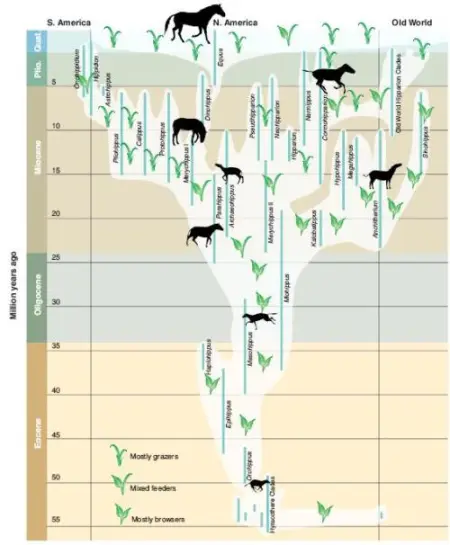
A modern horse phylogeny. From Macfadden 2005, via Laelaps.

A modern horse phylogeny. From MacFadden 2005, via Laelaps.

So where did the orthogenetic depiction of horse evolution come from, and why is it still with us today? The answer highlights the importance of museum exhibits and specimen provenance in the public’s understanding of paleontology, with a dose of jealous personalities for good measure.

In 1859, Charles Darwin published On the Origin of Species, in which he articulated the process of evolution by natural selection virtually exactly as we understand it today. Darwin’s book incited a whirlwind of debate in both scientific and public circles because of its implication that the diversity of life could be attributed to natural forces, rather than an unknowable divine power. Within a decade, however, the vast majority of the scientific community was convinced by the soundness of Darwin’s theory, and to this day billions of individual observations of the natural world tell us that evolution is assuredly true.

One of the many lines of evidence covered in On the Origin of Species is the fossil record, with which we can trace the evolution and extinction of organisms over time, including the ancestors of modern life. However, Chapter 9 of Darwin’s book, “On the Imperfection of the Geological Record” (full text pdf) reads like like a lengthy apology for the incomplete nature of fossil preservation. Today, the use of organized, cladistic methodologies allow paleontologists to piece together detailed phylogenies from fossils, but in Darwin’s day, the evidence was patchier, and he opted to de-emphasise the fossil record’s usefulness to avoid such criticism. As Darwin put it, “we have no right to expect to find in our geological formations an infinite number of of those fine transitional forms.” Unfortunately for paleontology specialists, this led other biologists to believe that fossils could not make any independent contribution to the understanding of evolution. Largely shut out of the biggest biological discovery of all time, paleontologists became stewards of a “second-class discipline” (Sepkoski 2012, 9).

Paleontologists in the late 19th century.

Since biologists interested in evolution considered paleontology mostly irrelevant, late 19th-century paleontologists were left with three options. They could support evolution as best they could and accept that other biologists might not take notice, they could ignore theoretical discussion entirely and focus on purely descriptive studies of morphology, or they could be spiteful and seek alternatives to Darwinian evolution. The second course of action was the most popular well into the 20th century. E.D. Cope seems to be  an example of the third approach, favoring an odd sort of neo-Lamarckism in his book The Origin of the Fittest. Such conceptions of directional change, such as Cope’s Law, are counter to evolution as proposed by Darwin and as understood today. However, a handful of paleontologists stuck with it and endeavored to provide meaningful fossil evidence for evolutionary theory.

Throughout the 1860’s, paleontologist O.C. Marsh amassed an impressive array of fossil horses from Wyoming and elsewhere in the American west. Horse fossils had been found in Europe much earlier, but Marsh’s horse collection was much more complete, and was probably the best fossil record compiled for any vertebrate group at the time. In 1870, the influential British naturalist Thomas “Darwin’s Bulldog” Huxley visited Marsh in New Haven and was suitably impressed: Marsh’s fossils ranged from the Eocene up until the Pleistocene, providing a clear picture of how the horse family had evolved over time. While Darwin had been hesitant to make too big a deal about the fossil record as evidence for evolution, the horse fossils were blatant examples of animals changing over time.

During the same visit, Huxley gave a lecture in New York in which he cited the horse fossils as a fantastic new line of evidence in support of evolution. Unfortunately, Huxley’s lecture (while admittedly aimed at a general audience) tread into some severely teleologic territory. As quoted in The Gilded Dinosaur (Jaffe 2000, 162), Huxley told his audience that “the horse is in many ways a most remarkable animal in as much as it presents us with an example of one the most perfect pieces of machinery in the animal kingdom.” He went on to explain how horse ancestors, from the little four-toed Hyracotherium in the Eocene to increasingly large horses like Merychippus and Pliohippus, gradually perfected the design of the modern horse. According to Huxley, over the course of the Cenozoic horses got bigger, faster, leggier, and generally better at being horses as we know them today. Problematically, this essentialist narrative rather misses the point of evolution as described by Darwin. 

Marsh, like Huxley, was an early advocate of evolution,  but his narrative of horse evolution was more on the mark. Marsh concluded that the smaller early horses with brachydont teeth were well suited for life in the rainforests that covered the western United States 50 million years ago. Horses like we know them today emerged as a direct result of the Earth getting cooler and drier over the course of the Cenozoic, and by the end of the Pleistocene the lineages of forest horses were completely extinct. Equus is with us today not because it is the best horse for any circumstance, but because it was most successful during the ice ages that shaped the modern flora and fauna (it also helped that humans figured out that horses are useful and ensured their survival through domestication).

Unfortunately, Marsh was never enthusiastic about public education, and so the progressive view of horse evolution was the one that made it into the public sphere. The history of horses remained a popular example of evidence for evolution, trotted out over the years by prominent biologists like George Simpson and Stephen Gould. Indeed, it was the first good evolutionary story known from fossils, although by no means the last or the best. In the earliest 1900s, Henry Osborn had a major role in solidifying the orthogenetic horse evolution story in the public eye when he curated the exhibit on the subject at the American Museum of Natural History. It is on the basic premise of this exhibit that the textbook, museum, and web descriptions of linear horse evolution that persist to this day are based.
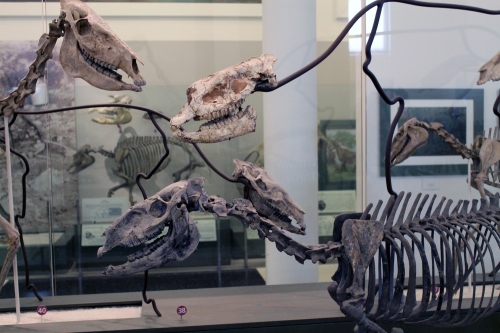
Photo by the author.

The fossil horses of AMNH. Photo by the author.

After the modern biological synthesis, paleontologists realigned with the rest of biology, and the odd pseudo-evolutionary ideas that persisted in paleontological circles began to fall by the wayside. However, orthogenetic ideas remain common in natural history exhibits on horse evolution to this day (in about 62% of them, according to MacFadden et al. 2012). The reason these exhibits have stuck around isn’t entirely clear. MacFadden and colleagues suggest suggest a lack of inertia or funding for the renovation of exhibits is a factor, but they also point out that even some newer exhibits fall back on linear horse evolution.

The biggest problem is that orthogenetic evolution makes more intuitive sense to non-specialists. We often use the word “evolution” to imply improvement, so it would follow that horses should get bigger and better over time. This is an important misconception to overcome, because, as if we need a reminder, only 15% of Americans believe humans evolved from other animals via strictly natural processes, and an even smaller number can correctly articulate how evolution works. Evolution is the fundamental principle underlying everything we see in the natural world, and it is imperative that a correct understanding of how it works is the basis of any biology education. With the proper background, the real story of horse evolution is a great example of how changing climates effect organisms and ecosystems over time. This is helpful for interpreting the ever-important subject of climate change, but it won’t click until the linear horse evolution story is trampled out for good.

References

Jaffe, M. 2000. The Gilded Dinosaur: The Fossil War Between E.D. Cope and O.C. Marsh and the Rise of American Science. New York, NY: Three Rivers Press.

MacFadden, B.J., Oviedo, L.H., Seymour, G.M. and Ellis, S. 2012. “Fossil Horses, Orthogenesis and Communicating Evolution in Museums.” Evolution, Education and Outreach 5:29-37.

Sepkoski, D. 2012. Rereading the Fossil Record: The Growth of Paleobiology as an Evolutionary Discipline. Chicago, IL: University of Chicago Press.
4 Comments

Filed under AMNH, history of science, mammals, museums, science communication, systematics