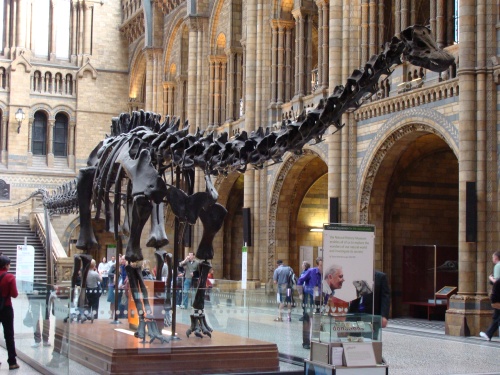
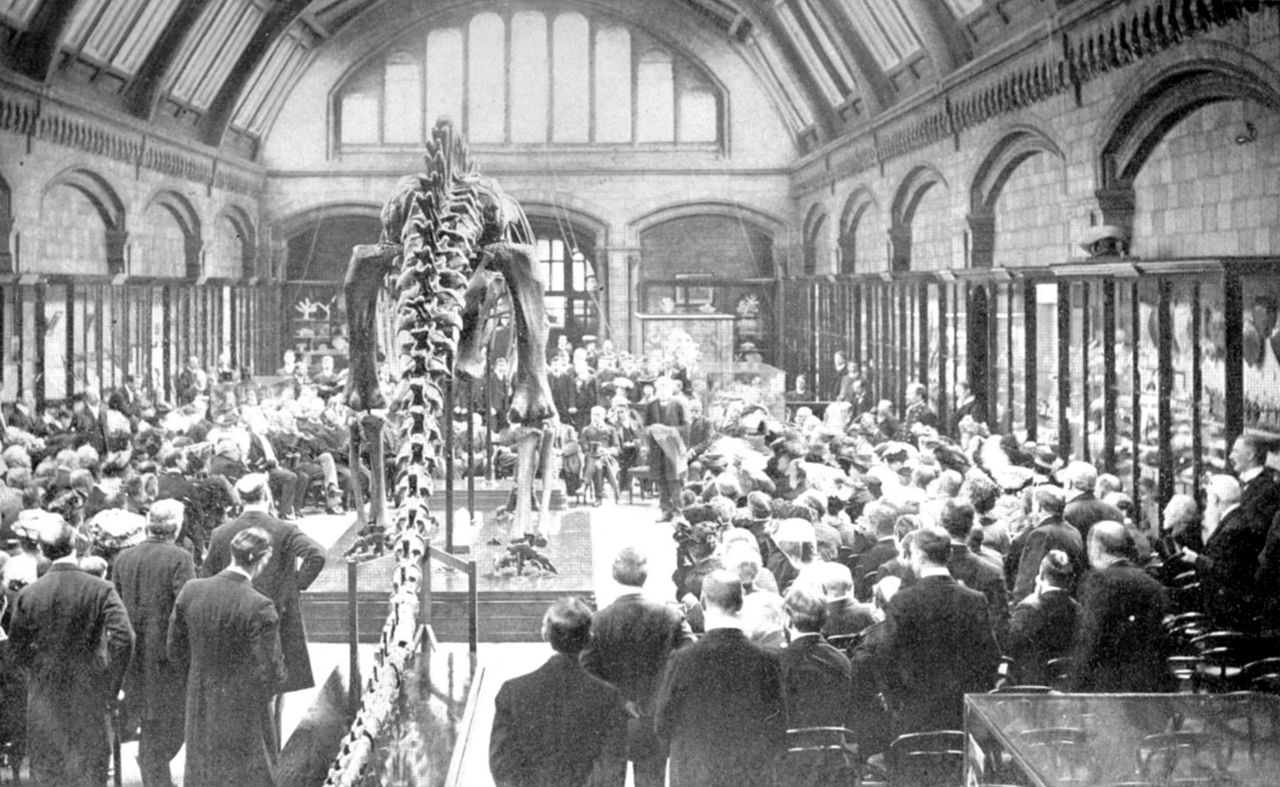
The first cast of the Carnegie Diplodocus holds court at London’s Natural History Museum. Source
The story of Andrew Carnegie’s Diplodocus will surely be well known to most readers. As the legend goes, Carnegie the millionaire philanthropist saw a cartoon in the November 1898 New York Journal depicting a sauropod dinosaur peering into the window of a skyscraper. He immediately contacted the paleontology department at the newly established Carnegie Museum of Natural History in Pittsburgh, and offered ample funding to find a sauropod skeleton for display. So began a frantic competition among the United States’ large urban museums to be the first to collect and mount a sauropod—the bigger the better.
The American Museum of Natural History was first across the finish line, unveiling their composite Apatosaurus in February of 1905. By that time, the Carnegie team had already found a sauropod skeleton of their own—a Diplodocus—near Medicine Bow, Wyoming. Unfortunately, they had nowhere to display it, as the Carnegie Museum building was still far from finished. Unwilling to be bested by his New York competition, Andrew Carnegie offered his chum King Edward VII a complete plaster replica of the Diplodocus, and hired a team of modelmakers to help make it happen. The arrival of the facsimile Diplodocus at the British Museum (now the Natural History Museum) in London was celebrated with a white tie event presided over by Carnegie and Baron Avebury, who spoke on behalf of the king. The London Diplodocus was on display two months after the AMNH Apatosaurus, and the original skeleton was unveiled in Pittsburgh in 1907.
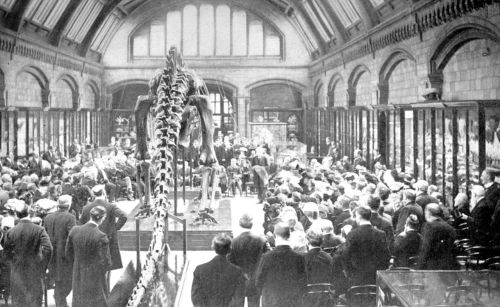
In March 1905, a classy shindig celebrated the arrival of the first replica Diplodocus in London.
That’s usually where the Diplodocus story ends, with a footnote that nine more Diplodocus replicas were later manufactured and presented to heads of state throughout Europe and Latin America. I’d like to explore those subsequent displays in more detail. The Carnegie Diplodocus was the first mass-produced dinosaur, and by 1932 it appeared in no less than ten virtually identical displays across three continents. Taylor characterizes Carnegie’s sauropod as “the single most viewed skeleton of any animal in the world”, and its scientific, social, and even political ramifications are both wide-reaching and fascinating.
Building a Sauropod
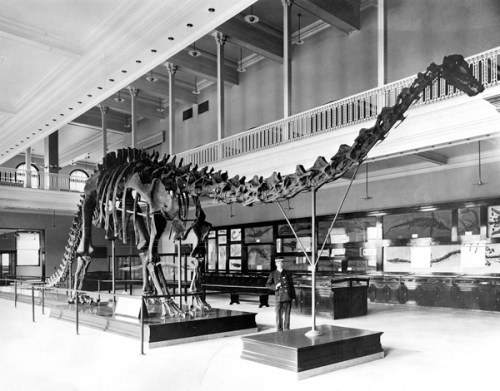
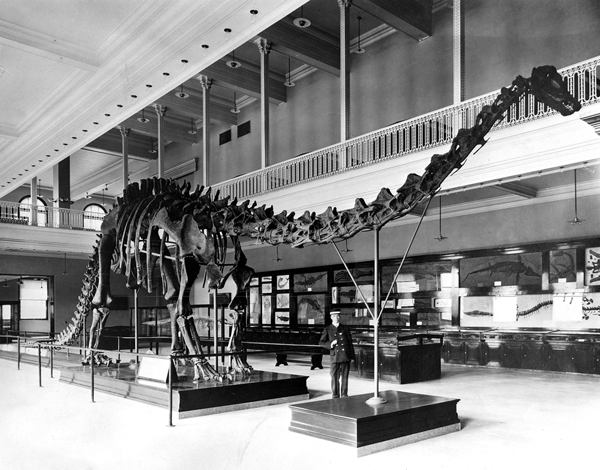
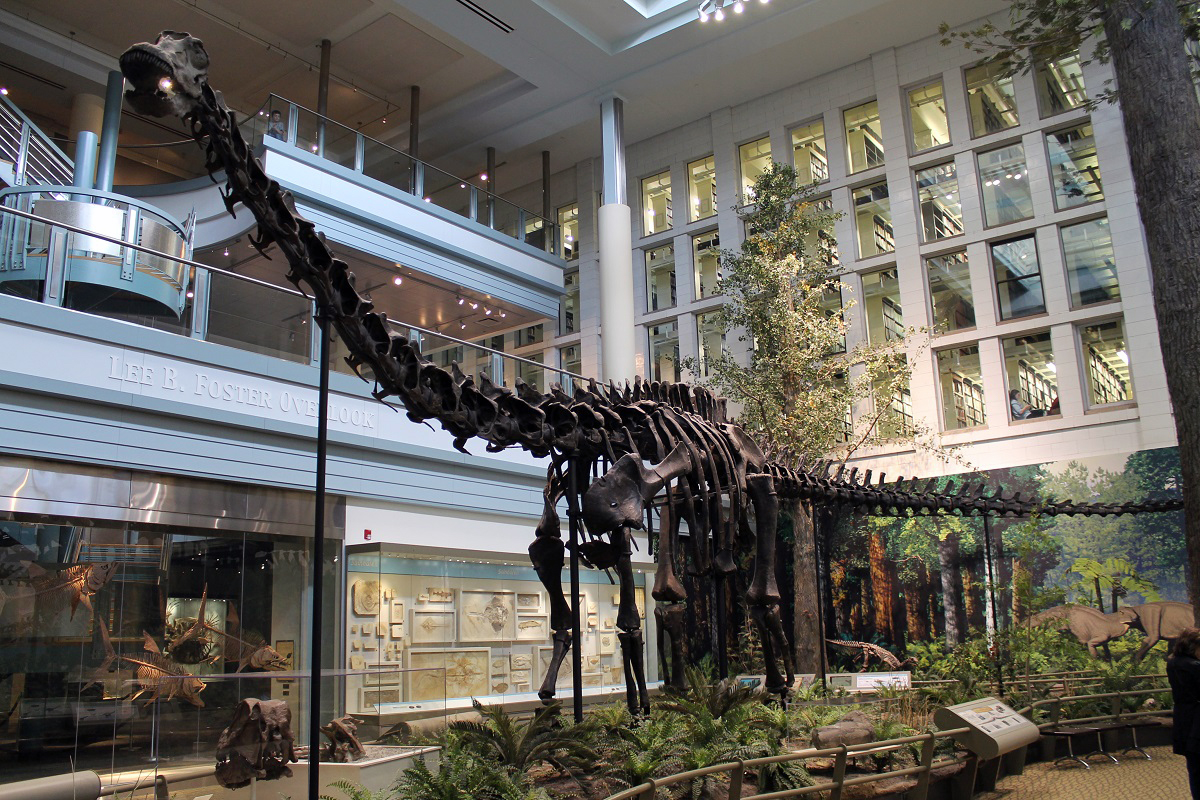
The real CM 84 has been displayed in Pittsburgh since 1907. Source
The Diplodocus in question is specimen CM 84, recovered in 1899 in Albany County, Wyoming. The skeleton was about 60% intact and remains one of the most complete sauropod specimens ever found. The ubiquitous John Bell Hatcher described the fossils in 1901, coining the new species Diplodocus carnegiei after the project’s benefactor. Arthur Coggeshall of the Carnegie Museum was primarily responsible for preparing and casting the fossils. He was initially supervised by Hatcher, but William Holland took over when Hatcher died in 1904. Holland deferred to Hatcher’s judgement in most cases, although he was not shy about voicing his disagreement. For example, Hatcher had reconstructed the Diplodocus forefeet with slightly elevated digits, but Holland (incorrectly) thought they should be flat and splayed.
As is typical of dinosaur mounts, the incomplete primary specimen was supplemented with other fossils to produce a full skeleton. The skull, for instance, was a cast of USNM 2673, a specimen on display at the Smithsonian. A number of missing bones, including most elements of the forelimbs, were sculpted using a smaller Diplodocus specimen for reference. Although it took longer to produce than the AMNH Apatosaurus, contemporary paleontologists generally agreed that Carnegie’s Diplodocus was the superior sauropod mount. Not only was its pose more natural and lifelike, but the underlying steel armature was cleverly hidden. It’s difficult to overstate the challenges of assembling a mounted skeleton on this scale, and in its day the Diplodocus was the best in the world.
Roll Call
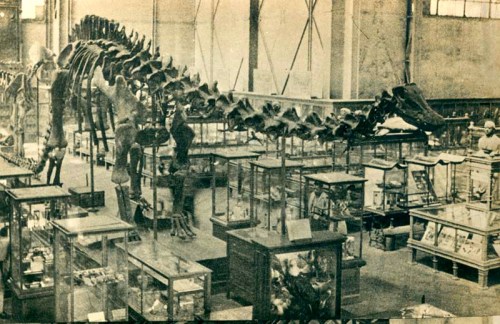
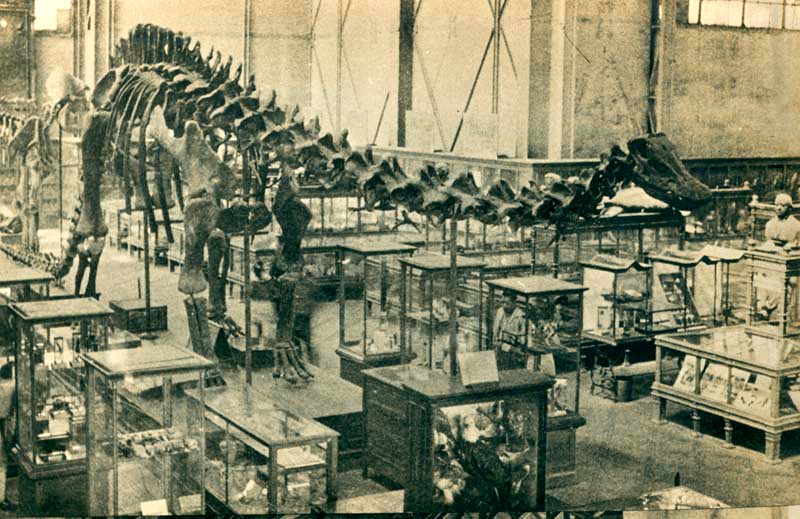
The Chopo University Museum in Mexico City received the 9th Diplodocus cast in 1929. Source
As mentioned, the first replica Diplodocus was unveiled in London in 1905, and the original fossils were ready for display in 1907. French and German dignitaries were present at an event in Pittsburgh celebrating its completion, and Andrew Carnegie promised both countries Diplodocus casts of their own. Once again, Coggeshall and Holland led the creation of the new mounts, a task they would repeat many times in the years to come. Playing precisely to cartoonish national stereotypes, the Germans provided a detailed plan and ambitious schedule for the project, while the French acted coy, then threw a lavish party when the mount was ready. Diplodocus replicas were on display at the National Natural History Museum in Paris and the Humboldt Museum in Berlin before the end of 1908, but the Pittsburgh team already had orders for a new batch of mounts. By early 1910, three new Diplodocus were on exhibit at the Museum for Paleontology and Geology in Bologna, Italy, the Natural History Museum in Vienna, Austria, and the Zoological Museum in St. Petersburg, Russia. The La Plata Museum in Buenos Aires, Argentina and the National Museum of Natural Science in Madrid, Spain received their Diplodocus mounts in 1912 and 1913, respectively, bringing the total number of replicas up to eight by the onset of World War I.
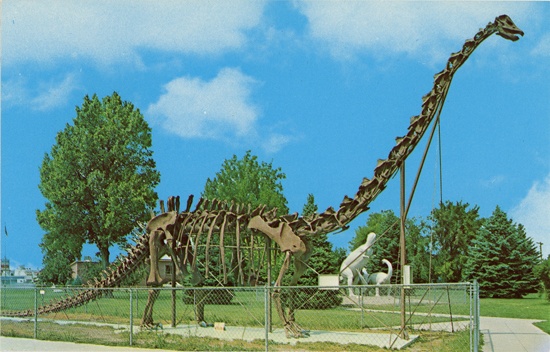
The war put a damper on this friendly exchange of dinosaurs, and Carnegie’s death in 1919 brought the Diplodocus diaspora to a temporary end. However, in 1929 Louise Carnegie, wife of Andrew, commissioned an additional cast as a gift for Alfonso Herrera of the Chopo University Museum in Mexico City. Herrera originally asked for a bronze cast for outdoor display, but when this proved prohibitively expensive, a plaster version was produced instead. In 1932, the Carnegie Museum traded a Diplodocus replica for a collection of German fossils from the Paleontological Museum in Munich. This copy has never been mounted or displayed. The last Diplodocus cast from the original molds was forged in 1957. Made from concrete, this mount was displayed outdoors for many years at the Utah Field House Museum in Vernal, Utah.
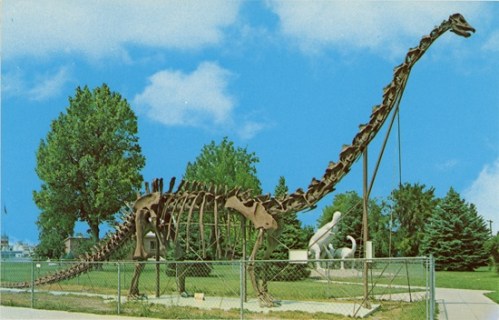
The 11th and final facsimile Diplodocus made from the original molds was this concrete version, on exhibit in Vernal, Utah for many years.
Most of the historic Diplodocus mounts remain on display today. The London Diplodocus was taken off exhibit during World War II, but in 1979 it was given a position of honor in the museum’s entrance hall. Later, it was completely restored and remounted with its tail held aloft. The Berlin, Buenos Aires, and Bologna Diplodocus mounts have also been upgraded with modern poses, but the others retain their historic, tail-dragging posture, looking exactly as they did a century ago. The St. Petersburg mount was circulated among a number of Russian museums, and may have been destroyed in an effort to make new molds from the bones (Edit: The Russian mount is still on display at the Orlov Museum for Paleontology—see comments). The concrete Diplodocus in Vernal has likewise been retired, but it was used to create two new casted skeletons, now on display in Utah and Nevada.
Opportunities for Science
The sudden availability of identical Diplodocus skeletons presented an unusual opportunity for international scientists, allowing researchers based thousands of miles apart to study and compare notes on the same bones. Perhaps inevitably, a few European scientists were not happy with Holland and Coggeshall’s take on the sauropod. The best-known dissenter was Gustav Tornier, who rejected the straight-limbed reconstruction of Diplodocus, arguing instead that the sauropod sprawled like a crocodile. The German scientist provided an illustration of this alternate stance, in which the poor dinosaur’s arms appear to project from the base of its neck. Holland responded with a particularly harsh rebuttal (backed by several European scientists), and Tornier declined to push the issue further in print.
Dinosaurs for everyone
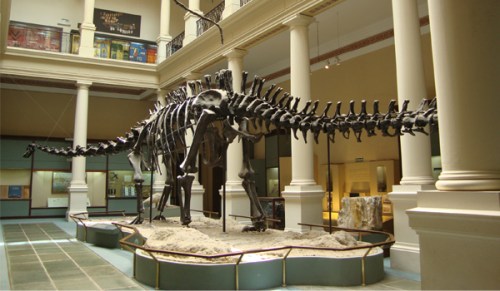
Diplodocus cast number seven at the La Plata Museum in Buenos Aires. Source
The most lasting influence of the Carnegie Diplodocus is certainly it’s cultural impact. If any one specimen can be credited with inspiring the global popularity of dinosaurs, it was this one. Thanks to Carnegie, citizens of 11 different nations had their first opportunity to stand in the presence of a giant dinosaur, and to experience the scale and splendor of a creature that completely dwarfed any modern land animal. In every nation where a new Diplodocus was installed, the local press adored the creature, never failing to point out its tiny head and presumed stupidity. Diplodocus was an endearing oaf, and for a time, its name was synonymous with dinosaurs and prehistory in general.
What was the significance of Diplodocus to all these people? It’s difficult not to think of it as a vanity project for Andrew Carnegie*, an opportunity to rub shoulders with European royalty and flaunt his wealth and generosity. One might also consider the Diplodocus an expression of America’s economic and technological might, or perhaps a harbinger of the United States’ role in globalization and mass production. French writer Octave Mirbeau seemed to be thinking along those lines when he lamented the mighty dinosaur being reduced to a crass, populist display. According to Carnegie himself, however, the goal was nothing less than world peace: he wanted to bring people together over their shared enthusiasm for the dinosaur. Too bad World War I came along and ruined the sauropod love-in.
*If the accolades went to anyone’s head, it was Holland’s. During his world tour assembling sauropod mounts, he was given countless awards, including the French Legion of Honor and German Knight’s Cross. Holland carefully added each new medal to his portrait at the Carnegie Museum.
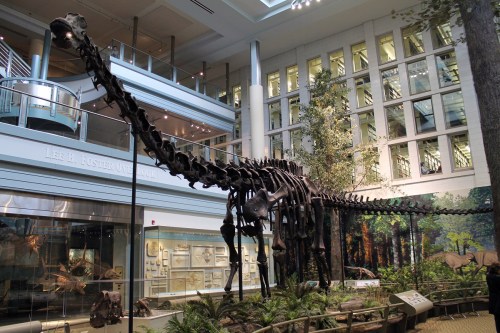
The original Diplodocus skeleton was remounted at the Carnegie Museum in 2007. Photo by the author.
On both sides of the Atlantic, Diplodocus was a shared point of reference and a beloved symbol. Most commonly, Diplodocus was the butt of a joke: from politicians to athletes to heavy machinery, anything big, slow, and not especially bright was likened to the dinosaur. My favorite anecdote on the subject comes from Nieuwland: during World War I, soldiers from different nations with different languages had the word “Diplodocus” in common, and used it to describe the heavy, plodding tanks.
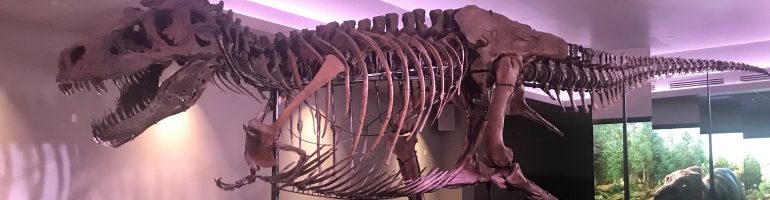
Today, we think of Diplodocus and it’s ilk very differently. Sauropods weren’t ungainly dolts—they were surprisingly nimble and extremely successful megaherbivores, unchallenged in their dominance for 140 million years. Still, it’s difficult to think of single fossil that has matched the global cultural impact of CM 84. There are far more copies of Stan the T. rex on display, and Sue is widely known by name, but really, the only contender that even comes close is Archaeopteryx. With eleven versions still on display, Carnegie’s legendary Diplodocus lives on.
References
Brinkman, P.D. 2010. The Second Jurassic Dinosaur Rush: Museums and Paleontology in America at the Turn of the 20th Century. Chicago, IL: University of Chicago Press.
Holland, W.J. 1906. The osteology of Diplodocus Marsh with special reference to the restoration of the skeleton of Diplodocus carnegiei Hatcher, presented by Mr. Andrew Carnegie to the British Museum, May 12, 1905. Memoirs of the Carnegie Museum. Vol. 2, No. 6, 225-278.
Nieuwland, I. 2010. The colossal stranger: Andrew Carnegie and Diplodocus intrude European Culture, 1904-1912. Endeavour. Vol 34, No. 2.
Taylor, M.P. 2010. Sauropod dinosaur research: a historical review. Geological Society, London, Special Publications. Vol. 343, pp. 361-386.







 EXTINCT MONSTERS


.001_-_London.JPG)


