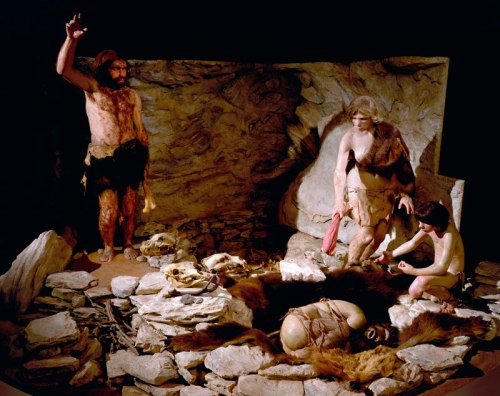
The neanderthal burial diorama. Image from Ice Age Mammals and the Age of Man, 1974.
On September 13, 1974, the Hall of Ice Age Mammals and the Rise of Man opened in Hall 6 at the National Museum of Natural History. Part of the “third wave” of NMNH exhibits, the Ice Age Hall was the result of interdisciplinary collaboration and a new drive to create more accessible, visitor-centric museum experiences. Specifically, the exhibit was a response to increasing pressure for museums to become destination attractions, valuing visitors’ desire to be entertained above anything else. The Ice Age Hall was meant to prove that good science and the intrinsic value of specimens could, in fact, be applied in a way that would appeal to contemporary audiences. The curators, designers, educators, and artists involved with the project saw it as an important departure from old methodologies, and expected it to be a template for future exhibits. This transition did not necessarily come easily, but for 40 years the results spoke for themselves.
The Hall of Quaternary Vertebrates

Large fossil mounts in the short-lived Pleistocene Hall. Images courtesy of the Smithsonian Institution Archives.
Despite the fanfare accompanying the Ice Age Hall’s opening, NMNH regulars would be forgiven for noticing that much of the exhibit looked familiar. Just four years earlier, this same space saw the opening of the brand-new Hall of Quaternary Vertebrates. This was the fifth and final phase of a thorough re-imagining of the museum’s fossil displays that began in 1959. Under the guidance of exhibit designer Ann Karras, the loose arrangement of specimens that had characterized the east wing for half a century was replaced with a directed narrative of the biological and geological history of the Earth.
This new direction was motivated by complementary revolutions in the museum field and in paleontology. Museum workers shrugged off their “cabinet of curiosity” roots and embraced education-oriented exhibits. Designers began to envision the routes visitors would travel through an exhibit space, and consider how objects on display could contribute to holistic stories. Meanwhile, paleontologists moved their field away from purely descriptive natural history, exploring instead how the fossil record could inform our understanding of evolution and ecology. At NMNH, this change in ideology inspired paleontologists to break away from the Geology Department and form their own Department of Paleobiology. The common thread between both transitions was a focus on connections – bringing new meaning and relevance to disparate parts by placing them in a common narrative.

Two dire wolves posed over a horse. This display didn’t make it into the Ice Age Hall. Source
As Curator of Paleontology, C.L. Gazin oversaw most of the east wing modernization and designed the Tertiary Mammals exhibit in Hall 4 himself. Gazin retired in 1970, however, so responsibility for the unfinished Quaternary exhibit in Hall 6 went to new hire Clayton Ray, the Assistant Curator of Cenozoic Mammals. To fill out the Quaternary Hall, Ray arranged a number of trades with other museums. The Natural History Museum of Los Angeles County provided a saber toothed cat, two dire wolves, and the sheep-sized sloth Paramylodon (USNM 15164) from the La Brea tar pits, while the American Museum of Natural History was able to spare a bison “mummy” (USNM 26387) and a taxidermied musk ox. Ray also selected a complete set of mammoth bones from the AMNH collections, which were found during a gold mining operation near Fairbanks, Alaska. The bones were collected individually and belonged to an unknown number of individuals (they may well represent multiple species), but they were sufficient for preparator Leroy Glenn to construct a complete mounted skeleton.
Ray placed the new mammoth (USNM 23792) alongside the Indiana mastodon (USNM 8204), which had been on display since 1904. The mammoth was so tall that it had less than an inch of clearance with the ceiling. The other big draw in the Quaternary Hall was a pair of never-before-exhibited giant sloths (USNM 20867 and USNM 20872) assembled from material Gazin collected in Panama. Referred to as “megatheres” at the time, these sloths are actually Eremotherium, and they are composites of at least eight individuals. The giant sloths were positioned back-to-back on a central platform, accentuated by an illuminated opening in the ceiling. All four giant mammal skeletons were supplemented with 1/5th scale life restorations created by staff artist Vernon Rickman. Exhibits specialist Lucius Lomax came up with the idea to display the fossil mounts behind piano wire, stretched from the floor to the ceiling and arranged in rows. The Eremotherium platform alone required 500 strands – or about 6000 feet – of wire.
A New Vision
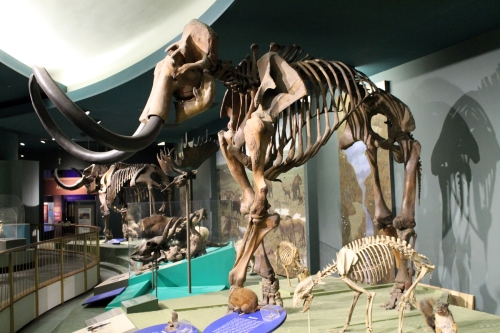
The composite mammoth looms over other specimens along the right wall of the Ice Age Hall. Photo by the author.
Neither NMNH staff nor museum visitors were overjoyed with the Quaternary Hall as it stood in 1970. The piano wire Lomax had installed was a frequent cause for complaint: visitors would constantly pluck at the strings and occasionally break them. The wires also ruined photos. Automatic lenses would focus on the wire, so when visitors got their vacation pictures developed they would end up with a bunch of images of vertical strands with darkness beyond them. Nevertheless, the piano wire was really just a scapegoat for deep-seated disagreements over content between paleontology curators and exhibit designers. This apparently unsolvable clash of personalities contributed to the hall being closed indefinitely after just a couple years.
Paleontologist Porter Kier became Director of NMNH in 1973, and one of his first moves was to assemble a new team to reinvent the Quaternary Hall. Paleobotanist Leo Hickey, geologists Robert Emery and Thomas Simkin, and anthropologist William Fitzhugh conceived of an interdisciplinary exhibit that would explore the ice ages from multiple perspectives. Continental glaciation, the evolution and extinction of large mammals, and the rise of humans would all be presented in a single, holistic story. In what was at the time a novel development, the curators worked with Elaine Anderson and other “conceptualizers/writers” from the Office of Exhibits. The scientists conceived of the main ideas and ensured factual accuracy, but the Office of Exhibits ultimately wrote the label copy and oversaw the construction of the exhibition.

A statue of an archaeologist at work was a popular part of the exhibit. Image from Ice Age Mammals and the Emergence of Man, 1974.
To accommodate new content, the existing Quaternary Hall layout had to be completely gutted and replaced. Although Clayton Ray was conspicuously absent from the exhibit team, most of the modern and fossil animal specimens he had gathered were reused in different locations. The center of the exhibit became an enclosed theater with a video presentation about the advance and retreat of North American glaciers. The north end of the hall was overtaken by human evolution displays. Replica skulls and full-body illustrations showed the progression of hominids from australopithicines to modern humans, amusingly represented by a hippie. Vernon Rickman returned to create a life-sized diorama depicting a neanderthal burial ceremony. While directly based on excavations at Regourdou Cave in France, the scene was also inspired by the much-publicized Shanidar Cave site in Iraq, where neanderthals allegedly laid their dead to rest on a bed of freshly picked flowers. Finally, a cast of an engraved mammoth tusk, based on a 25,000 year old original from the Czech Republic, was added to the south entrance. This piece was meant to tie the exhibit’s narrative together, symbolizing “man’s emergence in the ice age as a dominant influence on other animals and his environment” (Ice Age Mammals and the Emergence of Man, 1974).

Vernon Rickman works on neanderthal models in 1973. Image courtesy of the Smithsonian Institution Archives.
The Ice Age Hall was completed remarkably quickly. Kier pulled the team together in early 1974 and the new displays were designed, written, and fabricated by September. At least internally, a great deal of excitement accompanied the reopening of Hall 6. The Ice Age Hall was a serious departure from how exhibit work had traditionally been done at NMNH, but it also represented an attempt by the museum to stand its ground in the face of pressure to delve into “edutainment.” This was a trial run at developing a visitor-focused but science-driven exhibit, and everyone involved was anxious to see how the public would react.
Legacy of the Exhibit
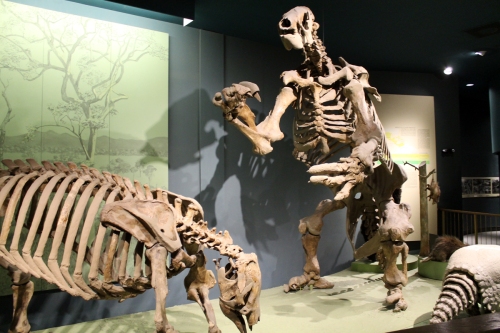
Few visitors can help but stop in their tracks at the sight of the Eremotherium pair. Photo by the author.
In 1978, Robert Wolf and Barbara Tymitz published a “naturalistic/responsive” evaluation of the Ice Age Hall. Their groundbreaking and oft-cited methodology involved interviewing visitors and surreptitiously tracking them through the gallery space, seeking to understand how museumgoers were using and interpreting the “complex set of stimuli” presented by the exhibit. This document, and especially the taxonomy of visitor types it describes, may well have influenced the museum field more than the Ice Age Hall itself.
According to Wolf and Tymitz, the Ice Age Hall was largely successful. Visitors generally remembered the major topics under discussion, and frequently left more curious about natural history than when they entered. They also noticed the difference in layout from the rest of the museum, describing it as easier to navigate and understand. Not surprisingly, the mammoth, mastodon, Eremotherium, and neanderthal burial were the most popular and most photographed objects. In comparison, the carved mammoth tusk at the front of the hall recieved surprisingly little attention. This object was intended to be tie the entire exhibit together, but most people ignored it entirely. Likewise, the separation of North and South American animals via an architectural “land bridge” was completely lost on visitors. Wolf and Tymitz observed that visitors entering from the south paid more attention to the fossil mounts, while visitors entering from the north were drawn to the glacier theater. A lesson about the importance of sight lines and traffic flow lies therein.
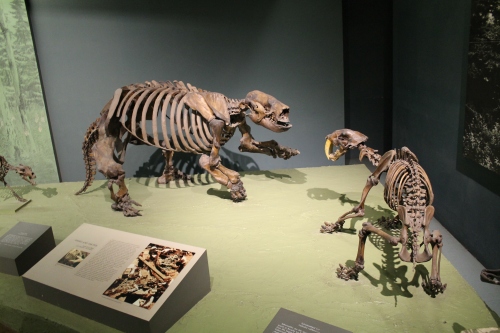
Paramylodon and Smilodon from the La Brea tar pits. Take a good look at the sloth, because it won’t be returning in 2019. Photo by the author.
After 40 years, not every element of the Hall of Ice Age Mammals and the Emergence of Man aged gracefully. Most obviously, the androcentric title and frequent use of the word “man” to describe humans throughout the label copy comes across as painfully dated. Displays that warned of another period of global cooling were removed (or at least stopped being lit) when anthropogenic warming emerged as a crucial public policy concern. The multimedia demonstration of continental glaciation was shut down by the early 2000s, and the human evolution corner was boarded up once the Hall of Human Origins opened in 2010. While the neanderthal diorama remained on display, recent research has shown that the affectionate burial it depicts is probably a misinterpretation. Ironically, the gradual removal of geology and anthropology components effectively turned the Ice Age Hall into the straightforward menagerie of Pleistocene animals that Ray initially envisioned.
The Ice Age Hall closed along with the rest of the NMNH fossil displays in April 2014. When the east wing reopens, many of the specimens will return restored and remounted, but in a different location. Since the new National Fossil Hall will be arranged in reverse chronological order, Hall 6 itself will house displays on the origins of life and an expanded FossiLab. Still, the Ice Age Hall experiment continues to leave its mark on the museum. The collaborative workflow and sharing of responsibilities between curators, educators, and exhibit specialists pioneered in the development of this exhibit remains standard practice today. The result has been ever more effective displays, providing solid scientific content to the widest possible audience.
References
Eschelman, R.E., Emry, R.J., Domning, D.P. and Bohaska, D.J. (2002). Biography and Bibliography of Clayton Edward Ray. Cenozoic Mammals of Land and Sea: Tributes to the Career of Clayon E. Ray. Emry, R.J., ed. Washington, DC: Smithsonian Contributions to Paleobiology.
Lay, M. (2013). Major Activities of the Division of Vertebrate Paleontology During the 1960s. http://paleobiology.si.edu/history/lay1960s.html
Marsh, D.E. (2014). From Extinct Monsters to Deep Time: An ethnography of fossil exhibits production at the Smithsonian’s National Museum of Natural History. http://circle.ubc.ca/handle/2429/50177
Sepkoski, D. (2012). Rereading the Fossil Record: The Growth of Paleobiology as an Evolutionary Discipline. Chicago, IL: The University of Chicago Press.
Smithsonian Institution. (1974). Ice Age Mammals and the Emergence of Man. Washington, DC: Elephant Press.
Wolf, R.L. and Tymitz, B.L. (1978). Whatever Happened to the Giant Wombat: An Investigation of the Impact of the Ice Age Mammals and the Emergence of Man Exhibit. Washington, DC: Smithsonian Institution.
Yochelson, E. (1985). The National Museum of Natural History: 75 Years in the Natural History Building. Washington, DC: Smithsonian Institution.




 EXTINCT MONSTERS
