Category Archives: exhibits

Spinosaurus at the National Geographic Museum

IMG_2341

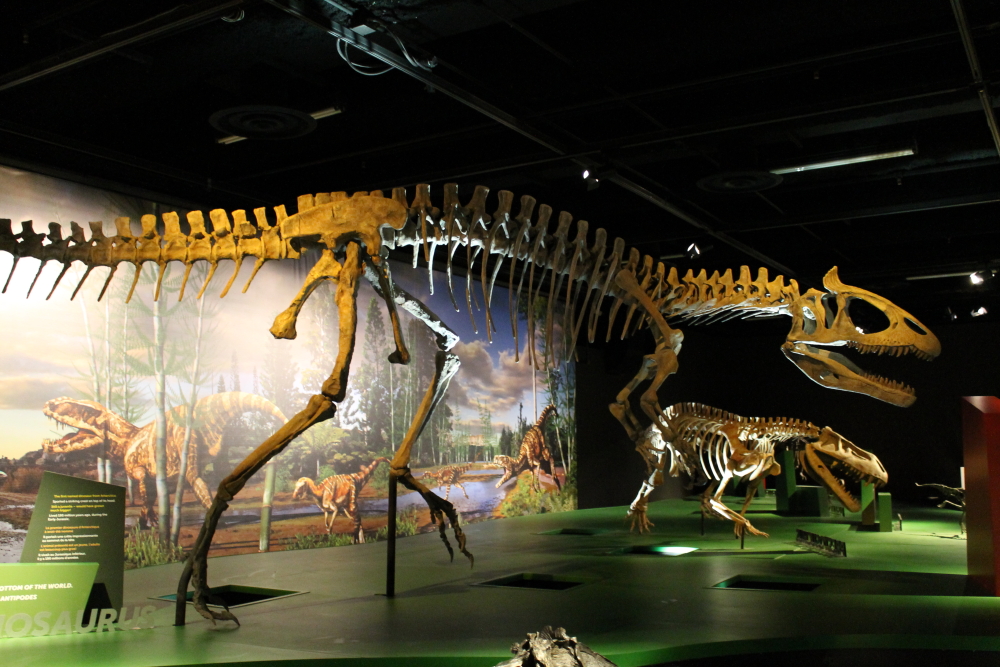
Research Casting International has done it again with a beautiful reconstructed skeleton of a swimming Spinosaurus. Photo by the author.

Yesterday, Nizar Ibrahim and National Geographic made a tremendous splash with their long-awaited announcement of a new Spinosaurus specimen. Spinosaurus is a widely recognized and beloved dinosaur (particularly among what one might call the dinosaur fandom community), but paradoxically it is known from only the scrappiest of fossil remains. What’s more, the holotype specimen is long gone – destroyed in the bombing of Munich during World War II. No doubt the enigmatic nature of Spinosaurus is a major part of its appeal. At any rate, the new paper by Ibrahim and colleagues describes the never-before-seen hindlimbs and pelvis of Spinosaurus, and proposes that the dinosaur’s anatomy – and behavior – were far more extreme than previously assumed. The new specimen reveals that Spinosaurus had narrow hips and legs barely longer than its arms. This was not an animal built for running on land, and a quadrupedal posture is not out of the question. What’s more, Spinosaurus limb bones are surprisingly dense for a theropod, not unlike the heavy bones of seals and early whales. Ibrahim and colleagues paint a picture of Spinosaurus as an animal that was at least as at-home in the water as it was on land.

The news has provoked the usual cycle of rampant speculation among dino fans, dismissal of sensationalism by some professionals, and even well-reasoned, evidence-based criticism. After the fervor dies down, we can assess whether this hypothesis holds water. In the meantime, though, I must applaud the tremendously impressive show National Geographic has put on. As part of the media roll-out that started yesterday afternoon, National Geographic has prepared both a television special and a traveling exhibit revolving around Spinosaurus. Some might scoff at all the hype over a partial skeleton, but I’d call this science outreach at its best, put on by some of the most experienced folks in the business.

IMG_2376

This Spinosaurus sculpture will be a fixture outside the National Geographic Building on 17th street until January. Photo by the author.

“Spinosaurus: Lost Giant of the Cretaceous” opened this morning at the National Geographic Explorer’s Hall in Washington, DC, and in this post I’d like to share my initial impressions. Visitors approaching from M Street are greeted by a life-sized Spinosaurus sculpture, posed over a half-eaten fish. This superb model was produced by the Italian studio GeoModel, and was apparently over a year in the making. Conceptual art and behind-the-scenes photos can be seen here. I’m not sure if the model has quite the extreme proportions that are proposed in the paper, but it’s not like I actually measured it. Regardless, this is a stunning piece  that will be a DC fixture through the end of the year.

The shrine to Ernst Stromer at the exhibit's entrance. Photo by the author.

The shrine to Ernst Stromer at the exhibit’s entrance. Photo by the author.

Once you’ve gone inside and paid your admission (I remember when this museum was free…oh well), you can enter the Spinosaurus exhibit proper. Interestingly, the exhibit is framed not as a science lesson but as a historical account. The first objects on display are documents and other possessions of Ernst Stromer, the German paleontologist who originally described Spinosaurus in 1915. Passing through a narrow corridor, you’ll see a reconstruction of the Spinosaurus holotype as it was displayed at the Bavarian State Collection in Munich, a Moroccan fossil shop, and even a replica of the cave where a Mysterious Bedouin Stranger led Ibrahim to the new find. Each stop is supplemented by a video mixing talking-head interviews with somewhat silly re-enactments of historic events. I particularly liked Stromer being berated by his Nazi boss.

Reconstruction of the holotype

I never dreamed I’d ever see an exact reconstruction of the Spinosaurus holotype, which was destroyed during World War II. Photo by the author.

I thought this method of storytelling was quite clever. By focusing on the role of Spinosaurus in world history, the exhibit can grab the attention of adult visitors that would usually dismiss dinosaurs as kids’ stuff. National Geographic’s shtick has always been presenting stories of intrepid scientists on adventures in distant locales, and there is plenty of that in evidence here. This sort of exoticism is probably a little problematic, but the gorgeous images of the Moroccan desert were clearly having the desired effect on some of my fellow visitors. Usually, I would complain about the over-reliance on long videos, but people seemed to be watching them all the way to the end, so I guess I’ll keep quiet this time.

Spinosaurus!

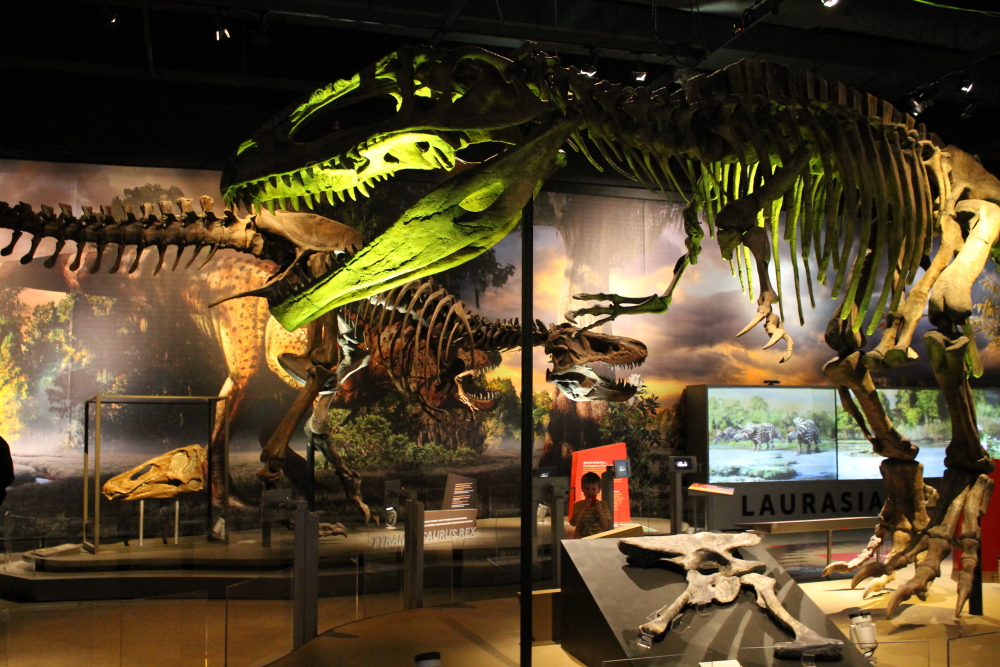
Spinosaurus in all its glory. Photo by the author.

Once the history lesson is over, the exhibit opens up into a larger display space. This is similar to what was done in “The World’s Largest Dinosaurs” – a narrow entry gallery introduces visitors to the topic at hand and the central questions being discussed, then visitors are freed to look at what they find interesting in whatever order they choose. All in all, this layout is a good compromise between the need to convey a specific educational message and the need to let visitors make the exhibit experience their own.

The star of the show is of course the reconstructed skeleton of Spinosaurus, yet another fantastic display piece by Research Casting International. Check out a time-lapse video of the mount being assembled here. What wasn’t clear from the grainy preview images that were flying around the internet a couple months ago is that the Spinosaurus is actually in a swimming pose. Its legs are posed in mid-paddle, and its head is turned to the right to snag a model sawfish. Above all, the mount is big. So big, in fact, that I couldn’t find anywhere in the gallery where I could photograph it all at once. I’d love to see this thing alongside Sue.

IMG_2372

The process of 3D printing digital fossils, explained. Photo by the author.

Happily, the exhibit takes the time to acknowledge that the Spinosaurus mount is not only a cast, but a composite of many fossil specimens. There is even a small display showcasing the process by which fossils are scanned and 3-D printed at a consistent scale. It’s great that the exhibit explains the evidence that led to the aquatic Spinosaurus reconstruction, showcasing the process of making and testing a scientific hypothesis.

Around the perimeter of the Spinosaurus gallery are displays of the other paleofauna of the Kem Kem region in Morocco, which Paul Sereno and company have been assembling for many years. There are models of azdarchid pterosaurs and coelocanth fish, as well as a Deltadromeus skeleton and skulls of  Carcharodontosaurus and Rugops (all heavily-reconstructed casts). All of these displays explore the question of how so many carnivores could co-exist in one environment. The answer provided is that each predator was specialized to hunt a different kind of prey: Spinosaurus chased fish, Carcharodontosaurus ate big herbivorous dinosaurs and (this will undoubtedly annoy some) Rugops is presented as an obligate scavenger.

friends

Some Kem Kem friends: Deltadromeus and Carcharodontosaurus. Photo by the author.

I have virtually nothing negative to say about the Spinosaurus exhibit. This is a great story, well told, and I was thoroughly impressed by nearly every part of it. The only thing that might be a sore point for some is that there are very few authentic fossils on display. A single dorsal spine is the only real bone representing Spinosaurus. Nevertheless, the exhibit team has shown precisely how to dramatize the process of scientific discovery, while still making the process transparent and relateable. Bravo.


11 Comments

Filed under dinosaurs, exhibits, fossil mounts, history of science, museums, reviews, science communication, theropods

Exhibit Review: Dinosaur Mysteries at the Maryland Science Center

First, let me assure you that the posts on major fossil exhibits and Triceratops mounts I’ve promised are definitely in the works, and I should be finishing them soon(ish). In the meantime, here’s a quick write-up of my recent trek to the distant land of Baltimore’s inner harbor, home of the Maryland Science Center and the “Dinosaur Mysteries” exhibit. In all seriousness, this exhibit has been open since 2004 and is less than 40 miles from me, so this visit was long overdue. What’s more, now that the Smithsonian’s fossil hall is closed for renovation, this is the largest dinosaur exhibit in the region, and will be the spot to see mounted dinosaur skeletons near Washington, D.C. for the next five years. Is it up to the task? Let’s find out.

Dinosaur Mysteries from the second floor. Photo by the author.

Dinosaur Mysteries from the second floor. Photo by the author.

At 15,000 square feet, Dinosaur Mysteries isn’t a huge exhibit, but it’s pretty dense with content. There are a lot of displays and interactives crammed into into the space, including no less than 12 free-standing mounts and life-sized sculptures of Astrodon* and Acrocanthosaurus. This venue is a science center, not a natural history museum, so the exhibit is mostly aimed at kids and families. That said, there’s still plenty for adult visitors to enjoy (the rest of the museum is purely for kids, though…if you don’t have any, I’d recommend taking advantage of the half-priced Friday evenings).

*Alright, it’s really a sculpture of Giraffatitan standing in for the poorly known Astrodon.

Among the mounted skeletons (all casts), expect to see Tyrannosaurus (Peck’s Rex, to be specific), Tarbosaurus, Giganotosaurus, Compsognathus, Herrerasaurus, Protoceratops, what used to be called “Dilophosaurus sinensis”, and plenty of others. The offerings are a little theropod heavy (and a little tyrannosaur heavy, in point of fact), but they certainly don’t fail to impress. Sadly overlooked by most visitors are some lovely genuine Maryland fossils, including an Astrodon femur that is the largest dinosaur bone found east of the Mississippi River.

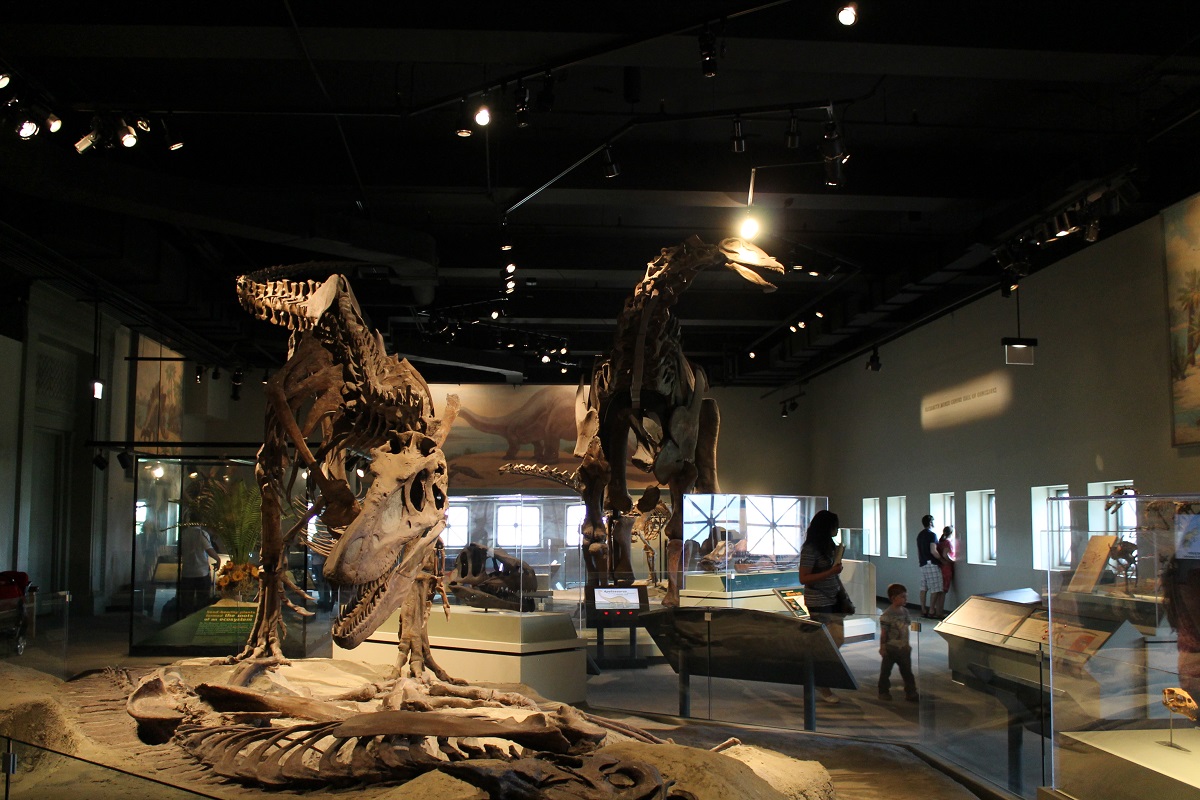
Full skeleton cast of Peck's Rex, accompanied by skull cast of the Nation's T. rex. Photo by the author.

Full skeleton cast of Peck’s Rex, accompanied by skull cast of the Nation’s T. rex/Wankel Rex. Photo by the author.

Thematically, Dinosaur Mysteries is all about answering questions through observation and deduction. The press release asserts that there are over two dozen interactives available, and indeed, visitors are invited throughout the exhibit to compare, contrast, and even measure fossils in order to draw conclusions about dinosaurs’ lives. Most of the “mysteries” are of the safe variety, tackling issues that are either soundly resolved or were never really issues to begin with (think “are birds dinosaurs” or “was Tyrannosaurus a scavenger or a predator”). Experts might be a bit blasé about these questions, but they nevertheless serve to get visitors thinking about how scientists draw conclusions. I go back and forth on this, but generally I find it helpful to embrace what visitors are already familiar with, at least as a starting point, rather than shutting out their frame of reference entirely.

Birds are dinosaurs, did you know?

This may come as a shock, but birds are dinosaurs. Photo by the author.

Other interactive components include a cool champsosaur skeleton puzzle, and a tabletop sandbox to dig in. I would have liked to see more interactivity with the dinosaur mounts themselves, since they’re the most visually impressive part of the exhibit. For example, there are no less than three Tyrannosaurus skulls on display, all from different specimens. That’s a great opportunity to compare the eccentricities of each individual, perhaps considering age differences, sexual dimorphism, pathology, or even erroneous reconstruction (looking at you, Wankel Rex rostrum). With some guidance, I reckon most visitors would do well with that, and it would push them closer to how paleontologists actually study fossils.

Astrodon and Acrocanthosaurus sculptures with Bored Dad #2. Photo by the author.

Astrodon and Acrocanthosaurus sculptures, with a Bored Dad. Photo by the author.

Apparently included in those two dozen interactives are a number of video terminals. As I’ve ranted before, videos are not interactive, even if you get to press a button to start it. That said, I’m actually of two minds about these. The videos, which are mostly interviews with paleontologists like Tom Holtz, Kristina Curry-Rogers, and Chris Morrow, were fascinating. I enjoyed hearing about the presumed purpose of Tyrannosaurus gastralia, what can and cannot  be presumed from dinosaur trackways, and especially the decision-making process behind posing a T. rex mount. However, these videos are also quite long, and rather unedited. The speakers ramble, repeat themselves, and generally er and um through their spiels. It’s quite a bit like chatting with a scientist about their work in person, actually, and I’m always in favor of giving science a human face. On the other hand, the exhibit team probably could have tightened these up.

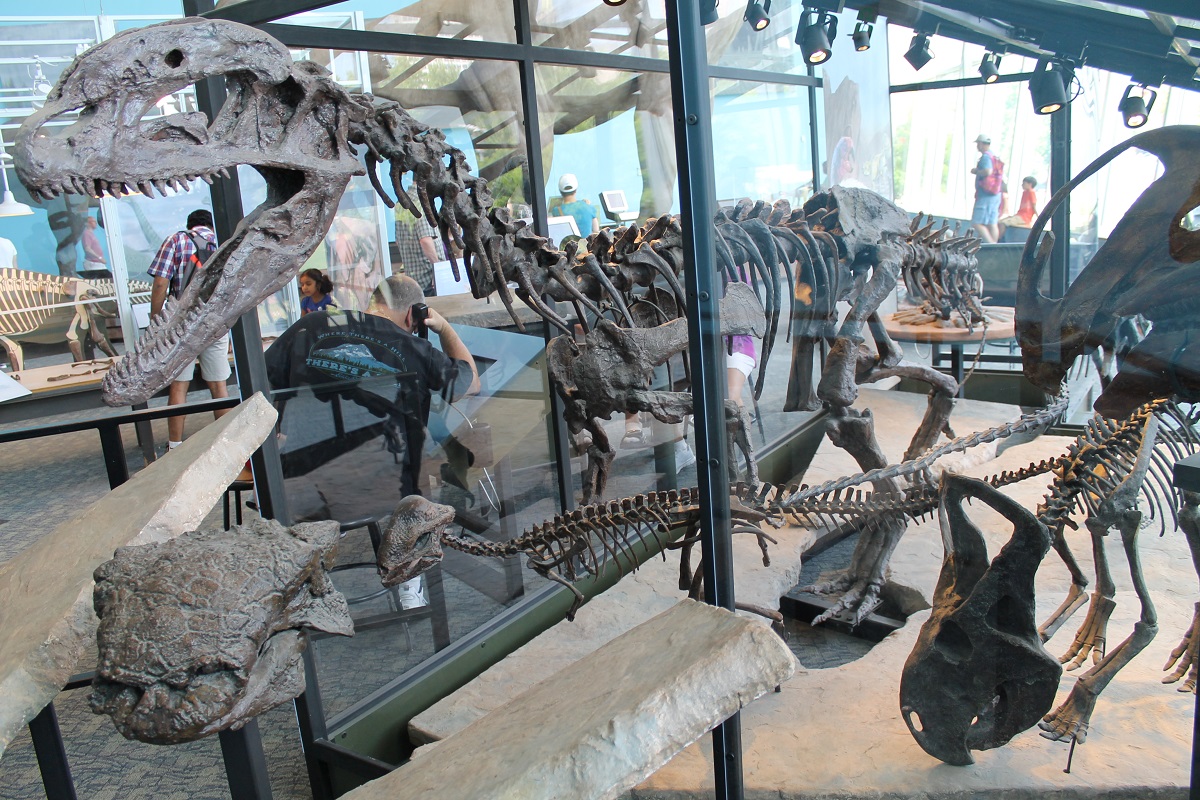
What used to be called "Dilophosaurus sinensis" and friends. Photo by the author.

What used to be called “Dilophosaurus sinensis” and friends. Photo by the author.

Overall, I was pretty pleased with Dinosaur Mysteries. It’s not a large-scale fossil hall at a major research museum, but it’s still cool to experience and the science being taught is generally very good. If you’ve got kids who are bummed that the Smithsonian fossil hall is closed (don’t forget that The Last American Dinosaurs is opening this fall, though), this is definitely a worthy substitute. For adults,  keep in mind that you aren’t the Maryland Science Center’s target audience, but if you appreciate the artistry of a well-made dinosaur exhibit, Dinosaur Mysteries is still worth checking out.

PS: There are a few additional photos on my tumblr page.

Leave a comment

Filed under dinosaurs, exhibits, fossil mounts, museums, reviews, science communication

Framing Fossil Exhibits, Part 1

This post started out as a review of “Evolving Planet”, the expansive paleontology exhibit at the Field Museum of Natural History. The short version is that it’s very good exhibit constrained by a somewhat frustrating layout. We’ll get back to that eventually, but first it’s worth considering the purpose of large-scale fossil exhibits in a more general sense.

Fossils, particularly the mounted skeletons of dinosaurs and other prehistoric animals, have been central to the identity of natural history museums since the late 19th century. In the early days, public exhibits were afterthoughts to the primary work of the museum (research and curation of collections), and if there was any logic behind their layout, it was an aesthetic logic. Typically posed in neutral, trophy-like stances on centrally-situated pedestals, mounted skeletons were the highlights of a natural history display for most visitors. For anyone not trained in comparative anatomy, however, these exhibits ultimately amounted to prehistoric pageantry. People could marvel at the great size of the animals, but there was very little to be learned besides the names of the species in question.

Hadrosaurus cast on display at the Field Museum. Field Museum Photo Archives.

A typically random assortment of fossil specimens at the Field Colombian Museum, ca. 1898. Image courtesy of the Field Museum Photo Archives.

These days, we try to do better. Exhibits are designed with a clear narrative structure, as well as specific learning goals for the audience. The focus of the narrative varies depending on the exhibit and the team behind it, but most modern natural history exhibits are explicitly designed to answer “how” as well as “what.” For paleontology displays, this means telling the story of life on Earth while also communicating how scientists collect and interpret evidence to put that story together. Crafting an exhibit has been compared to writing a popular nonfiction book, except designers are using the three-dimensional space of the exhibition hall as their medium. In this way, modern exhibits are more about ideas than specimens, or at least, the specimens are present primarily to illustrate the major scientific principles being communicated.

That’s how it works on paper, anyway. Despite this focus on education (and institutional mandates to provide learning opportunities for the widest possible audience), visitor surveys show that dinosaur pageantry is still the default mode of understanding for the majority of people passing through paleontology exhibits. No matter how carefully we craft our stories, most visitors still leave these displays recalling little more than a list of cool specimens they saw. Dinosaur pageantry has its place and can be employed for good. Dinosaurs and other prehistoric animals are undeniably impressive and spectacular, and it is absolutely worth taking advantage of that fact. We want people to pay attention to science, and in that respect mounted skeletons of favorite dinosaurs are great ambassadors to the world of research and discovery. The challenge is getting past the attention-grabbing stage. Prior experience has led visitors to expect that dinosaur pageantry is all paleontology has to offer, and many seem unprepared or unwilling to commit to a deeper understanding.

peabody mammals

The great hall at the Peabody Museum of Natural History, one of the last unmodified early 20th century fossil displays in the US. Photo by the author.

So are these people just hopeless rubes? Should exhibits be tailored only to visitors that care enough to put in the effort to understand? It should go without saying that this condescending attitude is completely wrongheaded and goes against the very spirit of museums. Education is half about knowing your content and half about knowing your audience. If visitors are not picking up on the content as desired, then a reassessment of who those visitors are is in order. Many museum exhibits still seem to be pitched at interested adults traveling alone with all the time in the world. This is a good description of many of my museum visits, but I’m also part of an increasingly small fraction of museum visitors. Most people who come to natural history museums come in groups of friends or family, and these groups often represent a range of ages. What’s more, most visitor interactions while in the museum will not be with the exhibits, but with each other. For the typical visitor, the museum experience is primarily a social one.

With this demographic in mind, a textbook on the wall (or a long video lecture*) is the last thing natural history museum audiences need. Visitors are absorbing exhibit content while simultaneously navigating a complicated, unfamiliar space. In the case of parents, they are also monitoring the attention span, hunger, and bathroom needs of their charges. Caught up in this whirlwind of information, visitors frequently fall back on what they already know. In the case of paleontology exhibits, this often means identifying familiar dinosaurs and ignoring the more intellectually challenging contextual information.

*It’s worth pointing out that a long video is NOT an improvement over a long label. Transferring label copy to a video or computer terminal does not inherently make the exhibit more interactive or more interesting. In fact, when the disruptive noise and need to wait for the next showing are taken into account, poorly implemented multimedia is probably less useful than traditional text labels.

The challenge for exhibit design, then, is dealing with the fact that visitors are not passively ingesting information. Visitors passing through an exhibit pull out relevant pieces of information and filter them through the lens of their existing worldview. Exhibit designers want visitors to also learn new information and challenge their preconceptions, but it’s easy to go too far. Survey after survey has shown that visitors do not appreciate exhibits that force them to move (or think) on rails. For practical reasons noted above, few visitors are able to look at every display, watch every orientation video, and work through every interactive in the prescribed order. Visitors need flexibility in order to make the exhibit experience their own. Finding the balance between providing informative context and providing a customizable experience is quite challenging, and not every exhibit succeeds.

struggling to contain the dinosaurs

The dinosaur hall in “Evolving Planet” at the Field Museum. Photo by the author.

On top of that, paleontology exhibits are particularly difficult to design because of problems with relatability. The story of life on Earth is immense, complex, and frequently counter-intuitive. It’s not enough to just explain what happened, we have to explain the history and methodologies of the half-dozen scientific disciplines that have contributed to to our understanding of that narrative. Even something so basic as the numerical age of a given fossil taxon requires a deluge of explanation to convey how we know. And all of this needs to be conveyed concisely, without being alienating, overwhelming, or condescending. Most importantly, it has to be made relevant to what audiences already know and understand.

Over the years, major natural history museums have attempted a variety of organizational strategies for their fossil exhibits. Each of these has been an attempt to break the dinosaur pageantry barrier and to portray the true complexity and relevance of paleontological science. Some arrangements, like taxonomical organization, have generally fallen out of favor. Others, like chronological presentations of life through time, are reliable mainstays that have been re-imagined in varied ways at different institutions. Still others, including cross-sections of specific extinct ecosystems, biogeography, and environmental change over time are relatively new and untested.

Keeping everything in this meandering introduction in mind, the upcoming series of posts will explore the strengths and weaknesses of each approach from the perspectives of science communication, aesthetics, and for lack of a better term, hospitality for non-expert audiences. Stay tuned!

References

Asma, S.T. 2001. Stuffed Animals and Pickled Heads: The Culture and Evolution of Natural History Museums. New York, NY: Oxford University Press.

Falk, J.H. and Dierking, L.D. 1992. The Museum Experience. Washington, DC: Whalesback Books.

Wands, S., Donnis, E. and Wilkening, S. 2010. “Do Guided Tours and Technology Drive Visitors Away?” History News 93:8:21-23.

2 Comments

Filed under dinosaurs, education, exhibits, fossil mounts, history of science, museums, opinion, science communication

Extinct Monsters Updated

artists conception

This early artist’s conception of the new NMNH fossil hall was on display on closing day.

Way back in 2012, I wrote a series of posts on the history of fossil displays at the National Museum of Natural History. Now that the old exhibit is closed for five years of renovation, it seemed like a good idea to go back and revise the old articles. That, and it can be very painful to read things I wrote over a year ago. Each of the seven posts, plus the launch page, have been substantially updated with new information, new images, and less abuse of the passive voice. You can check out the new articles via the Extinct Monsters link at the top of the page, or by clicking here.
Leave a comment

Filed under dinosaurs, exhibits, Extinct Monsters, fossil mounts, mammals, museums, NMNH, reptiles

Extinct Monsters: Brachyceratops

Click here to start the Extinct Monsters series from the beginning.

Most of the mounted dinosaur skeletons at the National Museum of Natural History (NMNH) represent taxa that are well-known to casual paleontology enthusiasts. But nestled amongst household names like Triceratops, Stegosaurus and Diplodocus is an easily-overlooked horned dinosaur that was historically called Brachyceratops montanensis (it’s currently labeled Styracosaurus sp). Tucked away in a glass case behind the giant Triceratops, this pocket-sized ceratopsian may not be the most spectacular display in the exhibit, but it is nevertheless an important one for the Museum. Discovered in 1913 by the Smithsonian’s own Curator of Fossil Reptiles Charles Gilmore, Brachyceratops represents one of only a few dinosaur species excavated, prepared, described and exhibited entirely in-house at NMNH. It is therefore unfortunate that modern researchers have banished the name Brachyceratops to the realm of taxonomic obscurity. What’s more, the days of the Brachyceratops mount, on exhibit since 1922, are numbered: when the NMNH paleontology halls closed for renovation in April 2014, this specimen was be retired to the collections, and is not planned for inclusion when the exhibit reopens in 2019.

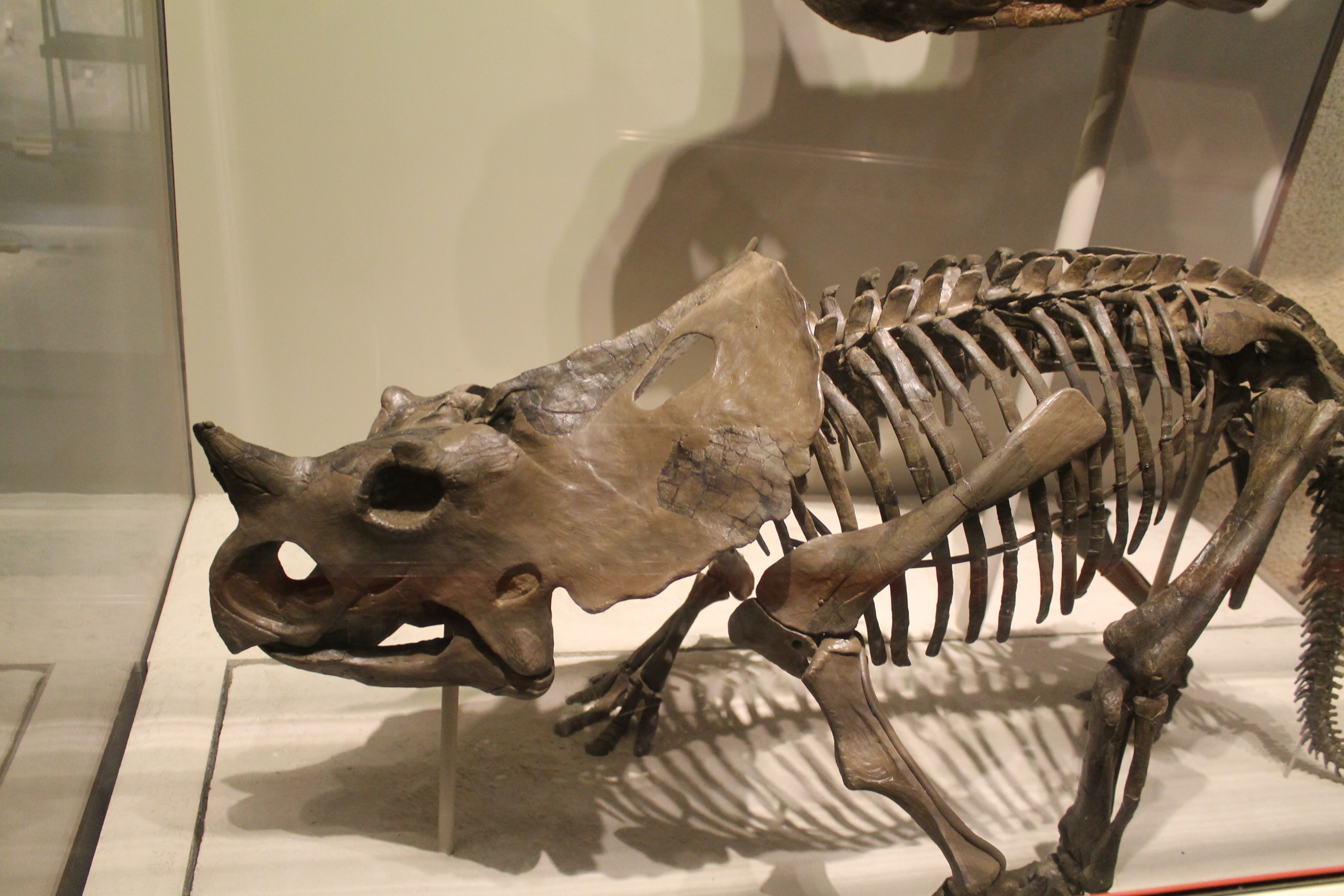
The Brachyceratops mount today. Photo by the author.

The Brachyceratops mount today. Photo by the author.

During his tenure at NMNH, Gilmore was an inexhaustibly productive writer, publishing at least 170 scientific articles, including numerous important descriptions and reassessments of fossils discovered by O.C. Marsh’s teams in the 19th century. However, Gilmore was much happier studying fossils in his lab than excavating new finds in the field, taking part in a scant 16 NMNH-sponsored field expeditions over the course of his career. A 1913 trip to the Cretaceous Two Medicine Formation in Northeast Montana was therefore unusual for Gilmore. He was following in the footsteps of Eugene Stebinger of the US Geological Survey, who had reported the previous year that the region was only minimally explored but clearly awash in vertebrate fossils.

On this inaugural fossil prospecting trip, Gilmore’s team located abundant remains of fish, small reptiles and dinosaurs, especially hadrosaurs and ankylosaurs. The most notable find, however, was a small bone bed (about six feet square) of ceratopsian fossils, representing at least five individuals. Gilmore described this find in a 1917 monograph, naming the dinosaur Brachyceratops montanensis. Today we know that ceratopsians were quite diverse, particularly during the Campanian, but in the early 20th century the true extent of the group was only just being revealed. Still, it was clear to Gilmore that at an estimated six feet in length, Brachyceratops was an unusually small ceratopsian. He proposed that it may have fed on different plants or occupied a different niche than larger contemporaries like Centrosaurus and Styracosaurus.

pretty art

Reconstruction of Brachyceratops holotype skull. Plate from Gilmore 1917.

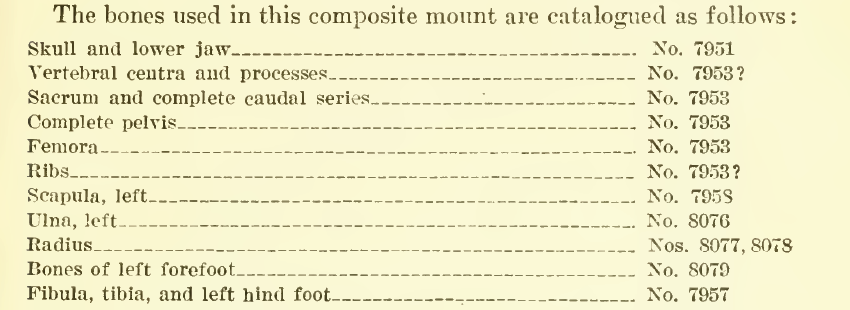
In 1917, most of the dinosaur mounts on display at NMNH came from fossils collected by Marsh for the US Geological Survey, and many represented species also on display in New York, Pittsburgh and New Haven. Accordingly, Gilmore was doubtlessly enthused by the prospect of displaying a dinosaur exclusive to Smithsonian. He awarded the task of creating a Brachyceratops mount to preparator Norman Boss, who would spend 345 working days on the project. Of the five individuals found in Montana, USNM 7953 was selected as the basis for the mount because it was the most complete, with the sacrum, pelvis, femora and complete set of caudal vertebrae found articulated in situ. Helpfully, Gilmore published a list of precisely which parts of the mount came from which individual specimen (see below). This was a marked contrast from some of his contemporaries at other museums, who would not bother to record such information, or even actively obscure how many disparate specimens they were using to build their mounts.

Gilmore's helpful list

A helpful breakdown of the Brachyceratops mount from Gilmore 1922.

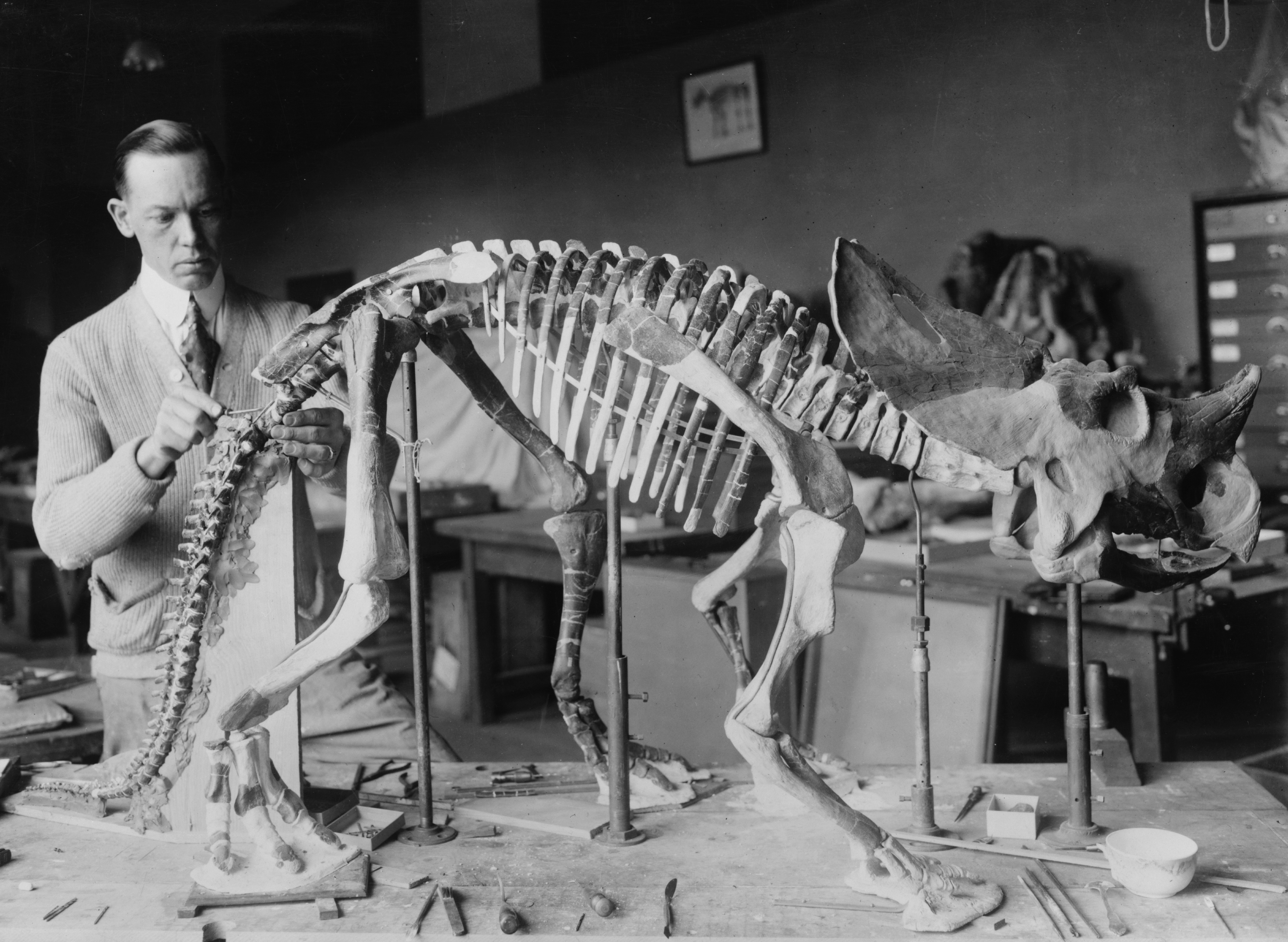
Boss based his restoration of Brachyceratops closely on the complete, articulated Monoclonius (=Centrosaurus) specimen (AMNH 5351) discovered by Barnum Brown in 1914. In particular, Boss replicated the angle of the scapulae and the number of vertebrae (22) on the American Museum of Natural History skeleton. Missing bones and portions thereof were sculpted in plaster, easily recognized by their solid color and smooth texture. Just as Gilmore and Boss had done with their 1905 Triceratops mount, the Brachyceratops was given strongly flexed elbows. According to Gilmore, a very large olecranon process on the ulna would have forced all ceratopsians into this somewhat awkward stance. Of particular note is the restoration of the skull, which was found shattered into dozens of pieces, many smaller than one inch. A close look at the specimen reveals how Boss painstakingly reassembled these fragments. Unfortunately, this is difficult in the exhibit hall because the mount is posed with the side of the skull that is mostly plaster facing visitors.

Norman Boss Brachyceratops courtesy Smithsonian archives

Norman Boss puts the finishing touches on the Brachyceratops mount. Photo courtesy of the Smithsonian Archives.

The completed Brachyceratops mount was placed on exhibit in 1922, on the same pedestal in the Hall of Extinct Monsters as the Triceratops. The substrate beneath the mount was colored and textured to match the Two Medicine Formation sandstone in which the fossils were found. Gilmore also prepared one of his charming models of Brachyceratops, mirroring the pose of the mount, but it is unclear whether it was ever exhibited.

woo triceratops

Brachyceratops on exhibit with Triceratops. Plate from Gilmore 1922.

The Brachyceratops has remained on view through each subsequent renovation of the fossil halls, always placed close to Triceratops. This close association has prompted many visitors to mistake the diminutive Brachyceratops for a baby Triceratops, and in fact these visitors are on the right track. While Gilmore always described Brachyceratops as an unusually small but full-grown ceratopsian, Scott Sampson and colleagues confirmed in 1997 that all five specimens were juveniles. A century’s worth of new fossil discoveries has provided modern paleontologists with a thorough understanding of ceratopsian ontogeny, and characteristics like the unfused nasal horn clearly mark the mounted Brachyceratops as a young animal. Unfortunately, Gilmore’s Brachyceratops specimens lack any good diagnostic features that could link it to an adult form. According to Andrew McDonald, the most likely candidate is Rubeosaurus ovatus, which was, incidentally, discovered by Gilmore on a 1922 repeat trip to the Two Medicine site. Nevertheless, without the ability to recognize other growth stages of the same species, the name Brachyceratops is unusable and is generally regarded as a nomen dubium.

It is not difficult to surmise why the Brachyceratops would end up near the bottom of the list of mounts to include in a renovated gallery. It is not especially large or impressive, it doesn’t have a recognizable name (or any proper name at all, really) and it doesn’t tell a critical story about evolution or deep time. With limited space available and new specimens being prepped for display, little Brachyceratops will have to go. It’s not all bad, though. Taking these fossils off exhibit will make them more accessible to researchers, and allow them to be closely examined in all aspects for the first time in decades. Perhaps one day soon we will have a clearer idea of the identity of one of Gilmore’s great finds.

References

Gilmore, C.W. (1917). Brachyceratops, a Ceratopsian Dinosaur from the Two Medicine Formation of Montana, with Notes on Associated Fossil Reptiles. Washington, DC: US Geological Survey.

Gilmore, C.W. (1922). The Smallest Known Horned Dinosaur, Brachyceratops. Proceedings of the US National Museum 63:2424.

Gilmore, C.W. (1930). On Dinosaurian Reptiles from the Two Medicine Formation of Montana. Proceedings of the US National Museum 77:2839.

McDonald, A.T. (2011). A Subadult Specimen of Rubeosaurus ovatus (Dinosauria: Ceratopsidae), with Observations on other Ceratopsids from the Two Medicine Formation. PLoS ONE 6:8.

Sampson, S.D., Ryan, M.J. and Tanke, D.H. (1997). Craniofacial Ontogeny in Centrosaurine Dinosaurs: Taxonomic and Behavioral Implications. Zoological Journal of the Linnean Society 12:1:293-337.

1 Comment

Filed under dinosaurs, exhibits, Extinct Monsters, field work, fossil mounts, history of science, marginocephalians, museums, NMNH, reptiles

Review: Ultimate Dinosaurs at the Cincinnati Museum Center

Ultimate Dinosaurs: Giants from Gondwana premiered in June 2012 with considerable fanfare at the Royal Ontario Museum (ROM) in Toronto. Developed by a ROM team led by David Evans and Matthew Vavrek, Ultimate Dinosaurs showcased the dinosaurs of the southern hemisphere, demonstrating how geographic isolation created Mesozoic ecosystems remarkably different from the menageries we are used to seeing in North American museum displays. The exhibit included 20 dinosaur mounts in all, including many taxa never before seen in museums above the equator.

I never made it to the inaugural showing of Ultimate Dinosaurs, but fortunately the show is now on the road. I saw it at the Cincinnati Museum Center (CMC) earlier this week, where it will remain through January 5th before moving on to Minneapolis. The exhibit assuredly does not disappoint…read on for many pictures and my musings on the design.

DPP_0001

The first room features Triassic and early Jurassic archosaurs.

Huge banners displayed outside the CMC and in the main lobby are impossible to miss, but the Ultimate Dinosaurs exhibit itself is hidden away on the lower level, with the entrance at the end of a quiet corridor. Aside from a video screen showing a shifting map of Gondwana, no proper introduction is provided. Visitors immediately find themselves in the first large room of fossil mounts, featuring Triassic and early Jurassic archosaurs like Herrerasaurus, Eoraptor, Cryolophosaurus and the rauisuchian Prestosuchus. This first batch of mounts is lined up on an elevated platform that runs along the right side of the room. Like all the mounts in Ultimate Dinosaurs, these are casts, and are plainly assembled in “chunks”: numerous bone elements casted together as single pieces. While these shortcuts are obvious up close, this mode of construction does allow for remarkably dynamic poses, and there is no obstructive armature to block one’s view. Behind the dinosaurs is the first of several gorgeous Julius Csotonyi murals, a lively panorama of life reconstructions in a naturalistic setting.

In front of every mount is an array of attractive signs in bright, solid colors. Information is mostly provided in short sound bites or bullet points, highlighting sensible information like the animal’s diet, the meaning of its name, where it was discovered, and why it is scientifically noteworthy. There is also at least one touchscreen in front of each mount, which includes several more pages of information for the more dedicated visitor. I really liked the similar touchscreen displays at the Carnegie Museum, and these are equally impressive. This is technology used intelligently, contributing to but not overwhelming the primary display, while using space in an economical way. I was also impressed by the succinctness of the text. It is very difficult to condense information into short blurbs that visitors can absorb with no more than a quick glance, but the Ultimate Dinosaurs writers balanced accuracy, intrigue and brevity on every single sign. Hats off to them!

Visitors were having a hell of a time pronouncing Cryolophosaurus.

Visitors were having a hell of a time pronouncing Cryolophosaurus.

Turning left at the Massospondylus at the far end of the first room, visitors enter a long and largely empty corridor. The left wall is adorned with a series of signs explaining the historical discovery of and evidence for continental drift, and herein lies my primary concern with the exhibit as a whole. The story being told in Ultimate Dinosaurs, regarding plate tectonics and its effect on evolution, is an important one. Paleobiogeography is key to understanding how the natural world we know today came to be. What’s more, it’s a great example of science in action, consisting of a handful of intuitive, evidence-based concepts that can be applied to new situations and clarify new discoveries.  As such, paleobiogeography ought to frame the entire exhibit. I would have placed the big ideas and central questions (Why are similar organisms sometimes found on opposite sides of oceans? What happens when populations or ecosystems are isolated from one another?) at the beginning, and ensured that they were reinforced in every display with recurring terms, imagery and motifs. The paleobiogeography story should guide the visitor’s experience and understanding of the exhibit.

Instead, Ultimate Dinosaurs at the CMC relegates the big ideas to secluded corners and easily-missed signs. The text itself is very clear and well-written, and supported by attractive, intuitive graphics, but it’s hidden away and or otherwise overshadowed by lists of factoids about each dinosaur. My largely unsubstantiated suspicion is that the original designers of Ultimate Dinosaurs at the ROM intended for the paleobiogeography story to be much more explicit, but this vision was compromised somewhat in order to fit the exhibit into the space available at the CMC. The unfortunate result is that the most critical information is introduced in an unorganized manner, and the exhibit is weaker for it.

Suchomimus peers in from the right, Amargasaurus and

Suchomimus peers in from the right, Malawisaurus in the middle, Argentina in back.

After passing through the switchbacking corridor, visitors reach the primary showroom. This is an enormous space filled with huge, impressive dinosaur mounts. Like the rest of the exhibit, this gallery is quite dark, with floor lights and the occasional overhead light highlighting the dinosaurs. The darkness helps to hide the unadorned walls and ceilings of the multipurpose space being used, but thankfully does not hinder one’s view of the dinosaurs. And the dinosaurs certainly do not disappoint. Even though they are casts, this exhibit was my first opportunity to see the likes of Armagasaurus, Suchomimus, Ouranosaurus and many others in person. I could walk around them, take in their scale and compare them to one another and to myself, experiences that no image or documentary can provide.

Majungasaurus and Rapetosaurus strike an extreme pose.

Majungasaurus and Rapetosaurus strike an extreme pose.

Most of the dinosaurs are in lively poses, as though the animal was frozen midstride, but a few are especially dynamic. Little Rahonavis is suspended from the ceiling, as though leaping for prey or perhaps engaging in a controlled glide to the forest floor. The Majungasaurus and Rapetosaurus, which are the only mounts directly interacting with one another, are particularly interesting. The attacking Majungasaurus has its foot up on the flank of the Rapetosaurus, and the sauropod is in a rather unusual squatting pose, with its forelimbs at what appears to be maximum flexion. I will leave it to the experts to decide whether this extreme pose is plausible, but this nevertheless serves as a reminder of what can be learned by assembling a skeleton in three-dimensional space.

Carnotaurus

Carnotaurus and Amargasaurus.

The mounts are clustered on three islands, representing Argentina, Madagascar and Niger. I do wish this organization had been made clearer to visitors, perhaps with large banners over the islands naming the dinosaurs’ location of origin. Clustered at the feet of the mounts are small cases containing a mix of original and casted fossils. Some of those are quite relevant and provide further context to the mounts: for instance, a collection of North African fossil fish near the Suchomimus illustrate the spinosaur’s probable diet. Other cases are a bit more perplexing. A series of cervical vertebrae from the North American sauropod Suuwassea is arbitrarily situated among the Madagascar mounts, and cases of cephalopods and Carboniferous plants are similarly out of place. Most of these oddball fossil displays did not come from the ROM, but were added by the CMC from their own collections. Although these fossils are fascinating and should absolutely be on display, I don’t think randomly interjecting them among the Gondwanan dinosaurs was the way to go. These displays interrupt the primary storyline and probably should have been placed elsewhere.

CWC addition

These additions from the CMC are neat, but a bit out of place.

The final room showcases the exhibit’s two largest mounts, Tyrannosaurus and Giganotosaurus. It is undeniably exciting to see these two giant predators side by side, and compare how these ostensibly similar carnivores were nevertheless subtly adapted to tackle different prey. I would have made this point more obvious than the exhibit does, but I suppose sometimes you need to step back and let your specimens speak for themselves.

This room also features the much-ballyhooed “augmented reality” gimmick. These are tablet-sized screens found alongside the mounts. When you point these at the Tyrannosaurus and Giganotosaurus skeletons, a CG version of dinosaur appears on the screen. Panning and tilting the tablet in front of the mount causes your view of the CG version to adjust accordingly. I found these sort of interesting, but they were not nearly as impressive as the mounts themselves. Unfortunately, the CG dinosaurs simply didn’t look very good. I am all for the use of technology in museum exhibits, but only if it plays to our strengths. In this case, the CG dinosaurs are directly and unfavorably comparable to a wide range of films and television shows that people can see without leaving home. As hubs for lifetime learning, museums can and should offer more than that.

Tyrannosaurus and Giganotosaurus side by side. Eat it up, internet.

Tyrannosaurus and Giganotosaurus side by side. Eat it up, internet.

Despite my nitpicks, Ultimate Dinosaurs really does live up to its name. This is a very handsomely designed exhibit, and an great opportunity to see mounts of exotic dinosaur taxa. If you are at all interested in paleontology, catching this exhibit is a no-brainer. But even if you’re not, this is a rare chance to see what the vertebrate fossil record has to offer beyond T. rex and Triceratops, and learn a bit about how our world came to be.

Edit: I had mistakenly said the murals were created by Raul Martin. They are the work of Julius Csotonyi.

7 Comments

Filed under dinosaurs, exhibits, fossil mounts, museums, ornithopods, reptiles, reviews, sauropods, theropods

There are “fake” fossil mounts after all…in China

I’m always bummed when I hear museum-goers describe fossil mounts, particularly those that are entirely or partially made up of casts, as “fakes.” It is inaccurate, if not inflammatory to describe mounts in this way, and I always make sure to offer a correction (see this ancient post of mine or Christopher Norris’s much better explanation for details).

Well, it turns out I was wrong, or at least trapped in a western-centric worldview. There are fossil mounts that can and should be called fake…in China. Earlier today, Brian Switek linked to a brief radio story at CRIEnglish about the recent appearance of dinosaur-themed parks throughout China. According to the clip, local governments throughout China have been competing to built the biggest and best dinosaur park. The parks are apparently the equivalent of attention-grabbing and income-building public works projects, such as stadiums or fancy shopping centers, that are created regularly in the U.S. But while these new parks might have been inspired by the torrent of spectacular, paradigm-shifting fossils found in China over the last two decades, they are not museums. These are amusement parks, featuring robotic and fiberglass awesomebro dinosaurs. They are entertainment, not educational or scientific enterprises by any stretch of the imagination.

So where are these municipal dinosaur theme parks getting their dinosaurs? As it turns out, there are literally dozens of new companies in China that exist entirely to supply these attractions. I had encountered some of these sites before, but didn’t know the context of their existence until now. Google “China robotic dinosaurs” or something similar and you’ll find them. Most of these products are what they are: big, goofy looking animatronic dinosaurs that aren’t especially attractive but at least can’t be mistaken for scientific reconstructions. But then I saw the “dinosaur skeletons”:

It’s possible that parts of these might be casts, but I doubt it. These are pretty much abominations, sculpted with little regard for the actual appearance of these dinosaurs, or animal anatomy in general. I’ve written at length about how the public conception of dinosaurs is irreversibly intertwined with its conception of museums. When we think of fossils, we think of grand museum halls populated by towering skeletons. This connection is so ingrained that mounted skeletons have become, in the public eye, the only proper way to display dinosaurs. It’s therefore not unexpected that these companies would capitalize on that association.

The problem is that unlike a mural or life-sized model, which are obviously reproductions, mounted skeletons retain the aura of authenticity that comes from displaying known fossils. To display a skeleton is to imply that we are seeing real specimens, or at least replicas standing in for specimens that exist somewhere else. Displaying “dinosaur skeletons” with no regard for accuracy ruins that association. For nearly 200 years, fossil mounts have been symbols of credible science, and I hate to see that good reputation sullied.

Leave a comment

Filed under dinosaurs, exhibits, fossil mounts, opinion

The Calvert Marine Museum’s big foam shark

Over Labor Day weekend, I visited the Calvert Marine Museum in Solomons, Maryland. The Museum, which features both indoor and outdoor exhibits, covers a wide range of Chesapeake regional history, including Patuxant Indian culture, the War of 1812, the local fishing industry and of course, Miocene marine fossils. The paleontology gallery, called “Treasures from Our Cliffs”, is nicely done and surprisingly high in production value for the museum’s size. Starting with an extensive entry gallery that places Chesapeake area fossils in a global context, the exhibit also includes fossils of seals, whales, invertebrates and assorted terrestrial mammals, plus a neat recreation of a cliff-side excavation.

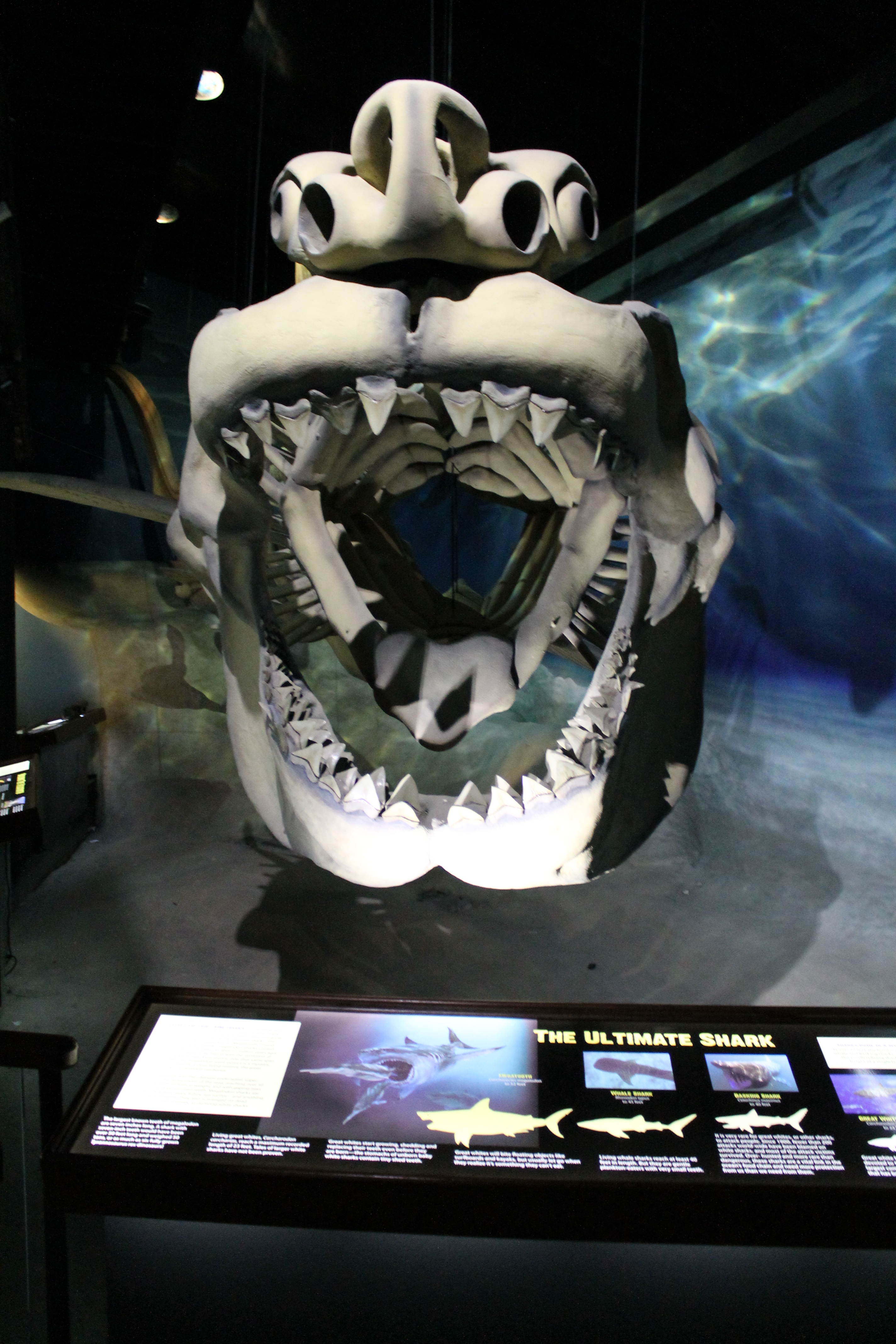
The Carcharocles megalodon at the Calvert Marine Museum.

The Carcharocles megalodon at the Calvert Marine Museum.

What I want to talk about most, though, is the big foam shark pictured above. This is the exhibit’s centerpiece attraction, a complete replica of the cartilaginous skeleton of the infamous giant extinct shark Carcharocles megalodon. Since shark skeletons are primarily made up of soft cartilage, most of their bodies are very unlikely to fossilize. While teeth and lithified vertebrae of C. megalodon are relatively common, a complete skeleton can only be created as a replica. As such, the Calvert Marine Museum’s display is a scaled-up model of the cartilaginous skeleton of a modern Carcharodon chararias (great white shark), with a few proportional adjustments based on known fossils. The result is undeniably impressive: suspended over an ocean backdrop, the 37-foot model absolutely steals the show in the paleontology exhibit.

Nevertheless, I find it absolutely fascinating that the museum would go to such lengths to create a replica shark, particularly given its substantial collection of original fossils. The foam shark’s existence can be traced to the beginning of the 20th century, when there was a dramatic rush among large urban museums in the United States to collect and mount the biggest and most spectacular dinosaur skeleton that could be found. This fossil craze was largely motivated by the vanity of the museums’ wealthy benefactors, but proved to be extremely productive for both paleontologists and museums. Mounted dinosaur skeletons sprung up seemingly overnight in cities across the country, making names like “Brontosaurus” and Diplodocus household terms and igniting a wave of interest in museums and natural science.

As a result of this mounting spree, the public conception of dinosaurs and other prehistoric animals is to this day irreversibly intertwined with its conception of museums. When we think of fossils, we think of grand museum halls populated by towering skeletons. This connection is so ingrained that mounted skeletons have become, in the public eye, the only proper way to display prehistoric animals. Patrons of paleontology exhibits expect mounts, and museums must deliver, even if it means purchasing a cast from another institution, or in the case of the Calvert Marine Museum, sculpting one outright.

And from the front.

A closer look at C. megalodon.

It is true that very few museum mounts feature the complete skeleton of a single animal – they are typically composites of many specimens, or have missing parts filled in with casts or sculpted elements (see this SVPOW post on Kyle Davies, who sculpts bone replicas for OMNH). Probably the most important function of a mount is to present fossil material in a format that non-specialists can easily understand and appreciate. They show viewers what extinct animals would have been like in life, and let us perceive them in relation to our own human scale. But unlike a mural or life-sized model, which are obviously reproductions, mounts retain the aura of authenticity that comes from displaying known fossils. To display a skeleton is to imply that we are seeing real specimens, or at least replicas standing in for specimens that exist somewhere else. Whether reasonable or not, this is the expectation ingrained by over 150 years of fossil mounts in museums.

This means that the C. megalodon at the Calvert Marine Museum is pushing the concept of a fossil mount to its very limit. While this is without doubt a very reasonable reconstruction of what a C. megalodon skeleton would have looked like, only a minuscule fraction of what is on display represents fossils that have actually been uncovered. The question is then, is a display like this a misrepresentation of scientific knowledge and the fossil record?

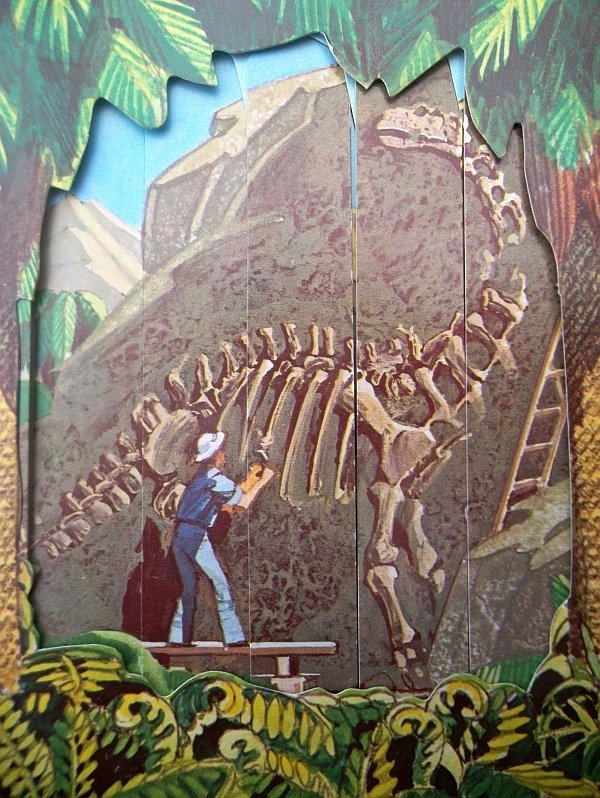
How dinosaur fossils are NOT found. From Dinosaurs: A Prunell magic Pop-Up Book, via LITC.

Not how vertebrate fossils are found. From Dinosaurs: A Prunell Magic Pop-Up Book, via LITC.

To the Calvert Marine Museum’s credit, the exhibit signs clearly explain that the C. megalodon skeleton is a replica, and provide a detailed explanation of how and why it was made. What’s more, the shark mount is merely an extreme example of filling in gaps with probable reconstructions, a process needed to make the construction of mounts of most prehistoric animals possible at all. The field of vertebrate paleontology is, in fact, largely based on the premise that incomplete remains can be understood in the context of other, better known relatives. Then again, if I learned anything teaching undergraduate anatomy, it’s that the concept that vertebrates share a body plan inherited through common ancestry is not widely known. This might be worth considering when presenting fossil mounts in general: after all, mounts primarily exist for the public, not for experts (although see Kenneth Carpenter’s comments on an earlier post).

The Calvert Marine Museum’s C. megalodon definitely raises some weighty questions about displays of scientific specimens in museums. In the context of vertebrate fossils, what qualifies as a real specimen, and what is well-supported extrapolation? What role should a museum play when displaying scientific knowledge? Should museums merely serve as repositories for original objects found in nature, or is the goal to provide context and meaning for those objects? Can a boundary between the two be defined at all?

3 Comments

Filed under exhibits, fish, fossil mounts, museums, science communication

In Defense of New Museums

As a museum* educator, I work with two kinds of experts: researchers who create knowledge and education specialists who disseminate knowledge. Both groups have ostensibly the same mission, which is to effectively communicate credible information about the world around us. Generally, both sides collaborate effectively, due in no small part to a shared enthusiasm for their work. But there is one issue (that has been raging for decades) in which researchers and educators frequently seem to be shouting past each other, complaining about what one another are doing wrong but not making much progress in reconciling their priorities. This issue is, of course, “new museum” exhibit aesthetics, the trend toward replacing traditional academically-oriented displays of specimens with dynamic, interactive leaning experiences that use specimens alongside interactive activities and multimedia to communicate specific educational messages to a broad audience.

*When I say museum, I mean natural history or science museum. Art museums are a completely different beast, and one I won’t pretend to understand.

From the perspective of many researchers and certain sets of museum-goers, these newer exhibits are frivolous lowest-common-denominator attractions better suited to amusement parks than serious institutions. For example, in a recent Tetrapod Zoology review of the London Natural History Museum’s Extinction exhibit, Darren Naish criticizes computer-based interactive exhibits because they “take up space that really should be spent on something far more worthwhile” and “give visitors the excuse to do the same old crap they do every other day of their lives (look at screens, play videogames, use touchscreens) when they really could be treated to a more unique experience.” Likewise, an all-encompassing rant about new museums can be found in this (admittedly 6 year old) post by Matt Wedel, which is well worth a read (seriously, read it now and then come back to this).

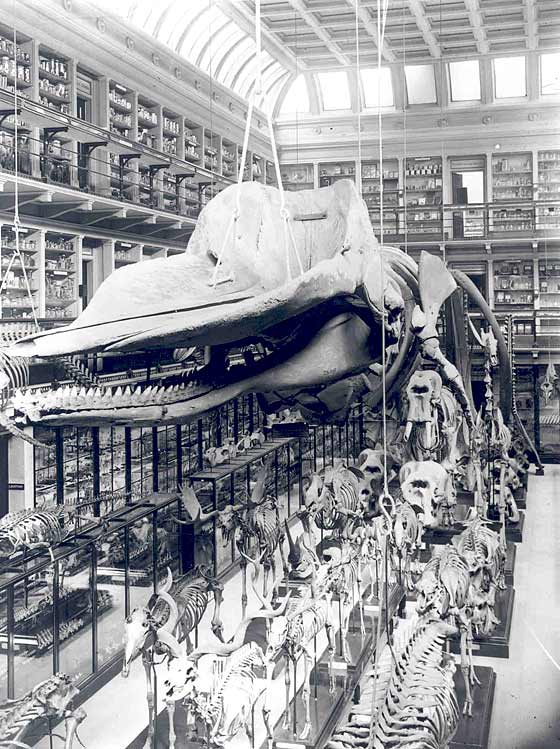
The Hunterian Museum as it appeared in the 1600s: all  of the specimens, not much else.

The Hunterian Museum as it appeared in the 1800s: ALL OF THE SPECIMENS.

But in direct contrast to Wedel’s insistence that the intrinsic value of real specimens is all museum-goers want or need, there are editorials like this one by James Durston, which I will charitably describe as provocative. Durston tells us that museums that only display artifacts for their own sake are “classrooms made of cold granite, the only sense of life emerging from the tourists.” He argues that most objects on display in museums don’t matter as much to visitors as museum workers think they do, and pleads for more context and more reason to care.

So what’s the deal? Are modern museums too focused on providing context for their collections, or not focused enough? Let me begin by explaining why modern museum exhibits look the way they do. A century ago, or even 50 years ago, exhibits were arranged and labels were written almost exclusively by expert curators. These exhibits were, by and large, created with an audience of “interested people” in mind, meaning either other experts or clientele with enough leisure time to learn the jargon presented to them. The majority of visitors who came through the door were not directly catered to, because exhibits were considered an afterthought to the real work of the museum: research and collections management.

In the past 30 years, however, the museum field has decided that it can do better. Museums shifted from inwardly focused, primarily academic institutions into focal points for lifelong learning that operate in service to a wide community of visitors. Go to the website of your favorite museum and check out their mission statement (it should be pretty easy to find). I just did, and the mission of the National Museum of Natural History is to “increase knowledge and inspire learning about nature and culture, through outstanding research, collections, exhibitions, and education, in support of a sustainable future.” Note that the museum doesn’t seek to increase knowledge and inspire learning just for a core audience of studious, well-read people, but for everyone. That means the museum needs to offer content that is interesting to all sorts of people, whether they learn best by reading and absorbing information, by physically doing something, by making choices for themselves or by discussing an issue with others. Preserving  and studying collections is no less important than in museums of yore, but these activities are understood to be in service of providing knowledge to the widest possible audience.

This shift in focus has inspired museum exhibits with more explicit educational goals, as well as attempts to create learning experiences that reach visitors other than those already keyed in to the customary language of academia. Drawing heavily on Gardner’s multiple intelligences, modern exhibits are intended to cater to diverse audiences that learn in a variety of different ways. In particular, hands-on mini experiments and computer-based games have become staples in science exhibits in order to reach visitors who learn better by doing than by observing. These interactive elements (we just call them interactives in the biz) are not appealing to everyone, but museums serve a broad community and have no business being exclusionary in the services they provide.

Beyond any moral or educational imperative, however, modern museums must be accessible because they are nonprofit institutions that rely heavily on public funds. They are funded based on the promise that they will provide educational resources for their communities, and that means serving more than a small subset of the population. Furthermore, ever-tightening budgets mean that museums need to be strictly managed. Educators have no choice but to establish clear standards of success for their exhibits, and to develop means to track attendance and audience engagement. Just to keep our jobs and keep museum doors open, we need to be able to clearly articulate who we are serving, how we are benefiting them and how we know.

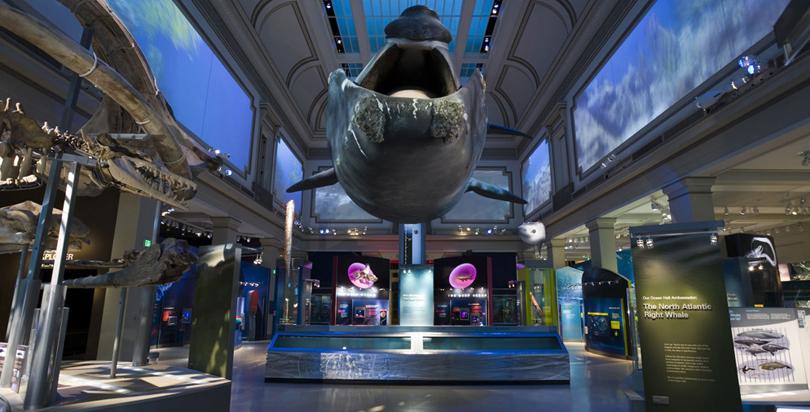
The new Ocean Hall at NMNH: a $90 million new museum extravaganza.

The new Ocean Hall at NMNH: a $50 million new museum extravaganza.

If it was not clear, I absolutely agree with the goals behind new museum design. As  was argued in the American Alliance of Museums’ 1984 “Museums for a New Century” commission report, “if collections are the heart of museums, what we have come to call education – the commitment to presenting objects and ideas an an informative and stimulating way – is the spirit.” General audiences can certainly experience awe and wonder when presented with neat stuff, but museums can and should provide more than that. A hundred birds from around the world look impressive on a shelf, but they are much more interesting when the viewer understands the evolutionary processes and biogeography that produced such diversity. A little bit of context goes a long way to making such an exhibit is accessible and valuable to the widest possible audience.

In practice, however, I will concede that many attempts at broadening the appeal of natural history exhibits are pretty bad. Some modern museum exhibits use technology in terrible ways, and many attempts to increase interactivity are bafflingly pointless or even counterproductive. For instance, a dinosaur exhibit I visited earlier this year includes a green-screen stage where visitors can place themselves in a scene with dinosaurs running around. The result is not only painfully dated, but it has no educational purpose and may well encourage people to think that humans and dinosaurs once co-existed. Likewise, an exhibit on human evolution features a glorified photo booth that makes visitors’ faces look like other hominids. This non-educational attraction is consistently the most popular element of the gallery, distracting visitors from the fantastic displays and specimens all around it. More generally, an increasing number of exhibits are incorporating profoundly pointless touch-screen computers that let visitors browse photos of the specimens on display right in front of them. Just because an exhibit element is hands-on doesn’t mean it is actually helping visitors interact with exhibit content.

One reason lousy interactives keep being designed is that our evaluation procedures* are not always great at separating good exhibits from appealing ones. A good interactive provides informative content in an engaging way, while an appealing one is engaging but lacking in content. Many visitors may speak highly of just-appealing interactives, but that doesn’t mean these belong in museums. The aforementioned budget woes are also a factor here: interactives that draw crowds for any reason are a big help when scrounging for ways to fund research and preservation. There are tough calls to make when deciding between what visitors most want to see and what is actually worthy of an educational institution. There are no easy answers, especially when museums are consistently hurting for funding.

*Do note, however, that actually testing whether exhibits are meeting their educational goals has finally become commonplace…for far too long museum workers just assumed anything they made was good enough.

Nevertheless, when an interactive display works, when visitors’ eyes light up with understanding by working out a scientific problem for themselves, the process is absolutely worthwhile. Earlier this year, I raved about the low-tech brilliance of an activity in the Academy of Natural Sciences that let visitors physically act out the difference in upright and sprawling gaits. And the NMNH Human Origins exhibit features a fantastic computer game where visitors play the part of a future world leader and experience firsthand the challenges and consequences of overpopulation, food shortage and invasive species. Exhibit interactives, both technology-based and otherwise, are difficult to pull off, and many museums have failed at the task. But we owe it to our visitors to try.

10 Comments

Filed under collections, education, exhibits, history of science, museums, opinion, science communication

The NMNH fossil halls, circa 1963

c.02

A revamp for the dinosaur displays in Hall 2. Courtesy of the Smithsonian Institution Archives.

Since the NMNH building opened in 1910 as the United States National Museum, the east wing has been home to fossil displays. Although there have been many small adjustments and additions to the exhibits over the years, we can separate the east wing’s layout into three main periods. From 1910 t0 1945, the exhibits were primarily under the stewardship of Charles Gilmore. Called the “Hall of Extinct Monsters”, this iteration was somewhat haphazard in its layout and generally resembled a classic “cabinet of curiosity” approach to exhibit design. Gilmore’s version of the east wing remained in place until 1963, when the space was redesigned as part of the Smithsonian-wide modernization project. In the updated halls, there was a directed effort to compartmentalize exhibits based on the subdivisions of the Museum’s research staff, with each area of the gallery becoming the responsibility of a different curator. A second renovation was carried out in several stages starting in 1980. This version, which was open until 2014, was part of the new museology wave that started in the late 1970s. As such, the exhibits form a more cohesive narrative of the history of life on earth, and much of the signage carries the voice of educators, rather than curators.

Of course, the field of paleontology has advanced by leaps and bounds since the early 1980s, and NMNH staff have made piecemeal updates to the galleries when possible, including restorations of deteriorating mounts, and additional signage that addresses the dinosaurian origin of birds and the importance of the fossil record for understanding climate change. A third renovation is currently underway and will be completed in 2019.

But I’m getting ahead of myself. The purpose of this post is to provide an overview of the NMNH fossil halls as they stood in 1963, after the first major renovation. This iteration of the east wing was long gone before I was born, so this information is pieced together from historic photographs, archived exhibit scripts, and correspondence among the individuals involved in the modernization project (my thanks to the staff of the Smithsonian Institution Archives for their assistance in accessing these materials). Perhaps unsurprisingly, records of the dinosaur gallery are by far the most thorough. Information on the other halls is considerably harder to come by, so if any readers who saw the older exhibits in person remember any details, it would be fantastic if you could share them.

Layout of the USNM east wing, circa 1963.

Layout of the USNM east wing, circa 1963.

As mentioned, the Smithsonian underwent a thorough modernization project in the middle of the 20th century. The modernization committee, chaired by Frank Taylor (the eventual director-general of Smithsonian museums), was established in 1948. Under the committee’s guidance, most of the institution’s exhibits were redesigned between 1953 and 1963. Keep in mind that at the time, the United States National Museum was the only Smithsonian museum – it would not be divided into the National Museum of Natural History and the National Museum of History and Technology (now the National Museum of American History) until 1964.

Completed in 1963, the USNM fossil exhibits were among the last to be modernized. Only a small number of specimens were added that had not already been on view in the previous version of the space – in fact, many specimens were removed. The changes primarily focused on the layout of the exhibit, turning what was a loosely organized set of displays into a series of themed galleries. The east wing included four halls in 1963, the layout of which can be seen in the map above. Each hall was the responsibility of a particular curator. Nicholas Hotton oversaw Paleozoic and Mesozoic reptiles in Hall 2. David Dunkle was in charge of fossil fish in Hall 3. Porter Kier oversaw fossil invertebrates and plants in Hall 4. Finally, Charles Gazin, head curator of the Paleontology Division, was responsible for Cenozoic mammals in Hall 5. Each curator had a central role in selecting specimens for display and writing accompanying label copy.

Invertebrates and Fossil Plants

echinoderms1961

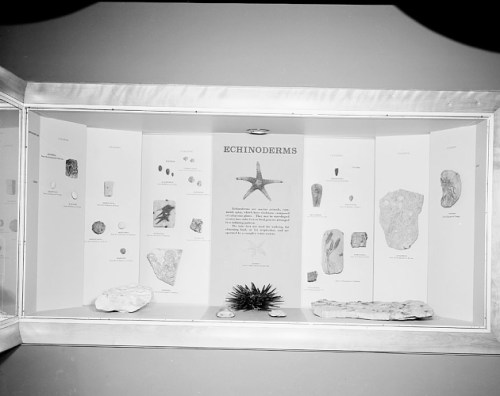
Echinoderm fossil display in Hall 4. Courtesy of the Smithsonian Institution Archives.

It is likely that part of the reason the fossil halls were late on the modernization schedule was that the curators of the Paleontology Division were not terribly interested in exhibits or outreach. There were no staff members in the division exclusively devoted to exhibit work, so the task of designing the new exhibit space was an added burden for the research staff. As invertebrate paleontology curator G. Arthur Cooper put it in a 1950 memo, “all divisions of Geology at present are in an apathetic state toward exhibition.”

Nevertheless, work on the east wing halls had begun by 1957, if not a bit earlier. The first of the new exhibits to be worked on was Hall 4, featuring fossil invertebrates and plants. The long and narrow space was divided into four sections: the first introduced the study of fossils and how they are preserved, the second was devoted to paleobotany, the third contained terrestrial and marine invertebrates, and the forth provided an overview of geological time. Cooper described the new exhibit as a progressive story of the expansion of life, “its stem connecting all life which is now culminating in man.”

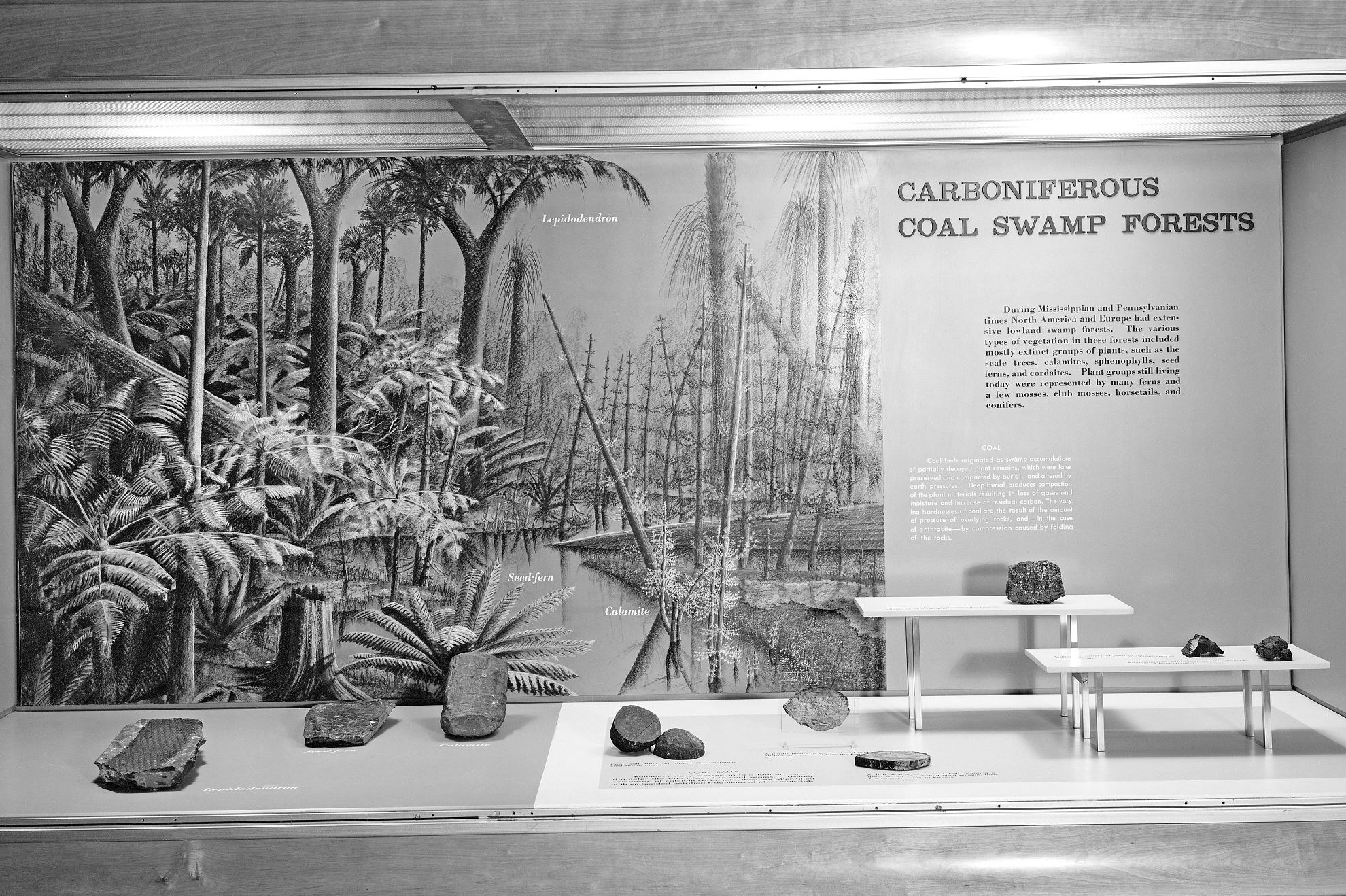
Carboniferous coal swamp fossils in Hall 4. Photo courtesy of the Smithsonian Institution Archives.

In addition to a variety of fossil specimens, Hall 4 featured a series of dioramas built by George Merchand, an exhibit specialist from Ann Arbor, Michigan. Merchand built at least 4 dioramas between 1957 and 1958, each depicting representative invertebrate marine fauna from a different Paleozoic period. Most, if not all, of these dioramas were retained during the 1980s renovation and remained on view through 2014.

Fossil Fishes and Amphibians

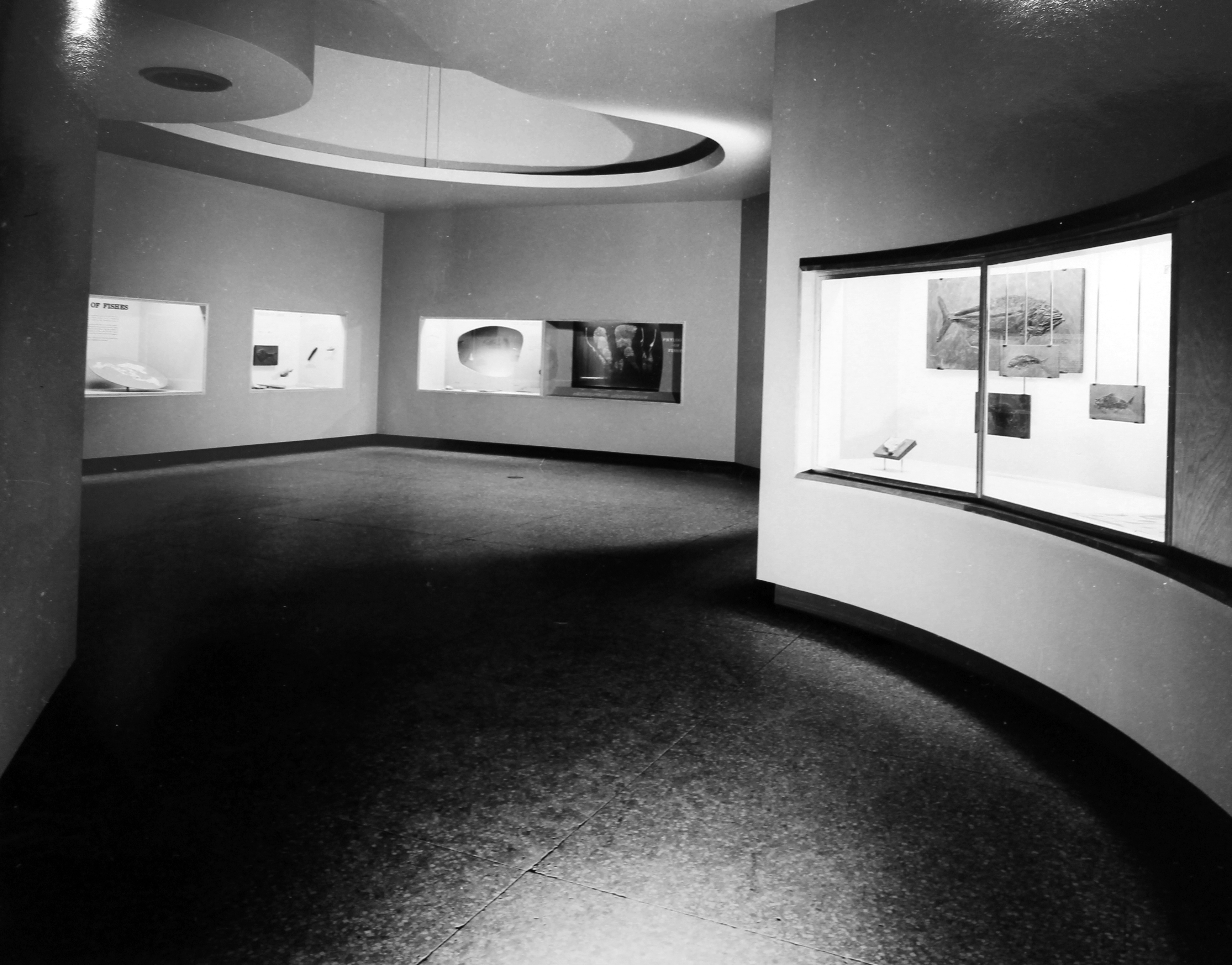
Fossil fishes in Hall 3. Photo courtesy of the Smithsonian Institution Archives.

Fossil fish and a smattering of amphibians were located in Hall 3, on the far east side of the wing. This space would be converted into “Mammals in the Limelight” in the 1980s. David Dunkle, for whom everyone’s favorite placoderm Dunkleosteus is named, was in charge of this gallery during his tenure at USNM between 1946 and 1968. The specimens on view were arranged temporally, starting with placoderms on the south side and progressing into actinopterygians and basal amphibians on the north end. Among the more prominently displayed specimens were Xiphactinus, Seymouria, and “Buettneria” (=Koskinonodon). The hall also contained a replica of the recently discovered modern coelacanth, and small diorama of a Carboniferous coal swamp.

Dinosaurs and Other Reptiles

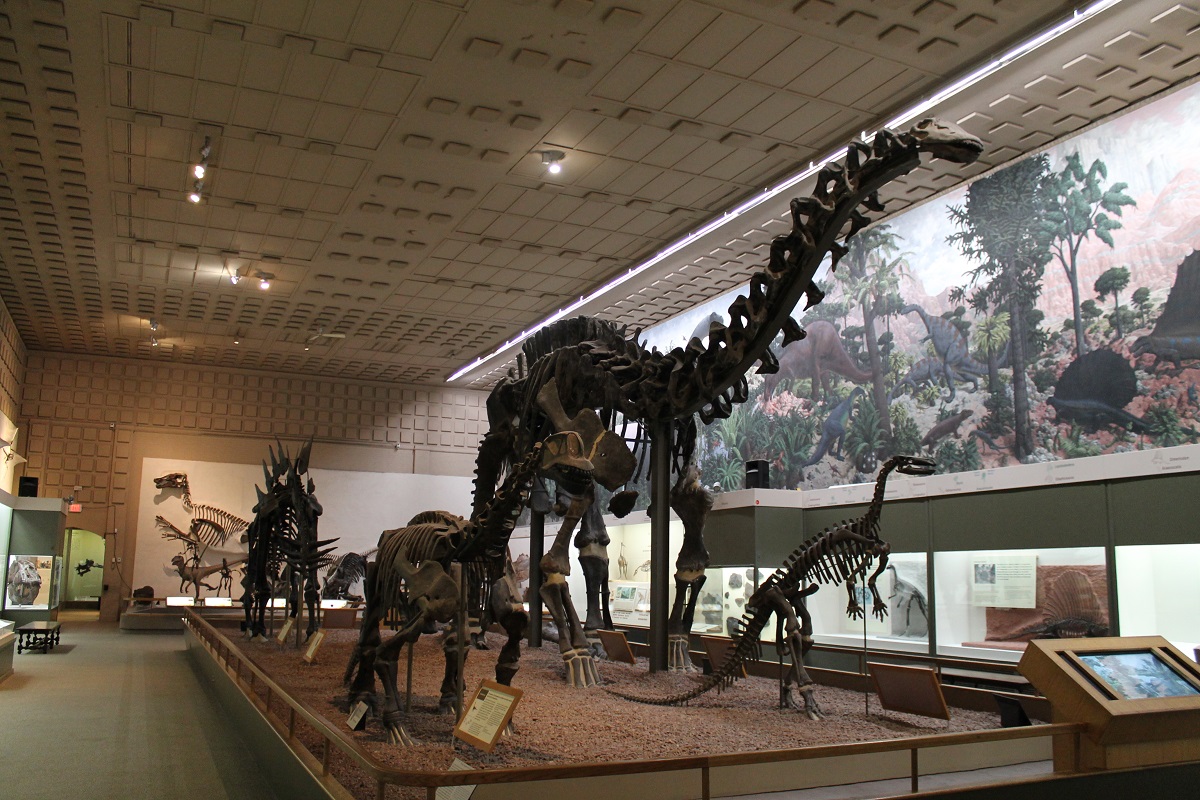
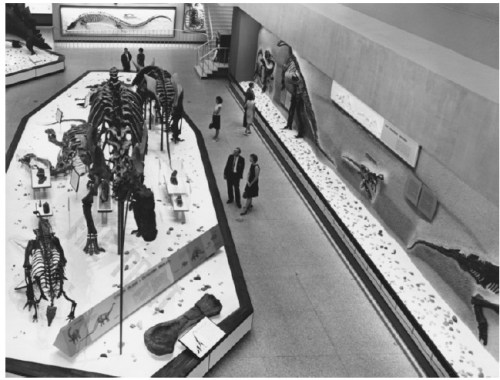
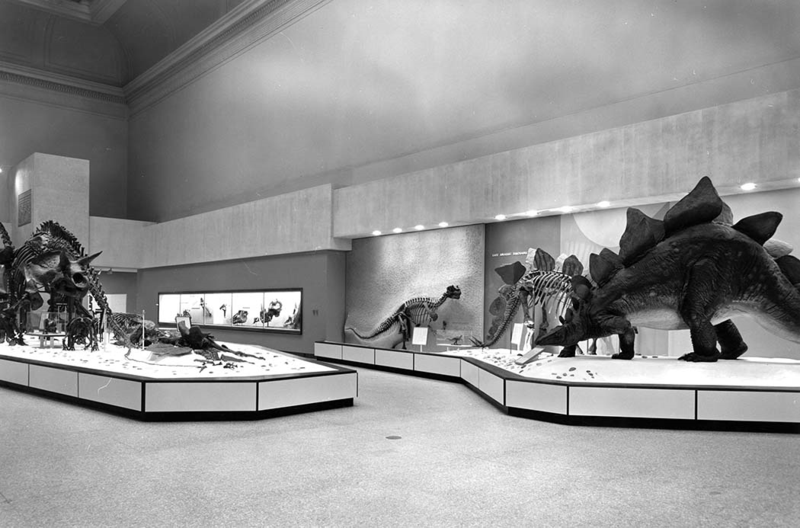
Dinosaurs in Hall 2, as seen facing west. Photo courtesy of the Smithsonian Institution Archives.

Hall 2, featuring dinosaurs and other reptiles, was the main draw for most visitors. It was not, however, a major priority for the Smithsonian research staff. The museum had not had a dinosaur specialist since Gilmore passed away in 1945 and indeed, dinosaurs were not an especially popular area of study among mid-century paleontologists in general. As such, responsibility for Hall 2 fell to Nicholas Hotton, at the time a brand-new Associate Curator. Later in his career, Hotton would be best known as an opponent to the dinosaur endothermy movement, but in the early 1960s he was most interested in early amniotes and the origin of mammals.

Hotton’s display of South African synapsids and amphibians. Photo courtesy of the Smithsonian Institution Archives.

Perhaps due to the general disinterest among USNM curators, changes to the dinosaur exhibits were mostly organizational. Most of the free-standing dinosaur mounts built by Gilmore and his team were collected on a single central pedestal. Preferring not to tackle the massive undertaking of disassembling and remounting the 70-foot Diplodocus skeleton, the exhibit designers left the sauropod in place and clustered the smaller moutns around it. In the new arrangement, the Diplodocus was flanked by the two Camptosaurus and prone Camarasaurus on its right and by Triceratops and Brachyceratops on its left. The Stegosaurus stenops holotype, splayed on its side in a recreation of how it was first discovered, was placed behind the sauropods at the back of the platform.

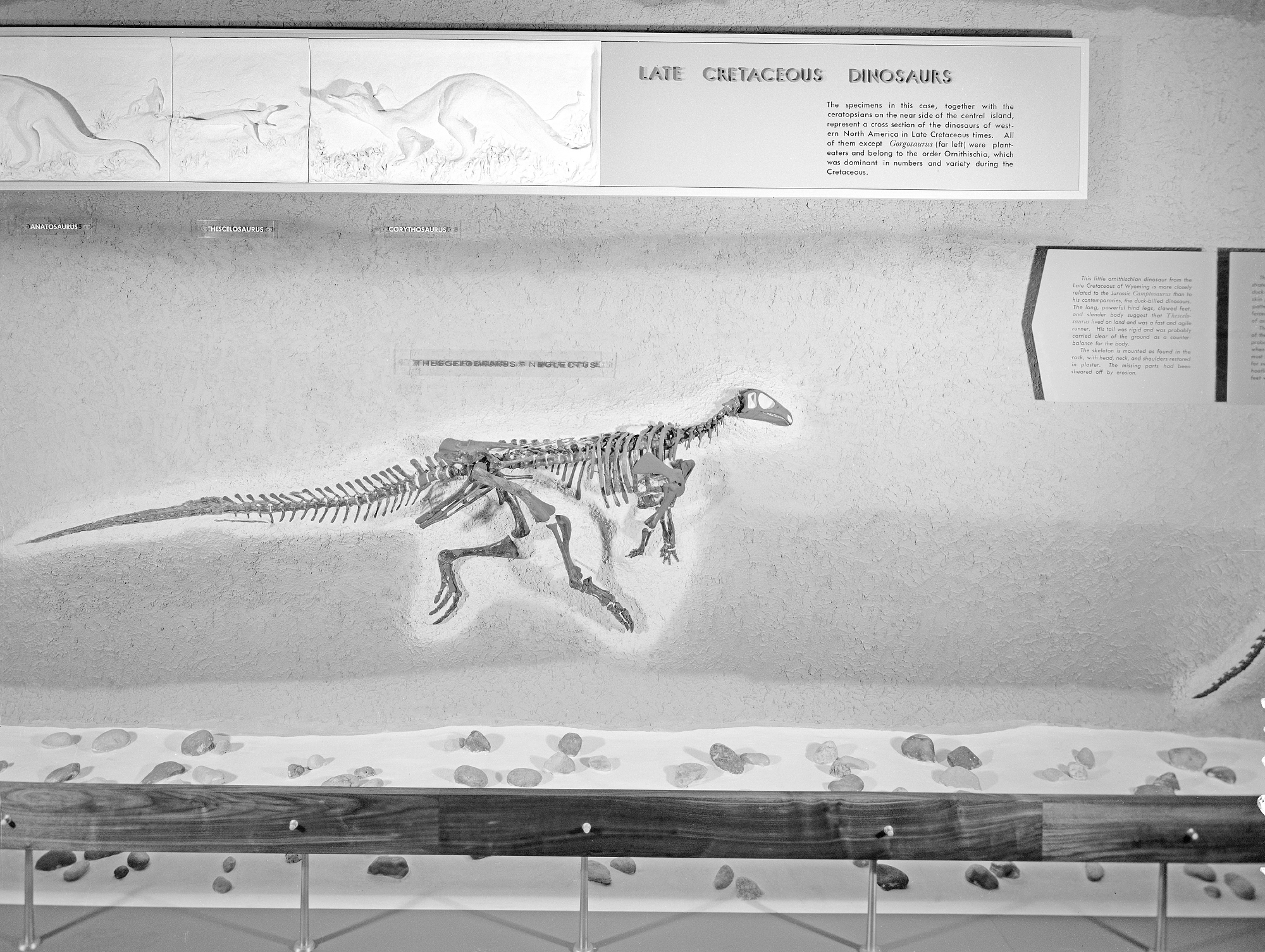
Close up of Thescelosaurus on the south wall. Photo courtesy of the Smithsonian Institution Archives.

 The north and south walls of Hall 2 were lined with additional specimens. On the south side, Gilmore’s relief mounts of Ceratosaurus and Edmontosaurus (called “Anatosaurus” in this exhibit) were joined by the gallery’s one new dinosaur, a relief mount of Gorgosaurus in a death pose. The north wall featured a long, narrow, glass-enclosed case illustrating the basics of dinosaur classification. In addition to saurischian and ornithischian pelves, the case featured skulls representing most of the major dinosaur groups. Amusingly, all but two of these skulls (Triceratops and Diplodocus) were labeled with names that are no longer considered valid. These skulls included “Antrodemus” (Allosaurus), “Trachodon” (Edmontosaurus) “Procheneosaurus” (probably Corythosaurus)  and “Monoclonius” (Centrosaurus).

In the southwest corner of Hall 2 (where FossiLab is today), visitors could see the Museum’s two free-standing Stegosaurus: the fossil mount constructed by Gilmore in 1913 and the charmingly ugly papier mache version, which had received a fresh coat of paint. Finally, the rear (east) wall of Hall 2 held Gilmore’s relief mounted Tylosaurus.

Mammals

c.11

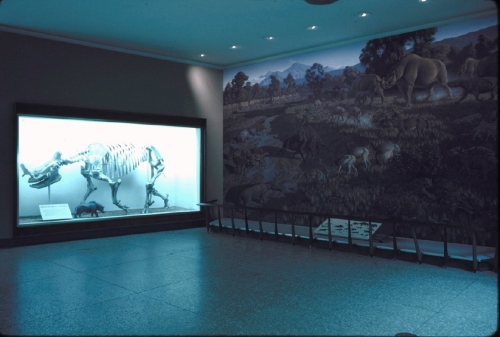
Brontotherium and Matternes’ Oligocene mural in Hall 5. Photo courtesy of the Smithsonian Institution Archives.

Fossil mammals were exhibited in Hall 5, a corridor-like space accessible from the main rotunda and via two doorways on the north side of Hall 2. After 1990, this space would house the “Life in the Ancient Seas” exhibit. Charles Gazin, head curator of the Division of Paleontology, was in charge of this space on paper, but my impression is that his attention was elsewhere during its design and construction. Gazin was apparently approached by the modernization committee several times during the 1950s, but was reluctant to commit his time to a major renovation project. Gazin had been spending a great deal of time at a Pliocene dig site in Panama, and the collection of new fossils proved more interesting than designing displays. As Gazin tersely explained, “It is a little difficult to concentrate objectively on exhibition problems here in the interior of Panama.”

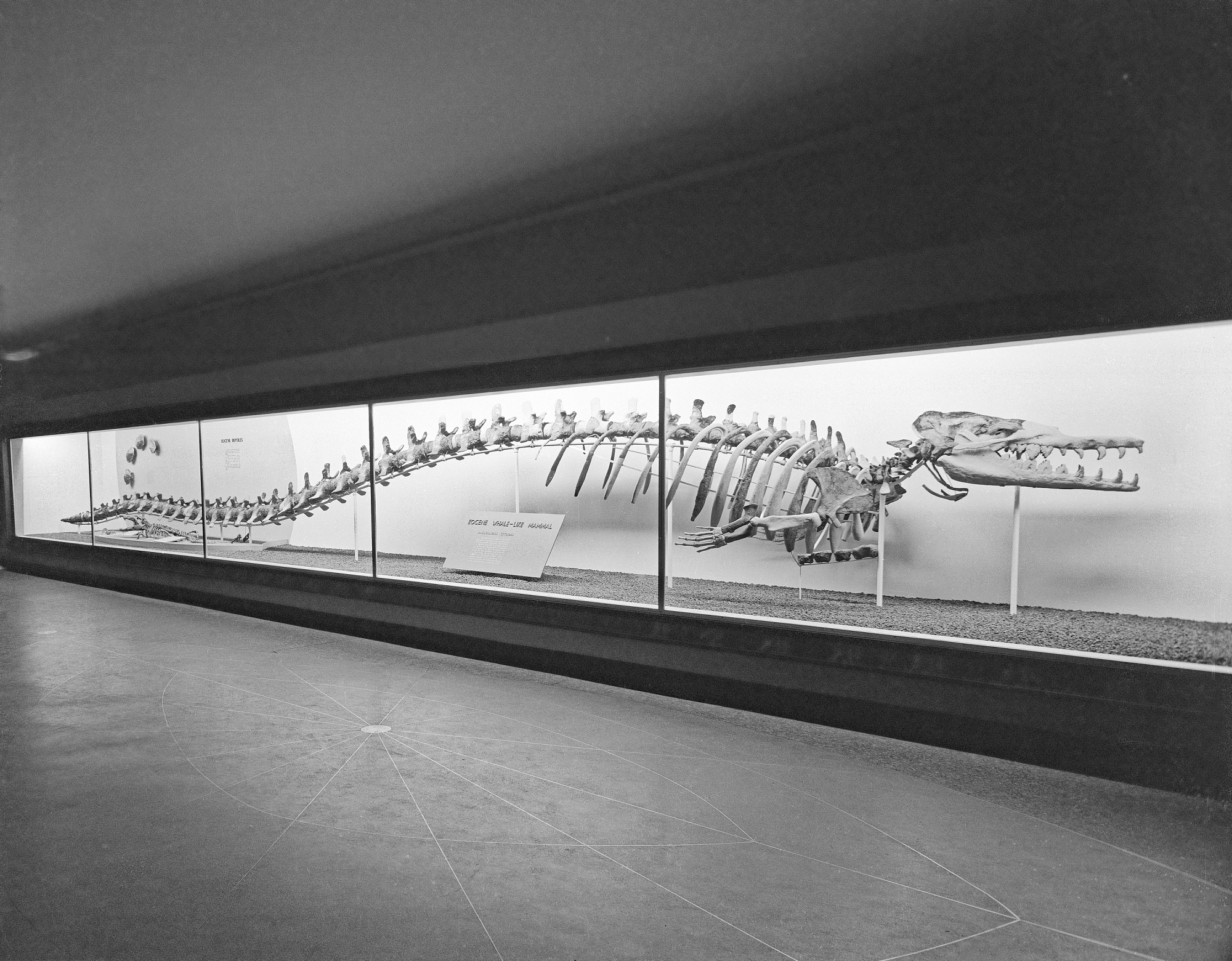
Basilosaurus and Cenozoic reptiles in Hall 5. Photo courtesy of the Smithsonian Institution Archives.

Nevertheless, Gazin’s interest in Cenozoic mammals ensured that his gallery was exceptionally thorough. Thanks to Gazin’s own collecting expeditions throughout the 1950s, the new fossil mammals galleries contained representatives of nearly all major mammal groups, from every epoch from the Paleocene through the Pliocene (the Pleistocene was deliberately excluded, as a separate ice age exhibit was also in the works). Classic mounts from the Gilmore era like Basilosaurus and Teleoceras were joined by dozens of less showy specimens like rodents, small perissodactyls, and early primates. The new exhibit also introduced the first wave of Jay Matternes’ much-beloved murals, illustrating the changing flora and fauna in North America over the course of the Cenozoic.

Unveiling and Reactions

The new east wing galleries officially opened on June 25, 1963. According to the press release, “the new exhibit features in colorful and dramatic settings more than 24 skeletons and skulls of the largest land animals the world has ever known.” The exhibits were officially unveiled with a late afternoon ceremony, in which Carol Hotton (Nicholas Hotton’s daughter) cut the ribbon and the lights to Hall 2 were suddenly turned on to dramatic effect.

Unfortunately, the new exhibits were not universally loved by the museum staff. The wing had been planned a set of compartmentalized exhibits, each corresponding to a subdivision of the Division of Paleontology, with a different curator taking responsibility for each hall. While seeming sensible on paper, this plan turned out to be a logistical nightmare, and a common cause for complaint among Division staff for the next decade. In addition, Gazin in particular voiced concerns as early as January 1964 that the design of the new halls was entirely inadequate for preventing accidental or deliberate damage to specimens by visitors. The mounts in Hall 2 were raised only about a foot off the ground, and were not protected by any sort of guard rail or barrier. As a result, within a few months of the exhibit’s unveiling, several ribs and vertebral processes had been broken off or stolen from CamarasaurusGorgosaurus, Ceratosaurus and others.

With the notable caveat that I never saw the 1963 exhibits in person, I would say that this is aesthetically my least favorite iteration of the east wing. The grandiose, institutional Greco-Roman architecture originally displayed in the Hall of Extinct Monsters was replaced with what can only be described as extremely 1960s design. Solid earth-tone colors, wood paneling and wall-to-wall carpeting gave the halls a much more austere character. While the efforts to categorize specimens into thematic zones was commendable for a museum of that era, the label copy (written by the curators) was still highly pedantic and verbose. As such, the 1963 fossil halls seem to have been very much of their time. While the designers were working to avoid the overt religiosity and grandeur of turn of the century museums, they had not yet reached the point of developing truly audience-centered educational experiences. The result was an exhibit that was humble, yet still largely inacessible. Perhaps for this reason, the 1963 fossil halls were the shortest-lived at NMNH to date, being replaced within 20 years of their debut.

This post was updated and edited on January 8, 2018.

Leave a comment

Filed under dinosaurs, exhibits, Extinct Monsters, fish, fossil mounts, history of science, mammals, museums, NMNH, reptiles, science communication