Category Archives: exhibits

Extinct Monsters: Gilmore’s Diplodocus

Click here to start the Extinct Monsters series from the beginning.

More than 80 years ago, Smithsonian paleontologist Charles Whitney Gilmore supervised the installation of the mounted Diplodocus skeleton known as USNM 10865. In December 2014, that same skeleton was finally disassembled for conservation and eventual re-mounting.This post is about the history of this particular mount: where it came from, who put it together, and what it has and continues to tell us about prehistory.

Predecessor at CMNH

The story of the NMNH Diplodocus mount actually began in Pittsburgh, Pennsylvania around the turn of the century. In November of 1898, Steel tycoon-turned-philanthropist Andrew Carnegie read that the remains of a giant “Brontosaurus” had been discovered in Wyoming. Carnegie’s interest was piqued and the following year, he contributed $10,000 to the Carnegie Museum of Natural History (which he had founded two years earlier) to find a complete “Brontosaurus” – or something like it – for display in Pittsburgh. Perhaps proving that money can indeed buy anything, on July 4th, 1989 the CMNH team found a reasonably complete sauropod skeleton in Sheep Creek Basin, Wyoming. CMNH Curator of Paleontology John Bell Hatcher declared the specimen to be a new species, which he named for the Museum’s benefactor: Diplodocus carnegii.

Back in Pittsburgh, the task of preparing and mounting the fossils fell to preparator Arthur Coggeshall and his staff.  Creating a permanent armature for a delicate 84-foot skeleton was a monumental undertaking, beyond anything that had ever been attempted before. Coggeshall used a steel rod, shaped to the contours of the vertebral column, as the basis for the mount. Once the backbone was in place, the limbs, ribs, and other extremities were mounted on steel rods of their own and attached to the rest of the skeleton. The fossils were connected to the steel armature by drilling screws and bolts directly into the bone. Since the original Diplodocus carnegii skeleton was not complete, the mount was supplemented with fossils uncovered during subsequent field seasons at Sheep Creek and elsewhere in Wyoming.

The CMNH Diplodocus was unveiled in 1907 in a brand-new wing that had been constructed to display it. Although the American Museum of Natural History had by that point completed a sauropod mount of their own, the Pittsburgh display was well-received by paleontologists and laypeople alike. Not to be bested by the New York competition, Carnegie also commissioned eight Diplodocus replicas, which he donated to museums throughout Europe and Latin America.
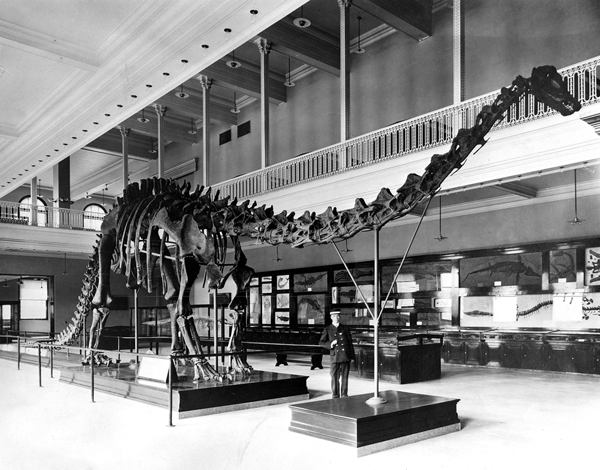
The original CMNH Diplodocus mount, in the hall built specifically to accomodate it. Source

The original CMNH Diplodocus mount, in the hall built specifically to accommodate it. Source

This wave of publicity allowed the paleontology staff at CMNH and elsewhere to continue to undergo large-scale fossil hunting expeditions. In 1909, a team led by Earl Douglass hit the jackpot north of Jensen, Utah. At the site now known as Dinosaur National Monument, CMNH teams excavated over 300 tons of Jurassic fossils over 13 field seasons. The immensely productive “Dinosaur Quarry” site is thought to represent a prehistoric river bar, where dead animals from upsteam accumulated over time. In addition to an assortment of crocodiles and other small reptiles, this location has yielded remains of Apatosaurus, Diplodocus, Stegosaurus, Allosaurus and many other taxa. Although the site was far from exhausted, the CMNH team moved on in 1922, at which point paleontologist Charles Gilmore from the United States National Museum took over.

USNM Excavation at Dinosaur National Monument

Gilmore led the first USNM field season at Dinosaur National Monument in May of 1923. In their final year at the site, the CMNH team had located two partial sauropod skeletons. Gilmore opted to focus on excavating these “in order to secure a mountable skeleton” for display (Gilmore 1932). As with the CMNH team before them, the primary motivation of Gilmore’s team was not scientific research, but to bring back spectacular display specimens. Gilmore was unarguably a phenomenal scientist who made lasting contributions to our knowledge about prehistory, but this focus on impressive displays was typical of early 20th century paleontology. As such, valuable taphonomic and ecological data that would been collected by modern paleontologists was probably destroyed when unearthing this and other exhibition-caliber dinosaur specimens.

Once the excavation began, Gilmore decided that the Diplodocus skeleton dubbed specimen 355 was the best candidate for a mount. The skeleton consisted of an articulated vertebral column, from the 15th cervical to the 5th caudal, a separated but virtually complete tail, the pelvis, both pectoral girdles, much of the rib cage, both humeri, and a complete left hind limb. Unfortunately, the head and most of the neck had eroded out of the hillside and  long since weathered away. Some elements not preserved with specimen 355 were reportedly cherry-picked from another specimen at the same site. Again, this sort of selective excavation is discouraged today, but was typical at the time. On August 8, the team wrapped up and shipped 25 tons of material back to Washington, DC via railway.

Preparation, Mounting and Description

Preparing and mounting the Diplodocus was, according to Gilmore, the single most ambitious undertaking attempted by the department during his tenure.  In his words, “the magnitude of the task, by a small force, of preparing one of these huge skeletons for public exhibition can be fully appreciated only by those who have passed through such an experience” (Gilmore 1932).  Gilmore, along with preparators Norman Boss, Thomas Horne, and John Barrett, spent  2,545 working days over the course of six years preparing the skeleton for exhibition. Gilmore reported that his team  followed the method Arthur Coggeshall had developed at CMNH over 20 years earlier for mounting their sauropod. The vertebral column was assembled first, supported by a series of steel rods. This structure was mounted at the appropriate height on four upright steel beams securely anchored to the floor. Limbs and other extremities were subsequently added, with steel rods shaped to the contours of the fossils supporting each portion of the skeleton.
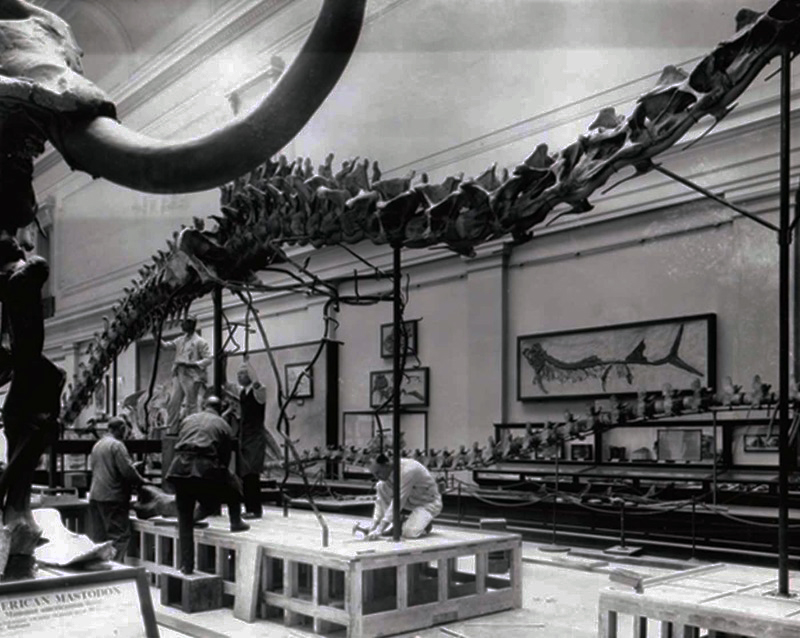
Diplodocus under construction, ca. 1930. Source

Diplodocus under construction, ca. 1930. Source

Missing parts of the skeleton, including the right hindlimb and the distal portions of the forelimbs, were filled in using casts of the Carnegie Diplodocus. According to Gilmore, the casted elements were colored “to harmonize with the actual bones but with sufficient difference to be at once distinguished from the originals” (Gilmore 1932). This is noteworthy, because the creators of other dinosaur mounts at that time had been known to deliberately disguise artificial elements by painting them to match the fossils. Although the Smithsonian Diplodocus was a composite of multiple specimens and therefore does not represent any single animal that actually existed, the decision to make the casted elements readily visible represents a degree of honesty and integrity that is more common in modern museum displays than it was in Gilmore’s time.
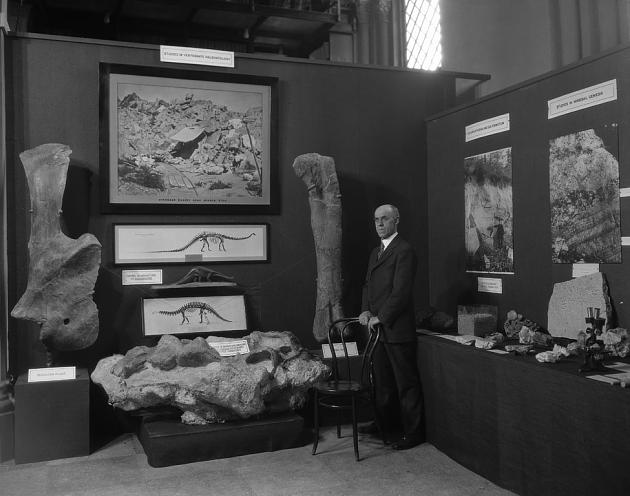
Gilmore presents plans for the in-progress Diplodocus mount at the 1927 Conference of the Future of the Smithsonian. Photo courtesy of the Smithsonian Institution Archives.

In the process of preparing and mounting the Diplodocus (at this point designated USNM 10865), Gilmore was able to further refine our understanding of sauropod physiology. Looking at the specimen, Gilmore was easily able to dismiss notions by earlier workers that Diplodocus had sprawled like a crocodile, asserting that “the crocodilian attitude for Diplodocus involves anotomical imposibilities” (Gilmore 1932). Additionally, since the entire dorsal portion of the vertebral column was present and intact, Gilmore determined that the presacral vertebrae (in the lower back) arch downward, toward the sacrum. The CMNH Diplodocus and AMNH Apatosaurus had been mounted with completely straight backs, so Gilmore was able to create a more accurate mount. Studying the articulated vertebral column also convinced Gilmore to raise the tail higher than in previous sauropod mounts. Although it would be decades before paleontologists started raising the tail completely clear of the ground, this was certainly a step in the right direction. Gilmore refrained, however, from definitively assigning USNM 10865 to a particular species of Diplodocus, since at the time (and to this day, apparently) the differences among the named species of this genus were unclear.

Exhibition and Legacy

USNM 10865 in the Hall of Extinct Monsters, circa 1932. Photo courtesy of the Smithsonian Institution Archives.

The completed Diplodocus skeleton was 70 feet, 2 inches long and 12 feet, five inches tall at the hips, making it about 14 feet shorter in length than its CMNH counterpart. The mount was introduced to the Hall of Extinct Monsters at the United States National Museum in 1931, positioned atop three pedestals so that visitors could walk right underneath it. The Diplodocus was placed right in the center of the  gallery, facing west so that it could stare down visitors as they entered the hall.

The unveiling of the Diplodocus mount was a big deal, but did not catch the public’s attention in quite the same way as its CMNH predecessor. After all, by 1931 several of the other major natural history museums had had sauropods on display for over two decades. Nevertheless, for residents and visitors in Washington, DC the new mount was an unforgettable look at the life of the past.

The Diplodocus, as it stood from 1963 through 1981. Image courtesy of the Smithsonian Institution Archives.

The Diplodocus, as it stood from 1963 through 1981. Image courtesy of the Smithsonian Institution Archives.

The Diplodocus was not moved during the 1963 modernization of the fossil exhibits, but the walkable area around the mount was significantly reduced. Visitors could no longer walk under the skeleton, or get as close to it. The Diplodocus was not moved during the 1981 renovation, either, but the neck support coming up from the floor was replaced by less intrusive cables suspended from the ceiling. In the new exhibit, the sauropod centerpiece was surrounded by contemporaneous friends from the Morrison Formation, including Stegosaurus, Camptosaurus, Camarasaurus and Allosaurus.

National Museum of Natural History in Washington, DC.

Diplodocus as it stood from 1981-2014. Photo by the author.

From 1931 to 2014, the Diplodocus remained an unchanging fixture of the Museum’s east wing. Although this specimen’s story has not been as widely told as that of the CMNH Diplodocus, the Smithsonian sauropod is certainly just as interesting. For more than 80 years, USNM 10865 has mesmerized generations of viewers with its size and elegance.  What’s more, this specimen, and the associated measurements and drawings meticulously prepared by Gilmore, are frequently referred to in publications by modern paleontologists. For its contributions to public education and to scientific inquiry, USNM 10865 is one to celebrate.

References

Brinkman, P.D. The Second Jurassic Dinosaur Rush: Museums and Paleontology in America at the Turn of the 20th Century. Chicago: University of Chicago Press, 2010.

Gilmore, C.W. “On a Newly Mounted Skeleton of Diplodocus in the United States National Museum.” Proceedings of the United States National Museum 81:1-21, 1932.

Gilmore, C.W. “A History of the Division of Vertebrate Paleontology in the United States National Museum.” Proceedings of the United States National Museum 90, 1941.

3 Comments

Filed under anatomy, CMNH, dinosaurs, exhibits, Extinct Monsters, field work, fossil mounts, history of science, museums, NMNH, reptiles, sauropods

Extinct Monsters: History of Smithsonian Fossil Exhibits

Click here to start the Extinct Monsters series from the beginning.

Upon his death in 1829, British scientist James Smithson left his fortune to the United States government to found “at Washington…an establishment for the increase and diffusion of knowledge.” Congress used Smithson’s estate to establish the publicly funded Smithsonian Institution in 1846, which has since grown into an expansive research institute and museum complex that is recognized the world over. Vertebrate paleontology has been an important part of the Smithsonian’s agenda since the beginning, and this article by Ray Rye provides a compelling history of the scientific staff and their research. This post will take a slightly different approach, summarizing the changing public face of Smithsonian paleontology in the form of its genre-defining exhibits.

In 1847, Joseph Henry, the Smithsonian’s first secretary, started construction on the original Smithsonian building, which today is colloquially known as “the castle.” The first vertebrate paleontology exhibit housed within its walls consisted of a trio of casted skeletons: the ground sloth Megatherium, the glyptodont Scistopleurum, and the tortoise Collossochelys. These exhibits were probably obtained through Ward’s Natural Science Establishment. The Smithsonian’s first skeletal mount made from original fossils was a Megaloceros, purchased from antiquities dealers Thomas and Sons in 1872.

Exhibits like this one at USNM were deemed incomprehensible and inspired early reform

Basilosaurus, Megatherium, and Megaloceros are visible in the southwest court of the first United States National Museum. Image courtesy of the Smithsonian Institution Archives.

1881 saw the completion of the original United States National Museum, next door to the castle (this structure is now called the Arts and Industries Building). The southwest court was dedicated to osteology and paleontology, and the existing skeletal mounts were placed here among rows of cases containing smaller specimens. At this point in time, the Smithsonian had very few permanent staff members, instead relying mostly on scholars serving in unpaid “honorary” positions to curate the growing national collection. Famed paleontologist O.C. Marsh (the beardier half of the “bone wars” rivals) was the honorary curator of vertebrate paleontology. Under contract with the United States Geological Survey, Marsh supervised numerous field expeditions to the American west and oversaw the collection of untold thousands of fossil specimens. When Marsh died in 1899 the fossils he collected for the government were relocated from Yale University (his home institution) to the Smithsonian.

Gilmore and the Hall of Extinct Monsters

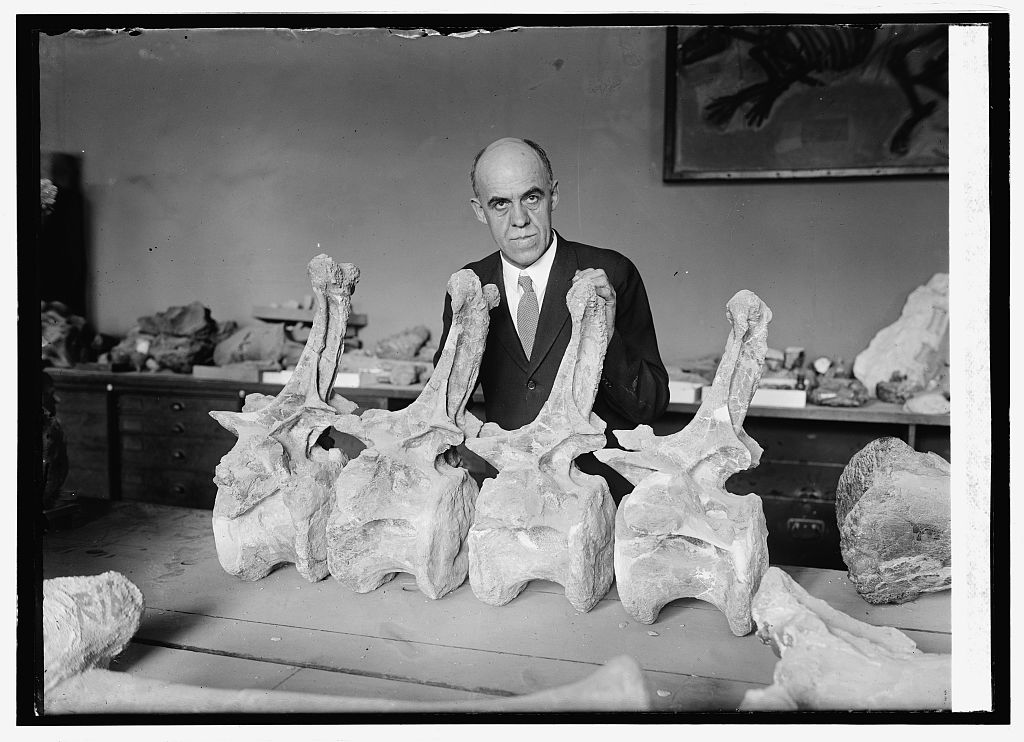
Gilmore with Diplodocus vertebrae.

C.W. Gilmore with some Diplodocus vertebrae. Image courtesy of the Smithsonian Institution Archives.

Charles Whitney Gilmore was a student in mine engineering at the University of Wyoming when he became involved in the Carnegie Museum’s fossil hunting expeditions in 1899. Recognizing the young man’s enthusiasm and talent, John Bell Hatcher hired Gilmore immediately after his graduation in 1901. Gilmore worked with Hatcher for two field seasons, but in 1903 he moved to Washington, DC upon being offered a position as a full-time preparator at the USNM. He was promoted to Curator of Vertebrate Paleontology in 1924, and is fondly remembered as an exceptionally modest but extraordinarily productive scientist. As curator, Gilmore led sixteen fossil-hunting expeditions to the western interior. Gilmore’s most enduring contribution to paleontology, however, is his extensive body of descriptive publications on the Marsh fossils. His monographs on Apatosaurus, Camarasaurus, Ceratosaurus, and many others are still regularly cited today.

Along with preparators Norman Boss and James Gidley, Gilmore is responsible for creating most of the mounted dinosaur skeletons that are on display at the Smithsonian. The first dinosaur mount Gilmore and his team completed was Edmontosaurus, which went on display in the original USNM building in 1904. Gilmore would go on to supervise the construction of Triceratops (the first mount of this taxon in the world), Camptosaurus, Stegosaurus, DimetrodonCeratosaurus, Diplodocus, and numerous other displays that have been enjoyed by generations of museum visitors.

extinctmonstersfront_1913

The Hall of Extinct Monsters, sometime before 1929. Image courtesy of the Smithsonian Institution Archives.

Congress authorized the construction of a new United States National Museum on the north side of the National Mall in 1911. In contrast to the Victorian style of the original building, the new museum sported neoclassical granite construction which matched the aesthetic of the other federal buildings. Exactly when the museum opened is the subject of some debate. Collections and offices began moving across the mall via horse and wagon in 1908, and part of the first floor opened to the public on March 17th, 1910. Nevertheless, it was not until 1911 that all the exhibit spaces were ready for visitors, including the evocatively titled “Hall of Extinct Monsters” in the museum’s east wing. This cavernous space devoted to fossil displays was primarily under Gilmore’s stewardship, and generally resembled a classic “cabinet of curiosity” approach to exhibit design. Gilmore and his team would gradually fill the Hall of Extinct Monsters will new specimens over the coming decades, culminating in the towering Diplodocus mount completed in 1932.

Modernization and Renaissance

Gilmore retired in 1945, and vertebrate paleontology research at the USNM, particularly in dinosaurs, quieted in his absence. Charles Gazin, Gilmore’s successor as Curator of Vertebrate Paleontology, specialized in mammals, and the museum remained without a curator specializing in dinosaurs until Matt Carrano was hired in 2003. In 1957, the USNM split into two subdivisions, the Museum of Natural History and the Museum of History and Technology. The Smithsonian’s history collections were moved to a new building next door, now called the National Museum of American History, and other collections gradually dispersed into 20-some other Smithsonian museums. The site of the disbanded USNM was officially renamed the National Museum of Natural History in 1967, and remains the home of natural sciences and anthropology.

The Diplodocus, as it stood from 1963 through 1981. Image courtesy of the Smithsonian Institution Archives.

The Hall of Fossil Reptiles lasted from 1962 to 1981. Image courtesy of the Smithsonian Institution Archives.

The Hall of Extinct Monsters persisted largely unchanged until 1962, when it was finally renovated as part of a Smithsonian-wide modernization project. The fossil exhibits were among the last to be updated, in part due to ambivalence from the paleontology curators. The department did not employ any staff members exclusively devoted to exhibit work, so the task of reinventing the displays was an added burden for the research staff. As such, the changes to the hall ended up being more cosmetic than structural. The largest mount, Gilmore’s Diplodocus, was too difficult to disassemble and move, so the new exhibit was designed around it. Solid earth tones and wall-to-wall carpet replaced the original neoclassical aesthetic. The John Elliot mural Diana of the Tides, positioned high on the east wall, was simply boarded over during construction (and has remained so ever since).

The 1981 renovation saw the addition of a mezzanine over the dinosaur exhibit. Source

In 1974, the addition of the Hall of Ice Age Mammals and the Rise of Man expanded the paleontology display space beyond the east wing. Further renovations took place in three stages starting in 1979. Entitled “Fossils: The History of Life”, the overhauled exhibit complex represented a significant departure from earlier iterations of this space. While the previous renovation arranged specimens according to taxonomy and curatorial specialties, “The History of Life” followed the evolutionary progression of fossil plants and animals through time. The new exhibits also differed from prior efforts in that they were not put together exclusively by curators. Instead, the design process was led by educators and exhibits specialists, who sought curatorial input at all stages. The new specimens and displays also required the once spacious hall to be carved up into a maze of small rooms and narrow corridors. Even with the additional floor space provided by a new balcony over the dinosaurs, the east wing had become quite crowded.

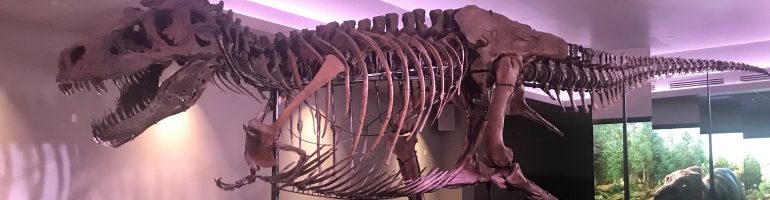
Of course, the science of paleontology has advanced by leaps and bounds since the 1980s, and NMNH staff have made piecemeal updates to the exhibits when possible. These changes include restorations of deteriorating mounts, the addition of a cast of Stan the Tyrannosaurus, and a few revised signs addressing the dinosaurian origin of birds and new dates for geologic time periods. Still, the east wing remained largely the same for over 30 years, and began to look a bit tired next to the brand-new exhibits that have opened at NMNH over the last decade.

Looking Ahead

The NMNH fossil halls closed on April 27th, 2014 for a five year renovation project. For the first time, the east wing was completely gutted and its underlying infrastructure overhauled. Aging specimens like the 1932 Diplodocus and the 1911 Ceratosaurus were be painstakingly disassembled and conserved, and the space itself was restored to its original Beaux Arts splendor. The re-imagined exhibit is arranged in reverse chronological order: visitors  start among mammoths and ground sloths in the Pleistocene and move backward in time through increasingly alien-looking versions of North America. Unlike the present exhibit, however, an open floor plan will allow visitors to get a sense of what they’re in for from the moment they walk into the hall.

4-07

Mesozoic section of the new Hall of Fossils – Deep Time. Concept art on display in the Last American Dinosaurs exhibit at NMNH.

The overall theme is change over geologic time, highlighting the myriad ways that climate, geography, evolution, and other living and nonliving systems interact and shape the world’s environments. Not all the classic mounts will make it into the new space (Brachyceratops, Zygorhiza, and Stegomastodon are among the retirees), but there are many new additions, including the Nation’s T. rex The result will be a compelling mix of classic early 20th century museum aesthetics and modern visitor-focused educational strategies.

References

Gilmore, C.W.  (1941). A History of the Division of Vertebrate Paleontology in the United States National Museum. Proceedings of the United States National Museum No. 90.

Rye, R. (2002.) History of the NMNH Paleobiology Department. http://paleobiology.si.edu/history/rye.html

Sues, H. and Marsh, D. (2013). Charles Whitney Gilmore: The Forgotten Dinosaur Hunter. http://paleobiology.si.edu/history/gilmore.html

Yochelson, E.L. (1985). The National Museum of Natural History: 75 Years in the Natural History Building. Washington, DC: Smithsonian Institution Press.

1 Comment

Filed under collections, dinosaurs, exhibits, Extinct Monsters, fossil mounts, history of science, mammals, museums, NMNH, reptiles

Exhibits with an Agenda

I am currently part of a team preparing a small exhibit on sustainable energy for a Midwestern history museum. Our original goal was simple: to review the regional history of renewable energy production and use, in order to illustrate that “green living” is not a new concept. However, as with most creations of passionate people, the size and scope of the exhibit has expanded quite a bit, and the exhibit is now intended to be a more forceful argument for responsible energy use and the importance of being aware of one’s own energy footprint. There’s no denying this argument has always been an implicit part of the exhibit plan. In this part of the world, there is an unfortunate resistance to, if not outright demonization of progressive energy policy, and we absolutely want to undermine the assumptions and misconceptions that fuel this anti-green discourse. What has changed is that we’ve stopped hiding our agenda.

In his 1994 essay Evaluating the Ethics and Consciences of Museums, Robert Sullivan proposes that museums are “moral educators”. Either deliberately or through unconscious subtext, museums inherently shape the opinions, worldview and conception of self of their visitors. It is unavoidable that museum content will be shaped by subtextual ideologies and assumptions. Identifying and unpacking these biases is a huge issue (it’s basically the entire focus of the humanities for the last 50 years or so), but one can still exert a degree of control over which assumptions are expressed.

Museums are among the most trusted of media forms, and are widely considered to be far more reliable than books, television or newspapers. This public trust can be intimidating, but it does present a unique opportunity: if a museum takes a stand on an important issue, it will probably be taken seriously. Obviously, trust is not a resource to be squandered needlessly, but when wielded with care and deliberation it can be very powerful.

With our sustainable energy exhibit, we are trying very hard to harness that power in an effective way. The issues that surround energy use are very serious, as the availability and ready access of energy are critical to our modern economy, infrastructure, and way of life. Unfortunately, the discourse around renewable energy, diminishing fossil fuels and climate change is highly politicized. We want to be plain about the economic and environmental dangers that good, solid research tells us is in our future, and we want to call out sources of misinformation. Above all, we want to give people the intellectual tools to evaluate controversial issues for themselves, and to identify which arguments are backed by concrete evidence and which are not.

Our exhibit may well raise some eyebrows for taking a hard stance on a topic that many in this region consider to be “controversial”. I think this is a good thing. Museums really should not be playing the “both sides of the story” game that other media forms play when the evidence and experts clearly favor one camp. If we are avoiding asking our audiences hard questions, then we are not teaching, and we are not doing our job.

Leave a comment

Filed under education, exhibits, museums, opinion, science communication

More Fun at the Carnegie Museum

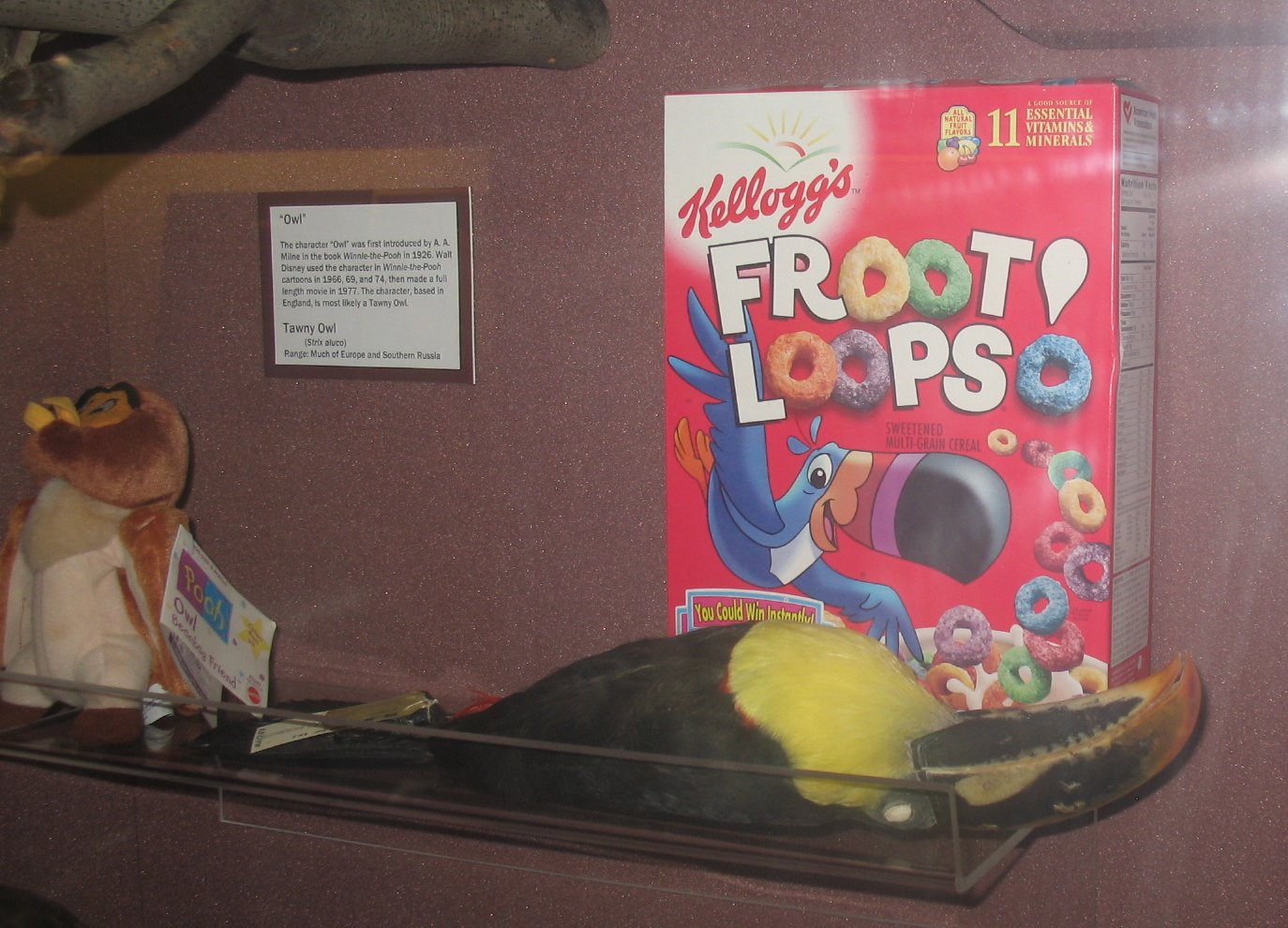
I just have to share this picture, also from the Carnegie Museum of Natural History (see previous post). While the “Dinosaurs in their Time” gallery is fantastic, this has to be one of the worst museum displays I’ve ever seen, as well as one of the most fascinating.

Leave a comment

Filed under CMNH, collections, education, exhibits, museums, opinion, theropods