Category Archives: opinion

Framing Fossil Exhibits: Phylogeny – An Addendum

After I posted my slightly critical evaluation of the AMNH fossil halls last month, a reader suggested I take a look at Next of Kin by Lowell Dingus. Dr. Dingus was the project director for the 1995 renovation, and his book chronicles the decade-long process of overhauling these genre-defining exhibits. It also includes plenty of gorgeous photos of the AMNH fossil exhibits past and present. Although out of print, Next of Kin can be found online for next to nothing. If you find anything on this blog interesting, I would call this book required reading. I cannot recommend it enough.

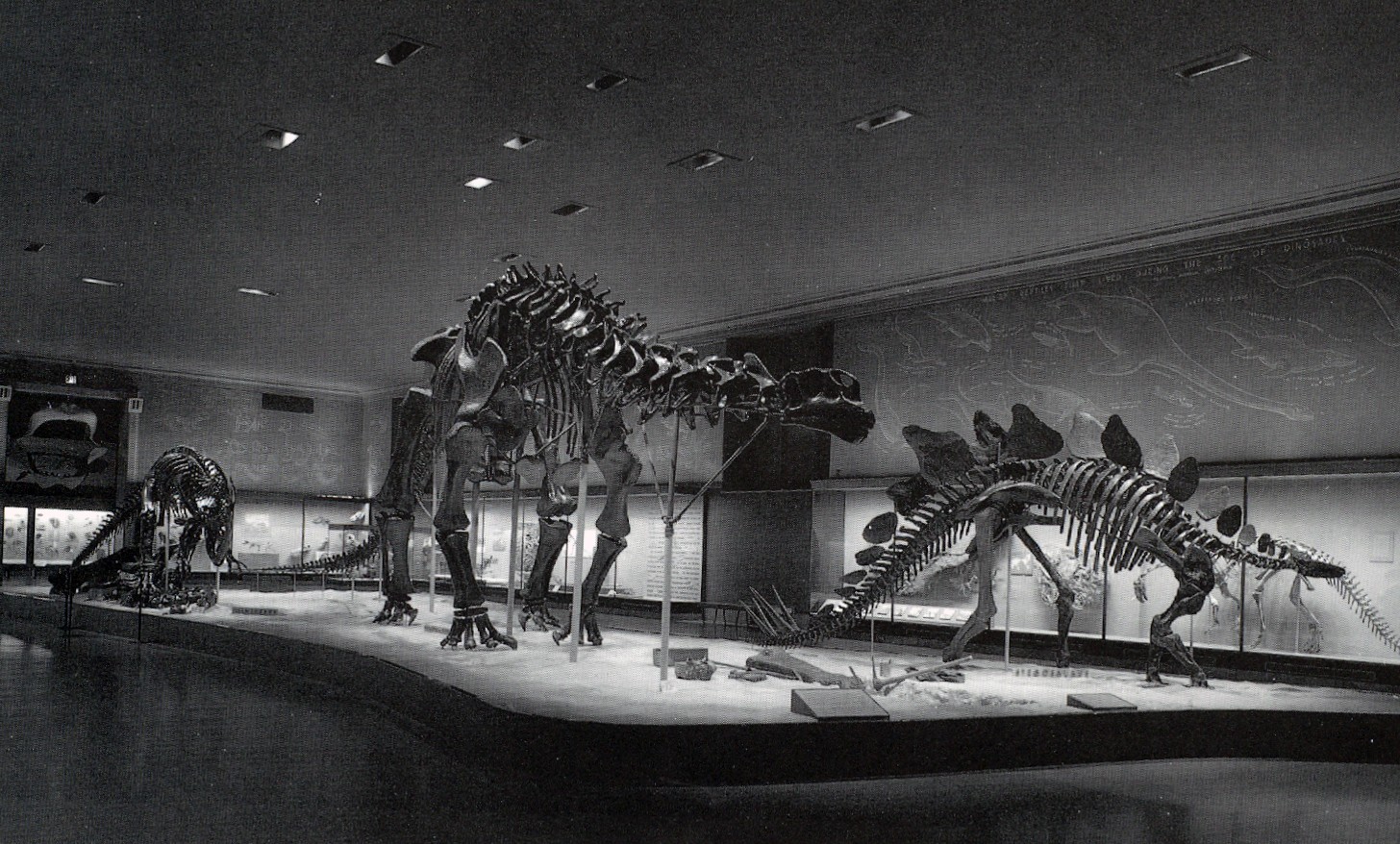
Edwin Colbert designed this version of the Jurassic exhibit in 1956. This space is now the Hall of Saurichian Dinosaurs. Photo from Dingus 1996.

Next of Kin is full of fascinating information about the renovation, and the history of the halls in general. For instance, it was news to me that the original plan in 1987 was to modernize only the two fossil mammal halls. When William Moynihan took over as Director of AMNH the following year, however, he asked in a planning meeting why the dinosaur exhibits weren’t being renovated, and soon the project expanded to include all six halls on the 4th floor. Apparently the approaches to interpretation, aesthetics, and layout that characterize the exhibits today were already fully formed. The concept of a main pathway with branching alcoves representing individual clades was in place, so the exhibit team only needed to set the starting point back a ways to include the dinosaurs and the rest of the vertebrate family tree. Restoring the historic interior architecture, obscured since the 1950s, was also an early priority. Dingus relates how he wanted to eliminate the “black box” look of the midcentury exhibits and let natural light back into the halls. In my opinion, the well-lit, airy aesthetic is one of the standout features of the AMNH fossil halls, and one other museums might do well to emulate.

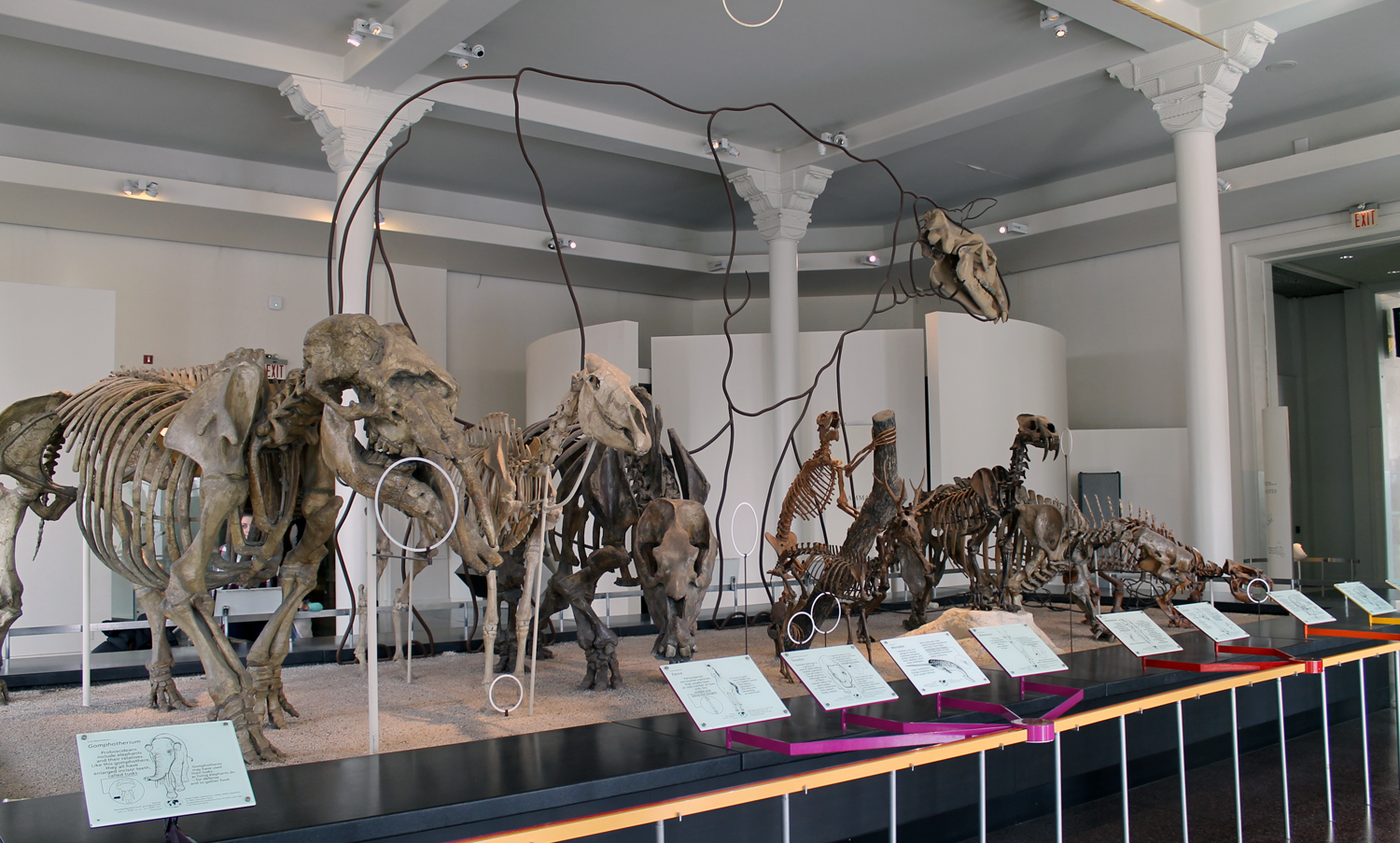
Dingus also points out a number of clever design choices that I missed during my last visit to the museum. For instance, the primate section was deliberately placed in the center of the mammal hall, to avoid the implications of directed evolution and human superiority that once marked the AMNH exhibits. Another cool feature is the use of minimalist metal armatures to suggest the size and shape of animals for which only limited material is available. This is an artful way to convey the dimensions of these species without resorting to fabricating most of the skeleton. Again, this is something I’d love to see more of at other museums.

Photo by the author.

Minimalist armatures suggest the size and shape of incomplete specimens. Photo by the author.

Still, I was most interested in reading Dingus’s rationale for the design and layout of the AMNH fossil halls. In my previous post, I argued that the phylogenetic arrangement was a worthwhile experiment, but in practice it may not be the most practical way to make the history of life meaningful to the museum’s primary audience. More than any other organizational scheme, phylogeny is the way biologists think about the natural world, and I applaud the effort to encourage visitors to look at fossils the way scientists do. However, even the most basic elements of evolutionary classification are specialized knowledge, and require a daunting amount of up-front explanation (especially when targeting multiple age groups). I don’t think this integrates well with the multi-entrance, non-linear exhibit space at AMNH.

During the initial planning stages of the AMNH renovation, Dingus and other staff toured several large-scale paleontology exhibits in North America and Europe. Dingus clearly did not like what he saw, lamenting that “some institutions rely heavily on easy-to-understand, anecdotal labels and robotic recreations of dinosaurs that appeal to the lowest common denominator of visitor intellect.” He rejected the “prominent contemporary school of exhibit design that advocates only giving the visitor what he or she asks for,” feeling strongly that his institution could do better. Referring to the renovation as a “scientific crusade,” Dingus was inspired to challenge his audience in a way that peer institutions did not. Dingus and his colleagues wanted to show visitors the real science behind paleontological reconstructions. The phylogeny-based arrangement was central to that goal, emphasizing rigorous anatomical analysis and empiricism in a field historically characterized by idle speculation.

Age of Man

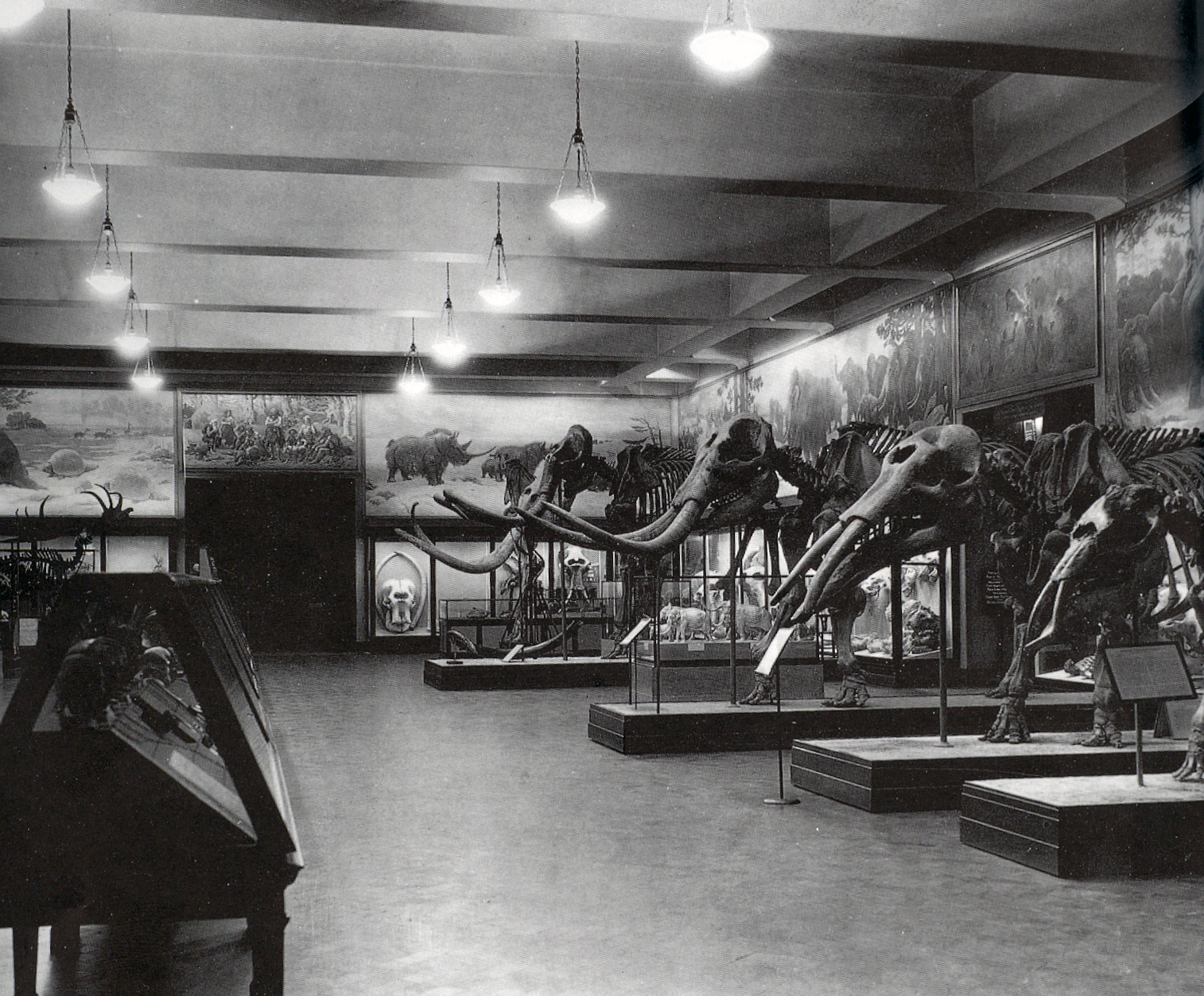
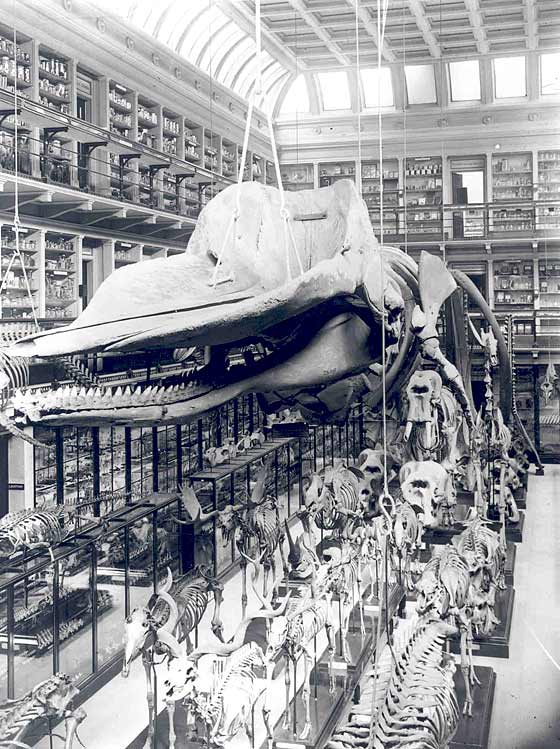
The orientation hall is in the oldest of the 4th floor exhibit spaces. Until the 1960s, this space was occupied by the Hall of the Age of Man. Photo from Dingus 1996.

I agree wholeheartedly with all of this. There was a period in the 80s and 90s (I think the worst is behind us) when the trend toward visitor-focused, educational exhibits got mixed up with a push to make museums more competitive with other leisure activities. Customer enjoyment was valued above all else, even if it meant sacrificing the informative content and access to real specimens that made museums worthwhile institutions in the first place. The resulting displays were filled with paltry nonsense like simulators, pointless computer terminals, and the aforementioned robot dinosaurs*. These exhibits imitated amusement parks, but with only a fraction of the budget they quickly fell into disrepair and technological obsolescence. Despite being museums’ most important and unique resources, curators and research staff found themselves increasingly divorced from their institutions’ public faces.

*Fine, I admit robot dinosaurs are cool. But I’d prefer that they weren’t in museums.

Under these circumstances, a backlash is quite understandable. Nevertheless, it is a common mistake (which I am by no means accusing Dingus of making!) that a visitor-centered exhibit is the same as a frivolous one. When educators push for audience-focused exhibits, they have the same goal as curators: to communicate as much content as possible. Audience-focused exhibits aren’t about dumbing down or eliminating content. They’re about presenting content in a way that effectively reaches the museum’s diverse audience. The AMNH fossil halls would work well for an informed adult visitor with ample time to inspect every specimen and read every label. But this is not the typical audience for natural history museums, and unless AMNH is a major outlier, it’s not the core audience for these exhibits. Most visitors come in mixed-aged groups. The trip to the museum is a social experience, and interactions occur among visitors as much as they occur between visitors and the exhibits. The best museums anticipate and meet the needs of these visitors in order to provide a quality learning experience.

ponies

An updated version of the classic (and classically misleading) horse evolution exhibit. Photo by the author.

It’s admittedly fun to share horror stories about dumb comments overheard in museums. Who in this field hasn’t rolled their eyes at the parent who makes up an answer to their child’s question, when the correct information is on the sign right in front of them? And yet, some of the blame for this failed educational encounter should fall on the museum. Why was that parent unable to spot the relevant information with a quick glace? Can we design signage so that the most important information is legible on the move, or from across the room? Can we correct commonly misunderstood concepts in intuitive ways?

As Dingus argues, it’s important to aim high in the amount of information we want to convey. There’s nothing worse than a condescending teacher. But a carefully-honed message in common language will always be more successful than a textbook on the wall. Happily, this is the way the wind is blowing these days. In a strong reversal of the situation a decade ago, curators now work closely with educators on the front lines to produce exhibits that are both accessible and intellectually challenging. It’s been 20 years since AMNH opened the latest version of its fossil exhibits…perhaps a new and even better iteration is already on its way!

Reference

Dingus, L. (1996). Next of Kin: Great Fossils at the American Museum of Natural History. New York, NY: Rizzoli International Publications, Inc.

6 Comments

Filed under AMNH, education, exhibits, fossil mounts, mammals, museums, opinion, reviews, science communication, systematics

Framing Fossil Exhibits: Phylogeny

This is the third part of an on-again, off-again series about organizational and interpretive approaches in large-scale paleontology exhibits (see the introduction and walk through time entries). This time, I’ll be discussing exhibits arranged according to phylogenetics – that is, the evolutionary relationships among living things. Natural history museums have displayed specimens according to their place on the tree of life since the days of Charles Wilson Peale, and more than any other organizational scheme, phylogeny is the way biologists think about the living world. Perhaps unsurprisingly, this arrangement was more common in the past, when exhibits were typically designed by and for experts. Examples of these old-school displays include the fossil mammal gallery at the Peabody Museum of Natural History and the paleontology halls at the University of Kansas Natural History Museum (neither has been thoroughly overhauled since the 1950s).

peabody mammals

The jargon-heavy signage in the Peabody Museum’s classic fossil mammal exhibit is probably ignored by most visitors. Photo by the author.

Modern natural history museums rarely attempt phylogenetic exhibits. In vertebrate paleontology, an understanding of the evolutionary relationships of animals as identified via minute anatomical details is fundamental to our science. However, most people simply don’t think about the world in this way. For example, I was halfway through my first semester teaching an undergraduate anatomy course when I realized that most of the class didn’t really understand what a mammal is. The students were familiar with the word “mammal” and could provide some examples, but they couldn’t articulate what sets mammals apart from other animals, and the relationship of mammals to other vertebrates within the tree of life was all new to them. It’s easy to forget that even the most basic elements of evolutionary classification are specialized knowledge, even among biology students.

Describing the history of life on Earth chronologically is relatively easy—museum visitors intuitively understand the forward progression of time. But scientific classification (as opposed to colloquial categorization) requires a lot of explanation up front, and it’s easy to overwhelm an audience with jargon. While not impossible (see Neil Shubin’s masterful Your Inner Fish), it is very difficult to explain phylogeny to a general audience in a relatable and approachable way.

In 1995, the American Museum of Natural History attempted to do just that with the most recent renovation of its historic 4th floor fossil halls. This evolutionary arrangement was a major change for AMNH, since this space had a “walk through time” layout for most of the 20th century. In the accompanying book Discovering Dinosaurs in the American Museum of Natural History, curators Norell, Gaffney, and Dingus explain that phylogenetics (and the cladistic methodology in particular) is the only way to approach the study of prehistoric life in an objective way. Patterns of evolutionary relationships revealed by cladistic analyses are hard evidence in a field of study traditionally characterized by idle speculation. Norell and colleagues argue that the new exhibit arrangement shows visitors the credibility and scientific rigor behind modern paleontology.
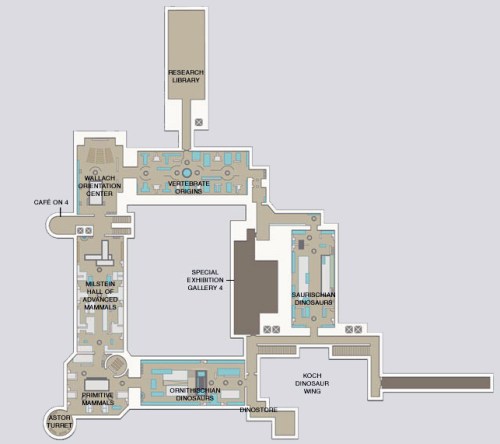
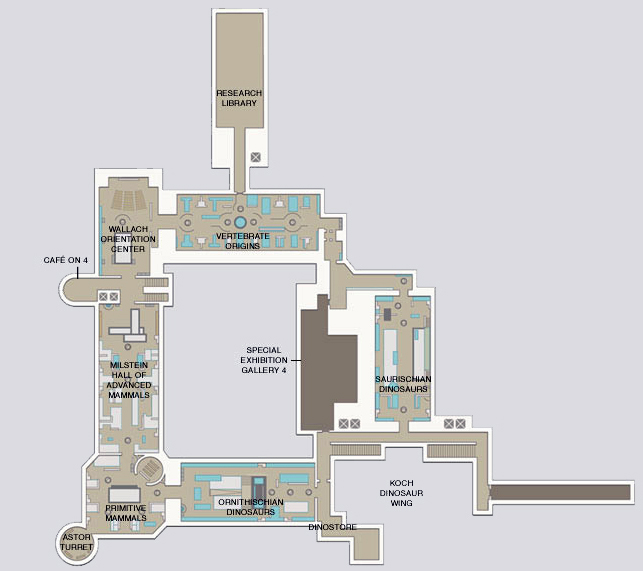
4th floor of AMNH.

Map of the fossil halls on the 4th floor of AMNH. Source

Communicating the rigorous and trustworthy nature of scientific conclusions is a worthy goal, and the choice to ground the AMNH exhibit in this way seems almost prophetic given the litany of speculation-heavy paleontology “documentaries” that have proliferated in the years since it opened. Scientific rigor is definitely a running theme here – sign after sign explains that popularly depicted dinosaur behaviors like parental care and pack-hunting are largely untestable speculation. To a degree, this label copy takes the fun out of an undeniably fun subject, but I can appreciate the effort to legitimize paleontological science in the public eye. Overall, the AMNH exhibits represent an attempt to train visitors to look at fossils the way scientists do, and the phylogenetic layout is central to that goal.

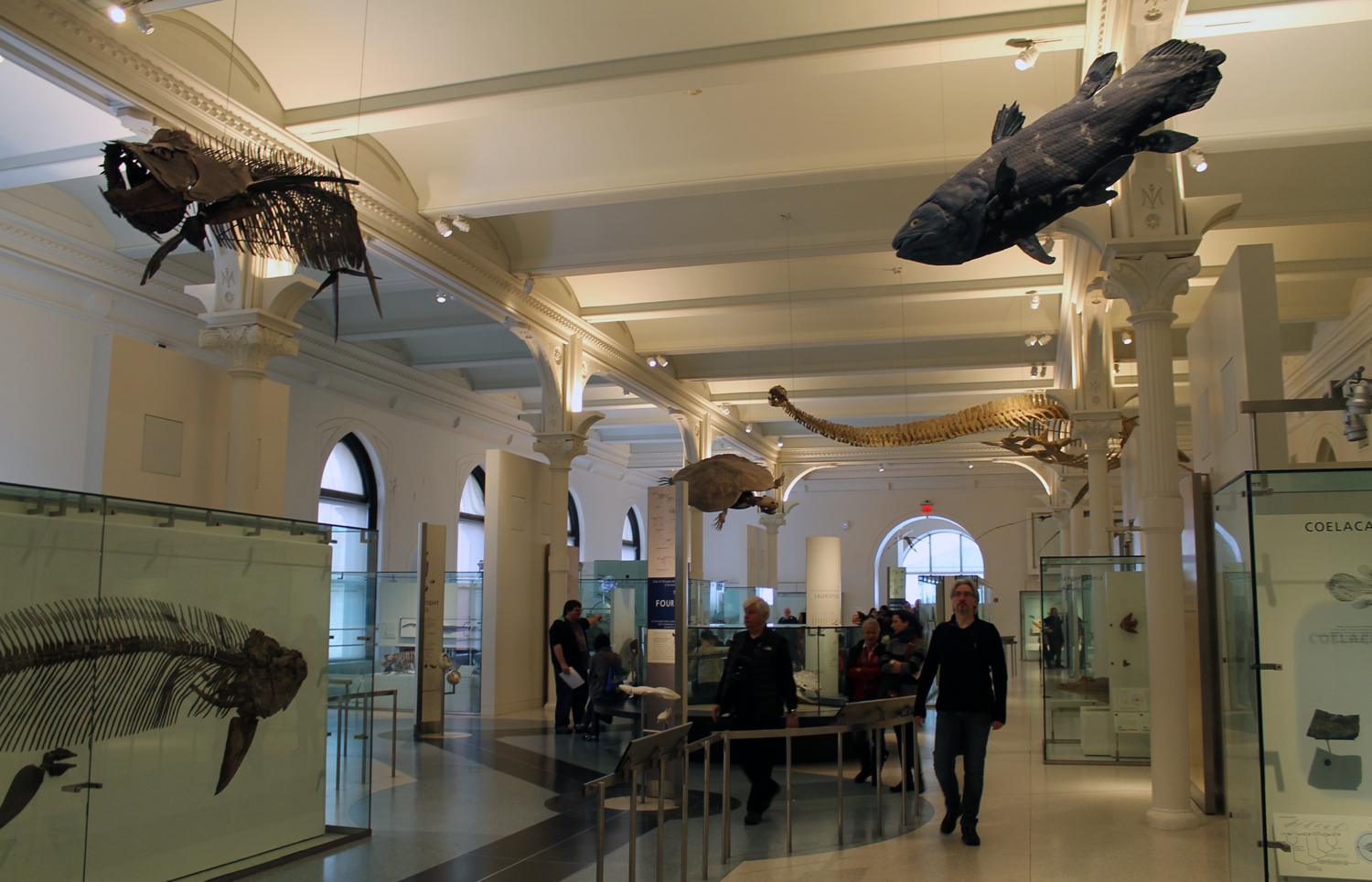
In the exhibit, visitors are meant to walk through a cladogram of chordates. You’ll pass through large halls dedicated to broad groups like saurischian dinosaurs and advanced mammals, while visiting smaller cul-de-sacs that  represent narrower clades like ornithomimids and testudines. A central black path guides you through the evolution of life, and centrally-situated pillars along your route identify major evolutionary innovations, such as jaws or the ability to reproduce on land. The insanely comprehensive vertebrate fossil collections at AMNH make this institution uniquely capable of putting so much diversity on display (although non-tetrapods are woefully underrepresented). Meanwhile, an open floor plan allows you to spend as much or as little time in each area as you wish, and ample natural lighting goes a long way toward making it possible to study specimens in detail.

follow the path for now

Pillars mark major evolutionary milestones in the Hall of Vertebrate Origins. Photo by the author.
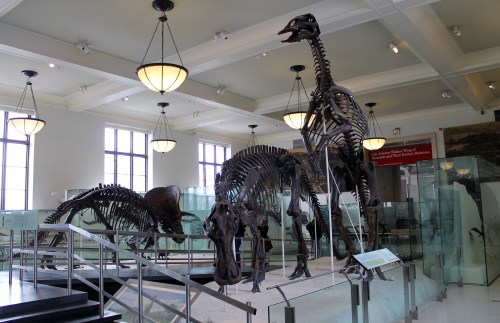
path disappears among dinosaurs

The evolutionary pathway becomes considerably less obvious among the dinosaurs. Photo by the author.

Nevertheless, I agree with Riley Black that the AMNH fossil halls don’t do the best job communicating the story of vertebrate evolution to their core audience. The underlying purpose of any exhibit structure is to provide meaning and context for objects – to help visitors see them as more than neat things to look at. According to visitor surveys, the default mode of understanding for most people passing through a paleontology exhibit is what I’ve been calling “dinosaur pageantry.” After seeing the exhibit, most visitors will recall a list of cool skeletons they saw. A few might consider which ones are meat-eaters and which ones are plant-eaters, but without further prompting that’s all we can usually expect from non-specialists. It’s the museum’s job to give visitors the intellectual tools to contextualize those fossils in a more sophisticated way, but there’s a fine line to walk. Provide too little information and nobody learns anything, but provide too much and the content is ignored. Unfortunately, the AMNH exhibits fall into the “overkill” category.

As discussed, phylogeny is complicated, often counter-intuitive, and largely unfamiliar to many visitors. To overcome this, the AMNH designers rely on a fairly long orientation film, which introduces the concept of categorizing organisms based on shared derived characteristics. There are a few problems with this. First there’s the film itself, which dives right into the traits that characterize different groups – like the stirrup-shaped stapes of derived mammals and the temporal fenestrae of archosaurs – without explaining why these traits are significant. To a layperson, these probably seem like really inconsequential things to hang a whole group on. The video also presents a cladogram of vertebrates without explaining how to read it. As Torrens and Barahona demonstrate, interpreting a phylogenetic tree is a specialized skill that many natural history museum visitors lack. Second, I saw no incentive or instruction to actually start my visit to the 4th floor in the orientation hall. There are no less than four entrances to the fossil exhibits, so many visitors won’t know there is an orientation film (I sure didn’t) until they’re halfway through the galleries. Finally, there’s the reliance on media in general: do we really want visitors to spend even a portion of their time in an exhibit full of real fossils watching a video in a darkened room? Telling visitors what to think in a narrated video is easy, but it’s not nearly as meaningful as showing them the same concept with specimens (or better yet, coaxing them to reach conclusions themselves).

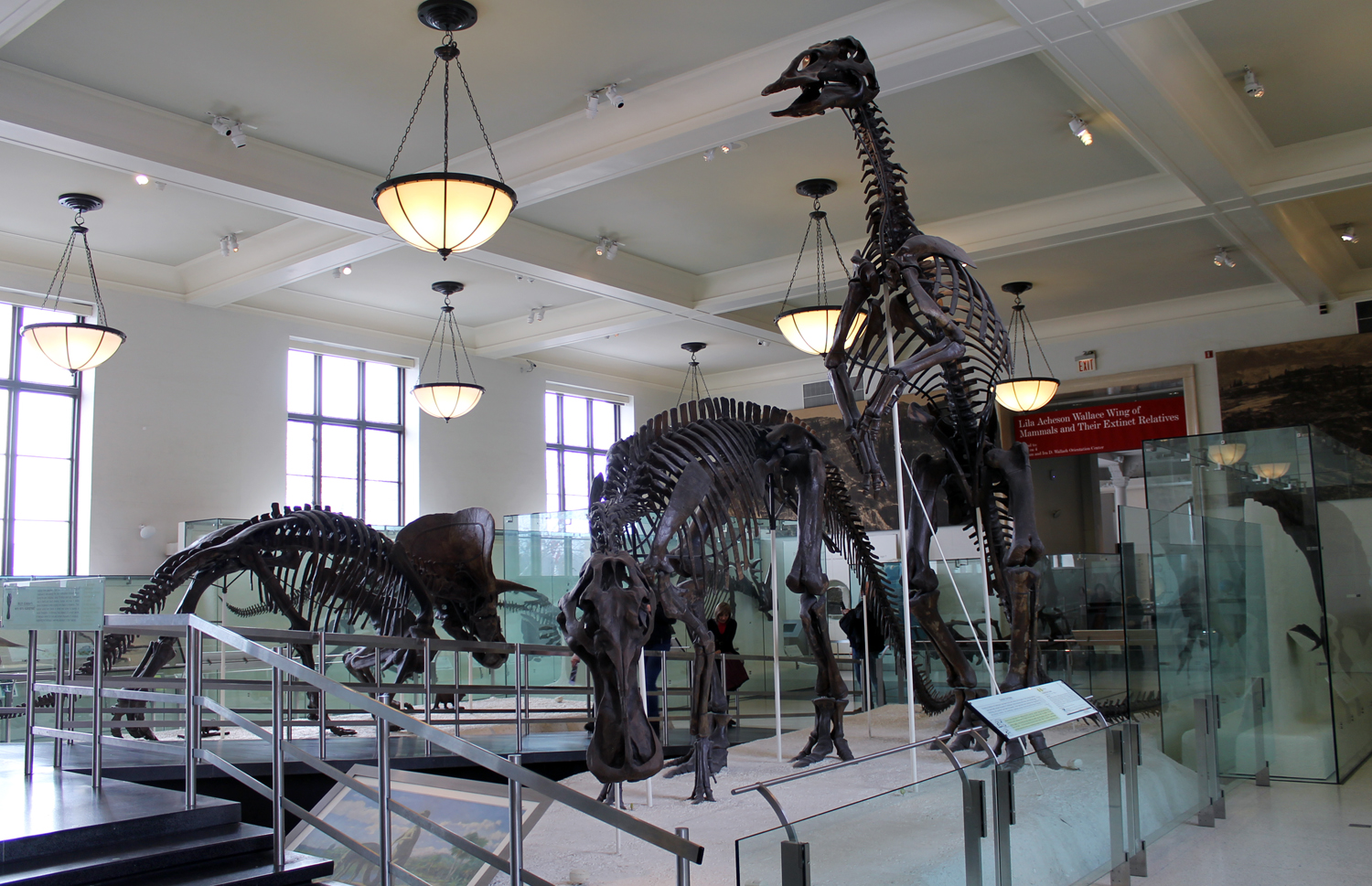
Hall of Saurischian Dinosaurs, American Museum of Natural History. Photo by the author.

Iconic mounts in the Hall of Saurischian Dinosaurs are iconic. Photo by the author.

Within the actual fossil halls, interpretation remains stubbornly unapproachable. For example, the sign introducing proboscidians tells visitors that this group is defined primarily by eye sockets located near the snout. An observant visitor might wonder why scientists rely on such an obscure detail, as opposed to the obvious trunks and tusks. There’s a good teaching moment there concerning why some characteristics might face more selection pressure (and thus change more radically) than others, but instead visitors are only offered esoteric statements. Relatedly, the exhibit does little to prioritize information. Most label text is quite small, and there’s a lot of it. Compare this to Evolving Planet at the Field Museum, where there is a clear hierarchy of headings and sub-headings. Visitors can read the main point of a display without even stopping, and parents can quickly find relevant information to answer their charges’ questions (rather than making something up).

Evolving Planet also compares favorably to the AMNH fossil halls in its informative aesthetics and spatial logic. At FMNH, walls and signs in each section are distinctly color-coded, making transitions obvious and intuitive. Likewise, consistent iconography  – such as the mass extinction zones – helps visitors match recurring themes and topics throughout the exhibit. AMNH, in contrast, has a uniform glass and white-walled Apple Store aesthetic. It’s visually appealing, but doesn’t do much to help visitors navigate the space in a meaningful way.
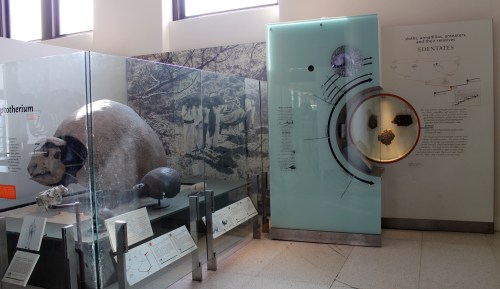
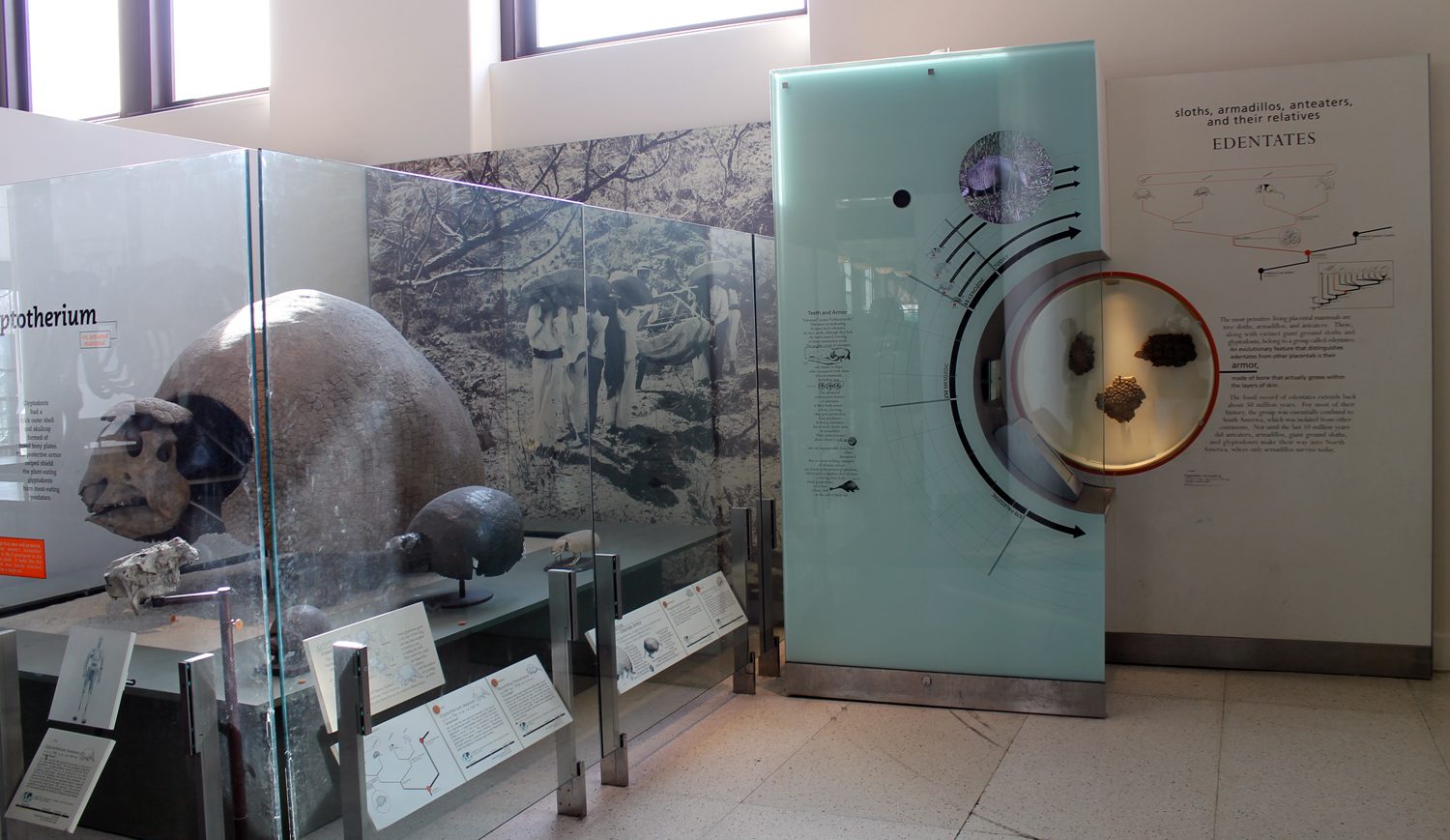
edentates aren't real

Phylogenetic interpretations change quickly – Edentata is no longer considered a natural group. Photo by the author.

The phylogenetic layout introduces a number of other unique interpretive challenges. Since there is no temporal axis,  it’s often unclear whether the lineage in a particular cul-de-sac cluster went extinct, continued on, or gave rise to another group elsewhere in the exhibit. Visitors that want to know which animals lived contemporaneously are out of luck. Meanwhile, the exhibit sometimes uses modern animal skeletons to fill out displays where fossil examples are limited, such as bats and primates. While these are labeled, the text is too small to be seen from a distance. The evolutionary organization is also burdened by the fact that phylogenetics is a fast-moving and often changing field of study. While the order of geologic time periods will never change, the 20 year-old displays at AMNH are already out of date in several details. For example, there is a cul-de-sac devoted to edentates, which is now considered polyphyletic, and a cladogram in the Hall of Saurischian Dinosaurs incorrectly places tyrannosaurids among the carnosaurs.

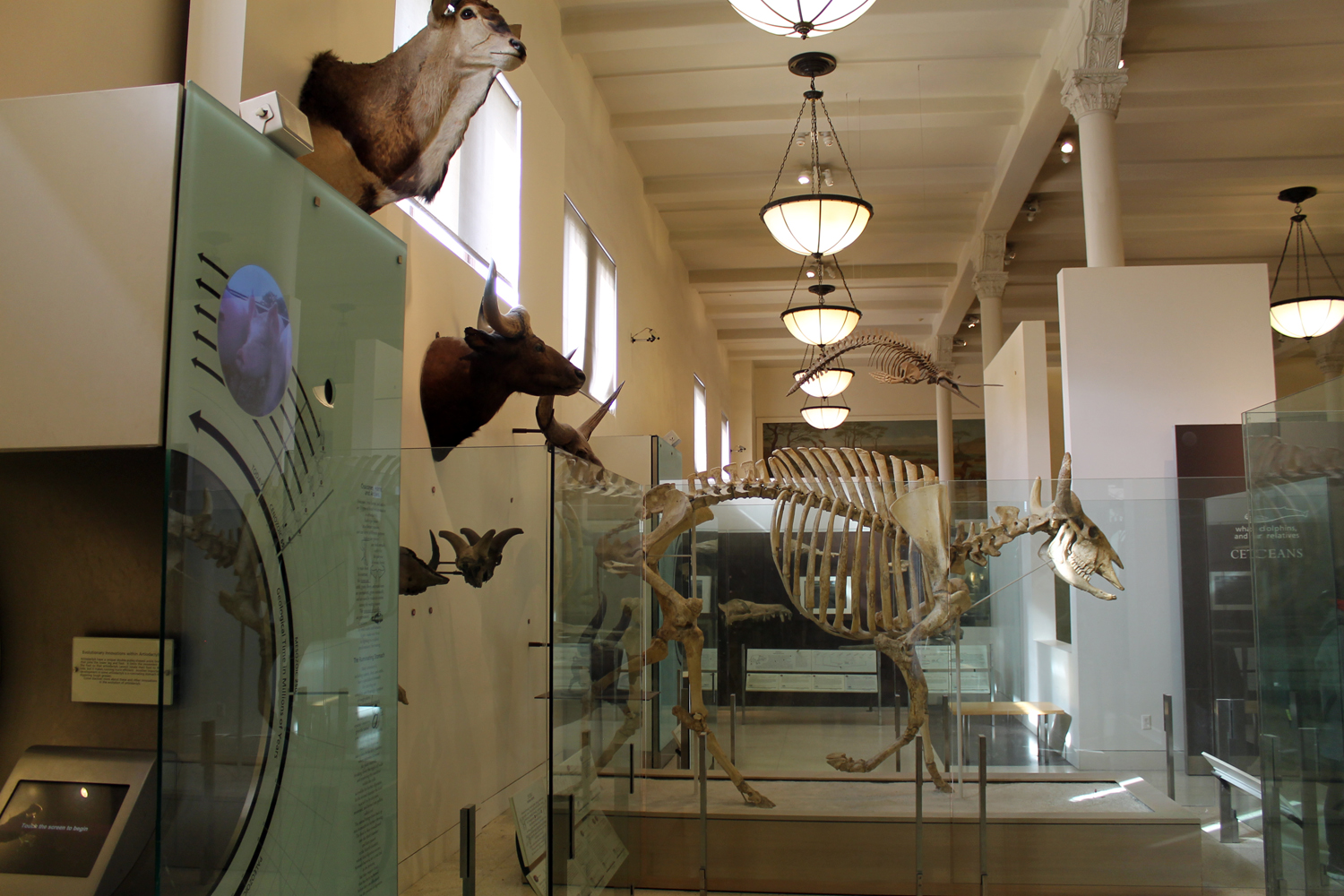
Cows and broken videos

Glass architecture lets visitors see through displays and get a sense of what lies beyond. Photo by the author.

Neat comparison of mammal teeth. Too bad there's no obvious label.

This display is a great example of the diversity in mammal teeth, but it’s a confusing centerpiece for the Hall of Primitive Mammals. Photo by the author.

The AMNH fossil exhibits excel in many respects, chiefly in the amazing diversity and quantity of specimens on display. The exhibit throws a lot of good science at visitors, but falters in explaining why it matters. The point of all this is not to nit-pick the design choices at AMNH, but to reiterate that phylogenetically-arranged fossil exhibits are really hard to pull off. This is not the most intuitive way to introduce the history of life, or even the process of evolution. With so much background to cover, perhaps a more structured and linear layout would be better. In fact, a lot of my issues with the AMNH fossil exhibits seem to stem from a disconnect between the phylogenetic interpretive content and the wide-open aesthetics. Open exhibits can be great, but in this case it hinders the learning opportunities for self-guided groups of visitors. It’s difficult to imagine a typical visitor, arriving with their family or another mixed-age group, having the patience to make sense of it all. Regrettably, such visitors default to the dinosaur pageantry level of understanding, making all the work invested in creating a meaningful exhibit space for naught.

References

Norell, M, Gaffney, E, and Dingus, L. (1995). Discovering Dinosaurs in the American Museum of Natural History. New York, NY: Alfred A. Knopf, Inc.

Torrens, E. and Barahona, A. (2012). Why are Some Evolutionary Trees in Natural History Museums Prone to Being Misinterpreted? Evolution: Education and Outreach 1-25.

14 Comments

Filed under AMNH, dinosaurs, exhibits, fish, FMNH, fossil mounts, mammals, museums, opinion, reptiles, reviews, systematics

I Have Opinions About Dippy

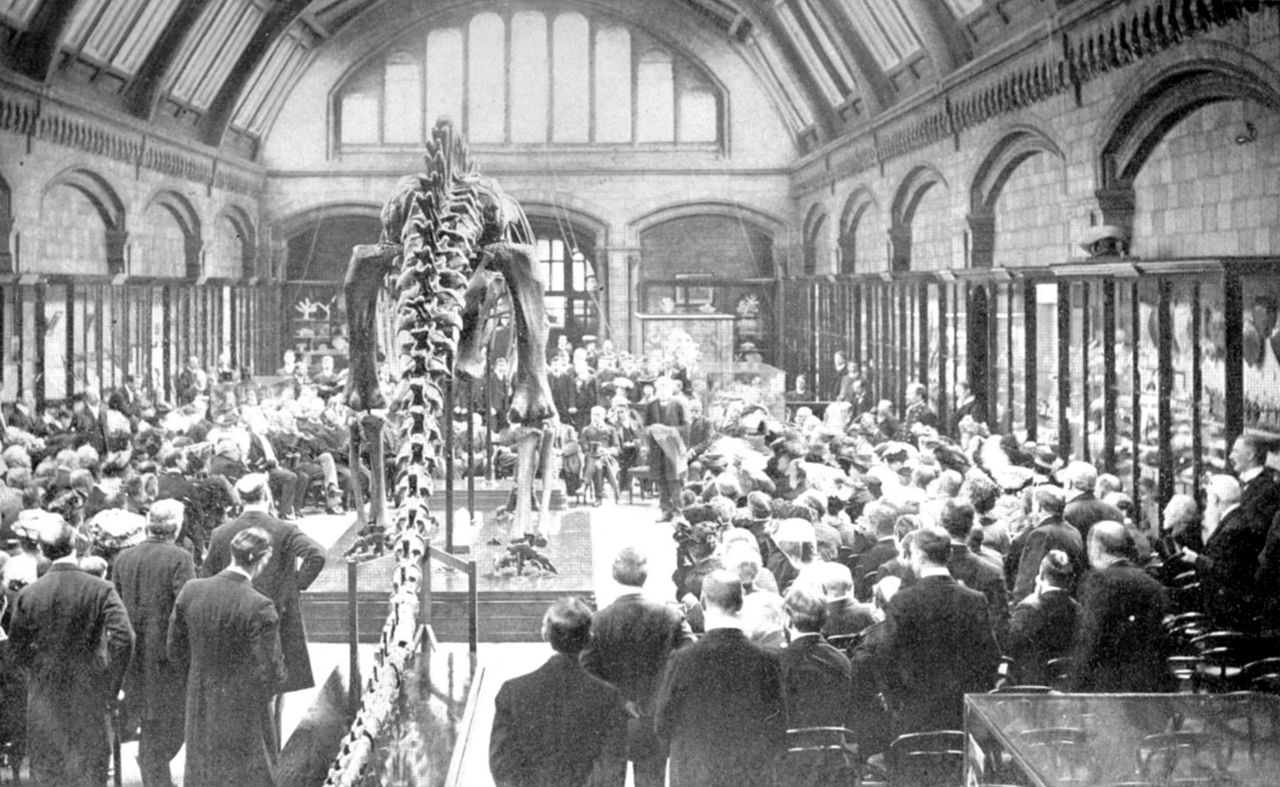
1st cast in spot of honor

Dippy the Diplodocus has been at London’s Natural History Museum since 1905. Source
Historic fossil mounts are usually taken for granted. Classics like the the AMNH Tyrannosaurus (which turns 100 this year!) have been enjoyed by generations of visitors, and it seems out of the question that they might ever be retired from display. Such was the case with Dippy the Diplodocus at London’s Natural History Museum – this cast of the CMNH original has been at the museum since 1905, and has been the centerpiece of Hintze Hall since 1979. It was therefore something of a shock when the NHM announced on Thursday that plans are afoot to replace Dippy with a blue whale skeleton. For a few hours, at least, this was huge news. #Savedippy was trending internationally, memes were created, and petitions sprang up to keep the mount in place. To me, it was inspiring to see how much people care about this mounted skeleton. I’ve repeatedly argued on this blog that fossil mounts take on second lives in museums, and have cultural and historical meaning independent of their identities as scientific specimens. The outpouring of love for Dippy is as clear an example as I could ever hope for.

Things seemed to calm down once a few editorials in favor of the change made the rounds, most notably pieces at the Huffington Post, the Conversation, and the Telegraph. These authors make a strong case for the blue whale: it’s the largest animal to ever exist, but it’s on the brink of extinction. It reminds us of our role as stewards of the planet, and the impacts the choices we make today will have on future generations. Meanwhile, the opposition hasn’t offered much beyond “kids like dinosaurs.” Personally, I’m not steadfastly opposed to the change. A whale is an excellent symbol for the importance of protecting the natural world, and it certainly beats losing exhibit space to a new cafe or gift shop. I’ve also never been to the NHM, and my heart already belongs to another Diplodocus, so I don’t really have a dog in this fight. Still, Dippy is an irreplaceable monument deeply entrenched in history, and certainly deserves a thoughtful defense.

The MNH released this concept art of the new display. Source

Exhibit company Casson Mann prepared this concept art of the new display. Source

To review, the original Dippy fossils were collected in 1899 near Medicine Bow, Wyoming by a team funded by Andrew Carnegie. The Pittsburgh-based industrialist/philanthropist wanted to make a name for his newly-founded Carnegie Museum of Natural History by displaying the first-ever mounted skeleton of a sauropod dinosaur. The Diplodocus discovered by Carnegie’s team was (and still is) one of the most complete sauropod specimens ever found. Nevertheless, they lost the race to public display: the American Museum of Natural History unveiled its composite “Brontosaurus” mount in March of 1905*, while Carnegie was still waiting for his museum building to be finished. Not to be bested by the New York competition, Carnegie offered a complete plaster cast of the Diplodocus skeleton to King Edward VII. The replica now known as Dippy was on display in London before the end of the year. After completing a mount of the original fossils at CMNH in 1907, Carnegie went on to produce seven more Diplodocus casts, which he gifted to various European heads of state (read the full story here). In addition, at least four other Dippy replicas have been created since Carnegie’s death in 1919. Whether we consider all versions or just the London cast, Dippy the Diplodocus is among the most-viewed animal skeletons in the world. Its cultural impact, particularly in Europe, is astounding. More than any other specimen, it can be argued that this one made “dinosaur” a household word throughout the world.

*Natural history historian Ilja Nieuwland once commented that the first cast – the one still on display in London – was temporarily assembled in a Pittsburgh warehouse the Pittsburgh Exposition Society Hall in 1904. It could therefore be claimed that this was actually the first sauropod mount.

diplodocus_nocopyright

The Diplodocus cast in London debuted two years before the Pittsburgh original.

And yet, one of the recurring arguments to replace Dippy in the Hintze Hall is that it’s “just a copy” or worse, “a fake.” Of course, referring to a fossil cast in this way is a flagrant misrepresentation. Casts are exact replicas of real specimens, full stop. You can read about the reasons casts are made in the Fossil Mount FAQs, but suffice it to say that replicas like Dippy are just as useful to researchers as the originals they are based on in most respects – some have even been used for microscopic analysis. At the very least, it’s downright inflammatory to dismiss a cast as though it were a P.T. Barnum-era forgery.

But let’s say we don’t care about that, and we must adhere to a conception of authenticity that doesn’t allow for casts. Even then, this particular cast is a 109 year-old historic icon. Despite being made of plaster, this replica introduced the world to the immensity of deep time. Carnegie himself described it as way to foster international peace. It gave the multilingual troops in the first world war a shared word with which to refer to tanks. It was a harbinger of globalization and mass production. And yes, it has enchanted generation upon generation of schoolchildren. NHM director Michael Dixon said that the blue whale will bring the museum’s “societally relevant research” to the forefront, but you’d be hard-pressed to find a natural history specimen more societally relevant than Dippy.

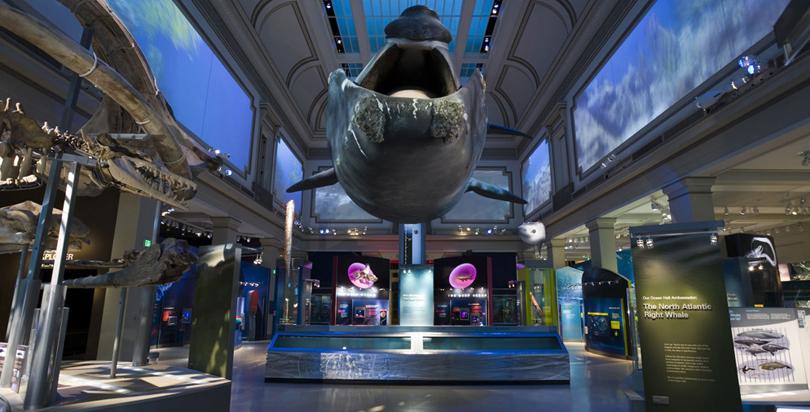
Blue whale model at AMNH. Photo by the author.

Never let it be said that blue whales aren’t impressive. This model at AMNH is staggeringly huge. Photo by the author.

That brings me to the most irksome pro-whale argument. Michael Rundle contends that the whale “is “more profound than Dippy could ever be. We still share a planet, and a destiny, with this weightless behemoth.” It is true that blue whales are incredible, awe-inspiring animals, with a fate that depends directly on our own commitment to preservation. At the entrance to the NHM, the whale skeleton will be a powerful tool for educating audiences about the fragile condition of the world around us. But dinosaurs are just as relevant to ecological education. The best way to understand the modern biodiversity crisis is to look to the past. The fossil record lets us observe how organisms have responded to climate change, habitat loss, and invasive species over 4.5 billion years. In turn, this information helps us make informed choices about our future. A sauropod like Dippy is a particularly useful teaching tool. It could demonstrate how keystone herbivores can shape their environment. Or it could be compared to a mammoth or an elephant to show how different flora can lead to the evolution of completely different megaherbivores. The NHM’s rhetoric in favor of the whale unfortunately reinforces the idea that past life is dead, gone, and irrelevant. Nothing could be futher from the truth.

Plus, nothing’s cooler than a sauropod.

13 Comments

Filed under dinosaurs, exhibits, fossil mounts, history of science, mammals, museums, NHM, opinion, reptiles, sauropods, science communication

Dinosaurs on display in 2014

Instead of repeating last year’s navel-gazing, I’m going to try something a little more interesting with my obligatory year-in-review*. This post will recap 2014’s big events in museum paleontology – I’ve covered some of it before, but there’s plenty that I missed as well.

Out with the Old

artists conception

Concept art for the new NMNH fossil hall, opening 2019.

I don’t think it’s a stretch to say that the most important event in the world of fossil exhibits this year was the closing of the National Museum of Natural History’s east wing. This is the world’s most-visited natural history museum, and the fossil mounts on display here have been among the most widely-viewed anywhere. The east wing has been home to paleontology displays since the building opened more than a century ago, but until now it has never undergone a complete, wall-to-wall modernization. Since the halls closed in April, NMNH staff have made significant progress de-installing the old displays, including some mounted skeletons that have been on display for over 80 years. Over the next five years, this historic space will be restored to it’s original neo-classical glory, and eventually remade into a new chronicle of the history of life on Earth suitable for the 21st century.

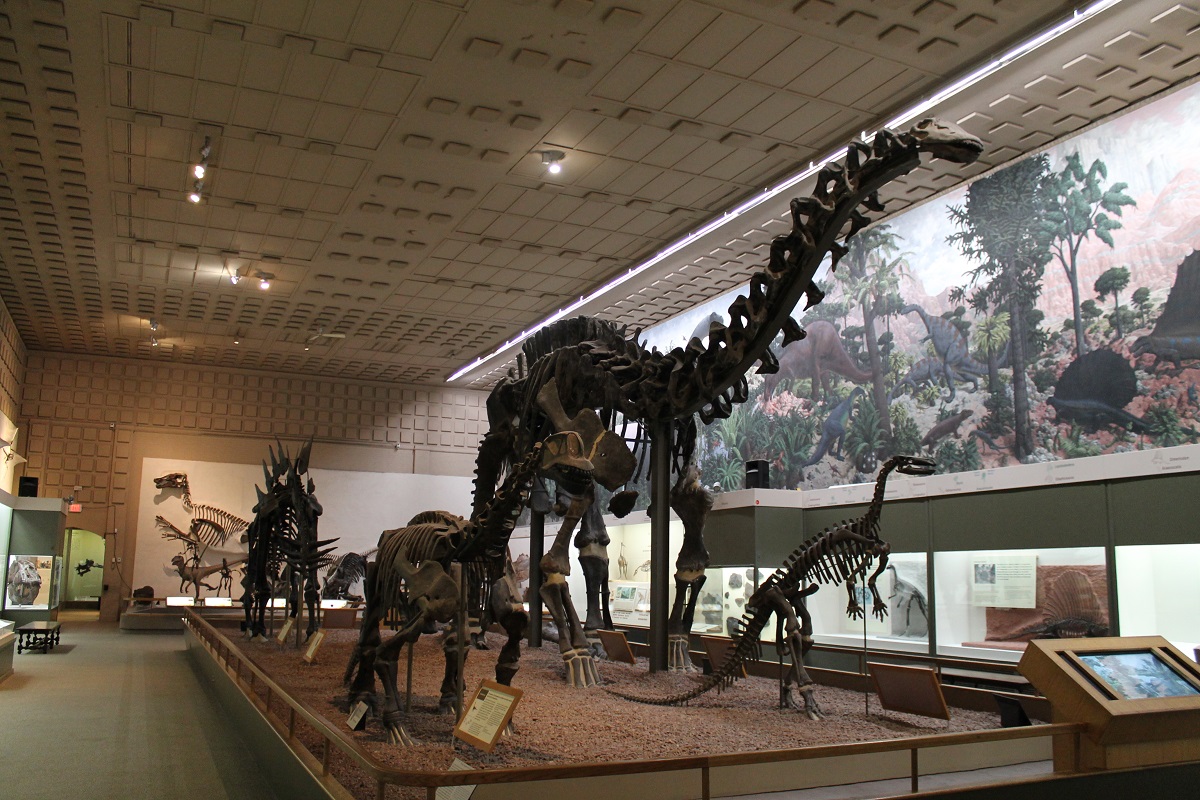
NMNH was among the last of the classic American natural history museums to commit to a post-dinosaur renaissance overhaul (the American Museum of Natural History started the trend in 1995, followed by the Field Museum and the Carnegie Museum). All eyes are now on the Peabody Museum of Natural History, where the great hall of fossil reptiles still looks much as it did sixty years ago. A plan is in place for a $30 million renovation, and the museum is currently soliciting donations to fund the project. For now, however, New Haven is one of the last places in North America where visitors can still see early-20th century dinosaur mounts.

In With the New

Spinosaurus!

Spinosaurus at the National Geographic Explorer’s Hall. Photo by the author.

Several new temporary and traveling fossil exhibits opened in the United States this year. The biggest splash was made by “Spinosaurus: Lost Giant of the Cretaceous”, which I reviewed in September. Premiering at the National Geographic Explorer’s Hall in Washington DC, this exhibit is science outreach on a grand scale. It debuted alongside a technical paper by Nizar Ibrahim and colleagues that redescribed the well-known Spinosaurus as a short-legged analogue to early whales. While there has been some skepticism about the paper’s conclusions, credit must be given for such an ambitious public display of up-to-the-minute research. The exhibit, which includes a 50-foot reconstruction of a swimming Spinosaurus skeleton, will be on display in Washington through April 12. After that, it begins its world tour in Germany.

Washington, DC got a second new paleontology exhibit this Fall in the form of “The Last American Dinosaurs” at NMNH. Focusing on the North American ecosystem that existed just before the Cretaceous-Paleogene extinction event, this exhibit will serve as an interim dinosaur attraction while the main fossil hall is being renovated. The Last American Dinosaurs is more than a stopgap, however – it’s a remarkably well-crafted look at ecology and the phenomenon of extinction, both in the past and in the present.

Other 2014 fossil exhibits of note include “Tiny Titans: Dinosaur Eggs and Babies” at the Peabody Museum, and “Pterosaurs: Flight in the Age of Dinosaurs” at AMNH. Tiny Titans didn’t feature any show-stopping fossil mounts, but it was nevertheless a charming, kid-friendly exhibit focused on how different groups of dinosaurs raised their young. I thoroughly enjoyed it, particularly the gorgeous artwork by Luis Rey. I missed my chance to check out Pterosaurs (it closes this week), so if you were able to see it please share your thoughts!

Mount of the Year

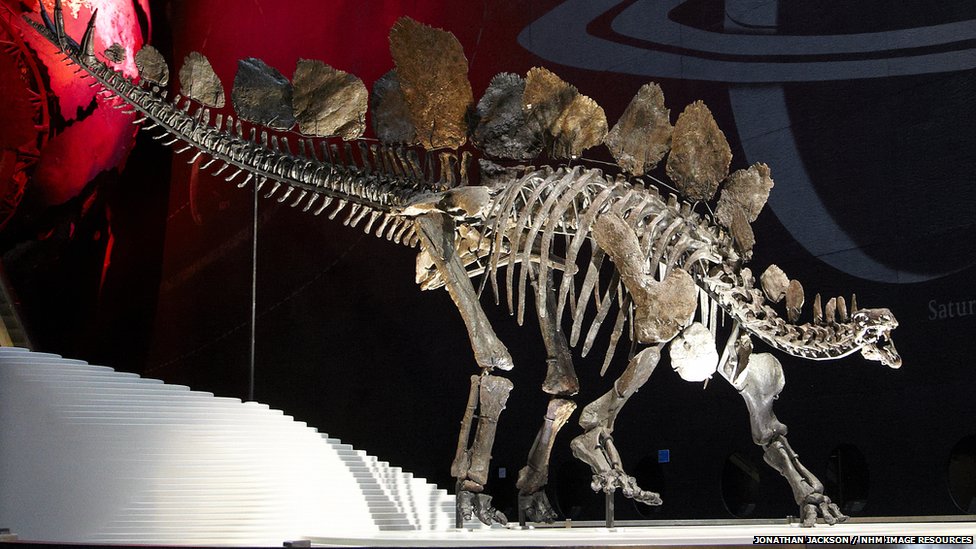
Sophie the Stegosaurus at the Natural History Museum in London. Source

Sophie the Stegosaurus at the Natural History Museum in London. Source

What was the coolest mounted fossil skeleton created this year? For the runner up, I’d pick the aforementioned Spinosaurus. Created by RCI and Acme Design under the direction of Paul Sereno’s lab at the University of Chicago, this replica skeleton embodies both the possibilities and pitfalls of digital technology. The Spinosaurus mount is based on a digital composite of laser-scanned fossils held in at least three countries, as well as scaled-up bones from related animals like Suchomimus, and a fair amount of sculpted material. On one hand, it’s incredible that a unified vision of this animal can be willed into three-dimensional existence. However, one could reasonably voice concern about presenting a somewhat controversial hypothesis in a format that implies authenticity. Virtually all fossil mounts are composites to some degree, but it seems we’re still working out the limits of how far this concept can be taken.

In contrast, I have no reservations in granting Mount of the Year to Sophie the Stegosaurus. Unveiled on December 4th at London’s Natural History Museum, this is the most complete Stegosaurus specimen known and the first example of this species to be displayed in Europe. It’s also the first new dinosaur skeleton to be added to historic NHM exhibit halls in more than a century. After the museum purchased the skeleton from a private dealer in 2013, Paul Barrett and Charlotte Brassey have been carefully examining (and laser-scanning) every inch of it for the better part of the last year. New data on the biomechanics and behavior of Stegosaurus is due out soon, but for now the public can enjoy the 18-foot skeleton in a dramatic display at the museum. In addition to the impressive work creating a dynamic pose with nearly invisible supports, I’m particularly taken by NHM’s outreach efforts, which explain the importance of this skeleton for a broad range of audiences.

All in all, 2014 was a pretty good year for paleontology on display. While fossil exhibits remained stagnant for much of the 20th century, the last decade plus has seen an explosion of displays to feed the public’s insatiable appetite for dinosaurs. Perhaps in the future we will call this time the second golden age of fossil mounts!

*For the record, Dinosours! got about 26,000 visitors last year, many of which I owe to the good people at Love in the Time of Chasmosaurs and SV-POW. My review of the Spinosaurus exhibit was by far the most popular post, followed by the two-parter on Triceratops posture and the true story of the mismatched “Brontosaurus” skull.


1 Comment

Filed under AMNH, dinosaurs, exhibits, fossil mounts, museums, NMNH, opinion, theropods, thyreophorans

Framing Fossil Exhibits, Part 1

This post started out as a review of “Evolving Planet”, the expansive paleontology exhibit at the Field Museum of Natural History. The short version is that it’s very good exhibit constrained by a somewhat frustrating layout. We’ll get back to that eventually, but first it’s worth considering the purpose of large-scale fossil exhibits in a more general sense.

Fossils, particularly the mounted skeletons of dinosaurs and other prehistoric animals, have been central to the identity of natural history museums since the late 19th century. In the early days, public exhibits were afterthoughts to the primary work of the museum (research and curation of collections), and if there was any logic behind their layout, it was an aesthetic logic. Typically posed in neutral, trophy-like stances on centrally-situated pedestals, mounted skeletons were the highlights of a natural history display for most visitors. For anyone not trained in comparative anatomy, however, these exhibits ultimately amounted to prehistoric pageantry. People could marvel at the great size of the animals, but there was very little to be learned besides the names of the species in question.

Hadrosaurus cast on display at the Field Museum. Field Museum Photo Archives.

A typically random assortment of fossil specimens at the Field Colombian Museum, ca. 1898. Image courtesy of the Field Museum Photo Archives.

These days, we try to do better. Exhibits are designed with a clear narrative structure, as well as specific learning goals for the audience. The focus of the narrative varies depending on the exhibit and the team behind it, but most modern natural history exhibits are explicitly designed to answer “how” as well as “what.” For paleontology displays, this means telling the story of life on Earth while also communicating how scientists collect and interpret evidence to put that story together. Crafting an exhibit has been compared to writing a popular nonfiction book, except designers are using the three-dimensional space of the exhibition hall as their medium. In this way, modern exhibits are more about ideas than specimens, or at least, the specimens are present primarily to illustrate the major scientific principles being communicated.

That’s how it works on paper, anyway. Despite this focus on education (and institutional mandates to provide learning opportunities for the widest possible audience), visitor surveys show that dinosaur pageantry is still the default mode of understanding for the majority of people passing through paleontology exhibits. No matter how carefully we craft our stories, most visitors still leave these displays recalling little more than a list of cool specimens they saw. Dinosaur pageantry has its place and can be employed for good. Dinosaurs and other prehistoric animals are undeniably impressive and spectacular, and it is absolutely worth taking advantage of that fact. We want people to pay attention to science, and in that respect mounted skeletons of favorite dinosaurs are great ambassadors to the world of research and discovery. The challenge is getting past the attention-grabbing stage. Prior experience has led visitors to expect that dinosaur pageantry is all paleontology has to offer, and many seem unprepared or unwilling to commit to a deeper understanding.

peabody mammals

The great hall at the Peabody Museum of Natural History, one of the last unmodified early 20th century fossil displays in the US. Photo by the author.

So are these people just hopeless rubes? Should exhibits be tailored only to visitors that care enough to put in the effort to understand? It should go without saying that this condescending attitude is completely wrongheaded and goes against the very spirit of museums. Education is half about knowing your content and half about knowing your audience. If visitors are not picking up on the content as desired, then a reassessment of who those visitors are is in order. Many museum exhibits still seem to be pitched at interested adults traveling alone with all the time in the world. This is a good description of many of my museum visits, but I’m also part of an increasingly small fraction of museum visitors. Most people who come to natural history museums come in groups of friends or family, and these groups often represent a range of ages. What’s more, most visitor interactions while in the museum will not be with the exhibits, but with each other. For the typical visitor, the museum experience is primarily a social one.

With this demographic in mind, a textbook on the wall (or a long video lecture*) is the last thing natural history museum audiences need. Visitors are absorbing exhibit content while simultaneously navigating a complicated, unfamiliar space. In the case of parents, they are also monitoring the attention span, hunger, and bathroom needs of their charges. Caught up in this whirlwind of information, visitors frequently fall back on what they already know. In the case of paleontology exhibits, this often means identifying familiar dinosaurs and ignoring the more intellectually challenging contextual information.

*It’s worth pointing out that a long video is NOT an improvement over a long label. Transferring label copy to a video or computer terminal does not inherently make the exhibit more interactive or more interesting. In fact, when the disruptive noise and need to wait for the next showing are taken into account, poorly implemented multimedia is probably less useful than traditional text labels.

The challenge for exhibit design, then, is dealing with the fact that visitors are not passively ingesting information. Visitors passing through an exhibit pull out relevant pieces of information and filter them through the lens of their existing worldview. Exhibit designers want visitors to also learn new information and challenge their preconceptions, but it’s easy to go too far. Survey after survey has shown that visitors do not appreciate exhibits that force them to move (or think) on rails. For practical reasons noted above, few visitors are able to look at every display, watch every orientation video, and work through every interactive in the prescribed order. Visitors need flexibility in order to make the exhibit experience their own. Finding the balance between providing informative context and providing a customizable experience is quite challenging, and not every exhibit succeeds.

struggling to contain the dinosaurs

The dinosaur hall in “Evolving Planet” at the Field Museum. Photo by the author.

On top of that, paleontology exhibits are particularly difficult to design because of problems with relatability. The story of life on Earth is immense, complex, and frequently counter-intuitive. It’s not enough to just explain what happened, we have to explain the history and methodologies of the half-dozen scientific disciplines that have contributed to to our understanding of that narrative. Even something so basic as the numerical age of a given fossil taxon requires a deluge of explanation to convey how we know. And all of this needs to be conveyed concisely, without being alienating, overwhelming, or condescending. Most importantly, it has to be made relevant to what audiences already know and understand.

Over the years, major natural history museums have attempted a variety of organizational strategies for their fossil exhibits. Each of these has been an attempt to break the dinosaur pageantry barrier and to portray the true complexity and relevance of paleontological science. Some arrangements, like taxonomical organization, have generally fallen out of favor. Others, like chronological presentations of life through time, are reliable mainstays that have been re-imagined in varied ways at different institutions. Still others, including cross-sections of specific extinct ecosystems, biogeography, and environmental change over time are relatively new and untested.

Keeping everything in this meandering introduction in mind, the upcoming series of posts will explore the strengths and weaknesses of each approach from the perspectives of science communication, aesthetics, and for lack of a better term, hospitality for non-expert audiences. Stay tuned!

References

Asma, S.T. 2001. Stuffed Animals and Pickled Heads: The Culture and Evolution of Natural History Museums. New York, NY: Oxford University Press.

Falk, J.H. and Dierking, L.D. 1992. The Museum Experience. Washington, DC: Whalesback Books.

Wands, S., Donnis, E. and Wilkening, S. 2010. “Do Guided Tours and Technology Drive Visitors Away?” History News 93:8:21-23.

2 Comments

Filed under dinosaurs, education, exhibits, fossil mounts, history of science, museums, opinion, science communication

The Stan Gallery

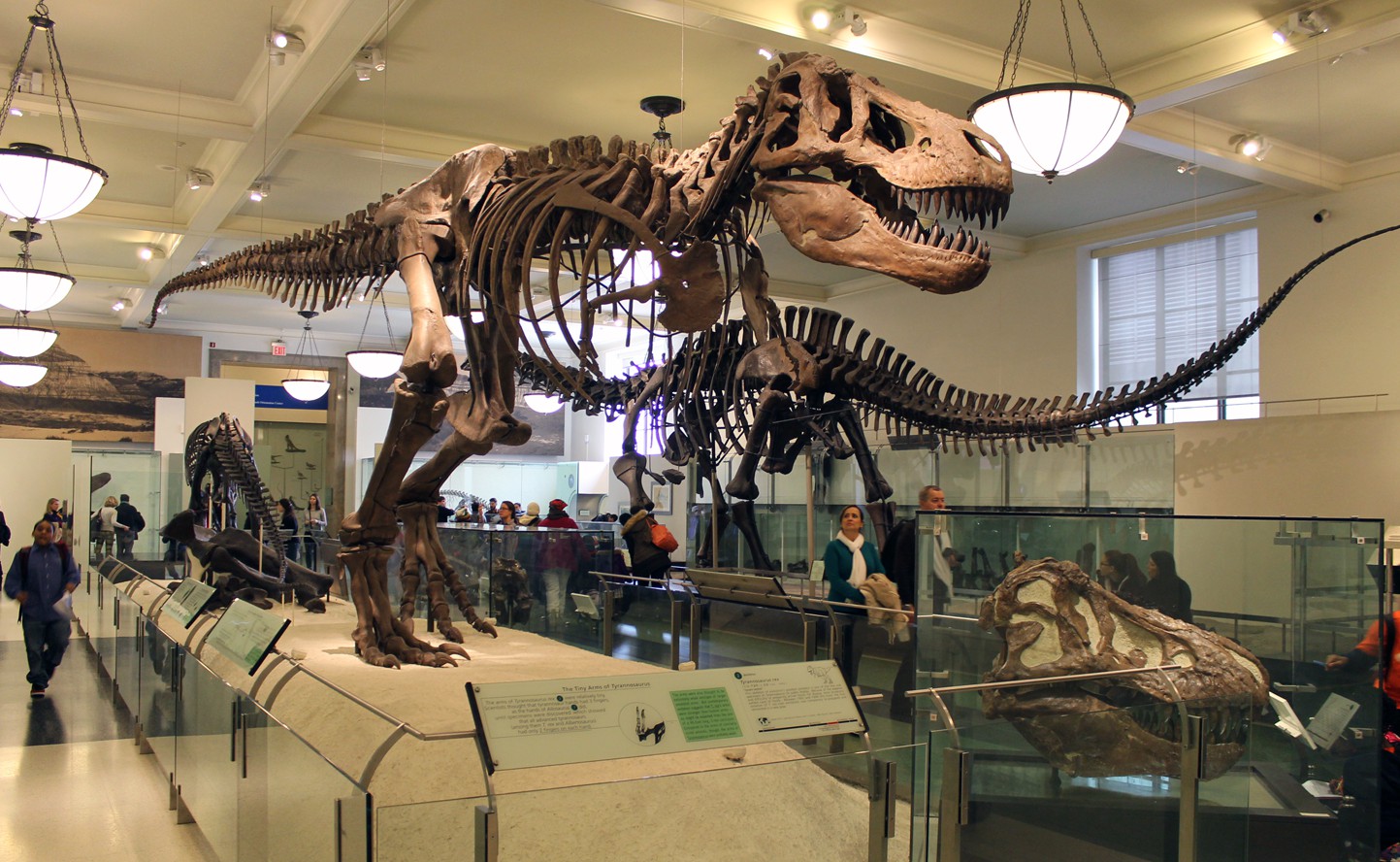
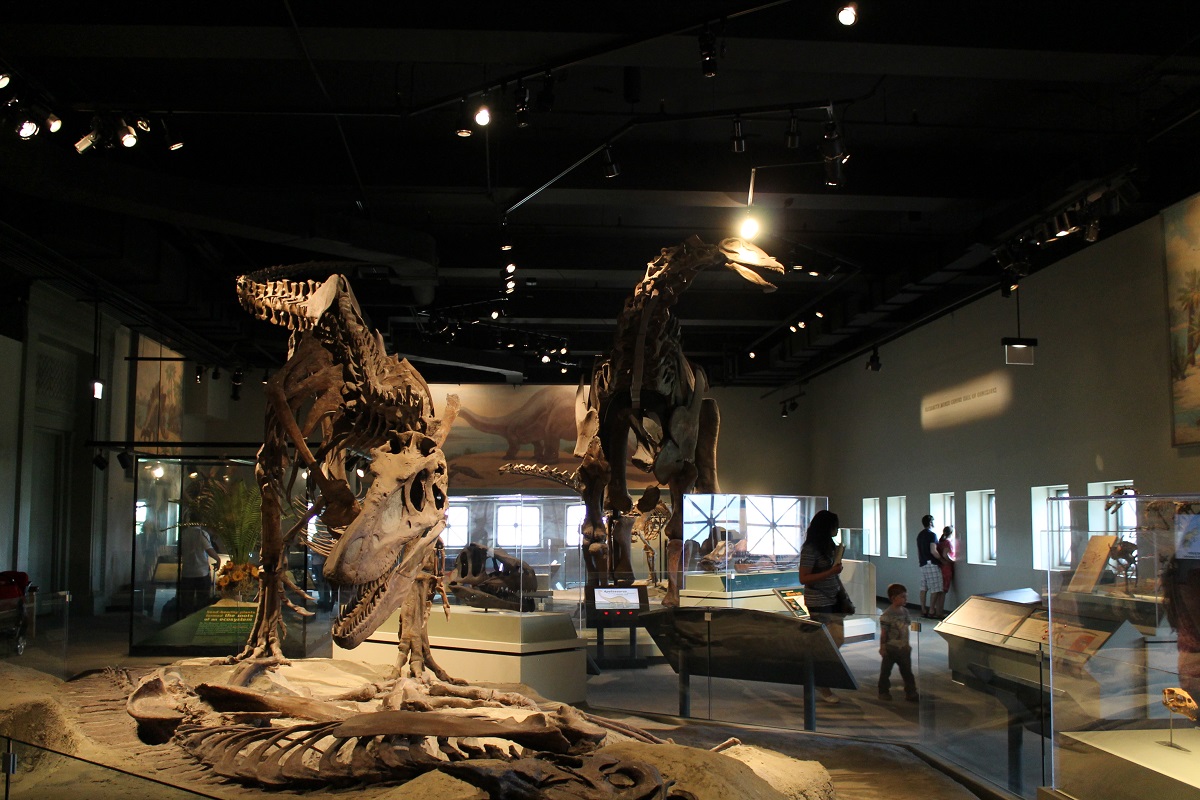
The first-ever mounted skeleton of Tyrannosaurus rex went on display at the American Museum of Natural History in 1915, and for nearly 30 years, the New York museum was the only place in the world where one could see the world’s most famous dinosaur in person. The situation today could not be more different. More than 50 individual Tyrannosaurus specimens of varying degrees of completeness are now known, and thanks to casting technology the number of Tyrannosaurus skeletons on display may well exceed one hundred.

A significant fraction of those displays are casts of BHI 3033, the T. rex specimen more commonly known as Stan. Excavated in South Dakota in 1992 by the Black Hills Institute (a for-profit outfit specializing in excavating, preparing and mounting fossils), Stan is significant for being over two-thirds complete and for including the best preserved Tyrannosaurus skull yet found. Since 1996, BHI has sold dozens of casts of the complete Stan skeleton (missing bones are filled in with casts from the original AMNH T. rex, among others) to museums and other venues around the world. At a relatively affordable $100,000 plus shipping, even small local museums and the occasional wealthy individual can now own a Tyrannosaurus mount. Stan is, by a wide margin, the most duplicated and most exhibited dinosaur in the world today. As of 2008, BHI had sold more than 30 Stan casts, and that number has grown substantially since then, particularly with the increased interest in dinosaur displays in Asia.

One might argue that this extreme amount of replication lessens the cultural value of museum displays. What allure do museums have when the specimens on display are fiberglass replicas, of which identical versions can be seen at dozens of other venues, including corporate offices and amusement parks? I would counter that this is a small price to pay when we consider the immense educational benefits of this unprecedented availability of dinosaur skeletons. Children and adults around the world now have  the opportunity to see a T. rex in person, an experience that was until recently limited to citizens of a handful of large cities. What’s more, the huge body of research on Tyrannosaurus makes it a veritable model organism for vertebrate paleontology, so increasing access to T. rex fossils for international scientists is definitely helpful.

Besides, a fossil mount is far more than the fossil bones it is composed of. Mounts are in equal measures natural specimens and man-made objects, works of installation art designed to communicate a story through pose, posture and a carefully arranged mise-en-scene. Below are 14 examples of Stan on display, highlighting the great range attainable with a single dinosaur.

Image sources: Orientation UofMa_leistra, Bill and Sandra WayneReluctant Drifter, Roadschooling America, dinonikes, Texas Tigers, Momotarou2012, Helana Handbasket and Marie Thomas.

5 Comments

February 2, 2014 · 11:55 am

There are “fake” fossil mounts after all…in China

I’m always bummed when I hear museum-goers describe fossil mounts, particularly those that are entirely or partially made up of casts, as “fakes.” It is inaccurate, if not inflammatory to describe mounts in this way, and I always make sure to offer a correction (see this ancient post of mine or Christopher Norris’s much better explanation for details).

Well, it turns out I was wrong, or at least trapped in a western-centric worldview. There are fossil mounts that can and should be called fake…in China. Earlier today, Brian Switek linked to a brief radio story at CRIEnglish about the recent appearance of dinosaur-themed parks throughout China. According to the clip, local governments throughout China have been competing to built the biggest and best dinosaur park. The parks are apparently the equivalent of attention-grabbing and income-building public works projects, such as stadiums or fancy shopping centers, that are created regularly in the U.S. But while these new parks might have been inspired by the torrent of spectacular, paradigm-shifting fossils found in China over the last two decades, they are not museums. These are amusement parks, featuring robotic and fiberglass awesomebro dinosaurs. They are entertainment, not educational or scientific enterprises by any stretch of the imagination.

So where are these municipal dinosaur theme parks getting their dinosaurs? As it turns out, there are literally dozens of new companies in China that exist entirely to supply these attractions. I had encountered some of these sites before, but didn’t know the context of their existence until now. Google “China robotic dinosaurs” or something similar and you’ll find them. Most of these products are what they are: big, goofy looking animatronic dinosaurs that aren’t especially attractive but at least can’t be mistaken for scientific reconstructions. But then I saw the “dinosaur skeletons”:

It’s possible that parts of these might be casts, but I doubt it. These are pretty much abominations, sculpted with little regard for the actual appearance of these dinosaurs, or animal anatomy in general. I’ve written at length about how the public conception of dinosaurs is irreversibly intertwined with its conception of museums. When we think of fossils, we think of grand museum halls populated by towering skeletons. This connection is so ingrained that mounted skeletons have become, in the public eye, the only proper way to display dinosaurs. It’s therefore not unexpected that these companies would capitalize on that association.

The problem is that unlike a mural or life-sized model, which are obviously reproductions, mounted skeletons retain the aura of authenticity that comes from displaying known fossils. To display a skeleton is to imply that we are seeing real specimens, or at least replicas standing in for specimens that exist somewhere else. Displaying “dinosaur skeletons” with no regard for accuracy ruins that association. For nearly 200 years, fossil mounts have been symbols of credible science, and I hate to see that good reputation sullied.

Leave a comment

Filed under dinosaurs, exhibits, fossil mounts, opinion

In Defense of New Museums

As a museum* educator, I work with two kinds of experts: researchers who create knowledge and education specialists who disseminate knowledge. Both groups have ostensibly the same mission, which is to effectively communicate credible information about the world around us. Generally, both sides collaborate effectively, due in no small part to a shared enthusiasm for their work. But there is one issue (that has been raging for decades) in which researchers and educators frequently seem to be shouting past each other, complaining about what one another are doing wrong but not making much progress in reconciling their priorities. This issue is, of course, “new museum” exhibit aesthetics, the trend toward replacing traditional academically-oriented displays of specimens with dynamic, interactive leaning experiences that use specimens alongside interactive activities and multimedia to communicate specific educational messages to a broad audience.

*When I say museum, I mean natural history or science museum. Art museums are a completely different beast, and one I won’t pretend to understand.

From the perspective of many researchers and certain sets of museum-goers, these newer exhibits are frivolous lowest-common-denominator attractions better suited to amusement parks than serious institutions. For example, in a recent Tetrapod Zoology review of the London Natural History Museum’s Extinction exhibit, Darren Naish criticizes computer-based interactive exhibits because they “take up space that really should be spent on something far more worthwhile” and “give visitors the excuse to do the same old crap they do every other day of their lives (look at screens, play videogames, use touchscreens) when they really could be treated to a more unique experience.” Likewise, an all-encompassing rant about new museums can be found in this (admittedly 6 year old) post by Matt Wedel, which is well worth a read (seriously, read it now and then come back to this).

The Hunterian Museum as it appeared in the 1600s: all  of the specimens, not much else.

The Hunterian Museum as it appeared in the 1800s: ALL OF THE SPECIMENS.

But in direct contrast to Wedel’s insistence that the intrinsic value of real specimens is all museum-goers want or need, there are editorials like this one by James Durston, which I will charitably describe as provocative. Durston tells us that museums that only display artifacts for their own sake are “classrooms made of cold granite, the only sense of life emerging from the tourists.” He argues that most objects on display in museums don’t matter as much to visitors as museum workers think they do, and pleads for more context and more reason to care.

So what’s the deal? Are modern museums too focused on providing context for their collections, or not focused enough? Let me begin by explaining why modern museum exhibits look the way they do. A century ago, or even 50 years ago, exhibits were arranged and labels were written almost exclusively by expert curators. These exhibits were, by and large, created with an audience of “interested people” in mind, meaning either other experts or clientele with enough leisure time to learn the jargon presented to them. The majority of visitors who came through the door were not directly catered to, because exhibits were considered an afterthought to the real work of the museum: research and collections management.

In the past 30 years, however, the museum field has decided that it can do better. Museums shifted from inwardly focused, primarily academic institutions into focal points for lifelong learning that operate in service to a wide community of visitors. Go to the website of your favorite museum and check out their mission statement (it should be pretty easy to find). I just did, and the mission of the National Museum of Natural History is to “increase knowledge and inspire learning about nature and culture, through outstanding research, collections, exhibitions, and education, in support of a sustainable future.” Note that the museum doesn’t seek to increase knowledge and inspire learning just for a core audience of studious, well-read people, but for everyone. That means the museum needs to offer content that is interesting to all sorts of people, whether they learn best by reading and absorbing information, by physically doing something, by making choices for themselves or by discussing an issue with others. Preserving  and studying collections is no less important than in museums of yore, but these activities are understood to be in service of providing knowledge to the widest possible audience.

This shift in focus has inspired museum exhibits with more explicit educational goals, as well as attempts to create learning experiences that reach visitors other than those already keyed in to the customary language of academia. Drawing heavily on Gardner’s multiple intelligences, modern exhibits are intended to cater to diverse audiences that learn in a variety of different ways. In particular, hands-on mini experiments and computer-based games have become staples in science exhibits in order to reach visitors who learn better by doing than by observing. These interactive elements (we just call them interactives in the biz) are not appealing to everyone, but museums serve a broad community and have no business being exclusionary in the services they provide.

Beyond any moral or educational imperative, however, modern museums must be accessible because they are nonprofit institutions that rely heavily on public funds. They are funded based on the promise that they will provide educational resources for their communities, and that means serving more than a small subset of the population. Furthermore, ever-tightening budgets mean that museums need to be strictly managed. Educators have no choice but to establish clear standards of success for their exhibits, and to develop means to track attendance and audience engagement. Just to keep our jobs and keep museum doors open, we need to be able to clearly articulate who we are serving, how we are benefiting them and how we know.

The new Ocean Hall at NMNH: a $90 million new museum extravaganza.

The new Ocean Hall at NMNH: a $50 million new museum extravaganza.

If it was not clear, I absolutely agree with the goals behind new museum design. As  was argued in the American Alliance of Museums’ 1984 “Museums for a New Century” commission report, “if collections are the heart of museums, what we have come to call education – the commitment to presenting objects and ideas an an informative and stimulating way – is the spirit.” General audiences can certainly experience awe and wonder when presented with neat stuff, but museums can and should provide more than that. A hundred birds from around the world look impressive on a shelf, but they are much more interesting when the viewer understands the evolutionary processes and biogeography that produced such diversity. A little bit of context goes a long way to making such an exhibit is accessible and valuable to the widest possible audience.

In practice, however, I will concede that many attempts at broadening the appeal of natural history exhibits are pretty bad. Some modern museum exhibits use technology in terrible ways, and many attempts to increase interactivity are bafflingly pointless or even counterproductive. For instance, a dinosaur exhibit I visited earlier this year includes a green-screen stage where visitors can place themselves in a scene with dinosaurs running around. The result is not only painfully dated, but it has no educational purpose and may well encourage people to think that humans and dinosaurs once co-existed. Likewise, an exhibit on human evolution features a glorified photo booth that makes visitors’ faces look like other hominids. This non-educational attraction is consistently the most popular element of the gallery, distracting visitors from the fantastic displays and specimens all around it. More generally, an increasing number of exhibits are incorporating profoundly pointless touch-screen computers that let visitors browse photos of the specimens on display right in front of them. Just because an exhibit element is hands-on doesn’t mean it is actually helping visitors interact with exhibit content.

One reason lousy interactives keep being designed is that our evaluation procedures* are not always great at separating good exhibits from appealing ones. A good interactive provides informative content in an engaging way, while an appealing one is engaging but lacking in content. Many visitors may speak highly of just-appealing interactives, but that doesn’t mean these belong in museums. The aforementioned budget woes are also a factor here: interactives that draw crowds for any reason are a big help when scrounging for ways to fund research and preservation. There are tough calls to make when deciding between what visitors most want to see and what is actually worthy of an educational institution. There are no easy answers, especially when museums are consistently hurting for funding.

*Do note, however, that actually testing whether exhibits are meeting their educational goals has finally become commonplace…for far too long museum workers just assumed anything they made was good enough.

Nevertheless, when an interactive display works, when visitors’ eyes light up with understanding by working out a scientific problem for themselves, the process is absolutely worthwhile. Earlier this year, I raved about the low-tech brilliance of an activity in the Academy of Natural Sciences that let visitors physically act out the difference in upright and sprawling gaits. And the NMNH Human Origins exhibit features a fantastic computer game where visitors play the part of a future world leader and experience firsthand the challenges and consequences of overpopulation, food shortage and invasive species. Exhibit interactives, both technology-based and otherwise, are difficult to pull off, and many museums have failed at the task. But we owe it to our visitors to try.

10 Comments

Filed under collections, education, exhibits, history of science, museums, opinion, science communication

Another JP4 Feathers Post

Okay, I’ll bite.

A week ago, Jurassic Park 4 director Colin Treverrow tweeted two words and a hashtag that set the corners of the internet I hang out in aflame for days afterward. The dinosaurs in the upcoming third sequel will not have feathers, in defiance of the twenty years of irrefutable fossil evidence that has come to light since the original film’s 1993 release. Reactions to this news demonstrate a clear divide among dinosaur enthusiasts: there are those who hate the idea of scientifically inaccurate dinosaurs appearing in mass media, and those who are enamored with the “classic” dinosaurs of their youth, and vocally resist any change. And in this case, I don’t really agree with either.

The problem is that dinosaurs straddle two different roles in our culture. There is the scientific reality of their existence, informed by careful scrutiny of hard evidence. Brilliant researchers collect and interpret fossils, broadening our understanding of not only the lives of dinosaurs, but how life on earth evolves and adapts to change in general. As a science educator, this is the perspective on dinosaurs I am usually invested in.

But dinosaurs also have what John Conway calls “awesomebro” appeal. From this angle, dinosaurs are appealing because they are monsters with big teeth and are generally super cool. This is coupled with an innate association of dinosaurs with early childhood that people are remarkably protective of. For example, on Brian Switek’s 10 Dinosaur Myths that Need to Go Extinct article for Tor Publishing, commenter Alan B. declares “I don’t care what anyone says, the dinos we learned about when I was in grade school were awesome! And given a choice between factual and awesome, I will choose awesome every time!” Clearly there is a a bit of tongue-in-cheek humor at play here, but comments like this appear virtually anywhere feathered dinosaurs are discussed. Many people genuinely care about their “classic” dinosaurs, and react negatively to new discoveries that threaten the dinosaur paradigm they associate with childhood bliss.

As Conway points out, the typical reaction of anyone with a vested interest actual scientific paleontology is to reject and belittle pop-culture dinosaurs whenever possible. Unfortunately, this we’re-right-and-you’re-wrong approach veers into deficit model territory, and doesn’t seem to accomplish much other than make the rift among dinosaur enthusiasts more antagonistic. It makes our audience of potential learners defensive, even angry, that scientists are “ruining” dinosaurs. And focusing conversations on the fact that popular conceptions of dinosaurs are wrong removes focus from the real benefits of researching past life.

I think it would be more helpful to recognize the validity and significance of pop-culture dinosaurs, but to work towards separating them in the public consciousness from real dinosaurs. A potential conversation: You think the Jurassic Park Raptors are cool? Great, so do I, but I think they’re cool in the way other movie monsters like the Predator or the T-1000 are cool. But perhaps you’d be interested in learning about the real animal Velociraptor mongoliensis that the movie Raptors were inspired by? My point is, the widespread appreciation/nostalgia for pop-culture dinosaurs (or fantasy dinosaurs, or classic dinosaurs, or awesomebro dinosaurs, whatever you want to call them) is potentially valuable, but I think it often gets dismissed too gruffly. If would-be educators are outright dismissing what their audience is bringing to the conversation, that audience has little incentive to learn more.

3 Comments

Filed under dinosaurs, education, movies, opinion, reptiles, science communication

Exhibits with an Agenda

I am currently part of a team preparing a small exhibit on sustainable energy for a Midwestern history museum. Our original goal was simple: to review the regional history of renewable energy production and use, in order to illustrate that “green living” is not a new concept. However, as with most creations of passionate people, the size and scope of the exhibit has expanded quite a bit, and the exhibit is now intended to be a more forceful argument for responsible energy use and the importance of being aware of one’s own energy footprint. There’s no denying this argument has always been an implicit part of the exhibit plan. In this part of the world, there is an unfortunate resistance to, if not outright demonization of progressive energy policy, and we absolutely want to undermine the assumptions and misconceptions that fuel this anti-green discourse. What has changed is that we’ve stopped hiding our agenda.

In his 1994 essay Evaluating the Ethics and Consciences of Museums, Robert Sullivan proposes that museums are “moral educators”. Either deliberately or through unconscious subtext, museums inherently shape the opinions, worldview and conception of self of their visitors. It is unavoidable that museum content will be shaped by subtextual ideologies and assumptions. Identifying and unpacking these biases is a huge issue (it’s basically the entire focus of the humanities for the last 50 years or so), but one can still exert a degree of control over which assumptions are expressed.

Museums are among the most trusted of media forms, and are widely considered to be far more reliable than books, television or newspapers. This public trust can be intimidating, but it does present a unique opportunity: if a museum takes a stand on an important issue, it will probably be taken seriously. Obviously, trust is not a resource to be squandered needlessly, but when wielded with care and deliberation it can be very powerful.

With our sustainable energy exhibit, we are trying very hard to harness that power in an effective way. The issues that surround energy use are very serious, as the availability and ready access of energy are critical to our modern economy, infrastructure, and way of life. Unfortunately, the discourse around renewable energy, diminishing fossil fuels and climate change is highly politicized. We want to be plain about the economic and environmental dangers that good, solid research tells us is in our future, and we want to call out sources of misinformation. Above all, we want to give people the intellectual tools to evaluate controversial issues for themselves, and to identify which arguments are backed by concrete evidence and which are not.

Our exhibit may well raise some eyebrows for taking a hard stance on a topic that many in this region consider to be “controversial”. I think this is a good thing. Museums really should not be playing the “both sides of the story” game that other media forms play when the evidence and experts clearly favor one camp. If we are avoiding asking our audiences hard questions, then we are not teaching, and we are not doing our job.

Leave a comment

Filed under education, exhibits, museums, opinion, science communication