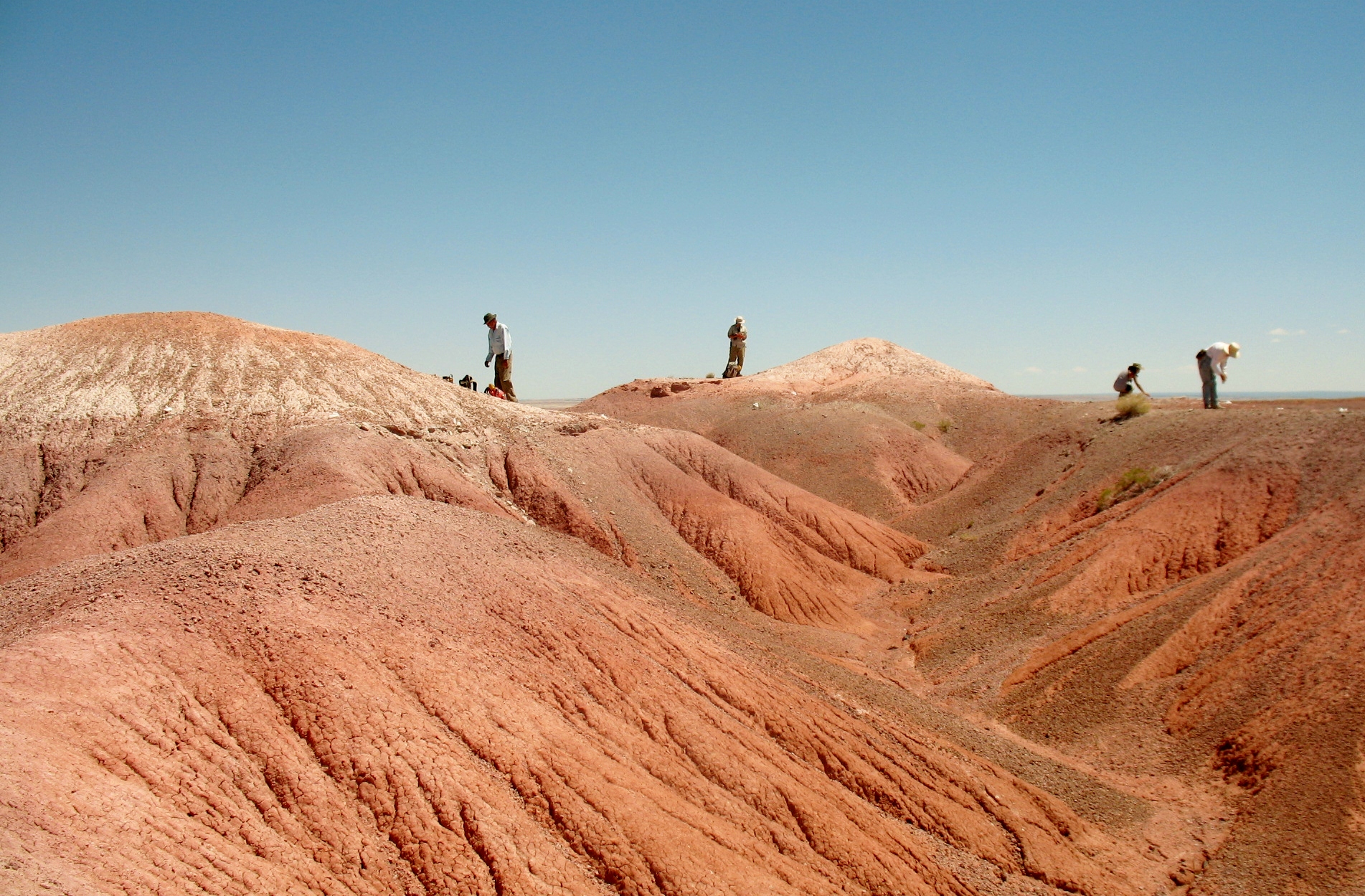
Just a few pictures from my time fossil prospecting in NE Arizona. Ain’t that desert pretty? More on why the late Triassic and microstrat is cool later.


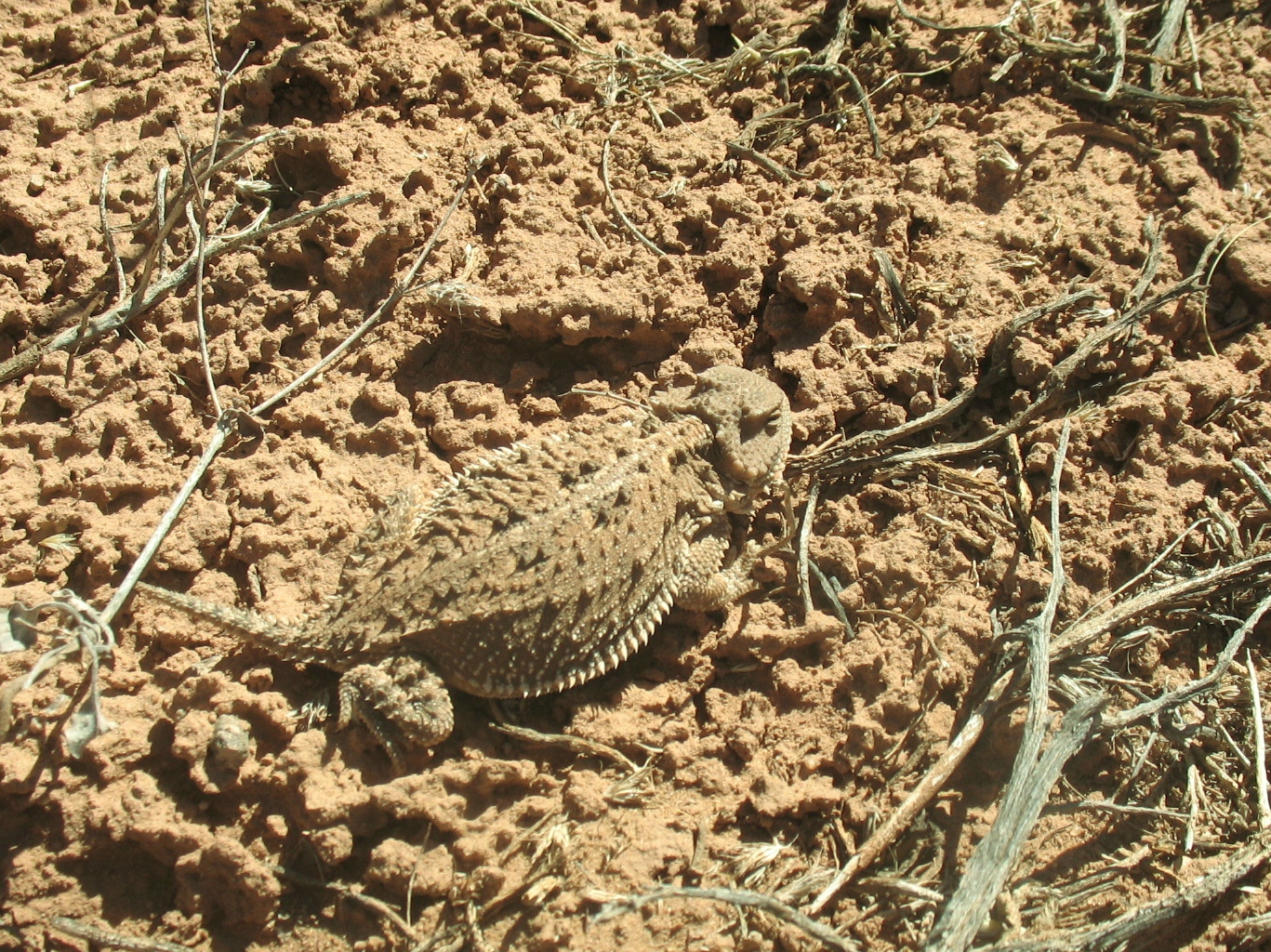

Just a few pictures from my time fossil prospecting in NE Arizona. Ain’t that desert pretty? More on why the late Triassic and microstrat is cool later.
Filed under field work, museums
I spent the weekend in New York, and was able to spend a full day at the American Museum of Natural History. I’m a fan of New York, it’s just brimming with culture and has a neighborliness that one doesn’t see many other places. It had been much too long since I had been there, and even longer since I had been to AMNH. There’s a fair bit of brain dumping I’d like to accomplish on the topic of the museum, so I’ll probably be posting thoughts on the permanent paleobiology galleries and the mobile app fairly soon. For now, however, I really need to take a moment to gush about The World’s Largest Dinosaurs.
A typical dinosaur exhibit is based on the spectacle of the mounted skeletons. The curtain is raised on the strange and spectacularly large dinosaur bones, everybody oohs and ahhs, and that is all most/many visitors get out of it. Moreover, people leave (and probably came in with) the impression that paleontologists are people who dig up dinosaur bones and then put them on display. Such is not the case with The World’s Largest Dinosaurs, a new temporary exhibit at AMNH.

Life-size Mamenchisaurus. From http://gothamist.com.
The World’s Largest Dinosaurs is unique because it is not focused on skeletal mounts. There are no mounts to speak of in the gallery, and in fact, there are very few fossils on display at all. This exhibit provides a window into what vertebrate paleontologists do after they dig up the bones. Specifically, it is about sauropod biology. There has been a lot of really fascinating research into sauropod biology in the last 10-15 years, asking and answering questions such as, how did they carry all that weight? How did they reproduce? How did they get enough to eat? And of course, what’s the deal with those pneumatic bones? These questions are all explored in this exhibit.

A crappy image of an interactive display.
The layout of The World’s Largest Dinosaurs is very effective. Visitors are oriented in a narrow space that clearly lays out the topic at hand. Using skeletons of modern animals as comparisons, the questions that the very existence of sauropods raise are introduced to visitors (i.e., how did they get away with being so effin big?). Once the question is laid out, the exhibit opens up into a large space with many stations that address different research questions. The “ooh and ahh” factor is covered by a life-size model of a Mamenchisaurus in the center of the gallery, which doubles as a projection screen: animations of the circulatory, respritory and reproductive systems are displayed right on the model, accompanied by narration (see below).

Mamenchisaurus projection screen. From http://gothamist.com.
I was at AMNH on what turned out to be a very crowded day (no surprise, it was a rainy day on a holiday weekend), but I managed to get into the day’s earliest time slot, before it got too packed. When I was there at least, it was quiet enough for people to see the exhibits, and to get ahold of the interactives. As such, I observed people around me engaging with and understanding the material. Kids were working through the problems presented in the exhibit, despite the attempts of their parents to dumb down their experience and herd them through faster. The non-paleo people I were interested enough to read just about everything. Importantly, I heard no complaints that there weren’t many fossils on display. This is interesting, given how vocal some museum visitors can be about the exhibition of casts. Evidently, The World’s Largest Dinosaurs succeeded in entertaining and educating people without traditional mounted skeletons. I think this could potentially be a very big deal, and could cause museums to rethink the way paleontology exhibits are designed.
Freelance paleoartist, researcher and author Gregory Paul has recently issued what amounts to a Cease and Desist to illustrators making use of his skeletal restorations of dinosaurs in paid projects. Paul argues that when other artists use his reconstructions,”often but not always the result is that other’s work possesses the ‘Greg Paul look”, and that this is a violation of copyright which has hindered his ability to secure commissions. Paul’s statement can be seen here, with rebuttals here, and here. I would also encourage reading the thoughtful responses to the issue by artists and others in the paleontological community on the DML archives.

Torvosaurus by Gregory Paul. Image borrowed from http://www.kheper.net.
Gregory Paul is of course one of the most influential individuals working on dinosaurs today. His work, particularly in Predatory Dinosaurs of the World, is probably the most frequently cited inspiration in my generation of paleophiles (perhaps because it isn’t cool to say Jurassic Park anymore). In particular, his series of intensively researched skeletal restorations (representing virtually every dinosaur known from sufficient material) are ubiquitous resources for paleontologists, and are a beloved resource among professional and hobbyist dinosaur artists. Even when his reconstructions are not directly utilized, the white-bones-on-black-outline presentation and one-foot-raised posture (see above) created by Paul have become an unofficial standard.
Now Paul is telling us that playtime is over. He has stated in no uncertain terms that creating dinosaur art based on his reconstructions without his consent and compensation is a copyright violation. The skeletal restorations require extensive research, travel to collections, original photography, and cross-scaling (which I won’t pretend to understand). Moreover, Paul has stated that other artists need to start doing the same, personally researching every dinosaur illustrated from the ground up, rather than relying disproportionately on his work.
I think Paul makes many fair points. In particular, the practice of producing uncredited Gregory Paul knockoffs at low prices is problematic, and his financial concerns are valid. Paul is in a (as far as I know) unique position among individuals producing quality paleontological restorations in that he does not have a university or museum position; his art is his business and livelihood, a fact which should be respected.
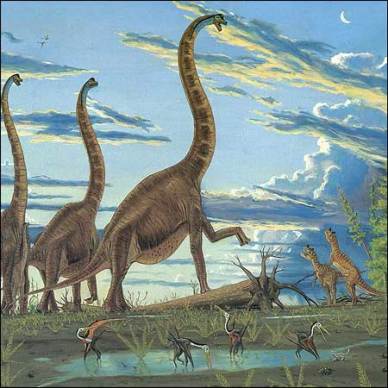
Nevertheless, although I have complete sympathy for Paul’s predicament, I do have to take issue with some of his arguments, explained below.
1. I am concerned that Paul has framed the argument by defining paleoart as a commercial commodity, and not as art or science. Everybody needs to make a living and romanticized ideals only get you so far, but science (and art) is all about sharing. By performing and publishing research, a scientist is providing her community and society with knowledge. Scientists continue to make new discoveries and continue to illustrate the many fascinating facets of the universe around us. As I see it, that is the point of science, but when you say, “this information that I discovered is mine, and only I can use it and built on it,” science becomes a business enterprise. We’ve already seen some of the complications of copyrighting genes. Do we really want to extend that to other fields? Paul’s situation is a little different because he is individually responsible for the majority of useful dinosaur skeletal restorations available. The principle, however, should be the same: when research is published, the knowledge gained from it becomes a shared commodity that others can learn from and expand on.
2. In his second rebuttal, Paul addresses the “slippery slope” that if skeletal drawings are off limits, than perhaps published photographs, measurements or even museum mounts could be as well. Paul argues that this is irrelevant because no scientist would object to others making use of their work when conducting further research. This seems like a completely inadequate excuse, because it gives Paul’s work special status that he is not extending to other researchers. The question remains that if one person objects to other scientists making use on their research, than what happens if others follow suit? The entire scientific process would grind to a halt.
3. Paul argues that he was key in establishing the “new look” of dinosaurs in the 1970s and 80s. What he means by “new look”, however, is not clear. Paul’s artwork and research was absolutely central in the transformation of our understanding of dinosaurs from slow, dim-witted monsters to active and socially complex animals (the work of Robert Bakker, John Ostrom, and, undeniably, the artists involved in Jurassic Park were also important). However, if Paul is attempting to claim some ownership of the fact that dinosaurs were, on the whole, fleet-footed and active animals, that seems as unreasonable as James Watson and Francis Crick claiming ownership of the fact that DNA is a double helix (oh wait…). If however, Paul is merely referring to the many artists who’s dinosaur depictions end up with the same emaciated, two-dimensional, dynamic-but-lifeless look of Paul’s, than this is a valid criticism. I hope to find clarification before jumping to conclusions about Paul trying to copyright scientific facts that he happens to have popularized.
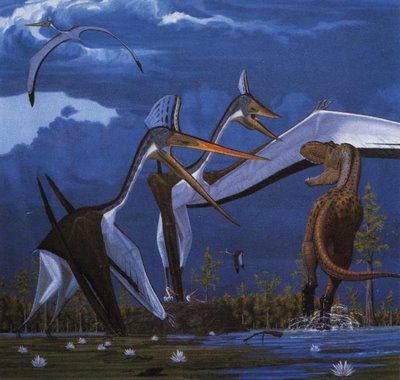
Quetzalcoatlus and Daspletosaurus by Gregory Paul. Image borrowed from http://blogevolved.blogspot.com.
Finally, I found what I interpreted to be an attempt to discourage up-and-coming paleoartists from joining the field to be extremely off-putting.
If you are thinking that gee wiz doing your own technical research and restorations sure sounds like a pain in the butt, or may be beyond your knowledge base, and you don’t want to risk doing inaccurate restorations or do not think paying me a fee is workable, then there is another alternative. Perhaps it is better if you do something else. I know, it’s lots of fun illustrating dinosaurs. But if you cannot produce high quality, original paleorestorations is it really a good idea to be in the business? If you for example like the Greg Paul look do you really want to be underbidding me? Does not make sense when you mull it over.
I read this as “this is my field, you will never be as good as me, so don’t even try.” Well gee wiz Mr. Paul, isn’t that a nice thing to say to the legions of fans and admirers whose image of you ranges from “brilliant” to “godly.” Yes, Paul’s work is excellent, and few can duplicate it’s quality, but it doesn’t seem especially constructive to actively discourage others from working in the field.
This is a difficult issue, particularly because the economic factors probably have to weigh more heavily than ideological ones. I hope Mr. Paul’s statement gets wide circulation, and continues to inspire debate on what we should value about science.
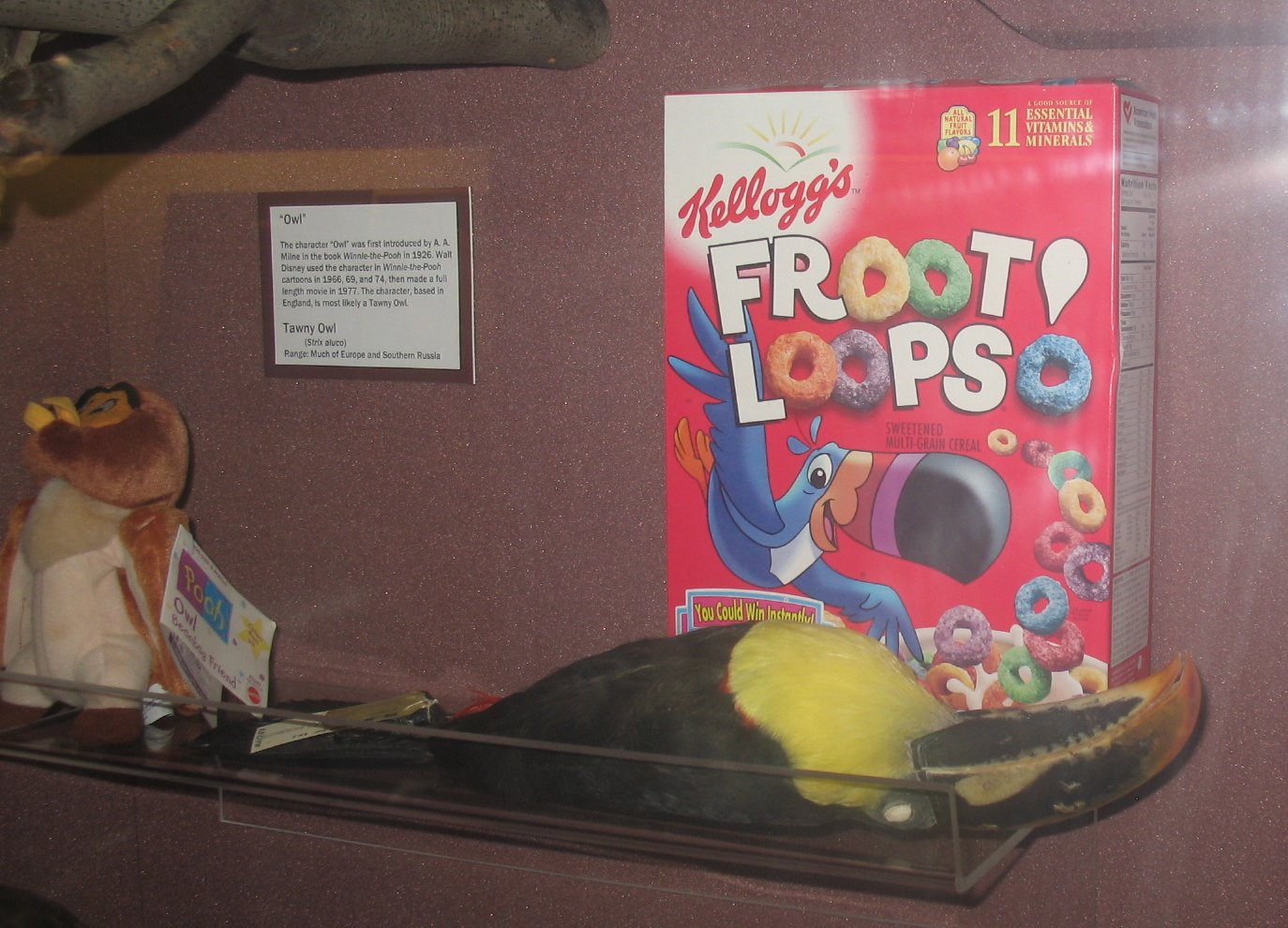
I just have to share this picture, also from the Carnegie Museum of Natural History (see previous post). While the “Dinosaurs in their Time” gallery is fantastic, this has to be one of the worst museum displays I’ve ever seen, as well as one of the most fascinating.
The AAA’s removal of science from the rhetoric of its statement of purpose has made the internet angry. For a bunch of links to smart people’s discussion of the issue, please see this post at Neuroanthropology. If you want to know what I think, read on!
Old Wording:
“The purposes of the Association shall be to advance anthropology as the science that studies humankind in all its aspects, through archeological, biological, ethnological, and linguistic research; and to further the professional interests of American anthropologists; including the dissemination of anthropological knowledge and its use to solve human problems.”
New Wording:
“The purposes of the Association shall be to advance public understanding of humankind in all its aspects. This includes, but is not limited to, archaeological, biological, social, cultural, economic, political, historical, medical, visual, and linguistic anthropological research. The Association also commits itself and to further the professional interests of anthropologists, including the dissemination of anthropological knowledge, expertise, and interpretation.”
Above is the old statement of purpose followed by the new. Having ruminated on the issue a bit, what most troubles me is that the new statement seems calibrated to make a divided field even more divided. As I mentioned in the previous post, there is a long-standing gap between the methodologies of biological and archaeological anthropologists and social anthropologists. However, there aren’t many of the former camp that don’t recognize the value of relativism and reflexivity, just as few of the latter camp who outright dismiss statistics and hard data. However, instead of encouraging communication across this shared ground, the new statement divvies up the classic four fields approach (archaeology, biology, ethnography and linguistics) used in the original statement into ten categories. The implication is that Anthropologists should continue to narrow their focus rather than collaborate.
If the discipline is to have any meaning in the future, collaboration will be the key. At present, the lack of intra-disciplinary understanding of very basic concepts is, frankly, appalling. Even at my superhappyinterdisciplinaryliberalarts school, most many students specializing in social anthropology had little grasp of the fundamentals of evolution, and more than once I found myself debating with people who thought that biological evolution was, by definition, linear and progressive. Rest assured, I probably annoyed my share of social anthropologists by misunderstanding their field, as well.
Before I ride off into the sunset on my horse of academic harmony, let me reiterate that I think the new AAA statement is inexcusably dismissive of biological and archaeological Anthropologists. Tellingly, six of the seven new categories are aspects of social anthropology/ethnography, with no like divisions of archaeology, biology and linguistics. Certainly the distinctions between primatology, hominid paleoecology and skeletal pathology are just as meaningful as the divisions between political, historical and economic social anthropology? Furthermore, it must be reiterated that abandoning scientific analysis will only hurt the perceived legitimacy of anthropology in both the academic and public spheres.
Filed under anthropology, education, opinion
Hi, I’m Ben and I’m going to attempt to start a blog. Much like my life, I’m not really sure what I’m going to do with it yet, but I do have some vague ideas that would require a lot of arm waving to articulate. Since I’m not holding my breath for the day either of those get resolved, for the time being I’m just going to post stuff I’m interested in. Mostly, that means stuff about paleontology, museum planning and plastic toys.
To start off with something that does not really fit into any of those categories, whadaya make of this?
American Anthropological Association Abandons Science
Having finished my B.A. last year in Anthropology, this makes me sad and tired. As it is, Anthropology hardly qualifies as a real discipline. Rather, it’s an umbrella field where lots of research vaguely related to “the human condition” (a meaningless phrase in and of itself) gets lumped together. This includes real, rigorous scientific research relating to anatomy, primate evolution, hominid paleobiology and the like, as well as all the varying subfields of Archaeology. Anthropology also includes social/cultural anthropology, which, since the 1970s has become deeply entrenched in the ethereal realm of anti-positivism. As one might expect, researchers on both sides of the field have very little common ground, and indeed, biological and archaeological anthropologists spend much more time collaborating with biologists and geologists than they do with social anthropologists.
I imagine it’s pretty clear that I’ve thrown myself in with the bio/archaeo camp. Perhaps in a later post I’ll explain why I have lost my patience for most social anthropology, but that would require more detail than I would like to get into at this point. For now I’ll just say that I am very troubled by the implications of the AAA’s decision to remove “science” from its agenda. In a country where only 14% of the population believe that evolution is “definitely true”, this is not a decision to be taken lightly, as it only opens the door wider for the very effective anti-science PR machine. The importance of scientific rigor is especially important for Anthropology, which is already a poorly-defined discipline. By eliminating scientific standards from Anthropology, I think the AAA is slitting its own throat.
Update: It has come to my attention that the twitter tag for this discussion is #AAAfail. Awesome.
Filed under anthropology, education, opinion
 | Michael Sisley. on A primer on the Sternberg… |
 | Ben on A primer on the Sternberg… |

 EXTINCT MONSTERS