Tag Archives: natural history museums

The Diplodocus seen ’round the world

1st cast in spot of honor

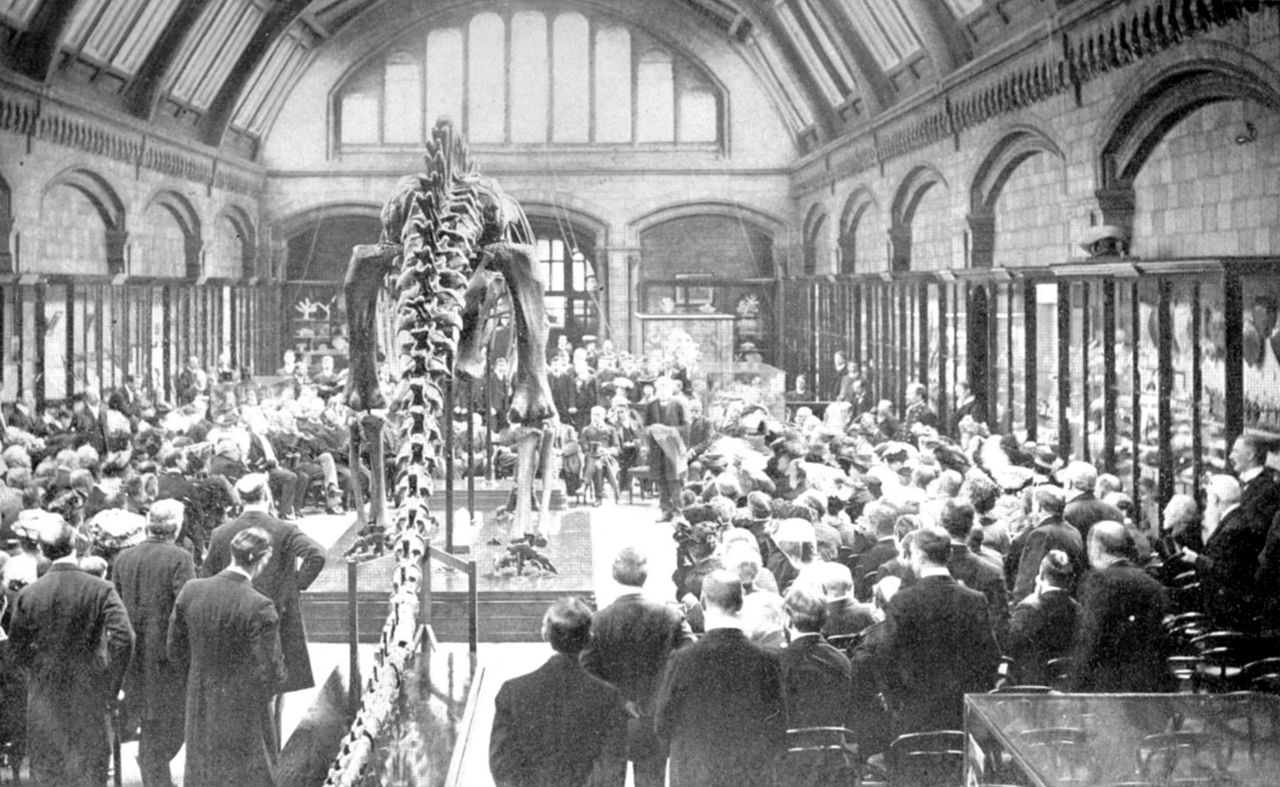
The first cast of the Carnegie Diplodocus holds court at London’s Natural History Museum. Source

The story of Andrew Carnegie’s Diplodocus will surely be well known to most readers. As the legend goes, Carnegie the millionaire philanthropist saw a cartoon in the November 1898 New York Journal depicting a sauropod dinosaur peering into the window of a skyscraper. He immediately contacted the paleontology department at the newly established Carnegie Museum of Natural History in Pittsburgh, and offered ample funding to find a sauropod skeleton for display. So began a frantic competition among the United States’ large urban museums to be the first to collect and mount a sauropod—the bigger the better.

The American Museum of Natural History was first across the finish line, unveiling their composite Apatosaurus in February of 1905. By that time, the Carnegie team had already found a sauropod skeleton of their own—a Diplodocus—near Medicine Bow, Wyoming. Unfortunately, they had nowhere to display it, as the Carnegie Museum building was still far from finished. Unwilling to be bested by his New York competition, Andrew Carnegie offered his chum King Edward VII a complete plaster replica of the Diplodocus, and hired a team of modelmakers to help make it happen. The arrival of the facsimile Diplodocus at the British Museum (now the Natural History Museum) in London was celebrated with a white tie event presided over by Carnegie and Baron Avebury, who spoke on behalf of the king. The London Diplodocus was on display two months after the AMNH Apatosaurus, and the original skeleton was unveiled in Pittsburgh in 1907.
diplodocus_nocopyright

In March 1905, a classy shindig celebrated the arrival of the first replica Diplodocus in London.

That’s usually where the Diplodocus story ends, with a footnote that nine more Diplodocus replicas were later manufactured and presented to heads of state throughout Europe and Latin America. I’d like to explore those subsequent displays in more detail. The Carnegie Diplodocus was the first mass-produced dinosaur, and by 1932 it appeared in no less than ten virtually identical displays across three continents. Taylor characterizes Carnegie’s sauropod as “the single most viewed skeleton of any animal in the world”, and its scientific, social, and even political ramifications are both wide-reaching and fascinating.

Building a Sauropod
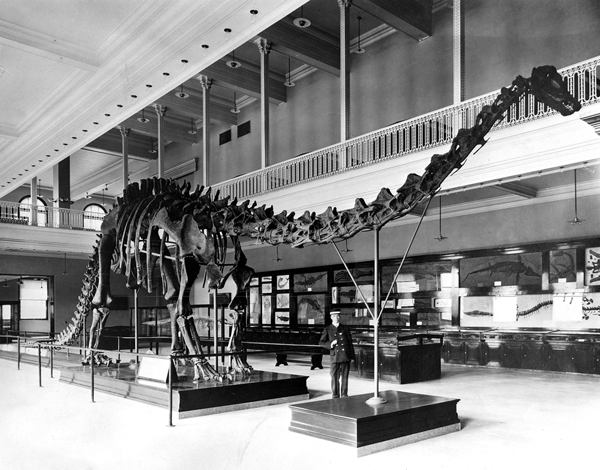
The original CMNH Diplodocus mount, in the hall built specifically to accomodate it. Source

The real CM 84 has been displayed in Pittsburgh since 1907. Source

The Diplodocus in question is specimen CM 84, recovered in 1899 in Albany County, Wyoming. The skeleton was about 60% intact and remains one of the most complete sauropod specimens ever found. The ubiquitous John Bell Hatcher described the fossils in 1901, coining the new species Diplodocus carnegiei after the project’s benefactor. Arthur Coggeshall of the Carnegie Museum was primarily responsible for preparing and casting the fossils. He was initially supervised by Hatcher, but William Holland took over when Hatcher died in 1904. Holland deferred to Hatcher’s judgement in most cases, although he was not shy about voicing his disagreement. For example, Hatcher had reconstructed the Diplodocus forefeet with slightly elevated digits, but Holland (incorrectly) thought they should be flat and splayed.

As is typical of dinosaur mounts, the incomplete primary specimen was supplemented with other fossils to produce a full skeleton. The skull, for instance, was a cast of USNM 2673, a specimen on display at the Smithsonian. A number of missing bones, including most elements of the forelimbs, were sculpted using a smaller Diplodocus specimen for reference. Although it took longer to produce than the AMNH Apatosaurus, contemporary paleontologists generally agreed that Carnegie’s Diplodocus was the superior sauropod mount. Not only was its pose more natural and lifelike, but the underlying steel armature was cleverly hidden. It’s difficult to overstate the challenges of assembling a mounted skeleton on this scale, and in its day the Diplodocus was the best in the world.

Roll Call
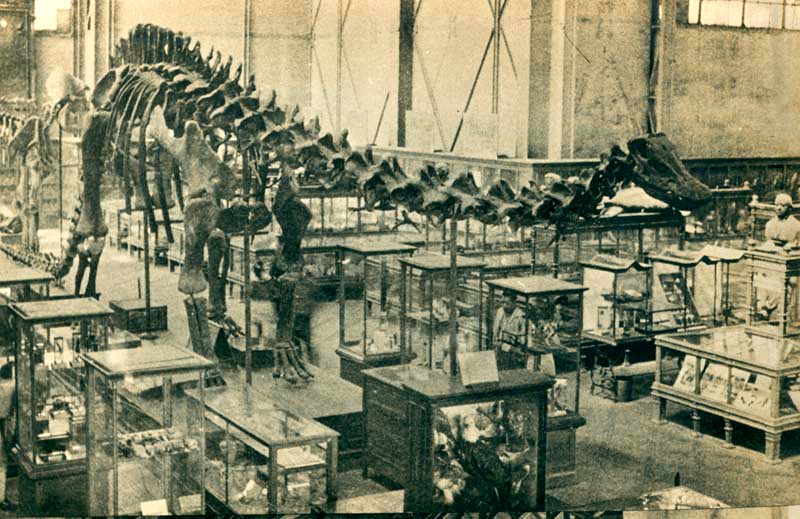
dip_mexico

The Chopo University Museum in Mexico City received the 9th Diplodocus cast in 1929. Source

As mentioned, the first replica Diplodocus was unveiled in London in 1905, and the original fossils were ready for display in 1907. French and German dignitaries were present at an event in Pittsburgh celebrating its completion, and Andrew Carnegie promised both countries Diplodocus casts of their own. Once again, Coggeshall and Holland led the creation of the new mounts, a task they would repeat many times in the years to come. Playing precisely to cartoonish national stereotypes, the Germans provided a detailed plan and ambitious schedule for the project, while the French acted coy, then threw a lavish party when the mount was ready. Diplodocus replicas were on display at the National Natural History Museum in Paris and the Humboldt Museum in Berlin before the end of 1908, but the Pittsburgh team already had orders for a new batch of mounts. By early 1910, three new Diplodocus were on exhibit at the Museum for Paleontology and Geology in Bologna, Italy, the Natural History Museum in Vienna, Austria, and the Zoological Museum in St. Petersburg, Russia. The La Plata Museum in Buenos Aires, Argentina and the National Museum of Natural Science in Madrid, Spain received their Diplodocus mounts in 1912 and 1913, respectively, bringing the total number of replicas up to eight by the onset of World War I.

The war put a damper on this friendly exchange of dinosaurs, and Carnegie’s death in 1919 brought the Diplodocus diaspora to a temporary end. However, in 1929 Louise Carnegie, wife of Andrew, commissioned an additional cast as a gift for Alfonso Herrera of the Chopo University Museum in Mexico City. Herrera originally asked for a bronze cast for outdoor display, but when this proved prohibitively expensive, a plaster version was produced instead. In 1932, the Carnegie Museum traded a Diplodocus replica for a collection of German fossils from the Paleontological Museum in Munich. This copy has never been mounted or displayed. The last Diplodocus cast from the original molds was forged in 1957. Made from concrete, this mount was displayed outdoors for many years at the Utah Field House Museum in Vernal, Utah.
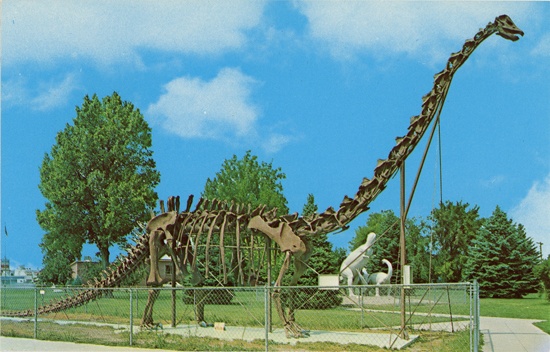
goofy vernal field house concrete cast

The 11th and final facsimile Diplodocus made from the original molds was this concrete version, on exhibit in Vernal, Utah for many years.

Most of the historic Diplodocus mounts remain on display today. The London Diplodocus was taken off exhibit during World War II, but in 1979 it was given a position of honor in the museum’s entrance hall. Later, it was completely restored and remounted with its tail held aloft. The Berlin, Buenos Aires, and Bologna Diplodocus mounts have also been upgraded with modern poses, but the others retain their historic, tail-dragging posture, looking exactly as they did a century ago. The St. Petersburg mount was circulated among a number of Russian museums, and may have been destroyed in an effort to make new molds from the bones (Edit: The Russian mount is still on display at the Orlov Museum for Paleontology—see comments). The concrete Diplodocus in Vernal has likewise been retired, but it was used to create two new casted skeletons, now on display in Utah and Nevada.

Opportunities for Science

St. Petersburg

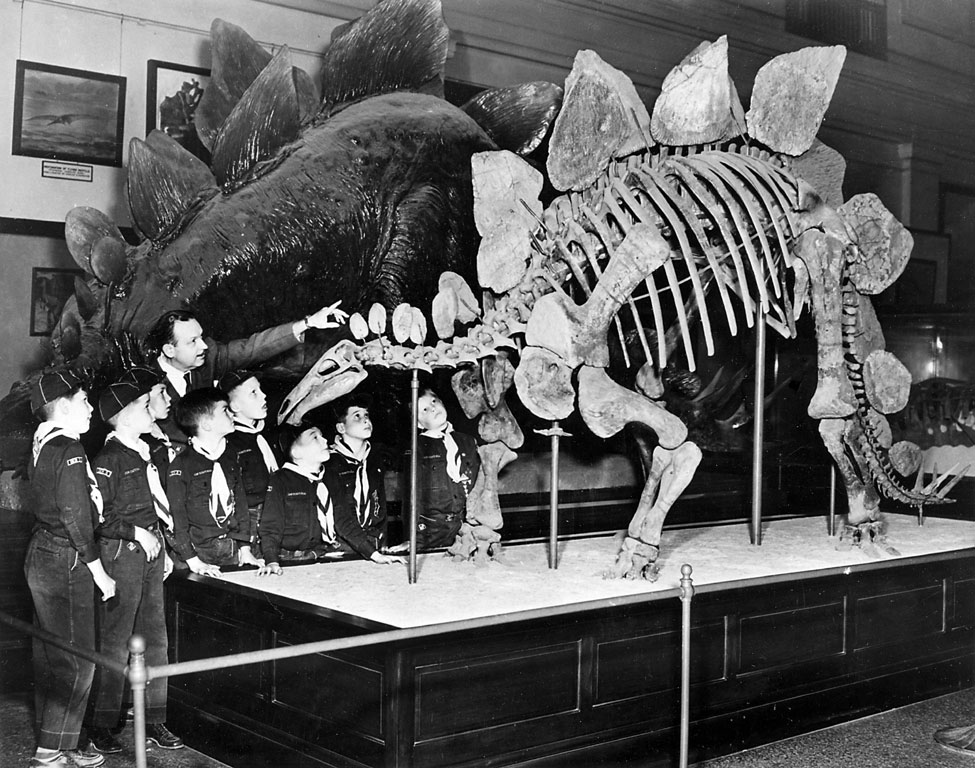
The weird bow-legged Diplodocus in St. Petersburg looks more like the original USNM Triceratops than Tornier’s take on the sauropod.  Source

The sudden availability of identical Diplodocus skeletons presented an unusual opportunity for international scientists, allowing researchers based thousands of miles apart to study and compare notes on the same bones. Perhaps inevitably, a few European scientists were not happy with Holland and Coggeshall’s take on the sauropod. The best-known dissenter was Gustav Tornier, who rejected the straight-limbed reconstruction of Diplodocus, arguing instead that the sauropod sprawled like a crocodile. The German scientist provided an illustration of this alternate stance, in which the poor dinosaur’s arms appear to project from the base of its neck. Holland responded with a particularly harsh rebuttal (backed by several European scientists), and Tornier declined to push the issue further in print.

Dinosaurs for everyone

La plata

Diplodocus cast number seven at the La Plata Museum in Buenos Aires. Source

The most lasting influence of the Carnegie Diplodocus is certainly it’s cultural impact. If any one specimen can be credited with inspiring the global popularity of dinosaurs, it was this one. Thanks to Carnegie, citizens of 11 different nations had their first opportunity to stand in the presence of a giant dinosaur, and to experience the scale and splendor of a creature that completely dwarfed any modern land animal. In every nation where a new Diplodocus was installed, the local press adored the creature, never failing to point out its tiny head and presumed stupidity. Diplodocus was an endearing oaf, and for a time, its name was synonymous with dinosaurs and prehistory in general.

What was the significance of Diplodocus to all these people? It’s difficult not to think of it as a vanity project for Andrew Carnegie*, an opportunity to rub shoulders with European royalty and flaunt his wealth and generosity. One might also consider the Diplodocus an expression of America’s economic and technological might, or perhaps a harbinger of the United States’ role in globalization and mass production. French writer Octave Mirbeau seemed to be thinking along those lines when he lamented the mighty dinosaur being reduced to a crass, populist display. According to Carnegie himself, however, the goal was nothing less than world peace: he wanted to bring people together over their shared enthusiasm for the dinosaur. Too bad World War I came along and ruined the sauropod love-in.
*If the accolades went to anyone’s head, it was Holland’s. During his world tour assembling sauropod mounts, he was given countless awards, including the French Legion of Honor and German Knight’s Cross. Holland carefully added each new medal to his portrait at the Carnegie Museum.
Original Diplodocus

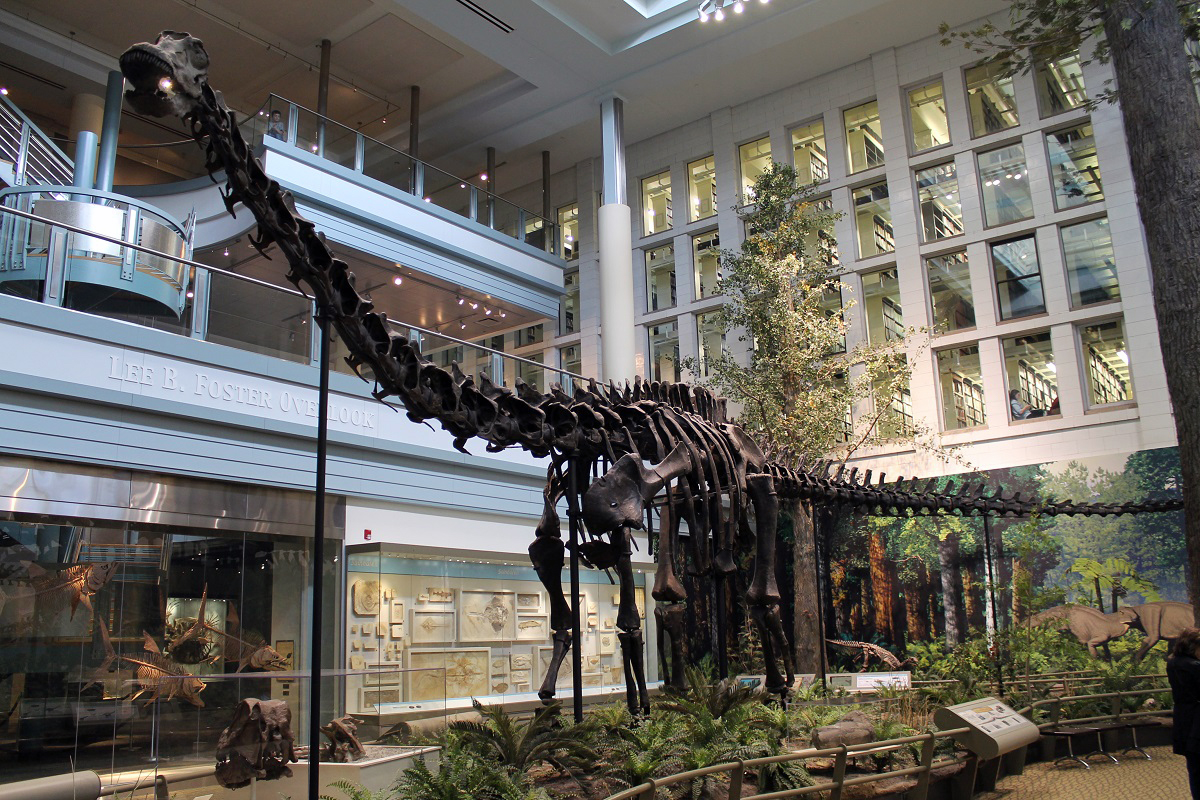
The original Diplodocus skeleton was remounted at the Carnegie Museum in 2007. Photo by the author.

On both sides of the Atlantic, Diplodocus was a shared point of reference and a beloved symbol. Most commonly, Diplodocus was the butt of a joke: from politicians to athletes to heavy machinery, anything big, slow, and not especially bright was likened to the dinosaur. My favorite anecdote on the subject comes from Nieuwland: during World War I, soldiers from different nations with different languages had the word “Diplodocus” in common, and used it to describe the heavy, plodding tanks.

Today, we think of Diplodocus and it’s ilk very differently. Sauropods weren’t ungainly dolts—they were surprisingly nimble and extremely successful megaherbivores, unchallenged in their dominance for 140 million years. Still, it’s difficult to think of single fossil that has matched the global cultural impact of CM 84. There are far more copies of Stan the T. rex on display, and Sue is widely known by name, but really, the only contender that even comes close is Archaeopteryx. With eleven versions still on display, Carnegie’s legendary Diplodocus lives on.

References

Brinkman, P.D. 2010. The Second Jurassic Dinosaur Rush: Museums and Paleontology in America at the Turn of the 20th Century. Chicago, IL: University of Chicago Press.

Holland, W.J. 1906. The osteology of Diplodocus Marsh with special reference to the restoration of the skeleton of Diplodocus carnegiei Hatcher, presented by Mr. Andrew Carnegie to the British Museum, May 12, 1905. Memoirs of the Carnegie Museum. Vol. 2, No. 6, 225-278.

Nieuwland, I. 2010. The colossal stranger: Andrew Carnegie and Diplodocus intrude European Culture, 1904-1912. Endeavour. Vol 34, No. 2.

Taylor, M.P. 2010. Sauropod dinosaur research: a historical review. Geological Society, London, Special Publications. Vol. 343, pp. 361-386.

28 Comments

Filed under CMNH, dinosaurs, fossil mounts, history of science, museums, reptiles, sauropods

Extinct Monsters Updated

artists conception

This early artist’s conception of the new NMNH fossil hall was on display on closing day.

Way back in 2012, I wrote a series of posts on the history of fossil displays at the National Museum of Natural History. Now that the old exhibit is closed for five years of renovation, it seemed like a good idea to go back and revise the old articles. That, and it can be very painful to read things I wrote over a year ago. Each of the seven posts, plus the launch page, have been substantially updated with new information, new images, and less abuse of the passive voice. You can check out the new articles via the Extinct Monsters link at the top of the page, or by clicking here.

Leave a comment

Filed under dinosaurs, exhibits, Extinct Monsters, fossil mounts, mammals, museums, NMNH, reptiles

Displaying the Tyrant King – Part 2

Old meets new

Old meets new: The classic Carnegie T. rex (CM 9380) is now paired with a cast of Peck’s Rex (MOR 980). Photo by the author.

Start with Displaying the Tyrant King – Part 1.

In 1915, the American Museum of Natural History unveiled the first mounted skeleton of Tyrannosaurus rex ever constructed. The Carnegie Museum of Natural History followed suit with their Tyrannosaurus mount in 1941, and for most of the 20th century New York and Pittsburgh were the only places in the world where the tyrant king could be seen in person. Nevertheless, these displays propelled Tyrannosaurus to universal stardom, and the instantly recognizable dinosaur appeared in countless books, films, and other media for years to come.

The omnipresence of T. rex was secured in part by two additional museum displays, ironically at institutions that did not have any actual Tyrannosaurus fossils on hand. The Field Museum of Natural History commissioned Charles Knight to paint a series of prehistoric landscapes in 1928, the most recognizable of which depicts a face-off between Triceratops and a surprisingly spry Tyrannosaurus. In 1947, Rudolph Zallinger painted a considerably more bloated and lethargic T. rex as part of his Age of Reptiles mural at the Peabody Museum of Natural History. Both paintings would be endlessly replicated for decades, and would go on to define the prehistoric predator in the public imagination.

Rex Renaissance

Despite enduring public enthusiasm, scientific interest in dinosaurs declined sharply in the mid-20th century, and new discoveries were few and far between. This changed rather suddenly with the onset of the “dinosaur renaissance” in the 1970s and 80s, which brought renewed energy to the discipline in the wake of evidence that dinosaurs had been energetic and socially sophisticated animals. The next generation of paleontologists endeavored to look at fossils in new ways to understand dinosaur behavior, biomechanics, ontogeny, and ecology. Tyrannosaurus was central to the new wave of research, and has been the subject of hundreds of scientific papers since 1980. More interest brought more fossil hunters into the American west, leading to an unprecedented expansion in known Tyrannosaurus fossils. Once considered vanishingly rare, Tyrannosaurus is now known from over 50 individual specimens across a wide range of ages and sizes. Extensive research on growth rate, cellular structure, sexual dimorphism, speed, and energetics, to name but a few topics, has turned T. rex into a veritable model organism among dinosaurs.

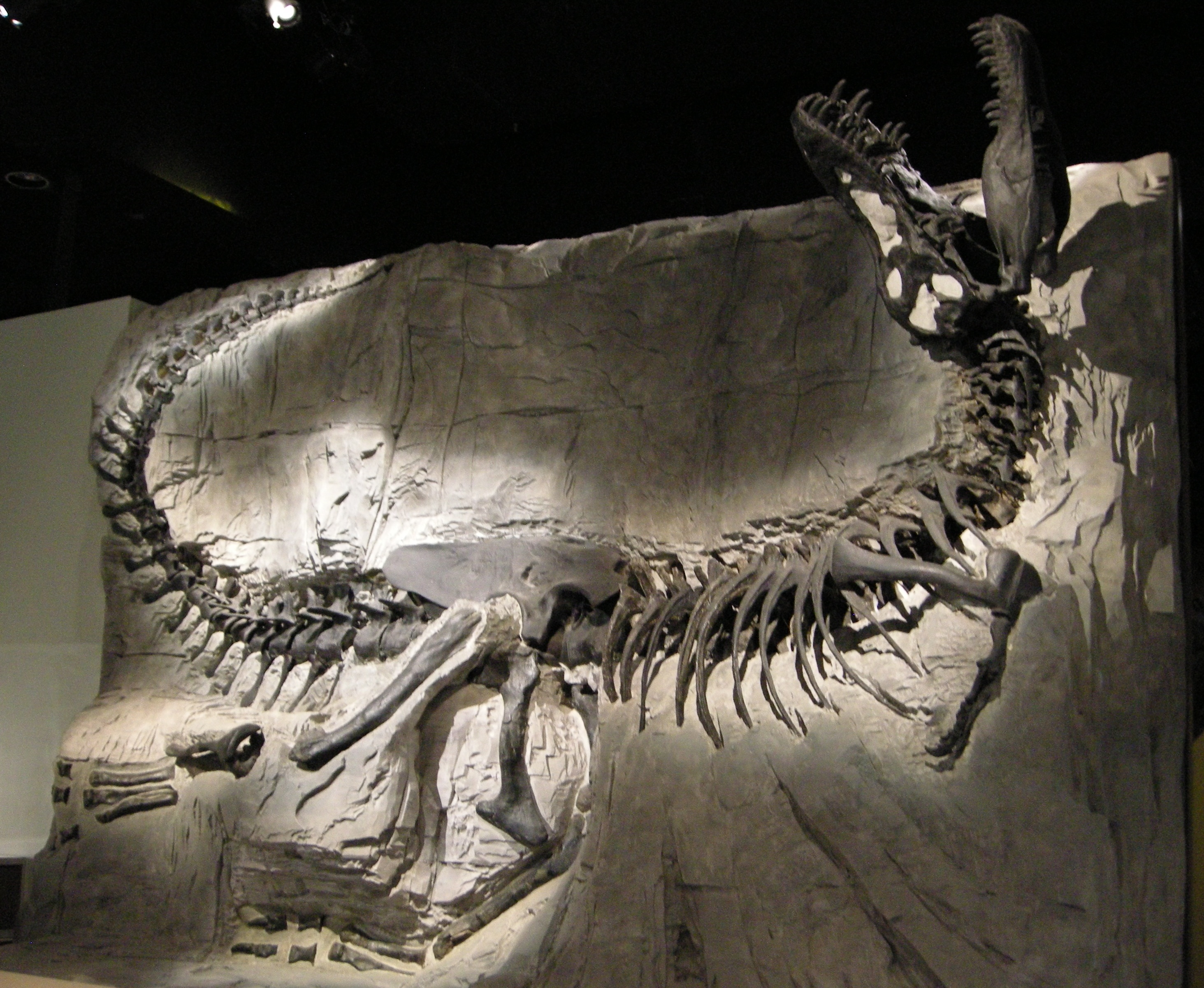
RTMP 81.6.1, aka Black Beauty, mounted in relief at the Royal Tyrell Museum. Source.

RTMP 81.6.1, aka Black Beauty, mounted in relief at the Royal Tyrell Museum. Source

The most celebrated Tyrannosaurus find from the early years of the dinosaur renaissance came from Alberta, making it the northernmost and westernmost T. rex to date. The 30% complete “Black Beauty” specimen, so named for the black luster of the fossilized bones, was found in 1980 by a high school student and was excavated by paleontologist Phil Curie. The original Black Beauty fossils were taken on a tour of Asia before finding a permanent home at the newly established Royal Tyrell Museum in Drumheller, Alberta. In lieu of a standing mount, Black Beauty was embedded in a faux sandstone facade, mirroring the environment in which the fossils were found and the animal’s presumed death pose. This relief mount set Black Beauty apart from its AMNH and CMNH predecessors, and even today it remains one of the most visually striking Tyrannosaurus displays.  Since the original specimen consisted of less than half of a skeleton, much of this display is made up of sculpted bones, including the pelvis, scapula, and most of the ribs. The mounted skull is a cast, but the real skull is displayed behind glass nearby. A complete cast of Black Beauty in a traditional free-standing mount is also on display at the Swedish Museum of Natural History in Stockholm.

The World’s Most Replicated Dinosaur

Driven by the increased public demand for dinosaurs, many museums without Tyrannosaurus fossils of their own have purchased complete casts from other institutions. In 1986, the Academy of Natural Sciences in Philadelphia opened “Discovering Dinosaurs”, the world’s first major exhibit showcasing active, endothermic dinosaurs. The centerpiece of the exhibit was a cast of the original AMNH Tyrannosaurus, posed for the first time in the horizontal posture that we now know was the animal’s habitual stance. The following year, another AMNH cast appeared in the lobby of Denver Museum of Nature and Science in a strikingly bizarre pose, with one leg kicking high in the air. The mount’s designer Robert Bakker intended to push boundaries and demonstrate what a dynamic and energetic Tyrannosaurus might be capable of, although the mount has subsequently been described as dancing, kicking a soccer ball, or peeing on a fire hydrant. Meanwhile, The Royal Tyrell Museum prepared a mount of RTMP.81.12.1 (a specimen consisting of a relatively small number of postcranial bones) that was filled in with AMNH casts, including the highly recognizable skull.

Cast

Tyrannosaurus cast at the Denver Museum of Nature and Science. Source

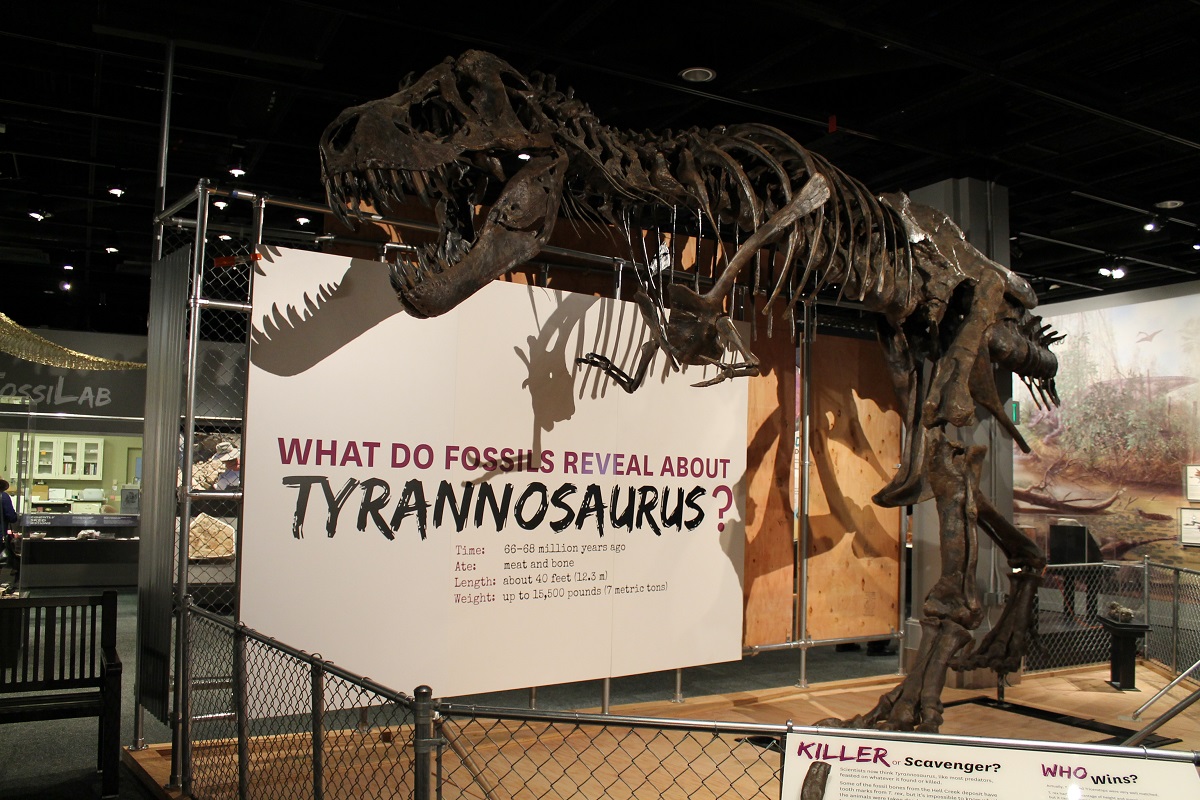
Since the late 1990s, however, casts of another specimen have overtaken AMNH 5027 for the title of most ubiquitous T. rex. BHI 3033, more commonly known as Stan, was excavated in South Dakota in 1992 by the Black Hills Institute, a for-profit outfit specializing in excavating, preparing, and mounting fossils. Stan is significant for being over two-thirds complete and for including the best-preserved Tyrannosaurus skull yet found. BHI has sold dozens of casts of the Stan skeleton to museums and other venues around the world. At a relatively affordable $100,000 plus shipping, even small local museums and the occasional wealthy individual can now own a Tyrannosaurus mount. With over 50 casts sold as of 2017, Stan is, by a wide margin, the most duplicated and most exhibited dinosaur in the world.

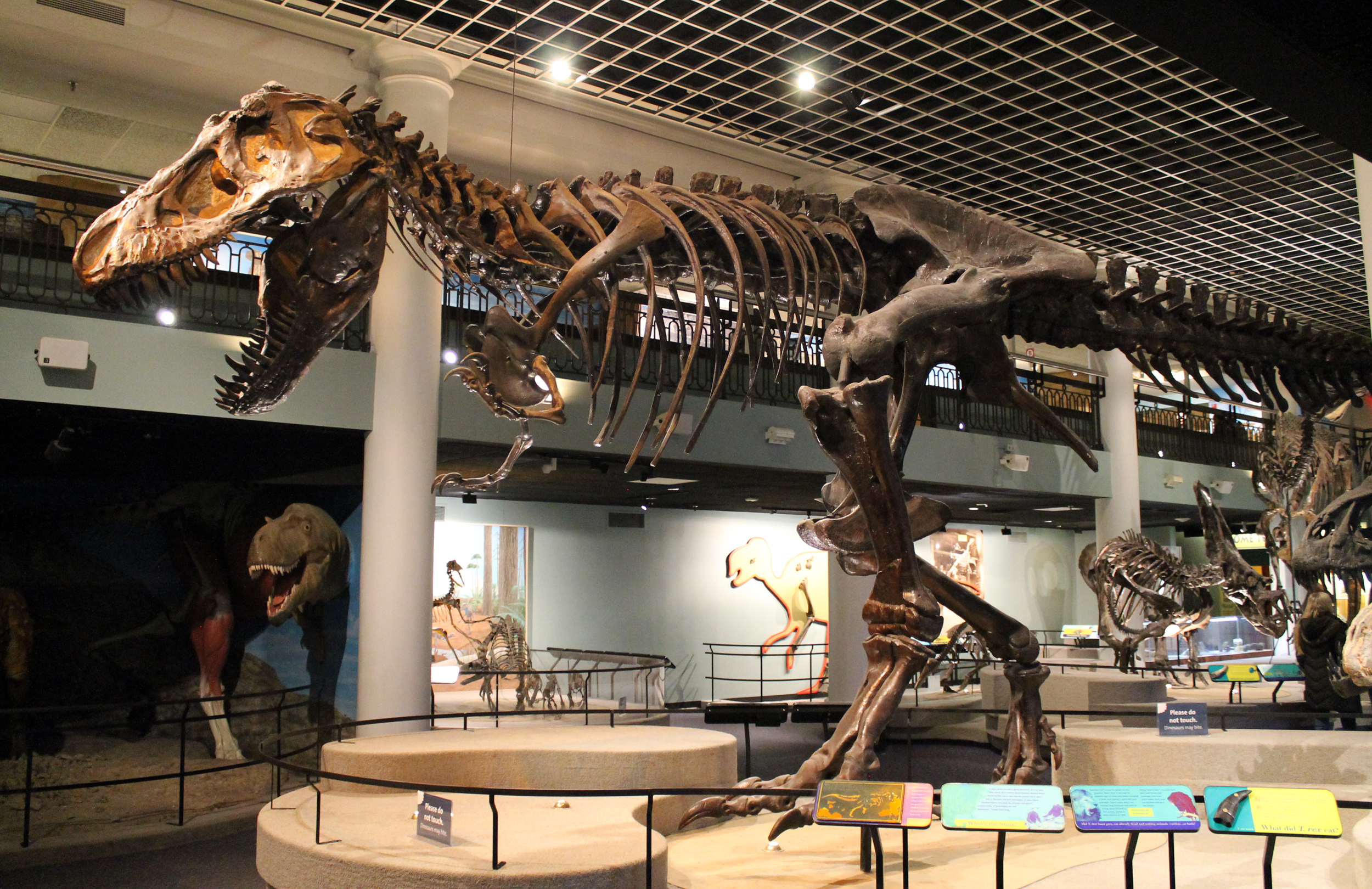
Stan the Tyrannosaurus at the National Museum of Natural History. Photo by the author.

Stan the Tyrannosaurus at the National Museum of Natural History. Photo by the author.

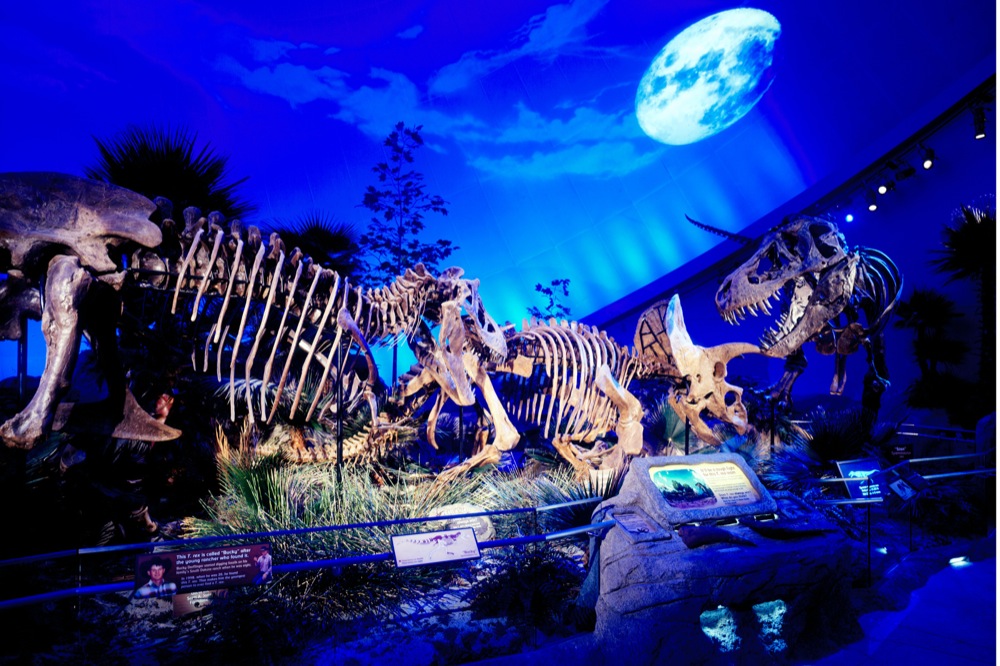
All these new Tyrannosaurus mounts are forcing museums to get creative, whether they are displaying casts or original fossils. Predator-prey pairings are a popular display choice: for example, the Houston Museum of Natural Science T. rex is positioned alongside an armored Denversaurus, and the Los Angeles Natural History Museum matches the tyrant dinosaur with its eternal enemy, Triceratops. Meanwhile, the growing number of juvenile Tyrannosaurus specimens has allowed for family group displays. A second T. rex exhibit at LACM features an adult, subadult and baby, while the Children’s Museum of Indianapolis pairs a Stan cast with the original skeleton of Bucky, a “teenage” T. rex. The most unique Tyrannosaurus mount so far is certainly the copulating pair at the Jurassic Museum of Asturias.

Tyrannosaurus versus Denversaurus at the Houston Museum of Nature and Science. Photo by the author.

Each of these displays gives a substantially different impression of Tyrannosaurus. Depending on the mount, visitors might see T. rex as a powerful brute, a fast and agile hunter, or a nurturing parent (or a gentle lover). Each mount is accurate insofar that a real Tyrannosaurus probably adopted a similar stance at some point, but the museum’s choice of pose nevertheless influences visitors’ understanding of and attitude toward the dinosaur.

Restoring the Classics

With dozens of new Tyrannosaurus mounts springing up across the country and around the world, the original AMNH and CMNH displays began to look increasingly obsolete. Unfortunately, modernizing historic fossil mounts is an extremely complex and expensive process. The early 20th century technicians that built these displays generally intended for them to be permanent: bolts were drilled directly into the bones and gaps were sealed with plaster that can only be removed by manually chipping it away. What’s more, the cumulative effects of rusting armatures, fluctuating humidity, and vibration from passing crowds have considerably damaged historic mounts over the course of their decades on display.

AMNH 5027 was restored and remounted in 1995.

AMNH 5027 was restored and remounted in 1995. Photo by the author.

Despite these challenges, AMNH and CMNH have both been able to restore and update their classic Tyrannosaurus displays. While fossil mounts used to be built in-house, often by the same people who found and described those fossils, modern mounting projects are typically outsourced to specialist companies. Phil Fraley Productions, an exhibit fabrication company based in the Pittsburgh suburbs, was responsible for both T. rex restorations. At AMNH, Jeanne Kelly spent two years disarticulating and conserving each bone before Phil Fraley’s crew took over to build the new armature. The new mount not only corrected the dinosaur’s posture, but improved visitors’ view of the fossils by removing obstructive vertical supports. Instead, most of the skeleton’s weight is now supported by steel cables hanging from the ceiling.  Each bone is secured to an individual metal bracket, allowing researchers to easily remove elements for study as necessary. A new cast of the skull was also prepared, this time with open fenestrae for a more natural appearance. Rather than attempting to match the dramatic and showy T. rex mounts at other museums, the AMNH team chose a comparatively subdued stalking pose. A closed mouth and subtly raised left foot convey a quiet dignity befitting this historically significant display.

Historically, the 1941 CMNH Tyrannosaurus had never quite lived up to its New York predecessor. Although it incorporated the Tyrannosaurus type specimen, it was mostly composed of casts from the New York skeleton, and it sported an unfortunately crude replica skull. It is therefore ironic that CMNH now exhibits the more spectacular T. rex display, one which finally realizes Osborn’s ambitious plan to construct an epic confrontation between two of the giant predators. As they had with the AMNH mount, Phil Fraley’s team dismantled the original display and painstakingly removed many layers of paint, shellac, and plaster from the bones. Michael Holland contributed a new restored skull, actually a composite of several Tyrannosaurus skulls. The restored holotype T. rex now faces off with a cast of “Peck’s Rex”, a specimen recovered from Montana in 1997. Despite the difficulty of modernizing the historic specimen, the team reportedly developed a healthy respect for turn of the century mount-makers like Adam Hermann and Arthur Coggeshall, who developed the techniques for making enduring displays of fragile fossils that are still being refined today.

Continue to Displaying the Tyrant King Part 3.

References

Colbert, E.H., Gillette, D.D. and Molnar, R.N. “North American Dinosaur Hunters.” The Complete Dinosaur, Second Edition. Brett-Surman, M.K., Holtz, T.R. and Farlow, J.O., eds.Bloomington, IN: Indiana University Press.

Dingus, L. 1996. Next of Kin: Great Fossils at the American Museum of Natural History. New York, NY: Rizzoli International Publications, Inc.

Johnson, K. and Stucky, R.K. 2013. “Paleontology: Discovering the Ancient History of the American West.” Denver Museum of Nature and Science Annals, No. 4.

Larson, N. 2008. “One Hundred Years of Tyrannosaurus rex: The Skeletons.” Tyrannosaurus rex, The Tyrant King. Larson, Peter and Carpenter, Kenneth, eds. Bloomington, IN: Indiana University Press.

Naish, D. 2009. The Great Dinosaur Discoveries. Berkeley, CA: University of California Press.

Norell, M., Gaffney, E.S. and Dingus, L. 1995. Discovering Dinosaurs: Evolution, Extinction, and the Lessons of Prehistory.  Berkeley, CA: University of California Press.

Psihoyos, L. 1994. Hunting Dinosaurs. New York, NY: Random House, Inc.

4 Comments

Filed under AMNH, CMNH, dinosaurs, fossil mounts, history of science, museums, NMNH, paleoart, reptiles, theropods

Displaying the Tyrant King – Part 1


The original Tyrannosaurus rex mount at the American Museum of Natural History. Photo from Dingus 1996.

The original Tyrannosaurus rex mount at the American Museum of Natural History. Photo from Dingus 1996.

Woodrow Wilson is in the white house. The first World War is raging in Europe, but the United States is not yet involved. The women’s suffrage movement is picking up speed. And you just heard that the skeleton of an actual dragon is on display at the American Museum of Natural History in New York. It is difficult to imagine a time before every man, woman, and child in the developed world knew the name Tyrannosaurus rex, but that world existed not even a century ago. In 1915, AMNH unveiled the very first mounted skeleton of the tyrant lizard king, immediately and irrevocably cementing the image of the towering reptilian carnivore in the popular psyche.

Today, Tyrannosaurus is a celebrity among dinosaurs, appearing in every form of media imaginable. More importantly, however, it is an icon for paleontology and an ambassador to science. The cult of T. rex began in the halls of museums, and museums remain the prehistoric carnivore’s symbolic home. The mounted skeletons in museums provide the legendary T. rex its credibility: these are the authentic remains of the giant predator that once stalked North America. And yet, most of the dozens of  Tyrannosaurus skeletons on display around the world are casts, and none of them represent complete skeletons (rather, they are filled in with spare parts from other specimens and the occasional sculpted bone). These are sculptures as well as scientific specimens, works of installation art composed by artists, engineers, and scientists. Herein lies the paradox presented by all fossil mounts: they are natural specimens and constructed objects, embodying a challenging duality between the realms of empiricism and imagination.

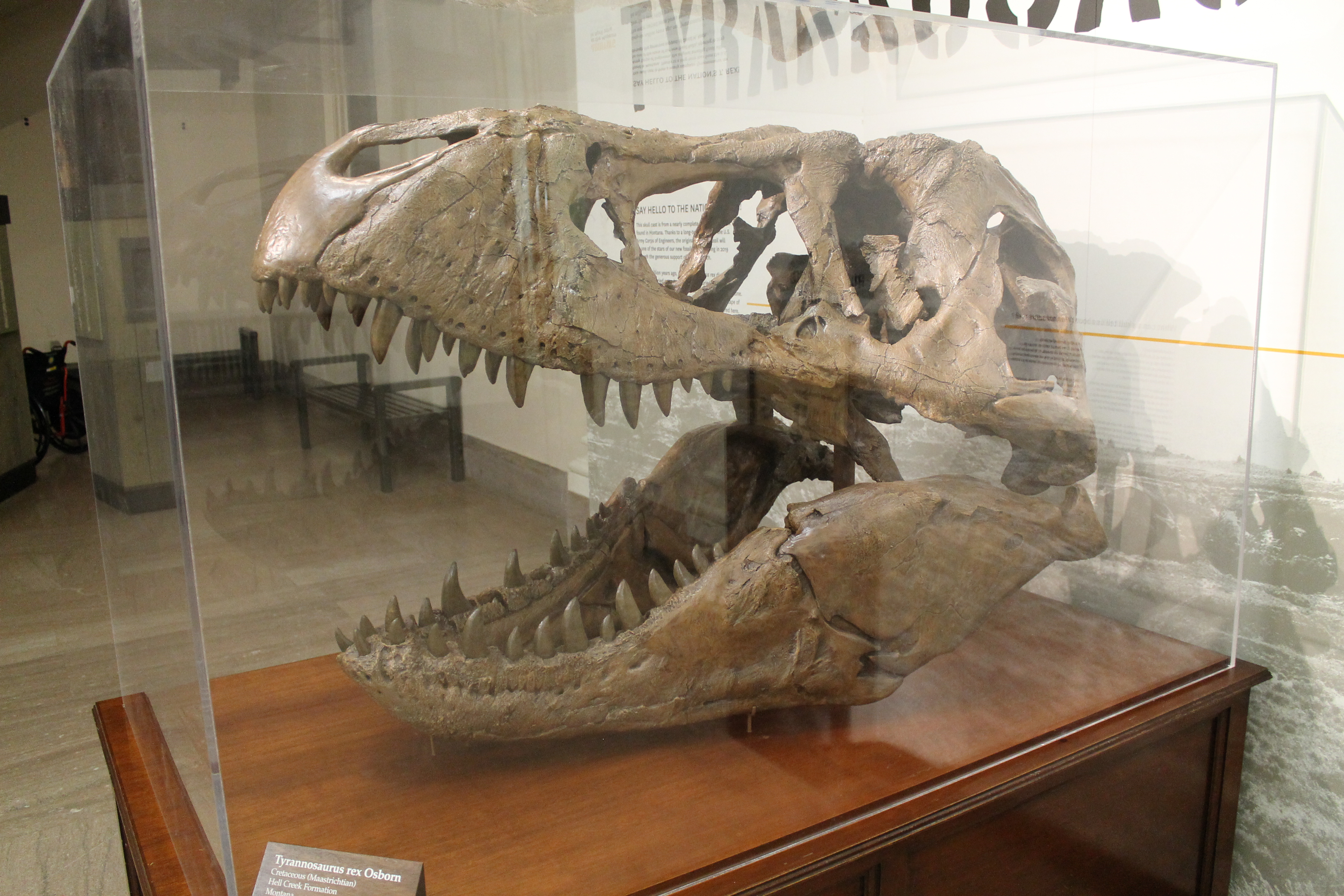
Tyrannosaurus mount is at once educational and spectacular. Both roles were embraced at AMNH in 1915, and these dual identities have defined T. rex displays ever since. 14 years ago, FMNH PR 2081, also known as Sue, became a star attraction for the Field Museum of Natural History and the city of Chicago at large. Later this month, another T. rex will unwittingly take on a similar role: on April 15th, MOR 555, an 80% complete Tyrannosaurus specimen discovered in Montana, will be dubbed “The Nation’s T. rex and entered into the Smithsonian National Museum of Natural History collection with considerable fanfare.

Skull cast of MOR 555, soon to be "The Nation's T. rex", at NMNH.

Skull cast of MOR 555, soon to be “The Nation’s T. rex“, at the National Museum of Natural History. Photo by the author.

This three part series is a look back at how the tyrant king has defined, and been defined by, the museum experience. Part 1 will cover the circumstances surrounding the creation of the iconic original Tyrannosaurus mount in New York, as well as its successor in Pittsburgh. Part 2 will explore the changing role of Tyrannosaurus in museums caused by a surge of new fossil finds and a revolution in our understanding of dinosaurs. Finally, Part 3 will conclude with a discussion of the positives and negatives of a modern world saturated in all things T. rex.

The Original Tyrant

Between 1890 and 1910, the United States’ large urban natural history museums entered into a frenzied competition to find and display the largest and most spectacular dinosaur skeletons. Although the efforts of paleontologists O.C. Marsh and E.D. Cope in the late 19th century fleshed out the scientific understanding of Mesozoic reptiles, it was these turn-of-the-century museum displays that brought dinosaurs into the public sphere. Bankrolled by New York’s wealthy aristocrats and led by the ambitious mega-tool Henry Osborn, AMNH won the fossil race by most any measure. The New York museum completed the world’s first mounted skeleton of a sauropod dinosaur in 1905, and also left its Chicago and Pittsburgh competitors in the dust with the highest visitation rate and the most fossil mounts on display.

Osborn’s goal was to establish AMNH as the global epicenter for paleontology research and education, and in 1905 he revealed his ace in the hole: two partial skeletons of giant meat-eating dinosaurs uncovered by fossil hunter Barnum Brown. In a deceptively brief paper in the Bulletin of the American Museum of Natural History, Osborn described the fossils from Wyoming and Montana, coining the names Dynamosaurus imperiosus and Tyrannosaurus rex (a follow-up paper in 1906 reclassified “Dynamosaurus” as a second Tyrannosaurus specimen). Fully aware of what a unique prize he had in his possession, Osborn wasted no time leveraging the fossils for academic glory (and additional funding from benefactors). He placed the unarticulated Tyrannosaurus fossils on display at AMNH shortly after his initial publication, and commissioned legendary artist Charles Knight to prepare a painting of the animal’s life appearance.

In 1908, Brown collected a much more complete Tyrannosaurus specimen (AMNH 5027), with over 50% of the skeleton intact, including the first complete skull and a significant portion of the torso. With this specimen in hand, AMNH technician Adam Hermann and his team began work on a mounted Tyrannosaurus skeleton to join the Museum’s growing menagerie of mounted dinosaurs and prehistoric mammals. Inspired by the Museum’s collection of taxidermy mounts in dynamic habitat dioramas, and seeking to accentuate the spectacle of his reptilian monster, Osborn initially wanted to mount two Tyrannosaurus skeletons facing off over a dead hadrosaur. He even published a brief description complete with illustrations of the projected scene (shown below). However, the structural limitations inherent to securing heavy fossils to a steel armature, as well as the inadequate amount of Tyrannosaurus fossils available, made such a sensational display impossible to achieve.

Model of unrealized T. rex showdown mount from Osborn 1913.

Model of unrealized T. rex showdown mount. Image from Osborn 1913.

Instead, Hermann prepared a single Tyrannosaurus mount, combining the 1908 specimen with plaster casts of leg bones from the 1905 holotype. The original skull was impractically heavy, so a cast was used in its place. Finally, missing portions of the skeleton, including the arms, feet, and most of the tail, were sculpted by hand using bones from Allosaurus as reference. During the early 20th century, constructing fossil mounts was a relatively new art form, and while Hermann was one of the most talented and prolific mount-makers in the business, his techniques were somewhat unkind to the fossil material. Bolts were drilled directly into the fragile bones to secure them to the armature, and in some cases steel rods were tunneled right through the bones. Any fractures were sealed with plaster, and reconstructed portions were painted to be nearly indistinguishable from the original fossils. Like most of the early AMNH fossil mounts, preserving the integrity of the Tyrannosaurus bones was often secondary to aesthetic concerns like concealing the unsightly armature.

Tyrannosaurus and others in AMNH Dinosaur Hall, 1927. Photo courtesy of AMNH Research Library.

AMNH Tyrannosaurus, ca. 1940. Photo courtesy of the AMNH Research Library.

The completed Tyrannosaurus mount, a magnificent sculptural combination of bone, plaster, and steel, was unveiled in 1915 to stunned audiences. The December 3rd New York Times article was thick with hyperbole, declaring the dinosaur “the prize fighter of antiquity”, “the king of all kings in the domain of animal life,” “the absolute warlord of the earth” and “the most formidable fighting animal of which there is any record whatsoever” (and people say that today’s science journalism is sensationalist!). With its tooth-laden jaws agape and a long, dragging lizard tail extending its length to over 40 feet, the Tyrannosaurus was akin to a mythical dragon, an impossible monster from a primordial world. This dragon, however, was real, albeit safely dead for 66 million years.

Today, we know that the original AMNH Tyrannosaurus mount was inaccurate in many ways. The upright, tail-dragging pose, which had been the most popular attitude for bipedal dinosaurs since Joseph Leidy’s 1868 presentation of Hadrosaurus, is now known to be incorrect. More complete Tyrannosaurus skeletons have revealed that the tail reconstructed by Osborn and Hermann was much too long.  The Allosaurus-inspired sculpted feet were too robust, the legs (casted from the 1905 holotype), were too large compared to the rest of the body, and the hands had too many fingers (the mount was given proper two-fingered hands when it was moved in 1927). It would be misleading to presume that the prehistoric carnivore’s skeleton sprang from the ground exactly as it was presented, but it is equally problematic to reject it as a fake. There are many reasons to criticize Osborn’s leadership at AMNH, but he did not exhibit outright forgeries. The 1915 Tyrannosaurus mount was a solid representation of the best scientific data available at the time, presented in an evocative and compelling manner.

The AMNH Tyrannosaurus mount was no less than an icon: for paleontology, for its host museum, and for the city of New York. The mount has been a New York attraction for longer than the Empire State Building, and for almost 30 years, AMNH was the only place in the world where visitors could see a T. rex in person. In 1918, Tyrannosaurus would make its first Hollywood appearance in the short film The Ghost of Slumber Mountain. This star turn was followed by roles in 1925’s The Lost World and 1933’s King Kong, firmly establishing the tyrant king’s celebrity status. It is noteworthy that special effects artist Willis O’Brian and model maker Marcel Delgado copied the proportions and posture of the AMNH display exactly when creating the dinosaurs for each of these films. The filmmakers apparently took no artistic liberties, recreating Tyrannosaurus precisely how the nation’s top scientists had reconstructed it in the museum.

A T. rex for Pittsburgh

In 1941, AMNH ended it’s Tyrannosaurus monopoly and sold the incomplete type specimen (the partial skeleton described in Osborn’s 1905 publication) to Pittsburgh’s Carnegie Museum of Natural History. While it is sometimes reported that this transfer took place to keep the valuable fossils out of harm’s way during World War II (e.g. Larson 2008), the deal was apparently underway well before the United States became involved in the war. Having paid an astounding $100,000 ($1.7 million in today’s dollars) for the fossils, CMNH staff wasted no time in assembling a mount of their own. The Tyrannosaurus holotype only included only about 15% of the skeleton, so most of Pittsburgh mount had to be made from casts and sculpted elements. Somewhat pointlessly, the skull fragments included with the specimen were buried inside a plaster skull replica, making them inaccessible to researchers for several decades. Completed in less than a year, the CMNH Tyrannosaurus was given an upright, tail-dragging posture very much like its AMNH predecessor.

Carnegie Museum of Natural History. Photo from NPR.

CM 9380 at the Carnegie Museum of Natural History. Source

The mid-20th century is sometimes called the “quiet phase” in vertebrate paleontology. After enjoying public fame and generous federal support during the late 1800s, paleontology as a discipline was largely marginalized when experiment-driven “hard” sciences like physics and molecular biology rose to prominence. By the 1950s and 60s, the comparably small number of researchers studying ancient life were chiefly concerned with theoretical models for quantifying trends in evolution. Although the aging dinosaur displays at American museums remained popular with the public, these animals were perceived as evolutionary dead-ends, of little interest to the majority of scientists. Between 1908 (when Brown found the iconic AMNH Tyrannosaurus skeleton) and 1980, only four largely incomplete Tyrannosaurus specimens were found, and no new mounts of this species were built.

Continue to Displaying the Tyrant King Part 2.

References

Dingus, L. (1996). Next of Kin: Great Fossils at the American Museum of Natural History. New York, NY: Rizzoli International Publications, Inc.

Glut, D. 2008. “Tyrannosaurus rex: A century of celebrity.” Tyrannosaurus rex, The Tyrant King. Larson, Peter and Carpenter, Kenneth, eds. Bloomington, IN: Indiana University Press.

Hermann, A. 1909. “Modern Laboratory Methods in Vertebrate Paleontology.” Bulletin of the American Museum of Natural History 21:283-331.

Larson, N. 2008. “One Hundred Years of Tyrannosaurus rex: The Skeletons.” Tyrannosaurus rex, The Tyrant King. Larson, Peter and Carpenter, Kenneth, eds. Bloomington, IN: Indiana University Press.

“Mining for Mammoths in the Badlands: How Tyrannosaurus Rex Was Dug Out of His 8,000,000 Year old Tomb,” The New York Times, December 3, 1905, page SM1.

Naish, D. 2009. The Great Dinosaur Discoveries. Berkeley, CA: University of California Press.

Osborn, H.F. 1906. “Tyrannosaurus, Upper Cretaceous Carnivorous Dinosaur.” Bulletin of the American Museum of Natural History 22:281-296.

Osborn, H.F. 1913. “Tyrannosaurus, Restoration and Model of the Skeleton.” Bulletin of the American Museum of Natural History 32:9-92.

Rainger, Ronald 1991. “An Agenda for Antiquity: Henry Fairfield Osborn and Vertebrate Paleontology at the American Museum of Natural History, 1890-1935. Tuscaloosa, Alabama. University of Alabama Press.

Wesihampel, D.B. and White, Nadine M. 2003.The Dinosaur Papers: 1676-1906. Washington, DC: Smithsonian Books.

1 Comment

Filed under AMNH, CMNH, dinosaurs, fossil mounts, history of science, movies, museums, NMNH, reptiles, theropods

The Stan Gallery

The first-ever mounted skeleton of Tyrannosaurus rex went on display at the American Museum of Natural History in 1915, and for nearly 30 years, the New York museum was the only place in the world where one could see the world’s most famous dinosaur in person. The situation today could not be more different. More than 50 individual Tyrannosaurus specimens of varying degrees of completeness are now known, and thanks to casting technology the number of Tyrannosaurus skeletons on display may well exceed one hundred.

A significant fraction of those displays are casts of BHI 3033, the T. rex specimen more commonly known as Stan. Excavated in South Dakota in 1992 by the Black Hills Institute (a for-profit outfit specializing in excavating, preparing and mounting fossils), Stan is significant for being over two-thirds complete and for including the best preserved Tyrannosaurus skull yet found. Since 1996, BHI has sold dozens of casts of the complete Stan skeleton (missing bones are filled in with casts from the original AMNH T. rex, among others) to museums and other venues around the world. At a relatively affordable $100,000 plus shipping, even small local museums and the occasional wealthy individual can now own a Tyrannosaurus mount. Stan is, by a wide margin, the most duplicated and most exhibited dinosaur in the world today. As of 2008, BHI had sold more than 30 Stan casts, and that number has grown substantially since then, particularly with the increased interest in dinosaur displays in Asia.

One might argue that this extreme amount of replication lessens the cultural value of museum displays. What allure do museums have when the specimens on display are fiberglass replicas, of which identical versions can be seen at dozens of other venues, including corporate offices and amusement parks? I would counter that this is a small price to pay when we consider the immense educational benefits of this unprecedented availability of dinosaur skeletons. Children and adults around the world now have  the opportunity to see a T. rex in person, an experience that was until recently limited to citizens of a handful of large cities. What’s more, the huge body of research on Tyrannosaurus makes it a veritable model organism for vertebrate paleontology, so increasing access to T. rex fossils for international scientists is definitely helpful.

Besides, a fossil mount is far more than the fossil bones it is composed of. Mounts are in equal measures natural specimens and man-made objects, works of installation art designed to communicate a story through pose, posture and a carefully arranged mise-en-scene. Below are 14 examples of Stan on display, highlighting the great range attainable with a single dinosaur.

Image sources: Orientation UofMa_leistra, Bill and Sandra WayneReluctant Drifter, Roadschooling America, dinonikes, Texas Tigers, Momotarou2012, Helana Handbasket and Marie Thomas.

5 Comments

February 2, 2014 · 11:55 am

Review: Ultimate Dinosaurs at the Cincinnati Museum Center

Ultimate Dinosaurs: Giants from Gondwana premiered in June 2012 with considerable fanfare at the Royal Ontario Museum (ROM) in Toronto. Developed by a ROM team led by David Evans and Matthew Vavrek, Ultimate Dinosaurs showcased the dinosaurs of the southern hemisphere, demonstrating how geographic isolation created Mesozoic ecosystems remarkably different from the menageries we are used to seeing in North American museum displays. The exhibit included 20 dinosaur mounts in all, including many taxa never before seen in museums above the equator.

I never made it to the inaugural showing of Ultimate Dinosaurs, but fortunately the show is now on the road. I saw it at the Cincinnati Museum Center (CMC) earlier this week, where it will remain through January 5th before moving on to Minneapolis. The exhibit assuredly does not disappoint…read on for many pictures and my musings on the design.

DPP_0001

The first room features Triassic and early Jurassic archosaurs.

Huge banners displayed outside the CMC and in the main lobby are impossible to miss, but the Ultimate Dinosaurs exhibit itself is hidden away on the lower level, with the entrance at the end of a quiet corridor. Aside from a video screen showing a shifting map of Gondwana, no proper introduction is provided. Visitors immediately find themselves in the first large room of fossil mounts, featuring Triassic and early Jurassic archosaurs like Herrerasaurus, Eoraptor, Cryolophosaurus and the rauisuchian Prestosuchus. This first batch of mounts is lined up on an elevated platform that runs along the right side of the room. Like all the mounts in Ultimate Dinosaurs, these are casts, and are plainly assembled in “chunks”: numerous bone elements casted together as single pieces. While these shortcuts are obvious up close, this mode of construction does allow for remarkably dynamic poses, and there is no obstructive armature to block one’s view. Behind the dinosaurs is the first of several gorgeous Julius Csotonyi murals, a lively panorama of life reconstructions in a naturalistic setting.

In front of every mount is an array of attractive signs in bright, solid colors. Information is mostly provided in short sound bites or bullet points, highlighting sensible information like the animal’s diet, the meaning of its name, where it was discovered, and why it is scientifically noteworthy. There is also at least one touchscreen in front of each mount, which includes several more pages of information for the more dedicated visitor. I really liked the similar touchscreen displays at the Carnegie Museum, and these are equally impressive. This is technology used intelligently, contributing to but not overwhelming the primary display, while using space in an economical way. I was also impressed by the succinctness of the text. It is very difficult to condense information into short blurbs that visitors can absorb with no more than a quick glance, but the Ultimate Dinosaurs writers balanced accuracy, intrigue and brevity on every single sign. Hats off to them!

Visitors were having a hell of a time pronouncing Cryolophosaurus.

Visitors were having a hell of a time pronouncing Cryolophosaurus.

Turning left at the Massospondylus at the far end of the first room, visitors enter a long and largely empty corridor. The left wall is adorned with a series of signs explaining the historical discovery of and evidence for continental drift, and herein lies my primary concern with the exhibit as a whole. The story being told in Ultimate Dinosaurs, regarding plate tectonics and its effect on evolution, is an important one. Paleobiogeography is key to understanding how the natural world we know today came to be. What’s more, it’s a great example of science in action, consisting of a handful of intuitive, evidence-based concepts that can be applied to new situations and clarify new discoveries.  As such, paleobiogeography ought to frame the entire exhibit. I would have placed the big ideas and central questions (Why are similar organisms sometimes found on opposite sides of oceans? What happens when populations or ecosystems are isolated from one another?) at the beginning, and ensured that they were reinforced in every display with recurring terms, imagery and motifs. The paleobiogeography story should guide the visitor’s experience and understanding of the exhibit.

Instead, Ultimate Dinosaurs at the CMC relegates the big ideas to secluded corners and easily-missed signs. The text itself is very clear and well-written, and supported by attractive, intuitive graphics, but it’s hidden away and or otherwise overshadowed by lists of factoids about each dinosaur. My largely unsubstantiated suspicion is that the original designers of Ultimate Dinosaurs at the ROM intended for the paleobiogeography story to be much more explicit, but this vision was compromised somewhat in order to fit the exhibit into the space available at the CMC. The unfortunate result is that the most critical information is introduced in an unorganized manner, and the exhibit is weaker for it.

Suchomimus peers in from the right, Amargasaurus and

Suchomimus peers in from the right, Malawisaurus in the middle, Argentina in back.

After passing through the switchbacking corridor, visitors reach the primary showroom. This is an enormous space filled with huge, impressive dinosaur mounts. Like the rest of the exhibit, this gallery is quite dark, with floor lights and the occasional overhead light highlighting the dinosaurs. The darkness helps to hide the unadorned walls and ceilings of the multipurpose space being used, but thankfully does not hinder one’s view of the dinosaurs. And the dinosaurs certainly do not disappoint. Even though they are casts, this exhibit was my first opportunity to see the likes of Armagasaurus, Suchomimus, Ouranosaurus and many others in person. I could walk around them, take in their scale and compare them to one another and to myself, experiences that no image or documentary can provide.

Majungasaurus and Rapetosaurus strike an extreme pose.

Majungasaurus and Rapetosaurus strike an extreme pose.

Most of the dinosaurs are in lively poses, as though the animal was frozen midstride, but a few are especially dynamic. Little Rahonavis is suspended from the ceiling, as though leaping for prey or perhaps engaging in a controlled glide to the forest floor. The Majungasaurus and Rapetosaurus, which are the only mounts directly interacting with one another, are particularly interesting. The attacking Majungasaurus has its foot up on the flank of the Rapetosaurus, and the sauropod is in a rather unusual squatting pose, with its forelimbs at what appears to be maximum flexion. I will leave it to the experts to decide whether this extreme pose is plausible, but this nevertheless serves as a reminder of what can be learned by assembling a skeleton in three-dimensional space.

Carnotaurus

Carnotaurus and Amargasaurus.

The mounts are clustered on three islands, representing Argentina, Madagascar and Niger. I do wish this organization had been made clearer to visitors, perhaps with large banners over the islands naming the dinosaurs’ location of origin. Clustered at the feet of the mounts are small cases containing a mix of original and casted fossils. Some of those are quite relevant and provide further context to the mounts: for instance, a collection of North African fossil fish near the Suchomimus illustrate the spinosaur’s probable diet. Other cases are a bit more perplexing. A series of cervical vertebrae from the North American sauropod Suuwassea is arbitrarily situated among the Madagascar mounts, and cases of cephalopods and Carboniferous plants are similarly out of place. Most of these oddball fossil displays did not come from the ROM, but were added by the CMC from their own collections. Although these fossils are fascinating and should absolutely be on display, I don’t think randomly interjecting them among the Gondwanan dinosaurs was the way to go. These displays interrupt the primary storyline and probably should have been placed elsewhere.

CWC addition

These additions from the CMC are neat, but a bit out of place.

The final room showcases the exhibit’s two largest mounts, Tyrannosaurus and Giganotosaurus. It is undeniably exciting to see these two giant predators side by side, and compare how these ostensibly similar carnivores were nevertheless subtly adapted to tackle different prey. I would have made this point more obvious than the exhibit does, but I suppose sometimes you need to step back and let your specimens speak for themselves.

This room also features the much-ballyhooed “augmented reality” gimmick. These are tablet-sized screens found alongside the mounts. When you point these at the Tyrannosaurus and Giganotosaurus skeletons, a CG version of dinosaur appears on the screen. Panning and tilting the tablet in front of the mount causes your view of the CG version to adjust accordingly. I found these sort of interesting, but they were not nearly as impressive as the mounts themselves. Unfortunately, the CG dinosaurs simply didn’t look very good. I am all for the use of technology in museum exhibits, but only if it plays to our strengths. In this case, the CG dinosaurs are directly and unfavorably comparable to a wide range of films and television shows that people can see without leaving home. As hubs for lifetime learning, museums can and should offer more than that.

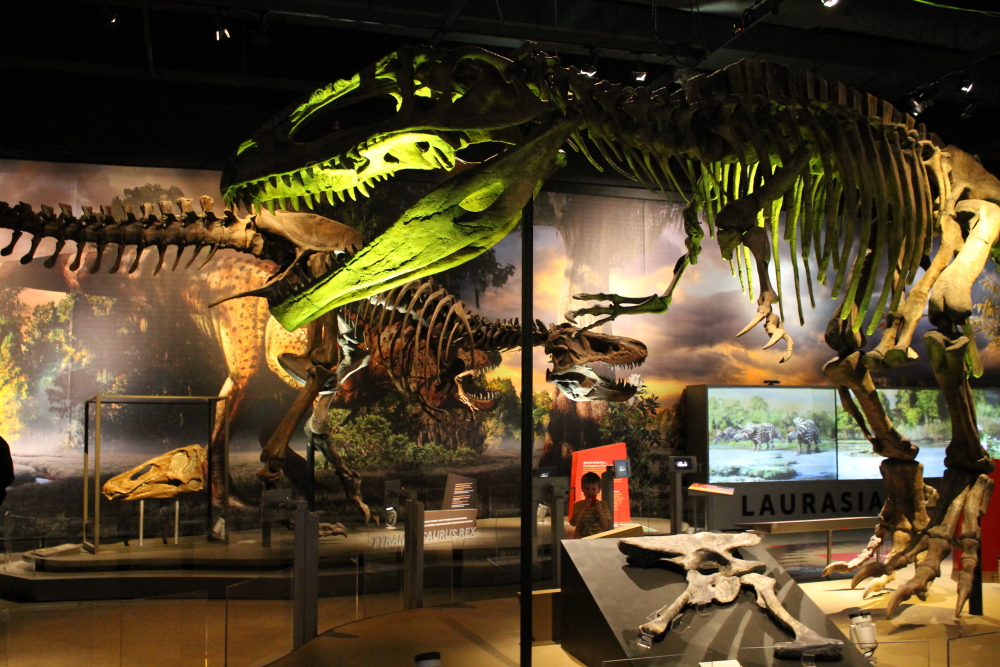
Tyrannosaurus and Giganotosaurus side by side. Eat it up, internet.

Tyrannosaurus and Giganotosaurus side by side. Eat it up, internet.

Despite my nitpicks, Ultimate Dinosaurs really does live up to its name. This is a very handsomely designed exhibit, and an great opportunity to see mounts of exotic dinosaur taxa. If you are at all interested in paleontology, catching this exhibit is a no-brainer. But even if you’re not, this is a rare chance to see what the vertebrate fossil record has to offer beyond T. rex and Triceratops, and learn a bit about how our world came to be.

Edit: I had mistakenly said the murals were created by Raul Martin. They are the work of Julius Csotonyi.

7 Comments

Filed under dinosaurs, exhibits, fossil mounts, museums, ornithopods, reptiles, reviews, sauropods, theropods

Juan Bautista Bru and the First Fossil Mount

The first fossils ever assembled into a freestanding mount belonged to the giant ground sloth Megatherium. The fossils, which were unearthed near Luján in what is now Argentina, were described and mounted in 1795 by Juan Bautista Bru at the Royal Cabinet of Natural History in Madrid. But while the Megatherium mount played an important part in the history of paleontology and in our understanding of the changing Earth, the man who made it possible is scarcely mentioned in the literature. Instead, Bru’s work on Megatherium is typically overshadowed by the involvement of the much better known anatomist Georges Cuvier. Drawing principally from José López Piñero ‘s 1988 paper on Bru, this entry is intended to highlight and acknowledge Bru’s contribution to the practice of mounting fossils for public display.

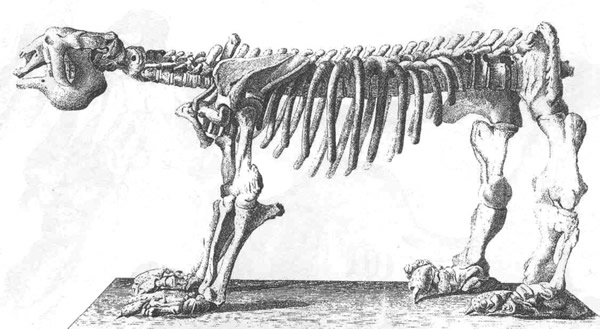
Cuvier's adaptation of Bru's drawing.

Cuvier’s adaptation of Bru’s illustration of the Megatherium mount.

The Megatherium  in question was discovered  in 1789 in what was then the Viceroyalty of Rio de la Plata, on the banks of the Luján River, “a league and a half” from the town of the same name. As region was controlled by the Spanish monarchy at the time (although the Argentine War of Independence was not far off), it was standard procedure for viceroy Marqués de Lorento to ship the important find to Spain with all haste. Packed into seven crates, the nearly complete skeleton was delivered to the Royal Cabinet of Natural History in Madrid, which curated natural specimens from Spanish territories and was among the most respected scientific institutions in Europe.

By the late 1700s, the European Enlightenment was well established, and the pursuit of knowledge about the world through reason and scientific deduction rather than legend or dogma was popular among the societal elite. The study of natural history was deemed particularly important, and institutions like the Royal Cabinet which collected, quantified and published knowledge about the natural world were well-respected and well-funded. However, the meaning of the fossil record still eluded the top minds of the era. A century earlier, Nicolaus Steno had determined that fossils were the remains of once-living organisms, and by the late 1700s some naturalists were starting to come around to the idea that species that once existed had become extinct. Nevertheless, when the Megatherium arrived in Madrid, naturalists still lacked the most important part of the puzzle presented by the fossil record: an understanding of evolution and the interrelatedness of life on Earth.

The task of interpreting the Luján fossils went to Juan Bautista Bru, the “Artist and First Dissector” at the Royal Cabinet. Born in Valencia, Bru had initially tried his hand as a traditional artist, but found little success. After shifting his focus to natural science, Bru joined the Royal Cabinet in 1771 and remained there until his death in 1799. Bru primarily served as a scientific illustrator, combining his artistic skill with his extensive anatomical knowledge to produce gorgeously detailed drawings of biological specimens, as was required before photography became commonplace. He was also responsible for producing taxidermy pieces and occasionally, mounted skeletons of animals.  In 1777, Bru prepared and mounted the skeleton of an elephant that had died at the royal estate in Aranjuez, a task which doubtlessly provided useful practice for mounting the gigantic Megatherium.

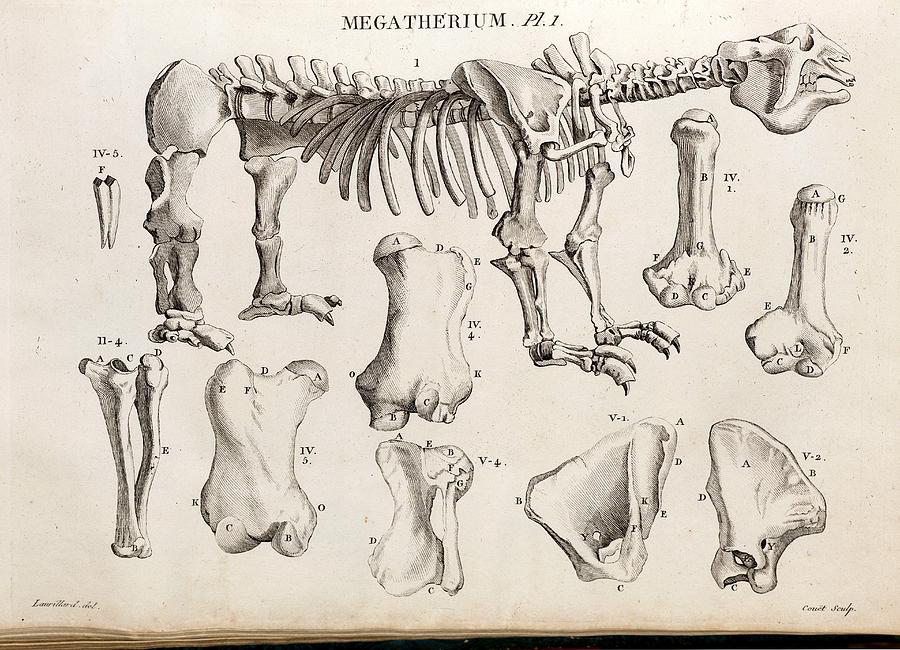
Plate from Bru's monograph

Plate I from Bru’s Megatherium monograph.

Bru devoted four years to studying the Luján fossils, which were complete except for the animal’s tail. He completed his monograph in 1793, which included detailed descriptions of every skeletal element, in addition to 22 plates illustrating the bones from various angles. Among the illustrations was the completely articulated skeleton shown above, which is, incidentally, the first recorded instance of a skeletal drawing illustrating the living form of an extinct animal. Since the mounted skeleton did not go on display until 1795, it is unclear whether Bru based the illustration on the mount or vice versa. Unfortunately, little is known about how Bru created the Megatherium mount, and his drawing provides no information about the armature that supported the massive bones. Since Bru did not discuss the mount’s construction in his monograph, one can only surmise that the techniques he refined over the years building mounts of modern animal skeletons were applicable to the fossils. Wooden armatures were used to mount fossils in the early 1800s, and it is plausible that Bru pioneered this technique. Regardless of how it was supported, the  rhino-sized Megatherium mount was placed on a rectangular wooden platform in a room of the Royal Cabinet already devoted to fossils and minerals.

It is unclear why, but Bru never published his monograph, and this unfortunately resulted in him effectively being scooped by Georges Cuvier in 1796. A representative of the French government working in Santa Domingo acquired a set of proofs of Bru’s monograph and illustration, and passed them along to the Institut de France. The proofs made their way to Cuvier, who was well established as one of the world’s leading experts in anatomy and natural history. Although he had not yet seen the actual fossils, Cuvier wrote a brief article in the journal Magasin Encyclopedique on the South American creature, in which he coined the rather vague name Megatherium americanum, meaning American giant beast. Cuvier’s article was not without error (he claimed the fossils were found in Paraguay), but he did correctly recognize that the animal was an edentate* and was curiously similar to modern tree sloths**. In contrast, Bru’s description of the fossils, while thorough, contained no attempt at classification.

As it happened, Cuvier published a second important article on fossil animals in 1796: his Mémoires sur les espèces d’éléphants vivants et fossiles, in which he established that the mammoth fossils found in the Americas belonged to an extinct relative of modern elephants. The wave of attention Cuvier received that year for his contributions to the young field of paleontology apparently eclipsed any recognition of Bru’s multi-year study of the Megatherium. Bru ended up selling his monograph and illustrations to a publisher, and a translated version eventually appeared in a widely disseminated booklet with Cuvier’s Megatherium article in 1804, five years after Bru’s death.

Megatherium would continue to be important to 19th century paleontologists. Charles Darwin became interested in South American fossils during the second voyage of the HMS Beagle. In particular, the relationship between the extinct ground sloths and their modern relatives contributed to Darwin’s ideas about the succession of species over geologic time. In 1849, the British Museum produced a Megatherium mount of their own, a composite of two skeletons found very near to where the Spanish specimen was first discovered. Plaster casts of this mount would appear in museums on both sides of the Atlantic, and the original cast is still on display in London today (some of the fossils were destroyed during World War II). But while the discovery of Megatherium would be recounted often over the subsequent two centuries, it was Cuvier, not Bru, who was always given credit for introducing the animal to the world. Only in recent years has Bru’s name begun to circulate again in historical accounts.

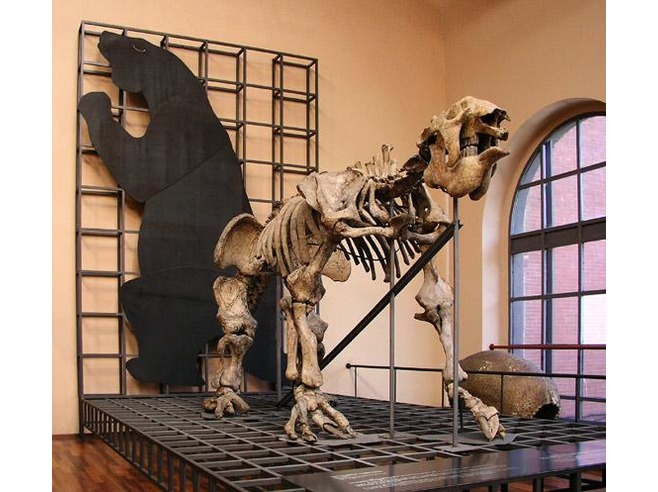
The original Megatherium fossils have been remounted at the Museo Nacional de Ciencias Naturales. Image from TripAdvisor.

The original Megatherium fossils have been remounted at the Museo Nacional de Ciencias Naturales. Image from Virtual Tourist.

However, there is a bit of happiness at the end of this story. Unlike other early mounts like Peale’s mastodon and Hydrarchos, Bru’s Megatherium has survived to the present day. Remounted on a new steel armature in an approximation of the original quadrupedal pose, the Luján Megatherium fossils are on display at the Royal Cabinet’s spiritual successor, the National Museum of Natural Science in Madrid. On public display for a nearly uninterrupted 218 years, this specimen can  surely be said to have taken on a second life. It was once a giant beast that roamed across the ancient Argentinian plains, and now it is a monument to scientific achievement.

*Edentata is a historic paraphyletic group that includes sloths, anteaters, pangolins and aardvarks. Modern biologists recognize that the new world sloths and anteaters and old world pangolins and aardvarks are not closely related. The name Xenarthra is now used for sloths and their new world relatives.

**Cuvier was working many decades before Charles Darwin published On the Origin of Species, and as such, did not subscribe to the idea that species could change and diversify over time. It is therefore worth noting that while he recognized the similarity between Megatherium and modern sloths, he did not conceive of their relationship in an evolutionary sense (that is, related species sharing a common ancestor). 

References

Argot, C. (2008). Changing Views in Paleontology:
The Story of a Giant (Megatherium, Xenarthra). Mammalian Evolutionary Morphology. Pp 37-50.

López Piñero , J.M. (1988). Juan Bautista Bru (1740-1799) and the Description of the Genus Megatherium. Journal of the History of Biology. 21:1:147-163.

1 Comment

Filed under fossil mounts, history of science, mammals, museums, paleoart

The Artist in His Museum: Peale’s Mastodon

In 1801, naturalist and painter Charles Wilson Peale assembled in Philadelphia the skeleton of a mastodon (Mammut americanum).While Peale’s mastodon was not the first fully assembled fossil animal put on display, it was assuredly the first display of this type to capture widespread public attention, particularly in the United States. What’s more, the mastodon became an important symbol for the untold natural wonders of the American continent, which was still largely unexplored (by European colonists) at the beginning of the 19th century. Finally, Peale’s mastodon made clear to the public one of the most important principles of modern biology: the idea that organisms can become extinct.

The Peale Museum mastodon, as illustrated by Charles Peale's son, Rembrandt. The Peale Museum mastodon, as illustrated by Charles Peale’s son, Rembrandt.

An extinct giant

The story of the mastodon mount actually began a full century before the 1806 debut. In 1705, a farmer in Claverack, New York found an enormous tooth that had eroded out of a hillside. The farmer traded the tooth to a local politician, and it eventually made it its way into the hands of New York’s colonial governor, Edward Hyde, 3rd Earl of Clarendon. Hyde in turn sent the tooth to London, describing it as a remnant of an antediluvian giant. As word of the remains of a giant spread, other Americans soon began reporting similar finds. Throughout the colonies, giant bones, teeth, and tusks began to be uncovered. While early reports called these fossils the remains of “incognitum,” or “the unknown,” naturalists caught on reasonably quickly that these were not the bones of giant men but of elephant-like creatures.

At this point a brief digression on etymology and taxonomy is required. For most of the 19th century, the American fossil elephants were invariably called “mahmot” or “mammoth.” This was an Anglicization of the Old Vogul term maimanto (meaning earth-horn), which referred to giant tusks occasionally found in Siberia. It is unclear, however, who first made the correct connection between the frozen mammoths of Siberia and the American fossil skeletons. Credit for adopting “mammoth” as a synonym for “big” goes to Thomas Jefferson, who was fascinated by paleontology and the mammoth fossils in particular.

It was not until 1817 that French anatomist Georges Cuvier recognized that there were at least two types of extinct American proboscideans: the taller mammoths and stockier mastodons. Unequivocally demonstrating the staggering repression of the Victorian era, Cuvier coined the name “mastodon,” meaning nipple tooth, because apparently he thought the animal’s most distinguishing feature was that its teeth looked like breasts.

Boobs? Couvier, you poor bastard. Cuvier, you poor bastard.

The American elephantine fossils raised difficult questions for naturalists. The fossils clearly belonged to animals that had never been seen alive, which meant that the entire species must have died out. This concept of extinction was new to science, and it challenged the biblically-inspired presumption that all species had originated in a single creation event. Cuvier was a leader in the 19th century scientific movement known as catastrophism–the idea that extinctions were the result of periodic disasters, such as floods. While Cuvier himself rejected the idea that populations of organisms could avoid extinction by adapting and changing, his work on extinction would prove important when Charles Darwin worked out the process of evolution several decades later.

Unearthing the mastodon

In 1789, Nicholas Collin of the American Philosophical Society proposed a search for a complete mammoth skeleton, in order to resolve the animal’s identity and the question of its extinction once and for all. Collin’s call was answered by Charles Wilson Peale, founder of America’s first modern museum. Peale is best known today as a portrait artist during the American Revolution, but he was also the founder of the Peale Museum in Philadelphia. Although semi-formal collections of interesting natural specimens had existed before, Peale uniquely fashioned his institution as a space for public education, rather than a private vanity project. On the second floor of Philadelphia’s Independence Hall, Peale arranged displays of mammals, birds, and plants in a scala naturae, which was the contemporary understanding of natural order. Peale intended the museum to be a public resource that would improve visitors’ moral character through lessons in science, as was made clear by the slogan printed on every ticket, “the birds and beasts will teach thee.”

In 1799, a farmer named John Masten reported that he had found bones of “an animal of uncommon magnitude” on his land outside Newburgh, New York. Masten gathered a large party of friends and neighbors to help excavate the find. This proved to be a little too much fun: the crowd eventually descended into alcohol-fueled chaos, and many of the fossils were destroyed. Nevertheless, Peale decided to pay Masten a visit, with the hope of securing mammoth fossils for his museum. Peale ended up paying Masten $200 for the surviving fossils, plus another $100 for the right to search his land for more remains. Peale returned to Masten’s farm with a better-organized crew and $500 in additional funding from the American Philosophical Society. The ensuing excavation is the subject of Peale’s 1806 painting, The Exhumation of the Mastodon, shown below.

“The Exhumation of the Mastodon” by Charles Peale, 1806.

Although highly dramatized, The Exhumation of the Mastodon provides the best available record of the event. Since the pit where Masten first found the bones had filled with water, Peale oversaw the construction of a huge wooden wheel, which drove a conveyor belt hauling buckets of water out of the work site. Peale himself can be seen on the right, presiding over his small army of excavators. The well-publicized project eventually uncovered most of a mastodon. Exploring a few nearby farms, Peale’s workers eventually accumulated enough material to build a complete skeleton, most notably a mandible found on another farm down the road. In what was either showmanship or genuine confusion regarding the diets of elephants, Peale said of the find, “Gracious God, what a jaw! How many animals must have been crushed beneath it!” (quoted in Simpson 1942, 159).

The mastodon on exhibit

Once the mastodon skeleton had been transported to Philadelphia, the process of building the mount fell upon Peale’s son Rembrandt and Moses Williams, a free man of color who worked for the Peales. It took three months to articulate the skeleton, although sadly the details of how it was mounted on its armature are lost to history. Initiating a practice that would become necessity for most fossil mounts in years to come, Rembrant filled in missing parts of the mastodon skeleton (the top of the cranium and the tail) with sculpted elements. In addition, wooden discs were placed between vertebrae, slightly exaggerating the mount’s total length.

The completed mastodon mount was unveiled in 1802, in the main hall of the American Philosophical Society. Shortly thereafter, it was moved to the Peale Museum at Independence Hall. For 50 cents (plus regular admission), the visiting public could marvel at the creature Peale touted as “the first of American animals” and “the largest of terrestrial beings.” The mastodon (still being called a mammoth at that time) was a sensation, stirring up fascination with natural science, the prehistoric past, and no small amount of ours-is-bigger-than-yours patriotism in the young United States. In 1822, Peale would commemorate the unveiling of the mastodon with his self portrait, The Artist in His Museum. Ever the showman, Peale ensured that the skeleton in his painting is only barely visible below the rising curtain.

“The Artist in His Museum” by Charles Peale, 1822.

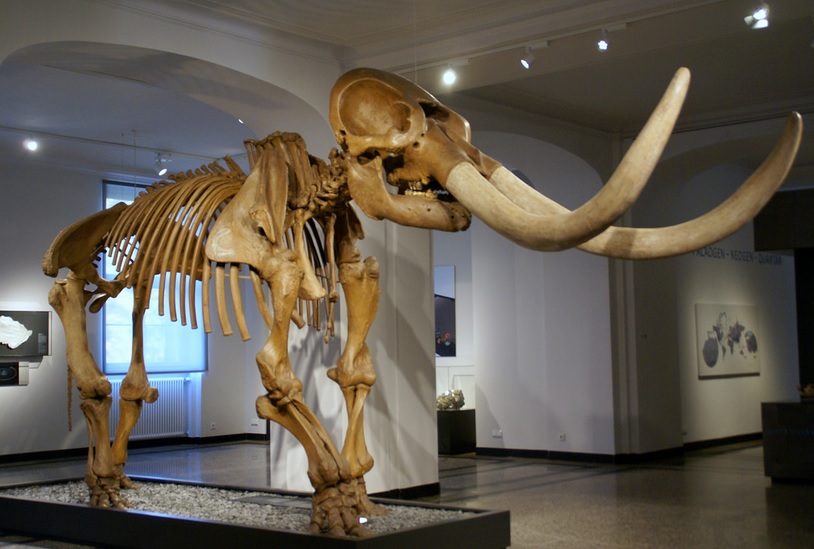
After Peale’s death in 1827 his museum floundered, and was eventually reduced from a meritorious educational institution into a circus of cheap spectacle. It shut down for good in 1848, and the mastodon (by then one of many similar mounts) was put up for auction. There are several conflicting accounts of what became of the mount, including the suggestion that it was destroyed in a fire, but in fact Peale’s mastodon has survived to the present day. Johann Jakob Kaup purchased the skeleton for the Landesmuseum in Durmstadt, Germany, and it has remained on display there ever since.

Germany Peale’s mastodon survives in Durmstadt, Germany. Source

Peale’s mastodon left an unmistakable legacy for both paleontology and public education. Today, the public conception of prehistory is inseparably connected to the image of towering mounted skeletons in museum halls. But fossils do not come out of the ground bolted to steel armatures, so it is largely thanks to Peale that mounts have become the most enduring means of sharing paleontology with the public.

References

Carpenter, K., Madsen, J.H. and Lewis, L. (1994). Mounting of Fossil Vertebrate Skeletons. Vertebrate Paleontological Techniques, Vol. 1. Cambridge, UK: Cambridge University Press.

Connriff, R. (2010). Mammoths and Mastodons: All American Monsters. Smithsonian Magazine. http://www.smithsonianmag.com/science-nature/Mammoths-and-Mastodons-All-American-Monsters.html

Semonin, P. (2000). American Monster: How the Nation’s First Prehistoric Creature Became a Symbol of National Identity. New York, NY: New York University Press.

Simpson, G.G. (1942). The Beginnings of Vertebrate Paleontology in North Ameirca. Proceedings of the American Philosophical Society 86:130-188.

4 Comments

Filed under field work, fossil mounts, history of science, mammals, museums

The Gilmore Models: Where are they now?

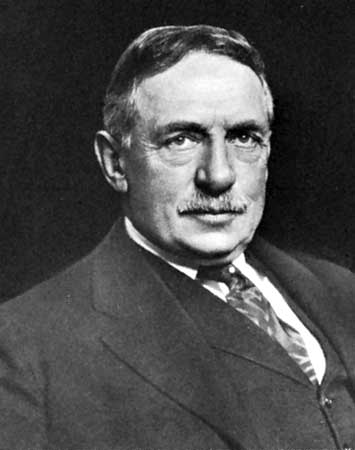
Regular readers of this site (if there are any) undoubtedly know Charles Whitney Gilmore as the Smithsonian paleontologist who, between 1903 and 1964, led in the creation of most of the mounted dinosaur skeletons that remain on display at the National Museum of Natural History today. You don’t necessarily have to be in Washington, DC to see Gilmore’s reconstructions, however. In addition to being an expert anatomist and fossil preparator, Gilmore was a formidable sculptor, and during his tenure at the Smithsonian he produced a number of gorgeous life reconstructions of prehistoric animals. Plaster copies of these models were gifted or sold to large and small museums in North America and Europe, including the Sternberg Museum of Natural History, the University of Kansas Natural History Museum and the Hunterian Museum at the University of Glasgow. These models were typically displayed alongside isolated fossil elements to give a sense of the entire animal at institutions where complete mounts were unfeasible.

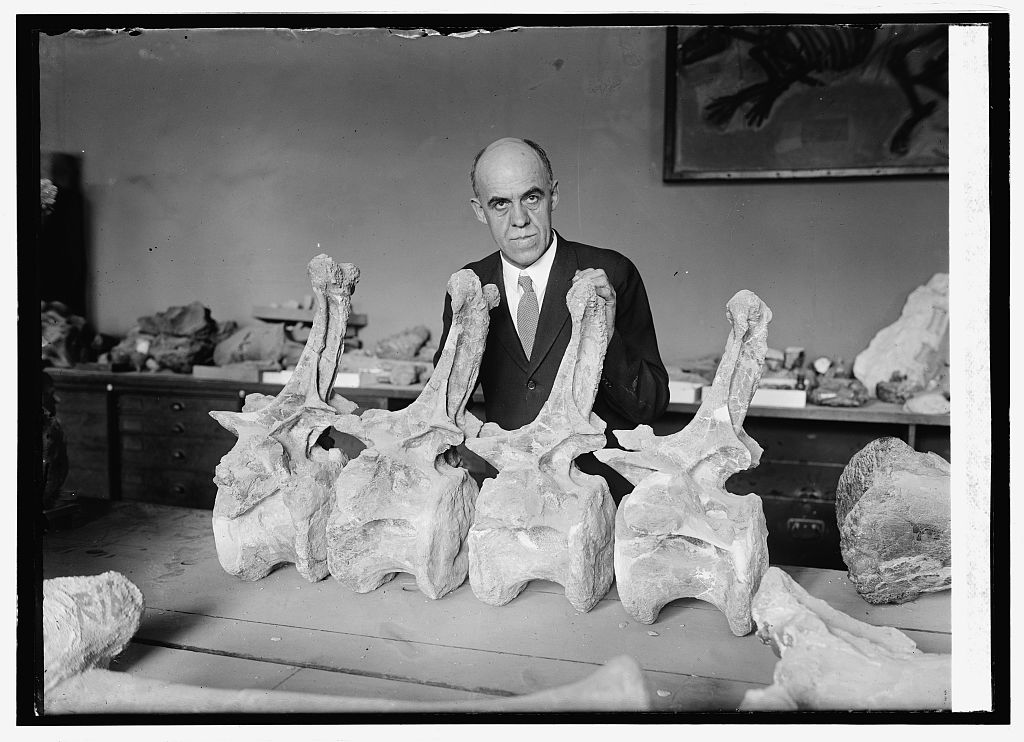
Gilmore with Diplodocus vertebrae.

Charles Gilmore, or Chucky G, as he was known to his friends.

Unfortunately, many of the museums that acquired copies of Gilmore’s models in the 1920s and 30s seem to have lost the detailed provenance of these acquisitions (not a rare occurrence, as museums must track literally millions of objects and historic records on paper do not always survive). The Hunterian Museum has the best records regarding these models that I am aware of, and incidentally their online catalog is the source of most of the photographs in this post.

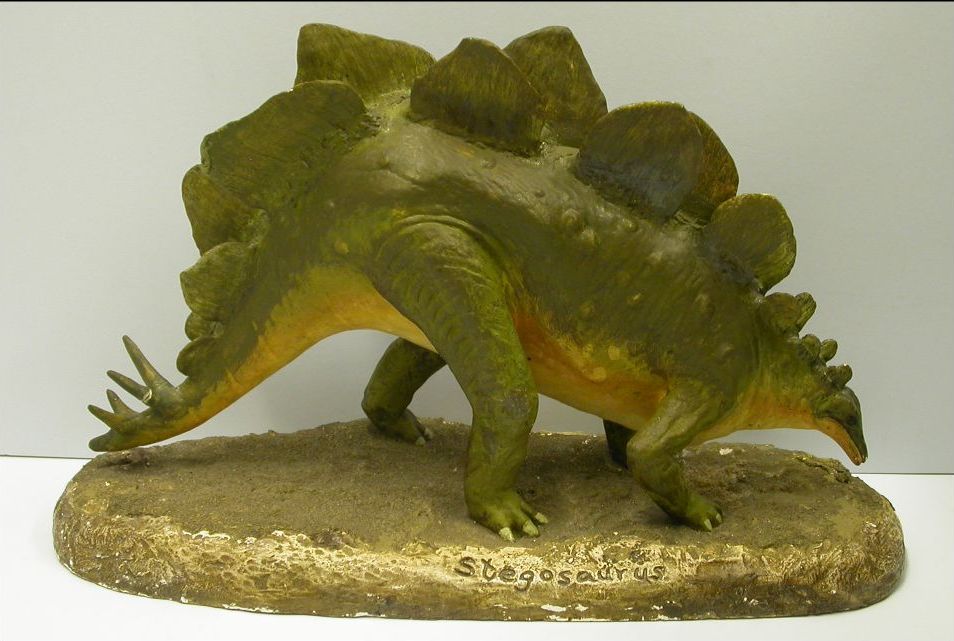
Stegosaurus model in plaster of paris. Image courtesy of the Hunterian Museum and Art Gallery.

Stegosaurus model in plaster of paris. Image courtesy of the Hunterian Museum and Art Gallery.

While Gilmore’s models are obviously far from accurate by modern standards, a closer inspection reveals that Gilmore was familiar with every inch of the fossils in his care, and put that knowledge to use in his sculptures. The Stegosaurus above, for instance, is a perfect match for Gilmore’s full-sized mount in terms of pose and proportion. Undoubtedly, physically assembling an actual skeleton is among the best ways to become familiar with how an animal would work in three dimensions. In particular, note that unlike many contemporary reconstructions, Gilmore did not fudge the number or position of the plates; they’re all accounted for.

Stegosaurus model in plaster of paris. Image courtesy of the Hunterian Museum and Art Gallery.

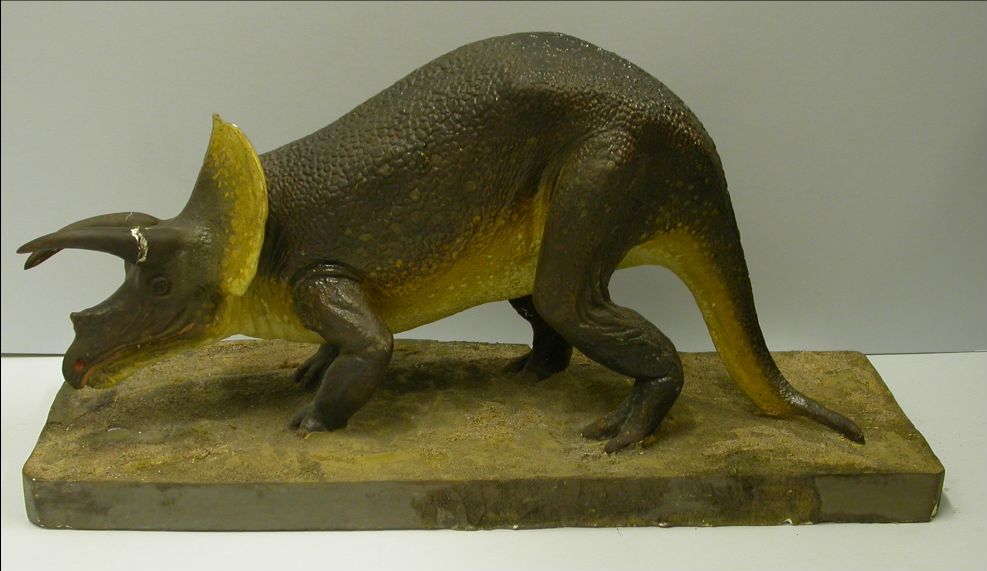
Triceratops model in plaster of paris. Image courtesy of the Hunterian Museum and Art Gallery.

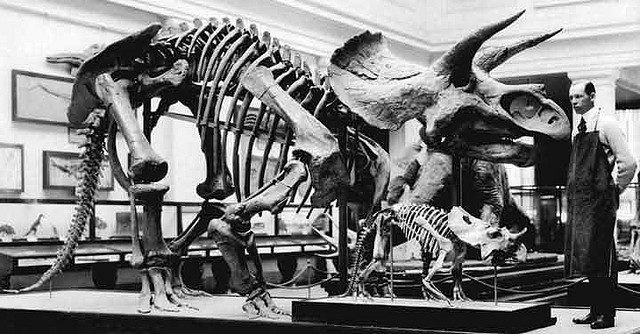
The Triceratops model exhibits a number of interesting choices. The classic bowed ceratopsian forelimbs (which Gilmore first proposed after finding no other way to articulate them in his 1905 Triceratops mount) are clearly in evidence, but my eye is drawn to the scrawny, lizard-like hindlimbs. Comparing this model to Gilmore’s mount, there would appear to be virtually no muscle back there. The size of the head is yet another remnant of the mounting process. Since his Triceratops mount was a composite of numerous specimens, Gilmore used the skull of an inappropriately small animal, and apparently carried the chimeric proportions to this sculpture. The lack of cheeks and extremely thick neck are also characteristic of older ceratopsian reconstructions, although I can’t comment on precisely when or why that look went out of style.

Stegosaurus model in plaster of paris. Image courtesy of the Hunterian Museum and Art Gallery.

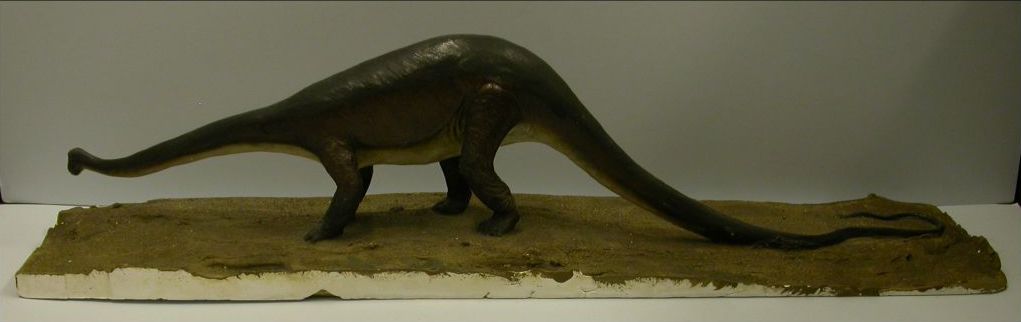
Diplodocus model in plaster of paris. Image courtesy of the Hunterian Museum and Art Gallery.

This Diplodocus has a much more defined shape than most mid-century sauropod reconstructions. Note in particular the sloping back, which peaks at the sacrum. This differs from the 1907 Diplodocus mount at the Carnegie Museum of Natural History, which had a completely horizontal spinal column. When Gilmore led the creation of the Smithsonian Diplodocus mount, he had the opportunity to use a vertebral column that was found articulated in situ, and was thus able to more accurately portray the shape of the animal’s midsection.

Ceratosaurus
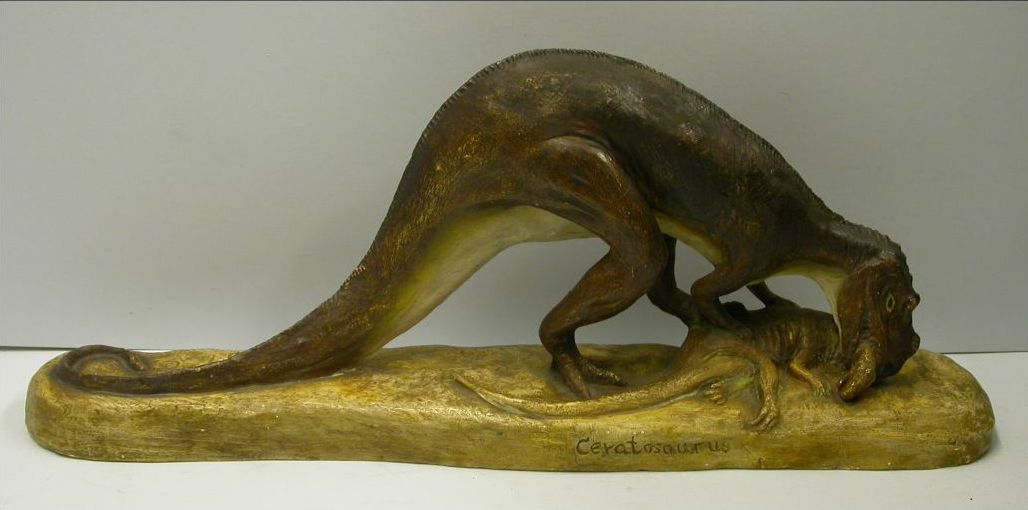
Ceratosaurus. Image courtesy of the Hunterian Museum and Art Gallery.

Gilmore’s Ceratosaurus is the liveliest of the set, and is the only one that doesn’t strictly adhere to the pose of a corresponding fossil mount. Delivering a killing blow to a hapless ornithopod, one can easily imagine the energetic pounce that preceded this scene. I will point out, though, that this guy’s hindquarters are enormous. 

Gilmore's stub-tailed Dimetrodon. Image from Gilmore 1939.

Gilmore’s stub-tailed Dimetrodon model. 

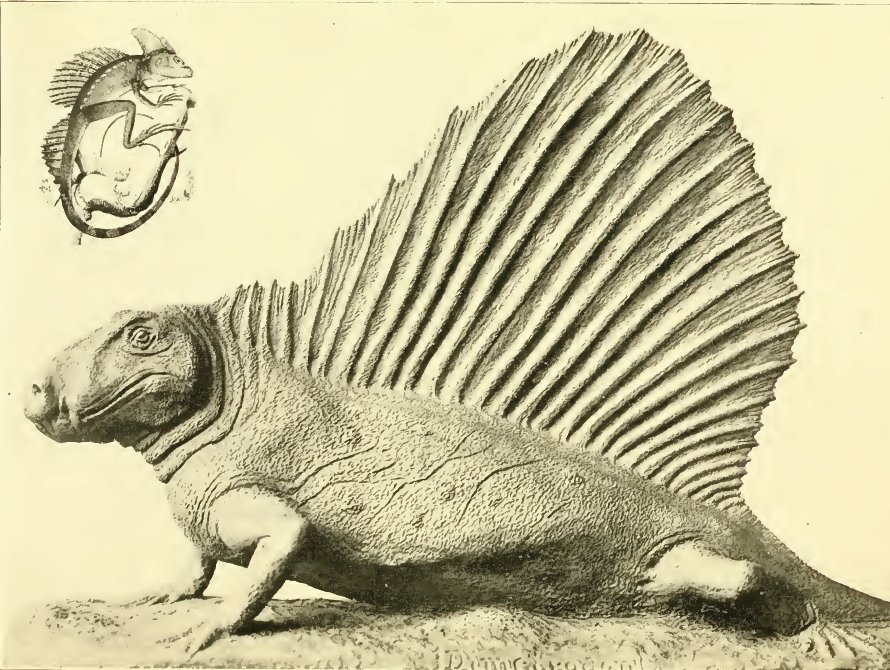
Gilmore also sculpted some non-dinosaurs, including at least one prehistoric horse and the Dimetrodon pictured above. Note the teensy stub of a tail, which this model actually shared with Gilmore’s mount of the pelycosaur. The lips obscuring most of the teeth except for a couple incisors is an unusual choice, and I’m not sure what inspired it. This image is from Gilmore’s 1939 paper on Dimetrodon, and the Basiliscus basiliscus in the corner provides a helpful comparison to a contemporary animal with a similar dorsal sail.

In addition to the models shown here, Gilmore created sculptures of “Anatosaurus”, “Brachyceratops” and a Cenozoic horse, as well as busts of Styracosaurus and Corythosaurus (and there may well have been others I haven’t seen). As mentioned, copies of these mounts were distributed to museums and possibly private collections throughout the 20s and 30s, and I have no idea how many were actually made. A few museums, such as the Sternberg Museum, actually have these models on display, but at other institutions they have been relegated to storage. Objects like these present an unusual challenge for collections managers. They were accessioned as scientific representations, but their value has shifted over the last century to the realm of art and history. While these models are undoubtedly important, they are probably no longer useful at many of the institutions that hold them. As such, the Gilmore models exemplify that museum collections are not necessarily static, but change in meaning as the years go by.

If you work at an institution that has one or more Gilmore models in its collection, feel free to leave a comment. I’d love to start a working database of where copies of these models have ended up!

References

Gilmore, C.W. (1939). “A Mounted Skeleton of Dimetrodon gigas in the United States National Museum, with Notes on the Skeletal Anatomy.” Proceedings of the US National Museum 56:2300:525-539.

Gilmore, C.W. (1932) “On a newly mounted skeleton of Diplodocus in the United States National Museum.” Proceedings of the United States National Museum 81:1-21.

11 Comments

Filed under collections, dinosaurs, history of science, NMNH, paleoart, reptiles

The Osborn problem

In both paleontology and the museum field, we’ve long contended with what one might call “the Osborn problem.” The legacy of Henry Fairfield Osborn, paleontologist and president of the American Museum of Natural History between 1908 and 1933, is quite important to both fields.  To paleontologists, he is known for accumulating at AMNH one of the largest and most exhaustive fossil collections in the world,  for financing and supporting the careers of legends like Barnum Brown and Charles R. Knight, and of course for naming and describing saurian celebrities like Tyrannosaurus and Velociraptor.

Osborn is also well-regarded by museum specialists for heightening the standards for public exhibitions, investing in lifelike habitat dioramas of taxidermy animals and spectacular mounted dinosaur skeletons in order to make science exciting for a wide audience. Osborn’s devotion to storytelling and drama in the exhibits he curated brought millions of visitors to AMNH and quite literally defined public expectations for what museums should offer to this day.

Henry Fairfield Osborn.

Henry Fairfield Osborn.

In recent decades, however, historical interest in Osborn has been mostly focused on his disreputable personal and political beliefs: Osborn was a flagrant racist and anti-Semite,  an admirer of Adolf Hitler and a strong supporter of research in eugenics. Osborn regularly used his clout to bring material harm to the American working class, lobbying for legislation including the Emergency Quota Act and the Immigration Act of 1924. For what it’s worth, Osborn was also apparently unbearably arrogant and truly dreadful to work with, going as far as to demand lower-ranked museum employees leave the elevator car when he got on.

All this puts paleontologists and museum specialists in an awkward position. Is it acceptable to admire Osborn’s positive achievements in light of his personal politics? After all, Osborn’s views were not terribly unusual among the aristocratic class of his day. Perhaps we shouldn’t condemn the man entirely for not “rising above his time and place” (as Stephen Ambrose argues regarding coming to terms with Thomas Jefferson the slave owner).

Unfortunately, Osborn’s case is complicated by the fact that his bigotry inspired (or at least contributed to) much of his work at AMNH*. To start, Osborn’s scientific work was based on an inaccurate orthogenetic interpretation of evolution. He professed that an ill-defined guiding force shaped life from lesser to greater forms, the effect of which could be seen by comparing “primitive” and “advanced” species, and of course, “primitive” and “advanced” expressions of humanity. While we cannot conclusively link Osborn’s pseudo-evolutionary ideas with his bigoted social agenda, it is certainly convenient for him that he saw people of “Nordic” descent as biologically superior.

*To clarify, none of the exhibits curated by Osborn remain on display and none of my comments here apply to the present day AMNH.

Critically, Osborn did not keep his ideas of natural hierarchy in the ivory tower. He explicitly intended that the exhibition halls of AMNH educate visitors not just about natural science but about the naturally graded order he believed to be characteristic of life on earth. Osborn thought that collections of biological specimens implicitly revealed an upward ascent of life, and that those on top had earned their place through innate superiority. Osborn pronounced that his exhibits would teach morality to new American immigrants, presumably by putting them in their place with the rather hideous racial hierarchy on display in the Hall of the Age of Man. As Donna Haraway puts it in her classic essay Teddy Bear Patriarchy, Osborn’s exhibits were a “gospel of wealth and privilege” that appropriated natural specimens to affirm the American elite’s place at the top of the pecking order.

Tyrannosaurus and others in AMNH Dinosaur Hall, 1927. Photo courtesy of AMNH Research Library.

Tyrannosaurus and others in AMNH Dinosaur Hall, 1927. Photo courtesy of AMNH Research Library.

Museums are understood to be sources of intellectual authority, and deservedly so. But exhibits have authorship, same as any other written work, and Osborn’s legacy demonstrates that the influence of authors and their worldviews can be a powerful force. For example, Osborn arranged the Hall of the Age of Man in what he saw as ascending order, from the ancient peoples of Africa, to North America, and finally Europe. Placed at the end of an exhibit series that started with Cambrian invertebrate fossils before passing through Paleozoic, Mesozoic, and Cenozoic fossil displays, the Age of Man gallery deliberately implied that European-descended humans were the culmination of the entire history of life on Earth.

Meanwhile, the exhibit on fossil horses curated by Osborn depicted small, multi-toed horses of the Eocene gradually becoming larger, losing toes and becoming better at being modern Equus. This orthegenetic representation runs counter to evolution via natural selection as originally proposed by Darwin, and as understood today. Indeed, other paleontologists, including O.C. Marsh, had established in the 19th century that horse evolution more closely resembled a tangled bush, with many overlapping morphological offshoots adapted to varying environmental circumstances. But Osborn had rejected Darwinian evolution in favor of his presumed hierarchy of life, and ensured that his inaccurate story was what was seen by millions of visitors.

So what does Osborn’s legacy mean to paleontologists and museum specialists today? Do we need to qualify every mention of his name with a denouncement of his worldview? Should we always write out “Tyrannosaurus rex Osborn, 1905″ as “Tyrannosaurus rex Osborn the racist jerk, 1905″? At minimum, Osborn’s exhibits are a sobering reminder to all us involved in science education that our field is not immune to bias. The  subjectivity of cultural and historical museum exhibits has been well-explored by scholars like Ames and Weil, but comparatively little reflection has been done on the authorship of exhibits on science and natural history. We rely on the “naturalness” of the objects we display to speak for itself, and to bear the burden of proof for the statements we make. The world around us is knowable, and science is the best tool to learn about it. But explaining what we have learned in any form (books, technical journals, museum exhibits) is an avenue for personal or cultural bias to slip in, and that is why it remains important to actively and regularly check our assumptions.

References

Ames, M.M. (2004). Museums in the Age of Deconstruction. In Reinventing the Museum: Historical and Contemporary Perspectives on the Paradigm Shift. Lanham, MD: AltaMira Press.

Brinkman, P.D. (2010). The Second Jurassic Dinosaur Rush: Museums and Paleontology in America at the Turn of the Twentieth Century. Chicago, IL: University of Chicago Press.

Colbert, E.H. (1968). Men and Dinosaurs: The Search in Field and Laboratory. New York, NY: E.P. Dutton and Co., Inc.

Haraway, D. (1984). Teddy Bear Patriarchy: Taxidermy in the Garden of Eden, New York City, 1908-1936. Social Text 11:20-64.

Kohlstedt, S.G. (2005). Thoughts in Things: Modernity, History and North American Museums. Isis 96:586-601.

Osborn, H.F. (1921). The Hall of the Age of Man in the American Museum. Nature 107:236-240.

6 Comments

Filed under AMNH, anthropology, history of science, mammals, museums, science communication