Monthly Archives: April 2015

Permo-Triassic Synapsids at NMNH

Click here to start the NMNH series from the beginning.

In the middle decades of the 20th century, museum theory and paleontological science were undergoing complementary revolutions. Museum workers shrugged off their “cabinet of curiosity” roots and embraced visitor-centric, education-oriented exhibits. Designers began to envision the routes visitors would travel through an exhibit space, and consider how objects on display could contribute to holistic stories. Meanwhile, paleontologists like Stephen J. Gould and David Raup moved their field away from purely descriptive natural history, exploring instead how the fossil record could inform our understanding of evolution and ecology. The common thread between both transitions was a focus on connections – bringing new meaning and relevance to disparate parts by placing them in a common narrative.

Between 1953 and 1963, the Smithsonian implemented an institution-wide modernization program, transforming virtually every exhibit in the museum complex. The National Museum of Natural History began renovations to its classic fossil halls in 1959, and the new exhibits were emblematic of contemporary trends in both museum design and paleontology. The plan, as devised by exhibit designer Ann Karras, was to do away with the loose arrangement of specimens and turn the east wing into a guided narrative of the biological and geological history of Earth. Responsibility for selecting specimens and writing label copy in each of the four halls fell to a different curator. In Hall 2, which housed dinosaurs and fossil reptiles, that curator was Nicholas Hotton.

Layout of the USNM east wing, circa 1963.

Layout of the NMNH east wing as of 1963.

Hotton joined NMNH in 1959 as an Associate Curator of Paleontology. Entirely onboard with Karras’s vision and the paleobiology movement as a whole, Hotton described the old exhibits as “crowded” and “unorganized.” He thought NMNH had plenty of dinosaurs, but “mammal-like reptiles”* were sorely needed if Hall 2 was to tell the complete story of amniote evolution. Following that, Hotton’s mission over the next several years was to assemble a respectable collection of synapsid specimens for NMNH, and to incorporate them into a well-illustrated exhibit on the origins of mammals. This post highlights just a few of the specimens featured in Hotton’s version of Hall 2.

*In Hotton’s day, early mammalian relatives were usually called “mammal-like reptiles”, hence their inclusion in the fossil reptile exhibit. Today, most specialists prefer a more precise definition of reptiles that excludes synapsid (mammal-line) animals. In this post, I will be using the modern classification wherever possible. 

The Dimetrodon

Prior to 1960, the non-mammalian synapsid collections at NMNH were mostly limited to early Permian pelycosaurs. The most impressive of these was a Dimetrodon gigas collected in 1917 by independent fossil hunter Charles Sternberg. One of the best collectors of his day, Sternberg worked intermittently for E.D. Cope, O.C. Marsh, and various North American museums. In the summer of 1917, however, Sternberg was on a personal collecting trip with his son Levi. Their target was the Craddock Ranch bone bed of Baylor County, Texas, which was first explored in 1909 by a University of Chicago team. Sternberg was already quite familiar with this part of western Texas, having made some of the first thorough surveys of the Permian “red beds” in the 1880s, but the site itself was new to him. Nevertheless, Sternberg was extraordinarily successful that summer, collecting hundreds of fossils from a wide range of animals. He offered this bounty to the Smithsonian, and they purchased it from him immediately.

The Craddock Ranch fossils were particularly appealing because of their unique preservation. Buried in soft clay at the bottom of a shallow pond, the fossils could be removed from the ground with relative ease, and were largely free of encrusting matrix. Although few of the bones were articulated, many were identifiable. All told, the Sternberg collection included at least 35 skulls and partial skeletons from amphibians like Cardiocephalus, Diplocaulus, and Seymouria, plus hundreds of individual Dimetrodon bones, and a single articulated Dimetrodon specimen.

Note short tail

An early photograph of the Dimetrodon mount. Image from Gilmore 1919.

Dimetrodon first displaed on north wall

The Dimetrodon was first displayed on the north wall of the Hall of Extinct Monsters. Source

That Dimetrodon (USNM 8635) was the basis for a mount constructed by T.J. Horne. The articulated skeleton included a complete series of presacral vertebrae, the shoulder girdles, most of the forelimbs, and the left femur and tibia. The skull and jaw bones were found disarticulated, but bound together in the same mass of matrix as the skeleton. Horne added the pelvic bones and sacrum from smaller Dimetrodon specimens, and sculpted the rest of the missing material in plaster to complete the mount. Notably, his reconstructed tail was extremely short and stubby. Although the American Museum and Field Museum already had Dimetrodon mounts on display, the NMNH version stood out because of its open jaws, which Charles Gilmore said “gives the animal an appearance of angrily defying one who has suddenly blocked his path.”

Gilmore added the Dimetrodon to the Hall of Extinct Monsters in 1918. Like the other standing mounts constructed under Gilmore’s supervision, the skeleton was placed on a base textured and painted to resemble the rocks in which it was found. At this point in time, the NMNH fossil halls lacked any overarching organizational scheme, and interpretive content was minimal. Nevertheless, Gilmore displayed the Dimetrodon mount with both a small model and a 15-foot oil painting by Garnet Jex, which provided general audiences a better understanding of the animal’s life appearance.

dimetrodon

Dimetrodon in the 1963 fossil reptiles exhibit. Image courtesy of the Smithsonian Institution Archives.
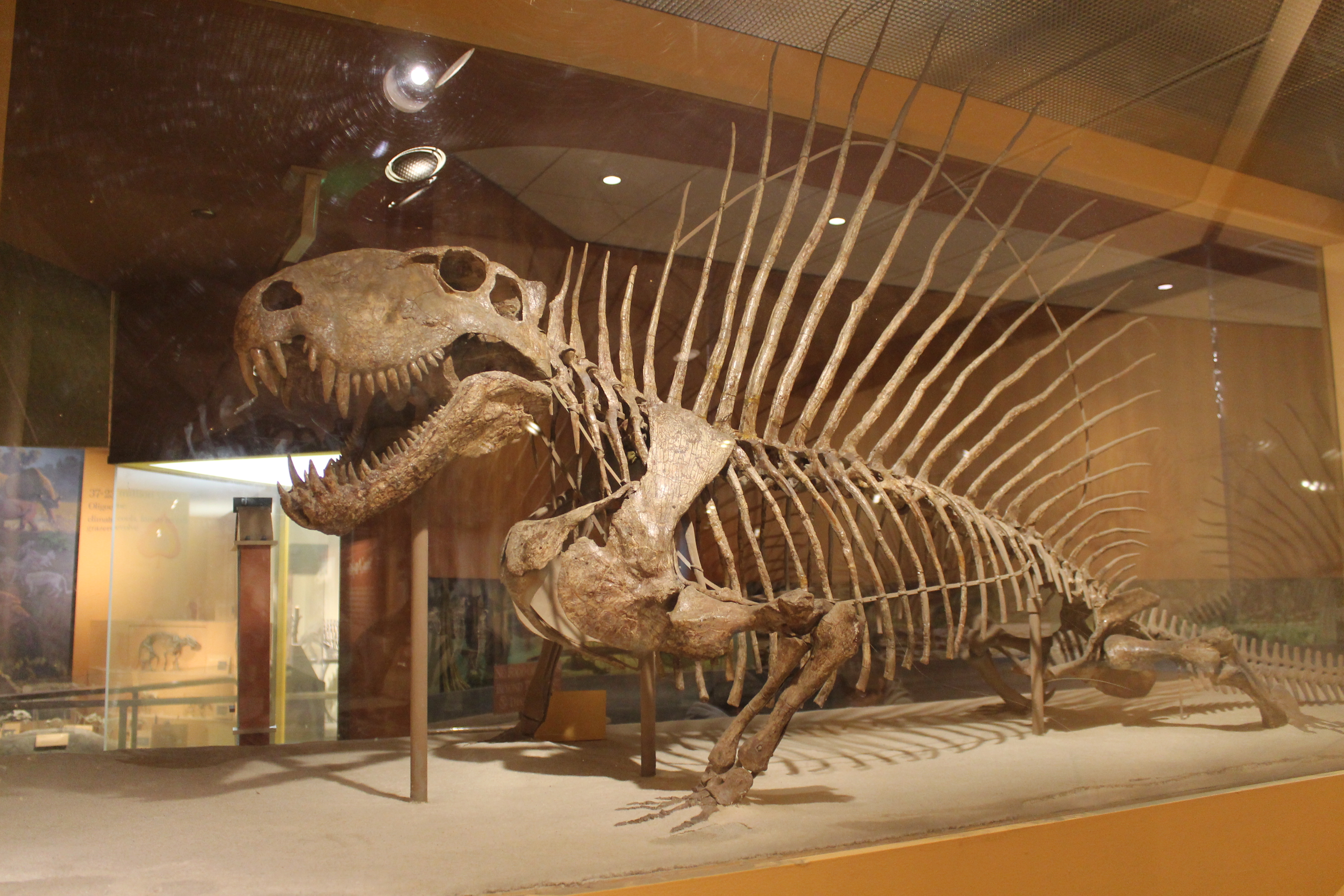
Dimetrodon in 2014. Photo by the author.

Dimetrodon after the 1981 renovation. Photo by the author.

During the 1962 renovation, Hotton re-contextualized the classic Dimetrodon mount as a mammal ancestor. Unmissable orange arrows pointed to the specific anatomical traits that signify the animal’s kinship with mammals, including heterodont teeth and a single temporal fenestra. By design, visitors would pass Dimetrodon before visiting the true mammals in the adjacent hall.

The Dimetrodon skeleton itself was altered during the next renovation in 1981, when it was placed on a new, untextured base and given a longer replica tail. Contemporary staff also repainted the plaster sections to more closely resemble the original fossils – a surprising reversal of Gilmore and Horne’s original intention to make the reconstructed bones obvious to viewers.

The Thrinaxodon

Pelycosaurs like Dimetrodon represent the first major synapsid radiation, but by the middle Permian they were almost entirely replaced by therapsids. A more derived group which includes modern mammals, therapsids spread across the globe and became increasingly diverse as the Permian progressed. From weasel-sized burrowers to multi-ton herbivores, non-mammalian therapsids were among the first animal groups to conquer a wide range of terrestrial niches. Hotton wanted to tell this story in the modernized fossil exhibit, but there were hardly any non-mammalian therapsids in the NMNH collections. To correct this problem, Hotton took to the field for several months in 1960, and again in 1961. He joined James Kitching in exploring the Beafort Group rocks of South Africa, which were known to produce plentiful Permian and Triassic vertebrate fossils. Hotton returned to the museum with over 200 new specimens, the best of which were used in the renovated exhibit.

Hotton’s display of South African synapsids and amphibians. Note “Baby Doll” on the far left. Photo courtesy of the Smithsonian Institution Archives.
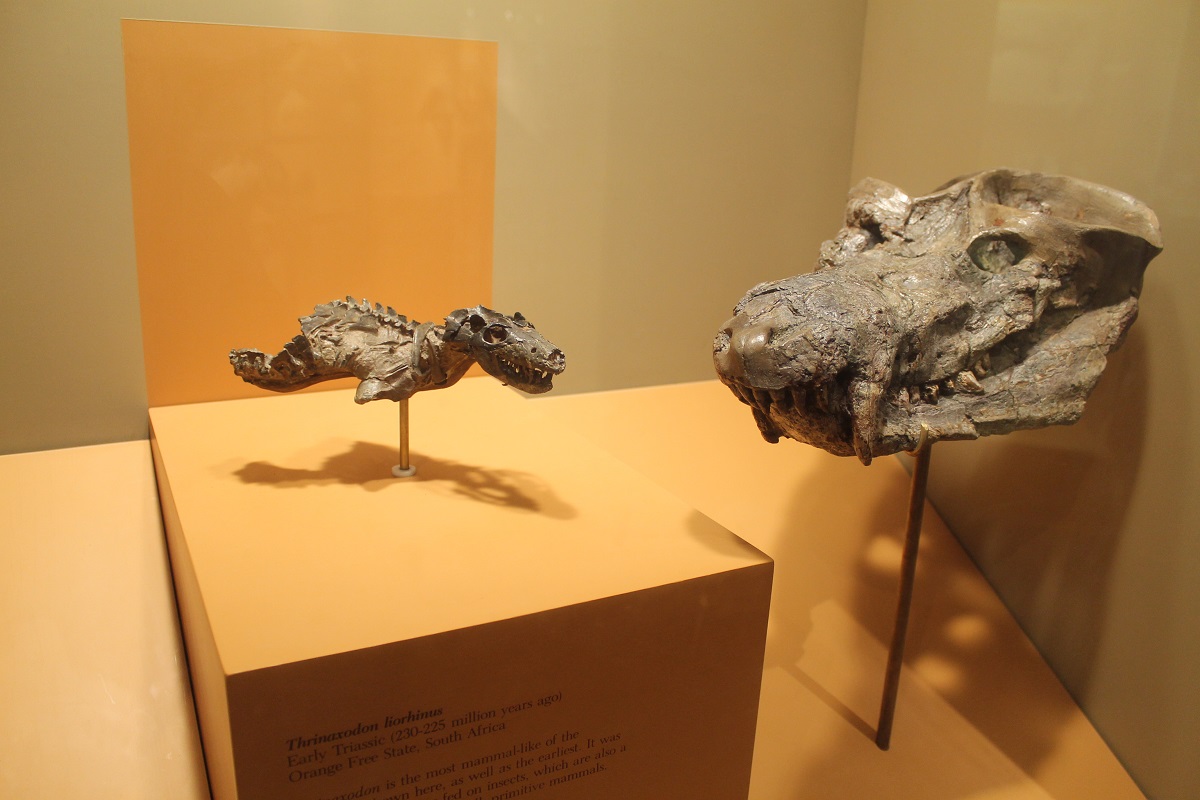
Thrinraxodon with Cynognathus skull

Thrinaxodon paired with Cynognathus skull. Photo by the author.

Hotton’s most prized find from South Africa was a gorgeously preserved and nearly complete Thrinaxodon liorhinus (USNM 22812). Hotton called this specimen “Baby Doll”, and while it was not prepared in time for Hall 2’s 1963 opening, it would later earn a spot of honor in the exhibit. Before that happened, though, Baby Doll was actually stolen by an over-enthusiastic volunteer. The FBI located and returned the fossil a year and a half later.

Since the 1980s, the Thrinaxodon has been displayed alongside the skull of Cynognathus crateronotus (USNM 22813), which Hotton collected on the same expedition. Both are members of the cynodont clade, which includes some of the closest relatives of modern mammals.

 The Daptocephalus

Less than a month after hall 2 reopened, Nicholas Hotton returned to South Africa. This time, he was accompanied by his spouse Ruth Hotton and their three young children. For seven months, the Hottons traveled among fossil sites on different ranches, camping most nights. They collected some 300 specimens for the Smithsonian, and Hotton’s biostratigraphic mapping of the Beaufort Group brought a measure of clarity to this region’s historically convoluted geology.

Ruth Hotton made one of the trip’s most impressive finds while prospecting in a dry riverbed with her daughter, Carol (who is now a paleobotanist at NMNH). Turning a corner, she stumbled upon a dicynodont skeleton, completely exposed and lying in the middle of the channel. One can only imagine the surprise and delight of finding an articulated fossil skeleton completely uncovered. If the Hottons had been there one season earlier or one season later, the river would have undoubtedly destroyed the fossils.
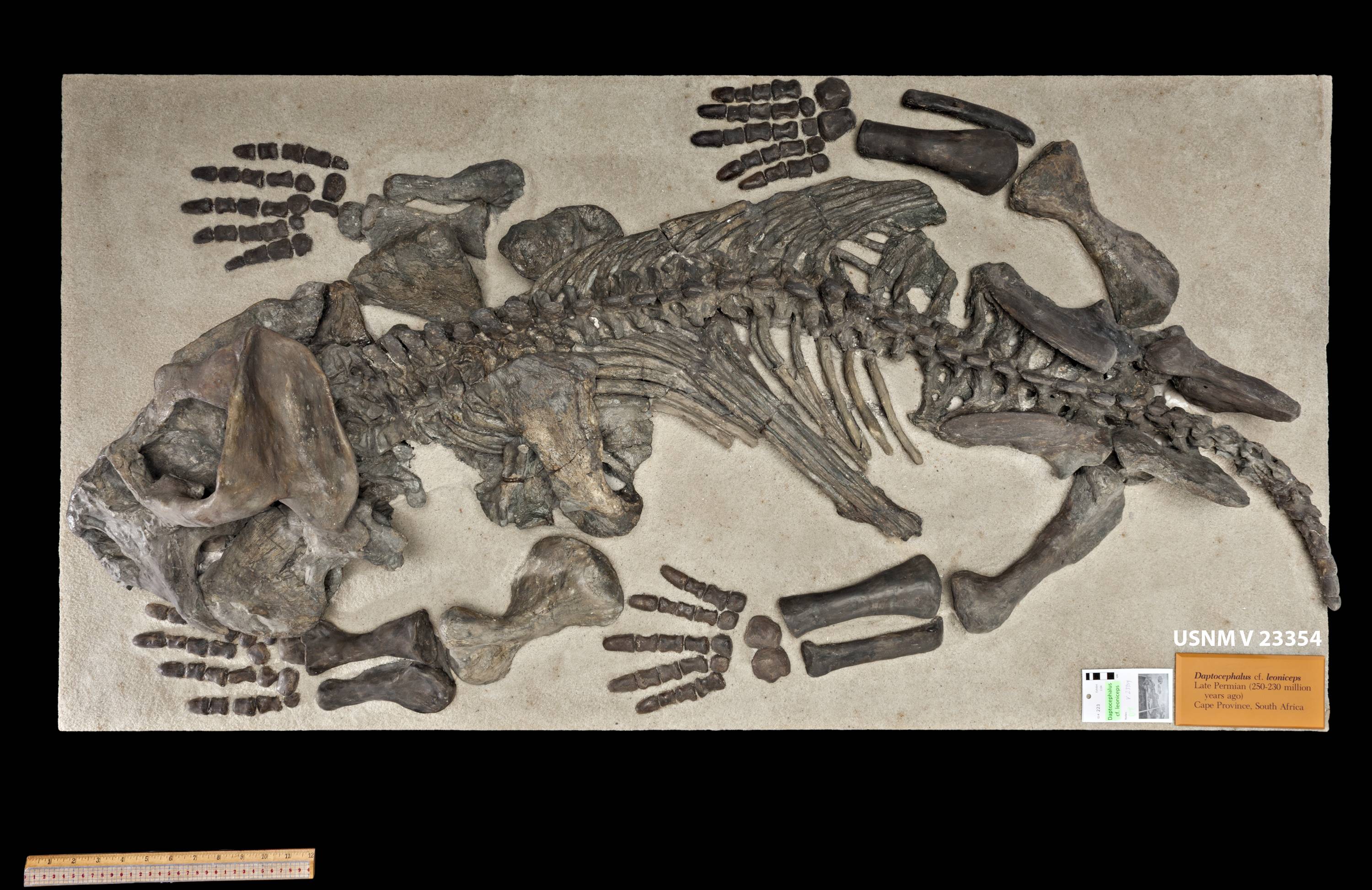
Daptocephalus on display. Photo by James Di Loreto, National Museum of Natural History.

Back at the museum, Nicholas Hotton prepared the specimen (USNM 299746) and determined it to be Daplocephalus leoniceps, one of the plethora of dicynodonts known from the Beaufort Group. Based on this classification, he reconstructed the damaged skull to resemble more complete Daplocephalus specimens, and added casts of Daplocephalus limbs.
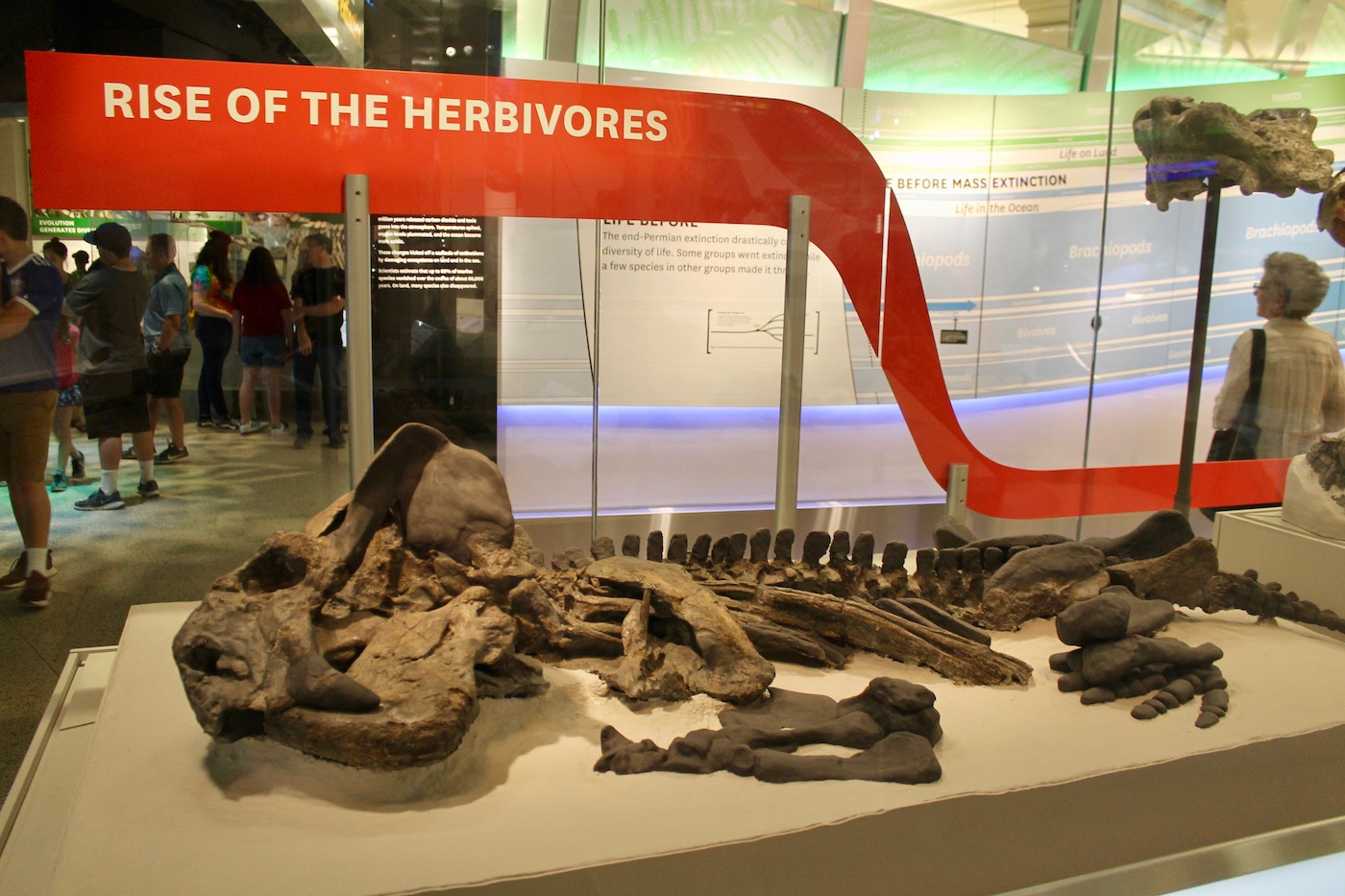
The specimen was restored in 2019 and is now labeled Platypodosaurus. Photo by the author.

As it turns out, however, USNM 299749 is not a Daplocephalus—it is a somewhat distantly related dicynodont currently called Platypodosaurus. To varying degrees, fossil mounts are hypotheses made of bone and plaster. They are based on the best information available at the time, but sometimes they need to be corrected. The NMNH “Daplocephalus” had been mislabeled and erroneously reconstructed for many years, but the 2014 renovation of the NMNH fossil halls now presented an opportunity to deconstruct the specimen and study it up close. As of 2019, Platypodosaurus was back on display with a newly reconstructed skull and limbs.

Thanks to Christian Kammerer for kindly sharing images and insight on “Daptocephalus”!

References

Gilmore, C.W. (1919). A Mounted Skeleton of Dimetrodon gigas in the United States National Museum, with Notes on the Skeletal Anatomy. Proceedings of the United States National Museum 56:2300:525-539.

Kammerer, C. (2015). Personal communication.

Lay, M. (2013). Major Activities of the Division of Vertebrate Paleontology During the 1960s. http://paleobiology.si.edu/history/lay1960s.html

Marsh, D.E. (2014). From Extinct Monsters to Deep Time: An ethnography of fossil exhibits production at the Smithsonian’s National Museum of Natural History. http://circle.ubc.ca/handle/2429/50177

Sepkoski, D. (2012). Rereading the Fossil record: The Growth of Paleobiology as an Evolutionary Discipline. Chicago, IL: The University of Chicago Press.

4 Comments

Filed under exhibits, Extinct Monsters, field work, fossil mounts, history of science, mammals, museums, NMNH

Fossil sandboxes are terrible

Are these kids learning yet?

Are these kids learning yet? Source

Today, I need to take a moment to rail against one of the most reliably entertaining and beloved of museum attractions – fossil sandboxes. These activities are nearly ubiquitous at paleontology-related parks and museums, and some of them can be quite large and elaborate. There are a few variations, but they generally involve children using simple hand tools to dig through sand or loose gravel to uncover planted fossils (usually replicas, but I’ve seen a few places sacrifice real Pleistocene bones for this activity). Kids and families absolutely adore fossil sandboxes, and they generate all kinds of goodwill for the museums that feature them. In fact, many visitors have come to expect sandbox digs at paleontology exhibits, and become annoyed when one isn’t available.

I understand the appeal of sandboxes. For kids, they’re an opportunity to play pretend, engage in a physical activity after a day of looking at stuff, and generally have fun making a mess. Museum educators, myself included, are all about Gardner’s theory of multiple intelligences – the idea that different people learn best in different ways. While some easily absorb and retain information by reading or listening quietly, others prefer to solve a problem, talk through a topic with others, or engage in some sort of hands-on activity. That last one is called bodily-kinesthetic intelligence, and it is common among athletes and actors, among others. A fossil sandbox allegedly provides an activity for bodily-kinesthetic learners to develop and hone a physical skill related to the topic at hand. Kids get a chance to see and feel what it’s like to be a real paleontologist working in the field.

Except not really. A sandbox focuses kids’ attention, but that’s not the same thing as learning. What they’re doing has virtually nothing to do with actual paleontology. Digging is a comparatively minor part of field work – far more time is spent prospecting for fossils. When a team does start excavating, it’s conducted in a precise and organized manner, so that no taphonomic data is lost. By comparison, the sandbox arrangement conjures ideas of frantic treasure hunting, rather than piecing together and interpreting clues about past life. Furthermore, digging through loose sand is exceedingly rare in the field. If it were so easy to get at fossils, they would either have been found already or would have eroded away to nothing. A simulation is supposed to model a real event, or constrain that event to a limited set of variables. Sandbox digs do neither. Parents and caretakers might appreciate a place where kids can entertain themselves for a while, and educators can pat themselves on the back for providing a physically-involved experience. But there’s no use pretending that anybody is learning in what amounts to a themed playpen.

One alternative to the sandbox concept is provided by Thistle. He describes an activity in which he sets up a series of square meter “dig sites” within a room. Different specimens or artifacts are placed in each square. Participating students are then told that each square represents what was found in a layer of excavation, and are prompted to draw conclusions based on the different objects recovered from different strata. Students consider the spatial relationships among found objects, and discuss the roles of taphonomy and deep time. Unlike a sandbox dig, the results of this activity are comparable to those of a real excavation, and students are asking the same sorts of questions paleontologists would. Granted, Thistle’s activity requires much more guidance than a sandbox, but it’s a good example of something that participants might actually learn from.

The point is, we owe our audiences more than a mindless diversion with no bearing on actual science. And for that matter, we owe the scientists whose work we’re communicating more than a tacky, inaccurate simulation. If our goals are to inspire enthusiasm for science and to encourage young visitors to think scientifically, surely we can do better than a sandbox dig.

References

Thistle, P.C. 2012. Archaeology Excavation Simulation: Correcting the Emphasis. Journal of Museum Education 37:2:65-76.

6 Comments

Filed under education, exhibits, field work, museums, opinion, science communication

History of the AMNH Fossil Halls – Part 2

Start with History of the AMNH Fossil Halls – Part 1.

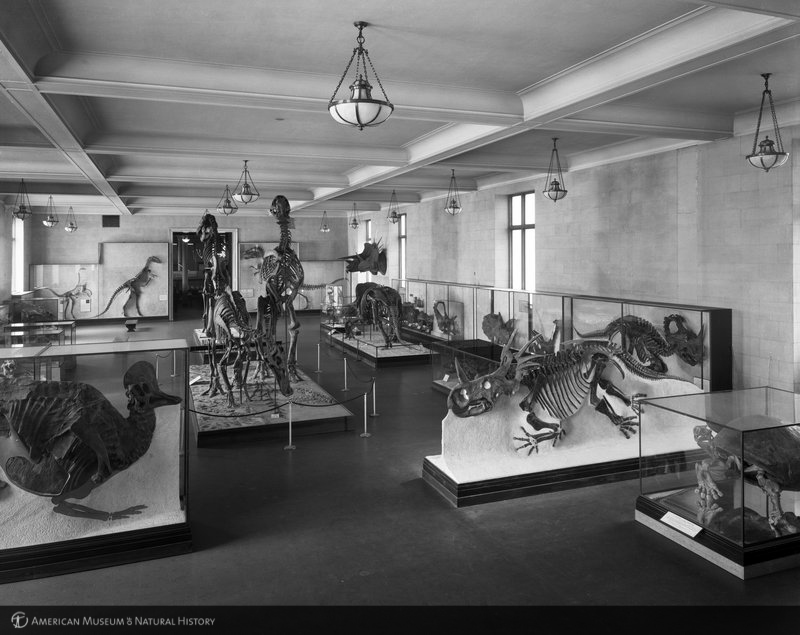
During his leadership of the American Museum of Natural History’s Department of Vertebrate Paleontology and later, the museum at large, Henry Osborn oversaw an unprecedented expansion of the institution’s paleontology exhibits. As fossils poured in from the Department’s international collecting expeditions, these displays expanded into five separate galleries on the museum’s fourth floor. During the first two decades of the 20th century, AMNH staff was installing newly prepared and mounted specimens every single year, and AMNH was the undisputed center of American vertebrate paleontology. The increasingly marginal role of descriptive natural history in the greater field of biology at this time made the scale of Osborn’s program all the more impressive.

Nevertheless, this golden age of fossil exhibits would not last forever. Osborn supported the expensive expeditions and monumental displays through his personal connections with wealthy benefactors. The combination of the Great Depression and Osborn’s death in 1933 all but eliminated this source of income, and the museum had to scale back its activities considerably. In 1942, the Department of Vertebrate Paleontology was dissolved. Paleontology work continued under the Department of Geology, but with only a fraction of its former staff and budget.

Phase IV: 1940 – 1955

amnhmap_1939

In the post-Osborn era, responsibility for the fourth floor exhibits deservedly transferred to Barnum Brown. Indeed, Brown’s adventures as a swashbuckling fossil hunter not only brought him personal fame, but made the museum’s world-class paleontology exhibits what they were. Of the 36 dinosaurs on display by 1939, no less than 27 had been discovered by Brown. Most of these iconic finds were made in his 20s and 30s, but Brown nevertheless remained at AMNH for most of his life. Even after officially retiring in 1943, Brown still frequented the museum, often giving spontaneous personal tours of the exhibits.

brown's jurassic hall

Brown’s Jurassic Hall, around 1940. Photo from Dingus 1996.

In 1932, the architectural firm Trowbridge and Livingston completed the 13th building in the AMNH complex. This meant that for the first time, the paleontology exhibits formed a complete circuit, an arrangement that persists to this day. Brown opted to spread the dinosaurs into two halls, making the new space the Jurassic Hall and converting the Osborn-era Great Hall of Dinosaurs into the Cretaceous Hall. Several existing fossil mounts had to be moved as a result, including the massive “Brontosaurus.”  Eyeballing the widths of the doorways and corridors separating the present day Hall of Saurischian Dinosaurs (formerly the Jurassic Hall) and Hall of Ornithiscian Dinosaurs (formerly the Cretaceous Hall and Great Hall of Dinosaurs), it’s difficult to imagine how museum staff could have moved the 66-foot sauropod in one piece. This photograph suggests that the skeleton was divided into several sections, which then had to be brought down the freight elevator on one side of museum and carted around to an elevator on the other side. This would be the third and final position for the “Brontosaurus” – even when the mount was updated  in 1995, preparators left the torso and legs in place.

brown's cretaceous hall

Brown’s Cretaceous Hall, around 1939. Photo courtesy of the AMNH Research Library.

The 1930s and 40s saw a number of new dinosaur mounts added to the displays, nearly all of which were discovered by Brown. The new Jurassic Hall gained a Stegosaurus and Tenontosaurus (oddly, not a Jurassic dinosaur), and the Cretaceous Hall gained Brown’s astonishingly intact Centrosaurus, Corythosaurus, and Styracosaurus from Alberta.

Phase V: 1956 – 1990

amnhmap_1956

Edwin Colbert joined AMNH in 1930 as Osborn’s assistant (he called this “a time of experiences and incidents,” whatever that means). Eventually rising to Curator of Vertebrate Paleontology, Colbert was one of only a handful of mid-century researchers studying dinosaurs. He is also notable for his public outreach — in collaboration with his partner, Margaret Colbert, he wrote more than 20 popular books about paleontology.

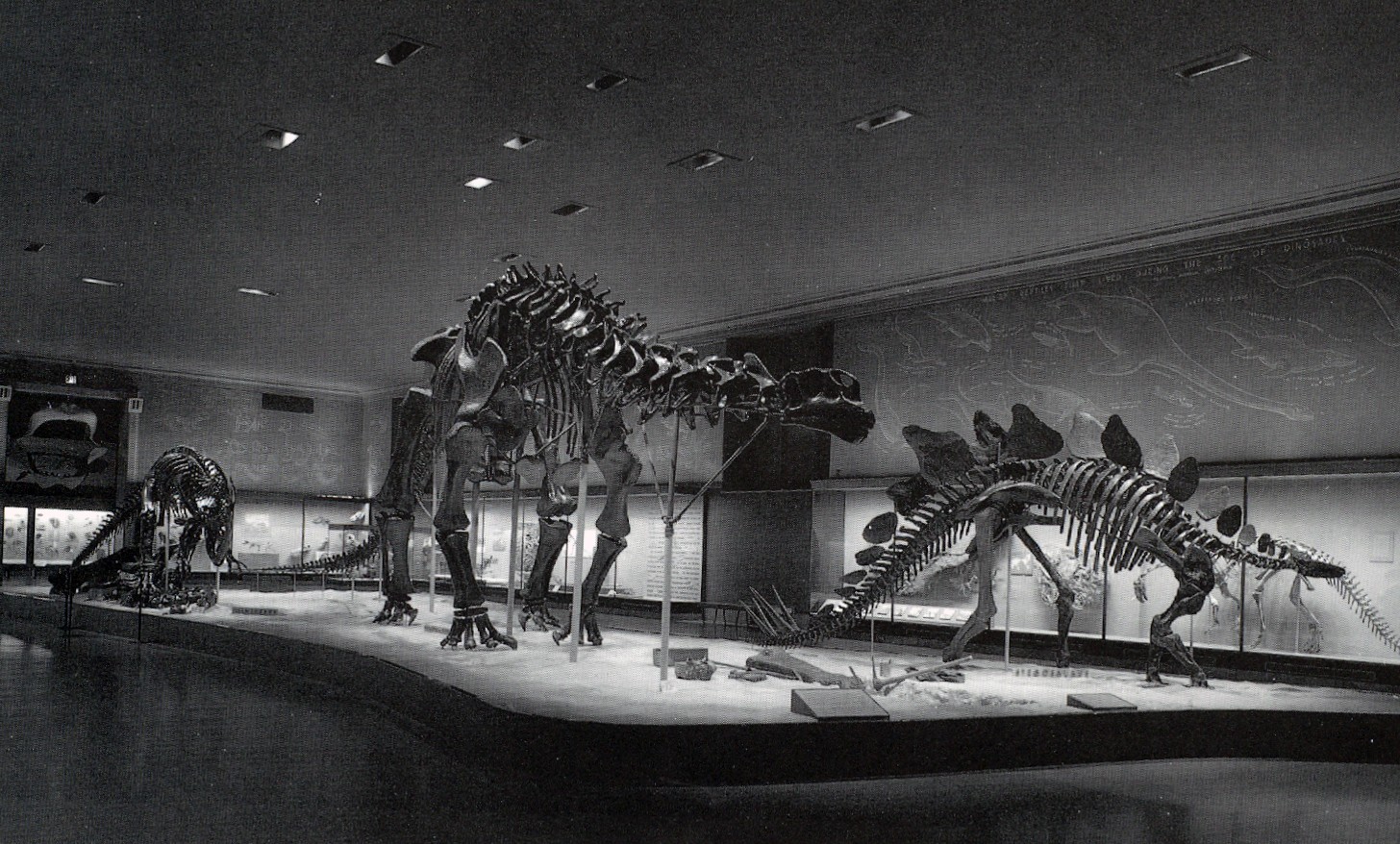
In 1953, Colbert worked with exhibit specialist Katharine Beneker to redesign the Jurassic and Cretaceous Halls. The Jurassic Hall received the most dramatic aesthetic makeover — windows were covered up to create a “black box” effect, while the dinosaur mounts were illuminated dramatically from above and below. The most significant addition to this space wasn’t a standing mount, but a trace fossil. Exhibit developers incorporated several slabs of sauropod tracks (collected at the Paluxy River in Texas by Roland T. Bird) into the central pedestal, as though left behind by the “Brontosaurus.” Cemented together, the slabs weighed 22 tons — apparently nobody expected that they would ever need to be moved. The fossil fish alcove, formerly part of the 1905 Hall of Fossil Reptiles, also found a home in this space.

In stark contrast to the Charles Knight oil and watercolor murals commissioned by Osborn, Colbert elected to decorate the Jurassic Hall with a series of understated chalk drawings. Joseph Guerry created the illustrations, which was then projected onto the walls and traced in chalk. The initial plan was to paint over the chalk outlines, but Colbert enjoyed the blackboard-like look and left them as they were. The exhibit team didn’t even add fixative, since it would have turned the lines an unpleasant yellow.

Jurassic hall colbert. Photo from Dingus 1996.

The Jurassic —or Brontosaur— Hall opened in 1953. Photo from Dingus 1996.

Architectural modifications to the Cretaceous Hall were minimal, although the standing dinosaur mounts were all clustered onto a single platform. Interestingly, both the National Museum of Natural History and the Peabody Museum of Natural History would arrange their dinosaurs in precisely the same way within the decade. While it’s possible that these museums were copying AMNH, this similarity is probably a reflection of the transition to more holistic natural history displays that was occurring in museums nationwide. Rather than displaying specimens individually, exhibit designers in the 1950s and 60s began to arrange them in meaningful ways — for example, grouping animals with a shared habitat. The Cretaceous Hall also gained some new specimens, including an array of Protoceratops skulls recovered during the Central Asiatic Expeditions. Signs and labels were updated with more approachable language, once again reflecting contemporary museum theory.

The Cretaceous —or Tyrannosaur— Hall opened in 1954. Photo courtesy of the AMNH Research Library.

Meanwhile, some of the oldest AMNH fossil exhibits were retired and replaced during this period. In 1961, the classic geology hall — the oldest exhibit on the fourth floor — became the research library and was closed to regular museum visitors. Its spiritual successor was the new Earth History exhibit, which replaced Osborn’s Hall of the Age of Man. Around the same time, George Gaylord Simpson curated what was colloquially known as the “Sloth Hall.” Occupying the space that was once the Hall of Fossil Reptiles, this exhibit featured ground sloths and glyptodonts, plus a sizable display demonstrating how fossils are collected and prepared. Only the Hall of Fossil Mammals remained ostensibly untouched during this wave of modernization.

The Hall of Advanced Mammals in 1982. Some sections were boarded up but remaining exhibits were virtually unchanged from the turn of the century. Photo courtesy of the AMNH Research Library.

The 1950s and 60s iterations of the AMNH fossil halls endured for 30 years, making them the longest-lasting versions to date. Displays like the “Brontosaurus” and Tyrannosaurus became immutable symbols for the institution, visited again and again by generations of museum-goers. However, time gradually took its toll. A large section of the Hall of Fossil Mammals was boarded up, since museum staff had removed so many specimens for study or conservation. Railings were eventually added to the Jurassic Hall, because it was too tempting for visitors to join the dinosaurs on the platform, Ke$ha-style.

The Brontosaur Hall in 1988. Photo courtesy of the AMNH Research Library.

Most importantly, the exhibit content became increasingly out-of-date with each passing year. This obsolescence permeated nearly every aspect of the exhibits, from the discussion of the dinosaurs’ extinction to the drab, earth-tone aesthetics. However, the most visibly antiquated elements were the fossil mounts themselves. A new wave of dinosaur research demonstrated that these animals had been active and socially sophisticated, a far cry from the the coldblooded tail-draggers that populated the galleries. AMNH had once been the center of American paleontology, but by the late 1980s its dated displays were lagging far behind newer museums.

Phase VI: 1995 – Present

amnhmap_1995

Between 1987 and 1995, Lowell Dingus coordinated a comprehensive, $44 million renovation of the AMNH fossil exhibits (previously discussed here and here). The original plan was to renovate only the Hall of Fossil Mammals, since it had remained largely unaltered since 1895. Within a year, however, the project had expanded to encompass all six halls on the fourth floor, telling the entire story of vertebrate evolution. Two primary goals originated very early in the planning process. First, the “walk through time” layout would be replaced with one rooted in phylogenetic classification. The cladistic methodology for tracing organisms’ evolutionary history became the central theme that unified the new exhibits. This required a fairly substantial reorganization of existing specimens. The mammals could remain in the same two halls, but the denizens of the Jurassic and Cretaceous halls had to be rearranged to feature Saurischian and Ornithiscian dinosaurs, respectively. Meanwhile, the research library moved to a new location to make way for the Hall of Vertebrate Origins.

Advanced Mammals

The Hall of Advanced Mammals was the first renovated exhibit opened to the public. Photo by the author.

The second major goal was to restore the original architecture in each hall, ensuring that both the historic specimens and the spaces they occupied would come “as close to their original grandeur as possible” (Dingus 2006). In many cases original architecture elements — such as the molded ceilings — were still intact behind panels that had been installed over them. These features were painstakingly restored, or when necessary, recreated. Classic decorative elements, from the colonnades to the elegant chandeliers, were reintroduced.

Apatosaurus remount

The updated Apatosaurus in the Hall of Saurischian Dinosaurs. Photo by the author.

The vast majority of the fossil mounts in the renovated exhibits had already been on display for years. Among the classic mounts, only the two most iconic displays were completely overhauled. The restoration of Apatosaurus (formerly “Brontosaurus“) took more than a year. A conservation team led by Jeanne Kelly worked from a temporary wooden scaffold, filling cracks in the aging fossils with epoxy and securing loose joints on the armature. The mount’s torso and legs remained in place throughout the process, but the neck and tail were dismantled and remounted by Phil Fraley’s exhibit company. In addition to a new head, the revised Apatosaurus gained several caudal and cervical vertebrae, extending its total length to 88 feet. Remounting the Tyrannosaurus rex was even more difficult, because the fossils were so fragile. Once again, Phil Fraley was responsible for disassembling and reposing the skeleton. The T. rex now sports a more accurate horizontal posture, and its weight is supported by steel cables extending from the ceiling.

The new fossil mounts are easily recognized by their dynamic poses. In the Hall of Vertebrate Origins, the amphibian “Buettneria” (now Koskinonodon) assumes a diving pose, while a Prestosuchus charges with its tail aloft. Among the dinosaurs, a new Deinonychus mount (assembled in part from previously-unidentified historic material) is posed in mid-leap. Finally, the dog-like Amphicyon chases the tiny antelope Ramoceros in the Hall of Advanced Mammals.

hall of ver

In the Hall of Vertebrate Origins, a new Koskinodon mount represents the vertebrates’ critical transition to terrestrial life. Photo by the author.

The AMNH fossil halls represent one of the most exhaustively complete fossil collections in the world, but these exhibits ultimately tell two stories. On one hand, we have the story represented by the fossils themselves. The exhibit is an extended genealogy, tracing our origins across 500 million years of deep time. On the other hand, we have the museum’s history, which highlights both the praiseworthy and the ugly sides of 20th century science. It reminds us where our society has been and where it needs to go. Both stories are relevant to each and every person passing through these halls, and laudably, the latest renovation highlights both.

References

Colbert, E.H. (1958). Chalk Murals. Curator 4:10-16.

Dingus, L. (1996). Next of Kin: Great Fossils at the American Museum of Natural History. New York, NY: Rizzoli International Publications, Inc.

Norell, M, Gaffney, E, and Dingus, L. (1995). Discovering Dinosaurs in the American Museum of Natural History. New York, NY: Alfred A. Knopf, Inc.

5 Comments

Filed under AMNH, dinosaurs, exhibits, fossil mounts, history of science, mammals, museums, reptiles