Monthly Archives: January 2016

Clash of the Texas Fossil Exhibits: HMNS

Quetzalcoatlus

A standing Quetzalcoatlus skeleton is a sight to behold, but is that enough? Photo by the author.

Last week, I checked two major fossil exhibits off my must-see list – the Morian Hall of Paleontology at the Houston Museum of Natural Science, and Life Then and Now at the Perot Museum in Dallas. Although both exhibits opened the same year and cover the same basic subject matter, they are radically different in terms of aesthetics, design, and interpretation. Life Then and Now is unabashedly excellent and pretty much embodies everything I called a Good Thing in my series on paleontology exhibit design. I’ll be sure to discuss it in detail later on. Nevertheless, I’m itching to write about the HMNS exhibit first because it’s—in a word—weird. The Morian Hall essentially rejects the last quarter century of conventional wisdom in developing fossil displays, and for that matter, science exhibits of any kind.

The Morian Hall occupies a brand-new 36,000 square foot addition to HMNS, apparently the largest in the museum’s history. The first thing I noticed walking into the exhibit was that the space doesn’t look like any other science exhibit I’ve seen, past or present. Instead, it strongly resembles a contemporary art gallery, and this fossils-as-art aesthetic permeates every aspect of the exhibit design. Specimens are displayed against stark white backgrounds, with smaller fossils in austere wall cases and larger mounted skeletons on angular, minimalist platforms. Most objects are displayed individually, with lots of negative space between them. Interpretive labels, where present, are small and out of the way (and the text is all in Helvetica, because of course it is). There are no interactive components of any kind—no movies, no computer terminals, not even question-and-answer flip-up panels. The exhibit is defined by its own absence, the structural elements and labels fading into the background with the intent that nothing distract from the specimens themselves.
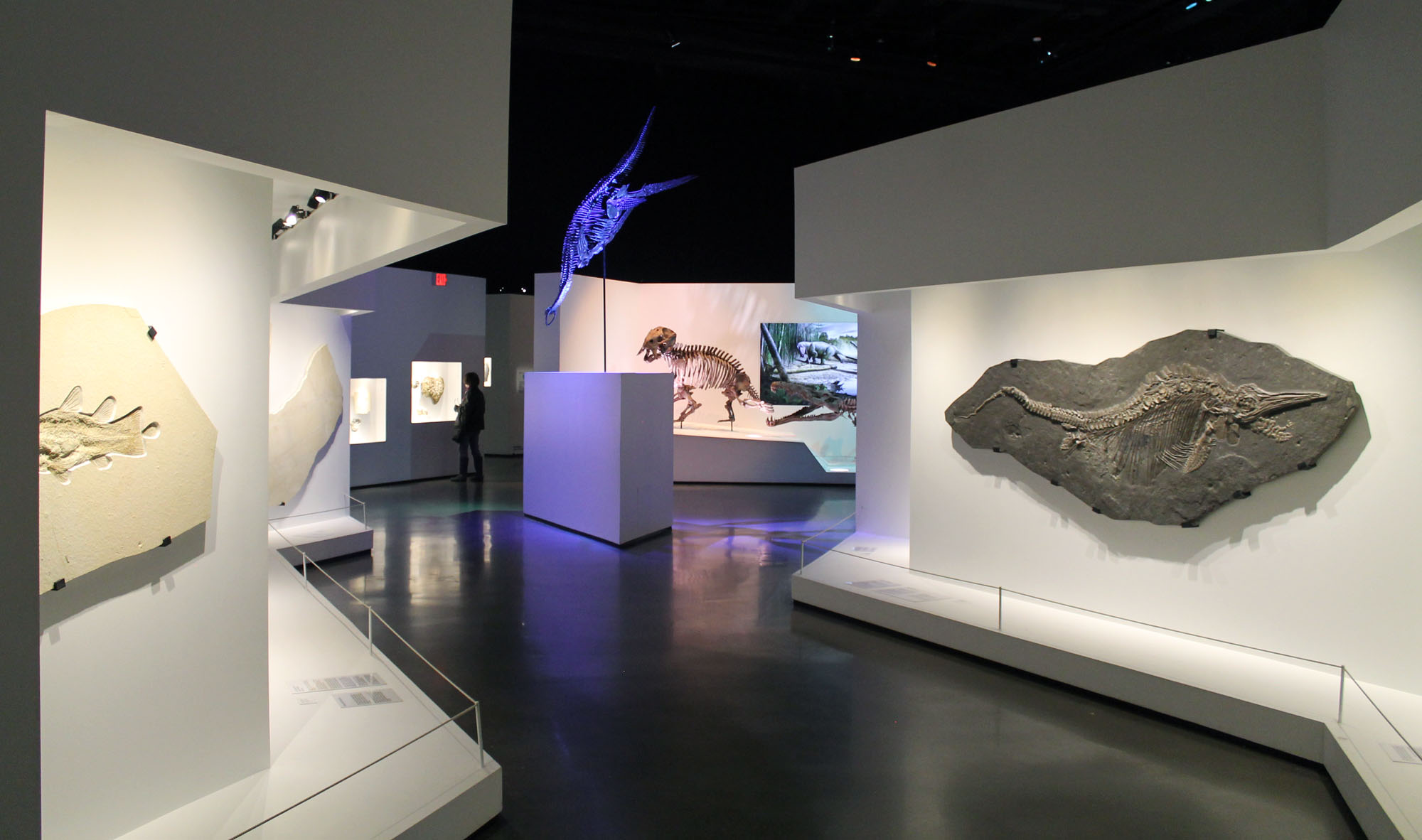
white walls and art gallery format

The HMNS paleontology exhibit looks and feels like a contemporary art gallery. Photo by the author.

For the benefit of those outside the museum field, I should clarify that for myself and many others trained in science and history museums, art museums are basically opposite world. In an art museum, objects are collected and displayed for their own sake. Each artwork is considered independently beautiful and thought-provoking, and curators often strive to reduce interpretation to the bare minimum. Some museums have gone so far as to forgo labels entirely, so that objects can be enjoyed and contemplated simply as they are. Not coincidentally, art museums have a reputation as being “highbrow” establishments that attract and cater to a relatively narrow group of people. People who do not fit the traditional definition of art museum visitor sometimes find these institutions irrelevant or even unwelcoming (more on that in a moment). This summation is hardly universal, but I would argue that the participatory, audience-centered art museum experiences created by Nina Simon and others are an exception that proves the rule.

Natural history museums are different. Collections of biological specimens are valuable because of what they represent collectively. These collections are physical representations of our knowledge of biodiversity, and we could never hope to understand, much less protect, the natural world without them. Each individual specimen is not necessarily interesting or even rare, but it matters because it is part of a larger story. It represents something greater, be it a species, a habitat, or an evolutionary trend. Likewise, modern natural history exhibits aren’t about the objects on display, but rather the big ideas those objects illustrate. Since the mid-2oth century, designers have sought to create exhibits that are accessible and meaningful learning experiences for the widest possible audience, and natural history museums are generally considered family-friendly destinations.
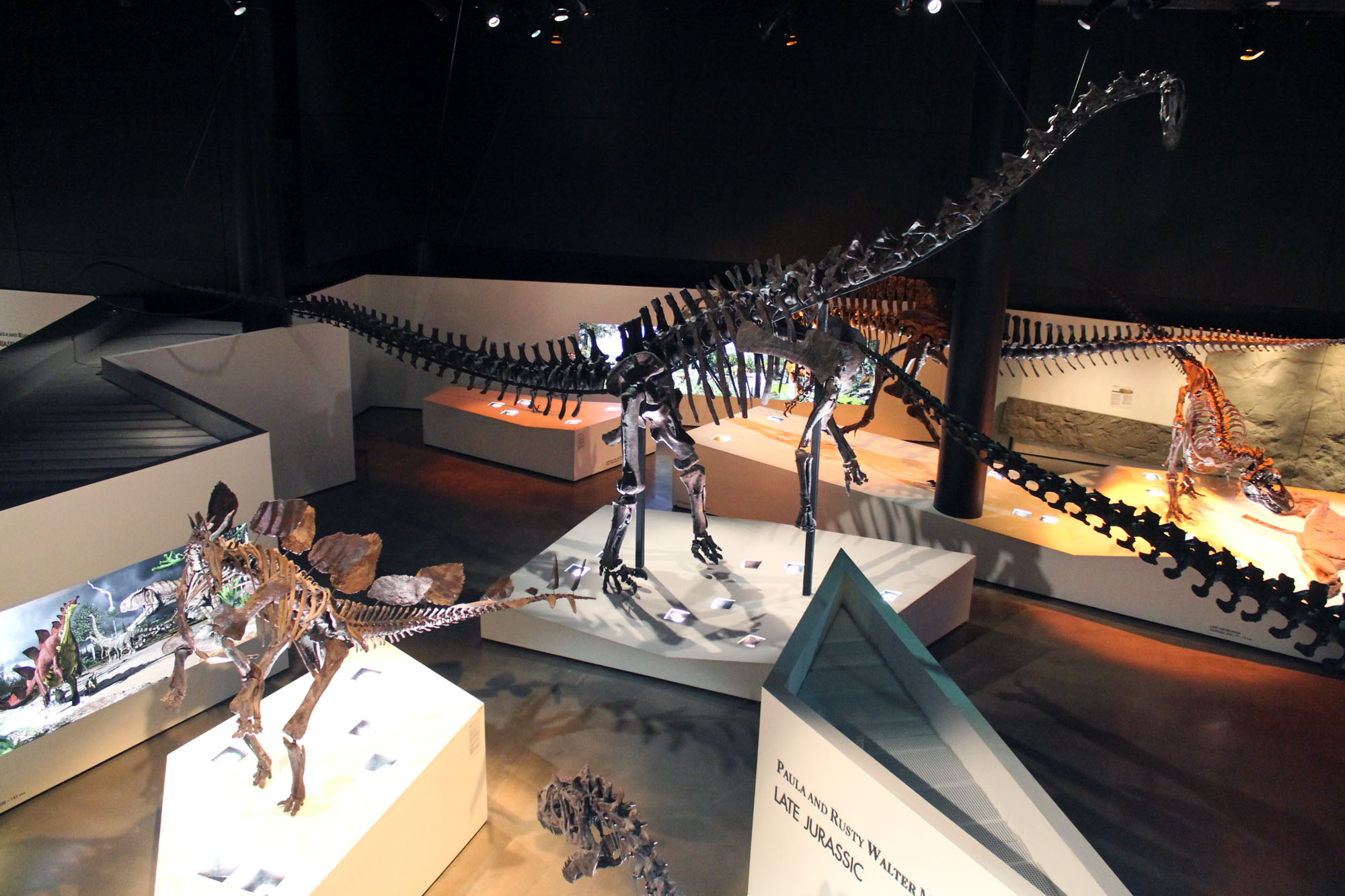
label your damn casts

You can tell Robert Bakker was involved because everyone is rearing. Photo by the author.

There is much to like in the Morian Hall of Paleontology. For one thing, the range of animals on display is incredible. I cherished the opportunity to stand in the presence of a standing Quetzalcoatlus, a Sivatherium, a gorgonopsid, and many other taxa rarely seen in museums. Other specimens are straight-up miracles of preservation and preparation, including a number of Eocene crabs from Italy. I also enjoyed that many of the mounts were in especially dynamic poses, and often interacting with one another. With fossil mount tableaus placed up high as well as at eye level, there was always incentive to look around and take in every detail.

Nevertheless, the art gallery aesthetic raised a number of red flags for me. To start, the minimalist design means that interpretation takes a serious hit. Although the exhibit is arranged chronologically, there are many routes through the space and the correct path is not especially clear. Meanwhile, there are no large headings that can be seen on the move—visitors need to go out of their way to read the small and often verbose text. All this means that the Morian Hall is an essentially context-free experience. Visitors are all but encouraged to view the exhibit as a parade of cool monsters, rather than considering the geological, climatic, and evolutionary processes that produced that diversity. There is an incredible, interrelated web of life through time on display in the Morian Hall, but I fear that most visitors are not being given the tools to recognize it. By decontextualizing the specimens, the exhibit unfortunately removes their meaning, and ultimately their reality*.

*Incidentally, most of the mounted skeletons are casts. This is quite alright, but I was very disappointed that they were not identified as such on accompanying labels.

gorgeous but what does it mean

This double-helix trilobite growth series is gorgeous—but what does it communicate, exactly? Photo by the author.

What’s more, the idealized, formal purity of the exhibit design echoes a darker era in the history of museums. It’s no secret that many of the landmark museums we know today were born out of 19th century imperialism. Colonial domination was achieved not only with military power, but through academia. When colonial powers took over another nation, they brought their archaeologists, naturalists, and ethnographers along to take control of the world’s understanding of that place, its environment, and its people. Museums were used to house and display natural and cultural relics of conquered nations, and to disseminate western scientists’ interpretation of these objects. Even today, it is all too common to see ethnographic objects displayed in austere exhibit spaces much like the Morian Hall of Paleontology. These displays erase the objects’ original cultural meaning. Dinosaurs don’t care about being silenced, of course, but it’s odd that HMNS would choose to bring back such loaded visual rhetoric.

Pretty ammonites with donor names prominently displayed send the wrong message. Photo by the author.

Pretty ammonites with donor names prominently displayed send the wrong message. Photo by the author.

My final concern with the art gallery format is the implication that fossils have monetary value. Fossils are priceless pieces of natural heritage, and they cannot be valued because they’re irreplaceable. While there is a thriving commercial market for rare fossils, a plurality of paleontologists do not engage with private dealers. Buying and selling significant fossils for private use is explicitly forbidden under the ethics statement of the Society of Vertebrate Paleontology, and it is institutional policy at many museums that staff never discuss the monetary value of fossil specimens.

The art world has its own rules and standards. The price tags of famous pieces, including what a museum paid to acquire them, are widely known. Private collectors are celebrated, even revered. In fact, it is common to see exhibits built around a particular individual’s collection. These exhibits are not about an artist or period but the fact that somebody purchased these objects, and has given (or merely loaned) them to the museum. Two rooms in the Morian Hall are actually just that: otherwise unrelated specimens displayed together because they were donated by a specific collector. By displaying specimens with the same visual language as art objects, the Morian Hall undermines the message that fossils should not be for sale. Not only is the private fossil trade legitimized, it communicates that the primary value of fossils is their aesthetic appeal. Like the lack of contextual signage, this serves to obscure the specimens’ scientific meaning. Fossils are precious remains of real organisms, clues about ecosystems from long ago and the making of the world as we know it today. But that information is only available if they are publicly accessible, not sitting on someone’s mantelpiece.
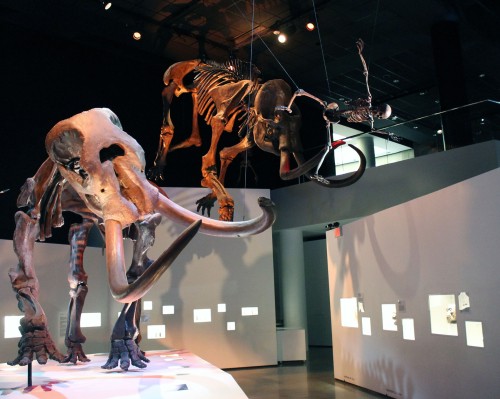
action!

A truly remarkable fossil mount tableau, in which a mastodon flings a human hunter while a mammoth is driven off a “cliff” in the background. Photo by the author.

Now hold on (regular readers might be saying), haven’t I argued repeatedly that fossil mounts should be considered works of art? Absolutely, and that is part of why I was taken aback by this exhibit. The difference is that while the Morian Hall displays fossils the way art is traditionally exhibited, it does not interpret them like art. When I call fossil mounts works of art, I mean that they have authorship and context. They have encoded and decoded meaning, as well as relationships with their viewers, creators, host institutions, and ultimately, the animals they represent. Calling something art is opening it up to discussion and deconstruction. The HMNS exhibits do the opposite.

For the last few decades, natural history museums have been opening windows onto the process of creating knowledge. Modern exhibits seek to show how scientists draw conclusions from evidence, and invite visitors to do the same. In the Morian Hall, those windows are closed. Specimens are meant to be seen as they are, reducing the experience to only the object and the viewer. But there is no “as they are” for fossils. Thousands of hours of fossil preparation and mount construction aside, every display in that exhibit is the result of literally centuries of research into geology, anatomy, and animal behavior. These are representations of real animals, but they also represent the cumulative interpretive work of a great many people. The display simply isn’t complete without their stories.
17 Comments

Filed under anthropology, dinosaurs, exhibits, fossil mounts, HMNS, mammals, museums, opinion, paleoart, reviews, science communication

History of the Field Museum Fossil Halls – Part 1

The Field Museum of Natural History (variously known as the Field Colombian Museum and the Chicago Museum of Natural History) was founded by wealthy philanthropists in the wake of the 1893 World’s Columbian Exposition in Chicago. It has since expanded into one of the largest natural history museums in the world, a destination attraction and a hub for ongoing research. What follows is a summary of the historic paleontology exhibits at the Field Museum – when and how they expanded and changed, when major specimens were added, and who spearheaded these efforts.

As with my previous overviews of fossil exhibits at AMNH and NMNH, please note that I will not be discussing field expeditions or research by museum staff in any detail, as these topics are well-explored elsewhere (see Paul Brinkman’s extensive work, for starters). My primary interest here is in the public-facing exhibits, and the people who created them.

Phase I: The Field Columbian Museum

The World’s Columbian Exposition was held in Chicago in 1893, principally as a celebration of the 400th anniversary of Christopher Columbus’s arrival in the Americas. Lasting six months and attended by 27 million people, the Exposition was monumental in size and scope. Years before it even opened, there was talk about using the Exposition displays to seed a new museum, which would rival the great natural history museums in New York and Washington, DC. Eager to establish an enduring cultural attraction in their city, a group of wealthy Chicagoans – including Marshall Field, who donated an unprecedented $1 million – contributed the necessary funds to buy up many of the Exposition’s exhibits and found the Field Columbian Museum.

As the largest and most elegant of the 200 temporary buildings constructed for the Exposition, the Palace of Fine Arts became the Field Museum’s home. Frederick Skiff served as the first director, acting as an intermediary between the board of trustees and the new curatorial staff, who would manage the collections and assemble the exhibits. Skiff hired geologist Oliver Farrington to curate the earth science collections, a diverse mix of minerals, gems, meteorites, fossils, and fabricated displays purchased from the Henry Ward Natural Sciences Establishment. With thousands of specimens to catalog, Farrington was soon overwhelmed. He repeatedly asked Skiff to hire a paleontology specialist to support him, but the board (composed of the businessmen who founded the museum) was uninterested in paying more salaries or acquiring new specimens.

fossils

The model icthyosaur and thousands of fossils in cases were among the specimens purchased from the Ward Natural Sciences Establishment after the World’s Columbian Exposition. Image courtesy of the Field Museum Photo Archives.

When the Field Columbian Museum opened on June 2nd, 1894, most the 5,000-piece fossil collection was on public display. In addition to the cases of as-yet unlabled invertebrates, plants, and other small fossils, the exhibit included several large reconstructions of prehistoric animals. As of opening day, a life reconstruction of a mammoth stood in the west court, while skeletons of MegalocerosScistopleurum, MegatheriumHadrosaurus, and a uintathere stood in halls 35 and 36. With the exception of the Megaloceros, these were all replicas of mounts from other institutions. The Hadrosaurus in particular was woefully outdated, considered by contemporary scholars to have “long since ceased to have any value except as a historic attempt” (Beecher 1901).

After completing his catalog of the earth science collections in 1896, Farrington continued to lobby for a dedicated staff paleontologist. The board paid no attention until 1897, when the American Museum of Natural History and the Carnegie Museum of Natural History announced ambitious plans to scour the western interior for fossils. So began what Brinkman calls the second Jurassic dinosaur rush – a frenzied race among leading American museums to be the first to collect and mount a sauropod dinosaur. Not wanting to be left behind by peer institutions, the trustees approved the conditional hiring of Elmer Riggs to collect dinosaurs for the Field Museum.

Hadrosaurus cast on display at the Field Museum. Field Museum Photo Archives.

Hadrosaurus stands among other fossil casts in the Field Columbian Museum. Image courtesy of the Field Museum Photo Archives.

Riggs and his classmate Barnum Brown cut their teeth in paleontology while studying under Samuel Wendell Williston at the University of Kansas. The two young men took part in an AMNH collecting expedition in 1896. Brown, who had quit his studies to work for the museum, quickly became a favorite at AMNH. Concerned about his own future, Riggs sent an unsolicited letter to Frederick Skiff, offering his skills as a fossil collector and preparator. The letter crossed Skiff’s desk at an opportune time, and in the summer of 1898 Riggs was paid a small stipend for a trial collecting trip with Farrington. The expedition was a success, and Riggs was hired as an Assistant Curator before the end of the year.

Riggs’ first three collecting seasons with the Field Museum were enormously successful. In addition to the holotype of Brachiosaurus, at the time the largest known dinosaur, Riggs collected a very-well-preserved back end of an Apatosaurus near Fruita, Colorado. Nevertheless, AMNH won the sauropod race when they completed their composite “Brontosaurus” mount in 1905. The Carnegie Museum had a Diplodocus on display in 1907, and was busy cranking out casts for European heads of state. While Riggs’ Apatosaurus was more complete than any single specimen the other museums had recovered, it was still only half a dinosaur. Riggs and Farrington repeatedly lobbied the board for funding to find more sauropod material with which to complete the skeleton, but the trustees had moved on to other things.

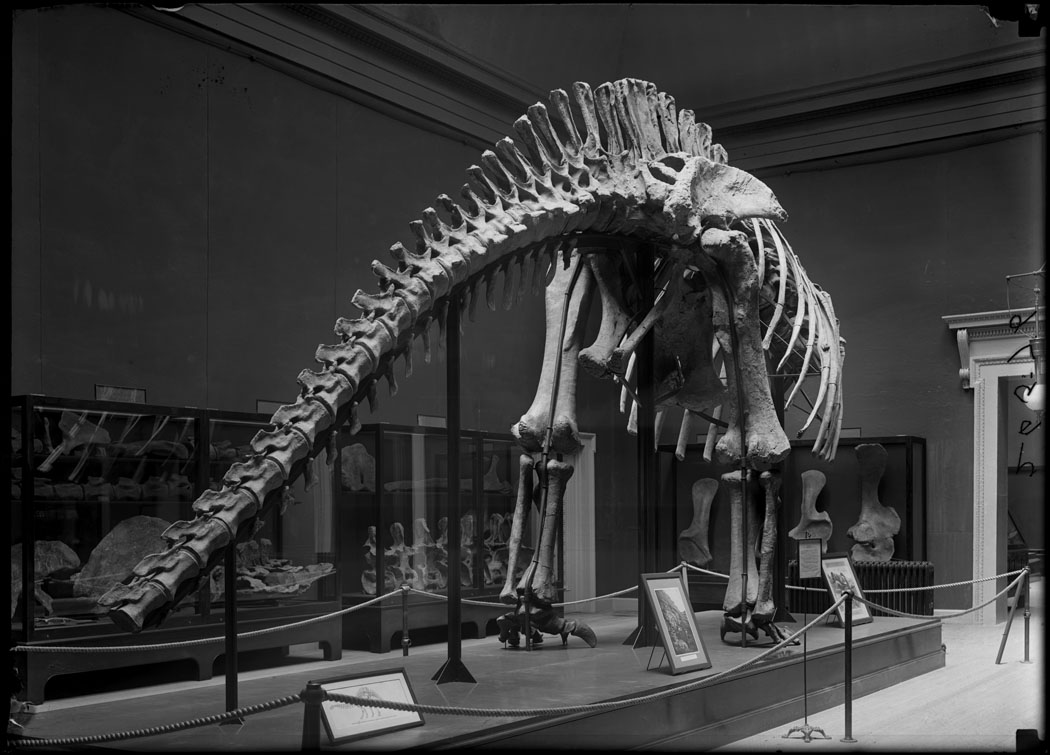
Riggs' Apatosaurus mount stood unfinished from 1908-1958. Photo from the Field Museum Library.

Riggs’ Apatosaurus mount stood unfinished from 1908-1958. Image courtesy of the Field Museum Photo Archives.

Plans were afoot to move the Field Museum to a new lakefront campus. However, when legal issues halted progress on the new building, Riggs was granted permission to mount the partial Apatosaurus in hall 35. The plaster casts previously displayed in this space were discarded, and unfortunately are now lost to history. A gas furnace was installed on the museum grounds, which Riggs and his small team used to shape massive steel I-beams for use in the armature. The teetering sauropod hindquarters was unveiled in 1908, but if Riggs hoped that the museum administrators would want to complete the mount once they saw how absurd the incomplete skeleton looked, he was out of luck.

Indeed, the years that followed were among the most frustrating of Riggs’ career. He received no funding to collect fossils after 1910, and could only look on enviously at the thriving paleontology research and exhibit programs at AMNH and the Carnegie Museum. The institutions in New York and Pittsburgh were headed by paleontologists, and bankrolled by wealthy fossil enthusiasts like J.P. Morgan and Andrew Carnegie. By comparison, the Field Museum was controlled by trustees with seemingly little interest in paleontology. Already paid less than the museum’s other curators, Farrington and Riggs were left with meager resources and little to do until the 1920s.

Phase II: Halls 37 and 38

The Palace of Fine Arts was intended to last six months, and after ten years it was in dire shape. The roof leaked constantly, putting exhibits and collections in danger, and fences had to be placed around the perimeter to protect visitors from falling brick. Before his death in 1906, Marshall Field worked with architect Daniel Burnham to design a new home for the museum. It took years to settle disputes over where to place the building, but ground was eventually broken off Lake Shore Drive in 1915. Completed in 1920, the new Field Museum of Natural History was a gleaming marble fortress, decorated inside and out with intricate neoclassical reliefs and statuary.

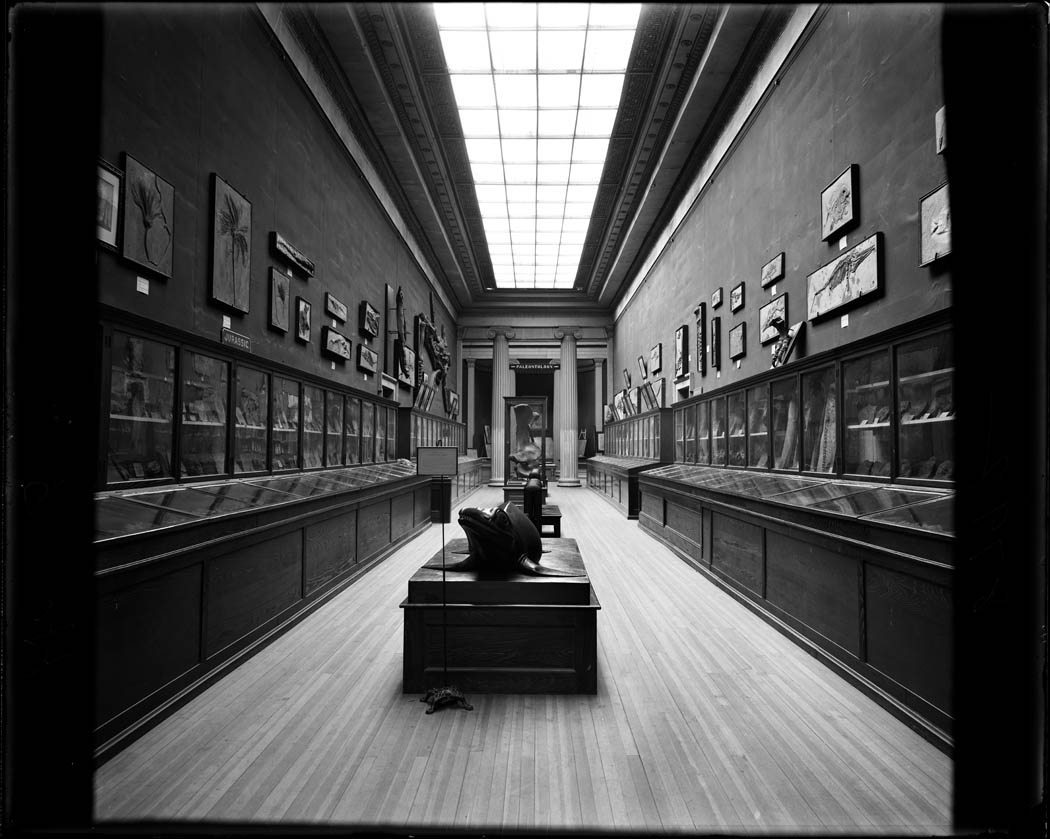
hall 37

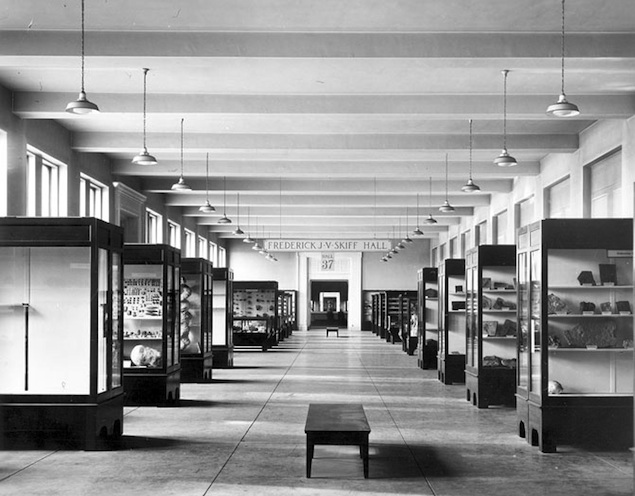
In the spirit of a classic cabinet of curiosity, some of the cases in Hall 37 contained over a thousand specimens apiece. Source

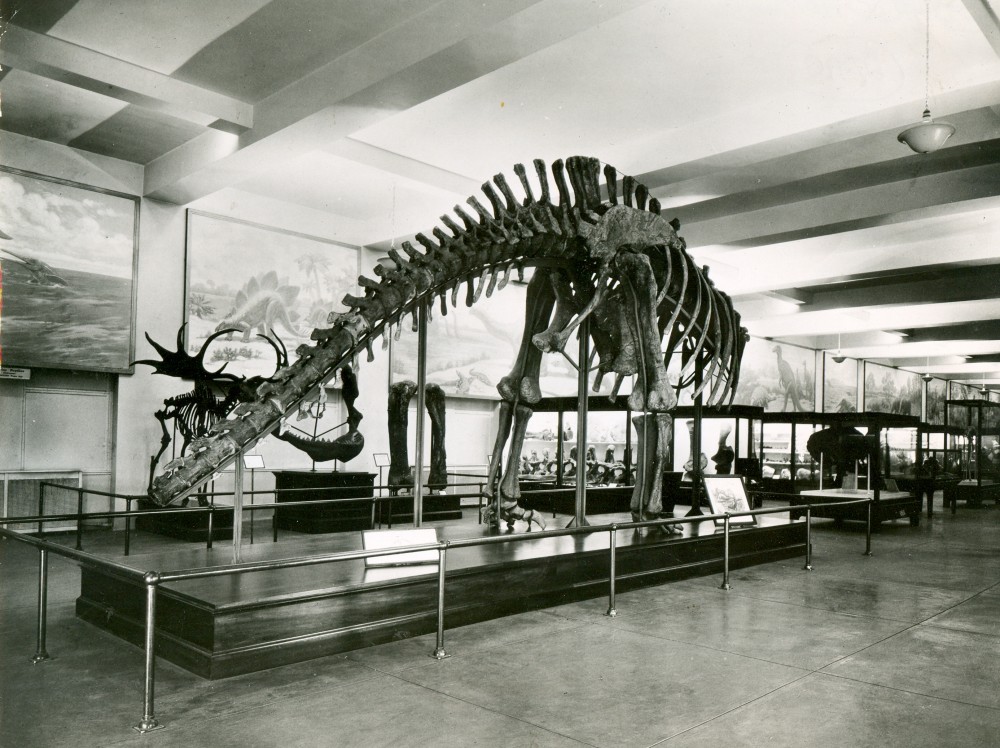
Exhibits and collections were transported by rail car, often without being removed from their display cases. Earth science exhibits found a new home on the west side of the upper level. Hall 37, an east-west facing gallery accessible directly off the west mezzanine, housed invertebrate and plant fossils. Hall 38, running north to south against the far west side of the building, contained vertebrate fossils. Although it was colloquially known as the “dinosaur hall”, this space never contained many dinosaurs. In the 1920s, the only dinosaurs to be found were the half-Apatosaurus, a Triceratops skull, an articulated “Morosaurus” (Camarasaurus) limb, and parts of Brachiosaurus. The bulk of the specimens on display were Cenozoic mammals, including horses, rhinos, camelids, and a mammoth and mastodon. There was also a life-sized “coal swamp” diorama behind a glass barrier, with large model insects suspended in flight.

This comparatively modest exhibit was expanded significantly between 1922 and 1927, when Elmer Riggs was once again able to collect fossils in the field. Thanks to a bequest from Marshall Field’s grandson, Riggs traveled to Alberta, Argentina, and Bolivia, securing many unique specimens along the way. These included several new species, like the marsupial cat Thylacosmilus and the predatory bird Andalgalornis. A colossal Megatherium Riggs recovered in Argentina was immediately mounted for display, and became one of the most memorable elements of Hall 38.

hall 38

A postcard of the partial Apatosaurus at the south end of Hall 38. Image courtesy of the Field Museum Photo Archives.

A postcard of the north end of Hall 38, featuring a South American giant sloth and other Cenozoic mammals.

Megatherium at the north end of Hall 38. Image courtesy of the Field Museum Photo Archives.

Hall 38 also boasted a spectacular set of murals by Charles Knight. The undisputed master of paleontological reconstructions and wildlife art, Knight had a long working relationship with Henry Osborn, president of AMNH. Osborn had commissioned Knight to create many large and small paintings for his museum’s fossil exhibits, but the two frequently argued over Knight’s remuneration. For years, Osborn and Knight discussed a series of immense wall canvases illustrating the entire history of life. Osborn could never get the money together, however, and Knight refused to produce any concept sketches for fear that they would be turned over to a less-skilled artist. In 1926, the Field Museum’s board of trustees asked for a meeting with Knight about an identical project for their new fossil hall. The initial discussion did not go well, and Knight walked out when the trustees started making “suggestions” about the content, color, and composition of the proposed artwork. Knight was very talented, but also very particular. He gladly accepted anatomical expertise from scientists but would not suffer meddling with the artistic aspects of his work. Fortunately for both parties, Knight’s daughter/manager Lucy intervened, securing her father the biggest commission of his career.

Knight completed 28 murals for the Field Museum, the largest of them measuring 25 feet long and nine feet high. Subjects ranged from the Proterozoic primordial soup to an iconic standoff between Tyrannosaurus and Triceratops. These images were not only painstakingly researched reconstructions based on the latest fossil evidence, they were (and still are) gorgeous works of art in their own right. With Knight’s murals in place, the Field Museum finally had a world-class paleontology exhibit.

hall 38 mastodon

The mastodon in Hall 38, with fossil horses visible beyond. Image courtesy of the Field Museum Photo Archives.

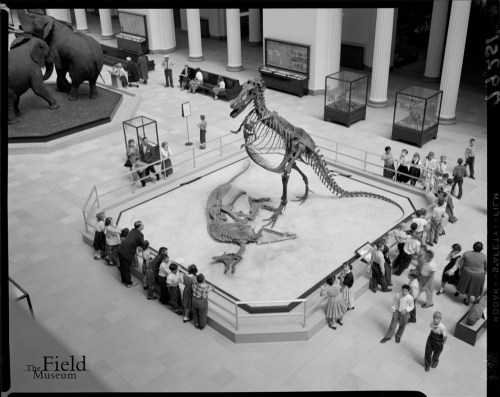
Gorgo in Stanley Field Hall. Photo courtesy of Field Museum Photo Archives.

Gorgosaurus” in the Stanley Field Hall. Photo courtesy of Field Museum Photo Archives.

Riggs retired in 1942, leaving paleontology at the Field Museum to the next generation, among them Eugene Richardson, Brian Patterson, and Orville Gilpin. In 1951, Richardson oversaw a thorough modernization of Hall 37. The number of specimens on display was drastically reduced, making room for more accessible explanations of the fossils and ten new dioramas of Paleozoic marine life. The resulting exhibit was one of the most comprehensive displays of fossil invertebrates in the world.

Although virtually no dinosaur research was done at the Field Museum between 1910 and the late 1990s, the 1950s saw the acquisition of two significant specimens for the benefit of the visiting public. In 1956, preparator Orville Gilpin assembled a Daspletosaurus (then called Gorgosaurus) for the central Stanley Field Hall. The skeleton was a surplus specimen from Barnum Brown’s years collecting along Alberta’s Red Deer River, and trustee Louis Ware spearheaded the effort to buy it from AMNH. Since the Daspletosaurus was acquired explicitly for display, Gilpin opted to skewer and otherwise permanently damage many of bones for the sake of an unobstructed, free-standing mount. In the mid 20th century, dinosaur fossils were thought of as display pieces first, and irreplaceable specimens second.

apatosaurus revised

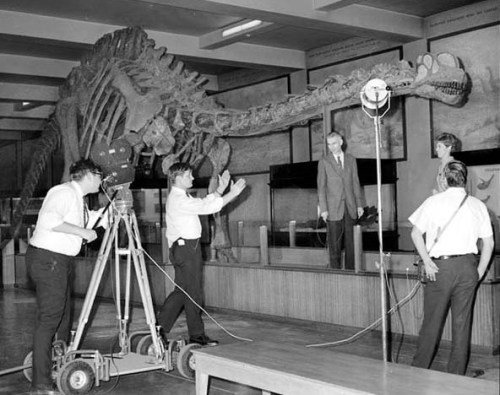
The newly-finished Apatosaurus serves as a backdrop for an educational video shoot. Source

Two years after installing the Daspletosaurus, Gilpin finally completed Riggs’ partial Apatosaurus in Hall 38. When Edward Holt announced that he had discovered the front half of a sauropod near Green River, Utah, the Field Museum purchased the rights to excavate and display the find. Gilpin added the new fossils to the existing mount without dismantling Riggs’ heavy-duty armature. Relabeled “Brontosaurus” and erroneously given a casted Camarasaurus skull, the refreshed sauropod debuted in April 1958 – half a century after Riggs started the project.

The next three decades saw occasional piecemeal additions to the fossil halls. For example, the University of Chicago donated its entire geology collection to the Field Museum in 1965. This included a unique assortment of Permian amphibians and synapsids from the red beds of central Texas, many of them holotypes. Field Museum preparators remounted several of these specimens and integrated them into the exhibits. Nevertheless, Hall 38 never received a complete overhaul, and by the late 1980s it was quite dated. Not only were the fossil mounts in stiff, tail-dragging poses, but the stilted label copy written by curators past did not meet modern expectations for natural history exhibits. Even the vibrant Charles Knight murals looked tired behind years of accumulated dust and dirt. In short, the Field Museum was long overdue for a total re-imaging of its paleontology displays.

Next time, we’ll take a look at the Field Museum’s fossil exhibits from the 1990s onward. Stay tuned!

References

Beecher, C.E. 1901. The reconstruction of a Cretaceous dinosaur, Claosaurus annectens Marsh. Transactions of the Connecticut Academy of Arts and Sciences. 11: 311-324.

Brinkman, P.D. 2000. Establishing Vertebrate Paleontology at Chicago’s Field Colombian Museum: 1893-1898. Archives of Natural History 27: 1: 81-114.

Brinkman, P.D. 2o10. The Second Jurassic Dinosaur Rush: Museums and Paleontology in America at the Turn of the 20th Century. Chicago, IL: The University of Chicago Press.

Chicago Natural History Museum Bulletin. (March 1956). 27: 3.

Gilpin, O.L. 1959. A Freestanding Mount of Gorgosaurus. Curator 2: 2: 162-168.

Glut, D.F. 2001. Remembering the Field Museum’s Hall 38. Jurassic Classics: A Collection of Saurian Essays and Mesozoic Musings. Jefferson, NC: McFarland.

Lelièvre, M A. 2006. Evolving Planet: Constructing the Culture of Science at Chicago’s Field Museum. Anthropologica 48: 2: 293-296.

Milner, R. 2012. Charles R. Knight: The Artist Who Saw Through Time. New York, NY: Abrams.

Tubitis, T.J. 2005. Revitalizing Life Over Time: A New Look for a Very Old Topic. In the Field 76: 2: 18.

Williams, P.M. 1968. The Burham Plan and the Field Museum. Bulletin of the Field Museum of Natural History 39: 5: 8-12.

4 Comments

Filed under dinosaurs, exhibits, FMNH, fossil mounts, history of science, mammals, museums, reptiles, sauropods