Author Archives: Ben

First Full-Sized Dinosaurs: From Crystal Palace to Hadrosaurus

Last time, we covered how Albert Koch turned a tidy profit with his less-than-accurate fossil mounts, leading credible paleontologists to avoid involvement with full-sized reconstructions of extinct animals for much of the 19th century. With the exceptions of Juan Bautista Bru’s ground sloth and Charles Peale’s mastodon, all the fossil mounts that had been created thus far were horrendously inaccurate chimeras assembled by often disreputable showmen. Serious scientists were already struggling to disassociate themselves from these sensationalized displays of imaginary monsters, so naturally they avoided degrading their work further by participating in such frivolous spectacle.

The prevailing negative attitude toward fossil mounts among academics would begin to shift in 1868, when paleontologist Joseph Leidy and artist Benjamin Waterhouse Hawkins collaborated on a mount of Hadrosaurus, the first dinosaur to be scientifically described in America and the first dinosaur to be mounted in the world. While prehistoric animals were well known by the mid-19th century, the Hadrosaurus was so bizarre, so utterly unlike anything alive today, that it truly opened people’s eyes to the unexplored depths of the Earth’s primordial history. I have written about the Hadrosaurus mount before, but its creation was such a landmark event in the history of paleontology and particularly the public understanding of prehistory that it deserves to be contextualized more thoroughly.

Discovering Dinosaurs in Britain

In the early 1800s, American fossil hunters were busy poring over the bones mammoths, mastodons and other mammals. Across the Atlantic, however, it was all about reptiles. Scholars were pulling together the first cohesive history of life on earth, and Georges Cuvier was among the first to recognize distinct periods in which different sorts of creatures were dominant. There had been an Age of Mammals in the relatively recent past during which extinct animals were not so different from modern megafauna, but it was preceded by an Age of Reptiles, populated by giant-sized relatives of modern lizards and crocodilians. The marine ichthyosaurs and plesiosaurs unearthed by Mary Anning on the English coast were the first denizens of this era to be thoroughly studied, but they were soon followed by discoveries of terrestrial creatures. In 1824, geologist William Buckland received a partial jaw and a handful of postcranial bones found in the Oxfordshire shale. Recognizing the remains as those of a reptile, Buckland named the creature Megalosaurus, making it the first scientifically described non-avian dinosaur (honoring the unspoken agreement to ignore “Scrotum humanum”).
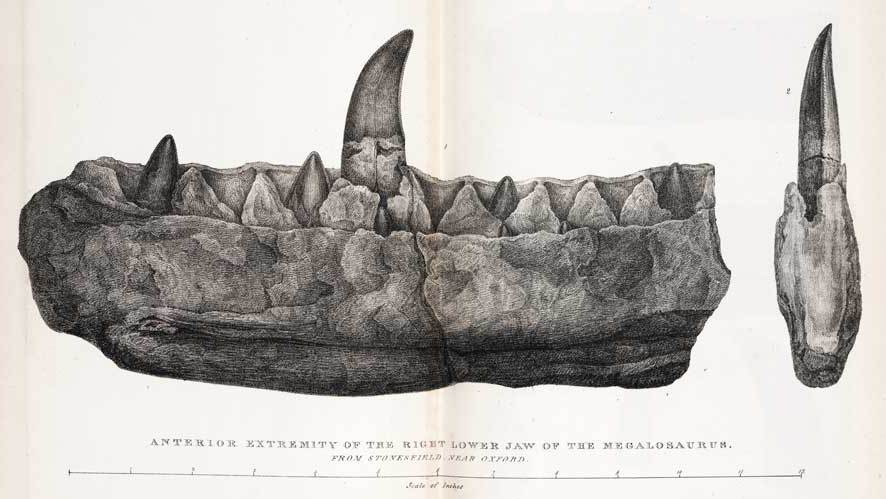
The partial jaw of Megalosaurus, the first named dinosaur.

The partial jaw of Megalosaurus, the first named dinosaur.

Of course, the word “dinosaur” did not yet exist. As covered by virtually every text ever written on paleontological history, it was anatomist Richard Owen who formally defined Dinosauria in 1842 as a distinct biological group. Owen defined dinosaurs based on anatomical characteristics shared by Megalosaurus and two other recently discovered prehistoric reptiles, Iguanodon and Hylaeosaurus (fatefully, and somewhat arbitrarily, he excluded pterosaurs and doomed paleontologists and educators to forever reminding people that pterodactyls are not dinosaurs). In addition to being an extremely prolific author (he wrote more than 600 papers in his lifetime), Owen was a talented publicist and quite probably knew what he was unleashing. The widely publicized formal definition of dinosaurs, accompanied by displays of unarticulated fossils at the Glasgow Museum, was akin to announcing that dragons were real. By giving dinosaurs their name, Owen created an icon for the prehistoric past that the public could not ignore.

“Dinosaur” soon became the word of the day in Victorian England. Looking to capitalize on this enthusiasm for paleontology, the Crystal Palace Company approached Owen in 1852 to oversee the creation of an unprecedented new exhibit. The company was building a park in the London suburb of Sydenham, meant to be a permanent home for the magnificent Crystal Palace, which had been built the previous year for the Great International Exhibition of the Works and Industry of All Nations. Concerned that the palace would not draw visitors to the park on its own, the Crystal Palace Company commissioned Owen and scientific illustrator Benjamin Waterhouse Hawkins to create a set of life-sized sculptures of dinosaurs and other prehistoric creatures, the first of their kind in the world. The sculptures were a tremendous undertaking: the Iguanodon, for instance, was supported by four 9-foot iron columns, and its body was built up with brick, tile and cement. Hawkins then sculpted its outer skin from more than 30 tons of clay. All told, more than a dozen animals were built, including Megalosaurus, Iguanodon, Hylaeosaurus and an assortment of marine reptiles and mammals.
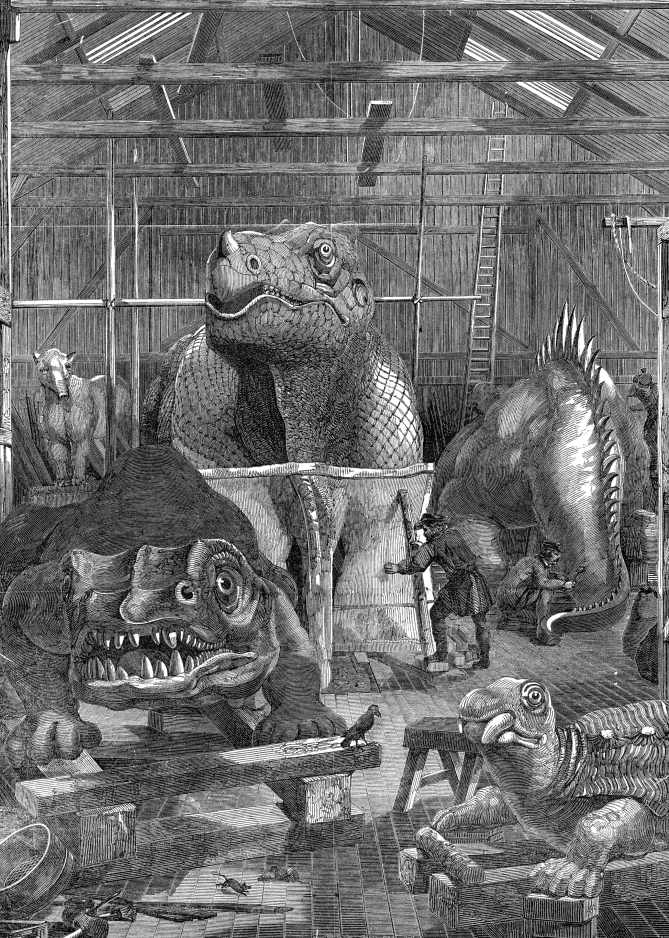
The Crystal Palace dinosaurs under construction in Hawkin's studio.

The Crystal Palace dinosaurs under construction in Hawkin’s studio.

Queen Victoria herself presided over the opening ceremony of Crystal Palace Park in 1854, which was attended by 40,000 people. This was an important milestone because up until that point, only the broadest revelations in geology and paleontology made it out of the academic sphere. But as Hawkins himself put it, the Crystal Palace dinosaurs “might be properly described as one vast and combined experiment of visual education” (Hawkins 1853, 219). The general public could see firsthand the discoveries and conclusions of the most brilliant scientists of their age, in a format that could not only be readily understood and appreciated, but experienced. Full-sized reconstructions of prehistoric animals, including fossil mounts, continue to be built today for precisely this reason.
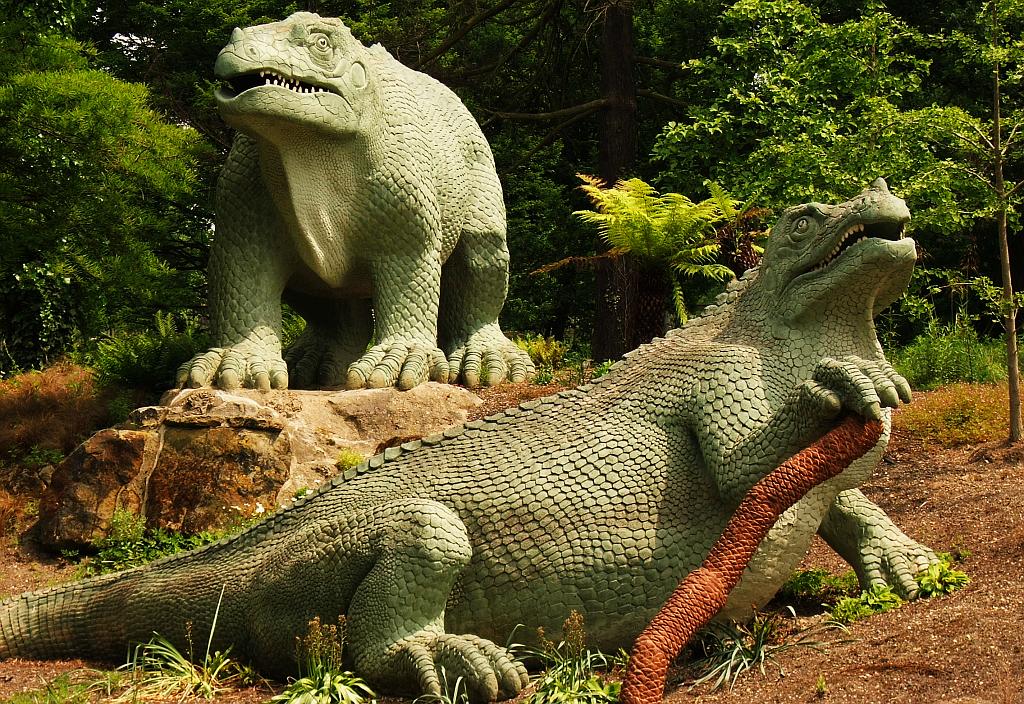
Recently restored Iguanodon sculptures. Wikimedia Commons.

Recently restored Iguanodon sculptures at Crystal Palace Park. Source

While the Crystal Palace dinosaurs are important historic artifacts and beautiful works of art in their own right, they have not aged well as accurate reconstructions. Owen only had the scrappiest of dinosaur fossils to work with, enough to conclude that they were reptiles and that they were big but not much else. As a result, the Megalosaurus and Iguanodon sculptures look like rotund lizards, as though a monitor lizard or iguana gained the mass and proportions of an elephant. By modern standards, these beasts look pretty ridiculous as representations of dinosaurs, but they were quite reasonable given what was known at the time, at least for a few years.

Dinosaurs of the Jersey Shore

And so at last Hadrosaurus enters the story. Just four years after the unveiling of the Crystal Palace sculptures, the first American dinosaur was found on a farm near Haddonfield, New Jersey (dinosaur footprints and teeth had been found earlier, but their affinity with the European reptiles was not recognized until later). William Foulke, a lawyer and geology enthusiast affiliated with the Philadelphia-based Academy of Natural Sciences, was at his winter home in Haddonfield when he paid a visit to his neighbor, John Hopkins. Hopkins told Foulke that he occasionally found large fossils on his land, which he generally gave away to interested friends and family members. With Hopkins’ permission, Foulke searched the site where the fossils had been found with the assistance of paleontology and anatomy specialist Joseph Leidy. Also a member of the Academy of Natural Sciences, Leidy is considered the founder of American paleontology and during the mid-1800s, he was the preeminent expert on the subject. At the Haddonfield site, Foulke and Leidy uncovered approximately a third of a dinosaur skeleton, including two  nearly complete limbs, 28 vertebrae, a partial pelvis, scattered teeth and two jaw fragments.
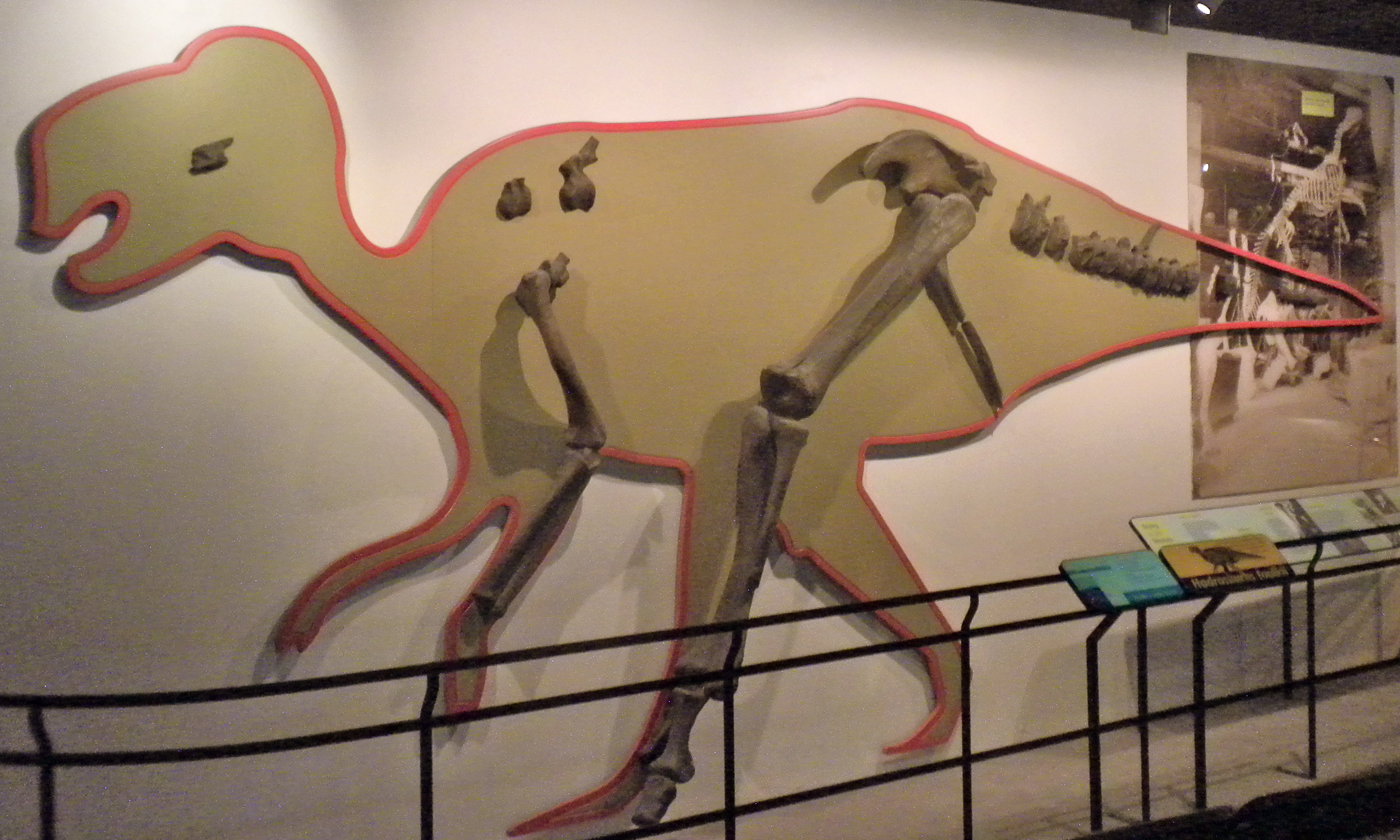
All known Hadrosaurus fossils, presently on display at the Academy of Natural Sciences.

All known Hadrosaurus fossils, presently on display at the Academy of Natural Sciences.

Now in possession of the most complete dinosaur skeleton yet found, Leidy began studying the fossils of what he would name Hadrosaurus foulkii (Foulke’s bulky lizard) in Philadelphia. The teeth in particular told Leidy that Hadrosaurus was similar to the European Iguanodon. Like IguanodonHadrosaurus was plainly an herbivore, and for reasons left unspecified Leidy surmised that it was amphibious, spending most of its time in freshwater marshes. Leidy noted that Hadrosaurus was a leaner and more gracile animal than Owen’s Crystal Palace reconstructions, but he was particularly interested in “the enormous disproportion between the fore and hind parts of the skeleton” (Leidy 1865). Given the large hindlimb and small forelimb, Leidy reasoned that Hadrosaurus was a habitual biped, and likened its posture to a kangaroo, with an upward-angled trunk and dragging tail. As such, we can credit Leidy for first envisioning the classic Godzilla pose for dinosaurs, which has been known to be inaccurate for decades but remains deeply ingrained in the public psyche.

Although the new information gleaned from Hadrosaurus made it clear that the Crystal Palace sculptures were hopelessly inaccurate, Leidy had been impressed by the Sydenham display and wanted to create a similar public attraction in the United States. Leidy invited Hawkins to prepare a new set of prehistoric animal sculptures for an exhibit in New York’s Central Park. Hawkins set up an on-site studio and began constructing a life-sized Hadrosaurus, in addition to a mastodon, a ground sloth and Laelaps, another New Jersey dinosaur. Unfortunately, Hawkins’ shop was destroyed one night by vandals, apparently working for corrupt politicians. What remained of the sculptures was buried in Central Park and the exhibit was cancelled.

Edit 4/20/2017: Leidy was not actually involved in planning the ill-fated Central Park display. Thanks to Raymond Rye for the tip!

The “Bulky Lizard” Mount

Instead of abandoning the project entirely, Hawkins and Leidy redirected the resources they had already prepared for the Central Park exhibit into a display at the Academy of Natural Sciences museum in Philadelphia. Leidy decided he wanted a mounted skeleton of Hadrosaurus, rather than a fully fleshed model as was originally planned. Such a display had not appeared in a credible museum since Charles Peale created his mastodon mount, but if anybody could get a fossil mount to be taken seriously, it was Leidy.

With only a partial Hadrosaurus skeleton to work with, Hawkins had to sculpt many of the bones from scratch, in the process inventing many of the mounting techniques that are still in use nearly a century and a half later. For instance, Hawkins created mirrored duplicates of the left limb bones for use on the animal’s right side, and reconstructed best-guess stand-ins for the skull, scapulae and much of the spinal column using modern animals as reference. Based on photographs like the one below, it appears that portions of the vertebral column were cast as large blocks, rather than individual vertebrae. The mount  was supported by a shaped metal rod running through the vertebrae, as well as a single vertical pole extending from the floor to the base of the neck. In fact, very little of the armature appears to have been externally visible, suggesting that making the skeleton as aesthetically clean as possible was a priority.
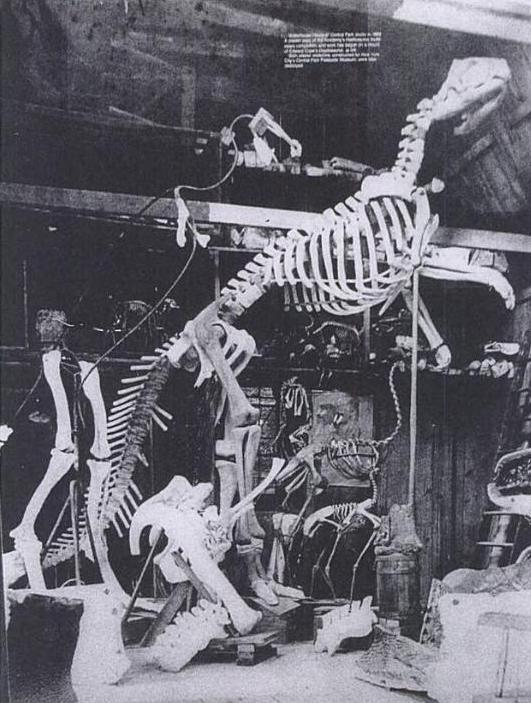
Hawkin's studio

Hadrosaurus under construction in Hawkins’ studio. Note the flightless bird mounts used for reference. From Carpenter et al. 1994.

The Hadrosaurus mount had a few eccentricities that are worth noting. First, the mount has seven cervical vertebrae, which is characteristic of mammals, not reptiles. Likewise, the scapulae and pelvis are also quite mammal-like. Hawkins was apparently using a kangaroo skeleton as reference in his studio, and it is plausible that this was the source of these mistakes. In addition, Hawkins had virtually no cranial material to work with (despite several repeat visits to the Haddonfield site by Academy members searching for the skull), so he had to make something up. He ended up basing the his sculpted skull on an iguana, one of the few exclusively herbivorous reptiles living today. Although fossils of Hadrosaurus relatives would later show that this was completely off the mark, it was very reasonable given what was known at the time.

The Hadrosaurus mount was unveiled at the Academy of Natural Sciences musuem in 1868, and the response was overwhelming. The typical annual attendance of 30,000 patrons more than doubled that year to 66,000, and the year after that saw more than 100,000 visitors. Traffic levels were so high that the Academy had to decrease the number of days it was open and enforce limits on daily attendance in order to prevent damage to the rest of the collection. Soon, the Academy was forced to relocate to a new, larger building in downtown Philadelphia, which it still occupies today.

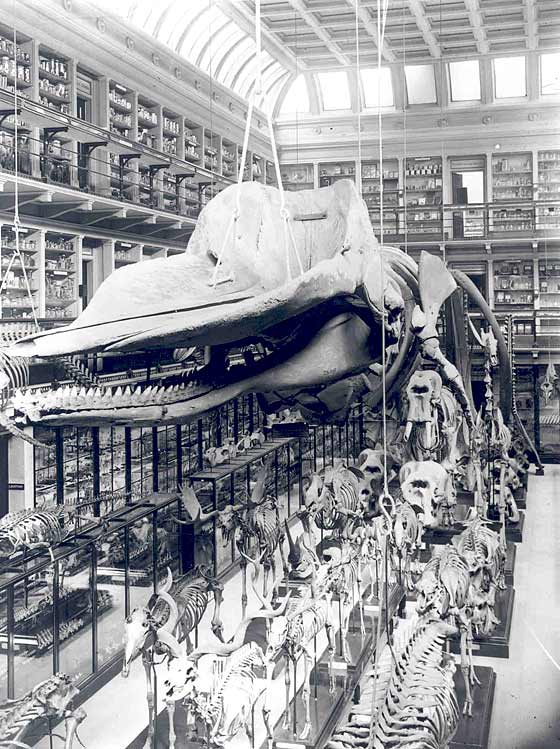
The audience for the Hadrosaurus mount was expanded greatly in the 1870s by three plaster copies of the skeleton, which were sent to Princeton University in New Jersey, the Smithsonian Institution in Washington, DC and the Royal Scottish Museum in Edinburgh (the first dinosaur mount displayed in Europe). The Smithsonian copy had a particularly mobile existence: it was first displayed in  the castle on the south side of the National Mall, moved to the dedicated paleontology display in the Arts and Industries Building around 1890, and finally traded to the Field Museum in Chicago later in the decade. In Chicago, the Hadrosaurus was displayed in a spacious gallery alongside mounts of Megaloceros and Uintatherium, and it is in this context that the best surviving photographs of the Hadrosaurus mount were taken. Sadly, by the early 1900s all three casts had been destroyed or discarded by their host institutions, since they had either deteriorated badly or were deemed too inaccurate for continued display. The original Philadelphia mount was also dismantled, although the Hadrosaurus fossils are still at the Academy.

Hadrosaurus cast on display at the Field Museum. Field Museum Photo Archives.

Hadrosaurus cast on display at the Field Museum. Field Museum Photo Archives.

Why was the Hadrosaurus mount such a big deal? For one thing, it was different from previous fossil mounts in that it was the product of the best scientific research of the day. This was not the work of a traveling showman but a display created by the preeminent scientific society of the era, with all the mystique and prestige that came with it. Most importantly, however, the Hadrosaurus mount presented the first ever opportunity to stand in the presence of a dinosaur. By the mid-19th century, western civilization had had ample opportunity to come to terms with the fact that organisms could become extinct, but for the most part the fossils on display were similar to familiar animals like horses, elephants and deer. The Hadrosaurus, however, was virtually incomparable to anything alive today. It was a monster from a primordial world, incontrovertible evidence that the Earth had once been a very different place. By comparison, the Crystal Palace sculptures were essentially oversized lizards, and therefore fairly relateable.  The Hadrosaurus was the real turning point, the moment the public got their first glimpse into the depths of prehistory. For 15 years, the Hadrosaurus was the only real dinosaur on display anywhere in the world, so it is no wonder that people flocked to see it.

Of course, the Hadrosaurus was only the beginning of the torrent of dinosaur fossils that would be unearthed in the late 19th century. It would prove to be but a hint at the amazing diversity and scale of the dinosaurs that would be revealed in the American west, as well as the scores of fossil mounts that would soon spring up in museums.

References

Carpenter, K., Madsen, J.H. and Lewis, L. (1994). “Mounting of Fossil Vertebrate Skeletons.” In Vertebrate Paleontological Techniques, Vol. 1. Cambridge, UK: Cambridge University Press.

Leidy, J. (1865). “Cretaceous Reptiles of the United States.” Smithsonian Contributions to Knowledge. 14: 1-102. 

Waterhouse Hawkins, B. (1853). “On Visual Education as Applied to Geology.” Journal of the Society of Arts. 2: 444-449.

4 Comments

Filed under anatomy, dinosaurs, field work, fossil mounts, history of science, museums, ornithopods, paleoart, reptiles

There are “fake” fossil mounts after all…in China

I’m always bummed when I hear museum-goers describe fossil mounts, particularly those that are entirely or partially made up of casts, as “fakes.” It is inaccurate, if not inflammatory to describe mounts in this way, and I always make sure to offer a correction (see this ancient post of mine or Christopher Norris’s much better explanation for details).

Well, it turns out I was wrong, or at least trapped in a western-centric worldview. There are fossil mounts that can and should be called fake…in China. Earlier today, Brian Switek linked to a brief radio story at CRIEnglish about the recent appearance of dinosaur-themed parks throughout China. According to the clip, local governments throughout China have been competing to built the biggest and best dinosaur park. The parks are apparently the equivalent of attention-grabbing and income-building public works projects, such as stadiums or fancy shopping centers, that are created regularly in the U.S. But while these new parks might have been inspired by the torrent of spectacular, paradigm-shifting fossils found in China over the last two decades, they are not museums. These are amusement parks, featuring robotic and fiberglass awesomebro dinosaurs. They are entertainment, not educational or scientific enterprises by any stretch of the imagination.

So where are these municipal dinosaur theme parks getting their dinosaurs? As it turns out, there are literally dozens of new companies in China that exist entirely to supply these attractions. I had encountered some of these sites before, but didn’t know the context of their existence until now. Google “China robotic dinosaurs” or something similar and you’ll find them. Most of these products are what they are: big, goofy looking animatronic dinosaurs that aren’t especially attractive but at least can’t be mistaken for scientific reconstructions. But then I saw the “dinosaur skeletons”:

It’s possible that parts of these might be casts, but I doubt it. These are pretty much abominations, sculpted with little regard for the actual appearance of these dinosaurs, or animal anatomy in general. I’ve written at length about how the public conception of dinosaurs is irreversibly intertwined with its conception of museums. When we think of fossils, we think of grand museum halls populated by towering skeletons. This connection is so ingrained that mounted skeletons have become, in the public eye, the only proper way to display dinosaurs. It’s therefore not unexpected that these companies would capitalize on that association.

The problem is that unlike a mural or life-sized model, which are obviously reproductions, mounted skeletons retain the aura of authenticity that comes from displaying known fossils. To display a skeleton is to imply that we are seeing real specimens, or at least replicas standing in for specimens that exist somewhere else. Displaying “dinosaur skeletons” with no regard for accuracy ruins that association. For nearly 200 years, fossil mounts have been symbols of credible science, and I hate to see that good reputation sullied.

Leave a comment

Filed under dinosaurs, exhibits, fossil mounts, opinion

The Chimeric Missourium and Hydrarchos

In 1802, naturalist and painter John Peale unveiled the first mounted fossil skeleton ever put on display in the United States. The mount, a mastodon (Mammut americanum) collected on a farm near Newburgh, New York, immediately captured public attention and inspired a wave of interest in anything old and big. Although Peale charged admission to view the mastodon and somewhat dramatized its importance as “the first of American animals” and “the largest of terrestrial beings”, his primary intent was to educate the public about the natural world. Nevertheless, many American capitalists saw the crowds of people lining up to see Peale’s mastodon and concluded that there was a profit to be made in exhibiting fossils. The best known of these 19th century fossil showmen was surely Albert Koch. Having immigrated to the United States from Germany in 1835, Koch was a contemporary of P.T. Barnum, and like Barnum, he made a career out of exhibiting “curiosities”, some real and some fraudulent or exaggerated. At “Dr. Koch’s” (he never actually earned a doctorate) exhibition hall in St. Louis, Missouri, visitors paying the 50 cent admission fee could view wax sculptures, exotic animals, artifacts from distant countries, extensive miniature dioramas, and alleged freaks of nature. Koch also had a live grizzly bear and several alligators – sources differ on whether or not they were forced to fight for entertainment.

Missourium

In 1840, Koch received word of something much bigger. A Missouri farmer had discovered large fossil bones, and Koch quickly arranged to purchase the find along with the rights to search the farmer’s land for more. Within four months, Koch had assembled a complete mastodon skeleton. More than complete, actually: Koch’s mount included numerous extra vertebrae and ribs from one or more additional mastodon individuals. Like Peale before him, Koch placed blocks of wood between the vertebrae to further exaggerate the animal’s length. The result was a 32-foot mount, nearly twice as long as a typical mastodon. As a final flourish, Koch positioned the mastodon’s tusks pointing upwards, to make the beast look more fearsome. In order to differentiate his creation from Peale’s earlier exhibit, Koch called the creature “Missourium”, although there was no scientific reason to distinguish it from other mastodon finds. Missourium went on display at Koch’s St. Louis establishment later that same year, and proved to be an instant success. In fact, Koch decided that the composite mastodon mount was worth more than then every other display combined. In 1841, he sold the exhibit hall and took Missourium on tour, traveling to New Orleans, Philadelphia, and several other American cities.

Illustration of Missourium. Out-of-copyright image via Laelaps.

Contemporary academics, including the British naturalist Richard Owen, pointed out that Koch’s mount was clearly an incorrectly assembled composite, and expressed disapproval for Koch’s sensationalized treatment of important fossil specimens. Just like famous P.T. Barnum frauds like Joice Heth and the Feejee mermaid, however, the controversy surrounding Missourium’s legitimacy only increased the enthusiasm of the paying public.  As an interesting side note, Koch claimed to have found stone tools and other human artifacts alongside the Missourium fossils. He included a pamphlet with his traveling exhibit which explained that these tools demonstrated that human populations in North America extended much further back in time than had been previously assumed. Koch may well have been telling the truth about where he found the artifacts and would eventually turn out to be correct about the antiquity of American humans. Nevertheless, because of the obviously fraudulent nature of Missourium, scientists of the day saw fit to ignore Koke’s suggestions entirely.

Hydrarchos

Koch sold Missourium to the British Museum in 1843, but he was soon at it again in 1845, when he began scouring Alabama for new display-worthy fossils. This time, Koch was after the bones of the prehistoric whale Basilosaurus cetoides. The Philadelphia-based naturalist and physician Richard Harlan had first described and named Basilosaurus in 1835 (he erroneously thought it was a reptile, hence the name meaning “king lizard”), but its fossils had been well known in the American south for decades before that. Enslaved men and women often ran into the bones while plowing fields, and these fossils were sometimes used as furniture or foundation posts for houses. Between January and April of 1845, Koch traveled across Clarke, Choctaw, and Washington counties, retrieving Basilosaurus remains. His best find was an articulated partial skeleton, including much of the skull, which he unearthed near the Tombigbee River.

After accumulating parts of at least six Basilosaurus individuals, Koch combined the fossils into a 114-foot mount (he would claim that it was 140 feet). Just as he had with Missourium, Koch strung together the vertebrae of multiple animals, extending his creation’s length to an absurd degree. This time, Koch did not even limit himself to whale fossils: as naturalist Jeffries Wyman would point out, many of the elements in Koch’s chimeric creation were actually ammonite shells. Billed as a sea serpent called “Hydrargos sillimani” (named after Yale professor Benjamin Silliman, who was not involved in the project and immediately requested that the reference be removed), the mount was first exhibited at the Apollo Saloon in New York City. Hydrargos, eventually renamed Hyrarchos, proved to be even more popular and profitable than Missourium. Cleverly, Koch had constructed the skeleton not as a single structure but as several modular components secured to wooden boards. This made it easy for the showman to disassemble, transport, and reassemble the display, which he toured throughout the United States and Europe.

Illustration of Hydrarchos in New York.

Illustration of Hydrarchos in New York’s Apollo Saloon.

As they had with Missourium, scientists confronted Koch over his inaccurate and sensationalized displays. Undaunted, Koch eventually sold the Hydrarchos mount to the Prussian King Friedrich Wilhelm IV, who exhibited it in Berlin’s Royal Anatomical Museum despite the insistence by the museum’s experts that the mount was a fraudulent reconstruction. Koch was still not finished, however. In 1848 he completed a second Basilosaurus composite, this one 96 feet long, and again took it on tour. The Mark II Hydrarchos would eventually be sold to Colonel Wood’s Museum in Chicago. E.L. Wood’s “museum” was yet another exhibition of mostly-bogus oddities, like Koch’s original operation in St. Louis. Still, the Basilosaurus mount’s final home can be credited for correctly identifying it as a prehistoric whale. The composite mount was labeled as “Zeuglodon”, a junior synonym coined by Richard Owen when he determined that the Alabama fossils belonged to marine mammals, not reptiles. Properly identified or not, the mount was destroyed along with the rest of Wood’s Museum during the great Chicago fire in 1871. Most of the original Hydrarchos was lost during World War II, although some parts remain at the Humboldt Museum in Berlin.

Modern Influences

Koch’s fossil mounts were frustrating to 19th century paleontologists because they cast unnecessary doubt on their young discipline. The actual bones that made up Missourium and Hydrarchos were genuine, Koch had merely assembled them incorrectly to enhance the appeal and profitability of his displays. To the scientists’ chagrin, when they criticized Koch’s displays, the popular press and the public often misinterpreted their statements and became skeptical of fossil finds in general. During the 19th century, ideas like extinction and the great age of the Earth were very new, and Koch’s spurious commodification of hard evidence made it harder for legitimate researchers to be taken seriously in the public sphere.

In fact, modern paleontologists still have to do damage control when the occasional forgery turns up. In 1999, the discovery of “Archaeoraptor” was widely publicized in National Geographic magazine and elsewhere as a feathered dinosaur that provided important evidence for the dinosaurian origin of birds. Archaeoraptor was not the first feathered dinosaur ever found, but it was one of the early ones, back when the concept of dinosaurs with feathers was still news. Unfortunately, it was only after the National Geographic article had gone to press that paleontologists Xu Xing and Phil Curie determined that the Archaeoraptor specimen, which had been smuggled into the United States from China by an unknown dealer, was actually a composite. Someone in China knew that a complete skeleton was worth more than an incomplete one, and cemented together partial skeletons of several dinosaurs, including Microraptor and Yanornis. When National Geographic retracted the story, however, many readers misunderstood the extent of the forgery. They thought that the feathers, the most exciting part of the find, had been faked, when in reality all the parts of Archaeoraptor were quite real, they just belonged to different animals.

This out-of-copyright image of Hydrarchos provides a good look at the mount's wooden armature. Out-of-copyright image via Laelaps.

This image of Hydrarchos provides a good look at the mount’s wooden armature. Incidentally, the above caption is accurate. Out-of-copyright image via Laelaps.

More than ten years later, writers with creationist agendas and a few scientists who ought to know better are still pushing the myth that Archaeoraptor was a deliberate hoax. Literally hundreds of genuine feathered dinosaur specimens found since then contribute to the scientific consensus that birds area incontrovertibly dinosaurs. And yet, paleontologists are still fighting skepticism inspired by the Archaeoraptor mistake.

19th century paleontologists paid for Koch’s displays in much the same way. Editorials denouncing evolution and the fossil record repeatedly referenced Koch’s ridiculous chimeras, as though these showpieces were representative of paleontologists’ work. I suspect that the general animosity paleontologists of the era felt toward fossil mounts came from dealing with Koch’s legacy. O.C. Marsh, for instance, hated the idea of mounting fossils and refused to let any of his finds be displayed in such a way during his lifetime. It would not be until 1868 and the discovery of the first somewhat complete dinosaur remains that paleontologists would again see mounting as a legitimate means for displaying their finds.

References

Carpenter, K., Madsen, J.H. and Lewis, L. (1994). Mounting of Fossi Vertebrate Skeletons. In Vertebrate Paleontological Techniques, Vol. 1. Cambridge, UK: Cambridge University Press.

Jones, D.E. 1998. Doctor Koch and his “Immense Antidiluvian Monsters.” http://www.alabamaheritage.com/vault/monsters.htm

Rogers, M. 2010. Delia’s Tears: Race, Science and Photography in Nineteenth Century America. New Haven, CT: Yale University Press.

Simpson, G.G. 1942. The Beginnings of Vertebrate Paleontology in North America. Proceedings of the American Philosophical Society. 86:1:130-188.

Switek, B. 2008. “Koch’s “Mammoth” and Human Antiquity.” http://scienceblogs.com/laelaps/2008/06/18/too-little-too-soon/

9 Comments

Filed under fossil mounts, history of science, mammals, museums

The Artist in His Museum: Peale’s Mastodon

In 1801, naturalist and painter Charles Wilson Peale assembled in Philadelphia the skeleton of a mastodon (Mammut americanum).While Peale’s mastodon was not the first fully assembled fossil animal put on display, it was assuredly the first display of this type to capture widespread public attention, particularly in the United States. What’s more, the mastodon became an important symbol for the untold natural wonders of the American continent, which was still largely unexplored (by European colonists) at the beginning of the 19th century. Finally, Peale’s mastodon made clear to the public one of the most important principles of modern biology: the idea that organisms can become extinct.

The Peale Museum mastodon, as illustrated by Charles Peale's son, Rembrandt. The Peale Museum mastodon, as illustrated by Charles Peale’s son, Rembrandt.

An extinct giant

The story of the mastodon mount actually began a full century before the 1806 debut. In 1705, a farmer in Claverack, New York found an enormous tooth that had eroded out of a hillside. The farmer traded the tooth to a local politician, and it eventually made it its way into the hands of New York’s colonial governor, Edward Hyde, 3rd Earl of Clarendon. Hyde in turn sent the tooth to London, describing it as a remnant of an antediluvian giant. As word of the remains of a giant spread, other Americans soon began reporting similar finds. Throughout the colonies, giant bones, teeth, and tusks began to be uncovered. While early reports called these fossils the remains of “incognitum,” or “the unknown,” naturalists caught on reasonably quickly that these were not the bones of giant men but of elephant-like creatures.

At this point a brief digression on etymology and taxonomy is required. For most of the 19th century, the American fossil elephants were invariably called “mahmot” or “mammoth.” This was an Anglicization of the Old Vogul term maimanto (meaning earth-horn), which referred to giant tusks occasionally found in Siberia. It is unclear, however, who first made the correct connection between the frozen mammoths of Siberia and the American fossil skeletons. Credit for adopting “mammoth” as a synonym for “big” goes to Thomas Jefferson, who was fascinated by paleontology and the mammoth fossils in particular.

It was not until 1817 that French anatomist Georges Cuvier recognized that there were at least two types of extinct American proboscideans: the taller mammoths and stockier mastodons. Unequivocally demonstrating the staggering repression of the Victorian era, Cuvier coined the name “mastodon,” meaning nipple tooth, because apparently he thought the animal’s most distinguishing feature was that its teeth looked like breasts.

Boobs? Couvier, you poor bastard. Cuvier, you poor bastard.

The American elephantine fossils raised difficult questions for naturalists. The fossils clearly belonged to animals that had never been seen alive, which meant that the entire species must have died out. This concept of extinction was new to science, and it challenged the biblically-inspired presumption that all species had originated in a single creation event. Cuvier was a leader in the 19th century scientific movement known as catastrophism–the idea that extinctions were the result of periodic disasters, such as floods. While Cuvier himself rejected the idea that populations of organisms could avoid extinction by adapting and changing, his work on extinction would prove important when Charles Darwin worked out the process of evolution several decades later.

Unearthing the mastodon

In 1789, Nicholas Collin of the American Philosophical Society proposed a search for a complete mammoth skeleton, in order to resolve the animal’s identity and the question of its extinction once and for all. Collin’s call was answered by Charles Wilson Peale, founder of America’s first modern museum. Peale is best known today as a portrait artist during the American Revolution, but he was also the founder of the Peale Museum in Philadelphia. Although semi-formal collections of interesting natural specimens had existed before, Peale uniquely fashioned his institution as a space for public education, rather than a private vanity project. On the second floor of Philadelphia’s Independence Hall, Peale arranged displays of mammals, birds, and plants in a scala naturae, which was the contemporary understanding of natural order. Peale intended the museum to be a public resource that would improve visitors’ moral character through lessons in science, as was made clear by the slogan printed on every ticket, “the birds and beasts will teach thee.”

In 1799, a farmer named John Masten reported that he had found bones of “an animal of uncommon magnitude” on his land outside Newburgh, New York. Masten gathered a large party of friends and neighbors to help excavate the find. This proved to be a little too much fun: the crowd eventually descended into alcohol-fueled chaos, and many of the fossils were destroyed. Nevertheless, Peale decided to pay Masten a visit, with the hope of securing mammoth fossils for his museum. Peale ended up paying Masten $200 for the surviving fossils, plus another $100 for the right to search his land for more remains. Peale returned to Masten’s farm with a better-organized crew and $500 in additional funding from the American Philosophical Society. The ensuing excavation is the subject of Peale’s 1806 painting, The Exhumation of the Mastodon, shown below.

“The Exhumation of the Mastodon” by Charles Peale, 1806.

Although highly dramatized, The Exhumation of the Mastodon provides the best available record of the event. Since the pit where Masten first found the bones had filled with water, Peale oversaw the construction of a huge wooden wheel, which drove a conveyor belt hauling buckets of water out of the work site. Peale himself can be seen on the right, presiding over his small army of excavators. The well-publicized project eventually uncovered most of a mastodon. Exploring a few nearby farms, Peale’s workers eventually accumulated enough material to build a complete skeleton, most notably a mandible found on another farm down the road. In what was either showmanship or genuine confusion regarding the diets of elephants, Peale said of the find, “Gracious God, what a jaw! How many animals must have been crushed beneath it!” (quoted in Simpson 1942, 159).

The mastodon on exhibit

Once the mastodon skeleton had been transported to Philadelphia, the process of building the mount fell upon Peale’s son Rembrandt and Moses Williams, a free man of color who worked for the Peales. It took three months to articulate the skeleton, although sadly the details of how it was mounted on its armature are lost to history. Initiating a practice that would become necessity for most fossil mounts in years to come, Rembrant filled in missing parts of the mastodon skeleton (the top of the cranium and the tail) with sculpted elements. In addition, wooden discs were placed between vertebrae, slightly exaggerating the mount’s total length.

The completed mastodon mount was unveiled in 1802, in the main hall of the American Philosophical Society. Shortly thereafter, it was moved to the Peale Museum at Independence Hall. For 50 cents (plus regular admission), the visiting public could marvel at the creature Peale touted as “the first of American animals” and “the largest of terrestrial beings.” The mastodon (still being called a mammoth at that time) was a sensation, stirring up fascination with natural science, the prehistoric past, and no small amount of ours-is-bigger-than-yours patriotism in the young United States. In 1822, Peale would commemorate the unveiling of the mastodon with his self portrait, The Artist in His Museum. Ever the showman, Peale ensured that the skeleton in his painting is only barely visible below the rising curtain.

“The Artist in His Museum” by Charles Peale, 1822.

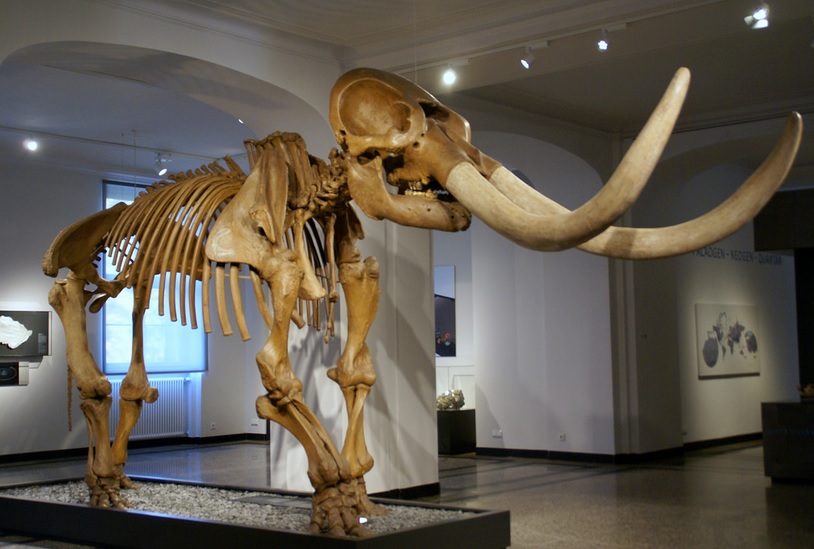
After Peale’s death in 1827 his museum floundered, and was eventually reduced from a meritorious educational institution into a circus of cheap spectacle. It shut down for good in 1848, and the mastodon (by then one of many similar mounts) was put up for auction. There are several conflicting accounts of what became of the mount, including the suggestion that it was destroyed in a fire, but in fact Peale’s mastodon has survived to the present day. Johann Jakob Kaup purchased the skeleton for the Landesmuseum in Durmstadt, Germany, and it has remained on display there ever since.

Germany Peale’s mastodon survives in Durmstadt, Germany. Source

Peale’s mastodon left an unmistakable legacy for both paleontology and public education. Today, the public conception of prehistory is inseparably connected to the image of towering mounted skeletons in museum halls. But fossils do not come out of the ground bolted to steel armatures, so it is largely thanks to Peale that mounts have become the most enduring means of sharing paleontology with the public.

References

Carpenter, K., Madsen, J.H. and Lewis, L. (1994). Mounting of Fossil Vertebrate Skeletons. Vertebrate Paleontological Techniques, Vol. 1. Cambridge, UK: Cambridge University Press.

Connriff, R. (2010). Mammoths and Mastodons: All American Monsters. Smithsonian Magazine. http://www.smithsonianmag.com/science-nature/Mammoths-and-Mastodons-All-American-Monsters.html

Semonin, P. (2000). American Monster: How the Nation’s First Prehistoric Creature Became a Symbol of National Identity. New York, NY: New York University Press.

Simpson, G.G. (1942). The Beginnings of Vertebrate Paleontology in North Ameirca. Proceedings of the American Philosophical Society 86:130-188.

4 Comments

Filed under field work, fossil mounts, history of science, mammals, museums

The Calvert Marine Museum’s big foam shark

Over Labor Day weekend, I visited the Calvert Marine Museum in Solomons, Maryland. The Museum, which features both indoor and outdoor exhibits, covers a wide range of Chesapeake regional history, including Patuxant Indian culture, the War of 1812, the local fishing industry and of course, Miocene marine fossils. The paleontology gallery, called “Treasures from Our Cliffs”, is nicely done and surprisingly high in production value for the museum’s size. Starting with an extensive entry gallery that places Chesapeake area fossils in a global context, the exhibit also includes fossils of seals, whales, invertebrates and assorted terrestrial mammals, plus a neat recreation of a cliff-side excavation.

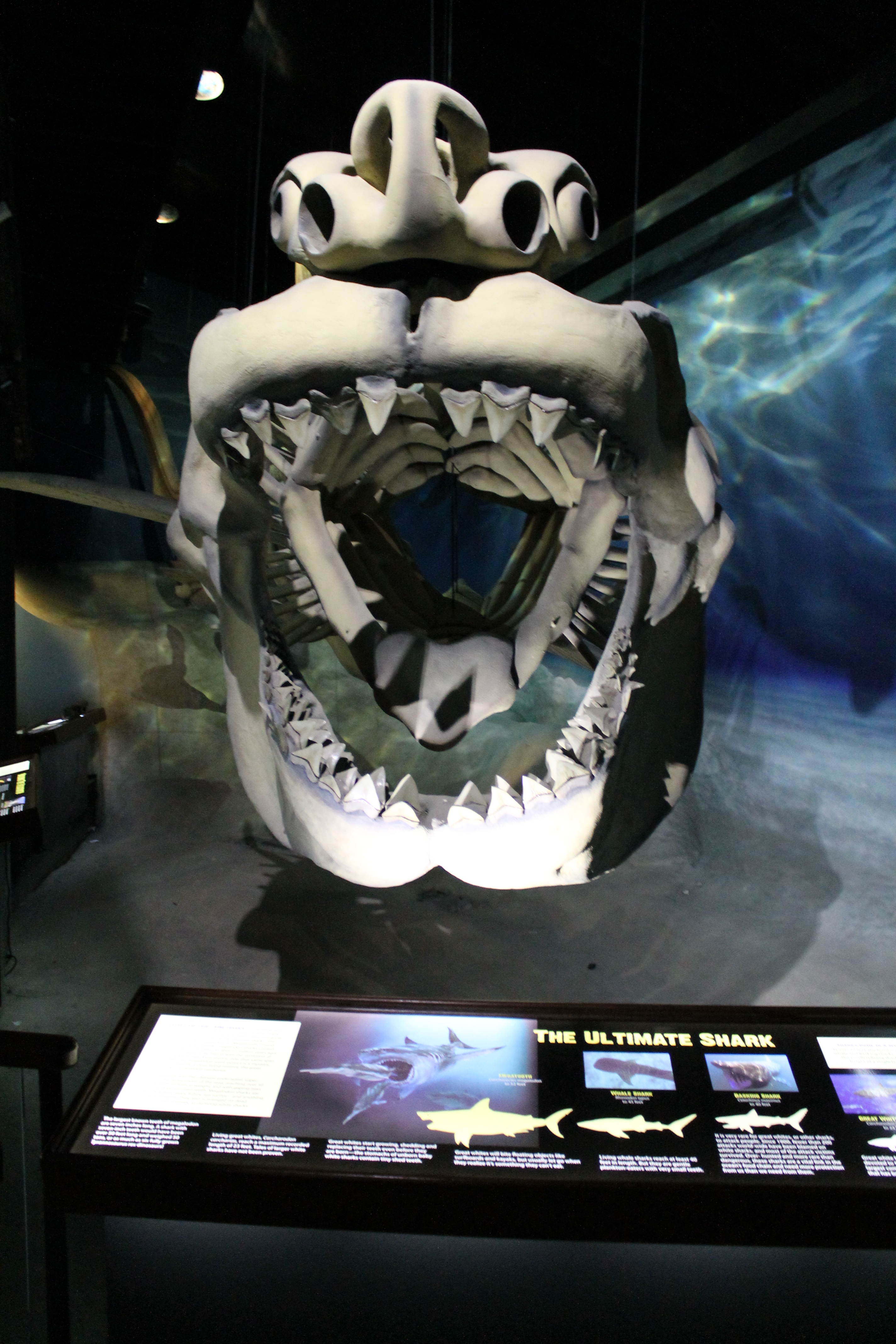
The Carcharocles megalodon at the Calvert Marine Museum.

The Carcharocles megalodon at the Calvert Marine Museum.

What I want to talk about most, though, is the big foam shark pictured above. This is the exhibit’s centerpiece attraction, a complete replica of the cartilaginous skeleton of the infamous giant extinct shark Carcharocles megalodon. Since shark skeletons are primarily made up of soft cartilage, most of their bodies are very unlikely to fossilize. While teeth and lithified vertebrae of C. megalodon are relatively common, a complete skeleton can only be created as a replica. As such, the Calvert Marine Museum’s display is a scaled-up model of the cartilaginous skeleton of a modern Carcharodon chararias (great white shark), with a few proportional adjustments based on known fossils. The result is undeniably impressive: suspended over an ocean backdrop, the 37-foot model absolutely steals the show in the paleontology exhibit.

Nevertheless, I find it absolutely fascinating that the museum would go to such lengths to create a replica shark, particularly given its substantial collection of original fossils. The foam shark’s existence can be traced to the beginning of the 20th century, when there was a dramatic rush among large urban museums in the United States to collect and mount the biggest and most spectacular dinosaur skeleton that could be found. This fossil craze was largely motivated by the vanity of the museums’ wealthy benefactors, but proved to be extremely productive for both paleontologists and museums. Mounted dinosaur skeletons sprung up seemingly overnight in cities across the country, making names like “Brontosaurus” and Diplodocus household terms and igniting a wave of interest in museums and natural science.

As a result of this mounting spree, the public conception of dinosaurs and other prehistoric animals is to this day irreversibly intertwined with its conception of museums. When we think of fossils, we think of grand museum halls populated by towering skeletons. This connection is so ingrained that mounted skeletons have become, in the public eye, the only proper way to display prehistoric animals. Patrons of paleontology exhibits expect mounts, and museums must deliver, even if it means purchasing a cast from another institution, or in the case of the Calvert Marine Museum, sculpting one outright.

And from the front.

A closer look at C. megalodon.

It is true that very few museum mounts feature the complete skeleton of a single animal – they are typically composites of many specimens, or have missing parts filled in with casts or sculpted elements (see this SVPOW post on Kyle Davies, who sculpts bone replicas for OMNH). Probably the most important function of a mount is to present fossil material in a format that non-specialists can easily understand and appreciate. They show viewers what extinct animals would have been like in life, and let us perceive them in relation to our own human scale. But unlike a mural or life-sized model, which are obviously reproductions, mounts retain the aura of authenticity that comes from displaying known fossils. To display a skeleton is to imply that we are seeing real specimens, or at least replicas standing in for specimens that exist somewhere else. Whether reasonable or not, this is the expectation ingrained by over 150 years of fossil mounts in museums.

This means that the C. megalodon at the Calvert Marine Museum is pushing the concept of a fossil mount to its very limit. While this is without doubt a very reasonable reconstruction of what a C. megalodon skeleton would have looked like, only a minuscule fraction of what is on display represents fossils that have actually been uncovered. The question is then, is a display like this a misrepresentation of scientific knowledge and the fossil record?

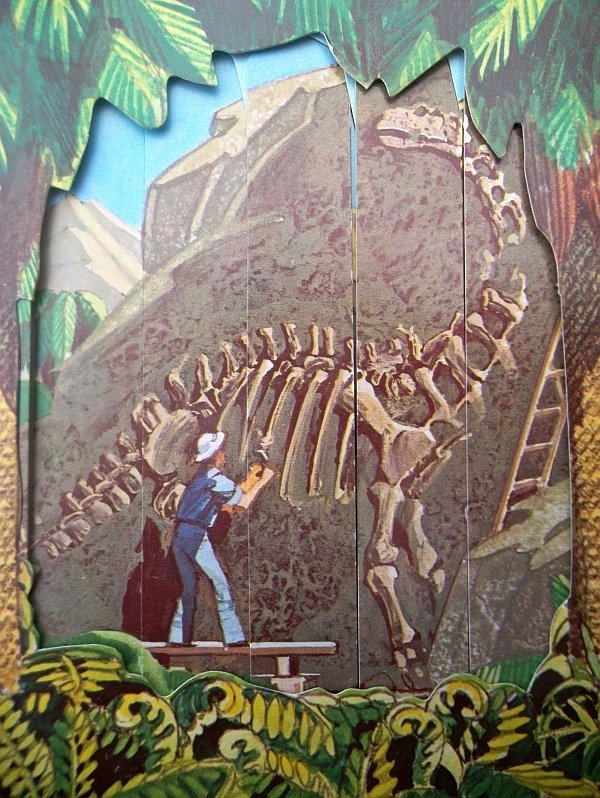
How dinosaur fossils are NOT found. From Dinosaurs: A Prunell magic Pop-Up Book, via LITC.

Not how vertebrate fossils are found. From Dinosaurs: A Prunell Magic Pop-Up Book, via LITC.

To the Calvert Marine Museum’s credit, the exhibit signs clearly explain that the C. megalodon skeleton is a replica, and provide a detailed explanation of how and why it was made. What’s more, the shark mount is merely an extreme example of filling in gaps with probable reconstructions, a process needed to make the construction of mounts of most prehistoric animals possible at all. The field of vertebrate paleontology is, in fact, largely based on the premise that incomplete remains can be understood in the context of other, better known relatives. Then again, if I learned anything teaching undergraduate anatomy, it’s that the concept that vertebrates share a body plan inherited through common ancestry is not widely known. This might be worth considering when presenting fossil mounts in general: after all, mounts primarily exist for the public, not for experts (although see Kenneth Carpenter’s comments on an earlier post).

The Calvert Marine Museum’s C. megalodon definitely raises some weighty questions about displays of scientific specimens in museums. In the context of vertebrate fossils, what qualifies as a real specimen, and what is well-supported extrapolation? What role should a museum play when displaying scientific knowledge? Should museums merely serve as repositories for original objects found in nature, or is the goal to provide context and meaning for those objects? Can a boundary between the two be defined at all?

3 Comments

Filed under exhibits, fish, fossil mounts, museums, science communication

In Defense of New Museums

As a museum* educator, I work with two kinds of experts: researchers who create knowledge and education specialists who disseminate knowledge. Both groups have ostensibly the same mission, which is to effectively communicate credible information about the world around us. Generally, both sides collaborate effectively, due in no small part to a shared enthusiasm for their work. But there is one issue (that has been raging for decades) in which researchers and educators frequently seem to be shouting past each other, complaining about what one another are doing wrong but not making much progress in reconciling their priorities. This issue is, of course, “new museum” exhibit aesthetics, the trend toward replacing traditional academically-oriented displays of specimens with dynamic, interactive leaning experiences that use specimens alongside interactive activities and multimedia to communicate specific educational messages to a broad audience.

*When I say museum, I mean natural history or science museum. Art museums are a completely different beast, and one I won’t pretend to understand.

From the perspective of many researchers and certain sets of museum-goers, these newer exhibits are frivolous lowest-common-denominator attractions better suited to amusement parks than serious institutions. For example, in a recent Tetrapod Zoology review of the London Natural History Museum’s Extinction exhibit, Darren Naish criticizes computer-based interactive exhibits because they “take up space that really should be spent on something far more worthwhile” and “give visitors the excuse to do the same old crap they do every other day of their lives (look at screens, play videogames, use touchscreens) when they really could be treated to a more unique experience.” Likewise, an all-encompassing rant about new museums can be found in this (admittedly 6 year old) post by Matt Wedel, which is well worth a read (seriously, read it now and then come back to this).

The Hunterian Museum as it appeared in the 1600s: all  of the specimens, not much else.

The Hunterian Museum as it appeared in the 1800s: ALL OF THE SPECIMENS.

But in direct contrast to Wedel’s insistence that the intrinsic value of real specimens is all museum-goers want or need, there are editorials like this one by James Durston, which I will charitably describe as provocative. Durston tells us that museums that only display artifacts for their own sake are “classrooms made of cold granite, the only sense of life emerging from the tourists.” He argues that most objects on display in museums don’t matter as much to visitors as museum workers think they do, and pleads for more context and more reason to care.

So what’s the deal? Are modern museums too focused on providing context for their collections, or not focused enough? Let me begin by explaining why modern museum exhibits look the way they do. A century ago, or even 50 years ago, exhibits were arranged and labels were written almost exclusively by expert curators. These exhibits were, by and large, created with an audience of “interested people” in mind, meaning either other experts or clientele with enough leisure time to learn the jargon presented to them. The majority of visitors who came through the door were not directly catered to, because exhibits were considered an afterthought to the real work of the museum: research and collections management.

In the past 30 years, however, the museum field has decided that it can do better. Museums shifted from inwardly focused, primarily academic institutions into focal points for lifelong learning that operate in service to a wide community of visitors. Go to the website of your favorite museum and check out their mission statement (it should be pretty easy to find). I just did, and the mission of the National Museum of Natural History is to “increase knowledge and inspire learning about nature and culture, through outstanding research, collections, exhibitions, and education, in support of a sustainable future.” Note that the museum doesn’t seek to increase knowledge and inspire learning just for a core audience of studious, well-read people, but for everyone. That means the museum needs to offer content that is interesting to all sorts of people, whether they learn best by reading and absorbing information, by physically doing something, by making choices for themselves or by discussing an issue with others. Preserving  and studying collections is no less important than in museums of yore, but these activities are understood to be in service of providing knowledge to the widest possible audience.

This shift in focus has inspired museum exhibits with more explicit educational goals, as well as attempts to create learning experiences that reach visitors other than those already keyed in to the customary language of academia. Drawing heavily on Gardner’s multiple intelligences, modern exhibits are intended to cater to diverse audiences that learn in a variety of different ways. In particular, hands-on mini experiments and computer-based games have become staples in science exhibits in order to reach visitors who learn better by doing than by observing. These interactive elements (we just call them interactives in the biz) are not appealing to everyone, but museums serve a broad community and have no business being exclusionary in the services they provide.

Beyond any moral or educational imperative, however, modern museums must be accessible because they are nonprofit institutions that rely heavily on public funds. They are funded based on the promise that they will provide educational resources for their communities, and that means serving more than a small subset of the population. Furthermore, ever-tightening budgets mean that museums need to be strictly managed. Educators have no choice but to establish clear standards of success for their exhibits, and to develop means to track attendance and audience engagement. Just to keep our jobs and keep museum doors open, we need to be able to clearly articulate who we are serving, how we are benefiting them and how we know.

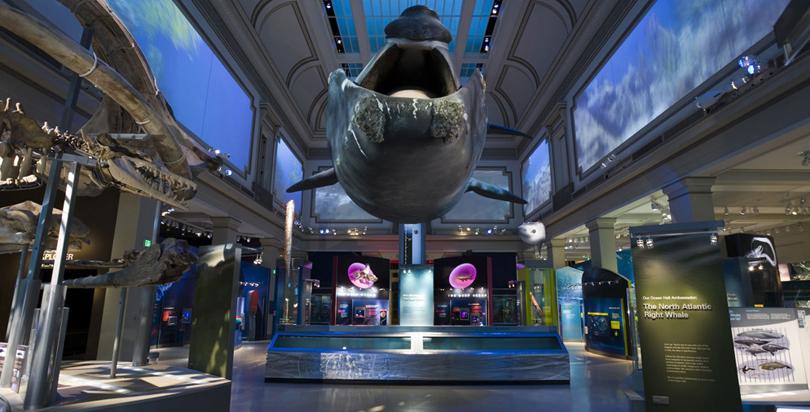
The new Ocean Hall at NMNH: a $90 million new museum extravaganza.

The new Ocean Hall at NMNH: a $50 million new museum extravaganza.

If it was not clear, I absolutely agree with the goals behind new museum design. As  was argued in the American Alliance of Museums’ 1984 “Museums for a New Century” commission report, “if collections are the heart of museums, what we have come to call education – the commitment to presenting objects and ideas an an informative and stimulating way – is the spirit.” General audiences can certainly experience awe and wonder when presented with neat stuff, but museums can and should provide more than that. A hundred birds from around the world look impressive on a shelf, but they are much more interesting when the viewer understands the evolutionary processes and biogeography that produced such diversity. A little bit of context goes a long way to making such an exhibit is accessible and valuable to the widest possible audience.

In practice, however, I will concede that many attempts at broadening the appeal of natural history exhibits are pretty bad. Some modern museum exhibits use technology in terrible ways, and many attempts to increase interactivity are bafflingly pointless or even counterproductive. For instance, a dinosaur exhibit I visited earlier this year includes a green-screen stage where visitors can place themselves in a scene with dinosaurs running around. The result is not only painfully dated, but it has no educational purpose and may well encourage people to think that humans and dinosaurs once co-existed. Likewise, an exhibit on human evolution features a glorified photo booth that makes visitors’ faces look like other hominids. This non-educational attraction is consistently the most popular element of the gallery, distracting visitors from the fantastic displays and specimens all around it. More generally, an increasing number of exhibits are incorporating profoundly pointless touch-screen computers that let visitors browse photos of the specimens on display right in front of them. Just because an exhibit element is hands-on doesn’t mean it is actually helping visitors interact with exhibit content.

One reason lousy interactives keep being designed is that our evaluation procedures* are not always great at separating good exhibits from appealing ones. A good interactive provides informative content in an engaging way, while an appealing one is engaging but lacking in content. Many visitors may speak highly of just-appealing interactives, but that doesn’t mean these belong in museums. The aforementioned budget woes are also a factor here: interactives that draw crowds for any reason are a big help when scrounging for ways to fund research and preservation. There are tough calls to make when deciding between what visitors most want to see and what is actually worthy of an educational institution. There are no easy answers, especially when museums are consistently hurting for funding.

*Do note, however, that actually testing whether exhibits are meeting their educational goals has finally become commonplace…for far too long museum workers just assumed anything they made was good enough.

Nevertheless, when an interactive display works, when visitors’ eyes light up with understanding by working out a scientific problem for themselves, the process is absolutely worthwhile. Earlier this year, I raved about the low-tech brilliance of an activity in the Academy of Natural Sciences that let visitors physically act out the difference in upright and sprawling gaits. And the NMNH Human Origins exhibit features a fantastic computer game where visitors play the part of a future world leader and experience firsthand the challenges and consequences of overpopulation, food shortage and invasive species. Exhibit interactives, both technology-based and otherwise, are difficult to pull off, and many museums have failed at the task. But we owe it to our visitors to try.

10 Comments

Filed under collections, education, exhibits, history of science, museums, opinion, science communication

D.C. area fossils on WAMU

Matt Carrano of the National Museum of Natural History, Alan Dooley of the Virginia Museum of Natural History and Dave Hacker of Maryland’s Dinosaur Park were interviewed on the Kojo Nnamdi show this afternoon. You can listen to the stream here. Topics covered include the 2019 re-opening of the NMNH fossil halls, local Cretaceous and Miocene paleoenvironments, the harm caused by commercial fossil collecting and the Discovery Channel C. megalodon travesty. Since I work for the MNCPPC at Dinosaur Park and have been involved with NMNH in the past, this is all quite near and dear to me. If you’ve got 20-30 minutes, it’s well worth a listen!

1 Comment

Filed under Dinosaur Park, dinosaurs, field work, NMNH

The Gilmore Models: Where are they now?

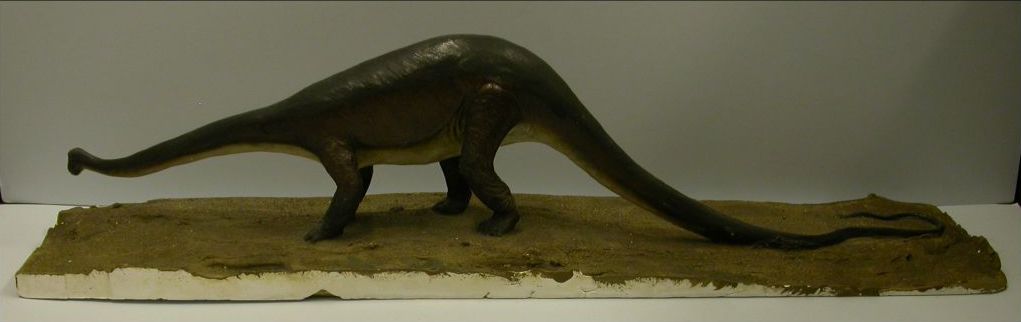
Regular readers of this site (if there are any) undoubtedly know Charles Whitney Gilmore as the Smithsonian paleontologist who, between 1903 and 1964, led in the creation of most of the mounted dinosaur skeletons that remain on display at the National Museum of Natural History today. You don’t necessarily have to be in Washington, DC to see Gilmore’s reconstructions, however. In addition to being an expert anatomist and fossil preparator, Gilmore was a formidable sculptor, and during his tenure at the Smithsonian he produced a number of gorgeous life reconstructions of prehistoric animals. Plaster copies of these models were gifted or sold to large and small museums in North America and Europe, including the Sternberg Museum of Natural History, the University of Kansas Natural History Museum and the Hunterian Museum at the University of Glasgow. These models were typically displayed alongside isolated fossil elements to give a sense of the entire animal at institutions where complete mounts were unfeasible.

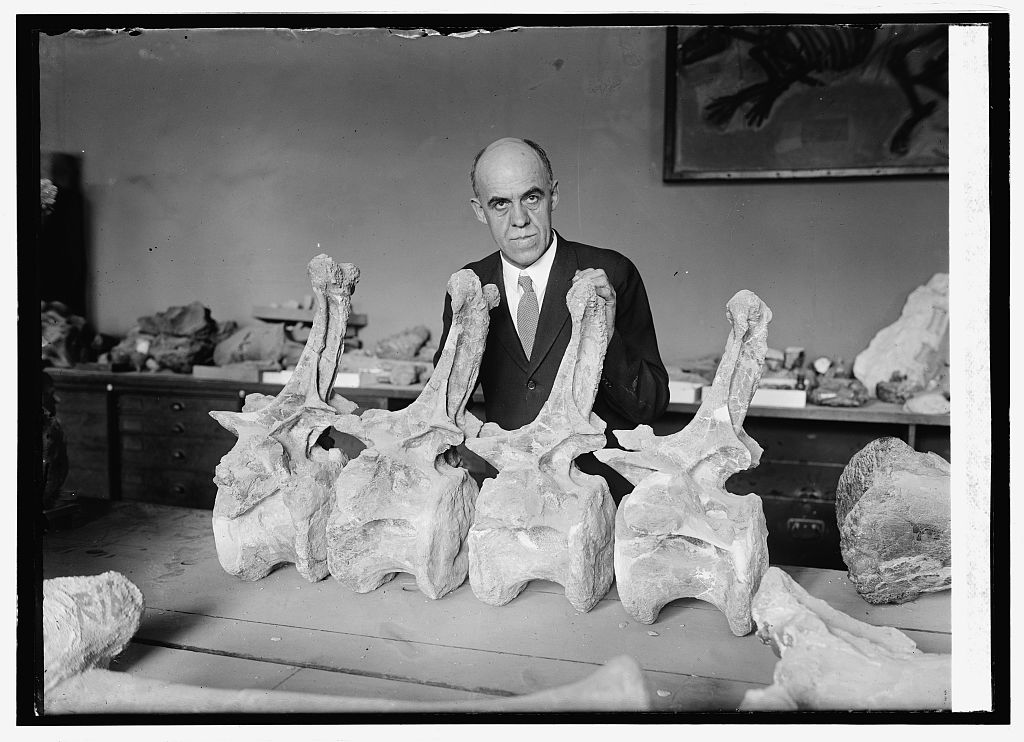
Gilmore with Diplodocus vertebrae.

Charles Gilmore, or Chucky G, as he was known to his friends.

Unfortunately, many of the museums that acquired copies of Gilmore’s models in the 1920s and 30s seem to have lost the detailed provenance of these acquisitions (not a rare occurrence, as museums must track literally millions of objects and historic records on paper do not always survive). The Hunterian Museum has the best records regarding these models that I am aware of, and incidentally their online catalog is the source of most of the photographs in this post.

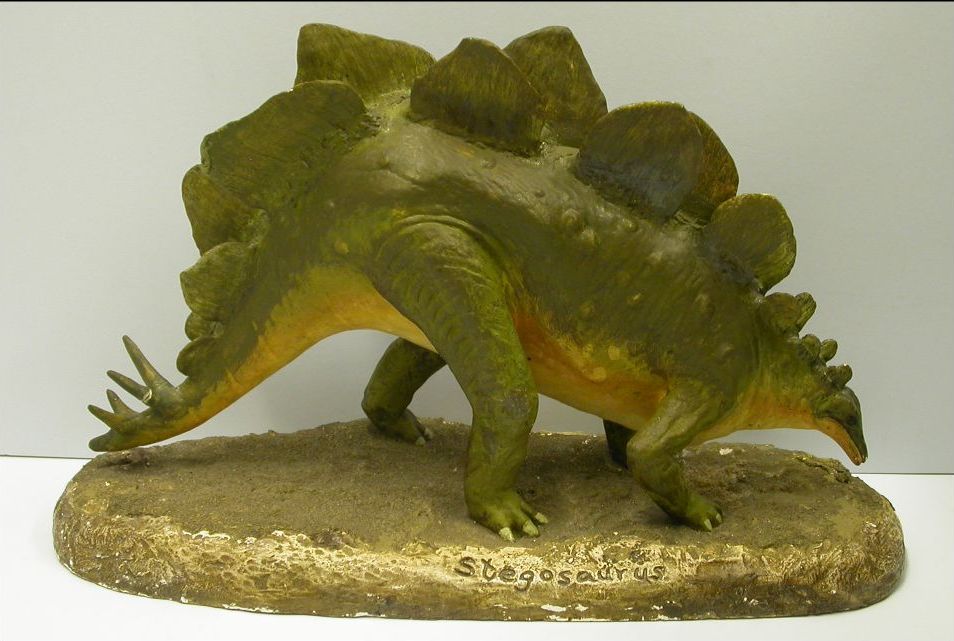
Stegosaurus model in plaster of paris. Image courtesy of the Hunterian Museum and Art Gallery.

Stegosaurus model in plaster of paris. Image courtesy of the Hunterian Museum and Art Gallery.

While Gilmore’s models are obviously far from accurate by modern standards, a closer inspection reveals that Gilmore was familiar with every inch of the fossils in his care, and put that knowledge to use in his sculptures. The Stegosaurus above, for instance, is a perfect match for Gilmore’s full-sized mount in terms of pose and proportion. Undoubtedly, physically assembling an actual skeleton is among the best ways to become familiar with how an animal would work in three dimensions. In particular, note that unlike many contemporary reconstructions, Gilmore did not fudge the number or position of the plates; they’re all accounted for.

Stegosaurus model in plaster of paris. Image courtesy of the Hunterian Museum and Art Gallery.

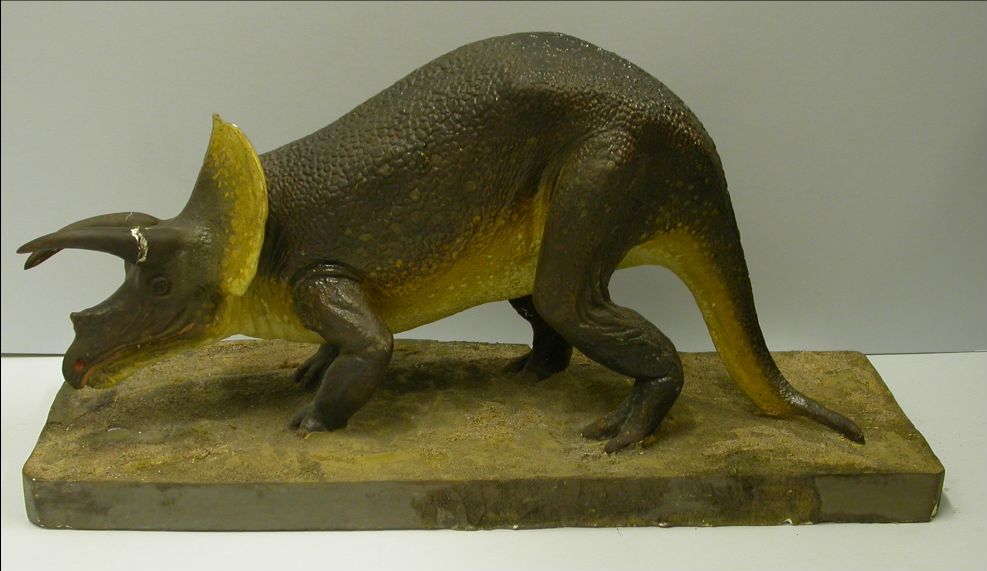
Triceratops model in plaster of paris. Image courtesy of the Hunterian Museum and Art Gallery.

The Triceratops model exhibits a number of interesting choices. The classic bowed ceratopsian forelimbs (which Gilmore first proposed after finding no other way to articulate them in his 1905 Triceratops mount) are clearly in evidence, but my eye is drawn to the scrawny, lizard-like hindlimbs. Comparing this model to Gilmore’s mount, there would appear to be virtually no muscle back there. The size of the head is yet another remnant of the mounting process. Since his Triceratops mount was a composite of numerous specimens, Gilmore used the skull of an inappropriately small animal, and apparently carried the chimeric proportions to this sculpture. The lack of cheeks and extremely thick neck are also characteristic of older ceratopsian reconstructions, although I can’t comment on precisely when or why that look went out of style.

Stegosaurus model in plaster of paris. Image courtesy of the Hunterian Museum and Art Gallery.

Diplodocus model in plaster of paris. Image courtesy of the Hunterian Museum and Art Gallery.

This Diplodocus has a much more defined shape than most mid-century sauropod reconstructions. Note in particular the sloping back, which peaks at the sacrum. This differs from the 1907 Diplodocus mount at the Carnegie Museum of Natural History, which had a completely horizontal spinal column. When Gilmore led the creation of the Smithsonian Diplodocus mount, he had the opportunity to use a vertebral column that was found articulated in situ, and was thus able to more accurately portray the shape of the animal’s midsection.

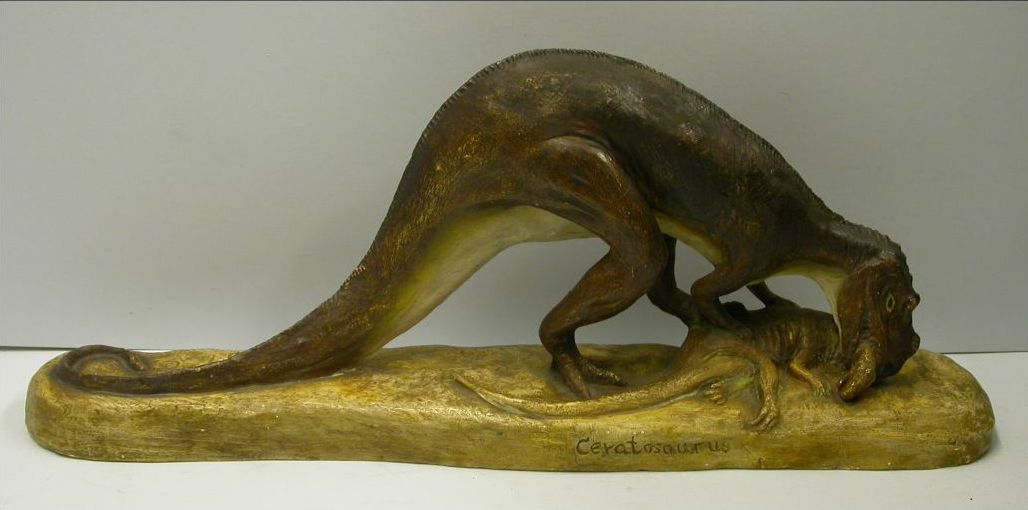
Ceratosaurus
Ceratosaurus. Image courtesy of the Hunterian Museum and Art Gallery.

Gilmore’s Ceratosaurus is the liveliest of the set, and is the only one that doesn’t strictly adhere to the pose of a corresponding fossil mount. Delivering a killing blow to a hapless ornithopod, one can easily imagine the energetic pounce that preceded this scene. I will point out, though, that this guy’s hindquarters are enormous. 

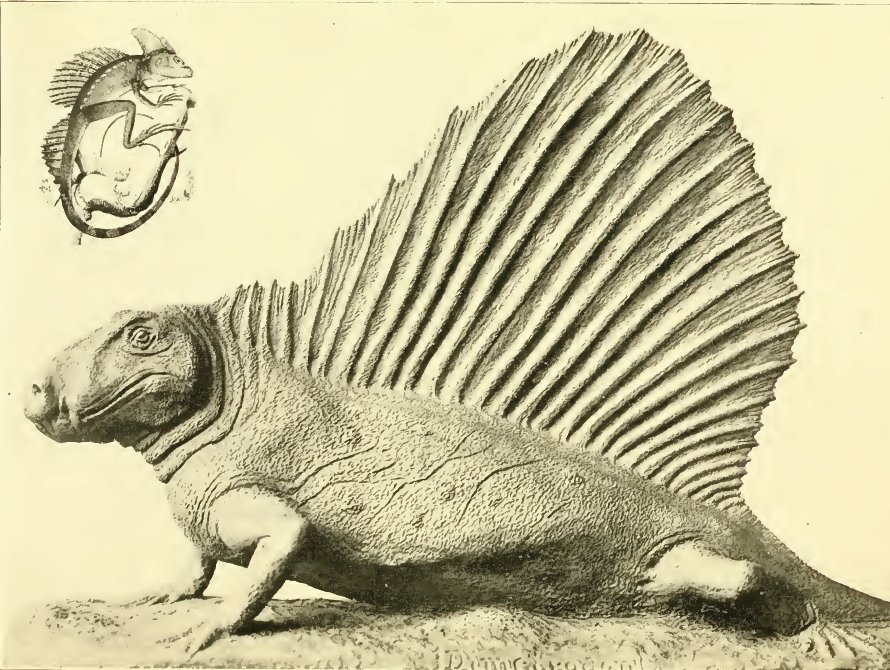
Gilmore's stub-tailed Dimetrodon. Image from Gilmore 1939.

Gilmore’s stub-tailed Dimetrodon model. 

Gilmore also sculpted some non-dinosaurs, including at least one prehistoric horse and the Dimetrodon pictured above. Note the teensy stub of a tail, which this model actually shared with Gilmore’s mount of the pelycosaur. The lips obscuring most of the teeth except for a couple incisors is an unusual choice, and I’m not sure what inspired it. This image is from Gilmore’s 1939 paper on Dimetrodon, and the Basiliscus basiliscus in the corner provides a helpful comparison to a contemporary animal with a similar dorsal sail.

In addition to the models shown here, Gilmore created sculptures of “Anatosaurus”, “Brachyceratops” and a Cenozoic horse, as well as busts of Styracosaurus and Corythosaurus (and there may well have been others I haven’t seen). As mentioned, copies of these mounts were distributed to museums and possibly private collections throughout the 20s and 30s, and I have no idea how many were actually made. A few museums, such as the Sternberg Museum, actually have these models on display, but at other institutions they have been relegated to storage. Objects like these present an unusual challenge for collections managers. They were accessioned as scientific representations, but their value has shifted over the last century to the realm of art and history. While these models are undoubtedly important, they are probably no longer useful at many of the institutions that hold them. As such, the Gilmore models exemplify that museum collections are not necessarily static, but change in meaning as the years go by.

If you work at an institution that has one or more Gilmore models in its collection, feel free to leave a comment. I’d love to start a working database of where copies of these models have ended up!

References

Gilmore, C.W. (1939). “A Mounted Skeleton of Dimetrodon gigas in the United States National Museum, with Notes on the Skeletal Anatomy.” Proceedings of the US National Museum 56:2300:525-539.

Gilmore, C.W. (1932) “On a newly mounted skeleton of Diplodocus in the United States National Museum.” Proceedings of the United States National Museum 81:1-21.

11 Comments

Filed under collections, dinosaurs, history of science, NMNH, paleoart, reptiles

The Osborn problem

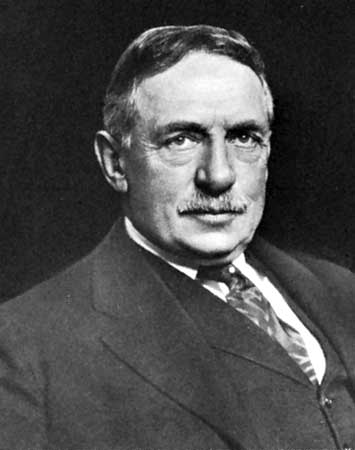
In both paleontology and the museum field, we’ve long contended with what one might call “the Osborn problem.” The legacy of Henry Fairfield Osborn, paleontologist and president of the American Museum of Natural History between 1908 and 1933, is quite important to both fields.  To paleontologists, he is known for accumulating at AMNH one of the largest and most exhaustive fossil collections in the world,  for financing and supporting the careers of legends like Barnum Brown and Charles R. Knight, and of course for naming and describing saurian celebrities like Tyrannosaurus and Velociraptor.

Osborn is also well-regarded by museum specialists for heightening the standards for public exhibitions, investing in lifelike habitat dioramas of taxidermy animals and spectacular mounted dinosaur skeletons in order to make science exciting for a wide audience. Osborn’s devotion to storytelling and drama in the exhibits he curated brought millions of visitors to AMNH and quite literally defined public expectations for what museums should offer to this day.

Henry Fairfield Osborn.

Henry Fairfield Osborn.

In recent decades, however, historical interest in Osborn has been mostly focused on his disreputable personal and political beliefs: Osborn was a flagrant racist and anti-Semite,  an admirer of Adolf Hitler and a strong supporter of research in eugenics. Osborn regularly used his clout to bring material harm to the American working class, lobbying for legislation including the Emergency Quota Act and the Immigration Act of 1924. For what it’s worth, Osborn was also apparently unbearably arrogant and truly dreadful to work with, going as far as to demand lower-ranked museum employees leave the elevator car when he got on.

All this puts paleontologists and museum specialists in an awkward position. Is it acceptable to admire Osborn’s positive achievements in light of his personal politics? After all, Osborn’s views were not terribly unusual among the aristocratic class of his day. Perhaps we shouldn’t condemn the man entirely for not “rising above his time and place” (as Stephen Ambrose argues regarding coming to terms with Thomas Jefferson the slave owner).

Unfortunately, Osborn’s case is complicated by the fact that his bigotry inspired (or at least contributed to) much of his work at AMNH*. To start, Osborn’s scientific work was based on an inaccurate orthogenetic interpretation of evolution. He professed that an ill-defined guiding force shaped life from lesser to greater forms, the effect of which could be seen by comparing “primitive” and “advanced” species, and of course, “primitive” and “advanced” expressions of humanity. While we cannot conclusively link Osborn’s pseudo-evolutionary ideas with his bigoted social agenda, it is certainly convenient for him that he saw people of “Nordic” descent as biologically superior.

*To clarify, none of the exhibits curated by Osborn remain on display and none of my comments here apply to the present day AMNH.

Critically, Osborn did not keep his ideas of natural hierarchy in the ivory tower. He explicitly intended that the exhibition halls of AMNH educate visitors not just about natural science but about the naturally graded order he believed to be characteristic of life on earth. Osborn thought that collections of biological specimens implicitly revealed an upward ascent of life, and that those on top had earned their place through innate superiority. Osborn pronounced that his exhibits would teach morality to new American immigrants, presumably by putting them in their place with the rather hideous racial hierarchy on display in the Hall of the Age of Man. As Donna Haraway puts it in her classic essay Teddy Bear Patriarchy, Osborn’s exhibits were a “gospel of wealth and privilege” that appropriated natural specimens to affirm the American elite’s place at the top of the pecking order.

Tyrannosaurus and others in AMNH Dinosaur Hall, 1927. Photo courtesy of AMNH Research Library.

Tyrannosaurus and others in AMNH Dinosaur Hall, 1927. Photo courtesy of AMNH Research Library.

Museums are understood to be sources of intellectual authority, and deservedly so. But exhibits have authorship, same as any other written work, and Osborn’s legacy demonstrates that the influence of authors and their worldviews can be a powerful force. For example, Osborn arranged the Hall of the Age of Man in what he saw as ascending order, from the ancient peoples of Africa, to North America, and finally Europe. Placed at the end of an exhibit series that started with Cambrian invertebrate fossils before passing through Paleozoic, Mesozoic, and Cenozoic fossil displays, the Age of Man gallery deliberately implied that European-descended humans were the culmination of the entire history of life on Earth.

Meanwhile, the exhibit on fossil horses curated by Osborn depicted small, multi-toed horses of the Eocene gradually becoming larger, losing toes and becoming better at being modern Equus. This orthegenetic representation runs counter to evolution via natural selection as originally proposed by Darwin, and as understood today. Indeed, other paleontologists, including O.C. Marsh, had established in the 19th century that horse evolution more closely resembled a tangled bush, with many overlapping morphological offshoots adapted to varying environmental circumstances. But Osborn had rejected Darwinian evolution in favor of his presumed hierarchy of life, and ensured that his inaccurate story was what was seen by millions of visitors.

So what does Osborn’s legacy mean to paleontologists and museum specialists today? Do we need to qualify every mention of his name with a denouncement of his worldview? Should we always write out “Tyrannosaurus rex Osborn, 1905″ as “Tyrannosaurus rex Osborn the racist jerk, 1905″? At minimum, Osborn’s exhibits are a sobering reminder to all us involved in science education that our field is not immune to bias. The  subjectivity of cultural and historical museum exhibits has been well-explored by scholars like Ames and Weil, but comparatively little reflection has been done on the authorship of exhibits on science and natural history. We rely on the “naturalness” of the objects we display to speak for itself, and to bear the burden of proof for the statements we make. The world around us is knowable, and science is the best tool to learn about it. But explaining what we have learned in any form (books, technical journals, museum exhibits) is an avenue for personal or cultural bias to slip in, and that is why it remains important to actively and regularly check our assumptions.

References

Ames, M.M. (2004). Museums in the Age of Deconstruction. In Reinventing the Museum: Historical and Contemporary Perspectives on the Paradigm Shift. Lanham, MD: AltaMira Press.

Brinkman, P.D. (2010). The Second Jurassic Dinosaur Rush: Museums and Paleontology in America at the Turn of the Twentieth Century. Chicago, IL: University of Chicago Press.

Colbert, E.H. (1968). Men and Dinosaurs: The Search in Field and Laboratory. New York, NY: E.P. Dutton and Co., Inc.

Haraway, D. (1984). Teddy Bear Patriarchy: Taxidermy in the Garden of Eden, New York City, 1908-1936. Social Text 11:20-64.

Kohlstedt, S.G. (2005). Thoughts in Things: Modernity, History and North American Museums. Isis 96:586-601.

Osborn, H.F. (1921). The Hall of the Age of Man in the American Museum. Nature 107:236-240.

6 Comments

Filed under AMNH, anthropology, history of science, mammals, museums, science communication

10,000 Thanks

Sometime last night, this site received its 10,000th visitor. I am thrilled beyond words that so many people have found what I have posted here interesting or helpful. I started blogging when I was fresh out of college, with an internship at the Smithsonian but only vague ideas of what I wanted to do with myself. Since that time, I figured out that while the web is full of fantastic resources on research in paleontology, precious little information was available about the study and display of fossils on a human timescale.  The spectacular paleontology exhibitions that fill our museum halls would certainly not be possible without the study of the fossil record, but they also wouldn’t exist without the artists, technicians, researchers and educators that will these displays into reality.

If only in a disorganized and haphazard way, that is what I aim to provide with this blog. The process of creating and communicating knowledge in a museum setting is as much about people as it is about ideas, and I’d like to make sure those people get the recognition they deserve. 

So with that, I would like to say thank you to each and every person that stopped by, and especially those who took the time to join the conversation by commenting and sharing their own expertise. Here’s to 20,000!

OLYMPUS DIGITAL CAMERA

2 Comments

Filed under museums