Category Archives: AMNH

A closer look at the “Natural History Museum of North America”

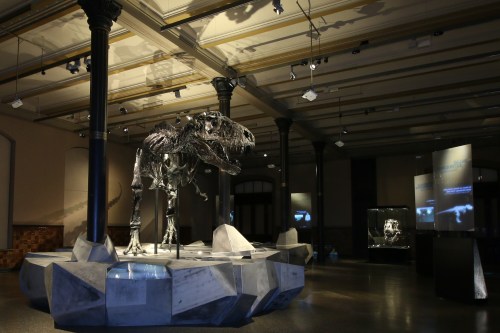
A headless Tyrannosaurus skeleton at the fictional Natural History Museum of North America.

It seems that another Jurassic Park film is upon us. As I’ve written about before, the phenomenon that is Jurassic Park and it’s various sequels and spin-offs has played a central role in the public’s general awareness of dinosaurs for 30 years and counting. Whether we like it or not, every bit of public-facing media concerning dinosaurs (exhibits, books, documentaries, and more) must contend with Jurassic Park‘s long shadow. The latest film—Jurassic World: Rebirth—is just alright, but in a series first, it includes a scene in a natural history museum.

The Jurassic Park films have referenced the century-old association between museums and dinosaurs before. The first Jurassic Park played with this iconography in its classic finale, when the flesh-and-blood Tyrannosaurus and Velociraptor tear down pair of skeletal mounts in the titular park’s visitor center. Those cast skeletons were supplied by Research Casting International: the T. rex was a combination of LACM 23844 and the Royal Terrell Museum’s Black Beauty specimen, while the sauropod was a Camarasaurus with an alternate head. The implication of the scene is clear: the living, cloned dinosaurs represent new technology and scientific progress smashing the old and obsolete incarnations of paleontology to bits. A museum-like setting also features in several scenes in Jurassic World: Fallen Kingdom. In that film, the skeletal mounts—nearly all of which came straight from the Gaston Design catalog—are set up in the home of a wealthy dinosaur enthusiast.

The visitor center rotunda in Jurassic Park.

In Jurassic World: Rebirth, the characters don’t just encounter museum-like displays, they visit an actual museum in New York City. The museum isn’t named in the film, but photos of props reveal that it’s the Natural History Museum of North America, an obvious stand-in for the American Museum of Natural History. As the exposition-heavy scene plays out, we see the dinosaur hall is being dismantled. Pieces of skeletons and other exhibits are carted up and loaded away by a crew of hard-hatted workers.

“It’s a hell of a day here. They’re closing us down,” says paleontologist Henry Loomis, played by Jonathan Bailey. It’s not clear who “they” or “us” is in this scenario. Is the entire museum being shut down? The paleontology department? Or just this dinosaur exhibit? The film doesn’t have an answer to any of these questions, and the scene’s setting seems to be mostly symbolic: the public has grown weary of the feral dinosaur populations that have spread around the world at this point in the Jurassic Park universe. A catastrophic decline in museum attendance is apparently a side effect of that disinterest.

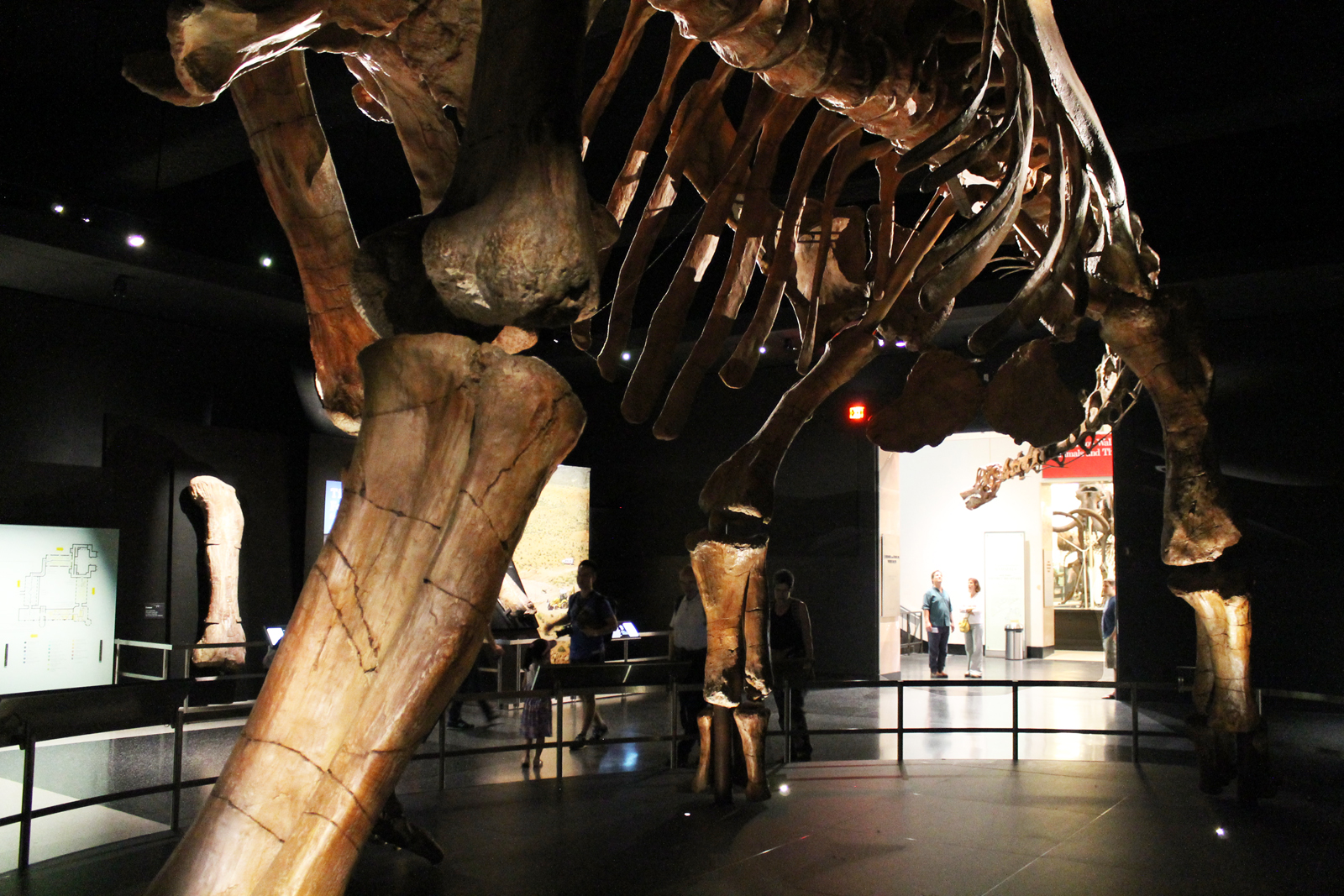
Looking up at the “Titanosaurus” skeleton.

Despite the hazy rationale for its deinstallation, we can still infer a fair amount about this fictional exhibition during the five minutes the characters linger within its walls. There are at least two galleries: an outer gallery flanked by large windows and dominated by a sauropod skeleton that straddles two pedestals, and up a set of stairs, an inner gallery that houses the T. rex skeleton.

The halls are decked in extravagant Baroque trim. This lavish architectural style was popular in Europe during the 17th and 18th centuries, but is somewhat out of place in New York City, where Beaux-Arts was the norm for large public buildings (like museums) built around the turn of the 20th century (like AMNH). A few Baroque revival buildings—mostly churches from the late 19th century—do exist in New York, however. Notably, the Baroque influence extends beyond the walls and ceilings and into the exhibit elements: gilded sauropods adorn a set of columns in the outer hall, and a high-contrast mural depicting what might be Archaeopteryx and Compsognathus is visible in the background of a couple shots.

The Painted Hall at Old Royal Naval College. Image from ornc.org.

The museum scene was actually shot in the UK, at the Old Royal Naval College in Greenwich. The dinosaur galleries are in fact the famous Painted Hall. Designed by James Thornhill and constructed between 1707 and 1726, this space was originally a dining hall but is now a popular tourist attraction. The immense murals depict an assortment of mythological and historical figures: King William III is at the center of mural on the ceiling, while George I holds court in the mural on the rear wall (this virtual tour explores the murals’ subjects in detail). Both murals are visible in Jurassic World: Rebirth (it’s best not to wonder why a New York museum is decorated with images of British monarchs).

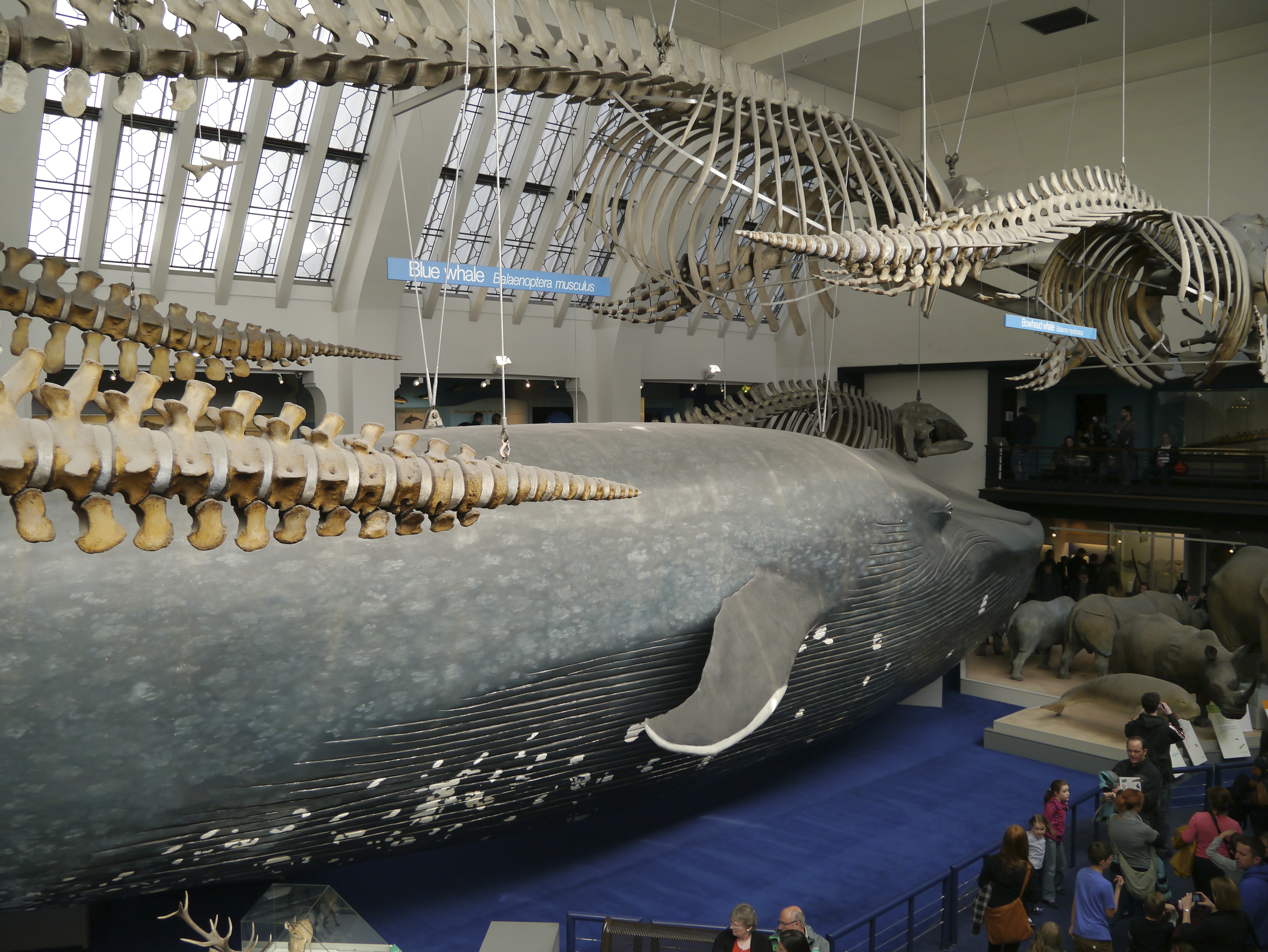
The British sensibilities extend to the exhibit elements. In the filmmakers’ commentary, director Gareth Edwards notes that he was inspired by the dinosaur hall at the London Museum of Natural History, which was considered as a shooting location. Much like that real-word exhibit, some of the displays at the North American Museum of Natural History are suspended above visitors’ heads and are partially hidden in shadow. The font and other design elements of the exhibit signage are also similar to the London museum.

Quetzalcoatlus skeleton and Mosasaurus skull on display amongst Baroque decor.

Taking a closer look at the dinosaurs themselves, the T. rex appears to be in an old-fashioned tail-dragging pose, or perhaps it’s mirroring the classic roaring stance from the end of the first film. The “When dinosaurs roamed the Earth” banner that matches the Jurassic Park visitor center is presumably an in-universe coincidence. A Quetzalcoatlus skeleton is suspended in front of the doorway, and a very large Mosasaurus skull hangs to its left. We also see a Triceratops skull and Deinonychus skeleton already crated for removal, along with some unidentified vertebrae and ribs on tables.

The fossils are realized on film with a combination of physical reproductions and CGI. The Triceratops skull is (rather crudely) sculpted, while the T. rex skull and Deinonychus skeleton appear to be casts of actual fossils. The Quetzalcoatlus, Mosasaurus, and T. rex body are CGI. The sauropod legs were likely present on set, but the rest of its body was filled in digitally when it appears in frame. None of the mounts have the supporting armatures needed for real fossils, so we can conclude that within the film universe, this exhibit only featured casts and reproductions.

Note the gilded sauropods on the columns to nowhere and the original Painted Hall red benches.

Taken together, the evidence on screen suggests that the Natural History Museum of North America is of similar age to AMNH, and the space occupied by the dinosaur exhibit was built as a Baroque revival in the late 1800s. Dinosaur-themed trim like gilded sauropods indicates that this has been a paleontology exhibit for all or most of that time. There have been recent updates, however. Some exhibit text is displayed on animated LED screens (this is most visible below the Mosasaurus skull) and other graphics are backlit. Text beneath the header “Incubation and Development” discusses the process of cloning dinosaurs—in the Jurassic Park universe, the existence of cloned dinosaurs became public knowledge when a T. rex briefly rampaged through San Diego in 1997, so this text must have been added sometime after that. An animated video summarizes how the feral dinosaur populations that began to spread in 2018 ultimately did not survive in the temperate latitudes, and most living dinosaurs now only thrive at the equator. This display could not be more than a couple years old at the time of Jurassic World: Rebirth.

The age of the Mesozoic reptiles on display is harder to pinpoint. Let’s ignore for the moment the many differences between these skeletons and their real-life counterparts (yes, there are no real mosasaurs that big, nobody would reconstruct a Quetzalcoatlus skeleton with that crest, and the Triceratops‘s eyes are weirdly placed). Few of these animals were known at the turn of the century, so most would have to be relatively recent additions. Quetzalcoatlus, for instance, was named in 1975, and sauropods the size of the “Titanosaurus” on display weren’t discovered until the late 80s (amusingly, the sauropod skeleton has a Camarasaurus skull, a fate that is apparently not just reserved for apatosaurines).

The blue illustration on this panel is subtly animated.

As discussed, the skulls and skeletons are all clearly plastic casts and models, which would date them to the 1970s at the earliest. The dynamic poses of the sauropod and Quetzalcoatlus also suggest a mid-Dinosaur Renaissance timeframe. What’s really interesting, though, is that all these skeletons are the chocolate brown color of fossilized bone. In a world where living dinosaurs exist, I would imagine that newer displays—whether real or replica—would be made to look like recent animals. Replica skeletons would be ivory-colored, and perhaps accompanied by taxidermy mounts or preserved samples of feathers, skin, and other soft structures. With that in mind, I’d say these skeletal displays were overhauled in the 80s or 90s, before there was widespread access to cloned dinosaurs. Overlays of new text and media were added in subsequent decades in an effort to keep the exhibit relevant in the “neo-Jurassic age.”

Martin Krebs (Rupert Friend), Zora Bennet (Scarlett Johansson), and Henry Loomis (Jonathan Bailey) hang their heads in shame after Loomis calls Quetzalcoatlus an “avian dinosaur.”

Loomis’s comment that “five years ago, you’d have to wait for hours” to get into the exhibit doesn’t make much sense with this timeline—if the public was going to lose interest in prehistoric dinosaurs, surely it would have happened before 2015, when the Jurassic World theme park was going strong. Perhaps the museum saw a brief spike in attendance around the time living dinosaurs started showing up in people’s backyards?

To be honest, much of the timeline of Jurassic World: Rebirth is illogical, and it probably has something to do with the film being hastily written and rushed into production. But I hope you’ll agree that even the worst fiction can be fun playground for thought experiments like this one. Did you catch any details in the Natural History Museum of North America Scene that I missed?

6 Comments

Filed under AMNH, art history, dinosaurs, exhibits, movies, museums

It’s time to renovate the AMNH fossil halls

An overview of the Hall of Vertebrate Origins. Photo by the author.

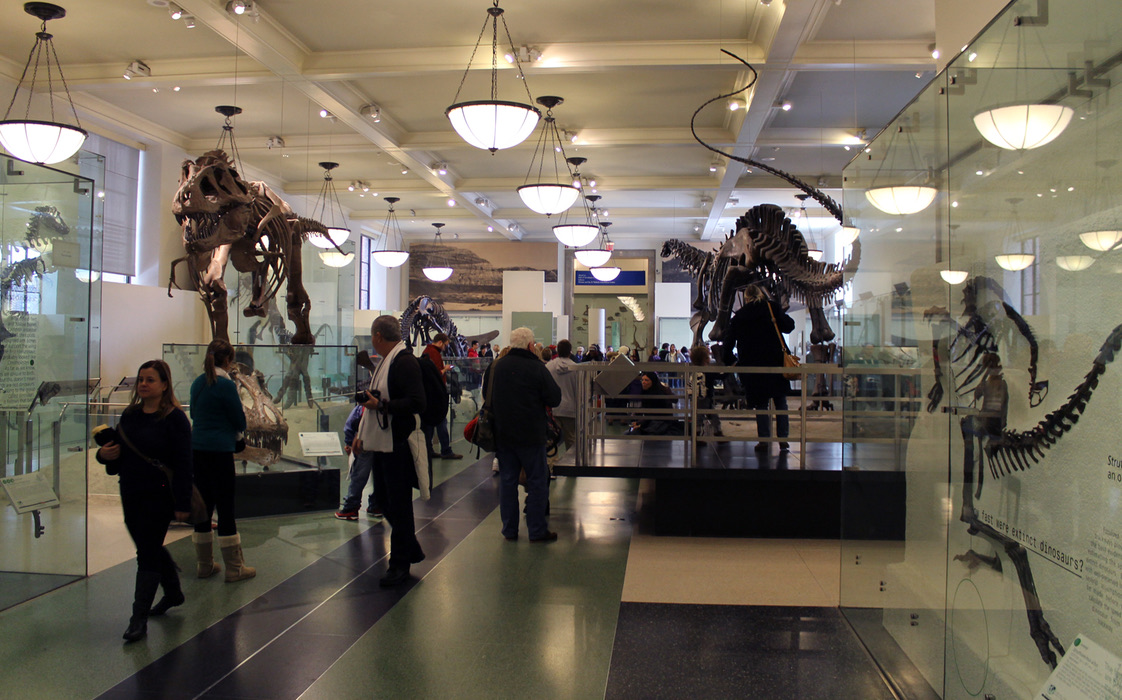
Spending a day at the American Museum of Natural History is always a joy. Particularly in its fourth floor fossil halls, AMNH stands head and shoulders above peer museums in the sheer breadth of collections on display. Something in the ballpark of 600 fossil vertebrate specimens are included, including no less than 135 mounted skeletons. Many of these represent taxa that cannot be seen anywhere else in North America. With each visit, however, I feel more and more that the AMNH fossil halls are showing their age. This is not surprising—the current exhibition opened in stages between 1994 and 1996. Strange as it seems to aging millennials like myself, that was 30 years ago. By comparison, the prior iteration of the fossil halls was completed in 1956, and was 31 years old when renovation planning began in 1987.

The “Brontosaur Hall,” part of the midcentury iteration of the AMNH fossil exhibits. Photo courtesy of the AMNH Research Library.

In their time, the current fossil halls were a monumental accomplishment—taking nine years to complete and costing $44 million (which would be more than $90 million today). Steering the ship was Lowell Dingus, a paleontologist by training who assumed the role of Project Director for the renovation. Dingus led a twenty-person team of AMNH researchers, writers, and preparators dedicated to the project, and Ralph Appelbaum Associates was hired to design a new look for the halls.

Initially, the intention was to only replace the two oldest halls, which featured Cenozoic mammal fossils. Some of these displays had not been altered since the 1920s, and others were boarded over because so many specimens had been removed for study or conservation. But when George Langdon and William Moynihan took over museum leadership positions, they decided to expand the project to include the two dinosaur halls. With the further addition of a new Hall of Vertebrate Origins (in a space previously occupied by the library) and a fourth floor Orientation Center, the project rapidly ballooned to cover 40,000 square feet of exhibit space and the entire story of vertebrate evolution.

On the design side, the team sought to restore the original architecture in each hall, ensuring that both the specimens and the spaces they occupied would come, as Dingus put it, “as close to their original grandeur as possible.” In many cases, century-old architectural elements—such as windows and molded ceilings—were still intact behind panels that had been installed over them during previous renovations. These features were painstakingly restored, or when necessary, recreated. Classic decorative elements, from the colonnades to the elegant chandeliers, were reintroduced.

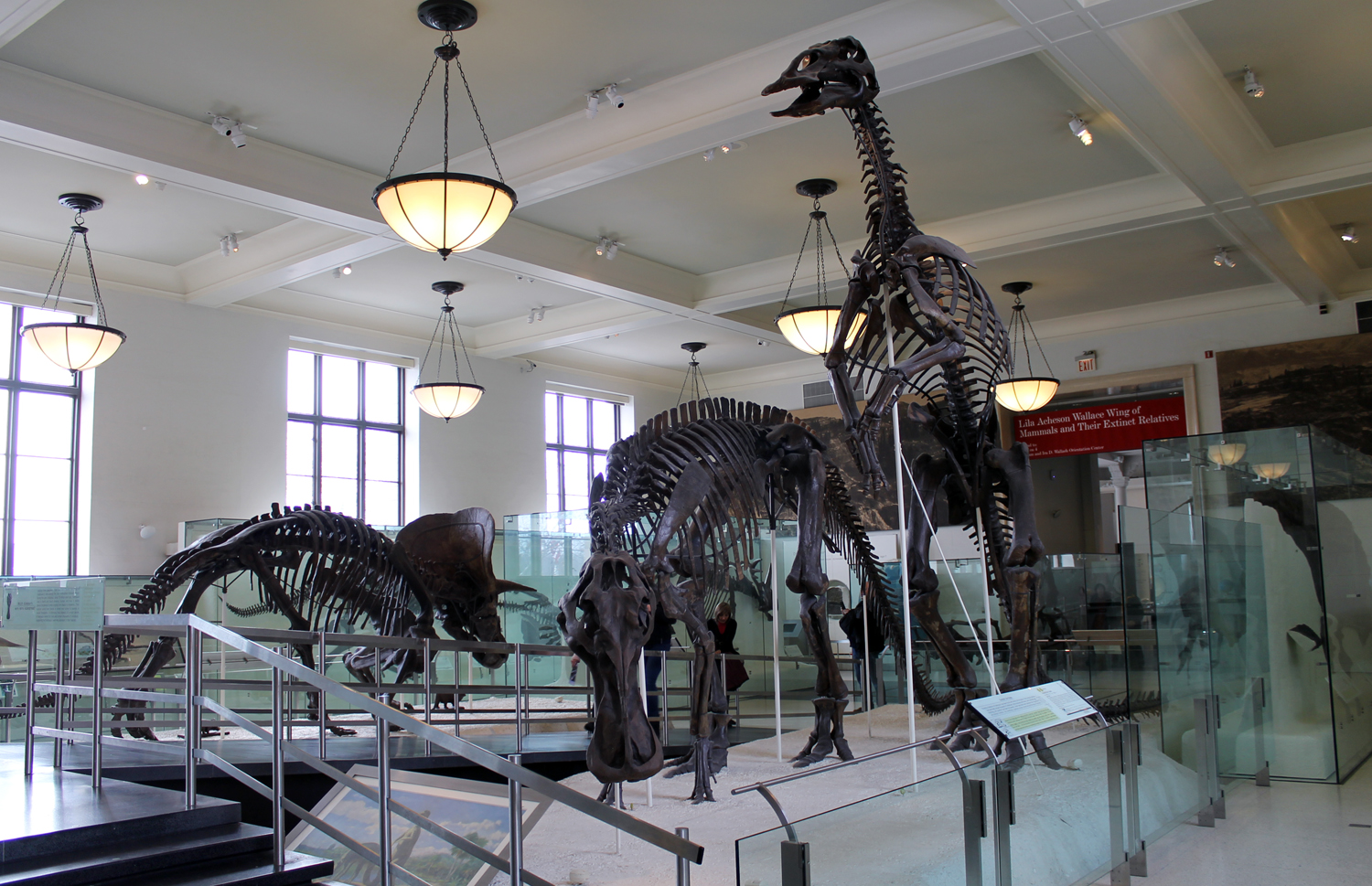
The former “Brontosaur Hall” is now the Hall of Saurischian Dinosaurs. Photo by the author.

Dingus also had transformative plans for the fourth floor’s interpretation and organization. Rather than the traditional walk through time that characterized the midcentury exhibits, the renovated halls would be arranged according to phylogenetic classification: visitors were meant to explore the vertebrate family tree as they moved through the fourth floor galleries. Each large hall represented a major branch, and was further divided into smaller alcoves representing specific groups, like turtles, artiodactyls, or ornithomimid dinosaurs.

While this organization closely matched how paleontologists think about life on Earth (particularly those at AMNH who helped pioneer the cladistic methodology), it is unfamiliar to most visitors. For Dingus and his colleagues, this wasn’t a flaw—it was the point. “Is it enough simply to discuss what visitors want to know about,” Dingus wrote at the time, “or do exhibitions have a responsibility to broaden their audiences’ horizons by presenting challenging information?”

Field Museum visitors play with a zoetrope in the shadow of an Apatosaurus skeleton. Photo by John Weinstein, © Field Museum

Dingus was planting a big, blue AMNH flag on one side of an ongoing debate about the role of museums and the purpose of their exhibits. “There is a prominent, contemporary school of exhibition design that advocates giving the visitor only what he or she asks for,” he wrote. “I vehemently disagree with this philosophy. We cannot pitch all the information to the lowest common denominator of interest and intellect.”

Dingus was likely referring to the philosophy championed by Michael Spock, who was at that time the Vice President for Public Programming at the Field Museum of Natural History. Spock had previously gained industry attention for his exploratory, interactive exhibitions at the Boston Children’s Museum. At the Field Museum, his approach was to make exhibitions “for someone, rather than about something.” Under Spock, projects began by asking community members what they were curious about, rather then by dictating what was important. Spock-era exhibits were filled with interactive and touchable displays meant to illustrate scientific concepts—some more successfully than others. They also tended to embrace a “less is more” aesthetic, taking deep dives into a few examples rather than trying to represent the full breadth of the museum’s collection.

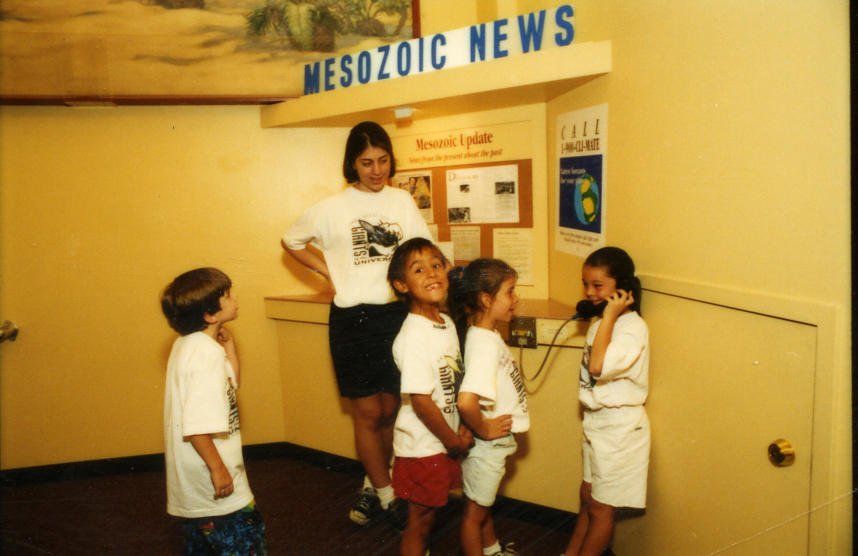
A group of children get updates on climatic changes over time in the form of news reports. Photo by John Weinstein, © Field Museum

For better or worse, Dingus’s fossil halls at AMNH could not be more different than the ones Spock oversaw at the Field Museum. There are no levers to pull, no “Dial-a-Dinosaur” phones, and certainly no rideable trilobites (all features of the early 90s Field Museum). Instead, the focus is on the fossils, and—as mentioned—there are far more of them on display than at any comparable museum. The closest things to interactives are the computer terminals, which allow visitors to select from menus of scientist-narrated videos.

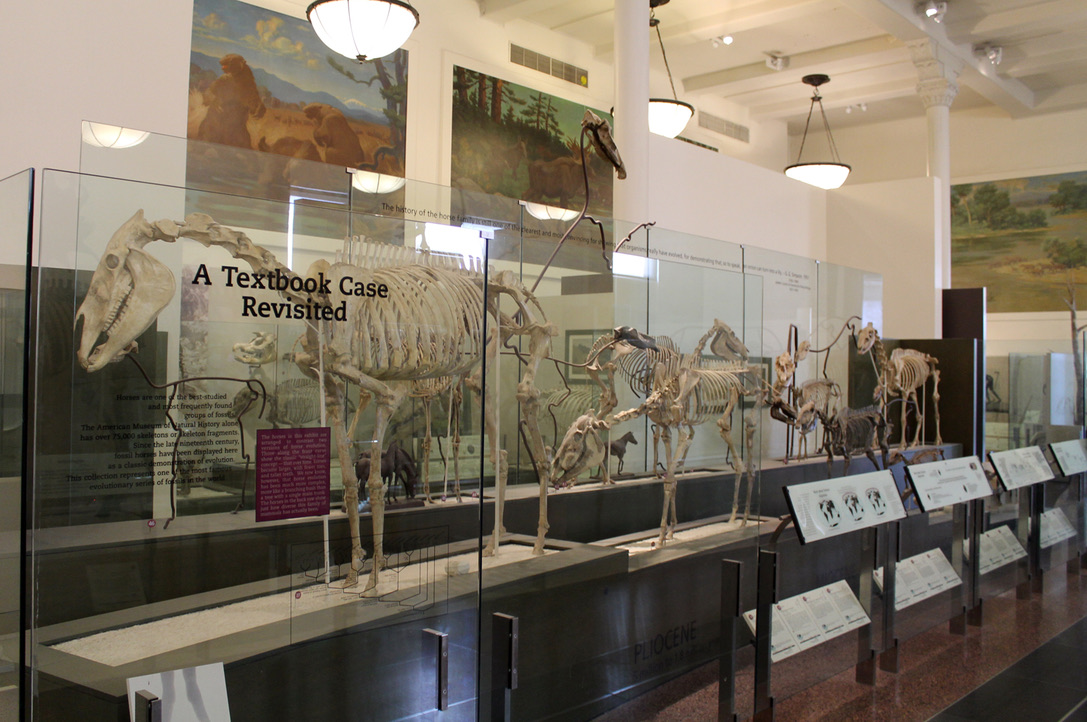
A display of fossil horses at AMNH. Photo by the author.

As it happened, Spock’s version of the Field Museum fossil halls barley lasted a decade, while Dingus’s AMNH exhibits remain mostly unchanged today: aside from the Patagotitan in the Orientation Center, the next largest addition might be a Tiktaalik cast skull in one case in the Hall of Vertebrate Origins. So how have the AMNH halls fared?

I sympathize with Dingus’s aim to “promote science literacy and develop a better awareness of how science can help illuminate the world.” That said, the AMNH fossil halls are clear example of a debunked educational style known as the “deficit model”—briefly, this is an approach to teaching that assumes students are empty vessels that can be simply filled with information. Moreover, I’m not convinced that the phylogenetic arrangement of the halls is particularly helpful for most visitors. The AMNH fossil halls are perfect for college students already learning about the diversity of life. But for most everyone else, the organization is opaque at best and a hindrance to understanding at worst. Making sense of phylogeny requires a lot of groundwork up front—even something as basic as knowing which direction to read a tree is not common knowledge. The Meryl Streep-narrated video in the Orientation Hall attempts to bridge this gap, but it’s overlong and not terribly engaging. Meanwhile, the multi-entrance, cyclical shape of the fourth floor means that only a fraction of visitors are actually starting in the Orientation Hall.

An example of a graphic with bizarre kerning and layout choices. Photo by the author.

Within the galleries, the central pillars that update visitors on where they are in the tree are generally ignored. Part of the problem is that displays which highlight the three-fingered hand, the stirrup-shaped stapes, and other seemingly minor features that unify evolutionary groups are not especially compelling. And although I appreciate the wide open and well-lit spaces, I think the design of the halls might be working against the interpretation. It’s hard to tell where one grouping ends and another begins when every surface is either white or made of glass.

Speaking of unhelpful design, there are some bewildering graphic design choices in these halls. On a single graphic, text may switch from center to left to right justification, randomly change in font and/or size, or be interrupted by illustrations placed in the middle of paragraphs. Sometimes paragraphs or even sentences run across multiple surfaces, and some text is printed on the glass barriers in front of fossils, making it even harder to read. I don’t want to harp on this forever so I’ll just link to some more chaotic examples here, here, here, and here.

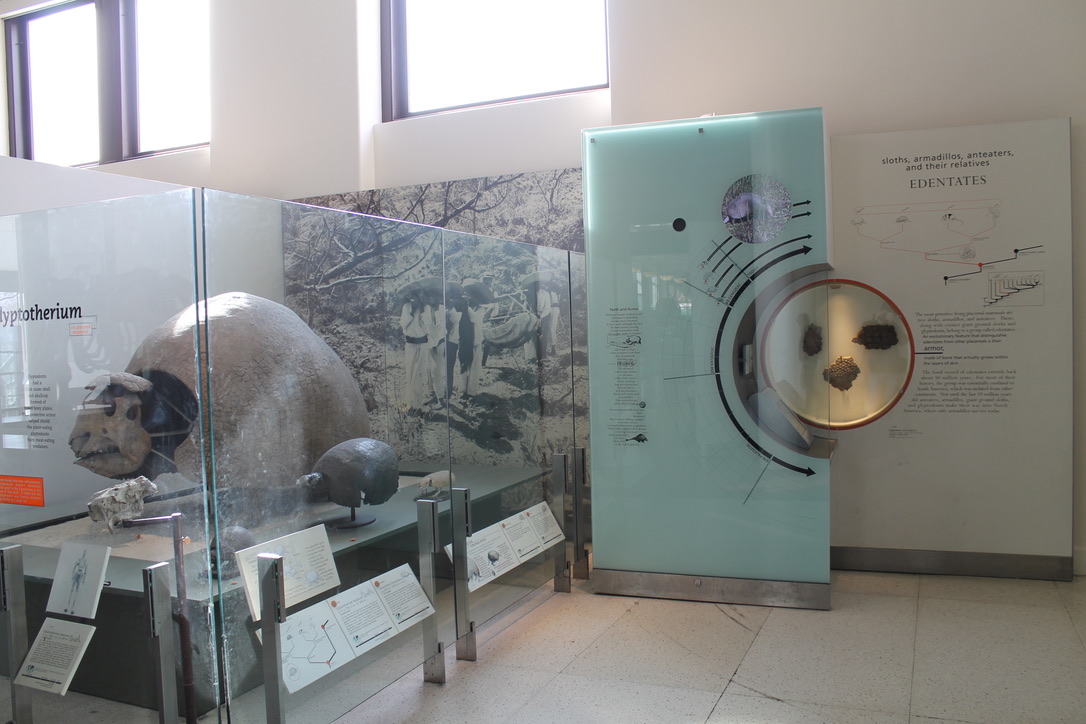
A corner devoted to the Edentates, which is no longer considered a real evolutionary group. Photo by the author.

Simply put, I’d be very surprised if many visitors are engaging with the phylogenetic organization, or even wondering why the fossils they’re looking at are displayed together. Remember: most visitors come in mixed-aged groups. The trip to the museum is a social experience, and interactions occur among visitors as much as they occur between visitors and the exhibits. The best museums anticipate and meet the needs of these visitors. Too much information, or irrelevant information, is just as bad as too little. I’m all for “broadening horizons” with “challenging” content, but the exhibit needs to be accessible first.

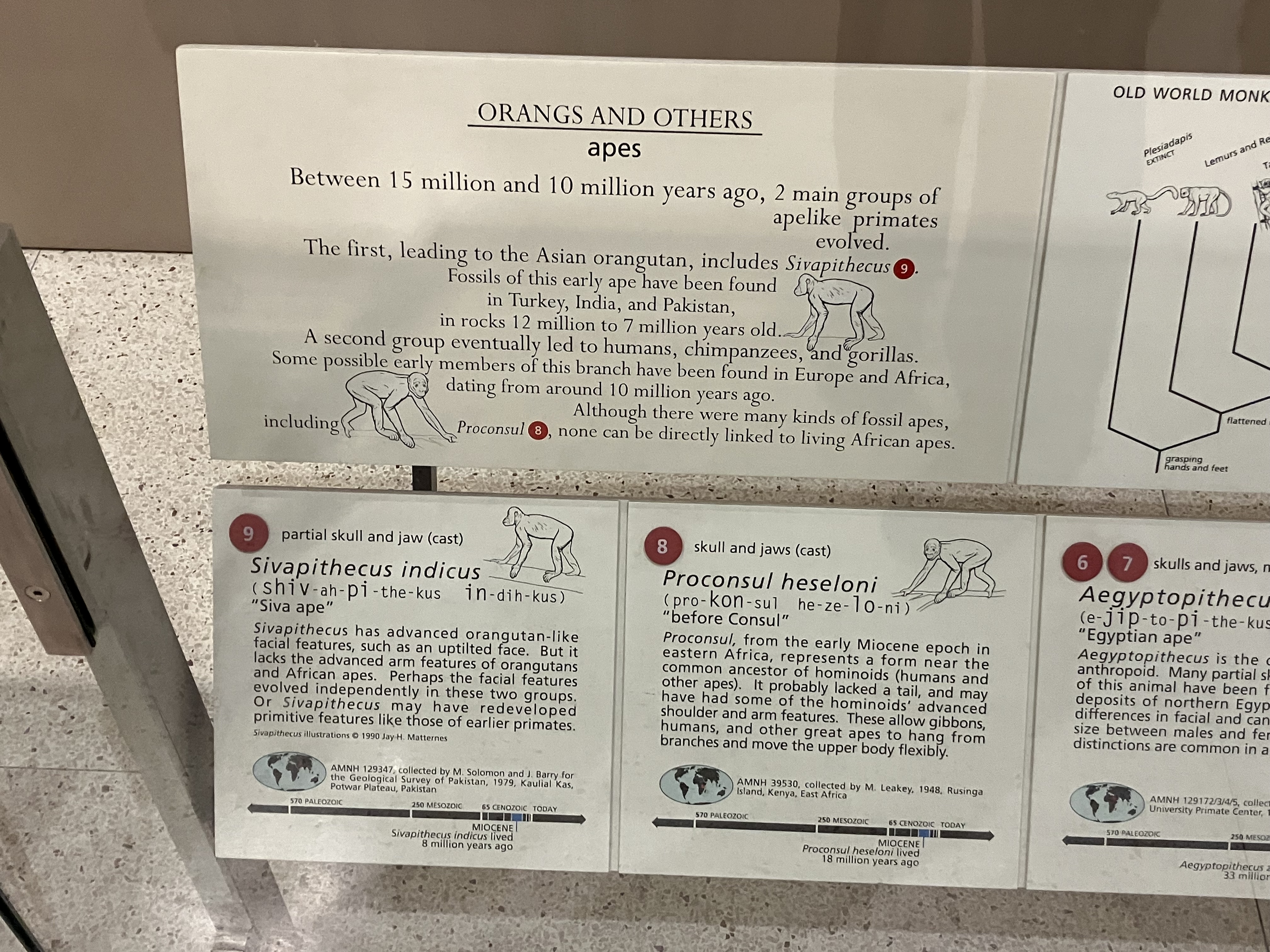
Even if the AMNH fossil halls are pitched above most visitors’ levels of interest, background knowledge, and patience, is the information at least reliable? Much of it is, but phylogeny is inherently volatile, and many groupings (to say nothing of particular genera and species) in the exhibit have been out of date for decades. Visitors in 2024 are being told that tyrannosaurs are a kind of carnosaur (they’re actually coelurosaurs), that pangolins, aardvarks, and sloths form a group called Edentates (they’re actually distantly related), and that primates and rodents are closely related to bats (they’re not). But other groupings in these halls have fared better: the exhibition definitively states that birds are a kind of dinosaur, an idea that enjoys near-universal acceptance today but was reasonably disputable in the early 90s.

Early 20th century tail-draggers. Photo by the author.

On top of the outdated information scattered throughout the halls, about a dozen of the mounted dinosaur skeletons are in old-fashioned, tail-dragging poses. These were known to be inaccurate at the time of the last renovation, but the budget only covered remounting two of them (the Apatosaurus and the Tyrannosaurus).

And just to be exhaustive in covering issues with the existing halls, many paleontologists over the years have discovered that the museum has no easy way to open the large glass cases that house some of AMNH’s most unique and significant fossils. Specimens like the Barosaurus, the Gorgosaurus pair, and the Corythosaurus mummy can only be accessed with the help of hired glaziers, and the museum requires scientists to cover the expense. This is well beyond most research budgets, and as a result, many of these world-famous and one-of-a-kind specimens have not been studied closely in decades.

So it’s fair to ask, why haven’t the AMNH fossil halls been updated yet? To be clear, the museum’s scientific and exhibitions staff are fully aware of everything I mentioned above. I’m sure the biggest hurdle is that a thorough renovation would be really, really expensive. For comparison, the NMNH renovation that took place between 2014 and 2019 cost $110 million ($70 million to restore the century-old east wing and $40 million for the exhibition itself). There’s also the cost in visitation to consider: if AMNH is anything like its peers, a big part of its operating budget comes from visitor admissions (for readers outside the United States, most of our museums are private nonprofits and do not get direct government support). Take away the most popular exhibition in the building for any length of time, and that income drops sharply.

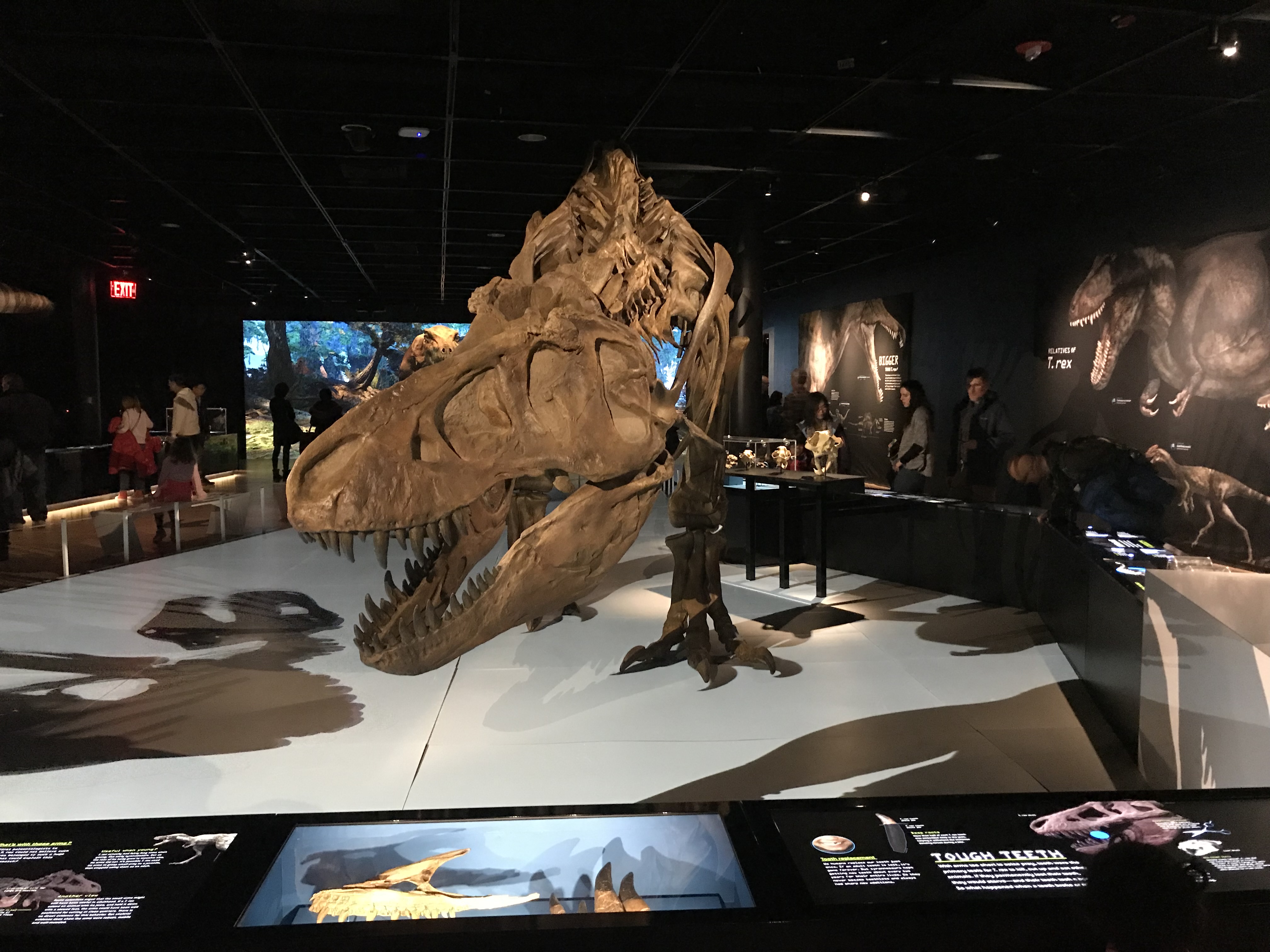
A cast of Tyrannosaurus rex in the AMNH traveling exhibition T. rex: The Ultimate Predator. Photo by the author.

From context clues, I don’t think a top-to-bottom renovation of the permanent fossil halls is coming any time soon. AMNH only recently hired a new fossil reptile curator, Roger Benson, in 2023. And the museum just opened a brand-new wing called the Gilder Center, which took five years and $465 million to build. The museum also just announced that it has temporary custody of Apex, a privately-owned Stegosaurus skeleton. According to a press release, Apex will eventually be the centerpiece of a new passageway connecting the Gilder Center to the permanent fossil halls (the real skeleton until 2028 or so, then a cast). I’d be surprised if we hear anything about a full-scale renovation until after Apex has left the building.

To their credit, the AMNH exhibitions team hasn’t exactly been idle when it comes to dinosaur displays. Over the last two decades, they’ve been rolling out a series of fossil-centric traveling exhibitions, including The World’s Largest Dinosaurs, Dinosaurs Among Us, Extreme Mammals, and T. rex: The Ultimate Predator. Each of these temporary shows has been up-to-date with new science and high-tech exhibtry. When the time comes, I’m sure this team could do great work on new permanent fossil galleries.

But for now, what are your hopes for the eventual AMNH renovation? What do you want to see changed or introduced? What should stay the same? Please leave a comment with your ideas!

References

Dingus, L. 1996. Next of Kin: Great Fossils at the American Museum of Natural History. New York, NY: Rizzoli International Publications, Inc. 

Honan, W.H. 1990. Say Goodbye to the Stuffed Elephants. The New York Times Magazine

Solomon, D. 1999. He Turns the Past Into Stories, and the Galleries Fill Up. The New York Times.

Spiegel, A.N., Evans, E.M., Frazier, B., Hazel, A., Tare, M., Gram, W., and Diamond, J. 2012. Changing Museum Visitors’ Conceptions of Evolution. Evolution: Education and Outreach 5:1:43-61.

Torrens, E. and Barahona, A. 2012. Why are Some Evolutionary Trees in Natural History Museums Prone to Being Misinterpreted? Evolution: Education and Outreach 1-25.

11 Comments

Filed under AMNH, education, exhibits, FMNH, museums, opinion, science communication

Is it real?

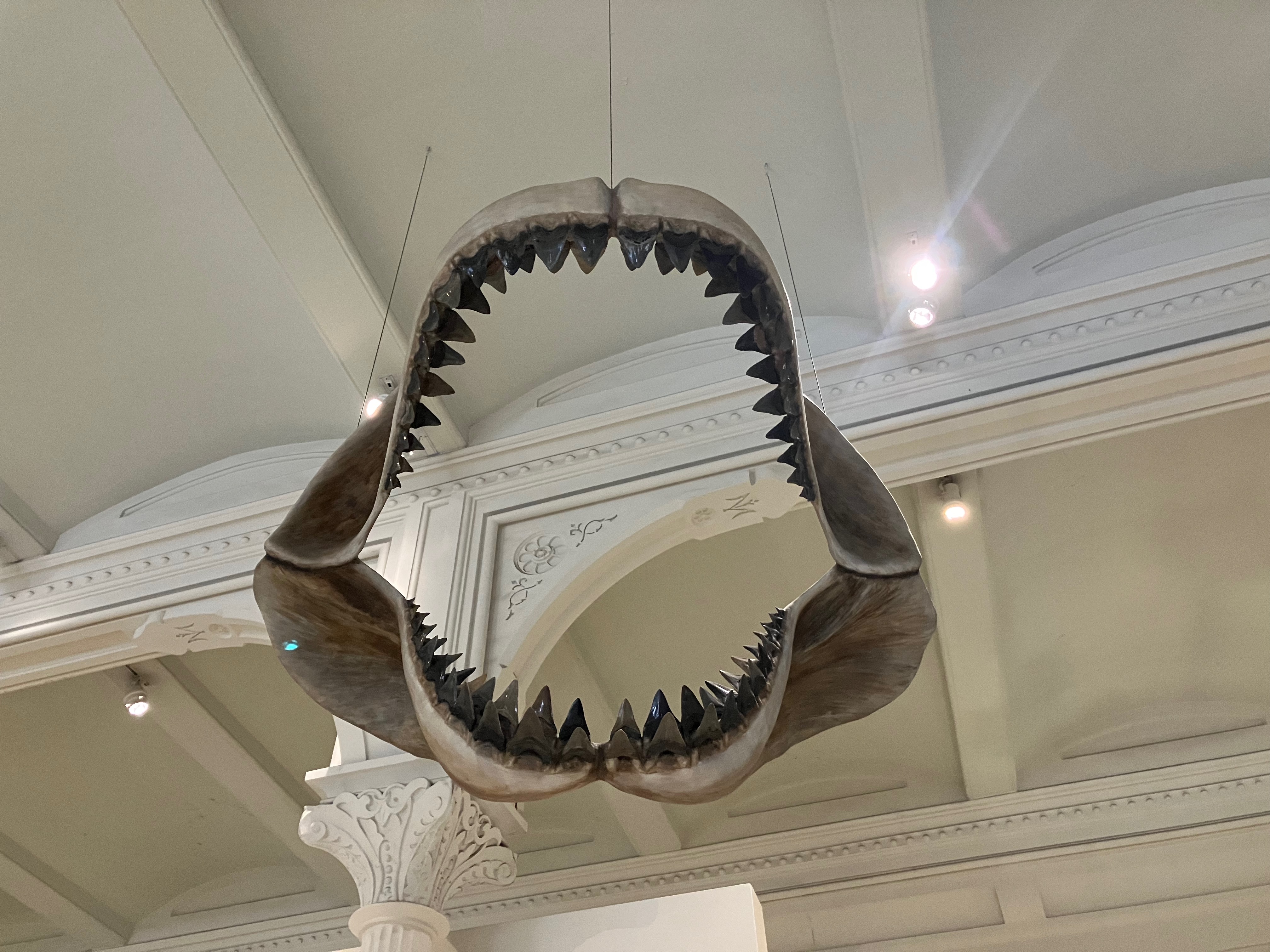
O. megalodon jaws a the American Museum of Natural History. Photo by the author.

You’ve probably seen the gaping jaws of Otodus megalodon (or “megalodon,” as it is colloquially known) in a natural history museum. Perhaps they’re set on the ground where they can frame a group photo, or maybe they’re suspended from the ceiling so you can imagine the rest of the shark rocketing toward you. In any case, every one of these O. megalodon jaws is a sculpted model with real (or cast) teeth embedded in it. Fossil jaws like this have never been found. Nor do scientists expect to ever find intact O. megalodon jaws—shark skeletons are made of cartilage, meaning they lack the mineral content and endurance of bone. Some fossilized shark skeletons are known, but they tend to be from smaller varieties. In the case of O. megalodon, we mostly just have teeth.

Why would a museum display a model of something that has never been found? Because paleontologists are quite confident that a real O. megalodon jaw would look just like this. For one thing, the general shape of modern lamniform shark jaws isn’t especially variable. Comparisons with modern sharks also allow scientists to determine where a fossil tooth fits into the mouth—in the front, to the side, or toward the back. There simply isn’t that much room for guesswork in the reconstruction, at least as far as the jaws are concerned.

I’ve been thinking about the accusation of “fake” again, as it pertains to fossil exhibitions (this is hardly new territory for this blog). One often hears from dissatisfied members of the public that the fossil skeletons on display at any given museum are fake—sometimes with the accusation that the real bones are “hidden” or “in storage” but occasionally with the conspiratorial angle that the creatures on display have been partially or fully invented. Museum workers do their best to explain: casts are exact copies made from molds of original fossils. Fossil skeletons are usually incomplete, but we can substitute casts from other individuals or mirror parts from the opposite side of the body. Plenty of mounted skeletons are made of original fossils, and at bigger museums, most of them are. And so forth.

Thalassomedon casts in pursuit of fish at the Denver Museum of Nature and Science. Photo by the author.

And yet, the cry of “fake” isn’t exactly wrong, either. Many displays contain some amount of sculpted material. In the case of the ubiquitous meg jaws, most of the object by volume is reconstruction. Lukas Rieppel cheekily describes early 20th century dinosaur mounts as “mixed media sculptures, having been cobbled together from a large number of disparate elements that include plaster, steel, and paint, in addition to fossilized bone.” He’s right, and what’s more, even complete skeletons don’t come out of the ground assembled on metal armatures.

So here’s my take: calling fossil mounts fake isn’t wrong, but it also isn’t relevant. The point of the O. megalodon jaws at the start of this post isn’t to show you the real fossil teeth—they’re kind of hard to see suspended fifteen feet off the ground. No, the point is to give the extinct shark that left those teeth behind form, life, and context. The visual and visceral experience of a 10-foot mouth rushing down at you provides a better understanding of what O. megalodon was all about then a case of teeth laid flat in a case ever could.

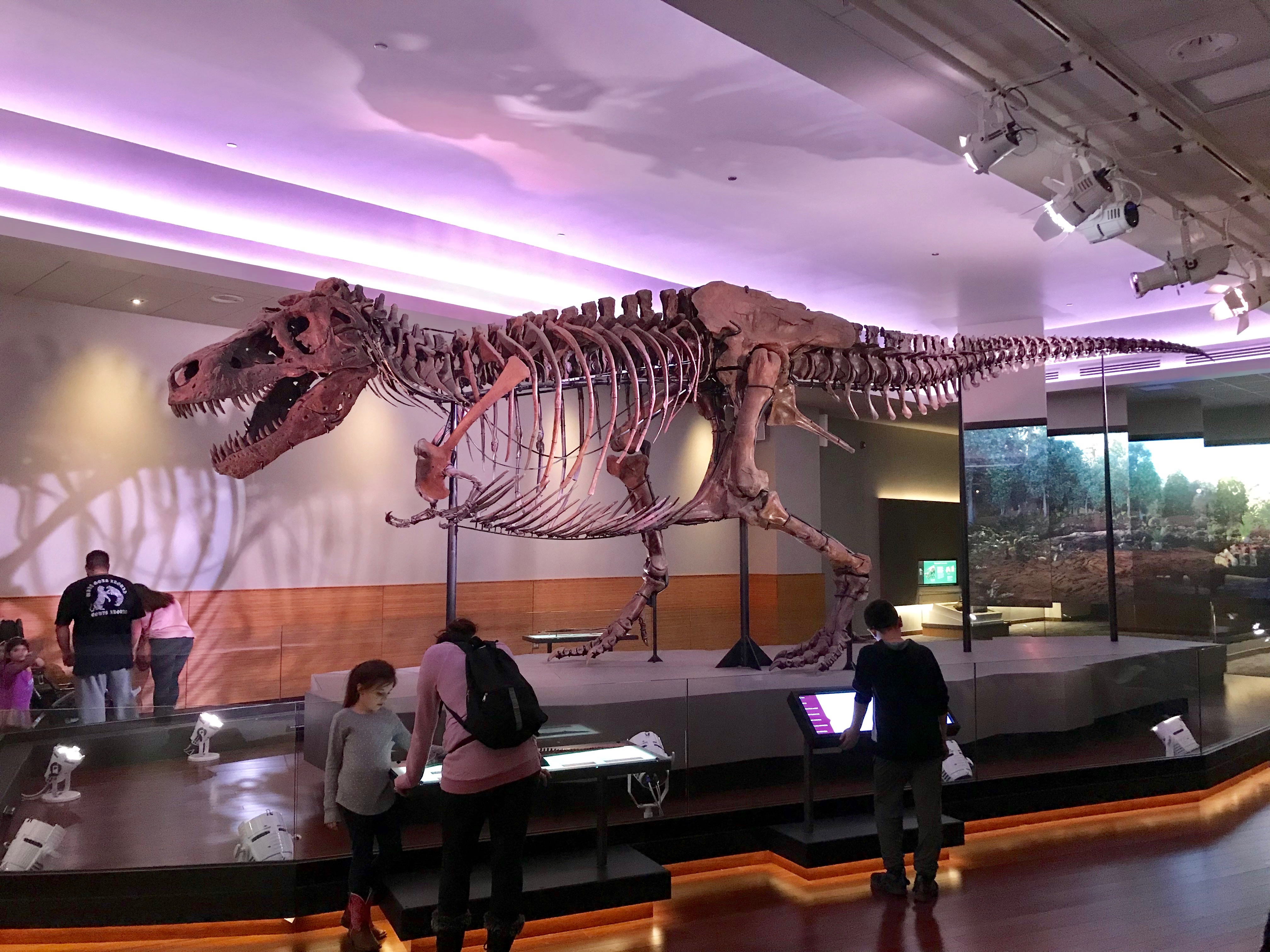
SUE in the Field Museum’s Evolving Planet exhibition. Photo by the author.

The same applies to just about any mounted fossil skeleton you’ve ever seen, whether it includes original material or is entirely cast. The purpose of these displays isn’t to show fossils as they were found. These are works of installation art, custom built for the space and in dialogue with their surroundings, including with visitors themselves. Take SUE the T. rex in their 2018 gallery on the Field Museum’s second floor. When SUE was in the cavernous, half-acre expanse of Stanley Field Hall, visitors often remarked that SUE looked small. In order to emphasize SUE’s size in the new space, the designers hid the skeleton behind a scrim wall. Instead of first seeing SUE from several hundred feet away, visitors don’t meet the T. rex until it’s looming over them, and they feel quite small in comparison. The T. rex skeleton and the space around it were arranged and composed in order to invoke a precise emotional response.

Often, the display evokes a specific hypothesis. The rearing Barosaurus in the AMNH rotunda is a classic example. We don’t know for sure whether Barosaurus could rear up on its back legs, or whether it would defend its offspring from a charging Allosaurus. But this is the story the exhibit’s creators chose to tell, using articulated fossil casts as their medium. In short, a display like this lets visitors without a detailed background in skeletal anatomy and animal behavior see the fossils the way that scientists do.

Bison diorama at the Denver Museum of Nature and Science. Photo by the author.

It’s worth drawing a comparison between mounted fossil skeletons and the other iconic natural history display, the taxidermy diorama. Imagine looking at this exquisite diorama of a rolling bison at the Denver Museum of Nature and Science, and dismissing it because it’s not real. The bison is, for the most part, a fabrication: it’s mostly clay or foam by volume, and it’s built over a wood and metal armature. It has no bones, muscle, blood, or viscera, and the only original part, the hide, has been treated with an assortment of preservatives. Meanwhile, the grass may well be paper or fabric, the background landscape is a painting, and the warmth from the sun is an electric light. This diorama is almost completely fake, but to say so is to entirely miss the point. If physical reality is all that matters, this display has nothing to offer that you can’t get from a leather sofa.

A well-made taxidermy diorama uses artificial materials to evoke the attitude, behavior, context, and essence of a living animal. A reconstructed fossil skeleton does precisely the same thing (although it is limited to the part of the extinct animal that we know best). So the next time someone dismisses a fossil exhibit as “fake,” try reframing the conversation. The reality of these displays doesn’t come from the material they’re made from, it comes from the combined knowledge and skill of preparators, artists, and scientists.

References

Rieppel, L. 2019. Assembling the Dinosaur: Fossil Hunters, Tycoons, and the Making of a Spectacle. Cambridge, MA: Harvard University Press.

Poliquin, R. 2012. The Breathless Zoo: Taxidermy and the Cultures of Longing. University Park, PA: The Pennsylvania State University Press.

6 Comments

Filed under AMNH, art history, DMNS, exhibits, fish, FMNH, fossil mounts, museums, opinion, paleoart

Dinosaurs of the Field Museum – Part 2

In the previous “quick bite” post, I introduced the dinosaurs on display at the Field Museum of Natural History (FMNH) that were collected in the early 20th century. This time, we’ll take a look at some of the dinosaurs collected and first displayed “in living memory”—that is to say, in the last three decades or so. I’ve skipped a few that either don’t have much available provenance (like the juvenile Maiasaura) or don’t have a very interesting story (like the off-the-shelf Deinonychus cast).

In comparing the early and more recent dinosaur installations at FMNH, it is immediately apparent that the latter group covers a much wider geographical range. The older mounted skeletons were all recovered in the western United States and Canada, while the new batch comes from all over the world, especially the global south. Local scientists were usually involved in the research, and in most cases the original fossils remained in or were ultimately returned to their countries of origin.

Tyrannosaurus rex (PR 2081)

SUE in Stanley Field Hall, ca. 2015. Photo by the author.

As one of the world’s most thoroughly-researched and best-known dinosaurs, SUE the T. rex scarcely requires an introduction. SUE is the most complete adult Tyrannosaurus ever found, with 90% of the skeleton intact. Approximately 30 years old at the time of their death, SUE is also the eldest T. rex known, and within the margin of error for the title of largest

SUE was discovered in 1990 by Sue Hendrickson on ranchland near Faith, South Dakota. At the time, Hendrickson was working with the Black Hills Institute, a private company that specializes in collecting and exhibiting fossils. BHI’s claim to the fossil became the subject of a legal battle involving landowner Maurice Williams, the Cheyenne River Tribal Council, and the US Department of the Interior. With little legal precedent for ownership disputes over fossils, it took until 1995 for the District Court to award Williams the skeleton. Williams announced that he would put SUE on the auction block, and paleontologists initially worried that the priceless specimen would disappear into the hands of a wealthy collector. Those fears were put to rest in 1997 when FMNH won SUE with financial backing from McDonald’s and Disney. 

SUE has ruled this dedicated hall in Evolving Planet since December 2018. Photo © Field Museum.

The museum wasted no time making the most of the celebrity specimen. The preparation team expanded to twelve people, who spent 35,000 hours over the next three years extracting SUE’s skeleton from the rock. Chris Brochu was brought on board to write a detailed monograph, which is still a definitive source on Tyrannosaurus rex anatomy. Meanwhile, Phil Fraley built the metal armature upon which the skeleton would be mounted. SUE debuted in FMNH’s cavernous Stanley Field Hall on May 17, 2000 with the dropping of a curtain.

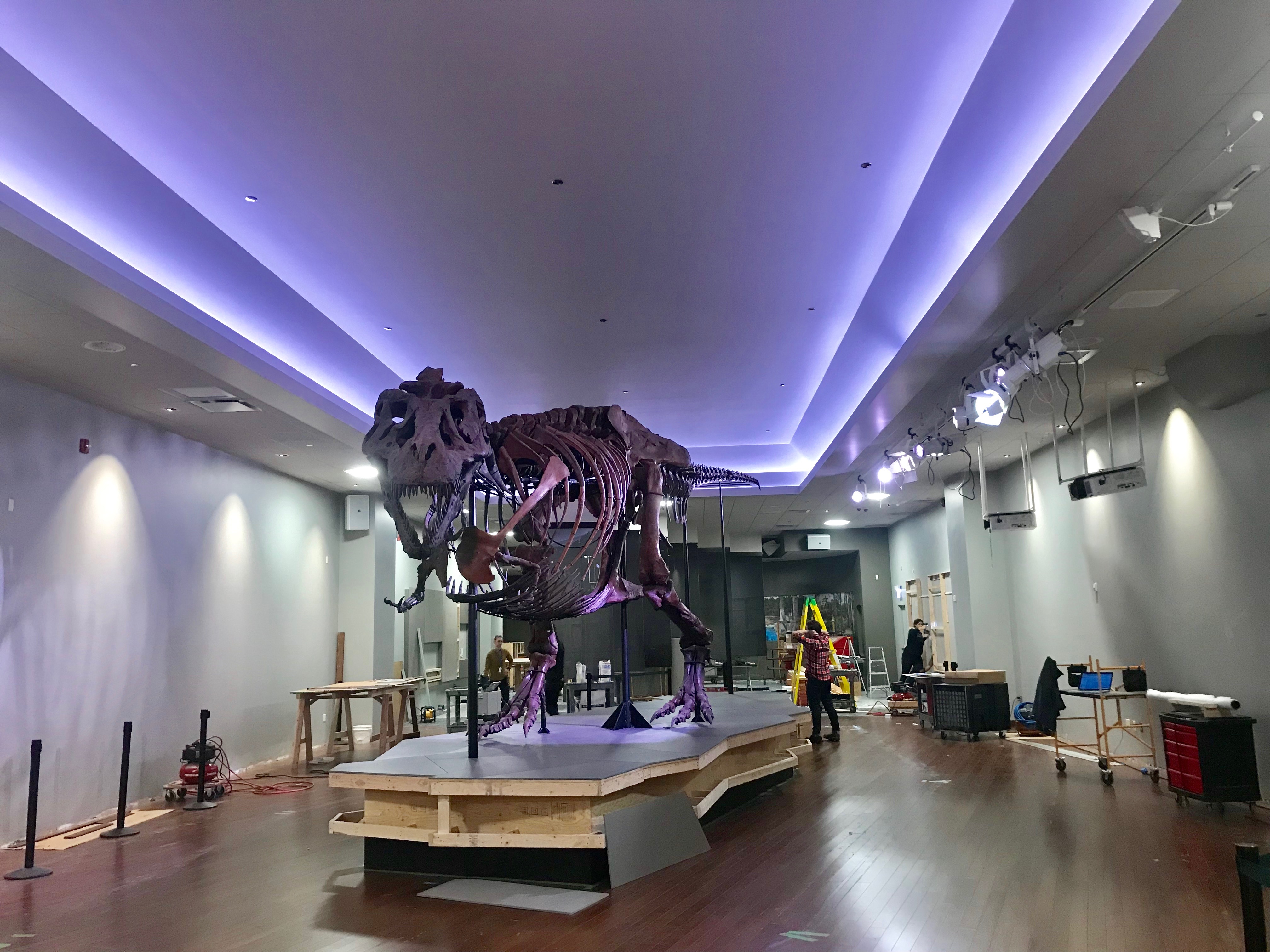
SUE held court in Stanley Field Hall for nearly 20 years, but in 2018 it was time for a change. That year, SUE was relocated to a new, 6,500 square foot gallery within the Evolving Planet exhibition. In contrast with the neoclassical expanse of Stanley Field Hall, this “private suite” gives the T. rex some much-needed context. SUE is now situated in an immersive reconstruction of the waterlogged forests of Late Cretaceous South Dakota. The mounted skeleton itself received an update, overseen by Pete Makovicky, Tom Cullen, and Bill Simpson. Garth Dallman and colleagues from Research Casting International (RCI) modified the original mount to correct a range of issues, like the articulation of the right knee and the position of the shoulders. SUE was also reunited with their gastralia—the rib-like bones that were embedded in the belly muscles.

Cryolophosaurus ellioti (PR 1821)

Cryolophosaurus partial skull in the Antarctic Dinosaurs exhibition. Photo by the author.

Excavating fossils is challenging in the best of conditions, but add the treacherous climate of Antarctica to the mix and it becomes a truly astounding feat. In 1991, William Hammer of Augustana College led a team that discovered and excavated the first Antarctic dinosaur to be named and described: the moose-sized theropod Cryolophosaurus. While bad weather prevented them from excavating the entire skeleton, Hammer and colleagues managed to collect the rear portion of the skull and jaw, as well as parts of the pelvis and hind limbs. The specimens were given to FMNH, the largest fossil repository near Hammer’s institution.

Cryolophosaurus cast in the Antarctic Dinosaurs exhibition. Photo © Field Museum

Hammer returned to the Cryolophosaurus site in 2010, joined by Nate Smith, Josh Matthews, and FMNH’s Pete Makovicky. Working in minus 15 F conditions, the team excavated more of the holotype skeleton. Some overlapping bones, including a second braincase, clarified that at least two individuals were present in the quarry.

For many years, Cryolophosaurus had only a minor role in FMNH exhibitions. In Evolving Planet, it is represented only by a cast of the partial skull. In 2018, however, the museum debuted Antarctic Dinosaurs, a traveling exhibition all about the 2010 expedition. Cryolophosaurus is the star of the show: most of the holotype is displayed in a series of cases, alongside a complete standing cast created by RCI. While other museums have displayed Cryolophosaurus reconstructions, the Antarctic Dinosaurs cast is more up-to-date in many respects—for instance, it’s narrow skull more closely resembles Dilophosaurus than Allosaurus.

Rapetosaurus krausei (PR 2209)

Juvenile Rapetosaurus in Evolving Planet. Photo by the author.

It’s hard to imagine now, but as recently as the mid-1990s, very little was known about titanosaurs. These Cretaceous sauropods were mostly known from isolated bones, and it wasn’t even clear if they were more closely related to diplodocoids like Diplodocus and Apatosaurus or to macronarians like Camarasaurus and Brachiosaurus. That changed in 2001, when Kristina Curry Rogers and Catherine Forster published the first description of Rapetosaurus krausei.

The new genus and species was based on fossils collected a few years earlier on a Mahajanga Basin Project expedition in northwest Madagascar. Organized by the State University of New York at Stony Brook and the local Universite d’Antananarivo, the Mahajanga Basin Project has been exploring fossil outcrops in this region since 1993. The project has been tremendously successful, yielding numerous new species and revolutionizing our understanding of vertebrate evolution in the southern hemisphere.

Rogers and Forster designated one of two adult Rapetosaurus skulls as the holotype, but most of our information about this animal comes from a 15-foot, 75% complete juvenile skeleton. To this day, this fossil is the most complete titanosaur ever found, and the only titanosaur known from both a skull and the majority of its postcranial skeleton. From their high-set eyes to their ludicrously wide bodies, much of what is known about the shape of titanosaurs comes from this specimen. Details of this skeleton also helped confirm that titanosaurs are macronarian sauropods.

As one of the funders of the MBP expeditions, the Field Museum became the repository for the juvenile Rapetosaurus skeleton. The fossil was mounted for display in 2006, when the paleontology halls were refreshed and retitled as Evolving Planet.

Buitreraptor gonzalezorum (MPCA 245 and others)

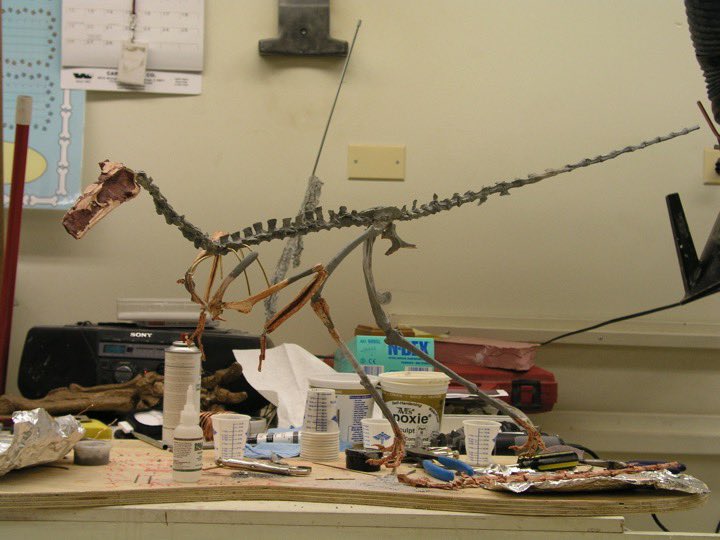
Buitreraptor cast under construction—note the unrestored skull cast being used as a placeholder. Many thanks to Matthew Aaron Brown for sharing this photo.

Fossils of Buitreraptor, a goose-sized dromaeosaur, were first collected in Patagonia, Argentina in 2004. The Field Museum’s Pete Makovicky was joined by Sebastián Apesteguia and Federico Agnolín in describing the new dinosaur the following year. Buitreraptor is notable for being the oldest known South American dromaeosaur (about 98 million years old), and for being one of the most completely known unlagiine dromaeosaurs—bizarre creatures with exceptionally long and narrow snouts. The holotype specimen was prepared at FMNH before being returned to the Museo Provincial de Cipolletti Carlos Ameghino in Río Negro, Argentina.

Finished Buitreraptor cast in Evolving Planet. Photo by the author.

The Evolving Planet team did not originally intend to include Buitreraptor, but as the exhibition neared completion it was noted that the bird evolution display—which only featured Deinonychus and a pair of small models—looked a little sparse. With most of the hall already installed and the opening just months away, preparators Connie Van Beek, Matthew Aaron Brown, and Jim Holstein were tapped to create a mounted cast of Buitreraptor. The preparators first built a prototype by wiring together available casts of the original fossils. They then moved on to the final version, which involved reconstructing the missing extremities (arms, feet, and ribs) and creating a “re-inflated” version of the specimen’s crushed skull. The entire project was completed in less than two months.

Patagotitan mayorum (MPEF 2400 and others)

Field Museum and Museo Paleontológico Egidio Feruglio staff worked together to assemble Máximo in May 2018. Photo by the author.

In 2017, plans took shape to reimagine Stanley Field Hall, as has happened several times since the current FMNH building opened in 1921. Part of the plan was to relocate SUE to a dedicated gallery in Evolving Planet, but what could take the place of the star T. rex? The museum found their answer in Patagotitan, a recently discovered titanosaur that is a contender for the world’s largest dinosaur.

Patagotitan mayorum was discovered on the Mayo family farm near La Flecha, Argentina in 2010. Between 2012 and 2014, Diego Pol and colleagues at the Museo Paleontológico Egidio Feruglio (MEF) excavated the find, which turned out to be a bone bed of six individuals. The new genus and species was named and published in 2018.

The FMNH cast is actually the second Patagotitan display in the United States. In 2015 (before the animal had a name), the American Museum of Natural History commissioned RCI to create a cast for the Wallach Orientation Center, part of the loop of fossil halls on the New York museum’s 4th floor. By placing Patagotitan in a relatively small space, the AMNH designers emphasized the sauropod’s great size. Standing in a slightly crouched pose with its head extending into an adjacent hall, the mount overwhelms the space.

Máximo has plenty of room to spread out in Stanley Field Hall. Photo by the author.

In contrast, the FMNH Patagotitan—nicknamed Máximo—has room to spread out. In the half-acre, four story expanse of Stanley Field Hall, visitors can stand at a reasonable distance and take in the 122-foot skeleton all at once. They can also look Máximo in the eye socket from the upper level balcony. Rather than work with RCI on the project, FMNH commissioned the mount from MEF directly. It was designed and built in Trelew, Argentina, and shipped to Chicago via cargo ship. The installation took four days in May 2018. The process didn’t go entirely without a hitch—under the skylight in Stanley Field Hall, the original paint job on the cast bones looked like raw meat. But even with the need for an emergency repaint of the entire skeleton, Máximo was completed on time and has been greeting FMNH visitors ever since.

Spinosaurus aegyptiacus (FSAC-KK-11888)

The Prehistoric Minds team prepares to add legs to Spinosaurus. Photo by the author.

The Field Museum’s newest dinosaur debuted just two weeks ago as of this writing (and is, in fact, why I’ve been sitting on this post for months). Postdoctoral researcher Matteo Fabbri approached the Exhibitions department in Fall 2022 with the prospect of acquiring a Spinosaurus cast. Less than a year later, that cast has joined Patagotitan in Stanley Field Hall, suspended twelve feet off the floor in a swimming pose.

Thanks to its dragon-like shape and star turn in Jurassic Park III, Spinosaurus is a very popular dinosaur, but until recently it has been quite poorly known. The 1912 holotype specimen—consisting of a partial jaw, several dorsal vertebrae, and a few other odds and ends—was inadvertently destroyed in the bombing of Munich during World War II. It wasn’t until 2008 that another skeleton was found in southern Morocco. The new specimen revealed that Spinosaurus was even weirder than previously thought: not only did it have an elongated, crocodile-like skull and a sail on its back, it also had a long body, short legs, and a newt-like tail fin.

Spinosaurus hangs 12 feet above the floor. Photo by the author.

Very few Spinosaurus casts have ever been displayed. One was made for the retired Spinosaurus: Lost Giant of the Cretaceous traveling exhibit. Another appeared in last year’s The Big Eight: Dinosaur Revelation in Hong Kong. But as far as I can tell, the only other permanent Spinosaurus skeleton on display is at Japan’s Kitakyushu Museum of Natural History. That makes the FMNH cast the only mount of its kind in the western hemisphere. 

It’s also the most up-to-date Spinosaurus on display. As part of the team that has been studying Spinosaurus for the last 15 years, Fabbri ensured that cervical vertebrae collected at the original discovery site just six months ago were incorporated into the mount. All told, about 50% of the skeleton is cast from the Morocco specimen, while the rest is reconstructed. 

Like Máximo, the Spinosaurus was built overseas. Simone Maganuco and colleagues constructed the skeleton in Italy, then traveled with it to Chicago to help with the installation. The lightweight cast—which only weighs 700 pounds—was hanging in its permanent position after just ten hours of work.

Press coverage of the installation (with appearances from a certain overenthusiastic nerd) can be seen here and here.

References

Brochu, C.A. 2003. Osteology of Tyrannosaurus rex: Insights from a nearly complete skeleton and high-resolution computed tomographic analysis of the skull. Journal of Vertebrate Paleontology 22:1–138.

Curry Rogers, K., Forster, C.A. 2001. The last of the dinosaur titans: a new sauropod from Madagascar. Nature 412:6746:530–534.

Hammer, W.R. and Hickerson, W.J. 1994. A Crested Theropod Dinosaur from Antarctica. Science 264: 828–830.

Grande, L. 2017. Curators: Behind the Scenes of Natural History Museums. Chicago, IL: University of Chicago Press.

Ibrahim, N., Maganuco, S., Dal Sasso, C., Fabbri, M., Auditore, M., Binedellini, G., Martill, D.M., Zourhi, S., Matterelli, D., Unwin, D.M., Wiemann, J., Bonadonna, D., Amane, A., Jakubczak, J., Joger, U., Lauder, G.V., and Pierce, S.E. 2020. Tail-propelled aquatic locomotion in a theropod dinosaur. Nature 581(7806):1–4.

Makovicky, P.J., Apesteguía, S., and Agnolín, F.L. 2005. The earliest dromaeosaurid theropod from South America. Nature 437: 1007–1011.

Smith, N.D., Makovicky, P.J., Hammer, W.R., and Currie, P.J. 2007. Osteology of Cryolophosaurus ellioti from the Early Jurassic of Antarctica and implications for early theropod evolution. Zoological Journal of the Linnean Society 151: 377–421.

1 Comment

Filed under AMNH, dinosaurs, exhibits, FMNH, fossil mounts, museums, sauropods, theropods

Rhinos too thick: Fossils and flattery at Agate Springs

“No progress at all. Rhinos too thick.”

So wrote American Museum of Natural History fossil collector Albert Thomson in his September 1917 field notes. At that point, Thomson been collecting mammal fossils at Agate Springs nearly every year since 1907—and was still finding rhino bones in such abundance that they formed a seemingly impenetrable layer.

Located in northwest Nebraska and dating to about 22 million years ago, the Agate Springs bone bed is an aggregation of fossilized animals on an astonishing scale. Like the Carnegie quarry at Dinosaur National Monument, it provides a snapshot of an ecosystem at a moment in geologic time. But while a high estimate of the individual dinosaurs represented at Carnegie Quarry is in the hundreds, the main bone bed at Agate Springs may well contain tens of thousands of animals. The vast majority of fossils come from the tapir-sized rhino Menoceras, scrambled and packed together in a layer up to two feet thick. Moropus, Daeodon, and an assortment of other hoofed animals and small carnivores have also been found. These animals may have gathered during a drought and succumbed to thirst or disease, before the returning rains rapidly buried their remains. It’s also possible that the bone bed represents a mass drowning during a flash food. Since different parts of the site vary in density, Agate Springs likely represents multiple mortality events over a number of years.

IMG_1185

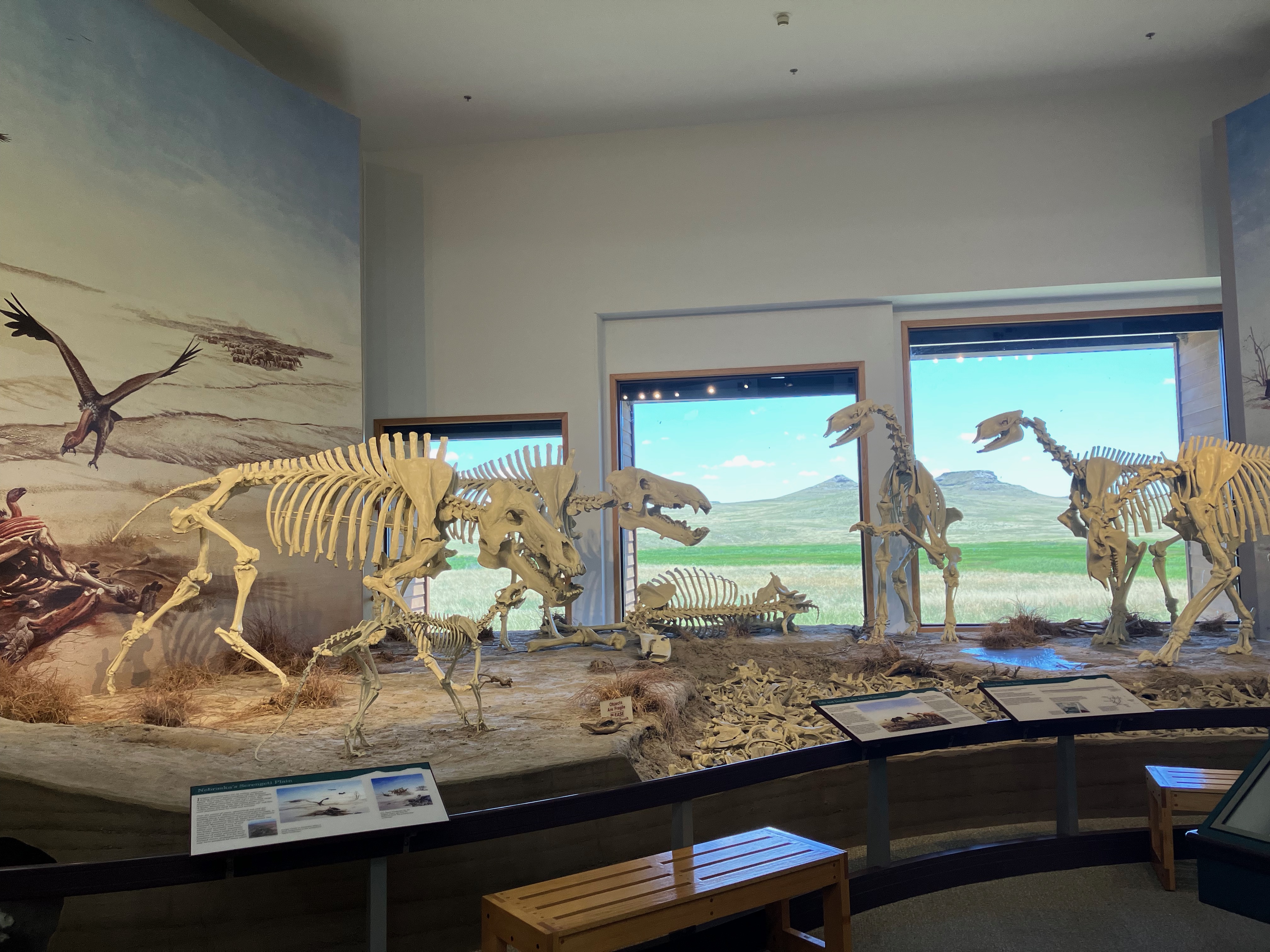
Tableau of cast fossil skeletons at the Agate Fossil Beds National Monument visitor center. Photo by the author.

Today, less than 30% of the Agate Springs bone bed has been excavated, but not for a lack of effort. Teams from a half dozen museums visited the site between 1900 and 1925, with the Carnegie Museum of Natural History (CM), the University of Nebraska State Museum (UNSM), and the American Museum of Natural History (AMNH) establishing large-scale excavations and returning year after year. As we shall see, the relationships between these teams were not always amicable, making this period at Agate Springs a window into the preoccupations of museum workers at the turn of the century. Agate Springs also illustrates how east coast paleontologists interacted with and relied on local people, defending their social capital as jealously as any fossil deposit. Finally, museums’ interest in Agate Springs in the mid 20th century exemplifies how exhibitions had evolved during the intervening period.

The setting

Agate Springs is unceded Sioux territory, occupied by settlers after the Kansas-Nebraska Act of 1854. James Cook purchased the treeless tract of rolling hills from his father-in-law in 1887, naming it Agate Springs after the rocky banks of the nearby Niobrara River. James and Kate Cook established a ranch where they raised horses and cattle, and Agate Springs became a popular stop for travelers on their way to Cheyenne, Wyoming.

The Cooks were aware of bones weathering out of the hills as far back as 1885, when the land was still owned by Kate’s father. James knew that scientists were on the lookout for fossils in the region—by one account he worked for O.C. Marsh as a translator in 1874. Once the ranch was established, he began writing to museums, including UNSM in Lincoln and the Carnegie Museum in Pittsburgh, inviting them to visit Agate Springs. A UNSM party led by Erwin Barbour was the first to drop by, spending a night at the Cook homestead in July 1892. Chiefly concerned with collecting “devil’s corkscrews” (ancient beaver burrows) north of the Niobrara, Barbour sent his student F.C. Kenyon to check out the bones Cook promised in the nearby hills. Kenyon collected as much as he could carry, but his report apparently did not excite Barbour, and the UNSM party moved on.

It would be twelve years before another paleontologist visited Agate Springs. Olaf Peterson of the Carnegie Museum stopped by the ranch in early August of 1904, at the end of a tumultuous field season in western Nebraska. Peterson had received a telegram on July 4 that his brother-in-law, boss, and mentor John Bell Hatcher had died of typhoid. Peterson intended to cut the season short, but Carnegie Museum director William Holland denied the request, writing in no uncertain terms that Peterson was to continue his work in Nebraska. Later in July, Peterson fell ill himself, and spent several days recovering in Fort Robinson. Suffice it to say, Peterson was not in the best of moods when he arrived at Agate Springs.

Nevertheless, the outcrops Peterson saw at Agate Springs revitalized his spirit. Accounts differ on what part of the site Cook showed him (this will be important shortly), but when he returned east two weeks later he was raving about a quarry with “ten skulls within a six-foot radius.” In Pittsburgh, Peterson and Holland began drawing up plans for an ambitious excavation the following year. In their view, they had staked a claim to the site: just like contemporary gold and oil prospectors, turn-of-the-century paleontologists lived by the rule of “dibs.” For the museum crowd, being the first scientist to “discover” a quarry meant an entitlement to control the site and the resources it produced. This included both the physical fossils and the privilege to describe and interpret those fossils—controlling the site meant controlling scientific knowledge.

Dueling quarries

Cook either didn’t know about such customs, or didn’t care. To his credit, Cook was never interested in monetizing the fossils at Agate Springs. By all accounts, he simply wanted to share with the world the knowledge that the bone bed represented. He was concerned that it was so expansive that no single team could uncover all its secrets. On May 26, 1905, Cook wrote to Barbour, inviting him to share in the bounty he had shown Peterson the previous summer, explaining that it was “so large that [the Carnegie team] could not work it out in years, so there is plenty of material for other parties to work with.”

On other occasions, Barbour had taken a cautious stance when corresponding with landowners. In this case, however, he could barely contain the enthusiasm in his reply. In a single letter, Barbour reminded Cook that UNSM had visited 12 years before and therefore should have collecting rights, asked Cook to place a literal flag on the site claiming it for the University of Nebraska, offered to hire Cook’s 18 year-old son Harold as a field assistant, and appealed to Cook’s state pride by listing the out-of-state institutions that were removing Nebraska’s fossil heritage each year.

IMG_1238

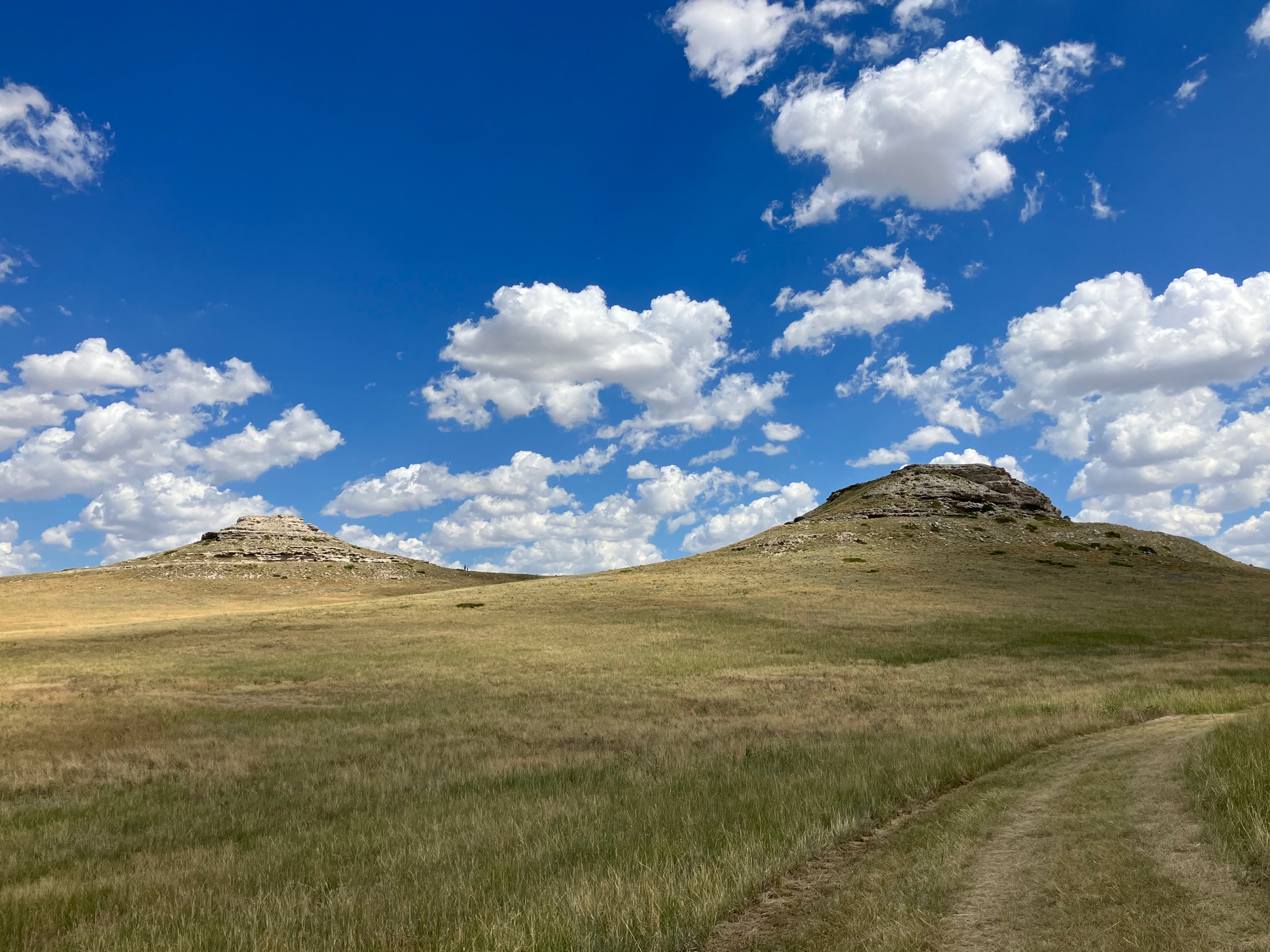
Carnegie Hill and University Hill today. Photo by the author.

That summer, Peterson and Barbour opened quarries on two neighboring buttes at Agate Springs, which came to be known as Carnegie Hill and University Hill. While the two parties were cordial neighbors, letters exchanged by Holland, Barbour, and Cook demonstrate that the museum directors were uncomfortable with the situation. Holland repeatedly wrote to Cook, claiming that his team was more skilled than Barbour’s and warning that it would be bad for science if the fossils and geological data were split between two institutions. Harold Cook didn’t appreciate Holland’s condescending tone. In a note to his father pinned to one of the letters, he wrote that “a letter of this kind is the work of a pinheaded, egotistical, educated fool.”

The Carnegie and UNSM teams returned to Agate Springs in 1906, but spent the summer of 1907 elsewhere. The elder Cook took the opportunity to invite yet more paleontologists, and teams from AMNH, the Yale Peabody Museum, and Amherst College showed up to collect fossils.

Meanwhile, Holland began a campaign to wrest control of the site by any means necessary. He became particularly focused on the narrative of who discovered the bone bed. According to Holland, Cook had shown Peterson the smaller, less dense site that would be come to be known as Quarry A. Peterson then went prospecting on his own and found the primary bone bed that straddled the two buttes. Holland went on to argue that regardless of who first saw the fossils, Peterson earned credit for the discovery because he was the first trained scientist on the scene, and therefore the first individual to correctly identify the age and identity of the animal remains.

Cook rejected Holland’s retelling of the events of August 1904, insisting that he had known of the bone bed for years before he showed it to Peterson. In many ways, the two men were talking past each other. Cook found Holland’s insistence on claiming the discovery for Peterson nonsensical and disrespectful—he knew his own land, and he was the one who invited the paleontologists in the first place. Holland, on the other hand, was staking a claim among his fellow academics. He needed to demonstrate that the Carnegie Museum had been at Agate Springs first, so that other institutions would yield to his authority to interpret and publish on the fossils.

IMG_1235

Harold Cook’s homestead cabin, recently fixed up and painted. Photo by the author.

Late in 1907, Holland visited the Cooks’ ranch in person for the first time. He offered to buy the fossil-bearing land outright, doubtlessly planning to block the other museums from accessing it. At this point, James Cook made the awkward discovery that Carnegie Hill and University Hill were actually just outside his official holdings, in the public domain. Holland moved to purchase the land, but Harold Cook beat him to it, building a cabin and filing a homestead claim in March 1908. In their gentlemanly rancher way, the Cooks told Holland to get lost, and the Carnegie Museum left Agate Springs for good.

Playing nice

While Holland had managed to sour his relationship with a remarkably welcoming and accommodating landowner, Barbour did the opposite. In letters to Cook, he regularly acknowledged the rancher as the discoverer of the site. He visited the Cooks frequently and employed Harold in the UNSM quarry, training the younger Cook into a formidable fossil prospector and anatomist. Soon Harold was studying at the University of Nebraska under Barbour, and a few years later, Harold and Barbour’s daughter Elinor were married. Barbour also named a few species after the Cooks, including Moropus cooki.

AMNH director Henry Osborn and field manager Albert Thomson had a similarly positive relationship with the Cooks. The New York museum took over Carnegie Quarry in 1908, and Osborn visited several times to express his gratitude. Like Barbour, he paid Harold for his time, labor, and expertise. Later, Osborn invited Harold to work at AMNH during the off-season. In return, AMNH was permitted to collect at Agate Springs for nearly two decades. Thomson returned almost every year through 1923, and the museum accumulated so many Menoceras and Moropus fossils that it began selling and trading them to other institutions.

IMG_0328

Menoceras and Moropus slab at the National Museum of Natural History. Photo by the author.

The reward for staying in the Cooks’ good graces was clear. UNSM and AMNH paleontologists gained access to the Agate Spring quarries for many years, accumulating large collections. They earned accolades from publications, public interest from the skeletons they placed on exhibit, and even monetary rewards from selling the excess specimens. Meanwhile, the Carnegie Museum was shut out after their first few seasons of collecting because Holland was, if not outright hostile to the Cooks, unable to communicate effectively with the ranchers. For American paleontologists at the turn of the century, social capital was a critical resource. Positive relationships with landowners and other individuals in the fossil-rich western states earned them access to land, information about the terrain, and networks of eyes on the ground, any of which might lead them to the next important quarry.

You get a rhino block, and you get a rhino block…

The scale and intensity of the Agate Springs excavations decreased after 1910, and in the early 20s, Thompson and the AMNH crew closed up shop, believing they had found examples of every species that could be found. By that time, the site’s value for museums had shifted. Rather than being a bonanza of specimens to collect, categorize, and publish on, Agate Springs had become a place to quickly and easily obtain display-worthy fossils. As Hunt puts it, the site was a “storehouse of good exhibit materials, to be tapped when needed by museums wishing to mount a rhino or two.”

Today, Agate Springs fossils—acquired in the field or via trade—are on display at large and small museums all over North America. Many of these are mounted skeletons of rhinos, camels, and Moropus, but there is also a particular abundance of large, incompletely prepared slabs, which provide viewers with a small window into the Agate Springs bone bed. Because of the sheer density of bones, the early 20th century excavation teams quickly stopped jacketing fossils individually, and instead began preparing out large blocks, typically four to six feet across. The blocks were hardened with shellac, and reinforced with wood planks around their borders. Pulleys and cranes were required to lift the largest blocks out of the quarries. In the early years, the intention was to fully excavate these blocks at their respective museums. It’s not clear which museum first placed a complete block on exhibit, but the idea proved popular. Many later visitors to Agate Springs, from James Gidley of the National Museum of Natural History in 1909 to Elmer Riggs of the Field Museum of Natural History in 1940, came with the express purpose of collecting intact slabs for display.

IMG_0005

Menoceras slab on display at the Field Museum of Natural History. Photo by the author.

The popularity of fossil blocks from Agate Springs coincides with a shift in philosophy toward exhibitions at natural history museums. While early 20th century exhibits were catalogs of life, emphasizing the breadth of the museum’s collection, by the 1920s and 30s many museums had begun moving toward narrative exhibits. Displays were intended to communicate ideas, and objects served as illustrations of those ideas. The fossil blocks from Agate Springs were ready-made illustrations of a number of paleontology concepts, from the process of taphonomy to the task of excavation millions of years later. Most have remained on display to this day, a fact that James Cook would undoubtably be pleased with.

An incomplete list of museums in possession of Agate Springs blocks follows. Do you know of others? Please leave a comment!

  • Carnegie Museum of Natural History
  • American Museum of Natural History
  • University of Nebraska State Museum
  • Field Museum of Natural History
  • National Museum of Natural History
  • Royal Ontario Museum
  • Denver Museum of Nature and Science
  • Yale Peabody Museum of Natural History
  • Harvard Museum of Comparative Zoology
  • University of Wyoming Geological Museum
  • South Dakota School of Mines and Technology
  • Wesleyan University Geology Museum
  • University of Austin Texas Memorial Museum
  • University of Michigan Museum of Natural History
  • Science Museum of Minnesota
  • Fort Robinson State Park Trailside Museum

References

Agate Fossil Beds: Official National Park Handbook. Washington, DC: National Park Service.

Hunt, R.M. 1984. The Agate Hills: History of Paleontological Excavations, 1904-1925. 

Vetter, J. 2008. Cowboys, Scientists, and Fossils: The Field Site and Local Collaboration in the American West. Isis 99:2:273-303.

Skinner, M.F., Skinner, S.M., Gooris, R.J. 1977. Stratigraphy and Biostratigraphy of Late Cenozoic Deposits in Central Sioux County, Western Nebraska. Bulletin of the American Museum of Natural History 158:5:265-370.

3 Comments

Filed under AMNH, CMNH, collections, dinosaurs, DMNS, exhibits, field work, fossil mounts, history of science, museums, NMNH, ornithopods, sauropods, theropods, thyreophorans

Displaying the Tyrant King (Redux)

This is an updated version of a series of posts from 2014. With Deep Time and the new SUE exhibition now open, I’m dusting it off and bringing it up to date.

Woodrow Wilson is in the white house. The first World War is raging in Europe, but the United States is not yet involved. The women’s suffrage movement is picking up speed. And you just heard that the skeleton of an actual dragon is on display at the American Museum of Natural History (AMNH) in New York. It is difficult to imagine a time before Tyrannosaurus rex was a household name, but such was the case barely a century ago. In 1915, AMNH unveiled the very first mounted skeleton of the tyrant lizard king, immediately and irrevocably cementing the image of the towering reptilian carnivore in the popular psyche.

Today, Tyrannosaurus is a celebrity among dinosaurs, appearing in every form of media imaginable. More importantly, it is an icon for paleontology and an ambassador to science. Much has been written about T. rex — about its discovery, about the animal itself, and about its role in popular culture. This article will take a slightly different tack. This is an overview of the history of the tyrant king on display, and how it has defined (and been defined by) the museum experience.

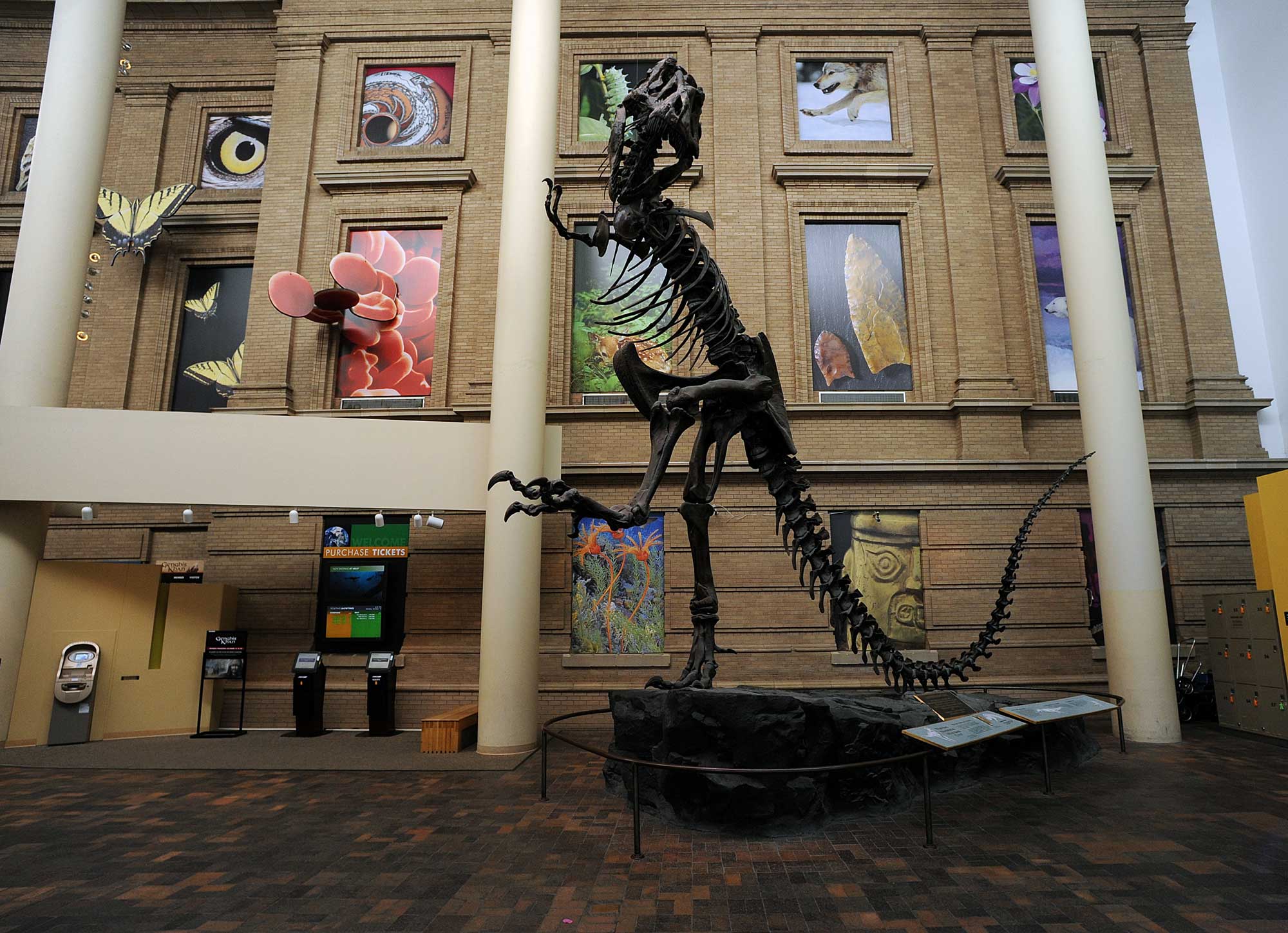
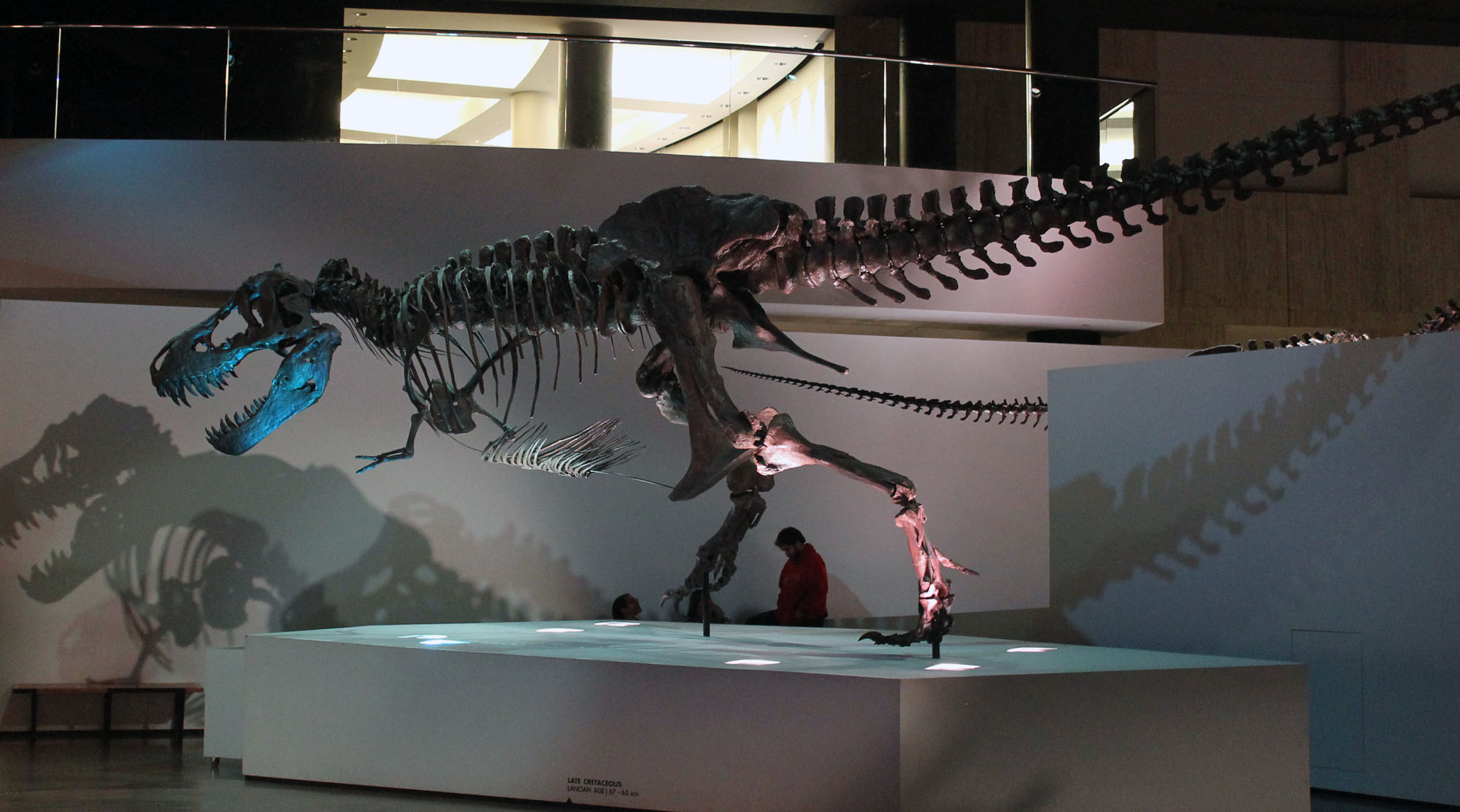
The cult of T. rex began in the halls of museums, and museums remain the prehistoric carnivore’s symbolic home. Mounted skeletons provide the legendary T. rex its credibility: these are the authentic remains of the giant predator that once stalked North America. And yet, most of the dozens of  Tyrannosaurus skeletons on display around the world are casts, and none of them represent complete skeletons (rather, they are filled in with spare parts from other specimens and the occasional sculpted bone). These are sculptures as well as scientific specimens, works of installation art created by artists, engineers, and scientists. Herein lies the paradox presented by all fossil mounts: they are natural specimens and constructed objects, embodying a challenging duality between the realms of empiricism and imagination.

I. The Original Tyrant

Tyrannosaurus as it was displayed at AMNH in the 1920s. Image courtesy of the AMNH Research Library.

Between 1890 and 1910, the United States’ natural history museums entered into a frenzied competition to find and display the largest and most spectacular dinosaur skeletons. Although discoveries by paleontologists like O.C. Marsh and E.D. Cope in the late 19th century fleshed out the scientific understanding of Mesozoic reptiles, it was these turn-of-the-century museum displays that brought dinosaurs into the public sphere. Bankrolled by New York’s wealthy aristocrats and led by the ambitious (and extremely problematic—read on) Henry Osborn, the American Museum of Natural History won the fossil race by most any measure. The New York museum completed the world’s first mounted skeleton of a sauropod dinosaur in 1905, and also left its peer institutions in the dust with the highest visitation and the most fossil mounts on display.

Osborn’s goal was to establish AMNH as the global epicenter for paleontology research and education, and in 1905 he revealed his ace in the hole: two partial skeletons of giant meat-eating dinosaurs uncovered by fossil hunter Barnum Brown. In a deceptively brief paper in the Bulletin of the American Museum of Natural History, Osborn described the fossils from Wyoming and Montana, coining the names Dynamosaurus imperiosus and Tyrannosaurus rex (a follow-up paper in 1906 reclassified “Dynamosaurus” as a second Tyrannosaurus specimen). Fully aware of what a unique prize he had in his possession, Osborn wasted no time leveraging the fossils for academic glory. He placed the unarticulated bones on display shortly after his initial publication, and commissioned artist Charles Knight to prepare a painting of the animal’s life appearance.
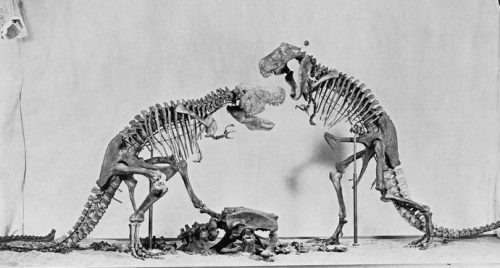
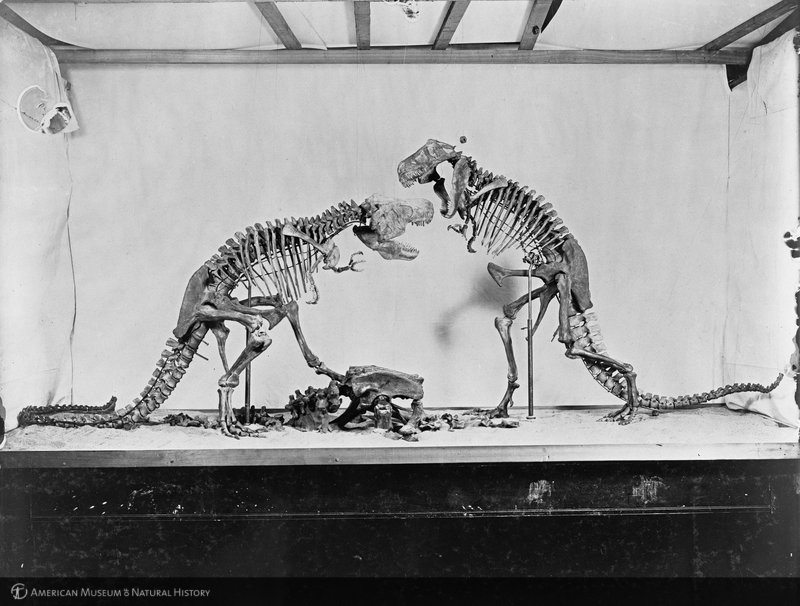
E.S. Christman’s miniature models act out Osborn’s unrealized battling Tyrannosaurus display. Image courtesy of the AMNH Research Library.

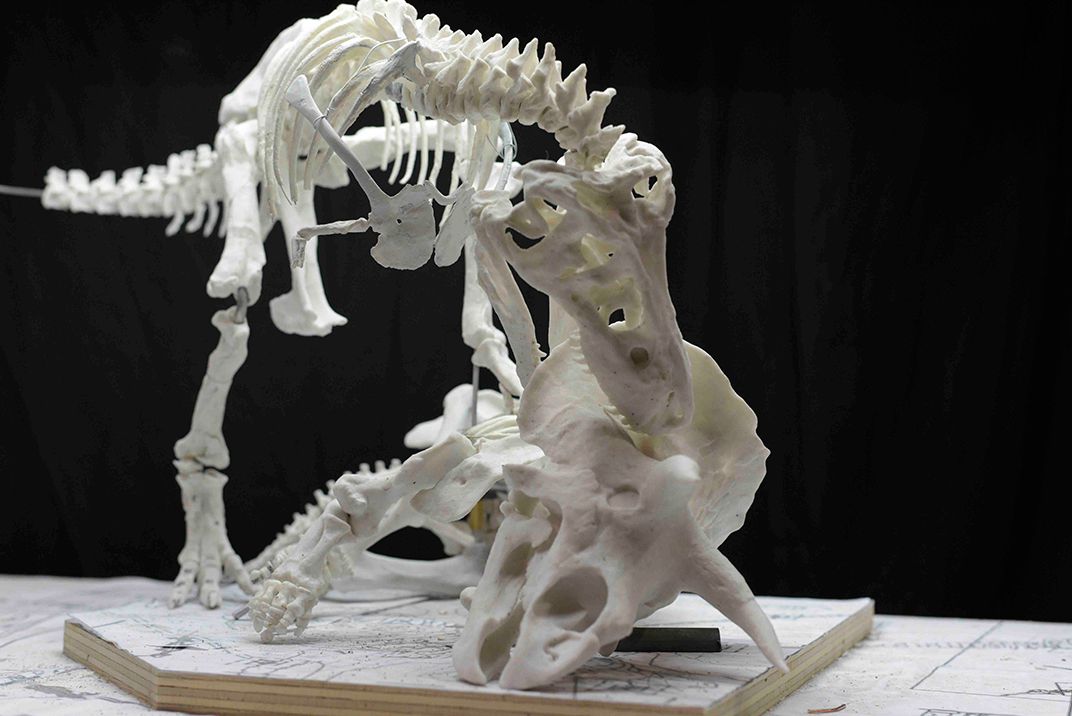
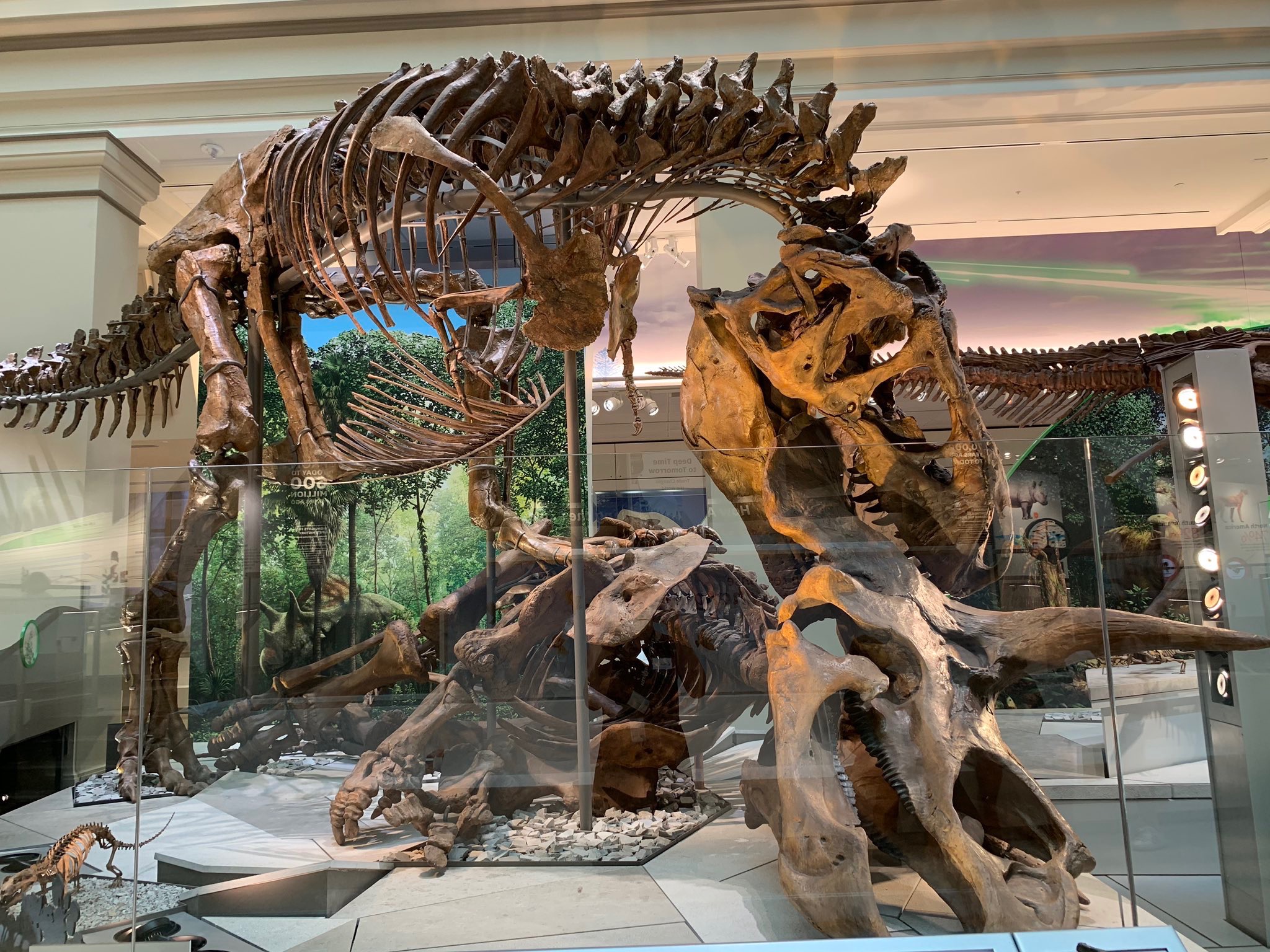
In 1908, Brown collected a much more complete Tyrannosaurus specimen (AMNH 5027), with over 50% of the skeleton intact, including the first complete skull and a significant portion of the torso. With this specimen in hand, AMNH technician Adam Hermann and his team began work on a mounted Tyrannosaurus skeleton to join the Museum’s growing menagerie of dinosaurs and prehistoric mammals. Inspired by the museum’s habitat dioramas and seeking to accentuate the spectacle of his reptilian monster, Osborn initially wanted to mount two Tyrannosaurus skeletons facing off over a dead hadrosaur. He even published a brief description, complete with 1/10th scale wooden models illustrating the proposed exhibit (above). However, the structural limitations inherent to securing heavy fossils to a steel armature, as well as the inadequate amount of Tyrannosaurus fossils available, made such a sensational display impossible to achieve.

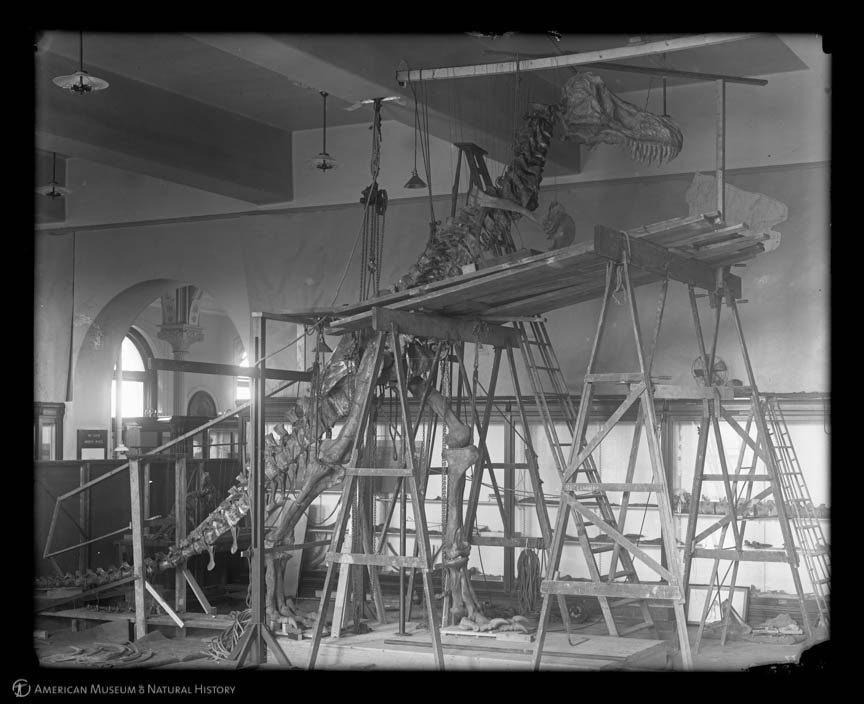
Instead, Hermann prepared a single Tyrannosaurus mount, combining the 1908 specimen with plaster casts of the hips and femur from the 1905 holotype. The original skull was impractically heavy, so a cast was used in its place. Missing portions of the skeleton, including the arms, feet, and most of the tail, were sculpted by hand using bones from Allosaurus as reference. During the early 20th century, constructing fossil mounts was a relatively new art form, and while Hermann was one of the most talented and prolific mount-makers around, his techniques were somewhat unkind to the fossil material. Bolts were drilled directly into the fragile bones to secure them to the armature, and in some cases steel rods were tunneled right through them. Any fractures were sealed with plaster, and reconstructed portions were painted to be nearly indistinguishable from the original fossils. Like most of the early AMNH fossil mounts, preserving the integrity of the Tyrannosaurus bones was secondary to aesthetic concerns like concealing the unsightly armature.

The Tyrannosaurus mount takes shape. Image courtesy of the AMNH Research Library.

The completed Tyrannosaurus mount, a magnificent sculptural combination of bone, plaster, and steel, was unveiled in 1915 to stunned audiences. With its tooth-laden jaws agape and a long, dragging lizard tail extending its length to over 40 feet, the Tyrannosaurus was akin to a mythical dragon, an impossible monster from a primordial world. This dragon, however, was real, albeit safely dead for 66 million years. The December 3rd New York Times article was thick with hyperbole, declaring the dinosaur “the prize fighter of antiquity”, “the king of all kings in the domain of animal life,” “the absolute warlord of the earth” and “the most formidable fighting animal of which there is any record whatsoever.” Even Osborn got in on the game, calling Tyrannosaurus “the most superb carnivorous mechanism among the terrestrial Vertebrata, in which raptorial destructive power and speed are combined.”

Brian Noble argues that Osborn’s descriptions of T. rex betray his own racial anxiety and fear of obsolescence. As a member of the New York aristocratic class, Osborn supported eugenics and lobbied for race-based quotas on immigration. Within months of penning museum labels that lament the extinction of “great and noble” carnivores like Tyrannosaurus, Osborn was writing that “the greatest danger to the American republic is the gradual dying out…of those hereditary traits through which the principles of our religious, political, and social foundations were laid down and their insidious replacement by traits of a less noble character” (quoted in Noble 2017, pg. 73). Whether knowingly or not, Osborn allowed his fear of the fall of the de facto ruling class to which he belonged influence his interpretation of a long-dead dinosaur.
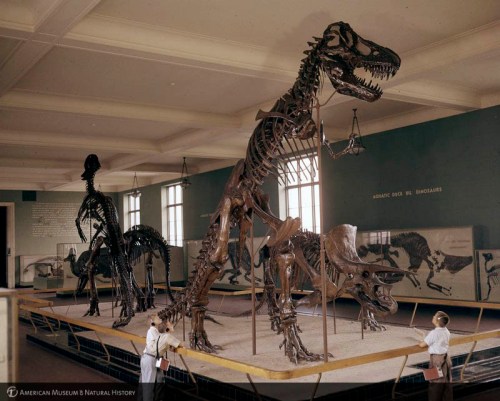
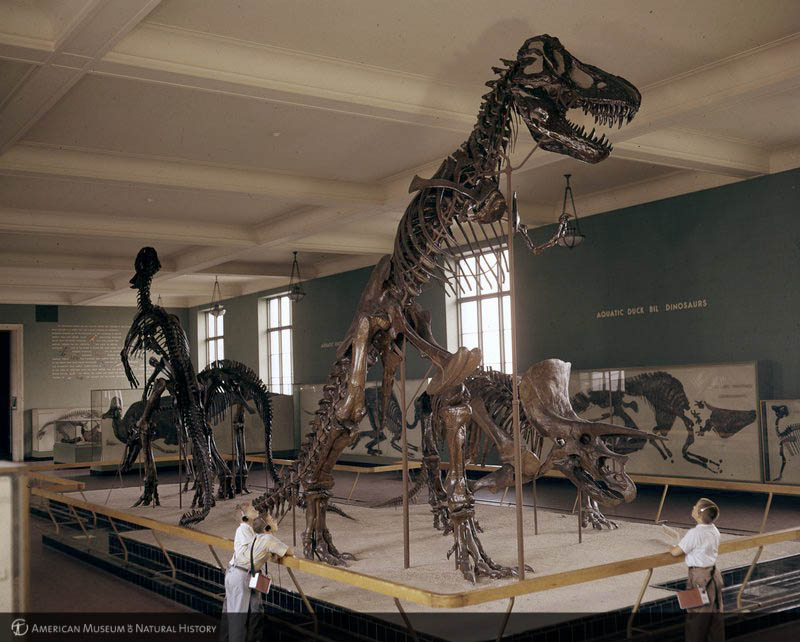
Hermann’s Tyrannosaurus continued to delight AMNH visitors through the 1980s. Image courtesy of the AMNH Research Library.

Today, we know that the original AMNH Tyrannosaurus mount was inaccurate in many ways. The upright, tail-dragging pose, which had been the most popular attitude for bipedal dinosaurs since Joseph Leidy’s 1868 Hadrosaurus mount, is now known to be incorrect. More complete Tyrannosaurus skeletons have revealed that the tail reconstructed by Osborn and Hermann was much too long. The Allosaurus-inspired feet were too robust, the legs (partially cast from the 1905 holotype) were too large, and the hands had too many fingers. It would be misleading to presume that the prehistoric carnivore’s skeleton sprang from the ground exactly as it was presented, but it is equally incorrect to reject it as a fake. The 1915 mount was a solid representation of the best scientific data available at the time, presented in an evocative and compelling manner.

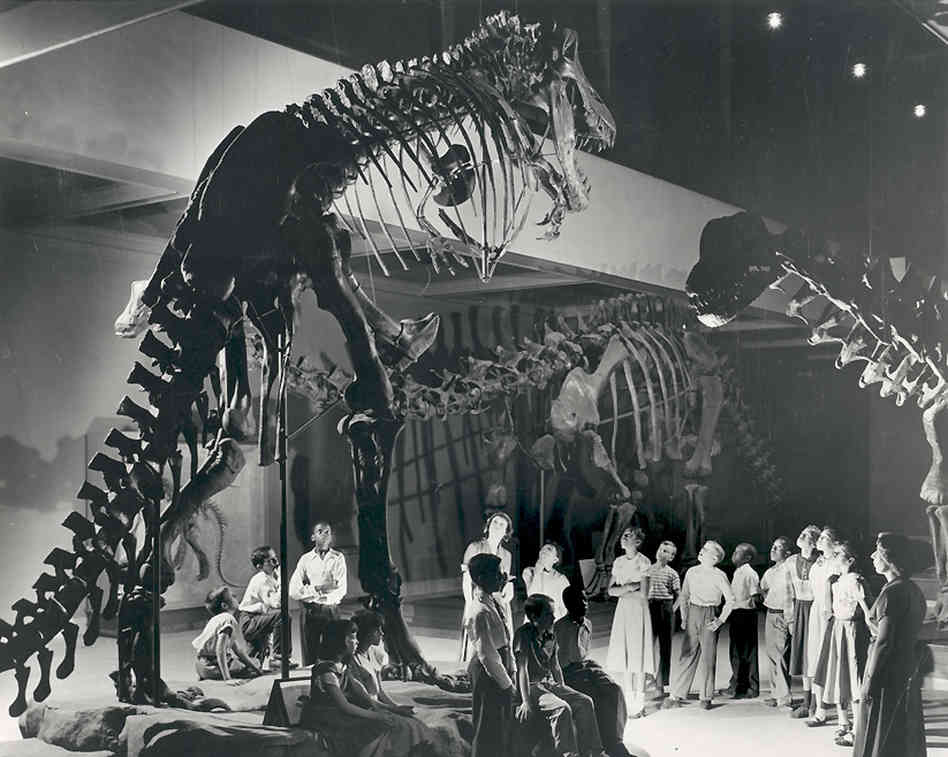
The AMNH Tyrannosaurus mount was no less than a monument: for paleontology, for its host museum, and for the city of New York. The mount has been a New York attraction for longer than the Empire State Building, and for almost 30 years, AMNH was the only place in the world where visitors could see a T. rex in person. In 1918, Tyrannosaurus would make its first Hollywood appearance in the short film The Ghost of Slumber Mountain. This star turn was followed by roles in 1925’s The Lost World and 1933’s King Kong, firmly establishing the tyrant king’s celebrity status. It is noteworthy that special effects artist Willis O’Brian and model maker Marcel Delgado copied the proportions and posture of the AMNH display exactly when creating the dinosaurs for each of these films. The filmmakers took virtually no artistic liberties, depicting Tyrannosaurus precisely how contemporary scientists had reconstructed it at the museum.

II. A T. rex for Pittsburgh

The Carnegie Museum’s first attempt at restoring the skull of T. rexSource

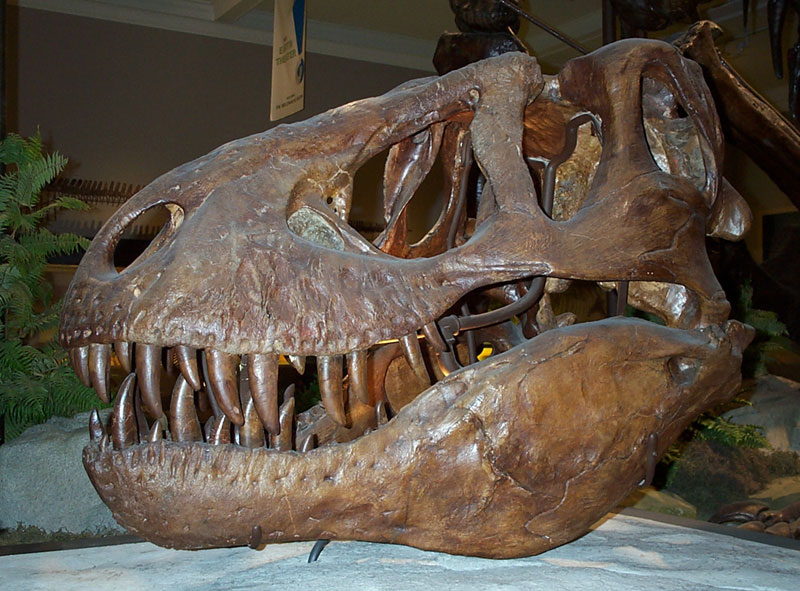
In 1941, AMNH ended its Tyrannosaurus monopoly and sold the incomplete type specimen (the partial skeleton described in Osborn’s 1905 publication) to Pittsburgh’s Carnegie Museum of Natural History. While it is sometimes reported that this transfer took place to keep the valuable fossils out of harm’s way during World War II (e.g. Larson 2008), the deal was actually underway well before the United States became involved in the war. Carnegie Museum Director Andrew Avinoff spent nearly a year bargaining with Barnum Brown over a price, eventually settling on $100,000 ($1.7 million in today’s dollars) for the fossils with appropriate bases and mounting fixtures. Carnegie staff wasted no time assembling a mount of their own, but since the Tyrannosaurus holotype only included about 18% of the skeleton, most of the Pittsburgh T. rex had to be made from casted and sculpted elements. Somewhat pointlessly, the skull fragments included with the specimen were buried inside a plaster skull replica (above), making them inaccessible to researchers for several decades. Completed in less than a year, the Carnegie Tyrannosaurus was given a more hunched posture than its AMNH predecessor.
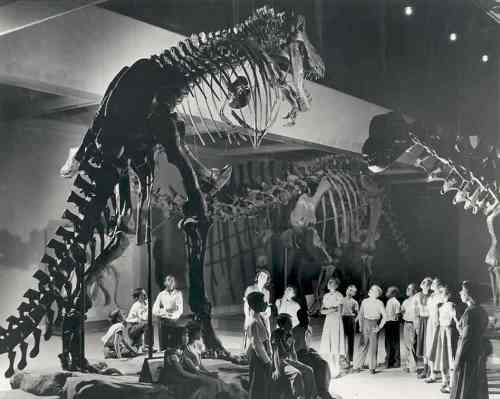
The Tyrannosaurus faced off with Diplodocus and Apatosaurus at the Carnegie Museum for more than 60 years. Source

The mid-20th century was a quiet phase for vertebrate paleontology. After enjoying public fame and generous federal support during the late 1800s, paleontology as a discipline was largely marginalized when experiment-driven “hard” sciences rose to prominence. By the 1950s and 60s, the comparably small number of researchers studying ancient life were chiefly concerned with theoretical models for quantifying trends in evolution. Although the aging dinosaur displays at American museums remained popular with the public, these animals were perceived as evolutionary dead-ends, of little interest to the majority of scientists.

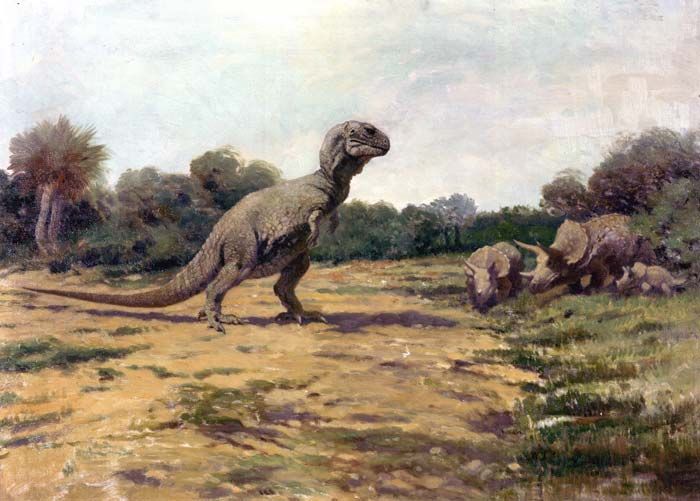
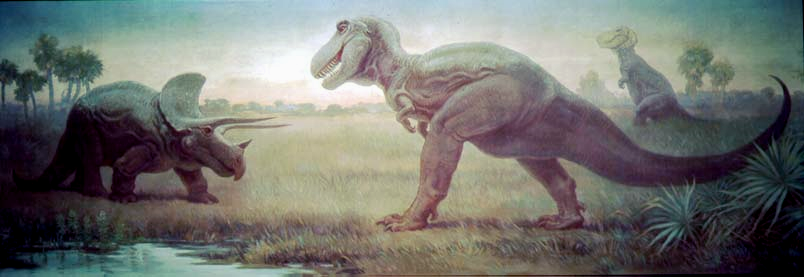
While New York and Pittsburgh remained the only places where the tyrant king could be seen in person, the ongoing fame of T. rex was secured in part by two additional museum displays, ironically at institutions that did not have any actual Tyrannosaurus fossils on hand. In 1928, the Field Museum of Natural History commissioned Charles Knight to paint a series of prehistoric landscapes, the most recognizable of which depicts a face-off between Triceratops and a surprisingly spry Tyrannosaurus. In 1947, Rudolph Zallinger painted a considerably more bloated and lethargic T. rex as part of his Age of Reptiles mural at the Peabody Museum of Natural History. Both paintings would be endlessly imitated for decades, and would go on to define the prehistoric predator in the public imagination.

III. Rex Renaissance
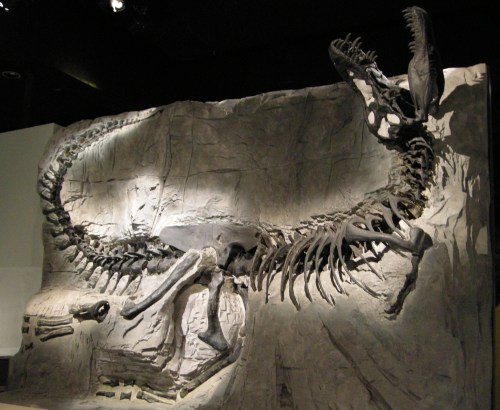
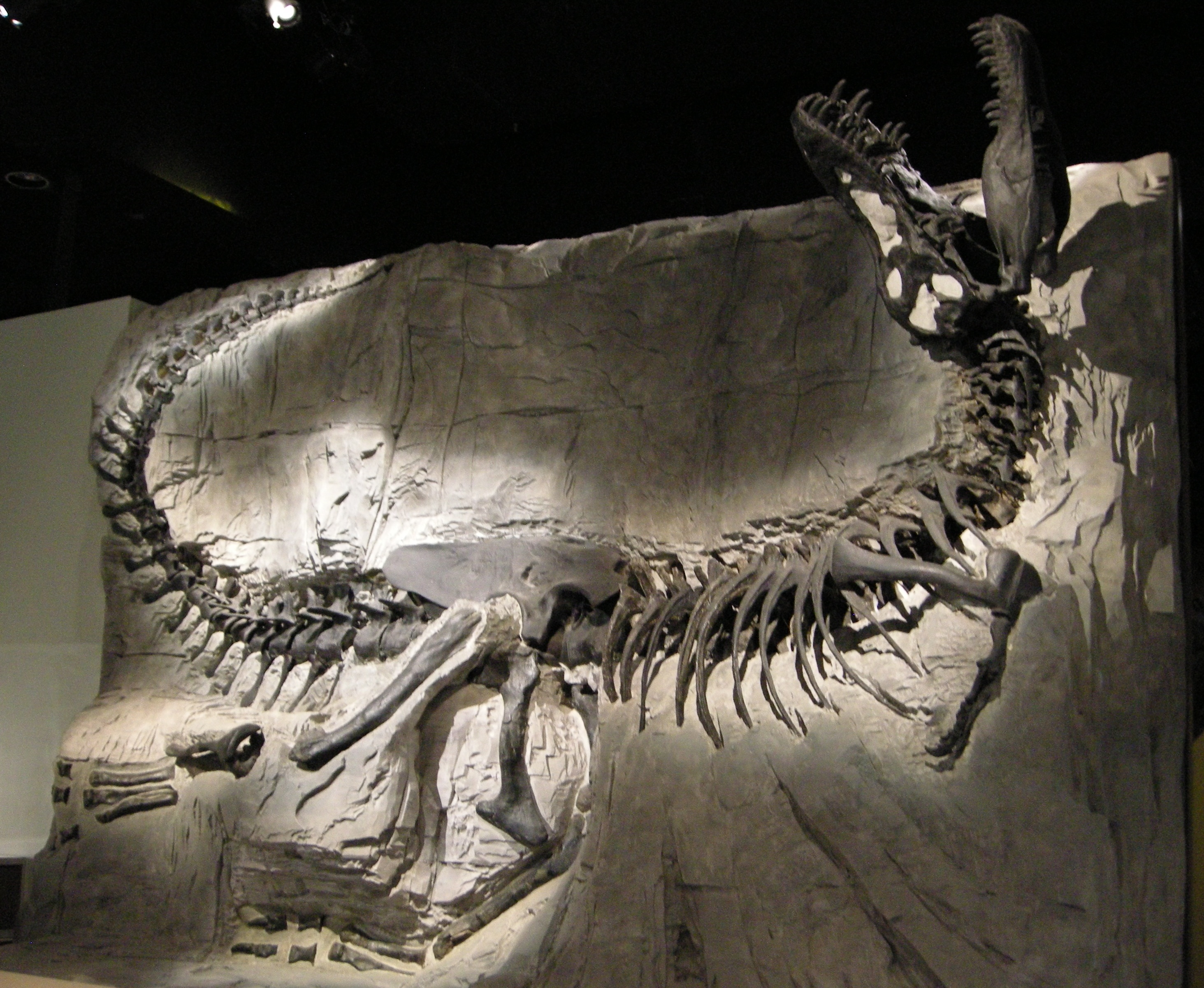
RTMP 81.6.1, aka Black Beauty, mounted in relief at the Royal Tyrell Museum. Source

The sparse scientific enthusiasm for dinosaurs that defined mid-century paleontology changed rather suddenly in the 1970s and 80s. The “dinosaur renaissance” brought renewed energy to the discipline in the wake of evidence that dinosaurs had been energetic and socially sophisticated animals. The next generation of paleontologists endeavored to look at fossils in new ways to understand dinosaur behavior, biomechanics, ontogeny, and ecology. Tyrannosaurus was central to the new wave of research, and has been the subject of hundreds of scientific papers since 1980. More interest brought more fossil hunters into the American west, leading to an unprecedented expansion in known Tyrannosaurus fossils.

The most celebrated Tyrannosaurus find from the dinosaur renaissance era came from Alberta, making it the northernmost and westernmost T. rex to date. The 30% complete “Black Beauty” specimen, so named for the black luster of the fossilized bones, was found in 1980 by a group of high schoolers and was excavated by paleontologist Phil Curie. The original Black Beauty fossils were taken on a tour of Asia before finding a permanent home at the newly established Royal Tyrell Museum in Drumheller, Alberta. In lieu of a standing mount, Black Beauty was embedded in a faux sandstone facade, mirroring the environment in which the fossils were found and the animal’s presumed death pose. This relief mount set Black Beauty apart from its AMNH and Carnegie predecessors, and even today it remains one of the most visually striking Tyrannosaurus displays.
The mid-sized reconstruction (right) in this 2011 growth series at LACM incorporates Garbani’s juvenile T. rex fossils. Photo by the author.

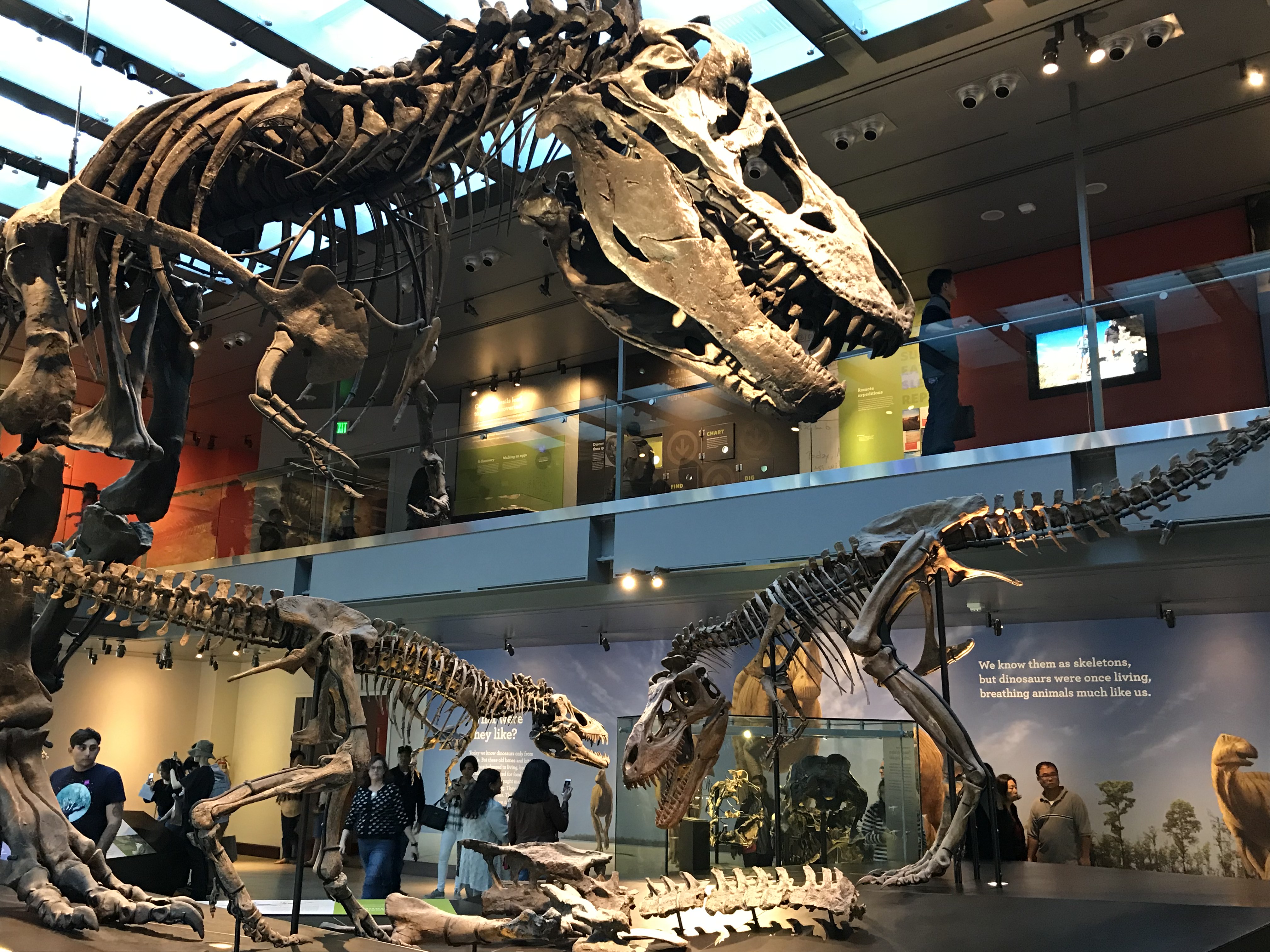
Tyrannosaurus was once considered vanishingly rare, but by the early 1990s the number of known specimens had increased dramatically. Harley Garbani found three specimens, including the first T. rex juvenile, while prospecting in Montana for the Natural History Museum of Los Angeles County (LACM). “I was pretty excited,” Garbani recounted, “I didn’t figure another of those suckers would ever be found” (quoted in Horner and Lessem 1993). Meanwhile, the Royal Tyrell Museum tracked down a partial T. rex in Alberta that Charles Sternberg had marked in 1946 but never excavated.

One of the most complete Tyrannosaurus specimens was discovered by avocational collector Kathy Wankel while prospecting on Montana land owned by the Army Corps of Engineers. The Museum of Rockies (MOR) excavated the Wankel Rex in 1989, and until recently it was held it trust at the Bozeman museum. All of these specimens have allowed paleontologists to conduct extensive research on the growth rate, cellular structure, sexual dimorphism, speed, and energetics of T. rex, turning the species into a veritable model organism among dinosaurs.

IV. The World’s Most Replicated Dinosaur
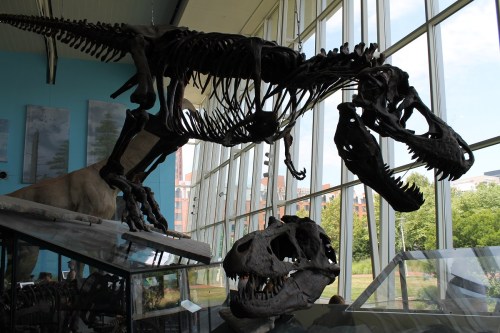
Cast of Peck’s Rex, accompanied by a Wankel Rex skull, at the Maryland Science Center. Photo by the author.

Despite the relative bonanza of new Tyrannosaurus specimens uncovered in the 1980s and 90s, very few of those skeletons were immediately assembled as display mounts. Instead, many museums have purchased complete casts to meet the increasing public demand for dinosaurs. In 1986, the Academy of Natural Sciences in Philadelphia opened Discovering Dinosaurs, the world’s first major exhibit showcasing active, endothermic dinosaurs. The centerpiece of the exhibit was a cast of the AMNH Tyrannosaurus, posed for the first time in the horizontal posture that we now know was the animal’s habitual stance. The following year, another AMNH cast appeared in the lobby of Denver Museum of Nature and Science in a strikingly bizarre pose, with one leg kicking high in the air. Robert Bakker—the mount’s designer— intended to push boundaries and demonstrate what a dynamic and energetic Tyrannosaurus might be capable of, although the mount has subsequently been described as dancing, kicking a soccer ball, or peeing on a fire hydrant.

Denver’s high-kicking T. rex. Source

Since the late 1990s, however, casts of another specimen have overtaken AMNH 5027 for the title of most ubiquitous T. rex. BHI 3033, more commonly known as Stan, was excavated in South Dakota in 1992 by the Black Hills Institute (BHI), a commercial outfit specializing in excavating, preparing, and mounting fossils. BHI has sold dozens of Stan casts to museums and other venues around the world. At a relatively affordable $100,000 plus shipping, even small local museums and the occasional wealthy individual can now own a Tyrannosaurus mount. With over 50 casts sold as of 2017, Stan is, by a wide margin, the most duplicated and most exhibited dinosaur in the world.
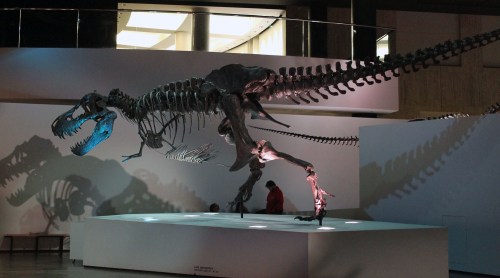
Stan cast at the Houston Museum of Natural Science. Photo by the author.

All these new Tyrannosaurus mounts are forcing museums to get creative, whether they are displaying casts or original fossils. Predator-prey pairings are a popular display choice: for example, the Wankel Rex cast at the Perot Museum of Nature and Science  is positioned alongside the sauropod Alamosaurus, and the Cleveland Museum of Natural History matches the tyrant dinosaur with its eternal enemy, Triceratops. Meanwhile, the growing number juvenile Tyrannosaurus specimens has allowed for family group displays. LACM features an adult, subadult, and baby, while the Burpee Museum of Natural History pairs its original juvenile T. rex “Jane” with an AMNH 5027 cast. The most unique Tyrannosaurus mount so far is certainly the copulating pair at the Jurassic Museum of Asturias.
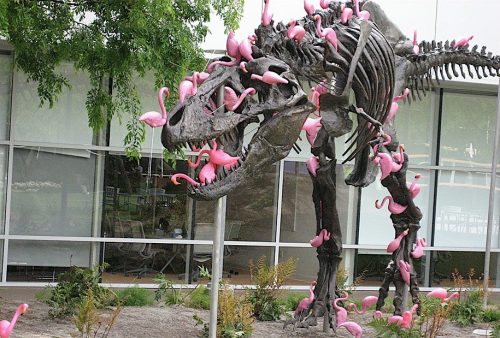
While not as widespread as Stan, casts of the Wankel Rex (distributed by Research Casting International) are increasingly common. This copy at the Google headquarters is periodically attacked by smaller, pinker theropods. Source

Each of these displays gives a substantially different impression of Tyrannosaurus. Depending on the mount, visitors might see T. rex as a powerful brute, a fast and agile hunter, or a nurturing parent (or a gentle lover). Most mounts are accurate insofar that a real Tyrannosaurus probably adopted a similar stance at some point, but the museum’s choice of pose nevertheless influences visitors’ understanding of and attitude toward the dinosaur.

V. Restoring the Classics
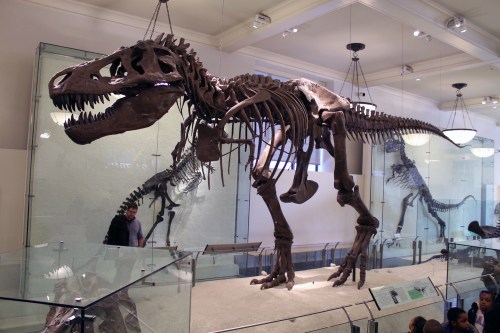
An update for the first T. rex ever displayed. Photo by the author.

With dozens of new Tyrannosaurus mounts springing up across the country and around the world, the original AMNH and Carnegie displays began to look increasingly obsolete. However, modernizing historic fossil mounts is an extremely complex and expensive process. The early 20th century technicians that built these displays generally intended for them to be permanent: bolts were drilled directly into the bones and gaps were sealed with plaster that can only be removed by manually chipping it away. What’s more, the cumulative effects of corroding armatures, fluctuating humidity, and vibration from passing crowds had damaged the historic mounts over the course of their decades on display.

Despite these challenges, AMNH and the Carnegie Museum have both been able to restore and update their classic Tyrannosaurus displays. Between 1987 and 1995, Lowell Dingus coordinated a comprehensive renovation of the AMNH fossil exhibits. As part of the project, chief preparator Jeanne Kelly led the restoration and remounting of the iconic T. rex. The fossils proved especially fragile, and some elements had never been completely freed from the sandstone matrix. It took six people working for two months just to strip away the layers of paint and shellac applied by the original preparators.

Exhibit specialist Phil Fraley constructed the new armature, which gave the tyrant king a more accurate horizontal posture. While the old mount was supported by obtrusive rods extending from the floor, the new version is actually suspended from the ceiling with a pair of barely-visible steel cables. Each bone is secured to an individual metal bracket, allowing researchers to remove elements for study as necessary. A new cast of the skull was also prepared, this time with open fenestrae for a more natural appearance. Curators Gene Gaffney and Mark Norrell settled on a fairly conservative stalking pose—a closed mouth and subtly raised left foot convey a quiet dignity befitting this historic specimen.
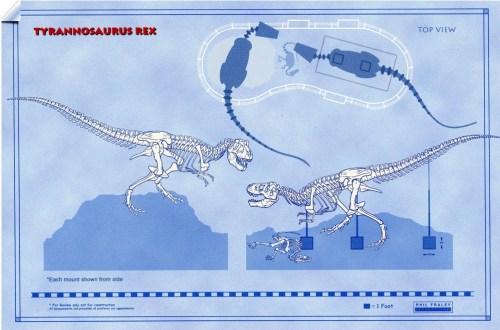
One of many conceptual drawings created by Phil Fraley Productions during the process of planning the Carnegie Museum renovation. Source

Historically, the Carnegie Tyrannosaurus had never quite lived up to its AMNH predecessor. Although it incorporated the Tyrannosaurus holotype, it was mostly composed of casts from the New York skeleton, and it sported an unfortunately crude replica skull. It is therefore ironic that the Carnegie Museum now exhibits the more spectacular T. rex display, one which  realizes Osborn’s plan to construct an epic confrontation between two giant predators.

While less complete than many subsequent finds, the Tyrannosaurus rex holotype is still important because it defines the species. It had not been studied properly since the early 20th century, however, and the skull elements were completely inaccessible—entombed in plaster since 1941. The conservation team overseen by Hans-Dieter Sues sought not only to rebuilt the exhibit mount, but to re-describe the specimen and provide casts of individual bones to other museums. The Carnegie website once hosted a fascinating day-by-day account this process. The page seems to have been removed but an archived version can be found here.
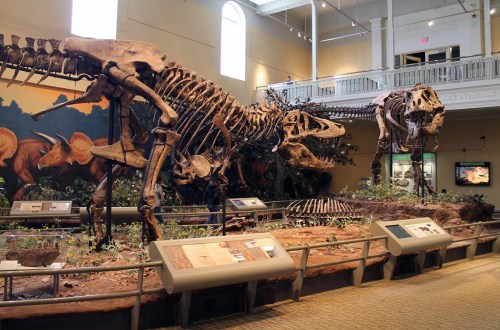
Old meets new: the restored Tyrannosaurus holotype faces off with a cast of Peck’s Rex. Photo by the author.

Phil Fraley, now heading an independent company based in New Jersey, oversaw the construction of the new mount. Michael Holland contributed a new restored skull, actually a composite of several Tyrannosaurus skulls. The mount was completed in 2007, and is displayed alongside a cast of “Peck’s Rex,” a specimen housed at MOR. Despite the difficulty of modernizing the historic specimen, the team reportedly developed a healthy respect for turn-of-the-century mount-makers like Adam Hermann and Arthur Coggeshall, who developed the techniques for making enduring displays of fragile fossils that are still being refined today.

VI. From South Dakota to Chicago
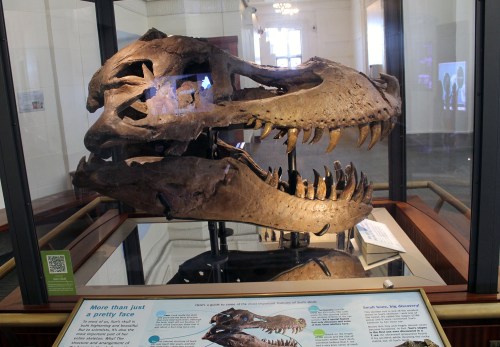
The skull of SUE the T. rex. Photo by the author.

Tyrannosaurus rex displays changed for good in the 1990s thanks to two individuals, one real and one fictional. The latter was of course the T. rex from the film Jurassic Park, brought to life with a full-sized hydraulic puppet, game-changing computer animation, and the inspired use of a baby elephant’s screeching cry for the dinosaur’s roar. The film made T. rex real—a breathing, snorting, drooling animal unlike anything audiences had ever seen. Jurassic Park was a tough act to follow, and in one way or another, every subsequent museum display of the tyrant king has had to contend with the shadow cast by the film’s iconic star.

The other dinosaur of the decade was SUE, who scarcely requires an introduction. SUE is the most complete Tyrannosaurus ever found, with 90% of the skeleton intact. Approximately 30 years old at the time of their death, SUE is also the eldest T. rex known, and within the margin of error for the title of largest. The specimen’s completeness and exquisite preservation has allowed paleontologists to ascertain an unprecedented amount of information about this individual dinosaur. In particular, SUE’s skeleton is riddled with fractured and arthritic bones, as well as evidence of gout and parasitic infections that together paint a dramatic picture of a violent life at the top of the food chain.

It was the events of SUE’s second life, however, that made this the fossil the world knows by name. SUE was discovered in 1990 by Sue Hendrickson (for whom the specimen is named) on ranch land within the Cheyenne River reservation of South Dakota. The Black Hills Institute excavated the skeleton and initially intended to display the Tyrannosaurus at a new facility in Hill City. Even at this point, SUE was a flashpoint for controversy among paleontologists: while several researchers signed up to work with BHI on a monograph about SUE, others did not think a for-profit company was an appropriate place for such an important specimen. Things heated up in 1992, when BHI became embroiled in a four-way legal battle with landowner Maurice Williams, the Cheyenne Council, and the United States Department of the Interior. With little legal precedent for ownership disputes over fossils, it took until 1995 for the District Court to award Williams the skeleton (I recommend the relevant chapter in Grande 2017 as the most evenhanded account of how this went down).

Williams announced that he would put SUE on the auction block, and paleontologists initially worried that the priceless specimen would disappear into the hands of a wealthy collector, or end up in a crass display at a Las Vegas casino. Those fears were put to rest in 1997 when the Field Museum of Natural History (FMNH) won SUE with financial backing from McDonald’s and Disney. Including the auctioneer’s commission, the price was an astounding $8.36 million.
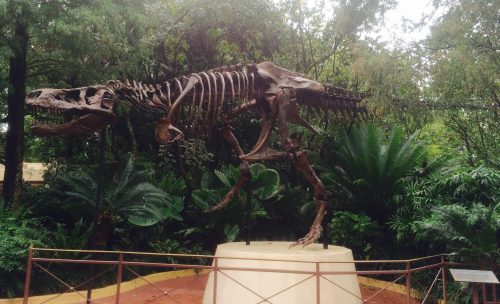
Research Casting International prepared two SUE casts: one for a traveling exhibition and this one at Walt Disney World in Orlando. Photo by the author.

FMNH and its corporate backers did not pay seven figures for SUE solely to learn about dinosaur pathology.  SUE’s remarkable completeness would be a boon for scientists, but the fossil’s star power was at least as important for the museum. SUE was a blockbuster attraction that would bring visitors in the door, and the dinosaur’s name and likeness could be marketed for additional earned income. As former FMNH president John McCarter explained, “we do dinosaurs…so that we can do fish” (quoted in Fiffer 2000). A Tyrannosaurus would attract visitors and generate funds, which could in turn support less sensational but equally important collections maintenance.

Once SUE arrived at FMNH, the museum did not hold back marketing the dinosaur as a must-see attraction. A pair of SUE’s teeth went on display days after the auction. This expanded organically into the “SUE Uncrated” exhibit, where visitors could watch the plaster-wrapped bones being unpacked and inventoried. The main event, of course, was the mounted skeleton, which needed to be ready by the summer of 2000. This was an alarmingly short timetable, and the FMNH team had to hit the ground running. Although BHI had already put in 4,000 hours of prep work, much of SUE’s skeleton was still buried in rock and plaster. The bones needed to be prepared and stabilized before they could be studied, and they needed to be studied before they could be mounted.
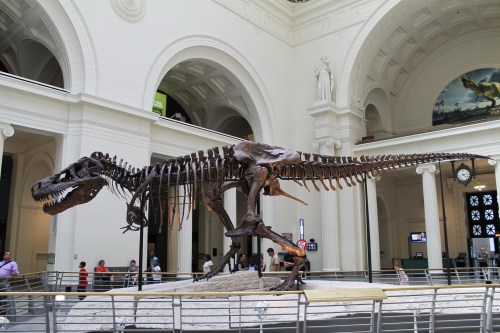
SUE as displayed from 2000 to 2017. Photo by the author.

After reviewing a number of bids, FMNH selected Phil Fraley to prepare SUE’s armature. Fraley had already remounted the AMNH T. rex at that point, and left his post at the New York museum and founded his own company so that he could work on SUE. Just as had been done with the AMNH skeleton, Fraley’s team built an armature with individual brackets securing each bone, allowing them to be removed with relative ease for research and conservation. No bolts were drilled into the bones and no permanent glue was applied, ensuring that the fossils were not damaged for the sake of the exhibit. SUE was placed right at the heart of the museum, in the half-acre, four-story expanse of Stanley Field Hall. Despite these cavernous surroundings, SUE was given a low, crouching posture—the intent was to give visitors a face-to-face encounter with T. rex.

SUE was revealed to the public on May 17, 2000 with the dropping of a curtain. 10,000 visitors came to see SUE on opening day, and that year the museum’s attendance soared from 1.6 to 2.4 million. To this day, headlines about SUE are common, even outside of Chicago, and the Field Museum’s increasingly avant garde @SUEtheTrex twitter account has 60,000 followers and counting. SUE has been the subject of more than 50 technical papers, several books, and hundreds of popular articles. When FMNH brought SUE to Chicago, they weren’t just preserving an important specimen in perpetuity, they were creating an icon.

VII. Tyrannosaurs Invade Europe

Tristan at Berlin’s Museum fur Naturkunde. Photo by Heinrich Mallison.

Tyrannosaurus is an exclusively North American animal. It follows that real Tyrannosaurus skeletons have historically only been displayed in American and Canadian museums, while the rest of the world has had to content itself with casts of Stan and the Wankel Rex. This situation changed recently, and there are now two original T. rex skeletons on display in European museums.

The first was Tristan, a Tyrannosaurus collected in 2000 by private collectors. Niels Nielsen, a Danish real estate developer, bought the skeleton for an undisclosed sum (he named the dinosaur Tristan after his son). While it is common for art museums to display privately owned objects, scientific institutions usually avoid such arrangements.  There are many reasons for this: it may be a museum’s policy to avoid legitimizing the private market for one-of-a-kind specimens, or they may simply want to steer clear of demands by owners regarding exhibition and interpretation. Perhaps most importantly, scientific research on privately owned specimens is not necessarily reproducible, because there is no guarantee the specimen will remain in a publicly-accessible repository.

Despite these drawbacks, Director Johannes Vogel of the Museum für Naturkunde in Berlin decided to accept Tristan as a loan. Paleontologist Heinrich Mallison worked with Nielsen and others to design the mount and plan how it would fit into the exhibit hall. The team opted to pose Tristan as though making a rapid left turn around a “tree” (one of the cast iron columns bisecting the room). Unfortunately, the final armature did not effectively capture the intended twisting motion in the torso, hips, and right leg, and the resulting mount is stiffer looking then the initial renders. The public does not seem to have minded, however. Tristan was unveiled in September 2015 and drew half a million visitors in its first six months on display.
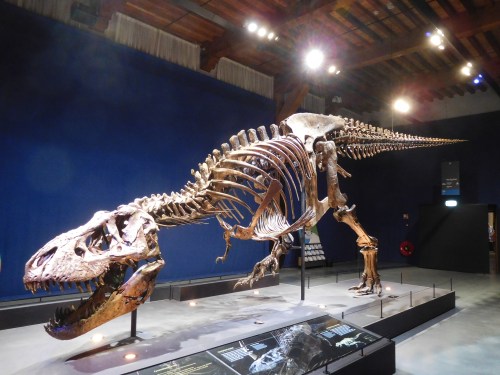
Trix the T. rex in a temporary exhibit space at the Naturalis Biodiversity Center. Source

Europe’s second Tyrannosaurus mount debuted in September 2016 at the Naturalis Biodiversity Center in Leiden. Named Trix after the Netherlands’ Queen Beatrix, this specimen was collected in Montana by a crew from the museum working in collaboration with the Black Hills Institute. The mount constructed by BHI uniquely includes the original skull, rather than a lightweight replica. This was accomplished by posing Trix in a low running pose, with its head skimming less than a foot above the ground.

VIII. Into the Future
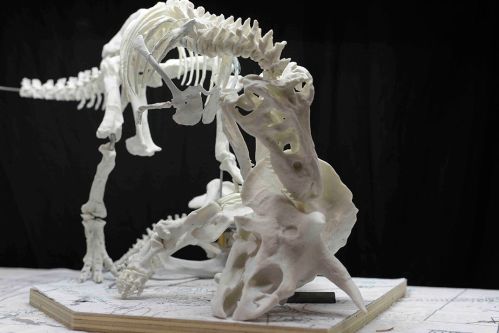
A 1/10th scale 3-D printed model of the Nation’s T. rex recalls the wooden maquettes used at AMNH over a century ago. Source

New T. rex displays just keep coming. In 2019, the National Museum of Natural History reopened its paleontology halls after a five year renovation. The new “Deep Time” exhibition has a brand-new Tyrannosaurus mount as its centerpiece. The specimen in question is the Wankel Rex, which had been held in trust at the Museum of the Rockies since it was excavated in 1989. Found on Army Corps of Engineers land, the fossils are owned by the federal government and therefore an ideal candidate for display at the national museum (technically, they are on a 50 year loan from the Corps to the Smithsonian).
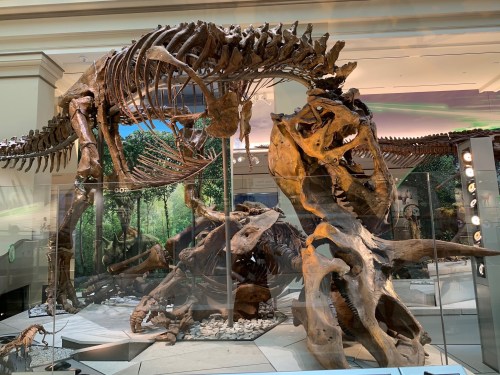
Look closely the fallen Triceratops and you’ll see crushed ribs, a broken horn, and that its head is no longer attached to its body

Although several casts of the Wankel Rex are on display around the world, this is the first time the original fossils have been assembled into a standing mount. For Curator Matt Carrano, it was important that the T. rex was presented like an animal, rather than a sculpture. To accomplish this, he devised a deliriously cool pose, with the Tyrannosaurus poised as though prying the head off a prone Triceratops. Pulling off such a scene was easier said than done. Extreme poses are relatively straightforward when working with lightweight casts, but the degree of dynamism Carrano wanted is much more complicated when creating a frame that safely supports real fossils. Just like Hermann and Christian a century earlier, Matt Fair and his colleagues at Research Casting International started with a 10th scale miniature before moving on to the real skeleton.

Now on display at NMNH, the Wankel Rex has a new nickname: the Nation’s T. rex. This moniker is appropriate: NMNH follows only the Louvre in annual visitation, sometimes topping 8 million people. That means the Nation’s T. rex will soon be the most-viewed Tyrannosaurus skeleton in the world. In all likelihood, 60 million people will pass by the mounted skeleton in the next decade.
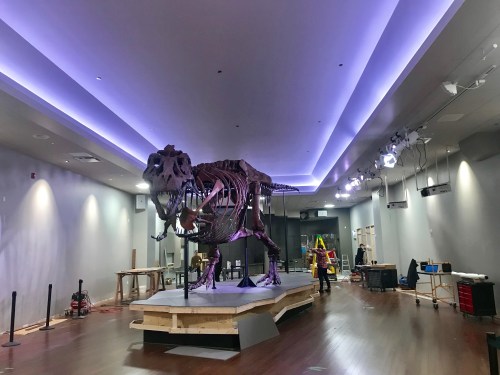
SUE the T. rex in their not-quite-finished throne room. Photo by the author.

Nevertheless, the Nation’s T. rex has competition. In 2018, the Field Museum moved SUE to a 6,500 square foot gallery adjacent to the main dinosaur hall. The new exhibition (full disclosure: I was a co-developer on this project) gives SUE some much-needed context. In contrast to the neoclassical space it once occupied, the mounted T. rex is now part of a media-rich experience that Brown, Hermann, and Osborn could have scarcely imagined. An animated backdrop illustrates the waterlogged forests where Tyrannosaurus lived, and a narrated light show provides a tour of SUE’s skeleton—highlighting pathologies and other key features.

With guidance from Pete Makovicky, Tom Cullen, and Bill Simpson, Garth Dallman and colleagues at Research Casting International modified the original SUE mount to correct a range of anatomical inaccuracies and reunite the skeleton with its gastralia (rib-like bones embedded in the belly muscles). This is the first time a Tyrannosaurus skeleton has been mounted with a real gastral basket, and it gives the dinosaur a girthier silhouette. Many lines of evidence have converged onto this new look for T. rex. The animal was not the lithe pursuit predator it was portrayed as in the 1990s, but an ambush hunter with the raw weight and muscle to overpower its bus-sized prey.

SUE’s new digs combine immersive media with elegant and austere design language. Photo by the author.

As we have seen, the number of Tyrannosaurus skeletons on exhibit, whether original fossils or casts, has exploded in recent years. Fifty years ago, New York and Pittsburgh were the only places where the world’s most famous dinosaur could be seen in person. Today, there may well be over a hundred Tyrannosaurus mounts worldwide (most of which are identical casts of a handful of specimens). These displays have evolved over time: new scientific discoveries changed the animal’s pose and shape, new technology has allowed for more enriching and immersive exhibits, and popular media presentations of T. rex have continuously increased the public’s expectations for their encounter with the real thing.

Meanwhile, each T. rex on display exists in a socio-political context: human actors “create the initial and enduring performative iterations of T. rex” (Noble 2016, 71). A century ago, the first-ever T. rex exhibit was encoded with one man’s prejudice and social hangups. In the present, another T. rex—SUE—has become a nonbinary icon.  The Field Museum now refers to SUE as “they” instead of “she,” both in the spirit of scientific accuracy (we don’t know SUE’s sex) and LGBTQ+ inclusivity. As explained in a press release, “this kind of representation can make a big difference in the lives of the LGBTQ community. It’s not about politics; it’s about respect. If our Twitter dinosaur gets more people used to using singular “they/them” pronouns and helps some folks out there feel less alone, that seems worth it to us.”

For museums, acquiring and displaying a T. rex is not exactly a risk. As Carrano explained with respect to the Nation’s T. rex, “the T. rex is not surprising, but that’s not its job. Its job is to be awesome.” Specimens like the Nation’s T. rex or SUE are ideal for museums because they are at once scientifically informative and irresistibly captivating. Museums do not need to choose between education and entertainment because a Tyrannosaurus skeleton effectively does both. And even as ever more lifelike dinosaurs grace film screens, museums are still the symbolic home of T. rex. The iconic image associated with Tyrannosaurus is that of a mounted skeleton in a grand museum hall, just as it was when the dinosaur was introduced to the world nearly a century ago. The tyrant king is an ambassador to science that unfailingly excites audiences about the natural world, and museums are lucky to have it.

References

Asma, S.T. 2001. Stuffed Animals and Pickled Heads: The Culture and Evolution of Natural History Museums. New York, NY: Oxford University Press.

Boas, F. 1907. Some Principles of Museum Administration. Science 25:650:931-933.

Black, R. 2013. My Beloved Brontosaurus: On the Road with Old Bones, New Science and our Favorite Dinosaurs. New York, NY: Scientific American/Farrar, Straus and Giroux.

Clemens, W.A. and Hartman, J.H. 2014. “From Tyrannosaurus rex to asteroid impact: Early studies (1901-1980 of the Hell Creek Formation in its type area.” Through the End of the Cretaceous in the Type Locality of the Hell Creek Formation in Montana and Adjacent Areas. Eds. Wilson, G.P., Clemens, W.A., Horner, J.R., and Hartman, J.H. Boulder, CO: Geological Society of America.

Colbert, E.H., Gillette, D.D. and Molnar, R.N. “North American Dinosaur Hunters.” The Complete Dinosaur, Second Edition. Brett-Surman, M.K., Holtz, T.R. and Farlow, J.O., eds. Bloomington, IN: Indiana University Press.

Counts, C.M. 2009. Spectacular Design in Museum Exhibitions. Curator 52: 3: 273-289.

Dingus, L. 1996. Next of Kin: Great Fossils at the American Museum of Natural History. New York, NY: Rizzoli International Publications, Inc.

Dingus, L. 2004. Hell Creek, Montana: America’s Key to the Prehistoric Past. New York, NY: St. Martin’s Press.

Dingus, L. 1996. Next of Kin: Great Fossils at the American Museum of Natural History. New York, NY: Rizzoli International Publications, Inc.

Fiffer, S. 2000. Tyrannosaurus Sue: The Extraordinary Saga of the Largest, Most Fought Over T. rex ever Found. New York, NY: W.H. Freeman and Company.

Fox, A. and Carrano, M. 2018. Q&A: Smithsonian Dinosaur Expert Helps T. rex Strike a New Pose. Smithsonian Magazine. https://www.smithsonianmag.com/blogs/national-museum-of-natural-history/2018/07/17/q-smithsonian-dinosaur-expert-helps-t-rex-strike-new-pose

Freedom du Lac, J. 2014. The T. rex that got away: Smithsonian’s quest for Sue ends with different dinosaur. Washington Post.

Glut, D. 2008. “Tyrannosaurus rex: A century of celebrity.” Tyrannosaurus rex, The Tyrant King. Larson, Peter and Carpenter, Kenneth, eds. Bloomington, IN: Indiana University Press.

Grande, L. 2017. Curators: Behind the Scenes of Natural History Museums. Chicago, IL: University of Chicago Press.

Hermann, A. 1909. “Modern Laboratory Methods in Vertebrate Paleontology.” Bulletin of the American Museum of Natural History 21:283-331.

Horner, J.R. and Lessem, D. 1993. The Complete T. rex: How Stunning New Discoveries are Changing Our Understanding of the World’s Most Famous Dinosaur. New York, NY: Simon and Schuster.

Johnson, K. and Stucky, R.K. 2013. “Paleontology: Discovering the Ancient History of the American West.” Denver Museum of Nature and Science Annals, No. 4.

Larson, N. 2008. “One Hundred Years of Tyrannosaurus rex: The Skeletons.” Tyrannosaurus rex, The Tyrant King. Larson, Peter and Carpenter, Kenneth, eds. Bloomington, IN: Indiana University Press.

Lee, B.M. 2005. The Business of Dinosaurs: The Chicago Field Museum’s Nonprofit Enterprise. Unpublished thesis, George Washington University.

McGinnis, H.J. 1982. Carnegie’s Dinosaurs: A Comprehensive Guide to Dinosaur Hall at Carnegie Museum of Natural History, Carnegie Institute. Pittsburgh, PA: The Board of Trustees, Carnegie Institute.

“Mining for Mammoths in the Badlands: How Tyrannosaurus Rex Was Dug Out of His 8,000,000 Year old Tomb,” The New York Times, December 3, 1905, page SM1.

Nobel, B. 2016. Articulating Dinosaurs: A Political Anthropology. Toronto, ON: University of Toronto Press.

Norell, M., Gaffney, E.S. and Dingus, L. 1995. Discovering Dinosaurs: Evolution, Extinction, and the Lessons of Prehistory.  Berkeley, CA: University of California Press.

Osborn, H.F. 1906. Tyrannosaurus, Upper Cretaceous Carnivorous Dinosaur: Second Communication. Bulletin of the American Museum of Natural History vol. 22, pp. 281-296.

Osborn, H.F. 1913. Tyrannosaurus, Restoration and Model of the Skeleton. Bulletin of the American Museum of Natural History vol 32, pp. 9-12.

Osborn, H.F. 1916. Skeletal Adaptations of OrnitholestesStruthiomimus, and TyrannosaurusBulletin of the American Museum of Natural History vol 35, pp. 733-771.

Psihoyos, L. 1994. Hunting Dinosaurs. New York, NY: Random House, Inc.

Rainger, R. 1991. An Agenda for Antiquity: Henry Fairfield Osborn and Vertebrate Paleontology at the American Museum of Natural History, 1890-1935. Tuscaloosa, Alabama. University of Alabama Press.

Wesihampel, D.B. and White, Nadine M. 2003.The Dinosaur Papers: 1676-1906. Washington, DC: Smithsonian Books.

8 Comments

Filed under AMNH, CMNH, dinosaurs, DMNS, exhibits, FMNH, fossil mounts, history of science, HMNS, museums, reptiles, science communication, theropods

Do fossil exhibits have too many dinosaurs?

Reflexive discussion about the practice of communicating paleontological science to general audiences has become more common recently – there was even a two-day Popularizing Paleontology workshop in London last year.  It’s about time – paleontology encompasses some of the most important questions about the world around us, from how life evolves to how ecosystems respond to planetary changes. Paleontology is the study of how the world came to be, and our understanding of the natural world is hopelessly incomplete without it. For the larger public, however, paleontology is synonymous with dinosaurs, and this can be a problem. Dinosaurs are awesome, but they are but one branch of the tree of life. And while their 160 million year dominance is significant, the era of non-avian dinosaurs is only a fraction of the 3.5 billion year history of life on Earth. Their story is not the only story worth telling.

Why the outsized fascination with dinosaurs? I suspect it’s the result of a self-perpetuating cycle. Human curiosity peaks somewhere between subjects an individual knows well and subjects that are completely new to them. In other words, people prefer to learn about things they are already familiar with. That means that museum visitors are drawn to dinosaurs like Tyrannosaurus and Apatosaurus because they already know something about them. Meanwhile, other fascinating creatures are bypassed precisely because visitors lack an existing mental framework to contextualize them. Somewhat paradoxically, in the sphere of informal learning, familiarity is king.

Generally, educators have been happy to indulge the public craving for dinosaurs*. In a must-read blog post resulting from the aforementioned Popularizing Paleontology workshop, Mark Witton describes dinosaurs as “one of the most important and potent tools at our disposal” because they are “gateways” to discussions about evolution, extinction, deep time, and even the nature of the scientific method. Witton then unpacks this conventional wisdom, highlighting several ways that relying on the built-in appeal of dinosaurs may not be as effective as traditionally assumed. It’s a fascinating discussion that I highly recommend reading.

Witton’s post got me thinking that if we’re going to consider easing up on dinosaurs in outreach efforts, we need some sort of baseline to firmly establish if (or the degree to which) they are being overused. One argumentum ad nauseum in these conversations is that museum exhibits are overstocked with dinosaurs. Allegedly, exhibit designers have responded to the popularity of Mesozoic dinosaurs by devoting an excessive amount of exhibit space to them, while relegating Paleozoic and Cenozoic specimens to the collections. This supposition can be (very, very crudely) tested by comparing the percentage of available exhibit space to the percentage of time non-avian dinosaurs dominated the planet. Assuming that exhibits should not be expected to allocate proportional space to pre-Phanerozoic life, I figure that the “Age of Dinosaurs” should cover 30-35% of an exhibit about life since the Cambrian (~160 million out of 541 million years).

To satisfy my own curiosity, I’ve gone and checked this figure against the three big paleontology exhibits with which I am most familiar. The slapdash maps below are traced from museum guides available online, with percentages calculated with the help of the Photoshop ruler tool. Green denotes dinosaurs, brown represents Cenozoic mammals, and blue encompasses everything else, including Paleozoic fossils, overviews of life over time, and non-dinosaurian Mesozoic life.

Field Museum of Natural History

Space allotment by subject in Evolving Planet at the Field Museum of Natural History. Dinosaurs: 31%; Mammals: 31%; Other: 38%.

Let’s start with the Field Museum, since it’s the most straightforward. The Evolving Planet exhibit (on view since 2006) occupies three elongated halls totaling 27,000 square feet. Evolving Planet is a classic “walk through time”-style exhibit, and the Paleozoic, Mesozoic, and Cenozoic are given remarkably equal amounts of floor space. Even though the central hall is larger than the other two, it is partially occupied by plants, marine animals, and early Triassic weirdos. At 31% of the total exhibit, dinosaurs are right about where they should be.

National Museum of Natural History

Space allotment by subject in the old fossil halls at the National Museum of Natural History. Dinosaurs: 15%; Mammals: 43%; Other 42%.

The old paleontology halls at the National Museum of Natural History (closed since 2014) demonstrate what happens when a museum goes without a dinosaur specialist for three quarters of a century. Cenozoic mammals and Paleozoic marine life were given room to spread out, while the dinosaurs were crowded into a paltry 15% of the available 31,000 square feet. It’s worth noting that unlike the Field Museum’s current fossil halls, which were designed from the ground up in the early 1990s, the NMNH paleontology wing was built up in a piecemeal fashion over the course of a century. The space was repeatedly carved into smaller sections to make room for new exhibits, and designers had to work around existing specimens that were too expensive or difficult to move. By the 1980s the halls had become something like a maze, and much of the available space wasn’t used very efficiently. Still, the consistently meager amount of space allotted to dinosaurs made it clear where the curators’ interests lay.

American Museum of Natural History

gallery usage at amnh

Space allotment by subject on the fourth floor of the American Museum of Natural History. Dinosaurs: 40%; Mammals: 30%; Other: 30%.

At the American Museum of Natural History, fossil exhibits are spread across six halls on the fourth floor. The last substantial renovation was completed in 1995, although a titanosaur skeleton was added to the Orientation Hall in 2016. This exhibit differs from its counterparts at FMNH and NMNH in that it’s arranged phylogenetically, rather than chronologically. It is also limited to vertebrate evolution, so plants and invertebrates are not included. With those caveats in mind, dinosaurs occupy 40% of the 65,000 square feet of exhibit space.

So, do museums have too many dinosaurs? Based on this exercise, these three museums have just the right amount (or even too few). The proportion of space allocated to dinosaurs closely matches the time span of their ecological dominance during the Phanerozoic. The percentage of dinosaur space at AMNH is on the high side, but if we also incorporated the square footage of the human evolution exhibit and the assortment of marine invertebrate fossils on display elsewhere in the museum, that percentage would decrease significantly. In fact, if this exercise has revealed anything, it’s that Cenozoic mammals get an awful lot of space, given that the “Age of Mammals” takes up only 13% of the Phanerozoic.

Again, this is an extremely crude way to measure dinosaur-themed engagement efforts. One might also look at the number of specimens on exhibit, or the newness of the displays (are dinosaurs getting updated more frequently, while other exhibits are left to languish?). And that’s to say nothing of outreach beyond the permanent exhibits. Still, I hope this is a helpful starting point. At the very least, it suggests to me that “are museums over-emphasizing dinosaurs?” is not the only question worth asking. We also need to tease out if audiences are ignoring non-dinosaur paleontology outreach efforts, and if there’s a way to counter that.

*It’s a tired but worthwhile point that comparatively few people can articulate what a dinosaur actually is. For many, anything big and dead (and displayed in skeletal form) is a dinosaur. This complicates the matter, because when people ask for dinosaurs they may actually mean prehistoric animals.

7 Comments

Filed under AMNH, dinosaurs, exhibits, FMNH, mammals, museums, NMNH, systematics

The Epistemological Challenge of Model Whales

The very nature of whales precludes scientific study of these incredible animals. They are enormous—strong and powerful in life and unwieldy to manipulate in death. They live in the open ocean, where they can only be reached by boat or plane. Living whales fare poorly in captivity, and dead whales rapidly deteriorate into an oily, reeking mess. If there was ever a natural specimen that does not lend itself to display in a museum, it would be a whale.

This is not for lack of trying. Museums have long sought to collect whales, both to complete their records of biodiversity and to show the visiting public the spectacular extremes of animal life. Success in this endeavor has always been mixed. The Natural History Museum of London has one of the best collections of real whales, including dolphins, porpoises, and a humpback (Megaptera novaeangliae) fetus pickled in bathtub-sized vats of alcohol. Larger whales*, however, can only be displayed as skeletons, which unfortunately misrepresent the shape of the living animal (and as many museums have learned the hard way, even whale bones stink and drip blubber for years after cleaning). Many taxidermists have attempted to preserve the skins of large whales over the years, but this has typically resulted in grotesque, short-lived failures**.

Casting in newfoundland

A Smithsonian team takes plaster molds from a blue whale caught by whalers in Newfoundland. Source

A museum is a place for real things, but what can museum workers do if a specimen is so irreconcilable with the practicalities of display? Throughout the 20th century, many museums have experimented with life-sized model whales. Vouched by scientists and based on photographs and measurements of actual whales, these models provided (and continue to provide) many visitors with the closest experience they will ever have to seeing a giant whale in person. However, to display a model is to raise key questions about authenticity. Constructed from papier-mâché, plaster, or fiberglass, a model whale lacks the flesh-and-blood reality of a true whale. Its legitimacy comes from a disassociated set of observations, and the perceived authority and expertise of the scientists who made them. The situation is complicated by the fact that we know remarkably little about living whales, and historical scientists knew even less. Model whales have never been intended to deceive audiences, but many could hardly be called accurate reconstructions today.

In the 19th century, the only people who had seen living whales up close were whalers—a group probably more concerned with staying alive than making careful anatomical observations. Scientists had to rely on occasional, all-too-brief surface sightings and the misshapen corpses of beached animals. While the situation has improved, we still know precious little about whales’ lives below the waves. Is it scientifically acceptable, or even ethical, to present a reconstruction of an animal based on such limited information? Let the epistemological nightmare begin!

*By large whales, I am referring primarily to mysticetes and the sperm whale (Physter macrocephalus).

**One notable exception is the juvenile blue whale at the Göteborg Natural History Museum in Sweden. Not only is this the only mounted mysticete in the world, it is the only whale to have an upholstered seating area inside. Once a destination for lovers’ trysts, the whale’s interior now hosts Santa Claus at Christmastime. 

Round 1: 1880 – 1938

First whale

This bisected humpback at the United States National Museum was the first large whale replica displayed at a major museum. Image courtesy of the Smithsonian Institution Archives.

Spencer Baird, the Smithsonian’s first curator, was a marine biologist with a strong interest in cetaceans. He quickly made the Smithsonian a place for whales, assembling an impressive collection and hiring staff with similar research priorities. It is therefore no surprise that the first full-sized replica of a large whale would be built at the United States National Museum. In 1882, exhibit specialist Joseph Palmer mounted the skeleton of a humpback whale with its left side enclosed in a plaster death cast of the same individual. This display lasted until the early 20th century, when it was scrapped during the move from the Arts and Industries Building to what is now the National Museum of Natural History. In 1901, Ward’s Natural Science Establishment provided a similar half-mount of a sperm whale to the Bishop Museum in Honolulu.

However, museum workers soon set their sights on bigger whales—specifically, the largest animal the Earth has ever known. In 1903, Smithsonian Curator of Mammals Frederick True teamed up with Head of Exhibits Frederick Lucas to create the first scientifically informed life-sized model of a blue whale (Balaenoptera musculus). To accomplish this, the two Fredericks traveled to the Cabot Steam Whaling Company processing station in Newfoundland. At this point in time, whaling had progressed well beyond the rickety wooden ships described by Melville. It was a technologically sophisticated and ruthlessly efficient operation, largely conducted from floating meat factories armed with explosive harpoons. This period of industrialized whaling  drove many whale species to the brink of extinction. For their part, True and Lucas were convinced that they only had a few years left to observe a giant cetacean firsthand.

In the arts and industries building

After debuting at the St. Louis World’s fair, Lucas’s blue (or “sulphur-bottom”) whale found at home at USNM. Photo courtesy of the Smithsonian Institution Archives..

True and Lucas watched the whalers haul in several smaller blue whales before selecting a 78-foot, 70-ton behemoth as their subject. Once the whalers brought the dead animal into shallow water, the museum workers rode out in a dinghy to measure the whale and take plaster molds of its flank, flukes, and head. They worked continuously over two days, racing to beat the onset of decomposition. The resulting molds only represented half the animal, and were significantly distorted by the sagging and bloating of the carcass, but Lucas made do.

Following Carl Akeley’s general method for creating life-like taxidermy mounts, Lucas started by blocking out the whale’s basic dimensions with a steel and basswood frame. His team then used wood and wire mesh to further shape the boat-like model, and finished it with an outer layer of papier-mâché. It is unclear if Lucas was able to use any actual casts of the Newfoundland whale, or if he sculpted it freehand using the molds as reference. Most likely, it was a combination of the two. The colossal model was shipped by rail for its debut at the 1904 Louisiana Purchase Exposition in St. Louis (alongside a familiar Stegosaurus and Triceratops). Afterward, Lucas’s whale was displayed in the Arts and Industries Building, and later, in the west wing of the newly completed NMNH.

In 1906, the American Museum of Natural History started work on a blue whale of their own. Rather than measuring their own dead whale, the AMNH exhibits team led by F.C.A. Richardson (who also built the NMNH Stegosaurus) used measurements from True’s monograph, Whalebone Whales of the Western North Atlantic. In fact, the New York model ended up with virtually identical proportions to its Smithsonian predecessor, and was probably styled after the same Newfoundland carcass. Richardson ran into trouble when he couldn’t get his whale’s papier-mâché skin to hold up—it sagged against the wooden frame, making the model look emaciated. Richardson was eventually dismissed from the project, replaced by Roy Chapman Andrews (who would later lead the Central Asiatic Expeditions). At the time, neither Andrews nor anyone else working on the model had ever seen a whale in person. Still, the completed model was, by all contemporary accounts, just as convincing as the Smithsonian version.

source

It seems there is nowhere in the NHM Hall of Mammals where one can see, much less photograph, the entire blue whale. Source

On the other side of the Atlantic, London NHM scientists scoffed at the Americans and their replica whales. Zoological Department head William Calman was particularly contemptuous, opining that natural history museums should only display real specimens. Apparently something changed in the decades that followed, because in 1937 NHM unveiled a wood-and-plaster blue whale model built by Percy Stammwitz. For some reason it is often claimed that the London cetacean was the first life-sized blue whale replica, which is plainly untrue. Nevertheless, at 92 feet and seven tons, it was the largest such exhibit when it debuted. It is also the oldest blue whale replica that is still on display today.

Round 2: 1963 – 1969

underthesea

The Smithsonian’s second blue whale model dominated the Life in the Sea exhibit. Photo courtesy of the Smithsonian Institution Archives.

Back in America, the NMNH and AMNH blue whales endured for several decades. Eventually, however, new cetacean research and new standards for museum displays made these first generation models obsolete. In the late 1950s, Frank Taylor initiated the Smithsonian-wide modernization program, which was to replace the institution’s aging exhibits. Early on the agenda was an update to the marine life exhibit, home to the 1904 blue whale. Designing the new hall was like pulling teeth, as intransigent curators refused to cooperate or furnish specimens for what they saw as a misguided endeavor*. Still, Taylor was able to commission a new, larger blue whale model to serve as the exhibit’s centerpiece.

The first NMNH whale bore an unfortunate resemblance to a giant grey sausage**. True and Lucas based the proportions on a bloated and decomposing carcass, understandably missing some of the nuances of the animal’s form. Meanwhile, the model’s stiff posture and cylindrical shape were necessary given the structural limitations of the materials used in its construction. The 1963 model corrected both problems. Although photographs of living blue whales underwater were still a decade away, footage of grey whales (Eschrichtius robustus) at sea helped the model-makers imbue their creation with life. The model was given a gentle diving pose, and lightweight plastic and fiberglass helped make this more dynamic sculpture possible. With a total length of 94 feet, the new whale was painted a cheery light blue, with pale yellow spots. Two steel beams secured the model’s left side to the north wall of the gallery.

After several false starts, AMNH began serious work on a replacement for their own outdated sausage-whale in 1967. The new blue whale model would be the centerpiece of the long-delayed Hall of Ocean Life, now slated to open for the museum’s centennial in 1969. This firm deadline made an already challenging project even more stressful—by the end, Department of Mammology Chair Richard van Gelder had threatened to resign twice, and was nearly fired three times.

installing the amnh whale mk 2

The rig securing this 9-ton blue whale model to the ceiling is an engineering marvel. Photo courtesy of the AMNH Research Library.

To start, van Gelder was frustrated by the museum administrators’ firm insistence that the new whale not be suspended by wires (which they thought looked tacky). As a tongue-in-cheek counter-proposal, van Gelder suggested the museum construct a dead, beached whale splayed out on the floor. To his chagrin, the administrators loved the idea because it would be much cheaper. Gordon Reekie of the exhibits department began planning an immersive experience with the sounds of gulls and crashing surf. As legend has it, van Gelder successfully sabotaged the dead whale concept when he told a group of donors that the smell of the rotting carcass would also be simulated.

Lyle Barton eventually devised the final plan, in which the steel structure securing the whale to the ceiling would be hidden within the model’s arching back. Once van Gelder deflected a last-minute request to give the whale an open mouth (not only was this inaccurate, but it would tempt people to throw things into it), workers from StructoFab carved the model from huge blocks of polyurethane. Like Andrews before him, van Gelder had never seen a blue whale in person, but did his best to ensure the accuracy of the model—down to the 28 hairs on its chin.

One more headache remained: at nine tons, the completed model was heavier than anticipated. 600 pounds of paint had to be sanded off and reapplied with a lighter touch before the model met the recommendations of two independent teams of engineers. Still, Barton insisted on measuring the distance between the whale’s chin and the floor every day for several months, just in case.

Restoring the squid and the whale Source

“The Squid and the Whale” with its original paint job. Source

In addition to the blue whale, the Hall of Ocean Life debuted with a second model cetacean. This famous diorama depicts the head of a sperm whale as the animal wrestles with a giant squid (Architeuthis dux). When the model was built, nobody had ever seen a live giant squid, much less one battling the world’s largest predator. We know that sperm whales eat squid because squid parts are found in their bellies. Suction-cup scars on whales’ faces tell us the squid do not always do down without a fight. Still, the 1960s modelmakers had to guess at the appearance of the cephalopod. Even the sperm whale proved difficult to recreate: these animals appear light grey underwater but almost black on the surface, and curators argued how to paint the model. This was rendered moot when the diorama was placed in a nearly pitch-black environment, simulating the gloomy depths 23,000 feet under the sea. Barely visible in the darkness, this display is fantastically eerie. The fact that the event it represents has never been (and may never be) witnessed by human eyes makes it all the more unsettling.

*Curators objected to the planned exhibit’s interdisciplinary presentation, which would use specimens to make broader points about ecology, climate, and maritime history. They preferred displays that were divided by sub-discipline and which strictly adhered to taxonomic tradition.

**Counterintuitively, the awkward, stiff shape of the original NMNH blue whale actually made it more believable: many visitors thought they were looking at a real taxidermied whale gone slightly awry. One of the aims when designing a replacement was to reduce confusion by creating an object that was clearly artificial. 

Round 3: 2003 – Present

Blue whale model at AMNH. Photo by the author.

The restored AMNH blue whale in 2015. Photo by the author.

Sadly, not all of the historic cetacean models are still with us. The original NMNH blue whale was discarded in the early 1960s to make way for its replacement. AMNH saved its first whale in storage until 1973, when they offered it free of charge to anyone who could arrange for its removal from the building. When no serious offers were made, this model was also demolished (although the eyeball was sold during a fundraising event). The second NMNH blue whale eventually proved to be somewhat inaccurate: the throat was over-inflated and the coloration was all wrong. It was hidden from view for most of the 1990s, although its back was still visible over a blockade. In 2000, the west wing was converted into the Mammals Hall, and the construction contractor gained ownership of the unwanted whale. He briefly listed the model on eBay, but unfortunately the whale fell apart once it was pulled off the wall.

The International Whaling Commission banned the hunting of blue whales in 1966. Since that time, interest in conservation and improved technology have enhanced our understanding of these marine giants. While few blue whale behaviors have been observed, much less photographed, marine biologists know far more than they did half a century ago. Armed with better knowledge of blue whale anatomy, AMNH exhibits staff made several modifications to the 1969 model. In addition to a resculpted jawline and a relocated blowhole, the whale gained a navel and an anus (both details were overlooked the first time around). Finally, its slate gray skin, based on photographs of beached carcasses, was repainted in the vivid blue of a living whale.

Teh squid

Like the blue whale, the AMNH giant squid was remodeled and repainted in 2003 based on new information about this elusive creature’s shape and color. Photo by the author.

The roster of model cetaceans has seen several additions in recent decades. Among them are a gray whale built for the Monterey Bay Aquarium in 1984, and yet another blue whale displayed outside Tokyo’s National Museum of Nature and Science. One of the newest life-sized whale sculptures to grace museum halls is Phoenix, a North Atlantic right whale (Eubalaena glacialis) on display at NMNH since 2008. This model is special because it represents a real, individual animal that is alive in the ocean today.

Scientists at the New England Aquarium have tracked the real Phoenix (a.k.a. #1705) since her birth in 1987. She was selected for the NMNH model because her life history is well known, and because the ongoing study of this individual presents an opportunity to show science in action. An interdisciplinary group of researchers including Marilyn Marx, Amy Knowlton, Michael Moore, Jim Mead, and Charles Potter spent two years working out every detail of the model, down to the chin scars Phoenix got in a run-in with a fishing net. Missouri-based Elemoose Studios was commissioned to build the full-sized model. Because the historic space the whale was to be exhibited in could not support the weight of a traditional fiberglass model, modelmaker Terry Chase had to get creative. He designed an ultra-light aluminum frame, with a foam build-up and paper skin. The completed model is 45 feet long but weighs only 2,300 pounds.

fee

Phoenix floats majestically in the NMNH Ocean Hall. Source

A model whale will always be an imperfect substitute for reality. Early attempts were limited as much by available technology and materials as they were by an incomplete understanding of their living counterparts. Lucas and Andrews could scarcely dream of the light but strong urethane foam used to create the Phoenix replica. Nevertheless, model whales have become steadily more accurate with each generation, keeping pace with marine biologists’ improving access to whales in their natural habitat. With considerable effort, it is now even possible to exhibit a convincing duplicate of a living individual.

The advantage of a model whale is that it is much easier to observe than a real whale. Paradoxically, this is also what makes these exhibits so epistemologically challenging. Even for somebody fortunate enough to have seen a whale at sea, a museum model is a much more visceral and relatable encounter. Almost nobody has seen a living blue whale underwater, but millions see the AMNH model every year. For those people, this chunk of polyurethane IS a blue whale. It represents their understanding of the animal, and is how they make sense of any fleeting glimpses of real whales they may have seen. Creating a whale stand-in is therefore not only technically challenging for a museum, it is an immense responsibility.

References

Burnett, D.G. 2012. The Sounding of the Whale: Science and Cetaceans in the Twentieth Century. Chicago, IL: University of Chicago Press.

Hoare, P. 2010. The Whale: In Search of the Giants of the Sea. New York, NY: HarperCollins.

Quinn, S.C. 2006. Windows on Nature: The Great Habitat Dioramas of the American Museum of Natural History. New York, NY: Abrams.

Rader, K.A. and Cain, V.E.M. 2014. Life on Display: Revolutionizing U.S. Museums of Science and Natural History in the Twentieth Century. Chicago, IL: University of Chicago Press.

Rossi, M. 2008. Modeling the Unknown: How to Make a Perfect Whale. Endeavour 32: 2: 58-63.

Rossi, M. 2010. Fabricating Authenticity: Modeling a Whale at the American Museum of Natural History, 1906-1974. Isis 101: 2: 338-361.

Smithsonian Institution. 2008. Modeling Phoenix, Our North Atlantic Right Whale. http://naturalhistory.si.edu/exhibits/ocean_hall/whale_model.html

Smithsonian Institution. 2010. A Century of Whales at the Smithsonian Institution. http://naturalhistory.si.edu/onehundredyears/profiles/Whales_SI.html

Wallace, J.E. 2000. A Gathering of Wonders: Behind the Scenes at the American Museum of Natural History. New York, NY: St. Martin’s Press.

3 Comments

Filed under AMNH, exhibits, history of science, mammals, museums, NHM, NMNH

Meeting the Titanosaur

It be big

The titanosaur doesn’t photograph well. It must be experienced. Photo by the author.

On January 15, the American Museum of Natural History unveiled the first new fossil mount to be added to their paleontology halls in 20 years. It is the reconstructed skeleton of an as-yet-unnamed titanosaur, an immense sauropod dinosaur that lived in Argentina during the mid-Cretaceous. The titanosaur is probably the most hyped-up fossil mount since Sue, at least in the United States (Sophie the Stegosaurus in the U.K. and Tristan the Tyrannosaurus in Germany received similar attention). This merits some discussion. The AMNH public relations staff pulled no punches in selling the titanosaur as a must-see exhibit. Huge advertisements appeared on buses and buildings around New York, including in Times Square. The legendary David Attenborough hosted a television special on the discovery of the fossils. Countless local and national news outlets were invited to the titanosaur’s unveiling earlier this year. But is this dinosaur really the find of the century?

Titanosaur was even advertised in times square. Source

One of the many titanosaur ads that showed up around New York City this past winter. Source

It depends. The titanosaur represents a species new to science, but it has not yet been formally published. The fossils were recovered in 2014 by José Luis Carballido and Diego Pol, paleontologists with the Egidio Feruglio Paleontology Museum (the AMNH connection is that Pol was a doctoral student of Paleontology Division Chair Mark Norell). Bones from at least six individuals of the same species were found, together representing 70% of the skeleton. However, AMNH staff have mostly avoided calling this animal the biggest dinosaur ever.

Indeed, declaring any dinosaur species to be the largest is a fool’s errand. We’ve known for some time that South American titanosaurs, as a group, are probably the biggest land animals that ever lived. Unfortunately, these giants are typically represented by only a few isolated bones. For an animal to become fossilized, it needs to be buried shortly after death. But it takes a lot more dirt to cover a large animal than a small one. A flood or landslide big enough to completely cover a sauropod over a hundred feet long would be an exceedingly rare event. More often, these animals were picked apart by scavengers for some time before a few of the more durable bones were buried and fossilized. For example, Argentinosaurus is known from about ten percent of the skeleton, and Puertasaurus is known from just four vertebrae. Paleontologists can use better-known relatives to produce reasonable reconstructions from even these limited remains, but any length estimate is a ballpark figure. Even among related animals, proportions can vary significantly. Consider, for example, the very long tail of a green iguana as compared to the stubby tail of a Galapagos land iguana. Carballido and Pol’s find stands out among other titanosaurs because two-thirds of the skeleton is known. hen the description is published, it will undoubtedly shed new light on the skeletal anatomy of this group. Still, the missing parts mostly come from the neck and tail, which will probably preclude a precise estimate of the animal’s total length.

*This level of completeness is not entirely unprecedented. Dreadnoughtus, described in 2014, is also about 70% complete.

he peekin

The titanosaur’s head and neck extend out of the room and into the corridor. Photo by the author.

We can’t say the AMNH titanosaur is absolutely the biggest known dinosaur, but what about the mount? At 122 feet, the reconstructed skeleton prepared by Research Casting International dwarfs AMNH’s resident sauropod, the 82-foot apatosaurine. It’s also a fair bit longer than the museum’s brain-breakingly huge blue whale model. AMNH is not the first museum to display a titanosaur, however. The Royal Ontario Museum has a 110-foot Futalognkosaurus, which the AMNH mount handily beats. But the new titanosaur is essentially the same size as the 123-foot Argentinosaurus at the Fernbank Museum of Natural History (duplicates also exist in Europe and South America). The difference, as mentioned, is that not a lot about Argentinosaurus is actually known, and the mount is almost entirely a sculpted reconstruction. By comparison, the AMNH titanosaur is largely composed of 3-D printed components based on scans of original fossils. “The biggest reconstructed skeleton of a reasonably well-known dinosaur” isn’t the catchiest headline, though.

Suffice it so say that on paper, the AMNH titanosaur isn’t a revolution for dinosaur science. When I went to see it last weekend, I expected to see a typical example of a well-studied group of dinosaurs. I was not prepared.

the bastard

The closest I can find to a full-body photo of the titanosaur. Source

This bastard is BIG. I could go through a whole series of superlatives, but it’s impossible to describe the experience of sharing space with this magnificent skeleton. You cannot comprehend what a 122-foot dinosaur really is until you’ve experienced it. It helps that the titanosaur occupies a smallish, low-ceilinged room (a century ago, this was the infamous Hall of the Age of Man). It also helps that there are no long lines of sight into this space. You turn a corner and you are quite abruptly in the titanosaur’s presence. Regardless, the marketing line that was ubiquitous earlier this year – “everything else got a whole lot smaller” – rings unsettlingly true. Compared to the titanosaur, the mammoth and mastodon across the hall look like pipsqueaks. Even the AMNH blue whale, which usually requires a double-take, became a little easier to take in.
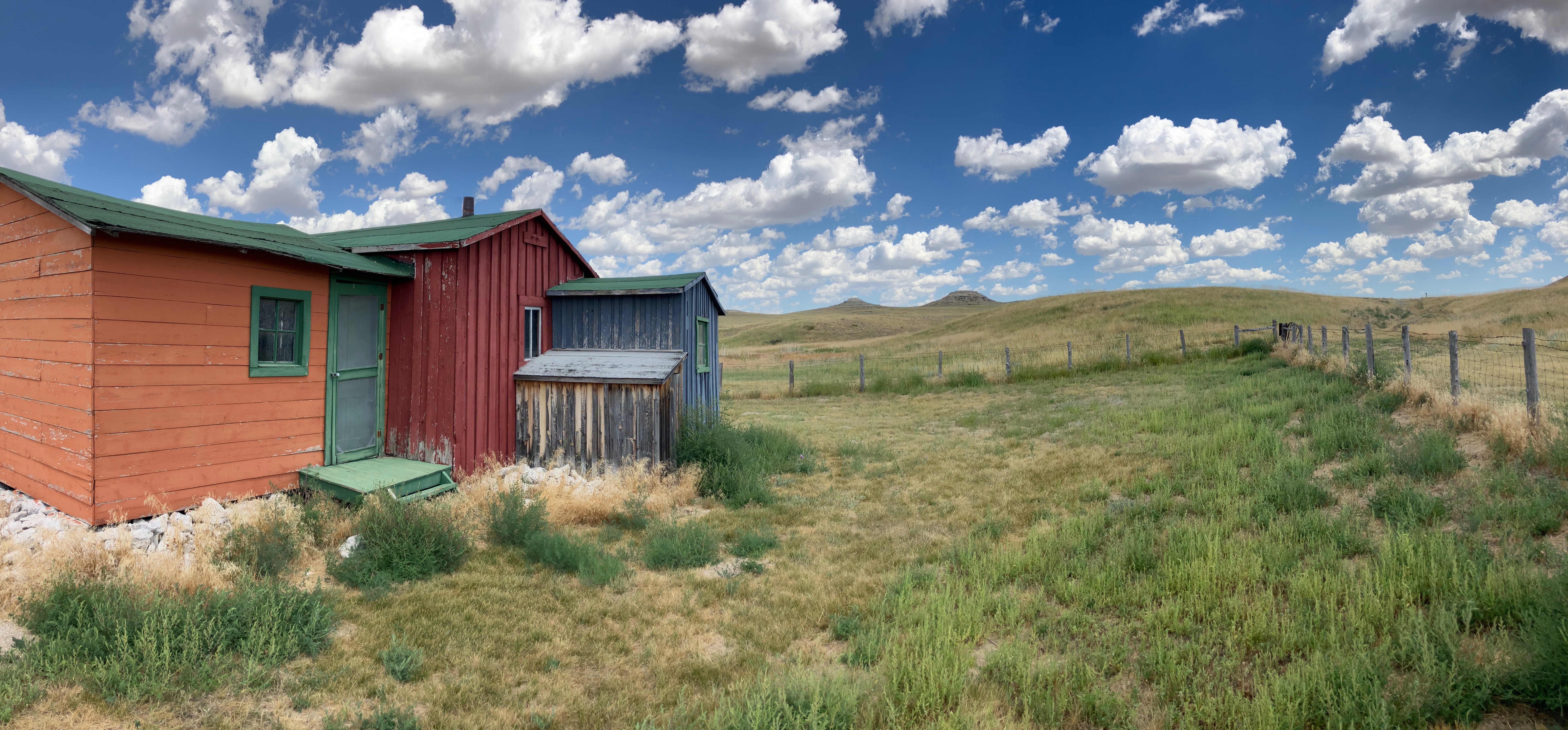
I’m no stranger to sauropods. I teach people about them at work all the time. But seeing the titanosaur in person was a revelation, and something I strongly recommend to anyone interested in the natural world. The titanosaur may not be the most important dinosaur discovery of our generation, but by giving it corporeal presence, AMNH created an incredible symbol. This is life at its limits, an embodiment of the incredible things the tetrapod body plan can do.
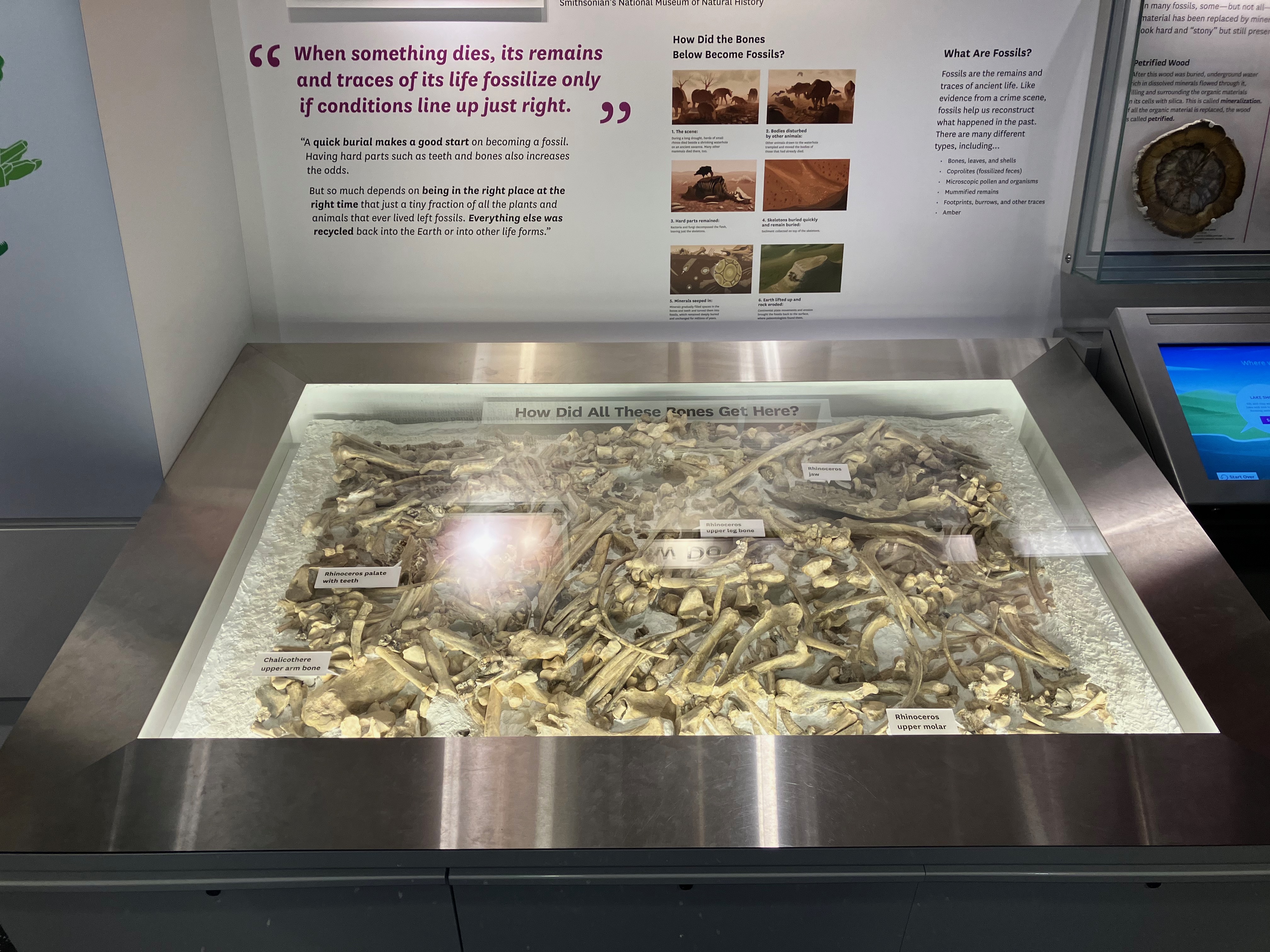
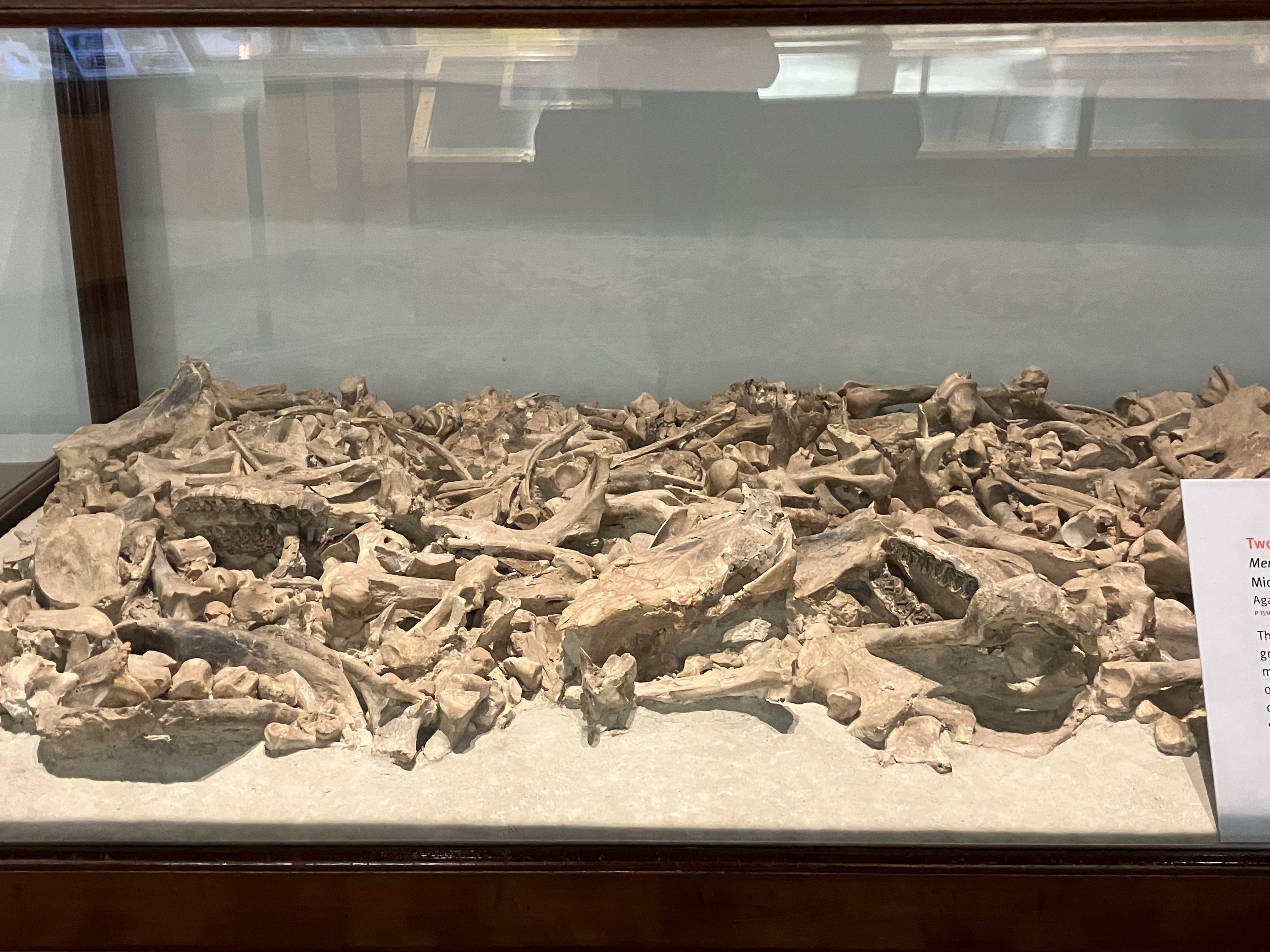
P.S.: If you’re concerned about the fate of the juvenile Barosaurus model that used to occupy this space, worry not. It now lives at the Cleveland Museum of Natural History, and will be on display at least through October of this year.

4 Comments

Filed under AMNH, dinosaurs, fossil mounts, museums, sauropods

AMNH dinosaurs in vintage cartoons

Today I happened upon a pair of wonderful vintage cartoons that simply must be shared. I found them in Edwin Colbert’s The Dinosaur Book: The Ruling Reptiles and Their Relatives, digitized here. The cartoons originally appeared in the New Yorker and the Saturday Evening Post, respectively.

original caption

Original caption: “And here is my first dinosaur – makes me feel like a kid again every time I look at it.”

The cartoons plainly depict the “Brontosaurus” and “Trachodon” (now labeled Apatosaurus and Anatotitan) skeletons at the American Museum of Natural History, and as representations of these mounts, they aren’t bad. At the time of the cartoons’ initial publications in 1939 and 1940, these and dozens of other fossil mounts had been on display at AMNH for over 30 years. They were iconic New York attractions, and the museum had rightly earned itself a reputation as the place to see dinosaurs.

original caption

Original caption: “I don’t mind you boosting your home state, Conroy, but stop telling the children that’s a California jack rabbit!”

Perhaps it’s unwise to interpret these images too literally, but I can’t help but wonder which version of the AMNH fossil halls the cartoonists intended to depict. Since 1922, the famous mounts had been housed in Henry Osborn’s Great Hall of Dinosaurs, but during the 1930s the dinosaur exhibits underwent a significant expansion. The dinosaurs were reshuffled into two halls, one representing the Jurassic and one the Cretaceous.

osborn era

The Great Hall of Dinosaurs as it appeared in the 1920s. Image courtesy of the AMNH Research Library.

brown's jurassic hall

The new Jurassic Hall opened around 1940. Photo from Dingus 1996.

The inclusion of a Stegosaurus with “Brontosaurus” and the ceratopsian skulls behind the “Trachodon” lead me to believe these are illustrations of the renovated halls, which would have been brand new at the time. But again, it’s just as likely that the cartoonists only intended to capture the general feel of these famous exhibits.

References

Colbert, E.H. 1945. The Dinosaur Book: The Ruling Reptiles and Their Relatives, 2nd Edition. New York, NY: The American Museum of Natural History/McGraw-Hill Book Company, Inc.

Dingus, L. (1996). Next of Kin: Great Fossils at the American Museum of Natural History. New York, NY: Rizzoli International Publications, Inc.

1 Comment

Filed under AMNH, dinosaurs, exhibits, fossil mounts, museums, ornithopods, paleoart, sauropods