Category Archives: fossil mounts

The NMNH fossil halls, circa 1963

c.02

A revamp for the dinosaur displays in Hall 2. Courtesy of the Smithsonian Institution Archives.

Since the NMNH building opened in 1910 as the United States National Museum, the east wing has been home to fossil displays. Although there have been many small adjustments and additions to the exhibits over the years, we can separate the east wing’s layout into three main periods. From 1910 t0 1945, the exhibits were primarily under the stewardship of Charles Gilmore. Called the “Hall of Extinct Monsters”, this iteration was somewhat haphazard in its layout and generally resembled a classic “cabinet of curiosity” approach to exhibit design. Gilmore’s version of the east wing remained in place until 1963, when the space was redesigned as part of the Smithsonian-wide modernization project. In the updated halls, there was a directed effort to compartmentalize exhibits based on the subdivisions of the Museum’s research staff, with each area of the gallery becoming the responsibility of a different curator. A second renovation was carried out in several stages starting in 1980. This version, which was open until 2014, was part of the new museology wave that started in the late 1970s. As such, the exhibits form a more cohesive narrative of the history of life on earth, and much of the signage carries the voice of educators, rather than curators.

Of course, the field of paleontology has advanced by leaps and bounds since the early 1980s, and NMNH staff have made piecemeal updates to the galleries when possible, including restorations of deteriorating mounts, and additional signage that addresses the dinosaurian origin of birds and the importance of the fossil record for understanding climate change. A third renovation is currently underway and will be completed in 2019.

But I’m getting ahead of myself. The purpose of this post is to provide an overview of the NMNH fossil halls as they stood in 1963, after the first major renovation. This iteration of the east wing was long gone before I was born, so this information is pieced together from historic photographs, archived exhibit scripts, and correspondence among the individuals involved in the modernization project (my thanks to the staff of the Smithsonian Institution Archives for their assistance in accessing these materials). Perhaps unsurprisingly, records of the dinosaur gallery are by far the most thorough. Information on the other halls is considerably harder to come by, so if any readers who saw the older exhibits in person remember any details, it would be fantastic if you could share them.

Layout of the USNM east wing, circa 1963.

Layout of the USNM east wing, circa 1963.

As mentioned, the Smithsonian underwent a thorough modernization project in the middle of the 20th century. The modernization committee, chaired by Frank Taylor (the eventual director-general of Smithsonian museums), was established in 1948. Under the committee’s guidance, most of the institution’s exhibits were redesigned between 1953 and 1963. Keep in mind that at the time, the United States National Museum was the only Smithsonian museum – it would not be divided into the National Museum of Natural History and the National Museum of History and Technology (now the National Museum of American History) until 1964.

Completed in 1963, the USNM fossil exhibits were among the last to be modernized. Only a small number of specimens were added that had not already been on view in the previous version of the space – in fact, many specimens were removed. The changes primarily focused on the layout of the exhibit, turning what was a loosely organized set of displays into a series of themed galleries. The east wing included four halls in 1963, the layout of which can be seen in the map above. Each hall was the responsibility of a particular curator. Nicholas Hotton oversaw Paleozoic and Mesozoic reptiles in Hall 2. David Dunkle was in charge of fossil fish in Hall 3. Porter Kier oversaw fossil invertebrates and plants in Hall 4. Finally, Charles Gazin, head curator of the Paleontology Division, was responsible for Cenozoic mammals in Hall 5. Each curator had a central role in selecting specimens for display and writing accompanying label copy.

Invertebrates and Fossil Plants
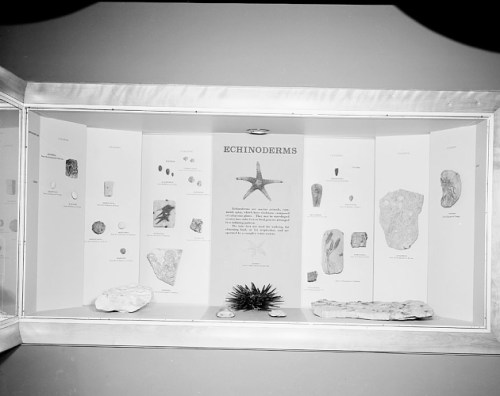
echinoderms1961

Echinoderm fossil display in Hall 4. Courtesy of the Smithsonian Institution Archives.

It is likely that part of the reason the fossil halls were late on the modernization schedule was that the curators of the Paleontology Division were not terribly interested in exhibits or outreach. There were no staff members in the division exclusively devoted to exhibit work, so the task of designing the new exhibit space was an added burden for the research staff. As invertebrate paleontology curator G. Arthur Cooper put it in a 1950 memo, “all divisions of Geology at present are in an apathetic state toward exhibition.”

Nevertheless, work on the east wing halls had begun by 1957, if not a bit earlier. The first of the new exhibits to be worked on was Hall 4, featuring fossil invertebrates and plants. The long and narrow space was divided into four sections: the first introduced the study of fossils and how they are preserved, the second was devoted to paleobotany, the third contained terrestrial and marine invertebrates, and the forth provided an overview of geological time. Cooper described the new exhibit as a progressive story of the expansion of life, “its stem connecting all life which is now culminating in man.”
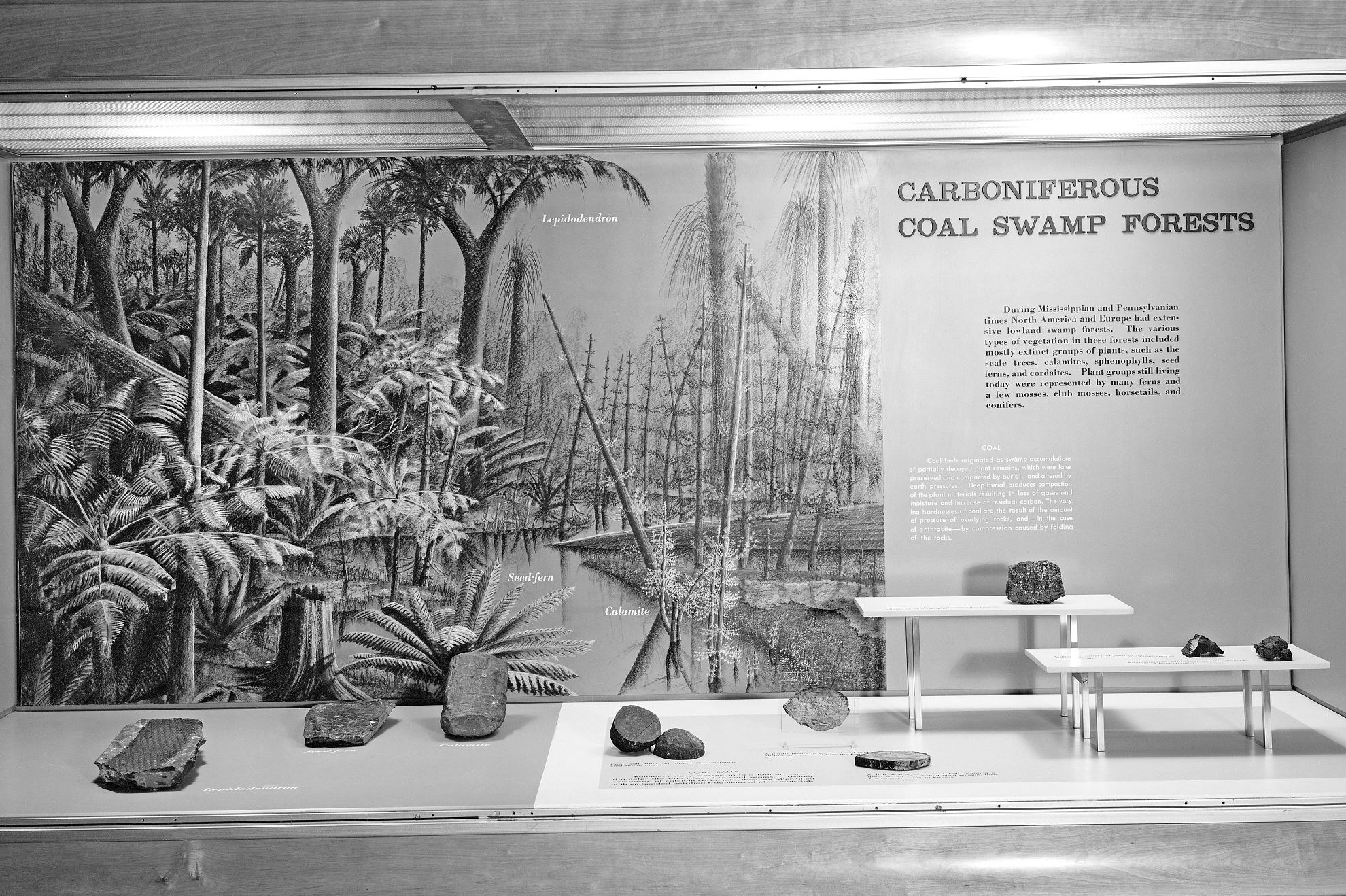
Carboniferous coal swamp fossils in Hall 4. Photo courtesy of the Smithsonian Institution Archives.

In addition to a variety of fossil specimens, Hall 4 featured a series of dioramas built by George Merchand, an exhibit specialist from Ann Arbor, Michigan. Merchand built at least 4 dioramas between 1957 and 1958, each depicting representative invertebrate marine fauna from a different Paleozoic period. Most, if not all, of these dioramas were retained during the 1980s renovation and remained on view through 2014.

Fossil Fishes and Amphibians
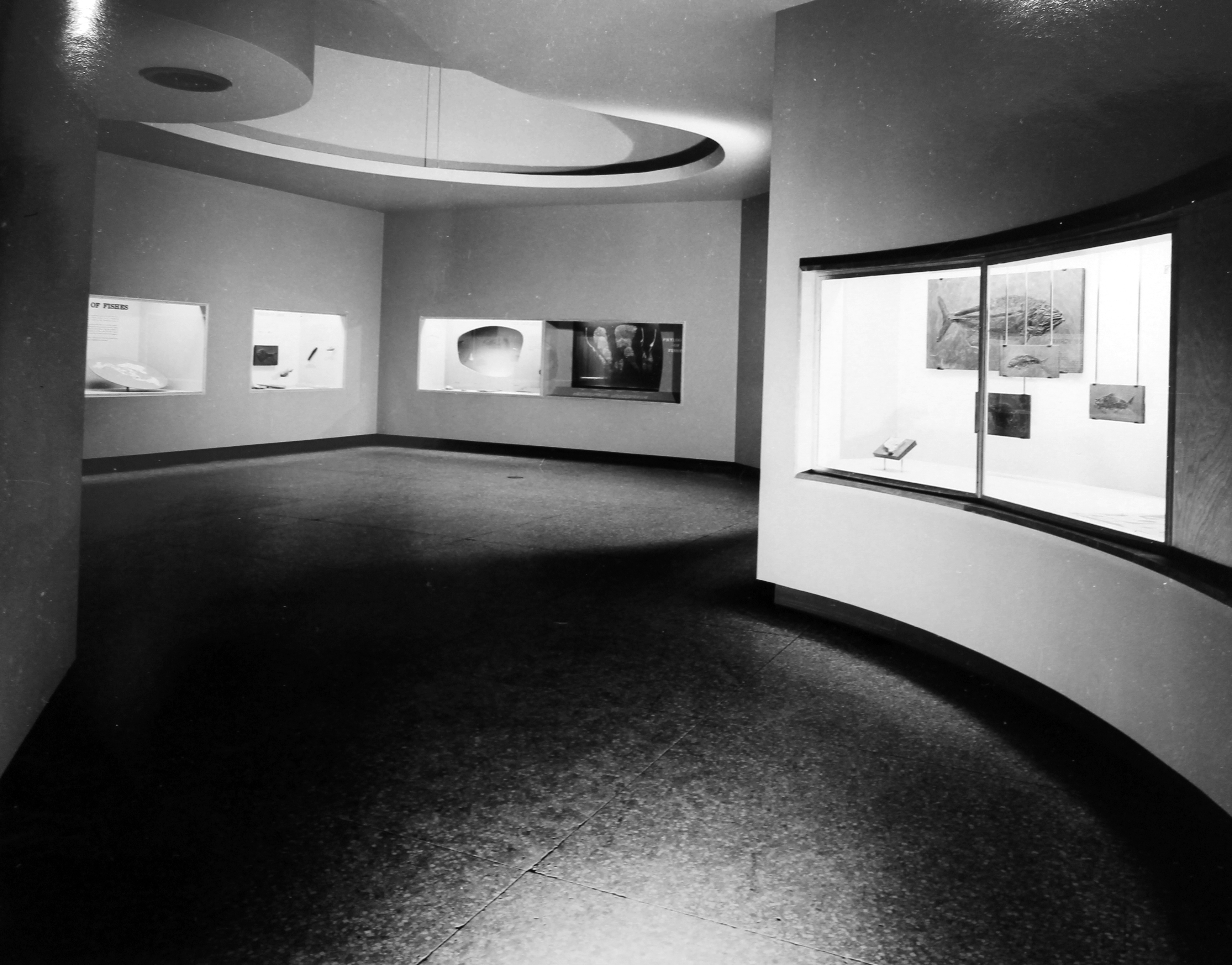
Fossil fishes in Hall 3. Photo courtesy of the Smithsonian Institution Archives.

Fossil fish and a smattering of amphibians were located in Hall 3, on the far east side of the wing. This space would be converted into “Mammals in the Limelight” in the 1980s. David Dunkle, for whom everyone’s favorite placoderm Dunkleosteus is named, was in charge of this gallery during his tenure at USNM between 1946 and 1968. The specimens on view were arranged temporally, starting with placoderms on the south side and progressing into actinopterygians and basal amphibians on the north end. Among the more prominently displayed specimens were Xiphactinus, Seymouria, and “Buettneria” (=Koskinonodon). The hall also contained a replica of the recently discovered modern coelacanth, and small diorama of a Carboniferous coal swamp.

Dinosaurs and Other Reptiles
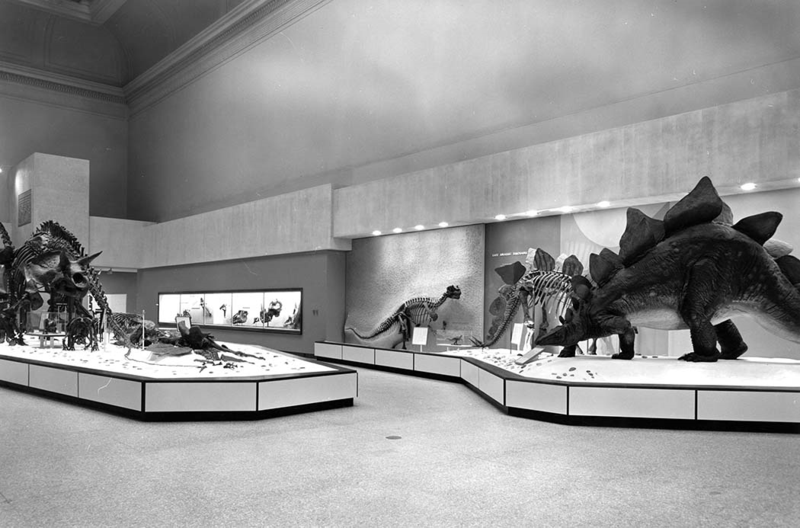
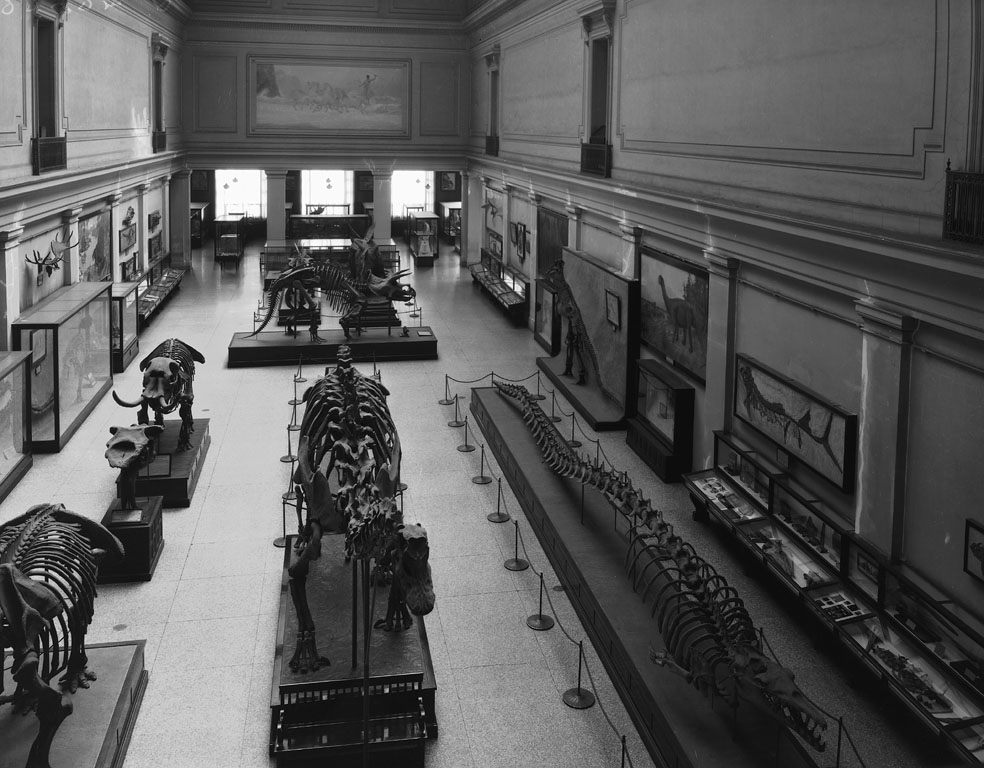
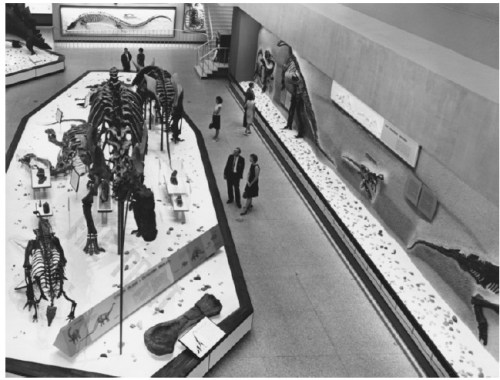
Dinosaurs in Hall 2, as seen facing west. Photo courtesy of the Smithsonian Institution Archives.

Hall 2, featuring dinosaurs and other reptiles, was the main draw for most visitors. It was not, however, a major priority for the Smithsonian research staff. The museum had not had a dinosaur specialist since Gilmore passed away in 1945 and indeed, dinosaurs were not an especially popular area of study among mid-century paleontologists in general. As such, responsibility for Hall 2 fell to Nicholas Hotton, at the time a brand-new Associate Curator. Later in his career, Hotton would be best known as an opponent to the dinosaur endothermy movement, but in the early 1960s he was most interested in early amniotes and the origin of mammals.

Hotton’s display of South African synapsids and amphibians. Photo courtesy of the Smithsonian Institution Archives.

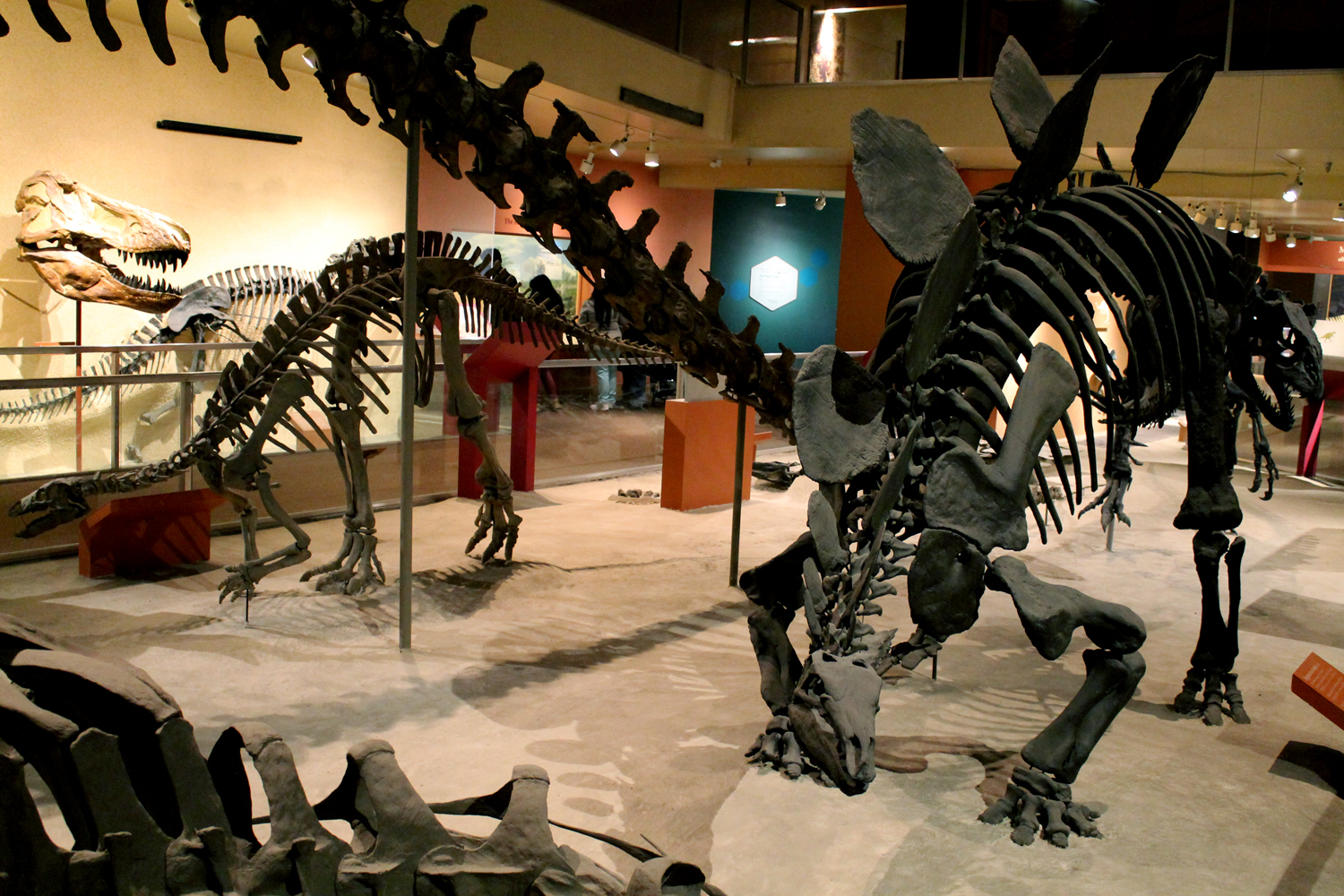
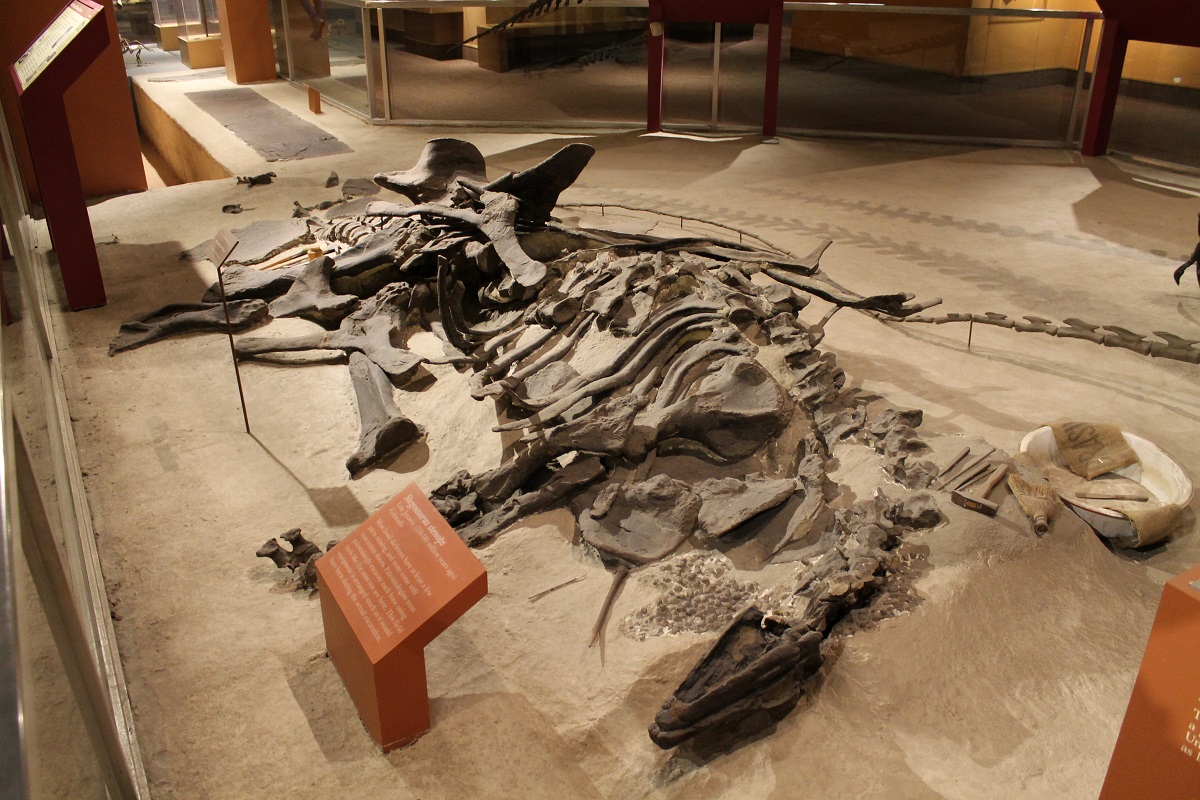
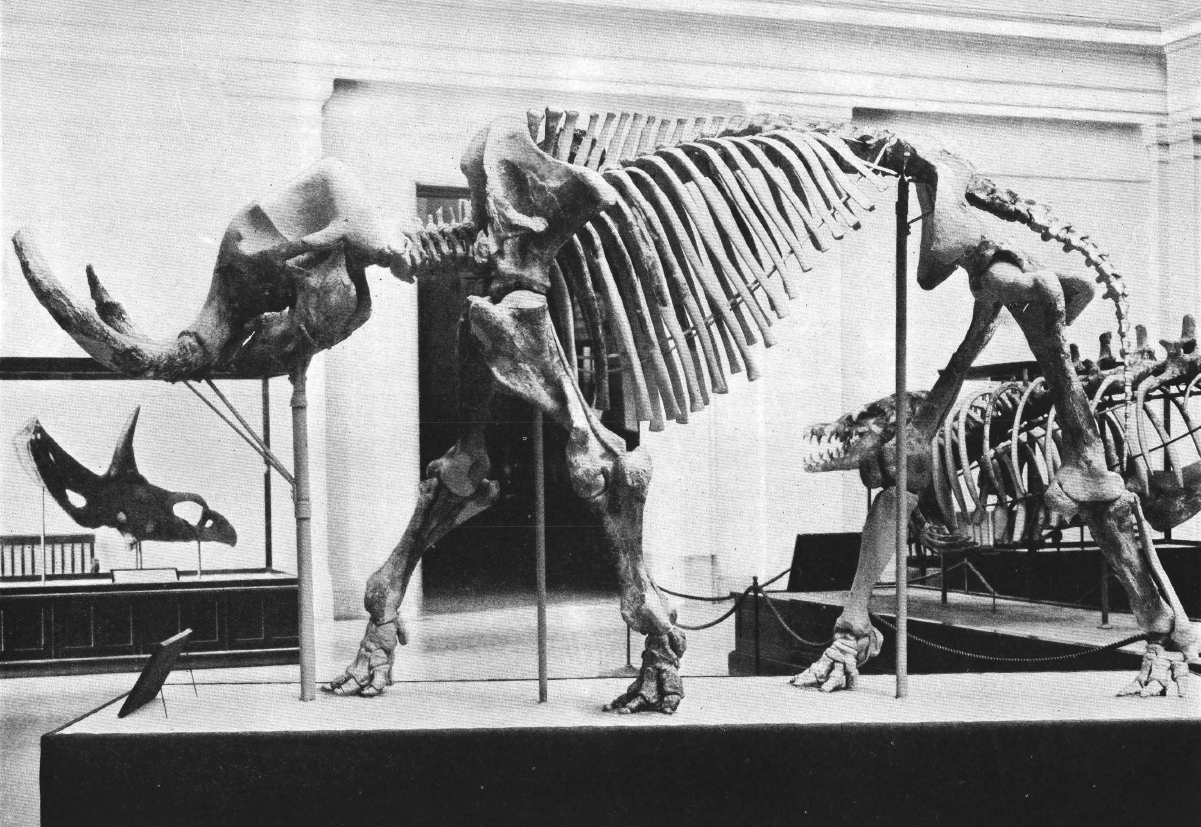
Perhaps due to the general disinterest among USNM curators, changes to the dinosaur exhibits were mostly organizational. Most of the free-standing dinosaur mounts built by Gilmore and his team were collected on a single central pedestal. Preferring not to tackle the massive undertaking of disassembling and remounting the 70-foot Diplodocus skeleton, the exhibit designers left the sauropod in place and clustered the smaller moutns around it. In the new arrangement, the Diplodocus was flanked by the two Camptosaurus and prone Camarasaurus on its right and by Triceratops and Brachyceratops on its left. The Stegosaurus stenops holotype, splayed on its side in a recreation of how it was first discovered, was placed behind the sauropods at the back of the platform.
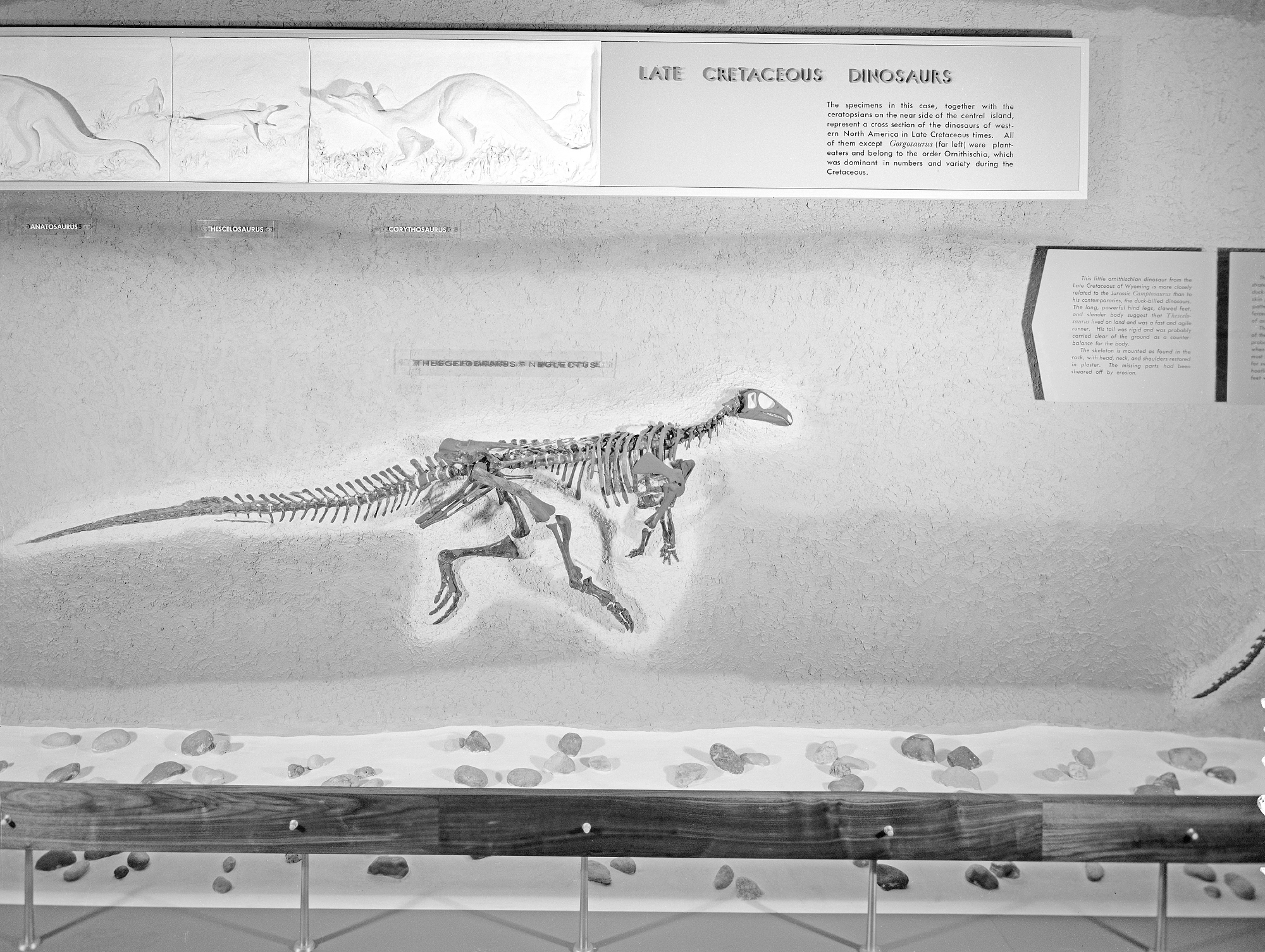
Close up of Thescelosaurus on the south wall. Photo courtesy of the Smithsonian Institution Archives.

 The north and south walls of Hall 2 were lined with additional specimens. On the south side, Gilmore’s relief mounts of Ceratosaurus and Edmontosaurus (called “Anatosaurus” in this exhibit) were joined by the gallery’s one new dinosaur, a relief mount of Gorgosaurus in a death pose. The north wall featured a long, narrow, glass-enclosed case illustrating the basics of dinosaur classification. In addition to saurischian and ornithischian pelves, the case featured skulls representing most of the major dinosaur groups. Amusingly, all but two of these skulls (Triceratops and Diplodocus) were labeled with names that are no longer considered valid. These skulls included “Antrodemus” (Allosaurus), “Trachodon” (Edmontosaurus) “Procheneosaurus” (probably Corythosaurus)  and “Monoclonius” (Centrosaurus).

In the southwest corner of Hall 2 (where FossiLab is today), visitors could see the Museum’s two free-standing Stegosaurus: the fossil mount constructed by Gilmore in 1913 and the charmingly ugly papier mache version, which had received a fresh coat of paint. Finally, the rear (east) wall of Hall 2 held Gilmore’s relief mounted Tylosaurus.

Mammals
c.11

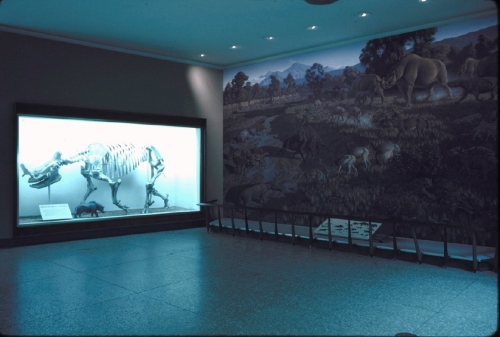
Brontotherium and Matternes’ Oligocene mural in Hall 5. Photo courtesy of the Smithsonian Institution Archives.

Fossil mammals were exhibited in Hall 5, a corridor-like space accessible from the main rotunda and via two doorways on the north side of Hall 2. After 1990, this space would house the “Life in the Ancient Seas” exhibit. Charles Gazin, head curator of the Division of Paleontology, was in charge of this space on paper, but my impression is that his attention was elsewhere during its design and construction. Gazin was apparently approached by the modernization committee several times during the 1950s, but was reluctant to commit his time to a major renovation project. Gazin had been spending a great deal of time at a Pliocene dig site in Panama, and the collection of new fossils proved more interesting than designing displays. As Gazin tersely explained, “It is a little difficult to concentrate objectively on exhibition problems here in the interior of Panama.”
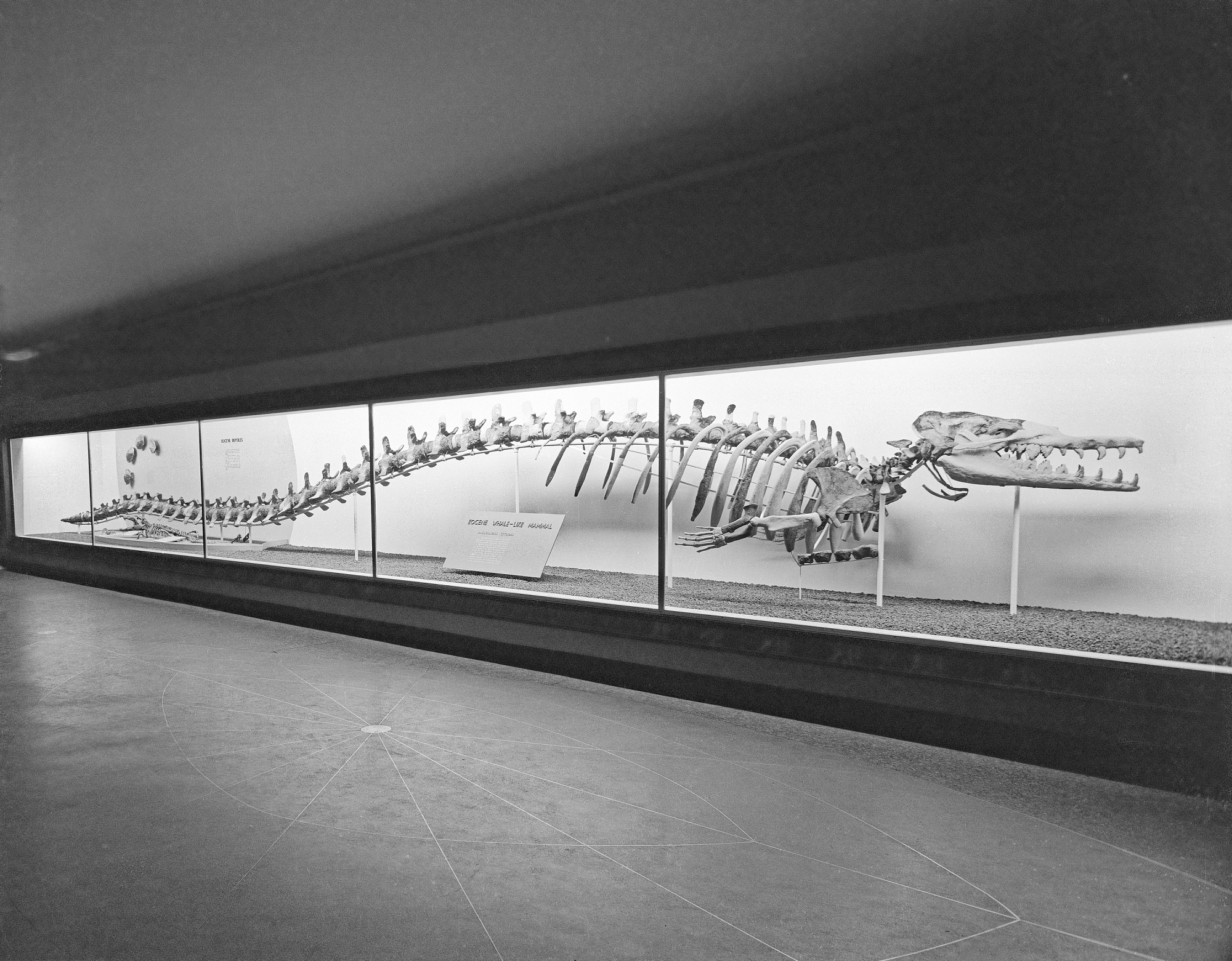
Basilosaurus and Cenozoic reptiles in Hall 5. Photo courtesy of the Smithsonian Institution Archives.

Nevertheless, Gazin’s interest in Cenozoic mammals ensured that his gallery was exceptionally thorough. Thanks to Gazin’s own collecting expeditions throughout the 1950s, the new fossil mammals galleries contained representatives of nearly all major mammal groups, from every epoch from the Paleocene through the Pliocene (the Pleistocene was deliberately excluded, as a separate ice age exhibit was also in the works). Classic mounts from the Gilmore era like Basilosaurus and Teleoceras were joined by dozens of less showy specimens like rodents, small perissodactyls, and early primates. The new exhibit also introduced the first wave of Jay Matternes’ much-beloved murals, illustrating the changing flora and fauna in North America over the course of the Cenozoic.

Unveiling and Reactions

The new east wing galleries officially opened on June 25, 1963. According to the press release, “the new exhibit features in colorful and dramatic settings more than 24 skeletons and skulls of the largest land animals the world has ever known.” The exhibits were officially unveiled with a late afternoon ceremony, in which Carol Hotton (Nicholas Hotton’s daughter) cut the ribbon and the lights to Hall 2 were suddenly turned on to dramatic effect.

Unfortunately, the new exhibits were not universally loved by the museum staff. The wing had been planned a set of compartmentalized exhibits, each corresponding to a subdivision of the Division of Paleontology, with a different curator taking responsibility for each hall. While seeming sensible on paper, this plan turned out to be a logistical nightmare, and a common cause for complaint among Division staff for the next decade. In addition, Gazin in particular voiced concerns as early as January 1964 that the design of the new halls was entirely inadequate for preventing accidental or deliberate damage to specimens by visitors. The mounts in Hall 2 were raised only about a foot off the ground, and were not protected by any sort of guard rail or barrier. As a result, within a few months of the exhibit’s unveiling, several ribs and vertebral processes had been broken off or stolen from CamarasaurusGorgosaurus, Ceratosaurus and others.

With the notable caveat that I never saw the 1963 exhibits in person, I would say that this is aesthetically my least favorite iteration of the east wing. The grandiose, institutional Greco-Roman architecture originally displayed in the Hall of Extinct Monsters was replaced with what can only be described as extremely 1960s design. Solid earth-tone colors, wood paneling and wall-to-wall carpeting gave the halls a much more austere character. While the efforts to categorize specimens into thematic zones was commendable for a museum of that era, the label copy (written by the curators) was still highly pedantic and verbose. As such, the 1963 fossil halls seem to have been very much of their time. While the designers were working to avoid the overt religiosity and grandeur of turn of the century museums, they had not yet reached the point of developing truly audience-centered educational experiences. The result was an exhibit that was humble, yet still largely inacessible. Perhaps for this reason, the 1963 fossil halls were the shortest-lived at NMNH to date, being replaced within 20 years of their debut.

This post was updated and edited on January 8, 2018.
Leave a comment

Filed under dinosaurs, exhibits, Extinct Monsters, fish, fossil mounts, history of science, mammals, museums, NMNH, reptiles, science communication

A Triceratops for Lawrence

In an earlier post, I described how the Smithsonian’s Triceratops was the first free-standing mount of this animal ever created, and the eccentricities of its proportions and posture would define how the species would be depicted in artwork and other reconstructions for the better part of a century. I should have clarified, however, that this was not the first time Triceratops fossils were put on public exhibit. That honor goes to the University of Kansas Natural History Museum, which was founded in 1864 and is still operational today.

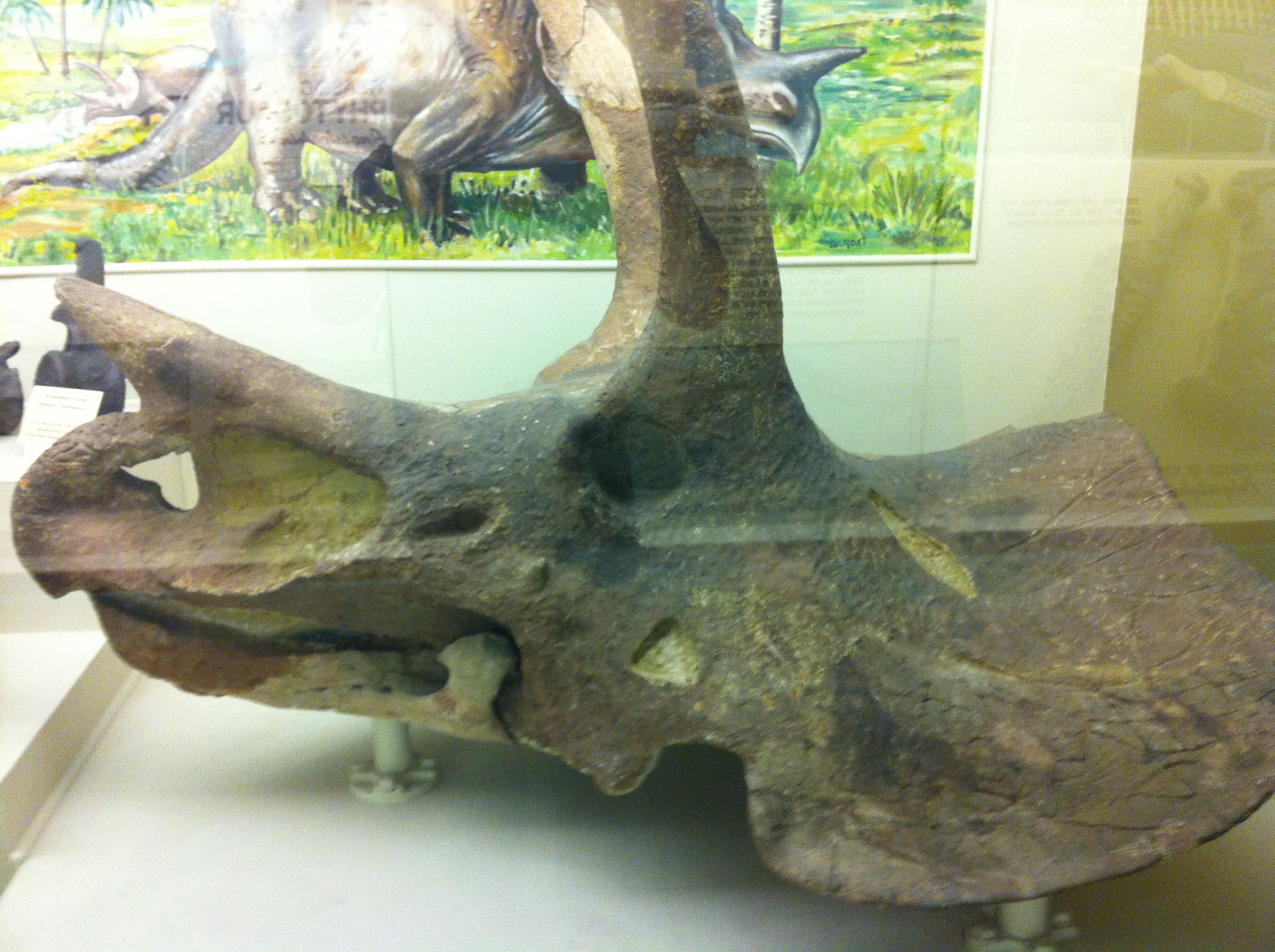
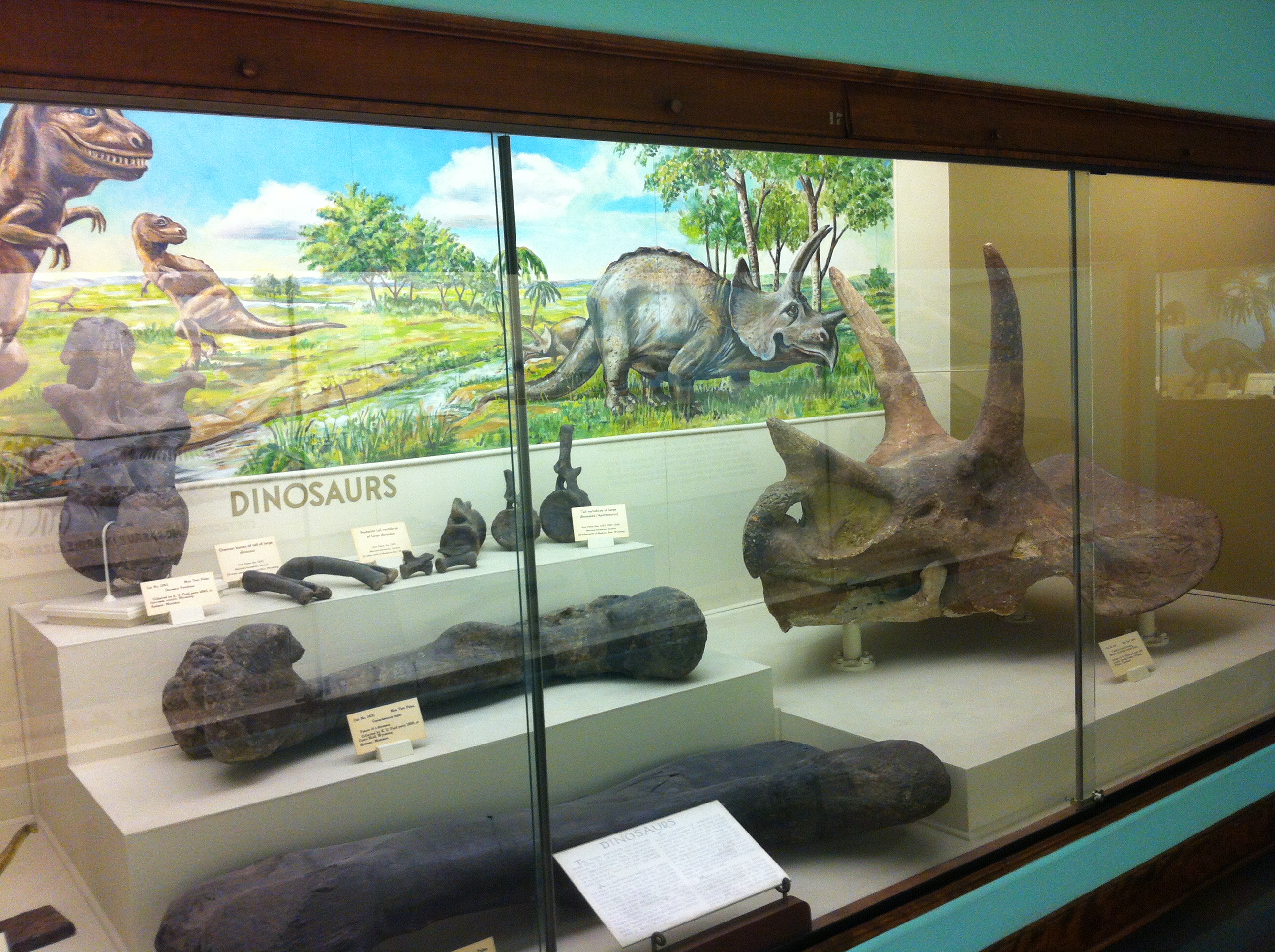
Among the Museum’s basement paleontology exhibits is a case of dinosaur fossils that has literally gone unchanged since the 1950s. Although this time capsule of mid-century museum design is of some historical interest, it would be nice if those sauropod limb bones weren’t labeled “Brontosaurus” (to be clear, the whole museum doesn’t look like this, the staff has been slowly but surely modernizing the exhibits). Of particular importance is the Triceratops skull (specimen 422) on the left side of the case. While there is no historical information on its label, this specimen has been with the museum for over 115 years, having been unearthed and put on display only six years after O.C. Marsh first named and described Triceratops.

The dinosaur case at the KU Natural History Museum, untouched since the 1950s.

The dinosaur case at the KU Natural History Museum, untouched since the 1950s.

The story of the KU Triceratops is not well-known, although it is the subject of the somewhat hard-to-find book (neither the Museum nor the KU library has a copy) A Triceratops Hunt in Pioneer Wyoming. In the summer of 1895, a team from the University ventured into the frontier lands of of eastern Wyoming with the explicit goal of finding a Triceratops for display at the young Natural History Museum. The team was led by Samuel Wendell Williston, founder of the University’s geology department. Although Williston’s specialty was entomology, he had previously worked under Marsh at Yale and was well-acquainted with the plethora of dinosaurs on which his mentor had published. Also on the expedition were KU Regent James Polk Sams, and two individuals whose names are quite familiar to anyone with an interest in the history of paleontology, Barnum Brown and Elmer Riggs. Brown would, of course, go on to be the star fossil hunter at the American Museum of Natural History, while Riggs would become a curator at the Field Museum of Natural History. In 1895, however, both were students, and not especially interested in fossil collecting or paleontology. 

The team found the Triceratops they were looking for on July 9, near the confluence of Lightning and Lance Creeks. By July 22, the skull was fully excavated and crated for a journey by train back to Lawrence. The fossil apparently garnered a fair amount of attention on the journey; while Triceratops is well known today, in 1895 few had any idea that animals such as this had ever walked the Earth. And yet, here was clear, physical evidence of an extinct animal like nothing alive in the modern world, and it would soon be displayed for all to see in the University of Kansas Museum.

Triceratops skull retrieved by the 1895 Wyoming expedition.

Triceratops skull retrieved by the 1895 Wyoming expedition.

The 1895 expedition was not tremendously productive scientifically, the fossils found that summer resulting in only three short papers. However, the journey, and the Triceratops skull that was brought back, did end up being quite important for paleontology. The expedition inspired Brown and Riggs to pursue careers in paleontology, and as Brinkman and colleagues write in Triceratops Hunt in Pioneer Wyoming, “they would hunt bones for the rest of their lives, to the great benefit of science, and might never have done so had not circumstances landed them in the circle of Williston’s influence in the summer of 1895.”

Furthermore, by setting out with the clear goal to find a dinosaur for display, the University of Kansas team were trailblazers in a movement that would lead to the inseparable connection between dinosaurs and museums in popular culture today. In the first decade of the 20th century, newly burgeoning large urban museums openly competed to find and display the largest and most spectacular dinosaurs. Exhibits like the AMNH Brontosaurus, the Carnegie Museum of Natural History Diplodocus and, of course, the Smithsonian Triceratops brought millions of Americans into museums, ensuring that to this day, when we think of museums, we think of dinosaur skeletons (and vice versa). In spite of the somewhat dingy basement display it currently finds itself in, the University of Kansas Triceratops was an early trendsetter and a profound example of the intersection of science and history.

Reference

Kohl, M.F., Martin, L.D. and Brinkman, P., eds. (2004). Triceratops Hunt in Pioneer Wyoming: The Journals of Barnum Brown and J.P. Sams. Glendoo, WY: High Plains Press.

4 Comments

Filed under dinosaurs, field work, fossil mounts, history of science, marginocephalians, museums, reptiles

Allan McCollum’s fossil art

Click here if the embedded video doesn’t work.

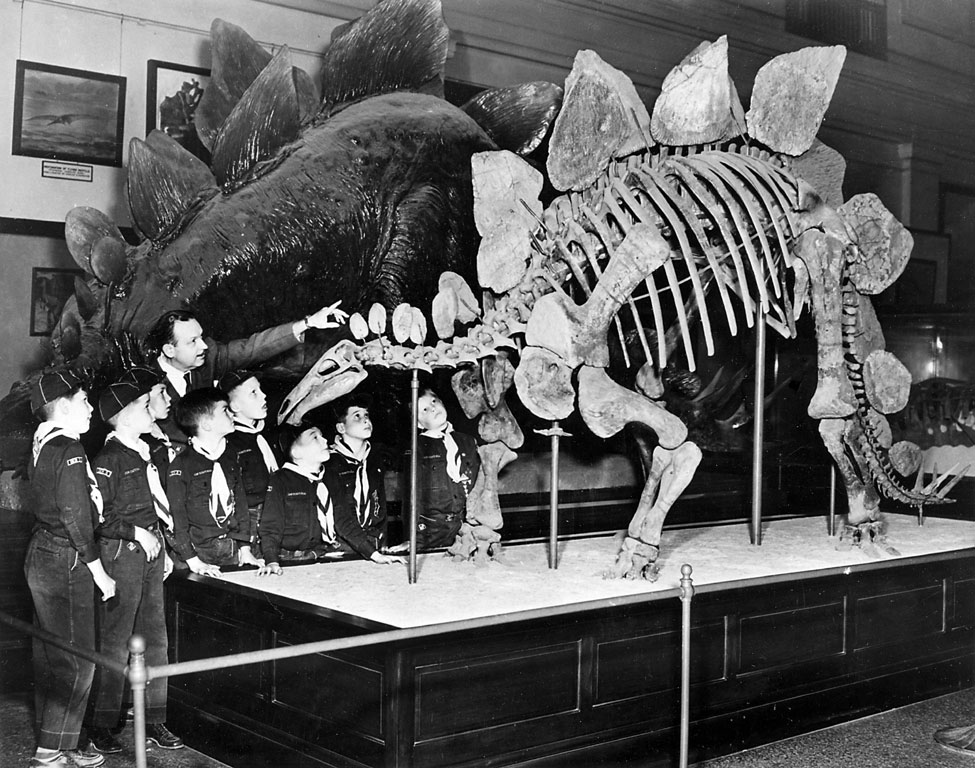
My first love is natural science, but I also fancy myself an amateur art enthusiast, particularly for performance and installation pieces from the last 50 years or so. I am fascinated by art that directly engages the viewer, art that is not complete without the involvement of the spectator. As it happens, mounted fossil skeletons are a great example of  installation art, although they are not deliberately constructed as such. The size and presence of a dinosaur skeleton, such as the Stegosaurus below, necessarily incorporates the viewers’ human scale into the experience. Viewers are not merely spectators but participants in a shared performance. Nevertheless, fossils are nearly always displayed and interpreted as scientific specimens, rather than art objects.

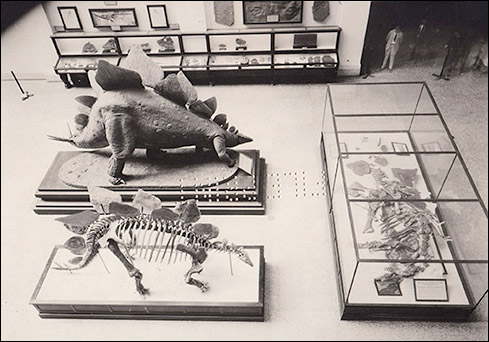
Stegosaurus fossil mount and life-size model circa 1913. Photo courtesy of the Smithsonian Institution Archives.

Stegosaurus fossil mount and life-size model at USNM circa 1913. Photo courtesy of the Smithsonian Institution Archives.

One important exception occurs in the work of prolific New York-based artist Allan McCollum. McCollum’s installations frequently address repetitive labor and industrial manufacturing, often incorporating hundreds or thousands of similar but subtly unique objects. Each piece is the product of many small actions, gradually assembled over time. In the early 1990s, the artist turned his attention to fossils, particularly their historic meaning and aesthetic appeal.

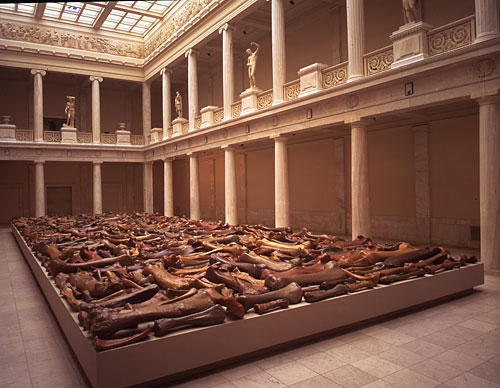
"Lost Objects" by Allan McCollum. Image from Art21.

“Lost Objects” by Allan McCollum. Image from Art21.

In 1991, McCollum collaborated with the Carnegie Museum of Natural History to produce “Lost Objects”, displayed next door at the Carnegie Museum of Art. Using molds taken from dinosaur fossils (apparently all limb bones) in the CMNH collection, the artist produced several hundred fossil casts for the installation shown above. To me, this piece is a reflection on the global sharing of fossil material permitted by casting technology. In the Art21 video at the top of this post, McCollum briefly discusses the prominence of casts among the dinosaur mounts that are a staple at natural history museums. Dinosaur skeletons are virtually never found complete, and mounts are often filled in with casts of specimens held by other museums. For example, the National Museum of Natural History Diplodocus mount incorporates casts of the left hindlimb and much of the neck of the Carnegie Diplodocus. What’s more, casted duplicates of the entire Carnegie Diplodocus can be seen in London, Berlin and several other cities in Europe and Latin America, and casts of the American Museum of Natural History Tyrannosaurus are on display in Denver and  Philadelphia. It would be an impressive sight if all the casts of certain fossil specimens scattered around the world were reunited in one room, a monument to the knowledge gained from a century of scholarly collaboration. It would also commemorate the intangible excitement generated by dinosaur mounts, made possible only through the duplication and sharing of casts.

MCollum also comments that “there aren’t as many dinosaur bones in the world as we think.” Perhaps, then, “Lost Objects” is a reflection on the scarcity of intact fossils, by showing an impossibly large collection that no museum could hope to amass. Let’s just hope he wasn’t trying to comment on the alleged mass-production of casts cheapening the original fossils and the museums that hold them, because he’d be dead wrong (EDIT: He wasn’t, see comments).

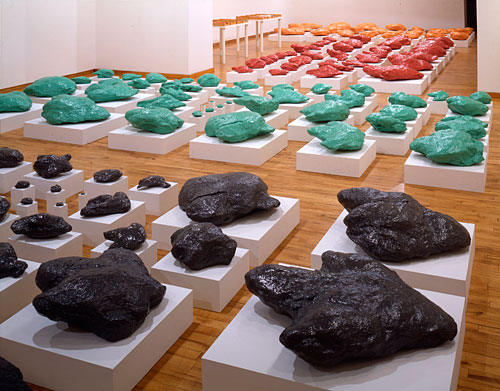
mccollumnaturalcopies

“Natural Copies” by Allan McCollum. Image from Art21.

In 1995, McCollum followed up on “Lost Objects” with “Natural Copies, a series of casted dinosaur footprints produced in collaboration with the College of Eastern Utah Prehistoric Museum. For the artist, this piece was a reflection on the idea that 150 million-year-old fossils can be valued as cultural history. The footprints in question were found by the hundreds in a Utah coal mine. While many ended up at the museum, others were collected by miners to display at home. The fossils took on a second life as symbols the community’s workforce and natural heritage, irrelevant to the dinosaurs that produced the tracks but important all the same. McCollum’s work separates the fossils from their typical scientific context so that viewers may reflect on their cultural meaning and even the aesthetic beauty of their form.

So what’s the point of these installations? These appropriations of fossils as aesthetic pieces has no bearing on the science of paleontology, and in fact may obscure information about how the animals that left these traces lived and behaved. And yet, from the moment a fossil is first seen by human eyes, whether it is an ammonite preserved in a split open rock or the glint of a vertebrate bone weathering out of a hillside, it becomes meaningful on a human scale. For the discoverer, the researcher who describes the fossil, the institution that holds it in its collection and the visitor who sees the fossil on display, that specimen has cultural value. This does not diminish the value of fossils as natural specimens, but rather enhances their importance.

1 Comment

Filed under collections, dinosaurs, fossil mounts, museums, paleoart

Fossil mounts in the museum environment

Sue and Stan reconstructions from Scott Hartman's DeviantArt page.

Sue and Stan reconstructions from Scott Hartman’s DeviantArt page.

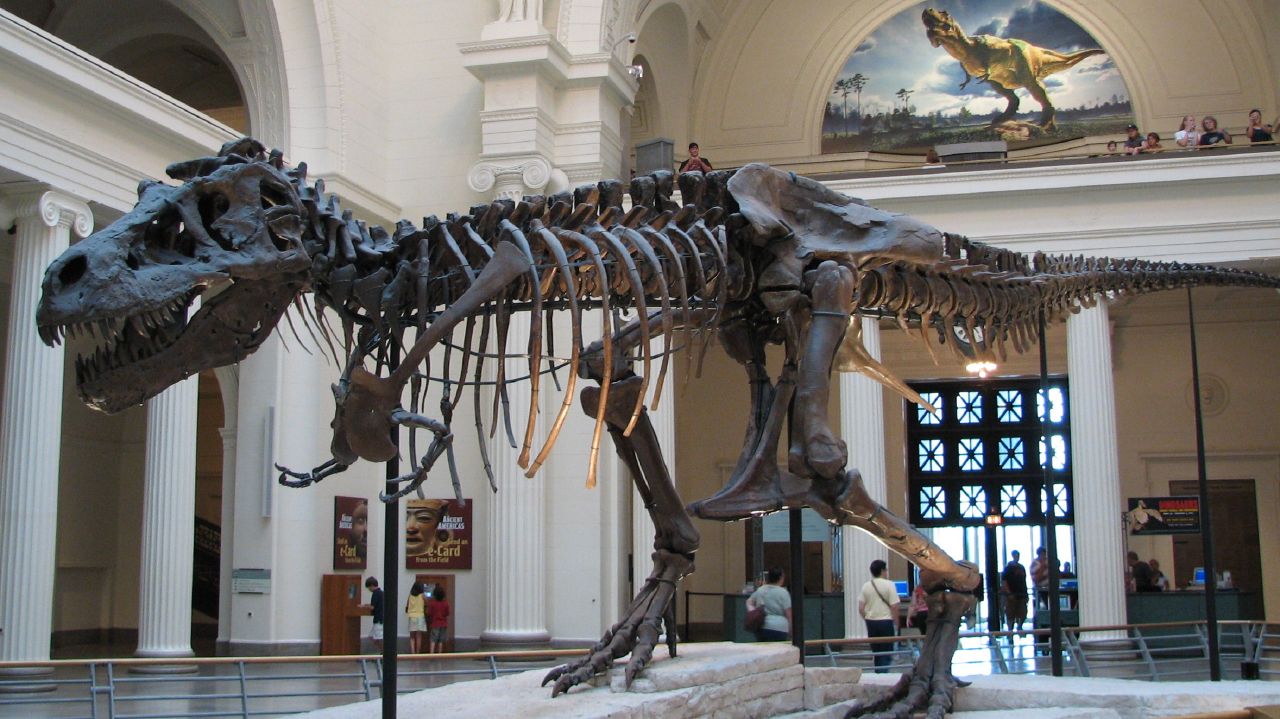
Scott Hartman posted the above image to his DeviantArt page the other day, comparing the Tyrannosaurus specimens Sue and Stan side by side. For those unfamiliar, Hartman is known for his rigorously measured skeletal diagrams of dinosaurs (and sometimes other animals) that are crucial references for many artists and paleontologists. I’m always impressed by Hartman’s work, but this new comparative image really floored me. I knew that Sue is the largest and most complete rex yet found, but I had never properly appreciated what a monster she is. I’ve seen the mounted Sue skeleton at the Field Museum several times, and I’ve seen at least four casts of Stan in various locations, but I never realized what a significant size disparity exists between the two.

Tyrannosaurus Sue at the Field Museum of Natural History.

Tyrannosaurus Sue at the Field Museum of Natural History.

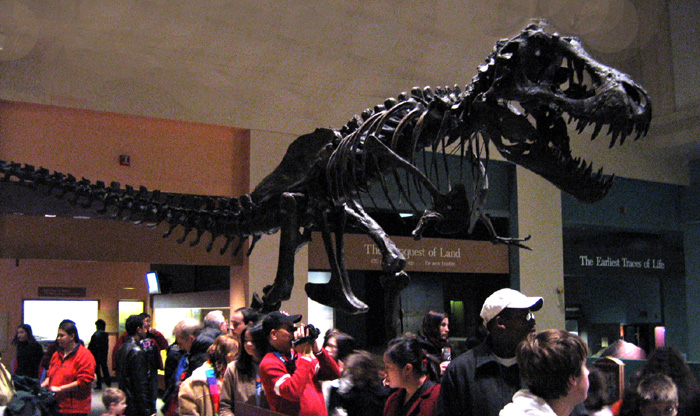
Tyrannosaurus Stan at the National Museum of Natural History.

Tyrannosaurus Stan at the National Museum of Natural History.

It’s not a groundbreaking discovery by any means, but I’m struck by how important the museum environment is when exhibiting a mounted skeleton. I mentioned yesterday that exhibits are never neutral, and this is a particularly clear example. Sue is exhibited in the gigantic central hall of the Field Museum, and in this open, grandiose environment, her size is actually deemphasized. By comparison, the presence of the Stan mount at the National Museum of Natural History was not anticipated during the 1981 renovation of the dinosaur hall (it was added in 2001, I believe) and is sort of crammed into a corner. In the cramped space, Stan looks pretty big, and it’s little wonder I had never appreciated the marked difference in size between the two mounts.

The takeaway, I guess, is that it would do us well to pay careful attention to the design choices (or constraints) in a museum exhibit. We’d like to think that a rare and important specimen like a Tyrannosaurus skeleton speaks for itself, but visitor impressions of even these fossils are shaped by the context they are placed in.

Leave a comment

Filed under dinosaurs, fossil mounts, museums, NMNH, paleoart

Drama and natural history

While running errands this morning a thought came to me: a natural history exhibit in a museum is a lot like a stage performance*. When watching a play, the viewer knows she is seeing a performance, but it willing to suspend disbelief so long as the fantasy is well-created. To varying degrees, most modern natural history exhibits engage in the same theatrical relationship with their audiences. Exhibits re-create reality within the museum environment, and visitors accept the performance as truth.

*Actually, I thought “movie” first, but theater is a better analogy because the actors are real and present.

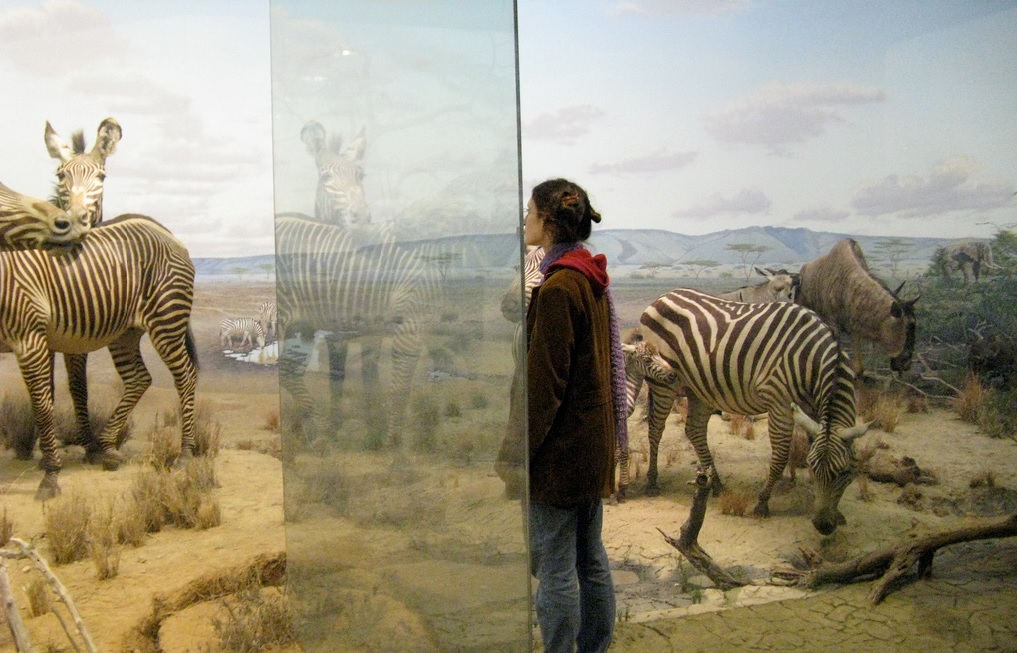
CMNH zebra diorama. Source: amyboemig on flickr.

A rather poignant picture of the CMNH zebra diorama. Source: amyboemig on flickr.

Habitat dioramas featuring taxidermied animals are the most obvious example. Dioramas like the lovely east African savannah scene at the Carnegie Museum of Natural History pictured above are exactingly detailed microcosms modeled after actual environments. The backdrops are typically  based on photographs of real locations. The teams that collected the animal skins would also take samples of leaves and even molds of tree bark, in order to exhibit the ecosystem in toto. And of course, the mannequins on which the animal skins are mounted were sculpted by artists with a strong foundation in anatomical science. And yet, the diorama is clearly not real. Visitors know that they are not looking at an actual game reserve that has been somehow frozen in time. Many viewers might mistake the animals as being “stuffed” (they are in fact sculptures with tanned skins fitted onto them), but  they still recognize some element of artifice.  The animals clearly didn’t end up in the glass-enclosed box on their own accord. And yet, visitors accept the illusion, because they keep coming to museums to learn about the world around us.

The same holds true for most other displays. These dioramas at the New York State Museum are not literally historic Iroquois villages shrunk down to 1/20 scale. The Tyrannosaurus and Triceratops pictured below are not really fighting, nor did they die in a death struggle. Even the Apple Store-eque NMNH Hall of Mammals recreates natural behaviors against a sterile backdrop. Unless the museum is displaying completely decontextualized specimens lying prone on a shelf, there is some degree of theatricality in the exhibit.

Tyrannosaurus and Triceratops at the Children’s Museum of Indianapolis. Source.

The theater analogy begins to go astray, however, when we consider that the performances in natural history exhibits are informed by reality. For the most part, exhibit designers do not place specimens in completely fictitious scenarios; the theatrical element serves to illustrate something real. Perhaps exhibits are more akin to a movie “based on a true story.” But like those movies, there is an undeniable selectivity in how museum workers tell their stories.  Why are the zebra in the CMNH diorama chilling amicably with wildebeest? That is certainly something that real zebra have been known to do, but zebra have also been known to drown lions, trample foals and chew on the cars of obnoxious tourists. For that matter, why does this diorama not include any sign of human pastoralists, who have lived in the same environment as these animals for thousands of years?

Exhibits have human authorship, just like any other document. The manner in which any specimen or object is displayed is inherently subjective, and there will always be emphasis and omissions, intentional or otherwise, that change the way the exhibit is interpreted. Before you misjudge me, dear reader, this is not an argument that there is no objective reality. I wouldn’t even say that it is impossible to understand and perceive objective reality. Scientists do it all the time. But when it comes time to communicate that information, we are creating something new, and choosing what we incorporate and how we express it. Getting back to my original point, we’re putting on a representational show. And that means that what we’re creating only works as long as our audience is willing to participate in the performance.


Leave a comment

Filed under anthropology, fossil mounts, mammals, museums, science communication

A Visit to the Academy of Natural Sciences

I spent yesterday in Philadelphia, my first visit in at least 10 years, and of course made a point of visiting the Academy of Natural Sciences. Founded in 1812, the Academy is the oldest natural science research institution and museum in North America, established “for the encouragement and cultivation of the sciences, and the advancement of useful learning.” Initially formed as a hub for research on the American frontier, the Academy has sponsored scientific expeditions across the world and has amassed a collection of 17 million specimens that is still actively used 200 years after its founding.

In 1868, the Academy museum made a landmark contribution to paleontology by hosting the first mounted dinosaur skeleton ever constructed. The mount, the work of paleontologist Joseph Leidy and sculptor Benjamin Waterhouse Hawkins, depicted Hadrosaurus foulki, the first dinosaur discovered in North America and at the time the most complete dinosaur ever found. With only two limbs, a section of the spinal column and some other odds and ends to work with, Hawkins invented many of the mounting techniques that are still in use today. For instance, Hawkins created mirrored duplicates of the left limb bones for use on the animal’s right side, and reconstructed best-guess stand-ins for the skull, scapulae and most of the vertebrae using extant animals as reference. By modern standards, the Leidy-Hawkins Hadrosaurus mount wasn’t especially accurate (the sculpted scapulae and vertebrae resemble those of a mammal, not a reptile; the skull, based on that of an iguana, turned out to be completely off the mark; the fully upright, kangaroo-like posture is now known to be anatomically implausible), but it nevertheless presented the first-ever opportunity to stand in the presence of a dinosaur. Extinct animals were already known to the public, and some had even been mounted, but the Hadrosaurus was so bizarre,  so utterly unlike anything alive today, that it really opened people’s eyes to the unexplored depths of the Earth’s primordial history.

Original 1868 Hadrosaurus mount.

Original 1868 Hadrosaurus mount.

The Hadrosaurus display caused public visitation to skyrocket, prompting the Academy to relocate in 1876 to a larger building in central Philadelphia, where it remains today. I haven’t been able to find any photographs or detailed information about it, but for much of the 20th century the Academy had a fossil exhibit with a Corythosaurus mount as its centerpiece. This was replaced in 1986 with an expanded “Discovering Dinosaurs” exhibit, which apparently was among the first to showcase the discoveries of the dinosaur renaissance. This exhibit has just about zero web presence, as well (seriously, any help tracking down details about it would be greatly appreciated). The current version of the Dinosaur Hall opened in 1998, and is what I will discuss below.

This cast of the AMNH Tyrannosaurus is the centerpiece of the Dinosaur gallery. Source: Wikipedia Commons.

What’s Cool

Although crammed into a fairly small space, the Academy’s two-level Dinosaur Hall is packed with mounts of North American fossil reptiles, including Tyrannosaurus, Chasmosaurus, Deinonychus, Tylosaurus, Pachycephalosaurus and many more. Compared to the sterile and coldly scientific displays at larger museums like the American Museum of Natural History, the Academy’s exhibit designers clearly put an emphasis on accessibility, particularly for younger visitors. Signs are attractive, colorful and use simple language, but do not sacrifice scientific accuracy. Although “Do Not Touch” notices abound, guardrails are low and allow visitors to view the mounts up close. Even the fossil prep lab, a staple in paleontology exhibits, is not behind glass but is separated from visitors by a low wall, allowing guests to converse freely with the preparators if they so choose (This might not be so fun for the preparators; I’ve worked in a couple of these labs and I’ll be the first to admit that our conversations are not always for public ears).

The Academy’s Dinosaur Hall is also filled with interactive activities. I question the educational value of a green-screen that places visitors into a scene with dinosaurs running around (the last thing we need is to encourage more people to think humans and dinosaurs coexisted), but many of the other interactives are quite inspired. In one corner, children are encouraged to climb inside a Tyrannosaurus skull cast to find evidence for its diet and lifestyle. Crouching between its jaws, kids find partially-erupted teeth, evidence that the predator broke and regrew teeth throughout its life. My favorite interactive, however, featured parallel rows of theropod and crocodile footprints on the floor. Visitors were directed to walk down each trackway, comparing how it felt different to move with an upright or sprawling gait. At the end, a sign explained that it’s harder, and less energy efficient, to move like a crocodile. I loved this activity because it was simple (just images on the floor, no technology required) and yet conveyed a clear explanation of biomechanics. Visitors use their own bodies to reach the conclusion, finding the answer in a tactile and experiential way that is more memorable than just being told that a sprawling posture is inefficient.

Overall, the Dinosaur Hall is a great overview of dinosaur science. It focuses on the biology of dinosaurs, emphasizing their similarity to animals we know today, and how scientists can draw conclusions about past life by studying the modern world. This content is communicated in a way that is clear and engaging for visitors of all ages, making this exhibit a good example of the old adage that all good science can be explained in simple terms. When I visited, there were a couple children using the open exhibits like a playground, but for the most part I think this highly accessible dinosaur exhibit is quite successful.

What’s Not So Cool

The Academy’s Dinosaur Hall is 15 years old, and is in some places showing its age. Some of the exhibit content is not entirely up-to-date; for instance, a display on the relationship between birds and dinosaurs leaves the question completely open ended. I also saw at least two invalid names, “Majungatholus” and “Ultrasauros”, used on labels. Probably more obvious to most visitors is the general wear and tear visible in certain parts of the exhibit. Some labels, particularly those facing large windows, are badly faded. The Elasmosaurus mount was moved from the Dinosaur Hall proper to the entrance lobby at some point, but Elasmosaurus signage, now labeling an empty space, is still in place in the exhibit. I got the impression that the Academy, like much of Philadelphia, is hurting for funding.

Corythosaurus and Chasmosaurus mounts. Source: TravelMuse.

The story of Leidy’s Hadrosaurus appears in several places throughout the museum. Casts of the original fossil material are displayed over a silhouette of the dinosaur toward the back of the Dinosaur Hall. Elsewhere , there is a new full casted mount of Hadrosaurus (signs explain that it is filled in with Maiasaura material), and the original tibia is displayed as part of a rather cool 200th Anniversary special exhibit. At the time, I wished that these displays were consolidated in one place, since the Hadrosaurus story is an important chapter in the history of science and of museums that can be seen exclusively at the Academy. I later found out that in 2008, the Academy had a major temporary exhibit commemorating the 150th anniversary of the original Hadrosaurus mount, which featured, among other things, a recreation of the victorian-era exhibit and the workshop of Benjamin Waterhouse Hawkins (great videos and interviews about the exhibit here). I wish I had been able to see that, because it blends the scientific, cultural and historic value of fossil mounts in a way that only this museum can.

The sadly closed Hadrosaurus Anniversary exhibit. Note Hawkins’ original sculpted head on the red pillow. Source: The Art Blog.

The current centerpiece of the Dinosaur Hall is a cast of the AMNH Tyrannosaurus. It’s neat, but I imagine most visitors would be more enthused to see the real one just a couple hours down the road. Indeed, most of the dinosaurs on display at the Academy are casts from other institutions. I have no problem with displaying casts, but I can’t help but feel that this generalized dinosaur exhibit is underselling the Academy’s own fossil collections, not to mention its contributions to paleontology. Should the Academy renovate this space again, I’d love to see the institutions’ unique history play a more prominent role, as well as the work that Academy-affiliated researchers are doing today.

Leave a comment

Filed under collections, dinosaurs, exhibits, fossil mounts, history of science, museums, ornithopods, reptiles, reviews, science communication

Scientific uses for fossil mounts

I have a question for the paleontological community. I know this blog doesn’t get anywhere near the traffic to expect many answers, if any, but I’m going to ask it anyway.

How do fossil mounts factor into your research? What information can be gained from an assembled and articulated vertebrate skeleton that cannot be determined (or is more difficult to determine) from the study of individual bones? Mounts did have a role in research historically: for instance, Gilmore used the process of creating the Triceratops, Camptosaurus and Diplodocus mounts for the United States National Museum to correct anatomical errors and assumptions previously published by Marsh. But are we still learning from the process of physically assembling skeletons (digital models don’t count)?

I ask because my immediate assumption is that mounts do not benefit research. Fossil mounts clearly have (admittedly difficult to quantify) educational value. They are spectacular, awe-inspiring displays with a physical presence that no book, film or shoddy cable documentary could hope to achieve. For many, including myself, fossil mounts were a first encounter with science in general, inspiring me to ask questions about the natural world and seek ways to answer them. But if we focus entirely on the process of studying and learning from fossils, do mounts have any value?

There is no shortage of reasons why mounts utilizing original fossils are problematic for researchers. Mounted fossils, which are often all-important holotypes, are difficult for researchers to access, and certain parts of the skeleton, like the back of the skull or the vertebral bodies, cannot be reached at all. The mounting process, while better than it was a century ago,  is invasive, destructive and sometimes irreversible.  Mounted fossils in public spaces inevitably suffer damage from fluctuating temperature and humidity (such as pyrite disease), uneven weight distribution and vibration from passing crowds. Many historic mounts used plaster or shellac to seal bones together or to reconstruct broken pieces, which is effectively impossible to remove without damaging the fossils. In the case of the Peabody Museum Apatosaurus, modern researchers do not know how much of certain bones are real and how much was reconstructed.

There is a long, worthwhile discussion to be had on whether the needs of research or the needs of education are more important in this scenario (David Hone and Heinrich Mallison make a case for each side on their respective blogs). But before I get to that point, I’d like to sort out if the distinction is as clear cut as “mounts good for education, mounts bad for research.” Any comments or experience on the matter would be very much appreciated!

8 Comments

Filed under dinosaurs, fossil mounts, history of science, museums, NMNH, science communication

Fossil mounts: specimens, showpieces, art and more

A few days ago, Andy Farke posed the following question on twitter:

If fossils are part of our planet’s heritage, and belong to all of us, are museum restrictions on photos ethical?

Farke clarified that he was referring specifically to fossils held in collections, especially those collected on federal land and/or with public funding. Following the same sound logic that makes open access scientific publication a necessity, any scientific work using public resources should be accessible to everyone, including objects in collections.* The question had arisen because some museums bar researchers utilizing collections from using photographs in their published articles (or charge a fee for the privilege). This is a valid concern, but I don’t have enough experience with scientific publishing to explore it properly. Instead, I’d like to hijack the question in order to discuss the murky identity of fossil mounts.

*I’m going to disregard for-profit museums for the time being, suffice it to say such collections exist and can be useful for research as well.

A sampling of fossil collections and curators at the National Museum of Natural History. Source: http://paleobiology.si.edu.

As was already pointed out in response to Farke’s initial question, the public’s right to access photographs of some fossil collections should not necessarily extend to museum exhibits. Any modern museum exhibit worth its salt is far more than specimens on shelves. Exhibits are immersive experiences that use specimens to illustrate a story. A great deal of creative work goes into designing and fabricating an exhibit, and it is not unreasonable for museums to claim ownership of any reproductions, including photographs, if they so choose.

Allosaurus and Barosaurus mount in the Roosevelt rotunda of the American Museum of Natural History. Source: http://www.ourtravelpics.com.

Allosaurus and Barosaurus mounts in the Roosevelt rotunda of the American Museum of Natural History. Source: http://www.ourtravelpics.com.

Fossil mounts, however, are a different beast. These structures are difficult to categorize because they are intended both to educate and to entertain. They may incorporate real fossils, or casts taken directly from them, but I would argue that fossil mounts are primarily constructed pieces. With the exception of some more recently extinct mammal taxa, most mounts are composites of casts, sculpted elements and original fossils collected in different places at different times. Steel armatures are custom-made not only to support the specimens but to appropriately fill the exhibit space. Mounts like the striking Barosaurus and Allosaurus encounter in the Roosevelt rotunda at AMNH (above) are designed to make an aesthetic impression as well as to inform. Overall, mounts require a substantial investment of time, labor, money and artistic skill to create and maintain. Experienced researchers typically guide the construction process and the contributions of knowledgeable scientists cannot be overstated, but fossil specimens certainly do not come out of the ground mount-ready. There is a great deal more to making a good mount than stringing vertebrae together in the right order.

A direct comparison can be made between fossil mounts and the taxidermied animals that are also a staple at natural history museums. A taxidermy mount also incorporates a scientific specimen, the animal’s skin, which if collected using public resources should be accessible to all. Like fossil mounts, however, taxidermy pieces require extensive artistic and technical skill to create, from the steel or wood armature to the clay model that build’s out the animal’s musculature to the eyes and mouth, which are typically sculpted from scratch. It is worth quoting Rachel Poliquin’s excellent The Breathless Zoo at length:

As dead and mounted animals, [taxidermy mounts] are thoroughly cultural objects; yet as pieces of nature, [they] are thoroughly beyond culture. Animal or object? Animal and object? This is the irresolvable tension that defines all taxidermy. (Poliquin 2012, 5-6)

I firmly believe that the results of scientific inquiry belong in the public domain, and it follows that restrictions on the photographic reproduction of collections specimens are inappropriate. Nevertheless, fossil mounts and taxidermied animals are the products of artisans as much as of researchers, and the right to credit and control over this work ought to be respected. This middle ground is awkward to negotiate, and as Poliquin puts it, a means to please all parties might be “irresolvable.”

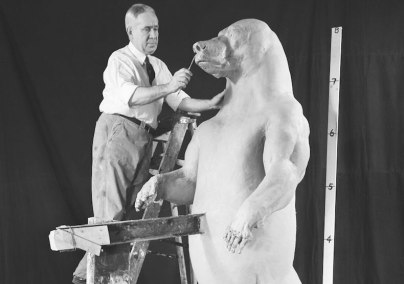
Robert Rockwell sculpts the internal model for AMNH's taxidermied brown bear. Source: Scientific American.

Robert Rockwell sculpts the internal model for AMNH’s taxidermied brown bear. Source: Scientific American.

To make a non-committal final point, I’d like to mention that it is tempting to be too uptight about copyright, particularly in a museum setting. This past October, I had the pleasure to give a presentation with Alexis Fekete at the Kansas Museum Association’s annual conference. The most interesting part of our session (which was about how web 2.0 tools can help museums) was when audience members, mostly representing small history museums, voiced concerns over making their photography collections available online. There was apprehension about making it too easy for people to copy and sell pictures without permission, which I assume is the primary reasoning behind other museums’ policies prohibiting the publication of fossil images. I’m skeptical, however, that this is the most pressing concern. Perhaps I’m being naïve, but I have no problem with getting information disseminated to genuinely interested people. Creating awareness and enthusiasm for content is part of the general mission of museums, and I’d hate to see overzealous copyright barriers get in the way of that.

References

Poliquin, R. 2012. The Breathless Zoo: Taxidermy and the Cultures of Longing. University Park, PA: Pennsylvania State University Press.

3 Comments

Filed under collections, dinosaurs, fossil mounts, mammals, museums, science communication

Extinct Monsters: The Marsh Dinosaurs, Part II

Read the Marsh Dinosaurs, Part I or start the Extinct Monsters series from the beginning.

During the first decade of the 20th century, the United States National Museum paleontology department was located in an offsite building in northwest Washington, DC. It was here that preparators Charles Gilmore, Norman Boss, and James Gidley slowly but surely worked through the literal trainloads of fossil specimens O.C. Marsh had acquired for the United States Geological Survey. The Marsh Collection included unknown thousands of specimens, many of them holotypes, and there was no shortage of gorgeous display-caliber material. Even after the “condemnation of worthless material” Gilmore and his team quickly filled the available exhibit space in the Arts and Industries Building with mounted skeletons.

The Ceratosaurus

With no more display space and plenty more fossils, it was fortunate that the USNM moved to a new, larger building in 1910. In this iconic, green-domed building (now the National Museum of Natural History), the paleontology department received newly furnished collections spaces and the entire east wing to fill with display specimens. The evocatively titled Hall of Extinct Monsters provided a new home for the mounted skeletons already constructed for the old exhibit, as well as plenty of room for new displays.

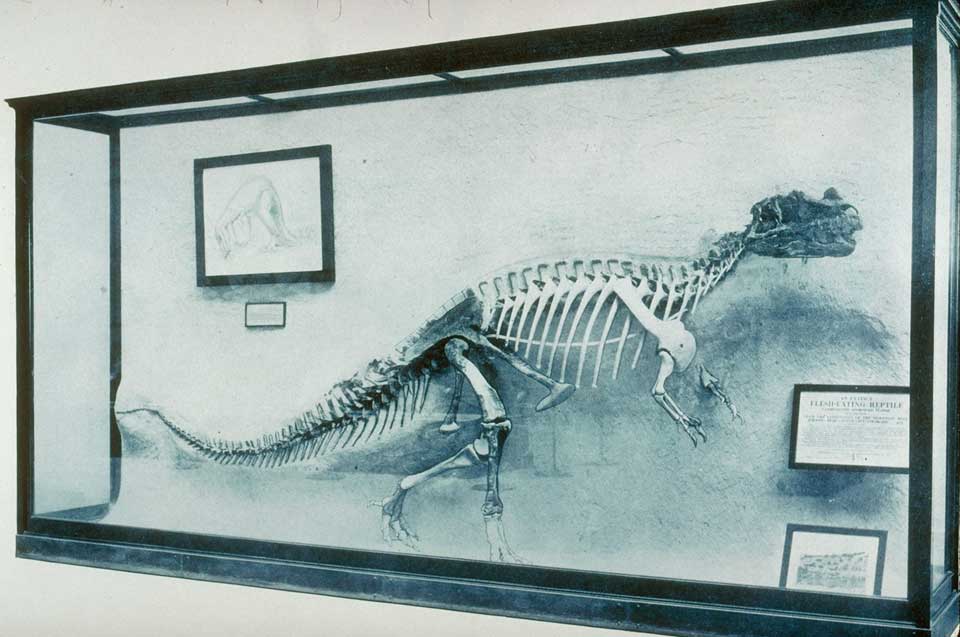
The Ceratosaurus nasicornis holotype was originally housed in a glass case. Image courtesy of the Linda Hall Library.

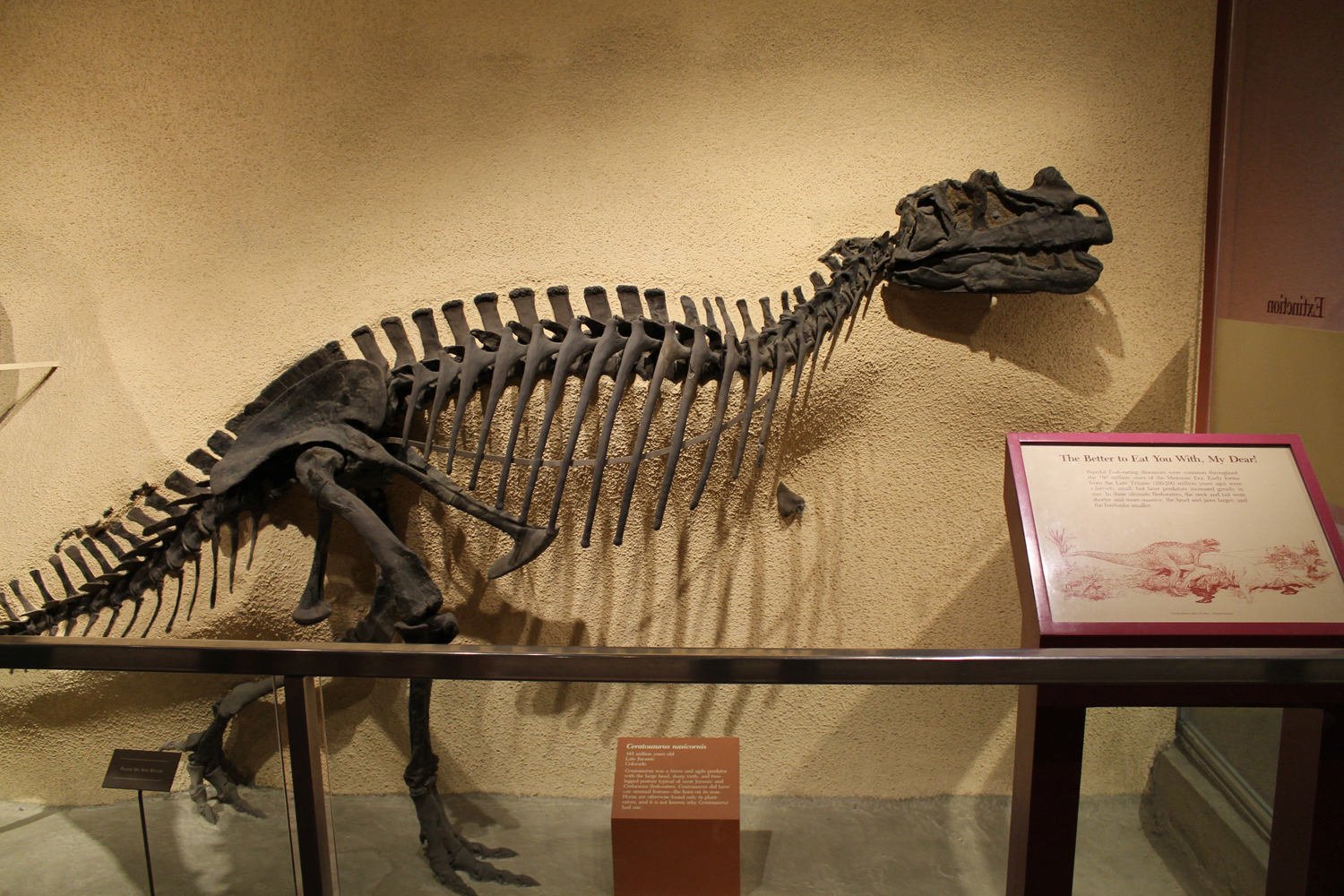
Ceratosaurus. Photo by the author.

The delicate arms of Ceratosaurus were removed several years prior to the hall’s closing. Photo by the author.

One of the first new additions was the type specimen of Ceratosaurus nasicornis (USNM 4735), mounted in relief. Marshall Felch led the excavation of this specimen in 1883 at a quarry near Cañon City, Colorado. The nearly complete skeleton received a cursory description from Marsh upon its discovery, but it was Gilmore who described it properly in 1920, ten years after it was put on display. When it was introduced to the Hall of Extinct Monsters, this was the only Ceratosaurus specimen yet found, making the mount a USNM exclusive. The skeleton was originally displayed in a glass case, but during the 1963 renovation it was placed in a more open setting.

Even today, Ceratosaurus is only known from a handful of specimens. For this reason, the original Ceratosaurus fossils will not be returning when the current renovation is completed in 2019. The new hall will instead feature a three-dimensional, standing cast of this skeleton. The original fossils are now in the museum’s collections, available for proper study for the first time in over a century.

The Camptosaurus

In 1912, two mounted skeletons of Camptosaurus, one large (USNM 4282) and one small (USNM 2210), were introduced to the Hall of Extinct Monsters. William Read excavated both specimens at Quarry 13 in the Como region of Wyoming a quarter of a century earlier. Representing the first-ever mounted skeletons of Camptosaurus, these specimens have had a rather complex taxonomical history. Marsh initially described both specimens as Camptosaurus nanus, a new species within the genus Camptosaurus (the type species was Camptosaurus dispar, also coined by Marsh). After the fossils were acquired by the USNM, Gilmore re-described the larger individual as a new species, Camptosaurus browni. This designation remained until the 1980s, when Peter Galton and H.P. Powell determined that C. nanus and C. browni were actually both growth stages of C. dispar.

Regardless of what they are called, both specimens were remarkably well-preserved and reasonably complete. Most of the skeletal elements of the larger Camptosaurus came from a single individual that was found articulated in situ. However, some of the cervical vertebrae came from another specimen from the same quarry, and the skull, pubis, and some of the ribs were reconstructed. Of particular interest is the right ilium, which has been punctured all the way through by a force delivered from above. Gilmore postulated that “the position of the wounds suggest…that this individual was a female who might have received the injuries during copulation.” The smaller “C. nanus” was also found mostly complete, but two metatarsals came from a different individual and the skull and left forelimb were sculpted.

The original pair of Camptosaurus mounts. Image from Backyard Dinosaurs.

Gilmore supervised the creation of both mounts, and constructed the larger individual himself. Norman Boss took the lead on the smaller specimen. As with the other dinosaur skeletons, the mount was centered on an inch-thick steel rod bent to conform to the shape of the vertebral column. Bolts were drilled directly into the vertebrae to attach them to the armature, and the vertebral foramina were filled with liberal amounts of plaster to secure them to the rod. A similar process was used to assemble each of the limbs, and the ribs were supported by a wire cage.

Gilmore aimed to correct many specifics of Marsh’s  original illustrated reconstruction of Camptosaurus. To start, he shortened the presacral region to make a more compact torso. Marsh had also inexplicably illustrated Camptosaurus with lumbar vertebrae (a characteristic exclusive to mammals), which Gilmore corrected. Finally, Marsh had reconstructed the animal as an obligate biped, but Gilmore  determined that “Camptosaurus used the quadrupedal mode of progression more frequently than any other known member of Ornithopoda.” Accordingly, the larger Camptosaurus mount was posed on all fours. The completed Camptosaurus mounts were placed together in a freestanding glass case toward the rear of the Hall of Extinct Monsters. In 1962 the pair was moved to the left of the Diplodocus on the central pedestal of the redesigned exhibit. During the 1981 renovation they were moved a few feet back, so that they were alongside the sauropod’s tail.

This cast replaced the original Camptosaurus mount in 2010. Photo by the author.

This cast replaced the original Camptosaurus mounts in 2010. Photo by the author.

The retired plaster skulls of the original Camptosaurus mounts. Photo by the author.

The retired plaster skulls of the original Camptosaurus mounts. Photo by the author.

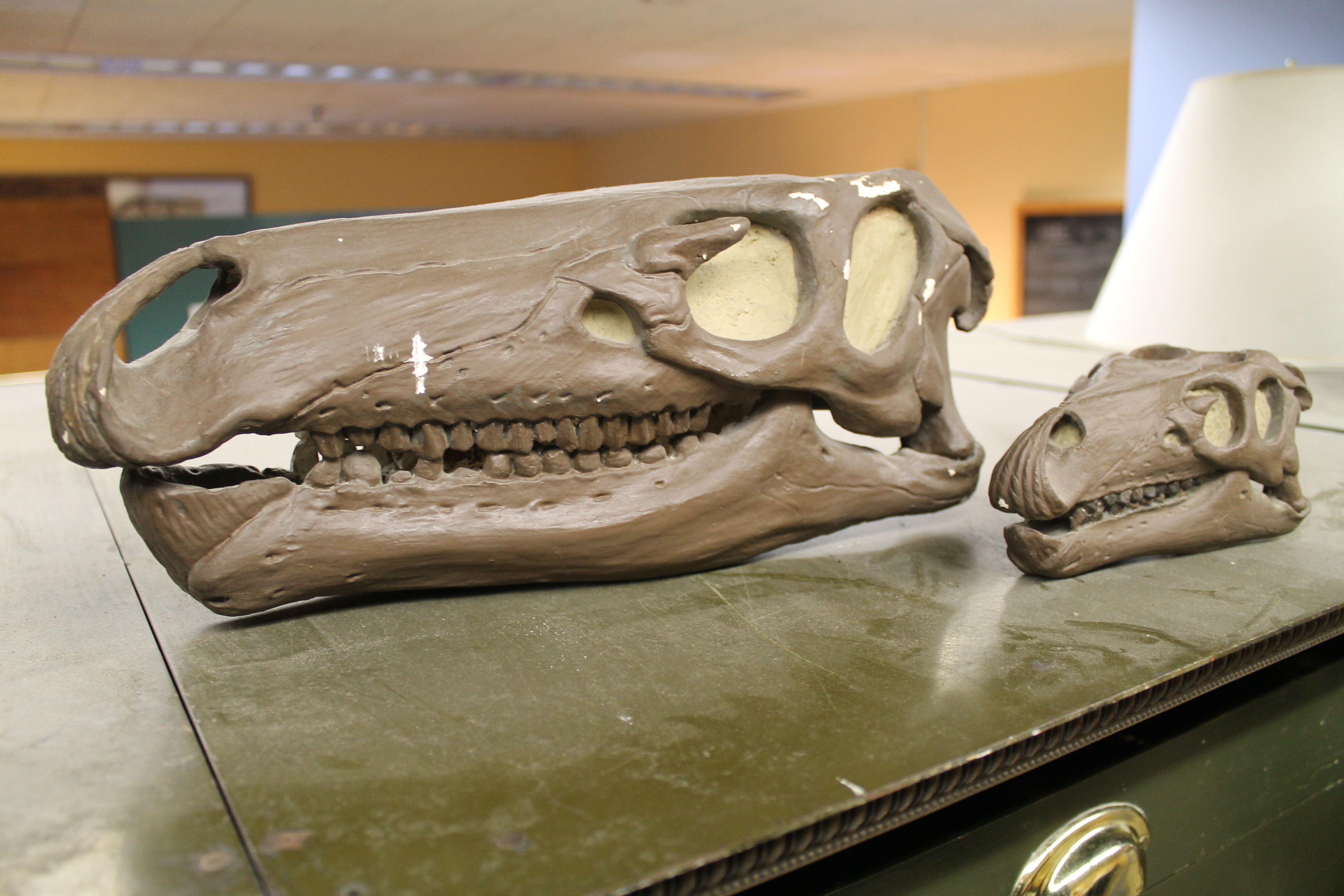
Both Camptosaurus skeletons taken off exhibit in 2010 and replaced with a cast of the adult. The delicate fossils, which had suffered from considerable wear and tear over the past hundred years, were stabilized and stored individually for their protection. The new mount has a number of upgrades to reflect our improved understanding of dinosaur anatomy. The arms are closer together and the palms face inward, because the pronated (palms down) hands on Gilmore’s version have been determined to be a physical impossibility. The new mount also features a completely different skull. The rectangular model skull used on the original mount was based on Iguanodon, but new discoveries show that the skull of Camptosaurus was more triangular in shape. Both the adult and juvenile Camptosaurus will appear in the new National Fossil Hall.

The Stegosaurus

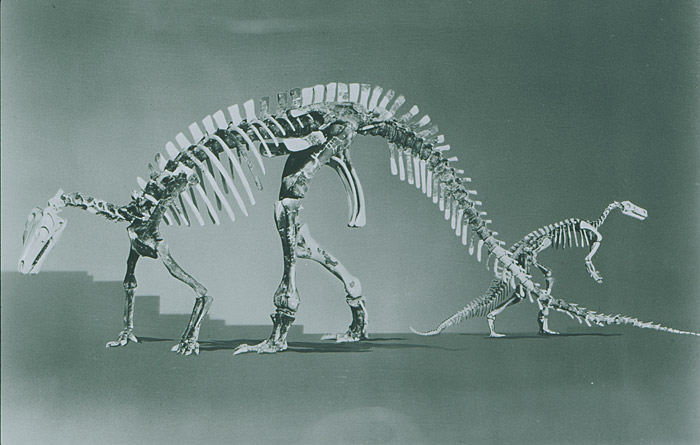
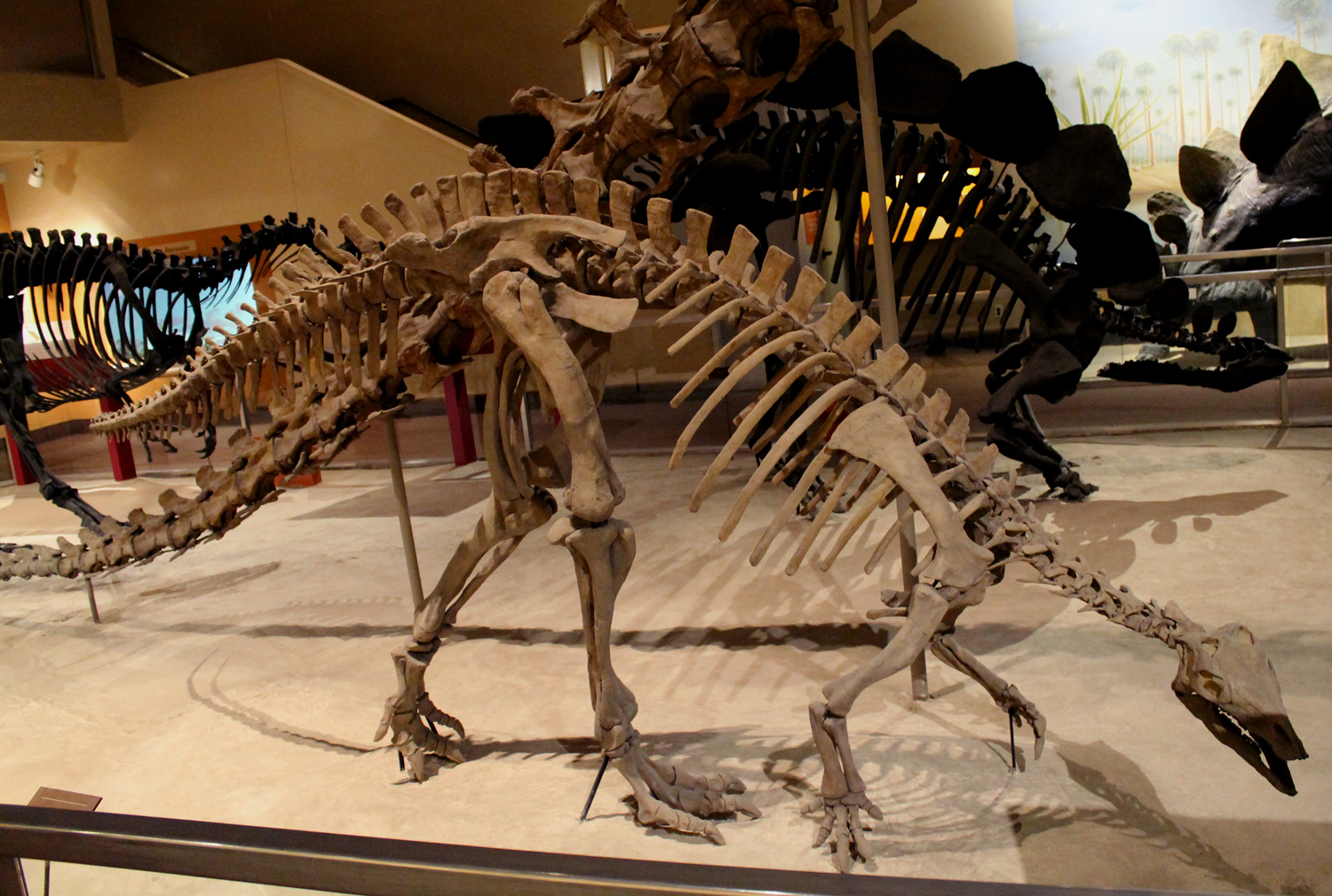
The Smithsonian’s first Stegosaurus exhibit was a life-sized model built for the 1904 World’s Fair in St. Louis. This model found its way into the Hall of Extinct Monsters in 1910. In 1913, the model was joined by a mounted Stegosaurus skeleton found at the same Cañon City quarry as the Ceratosaurus. A third Stegosaurus, the holotype of S. stenops, was introduced in 1918. Lovingly called the “roadkill” Stegosaurus, USNM 4934 is remarkable in part because it was found completely articulated. In fact, before its 1886 discovery by Marshall Felch, it was unknown exactly how the animal’s plates were positioned on its back.

Standing Stegosaurus mount and life-size model, circa 1950. Photo courtesy of the Smithsonian Institution Archives.

Stegosaurus

Stegosaurus model, standing mount, and “roadkill” on display in the Hall of Extinct Monsters. Source

All three Stegosaurus displays were moved in 1963 and 1981. In Fossils: The History of Life, the Stegosaurus skeletons were positioned flanking the Diplodocus in the central display area, with the standing mount on the right and the roadkill skeleton on the left. The model Stegosaurus stood opposite the mount. Just like the Triceratops and Camptosaurus, many decades on display took their toll on the standing Stegosaurus, so in 2003 the fossils were removed from the exhibit. Dismantling the Stegosaurus was particularly challenging because of the large amount of plaster applied by the mount’s creators. In some cases the plaster infill had to be removed with hand tools, which put further pressure on the fossils. Additionally, the rod supporting the backbone had been threaded right through each of the vertebrae, and was extremely difficult to remove. A casted Stegosaurus mount in a more active pose was returned to the exhibit in 2004.

Cast of Stegosaurus and Camptosaurus. Photo by the author.

Casts of Stegosaurus and Camptosaurus. Photo by the author.

Roadkill stego

“Roadkill” Stegosaurus in 2014. Photo by the author.

After 110 years on display at the Smithsonian, the model Stegosaurus has been donated to the Museum of the Earth in Ithaca. The roadkill Stegosaurus, however, will feature prominently in the new National Fossil Hall, mounted upright on the wall by the exhibit’s secondary entrance. The 2004 Stegosaurus cast had a number of anatomical issues and will not be returning – instead, it will be replaced by an updated cast made from the same original fossils.

The Marsh dinosaurs have been of critical importance in our understanding of the Mesozoic world, but at this point these fossils are historic artifacts as well. When they were uncovered, the American civil war was still a recent memory, and railroads had only recently extended to the western United States. Before the first world war they had been assembled into mounts, and for more than a century these fossils have been mesmerizing and inspiring millions of visitors. Several of these mounts, including the Triceratops, Ceratosaurus and Camptosaurus, were the first reconstructions of these species to ever appear in the public realm, and therefore defined popular interpretations that have lasted for generations. Some visitors may lament that many of the original specimens have been recently been replaced with replicas, but the fact is that these are irreplaceable and invaluable national treasures. They inform us of our culture, and our dedication to expanding knowledge and our rich natural history. We only get one chance with these fossils, and that is why the absolute best care must be taken to preserve them for future generations.

References

Gilmore, C.W. 1912 “The Mounted Skeletons of Camptosaurus in the United States National Musuem.” Proceedings of the US National Museum 14:1878.

Gilmore, C.W. 1941 “A History of the Division of Vertebrate Paleontology in the United States National Museum.” Proceedings of the United States National Museum 90.

Jabo, S. 2012. Personal communication.

Leave a comment

Filed under collections, dinosaurs, exhibits, Extinct Monsters, field work, fossil mounts, history of science, museums, NMNH, ornithopods, reptiles, theropods, thyreophorans

Extinct Monsters: Ice Age Giants

Click here to start the NMNH series from the beginning.

The old fossil mammal exhibits at the National Museum of Natural History were notable for their sheer diversity. From rabbits to elephants and from bats to whales, virtually every major group of North American mammals, particularly eutherian (placental) mammals, was represented. By my count, there were no less than 48 mounted mammal skeletons on display (not including individual skulls and other parts) in 2014, arranged by time period and distributed across three sizable halls.

The comprehensive nature of these exhibits was largely thanks to C.L. Gazin, head curator of the Division of Vertebrate Paleontology in the 1950s and 60s. During the modernization of the fossil halls in the early 1960s, Gazin focused his efforts on assembling a complete narrative of Cenozoic mammal evolution. The six-part exhibit debuted in 1961 in Hall 5, and was relocated two decades later to Hall 3. Gazin also initiated the construction of the adjacent Ice Age exhibit, although it would not be permanently opened to the public until 1974.

Now that the fossil halls are being renovated, NMNH staff face the enormous task of disassembling and restoring the dozens of historic mammal skeletons. Many will return when the exhibit reopens in 2019, but others may be retired to the collections if they are deemed too fragile for continued display, or if they are not illustrative of the story being told in the new exhibit.

The Megaloceros

This Megaloceros

This Megaloceros has the distinction of being the Smithsonian’s first mounted skeleton composed of original fossils. Photo by the author.

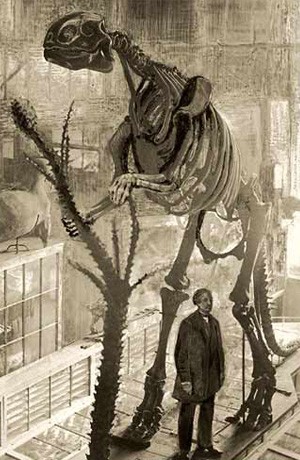
The Smithsonian’s first mounted fossil skeletons went on display in 1871 in the building colloquially called “the castle.” The exhibit included plaster casts of the ground sloth Megatherium, the tortoise Colossochelys and the glyptodont Scistopleurum, all made from originals at the British Museum. The following year saw the addition of the giant deer Megaloceros (USNM V 7051) — the Smithsonian’s first mounted skeleton composed of original fossils. The Smithsonian purchased this complete Megaloceros, which was uncovered in an Irish peat bog, from Philadelphia-based antiques dealer Thomas and Sons. The mount was assembled by none other than Benjamin Waterhouse Hawkins, the sculptor who created the famous Crystal Palace dinosaurs.

Note basilo

Megaloceros in the southeast court of the Arts and Industries building, circa 1896. The British Museum Megatherium cast can be seen on the left. Source

When construction of the original United States National Museum (what is now called the Arts and Industries Building) was completed in 1881, all of the fossil displays were moved to the new setting. Vertebrate fossils found a home in the 80,000 square foot southeast court. Gradually, the Megaloceros and British Museum casts were joined by many more crowd-pleasing skeletons, including a copy of the Philadelphia Hadrosaurus, an Edmontosaurus, a Triceratops, and a mastodon (discussed below). By the time the USNM was preparing to move to yet another new building across the national mall in 1910, the southeast court had become quite crowded. Unfortunately, the Megatherium and Collossochelys never made it to the new location. These casts were discarded due to the damage they had accumulated while on display. Although the glyptodont cast was still on exhibit as of 1940, it too was eventually destroyed. Happily, the Megaloceros survived, and has been included in each subsequent iteration of the fossil exhibits.

Starting in 1974, the Megaloceros was displayed alongside the extinct bird Diornis in the Ice Age hall. It’s weight was partially supported by cables descending from the ceiling, which proved to be a problem when it came time to disassemble it in July 2014. Rather than attempting to lift the delicate skull and heavy antlers off the armature, the exhibit team strapped the skull to a mechanical lift so that it could be slowly and gently lowered to the floor. In the new National Fossil Hall, the Megaloceros will be sitting on the ground. This pose was selected in order to bring the spectacular antlers to visitors’ eye level.

The Mastodon

The Indiana mastodon in the Hall of Extinct Monsters. Photo courtesy of the Smithsonian Institution Archives.

In 1901, Michigan farmer Levi Wood found a well-preserved, nearly complete Mammut americanum (USNM 2106) in a peat swamp on his land. The USNM purchased the rights to excavate the skeleton from Wood and began work that same year. The specimen turned out to be virtually complete, save for the forelimbs and left hindlimb. Alban Stewart mounted the skeleton, adding a left hindlimb from another mastodon specimen from Missouri, and filling in other missing elements with plaster replicas. The completed mount was first exhibited at the Louisiana Purchase Exposition in St. Louis, Missouri in 1904.

For a time, there were two mastodon mounts on display in the Hall of Extinct Monsters. Photo courtesy of the Smithsonian Institution Archives.

After the Exposition, the Michigan mastodon was added to the fossil displays in the  southeast court of the Arts and Industries Building. It remained there for four years, before joining the rest of the paleontology exhibits and collections in the move to the new USNM building.

In 1915, a second mastodon (USNM V 8204) from Indiana was added to the Hall of Extinct Monsters. The matching set can be seen on the left side of the image above, with the plaster skull of a Deinotherium (USNM V 1917) positioned between them. The larger Indiana mastodon persisted through the 1963 and 1981 renovations, and will return with an energetic trumpeting pose in 2019. NMNH loaned the Michigan mastodon to the Oregon Zoo for many years. It has since been returned, dismantled, and retired to the collections.

The Stegomastodon

Stegomastodon in 2014. Photo by the author.

Stegomastodon in 2014. Photo by the author.

The young male Stegomastodon (USNM 10707) was collected by James Gidley and Kirk Bryan collected this skeleton in the San Pedro Valley of Arizona. This 1921 collecting trip also produced the museum’s Glyptotherium. While the genus Stegomastodon was erected in 1912, Gidley referred his specimen to a new species, S. arizonae, due to its more “progressive” physiology and slightly younger age. By 1925, the skeleton was mounted and on display in the Hall of Extinct Monsters. While the original mount used the real fossil tusks, these were eventually replaced with facsimiles.

Stegomastodon with

Stegomastodon with its original tusks. Photo from Gidley 1925.

The Stegomastodon will not be returning when the National Fossil Hall reopens in 2019. For one thing, there are already two big elephants on display: the mammoth and the mastodon. Elephants take up a lot of space, and a third proboscidean offers diminishing returns when compared to the amount of floor space it requires. More importantly, the Stegomastodon is a holotype specimen, and the exhibit team elected to remove most of these important specimens from the public halls. This is both to keep them safe from the damaging effects of vibration, humidity, and fluctuating temperature, as well as to make them more accessible to researchers.

The Eremotherium pair

Eremotherium

The unique and impressive Eremotherium pair. Photo by the author.

The immense pair of giant ground sloths (USNM V 20867 and USNM V 20872) are among the most impressive and unique skeletal mounts at NMNH. Many a visitor has ascended the ramp to the Ice Age gallery only to stop and stare at them. Unlike the Megaloceros, mastodon, and many others, these were new additions added during the 1960s modernization. Gazin’s team recovered the fossils in Panama between 1950 and 1951, bringing back over 100 plaster jackets representing at least eight individual sloths of the genus Eremotherium.

sou

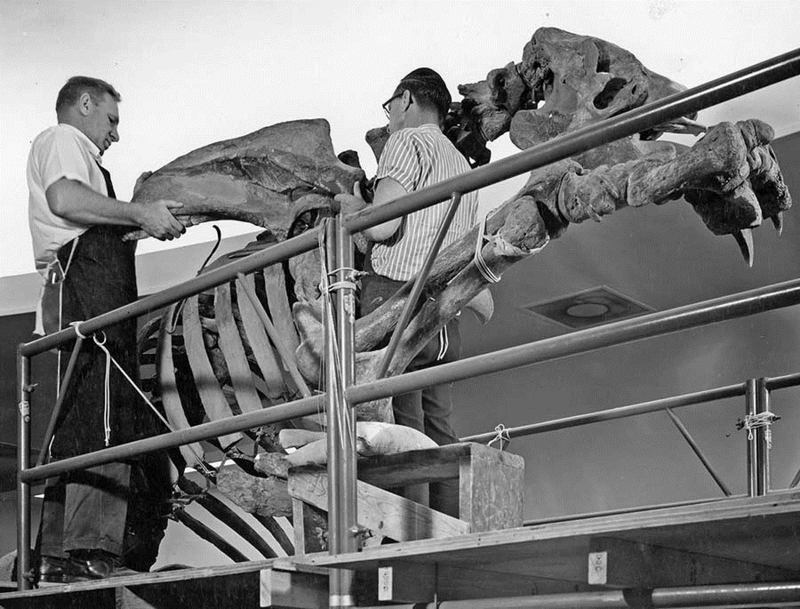
John Ott and Gladwyn Sullivan attach the scapula of the standing sloth. Source

Assistant Curator of Cenozoic Mammals Clayton Ray oversaw the assembly of the two Eremotherium mounts in 1969. Both the larger standing sloth and smaller kneeling one are composites of fossils from many individuals (there are also plenty of reconstructed bones, easily spotted by their solid beige coloration). Most of the surplus bones were repatriated to Panama before the mounts went on display. The sloths were originally positioned back-to-back on a central platform, accentuated by an illuminated opening in the ceiling. However, this layout only lasted a few years. In 1974, the Quaternary Hall was completely reorganized into the Hall of Ice Age Mammals and the Age of Man. In the new arrangement, the Eremotherium pair was relocated to a corner at the north end of the gallery. In 2019, only one Eremotherium will be on display.

The Mammoth

Chimera mammoth

This mammoth was assembled from as many as 70 individual specimens. Photo by the author.

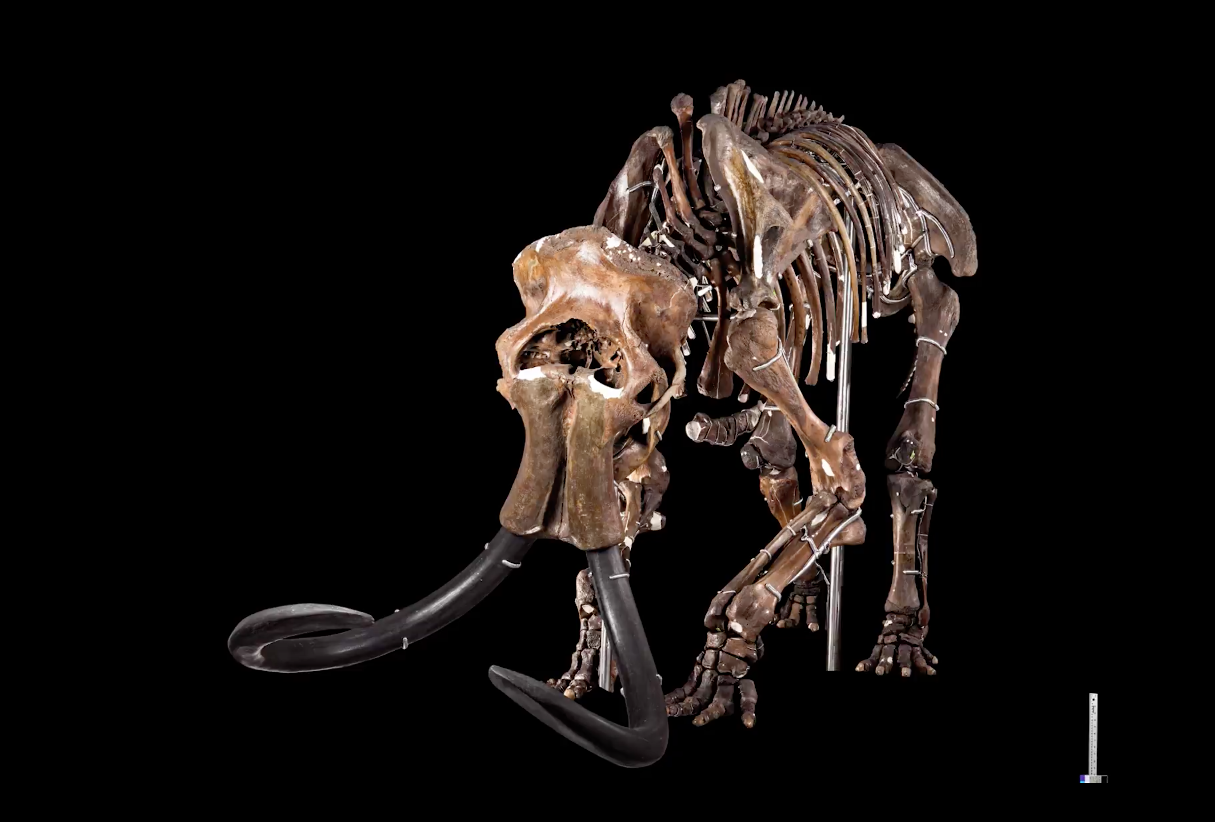
Although it was always labeled as a woolly mammoth (Mammuthus primigenius), the Smithsonian’s third proboscidian skeleton (USNM V 23792) is actually a composite of over fifty individual specimens, some of which probably belong to the more southerly Columbian mammoth (Mammuthus columbi). Most of these fossils were acquired in a trade with the American Museum of Natural History in the 1960s, specifically to build a mounted skeleton for the Ice Age hall. Perhaps because they were acquired for display, rather than study, the origin of these fossils was not well-recorded. It is only now that the mammoth has been disassembled that collections staff can begin to to learn more about this iconic chimera. Some of the bones are marked with the year and location of their collection, crucial details for piecing together their provenance.

The mammoth in its new, snow-shoveling pose. Photo courtesy of the Smithsonian Newsdesk.

In the new fossil hall, the mammoth will be leaning forward, pushing its great tusks across the ground as though it were brushing away snow. In the meantime, the original mount was digitally scanned, and the model is freely available from Smithsonian 3D.

References

Carrano, M. 2018. Pers. comm.

Gazin, C.L. 1956.  Exploration for the remains of giant ground sloths in Panama. Smithsonian report, 341-354.

Gidley, J.W. 1925. Fossil Proboscidea and Edentata of the San Pedro Valley, Arizona. Shorter Contributions to General Geology (USGS). Professional Paper 140-B, 83-95.

Gilmore, C.W. 1906. Notes on Some Recent Additions to the Exhibition Series of Vertebrate Fossils. Proceedings of the United States National Museum No. 30.

Gilmore, C.W.  1941. A History of the Division of Vertebrate Paleontology in the United States National Museum. Proceedings of the United States National Museum No. 90.

Marsh, D.E. 2014. From Extinct Monsters to Deep Time: An ethnography of fossil exhibits production at the Smithsonian’s National Museum of Natural History. http://circle.ubc.ca/handle/2429/50177

3 Comments

Filed under Extinct Monsters, field work, fossil mounts, history of science, mammals, museums, NMNH