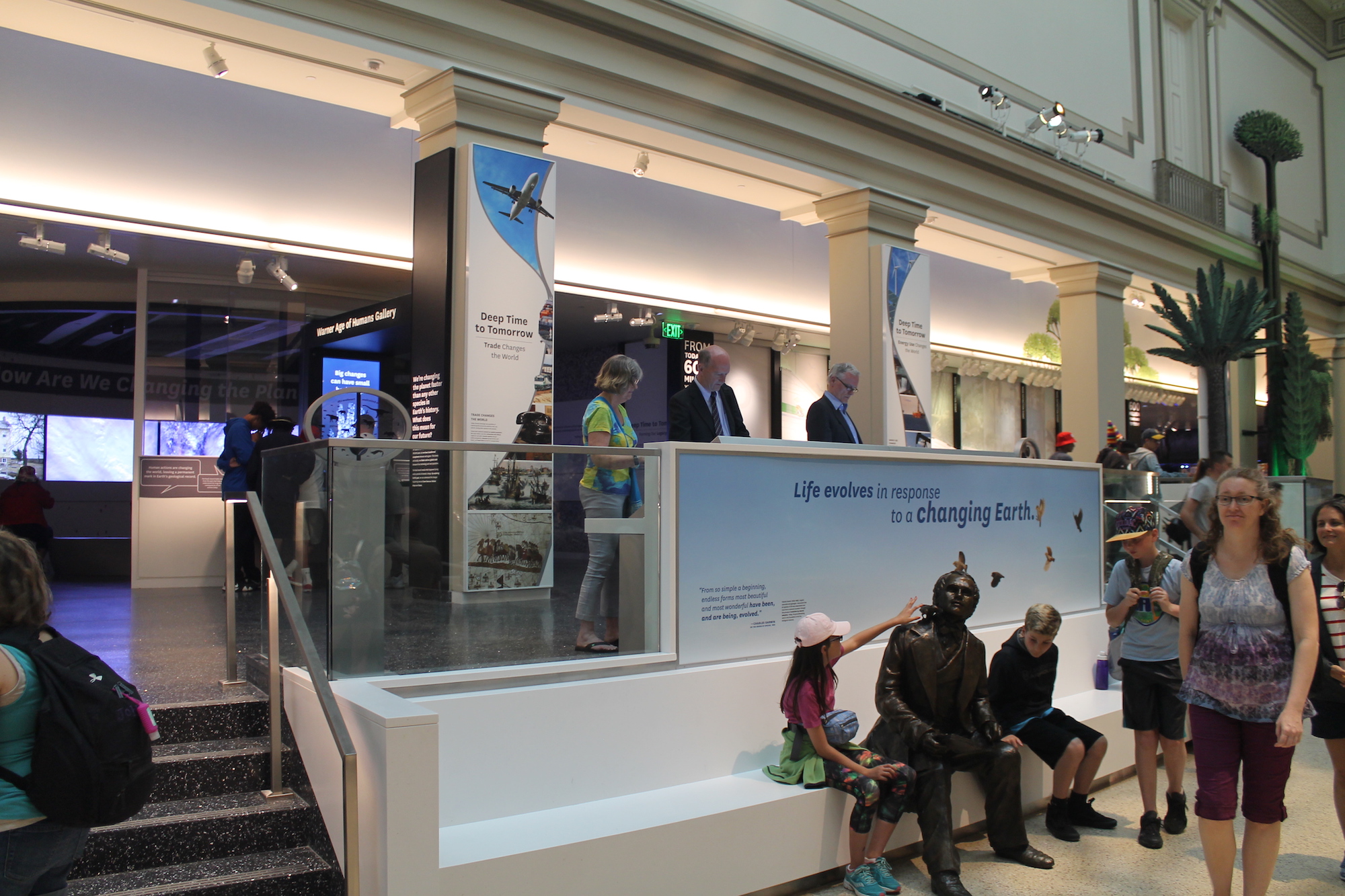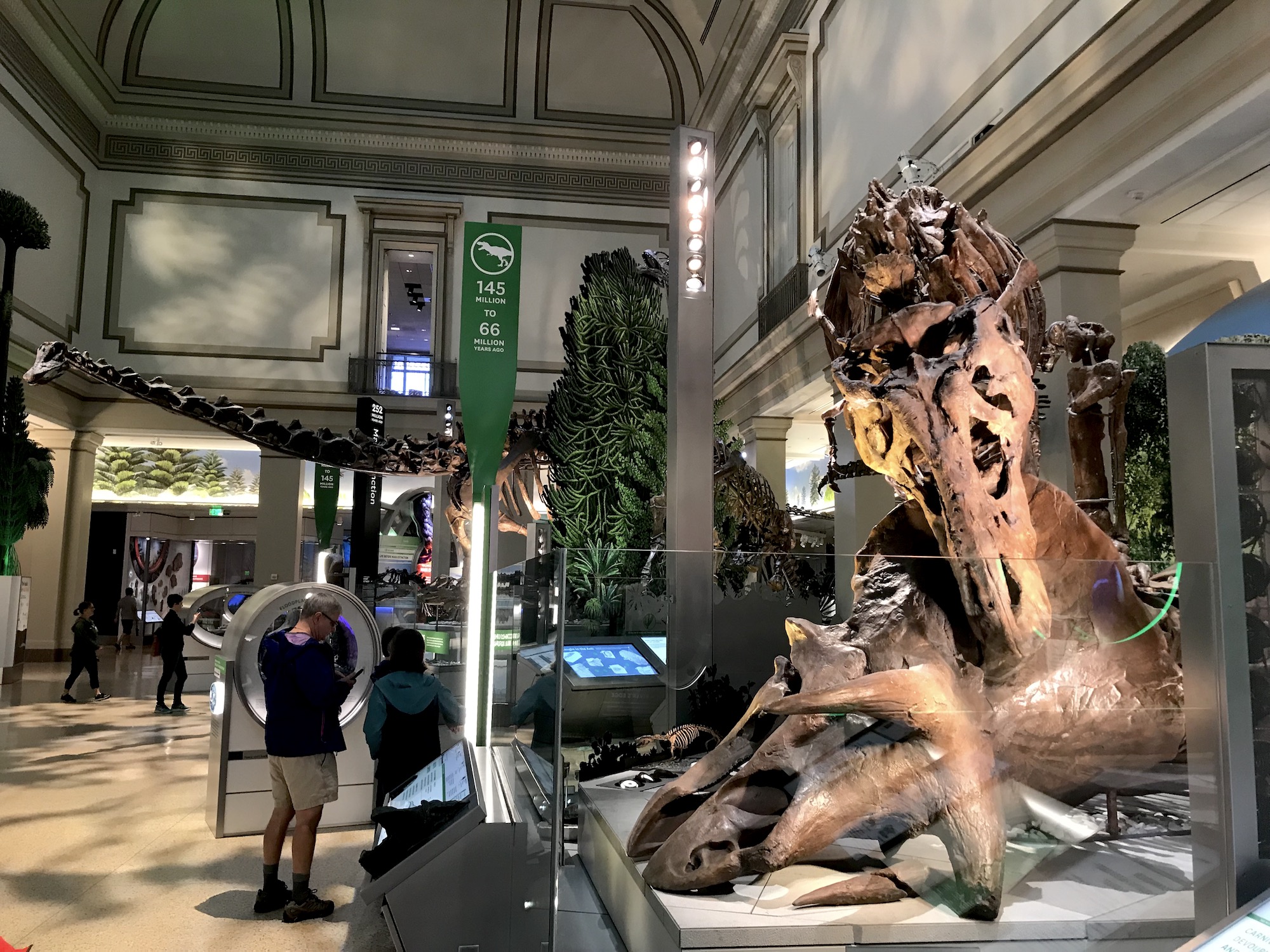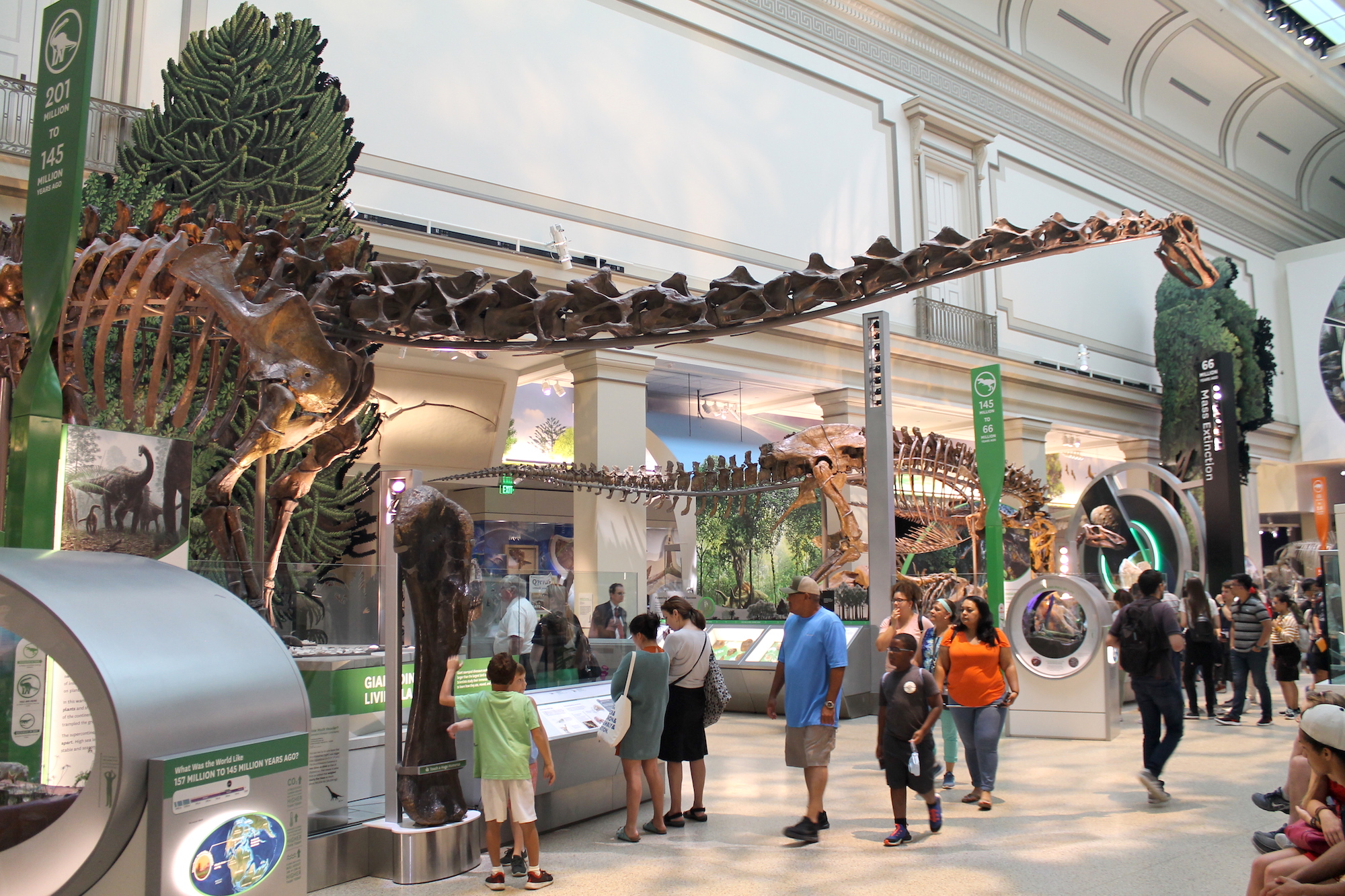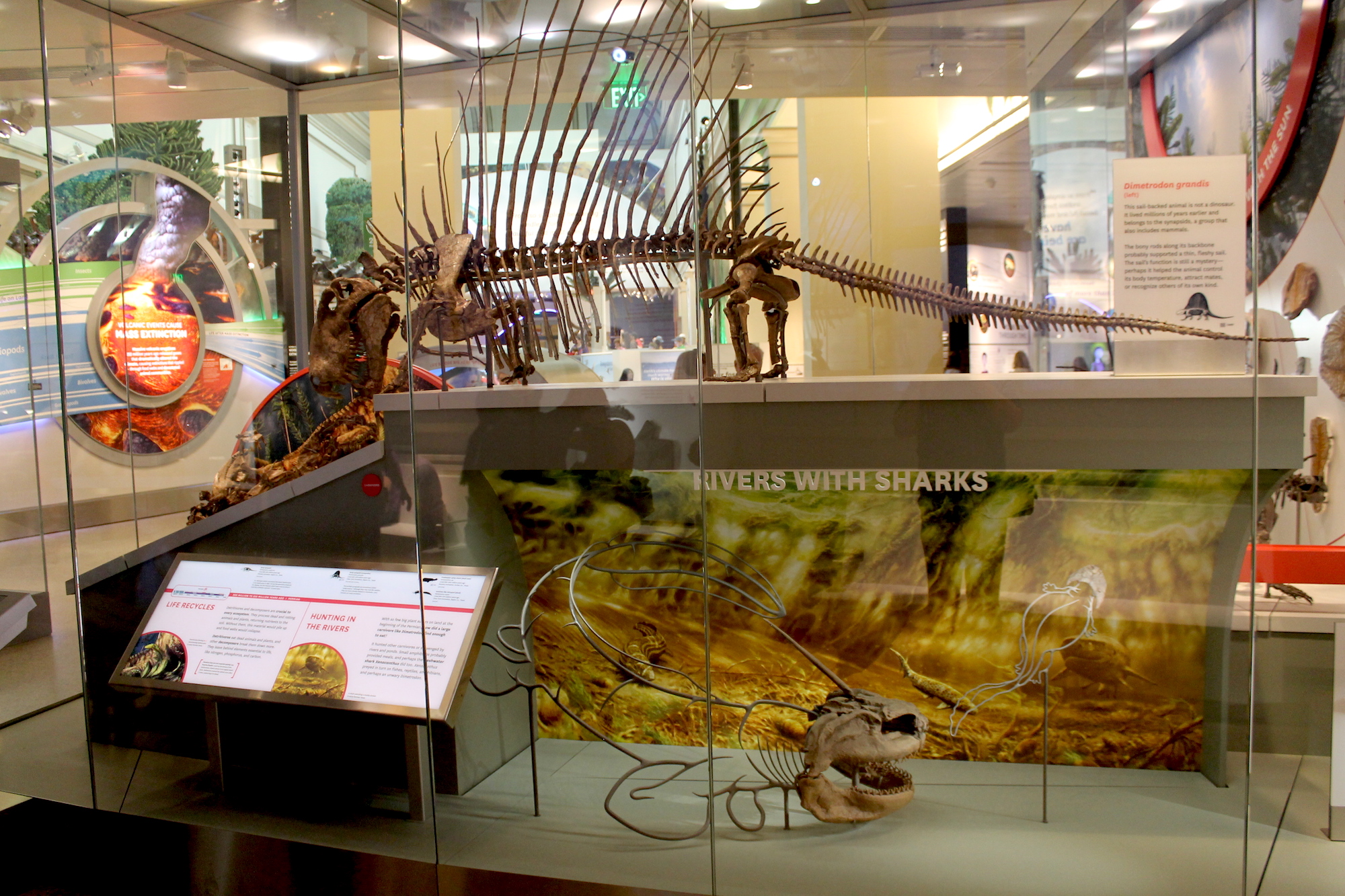
Category Archives: reviews

Past Worlds at NHMU is breathtaking

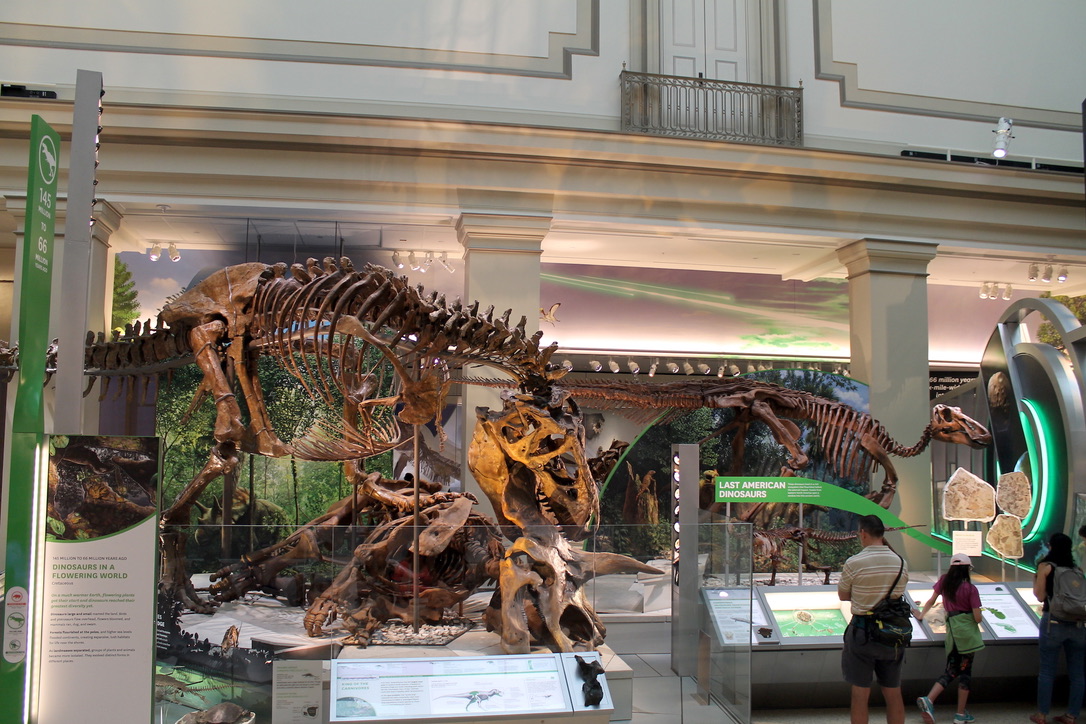
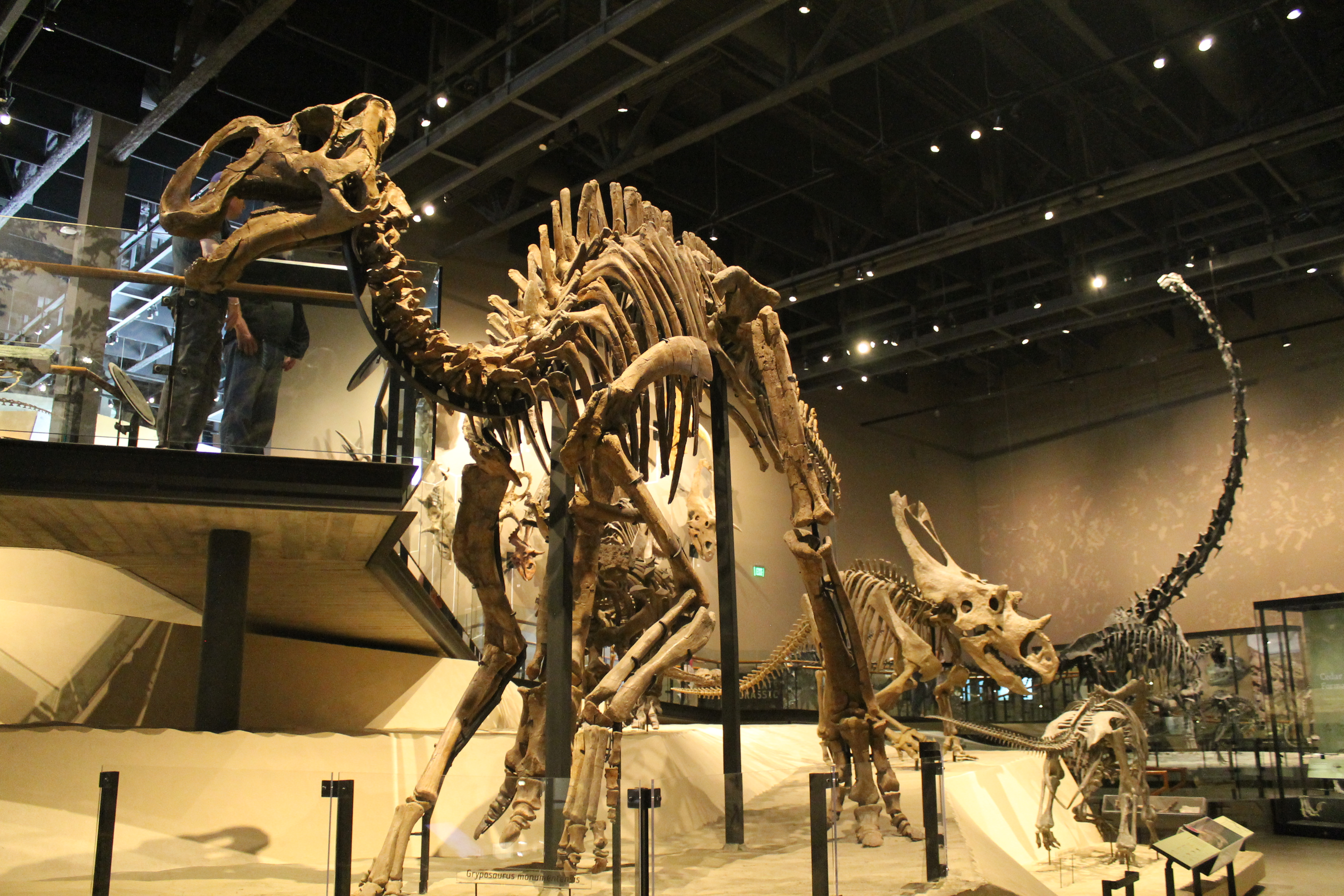
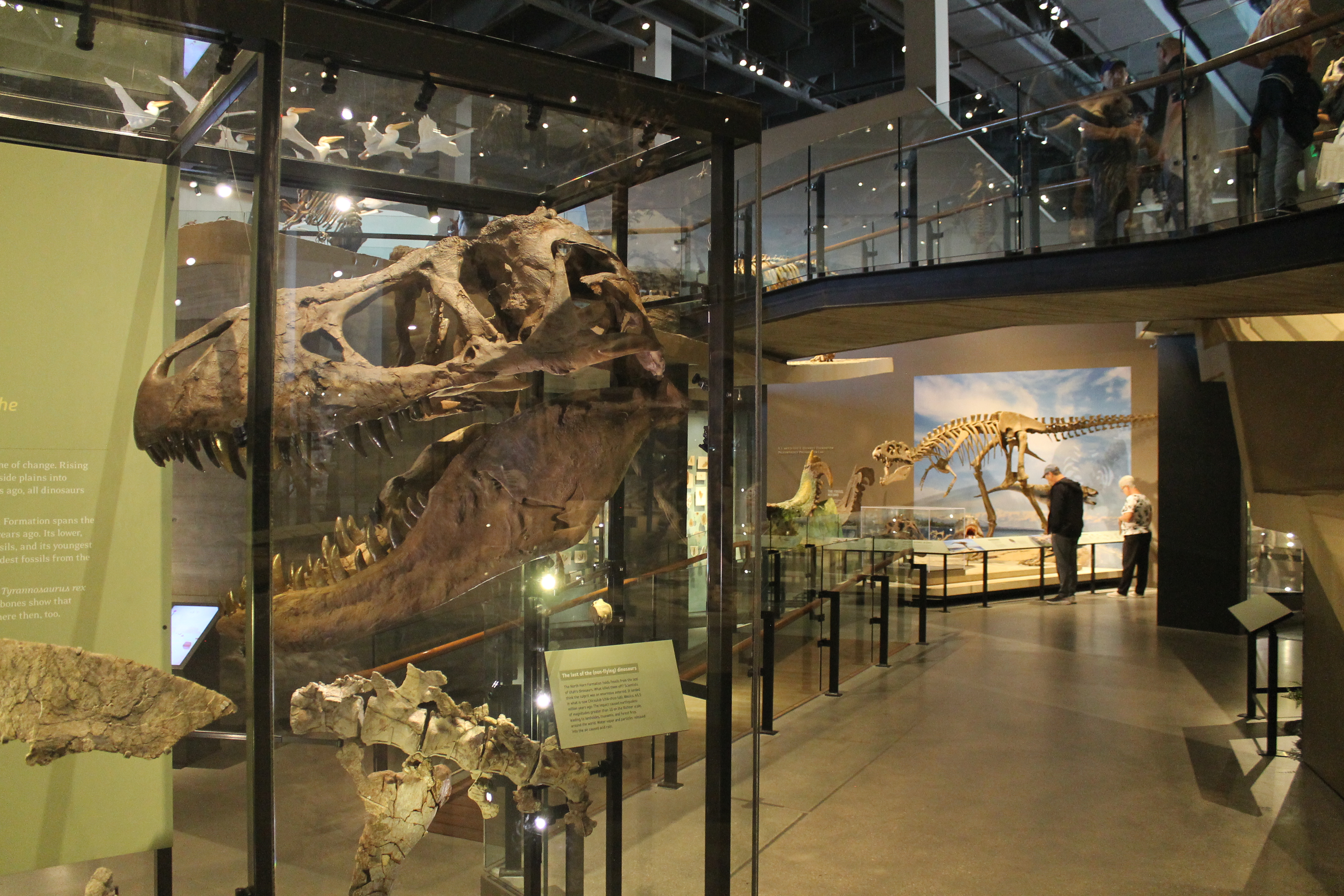
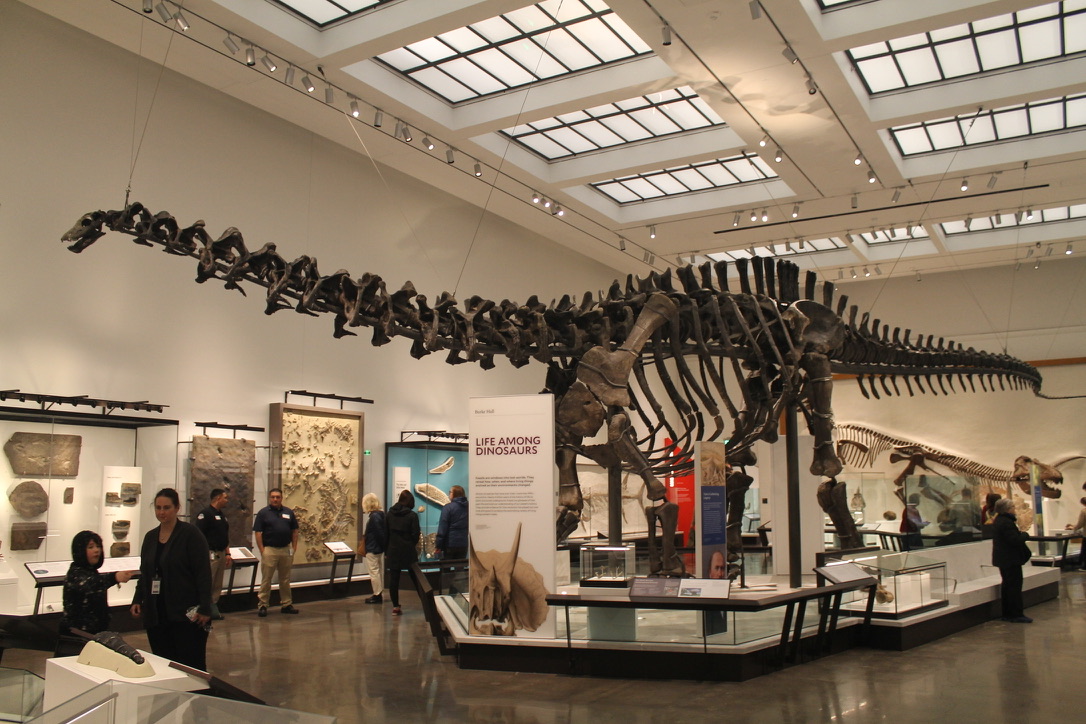
Gryposaurus makes an impression amidst other dinosaurs in Past Worlds, the NHMU paleontology exhibition. Photo by the author.

I visited the Natural History Museum of Utah (NHMU) earlier this week, and I need to take a moment to applaud its exceptionally beautiful and well-conceived paleontology hall.

NHMU is part of the University of Utah. It resided in its original home on the Salt Lake City campus from 1969 to 2011, when the museum relocated to a new, purpose-built facility in the foothills near Red Butte Canyon. Several design firms contributed to the Rio Tinto Center (the name for the building in which the museum resides), but the permanent exhibitions—including the paleontology hall—are the work of good ol’ Ralph Appelbaum Associates (RAA). For the unfamiliar, RAA is a dominant player in the field of museum design that is often associated with projects of profound cultural and historic significance, like the US Holocaust Memorial Museum and the National Museum of African American History and Culture. RAA has fewer natural history projects in its lengthy catalog of commissions. Near as I can tell, their only other paleontology-centric project was the fourth floor fossil halls at AMNH. I’m not a huge fan of many of the design choices made in those halls, so it’s interesting to see what 20 years and a different client can mean.

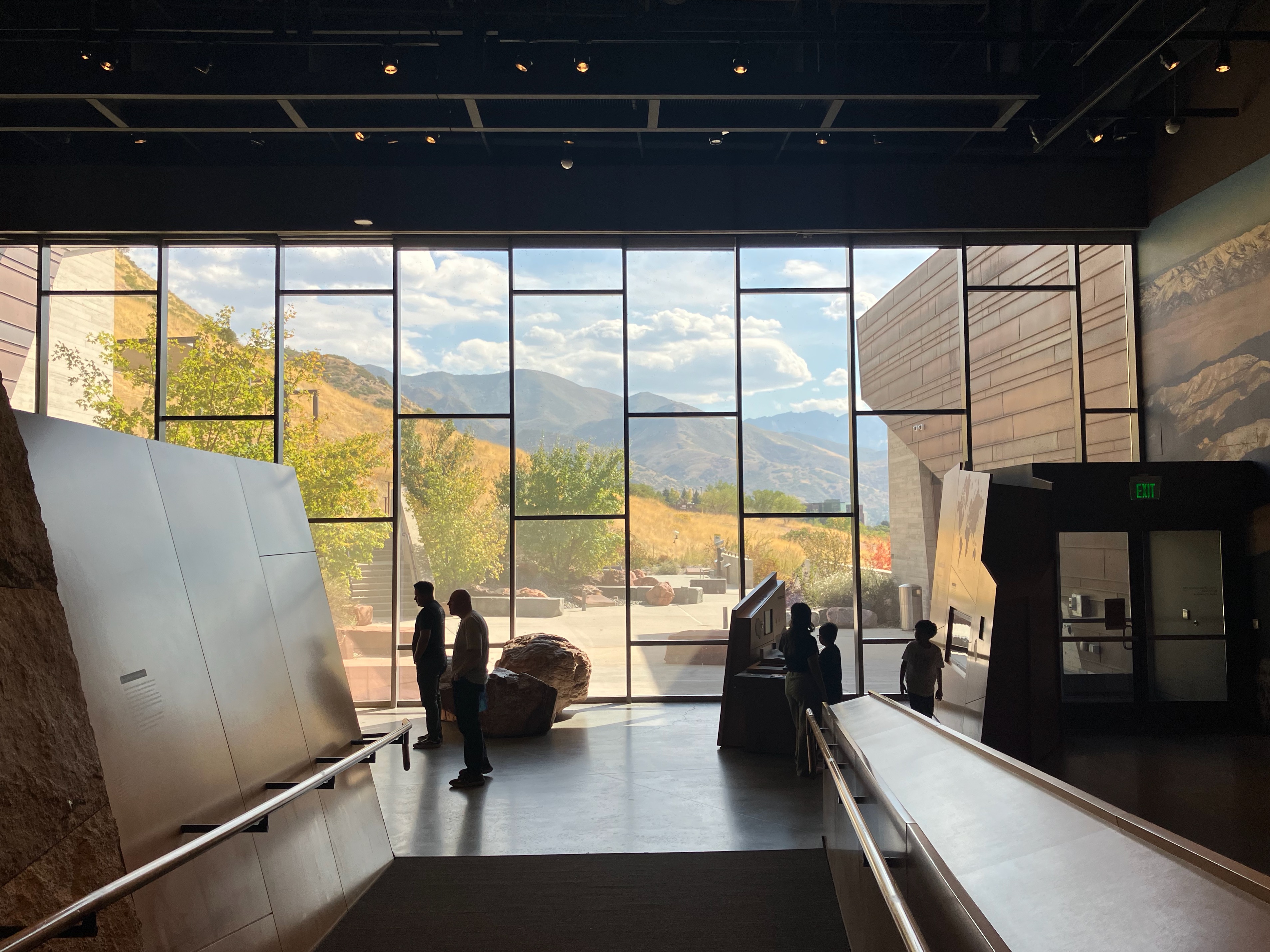
Large windows and frequent access to the outdoors are standout features of the NHMU building. Photo by the author.

The 44,000 square feet of permanent exhibitions at NHMU flow linearly across the building’s five floors, which visitors can explore from bottom to top or top to bottom. Conceived as a single experience, the exhibitions don’t feel like discreet units—instead, they flow seamlessly into one another as visitors climb or descend along switchbacking paths through the building. I want to call attention to the design of the museum as a whole because it manages to be both stylish and meaningful. Unlike some other museums with bold architecture (looking at you, ROM), the building manages to make a visual statement without hindering visitor experience or usable exhibit space.

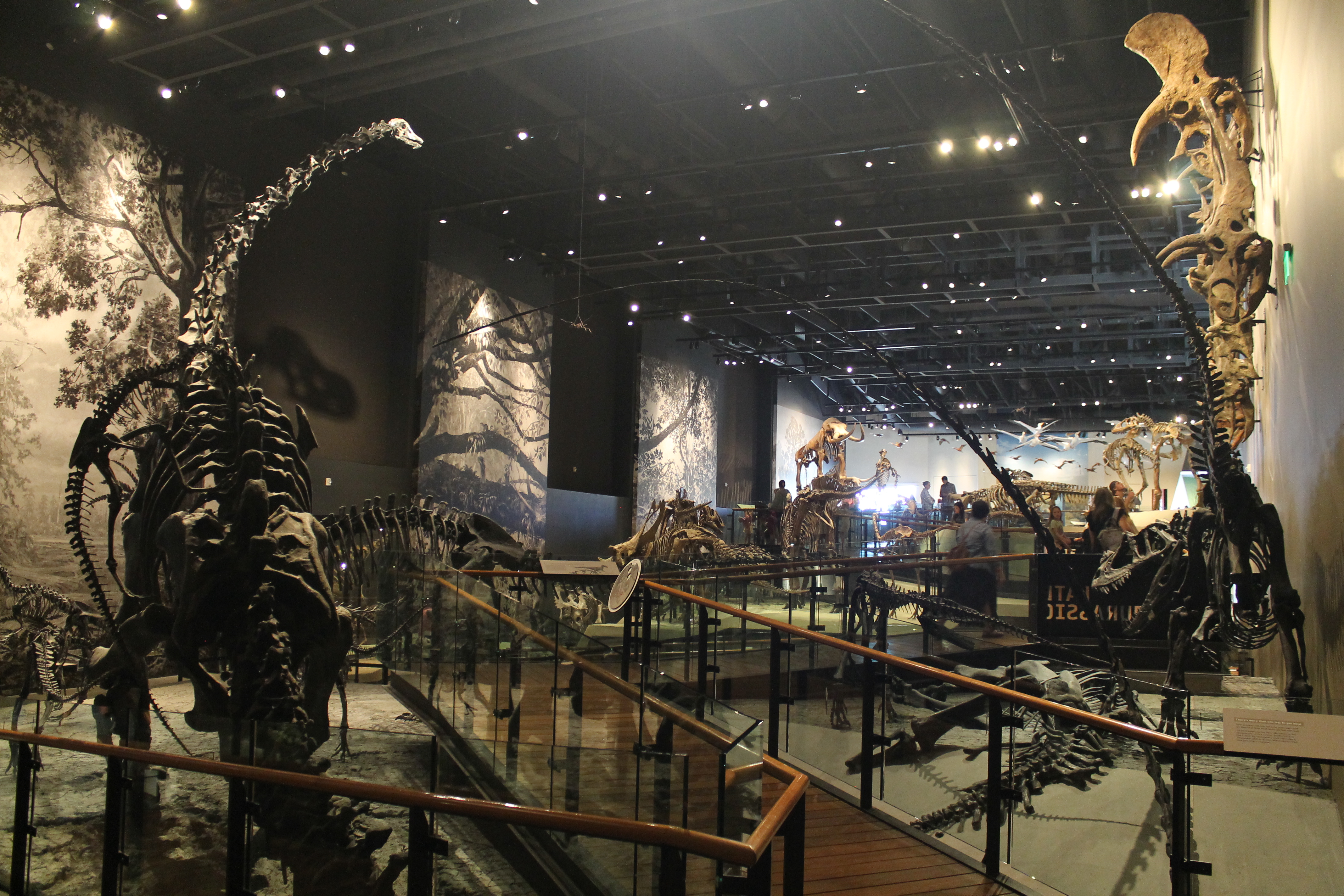
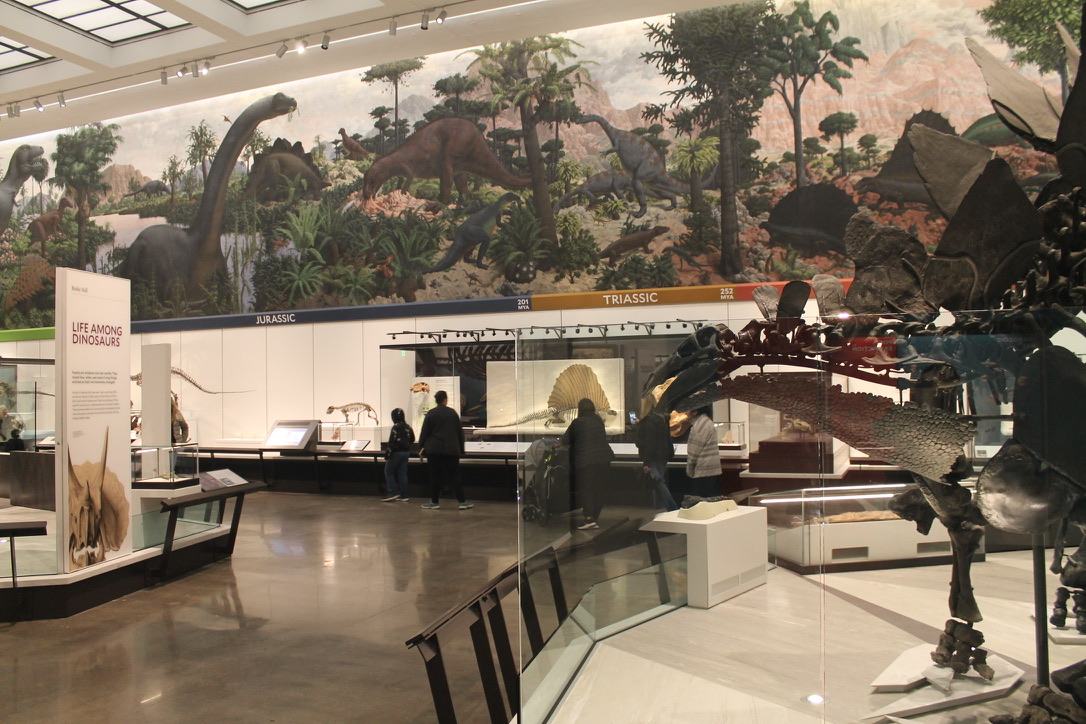
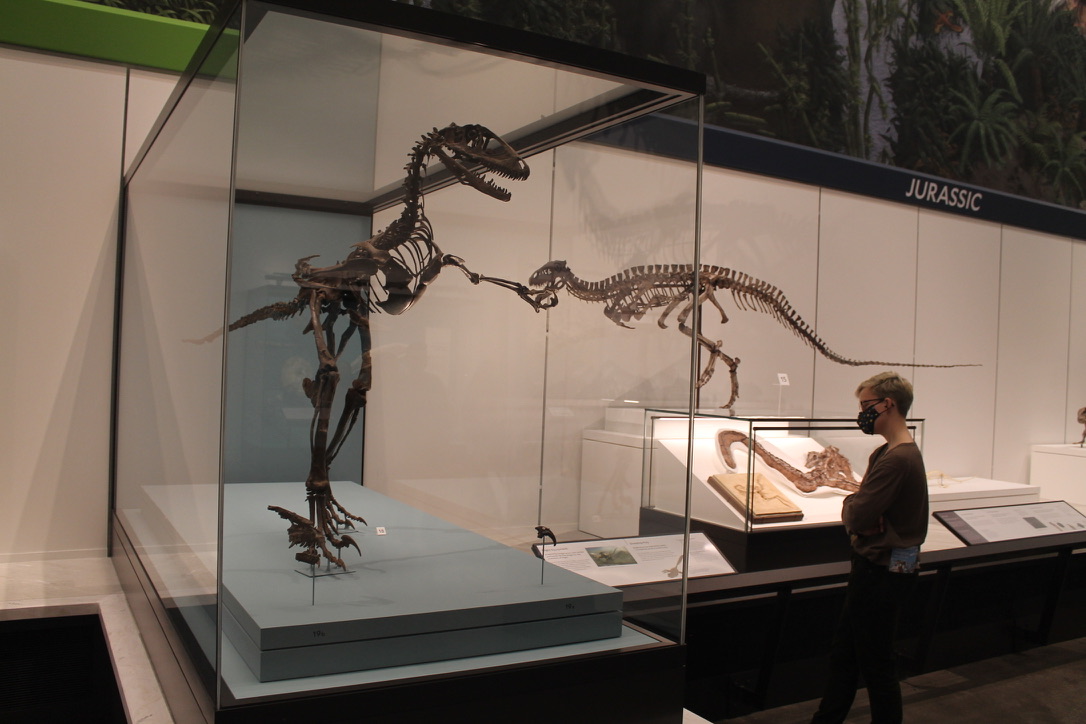
Past Worlds as seen from the Jurassic. Photo by the author.

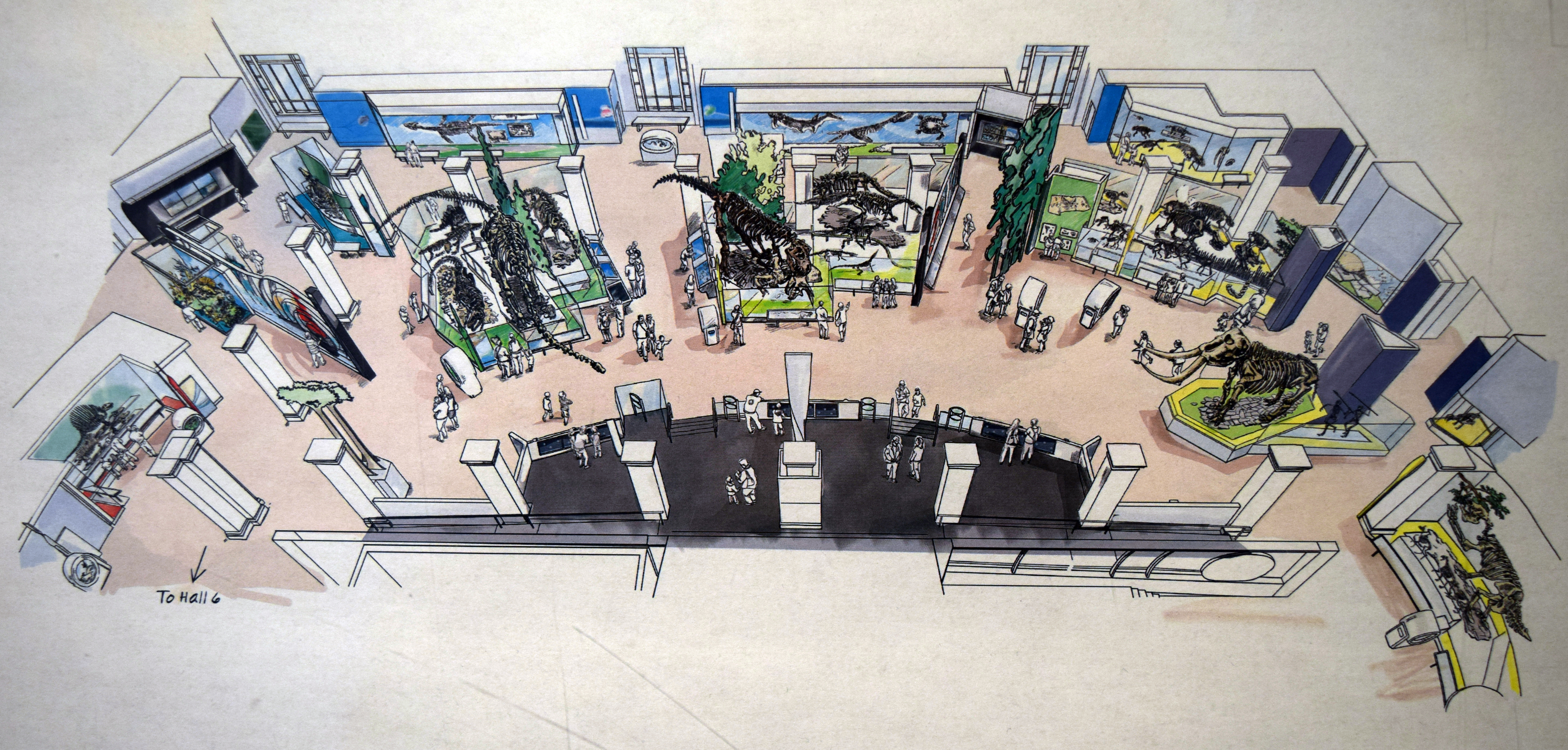
The paleontology hall—entitled Past Worlds—occupies about half of the total exhibit space, and fittingly it is the first area visitors encounter if they choose to start at the bottom. The hall is open and spacious, but visitors cannot access the entire exhibition at once. Instead, they follow a zigzagging, switchbacking path, with new sight lines opening up as they go. Monumental elements—namely, the dinosaur skeletons, wall murals, and immersive dioramas—are encountered multiple times from different perspectives.

One example is a life-sized diorama of the lake bottom where fossils of the Green River Formation were preserved. Visitors first see this tableau from an “underwater” perspective. Then, some time later, visitors encounter this same scene again, now looking down from the “surface.” Elsewhere, dinosaur skeletons that can be seen from different vantages are interpreted in multiple ways, depending on what else visitors can currently see and compare them to. This series of reveals and payoffs reminds me of the carefully constructed experiential narratives in theme parks, but precisely applied to help visitors learn about ecology and geology. It’s really cool.

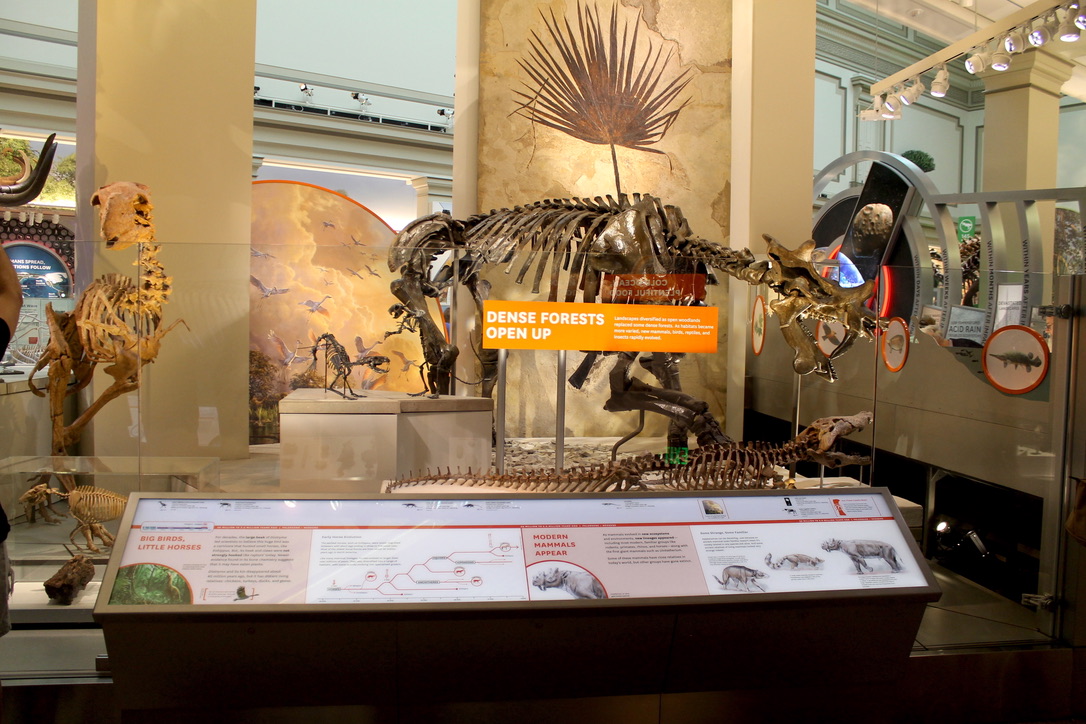
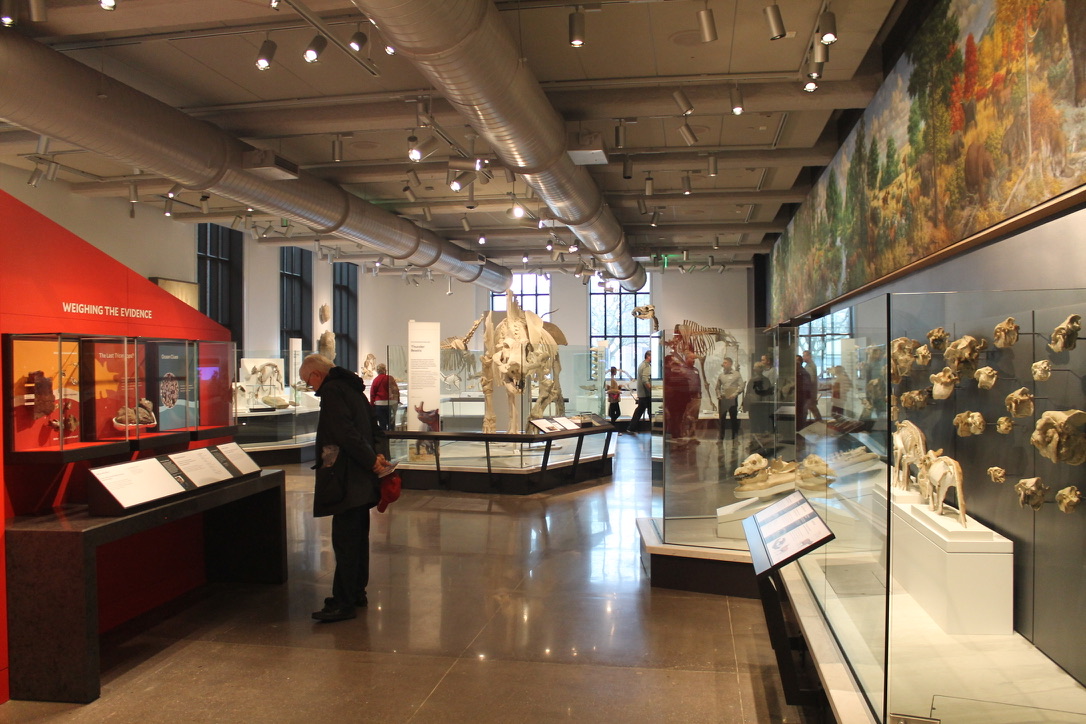
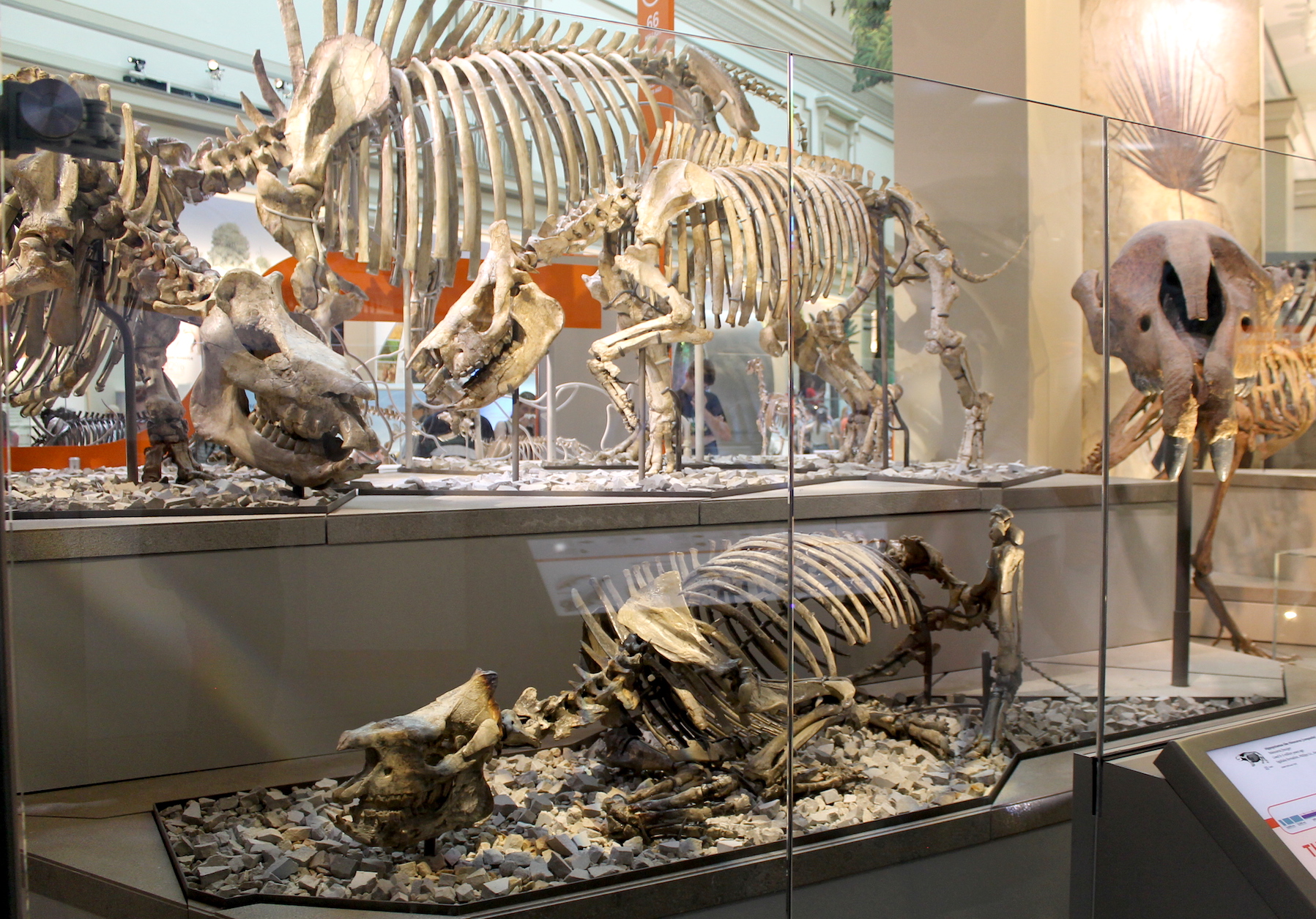
Uintatherium and Patriofelis foreground multiple layers of mounted skeletons. Photo by the author.

The hall’s color palate is a mix of earth tones and grayscale. Some of this comes from the mounted skeletons, which range from the charcoal gray of Morrison fossils on one end of the space to brown and beige Cretaceous and Cenozoic fossils on the other. Four giant, vertically oriented murals also contribute to the look and feel of the space. Corresponding to the Jurassic, Cretaceous, Paleogene, and Quaternary areas of the hall, these black-and-white murals focus on the flora and landscapes of these eras—you have to look closely to find the animals. I couldn’t find a label identifying the artist, but the murals’ dark foregrounds and bright backgrounds remind me of the original King Kong (or if you want to be fancy, the engravings of Gustav Doré).

Local tyrants Lythronax and Teratophoneus get the most attention, but an obligatory cast of the Wankel/Nation’s T. rex is also present. Photo by the author.

As suggested by the murals, the overall space is arranged chronologically. However, the switchbacking path through the exhibition means that visitors start in the recent past and move back to the Jurassic, before reversing direction and moving forward in time. While a time axis is present, Past Worlds is less about presenting a comprehensive narrative of the history of life and more about zeroing in on a few particular ecosystems that once existed in Utah. These include the Morrison Formation of the Jurassic, the Cedar Mountain, Kaiparowits, and North Horn Formations of the Cretaceous, the Green River Formation of the Paleogene, and the recent Ice Ages. These deep dives into specific habitat groups are relatable, digestible, and easy to contrast with one another and the modern world—indeed, I have been not-so-subtly trying to coax the paleontology exhibits at my own institution in the same direction.

The mounted skeletons have fared well, considering that they’re all in open air and easy to reach. Photo by the author.

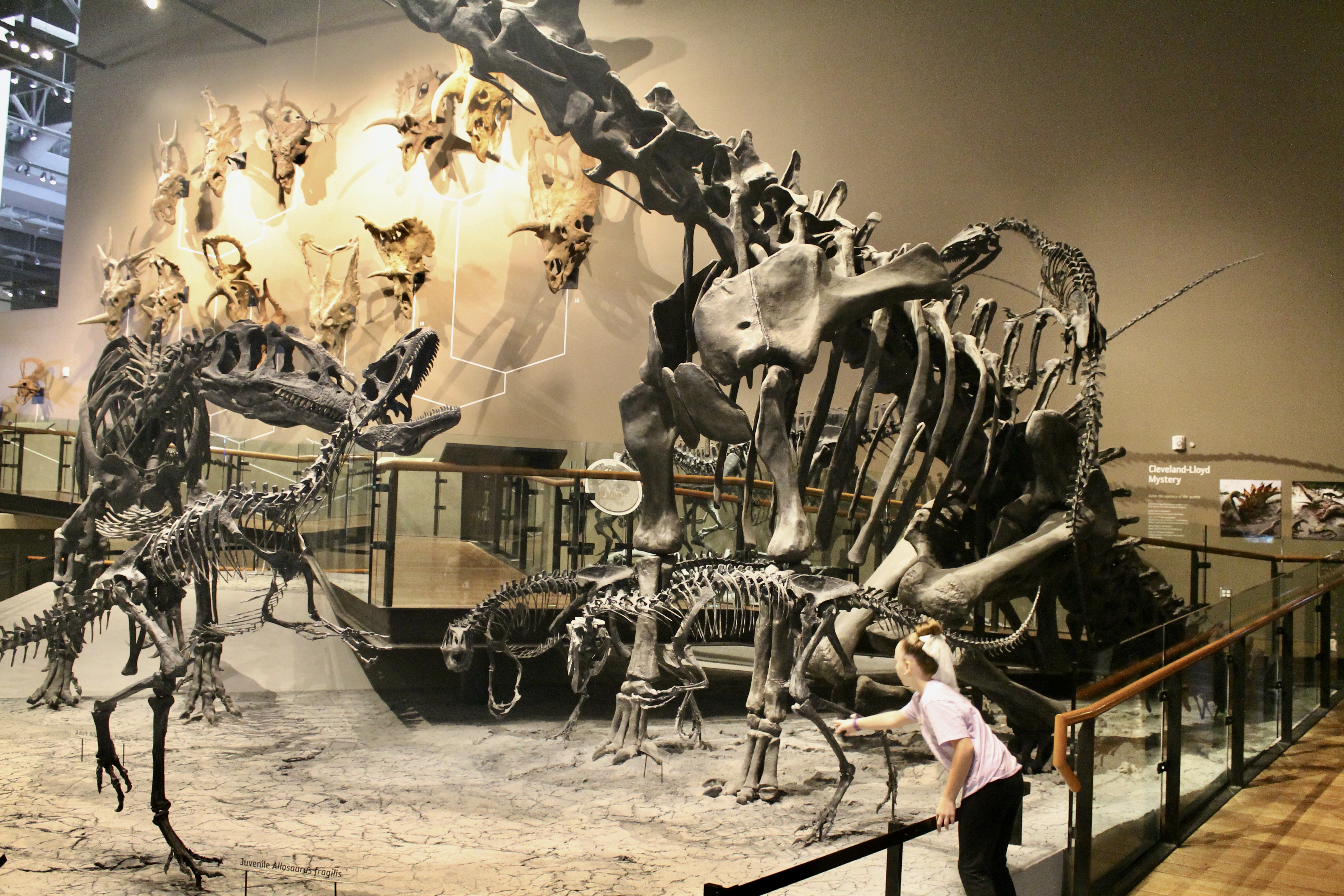
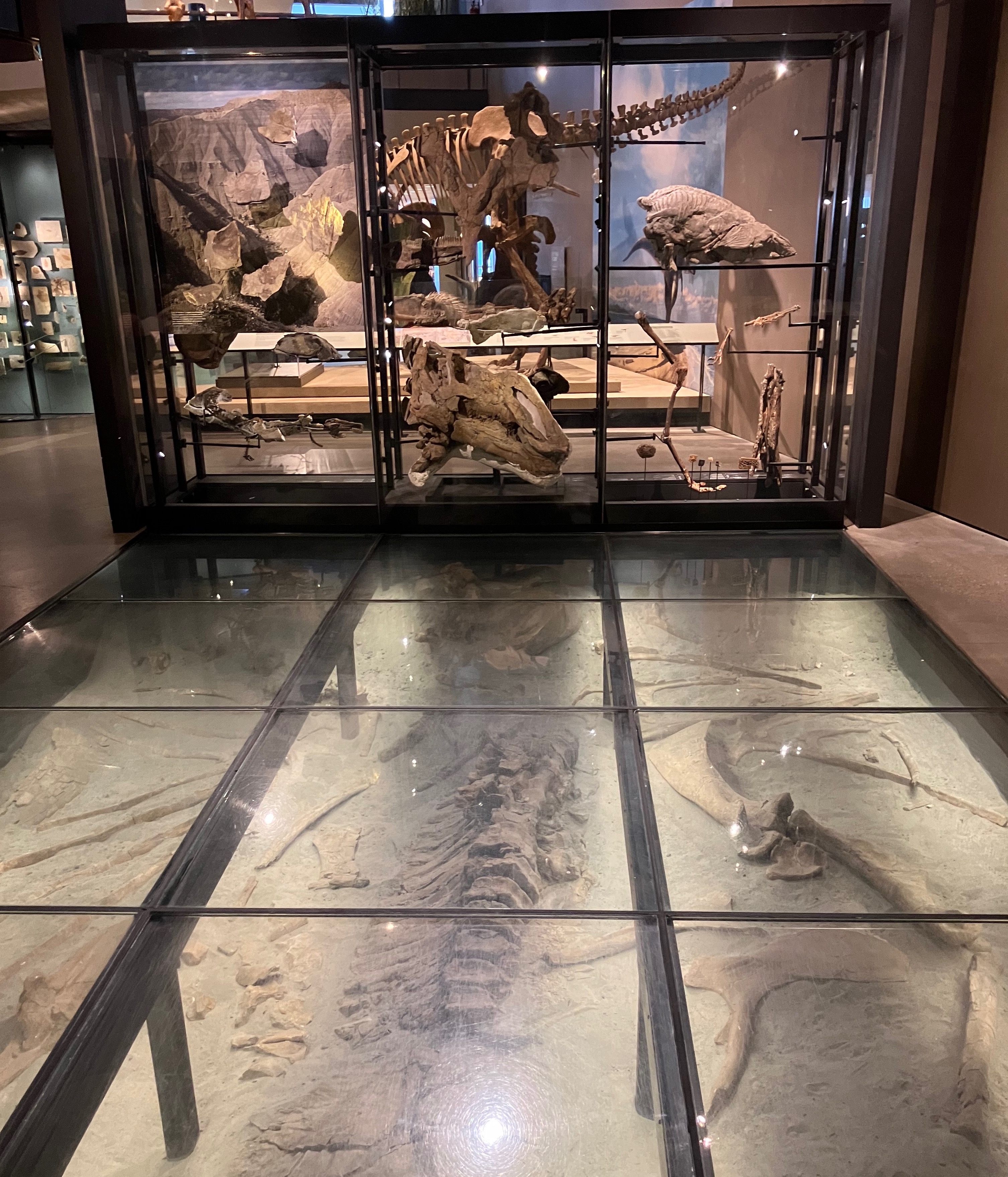
Past Worlds features hundreds of fossil specimens, nearly all from Utah or adjacent states. There are more than 40 mounted skeletons, many of which were firsts for me—I’ve never seen a mounted Marshosaurus, Akainacephalus, or Patriofelis before! Notably, all but one of the standing mounts (the Gryposaurus) are casts. This is not due to a lack of material—most of the mounts are based on fossils from NHMU’s collection. Clearly, somebody made the decision to draw a firm line between the real specimens and the dynamic reconstructions—a line that other museums have traditionally blurred. I think it’s fair for some visitors to be disappointed by this, but using casts allows for some lively and energetic displays. The group of Allosaurus swarming a Barosaurus mired in mud is particularly evocative (and incidentally, the way the sauropod’s tail sweeps under the path and curls overhead is so cool). Besides, there are plenty of real fossils to see, many of which are very strikingly displayed. I was impressed by an in situ hadrosaur skeleton under the floor, which seamlessly merges with a vertical case of Kaiparowits fossils that appears to be rising out of the ground.

I’m not sure how easy this is for scientists to access, but it sure looks neat. Photo by the author.

Individual labels are commendably brief, and tie each fossil to the larger stories being told. I was pleasantly surprised that the ID lists the discoverer and the preparator of each fossil, when known. Most labels also include a skeletal diagram showing where individual bones fit into the larger skeleton, but these were frustratingly small and almost impossible to make out (a problem shared with similar graphics at NMNH).

There are plenty of touchable displays, but media is used sparingly. A highlight is a four-part program in which scientists propose different possible causes for the Cleveland-Lloyd assemblage of Jurassic fossils. Visitors are then prompted to vote on which hypothesis is most convincing. The program is several minutes long, but visitors appeared to be staying for the entire thing, and causing a traffic bottleneck in the process.

As you can assuredly tell, I was extremely impressed by NHMU. Meaningful design and a thoughtful approach to visitor experience combine with accessible interpretation and some extraordinary fossils to create a truly outstanding example of a natural history exhibition.

3 Comments

Filed under dinosaurs, exhibits, fossil mounts, mammals, museums, reviews

The Dueling Dinosaurs: famous fossils in an open lab

A partially prepared tyrannosaur skeleton in a field jacket. Photo by the author.

Earlier this month, I had the a chance to see the “Dueling Dinosaurs,” which debuted at the North Carolina Museum of Natural Science (NCMNS) in April. Consisting of virtually complete skeletons of a tyrannosaur and Triceratops preserved side-by-side, this fossil is either the find of the century, or just another example of overhyped, overstudied, and overpriced Hell Creek dinosaurs—it depends on who you ask. But NCMNS has made it more than that, placing the fossil at the center of an ambitious project to improve science literacy by removing all barriers to the process.

Commercial collector Clayton Phipps discovered the skeletons in 2006, on private ranchland in Montana. Having never worked on anything so large before, Phipps teamed up with the Black Hills Institute for the initial preparation and assessment of the fossil. The skeletons were put up for auction in 2013, resulting in what has become a familiar din of competing voices. The sellers heralded the rarity and quality of the fossil, proclaiming it to be a clear example of dinosaurs that perished while locked in combat. Paleontologists countered that a fight-to-the-death scenario was unlikely, and without scientific study, the circumstances of the dinosaurs’ demise could not be known. Furthermore, in the event that the fossil went to a private buyer, there would be no opportunity to study it. The so-called Dueling Dinosaurs were poised to become yet another example of a high-profile specimen sold into private hands, where they could never contribute to scientific and public knowledge.

As it happened, the auction was a failure, and bidding never reached the reserve price. Behind the scenes, however, the Friends of the North Carolina Museum of Natural Science—a non-profit organization that supports the state-run museum—had put forth an offer of six million dollars for the fossil. To be clear, a mid-sized public museum like NCMNS absolutely does not have $6 million on hand for specimen acquisition. The funding came from private donations solicited by the Friends organization.

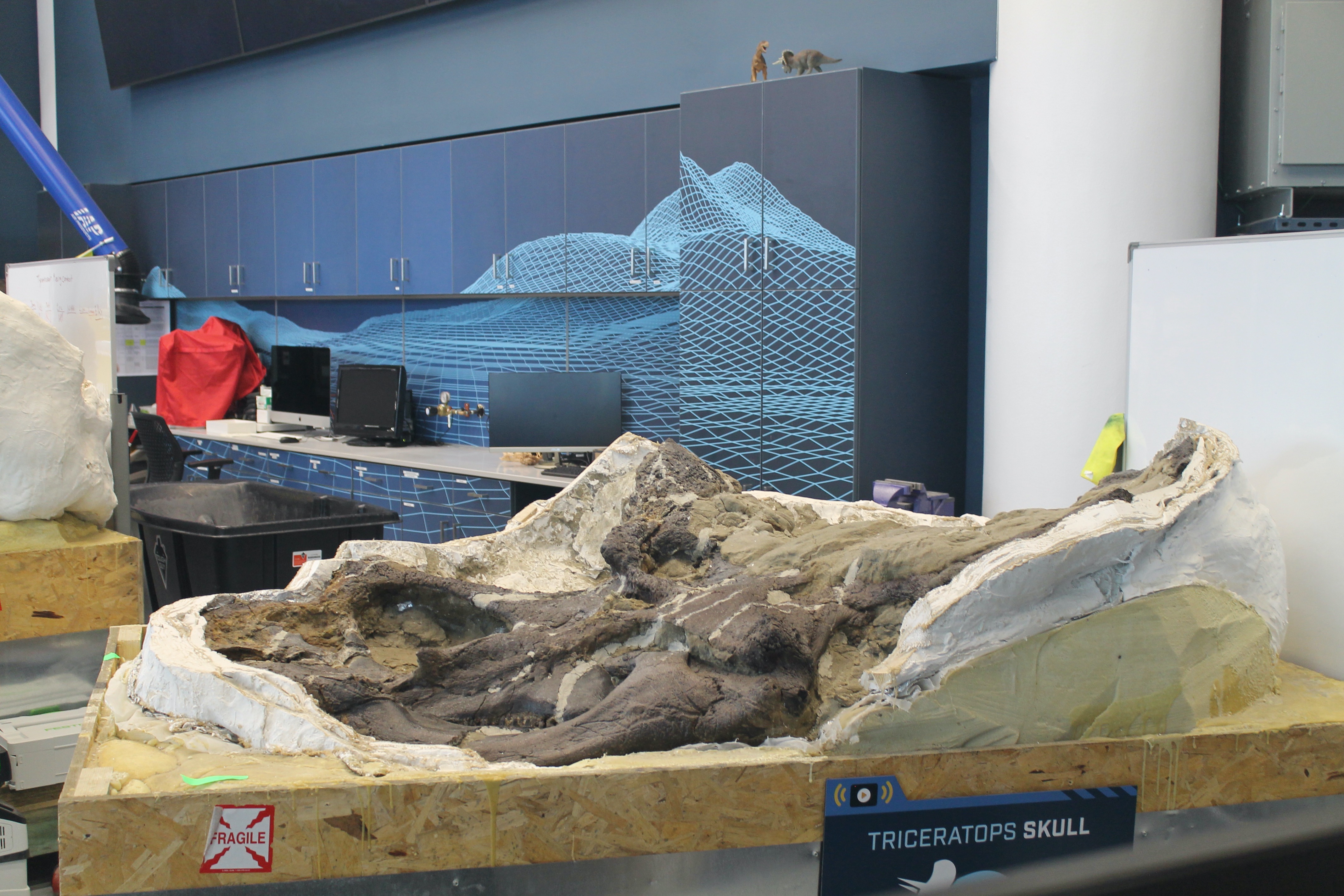
A partially prepared Triceratops skull in a field jacket. Photo by the author.

The offer was accepted, but there was another hurdle: a legal challenge over ownership of the land the fossil was found on. In Montana, surface rights (ranching, farming, etc.) and mineral rights (oil, coal, uranium, etc.) to the same parcel of land can be split among different owners. When the Dueling Dinosaurs fossil was collected, arrangements were made with surface landowners Lige and Mary Ann Murray, but other parties had partial claim to the mineral property. Those individuals—Jerry and Bo Severson—sued, arguing that fossils are minerals and should belong to them. In 2020, the Montana Supreme court ruled that for legal purposes, fossils are “land” and therefore belong to surface landowners. With the sale completed, the next stage in the Dueling Dinosaurs story could begin.

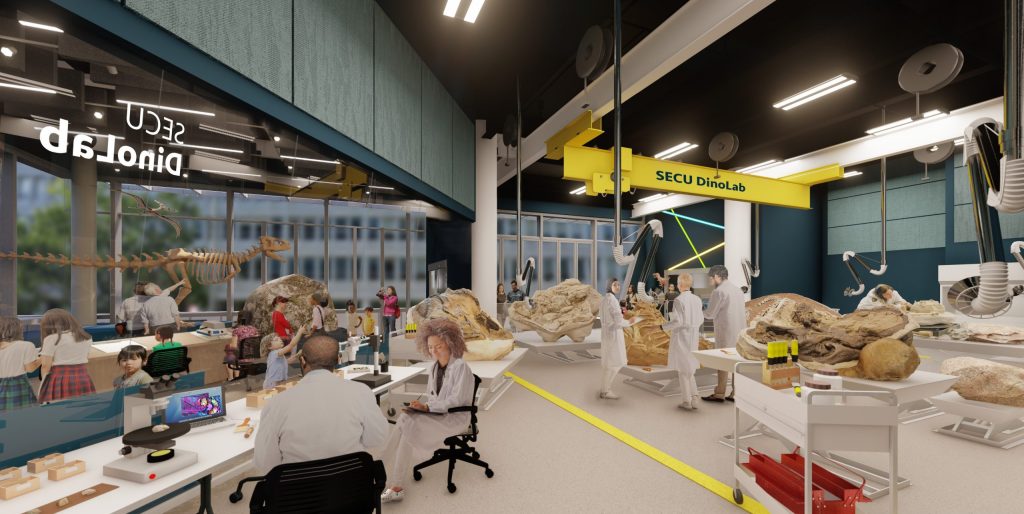
Concept render of Dueling Dinosaurs lab and exhibit by HH Architecture. Source

Having already pushed for the acquisition of the fossil, NCMNS Head of Paleontology Lindsay Zanno took charge of the project. Her vision was to create a completely open fossil preparation lab. Rather than being behind glass, the scientists working on the Dueling Dinosaurs would be available for conversation with the public whenever the museum was open. As Zanno explained in an interview, “I conceived the Dueling Dinosaurs project to take the public on a live scientific journey, to illuminate how science works, to show who scientists are and what we look like, and to increase trust in the scientific process.”

To accomplish this, NCMNS hired local firm HH Architecture. They designed the state-of-the-art lab to Zanno’s specifications within the Nature Research Center, the second wing of NCMNS that opened in 2012. The addition also includes two flanking exhibit galleries and street-facing, floor-to-ceiling windows, which allow passerby to see into the lab.

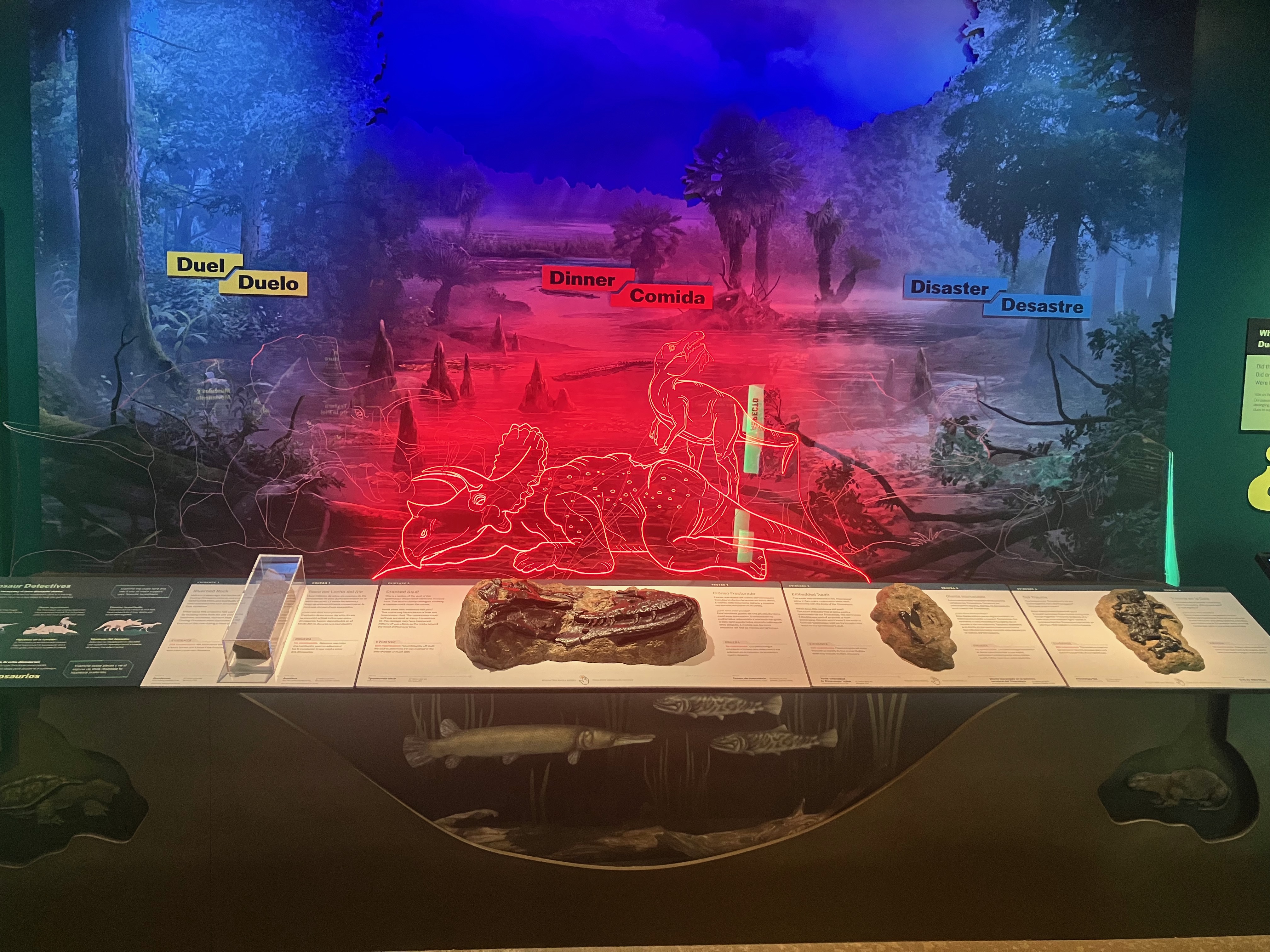
LED images of the three hypotheses cycle across a central display in the first gallery. Photo by the author.

Visitors enter the Dueling Dinosaurs exhibit on the Nature Research Center’s ground floor. The first gallery introduces visitors to the ecosystem of Late Cretaceous Montana. Green panels and walls situate visitors in this verdant environment. After passing small cases with turtle, crocodile, fish, and plant fossils (the purchase of the Dueling Dinosaurs included access to the discovery site, but these are on loan from the Denver Museum of Nature and Science), visitors reach a large display introducing the central mystery of the Dueling Dinosaurs. The exhibit presents three possible scenarios that could have resulted in the dinosaurs being preserved together: duel (a fight to the death), dinner (the tyrannosaur perished while scavenging on Triceratops), or disaster (the animals died separately and were washed together in a flash flood). Color-coded LED outlines of the dinosaurs illustrate the three scenarios in front of an illustrated backdrop.

While these scenarios are presented as being equally plausible, most paleontologists agree that the “disaster” scenario is the likeliest of the three. The real purpose of the exhibit’s presentation is to introduce visitors to the process of stating a hypothesis and finding supporting evidence. Remember, a major part of the rationale behind acquiring the fossil and creating this is exhibit was to show the public what scientists do, and why scientific conclusions are trustworthy. This inquiry-based display attempts to coax visitors through the process of considering the available evidence, and letting it lead them to a conclusion.

Projected images and text augment a sculpture of the fossils. Photo by the author.

Visitors’ next stop is the lab itself, but traffic is controlled by a roughly 4-minute media presentation at the far end of the first gallery. Relief sculptures of the Dueling Dinosaurs skeletons at 50% scale are the centerpiece of this display. Projected images to the left and right—and on the sculpture itself—illustrate the story of where the fossil came from and what scientists hope to learn from it. Certain moments, like a laser scan across the fossil, suggest at least a little inspiration from the SUE show at the Field Museum. The animated tyrannosaur and Triceratops that appear throughout this and other media pieces in the exhibition were created by Urvogel Games, the people behind the dinosaur simulator game Saurian.

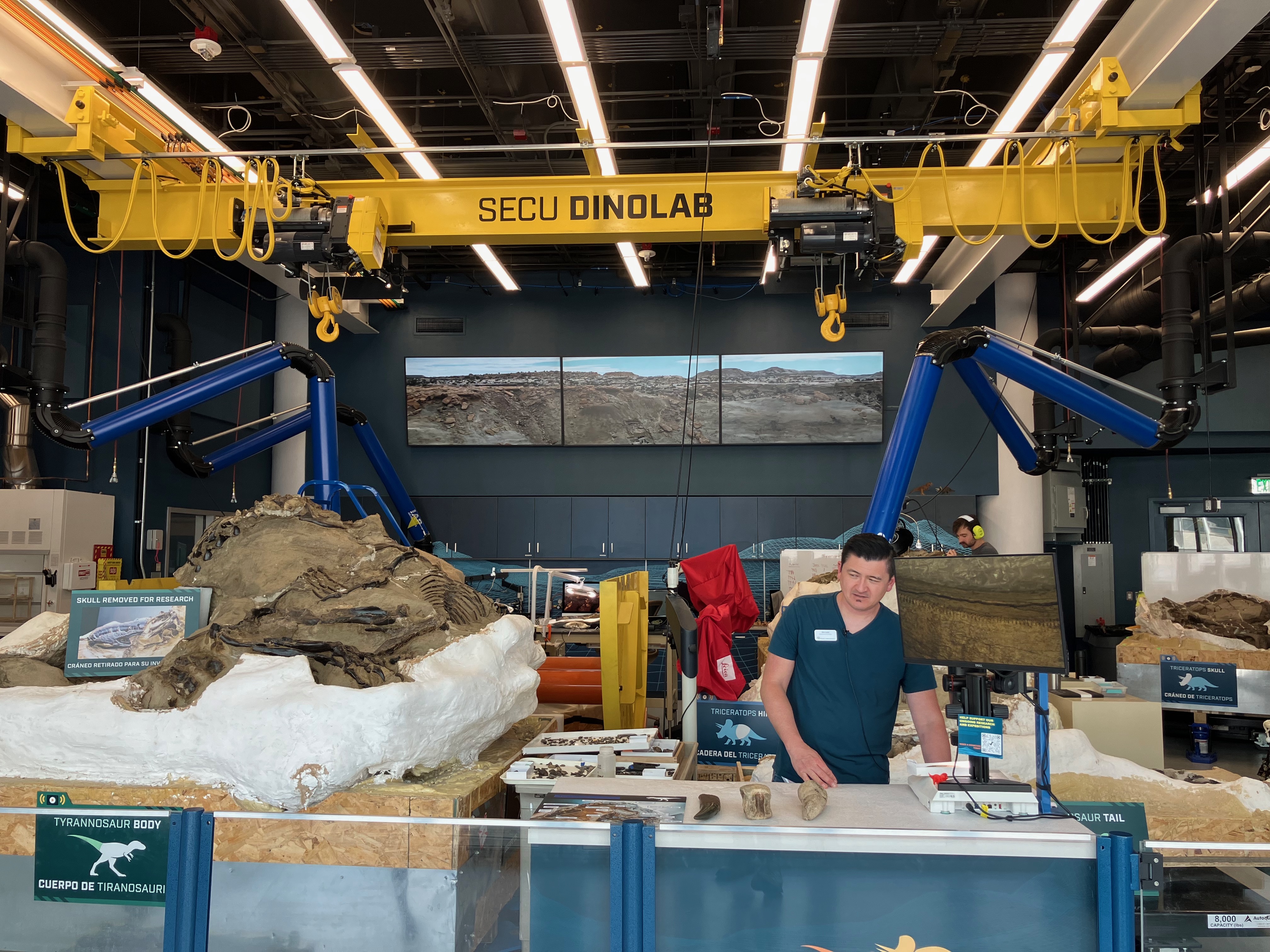
Once inside the lab, nothing but a short plexi barrier separates visitors from the preparators at work. As a former/occasional fossil preparator myself, I can tell you that this space is really, really impressive. It’s not enormous, but it’s big enough to comfortably hold four large jacketed matrix blocks. A 10 ton capacity crane looms overhead, and pneumatic hook-ups for air scribes and dust collectors are within reach throughout the space. I was particularly impressed by a rig that can rotate large jackets on their vertical axis, allowing them to be prepared from multiple directions. No less than seven preparators have been hired to staff this lab, so visitors should find people working all the time. Part of the preparators’ responsibility is to be available to answer questions. Typically, one person is posted by the barrier while the rest of the team works in the background.

An overview of the public lab. Photo by author.

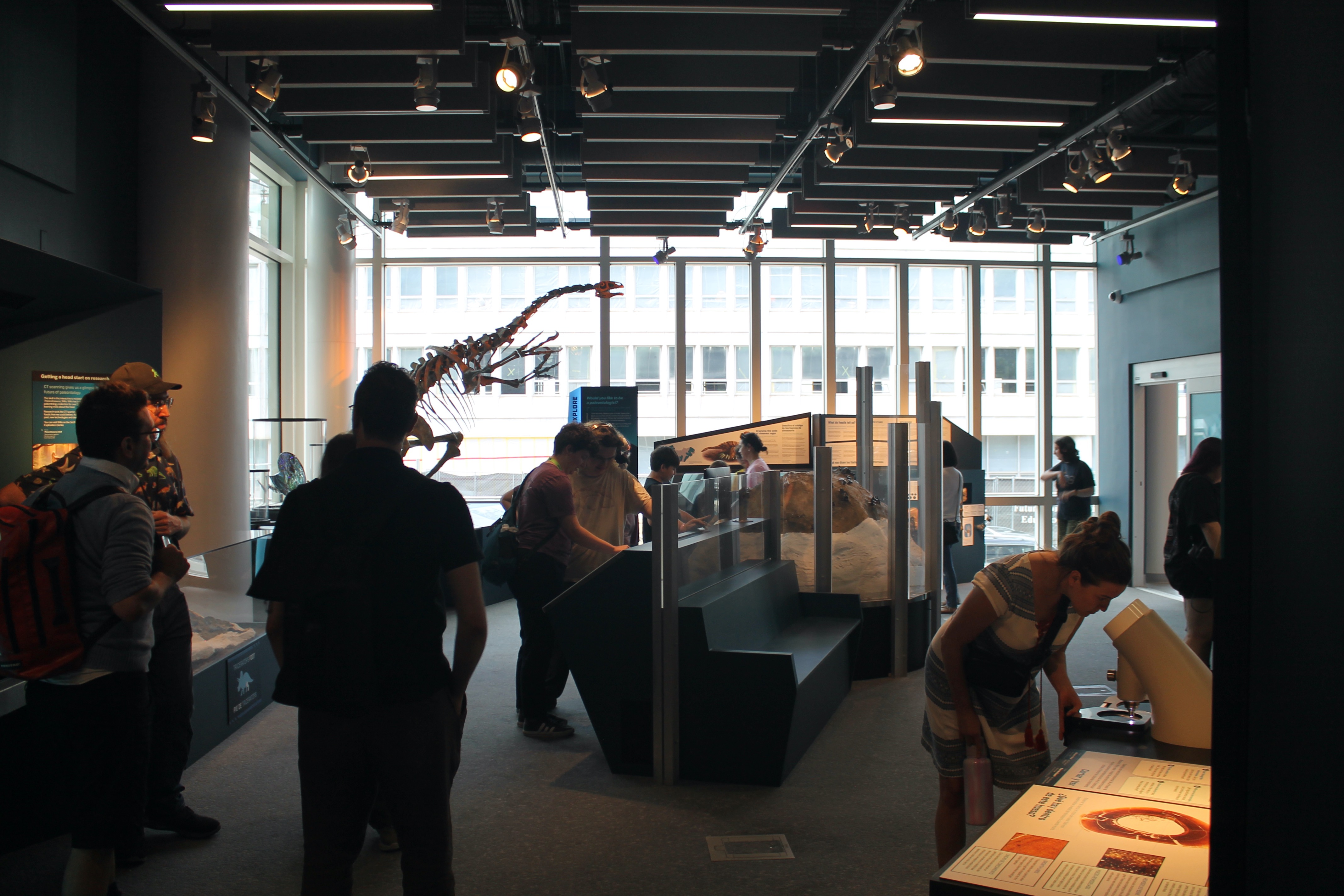
The second gallery space is not about the Dueling Dinosaurs specifically, but about the tools and techniques paleontologists use to learn about the past from fossils. The most prominent displays are a cast of Nothronychus (a dinosaur described by Zanno and colleagues) and a nest of oviraptorosaur eggs from Utah. Visitors can touch the tools used by fossil preparators, perform a simulated CT scan of a Thescelosaurus skull, and look through a microscope at growth lines in a sectioned dinosaur bone. I was told this gallery wasn’t quite finished, which might be why it felt unfocused to me. A more prominent header and summative statement at its entrance about the purpose of the gallery might help.

“Science has an accessibility problem,” Zanno said in an interview, “and mistrust in science is rising. We have to bring science out of the back corners and basements…and let our community see who we are and what we do.” The Dueling Dinosaurs exhibition has done exactly that—visitors could not be closer to the process of preparing and studying these fossils without being handed an air scribe. So how is that working out?

Visitors explore interactive stations in the second gallery. Photo by the author.

I detected a hint of frustration coming from the team members I spoke to. Too many visitors are fundamentally misunderstanding what they are seeing in the lab. They assume the preparators are actors and the fossils are fake, and are often incredulous when told otherwise. The concept that a museum is a place where new science happens is also surprising to a plurality of visitors. One strategy the team has employed is to set up a table of matrix and fragments for the preparator on interpretive duty to sort through. That way, they are clearly working on something when visitors enter and are less likely to be mistaken as an actor or volunteer. Still, if visitors are struggling to recognize real scientists in a real lab when presented with them, the need for access to science in action may be even greater than anticipated.

This might be a “when you have a hammer, everything looks like a nail” situation, but I think some reframing of the exhibition and how its presented could go a long way. Right now, the experience is titled “Dueling Dinosaurs,” which is undoubtedly compelling, but elicits its own set of expectations and assumptions about what visitors will see and do. Why not present the experience as what it really is—an opportunity to meet real paleontologists in their place of work? Would it be possible to reverse the order of visitor flow, so they see the gallery about how paleontology is done first, then visit the lab, then finish by learning about the Dueling Dinosaurs as a case study?

A media-based interactive allows visitors to apply different color patterns to an animated Triceratops, rendered in real time. Photo by the author.

Preparing the fossil is expected to take about five years. The goal is to keep the skeletons in their death positions and eventually display them in relief, somewhat like the model in the media presentation. How much matrix to remove is a moving target. The tyrannosaur’s skull has already been CT scanned multiple times with disappointing results. More matrix will need to be cleared to get a good image of the inside of the skull. Meanwhile, extensive skin impressions are preserved across both skeletons, and the team hopes to leave much of this in place. The process is being slowed somewhat by the need to scrape and chip away irreversible glue that was applied by the original preparators.

Aside from determining whether the dinosaurs actually died fighting (don’t count on it), one of the most anticipated answers the project is expected to provide is the identity of the tyrannosaur. When the fossil was at the Black Hills Institute, Pete Larson concluded that it was a Nanotyrannus—a controversial name applied to fossils that many paleontologists think are actually juvenile Tyrannosaurus rex. Indeed, when the fossil was up for auction, it was marketed as a young T. rex, probably for the sake of name recognition. The NCMNS team will eventually weigh in after studying the skeleton more thoroughly.

The lab itself is expected to remain in place once the Dueling Dinosaurs are prepared. The museum already has other very large fossils awaiting preparation.

If you’re able to visit Raleigh, I highly recommend visiting the Dueling Dinosaurs, the open prep lab, and the rest of NCMNS (the museum is free). You can also monitor the preparation process online. Many thanks to Jennifer Anné, Paul Brinkman, Elizabeth Jones, Christian Kammerer, and Eric Lund for speaking to me about the exhibition. Any factual errors are my own.

3 Comments

Filed under dinosaurs, education, exhibits, marginocephalians, museums, NCMNS, opinion, reviews, science communication, theropods

Review: the new Peabody Museum

Tylosaurus and Archelon skeletons soar overhead in the Peabody Museum’s brand-new lobby. Photo by the author.

For decades, the Yale Peabody Museum of Natural History (YPM) was a museum frozen in time, with no comprehensive updates to its paleontology halls since the 1950s. Then, around 2010, serious discussions began about overhauling the dinosaur and fossil mammal exhibits. Fundraising started in 2015, and in 2018, the museum announced that it had received a $160 million donation—enough to renovate not just the paleontology halls, but the entire museum. YPM closed its doors at the beginning of 2020, and on March 26 of this year, it reopened to the public once again.

Technically, this is a soft opening. The third floor—which houses the museum’s classic taxidermy dioramas—has not yet opened, and a scattering of cases around the museum are empty as of this writing. Still, there is plenty to see: during the renovation, YPM gained a new, multi-story lobby (connecting the museum to the academic building next door), as well as new collections facilities, classrooms, and 50% more exhibit space. And most importantly, the paleontology halls are open and just about complete.

A Geosternbergia cast demonstrates its quad-launching technique in the museum’s entryway. Photo by the author.

The remaking of the YPM exhibitions was a collaborative effort between internal staff (led by Kailen Rogers, Chris Norris, Susan Butts, Jacques Gauthier, and others) and two outside design firms—Centerbrook Architects and Planners provided the high-level design of museum and surrounding area , while Reich + Petch worked on specific exhibit elements and graphic design.

I spent a few hours at YPM last week, and the new halls were absolutely worth the wait. What I found most striking is that the paleontology halls feel at once new and familiar. The dimensions of the dinosaur and fossil mammal halls (officially, the Burke Hall of Dinosaurs and A World of Change) remain identical, and they are still anchored by Rudolph Zallinger’s magnificent fresco murals—The Age of Reptiles and The Age of Mammals. Charles Beecher’s relief mounted Edmontosaurus was left in place, and the overall layout and flow of the spaces have not been radically altered. On the other hand, white walls and new windows and skylights have transformed what had been fairly gloomy spaces into bright, open expanses. There are dozens of new specimens on display, in addition to plenty of returning ones. And a third gallery has been added to the paleontology wing: called The Human Footprint, this space explores how humans have interacted with the natural world over the past hundred thousand years or so.

The remounted Stegosaurus looks back toward Zallinger’s Age of Reptiles. Photo by the author.

The primary themes of the paleontology exhibits are displayed at the entrance to Burke Hall: “life affects the environment and the environment affects life” and “extinctions change everything.” Much like Deep Time at the National Museum of Natural History, YPM’s exhibits emphasize that the evolution of life on Earth did not occur in a vacuum, but as part of a continuously changing global system. This narrative does have a time axis—visitors follow along from the Edicaran to the present day—but the precise devisions of geologic time are often de-emphasized in favor of the broad environmental transitions that triggered evolutionary innovations.

This presentation of the evolution of life compliments the existing Zallinger murals. Painted between 1942 and 1967, these are among the most iconic images of prehistoric life ever created. Although some of the animal reconstructions are outdated, Zallinger was in other ways ahead of his time. Rather than giving the geologic periods hard borders, he artfully wove the sections together so that each one fades imperceptibly into the next. The viewer can see that the flora, fauna, and climate are changing over time, but it’s a gradient, not a ladder. Incidentally, it was not a given that the Zallinger murals would be preserved. Great credit is due to the YPM team for not only retaining the murals, but utilizing them as a key part of the new exhibition’s narrative.

Brontosaurus reclaims its place as the centerpiece of the dinosaur hall. Photo by the author.

One clear advantage of a wall-to-wall renovation is that the exhibits are much better organized than before. In the old dinosaur hall, visitors encountered an essentially random succession of displays: from modern sea turtles to Triassic trees and from a Cretaceous mosasaur to a Quaternary mastodon. Now, the displays run chronologically, and more or less in sync with the Zallinger mural. Visitors can follow the history of life in the sea on the west side of the hall, and the history of terrestrial life on the east side. I also suspect that placing Brontosaurus and a brontothere as central anchors in their respective halls was a deliberate choice.

A very large Megacerops stands on a central platform in the reimagined Cenozoic hall. Photo by the author.

Research Casting International remounted several historic skeletons with characteristic artistry and skill. I will have a separate article about the mounted skeletons sometime soon, but the remounts are Brontosaurus, Stegosaurus, Deinonychus, Archelon, Moropus, Megaloceros, a mastodon, and a dodo. Brand new mounted skeletons include Tylosaurus, Poposaurus, and a Geosternbergia family of four (plus a few secret mounts outside the neighboring Marsh Auditorium). At least fifteen existing mounts have returned. As Postdoctoral Fellow Advait Jukar explained to me, the goal for the mounted skeletons was to portray “living, breathing animals, rather than looking like they’re posing for a portrait.” For example, the aggressive rutting posture of the Irish elk was directly inspired by the classic bull moose diorama at the American Museum of Natural History.

Mounted skeletons aside, there are some really extraordinary fossils in these halls. Some of the specimens that caught my eye include a geode bird egg with an embryonic skeleton inside, the bizzare Arsinotherium from Egypt’s Fayum region, a Nothrotheriops with patches of hair and skin, and the early Jurassic dinosaurs Podokosaurus and Anchisaurus.

Remounted Irish elk and mastodon in the Human Footprint gallery. Photo by the author.

While many of the fossils speak for themselves, the halls are also populated with several new models and replications, which imbue the extinct species on display with life and personality. The towering Gastornis created by Blue Rhino Studio is the clear standout—I like that it looks like its gazing longingly back toward the Mesozoic dinosaurs in the adjacent hall. Other highlights include a slab of Edicaran weirdos and the mammal Rapenomamus attacking a Psittacosaurus at the feet of Brontosaurus (I would have liked to see a baby sauropod as the prey, but maybe that would be too much for squeamish visitors).

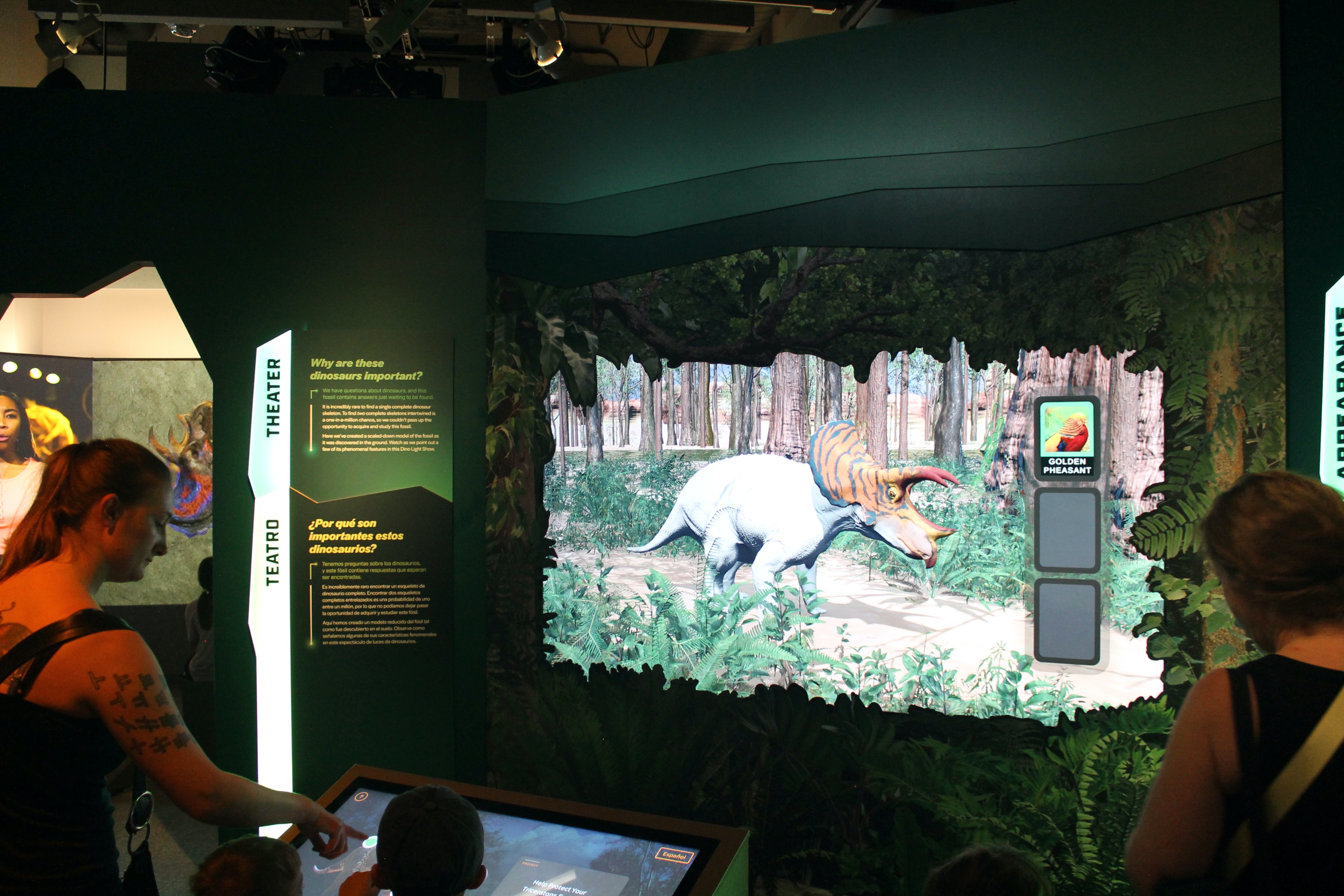
Meanwhile, the YPM team made some selective forays into the realm of media and digital interactives. Most (possibly all?) of these take the form of slideshows on large touchscreens. These are an effective way to condense a lot of information into a limited space, and allow for some visitor choice in what topics interest them. I thought an interactive where visitors could explore the propagation of horses, humans, and tomatoes around the world was particularly well done.

Gastornis is a highlight of the Cenozoic Hall. Photo by the author.

I would expect an institution like Yale to be protective of its legacy and history, so I was surprised to find a prominently placed rebuke of superstar 19th century paleontologist O.C. Marsh in the dinosaur hall. As Advait described it, this is an “and” statement: Marsh was instrumental in shaping our understanding of prehistory and evolution and he collected from Native land without permission, looted graves, and was academically dishonest.

The call-out of Marsh wasn’t the only unexpectedly progressive element in the new exhibits. A brontothere fossil is interpreted with a poem by a trans teenager, which criticizes imperialistic scientists for imposing their way of knowing upon the world. Elsewhere, a display of fossils from the Santa Fe Formation in Argentina is accompanied by printed labels solely in Spanish—perhaps a statement about whose voices should be heard when interpreting the natural heritage of a given region. Natural History Conservator Mariana di Giacomo told me that these displays are part of an effort to include a wider range of perspectives in YPM exhibits. Other examples include musings from artist Ray Troll on being a “highly motivated fish” and psychologist Eli Lobowitz’s take on why kids love dinosaurs.

Deinonychus and Poposaurus are the largest saurian carnivores on display. Photo by the author.

My critiques of the new paleontology halls are pretty limited. There are more typos and inconsistencies in the labels than there ought to be, particularly in the age ranges given for certain specimens. I overheard multiple visitors concluding that the Edmontosaurus skeleton was a T. rex, and I suspect an image of Tyrannosaurus placed in front of the Edmontosaurus is to blame. In one area, the writer uses terms like “stem reptile,” “early stem land egglayer,” and “stem amniote” as common names for various species. Even with some specialized knowledge I don’t understand what distinction they were trying to make, and I can’t imagine those terms are helpful for most visitors.

The most pervasive issue is the inconsistent quality of 2-D life reconstructions used on graphics throughout the halls. With a few exceptions, it appears that the exhibition’s creators used whatever images were available, including stock renders and illustrations pulled from Wikipedia. For many people (especially children) unaccustomed to interpreting bones, life reconstructions can be more meaningful than the actual fossils. It’s worth budgeting for original, quality artwork whenever possible. Put that $41 billion Yale endowment to use!

A graphic with a particularly uninspired illustration from a stock image provider. Photo by the author.

Speaking of Yale’s effectively bottomless pockets, the best news about the new YPM is that it’s 100% free. This is an excellent precedent to set: there’s no better way to welcome a broader audience and remove barriers from engagement with science than doing away with admission fees. I hope other museums follow YPM’s lead on this front and work to free themselves from reliance on admission income.

More on fossils at the Peabody soon!

10 Comments

Filed under dinosaurs, exhibits, fossil mounts, mammals, museums, opinion, paleoart, reviews, science communication, YPM

Great Whales at the Royal Ontario Museum

IMG_9913

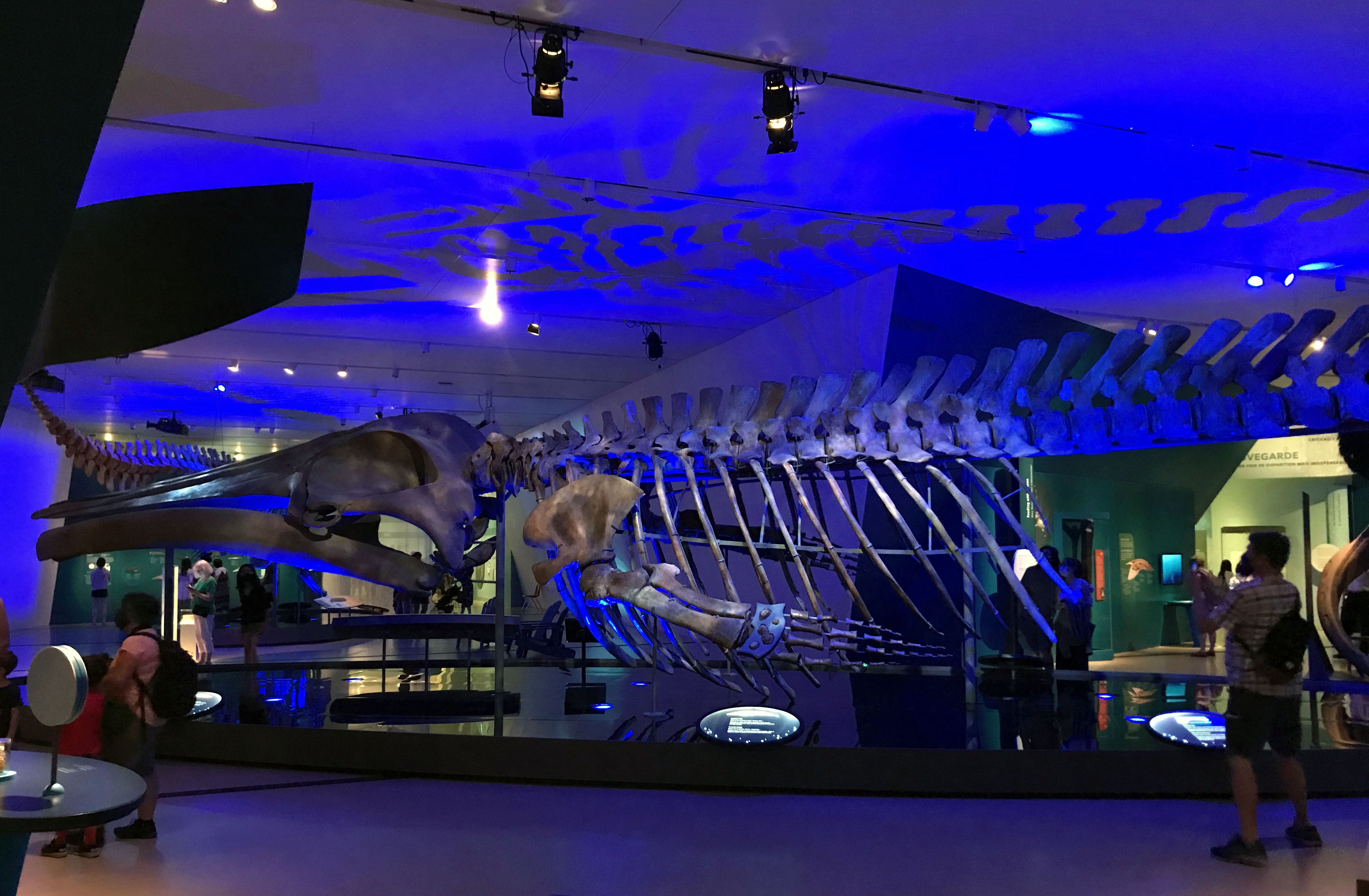
The sperm whale Alulgwet is the first of three skeletons visitors encounter.

This past weekend, I had an opportunity to visit the Royal Ontario Museum, checking another North American natural history museum off my bucket list. There’s plenty to say about the ROM, but I’d like to focus on Great Whales: Up Close and Personal, a temporary exhibition that opened this summer. Great Whales is, in a word, magnificent. It is among the very best natural history exhibits I’ve seen in recent years—no small feat given that much of its development occurred in the midst of the ongoing pandemic.

An exhibit is a story told through physical space, made up of words, objects, images, sounds, and experiences. Great Whales leverages all of these tools to not only immerse visitors in the multi-faceted world of giant whales, but also evoke feelings of awe, reverence, and humility. More than any exhibit or wildlife documentary in recent memory, Great Whales captures the humbling effect of real encounters with the natural world. 

IMG_7952

Displayed at eye level, the scale of this blue whale—80 tons in life—is particularly apparent.

The presence of three real whales is a major part of this. The colossal skeletons of a sperm whale, a blue whale, and a right whale dominate the space, but they are introduced as individuals, rather than specimens. They each have a name and a story: for example, the right whale Alasuwinu was found dead on Epekwitk/Prince Edward Island in 2017. Scientists had tracked this adult male for many years and he had survived a number of close calls with fishing nets, but he ultimately perished after being struck by a boat.  

The ethereal atmosphere of the exhibition is also powerful. The whale skeletons are bathed in a blue glow, casting mesmerizing shadows on the walls and ceilings. Sounds of the ocean—including whale songs—can be heard throughout. In one corner, the whale songs are played at their true volume, which is loud and deep enough to feel in your bones. It’s hard not to imagine sailors from centuries past lying awake at night and hearing those eerie rumbles through the hulls of their ships.

IMG_9951

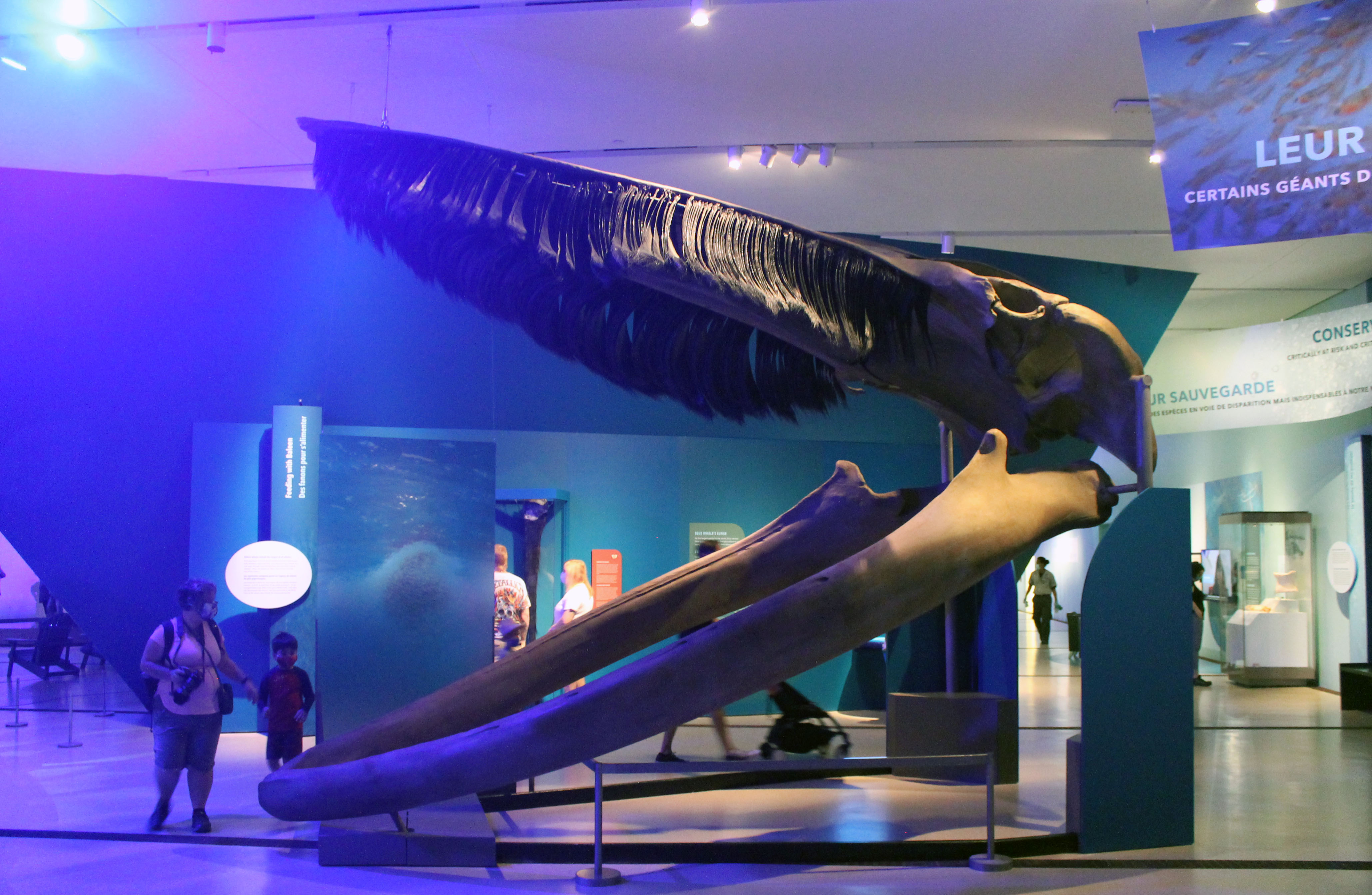
Visitors can step inside the baleen-laden jaws of this replica skull.

However, I think the exhibition’s biggest strength is that it is told through multiple voices. One of those voices is the standard, omniscient museum voice, through which we learn about the biomechanics of hearts and lungs on a massive scale, as well as the evolution of whales (which could be an exhibit all its own). We also hear from scientists, including ROM mammalogy technician Jacqueline Miller. In one video, Miller recounts the experience of breaking down the blue whale (named Blue), which was found trapped by shifting ice in 2014. She describes the overpowering stench and the overwhelming amount of gore, but also the excitement of turning a tragedy into an opportunity to learn something new and maybe help other whales in the future.

IMG_7949

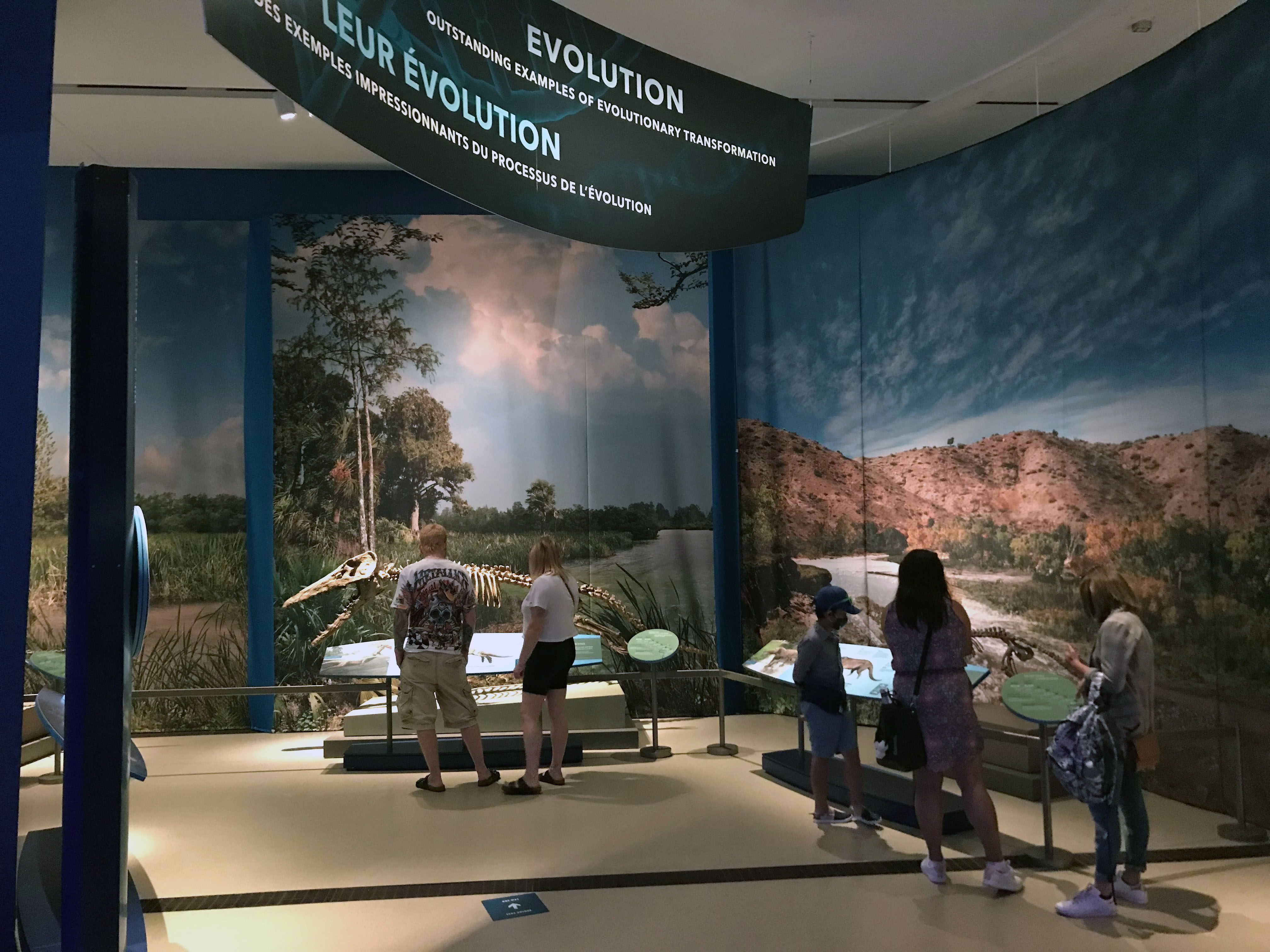
The evolution section includes skeletons of Pakicetus, Ambulocetus, Kutchicetus, and Dorudon.

Most unique to a science exhibition like this one is the recurring presence of Indigenous Elders, artists, and storytellers. Wolastoq artist and cultural educator Possesom Paul describes whales as ancient partners of humans—powerful, mysterious, but also vulnerable. In two areas of the exhibit, we hear Passamaquoddy Elder Maggie Paul singing the song All My People, which honors the whales. As a non-Native person, I felt privileged that these perspectives were being shared with me. These ways of knowing do not conflict with the scientific ones—instead, they complement one another and provide visitors with more pathways to connect with the exhibition content.

IMG_9962

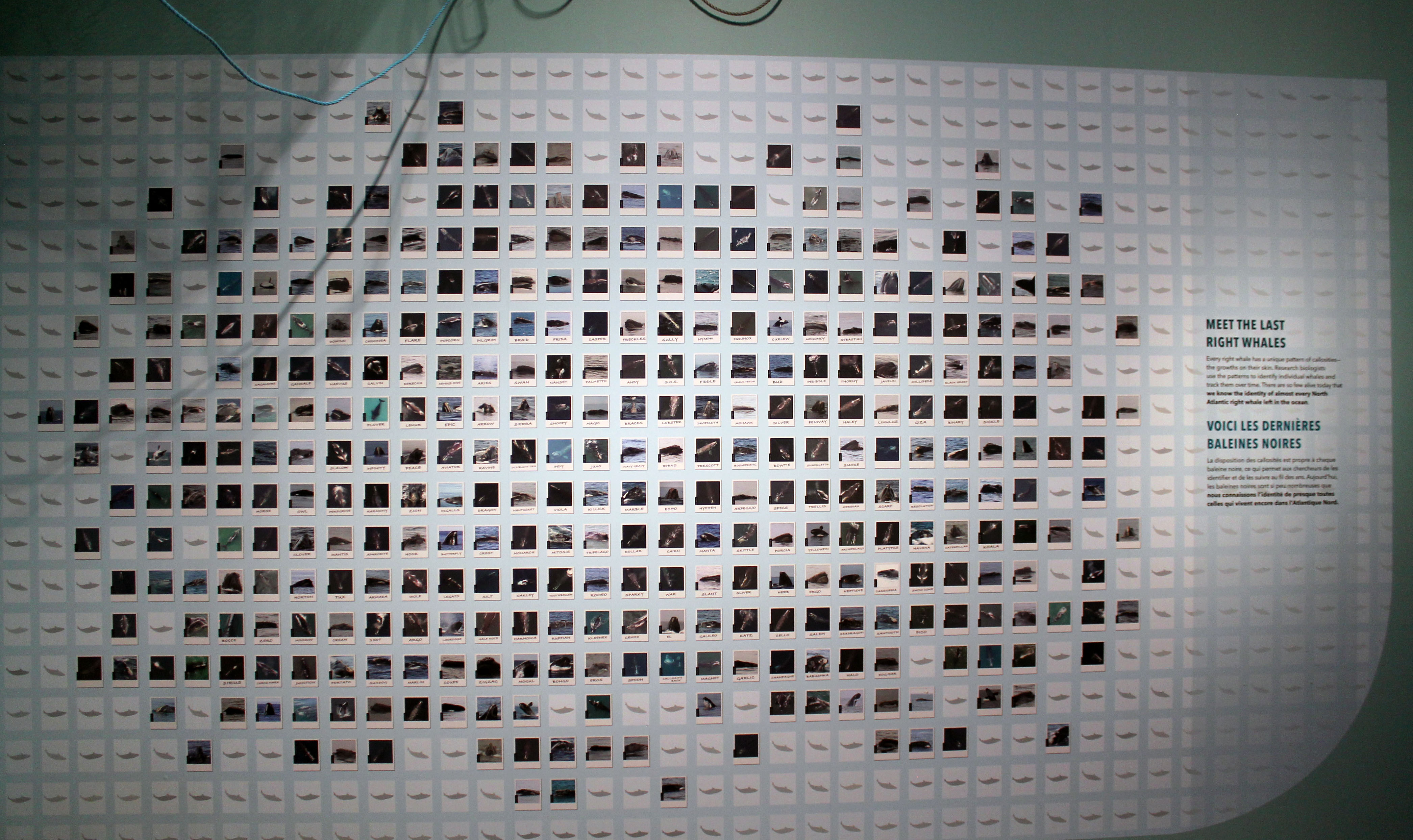
The remaining North Atlantic right whale population, visualized.

Traditional and scientific perspectives converge in the exhibit’s conservation message. Choice statistics make the plight of whales in the industrialized world particularly stark. I’ve been unable to forget one infographic informing me that 10% of the right whale population has died since 2017—equivalent to losing every person in North and South America. Another graphic illustrates how precious each individual whale is: a wall of polaroid photos introduces us to most of the 300-some right whales alive today. 

Great Whales is poignant, thought-provoking, and often beautiful, representing the best of what a natural history exhibit can be. It will be on display at the ROM until March 2022. It’s unclear if it will travel after that, but I very much hope it does. 


5 Comments

Filed under exhibits, mammals, museums, reviews, ROM, science communication

Meeting Peale’s Mastodon

humboldt4

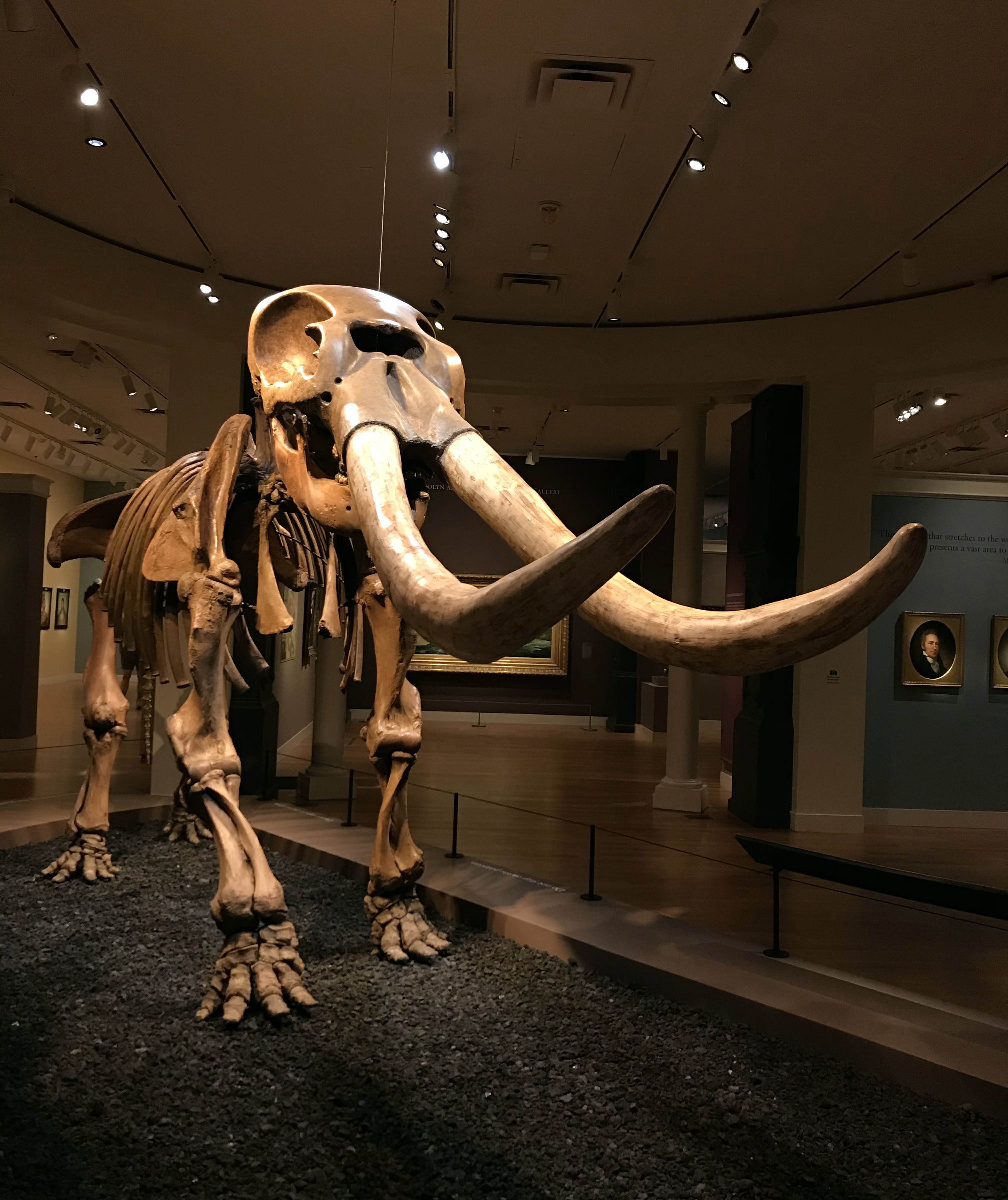
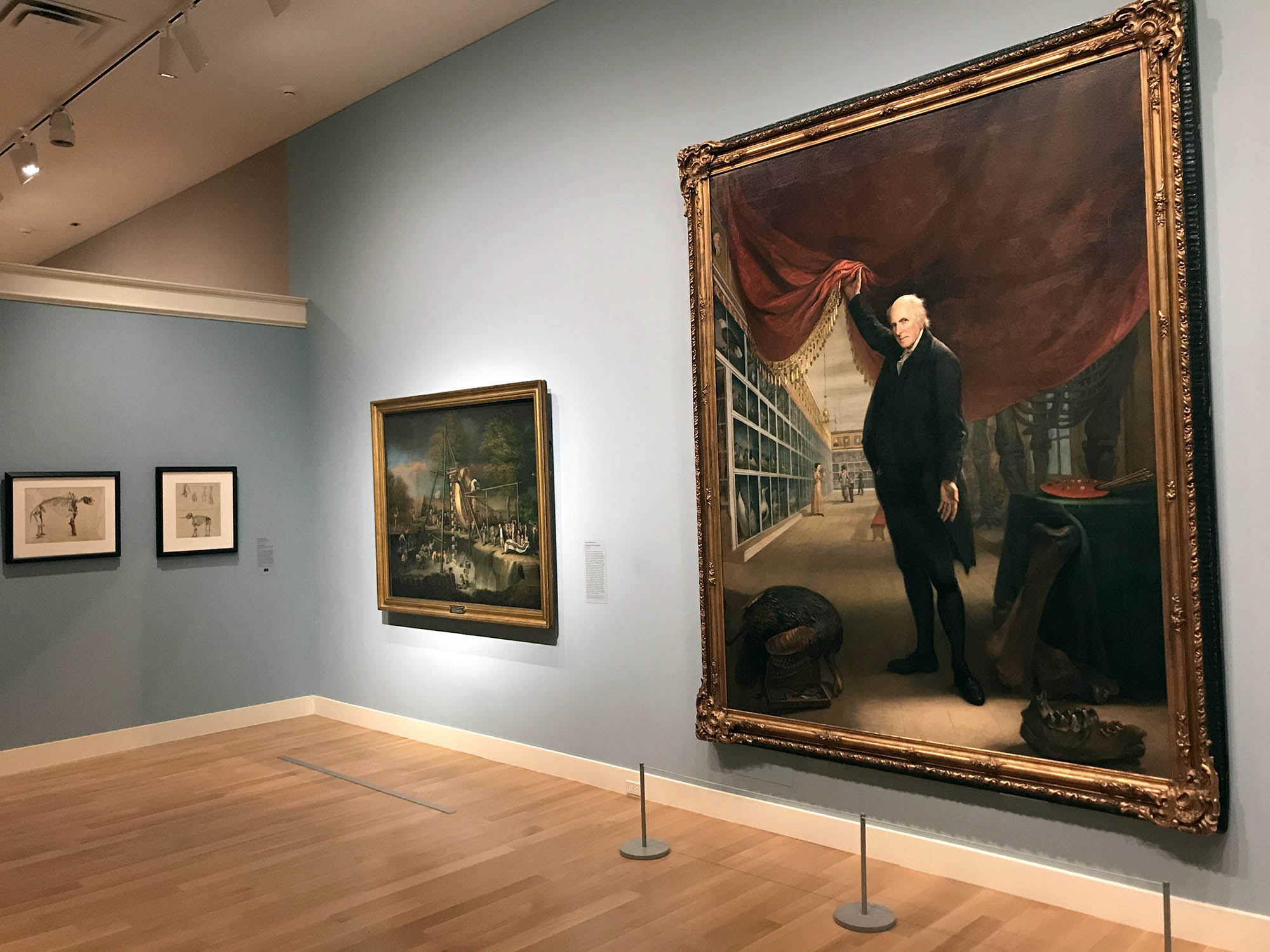
A mastodon in an art museum.

Last week, I met a very special fossil. Pictured above is Charles Wilson Peale’s mastodon, which is currently on display at the Smithsonian American Art Museum. Exhumed in 1799 near the banks of the Hudson River and unveiled to the public on Christmas Eve, 1801, this was the very first mounted skeleton of a prehistoric animal ever exhibited in the United States. Preceding Darwin’s On the Origin of Species by six decades, the mastodon entered public discourse at a time when even the idea of extinction was still hotly debated. The mastodon proved to be a source of national pride for European Americans, demonstrating that North America’s natural wonders could rival Europe’s great architecture and rich history.

After Peale’s Philadelphia museum closed in 1848, the mastodon was sold and wound up at the Hessisches Landesmuseum in Darmstadt, Germany. There it remained for over 170 years, largely forgotten in its home country, until SAAM senior curator Eleanor Harvey had the idea to include it in a new exhibition.

969EC399-BD98-460A-8C8D-3DC442AEEEBB_1_105_c

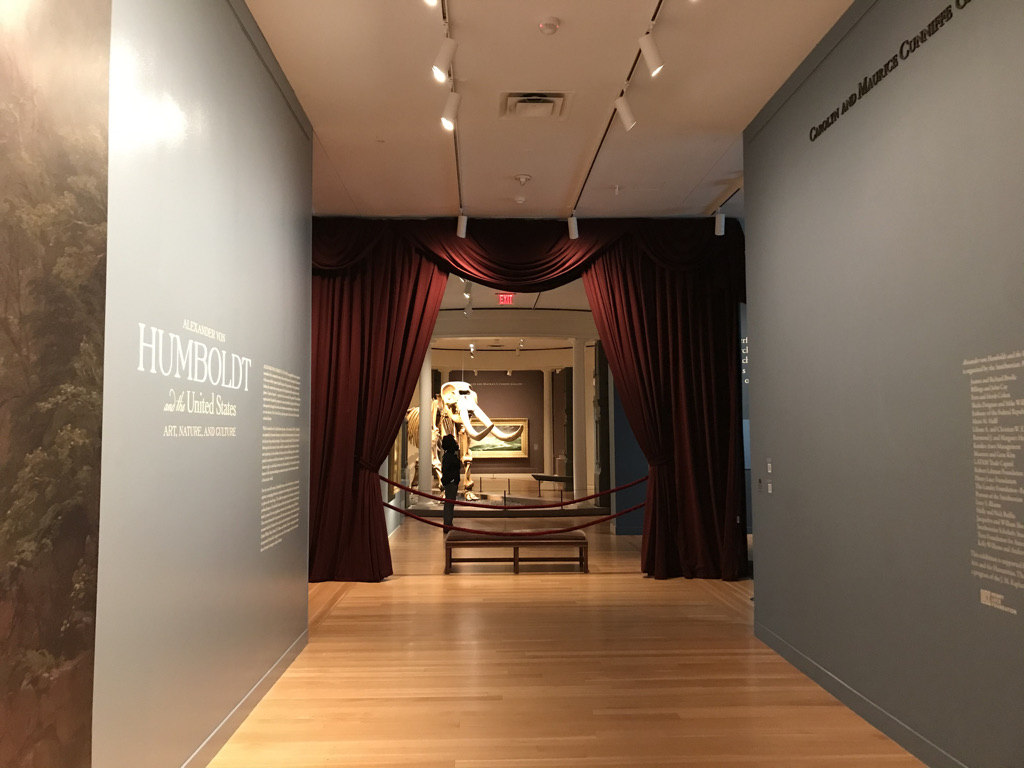
A red curtain evokes Peale’s self portrait, The Artist in his Museum

Harvey’s exhibition isn’t about fossils, or even about Peale. Her subject is Alexander von Humboldt, a 19th-century naturalist who left a profound impact on the scholars, artists, and politicians of the young United States. Alexander von Humboldt and the United States: Art, Nature, and Culture tracks the legacy of Humboldt’s brief but highly influential visit to America. During a six-week tour in 1804, Humboldt met with President Thomas Jefferson and other dignitaries, planting intellectual seeds that would shape America’s aspirational ideals for decades and centuries to come. From his vision of nature as an interconnected network to his advocacy for democracy, the abolition of slavery, and learning from Indigenous knowledge, Humboldt’s influence was wide-reaching*. 

*I personally found the exhibition’s presentation of Humboldt’s influence on US policy a bit doe-eyed. While triumphs like the founding of the National Park Service and Smithsonian Institution can be traced to Humboldt’s legacy, it’s hard to argue that his social ideals had much practical effect in the 19th century

An important stop on Humboldt’s American tour was Peale’s museum in Philadelphia. Humboldt dined with Peale’s family beneath the ribcage of the mounted mastodon, later citing the beast as a key example of America’s incredible natural heritage. For Humboldt, Peale, and Jefferson, the mastodon embodied the young nation’s great potential—if this land was home to creatures as mighty at the mastodon, then its future would have to be equally monumental. 

To Harvey, the mastodon skeleton perfectly encapsulated the story she wanted to tell about Humboldt. She initially thought that shipping the mastodon from Germany for a temporary exhibition was a long shot, but her counterparts at the Landesmuseum were game. Curator Oliver Sandrock oversaw the process of preparing the mastodon for travel, which involved a deep cleaning, as well as breaking down the original 19th century armature into several pieces.

humboldt7

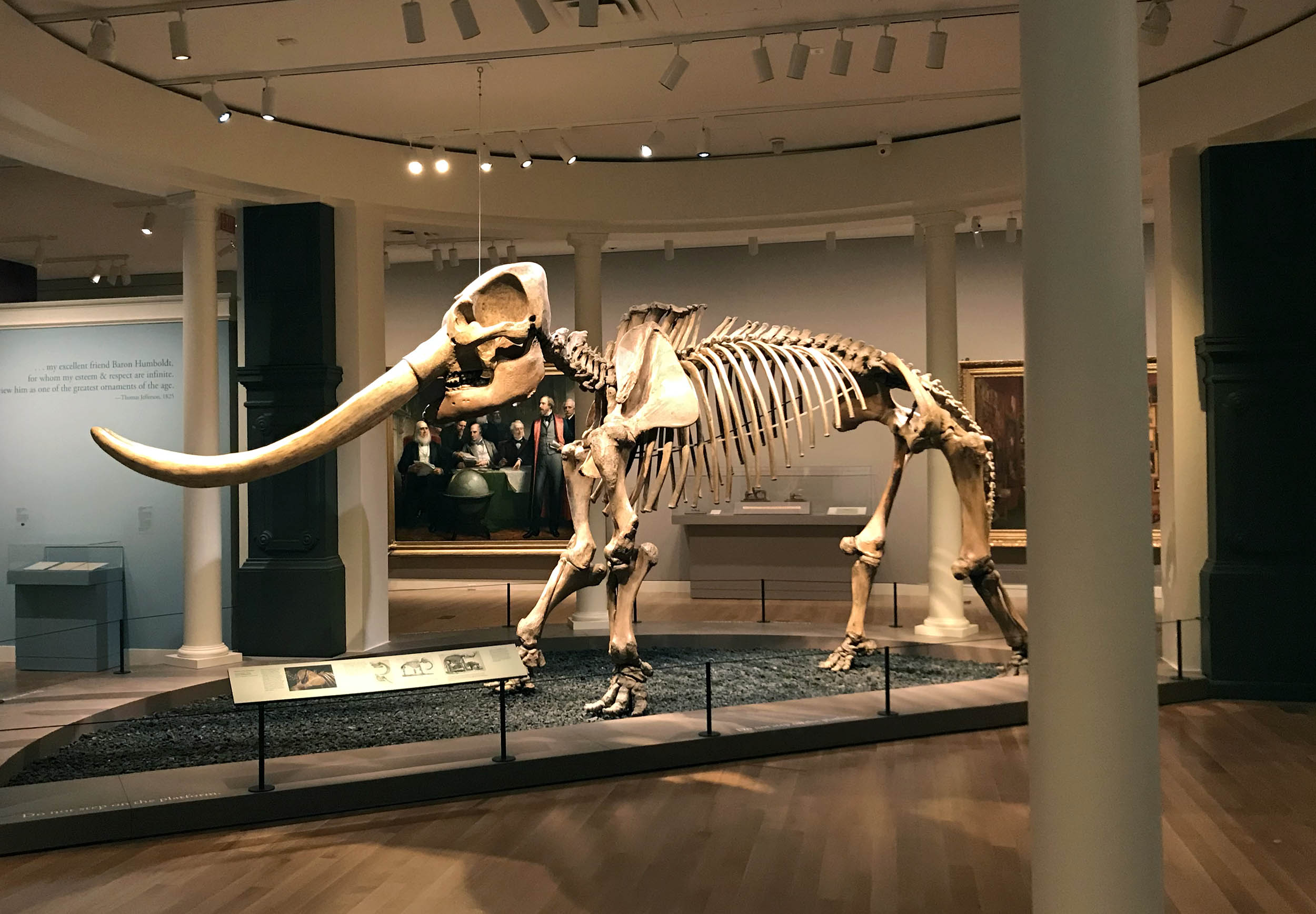
The mastodon is presented primarily as a historical object—there is no discussion of the animal’s life appearance or behavior to be found.

I spoke to Advait Jukar, a Research Associate with the National Museum of Natural History, about his involvement with the mastodon. He inspected the skeleton in early 2020, shortly after it arrived in Washington, DC. As a fossil elephant specialist, Jukar was able to determine that the mastodon was an adult male, and that about 50% of the mount was composed of real, partially mineralized bone. Fascinatingly, most of the reconstructed bones were carved from wood. This was the handiwork of Rembrandt Peale (Charles’ son), William Rush, and Moses Williams. Most of the wooden bones were carved in multiple pieces, which were locked together with nails and pegs. The craftsmanship is exquisite, and the joins are difficult to make out unless you stand quite close. The mandible is entirely wood, but the teeth are real. These teeth probably came from a different individual—one tooth on the right side didn’t fit properly and was inserted sideways!

The mastodon at SAAM differs from the original presentation at Peale’s museum in a few ways. The missing top of the skull was once modeled in papier-mâché, but this reconstruction was destroyed when the Landesmuseum was bombed during the second world war. It has since been remodeled in plaster. While the mastodon was never mounted with real tusks, the mount has traditionally sported strongly curved replica tusks, more reminiscent of a mammoth. While Rembrandt Peale published a pamphlet in 1803 suggesting that the mastodon’s tusks should be positioned downward, like a pair of predatory fangs, it’s unclear if the tusks on the skeleton were ever mounted this way. At SAAM, the mastodon correctly sports a pair of nearly straight replicated tusks, which curve gently upward. 

pealemammoth

Rembrandt Peale’s carnivorous mammoth, with downward-facing tusks. Public domain.

Overall, the work of Peale, Rush, and Williams remains remarkably intact. Although it’s now lit by electric lights instead of oil lamps, this is the same beast that Humboldt encountered 220 years ago. Harvey even included a mouse in a small case at the mastodon’s feet, just as Peale did in Philadelphia. If anything, it’s remarkable how similar the mastodon mount looks to newer displays of fossil skeletons. Its creators pioneered an art form that has not changed enormously to this day.

humboldt1

Artwork of the mastodon, its excavation, and its presentation by the Peale family.

While the mastodon is undeniably the star of the show, the exhibition also utilizes artworks from the SAAM collection, loans from other institutions, and three lengthy media presentations to tell Humboldt’s story. I was excited to see Peale’s The Artist in His Museum and Exhumation of the Mastodon reunited, and the collection of George Catlin’s portraits of Native Americans is impressive. However, I was most captivated by a media presentation exploring Frederic Church’s Heart of the Andes. While the original painting had to stay at the Metropolitan Museum of Art, the video—which can be seen online here—explores the details and historical context of the painting with visually arresting style. I’ve been critical in the past of art museums’ proclivity for opaque and unwelcoming interpretive styles, but this video is great and I hope to see more efforts like it.

Overall, I was delighted by the exhibition. Seeing a fossil in an art museum, interpreted as a cultural artifact, is extraordinary. Like Humboldt himself, the mastodon is an interception of art, nature, and culture, and I relished the opportunity to meet such an icon.

Alexander von Humboldt and the United States: Art, Nature, and Culture runs through July 11, 2021. 

References

Jukar, A. 2021. Pers. comm.

O’Connor, A. 2020. Mysteries of the first mastodon.

Semonin, P. 2000. American Monster: How the Nation’s First Prehistoric Creature Became a Symbol of National Identity. New York, NY: New York University Press.

6 Comments

Filed under art history, exhibits, fossil mounts, history of science, mammals, museums, reviews

Dinosaurs at the Cincinnati Museum Center

A grand view upon entering the new CMC dinosaur hall.

Cincinnati’s Union Terminal is an incredible building. This colossal art deco structure is a sight to behold inside and out, and the muraled semi-dome in its central rotunda is among the largest of its kind in the world. Built in 1933 as a train station (and functioning as one today, after a mid-century hiatus), Union Terminal is also home to the Cincinnati Museum Center (CMC), which relocated here from a downtown location in the early 1990s.

I visited CMC once before in 2013, to see the traveling Ultimate Dinosaurs exhibit. I also saw the permanent natural history exhibits that were in place at the time, which included some very elaborate walk-through reconstructions of a Pleistocene forest and a modern cave. These exhibits were constructed in the 90s, and had a lot of the hallmarks of museum design in that era. For example, the ice age galleries were framed around visitors “examining evidence like scientists,” which in practice involved binary question-and-answer stations and interactives where the action performed didn’t really connect with the concept meant to be communicated. Nevertheless, the actual fossil collection on display—mostly from Big Bone Lick in Kentucky—was impressive, as were the ambitious, large-scale dioramas.

The 1990s-era ice age gallery.

This huge diorama featured life-sized wolves, a ground sloth, and a mastodon mired in mud.

Since then, Union Terminal and CMC have undergone a sweeping transformation. In 2014, the National Trust named the building—which had never been completely renovated in its 80 year history—one of the country’s most endangered historic places. Happily, the county took action, and raised funds to restore and modernize Union Terminal. In the process, most of the existing museum galleries were completely demolished, and the spaces they occupied were restored to match the building’s original architecture.

This strikes me as a bold move. Typically, legacy museums will gradually update or replace old exhibits as funding allows. In contrast, the CMC renovation started with a total teardown, and new exhibits are now being added in phases. As of this writing, the natural history and science side of the building includes a brand-new dinosaur gallery (discussed here), the aforementioned walk-through cave, a partial exhibit on the moon landing, and an assortment of temporary-looking exhibits. A new ice age gallery, the rest of the space exhibit, and immersive exhibits about Cincinnati history are slated to open later this year, and it appears fundraising is underway for future projects, including a Paleozoic fossil hall.

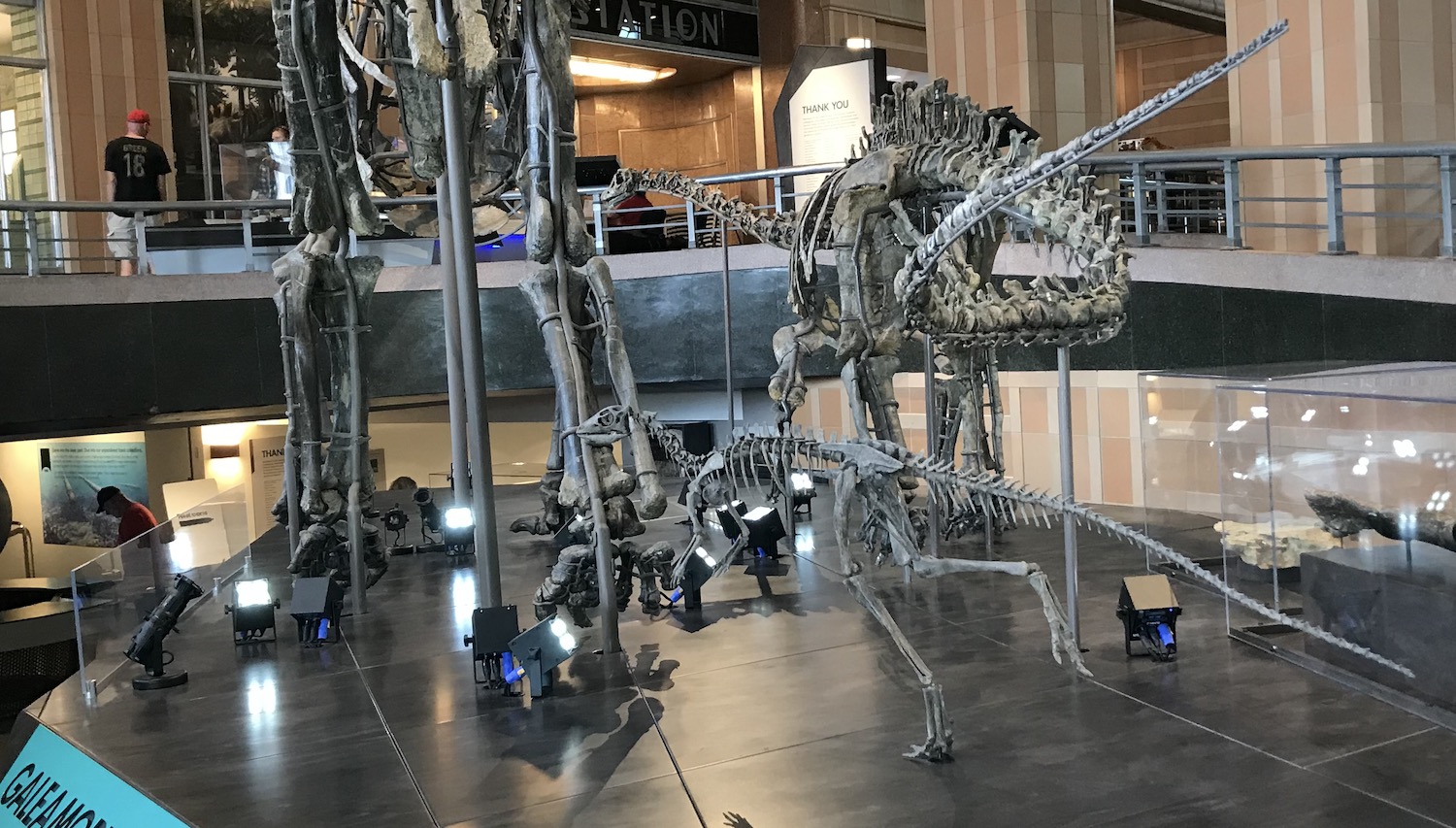
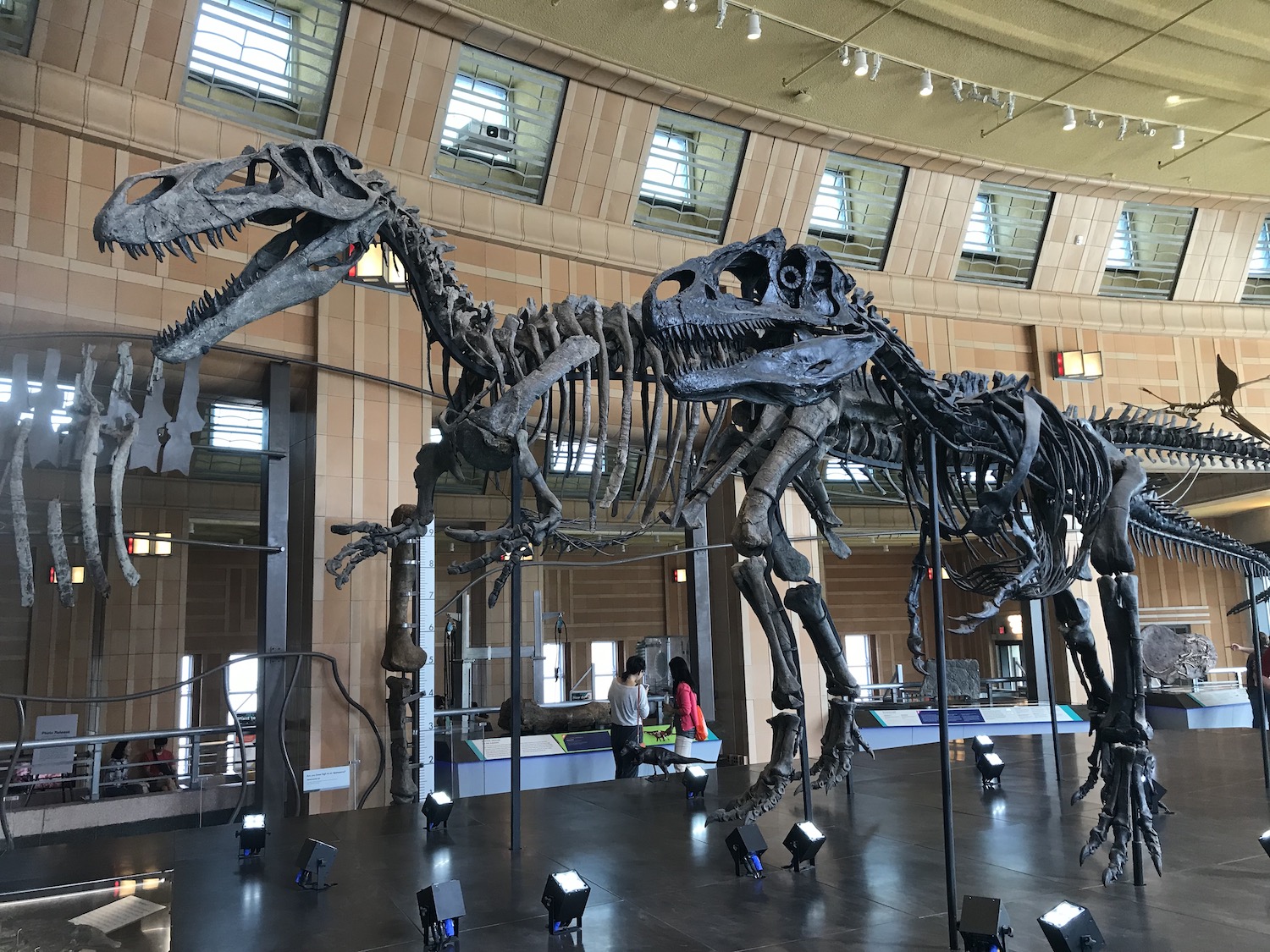
The hall’s only ornithischian Othnielosaurus follows in the footsteps of Galaemopus and Diplodocus.

To cut to the chase, the dinosaur hall is excellent. Developed by senior project manager Sarah Lima and curator Glenn Storrs, this is effectively a brand-new exhibit, since the old dinosaur gallery was quite limited. When the original CMC exhibits were built, the strengths of the vertebrate paleontology collections were primarily in Quaternary mammals and Paleozoic invertebrates. Over the last 20 years, however, the museum has been focused on the Jurassic. In particular, regular field work at the Mother’s Day Quarry in Montana has yielded a trove of Jurassic fossils, including some very unique sauropod specimens. The gallery includes an 80% complete Galaemopus, a composite juvenile Diplodocus, sauropod skin impressions, and a one-of-a-kind juvenile Diplodocus skull. In spite of the unspoken adage, the Morrison fauna is not resolved, and new secrets of this ecosystem are still being recovered.

Torvosaurus towers over a composite Allosaurus assembled from Cleveland-Lloyd fossils.

Other key specimens in the new exhibit were purchased from commercial fossil collectors. Jason Cooper, a Cincinnati native, discovered the Torvosaurus, which is the only real specimen of its kind on display anywhere. Along with his father Dan and brother Ben, Cooper excavated the 50% complete skeleton from a private Colorado ranch and prepared and mounted it for display. The museum purchased the Daspletosaurus from the Rocky Mountain Dinosaur Research Center. Anthony Maltese and colleagues excavated the skeleton in 2006 and prepared it over the course of several years.

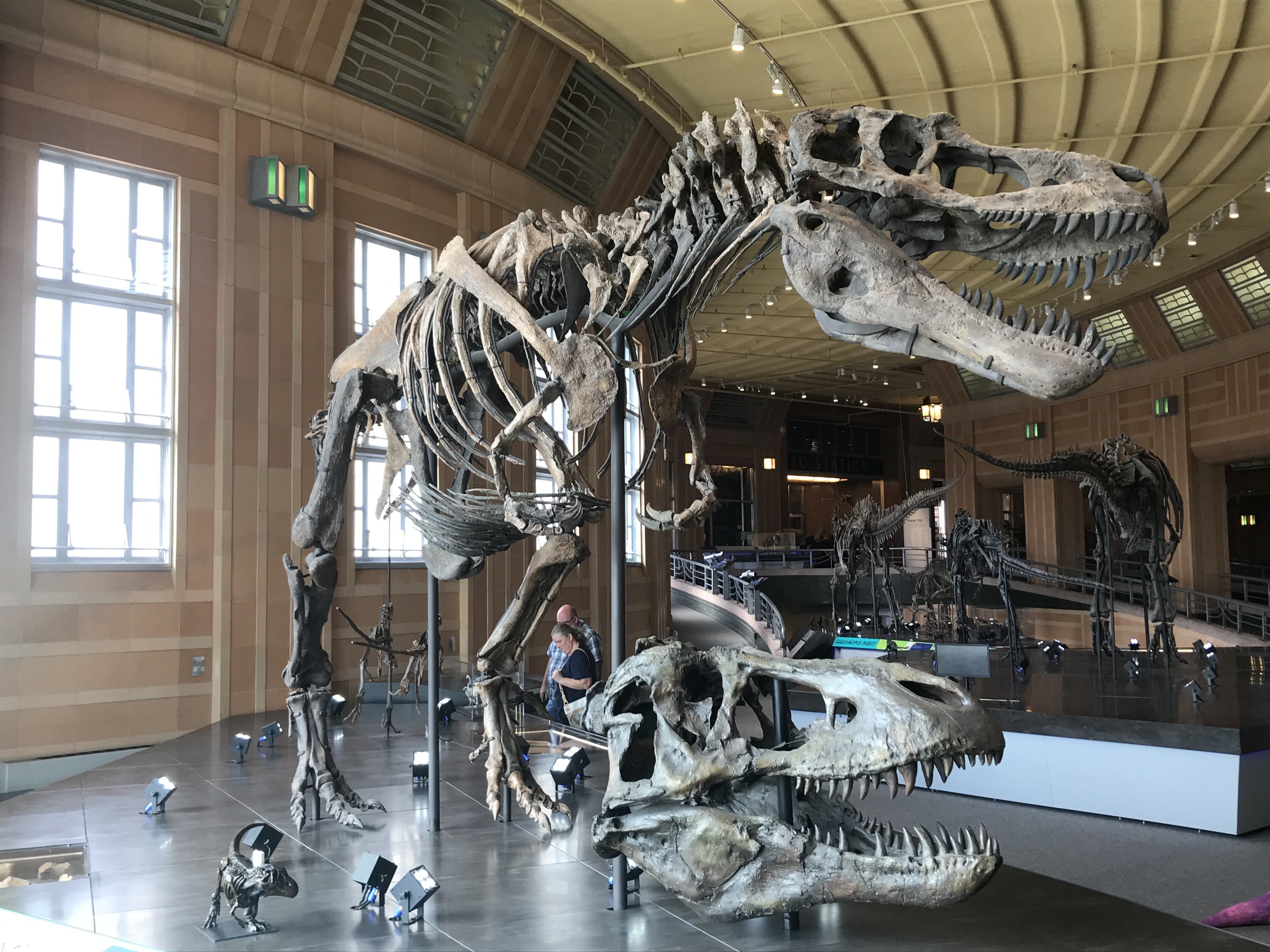
Nicknamed “Pete III,” the Daspletosaurus shares its platform with two Dromaeosaurus casts and a cast skull of the Nation’s T. rex.

Like many newer fossil exhibits, the gallery is well-lit and spacious. The art deco design of Union Terminal informs the look of the hall: large windows fill the space with natural light, and the larger specimens are arranged on minimalist platforms that can be viewed from many angles, including from above. I found it noteworthy how close visitors can get to the mounted skeletons. Although the platforms are fairly high up, there are no glass barriers. I found that I could get within a few inches of the Galaemopus feet without much effort. I’m sure a slightly taller or more determined person could manage to touch the fossils.

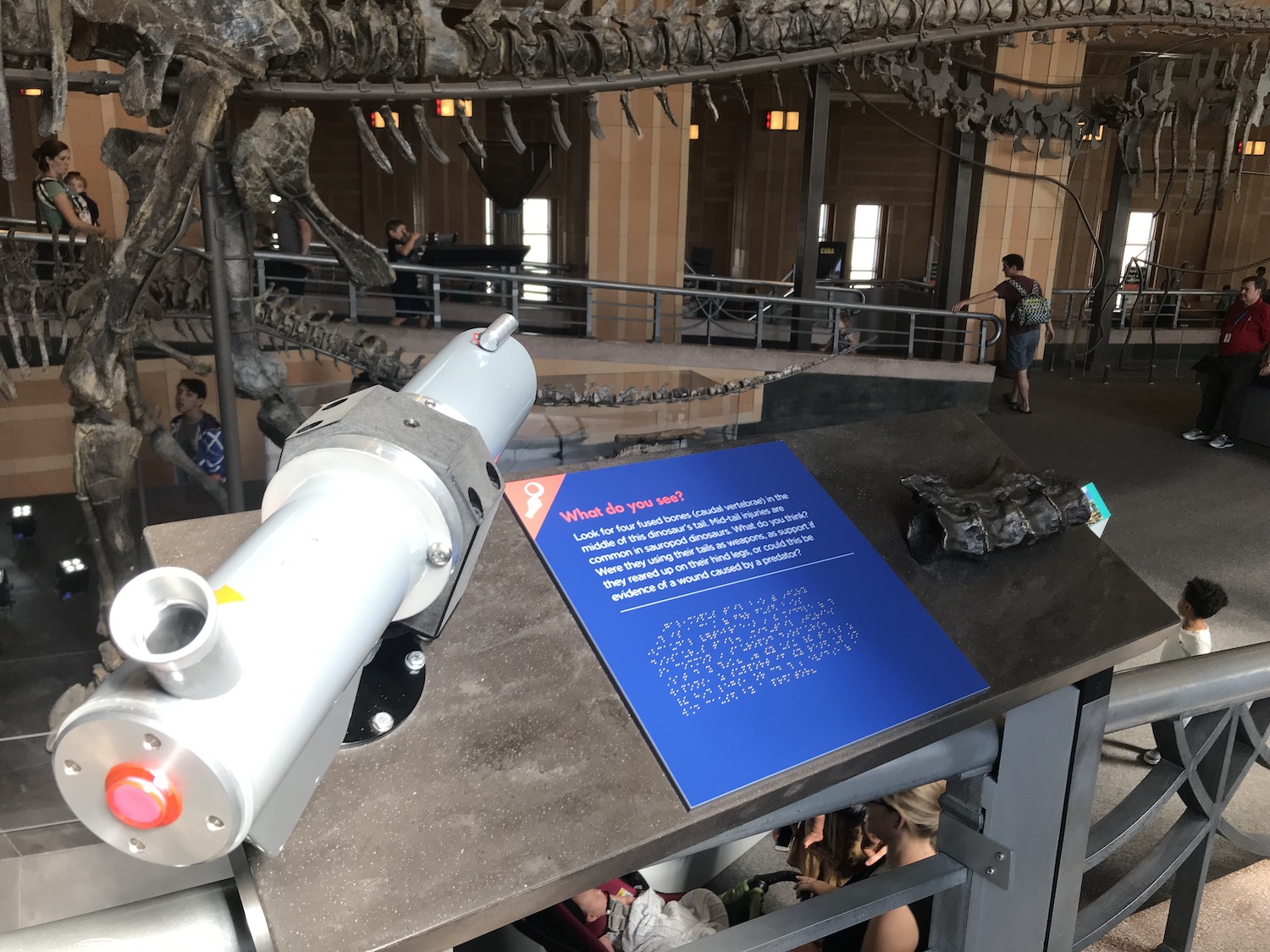
Hopefully, they’ll be distracted by the many exhibit elements that are meant to be touched. In contrast to the 1990s exhibits, CMC has mostly done away with physical interactives, instead emphasizing touchable models and digital touchscreens. One particularly impressive inclusion are the digital video cameras (in robust cylindrical housing) connected to large monitors. Visitors can use these to get real-time magnified views of certain fossils, including a chunk of Tyrannosaurus medullary bone. This set-up couldn’t have been cheap! I also had fun with a set of telescopes aimed at certain parts of the dinosaur skeletons, such as a series of fused vertebrae in the Galaemopus tail. These are outfitted with targeting lasers (!) to help pinpoint the key features.

Each “closer look” station includes a telescope (with targeting laser!) aimed at an important skeletal feature, plus a bronze cast of that same element.

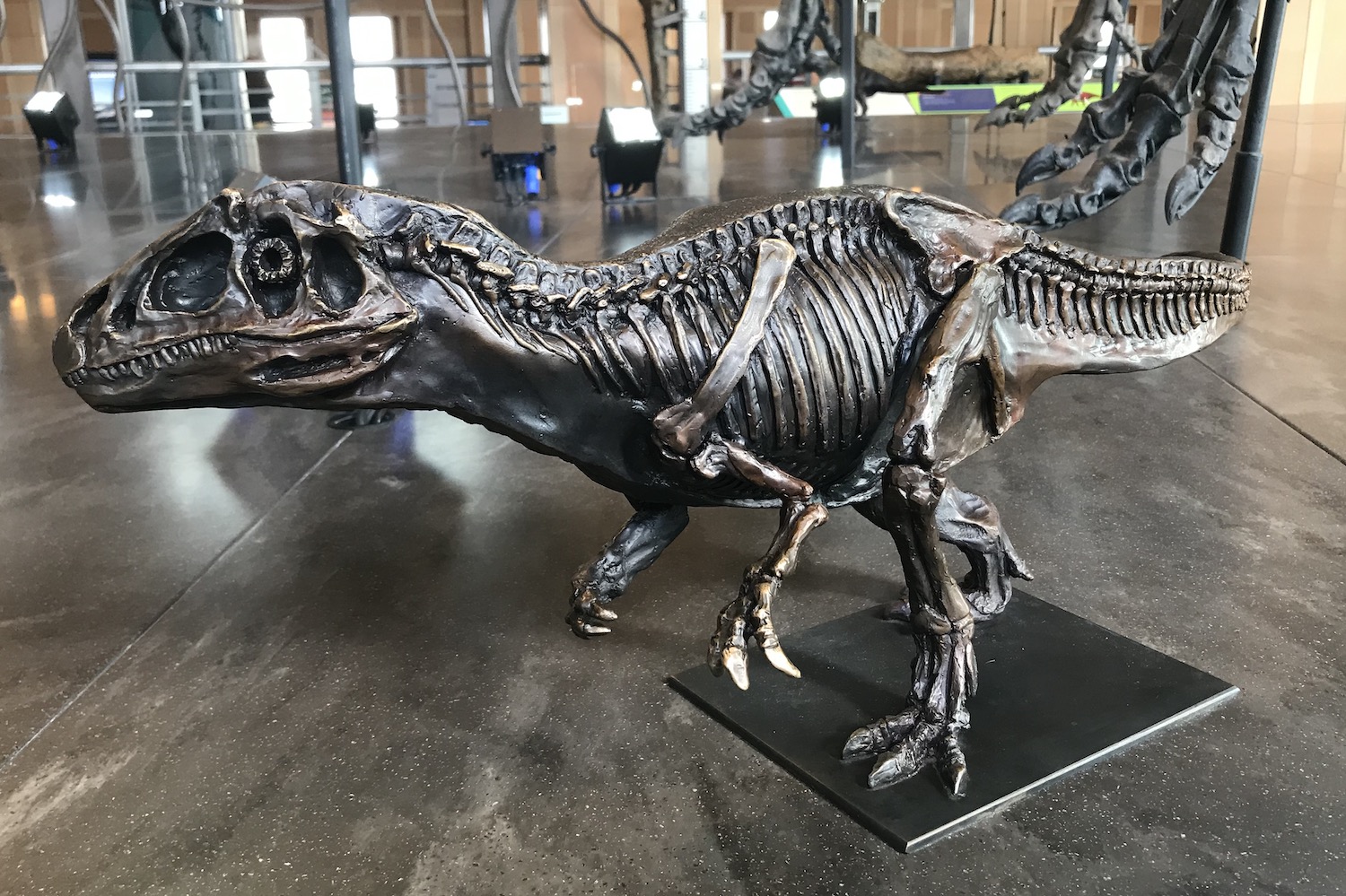
This bronze miniature Allosaurus is one of four similar models.

Not every visitor can see the fossil mounts, so CMC worked with David Grimes of the Clovernook Center for the Blind and Visually Impaired to help people with low vision experience the exhibit. Braille is incorporated into many of the displays, and the hall is full of touchable bronze models, ranging from individual bones (like the aforementioned Galaemopus vertebrae) to fleshed-out reconstructions (such as Confuciusornis). Four of the dinosaur mounts are recreated as bronze miniatures. Structures like ribs and vertebral processes are quite thin at this scale and susceptible to bending or breaking, so the exhibit team went with a half-fleshed look to make the models more durable. The Field Museum landed on the same solution with the touchable miniature SUE, but credit is due to the CMC team for getting their models to stand up, rather than being presented in relief.

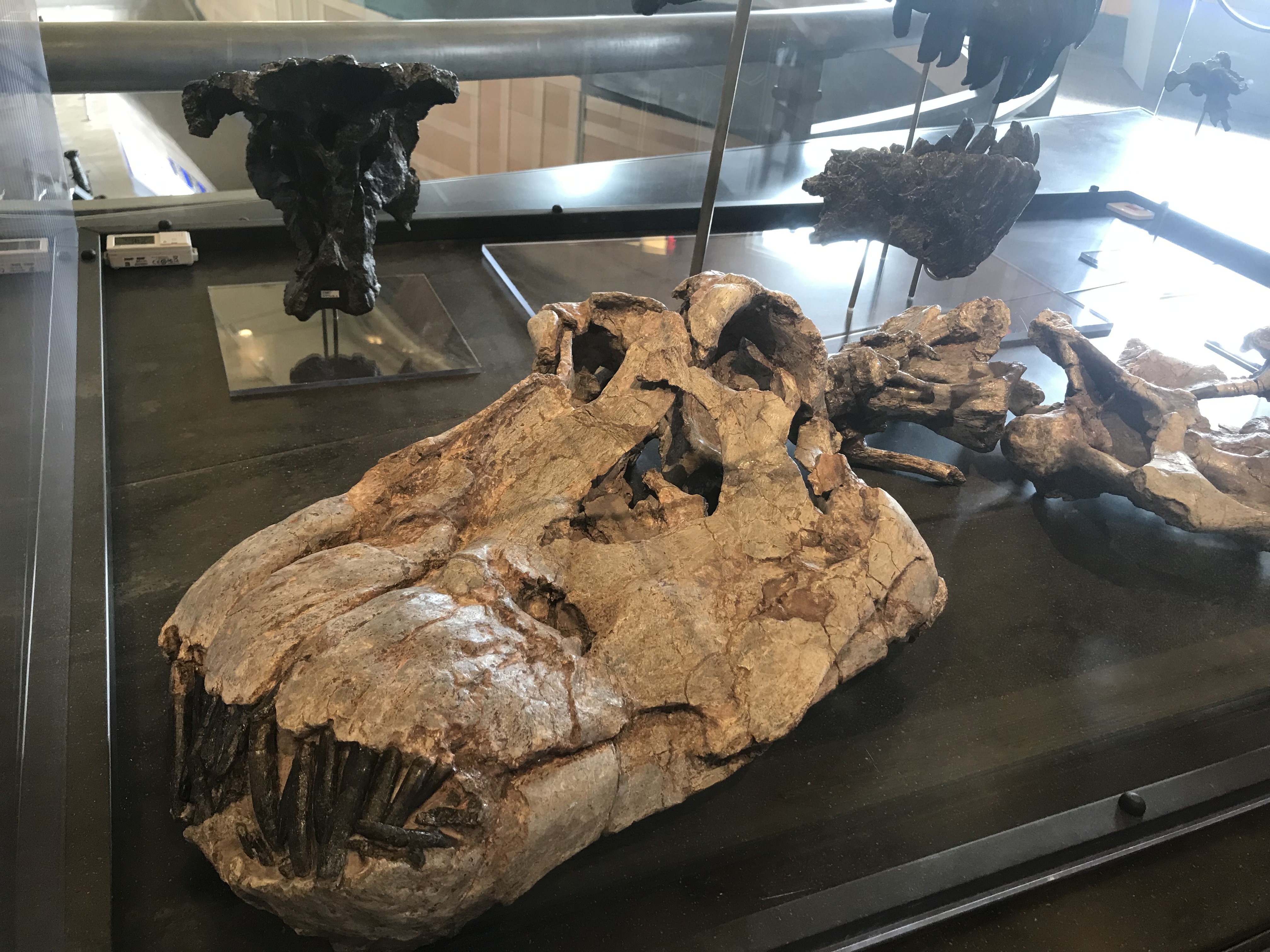
A real Apatosaurus skull, one of many treasures hidden away in smaller cases throughout the hall.

If I were to critique one element of the hall, it would be that some of the labels, graphics, and interactives are spatially disconnected from the fossils they relate to. For example, a digital touchscreen where visitors can manipulate a 3D scan of an Apatosaurus skull is nowhere near the real skull displayed elsewhere in the exhibit, and the only label for Othnielosaurus is on the opposite side of the platform from the mounted skeleton. This is, of course, a minor concern, and I can only imagine the difficulty of arranging an exhibit with as much verticality as this one.

Overall, the new CMC dinosaur hall is fantastic, whether one is considering the specimens on display, the story being told, or the aesthetics of the space. The collection of real, new-to-science specimens makes this exhibit stand out among other paleontology halls, but I’m curious how the museum’s general audience will respond. A once-expansive museum closed for two years, and opened with an excellent exhibit that nevertheless is much smaller than what was once on display. Will visitors be satisfied with quality over quantity? And will they keep returning as new CMC exhibits are completed over the coming years? Time will tell.


2 Comments

Filed under dinosaurs, exhibits, fossil mounts, museums, opinion, reviews, sauropods, science communication, theropods, Uncategorized

Deep Time is a masterpiece

A spectacle of evolution.

About ten years ago, a team at the National Museum of Natural History set out to reinvent their aging fossil halls for a new generation. Paleontology exhibitions had occupied the building’s east wing since 1911, and while there had been several renovations and additions, these were always additive. The result was a crowded and jumbled space, a hodge-podge of displays created by different people, at different times, for different reasons. In the early 2000s, a new core team—including Project Manager and Developer Siobhan Starrs, Designer Pauline Dolovich, and Curators Matt Carrano, Kay Behrensmeyer, and Scott Wing—had a once-in-a-lifetime opportunity to clear the east wing from wall to wall and start over with a blank slate. Their task was to fill 31,000 square feet with the story of life on Earth, with the latest science and a modern understanding of how visitors use museums in mind.

The result is breathtaking. Deep Time, as the new exhibition is colloquially known, sets a high standard for excellence in natural history exhibitions. What follows is a brief discussion of some the hall’s many successes. I will undoubtably have more to say in the coming weeks.

Themes

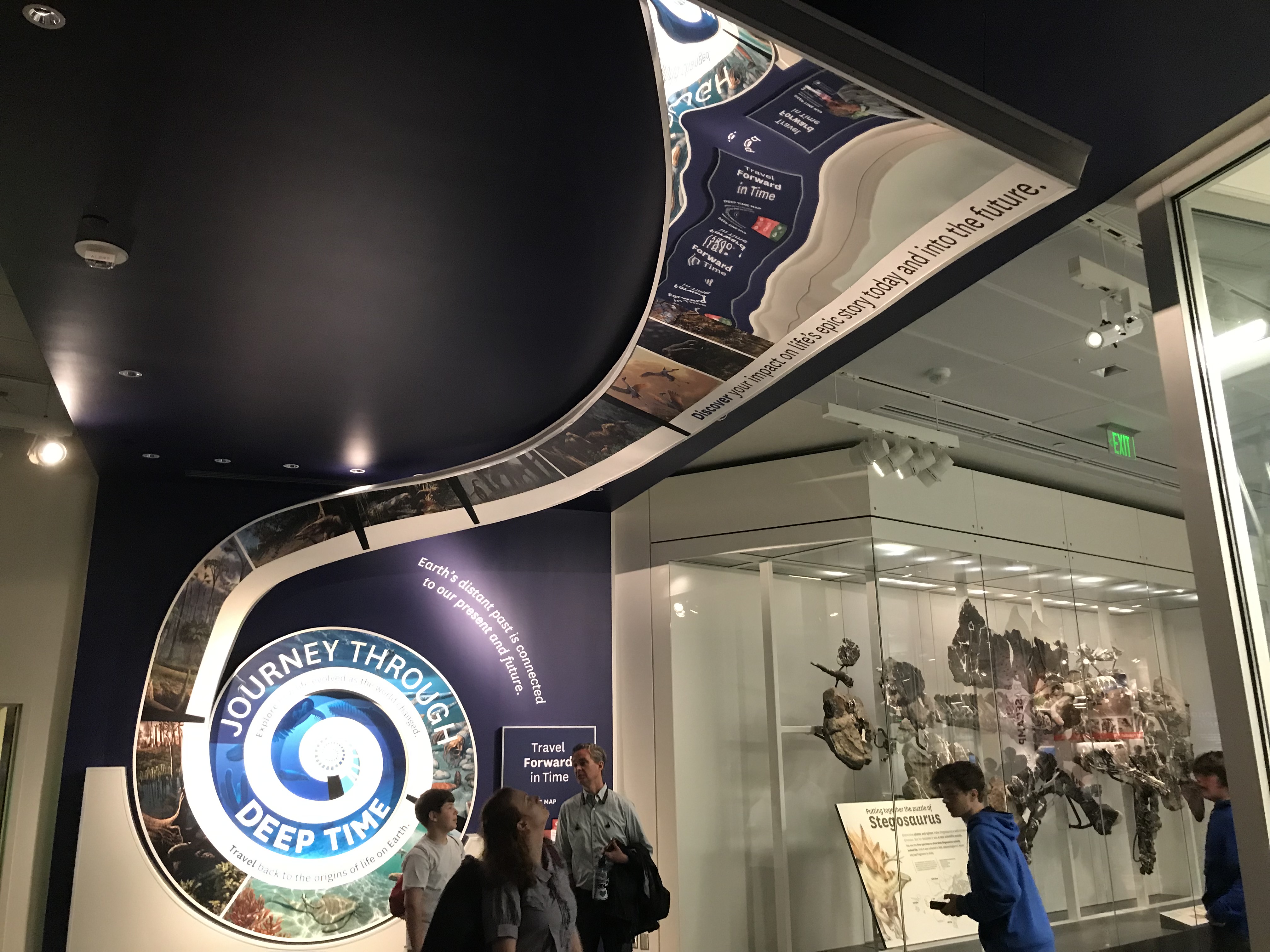
The Time Spiral, illustrated by Julius Csotonyi, appears at both entrances to Deep Time. It is the spiritual successor to John Gurche’s Tower of Time.

As has been well publicized, Deep Time contains a strong message about how humans are changing the Earth in unprecedented ways. This is introduced the moment visitors enter the exhibition, with an illustrated spiral of time that ends in a mirror. The implication is simple, but direct: we are part of the story of our planet.

Throughout the hall, visitors are reminded of humanity’s connection to the rest of the planet in different ways. In one corner, an interactive (admirably starring a gender-neutral cartoon host) illustrates the evolutionary origins of different features of the human body. In the Quaternary section, large graphics present the percentage of megafauna on each continent that went extinct as humans spread around the globe.

The bridge is a highly-visible and centrally-located destination in the Deep Time hall.

The hardest-hitting message, however, is about the modern climate crisis. The fact that industrial activity is profoundly warming the climate—a change that comes with dire consequences—is presented in clear, matter-of-fact language. It’s not preachy, it’s not political, it’s just the truth. The exhibition does not explicitly say we should stop harming the planet (although we should), but it clearly presents the evidence that we are, and that we have the ability to stop. This information is centered on an overlook called “the bridge.” The centrality of this location and its proximity to the dinosaurs makes the climate narrative unmissable. The nature of the modern media landscape is such that many NMNH visitors may well have never seen this message presented in non-political terms. I’m eager to see the results.

Layout

The Jurassic and Permian are visible from the Cretaceous.

One of the earliest decisions in Deep Time’s development was to restore the original architecture. This had already been done in the north and west wings for the Ocean and Mammals halls, and restoring the east wing would bring back the building’s intended symmetry. This choice dovetailed with an acknowledgement of visitors’ tendency to pinball around an exhibition, rather than view displays in a prescribed order. The team decided to welcome this spirit of exploration. The new hall can be navigated in any order, but still makes sense as a cohesive story.

Most of the displays are on island platforms. Each platform represents a particular time period, and for the most part, specimens displayed together represent species that would have coexisted in a single ecosystem. Big, show-stopping skeletons are in the center, while smaller specimens and accompanying labels and interactives can be found around the perimeter. Vertical pillars, which are visible from across the hall, indicate where each platform is in time. Meanwhile, mass extinctions are represented by large walls that physically divide the space. The result is a hall where it’s always clear whether the display you’re looking at is earlier or later in time than any other display, even though you can circulate among the islands at will.

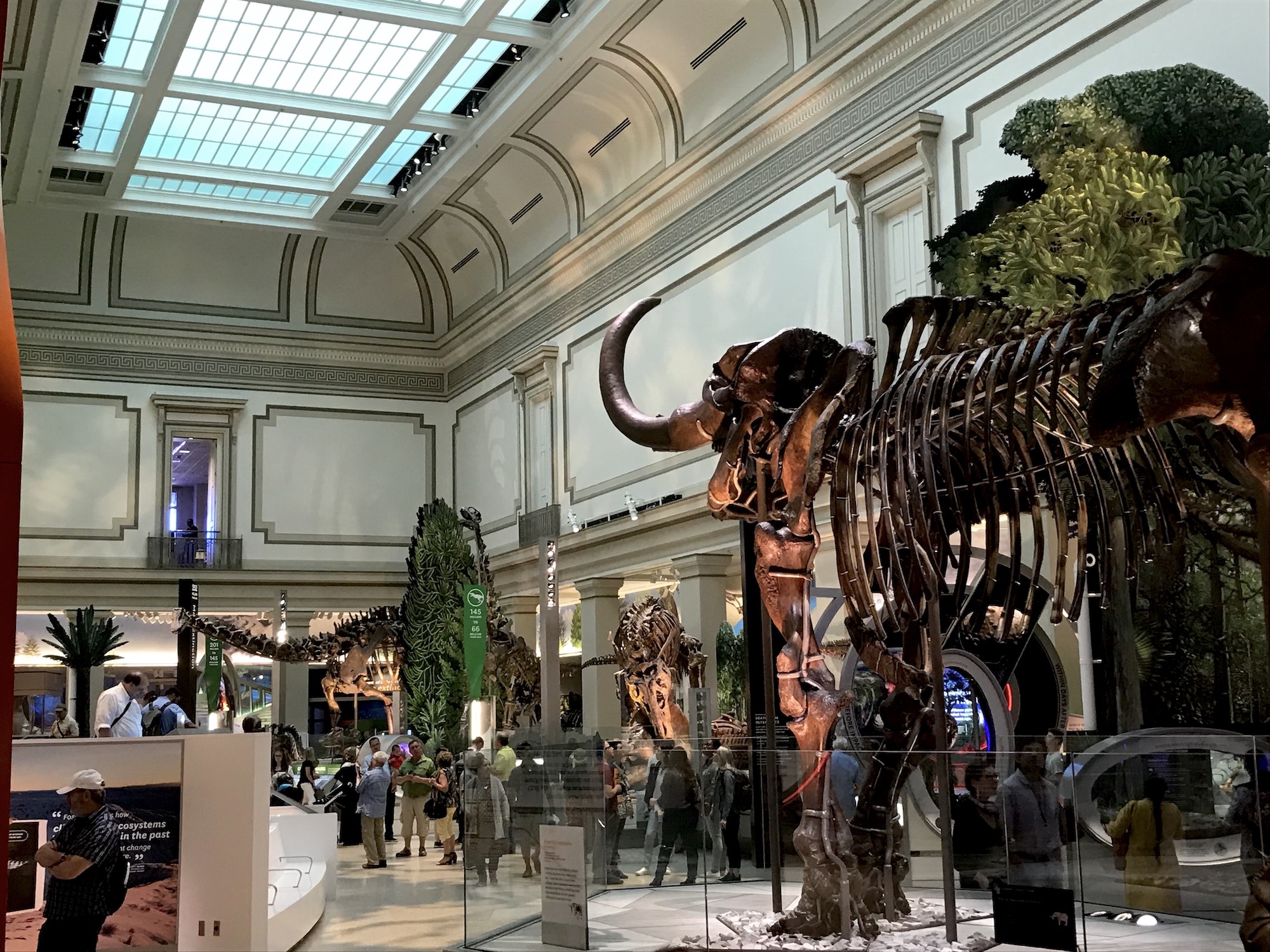
The remounted Diplodocus can be seen from anywhere in Deep Time, as well as from the rotunda.

NMNH gets several million visitors each year, so traffic flow is a major concern. This was a problem in the old hall, where decades of partial renovations had resulted in several frustrating bottlenecks. The new hall allocates nearly 50% of its floor space to visitor movement. A central avenue allows quick movement around the exhibition. Visitors short on time can pop in and “snack” on a few displays, rather than investing in the whole meal. Unlike linear exhibitions, visitors can backtrack without disrupting the traffic flow.

Furthermore, most of the hall can be viewed from multiple perspectives. Another function of the bridge is to provide an elevated vantage point. From the overlook, visitors can see Tyrannosaurus and Diplodocus over the heads of the crowd. Digital interactives show highlights on a 3-D model of the hall, helping visitors think about the entire history of life all at once. Actually, this is one area where I wish the developers had gone further. I would have loved to see displays that encouraged visitors to compare the animals visible on either side of the mass extinctions, or to think about what environmental factors led to the evolution of very different megaherbivores (the sauropods and proboscideans) at different points in time.

Animals

Dimetrodon prepares to scavenge Ophiacodon, while Xenacanthus and Diplocaulus swim below.

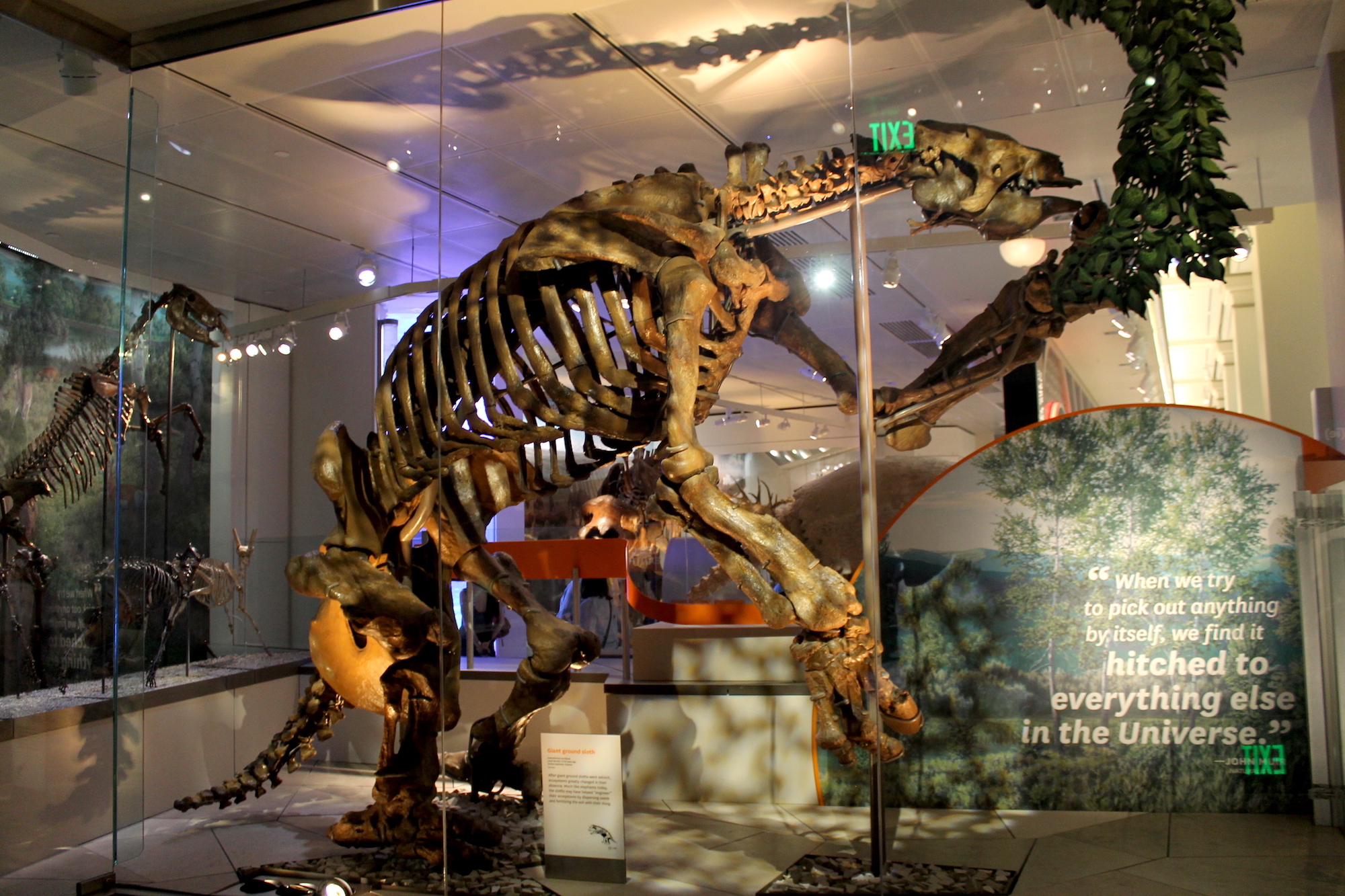
Lead Curator Matt Carrano came to the project with a vision. He wanted the mounted skeletons to read as animals, not as monsters or trophies. That meant they should be doing the sorts of things that animals do. Nearly every mount tells a story. The well-publicized Tyrannosaurus is dismembering a Triceratops: look closely and you’ll see fractured ribs, a broken horn, and that the Triceratops‘s head is actually separated from its body. The Eremotherium is plucking Osage oranges from a tree, referencing the hypothesis that these inedible fruits were cultivated by recently-extinct megafauna. A Menoceras is lying on its side in a characteristic rhino resting pose. The Stegoceras is scratching its jaw. Each pose gives the mounted skeletons a reality that is rarely seen in fossil exhibits. These are the remains of once-living creatures, after all. They got hurt, hungry, tired, and itchy.
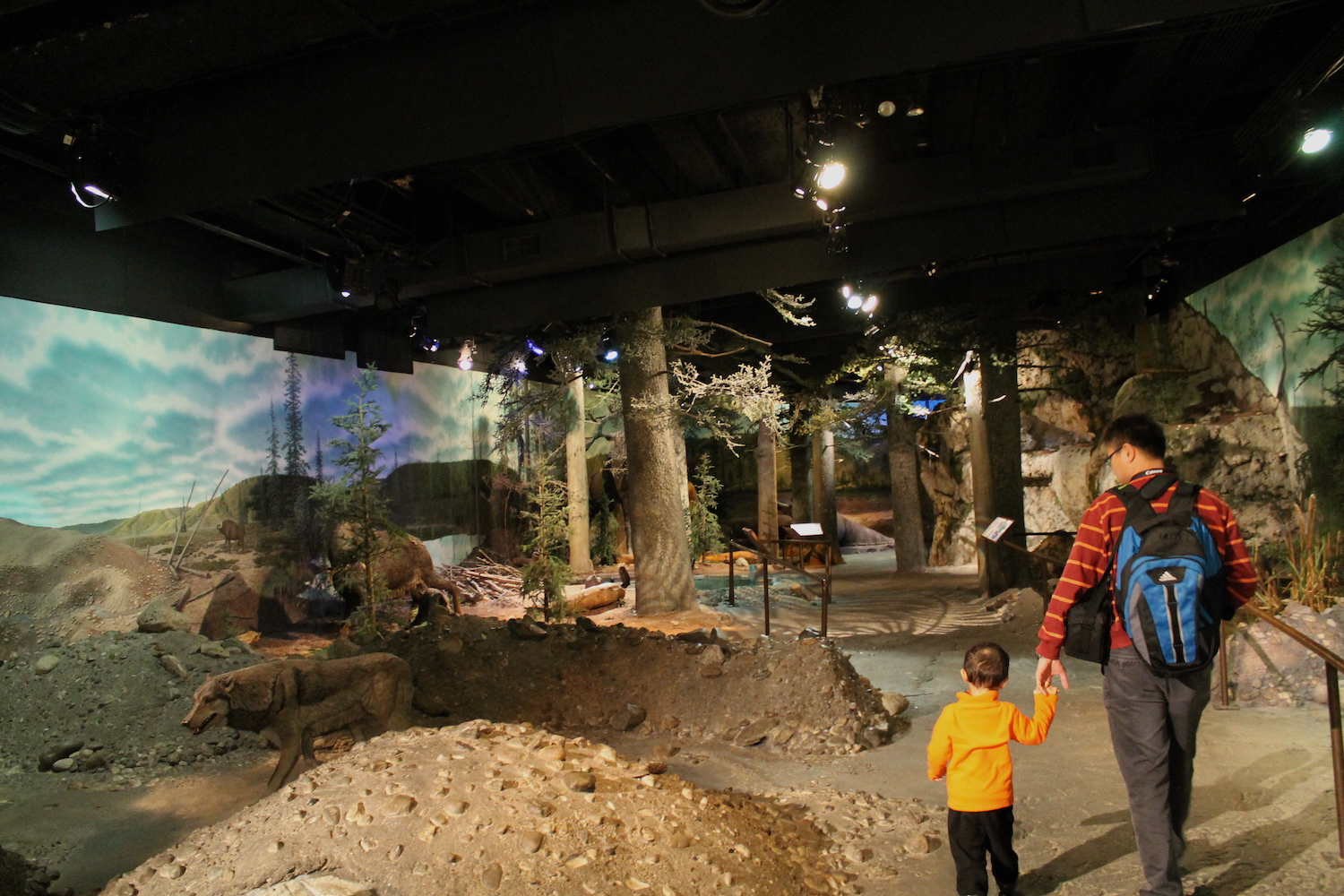
Although the resting Menoceras bears a certain resemblance to the Roosevelt white rhino on the other side of the museum, this was a lucky accident rather than a deliberate quote.

Another more subtle reason these mounts are so successful is that the animals’ feet are always touching the ground. Many mounted skeletons are elevated on their supports, which makes the interplay between the armature and the base (typically built separately) easier to manage but also makes the skeletons look like they’re hovering. Grounding the animals’ feet was extremely challenging: ultimately, beds of gravel were used to smooth out the point of contact. Few visitors are likely to notice this achievement specifically, but the result is that each skeleton is imbued with weight and energy rarely seen in similar displays.

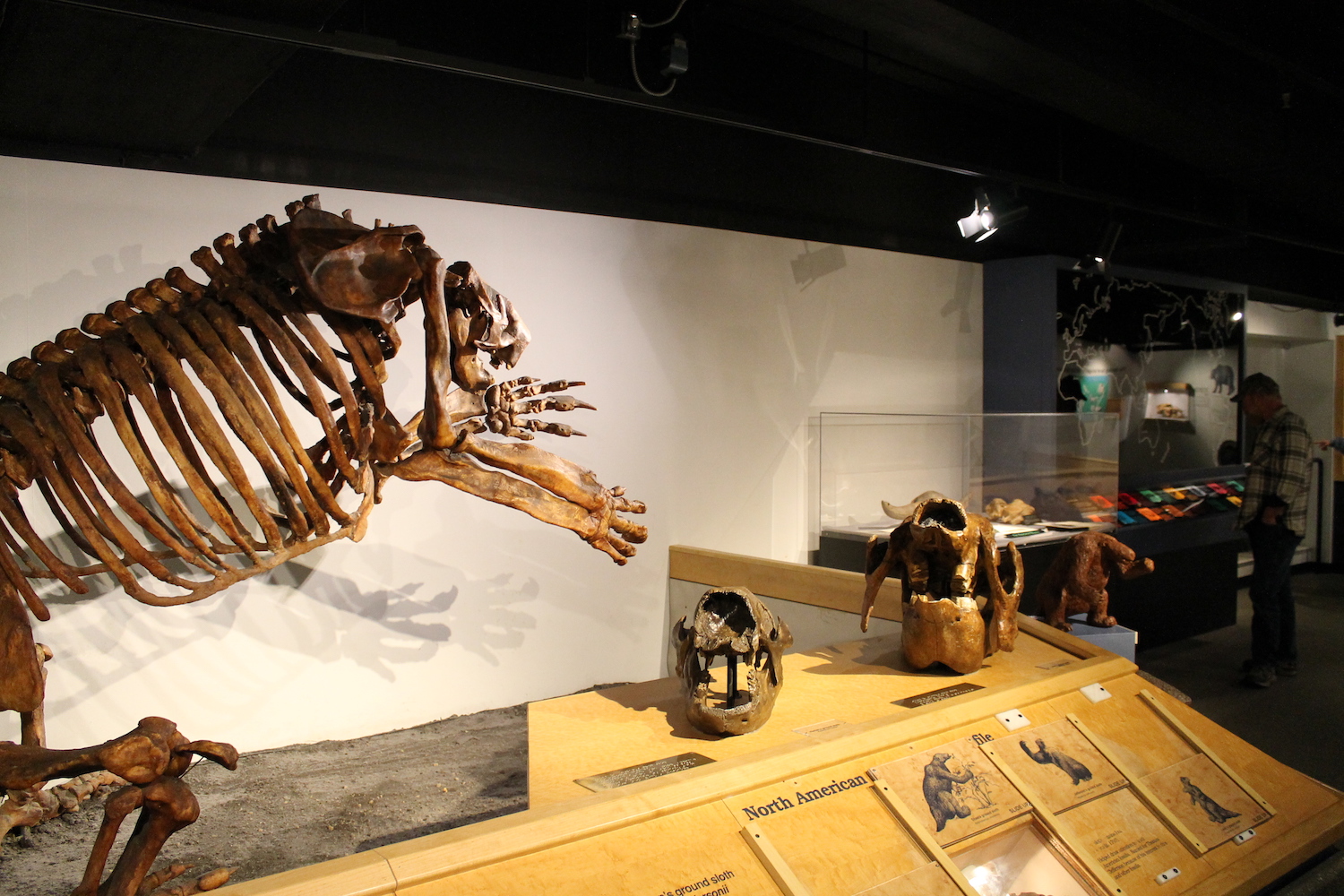
Placing the ground sloth at the entrance was an early design decision.

Research Casting International prepared and constructed most of the mounted skeletons, while NMNH preparators handled the rest in-house. The scope of the mounting and remounting of fossil skeletons for Deep Time is probably unprecedented. For comparison, the renovation of the American Museum of Natural History paleontology halls in the mid 90s involved two remounts (Tyrannosaurus and Apatosaurus) and around ten new skeletons. By my rough count, Deep Time has 40 remounts and 13 brand-new mounts, to say nothing of the work that went in to dismantling the skeletons from the old hall that have been returned to collections.

Discovery

The Jurassic diorama, one of more than a dozen new scenes created for Deep Time.

It wasn’t until my second day exploring Deep Time that I noticed the dioramas cycle between day and night. I can only imagine the challenge the designers faced in arguing for this feature. It doesn’t have any particular educational purpose, after all, and only a small fraction of visitors are likely to notice it. Still, for those who do notice (I’m picturing a child poring over every detail of the miniature landscape while their parents wait impatiently), the effect is beautiful and magical. Those are the moments exhibition creators strive for.

Good thing that glass is there or we’d be in a real pickle.

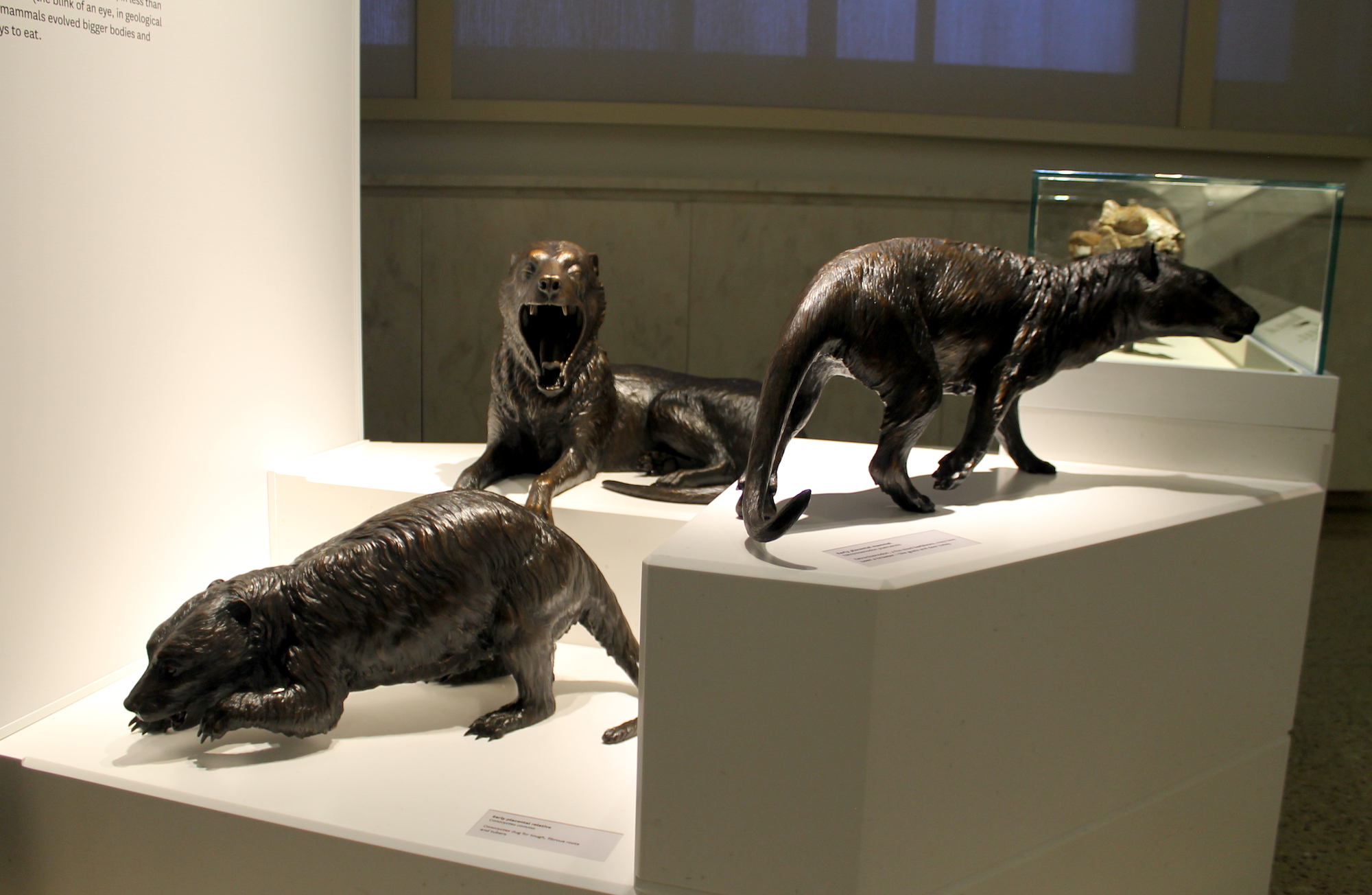
A stroll through Deep Time is filled with similar moments of discovery, on many different scales. Follow the gaze of the two bronze Ice Age humans and you’ll realize they’re reacting to the Smilodon stalking nearby. Look beneath the platforms where Tyrannosaurus and Dimetrodon are standing and find a secret world of freshwater fossils. Although there are few levers to pull and wheels to turn in the exhibition, tactile experiences abound. There are touchable fossil casts, and a plethora of life-sized bronzes to interact with. I’m particularly enamored with the Mesozoic and early Cenozoic mammals: these are difficult to conceptualize with fossils alone and the bronzes bring them to digging, scratching, yawning life.

Seriously, these guys rule.

There are a hundred more examples, but I should stop for now. In short, Deep Time is an incredible exhibition. You should visit, and then visit several more times, because you’ll undoubtably discover new things to wonder at.
Reference

Marsh, D.E. 2019. Extinct Monsters to Deep Time: Conflict, Compromise, and the Making of the Smithsonian’s Fossil Halls. New York, NY: Berghan Books.

6 Comments

Filed under Deep Time, dinosaurs, education, exhibits, fossil mounts, mammals, museums, NMNH, opinion, reviews

Paleontology Exhibits of California – Part 3

We ended our southern California museum tour with the Western Science Center and the San Diego Natural History Museum. Regrettably, my memory of the Western Science Center is not as detailed as it could be – probably because we stopped by the morning after an 8-hour romp through the San Diego Safari Park and I was still a little braindead. Open since 2006, the Western Science Center was established to house and interpret the fossils and archaeological artifacts recovered during the construction of Diamond Valley Lake, an artificial reservoir near Hemet, California. The fossils in question are from the Pleistocene (roughly contemporaneous with the La Brea Tar Pits) and the museum has nearly a million of them.

“Snapshots in Time” is the main exhibit at the Western Science Center.

The heart of the museum is the permanent “Snapshots in Time” exhibit, which features both paleontology and archaeology displays. Dominating the room are the mounted skeletons of Max the mastodon and Xena the columbian mammoth. Unlike conventional fossil mounts, in which real or cast bones are cradled by a custom armature, Max and Xena are represented by two-dimensional frames, which establish the animals’ shape in life. Casted bones are attached to the frames in their proper locations, and the real fossils are in glass-covered sandboxes at the feet of the mounts. These visually distinctive displays have some noteworthy interpretive advantages. For one thing, they show the true shape of a proboscidian (in contrast, a conventional mammoth or mastodon mount omits the boneless trunk). These displays also clearly illustrate how much of the specimen was actually found – no reconstructed bones are needed. The Max and Xena mounts are a clever way to help visitors understand the subtleties of paleontological reconstruction: vertebrate fossils are rarely found as complete skeletons, but the inferred portions are far more than idle speculation.

The Western Science Center’s interactives are inspired, as well. Most impressive is a station where visitors can make clay casts from metal molds set into a counter. The amount of upkeep an activity like this requires would be prohibitive for a higher-traffic museum, but here it seemed to work just fine. I also liked a station that invites visitors to interpret archaeological objects through the rules of superposition. However, a mostly-digital interactive that demonstrates taphonomic processes in different microenvironments felt clunky and difficult to use.

As long as clay and plastic wrap can be continuously provided, this cast-making station is worth attempting to emulate.

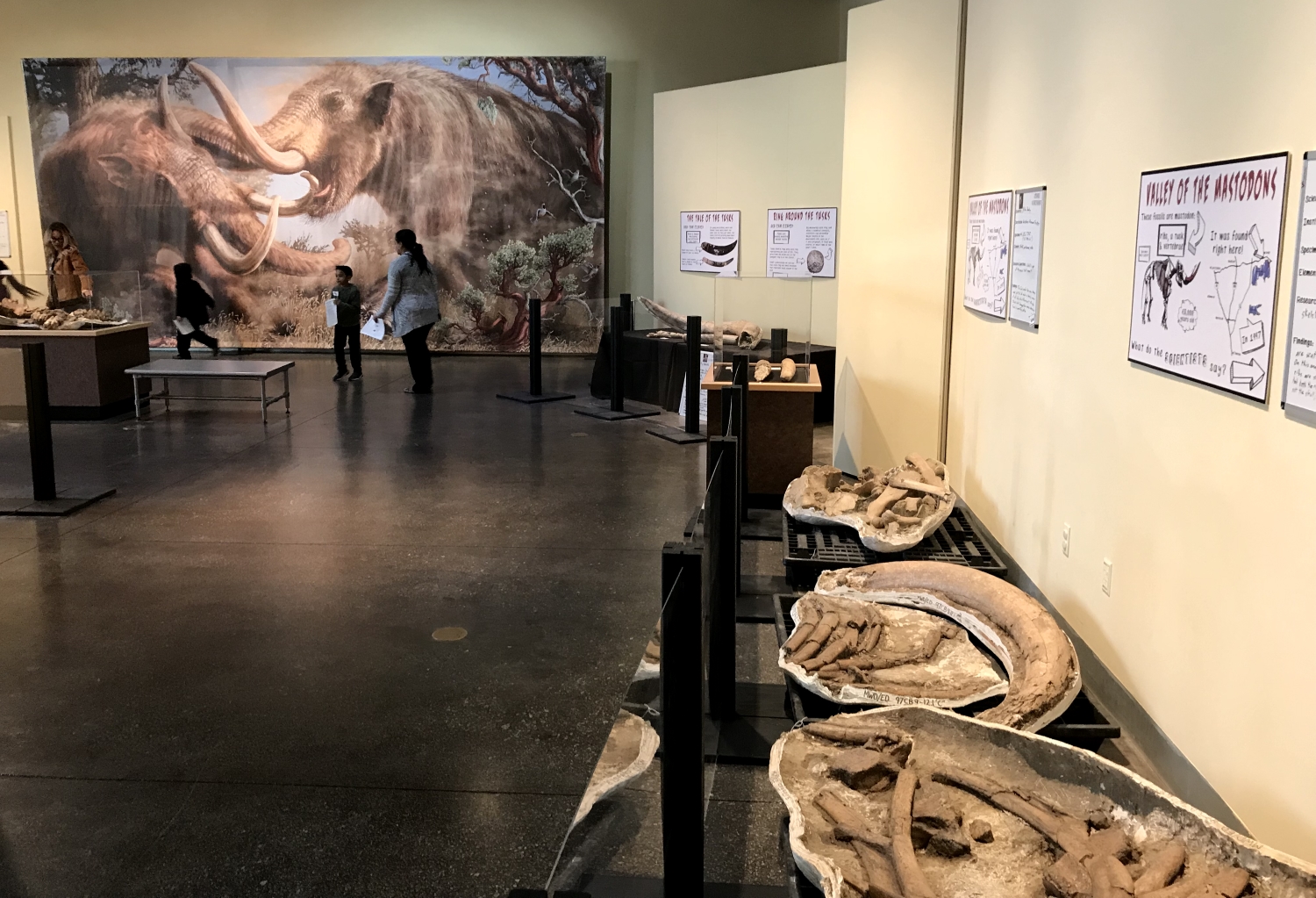
The Valley of the Mastodons special exhibit, featuring a killer mural by Brian Engh.

We also got to see “Valley of the Mastodons,” a special exhibit that will be on display until next month. The exhibit is the result of an experimental public conference arranged by Western Science Center Director Alton Dooley and Dr. Katy Smith of Georgia State University. During the event last August, a group of paleontologists spent several days studying as-yet undescribed fossils from the museum’s collection on the exhibit floor and in view of the public. Visitors could chat with scientists and learn about their discoveries and methods in real time. I can’t report on the event itself (do check out Jeanne Timmons’s top-notch reporting at PLOS Paleo), but I liked the slap-dash, science-in-progress look of the exhibits. There were pieces of over a dozen mastodon individuals on display in various states of preparation, accompanied by notes from the visiting scientists feverishly scrawled on whiteboards. Between Valley of the Mastodons and the Western Science Center’s event calendar, it seems that the museum’s secret strength its its ceaseless slate of public programming. Workshops, activities, and lectures on topics ranging well beyond the boundaries of paleontology and archaeology suggest that the museum has successfully situated itself as an indispensable community resource.

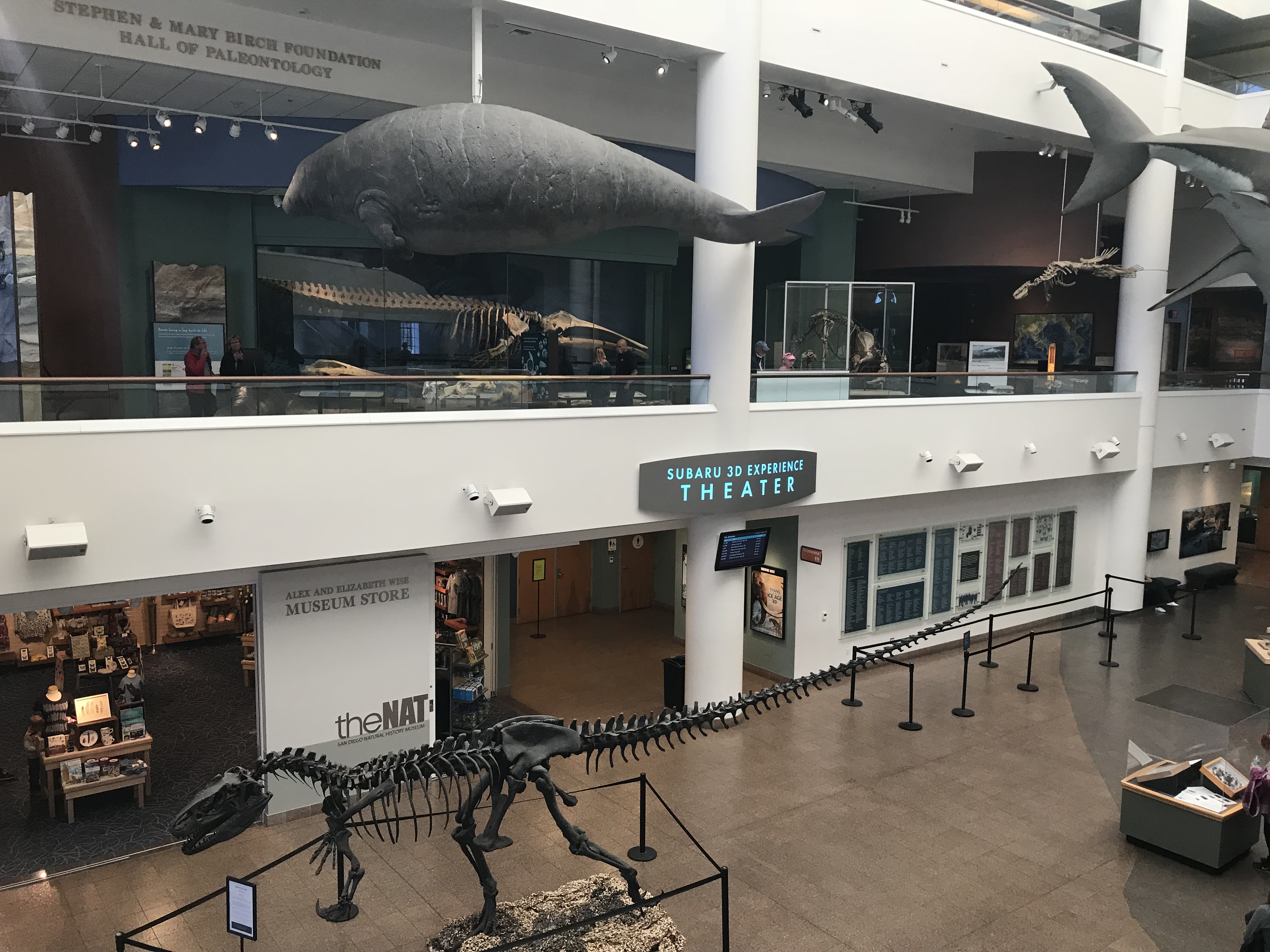
Despite its size, the SDNHM building doesn’t have a ton of usable exhibit space, and many displays are crowded onto mezzanines.

If I had to pick a favorite southern California museum, it would be the San Diego Natural History Museum (or “the Nat,” as it is rather insistently branded). Like the Field Museum, SDNHM got its start as a permanent home for a collection of objects assembled for a world’s fair, in this case the 1914 Panama-California Exposition. The museum occupied a series of temporary structures built for the Exposition in San Diego’s Balboa Park until 1933, when the purpose-built museum building was completed. A 2001 renovation more than doubled the museum’s size. Near as I can tell, no pre-renovation exhibits remain on display. Nevertheless, there’s a ton of great stuff to see, from an urban ecosystems-focused wildlife exhibit to a temporary “random cool specimens from the collections” gallery (this sort of exhibit has been popular lately, and I’m all for it). In keeping with the theme of this blog I’ll focus my comments on the paleontology exhibit.

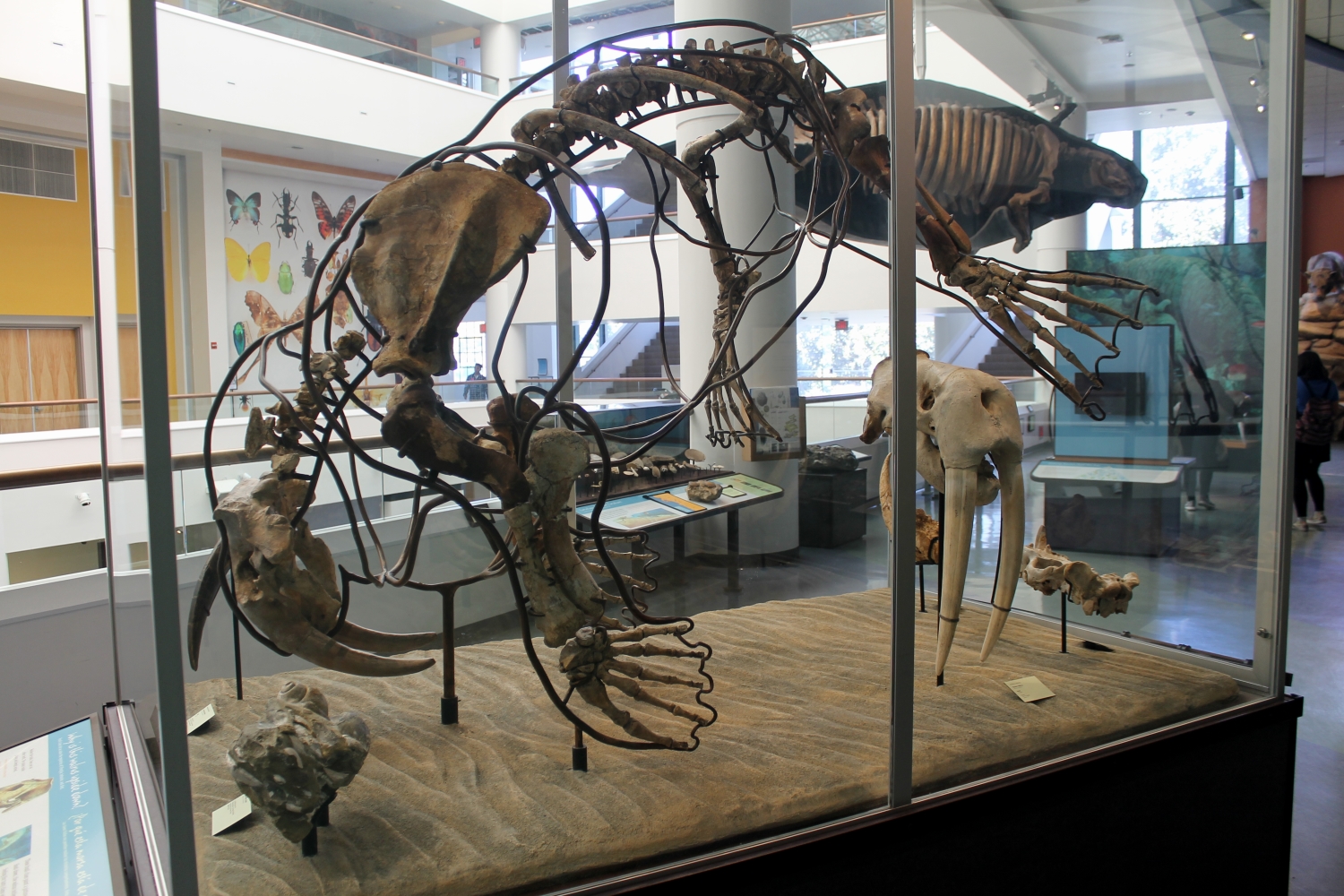
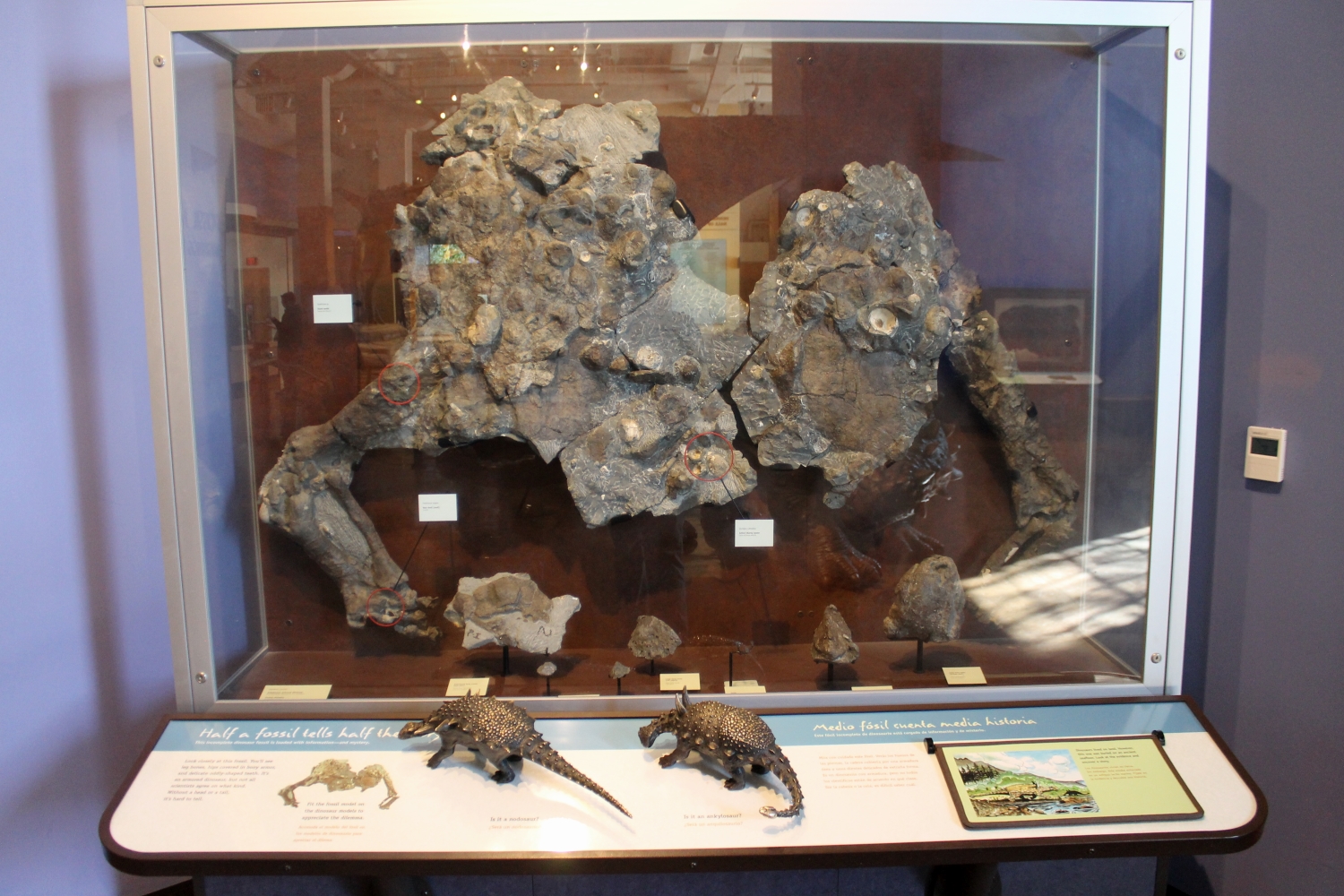
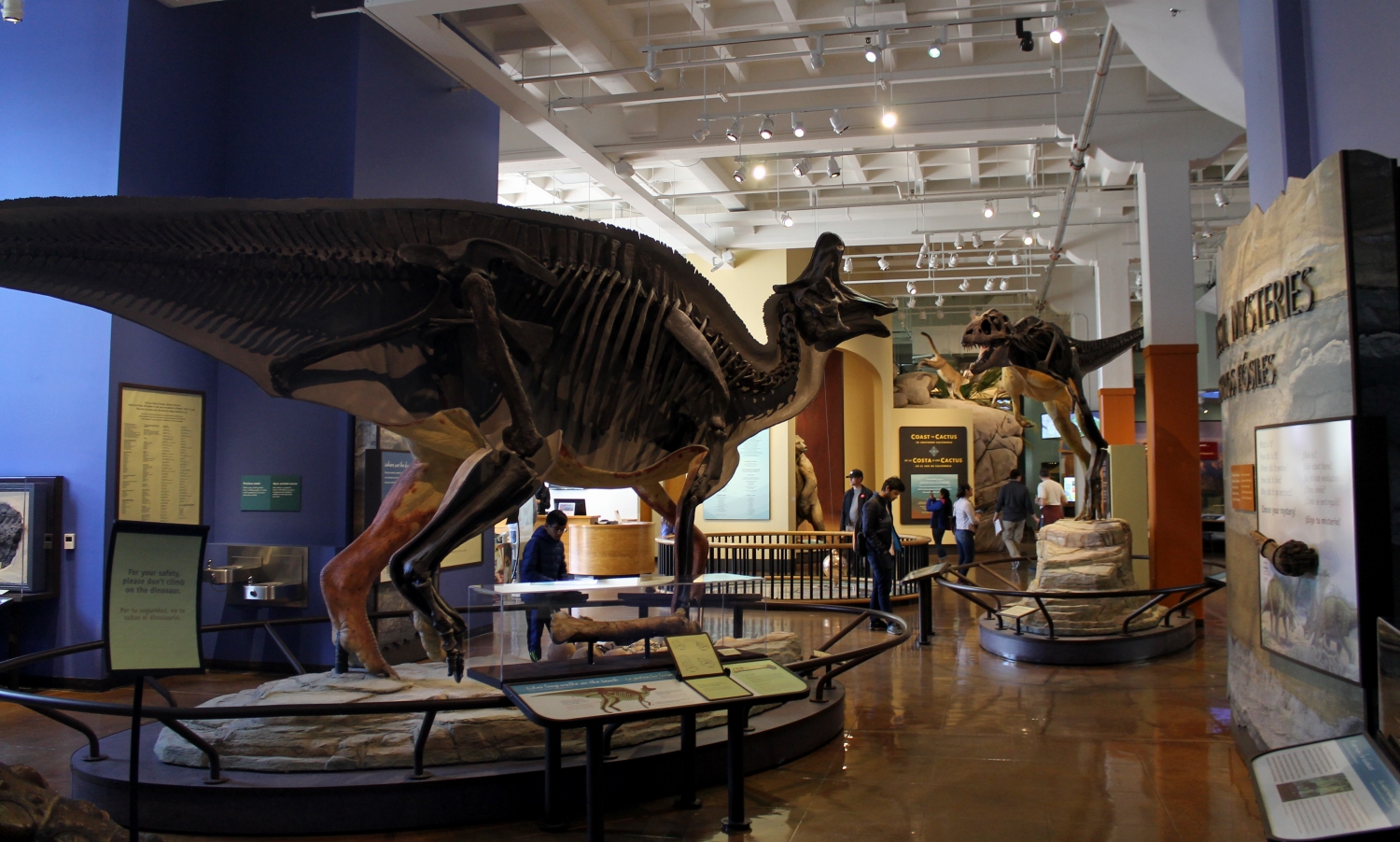
“Fossil Mysteries” showcases prehistoric life from the San Diego area from the Mesozoic through the ice ages. The regional focus means that the exhibit is full of incredible creatures I had never heard of. Examples include Semirostrum, a porpoise with an absurdly elongated chin, and Dusignathus, a walrus with seal-like teeth for hunting fish (unlike modern walruses, which are adapted to suck up mollusks). Beautiful mounted skeletons of the walrus Valenictus, the fearsome-looking pinniped Allodesmus, and an unnamed grey whale relative introduced me to a brand-new prehistoric ecosystem. While southern California is not known for its dinosaur fossils, the handful of specimens on display were interesting because of their unique taphonomy. Found in marine deposits, the hadrosaur femur and armored shoulders of Alectopelta are studded with bivalves.

I am the Valenictus.

This Alectopelta was swept out to sea before being buried in marine sediments, and is now studded with oysters.

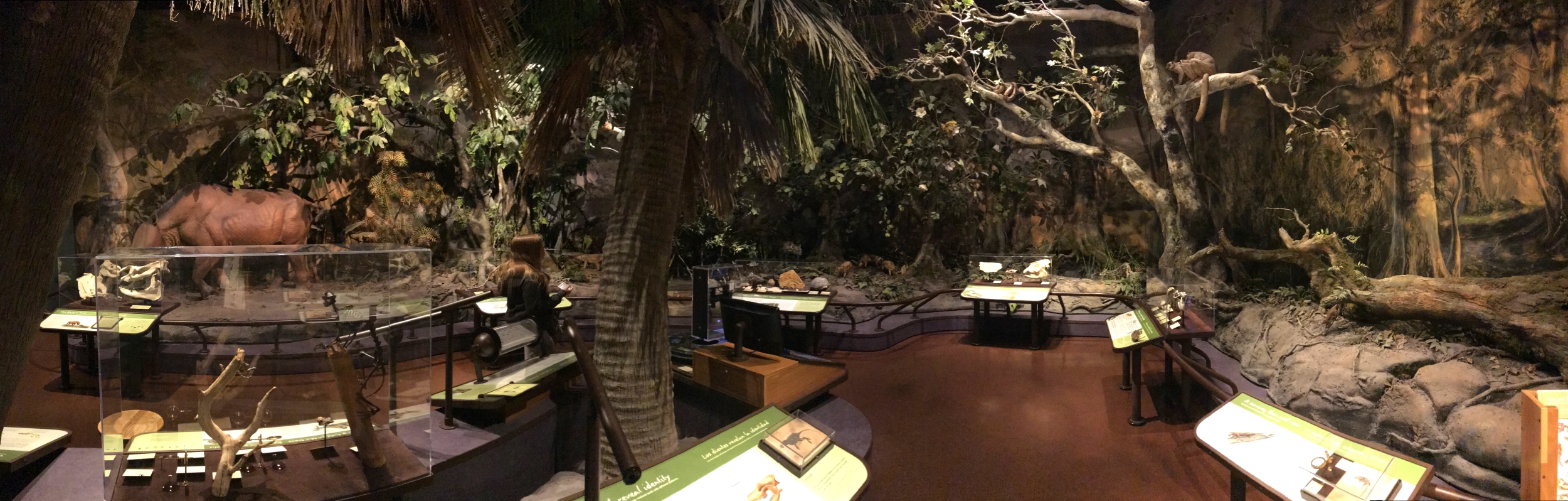
Fossil Mysteries also boasts an impressive array of fabricated displays. Life-sized models of Carcharocles megalodon and Hydrodamalis gigas hang over the central hall, while half-model, half-cast reconstructions of Lambeosaurus and Albertosaurus make up for the paucity of real dinosaur material. One of my favorite parts of the exhibit is the walk-through diorama of an Eocene rainforest. I’ve seen Carboniferous coal swamps represented like this at several other museums, but this is the first time I’ve seen this approach applied to the early Cenozoic. I can’t imagine why, since Lagerstätten from this time period found across North America and Europe make it a natural choice for a highly detailed, immersive display. In a rare but very welcome move, SDNHM provides information about the artists that contributed to the exhibit on its website.

Half-model, half-cast skeletons of Lambeosaurus and Albertosaurus were designed by Mark Rehkopf of Research Casting International.

A panoramic view of the immersive Eocene diorama.

Aside from the specimens and objects, what I really love about Fossil Mysteries is the interpretation. For me, the best signage grabs visitors’ attention by starting with what they know, then poses new questions and provides the tools needed to answer them. Good signs relate directly to the objects on display whenever possible, because that is what visitors come to see in the first place. And all this should be done with brutal succinctness. People can read textbooks at home, so its a mark of a truly talented exhibit writer when complex ideas can be consistently communicated in 40 words or less. With the right phrasing and arrangement, an exhibit can move beyond merely sharing information and become a space for conversation, reflection, and meaningful engagement. Basically, visitors should be able to learn something new in a way that wouldn’t be possible anywhere else. I want to give the exhibit developers and writers at SDNHM the highest of fives, because they absolutely nailed it.

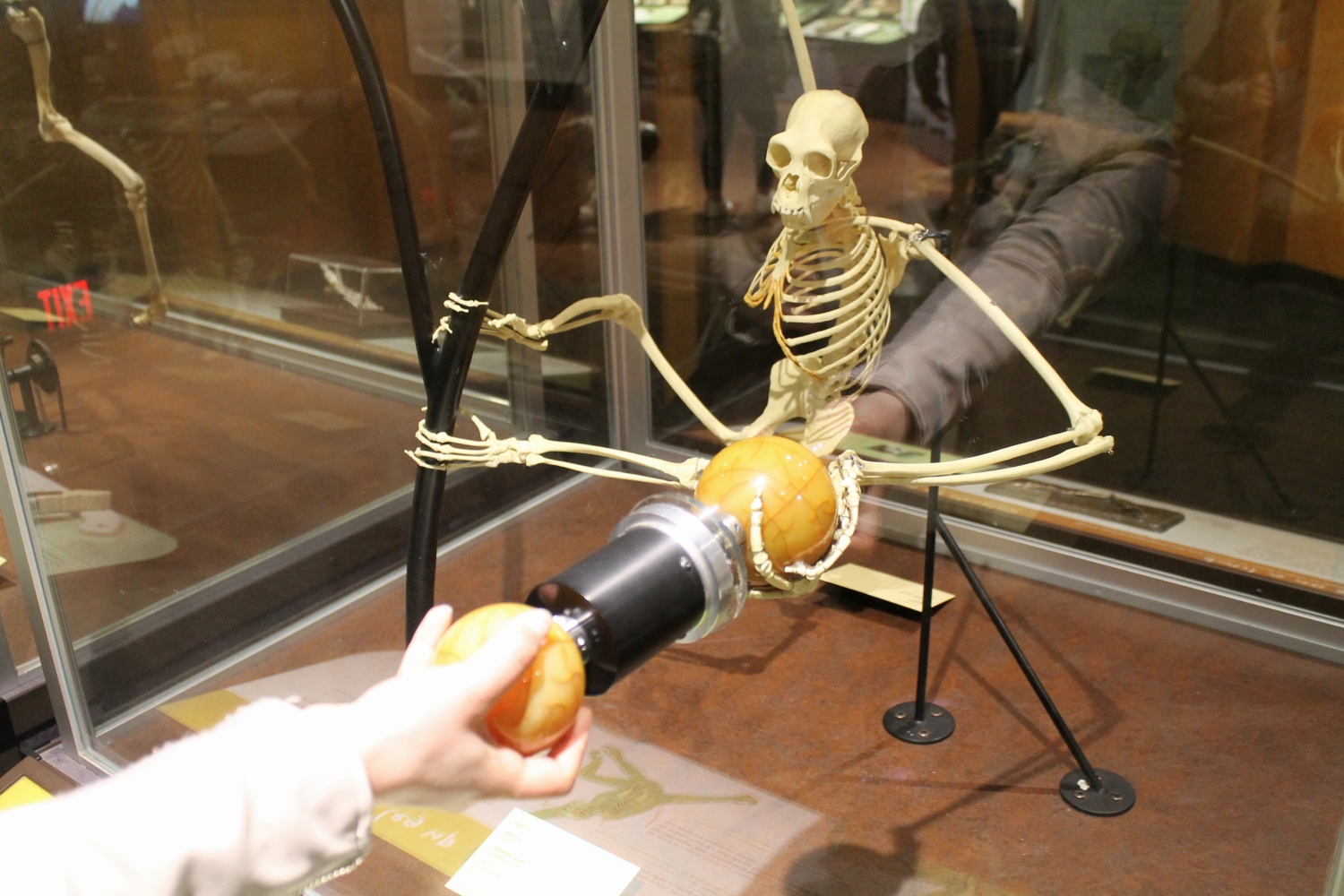
In an informative and weirdly potent interactive, visitors learn about the special adaptations in primate wrists by helping a gibbon skeleton turn a doorknob.

So there you have it – five museums in as many days, and another corner of the world map of natural history museums checked off. Have you been to any of the southern California museums I’ve been discussing? What did you think? Please share in the comments!

4 Comments

Filed under dinosaurs, exhibits, fossil mounts, mammals, museums, opinion, reviews

Paleontology Exhibits of California – Part 2

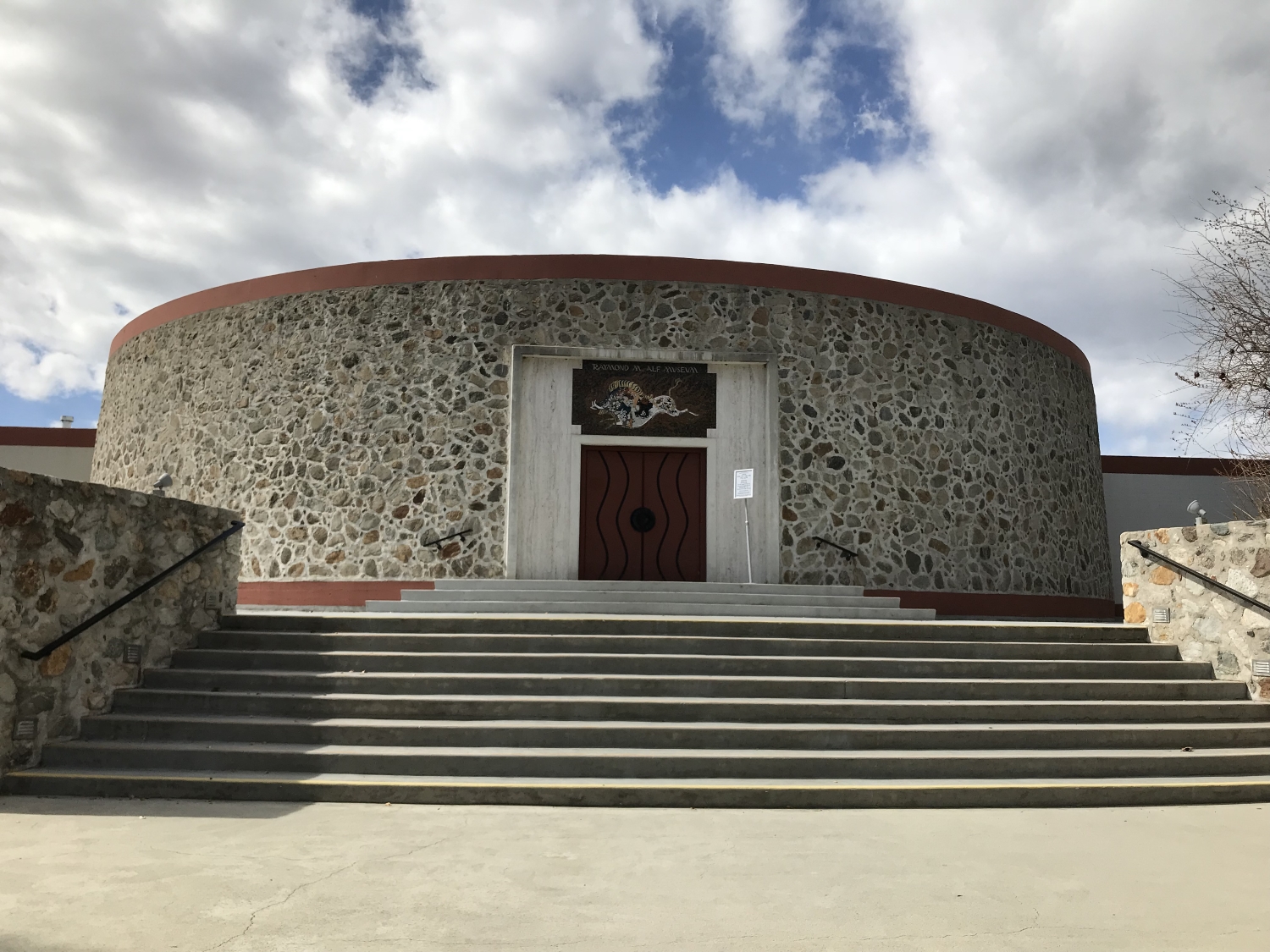
After visiting the La Brea Tar Pits and the Natural History Museum of Los Angeles County, we headed to Claremont to check out the Raymond M. Alf Museum of Paleontology. I had heard lots of good things about the Alf Museum and have been wanting to check it out for some time. Many, many thanks to Curator Andy Farke (as well as Lucy Herrero and Gabriel Santos) for generously taking the time to show us around!

The Alf Museum is housed in a distinctive circular building, with a peccary mosaic over the door.

The Alf Museum is extremely unique. Located at the Webb School in Claremont, it is the only nationally accredited museum on a high school campus. The museum grew out of the collection of Webb teacher Raymond Alf. Though he was not a paleontologist by training, Alf became hooked on fossils after finding a Miocene peccary skull on a 1936 trip to the Mojave Desert. Alf continued to take students fossil hunting year after year, building a sizable collection in the basement of the library and any other storage space he could find. In 1968, alumi and school administrators came together to establish the non-profit Alf Museum, with Raymond Alf himself serving as its first director. Alf passed away in 1999, but lived long enough to see his museum become an internationally recognized research institution.

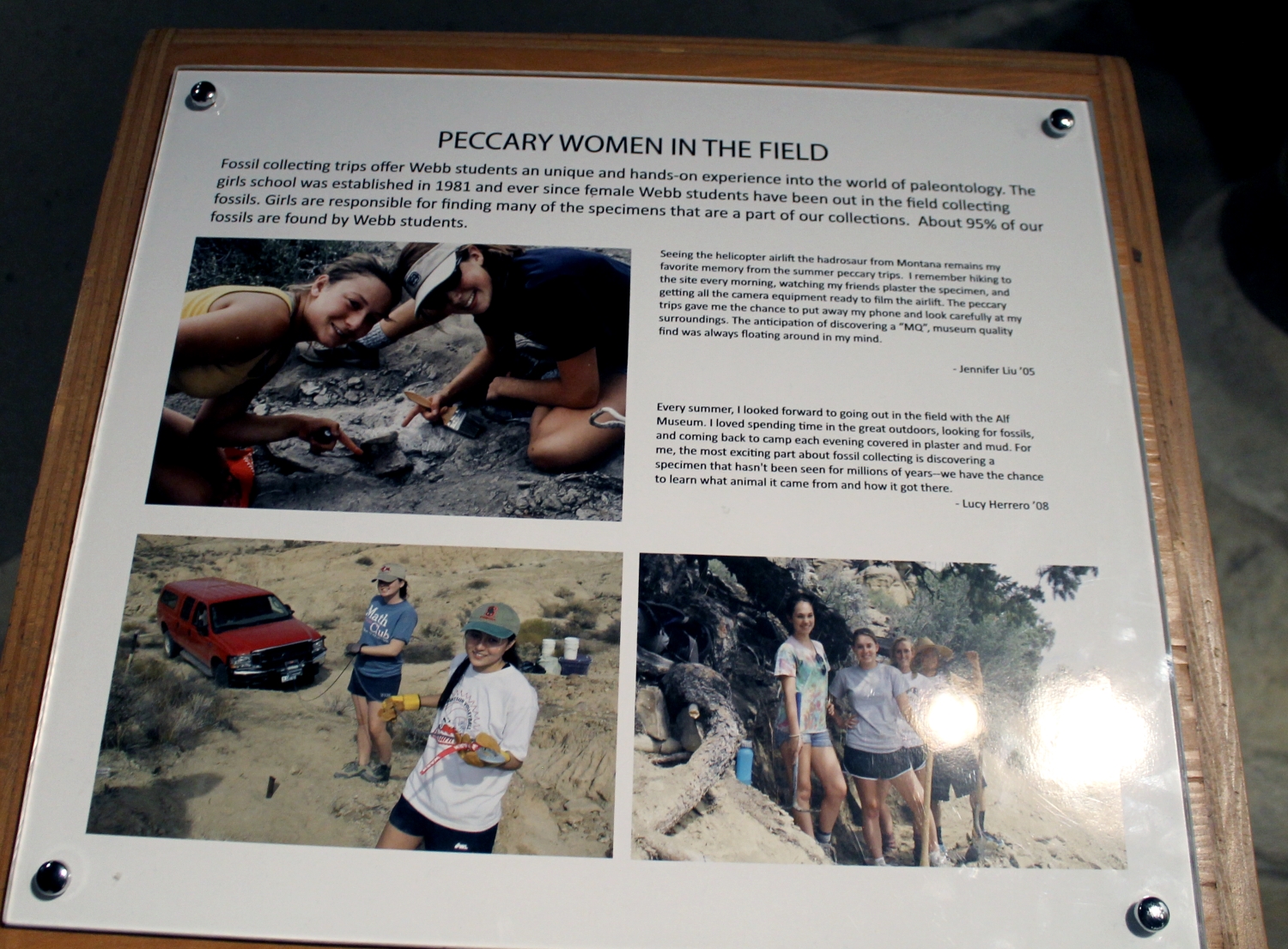
Webb School students continue to take an active part in collecting and research at the museum. All students go through a paleontology course in 9th grade, and about a fifth of the student body remains involved afterward. 95% of the museum’s 140,000 fossils were found by students on “peccary trips” to California, Utah, and Arizona. Students also lead tours and work in the state-of-the-art fossil prep and digitization labs. To date, 28 students have co-authored technical papers before graduating, all of which are proudly displayed at the museum.

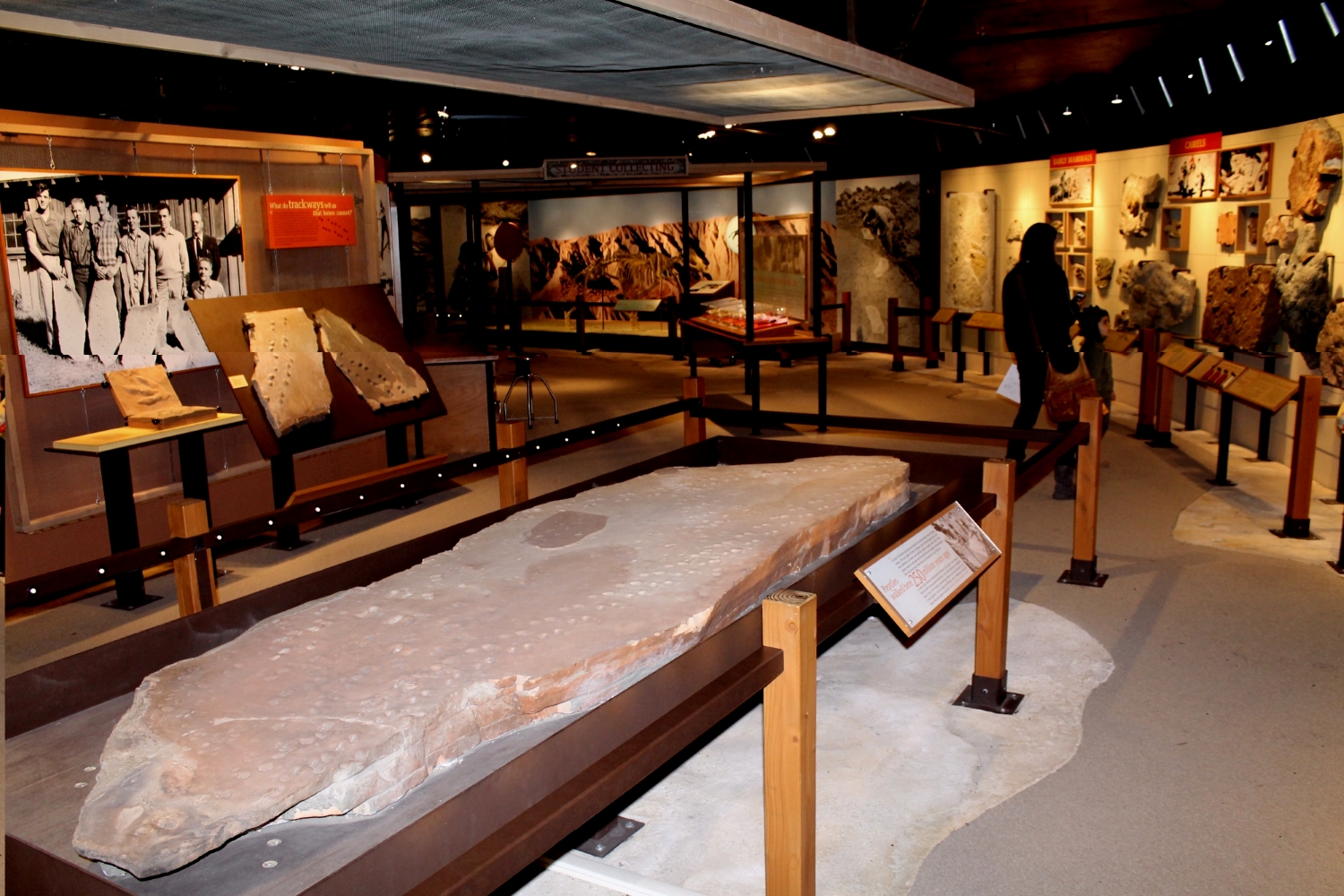
Alf and a group of students collected this Permian reptile trackway in 1967 near Seligman, Arizona.

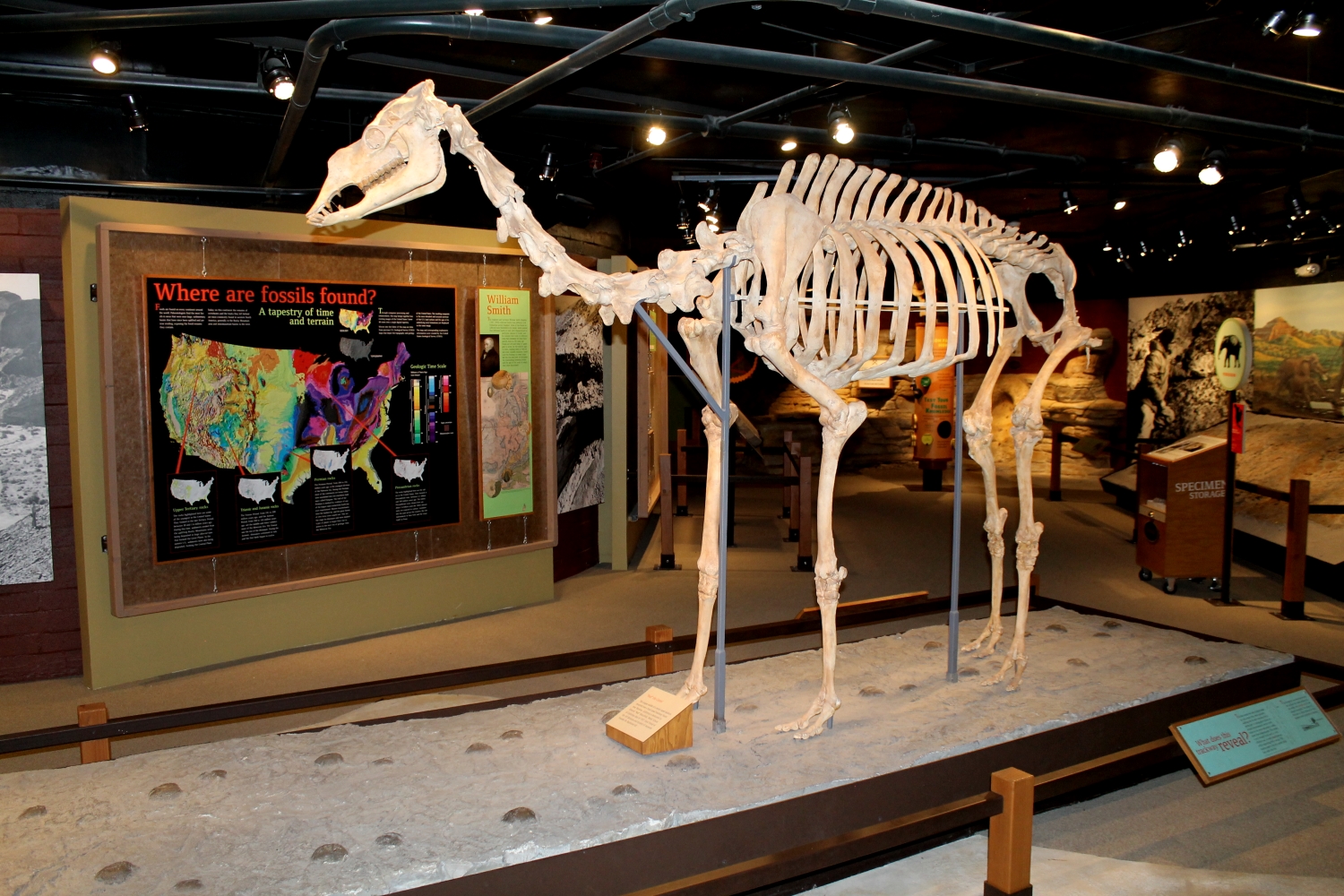
In the Hall of Footprints, mounted skeletons are cleverly placed over real fossil trackways.

There are two exhibits at the Alf Museum, each taking up one of the two floors. The lower level houses the Hall of Footprints, which was last renovated in 2002. This exhibit showcases one of the largest fossil trackway collections in the United States. Trace fossils on display range from Permian reptiles and insects to Cenozoic elephants and camels, as well as important holotypes like the world’s only known amphicyonid (bear-dog) trackway. To quote Dr. Farke, much of the footprint collection was acquired by “being stupid.” Despite being miles from any road, Alf and his students would cut colossal track-bearing slabs out of the bedrock by hand. Between the logistical problems and the availability of digitization techniques like photogrammetry, few modern ichnologists would condone Alf’s practices. On the other hand, his recklessness ensured that these fossils are available for study today, even after many of the source localities have weathered away or been vandalized.

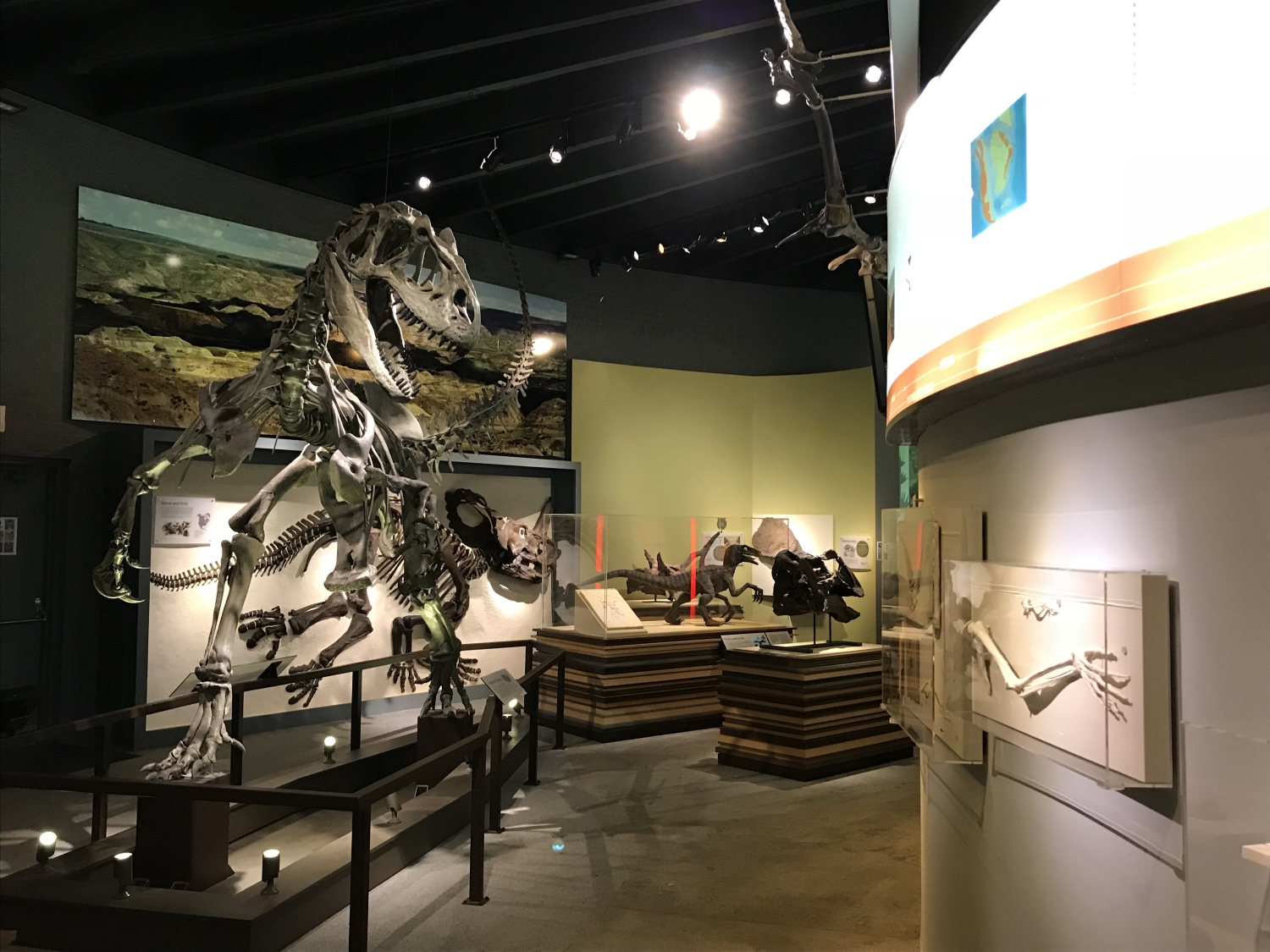
The main level’s Hall of Life is a more traditional walk through time, but with an Alf Museum spin. Visitors follow the circumference of the annular building, starting with the origin of the universe and progressing chronologically through the major milestones in the evolution of life on Earth. The bigger, showier aspects of the exhibit are not unique to the museum. There’s a cast of the Red Deer River Centrosaurus from the American Museum of Natural History, and a composite cast of a Cleveland-Lloyd Allosaurus. A model of the famous transitional fish Tiktaalik has an identical twin at the Field Museum. Like many modern exhibits, walls are filled in with large murals and a varied color palate is used to demarcate themed sections. Different audio tracks throughout the exhibit are subtlety employed in the same way (the sound of buzzing prairie insects symbolizing the rise of grasslands in the Cenozoic is particularly inspired).

Showy dinosaur casts undoubtedly draw visitors’ attention.

Original and cast specimens from the Paleozoic are illustrated by one of several murals by Karen Carr.

Once one looks past the more ostentatious parts of the display, the Alf Museum really gets interesting. Since Dr. Farke was involved in the Hall of Life’s 2011 renovation, he could explain the design choices in detail. Some of these follow Farke’s own sensibilities. For instance, the scientific method and the evidence for evolution are strongly emphasized. Most labels are implicitly written to answer the question how do we know? Interactives tend to be of the analog variety, and multimedia is only used to illustrate things that could not be effectively shown with a static display. One example is a video where a computer model of a pterosaur skeleton demonstrates the quadrupedal launch hypothesis.

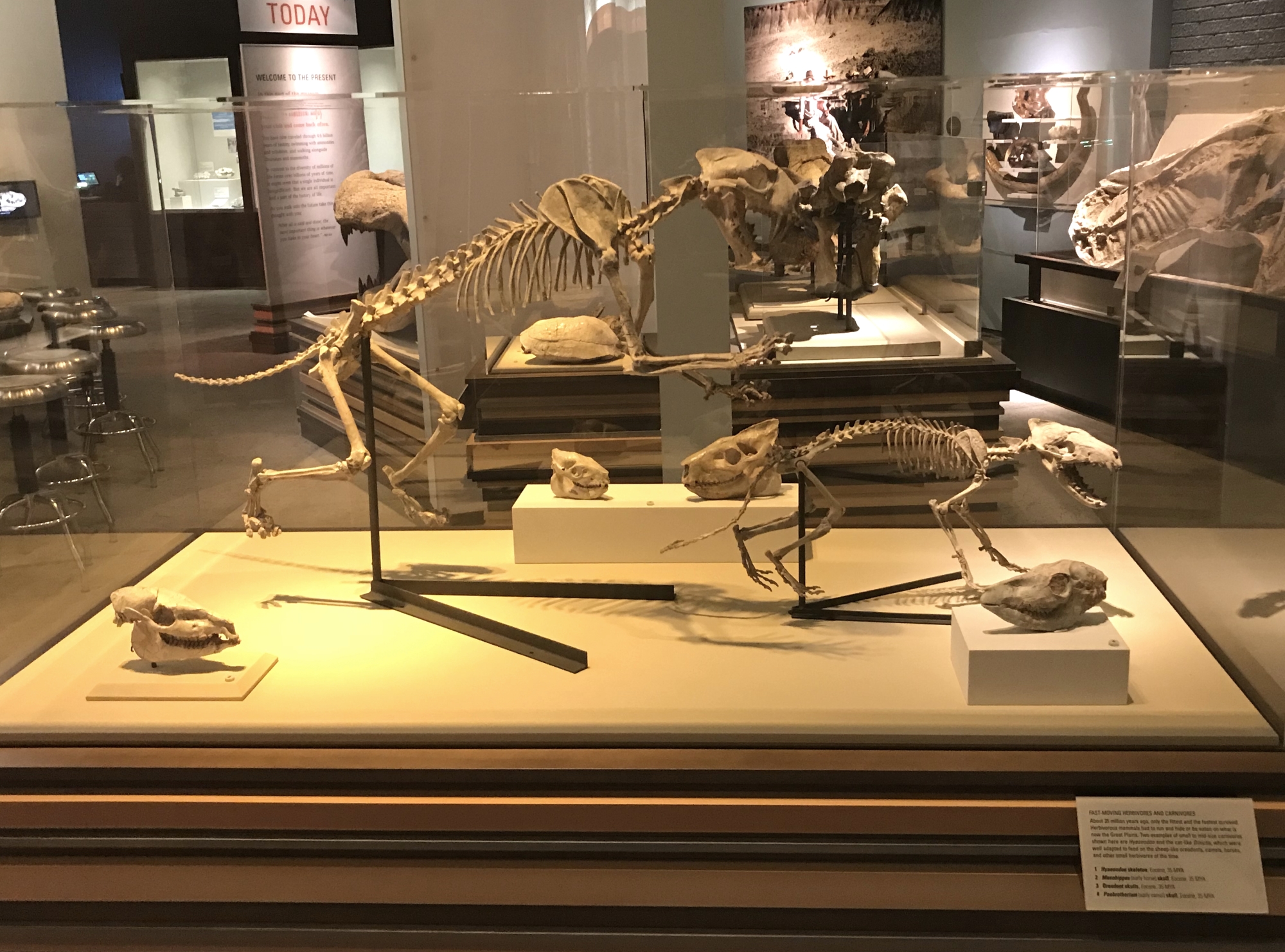
Expressive Dinictis and Hyaenodon mounts welcome visitors to the Cenozoic.

“What are you going to do with your moment in time?”

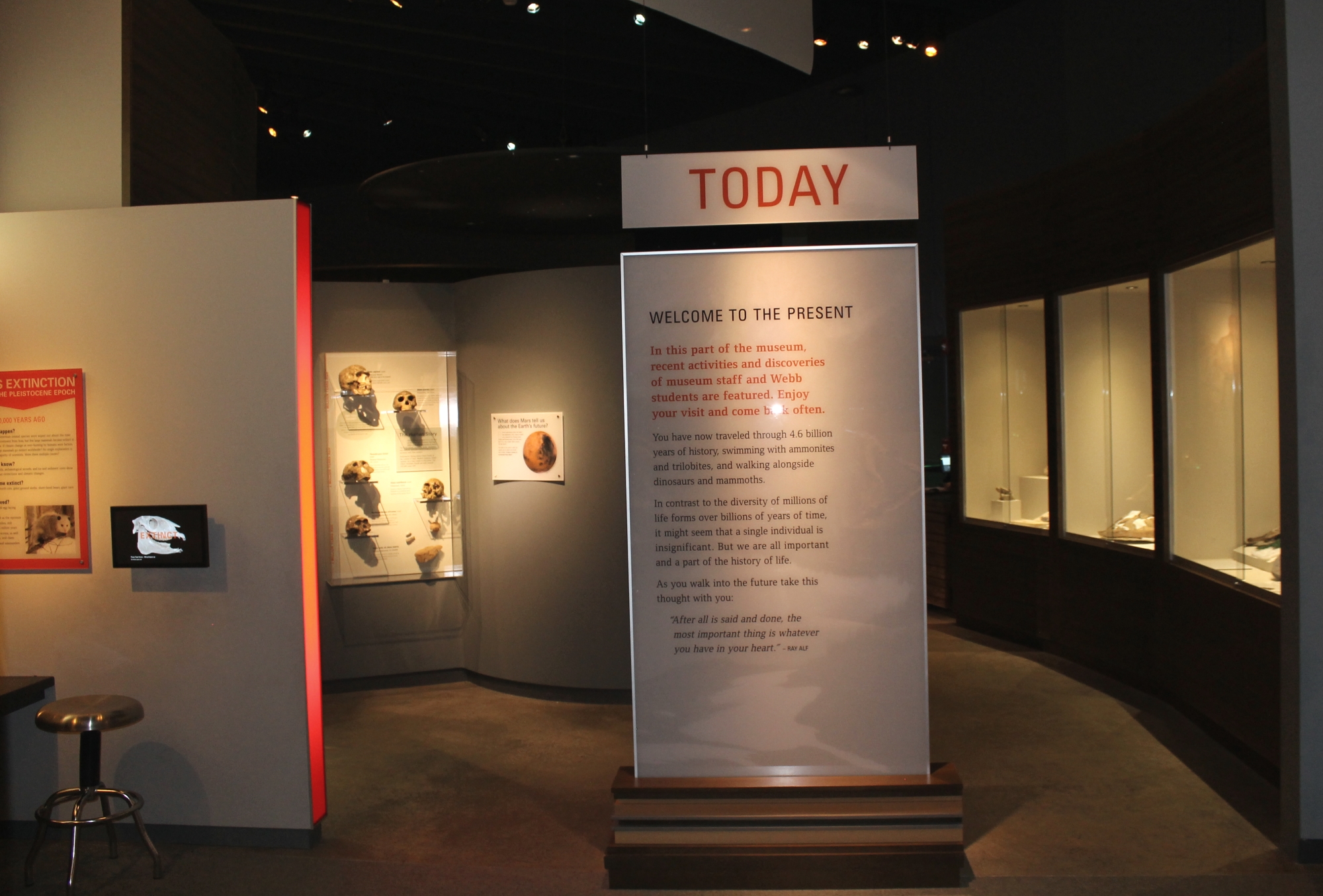
Nevertheless, in both large and small ways the main themes of the exhibit are modeled after Raymond Alf’s own teaching philosophies. Following Alf’s lead in trusting students to treat specimens mindfully and respectfully, many objects are not in cases and within arm’s reach. The circular halls harmonize with the “spiral of time,” Alf’s preferred metaphor for the geological record (and circles and spirals are a recurring visual motif throughout the museum). Perhaps most importantly, the Hall of Life’s walk through time doesn’t end in the past but in the present. This final section includes nods to the archaeological record, as well as cases featuring new research and discoveries by Webb School students. The message is that despite our short time on Earth, humans have had a profound impact on the planet and every individual has a part to play in the larger story of the universe. As Alf repeatedly asked his students, “what are you going to do with your moment in time?”

Student stories and quotes can be found throughout the exhibits.

The most thought-provoking thing that Farke told me was that the Alf Museum is intended for three distinct audiences. There are the regular museum visitors, seeking a generalized look at paleontology. Then there are current Webb School students, who make use of the museum as part of their classes. Finally, there is the larger cohort of Webb alumni, who want to see specimens they remember from decades past (including fossils they collected themselves) and to reflect on their time at the school and on Raymond Alf himself. It is the nods to this third group that make the Alf Museum’s exhibits uncommonly special. Even as an outsider who had never met a Webb student and was just learning about Alf’s legacy, I found that the museum has a palpable sense of community.

Between the photos of beaming students on peccary trips to the unattributed Raymond Alf quotes printed high on the walls, the shared experiences of the Webb School community are intractably situated within the exhibits. Objects on display are illustrative specimens, but they are also more. Each one represents a rich tapestry of people, places, and experiences, and embodies a sort of collective memory starting with its discovery and extending into the present day. For me, at least, this is what natural history is all about.

5 Comments

Filed under collections, dinosaurs, education, exhibits, field work, mammals, museums, reviews, science communication

Paleontology Exhibits of California – Part 1

I’ve spent the last week on a whirlwind tour of southern California, visiting natural history museums, zoos, and botanic gardens, as well as seeing a fair assortment of marine mammals. Suffice it to say, my (endlessly patient) travel partner Stephanie and I ended the trip with a bit of sensory overload. I had planned to start off with a brief travelogue post and save more thorough analysis for later, but as usual I’ve gone and written much more than I intended.

La Brea Tar Pits and Page Museum

Howard Ball’s famous mammoth statues in La Brea’s lake pit.

The La Brea Tar Pits (a.k.a. the the tar tar pits) is an iconic fossil locality in downtown Los Angeles. I visited  in my single-digit years, but I remember the site better from documentaries like Denver the Last Dinosaur. The region’s asphalt seeps have been known to local people for thousands of years, and they were first commercially mined in the 1700s, when Rancho La Brea was a Mexican land grant. The animal bones commonly found in the asphalt were seen as a nuisance until 1875, when William Denton of Wellesley College identified a large tooth from Rancho La Brea as belonging to an extinct saber-toothed cat. Several years of largely unrestricted fossil collecting followed, until the Hancock family that had come to own the land gave exclusive collecting rights to the Los Angeles County Museum (now the Natural History Museum of Los Angeles County) in 1913.

Within two years, museum paleontologists had collected about a million bones, mostly from large Pleistocene animals like mammoths, ground sloths, wolves, and saber-toothed cats. This enormous abundance meant that the La Brea fossils were useful not only as research specimens but as trade goods. The LACM amassed much of its present-day fossil collection by trading La Brea fossils to other museums.

The Hancock family donated the 23 acres around the La Brea asphalt seeps to Los Angeles County in 1924. From that point on, the area functioned as a public park, where visitors could learn about ice age California and even watch ongoing excavations. Park facilities and exhibits expanded gradually over the ensuing decades. Sculptures of bears and ground sloths by Herman Beck were added to the grounds in the late 1920s. In 1952, a concrete bunker over one of the excavation sites became the first La Brea museum. The LACM board commissioned the site’s most iconic display – the trio of mammoth statues – in 1965, and sculptor Howard Ball installed them in 1968.

The George C. Page Museum, plus a man who wouldn’t move.

Finally, after years of planning and fundraising, the George C. Page Museum of La Brea Discoveries opened in 1977. The remarkable Brutalist building is adorned by a fiberglass frieze depicting ice age animals in a savanna environment. The aluminum frame holding up the frieze also contains an atrium of tropical plants, which the indoor exhibit halls encircle. Architects Willis Fagan and Frank Thornton designed the museum to fit organically into the established park setting, and to subliminally reflect the fossil excavations it celebrates. The building appears to be erupting from the ground, much like the asphalt and the fossils therein. The entrance is below ground level, so visitors must descend a ramp to meet the fossils at their point of origin.

The giant camel Camelops hesternus (front) with adult and juvenile mastodons (back). Those logs were also hauled out of the asphalt seeps.

Panthera atrox was apparently more like a giant jaguar than a lion. Small-by-comparison Smilodon fatalis in the back.

In many ways, the Page Museum is now a museum of a museum. Most of the interior exhibits, including the fossil mounts designed by Eugene Fisher*, are the same as they were in 1977. Photos show that the exhibit halls, prep labs, and collections areas have changed little in the last 40 years. And that’s okay! The museum building and the outdoor displays around it have been part of the Los Angeles landscape for decades, and cherished by generations of visitors. To the museum’s credit, the 1970s exhibits were well ahead of their time. Windows onto the prep lab and collections would be right at home in modern “inside out” museums, and an oft-repeated message that microfossils (such as insects, birds, rodents, and pollen) are more informative than megafauna fossils vis-à-vis paleoclimate and ancient environments is still very relevant to the field of paleontology today.

That isn’t to say there is nothing new to see. Newer signage around the park grounds does an excellent job re-interpreting older displays, especially those that are now considered inaccurate. For example, Howard Ball’s mammoth statues are probably among the most photographed paleoart installations in the world, but they completely misrepresent the way most of the animals found at La Brea actually died. Ball’s female mammoth is hip-deep in a man-made lake filling in an old asphalt quarry. As the signage (and tireless tour guides) explains, the animals trapped here thousands of years ago actually became stuck in asphalt seeps that were six inches deep or less. Meanwhile, while the classic friezes and murals throughout the Page Museum depict savanna-like landscapes, more recent analysis of microfossils demonstrates that the area was actually a fairly dense woodland.

Turkeys, condors, eagles, and storks are among the more unusual fossil mounts at the Page Museum.

There are two main reasons that the Page Museum is a must-see. First, it provides an in-depth view of a single prehistoric ecosystem. As mentioned, LACM traded La Brea fossils to all sorts of other museums, so chances are you’ve already seen a La Brea Smilodon, Paramylodon, or dire wolf. The Page Museum has these animals, but it also has rarely-seen creatures like ice age turkeys, condors, and coyotes. I counted 25 mounted skeletons in total, to say nothing of the hundreds of smaller specimens. My favorite display was a Smilodon skull growth series, where you can see how the adult saber teeth erupt and push out the baby sabers. In addition, the Page Museum stands right next to the La Brea fossil quarries, past and present. The museum and the park that preceded it were conceived as places where the public could see science in action. Researchers have been uncovering fossils at La Brea for over a hundred years, and visitors have been watching over their shoulders the entire time. That alone makes La Brea a very special place.

*All the La Brea mounts (at the Page Museum or elsewhere) are composites. To my knowledge no articulated remains have ever been recovered from the asphalt seeps. As Stephanie pointed out, the skull of the Equus occidentalis mount actually belonged to a significantly younger animal than the mandible. 

Natural History Museum of Los Angeles County

This Tyrannosaurus growth series is the centerpiece of the LACM Dinosaur Hall.

Our next stop was the Page Museum’s parent institution, the Natural History Museum of Los Angeles County (which I will continue to abbreviate as LACM for consistency). LACM actually features two fossil exhibits: the 2010 Age of Mammals Hall and the 2011 Dinosaur Hall. Both were part of a $135 million project to restore and update much of the LACM building, which first opened in 1913. While the two halls were developed concurrently by different teams, they are architecturally very similar. Parallel mezzanines flank spacious central aisles, which maximizes usable space in the two-story rooms and allows visitors to view most of the mounted skeletons from ground level or from above.

The primary strength of both the Age of Mammals Hall and the Dinosaur Hall is that they look really good. New skylights and newly uncovered bay windows yield plenty of natural light. Primary-colored panels provide interesting backdrops for the specimens, and fossil mounts on the ground and in the air keep visitors looking in all directions. These exhibits were clearly designed to look incredible from the moment you enter the room, and the abundant natural light means they photograph quite well.

Suspended skeletons make use of the vertical space and keep visitors looking all around the exhibit.

Triceratops and Mamenchisaurus at the front end of the Dinosaur Hall.

LACM’s mammal collection has been built up over the last century, while the dinosaur specimens were mostly collected by Luis Chiappe’s Dinosaur Institute in the decade preceding the exhibit’s opening. Nevertheless, both exhibits feature an uncommon diversity of beautifully-prepared fossils. I was particularly taken by the metal fixtures constructed to display incomplete skulls of Augustynolophus and Tyrannosaurus. The mounted skeletons were handled by two different companies: Research Casting International did the mammals and Phil Fraley Productions did the dinosaurs. I actually like the mammal mounts slightly better. There’s a greater range of interesting poses, and they don’t suffer from Fraley’s signature exploding chests.

The Poebrotherium, Hoplophoneus, and Hyracodon mounts are full of life and character.

A metalwork frame artfully shows the missing parts of this Augustynolophus skull.

All that said, there is a surprising divergence in the quality of interpretation between the Age of Mammals Hall and the Dinosaur Hall. On this front, the Age of Mammals Hall is better by far. There is an open floor plan that visitors can circulate freely, but everything comes back to three main ideas posted near the entrance: continents move, climates change, mammals evolve. In no particular order, the exhibit demonstrates how Cenozoic mammals diversified in response to the environmental upheaval around them.

On the ground floor, one tableau shows how dogs, horses, rhinos, and camels evolved to move swiftly across the emergent grasslands of the Miocene. Another area covers how mammals grew larger to adapt to an ice age climate. Overhead, a whale, sea cow, sea lion, and desmostylian illustrate four independent lineages that evolved to make use of marine resources. Exhibits on the mezzanine level focus on how paleontologists learn about prehistoric mammals. One area compares different sorts of teeth and feet. Another explains how pollen assemblages can be used to determine the average temperature and moisture of a particular time and place, while drill cores illustrate how a region’s environment changed over time. Although the exhibit as a whole has no time axis, it does an excellent job conveying how evolution works at an environmental scale.

The addition of dogs, camels, and rhinos makes for an informative twist on the classic horse evolution exhibit.

Struthiomimus is accompanied by a modern ostrich and tundra swan.

By comparison, the Dinosaur Hall doesn’t have any obvious guiding themes. The exhibit is a grab-bag of topics, and to my eyes, specimens and labels appear to be placed wherever they fit. Jurassic Allosaurus and Stegosaurus are surrounded by displays about the end-Cretaceous extinction. Carnotaurus of Cretaceous Argentina is paired with Camptosaurus of Jurassic Colorado. Mamenchisaurus shares a platform with distantly-related Thescelosaurus, which lived 80 million years later on the other side of the world. An explanation of what defines a dinosaur is confusingly juxtaposed with non-dinosaurian marine reptiles. If there’s any logic here, I didn’t see it. This is accentuated by the fact that the label copy is no more specific than a run-of-the-mill dinosaur book for kids. It all feels very generalized and unambitious, especially compared to the Age of Mammals Hall. I would have liked to see more information on what makes these particular specimens special, as well as how they were found, prepared, and interpreted. I suppose it’s up to the visitor whether an exhibit like this can get by on looks alone.

And so concludes day one of our trip. Next time, the Raymond M. Alf Museum and places south!

1 Comment

Filed under dinosaurs, exhibits, field work, history of science, LACM, mammals, museums, paleoart, reviews