Tag Archives: paleontology

The Diplodocus seen ’round the world

1st cast in spot of honor

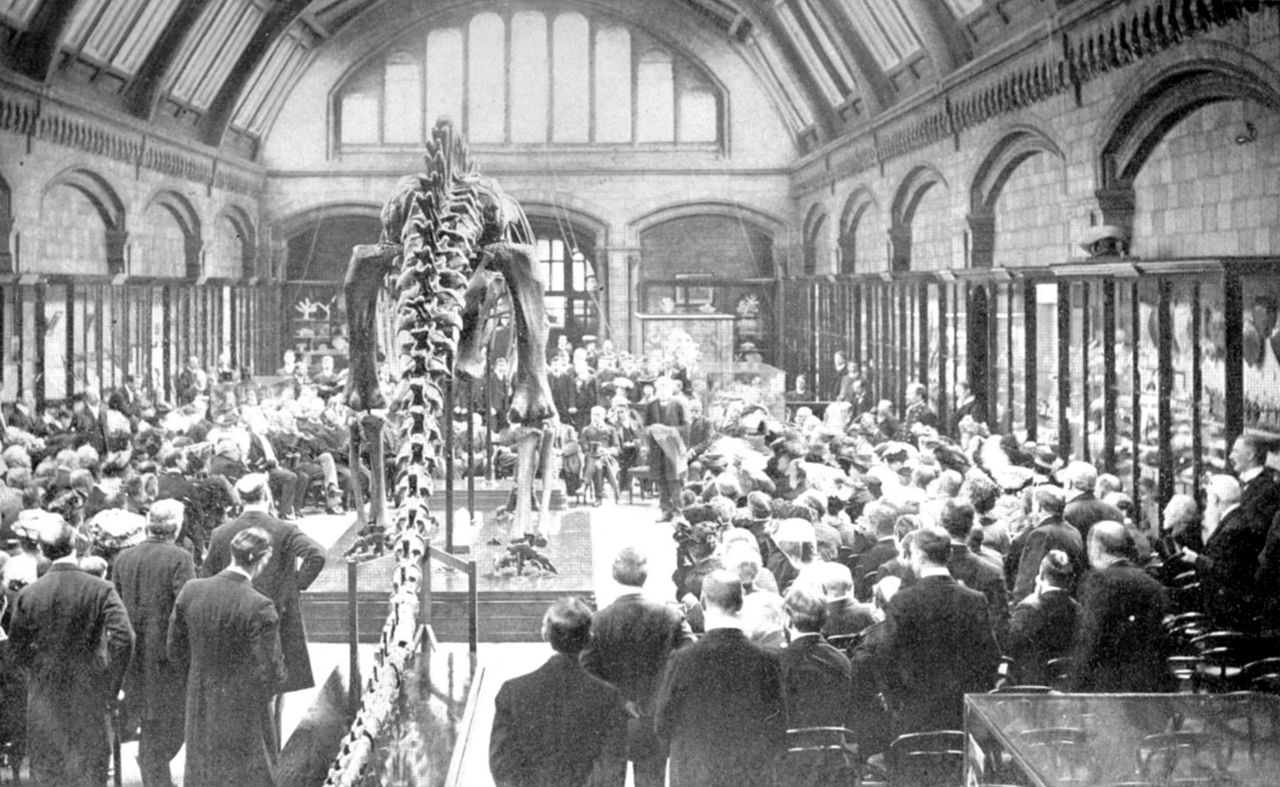
The first cast of the Carnegie Diplodocus holds court at London’s Natural History Museum. Source

The story of Andrew Carnegie’s Diplodocus will surely be well known to most readers. As the legend goes, Carnegie the millionaire philanthropist saw a cartoon in the November 1898 New York Journal depicting a sauropod dinosaur peering into the window of a skyscraper. He immediately contacted the paleontology department at the newly established Carnegie Museum of Natural History in Pittsburgh, and offered ample funding to find a sauropod skeleton for display. So began a frantic competition among the United States’ large urban museums to be the first to collect and mount a sauropod—the bigger the better.

The American Museum of Natural History was first across the finish line, unveiling their composite Apatosaurus in February of 1905. By that time, the Carnegie team had already found a sauropod skeleton of their own—a Diplodocus—near Medicine Bow, Wyoming. Unfortunately, they had nowhere to display it, as the Carnegie Museum building was still far from finished. Unwilling to be bested by his New York competition, Andrew Carnegie offered his chum King Edward VII a complete plaster replica of the Diplodocus, and hired a team of modelmakers to help make it happen. The arrival of the facsimile Diplodocus at the British Museum (now the Natural History Museum) in London was celebrated with a white tie event presided over by Carnegie and Baron Avebury, who spoke on behalf of the king. The London Diplodocus was on display two months after the AMNH Apatosaurus, and the original skeleton was unveiled in Pittsburgh in 1907.
diplodocus_nocopyright

In March 1905, a classy shindig celebrated the arrival of the first replica Diplodocus in London.

That’s usually where the Diplodocus story ends, with a footnote that nine more Diplodocus replicas were later manufactured and presented to heads of state throughout Europe and Latin America. I’d like to explore those subsequent displays in more detail. The Carnegie Diplodocus was the first mass-produced dinosaur, and by 1932 it appeared in no less than ten virtually identical displays across three continents. Taylor characterizes Carnegie’s sauropod as “the single most viewed skeleton of any animal in the world”, and its scientific, social, and even political ramifications are both wide-reaching and fascinating.

Building a Sauropod
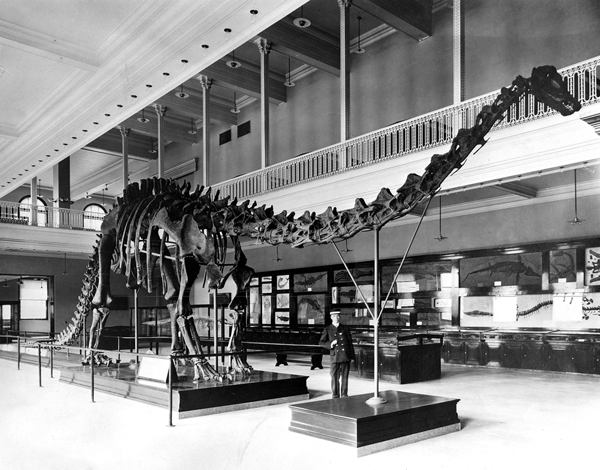
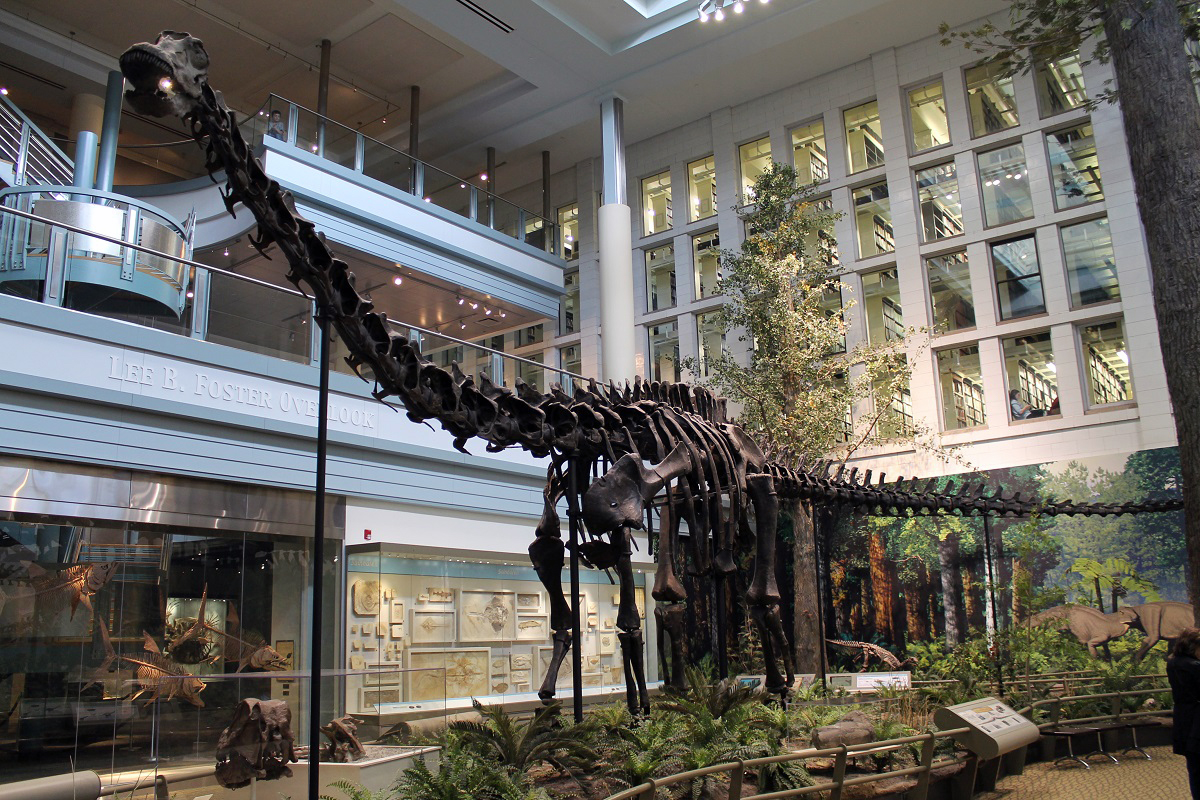
The original CMNH Diplodocus mount, in the hall built specifically to accomodate it. Source

The real CM 84 has been displayed in Pittsburgh since 1907. Source

The Diplodocus in question is specimen CM 84, recovered in 1899 in Albany County, Wyoming. The skeleton was about 60% intact and remains one of the most complete sauropod specimens ever found. The ubiquitous John Bell Hatcher described the fossils in 1901, coining the new species Diplodocus carnegiei after the project’s benefactor. Arthur Coggeshall of the Carnegie Museum was primarily responsible for preparing and casting the fossils. He was initially supervised by Hatcher, but William Holland took over when Hatcher died in 1904. Holland deferred to Hatcher’s judgement in most cases, although he was not shy about voicing his disagreement. For example, Hatcher had reconstructed the Diplodocus forefeet with slightly elevated digits, but Holland (incorrectly) thought they should be flat and splayed.

As is typical of dinosaur mounts, the incomplete primary specimen was supplemented with other fossils to produce a full skeleton. The skull, for instance, was a cast of USNM 2673, a specimen on display at the Smithsonian. A number of missing bones, including most elements of the forelimbs, were sculpted using a smaller Diplodocus specimen for reference. Although it took longer to produce than the AMNH Apatosaurus, contemporary paleontologists generally agreed that Carnegie’s Diplodocus was the superior sauropod mount. Not only was its pose more natural and lifelike, but the underlying steel armature was cleverly hidden. It’s difficult to overstate the challenges of assembling a mounted skeleton on this scale, and in its day the Diplodocus was the best in the world.

Roll Call
dip_mexico

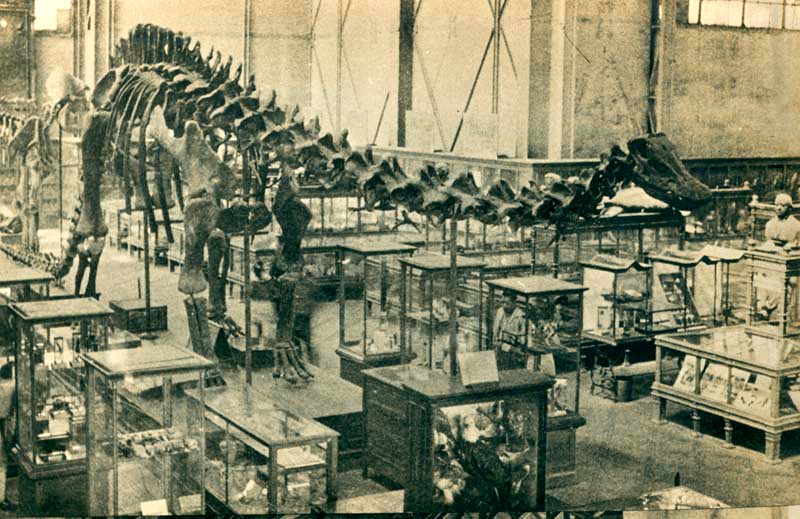
The Chopo University Museum in Mexico City received the 9th Diplodocus cast in 1929. Source

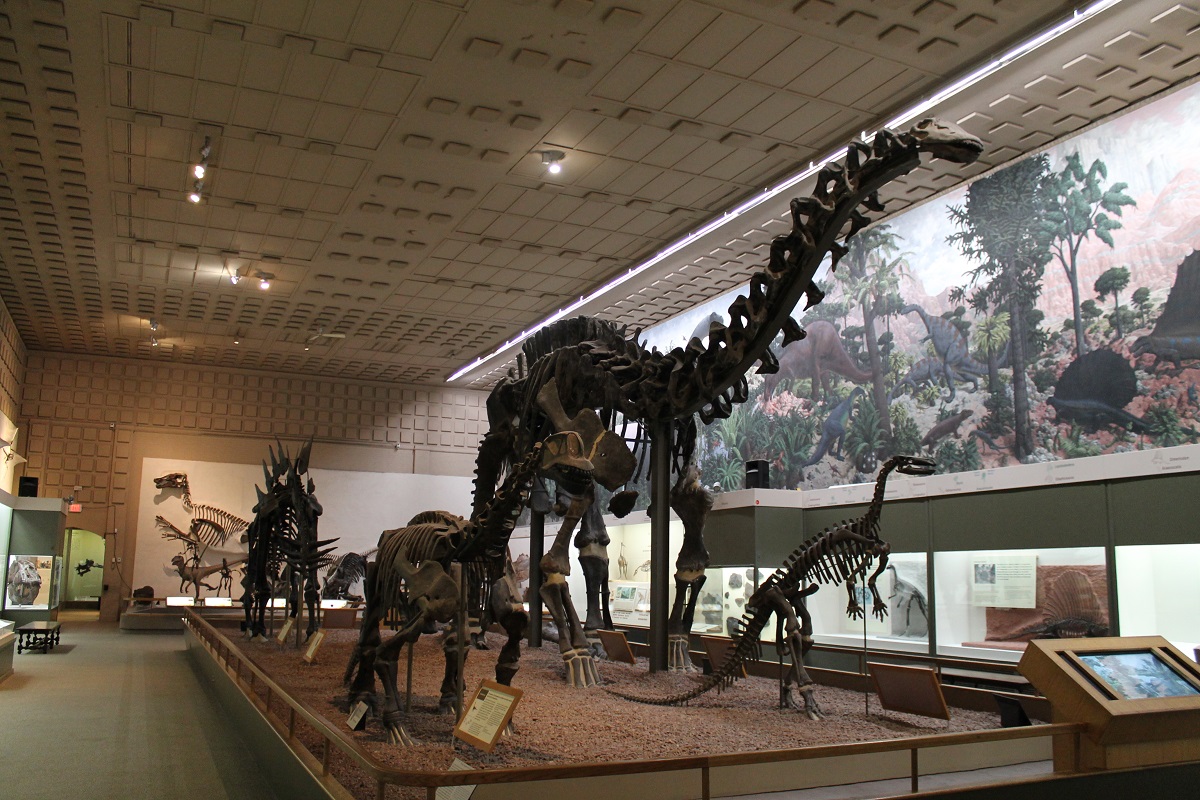
As mentioned, the first replica Diplodocus was unveiled in London in 1905, and the original fossils were ready for display in 1907. French and German dignitaries were present at an event in Pittsburgh celebrating its completion, and Andrew Carnegie promised both countries Diplodocus casts of their own. Once again, Coggeshall and Holland led the creation of the new mounts, a task they would repeat many times in the years to come. Playing precisely to cartoonish national stereotypes, the Germans provided a detailed plan and ambitious schedule for the project, while the French acted coy, then threw a lavish party when the mount was ready. Diplodocus replicas were on display at the National Natural History Museum in Paris and the Humboldt Museum in Berlin before the end of 1908, but the Pittsburgh team already had orders for a new batch of mounts. By early 1910, three new Diplodocus were on exhibit at the Museum for Paleontology and Geology in Bologna, Italy, the Natural History Museum in Vienna, Austria, and the Zoological Museum in St. Petersburg, Russia. The La Plata Museum in Buenos Aires, Argentina and the National Museum of Natural Science in Madrid, Spain received their Diplodocus mounts in 1912 and 1913, respectively, bringing the total number of replicas up to eight by the onset of World War I.

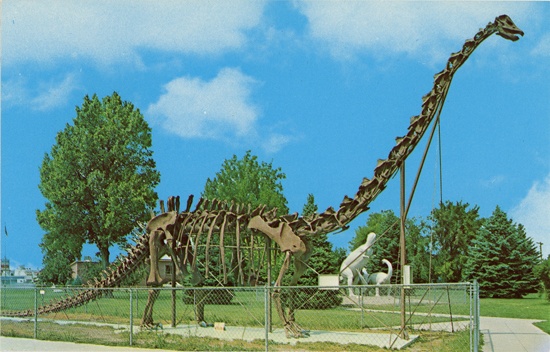
The war put a damper on this friendly exchange of dinosaurs, and Carnegie’s death in 1919 brought the Diplodocus diaspora to a temporary end. However, in 1929 Louise Carnegie, wife of Andrew, commissioned an additional cast as a gift for Alfonso Herrera of the Chopo University Museum in Mexico City. Herrera originally asked for a bronze cast for outdoor display, but when this proved prohibitively expensive, a plaster version was produced instead. In 1932, the Carnegie Museum traded a Diplodocus replica for a collection of German fossils from the Paleontological Museum in Munich. This copy has never been mounted or displayed. The last Diplodocus cast from the original molds was forged in 1957. Made from concrete, this mount was displayed outdoors for many years at the Utah Field House Museum in Vernal, Utah.
goofy vernal field house concrete cast

The 11th and final facsimile Diplodocus made from the original molds was this concrete version, on exhibit in Vernal, Utah for many years.

Most of the historic Diplodocus mounts remain on display today. The London Diplodocus was taken off exhibit during World War II, but in 1979 it was given a position of honor in the museum’s entrance hall. Later, it was completely restored and remounted with its tail held aloft. The Berlin, Buenos Aires, and Bologna Diplodocus mounts have also been upgraded with modern poses, but the others retain their historic, tail-dragging posture, looking exactly as they did a century ago. The St. Petersburg mount was circulated among a number of Russian museums, and may have been destroyed in an effort to make new molds from the bones (Edit: The Russian mount is still on display at the Orlov Museum for Paleontology—see comments). The concrete Diplodocus in Vernal has likewise been retired, but it was used to create two new casted skeletons, now on display in Utah and Nevada.

Opportunities for Science

St. Petersburg

The weird bow-legged Diplodocus in St. Petersburg looks more like the original USNM Triceratops than Tornier’s take on the sauropod.  Source

The sudden availability of identical Diplodocus skeletons presented an unusual opportunity for international scientists, allowing researchers based thousands of miles apart to study and compare notes on the same bones. Perhaps inevitably, a few European scientists were not happy with Holland and Coggeshall’s take on the sauropod. The best-known dissenter was Gustav Tornier, who rejected the straight-limbed reconstruction of Diplodocus, arguing instead that the sauropod sprawled like a crocodile. The German scientist provided an illustration of this alternate stance, in which the poor dinosaur’s arms appear to project from the base of its neck. Holland responded with a particularly harsh rebuttal (backed by several European scientists), and Tornier declined to push the issue further in print.

Dinosaurs for everyone

La plata

Diplodocus cast number seven at the La Plata Museum in Buenos Aires. Source

The most lasting influence of the Carnegie Diplodocus is certainly it’s cultural impact. If any one specimen can be credited with inspiring the global popularity of dinosaurs, it was this one. Thanks to Carnegie, citizens of 11 different nations had their first opportunity to stand in the presence of a giant dinosaur, and to experience the scale and splendor of a creature that completely dwarfed any modern land animal. In every nation where a new Diplodocus was installed, the local press adored the creature, never failing to point out its tiny head and presumed stupidity. Diplodocus was an endearing oaf, and for a time, its name was synonymous with dinosaurs and prehistory in general.

What was the significance of Diplodocus to all these people? It’s difficult not to think of it as a vanity project for Andrew Carnegie*, an opportunity to rub shoulders with European royalty and flaunt his wealth and generosity. One might also consider the Diplodocus an expression of America’s economic and technological might, or perhaps a harbinger of the United States’ role in globalization and mass production. French writer Octave Mirbeau seemed to be thinking along those lines when he lamented the mighty dinosaur being reduced to a crass, populist display. According to Carnegie himself, however, the goal was nothing less than world peace: he wanted to bring people together over their shared enthusiasm for the dinosaur. Too bad World War I came along and ruined the sauropod love-in.
*If the accolades went to anyone’s head, it was Holland’s. During his world tour assembling sauropod mounts, he was given countless awards, including the French Legion of Honor and German Knight’s Cross. Holland carefully added each new medal to his portrait at the Carnegie Museum.
Original Diplodocus

The original Diplodocus skeleton was remounted at the Carnegie Museum in 2007. Photo by the author.

On both sides of the Atlantic, Diplodocus was a shared point of reference and a beloved symbol. Most commonly, Diplodocus was the butt of a joke: from politicians to athletes to heavy machinery, anything big, slow, and not especially bright was likened to the dinosaur. My favorite anecdote on the subject comes from Nieuwland: during World War I, soldiers from different nations with different languages had the word “Diplodocus” in common, and used it to describe the heavy, plodding tanks.

Today, we think of Diplodocus and it’s ilk very differently. Sauropods weren’t ungainly dolts—they were surprisingly nimble and extremely successful megaherbivores, unchallenged in their dominance for 140 million years. Still, it’s difficult to think of single fossil that has matched the global cultural impact of CM 84. There are far more copies of Stan the T. rex on display, and Sue is widely known by name, but really, the only contender that even comes close is Archaeopteryx. With eleven versions still on display, Carnegie’s legendary Diplodocus lives on.

References

Brinkman, P.D. 2010. The Second Jurassic Dinosaur Rush: Museums and Paleontology in America at the Turn of the 20th Century. Chicago, IL: University of Chicago Press.

Holland, W.J. 1906. The osteology of Diplodocus Marsh with special reference to the restoration of the skeleton of Diplodocus carnegiei Hatcher, presented by Mr. Andrew Carnegie to the British Museum, May 12, 1905. Memoirs of the Carnegie Museum. Vol. 2, No. 6, 225-278.

Nieuwland, I. 2010. The colossal stranger: Andrew Carnegie and Diplodocus intrude European Culture, 1904-1912. Endeavour. Vol 34, No. 2.

Taylor, M.P. 2010. Sauropod dinosaur research: a historical review. Geological Society, London, Special Publications. Vol. 343, pp. 361-386.

28 Comments

Filed under CMNH, dinosaurs, fossil mounts, history of science, museums, reptiles, sauropods

Framing Fossil Exhibits, Part 1

This post started out as a review of “Evolving Planet”, the expansive paleontology exhibit at the Field Museum of Natural History. The short version is that it’s very good exhibit constrained by a somewhat frustrating layout. We’ll get back to that eventually, but first it’s worth considering the purpose of large-scale fossil exhibits in a more general sense.

Fossils, particularly the mounted skeletons of dinosaurs and other prehistoric animals, have been central to the identity of natural history museums since the late 19th century. In the early days, public exhibits were afterthoughts to the primary work of the museum (research and curation of collections), and if there was any logic behind their layout, it was an aesthetic logic. Typically posed in neutral, trophy-like stances on centrally-situated pedestals, mounted skeletons were the highlights of a natural history display for most visitors. For anyone not trained in comparative anatomy, however, these exhibits ultimately amounted to prehistoric pageantry. People could marvel at the great size of the animals, but there was very little to be learned besides the names of the species in question.

Hadrosaurus cast on display at the Field Museum. Field Museum Photo Archives.

A typically random assortment of fossil specimens at the Field Colombian Museum, ca. 1898. Image courtesy of the Field Museum Photo Archives.

These days, we try to do better. Exhibits are designed with a clear narrative structure, as well as specific learning goals for the audience. The focus of the narrative varies depending on the exhibit and the team behind it, but most modern natural history exhibits are explicitly designed to answer “how” as well as “what.” For paleontology displays, this means telling the story of life on Earth while also communicating how scientists collect and interpret evidence to put that story together. Crafting an exhibit has been compared to writing a popular nonfiction book, except designers are using the three-dimensional space of the exhibition hall as their medium. In this way, modern exhibits are more about ideas than specimens, or at least, the specimens are present primarily to illustrate the major scientific principles being communicated.

That’s how it works on paper, anyway. Despite this focus on education (and institutional mandates to provide learning opportunities for the widest possible audience), visitor surveys show that dinosaur pageantry is still the default mode of understanding for the majority of people passing through paleontology exhibits. No matter how carefully we craft our stories, most visitors still leave these displays recalling little more than a list of cool specimens they saw. Dinosaur pageantry has its place and can be employed for good. Dinosaurs and other prehistoric animals are undeniably impressive and spectacular, and it is absolutely worth taking advantage of that fact. We want people to pay attention to science, and in that respect mounted skeletons of favorite dinosaurs are great ambassadors to the world of research and discovery. The challenge is getting past the attention-grabbing stage. Prior experience has led visitors to expect that dinosaur pageantry is all paleontology has to offer, and many seem unprepared or unwilling to commit to a deeper understanding.

peabody mammals

The great hall at the Peabody Museum of Natural History, one of the last unmodified early 20th century fossil displays in the US. Photo by the author.

So are these people just hopeless rubes? Should exhibits be tailored only to visitors that care enough to put in the effort to understand? It should go without saying that this condescending attitude is completely wrongheaded and goes against the very spirit of museums. Education is half about knowing your content and half about knowing your audience. If visitors are not picking up on the content as desired, then a reassessment of who those visitors are is in order. Many museum exhibits still seem to be pitched at interested adults traveling alone with all the time in the world. This is a good description of many of my museum visits, but I’m also part of an increasingly small fraction of museum visitors. Most people who come to natural history museums come in groups of friends or family, and these groups often represent a range of ages. What’s more, most visitor interactions while in the museum will not be with the exhibits, but with each other. For the typical visitor, the museum experience is primarily a social one.

With this demographic in mind, a textbook on the wall (or a long video lecture*) is the last thing natural history museum audiences need. Visitors are absorbing exhibit content while simultaneously navigating a complicated, unfamiliar space. In the case of parents, they are also monitoring the attention span, hunger, and bathroom needs of their charges. Caught up in this whirlwind of information, visitors frequently fall back on what they already know. In the case of paleontology exhibits, this often means identifying familiar dinosaurs and ignoring the more intellectually challenging contextual information.

*It’s worth pointing out that a long video is NOT an improvement over a long label. Transferring label copy to a video or computer terminal does not inherently make the exhibit more interactive or more interesting. In fact, when the disruptive noise and need to wait for the next showing are taken into account, poorly implemented multimedia is probably less useful than traditional text labels.

The challenge for exhibit design, then, is dealing with the fact that visitors are not passively ingesting information. Visitors passing through an exhibit pull out relevant pieces of information and filter them through the lens of their existing worldview. Exhibit designers want visitors to also learn new information and challenge their preconceptions, but it’s easy to go too far. Survey after survey has shown that visitors do not appreciate exhibits that force them to move (or think) on rails. For practical reasons noted above, few visitors are able to look at every display, watch every orientation video, and work through every interactive in the prescribed order. Visitors need flexibility in order to make the exhibit experience their own. Finding the balance between providing informative context and providing a customizable experience is quite challenging, and not every exhibit succeeds.

struggling to contain the dinosaurs

The dinosaur hall in “Evolving Planet” at the Field Museum. Photo by the author.

On top of that, paleontology exhibits are particularly difficult to design because of problems with relatability. The story of life on Earth is immense, complex, and frequently counter-intuitive. It’s not enough to just explain what happened, we have to explain the history and methodologies of the half-dozen scientific disciplines that have contributed to to our understanding of that narrative. Even something so basic as the numerical age of a given fossil taxon requires a deluge of explanation to convey how we know. And all of this needs to be conveyed concisely, without being alienating, overwhelming, or condescending. Most importantly, it has to be made relevant to what audiences already know and understand.

Over the years, major natural history museums have attempted a variety of organizational strategies for their fossil exhibits. Each of these has been an attempt to break the dinosaur pageantry barrier and to portray the true complexity and relevance of paleontological science. Some arrangements, like taxonomical organization, have generally fallen out of favor. Others, like chronological presentations of life through time, are reliable mainstays that have been re-imagined in varied ways at different institutions. Still others, including cross-sections of specific extinct ecosystems, biogeography, and environmental change over time are relatively new and untested.

Keeping everything in this meandering introduction in mind, the upcoming series of posts will explore the strengths and weaknesses of each approach from the perspectives of science communication, aesthetics, and for lack of a better term, hospitality for non-expert audiences. Stay tuned!

References

Asma, S.T. 2001. Stuffed Animals and Pickled Heads: The Culture and Evolution of Natural History Museums. New York, NY: Oxford University Press.

Falk, J.H. and Dierking, L.D. 1992. The Museum Experience. Washington, DC: Whalesback Books.

Wands, S., Donnis, E. and Wilkening, S. 2010. “Do Guided Tours and Technology Drive Visitors Away?” History News 93:8:21-23.

2 Comments

Filed under dinosaurs, education, exhibits, fossil mounts, history of science, museums, opinion, science communication

Displaying the Tyrant King – Part 3

Subtlety is unnessesary when T. rex is involved.

Who needs subtlety when you have a T. rex?

Start with Displaying the Tyrant King Part 1 and Part 2.

Tyrannosaurus rex displays changed for good in the 1990s thanks to two individuals, one real and one fictional. The latter was of course the T. rex from the film Jurassic Park, brought to life with a full-sized hydraulic puppet, game-changing computer animation, and the inspired use of a baby elephant’s screeching cry for the dinosaur’s roar. The film made T. rex real – a breathing, snorting, drooling animal unlike anything audiences had ever seen. Jurassic Park was a tough act to follow, and in one way or another, every subsequent museum display of the tyrant king has had to contend with the shadow cast by the film’s iconic star.

The other dinosaur of the decade was Sue, who scarcely requires introduction. First and foremost, Sue is the most complete Tyrannosaurus ever found, with 80% of the skeleton intact. Approximately 28 years old at the time of her death, Sue is also the eldest T. rex known, as well as one of the largest. The specimen’s completeness and exquisite preservation has allowed paleontologists to ascertain an unprecedented amount of information about the lifestyle of meat-eating dinosaurs. In particular, Sue’s skeleton is riddled with fractured and arthritic bones, as well as evidence of gout and parasitic infection that together paint a dramatic picture of the rough-and-tumble world of the late Cretaceous.

From South Dakota to Chicago

Sue at Disney World

Cast of Sue at Walt Disney World, Orlando. Source

It was the events of Sue’s second life, however, that made her the fossil the world knows by name. Sue was discovered in the late summer of 1990 by avocational fossil hunter Susan Hendrickson (for whom the specimen is named) on the Cheyenne River reservation in South Dakota. Peter Larson of the Black Hills Institute, a commercial outfit that specializes in excavating, preparing, and exhibiting fossils, initially intended to display the Tyrannosaurus at a new facility in Hill City, but soon became embroiled in an ugly four-way legal battle with landowner Maurice Williams, the Cheyenne council, and the United States Department of the Interior. With little precedent for ownership disputes over fossils, it took until 1995 for the District Court to award Williams the skeleton. Williams soon announced that he would put Sue on the auction block, and paleontologists initially worried that the priceless specimen would disappear into the hands of a wealthy collector, or end up in a crass display at a Las Vegas casino. Those fears were put to rest in 1997 when Chicago’s Field Museum of Natural History won Sue with financial backing from McDonald’s and Disney. Including the auctioneer’s commission, the price was an astounding $8.36 million.

FMNH and its corporate partners did not pay seven figures for Sue solely to learn about dinosaur pathology.  Sue’s remarkable completeness would be a boon to scientists, but her star power was at least as important for the Museum. Sue was a blockbuster attraction that would bring visitors in the door, and her name and likeness could be marketed for additional earned income. As FMNH President John McCarter explained, “we do dinosaurs…so that we can do fish” (quoted in Fiffer 2000). Particularly in the late 1990s, with Jurassic Park still fresh in people’s minds, a Tyrannosaurus would attract visitors and generate funds, which could in turn fund less sensational but equally important research, like ichthyology and entomology.

Still, some worried that McCarter, whose background was in business, not science, was exploiting an important specimen as a marketing gimmick at the expense of the Museum’s educational mission. This echoed similar concerns voiced 80 years earlier, when the original mounted Tyrannosaurus was introduced at the American Museum of Natural History. As president of AMNH, Henry Osborn oversaw the creation of grandiose and dramatic exhibits, with the intent to draw crowds and justify private and municipal financial support. When the Museum unveiled the Tyrannosaurus mount, Osborn held a lavish publicity gala for the New York elite and members of the press. The buzz generated by Osborn’s promotion resulted in lines around the block and front page headlines, but the attention was focused on the spectacle of the dinosaur rather than the science behind it. Many academics derided this as lowest common denominator pandering, while others, like anthropologist Franz Boas, grudgingly accepted that “it is a fond delusion of many museum officers that the attitude of the public is a more serious one, but the majority do not want anything beyond entertainment.”

Original skull of Sue the T. rex, displayed on the upper mezzanine. Photo by the author.

FMNH was under similar scrutiny as museum staff revealed their plans for Sue. The role of the corporate sponsors that paid for the fossils was a particular cause for concern, and the marketing team knew it. Although the idea of T. rex-themed Happy Meals was briefly on the table, McDonald’s and Disney wisely opted to present themselves only as patrons of science. McDonald’s got its name on the new fossil preparation lab at FMNH and Disney got a mounted cast of Sue to display at Walt Disney World, but the principal benefit to the two companies was high-profile exposure in association with youth science education. The Museum retained control over the message, highlighting Sue’s importance to paleontology and only coyly admitting her role as a promotional tool. Likewise, FMNH is the sole profiteer from the litany of shirts, hats, toys, mugs, and assorted trinkets bearing the Sue name and logo that are continually sold at the Museum and around Chicago.

You May Approach Her Majesty

Once Sue arrived at FMNH, the Museum did not hold back marketing the dinosaur as a must-see attraction. A pair of Sue’s teeth went on display days after the auction, which expanded organically into the “Sue Uncrated” exhibit, where visitors could watch the plaster-wrapped bones being unpacked and inventoried. Meanwhile, McDonald’s prepared an educational packet on Sue that was distributed to 60,000 elementary schools.

The main event, of course, was the mounted skeleton, which needed to be ready by the summer of 2000. This was an alarmingly short timetable, and the FMNH team had to hit the ground running. Much of Sue’s skeleton was still buried in rock and plaster. The bones needed to be prepared and stabilized before they could be studied, and they needed to be studied before they could be mounted. In addition, two complete Sue casts had to be fabricated: one for Disney World and one for a McDonald’s-sponsored traveling exhibit. The casts were produced by Research Casting International, the Toronto-based company that recently built the mounted menagerie for “Ultimate Dinosaurs“. Phil Fraley Productions, the same exhibit company that rebuilt the American Museum and Carnegie Museum T. rex mounts, was tapped to mount Sue’s original skeleton.

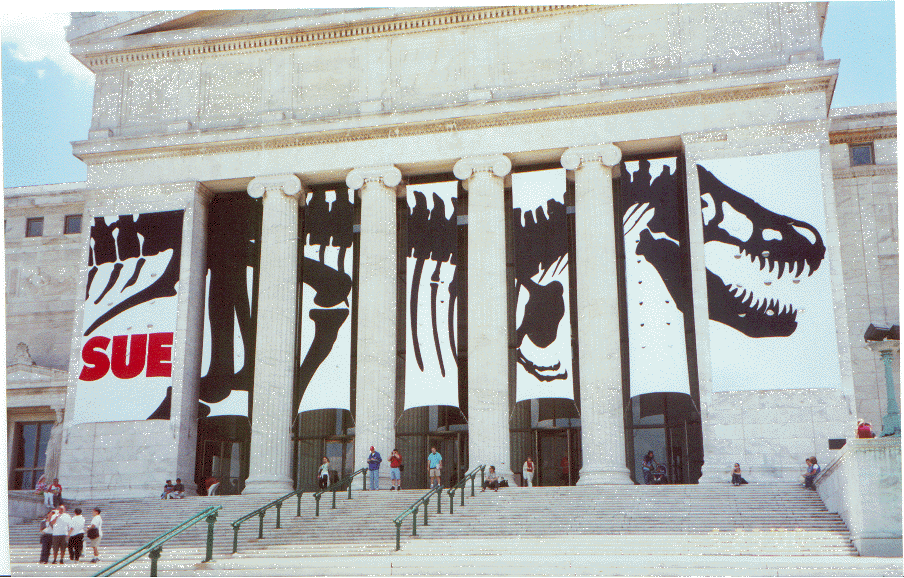
The mounted skeleton of Sue in the Stanley Field Hall. Photo by the author.

Unlike every other Tyrannosaurus mount before or since, Sue can hardly be called a composite. With the exception of a missing arm, left foot, a couple ribs, and small number of other odds and ends, the mounted Sue skeleton is composed of real fossils from a single individual. FMNH public relations latched onto this fact, emphasizing in press releases that while “many museums are displaying replicas of dinosaur skeletons, the Field Museum has strengthened its commitment to authenticity. This is Sue.” Just as they did with the AMNH Tyrannosaurus, Fraley’s team built an armature with individual brackets securing each bone, allowing them to be removed with relative ease for research and conservation. No bolts were drilled into the bones and no permanent glue was applied, ensuring that the fossils incur only minimal damage for the sake of the exhibit. Despite these improvements over historic mount-making techniques, however, the Sue mount does have some inexplicable anatomical errors. The coracoids should be almost touching in the middle of the chest, but the shoulder girdles are mounted so high on the rib cage that there is a substantial space between them. Consequently, the furcula (wishbone) is also positioned incorrectly.

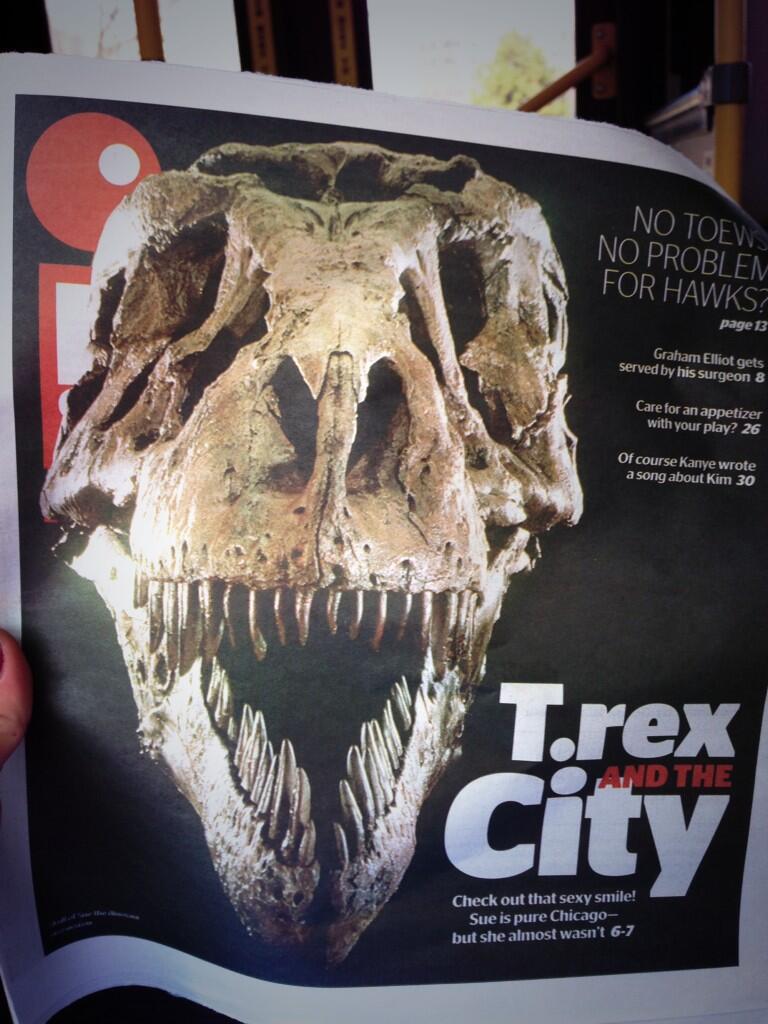
After a private event not unlike the one held by Osborn in 1915, Sue was revealed to the public on May 17, 2000 with the literal raising of a curtain. A week-long series of celebrations and press junkets introduced Sue to Chicago, and she has been one of the city’s biggest attractions every since. All the publicity paid off, at least in the short term: FMNH attendance soared that year from 1.6 million to 2.4 million. 14 years later, Sue the Tyrannosaurus is still known by name, and is even used as the voice of FMNH on twitter. Interestingly, Sue’s new identity as a Chicago landmark seems to have all but eclipsed the legal dispute that was her original source of fame. A recent RedEye cover story goes so far as to proclaim this South Dakotan skeleton as “pure Chicago.”

 The Nation’s T. rex

This customized truck transported the Nation’s T. rex from Montana to Washington, DC.

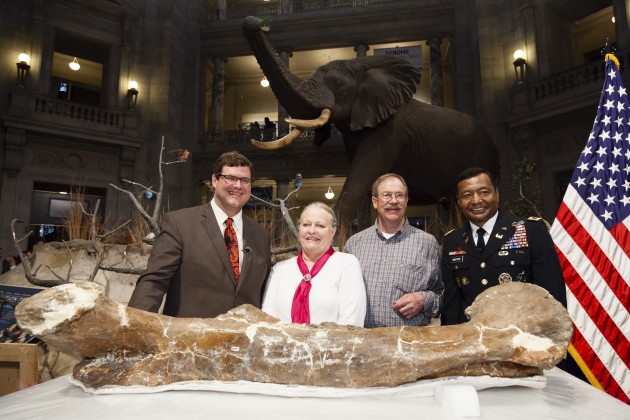
This year, another Tyrannosaurus specimen has rocketed to Sue-like levels of notoriety. MOR 555, also known as “Wankel Rex”, is being transferred to the Smithsonian National Museum of Natural History, where it will eventually be mounted for long-term display. Now dubbed “the Nation’s T. rex“, the promotion of this specimen has mirrored that of Sue in many ways. Front-page media coverage, first-person tweets from the dinosaur and even an official song and dance contest herald the arrival of the fossils from their previous repository, the Museum of the Rockies in Montana. Much like the “Sue Uncrated” exhibit, the process of unpacking the unarticulated bones will soon be on view in a temporary display called “The Rex Room.” Meanwhile, the very name “Nation’s T. rex” is a provocative invented identity akin to Sue’s new status as a Chicagoan.

Nevertheless, the Nation’s T. rex does not quite live up to Sue’s mystique. This Tyrannosaurus is neither as large nor as complete as Sue, and there was no prolonged legal battle or frantic auction in its past. The 60% complete skeleton was found in 1988 by Montana rancher Kathy Wankel, on land owned by the US Army Corps of Engineers. The fossils are now on a 50 year loan from from the Corps to the Smithsonian, (presumably) a straightforward transfer between federal agencies. In addition, MOR 555 is by no means a new specimen. Several casts of the skeleton are already on display, including exhibits at the Royal Ontario Museum, the Museum of the Rockies, the Perot Museum of Nature and Science, and even the Google campus. In fact, a cast of the MOR 555 skull has been on display at NMNH for years.

NMNH Director Kirk Johnson, fossil hunter Kathy Wankel, her husband Bob Wankel, and Lt. Gen. Thomas Bostick preside over the arrival of the Nation’s T. rex at the Smithsonian. Source

With that in mind, the hype around the Nation’s T. rex might seem like much ado about nothing. As this series has demonstrated, the number of Tyrannosaurus skeletons on exhibit, whether original fossils or casts, has exploded in recent years. A quarter century ago, New York and Pittsburgh were the only places where the world’s most famous dinosaur could be seen in person. Today, there may well be over a hundred Tyrannosaurus mounts worldwide, most of which are identical casts of a handful of specimens. Acquiring and displaying a T. rex is neither risky nor ambitious for a natural history museum. No audience research or focus groups are needed to know that the tyrant king will be a hit. And yet, excessive duplication of a sure thing might eventually lead to monotony and over-saturation.

So far, such fears appear to be unfounded. A specimen like Sue or the Nation’s T. rex is ideal for museums because it is at once scientifically informative and irresistibly captivating. Museums do not need to choose between education and entertainment because a Tyrannosaurus skeleton effectively does both. And even as ever more lifelike dinosaurs grace film screens, museums are still the symbolic home of T. rex. The iconic image associated with Tyrannosaurus is that of a mounted skeleton in a grand museum hall, just as it was when the dinosaur was introduced to the world nearly a century ago. The tyrant king is an ambassador to science that unfailingly excites audiences about the natural world, and museums are lucky to have it.

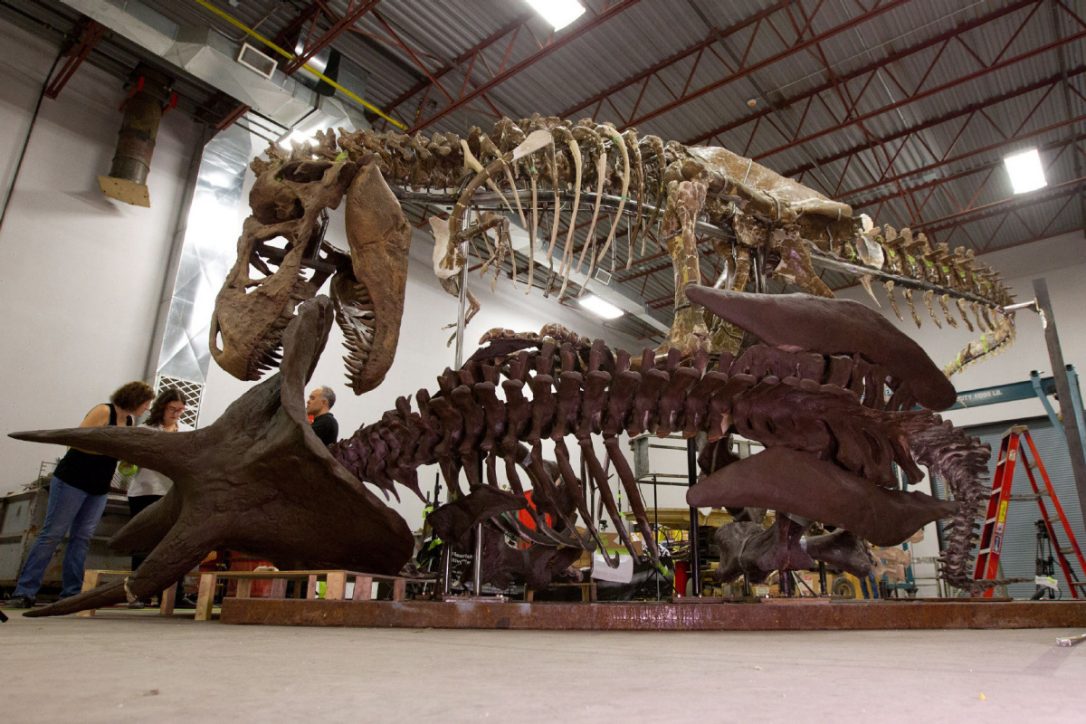
The Nation’s T. rex in its final pose at the Research Casting International workshop.

This week, NMNH will be celebrating all things Tyrannosaurus, starting with a live webcast of arrival of the Nation’s T. rex on Tuesday morning. Stay tuned to this blog for further coverage of the events!

References

Asma, S.T. 2001. Stuffed Animals and Pickled Heads: The Culture and Evolution of Natural History Museums. New York, NY: Oxford University Press.

Boas, F. 1907. Some Principles of Museum Administration. Science 25:650:931-933.

Counts, C.M. 2009. Spectacular Design in Museum Exhibitions. Curator 52: 3: 273-289.

Fiffer, S. 2000. Tyrannosaurus Sue: The Extraordinary Saga of the Largest, Most Fought Over T. rex ever Found. New York, NY: W.H. Freeman and Company.

Larson, N. 2008. “One Hundred Years of Tyrannosaurus rex: The Skeletons.” Tyrannosaurus rex: The Tyrant King. Larson, Peter and Carpenter, Kenneth, eds. Bloomington, IN: Indiana University Press.

Lee, B.M. 2005. The Business of Dinosaurs: The Chicago Field Museum’s Nonprofit Enterprise. Unpublished thesis, George Washington University.

Rainger, R. 1991. An Agenda for Antiquity: Henry Fairfield Osborn and Vertebrate Paleontology at the American Museum of Natural History, 1980-1935. Tuscaloosa, AL: University of Alabama Press.

Switek, B. 2013. My Beloved Brontosaurus: On the Road with Old Bones, New Science and our Favorite Dinosaurs. New York, NY: Scientific American/Farrar, Straus and Giroux.

5 Comments

Filed under dinosaurs, FMNH, fossil mounts, history of science, movies, museums, NMNH, reptiles, science communication, theropods

Displaying the Tyrant King – Part 2

Old meets new

Old meets new: The classic Carnegie T. rex (CM 9380) is now paired with a cast of Peck’s Rex (MOR 980). Photo by the author.

Start with Displaying the Tyrant King – Part 1.

In 1915, the American Museum of Natural History unveiled the first mounted skeleton of Tyrannosaurus rex ever constructed. The Carnegie Museum of Natural History followed suit with their Tyrannosaurus mount in 1941, and for most of the 20th century New York and Pittsburgh were the only places in the world where the tyrant king could be seen in person. Nevertheless, these displays propelled Tyrannosaurus to universal stardom, and the instantly recognizable dinosaur appeared in countless books, films, and other media for years to come.

The omnipresence of T. rex was secured in part by two additional museum displays, ironically at institutions that did not have any actual Tyrannosaurus fossils on hand. The Field Museum of Natural History commissioned Charles Knight to paint a series of prehistoric landscapes in 1928, the most recognizable of which depicts a face-off between Triceratops and a surprisingly spry Tyrannosaurus. In 1947, Rudolph Zallinger painted a considerably more bloated and lethargic T. rex as part of his Age of Reptiles mural at the Peabody Museum of Natural History. Both paintings would be endlessly replicated for decades, and would go on to define the prehistoric predator in the public imagination.

Rex Renaissance

Despite enduring public enthusiasm, scientific interest in dinosaurs declined sharply in the mid-20th century, and new discoveries were few and far between. This changed rather suddenly with the onset of the “dinosaur renaissance” in the 1970s and 80s, which brought renewed energy to the discipline in the wake of evidence that dinosaurs had been energetic and socially sophisticated animals. The next generation of paleontologists endeavored to look at fossils in new ways to understand dinosaur behavior, biomechanics, ontogeny, and ecology. Tyrannosaurus was central to the new wave of research, and has been the subject of hundreds of scientific papers since 1980. More interest brought more fossil hunters into the American west, leading to an unprecedented expansion in known Tyrannosaurus fossils. Once considered vanishingly rare, Tyrannosaurus is now known from over 50 individual specimens across a wide range of ages and sizes. Extensive research on growth rate, cellular structure, sexual dimorphism, speed, and energetics, to name but a few topics, has turned T. rex into a veritable model organism among dinosaurs.

RTMP 81.6.1, aka Black Beauty, mounted in relief at the Royal Tyrell Museum. Source.

RTMP 81.6.1, aka Black Beauty, mounted in relief at the Royal Tyrell Museum. Source

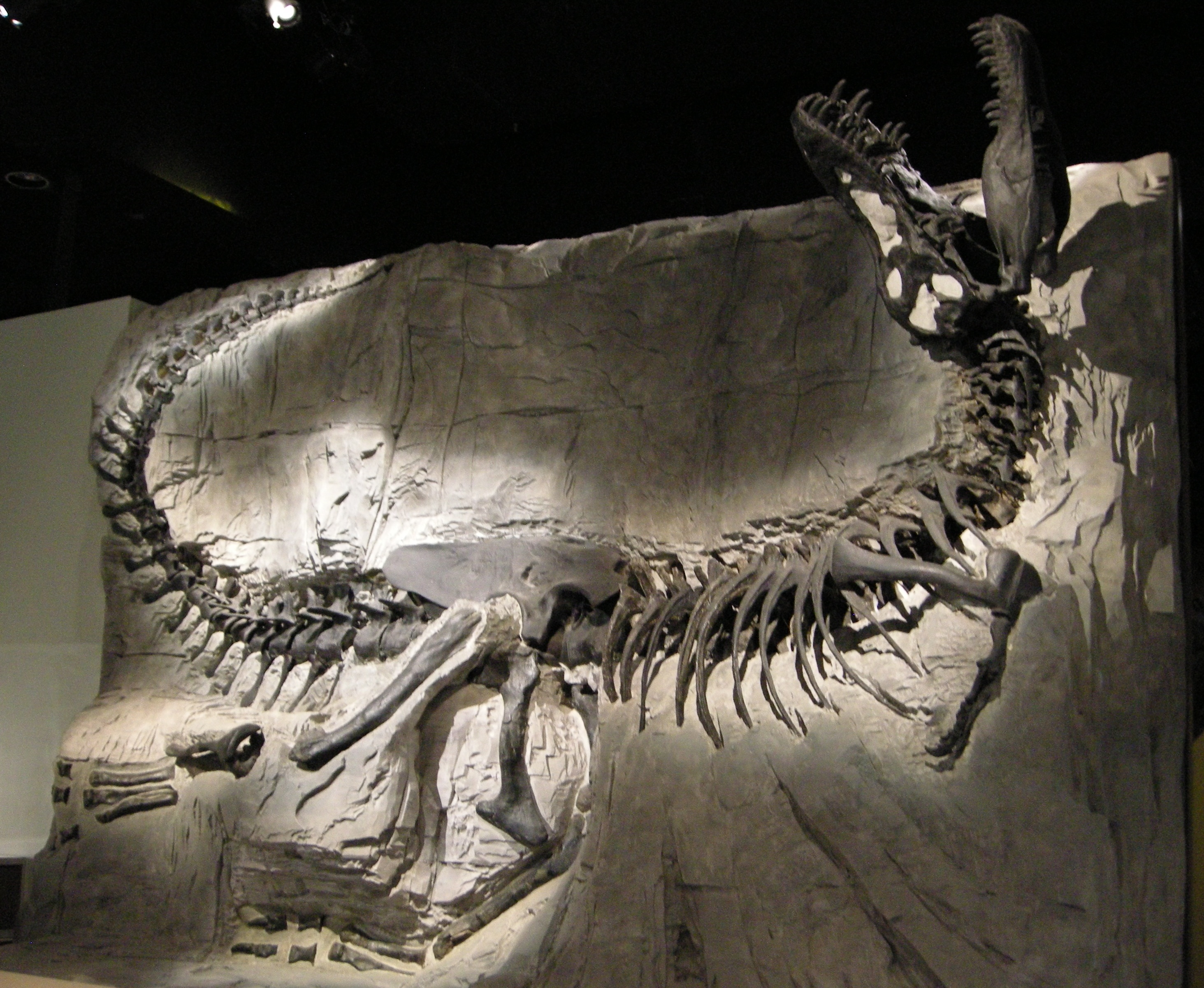
The most celebrated Tyrannosaurus find from the early years of the dinosaur renaissance came from Alberta, making it the northernmost and westernmost T. rex to date. The 30% complete “Black Beauty” specimen, so named for the black luster of the fossilized bones, was found in 1980 by a high school student and was excavated by paleontologist Phil Curie. The original Black Beauty fossils were taken on a tour of Asia before finding a permanent home at the newly established Royal Tyrell Museum in Drumheller, Alberta. In lieu of a standing mount, Black Beauty was embedded in a faux sandstone facade, mirroring the environment in which the fossils were found and the animal’s presumed death pose. This relief mount set Black Beauty apart from its AMNH and CMNH predecessors, and even today it remains one of the most visually striking Tyrannosaurus displays.  Since the original specimen consisted of less than half of a skeleton, much of this display is made up of sculpted bones, including the pelvis, scapula, and most of the ribs. The mounted skull is a cast, but the real skull is displayed behind glass nearby. A complete cast of Black Beauty in a traditional free-standing mount is also on display at the Swedish Museum of Natural History in Stockholm.

The World’s Most Replicated Dinosaur

Driven by the increased public demand for dinosaurs, many museums without Tyrannosaurus fossils of their own have purchased complete casts from other institutions. In 1986, the Academy of Natural Sciences in Philadelphia opened “Discovering Dinosaurs”, the world’s first major exhibit showcasing active, endothermic dinosaurs. The centerpiece of the exhibit was a cast of the original AMNH Tyrannosaurus, posed for the first time in the horizontal posture that we now know was the animal’s habitual stance. The following year, another AMNH cast appeared in the lobby of Denver Museum of Nature and Science in a strikingly bizarre pose, with one leg kicking high in the air. The mount’s designer Robert Bakker intended to push boundaries and demonstrate what a dynamic and energetic Tyrannosaurus might be capable of, although the mount has subsequently been described as dancing, kicking a soccer ball, or peeing on a fire hydrant. Meanwhile, The Royal Tyrell Museum prepared a mount of RTMP.81.12.1 (a specimen consisting of a relatively small number of postcranial bones) that was filled in with AMNH casts, including the highly recognizable skull.

Cast

Tyrannosaurus cast at the Denver Museum of Nature and Science. Source

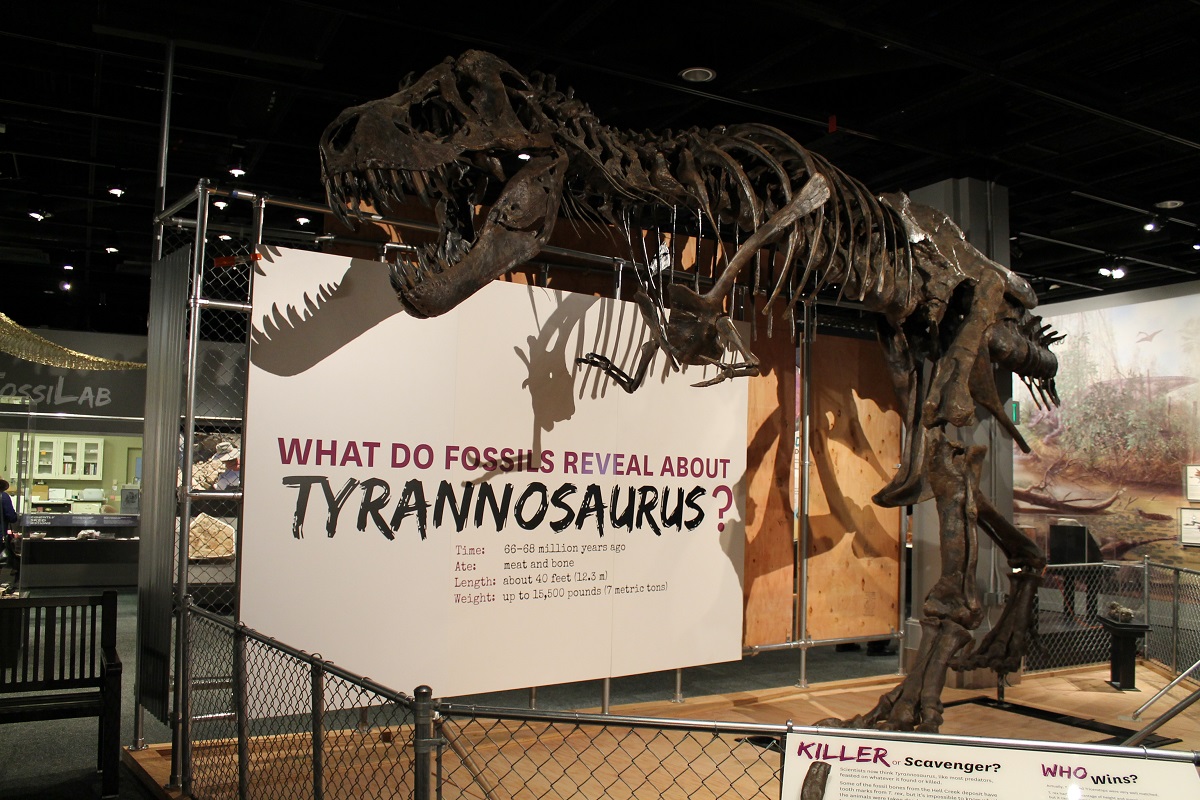
Since the late 1990s, however, casts of another specimen have overtaken AMNH 5027 for the title of most ubiquitous T. rex. BHI 3033, more commonly known as Stan, was excavated in South Dakota in 1992 by the Black Hills Institute, a for-profit outfit specializing in excavating, preparing, and mounting fossils. Stan is significant for being over two-thirds complete and for including the best-preserved Tyrannosaurus skull yet found. BHI has sold dozens of casts of the Stan skeleton to museums and other venues around the world. At a relatively affordable $100,000 plus shipping, even small local museums and the occasional wealthy individual can now own a Tyrannosaurus mount. With over 50 casts sold as of 2017, Stan is, by a wide margin, the most duplicated and most exhibited dinosaur in the world.

Stan the Tyrannosaurus at the National Museum of Natural History. Photo by the author.

Stan the Tyrannosaurus at the National Museum of Natural History. Photo by the author.

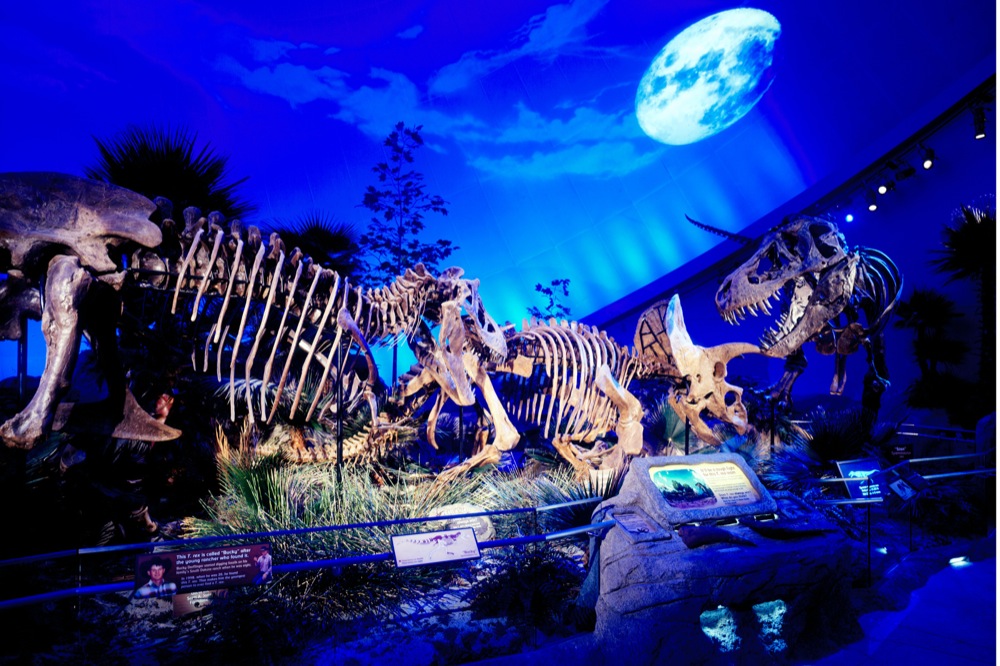
All these new Tyrannosaurus mounts are forcing museums to get creative, whether they are displaying casts or original fossils. Predator-prey pairings are a popular display choice: for example, the Houston Museum of Natural Science T. rex is positioned alongside an armored Denversaurus, and the Los Angeles Natural History Museum matches the tyrant dinosaur with its eternal enemy, Triceratops. Meanwhile, the growing number of juvenile Tyrannosaurus specimens has allowed for family group displays. A second T. rex exhibit at LACM features an adult, subadult and baby, while the Children’s Museum of Indianapolis pairs a Stan cast with the original skeleton of Bucky, a “teenage” T. rex. The most unique Tyrannosaurus mount so far is certainly the copulating pair at the Jurassic Museum of Asturias.

Tyrannosaurus versus Denversaurus at the Houston Museum of Nature and Science. Photo by the author.

Each of these displays gives a substantially different impression of Tyrannosaurus. Depending on the mount, visitors might see T. rex as a powerful brute, a fast and agile hunter, or a nurturing parent (or a gentle lover). Each mount is accurate insofar that a real Tyrannosaurus probably adopted a similar stance at some point, but the museum’s choice of pose nevertheless influences visitors’ understanding of and attitude toward the dinosaur.

Restoring the Classics

With dozens of new Tyrannosaurus mounts springing up across the country and around the world, the original AMNH and CMNH displays began to look increasingly obsolete. Unfortunately, modernizing historic fossil mounts is an extremely complex and expensive process. The early 20th century technicians that built these displays generally intended for them to be permanent: bolts were drilled directly into the bones and gaps were sealed with plaster that can only be removed by manually chipping it away. What’s more, the cumulative effects of rusting armatures, fluctuating humidity, and vibration from passing crowds have considerably damaged historic mounts over the course of their decades on display.

AMNH 5027 was restored and remounted in 1995.

AMNH 5027 was restored and remounted in 1995. Photo by the author.

Despite these challenges, AMNH and CMNH have both been able to restore and update their classic Tyrannosaurus displays. While fossil mounts used to be built in-house, often by the same people who found and described those fossils, modern mounting projects are typically outsourced to specialist companies. Phil Fraley Productions, an exhibit fabrication company based in the Pittsburgh suburbs, was responsible for both T. rex restorations. At AMNH, Jeanne Kelly spent two years disarticulating and conserving each bone before Phil Fraley’s crew took over to build the new armature. The new mount not only corrected the dinosaur’s posture, but improved visitors’ view of the fossils by removing obstructive vertical supports. Instead, most of the skeleton’s weight is now supported by steel cables hanging from the ceiling.  Each bone is secured to an individual metal bracket, allowing researchers to easily remove elements for study as necessary. A new cast of the skull was also prepared, this time with open fenestrae for a more natural appearance. Rather than attempting to match the dramatic and showy T. rex mounts at other museums, the AMNH team chose a comparatively subdued stalking pose. A closed mouth and subtly raised left foot convey a quiet dignity befitting this historically significant display.

Historically, the 1941 CMNH Tyrannosaurus had never quite lived up to its New York predecessor. Although it incorporated the Tyrannosaurus type specimen, it was mostly composed of casts from the New York skeleton, and it sported an unfortunately crude replica skull. It is therefore ironic that CMNH now exhibits the more spectacular T. rex display, one which finally realizes Osborn’s ambitious plan to construct an epic confrontation between two of the giant predators. As they had with the AMNH mount, Phil Fraley’s team dismantled the original display and painstakingly removed many layers of paint, shellac, and plaster from the bones. Michael Holland contributed a new restored skull, actually a composite of several Tyrannosaurus skulls. The restored holotype T. rex now faces off with a cast of “Peck’s Rex”, a specimen recovered from Montana in 1997. Despite the difficulty of modernizing the historic specimen, the team reportedly developed a healthy respect for turn of the century mount-makers like Adam Hermann and Arthur Coggeshall, who developed the techniques for making enduring displays of fragile fossils that are still being refined today.

Continue to Displaying the Tyrant King Part 3.

References

Colbert, E.H., Gillette, D.D. and Molnar, R.N. “North American Dinosaur Hunters.” The Complete Dinosaur, Second Edition. Brett-Surman, M.K., Holtz, T.R. and Farlow, J.O., eds.Bloomington, IN: Indiana University Press.

Dingus, L. 1996. Next of Kin: Great Fossils at the American Museum of Natural History. New York, NY: Rizzoli International Publications, Inc.
Johnson, K. and Stucky, R.K. 2013. “Paleontology: Discovering the Ancient History of the American West.” Denver Museum of Nature and Science Annals, No. 4.

Larson, N. 2008. “One Hundred Years of Tyrannosaurus rex: The Skeletons.” Tyrannosaurus rex, The Tyrant King. Larson, Peter and Carpenter, Kenneth, eds. Bloomington, IN: Indiana University Press.

Naish, D. 2009. The Great Dinosaur Discoveries. Berkeley, CA: University of California Press.

Norell, M., Gaffney, E.S. and Dingus, L. 1995. Discovering Dinosaurs: Evolution, Extinction, and the Lessons of Prehistory.  Berkeley, CA: University of California Press.

Psihoyos, L. 1994. Hunting Dinosaurs. New York, NY: Random House, Inc.

4 Comments

Filed under AMNH, CMNH, dinosaurs, fossil mounts, history of science, museums, NMNH, paleoart, reptiles, theropods

Displaying the Tyrant King – Part 1


The original Tyrannosaurus rex mount at the American Museum of Natural History. Photo from Dingus 1996.

The original Tyrannosaurus rex mount at the American Museum of Natural History. Photo from Dingus 1996.

Woodrow Wilson is in the white house. The first World War is raging in Europe, but the United States is not yet involved. The women’s suffrage movement is picking up speed. And you just heard that the skeleton of an actual dragon is on display at the American Museum of Natural History in New York. It is difficult to imagine a time before every man, woman, and child in the developed world knew the name Tyrannosaurus rex, but that world existed not even a century ago. In 1915, AMNH unveiled the very first mounted skeleton of the tyrant lizard king, immediately and irrevocably cementing the image of the towering reptilian carnivore in the popular psyche.

Today, Tyrannosaurus is a celebrity among dinosaurs, appearing in every form of media imaginable. More importantly, however, it is an icon for paleontology and an ambassador to science. The cult of T. rex began in the halls of museums, and museums remain the prehistoric carnivore’s symbolic home. The mounted skeletons in museums provide the legendary T. rex its credibility: these are the authentic remains of the giant predator that once stalked North America. And yet, most of the dozens of  Tyrannosaurus skeletons on display around the world are casts, and none of them represent complete skeletons (rather, they are filled in with spare parts from other specimens and the occasional sculpted bone). These are sculptures as well as scientific specimens, works of installation art composed by artists, engineers, and scientists. Herein lies the paradox presented by all fossil mounts: they are natural specimens and constructed objects, embodying a challenging duality between the realms of empiricism and imagination.

Tyrannosaurus mount is at once educational and spectacular. Both roles were embraced at AMNH in 1915, and these dual identities have defined T. rex displays ever since. 14 years ago, FMNH PR 2081, also known as Sue, became a star attraction for the Field Museum of Natural History and the city of Chicago at large. Later this month, another T. rex will unwittingly take on a similar role: on April 15th, MOR 555, an 80% complete Tyrannosaurus specimen discovered in Montana, will be dubbed “The Nation’s T. rex and entered into the Smithsonian National Museum of Natural History collection with considerable fanfare.

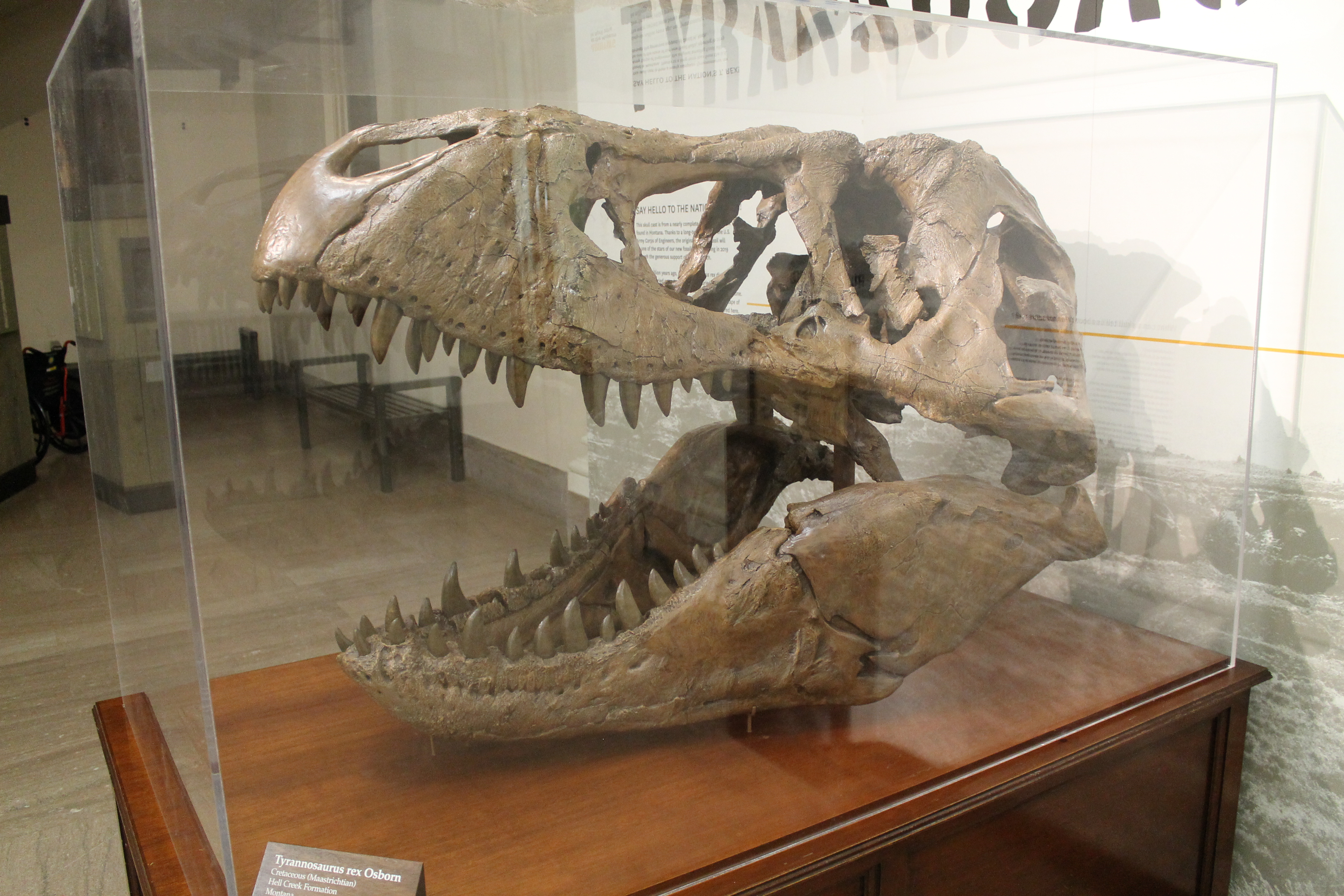
Skull cast of MOR 555, soon to be "The Nation's T. rex", at NMNH.

Skull cast of MOR 555, soon to be “The Nation’s T. rex“, at the National Museum of Natural History. Photo by the author.

This three part series is a look back at how the tyrant king has defined, and been defined by, the museum experience. Part 1 will cover the circumstances surrounding the creation of the iconic original Tyrannosaurus mount in New York, as well as its successor in Pittsburgh. Part 2 will explore the changing role of Tyrannosaurus in museums caused by a surge of new fossil finds and a revolution in our understanding of dinosaurs. Finally, Part 3 will conclude with a discussion of the positives and negatives of a modern world saturated in all things T. rex.

The Original Tyrant

Between 1890 and 1910, the United States’ large urban natural history museums entered into a frenzied competition to find and display the largest and most spectacular dinosaur skeletons. Although the efforts of paleontologists O.C. Marsh and E.D. Cope in the late 19th century fleshed out the scientific understanding of Mesozoic reptiles, it was these turn-of-the-century museum displays that brought dinosaurs into the public sphere. Bankrolled by New York’s wealthy aristocrats and led by the ambitious mega-tool Henry Osborn, AMNH won the fossil race by most any measure. The New York museum completed the world’s first mounted skeleton of a sauropod dinosaur in 1905, and also left its Chicago and Pittsburgh competitors in the dust with the highest visitation rate and the most fossil mounts on display.

Osborn’s goal was to establish AMNH as the global epicenter for paleontology research and education, and in 1905 he revealed his ace in the hole: two partial skeletons of giant meat-eating dinosaurs uncovered by fossil hunter Barnum Brown. In a deceptively brief paper in the Bulletin of the American Museum of Natural History, Osborn described the fossils from Wyoming and Montana, coining the names Dynamosaurus imperiosus and Tyrannosaurus rex (a follow-up paper in 1906 reclassified “Dynamosaurus” as a second Tyrannosaurus specimen). Fully aware of what a unique prize he had in his possession, Osborn wasted no time leveraging the fossils for academic glory (and additional funding from benefactors). He placed the unarticulated Tyrannosaurus fossils on display at AMNH shortly after his initial publication, and commissioned legendary artist Charles Knight to prepare a painting of the animal’s life appearance.

In 1908, Brown collected a much more complete Tyrannosaurus specimen (AMNH 5027), with over 50% of the skeleton intact, including the first complete skull and a significant portion of the torso. With this specimen in hand, AMNH technician Adam Hermann and his team began work on a mounted Tyrannosaurus skeleton to join the Museum’s growing menagerie of mounted dinosaurs and prehistoric mammals. Inspired by the Museum’s collection of taxidermy mounts in dynamic habitat dioramas, and seeking to accentuate the spectacle of his reptilian monster, Osborn initially wanted to mount two Tyrannosaurus skeletons facing off over a dead hadrosaur. He even published a brief description complete with illustrations of the projected scene (shown below). However, the structural limitations inherent to securing heavy fossils to a steel armature, as well as the inadequate amount of Tyrannosaurus fossils available, made such a sensational display impossible to achieve.

Model of unrealized T. rex showdown mount from Osborn 1913.

Model of unrealized T. rex showdown mount. Image from Osborn 1913.

Instead, Hermann prepared a single Tyrannosaurus mount, combining the 1908 specimen with plaster casts of leg bones from the 1905 holotype. The original skull was impractically heavy, so a cast was used in its place. Finally, missing portions of the skeleton, including the arms, feet, and most of the tail, were sculpted by hand using bones from Allosaurus as reference. During the early 20th century, constructing fossil mounts was a relatively new art form, and while Hermann was one of the most talented and prolific mount-makers in the business, his techniques were somewhat unkind to the fossil material. Bolts were drilled directly into the fragile bones to secure them to the armature, and in some cases steel rods were tunneled right through the bones. Any fractures were sealed with plaster, and reconstructed portions were painted to be nearly indistinguishable from the original fossils. Like most of the early AMNH fossil mounts, preserving the integrity of the Tyrannosaurus bones was often secondary to aesthetic concerns like concealing the unsightly armature.

Tyrannosaurus and others in AMNH Dinosaur Hall, 1927. Photo courtesy of AMNH Research Library.

AMNH Tyrannosaurus, ca. 1940. Photo courtesy of the AMNH Research Library.

The completed Tyrannosaurus mount, a magnificent sculptural combination of bone, plaster, and steel, was unveiled in 1915 to stunned audiences. The December 3rd New York Times article was thick with hyperbole, declaring the dinosaur “the prize fighter of antiquity”, “the king of all kings in the domain of animal life,” “the absolute warlord of the earth” and “the most formidable fighting animal of which there is any record whatsoever” (and people say that today’s science journalism is sensationalist!). With its tooth-laden jaws agape and a long, dragging lizard tail extending its length to over 40 feet, the Tyrannosaurus was akin to a mythical dragon, an impossible monster from a primordial world. This dragon, however, was real, albeit safely dead for 66 million years.

Today, we know that the original AMNH Tyrannosaurus mount was inaccurate in many ways. The upright, tail-dragging pose, which had been the most popular attitude for bipedal dinosaurs since Joseph Leidy’s 1868 presentation of Hadrosaurus, is now known to be incorrect. More complete Tyrannosaurus skeletons have revealed that the tail reconstructed by Osborn and Hermann was much too long.  The Allosaurus-inspired sculpted feet were too robust, the legs (casted from the 1905 holotype), were too large compared to the rest of the body, and the hands had too many fingers (the mount was given proper two-fingered hands when it was moved in 1927). It would be misleading to presume that the prehistoric carnivore’s skeleton sprang from the ground exactly as it was presented, but it is equally problematic to reject it as a fake. There are many reasons to criticize Osborn’s leadership at AMNH, but he did not exhibit outright forgeries. The 1915 Tyrannosaurus mount was a solid representation of the best scientific data available at the time, presented in an evocative and compelling manner.

The AMNH Tyrannosaurus mount was no less than an icon: for paleontology, for its host museum, and for the city of New York. The mount has been a New York attraction for longer than the Empire State Building, and for almost 30 years, AMNH was the only place in the world where visitors could see a T. rex in person. In 1918, Tyrannosaurus would make its first Hollywood appearance in the short film The Ghost of Slumber Mountain. This star turn was followed by roles in 1925’s The Lost World and 1933’s King Kong, firmly establishing the tyrant king’s celebrity status. It is noteworthy that special effects artist Willis O’Brian and model maker Marcel Delgado copied the proportions and posture of the AMNH display exactly when creating the dinosaurs for each of these films. The filmmakers apparently took no artistic liberties, recreating Tyrannosaurus precisely how the nation’s top scientists had reconstructed it in the museum.

A T. rex for Pittsburgh

In 1941, AMNH ended it’s Tyrannosaurus monopoly and sold the incomplete type specimen (the partial skeleton described in Osborn’s 1905 publication) to Pittsburgh’s Carnegie Museum of Natural History. While it is sometimes reported that this transfer took place to keep the valuable fossils out of harm’s way during World War II (e.g. Larson 2008), the deal was apparently underway well before the United States became involved in the war. Having paid an astounding $100,000 ($1.7 million in today’s dollars) for the fossils, CMNH staff wasted no time in assembling a mount of their own. The Tyrannosaurus holotype only included only about 15% of the skeleton, so most of Pittsburgh mount had to be made from casts and sculpted elements. Somewhat pointlessly, the skull fragments included with the specimen were buried inside a plaster skull replica, making them inaccessible to researchers for several decades. Completed in less than a year, the CMNH Tyrannosaurus was given an upright, tail-dragging posture very much like its AMNH predecessor.

Carnegie Museum of Natural History. Photo from NPR.

CM 9380 at the Carnegie Museum of Natural History. Source

The mid-20th century is sometimes called the “quiet phase” in vertebrate paleontology. After enjoying public fame and generous federal support during the late 1800s, paleontology as a discipline was largely marginalized when experiment-driven “hard” sciences like physics and molecular biology rose to prominence. By the 1950s and 60s, the comparably small number of researchers studying ancient life were chiefly concerned with theoretical models for quantifying trends in evolution. Although the aging dinosaur displays at American museums remained popular with the public, these animals were perceived as evolutionary dead-ends, of little interest to the majority of scientists. Between 1908 (when Brown found the iconic AMNH Tyrannosaurus skeleton) and 1980, only four largely incomplete Tyrannosaurus specimens were found, and no new mounts of this species were built.

Continue to Displaying the Tyrant King Part 2.

References

Dingus, L. (1996). Next of Kin: Great Fossils at the American Museum of Natural History. New York, NY: Rizzoli International Publications, Inc.

Glut, D. 2008. “Tyrannosaurus rex: A century of celebrity.” Tyrannosaurus rex, The Tyrant King. Larson, Peter and Carpenter, Kenneth, eds. Bloomington, IN: Indiana University Press.

Hermann, A. 1909. “Modern Laboratory Methods in Vertebrate Paleontology.” Bulletin of the American Museum of Natural History 21:283-331.

Larson, N. 2008. “One Hundred Years of Tyrannosaurus rex: The Skeletons.” Tyrannosaurus rex, The Tyrant King. Larson, Peter and Carpenter, Kenneth, eds. Bloomington, IN: Indiana University Press.

“Mining for Mammoths in the Badlands: How Tyrannosaurus Rex Was Dug Out of His 8,000,000 Year old Tomb,” The New York Times, December 3, 1905, page SM1.

Naish, D. 2009. The Great Dinosaur Discoveries. Berkeley, CA: University of California Press.

Osborn, H.F. 1906. “Tyrannosaurus, Upper Cretaceous Carnivorous Dinosaur.” Bulletin of the American Museum of Natural History 22:281-296.

Osborn, H.F. 1913. “Tyrannosaurus, Restoration and Model of the Skeleton.” Bulletin of the American Museum of Natural History 32:9-92.

Rainger, Ronald 1991. “An Agenda for Antiquity: Henry Fairfield Osborn and Vertebrate Paleontology at the American Museum of Natural History, 1890-1935. Tuscaloosa, Alabama. University of Alabama Press.

Wesihampel, D.B. and White, Nadine M. 2003.The Dinosaur Papers: 1676-1906. Washington, DC: Smithsonian Books.

1 Comment

Filed under AMNH, CMNH, dinosaurs, fossil mounts, history of science, movies, museums, NMNH, reptiles, theropods

The Top Seven Dinosaur Mounts #MuseumDinos

According to Twitter, today is #MuseumDinos day, possibly because it’s the 10th anniversary of the groundbreaking DinoSphere exhibit at the Indianapolis Children’s Museum. At any rate, dinosaurs in museums is a thing I’m kind of interested in, so here’s the first ever DINOSOURS! listicle: the hastily-planned and in-no-way-definitive top seven coolest dinosaur extinct animal mounts from around the world.

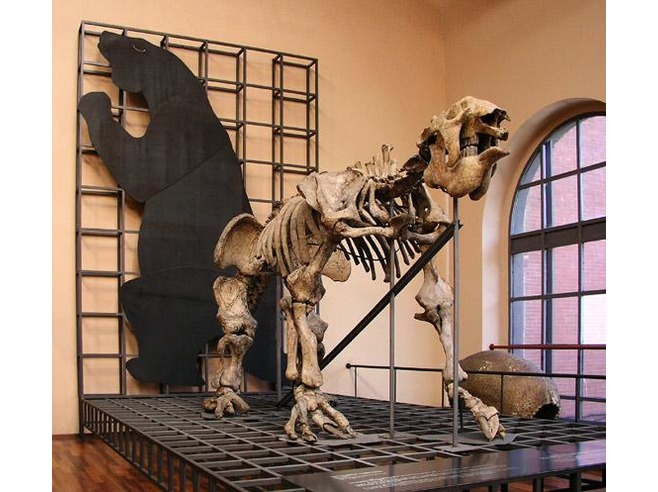
7. MegatheriumMuseo Nacional de Ciencias Naturales

The original Megatherium fossils have been remounted at the Museo Nacional de Ciencias Naturales. Image from TripAdvisor.

Megatherium at the Museo Nacional de Ciencias Naturales. Source

Let’s start with the eldest. There are quite a few ground sloth mounts in the world, but the Megatherium in Madrid has the distinction of being the first assembled skeleton of a prehistoric animal ever put on public display. It’s hard to imagine, but when Juan Bautista Bru created this mount in 1795, biological evolution was completely unknown, and naturalists were just beginning wrap their heads around the idea that organisms could become extinct. This Megatherium was a product of a very different era of human understanding about the natural world, but unlike other historic mounts like the Peale mastodon and Leidy Hadrosaurus, it has survived to the present day.

6. Stegosaurus and Allosaurus, Denver Museum of Nature and Science

Stegosaurus and Allosaurus

Stegosaurus and Allosaurus at the Denver Museum of Nature and Science. Source

In addition to being a respected scientist, Ken Carpenter is among the most skilled fossil mount creators working today. Among his most recognizable work is the Stegosaurus and Allosaurus face-off at the Denver Museum of Nature and Science. Featuring a remount of a historic Stegosaurus specimen and an Allosaurus discovered and mostly excavated by 12-year-old India Wood, this lively display was unveiled in 1995 as the centerpiece of the “Prehistoric Journey” exhibit. In addition to biomechanical accuracy exceeding many other modern mounts, this display by Carpenter and Bryan Small is imbued with remarkable dynamism and energy.

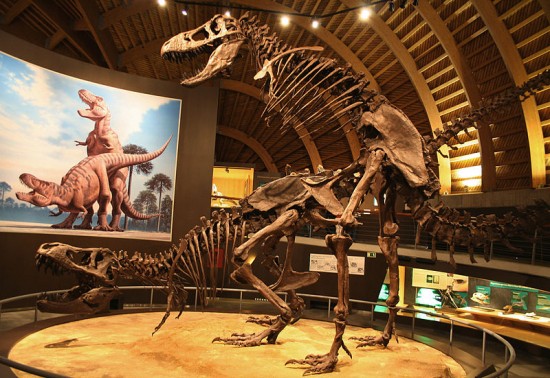
5. Tyrannosaurus pair, Museo Jurasico de Asturias

Tyrannosaurus at Museo Jurasico de Asturias. Source

Tyrannosaurus at Museo Jurasico de Asturias. Source

Then again, there are a lot of fighting dinosaur mounts. I love that dinosaurs had big teeth and killed things as much as the next person, but it’s refreshing to see a mount that showcases some other aspect of these animals’ lives. That said, the Spanish Museo Jurasico de Asturias is, as far as I know, the only museum to display a pair of copulating dinosaurs. The T. rex on the bottom looks like yet another Stan cast, but I’m not sure about the one on top.

4. Diplodocus, Carnegie Museum of Natural History (and elsewhere)

The original "Dippy" the Diplodocus at the Carnegie Museum of Natural History.

The original “Dippy” the Diplodocus at the Carnegie Museum of Natural History.

Like the Madrid Megatherium, this Diplodocus is intractably situated in history. If the worldwide popularity of dinosaurs could be traced to a single specimen, it would be this one. At the turn of the 20th century, Andrew Carnegie, who funded the creation of the Carnegie Museum in Pittsburgh, demanded that his museum find and display a sauropod dinosaur. This launched the Great American Sauropod Race, a frenzied competition among the United States’ large natural history museums to assemble the biggest dinosaur for display. The American Museum in New York was first across the finish line in 1905 with their composite “Brontosaurus”, although the Diplodocus collected by the CMNH team was a more complete specimen. Not to be outdone by his New York competitors, Carnegie commissioned several casts of the skeleton, which he presented to several cities in Europe and Latin America. Diplodocus casts sprang up seemingly overnight in London, Paris and elsewhere, and the original specimen was unveiled in Pittsburgh in 1907.

3. GiraffatitanMuseum für Naturkunde

Should the Giraffatitan at Berlin's Museum fur Naturkunde be displayed in Germany? Image from Wikipedia.

The biggest fossil mount in the world. Source

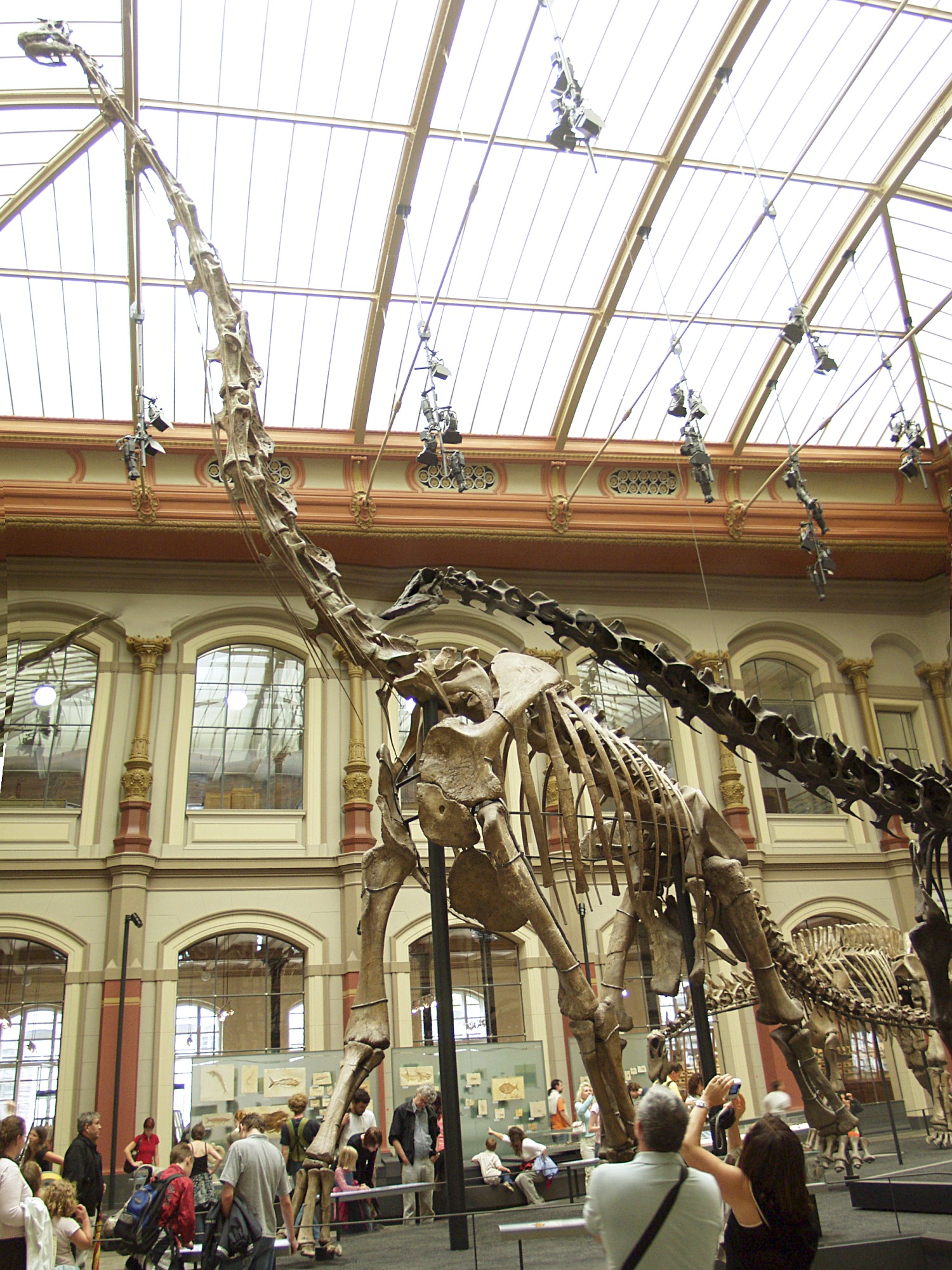
The Berlin Giraffatitan is on this list for two reasons. First, it’s really big. The biggest mount in the world composed mostly of original fossils, as a matter of fact, and big things are awesome. However, this display is also a fascinating example of the cultural meaning natural specimens can take on when placed on display. The fossils themselves were removed from what is now Tanzania under the authority of a colonial government that is no longer considered legitimate or appropriate, and the mount itself was completed in 1935, a time when the hall it was displayed in was filled with swastika flags. The fossils themselves (and the current museum staff that have inherited them) obviously have nothing to do with Nazis or colonial imperialism, but the display they were incorporated into is entrenched in history that should not be ignored or forgotten.

This is actually the second iteration of this display, the bow-legged original having been remounted in 2007.That’s one of the Carnegie Diplodocus casts peeking in from the right, by the way.

2. Triceratops, National Museum of Natural History

Triceratops at the National Museum of Natural History.

Triceratops at the National Museum of Natural History.

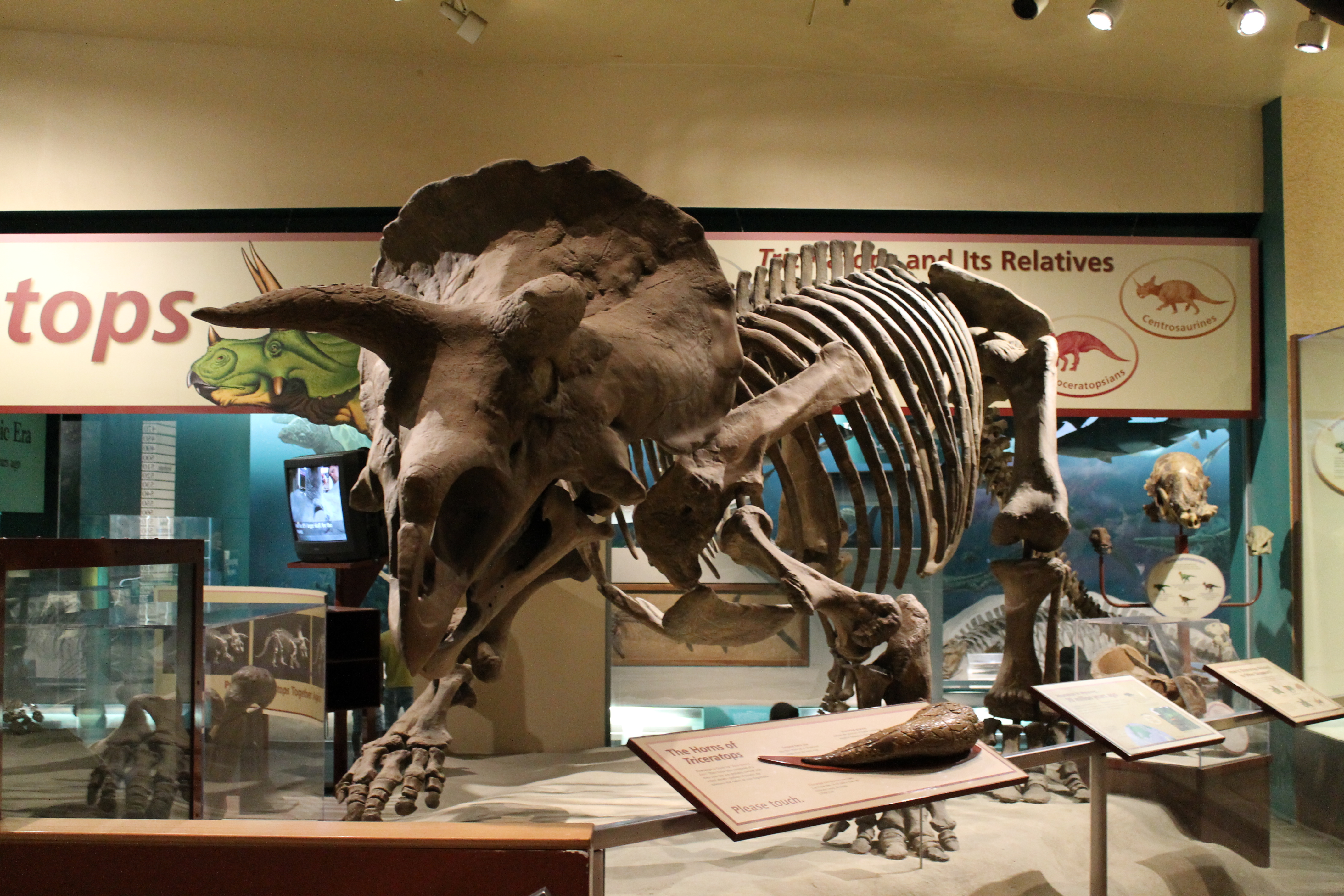
Triceratops is objectively the coolest dinosaur ever, and NMNH is the home to the definitive (and first) Triceratops mount. Charles Gilmore and Norman Boss constructed this composite skeleton in 1905 from fossils collected throughout Wyoming, resulting in a mount that was inaccurate in many details; most noticeably, the skull was too small compared to the rest of the body. Nevertheless, this Triceratops was the basis for illustrations in popular books for decades to come. In 2000, Steve Jabo and others retired the original mount, conserving the fossils and replacing them in the exhibit hall with a casted duplicate. Among other improvements, the undersized head was corrected by digitally scanning the original and 3D-printing it at a different scale.

1. Barosaurus and Allosaurus, American Museum of Natural History

Allosaurus and Barosaurus mount in the Roosevelt rotunda of the American Museum of Natural History. Source: http://www.ourtravelpics.com.

Allosaurus and Barosaurus mount at the American Museum of Natural History. Source

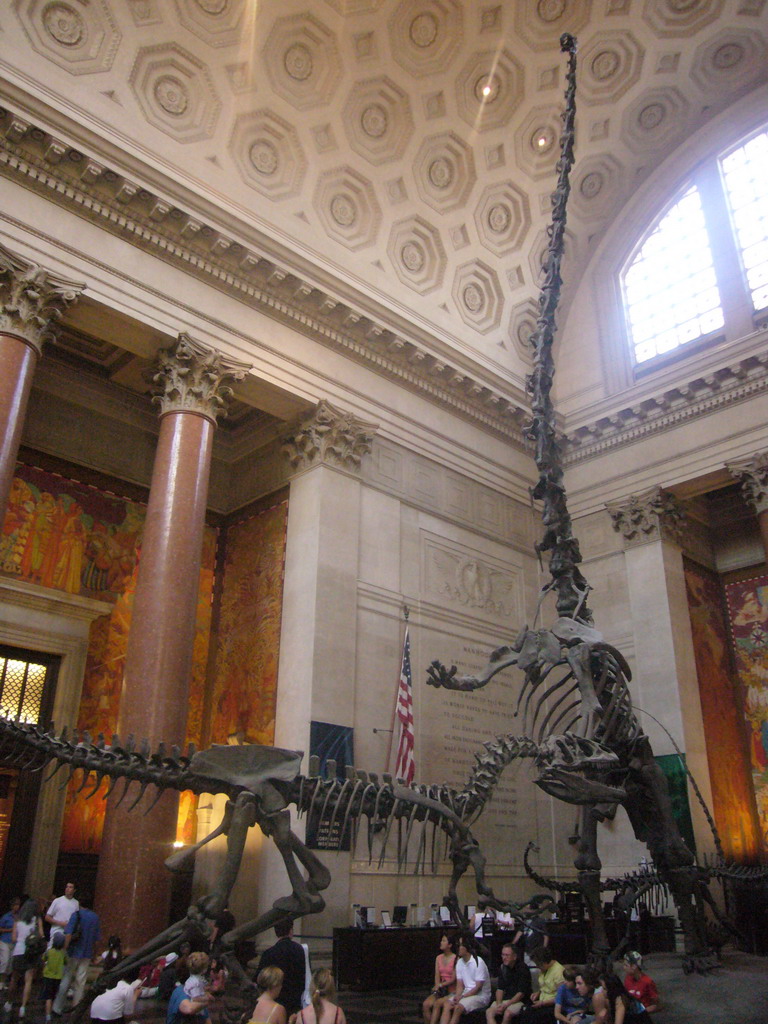
Was there ever any question what would be in first place ? The Barosaurus encounter in the Theodore Roosevelt rotunda at AMNH is a prime contender for the world’s most spectacular fossil mount. What I like most about this exhibit is the purposeful mise-en-scene: the dinosaurs decisively fill the space, drawing the viewer’s eye not only around the room but up the neck of the 50-foot Barosaurus toward the high vaulted ceiling.  Since 2010, visitors have been able to walk between as well as around the mounts, inserting their own human scale into the scene. According to AMNH paleontologist Mark Norrell, the objective of this exhibit was “to imagine dinosaurs as living organisms, facing challenges similar to those that confront animals today.” However, Norrell freely admits that the display was also meant to be a spectacle, emphasizing the “romantic history and grandeur of fossils”.

References

Brinkman, P.D. (2010). The Second Jurassic Dinosaur Rush: Museums and Paleontology in America at the Turn of the 20th Century. Chicago, IL: University of Chicago Press.

Carpenter, K., Madsen, J.H. and Lewis, L. (1994). Mounting of Fossil Vertebrate Skeletons. In Vertebrate Paleontological Techniques, Vol. 1. Cambridge, UK: Cambridge University Press.

López Piñero , J.M. (1988). Juan Bautista Bru (1740-1799) and the Description of the Genus MegatheriumJournal of the History of Biology. 21:1:147-163.

Norrell, M.A., Dingus, L.W. & Gaffney, E.S. (1991). Barosaurus on Central Park West. Natural History, 100(12), 36-41.

3 Comments

Filed under AMNH, CMNH, dinosaurs, fossil mounts, history of science, mammals, museums, NMNH, paleoart, reptiles

The Stan Gallery

The first-ever mounted skeleton of Tyrannosaurus rex went on display at the American Museum of Natural History in 1915, and for nearly 30 years, the New York museum was the only place in the world where one could see the world’s most famous dinosaur in person. The situation today could not be more different. More than 50 individual Tyrannosaurus specimens of varying degrees of completeness are now known, and thanks to casting technology the number of Tyrannosaurus skeletons on display may well exceed one hundred.

A significant fraction of those displays are casts of BHI 3033, the T. rex specimen more commonly known as Stan. Excavated in South Dakota in 1992 by the Black Hills Institute (a for-profit outfit specializing in excavating, preparing and mounting fossils), Stan is significant for being over two-thirds complete and for including the best preserved Tyrannosaurus skull yet found. Since 1996, BHI has sold dozens of casts of the complete Stan skeleton (missing bones are filled in with casts from the original AMNH T. rex, among others) to museums and other venues around the world. At a relatively affordable $100,000 plus shipping, even small local museums and the occasional wealthy individual can now own a Tyrannosaurus mount. Stan is, by a wide margin, the most duplicated and most exhibited dinosaur in the world today. As of 2008, BHI had sold more than 30 Stan casts, and that number has grown substantially since then, particularly with the increased interest in dinosaur displays in Asia.

One might argue that this extreme amount of replication lessens the cultural value of museum displays. What allure do museums have when the specimens on display are fiberglass replicas, of which identical versions can be seen at dozens of other venues, including corporate offices and amusement parks? I would counter that this is a small price to pay when we consider the immense educational benefits of this unprecedented availability of dinosaur skeletons. Children and adults around the world now have  the opportunity to see a T. rex in person, an experience that was until recently limited to citizens of a handful of large cities. What’s more, the huge body of research on Tyrannosaurus makes it a veritable model organism for vertebrate paleontology, so increasing access to T. rex fossils for international scientists is definitely helpful.

Besides, a fossil mount is far more than the fossil bones it is composed of. Mounts are in equal measures natural specimens and man-made objects, works of installation art designed to communicate a story through pose, posture and a carefully arranged mise-en-scene. Below are 14 examples of Stan on display, highlighting the great range attainable with a single dinosaur.

Image sources: Orientation UofMa_leistra, Bill and Sandra WayneReluctant Drifter, Roadschooling America, dinonikes, Texas Tigers, Momotarou2012, Helana Handbasket and Marie Thomas.

5 Comments

February 2, 2014 · 11:55 am

Juan Bautista Bru and the First Fossil Mount

The first fossils ever assembled into a freestanding mount belonged to the giant ground sloth Megatherium. The fossils, which were unearthed near Luján in what is now Argentina, were described and mounted in 1795 by Juan Bautista Bru at the Royal Cabinet of Natural History in Madrid. But while the Megatherium mount played an important part in the history of paleontology and in our understanding of the changing Earth, the man who made it possible is scarcely mentioned in the literature. Instead, Bru’s work on Megatherium is typically overshadowed by the involvement of the much better known anatomist Georges Cuvier. Drawing principally from José López Piñero ‘s 1988 paper on Bru, this entry is intended to highlight and acknowledge Bru’s contribution to the practice of mounting fossils for public display.

Cuvier's adaptation of Bru's drawing.

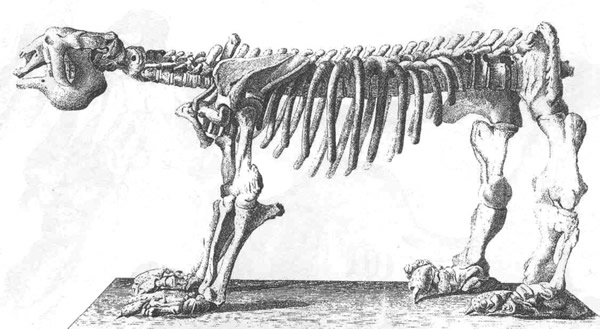
Cuvier’s adaptation of Bru’s illustration of the Megatherium mount.

The Megatherium  in question was discovered  in 1789 in what was then the Viceroyalty of Rio de la Plata, on the banks of the Luján River, “a league and a half” from the town of the same name. As region was controlled by the Spanish monarchy at the time (although the Argentine War of Independence was not far off), it was standard procedure for viceroy Marqués de Lorento to ship the important find to Spain with all haste. Packed into seven crates, the nearly complete skeleton was delivered to the Royal Cabinet of Natural History in Madrid, which curated natural specimens from Spanish territories and was among the most respected scientific institutions in Europe.

By the late 1700s, the European Enlightenment was well established, and the pursuit of knowledge about the world through reason and scientific deduction rather than legend or dogma was popular among the societal elite. The study of natural history was deemed particularly important, and institutions like the Royal Cabinet which collected, quantified and published knowledge about the natural world were well-respected and well-funded. However, the meaning of the fossil record still eluded the top minds of the era. A century earlier, Nicolaus Steno had determined that fossils were the remains of once-living organisms, and by the late 1700s some naturalists were starting to come around to the idea that species that once existed had become extinct. Nevertheless, when the Megatherium arrived in Madrid, naturalists still lacked the most important part of the puzzle presented by the fossil record: an understanding of evolution and the interrelatedness of life on Earth.

The task of interpreting the Luján fossils went to Juan Bautista Bru, the “Artist and First Dissector” at the Royal Cabinet. Born in Valencia, Bru had initially tried his hand as a traditional artist, but found little success. After shifting his focus to natural science, Bru joined the Royal Cabinet in 1771 and remained there until his death in 1799. Bru primarily served as a scientific illustrator, combining his artistic skill with his extensive anatomical knowledge to produce gorgeously detailed drawings of biological specimens, as was required before photography became commonplace. He was also responsible for producing taxidermy pieces and occasionally, mounted skeletons of animals.  In 1777, Bru prepared and mounted the skeleton of an elephant that had died at the royal estate in Aranjuez, a task which doubtlessly provided useful practice for mounting the gigantic Megatherium.

Plate from Bru's monograph

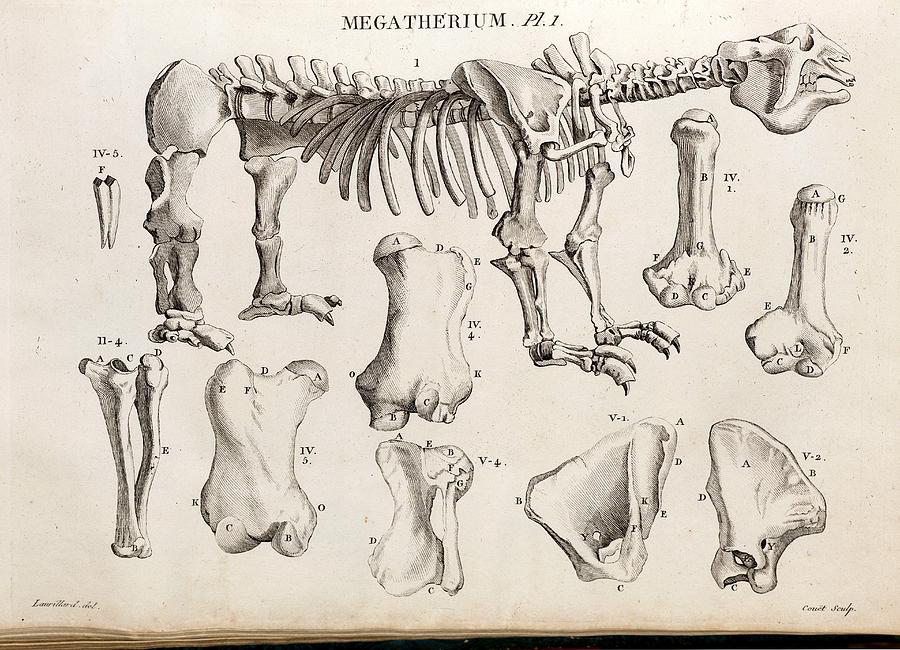
Plate I from Bru’s Megatherium monograph.

Bru devoted four years to studying the Luján fossils, which were complete except for the animal’s tail. He completed his monograph in 1793, which included detailed descriptions of every skeletal element, in addition to 22 plates illustrating the bones from various angles. Among the illustrations was the completely articulated skeleton shown above, which is, incidentally, the first recorded instance of a skeletal drawing illustrating the living form of an extinct animal. Since the mounted skeleton did not go on display until 1795, it is unclear whether Bru based the illustration on the mount or vice versa. Unfortunately, little is known about how Bru created the Megatherium mount, and his drawing provides no information about the armature that supported the massive bones. Since Bru did not discuss the mount’s construction in his monograph, one can only surmise that the techniques he refined over the years building mounts of modern animal skeletons were applicable to the fossils. Wooden armatures were used to mount fossils in the early 1800s, and it is plausible that Bru pioneered this technique. Regardless of how it was supported, the  rhino-sized Megatherium mount was placed on a rectangular wooden platform in a room of the Royal Cabinet already devoted to fossils and minerals.

It is unclear why, but Bru never published his monograph, and this unfortunately resulted in him effectively being scooped by Georges Cuvier in 1796. A representative of the French government working in Santa Domingo acquired a set of proofs of Bru’s monograph and illustration, and passed them along to the Institut de France. The proofs made their way to Cuvier, who was well established as one of the world’s leading experts in anatomy and natural history. Although he had not yet seen the actual fossils, Cuvier wrote a brief article in the journal Magasin Encyclopedique on the South American creature, in which he coined the rather vague name Megatherium americanum, meaning American giant beast. Cuvier’s article was not without error (he claimed the fossils were found in Paraguay), but he did correctly recognize that the animal was an edentate* and was curiously similar to modern tree sloths**. In contrast, Bru’s description of the fossils, while thorough, contained no attempt at classification.

As it happened, Cuvier published a second important article on fossil animals in 1796: his Mémoires sur les espèces d’éléphants vivants et fossiles, in which he established that the mammoth fossils found in the Americas belonged to an extinct relative of modern elephants. The wave of attention Cuvier received that year for his contributions to the young field of paleontology apparently eclipsed any recognition of Bru’s multi-year study of the Megatherium. Bru ended up selling his monograph and illustrations to a publisher, and a translated version eventually appeared in a widely disseminated booklet with Cuvier’s Megatherium article in 1804, five years after Bru’s death.

Megatherium would continue to be important to 19th century paleontologists. Charles Darwin became interested in South American fossils during the second voyage of the HMS Beagle. In particular, the relationship between the extinct ground sloths and their modern relatives contributed to Darwin’s ideas about the succession of species over geologic time. In 1849, the British Museum produced a Megatherium mount of their own, a composite of two skeletons found very near to where the Spanish specimen was first discovered. Plaster casts of this mount would appear in museums on both sides of the Atlantic, and the original cast is still on display in London today (some of the fossils were destroyed during World War II). But while the discovery of Megatherium would be recounted often over the subsequent two centuries, it was Cuvier, not Bru, who was always given credit for introducing the animal to the world. Only in recent years has Bru’s name begun to circulate again in historical accounts.

The original Megatherium fossils have been remounted at the Museo Nacional de Ciencias Naturales. Image from TripAdvisor.

The original Megatherium fossils have been remounted at the Museo Nacional de Ciencias Naturales. Image from Virtual Tourist.

However, there is a bit of happiness at the end of this story. Unlike other early mounts like Peale’s mastodon and Hydrarchos, Bru’s Megatherium has survived to the present day. Remounted on a new steel armature in an approximation of the original quadrupedal pose, the Luján Megatherium fossils are on display at the Royal Cabinet’s spiritual successor, the National Museum of Natural Science in Madrid. On public display for a nearly uninterrupted 218 years, this specimen can  surely be said to have taken on a second life. It was once a giant beast that roamed across the ancient Argentinian plains, and now it is a monument to scientific achievement.

*Edentata is a historic paraphyletic group that includes sloths, anteaters, pangolins and aardvarks. Modern biologists recognize that the new world sloths and anteaters and old world pangolins and aardvarks are not closely related. The name Xenarthra is now used for sloths and their new world relatives.

**Cuvier was working many decades before Charles Darwin published On the Origin of Species, and as such, did not subscribe to the idea that species could change and diversify over time. It is therefore worth noting that while he recognized the similarity between Megatherium and modern sloths, he did not conceive of their relationship in an evolutionary sense (that is, related species sharing a common ancestor). 

References

Argot, C. (2008). Changing Views in Paleontology:
The Story of a Giant (Megatherium, Xenarthra). Mammalian Evolutionary Morphology. Pp 37-50.

López Piñero , J.M. (1988). Juan Bautista Bru (1740-1799) and the Description of the Genus Megatherium. Journal of the History of Biology. 21:1:147-163.

1 Comment

Filed under fossil mounts, history of science, mammals, museums, paleoart

The Chimeric Missourium and Hydrarchos

In 1802, naturalist and painter John Peale unveiled the first mounted fossil skeleton ever put on display in the United States. The mount, a mastodon (Mammut americanum) collected on a farm near Newburgh, New York, immediately captured public attention and inspired a wave of interest in anything old and big. Although Peale charged admission to view the mastodon and somewhat dramatized its importance as “the first of American animals” and “the largest of terrestrial beings”, his primary intent was to educate the public about the natural world. Nevertheless, many American capitalists saw the crowds of people lining up to see Peale’s mastodon and concluded that there was a profit to be made in exhibiting fossils. The best known of these 19th century fossil showmen was surely Albert Koch. Having immigrated to the United States from Germany in 1835, Koch was a contemporary of P.T. Barnum, and like Barnum, he made a career out of exhibiting “curiosities”, some real and some fraudulent or exaggerated. At “Dr. Koch’s” (he never actually earned a doctorate) exhibition hall in St. Louis, Missouri, visitors paying the 50 cent admission fee could view wax sculptures, exotic animals, artifacts from distant countries, extensive miniature dioramas, and alleged freaks of nature. Koch also had a live grizzly bear and several alligators – sources differ on whether or not they were forced to fight for entertainment.

Missourium

In 1840, Koch received word of something much bigger. A Missouri farmer had discovered large fossil bones, and Koch quickly arranged to purchase the find along with the rights to search the farmer’s land for more. Within four months, Koch had assembled a complete mastodon skeleton. More than complete, actually: Koch’s mount included numerous extra vertebrae and ribs from one or more additional mastodon individuals. Like Peale before him, Koch placed blocks of wood between the vertebrae to further exaggerate the animal’s length. The result was a 32-foot mount, nearly twice as long as a typical mastodon. As a final flourish, Koch positioned the mastodon’s tusks pointing upwards, to make the beast look more fearsome. In order to differentiate his creation from Peale’s earlier exhibit, Koch called the creature “Missourium”, although there was no scientific reason to distinguish it from other mastodon finds. Missourium went on display at Koch’s St. Louis establishment later that same year, and proved to be an instant success. In fact, Koch decided that the composite mastodon mount was worth more than then every other display combined. In 1841, he sold the exhibit hall and took Missourium on tour, traveling to New Orleans, Philadelphia, and several other American cities.

Illustration of Missourium. Out-of-copyright image via Laelaps.

Contemporary academics, including the British naturalist Richard Owen, pointed out that Koch’s mount was clearly an incorrectly assembled composite, and expressed disapproval for Koch’s sensationalized treatment of important fossil specimens. Just like famous P.T. Barnum frauds like Joice Heth and the Feejee mermaid, however, the controversy surrounding Missourium’s legitimacy only increased the enthusiasm of the paying public.  As an interesting side note, Koch claimed to have found stone tools and other human artifacts alongside the Missourium fossils. He included a pamphlet with his traveling exhibit which explained that these tools demonstrated that human populations in North America extended much further back in time than had been previously assumed. Koch may well have been telling the truth about where he found the artifacts and would eventually turn out to be correct about the antiquity of American humans. Nevertheless, because of the obviously fraudulent nature of Missourium, scientists of the day saw fit to ignore Koke’s suggestions entirely.

Hydrarchos

Koch sold Missourium to the British Museum in 1843, but he was soon at it again in 1845, when he began scouring Alabama for new display-worthy fossils. This time, Koch was after the bones of the prehistoric whale Basilosaurus cetoides. The Philadelphia-based naturalist and physician Richard Harlan had first described and named Basilosaurus in 1835 (he erroneously thought it was a reptile, hence the name meaning “king lizard”), but its fossils had been well known in the American south for decades before that. Enslaved men and women often ran into the bones while plowing fields, and these fossils were sometimes used as furniture or foundation posts for houses. Between January and April of 1845, Koch traveled across Clarke, Choctaw, and Washington counties, retrieving Basilosaurus remains. His best find was an articulated partial skeleton, including much of the skull, which he unearthed near the Tombigbee River.

After accumulating parts of at least six Basilosaurus individuals, Koch combined the fossils into a 114-foot mount (he would claim that it was 140 feet). Just as he had with Missourium, Koch strung together the vertebrae of multiple animals, extending his creation’s length to an absurd degree. This time, Koch did not even limit himself to whale fossils: as naturalist Jeffries Wyman would point out, many of the elements in Koch’s chimeric creation were actually ammonite shells. Billed as a sea serpent called “Hydrargos sillimani” (named after Yale professor Benjamin Silliman, who was not involved in the project and immediately requested that the reference be removed), the mount was first exhibited at the Apollo Saloon in New York City. Hydrargos, eventually renamed Hyrarchos, proved to be even more popular and profitable than Missourium. Cleverly, Koch had constructed the skeleton not as a single structure but as several modular components secured to wooden boards. This made it easy for the showman to disassemble, transport, and reassemble the display, which he toured throughout the United States and Europe.

Illustration of Hydrarchos in New York.

Illustration of Hydrarchos in New York’s Apollo Saloon.

As they had with Missourium, scientists confronted Koch over his inaccurate and sensationalized displays. Undaunted, Koch eventually sold the Hydrarchos mount to the Prussian King Friedrich Wilhelm IV, who exhibited it in Berlin’s Royal Anatomical Museum despite the insistence by the museum’s experts that the mount was a fraudulent reconstruction. Koch was still not finished, however. In 1848 he completed a second Basilosaurus composite, this one 96 feet long, and again took it on tour. The Mark II Hydrarchos would eventually be sold to Colonel Wood’s Museum in Chicago. E.L. Wood’s “museum” was yet another exhibition of mostly-bogus oddities, like Koch’s original operation in St. Louis. Still, the Basilosaurus mount’s final home can be credited for correctly identifying it as a prehistoric whale. The composite mount was labeled as “Zeuglodon”, a junior synonym coined by Richard Owen when he determined that the Alabama fossils belonged to marine mammals, not reptiles. Properly identified or not, the mount was destroyed along with the rest of Wood’s Museum during the great Chicago fire in 1871. Most of the original Hydrarchos was lost during World War II, although some parts remain at the Humboldt Museum in Berlin.

Modern Influences

Koch’s fossil mounts were frustrating to 19th century paleontologists because they cast unnecessary doubt on their young discipline. The actual bones that made up Missourium and Hydrarchos were genuine, Koch had merely assembled them incorrectly to enhance the appeal and profitability of his displays. To the scientists’ chagrin, when they criticized Koch’s displays, the popular press and the public often misinterpreted their statements and became skeptical of fossil finds in general. During the 19th century, ideas like extinction and the great age of the Earth were very new, and Koch’s spurious commodification of hard evidence made it harder for legitimate researchers to be taken seriously in the public sphere.

In fact, modern paleontologists still have to do damage control when the occasional forgery turns up. In 1999, the discovery of “Archaeoraptor” was widely publicized in National Geographic magazine and elsewhere as a feathered dinosaur that provided important evidence for the dinosaurian origin of birds. Archaeoraptor was not the first feathered dinosaur ever found, but it was one of the early ones, back when the concept of dinosaurs with feathers was still news. Unfortunately, it was only after the National Geographic article had gone to press that paleontologists Xu Xing and Phil Curie determined that the Archaeoraptor specimen, which had been smuggled into the United States from China by an unknown dealer, was actually a composite. Someone in China knew that a complete skeleton was worth more than an incomplete one, and cemented together partial skeletons of several dinosaurs, including Microraptor and Yanornis. When National Geographic retracted the story, however, many readers misunderstood the extent of the forgery. They thought that the feathers, the most exciting part of the find, had been faked, when in reality all the parts of Archaeoraptor were quite real, they just belonged to different animals.

This out-of-copyright image of Hydrarchos provides a good look at the mount's wooden armature. Out-of-copyright image via Laelaps.

This image of Hydrarchos provides a good look at the mount’s wooden armature. Incidentally, the above caption is accurate. Out-of-copyright image via Laelaps.

More than ten years later, writers with creationist agendas and a few scientists who ought to know better are still pushing the myth that Archaeoraptor was a deliberate hoax. Literally hundreds of genuine feathered dinosaur specimens found since then contribute to the scientific consensus that birds area incontrovertibly dinosaurs. And yet, paleontologists are still fighting skepticism inspired by the Archaeoraptor mistake.

19th century paleontologists paid for Koch’s displays in much the same way. Editorials denouncing evolution and the fossil record repeatedly referenced Koch’s ridiculous chimeras, as though these showpieces were representative of paleontologists’ work. I suspect that the general animosity paleontologists of the era felt toward fossil mounts came from dealing with Koch’s legacy. O.C. Marsh, for instance, hated the idea of mounting fossils and refused to let any of his finds be displayed in such a way during his lifetime. It would not be until 1868 and the discovery of the first somewhat complete dinosaur remains that paleontologists would again see mounting as a legitimate means for displaying their finds.

References

Carpenter, K., Madsen, J.H. and Lewis, L. (1994). Mounting of Fossi Vertebrate Skeletons. In Vertebrate Paleontological Techniques, Vol. 1. Cambridge, UK: Cambridge University Press.

Jones, D.E. 1998. Doctor Koch and his “Immense Antidiluvian Monsters.” http://www.alabamaheritage.com/vault/monsters.htm

Rogers, M. 2010. Delia’s Tears: Race, Science and Photography in Nineteenth Century America. New Haven, CT: Yale University Press.

Simpson, G.G. 1942. The Beginnings of Vertebrate Paleontology in North America. Proceedings of the American Philosophical Society. 86:1:130-188.

Switek, B. 2008. “Koch’s “Mammoth” and Human Antiquity.” http://scienceblogs.com/laelaps/2008/06/18/too-little-too-soon/

9 Comments

Filed under fossil mounts, history of science, mammals, museums

The Artist in His Museum: Peale’s Mastodon

In 1801, naturalist and painter Charles Wilson Peale assembled in Philadelphia the skeleton of a mastodon (Mammut americanum).While Peale’s mastodon was not the first fully assembled fossil animal put on display, it was assuredly the first display of this type to capture widespread public attention, particularly in the United States. What’s more, the mastodon became an important symbol for the untold natural wonders of the American continent, which was still largely unexplored (by European colonists) at the beginning of the 19th century. Finally, Peale’s mastodon made clear to the public one of the most important principles of modern biology: the idea that organisms can become extinct.

The Peale Museum mastodon, as illustrated by Charles Peale's son, Rembrandt. The Peale Museum mastodon, as illustrated by Charles Peale’s son, Rembrandt.

An extinct giant

The story of the mastodon mount actually began a full century before the 1806 debut. In 1705, a farmer in Claverack, New York found an enormous tooth that had eroded out of a hillside. The farmer traded the tooth to a local politician, and it eventually made it its way into the hands of New York’s colonial governor, Edward Hyde, 3rd Earl of Clarendon. Hyde in turn sent the tooth to London, describing it as a remnant of an antediluvian giant. As word of the remains of a giant spread, other Americans soon began reporting similar finds. Throughout the colonies, giant bones, teeth, and tusks began to be uncovered. While early reports called these fossils the remains of “incognitum,” or “the unknown,” naturalists caught on reasonably quickly that these were not the bones of giant men but of elephant-like creatures.

At this point a brief digression on etymology and taxonomy is required. For most of the 19th century, the American fossil elephants were invariably called “mahmot” or “mammoth.” This was an Anglicization of the Old Vogul term maimanto (meaning earth-horn), which referred to giant tusks occasionally found in Siberia. It is unclear, however, who first made the correct connection between the frozen mammoths of Siberia and the American fossil skeletons. Credit for adopting “mammoth” as a synonym for “big” goes to Thomas Jefferson, who was fascinated by paleontology and the mammoth fossils in particular.

It was not until 1817 that French anatomist Georges Cuvier recognized that there were at least two types of extinct American proboscideans: the taller mammoths and stockier mastodons. Unequivocally demonstrating the staggering repression of the Victorian era, Cuvier coined the name “mastodon,” meaning nipple tooth, because apparently he thought the animal’s most distinguishing feature was that its teeth looked like breasts.

Boobs? Couvier, you poor bastard. Cuvier, you poor bastard.

The American elephantine fossils raised difficult questions for naturalists. The fossils clearly belonged to animals that had never been seen alive, which meant that the entire species must have died out. This concept of extinction was new to science, and it challenged the biblically-inspired presumption that all species had originated in a single creation event. Cuvier was a leader in the 19th century scientific movement known as catastrophism–the idea that extinctions were the result of periodic disasters, such as floods. While Cuvier himself rejected the idea that populations of organisms could avoid extinction by adapting and changing, his work on extinction would prove important when Charles Darwin worked out the process of evolution several decades later.

Unearthing the mastodon

In 1789, Nicholas Collin of the American Philosophical Society proposed a search for a complete mammoth skeleton, in order to resolve the animal’s identity and the question of its extinction once and for all. Collin’s call was answered by Charles Wilson Peale, founder of America’s first modern museum. Peale is best known today as a portrait artist during the American Revolution, but he was also the founder of the Peale Museum in Philadelphia. Although semi-formal collections of interesting natural specimens had existed before, Peale uniquely fashioned his institution as a space for public education, rather than a private vanity project. On the second floor of Philadelphia’s Independence Hall, Peale arranged displays of mammals, birds, and plants in a scala naturae, which was the contemporary understanding of natural order. Peale intended the museum to be a public resource that would improve visitors’ moral character through lessons in science, as was made clear by the slogan printed on every ticket, “the birds and beasts will teach thee.”

In 1799, a farmer named John Masten reported that he had found bones of “an animal of uncommon magnitude” on his land outside Newburgh, New York. Masten gathered a large party of friends and neighbors to help excavate the find. This proved to be a little too much fun: the crowd eventually descended into alcohol-fueled chaos, and many of the fossils were destroyed. Nevertheless, Peale decided to pay Masten a visit, with the hope of securing mammoth fossils for his museum. Peale ended up paying Masten $200 for the surviving fossils, plus another $100 for the right to search his land for more remains. Peale returned to Masten’s farm with a better-organized crew and $500 in additional funding from the American Philosophical Society. The ensuing excavation is the subject of Peale’s 1806 painting, The Exhumation of the Mastodon, shown below.

“The Exhumation of the Mastodon” by Charles Peale, 1806.

Although highly dramatized, The Exhumation of the Mastodon provides the best available record of the event. Since the pit where Masten first found the bones had filled with water, Peale oversaw the construction of a huge wooden wheel, which drove a conveyor belt hauling buckets of water out of the work site. Peale himself can be seen on the right, presiding over his small army of excavators. The well-publicized project eventually uncovered most of a mastodon. Exploring a few nearby farms, Peale’s workers eventually accumulated enough material to build a complete skeleton, most notably a mandible found on another farm down the road. In what was either showmanship or genuine confusion regarding the diets of elephants, Peale said of the find, “Gracious God, what a jaw! How many animals must have been crushed beneath it!” (quoted in Simpson 1942, 159).

The mastodon on exhibit

Once the mastodon skeleton had been transported to Philadelphia, the process of building the mount fell upon Peale’s son Rembrandt and Moses Williams, a free man of color who worked for the Peales. It took three months to articulate the skeleton, although sadly the details of how it was mounted on its armature are lost to history. Initiating a practice that would become necessity for most fossil mounts in years to come, Rembrant filled in missing parts of the mastodon skeleton (the top of the cranium and the tail) with sculpted elements. In addition, wooden discs were placed between vertebrae, slightly exaggerating the mount’s total length.

The completed mastodon mount was unveiled in 1802, in the main hall of the American Philosophical Society. Shortly thereafter, it was moved to the Peale Museum at Independence Hall. For 50 cents (plus regular admission), the visiting public could marvel at the creature Peale touted as “the first of American animals” and “the largest of terrestrial beings.” The mastodon (still being called a mammoth at that time) was a sensation, stirring up fascination with natural science, the prehistoric past, and no small amount of ours-is-bigger-than-yours patriotism in the young United States. In 1822, Peale would commemorate the unveiling of the mastodon with his self portrait, The Artist in His Museum. Ever the showman, Peale ensured that the skeleton in his painting is only barely visible below the rising curtain.

“The Artist in His Museum” by Charles Peale, 1822.

After Peale’s death in 1827 his museum floundered, and was eventually reduced from a meritorious educational institution into a circus of cheap spectacle. It shut down for good in 1848, and the mastodon (by then one of many similar mounts) was put up for auction. There are several conflicting accounts of what became of the mount, including the suggestion that it was destroyed in a fire, but in fact Peale’s mastodon has survived to the present day. Johann Jakob Kaup purchased the skeleton for the Landesmuseum in Durmstadt, Germany, and it has remained on display there ever since.

Germany Peale’s mastodon survives in Durmstadt, Germany. Source

Peale’s mastodon left an unmistakable legacy for both paleontology and public education. Today, the public conception of prehistory is inseparably connected to the image of towering mounted skeletons in museum halls. But fossils do not come out of the ground bolted to steel armatures, so it is largely thanks to Peale that mounts have become the most enduring means of sharing paleontology with the public.

References

Carpenter, K., Madsen, J.H. and Lewis, L. (1994). Mounting of Fossil Vertebrate Skeletons. Vertebrate Paleontological Techniques, Vol. 1. Cambridge, UK: Cambridge University Press.

Connriff, R. (2010). Mammoths and Mastodons: All American Monsters. Smithsonian Magazine. http://www.smithsonianmag.com/science-nature/Mammoths-and-Mastodons-All-American-Monsters.html

Semonin, P. (2000). American Monster: How the Nation’s First Prehistoric Creature Became a Symbol of National Identity. New York, NY: New York University Press.

Simpson, G.G. (1942). The Beginnings of Vertebrate Paleontology in North Ameirca. Proceedings of the American Philosophical Society 86:130-188.

4 Comments

Filed under field work, fossil mounts, history of science, mammals, museums