Category Archives: theropods

The Dueling Dinosaurs: famous fossils in an open lab

A partially prepared tyrannosaur skeleton in a field jacket. Photo by the author.

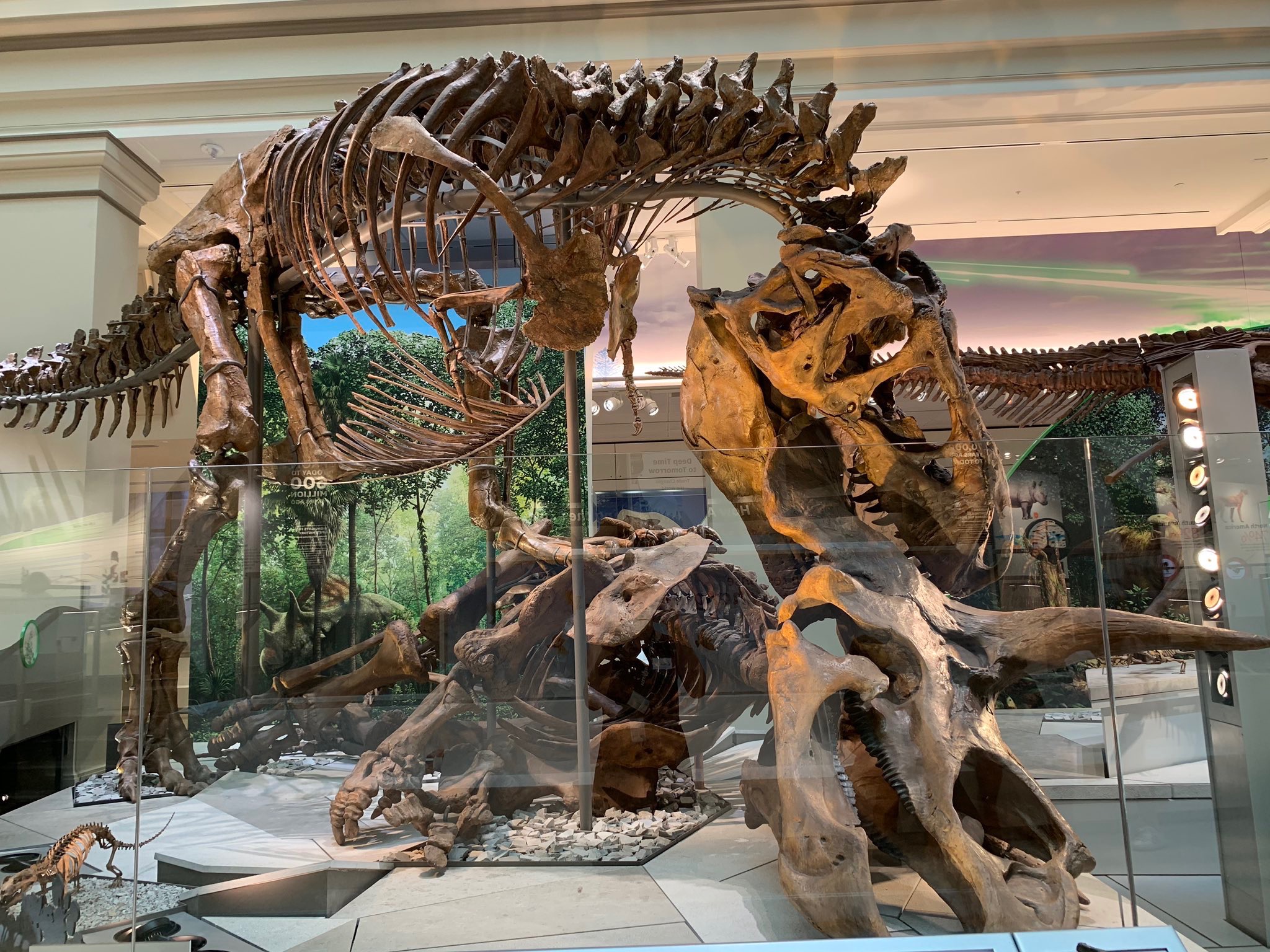
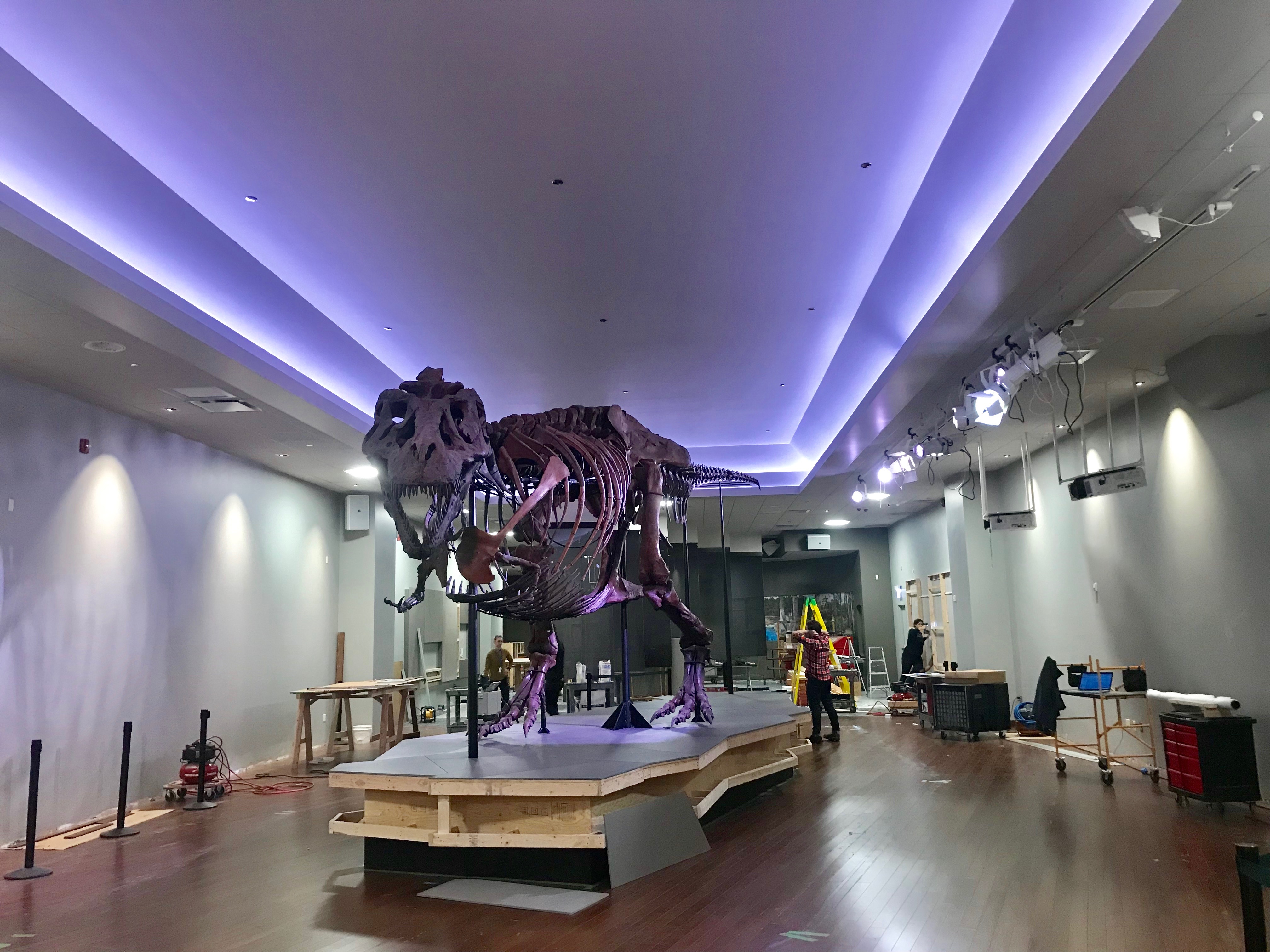
Earlier this month, I had the a chance to see the “Dueling Dinosaurs,” which debuted at the North Carolina Museum of Natural Science (NCMNS) in April. Consisting of virtually complete skeletons of a tyrannosaur and Triceratops preserved side-by-side, this fossil is either the find of the century, or just another example of overhyped, overstudied, and overpriced Hell Creek dinosaurs—it depends on who you ask. But NCMNS has made it more than that, placing the fossil at the center of an ambitious project to improve science literacy by removing all barriers to the process.

Commercial collector Clayton Phipps discovered the skeletons in 2006, on private ranchland in Montana. Having never worked on anything so large before, Phipps teamed up with the Black Hills Institute for the initial preparation and assessment of the fossil. The skeletons were put up for auction in 2013, resulting in what has become a familiar din of competing voices. The sellers heralded the rarity and quality of the fossil, proclaiming it to be a clear example of dinosaurs that perished while locked in combat. Paleontologists countered that a fight-to-the-death scenario was unlikely, and without scientific study, the circumstances of the dinosaurs’ demise could not be known. Furthermore, in the event that the fossil went to a private buyer, there would be no opportunity to study it. The so-called Dueling Dinosaurs were poised to become yet another example of a high-profile specimen sold into private hands, where they could never contribute to scientific and public knowledge.

As it happened, the auction was a failure, and bidding never reached the reserve price. Behind the scenes, however, the Friends of the North Carolina Museum of Natural Science—a non-profit organization that supports the state-run museum—had put forth an offer of six million dollars for the fossil. To be clear, a mid-sized public museum like NCMNS absolutely does not have $6 million on hand for specimen acquisition. The funding came from private donations solicited by the Friends organization.

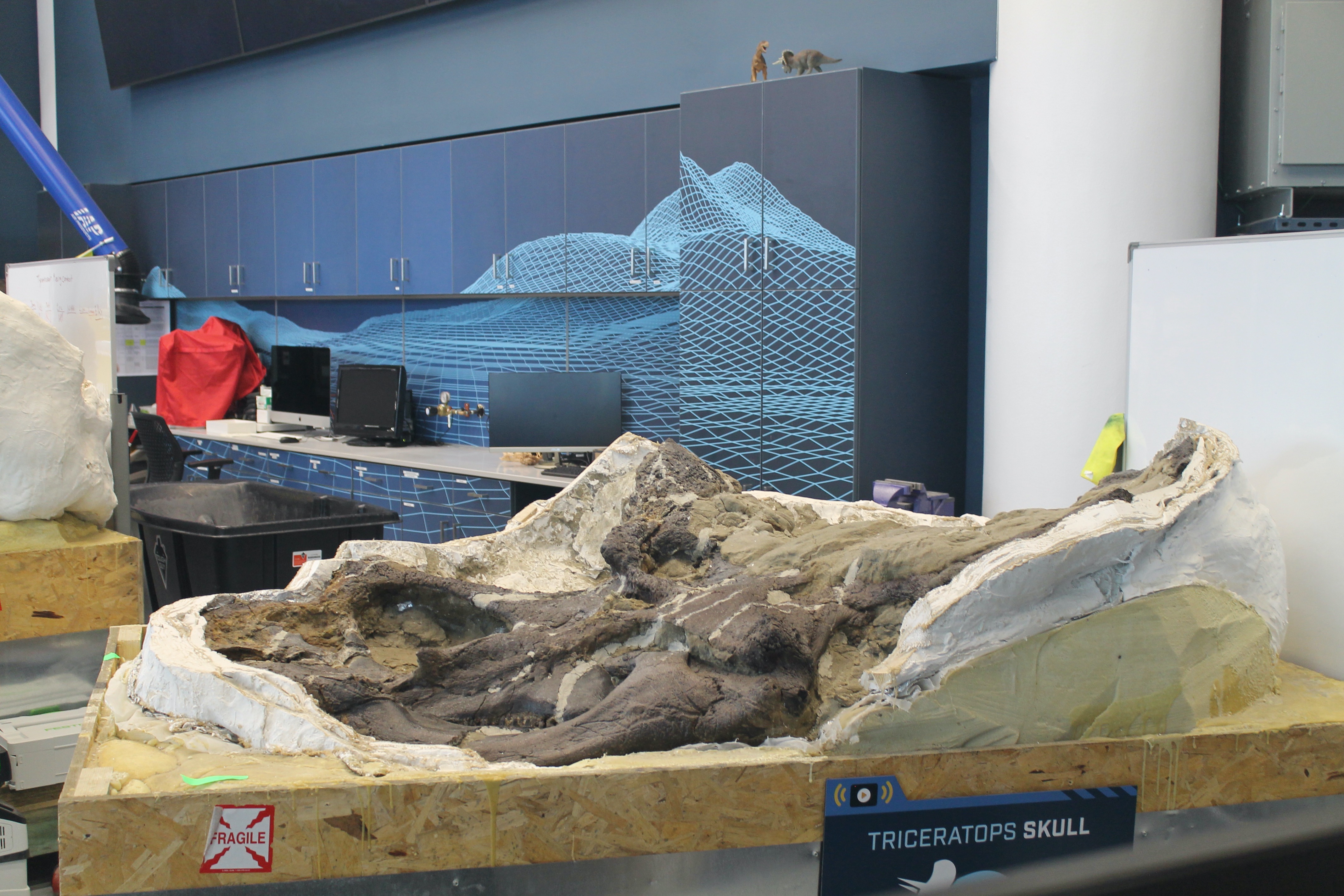
A partially prepared Triceratops skull in a field jacket. Photo by the author.

The offer was accepted, but there was another hurdle: a legal challenge over ownership of the land the fossil was found on. In Montana, surface rights (ranching, farming, etc.) and mineral rights (oil, coal, uranium, etc.) to the same parcel of land can be split among different owners. When the Dueling Dinosaurs fossil was collected, arrangements were made with surface landowners Lige and Mary Ann Murray, but other parties had partial claim to the mineral property. Those individuals—Jerry and Bo Severson—sued, arguing that fossils are minerals and should belong to them. In 2020, the Montana Supreme court ruled that for legal purposes, fossils are “land” and therefore belong to surface landowners. With the sale completed, the next stage in the Dueling Dinosaurs story could begin.

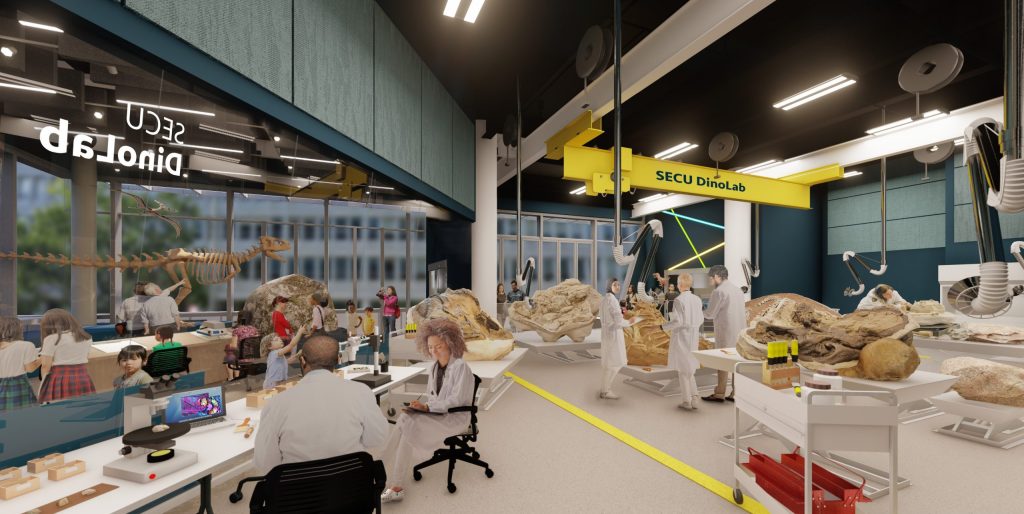
Concept render of Dueling Dinosaurs lab and exhibit by HH Architecture. Source

Having already pushed for the acquisition of the fossil, NCMNS Head of Paleontology Lindsay Zanno took charge of the project. Her vision was to create a completely open fossil preparation lab. Rather than being behind glass, the scientists working on the Dueling Dinosaurs would be available for conversation with the public whenever the museum was open. As Zanno explained in an interview, “I conceived the Dueling Dinosaurs project to take the public on a live scientific journey, to illuminate how science works, to show who scientists are and what we look like, and to increase trust in the scientific process.”

To accomplish this, NCMNS hired local firm HH Architecture. They designed the state-of-the-art lab to Zanno’s specifications within the Nature Research Center, the second wing of NCMNS that opened in 2012. The addition also includes two flanking exhibit galleries and street-facing, floor-to-ceiling windows, which allow passerby to see into the lab.

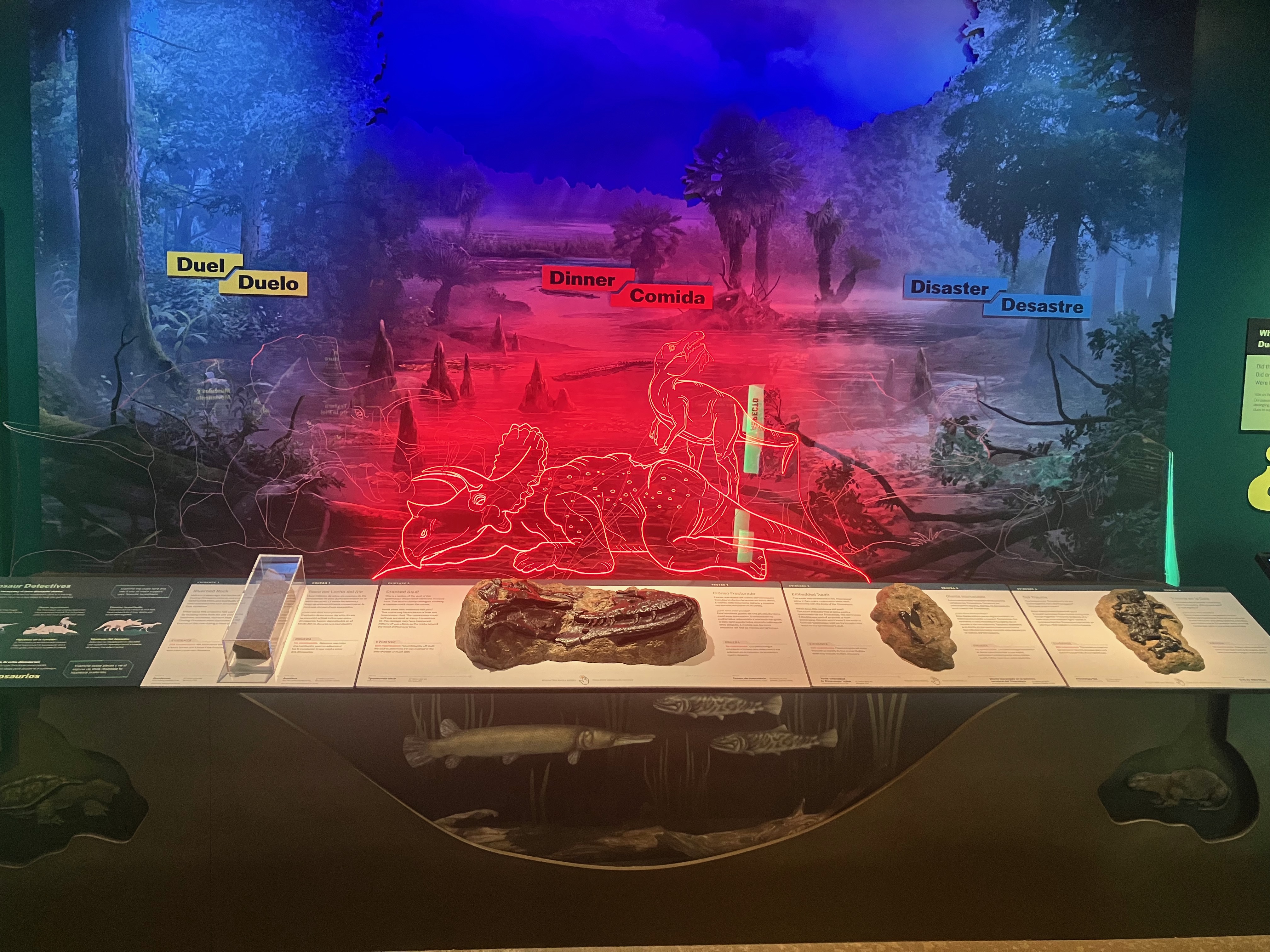
LED images of the three hypotheses cycle across a central display in the first gallery. Photo by the author.

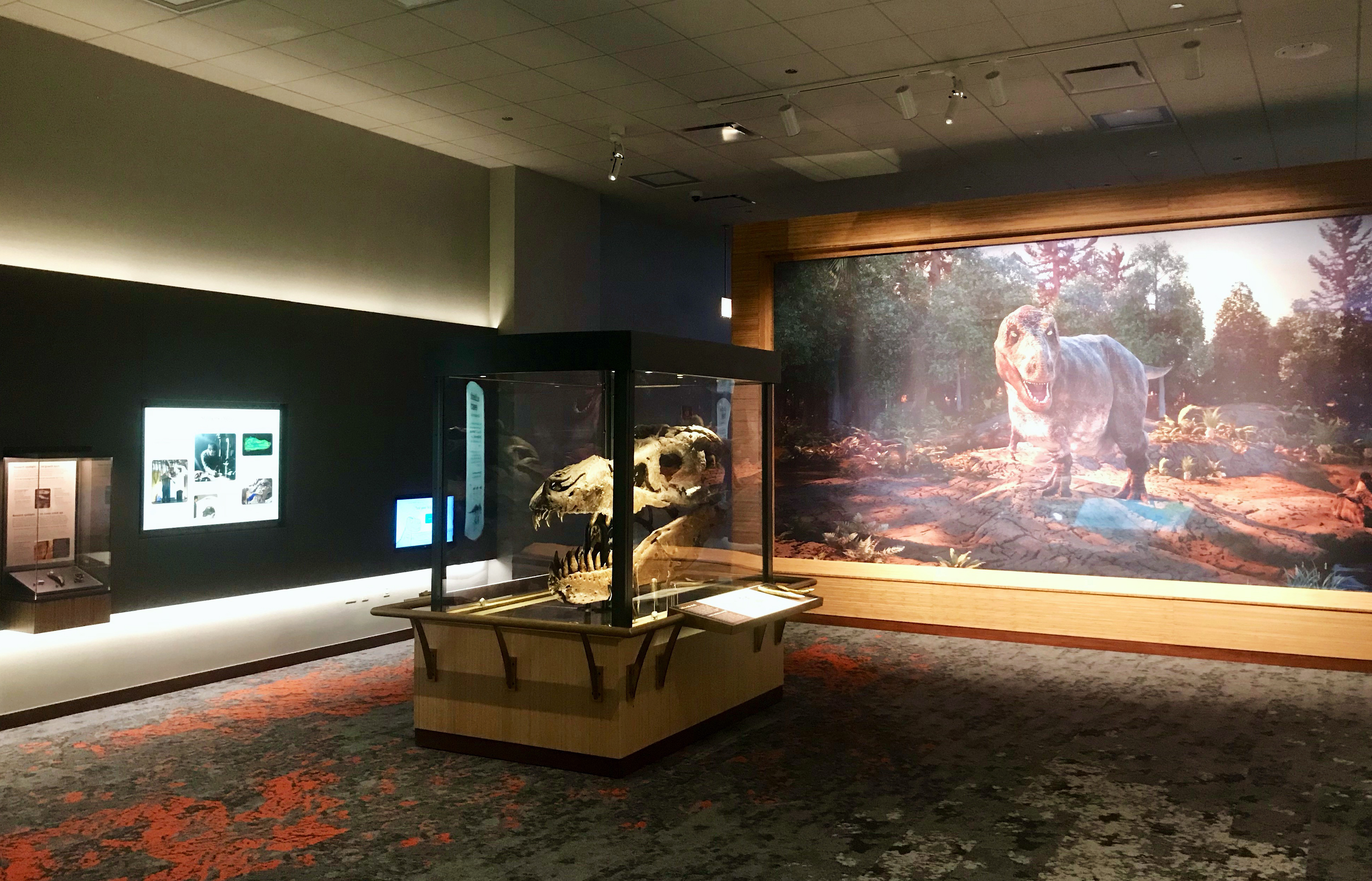
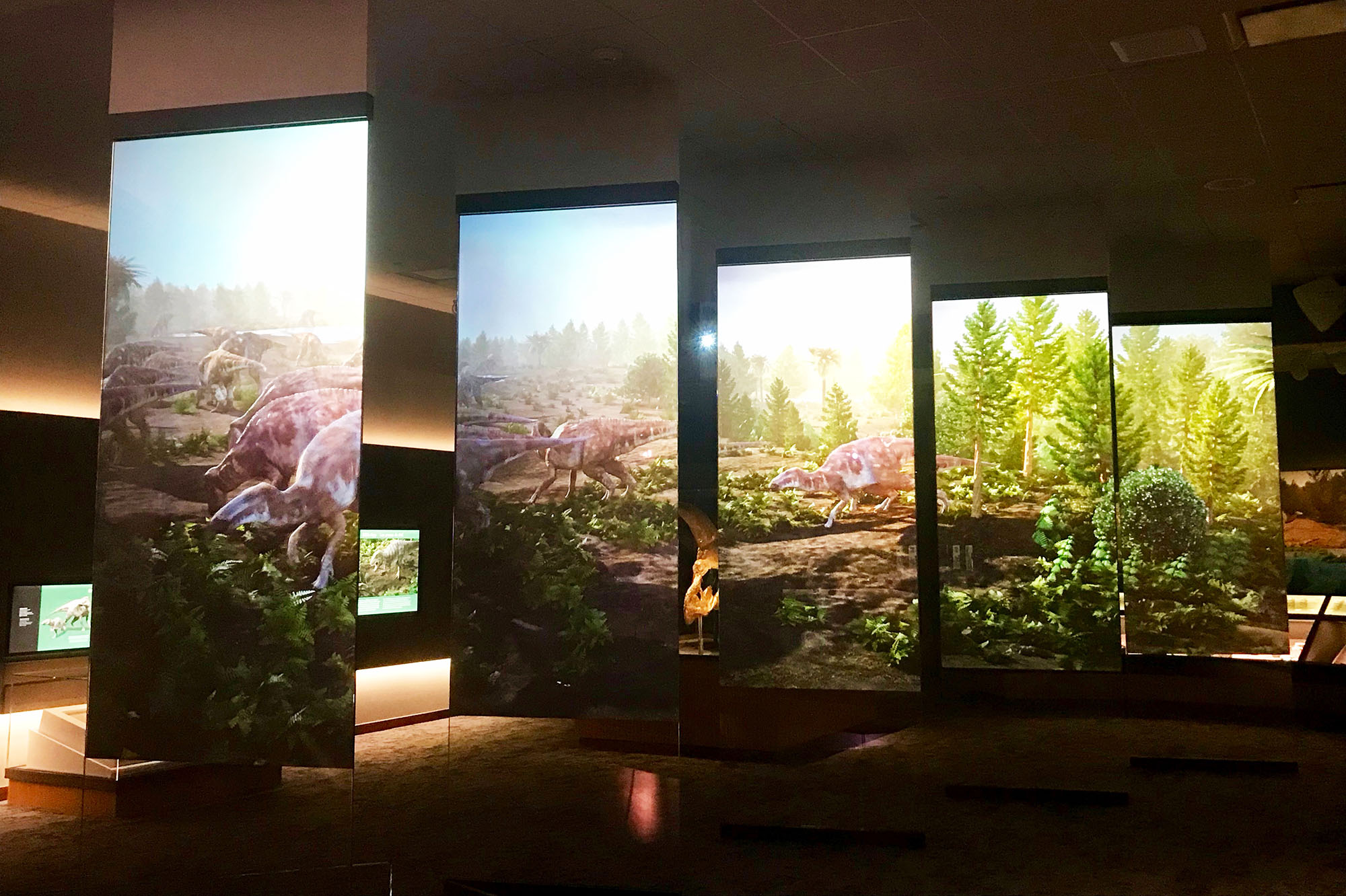
Visitors enter the Dueling Dinosaurs exhibit on the Nature Research Center’s ground floor. The first gallery introduces visitors to the ecosystem of Late Cretaceous Montana. Green panels and walls situate visitors in this verdant environment. After passing small cases with turtle, crocodile, fish, and plant fossils (the purchase of the Dueling Dinosaurs included access to the discovery site, but these are on loan from the Denver Museum of Nature and Science), visitors reach a large display introducing the central mystery of the Dueling Dinosaurs. The exhibit presents three possible scenarios that could have resulted in the dinosaurs being preserved together: duel (a fight to the death), dinner (the tyrannosaur perished while scavenging on Triceratops), or disaster (the animals died separately and were washed together in a flash flood). Color-coded LED outlines of the dinosaurs illustrate the three scenarios in front of an illustrated backdrop.

While these scenarios are presented as being equally plausible, most paleontologists agree that the “disaster” scenario is the likeliest of the three. The real purpose of the exhibit’s presentation is to introduce visitors to the process of stating a hypothesis and finding supporting evidence. Remember, a major part of the rationale behind acquiring the fossil and creating this is exhibit was to show the public what scientists do, and why scientific conclusions are trustworthy. This inquiry-based display attempts to coax visitors through the process of considering the available evidence, and letting it lead them to a conclusion.

Projected images and text augment a sculpture of the fossils. Photo by the author.

Visitors’ next stop is the lab itself, but traffic is controlled by a roughly 4-minute media presentation at the far end of the first gallery. Relief sculptures of the Dueling Dinosaurs skeletons at 50% scale are the centerpiece of this display. Projected images to the left and right—and on the sculpture itself—illustrate the story of where the fossil came from and what scientists hope to learn from it. Certain moments, like a laser scan across the fossil, suggest at least a little inspiration from the SUE show at the Field Museum. The animated tyrannosaur and Triceratops that appear throughout this and other media pieces in the exhibition were created by Urvogel Games, the people behind the dinosaur simulator game Saurian.

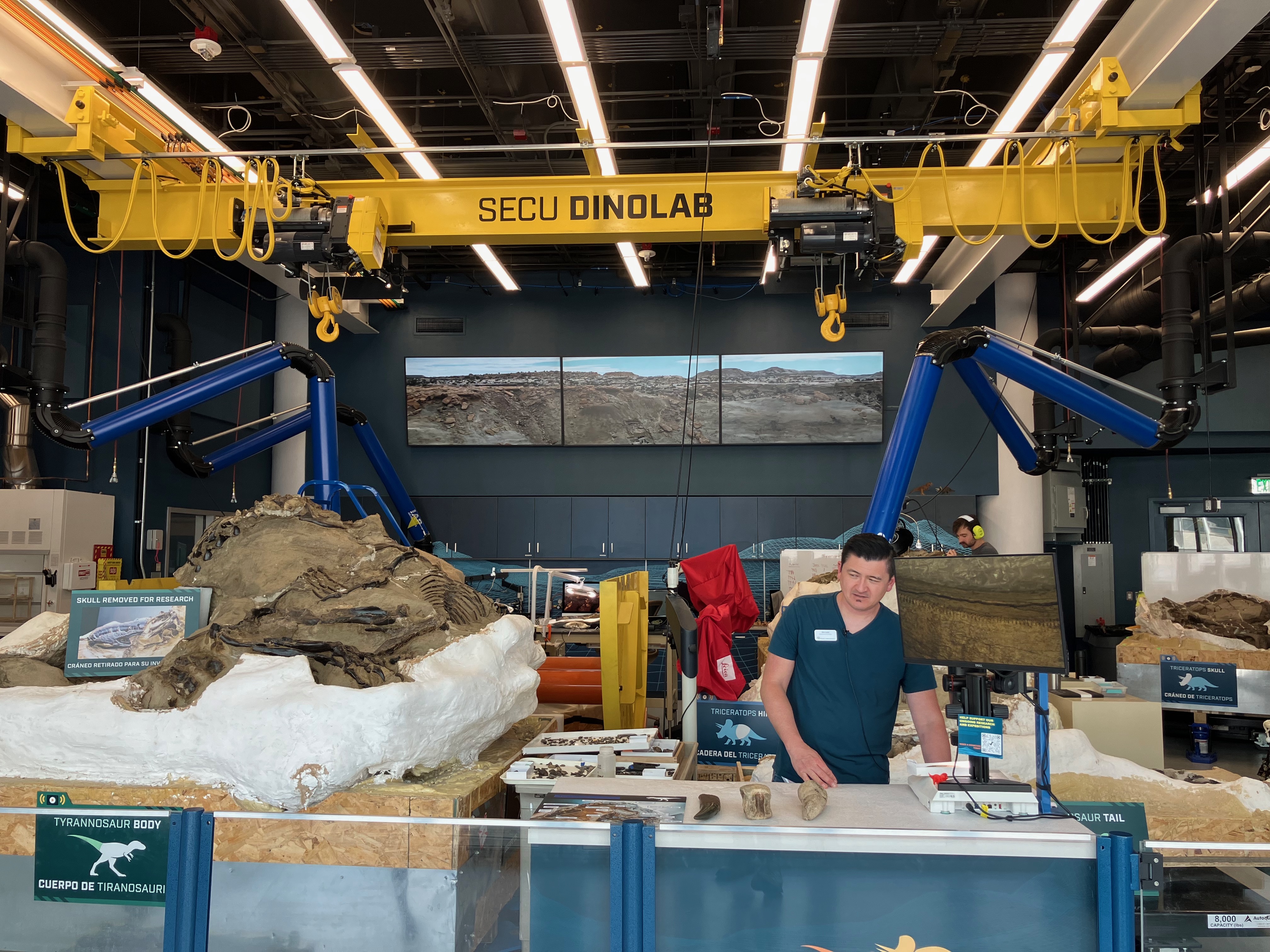
Once inside the lab, nothing but a short plexi barrier separates visitors from the preparators at work. As a former/occasional fossil preparator myself, I can tell you that this space is really, really impressive. It’s not enormous, but it’s big enough to comfortably hold four large jacketed matrix blocks. A 10 ton capacity crane looms overhead, and pneumatic hook-ups for air scribes and dust collectors are within reach throughout the space. I was particularly impressed by a rig that can rotate large jackets on their vertical axis, allowing them to be prepared from multiple directions. No less than seven preparators have been hired to staff this lab, so visitors should find people working all the time. Part of the preparators’ responsibility is to be available to answer questions. Typically, one person is posted by the barrier while the rest of the team works in the background.

An overview of the public lab. Photo by author.

The second gallery space is not about the Dueling Dinosaurs specifically, but about the tools and techniques paleontologists use to learn about the past from fossils. The most prominent displays are a cast of Nothronychus (a dinosaur described by Zanno and colleagues) and a nest of oviraptorosaur eggs from Utah. Visitors can touch the tools used by fossil preparators, perform a simulated CT scan of a Thescelosaurus skull, and look through a microscope at growth lines in a sectioned dinosaur bone. I was told this gallery wasn’t quite finished, which might be why it felt unfocused to me. A more prominent header and summative statement at its entrance about the purpose of the gallery might help.

“Science has an accessibility problem,” Zanno said in an interview, “and mistrust in science is rising. We have to bring science out of the back corners and basements…and let our community see who we are and what we do.” The Dueling Dinosaurs exhibition has done exactly that—visitors could not be closer to the process of preparing and studying these fossils without being handed an air scribe. So how is that working out?

Visitors explore interactive stations in the second gallery. Photo by the author.

I detected a hint of frustration coming from the team members I spoke to. Too many visitors are fundamentally misunderstanding what they are seeing in the lab. They assume the preparators are actors and the fossils are fake, and are often incredulous when told otherwise. The concept that a museum is a place where new science happens is also surprising to a plurality of visitors. One strategy the team has employed is to set up a table of matrix and fragments for the preparator on interpretive duty to sort through. That way, they are clearly working on something when visitors enter and are less likely to be mistaken as an actor or volunteer. Still, if visitors are struggling to recognize real scientists in a real lab when presented with them, the need for access to science in action may be even greater than anticipated.

This might be a “when you have a hammer, everything looks like a nail” situation, but I think some reframing of the exhibition and how its presented could go a long way. Right now, the experience is titled “Dueling Dinosaurs,” which is undoubtedly compelling, but elicits its own set of expectations and assumptions about what visitors will see and do. Why not present the experience as what it really is—an opportunity to meet real paleontologists in their place of work? Would it be possible to reverse the order of visitor flow, so they see the gallery about how paleontology is done first, then visit the lab, then finish by learning about the Dueling Dinosaurs as a case study?

A media-based interactive allows visitors to apply different color patterns to an animated Triceratops, rendered in real time. Photo by the author.

Preparing the fossil is expected to take about five years. The goal is to keep the skeletons in their death positions and eventually display them in relief, somewhat like the model in the media presentation. How much matrix to remove is a moving target. The tyrannosaur’s skull has already been CT scanned multiple times with disappointing results. More matrix will need to be cleared to get a good image of the inside of the skull. Meanwhile, extensive skin impressions are preserved across both skeletons, and the team hopes to leave much of this in place. The process is being slowed somewhat by the need to scrape and chip away irreversible glue that was applied by the original preparators.

Aside from determining whether the dinosaurs actually died fighting (don’t count on it), one of the most anticipated answers the project is expected to provide is the identity of the tyrannosaur. When the fossil was at the Black Hills Institute, Pete Larson concluded that it was a Nanotyrannus—a controversial name applied to fossils that many paleontologists think are actually juvenile Tyrannosaurus rex. Indeed, when the fossil was up for auction, it was marketed as a young T. rex, probably for the sake of name recognition. The NCMNS team will eventually weigh in after studying the skeleton more thoroughly.

The lab itself is expected to remain in place once the Dueling Dinosaurs are prepared. The museum already has other very large fossils awaiting preparation.

If you’re able to visit Raleigh, I highly recommend visiting the Dueling Dinosaurs, the open prep lab, and the rest of NCMNS (the museum is free). You can also monitor the preparation process online. Many thanks to Jennifer Anné, Paul Brinkman, Elizabeth Jones, Christian Kammerer, and Eric Lund for speaking to me about the exhibition. Any factual errors are my own.

3 Comments

Filed under dinosaurs, education, exhibits, marginocephalians, museums, NCMNS, opinion, reviews, science communication, theropods

Dinosaurs of the Field Museum – Part 2

In the previous “quick bite” post, I introduced the dinosaurs on display at the Field Museum of Natural History (FMNH) that were collected in the early 20th century. This time, we’ll take a look at some of the dinosaurs collected and first displayed “in living memory”—that is to say, in the last three decades or so. I’ve skipped a few that either don’t have much available provenance (like the juvenile Maiasaura) or don’t have a very interesting story (like the off-the-shelf Deinonychus cast).

In comparing the early and more recent dinosaur installations at FMNH, it is immediately apparent that the latter group covers a much wider geographical range. The older mounted skeletons were all recovered in the western United States and Canada, while the new batch comes from all over the world, especially the global south. Local scientists were usually involved in the research, and in most cases the original fossils remained in or were ultimately returned to their countries of origin.

Tyrannosaurus rex (PR 2081)

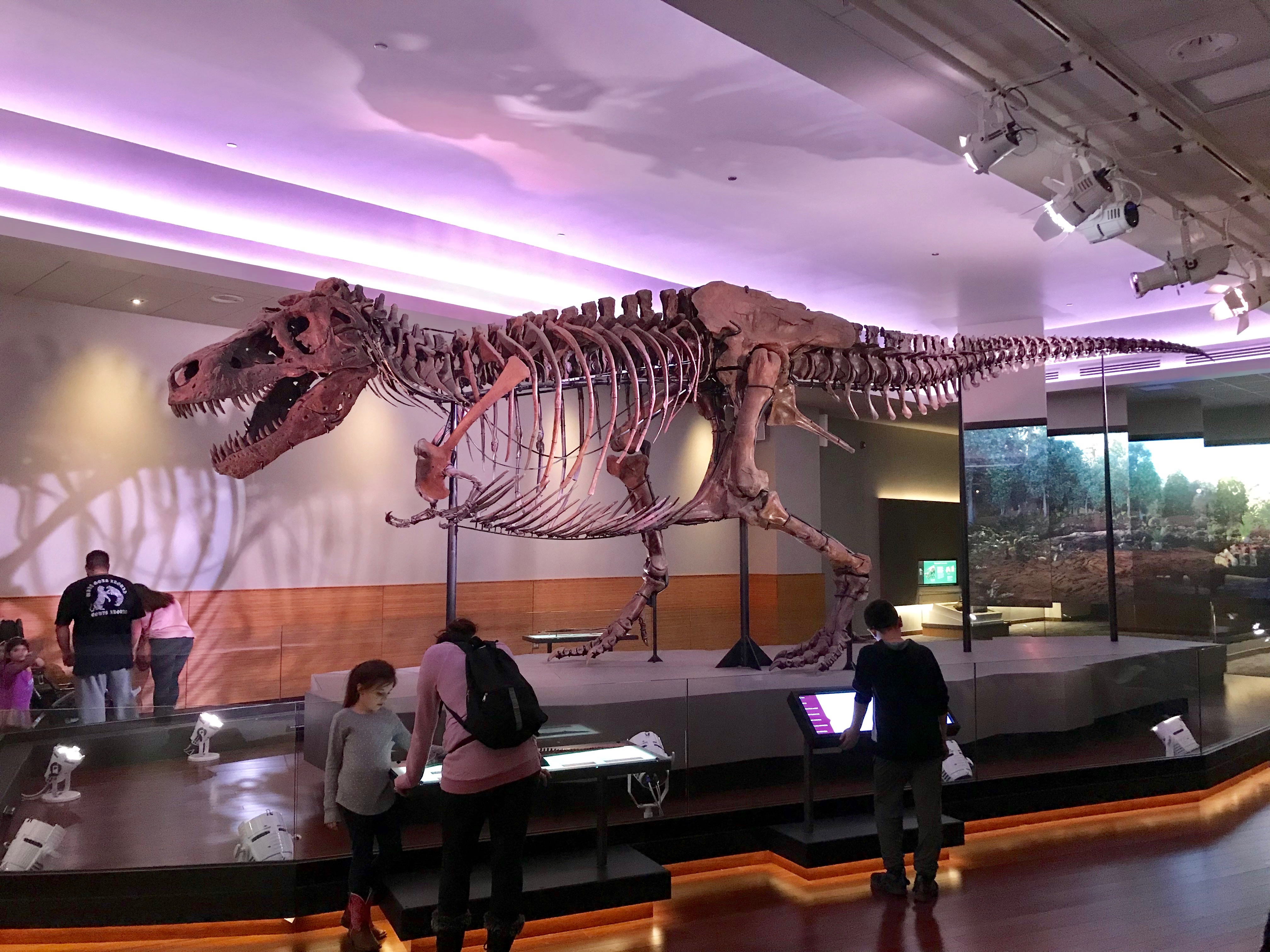
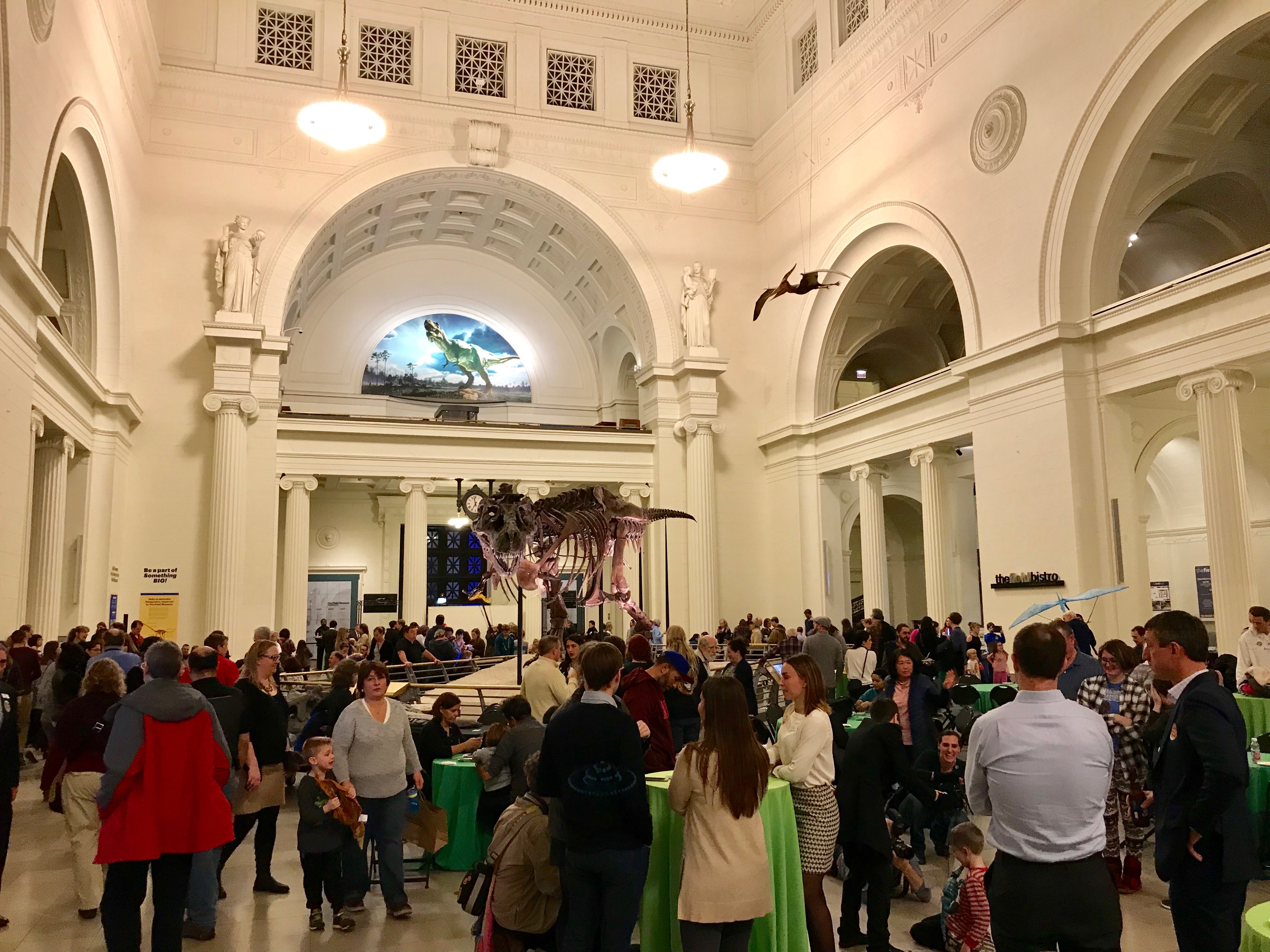
SUE in Stanley Field Hall, ca. 2015. Photo by the author.

As one of the world’s most thoroughly-researched and best-known dinosaurs, SUE the T. rex scarcely requires an introduction. SUE is the most complete adult Tyrannosaurus ever found, with 90% of the skeleton intact. Approximately 30 years old at the time of their death, SUE is also the eldest T. rex known, and within the margin of error for the title of largest

SUE was discovered in 1990 by Sue Hendrickson on ranchland near Faith, South Dakota. At the time, Hendrickson was working with the Black Hills Institute, a private company that specializes in collecting and exhibiting fossils. BHI’s claim to the fossil became the subject of a legal battle involving landowner Maurice Williams, the Cheyenne River Tribal Council, and the US Department of the Interior. With little legal precedent for ownership disputes over fossils, it took until 1995 for the District Court to award Williams the skeleton. Williams announced that he would put SUE on the auction block, and paleontologists initially worried that the priceless specimen would disappear into the hands of a wealthy collector. Those fears were put to rest in 1997 when FMNH won SUE with financial backing from McDonald’s and Disney. 

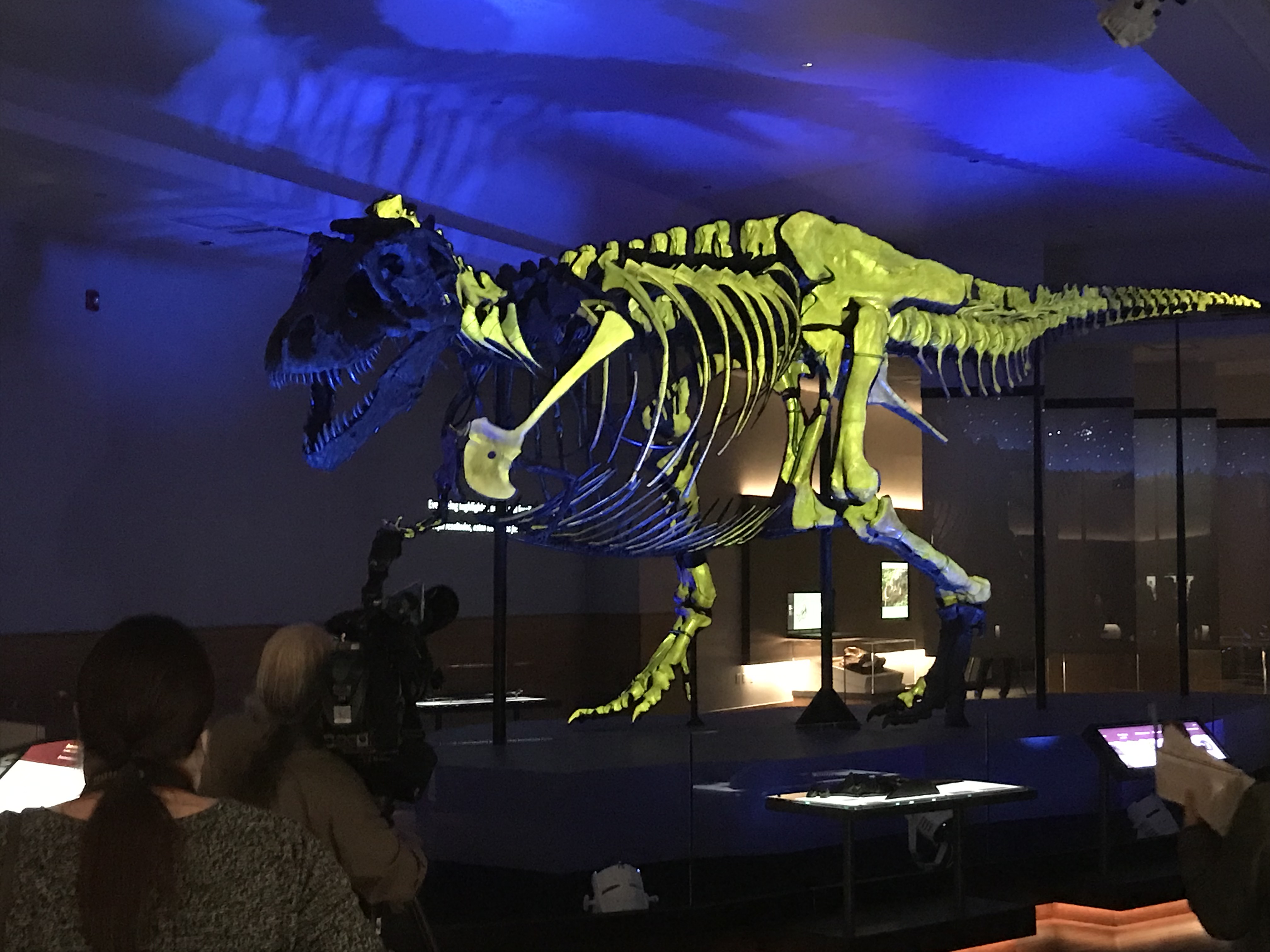
SUE has ruled this dedicated hall in Evolving Planet since December 2018. Photo © Field Museum.

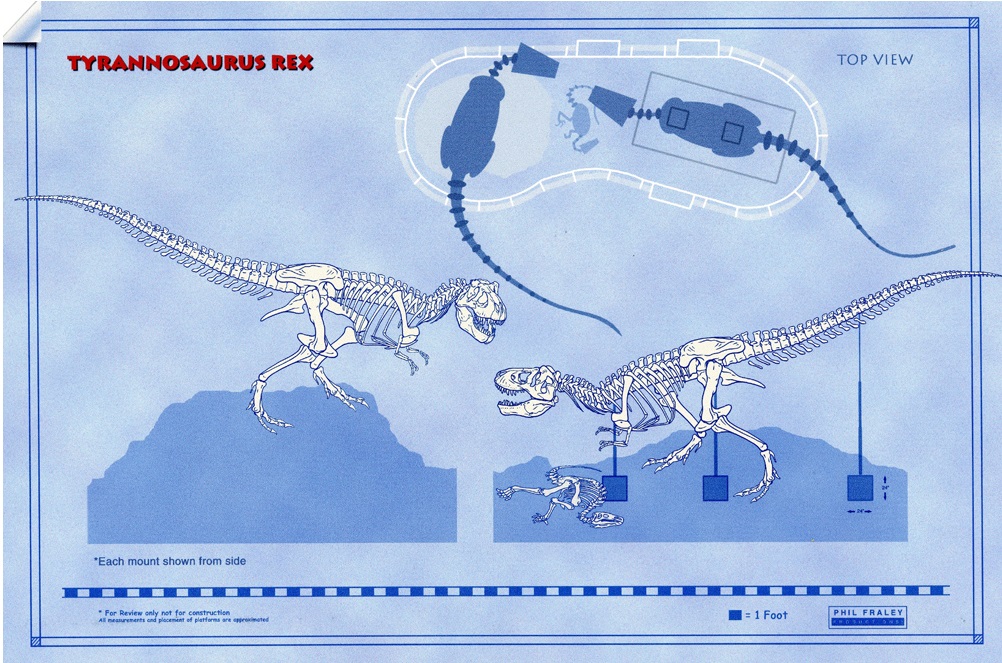
The museum wasted no time making the most of the celebrity specimen. The preparation team expanded to twelve people, who spent 35,000 hours over the next three years extracting SUE’s skeleton from the rock. Chris Brochu was brought on board to write a detailed monograph, which is still a definitive source on Tyrannosaurus rex anatomy. Meanwhile, Phil Fraley built the metal armature upon which the skeleton would be mounted. SUE debuted in FMNH’s cavernous Stanley Field Hall on May 17, 2000 with the dropping of a curtain.

SUE held court in Stanley Field Hall for nearly 20 years, but in 2018 it was time for a change. That year, SUE was relocated to a new, 6,500 square foot gallery within the Evolving Planet exhibition. In contrast with the neoclassical expanse of Stanley Field Hall, this “private suite” gives the T. rex some much-needed context. SUE is now situated in an immersive reconstruction of the waterlogged forests of Late Cretaceous South Dakota. The mounted skeleton itself received an update, overseen by Pete Makovicky, Tom Cullen, and Bill Simpson. Garth Dallman and colleagues from Research Casting International (RCI) modified the original mount to correct a range of issues, like the articulation of the right knee and the position of the shoulders. SUE was also reunited with their gastralia—the rib-like bones that were embedded in the belly muscles.

Cryolophosaurus ellioti (PR 1821)

Cryolophosaurus partial skull in the Antarctic Dinosaurs exhibition. Photo by the author.

Excavating fossils is challenging in the best of conditions, but add the treacherous climate of Antarctica to the mix and it becomes a truly astounding feat. In 1991, William Hammer of Augustana College led a team that discovered and excavated the first Antarctic dinosaur to be named and described: the moose-sized theropod Cryolophosaurus. While bad weather prevented them from excavating the entire skeleton, Hammer and colleagues managed to collect the rear portion of the skull and jaw, as well as parts of the pelvis and hind limbs. The specimens were given to FMNH, the largest fossil repository near Hammer’s institution.

Cryolophosaurus cast in the Antarctic Dinosaurs exhibition. Photo © Field Museum

Hammer returned to the Cryolophosaurus site in 2010, joined by Nate Smith, Josh Matthews, and FMNH’s Pete Makovicky. Working in minus 15 F conditions, the team excavated more of the holotype skeleton. Some overlapping bones, including a second braincase, clarified that at least two individuals were present in the quarry.

For many years, Cryolophosaurus had only a minor role in FMNH exhibitions. In Evolving Planet, it is represented only by a cast of the partial skull. In 2018, however, the museum debuted Antarctic Dinosaurs, a traveling exhibition all about the 2010 expedition. Cryolophosaurus is the star of the show: most of the holotype is displayed in a series of cases, alongside a complete standing cast created by RCI. While other museums have displayed Cryolophosaurus reconstructions, the Antarctic Dinosaurs cast is more up-to-date in many respects—for instance, it’s narrow skull more closely resembles Dilophosaurus than Allosaurus.

Rapetosaurus krausei (PR 2209)

Juvenile Rapetosaurus in Evolving Planet. Photo by the author.

It’s hard to imagine now, but as recently as the mid-1990s, very little was known about titanosaurs. These Cretaceous sauropods were mostly known from isolated bones, and it wasn’t even clear if they were more closely related to diplodocoids like Diplodocus and Apatosaurus or to macronarians like Camarasaurus and Brachiosaurus. That changed in 2001, when Kristina Curry Rogers and Catherine Forster published the first description of Rapetosaurus krausei.

The new genus and species was based on fossils collected a few years earlier on a Mahajanga Basin Project expedition in northwest Madagascar. Organized by the State University of New York at Stony Brook and the local Universite d’Antananarivo, the Mahajanga Basin Project has been exploring fossil outcrops in this region since 1993. The project has been tremendously successful, yielding numerous new species and revolutionizing our understanding of vertebrate evolution in the southern hemisphere.

Rogers and Forster designated one of two adult Rapetosaurus skulls as the holotype, but most of our information about this animal comes from a 15-foot, 75% complete juvenile skeleton. To this day, this fossil is the most complete titanosaur ever found, and the only titanosaur known from both a skull and the majority of its postcranial skeleton. From their high-set eyes to their ludicrously wide bodies, much of what is known about the shape of titanosaurs comes from this specimen. Details of this skeleton also helped confirm that titanosaurs are macronarian sauropods.

As one of the funders of the MBP expeditions, the Field Museum became the repository for the juvenile Rapetosaurus skeleton. The fossil was mounted for display in 2006, when the paleontology halls were refreshed and retitled as Evolving Planet.

Buitreraptor gonzalezorum (MPCA 245 and others)

Buitreraptor cast under construction—note the unrestored skull cast being used as a placeholder. Many thanks to Matthew Aaron Brown for sharing this photo.

Fossils of Buitreraptor, a goose-sized dromaeosaur, were first collected in Patagonia, Argentina in 2004. The Field Museum’s Pete Makovicky was joined by Sebastián Apesteguia and Federico Agnolín in describing the new dinosaur the following year. Buitreraptor is notable for being the oldest known South American dromaeosaur (about 98 million years old), and for being one of the most completely known unlagiine dromaeosaurs—bizarre creatures with exceptionally long and narrow snouts. The holotype specimen was prepared at FMNH before being returned to the Museo Provincial de Cipolletti Carlos Ameghino in Río Negro, Argentina.

Finished Buitreraptor cast in Evolving Planet. Photo by the author.

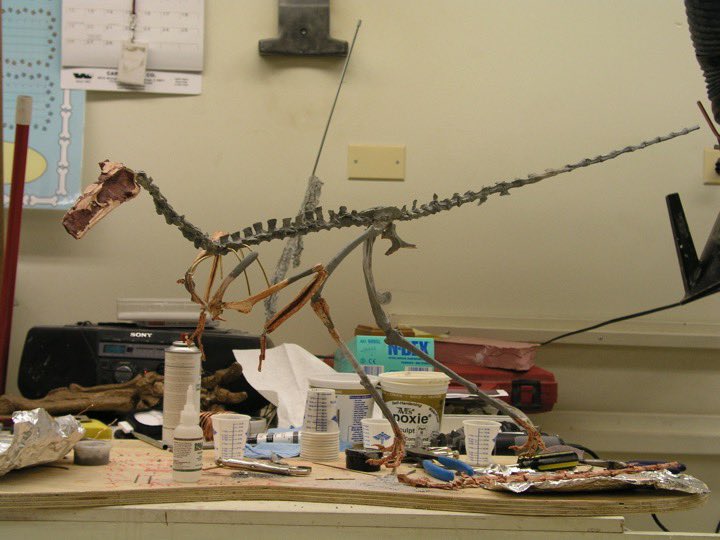
The Evolving Planet team did not originally intend to include Buitreraptor, but as the exhibition neared completion it was noted that the bird evolution display—which only featured Deinonychus and a pair of small models—looked a little sparse. With most of the hall already installed and the opening just months away, preparators Connie Van Beek, Matthew Aaron Brown, and Jim Holstein were tapped to create a mounted cast of Buitreraptor. The preparators first built a prototype by wiring together available casts of the original fossils. They then moved on to the final version, which involved reconstructing the missing extremities (arms, feet, and ribs) and creating a “re-inflated” version of the specimen’s crushed skull. The entire project was completed in less than two months.

Patagotitan mayorum (MPEF 2400 and others)

Field Museum and Museo Paleontológico Egidio Feruglio staff worked together to assemble Máximo in May 2018. Photo by the author.

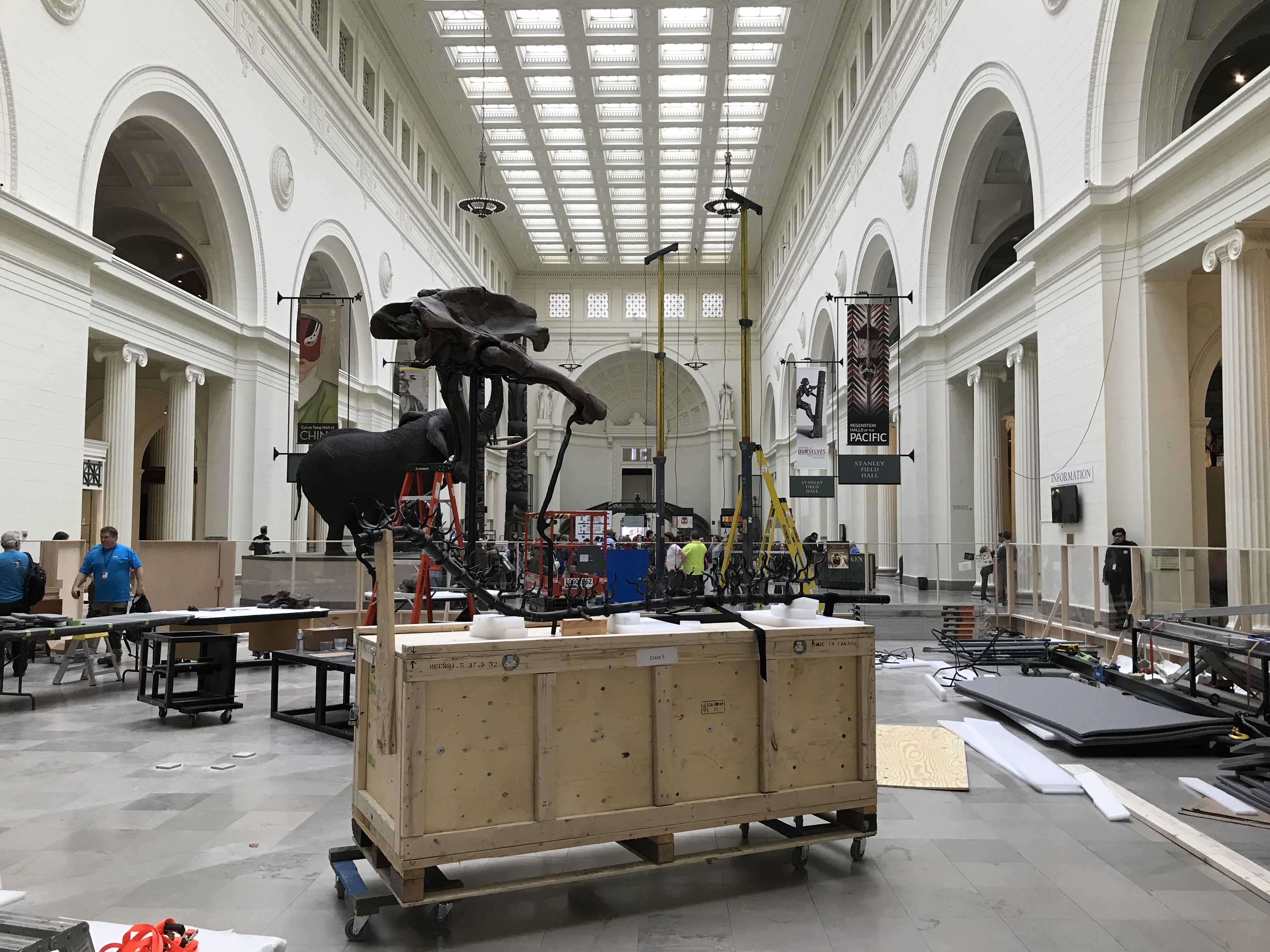
In 2017, plans took shape to reimagine Stanley Field Hall, as has happened several times since the current FMNH building opened in 1921. Part of the plan was to relocate SUE to a dedicated gallery in Evolving Planet, but what could take the place of the star T. rex? The museum found their answer in Patagotitan, a recently discovered titanosaur that is a contender for the world’s largest dinosaur.

Patagotitan mayorum was discovered on the Mayo family farm near La Flecha, Argentina in 2010. Between 2012 and 2014, Diego Pol and colleagues at the Museo Paleontológico Egidio Feruglio (MEF) excavated the find, which turned out to be a bone bed of six individuals. The new genus and species was named and published in 2018.

The FMNH cast is actually the second Patagotitan display in the United States. In 2015 (before the animal had a name), the American Museum of Natural History commissioned RCI to create a cast for the Wallach Orientation Center, part of the loop of fossil halls on the New York museum’s 4th floor. By placing Patagotitan in a relatively small space, the AMNH designers emphasized the sauropod’s great size. Standing in a slightly crouched pose with its head extending into an adjacent hall, the mount overwhelms the space.

Máximo has plenty of room to spread out in Stanley Field Hall. Photo by the author.

In contrast, the FMNH Patagotitan—nicknamed Máximo—has room to spread out. In the half-acre, four story expanse of Stanley Field Hall, visitors can stand at a reasonable distance and take in the 122-foot skeleton all at once. They can also look Máximo in the eye socket from the upper level balcony. Rather than work with RCI on the project, FMNH commissioned the mount from MEF directly. It was designed and built in Trelew, Argentina, and shipped to Chicago via cargo ship. The installation took four days in May 2018. The process didn’t go entirely without a hitch—under the skylight in Stanley Field Hall, the original paint job on the cast bones looked like raw meat. But even with the need for an emergency repaint of the entire skeleton, Máximo was completed on time and has been greeting FMNH visitors ever since.

Spinosaurus aegyptiacus (FSAC-KK-11888)

The Prehistoric Minds team prepares to add legs to Spinosaurus. Photo by the author.

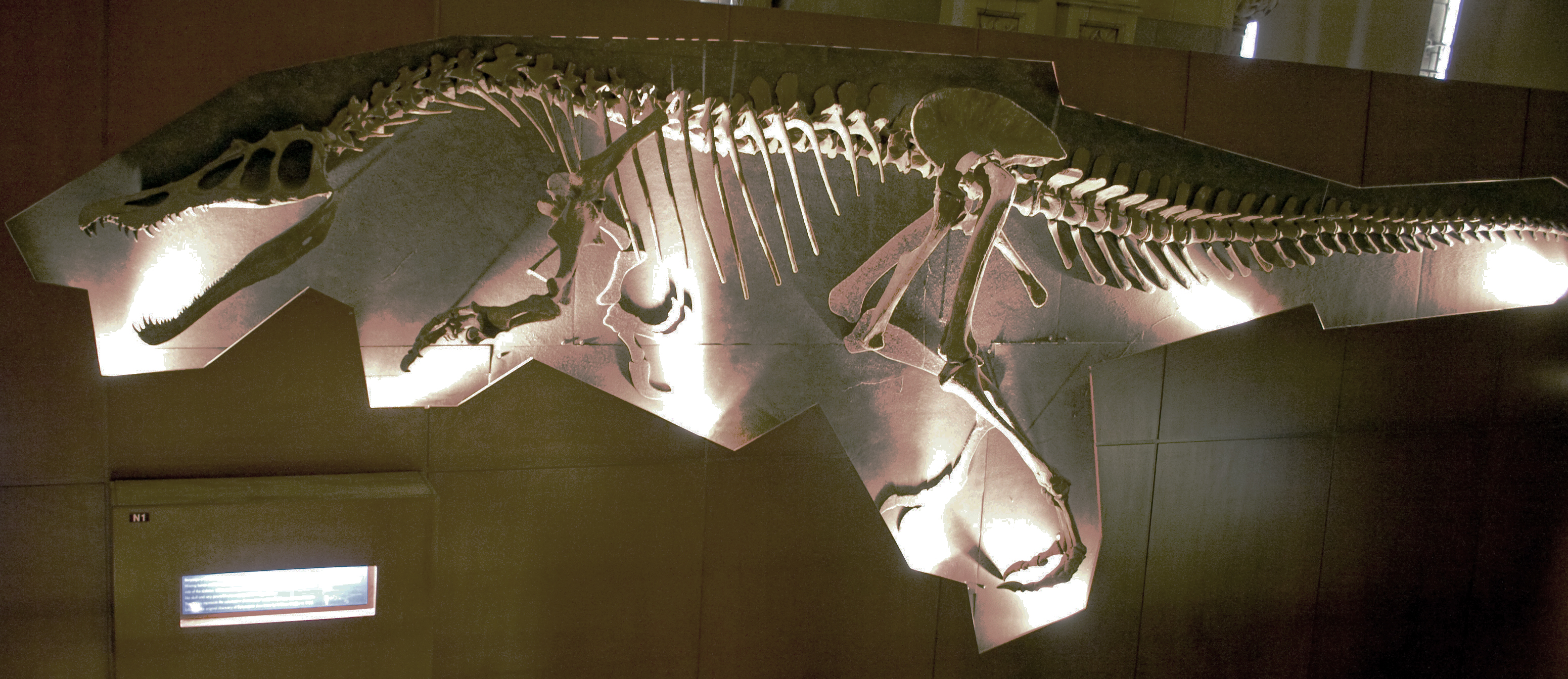
The Field Museum’s newest dinosaur debuted just two weeks ago as of this writing (and is, in fact, why I’ve been sitting on this post for months). Postdoctoral researcher Matteo Fabbri approached the Exhibitions department in Fall 2022 with the prospect of acquiring a Spinosaurus cast. Less than a year later, that cast has joined Patagotitan in Stanley Field Hall, suspended twelve feet off the floor in a swimming pose.

Thanks to its dragon-like shape and star turn in Jurassic Park III, Spinosaurus is a very popular dinosaur, but until recently it has been quite poorly known. The 1912 holotype specimen—consisting of a partial jaw, several dorsal vertebrae, and a few other odds and ends—was inadvertently destroyed in the bombing of Munich during World War II. It wasn’t until 2008 that another skeleton was found in southern Morocco. The new specimen revealed that Spinosaurus was even weirder than previously thought: not only did it have an elongated, crocodile-like skull and a sail on its back, it also had a long body, short legs, and a newt-like tail fin.

Spinosaurus hangs 12 feet above the floor. Photo by the author.

Very few Spinosaurus casts have ever been displayed. One was made for the retired Spinosaurus: Lost Giant of the Cretaceous traveling exhibit. Another appeared in last year’s The Big Eight: Dinosaur Revelation in Hong Kong. But as far as I can tell, the only other permanent Spinosaurus skeleton on display is at Japan’s Kitakyushu Museum of Natural History. That makes the FMNH cast the only mount of its kind in the western hemisphere. 

It’s also the most up-to-date Spinosaurus on display. As part of the team that has been studying Spinosaurus for the last 15 years, Fabbri ensured that cervical vertebrae collected at the original discovery site just six months ago were incorporated into the mount. All told, about 50% of the skeleton is cast from the Morocco specimen, while the rest is reconstructed. 

Like Máximo, the Spinosaurus was built overseas. Simone Maganuco and colleagues constructed the skeleton in Italy, then traveled with it to Chicago to help with the installation. The lightweight cast—which only weighs 700 pounds—was hanging in its permanent position after just ten hours of work.

Press coverage of the installation (with appearances from a certain overenthusiastic nerd) can be seen here and here.

References

Brochu, C.A. 2003. Osteology of Tyrannosaurus rex: Insights from a nearly complete skeleton and high-resolution computed tomographic analysis of the skull. Journal of Vertebrate Paleontology 22:1–138.

Curry Rogers, K., Forster, C.A. 2001. The last of the dinosaur titans: a new sauropod from Madagascar. Nature 412:6746:530–534.

Hammer, W.R. and Hickerson, W.J. 1994. A Crested Theropod Dinosaur from Antarctica. Science 264: 828–830.

Grande, L. 2017. Curators: Behind the Scenes of Natural History Museums. Chicago, IL: University of Chicago Press.

Ibrahim, N., Maganuco, S., Dal Sasso, C., Fabbri, M., Auditore, M., Binedellini, G., Martill, D.M., Zourhi, S., Matterelli, D., Unwin, D.M., Wiemann, J., Bonadonna, D., Amane, A., Jakubczak, J., Joger, U., Lauder, G.V., and Pierce, S.E. 2020. Tail-propelled aquatic locomotion in a theropod dinosaur. Nature 581(7806):1–4.

Makovicky, P.J., Apesteguía, S., and Agnolín, F.L. 2005. The earliest dromaeosaurid theropod from South America. Nature 437: 1007–1011.

Smith, N.D., Makovicky, P.J., Hammer, W.R., and Currie, P.J. 2007. Osteology of Cryolophosaurus ellioti from the Early Jurassic of Antarctica and implications for early theropod evolution. Zoological Journal of the Linnean Society 151: 377–421.

1 Comment

Filed under AMNH, dinosaurs, exhibits, FMNH, fossil mounts, museums, sauropods, theropods

Dinosaurs of the Field Museum — Part 1

About a year ago, I wrote this post about the dinosaurs of the London Natural History Museum, admittedly in a bit of a hurry. The post has proven very popular, which leads me to conclude there’s interest in more “quick bite” articles about the specimens on display at various museums. I’ll see about putting together more of these in the future.

For now, I’ll start close to home, with the dinosaurs on display at Chicago’s Field Museum of Natural History (FMNH). This entry is about the most notable specimens that were acquired outside the living memory of current staff. I’ll follow up with an article about more recent acquisitions sometime soon. It’s important to note that while I’m focusing on dinosaurs here, the real meat of the Field Museum’s vertebrate paleontology collection is in its Cenozoic holdings. Those too will need to be a topic for another time.

Brachiosaurus altithorax (P 25107)

Menke poses with the Brachiosaurus humerus, unwittingly creating an image that every subsequent sauropod worker is obligated to recreate. Photo © Field Museum.

The first dinosaur discovered by Field Museum paleontologists was nothing less than the biggest land animal known at the time. On July 4, 1900, the museum’s first paleontologist Elmer Riggs and his assistant H.W. Menke came upon a set of enormous bones in western Colorado. Riggs—who was specifically hired two years earlier to find dinosaurs for the nascent museum—named the new dinosaur Brachiosaurus altithorax in 1903. The individual bones were set in display cabinets (left image, below) around the same time. Comprising about 25% of the skeleton, Riggs did not consider the find complete enough to assemble into a standing mount. Nevertheless, the museum commissioned a replica Brachiosaurus skeleton about 90 years later, basing the missing pieces on the related Giraffatitan.

New Brachiosaurus fossils have proven elusive. While several individual bones have been found, the holotype collected by Riggs and Menke remains the most complete example of this famous dinosaur.

Apatosaurus” sp. (P 25112 and P 27021)

The Field Museum’s “Apatosaurus” is a composite of two sauropod specimens, collected 40 years apart. Photos © Field Museum.

Riggs and Menke found another sauropod in western Colorado in 1900, and returned the following year to excavate it. This time, they had the back two-thirds of an apatosaurine sauropod, complete save for the distal portions of the limbs and tail. As museum leaders were unwilling to fund a search for more sauropod material, Riggs mounted the partial skeleton in 1908 (left image, above). 

The sauropod remained in this unfinished state until the 1950s, when preparator Orville Gilpin arranged to acquire another incomplete sauropod. Gilpin had excavated the specimen with Jim Quinn near Moab, Utah in 1941, and knew that it was a perfect complement to the skeleton on display. Long-time museum president Stanley Field (nephew of founder Marshall Field) had repeatedly resisted requests from the paleontology staff to complete the mount, but allegedly relented after overhearing a visitor ask which side of the half-dinosaur was the front. Gilpin built an armature for the neck and shoulders of the newly acquired specimen (right image, above), and finished the mount with casts of Apatosaurus forelimbs and a Camarasaurus skull from the Carnegie Museum of Natural History. The Field Museum finally had a complete sauropod on display, which was unveiled at the April 1958 Members’ Night. 

Apatosaurus” as it is currently displayed in Evolving Planet. Photo by the author.

In 1992, the composite sauropod was dismantled and relocated to the new Life Over Time exhibition on the other side of the building. The museum hired Prehistoric Animal Structures, Inc.—a now-shuttered company specializing in mounting fossil skeletons—to do the work. The updated sauropod debuted in 1994, now posed as though looking at visitors on a nearby elevated walkway. The sauropod remained in place when Life Over Time became Evolving Planet in 2006, though with the walkway gone it now appears to be admiring the Charles Knight murals on the wall.

A note on nomenclature: Riggs identified this skeleton as Apatosaurus, but the label was changed to Brontosaurus in the mid-20th century, when Apatosaurus fell out of common parlance. The name Apatosaurus returned to labels in 1994. However the most recent word on this specimen—from Tschopp et. al 2015—is that it’s not Apatosaurus nor Brontosaurus, but likely another, yet unnamed taxon.

Triceratops horridus (P 12003)

The skull of FMNH P 12003 as it is currently displayed in the SUE gallery. Photo by the author.

In 1904, Riggs moved on from the Jurassic-aged rocks of Colorado to the Cretaceous of Carter County, Montana. Today, this part of southeast Montana is lousy with paleontologists. There’s even an annual shindig for field crews held at the Carter County Museum in Ekalaka. However, Riggs’ expedition was among the first to visit the region from a large museum. The most significant find of the summer was a Triceratops skull and partial skeleton from just west of the Chalk Buttes.

The skull was prepared by 1905 and has been in every iteration of the Field Museum’s paleontology halls. The unusually thick brow horns were recently confirmed to be real bone, but it’s possible that they were originally from another, larger specimen (edit: There is real bone inside the horns, but they are padded with a lot of plaster reconstruction—see comments). The remainder of the skeleton remains in storage.

Gorgosaurus libratus (PR 2211)

Elmer the Gorgosaurus as it was last displayed, in 2017’s Specimens: Unlocking the Secrets of Life. Photo by the author.

Most collecting was paused during World War I, but shortly after the war, Marshall Field III funded new expeditions in all four of the Field Museum’s major research areas (Zoology, Botany, Geology, and Anthropology). Riggs led three of these expeditions, one to Alberta and two to Argentina and Bolivia. Riggs saw the 1922 Alberta trip as something of a practice run, since he hadn’t been in the field in years, and some on his team had never done fieldwork at all. 

Still, the crew was serious about bringing in fossils. Riggs decided to go to the Red Deer River region of Alberta, a place where his former colleague and classmate Barnum Brown had unearthed numerous near-complete dinosaurs for the American Museum of Natural History. Riggs also hired fossil hunter George F. Sternberg, who already knew the area well, to join him on the 14-week expedition.

After returning from Alberta, Riggs was busy getting ready for the upcoming expeditions to South America, and most of the field jackets remained unopened for years, or even decades. One jacket lingered until 1999, when the large team of preparators assembled to prep SUE the T. rex decided to crack it open. 

Inside, they found the virtually complete hips, hindlimbs, and tail of a four-year-old Gorgosaurus, which they named Elmer. Riggs’ notes indicated that the skull ought to have been present, but the preparators only found a few teeth. Further investigation revealed that the partial skull had been in its own jacket with a different number, and that it had been loaned to the University of California at Berkeley in the 1970s. The Berkeley scientists had subsequently lost the fossil, but (fortunately) made a cast of it, which was later returned to the Field Museum. 

Elmer was included in the touring exhibition Dinosaurs: Ancient Fossils, New Discoveries, and most recently in 2017’s Specimens: Unlocking the Secrets of Life. It is currently off exhibit.

Lambeosaurus lambei (PR 380)

Lambeosaurus under prep in 1955. Photo © Field Museum.

According to Riggs, the “prize find” of the 1922 Alberta expedition was a Lambeosaurus found by Sternberg. Even in the field, it was clear that the skeleton was completely intact, save for the head, part of the neck, and the tip of the tail. Sternberg’s field notes indicate that the weathered side included a number of large skin impressions. The Lambeosaurus was jacketed and excavated in eight sections, totaling about three tons of rock and fossil.

Like Elmer the Gorgosaurus, the Lambeosaurus was left unprepared while Field Museum preparators focused on the fossils from South America. In 1947, the University of Chicago closed its geology museum and donated its collections to the Field Museum, pushing the Alberta fossils even further down the queue. Stanley Kuczek finally prepared the Lambeosaurus in 1954, when it was slated to be paired with Daspletosaurus in a new display (more below).

Kuczek prepared only the unweathered (face-down in the field) side of the skeleton, so the skin impressions Sternberg reported are still embedded in the matrix under the fossil. A Lambeosaurus skull from the University of Chicago collection (UC 1479) was used to complete the display. Sternberg’s Lambeosaurus remains the most complete non-bird dinosaur at the Field Museum, and a (perhaps unsung) highlight of the collection.

Daspletosaurus torosus (PR 308)

Nathan Cochran recently rediscovered the original “Gorgosaurus” and Lambeosaurus label, as seen in this image. Check it out here. Photo © Field Museum.

The Field Museum’s Daspletosaurus, sometimes called “Gorgeous George,” was collected by Barnum Brown of the American Museum of Natural History in 1914. It came from the same region of Alberta that Riggs and company would visit eight years later. At the time, the partial skeleton was considered an example of Gorgosaurus, of which the New York museum already had three. In 1955, Field Museum board member Louis Ware offered to buy the American Museum’s spare tyrannosaur, and soon the fossil was on its way to Chicago.

Orville Gilpin mounted the skeleton—which has been known as Daspletosaurus since 1999—for display. He elected to create a completely free-standing mount, with no visible armature. This required drilling through each of the vertebrae to thread a steel pipe through, as well as splitting the right femur. These destructive practices would never be undertaken today, but in the mid 20th century, dinosaurs were seen as display pieces first and scientific specimens second.

Daspletosaurus in Evolving Planet. Photo by the author.

Like the “Apatosaurus,” Gorgeous George was revealed to the public during Members’ Night. The skeleton was placed at the south end of the museum’s central Stanley Field Hall, standing over Sternberg’s Lambeosaurus as though it had just brought down the herbivore. In 1992, Prehistoric Animal Structures, Inc. remounted the Daspletosaurus in a more accurate horizontal posture, once again poised over its Lambeosaurus prey. The real skull has never been mounted on the skeleton, but it is currently on display near the museum’s east entrance.

Parasaurolophus cyrtocristatus (P 27393)

Parasaurolophus in Evolving Planet. Photo by the author.

The Parasaurolophus cyrtocristatus holotype was found by Charles Sternberg (father of George) in 1923, near Fruitland, New Mexico. It made it to the Field Museum through a series of exchanges, but was not prepared until the 1950s. John Ostrom published a description of the skeleton and partial skull in 1961, noting that it was nearly identical to Parasaurolophus walkeri from Alberta, except for the crest on the back of its head. While P. walkeri has a long, backward-projecting crest, the New Mexico species has a short crest that curves downward.

The Parasaurolophus was first exhibited in 1994, as part of Life Over Time. The 70% complete skeleton was mounted directly to a wall, with illustrations of the missing bones behind it. Ten years later, Research Casting International was brought in to turn the Parasaurolophus into a complete standing mount. Like most modern mounts, the armature is designed so that each bone can be removed individually for study or conservation. Captured in a graceful walking pose, the Parasaurolophus is—in my opinion—the most elegant and evocative dinosaur mount at the Field Museum.

References

Brinkman, P. 2000. Establishing vertebrate paleontology at Chicago’s Field Columbian Museum, 1893–1898. Archives of Natural History 27:81–114.

Brinkman, P. 2010. The Second Jurassic Dinosaur Rush: Museums and Paleontology in America at the Turn of the 20th Century. Chicago: University of Chicago Press.

Brinkman, P. 2013. Red Deer River shakedown: a history of the Captain Marshall Field paleontological expedition to Alberta, 1922, and its aftermath. Earth Sciences History 32:2:204-234. 

Erickson, G.M, Makovicky, P.J., Currie, P.J., Norell, M.A., Yerby, S.A., and Brochu, C.A. 2004. Gigantism and life history parameters of tyrannosaurid dinosaurs. Nature 430:722–775.

Forster, C.A. 1996. Species resolution in Triceratops: cladistic and morphometric approaches. Journal of Vertebrate Paleontology 16:2:259–270.

Gilpin, O. 1959. A free-standing mount of Gorgosaurus. Curator: The Museum Journal 2:2:162–168.

Ostrom, J.H. 1961. A new species of hadrosaurian dinosaur from the Cretaceous of New Mexico. Journal of Paleontology 35:3:575–577.

11 Comments

Filed under dinosaurs, exhibits, field work, FMNH, fossil mounts, history of science, museums, ornithopods, sauropods, theropods

Spinosaurus, aquatic animals, and jargon

Two weeks ago, another volley was fired in the ongoing Spinosaurus wars. Long known only from remains that were destroyed during World War II, this North African dinosaur has been the subject of numerous scientific publications over the last decade thanks to a newly discovered partial skeleton, which was first described in 2014. With its long, narrow snout, daschund-like hind limbs, and a six-foot ornamental sail on its back, Spinosaurus was an extreme and unusual dinosaur, and it’s easy to see why it’s of such interest to paleontologists, laypeople, and children alike. 

Reconstructed Spinosaurus skeleton at the Hong Kong Science Center. Photo by Hong Kong Tourism Board

Nevertheless, the profound weirdness of Spinosaurus has also made it contentious. What was this animal doing that necessitated the evolution of such bizarre features? Paleontologists agree that it was a specialized fish-eater, as evidenced by its long snout, straight, conical teeth, and nostrils high up on its head (enabling it to breath while keeping its mouth submerged). But while some authors (e.g. Hone and Holtz 2020) imagine Spinosaurus as a heron-like animal, snatching fish from the shallows while wading or standing on the shore, others (e.g. Ibrahim et al. 2020) see evidence for a creature that was at home in the water, swimming after its prey. Naturally, there is also a full gradient of options between the extremes.

The newest publication, by Paul Sereno and colleagues, ground-truths some details of Spinosaurus anatomy. The authors compared parts like the feet and the tail vertebrae to modern animals, and also employed a digital model of Spinosaurus to virtually test its buoyancy and stability in water. Their primary conclusion: largely due to the tall sail on its back, Spinosaurus would have struggled to swim in deep water. 

This is valuable data that helps refine our understanding of Spinosaurus, specifically by constraining the list of ways it could have obtained its fishy prey. Sereno and colleagues argue that Spinosaurus didn’t dive or pursue fish in open water, but their results don’t preclude the possibility that it spent most of its time around water or even in the water (indeed, there is still ample evidence that it did). 

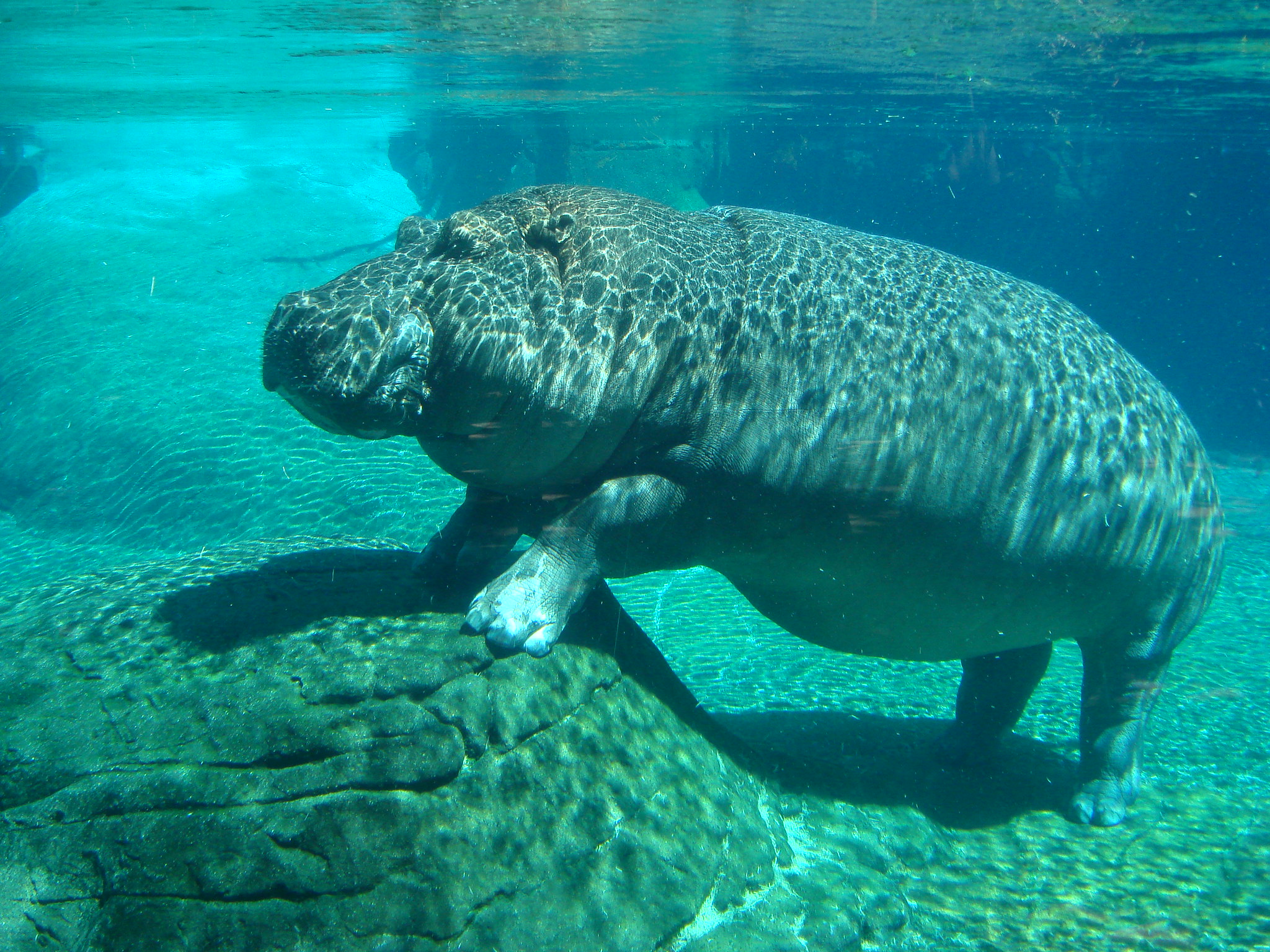
I hope it’s clear that I have no qualm with the content of the paper itself. Instead, what drove me to start hacking at my keyboard today was the title: “Spinosaurus is not an aquatic dinosaur.” Within the paper, Sereno and colleagues define an “aquatic” animal as one “adapted for life primarily, or solely, in water with severely reduced functional capacity on land.” Bony fish, whales, penguins, and sea turtles are provided as examples. The authors go on to clarify that crocodiles and waterfowl do not meet the criteria for aquatic life. Hippos, sea otters, and pond turtles would also not qualify as aquatic based on this definition. The authors provide the term “semiaquatic” to cover these sorts of animals, and ultimately conclude that Spinosaurus itself was semiaquatic. 

Hippos spend most of their time fully or nearly submerged, but by the definition in Sereno et al. 2022, they are not aquatic. Photo by cloudzilla, CC BY.

I would argue that this use of the word aquatic is counterintuitive to all but the most dedicated specialists, and that its use in the title obfuscates the authors’ own conclusions. The definition of aquatic in common parlance is “of, in, or pertaining to water.” A hippo, for example, would be uncontroversially considered aquatic by most people, since it spends much of its time nearly or fully submerged. Therefore, I find no fault with the legions of people who saw the title and inferred that the authors were arguing that Spinosaurus did not spend time in or near water at all. Some might say that people ought to read the paper before drawing conclusions, but the title should be the first step on that journey. It certainly shouldn’t misrepresent the contents of the paper. This paper could have just as easily been titled “Spinosaurus was a semiaquatic dinosaur” and there would be no confusion. 

I don’t mean to call out this paper specifically, and I certainly don’t think the habits and habitat of Spinosaurus are of crucial public interest. However, I do see this paper’s title as emblematic of a bad habit among specialists, scientific or otherwise. It’s an insistence on using a technical definition for a word or phrase, even if that word or phrase is widely understood to mean something else. 

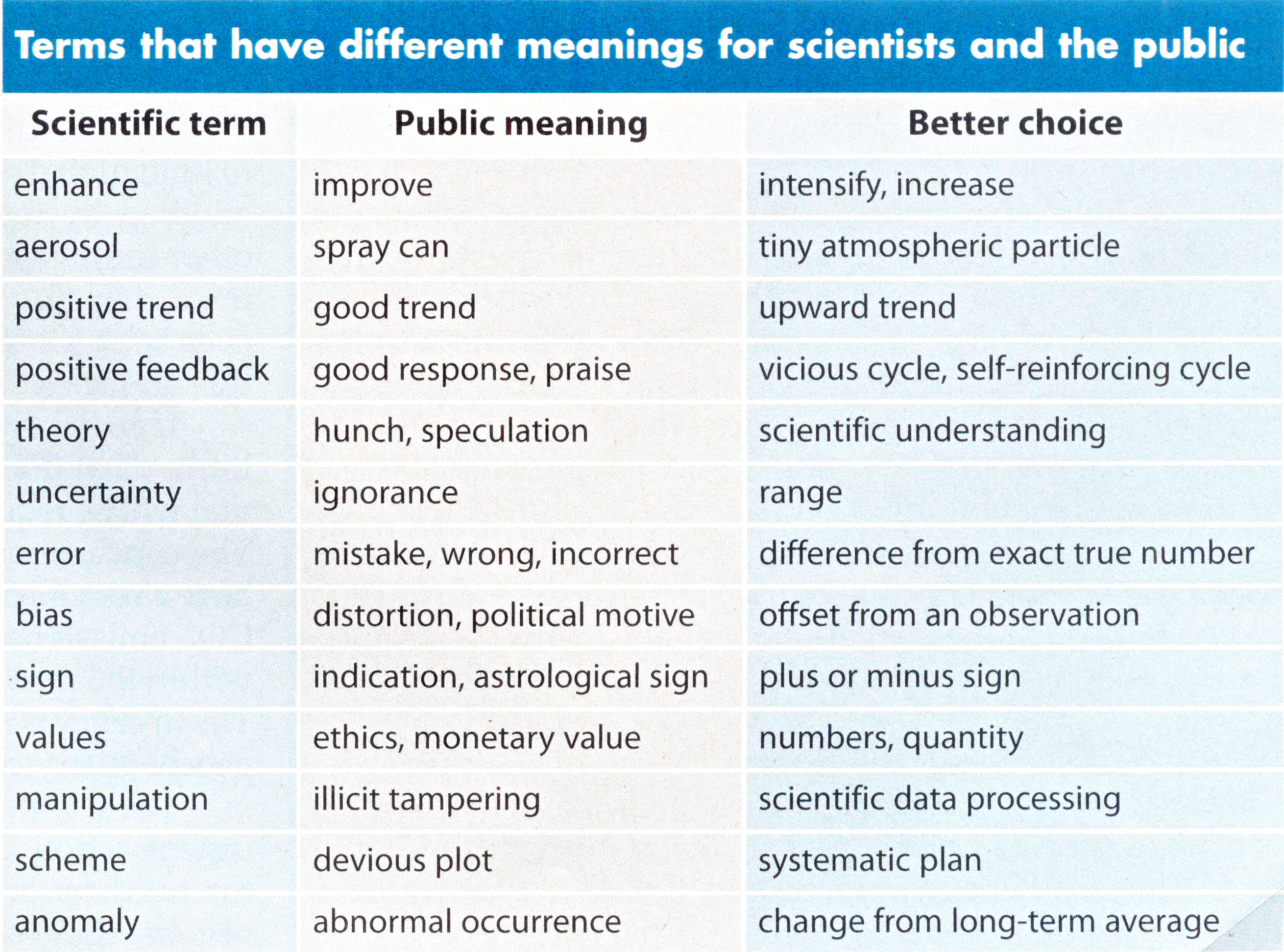
In a 2011 paper about barriers to public understanding of climate change, Somerville and Hassol provided a list of terms that have scientific meanings that are distinct from their popular meanings (below). Later, a crowd-sourced spreadsheet expanded the list. A case in point: for biologists, a mutation refers to any change in a gene. But for most English speakers, a mutation is inherently negative, and can have deadly consequences (or makes things really big really fast). A correct context for mutation is critical to understanding what evolution is, and how it works.

Table of frequently misunderstood scientific terms from Somerville and Hassol 2011.

In a particularly consequential example, the World Health Organization and other authorities avoided calling the COVID-19 virus “airborne” for well over a year. Why? In part, because they were adhering to a definition of airborne that excludes particles above a certain size, or which haven’t been demonstrated to linger in the air for a certain amount of time. A virus can be in the air, but not be technically airborne. Of course, anyone who isn’t an infectious disease expert would reasonably—but incorrectly—conclude that a virus that is “not airborne”  isn’t transmitted by breathing. Many factors contributed to the failure to contain COVID-19, but the use of counterintuitive jargon in messaging for a wide audience certainly did not help.

There is, I suppose, a certain nobility in declaring that “words have meaning,” and attempting to lead by example in their use. Likewise, there are certain words that have no common alternative, and must be introduced in order to communicate (synapsid and multituberculate come to mind). But new ideas stick better when they are built on existing knowledge—replacing ideas your audience already has is much harder. If you think the science you are communicating is important and worth knowing, why not meet your audience where they already are? Attention spans are short, so we need to use the limited attention we get wisely.

References

Fabbri, M., Navalón, G., Benson, R.B.J., Pol, D., O’Connor, J., Bhullar, B.S., Erickson, G.S., Norell, M.A., Orkney, A., Lamanna, M.C., Zouhri, S., Becker, J., Emke, A., Dal Sasso, C., Maganuco, S., Auditore, M., and Ibrahim, N. 2022. Subaqueous foraging among carnivorous dinosaurs. Nature 603:852–857.

Hone, D.W.E. and Holtz, Jr., T.R. 2021. Evaluating the ecology of Spinosaurus: Shoreline generalist or aquatic pursuit specialist? Palaeonologica Electronica 24(1):a03.

Ibrahim, N., Maganuco, S., Dal Sasso, C., Fabbri, M., Auditore, M., Bindellini, G., Martill, D.M., Zouhri, S., Mattarelli, D.A., Unwin, D.M., Weimann, J., Bonadonna, D., Amane, A., Jacubczak, J., Joger, U., Lauder, G.V., and Pierce, S.E. Tail-propelled aquatic locomotion in a theropod dinosaur. Nature 581:67–70.

Lewis, D. 2022. Why the WHO took two years to say COVID is airborne. Nature News Feature, April 6, 2022.

Sereno, P.C., Myhrvold, N., Henderson, D.M., Fish, F.E., Vidal, D., Baumgart, S.L., Keillor, T.M., Formoso, K.K., and Conroy, L.L. 2022. Spinosaurus is not an aquatic dinosaur. eLife11:380092.

Somerville, R.C.J. and Hassol, S.J. 2011. Communicating the science of climate change. Physics Today 64:10:48.

3 Comments

Filed under dinosaurs, education, opinion, science communication, theropods

Rhinos too thick: Fossils and flattery at Agate Springs

“No progress at all. Rhinos too thick.”

So wrote American Museum of Natural History fossil collector Albert Thomson in his September 1917 field notes. At that point, Thomson been collecting mammal fossils at Agate Springs nearly every year since 1907—and was still finding rhino bones in such abundance that they formed a seemingly impenetrable layer.

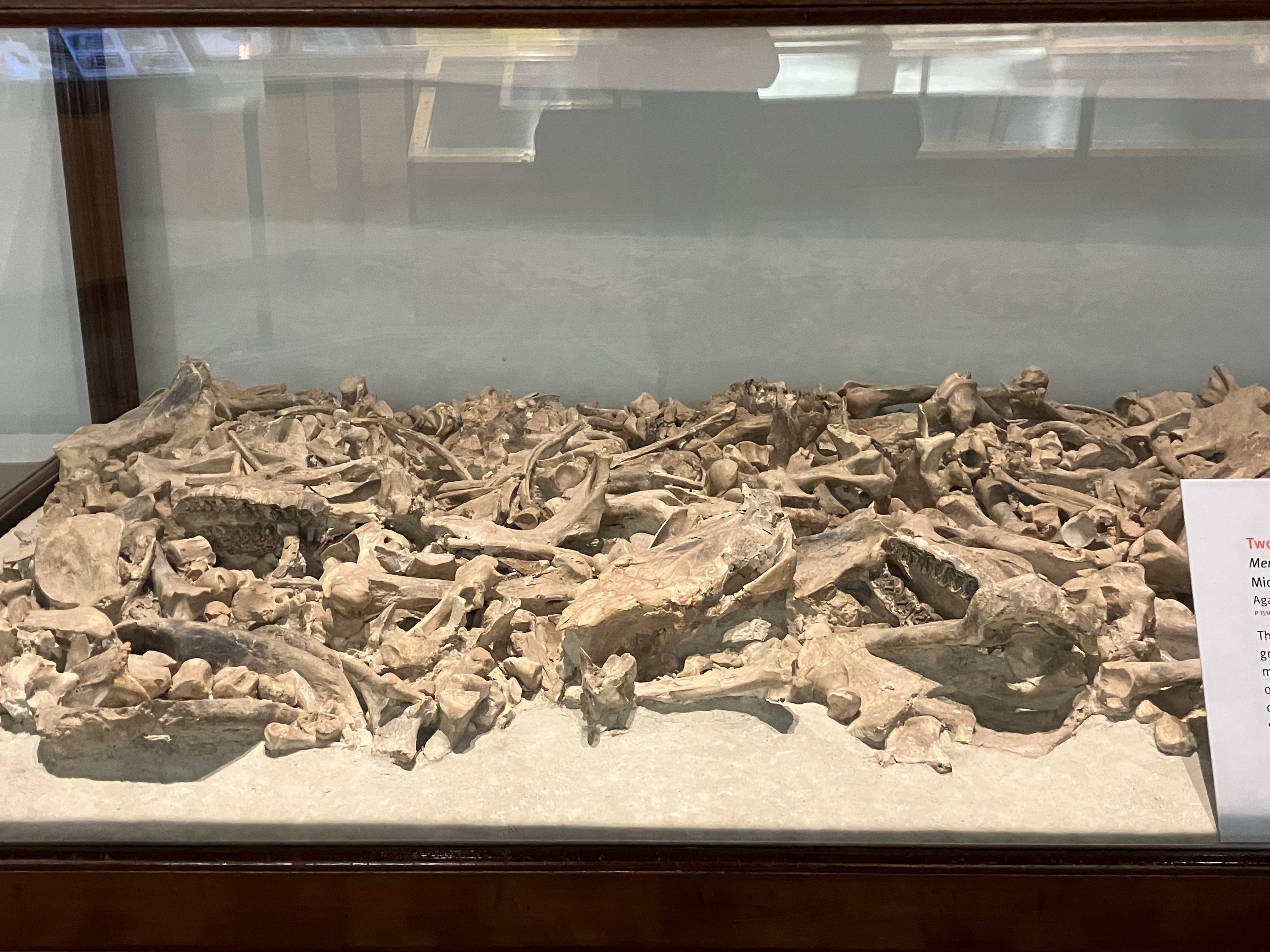
Located in northwest Nebraska and dating to about 22 million years ago, the Agate Springs bone bed is an aggregation of fossilized animals on an astonishing scale. Like the Carnegie quarry at Dinosaur National Monument, it provides a snapshot of an ecosystem at a moment in geologic time. But while a high estimate of the individual dinosaurs represented at Carnegie Quarry is in the hundreds, the main bone bed at Agate Springs may well contain tens of thousands of animals. The vast majority of fossils come from the tapir-sized rhino Menoceras, scrambled and packed together in a layer up to two feet thick. Moropus, Daeodon, and an assortment of other hoofed animals and small carnivores have also been found. These animals may have gathered during a drought and succumbed to thirst or disease, before the returning rains rapidly buried their remains. It’s also possible that the bone bed represents a mass drowning during a flash food. Since different parts of the site vary in density, Agate Springs likely represents multiple mortality events over a number of years.

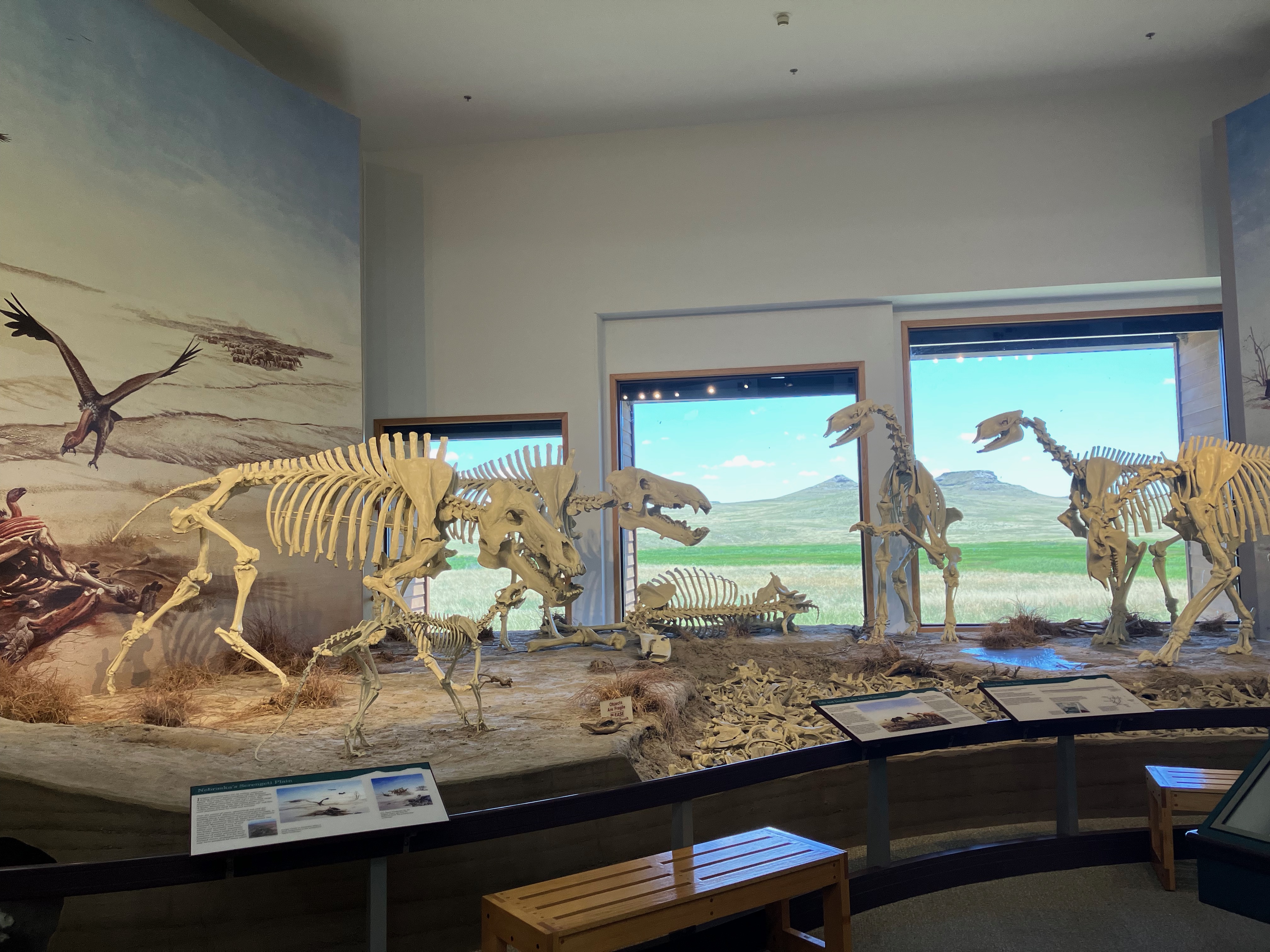
IMG_1185

Tableau of cast fossil skeletons at the Agate Fossil Beds National Monument visitor center. Photo by the author.

Today, less than 30% of the Agate Springs bone bed has been excavated, but not for a lack of effort. Teams from a half dozen museums visited the site between 1900 and 1925, with the Carnegie Museum of Natural History (CM), the University of Nebraska State Museum (UNSM), and the American Museum of Natural History (AMNH) establishing large-scale excavations and returning year after year. As we shall see, the relationships between these teams were not always amicable, making this period at Agate Springs a window into the preoccupations of museum workers at the turn of the century. Agate Springs also illustrates how east coast paleontologists interacted with and relied on local people, defending their social capital as jealously as any fossil deposit. Finally, museums’ interest in Agate Springs in the mid 20th century exemplifies how exhibitions had evolved during the intervening period.

The setting

Agate Springs is unceded Sioux territory, occupied by settlers after the Kansas-Nebraska Act of 1854. James Cook purchased the treeless tract of rolling hills from his father-in-law in 1887, naming it Agate Springs after the rocky banks of the nearby Niobrara River. James and Kate Cook established a ranch where they raised horses and cattle, and Agate Springs became a popular stop for travelers on their way to Cheyenne, Wyoming.

The Cooks were aware of bones weathering out of the hills as far back as 1885, when the land was still owned by Kate’s father. James knew that scientists were on the lookout for fossils in the region—by one account he worked for O.C. Marsh as a translator in 1874. Once the ranch was established, he began writing to museums, including UNSM in Lincoln and the Carnegie Museum in Pittsburgh, inviting them to visit Agate Springs. A UNSM party led by Erwin Barbour was the first to drop by, spending a night at the Cook homestead in July 1892. Chiefly concerned with collecting “devil’s corkscrews” (ancient beaver burrows) north of the Niobrara, Barbour sent his student F.C. Kenyon to check out the bones Cook promised in the nearby hills. Kenyon collected as much as he could carry, but his report apparently did not excite Barbour, and the UNSM party moved on.

It would be twelve years before another paleontologist visited Agate Springs. Olaf Peterson of the Carnegie Museum stopped by the ranch in early August of 1904, at the end of a tumultuous field season in western Nebraska. Peterson had received a telegram on July 4 that his brother-in-law, boss, and mentor John Bell Hatcher had died of typhoid. Peterson intended to cut the season short, but Carnegie Museum director William Holland denied the request, writing in no uncertain terms that Peterson was to continue his work in Nebraska. Later in July, Peterson fell ill himself, and spent several days recovering in Fort Robinson. Suffice it to say, Peterson was not in the best of moods when he arrived at Agate Springs.

Nevertheless, the outcrops Peterson saw at Agate Springs revitalized his spirit. Accounts differ on what part of the site Cook showed him (this will be important shortly), but when he returned east two weeks later he was raving about a quarry with “ten skulls within a six-foot radius.” In Pittsburgh, Peterson and Holland began drawing up plans for an ambitious excavation the following year. In their view, they had staked a claim to the site: just like contemporary gold and oil prospectors, turn-of-the-century paleontologists lived by the rule of “dibs.” For the museum crowd, being the first scientist to “discover” a quarry meant an entitlement to control the site and the resources it produced. This included both the physical fossils and the privilege to describe and interpret those fossils—controlling the site meant controlling scientific knowledge.

Dueling quarries

Cook either didn’t know about such customs, or didn’t care. To his credit, Cook was never interested in monetizing the fossils at Agate Springs. By all accounts, he simply wanted to share with the world the knowledge that the bone bed represented. He was concerned that it was so expansive that no single team could uncover all its secrets. On May 26, 1905, Cook wrote to Barbour, inviting him to share in the bounty he had shown Peterson the previous summer, explaining that it was “so large that [the Carnegie team] could not work it out in years, so there is plenty of material for other parties to work with.”

On other occasions, Barbour had taken a cautious stance when corresponding with landowners. In this case, however, he could barely contain the enthusiasm in his reply. In a single letter, Barbour reminded Cook that UNSM had visited 12 years before and therefore should have collecting rights, asked Cook to place a literal flag on the site claiming it for the University of Nebraska, offered to hire Cook’s 18 year-old son Harold as a field assistant, and appealed to Cook’s state pride by listing the out-of-state institutions that were removing Nebraska’s fossil heritage each year.

IMG_1238

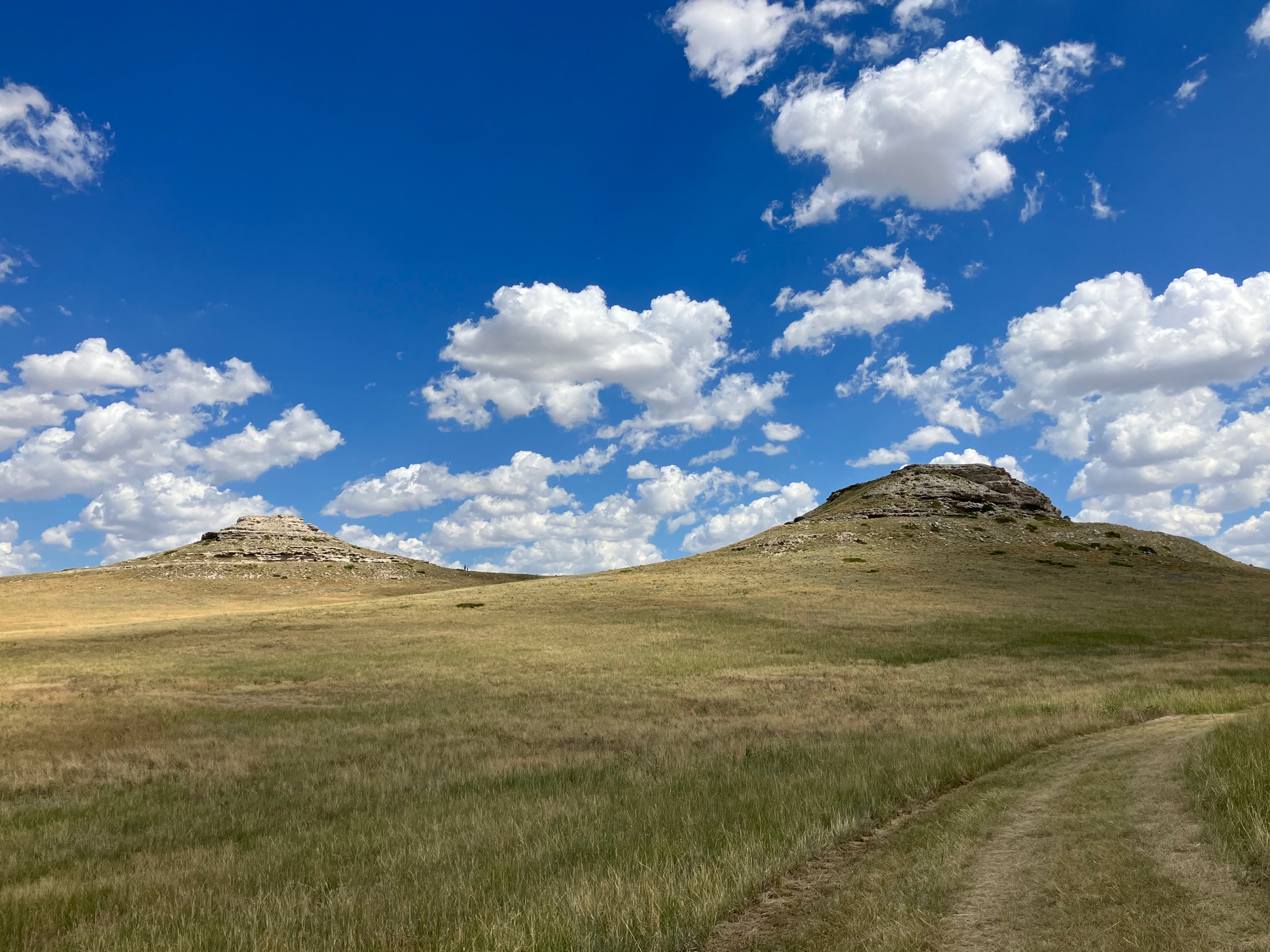
Carnegie Hill and University Hill today. Photo by the author.

That summer, Peterson and Barbour opened quarries on two neighboring buttes at Agate Springs, which came to be known as Carnegie Hill and University Hill. While the two parties were cordial neighbors, letters exchanged by Holland, Barbour, and Cook demonstrate that the museum directors were uncomfortable with the situation. Holland repeatedly wrote to Cook, claiming that his team was more skilled than Barbour’s and warning that it would be bad for science if the fossils and geological data were split between two institutions. Harold Cook didn’t appreciate Holland’s condescending tone. In a note to his father pinned to one of the letters, he wrote that “a letter of this kind is the work of a pinheaded, egotistical, educated fool.”

The Carnegie and UNSM teams returned to Agate Springs in 1906, but spent the summer of 1907 elsewhere. The elder Cook took the opportunity to invite yet more paleontologists, and teams from AMNH, the Yale Peabody Museum, and Amherst College showed up to collect fossils.

Meanwhile, Holland began a campaign to wrest control of the site by any means necessary. He became particularly focused on the narrative of who discovered the bone bed. According to Holland, Cook had shown Peterson the smaller, less dense site that would be come to be known as Quarry A. Peterson then went prospecting on his own and found the primary bone bed that straddled the two buttes. Holland went on to argue that regardless of who first saw the fossils, Peterson earned credit for the discovery because he was the first trained scientist on the scene, and therefore the first individual to correctly identify the age and identity of the animal remains.

Cook rejected Holland’s retelling of the events of August 1904, insisting that he had known of the bone bed for years before he showed it to Peterson. In many ways, the two men were talking past each other. Cook found Holland’s insistence on claiming the discovery for Peterson nonsensical and disrespectful—he knew his own land, and he was the one who invited the paleontologists in the first place. Holland, on the other hand, was staking a claim among his fellow academics. He needed to demonstrate that the Carnegie Museum had been at Agate Springs first, so that other institutions would yield to his authority to interpret and publish on the fossils.

IMG_1235

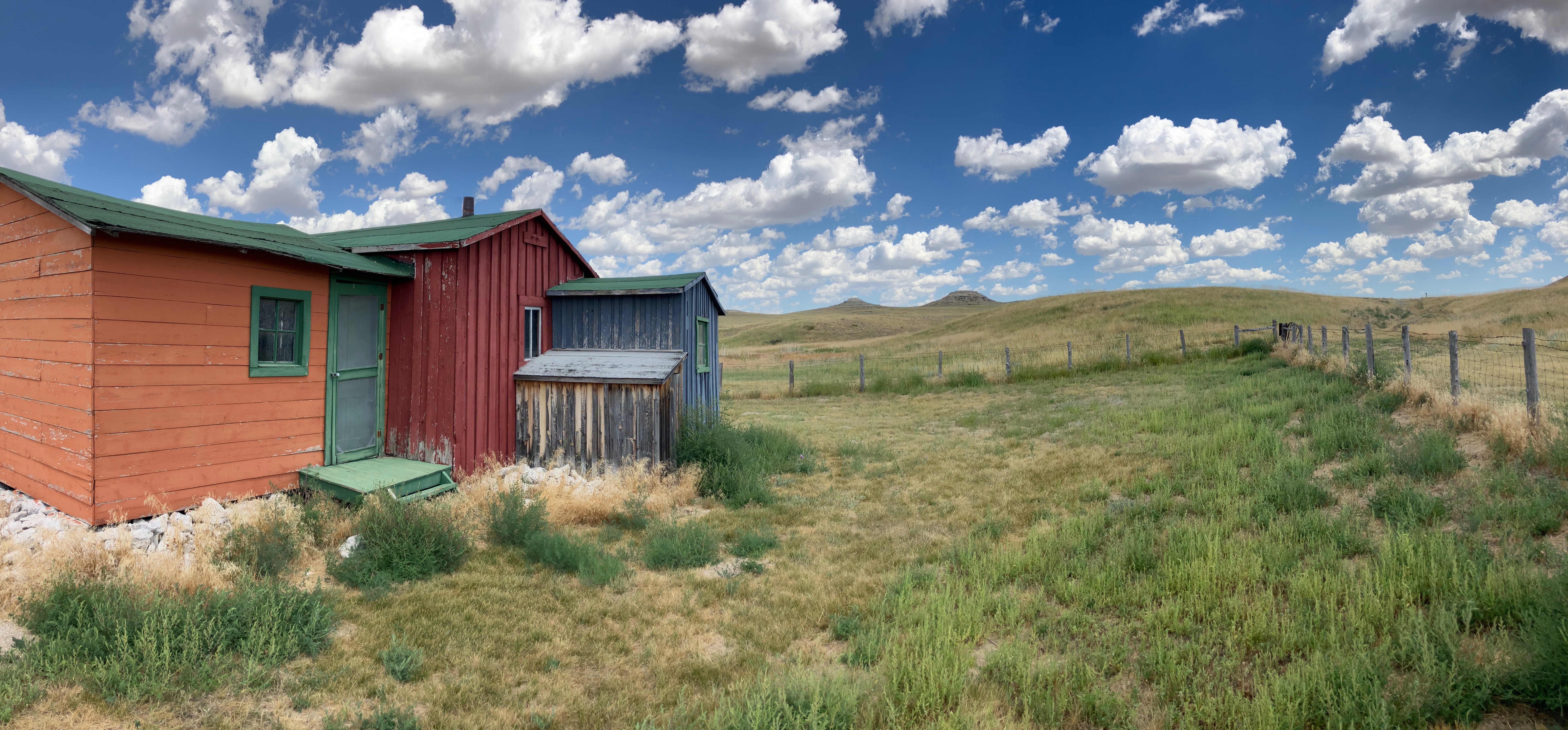
Harold Cook’s homestead cabin, recently fixed up and painted. Photo by the author.

Late in 1907, Holland visited the Cooks’ ranch in person for the first time. He offered to buy the fossil-bearing land outright, doubtlessly planning to block the other museums from accessing it. At this point, James Cook made the awkward discovery that Carnegie Hill and University Hill were actually just outside his official holdings, in the public domain. Holland moved to purchase the land, but Harold Cook beat him to it, building a cabin and filing a homestead claim in March 1908. In their gentlemanly rancher way, the Cooks told Holland to get lost, and the Carnegie Museum left Agate Springs for good.

Playing nice

While Holland had managed to sour his relationship with a remarkably welcoming and accommodating landowner, Barbour did the opposite. In letters to Cook, he regularly acknowledged the rancher as the discoverer of the site. He visited the Cooks frequently and employed Harold in the UNSM quarry, training the younger Cook into a formidable fossil prospector and anatomist. Soon Harold was studying at the University of Nebraska under Barbour, and a few years later, Harold and Barbour’s daughter Elinor were married. Barbour also named a few species after the Cooks, including Moropus cooki.

AMNH director Henry Osborn and field manager Albert Thomson had a similarly positive relationship with the Cooks. The New York museum took over Carnegie Quarry in 1908, and Osborn visited several times to express his gratitude. Like Barbour, he paid Harold for his time, labor, and expertise. Later, Osborn invited Harold to work at AMNH during the off-season. In return, AMNH was permitted to collect at Agate Springs for nearly two decades. Thomson returned almost every year through 1923, and the museum accumulated so many Menoceras and Moropus fossils that it began selling and trading them to other institutions.

IMG_0328

Menoceras and Moropus slab at the National Museum of Natural History. Photo by the author.

The reward for staying in the Cooks’ good graces was clear. UNSM and AMNH paleontologists gained access to the Agate Spring quarries for many years, accumulating large collections. They earned accolades from publications, public interest from the skeletons they placed on exhibit, and even monetary rewards from selling the excess specimens. Meanwhile, the Carnegie Museum was shut out after their first few seasons of collecting because Holland was, if not outright hostile to the Cooks, unable to communicate effectively with the ranchers. For American paleontologists at the turn of the century, social capital was a critical resource. Positive relationships with landowners and other individuals in the fossil-rich western states earned them access to land, information about the terrain, and networks of eyes on the ground, any of which might lead them to the next important quarry.

You get a rhino block, and you get a rhino block…

The scale and intensity of the Agate Springs excavations decreased after 1910, and in the early 20s, Thompson and the AMNH crew closed up shop, believing they had found examples of every species that could be found. By that time, the site’s value for museums had shifted. Rather than being a bonanza of specimens to collect, categorize, and publish on, Agate Springs had become a place to quickly and easily obtain display-worthy fossils. As Hunt puts it, the site was a “storehouse of good exhibit materials, to be tapped when needed by museums wishing to mount a rhino or two.”

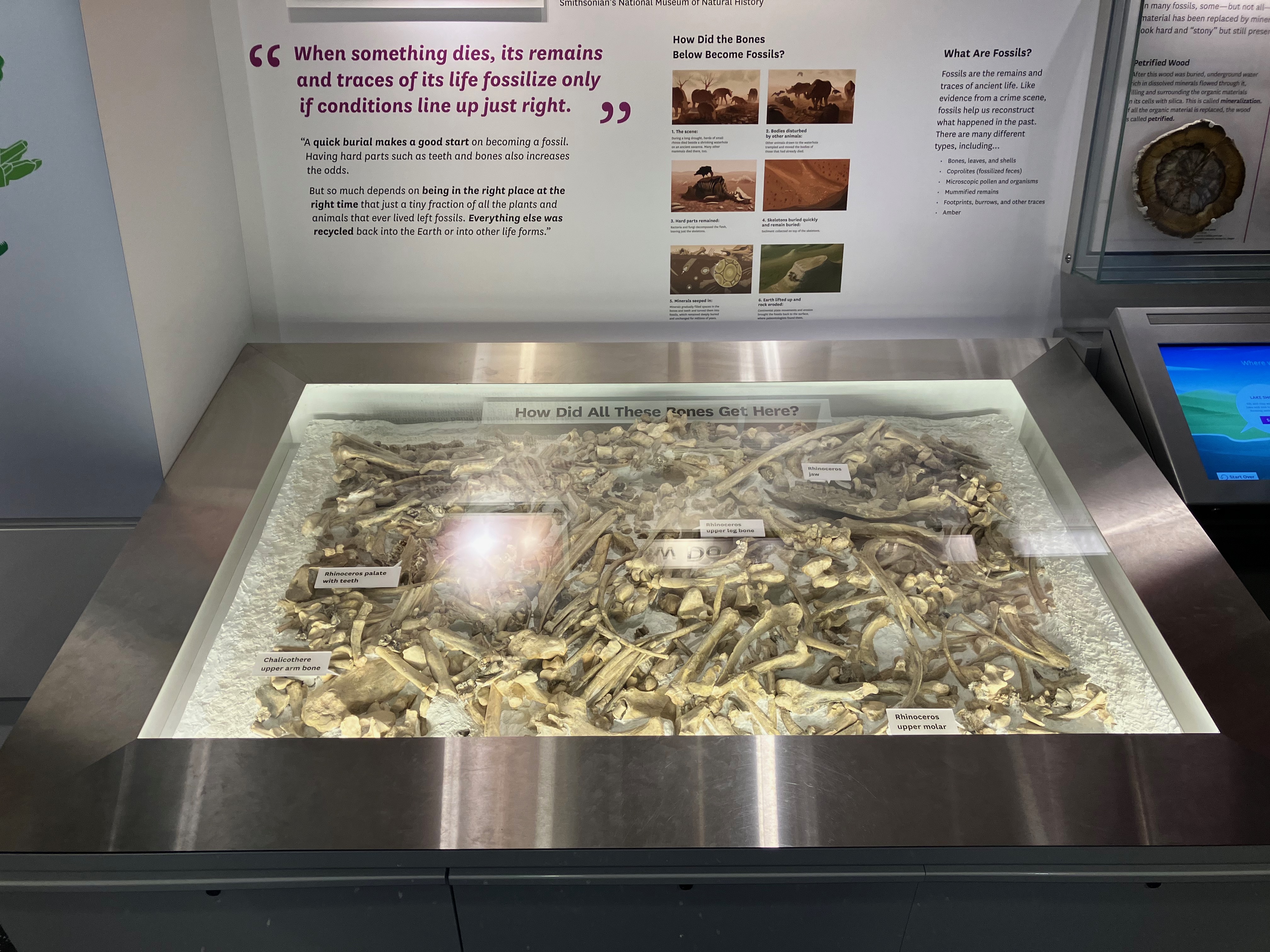
Today, Agate Springs fossils—acquired in the field or via trade—are on display at large and small museums all over North America. Many of these are mounted skeletons of rhinos, camels, and Moropus, but there is also a particular abundance of large, incompletely prepared slabs, which provide viewers with a small window into the Agate Springs bone bed. Because of the sheer density of bones, the early 20th century excavation teams quickly stopped jacketing fossils individually, and instead began preparing out large blocks, typically four to six feet across. The blocks were hardened with shellac, and reinforced with wood planks around their borders. Pulleys and cranes were required to lift the largest blocks out of the quarries. In the early years, the intention was to fully excavate these blocks at their respective museums. It’s not clear which museum first placed a complete block on exhibit, but the idea proved popular. Many later visitors to Agate Springs, from James Gidley of the National Museum of Natural History in 1909 to Elmer Riggs of the Field Museum of Natural History in 1940, came with the express purpose of collecting intact slabs for display.

IMG_0005

Menoceras slab on display at the Field Museum of Natural History. Photo by the author.

The popularity of fossil blocks from Agate Springs coincides with a shift in philosophy toward exhibitions at natural history museums. While early 20th century exhibits were catalogs of life, emphasizing the breadth of the museum’s collection, by the 1920s and 30s many museums had begun moving toward narrative exhibits. Displays were intended to communicate ideas, and objects served as illustrations of those ideas. The fossil blocks from Agate Springs were ready-made illustrations of a number of paleontology concepts, from the process of taphonomy to the task of excavation millions of years later. Most have remained on display to this day, a fact that James Cook would undoubtably be pleased with.

An incomplete list of museums in possession of Agate Springs blocks follows. Do you know of others? Please leave a comment!

  • Carnegie Museum of Natural History
  • American Museum of Natural History
  • University of Nebraska State Museum
  • Field Museum of Natural History
  • National Museum of Natural History
  • Royal Ontario Museum
  • Denver Museum of Nature and Science
  • Yale Peabody Museum of Natural History
  • Harvard Museum of Comparative Zoology
  • University of Wyoming Geological Museum
  • South Dakota School of Mines and Technology
  • Wesleyan University Geology Museum
  • University of Austin Texas Memorial Museum
  • University of Michigan Museum of Natural History
  • Science Museum of Minnesota
  • Fort Robinson State Park Trailside Museum

References

Agate Fossil Beds: Official National Park Handbook. Washington, DC: National Park Service.

Hunt, R.M. 1984. The Agate Hills: History of Paleontological Excavations, 1904-1925. 

Vetter, J. 2008. Cowboys, Scientists, and Fossils: The Field Site and Local Collaboration in the American West. Isis 99:2:273-303.

Skinner, M.F., Skinner, S.M., Gooris, R.J. 1977. Stratigraphy and Biostratigraphy of Late Cenozoic Deposits in Central Sioux County, Western Nebraska. Bulletin of the American Museum of Natural History 158:5:265-370.

3 Comments

Filed under AMNH, CMNH, collections, dinosaurs, DMNS, exhibits, field work, fossil mounts, history of science, museums, NMNH, ornithopods, sauropods, theropods, thyreophorans

The dinosaurs of London’s Natural History Museum

Founded in 1881 as an offshoot of the British Museum, the Natural History Museum (NHM) in London is one of the world’s best-known and most-visited museums. For millions of visitors from the UK and abroad each year, NHM provides their first—sometimes only—opportunity to see a full-sized dinosaur skeleton in person. That makes the collection of dinosaurs on display uniquely important: each one is an ambassador to paleontological science and the deep history of the Earth.

For your reference and mine, what follows is a brief introduction to NHM’s dinosaurs. Please note that I have not been to NHM and this information is based on references available online.

Diplodocus carnegii (Dippy)

dip_london_2014

For 36 years, Dippy greeted visitors in Hintze Hall. Source

Most readers are probably familiar with the story of Dippy the Diplodocus. In 1898, industrialist and philanthropist Andrew Carnegie funded an expedition to find a sauropod dinosaur for the newly-founded Carnegie Museum of Natural History. The Diplodocus the team uncovered the following summer was—and still is—one of the most complete sauropod skeletons ever found. Nevertheless, Carnegie lost the race for the first mounted sauropod on permanent display: the American Museum of Natural History unveiled its composite Apatosaurus in March of 1905, while the Carnegie Museum building was still unfinished. Not to be bested by the New York competition, Carnegie offered a complete plaster cast of the Diplodocus to King Edward VII. The replica known today as Dippy went on display in London that May. Carnegie went on to produce seven additional Diplodocus casts, and more have been created since his death in 1919.

Whether we consider all versions or just the London cast, Dippy’s cultural impact is astounding. As Nieuwland writes, “Carnegie’s series of casts—and the political gesture of their donations—turned [Dippy] into a contested and open-ended object that existed at the crossroads of several interacting (social, political, cultural, scientific) domains.” The intersection of political intrigue and gossip with the sensational nature of the specimen itself resulted in a cascade of media attention, political cartoons, and eventually even films. At least in Europe, Dippy can be believably said to be the specimen that made “dinosaur” a household word.

In 1979, Dippy was moved to NHM’s cavernous entryway, called Hintze Hall. The cast served as the museum’s mascot and most iconic object until 2015, when it was replaced with a blue whale skeleton. Dippy’s time in the limelight was not over, however. The original cast was retrofitted for the traveling exhibition Dippy on Tour, and a bronze duplicate may one day be installed outside NHM.

Triceratops sp.

nhmtriceratops

Triceratops replica skeleton at the Natural History Museum. Source

This Triceratops is not an original skeleton or a cast—it’s a papier mâché model. Frederic Lucas of the United States National Museum (now the National Museum of Natural History) created this replica in 1900 for the Smithsonian display at the Pan-American Exhibition in Buffalo, New York. He likely used O.C. Marsh’s published illustration of a Triceratops skeleton as his primary reference. The model made a second appearance at the 1904 Louisiana Purchase Exposition in St. Louis, Missouri, but was rendered obsolete shortly thereafter when Charles Gilmore finished the world’s first real Triceratops mount in 1905. While constructing the skeleton, Gilmore learned that Marsh and Lucas’s straight-legged interpretation was physically impossible—Triceratops actually had partially sprawling forelimbs.

Nevertheless, exhibit models like this rarely go waste. Two years later, NHM received Lucas’s model as a gift from USNM. It has been on nearly continuous display ever since.

Iguanodon bernissartensis

Iguanodon_bernissartensis

The Belgian Iguanodon cast as it appears today.Source

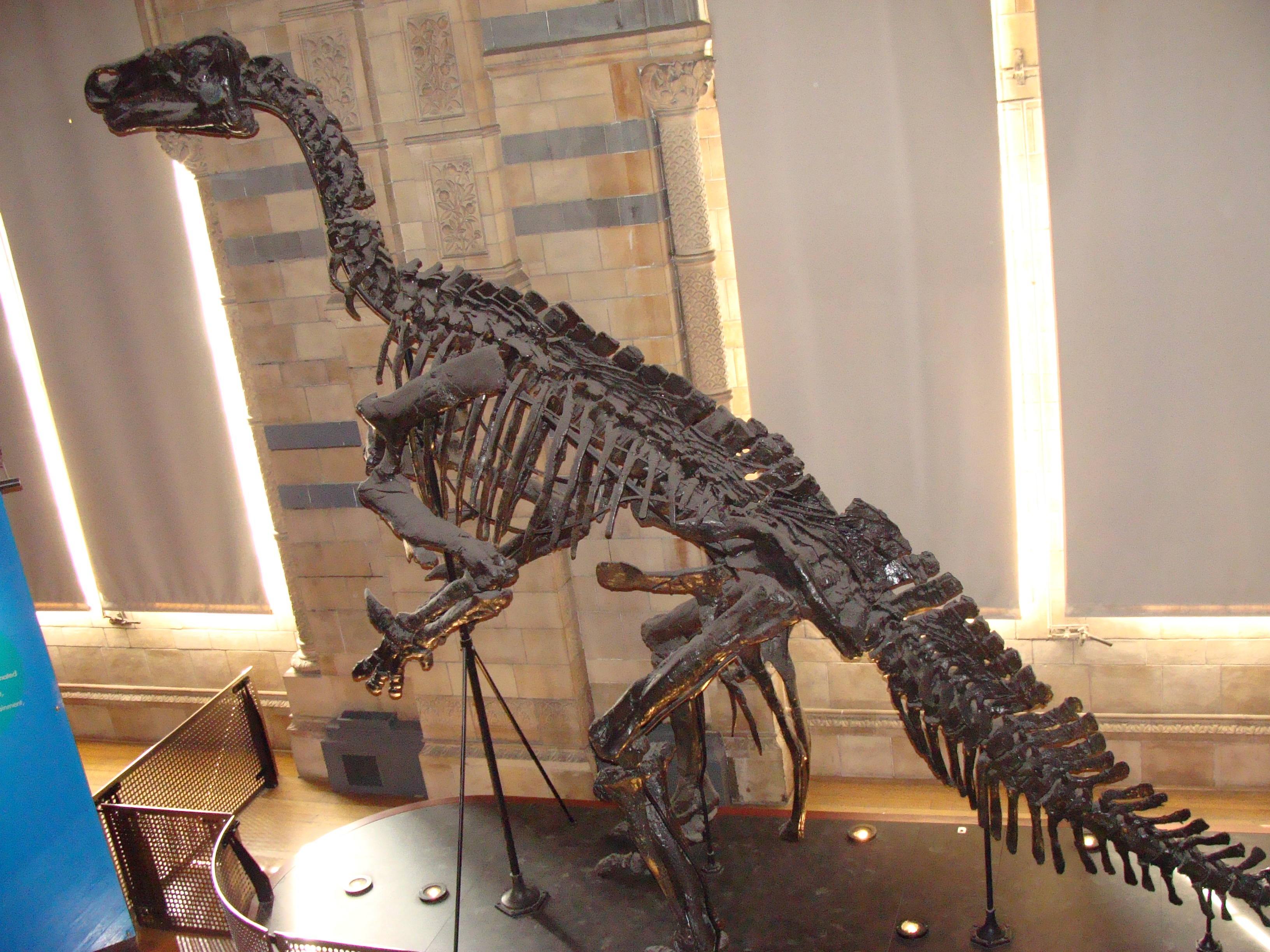
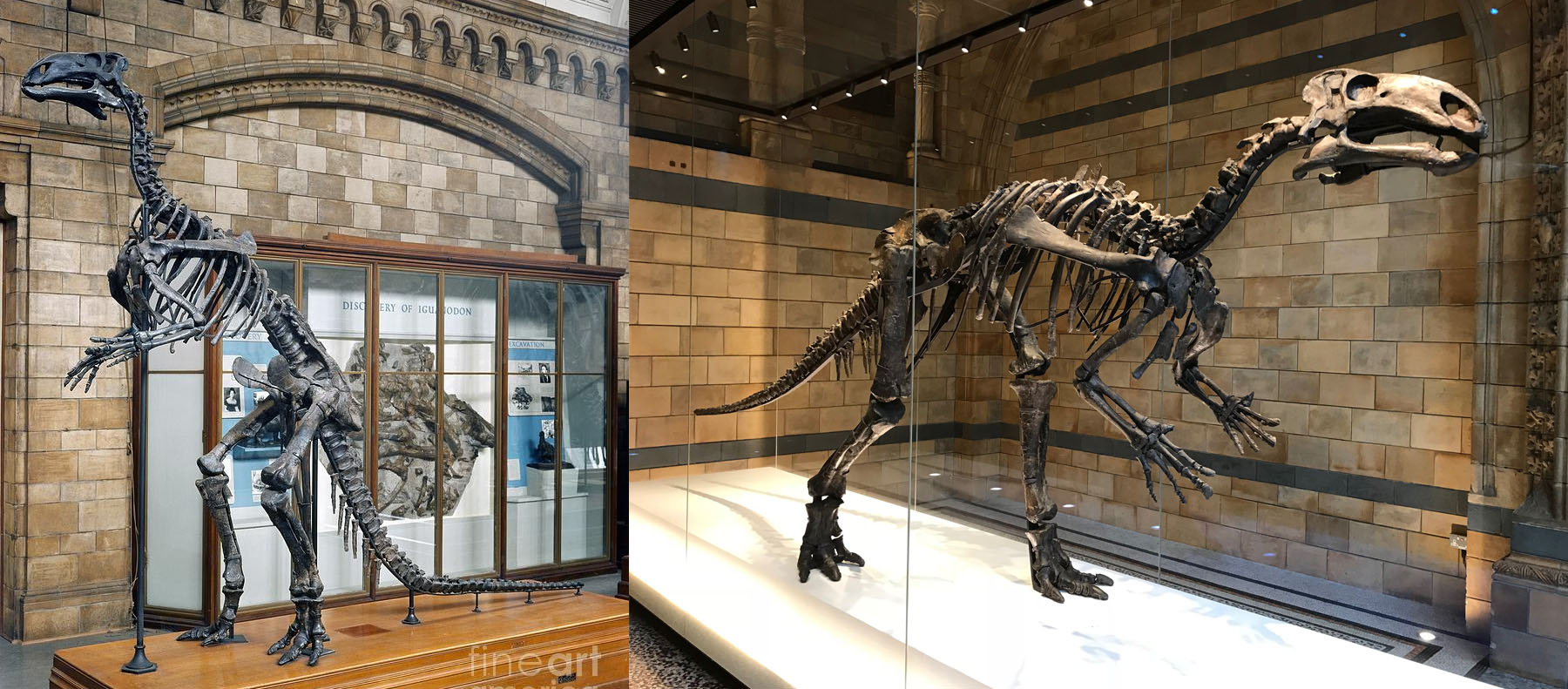
In 1878, coal miners in western Belgium discovered a clay deposit dense with Iguanodon fossils. A crew from the Belgian Royal Museum of Natural History (now the Belgium Museum of Natural Sciences) excavated dozens of skeletons, and in 1882 Louis De Pauw and Louis Dollo took on the task of assembling the best examples into standing mounts. De Pauw distributed casts of the largest and most complete individual to several institutions around Europe, including NHM (sources differ on whether the NHM cast arrived in 1895 or 1905).

While Dippy is made up of individual plaster casts of each bone, the Iguanodon was molded and cast in a handful of large sections. This means that the skeleton cannot be easily reassembled into a horizontal pose, and must remain a relic of an earlier era in our understanding of dinosaur posture.

Hypsilophodon foxii

hypsybeforeafter

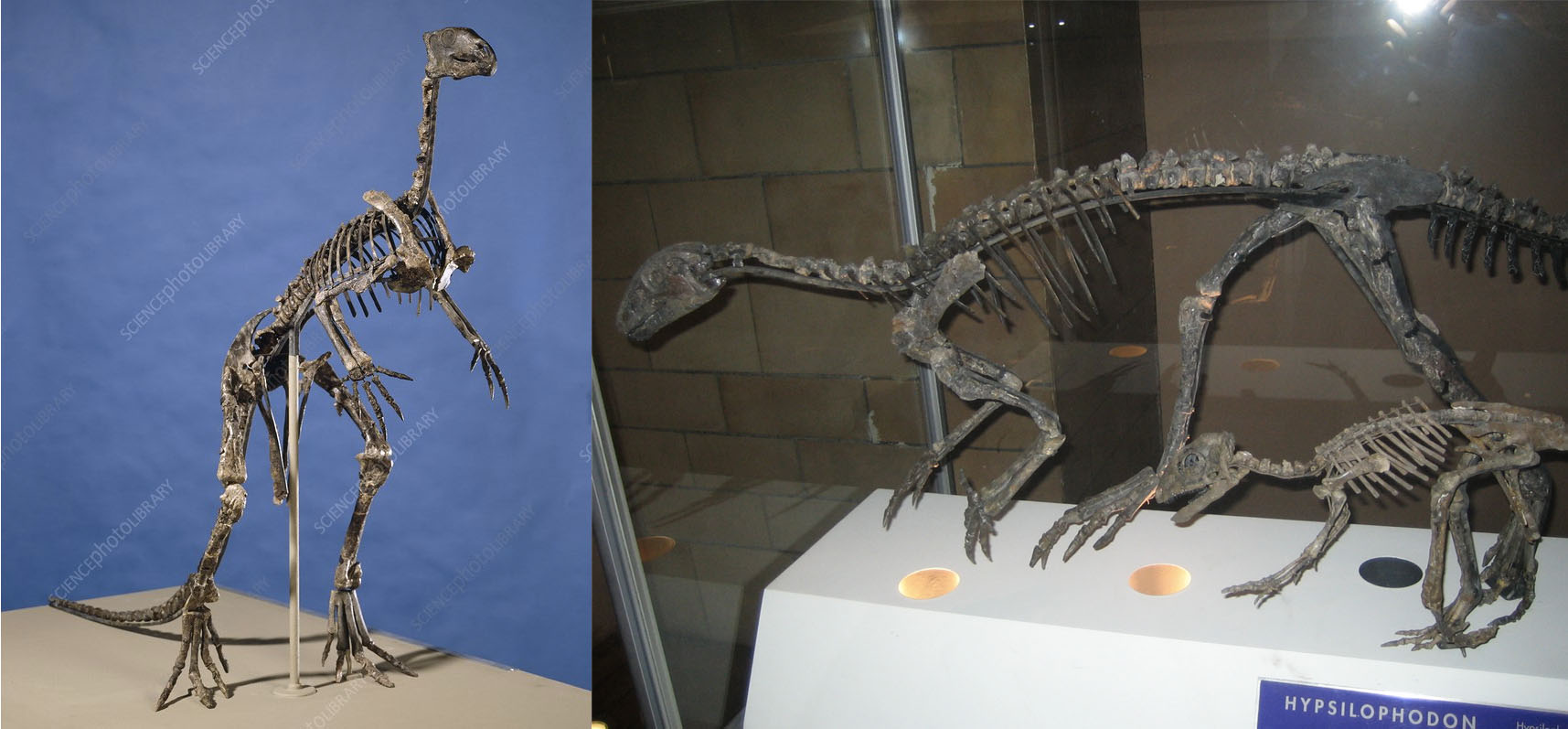
Nearly all known Hypsilophodon fossils come from the”Hypsilophodon bed,” part of the Wessex Formation on the Isle of Wight. More than a hundred articulated skeletons have been found in this mudstone layer, including NHM’s mounted pair. These particular individuals were collected by Reginald Hooley, an avocational fossil collector who also described and published several new species. The bulk of Hooley’s collection was sold to NHM in 1924, shortly after his death.

The larger Hypsilophodon (R5829) was mounted in 1934 by preparators Louis Parsons and Frank Barlow, in an upright, tail-dragging pose that closely mirrored the Belgian Iguanodon. This mount remained on display until the early 1990s, when the specimen was remounted for the 1992 dinosaur hall. Nigel Larkin and colleagues adapted the original iron armature to give the skeleton its correct horizontal posture. A juvenile Hypsilophodon (R5830) from the Hooley collection was also mounted at this time, using a cast Orodromeus skull provided by the Museum of the Rockies. Both Hypsilophodon mounts remained on display until 2016, when they were removed due to conservation concerns.

Mantellisaurus atherfieldensis

mantellibeforeafter

The centerpiece of the 1924 Hooley acquisition is the holotype skeleton (R5764) of Mantellisaurus atherfieldensis, known at the time as Iguanodon atherfieldensis. Hooley found the 85% complete skeleton in 1914 on the Isle of Wight, in several blocks that had already eroded out of a cliff. It was—and still is—the most complete dinosaur skeleton found in the UK. Like the Hypsilophodon, the Mantellisaurus was originally mounted in the 1930s with a kangaroo-like posture. It was remounted for the 1992 exhibit in a horizontal walking pose.

More recently, the Mantellisaurus was moved to the redesigned Hintze Hall, part of a small selection of iconic specimens that represent the NHM’s collections and research areas. As an exceptionally complete, local dinosaur, it was a natural choice to represent vertebrate paleontology at the museum. In 2019, paleontologist Susannah Maidment and preparator Mark Graham spent four days temporarily dismantling the Mantellisaurus mount and digitizing every bone for future research.

Scolosaurus cutleri

Scolosaurus

The complete Scolosaurus fossil. Image courtesy of the National History Museum, CC BY.

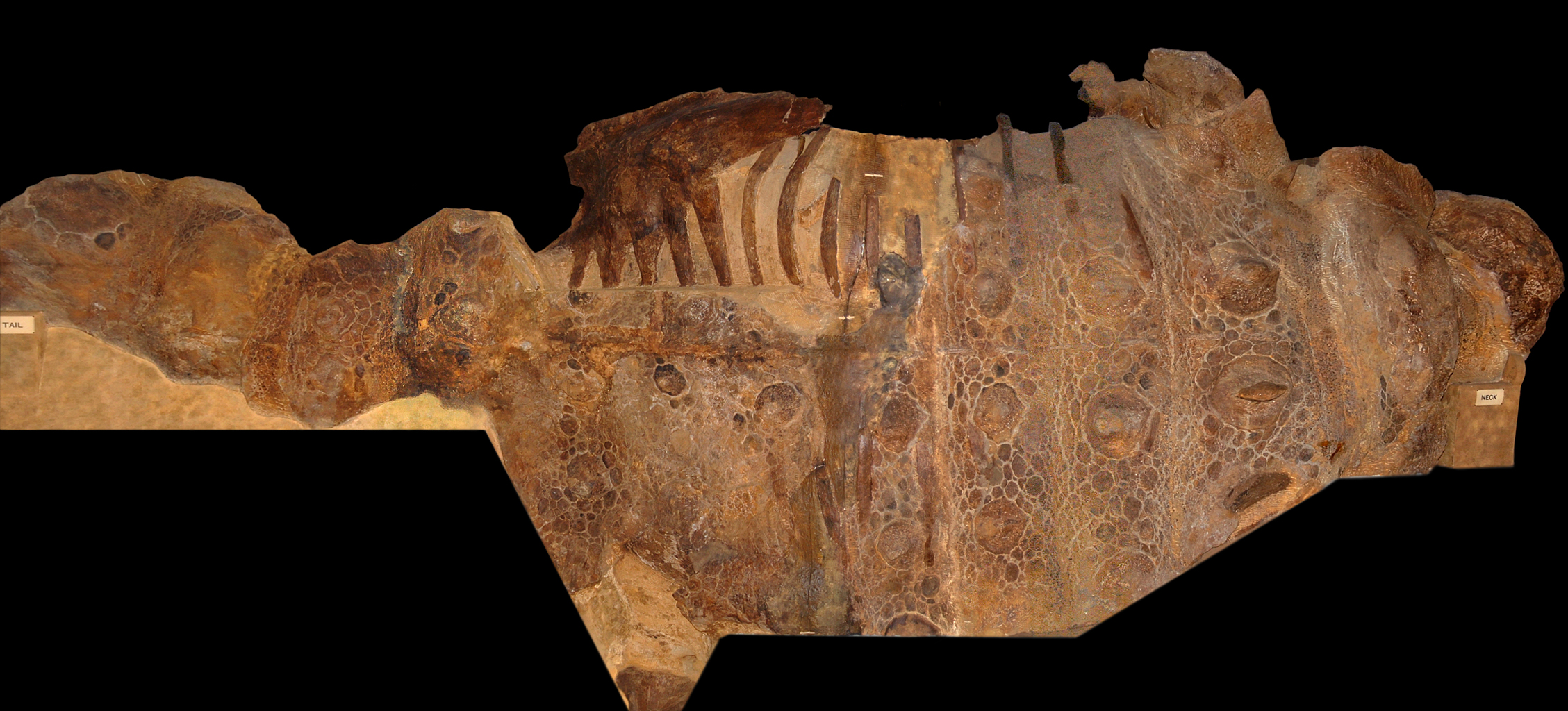
Another remarkable real specimen in the NHM collection is the Scolosaurus holotype (R5161). This fossil includes nearly the entire animal intact and in situ, including its osteoderms and some skin impressions. Only the head, the end of the tail, and two limbs are missing.

The Scolosaurus was found by fossil hunter William Cutler in 1914. After moving to Alberta from the UK, Cutler found work on Barnum Brown’s field expeditions before setting out as an independent collector. Cutler had a reputation for reckless behavior in the field, and often worked alone. Excavating the Scolosaurus was a case in point: it collapsed on him while he was undercutting the jacket.

NHM purchased the Scolosaurus in 1915, and Parsons set to work preparing the fossil straightaway. It has been on near-continuous display since 1929.

Cutler was hired by NHM again in 1925 to search for dinosaurs in Tanzania. Among his party was none other than Louis Leakey, on his first field season. Tragically, Cutler contracted malaria and died in the field at age 47.

Massospondylus carinatus

massospondylus

Like most of the dinosaurs in the 1992 exhibit, Massospondylus stands on a platform over visitors’ heads. Source

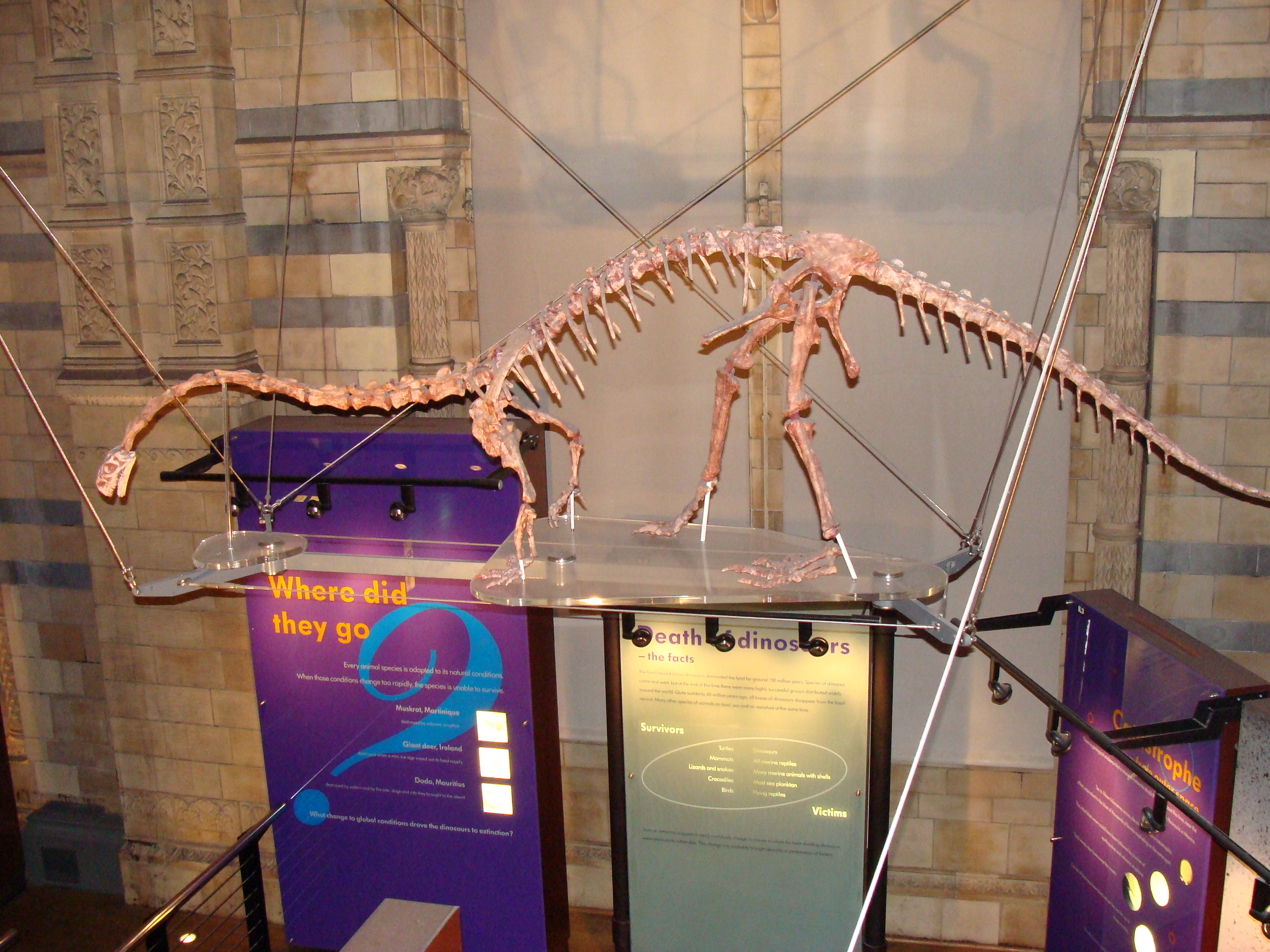
In 1962, NHM acquired a nearly complete, unarticulated Massospondylus cast from the South African Museum in Cape Town. Some time later, William Lindsay and colleagues mounted it for a temporary exhibition at the City of Plymouth Museum. The mount has an unusual supporting armature, composed of short, glass-reinforced epoxy tubes. Since each section of tube fits tightly into the next, the mount can be assembled without the use of adhesives. The Massospondylus was repurposed for the 1992 dinosaur hall, where it remains today.

Gallimimus bullatus

nhm27

At 18 feet long, Gallimimus is bigger than you think. Source

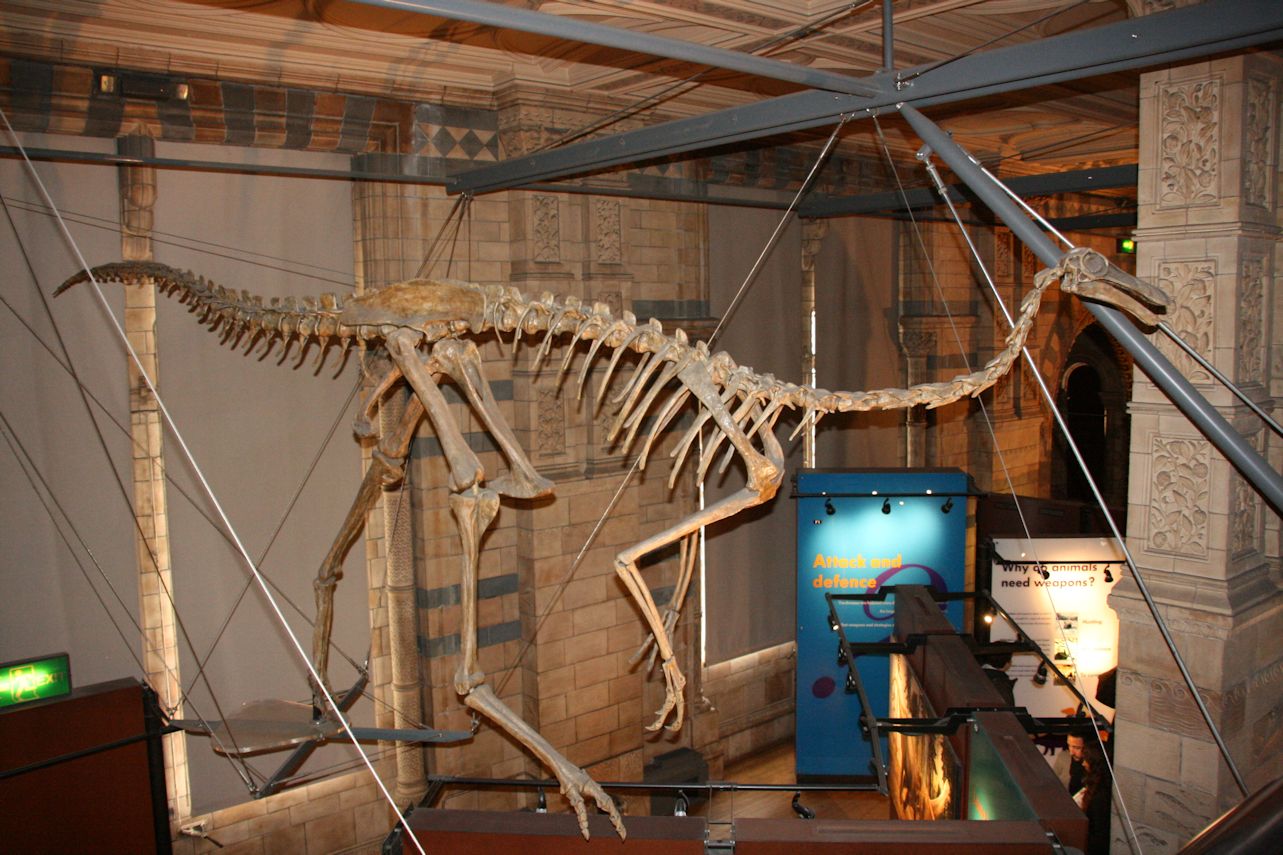
Like Massospondylus, this Gallimimus arrived at NHM as an unarticulated cast in an exchange with a peer institution, in this case the Polish Academy of Sciences. The original skeleton was discovered on a Polish-Mongolian joint expedition led by trailblazing paleontologist and all-around incredible person Zofia Kielan-Jaworowska.

When NHM was beginning work on the 1992 dinosaur hall, the fossil prep team elected to hire Research Casting International to mount the Gallimimus. Rather than using the plaster casts, RCI made a plastic duplicate of each bone and assembled them on an aluminum armature. The skeleton’s running pose meant that the mount’s weight had to be carefully managed. All the weight rests on the left leg, which was molded around a 22-pound steel rod to compensate.

Lindsay reports that the decision to display most of the dinosaurs on elevated platforms was not made until after most of the mounts were finished. This wasn’t an issue for the smaller, more stable skeletons, but the Gallimimus was heavy and awkward enough that the tensioned steel cables holding up its platform had to be adjusted and readjusted as the skeleton was assembled.

Baryonyx walkerii

baryonyx_nhm

A relief-mounted cast of Baryonyx, created in-house at NHM. Source

In January of 1983, William Walker discovered a large claw in a brick pit. NHM paleontologists Angela Milner and Alan Charig traveled to the site in southern England that summer to look for more. What they found was a carnivorous dinosaur unlike any other, with a crocodilian snout and smooth, straight teeth for snagging fish. Named Baryonyx walkeri, this specimen (R9951) is the only confirmed example of the species yet found.

The Baryonyx was found in particularly hard matrix loaded with iron ore, and as a result took nearly ten years to prepare, mold, and cast. A relief mount was completed just in time for the opening of the 1992 dinosaur hall.

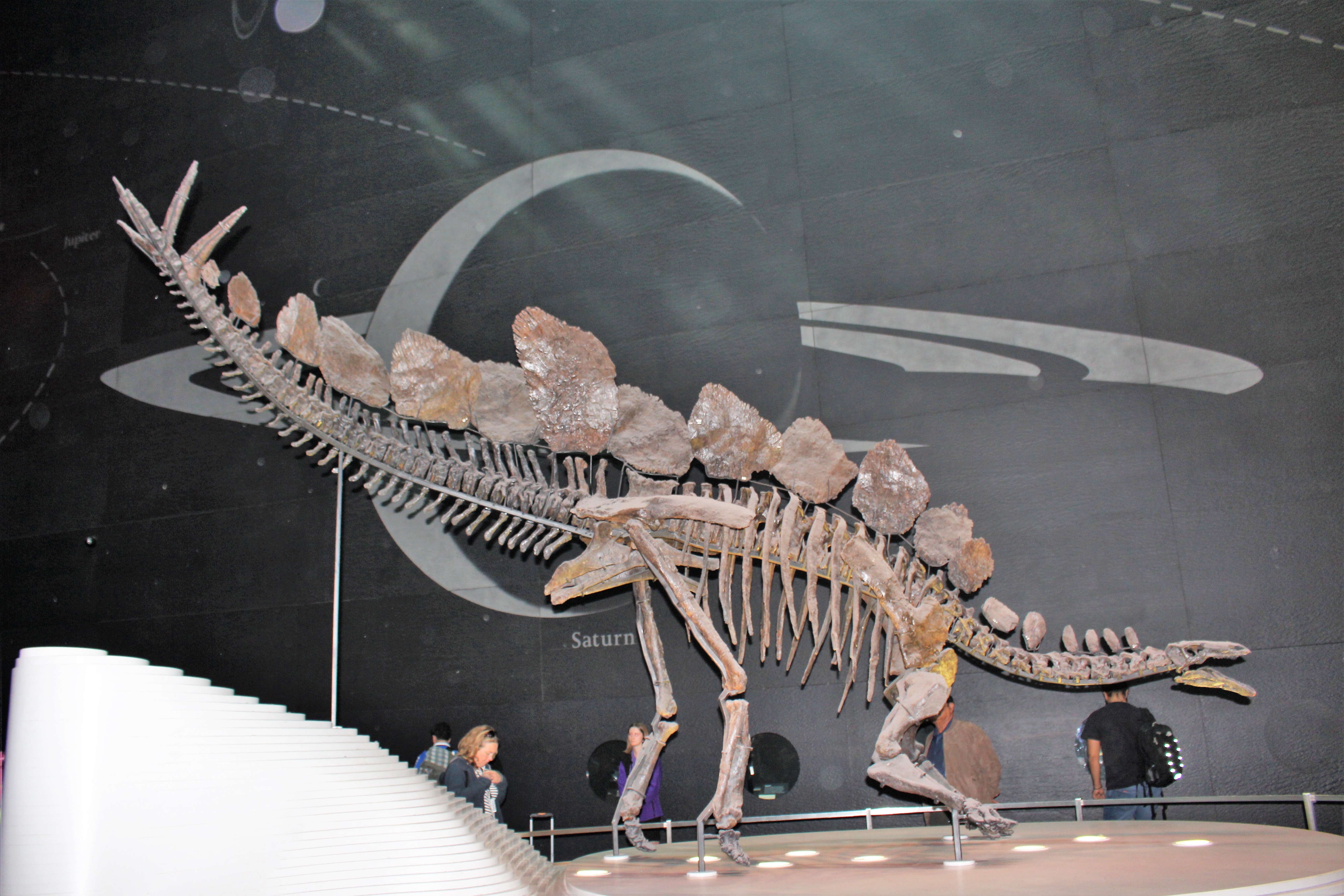
Stegosaurus stenops (Sophie)

Sophie the Stegosaurus greets visitors in Earth Hall, at the museum’s east entrance.
Source

NHM’s most recent major dinosaur acquisition is a juvenile Stegosaurus called Sophie (R36730). Commericial fossil hunter Bob Simon collected the skeleton at a quarry in Wyoming, in 2003. The 90% complete, three-dimensionally preserved skeleton was prepared at Sauriermuseum in Switzerland. NHM purchased the specimen in 2013 with the help of multiple donors. Working in secret, staff paleontologists Susannah Maidment, Paul Barrett, and Charlotte Brassey thoroughly documented the skeleton with CT and laser scans of every bone. Sophie’s mounted skeleton was a surprise reveal in December 2014, alongside a trove of open access research covering the animal’s locomotion, bite force, and more.

References

Barrett, P., Parry, P., and Chapman, S. 2016. Dippy: The Tale of a Museum Icon. Natural History Museum, London.

Getty, T.A. and Crane, M.D. 1975. A Historical Account of the Palaeontological Collections found by R.W. Hooley (1865 to 1923). Newsletter of the Geological Curators Group. 4 (September 1975) :170-179.

Lindsay, W., Larkin, N., and Smith, N. 1996. Displaying Dinosaurs at the Natural History Museum, London. Curator 39:4:262-279.

Maidenment, S.C.R., Brassey, C., and Barrett, P.M. 2015. The postcranial skeleton of an exceptionally complete individual of the plated dinosaur Stegosaurus stenops from the Upper Jurassic Morrison Formation of Wyoming, USA. PLoS One. 10:10: e0138352.

Nieuwland, I. 2019. American Dinosaur Abroad: A Cultural History of Carnegie’s Plaster Diplodocus. University of Pittsburgh Press.

Noe, L. and Flinney, S. 2008. Dismantling, painting, and re-erecting of a historical cast of dinosaur Iguanodon in the Sedgwick Museum, Cambridge. NatSCA News 14:41-48.

Swinton, W.E. 1936. Notes on the Osteology of Hypsilophodon, and on the family Hypsilophodontidae. Proceedings of the Zoological Society of London. 106:2:555-578.

Tanke, D.H. 2003. Lost in plain sight: Rediscovery of William Cutler’s missing Eoceratops. In New Perspectives on Horned Dinosaurs. Indiana University Press.

10 Comments

Filed under dinosaurs, exhibits, field work, fossil mounts, marginocephalians, museums, NHM, ornithopods, sauropods, theropods, thyreophorans

Telling SUE’s story (part 1)

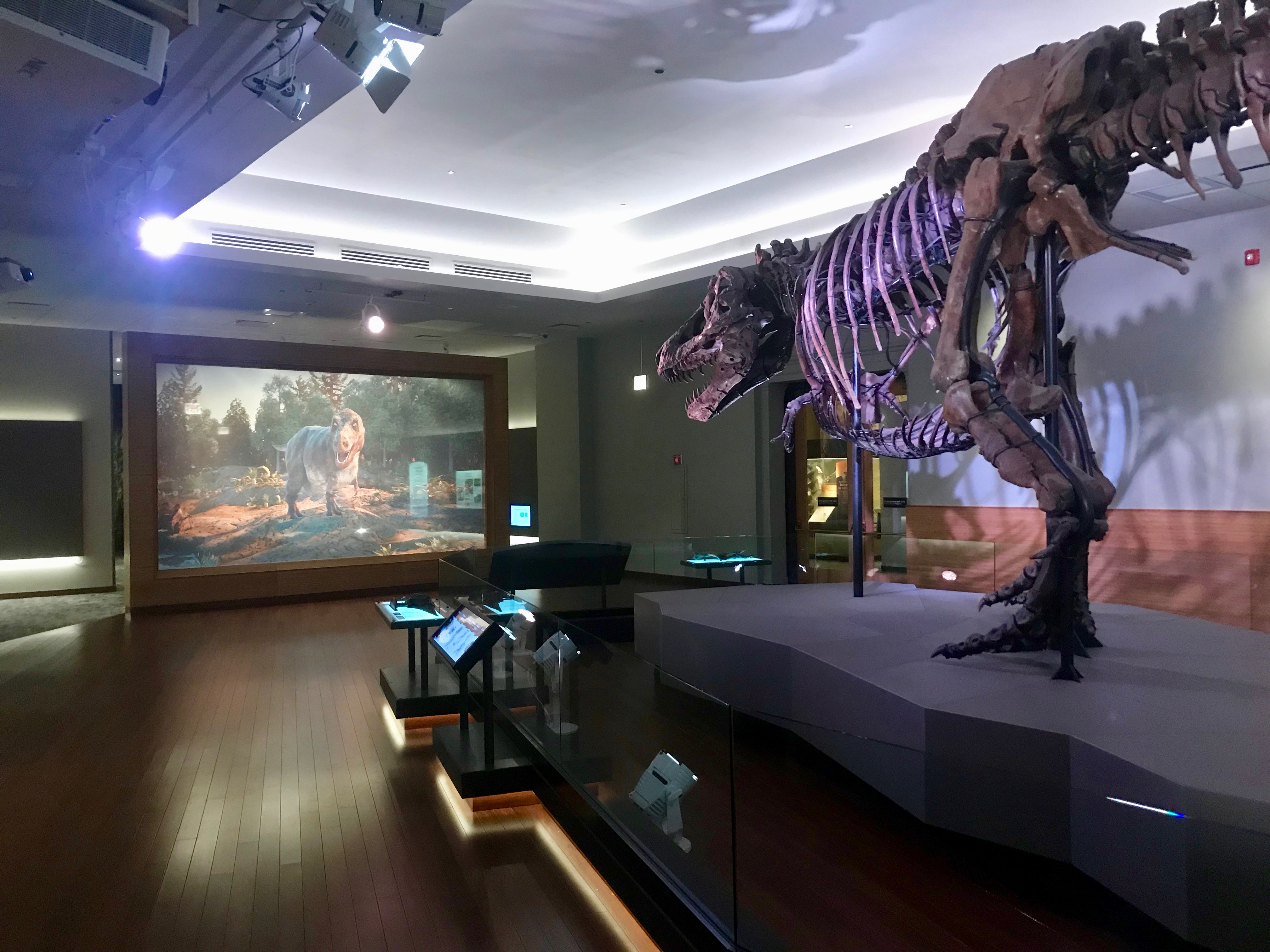
SUE’s new digs combine immersive media with elegant and austere design language. Photo by the author.

SUE—the Field Museum’s Tyrannosaurus rex—has been busy lately. In 2018, the skeleton was moved from Stanley Field Hall to a dedicated gallery within the Evolving Planet exhibition. A new traveling exhibition about SUE began its North American tour earlier this year. I was involved with both these projects as an Exhibition Developer, and in this post (divided into two parts), I’ll share my experiences and some of the choices I made along the way. Basically, the sort of things I’d want to know about an exhibit at another museum.

Before I continue, I’d like to emphasize that authorship of the new SUE exhibits is shared among dozens of talented professionals. In addition to my SUE co-developers Susan Golland and Meredith Whitfield, these exhibits were imagined and willed into existence by a small army of project managers, designers, scientists, mount-makers, programmers, and more. And all of us are standing on the shoulders of the researchers, preparators, artists, and educators who have contributed to our understanding of this incredible fossil since it was unearthed 30 years ago.

Why move SUE?

In January 2018, the Museum held an event for members to say a temporary goodbye to SUE. Photo by the author.

The role of a developer differs depending on the institution, but at the Field Museum we are essentially storytellers (or perhaps story organizers). Working closely with curators (staff scientists) and designers, we craft a narrative that can be expressed through physical space, and write most of the words visitors read or hear. One thing we do not do is decide which projects the Museum takes on and when. As I understand it, however, the decision to relocate SUE was a long time in coming.

After acquiring SUE as a partially prepared skeleton in 1998, Museum leadership decided that the mounted skeleton should be on display within two years. With a large team, that was enough time to prepare the fossil and publish a monograph, but renovating the existing paleontology halls to make room for a T. rex would have been impossible. So SUE debuted in Stanley Field Hall, with an understanding that this was a temporary solution (Edit: The choice to display SUE in Stanley Field Hall was actually a bit more complicated, with many factors besides schedule involved).

Thanks to Phil Fraley’s well-designed armature, SUE was taken down in just two weeks. Photo by the author.

While SUE’s position as a centerpiece in Stanley Field Hall was instantly iconic, the display could provide only minimal context for the fossil. And even though SUE is the size of a bus, visitors were right to point out that the skeleton looked small in the four-story, half-acre expanse. A dedicated gallery would be needed to properly represent SUE’s role as a rosetta stone for dinosaur science, to contextualize T. rex within the history of life on Earth, and to give SUE the presence they deserved.

As it turned out, the opportune moment to create such a gallery wouldn’t arrive until nearly two decades later. A multi-part plan was established in 2016: the SUE move would occur concurrently with a rebranding and redecorating of Stanley Field Hall, with hanging gardens and a Patagotitan cast filling the vertical space better than the Tyrannosaurus ever could. Meanwhile, the temporary (and now traveling) exhibition Antarctic Dinosaurs would keep fossil fans happy during the 9 months SUE was off display.

You can make a dinosaur do anything on paper, but assembling the real bones always comes with unexpected surprises. Photo by the author.

Naturally, any change to a beloved display was bound to be controversial. After all, SUE had been a mainstay in Stanley Field Hall for a generation of visitors (I’m old enough to remember the Brachiosaurus, so SUE always seemed like a newcomer to me). If anything, public relations staff leaned into the controversy, since it was a magnet for media attention. At times, the press generated by the SUE move felt comparable to adding an entire wing to the museum. The team working on the new gallery kept quiet, confident that visitors concerned about the change would come around once they saw what we were up to.

An encounter with SUE

The new SUE gallery occupies a space called Hall 25A, between the two arms of the U-shaped Evolving Planet exhibition. This hall didn’t exist when SUE first arrived at the Field Museum—it was one of four light wells that were original to the building, which weren’t filled in until the early 2000s. Finding space for a new exhibit is challenging in a century-old museum, but Hall 25A’s location was a lucky break. It could be connected directly to the existing dinosaur hall, so that the SUE gallery appeared precisely where it should during a visitor’s walk through time.

Our overall goal with the new gallery was to give visitors a dramatic encounter with SUE, contextualized within the Cretaceous world. Accordingly, designer Eric Manabat arranged the space with drama in mind. Visitors no longer get their first look at SUE from 300 feet away. Instead, SUE is hidden behind a scrim wall—visitors move around the wall and find themselves quite suddenly looking up into the face of the T. rex (SUE certainly doesn’t look small anymore).  Updates to the mounted skeleton—overseen by Pete Makovicky, Bill Simpson, and Tom Cullen—also give SUE a more imposing presence. The addition of SUE’s real gastralia (rib-like bones embedded in the belly muscles) and adjustments to the ribs and shoulders provide a better sense of how massive Tyrannosaurus was. SUE is also standing up straighter, and the jaws are now open.

SUE’s skeleton is visible through the translucent scrim wall, and we made sure the fleshed-out reconstruction was posed and scaled to line up perfectly. Photo by the author.

The look and feel of modern natural history exhibitions often leans toward one of two extremes. They either take design cues from art galleries, placing objects against a minimalist, neutral backdrop, or they are highly immersive recreations of a particular setting. The new SUE exhibition does a bit of both. The physical space is austere and elegant, although the use of wood paneling makes it warmer and more inviting than a typical art gallery. The immersion comes in the form of multimedia. Animated scenes of the waterlogged forests where Tyrannosaurus lived are projected on a staggered row of screens, creating a living backdrop behind the skeleton. A primordial soundscape of birds, frogs, and insects can be heard throughout the hall.

I think this multimedia overlay makes the SUE gallery particularly unique, because it’s constantly changing. The animated scenes take you to three locations in SUE’s habitat on a 20-minute cycle: an upland forest at dawn, the shore of the inland sea during a midday rainstorm, and a lowland river in the late afternoon. When the visuals change, the soundscape and the color of the overhead lights change with them. Visitors are themselves part of the ebb and flow of the gallery. They move among and between the screens, placing themselves in the scenes and pointing out minute details. Every time there’s a bout of dinosaur action, visitors gather to watch, then disperse around the hall once more.

At one point during the light show, all the real fossils included in the mount are highlighted. Photo by the author.

The exhibit’s biggest surprise comes during the “nighttime” portion of the media loop, when a narrated light show provides a tour of SUE’s skeleton. Projection mapping is used to highlight pathologies and other key features, helping visitors see details that they might have overlooked. Media Producer Latoya Flowers’s work on the show is spectacular, and it’s no wonder that visitors sometimes break out into spontaneous applause upon seeing it.

Bringing SUE to life

How could we not pay homage to Charles Knight’s timeless standoff between Tyrannosaurus and Triceratops? Above: Artwork by Charles Knight. Below: render by Atlantic Productions, © Field Museum.

As one might imagine, creating the animated scenes was one of the most involved aspects of the project, as well as one of the most fun. These scenes were produced by the London-based studio ZooVFX, known for their work on Flying Monsters and Natural History Museum Alive, among other effects-heavy educational programs. However, this was was not simply a matter of sending the animators some parameters and accepting whatever they gave us. The process was deeply collaborative, and the Field Museum team of scientists, developers, and designers teleconferenced with ZooVFX at least once a week for well over a year.

Like any animation project, the process of creating these vignettes began with storyboards. We settled on the T. rex behaviors we wanted to depict: hunting, scavenging, drinking, defecating, and a standoff with Triceratops (basically, unsuccessful hunting). A scene with SUE sleeping was also considered, but curators decided that posing a sleeping T. rex would require too much speculation. We didn’t want constant, cacophonous dinosaur action in the gallery, so the moments with SUE are interspersed with longer periods of calm.

Next came designing and modeling (Vladimir Venkov was the primary artist at ZooVFX) the ten animal species to be featured. Naturally, the curators led this process. I think it’s fair to say that we strove for “safe” dinosaur reconstructions, insofar that they adhere to what is most definitively known from the fossil record. Your aesthetic preferences may vary, but they work well in the context of this exhibit.

The staggered, two-sided screens allow visitors to place themselves in the scenes, and also recall the ribs and vertebrae of the mounted skeleton. Photo by the author.

Animating SUE was relatively straightforward, but establishing the gaits of Triceratops and Edmontosaurus required a lot of iteration. The first walk cycle attempts were too mammalian, and lacked the bilaterally asymmetrical gait of four-legged reptiles. Edmontosaurus was particularly tricky because its back legs are much larger than its front legs, but its stiffened spine doesn’t allow the body to twist very much. Fossil trackways proved very helpful: when the animators matched the dinosaurs’ footfalls  to the footprints, biomechanically plausible movement usually followed. The folks at ZooVFX were fantastic, providing something like twenty variations on a hurried hadrosaur before we found one that worked.

Once we had basic walk and run animations, it was time to choreograph the action scenes. Once again, the Edmontosaurus scene caused trouble. How do you sell SUE ambushing the herd when T. rex can’t actually run? The finished version reminds me more of a crocodile than a lion—SUE gets really close, ultimately only taking four steps to reach their unfortunate quarry. The audio sells it. Pete Makovicky asked that SUE’s jaws slam shut with a crack you feel in your bones, like a really, really big crocodile. One bite, and “deadmonto” is toast.

Other challenges included designing SUE’s poop (we consulted a Bristol stool chart and decided on a 2 or 3), and staging the fight between Tyrannosaurus and Triceratops. Naturally, we wanted a “Charles Knight moment” where the animals face off, but it had to be believable. I enjoyed the opportunity to script out the fight, move by move. In the final version, SUE’s attack is a moment too slow, so they find themselves temporarily cornered by their prey. SUE limps away with a stab wound in their left leg, matching the fossil skeleton’s infected tibia.

It’s nice in here. Photo by the author.

Susan Golland once called the new SUE gallery an oasis, which I think is a perfect descriptor. By the time visitors reach SUE, they’ve come two thirds of the way through Evolving Planet. It’s an extremely dense exhibition, covering the entire history of life with over 1,000 specimens. But then, they reach a big, open gallery that is all about a single specimen. There’s ample space to sit down and collect yourself. And the ever-changing media overlay means that you’ll actually see more if you take a break, rather than hurrying on ahead. I find the SUE gallery quite beautiful, and I hope that it does justice to such an extraordinary fossil.

Next time, we’ll look at updates to the SUE gallery since 2018, creating the traveling SUE exhibition, and realizing SUE in the flesh.

Awesome. Photo by the author.

1 Comment

Filed under dinosaurs, exhibits, FMNH, fossil mounts, paleoart, theropods

T. rex in Context: Deep Time’s Cretaceous Display

A little over a year ago, the National Museum of Natural History re-opened its paleontology halls after a five-year renovation. As I detailed in a previous post, the new exhibition—called Deep Time—is exceptional. Breathtaking to look at, intuitive to explore, and (of course) brimming with fascinating specimens, Deep Time sets a high standard for excellence in natural history exhibitions.

Today, I’d like to take a closer look at one display in Deep Time, the Cretaceous tableau, and elaborate on what makes it so effective. Many thanks to Designers Pauline Dolovich and Fang Pin Lee, Developer Siobhan Starrs, and Curator Matt Carrano for discussing their work with me.

The Cretaceous display tells a story through its carefully-composed design.

The Cretaceous display is home to Deep Time’s centerpiece, the Tyrannosaurus rex. As was well-covered by various media outlets in the months and years leading up to the exhibition’s opening, the “Nation’s T. rex” was discovered in 1988 on Army Corps of Engineers land, and is now on loan to the Smithsonian. Although it’s one of the most thoroughly-studied Tyrannosaurus specimens around, this is the first time the real skeleton has been assembled into a standing mount. Like many of the mounted skeletons in Deep Time, the T. rex strikes a dynamic pose that evokes the behavior of the living animal. In this case, the Tyrannosaurus is prying the head off a prone Triceratops.

Obviously, the T. rex draws a crowd. It’s hard to imagine any visitor passing through Deep Time without stopping to see it. But while the exhibit team acknowledged and emphasized the spectacular nature of the tyrant king, they also harnessed its star power to make a broader statement. Tyrannosaurus was part of a rich ecosystem of plants and animals, and while this apex predator had an impact on the entire community (eating some animals, providing leftovers for others), T. rex and other meat-eating dinosaurs were far outnumbered by the turtles, lizards, salamanders, and insects they lived alongside. By placing Tyrannosaurus within its ecological context, the display makes the seemingly fantastic dinosaur much more real. This reinforces one of the exhibition’s overarching themes: life in the past functioned much like life in the present, and studying past life can inform our understanding of the world today. It’s no accident that this cross-section of a prehistoric ecosystem is at the center of the hall, and includes its most popular specimen.

To avoid cluttering the historic architecture of the east wing, the designers integrated display lighting into the platforms.

While the Cretaceous display tells a complex story that is integral to the narrative of the exhibition as a whole, its footprint is remarkably compact. This efficient use of space is the result of a long and methodical design process. Designers Fang Pin Lee and Pauline Dolovich envisioned a broad avenue across the entire hall, which would accommodate large crowds (NMNH gets up to eight million visitors each year) and allow quick access to any part of the exhibition. This avenue needed to double as a central social space, where groups could congregate around built-in seating and look out onto the various displays. But more space for visitors means less space for specimens, and dinosaurs need a lot of room. Lee and Dolovich used digital renders and a miniature model to find the optimal position for the 40-foot Tyrannosaurus and its companions. This was a careful balancing act—they had to keep the T. rex visible from multiple approaches while working around the twin rows of structural columns down the center of the hall.

With ample space for visitor traffic, long sight lines, and some very large skeletons in the mix, there was precious little room in the Cretaceous display for text panels. This worked in the display’s favor, because it meant that much of the message had to be communicated through the design. For example, the Tyrannosaurus poised over its Triceratops meal evokes the predator’s role in the ecosystem, while conveniently reducing the footprint the two skeletons would require if displayed independently. Meanwhile, a cutaway in the platform next to the T. rex‘s foot contains an alligator, a turtle, clams, and aquatic plants. While only subtly implying the presence of a pond or river (the alligator skeleton is posed as though swimming along the surface, while lotus-like flowers “float” nearby), this area demonstrates these organisms’ ecological relationship to T. rex by placing them literally underfoot.

Stangerochampsa swims among floating Nelumbago leaves in an implied waterway.

To the right of Tyrannosaurus, a densely-layered series of specimens and display elements provides a nuanced look at the Hell Creek ecosystem within a limited amount of space. In the back, a pair of large murals by Julius Csotonyi set the stage: this was a lush, green world dense with weedy flowering plants (as opposed to the open conifer forests dinosaurs are often depicted in). To the left, a lone Torosaurus is dwarfed by the forest around it. To the right, an Edmontosaurus group tramples through the undergrowth, disturbing the smaller Thescelosaurus and Polyglyphanodon. Skeletons of Edmontosaurus, Thescelosaurus, and the aquatic reptile Champsosaurus stand in front of the murals, alongside three slabs of fossil leaves.

A vivid green panel among the skeletons spells out the key takeaway: these plants and animals were part of a single ecosystem that existed in North America at the end of the Age of Dinosaurs. Similar header panels can be found throughout the exhibition, and the writers iterated on the text for years. These short phrases had to convey the context and significance of a display at a glance, even if these were the only words a visitor read. The team settled on the headline “T. rex in Context” for the Cretaceous display, but when test audiences began visiting the hall, this proved to be a mistake. Because the words appeared so close to the Edmontosaurus, visitors were concluding that the hadrosaur was a T. rex. With weeks to go before opening, the team opted to replace the headline with the tried-and-true “Last American Dinosaurs.

Those vertical mounts for the fossil leaf slabs are incredible.

The final layer in the Cretaceous display is the rail at the very front. Smaller specimens—the lizard Polyglyphanodon, several fossil leaves, and an assortment of microfossils—are mounted in cases, while a dinosaur bone with insect damage is out in the open where it can be touched. The text on the rail is almost superfluous, but it is cleverly divided by trophic level. One panel addresses primary producers, another herbivores, and a third carnivores and decomposers. The plants and small animals are given the same amount of attention as the dinosaurs, reinforcing that all of these organisms have their part to play in the community.

Taken together, the elements of the Cretaceous display encourage deep looking without requiring a great deal of reading. Visitors drawn by the star power of the Tyrannosaurus find themselves surveying the “beautiful density” of specimens and display elements. They may notice minute details, like platform tiles slanted and dislodged as though by the movement of the dinosaurs, or the broken Triceratops horn that has rolled away from the skeleton. Intuitively, they understand that they’re looking at the complete ecological context of T. rex, and that this ecosystem is just as diverse and complex as those of today. If they choose to read the text panels, visitors will learn details like the names of the animals or the feeding strategies of different herbivores, but most of the information is conveyed through the layout alone. This is the mark of an uncommonly well-designed museum display.

5 Comments

Filed under Deep Time, dinosaurs, exhibits, fossil mounts, marginocephalians, museums, NMNH, ornithopods, paleoart, theropods

Displaying the Tyrant King (Redux)

This is an updated version of a series of posts from 2014. With Deep Time and the new SUE exhibition now open, I’m dusting it off and bringing it up to date.

Woodrow Wilson is in the white house. The first World War is raging in Europe, but the United States is not yet involved. The women’s suffrage movement is picking up speed. And you just heard that the skeleton of an actual dragon is on display at the American Museum of Natural History (AMNH) in New York. It is difficult to imagine a time before Tyrannosaurus rex was a household name, but such was the case barely a century ago. In 1915, AMNH unveiled the very first mounted skeleton of the tyrant lizard king, immediately and irrevocably cementing the image of the towering reptilian carnivore in the popular psyche.

Today, Tyrannosaurus is a celebrity among dinosaurs, appearing in every form of media imaginable. More importantly, it is an icon for paleontology and an ambassador to science. Much has been written about T. rex — about its discovery, about the animal itself, and about its role in popular culture. This article will take a slightly different tack. This is an overview of the history of the tyrant king on display, and how it has defined (and been defined by) the museum experience.

The cult of T. rex began in the halls of museums, and museums remain the prehistoric carnivore’s symbolic home. Mounted skeletons provide the legendary T. rex its credibility: these are the authentic remains of the giant predator that once stalked North America. And yet, most of the dozens of  Tyrannosaurus skeletons on display around the world are casts, and none of them represent complete skeletons (rather, they are filled in with spare parts from other specimens and the occasional sculpted bone). These are sculptures as well as scientific specimens, works of installation art created by artists, engineers, and scientists. Herein lies the paradox presented by all fossil mounts: they are natural specimens and constructed objects, embodying a challenging duality between the realms of empiricism and imagination.

I. The Original Tyrant

Tyrannosaurus as it was displayed at AMNH in the 1920s. Image courtesy of the AMNH Research Library.

Between 1890 and 1910, the United States’ natural history museums entered into a frenzied competition to find and display the largest and most spectacular dinosaur skeletons. Although discoveries by paleontologists like O.C. Marsh and E.D. Cope in the late 19th century fleshed out the scientific understanding of Mesozoic reptiles, it was these turn-of-the-century museum displays that brought dinosaurs into the public sphere. Bankrolled by New York’s wealthy aristocrats and led by the ambitious (and extremely problematic—read on) Henry Osborn, the American Museum of Natural History won the fossil race by most any measure. The New York museum completed the world’s first mounted skeleton of a sauropod dinosaur in 1905, and also left its peer institutions in the dust with the highest visitation and the most fossil mounts on display.

Osborn’s goal was to establish AMNH as the global epicenter for paleontology research and education, and in 1905 he revealed his ace in the hole: two partial skeletons of giant meat-eating dinosaurs uncovered by fossil hunter Barnum Brown. In a deceptively brief paper in the Bulletin of the American Museum of Natural History, Osborn described the fossils from Wyoming and Montana, coining the names Dynamosaurus imperiosus and Tyrannosaurus rex (a follow-up paper in 1906 reclassified “Dynamosaurus” as a second Tyrannosaurus specimen). Fully aware of what a unique prize he had in his possession, Osborn wasted no time leveraging the fossils for academic glory. He placed the unarticulated bones on display shortly after his initial publication, and commissioned artist Charles Knight to prepare a painting of the animal’s life appearance.
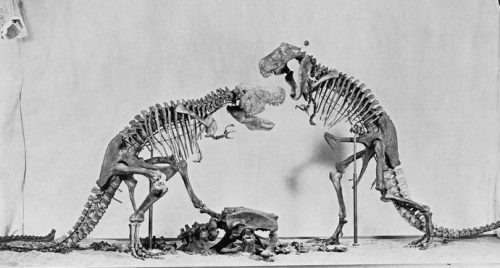
E.S. Christman’s miniature models act out Osborn’s unrealized battling Tyrannosaurus display. Image courtesy of the AMNH Research Library.

In 1908, Brown collected a much more complete Tyrannosaurus specimen (AMNH 5027), with over 50% of the skeleton intact, including the first complete skull and a significant portion of the torso. With this specimen in hand, AMNH technician Adam Hermann and his team began work on a mounted Tyrannosaurus skeleton to join the Museum’s growing menagerie of dinosaurs and prehistoric mammals. Inspired by the museum’s habitat dioramas and seeking to accentuate the spectacle of his reptilian monster, Osborn initially wanted to mount two Tyrannosaurus skeletons facing off over a dead hadrosaur. He even published a brief description, complete with 1/10th scale wooden models illustrating the proposed exhibit (above). However, the structural limitations inherent to securing heavy fossils to a steel armature, as well as the inadequate amount of Tyrannosaurus fossils available, made such a sensational display impossible to achieve.

Instead, Hermann prepared a single Tyrannosaurus mount, combining the 1908 specimen with plaster casts of the hips and femur from the 1905 holotype. The original skull was impractically heavy, so a cast was used in its place. Missing portions of the skeleton, including the arms, feet, and most of the tail, were sculpted by hand using bones from Allosaurus as reference. During the early 20th century, constructing fossil mounts was a relatively new art form, and while Hermann was one of the most talented and prolific mount-makers around, his techniques were somewhat unkind to the fossil material. Bolts were drilled directly into the fragile bones to secure them to the armature, and in some cases steel rods were tunneled right through them. Any fractures were sealed with plaster, and reconstructed portions were painted to be nearly indistinguishable from the original fossils. Like most of the early AMNH fossil mounts, preserving the integrity of the Tyrannosaurus bones was secondary to aesthetic concerns like concealing the unsightly armature.

The Tyrannosaurus mount takes shape. Image courtesy of the AMNH Research Library.

The completed Tyrannosaurus mount, a magnificent sculptural combination of bone, plaster, and steel, was unveiled in 1915 to stunned audiences. With its tooth-laden jaws agape and a long, dragging lizard tail extending its length to over 40 feet, the Tyrannosaurus was akin to a mythical dragon, an impossible monster from a primordial world. This dragon, however, was real, albeit safely dead for 66 million years. The December 3rd New York Times article was thick with hyperbole, declaring the dinosaur “the prize fighter of antiquity”, “the king of all kings in the domain of animal life,” “the absolute warlord of the earth” and “the most formidable fighting animal of which there is any record whatsoever.” Even Osborn got in on the game, calling Tyrannosaurus “the most superb carnivorous mechanism among the terrestrial Vertebrata, in which raptorial destructive power and speed are combined.”

Brian Noble argues that Osborn’s descriptions of T. rex betray his own racial anxiety and fear of obsolescence. As a member of the New York aristocratic class, Osborn supported eugenics and lobbied for race-based quotas on immigration. Within months of penning museum labels that lament the extinction of “great and noble” carnivores like Tyrannosaurus, Osborn was writing that “the greatest danger to the American republic is the gradual dying out…of those hereditary traits through which the principles of our religious, political, and social foundations were laid down and their insidious replacement by traits of a less noble character” (quoted in Noble 2017, pg. 73). Whether knowingly or not, Osborn allowed his fear of the fall of the de facto ruling class to which he belonged influence his interpretation of a long-dead dinosaur.
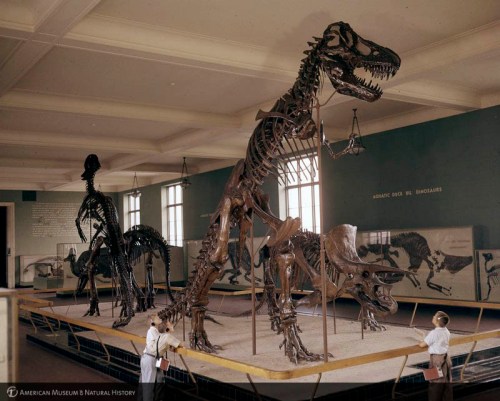
Hermann’s Tyrannosaurus continued to delight AMNH visitors through the 1980s. Image courtesy of the AMNH Research Library.

Today, we know that the original AMNH Tyrannosaurus mount was inaccurate in many ways. The upright, tail-dragging pose, which had been the most popular attitude for bipedal dinosaurs since Joseph Leidy’s 1868 Hadrosaurus mount, is now known to be incorrect. More complete Tyrannosaurus skeletons have revealed that the tail reconstructed by Osborn and Hermann was much too long. The Allosaurus-inspired feet were too robust, the legs (partially cast from the 1905 holotype) were too large, and the hands had too many fingers. It would be misleading to presume that the prehistoric carnivore’s skeleton sprang from the ground exactly as it was presented, but it is equally incorrect to reject it as a fake. The 1915 mount was a solid representation of the best scientific data available at the time, presented in an evocative and compelling manner.

The AMNH Tyrannosaurus mount was no less than a monument: for paleontology, for its host museum, and for the city of New York. The mount has been a New York attraction for longer than the Empire State Building, and for almost 30 years, AMNH was the only place in the world where visitors could see a T. rex in person. In 1918, Tyrannosaurus would make its first Hollywood appearance in the short film The Ghost of Slumber Mountain. This star turn was followed by roles in 1925’s The Lost World and 1933’s King Kong, firmly establishing the tyrant king’s celebrity status. It is noteworthy that special effects artist Willis O’Brian and model maker Marcel Delgado copied the proportions and posture of the AMNH display exactly when creating the dinosaurs for each of these films. The filmmakers took virtually no artistic liberties, depicting Tyrannosaurus precisely how contemporary scientists had reconstructed it at the museum.

II. A T. rex for Pittsburgh

The Carnegie Museum’s first attempt at restoring the skull of T. rexSource

In 1941, AMNH ended its Tyrannosaurus monopoly and sold the incomplete type specimen (the partial skeleton described in Osborn’s 1905 publication) to Pittsburgh’s Carnegie Museum of Natural History. While it is sometimes reported that this transfer took place to keep the valuable fossils out of harm’s way during World War II (e.g. Larson 2008), the deal was actually underway well before the United States became involved in the war. Carnegie Museum Director Andrew Avinoff spent nearly a year bargaining with Barnum Brown over a price, eventually settling on $100,000 ($1.7 million in today’s dollars) for the fossils with appropriate bases and mounting fixtures. Carnegie staff wasted no time assembling a mount of their own, but since the Tyrannosaurus holotype only included about 18% of the skeleton, most of the Pittsburgh T. rex had to be made from casted and sculpted elements. Somewhat pointlessly, the skull fragments included with the specimen were buried inside a plaster skull replica (above), making them inaccessible to researchers for several decades. Completed in less than a year, the Carnegie Tyrannosaurus was given a more hunched posture than its AMNH predecessor.
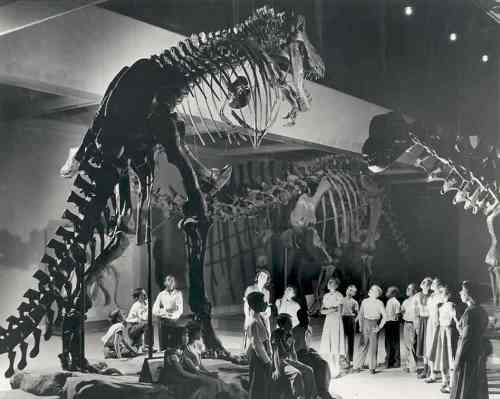
The Tyrannosaurus faced off with Diplodocus and Apatosaurus at the Carnegie Museum for more than 60 years. Source

The mid-20th century was a quiet phase for vertebrate paleontology. After enjoying public fame and generous federal support during the late 1800s, paleontology as a discipline was largely marginalized when experiment-driven “hard” sciences rose to prominence. By the 1950s and 60s, the comparably small number of researchers studying ancient life were chiefly concerned with theoretical models for quantifying trends in evolution. Although the aging dinosaur displays at American museums remained popular with the public, these animals were perceived as evolutionary dead-ends, of little interest to the majority of scientists.

While New York and Pittsburgh remained the only places where the tyrant king could be seen in person, the ongoing fame of T. rex was secured in part by two additional museum displays, ironically at institutions that did not have any actual Tyrannosaurus fossils on hand. In 1928, the Field Museum of Natural History commissioned Charles Knight to paint a series of prehistoric landscapes, the most recognizable of which depicts a face-off between Triceratops and a surprisingly spry Tyrannosaurus. In 1947, Rudolph Zallinger painted a considerably more bloated and lethargic T. rex as part of his Age of Reptiles mural at the Peabody Museum of Natural History. Both paintings would be endlessly imitated for decades, and would go on to define the prehistoric predator in the public imagination.

III. Rex Renaissance
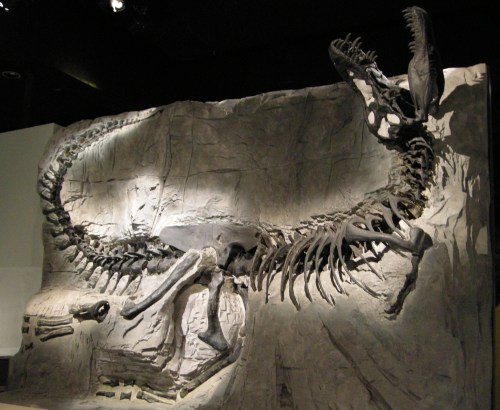
RTMP 81.6.1, aka Black Beauty, mounted in relief at the Royal Tyrell Museum. Source

The sparse scientific enthusiasm for dinosaurs that defined mid-century paleontology changed rather suddenly in the 1970s and 80s. The “dinosaur renaissance” brought renewed energy to the discipline in the wake of evidence that dinosaurs had been energetic and socially sophisticated animals. The next generation of paleontologists endeavored to look at fossils in new ways to understand dinosaur behavior, biomechanics, ontogeny, and ecology. Tyrannosaurus was central to the new wave of research, and has been the subject of hundreds of scientific papers since 1980. More interest brought more fossil hunters into the American west, leading to an unprecedented expansion in known Tyrannosaurus fossils.

The most celebrated Tyrannosaurus find from the dinosaur renaissance era came from Alberta, making it the northernmost and westernmost T. rex to date. The 30% complete “Black Beauty” specimen, so named for the black luster of the fossilized bones, was found in 1980 by a group of high schoolers and was excavated by paleontologist Phil Curie. The original Black Beauty fossils were taken on a tour of Asia before finding a permanent home at the newly established Royal Tyrell Museum in Drumheller, Alberta. In lieu of a standing mount, Black Beauty was embedded in a faux sandstone facade, mirroring the environment in which the fossils were found and the animal’s presumed death pose. This relief mount set Black Beauty apart from its AMNH and Carnegie predecessors, and even today it remains one of the most visually striking Tyrannosaurus displays.
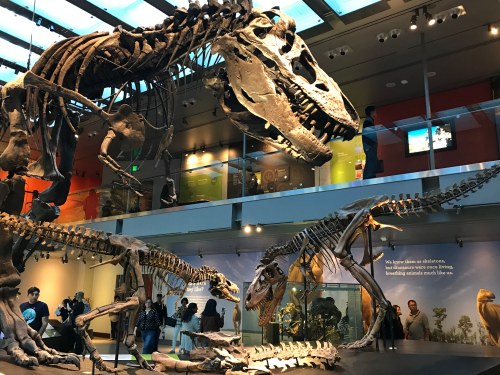
The mid-sized reconstruction (right) in this 2011 growth series at LACM incorporates Garbani’s juvenile T. rex fossils. Photo by the author.

Tyrannosaurus was once considered vanishingly rare, but by the early 1990s the number of known specimens had increased dramatically. Harley Garbani found three specimens, including the first T. rex juvenile, while prospecting in Montana for the Natural History Museum of Los Angeles County (LACM). “I was pretty excited,” Garbani recounted, “I didn’t figure another of those suckers would ever be found” (quoted in Horner and Lessem 1993). Meanwhile, the Royal Tyrell Museum tracked down a partial T. rex in Alberta that Charles Sternberg had marked in 1946 but never excavated.

One of the most complete Tyrannosaurus specimens was discovered by avocational collector Kathy Wankel while prospecting on Montana land owned by the Army Corps of Engineers. The Museum of Rockies (MOR) excavated the Wankel Rex in 1989, and until recently it was held it trust at the Bozeman museum. All of these specimens have allowed paleontologists to conduct extensive research on the growth rate, cellular structure, sexual dimorphism, speed, and energetics of T. rex, turning the species into a veritable model organism among dinosaurs.

IV. The World’s Most Replicated Dinosaur
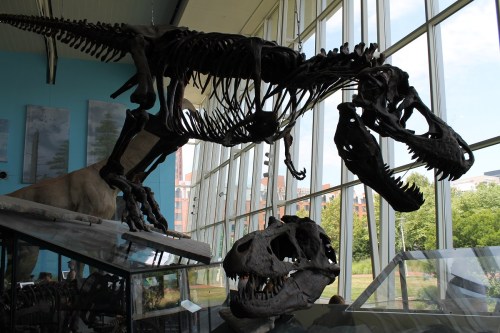
Cast of Peck’s Rex, accompanied by a Wankel Rex skull, at the Maryland Science Center. Photo by the author.

Despite the relative bonanza of new Tyrannosaurus specimens uncovered in the 1980s and 90s, very few of those skeletons were immediately assembled as display mounts. Instead, many museums have purchased complete casts to meet the increasing public demand for dinosaurs. In 1986, the Academy of Natural Sciences in Philadelphia opened Discovering Dinosaurs, the world’s first major exhibit showcasing active, endothermic dinosaurs. The centerpiece of the exhibit was a cast of the AMNH Tyrannosaurus, posed for the first time in the horizontal posture that we now know was the animal’s habitual stance. The following year, another AMNH cast appeared in the lobby of Denver Museum of Nature and Science in a strikingly bizarre pose, with one leg kicking high in the air. Robert Bakker—the mount’s designer— intended to push boundaries and demonstrate what a dynamic and energetic Tyrannosaurus might be capable of, although the mount has subsequently been described as dancing, kicking a soccer ball, or peeing on a fire hydrant.

Denver’s high-kicking T. rex. Source

Since the late 1990s, however, casts of another specimen have overtaken AMNH 5027 for the title of most ubiquitous T. rex. BHI 3033, more commonly known as Stan, was excavated in South Dakota in 1992 by the Black Hills Institute (BHI), a commercial outfit specializing in excavating, preparing, and mounting fossils. BHI has sold dozens of Stan casts to museums and other venues around the world. At a relatively affordable $100,000 plus shipping, even small local museums and the occasional wealthy individual can now own a Tyrannosaurus mount. With over 50 casts sold as of 2017, Stan is, by a wide margin, the most duplicated and most exhibited dinosaur in the world.
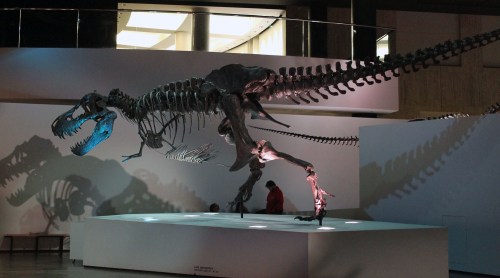
Stan cast at the Houston Museum of Natural Science. Photo by the author.

All these new Tyrannosaurus mounts are forcing museums to get creative, whether they are displaying casts or original fossils. Predator-prey pairings are a popular display choice: for example, the Wankel Rex cast at the Perot Museum of Nature and Science  is positioned alongside the sauropod Alamosaurus, and the Cleveland Museum of Natural History matches the tyrant dinosaur with its eternal enemy, Triceratops. Meanwhile, the growing number juvenile Tyrannosaurus specimens has allowed for family group displays. LACM features an adult, subadult, and baby, while the Burpee Museum of Natural History pairs its original juvenile T. rex “Jane” with an AMNH 5027 cast. The most unique Tyrannosaurus mount so far is certainly the copulating pair at the Jurassic Museum of Asturias.
While not as widespread as Stan, casts of the Wankel Rex (distributed by Research Casting International) are increasingly common. This copy at the Google headquarters is periodically attacked by smaller, pinker theropods. Source

Each of these displays gives a substantially different impression of Tyrannosaurus. Depending on the mount, visitors might see T. rex as a powerful brute, a fast and agile hunter, or a nurturing parent (or a gentle lover). Most mounts are accurate insofar that a real Tyrannosaurus probably adopted a similar stance at some point, but the museum’s choice of pose nevertheless influences visitors’ understanding of and attitude toward the dinosaur.

V. Restoring the Classics
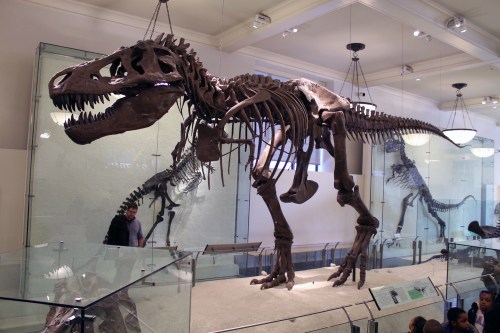
An update for the first T. rex ever displayed. Photo by the author.

With dozens of new Tyrannosaurus mounts springing up across the country and around the world, the original AMNH and Carnegie displays began to look increasingly obsolete. However, modernizing historic fossil mounts is an extremely complex and expensive process. The early 20th century technicians that built these displays generally intended for them to be permanent: bolts were drilled directly into the bones and gaps were sealed with plaster that can only be removed by manually chipping it away. What’s more, the cumulative effects of corroding armatures, fluctuating humidity, and vibration from passing crowds had damaged the historic mounts over the course of their decades on display.

Despite these challenges, AMNH and the Carnegie Museum have both been able to restore and update their classic Tyrannosaurus displays. Between 1987 and 1995, Lowell Dingus coordinated a comprehensive renovation of the AMNH fossil exhibits. As part of the project, chief preparator Jeanne Kelly led the restoration and remounting of the iconic T. rex. The fossils proved especially fragile, and some elements had never been completely freed from the sandstone matrix. It took six people working for two months just to strip away the layers of paint and shellac applied by the original preparators.

Exhibit specialist Phil Fraley constructed the new armature, which gave the tyrant king a more accurate horizontal posture. While the old mount was supported by obtrusive rods extending from the floor, the new version is actually suspended from the ceiling with a pair of barely-visible steel cables. Each bone is secured to an individual metal bracket, allowing researchers to remove elements for study as necessary. A new cast of the skull was also prepared, this time with open fenestrae for a more natural appearance. Curators Gene Gaffney and Mark Norrell settled on a fairly conservative stalking pose—a closed mouth and subtly raised left foot convey a quiet dignity befitting this historic specimen.
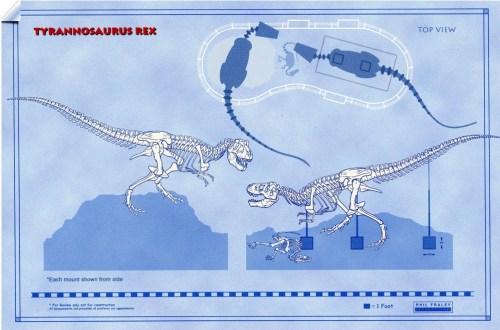
One of many conceptual drawings created by Phil Fraley Productions during the process of planning the Carnegie Museum renovation. Source

Historically, the Carnegie Tyrannosaurus had never quite lived up to its AMNH predecessor. Although it incorporated the Tyrannosaurus holotype, it was mostly composed of casts from the New York skeleton, and it sported an unfortunately crude replica skull. It is therefore ironic that the Carnegie Museum now exhibits the more spectacular T. rex display, one which  realizes Osborn’s plan to construct an epic confrontation between two giant predators.

While less complete than many subsequent finds, the Tyrannosaurus rex holotype is still important because it defines the species. It had not been studied properly since the early 20th century, however, and the skull elements were completely inaccessible—entombed in plaster since 1941. The conservation team overseen by Hans-Dieter Sues sought not only to rebuilt the exhibit mount, but to re-describe the specimen and provide casts of individual bones to other museums. The Carnegie website once hosted a fascinating day-by-day account this process. The page seems to have been removed but an archived version can be found here.
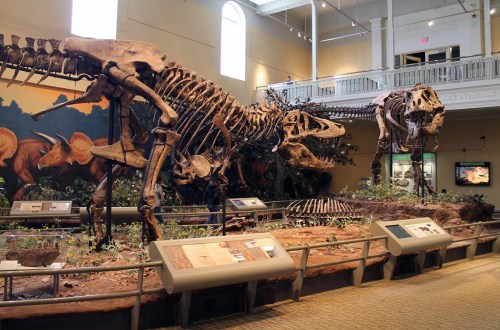
Old meets new: the restored Tyrannosaurus holotype faces off with a cast of Peck’s Rex. Photo by the author.

Phil Fraley, now heading an independent company based in New Jersey, oversaw the construction of the new mount. Michael Holland contributed a new restored skull, actually a composite of several Tyrannosaurus skulls. The mount was completed in 2007, and is displayed alongside a cast of “Peck’s Rex,” a specimen housed at MOR. Despite the difficulty of modernizing the historic specimen, the team reportedly developed a healthy respect for turn-of-the-century mount-makers like Adam Hermann and Arthur Coggeshall, who developed the techniques for making enduring displays of fragile fossils that are still being refined today.

VI. From South Dakota to Chicago
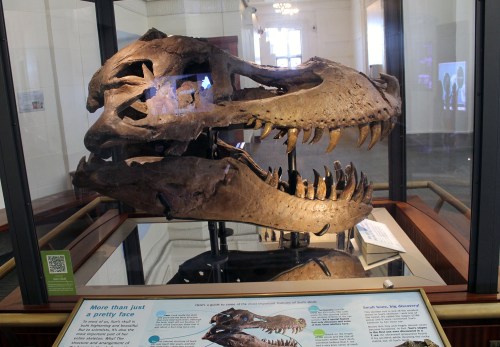
The skull of SUE the T. rex. Photo by the author.

Tyrannosaurus rex displays changed for good in the 1990s thanks to two individuals, one real and one fictional. The latter was of course the T. rex from the film Jurassic Park, brought to life with a full-sized hydraulic puppet, game-changing computer animation, and the inspired use of a baby elephant’s screeching cry for the dinosaur’s roar. The film made T. rex real—a breathing, snorting, drooling animal unlike anything audiences had ever seen. Jurassic Park was a tough act to follow, and in one way or another, every subsequent museum display of the tyrant king has had to contend with the shadow cast by the film’s iconic star.

The other dinosaur of the decade was SUE, who scarcely requires an introduction. SUE is the most complete Tyrannosaurus ever found, with 90% of the skeleton intact. Approximately 30 years old at the time of their death, SUE is also the eldest T. rex known, and within the margin of error for the title of largest. The specimen’s completeness and exquisite preservation has allowed paleontologists to ascertain an unprecedented amount of information about this individual dinosaur. In particular, SUE’s skeleton is riddled with fractured and arthritic bones, as well as evidence of gout and parasitic infections that together paint a dramatic picture of a violent life at the top of the food chain.

It was the events of SUE’s second life, however, that made this the fossil the world knows by name. SUE was discovered in 1990 by Sue Hendrickson (for whom the specimen is named) on ranch land within the Cheyenne River reservation of South Dakota. The Black Hills Institute excavated the skeleton and initially intended to display the Tyrannosaurus at a new facility in Hill City. Even at this point, SUE was a flashpoint for controversy among paleontologists: while several researchers signed up to work with BHI on a monograph about SUE, others did not think a for-profit company was an appropriate place for such an important specimen. Things heated up in 1992, when BHI became embroiled in a four-way legal battle with landowner Maurice Williams, the Cheyenne Council, and the United States Department of the Interior. With little legal precedent for ownership disputes over fossils, it took until 1995 for the District Court to award Williams the skeleton (I recommend the relevant chapter in Grande 2017 as the most evenhanded account of how this went down).

Williams announced that he would put SUE on the auction block, and paleontologists initially worried that the priceless specimen would disappear into the hands of a wealthy collector, or end up in a crass display at a Las Vegas casino. Those fears were put to rest in 1997 when the Field Museum of Natural History (FMNH) won SUE with financial backing from McDonald’s and Disney. Including the auctioneer’s commission, the price was an astounding $8.36 million.
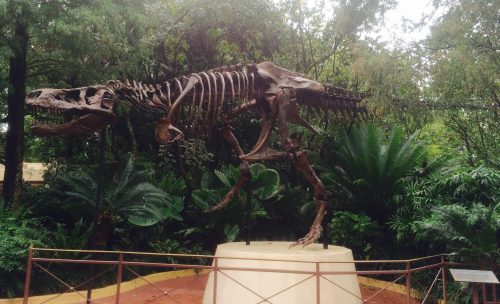
Research Casting International prepared two SUE casts: one for a traveling exhibition and this one at Walt Disney World in Orlando. Photo by the author.

FMNH and its corporate backers did not pay seven figures for SUE solely to learn about dinosaur pathology.  SUE’s remarkable completeness would be a boon for scientists, but the fossil’s star power was at least as important for the museum. SUE was a blockbuster attraction that would bring visitors in the door, and the dinosaur’s name and likeness could be marketed for additional earned income. As former FMNH president John McCarter explained, “we do dinosaurs…so that we can do fish” (quoted in Fiffer 2000). A Tyrannosaurus would attract visitors and generate funds, which could in turn support less sensational but equally important collections maintenance.

Once SUE arrived at FMNH, the museum did not hold back marketing the dinosaur as a must-see attraction. A pair of SUE’s teeth went on display days after the auction. This expanded organically into the “SUE Uncrated” exhibit, where visitors could watch the plaster-wrapped bones being unpacked and inventoried. The main event, of course, was the mounted skeleton, which needed to be ready by the summer of 2000. This was an alarmingly short timetable, and the FMNH team had to hit the ground running. Although BHI had already put in 4,000 hours of prep work, much of SUE’s skeleton was still buried in rock and plaster. The bones needed to be prepared and stabilized before they could be studied, and they needed to be studied before they could be mounted.
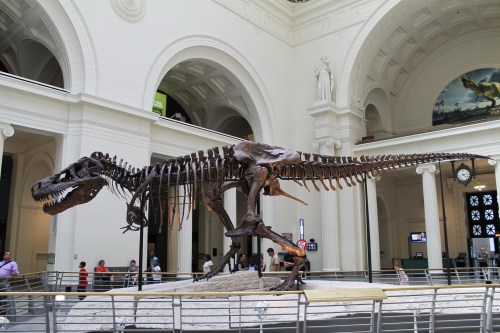
SUE as displayed from 2000 to 2017. Photo by the author.

After reviewing a number of bids, FMNH selected Phil Fraley to prepare SUE’s armature. Fraley had already remounted the AMNH T. rex at that point, and left his post at the New York museum and founded his own company so that he could work on SUE. Just as had been done with the AMNH skeleton, Fraley’s team built an armature with individual brackets securing each bone, allowing them to be removed with relative ease for research and conservation. No bolts were drilled into the bones and no permanent glue was applied, ensuring that the fossils were not damaged for the sake of the exhibit. SUE was placed right at the heart of the museum, in the half-acre, four-story expanse of Stanley Field Hall. Despite these cavernous surroundings, SUE was given a low, crouching posture—the intent was to give visitors a face-to-face encounter with T. rex.

SUE was revealed to the public on May 17, 2000 with the dropping of a curtain. 10,000 visitors came to see SUE on opening day, and that year the museum’s attendance soared from 1.6 to 2.4 million. To this day, headlines about SUE are common, even outside of Chicago, and the Field Museum’s increasingly avant garde @SUEtheTrex twitter account has 60,000 followers and counting. SUE has been the subject of more than 50 technical papers, several books, and hundreds of popular articles. When FMNH brought SUE to Chicago, they weren’t just preserving an important specimen in perpetuity, they were creating an icon.

VII. Tyrannosaurs Invade Europe

Tristan at Berlin’s Museum fur Naturkunde. Photo by Heinrich Mallison.

Tyrannosaurus is an exclusively North American animal. It follows that real Tyrannosaurus skeletons have historically only been displayed in American and Canadian museums, while the rest of the world has had to content itself with casts of Stan and the Wankel Rex. This situation changed recently, and there are now two original T. rex skeletons on display in European museums.

The first was Tristan, a Tyrannosaurus collected in 2000 by private collectors. Niels Nielsen, a Danish real estate developer, bought the skeleton for an undisclosed sum (he named the dinosaur Tristan after his son). While it is common for art museums to display privately owned objects, scientific institutions usually avoid such arrangements.  There are many reasons for this: it may be a museum’s policy to avoid legitimizing the private market for one-of-a-kind specimens, or they may simply want to steer clear of demands by owners regarding exhibition and interpretation. Perhaps most importantly, scientific research on privately owned specimens is not necessarily reproducible, because there is no guarantee the specimen will remain in a publicly-accessible repository.

Despite these drawbacks, Director Johannes Vogel of the Museum für Naturkunde in Berlin decided to accept Tristan as a loan. Paleontologist Heinrich Mallison worked with Nielsen and others to design the mount and plan how it would fit into the exhibit hall. The team opted to pose Tristan as though making a rapid left turn around a “tree” (one of the cast iron columns bisecting the room). Unfortunately, the final armature did not effectively capture the intended twisting motion in the torso, hips, and right leg, and the resulting mount is stiffer looking then the initial renders. The public does not seem to have minded, however. Tristan was unveiled in September 2015 and drew half a million visitors in its first six months on display.
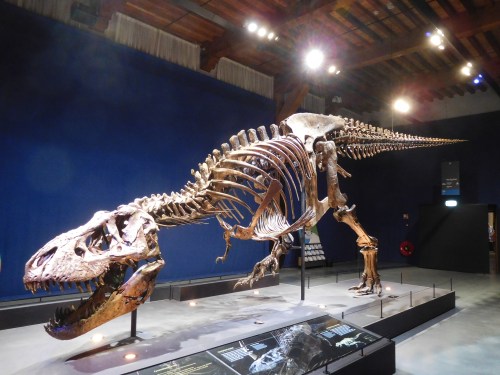
Trix the T. rex in a temporary exhibit space at the Naturalis Biodiversity Center. Source

Europe’s second Tyrannosaurus mount debuted in September 2016 at the Naturalis Biodiversity Center in Leiden. Named Trix after the Netherlands’ Queen Beatrix, this specimen was collected in Montana by a crew from the museum working in collaboration with the Black Hills Institute. The mount constructed by BHI uniquely includes the original skull, rather than a lightweight replica. This was accomplished by posing Trix in a low running pose, with its head skimming less than a foot above the ground.

VIII. Into the Future
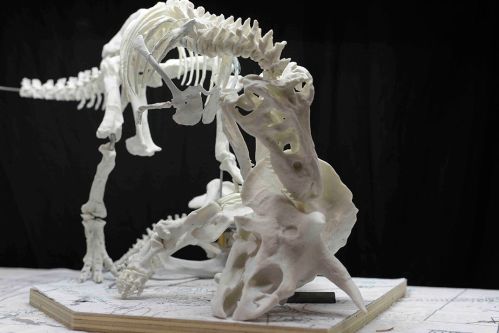
A 1/10th scale 3-D printed model of the Nation’s T. rex recalls the wooden maquettes used at AMNH over a century ago. Source

New T. rex displays just keep coming. In 2019, the National Museum of Natural History reopened its paleontology halls after a five year renovation. The new “Deep Time” exhibition has a brand-new Tyrannosaurus mount as its centerpiece. The specimen in question is the Wankel Rex, which had been held in trust at the Museum of the Rockies since it was excavated in 1989. Found on Army Corps of Engineers land, the fossils are owned by the federal government and therefore an ideal candidate for display at the national museum (technically, they are on a 50 year loan from the Corps to the Smithsonian).
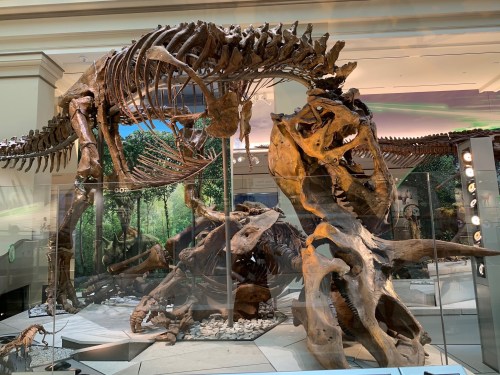
Look closely the fallen Triceratops and you’ll see crushed ribs, a broken horn, and that its head is no longer attached to its body

Although several casts of the Wankel Rex are on display around the world, this is the first time the original fossils have been assembled into a standing mount. For Curator Matt Carrano, it was important that the T. rex was presented like an animal, rather than a sculpture. To accomplish this, he devised a deliriously cool pose, with the Tyrannosaurus poised as though prying the head off a prone Triceratops. Pulling off such a scene was easier said than done. Extreme poses are relatively straightforward when working with lightweight casts, but the degree of dynamism Carrano wanted is much more complicated when creating a frame that safely supports real fossils. Just like Hermann and Christian a century earlier, Matt Fair and his colleagues at Research Casting International started with a 10th scale miniature before moving on to the real skeleton.

Now on display at NMNH, the Wankel Rex has a new nickname: the Nation’s T. rex. This moniker is appropriate: NMNH follows only the Louvre in annual visitation, sometimes topping 8 million people. That means the Nation’s T. rex will soon be the most-viewed Tyrannosaurus skeleton in the world. In all likelihood, 60 million people will pass by the mounted skeleton in the next decade.
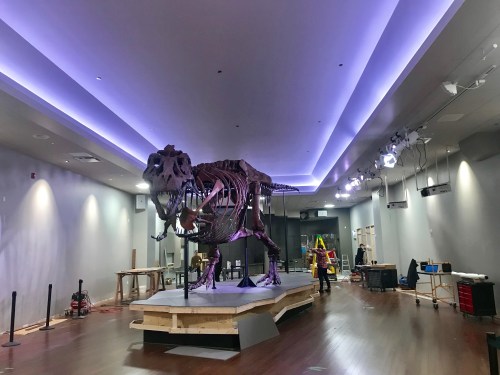
SUE the T. rex in their not-quite-finished throne room. Photo by the author.

Nevertheless, the Nation’s T. rex has competition. In 2018, the Field Museum moved SUE to a 6,500 square foot gallery adjacent to the main dinosaur hall. The new exhibition (full disclosure: I was a co-developer on this project) gives SUE some much-needed context. In contrast to the neoclassical space it once occupied, the mounted T. rex is now part of a media-rich experience that Brown, Hermann, and Osborn could have scarcely imagined. An animated backdrop illustrates the waterlogged forests where Tyrannosaurus lived, and a narrated light show provides a tour of SUE’s skeleton—highlighting pathologies and other key features.

With guidance from Pete Makovicky, Tom Cullen, and Bill Simpson, Garth Dallman and colleagues at Research Casting International modified the original SUE mount to correct a range of anatomical inaccuracies and reunite the skeleton with its gastralia (rib-like bones embedded in the belly muscles). This is the first time a Tyrannosaurus skeleton has been mounted with a real gastral basket, and it gives the dinosaur a girthier silhouette. Many lines of evidence have converged onto this new look for T. rex. The animal was not the lithe pursuit predator it was portrayed as in the 1990s, but an ambush hunter with the raw weight and muscle to overpower its bus-sized prey.

SUE’s new digs combine immersive media with elegant and austere design language. Photo by the author.

As we have seen, the number of Tyrannosaurus skeletons on exhibit, whether original fossils or casts, has exploded in recent years. Fifty years ago, New York and Pittsburgh were the only places where the world’s most famous dinosaur could be seen in person. Today, there may well be over a hundred Tyrannosaurus mounts worldwide (most of which are identical casts of a handful of specimens). These displays have evolved over time: new scientific discoveries changed the animal’s pose and shape, new technology has allowed for more enriching and immersive exhibits, and popular media presentations of T. rex have continuously increased the public’s expectations for their encounter with the real thing.

Meanwhile, each T. rex on display exists in a socio-political context: human actors “create the initial and enduring performative iterations of T. rex” (Noble 2016, 71). A century ago, the first-ever T. rex exhibit was encoded with one man’s prejudice and social hangups. In the present, another T. rex—SUE—has become a nonbinary icon.  The Field Museum now refers to SUE as “they” instead of “she,” both in the spirit of scientific accuracy (we don’t know SUE’s sex) and LGBTQ+ inclusivity. As explained in a press release, “this kind of representation can make a big difference in the lives of the LGBTQ community. It’s not about politics; it’s about respect. If our Twitter dinosaur gets more people used to using singular “they/them” pronouns and helps some folks out there feel less alone, that seems worth it to us.”

For museums, acquiring and displaying a T. rex is not exactly a risk. As Carrano explained with respect to the Nation’s T. rex, “the T. rex is not surprising, but that’s not its job. Its job is to be awesome.” Specimens like the Nation’s T. rex or SUE are ideal for museums because they are at once scientifically informative and irresistibly captivating. Museums do not need to choose between education and entertainment because a Tyrannosaurus skeleton effectively does both. And even as ever more lifelike dinosaurs grace film screens, museums are still the symbolic home of T. rex. The iconic image associated with Tyrannosaurus is that of a mounted skeleton in a grand museum hall, just as it was when the dinosaur was introduced to the world nearly a century ago. The tyrant king is an ambassador to science that unfailingly excites audiences about the natural world, and museums are lucky to have it.

References

Asma, S.T. 2001. Stuffed Animals and Pickled Heads: The Culture and Evolution of Natural History Museums. New York, NY: Oxford University Press.

Boas, F. 1907. Some Principles of Museum Administration. Science 25:650:931-933.

Black, R. 2013. My Beloved Brontosaurus: On the Road with Old Bones, New Science and our Favorite Dinosaurs. New York, NY: Scientific American/Farrar, Straus and Giroux.

Clemens, W.A. and Hartman, J.H. 2014. “From Tyrannosaurus rex to asteroid impact: Early studies (1901-1980 of the Hell Creek Formation in its type area.” Through the End of the Cretaceous in the Type Locality of the Hell Creek Formation in Montana and Adjacent Areas. Eds. Wilson, G.P., Clemens, W.A., Horner, J.R., and Hartman, J.H. Boulder, CO: Geological Society of America.

Colbert, E.H., Gillette, D.D. and Molnar, R.N. “North American Dinosaur Hunters.” The Complete Dinosaur, Second Edition. Brett-Surman, M.K., Holtz, T.R. and Farlow, J.O., eds. Bloomington, IN: Indiana University Press.

Counts, C.M. 2009. Spectacular Design in Museum Exhibitions. Curator 52: 3: 273-289.

Dingus, L. 1996. Next of Kin: Great Fossils at the American Museum of Natural History. New York, NY: Rizzoli International Publications, Inc.

Dingus, L. 2004. Hell Creek, Montana: America’s Key to the Prehistoric Past. New York, NY: St. Martin’s Press.

Dingus, L. 1996. Next of Kin: Great Fossils at the American Museum of Natural History. New York, NY: Rizzoli International Publications, Inc.

Fiffer, S. 2000. Tyrannosaurus Sue: The Extraordinary Saga of the Largest, Most Fought Over T. rex ever Found. New York, NY: W.H. Freeman and Company.

Fox, A. and Carrano, M. 2018. Q&A: Smithsonian Dinosaur Expert Helps T. rex Strike a New Pose. Smithsonian Magazine. https://www.smithsonianmag.com/blogs/national-museum-of-natural-history/2018/07/17/q-smithsonian-dinosaur-expert-helps-t-rex-strike-new-pose

Freedom du Lac, J. 2014. The T. rex that got away: Smithsonian’s quest for Sue ends with different dinosaur. Washington Post.

Glut, D. 2008. “Tyrannosaurus rex: A century of celebrity.” Tyrannosaurus rex, The Tyrant King. Larson, Peter and Carpenter, Kenneth, eds. Bloomington, IN: Indiana University Press.

Grande, L. 2017. Curators: Behind the Scenes of Natural History Museums. Chicago, IL: University of Chicago Press.

Hermann, A. 1909. “Modern Laboratory Methods in Vertebrate Paleontology.” Bulletin of the American Museum of Natural History 21:283-331.

Horner, J.R. and Lessem, D. 1993. The Complete T. rex: How Stunning New Discoveries are Changing Our Understanding of the World’s Most Famous Dinosaur. New York, NY: Simon and Schuster.

Johnson, K. and Stucky, R.K. 2013. “Paleontology: Discovering the Ancient History of the American West.” Denver Museum of Nature and Science Annals, No. 4.

Larson, N. 2008. “One Hundred Years of Tyrannosaurus rex: The Skeletons.” Tyrannosaurus rex, The Tyrant King. Larson, Peter and Carpenter, Kenneth, eds. Bloomington, IN: Indiana University Press.

Lee, B.M. 2005. The Business of Dinosaurs: The Chicago Field Museum’s Nonprofit Enterprise. Unpublished thesis, George Washington University.

McGinnis, H.J. 1982. Carnegie’s Dinosaurs: A Comprehensive Guide to Dinosaur Hall at Carnegie Museum of Natural History, Carnegie Institute. Pittsburgh, PA: The Board of Trustees, Carnegie Institute.

“Mining for Mammoths in the Badlands: How Tyrannosaurus Rex Was Dug Out of His 8,000,000 Year old Tomb,” The New York Times, December 3, 1905, page SM1.

Nobel, B. 2016. Articulating Dinosaurs: A Political Anthropology. Toronto, ON: University of Toronto Press.

Norell, M., Gaffney, E.S. and Dingus, L. 1995. Discovering Dinosaurs: Evolution, Extinction, and the Lessons of Prehistory.  Berkeley, CA: University of California Press.

Osborn, H.F. 1906. Tyrannosaurus, Upper Cretaceous Carnivorous Dinosaur: Second Communication. Bulletin of the American Museum of Natural History vol. 22, pp. 281-296.

Osborn, H.F. 1913. Tyrannosaurus, Restoration and Model of the Skeleton. Bulletin of the American Museum of Natural History vol 32, pp. 9-12.

Osborn, H.F. 1916. Skeletal Adaptations of OrnitholestesStruthiomimus, and TyrannosaurusBulletin of the American Museum of Natural History vol 35, pp. 733-771.

Psihoyos, L. 1994. Hunting Dinosaurs. New York, NY: Random House, Inc.

Rainger, R. 1991. An Agenda for Antiquity: Henry Fairfield Osborn and Vertebrate Paleontology at the American Museum of Natural History, 1890-1935. Tuscaloosa, Alabama. University of Alabama Press.

Wesihampel, D.B. and White, Nadine M. 2003.The Dinosaur Papers: 1676-1906. Washington, DC: Smithsonian Books.
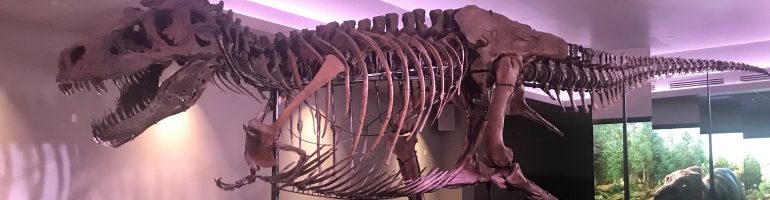
8 Comments

Filed under AMNH, CMNH, dinosaurs, DMNS, exhibits, FMNH, fossil mounts, history of science, HMNS, museums, reptiles, science communication, theropods

Dinosaurs at the Cincinnati Museum Center

A grand view upon entering the new CMC dinosaur hall.

Cincinnati’s Union Terminal is an incredible building. This colossal art deco structure is a sight to behold inside and out, and the muraled semi-dome in its central rotunda is among the largest of its kind in the world. Built in 1933 as a train station (and functioning as one today, after a mid-century hiatus), Union Terminal is also home to the Cincinnati Museum Center (CMC), which relocated here from a downtown location in the early 1990s.

I visited CMC once before in 2013, to see the traveling Ultimate Dinosaurs exhibit. I also saw the permanent natural history exhibits that were in place at the time, which included some very elaborate walk-through reconstructions of a Pleistocene forest and a modern cave. These exhibits were constructed in the 90s, and had a lot of the hallmarks of museum design in that era. For example, the ice age galleries were framed around visitors “examining evidence like scientists,” which in practice involved binary question-and-answer stations and interactives where the action performed didn’t really connect with the concept meant to be communicated. Nevertheless, the actual fossil collection on display—mostly from Big Bone Lick in Kentucky—was impressive, as were the ambitious, large-scale dioramas.

The 1990s-era ice age gallery.

This huge diorama featured life-sized wolves, a ground sloth, and a mastodon mired in mud.

Since then, Union Terminal and CMC have undergone a sweeping transformation. In 2014, the National Trust named the building—which had never been completely renovated in its 80 year history—one of the country’s most endangered historic places. Happily, the county took action, and raised funds to restore and modernize Union Terminal. In the process, most of the existing museum galleries were completely demolished, and the spaces they occupied were restored to match the building’s original architecture.

This strikes me as a bold move. Typically, legacy museums will gradually update or replace old exhibits as funding allows. In contrast, the CMC renovation started with a total teardown, and new exhibits are now being added in phases. As of this writing, the natural history and science side of the building includes a brand-new dinosaur gallery (discussed here), the aforementioned walk-through cave, a partial exhibit on the moon landing, and an assortment of temporary-looking exhibits. A new ice age gallery, the rest of the space exhibit, and immersive exhibits about Cincinnati history are slated to open later this year, and it appears fundraising is underway for future projects, including a Paleozoic fossil hall.

The hall’s only ornithischian Othnielosaurus follows in the footsteps of Galaemopus and Diplodocus.

To cut to the chase, the dinosaur hall is excellent. Developed by senior project manager Sarah Lima and curator Glenn Storrs, this is effectively a brand-new exhibit, since the old dinosaur gallery was quite limited. When the original CMC exhibits were built, the strengths of the vertebrate paleontology collections were primarily in Quaternary mammals and Paleozoic invertebrates. Over the last 20 years, however, the museum has been focused on the Jurassic. In particular, regular field work at the Mother’s Day Quarry in Montana has yielded a trove of Jurassic fossils, including some very unique sauropod specimens. The gallery includes an 80% complete Galaemopus, a composite juvenile Diplodocus, sauropod skin impressions, and a one-of-a-kind juvenile Diplodocus skull. In spite of the unspoken adage, the Morrison fauna is not resolved, and new secrets of this ecosystem are still being recovered.

Torvosaurus towers over a composite Allosaurus assembled from Cleveland-Lloyd fossils.

Other key specimens in the new exhibit were purchased from commercial fossil collectors. Jason Cooper, a Cincinnati native, discovered the Torvosaurus, which is the only real specimen of its kind on display anywhere. Along with his father Dan and brother Ben, Cooper excavated the 50% complete skeleton from a private Colorado ranch and prepared and mounted it for display. The museum purchased the Daspletosaurus from the Rocky Mountain Dinosaur Research Center. Anthony Maltese and colleagues excavated the skeleton in 2006 and prepared it over the course of several years.

Nicknamed “Pete III,” the Daspletosaurus shares its platform with two Dromaeosaurus casts and a cast skull of the Nation’s T. rex.

Like many newer fossil exhibits, the gallery is well-lit and spacious. The art deco design of Union Terminal informs the look of the hall: large windows fill the space with natural light, and the larger specimens are arranged on minimalist platforms that can be viewed from many angles, including from above. I found it noteworthy how close visitors can get to the mounted skeletons. Although the platforms are fairly high up, there are no glass barriers. I found that I could get within a few inches of the Galaemopus feet without much effort. I’m sure a slightly taller or more determined person could manage to touch the fossils.

Hopefully, they’ll be distracted by the many exhibit elements that are meant to be touched. In contrast to the 1990s exhibits, CMC has mostly done away with physical interactives, instead emphasizing touchable models and digital touchscreens. One particularly impressive inclusion are the digital video cameras (in robust cylindrical housing) connected to large monitors. Visitors can use these to get real-time magnified views of certain fossils, including a chunk of Tyrannosaurus medullary bone. This set-up couldn’t have been cheap! I also had fun with a set of telescopes aimed at certain parts of the dinosaur skeletons, such as a series of fused vertebrae in the Galaemopus tail. These are outfitted with targeting lasers (!) to help pinpoint the key features.

Each “closer look” station includes a telescope (with targeting laser!) aimed at an important skeletal feature, plus a bronze cast of that same element.

This bronze miniature Allosaurus is one of four similar models.

Not every visitor can see the fossil mounts, so CMC worked with David Grimes of the Clovernook Center for the Blind and Visually Impaired to help people with low vision experience the exhibit. Braille is incorporated into many of the displays, and the hall is full of touchable bronze models, ranging from individual bones (like the aforementioned Galaemopus vertebrae) to fleshed-out reconstructions (such as Confuciusornis). Four of the dinosaur mounts are recreated as bronze miniatures. Structures like ribs and vertebral processes are quite thin at this scale and susceptible to bending or breaking, so the exhibit team went with a half-fleshed look to make the models more durable. The Field Museum landed on the same solution with the touchable miniature SUE, but credit is due to the CMC team for getting their models to stand up, rather than being presented in relief.

A real Apatosaurus skull, one of many treasures hidden away in smaller cases throughout the hall.

If I were to critique one element of the hall, it would be that some of the labels, graphics, and interactives are spatially disconnected from the fossils they relate to. For example, a digital touchscreen where visitors can manipulate a 3D scan of an Apatosaurus skull is nowhere near the real skull displayed elsewhere in the exhibit, and the only label for Othnielosaurus is on the opposite side of the platform from the mounted skeleton. This is, of course, a minor concern, and I can only imagine the difficulty of arranging an exhibit with as much verticality as this one.

Overall, the new CMC dinosaur hall is fantastic, whether one is considering the specimens on display, the story being told, or the aesthetics of the space. The collection of real, new-to-science specimens makes this exhibit stand out among other paleontology halls, but I’m curious how the museum’s general audience will respond. A once-expansive museum closed for two years, and opened with an excellent exhibit that nevertheless is much smaller than what was once on display. Will visitors be satisfied with quality over quantity? And will they keep returning as new CMC exhibits are completed over the coming years? Time will tell.


2 Comments

Filed under dinosaurs, exhibits, fossil mounts, museums, opinion, reviews, sauropods, science communication, theropods, Uncategorized