Category Archives: FMNH

Framing Fossil Exhibits: Environmental Change

Over the past few months, I’ve been writing about the strengths and weaknesses of various large-scale paleontology exhibits from an educational standpoint. Check out the Introduction, Walk Through Time, Phylogeny, and Habitat Immersion posts if you’d like to catch up. I’ll wrap up this series for the time being with a look at two upcoming renovations of classic fossil displays, which appear to have converged on similar aesthetic, organizational, and interpretive approaches.

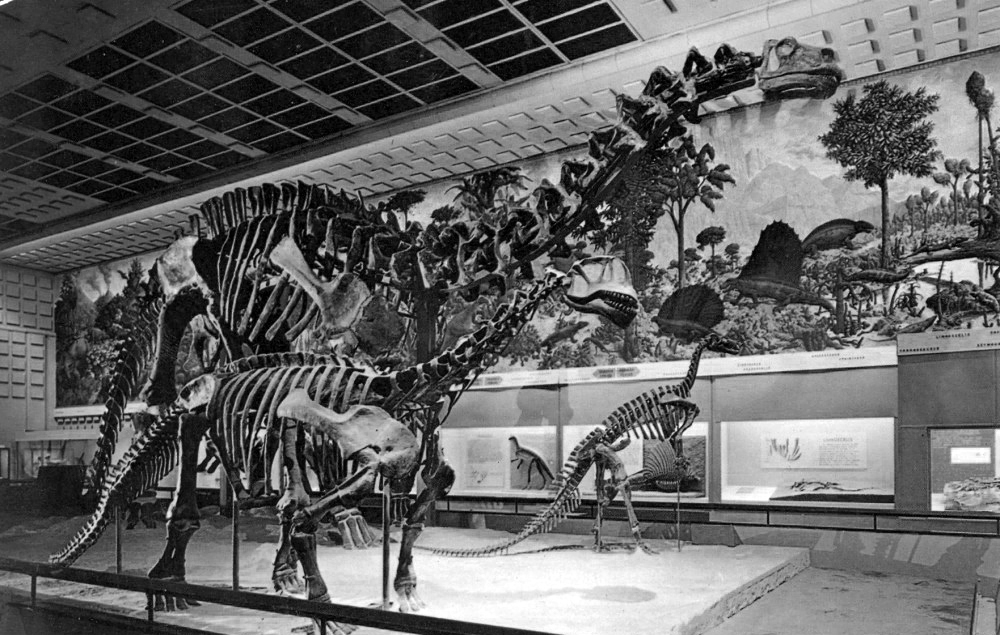
First up is the Peabody Museum of Natural History, where the Great Hall of Dinosaurs and adjacent Hall of Mammal Evolution have seen little modification since the 1950s. While the PMNH fossil galleries are fascinating as a time capsule of mid-century exhibit design, much of the content is rather dated and a thorough overhaul is sorely needed. PMNH staff started planning for the renovation in 2010, and I highly recommend Collections Manager Chris Norris’s blog posts on the process. Once the basic layout and concepts were in order, the museum hired the architectural firm Studio Joseph to prepare the images being used to promote the project. Fundraising is now underway, but an estimated completion date has yet to be announced.

Great hall

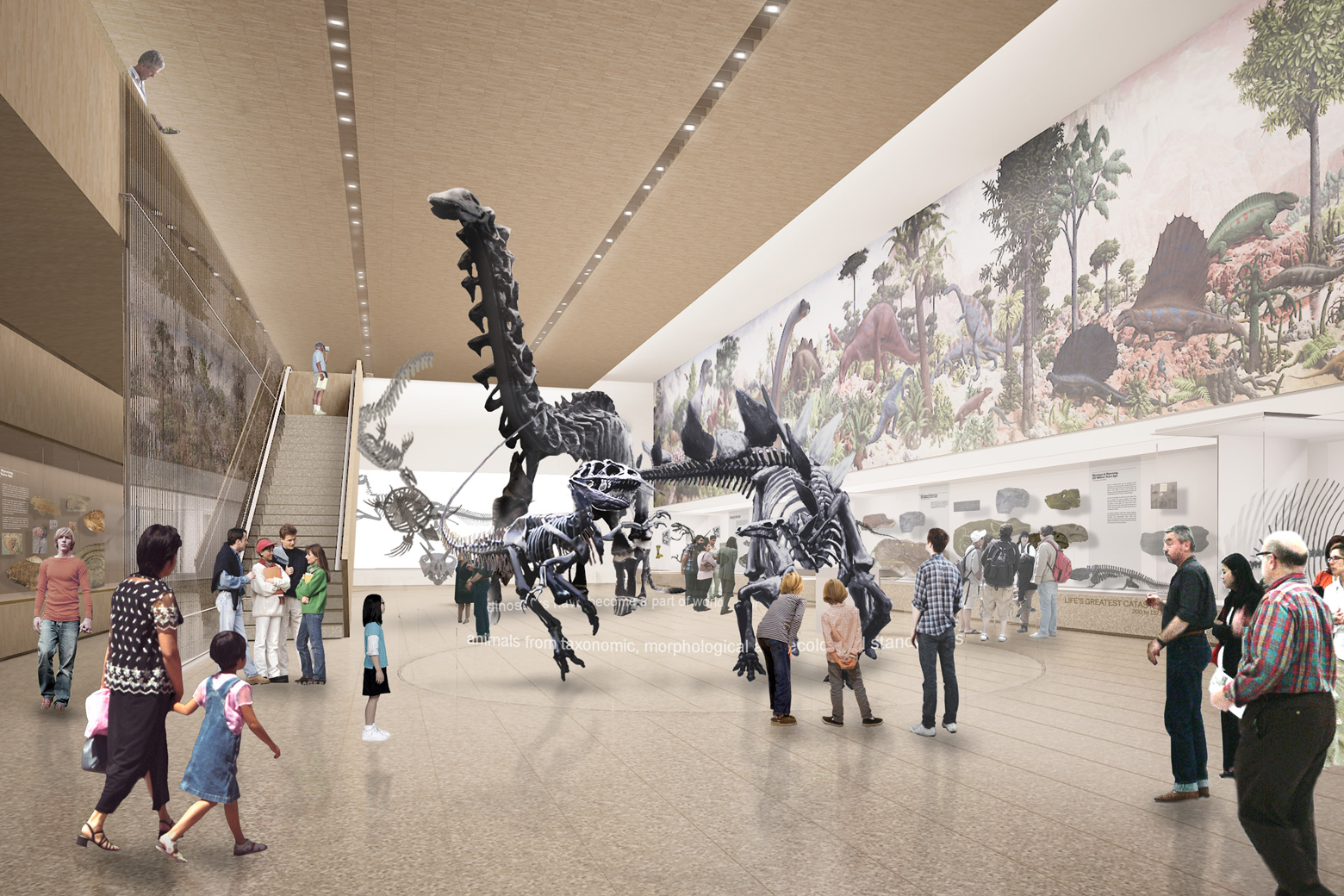
Conceptual render of the Great Hall of Dinosaurs by Studio Joseph. Source

The big idea behind the new exhibit is the dynamic relationship between the biosphere and the Earth’s various other spheres (atmosphere, geosphere, hydrosphere, etc). The evolution of life on Earth did not occur in a vacuum, but as part of a continuously changing global system. This narrative does have a time axis – visitors will travel from the Permian at one end of the exhibit to the Quaternary at the other – but the precise divisions of geologic time are de-emphasized in favor of the broad environmental transitions that triggered evolutionary innovations. Examples might include the separation of continents during the Mesozoic, the diversification of flowering plants in the Cretaceous, or the massive climatic shift at the end of the Eocene. In this context, it’s more important that visitors understand (for example) that the Cenozoic was generally a transition from hot and wet to cold and dry (and the implications on mammalian evolution) than that they know the names and time spans of each epoch.

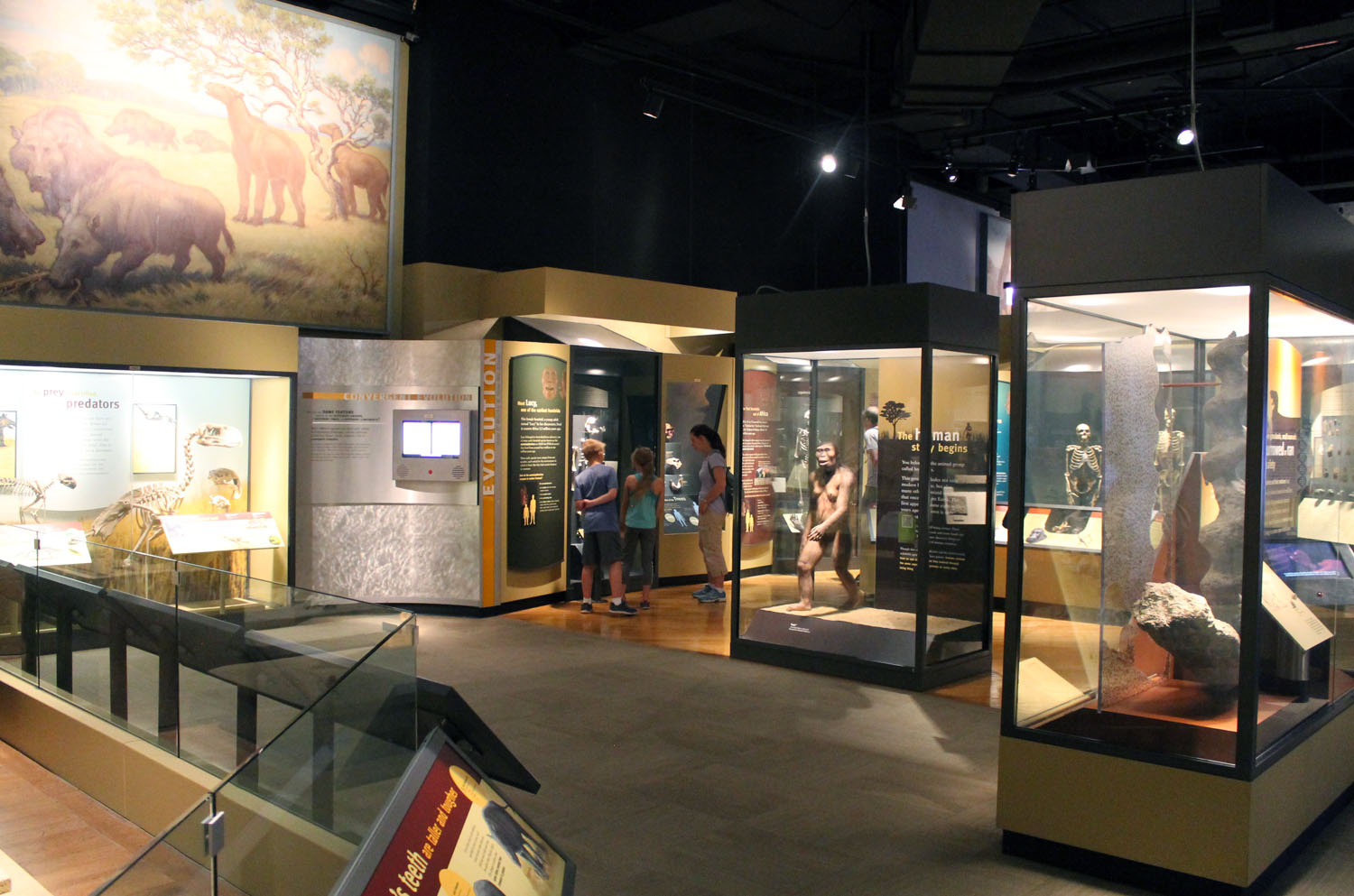
This approach contrasts sharply with traditional chronological exhibits, such as the Field Museum of Natural History’s “Evolving Planet.” The FMNH fossil galleries are extremely linear, and each geologic period is introduced with a set of easily-digested bullet points summarizing what happened during that time. Relatively tight spaces prevent visitors from seeing specimens from other time periods prematurely, and the galleries devoted to each period are color-coded to make them immediately distinct. According to Norris, this segmented presentation of the history of life obscures the large-scale transitions which transcend the somewhat arbitrary divisions of geologic time. As such, the new PMNH fossil halls will present the narrative holistically, encouraging visitors to track the underlying environmental trends that precipitated evolutionary change over time.

mammal hall concept art by Studio Joseph

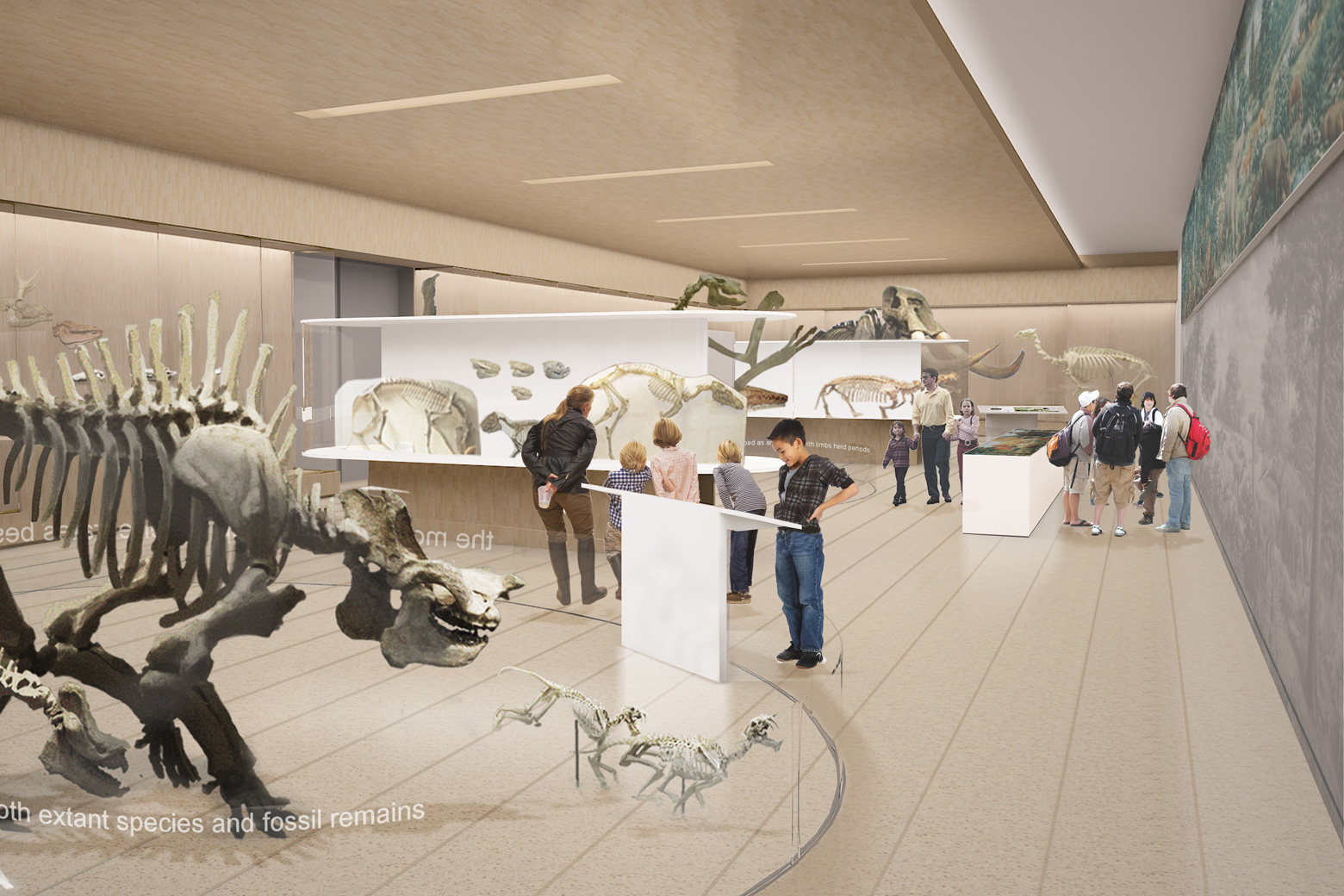
Conceptual render of the Hall of Mammals by Studio Joseph. Source

As is immediately clear from the promotional images, the new exhibit will juxtapose a modern, wide-open aesthetic with elements of the museum’s past – specifically, the outdated but gorgeous Rudolph Zallinger murals. Both of these design elements tie directly to exhibit’s narrative themes. By breaking up the central dinosaur pedestal and eliminating the unsightly glass cases in the Mammal Hall, the exhibit designers have dramatically increased the available floor space and opened up new lines of sight. This should allow visitors to view each of the galleries comprehensively, rather than as a series of discreet segments. Meanwhile, the Zallinger murals will remain a celebrated part of the exhibits. These magnificent frescoes were painted between 1942 and 1967, and are among the most iconic images of prehistoric life ever created. Although the physiology of some of the animals is outdated, Zallinger was in other ways ahead of his time. Rather than giving the geologic periods hard borders, Zallinger artfully wove the sections together so that each one fades imperceptibly into the next. The viewer can see that the flora, fauna, and climate are changing over time, but it’s a gradient, not a ladder, which perfectly reflects the narrative of the new exhibit.

deinonychus close up by Studio Joseph

A conceptual render of Deinonychus and other Cretaceous fossils. Source

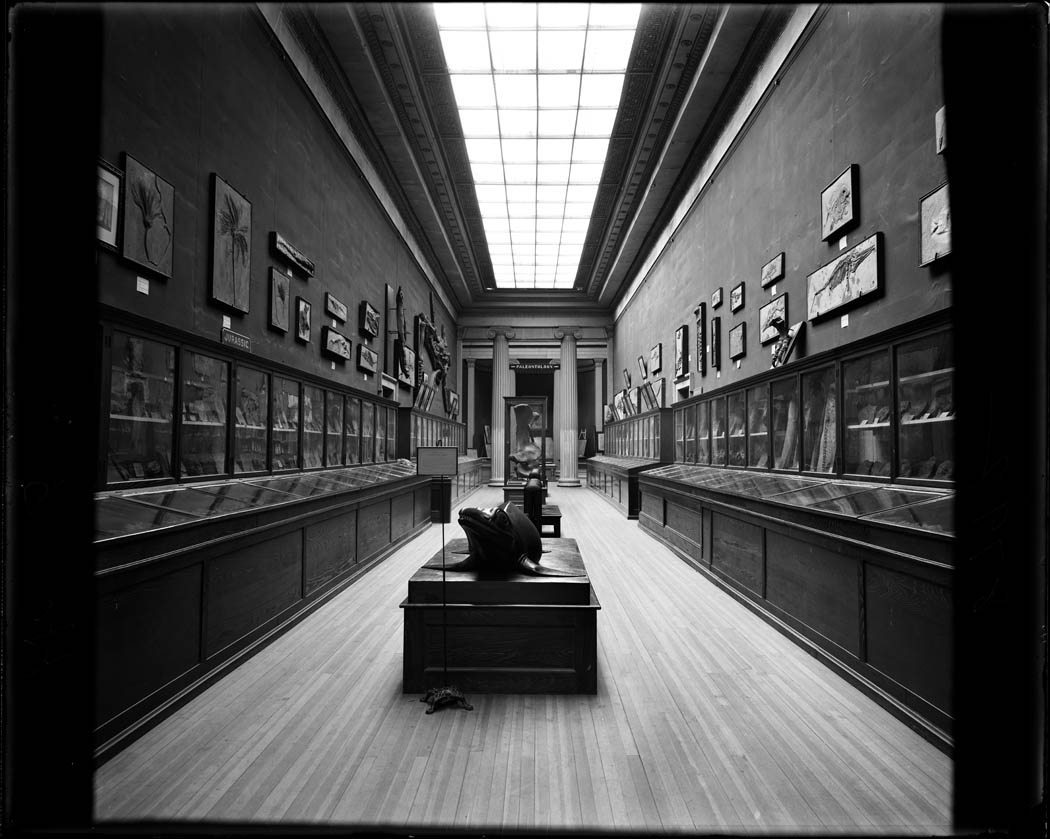
About 300 miles south of PMNH, the re-imagining of the fossil halls at the National Museum of Natural History is well underway. This building’s east wing has been home to paleontology displays since it opened in 1910 and has been updated several times, but this is the first time it has undergone a complete, wall-to-wall modernization. The old exhibits were formally closed on April 28th, 2014, and NMNH staff spent the following year removing thousands of specimens from the halls. With the fossils out of the way, the next step will be to restore the historic space to its original neoclassical glory. After that, the new exhibits and updated fossil mounts can be assembled in time for a 2019 re-opening.

Intriguingly, the planned design of the new National Fossil Hall is both thematically and aesthetically similar to the PMNH renovation, albeit on a grander scale. The National Fossil Hall’s narrative focus will be on large-scale environmental transitions over time, and how these changes drove the evolution of plants and animals. Like at PMNH, this will be accentuated by an open layout: false walls and barriers that have divided the space since the early 1960s will come down, allowing visitors to see clear across the spacious three-story hall. This airy aesthetic hearkens back to the Hall of Extinct Monsters, and like the restoration of the Zallinger murals at PMNH it represents an admirable celebration of the institution’s history.

concept art

Early conceptual render of the National Fossil Hall by Reich + Petch Source

One interpretive choice that will set the National Fossil Hall apart is the clustering of specimens on islands, or “pork chops”, as the were called early in development. Each pork chop represents North America at a particular period in time. While anchored by a few charismatic mounts, the pork chops will also include all manner of small animals, invertebrates, and plants that were part of that environment. In this way, the islands are self-contained mini exhibits, each one showing a complete ecosystem that existed at a particular time. Moving among the these displays, visitors should get a sense of how climate change and faunal interchange (among other phenomena) can completely transform an ecosystem over millions of years. They’ll also learn how certain organisms, like sauropods in the Jurassic or grass in the Neogene, can change landscapes and influence the evolution of contemporary plants and animals.

The emphasis on open spaces and freedom of movement is notable, because this is quite different from the linear exhibits of the late 20th century. In recent decades, exhibits have become increasingly structured, with specific learning goals and physical spaces designed to corral visitors through a carefully orchestrated narrative journey. Again, Evolving Planet at FMNH is an excellent example of this philosophy. The new National Fossil Hall is in some ways a push in the opposite direction – although it has a clear narrative and overarching message, visitors can roam through the exhibit as they please. I see the pork chop system as a way to have it both ways. Whether visitors work through the exhibit front to back or run straight to the T. rex in the center of the hall, then wander around at random, they’ll still be able to compare and contrast the different ecosystems and learn what the designers want them to learn.

A pork chop

Early concept art of the Jurassic “pork chop.” Image from The Last American Dinosaurs, NMNH.

More than anything else, what I expect to set the National Fossil Hall apart from peer exhibits will be its explicit connections to modern-day environmental crises. It’s worth quoting the Department of Paleobiology’s summary in full:

Visitors to the Museum will be able to explore how life, environments, and ecosystems have interacted to form and change our planet over billions of years. By discovering and harnessing the tools and methods paleobiologists use to study fossils, visitors will gain a deeper understanding of how the world works.

The distant past affects all of us today and will continue to do so in the future. How will climate change impact the natural world and our daily lives? How can we make informed choices about our ecosystems as individuals and as a species? How can we all become informed citizens of a changing planet?

We are in the midst of an extinction event of our own making. Anthropogenic climate change, habitat destruction, and invasive species are as dangerous as any asteroid, and will likely have profound effects on our own lives and livelihoods in the coming century. But while humans are undeniably the cause of the latest round of global changes, we also have the power to mitigate and manage their consequences. The study of fossils provides important contextual information – we can place modern organisms in an evolutionary context and understand their role in shaping the world as we know it, and we can see how organisms have responded to significant environmental overhauls in the distant past. The fossil record is in fact the only way to directly observe these things (as opposed to relying on models or actualistic experiments). As such, the new National Fossil Hall will make it clear that paleontology isn’t just about historical curiosity. The study of past life gives us a long view of the Earth’s biotic and abiotic systems, and helps us predict how they will respond to today’s environmental changes.

looking west

Concept drawing of the National Fossil Hall’s Cretaceous zone. In the old hall, the viewer would be standing at the base of the mezzanine stairs facing the rotunda. Source

With the modern climate crisis front and center, the new National Fossil Hall has the potential to be one of the most immediately relevant and important paleontology exhibits ever assembled*. This is significant, because as I lamented when I started this series, immediacy and relevance are not things that most museum visitors expect from fossil displays. While fossils, particularly the mounted skeletons of dinosaurs and other prehistoric animals, have been central to the identity of natural history museums since the late 19th century, most visitors don’t regard these exhibits as anything more than prehistoric pageantry. Visitor surveys consistently reveal that dinosaurs are seen as eye candy – monsters that might as well be from another planet. This is a shame, because dinosaurs and other prehistoric organisms were real parts of our own world, and we can learn much from them.

Reich

The new National Fossil Hall will be arranged in reverse chronological order – as visitors move accross the gallery, familiar elements of modern environments will be stripped away and the world will become an increasingly alien place. Source

And so we come full circle. What is the point of a museum exhibit**? Is it enough to provide visitors an opportunity to see cool objects and specimens? When we ask museumgoers what they want to see, they tell us “dinosaurs” or “fossils.” They don’t ask for compelling narratives or connections to big contemporary issues, and they don’t see their museum visit as an important way to bridge gaps in scientific literacy.

Still, it is of critical importance that we provide these narratives and connections. Even if we accept the fact that the very existence of a museum and the chance to see real specimens is a Good Thing, museums are still accountable to the public. Virtually all museums cite education as the primary purpose of their institution, and it’s imperative to live up to that. A museum should have a learning goal in mind, it should be able to prove that this message is coming across, and it should be able to articulate why its audience is better off for it. This is not necessarily easy – exhibits need to be relevant without being condescending or preachy. Exhibit designers need to understand their visitors as much as their content. They need to find a balance between feeding visitors information and providing a customizable experience for diverse audiences. As we have seen, not every exhibit succeeds, but my impression is that we’re getting better at it.

*It’s also notable that this climate change-focused exhibit will be on the national mall, given the ongoing politically-motivated opposition to climate science.

**Note that I’m referring specifically to public-facing exhibits. There are many good reasons why the ongoing maintenance of natural history collections is intrinsically valuable.

References

Marsh, D.E. (2014). From Extinct Monsters to Deep Time: An ethnography of fossil exhibits production at the Smithsonian’s National Museum of Natural History. http://circle.ubc.ca/handle/2429/50177

Weil, S.E. (2002). Making Musueums Matter. Washington, DC: Smithsonian Books.

Werning, S. (2013). Why Paleontology Is Relevant. The Integrative Paleontologists. http://blogs.plos.org/paleo/2013/02/19/why-paleontology-is-relevant

6 Comments

Filed under dinosaurs, education, exhibits, FMNH, museums, NMNH, opinion, PMNH, science communication

Framing Fossil Exhibits: Phylogeny

This is the third part of an on-again, off-again series about organizational and interpretive approaches in large-scale paleontology exhibits (see the introduction and walk through time entries). This time, I’ll be discussing exhibits arranged according to phylogenetics – that is, the evolutionary relationships among living things. Natural history museums have displayed specimens according to their place on the tree of life since the days of Charles Wilson Peale, and more than any other organizational scheme, phylogeny is the way biologists think about the living world. Perhaps unsurprisingly, this arrangement was more common in the past, when exhibits were typically designed by and for experts. Examples of these old-school displays include the fossil mammal gallery at the Peabody Museum of Natural History and the paleontology halls at the University of Kansas Natural History Museum (neither has been thoroughly overhauled since the 1950s).

peabody mammals

The jargon-heavy signage in the Peabody Museum’s classic fossil mammal exhibit is probably ignored by most visitors. Photo by the author.

Modern natural history museums rarely attempt phylogenetic exhibits. In vertebrate paleontology, an understanding of the evolutionary relationships of animals as identified via minute anatomical details is fundamental to our science. However, most people simply don’t think about the world in this way. For example, I was halfway through my first semester teaching an undergraduate anatomy course when I realized that most of the class didn’t really understand what a mammal is. The students were familiar with the word “mammal” and could provide some examples, but they couldn’t articulate what sets mammals apart from other animals, and the relationship of mammals to other vertebrates within the tree of life was all new to them. It’s easy to forget that even the most basic elements of evolutionary classification are specialized knowledge, even among biology students.

Describing the history of life on Earth chronologically is relatively easy—museum visitors intuitively understand the forward progression of time. But scientific classification (as opposed to colloquial categorization) requires a lot of explanation up front, and it’s easy to overwhelm an audience with jargon. While not impossible (see Neil Shubin’s masterful Your Inner Fish), it is very difficult to explain phylogeny to a general audience in a relatable and approachable way.

In 1995, the American Museum of Natural History attempted to do just that with the most recent renovation of its historic 4th floor fossil halls. This evolutionary arrangement was a major change for AMNH, since this space had a “walk through time” layout for most of the 20th century. In the accompanying book Discovering Dinosaurs in the American Museum of Natural History, curators Norell, Gaffney, and Dingus explain that phylogenetics (and the cladistic methodology in particular) is the only way to approach the study of prehistoric life in an objective way. Patterns of evolutionary relationships revealed by cladistic analyses are hard evidence in a field of study traditionally characterized by idle speculation. Norell and colleagues argue that the new exhibit arrangement shows visitors the credibility and scientific rigor behind modern paleontology.

4th floor of AMNH.

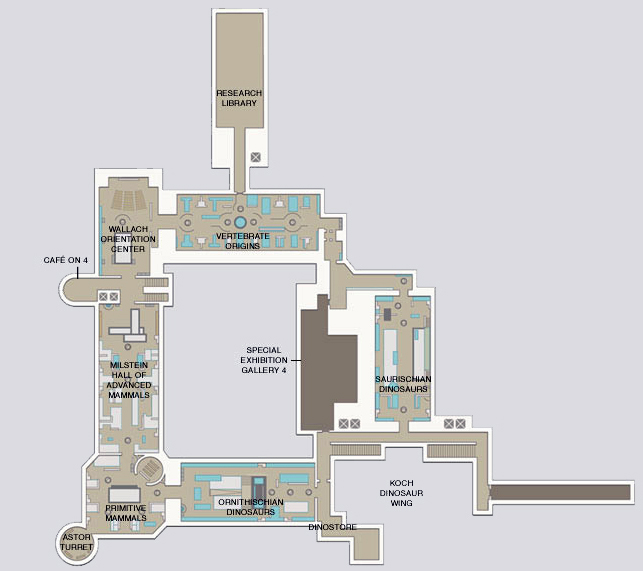
Map of the fossil halls on the 4th floor of AMNH. Source

Communicating the rigorous and trustworthy nature of scientific conclusions is a worthy goal, and the choice to ground the AMNH exhibit in this way seems almost prophetic given the litany of speculation-heavy paleontology “documentaries” that have proliferated in the years since it opened. Scientific rigor is definitely a running theme here – sign after sign explains that popularly depicted dinosaur behaviors like parental care and pack-hunting are largely untestable speculation. To a degree, this label copy takes the fun out of an undeniably fun subject, but I can appreciate the effort to legitimize paleontological science in the public eye. Overall, the AMNH exhibits represent an attempt to train visitors to look at fossils the way scientists do, and the phylogenetic layout is central to that goal.

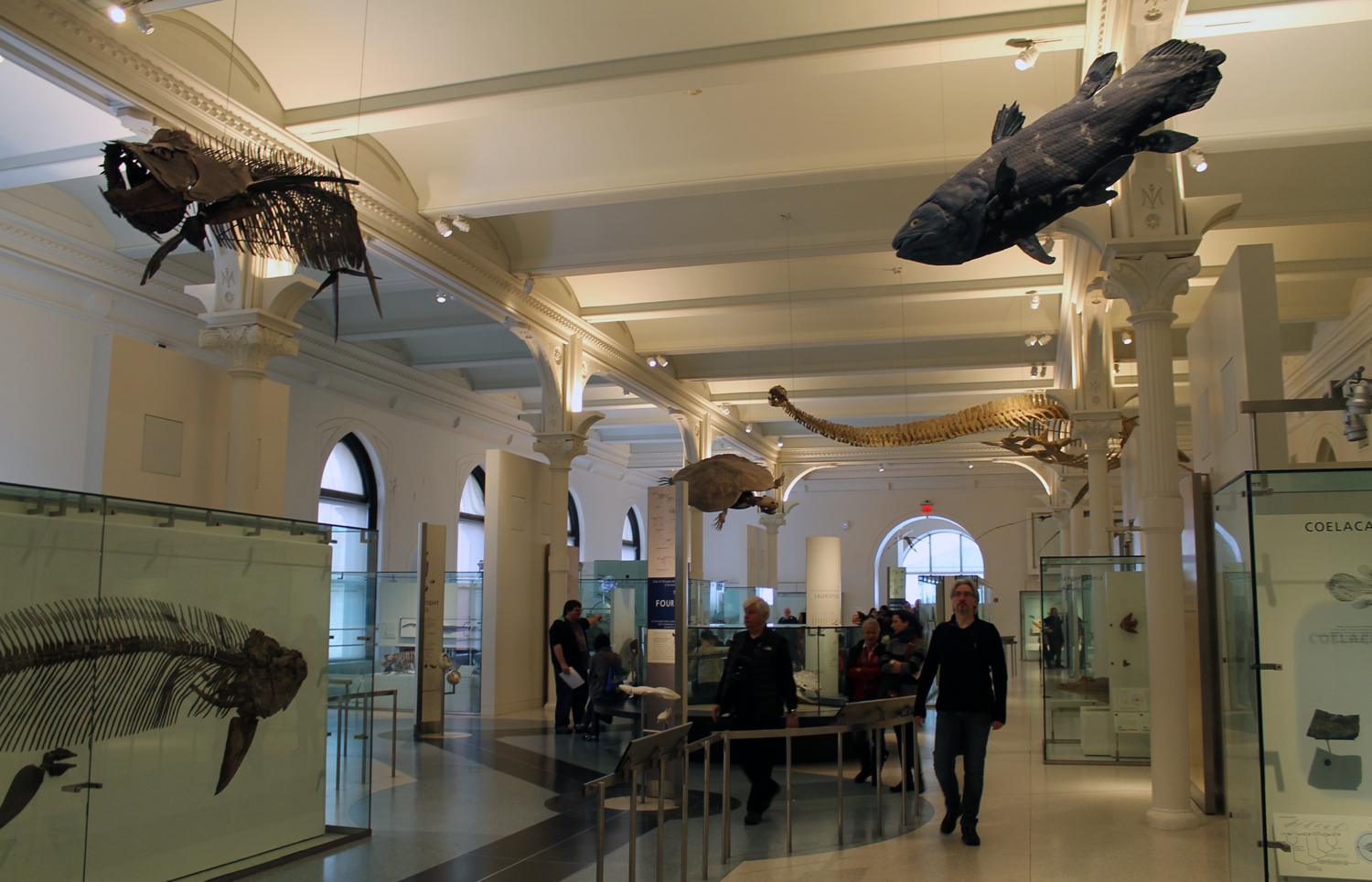
In the exhibit, visitors are meant to walk through a cladogram of chordates. You’ll pass through large halls dedicated to broad groups like saurischian dinosaurs and advanced mammals, while visiting smaller cul-de-sacs that  represent narrower clades like ornithomimids and testudines. A central black path guides you through the evolution of life, and centrally-situated pillars along your route identify major evolutionary innovations, such as jaws or the ability to reproduce on land. The insanely comprehensive vertebrate fossil collections at AMNH make this institution uniquely capable of putting so much diversity on display (although non-tetrapods are woefully underrepresented). Meanwhile, an open floor plan allows you to spend as much or as little time in each area as you wish, and ample natural lighting goes a long way toward making it possible to study specimens in detail.

follow the path for now

Pillars mark major evolutionary milestones in the Hall of Vertebrate Origins. Photo by the author.

path disappears among dinosaurs

The evolutionary pathway becomes considerably less obvious among the dinosaurs. Photo by the author.

Nevertheless, I agree with Riley Black that the AMNH fossil halls don’t do the best job communicating the story of vertebrate evolution to their core audience. The underlying purpose of any exhibit structure is to provide meaning and context for objects – to help visitors see them as more than neat things to look at. According to visitor surveys, the default mode of understanding for most people passing through a paleontology exhibit is what I’ve been calling “dinosaur pageantry.” After seeing the exhibit, most visitors will recall a list of cool skeletons they saw. A few might consider which ones are meat-eaters and which ones are plant-eaters, but without further prompting that’s all we can usually expect from non-specialists. It’s the museum’s job to give visitors the intellectual tools to contextualize those fossils in a more sophisticated way, but there’s a fine line to walk. Provide too little information and nobody learns anything, but provide too much and the content is ignored. Unfortunately, the AMNH exhibits fall into the “overkill” category.

As discussed, phylogeny is complicated, often counter-intuitive, and largely unfamiliar to many visitors. To overcome this, the AMNH designers rely on a fairly long orientation film, which introduces the concept of categorizing organisms based on shared derived characteristics. There are a few problems with this. First there’s the film itself, which dives right into the traits that characterize different groups – like the stirrup-shaped stapes of derived mammals and the temporal fenestrae of archosaurs – without explaining why these traits are significant. To a layperson, these probably seem like really inconsequential things to hang a whole group on. The video also presents a cladogram of vertebrates without explaining how to read it. As Torrens and Barahona demonstrate, interpreting a phylogenetic tree is a specialized skill that many natural history museum visitors lack. Second, I saw no incentive or instruction to actually start my visit to the 4th floor in the orientation hall. There are no less than four entrances to the fossil exhibits, so many visitors won’t know there is an orientation film (I sure didn’t) until they’re halfway through the galleries. Finally, there’s the reliance on media in general: do we really want visitors to spend even a portion of their time in an exhibit full of real fossils watching a video in a darkened room? Telling visitors what to think in a narrated video is easy, but it’s not nearly as meaningful as showing them the same concept with specimens (or better yet, coaxing them to reach conclusions themselves).

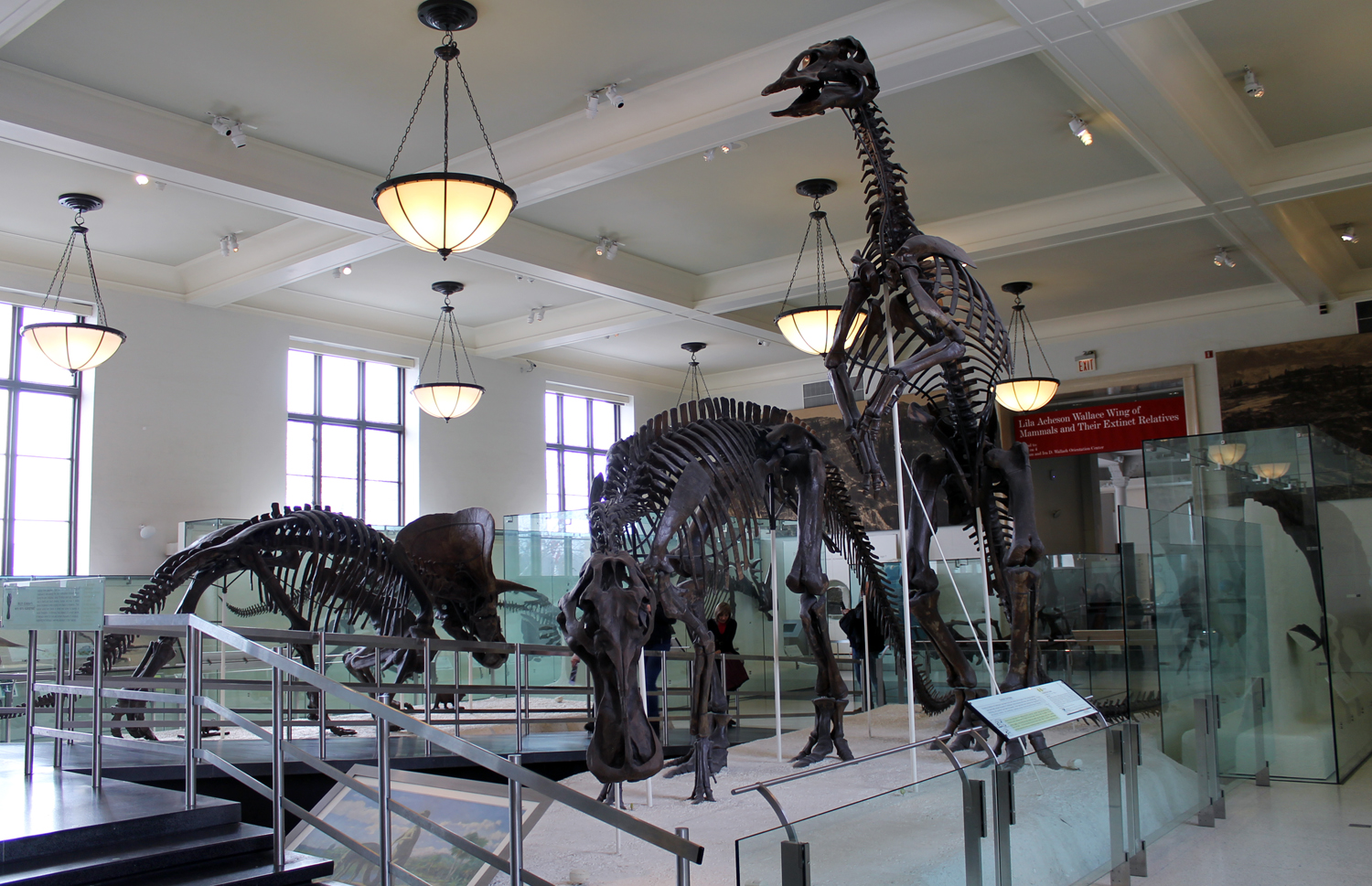
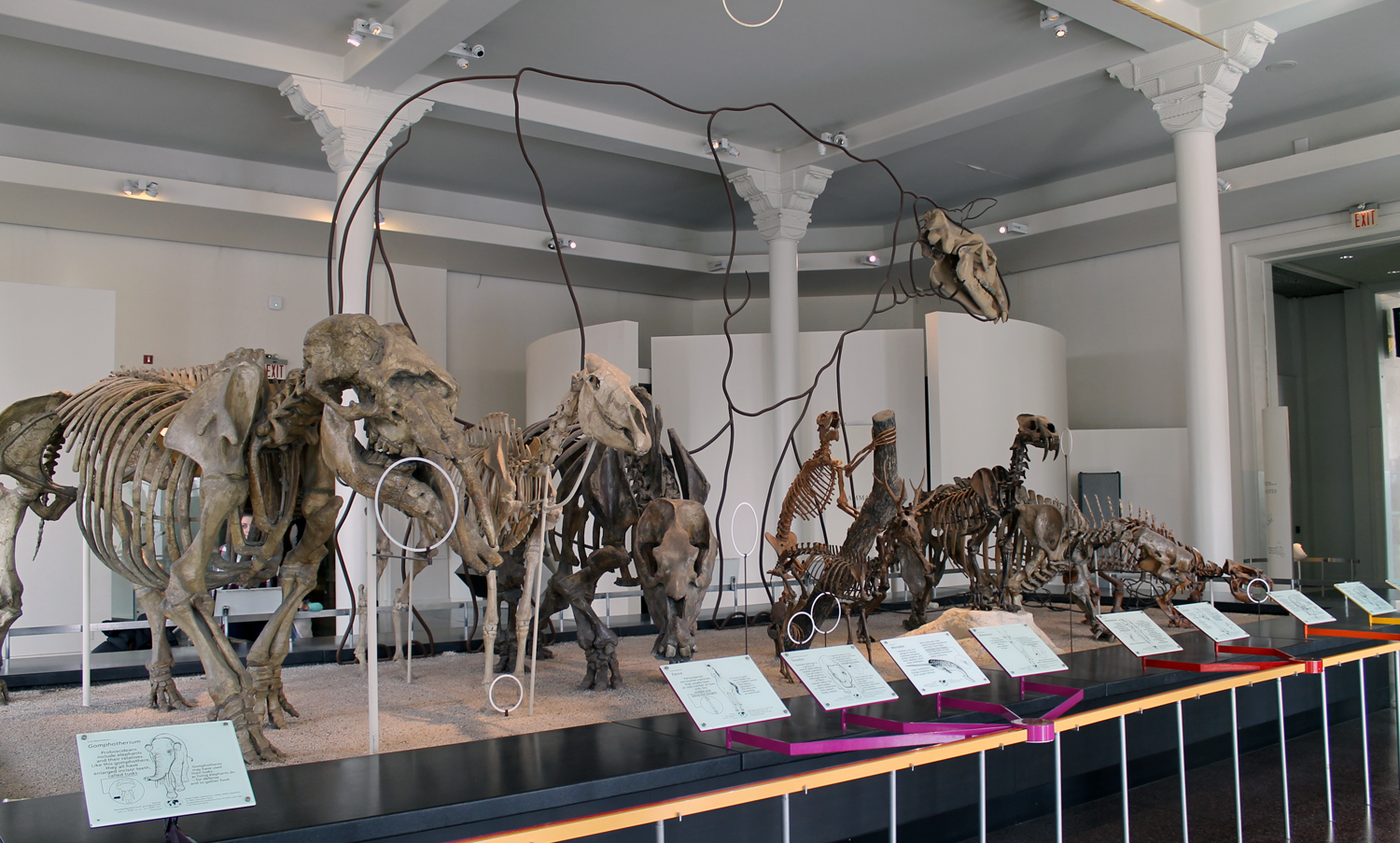
Hall of Saurischian Dinosaurs, American Museum of Natural History. Photo by the author.

Iconic mounts in the Hall of Saurischian Dinosaurs are iconic. Photo by the author.

Within the actual fossil halls, interpretation remains stubbornly unapproachable. For example, the sign introducing proboscidians tells visitors that this group is defined primarily by eye sockets located near the snout. An observant visitor might wonder why scientists rely on such an obscure detail, as opposed to the obvious trunks and tusks. There’s a good teaching moment there concerning why some characteristics might face more selection pressure (and thus change more radically) than others, but instead visitors are only offered esoteric statements. Relatedly, the exhibit does little to prioritize information. Most label text is quite small, and there’s a lot of it. Compare this to Evolving Planet at the Field Museum, where there is a clear hierarchy of headings and sub-headings. Visitors can read the main point of a display without even stopping, and parents can quickly find relevant information to answer their charges’ questions (rather than making something up).

Evolving Planet also compares favorably to the AMNH fossil halls in its informative aesthetics and spatial logic. At FMNH, walls and signs in each section are distinctly color-coded, making transitions obvious and intuitive. Likewise, consistent iconography  – such as the mass extinction zones – helps visitors match recurring themes and topics throughout the exhibit. AMNH, in contrast, has a uniform glass and white-walled Apple Store aesthetic. It’s visually appealing, but doesn’t do much to help visitors navigate the space in a meaningful way.

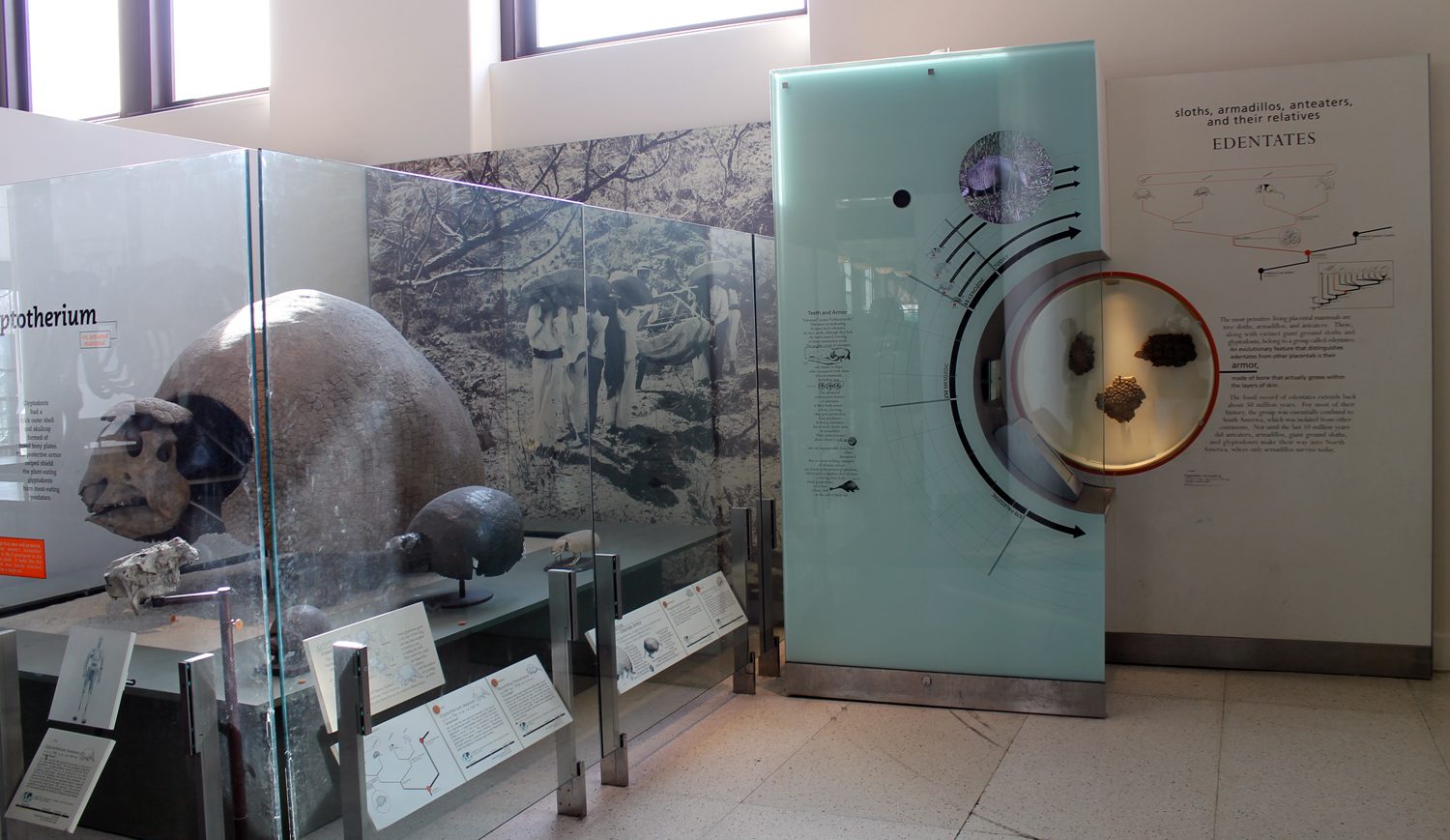
edentates aren't real

Phylogenetic interpretations change quickly – Edentata is no longer considered a natural group. Photo by the author.

The phylogenetic layout introduces a number of other unique interpretive challenges. Since there is no temporal axis,  it’s often unclear whether the lineage in a particular cul-de-sac cluster went extinct, continued on, or gave rise to another group elsewhere in the exhibit. Visitors that want to know which animals lived contemporaneously are out of luck. Meanwhile, the exhibit sometimes uses modern animal skeletons to fill out displays where fossil examples are limited, such as bats and primates. While these are labeled, the text is too small to be seen from a distance. The evolutionary organization is also burdened by the fact that phylogenetics is a fast-moving and often changing field of study. While the order of geologic time periods will never change, the 20 year-old displays at AMNH are already out of date in several details. For example, there is a cul-de-sac devoted to edentates, which is now considered polyphyletic, and a cladogram in the Hall of Saurischian Dinosaurs incorrectly places tyrannosaurids among the carnosaurs.

Cows and broken videos

Glass architecture lets visitors see through displays and get a sense of what lies beyond. Photo by the author.

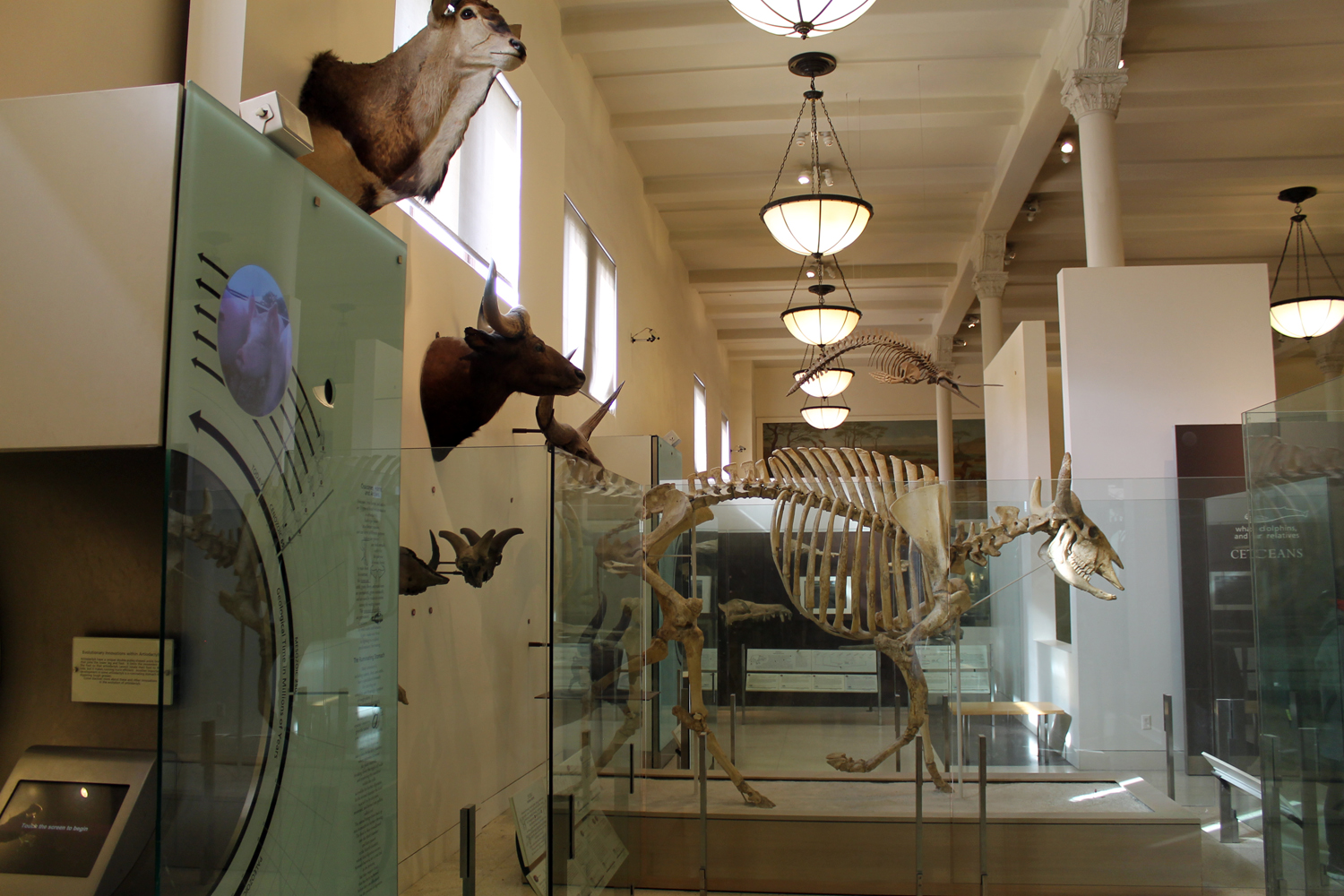
Neat comparison of mammal teeth. Too bad there's no obvious label.

This display is a great example of the diversity in mammal teeth, but it’s a confusing centerpiece for the Hall of Primitive Mammals. Photo by the author.

The AMNH fossil exhibits excel in many respects, chiefly in the amazing diversity and quantity of specimens on display. The exhibit throws a lot of good science at visitors, but falters in explaining why it matters. The point of all this is not to nit-pick the design choices at AMNH, but to reiterate that phylogenetically-arranged fossil exhibits are really hard to pull off. This is not the most intuitive way to introduce the history of life, or even the process of evolution. With so much background to cover, perhaps a more structured and linear layout would be better. In fact, a lot of my issues with the AMNH fossil exhibits seem to stem from a disconnect between the phylogenetic interpretive content and the wide-open aesthetics. Open exhibits can be great, but in this case it hinders the learning opportunities for self-guided groups of visitors. It’s difficult to imagine a typical visitor, arriving with their family or another mixed-age group, having the patience to make sense of it all. Regrettably, such visitors default to the dinosaur pageantry level of understanding, making all the work invested in creating a meaningful exhibit space for naught.

References

Norell, M, Gaffney, E, and Dingus, L. (1995). Discovering Dinosaurs in the American Museum of Natural History. New York, NY: Alfred A. Knopf, Inc.

Torrens, E. and Barahona, A. (2012). Why are Some Evolutionary Trees in Natural History Museums Prone to Being Misinterpreted? Evolution: Education and Outreach 1-25.

14 Comments

Filed under AMNH, dinosaurs, exhibits, fish, FMNH, fossil mounts, mammals, museums, opinion, reptiles, reviews, systematics

Framing Fossil Exhibits: A Walk Through Time

Half a year ago, I promised a series of posts comparing the common strategies for framing the history of life in museum exhibits. This post is the first step toward making good on that goal. Historically, fossil displays at major natural history museums amounted to little more than dinosaur pageant shows, and even today this is all many visitors want or expect. The challenge for exhibit creators is to contextualize the fossils as part of a greater narrative without being alienating, overwhelming, or perhaps worst of all, condescending. A large, permanent exhibit is an enormously time-consuming and expensive undertaking. The opportunity to build or thoroughly renovate an exhibition might occur only once in a generation, so there is exceptional pressure to produce something that succeeds and endures. Exhibits tend to be products of their time, however, and are strongly influenced both by contemporary scholarship and trends in museum theory.

One of the most enduring formats for exploring the fossil record is the “walk through time.” A chronological portrayal of the history of life is an obvious solution, and I don’t mean that in a disparaging way. Audiences are predisposed to understand the forward progression of time, so little up-front explanation is needed. It also helps that the geological timescale compartmentalizes the history of Earth into tidy units. Each Era, Period, or Epoch has a unique cast of characters and a few defining events that make it easy to sum up. There are plenty of examples of chronological fossil exhibits, including Prehistoric Journey at the Denver Museum of Nature and Science, The Third Planet at the Milwaukee Public Museum, and even traveling exhibits like Ultimate Dinosaurs. For this post, though, I’ll be using the Field Museum of Natural History’s “Evolving Planet” as my primary case study, since it so thoroughly embraces the “walk through time” format (and I have a good set of photos on hand to jog my memory).

Map of Evolving Planet. Source

Map of the Field Museum’s Evolving Planet galleries. Source

Evolving Planet is a 27,000 sq. ft. journey through the evolution of life. It opened in 2006, although it is notable that Evolving Planet relies heavily on the structure of the previous paleontology exhibit, “Life Over Time.” Major set pieces like the replicated Carboniferous coal swamp and the Apatosaurus mount remained in place while exhibit designers overhauled the aesthetics and narrative. The most important change is the explicit focus on evolution. Although evolution is key to all biological sciences and the evidence for it is overwhelming, many schools in the United States fail to teach evolution properly and at least a third of the population rejects it outright. As destinations for life-long learning, museums are well-poised to address this deficit in evolutionary understanding, and the Field Museum has enthusiastically risen to the occasion. Evolving Earth weaves the evidence for evolution into all aspects of the displays. The first thing visitors see is the thesis of the exhibit—everything that has ever lived is connected through and is the result of evolution—printed on an otherwise blank wall. Moving forward, visitors learn how evolution via natural selection works, and how we know. Along the way, common misconceptions, such as the idea that lineages improve over time, or that evolution is “just a theory” are proactively addressed and corrected.

eg

The thesis of Evolving Planet cannot be missed. Photo by the author.

This pedagogical approach defines a trend in exhibit design that began in earnest in the 1950s. Early natural history exhibits were designed by and for experts, combining expansive collections of carefully arranged specimens with a few “iconic” displays, such as dinosaur skeletons or taxidermy mounts. By the mid-20th century, however, visitor-centric ideas had begun to take root. Designers began to envision the routes visitors would travel through an exhibit space, and consider what they would look at first when entering a room, and why. Soon hierarchical signage (main ideas in big text, working down to sub-topics and specimen labels) became the norm. Exhibits were enriched with interpretive displays, like dioramas, and scholarly labels were replaced by conversational text and even multimedia. By the 1970s, most of the exhibit responsibilities once held by curators were now handled by exhibit designers and developers. No longer places to explore a collection and view objects at will, exhibits now had carefully structured narratives built around explicit educational goals. In the 80s and 90s, the very floorplans of new exhibits came to reflect this identity, as open halls were replaced with carefully directed switch-backing corridors.

Each geological time period in Evolving Planet is color-coded. Photo by the author.

Each geological time period in Evolving Planet is color-coded. Photo by the author.

Once we reach the Permian, the fossils can start to speak for themselves. Photo by the author.

Once we reach the Permian, the fossils can start to speak for themselves. Photo by the author.

Evolving Planet is, for better or worse, thoroughly rooted in the late 20th century tradition of exhibit design. As the map above shows, once visitors enter Evolving Planet, they are committed to a lengthy trek along a predetermined route. There are no shortcuts to the dinosaurs – you must traverse the entire history of life, starting with its origins in the Precambrian. Along the way, you’ll become familiar with the exhibit’s iconography. Every time you enter a new geologic period, you are greeted by a “Timeline Moment.” These include a chapter heading, a back-lit illustration, an update of where you are on the timeline, and a summation of the key evolutionary innovations and environmental changes of that age. All the walls and graphics in each section are also color-coded, making your progression to each new period very distinct. Finally, the path is occasionally interrupted by unmissable black and red area indicating that a mass extinction has occurred. The resulting experience feels like walking through a book. Information is relayed in a specific order, and visitors are expected to recall concepts that were introduced in previous sections.

A panoramic CGI recreation of the Burgess Shale fauna brings small, easily overlooked fossils to life.

A panoramic CGI recreation of the Burgess Shale fauna brings small, easily overlooked fossils to life. Photo by the author.

One challenge inherent to a chronological narrative of the history of life is that the physical evidence for early organisms simply isn’t very interesting to look at (for non-specialists, anyway). Large mounted skeletons of fossil vertebrates have a lot of presence, but they same can’t be said for stromatolites and wiggly-worm impressions. The designers of Evolving Planet address this problem in two ways. First, they built iconic contextual displays to stand in for fossils that aren’t suitably monumental on their own. The Cambrian section features a panoramic animated recreation of the Burgess Shale environment. Actual fossils are available, but the video is what makes visitors stop and take note. Likewise, the Carboniferous section is dominated by a walk-through diorama of a coal swamp, complete with life-sized giant millipedes and dragonflies. Like the predetermined pathway, these landmark displays are very much in keeping with late 20th century trends in exhibit design. It’s a conceptually odd but admittedly effective reversal of the classic museum: fabricated displays are supported by genuine specimens, instead of the other way around.

evolving earth

Mass extinction markers tell visitors to expect something different up ahead. Photo by the author.

The second strategy concerns the layout of Evolving Planet, which was inherited from the previous exhibit, Life Over Time. The space is shaped like a U, with switch-backing corridors flanking a more open dinosaur section in the middle. Curator Eric Gyllenhaal explained that “the heavy content, on the stuff that people were not familiar with, was the stuff that came first and came afterward, and that’s where we really got into the details of the evolutionary process” (quoted in Asma, pp. 226-227). Visitors are more focused and more inclined to read signs carefully early in the exhibit, so the developers used the introductory rooms to cover challenging concepts like the origins of life and the mechanisms of speciation. This is the “homework” part of the exhibit, and the narrow corridors and limited sightlines keep visitors engaged with the content, without being tempted to run ahead. Once visitors reach the Mesozoic and the dinosaurs, however, the space opens up. Among the dinosaur mounts, visitors are can choose what they wish to view, and in what order. This serves as a reward for putting up with the challenging material up front. The path tightens up again on the way out, but it’s not as pedagogically rigorous as the beginning of the exhibit. Some sections, like the human evolution displays, are actually cul-du-sacs that can be bypassed by visitors anxious to leave.

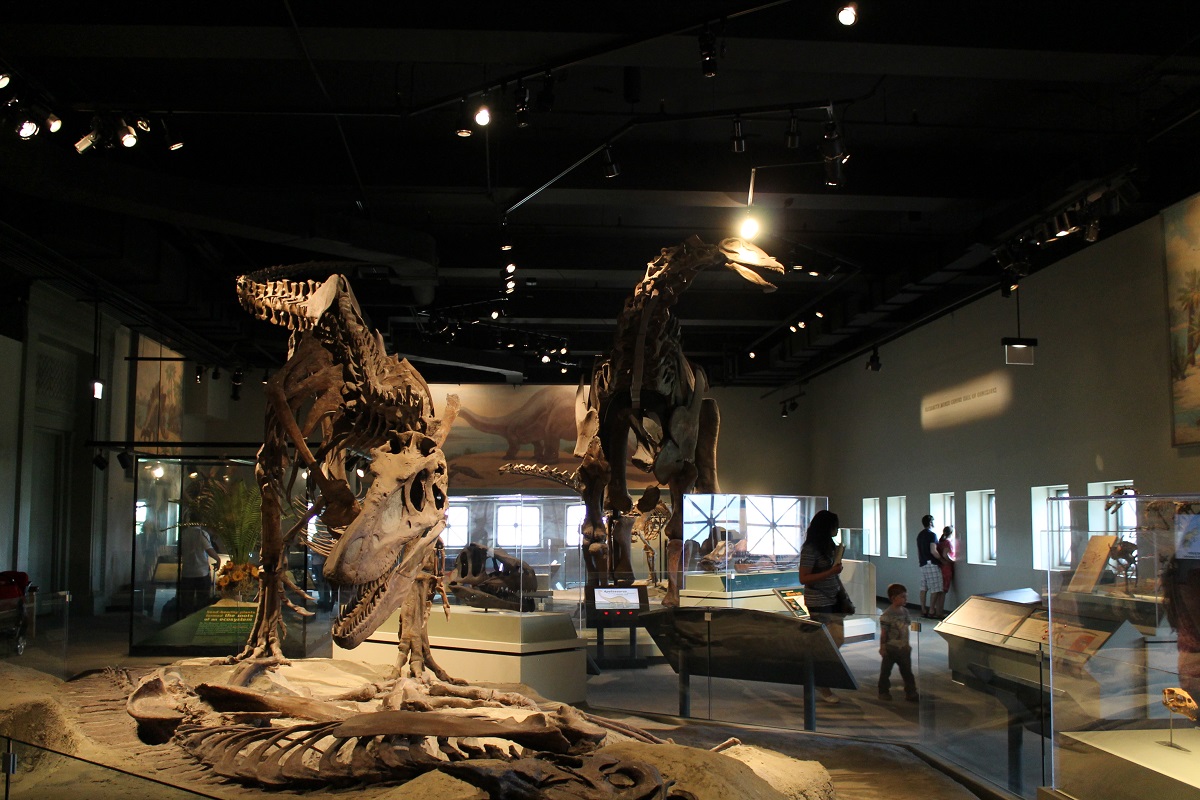
struggling to contain the dinosaurs

Although the dinosaurs get a third of the exhibit to themselves, the hall still struggles to contain them. Photo by the author.

The story of human evolution is relegated to a cul-de-sac late in the exhibit. Photo by the author.

The story of human evolution is relegated to a cul-de-sac late in the exhibit. Photo by the author.

Evolving Planet’s chronological narrative and linear structure complement each other nicely. The sequential path gives the exhibit designers significant control over the visitor’s learning experience, and when dealing with widely misunderstood concepts like evolution, the benefits are clear. The exhibit establishes clear learning goals, and designers can be reasonably confident that these goals are being met. Based on the other new permanent exhibitions at the Field Museum, I get the impression that the design team strongly favors linear exhibits. 2008’s “Ancient Americas”, for instance, closely mirrors Evolving Planet’s structure: a set path through a series of themed spaces, unified by consistent iconography. The designers are to be commended for absolutely owning this concept, and realizing it to its full potential.

Exhibit designers deliberately made the path to the exit much more obvious in the second half of Evolving Planet. Photo by the author.

Exhibit designers deliberately made the path to the exit much more obvious in the final stretch of Evolving Planet. Photo by the author.

The problem with a linear design, of course, is that it’s constraining.  All visitors enter with prior knowledge and a certain worldview or perspective, and are inclined to be more interested in some displays than others. Linear exhibits largely suppress this by forcing everyone through the same tube. Ironically, the strong emphasis on the sequence of geological time periods may also overstate their importance. While these divisions are defined based on real events like extinctions and faunal turnover, they are still human constructs with often messy borders. Relying too heavily on them understates the importance of long-term, short-term, and localized evolutionary events.

Museums should be educational, and exhibits should challenge visitors, particularly regarding the mechanisms of evolution and the scope and complexity of deep time. Still, there’s something to be said for free choice in elective education. Evolving Planet, and “walk through time” exhibits in general, skews more toward the former. It’s an effective option, but also a safe one. Next time, we’ll take a look at exhibits that frame paleontological science in less intuitive ways.

References

Asma, S.T. 2001. Stuffed Animals and Pickled Heads: The Culture and Evolution of Natural History Museums. New York, NY: Oxford University Press.

Diamond, J. and Evans, E.M. 2007. “Museums Teach Evolution.” Society for the Study of Evolution 61:6:1500-1506.

Marsh, D.E. 2014. From Extinct Monsters to Deep Time: An ethnography of fossil exhibits production at the Smithsonian’s National Museum of Natural History. http://circle.ubc.ca/handle/2429/50177

1 Comment

Filed under education, exhibits, FMNH, fossil mounts, museums, reviews, science communication

Bully for Camarasaurus

Note: This post was written in 2014. It predates Emanuel Tschopp and colleagues’ landmark paper which, among other things, resurrected the genus Brontosaurus. I’ve attempted to update the taxonomy where appropriate, but it may still be a bit of a mess.

The story of the mismatched head of Brontosaurus is one of the best known tales from the history of paleontology. I think I first heard it while watching my tattered VHS copy of More Dinosaurs—scientists had mistakenly mounted the skull of Camarasaurus on an Apatosaurus skeleton, and the error went unnoticed for decades. The legend has been repeated countless times, perhaps because we revel in the idea that even experts can make silly mistakes. Nevertheless, I think it’s time we set the record straight: nobody ever mistakenly placed a Camarasaurus skull on Apatosaurus. The truth is a lot more nuanced—and a lot more interesting—than a simple case of mistaken identity.

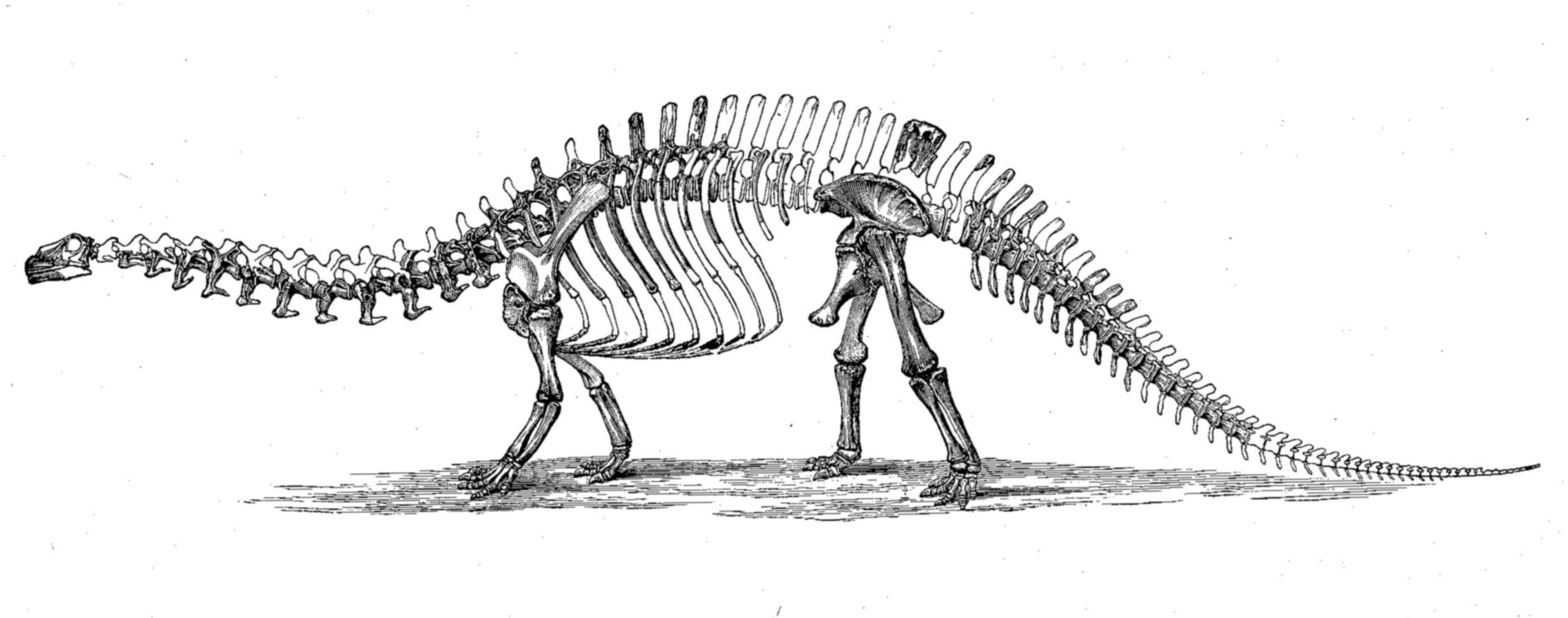
Intrinsically related to the head-swap story is the replacement of “Brontosaurus” with “Apatosaurus” in the popular lexicon. This is well covered elsewhere, so I’ll be brief. Scientific names for animals are governed by the International Code of Zoological Nomenclature, which includes the principle of priority: if an organism has been given more than one name, the oldest published name is the correct one. Leading 19th century paleontologist O.C. Marsh named Apatosaurus ajax in 1877, based on a vertebral column discovered in the Morrison Formation of Colorado. Two years later, Marsh introduced Brontosaurus excelsus to the world, from a more complete specimen uncovered in rocks of the same age in Wyoming. Like many of Marsh’s publications, these descriptions were extremely brief, offering a scant two paragraphs for each taxon. However, Marsh did provide a longer description of Brontosaurus in 1883, complete with the first-ever restoration of the complete skeleton.

This is not a Camarasaurus skull.

Come play with us, Brontosaurus…forever and ever and ever. Photo courtesy of the AMNH Research Library.

In 1903, Elmer Riggs of the Field Museum of Natural History underwent a survey of sauropod fossils held at various museums and concluded that Brontosaurus excelsus was too similar to Apatosaurus to merit its own genus. The name “Brontosaurus” was dropped, and the species became Apatosaurus excelsus for most of the 20th century. However, a substantial re-evaluation of diplodocoid sauropods by Emanuel Tschopp and colleagues in 2015 reversed Riggs’ decision. So the name Brontosaurus is back, but keep in mind that the species excelsus never actually went anywhere—it was just hidden under the Apatosaurus umbrella. Following Tschopp et al., Apatosaurus and Brontosaurus were distinct animals that lived in the same environment.

So how does the mismatched head fit into all of this? The short answer is that it doesn’t. The fact that some Apatosaurus mounts had incorrect heads for much of the 20th century has nothing to do with which name was being used at any given time, although the two issues have often been conflated in popular books. I suspect the two stories got mixed up because paleontologists were pushing to correct both misconceptions around the same time during the dinosaur renaissance.

Marsh's Brontosaurus

Marsh’s second and definitive Brontosaurus reconstruction, first published in 1891.

Let’s go back to Marsh’s 1891 Brontosaurus reconstruction*, pictured above. The Brontosaurus type specimen did not include a head, and many have reported that Marsh used a Camarasaurus skull in this illustration. However, this would not have been possible, because the first complete Camarasaurus skull wasn’t discovered until 1899. What Marsh had instead was a few fragmentary bits of Camarasaurus cranial material, plus a snout and jaw (USNM 5730) now thought to be Brachiosaurus (more on this at SV-POW). Although these pieces were found far from the Brontosaurus quarry, Marsh extrapolated from them to create the best-guess skull that appears in his published reconstruction.

*Note that this is the second of two Brontosaurus reconstructions commissioned by Marsh. The first drawing, published in 1883, has somewhat different skull, but it still does not resemble Camarasaurus. 

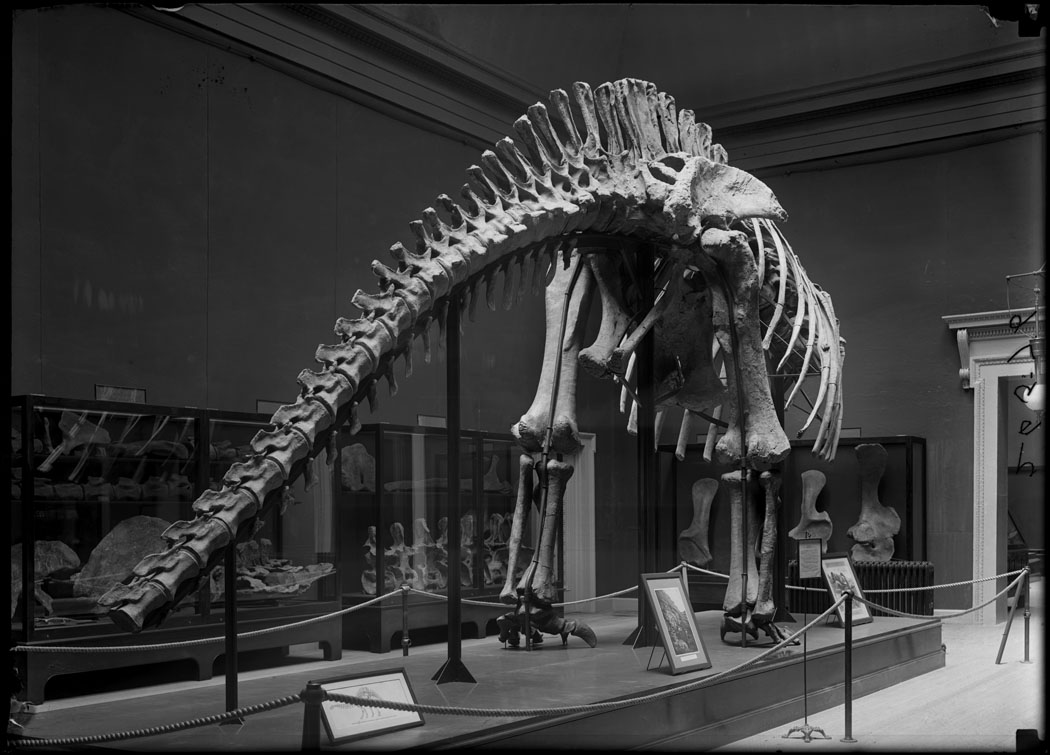
Although Stephen Gould states in his classic essay “Bully for Brontosaurus” that Marsh mounted the Brontosaurus holotype at the Yale Peabody Museum, Marsh never saw his most famous dinosaur assembled in three dimensions. In fact, Marsh strongly disliked the idea of mounting fossil skeletons, considering it a trivial endeavor of no benefit to science. Instead, it was Adam Hermann of the American Museum of Natural History, supervised by Henry Osborn, who built the original Brontosaurus/Apatosaurus mount (AMNH 460), six years after Marsh’s death in 1899.

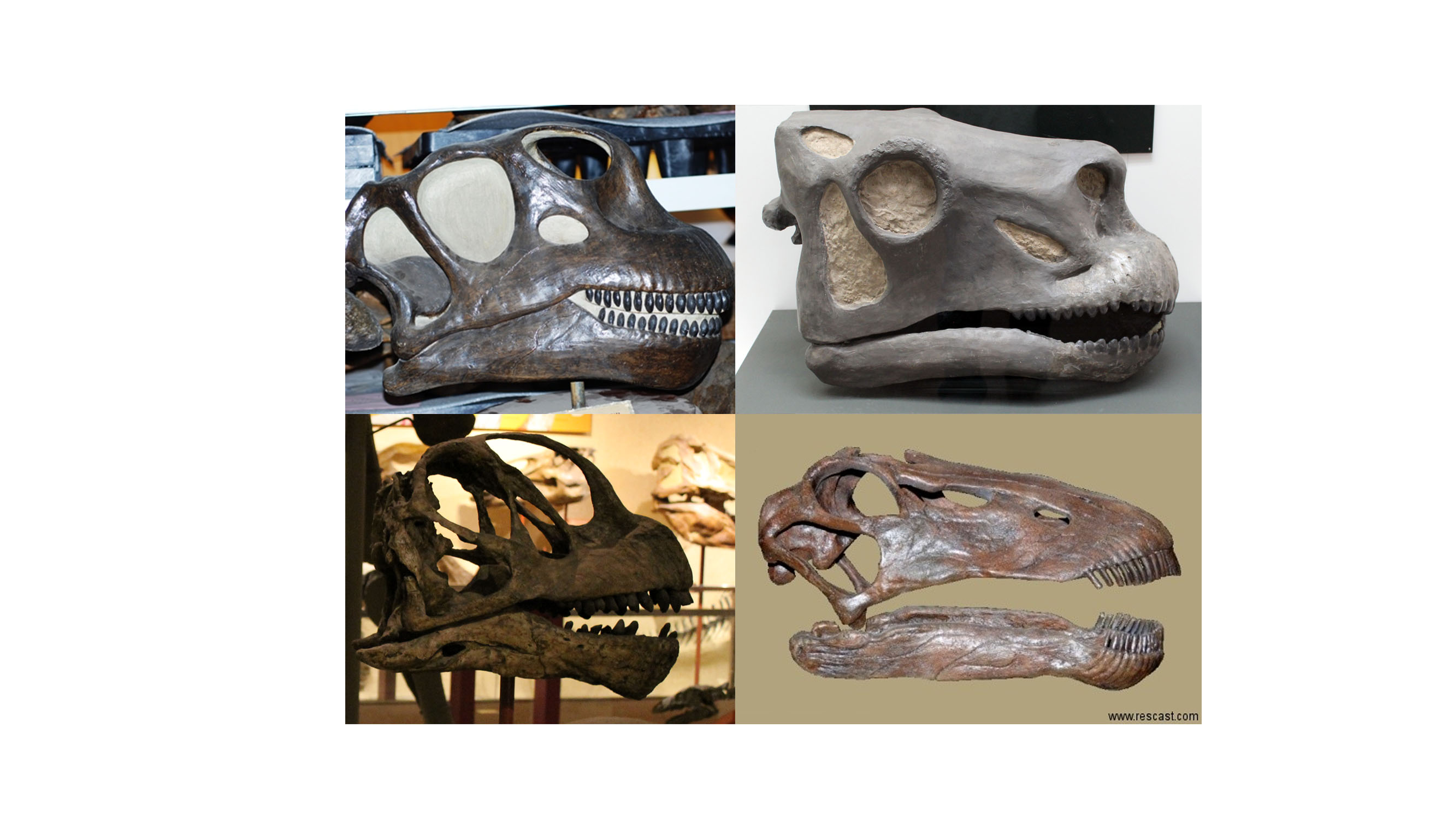
Counterclockwise from top:

Clockwise from top: AMNH sculpted skull (Source), Peabody Museum sculpted skull, real Apatosaurus skull (Source), and real Camarasaurus skull.

To create the mounted skeleton, Hermann combined fossil material from four separate individuals. All of the material had been collected by AMNH teams in Wyoming specifically for a display mount—and to beat Andrew Carnegie at building the first mounted sauropod. Like Marsh, however, they failed to find an associated skull (a Camarasaurus-like tooth was allegedly found near the primary specimen, but it has since been lost). Even today, sauropod skulls are notoriously rare, perhaps because they are quick to fall off and roll away during decomposition. Instead, Hermann was forced to make a stand-in skull in plaster. Osborn explained in an associated publication that this model skull was “largely conjectural and based on that of Morosaurus” (Morosaurus was a competing name for Camarasaurus that is no longer used).

Was it really, though? The sculpted skull is charmingly crude, so the overt differences between the model and a real Camarasaurus skull (top and bottom left in the image above) might be attributed to the simplicity of the model. Note that there isn’t even an open space between the upper and lower jaws! Still, Hermann’s model bears a striking resemblance to Marsh’s illustration in certain details, principally the elongate snout and the very large, ovoid orbit. It’s reasonable to assume that Hermann used Marsh’s speculative drawing as a reference, in addition to any actual Camarasaurus material that was available to him. At the very least, it is incorrect to say that AMNH staff mistakenly gave the mount a Camarasaurus skull, since Osborn openly states that it is a “conjectural” model.

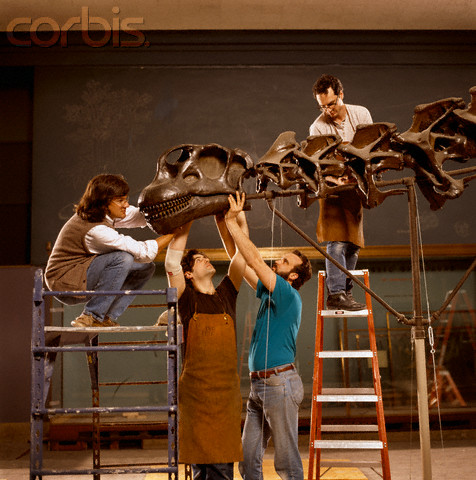
A young Mark Norell

A young Mark Norell leads the removal of the sculpted skull from the classic AMNH Apatosaurus. Source

In 1909, a team led by Earl Douglass  of the Carnegie Museum of Natural History finally discovered a real Apatosaurus skull (third image, lower right). They were working at the eastern Utah quarry that is now Dinosaur National Monument, excavating the most complete Apatosaurus skeleton yet found (CM 3018). The skull in question (cataloged as CM 11162) was not connected to the skeleton, but Douglass had little doubt that they belonged together. Back at the Carnegie Museum, director William Holland all but confirmed this when he found that the skull fit neatly with the skeleton’s first cervical vertebra. As he wrote at the time, “this confirms…that Marsh’s Brontosaurus skull is a myth.”

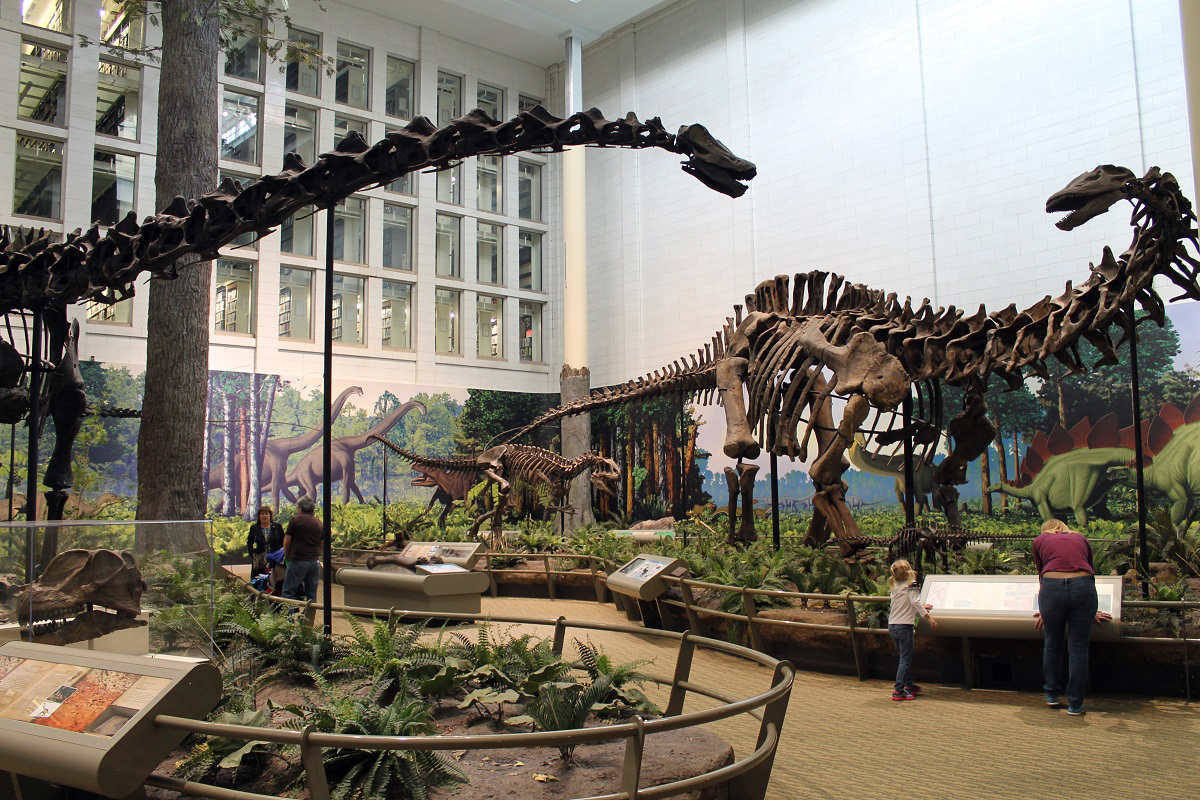
The Carnegie team prepared and mounted the new Apatosaurus, and Holland initially planned to use the associated skull. However, when Osborn heard about this he threatened to ruin Holland’s career if he went through with it. You see, the new skull looked nothing like the round, pseudo-Camarasaurus model skull on the AMNH mount. Instead, it was flat and broad, like a more robust version of Diplodocus. Osborn wasn’t about to let Holland contradict his museum’s star attraction, and Holland backed down, never completing his planned publication on the true nature of Apatosaurus. Meanwhile, the mounted skeleton at the Carnegie Museum remained headless until Holland’s death in 1932. After that, museum staff quietly added a Camarasaurus-like skull. This was an important event, as it would be the first time an actual cast skull of Camarasaurus (as opposed to a freehand sculpture) would be attached to a mounted Apatosaurus skeleton. While I’ve had no luck determining precisely who was involved, Keith Parsons speculated that the decision was made primarily for aesthetic reasons.
Carnegie Museum Brontosaurus circa 1934. Source

Carnegie Museum Apatosaurus alongside the famed Diplodocus, sometime after 1934. Source

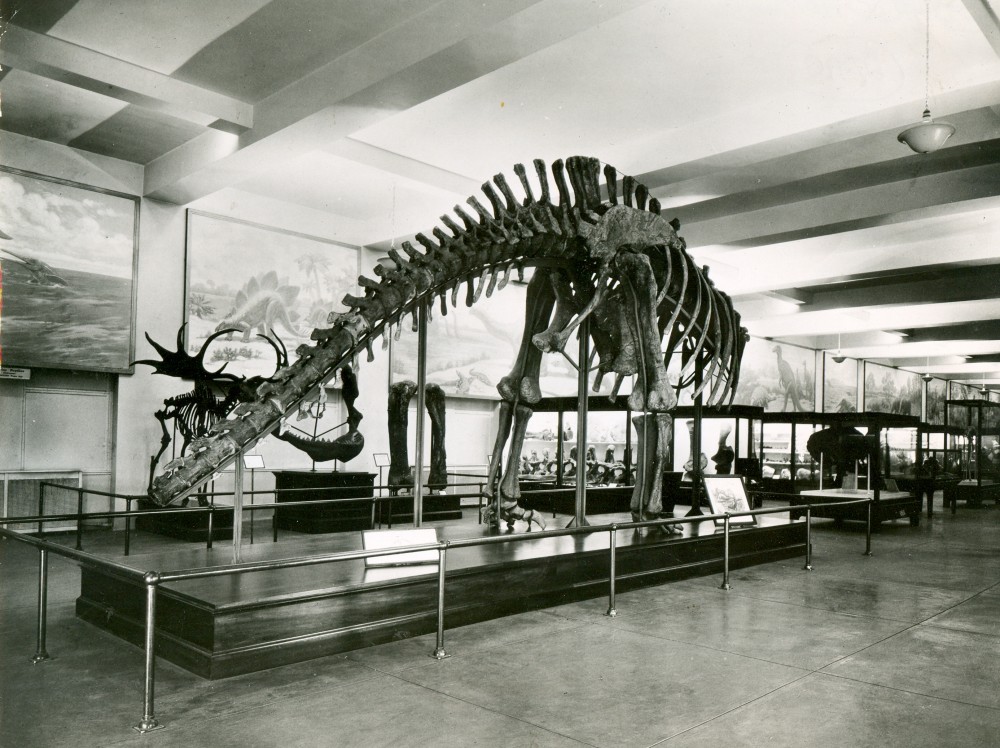
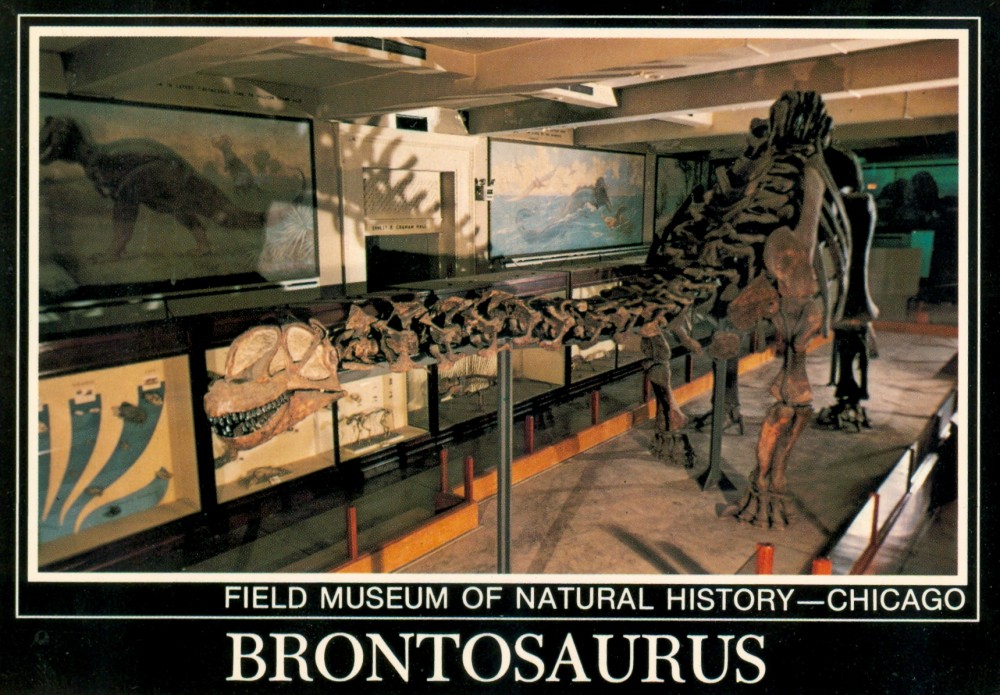
Elmer Riggs assembled a third Apatosaurus mount (FMNH P 25112) at the Field Museum in 1908. Riggs had recovered the articulated and nearly complete back end of the sauropod near Fruita, Colorado in 1901, but was unable to secure funding for further collecting trips to complete the mount. Riggs was forced to mount his half Apatosaurus as-is, and the absurd display stood teetering on its back legs for 50 years. Finally, Riggs’ successor Orville Gilpin acquired enough Apatosaurus fossils to complete the mount in 1958. As usual, no head was available, so Gilpin followed the Carnegie Museum’s lead and gave the mount a cast Camarasaurus skull.

The completed mount as it stood in the 1970s, Camarasaurus head and all.

Orville Gilpin finally completed the FMNH Apatosaurus in 1958.

The last classic apatosaurine mount was built at the Yale Peabody Museum of Natural History in 1931, using Marsh’s original Brontosaurus excelsus holotype (YPM 1980) and a lot of plaster padding. The skull this mount originally sported (third image, upper right) is undoubtedly the strangest of the lot. A plaster replica sculpted around a small portion of a real Camarasaurus mandible, this model doesn’t look like any known sauropod. The overall shape is much more elongated than either Camarasaurus or the AMNH model, and may have been inspired by Marsh’s hypothetical illustration. Other details, however, are completely new. The anteorbital fenestrae are thin horizontal slashes, rather than the wide openings in previous reconstructions, while the tiny, forward-leaning nares don’t look like any dinosaur skull—real or imaginary—I’ve ever seen. The sculptor is sadly unknown, but this model almost looks like a committee-assembled combination of the Marsh drawing, the AMNH model, and CM 11162 (a.k.a. the real Apatosaurus skull).

During the mid-20th century, vertebrate paleontology lapsed into a quiet period. Although the aging dinosaur displays at American museums remained popular with the public, these animals came to be perceived as evolutionary dead-ends, of little interest to the majority of scientists. The controversies surrounding old mounts were largely forgotten, even among specialists, and museum visitors saw no reason not to accept these reconstructions (museums are, after all, one of the most trusted sources of information around).

A postcard

The Peabody Brontosaurus with its original head. Note that the Camarasaurus in the foreground also has a sculpted skull.

This changed with the onset of the dinosaur renaissance in the 1970s and 80s, which brought renewed energy to the discipline in the wake of new evidence that dinosaurs had been energetic and socially sophisticated animals. In the midst of this revolution, John McIntosh of Wesleyan University re-identified the real skull of Apatosaurus. Along with David Berman, McIntosh studied the archived notes of Marsh, Douglass, and Holland and tracked down the various specimens on which reconstructed skulls had been based. They determined that Marsh’s restoration of the Brontosaurus skull, long accepted as dogma, had in fact been almost entirely arbitrary. Following the trail of guesswork, misunderstandings, and scientific inertia, McIntosh and Berman proved that Holland had been right all along. The skull recovered at Dinosaur National Monument along with the Carnegie Apatosaurus was in fact the only legitimate skull ever found from an apatosaurine up to that point. In 1981, McIntosh himself replaced the head of the Peabody Museum Brontosaurus with a cast of the Carnegie skull. AMNH, the Field Museum, and the Carnegie Museum followed suit before the decade was out.

aess

Remounted Apatosaurus at the Carnegie Museum. Photo by the author.

Given the small size of the historic community of dinosaur specialists, it may have been particularly vulnerable to the influences of a few charismatic individuals. To wit, Marsh’s speculative Brontosaurus skull was widely accepted despite a lack of compelling evidence, and Osborn was apparently able to bully Holland out of publishing a find that contradicted the mount at AMNH. What’s more, the legend of the mismatched Brontosaurus skull somehow became distorted by the idea that either Marsh or Osborn had accidentally given their reconstructions the head of Camarasaurus. This is marginally true at best, since both men actually oversaw the creation of composite reconstructions which only passingly resembled Camarasaurus. Nevertheless, the idea that the skull of Camarasaurus was a passable substitute for that of Apatosaurus was apparently well-established by the 1930s, when Carnegie staff hybridized the two sauropods for the first time. Even today, there are numerous conflicting versions of this story, and it is difficult to sort out which details are historically accurate and which are merely assumed.

I’d like to close by pointing out that while the head-swap story is often recounted as a scientific gaffe, it is really an example of science working as it should. Although it took a few decades, the mistakes of the past were overcome by sound evidence. Despite powerful social and political influences, evidence and reason eventually won out, demonstrating the self-corrective power of the scientific process.

References

Berman, D.S. and McIntosh, J.S. 1975. Description of the Palate and Lower Jaw of the Sauropod Dinosaur Diplodocus with Remarks on the Nature of the Skull of ApatosaurusJournal of Paleontology 49:1:187-199.

Brinkman, P. 2006. Bully for Apatosaurus. Endeavour 30:4:126-130.

Gould, S.J. 1991. Bully for Brontosaurus: Reflections in Natural History. New York, NY: W.W. Norton and Company.

Osborn, H.F. 1905. Skull and Skeleton of the Sauropodous Dinosaurs, Morosaurus and BrontosaurusScience 22:560:374-376.

Parsons, K.M. 1997. The Wrongheaded Dinosaur. Carnegie Magazine. November/December:38.

Tschopp, E., Mateus, O., and Benson, R.B.J. 2015. A specimen-level phylogenetic analysis and taxonomic revision of Diplodocidae (Dinosauria, Sauropoda). PeerJ 3:e857. https://doi.org/10.7717/peerj.857

9 Comments

Filed under AMNH, CMNH, dinosaurs, field work, FMNH, fossil mounts, history of science, museums, reptiles, sauropods, systematics

Displaying the Tyrant King – Part 3

Subtlety is unnessesary when T. rex is involved.

Who needs subtlety when you have a T. rex?

Start with Displaying the Tyrant King Part 1 and Part 2.

Tyrannosaurus rex displays changed for good in the 1990s thanks to two individuals, one real and one fictional. The latter was of course the T. rex from the film Jurassic Park, brought to life with a full-sized hydraulic puppet, game-changing computer animation, and the inspired use of a baby elephant’s screeching cry for the dinosaur’s roar. The film made T. rex real – a breathing, snorting, drooling animal unlike anything audiences had ever seen. Jurassic Park was a tough act to follow, and in one way or another, every subsequent museum display of the tyrant king has had to contend with the shadow cast by the film’s iconic star.

The other dinosaur of the decade was Sue, who scarcely requires introduction. First and foremost, Sue is the most complete Tyrannosaurus ever found, with 80% of the skeleton intact. Approximately 28 years old at the time of her death, Sue is also the eldest T. rex known, as well as one of the largest. The specimen’s completeness and exquisite preservation has allowed paleontologists to ascertain an unprecedented amount of information about the lifestyle of meat-eating dinosaurs. In particular, Sue’s skeleton is riddled with fractured and arthritic bones, as well as evidence of gout and parasitic infection that together paint a dramatic picture of the rough-and-tumble world of the late Cretaceous.

From South Dakota to Chicago

Sue at Disney World

Cast of Sue at Walt Disney World, Orlando. Source

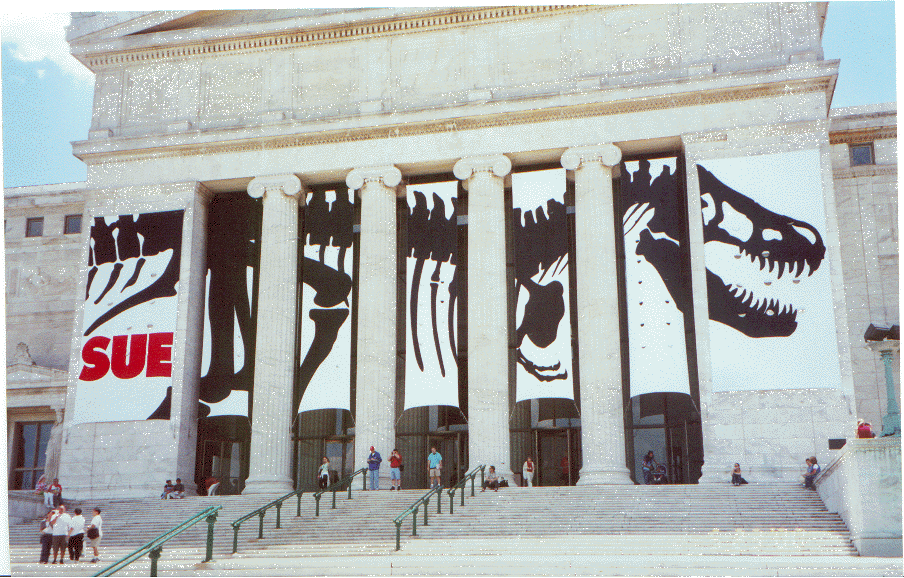
It was the events of Sue’s second life, however, that made her the fossil the world knows by name. Sue was discovered in the late summer of 1990 by avocational fossil hunter Susan Hendrickson (for whom the specimen is named) on the Cheyenne River reservation in South Dakota. Peter Larson of the Black Hills Institute, a commercial outfit that specializes in excavating, preparing, and exhibiting fossils, initially intended to display the Tyrannosaurus at a new facility in Hill City, but soon became embroiled in an ugly four-way legal battle with landowner Maurice Williams, the Cheyenne council, and the United States Department of the Interior. With little precedent for ownership disputes over fossils, it took until 1995 for the District Court to award Williams the skeleton. Williams soon announced that he would put Sue on the auction block, and paleontologists initially worried that the priceless specimen would disappear into the hands of a wealthy collector, or end up in a crass display at a Las Vegas casino. Those fears were put to rest in 1997 when Chicago’s Field Museum of Natural History won Sue with financial backing from McDonald’s and Disney. Including the auctioneer’s commission, the price was an astounding $8.36 million.

FMNH and its corporate partners did not pay seven figures for Sue solely to learn about dinosaur pathology.  Sue’s remarkable completeness would be a boon to scientists, but her star power was at least as important for the Museum. Sue was a blockbuster attraction that would bring visitors in the door, and her name and likeness could be marketed for additional earned income. As FMNH President John McCarter explained, “we do dinosaurs…so that we can do fish” (quoted in Fiffer 2000). Particularly in the late 1990s, with Jurassic Park still fresh in people’s minds, a Tyrannosaurus would attract visitors and generate funds, which could in turn fund less sensational but equally important research, like ichthyology and entomology.

Still, some worried that McCarter, whose background was in business, not science, was exploiting an important specimen as a marketing gimmick at the expense of the Museum’s educational mission. This echoed similar concerns voiced 80 years earlier, when the original mounted Tyrannosaurus was introduced at the American Museum of Natural History. As president of AMNH, Henry Osborn oversaw the creation of grandiose and dramatic exhibits, with the intent to draw crowds and justify private and municipal financial support. When the Museum unveiled the Tyrannosaurus mount, Osborn held a lavish publicity gala for the New York elite and members of the press. The buzz generated by Osborn’s promotion resulted in lines around the block and front page headlines, but the attention was focused on the spectacle of the dinosaur rather than the science behind it. Many academics derided this as lowest common denominator pandering, while others, like anthropologist Franz Boas, grudgingly accepted that “it is a fond delusion of many museum officers that the attitude of the public is a more serious one, but the majority do not want anything beyond entertainment.”

Original skull of Sue the T. rex, displayed on the upper mezzanine. Photo by the author.

FMNH was under similar scrutiny as museum staff revealed their plans for Sue. The role of the corporate sponsors that paid for the fossils was a particular cause for concern, and the marketing team knew it. Although the idea of T. rex-themed Happy Meals was briefly on the table, McDonald’s and Disney wisely opted to present themselves only as patrons of science. McDonald’s got its name on the new fossil preparation lab at FMNH and Disney got a mounted cast of Sue to display at Walt Disney World, but the principal benefit to the two companies was high-profile exposure in association with youth science education. The Museum retained control over the message, highlighting Sue’s importance to paleontology and only coyly admitting her role as a promotional tool. Likewise, FMNH is the sole profiteer from the litany of shirts, hats, toys, mugs, and assorted trinkets bearing the Sue name and logo that are continually sold at the Museum and around Chicago.

You May Approach Her Majesty

Once Sue arrived at FMNH, the Museum did not hold back marketing the dinosaur as a must-see attraction. A pair of Sue’s teeth went on display days after the auction, which expanded organically into the “Sue Uncrated” exhibit, where visitors could watch the plaster-wrapped bones being unpacked and inventoried. Meanwhile, McDonald’s prepared an educational packet on Sue that was distributed to 60,000 elementary schools.

The main event, of course, was the mounted skeleton, which needed to be ready by the summer of 2000. This was an alarmingly short timetable, and the FMNH team had to hit the ground running. Much of Sue’s skeleton was still buried in rock and plaster. The bones needed to be prepared and stabilized before they could be studied, and they needed to be studied before they could be mounted. In addition, two complete Sue casts had to be fabricated: one for Disney World and one for a McDonald’s-sponsored traveling exhibit. The casts were produced by Research Casting International, the Toronto-based company that recently built the mounted menagerie for “Ultimate Dinosaurs“. Phil Fraley Productions, the same exhibit company that rebuilt the American Museum and Carnegie Museum T. rex mounts, was tapped to mount Sue’s original skeleton.

The mounted skeleton of Sue in the Stanley Field Hall. Photo by the author.

Unlike every other Tyrannosaurus mount before or since, Sue can hardly be called a composite. With the exception of a missing arm, left foot, a couple ribs, and small number of other odds and ends, the mounted Sue skeleton is composed of real fossils from a single individual. FMNH public relations latched onto this fact, emphasizing in press releases that while “many museums are displaying replicas of dinosaur skeletons, the Field Museum has strengthened its commitment to authenticity. This is Sue.” Just as they did with the AMNH Tyrannosaurus, Fraley’s team built an armature with individual brackets securing each bone, allowing them to be removed with relative ease for research and conservation. No bolts were drilled into the bones and no permanent glue was applied, ensuring that the fossils incur only minimal damage for the sake of the exhibit. Despite these improvements over historic mount-making techniques, however, the Sue mount does have some inexplicable anatomical errors. The coracoids should be almost touching in the middle of the chest, but the shoulder girdles are mounted so high on the rib cage that there is a substantial space between them. Consequently, the furcula (wishbone) is also positioned incorrectly.

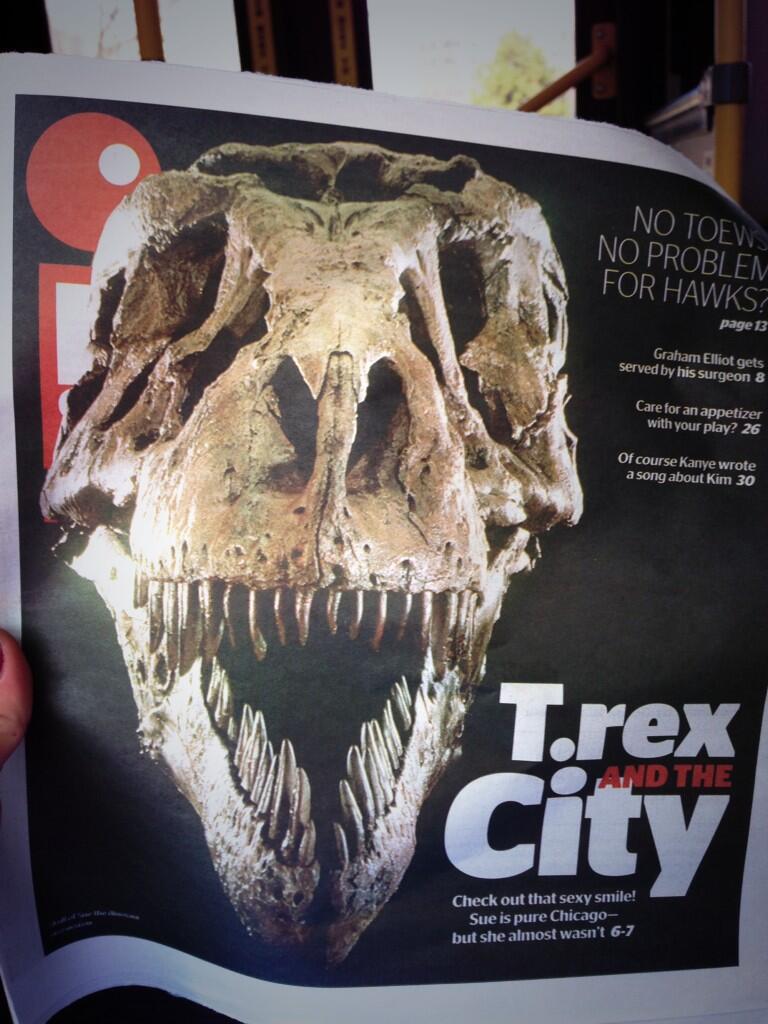
After a private event not unlike the one held by Osborn in 1915, Sue was revealed to the public on May 17, 2000 with the literal raising of a curtain. A week-long series of celebrations and press junkets introduced Sue to Chicago, and she has been one of the city’s biggest attractions every since. All the publicity paid off, at least in the short term: FMNH attendance soared that year from 1.6 million to 2.4 million. 14 years later, Sue the Tyrannosaurus is still known by name, and is even used as the voice of FMNH on twitter. Interestingly, Sue’s new identity as a Chicago landmark seems to have all but eclipsed the legal dispute that was her original source of fame. A recent RedEye cover story goes so far as to proclaim this South Dakotan skeleton as “pure Chicago.”

 The Nation’s T. rex

This customized truck transported the Nation’s T. rex from Montana to Washington, DC.

This year, another Tyrannosaurus specimen has rocketed to Sue-like levels of notoriety. MOR 555, also known as “Wankel Rex”, is being transferred to the Smithsonian National Museum of Natural History, where it will eventually be mounted for long-term display. Now dubbed “the Nation’s T. rex“, the promotion of this specimen has mirrored that of Sue in many ways. Front-page media coverage, first-person tweets from the dinosaur and even an official song and dance contest herald the arrival of the fossils from their previous repository, the Museum of the Rockies in Montana. Much like the “Sue Uncrated” exhibit, the process of unpacking the unarticulated bones will soon be on view in a temporary display called “The Rex Room.” Meanwhile, the very name “Nation’s T. rex” is a provocative invented identity akin to Sue’s new status as a Chicagoan.

Nevertheless, the Nation’s T. rex does not quite live up to Sue’s mystique. This Tyrannosaurus is neither as large nor as complete as Sue, and there was no prolonged legal battle or frantic auction in its past. The 60% complete skeleton was found in 1988 by Montana rancher Kathy Wankel, on land owned by the US Army Corps of Engineers. The fossils are now on a 50 year loan from from the Corps to the Smithsonian, (presumably) a straightforward transfer between federal agencies. In addition, MOR 555 is by no means a new specimen. Several casts of the skeleton are already on display, including exhibits at the Royal Ontario Museum, the Museum of the Rockies, the Perot Museum of Nature and Science, and even the Google campus. In fact, a cast of the MOR 555 skull has been on display at NMNH for years.

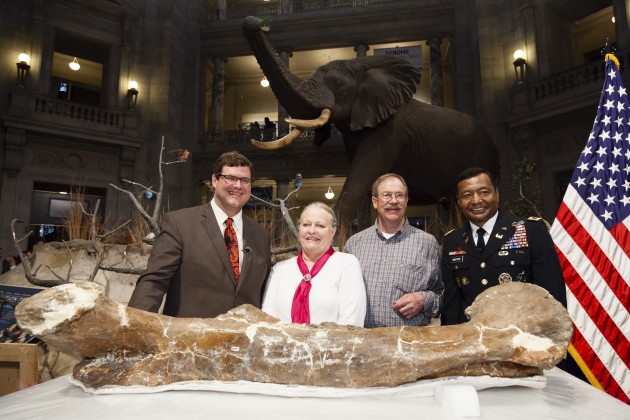
NMNH Director Kirk Johnson, fossil hunter Kathy Wankel, her husband Bob Wankel, and Lt. Gen. Thomas Bostick preside over the arrival of the Nation’s T. rex at the Smithsonian. Source

With that in mind, the hype around the Nation’s T. rex might seem like much ado about nothing. As this series has demonstrated, the number of Tyrannosaurus skeletons on exhibit, whether original fossils or casts, has exploded in recent years. A quarter century ago, New York and Pittsburgh were the only places where the world’s most famous dinosaur could be seen in person. Today, there may well be over a hundred Tyrannosaurus mounts worldwide, most of which are identical casts of a handful of specimens. Acquiring and displaying a T. rex is neither risky nor ambitious for a natural history museum. No audience research or focus groups are needed to know that the tyrant king will be a hit. And yet, excessive duplication of a sure thing might eventually lead to monotony and over-saturation.

So far, such fears appear to be unfounded. A specimen like Sue or the Nation’s T. rex is ideal for museums because it is at once scientifically informative and irresistibly captivating. Museums do not need to choose between education and entertainment because a Tyrannosaurus skeleton effectively does both. And even as ever more lifelike dinosaurs grace film screens, museums are still the symbolic home of T. rex. The iconic image associated with Tyrannosaurus is that of a mounted skeleton in a grand museum hall, just as it was when the dinosaur was introduced to the world nearly a century ago. The tyrant king is an ambassador to science that unfailingly excites audiences about the natural world, and museums are lucky to have it.

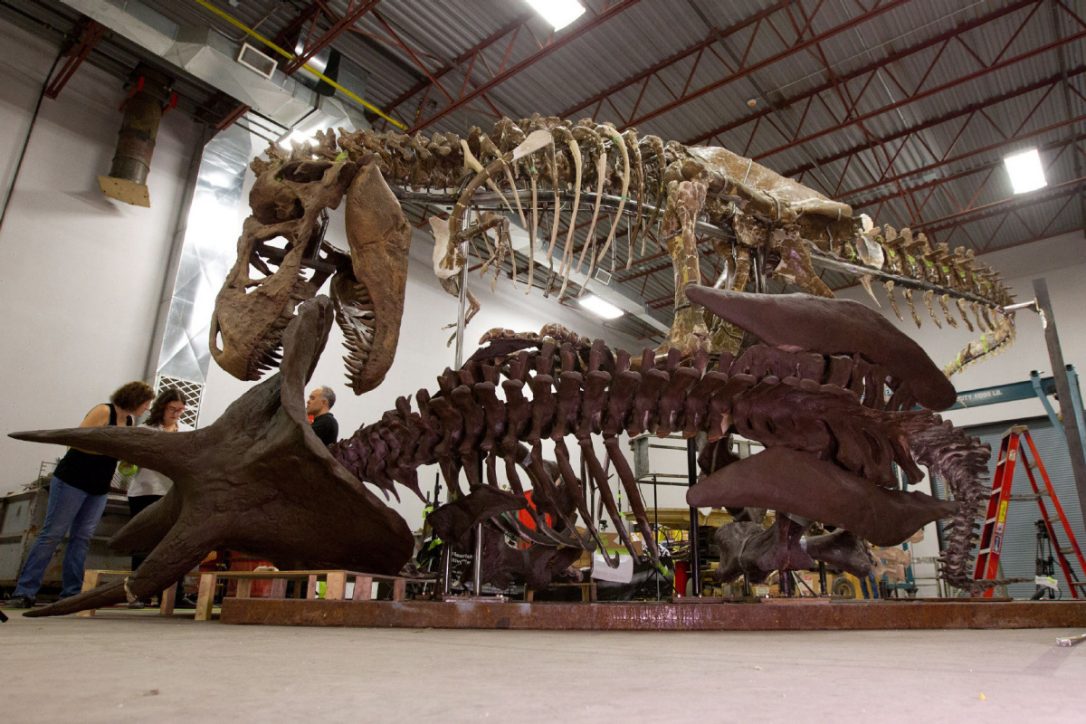
The Nation’s T. rex in its final pose at the Research Casting International workshop.

This week, NMNH will be celebrating all things Tyrannosaurus, starting with a live webcast of arrival of the Nation’s T. rex on Tuesday morning. Stay tuned to this blog for further coverage of the events!

References

Asma, S.T. 2001. Stuffed Animals and Pickled Heads: The Culture and Evolution of Natural History Museums. New York, NY: Oxford University Press.

Boas, F. 1907. Some Principles of Museum Administration. Science 25:650:931-933.

Counts, C.M. 2009. Spectacular Design in Museum Exhibitions. Curator 52: 3: 273-289.

Fiffer, S. 2000. Tyrannosaurus Sue: The Extraordinary Saga of the Largest, Most Fought Over T. rex ever Found. New York, NY: W.H. Freeman and Company.

Larson, N. 2008. “One Hundred Years of Tyrannosaurus rex: The Skeletons.” Tyrannosaurus rex: The Tyrant King. Larson, Peter and Carpenter, Kenneth, eds. Bloomington, IN: Indiana University Press.

Lee, B.M. 2005. The Business of Dinosaurs: The Chicago Field Museum’s Nonprofit Enterprise. Unpublished thesis, George Washington University.

Rainger, R. 1991. An Agenda for Antiquity: Henry Fairfield Osborn and Vertebrate Paleontology at the American Museum of Natural History, 1980-1935. Tuscaloosa, AL: University of Alabama Press.

Switek, B. 2013. My Beloved Brontosaurus: On the Road with Old Bones, New Science and our Favorite Dinosaurs. New York, NY: Scientific American/Farrar, Straus and Giroux.

5 Comments

Filed under dinosaurs, FMNH, fossil mounts, history of science, movies, museums, NMNH, reptiles, science communication, theropods