Category Archives: science communication

Exhibit Review: Kenosha Dinosaur Museum

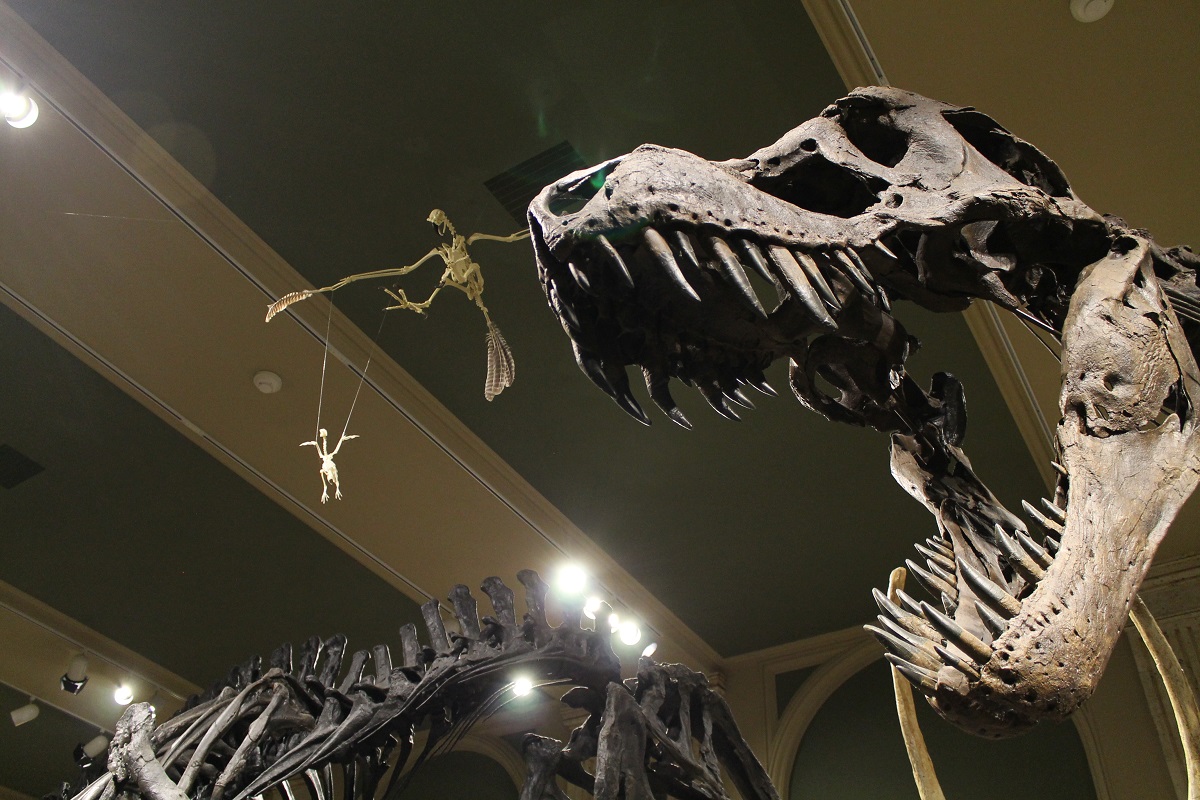
Stan and an eagle.

Stan the Tyrannosaurus with a modern eagle. Photo by the author.

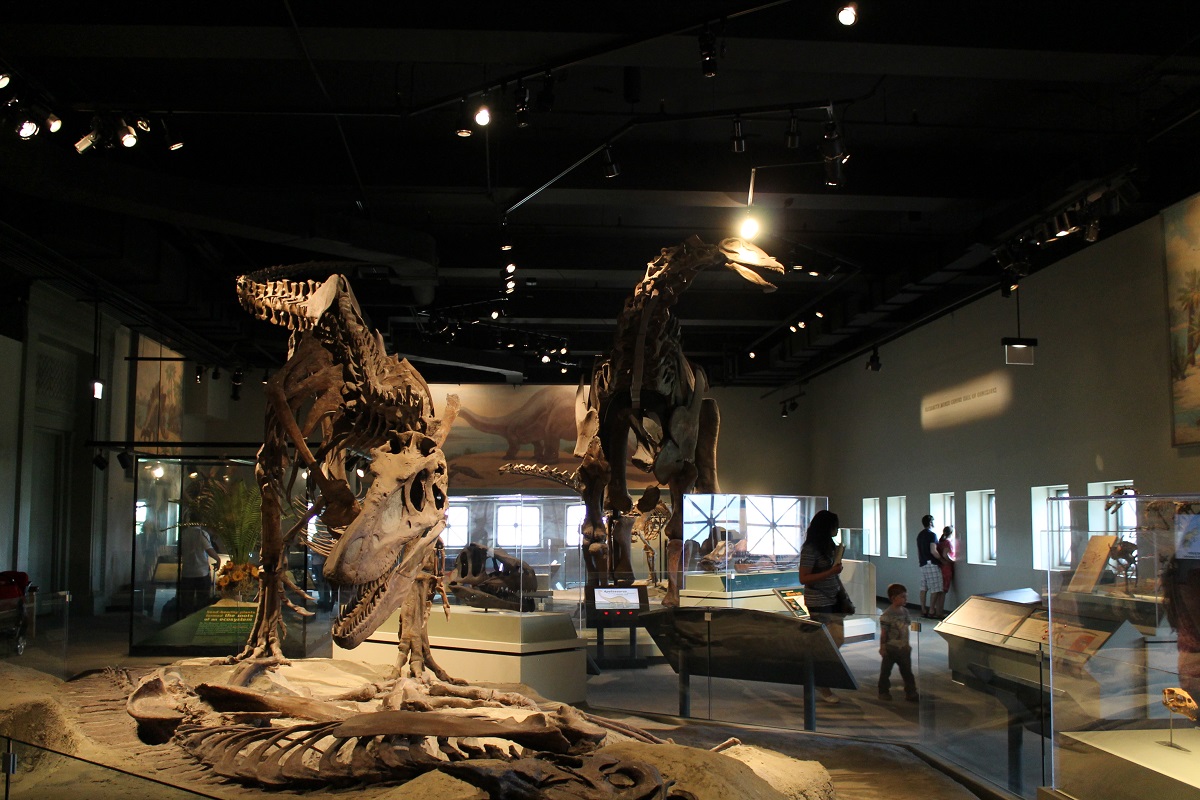
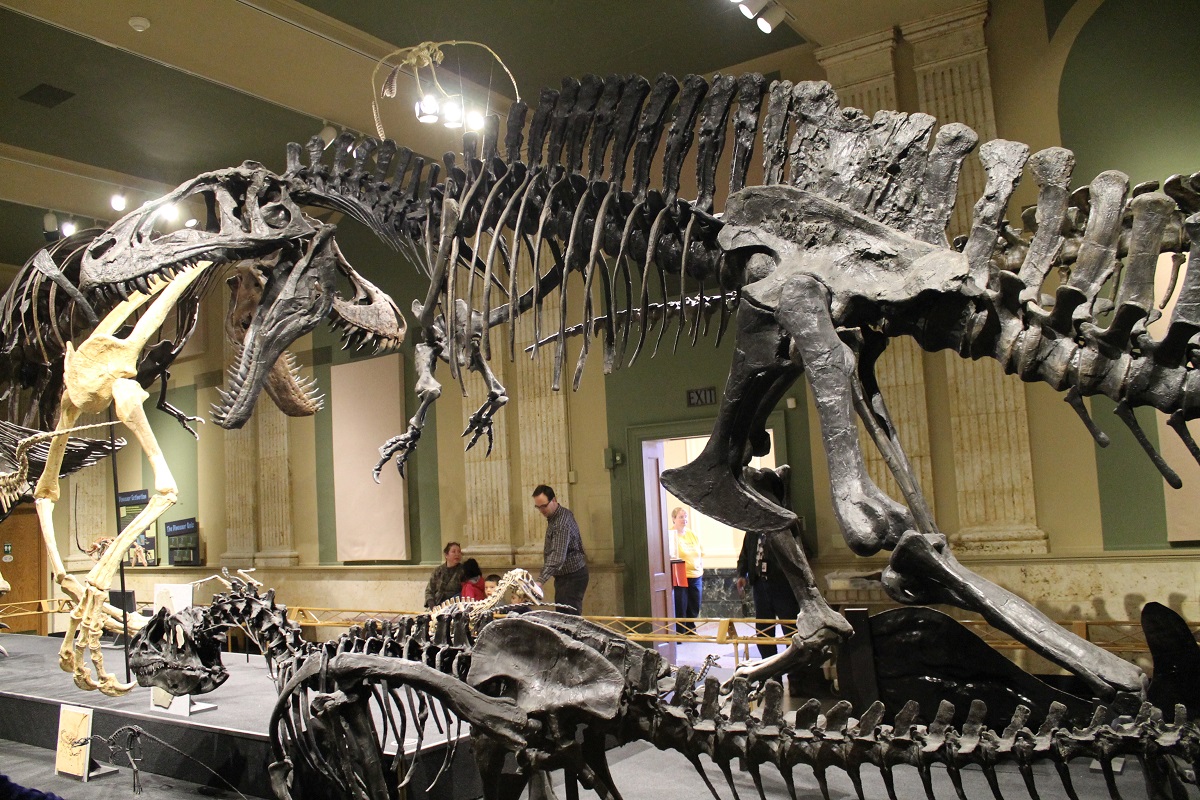
Last week, I had a chance to visit the Dinosaur Discovery Museum in Kenosha, Wisconsin. I had no idea this place existed until recently, but it’s a short drive north from the Chicago area, and has apparently been open since 2006. The Museum is a joint venture between the municipally funded Kenosha Public Museum system and Carthage College, and is housed in a lovely 1930s post office (on the National Register of Historic Places). As I understand it, the Dinosaur Discovery Museum was initially imagined as a space to host the undergraduate paleontology program at the College, which is led by Dr. Thomas Carr. While the Museum does include a working fossil prep lab and displays of recent finds from Carr’s field expeditions in Montana and South Dakota, the primary draw for most visitors is the permanent exhibit hall. Although less than 100 feet across, this space is packed with more theropod mounts than I have ever seen in one place.

Nary an ornithiscian in sight. Photo by the author.

Nary an ornithiscian in sight. Photo by the author.

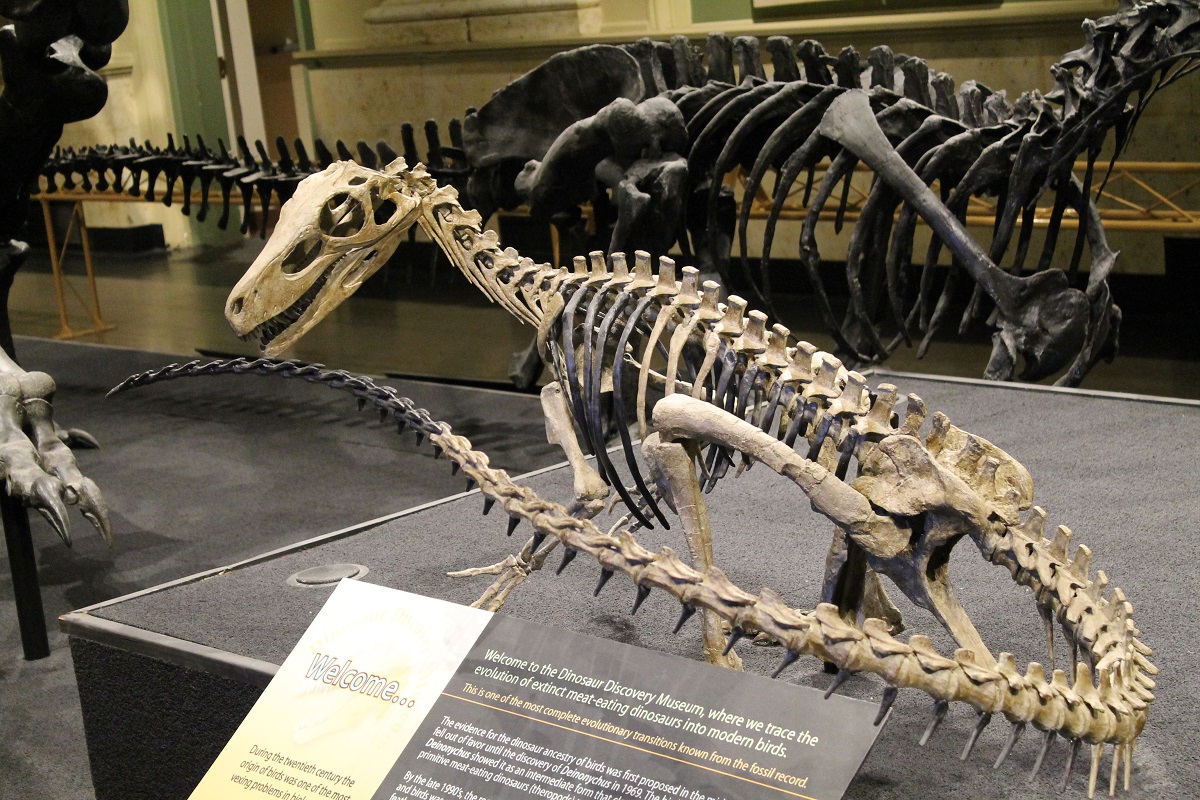
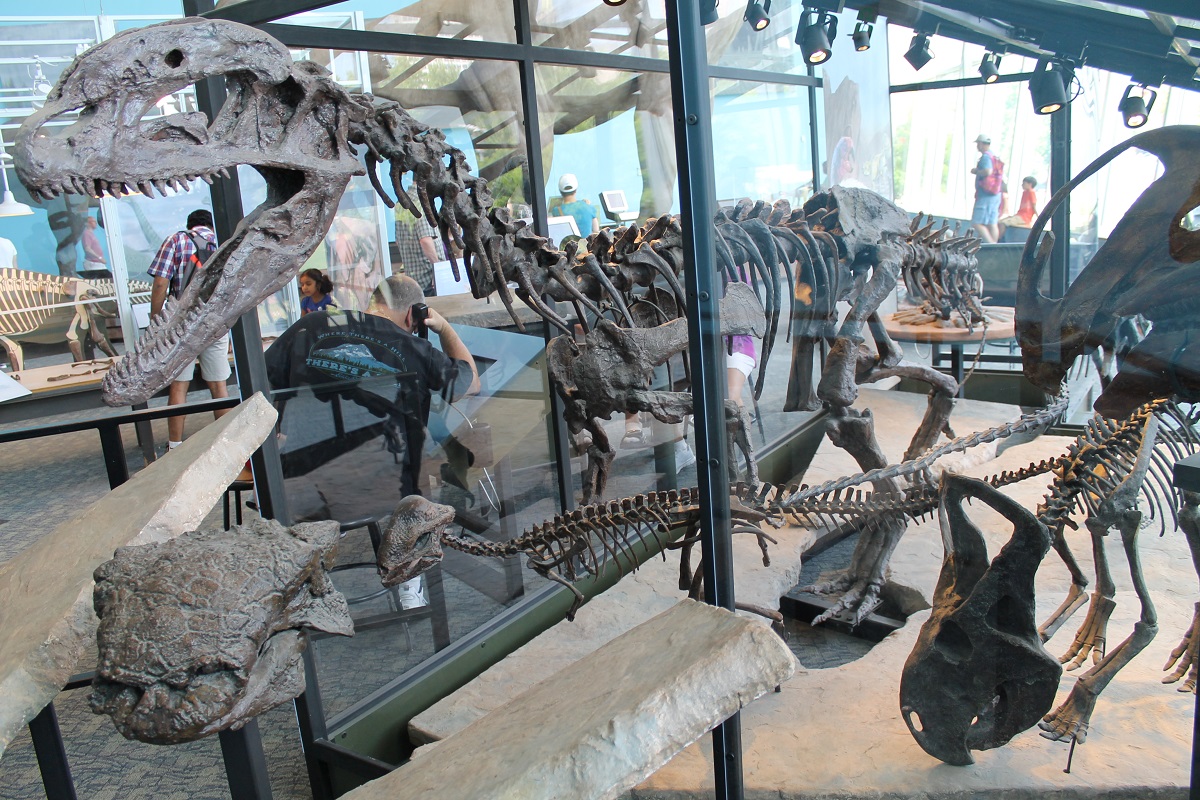
Naturally, the theme of this theropod-centric exhibit is bird evolution. Circling the central pedestal counter-clockwise, visitors can see the radiation of theropods from primitive forms like Herrerasaurus to larger ceratosaurs and tetanurans and finally to increasingly bird-like coelurosaurs. The Dinosaur Discovery Museum must have gotten a very generous initial donation, because they seem to have bought out virtually the entire catalog of casts from both the Black Hills Institute and Triebold Paleontology.

Hererrasaurus

A squatting Hererrasaurus is one of many unusually posed mounts at the Dinosaur Discovery Museum. Photo by the author.

Many of the casts were familiar to me, including the ubiquitous Stan, the Acrocanthosaurus from the North Carolina Museum of Natural Sciences, and the Anzu from the Carnegie Museum of Natural History. Nevertheless, it’s extremely cool to see such a complete range of theropod diversity in one place. I could directly compare any bone from a given mount to the same bone on any other, or even to the helpful selection of modern bird skeletons. The only thing that would make this exhibit more complete would be the inclusion of  growth series from the taxa for which this is known, like Tyrannosaurus and Allosaurus. And for the record, jaded paleophiles, T. rex looks really impressive alongside this menagerie. Overrated, my eye.

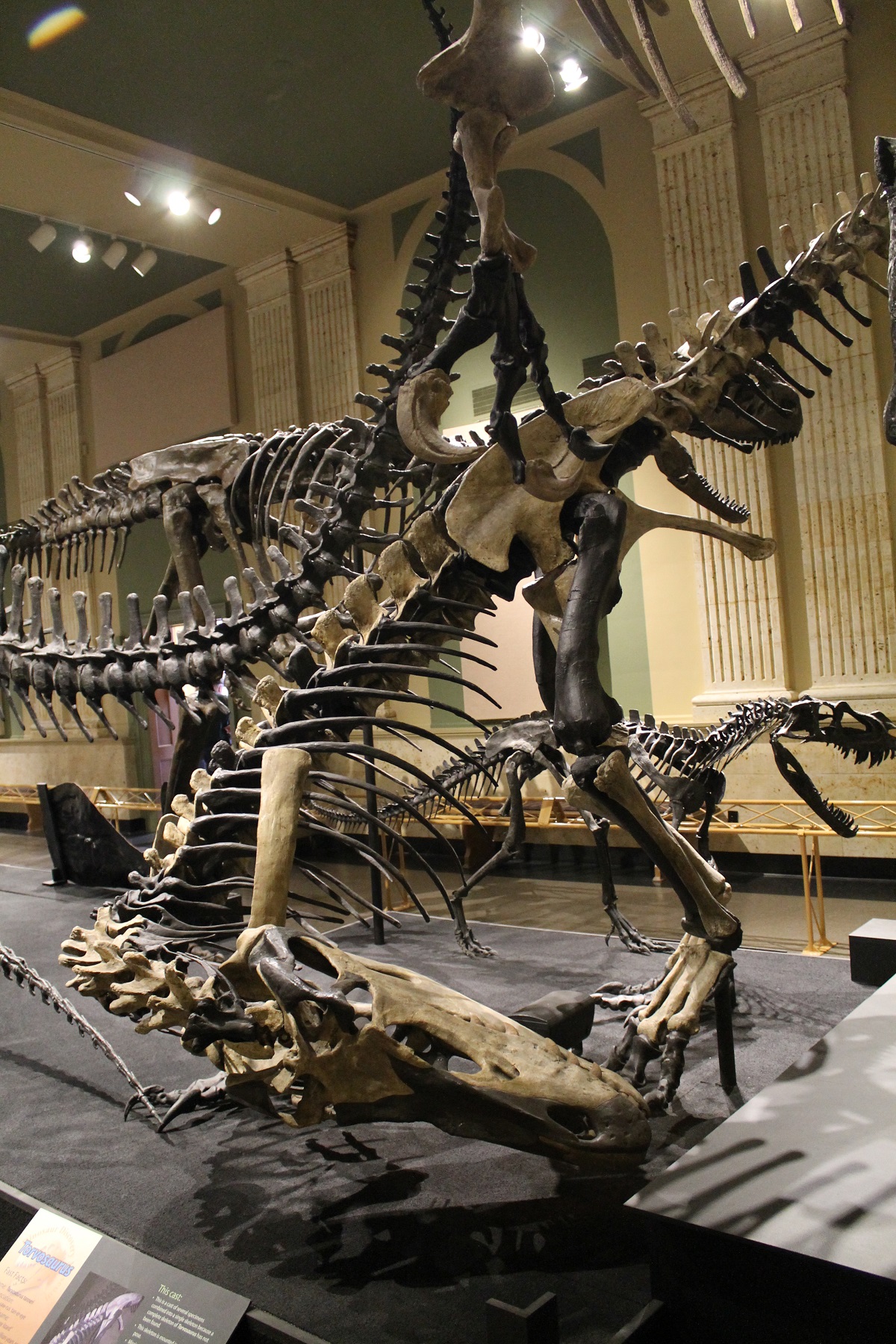
Torvosaurus scratches its jaw.

Torvosaurus scratches its jaw. Photo by the author.

Unlike some exhibits, the Dinosaur Discovery Museum does not shy away from the fact that all the skeletons on display are casts. Most of the mounts are very obviously painted in two colors, showing precisely which bones are based on real finds and which are sculpted reconstructions. Unfortunately, a handful of mounts inexplicably lack this information, which could confuse some visitors. One helpful side effect of displaying casts is that the dinosaurs can be placed in a variety of life-like poses. These theropods are not all staring straight ahead with mouths agape – instead, we are treated to displays like the Torvosaurus above, which is scratching its head with its foot.

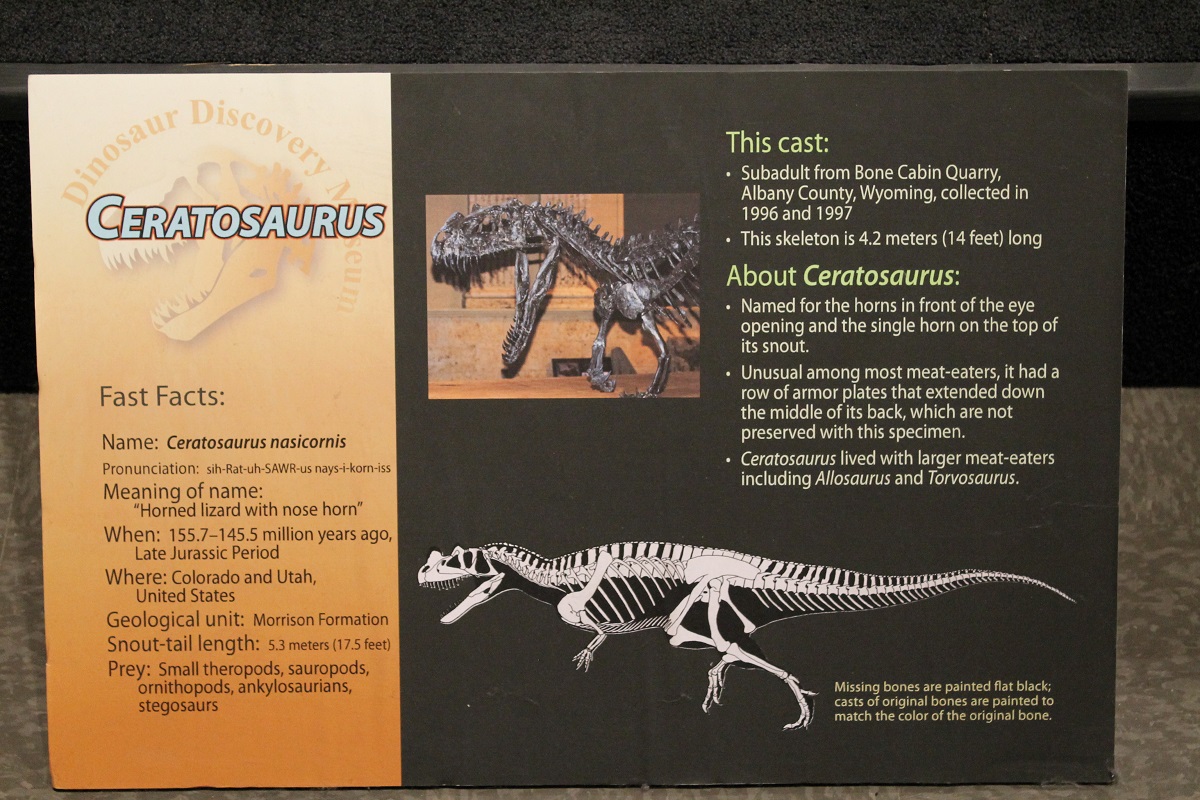
Ceratosaurus sign.

Signs like this accompany each dinosaur. Photo by the author.

The signage is of similarly high quality. Each dinosaur is accompanied by an attractive panel that provides expected information like the animal’s diet and time period, as well as a very helpful section identifying the quarry where the fossils were found and in most cases, the repository housing the original specimen. Additional signs on the walls cover the origin and extinction of dinosaurs, as well as the many lines of evidence that birds are surviving dinosaurs. Although they look a bit wordy at a distance, these signs are quite well-written for inclined to peruse them.

Acrocanthosaurus.

Acrocanthosaurus and an Allosaurus at rest. Photo by the author.

Also of note is a children’s room on the lower level, featuring (sigh) a sandbox dig and some very helpful and enthusiastic volunteers. Indeed, children’s activities appear to be the Dinosaur Discovery Museum’s strong suit. A look at their website reveals that kid’s programs are scheduled every weekend, and special events like dinosaur ornament making and flashlight tours occur throughout the year.

Clearly, I was impressed by my visit to the Dinosaur Discovery Museum. It’s wonderful that an educational opportunity like this exists in a semi-rural community, something that would have been unheard of not so long ago (did I mention it’s free?). What’s more, the exhibit hall is a great resource for specialists interested in comparing a variety of theropods first-hand. If you ever find yourself in the area, this little museum is definitely worth a visit.

1 Comment

Filed under dinosaurs, education, exhibits, fossil mounts, museums, reptiles, reviews, science communication, theropods

National Fossil Day 2014

Happy National Fossil Day! This will just be a quick photo post covering the events at the National Museum of Natural History today. The National Park Service started the day with a junior paleontologist swearing-in ceremony, where students from a dozen area schools learned about the importance of protecting and preserving public lands and natural resources.

Photo by

Photo by the National Park Service.

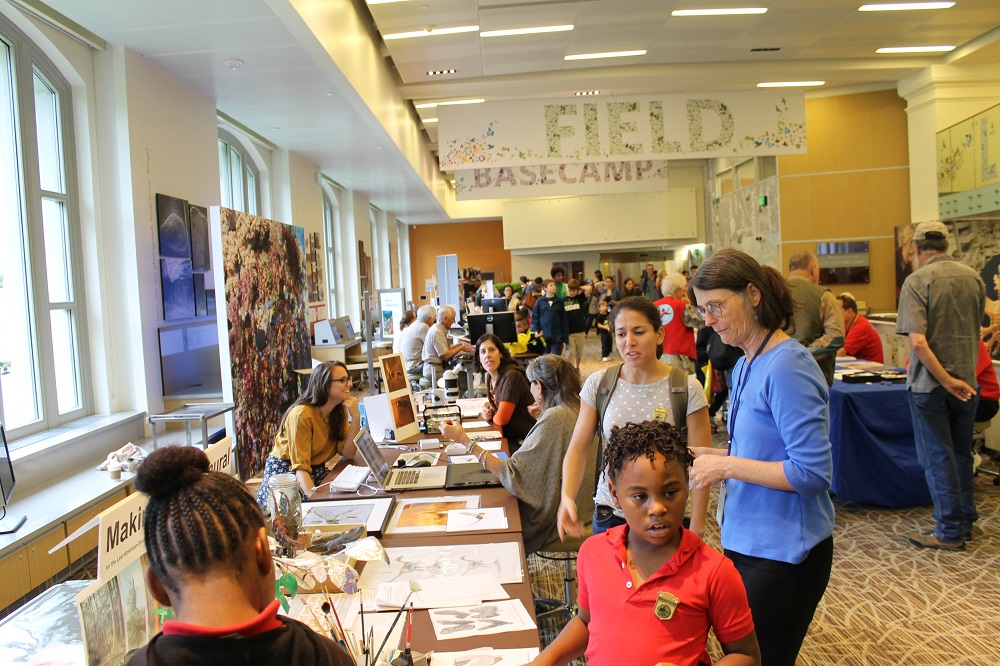
The main show was in the Q?rius education center, where museum staff and volunteers showed off their latest work and discoveries. Visitors could see tiny mammal bones and teeth plucked from matrix collected in Haitian caves, and work through a particularly inspired activity demonstrating how geologists correlate layers in different parts of the world.

nfd2

Photo by the author.

Photo by

Photo by the National Park Service.

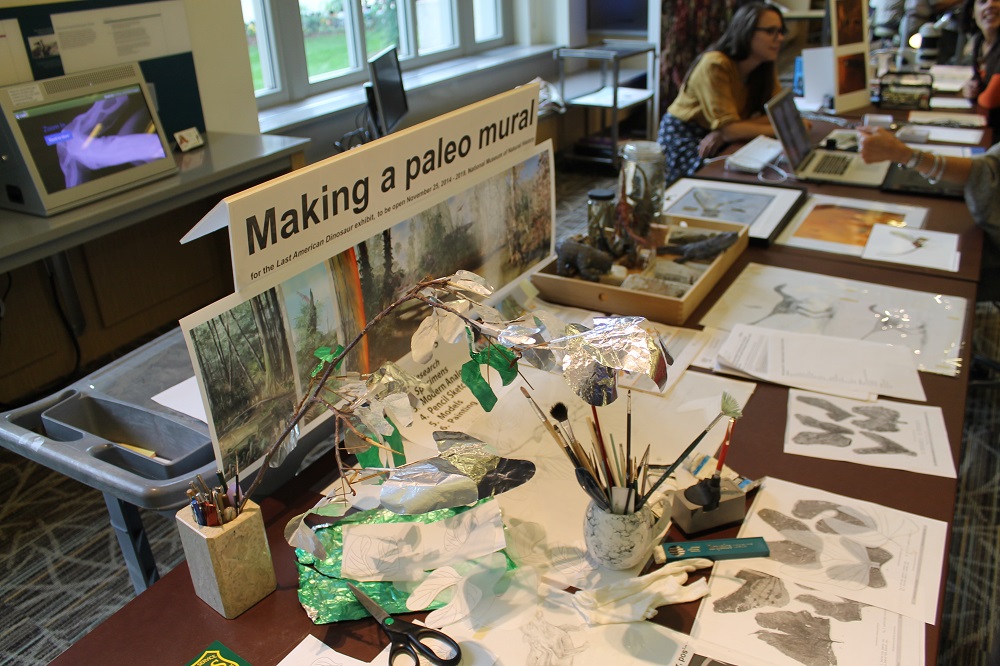
Resident scientific illustrator Mary Parrish had a particularly fascinating display, showcasing the methods and materials she uses to create accurate paintings of prehistoric environments. Note the aluminum foil leaves used as models to paint from, as well as the hand-made macquettes used to block out scenes and experiment with poses. Also on view was a draft of the giant Hell Creek mural that will be on display in The Last American Dinosaurs, opening in November.

nfd3

Photo by the author.

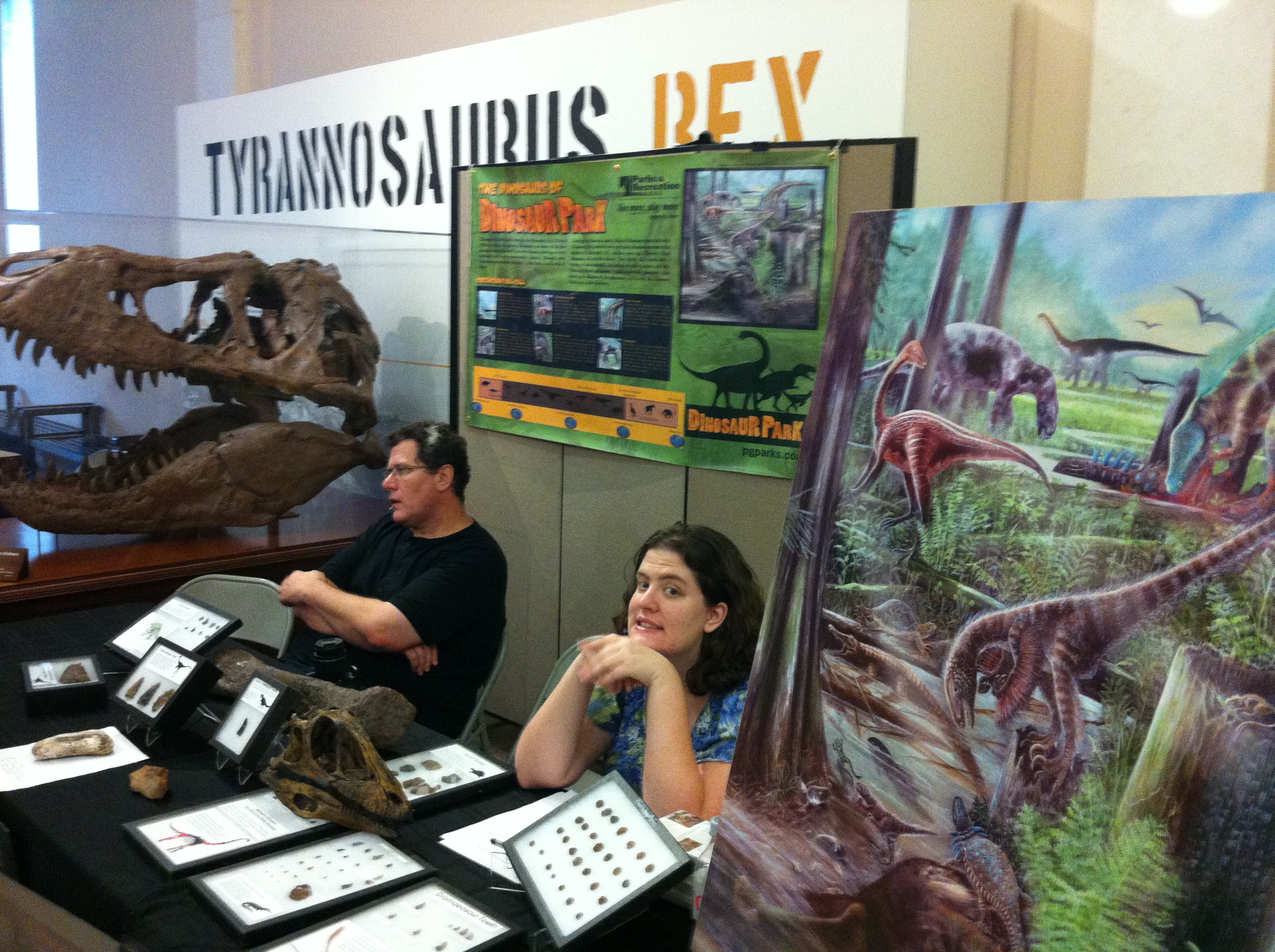
Out in the lower level lobby, the National Park Service, Bureau of Land Management, US Forest Service, National Science Foundation, Calvert Marine Museum, and Maryland Dinosaur Park had activities and displays. Here’s our display of recently discovered fossils from Cretaceous Maryland, slightly overshadowed by the Nation’s T. rex. We talked with visitors about Maryland’s role in the history of dinosaur science, the importance of the early Cretaceous as the origin of the world we know today, and our citizen science programs at the Park in Laurel.

image

Photo by the author.

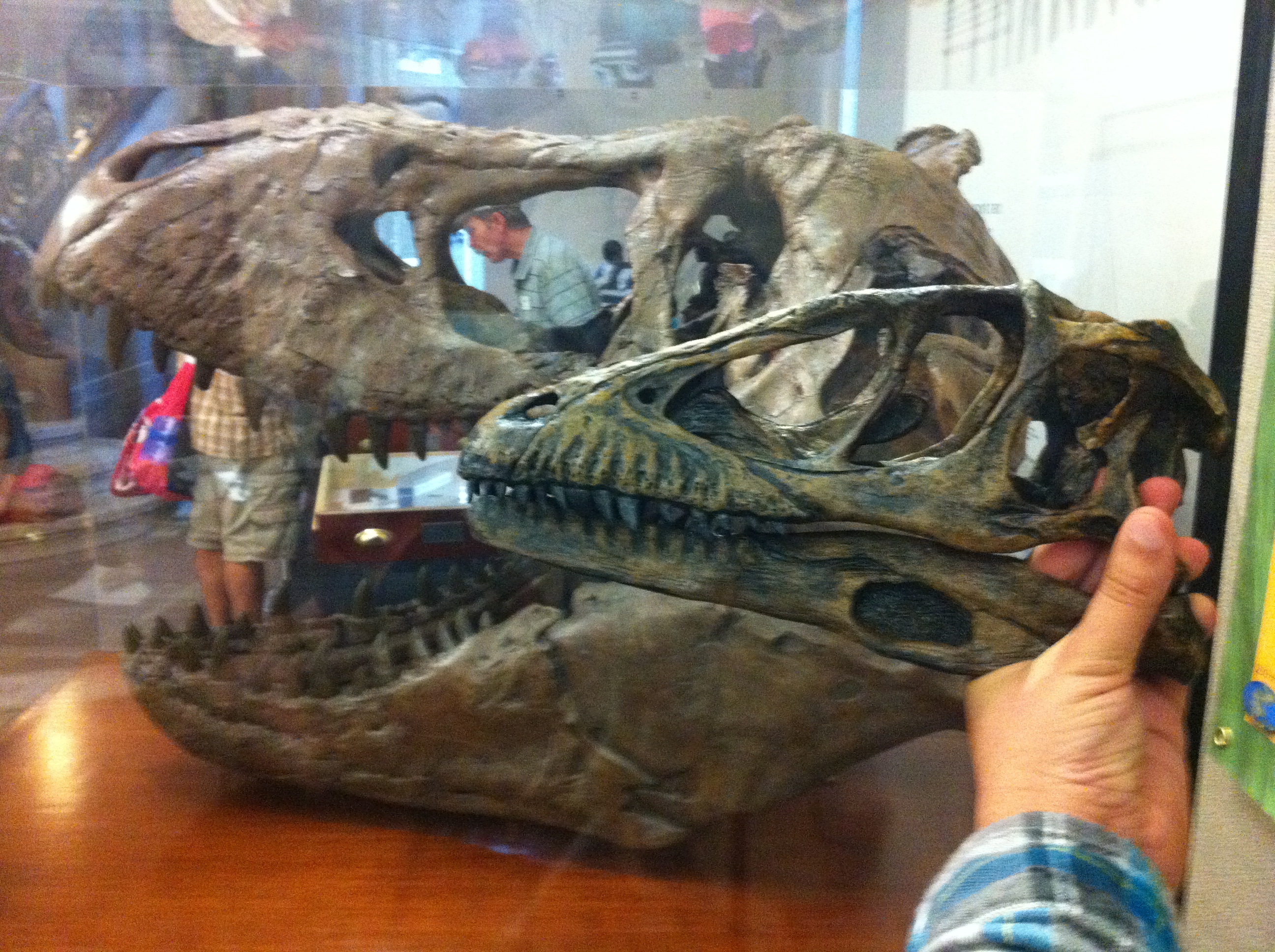
Photo by the author.

Our Deinonychus replica looks a little small next to the Nation’s T. rex. Photo by the author.

National Fossil Day is all about generating awareness and enthusiasm for fossils and the study of the Earth’s natural history. In that, I think the event was quite successful. We talked to nearly 400 people, all of them enthusiastic and eager to learn about local prehistory and the process of discovering the ancient past. It was also a fun opportunity to catch up with people – the Washington area paleontology scene isn’t very big!

Thank you to the National Park Service for coordinating this event, and to the Smithsonian for hosting it!


Leave a comment

Filed under citizen science, Dinosaur Park, dinosaurs, exhibits, museums, NMNH, paleoart, science communication

Spinosaurus at the National Geographic Museum

IMG_2341

Research Casting International has done it again with a beautiful reconstructed skeleton of a swimming Spinosaurus. Photo by the author.

Yesterday, Nizar Ibrahim and National Geographic made a tremendous splash with their long-awaited announcement of a new Spinosaurus specimen. Spinosaurus is a widely recognized and beloved dinosaur (particularly among what one might call the dinosaur fandom community), but paradoxically it is known from only the scrappiest of fossil remains. What’s more, the holotype specimen is long gone – destroyed in the bombing of Munich during World War II. No doubt the enigmatic nature of Spinosaurus is a major part of its appeal. At any rate, the new paper by Ibrahim and colleagues describes the never-before-seen hindlimbs and pelvis of Spinosaurus, and proposes that the dinosaur’s anatomy – and behavior – were far more extreme than previously assumed. The new specimen reveals that Spinosaurus had narrow hips and legs barely longer than its arms. This was not an animal built for running on land, and a quadrupedal posture is not out of the question. What’s more, Spinosaurus limb bones are surprisingly dense for a theropod, not unlike the heavy bones of seals and early whales. Ibrahim and colleagues paint a picture of Spinosaurus as an animal that was at least as at-home in the water as it was on land.

The news has provoked the usual cycle of rampant speculation among dino fans, dismissal of sensationalism by some professionals, and even well-reasoned, evidence-based criticism. After the fervor dies down, we can assess whether this hypothesis holds water. In the meantime, though, I must applaud the tremendously impressive show National Geographic has put on. As part of the media roll-out that started yesterday afternoon, National Geographic has prepared both a television special and a traveling exhibit revolving around Spinosaurus. Some might scoff at all the hype over a partial skeleton, but I’d call this science outreach at its best, put on by some of the most experienced folks in the business.

IMG_2376

This Spinosaurus sculpture will be a fixture outside the National Geographic Building on 17th street until January. Photo by the author.

“Spinosaurus: Lost Giant of the Cretaceous” opened this morning at the National Geographic Explorer’s Hall in Washington, DC, and in this post I’d like to share my initial impressions. Visitors approaching from M Street are greeted by a life-sized Spinosaurus sculpture, posed over a half-eaten fish. This superb model was produced by the Italian studio GeoModel, and was apparently over a year in the making. Conceptual art and behind-the-scenes photos can be seen here. I’m not sure if the model has quite the extreme proportions that are proposed in the paper, but it’s not like I actually measured it. Regardless, this is a stunning piece  that will be a DC fixture through the end of the year.

The shrine to Ernst Stromer at the exhibit's entrance. Photo by the author.

The shrine to Ernst Stromer at the exhibit’s entrance. Photo by the author.

Once you’ve gone inside and paid your admission (I remember when this museum was free…oh well), you can enter the Spinosaurus exhibit proper. Interestingly, the exhibit is framed not as a science lesson but as a historical account. The first objects on display are documents and other possessions of Ernst Stromer, the German paleontologist who originally described Spinosaurus in 1915. Passing through a narrow corridor, you’ll see a reconstruction of the Spinosaurus holotype as it was displayed at the Bavarian State Collection in Munich, a Moroccan fossil shop, and even a replica of the cave where a Mysterious Bedouin Stranger led Ibrahim to the new find. Each stop is supplemented by a video mixing talking-head interviews with somewhat silly re-enactments of historic events. I particularly liked Stromer being berated by his Nazi boss.

Reconstruction of the holotype

I never dreamed I’d ever see an exact reconstruction of the Spinosaurus holotype, which was destroyed during World War II. Photo by the author.

I thought this method of storytelling was quite clever. By focusing on the role of Spinosaurus in world history, the exhibit can grab the attention of adult visitors that would usually dismiss dinosaurs as kids’ stuff. National Geographic’s shtick has always been presenting stories of intrepid scientists on adventures in distant locales, and there is plenty of that in evidence here. This sort of exoticism is probably a little problematic, but the gorgeous images of the Moroccan desert were clearly having the desired effect on some of my fellow visitors. Usually, I would complain about the over-reliance on long videos, but people seemed to be watching them all the way to the end, so I guess I’ll keep quiet this time.

Spinosaurus!

Spinosaurus in all its glory. Photo by the author.

Once the history lesson is over, the exhibit opens up into a larger display space. This is similar to what was done in “The World’s Largest Dinosaurs” – a narrow entry gallery introduces visitors to the topic at hand and the central questions being discussed, then visitors are freed to look at what they find interesting in whatever order they choose. All in all, this layout is a good compromise between the need to convey a specific educational message and the need to let visitors make the exhibit experience their own.

The star of the show is of course the reconstructed skeleton of Spinosaurus, yet another fantastic display piece by Research Casting International. Check out a time-lapse video of the mount being assembled here. What wasn’t clear from the grainy preview images that were flying around the internet a couple months ago is that the Spinosaurus is actually in a swimming pose. Its legs are posed in mid-paddle, and its head is turned to the right to snag a model sawfish. Above all, the mount is big. So big, in fact, that I couldn’t find anywhere in the gallery where I could photograph it all at once. I’d love to see this thing alongside Sue.

IMG_2372

The process of 3D printing digital fossils, explained. Photo by the author.

Happily, the exhibit takes the time to acknowledge that the Spinosaurus mount is not only a cast, but a composite of many fossil specimens. There is even a small display showcasing the process by which fossils are scanned and 3-D printed at a consistent scale. It’s great that the exhibit explains the evidence that led to the aquatic Spinosaurus reconstruction, showcasing the process of making and testing a scientific hypothesis.

Around the perimeter of the Spinosaurus gallery are displays of the other paleofauna of the Kem Kem region in Morocco, which Paul Sereno and company have been assembling for many years. There are models of azdarchid pterosaurs and coelocanth fish, as well as a Deltadromeus skeleton and skulls of  Carcharodontosaurus and Rugops (all heavily-reconstructed casts). All of these displays explore the question of how so many carnivores could co-exist in one environment. The answer provided is that each predator was specialized to hunt a different kind of prey: Spinosaurus chased fish, Carcharodontosaurus ate big herbivorous dinosaurs and (this will undoubtedly annoy some) Rugops is presented as an obligate scavenger.

friends

Some Kem Kem friends: Deltadromeus and Carcharodontosaurus. Photo by the author.

I have virtually nothing negative to say about the Spinosaurus exhibit. This is a great story, well told, and I was thoroughly impressed by nearly every part of it. The only thing that might be a sore point for some is that there are very few authentic fossils on display. A single dorsal spine is the only real bone representing Spinosaurus. Nevertheless, the exhibit team has shown precisely how to dramatize the process of scientific discovery, while still making the process transparent and relateable. Bravo.


11 Comments

Filed under dinosaurs, exhibits, fossil mounts, history of science, museums, reviews, science communication, theropods

Exhibit Review: Dinosaur Mysteries at the Maryland Science Center

First, let me assure you that the posts on major fossil exhibits and Triceratops mounts I’ve promised are definitely in the works, and I should be finishing them soon(ish). In the meantime, here’s a quick write-up of my recent trek to the distant land of Baltimore’s inner harbor, home of the Maryland Science Center and the “Dinosaur Mysteries” exhibit. In all seriousness, this exhibit has been open since 2004 and is less than 40 miles from me, so this visit was long overdue. What’s more, now that the Smithsonian’s fossil hall is closed for renovation, this is the largest dinosaur exhibit in the region, and will be the spot to see mounted dinosaur skeletons near Washington, D.C. for the next five years. Is it up to the task? Let’s find out.

Dinosaur Mysteries from the second floor. Photo by the author.

Dinosaur Mysteries from the second floor. Photo by the author.

At 15,000 square feet, Dinosaur Mysteries isn’t a huge exhibit, but it’s pretty dense with content. There are a lot of displays and interactives crammed into into the space, including no less than 12 free-standing mounts and life-sized sculptures of Astrodon* and Acrocanthosaurus. This venue is a science center, not a natural history museum, so the exhibit is mostly aimed at kids and families. That said, there’s still plenty for adult visitors to enjoy (the rest of the museum is purely for kids, though…if you don’t have any, I’d recommend taking advantage of the half-priced Friday evenings).

*Alright, it’s really a sculpture of Giraffatitan standing in for the poorly known Astrodon.

Among the mounted skeletons (all casts), expect to see Tyrannosaurus (Peck’s Rex, to be specific), Tarbosaurus, Giganotosaurus, Compsognathus, Herrerasaurus, Protoceratops, what used to be called “Dilophosaurus sinensis”, and plenty of others. The offerings are a little theropod heavy (and a little tyrannosaur heavy, in point of fact), but they certainly don’t fail to impress. Sadly overlooked by most visitors are some lovely genuine Maryland fossils, including an Astrodon femur that is the largest dinosaur bone found east of the Mississippi River.

Full skeleton cast of Peck's Rex, accompanied by skull cast of the Nation's T. rex. Photo by the author.

Full skeleton cast of Peck’s Rex, accompanied by skull cast of the Nation’s T. rex/Wankel Rex. Photo by the author.

Thematically, Dinosaur Mysteries is all about answering questions through observation and deduction. The press release asserts that there are over two dozen interactives available, and indeed, visitors are invited throughout the exhibit to compare, contrast, and even measure fossils in order to draw conclusions about dinosaurs’ lives. Most of the “mysteries” are of the safe variety, tackling issues that are either soundly resolved or were never really issues to begin with (think “are birds dinosaurs” or “was Tyrannosaurus a scavenger or a predator”). Experts might be a bit blasé about these questions, but they nevertheless serve to get visitors thinking about how scientists draw conclusions. I go back and forth on this, but generally I find it helpful to embrace what visitors are already familiar with, at least as a starting point, rather than shutting out their frame of reference entirely.

Birds are dinosaurs, did you know?

This may come as a shock, but birds are dinosaurs. Photo by the author.

Other interactive components include a cool champsosaur skeleton puzzle, and a tabletop sandbox to dig in. I would have liked to see more interactivity with the dinosaur mounts themselves, since they’re the most visually impressive part of the exhibit. For example, there are no less than three Tyrannosaurus skulls on display, all from different specimens. That’s a great opportunity to compare the eccentricities of each individual, perhaps considering age differences, sexual dimorphism, pathology, or even erroneous reconstruction (looking at you, Wankel Rex rostrum). With some guidance, I reckon most visitors would do well with that, and it would push them closer to how paleontologists actually study fossils.

Astrodon and Acrocanthosaurus sculptures with Bored Dad #2. Photo by the author.

Astrodon and Acrocanthosaurus sculptures, with a Bored Dad. Photo by the author.

Apparently included in those two dozen interactives are a number of video terminals. As I’ve ranted before, videos are not interactive, even if you get to press a button to start it. That said, I’m actually of two minds about these. The videos, which are mostly interviews with paleontologists like Tom Holtz, Kristina Curry-Rogers, and Chris Morrow, were fascinating. I enjoyed hearing about the presumed purpose of Tyrannosaurus gastralia, what can and cannot  be presumed from dinosaur trackways, and especially the decision-making process behind posing a T. rex mount. However, these videos are also quite long, and rather unedited. The speakers ramble, repeat themselves, and generally er and um through their spiels. It’s quite a bit like chatting with a scientist about their work in person, actually, and I’m always in favor of giving science a human face. On the other hand, the exhibit team probably could have tightened these up.

What used to be called "Dilophosaurus sinensis" and friends. Photo by the author.

What used to be called “Dilophosaurus sinensis” and friends. Photo by the author.

Overall, I was pretty pleased with Dinosaur Mysteries. It’s not a large-scale fossil hall at a major research museum, but it’s still cool to experience and the science being taught is generally very good. If you’ve got kids who are bummed that the Smithsonian fossil hall is closed (don’t forget that The Last American Dinosaurs is opening this fall, though), this is definitely a worthy substitute. For adults,  keep in mind that you aren’t the Maryland Science Center’s target audience, but if you appreciate the artistry of a well-made dinosaur exhibit, Dinosaur Mysteries is still worth checking out.

PS: There are a few additional photos on my tumblr page.

Leave a comment

Filed under dinosaurs, exhibits, fossil mounts, museums, reviews, science communication

Framing Fossil Exhibits, Part 1

This post started out as a review of “Evolving Planet”, the expansive paleontology exhibit at the Field Museum of Natural History. The short version is that it’s very good exhibit constrained by a somewhat frustrating layout. We’ll get back to that eventually, but first it’s worth considering the purpose of large-scale fossil exhibits in a more general sense.

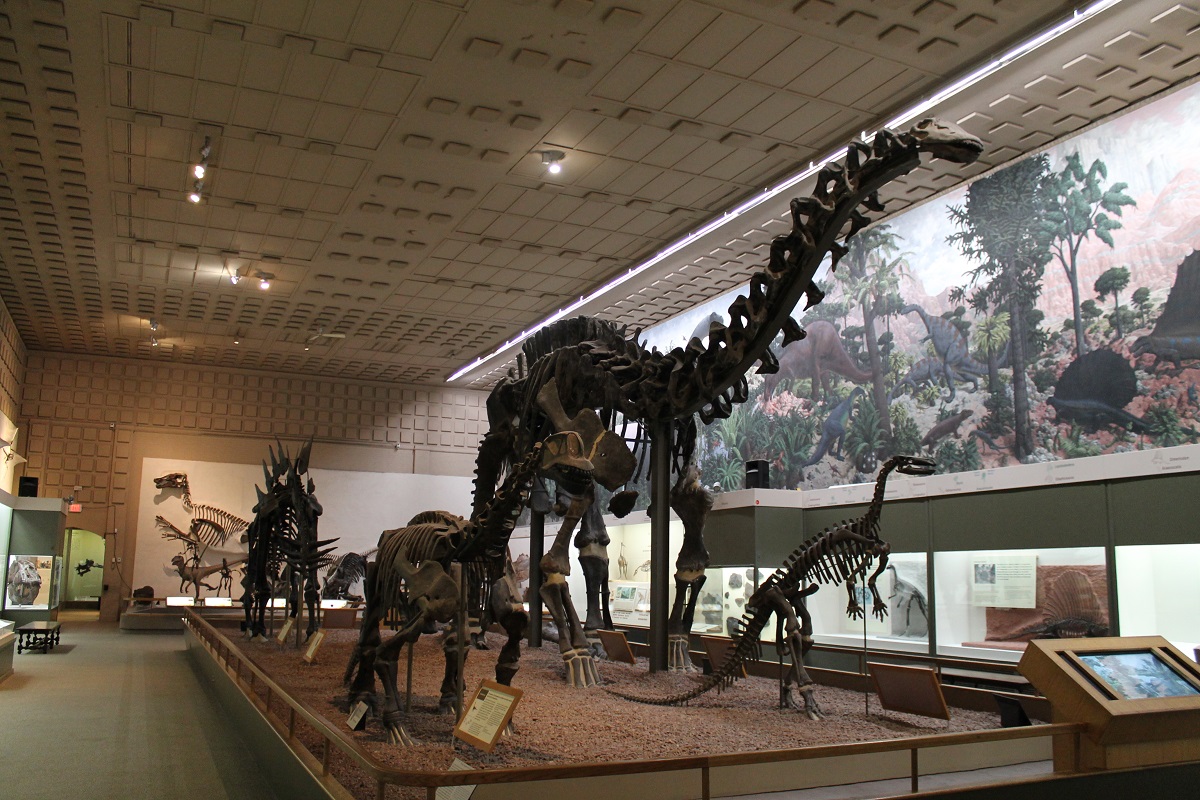
Fossils, particularly the mounted skeletons of dinosaurs and other prehistoric animals, have been central to the identity of natural history museums since the late 19th century. In the early days, public exhibits were afterthoughts to the primary work of the museum (research and curation of collections), and if there was any logic behind their layout, it was an aesthetic logic. Typically posed in neutral, trophy-like stances on centrally-situated pedestals, mounted skeletons were the highlights of a natural history display for most visitors. For anyone not trained in comparative anatomy, however, these exhibits ultimately amounted to prehistoric pageantry. People could marvel at the great size of the animals, but there was very little to be learned besides the names of the species in question.

Hadrosaurus cast on display at the Field Museum. Field Museum Photo Archives.

A typically random assortment of fossil specimens at the Field Colombian Museum, ca. 1898. Image courtesy of the Field Museum Photo Archives.

These days, we try to do better. Exhibits are designed with a clear narrative structure, as well as specific learning goals for the audience. The focus of the narrative varies depending on the exhibit and the team behind it, but most modern natural history exhibits are explicitly designed to answer “how” as well as “what.” For paleontology displays, this means telling the story of life on Earth while also communicating how scientists collect and interpret evidence to put that story together. Crafting an exhibit has been compared to writing a popular nonfiction book, except designers are using the three-dimensional space of the exhibition hall as their medium. In this way, modern exhibits are more about ideas than specimens, or at least, the specimens are present primarily to illustrate the major scientific principles being communicated.

That’s how it works on paper, anyway. Despite this focus on education (and institutional mandates to provide learning opportunities for the widest possible audience), visitor surveys show that dinosaur pageantry is still the default mode of understanding for the majority of people passing through paleontology exhibits. No matter how carefully we craft our stories, most visitors still leave these displays recalling little more than a list of cool specimens they saw. Dinosaur pageantry has its place and can be employed for good. Dinosaurs and other prehistoric animals are undeniably impressive and spectacular, and it is absolutely worth taking advantage of that fact. We want people to pay attention to science, and in that respect mounted skeletons of favorite dinosaurs are great ambassadors to the world of research and discovery. The challenge is getting past the attention-grabbing stage. Prior experience has led visitors to expect that dinosaur pageantry is all paleontology has to offer, and many seem unprepared or unwilling to commit to a deeper understanding.

peabody mammals

The great hall at the Peabody Museum of Natural History, one of the last unmodified early 20th century fossil displays in the US. Photo by the author.

So are these people just hopeless rubes? Should exhibits be tailored only to visitors that care enough to put in the effort to understand? It should go without saying that this condescending attitude is completely wrongheaded and goes against the very spirit of museums. Education is half about knowing your content and half about knowing your audience. If visitors are not picking up on the content as desired, then a reassessment of who those visitors are is in order. Many museum exhibits still seem to be pitched at interested adults traveling alone with all the time in the world. This is a good description of many of my museum visits, but I’m also part of an increasingly small fraction of museum visitors. Most people who come to natural history museums come in groups of friends or family, and these groups often represent a range of ages. What’s more, most visitor interactions while in the museum will not be with the exhibits, but with each other. For the typical visitor, the museum experience is primarily a social one.

With this demographic in mind, a textbook on the wall (or a long video lecture*) is the last thing natural history museum audiences need. Visitors are absorbing exhibit content while simultaneously navigating a complicated, unfamiliar space. In the case of parents, they are also monitoring the attention span, hunger, and bathroom needs of their charges. Caught up in this whirlwind of information, visitors frequently fall back on what they already know. In the case of paleontology exhibits, this often means identifying familiar dinosaurs and ignoring the more intellectually challenging contextual information.

*It’s worth pointing out that a long video is NOT an improvement over a long label. Transferring label copy to a video or computer terminal does not inherently make the exhibit more interactive or more interesting. In fact, when the disruptive noise and need to wait for the next showing are taken into account, poorly implemented multimedia is probably less useful than traditional text labels.

The challenge for exhibit design, then, is dealing with the fact that visitors are not passively ingesting information. Visitors passing through an exhibit pull out relevant pieces of information and filter them through the lens of their existing worldview. Exhibit designers want visitors to also learn new information and challenge their preconceptions, but it’s easy to go too far. Survey after survey has shown that visitors do not appreciate exhibits that force them to move (or think) on rails. For practical reasons noted above, few visitors are able to look at every display, watch every orientation video, and work through every interactive in the prescribed order. Visitors need flexibility in order to make the exhibit experience their own. Finding the balance between providing informative context and providing a customizable experience is quite challenging, and not every exhibit succeeds.

struggling to contain the dinosaurs

The dinosaur hall in “Evolving Planet” at the Field Museum. Photo by the author.

On top of that, paleontology exhibits are particularly difficult to design because of problems with relatability. The story of life on Earth is immense, complex, and frequently counter-intuitive. It’s not enough to just explain what happened, we have to explain the history and methodologies of the half-dozen scientific disciplines that have contributed to to our understanding of that narrative. Even something so basic as the numerical age of a given fossil taxon requires a deluge of explanation to convey how we know. And all of this needs to be conveyed concisely, without being alienating, overwhelming, or condescending. Most importantly, it has to be made relevant to what audiences already know and understand.

Over the years, major natural history museums have attempted a variety of organizational strategies for their fossil exhibits. Each of these has been an attempt to break the dinosaur pageantry barrier and to portray the true complexity and relevance of paleontological science. Some arrangements, like taxonomical organization, have generally fallen out of favor. Others, like chronological presentations of life through time, are reliable mainstays that have been re-imagined in varied ways at different institutions. Still others, including cross-sections of specific extinct ecosystems, biogeography, and environmental change over time are relatively new and untested.

Keeping everything in this meandering introduction in mind, the upcoming series of posts will explore the strengths and weaknesses of each approach from the perspectives of science communication, aesthetics, and for lack of a better term, hospitality for non-expert audiences. Stay tuned!

References

Asma, S.T. 2001. Stuffed Animals and Pickled Heads: The Culture and Evolution of Natural History Museums. New York, NY: Oxford University Press.

Falk, J.H. and Dierking, L.D. 1992. The Museum Experience. Washington, DC: Whalesback Books.

Wands, S., Donnis, E. and Wilkening, S. 2010. “Do Guided Tours and Technology Drive Visitors Away?” History News 93:8:21-23.

2 Comments

Filed under dinosaurs, education, exhibits, fossil mounts, history of science, museums, opinion, science communication

Displaying the Tyrant King – Part 3

Subtlety is unnessesary when T. rex is involved.

Who needs subtlety when you have a T. rex?

Start with Displaying the Tyrant King Part 1 and Part 2.

Tyrannosaurus rex displays changed for good in the 1990s thanks to two individuals, one real and one fictional. The latter was of course the T. rex from the film Jurassic Park, brought to life with a full-sized hydraulic puppet, game-changing computer animation, and the inspired use of a baby elephant’s screeching cry for the dinosaur’s roar. The film made T. rex real – a breathing, snorting, drooling animal unlike anything audiences had ever seen. Jurassic Park was a tough act to follow, and in one way or another, every subsequent museum display of the tyrant king has had to contend with the shadow cast by the film’s iconic star.

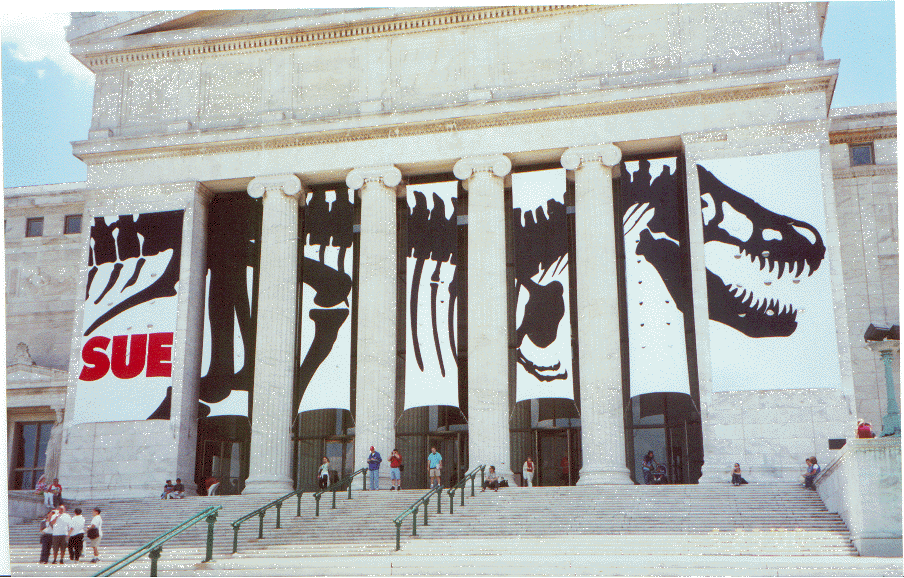
The other dinosaur of the decade was Sue, who scarcely requires introduction. First and foremost, Sue is the most complete Tyrannosaurus ever found, with 80% of the skeleton intact. Approximately 28 years old at the time of her death, Sue is also the eldest T. rex known, as well as one of the largest. The specimen’s completeness and exquisite preservation has allowed paleontologists to ascertain an unprecedented amount of information about the lifestyle of meat-eating dinosaurs. In particular, Sue’s skeleton is riddled with fractured and arthritic bones, as well as evidence of gout and parasitic infection that together paint a dramatic picture of the rough-and-tumble world of the late Cretaceous.

From South Dakota to Chicago

Sue at Disney World

Cast of Sue at Walt Disney World, Orlando. Source

It was the events of Sue’s second life, however, that made her the fossil the world knows by name. Sue was discovered in the late summer of 1990 by avocational fossil hunter Susan Hendrickson (for whom the specimen is named) on the Cheyenne River reservation in South Dakota. Peter Larson of the Black Hills Institute, a commercial outfit that specializes in excavating, preparing, and exhibiting fossils, initially intended to display the Tyrannosaurus at a new facility in Hill City, but soon became embroiled in an ugly four-way legal battle with landowner Maurice Williams, the Cheyenne council, and the United States Department of the Interior. With little precedent for ownership disputes over fossils, it took until 1995 for the District Court to award Williams the skeleton. Williams soon announced that he would put Sue on the auction block, and paleontologists initially worried that the priceless specimen would disappear into the hands of a wealthy collector, or end up in a crass display at a Las Vegas casino. Those fears were put to rest in 1997 when Chicago’s Field Museum of Natural History won Sue with financial backing from McDonald’s and Disney. Including the auctioneer’s commission, the price was an astounding $8.36 million.

FMNH and its corporate partners did not pay seven figures for Sue solely to learn about dinosaur pathology.  Sue’s remarkable completeness would be a boon to scientists, but her star power was at least as important for the Museum. Sue was a blockbuster attraction that would bring visitors in the door, and her name and likeness could be marketed for additional earned income. As FMNH President John McCarter explained, “we do dinosaurs…so that we can do fish” (quoted in Fiffer 2000). Particularly in the late 1990s, with Jurassic Park still fresh in people’s minds, a Tyrannosaurus would attract visitors and generate funds, which could in turn fund less sensational but equally important research, like ichthyology and entomology.

Still, some worried that McCarter, whose background was in business, not science, was exploiting an important specimen as a marketing gimmick at the expense of the Museum’s educational mission. This echoed similar concerns voiced 80 years earlier, when the original mounted Tyrannosaurus was introduced at the American Museum of Natural History. As president of AMNH, Henry Osborn oversaw the creation of grandiose and dramatic exhibits, with the intent to draw crowds and justify private and municipal financial support. When the Museum unveiled the Tyrannosaurus mount, Osborn held a lavish publicity gala for the New York elite and members of the press. The buzz generated by Osborn’s promotion resulted in lines around the block and front page headlines, but the attention was focused on the spectacle of the dinosaur rather than the science behind it. Many academics derided this as lowest common denominator pandering, while others, like anthropologist Franz Boas, grudgingly accepted that “it is a fond delusion of many museum officers that the attitude of the public is a more serious one, but the majority do not want anything beyond entertainment.”

Original skull of Sue the T. rex, displayed on the upper mezzanine. Photo by the author.

FMNH was under similar scrutiny as museum staff revealed their plans for Sue. The role of the corporate sponsors that paid for the fossils was a particular cause for concern, and the marketing team knew it. Although the idea of T. rex-themed Happy Meals was briefly on the table, McDonald’s and Disney wisely opted to present themselves only as patrons of science. McDonald’s got its name on the new fossil preparation lab at FMNH and Disney got a mounted cast of Sue to display at Walt Disney World, but the principal benefit to the two companies was high-profile exposure in association with youth science education. The Museum retained control over the message, highlighting Sue’s importance to paleontology and only coyly admitting her role as a promotional tool. Likewise, FMNH is the sole profiteer from the litany of shirts, hats, toys, mugs, and assorted trinkets bearing the Sue name and logo that are continually sold at the Museum and around Chicago.

You May Approach Her Majesty

Once Sue arrived at FMNH, the Museum did not hold back marketing the dinosaur as a must-see attraction. A pair of Sue’s teeth went on display days after the auction, which expanded organically into the “Sue Uncrated” exhibit, where visitors could watch the plaster-wrapped bones being unpacked and inventoried. Meanwhile, McDonald’s prepared an educational packet on Sue that was distributed to 60,000 elementary schools.

The main event, of course, was the mounted skeleton, which needed to be ready by the summer of 2000. This was an alarmingly short timetable, and the FMNH team had to hit the ground running. Much of Sue’s skeleton was still buried in rock and plaster. The bones needed to be prepared and stabilized before they could be studied, and they needed to be studied before they could be mounted. In addition, two complete Sue casts had to be fabricated: one for Disney World and one for a McDonald’s-sponsored traveling exhibit. The casts were produced by Research Casting International, the Toronto-based company that recently built the mounted menagerie for “Ultimate Dinosaurs“. Phil Fraley Productions, the same exhibit company that rebuilt the American Museum and Carnegie Museum T. rex mounts, was tapped to mount Sue’s original skeleton.

The mounted skeleton of Sue in the Stanley Field Hall. Photo by the author.

Unlike every other Tyrannosaurus mount before or since, Sue can hardly be called a composite. With the exception of a missing arm, left foot, a couple ribs, and small number of other odds and ends, the mounted Sue skeleton is composed of real fossils from a single individual. FMNH public relations latched onto this fact, emphasizing in press releases that while “many museums are displaying replicas of dinosaur skeletons, the Field Museum has strengthened its commitment to authenticity. This is Sue.” Just as they did with the AMNH Tyrannosaurus, Fraley’s team built an armature with individual brackets securing each bone, allowing them to be removed with relative ease for research and conservation. No bolts were drilled into the bones and no permanent glue was applied, ensuring that the fossils incur only minimal damage for the sake of the exhibit. Despite these improvements over historic mount-making techniques, however, the Sue mount does have some inexplicable anatomical errors. The coracoids should be almost touching in the middle of the chest, but the shoulder girdles are mounted so high on the rib cage that there is a substantial space between them. Consequently, the furcula (wishbone) is also positioned incorrectly.

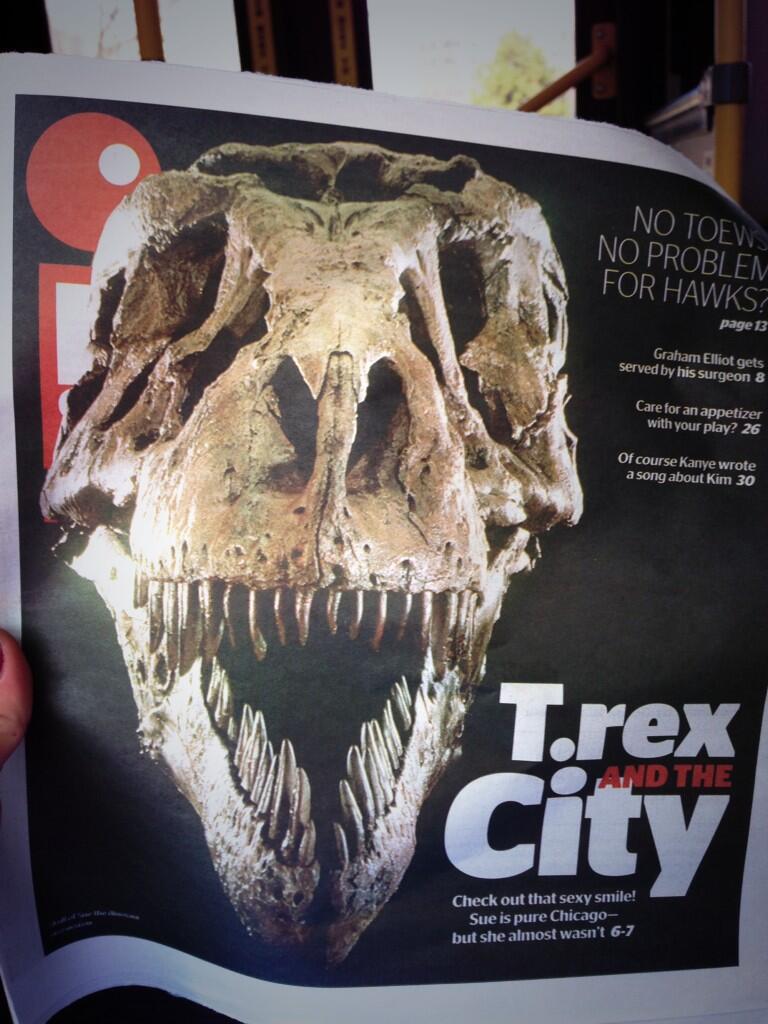
After a private event not unlike the one held by Osborn in 1915, Sue was revealed to the public on May 17, 2000 with the literal raising of a curtain. A week-long series of celebrations and press junkets introduced Sue to Chicago, and she has been one of the city’s biggest attractions every since. All the publicity paid off, at least in the short term: FMNH attendance soared that year from 1.6 million to 2.4 million. 14 years later, Sue the Tyrannosaurus is still known by name, and is even used as the voice of FMNH on twitter. Interestingly, Sue’s new identity as a Chicago landmark seems to have all but eclipsed the legal dispute that was her original source of fame. A recent RedEye cover story goes so far as to proclaim this South Dakotan skeleton as “pure Chicago.”

 The Nation’s T. rex

This customized truck transported the Nation’s T. rex from Montana to Washington, DC.

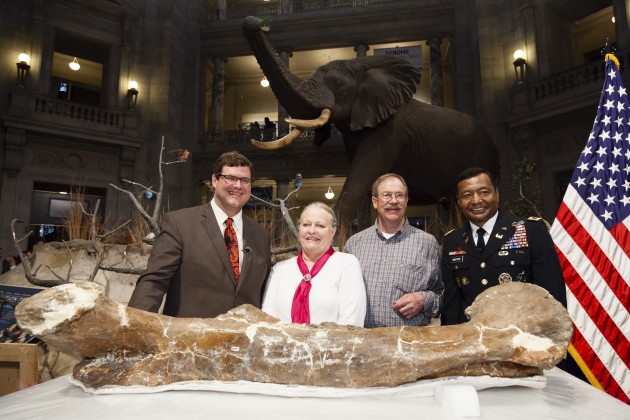
This year, another Tyrannosaurus specimen has rocketed to Sue-like levels of notoriety. MOR 555, also known as “Wankel Rex”, is being transferred to the Smithsonian National Museum of Natural History, where it will eventually be mounted for long-term display. Now dubbed “the Nation’s T. rex“, the promotion of this specimen has mirrored that of Sue in many ways. Front-page media coverage, first-person tweets from the dinosaur and even an official song and dance contest herald the arrival of the fossils from their previous repository, the Museum of the Rockies in Montana. Much like the “Sue Uncrated” exhibit, the process of unpacking the unarticulated bones will soon be on view in a temporary display called “The Rex Room.” Meanwhile, the very name “Nation’s T. rex” is a provocative invented identity akin to Sue’s new status as a Chicagoan.

Nevertheless, the Nation’s T. rex does not quite live up to Sue’s mystique. This Tyrannosaurus is neither as large nor as complete as Sue, and there was no prolonged legal battle or frantic auction in its past. The 60% complete skeleton was found in 1988 by Montana rancher Kathy Wankel, on land owned by the US Army Corps of Engineers. The fossils are now on a 50 year loan from from the Corps to the Smithsonian, (presumably) a straightforward transfer between federal agencies. In addition, MOR 555 is by no means a new specimen. Several casts of the skeleton are already on display, including exhibits at the Royal Ontario Museum, the Museum of the Rockies, the Perot Museum of Nature and Science, and even the Google campus. In fact, a cast of the MOR 555 skull has been on display at NMNH for years.

NMNH Director Kirk Johnson, fossil hunter Kathy Wankel, her husband Bob Wankel, and Lt. Gen. Thomas Bostick preside over the arrival of the Nation’s T. rex at the Smithsonian. Source

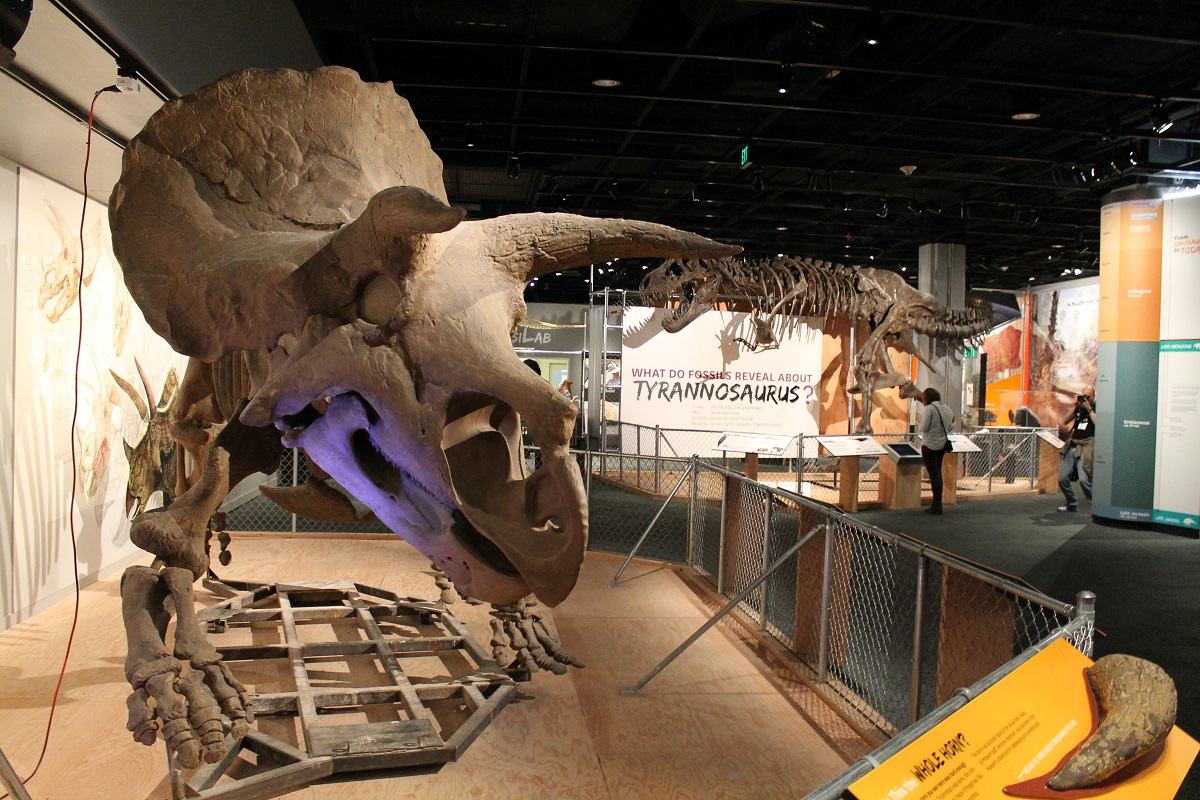
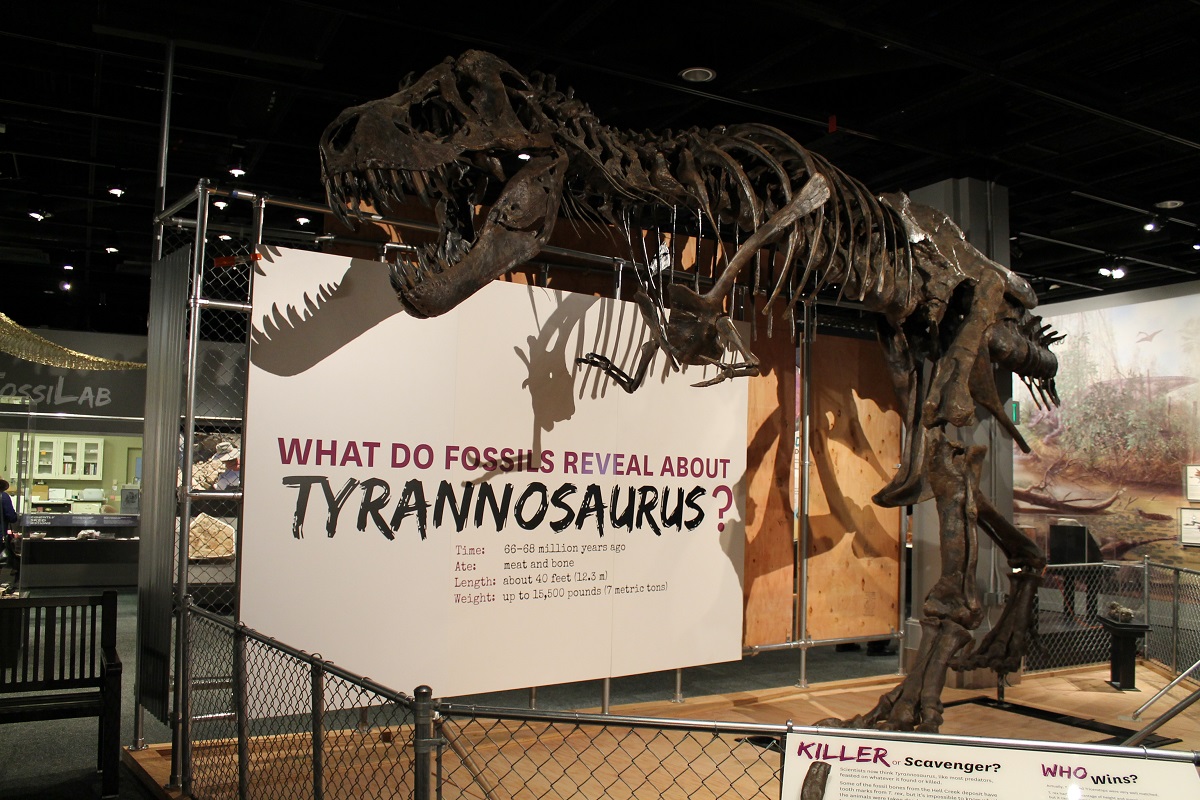
With that in mind, the hype around the Nation’s T. rex might seem like much ado about nothing. As this series has demonstrated, the number of Tyrannosaurus skeletons on exhibit, whether original fossils or casts, has exploded in recent years. A quarter century ago, New York and Pittsburgh were the only places where the world’s most famous dinosaur could be seen in person. Today, there may well be over a hundred Tyrannosaurus mounts worldwide, most of which are identical casts of a handful of specimens. Acquiring and displaying a T. rex is neither risky nor ambitious for a natural history museum. No audience research or focus groups are needed to know that the tyrant king will be a hit. And yet, excessive duplication of a sure thing might eventually lead to monotony and over-saturation.

So far, such fears appear to be unfounded. A specimen like Sue or the Nation’s T. rex is ideal for museums because it is at once scientifically informative and irresistibly captivating. Museums do not need to choose between education and entertainment because a Tyrannosaurus skeleton effectively does both. And even as ever more lifelike dinosaurs grace film screens, museums are still the symbolic home of T. rex. The iconic image associated with Tyrannosaurus is that of a mounted skeleton in a grand museum hall, just as it was when the dinosaur was introduced to the world nearly a century ago. The tyrant king is an ambassador to science that unfailingly excites audiences about the natural world, and museums are lucky to have it.

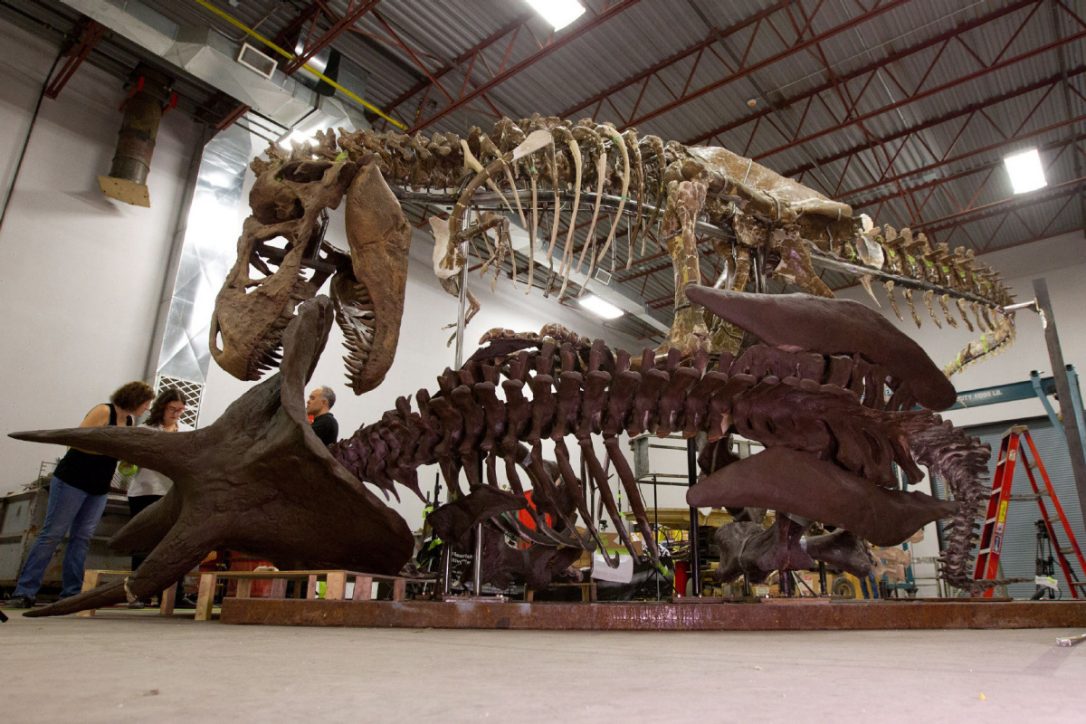
The Nation’s T. rex in its final pose at the Research Casting International workshop.

This week, NMNH will be celebrating all things Tyrannosaurus, starting with a live webcast of arrival of the Nation’s T. rex on Tuesday morning. Stay tuned to this blog for further coverage of the events!

References

Asma, S.T. 2001. Stuffed Animals and Pickled Heads: The Culture and Evolution of Natural History Museums. New York, NY: Oxford University Press.

Boas, F. 1907. Some Principles of Museum Administration. Science 25:650:931-933.

Counts, C.M. 2009. Spectacular Design in Museum Exhibitions. Curator 52: 3: 273-289.

Fiffer, S. 2000. Tyrannosaurus Sue: The Extraordinary Saga of the Largest, Most Fought Over T. rex ever Found. New York, NY: W.H. Freeman and Company.

Larson, N. 2008. “One Hundred Years of Tyrannosaurus rex: The Skeletons.” Tyrannosaurus rex: The Tyrant King. Larson, Peter and Carpenter, Kenneth, eds. Bloomington, IN: Indiana University Press.

Lee, B.M. 2005. The Business of Dinosaurs: The Chicago Field Museum’s Nonprofit Enterprise. Unpublished thesis, George Washington University.

Rainger, R. 1991. An Agenda for Antiquity: Henry Fairfield Osborn and Vertebrate Paleontology at the American Museum of Natural History, 1980-1935. Tuscaloosa, AL: University of Alabama Press.

Switek, B. 2013. My Beloved Brontosaurus: On the Road with Old Bones, New Science and our Favorite Dinosaurs. New York, NY: Scientific American/Farrar, Straus and Giroux.

5 Comments

Filed under dinosaurs, FMNH, fossil mounts, history of science, movies, museums, NMNH, reptiles, science communication, theropods

The self indulgent year-in-review post

Happy 2014!

Not unlike a 20th century museum, this blog is beholden to no one. I post what I want to post, and I alone decide what readers ought to find interesting. And yet, even the most visitor-centric modern museums with the most thorough evaluation procedures would no doubt do anything to get the fine-grained audience statistics that WordPress provides freely to bloggers. With that in mind, it’s time to jump squarely onto the bandwagon and share some of the highlights of the past year’s metrics.

With just shy of 10,000 viewers, 2013 was my best year by far in terms of visitation since I started blogging three years ago. The overwhelming majority of visitors hailed from the US, but there were plenty of visitors from Canada and the UK as well. More than half of visitors came via search engine, but there was also a significant number of visitors coming through social media, especially Twitter and Facebook. The good folks at Love in the Time of Chasmosaurs added me to their blog roll earlier this year, so that has been big driver of traffic as well.

The most popular post was the Murals and Dioramas entry in my Extinct Monsters series. My post on Henry Osborn’s notorious bigotry and how he continues to influence museums today was a close second, and my review of medullary bone in dinosaurs from last year was third. I’m glad the Osborn post found an audience, because I definitely consider it one of the more “important” posts I’ve done. Expect more about Osborn’s legacy in the coming year. The Murals and Dioramas post was made possible by a lovely chat I had with Norman Deaton earlier this year when I was working on my master’s thesis. I’m happy to see that his gorgeous and historically important dioramas are of interest to others. Be aware, the NMNH paleontology halls are closing for renovation this Spring, and the dioramas will not be included when the exhibit reopens in five years. The dioramas will definitely be preserved, but this is the last opportunity to see them in their intended context.

Beyond the blog, my big accomplishments this year were finishing my MA and scoring a job that lets me do precisely what I love: sharing information about paleontology with enthusiastic people. Meanwhile, my attempt to turn my thesis into something publishable has expanded into a monster with an absurd page count and no end in sight. Perhaps there will be news on that front in the coming year, but in the meantime thanks to all who have made this possible. And of course, thanks to all the readers who have dropped by (even all of you who only wanted that stolen horse evolution image that I only posted as a bad example), everyone who took the time to comment, and especially everyone who permitted me to tell the stories of their fascinating work.

Leave a comment

Filed under museums, science communication

The Calvert Marine Museum’s big foam shark

Over Labor Day weekend, I visited the Calvert Marine Museum in Solomons, Maryland. The Museum, which features both indoor and outdoor exhibits, covers a wide range of Chesapeake regional history, including Patuxant Indian culture, the War of 1812, the local fishing industry and of course, Miocene marine fossils. The paleontology gallery, called “Treasures from Our Cliffs”, is nicely done and surprisingly high in production value for the museum’s size. Starting with an extensive entry gallery that places Chesapeake area fossils in a global context, the exhibit also includes fossils of seals, whales, invertebrates and assorted terrestrial mammals, plus a neat recreation of a cliff-side excavation.

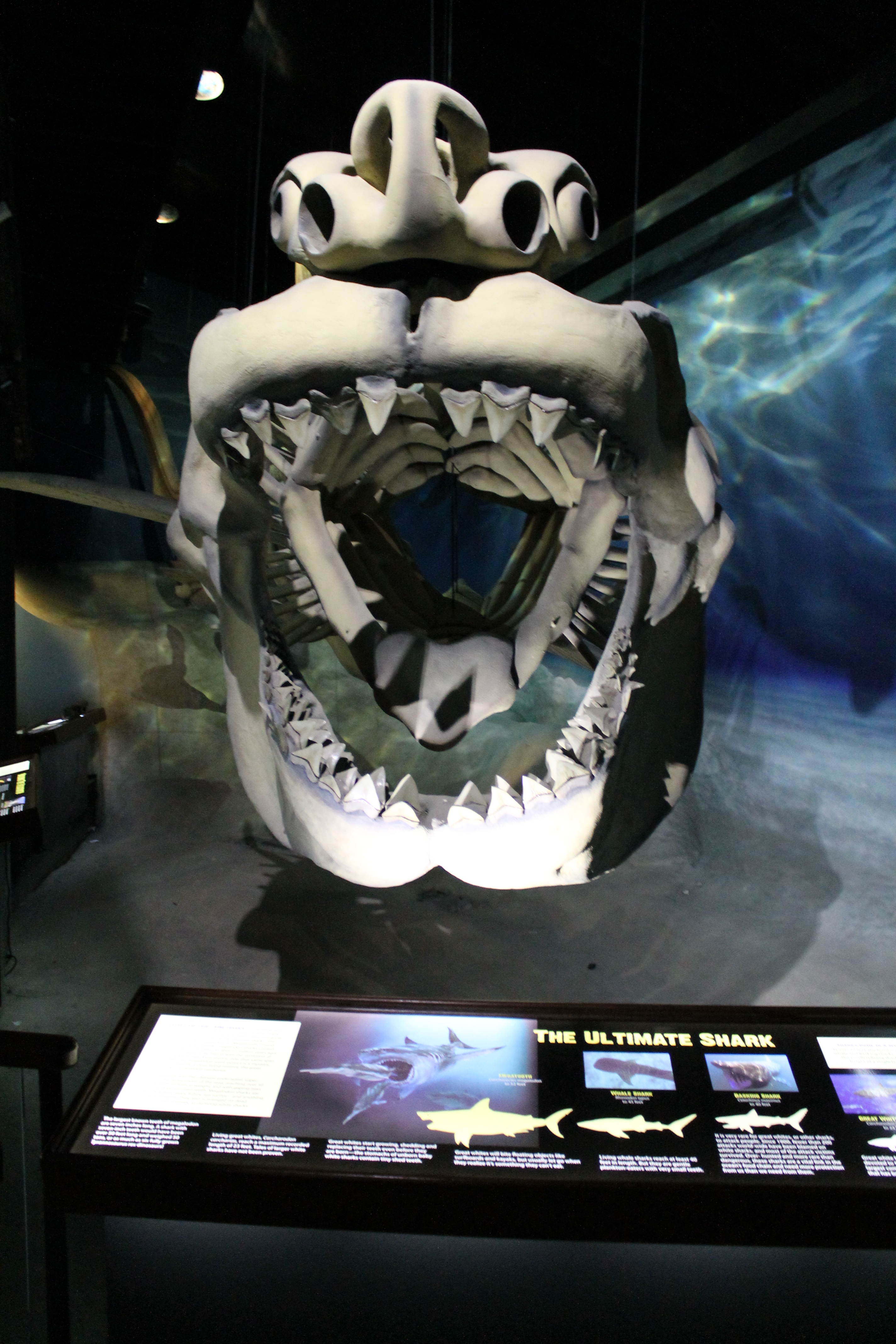
The Carcharocles megalodon at the Calvert Marine Museum.

The Carcharocles megalodon at the Calvert Marine Museum.

What I want to talk about most, though, is the big foam shark pictured above. This is the exhibit’s centerpiece attraction, a complete replica of the cartilaginous skeleton of the infamous giant extinct shark Carcharocles megalodon. Since shark skeletons are primarily made up of soft cartilage, most of their bodies are very unlikely to fossilize. While teeth and lithified vertebrae of C. megalodon are relatively common, a complete skeleton can only be created as a replica. As such, the Calvert Marine Museum’s display is a scaled-up model of the cartilaginous skeleton of a modern Carcharodon chararias (great white shark), with a few proportional adjustments based on known fossils. The result is undeniably impressive: suspended over an ocean backdrop, the 37-foot model absolutely steals the show in the paleontology exhibit.

Nevertheless, I find it absolutely fascinating that the museum would go to such lengths to create a replica shark, particularly given its substantial collection of original fossils. The foam shark’s existence can be traced to the beginning of the 20th century, when there was a dramatic rush among large urban museums in the United States to collect and mount the biggest and most spectacular dinosaur skeleton that could be found. This fossil craze was largely motivated by the vanity of the museums’ wealthy benefactors, but proved to be extremely productive for both paleontologists and museums. Mounted dinosaur skeletons sprung up seemingly overnight in cities across the country, making names like “Brontosaurus” and Diplodocus household terms and igniting a wave of interest in museums and natural science.

As a result of this mounting spree, the public conception of dinosaurs and other prehistoric animals is to this day irreversibly intertwined with its conception of museums. When we think of fossils, we think of grand museum halls populated by towering skeletons. This connection is so ingrained that mounted skeletons have become, in the public eye, the only proper way to display prehistoric animals. Patrons of paleontology exhibits expect mounts, and museums must deliver, even if it means purchasing a cast from another institution, or in the case of the Calvert Marine Museum, sculpting one outright.

And from the front.

A closer look at C. megalodon.

It is true that very few museum mounts feature the complete skeleton of a single animal – they are typically composites of many specimens, or have missing parts filled in with casts or sculpted elements (see this SVPOW post on Kyle Davies, who sculpts bone replicas for OMNH). Probably the most important function of a mount is to present fossil material in a format that non-specialists can easily understand and appreciate. They show viewers what extinct animals would have been like in life, and let us perceive them in relation to our own human scale. But unlike a mural or life-sized model, which are obviously reproductions, mounts retain the aura of authenticity that comes from displaying known fossils. To display a skeleton is to imply that we are seeing real specimens, or at least replicas standing in for specimens that exist somewhere else. Whether reasonable or not, this is the expectation ingrained by over 150 years of fossil mounts in museums.

This means that the C. megalodon at the Calvert Marine Museum is pushing the concept of a fossil mount to its very limit. While this is without doubt a very reasonable reconstruction of what a C. megalodon skeleton would have looked like, only a minuscule fraction of what is on display represents fossils that have actually been uncovered. The question is then, is a display like this a misrepresentation of scientific knowledge and the fossil record?

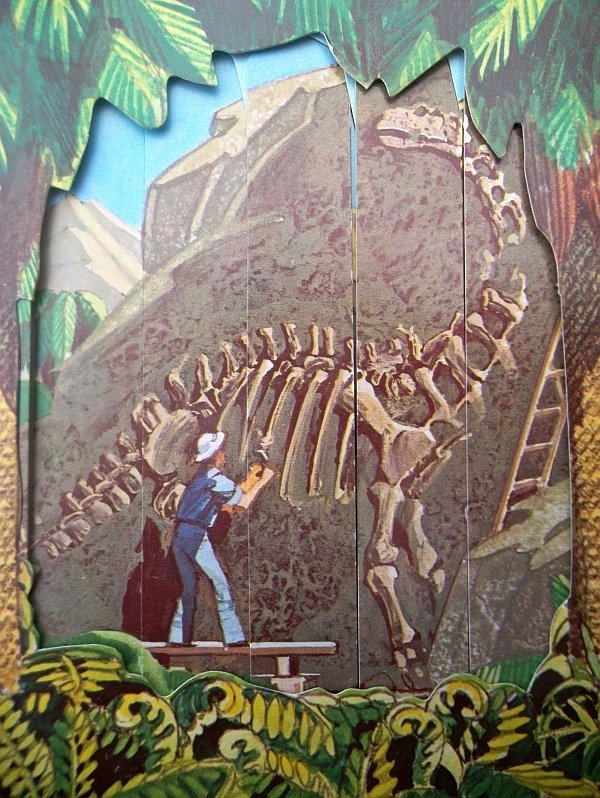
How dinosaur fossils are NOT found. From Dinosaurs: A Prunell magic Pop-Up Book, via LITC.

Not how vertebrate fossils are found. From Dinosaurs: A Prunell Magic Pop-Up Book, via LITC.

To the Calvert Marine Museum’s credit, the exhibit signs clearly explain that the C. megalodon skeleton is a replica, and provide a detailed explanation of how and why it was made. What’s more, the shark mount is merely an extreme example of filling in gaps with probable reconstructions, a process needed to make the construction of mounts of most prehistoric animals possible at all. The field of vertebrate paleontology is, in fact, largely based on the premise that incomplete remains can be understood in the context of other, better known relatives. Then again, if I learned anything teaching undergraduate anatomy, it’s that the concept that vertebrates share a body plan inherited through common ancestry is not widely known. This might be worth considering when presenting fossil mounts in general: after all, mounts primarily exist for the public, not for experts (although see Kenneth Carpenter’s comments on an earlier post).

The Calvert Marine Museum’s C. megalodon definitely raises some weighty questions about displays of scientific specimens in museums. In the context of vertebrate fossils, what qualifies as a real specimen, and what is well-supported extrapolation? What role should a museum play when displaying scientific knowledge? Should museums merely serve as repositories for original objects found in nature, or is the goal to provide context and meaning for those objects? Can a boundary between the two be defined at all?

3 Comments

Filed under exhibits, fish, fossil mounts, museums, science communication

In Defense of New Museums

As a museum* educator, I work with two kinds of experts: researchers who create knowledge and education specialists who disseminate knowledge. Both groups have ostensibly the same mission, which is to effectively communicate credible information about the world around us. Generally, both sides collaborate effectively, due in no small part to a shared enthusiasm for their work. But there is one issue (that has been raging for decades) in which researchers and educators frequently seem to be shouting past each other, complaining about what one another are doing wrong but not making much progress in reconciling their priorities. This issue is, of course, “new museum” exhibit aesthetics, the trend toward replacing traditional academically-oriented displays of specimens with dynamic, interactive leaning experiences that use specimens alongside interactive activities and multimedia to communicate specific educational messages to a broad audience.

*When I say museum, I mean natural history or science museum. Art museums are a completely different beast, and one I won’t pretend to understand.

From the perspective of many researchers and certain sets of museum-goers, these newer exhibits are frivolous lowest-common-denominator attractions better suited to amusement parks than serious institutions. For example, in a recent Tetrapod Zoology review of the London Natural History Museum’s Extinction exhibit, Darren Naish criticizes computer-based interactive exhibits because they “take up space that really should be spent on something far more worthwhile” and “give visitors the excuse to do the same old crap they do every other day of their lives (look at screens, play videogames, use touchscreens) when they really could be treated to a more unique experience.” Likewise, an all-encompassing rant about new museums can be found in this (admittedly 6 year old) post by Matt Wedel, which is well worth a read (seriously, read it now and then come back to this).

The Hunterian Museum as it appeared in the 1600s: all  of the specimens, not much else.

The Hunterian Museum as it appeared in the 1800s: ALL OF THE SPECIMENS.

But in direct contrast to Wedel’s insistence that the intrinsic value of real specimens is all museum-goers want or need, there are editorials like this one by James Durston, which I will charitably describe as provocative. Durston tells us that museums that only display artifacts for their own sake are “classrooms made of cold granite, the only sense of life emerging from the tourists.” He argues that most objects on display in museums don’t matter as much to visitors as museum workers think they do, and pleads for more context and more reason to care.

So what’s the deal? Are modern museums too focused on providing context for their collections, or not focused enough? Let me begin by explaining why modern museum exhibits look the way they do. A century ago, or even 50 years ago, exhibits were arranged and labels were written almost exclusively by expert curators. These exhibits were, by and large, created with an audience of “interested people” in mind, meaning either other experts or clientele with enough leisure time to learn the jargon presented to them. The majority of visitors who came through the door were not directly catered to, because exhibits were considered an afterthought to the real work of the museum: research and collections management.

In the past 30 years, however, the museum field has decided that it can do better. Museums shifted from inwardly focused, primarily academic institutions into focal points for lifelong learning that operate in service to a wide community of visitors. Go to the website of your favorite museum and check out their mission statement (it should be pretty easy to find). I just did, and the mission of the National Museum of Natural History is to “increase knowledge and inspire learning about nature and culture, through outstanding research, collections, exhibitions, and education, in support of a sustainable future.” Note that the museum doesn’t seek to increase knowledge and inspire learning just for a core audience of studious, well-read people, but for everyone. That means the museum needs to offer content that is interesting to all sorts of people, whether they learn best by reading and absorbing information, by physically doing something, by making choices for themselves or by discussing an issue with others. Preserving  and studying collections is no less important than in museums of yore, but these activities are understood to be in service of providing knowledge to the widest possible audience.

This shift in focus has inspired museum exhibits with more explicit educational goals, as well as attempts to create learning experiences that reach visitors other than those already keyed in to the customary language of academia. Drawing heavily on Gardner’s multiple intelligences, modern exhibits are intended to cater to diverse audiences that learn in a variety of different ways. In particular, hands-on mini experiments and computer-based games have become staples in science exhibits in order to reach visitors who learn better by doing than by observing. These interactive elements (we just call them interactives in the biz) are not appealing to everyone, but museums serve a broad community and have no business being exclusionary in the services they provide.

Beyond any moral or educational imperative, however, modern museums must be accessible because they are nonprofit institutions that rely heavily on public funds. They are funded based on the promise that they will provide educational resources for their communities, and that means serving more than a small subset of the population. Furthermore, ever-tightening budgets mean that museums need to be strictly managed. Educators have no choice but to establish clear standards of success for their exhibits, and to develop means to track attendance and audience engagement. Just to keep our jobs and keep museum doors open, we need to be able to clearly articulate who we are serving, how we are benefiting them and how we know.

The new Ocean Hall at NMNH: a $90 million new museum extravaganza.

The new Ocean Hall at NMNH: a $50 million new museum extravaganza.

If it was not clear, I absolutely agree with the goals behind new museum design. As  was argued in the American Alliance of Museums’ 1984 “Museums for a New Century” commission report, “if collections are the heart of museums, what we have come to call education – the commitment to presenting objects and ideas an an informative and stimulating way – is the spirit.” General audiences can certainly experience awe and wonder when presented with neat stuff, but museums can and should provide more than that. A hundred birds from around the world look impressive on a shelf, but they are much more interesting when the viewer understands the evolutionary processes and biogeography that produced such diversity. A little bit of context goes a long way to making such an exhibit is accessible and valuable to the widest possible audience.

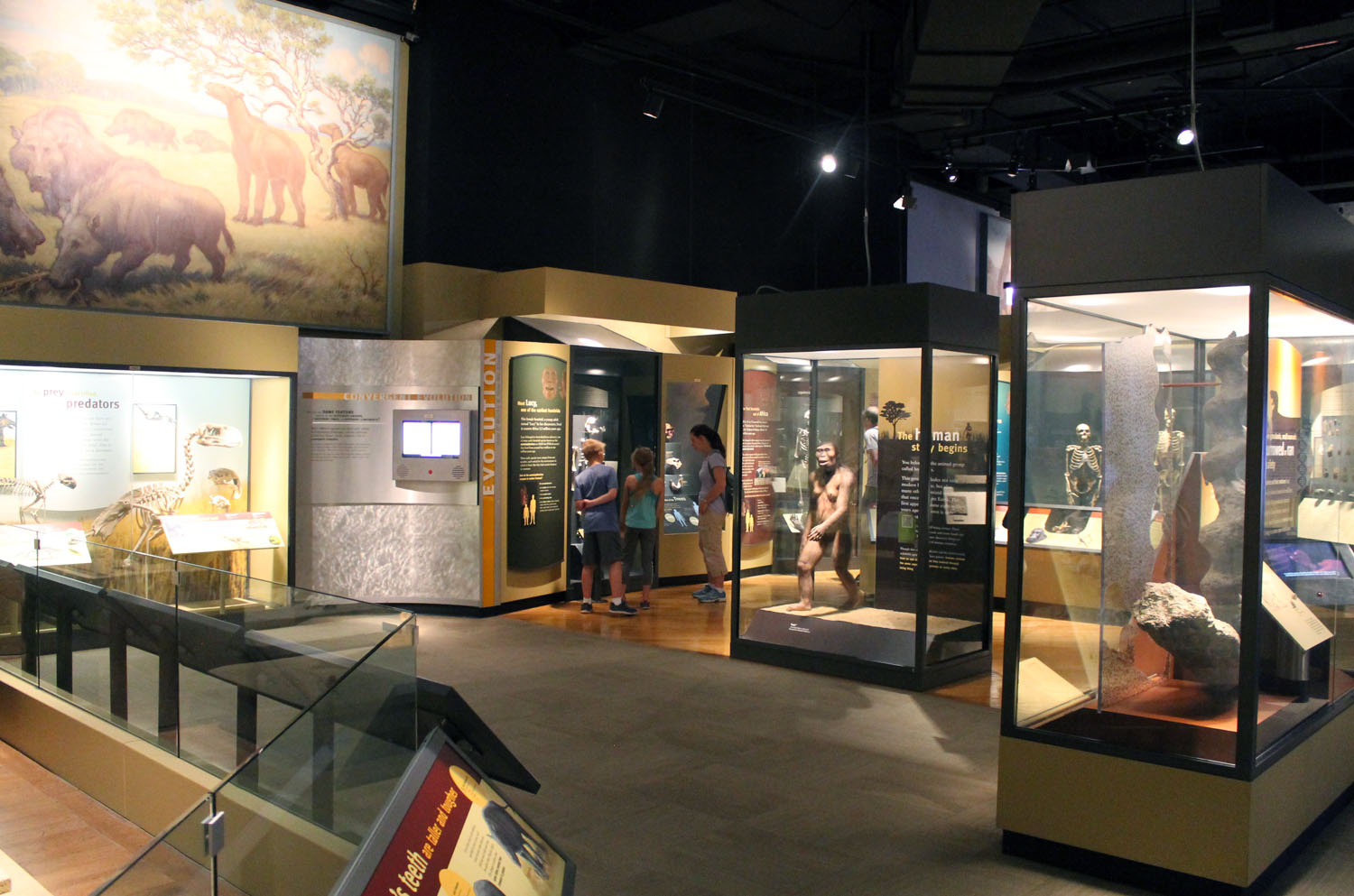
In practice, however, I will concede that many attempts at broadening the appeal of natural history exhibits are pretty bad. Some modern museum exhibits use technology in terrible ways, and many attempts to increase interactivity are bafflingly pointless or even counterproductive. For instance, a dinosaur exhibit I visited earlier this year includes a green-screen stage where visitors can place themselves in a scene with dinosaurs running around. The result is not only painfully dated, but it has no educational purpose and may well encourage people to think that humans and dinosaurs once co-existed. Likewise, an exhibit on human evolution features a glorified photo booth that makes visitors’ faces look like other hominids. This non-educational attraction is consistently the most popular element of the gallery, distracting visitors from the fantastic displays and specimens all around it. More generally, an increasing number of exhibits are incorporating profoundly pointless touch-screen computers that let visitors browse photos of the specimens on display right in front of them. Just because an exhibit element is hands-on doesn’t mean it is actually helping visitors interact with exhibit content.

One reason lousy interactives keep being designed is that our evaluation procedures* are not always great at separating good exhibits from appealing ones. A good interactive provides informative content in an engaging way, while an appealing one is engaging but lacking in content. Many visitors may speak highly of just-appealing interactives, but that doesn’t mean these belong in museums. The aforementioned budget woes are also a factor here: interactives that draw crowds for any reason are a big help when scrounging for ways to fund research and preservation. There are tough calls to make when deciding between what visitors most want to see and what is actually worthy of an educational institution. There are no easy answers, especially when museums are consistently hurting for funding.

*Do note, however, that actually testing whether exhibits are meeting their educational goals has finally become commonplace…for far too long museum workers just assumed anything they made was good enough.

Nevertheless, when an interactive display works, when visitors’ eyes light up with understanding by working out a scientific problem for themselves, the process is absolutely worthwhile. Earlier this year, I raved about the low-tech brilliance of an activity in the Academy of Natural Sciences that let visitors physically act out the difference in upright and sprawling gaits. And the NMNH Human Origins exhibit features a fantastic computer game where visitors play the part of a future world leader and experience firsthand the challenges and consequences of overpopulation, food shortage and invasive species. Exhibit interactives, both technology-based and otherwise, are difficult to pull off, and many museums have failed at the task. But we owe it to our visitors to try.

10 Comments

Filed under collections, education, exhibits, history of science, museums, opinion, science communication

The Osborn problem

In both paleontology and the museum field, we’ve long contended with what one might call “the Osborn problem.” The legacy of Henry Fairfield Osborn, paleontologist and president of the American Museum of Natural History between 1908 and 1933, is quite important to both fields.  To paleontologists, he is known for accumulating at AMNH one of the largest and most exhaustive fossil collections in the world,  for financing and supporting the careers of legends like Barnum Brown and Charles R. Knight, and of course for naming and describing saurian celebrities like Tyrannosaurus and Velociraptor.

Osborn is also well-regarded by museum specialists for heightening the standards for public exhibitions, investing in lifelike habitat dioramas of taxidermy animals and spectacular mounted dinosaur skeletons in order to make science exciting for a wide audience. Osborn’s devotion to storytelling and drama in the exhibits he curated brought millions of visitors to AMNH and quite literally defined public expectations for what museums should offer to this day.

Henry Fairfield Osborn.

Henry Fairfield Osborn.

In recent decades, however, historical interest in Osborn has been mostly focused on his disreputable personal and political beliefs: Osborn was a flagrant racist and anti-Semite,  an admirer of Adolf Hitler and a strong supporter of research in eugenics. Osborn regularly used his clout to bring material harm to the American working class, lobbying for legislation including the Emergency Quota Act and the Immigration Act of 1924. For what it’s worth, Osborn was also apparently unbearably arrogant and truly dreadful to work with, going as far as to demand lower-ranked museum employees leave the elevator car when he got on.

All this puts paleontologists and museum specialists in an awkward position. Is it acceptable to admire Osborn’s positive achievements in light of his personal politics? After all, Osborn’s views were not terribly unusual among the aristocratic class of his day. Perhaps we shouldn’t condemn the man entirely for not “rising above his time and place” (as Stephen Ambrose argues regarding coming to terms with Thomas Jefferson the slave owner).

Unfortunately, Osborn’s case is complicated by the fact that his bigotry inspired (or at least contributed to) much of his work at AMNH*. To start, Osborn’s scientific work was based on an inaccurate orthogenetic interpretation of evolution. He professed that an ill-defined guiding force shaped life from lesser to greater forms, the effect of which could be seen by comparing “primitive” and “advanced” species, and of course, “primitive” and “advanced” expressions of humanity. While we cannot conclusively link Osborn’s pseudo-evolutionary ideas with his bigoted social agenda, it is certainly convenient for him that he saw people of “Nordic” descent as biologically superior.

*To clarify, none of the exhibits curated by Osborn remain on display and none of my comments here apply to the present day AMNH.

Critically, Osborn did not keep his ideas of natural hierarchy in the ivory tower. He explicitly intended that the exhibition halls of AMNH educate visitors not just about natural science but about the naturally graded order he believed to be characteristic of life on earth. Osborn thought that collections of biological specimens implicitly revealed an upward ascent of life, and that those on top had earned their place through innate superiority. Osborn pronounced that his exhibits would teach morality to new American immigrants, presumably by putting them in their place with the rather hideous racial hierarchy on display in the Hall of the Age of Man. As Donna Haraway puts it in her classic essay Teddy Bear Patriarchy, Osborn’s exhibits were a “gospel of wealth and privilege” that appropriated natural specimens to affirm the American elite’s place at the top of the pecking order.

Tyrannosaurus and others in AMNH Dinosaur Hall, 1927. Photo courtesy of AMNH Research Library.

Tyrannosaurus and others in AMNH Dinosaur Hall, 1927. Photo courtesy of AMNH Research Library.

Museums are understood to be sources of intellectual authority, and deservedly so. But exhibits have authorship, same as any other written work, and Osborn’s legacy demonstrates that the influence of authors and their worldviews can be a powerful force. For example, Osborn arranged the Hall of the Age of Man in what he saw as ascending order, from the ancient peoples of Africa, to North America, and finally Europe. Placed at the end of an exhibit series that started with Cambrian invertebrate fossils before passing through Paleozoic, Mesozoic, and Cenozoic fossil displays, the Age of Man gallery deliberately implied that European-descended humans were the culmination of the entire history of life on Earth.

Meanwhile, the exhibit on fossil horses curated by Osborn depicted small, multi-toed horses of the Eocene gradually becoming larger, losing toes and becoming better at being modern Equus. This orthegenetic representation runs counter to evolution via natural selection as originally proposed by Darwin, and as understood today. Indeed, other paleontologists, including O.C. Marsh, had established in the 19th century that horse evolution more closely resembled a tangled bush, with many overlapping morphological offshoots adapted to varying environmental circumstances. But Osborn had rejected Darwinian evolution in favor of his presumed hierarchy of life, and ensured that his inaccurate story was what was seen by millions of visitors.

So what does Osborn’s legacy mean to paleontologists and museum specialists today? Do we need to qualify every mention of his name with a denouncement of his worldview? Should we always write out “Tyrannosaurus rex Osborn, 1905″ as “Tyrannosaurus rex Osborn the racist jerk, 1905″? At minimum, Osborn’s exhibits are a sobering reminder to all us involved in science education that our field is not immune to bias. The  subjectivity of cultural and historical museum exhibits has been well-explored by scholars like Ames and Weil, but comparatively little reflection has been done on the authorship of exhibits on science and natural history. We rely on the “naturalness” of the objects we display to speak for itself, and to bear the burden of proof for the statements we make. The world around us is knowable, and science is the best tool to learn about it. But explaining what we have learned in any form (books, technical journals, museum exhibits) is an avenue for personal or cultural bias to slip in, and that is why it remains important to actively and regularly check our assumptions.

References

Ames, M.M. (2004). Museums in the Age of Deconstruction. In Reinventing the Museum: Historical and Contemporary Perspectives on the Paradigm Shift. Lanham, MD: AltaMira Press.

Brinkman, P.D. (2010). The Second Jurassic Dinosaur Rush: Museums and Paleontology in America at the Turn of the Twentieth Century. Chicago, IL: University of Chicago Press.

Colbert, E.H. (1968). Men and Dinosaurs: The Search in Field and Laboratory. New York, NY: E.P. Dutton and Co., Inc.

Haraway, D. (1984). Teddy Bear Patriarchy: Taxidermy in the Garden of Eden, New York City, 1908-1936. Social Text 11:20-64.

Kohlstedt, S.G. (2005). Thoughts in Things: Modernity, History and North American Museums. Isis 96:586-601.

Osborn, H.F. (1921). The Hall of the Age of Man in the American Museum. Nature 107:236-240.

6 Comments

Filed under AMNH, anthropology, history of science, mammals, museums, science communication