The Calvert Marine Museum’s big foam shark

Over Labor Day weekend, I visited the Calvert Marine Museum in Solomons, Maryland. The Museum, which features both indoor and outdoor exhibits, covers a wide range of Chesapeake regional history, including Patuxant Indian culture, the War of 1812, the local fishing industry and of course, Miocene marine fossils. The paleontology gallery, called “Treasures from Our Cliffs”, is nicely done and surprisingly high in production value for the museum’s size. Starting with an extensive entry gallery that places Chesapeake area fossils in a global context, the exhibit also includes fossils of seals, whales, invertebrates and assorted terrestrial mammals, plus a neat recreation of a cliff-side excavation.

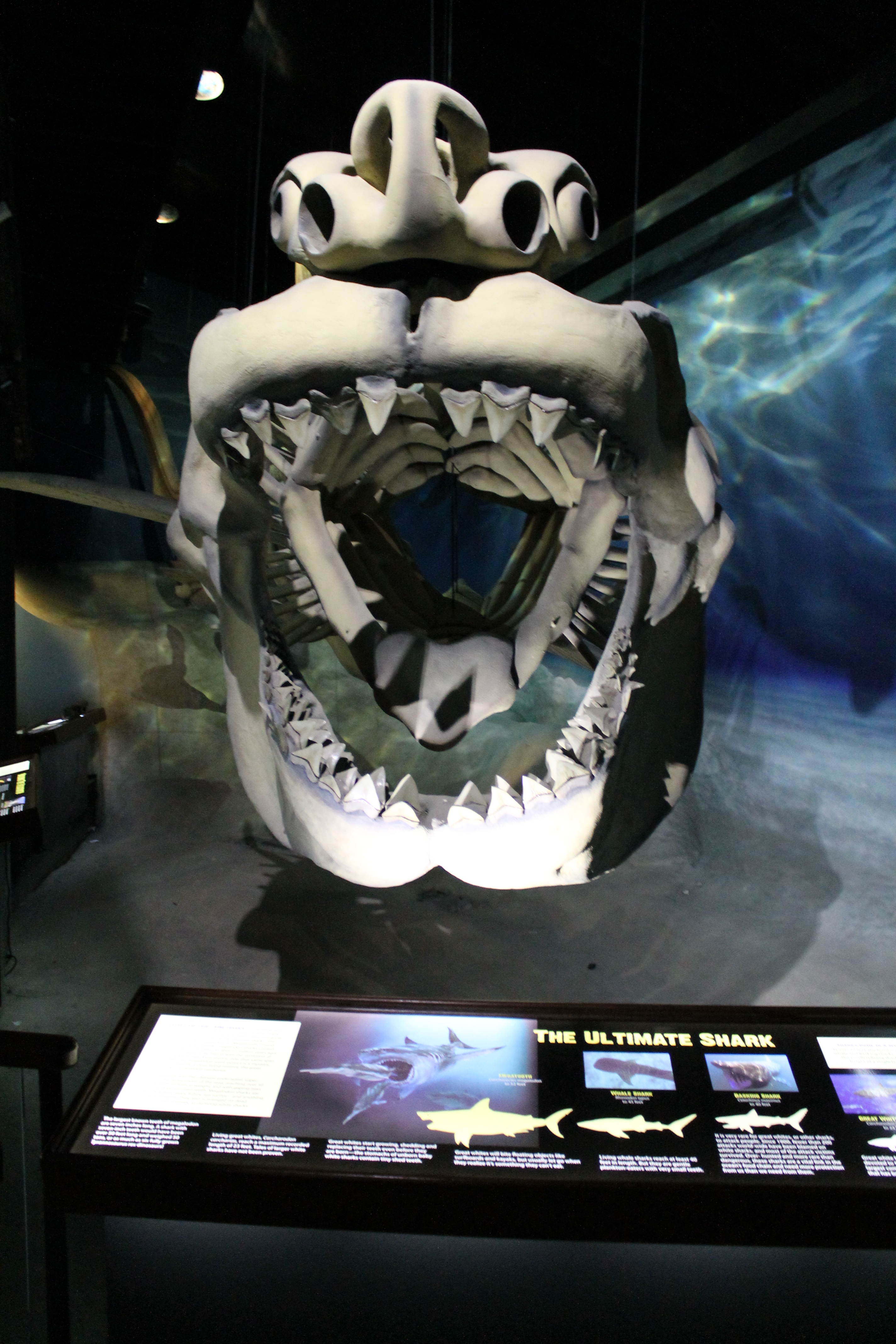
The Carcharocles megalodon at the Calvert Marine Museum.

The Carcharocles megalodon at the Calvert Marine Museum.

What I want to talk about most, though, is the big foam shark pictured above. This is the exhibit’s centerpiece attraction, a complete replica of the cartilaginous skeleton of the infamous giant extinct shark Carcharocles megalodon. Since shark skeletons are primarily made up of soft cartilage, most of their bodies are very unlikely to fossilize. While teeth and lithified vertebrae of C. megalodon are relatively common, a complete skeleton can only be created as a replica. As such, the Calvert Marine Museum’s display is a scaled-up model of the cartilaginous skeleton of a modern Carcharodon chararias (great white shark), with a few proportional adjustments based on known fossils. The result is undeniably impressive: suspended over an ocean backdrop, the 37-foot model absolutely steals the show in the paleontology exhibit.

Nevertheless, I find it absolutely fascinating that the museum would go to such lengths to create a replica shark, particularly given its substantial collection of original fossils. The foam shark’s existence can be traced to the beginning of the 20th century, when there was a dramatic rush among large urban museums in the United States to collect and mount the biggest and most spectacular dinosaur skeleton that could be found. This fossil craze was largely motivated by the vanity of the museums’ wealthy benefactors, but proved to be extremely productive for both paleontologists and museums. Mounted dinosaur skeletons sprung up seemingly overnight in cities across the country, making names like “Brontosaurus” and Diplodocus household terms and igniting a wave of interest in museums and natural science.

As a result of this mounting spree, the public conception of dinosaurs and other prehistoric animals is to this day irreversibly intertwined with its conception of museums. When we think of fossils, we think of grand museum halls populated by towering skeletons. This connection is so ingrained that mounted skeletons have become, in the public eye, the only proper way to display prehistoric animals. Patrons of paleontology exhibits expect mounts, and museums must deliver, even if it means purchasing a cast from another institution, or in the case of the Calvert Marine Museum, sculpting one outright.

And from the front.

A closer look at C. megalodon.

It is true that very few museum mounts feature the complete skeleton of a single animal – they are typically composites of many specimens, or have missing parts filled in with casts or sculpted elements (see this SVPOW post on Kyle Davies, who sculpts bone replicas for OMNH). Probably the most important function of a mount is to present fossil material in a format that non-specialists can easily understand and appreciate. They show viewers what extinct animals would have been like in life, and let us perceive them in relation to our own human scale. But unlike a mural or life-sized model, which are obviously reproductions, mounts retain the aura of authenticity that comes from displaying known fossils. To display a skeleton is to imply that we are seeing real specimens, or at least replicas standing in for specimens that exist somewhere else. Whether reasonable or not, this is the expectation ingrained by over 150 years of fossil mounts in museums.

This means that the C. megalodon at the Calvert Marine Museum is pushing the concept of a fossil mount to its very limit. While this is without doubt a very reasonable reconstruction of what a C. megalodon skeleton would have looked like, only a minuscule fraction of what is on display represents fossils that have actually been uncovered. The question is then, is a display like this a misrepresentation of scientific knowledge and the fossil record?

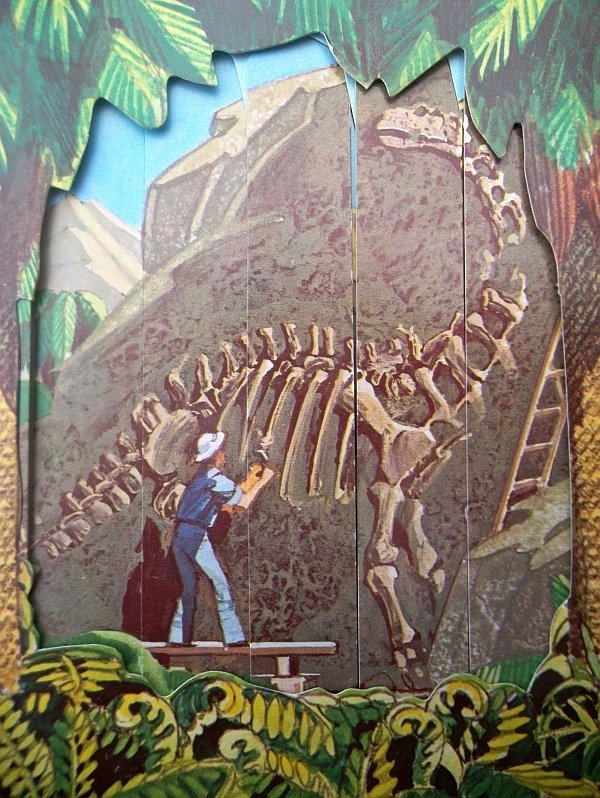
How dinosaur fossils are NOT found. From Dinosaurs: A Prunell magic Pop-Up Book, via LITC.

Not how vertebrate fossils are found. From Dinosaurs: A Prunell Magic Pop-Up Book, via LITC.

To the Calvert Marine Museum’s credit, the exhibit signs clearly explain that the C. megalodon skeleton is a replica, and provide a detailed explanation of how and why it was made. What’s more, the shark mount is merely an extreme example of filling in gaps with probable reconstructions, a process needed to make the construction of mounts of most prehistoric animals possible at all. The field of vertebrate paleontology is, in fact, largely based on the premise that incomplete remains can be understood in the context of other, better known relatives. Then again, if I learned anything teaching undergraduate anatomy, it’s that the concept that vertebrates share a body plan inherited through common ancestry is not widely known. This might be worth considering when presenting fossil mounts in general: after all, mounts primarily exist for the public, not for experts (although see Kenneth Carpenter’s comments on an earlier post).

The Calvert Marine Museum’s C. megalodon definitely raises some weighty questions about displays of scientific specimens in museums. In the context of vertebrate fossils, what qualifies as a real specimen, and what is well-supported extrapolation? What role should a museum play when displaying scientific knowledge? Should museums merely serve as repositories for original objects found in nature, or is the goal to provide context and meaning for those objects? Can a boundary between the two be defined at all?

3 Comments

Filed under exhibits, fish, fossil mounts, museums, science communication

In Defense of New Museums

As a museum* educator, I work with two kinds of experts: researchers who create knowledge and education specialists who disseminate knowledge. Both groups have ostensibly the same mission, which is to effectively communicate credible information about the world around us. Generally, both sides collaborate effectively, due in no small part to a shared enthusiasm for their work. But there is one issue (that has been raging for decades) in which researchers and educators frequently seem to be shouting past each other, complaining about what one another are doing wrong but not making much progress in reconciling their priorities. This issue is, of course, “new museum” exhibit aesthetics, the trend toward replacing traditional academically-oriented displays of specimens with dynamic, interactive leaning experiences that use specimens alongside interactive activities and multimedia to communicate specific educational messages to a broad audience.

*When I say museum, I mean natural history or science museum. Art museums are a completely different beast, and one I won’t pretend to understand.

From the perspective of many researchers and certain sets of museum-goers, these newer exhibits are frivolous lowest-common-denominator attractions better suited to amusement parks than serious institutions. For example, in a recent Tetrapod Zoology review of the London Natural History Museum’s Extinction exhibit, Darren Naish criticizes computer-based interactive exhibits because they “take up space that really should be spent on something far more worthwhile” and “give visitors the excuse to do the same old crap they do every other day of their lives (look at screens, play videogames, use touchscreens) when they really could be treated to a more unique experience.” Likewise, an all-encompassing rant about new museums can be found in this (admittedly 6 year old) post by Matt Wedel, which is well worth a read (seriously, read it now and then come back to this).

The Hunterian Museum as it appeared in the 1600s: all  of the specimens, not much else.

The Hunterian Museum as it appeared in the 1800s: ALL OF THE SPECIMENS.

But in direct contrast to Wedel’s insistence that the intrinsic value of real specimens is all museum-goers want or need, there are editorials like this one by James Durston, which I will charitably describe as provocative. Durston tells us that museums that only display artifacts for their own sake are “classrooms made of cold granite, the only sense of life emerging from the tourists.” He argues that most objects on display in museums don’t matter as much to visitors as museum workers think they do, and pleads for more context and more reason to care.

So what’s the deal? Are modern museums too focused on providing context for their collections, or not focused enough? Let me begin by explaining why modern museum exhibits look the way they do. A century ago, or even 50 years ago, exhibits were arranged and labels were written almost exclusively by expert curators. These exhibits were, by and large, created with an audience of “interested people” in mind, meaning either other experts or clientele with enough leisure time to learn the jargon presented to them. The majority of visitors who came through the door were not directly catered to, because exhibits were considered an afterthought to the real work of the museum: research and collections management.

In the past 30 years, however, the museum field has decided that it can do better. Museums shifted from inwardly focused, primarily academic institutions into focal points for lifelong learning that operate in service to a wide community of visitors. Go to the website of your favorite museum and check out their mission statement (it should be pretty easy to find). I just did, and the mission of the National Museum of Natural History is to “increase knowledge and inspire learning about nature and culture, through outstanding research, collections, exhibitions, and education, in support of a sustainable future.” Note that the museum doesn’t seek to increase knowledge and inspire learning just for a core audience of studious, well-read people, but for everyone. That means the museum needs to offer content that is interesting to all sorts of people, whether they learn best by reading and absorbing information, by physically doing something, by making choices for themselves or by discussing an issue with others. Preserving  and studying collections is no less important than in museums of yore, but these activities are understood to be in service of providing knowledge to the widest possible audience.

This shift in focus has inspired museum exhibits with more explicit educational goals, as well as attempts to create learning experiences that reach visitors other than those already keyed in to the customary language of academia. Drawing heavily on Gardner’s multiple intelligences, modern exhibits are intended to cater to diverse audiences that learn in a variety of different ways. In particular, hands-on mini experiments and computer-based games have become staples in science exhibits in order to reach visitors who learn better by doing than by observing. These interactive elements (we just call them interactives in the biz) are not appealing to everyone, but museums serve a broad community and have no business being exclusionary in the services they provide.

Beyond any moral or educational imperative, however, modern museums must be accessible because they are nonprofit institutions that rely heavily on public funds. They are funded based on the promise that they will provide educational resources for their communities, and that means serving more than a small subset of the population. Furthermore, ever-tightening budgets mean that museums need to be strictly managed. Educators have no choice but to establish clear standards of success for their exhibits, and to develop means to track attendance and audience engagement. Just to keep our jobs and keep museum doors open, we need to be able to clearly articulate who we are serving, how we are benefiting them and how we know.

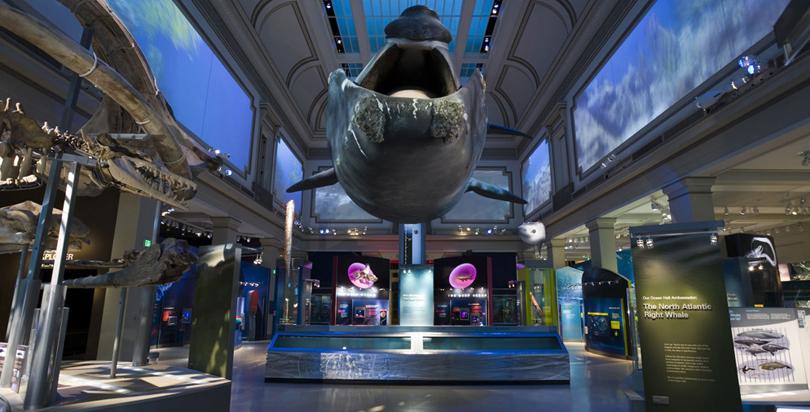
The new Ocean Hall at NMNH: a $90 million new museum extravaganza.

The new Ocean Hall at NMNH: a $50 million new museum extravaganza.

If it was not clear, I absolutely agree with the goals behind new museum design. As  was argued in the American Alliance of Museums’ 1984 “Museums for a New Century” commission report, “if collections are the heart of museums, what we have come to call education – the commitment to presenting objects and ideas an an informative and stimulating way – is the spirit.” General audiences can certainly experience awe and wonder when presented with neat stuff, but museums can and should provide more than that. A hundred birds from around the world look impressive on a shelf, but they are much more interesting when the viewer understands the evolutionary processes and biogeography that produced such diversity. A little bit of context goes a long way to making such an exhibit is accessible and valuable to the widest possible audience.

In practice, however, I will concede that many attempts at broadening the appeal of natural history exhibits are pretty bad. Some modern museum exhibits use technology in terrible ways, and many attempts to increase interactivity are bafflingly pointless or even counterproductive. For instance, a dinosaur exhibit I visited earlier this year includes a green-screen stage where visitors can place themselves in a scene with dinosaurs running around. The result is not only painfully dated, but it has no educational purpose and may well encourage people to think that humans and dinosaurs once co-existed. Likewise, an exhibit on human evolution features a glorified photo booth that makes visitors’ faces look like other hominids. This non-educational attraction is consistently the most popular element of the gallery, distracting visitors from the fantastic displays and specimens all around it. More generally, an increasing number of exhibits are incorporating profoundly pointless touch-screen computers that let visitors browse photos of the specimens on display right in front of them. Just because an exhibit element is hands-on doesn’t mean it is actually helping visitors interact with exhibit content.

One reason lousy interactives keep being designed is that our evaluation procedures* are not always great at separating good exhibits from appealing ones. A good interactive provides informative content in an engaging way, while an appealing one is engaging but lacking in content. Many visitors may speak highly of just-appealing interactives, but that doesn’t mean these belong in museums. The aforementioned budget woes are also a factor here: interactives that draw crowds for any reason are a big help when scrounging for ways to fund research and preservation. There are tough calls to make when deciding between what visitors most want to see and what is actually worthy of an educational institution. There are no easy answers, especially when museums are consistently hurting for funding.

*Do note, however, that actually testing whether exhibits are meeting their educational goals has finally become commonplace…for far too long museum workers just assumed anything they made was good enough.

Nevertheless, when an interactive display works, when visitors’ eyes light up with understanding by working out a scientific problem for themselves, the process is absolutely worthwhile. Earlier this year, I raved about the low-tech brilliance of an activity in the Academy of Natural Sciences that let visitors physically act out the difference in upright and sprawling gaits. And the NMNH Human Origins exhibit features a fantastic computer game where visitors play the part of a future world leader and experience firsthand the challenges and consequences of overpopulation, food shortage and invasive species. Exhibit interactives, both technology-based and otherwise, are difficult to pull off, and many museums have failed at the task. But we owe it to our visitors to try.

10 Comments

Filed under collections, education, exhibits, history of science, museums, opinion, science communication

D.C. area fossils on WAMU

Matt Carrano of the National Museum of Natural History, Alan Dooley of the Virginia Museum of Natural History and Dave Hacker of Maryland’s Dinosaur Park were interviewed on the Kojo Nnamdi show this afternoon. You can listen to the stream here. Topics covered include the 2019 re-opening of the NMNH fossil halls, local Cretaceous and Miocene paleoenvironments, the harm caused by commercial fossil collecting and the Discovery Channel C. megalodon travesty. Since I work for the MNCPPC at Dinosaur Park and have been involved with NMNH in the past, this is all quite near and dear to me. If you’ve got 20-30 minutes, it’s well worth a listen!

1 Comment

Filed under Dinosaur Park, dinosaurs, field work, NMNH

The Gilmore Models: Where are they now?

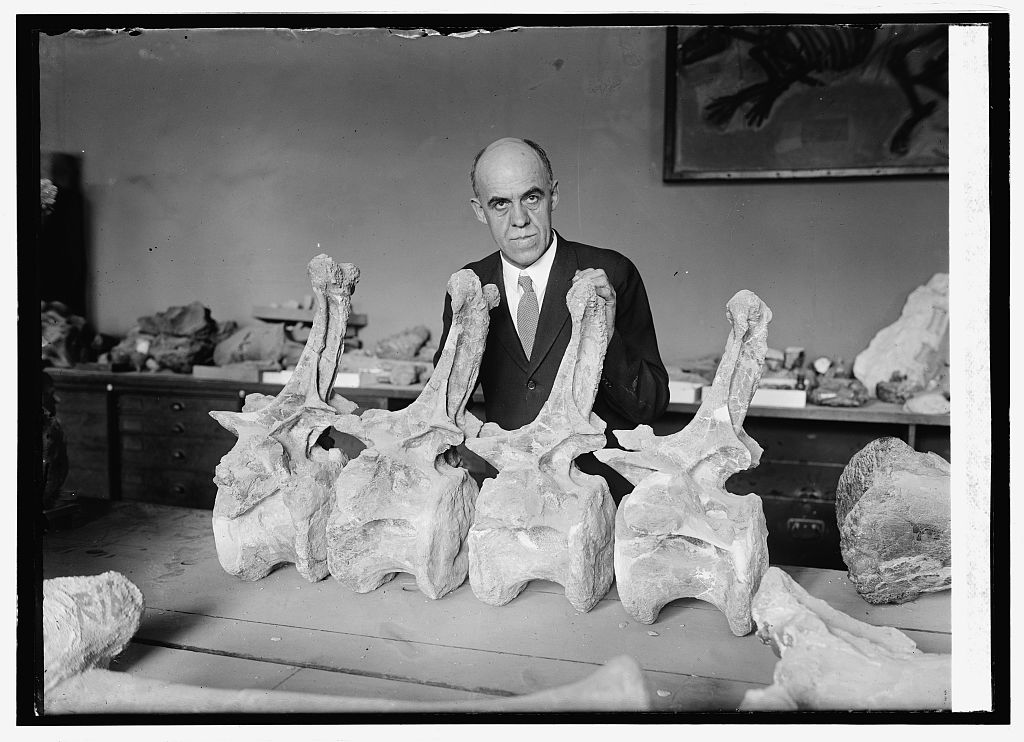
Regular readers of this site (if there are any) undoubtedly know Charles Whitney Gilmore as the Smithsonian paleontologist who, between 1903 and 1964, led in the creation of most of the mounted dinosaur skeletons that remain on display at the National Museum of Natural History today. You don’t necessarily have to be in Washington, DC to see Gilmore’s reconstructions, however. In addition to being an expert anatomist and fossil preparator, Gilmore was a formidable sculptor, and during his tenure at the Smithsonian he produced a number of gorgeous life reconstructions of prehistoric animals. Plaster copies of these models were gifted or sold to large and small museums in North America and Europe, including the Sternberg Museum of Natural History, the University of Kansas Natural History Museum and the Hunterian Museum at the University of Glasgow. These models were typically displayed alongside isolated fossil elements to give a sense of the entire animal at institutions where complete mounts were unfeasible.

Gilmore with Diplodocus vertebrae.

Charles Gilmore, or Chucky G, as he was known to his friends.

Unfortunately, many of the museums that acquired copies of Gilmore’s models in the 1920s and 30s seem to have lost the detailed provenance of these acquisitions (not a rare occurrence, as museums must track literally millions of objects and historic records on paper do not always survive). The Hunterian Museum has the best records regarding these models that I am aware of, and incidentally their online catalog is the source of most of the photographs in this post.

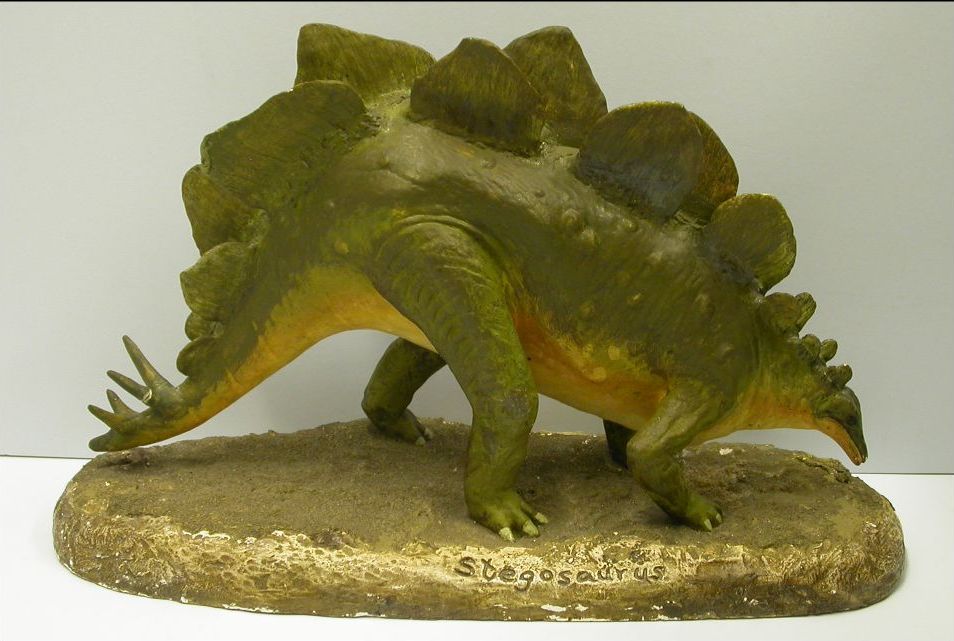
Stegosaurus model in plaster of paris. Image courtesy of the Hunterian Museum and Art Gallery.

Stegosaurus model in plaster of paris. Image courtesy of the Hunterian Museum and Art Gallery.

While Gilmore’s models are obviously far from accurate by modern standards, a closer inspection reveals that Gilmore was familiar with every inch of the fossils in his care, and put that knowledge to use in his sculptures. The Stegosaurus above, for instance, is a perfect match for Gilmore’s full-sized mount in terms of pose and proportion. Undoubtedly, physically assembling an actual skeleton is among the best ways to become familiar with how an animal would work in three dimensions. In particular, note that unlike many contemporary reconstructions, Gilmore did not fudge the number or position of the plates; they’re all accounted for.

Stegosaurus model in plaster of paris. Image courtesy of the Hunterian Museum and Art Gallery.

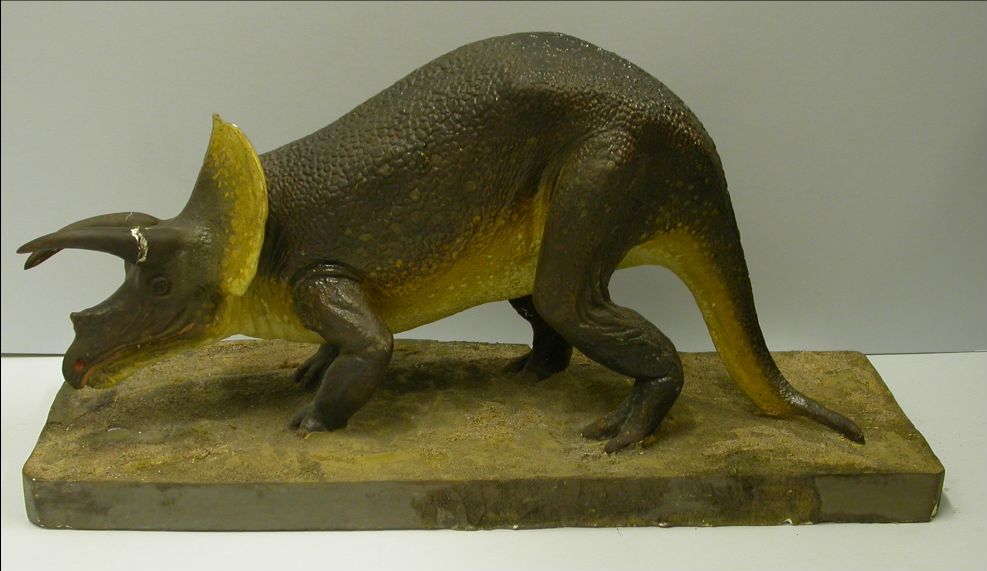
Triceratops model in plaster of paris. Image courtesy of the Hunterian Museum and Art Gallery.

The Triceratops model exhibits a number of interesting choices. The classic bowed ceratopsian forelimbs (which Gilmore first proposed after finding no other way to articulate them in his 1905 Triceratops mount) are clearly in evidence, but my eye is drawn to the scrawny, lizard-like hindlimbs. Comparing this model to Gilmore’s mount, there would appear to be virtually no muscle back there. The size of the head is yet another remnant of the mounting process. Since his Triceratops mount was a composite of numerous specimens, Gilmore used the skull of an inappropriately small animal, and apparently carried the chimeric proportions to this sculpture. The lack of cheeks and extremely thick neck are also characteristic of older ceratopsian reconstructions, although I can’t comment on precisely when or why that look went out of style.

Stegosaurus model in plaster of paris. Image courtesy of the Hunterian Museum and Art Gallery.

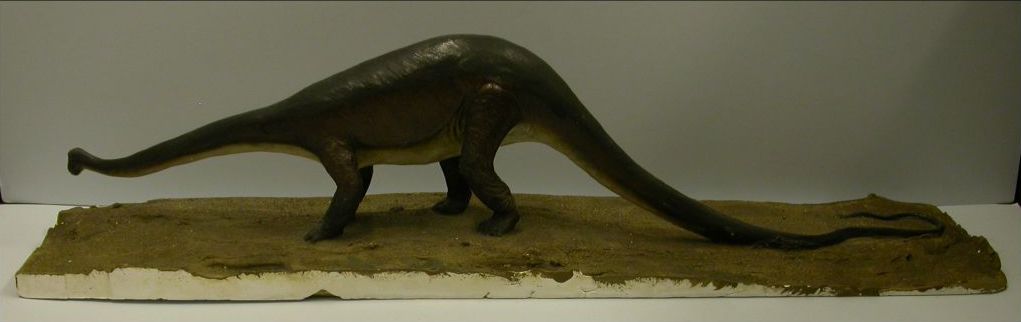
Diplodocus model in plaster of paris. Image courtesy of the Hunterian Museum and Art Gallery.

This Diplodocus has a much more defined shape than most mid-century sauropod reconstructions. Note in particular the sloping back, which peaks at the sacrum. This differs from the 1907 Diplodocus mount at the Carnegie Museum of Natural History, which had a completely horizontal spinal column. When Gilmore led the creation of the Smithsonian Diplodocus mount, he had the opportunity to use a vertebral column that was found articulated in situ, and was thus able to more accurately portray the shape of the animal’s midsection.

Ceratosaurus
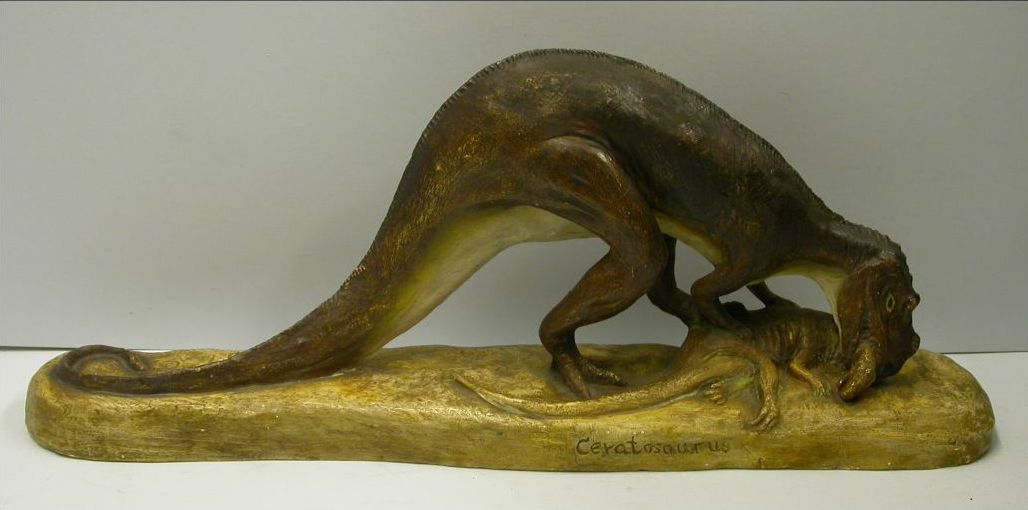
Ceratosaurus. Image courtesy of the Hunterian Museum and Art Gallery.

Gilmore’s Ceratosaurus is the liveliest of the set, and is the only one that doesn’t strictly adhere to the pose of a corresponding fossil mount. Delivering a killing blow to a hapless ornithopod, one can easily imagine the energetic pounce that preceded this scene. I will point out, though, that this guy’s hindquarters are enormous. 

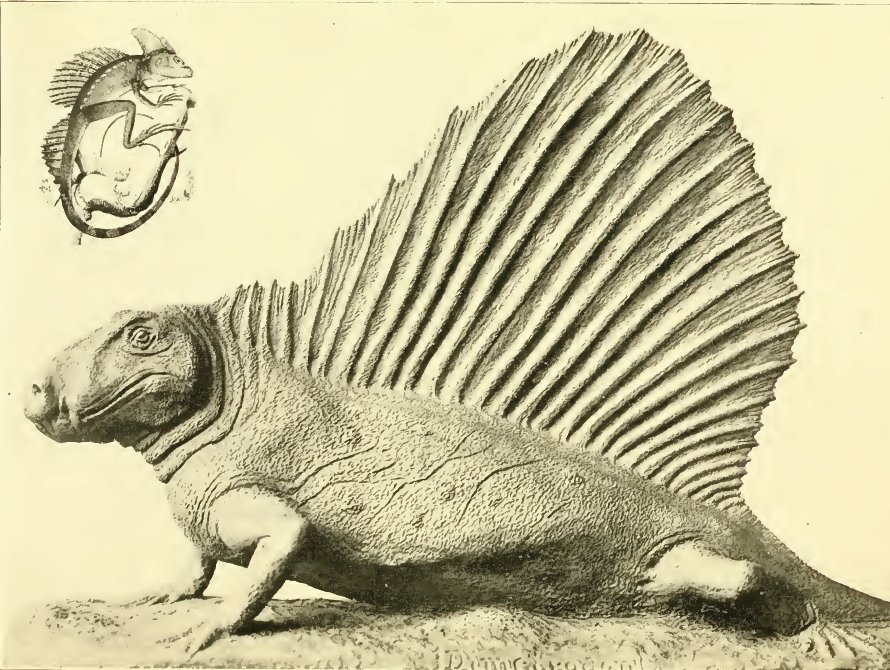
Gilmore's stub-tailed Dimetrodon. Image from Gilmore 1939.

Gilmore’s stub-tailed Dimetrodon model. 

Gilmore also sculpted some non-dinosaurs, including at least one prehistoric horse and the Dimetrodon pictured above. Note the teensy stub of a tail, which this model actually shared with Gilmore’s mount of the pelycosaur. The lips obscuring most of the teeth except for a couple incisors is an unusual choice, and I’m not sure what inspired it. This image is from Gilmore’s 1939 paper on Dimetrodon, and the Basiliscus basiliscus in the corner provides a helpful comparison to a contemporary animal with a similar dorsal sail.

In addition to the models shown here, Gilmore created sculptures of “Anatosaurus”, “Brachyceratops” and a Cenozoic horse, as well as busts of Styracosaurus and Corythosaurus (and there may well have been others I haven’t seen). As mentioned, copies of these mounts were distributed to museums and possibly private collections throughout the 20s and 30s, and I have no idea how many were actually made. A few museums, such as the Sternberg Museum, actually have these models on display, but at other institutions they have been relegated to storage. Objects like these present an unusual challenge for collections managers. They were accessioned as scientific representations, but their value has shifted over the last century to the realm of art and history. While these models are undoubtedly important, they are probably no longer useful at many of the institutions that hold them. As such, the Gilmore models exemplify that museum collections are not necessarily static, but change in meaning as the years go by.

If you work at an institution that has one or more Gilmore models in its collection, feel free to leave a comment. I’d love to start a working database of where copies of these models have ended up!

References

Gilmore, C.W. (1939). “A Mounted Skeleton of Dimetrodon gigas in the United States National Museum, with Notes on the Skeletal Anatomy.” Proceedings of the US National Museum 56:2300:525-539.

Gilmore, C.W. (1932) “On a newly mounted skeleton of Diplodocus in the United States National Museum.” Proceedings of the United States National Museum 81:1-21.

11 Comments

Filed under collections, dinosaurs, history of science, NMNH, paleoart, reptiles

The Osborn problem

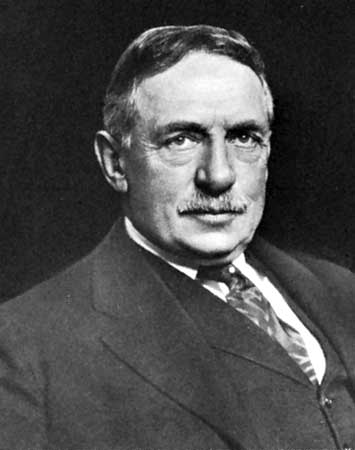
In both paleontology and the museum field, we’ve long contended with what one might call “the Osborn problem.” The legacy of Henry Fairfield Osborn, paleontologist and president of the American Museum of Natural History between 1908 and 1933, is quite important to both fields.  To paleontologists, he is known for accumulating at AMNH one of the largest and most exhaustive fossil collections in the world,  for financing and supporting the careers of legends like Barnum Brown and Charles R. Knight, and of course for naming and describing saurian celebrities like Tyrannosaurus and Velociraptor.

Osborn is also well-regarded by museum specialists for heightening the standards for public exhibitions, investing in lifelike habitat dioramas of taxidermy animals and spectacular mounted dinosaur skeletons in order to make science exciting for a wide audience. Osborn’s devotion to storytelling and drama in the exhibits he curated brought millions of visitors to AMNH and quite literally defined public expectations for what museums should offer to this day.

Henry Fairfield Osborn.

Henry Fairfield Osborn.

In recent decades, however, historical interest in Osborn has been mostly focused on his disreputable personal and political beliefs: Osborn was a flagrant racist and anti-Semite,  an admirer of Adolf Hitler and a strong supporter of research in eugenics. Osborn regularly used his clout to bring material harm to the American working class, lobbying for legislation including the Emergency Quota Act and the Immigration Act of 1924. For what it’s worth, Osborn was also apparently unbearably arrogant and truly dreadful to work with, going as far as to demand lower-ranked museum employees leave the elevator car when he got on.

All this puts paleontologists and museum specialists in an awkward position. Is it acceptable to admire Osborn’s positive achievements in light of his personal politics? After all, Osborn’s views were not terribly unusual among the aristocratic class of his day. Perhaps we shouldn’t condemn the man entirely for not “rising above his time and place” (as Stephen Ambrose argues regarding coming to terms with Thomas Jefferson the slave owner).

Unfortunately, Osborn’s case is complicated by the fact that his bigotry inspired (or at least contributed to) much of his work at AMNH*. To start, Osborn’s scientific work was based on an inaccurate orthogenetic interpretation of evolution. He professed that an ill-defined guiding force shaped life from lesser to greater forms, the effect of which could be seen by comparing “primitive” and “advanced” species, and of course, “primitive” and “advanced” expressions of humanity. While we cannot conclusively link Osborn’s pseudo-evolutionary ideas with his bigoted social agenda, it is certainly convenient for him that he saw people of “Nordic” descent as biologically superior.

*To clarify, none of the exhibits curated by Osborn remain on display and none of my comments here apply to the present day AMNH.

Critically, Osborn did not keep his ideas of natural hierarchy in the ivory tower. He explicitly intended that the exhibition halls of AMNH educate visitors not just about natural science but about the naturally graded order he believed to be characteristic of life on earth. Osborn thought that collections of biological specimens implicitly revealed an upward ascent of life, and that those on top had earned their place through innate superiority. Osborn pronounced that his exhibits would teach morality to new American immigrants, presumably by putting them in their place with the rather hideous racial hierarchy on display in the Hall of the Age of Man. As Donna Haraway puts it in her classic essay Teddy Bear Patriarchy, Osborn’s exhibits were a “gospel of wealth and privilege” that appropriated natural specimens to affirm the American elite’s place at the top of the pecking order.

Tyrannosaurus and others in AMNH Dinosaur Hall, 1927. Photo courtesy of AMNH Research Library.

Tyrannosaurus and others in AMNH Dinosaur Hall, 1927. Photo courtesy of AMNH Research Library.

Museums are understood to be sources of intellectual authority, and deservedly so. But exhibits have authorship, same as any other written work, and Osborn’s legacy demonstrates that the influence of authors and their worldviews can be a powerful force. For example, Osborn arranged the Hall of the Age of Man in what he saw as ascending order, from the ancient peoples of Africa, to North America, and finally Europe. Placed at the end of an exhibit series that started with Cambrian invertebrate fossils before passing through Paleozoic, Mesozoic, and Cenozoic fossil displays, the Age of Man gallery deliberately implied that European-descended humans were the culmination of the entire history of life on Earth.

Meanwhile, the exhibit on fossil horses curated by Osborn depicted small, multi-toed horses of the Eocene gradually becoming larger, losing toes and becoming better at being modern Equus. This orthegenetic representation runs counter to evolution via natural selection as originally proposed by Darwin, and as understood today. Indeed, other paleontologists, including O.C. Marsh, had established in the 19th century that horse evolution more closely resembled a tangled bush, with many overlapping morphological offshoots adapted to varying environmental circumstances. But Osborn had rejected Darwinian evolution in favor of his presumed hierarchy of life, and ensured that his inaccurate story was what was seen by millions of visitors.

So what does Osborn’s legacy mean to paleontologists and museum specialists today? Do we need to qualify every mention of his name with a denouncement of his worldview? Should we always write out “Tyrannosaurus rex Osborn, 1905″ as “Tyrannosaurus rex Osborn the racist jerk, 1905″? At minimum, Osborn’s exhibits are a sobering reminder to all us involved in science education that our field is not immune to bias. The  subjectivity of cultural and historical museum exhibits has been well-explored by scholars like Ames and Weil, but comparatively little reflection has been done on the authorship of exhibits on science and natural history. We rely on the “naturalness” of the objects we display to speak for itself, and to bear the burden of proof for the statements we make. The world around us is knowable, and science is the best tool to learn about it. But explaining what we have learned in any form (books, technical journals, museum exhibits) is an avenue for personal or cultural bias to slip in, and that is why it remains important to actively and regularly check our assumptions.

References

Ames, M.M. (2004). Museums in the Age of Deconstruction. In Reinventing the Museum: Historical and Contemporary Perspectives on the Paradigm Shift. Lanham, MD: AltaMira Press.

Brinkman, P.D. (2010). The Second Jurassic Dinosaur Rush: Museums and Paleontology in America at the Turn of the Twentieth Century. Chicago, IL: University of Chicago Press.

Colbert, E.H. (1968). Men and Dinosaurs: The Search in Field and Laboratory. New York, NY: E.P. Dutton and Co., Inc.

Haraway, D. (1984). Teddy Bear Patriarchy: Taxidermy in the Garden of Eden, New York City, 1908-1936. Social Text 11:20-64.

Kohlstedt, S.G. (2005). Thoughts in Things: Modernity, History and North American Museums. Isis 96:586-601.

Osborn, H.F. (1921). The Hall of the Age of Man in the American Museum. Nature 107:236-240.

6 Comments

Filed under AMNH, anthropology, history of science, mammals, museums, science communication

10,000 Thanks

Sometime last night, this site received its 10,000th visitor. I am thrilled beyond words that so many people have found what I have posted here interesting or helpful. I started blogging when I was fresh out of college, with an internship at the Smithsonian but only vague ideas of what I wanted to do with myself. Since that time, I figured out that while the web is full of fantastic resources on research in paleontology, precious little information was available about the study and display of fossils on a human timescale.  The spectacular paleontology exhibitions that fill our museum halls would certainly not be possible without the study of the fossil record, but they also wouldn’t exist without the artists, technicians, researchers and educators that will these displays into reality.

If only in a disorganized and haphazard way, that is what I aim to provide with this blog. The process of creating and communicating knowledge in a museum setting is as much about people as it is about ideas, and I’d like to make sure those people get the recognition they deserve. 

So with that, I would like to say thank you to each and every person that stopped by, and especially those who took the time to join the conversation by commenting and sharing their own expertise. Here’s to 20,000!

OLYMPUS DIGITAL CAMERA

2 Comments

Filed under museums

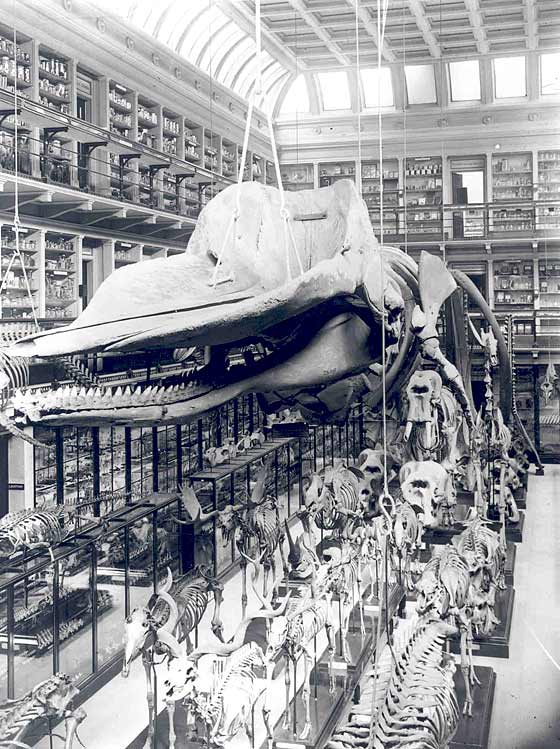
The NMNH fossil halls, circa 1963

c.02

A revamp for the dinosaur displays in Hall 2. Courtesy of the Smithsonian Institution Archives.

Since the NMNH building opened in 1910 as the United States National Museum, the east wing has been home to fossil displays. Although there have been many small adjustments and additions to the exhibits over the years, we can separate the east wing’s layout into three main periods. From 1910 t0 1945, the exhibits were primarily under the stewardship of Charles Gilmore. Called the “Hall of Extinct Monsters”, this iteration was somewhat haphazard in its layout and generally resembled a classic “cabinet of curiosity” approach to exhibit design. Gilmore’s version of the east wing remained in place until 1963, when the space was redesigned as part of the Smithsonian-wide modernization project. In the updated halls, there was a directed effort to compartmentalize exhibits based on the subdivisions of the Museum’s research staff, with each area of the gallery becoming the responsibility of a different curator. A second renovation was carried out in several stages starting in 1980. This version, which was open until 2014, was part of the new museology wave that started in the late 1970s. As such, the exhibits form a more cohesive narrative of the history of life on earth, and much of the signage carries the voice of educators, rather than curators.

Of course, the field of paleontology has advanced by leaps and bounds since the early 1980s, and NMNH staff have made piecemeal updates to the galleries when possible, including restorations of deteriorating mounts, and additional signage that addresses the dinosaurian origin of birds and the importance of the fossil record for understanding climate change. A third renovation is currently underway and will be completed in 2019.

But I’m getting ahead of myself. The purpose of this post is to provide an overview of the NMNH fossil halls as they stood in 1963, after the first major renovation. This iteration of the east wing was long gone before I was born, so this information is pieced together from historic photographs, archived exhibit scripts, and correspondence among the individuals involved in the modernization project (my thanks to the staff of the Smithsonian Institution Archives for their assistance in accessing these materials). Perhaps unsurprisingly, records of the dinosaur gallery are by far the most thorough. Information on the other halls is considerably harder to come by, so if any readers who saw the older exhibits in person remember any details, it would be fantastic if you could share them.

Layout of the USNM east wing, circa 1963.

Layout of the USNM east wing, circa 1963.

As mentioned, the Smithsonian underwent a thorough modernization project in the middle of the 20th century. The modernization committee, chaired by Frank Taylor (the eventual director-general of Smithsonian museums), was established in 1948. Under the committee’s guidance, most of the institution’s exhibits were redesigned between 1953 and 1963. Keep in mind that at the time, the United States National Museum was the only Smithsonian museum – it would not be divided into the National Museum of Natural History and the National Museum of History and Technology (now the National Museum of American History) until 1964.

Completed in 1963, the USNM fossil exhibits were among the last to be modernized. Only a small number of specimens were added that had not already been on view in the previous version of the space – in fact, many specimens were removed. The changes primarily focused on the layout of the exhibit, turning what was a loosely organized set of displays into a series of themed galleries. The east wing included four halls in 1963, the layout of which can be seen in the map above. Each hall was the responsibility of a particular curator. Nicholas Hotton oversaw Paleozoic and Mesozoic reptiles in Hall 2. David Dunkle was in charge of fossil fish in Hall 3. Porter Kier oversaw fossil invertebrates and plants in Hall 4. Finally, Charles Gazin, head curator of the Paleontology Division, was responsible for Cenozoic mammals in Hall 5. Each curator had a central role in selecting specimens for display and writing accompanying label copy.

Invertebrates and Fossil Plants

echinoderms1961

Echinoderm fossil display in Hall 4. Courtesy of the Smithsonian Institution Archives.

It is likely that part of the reason the fossil halls were late on the modernization schedule was that the curators of the Paleontology Division were not terribly interested in exhibits or outreach. There were no staff members in the division exclusively devoted to exhibit work, so the task of designing the new exhibit space was an added burden for the research staff. As invertebrate paleontology curator G. Arthur Cooper put it in a 1950 memo, “all divisions of Geology at present are in an apathetic state toward exhibition.”

Nevertheless, work on the east wing halls had begun by 1957, if not a bit earlier. The first of the new exhibits to be worked on was Hall 4, featuring fossil invertebrates and plants. The long and narrow space was divided into four sections: the first introduced the study of fossils and how they are preserved, the second was devoted to paleobotany, the third contained terrestrial and marine invertebrates, and the forth provided an overview of geological time. Cooper described the new exhibit as a progressive story of the expansion of life, “its stem connecting all life which is now culminating in man.”

Carboniferous coal swamp fossils in Hall 4. Photo courtesy of the Smithsonian Institution Archives.

In addition to a variety of fossil specimens, Hall 4 featured a series of dioramas built by George Merchand, an exhibit specialist from Ann Arbor, Michigan. Merchand built at least 4 dioramas between 1957 and 1958, each depicting representative invertebrate marine fauna from a different Paleozoic period. Most, if not all, of these dioramas were retained during the 1980s renovation and remained on view through 2014.

Fossil Fishes and Amphibians

Fossil fishes in Hall 3. Photo courtesy of the Smithsonian Institution Archives.

Fossil fish and a smattering of amphibians were located in Hall 3, on the far east side of the wing. This space would be converted into “Mammals in the Limelight” in the 1980s. David Dunkle, for whom everyone’s favorite placoderm Dunkleosteus is named, was in charge of this gallery during his tenure at USNM between 1946 and 1968. The specimens on view were arranged temporally, starting with placoderms on the south side and progressing into actinopterygians and basal amphibians on the north end. Among the more prominently displayed specimens were Xiphactinus, Seymouria, and “Buettneria” (=Koskinonodon). The hall also contained a replica of the recently discovered modern coelacanth, and small diorama of a Carboniferous coal swamp.

Dinosaurs and Other Reptiles

Dinosaurs in Hall 2, as seen facing west. Photo courtesy of the Smithsonian Institution Archives.

Hall 2, featuring dinosaurs and other reptiles, was the main draw for most visitors. It was not, however, a major priority for the Smithsonian research staff. The museum had not had a dinosaur specialist since Gilmore passed away in 1945 and indeed, dinosaurs were not an especially popular area of study among mid-century paleontologists in general. As such, responsibility for Hall 2 fell to Nicholas Hotton, at the time a brand-new Associate Curator. Later in his career, Hotton would be best known as an opponent to the dinosaur endothermy movement, but in the early 1960s he was most interested in early amniotes and the origin of mammals.

Hotton’s display of South African synapsids and amphibians. Photo courtesy of the Smithsonian Institution Archives.

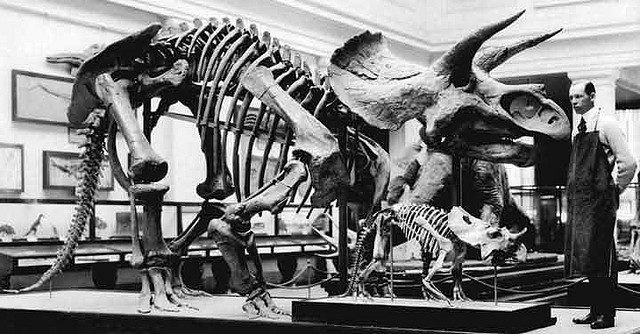
Perhaps due to the general disinterest among USNM curators, changes to the dinosaur exhibits were mostly organizational. Most of the free-standing dinosaur mounts built by Gilmore and his team were collected on a single central pedestal. Preferring not to tackle the massive undertaking of disassembling and remounting the 70-foot Diplodocus skeleton, the exhibit designers left the sauropod in place and clustered the smaller moutns around it. In the new arrangement, the Diplodocus was flanked by the two Camptosaurus and prone Camarasaurus on its right and by Triceratops and Brachyceratops on its left. The Stegosaurus stenops holotype, splayed on its side in a recreation of how it was first discovered, was placed behind the sauropods at the back of the platform.

Close up of Thescelosaurus on the south wall. Photo courtesy of the Smithsonian Institution Archives.

 The north and south walls of Hall 2 were lined with additional specimens. On the south side, Gilmore’s relief mounts of Ceratosaurus and Edmontosaurus (called “Anatosaurus” in this exhibit) were joined by the gallery’s one new dinosaur, a relief mount of Gorgosaurus in a death pose. The north wall featured a long, narrow, glass-enclosed case illustrating the basics of dinosaur classification. In addition to saurischian and ornithischian pelves, the case featured skulls representing most of the major dinosaur groups. Amusingly, all but two of these skulls (Triceratops and Diplodocus) were labeled with names that are no longer considered valid. These skulls included “Antrodemus” (Allosaurus), “Trachodon” (Edmontosaurus) “Procheneosaurus” (probably Corythosaurus)  and “Monoclonius” (Centrosaurus).

In the southwest corner of Hall 2 (where FossiLab is today), visitors could see the Museum’s two free-standing Stegosaurus: the fossil mount constructed by Gilmore in 1913 and the charmingly ugly papier mache version, which had received a fresh coat of paint. Finally, the rear (east) wall of Hall 2 held Gilmore’s relief mounted Tylosaurus.

Mammals

c.11

Brontotherium and Matternes’ Oligocene mural in Hall 5. Photo courtesy of the Smithsonian Institution Archives.

Fossil mammals were exhibited in Hall 5, a corridor-like space accessible from the main rotunda and via two doorways on the north side of Hall 2. After 1990, this space would house the “Life in the Ancient Seas” exhibit. Charles Gazin, head curator of the Division of Paleontology, was in charge of this space on paper, but my impression is that his attention was elsewhere during its design and construction. Gazin was apparently approached by the modernization committee several times during the 1950s, but was reluctant to commit his time to a major renovation project. Gazin had been spending a great deal of time at a Pliocene dig site in Panama, and the collection of new fossils proved more interesting than designing displays. As Gazin tersely explained, “It is a little difficult to concentrate objectively on exhibition problems here in the interior of Panama.”

Basilosaurus and Cenozoic reptiles in Hall 5. Photo courtesy of the Smithsonian Institution Archives.

Nevertheless, Gazin’s interest in Cenozoic mammals ensured that his gallery was exceptionally thorough. Thanks to Gazin’s own collecting expeditions throughout the 1950s, the new fossil mammals galleries contained representatives of nearly all major mammal groups, from every epoch from the Paleocene through the Pliocene (the Pleistocene was deliberately excluded, as a separate ice age exhibit was also in the works). Classic mounts from the Gilmore era like Basilosaurus and Teleoceras were joined by dozens of less showy specimens like rodents, small perissodactyls, and early primates. The new exhibit also introduced the first wave of Jay Matternes’ much-beloved murals, illustrating the changing flora and fauna in North America over the course of the Cenozoic.

Unveiling and Reactions

The new east wing galleries officially opened on June 25, 1963. According to the press release, “the new exhibit features in colorful and dramatic settings more than 24 skeletons and skulls of the largest land animals the world has ever known.” The exhibits were officially unveiled with a late afternoon ceremony, in which Carol Hotton (Nicholas Hotton’s daughter) cut the ribbon and the lights to Hall 2 were suddenly turned on to dramatic effect.

Unfortunately, the new exhibits were not universally loved by the museum staff. The wing had been planned a set of compartmentalized exhibits, each corresponding to a subdivision of the Division of Paleontology, with a different curator taking responsibility for each hall. While seeming sensible on paper, this plan turned out to be a logistical nightmare, and a common cause for complaint among Division staff for the next decade. In addition, Gazin in particular voiced concerns as early as January 1964 that the design of the new halls was entirely inadequate for preventing accidental or deliberate damage to specimens by visitors. The mounts in Hall 2 were raised only about a foot off the ground, and were not protected by any sort of guard rail or barrier. As a result, within a few months of the exhibit’s unveiling, several ribs and vertebral processes had been broken off or stolen from CamarasaurusGorgosaurus, Ceratosaurus and others.

With the notable caveat that I never saw the 1963 exhibits in person, I would say that this is aesthetically my least favorite iteration of the east wing. The grandiose, institutional Greco-Roman architecture originally displayed in the Hall of Extinct Monsters was replaced with what can only be described as extremely 1960s design. Solid earth-tone colors, wood paneling and wall-to-wall carpeting gave the halls a much more austere character. While the efforts to categorize specimens into thematic zones was commendable for a museum of that era, the label copy (written by the curators) was still highly pedantic and verbose. As such, the 1963 fossil halls seem to have been very much of their time. While the designers were working to avoid the overt religiosity and grandeur of turn of the century museums, they had not yet reached the point of developing truly audience-centered educational experiences. The result was an exhibit that was humble, yet still largely inacessible. Perhaps for this reason, the 1963 fossil halls were the shortest-lived at NMNH to date, being replaced within 20 years of their debut.

This post was updated and edited on January 8, 2018.

Leave a comment

Filed under dinosaurs, exhibits, Extinct Monsters, fish, fossil mounts, history of science, mammals, museums, NMNH, reptiles, science communication

A Triceratops for Lawrence

In an earlier post, I described how the Smithsonian’s Triceratops was the first free-standing mount of this animal ever created, and the eccentricities of its proportions and posture would define how the species would be depicted in artwork and other reconstructions for the better part of a century. I should have clarified, however, that this was not the first time Triceratops fossils were put on public exhibit. That honor goes to the University of Kansas Natural History Museum, which was founded in 1864 and is still operational today.

Among the Museum’s basement paleontology exhibits is a case of dinosaur fossils that has literally gone unchanged since the 1950s. Although this time capsule of mid-century museum design is of some historical interest, it would be nice if those sauropod limb bones weren’t labeled “Brontosaurus” (to be clear, the whole museum doesn’t look like this, the staff has been slowly but surely modernizing the exhibits). Of particular importance is the Triceratops skull (specimen 422) on the left side of the case. While there is no historical information on its label, this specimen has been with the museum for over 115 years, having been unearthed and put on display only six years after O.C. Marsh first named and described Triceratops.

The dinosaur case at the KU Natural History Museum, untouched since the 1950s.

The dinosaur case at the KU Natural History Museum, untouched since the 1950s.

The story of the KU Triceratops is not well-known, although it is the subject of the somewhat hard-to-find book (neither the Museum nor the KU library has a copy) A Triceratops Hunt in Pioneer Wyoming. In the summer of 1895, a team from the University ventured into the frontier lands of of eastern Wyoming with the explicit goal of finding a Triceratops for display at the young Natural History Museum. The team was led by Samuel Wendell Williston, founder of the University’s geology department. Although Williston’s specialty was entomology, he had previously worked under Marsh at Yale and was well-acquainted with the plethora of dinosaurs on which his mentor had published. Also on the expedition were KU Regent James Polk Sams, and two individuals whose names are quite familiar to anyone with an interest in the history of paleontology, Barnum Brown and Elmer Riggs. Brown would, of course, go on to be the star fossil hunter at the American Museum of Natural History, while Riggs would become a curator at the Field Museum of Natural History. In 1895, however, both were students, and not especially interested in fossil collecting or paleontology. 

The team found the Triceratops they were looking for on July 9, near the confluence of Lightning and Lance Creeks. By July 22, the skull was fully excavated and crated for a journey by train back to Lawrence. The fossil apparently garnered a fair amount of attention on the journey; while Triceratops is well known today, in 1895 few had any idea that animals such as this had ever walked the Earth. And yet, here was clear, physical evidence of an extinct animal like nothing alive in the modern world, and it would soon be displayed for all to see in the University of Kansas Museum.

Triceratops skull retrieved by the 1895 Wyoming expedition.

Triceratops skull retrieved by the 1895 Wyoming expedition.

The 1895 expedition was not tremendously productive scientifically, the fossils found that summer resulting in only three short papers. However, the journey, and the Triceratops skull that was brought back, did end up being quite important for paleontology. The expedition inspired Brown and Riggs to pursue careers in paleontology, and as Brinkman and colleagues write in Triceratops Hunt in Pioneer Wyoming, “they would hunt bones for the rest of their lives, to the great benefit of science, and might never have done so had not circumstances landed them in the circle of Williston’s influence in the summer of 1895.”

Furthermore, by setting out with the clear goal to find a dinosaur for display, the University of Kansas team were trailblazers in a movement that would lead to the inseparable connection between dinosaurs and museums in popular culture today. In the first decade of the 20th century, newly burgeoning large urban museums openly competed to find and display the largest and most spectacular dinosaurs. Exhibits like the AMNH Brontosaurus, the Carnegie Museum of Natural History Diplodocus and, of course, the Smithsonian Triceratops brought millions of Americans into museums, ensuring that to this day, when we think of museums, we think of dinosaur skeletons (and vice versa). In spite of the somewhat dingy basement display it currently finds itself in, the University of Kansas Triceratops was an early trendsetter and a profound example of the intersection of science and history.

Reference

Kohl, M.F., Martin, L.D. and Brinkman, P., eds. (2004). Triceratops Hunt in Pioneer Wyoming: The Journals of Barnum Brown and J.P. Sams. Glendoo, WY: High Plains Press.

4 Comments

Filed under dinosaurs, field work, fossil mounts, history of science, marginocephalians, museums, reptiles

Allan McCollum’s fossil art

Click here if the embedded video doesn’t work.

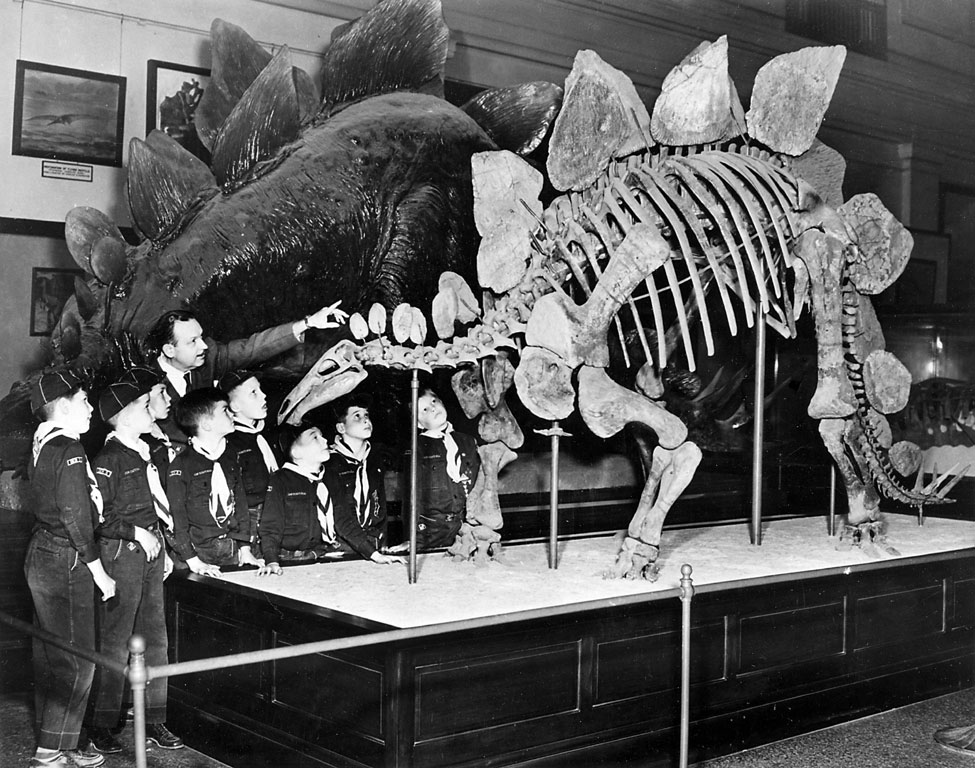
My first love is natural science, but I also fancy myself an amateur art enthusiast, particularly for performance and installation pieces from the last 50 years or so. I am fascinated by art that directly engages the viewer, art that is not complete without the involvement of the spectator. As it happens, mounted fossil skeletons are a great example of  installation art, although they are not deliberately constructed as such. The size and presence of a dinosaur skeleton, such as the Stegosaurus below, necessarily incorporates the viewers’ human scale into the experience. Viewers are not merely spectators but participants in a shared performance. Nevertheless, fossils are nearly always displayed and interpreted as scientific specimens, rather than art objects.

Stegosaurus fossil mount and life-size model circa 1913. Photo courtesy of the Smithsonian Institution Archives.

Stegosaurus fossil mount and life-size model at USNM circa 1913. Photo courtesy of the Smithsonian Institution Archives.

One important exception occurs in the work of prolific New York-based artist Allan McCollum. McCollum’s installations frequently address repetitive labor and industrial manufacturing, often incorporating hundreds or thousands of similar but subtly unique objects. Each piece is the product of many small actions, gradually assembled over time. In the early 1990s, the artist turned his attention to fossils, particularly their historic meaning and aesthetic appeal.

"Lost Objects" by Allan McCollum. Image from Art21.

“Lost Objects” by Allan McCollum. Image from Art21.

In 1991, McCollum collaborated with the Carnegie Museum of Natural History to produce “Lost Objects”, displayed next door at the Carnegie Museum of Art. Using molds taken from dinosaur fossils (apparently all limb bones) in the CMNH collection, the artist produced several hundred fossil casts for the installation shown above. To me, this piece is a reflection on the global sharing of fossil material permitted by casting technology. In the Art21 video at the top of this post, McCollum briefly discusses the prominence of casts among the dinosaur mounts that are a staple at natural history museums. Dinosaur skeletons are virtually never found complete, and mounts are often filled in with casts of specimens held by other museums. For example, the National Museum of Natural History Diplodocus mount incorporates casts of the left hindlimb and much of the neck of the Carnegie Diplodocus. What’s more, casted duplicates of the entire Carnegie Diplodocus can be seen in London, Berlin and several other cities in Europe and Latin America, and casts of the American Museum of Natural History Tyrannosaurus are on display in Denver and  Philadelphia. It would be an impressive sight if all the casts of certain fossil specimens scattered around the world were reunited in one room, a monument to the knowledge gained from a century of scholarly collaboration. It would also commemorate the intangible excitement generated by dinosaur mounts, made possible only through the duplication and sharing of casts.

MCollum also comments that “there aren’t as many dinosaur bones in the world as we think.” Perhaps, then, “Lost Objects” is a reflection on the scarcity of intact fossils, by showing an impossibly large collection that no museum could hope to amass. Let’s just hope he wasn’t trying to comment on the alleged mass-production of casts cheapening the original fossils and the museums that hold them, because he’d be dead wrong (EDIT: He wasn’t, see comments).

mccollumnaturalcopies

“Natural Copies” by Allan McCollum. Image from Art21.

In 1995, McCollum followed up on “Lost Objects” with “Natural Copies, a series of casted dinosaur footprints produced in collaboration with the College of Eastern Utah Prehistoric Museum. For the artist, this piece was a reflection on the idea that 150 million-year-old fossils can be valued as cultural history. The footprints in question were found by the hundreds in a Utah coal mine. While many ended up at the museum, others were collected by miners to display at home. The fossils took on a second life as symbols the community’s workforce and natural heritage, irrelevant to the dinosaurs that produced the tracks but important all the same. McCollum’s work separates the fossils from their typical scientific context so that viewers may reflect on their cultural meaning and even the aesthetic beauty of their form.

So what’s the point of these installations? These appropriations of fossils as aesthetic pieces has no bearing on the science of paleontology, and in fact may obscure information about how the animals that left these traces lived and behaved. And yet, from the moment a fossil is first seen by human eyes, whether it is an ammonite preserved in a split open rock or the glint of a vertebrate bone weathering out of a hillside, it becomes meaningful on a human scale. For the discoverer, the researcher who describes the fossil, the institution that holds it in its collection and the visitor who sees the fossil on display, that specimen has cultural value. This does not diminish the value of fossils as natural specimens, but rather enhances their importance.

1 Comment

Filed under collections, dinosaurs, fossil mounts, museums, paleoart

Another JP4 Feathers Post

Okay, I’ll bite.

A week ago, Jurassic Park 4 director Colin Treverrow tweeted two words and a hashtag that set the corners of the internet I hang out in aflame for days afterward. The dinosaurs in the upcoming third sequel will not have feathers, in defiance of the twenty years of irrefutable fossil evidence that has come to light since the original film’s 1993 release. Reactions to this news demonstrate a clear divide among dinosaur enthusiasts: there are those who hate the idea of scientifically inaccurate dinosaurs appearing in mass media, and those who are enamored with the “classic” dinosaurs of their youth, and vocally resist any change. And in this case, I don’t really agree with either.

The problem is that dinosaurs straddle two different roles in our culture. There is the scientific reality of their existence, informed by careful scrutiny of hard evidence. Brilliant researchers collect and interpret fossils, broadening our understanding of not only the lives of dinosaurs, but how life on earth evolves and adapts to change in general. As a science educator, this is the perspective on dinosaurs I am usually invested in.

But dinosaurs also have what John Conway calls “awesomebro” appeal. From this angle, dinosaurs are appealing because they are monsters with big teeth and are generally super cool. This is coupled with an innate association of dinosaurs with early childhood that people are remarkably protective of. For example, on Brian Switek’s 10 Dinosaur Myths that Need to Go Extinct article for Tor Publishing, commenter Alan B. declares “I don’t care what anyone says, the dinos we learned about when I was in grade school were awesome! And given a choice between factual and awesome, I will choose awesome every time!” Clearly there is a a bit of tongue-in-cheek humor at play here, but comments like this appear virtually anywhere feathered dinosaurs are discussed. Many people genuinely care about their “classic” dinosaurs, and react negatively to new discoveries that threaten the dinosaur paradigm they associate with childhood bliss.

As Conway points out, the typical reaction of anyone with a vested interest actual scientific paleontology is to reject and belittle pop-culture dinosaurs whenever possible. Unfortunately, this we’re-right-and-you’re-wrong approach veers into deficit model territory, and doesn’t seem to accomplish much other than make the rift among dinosaur enthusiasts more antagonistic. It makes our audience of potential learners defensive, even angry, that scientists are “ruining” dinosaurs. And focusing conversations on the fact that popular conceptions of dinosaurs are wrong removes focus from the real benefits of researching past life.

I think it would be more helpful to recognize the validity and significance of pop-culture dinosaurs, but to work towards separating them in the public consciousness from real dinosaurs. A potential conversation: You think the Jurassic Park Raptors are cool? Great, so do I, but I think they’re cool in the way other movie monsters like the Predator or the T-1000 are cool. But perhaps you’d be interested in learning about the real animal Velociraptor mongoliensis that the movie Raptors were inspired by? My point is, the widespread appreciation/nostalgia for pop-culture dinosaurs (or fantasy dinosaurs, or classic dinosaurs, or awesomebro dinosaurs, whatever you want to call them) is potentially valuable, but I think it often gets dismissed too gruffly. If would-be educators are outright dismissing what their audience is bringing to the conversation, that audience has little incentive to learn more.

3 Comments

Filed under dinosaurs, education, movies, opinion, reptiles, science communication