Monthly Archives: July 2015

The Pan-American Expo Triceratops Lives On UPDATE: Or does it?

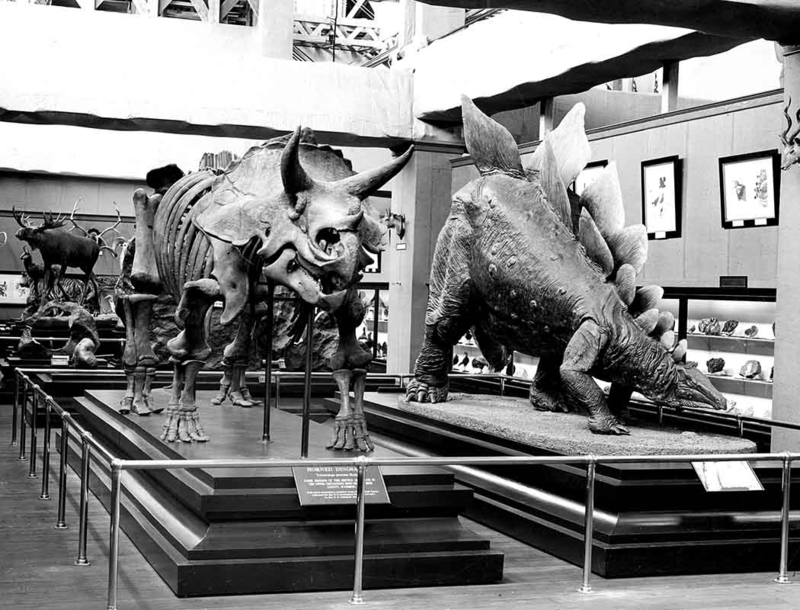
Triceratops at the Natural History Museum, London.

Triceratops at the Natural History Museum, London. Source

Don’t you hate it when you miss something glaringly obvious? I’ve never seen the Triceratops skeleton at London’s Natural History Museum in person, but I’ve seen enough pictures to know that it’s a little weird. Inaccuracies like the columnar feet, dragging tail, and vertical forelimbs can be attributed the display’s age, but the head doesn’t really look like any other Triceratops skull that’s ever been found. I had assumed that the funky frill and extremely long nasal horn were sculpted flourishes, but it turns out that no part of this Triceratops is real. It’s not a heavily-reconstructed original skeleton or even a cast – it’s a papier mâché model. And not just any model, but one that I’ve already written about in a different context.

Pan American exhibition

The Lucas Triceratops model at the 1901 Pan-American Exhibition. Source

Frederic Lucas, an Assistant Curator at the United States National Museum, created this Triceratops in 1900 for the Smithsonian display at the Pan-American Exhibition in Buffalo, New York. A mix of corporate and government displays based around the themes of peace, prosperity, and technology, the Pan-American Exhibition lasted from May to November 1901 (it was cut short when President William McKinley was shot on the fairgrounds). The Smithsonian’s 7,500 square foot exhibit took nearly a year to prepare, and showcased specimens from all departments of the nascent institution. Indeed, the Smithsonian’s participation in this and other fairs around the turn of the century is significant because these attractions were the basis for the some of the first exhibits at the USNM. Displays initially created for fairs often found a home in the museum’s permanent galleries, and the fair exhibitions were generally used as a template for the first generation of Smithsonian exhibits.

The Triceratops model was meant to represent the glut of fossils from the western United States that the Smithsonian had recently acquired from O.C. Marsh. Perhaps because most of those specimens were still unpacked and unprepared (the USNM didn’t hire a dedicated fossil preparator until 1903), Lucas sculpted the skeleton freehand based on one of Marsh’s published illustrations. It’s noteworthy that Lucas was not a paleontologist – he was brought on board at the age of 21 with no formal training because of his talent for constructing taxidermy displays. At any rate, Lucas followed Marsh’s reconstruction – at the time the only Triceratops reconstruction available – religiously when constructing his full-sized model.

St. Louis Expo

The Lucas Triceratops at the Louisiana Purchase Exposition in 1904. Source

After the Pan-American Exhibition, Lucas’s Triceratops made a second appearance at the 1904 Louisiana Purchase Exposition in St. Louis, Missouri. It was rendered obsolete shortly thereafter when Charles Gilmore assembled the world’s first real Triceratops skeleton at the USNM. As I’ve covered before, the act of physically manipulating the Triceratops fossils into a standing mount showed Gilmore that Marsh’s straight-legged reconstruction was a physical impossibility.

My understanding was that the Lucas model was lost or destroyed shortly after Gilmore’s real Triceratops went on display in 1905. I should have been more skeptical, however, because exhibits like this are almost never wasted. For example, Gilmore reported in 1943 that the Hadrosaurus cast displayed at the USNM before his arrival had been discarded due to wear and tear, but the mount had actually been given to the Field Museum in the 1890s. A couple months ago, I found out that Albert Koch’s chimeric mastodon (what he called “Missourium”) was purchased by Richard Owen on behalf of the British Museum and remounted. And just this year, the Smithsonian’s 112 year-old Stegosaurus model began a new life at the Museum of the Earth in Ithaca, New York.

tweet

Hey, that looks familiar! Source

The above tweet from the London Natural History Museum finally clued me in that the Lucas Triceratops had been hiding in plain sight for more than a century. The NHM (then the British Museum) received their Triceratops from the Smithsonian in 1907 (confirmed in the July 1907 issue of The Museums Journal), just when the Smithsonian had an extra Triceratops on hand. The London model is plainly not a cast of Gilmore’s 1905 mount, but it does resemble the Lucas model in most every detail, from the way the legs are posed to the exaggerated horns and frill. The only clear difference I can see is in the position of the head, which is much more elevated in the photos from the Buffalo and St. Louis expositions. However, I imagine the model would have been partially disassembled for transport. Perhaps when it was rebuilt in London the head ended up lower, whether by accident or design.

Unless there’s reason to think there were two copies of the Lucas Triceratops, I’d say the most parsimonious conclusion is that the London Triceratops is the very same model that was first displayed at the Pan-American Exhibition in 1901. Much like it’s long-time companion Dippy the Diplodocus, this Triceratops model is a century-old historic icon, one that has introduced generations upon generations of visitors to the enormity of deep time and the wonders of our prehistoric past. Inaccurate sculpture or not, it’s definitely something to preserve and to celebrate.

UPDATE: Shortly after I finished this post, @NHM_London responded to my inquiry with the following:

Hmm

Did I speak too soon? Source

I’m dubious that the NHM Triceratops is a copy of Gilmore’s 1905 version, but hey, it *is* their museum. I’ll leave this post up for now and follow up when I find out more. I love a good museum mystery!

References

Gilmore C.W. (1905).The Mounted Skeleton of Triceratops prorsus. Proceedings of the U.S. National Museum 29:1426:433-435.

Gilmore, C.W. (1941). A History of the Division of Vertebrate Paleontology in the United States National Museum. Proceedings of the United States National Museum 90.

Howarth, E., Rowley, F.R., Ruskin Butterfield, W., and Madeley, C. (1908). The Museums Journal, Volume 7. Museums Association.

7 Comments

Filed under dinosaurs, fossil mounts, history of science, marginocephalians, museums, NHM, NMNH

Framing Fossil Exhibits: Environmental Change

Over the past few months, I’ve been writing about the strengths and weaknesses of various large-scale paleontology exhibits from an educational standpoint. Check out the Introduction, Walk Through Time, Phylogeny, and Habitat Immersion posts if you’d like to catch up. I’ll wrap up this series for the time being with a look at two upcoming renovations of classic fossil displays, which appear to have converged on similar aesthetic, organizational, and interpretive approaches.

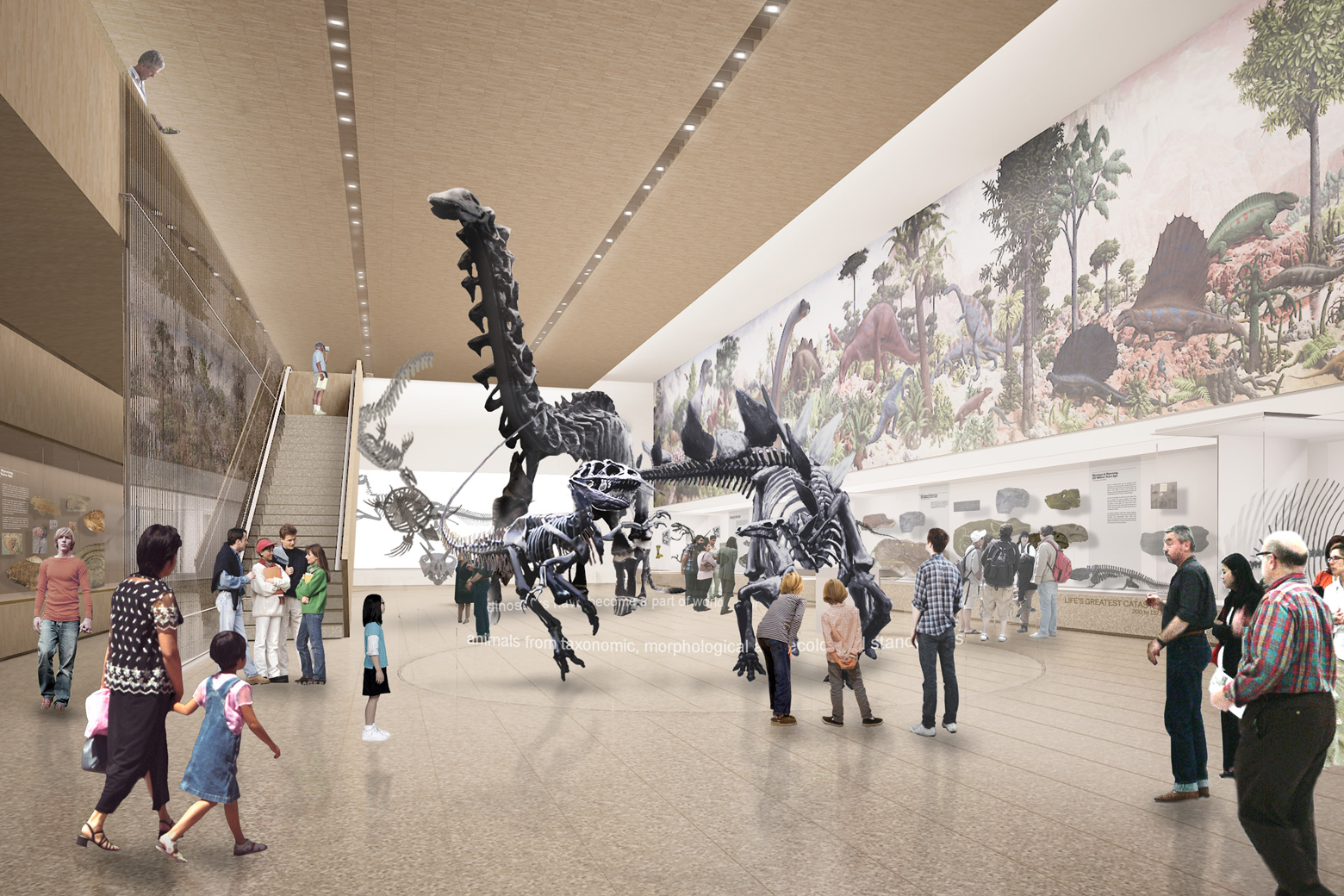
First up is the Peabody Museum of Natural History, where the Great Hall of Dinosaurs and adjacent Hall of Mammal Evolution have seen little modification since the 1950s. While the PMNH fossil galleries are fascinating as a time capsule of mid-century exhibit design, much of the content is rather dated and a thorough overhaul is sorely needed. PMNH staff started planning for the renovation in 2010, and I highly recommend Collections Manager Chris Norris’s blog posts on the process. Once the basic layout and concepts were in order, the museum hired the architectural firm Studio Joseph to prepare the images being used to promote the project. Fundraising is now underway, but an estimated completion date has yet to be announced.
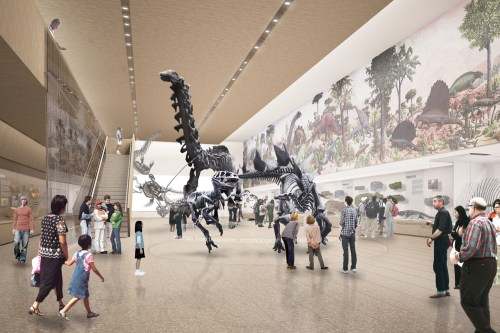
Great hall

Conceptual render of the Great Hall of Dinosaurs by Studio Joseph. Source

The big idea behind the new exhibit is the dynamic relationship between the biosphere and the Earth’s various other spheres (atmosphere, geosphere, hydrosphere, etc). The evolution of life on Earth did not occur in a vacuum, but as part of a continuously changing global system. This narrative does have a time axis – visitors will travel from the Permian at one end of the exhibit to the Quaternary at the other – but the precise divisions of geologic time are de-emphasized in favor of the broad environmental transitions that triggered evolutionary innovations. Examples might include the separation of continents during the Mesozoic, the diversification of flowering plants in the Cretaceous, or the massive climatic shift at the end of the Eocene. In this context, it’s more important that visitors understand (for example) that the Cenozoic was generally a transition from hot and wet to cold and dry (and the implications on mammalian evolution) than that they know the names and time spans of each epoch.

This approach contrasts sharply with traditional chronological exhibits, such as the Field Museum of Natural History’s “Evolving Planet.” The FMNH fossil galleries are extremely linear, and each geologic period is introduced with a set of easily-digested bullet points summarizing what happened during that time. Relatively tight spaces prevent visitors from seeing specimens from other time periods prematurely, and the galleries devoted to each period are color-coded to make them immediately distinct. According to Norris, this segmented presentation of the history of life obscures the large-scale transitions which transcend the somewhat arbitrary divisions of geologic time. As such, the new PMNH fossil halls will present the narrative holistically, encouraging visitors to track the underlying environmental trends that precipitated evolutionary change over time.
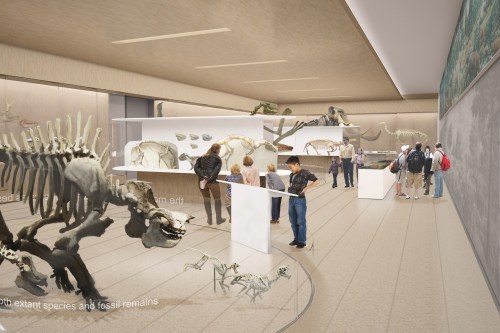
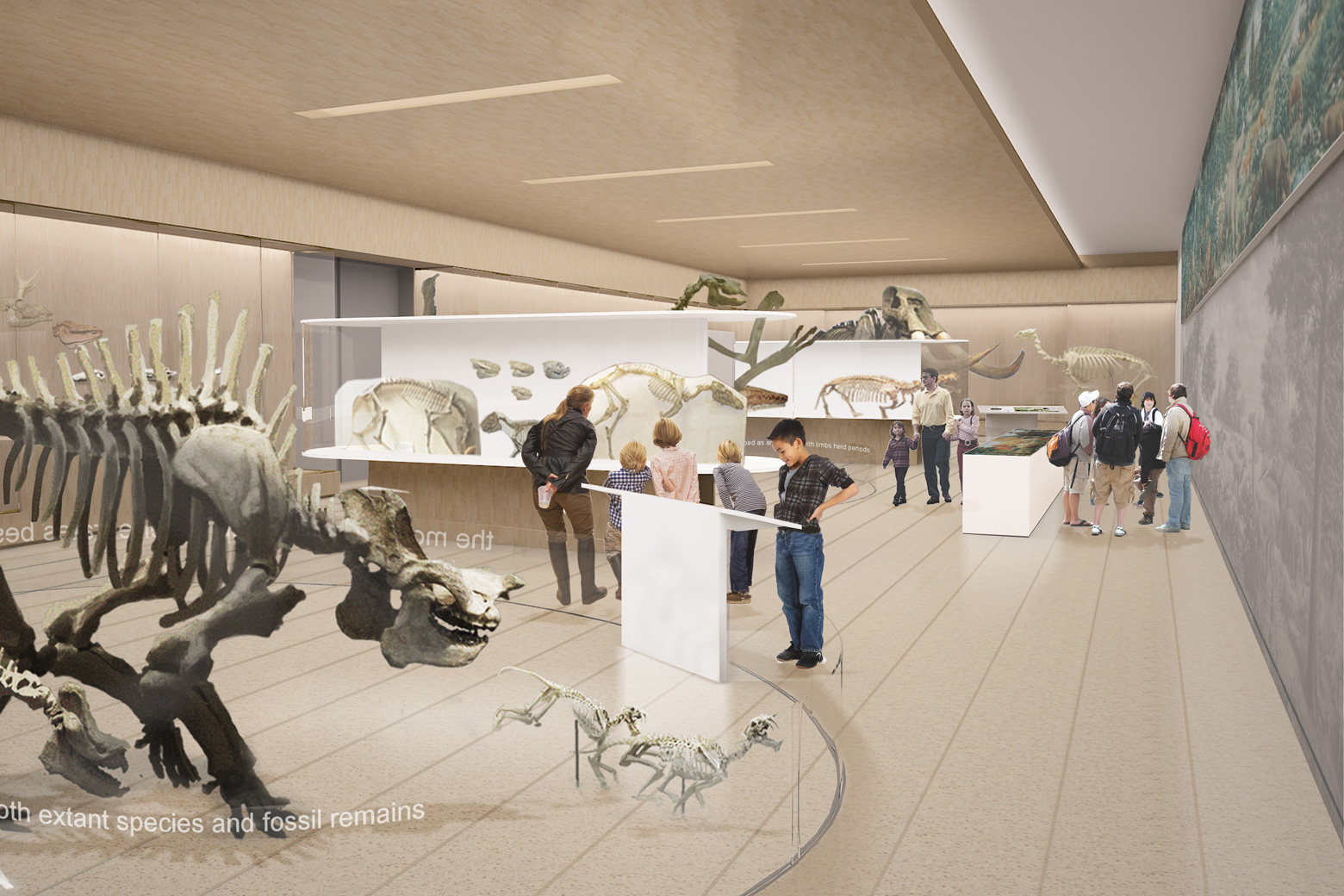
mammal hall concept art by Studio Joseph

Conceptual render of the Hall of Mammals by Studio Joseph. Source

As is immediately clear from the promotional images, the new exhibit will juxtapose a modern, wide-open aesthetic with elements of the museum’s past – specifically, the outdated but gorgeous Rudolph Zallinger murals. Both of these design elements tie directly to exhibit’s narrative themes. By breaking up the central dinosaur pedestal and eliminating the unsightly glass cases in the Mammal Hall, the exhibit designers have dramatically increased the available floor space and opened up new lines of sight. This should allow visitors to view each of the galleries comprehensively, rather than as a series of discreet segments. Meanwhile, the Zallinger murals will remain a celebrated part of the exhibits. These magnificent frescoes were painted between 1942 and 1967, and are among the most iconic images of prehistoric life ever created. Although the physiology of some of the animals is outdated, Zallinger was in other ways ahead of his time. Rather than giving the geologic periods hard borders, Zallinger artfully wove the sections together so that each one fades imperceptibly into the next. The viewer can see that the flora, fauna, and climate are changing over time, but it’s a gradient, not a ladder, which perfectly reflects the narrative of the new exhibit.
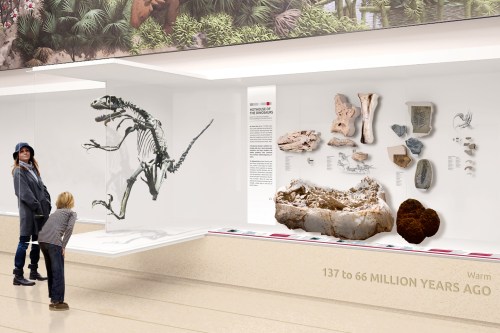
deinonychus close up by Studio Joseph

A conceptual render of Deinonychus and other Cretaceous fossils. Source

About 300 miles south of PMNH, the re-imagining of the fossil halls at the National Museum of Natural History is well underway. This building’s east wing has been home to paleontology displays since it opened in 1910 and has been updated several times, but this is the first time it has undergone a complete, wall-to-wall modernization. The old exhibits were formally closed on April 28th, 2014, and NMNH staff spent the following year removing thousands of specimens from the halls. With the fossils out of the way, the next step will be to restore the historic space to its original neoclassical glory. After that, the new exhibits and updated fossil mounts can be assembled in time for a 2019 re-opening.

Intriguingly, the planned design of the new National Fossil Hall is both thematically and aesthetically similar to the PMNH renovation, albeit on a grander scale. The National Fossil Hall’s narrative focus will be on large-scale environmental transitions over time, and how these changes drove the evolution of plants and animals. Like at PMNH, this will be accentuated by an open layout: false walls and barriers that have divided the space since the early 1960s will come down, allowing visitors to see clear across the spacious three-story hall. This airy aesthetic hearkens back to the Hall of Extinct Monsters, and like the restoration of the Zallinger murals at PMNH it represents an admirable celebration of the institution’s history.
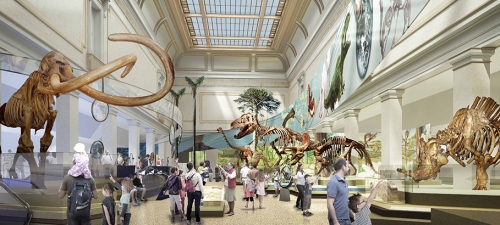
concept art

Early conceptual render of the National Fossil Hall by Reich + Petch Source

One interpretive choice that will set the National Fossil Hall apart is the clustering of specimens on islands, or “pork chops”, as the were called early in development. Each pork chop represents North America at a particular period in time. While anchored by a few charismatic mounts, the pork chops will also include all manner of small animals, invertebrates, and plants that were part of that environment. In this way, the islands are self-contained mini exhibits, each one showing a complete ecosystem that existed at a particular time. Moving among the these displays, visitors should get a sense of how climate change and faunal interchange (among other phenomena) can completely transform an ecosystem over millions of years. They’ll also learn how certain organisms, like sauropods in the Jurassic or grass in the Neogene, can change landscapes and influence the evolution of contemporary plants and animals.

The emphasis on open spaces and freedom of movement is notable, because this is quite different from the linear exhibits of the late 20th century. In recent decades, exhibits have become increasingly structured, with specific learning goals and physical spaces designed to corral visitors through a carefully orchestrated narrative journey. Again, Evolving Planet at FMNH is an excellent example of this philosophy. The new National Fossil Hall is in some ways a push in the opposite direction – although it has a clear narrative and overarching message, visitors can roam through the exhibit as they please. I see the pork chop system as a way to have it both ways. Whether visitors work through the exhibit front to back or run straight to the T. rex in the center of the hall, then wander around at random, they’ll still be able to compare and contrast the different ecosystems and learn what the designers want them to learn.
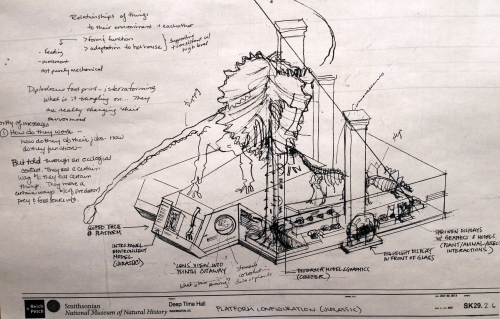
A pork chop

Early concept art of the Jurassic “pork chop.” Image from The Last American Dinosaurs, NMNH.

More than anything else, what I expect to set the National Fossil Hall apart from peer exhibits will be its explicit connections to modern-day environmental crises. It’s worth quoting the Department of Paleobiology’s summary in full:

Visitors to the Museum will be able to explore how life, environments, and ecosystems have interacted to form and change our planet over billions of years. By discovering and harnessing the tools and methods paleobiologists use to study fossils, visitors will gain a deeper understanding of how the world works.

The distant past affects all of us today and will continue to do so in the future. How will climate change impact the natural world and our daily lives? How can we make informed choices about our ecosystems as individuals and as a species? How can we all become informed citizens of a changing planet?

We are in the midst of an extinction event of our own making. Anthropogenic climate change, habitat destruction, and invasive species are as dangerous as any asteroid, and will likely have profound effects on our own lives and livelihoods in the coming century. But while humans are undeniably the cause of the latest round of global changes, we also have the power to mitigate and manage their consequences. The study of fossils provides important contextual information – we can place modern organisms in an evolutionary context and understand their role in shaping the world as we know it, and we can see how organisms have responded to significant environmental overhauls in the distant past. The fossil record is in fact the only way to directly observe these things (as opposed to relying on models or actualistic experiments). As such, the new National Fossil Hall will make it clear that paleontology isn’t just about historical curiosity. The study of past life gives us a long view of the Earth’s biotic and abiotic systems, and helps us predict how they will respond to today’s environmental changes.
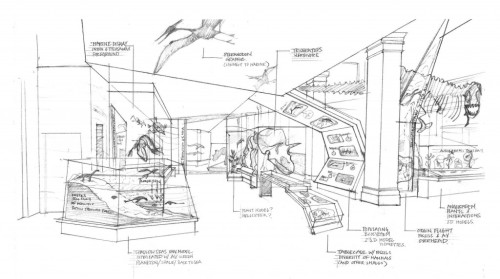
looking west

Concept drawing of the National Fossil Hall’s Cretaceous zone. In the old hall, the viewer would be standing at the base of the mezzanine stairs facing the rotunda. Source

With the modern climate crisis front and center, the new National Fossil Hall has the potential to be one of the most immediately relevant and important paleontology exhibits ever assembled*. This is significant, because as I lamented when I started this series, immediacy and relevance are not things that most museum visitors expect from fossil displays. While fossils, particularly the mounted skeletons of dinosaurs and other prehistoric animals, have been central to the identity of natural history museums since the late 19th century, most visitors don’t regard these exhibits as anything more than prehistoric pageantry. Visitor surveys consistently reveal that dinosaurs are seen as eye candy – monsters that might as well be from another planet. This is a shame, because dinosaurs and other prehistoric organisms were real parts of our own world, and we can learn much from them.

Reich

The new National Fossil Hall will be arranged in reverse chronological order – as visitors move accross the gallery, familiar elements of modern environments will be stripped away and the world will become an increasingly alien place. Source

And so we come full circle. What is the point of a museum exhibit**? Is it enough to provide visitors an opportunity to see cool objects and specimens? When we ask museumgoers what they want to see, they tell us “dinosaurs” or “fossils.” They don’t ask for compelling narratives or connections to big contemporary issues, and they don’t see their museum visit as an important way to bridge gaps in scientific literacy.

Still, it is of critical importance that we provide these narratives and connections. Even if we accept the fact that the very existence of a museum and the chance to see real specimens is a Good Thing, museums are still accountable to the public. Virtually all museums cite education as the primary purpose of their institution, and it’s imperative to live up to that. A museum should have a learning goal in mind, it should be able to prove that this message is coming across, and it should be able to articulate why its audience is better off for it. This is not necessarily easy – exhibits need to be relevant without being condescending or preachy. Exhibit designers need to understand their visitors as much as their content. They need to find a balance between feeding visitors information and providing a customizable experience for diverse audiences. As we have seen, not every exhibit succeeds, but my impression is that we’re getting better at it.

*It’s also notable that this climate change-focused exhibit will be on the national mall, given the ongoing politically-motivated opposition to climate science.

**Note that I’m referring specifically to public-facing exhibits. There are many good reasons why the ongoing maintenance of natural history collections is intrinsically valuable.

References

Marsh, D.E. (2014). From Extinct Monsters to Deep Time: An ethnography of fossil exhibits production at the Smithsonian’s National Museum of Natural History. http://circle.ubc.ca/handle/2429/50177

Weil, S.E. (2002). Making Musueums Matter. Washington, DC: Smithsonian Books.

Werning, S. (2013). Why Paleontology Is Relevant. The Integrative Paleontologists. http://blogs.plos.org/paleo/2013/02/19/why-paleontology-is-relevant

6 Comments

Filed under dinosaurs, education, exhibits, FMNH, museums, NMNH, opinion, PMNH, science communication

Framing Fossil Exhibits: Habitat Immersion

It’s time to revisit my sporadic series on organizational and interpretive approaches in large-scale paleontology exhibits. Check out the posts below if you’d like to catch up.

Introduction

Walk Through Time

Phylogeny

Phylogeny – Addendum

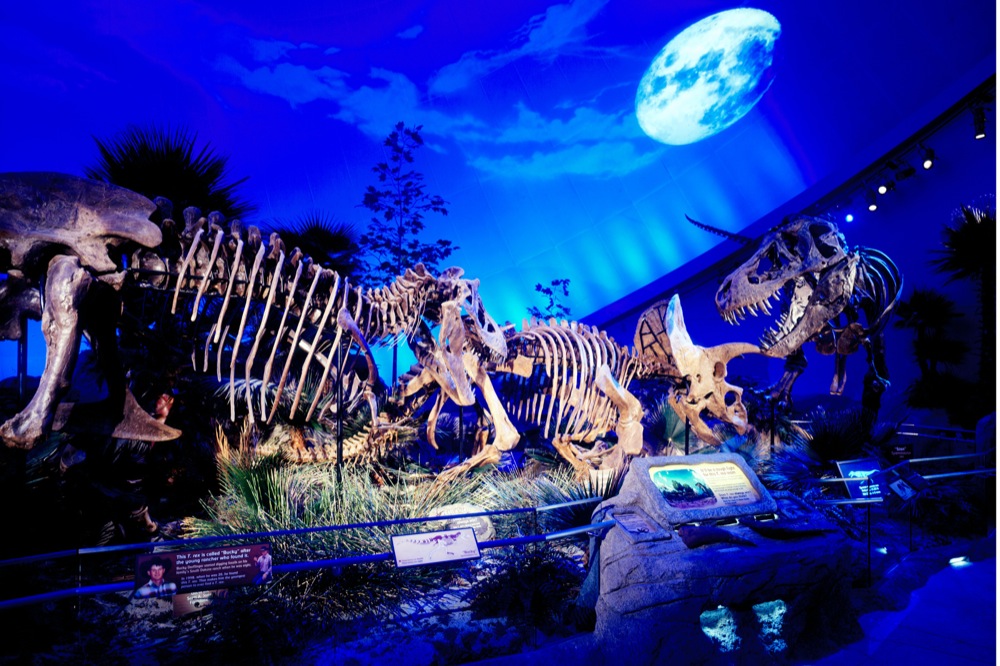
Today’s topic is immersive exhibits – walk-through artificial environments that realistically simulate the prehistoric world. There are plenty of examples, and notably most have been built in the last 30 years. The Cincinnati Museum Center has a reconstruction of the Ohio Valley during the Pleistocene. The centerpiece at the Sternberg Museum of Natural History is an indoor forest presided over by an animatronic Tyrannosaurus rex. Probably the most dramatic example is the DinoSphere at the Children’s Museum of Indianapolis. Here, a repurposed Imax theater contains a number of dynamically posed dinosaur skeletons standing among rocks and trees. The surround sound system provides a constant soundtrack of animal calls, while the projection screen shows the sky at different times of day on a 22-minute cycle. There are even periodic storms, complete with flashing lights and booming thunder.

Original Bucky skeleton paired with a Stan cast at the Children's Museum of Indianapolis. Source

Stan and Bucky  harass a Triceratops in the DinoSphere.

Exhibits like the DinoSphere and its kin are frequently derided as sensationalism with little educational value. These multi-million dollar special effects shows (which sometimes do not contain any genuine specimens at all) are plainly inspired by the successes of theme parks, and it’s easy to dismiss them as crass efforts to draw crowds with flashy gimmicks. Surely these exhibits are nothing more than misguided attempts to turn museums into entertainment, learning opportunities be damned?

Well, it depends. The role of spectacle in museums is a complex one, and arguably one that is impossible to decouple from the core identity of these institutions.  Going back to the enlightenment-era cabinets of curiosities from which modern natural history museums emerged, the public side of museums has always been about showing off the biggest, the rarest, or the most expensive. And this sensationalist modus operandi has often been reflected in the spaces where specimens are displayed. The Greco-Roman architecture of classic exhibit halls, for example, is no less artificial than the DinoSphere’s indoor thunderstorms, and serves pretty much the same purpose.

neoclassical

The neoclassical aesthetic of the Field Museum’s Stanley Field Hall was designed to impress—and is no less of a fabricated experience then the DinoSphere above. Photo by the author.

While spectacle in museums is nothing new, neither is its complicated relationship with education. Arresting displays have long been leveraged to imbue specimens with informative context. Take habitat dioramas populated by taxidermy animals, a longstanding staple of natural history museums. These little worlds behind glass first became popular in the mid 19th century, and were almost immediately controversial among museum workers. Paradoxically, dioramas provided visitors with a fuller appreciation of the ecosystems the animals lived in, but only by wrapping the specimens in a layer of theatrical artifice. The immersive fossil exhibits that have cropped up over the last few decades are essentially habitat dioramas on a larger scale, and exhibit designers are still wresting with the same issues their forebears did a century and a half ago. Which is more important in the context of public exhibits – an informative and meaningful narrative, or authenticity?

For me, spectacle and artifice are fine, even welcome, so long as they serve a purpose. In some cases, the spectacle exists to inform (as in a habitat diorama), in other cases the spectacle itself is the attraction. The robotic T. rex at the Natural History Museum in London and the neanderthal photo booth at the National Museum of Natural History come to mind as examples of the latter – they’re entertaining, but don’t facilitate any further reflection or inquiry. When implemented in a thoughtful and deliberate way, however, spectacle can be a powerful element in a museum educator’s toolkit.

Triassic horsetails

By design, the first big skeleton visitors see in Dinosaurs in Their Time isn’t a dinosaur – it’s the phytosaur Redondasaurus. Photo by the author.

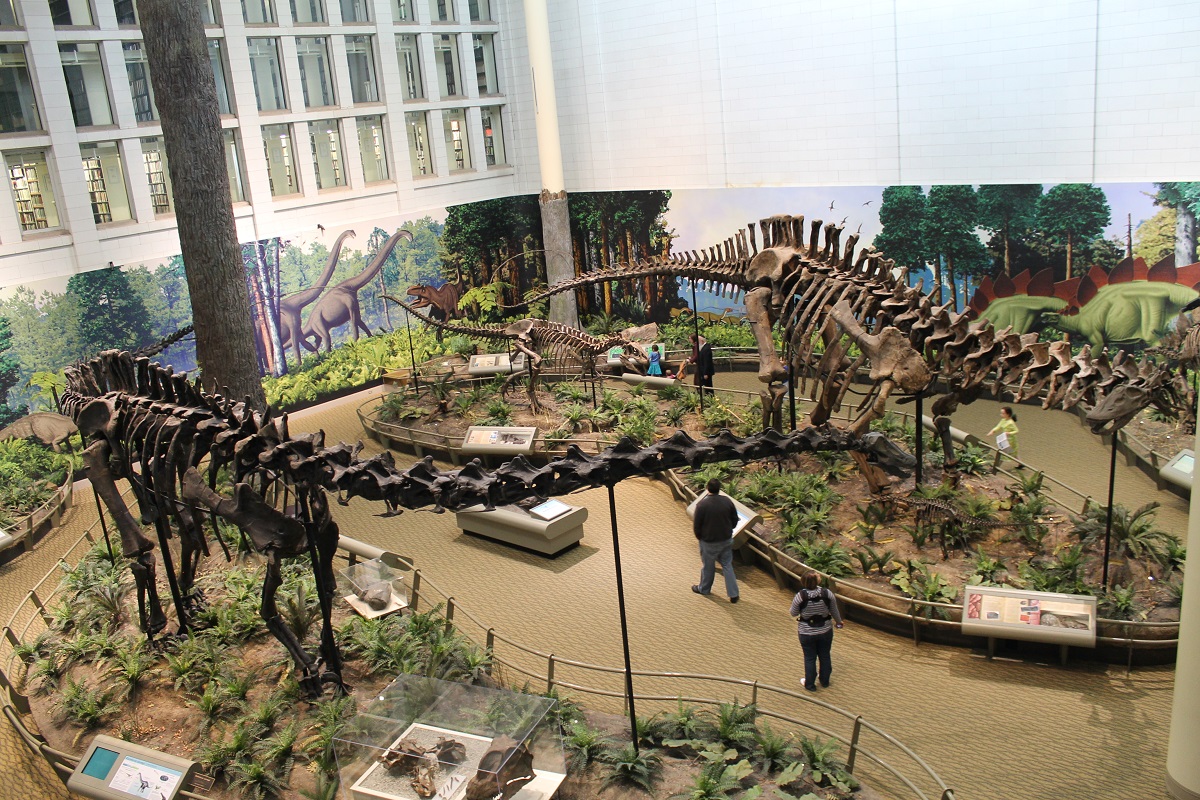
Let’s look at one example of a habitat immersion exhibit that uses showy reconstructed environments to maximize its educational potential. Two years and $36 million in the making, “Dinosaurs in Their Time” at the Carnegie Museum of Natural History is, in my opinion, one of the absolute best paleontology exhibits in the world*. Whether you’re considering the scope and quality of the specimens on display, the aesthetics and layout, or the interpretive approach,  Dinosaurs in Their Time is a benchmark in natural history exhibit design. You can follow along with this nifty interactive map.

*To be absolutely fair, Dinosaurs in Their Time is focused exclusively on the Mesozoic, which makes it difficult to compare to larger exhibits that cover the entire history of life on Earth.

What makes Dinosaurs in Their Time so great? Let’s start by considering the layout. The new exhibit more than doubles the square footage of the old Carnegie dinosaur hall, and much of the interior is actually a former courtyard (incidentally, this reuse of an existing space helped the exhibit earn its LEED certification). This makes the gallery spacious and airy, with a high ceiling and  plenty of natural lighting. The exhibit is arranged chronologically, starting in the Triassic and ending in the Cretaceous, but there is plenty of space in which to roam. In fact, the pathway forms a sort of figure eight around the Apatosaurus and Diplodocus in the Jurassic zone and the Tyrannosaurus pair in the Cretaceous. This cyclical organization allows, if not encourages, visitors to view specimens from multiple perspectives, and lets each person traverse the exhibit at their own pace. It’s especially nice that the sauropods have enough room to breathe – too often, these immense skeletons are relegated to cramped quarters where it’s impossible to see them all at once.

jurassic overlook

Visitors can walk all the way around Apatosaurus and Diplodocus, and even view them from above. Photo by the author.

The open spaces and clear sight lines are nicely complemented by the reconstructed rocks and foliage that fill the exhibit, giving it a proper outdoor feel. Importantly, the flora isn’t just for show – it’s a critical component of the interpretation. “We’ve painstaking recreated the worlds of the dinosaurs,” curator Matt Lamanna explains in a Carnegie Magazine interview, “everything that is displayed together actually lived together.” One of the key themes in Dinosaurs in Their Time is that dinosaurs were but one part of rich ecosystems, which were just as complex as those of today. These animals shaped and were shaped by the world around them, and there is far more to paleontology than the pageant show of toothy monsters that many visitors have come to expect. Indeed, it’s more akin to reconstructing entire worlds.

The plurality of “worlds” is important, because Dinosaurs in Their Time also emphasizes the nigh-unfathomable time span of the Mesozoic. Over 185 million years, countless communities of organisms came and went, and once again the immersive aesthetic of the exhibit helps convey this. While the horsetail swamp of the Triassic area almost looks like an alien world, the Cretaceous is populated by flowers and deciduous trees much like those of today. In this exhibit, the fossil specimens aren’t in a neutral environment – the space itself is part of the narrative.

T. rex with flowers and magnolia.

Tyrannosaurus and Triceratops mounts stand among flowers and magnolias. Photo by the author.

The habitat immersion approach comes with yet another plus: it encourages exploration. From a tiny swimming Hyphalosaurus under the waterline of an artificial pond to a Rhamphorhynchus halfway up a tree, visitors are constantly rewarded for looking high and low. As Lamanna explains, “many visitors are repeat visitors, so we wanted to give them something new to discover every time they come back.” This is particularly beneficial for younger visitors. Rather than barreling through the exhibit in minutes, kids are encouraged to look for tiny details and learn things along the way.

Finally, the computer terminals throughout Dinosaurs in Their Time merit some discussion because they embody the same multi-tiered educational approach as the physical space around them. Dinosaurs in Their Time actually tells several stories simultaneously: there’s the ecology story, the deep time story, the history of the specimens on display, and even a meta-story of how the new exhibit was put together. Most visitors won’t be interested in every narrative, nor should they be. Rather than filling the walls with a dizzying array of signage, the exhibit designers consolidated the various narratives into space-efficient interactives. Visitors can choose which information they would like to see, and craft their experience in the exhibit to their tastes. This is technology used intelligently and purposefully, and something I hope to see other exhibits emulate in the future.

look closely

Sharp-eyed visitors are rewarded with hidden specimens, like this Rhamphorhynchus halfway up a tree. Photo by the author.

The purpose of any exhibit structure is to provide meaning and context for objects – to help visitors see them as more than neat things to look at. It’s the museum’s job to give visitors the intellectual tools to contextualize displayed objects in a more sophisticated way. Spectacle is one way to achieve that goal, and Dinosaurs in Their Time is a stellar example.

References

Love, S. (1997). Curators as Agents of Change: An Insect Zoo for the Nineties. Exhibiting Dilemmas: Issues of Representation at the Smithsonian. Washington, DC: Smithsonian Institution Press.

McGinnis, H.J. (1982). Carnegie’s Dinosaurs: A Comprehensive Guide to Dinosaur Hall at Carnegie Museum of Natural History, Carnegie Institute. Pittsburgh, PA: Board of Trustees, Carnegie Institute.

Polliquin, R. (2012). The Breathless Zoo: Taxidermy and the Cultures of Longing. University Park, PN: Pennsylvania State University Press

10 Comments

Filed under CMNH, dinosaurs, education, exhibits, fossil mounts, museums, opinion, science communication