Author Archives: Ben

Framing Fossil Exhibits: A Walk Through Time

Half a year ago, I promised a series of posts comparing the common strategies for framing the history of life in museum exhibits. This post is the first step toward making good on that goal. Historically, fossil displays at major natural history museums amounted to little more than dinosaur pageant shows, and even today this is all many visitors want or expect. The challenge for exhibit creators is to contextualize the fossils as part of a greater narrative without being alienating, overwhelming, or perhaps worst of all, condescending. A large, permanent exhibit is an enormously time-consuming and expensive undertaking. The opportunity to build or thoroughly renovate an exhibition might occur only once in a generation, so there is exceptional pressure to produce something that succeeds and endures. Exhibits tend to be products of their time, however, and are strongly influenced both by contemporary scholarship and trends in museum theory.

One of the most enduring formats for exploring the fossil record is the “walk through time.” A chronological portrayal of the history of life is an obvious solution, and I don’t mean that in a disparaging way. Audiences are predisposed to understand the forward progression of time, so little up-front explanation is needed. It also helps that the geological timescale compartmentalizes the history of Earth into tidy units. Each Era, Period, or Epoch has a unique cast of characters and a few defining events that make it easy to sum up. There are plenty of examples of chronological fossil exhibits, including Prehistoric Journey at the Denver Museum of Nature and Science, The Third Planet at the Milwaukee Public Museum, and even traveling exhibits like Ultimate Dinosaurs. For this post, though, I’ll be using the Field Museum of Natural History’s “Evolving Planet” as my primary case study, since it so thoroughly embraces the “walk through time” format (and I have a good set of photos on hand to jog my memory).

Map of Evolving Planet. Source

Map of the Field Museum’s Evolving Planet galleries. Source

Evolving Planet is a 27,000 sq. ft. journey through the evolution of life. It opened in 2006, although it is notable that Evolving Planet relies heavily on the structure of the previous paleontology exhibit, “Life Over Time.” Major set pieces like the replicated Carboniferous coal swamp and the Apatosaurus mount remained in place while exhibit designers overhauled the aesthetics and narrative. The most important change is the explicit focus on evolution. Although evolution is key to all biological sciences and the evidence for it is overwhelming, many schools in the United States fail to teach evolution properly and at least a third of the population rejects it outright. As destinations for life-long learning, museums are well-poised to address this deficit in evolutionary understanding, and the Field Museum has enthusiastically risen to the occasion. Evolving Earth weaves the evidence for evolution into all aspects of the displays. The first thing visitors see is the thesis of the exhibit—everything that has ever lived is connected through and is the result of evolution—printed on an otherwise blank wall. Moving forward, visitors learn how evolution via natural selection works, and how we know. Along the way, common misconceptions, such as the idea that lineages improve over time, or that evolution is “just a theory” are proactively addressed and corrected.

eg

The thesis of Evolving Planet cannot be missed. Photo by the author.

This pedagogical approach defines a trend in exhibit design that began in earnest in the 1950s. Early natural history exhibits were designed by and for experts, combining expansive collections of carefully arranged specimens with a few “iconic” displays, such as dinosaur skeletons or taxidermy mounts. By the mid-20th century, however, visitor-centric ideas had begun to take root. Designers began to envision the routes visitors would travel through an exhibit space, and consider what they would look at first when entering a room, and why. Soon hierarchical signage (main ideas in big text, working down to sub-topics and specimen labels) became the norm. Exhibits were enriched with interpretive displays, like dioramas, and scholarly labels were replaced by conversational text and even multimedia. By the 1970s, most of the exhibit responsibilities once held by curators were now handled by exhibit designers and developers. No longer places to explore a collection and view objects at will, exhibits now had carefully structured narratives built around explicit educational goals. In the 80s and 90s, the very floorplans of new exhibits came to reflect this identity, as open halls were replaced with carefully directed switch-backing corridors.

Each geological time period in Evolving Planet is color-coded. Photo by the author.

Each geological time period in Evolving Planet is color-coded. Photo by the author.

Once we reach the Permian, the fossils can start to speak for themselves. Photo by the author.

Once we reach the Permian, the fossils can start to speak for themselves. Photo by the author.

Evolving Planet is, for better or worse, thoroughly rooted in the late 20th century tradition of exhibit design. As the map above shows, once visitors enter Evolving Planet, they are committed to a lengthy trek along a predetermined route. There are no shortcuts to the dinosaurs – you must traverse the entire history of life, starting with its origins in the Precambrian. Along the way, you’ll become familiar with the exhibit’s iconography. Every time you enter a new geologic period, you are greeted by a “Timeline Moment.” These include a chapter heading, a back-lit illustration, an update of where you are on the timeline, and a summation of the key evolutionary innovations and environmental changes of that age. All the walls and graphics in each section are also color-coded, making your progression to each new period very distinct. Finally, the path is occasionally interrupted by unmissable black and red area indicating that a mass extinction has occurred. The resulting experience feels like walking through a book. Information is relayed in a specific order, and visitors are expected to recall concepts that were introduced in previous sections.

A panoramic CGI recreation of the Burgess Shale fauna brings small, easily overlooked fossils to life.

A panoramic CGI recreation of the Burgess Shale fauna brings small, easily overlooked fossils to life. Photo by the author.

One challenge inherent to a chronological narrative of the history of life is that the physical evidence for early organisms simply isn’t very interesting to look at (for non-specialists, anyway). Large mounted skeletons of fossil vertebrates have a lot of presence, but they same can’t be said for stromatolites and wiggly-worm impressions. The designers of Evolving Planet address this problem in two ways. First, they built iconic contextual displays to stand in for fossils that aren’t suitably monumental on their own. The Cambrian section features a panoramic animated recreation of the Burgess Shale environment. Actual fossils are available, but the video is what makes visitors stop and take note. Likewise, the Carboniferous section is dominated by a walk-through diorama of a coal swamp, complete with life-sized giant millipedes and dragonflies. Like the predetermined pathway, these landmark displays are very much in keeping with late 20th century trends in exhibit design. It’s a conceptually odd but admittedly effective reversal of the classic museum: fabricated displays are supported by genuine specimens, instead of the other way around.

evolving earth

Mass extinction markers tell visitors to expect something different up ahead. Photo by the author.

The second strategy concerns the layout of Evolving Planet, which was inherited from the previous exhibit, Life Over Time. The space is shaped like a U, with switch-backing corridors flanking a more open dinosaur section in the middle. Curator Eric Gyllenhaal explained that “the heavy content, on the stuff that people were not familiar with, was the stuff that came first and came afterward, and that’s where we really got into the details of the evolutionary process” (quoted in Asma, pp. 226-227). Visitors are more focused and more inclined to read signs carefully early in the exhibit, so the developers used the introductory rooms to cover challenging concepts like the origins of life and the mechanisms of speciation. This is the “homework” part of the exhibit, and the narrow corridors and limited sightlines keep visitors engaged with the content, without being tempted to run ahead. Once visitors reach the Mesozoic and the dinosaurs, however, the space opens up. Among the dinosaur mounts, visitors are can choose what they wish to view, and in what order. This serves as a reward for putting up with the challenging material up front. The path tightens up again on the way out, but it’s not as pedagogically rigorous as the beginning of the exhibit. Some sections, like the human evolution displays, are actually cul-du-sacs that can be bypassed by visitors anxious to leave.
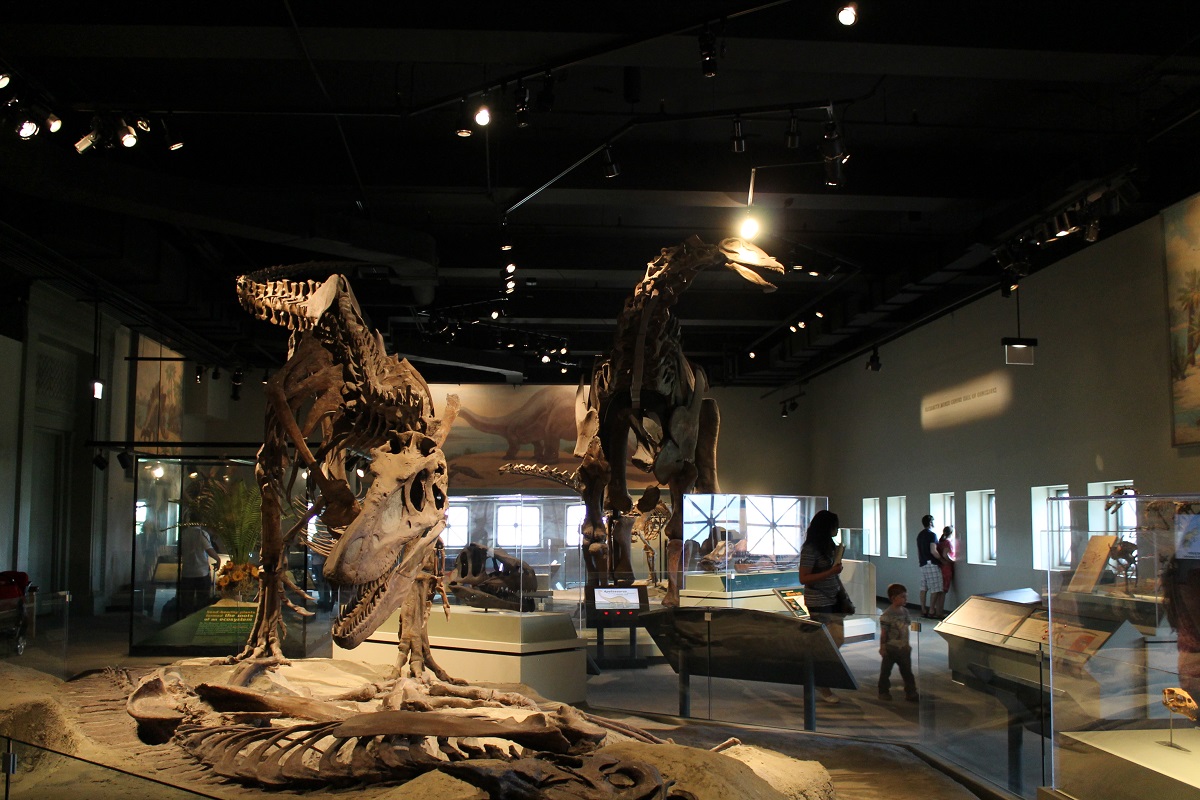
struggling to contain the dinosaurs

Although the dinosaurs get a third of the exhibit to themselves, the hall still struggles to contain them. Photo by the author.
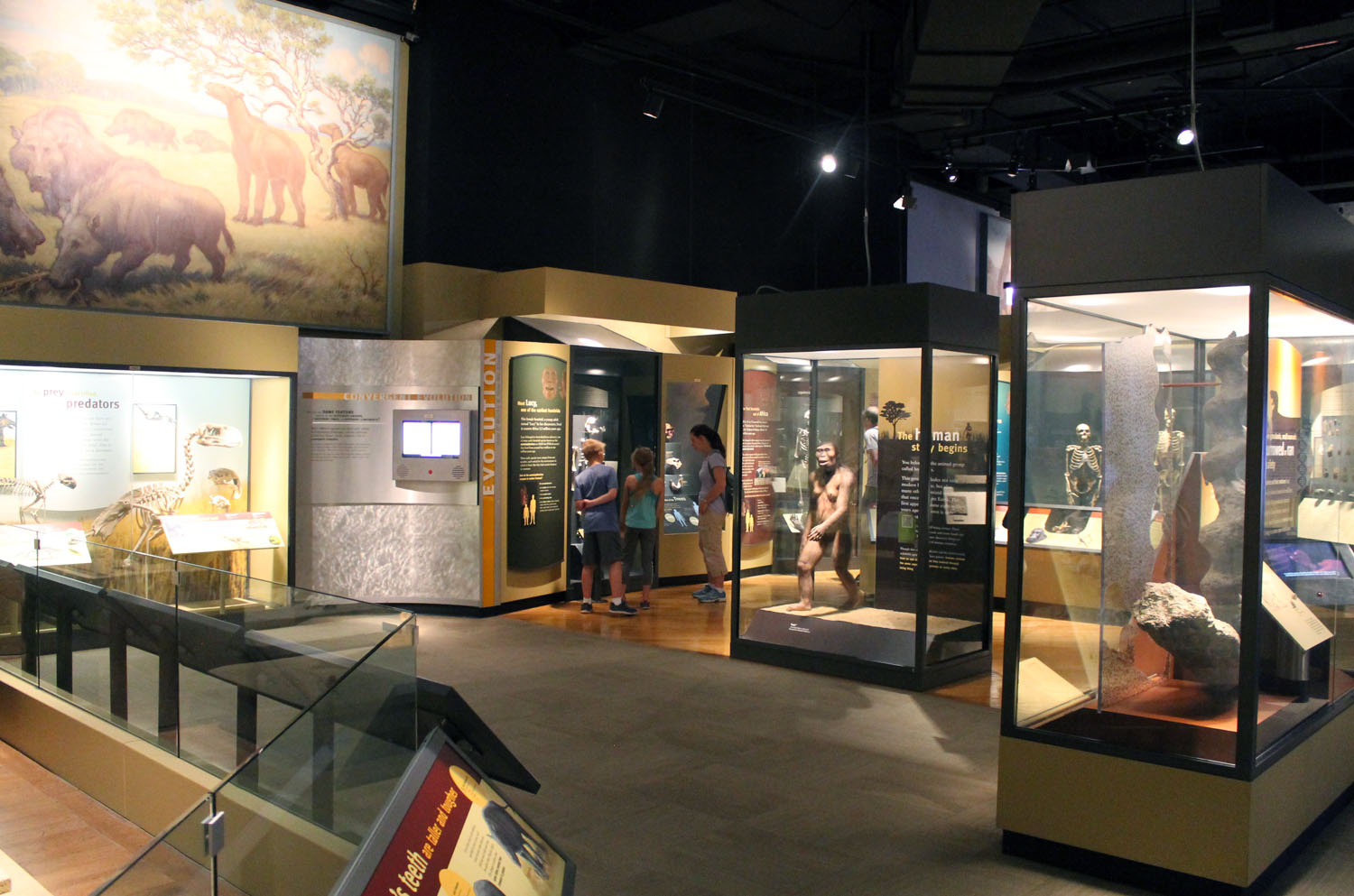
The story of human evolution is relegated to a cul-de-sac late in the exhibit. Photo by the author.

The story of human evolution is relegated to a cul-de-sac late in the exhibit. Photo by the author.

Evolving Planet’s chronological narrative and linear structure complement each other nicely. The sequential path gives the exhibit designers significant control over the visitor’s learning experience, and when dealing with widely misunderstood concepts like evolution, the benefits are clear. The exhibit establishes clear learning goals, and designers can be reasonably confident that these goals are being met. Based on the other new permanent exhibitions at the Field Museum, I get the impression that the design team strongly favors linear exhibits. 2008’s “Ancient Americas”, for instance, closely mirrors Evolving Planet’s structure: a set path through a series of themed spaces, unified by consistent iconography. The designers are to be commended for absolutely owning this concept, and realizing it to its full potential.

Exhibit designers deliberately made the path to the exit much more obvious in the second half of Evolving Planet. Photo by the author.

Exhibit designers deliberately made the path to the exit much more obvious in the final stretch of Evolving Planet. Photo by the author.

The problem with a linear design, of course, is that it’s constraining.  All visitors enter with prior knowledge and a certain worldview or perspective, and are inclined to be more interested in some displays than others. Linear exhibits largely suppress this by forcing everyone through the same tube. Ironically, the strong emphasis on the sequence of geological time periods may also overstate their importance. While these divisions are defined based on real events like extinctions and faunal turnover, they are still human constructs with often messy borders. Relying too heavily on them understates the importance of long-term, short-term, and localized evolutionary events.

Museums should be educational, and exhibits should challenge visitors, particularly regarding the mechanisms of evolution and the scope and complexity of deep time. Still, there’s something to be said for free choice in elective education. Evolving Planet, and “walk through time” exhibits in general, skews more toward the former. It’s an effective option, but also a safe one. Next time, we’ll take a look at exhibits that frame paleontological science in less intuitive ways.

References

Asma, S.T. 2001. Stuffed Animals and Pickled Heads: The Culture and Evolution of Natural History Museums. New York, NY: Oxford University Press.

Diamond, J. and Evans, E.M. 2007. “Museums Teach Evolution.” Society for the Study of Evolution 61:6:1500-1506.

Marsh, D.E. 2014. From Extinct Monsters to Deep Time: An ethnography of fossil exhibits production at the Smithsonian’s National Museum of Natural History. http://circle.ubc.ca/handle/2429/50177

1 Comment

Filed under education, exhibits, FMNH, fossil mounts, museums, reviews, science communication

Dinosaurs on display in 2014

Instead of repeating last year’s navel-gazing, I’m going to try something a little more interesting with my obligatory year-in-review*. This post will recap 2014’s big events in museum paleontology – I’ve covered some of it before, but there’s plenty that I missed as well.

Out with the Old

artists conception

Concept art for the new NMNH fossil hall, opening 2019.

I don’t think it’s a stretch to say that the most important event in the world of fossil exhibits this year was the closing of the National Museum of Natural History’s east wing. This is the world’s most-visited natural history museum, and the fossil mounts on display here have been among the most widely-viewed anywhere. The east wing has been home to paleontology displays since the building opened more than a century ago, but until now it has never undergone a complete, wall-to-wall modernization. Since the halls closed in April, NMNH staff have made significant progress de-installing the old displays, including some mounted skeletons that have been on display for over 80 years. Over the next five years, this historic space will be restored to it’s original neo-classical glory, and eventually remade into a new chronicle of the history of life on Earth suitable for the 21st century.

NMNH was among the last of the classic American natural history museums to commit to a post-dinosaur renaissance overhaul (the American Museum of Natural History started the trend in 1995, followed by the Field Museum and the Carnegie Museum). All eyes are now on the Peabody Museum of Natural History, where the great hall of fossil reptiles still looks much as it did sixty years ago. A plan is in place for a $30 million renovation, and the museum is currently soliciting donations to fund the project. For now, however, New Haven is one of the last places in North America where visitors can still see early-20th century dinosaur mounts.

In With the New

Spinosaurus!

Spinosaurus at the National Geographic Explorer’s Hall. Photo by the author.

Several new temporary and traveling fossil exhibits opened in the United States this year. The biggest splash was made by “Spinosaurus: Lost Giant of the Cretaceous”, which I reviewed in September. Premiering at the National Geographic Explorer’s Hall in Washington DC, this exhibit is science outreach on a grand scale. It debuted alongside a technical paper by Nizar Ibrahim and colleagues that redescribed the well-known Spinosaurus as a short-legged analogue to early whales. While there has been some skepticism about the paper’s conclusions, credit must be given for such an ambitious public display of up-to-the-minute research. The exhibit, which includes a 50-foot reconstruction of a swimming Spinosaurus skeleton, will be on display in Washington through April 12. After that, it begins its world tour in Germany.

Washington, DC got a second new paleontology exhibit this Fall in the form of “The Last American Dinosaurs” at NMNH. Focusing on the North American ecosystem that existed just before the Cretaceous-Paleogene extinction event, this exhibit will serve as an interim dinosaur attraction while the main fossil hall is being renovated. The Last American Dinosaurs is more than a stopgap, however – it’s a remarkably well-crafted look at ecology and the phenomenon of extinction, both in the past and in the present.

Other 2014 fossil exhibits of note include “Tiny Titans: Dinosaur Eggs and Babies” at the Peabody Museum, and “Pterosaurs: Flight in the Age of Dinosaurs” at AMNH. Tiny Titans didn’t feature any show-stopping fossil mounts, but it was nevertheless a charming, kid-friendly exhibit focused on how different groups of dinosaurs raised their young. I thoroughly enjoyed it, particularly the gorgeous artwork by Luis Rey. I missed my chance to check out Pterosaurs (it closes this week), so if you were able to see it please share your thoughts!

Mount of the Year

Sophie the Stegosaurus at the Natural History Museum in London. Source

Sophie the Stegosaurus at the Natural History Museum in London. Source

What was the coolest mounted fossil skeleton created this year? For the runner up, I’d pick the aforementioned Spinosaurus. Created by RCI and Acme Design under the direction of Paul Sereno’s lab at the University of Chicago, this replica skeleton embodies both the possibilities and pitfalls of digital technology. The Spinosaurus mount is based on a digital composite of laser-scanned fossils held in at least three countries, as well as scaled-up bones from related animals like Suchomimus, and a fair amount of sculpted material. On one hand, it’s incredible that a unified vision of this animal can be willed into three-dimensional existence. However, one could reasonably voice concern about presenting a somewhat controversial hypothesis in a format that implies authenticity. Virtually all fossil mounts are composites to some degree, but it seems we’re still working out the limits of how far this concept can be taken.

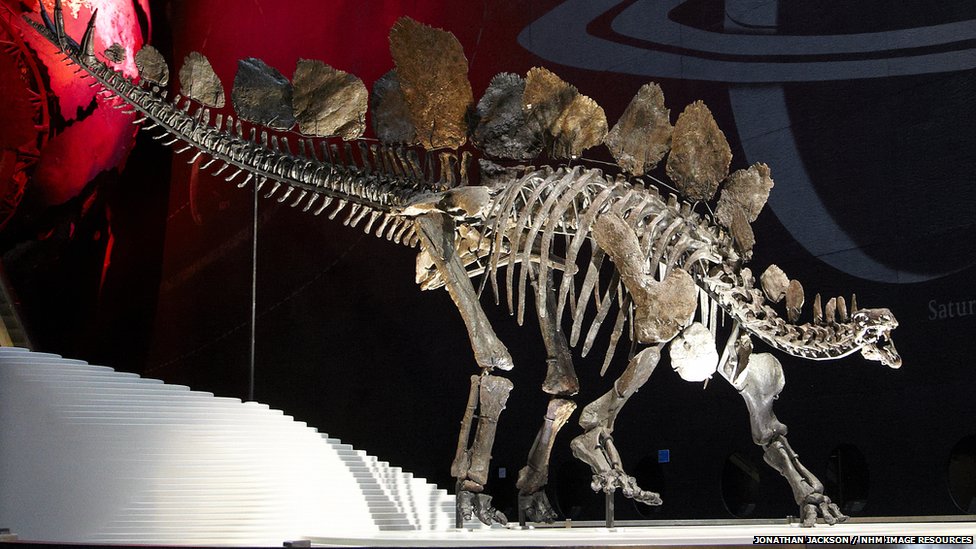
In contrast, I have no reservations in granting Mount of the Year to Sophie the Stegosaurus. Unveiled on December 4th at London’s Natural History Museum, this is the most complete Stegosaurus specimen known and the first example of this species to be displayed in Europe. It’s also the first new dinosaur skeleton to be added to historic NHM exhibit halls in more than a century. After the museum purchased the skeleton from a private dealer in 2013, Paul Barrett and Charlotte Brassey have been carefully examining (and laser-scanning) every inch of it for the better part of the last year. New data on the biomechanics and behavior of Stegosaurus is due out soon, but for now the public can enjoy the 18-foot skeleton in a dramatic display at the museum. In addition to the impressive work creating a dynamic pose with nearly invisible supports, I’m particularly taken by NHM’s outreach efforts, which explain the importance of this skeleton for a broad range of audiences.

All in all, 2014 was a pretty good year for paleontology on display. While fossil exhibits remained stagnant for much of the 20th century, the last decade plus has seen an explosion of displays to feed the public’s insatiable appetite for dinosaurs. Perhaps in the future we will call this time the second golden age of fossil mounts!

*For the record, Dinosours! got about 26,000 visitors last year, many of which I owe to the good people at Love in the Time of Chasmosaurs and SV-POW. My review of the Spinosaurus exhibit was by far the most popular post, followed by the two-parter on Triceratops posture and the true story of the mismatched “Brontosaurus” skull.


1 Comment

Filed under AMNH, dinosaurs, exhibits, fossil mounts, museums, NMNH, opinion, theropods, thyreophorans

So long, Diplodocus

USNM 10865 in the Hall of Extinct Monsters, circa 1932. Photo courtesy of the Smithsonian Institution Archives.

USNM 10865, shortly after its introduction in 1931. Photo courtesy of the Smithsonian Institution Archives.

Since the National Museum of Natural History fossil halls closed for renovation this past April, I’ve made a habit of checking the webcam in Hall 2 every couple weeks or so. For a while, it didn’t look like much was happening – the first waves of de-installation occurred out of view, toward the back of the gallery. Eventually, however, the iconic dinosaur mounts started coming down. The Allosaurus vanished in mid-July. The Stegosaurus and Camptosaurus were gone in September. By late October, the exhibit team had started cutting back the elevated platform and surrounding walkway where most of the standing dinosaur mounts had stood. This was when the process got really interesting, because previous renovations to this space over the past century have always been additive. Old exhibit panels were boarded over and forgotten decades ago, and even some elements of the 1911 Hall of Extinct Monsters, such as the John Elliot fresco “Diana of the Tides”, are still buried in these walls. To hear about these time capsules of science history being unsealed over the past few months has been absolutely thrilling.

But when I checked the webcam last Tuesday, I was met with a slight sinking feeling. The Diplodocus, the centerpiece of this hall for the last 83 years, was gone.

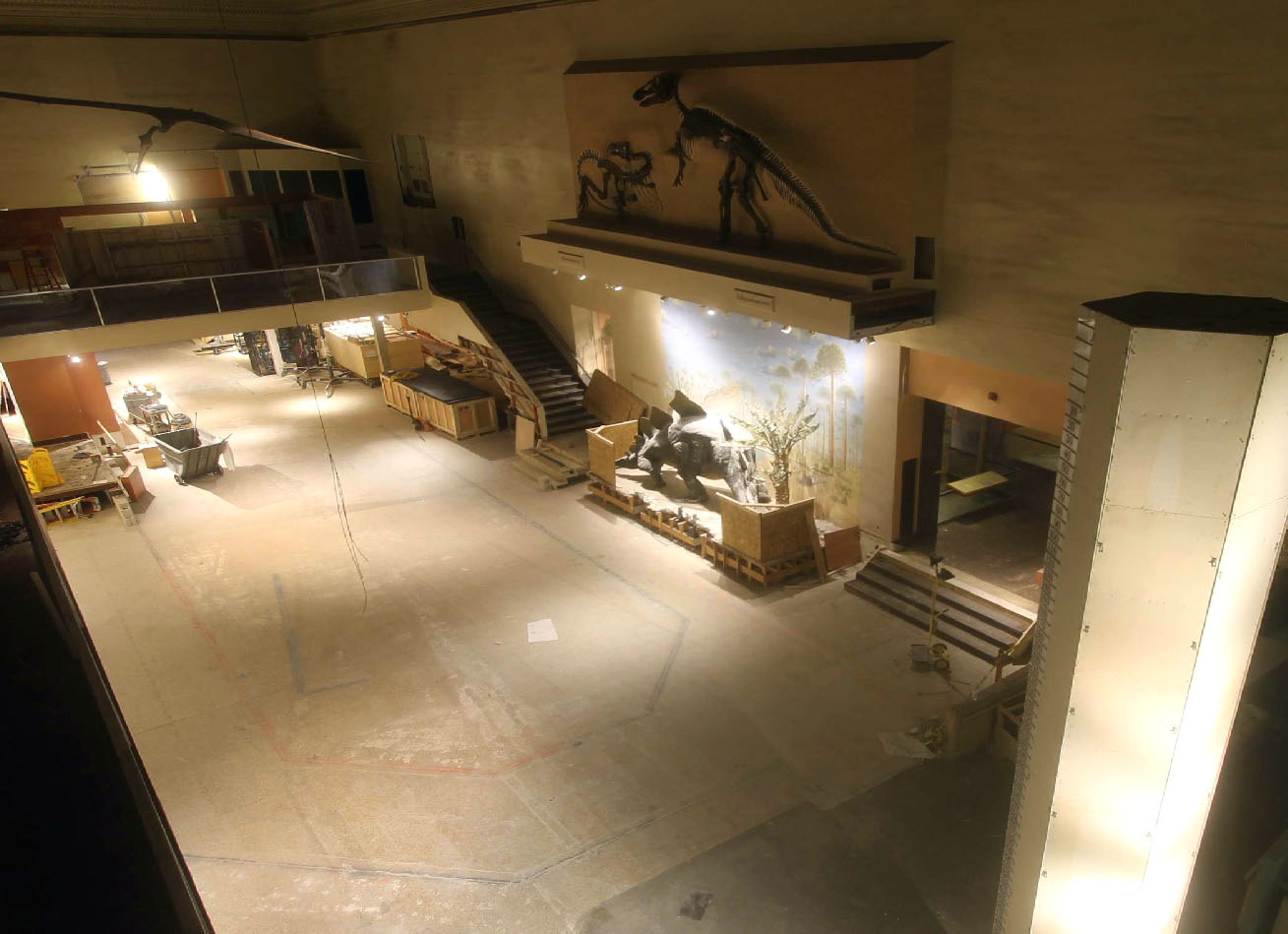
Hall 2 at NMNH, as of December 23, 2014.

Hall 2 at NMNH, as of December 23, 2014. Source

After it was excavated from Dinosaur National Monument in 1923, USNM 10865 took Charles Gilmore, Norman Boss, Thomas Horne, and John Barrett nearly a decade to prepare and mount. Aside from an an adjustment to the neck supports in the early 80s (making it hang from the ceiling, rather than being propped up from the floor), the Diplodocus remained in place and unmodified for longer than the average American lifespan. Generations of visitors have gazed up at it, and those lucky enough to view it before 1963 were able to walk under it. This mount has unquestionably taken on a second life: it is an institutional and regional icon as much as it is a dinosaur that once roamed a Jurassic floodplain. And in three days, NMNH collections staff and specialists from Research Casting International cleared every trace of it – well over 200 individual bones – from the hall.

The Diplodocus, as it stood from 1963 through 1981. Image courtesy of the Smithsonian Institution Archives.

The Diplodocus, as seen from 1963 through 1981. Image courtesy of the Smithsonian Institution Archives.

I can’t help but feel a twinge of sadness to see the Diplodocus go. I’ve been visiting the sauropod since before I could talk. I knew it as a toddler, as a high school volunteer, as a fresh-out-of college-intern, and as a museum professional. Even though the fossil halls have been closed for months, I suppose it was comforting to know that the Diplodocus was still standing on the other side of those barriers. But now it’s actually gone, and that makes it really sink in that the NMNH fossil hall that I knew – the one that inspired and nurtured my life-long interest in paleontology, is gone for good.

An early sketch of

An early sketch of USNM 10865’s new home – anchoring the Jurassic ecosystem display.

Of course, the now-disarticulated Diplodocus fossils are in the best possible hands. The veteran team at RCI will conserve, restore, and eventually remount them in a stunning, dynamic pose. What’s more, the renovated fossil hall in which it will be reintroduced is going to be awesome – structurally, aesthetically, and pedagogically. It will contextualize classic specimens like the Diplodocus within a modern understanding of how the ancient past is connected to our present and future, while simultaneously honoring this space’s history and heritage. I can’t wait.

3 Comments

Filed under dinosaurs, exhibits, fossil mounts, history of science, museums, NMNH, sauropods

Extinct Monsters: Basilosaurus

Click here to start the Extinct Monsters series from the beginning.

The National Museum of Natural History houses the world’s most complete assemblage of fossil marine mammals. The crown jewel of this collection is assuredly the historic mounted Basilosaurus, which was until recently the only mount of its kind composed of original fossils. Since 2008, this ancestral whale has been suspended from the ceiling of the Sant Ocean Hall, but these fossils have actually been on near-continuous display for 120 years and counting. Technically this wasn’t the first time Basilosaurus fossils were used in a mounted skeleton (Albert Koch’s absurd chimera “Hydrarchos the sea serpent” preceded it by 60 years), but it was the first time this species was mounted accurately and under scientific supervision.

Basilosaurus was named by anatomist Richard Harlan in 1834. The name means “king lizard”, since he erroneously thought the bones belonged to a giant sea-going reptile. Richard Owen later re-identified the bones as those of a whale, and coined the new name “Zueglodon” (yoke tooth). While the International Code of Zoological Nomenclature decrees that the first published name must be used, late 19th century paleontologists apparently preferred to use Owen’s junior synonym.

Note basilo

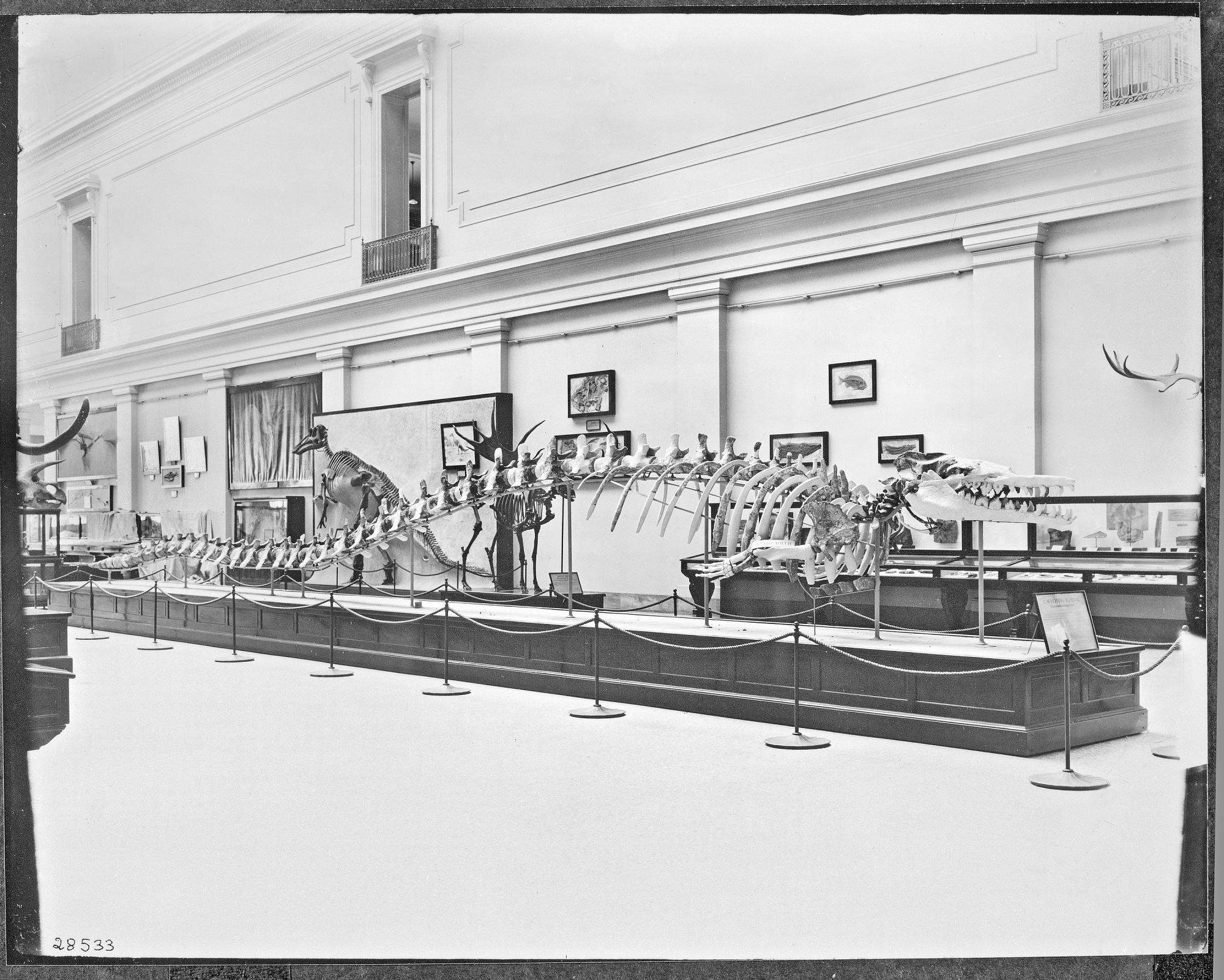
Basilosaurus cast in the original USNM, now called the Arts and Industries Building. Photo courtesy of the Smithsonian Institution Archives.

In 1884 Charles Schuchert, an Assistant Curator at the United States National Museum, went to Clarke County, Alabama in search of “Zueglodon” remains. This would be the very first fossil-hunting expedition ever mounted by the Smithsonian. Decades earlier, Koch came to the same region to collect the fossils he used to assemble Hydrarchos, and local people had been familiar with the whale bones long before that.

Schuchert did not find the complete Basilosaurus skeleton he was looking for, but he did recover a reasonably complete, albeit fragmented, skull and jaw. He returned to Alabama in 1886 and collected an articulated vertebral column, a pelvis, and enough other elements to assemble a composite skeleton. Museum staff used the fossils to produce plaster casts, and combined them with sculpted bones to construct a replica “Zueglodon.” The whale was first unveiled at the Atlanta Exposition in 1895, before finding a home in the original United States National Museum (now the Arts and Industries Building). The 40-foot skeleton hung from the ceiling of the southwest court, with the original fossils laid out in a long case beneath it.

Basilosaurus as the centerpiece of the Hall of Extinct Monsters sometime before 1930. Photo courtesy of the Smithsonian Institution Archives.

In 1910, the USNM relocated to a larger building on the north side of the national mall, which is now of the National Museum of Natural History.  The east wing of the new museum became the Hall of Extinct Monsters, and has been the home of fossil displays at the Smithsonian ever since. The Basilosaurus was selected as the centerpiece of the new display, as its great length and toothy appearance made it popular with visitors. In honor of the occasion, preparator James Gidley reworked the old plaster mount to incorporate Schuchert’s original fossils. A series of caudal vertebrae from a third Basilosaurus specimen was also used. Still labeled “Zueglodon”, the mount was completed in 1912, about a year after the Hall of Extinct Monsters first opened to the public. As Curator of Geology George Merrill explained, the wide-open floor plan of the new hall allowed visitors to walk all the way around the mount, and inspect its every aspect up close.

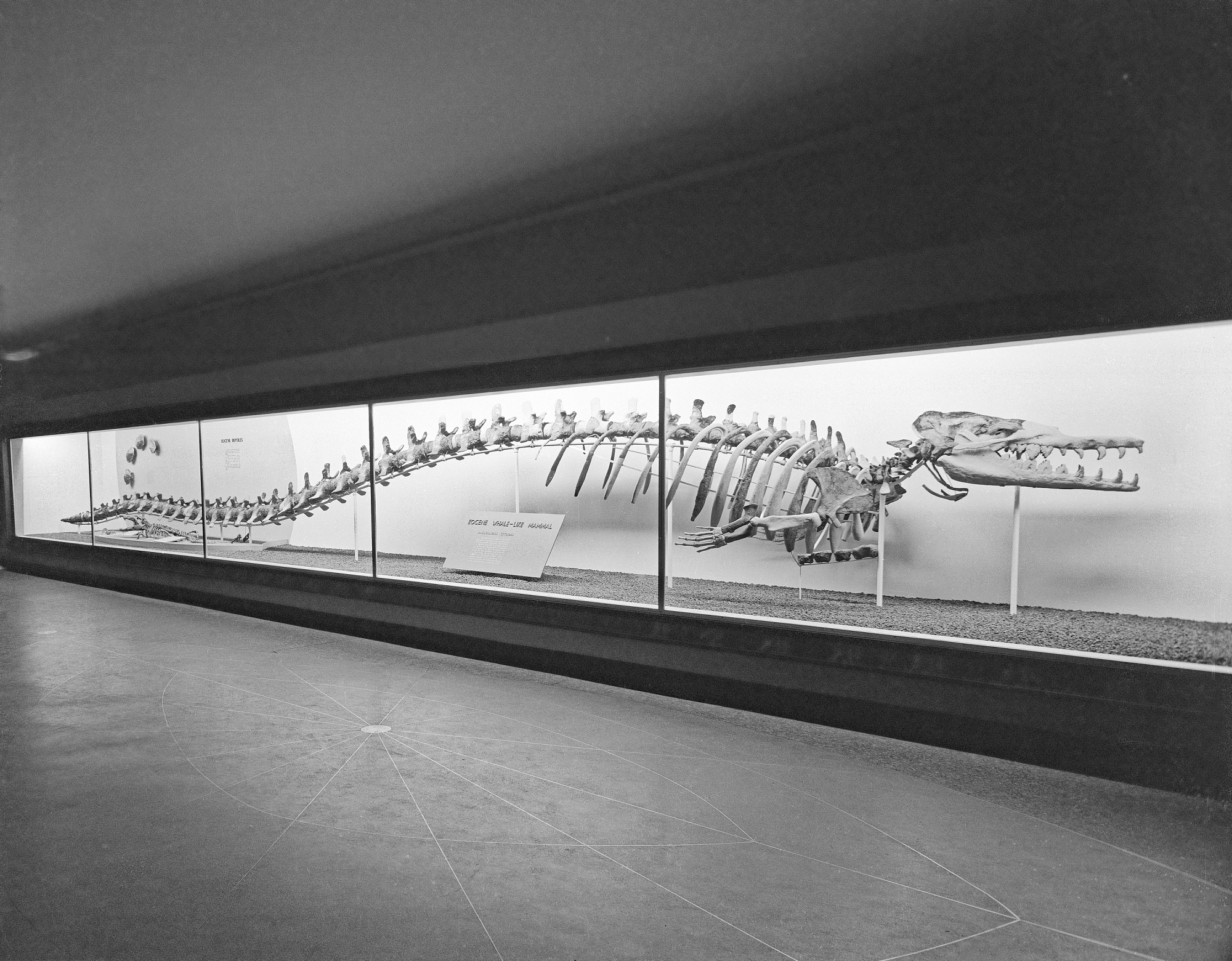
During the 1960s and 70s, Basilosaurus occupied a case in the fossil mammal exhibit in Hall 5. Photo courtesy of the Smithsonian Institution Archives.

In 1931, the Basilosaurus was upstaged by a new centerpiece: the mounted Diplodocus that took Charles Gilmore and his team more than a decade to assemble. The Diplodocus took the front-and-center position (where it remained until 2014), while the Basilosaurus was relocated to the south side of the hall. The Great Depression and World War II ensured that the east wing exhibits remained largely unchanged for nearly three decades after that, but the space was eventually renovated in the early 1960s as part of a Smithsonian-wide modernization campaign. In its new incarnation, the east wing’s open spaces were carved into smaller galleries dedicated to different groups of ancient life. With the central Hall 2 occupied by dinosaurs and fossil reptiles, the Basilosaurus joined the other Cenozoic mammals in Hall 5. This gallery became “Life in the Ancient Seas” in 1989, but the Basilosaurus remained in place.

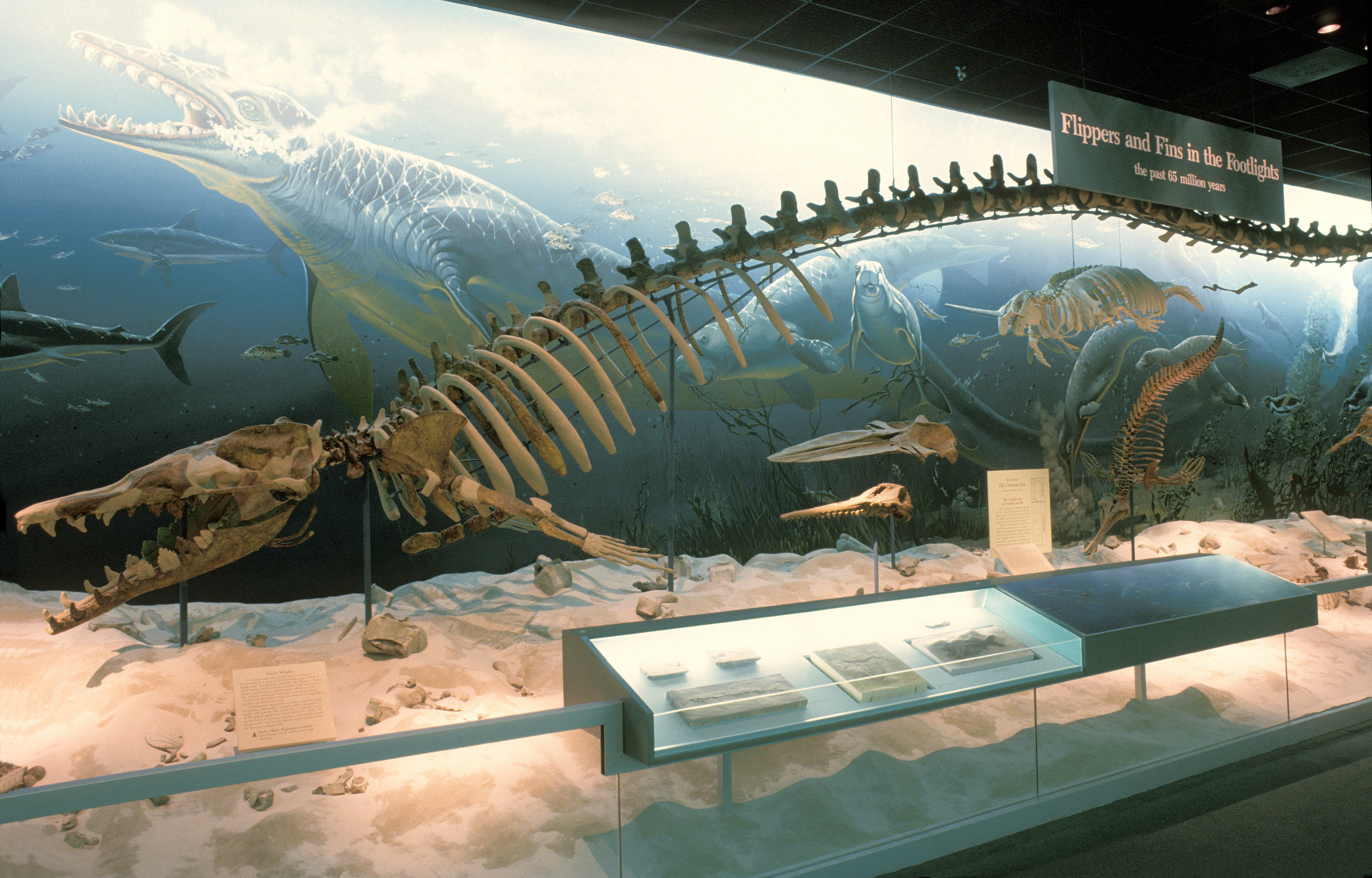
The Basilosaurus was in the Ancient Seas gallery from 1989 to 2008.

For the Ancient Seas gallery, Basilosaurus was remounted with an arched tail. Photo by Chip Clark.

Life in the Ancient Seas was a very different setting for the Basilosaurus than the Hall of Extinct Monsters, reflecting the significant changes in museum interpretation that occurred during the 20th century. The historic exhibit showcased the breadth of the museum’s fossil collection in a fairly neutral environment. Interpretation was minimal, and generally intended for a scholarly audience. In contrast, Life in the Ancient Seas was an immersive educational experience (no pun intended). The Basilosaurus and other marine mammal skeletons were posed over a papier-mâché ocean bottom, while a blue and turquoise color palate and even shimmering lights contributed to the illusion of traveling through an underwater world. Combined with text panels written with a jovial, inviting tone, the net effect was an exhibit pitched to a general audience at home with multimedia.

The historic Basilosaurus

The historic Basilosaurus, remounted for display in the Ocean Hall. Photo by the author.

The Basilosaurus was moved once more in 2008, when it was incorporated in the enormous new Ocean Hall. In its 5th position in a little over a century, the skeleton now hangs from the ceiling as part of an exhibit on whale evolution. Moving the historic skeleton was not an easy task, and took about six months of work. NMNH staff collaborated with Research Casting International to disassemble the skeleton, stabilize and conserve each bone, and finally remount the Basilosaurus on a new armature. In the new mount, each bone rests in a custom cradle with felt padding, to prevent vibration damage caused by the crowds passing beneath it. Smithsonian paleontologists also reunited the whale with its hind legs, which Schuchert found alongside the articulated vertebral column in Alabama but were, until recently, thought to belong to a bird.

This latest setting for Basilosaurus is a happy medium between museums past and present. The historic gallery occupied by the Ocean Hall has been restored to its original neoclassical glory, and much like the original Hall of Extinct Monsters visitors have clear sight lines across the space. Rather than being led on rails through a scripted exhibit experience, visitors can move freely through the gallery, bouncing among the objects they find compelling. At the same time, however, the Basilosaurus is explicitly contextualized as an example of the transformative power of evolution. Presented alongside cast skeletons of Maiacetus and Dorudon, this display makes whales’ evolutionary link to terrestrial mammals crystal clear.

This post was last updated on 1/8/2018.

References

Gilmore, C.W.  (1941). A History of the Division of Vertebrate Paleontology in the United States National Museum. Proceedings of the United States National Museum No. 90.

Marsh, D.E. (2014). From Extinct Monsters to Deep Time: An ethnography of fossil exhibits production at the Smithsonian’s National Museum of Natural History. http://circle.ubc.ca/handle/2429/50177
Meet Basilosaurus, an Ancient Whale (2008). Smithsonian Institution. http://www.mnh.si.edu/exhibits/ocean_hall/meet_basilosaurus.html

Leave a comment

Filed under exhibits, Extinct Monsters, fossil mounts, history of science, mammals, museums, NMNH

The Last American Dinosaurs Has Arrived!

Hatcher greets visitors

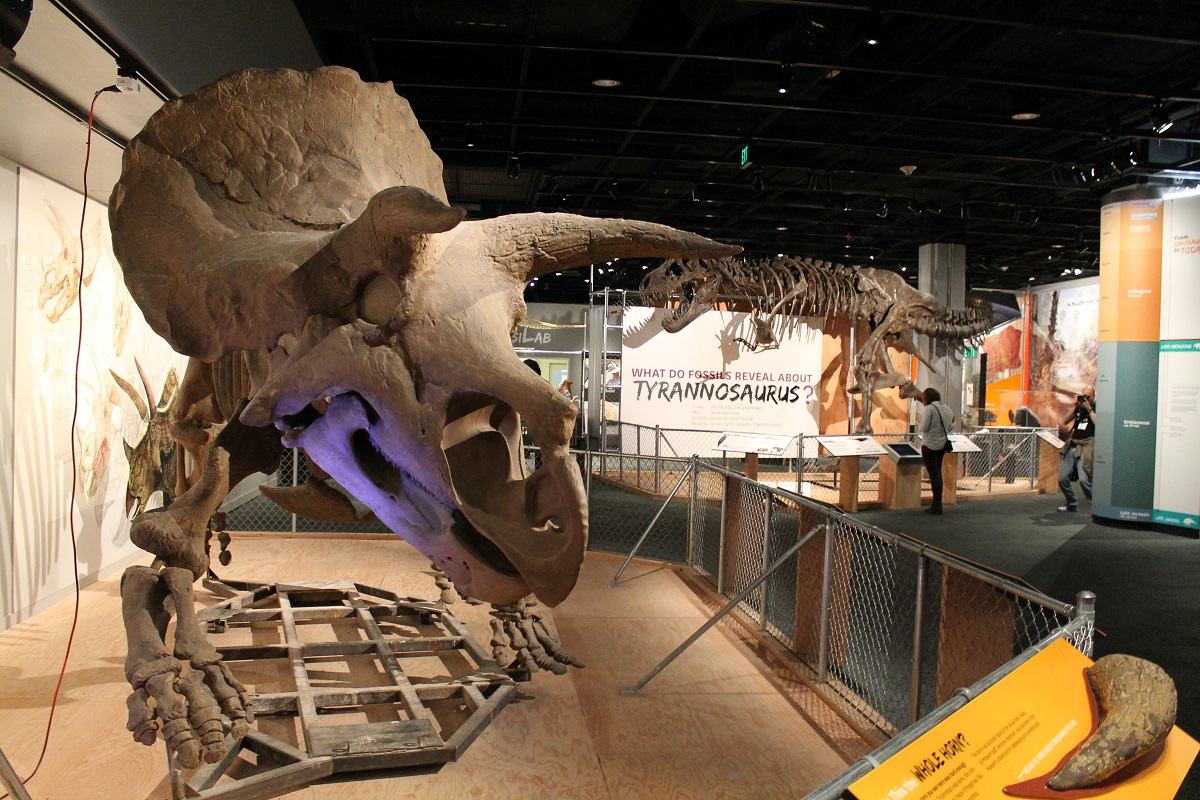
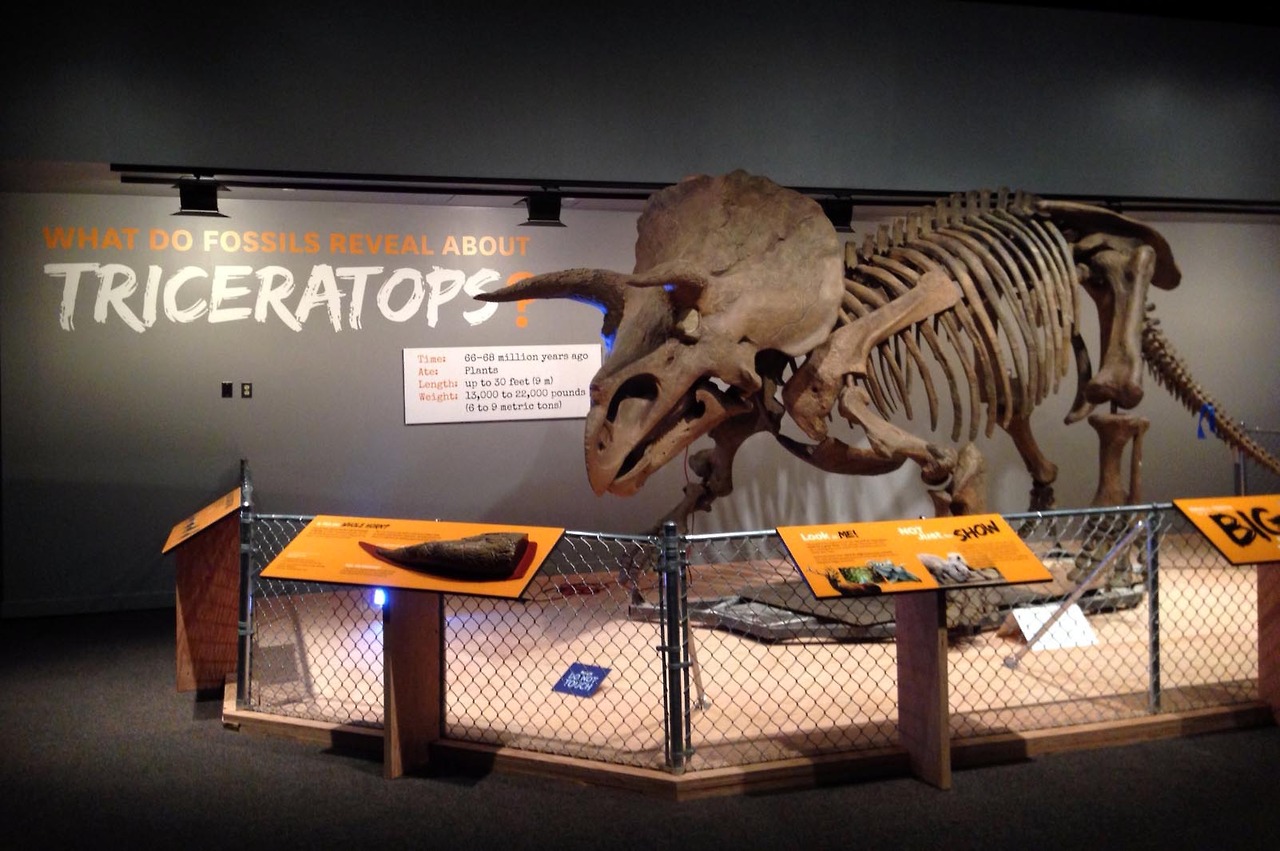
Hatcher the Triceratops greets visitors at the entrance to The Last American Dinosaurs.

Dinosaurs are once again on display at the National Museum of Natural History. Opening just in time for Thanksgiving weekend, “The Last American Dinosaurs” provides a much-needed dose of paleontology while the main fossil hall is being renovated. I was fortunate enough to take part in a preview tour for social media users – you can check out the storified version, or read on for photos and my initial thoughts on the new exhibit.

Stan is cool

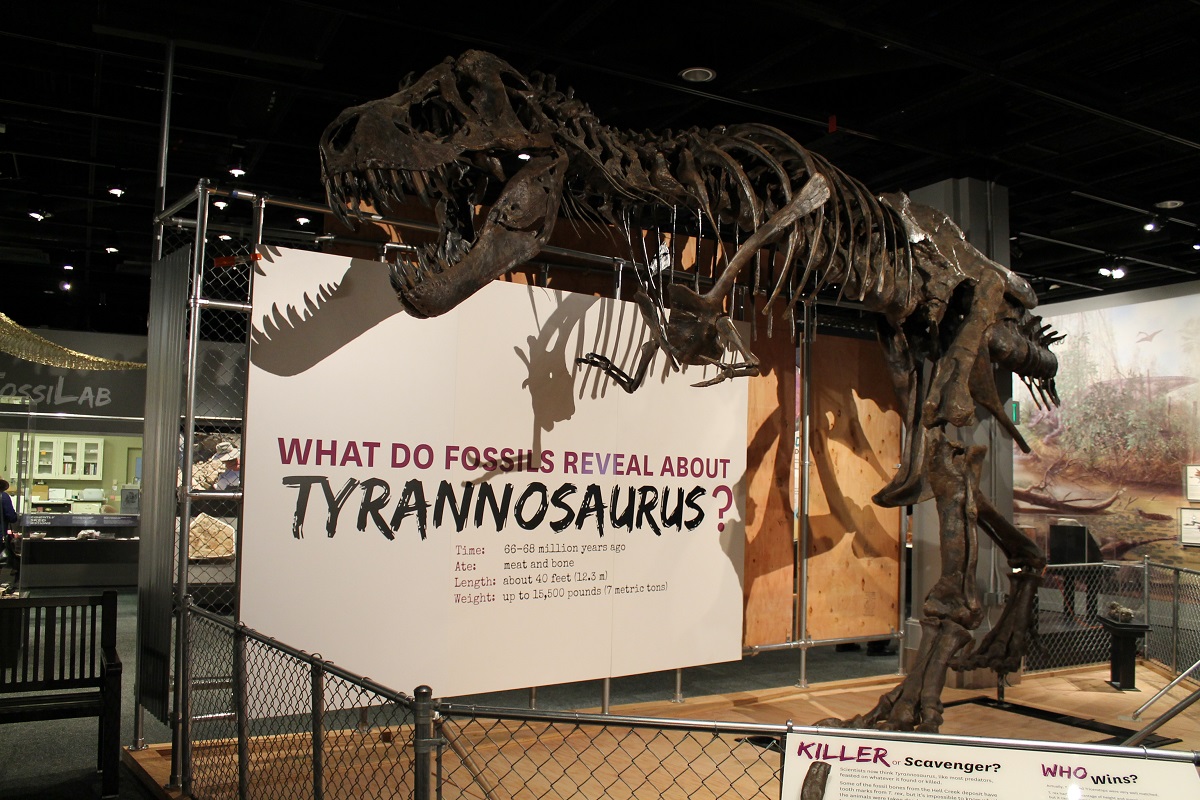
Stan the T. rex is sure to be a crowd-pleaser.

Babies

Triceratops growth series reveals how much we’ve learned about the lives of dinosaurs over the last 25 years.

As promised, there are plenty of dinosaurs on view. Specifically, these are the dinosaurs of Maastrichtian North America, the last of these animals to grace this continent before the extinction event 66 million years ago. In addition to the mounted skeletons of Triceratops and Tyrannosaurus discussed in the previous post, be on the lookout for a hatchling and juvenile Triceratops, an Edmontosaurus, and bits and pieces from dromaeosaurs and pachycephalosaurs.

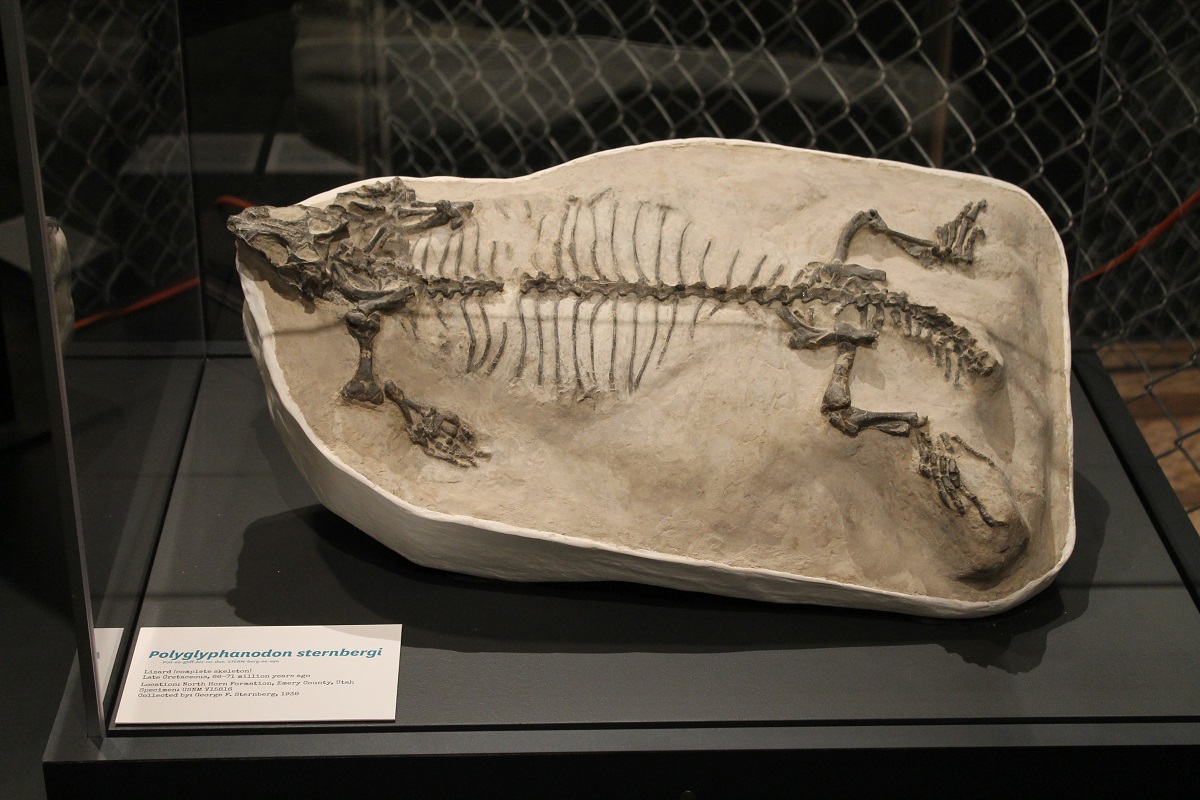
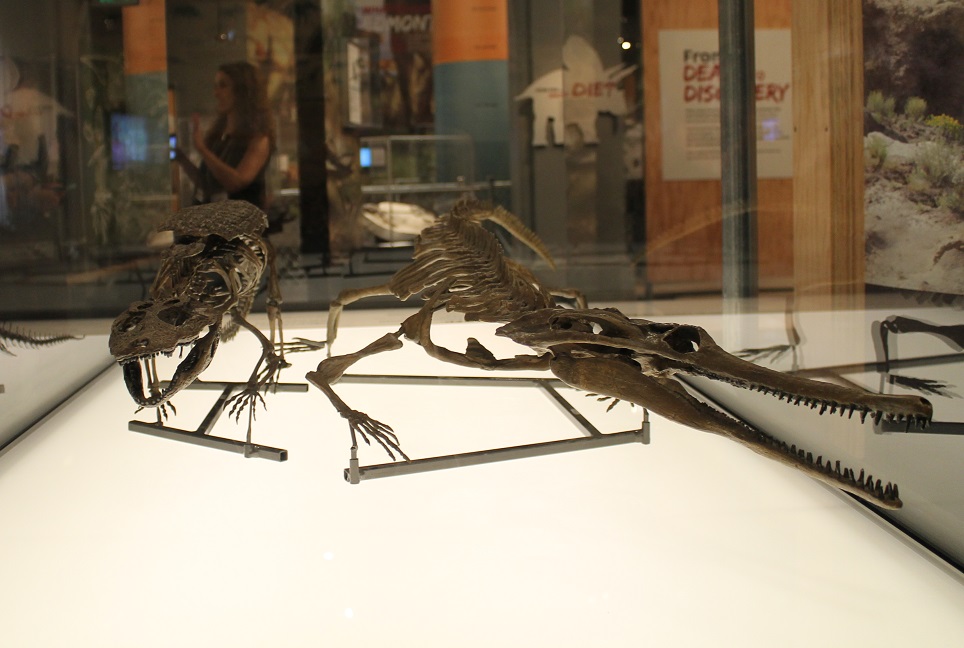
However, the dinosaurs are just the tip of the iceberg. As lead curator Hans-Dieter Sues explained within the first few minutes of the tour, the central message of this exhibit is that dinosaurs were only one part of a complex ecosystem. To that end, the dinosaurs of The Last American Dinosaurs are outnumbered by a menagerie of of reptiles, mammals, invertebrates, and plants that shared their world, most of which are on display for the first time. These specimens come from a variety of sources. Some, including turtles and fossil leaves, were collected by NMNH paleontologists in North Dakota specifically for this exhibit. Others, like the lizard Polyglyphanodon, have been in the museum’s collection since the 1930s but have never before been put on display. I also spotted a few casts sourced from Triebold Paleontology, including the mammal Didelphodon and the alligator-like Stangerochampsa

Gilmore specimen

This Polyglyphanodon was collected by Charles Gilmore in the 1930s.

crocs

Stangerochampsa and Champsosaurus are examples of animals that survived the K/T extinction.

Much like the Human Origins exhibit, The Last American Dinosaurs incorporates the faces of Smithsonian researchers and staff throughout the displays. There are large photos showing the museum’s scientists at work in the field, and the popular windowed FossiLab has found a new home in this exhibit. In addition, a large area is deservedly devoted to scientific illustrator Mary Parrish, chronicling the methods she uses to turn fossil data into gorgeously detailed renderings of prehistoric animals and environments. Videos of Parrish and others at work can be seen here.

I’m definitely a fan of this personalized approach to science communication. In-house scientists are museums’ most important and unique resources, and placing them front-and-center reminds visitors that science is done by real and diverse people, not caricatures in lab coats. A human face goes a long way toward making the process of doing science relateable to visitors.

new stuff

Handwritten labels on these fresh from the field fossils provide a personal touch.

The phenomenon of extinction is another important theme in The Last American Dinosaurs. The exhibit details how an asteroid impact combined with several other factors to radically alter the environment worldwide, causing 70% of species to die out (fun fact: ambient temperatures in North America directly after the impact were comparable to the inside of a brick pizza oven). However, the exhibit goes on to make direct comparisons between the K/Pg extinction event and the anthropogenic extinctions of today. Habitat destruction, introduction of invasive species, and climate change caused by burning fossil fuels are instigators of environmental upheaval as powerful as any space rock.

extinction

This moa and dodo remind visitors that extinction isn’t limited to the distant past.

In this way, The Last American Dinosaurs is a warm-up for the key messages of the new fossil hall. The overarching theme of the planned exhibit is that “Earth’s distant past is connected to the present and shapes our future.” It will showcase how living things and their environments are interdependent, and change over time. Crucially, it will also demonstrate how our understanding of how life has changed over time is important for understanding and mitigating our impact on present-day ecosystems. The Last American Dinosaurs is evidently a testing ground for how these ideas will resonate with audiences.

paleoart

Historic models of Agathaumas and Triceratops by Charles Knight and Charles Gilmore.

In designing modern paleontology exhibits, museum workers have tried many approaches to squelch the idea of the dinosaur pageant show and instead convey how the science of paleontology is relevant to our understanding of the world around us. Back in 1995, the American Museum of Natural History tried a cladistic arrangement with a focus on biodiversity. More recently, the Field Museum used the process of evolution to frame the history of life on Earth. While there are certainly overlaps with what has come before, the “modern implications of environmental change over deep time” approach under development at NMNH is fairly novel, and also quite timely. Some of the displays in The Last American Dinosaurs hit pretty close to home, and I’m eager to find out how visitors respond.

6 Comments

Filed under dinosaurs, exhibits, fossil mounts, mammals, marginocephalians, museums, NMNH, ornithopods, paleoart, reptiles, reviews, science communication, theropods

Hatcher, Stan, and the Changing Identities of Fossil Mounts

Photo by the author

Hatcher the Triceratops and Stan the T. rex in the NMNH fossil hall, early 2014. Photo by the author.

Although the east wing fossil halls are closed for renovation until 2019, the National Museum of Natural History will not be without a dinosaur display for much longer. An interim exhibit entitled “The Last American Dinosaurs” will open later this month, occupying the space that formally held the “Written in Bone” exhibition. The Last American Dinosaurs will cover a small but important slice of the age of dinosaurs: the final ecosystem to grace North America before the extinction event 66 million years ago. While the new exhibit will feature several show-stealing dinosaurs, the main message is that these animals lived within a complete and complex ecosystem, just like the animals of today. The exhibit will also cover the phenomenon of extinction, and how massive environmental change (whether caused by a giant space rock or by human activity) can drastically alter the course of life on Earth.

What I’d like to discuss in this post are the two dinosaurian centerpieces of the exhibit: Hatcher the Triceratops and Stan the Tyrannosaurus. Both mounts stood in the classic fossil hall for years, and I’ve already written extensively about each of them. Nevertheless, these two dinosaurs nicely encapsulate the history of mounted fossil skeletons, as well as the changing face of museum paleontology. As the ambassadors to the Smithsonian’s dinosaur collection for the next five years, I think it’s worth revisiting their origin stories.

The First Triceratops

Hatcher in Hall of Extinct Monsters

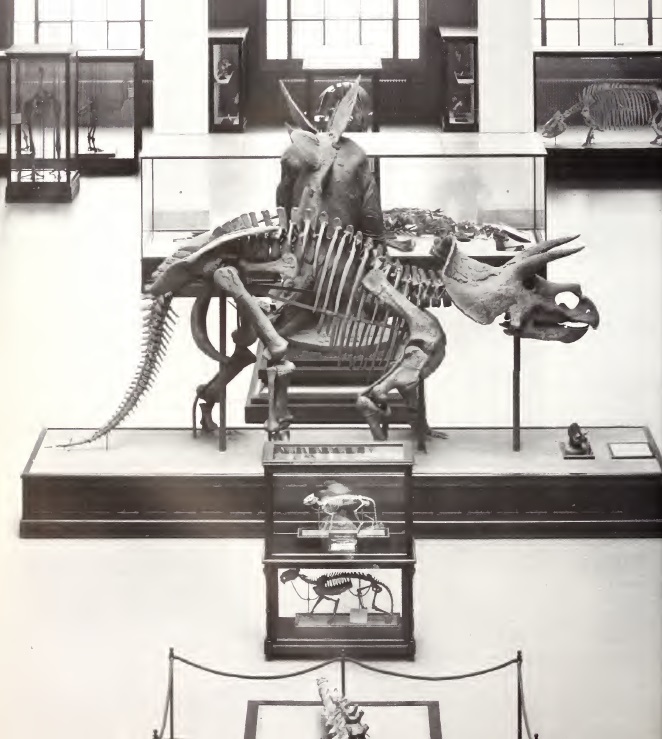
This Triceratops stood in the NMNH fossil hall for nearly 90 years. Photo courtesy of the Smithsonian Institution Archives.

The Smithsonian Triceratops hails from what we might call the golden age of museum paleontology. Mounted dinosaur skeletons were an integral part of the rise of large urban natural history museums at the turn of the 20th century. The opening of the American western frontier revealed an unprecedented treasure trove of fossils, far greater than what was previously known in Europe. As a result, paleontology became one of the first realms of science in which Americans were leaders, and patriotism was a significant factor in the growing public enthusiasm for extinct monsters. Wealthy benefactors of recently formed institutions like the American Museum of Natural History and the Field Columbian Museum envisioned the mounted skeletons of dinosaurs as an opportunity to increase attendance and public interest, and they provided ample funding to find fossils for display. These efforts were not wasted, as the golden age fossil mounts have been enjoyed for generations…and most are still on display today.

It’s easy to get caught up in the romanticism of this era of discovery and exposition. Golden age fossil mounts were forged into being entirely in-house. At a given museum, the same small group of staff was frequently responsible for finding, preparing, describing, naming and mounting a new dinosaur. As such, fossil mounts were typically exclusives to particular museums, and they garnered significant amounts of institutional and regional pride. New York had “Brontosaurus” and Tyrannosaurus. Pittsburgh had Diplodocus. And for more than 20 years, Washington, DC had the world’s only mounted Triceratops.

Hatcher in Sunday star

A spread in the June 11, 1905 Sunday Star profiled the Smithsonian Triceratops. Image courtesy of the Smithsonian Institution Archives.

Built in 1905 by Charles Gilmore and Norman Boss, the Smithsonian Triceratops has been a Washington, DC attraction for longer than the Lincoln Memorial. Like most turn of the century dinosaur mounts, it is not a single specimen but a composite of several individuals. The fossils were recovered from Wyoming by the prolific fossil hunter John Bell Hatcher, working in the employ of O.C. Marsh and the United States Geological Survey*. USNM 4842, the most complete partial skeleton available, provided the torso and pelvis, while the remains of at least six other Triceratops filled in the rest of the mount.

*Incidentally, this means the Triceratops doesn’t quite fit the story I outlined above. It was not discovered or named by Smithsonian scientists – instead, the Smithsonian inherited the fossils Marsh collected for the federal government when he was through with them.

Even though it was a slightly disproportionate chimera, for experts and laypeople alike the Smithsonian Triceratops mount was Triceratops. Virtually every illustration of the animal for decades after the mount’s debut dutifully copied its every eccentricity, including the slightly undersized head and excessively sprawled forelimbs. If you can strain your eyes to read Sunday Star article above, it’s also interesting to see how the mount was presented to the public. Even in an era when museum displays were unapologetically created by experts for experts, the Triceratops is repeatedly likened to a fantastical monster. Although the creation of the mount was an important anatomical exercise for the small community of professional paleontologists, it seems that for most visitors a display like this primarily served as whimsical entertainment.

Hatcher_tempdisplay

Hatcher was moved to his new home on the second floor at the beginning of the summer. Photo by the author.

After a brief stint in the original United States National Museum (now called the Arts and Industries Building), Gilmore and Boss’s Triceratops was transferred the east wing of the present-day NMNH in 1911. It remained there for 90 years, until the aging and deteriorating fossils were finally disassembled and retired to the collections. In their place, Smithsonian staff created an updated replica skeleton, called “Hatcher”, from digital scans of the original bones. This version is the Triceratops that will be on display in The Last American Dinosaurs.

A Prefab Tyrannosaurus?

Stan. Photo by Chip Clark.

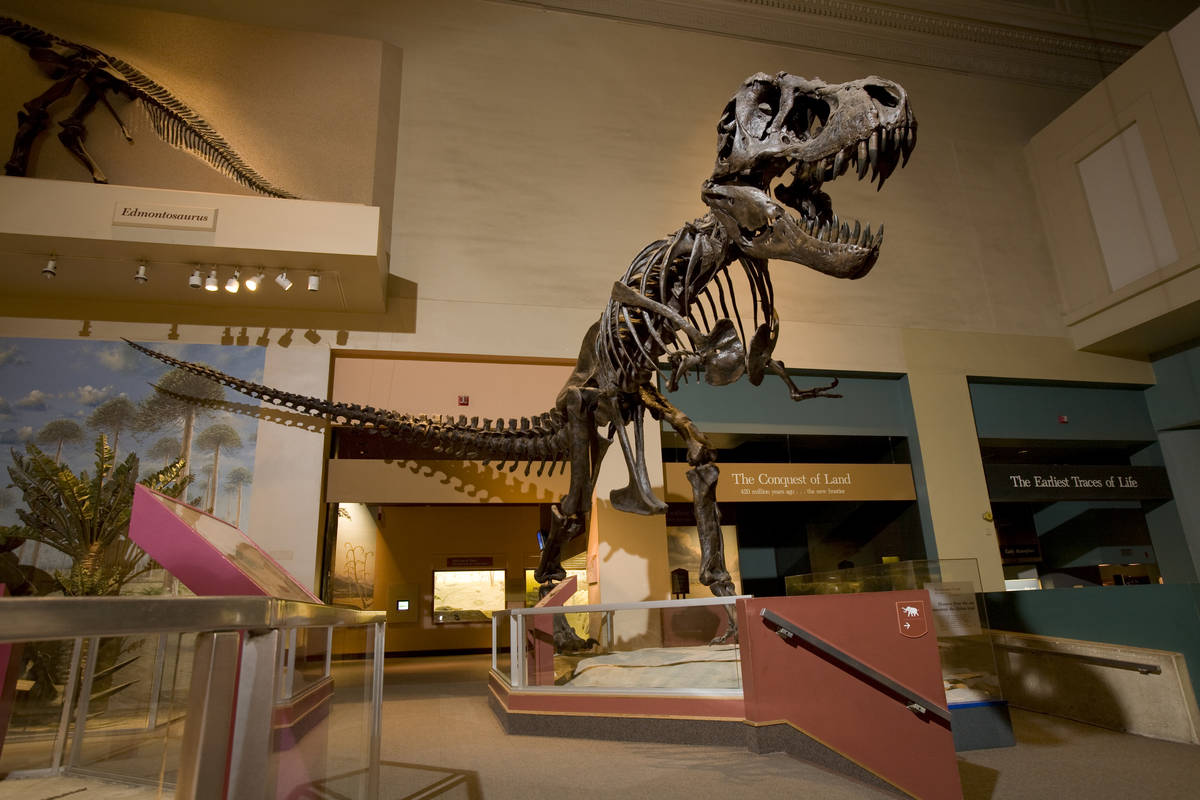
Stan the T. rex, as seen in the classic NMNH fossil hall. Photo by Chip Clark.

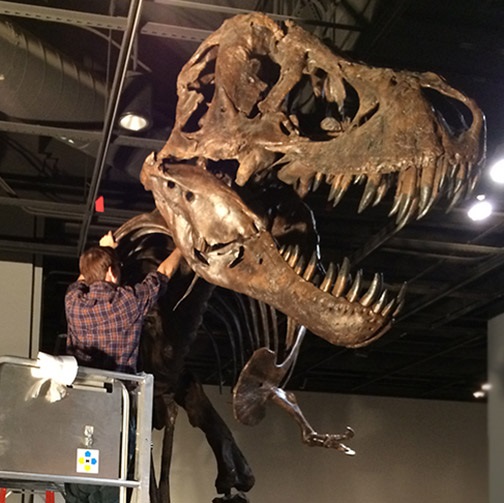
Since 2000, Hatcher the Triceratops was in a permanent face-off with another replica mount, Stan the Tyrannosaurus. Unlike Hatcher, Stan is not based on fossils in the Smithsonian collection. This T. rex cast was purchased from the Black Hills Institute, a private company that  produces and sells replica fossil skeletons (as well as original specimens, which is another issue entirely). Discovered by avocational fossil hunter Stan Sacrison in 1987, Stan the dinosaur was excavated and is now owned by BHI. Since 1995, BHI has sold dozens of Stan replicas to museums and other venues. The Smithsonian acquired its version in 1999, in part because of visitor demand for the world’s most famous dinosaur, but also apparently as a consolation prize for missing out on Sue.

Clearly, much has changed in the way museums source their dinosaurs. Rather than creating fossil mounts on-site, museums frequently contract out the production to exhibit fabrication companies like Research Casting International, Gaston Design, and the aforementioned Black Hills Institute. These companies can construct mounts using fossils or casts from a particular museum’s collection, but they also offer catalogs of made-to-order skeletons. Thanks to these exhibit companies, more or less identical copies of certain dinosaurs are now on display all over the world.  In Stan’s case, the Smithsonian version has a twin just seven miles north at the Discovery Communications building in Silver Spring.

Stan can be set up in a under an hour. This version was recently displayed at Farmington Museum.

Stan replicas can be set up in a under an hour. This version was recently displayed at New Mexico’s Farmington Museum. Source

An argument could be made that this degree of replication lessens the impact and cultural value of dinosaur displays. How much allure does a mount have when identical versions can be seen at dozens of other locations, including corporate offices and amusement parks? I would counter that this is a small price to pay when we consider the substantial educational benefits of this unprecedented availability of dinosaur skeletons. Widespread casts like Stan give people all over the world the opportunity to see a T. rex in person, an experience that was until recently limited to those with the means to travel to a handful of large cities. Typically priced in the tens of thousands of dollars, dinosaur casts certainly aren’t cheap, but they are still within the means of many small to mid-sized local museums.

Furthermore, these casts are hardly rolling off of assembly lines. They are exact replicas of real fossils, and require a tremendous amount of experience and skill to produce. Mounts are manufactured as needed, and are customized to meet the needs of the specific museum. Meanwhile, museums still employ scientists who collect new fossils for their collections. The difference is that these collecting trips usually seek to answer specific research questions, rather than going after only the biggest and most impressive display specimens. Finally, museums definitely haven’t outsourced exhibit production entirely. All summer at NMNH, in-house preparators have been working in collaboration with contractors from Research Casting International to dismantle the historic fossil exhibits in preparation for the upcoming renovation.

Reassembling Stan upstairs. Photo by Abby Telfer.

Reassembling Stan for The Last American Dinosaurs. Photo by Abby Telfer.

There’s one more change for the better in modern paleontology exhibits. When the Smithsonian Triceratops was first introduced to the world in 1905, natural history displays tended to focus on the breadth of collections. Curators composed exhibits with other experts in mind, and the non-scholars that actually made up the majority of museum visitors were not directly catered to. Without any context to work with, fossil mounts were little more than toothy spectacles for most visitors. Today, museum staff create exhibits that tell stories. The Last American Dinosaurs has been explicitly designed to contextualize the dinosaurs – to show how they fit into the history of life on Earth, and why their world is meaningful today. How successful will this be? I’ll report back after the exhibit opens on November 25th.

2 Comments

Filed under dinosaurs, exhibits, fossil mounts, history of science, marginocephalians, museums, NMNH, reptiles, theropods

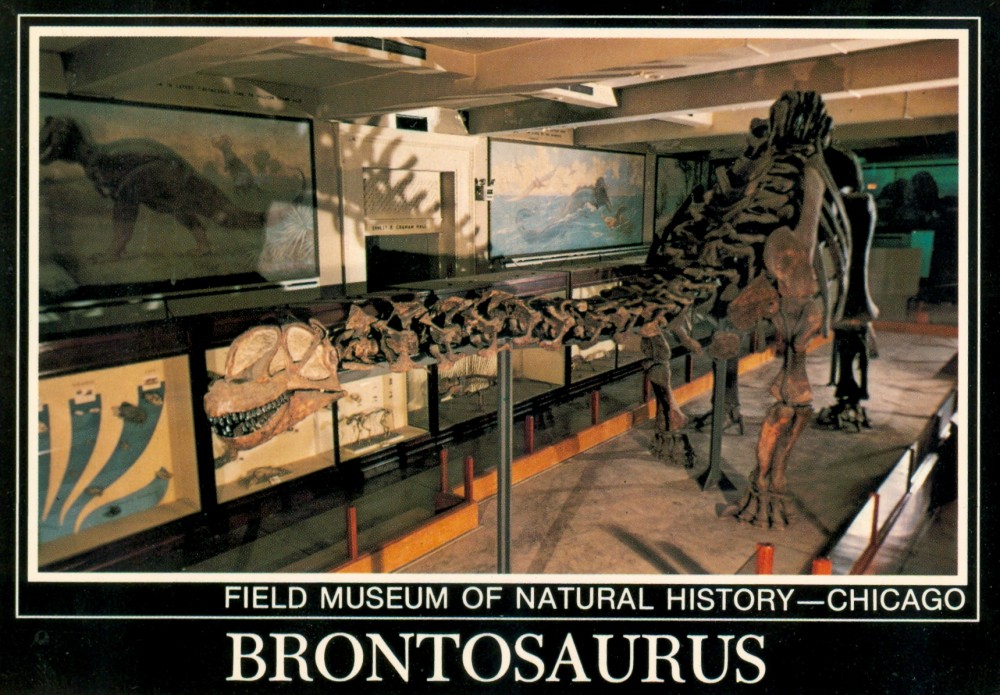
Bully for Camarasaurus

Note: This post was written in 2014. It predates Emanuel Tschopp and colleagues’ landmark paper which, among other things, resurrected the genus Brontosaurus. I’ve attempted to update the taxonomy where appropriate, but it may still be a bit of a mess.

The story of the mismatched head of Brontosaurus is one of the best known tales from the history of paleontology. I think I first heard it while watching my tattered VHS copy of More Dinosaurs—scientists had mistakenly mounted the skull of Camarasaurus on an Apatosaurus skeleton, and the error went unnoticed for decades. The legend has been repeated countless times, perhaps because we revel in the idea that even experts can make silly mistakes. Nevertheless, I think it’s time we set the record straight: nobody ever mistakenly placed a Camarasaurus skull on Apatosaurus. The truth is a lot more nuanced—and a lot more interesting—than a simple case of mistaken identity.

Intrinsically related to the head-swap story is the replacement of “Brontosaurus” with “Apatosaurus” in the popular lexicon. This is well covered elsewhere, so I’ll be brief. Scientific names for animals are governed by the International Code of Zoological Nomenclature, which includes the principle of priority: if an organism has been given more than one name, the oldest published name is the correct one. Leading 19th century paleontologist O.C. Marsh named Apatosaurus ajax in 1877, based on a vertebral column discovered in the Morrison Formation of Colorado. Two years later, Marsh introduced Brontosaurus excelsus to the world, from a more complete specimen uncovered in rocks of the same age in Wyoming. Like many of Marsh’s publications, these descriptions were extremely brief, offering a scant two paragraphs for each taxon. However, Marsh did provide a longer description of Brontosaurus in 1883, complete with the first-ever restoration of the complete skeleton.

This is not a Camarasaurus skull.

Come play with us, Brontosaurus…forever and ever and ever. Photo courtesy of the AMNH Research Library.

In 1903, Elmer Riggs of the Field Museum of Natural History underwent a survey of sauropod fossils held at various museums and concluded that Brontosaurus excelsus was too similar to Apatosaurus to merit its own genus. The name “Brontosaurus” was dropped, and the species became Apatosaurus excelsus for most of the 20th century. However, a substantial re-evaluation of diplodocoid sauropods by Emanuel Tschopp and colleagues in 2015 reversed Riggs’ decision. So the name Brontosaurus is back, but keep in mind that the species excelsus never actually went anywhere—it was just hidden under the Apatosaurus umbrella. Following Tschopp et al., Apatosaurus and Brontosaurus were distinct animals that lived in the same environment.

So how does the mismatched head fit into all of this? The short answer is that it doesn’t. The fact that some Apatosaurus mounts had incorrect heads for much of the 20th century has nothing to do with which name was being used at any given time, although the two issues have often been conflated in popular books. I suspect the two stories got mixed up because paleontologists were pushing to correct both misconceptions around the same time during the dinosaur renaissance.

Marsh's Brontosaurus

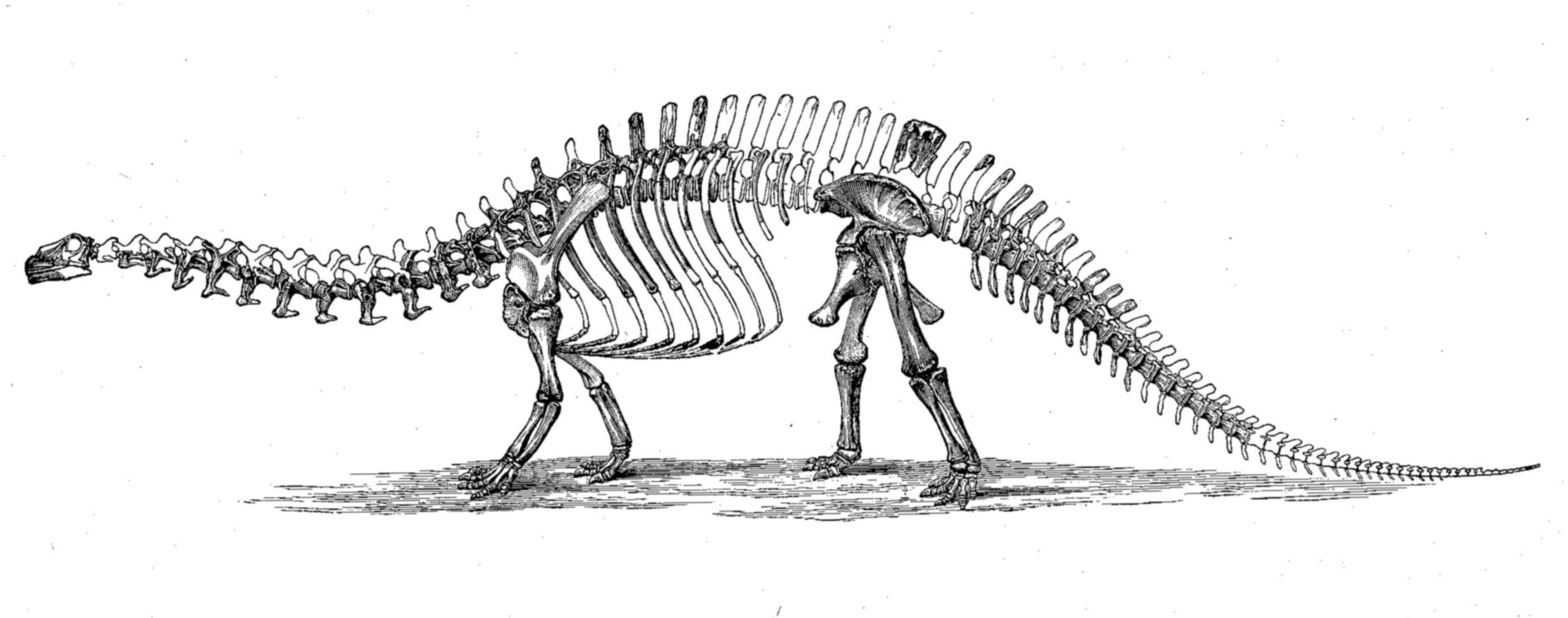
Marsh’s second and definitive Brontosaurus reconstruction, first published in 1891.

Let’s go back to Marsh’s 1891 Brontosaurus reconstruction*, pictured above. The Brontosaurus type specimen did not include a head, and many have reported that Marsh used a Camarasaurus skull in this illustration. However, this would not have been possible, because the first complete Camarasaurus skull wasn’t discovered until 1899. What Marsh had instead was a few fragmentary bits of Camarasaurus cranial material, plus a snout and jaw (USNM 5730) now thought to be Brachiosaurus (more on this at SV-POW). Although these pieces were found far from the Brontosaurus quarry, Marsh extrapolated from them to create the best-guess skull that appears in his published reconstruction.

*Note that this is the second of two Brontosaurus reconstructions commissioned by Marsh. The first drawing, published in 1883, has somewhat different skull, but it still does not resemble Camarasaurus. 

Although Stephen Gould states in his classic essay “Bully for Brontosaurus” that Marsh mounted the Brontosaurus holotype at the Yale Peabody Museum, Marsh never saw his most famous dinosaur assembled in three dimensions. In fact, Marsh strongly disliked the idea of mounting fossil skeletons, considering it a trivial endeavor of no benefit to science. Instead, it was Adam Hermann of the American Museum of Natural History, supervised by Henry Osborn, who built the original Brontosaurus/Apatosaurus mount (AMNH 460), six years after Marsh’s death in 1899.

Counterclockwise from top:

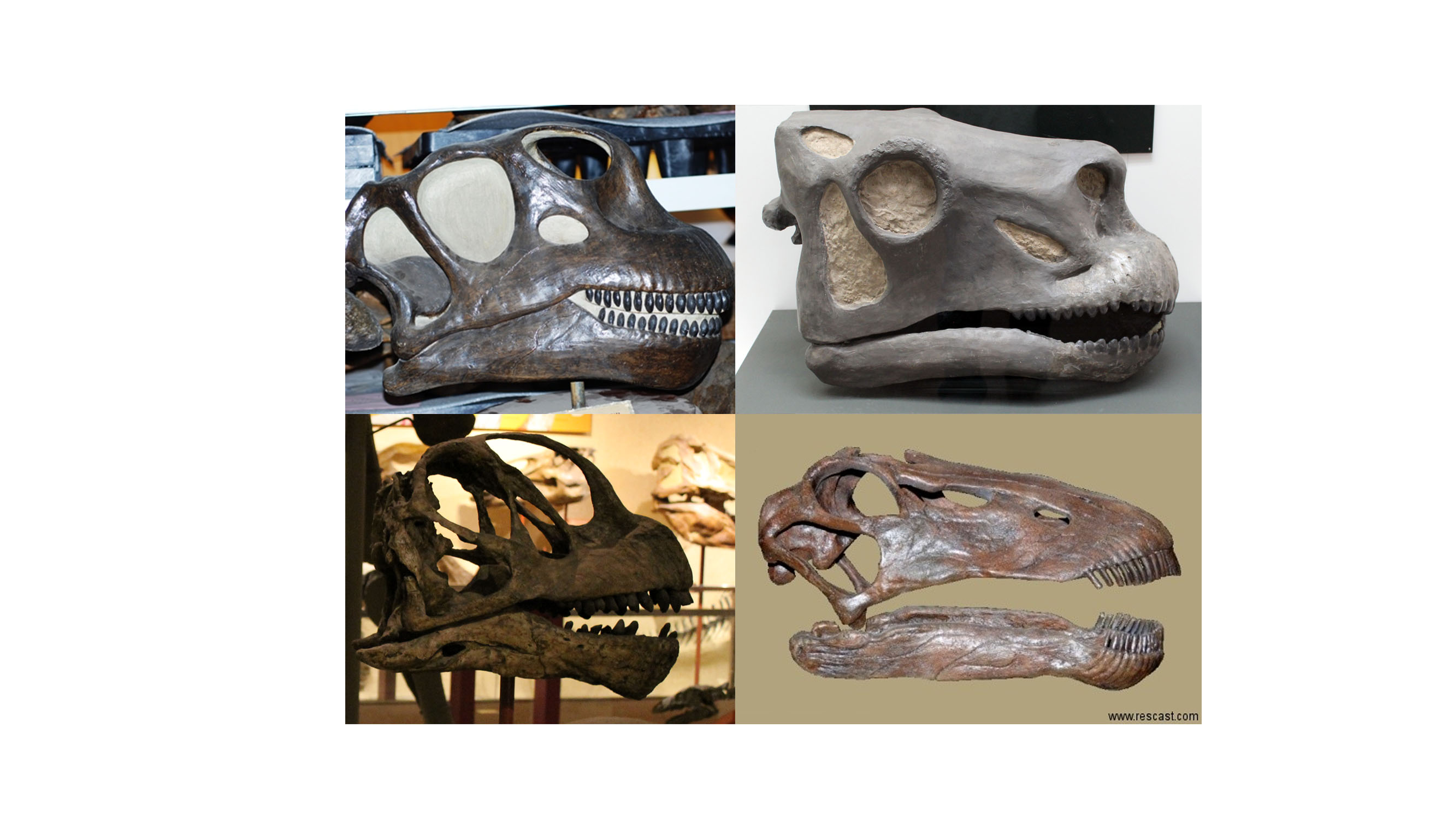
Clockwise from top: AMNH sculpted skull (Source), Peabody Museum sculpted skull, real Apatosaurus skull (Source), and real Camarasaurus skull.

To create the mounted skeleton, Hermann combined fossil material from four separate individuals. All of the material had been collected by AMNH teams in Wyoming specifically for a display mount—and to beat Andrew Carnegie at building the first mounted sauropod. Like Marsh, however, they failed to find an associated skull (a Camarasaurus-like tooth was allegedly found near the primary specimen, but it has since been lost). Even today, sauropod skulls are notoriously rare, perhaps because they are quick to fall off and roll away during decomposition. Instead, Hermann was forced to make a stand-in skull in plaster. Osborn explained in an associated publication that this model skull was “largely conjectural and based on that of Morosaurus” (Morosaurus was a competing name for Camarasaurus that is no longer used).

Was it really, though? The sculpted skull is charmingly crude, so the overt differences between the model and a real Camarasaurus skull (top and bottom left in the image above) might be attributed to the simplicity of the model. Note that there isn’t even an open space between the upper and lower jaws! Still, Hermann’s model bears a striking resemblance to Marsh’s illustration in certain details, principally the elongate snout and the very large, ovoid orbit. It’s reasonable to assume that Hermann used Marsh’s speculative drawing as a reference, in addition to any actual Camarasaurus material that was available to him. At the very least, it is incorrect to say that AMNH staff mistakenly gave the mount a Camarasaurus skull, since Osborn openly states that it is a “conjectural” model.

A young Mark Norell

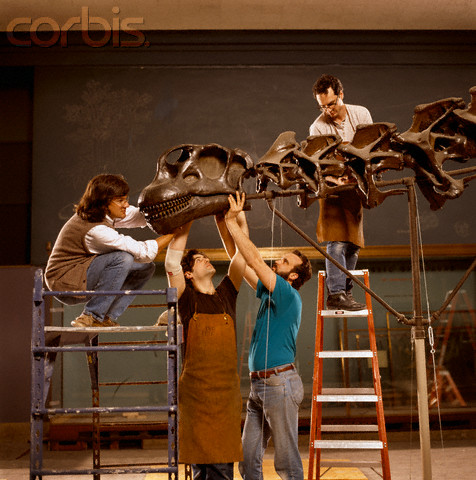
A young Mark Norell leads the removal of the sculpted skull from the classic AMNH Apatosaurus. Source

In 1909, a team led by Earl Douglass  of the Carnegie Museum of Natural History finally discovered a real Apatosaurus skull (third image, lower right). They were working at the eastern Utah quarry that is now Dinosaur National Monument, excavating the most complete Apatosaurus skeleton yet found (CM 3018). The skull in question (cataloged as CM 11162) was not connected to the skeleton, but Douglass had little doubt that they belonged together. Back at the Carnegie Museum, director William Holland all but confirmed this when he found that the skull fit neatly with the skeleton’s first cervical vertebra. As he wrote at the time, “this confirms…that Marsh’s Brontosaurus skull is a myth.”

The Carnegie team prepared and mounted the new Apatosaurus, and Holland initially planned to use the associated skull. However, when Osborn heard about this he threatened to ruin Holland’s career if he went through with it. You see, the new skull looked nothing like the round, pseudo-Camarasaurus model skull on the AMNH mount. Instead, it was flat and broad, like a more robust version of Diplodocus. Osborn wasn’t about to let Holland contradict his museum’s star attraction, and Holland backed down, never completing his planned publication on the true nature of Apatosaurus. Meanwhile, the mounted skeleton at the Carnegie Museum remained headless until Holland’s death in 1932. After that, museum staff quietly added a Camarasaurus-like skull. This was an important event, as it would be the first time an actual cast skull of Camarasaurus (as opposed to a freehand sculpture) would be attached to a mounted Apatosaurus skeleton. While I’ve had no luck determining precisely who was involved, Keith Parsons speculated that the decision was made primarily for aesthetic reasons.

Carnegie Museum Brontosaurus circa 1934. Source

Carnegie Museum Apatosaurus alongside the famed Diplodocus, sometime after 1934. Source

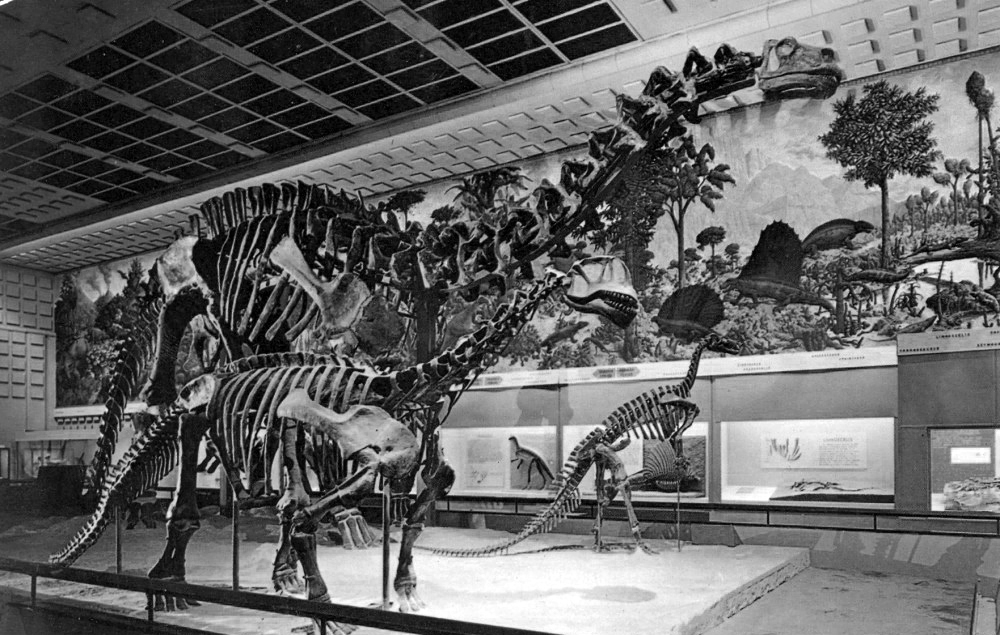
Elmer Riggs assembled a third Apatosaurus mount (FMNH P 25112) at the Field Museum in 1908. Riggs had recovered the articulated and nearly complete back end of the sauropod near Fruita, Colorado in 1901, but was unable to secure funding for further collecting trips to complete the mount. Riggs was forced to mount his half Apatosaurus as-is, and the absurd display stood teetering on its back legs for 50 years. Finally, Riggs’ successor Orville Gilpin acquired enough Apatosaurus fossils to complete the mount in 1958. As usual, no head was available, so Gilpin followed the Carnegie Museum’s lead and gave the mount a cast Camarasaurus skull.

The completed mount as it stood in the 1970s, Camarasaurus head and all.

Orville Gilpin finally completed the FMNH Apatosaurus in 1958.

The last classic apatosaurine mount was built at the Yale Peabody Museum of Natural History in 1931, using Marsh’s original Brontosaurus excelsus holotype (YPM 1980) and a lot of plaster padding. The skull this mount originally sported (third image, upper right) is undoubtedly the strangest of the lot. A plaster replica sculpted around a small portion of a real Camarasaurus mandible, this model doesn’t look like any known sauropod. The overall shape is much more elongated than either Camarasaurus or the AMNH model, and may have been inspired by Marsh’s hypothetical illustration. Other details, however, are completely new. The anteorbital fenestrae are thin horizontal slashes, rather than the wide openings in previous reconstructions, while the tiny, forward-leaning nares don’t look like any dinosaur skull—real or imaginary—I’ve ever seen. The sculptor is sadly unknown, but this model almost looks like a committee-assembled combination of the Marsh drawing, the AMNH model, and CM 11162 (a.k.a. the real Apatosaurus skull).

During the mid-20th century, vertebrate paleontology lapsed into a quiet period. Although the aging dinosaur displays at American museums remained popular with the public, these animals came to be perceived as evolutionary dead-ends, of little interest to the majority of scientists. The controversies surrounding old mounts were largely forgotten, even among specialists, and museum visitors saw no reason not to accept these reconstructions (museums are, after all, one of the most trusted sources of information around).

A postcard

The Peabody Brontosaurus with its original head. Note that the Camarasaurus in the foreground also has a sculpted skull.

This changed with the onset of the dinosaur renaissance in the 1970s and 80s, which brought renewed energy to the discipline in the wake of new evidence that dinosaurs had been energetic and socially sophisticated animals. In the midst of this revolution, John McIntosh of Wesleyan University re-identified the real skull of Apatosaurus. Along with David Berman, McIntosh studied the archived notes of Marsh, Douglass, and Holland and tracked down the various specimens on which reconstructed skulls had been based. They determined that Marsh’s restoration of the Brontosaurus skull, long accepted as dogma, had in fact been almost entirely arbitrary. Following the trail of guesswork, misunderstandings, and scientific inertia, McIntosh and Berman proved that Holland had been right all along. The skull recovered at Dinosaur National Monument along with the Carnegie Apatosaurus was in fact the only legitimate skull ever found from an apatosaurine up to that point. In 1981, McIntosh himself replaced the head of the Peabody Museum Brontosaurus with a cast of the Carnegie skull. AMNH, the Field Museum, and the Carnegie Museum followed suit before the decade was out.

aess

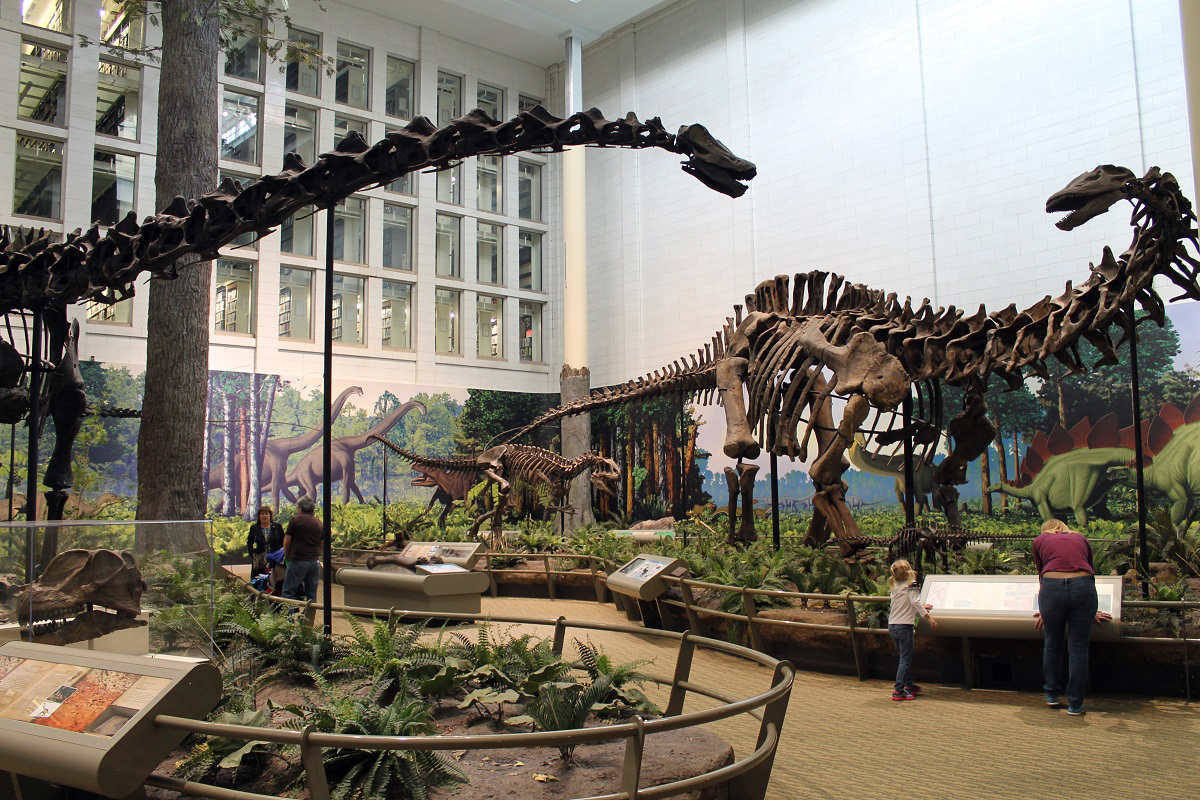
Remounted Apatosaurus at the Carnegie Museum. Photo by the author.

Given the small size of the historic community of dinosaur specialists, it may have been particularly vulnerable to the influences of a few charismatic individuals. To wit, Marsh’s speculative Brontosaurus skull was widely accepted despite a lack of compelling evidence, and Osborn was apparently able to bully Holland out of publishing a find that contradicted the mount at AMNH. What’s more, the legend of the mismatched Brontosaurus skull somehow became distorted by the idea that either Marsh or Osborn had accidentally given their reconstructions the head of Camarasaurus. This is marginally true at best, since both men actually oversaw the creation of composite reconstructions which only passingly resembled Camarasaurus. Nevertheless, the idea that the skull of Camarasaurus was a passable substitute for that of Apatosaurus was apparently well-established by the 1930s, when Carnegie staff hybridized the two sauropods for the first time. Even today, there are numerous conflicting versions of this story, and it is difficult to sort out which details are historically accurate and which are merely assumed.

I’d like to close by pointing out that while the head-swap story is often recounted as a scientific gaffe, it is really an example of science working as it should. Although it took a few decades, the mistakes of the past were overcome by sound evidence. Despite powerful social and political influences, evidence and reason eventually won out, demonstrating the self-corrective power of the scientific process.

References

Berman, D.S. and McIntosh, J.S. 1975. Description of the Palate and Lower Jaw of the Sauropod Dinosaur Diplodocus with Remarks on the Nature of the Skull of ApatosaurusJournal of Paleontology 49:1:187-199.

Brinkman, P. 2006. Bully for Apatosaurus. Endeavour 30:4:126-130.

Gould, S.J. 1991. Bully for Brontosaurus: Reflections in Natural History. New York, NY: W.W. Norton and Company.

Osborn, H.F. 1905. Skull and Skeleton of the Sauropodous Dinosaurs, Morosaurus and BrontosaurusScience 22:560:374-376.

Parsons, K.M. 1997. The Wrongheaded Dinosaur. Carnegie Magazine. November/December:38.

Tschopp, E., Mateus, O., and Benson, R.B.J. 2015. A specimen-level phylogenetic analysis and taxonomic revision of Diplodocidae (Dinosauria, Sauropoda). PeerJ 3:e857. https://doi.org/10.7717/peerj.857
9 Comments

Filed under AMNH, CMNH, dinosaurs, field work, FMNH, fossil mounts, history of science, museums, reptiles, sauropods, systematics

Exhibit Review: Kenosha Dinosaur Museum

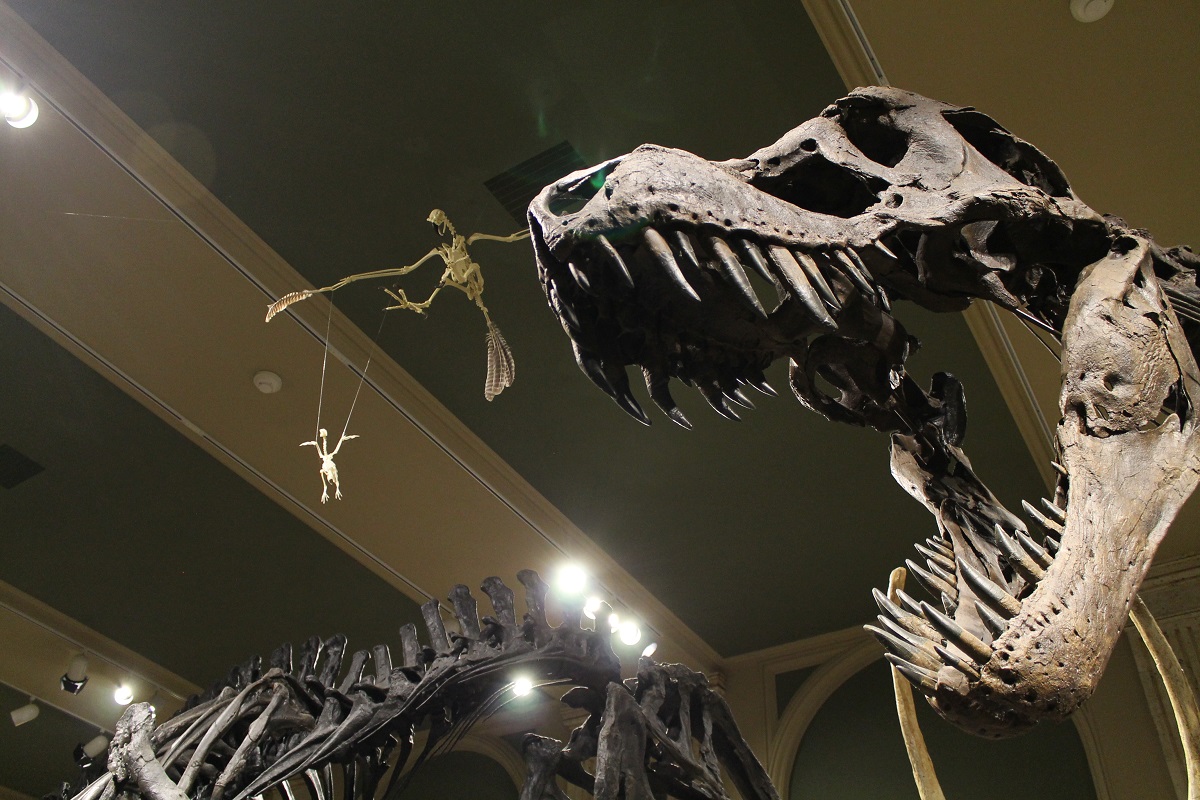
Stan and an eagle.

Stan the Tyrannosaurus with a modern eagle. Photo by the author.

Last week, I had a chance to visit the Dinosaur Discovery Museum in Kenosha, Wisconsin. I had no idea this place existed until recently, but it’s a short drive north from the Chicago area, and has apparently been open since 2006. The Museum is a joint venture between the municipally funded Kenosha Public Museum system and Carthage College, and is housed in a lovely 1930s post office (on the National Register of Historic Places). As I understand it, the Dinosaur Discovery Museum was initially imagined as a space to host the undergraduate paleontology program at the College, which is led by Dr. Thomas Carr. While the Museum does include a working fossil prep lab and displays of recent finds from Carr’s field expeditions in Montana and South Dakota, the primary draw for most visitors is the permanent exhibit hall. Although less than 100 feet across, this space is packed with more theropod mounts than I have ever seen in one place.

Nary an ornithiscian in sight. Photo by the author.

Nary an ornithiscian in sight. Photo by the author.

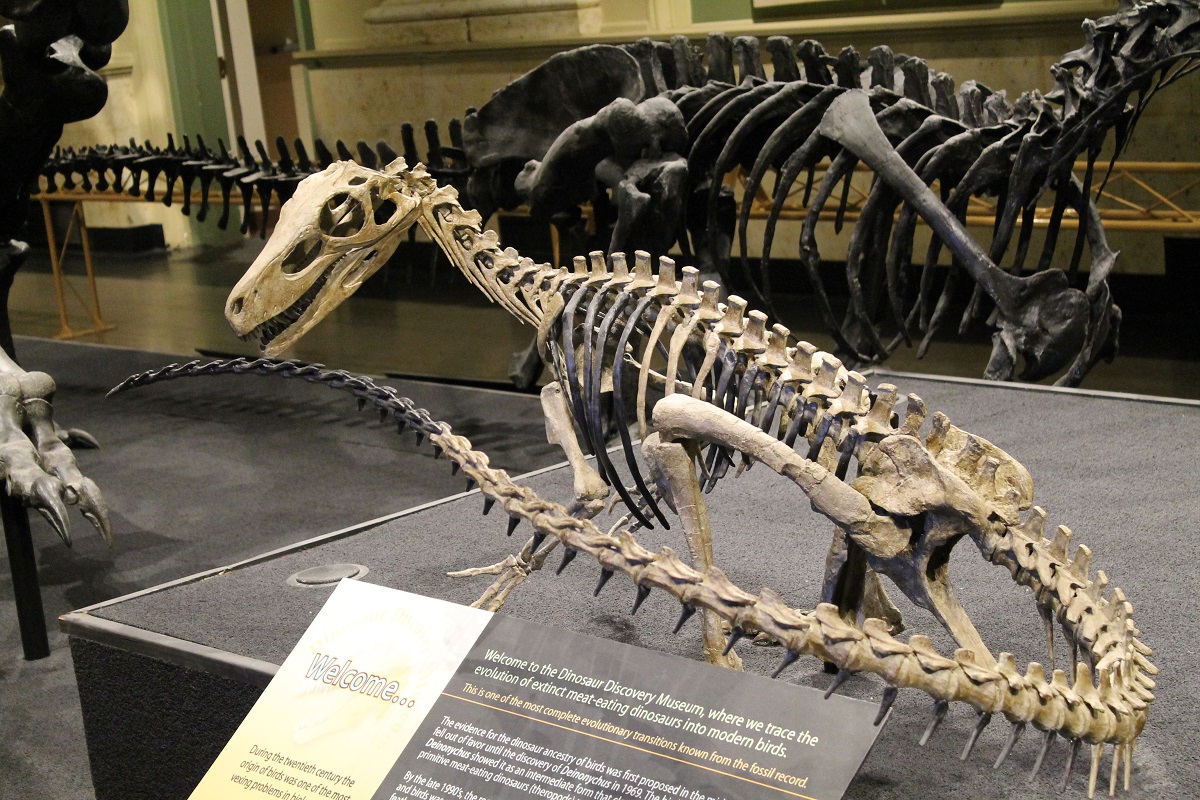
Naturally, the theme of this theropod-centric exhibit is bird evolution. Circling the central pedestal counter-clockwise, visitors can see the radiation of theropods from primitive forms like Herrerasaurus to larger ceratosaurs and tetanurans and finally to increasingly bird-like coelurosaurs. The Dinosaur Discovery Museum must have gotten a very generous initial donation, because they seem to have bought out virtually the entire catalog of casts from both the Black Hills Institute and Triebold Paleontology.

Hererrasaurus

A squatting Hererrasaurus is one of many unusually posed mounts at the Dinosaur Discovery Museum. Photo by the author.

Many of the casts were familiar to me, including the ubiquitous Stan, the Acrocanthosaurus from the North Carolina Museum of Natural Sciences, and the Anzu from the Carnegie Museum of Natural History. Nevertheless, it’s extremely cool to see such a complete range of theropod diversity in one place. I could directly compare any bone from a given mount to the same bone on any other, or even to the helpful selection of modern bird skeletons. The only thing that would make this exhibit more complete would be the inclusion of  growth series from the taxa for which this is known, like Tyrannosaurus and Allosaurus. And for the record, jaded paleophiles, T. rex looks really impressive alongside this menagerie. Overrated, my eye.

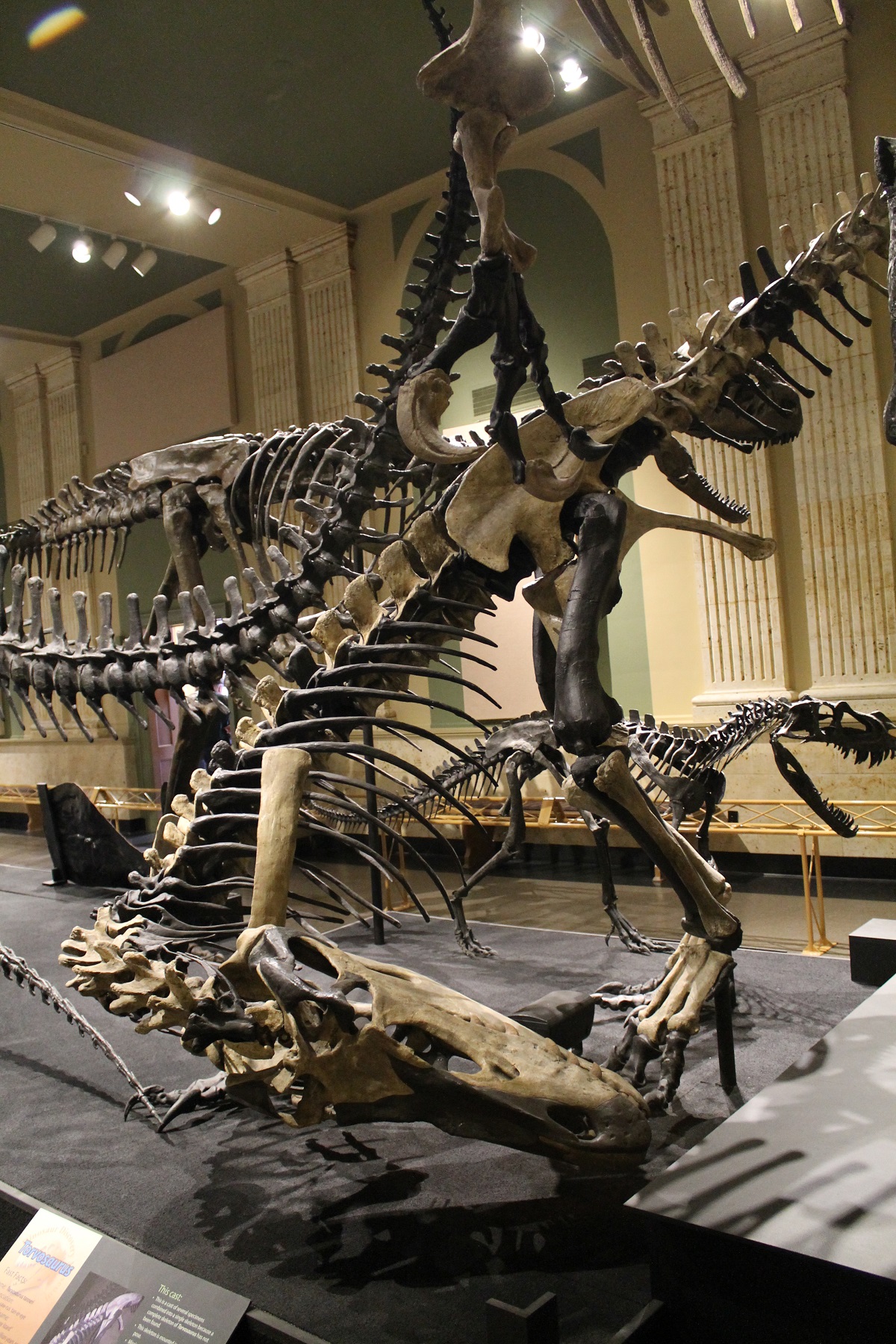
Torvosaurus scratches its jaw.

Torvosaurus scratches its jaw. Photo by the author.

Unlike some exhibits, the Dinosaur Discovery Museum does not shy away from the fact that all the skeletons on display are casts. Most of the mounts are very obviously painted in two colors, showing precisely which bones are based on real finds and which are sculpted reconstructions. Unfortunately, a handful of mounts inexplicably lack this information, which could confuse some visitors. One helpful side effect of displaying casts is that the dinosaurs can be placed in a variety of life-like poses. These theropods are not all staring straight ahead with mouths agape – instead, we are treated to displays like the Torvosaurus above, which is scratching its head with its foot.

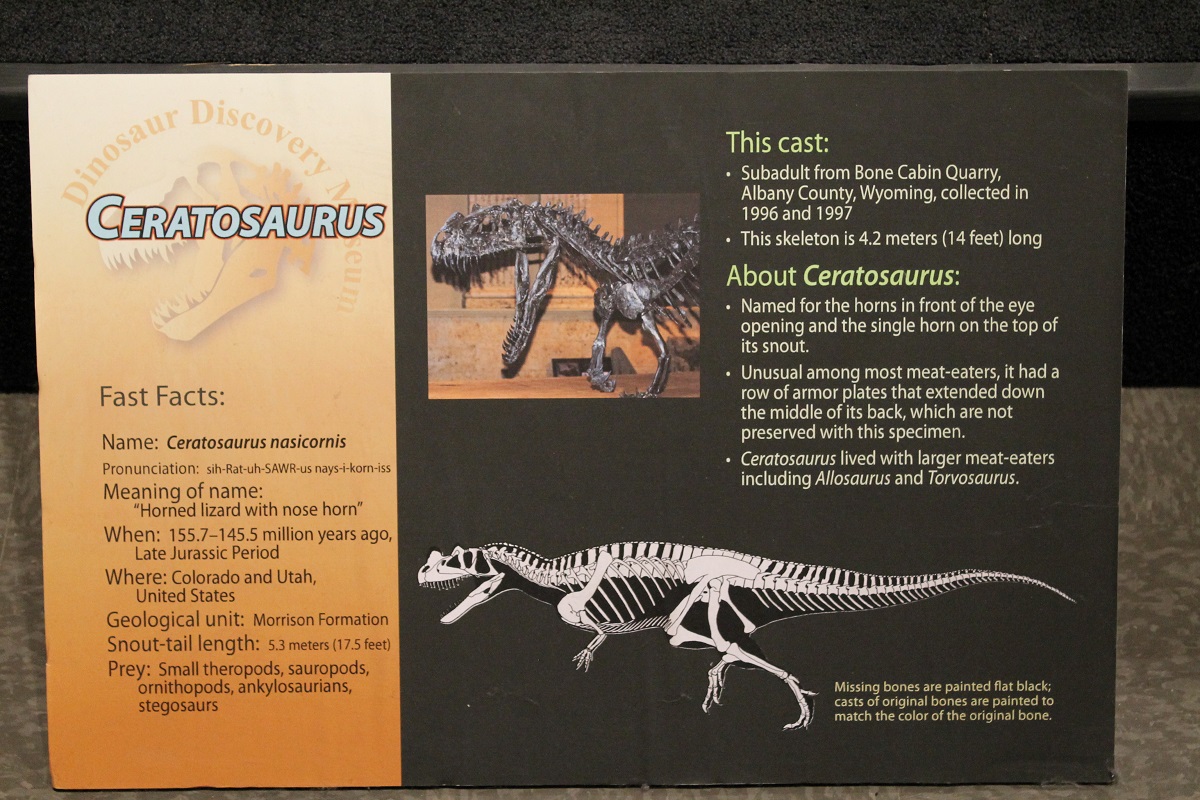
Ceratosaurus sign.

Signs like this accompany each dinosaur. Photo by the author.

The signage is of similarly high quality. Each dinosaur is accompanied by an attractive panel that provides expected information like the animal’s diet and time period, as well as a very helpful section identifying the quarry where the fossils were found and in most cases, the repository housing the original specimen. Additional signs on the walls cover the origin and extinction of dinosaurs, as well as the many lines of evidence that birds are surviving dinosaurs. Although they look a bit wordy at a distance, these signs are quite well-written for inclined to peruse them.

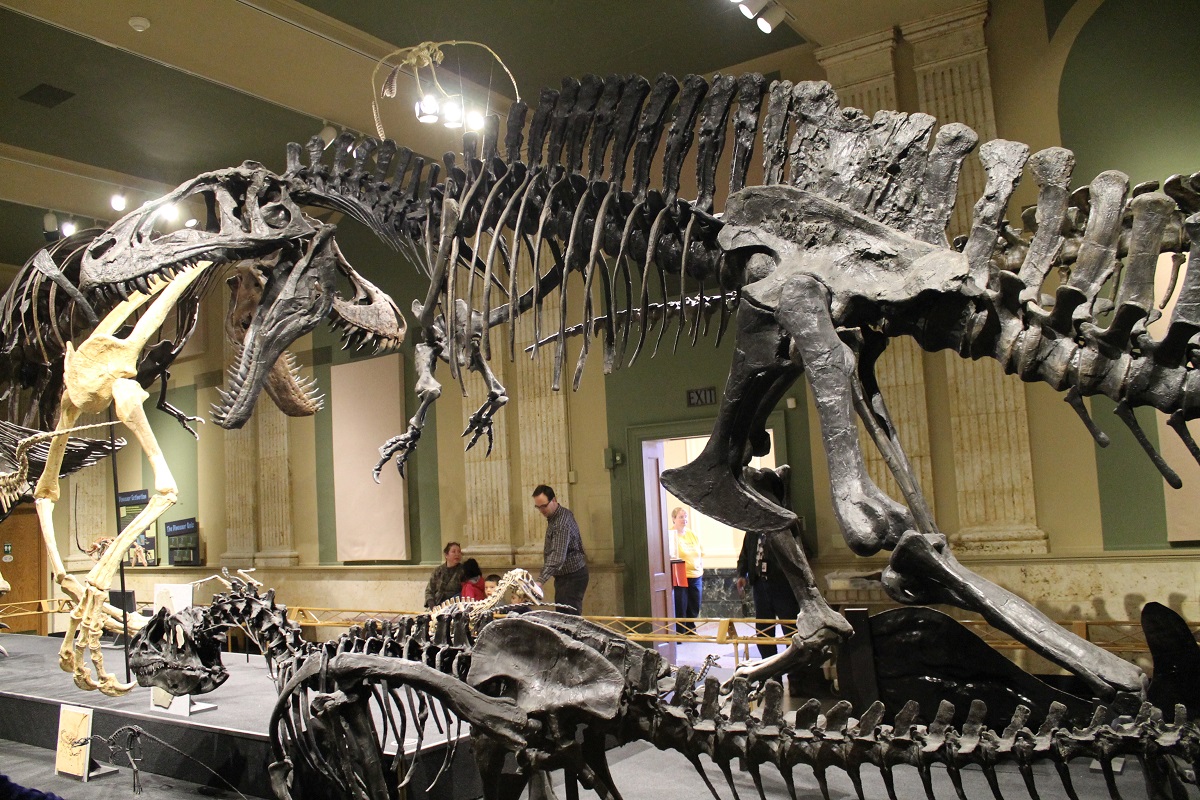
Acrocanthosaurus.

Acrocanthosaurus and an Allosaurus at rest. Photo by the author.

Also of note is a children’s room on the lower level, featuring (sigh) a sandbox dig and some very helpful and enthusiastic volunteers. Indeed, children’s activities appear to be the Dinosaur Discovery Museum’s strong suit. A look at their website reveals that kid’s programs are scheduled every weekend, and special events like dinosaur ornament making and flashlight tours occur throughout the year.

Clearly, I was impressed by my visit to the Dinosaur Discovery Museum. It’s wonderful that an educational opportunity like this exists in a semi-rural community, something that would have been unheard of not so long ago (did I mention it’s free?). What’s more, the exhibit hall is a great resource for specialists interested in comparing a variety of theropods first-hand. If you ever find yourself in the area, this little museum is definitely worth a visit.

1 Comment

Filed under dinosaurs, education, exhibits, fossil mounts, museums, reptiles, reviews, science communication, theropods

National Fossil Day 2014

Happy National Fossil Day! This will just be a quick photo post covering the events at the National Museum of Natural History today. The National Park Service started the day with a junior paleontologist swearing-in ceremony, where students from a dozen area schools learned about the importance of protecting and preserving public lands and natural resources.

Photo by

Photo by the National Park Service.

The main show was in the Q?rius education center, where museum staff and volunteers showed off their latest work and discoveries. Visitors could see tiny mammal bones and teeth plucked from matrix collected in Haitian caves, and work through a particularly inspired activity demonstrating how geologists correlate layers in different parts of the world.

nfd2

Photo by the author.

Photo by

Photo by the National Park Service.

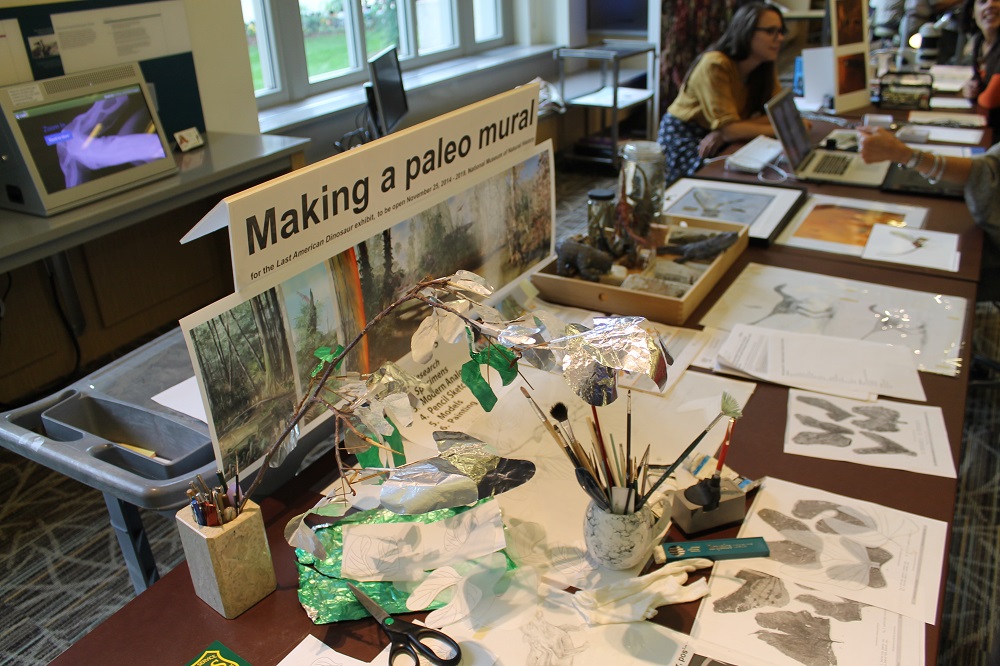
Resident scientific illustrator Mary Parrish had a particularly fascinating display, showcasing the methods and materials she uses to create accurate paintings of prehistoric environments. Note the aluminum foil leaves used as models to paint from, as well as the hand-made macquettes used to block out scenes and experiment with poses. Also on view was a draft of the giant Hell Creek mural that will be on display in The Last American Dinosaurs, opening in November.

nfd3

Photo by the author.

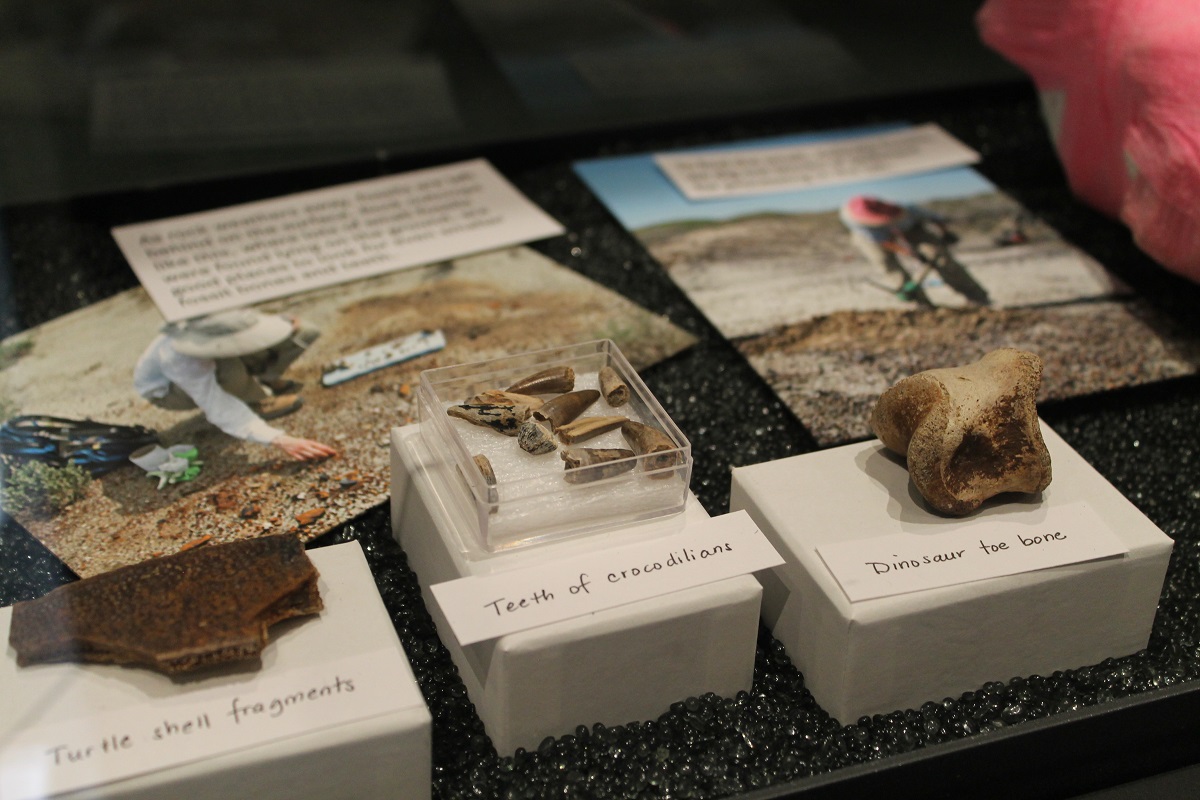
Out in the lower level lobby, the National Park Service, Bureau of Land Management, US Forest Service, National Science Foundation, Calvert Marine Museum, and Maryland Dinosaur Park had activities and displays. Here’s our display of recently discovered fossils from Cretaceous Maryland, slightly overshadowed by the Nation’s T. rex. We talked with visitors about Maryland’s role in the history of dinosaur science, the importance of the early Cretaceous as the origin of the world we know today, and our citizen science programs at the Park in Laurel.

image

Photo by the author.

Photo by the author.

Our Deinonychus replica looks a little small next to the Nation’s T. rex. Photo by the author.

National Fossil Day is all about generating awareness and enthusiasm for fossils and the study of the Earth’s natural history. In that, I think the event was quite successful. We talked to nearly 400 people, all of them enthusiastic and eager to learn about local prehistory and the process of discovering the ancient past. It was also a fun opportunity to catch up with people – the Washington area paleontology scene isn’t very big!

Thank you to the National Park Service for coordinating this event, and to the Smithsonian for hosting it!


Leave a comment

Filed under citizen science, Dinosaur Park, dinosaurs, exhibits, museums, NMNH, paleoart, science communication

Spinosaurus at the National Geographic Museum

IMG_2341

Research Casting International has done it again with a beautiful reconstructed skeleton of a swimming Spinosaurus. Photo by the author.

Yesterday, Nizar Ibrahim and National Geographic made a tremendous splash with their long-awaited announcement of a new Spinosaurus specimen. Spinosaurus is a widely recognized and beloved dinosaur (particularly among what one might call the dinosaur fandom community), but paradoxically it is known from only the scrappiest of fossil remains. What’s more, the holotype specimen is long gone – destroyed in the bombing of Munich during World War II. No doubt the enigmatic nature of Spinosaurus is a major part of its appeal. At any rate, the new paper by Ibrahim and colleagues describes the never-before-seen hindlimbs and pelvis of Spinosaurus, and proposes that the dinosaur’s anatomy – and behavior – were far more extreme than previously assumed. The new specimen reveals that Spinosaurus had narrow hips and legs barely longer than its arms. This was not an animal built for running on land, and a quadrupedal posture is not out of the question. What’s more, Spinosaurus limb bones are surprisingly dense for a theropod, not unlike the heavy bones of seals and early whales. Ibrahim and colleagues paint a picture of Spinosaurus as an animal that was at least as at-home in the water as it was on land.

The news has provoked the usual cycle of rampant speculation among dino fans, dismissal of sensationalism by some professionals, and even well-reasoned, evidence-based criticism. After the fervor dies down, we can assess whether this hypothesis holds water. In the meantime, though, I must applaud the tremendously impressive show National Geographic has put on. As part of the media roll-out that started yesterday afternoon, National Geographic has prepared both a television special and a traveling exhibit revolving around Spinosaurus. Some might scoff at all the hype over a partial skeleton, but I’d call this science outreach at its best, put on by some of the most experienced folks in the business.

IMG_2376

This Spinosaurus sculpture will be a fixture outside the National Geographic Building on 17th street until January. Photo by the author.

“Spinosaurus: Lost Giant of the Cretaceous” opened this morning at the National Geographic Explorer’s Hall in Washington, DC, and in this post I’d like to share my initial impressions. Visitors approaching from M Street are greeted by a life-sized Spinosaurus sculpture, posed over a half-eaten fish. This superb model was produced by the Italian studio GeoModel, and was apparently over a year in the making. Conceptual art and behind-the-scenes photos can be seen here. I’m not sure if the model has quite the extreme proportions that are proposed in the paper, but it’s not like I actually measured it. Regardless, this is a stunning piece  that will be a DC fixture through the end of the year.

The shrine to Ernst Stromer at the exhibit's entrance. Photo by the author.

The shrine to Ernst Stromer at the exhibit’s entrance. Photo by the author.

Once you’ve gone inside and paid your admission (I remember when this museum was free…oh well), you can enter the Spinosaurus exhibit proper. Interestingly, the exhibit is framed not as a science lesson but as a historical account. The first objects on display are documents and other possessions of Ernst Stromer, the German paleontologist who originally described Spinosaurus in 1915. Passing through a narrow corridor, you’ll see a reconstruction of the Spinosaurus holotype as it was displayed at the Bavarian State Collection in Munich, a Moroccan fossil shop, and even a replica of the cave where a Mysterious Bedouin Stranger led Ibrahim to the new find. Each stop is supplemented by a video mixing talking-head interviews with somewhat silly re-enactments of historic events. I particularly liked Stromer being berated by his Nazi boss.

Reconstruction of the holotype

I never dreamed I’d ever see an exact reconstruction of the Spinosaurus holotype, which was destroyed during World War II. Photo by the author.

I thought this method of storytelling was quite clever. By focusing on the role of Spinosaurus in world history, the exhibit can grab the attention of adult visitors that would usually dismiss dinosaurs as kids’ stuff. National Geographic’s shtick has always been presenting stories of intrepid scientists on adventures in distant locales, and there is plenty of that in evidence here. This sort of exoticism is probably a little problematic, but the gorgeous images of the Moroccan desert were clearly having the desired effect on some of my fellow visitors. Usually, I would complain about the over-reliance on long videos, but people seemed to be watching them all the way to the end, so I guess I’ll keep quiet this time.

Spinosaurus!

Spinosaurus in all its glory. Photo by the author.

Once the history lesson is over, the exhibit opens up into a larger display space. This is similar to what was done in “The World’s Largest Dinosaurs” – a narrow entry gallery introduces visitors to the topic at hand and the central questions being discussed, then visitors are freed to look at what they find interesting in whatever order they choose. All in all, this layout is a good compromise between the need to convey a specific educational message and the need to let visitors make the exhibit experience their own.

The star of the show is of course the reconstructed skeleton of Spinosaurus, yet another fantastic display piece by Research Casting International. Check out a time-lapse video of the mount being assembled here. What wasn’t clear from the grainy preview images that were flying around the internet a couple months ago is that the Spinosaurus is actually in a swimming pose. Its legs are posed in mid-paddle, and its head is turned to the right to snag a model sawfish. Above all, the mount is big. So big, in fact, that I couldn’t find anywhere in the gallery where I could photograph it all at once. I’d love to see this thing alongside Sue.

IMG_2372

The process of 3D printing digital fossils, explained. Photo by the author.

Happily, the exhibit takes the time to acknowledge that the Spinosaurus mount is not only a cast, but a composite of many fossil specimens. There is even a small display showcasing the process by which fossils are scanned and 3-D printed at a consistent scale. It’s great that the exhibit explains the evidence that led to the aquatic Spinosaurus reconstruction, showcasing the process of making and testing a scientific hypothesis.

Around the perimeter of the Spinosaurus gallery are displays of the other paleofauna of the Kem Kem region in Morocco, which Paul Sereno and company have been assembling for many years. There are models of azdarchid pterosaurs and coelocanth fish, as well as a Deltadromeus skeleton and skulls of  Carcharodontosaurus and Rugops (all heavily-reconstructed casts). All of these displays explore the question of how so many carnivores could co-exist in one environment. The answer provided is that each predator was specialized to hunt a different kind of prey: Spinosaurus chased fish, Carcharodontosaurus ate big herbivorous dinosaurs and (this will undoubtedly annoy some) Rugops is presented as an obligate scavenger.

friends

Some Kem Kem friends: Deltadromeus and Carcharodontosaurus. Photo by the author.

I have virtually nothing negative to say about the Spinosaurus exhibit. This is a great story, well told, and I was thoroughly impressed by nearly every part of it. The only thing that might be a sore point for some is that there are very few authentic fossils on display. A single dorsal spine is the only real bone representing Spinosaurus. Nevertheless, the exhibit team has shown precisely how to dramatize the process of scientific discovery, while still making the process transparent and relateable. Bravo.


11 Comments

Filed under dinosaurs, exhibits, fossil mounts, history of science, museums, reviews, science communication, theropods