Category Archives: sauropods

Interpreting the most-touched dinosaur bone of all time

In 1943, sawmill operator Daniel Edward Jones and his wife Vivian went prospecting for uranium west of their home in Delta, Colorado. In a gully near Potter Creek, they came upon a nearly seven foot-long dinosaur bone eroding out of the ground. It’s unclear exactly how and when they managed to excavate and remove the gigantic fossil, but sometime before 1955, the Joneses collected the bone and donated it to the Smithsonian Institution. That bone—identified as the humerus of a Brachiosaurus altithorax—has been on display at the National Museum of Natural History ever since.

The Potter Creek humerus (USNM V 21903) never made much of a splash scientifically. It wasn’t mentioned in any research paper until 1987, when Jim Jensen figured it alongside several other Brachiosaurus bones he collected at the same locality. The referral to Brachiosaurus has been questioned (e.g. Taylor 2009), but without any closely related dinosaurs known from Late Jurassic North America, researchers have generally been happy to use the available name.

Arguably, the Potter Creek humerus has a greater legacy as an object on display, and more specifically as an object to be touched. Since 1955, the fossil has been in easy reach of visitors, and has often been accompanied by signage inviting visitors to touch it. Extrapolating slightly from available visitation statistics and multiplying by the number of years on display, this fossil could easily have been touched by over 200 million people—possibly as many as 400 million. I’m unaware of any other dinosaur specimen that has been handled by that many individuals.

Let’s take a look at how the most-touched dinosaur bone of all time (if you know of other contenders for that title, please let me know!) has been interpreted over the years.

Photo courtesy of the Smithsonian Institution Archives.

One of the largest known dinosaur limb bones

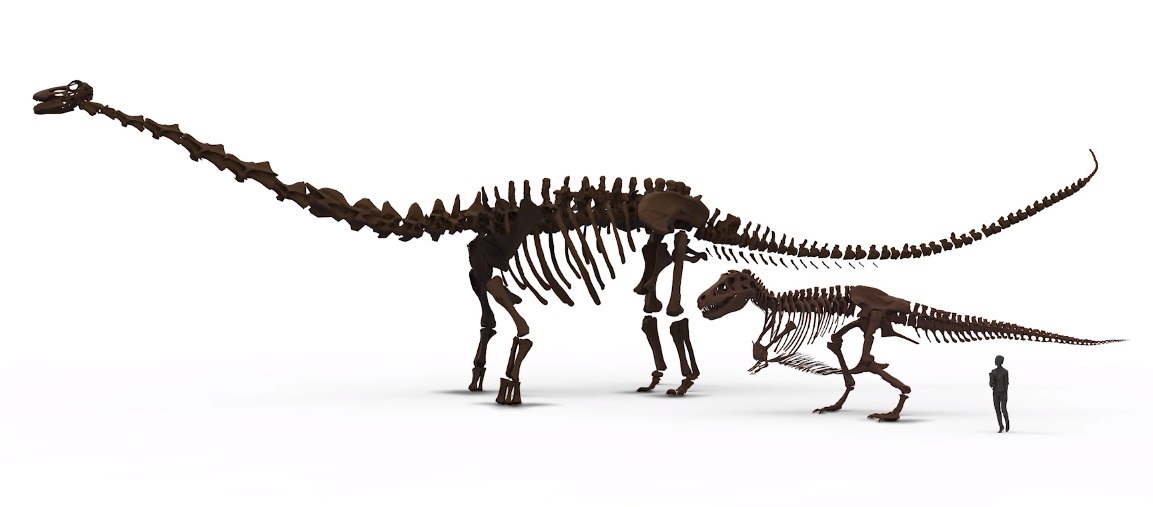
This humerus (upper arm bone) of the sauropod dinosaur Brachiosaurus alithorax was found by Mr. D.E. Jones of Delta, Colorado. It is from the Morrison formation, of late Jurassic age (about 130,000,000 years ago), in Montrose County, Colorado. Brachiosaurus was a giant among dinosaurs, much larger than the familiar Brontosaurus; it may have weighed as much as 55 tons. It is distinguished from other dinosaurs by the fact that its front legs were somewhat longer than its hind legs. This feature, the great length of the neck, and the projecting nostrils on top of the head seem to have been adaptations to its presumed life habits. Brachiosaurus was a plant eater that walked along the bottoms of lakes, lifting its head to breathe above the surface of the water. Brachiosaurus is known from North America, Africa, and Europe. This humerus is 6 feet 10 inches long, its position in the body of Brachiosaurus is shown in the sketch, where the humerus is drawn in red. Note the much smaller humerus in the nearby skeleton of the dinosaur Diplodocus.

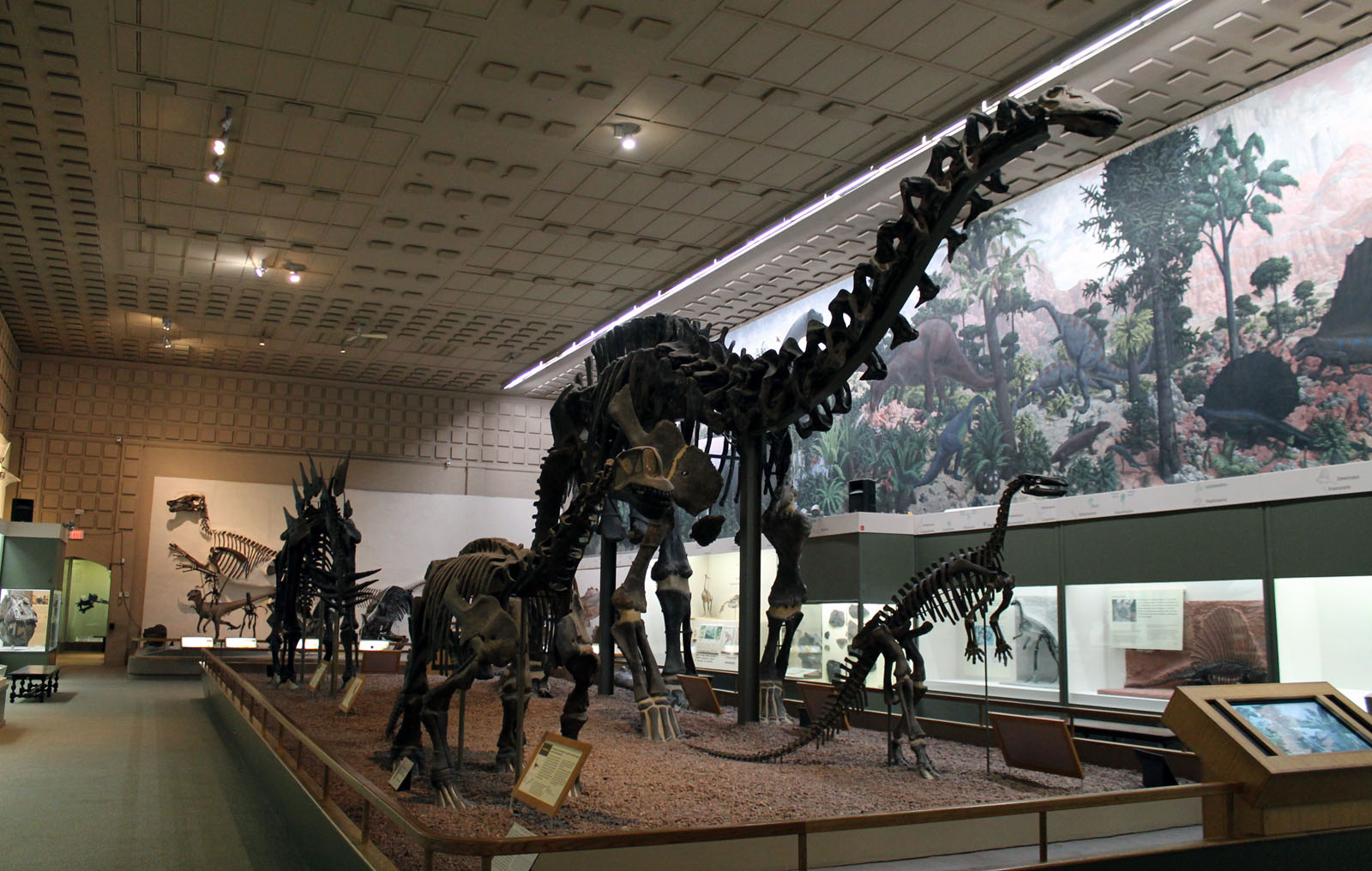
As mentioned, the Potter Creek humerus was first put on display at NMNH in 1955. It was mounted on a wooden pedestal in front of the Diplodocus skeleton, near the front of the museum’s spacious fossil hall. As seen in the photo above, the bone’s damaged shaft was not restored, although some sort of consolidant must have been applied to keep it from crumbling all over the floor.

The 181-word text panel accompanying the fossil was likely written by curator Charles Gazin, who had led the Vertebrate Paleontology division since 1946. The text is quite long and meanders through several distinct topics—addressing what the specimen is, who found it, how old it is, where it was found, how big the animal was, what the animal looked like, how the animal behaved, where else the animal lived, the exact size of the bone, and finally how it would fit into a complete skeleton. The text does not address any qualities of the fossil that visitors can actually observe until the very end.

Consideration of how visitors use museum exhibits—and how exhibits can best meet visitors’ needs—was in its infancy at this time. At NMNH and most of its peer institutions, labels were written by curators—experts in their fields but not necessarily in best practices for communicating with broad audiences. Exhibit text was by experts, for experts, and any visitors not up to parsing dense paragraphs like this one were left to make their own meaning of the exhibits.

It is notable, however, that this label compares the Potter Creek humerus to the nearby Diplodocus. As was typical of natural history exhibits at the time, the NMNH fossil hall wasn’t arranged in any particular order. Specimens were placed on platforms or in free-standing cases. This modular design allowed the hall to be rearranged with relative ease when new specimens were acquired, but it did not lend itself to any sort of overarching narrative for the displays. This passing reference to another specimen was as close to narrative cohesion as exhibits of this era could get.

Photo courtesy of the Smithsonian Institution Archives.

Would you like to touch a dinosaur bone?

This is a humerus (arm bone) of the sauropod Brachiosaurus alithorax. The position of the bone and the appearance of the animal are shown in the accompanying drawing. A close relative of Diplodocus and Camarasaurus, Brachiosaurus was the bulkiest land animal that ever lived, weighing about 55 tons. Like other sauropods, he spent most of his time in ponds, lakes, or rivers. If you want to be able to tell your friends that you touched a dinosaur bone, here is your chance.

The NMNH fossil halls were updated in 1963 as part of a decade-long, Smithsonian-wide modernization project. For the first time, an exhibit design specialist worked with the curators to compose the paleontology exhibits. Designer Ann Karras considered how visitors would move through the space, and attempted to create a coherent story of the evolution of life over time. Text panels were part of the aesthetics and organization of the exhibition, and were written with consistent style and terminology.

The text accompanying the Potter Creek humerus may have been written by Barbara Craig, and by modern standards, it’s pretty good (ignoring the now-debunked idea that sauropods spent their time in the water, and the choice to use a masculine pronoun for a dinosaur of unknown sex). The header is a call to action, inviting visitors to touch the fossil. The remaining 82 words are snappy and useful—the object is clearly identified, and the accompanying illustration is referenced right away. Visitors can find the information they want (what am I looking at? What should I do here?) right away, without having to fight through excessively long or wordy prose. It’s remarkable how well this label adheres to the standards for exhibit text that Beverly Serrell would first put forward over twenty years later.

Photo by Michael Brett-Surman.
Photo by Flickr user grafxmangrafxman.

Size in dinosaurs—how big is enormous?

Early dinosaurs were relatively small—about the size of the smaller Camptosaurus displayed to your left. However, these “small” dinosaurs were already larger than most land animals of their time. Although some lines of dinosaurs never got much larger, most produced huge forms. The average live weight of a dinosaur was about 5 tons. No other land-dwelling reptiles have ever approached this size and only about 2 percent of land-dwelling mammals have done so. The smallest dinosaur known, though no larger than a chicken, was still larger than 80 percent of all land mammals living today.

Brachiosaurus leg bone

The bone displayed below and in green in the drawing is from the upper part of the front leg of Brachiosaurus, one of the largest of all dinosaurs. Although Diplodocus had a longer neck and tail, Brachiosaurus was much taller and more massive and outweighed Diplodocus by several tons. Bones of a still larger animal similar to Brachiosaurus have been found in Colorado.

The dinosaur exhibits at NMNH were next updated in 1982. This time, the Potter Creek humerus was relocated to the right side of Diplodocus. With all of the mounted skeletons in a central corral and behind a plexiglass barrier, the role of the humerus as a designated touchable fossil was exceptionally clear. During the renovation, a fiberglass cowl was affixed to the damaged part of the humerus. This restoration makes the bone appear thicker than it actually is.

The accompanying text was written by postdoctoral research associates Jessica Harrison and George Stanley, under advisement from curator Nicolas Hotton. Their task was to balance the needs of visitors with demands for precise language from scientists. The resulting label is twice as long as the previous version and, I would argue, not nearly as useful. The primary text isn’t about the humerus at all—instead it discusses the range of dinosaur sizes and compares them to modern animals. The humerus is finally mentioned toward the bottom of the graphic, where it is once again compared to Diplodocus. For some reason, the donor is listed as Tony Jones.

Photo by the author.

How much heavier?

Sauropod dinosaur (arm bone)

Brachiosaurus altithorax

Lived 152 million years ago

Morrison Formation, Montrose Co., Colorado

USNM 21903

Donated by Eddie and Vivian Jones

You can see by it’s arm bone that Brachiosaurus (right) was bigger than Diplodocus (in front of you). The Brachiosaurus humerus is two times as thick as that of Diplodocus. That means it came from an animal that weighed nearly five times as much, about 140,000 lbs (64,000 kg)!

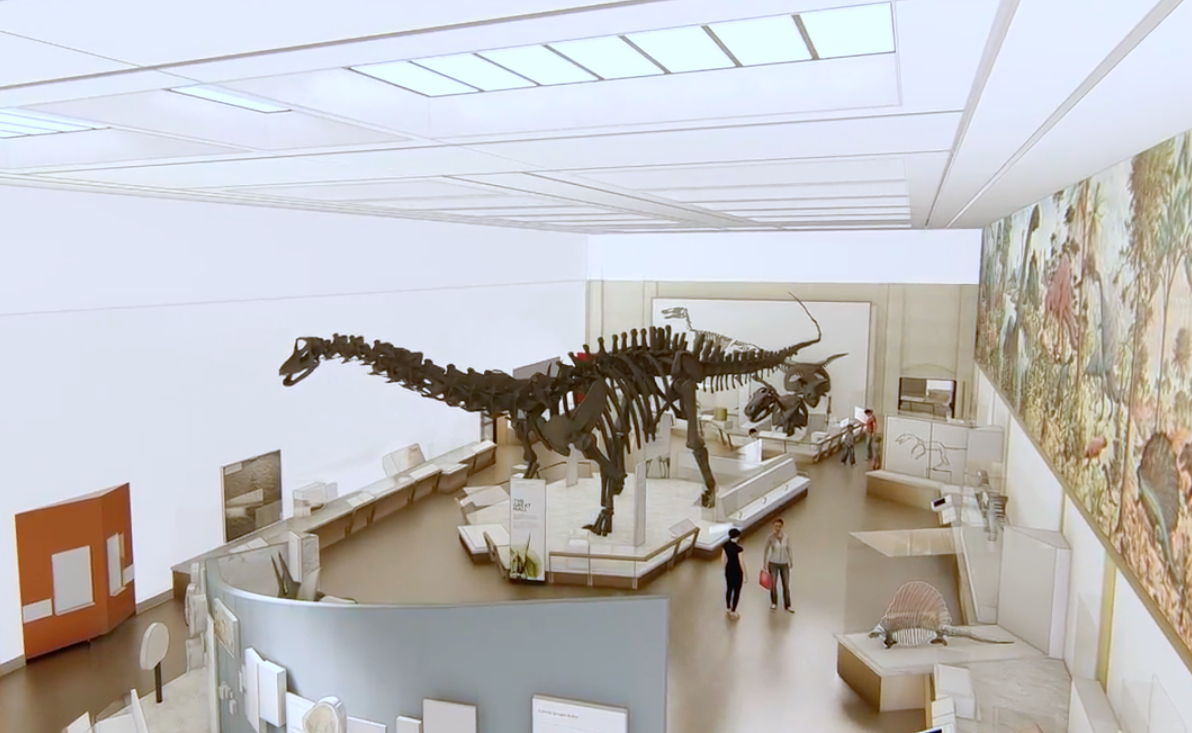
The most recent renovation of the NMNH fossil halls was completed in 2019. For the first time, the Potter Creek humerus is mounted vertically, in the orientation it would have held in a living Brachiosaurus. While requiring a sturdier and more sophisticated mounting structure, this display gives visitors a clearer understanding of the fossil before them.

Angela Roberts Reeder was the lead writer of the current exhibit text, assisted by several co-writers. At 51 words, this is the shortest label for the Potter Creek humerus yet. Some of the basic information—the animal’s name, how old the fossil is, and where it was found—is collapsed into a standardized and compact “tombstone” ID block. The remaining text covers a single subject: the mathematical relationship between the bone’s width and the living weight of the animal it belonged to.

This is considered good practice. According to Serrell, visitors are primarily concerned with the objects on display, not the exhibit text. They will look for text if they expect it to answer their immediate questions and improve their understanding. Visitors will quickly scan the available text, and if it doesn’t seem to be helping them, they will move on. Therefore, exhibit text needs to get to the point, and fast. Short labels aren’t about dumbing things down—they’re about finding the right words to communicate important ideas to the largest possible number of people.

Reeder’s label for the Potter Creek humerus is a great example. It immediately answers the most likely questions: “what is this thing?” and “how big was the dinosaur it came from?” Then, taking advantage of that momentary attention, it enhances visitors’ understanding by explaining how scientists can know the size of an animal from a single bone. The standardized ID block resolves most further questions without making visitors hunt though a long paragraph. Rather than trying to tackle too many concepts at once, this label omits any information on the life appearance or habits of Brachiosaurus.

Looking at the four generations of interpretation of the Potter Creek humerus, there are some recurring themes. The size of the bone and the animal it belonged to has always been referenced. And there is always an accompanying illustration showing where the bone fits into a complete Brachiosaurus. However, the earlier labels addressed the life habits of living sauropods with greater specificity (and as it turns out, inaccuracy—Brachiosaurus did not spend all its time wallowing in lakes in rivers). The newer labels are somewhat more technical, in that they focus on comparative measurements among fossils. This is surprising—I would have expected that earlier generations of paleontologists would have been more concerned with comparing figures and less interested in the total biology and ecology of extinct animals.

I was also surprised that there was not a clear trend toward shorter text. Instead, the length of the label has oscillated with each generation. And it’s worth noting that the earliest label is not burdened with excessive scientific jargon. The language has always been clear—what varies is how it is organized and how long it is overall.

References

D’Emic, M.D. and Carrano, M.T. 2019. Redescription of brachiosaurid sauropod dinosaur material from the Upper Jurassic Morrison Formation, Colorado, USA. The Anatomical Record 303:4:732–758.

Jensen, J.A. 1987. New brachiosaur material from the Late Jurassic of Utah and Colorado. Great Basin Naturalist 47:592–608.

Marsh, D.E. 2014. From Extinct Monsters to Deep Time: An ethnography of fossil exhibits production at the Smithsonian’s National Museum of Natural History. http://circle.ubc.ca/handle/2429/50177

Serrell, B. 2015. Exhibit Labels: An Interpretive Approach (2nd Edition). Rowman and Littlefield.

Taylor, M.P. 2009. A re-evaluation of Brachiosaurus altithorax Riggs 1903 (Dinosauria, Sauropoda) and its genetic separation from Giraffatitan brancai (Janesch 1914). Journal of Vertebrate Paleontology 29:3:787–803.

3 Comments

Filed under Deep Time, dinosaurs, exhibits, museums, NMNH, sauropods, science communication

Dinosaurs of the Field Museum – Part 2

In the previous “quick bite” post, I introduced the dinosaurs on display at the Field Museum of Natural History (FMNH) that were collected in the early 20th century. This time, we’ll take a look at some of the dinosaurs collected and first displayed “in living memory”—that is to say, in the last three decades or so. I’ve skipped a few that either don’t have much available provenance (like the juvenile Maiasaura) or don’t have a very interesting story (like the off-the-shelf Deinonychus cast).

In comparing the early and more recent dinosaur installations at FMNH, it is immediately apparent that the latter group covers a much wider geographical range. The older mounted skeletons were all recovered in the western United States and Canada, while the new batch comes from all over the world, especially the global south. Local scientists were usually involved in the research, and in most cases the original fossils remained in or were ultimately returned to their countries of origin.

Tyrannosaurus rex (PR 2081)

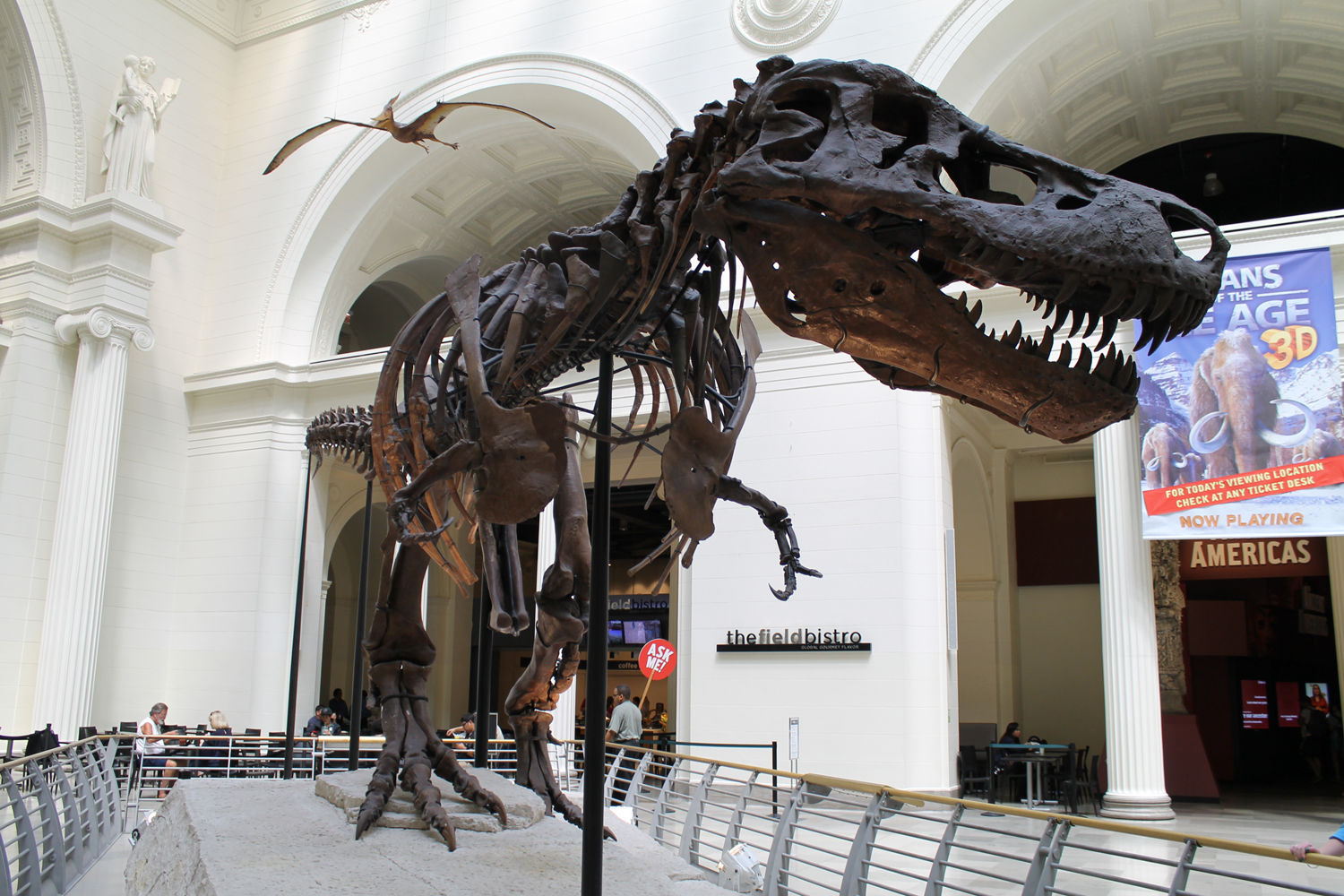
SUE in Stanley Field Hall, ca. 2015. Photo by the author.

As one of the world’s most thoroughly-researched and best-known dinosaurs, SUE the T. rex scarcely requires an introduction. SUE is the most complete adult Tyrannosaurus ever found, with 90% of the skeleton intact. Approximately 30 years old at the time of their death, SUE is also the eldest T. rex known, and within the margin of error for the title of largest

SUE was discovered in 1990 by Sue Hendrickson on ranchland near Faith, South Dakota. At the time, Hendrickson was working with the Black Hills Institute, a private company that specializes in collecting and exhibiting fossils. BHI’s claim to the fossil became the subject of a legal battle involving landowner Maurice Williams, the Cheyenne River Tribal Council, and the US Department of the Interior. With little legal precedent for ownership disputes over fossils, it took until 1995 for the District Court to award Williams the skeleton. Williams announced that he would put SUE on the auction block, and paleontologists initially worried that the priceless specimen would disappear into the hands of a wealthy collector. Those fears were put to rest in 1997 when FMNH won SUE with financial backing from McDonald’s and Disney. 

SUE has ruled this dedicated hall in Evolving Planet since December 2018. Photo © Field Museum.

The museum wasted no time making the most of the celebrity specimen. The preparation team expanded to twelve people, who spent 35,000 hours over the next three years extracting SUE’s skeleton from the rock. Chris Brochu was brought on board to write a detailed monograph, which is still a definitive source on Tyrannosaurus rex anatomy. Meanwhile, Phil Fraley built the metal armature upon which the skeleton would be mounted. SUE debuted in FMNH’s cavernous Stanley Field Hall on May 17, 2000 with the dropping of a curtain.

SUE held court in Stanley Field Hall for nearly 20 years, but in 2018 it was time for a change. That year, SUE was relocated to a new, 6,500 square foot gallery within the Evolving Planet exhibition. In contrast with the neoclassical expanse of Stanley Field Hall, this “private suite” gives the T. rex some much-needed context. SUE is now situated in an immersive reconstruction of the waterlogged forests of Late Cretaceous South Dakota. The mounted skeleton itself received an update, overseen by Pete Makovicky, Tom Cullen, and Bill Simpson. Garth Dallman and colleagues from Research Casting International (RCI) modified the original mount to correct a range of issues, like the articulation of the right knee and the position of the shoulders. SUE was also reunited with their gastralia—the rib-like bones that were embedded in the belly muscles.

Cryolophosaurus ellioti (PR 1821)

Cryolophosaurus partial skull in the Antarctic Dinosaurs exhibition. Photo by the author.

Excavating fossils is challenging in the best of conditions, but add the treacherous climate of Antarctica to the mix and it becomes a truly astounding feat. In 1991, William Hammer of Augustana College led a team that discovered and excavated the first Antarctic dinosaur to be named and described: the moose-sized theropod Cryolophosaurus. While bad weather prevented them from excavating the entire skeleton, Hammer and colleagues managed to collect the rear portion of the skull and jaw, as well as parts of the pelvis and hind limbs. The specimens were given to FMNH, the largest fossil repository near Hammer’s institution.

Cryolophosaurus cast in the Antarctic Dinosaurs exhibition. Photo © Field Museum

Hammer returned to the Cryolophosaurus site in 2010, joined by Nate Smith, Josh Matthews, and FMNH’s Pete Makovicky. Working in minus 15 F conditions, the team excavated more of the holotype skeleton. Some overlapping bones, including a second braincase, clarified that at least two individuals were present in the quarry.

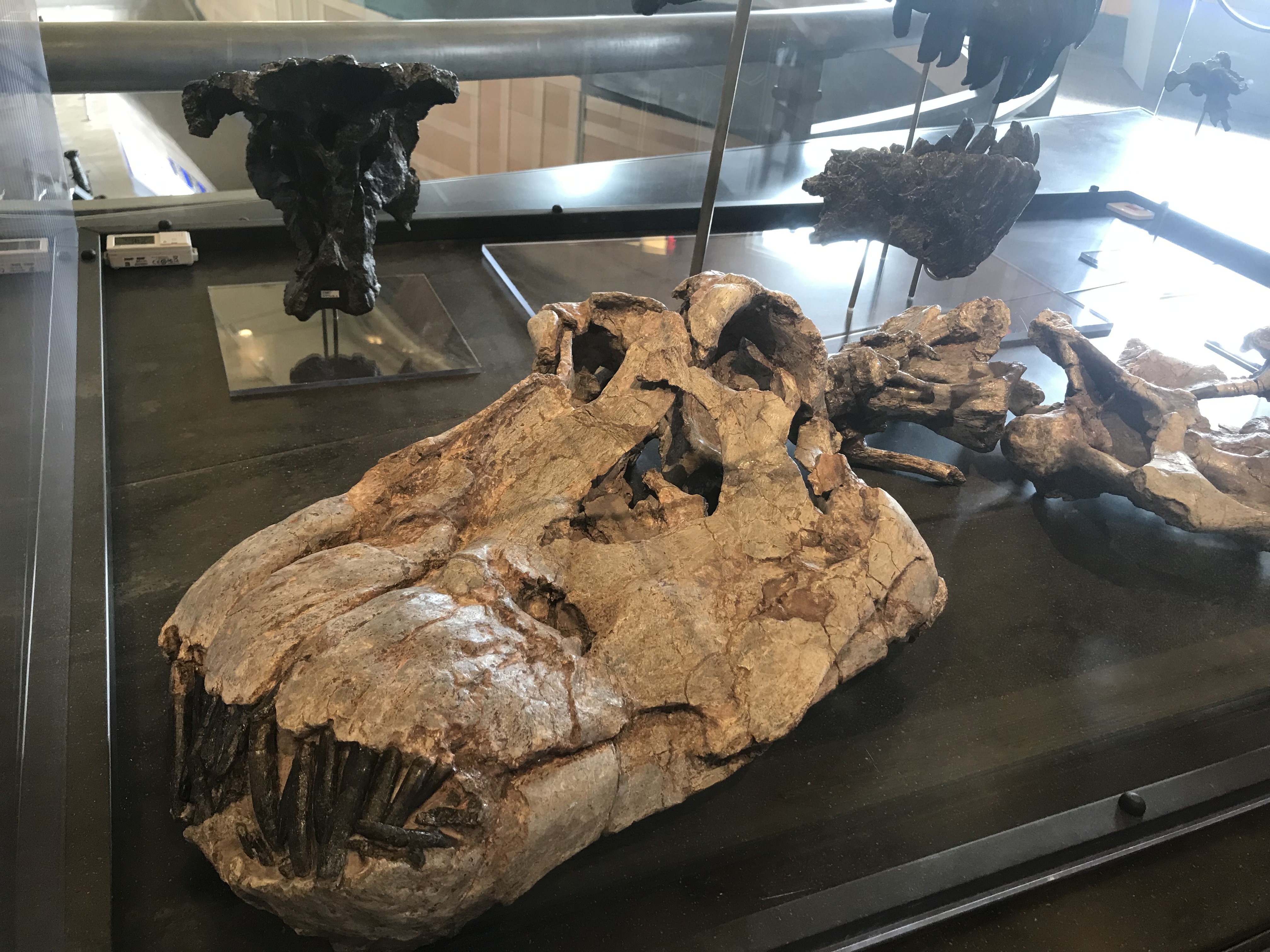
For many years, Cryolophosaurus had only a minor role in FMNH exhibitions. In Evolving Planet, it is represented only by a cast of the partial skull. In 2018, however, the museum debuted Antarctic Dinosaurs, a traveling exhibition all about the 2010 expedition. Cryolophosaurus is the star of the show: most of the holotype is displayed in a series of cases, alongside a complete standing cast created by RCI. While other museums have displayed Cryolophosaurus reconstructions, the Antarctic Dinosaurs cast is more up-to-date in many respects—for instance, it’s narrow skull more closely resembles Dilophosaurus than Allosaurus.

Rapetosaurus krausei (PR 2209)

Juvenile Rapetosaurus in Evolving Planet. Photo by the author.

It’s hard to imagine now, but as recently as the mid-1990s, very little was known about titanosaurs. These Cretaceous sauropods were mostly known from isolated bones, and it wasn’t even clear if they were more closely related to diplodocoids like Diplodocus and Apatosaurus or to macronarians like Camarasaurus and Brachiosaurus. That changed in 2001, when Kristina Curry Rogers and Catherine Forster published the first description of Rapetosaurus krausei.

The new genus and species was based on fossils collected a few years earlier on a Mahajanga Basin Project expedition in northwest Madagascar. Organized by the State University of New York at Stony Brook and the local Universite d’Antananarivo, the Mahajanga Basin Project has been exploring fossil outcrops in this region since 1993. The project has been tremendously successful, yielding numerous new species and revolutionizing our understanding of vertebrate evolution in the southern hemisphere.

Rogers and Forster designated one of two adult Rapetosaurus skulls as the holotype, but most of our information about this animal comes from a 15-foot, 75% complete juvenile skeleton. To this day, this fossil is the most complete titanosaur ever found, and the only titanosaur known from both a skull and the majority of its postcranial skeleton. From their high-set eyes to their ludicrously wide bodies, much of what is known about the shape of titanosaurs comes from this specimen. Details of this skeleton also helped confirm that titanosaurs are macronarian sauropods.

As one of the funders of the MBP expeditions, the Field Museum became the repository for the juvenile Rapetosaurus skeleton. The fossil was mounted for display in 2006, when the paleontology halls were refreshed and retitled as Evolving Planet.

Buitreraptor gonzalezorum (MPCA 245 and others)

Buitreraptor cast under construction—note the unrestored skull cast being used as a placeholder. Many thanks to Matthew Aaron Brown for sharing this photo.

Fossils of Buitreraptor, a goose-sized dromaeosaur, were first collected in Patagonia, Argentina in 2004. The Field Museum’s Pete Makovicky was joined by Sebastián Apesteguia and Federico Agnolín in describing the new dinosaur the following year. Buitreraptor is notable for being the oldest known South American dromaeosaur (about 98 million years old), and for being one of the most completely known unlagiine dromaeosaurs—bizarre creatures with exceptionally long and narrow snouts. The holotype specimen was prepared at FMNH before being returned to the Museo Provincial de Cipolletti Carlos Ameghino in Río Negro, Argentina.

Finished Buitreraptor cast in Evolving Planet. Photo by the author.

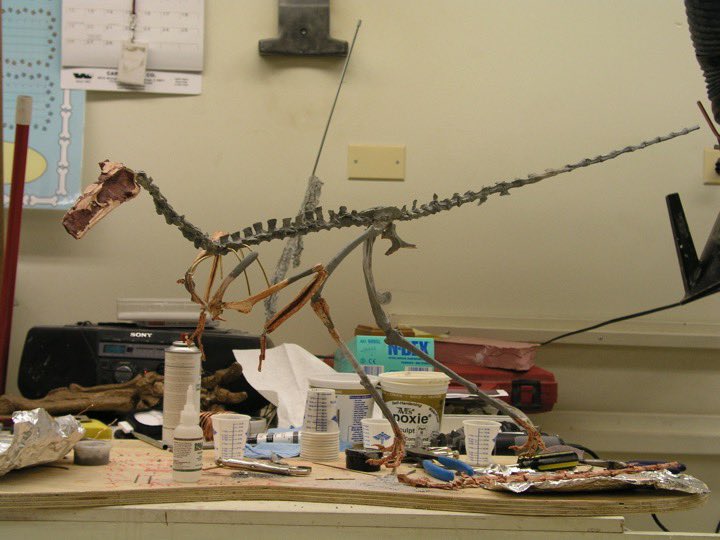
The Evolving Planet team did not originally intend to include Buitreraptor, but as the exhibition neared completion it was noted that the bird evolution display—which only featured Deinonychus and a pair of small models—looked a little sparse. With most of the hall already installed and the opening just months away, preparators Connie Van Beek, Matthew Aaron Brown, and Jim Holstein were tapped to create a mounted cast of Buitreraptor. The preparators first built a prototype by wiring together available casts of the original fossils. They then moved on to the final version, which involved reconstructing the missing extremities (arms, feet, and ribs) and creating a “re-inflated” version of the specimen’s crushed skull. The entire project was completed in less than two months.

Patagotitan mayorum (MPEF 2400 and others)

Field Museum and Museo Paleontológico Egidio Feruglio staff worked together to assemble Máximo in May 2018. Photo by the author.

In 2017, plans took shape to reimagine Stanley Field Hall, as has happened several times since the current FMNH building opened in 1921. Part of the plan was to relocate SUE to a dedicated gallery in Evolving Planet, but what could take the place of the star T. rex? The museum found their answer in Patagotitan, a recently discovered titanosaur that is a contender for the world’s largest dinosaur.

Patagotitan mayorum was discovered on the Mayo family farm near La Flecha, Argentina in 2010. Between 2012 and 2014, Diego Pol and colleagues at the Museo Paleontológico Egidio Feruglio (MEF) excavated the find, which turned out to be a bone bed of six individuals. The new genus and species was named and published in 2018.

The FMNH cast is actually the second Patagotitan display in the United States. In 2015 (before the animal had a name), the American Museum of Natural History commissioned RCI to create a cast for the Wallach Orientation Center, part of the loop of fossil halls on the New York museum’s 4th floor. By placing Patagotitan in a relatively small space, the AMNH designers emphasized the sauropod’s great size. Standing in a slightly crouched pose with its head extending into an adjacent hall, the mount overwhelms the space.

Máximo has plenty of room to spread out in Stanley Field Hall. Photo by the author.

In contrast, the FMNH Patagotitan—nicknamed Máximo—has room to spread out. In the half-acre, four story expanse of Stanley Field Hall, visitors can stand at a reasonable distance and take in the 122-foot skeleton all at once. They can also look Máximo in the eye socket from the upper level balcony. Rather than work with RCI on the project, FMNH commissioned the mount from MEF directly. It was designed and built in Trelew, Argentina, and shipped to Chicago via cargo ship. The installation took four days in May 2018. The process didn’t go entirely without a hitch—under the skylight in Stanley Field Hall, the original paint job on the cast bones looked like raw meat. But even with the need for an emergency repaint of the entire skeleton, Máximo was completed on time and has been greeting FMNH visitors ever since.

Spinosaurus aegyptiacus (FSAC-KK-11888)

The Prehistoric Minds team prepares to add legs to Spinosaurus. Photo by the author.

The Field Museum’s newest dinosaur debuted just two weeks ago as of this writing (and is, in fact, why I’ve been sitting on this post for months). Postdoctoral researcher Matteo Fabbri approached the Exhibitions department in Fall 2022 with the prospect of acquiring a Spinosaurus cast. Less than a year later, that cast has joined Patagotitan in Stanley Field Hall, suspended twelve feet off the floor in a swimming pose.

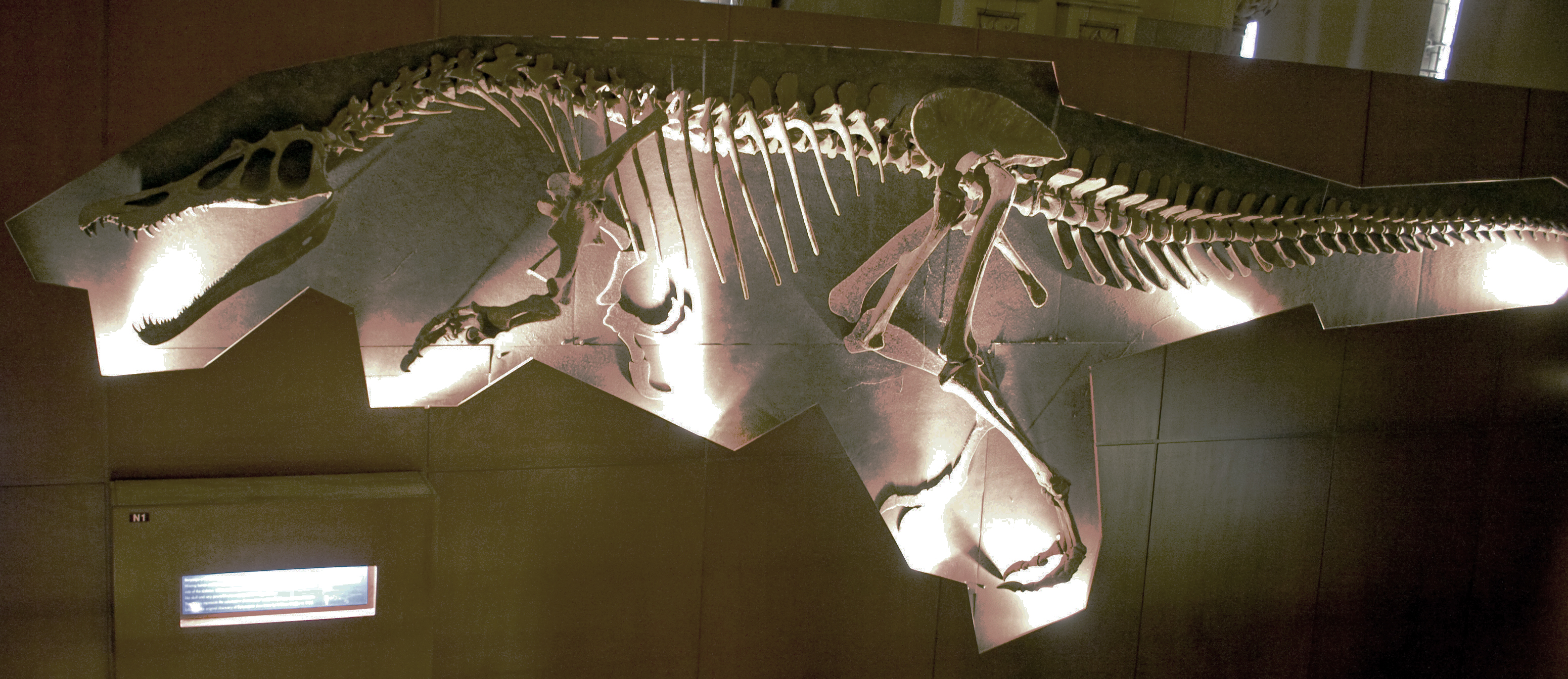
Thanks to its dragon-like shape and star turn in Jurassic Park III, Spinosaurus is a very popular dinosaur, but until recently it has been quite poorly known. The 1912 holotype specimen—consisting of a partial jaw, several dorsal vertebrae, and a few other odds and ends—was inadvertently destroyed in the bombing of Munich during World War II. It wasn’t until 2008 that another skeleton was found in southern Morocco. The new specimen revealed that Spinosaurus was even weirder than previously thought: not only did it have an elongated, crocodile-like skull and a sail on its back, it also had a long body, short legs, and a newt-like tail fin.

Spinosaurus hangs 12 feet above the floor. Photo by the author.

Very few Spinosaurus casts have ever been displayed. One was made for the retired Spinosaurus: Lost Giant of the Cretaceous traveling exhibit. Another appeared in last year’s The Big Eight: Dinosaur Revelation in Hong Kong. But as far as I can tell, the only other permanent Spinosaurus skeleton on display is at Japan’s Kitakyushu Museum of Natural History. That makes the FMNH cast the only mount of its kind in the western hemisphere. 

It’s also the most up-to-date Spinosaurus on display. As part of the team that has been studying Spinosaurus for the last 15 years, Fabbri ensured that cervical vertebrae collected at the original discovery site just six months ago were incorporated into the mount. All told, about 50% of the skeleton is cast from the Morocco specimen, while the rest is reconstructed. 

Like Máximo, the Spinosaurus was built overseas. Simone Maganuco and colleagues constructed the skeleton in Italy, then traveled with it to Chicago to help with the installation. The lightweight cast—which only weighs 700 pounds—was hanging in its permanent position after just ten hours of work.

Press coverage of the installation (with appearances from a certain overenthusiastic nerd) can be seen here and here.

References

Brochu, C.A. 2003. Osteology of Tyrannosaurus rex: Insights from a nearly complete skeleton and high-resolution computed tomographic analysis of the skull. Journal of Vertebrate Paleontology 22:1–138.
Curry Rogers, K., Forster, C.A. 2001. The last of the dinosaur titans: a new sauropod from Madagascar. Nature 412:6746:530–534.

Hammer, W.R. and Hickerson, W.J. 1994. A Crested Theropod Dinosaur from Antarctica. Science 264: 828–830.

Grande, L. 2017. Curators: Behind the Scenes of Natural History Museums. Chicago, IL: University of Chicago Press.

Ibrahim, N., Maganuco, S., Dal Sasso, C., Fabbri, M., Auditore, M., Binedellini, G., Martill, D.M., Zourhi, S., Matterelli, D., Unwin, D.M., Wiemann, J., Bonadonna, D., Amane, A., Jakubczak, J., Joger, U., Lauder, G.V., and Pierce, S.E. 2020. Tail-propelled aquatic locomotion in a theropod dinosaur. Nature 581(7806):1–4.

Makovicky, P.J., Apesteguía, S., and Agnolín, F.L. 2005. The earliest dromaeosaurid theropod from South America. Nature 437: 1007–1011.

Smith, N.D., Makovicky, P.J., Hammer, W.R., and Currie, P.J. 2007. Osteology of Cryolophosaurus ellioti from the Early Jurassic of Antarctica and implications for early theropod evolution. Zoological Journal of the Linnean Society 151: 377–421.

1 Comment

Filed under AMNH, dinosaurs, exhibits, FMNH, fossil mounts, museums, sauropods, theropods

Dinosaurs of the Field Museum — Part 1

About a year ago, I wrote this post about the dinosaurs of the London Natural History Museum, admittedly in a bit of a hurry. The post has proven very popular, which leads me to conclude there’s interest in more “quick bite” articles about the specimens on display at various museums. I’ll see about putting together more of these in the future.

For now, I’ll start close to home, with the dinosaurs on display at Chicago’s Field Museum of Natural History (FMNH). This entry is about the most notable specimens that were acquired outside the living memory of current staff. I’ll follow up with an article about more recent acquisitions sometime soon. It’s important to note that while I’m focusing on dinosaurs here, the real meat of the Field Museum’s vertebrate paleontology collection is in its Cenozoic holdings. Those too will need to be a topic for another time.

Brachiosaurus altithorax (P 25107)

Menke poses with the Brachiosaurus humerus, unwittingly creating an image that every subsequent sauropod worker is obligated to recreate. Photo © Field Museum.

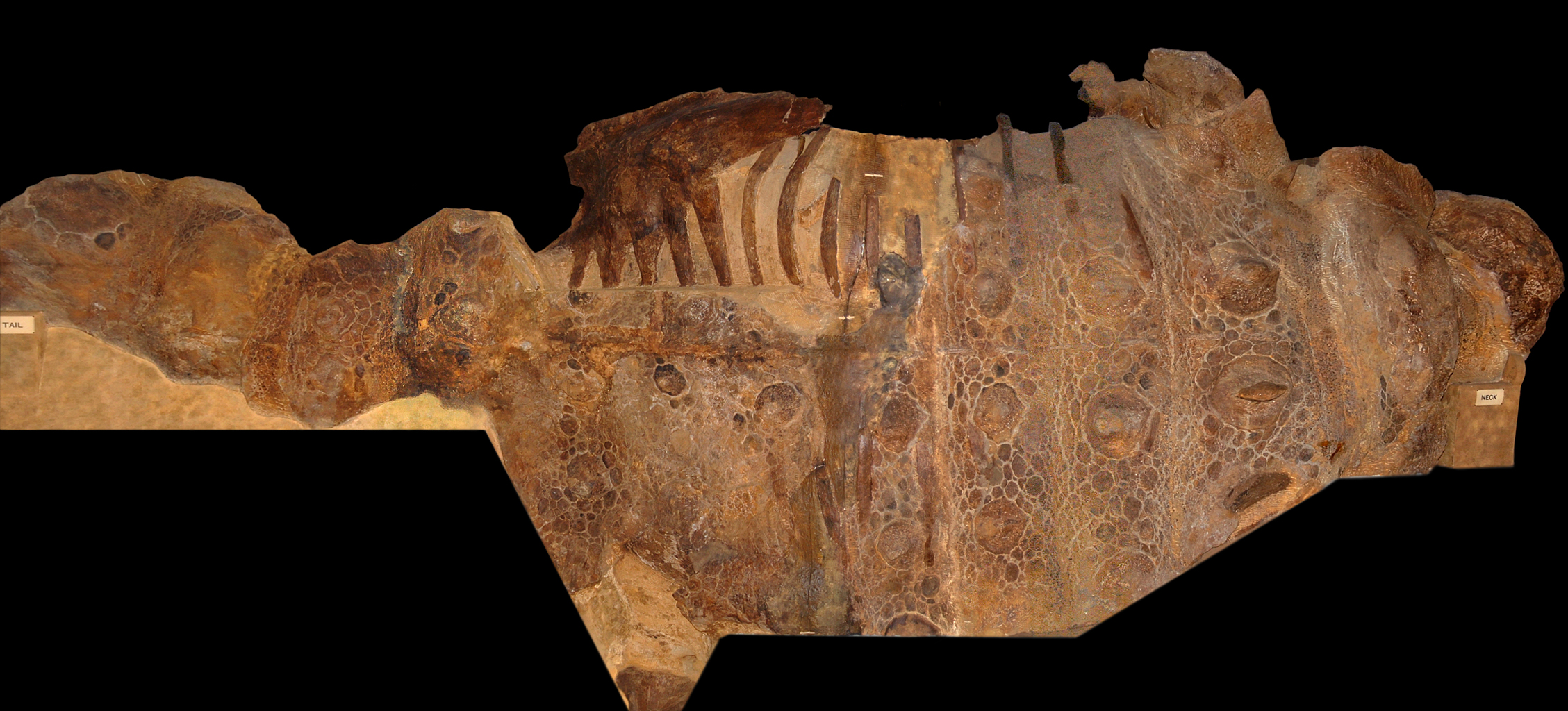
The first dinosaur discovered by Field Museum paleontologists was nothing less than the biggest land animal known at the time. On July 4, 1900, the museum’s first paleontologist Elmer Riggs and his assistant H.W. Menke came upon a set of enormous bones in western Colorado. Riggs—who was specifically hired two years earlier to find dinosaurs for the nascent museum—named the new dinosaur Brachiosaurus altithorax in 1903. The individual bones were set in display cabinets (left image, below) around the same time. Comprising about 25% of the skeleton, Riggs did not consider the find complete enough to assemble into a standing mount. Nevertheless, the museum commissioned a replica Brachiosaurus skeleton about 90 years later, basing the missing pieces on the related Giraffatitan.
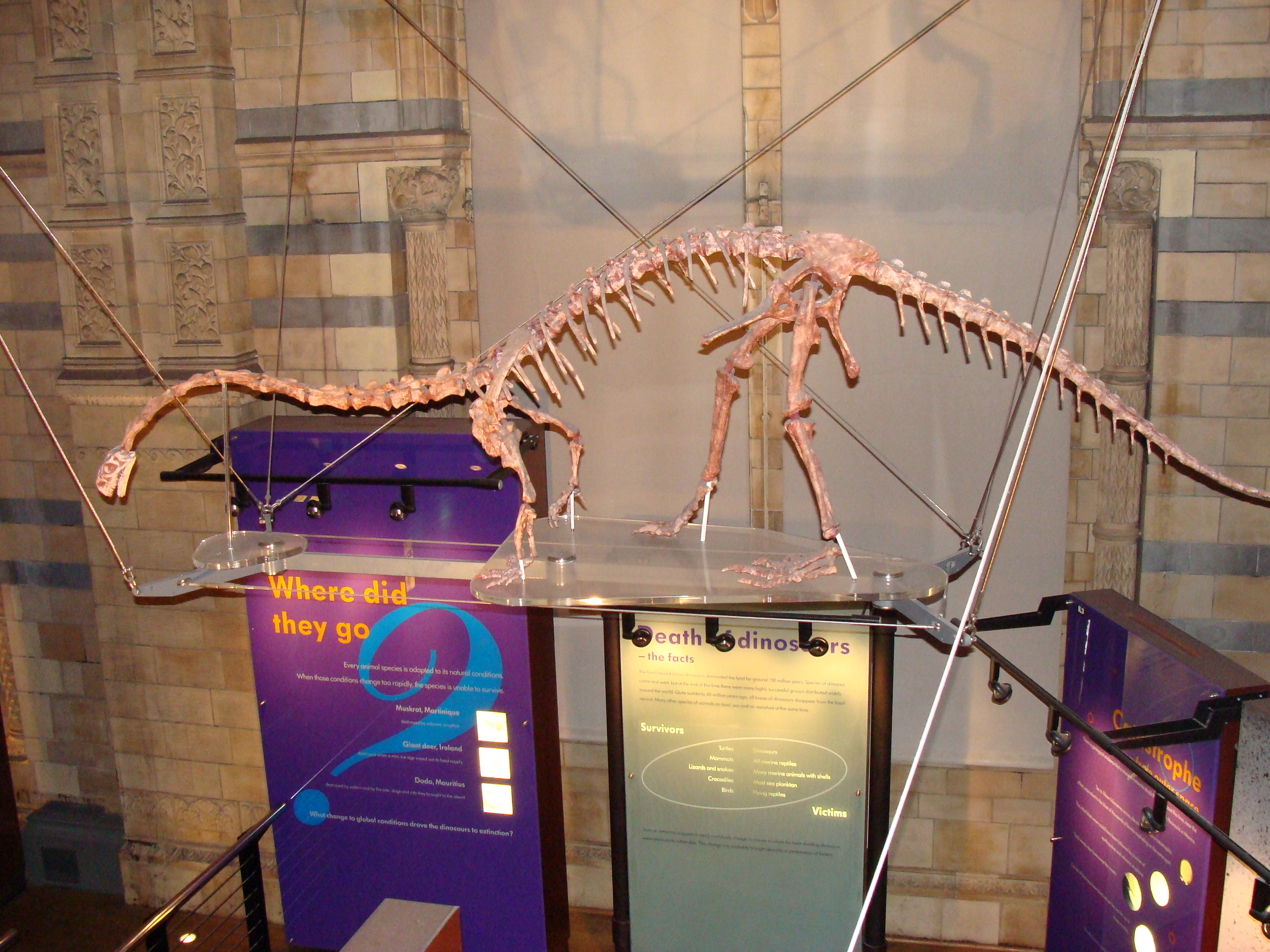
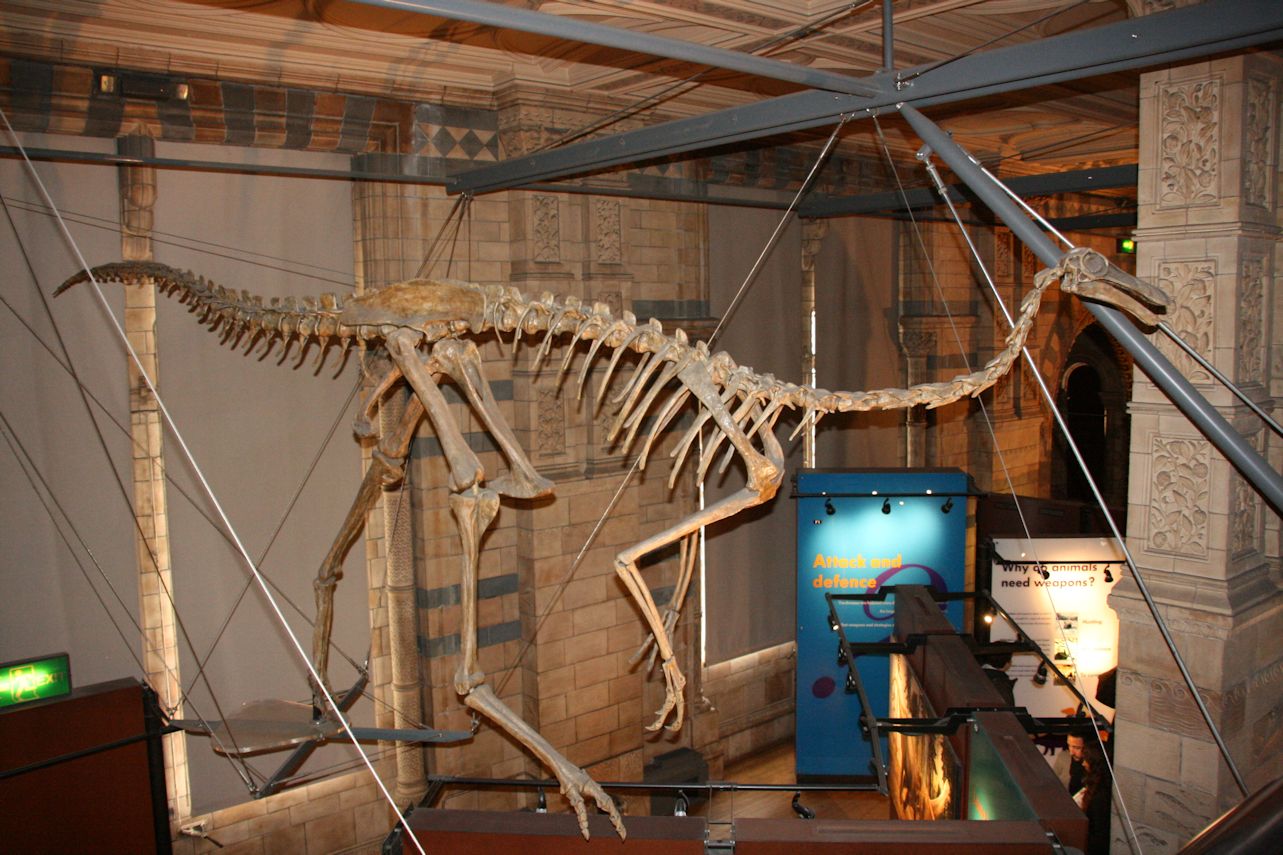
New Brachiosaurus fossils have proven elusive. While several individual bones have been found, the holotype collected by Riggs and Menke remains the most complete example of this famous dinosaur.

Apatosaurus” sp. (P 25112 and P 27021)

The Field Museum’s “Apatosaurus” is a composite of two sauropod specimens, collected 40 years apart. Photos © Field Museum.

Riggs and Menke found another sauropod in western Colorado in 1900, and returned the following year to excavate it. This time, they had the back two-thirds of an apatosaurine sauropod, complete save for the distal portions of the limbs and tail. As museum leaders were unwilling to fund a search for more sauropod material, Riggs mounted the partial skeleton in 1908 (left image, above). 

The sauropod remained in this unfinished state until the 1950s, when preparator Orville Gilpin arranged to acquire another incomplete sauropod. Gilpin had excavated the specimen with Jim Quinn near Moab, Utah in 1941, and knew that it was a perfect complement to the skeleton on display. Long-time museum president Stanley Field (nephew of founder Marshall Field) had repeatedly resisted requests from the paleontology staff to complete the mount, but allegedly relented after overhearing a visitor ask which side of the half-dinosaur was the front. Gilpin built an armature for the neck and shoulders of the newly acquired specimen (right image, above), and finished the mount with casts of Apatosaurus forelimbs and a Camarasaurus skull from the Carnegie Museum of Natural History. The Field Museum finally had a complete sauropod on display, which was unveiled at the April 1958 Members’ Night. 

Apatosaurus” as it is currently displayed in Evolving Planet. Photo by the author.

In 1992, the composite sauropod was dismantled and relocated to the new Life Over Time exhibition on the other side of the building. The museum hired Prehistoric Animal Structures, Inc.—a now-shuttered company specializing in mounting fossil skeletons—to do the work. The updated sauropod debuted in 1994, now posed as though looking at visitors on a nearby elevated walkway. The sauropod remained in place when Life Over Time became Evolving Planet in 2006, though with the walkway gone it now appears to be admiring the Charles Knight murals on the wall.

A note on nomenclature: Riggs identified this skeleton as Apatosaurus, but the label was changed to Brontosaurus in the mid-20th century, when Apatosaurus fell out of common parlance. The name Apatosaurus returned to labels in 1994. However the most recent word on this specimen—from Tschopp et. al 2015—is that it’s not Apatosaurus nor Brontosaurus, but likely another, yet unnamed taxon.

Triceratops horridus (P 12003)

The skull of FMNH P 12003 as it is currently displayed in the SUE gallery. Photo by the author.

In 1904, Riggs moved on from the Jurassic-aged rocks of Colorado to the Cretaceous of Carter County, Montana. Today, this part of southeast Montana is lousy with paleontologists. There’s even an annual shindig for field crews held at the Carter County Museum in Ekalaka. However, Riggs’ expedition was among the first to visit the region from a large museum. The most significant find of the summer was a Triceratops skull and partial skeleton from just west of the Chalk Buttes.

The skull was prepared by 1905 and has been in every iteration of the Field Museum’s paleontology halls. The unusually thick brow horns were recently confirmed to be real bone, but it’s possible that they were originally from another, larger specimen (edit: There is real bone inside the horns, but they are padded with a lot of plaster reconstruction—see comments). The remainder of the skeleton remains in storage.

Gorgosaurus libratus (PR 2211)

Elmer the Gorgosaurus as it was last displayed, in 2017’s Specimens: Unlocking the Secrets of Life. Photo by the author.

Most collecting was paused during World War I, but shortly after the war, Marshall Field III funded new expeditions in all four of the Field Museum’s major research areas (Zoology, Botany, Geology, and Anthropology). Riggs led three of these expeditions, one to Alberta and two to Argentina and Bolivia. Riggs saw the 1922 Alberta trip as something of a practice run, since he hadn’t been in the field in years, and some on his team had never done fieldwork at all. 

Still, the crew was serious about bringing in fossils. Riggs decided to go to the Red Deer River region of Alberta, a place where his former colleague and classmate Barnum Brown had unearthed numerous near-complete dinosaurs for the American Museum of Natural History. Riggs also hired fossil hunter George F. Sternberg, who already knew the area well, to join him on the 14-week expedition.

After returning from Alberta, Riggs was busy getting ready for the upcoming expeditions to South America, and most of the field jackets remained unopened for years, or even decades. One jacket lingered until 1999, when the large team of preparators assembled to prep SUE the T. rex decided to crack it open. 

Inside, they found the virtually complete hips, hindlimbs, and tail of a four-year-old Gorgosaurus, which they named Elmer. Riggs’ notes indicated that the skull ought to have been present, but the preparators only found a few teeth. Further investigation revealed that the partial skull had been in its own jacket with a different number, and that it had been loaned to the University of California at Berkeley in the 1970s. The Berkeley scientists had subsequently lost the fossil, but (fortunately) made a cast of it, which was later returned to the Field Museum. 

Elmer was included in the touring exhibition Dinosaurs: Ancient Fossils, New Discoveries, and most recently in 2017’s Specimens: Unlocking the Secrets of Life. It is currently off exhibit.

Lambeosaurus lambei (PR 380)

Lambeosaurus under prep in 1955. Photo © Field Museum.

According to Riggs, the “prize find” of the 1922 Alberta expedition was a Lambeosaurus found by Sternberg. Even in the field, it was clear that the skeleton was completely intact, save for the head, part of the neck, and the tip of the tail. Sternberg’s field notes indicate that the weathered side included a number of large skin impressions. The Lambeosaurus was jacketed and excavated in eight sections, totaling about three tons of rock and fossil.

Like Elmer the Gorgosaurus, the Lambeosaurus was left unprepared while Field Museum preparators focused on the fossils from South America. In 1947, the University of Chicago closed its geology museum and donated its collections to the Field Museum, pushing the Alberta fossils even further down the queue. Stanley Kuczek finally prepared the Lambeosaurus in 1954, when it was slated to be paired with Daspletosaurus in a new display (more below).

Kuczek prepared only the unweathered (face-down in the field) side of the skeleton, so the skin impressions Sternberg reported are still embedded in the matrix under the fossil. A Lambeosaurus skull from the University of Chicago collection (UC 1479) was used to complete the display. Sternberg’s Lambeosaurus remains the most complete non-bird dinosaur at the Field Museum, and a (perhaps unsung) highlight of the collection.

Daspletosaurus torosus (PR 308)

Nathan Cochran recently rediscovered the original “Gorgosaurus” and Lambeosaurus label, as seen in this image. Check it out here. Photo © Field Museum.

The Field Museum’s Daspletosaurus, sometimes called “Gorgeous George,” was collected by Barnum Brown of the American Museum of Natural History in 1914. It came from the same region of Alberta that Riggs and company would visit eight years later. At the time, the partial skeleton was considered an example of Gorgosaurus, of which the New York museum already had three. In 1955, Field Museum board member Louis Ware offered to buy the American Museum’s spare tyrannosaur, and soon the fossil was on its way to Chicago.

Orville Gilpin mounted the skeleton—which has been known as Daspletosaurus since 1999—for display. He elected to create a completely free-standing mount, with no visible armature. This required drilling through each of the vertebrae to thread a steel pipe through, as well as splitting the right femur. These destructive practices would never be undertaken today, but in the mid 20th century, dinosaurs were seen as display pieces first and scientific specimens second.

Daspletosaurus in Evolving Planet. Photo by the author.

Like the “Apatosaurus,” Gorgeous George was revealed to the public during Members’ Night. The skeleton was placed at the south end of the museum’s central Stanley Field Hall, standing over Sternberg’s Lambeosaurus as though it had just brought down the herbivore. In 1992, Prehistoric Animal Structures, Inc. remounted the Daspletosaurus in a more accurate horizontal posture, once again poised over its Lambeosaurus prey. The real skull has never been mounted on the skeleton, but it is currently on display near the museum’s east entrance.

Parasaurolophus cyrtocristatus (P 27393)

Parasaurolophus in Evolving Planet. Photo by the author.

The Parasaurolophus cyrtocristatus holotype was found by Charles Sternberg (father of George) in 1923, near Fruitland, New Mexico. It made it to the Field Museum through a series of exchanges, but was not prepared until the 1950s. John Ostrom published a description of the skeleton and partial skull in 1961, noting that it was nearly identical to Parasaurolophus walkeri from Alberta, except for the crest on the back of its head. While P. walkeri has a long, backward-projecting crest, the New Mexico species has a short crest that curves downward.

The Parasaurolophus was first exhibited in 1994, as part of Life Over Time. The 70% complete skeleton was mounted directly to a wall, with illustrations of the missing bones behind it. Ten years later, Research Casting International was brought in to turn the Parasaurolophus into a complete standing mount. Like most modern mounts, the armature is designed so that each bone can be removed individually for study or conservation. Captured in a graceful walking pose, the Parasaurolophus is—in my opinion—the most elegant and evocative dinosaur mount at the Field Museum.

References

Brinkman, P. 2000. Establishing vertebrate paleontology at Chicago’s Field Columbian Museum, 1893–1898. Archives of Natural History 27:81–114.

Brinkman, P. 2010. The Second Jurassic Dinosaur Rush: Museums and Paleontology in America at the Turn of the 20th Century. Chicago: University of Chicago Press.

Brinkman, P. 2013. Red Deer River shakedown: a history of the Captain Marshall Field paleontological expedition to Alberta, 1922, and its aftermath. Earth Sciences History 32:2:204-234. 

Erickson, G.M, Makovicky, P.J., Currie, P.J., Norell, M.A., Yerby, S.A., and Brochu, C.A. 2004. Gigantism and life history parameters of tyrannosaurid dinosaurs. Nature 430:722–775.

Forster, C.A. 1996. Species resolution in Triceratops: cladistic and morphometric approaches. Journal of Vertebrate Paleontology 16:2:259–270.

Gilpin, O. 1959. A free-standing mount of Gorgosaurus. Curator: The Museum Journal 2:2:162–168.

Ostrom, J.H. 1961. A new species of hadrosaurian dinosaur from the Cretaceous of New Mexico. Journal of Paleontology 35:3:575–577.

11 Comments

Filed under dinosaurs, exhibits, field work, FMNH, fossil mounts, history of science, museums, ornithopods, sauropods, theropods

Ernestine lives!

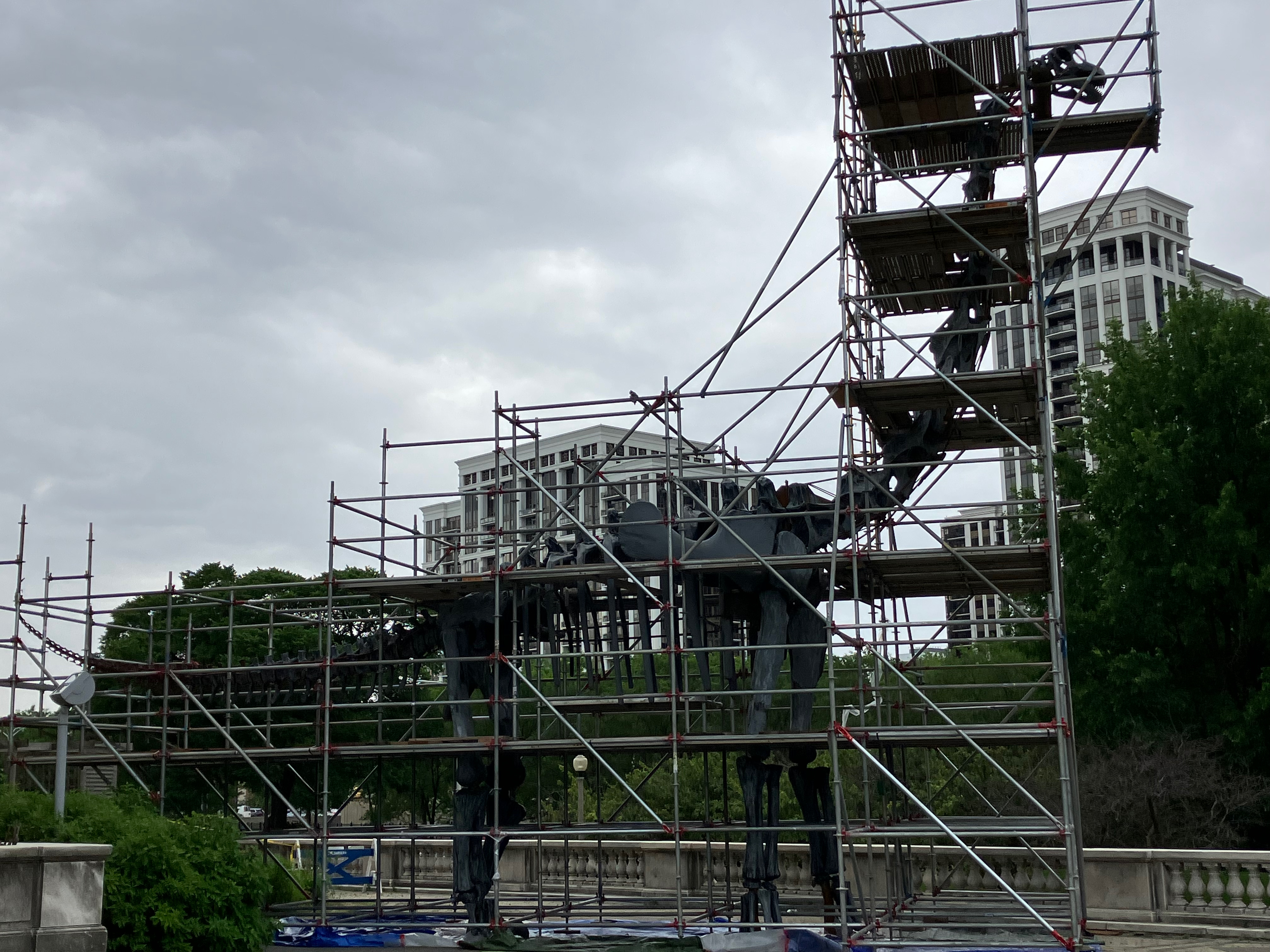
A scaffold of foreboding surrounds the Brachiosaurus cast. Photo by the author.

Earlier this year, the Brachiosaurus cast skeleton that stood on the Field Museum’s northwest terrace was retired. On display for 23 years (and 23 brutal Chicago winters), the replica was suffering from a rusting armature and extensive cracking. Deemed structurally unsound, it was dismantled the week of June 12. Though we lament the loss of the long-necked sentinel over DuSable Lake Shore Drive, the legacy of Brachiosaurus—the Field Museum’s first dinosaur—lives on.

The story of Brachiosaurus begins with the museum’s founding, nearly 130 years ago. The Field Columbian Museum opened in Chicago on June 2, 1894 as a permanent home for the collection assembled at the previous year’s World Columbian Exposition. While the collection boasted thousands of zoological, botanical, anthropological, and geological objects, it had but a single dinosaur: a replica skeleton of Hadrosaurus. Based on the original at the Philadelphia Academy of Natural Sciences, the model was badly out of date by the 1890s. Oliver Farrington, the Field’s original geology curator, considered it an embarrassment and petitioned director Frederick Skiff to hire a vertebrate paleontology specialist to collect better material. Skiff passed the request on the board, but was denied—with a building full of uncataloged specimens, they saw no need to obtain anything new.

The board changed their minds in 1898, when the Carnegie Museum and American Museum of Natural History announced plans to find sauropod dinosaurs for display. The resume of Elmer Riggs, a recent University of Kansas graduate with ample fossil hunting experience, happened to be on Skiff’s desk, and so Riggs was hired to collect dinosaurs for the museum.

The Brachiosaurus site in summer 1900. This excavation was particularly well-documented, thanks to Menke’s long-exposure, plate glass photographs. Photo © Field Museum, CC BY-NC.

In 1900, Riggs was prospecting near Grand Junction, Colorado with assistant Harold William Menke and camp cook Victor Dames. Their quarry was an exhibit-worthy specimen of Brontosaurus, the largest known dinosaur at that time. On July 4, Menke made a promising find: a giant limb bone that was the right size to be a Brontosaurus femur. The group began excavating and eventually revealed additional limb bones, nine-foot ribs, an articulated series of dorsal vertebrae, the sacrum, and a scattering of other bones. The course-grained, pebbly matrix suggested burial in a fast-moving river, which probably swept away the missing parts. All told, they had about 25% of a skeleton—not enough to mount for display but still worth collecting.

Once the fossils were back at the museum and undergoing preparation, Riggs confirmed something he had probably suspected in the field. Menke’s six-foot, seven-inch limb bone wasn’t a femur, it was a humerus. The humerus of Brontosaurus was well under five feet, so this animal was substantially larger. With his 1903 publication introducing Brachiosaurus altithorax to the world, Riggs emphasized its record size—and encouraged the press to make a meal of it.

Brachiosaurus was a win for the Field Museum: the first newly described dinosaur to come out of the nascent institution was also the biggest ever (a title Brachiosaurus would hold for the better part of the century). But while many of the individual bones were put on display in 1908, the holotype wasn’t complete enough to assemble into a standing mount. Instead, another find from Riggs’ 1900 Colorado expedition—the Fruita Apatosaurus—became the museum’s first mounted sauropod.

When the Field Museum was exploring the idea to create a complete replica Brachiosaurus, an unknown staffer (“M”) drew up this illustration to show how much would need to be reconstructed. This image is stitched together from multiple scans.

It would be almost ninety years before the museum revisited the prospect of putting Brachiosaurus on display. In the early 1990s, the Exhibitions department was hard at work remaking its paleontology halls from the ground up. This project would eventually open as Life Over Time in 1994, but in the meantime it was agreed that a showstopping symbol was needed outside the exhibit proper.

That showstopper could only be Brachiosaurus. The Field Museum hired Prehistoric Animal Structures, Inc.—a now-shuttered company specializing in mounted fossil skeletons—to make it happen. Commonly abbreviated as PAST, the company was founded by Gilles Danis, who previously created many of the Royal Tyrell Museum’s opening day exhibitions.

Fortunately for Danis and his team, there was more Brachiosaurus (and Brachiosaurus adjacent) fossil material to work with then in Riggs’ day. A handful of specimens referred to Brachiosaurus altithorax (mostly individual bones) had since turned up in the western United States, but the bulk of information came from a pair of Tanzanian skeletons. In 1914, German paleontologist Warner Janensch determined that these specimens were a second species of BrachiosaurusBrachiosaurus brancai. More recently, the Tanzanian brachiosaur has been moved to its own genus, and is now known as Giraffatitan brancai. While there are a number of key differences, Giraffatitan and Brachiosaurus are one another’s closest known relatives, making the former a reasonable reference for the unknown parts of the latter.

Ernestine the Brachiosaurus in Stanley Field Hall. Photo © Field Museum.

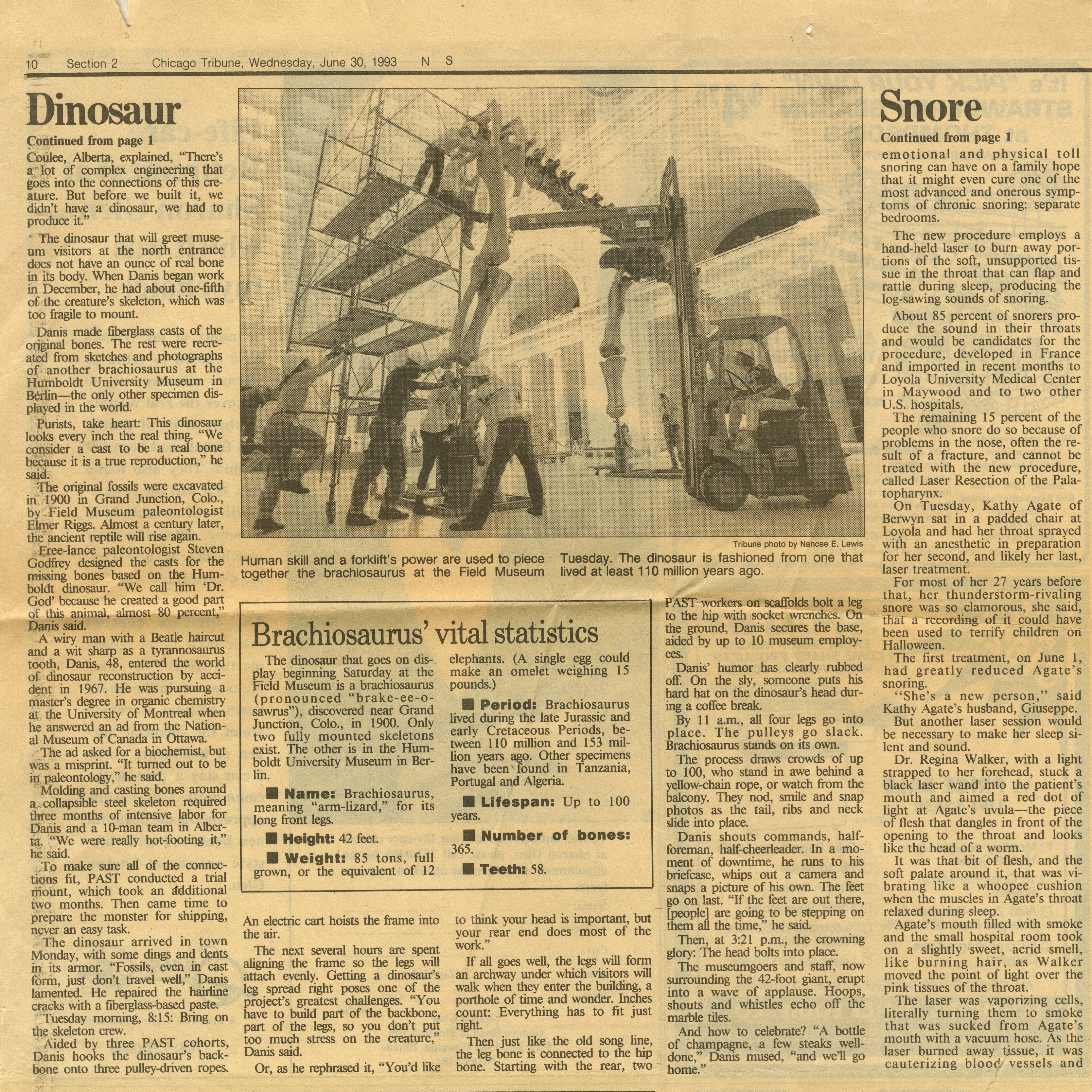
To reconstruct Brachiosaurus for the Field Museum, the PAST crew started by taking molds of the Brachiosaurus holotype bones. Next, Danis and Donna Sloan traveled to the Museum für Naturkunde in Berlin, where the Giraffatitan fossils are housed. While they were not allowed to make casts, Danis and Sloan took extensive measurements. Stephen Godfrey used this information to sculpt the missing parts of Brachiosaurus, including the head, neck, tail, and feet.

A few adjustments were made along the way. First, the PAST crew inflated the limb bones slightly, so that the steel armature would fit inside. Second, the museum wanted visitors to be able to walk under the Brachiosaurus, but its torso wasn’t quite long enough to meet the minimum fire egress requirements. PAST solved the problem by quietly duplicating two of the vertebrae in the dorsal series. In an amusing twist, these stretch-limo proportions may have inadvertently been correct. Danis named the finished replica Ernestine, because “Ernestine is an awkward name and Brachiosaurus is an awkward-looking thing.”

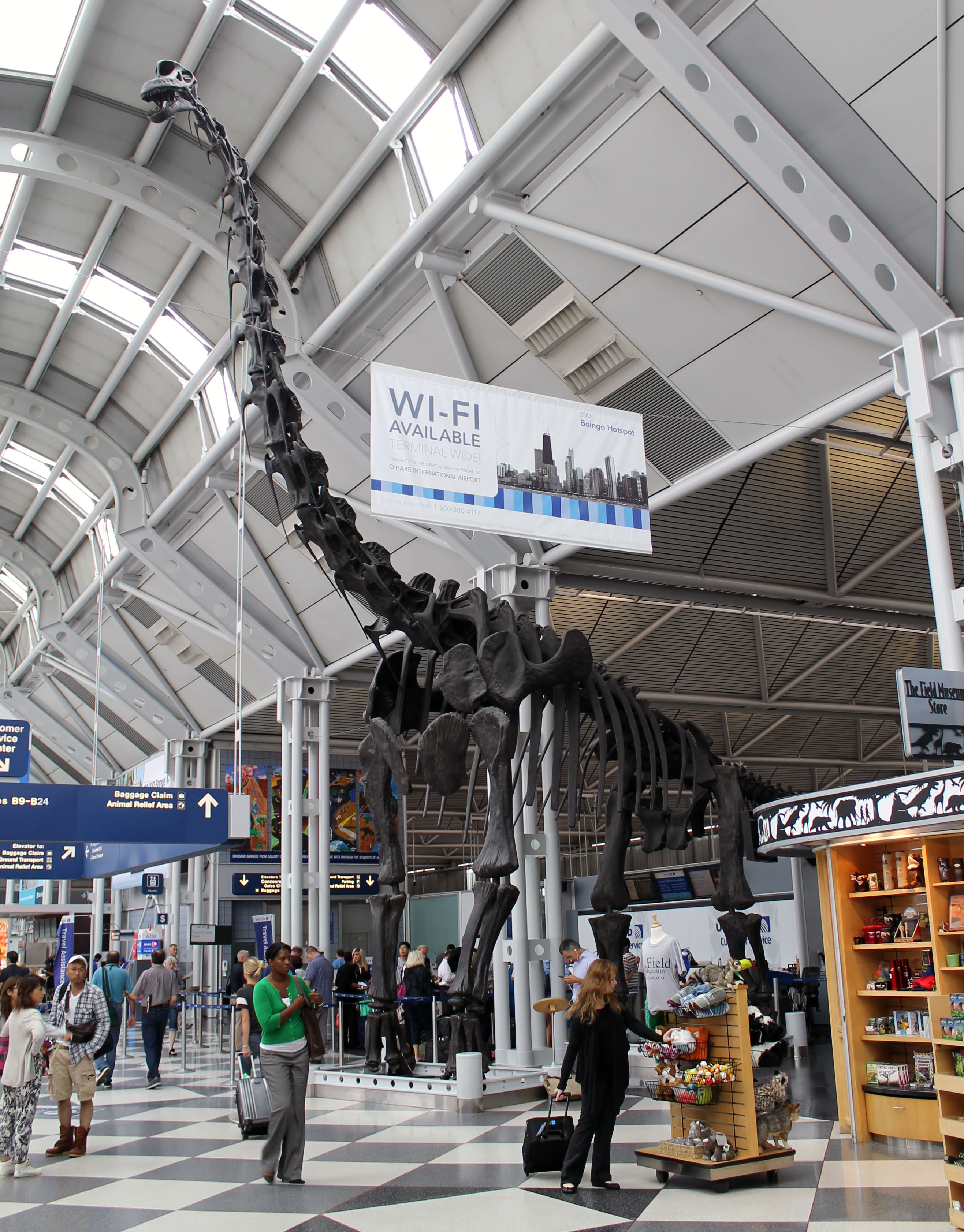
Ernestine the Brachiosaurus has stood in the United terminal at O’Hare since 1999. Photo by the author.

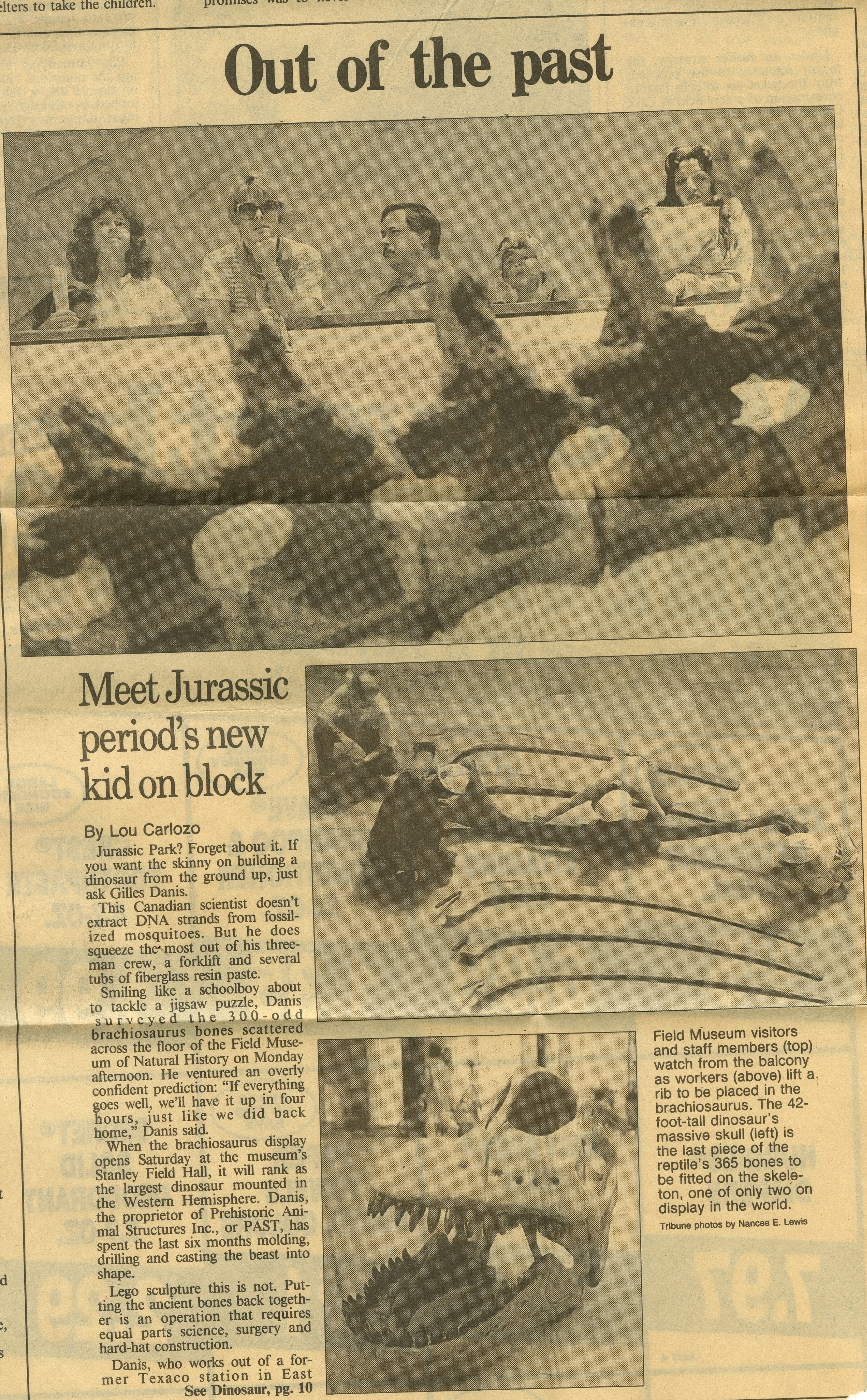
On June 29, 1993 (a Tuesday), Danis, three PAST crew members, and six Field Museum staffers assembled Ernestine in the museum’s central Stanley Field Hall. Reporters from the Chicago Sun-Times and Tribune were present to document the construction (scans of these articles are at the end of this post). Seven hours later, Brachiosaurus was complete, on its feet for the first time in 152 million years. At 41 feet tall, the replica skeleton was tall enough to peer over the second floor mezzanine and into the entrance to Life Over Time.

By coincidence, Ernestine’s debut was less than three weeks after the release of Jurassic Park—which happened to feature a Brachiosaurus in an iconic opening scene. The film quickly became the highest-grossing of all time, and launched a global wave of dino-mania. While he was busy finishing up and installing the Brachiosaurus, Danis was fielding calls left and right for his services. Even hotels were inquiring about putting dinosaur skeletons in their parking lots. His response? “If they can put up the cash for them, we’ll put them up!”

The outdoor Brachiosaurus on a rare sunny day. Photo by the author.

Ernestine’s stint in Stanley Field Hall wound up being short-lived. The Field Museum acquired SUE the Tyrannosaurus in 1997, and the mounted skeleton took the sauropod’s place in May 2000. Ernestine was relocated to O’Hare International Airport, where it remains today. Meanwhile, the museum commissioned a second Brachiosaurus replica to be displayed outdoors. Made from durable, all-weather plastic resin, the outdoor Brachiosaurus stood on the northwest terrace for the next 23 years. Notably, it outlasted SUE’s time in Stanley Field Hall: the Tyrannosaurus was relocated to its own gallery in 2018, and a cast of the Argentinian sauropod Patagotitan now occupies the Field Museum’s central space.

The Brachiosaurus display in the Field Museum’s Science Hub includes parts of the holotype, a replica skull, and more. Photo by the author.

Now that the outdoor Brachiosaurus replica has been retired, it’s fair to ask what’s next for the Field Museum’s first dinosaur. Ernestine will remain at the airport for the foreseeable future, but plans for the northwest terrace have not yet solidified. In the meantime, a popup exhibit rhapsodizing Brachiosaurus recently opened in the Science Hub—a rotating exhibit space where interpreters are always present. I was happy to write the labels for this display, which tells the story of Brachiosaurus from its discovery to the removal of the outdoor skeleton (in far fewer words than this post). The exhibit includes the sculpted skull of the outdoor Brachiosaurus and parts of the holotype—including the tail vertebrae, which haven’t been on public view since the 1920s. Be sure to stop by if you’re in the area, but be quick: Science Hub exhibits typically last only six months or so.

References

Brinkman, P.D. 2010. The Second Jurassic Dinosaur Rush: Museums and Paleontology in America at the Turn of the Twentieth Century. University of Chicago Press: Chicago, IL.

Engh, B. 2020. We Found a Brachiosaurus.

Riggs, E.S. 1903. Brachiosaurus: The Largest Known Dinosaur. American Journal of Science 4:15:299-306.

Simpson, W. 2022. Pers. comm.

Taylor, M.P. 2009. A re-evaluation of Brachiosaurus altithorax Riggs 1903 (Dinosauria, Sauropoda) and its generic separation from Giraffatitan brancai (Janesch 1914). Journal of Vertebrate Paleontology 29:3:787-806.

Taylor, M.P. 2014. Giles Danis of PAST on the Chicago Brachiosaurus mount.

Leave a comment

Filed under dinosaurs, exhibits, field work, FMNH, fossil mounts, history of science, movies, museums, reptiles, sauropods

The dinosaurs of London’s Natural History Museum

Founded in 1881 as an offshoot of the British Museum, the Natural History Museum (NHM) in London is one of the world’s best-known and most-visited museums. For millions of visitors from the UK and abroad each year, NHM provides their first—sometimes only—opportunity to see a full-sized dinosaur skeleton in person. That makes the collection of dinosaurs on display uniquely important: each one is an ambassador to paleontological science and the deep history of the Earth.

For your reference and mine, what follows is a brief introduction to NHM’s dinosaurs. Please note that I have not been to NHM and this information is based on references available online.

Diplodocus carnegii (Dippy)

dip_london_2014

For 36 years, Dippy greeted visitors in Hintze Hall. Source

Most readers are probably familiar with the story of Dippy the Diplodocus. In 1898, industrialist and philanthropist Andrew Carnegie funded an expedition to find a sauropod dinosaur for the newly-founded Carnegie Museum of Natural History. The Diplodocus the team uncovered the following summer was—and still is—one of the most complete sauropod skeletons ever found. Nevertheless, Carnegie lost the race for the first mounted sauropod on permanent display: the American Museum of Natural History unveiled its composite Apatosaurus in March of 1905, while the Carnegie Museum building was still unfinished. Not to be bested by the New York competition, Carnegie offered a complete plaster cast of the Diplodocus to King Edward VII. The replica known today as Dippy went on display in London that May. Carnegie went on to produce seven additional Diplodocus casts, and more have been created since his death in 1919.

Whether we consider all versions or just the London cast, Dippy’s cultural impact is astounding. As Nieuwland writes, “Carnegie’s series of casts—and the political gesture of their donations—turned [Dippy] into a contested and open-ended object that existed at the crossroads of several interacting (social, political, cultural, scientific) domains.” The intersection of political intrigue and gossip with the sensational nature of the specimen itself resulted in a cascade of media attention, political cartoons, and eventually even films. At least in Europe, Dippy can be believably said to be the specimen that made “dinosaur” a household word.

In 1979, Dippy was moved to NHM’s cavernous entryway, called Hintze Hall. The cast served as the museum’s mascot and most iconic object until 2015, when it was replaced with a blue whale skeleton. Dippy’s time in the limelight was not over, however. The original cast was retrofitted for the traveling exhibition Dippy on Tour, and a bronze duplicate may one day be installed outside NHM.

Triceratops sp.

nhmtriceratops

Triceratops replica skeleton at the Natural History Museum. Source

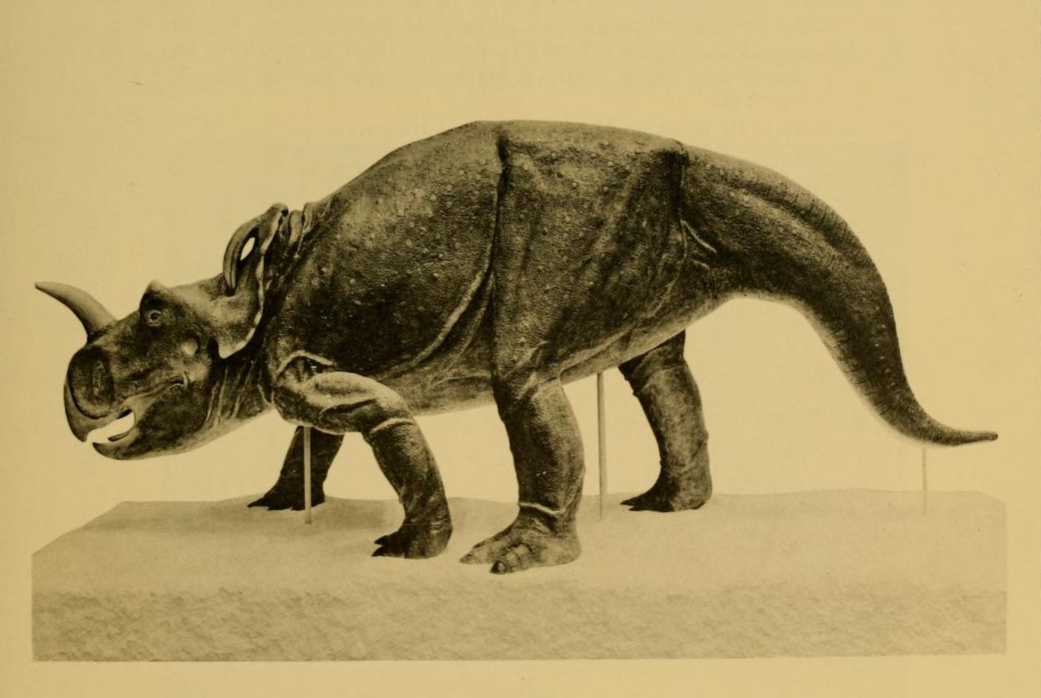
This Triceratops is not an original skeleton or a cast—it’s a papier mâché model. Frederic Lucas of the United States National Museum (now the National Museum of Natural History) created this replica in 1900 for the Smithsonian display at the Pan-American Exhibition in Buffalo, New York. He likely used O.C. Marsh’s published illustration of a Triceratops skeleton as his primary reference. The model made a second appearance at the 1904 Louisiana Purchase Exposition in St. Louis, Missouri, but was rendered obsolete shortly thereafter when Charles Gilmore finished the world’s first real Triceratops mount in 1905. While constructing the skeleton, Gilmore learned that Marsh and Lucas’s straight-legged interpretation was physically impossible—Triceratops actually had partially sprawling forelimbs.

Nevertheless, exhibit models like this rarely go waste. Two years later, NHM received Lucas’s model as a gift from USNM. It has been on nearly continuous display ever since.

Iguanodon bernissartensis

Iguanodon_bernissartensis

The Belgian Iguanodon cast as it appears today.Source

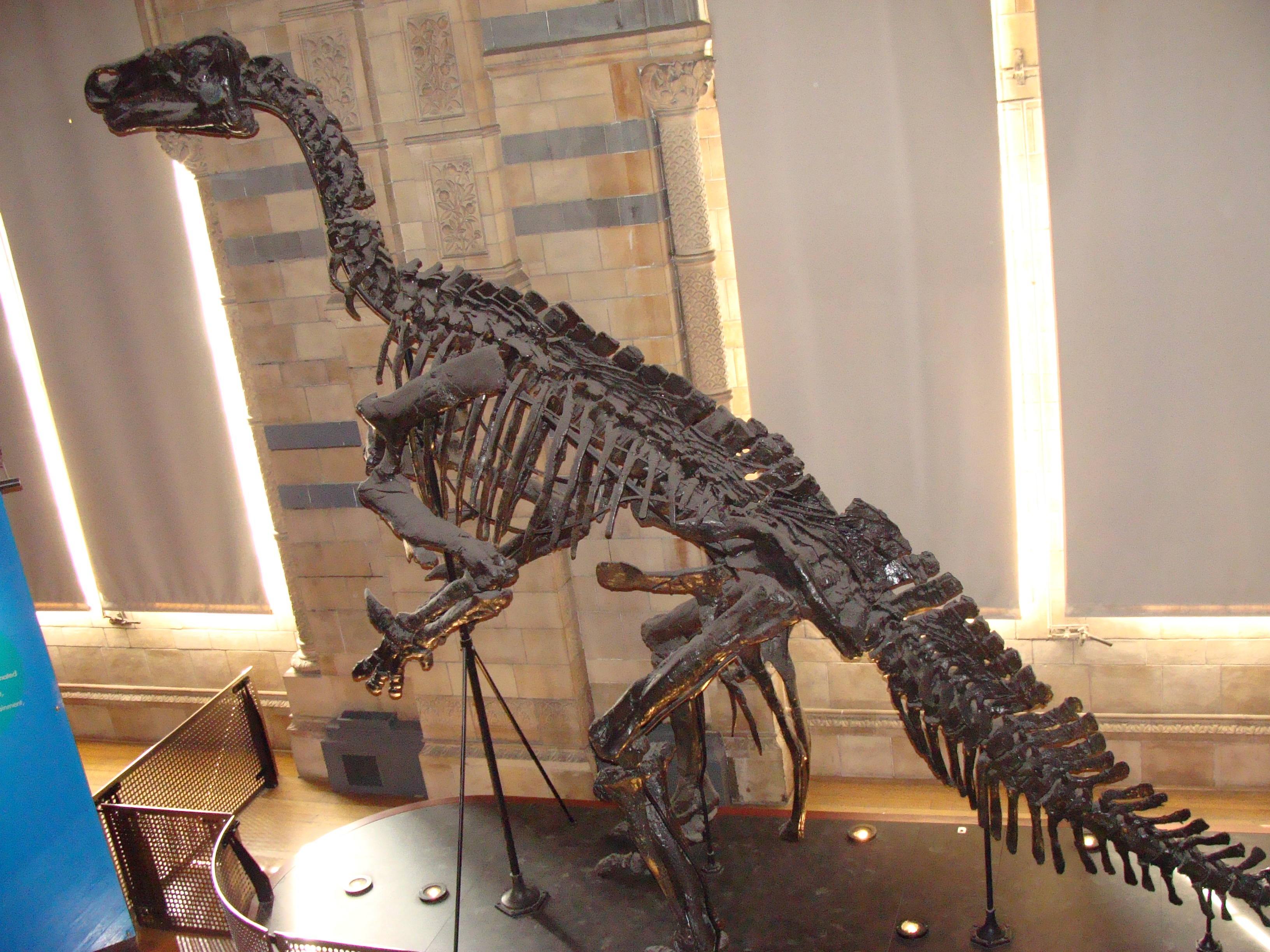
In 1878, coal miners in western Belgium discovered a clay deposit dense with Iguanodon fossils. A crew from the Belgian Royal Museum of Natural History (now the Belgium Museum of Natural Sciences) excavated dozens of skeletons, and in 1882 Louis De Pauw and Louis Dollo took on the task of assembling the best examples into standing mounts. De Pauw distributed casts of the largest and most complete individual to several institutions around Europe, including NHM (sources differ on whether the NHM cast arrived in 1895 or 1905).

While Dippy is made up of individual plaster casts of each bone, the Iguanodon was molded and cast in a handful of large sections. This means that the skeleton cannot be easily reassembled into a horizontal pose, and must remain a relic of an earlier era in our understanding of dinosaur posture.

Hypsilophodon foxii

hypsybeforeafter

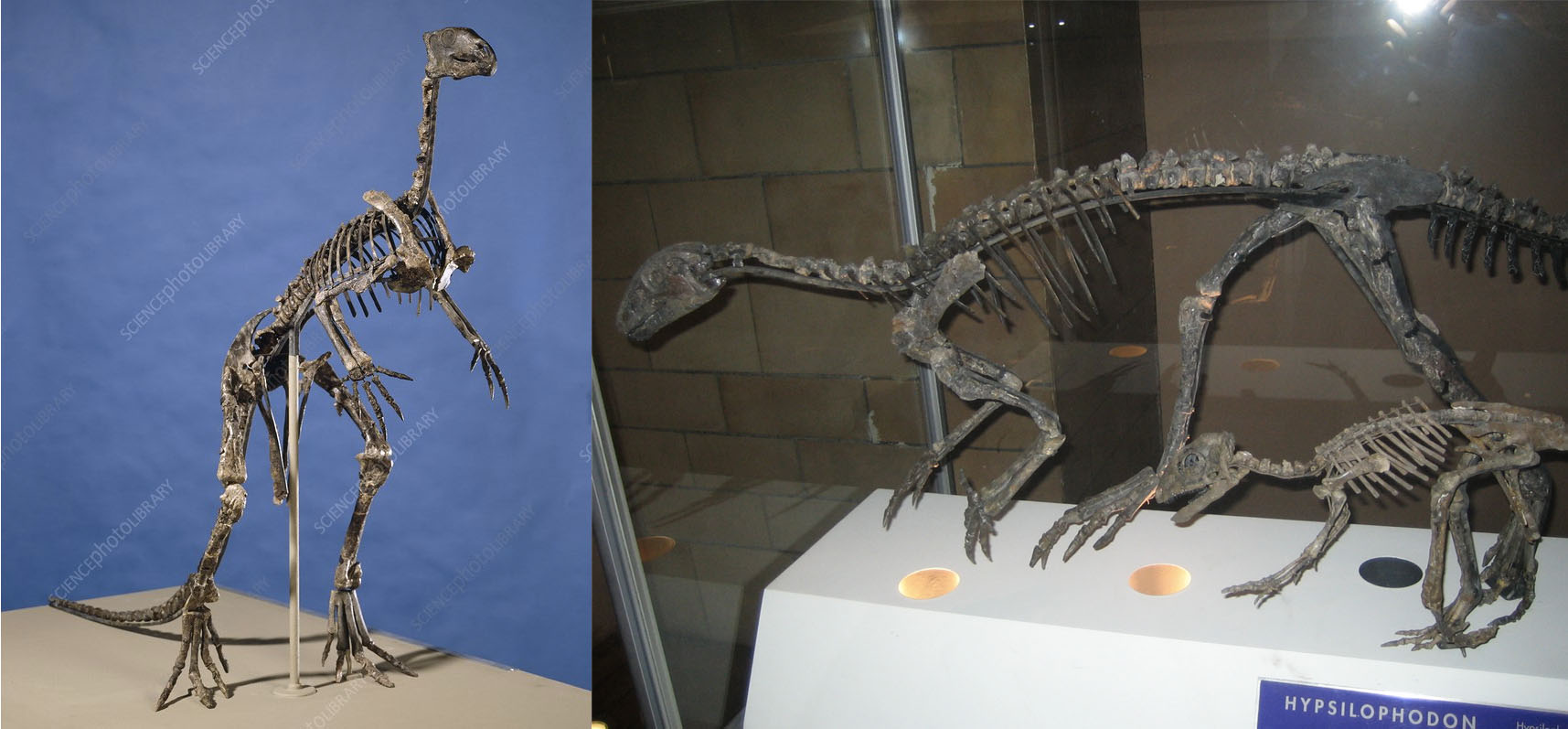
Nearly all known Hypsilophodon fossils come from the”Hypsilophodon bed,” part of the Wessex Formation on the Isle of Wight. More than a hundred articulated skeletons have been found in this mudstone layer, including NHM’s mounted pair. These particular individuals were collected by Reginald Hooley, an avocational fossil collector who also described and published several new species. The bulk of Hooley’s collection was sold to NHM in 1924, shortly after his death.

The larger Hypsilophodon (R5829) was mounted in 1934 by preparators Louis Parsons and Frank Barlow, in an upright, tail-dragging pose that closely mirrored the Belgian Iguanodon. This mount remained on display until the early 1990s, when the specimen was remounted for the 1992 dinosaur hall. Nigel Larkin and colleagues adapted the original iron armature to give the skeleton its correct horizontal posture. A juvenile Hypsilophodon (R5830) from the Hooley collection was also mounted at this time, using a cast Orodromeus skull provided by the Museum of the Rockies. Both Hypsilophodon mounts remained on display until 2016, when they were removed due to conservation concerns.

Mantellisaurus atherfieldensis

mantellibeforeafter

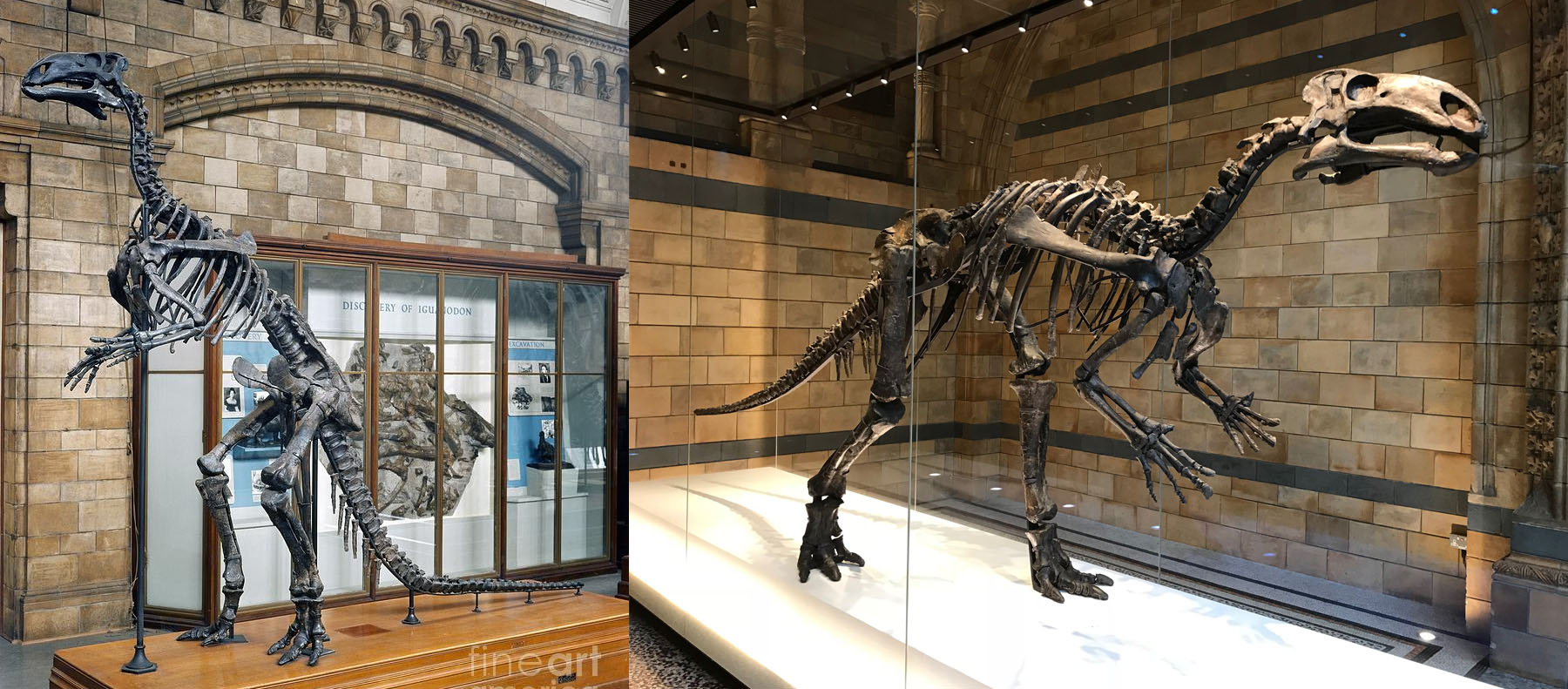
The centerpiece of the 1924 Hooley acquisition is the holotype skeleton (R5764) of Mantellisaurus atherfieldensis, known at the time as Iguanodon atherfieldensis. Hooley found the 85% complete skeleton in 1914 on the Isle of Wight, in several blocks that had already eroded out of a cliff. It was—and still is—the most complete dinosaur skeleton found in the UK. Like the Hypsilophodon, the Mantellisaurus was originally mounted in the 1930s with a kangaroo-like posture. It was remounted for the 1992 exhibit in a horizontal walking pose.

More recently, the Mantellisaurus was moved to the redesigned Hintze Hall, part of a small selection of iconic specimens that represent the NHM’s collections and research areas. As an exceptionally complete, local dinosaur, it was a natural choice to represent vertebrate paleontology at the museum. In 2019, paleontologist Susannah Maidment and preparator Mark Graham spent four days temporarily dismantling the Mantellisaurus mount and digitizing every bone for future research.

Scolosaurus cutleri

Scolosaurus

The complete Scolosaurus fossil. Image courtesy of the National History Museum, CC BY.

Another remarkable real specimen in the NHM collection is the Scolosaurus holotype (R5161). This fossil includes nearly the entire animal intact and in situ, including its osteoderms and some skin impressions. Only the head, the end of the tail, and two limbs are missing.

The Scolosaurus was found by fossil hunter William Cutler in 1914. After moving to Alberta from the UK, Cutler found work on Barnum Brown’s field expeditions before setting out as an independent collector. Cutler had a reputation for reckless behavior in the field, and often worked alone. Excavating the Scolosaurus was a case in point: it collapsed on him while he was undercutting the jacket.

NHM purchased the Scolosaurus in 1915, and Parsons set to work preparing the fossil straightaway. It has been on near-continuous display since 1929.

Cutler was hired by NHM again in 1925 to search for dinosaurs in Tanzania. Among his party was none other than Louis Leakey, on his first field season. Tragically, Cutler contracted malaria and died in the field at age 47.

Massospondylus carinatus

massospondylus

Like most of the dinosaurs in the 1992 exhibit, Massospondylus stands on a platform over visitors’ heads. Source

In 1962, NHM acquired a nearly complete, unarticulated Massospondylus cast from the South African Museum in Cape Town. Some time later, William Lindsay and colleagues mounted it for a temporary exhibition at the City of Plymouth Museum. The mount has an unusual supporting armature, composed of short, glass-reinforced epoxy tubes. Since each section of tube fits tightly into the next, the mount can be assembled without the use of adhesives. The Massospondylus was repurposed for the 1992 dinosaur hall, where it remains today.

Gallimimus bullatus

nhm27

At 18 feet long, Gallimimus is bigger than you think. Source

Like Massospondylus, this Gallimimus arrived at NHM as an unarticulated cast in an exchange with a peer institution, in this case the Polish Academy of Sciences. The original skeleton was discovered on a Polish-Mongolian joint expedition led by trailblazing paleontologist and all-around incredible person Zofia Kielan-Jaworowska.

When NHM was beginning work on the 1992 dinosaur hall, the fossil prep team elected to hire Research Casting International to mount the Gallimimus. Rather than using the plaster casts, RCI made a plastic duplicate of each bone and assembled them on an aluminum armature. The skeleton’s running pose meant that the mount’s weight had to be carefully managed. All the weight rests on the left leg, which was molded around a 22-pound steel rod to compensate.

Lindsay reports that the decision to display most of the dinosaurs on elevated platforms was not made until after most of the mounts were finished. This wasn’t an issue for the smaller, more stable skeletons, but the Gallimimus was heavy and awkward enough that the tensioned steel cables holding up its platform had to be adjusted and readjusted as the skeleton was assembled.

Baryonyx walkerii

baryonyx_nhm

A relief-mounted cast of Baryonyx, created in-house at NHM. Source

In January of 1983, William Walker discovered a large claw in a brick pit. NHM paleontologists Angela Milner and Alan Charig traveled to the site in southern England that summer to look for more. What they found was a carnivorous dinosaur unlike any other, with a crocodilian snout and smooth, straight teeth for snagging fish. Named Baryonyx walkeri, this specimen (R9951) is the only confirmed example of the species yet found.

The Baryonyx was found in particularly hard matrix loaded with iron ore, and as a result took nearly ten years to prepare, mold, and cast. A relief mount was completed just in time for the opening of the 1992 dinosaur hall.

Stegosaurus stenops (Sophie)

Sophie the Stegosaurus greets visitors in Earth Hall, at the museum’s east entrance.
Source

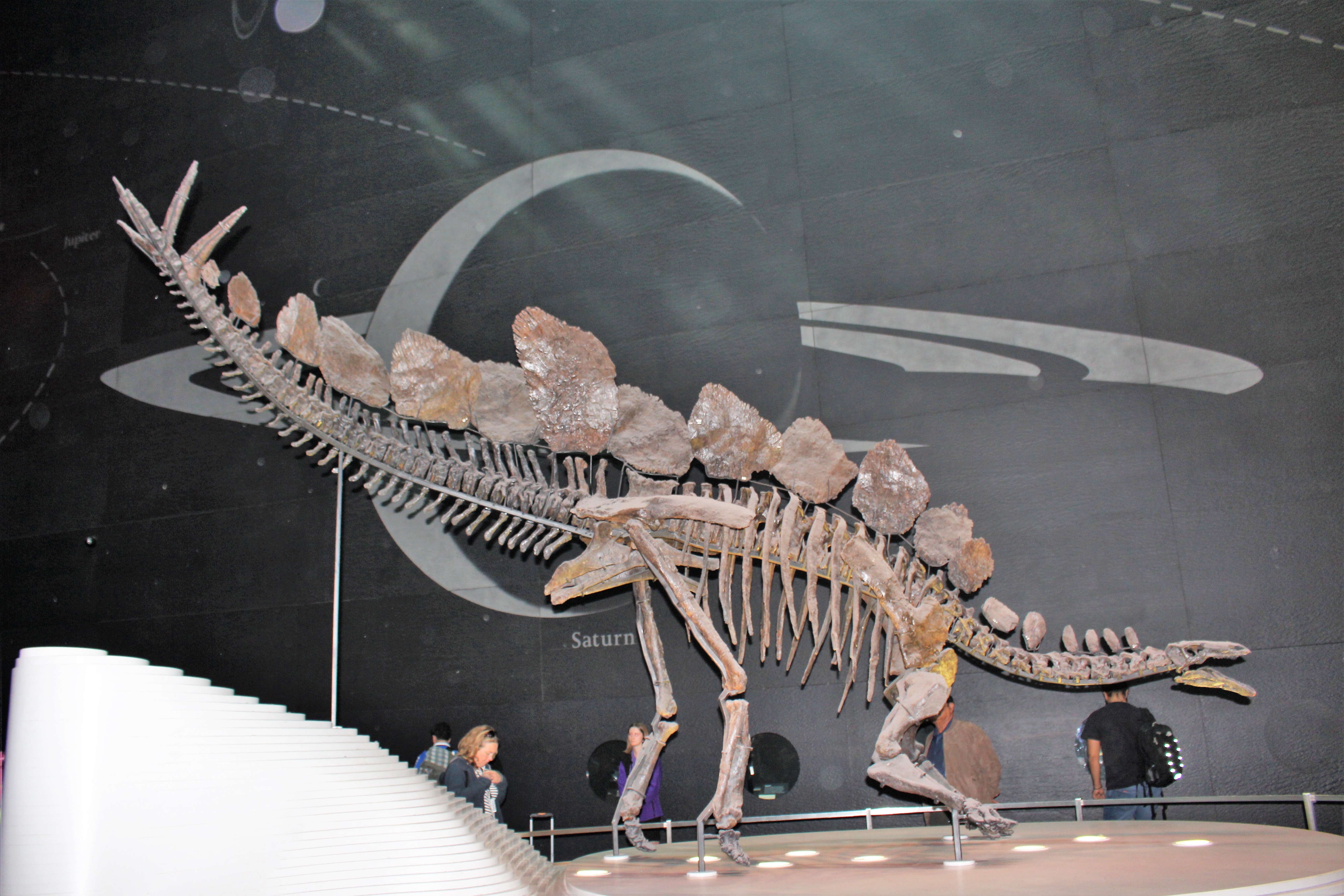
NHM’s most recent major dinosaur acquisition is a juvenile Stegosaurus called Sophie (R36730). Commericial fossil hunter Bob Simon collected the skeleton at a quarry in Wyoming, in 2003. The 90% complete, three-dimensionally preserved skeleton was prepared at Sauriermuseum in Switzerland. NHM purchased the specimen in 2013 with the help of multiple donors. Working in secret, staff paleontologists Susannah Maidment, Paul Barrett, and Charlotte Brassey thoroughly documented the skeleton with CT and laser scans of every bone. Sophie’s mounted skeleton was a surprise reveal in December 2014, alongside a trove of open access research covering the animal’s locomotion, bite force, and more.

References

Barrett, P., Parry, P., and Chapman, S. 2016. Dippy: The Tale of a Museum Icon. Natural History Museum, London.

Getty, T.A. and Crane, M.D. 1975. A Historical Account of the Palaeontological Collections found by R.W. Hooley (1865 to 1923). Newsletter of the Geological Curators Group. 4 (September 1975) :170-179.

Lindsay, W., Larkin, N., and Smith, N. 1996. Displaying Dinosaurs at the Natural History Museum, London. Curator 39:4:262-279.

Maidenment, S.C.R., Brassey, C., and Barrett, P.M. 2015. The postcranial skeleton of an exceptionally complete individual of the plated dinosaur Stegosaurus stenops from the Upper Jurassic Morrison Formation of Wyoming, USA. PLoS One. 10:10: e0138352.

Nieuwland, I. 2019. American Dinosaur Abroad: A Cultural History of Carnegie’s Plaster Diplodocus. University of Pittsburgh Press.

Noe, L. and Flinney, S. 2008. Dismantling, painting, and re-erecting of a historical cast of dinosaur Iguanodon in the Sedgwick Museum, Cambridge. NatSCA News 14:41-48.

Swinton, W.E. 1936. Notes on the Osteology of Hypsilophodon, and on the family Hypsilophodontidae. Proceedings of the Zoological Society of London. 106:2:555-578.

Tanke, D.H. 2003. Lost in plain sight: Rediscovery of William Cutler’s missing Eoceratops. In New Perspectives on Horned Dinosaurs. Indiana University Press.

10 Comments

Filed under dinosaurs, exhibits, field work, fossil mounts, marginocephalians, museums, NHM, ornithopods, sauropods, theropods, thyreophorans

The retiring dinosaur mounts at the Yale Peabody Museum

Another year, and another major renovation of a historic paleontology exhibition is underway. The dinosaur and fossil mammal halls at the Yale Peabody Museum of Natural History (YPM) closed to the public on January 1st. The rest of the museum will follow in July, with a planned reopening in 2023. This will be the first comprehensive renovation of the museum since the current building opened in 1931, and the upgrades are long overdue. For decades, most of the YPM exhibits have been a museum of a museum—a time capsule preserving the state of natural science and museum design in the mid-20th century. The dinosaur hall in particular looks almost exactly as it did when Rudolph Zallinger completed the spectacular Age of Reptiles mural on the east wall in 1947 (a handful of newer specimens, revised labels, and video terminals notwithstanding).

The Great Hall of Dinosaurs upon my last visit in 2014.

It’s exciting to see ground breaking on the new museum and exhibits, because this renovation has been a long time in coming. Serious discussions were underway in 2010, if not earlier, and a set of conceptual images was released as part of a fundraising effort launched in 2013. It appears that a lot has changed since then. The scope of the renovation has expanded to encompass the whole museum, not just the paleontology exhibits. And certain details from the 2013 concept—such as a mezzanine in the dinosaur hall opposite the Age of Reptiles mural—have been dropped. Last year, YPM launched a dedicated website showcasing the latest renovation plans. It’s wonderful that the institution is committed to keeping their community involved in and informed about the transformation of a public space that is near and dear to so many.

Naturally, this renovation is an opportunity to take a deep dive into the YPM fossil displays, and look at the specimens, artwork, and people that defined this institution in the past and which will carry it into the future. Expect upcoming posts exploring the future of these exhibits, but for now let’s start with a look back at the exhibit that once was.

Rendering of the new dinosaur hall, as of late 2019. Source

YPM was founded in 1866 with a gift from George Peabody. Peabody was the uncle of O.C. Marsh, who had been appointed Professor of Vertebrate Paleontology at Yale that same year. Having been awarded tenure and his own museum, Marsh began to lead and send crews into the American west to collect fossils. Many of Marsh’s expeditions were under auspices of the U.S. Geological Survey, and those fossils eventually made their way to the Smithsonian. The remainder, however, entered the YPM collections, where they remain to this day.

After Marsh’s death in 1899, his student Charles Beecher took over vertebrate paleontology at YPM. Beecher was, in turn, succeeded by Richard Lull. Lull never met Marsh (and the two were quite different in many ways), but he nevertheless spent much of his career carrying on his predecessor’s legacy. Like his Smithsonian counterpart Charles Gilmore, Lull expanded Marsh’s often laughably brief descriptions into proper monographs, which are still used by paleontologists today. And like Gilmore, Lull put the Marsh fossils on public display, guiding the assembly of the mounted skeletons that have held court at YPM ever since.

Lull became director of YPM in 1922, and it was in this role that he oversaw the museum’s move from it’s modest original building to the larger, French Gothic-inspired structure where it currently resides. Construction of the new museum was completed in 1925, and Lull spent the next several years developing the dinosaur hall we know today. Marsh, for his part, disliked the idea of display mounts, considering it a waste of time and effort. And limited space at the old facility meant that only two large dinosaur mounts—Edmontosaurus and Stegosaurus—were assembled between 1900 and 1925. The new building, however, had a great hall specifically built to house the Marsh dinosaurs, so Lull and his team got to work filling it.

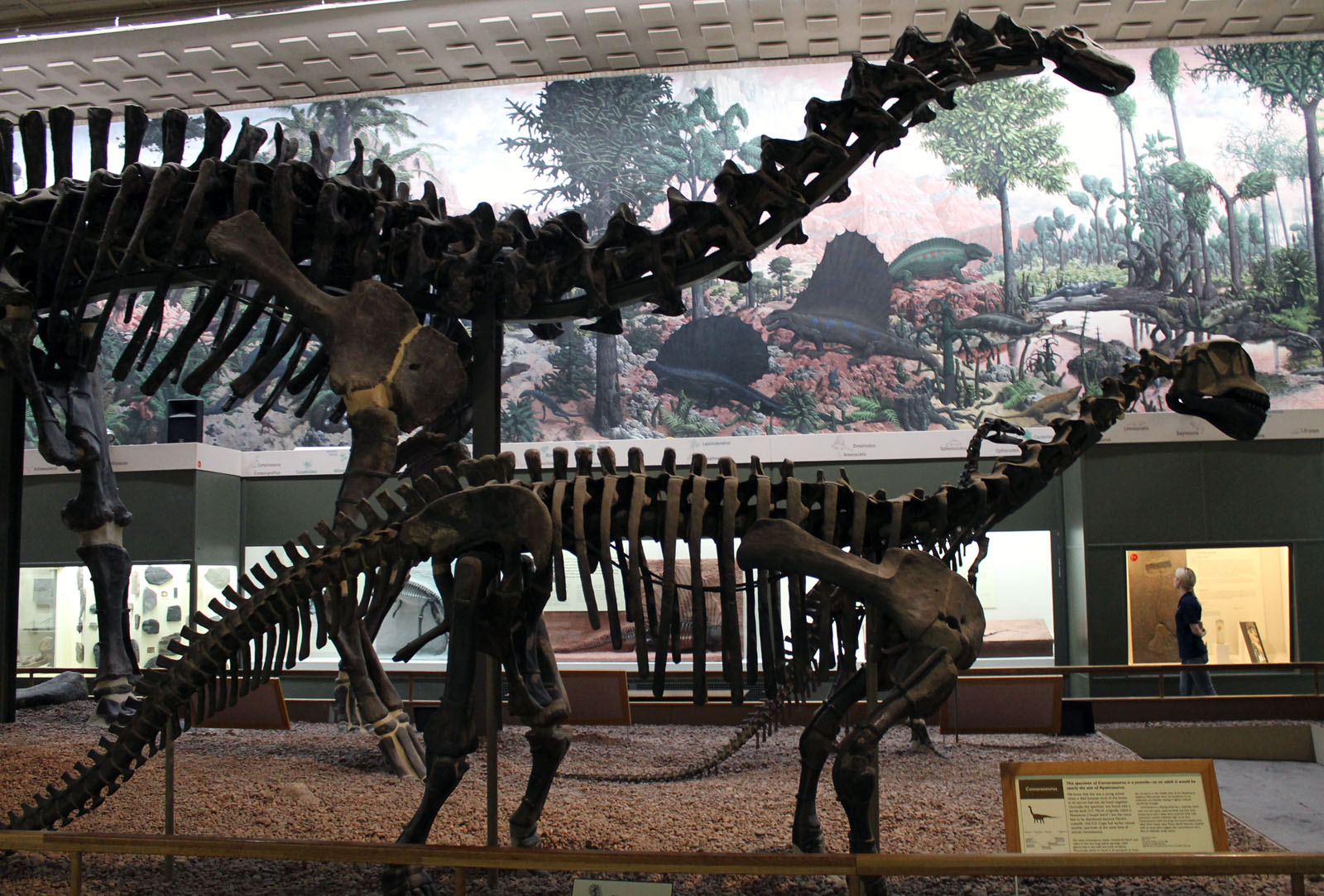
Camarasaurus and Camptosaurus

Camarasaurus and Brontosaurus mounted skeletons.

Most of the new mounts were assembled from fossils collected around 1880 at Como Bluff, Wyoming. Working for Marsh, William Reed and his crew amassed a treasure trove of Jurassic dinosaurs there, most famously the Brontosaurus holotype. Naturally, Lull devised Brontosaurus (YPM 1980) as the centerpiece of the dinosaur hall. Because of its size and complexity, it was the first of the new mounts to begin construction and took the longest to complete. The Brontosaurus was literally built into the floor: photos from the 1920s show a latticework of steel beams designed to spread its weight. Once the floor was installed, the Brontosaurus could not be moved.

In the meantime, preparator Hugh Gibb assembled two other mounts from Como Bluff material: Camarasaurus and Camptosaurus. The Camarasaurus (YPM 1910) is 21-foot juvenile, consisting of a complete vertebral column from the 2nd or 3rd cervical to middle of the tail, and most of the larger limb bones. The feet and most of the ribs are reconstructed, as is the skull, which is a fairly crude sculpture. In his 1930 publication discussing the mount, Lull commends Gibb for how closely his reconstruction matched the nearly complete and articulated juvenile Camarasaurus collected by the Carnegie Museum at what is now Dinosaur National Monument, despite the fact that Gibb had never studied that specimen. Lull only notes that the YPM mount has one fewer cervical and one fewer caudal than the Carnegie specimen, and that the reconstructed cervical ribs are much too short.

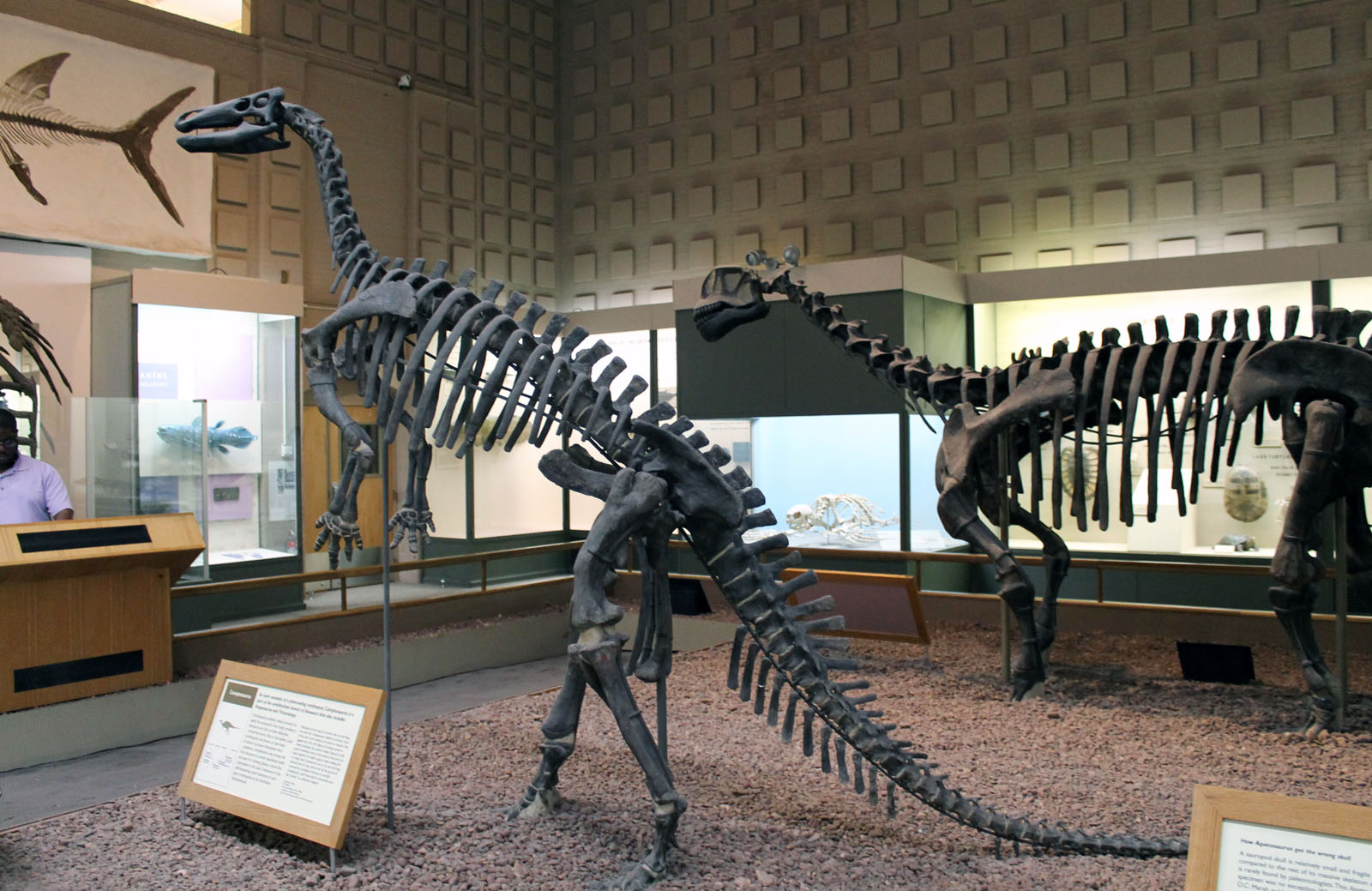
Camptosaurus and Camarasaurus mounted skeletons.

Gibb also assembled the Camptosaurus mount (YPM 1880), which he completed in 1937. Yet another specimen from Reed’s excavations at Como Bluff, the Camptosaurus is notable for how closely it mirrors Marsh’s illustrated reconstruction from 40 years earlier. It seems reasonable to assume this was a deliberate homage, although Gibb did follow Gilmore’s example and removed Marsh’s erroneous lumbar vertebrae. The sculpted skull, modeled after Iguanodon, was typical of Camptosaurus reconstructions at the time but is now known to be inaccurate.

Neither Camarasaurus nor Camptosaurus are slated to return in the renovated exhibit. Marsh originally designated both of these specimens as holotypes for “Morosaurus” (=Camarasaurus) lentus and Camptosaurus medius. Opinions on the validity of those particular species have changed over time, but it’s important that a new generation of paleontologists has an opportunity to study the original fossils up close, which has been virtually impossible in their mounted form.

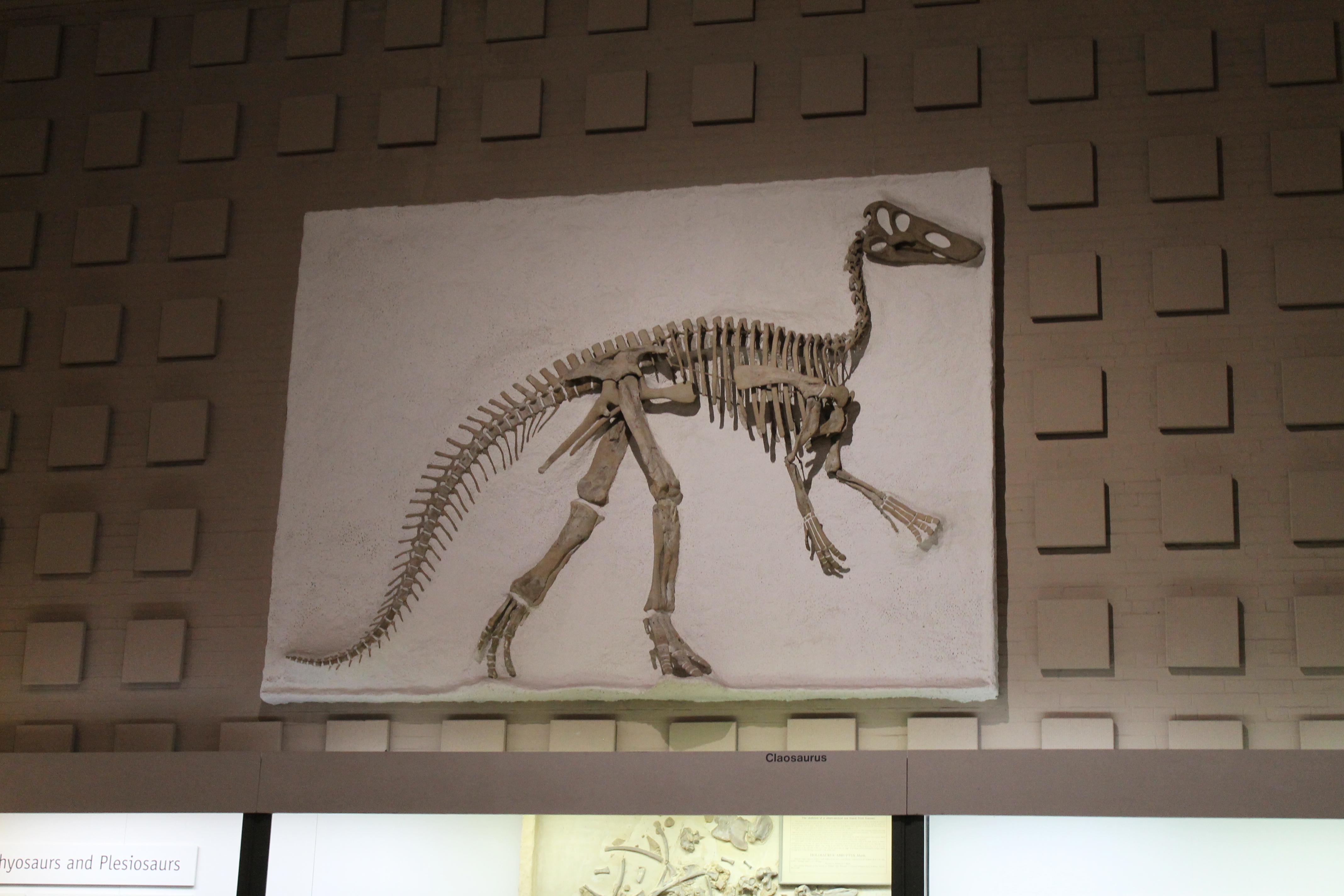
Claosaurus

Relief mount of Claosaurus.

High on the west wall is one of YPM’s most overlooked dinosaurs. This relief mount represents the only confirmed remains of Claosaurus agilis (YPM 1190), a hadrosaur found in the marine deposits of western Kansas. Claosaurus is a bit of a taxonomic mess: Marsh initially announced this fossil as a new species of Hadrosaurus, before upgrading it to its own genus. Then, he decided to sink all of the much younger Lance Formation hadrosaur material (what is now called Edmontosaurus annectens) into the Claosaurus genusIt’s a difficult web to untangle, but Claosaurus is a real taxon that lived alongside animals like Pteranodon and Tylosaurus.

Lull and Wright describe the mount as “recent” in their 1942 monograph on hadrosaurs, so it must have been assembled after the move the current building. Most of the vertebrae and limb bones are real, but the skull is (obviously) a model built around a few fragments of jaw. Although it’s hard to see from the ground, the preservation is apparently poor, and most of the bones are crushed to some degree. Lull and Wright attest to the significance of Claosaurus as the earliest known true hadrosaur, but were clearly frustrated by the quality of the specimen. Perhaps modern paleontologists will have better luck, once it’s taken off display and returned to the collections.

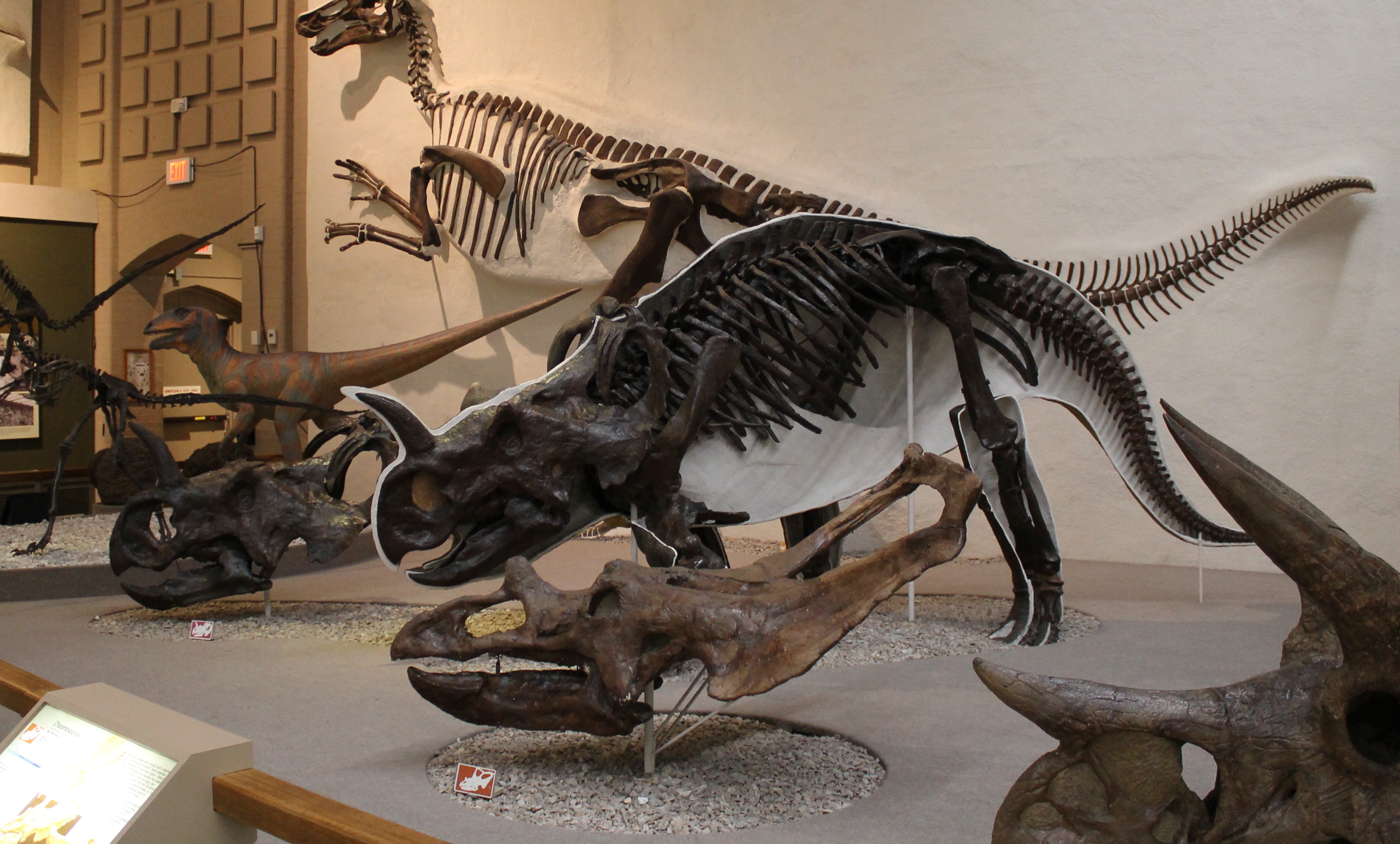
Centrosaurus

The Centrosaurus half-mount and its Cretaceous buddies.

Variably known as Monoclonius flexus, Centrosaurus flexus, and Centrosaurus apertus, this ceratopsian skeleton (YPM 2015) was collected by Barnum Brown on the American Museum of Natural History’s extremely productive expeditions to the Belly River region in Alberta. I’m not sure when YPM acquired the fossil (presumably in a trade), but it was mounted and on display by 1929. At some point during the development of the fossil mammal hall, Lull became enamored of half-mounts like this one, in which the animal appears bisected along its sagittal line. Half the skeleton is assembled on one side, while a fleshed-out model is visible on the other. Several mammal specimens at YPM are displayed this way, but the Centrosaurus is the only dinosaur.

Lull discusses the choices made in reconstructing Centrosaurus at length in his 1933 monograph on ceratopsians. He describes the relief-mounted Centrosaurus at AMNH as an imperfect representation of the animal’s life appearance because it preserves the death pose it was found in. In contrast, the YPM version is reconstructed in a three-dimensional standing posture. Lull specifically points to his Centrosaurus‘s nearly straight neck and sprawling forelimbs (with the humerus nearly horizontal) as superior to the AMNH presentation. The issue of ceratopsian forelimb posture is still not completely resolved, but there is probably some truth to Lull’s sprawling reconstruction.

The life-reconstruction side of Centrosaurus, as figured in Lull 1933.

For the fleshed-out portion of the mount, Lull directed the artist to match the musculature and skin texture of iguanas and alligators. A loggerhead turtle was referenced for the mouth and beak. Lull chose to give the small processes on the lower edges of the frill a horny sheath, rather than the fleshy look popularized by Charles Knight. Overall, the life restoration is on the lean side compared to our modern understanding of ceratopsians, but many details—including the digitigrade fingers and forelimb posture—have held up well.

Next time, we’ll look at how historic specimens like Brontosaurus, Stegosaurus, and Deinonychus might be modernized for the new version of the hall.

References

Lull, R.S. 1930. Skeleton of Camarasaurus lentus recently mounted at Yale. American Journal of Science 19:105:1-5.

Lull, R.S. 1910. Stegosaurus ungulatus Marsh, recently mounted at the Peabody Museum of Yale University. American Journal of Science 30:180:361-377.

Lull, R.S. 1933. A Revision of the Ceratopsia or Horned Dinosaurs. New Haven, CT: Tuttle, Morehouse, and Taylor Co.

Lull, R.S. and Wright, N.E. 1942. Hadrosaurian Dinosaurs of North America.  New York, NY: Geological Society of America.

Marsh, O.C. 1872. Notice on a new species of Hadrosaurus. American Journal of Science 3:16:301.

Marsh, O.C. 1890. Additional characters of the Ceratopsidae, with notice of new Cretaceous dinosaurs. American Journal of Science 39:233:418-426.

3 Comments

Filed under dinosaurs, exhibits, museums, ornithopods, sauropods, YPM

Dinosaurs at the Cincinnati Museum Center

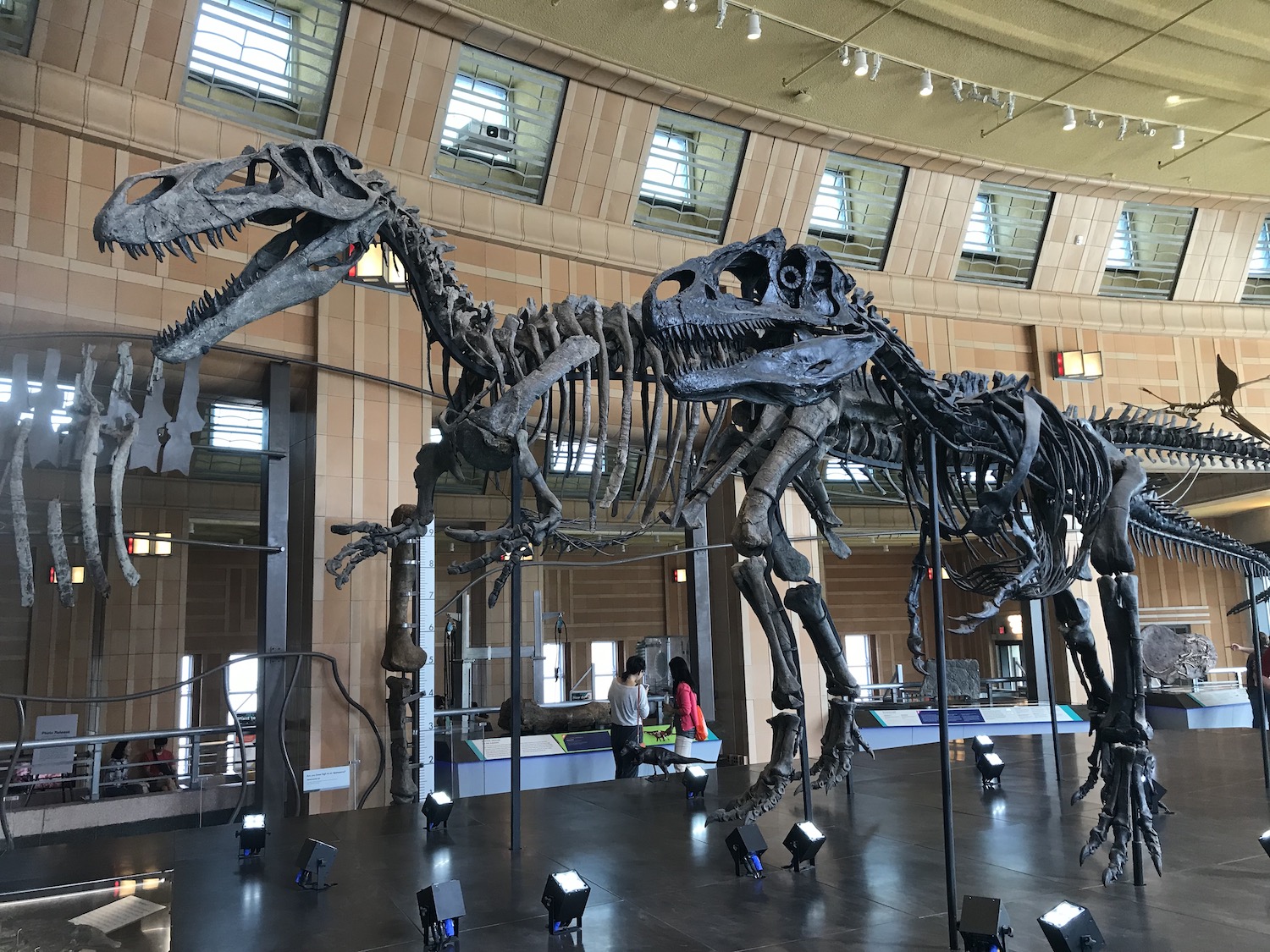
A grand view upon entering the new CMC dinosaur hall.

Cincinnati’s Union Terminal is an incredible building. This colossal art deco structure is a sight to behold inside and out, and the muraled semi-dome in its central rotunda is among the largest of its kind in the world. Built in 1933 as a train station (and functioning as one today, after a mid-century hiatus), Union Terminal is also home to the Cincinnati Museum Center (CMC), which relocated here from a downtown location in the early 1990s.

I visited CMC once before in 2013, to see the traveling Ultimate Dinosaurs exhibit. I also saw the permanent natural history exhibits that were in place at the time, which included some very elaborate walk-through reconstructions of a Pleistocene forest and a modern cave. These exhibits were constructed in the 90s, and had a lot of the hallmarks of museum design in that era. For example, the ice age galleries were framed around visitors “examining evidence like scientists,” which in practice involved binary question-and-answer stations and interactives where the action performed didn’t really connect with the concept meant to be communicated. Nevertheless, the actual fossil collection on display—mostly from Big Bone Lick in Kentucky—was impressive, as were the ambitious, large-scale dioramas.

The 1990s-era ice age gallery.

This huge diorama featured life-sized wolves, a ground sloth, and a mastodon mired in mud.

Since then, Union Terminal and CMC have undergone a sweeping transformation. In 2014, the National Trust named the building—which had never been completely renovated in its 80 year history—one of the country’s most endangered historic places. Happily, the county took action, and raised funds to restore and modernize Union Terminal. In the process, most of the existing museum galleries were completely demolished, and the spaces they occupied were restored to match the building’s original architecture.

This strikes me as a bold move. Typically, legacy museums will gradually update or replace old exhibits as funding allows. In contrast, the CMC renovation started with a total teardown, and new exhibits are now being added in phases. As of this writing, the natural history and science side of the building includes a brand-new dinosaur gallery (discussed here), the aforementioned walk-through cave, a partial exhibit on the moon landing, and an assortment of temporary-looking exhibits. A new ice age gallery, the rest of the space exhibit, and immersive exhibits about Cincinnati history are slated to open later this year, and it appears fundraising is underway for future projects, including a Paleozoic fossil hall.

The hall’s only ornithischian Othnielosaurus follows in the footsteps of Galaemopus and Diplodocus.

To cut to the chase, the dinosaur hall is excellent. Developed by senior project manager Sarah Lima and curator Glenn Storrs, this is effectively a brand-new exhibit, since the old dinosaur gallery was quite limited. When the original CMC exhibits were built, the strengths of the vertebrate paleontology collections were primarily in Quaternary mammals and Paleozoic invertebrates. Over the last 20 years, however, the museum has been focused on the Jurassic. In particular, regular field work at the Mother’s Day Quarry in Montana has yielded a trove of Jurassic fossils, including some very unique sauropod specimens. The gallery includes an 80% complete Galaemopus, a composite juvenile Diplodocus, sauropod skin impressions, and a one-of-a-kind juvenile Diplodocus skull. In spite of the unspoken adage, the Morrison fauna is not resolved, and new secrets of this ecosystem are still being recovered.

Torvosaurus towers over a composite Allosaurus assembled from Cleveland-Lloyd fossils.

Other key specimens in the new exhibit were purchased from commercial fossil collectors. Jason Cooper, a Cincinnati native, discovered the Torvosaurus, which is the only real specimen of its kind on display anywhere. Along with his father Dan and brother Ben, Cooper excavated the 50% complete skeleton from a private Colorado ranch and prepared and mounted it for display. The museum purchased the Daspletosaurus from the Rocky Mountain Dinosaur Research Center. Anthony Maltese and colleagues excavated the skeleton in 2006 and prepared it over the course of several years.

Nicknamed “Pete III,” the Daspletosaurus shares its platform with two Dromaeosaurus casts and a cast skull of the Nation’s T. rex.

Like many newer fossil exhibits, the gallery is well-lit and spacious. The art deco design of Union Terminal informs the look of the hall: large windows fill the space with natural light, and the larger specimens are arranged on minimalist platforms that can be viewed from many angles, including from above. I found it noteworthy how close visitors can get to the mounted skeletons. Although the platforms are fairly high up, there are no glass barriers. I found that I could get within a few inches of the Galaemopus feet without much effort. I’m sure a slightly taller or more determined person could manage to touch the fossils.

Hopefully, they’ll be distracted by the many exhibit elements that are meant to be touched. In contrast to the 1990s exhibits, CMC has mostly done away with physical interactives, instead emphasizing touchable models and digital touchscreens. One particularly impressive inclusion are the digital video cameras (in robust cylindrical housing) connected to large monitors. Visitors can use these to get real-time magnified views of certain fossils, including a chunk of Tyrannosaurus medullary bone. This set-up couldn’t have been cheap! I also had fun with a set of telescopes aimed at certain parts of the dinosaur skeletons, such as a series of fused vertebrae in the Galaemopus tail. These are outfitted with targeting lasers (!) to help pinpoint the key features.

Each “closer look” station includes a telescope (with targeting laser!) aimed at an important skeletal feature, plus a bronze cast of that same element.

This bronze miniature Allosaurus is one of four similar models.

Not every visitor can see the fossil mounts, so CMC worked with David Grimes of the Clovernook Center for the Blind and Visually Impaired to help people with low vision experience the exhibit. Braille is incorporated into many of the displays, and the hall is full of touchable bronze models, ranging from individual bones (like the aforementioned Galaemopus vertebrae) to fleshed-out reconstructions (such as Confuciusornis). Four of the dinosaur mounts are recreated as bronze miniatures. Structures like ribs and vertebral processes are quite thin at this scale and susceptible to bending or breaking, so the exhibit team went with a half-fleshed look to make the models more durable. The Field Museum landed on the same solution with the touchable miniature SUE, but credit is due to the CMC team for getting their models to stand up, rather than being presented in relief.

A real Apatosaurus skull, one of many treasures hidden away in smaller cases throughout the hall.

If I were to critique one element of the hall, it would be that some of the labels, graphics, and interactives are spatially disconnected from the fossils they relate to. For example, a digital touchscreen where visitors can manipulate a 3D scan of an Apatosaurus skull is nowhere near the real skull displayed elsewhere in the exhibit, and the only label for Othnielosaurus is on the opposite side of the platform from the mounted skeleton. This is, of course, a minor concern, and I can only imagine the difficulty of arranging an exhibit with as much verticality as this one.

Overall, the new CMC dinosaur hall is fantastic, whether one is considering the specimens on display, the story being told, or the aesthetics of the space. The collection of real, new-to-science specimens makes this exhibit stand out among other paleontology halls, but I’m curious how the museum’s general audience will respond. A once-expansive museum closed for two years, and opened with an excellent exhibit that nevertheless is much smaller than what was once on display. Will visitors be satisfied with quality over quantity? And will they keep returning as new CMC exhibits are completed over the coming years? Time will tell.


2 Comments

Filed under dinosaurs, exhibits, fossil mounts, museums, opinion, reviews, sauropods, science communication, theropods, Uncategorized

The Field Museum Shuffles its Dinosaurs

Rendering of Patagotitan and the Sue remount. Source

This morning, The Field Museum of Natural History announced two big changes to its dinosaur exhibits. First, the indispensable Sue the Tyrannosaurus will move from its prime location in the central Stanley Field Hall and into Evolving Planet, the museum’s permanent paleontology exhibit. Next, a cast of the South American sauropod Patagotitan will take Sue’s place in the main hall. Sue will be disassembled just a few months from now in February 2018. Patagotitan will be installed later next year, and Sue’s new home on the second floor opens in Spring 2019 (perhaps deliberately, this is within weeks of the National Fossil Hall’s reopening at the Smithsonian).

Sue has been the Field Museum’s defining attraction since the skeleton was acquired in 1997. It is the most complete Tyrannosaurus yet found, but it is also more than a natural history specimen. Sue is part of the pantheon of Chicago landmarks, and the public’s association of the mount with the city it resides in has all but eclipsed the legal battle that preceeded it’s acquisition.

The current Sue mount has a touch of “grenade-swallowing syndrome.” Photo by the author.

Nevertheless, the Sue mount that has been on display for 17 years is not perfect. Assembled by Phil Fraley Productions, the mount has been the subject of grumbling among tyrannosaur specialists for years: the coracoids are too far apart, the furcula is incorrectly placed, the posterior ribs are unnaturally bowed out, and so forth. Happily, Sue will be getting thoroughly updated during the move. In addition to correcting the various anatomical problems, the new mount will reintroduce Sue to its gastralia (belly ribs), which have been displayed separately since 2000, and change her crouching pose to a standing one. As Collections Manager Bill Simpson explains in the announcement video, “we now know more about how a T. rex skeleton should look and Sue is going to reflect those changes.”

Sue 2.0 will take over the second floor space occupied by the recently shuttered 3-D theater. Accessible as an annex to the dinosaur section of Evolving Planet, the Sue exhibit will contextualize the Tyrannosaurus with other fossils from the Hell Creek Formation.

Rendering of Patagotitan in the Stanley Field Hall. Source

Patagotitan is the same animal that the American Museum of Natural History billed as “the titanosaur” two years ago. Argentina’s newest megasauropod was first announced in 2014 but was formally named and published by José Carballido and colleagues just three weeks ago. While not technically the biggest known sauropod, Patagotitan is the only dinosaur in its class known  from reasonably complete remains. The skeleton itself will be more or less identical to the cast Research Casting International produced for AMNH. However, instead of being crammed into a small room, this Patagotitan will have space to stretch out, its neck craning to look over the second story mezzanine. The Field Museum exhibits team also wants visitors to be able to walk under and even touch the cast skeleton.

What do I think about all this (asked nobody)? I’m thrilled with the plans for Sue – it’s great that even though Sue is such an important symbol for the Field Museum, they don’t consider it a static piece. Much credit is due for the museum’s willingness to invest in their star attraction by keeping it up to the latest scientific standard. In addition, I never entirely liked how disassociated Sue was from the rest of the paleontology displays, and it’s nice to know that somebody at the museum must have felt the same way. There’s something to be said for giving the skeleton pride of place, but ultimately I think museumgoers will be better served by seeing Sue contextualized within the story of life on Earth.

While I love me some megasauropods, I can’t help but be less excited by the Patagotitan. I realize that most people don’t go to every natural history museum, but two identical casts already exist. To be fair, the Field Museum Patagotitan will be in a very different setting from its AMNH predecessor (although it may turn out rather like the Royal Ontario Museum Futalognkosaurus). Still, I would rather have seen something more unique to the Field Museum. One idea would be to bring back the Brachiosaurus reconstruction, and display it side-by-side with a remount of the historic Apatosaurus currently in Evolving Planet. Both specimens are tied to the museum’s own expeditionary history, and together would tell the remarkable story of Elmer Riggs. The Apatosaurus in particular could anchor a Field Museum retrospective, while images of the three different locations it has been displayed in since 1908.

The last time a sauropod graced the Stanley Field Hall. Source

Somebody more cynical than me might point out that switching up iconic displays is becoming a predictable way for museums to generate press and manufacture controversy. For example, the Natural History Museum in London got no less than three media splashes when they announced Dippy the Diplodocus was to be replaced, actually removed Dippy, and finally unveiled the remounted blue whale in Hintze Hall earlier this summer. Nevertheless, there is a strong case to be made that stirring up public reactions in this way is an effective way to keep the people interested in their museums. As Field Museum president Richard Lariviere told the Chicago Tribune, “the public doesn’t understand that the science…we convey is changing on an almost hourly basis here. I talk to people all the time who think that since they’ve been to the Field Museum 10 years ago they’ve seen it. By transforming the central space, we hope to convey that exact message.”

At any rate, we’re in for some great new dinosaur displays at the Field Museum over the next couple years. What do you think of the upcoming changes?

6 Comments

Filed under dinosaurs, exhibits, FMNH, fossil mounts, museums, opinion, sauropods, theropods

A Game Changer?

Today, Google and 60 partner museums unveiled the new natural history arm of the Google Cultural Institute. Launched in 2011, the Cultural Institute is an effort to make culturally significant material accessible online. Up until this point, the primary focus has been on art and history. In conjunction with museums and other institutions around the world, Google has been uploading millions of images, archival documents, and virtual walkthroughs of significant places. The natural history project offers more of the same, but with 100% more dinosaurs.

I had no idea this was in the works, nor do I know much beyond what is said in the press release. After spending much of this morning exploring the site, however, you can color me impressed. The sheer amount of content is overwhelming: 300,000 annotated specimen photos, virtual walkthroughs of 50 museums, and 184 multimedia presentations on topics both general (cabinets of curiosities) and esoteric (native plants and fish of Korea). Unfortunately, accessing this content can be a bit of a chore. I was often confused by the user interface, and found many of the most interesting or useful items by accident.

Somewhere in the Ancient Americas exhibit.

Somewhere in the Ancient Americas exhibit at the Field Museum of Natural History. Google Cultural Institute

For me, the museum walkthroughs are the clear highlight. Using Google’s Street View technology, users can explore the included museums and get surprisingly close to individual displays. Some of these “virtual tours” are frustratingly limited to a few corridors between exhibits, but others provide darn near the full experience of actually being there. Of the museum walkthroughs I’ve looked at so far, the National Museum of Natural History and Berlin’s Museum für Naturkunde are particular standouts in this regard. A handful of museums have had virtual tours available online since at least the early 2000s, but this is the first time I’ve seen the concept escape the gimmick stage and become something potentially useful.

The quality of the multimedia presentations (“virtual exhibits”, if you must) is a bit mixed. The best ones make specific use of the partner museums’ collections, highlighting the scientific, cultural, or historical significance of particular objects. These presentations provide curatorial expertise and novel insights that are not easily found elsewhere. Other presentations, however, are frustratingly generalized, and don’t include much content that one couldn’t get from skimming a Wikipedia article.

yawn, another cgi sauropod. I'd rather see the mount.

Yet another middling CGI dinosaur. Yay, I guess? Google Cultural Institute

I would include the site’s flagship attractions – narrated 360-degree tours of selected exhibit halls – in the second camp. These three short videos each feature an exhibit that “comes to life” with the help of some acceptable-but-not-spectacular CGI. Take the video about the Giraffatitan at the Museum für Naturkunde. It’s awesome to be able to look all around the hall, but most of the video is taken up by an animated version of the dinosaur that doesn’t accomplish anything it’s Jurassic Park counterpart didn’t 23 years ago. The video starts to tell some interesting stories – convergent evolution between sauropods and giraffes, the rate of extinction caused by human activities far outpaces normal background extinction – but the goofy CGI Giraffatitan is very much in the way. Museums have so many strengths, so I’ll never understand the impulse to rely on things like animated dinosaurs that a) their audience can see elsewhere and b) Hollywood will always be able to do better.

A great deal of content to be found by the bold.

A great deal of content can be found by the bold. Google Cultural Institute

All in all, the new natural history project at the Google Cultural Institute is a very impressive starting point. Nevertheless, my optimism is tempered by the fact that the web is littered with apps and mini-websites developed by museums, then almost immediately abandoned. Too often, digital projects are taken on without a clear idea of who will continue to update it, what need is being addressed, or even who the website or app is for. The real test will be whether Google and the partner museums will continue to support the Cultural Institute with new content. This has been a recurring problem with museums’ digital endeavors, but perhaps the collaboration with Google (and its extensive infrastructure) will help.

Moreover, accessibility is an admirable goal, but there is a very wide gap between putting stuff online and creating something that lots of people (teachers, students, people who don’t live near museums) actually want to use. I’m encouraged by the range of material on the Cultural Institute site. Some content is fairly general, perhaps suitable for a 3rd grade science report, while other content is far more in-depth. I will be very curious to see what the public ends up using, and for what purpose. It would also be neat to see if this ended up being the start of a truly global digital collection, useful for educators and researchers alike. We’ll see if the Cultural Institute ends up being the catalyst that finally makes digital museums happen!

3 Comments

Filed under collections, dinosaurs, education, exhibits, museums, sauropods, science communication

Meeting the Titanosaur

It be big

The titanosaur doesn’t photograph well. It must be experienced. Photo by the author.

On January 15, the American Museum of Natural History unveiled the first new fossil mount to be added to their paleontology halls in 20 years. It is the reconstructed skeleton of an as-yet-unnamed titanosaur, an immense sauropod dinosaur that lived in Argentina during the mid-Cretaceous. The titanosaur is probably the most hyped-up fossil mount since Sue, at least in the United States (Sophie the Stegosaurus in the U.K. and Tristan the Tyrannosaurus in Germany received similar attention). This merits some discussion. The AMNH public relations staff pulled no punches in selling the titanosaur as a must-see exhibit. Huge advertisements appeared on buses and buildings around New York, including in Times Square. The legendary David Attenborough hosted a television special on the discovery of the fossils. Countless local and national news outlets were invited to the titanosaur’s unveiling earlier this year. But is this dinosaur really the find of the century?

Titanosaur was even advertised in times square. Source

One of the many titanosaur ads that showed up around New York City this past winter. Source

It depends. The titanosaur represents a species new to science, but it has not yet been formally published. The fossils were recovered in 2014 by José Luis Carballido and Diego Pol, paleontologists with the Egidio Feruglio Paleontology Museum (the AMNH connection is that Pol was a doctoral student of Paleontology Division Chair Mark Norell). Bones from at least six individuals of the same species were found, together representing 70% of the skeleton. However, AMNH staff have mostly avoided calling this animal the biggest dinosaur ever.

Indeed, declaring any dinosaur species to be the largest is a fool’s errand. We’ve known for some time that South American titanosaurs, as a group, are probably the biggest land animals that ever lived. Unfortunately, these giants are typically represented by only a few isolated bones. For an animal to become fossilized, it needs to be buried shortly after death. But it takes a lot more dirt to cover a large animal than a small one. A flood or landslide big enough to completely cover a sauropod over a hundred feet long would be an exceedingly rare event. More often, these animals were picked apart by scavengers for some time before a few of the more durable bones were buried and fossilized. For example, Argentinosaurus is known from about ten percent of the skeleton, and Puertasaurus is known from just four vertebrae. Paleontologists can use better-known relatives to produce reasonable reconstructions from even these limited remains, but any length estimate is a ballpark figure. Even among related animals, proportions can vary significantly. Consider, for example, the very long tail of a green iguana as compared to the stubby tail of a Galapagos land iguana. Carballido and Pol’s find stands out among other titanosaurs because two-thirds of the skeleton is known. hen the description is published, it will undoubtedly shed new light on the skeletal anatomy of this group. Still, the missing parts mostly come from the neck and tail, which will probably preclude a precise estimate of the animal’s total length.

*This level of completeness is not entirely unprecedented. Dreadnoughtus, described in 2014, is also about 70% complete.

he peekin

The titanosaur’s head and neck extend out of the room and into the corridor. Photo by the author.

We can’t say the AMNH titanosaur is absolutely the biggest known dinosaur, but what about the mount? At 122 feet, the reconstructed skeleton prepared by Research Casting International dwarfs AMNH’s resident sauropod, the 82-foot apatosaurine. It’s also a fair bit longer than the museum’s brain-breakingly huge blue whale model. AMNH is not the first museum to display a titanosaur, however. The Royal Ontario Museum has a 110-foot Futalognkosaurus, which the AMNH mount handily beats. But the new titanosaur is essentially the same size as the 123-foot Argentinosaurus at the Fernbank Museum of Natural History (duplicates also exist in Europe and South America). The difference, as mentioned, is that not a lot about Argentinosaurus is actually known, and the mount is almost entirely a sculpted reconstruction. By comparison, the AMNH titanosaur is largely composed of 3-D printed components based on scans of original fossils. “The biggest reconstructed skeleton of a reasonably well-known dinosaur” isn’t the catchiest headline, though.

Suffice it so say that on paper, the AMNH titanosaur isn’t a revolution for dinosaur science. When I went to see it last weekend, I expected to see a typical example of a well-studied group of dinosaurs. I was not prepared.

the bastard

The closest I can find to a full-body photo of the titanosaur. Source

This bastard is BIG. I could go through a whole series of superlatives, but it’s impossible to describe the experience of sharing space with this magnificent skeleton. You cannot comprehend what a 122-foot dinosaur really is until you’ve experienced it. It helps that the titanosaur occupies a smallish, low-ceilinged room (a century ago, this was the infamous Hall of the Age of Man). It also helps that there are no long lines of sight into this space. You turn a corner and you are quite abruptly in the titanosaur’s presence. Regardless, the marketing line that was ubiquitous earlier this year – “everything else got a whole lot smaller” – rings unsettlingly true. Compared to the titanosaur, the mammoth and mastodon across the hall look like pipsqueaks. Even the AMNH blue whale, which usually requires a double-take, became a little easier to take in.

I’m no stranger to sauropods. I teach people about them at work all the time. But seeing the titanosaur in person was a revelation, and something I strongly recommend to anyone interested in the natural world. The titanosaur may not be the most important dinosaur discovery of our generation, but by giving it corporeal presence, AMNH created an incredible symbol. This is life at its limits, an embodiment of the incredible things the tetrapod body plan can do.

P.S.: If you’re concerned about the fate of the juvenile Barosaurus model that used to occupy this space, worry not. It now lives at the Cleveland Museum of Natural History, and will be on display at least through October of this year.

4 Comments

Filed under AMNH, dinosaurs, fossil mounts, museums, sauropods