Category Archives: theropods

Extinct Monsters: The Marsh Dinosaurs, Part III

allosaurus

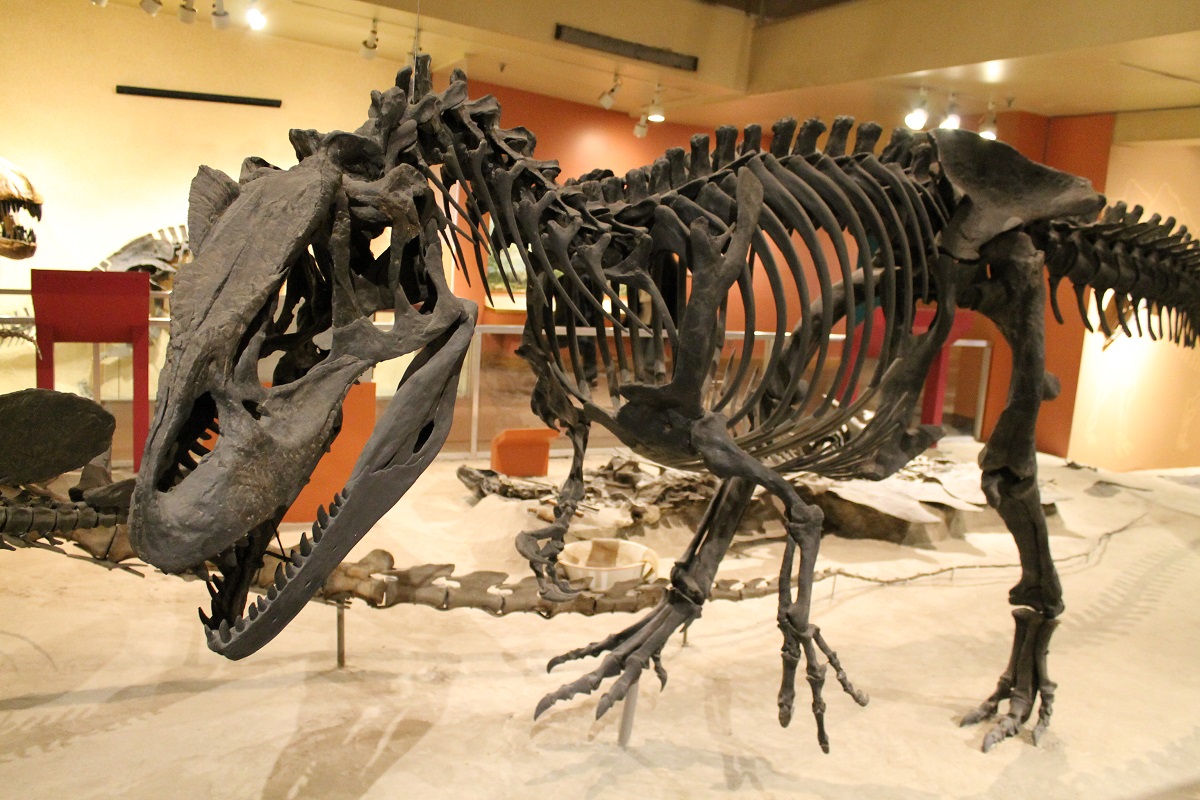
A close-up of Allosaurus. Photo by the author.

Click here to start the NMNH series from the beginning.

Some time ago, I wrote about the O.C. Marsh dinosaurs at the National Museum of Natural History. These are the mounted skeletons made from the enormous collection of fossils Marsh accumulated while working for the United States Geological Survey – if you’d like, you can catch up with Part 1 (on Edmontosaurus and Triceratops) and Part 2 (on Camptosaurus, Ceratosaurus, and Stegosaurus). Looking back, I noticed that I never actually finished, so here are the two Marsh dinosaurs with as-yet untold stories.

The Thescelosaurus

The name Thescelosaurus neglectus means “neglected wonderful lizard”, because Smithsonian paleontologist Charles Gilmore found the original specimen at the bottom of a crate, more than 10 years after it arrived at NMNH. Still buried its its field jacket, this skeleton had been long overlooked by both Marsh and the museum staff. Nevertheless, Gilmore found that it was remarkably complete and that it represented a taxon new to science.
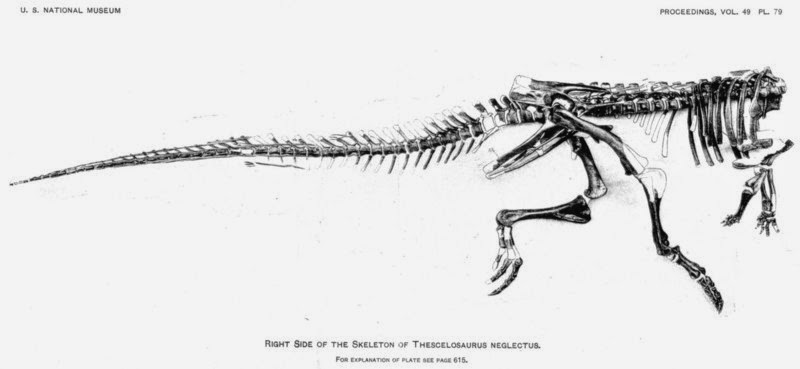
Gilmore's illustration

An illustration of the Thescelosaurus holotype prior to reconstruction. Source
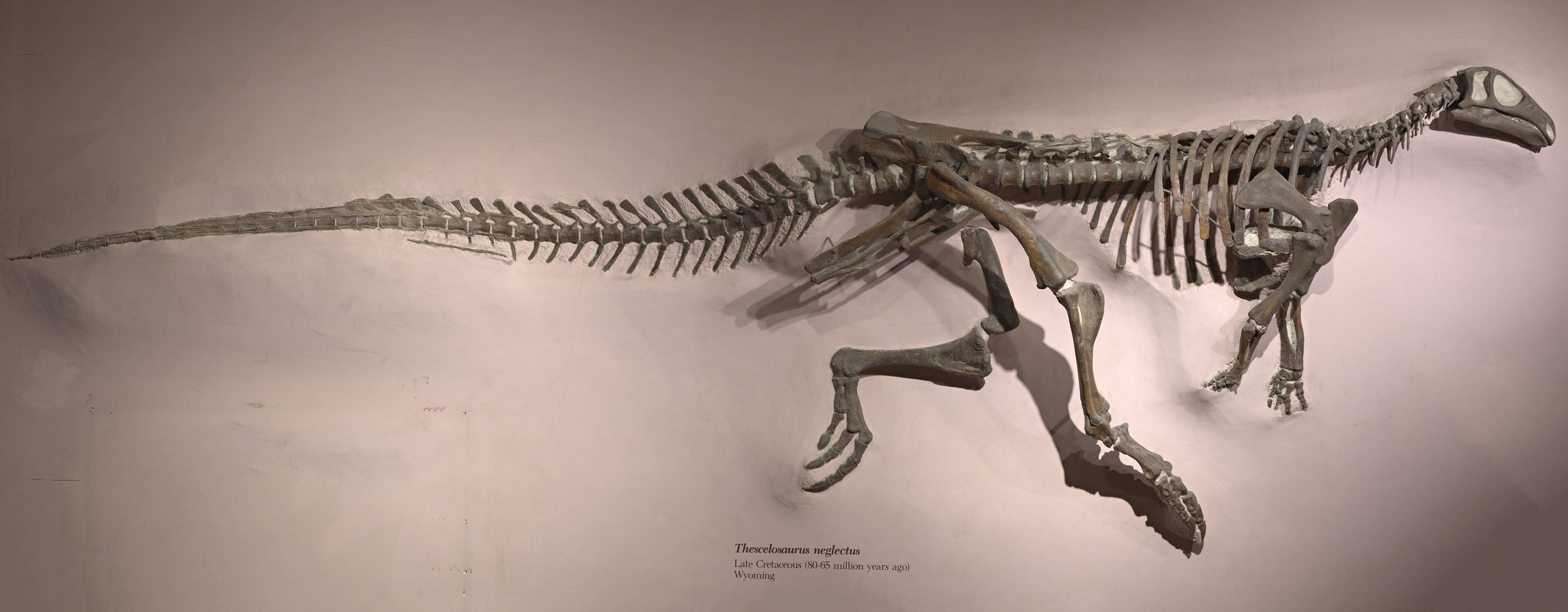
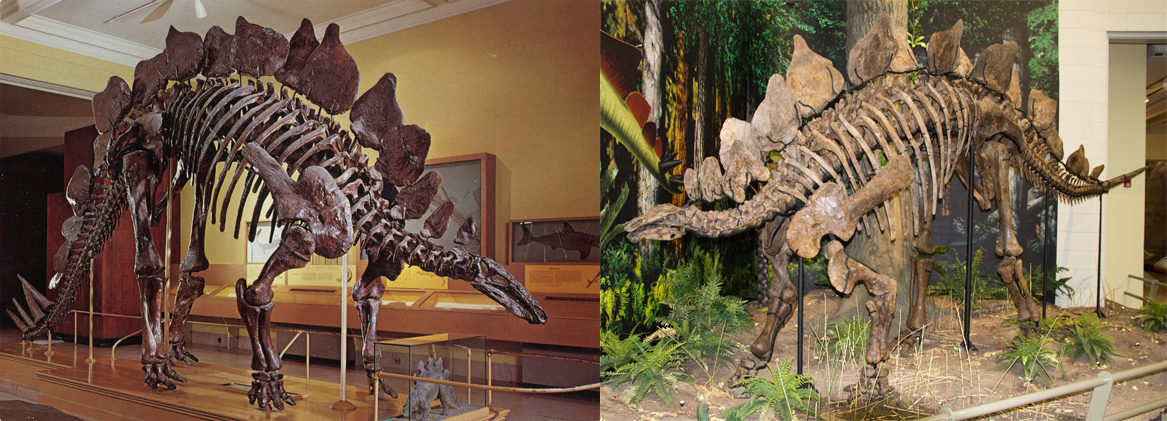
Thescelosaurus at USNM.

Thescelosaurus as displayed after 1981. Photo by Chip Clark.

The specimen that would become the Thescelosaurus holotype (USNM 7757) was excavated by John Bell Hatcher and William Utterback in July of 1891, while they were collecting for Marsh in Niobrara County, Wyoming. 20 years later, Gilmore discovered that the skeleton was articulated and intact, save for the head, neck, and parts of the shoulder. He even found small patches of preserved skin on the tail and legs. According to Gilmore, the animal had been buried rapidly after death, since it showed no signs of dismemberment by scavengers.

After describing the fossils, Gilmore mounted the Thesclosaurus in relief on its left side. Other than the reconstructed skull (modeled after Hypsilophodon), the specimen was displayed almost exactly as it was found. This was important to Gilmore, because as he wrote in his published description, “I am…of the opinion that specimens so exhibited hold the attention of the average museum visitor far longer and arouse a keener interest in the genuineness of the specimen than does a skeleton that has been freed from the rock and mounted in an upright, lifelike posture.” Today at least, I suspect that the opposite is true –  visitors are generally more impressed by dynamic standing mounts than by reliefs that preserve death poses. Still, it’s fascinating to gain a small amount of insight into the motivations of a pioneering mount-maker.

Although it was first displayed in the Hall of Extinct Monsters, the Thescelosaurus was most prominently exhibited in the 1963 version of the NMNH fossil halls. Here, it joined the Edmontosaurus, Gorgosaurus, and partial Corythosaurus relief mounts along the south wall. In life, these animals were vastly removed from one another in time and space, but displayed together they almost appeared to be parts of a single quarry face. The Thescelosaurus moved to the north wall in 1981, unfortunately placed rather high and out of most visitors’ line of sight.
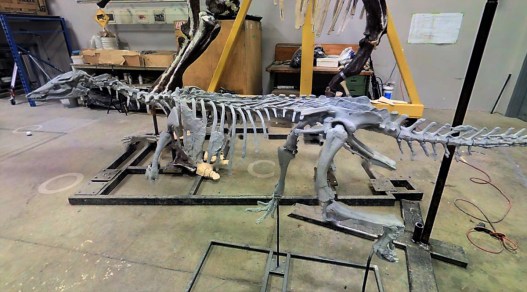
thescrci

Thescelosaurus cast in the RCI workshop. Source

thescrci2

Close-up of the new Thescelosaurus skull. Source

When the new National Fossil Hall opens in 2019, USNM 7757 will be replaced with a duplicate cast. The original bones will be moved to the collections, where they can be properly studied for the first time in a century. Already, technicians at Research Casting International have freed the skeleton’s left side, which had never been fully prepared. The exhibit replica assembled by RCI is beautiful, retaining the ossified tendons and cartilage impressions of the original. Mounted in a running pose, the new cast also features an updated head, based on Clint Boyd’s recent description of Thescelosaurus cranial anatomy.

The Allosaurus

Built in 1981, the Allosaurus fragilis (USNM 4734) was the last Marsh Collection dinosaur to be mounted, although bits and pieces have been on display at NMNH since 1920. There has been considerable interest in this individual recently, in part because Kenneth Carpenter and Gregory Paul proposed in 2010 that it become the neotype for Allosaurus – more on that in a moment. Others are interested in this specimen because of its unique pathologies. In addition to several broken and healed bones, the Allosaurus has a massive puncture wound on its left scapula, which nicely matches the diameter of a Stegosaurus tail spike.

Benjamin Mudge collected this specimen in 1877 near Cañon City, Colorado. Known as the Garden Park quarry, this site also produced the Stegosaurus, Camptosaurus, and Ceratosaurus on display at NMNH. Although the Smithsonian obtained the Allosaurus with the rest of the Marsh Collection around 1900, Gilmore did not look at it (or any of the theropod material) until at least 1911. All told, USNM 4734 consists of a partial skull and jaw, a complete set of presacral and sacral vertebrae, a few ribs, a pelvis, and virtually complete arms and legs. It would have had a tail as well, but Mudge’s crew accidentally threw the articulated tail over a cliff while excavating the skeleton. Norman Boss assembled a reconstructed skull, which was displayed through the 1970s. The articulated legs and feet were exhibited in a free-standing case until the late 1950s.
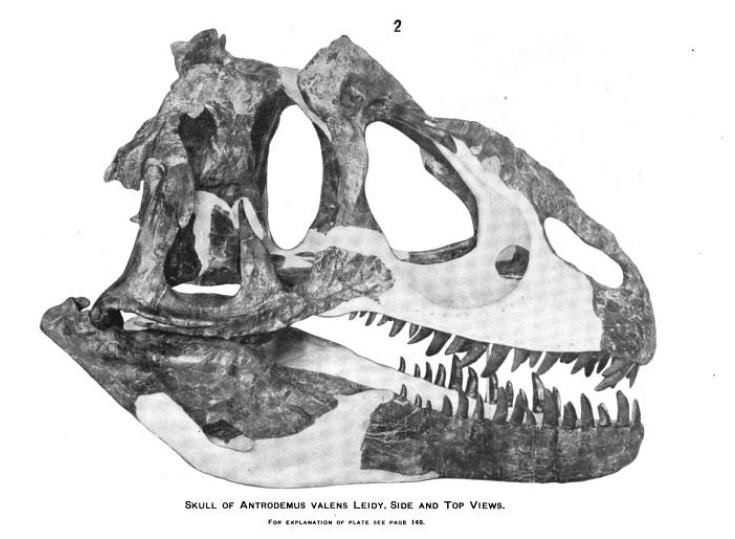
Reconstructed skull

Allosaurus skull  as reconstructed by Norman Boss. Image from Gilmore 1920.

This specimen’s taxonomic history merits some discussion. The holotype Marsh selected when naming Allosaurus (YPM 1930) is notoriously poor, consisting of a single phalanx, two dorsal centra, and a tooth. Dozens of very complete skeletons attributed to Allosaurus are now known, and most specialists basically agree on what an Allosaurus is, but the lack of a usable type with which to define the taxon has been an ongoing problem.

The far more complete USNM 4734 was recovered from the same quarry as the Allosaurus holotype, during the same 1877 field season. Marsh himself actually used this specimen, rather than his designated type, to illustrate subsequent publications on Allosaurus. In 1920, Gilmore flirted with the idea of nominating USNM 4734 as a neotype for Allosaurus, but for reasons that I find difficult to follow, he decided to lump both specimens into the older name Antrodemus valens. Joseph Leidy coined Antrodemus in 1870 based on a single caudal vertebra with no geologic provenance, so this move did little to fix the underlying issue. Nevertheless, Antrodemus remained a popular synonym for Allosaurus in some circles for several decades.
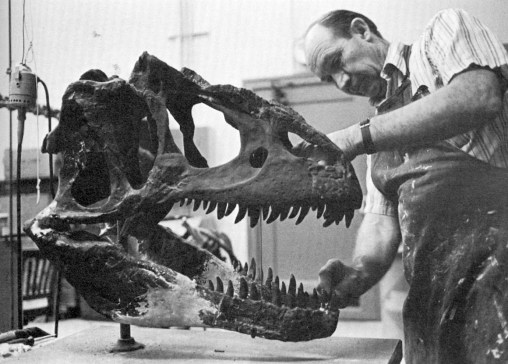
allosaurusskullprep

Arnold Lewis rebuilds the Allosaurus skull in 1979. Image from Thomson 1985.

When the NMNH fossil halls were renovated in 1981, the designers noticed that the exhibit badly needed a large theropod mount. Arnold Lewis was tapped to design and construct a complete mounted version of USNM 4734, with some assistance from Ken Carpenter. The tail was cast from a Brigham Young University specimen, but Lewis sculpted the belly ribs and sternum using an alligator skeleton as reference. The completed Allosaurus measures 17 feet from its grinning jaws to the tip of its tail, and a form-hugging armature makes it look particularly dynamic. This mount has been a favorite among visitors for more than 30 years, although the 2001 addition of a Stan the Tyrannosaurus cast has somewhat overshadowed the smaller theropod.
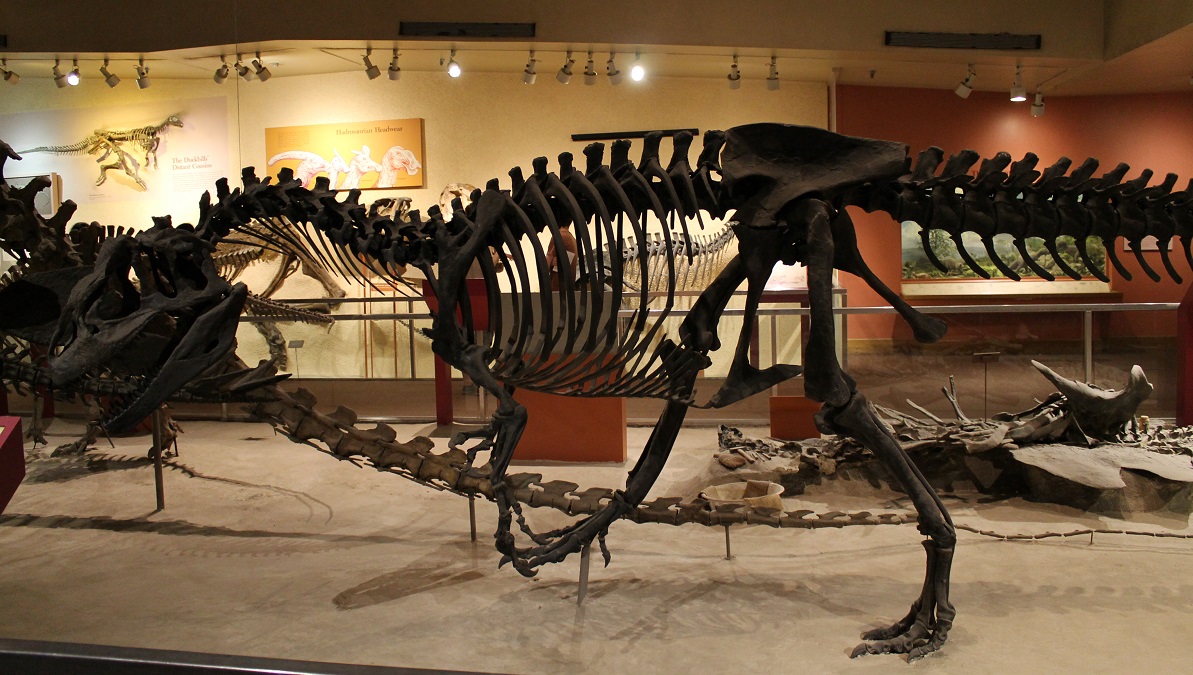
Allosaurus

The complete Allosaurus skeleton was finally exhibited in 1981. Photo by the author.

Technicians from Research Casting International took down the Allosaurus in the summer of 2014 as part of the current round of renovations. You can watch a video of the de-installation here. The skeleton will be remounted in a few years (crouching beside a nest mound), but Smithsonian researchers want to get a good look at it before that happens. In particular, curator Matt Carrano has been wondering for some time whether a partial jaw Marsh named “Labrosaurus ferox” actually belongs to this specimen. The “Labrosaurus” jaw, which has an unusual pathology caused by a bite or twisting force, came from the same quarry as USNM 4734, and appears to be the same portion of jaw that the more complete skeleton is missing. Time will tell whether Carrano’s hunch is correct. Meanwhile, Carpenter and Paul’s petition to replace the Allosaurus type with this more complete specimen from the same locality is still pending. We should expect to hear more about that soon, as well.

References

Carpenter, K., Madsen, J.H., and Lewis, L. (1994). Mounting of Fossil Vertebrate Skeletons. Vertebrate Paleontological Techniques. 285-322.

Gilmore, C. M. (1915). Osteology of Thescelosaurus, an ornithopodus dinosaur from the Lance Formation of Wyoming. Proceedings of the U.S. National Museum 49:2127:591–616.

Gilmore, C.M. (1920). Osteology of the Carnivorous Dinosauria in the United States National Museum with Special Reference to the Genera Antrodemus (Allosaurus) and CeratosaurusUnited States National Museum Bulletin 110:1-154.

Lee, J.J. (2014). The Smithsonian Disassembles its Dinosaurs. National Geographic Online.  http://news.nationalgeographic.com/news/2014/07/140731-dinosaur-hall-smithsonian-renovation-culture-science/

Paul, G.S. and Carpenter, K. (2010). Allosaurus Marsh, 1877 (Dinosauria, Theropoda): proposed conservation of usage by designation of a neotype for its type species Allosaurus fragilis Marsh, 1877. Bulletin of Zoological Nomenclature 67:1:53-56.

Thomson, P. (1985). Auks, Rocks, and the Odd Dinosaur: Inside Stories from the Smithsonian’s Museum of Natural History. New York, NY: Thomas Y. Crowell.

3 Comments

Filed under dinosaurs, exhibits, Extinct Monsters, fossil mounts, museums, NMNH, ornithopods, theropods

The Carnegie Quarry Diaspora

About 150 million years ago, a severe drought ravaged the western interior of North America. In eastern Utah, malnourished dinosaurs gathered near a dwindling river. Unwilling or unable to leave the water source, they eventually died of thirst or disease. When rain finally returned to the region, three or four successive flash floods washed dozens of animal carcasses into a relatively small depositional area to the southeast. Today, this site is known as the Carnegie Quarry at Dinosaur National Monument, and it is one of the most incredible fossil sites in the world.

Dinosaur National Monument interns collect data on the quarry wall.

Dinosaur National Monument interns collect data on the quarry wall. Source

Today, a structure encompassing a 180-foot section of the deposit (less than half its total length) allows visitors to view nearly 1400 dinosaur bones in situ. However, the fossils on display at Dinosaur National Monument represent only a portion of the material found at the Carnegie Quarry. Between the site’s discovery in 1908 and the establishment of the quarry wall exhibit, more than 20 reasonably complete dinosaur skeletons and dozens more incomplete specimens were excavated and distributed to museums in the US and Canada. No less than eleven mounted skeletons have been created from this material, and they are all still on display today. Although they are thousands of miles from their place of discovery and exhibited in four different cities, these mounts all represent individuals that lived and died in the same environment. They may have even encountered each other in life!

The Discovery

Earl Douglass was already an established fossil hunter when the Carnegie Museum of Natural History hired him in 1902. Late in the 1909 field season, Douglass was prospecting near the confluence of the Green and Yampa Rivers when he spotted a series of sauropod vertebrae eroding out of the rocks. Once Douglass and his crew began excavating the fossils, it became apparent that they had not just one remarkably complete dinosaur, but several. Douglass called it a “beautiful sight,” and CMNH director William Holland could barely contain his glee in his reports back to the Pittsburgh museum. Under Douglass’s management, CMNH crews worked at what became known as the Carnegie Quarry for 13 years. The dinosaur fossils were jumbled and often overlaid one another, so the excavators had to work on multiple skeletons simultaneously. The especially hard sandstone also slowed their work, and the team regularly resorted to huge horse-drawn plows and even dynamite to reach the fossils. Eventually railway tracks were installed to help transport blocks of sandstone out of the quarry.

In 1915, Holland successfully petitioned Woodrow Wilson to preserve the site as a national monument. CMNH crews continued to excavate until early 1923. At that point, their primary benefactor Andrew Carnegie had died, and funding for field work was dwindling. Other museums collected from the quarry periodically in the years that followed, but Douglass’s idea to contain the remaining fossils in an on-site museum was not realized until 1958.

The Mounts

CMNH

CMNH Apatosaurus. Historic photo from McGinnis 1982; modern photo source.

Apatosaurus louisae – CM 3018

The CMNH Apatosaurus was the first dinosaur discovered at the Carnegie Quarry. After Douglass first spotted the articulated caudal vertebrae in August of 1909, his crew spent several months extracting the rest of the skeleton from the rocks. The excavation continued into early 1910, and by the time they were finished they had the most complete Apatosaurus ever found – a title the specimen holds to this day. Holland mounted the 77-foot skeleton alongside the museum’s Diplodocus in just three years, at the time a record for a sauropod mount.

Holland famously left his Apatosaurus headless for decades due to a disagreement with Henry Osborn of the American Museum of Natural History. Douglass recovered a skull that almost certainly belonged to the Apatosaurus, but Holland opted not to use it because it contradicted the sculpted head already in place on the AMNH Apatosaurus mount. After Holland’s death in 1932, museum staff quietly added a casted Camarasaurus skull as a placeholder. This was finally replaced with a proper Apatosaurus skull in 1979. More recently, the team at Phil Fraley Productions disassembled and restored the Apatosaurus, along with the rest of the classic CMNH dinosaurs. Since 2007, this specimen has been back on display in a more graceful modern pose.

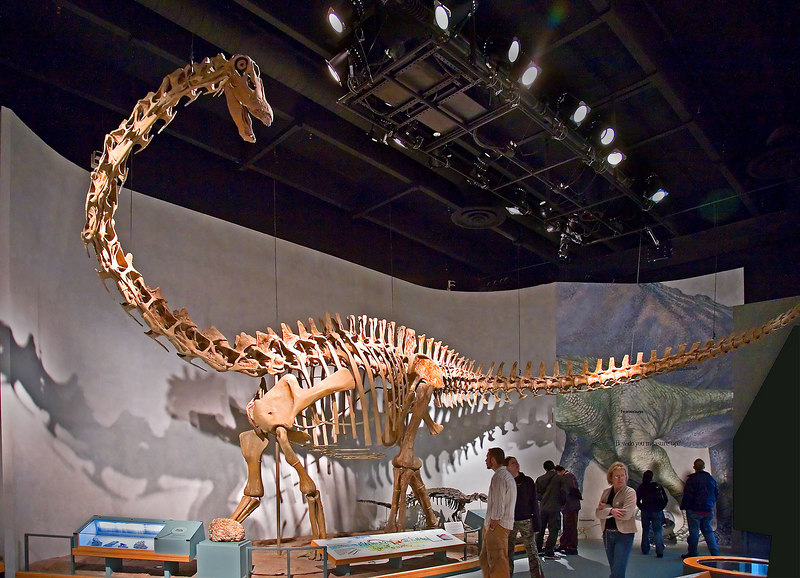
Fancy fisheye photo.

AMNH Barosaurus. Source

Barosaurus lentus – AMNH 6341

When the CMNH team discovered this skeleton in 1912, they assumed it was yet another specimen of the well-known Diplodocus. It was harvested for parts, with portions sent to CMNH, the United States National Museum, and the University of Utah to supplement their displays. When the specimen turned out to be the more obscure sauropod Barosaurus, it languished in pieces for many years. Barnum Brown of AMNH was making a circuit of the fossil collections at various natural history museums when he rediscovered this specimen. Through a series of purchases and trades, the Barosaurus was reunited at AMNH in 1929.

Nevertheless, AMNH quickly abandoned plans to mount the Barosaurus – the museum already had a sauropod on display, and there wasn’t enough floor space for another one. It wouldn’t go on display until 1991, when Lowell Dingus conceived of the idea to mount the Barosaurus in a spectacular rearing pose as part of the renovation of the Theodore Roosevelt Rotunda. Peter May took on the project – one of the first mounts produced by his company Research Casting International. The resulting display, actually a cast, is the tallest free-standing dinosaur mount in the world.

ROM Barosaurus.

ROM Barosaurus. Source

Barosaurus lentus – ROM 3670

Douglass recovered a second partial Barosaurus skeleton in 1912, which consisted of a mostly complete torso and parts of each leg. It stayed in the CMNH collections for many years, until they traded it to the Royal Ontario Museum in 1962. ROM staff intended to mount the skeleton, but once again this was cancelled due to a lack of space. David Evans was developing a new ROM paleontology exhibit in 2007 when he learned that the museum had most of a Barosaurus sitting in its collections. With only weeks remaining before the exhibit’s opening, Evans tapped Research Casting International to mount the sauropod, supplemented with a replica neck and tail from the AMNH version.

Allosaurus fragilis – CM 11844

Several Allosaurus specimens are known from the Carnegie Quarry, but the one on display at CMNH is one of the largest. Douglass and his team excavated this 35-foot skeleton between 1913 and 1915. The mount was built in 1938. Although the specimen included a partial skull, the exhibit team swapped it with a cast of a more complete skull (also found in the Carnegie Quarry) from the collections of the University of Utah. This mount also includes casts of the arms of USNM 4734, an Allosaurus collected for O.C. Marsh.

Stegosaurus ungulatus – CM 11341

The CMNH Stegosaurus is a composite of several individuals excavated from the Carnegie Quarry between 1920 and 1922. Museum staff completed the 21 foot-long mount in 1940, using a skull cast from USNM 8612. Casts of this skeleton were distributed to several other museums at some point, one of which is on display at the University of Nebraska State Museum. Phil Fraley’s company remounted the CMNH original in 2007.

Carnegie Camarasaurus.

Carnegie Camarasaurus. Source

Camarasaurus lentus – CM 11338

This juvenile Camarasaurus is the most complete sauropod ever found. It is displayed as a relief mount almost exactly as it was discovered, with two exceptions. The left leg was swapped with a more complete one from another individual, and the tail was re-positioned to create a more aesthetically pleasing mount. Casts of this skeleton are displayed at museums throughout the United States, including Dinosaur National Monument, but the original is at CMNH. This specimen is also notable because its left scapula is preserved in its life position, making it a helpful model for skeletal reconstructions and exhibit mounts.

NMNH Camarasaurus. Photo by the author.

NMNH Camarasaurus. Photo by the author.

Camarasaurus lentus – USNM 13786

The second best Camarasaurus also comes from Carnegie Quarry, but it is a considerably larger individual. Only the tail and a few odds and ends were missing. CMNH kept the specimen for several years before trading it to USNM in 1933 for a set of Pliocene horse skeletons. Norman Boss prepared the specimen in full view of the public during the 1936 Texas Centennial Exposition – one of the first known examples of such an exhibit. The completed mount appeared at USNM in the 1950s, sporting the tail of another Camarasaurus. At over 30 feet long, this skeleton is one of the largest dinosaurs on display at the Smithsonian. Unfortunately, the death pose somewhat limits the effect. The Camarasaurus was taken off exhibit in late 2014 for conservation and remounting. When it returns, it will be standing on its feet for the first time in 150 million years, taking its rightful place as one of the museum’s most impressive dinosaurs.

DMNH Diplodocus. Source

DMNH Diplodocus. Source

Diplodocus longus – DMNH 1494

Since this Dipldodocus was found somewhat disarticulated, Douglass suggested that the carcass may have been twisted apart while rolling downstream. AMNH held on to this skeleton for some time before trading it to the Denver Museum of Nature and Science in 1936 for two mammoth skeletons. Preparator Phillip Reinheimer mounted the skeleton with the help of 40 workers assigned to the museum through the Works Progress Administration. Additional Diplodocus fossils collected by William DeWeese (actually the first dinosaur specimens acquired by the museum) were also used to complete the mount. The Diplodocus remained on view until 1989, when Ken Carpenter and others restored and remounted the sauropod, elevating its tail and making its neck sweep gracefully to the left. The improved mount has been on display since 1995.

CMNH Camptosaurus.

CMNH Camptosaurus. Historic photo from McGinnis 1982; modern photo source.

Camptosaurus aphanoecetes – CM 11337

Douglass found this controversial small ornithopod in 1922, and correctly matched it with an isolated leg several feet away. It was first identified as Camptosaurus medius, but in 2008 Ken Carpenter reassigned it to the new species C. aphanoecetes. A 2011 phylogenic study by Andrew McDonald moved this specimen to a new genus, Uteodon. Carpenter, however, asserts that McDonald’s analysis was based on an incorrectly associated Dryosaurus braincase.

CMNH staff assembled the fossils into a relief mount in 1940. The skull, hindfeet, and tail were all sculpted. During the 2007 renovation, the Phil Fraley Productions team extracted the fossils from the plaster slab, even managing to preserve the delicate ossified dorsal tendons. They then created a new, three-dimensional mount, which features a revised replica skull.

Modern photo by the author.

CMNH Dryosaurus. Historic photo from McGinnis 1982; modern photo by the author.

Dryosaurus altus – CM 3392

This Dryosaurus skeleton is the most complete of several collected at Dinosaur National Monument. The tail is missing, and given the completeness of the rest of the skeleton it may well have been destroyed when Douglass’s crew was blasting through rock to get to the bone layer. The Dryosaurus entered the CMNH collections in 1922, and was assembled as a 9 foot-long relief mount in 1940. In 2007, Fraley’s team removed the fossils from the plaster matrix, and just as they did with the Camptosaurus, constructed a standing mount. To date, this is the only mounted Dryosaurus specimen in the world. It is displayed alongside a juvenile Ceratosaurus cast acquired from Western Paleontological Laboratories.

National Museum of Natural History in Washington, DC.

NMNH Diplodocus. Photo by the author.

Diplodocus sp. – USNM 10865

The National Museum of Natural History’s Diplodocus was one of the last articulated skeletons removed from the Carnegie Quarry. When the CMNH crew closed up shop, Charles Gilmore of the Smithsonian moved in to recover one of the sauropod skeletons Douglass left behind. In 1923, Gilmore’s team excavated a partial Diplodocus, and also cherry-picked a few extra bones from an adjacent specimen. The process of mounting the skeleton at USNM took six years of continuous work, and Gilmore would later describe it as the most ambitious undertaking his department hadever attempted. The 70-foot Diplodocus mount was completed in 1931, and remained unchanged for more than 80 years. It was finally taken down in December 2014, and will return in a new pose in 2019.

Addendum: Mike Taylor recently called attention to a gorgeous map of the entire deposit prepared by Ken Carpenter, which was what prompted this post. Check it out here.

References

Carpenter, K. (2013). History, Sedimentology, and Taphonomy of the Carnegie Quarry, Dinosaur National Monument, Utah. Annals of the Carnegie Museum 81:3:153-232.

Dingus, L. (1996). Next of Kin: Great Fossils at the American Museum of Natural History. New York, NY: Rizzoli International Publications, Inc.

Gilmore, C.W. (1941). “A History of the Division of Vertebrate Paleontology in the United States National Museum.” Proceedings of the United States National Museum 90.

McGinnis, H.J. (1982). Carnegie’s Dinosaurs: A Comprehensive Guide to Dinosaur Hall at Carnegie Museum of Natural History, Carnegie Institute. Pittsburgh, PA: The Board of Trustees, Carnegie Institute.

15 Comments

Filed under AMNH, CMNH, collections, dinosaurs, DMNS, exhibits, field work, fossil mounts, history of science, museums, NMNH, ornithopods, sauropods, theropods, thyreophorans

Real or cast? If only it were that simple!

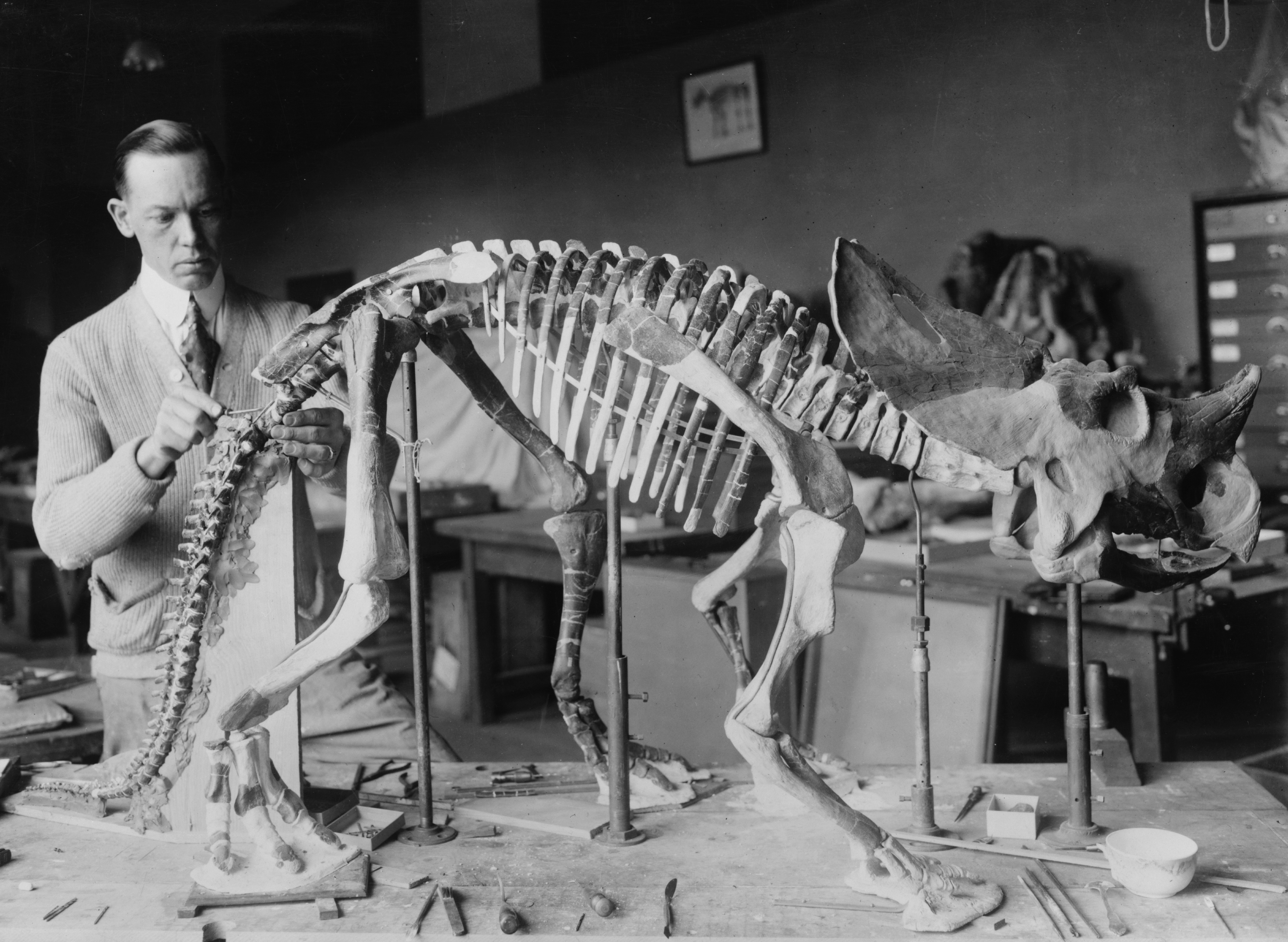
Norman Boss Brachyceratops courtesy Smithsonian archives

Norman Boss assembles  a “Brachyceratops” mount. White bones and portions thereof are sculpted. Image courtesy of the Smithsonian Institution Archives.

Back in January, London’s Natural History Museum incited a flurry of debate when it announced that Dippy, the Diplodocus skeleton that has graced the museum’s entrance hall for decades, will soon be retired and replaced with a blue whale. One of the recurring arguments in favor of the change has been that Dippy is not an original specimen – it’s a cast, or as some commentators have called it, “a fake.” As I argued last month, referring to a fossil cast in this way is a flagrant misrepresentation. An excellent post by Liz Martin covers this in more detail – “fake” implies deception, or something invented outright. Fossil casts are nothing of the sort. They are exact replicas of fossils, and they could not exist without the original specimens they are based on.

Nevertheless, the idea that fossil mounts are either original bones or casts is a bit of a false dichotomy. I’m as guilty as anyone of propagating this myth – it’s a simple way to assuage the fears of museum visitors that the fossil skeletons on display aren’t real. The truth is that most mounts include some amount of straight-up sculpted material. After all, the fossilized remains of vertebrate animals, particularly large ones, are almost never found articulated or anywhere near complete. The specimens chosen for museum mounts are among the absolute best available, but even they are not perfect. For instance, the NHM Dippy (actually one of many) is mostly a cast of a single Diplodocus specimen held at the Carnegie Museum of Natural History, but the forelimbs were reconstructed. When the mount was assembled, no Diplodocus forelimb material of comparable size was available, so Arthur Coggeshall and colleagues sculpted some based on smaller specimens.

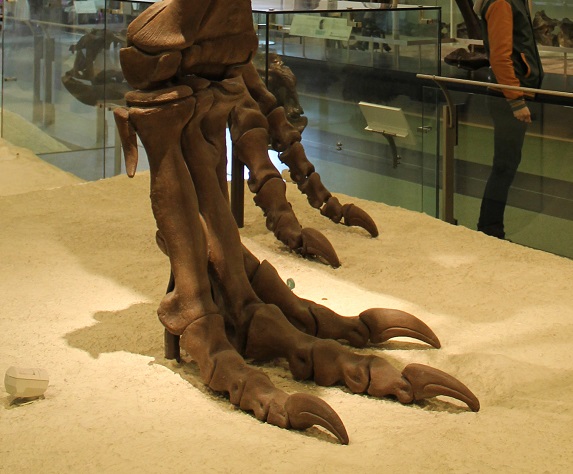
Sculpted feet

The sculpted feet of the AMNH Tyrannosaurus. Photo by the author.

From Hadrosaurus, the first mounted dinosaur skeleton, to modern reconstructions like Anzu, fossil mounts as we know them would not be possible without some amount of informed reconstruction. Take the iconic Tyrannosaurus rex mount at the American Museum of Natural History, assembled in 1915. The skeleton is a composite of two T. rex specimens, neither of which included any of the bones of the feet. Rather than creating a skeleton that stopped short at the ankles, Adam Herman sculpted a set of feet based on Allosaurus, another large meat-eating dinosaur. When Tyrannosaurus feet were eventually discovered, the allosaur-inspired feet turned out to be a little too bulky – tyrannosaurs actually had relatively long, gracile toes. But it’s not like T. rex turned out to have hooves or wheels. In most respects, from the basic three-toed arrangement to the shape and position of each individual bone, Hermann’s hypothesized tyrannosaur feet were spot-on. In fact, they were so close that the museum didn’t bother updating them when the skeleton was remounted in 1995.

The sculpted portions of fossil mounts aren’t wild speculation. They are very reasonable hypotheses based on a solid understanding of skeletal anatomy. As anatomist Georges Cuvier wrote in 1798:

Today comparative anatomy has reached such a point of perfection that, after inspecting a single bone, one can often determine the class, and sometimes even the genus of the animal to which it belonged…this is because the number, direction, and shape of the bones that compose each part of an animal’s body are always in a necessary relation to all the other parts, in such a way that – up to a point – one can infer the whole from any one of them and vice versa.

Cuvier’s principle of the correlation of parts – the idea that all backboned animals are built on the same basic body plan – is fundamental to the science of paleontology. If we have the right forelimb of an animal, we know that it had a mirror-image left forelimb. If we find a skeleton with it’s skull missing, we can still be confident that it had a head. What’s more, specialists can often recognize the group an animal belongs to (and sometimes the species) from just a few bones or teeth. Salamander vertebrae have a characteristic hourglass shape. Frog limb bones have “double-barreled” cavities in cross section. Marsupial teeth have a stylar shelf. New world monkeys have an extra premolar in each quadrant of the mouth. With enough specialized knowledge of related taxa, it is entirely possible to produce an educated reconstruction of most any animal from a minority of its skeleton.

How much is too much?

Argentinosaurus and Giganotosaurus at the Fernbank Museum of Natural History. Source

But as far as mounted skeletons in museums go, how far can we take this? Is it reasonable to build a standing mount when only 50% of the skeleton is definitively known? What about 30%? 10%? By bone count, that’s about the percentage of fossils ever found from the sauropod Argentinosaurus. And yet, the Fernbank Museum in Atlanta has a (rather spectacular) Argentinosaurus mount in its lobby. The whole thing is, of course, a fiberglass sculpture, dutifully based on better-known relatives. This mount is probably a fair reconstruction of what a complete Argentinosaurus skeleton would look like (although see this list of inaccuracies at Paleoking), but some still might consider it misleading. Your mileage may vary.

Museums generally do a good job labeling reconstructions. In particular, The Carnegie Museum and the Royal Ontario Museum are to be commended for posting charts alongside mounted skeletons that show which bones are original, which are casts, and which are reconstructions. In other cases, a little more transparency would not be unwelcome. For example, the four skulls below appear to include at least as much plaster reconstruction as bone, but they are all labeled as original specimens.

Photos by the author.

Four heavily-reconstructed fossil skulls at AMNH. Clockwise from top: Eryops, Indricotherium, Ophiacodon, and Triceratops. Photos by the author.

This is ultimately more of a philosophical question than a scientific one. Museum mounts, regardless of the amount of sculpted material, are usually well-supported reconstructions of the animal in question. If new information shows that a mount is wrong – as sometimes happens – staff are undoubtedly aware and will correct it as soon as funding and bureaucracy allow (granted, that can take decades). But as I’ve argued before, fossil mounts are unique among museum exhibits in that they are both the specimens and the interpretive context. They are hypotheses, but are presented (or at least understood) as straightforward truth. With this paradox in mind, how much is a museum ethically obligated to share about a mount’s creation? How can we do this without spurring visitors to use the dreaded f-word?

Comments are open, as always, and I’d be thrilled to hear what readers think.

11 Comments

Filed under AMNH, anatomy, dinosaurs, fossil mounts, mammals, museums, NHM, reptiles, sauropods, science communication, theropods

Installation art in the service of science

totes awesome

Unbridled awesome. Photo by the author.

Earlier this week, Dippy the Diplodocus gave me an opportunity to discuss mounted fossil skeletons as objects imbued with cultural and historical meaning. Today, I’d like to take that a step further and discuss them as art. Hold on tight, because it’s about to get interdisciplinary up in here.

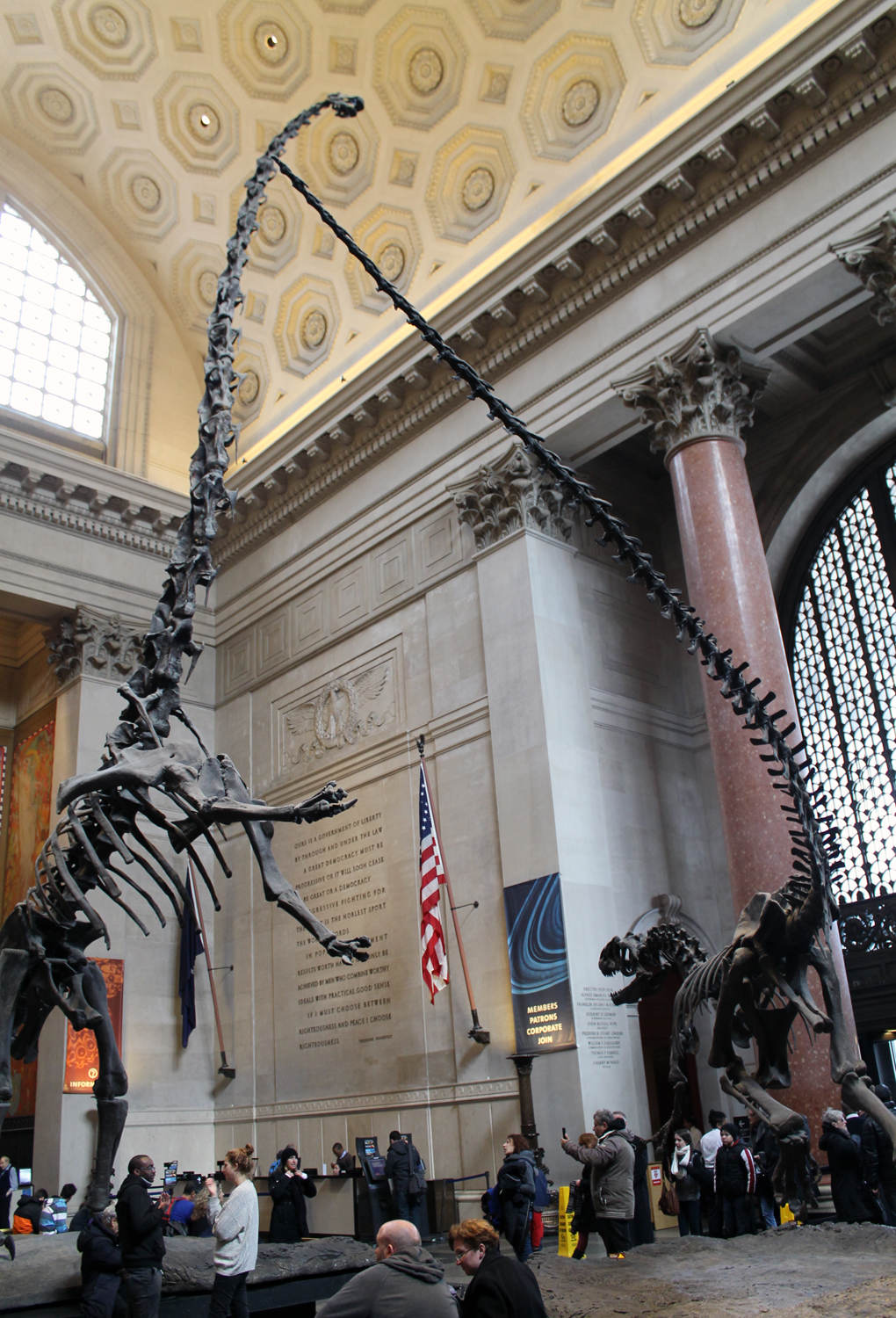
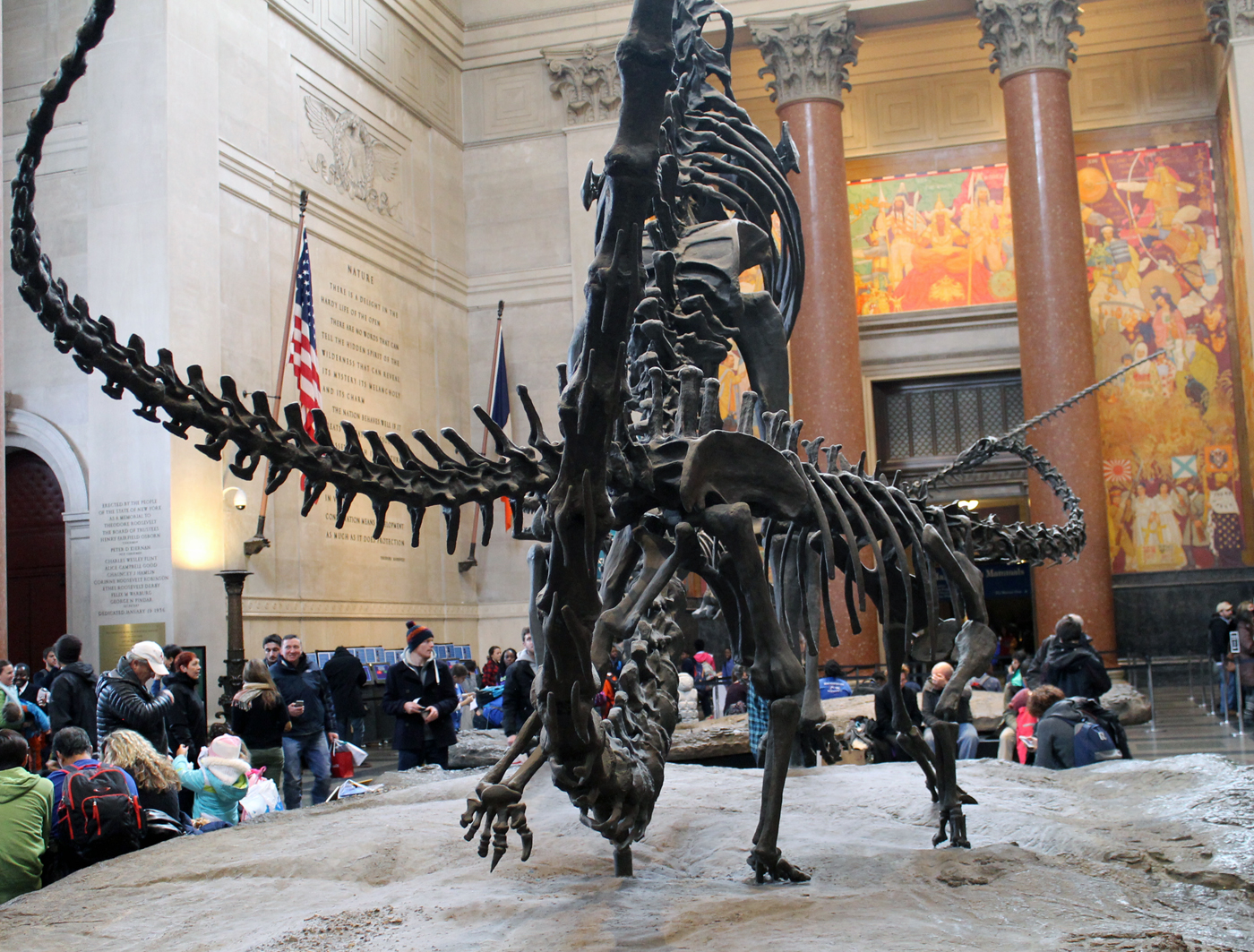
The Barosaurus and Allosaurus encounter at the American Museum of Natural History is one of the most amazing fossil displays in the world. Within the historic Theodore Roosevelt Rotunda, an adult Barosaurus skeleton rears to a height of fifty feet to protect its offspring from a charging Allosaurus. Although all three skeletons are glass-reinforced polyester and polyurethane foam casts (by necessity – it would be unwise to mount real fossil bones in such a precarious manner), they are based directly on real specimens. The adult Barosaurus is a cast of AMNH 6341, which was excavated by Earl Douglass at Dinosaur National Monument in 1923. The Allosaurus is a cast of DMNH 1483. The young Barosaurus is the most speculative of the lot and mostly consists of sculpted bones, but it includes casts of real juvenile sauropod vertebrae.

Looking past its physical properties, this display comes with an explicit pedagogical agenda. AMNH paleontologist Mark Norrell stated that the objective was “to imagine dinosaurs as living organisms, facing challenges similar to those that confront animals today.” When the exhibit was built in 1991, it was considered important to showcase what active, hot-blooded dinosaurs might be capable of. In this case, we have a portrayal of considerable speed and agility, as well as a suggestion of parental care and group living. The mount and its associated signage also invite visitors to consider the nature of the fossil record, and what questions paleontologists can and cannot definitively answer. We don’t know whether Barosaurus would have protected or even lived with its young. We don’t know if Allosaurus would have attempted to attack an animal more than three times its size. Even the ability of Barosaurus to rear up on two legs has been the subject of some debate. While not enormously far-fetched, this is still an imaginative reconstruction – one which challenges visitors to consider the evidence behind this and other displays throughout the museum.

However, even this sort of interpretation does not fully capture the experience of observing this tableau – there is something else going on here. The dynamic poses give the dinosaurs a startling presence, and it is scarcely possible not to imagine them as living animals. Visitors must consider what it would be like to encounter an Allosaurus charging at full speed, or to stand beneath a multi-ton sauropod. Standing in the center of the room, the viewer is literally surrounded by the mounts, and necessarily becomes a participant in the drama. Even if we ignore the representational identities of the dinosaurs and think of this display as a set of abstract shapes, it is still decisively monumental. The mise-en-scène draws the viewer’s eye around the room and up the neck of the Barosaurus, toward the vaulted ceiling. The scene can thus be described as a visual and physical intervention that draws each and every visitor that enters the rotunda into a shared performance.

Fancy fisheye photo.

The visitors themselves become part of the installation by providing a human scale. Source

As impressive as the mounts are on their own, they cannot be divorced from the Theodore Roosevelt Rotunda that surrounds them. Aesthetically, the grandiose nature of the skeletons compliments the neoclassical architecture. The site-specific composition also encourages visitors to look around the room and take note of structural elements they might have missed (e.g. the ceiling). But the room itself is far from a neutral exhibition space. It is a public monument to the first President Roosevelt, who Donna Haraway calls “the patron saint for the museum.” In addition to an array of canvases depicting scenes from Roosevelt’s public life,  quotations are etched into the walls under the headings Youth, Manhood, Nature, and The State. Roosevelt’s words, literally carved in stone, speak to his appreciation of the natural world, his support for what he called “the strenuous life”, and his belief in living honorably and compassionately. Were it not for the throngs of tourists, this space could be mistaken for a shrine.

There are a few possible ways to interpret  the relationship between the dinosaurs and the hall around them. We could cast the adult Barosaurus as Roosevelt’s idealized citizen. Rather than letting the Allosaurus pick off it’s more vulnerable companion, it stands its ground, for “the highest form of success comes not to the man who desires mere easy peace, but to the man who does not shrink from danger, from hardship, or from bitter toil.” Alternatively, we could follow Haraway and consider this space a monument to hyper-masculinity and paternalistic oppression. Haraway slams the Roosevelt Rotunda (which implies a male audience at the exclusion of others) and the adjacent Hall of African Mammals (which displays artificially-assembled nuclear families, always with a male leader) as products of the wealth and privilege of the early-20th century aristocracy. But if we assume – as many visitors apparently do – that the defending Barosaurus is female, the dinosaurs might be read as a direct critique of the institution’s history. While political and sociological readings probably didn’t come up much when these mounts were being constructed, intent isn’t the whole story. This is a public space, and visitors can and will make conscious and unconscious connections between the various objects on view. Besides, this wouldn’t be the first time fossils have been entwined with presidential politics.

Different

The fossils weren’t created to be displayed in this space, but the mounts were. Photo by the author.

A museum display always involves the staging or framing of the world. It is this infusion of creative choice that moves  fossil mounts beyond the realm of science and into art. As Polliquin puts it, a specimen from nature “permits or invites experience, wheras a work of art is intentionally made for an experience.” Whether they are composed of real fossils or casts thereof, fossil mounts are purposefully constructed to exist in the museum environment. Paradoxically, they are both the objects of scrutiny and the exhibit context. This is not something to hide or be ashamed of, but to celebrate. These mounts embody aesthetic  beauty, deep history, and rich culture, and these elements are just as important as their scientific value when we consider their role in the museological landscape.

References

Haraway, D. (1985). Teddy Bear Patriarchy: Taxidermy in the Garden of Eden, New York City, 1908-1936. Social Text 11:20-64.

Kohlstedt, S.G. (2005). “Thoughts in Things” Modernity, History, and North American Museums. Isis 96:4:586-601.

Lindsay, W., Larkin, N. and Smith, N. (1996). Displaying Dinosaurs at the Natural History Museum, London. Curator 39:4:262-279.

Norrell, M.A., Dingus, L.W. and Gaffney, E.S. (1991). Barosaurus on Central Park West. Natural History 100:12:36-41.

Polliquin, R. (2012). The Breathless Zoo: Taxidermy and the Cultures of Longing. University Park, PA: Pennsylvania State University Press.

Vogel, S. (1991). Always True to the Object, in Our Fashion. Exhibiting Cultures: The Poetics and Politics of Museum Displays. Washington, DC: Smithsonian Institution Press.

3 Comments

Filed under AMNH, dinosaurs, education, exhibits, fossil mounts, museums, paleoart, reptiles, sauropods, theropods

Dinosaurs on display in 2014

Instead of repeating last year’s navel-gazing, I’m going to try something a little more interesting with my obligatory year-in-review*. This post will recap 2014’s big events in museum paleontology – I’ve covered some of it before, but there’s plenty that I missed as well.

Out with the Old

artists conception

Concept art for the new NMNH fossil hall, opening 2019.

I don’t think it’s a stretch to say that the most important event in the world of fossil exhibits this year was the closing of the National Museum of Natural History’s east wing. This is the world’s most-visited natural history museum, and the fossil mounts on display here have been among the most widely-viewed anywhere. The east wing has been home to paleontology displays since the building opened more than a century ago, but until now it has never undergone a complete, wall-to-wall modernization. Since the halls closed in April, NMNH staff have made significant progress de-installing the old displays, including some mounted skeletons that have been on display for over 80 years. Over the next five years, this historic space will be restored to it’s original neo-classical glory, and eventually remade into a new chronicle of the history of life on Earth suitable for the 21st century.

NMNH was among the last of the classic American natural history museums to commit to a post-dinosaur renaissance overhaul (the American Museum of Natural History started the trend in 1995, followed by the Field Museum and the Carnegie Museum). All eyes are now on the Peabody Museum of Natural History, where the great hall of fossil reptiles still looks much as it did sixty years ago. A plan is in place for a $30 million renovation, and the museum is currently soliciting donations to fund the project. For now, however, New Haven is one of the last places in North America where visitors can still see early-20th century dinosaur mounts.

In With the New

Spinosaurus!

Spinosaurus at the National Geographic Explorer’s Hall. Photo by the author.
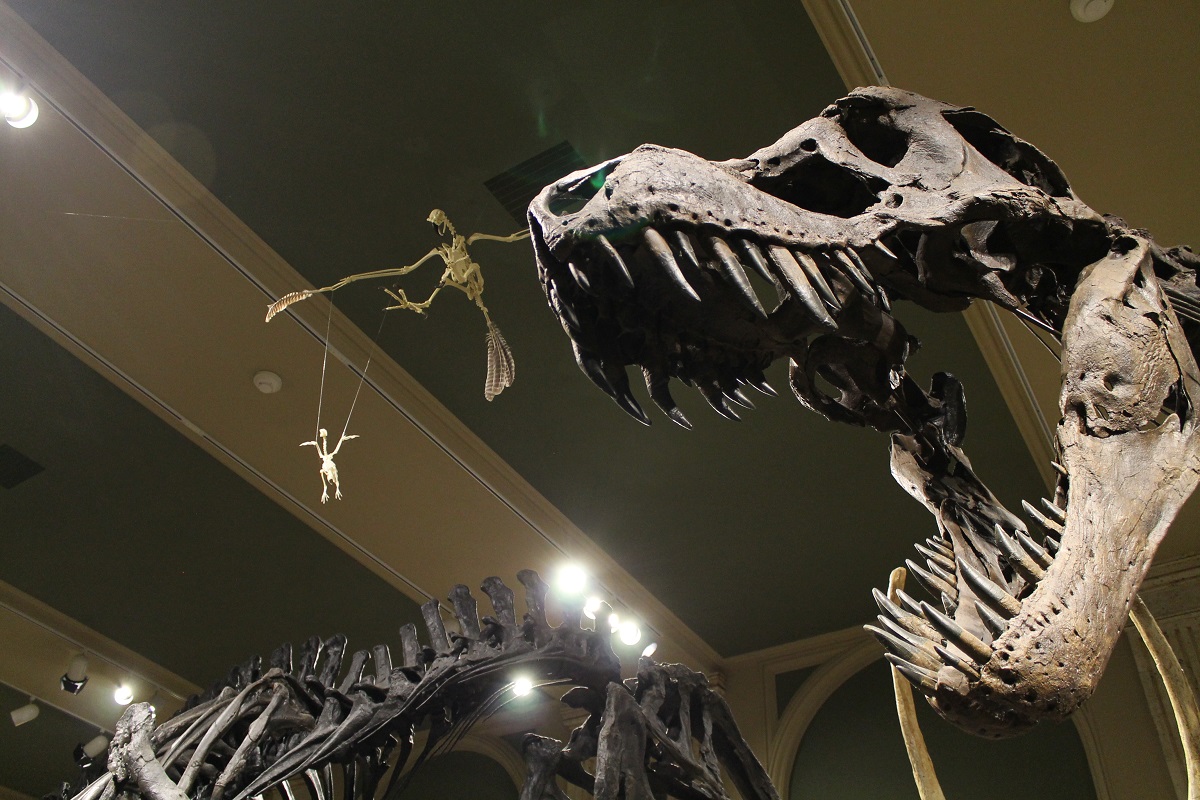
Several new temporary and traveling fossil exhibits opened in the United States this year. The biggest splash was made by “Spinosaurus: Lost Giant of the Cretaceous”, which I reviewed in September. Premiering at the National Geographic Explorer’s Hall in Washington DC, this exhibit is science outreach on a grand scale. It debuted alongside a technical paper by Nizar Ibrahim and colleagues that redescribed the well-known Spinosaurus as a short-legged analogue to early whales. While there has been some skepticism about the paper’s conclusions, credit must be given for such an ambitious public display of up-to-the-minute research. The exhibit, which includes a 50-foot reconstruction of a swimming Spinosaurus skeleton, will be on display in Washington through April 12. After that, it begins its world tour in Germany.

Washington, DC got a second new paleontology exhibit this Fall in the form of “The Last American Dinosaurs” at NMNH. Focusing on the North American ecosystem that existed just before the Cretaceous-Paleogene extinction event, this exhibit will serve as an interim dinosaur attraction while the main fossil hall is being renovated. The Last American Dinosaurs is more than a stopgap, however – it’s a remarkably well-crafted look at ecology and the phenomenon of extinction, both in the past and in the present.

Other 2014 fossil exhibits of note include “Tiny Titans: Dinosaur Eggs and Babies” at the Peabody Museum, and “Pterosaurs: Flight in the Age of Dinosaurs” at AMNH. Tiny Titans didn’t feature any show-stopping fossil mounts, but it was nevertheless a charming, kid-friendly exhibit focused on how different groups of dinosaurs raised their young. I thoroughly enjoyed it, particularly the gorgeous artwork by Luis Rey. I missed my chance to check out Pterosaurs (it closes this week), so if you were able to see it please share your thoughts!

Mount of the Year

Sophie the Stegosaurus at the Natural History Museum in London. Source

Sophie the Stegosaurus at the Natural History Museum in London. Source

What was the coolest mounted fossil skeleton created this year? For the runner up, I’d pick the aforementioned Spinosaurus. Created by RCI and Acme Design under the direction of Paul Sereno’s lab at the University of Chicago, this replica skeleton embodies both the possibilities and pitfalls of digital technology. The Spinosaurus mount is based on a digital composite of laser-scanned fossils held in at least three countries, as well as scaled-up bones from related animals like Suchomimus, and a fair amount of sculpted material. On one hand, it’s incredible that a unified vision of this animal can be willed into three-dimensional existence. However, one could reasonably voice concern about presenting a somewhat controversial hypothesis in a format that implies authenticity. Virtually all fossil mounts are composites to some degree, but it seems we’re still working out the limits of how far this concept can be taken.
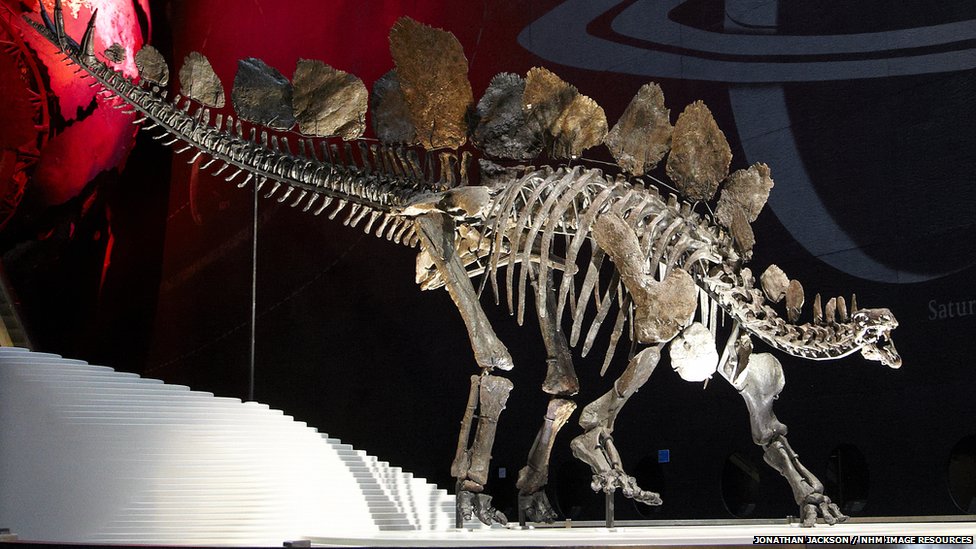
In contrast, I have no reservations in granting Mount of the Year to Sophie the Stegosaurus. Unveiled on December 4th at London’s Natural History Museum, this is the most complete Stegosaurus specimen known and the first example of this species to be displayed in Europe. It’s also the first new dinosaur skeleton to be added to historic NHM exhibit halls in more than a century. After the museum purchased the skeleton from a private dealer in 2013, Paul Barrett and Charlotte Brassey have been carefully examining (and laser-scanning) every inch of it for the better part of the last year. New data on the biomechanics and behavior of Stegosaurus is due out soon, but for now the public can enjoy the 18-foot skeleton in a dramatic display at the museum. In addition to the impressive work creating a dynamic pose with nearly invisible supports, I’m particularly taken by NHM’s outreach efforts, which explain the importance of this skeleton for a broad range of audiences.

All in all, 2014 was a pretty good year for paleontology on display. While fossil exhibits remained stagnant for much of the 20th century, the last decade plus has seen an explosion of displays to feed the public’s insatiable appetite for dinosaurs. Perhaps in the future we will call this time the second golden age of fossil mounts!

*For the record, Dinosours! got about 26,000 visitors last year, many of which I owe to the good people at Love in the Time of Chasmosaurs and SV-POW. My review of the Spinosaurus exhibit was by far the most popular post, followed by the two-parter on Triceratops posture and the true story of the mismatched “Brontosaurus” skull.


1 Comment

Filed under AMNH, dinosaurs, exhibits, fossil mounts, museums, NMNH, opinion, theropods, thyreophorans

The Last American Dinosaurs Has Arrived!

Hatcher greets visitors

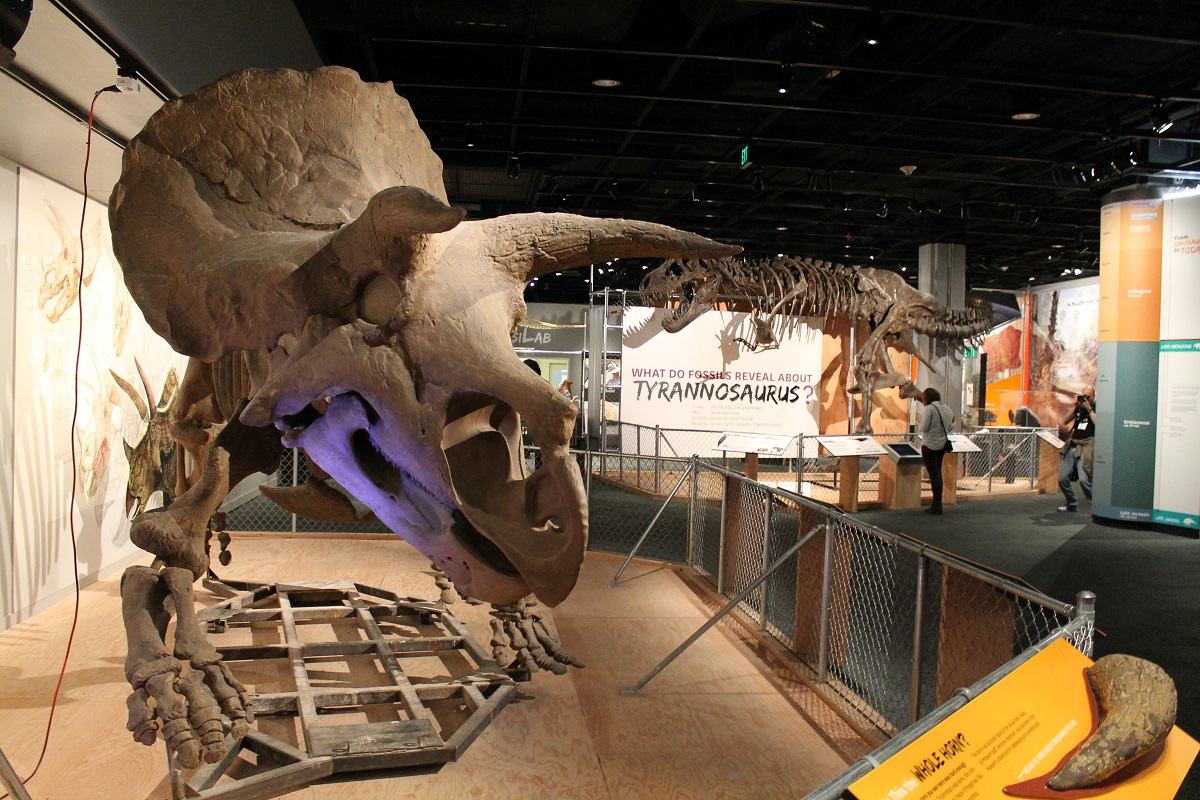
Hatcher the Triceratops greets visitors at the entrance to The Last American Dinosaurs.

Dinosaurs are once again on display at the National Museum of Natural History. Opening just in time for Thanksgiving weekend, “The Last American Dinosaurs” provides a much-needed dose of paleontology while the main fossil hall is being renovated. I was fortunate enough to take part in a preview tour for social media users – you can check out the storified version, or read on for photos and my initial thoughts on the new exhibit.

Stan is cool

Stan the T. rex is sure to be a crowd-pleaser.

Babies

Triceratops growth series reveals how much we’ve learned about the lives of dinosaurs over the last 25 years.

As promised, there are plenty of dinosaurs on view. Specifically, these are the dinosaurs of Maastrichtian North America, the last of these animals to grace this continent before the extinction event 66 million years ago. In addition to the mounted skeletons of Triceratops and Tyrannosaurus discussed in the previous post, be on the lookout for a hatchling and juvenile Triceratops, an Edmontosaurus, and bits and pieces from dromaeosaurs and pachycephalosaurs.

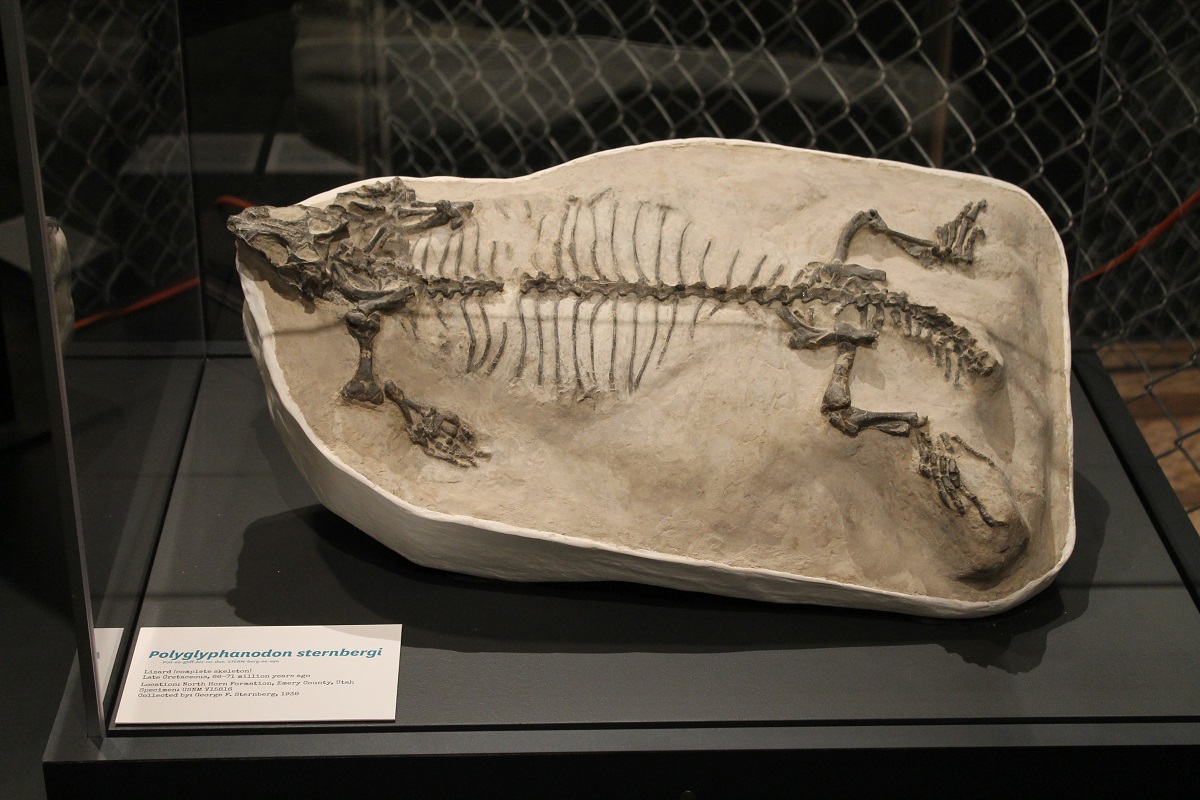
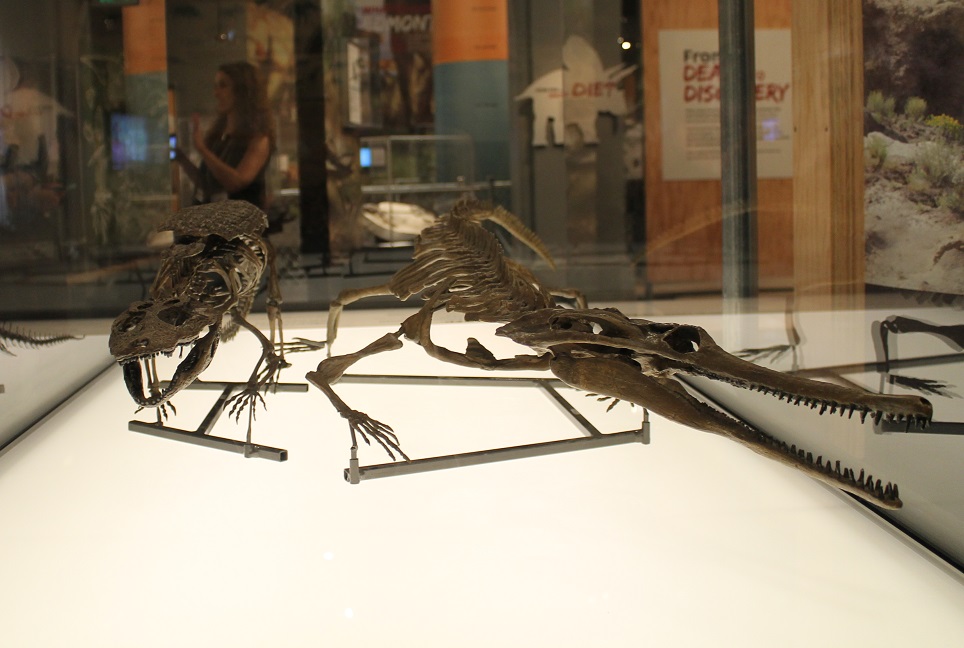
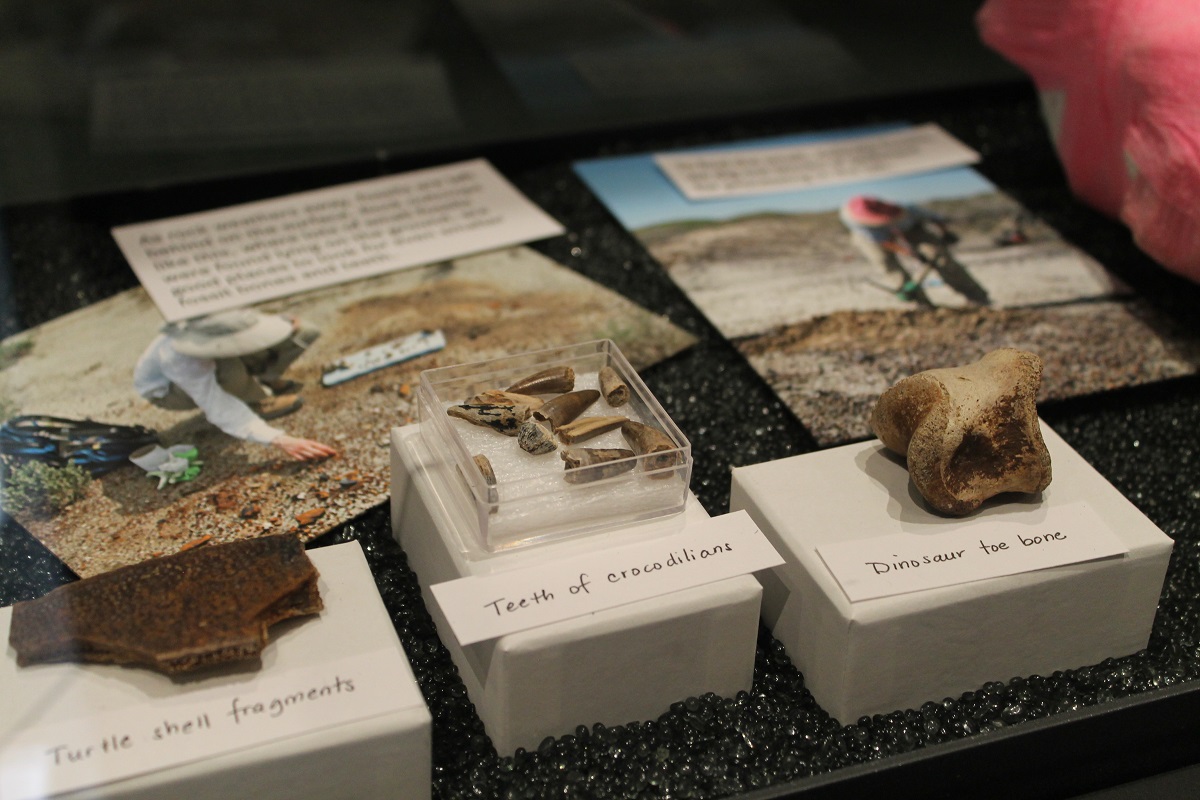
However, the dinosaurs are just the tip of the iceberg. As lead curator Hans-Dieter Sues explained within the first few minutes of the tour, the central message of this exhibit is that dinosaurs were only one part of a complex ecosystem. To that end, the dinosaurs of The Last American Dinosaurs are outnumbered by a menagerie of of reptiles, mammals, invertebrates, and plants that shared their world, most of which are on display for the first time. These specimens come from a variety of sources. Some, including turtles and fossil leaves, were collected by NMNH paleontologists in North Dakota specifically for this exhibit. Others, like the lizard Polyglyphanodon, have been in the museum’s collection since the 1930s but have never before been put on display. I also spotted a few casts sourced from Triebold Paleontology, including the mammal Didelphodon and the alligator-like Stangerochampsa

Gilmore specimen

This Polyglyphanodon was collected by Charles Gilmore in the 1930s.

crocs

Stangerochampsa and Champsosaurus are examples of animals that survived the K/T extinction.

Much like the Human Origins exhibit, The Last American Dinosaurs incorporates the faces of Smithsonian researchers and staff throughout the displays. There are large photos showing the museum’s scientists at work in the field, and the popular windowed FossiLab has found a new home in this exhibit. In addition, a large area is deservedly devoted to scientific illustrator Mary Parrish, chronicling the methods she uses to turn fossil data into gorgeously detailed renderings of prehistoric animals and environments. Videos of Parrish and others at work can be seen here.

I’m definitely a fan of this personalized approach to science communication. In-house scientists are museums’ most important and unique resources, and placing them front-and-center reminds visitors that science is done by real and diverse people, not caricatures in lab coats. A human face goes a long way toward making the process of doing science relateable to visitors.

new stuff

Handwritten labels on these fresh from the field fossils provide a personal touch.

The phenomenon of extinction is another important theme in The Last American Dinosaurs. The exhibit details how an asteroid impact combined with several other factors to radically alter the environment worldwide, causing 70% of species to die out (fun fact: ambient temperatures in North America directly after the impact were comparable to the inside of a brick pizza oven). However, the exhibit goes on to make direct comparisons between the K/Pg extinction event and the anthropogenic extinctions of today. Habitat destruction, introduction of invasive species, and climate change caused by burning fossil fuels are instigators of environmental upheaval as powerful as any space rock.

extinction

This moa and dodo remind visitors that extinction isn’t limited to the distant past.

In this way, The Last American Dinosaurs is a warm-up for the key messages of the new fossil hall. The overarching theme of the planned exhibit is that “Earth’s distant past is connected to the present and shapes our future.” It will showcase how living things and their environments are interdependent, and change over time. Crucially, it will also demonstrate how our understanding of how life has changed over time is important for understanding and mitigating our impact on present-day ecosystems. The Last American Dinosaurs is evidently a testing ground for how these ideas will resonate with audiences.

paleoart

Historic models of Agathaumas and Triceratops by Charles Knight and Charles Gilmore.

In designing modern paleontology exhibits, museum workers have tried many approaches to squelch the idea of the dinosaur pageant show and instead convey how the science of paleontology is relevant to our understanding of the world around us. Back in 1995, the American Museum of Natural History tried a cladistic arrangement with a focus on biodiversity. More recently, the Field Museum used the process of evolution to frame the history of life on Earth. While there are certainly overlaps with what has come before, the “modern implications of environmental change over deep time” approach under development at NMNH is fairly novel, and also quite timely. Some of the displays in The Last American Dinosaurs hit pretty close to home, and I’m eager to find out how visitors respond.

6 Comments

Filed under dinosaurs, exhibits, fossil mounts, mammals, marginocephalians, museums, NMNH, ornithopods, paleoart, reptiles, reviews, science communication, theropods

Hatcher, Stan, and the Changing Identities of Fossil Mounts

Photo by the author

Hatcher the Triceratops and Stan the T. rex in the NMNH fossil hall, early 2014. Photo by the author.

Although the east wing fossil halls are closed for renovation until 2019, the National Museum of Natural History will not be without a dinosaur display for much longer. An interim exhibit entitled “The Last American Dinosaurs” will open later this month, occupying the space that formally held the “Written in Bone” exhibition. The Last American Dinosaurs will cover a small but important slice of the age of dinosaurs: the final ecosystem to grace North America before the extinction event 66 million years ago. While the new exhibit will feature several show-stealing dinosaurs, the main message is that these animals lived within a complete and complex ecosystem, just like the animals of today. The exhibit will also cover the phenomenon of extinction, and how massive environmental change (whether caused by a giant space rock or by human activity) can drastically alter the course of life on Earth.

What I’d like to discuss in this post are the two dinosaurian centerpieces of the exhibit: Hatcher the Triceratops and Stan the Tyrannosaurus. Both mounts stood in the classic fossil hall for years, and I’ve already written extensively about each of them. Nevertheless, these two dinosaurs nicely encapsulate the history of mounted fossil skeletons, as well as the changing face of museum paleontology. As the ambassadors to the Smithsonian’s dinosaur collection for the next five years, I think it’s worth revisiting their origin stories.

The First Triceratops

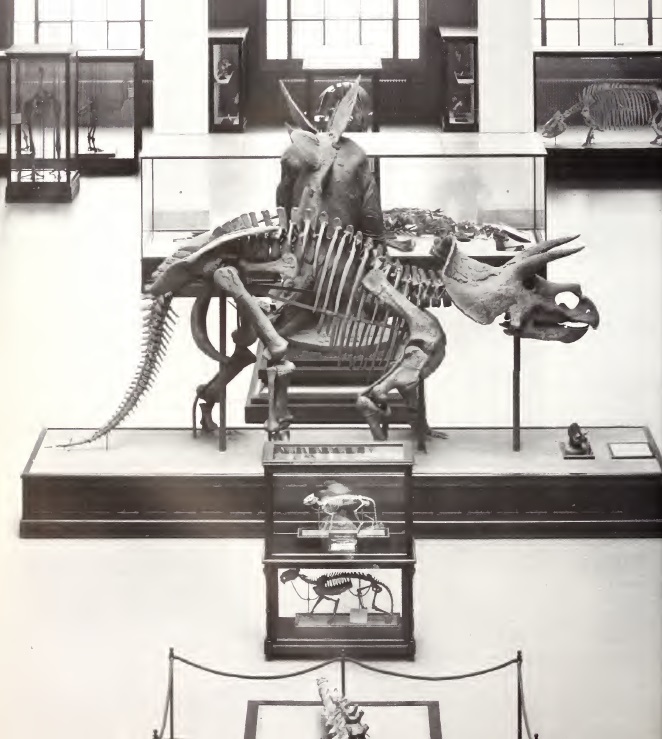
Hatcher in Hall of Extinct Monsters

This Triceratops stood in the NMNH fossil hall for nearly 90 years. Photo courtesy of the Smithsonian Institution Archives.

The Smithsonian Triceratops hails from what we might call the golden age of museum paleontology. Mounted dinosaur skeletons were an integral part of the rise of large urban natural history museums at the turn of the 20th century. The opening of the American western frontier revealed an unprecedented treasure trove of fossils, far greater than what was previously known in Europe. As a result, paleontology became one of the first realms of science in which Americans were leaders, and patriotism was a significant factor in the growing public enthusiasm for extinct monsters. Wealthy benefactors of recently formed institutions like the American Museum of Natural History and the Field Columbian Museum envisioned the mounted skeletons of dinosaurs as an opportunity to increase attendance and public interest, and they provided ample funding to find fossils for display. These efforts were not wasted, as the golden age fossil mounts have been enjoyed for generations…and most are still on display today.

It’s easy to get caught up in the romanticism of this era of discovery and exposition. Golden age fossil mounts were forged into being entirely in-house. At a given museum, the same small group of staff was frequently responsible for finding, preparing, describing, naming and mounting a new dinosaur. As such, fossil mounts were typically exclusives to particular museums, and they garnered significant amounts of institutional and regional pride. New York had “Brontosaurus” and Tyrannosaurus. Pittsburgh had Diplodocus. And for more than 20 years, Washington, DC had the world’s only mounted Triceratops.

Hatcher in Sunday star

A spread in the June 11, 1905 Sunday Star profiled the Smithsonian Triceratops. Image courtesy of the Smithsonian Institution Archives.

Built in 1905 by Charles Gilmore and Norman Boss, the Smithsonian Triceratops has been a Washington, DC attraction for longer than the Lincoln Memorial. Like most turn of the century dinosaur mounts, it is not a single specimen but a composite of several individuals. The fossils were recovered from Wyoming by the prolific fossil hunter John Bell Hatcher, working in the employ of O.C. Marsh and the United States Geological Survey*. USNM 4842, the most complete partial skeleton available, provided the torso and pelvis, while the remains of at least six other Triceratops filled in the rest of the mount.

*Incidentally, this means the Triceratops doesn’t quite fit the story I outlined above. It was not discovered or named by Smithsonian scientists – instead, the Smithsonian inherited the fossils Marsh collected for the federal government when he was through with them.

Even though it was a slightly disproportionate chimera, for experts and laypeople alike the Smithsonian Triceratops mount was Triceratops. Virtually every illustration of the animal for decades after the mount’s debut dutifully copied its every eccentricity, including the slightly undersized head and excessively sprawled forelimbs. If you can strain your eyes to read Sunday Star article above, it’s also interesting to see how the mount was presented to the public. Even in an era when museum displays were unapologetically created by experts for experts, the Triceratops is repeatedly likened to a fantastical monster. Although the creation of the mount was an important anatomical exercise for the small community of professional paleontologists, it seems that for most visitors a display like this primarily served as whimsical entertainment.

Hatcher_tempdisplay

Hatcher was moved to his new home on the second floor at the beginning of the summer. Photo by the author.

After a brief stint in the original United States National Museum (now called the Arts and Industries Building), Gilmore and Boss’s Triceratops was transferred the east wing of the present-day NMNH in 1911. It remained there for 90 years, until the aging and deteriorating fossils were finally disassembled and retired to the collections. In their place, Smithsonian staff created an updated replica skeleton, called “Hatcher”, from digital scans of the original bones. This version is the Triceratops that will be on display in The Last American Dinosaurs.

A Prefab Tyrannosaurus?

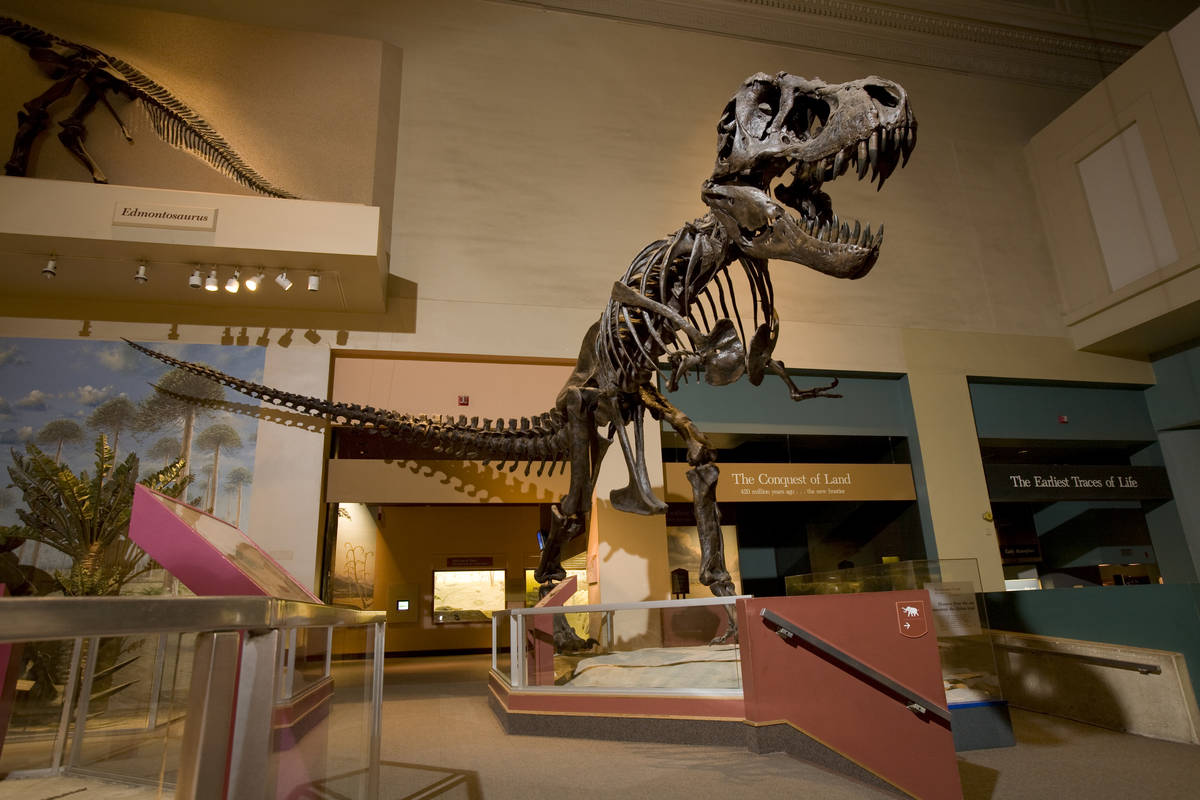
Stan. Photo by Chip Clark.

Stan the T. rex, as seen in the classic NMNH fossil hall. Photo by Chip Clark.

Since 2000, Hatcher the Triceratops was in a permanent face-off with another replica mount, Stan the Tyrannosaurus. Unlike Hatcher, Stan is not based on fossils in the Smithsonian collection. This T. rex cast was purchased from the Black Hills Institute, a private company that  produces and sells replica fossil skeletons (as well as original specimens, which is another issue entirely). Discovered by avocational fossil hunter Stan Sacrison in 1987, Stan the dinosaur was excavated and is now owned by BHI. Since 1995, BHI has sold dozens of Stan replicas to museums and other venues. The Smithsonian acquired its version in 1999, in part because of visitor demand for the world’s most famous dinosaur, but also apparently as a consolation prize for missing out on Sue.

Clearly, much has changed in the way museums source their dinosaurs. Rather than creating fossil mounts on-site, museums frequently contract out the production to exhibit fabrication companies like Research Casting International, Gaston Design, and the aforementioned Black Hills Institute. These companies can construct mounts using fossils or casts from a particular museum’s collection, but they also offer catalogs of made-to-order skeletons. Thanks to these exhibit companies, more or less identical copies of certain dinosaurs are now on display all over the world.  In Stan’s case, the Smithsonian version has a twin just seven miles north at the Discovery Communications building in Silver Spring.

Stan can be set up in a under an hour. This version was recently displayed at Farmington Museum.

Stan replicas can be set up in a under an hour. This version was recently displayed at New Mexico’s Farmington Museum. Source

An argument could be made that this degree of replication lessens the impact and cultural value of dinosaur displays. How much allure does a mount have when identical versions can be seen at dozens of other locations, including corporate offices and amusement parks? I would counter that this is a small price to pay when we consider the substantial educational benefits of this unprecedented availability of dinosaur skeletons. Widespread casts like Stan give people all over the world the opportunity to see a T. rex in person, an experience that was until recently limited to those with the means to travel to a handful of large cities. Typically priced in the tens of thousands of dollars, dinosaur casts certainly aren’t cheap, but they are still within the means of many small to mid-sized local museums.

Furthermore, these casts are hardly rolling off of assembly lines. They are exact replicas of real fossils, and require a tremendous amount of experience and skill to produce. Mounts are manufactured as needed, and are customized to meet the needs of the specific museum. Meanwhile, museums still employ scientists who collect new fossils for their collections. The difference is that these collecting trips usually seek to answer specific research questions, rather than going after only the biggest and most impressive display specimens. Finally, museums definitely haven’t outsourced exhibit production entirely. All summer at NMNH, in-house preparators have been working in collaboration with contractors from Research Casting International to dismantle the historic fossil exhibits in preparation for the upcoming renovation.

Reassembling Stan upstairs. Photo by Abby Telfer.

Reassembling Stan for The Last American Dinosaurs. Photo by Abby Telfer.

There’s one more change for the better in modern paleontology exhibits. When the Smithsonian Triceratops was first introduced to the world in 1905, natural history displays tended to focus on the breadth of collections. Curators composed exhibits with other experts in mind, and the non-scholars that actually made up the majority of museum visitors were not directly catered to. Without any context to work with, fossil mounts were little more than toothy spectacles for most visitors. Today, museum staff create exhibits that tell stories. The Last American Dinosaurs has been explicitly designed to contextualize the dinosaurs – to show how they fit into the history of life on Earth, and why their world is meaningful today. How successful will this be? I’ll report back after the exhibit opens on November 25th.

2 Comments

Filed under dinosaurs, exhibits, fossil mounts, history of science, marginocephalians, museums, NMNH, reptiles, theropods

Exhibit Review: Kenosha Dinosaur Museum

Stan and an eagle.

Stan the Tyrannosaurus with a modern eagle. Photo by the author.

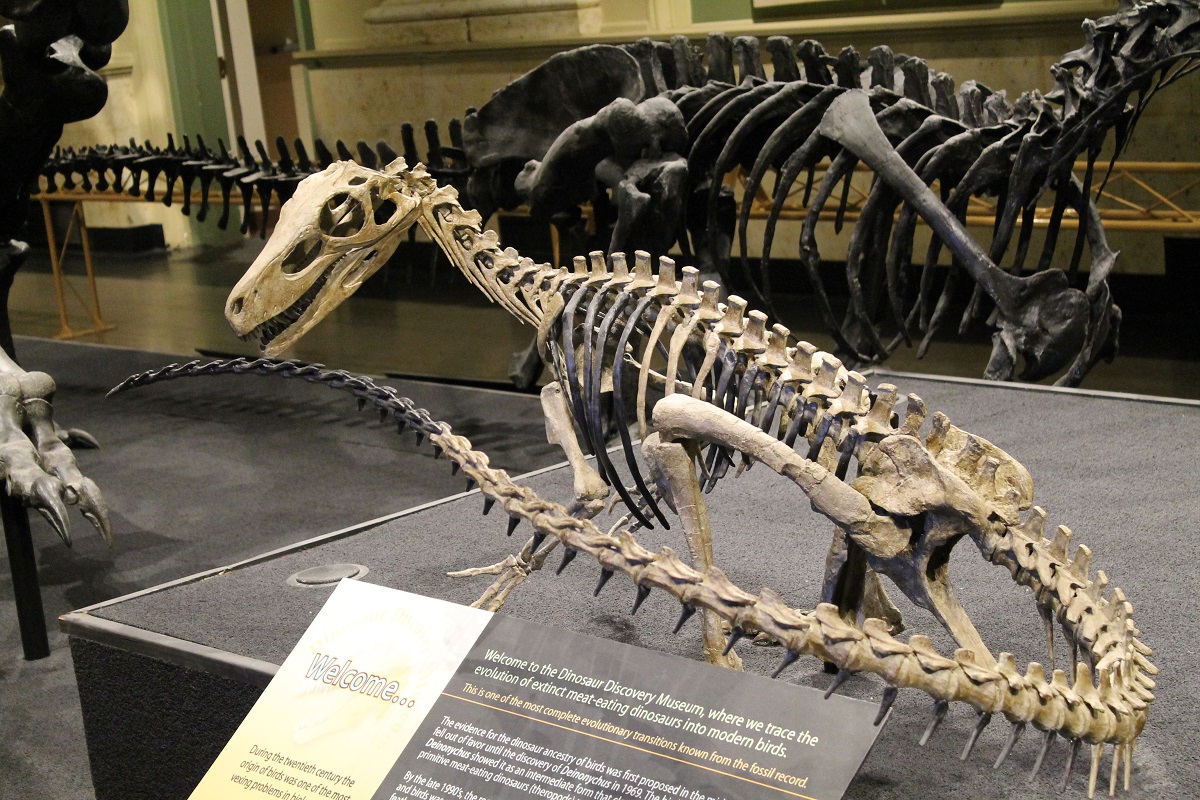
Last week, I had a chance to visit the Dinosaur Discovery Museum in Kenosha, Wisconsin. I had no idea this place existed until recently, but it’s a short drive north from the Chicago area, and has apparently been open since 2006. The Museum is a joint venture between the municipally funded Kenosha Public Museum system and Carthage College, and is housed in a lovely 1930s post office (on the National Register of Historic Places). As I understand it, the Dinosaur Discovery Museum was initially imagined as a space to host the undergraduate paleontology program at the College, which is led by Dr. Thomas Carr. While the Museum does include a working fossil prep lab and displays of recent finds from Carr’s field expeditions in Montana and South Dakota, the primary draw for most visitors is the permanent exhibit hall. Although less than 100 feet across, this space is packed with more theropod mounts than I have ever seen in one place.

Nary an ornithiscian in sight. Photo by the author.

Nary an ornithiscian in sight. Photo by the author.

Naturally, the theme of this theropod-centric exhibit is bird evolution. Circling the central pedestal counter-clockwise, visitors can see the radiation of theropods from primitive forms like Herrerasaurus to larger ceratosaurs and tetanurans and finally to increasingly bird-like coelurosaurs. The Dinosaur Discovery Museum must have gotten a very generous initial donation, because they seem to have bought out virtually the entire catalog of casts from both the Black Hills Institute and Triebold Paleontology.

Hererrasaurus

A squatting Hererrasaurus is one of many unusually posed mounts at the Dinosaur Discovery Museum. Photo by the author.

Many of the casts were familiar to me, including the ubiquitous Stan, the Acrocanthosaurus from the North Carolina Museum of Natural Sciences, and the Anzu from the Carnegie Museum of Natural History. Nevertheless, it’s extremely cool to see such a complete range of theropod diversity in one place. I could directly compare any bone from a given mount to the same bone on any other, or even to the helpful selection of modern bird skeletons. The only thing that would make this exhibit more complete would be the inclusion of  growth series from the taxa for which this is known, like Tyrannosaurus and Allosaurus. And for the record, jaded paleophiles, T. rex looks really impressive alongside this menagerie. Overrated, my eye.

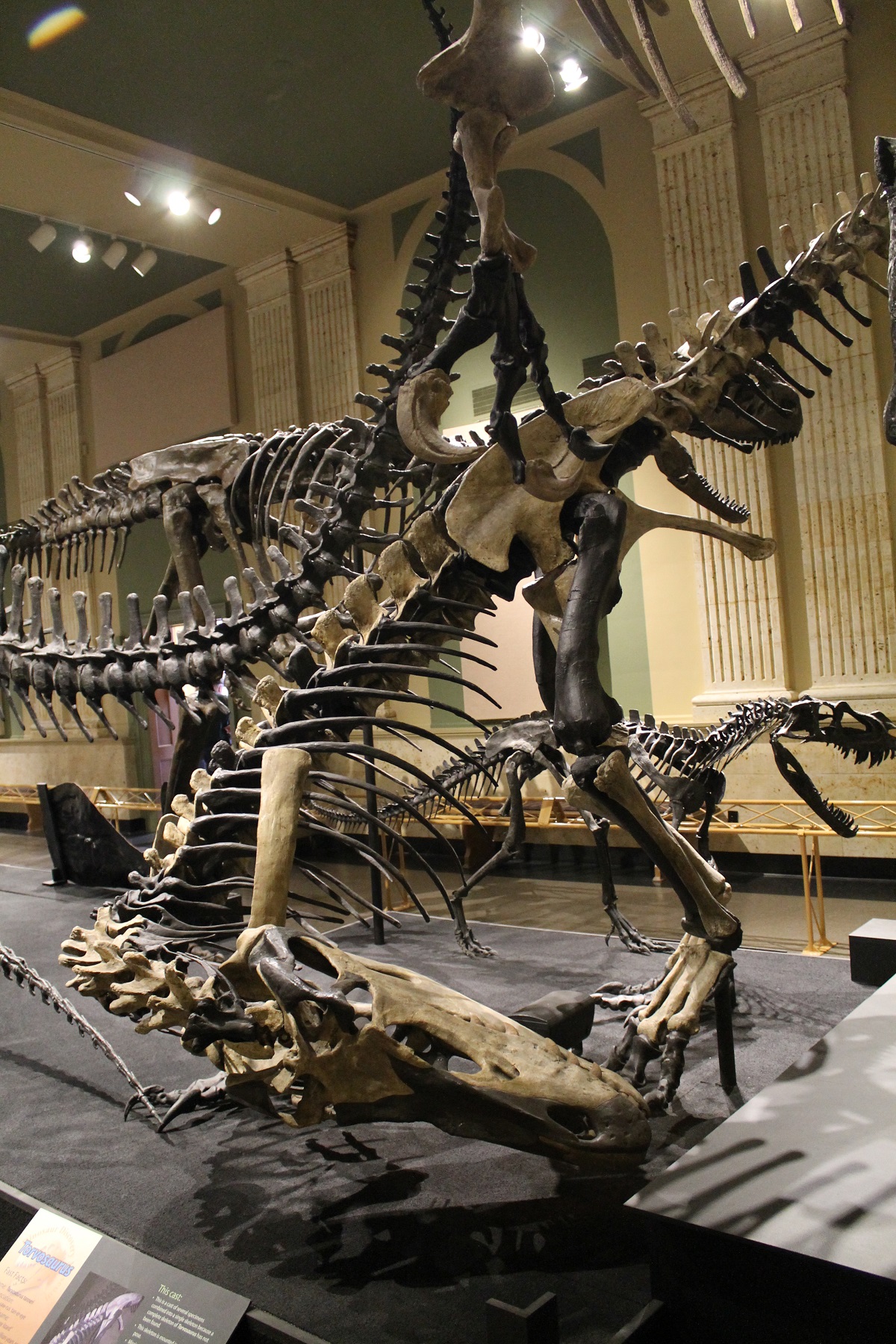
Torvosaurus scratches its jaw.

Torvosaurus scratches its jaw. Photo by the author.

Unlike some exhibits, the Dinosaur Discovery Museum does not shy away from the fact that all the skeletons on display are casts. Most of the mounts are very obviously painted in two colors, showing precisely which bones are based on real finds and which are sculpted reconstructions. Unfortunately, a handful of mounts inexplicably lack this information, which could confuse some visitors. One helpful side effect of displaying casts is that the dinosaurs can be placed in a variety of life-like poses. These theropods are not all staring straight ahead with mouths agape – instead, we are treated to displays like the Torvosaurus above, which is scratching its head with its foot.

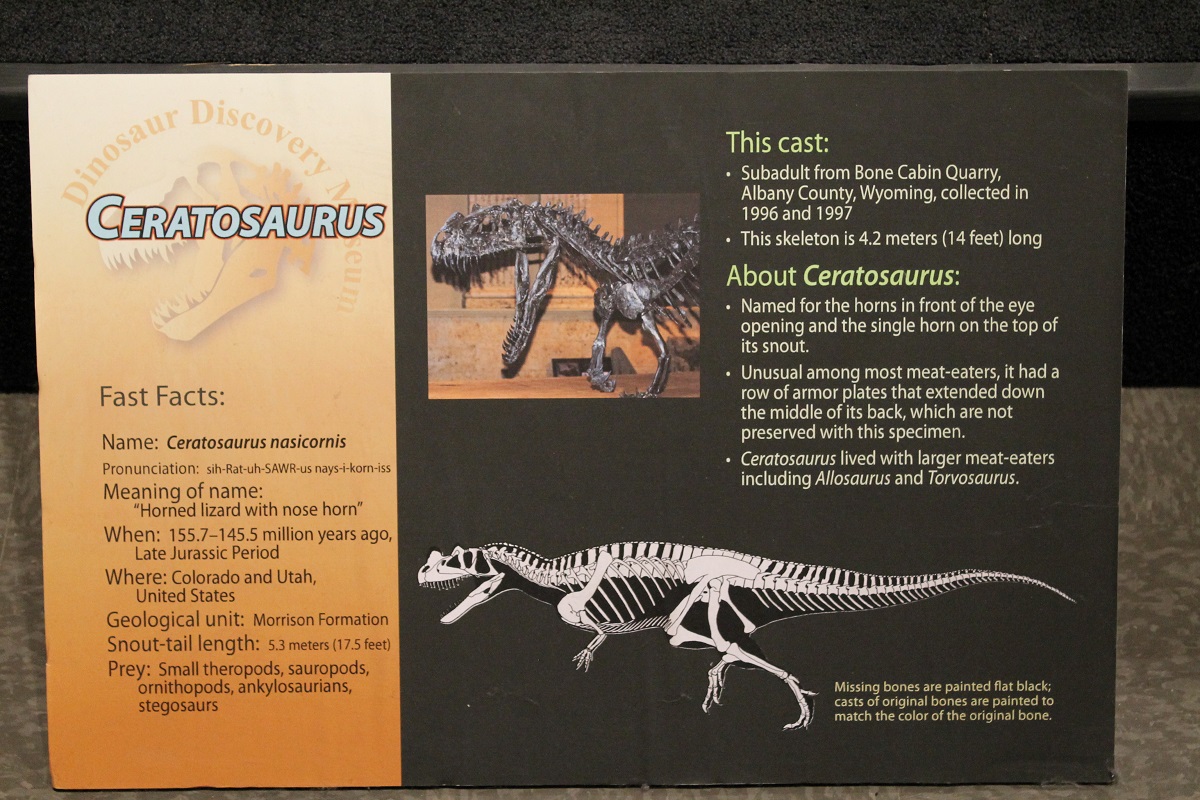
Ceratosaurus sign.

Signs like this accompany each dinosaur. Photo by the author.

The signage is of similarly high quality. Each dinosaur is accompanied by an attractive panel that provides expected information like the animal’s diet and time period, as well as a very helpful section identifying the quarry where the fossils were found and in most cases, the repository housing the original specimen. Additional signs on the walls cover the origin and extinction of dinosaurs, as well as the many lines of evidence that birds are surviving dinosaurs. Although they look a bit wordy at a distance, these signs are quite well-written for inclined to peruse them.

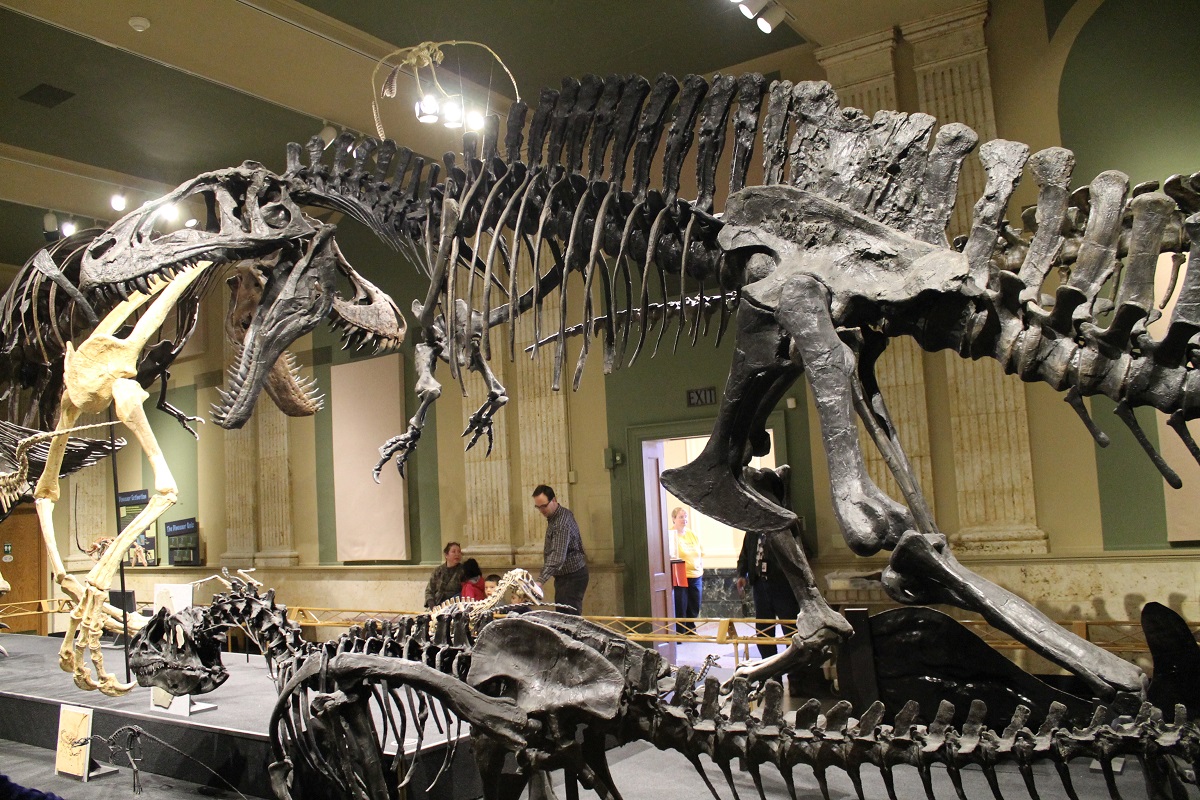
Acrocanthosaurus.

Acrocanthosaurus and an Allosaurus at rest. Photo by the author.

Also of note is a children’s room on the lower level, featuring (sigh) a sandbox dig and some very helpful and enthusiastic volunteers. Indeed, children’s activities appear to be the Dinosaur Discovery Museum’s strong suit. A look at their website reveals that kid’s programs are scheduled every weekend, and special events like dinosaur ornament making and flashlight tours occur throughout the year.

Clearly, I was impressed by my visit to the Dinosaur Discovery Museum. It’s wonderful that an educational opportunity like this exists in a semi-rural community, something that would have been unheard of not so long ago (did I mention it’s free?). What’s more, the exhibit hall is a great resource for specialists interested in comparing a variety of theropods first-hand. If you ever find yourself in the area, this little museum is definitely worth a visit.

1 Comment

Filed under dinosaurs, education, exhibits, fossil mounts, museums, reptiles, reviews, science communication, theropods

Spinosaurus at the National Geographic Museum

IMG_2341

Research Casting International has done it again with a beautiful reconstructed skeleton of a swimming Spinosaurus. Photo by the author.

Yesterday, Nizar Ibrahim and National Geographic made a tremendous splash with their long-awaited announcement of a new Spinosaurus specimen. Spinosaurus is a widely recognized and beloved dinosaur (particularly among what one might call the dinosaur fandom community), but paradoxically it is known from only the scrappiest of fossil remains. What’s more, the holotype specimen is long gone – destroyed in the bombing of Munich during World War II. No doubt the enigmatic nature of Spinosaurus is a major part of its appeal. At any rate, the new paper by Ibrahim and colleagues describes the never-before-seen hindlimbs and pelvis of Spinosaurus, and proposes that the dinosaur’s anatomy – and behavior – were far more extreme than previously assumed. The new specimen reveals that Spinosaurus had narrow hips and legs barely longer than its arms. This was not an animal built for running on land, and a quadrupedal posture is not out of the question. What’s more, Spinosaurus limb bones are surprisingly dense for a theropod, not unlike the heavy bones of seals and early whales. Ibrahim and colleagues paint a picture of Spinosaurus as an animal that was at least as at-home in the water as it was on land.

The news has provoked the usual cycle of rampant speculation among dino fans, dismissal of sensationalism by some professionals, and even well-reasoned, evidence-based criticism. After the fervor dies down, we can assess whether this hypothesis holds water. In the meantime, though, I must applaud the tremendously impressive show National Geographic has put on. As part of the media roll-out that started yesterday afternoon, National Geographic has prepared both a television special and a traveling exhibit revolving around Spinosaurus. Some might scoff at all the hype over a partial skeleton, but I’d call this science outreach at its best, put on by some of the most experienced folks in the business.

IMG_2376

This Spinosaurus sculpture will be a fixture outside the National Geographic Building on 17th street until January. Photo by the author.

“Spinosaurus: Lost Giant of the Cretaceous” opened this morning at the National Geographic Explorer’s Hall in Washington, DC, and in this post I’d like to share my initial impressions. Visitors approaching from M Street are greeted by a life-sized Spinosaurus sculpture, posed over a half-eaten fish. This superb model was produced by the Italian studio GeoModel, and was apparently over a year in the making. Conceptual art and behind-the-scenes photos can be seen here. I’m not sure if the model has quite the extreme proportions that are proposed in the paper, but it’s not like I actually measured it. Regardless, this is a stunning piece  that will be a DC fixture through the end of the year.

The shrine to Ernst Stromer at the exhibit's entrance. Photo by the author.

The shrine to Ernst Stromer at the exhibit’s entrance. Photo by the author.

Once you’ve gone inside and paid your admission (I remember when this museum was free…oh well), you can enter the Spinosaurus exhibit proper. Interestingly, the exhibit is framed not as a science lesson but as a historical account. The first objects on display are documents and other possessions of Ernst Stromer, the German paleontologist who originally described Spinosaurus in 1915. Passing through a narrow corridor, you’ll see a reconstruction of the Spinosaurus holotype as it was displayed at the Bavarian State Collection in Munich, a Moroccan fossil shop, and even a replica of the cave where a Mysterious Bedouin Stranger led Ibrahim to the new find. Each stop is supplemented by a video mixing talking-head interviews with somewhat silly re-enactments of historic events. I particularly liked Stromer being berated by his Nazi boss.

Reconstruction of the holotype

I never dreamed I’d ever see an exact reconstruction of the Spinosaurus holotype, which was destroyed during World War II. Photo by the author.

I thought this method of storytelling was quite clever. By focusing on the role of Spinosaurus in world history, the exhibit can grab the attention of adult visitors that would usually dismiss dinosaurs as kids’ stuff. National Geographic’s shtick has always been presenting stories of intrepid scientists on adventures in distant locales, and there is plenty of that in evidence here. This sort of exoticism is probably a little problematic, but the gorgeous images of the Moroccan desert were clearly having the desired effect on some of my fellow visitors. Usually, I would complain about the over-reliance on long videos, but people seemed to be watching them all the way to the end, so I guess I’ll keep quiet this time.

Spinosaurus!

Spinosaurus in all its glory. Photo by the author.

Once the history lesson is over, the exhibit opens up into a larger display space. This is similar to what was done in “The World’s Largest Dinosaurs” – a narrow entry gallery introduces visitors to the topic at hand and the central questions being discussed, then visitors are freed to look at what they find interesting in whatever order they choose. All in all, this layout is a good compromise between the need to convey a specific educational message and the need to let visitors make the exhibit experience their own.

The star of the show is of course the reconstructed skeleton of Spinosaurus, yet another fantastic display piece by Research Casting International. Check out a time-lapse video of the mount being assembled here. What wasn’t clear from the grainy preview images that were flying around the internet a couple months ago is that the Spinosaurus is actually in a swimming pose. Its legs are posed in mid-paddle, and its head is turned to the right to snag a model sawfish. Above all, the mount is big. So big, in fact, that I couldn’t find anywhere in the gallery where I could photograph it all at once. I’d love to see this thing alongside Sue.

IMG_2372

The process of 3D printing digital fossils, explained. Photo by the author.

Happily, the exhibit takes the time to acknowledge that the Spinosaurus mount is not only a cast, but a composite of many fossil specimens. There is even a small display showcasing the process by which fossils are scanned and 3-D printed at a consistent scale. It’s great that the exhibit explains the evidence that led to the aquatic Spinosaurus reconstruction, showcasing the process of making and testing a scientific hypothesis.

Around the perimeter of the Spinosaurus gallery are displays of the other paleofauna of the Kem Kem region in Morocco, which Paul Sereno and company have been assembling for many years. There are models of azdarchid pterosaurs and coelocanth fish, as well as a Deltadromeus skeleton and skulls of  Carcharodontosaurus and Rugops (all heavily-reconstructed casts). All of these displays explore the question of how so many carnivores could co-exist in one environment. The answer provided is that each predator was specialized to hunt a different kind of prey: Spinosaurus chased fish, Carcharodontosaurus ate big herbivorous dinosaurs and (this will undoubtedly annoy some) Rugops is presented as an obligate scavenger.

friends

Some Kem Kem friends: Deltadromeus and Carcharodontosaurus. Photo by the author.

I have virtually nothing negative to say about the Spinosaurus exhibit. This is a great story, well told, and I was thoroughly impressed by nearly every part of it. The only thing that might be a sore point for some is that there are very few authentic fossils on display. A single dorsal spine is the only real bone representing Spinosaurus. Nevertheless, the exhibit team has shown precisely how to dramatize the process of scientific discovery, while still making the process transparent and relateable. Bravo.


11 Comments

Filed under dinosaurs, exhibits, fossil mounts, history of science, museums, reviews, science communication, theropods

Displaying the Tyrant King – Part 3

Subtlety is unnessesary when T. rex is involved.

Who needs subtlety when you have a T. rex?

Start with Displaying the Tyrant King Part 1 and Part 2.

Tyrannosaurus rex displays changed for good in the 1990s thanks to two individuals, one real and one fictional. The latter was of course the T. rex from the film Jurassic Park, brought to life with a full-sized hydraulic puppet, game-changing computer animation, and the inspired use of a baby elephant’s screeching cry for the dinosaur’s roar. The film made T. rex real – a breathing, snorting, drooling animal unlike anything audiences had ever seen. Jurassic Park was a tough act to follow, and in one way or another, every subsequent museum display of the tyrant king has had to contend with the shadow cast by the film’s iconic star.

The other dinosaur of the decade was Sue, who scarcely requires introduction. First and foremost, Sue is the most complete Tyrannosaurus ever found, with 80% of the skeleton intact. Approximately 28 years old at the time of her death, Sue is also the eldest T. rex known, as well as one of the largest. The specimen’s completeness and exquisite preservation has allowed paleontologists to ascertain an unprecedented amount of information about the lifestyle of meat-eating dinosaurs. In particular, Sue’s skeleton is riddled with fractured and arthritic bones, as well as evidence of gout and parasitic infection that together paint a dramatic picture of the rough-and-tumble world of the late Cretaceous.

From South Dakota to Chicago

Sue at Disney World

Cast of Sue at Walt Disney World, Orlando. Source

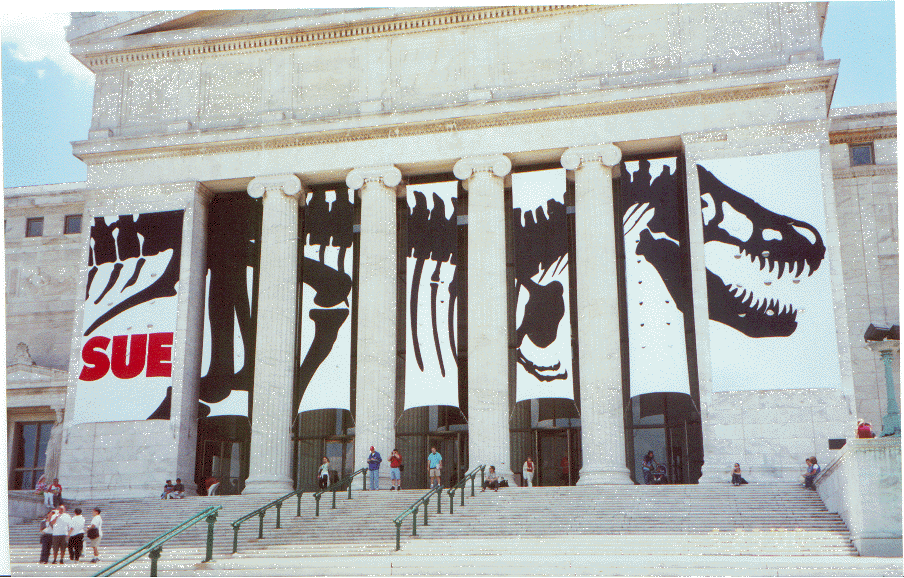
It was the events of Sue’s second life, however, that made her the fossil the world knows by name. Sue was discovered in the late summer of 1990 by avocational fossil hunter Susan Hendrickson (for whom the specimen is named) on the Cheyenne River reservation in South Dakota. Peter Larson of the Black Hills Institute, a commercial outfit that specializes in excavating, preparing, and exhibiting fossils, initially intended to display the Tyrannosaurus at a new facility in Hill City, but soon became embroiled in an ugly four-way legal battle with landowner Maurice Williams, the Cheyenne council, and the United States Department of the Interior. With little precedent for ownership disputes over fossils, it took until 1995 for the District Court to award Williams the skeleton. Williams soon announced that he would put Sue on the auction block, and paleontologists initially worried that the priceless specimen would disappear into the hands of a wealthy collector, or end up in a crass display at a Las Vegas casino. Those fears were put to rest in 1997 when Chicago’s Field Museum of Natural History won Sue with financial backing from McDonald’s and Disney. Including the auctioneer’s commission, the price was an astounding $8.36 million.

FMNH and its corporate partners did not pay seven figures for Sue solely to learn about dinosaur pathology.  Sue’s remarkable completeness would be a boon to scientists, but her star power was at least as important for the Museum. Sue was a blockbuster attraction that would bring visitors in the door, and her name and likeness could be marketed for additional earned income. As FMNH President John McCarter explained, “we do dinosaurs…so that we can do fish” (quoted in Fiffer 2000). Particularly in the late 1990s, with Jurassic Park still fresh in people’s minds, a Tyrannosaurus would attract visitors and generate funds, which could in turn fund less sensational but equally important research, like ichthyology and entomology.

Still, some worried that McCarter, whose background was in business, not science, was exploiting an important specimen as a marketing gimmick at the expense of the Museum’s educational mission. This echoed similar concerns voiced 80 years earlier, when the original mounted Tyrannosaurus was introduced at the American Museum of Natural History. As president of AMNH, Henry Osborn oversaw the creation of grandiose and dramatic exhibits, with the intent to draw crowds and justify private and municipal financial support. When the Museum unveiled the Tyrannosaurus mount, Osborn held a lavish publicity gala for the New York elite and members of the press. The buzz generated by Osborn’s promotion resulted in lines around the block and front page headlines, but the attention was focused on the spectacle of the dinosaur rather than the science behind it. Many academics derided this as lowest common denominator pandering, while others, like anthropologist Franz Boas, grudgingly accepted that “it is a fond delusion of many museum officers that the attitude of the public is a more serious one, but the majority do not want anything beyond entertainment.”

Original skull of Sue the T. rex, displayed on the upper mezzanine. Photo by the author.

FMNH was under similar scrutiny as museum staff revealed their plans for Sue. The role of the corporate sponsors that paid for the fossils was a particular cause for concern, and the marketing team knew it. Although the idea of T. rex-themed Happy Meals was briefly on the table, McDonald’s and Disney wisely opted to present themselves only as patrons of science. McDonald’s got its name on the new fossil preparation lab at FMNH and Disney got a mounted cast of Sue to display at Walt Disney World, but the principal benefit to the two companies was high-profile exposure in association with youth science education. The Museum retained control over the message, highlighting Sue’s importance to paleontology and only coyly admitting her role as a promotional tool. Likewise, FMNH is the sole profiteer from the litany of shirts, hats, toys, mugs, and assorted trinkets bearing the Sue name and logo that are continually sold at the Museum and around Chicago.

You May Approach Her Majesty

Once Sue arrived at FMNH, the Museum did not hold back marketing the dinosaur as a must-see attraction. A pair of Sue’s teeth went on display days after the auction, which expanded organically into the “Sue Uncrated” exhibit, where visitors could watch the plaster-wrapped bones being unpacked and inventoried. Meanwhile, McDonald’s prepared an educational packet on Sue that was distributed to 60,000 elementary schools.

The main event, of course, was the mounted skeleton, which needed to be ready by the summer of 2000. This was an alarmingly short timetable, and the FMNH team had to hit the ground running. Much of Sue’s skeleton was still buried in rock and plaster. The bones needed to be prepared and stabilized before they could be studied, and they needed to be studied before they could be mounted. In addition, two complete Sue casts had to be fabricated: one for Disney World and one for a McDonald’s-sponsored traveling exhibit. The casts were produced by Research Casting International, the Toronto-based company that recently built the mounted menagerie for “Ultimate Dinosaurs“. Phil Fraley Productions, the same exhibit company that rebuilt the American Museum and Carnegie Museum T. rex mounts, was tapped to mount Sue’s original skeleton.

The mounted skeleton of Sue in the Stanley Field Hall. Photo by the author.

Unlike every other Tyrannosaurus mount before or since, Sue can hardly be called a composite. With the exception of a missing arm, left foot, a couple ribs, and small number of other odds and ends, the mounted Sue skeleton is composed of real fossils from a single individual. FMNH public relations latched onto this fact, emphasizing in press releases that while “many museums are displaying replicas of dinosaur skeletons, the Field Museum has strengthened its commitment to authenticity. This is Sue.” Just as they did with the AMNH Tyrannosaurus, Fraley’s team built an armature with individual brackets securing each bone, allowing them to be removed with relative ease for research and conservation. No bolts were drilled into the bones and no permanent glue was applied, ensuring that the fossils incur only minimal damage for the sake of the exhibit. Despite these improvements over historic mount-making techniques, however, the Sue mount does have some inexplicable anatomical errors. The coracoids should be almost touching in the middle of the chest, but the shoulder girdles are mounted so high on the rib cage that there is a substantial space between them. Consequently, the furcula (wishbone) is also positioned incorrectly.

After a private event not unlike the one held by Osborn in 1915, Sue was revealed to the public on May 17, 2000 with the literal raising of a curtain. A week-long series of celebrations and press junkets introduced Sue to Chicago, and she has been one of the city’s biggest attractions every since. All the publicity paid off, at least in the short term: FMNH attendance soared that year from 1.6 million to 2.4 million. 14 years later, Sue the Tyrannosaurus is still known by name, and is even used as the voice of FMNH on twitter. Interestingly, Sue’s new identity as a Chicago landmark seems to have all but eclipsed the legal dispute that was her original source of fame. A recent RedEye cover story goes so far as to proclaim this South Dakotan skeleton as “pure Chicago.”

 The Nation’s T. rex

This customized truck transported the Nation’s T. rex from Montana to Washington, DC.

This year, another Tyrannosaurus specimen has rocketed to Sue-like levels of notoriety. MOR 555, also known as “Wankel Rex”, is being transferred to the Smithsonian National Museum of Natural History, where it will eventually be mounted for long-term display. Now dubbed “the Nation’s T. rex“, the promotion of this specimen has mirrored that of Sue in many ways. Front-page media coverage, first-person tweets from the dinosaur and even an official song and dance contest herald the arrival of the fossils from their previous repository, the Museum of the Rockies in Montana. Much like the “Sue Uncrated” exhibit, the process of unpacking the unarticulated bones will soon be on view in a temporary display called “The Rex Room.” Meanwhile, the very name “Nation’s T. rex” is a provocative invented identity akin to Sue’s new status as a Chicagoan.

Nevertheless, the Nation’s T. rex does not quite live up to Sue’s mystique. This Tyrannosaurus is neither as large nor as complete as Sue, and there was no prolonged legal battle or frantic auction in its past. The 60% complete skeleton was found in 1988 by Montana rancher Kathy Wankel, on land owned by the US Army Corps of Engineers. The fossils are now on a 50 year loan from from the Corps to the Smithsonian, (presumably) a straightforward transfer between federal agencies. In addition, MOR 555 is by no means a new specimen. Several casts of the skeleton are already on display, including exhibits at the Royal Ontario Museum, the Museum of the Rockies, the Perot Museum of Nature and Science, and even the Google campus. In fact, a cast of the MOR 555 skull has been on display at NMNH for years.

NMNH Director Kirk Johnson, fossil hunter Kathy Wankel, her husband Bob Wankel, and Lt. Gen. Thomas Bostick preside over the arrival of the Nation’s T. rex at the Smithsonian. Source

With that in mind, the hype around the Nation’s T. rex might seem like much ado about nothing. As this series has demonstrated, the number of Tyrannosaurus skeletons on exhibit, whether original fossils or casts, has exploded in recent years. A quarter century ago, New York and Pittsburgh were the only places where the world’s most famous dinosaur could be seen in person. Today, there may well be over a hundred Tyrannosaurus mounts worldwide, most of which are identical casts of a handful of specimens. Acquiring and displaying a T. rex is neither risky nor ambitious for a natural history museum. No audience research or focus groups are needed to know that the tyrant king will be a hit. And yet, excessive duplication of a sure thing might eventually lead to monotony and over-saturation.

So far, such fears appear to be unfounded. A specimen like Sue or the Nation’s T. rex is ideal for museums because it is at once scientifically informative and irresistibly captivating. Museums do not need to choose between education and entertainment because a Tyrannosaurus skeleton effectively does both. And even as ever more lifelike dinosaurs grace film screens, museums are still the symbolic home of T. rex. The iconic image associated with Tyrannosaurus is that of a mounted skeleton in a grand museum hall, just as it was when the dinosaur was introduced to the world nearly a century ago. The tyrant king is an ambassador to science that unfailingly excites audiences about the natural world, and museums are lucky to have it.

The Nation’s T. rex in its final pose at the Research Casting International workshop.

This week, NMNH will be celebrating all things Tyrannosaurus, starting with a live webcast of arrival of the Nation’s T. rex on Tuesday morning. Stay tuned to this blog for further coverage of the events!

References

Asma, S.T. 2001. Stuffed Animals and Pickled Heads: The Culture and Evolution of Natural History Museums. New York, NY: Oxford University Press.

Boas, F. 1907. Some Principles of Museum Administration. Science 25:650:931-933.

Counts, C.M. 2009. Spectacular Design in Museum Exhibitions. Curator 52: 3: 273-289.

Fiffer, S. 2000. Tyrannosaurus Sue: The Extraordinary Saga of the Largest, Most Fought Over T. rex ever Found. New York, NY: W.H. Freeman and Company.

Larson, N. 2008. “One Hundred Years of Tyrannosaurus rex: The Skeletons.” Tyrannosaurus rex: The Tyrant King. Larson, Peter and Carpenter, Kenneth, eds. Bloomington, IN: Indiana University Press.

Lee, B.M. 2005. The Business of Dinosaurs: The Chicago Field Museum’s Nonprofit Enterprise. Unpublished thesis, George Washington University.

Rainger, R. 1991. An Agenda for Antiquity: Henry Fairfield Osborn and Vertebrate Paleontology at the American Museum of Natural History, 1980-1935. Tuscaloosa, AL: University of Alabama Press.

Switek, B. 2013. My Beloved Brontosaurus: On the Road with Old Bones, New Science and our Favorite Dinosaurs. New York, NY: Scientific American/Farrar, Straus and Giroux.

5 Comments

Filed under dinosaurs, FMNH, fossil mounts, history of science, movies, museums, NMNH, reptiles, science communication, theropods