Tag Archives: fossil mounts

History of the AMNH Fossil Halls – Part 1

Much of what I write for this site starts with an attempt to find one reference or another, only to discover that it does not exist online. This time, I was curious how many times the American Museum of Natural History paleontology halls had been renovated, but I quickly found that there was no simple answer.  Unlike the fossil exhibits at the National Museum of Natural History, which have occupied the same large hall since the building opened, the AMNH counterparts have been moving and growing for more than 120 years. The museum expanded organically, eventually encompassing 27 interconnected buildings. And as its footprint grew, the paleontology exhibits grew with it.

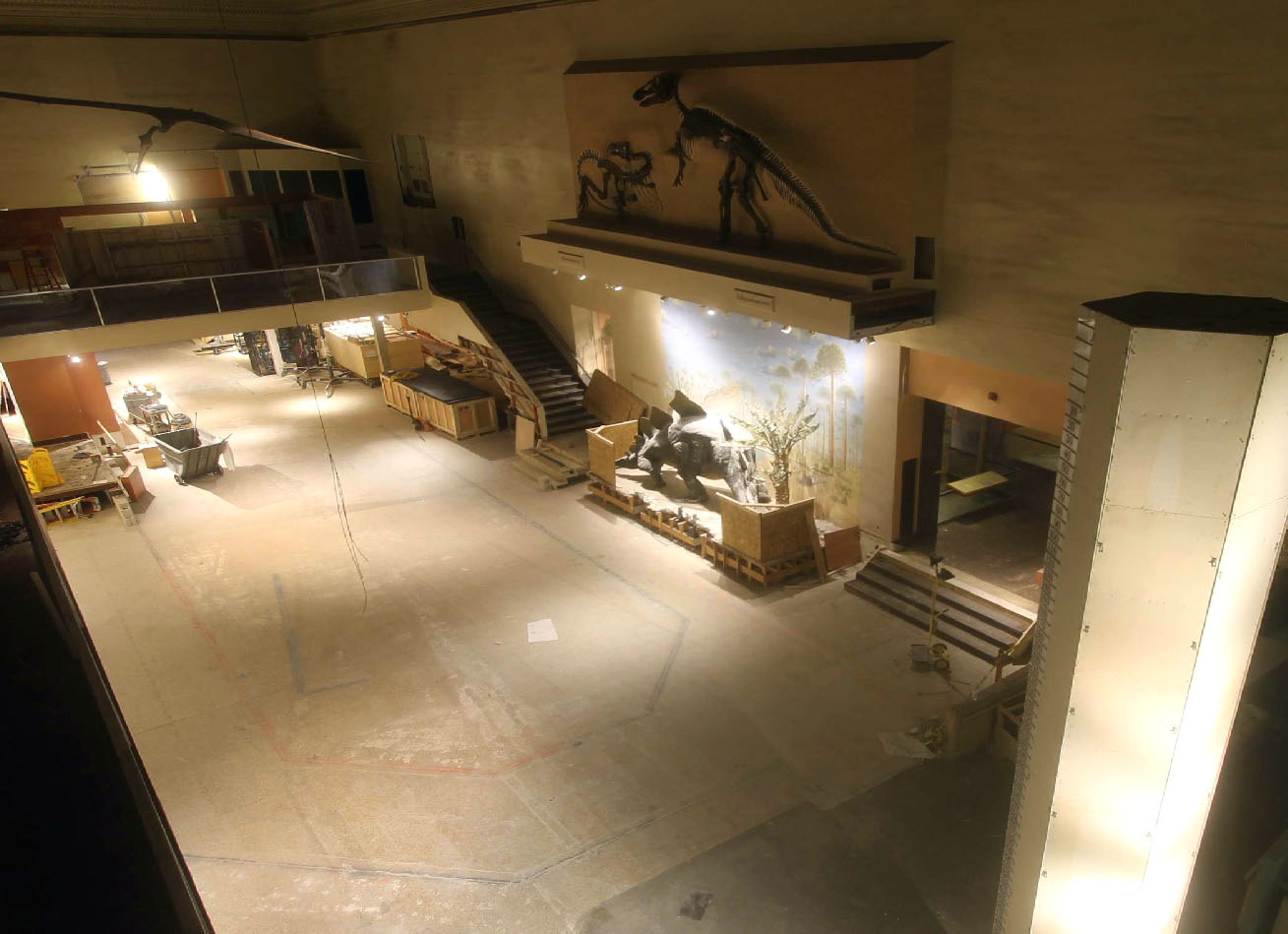
The following is my attempt to make sense of the fourth floor exhibit halls’ convoluted history. I’ve divided it into six phases, although this should only be considered a rudimentary outline. Many specimens were added and removed during each phase, particularly during the period of frantic expansion in the early 20th century. At the very least, however, this should be enough to contextualize most of the historic photos made available by the AMNH Research Library. As with my NMNH posts, please note that I will not be discussing field expeditions or scientific discoveries by museum staff, as these topics are well-explored elsewhere. My focus here is solely on the public-facing exhibits, and the people who created them.

Phase I: 1874 – 1904

amnhmap_1891

AMNH was founded in 1869, although the first buildings in Manhattan Square did not begin construction until 1874. The original structure was designed by architect Calvert Vaux. Since electric lights were not yet available, Vaux created exhibit spaces that maximized the impact of natural lighting. Large windows were divided into slits that paralleled rows of glass display cabinets. The sun would shine through the windows and directly into the cabinets, illuminating the specimens within. When the museum first opened, the single exhibit hall on the fourth floor was dedicated to geology specimens. While this space mostly housed rocks, minerals, and small fossils, a handful of mounted skeletons stood among the cabinets. Early acquisitions included a moa and the Pleistocene deer Megaloceros, shown below.

geology hall with moa

Geology Hall, before 1887. Photo from Dingus 1996.

Things changed radically shortly after Henry Osborn was hired in 1891. As a paleontologist, Osborn emerged from Princeton riding the crest of a wave of goodwill his discipline had enjoyed for most of the 19th century. Paleontology was the darling of American science, and one man in particular, O.C. Marsh of Yale, received generous federal funding to find and describe new fossils from the western interior. In the 1880s, however, an economy-minded Congress pulled that funding. Meanwhile, the rise of experimental biology led to the marginalization of descriptive natural history, including paleontology. The next generation of paleontologists needed a new home for their work, and they found it in museums. AMNH was one of several new museums backed by wealthy benefactors with an interest in public education. These benefactors gravitated toward paleontology because, as Ronald Rainger put it, fossils are “rare, valuable, and visible.” The skeletons of extinct monsters were huge and sensational, and naturally complimented the grandiose neoclassical halls of the nascent museums. But while the paleontology programs at institutions like the Carnegie Museum and the Field Museum were quite respectable, they all were overshadowed by Osborn’s Department of Vertebrate Paleontology at AMNH.  Osborn’s goal was to make AMNH the center of American vertebrate paleontology in the post-Marsh world, and by most any measure he succeeded.

Hall of Fossil Mammals, around 1906.

Hall of Fossil Mammals, around 1906. Photo from Dingus 1996.

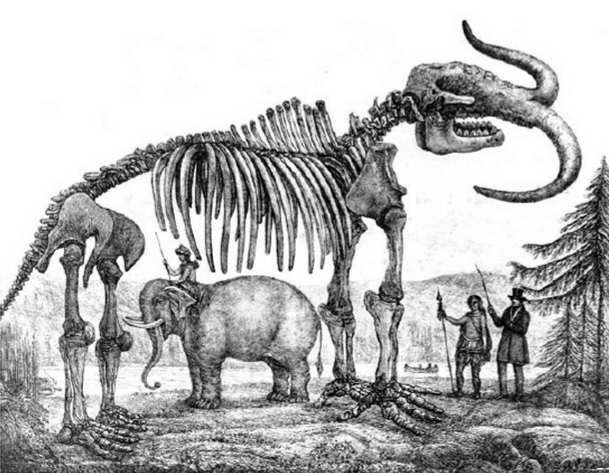
The next Phase I exhibit was the Hall of Fossil Mammals, which opened to the public in 1895. Osborn’s research was focused on Cenozoic mammals, especially brontotheres, and he tasked his department with assembling a suitably impressive collection. Some of the fossils on display were acquired in an 1897 purchase of Edward Cope’s personal collection. Many others were collected by AMNH staff in the Big Horn Basin of Wyoming. Among these in-house finds was the famous (and famously misleading) series of fossil horses, most of which were found and prepared by William Matthew. The largest and most captivating mounted skeleton on view was the Warren mastodon. Discovered in 1845 in a bog near Newburgh, New York, this specimen was the first complete mastodon ever found. It was initially described and displayed by Boston-based anatomist John Warren, but Osborn convinced J.P. Morgan to buy it for AMNH in 1906.

Aside from a few shuffled mounts (including the aforementioned mastodon, which seems to have been in nearly every room on the fourth floor), the Hall of Fossil Mammals remained mostly intact for the duration of the 20th century. Shortly after it was completed, the Department of Vertebrate Paleontology shifted its focus to dinosaurs. The mammals were only the star attractions for a few short years, but this display would nevertheless endure in its original form for generations.
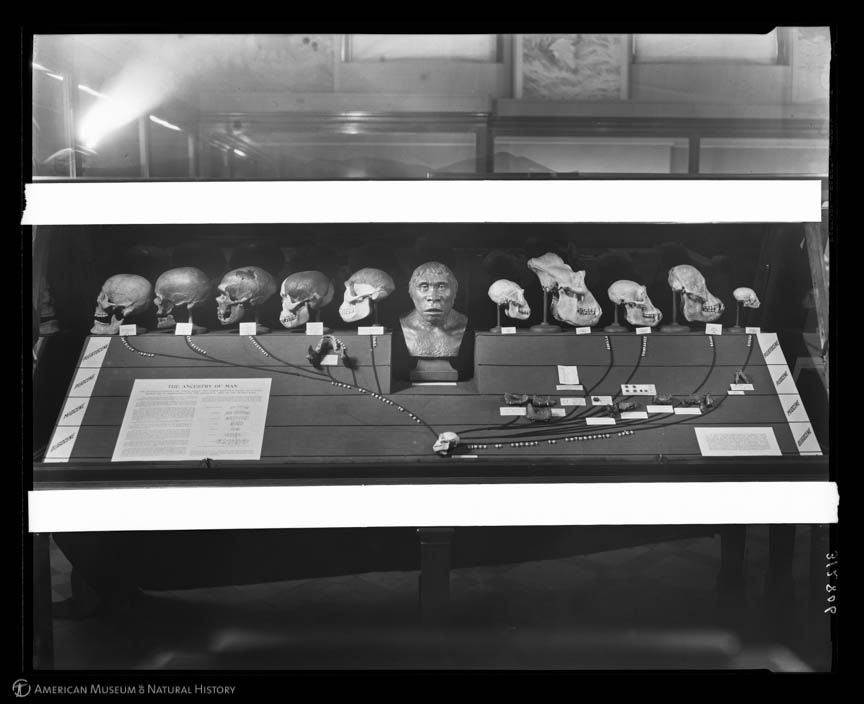
“Ancestry of Man” case in the Hall of the Age of Man, 1929. Photo courtesy of the AMNH Research Library.

At this point, it is crucial to mention that Osborn was an objectively lousy scientist, and that much of his work was motivated by a bigoted personal agenda.  He subscribed to an inaccurate orthogenetic (or as he called it, “aristogenetic”) interpretation of evolution, professing that all life forms had their place in a natural hierarchy. According to Osborn, people of Anglo-Saxon and Scandinavian ancestry were the pinnacle of existence, and he endeavored to turn his flagrantly racist beliefs into public knowledge by way of his exhibits. Nowhere is this clearer than the Hall of the Age of Man, which opened around 1900. This hall included a range of extinct animals that coexisted with early humans, but the central cases were dedicated to Osborn’s unorthodox narrative of human evolution. Hominid fossils were co-opted to illustrate Osborn’s unfounded view that modern human races were evolutionarily distinct, and to communicate his support for eugenics and racial purity. Osborn’s agenda was supported by many of the aristocratic elite that funded the museum, but apparently few of the AMNH research staff endorsed it. Margaret Mead in particular was highly critical of Osborn’s views, and especially his influence over public-facing interpretation.

Phase II: 1905 – 1920
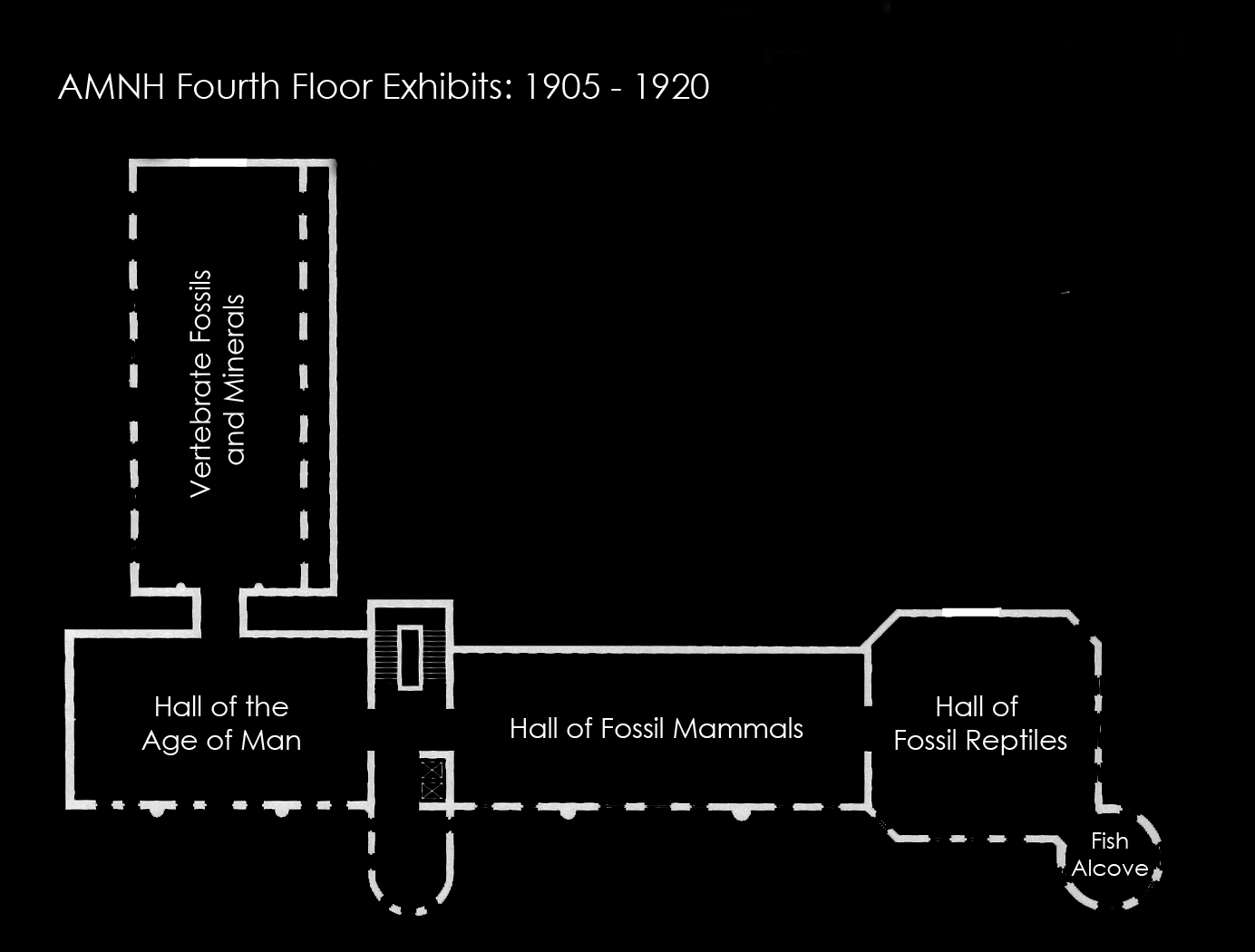
map

Edit: The map above should read “Invertebrate Fossils and Minerals.” 

For all of Osborn’s bigotry and bad science, it’s difficult to imagine the modern museum field without his influence. He was very good at marketing himself and his paleontology program, and he knew how to put on a show that would attract visitors in droves. Osborn heightened the standards for public exhibitions, investing in lifelike habitat dioramas of taxidermy animals and spectacular fossil mounts in order to make science exciting for a wide audience. Osborn’s devotion to storytelling and drama in the exhibits he curated brought millions of visitors to AMNH and defined public expectations for what museums should offer.

In 1906, Osborn became the fourth president of AMNH, and he oversaw its most rapid period of expansion. As president, he tripled municipal funding for the museum from New York City, and gained plenty more through his connections with wealthy potential donors. Much of this income was funneled into the Department of Vertebrate Paleontology’s famous dinosaur collecting expeditions, in which fossil hunters like Barnum Brown and Walter Granger earned fame and notoriety. However, the pioneering work on fossil preparation and mounting at AMNH was also significant. While many peer institutions were assembling and exhibiting new dinosaur mounts during this period, none matched the output or ambition of AMNH. With the sheer quantity of fossils coming in and institutional pressure to mount them for display as quickly as possible, chief preparator Adam Hermann had no choice but to modernize and professionalize his craft. Hermann developed a sophisticated prep lab with overhead tracks for hoisting heavy fossils, as well as electric and pnuematic hook-ups for power tools. Techniques like sand-blasting, acid preparation, and on-site metalworking developed by Hermann are still standard practice today.

trachodon crowded reptile hall

“Trachodon” pair in the Hall of Fossil Reptiles. Photo from Dingus 1996.

Dinosaurs take up a lot of space, and to accommodate them, a new gallery was opened on the far end of the Hall of Fossil Mammals. This Hall of Fossil Reptiles debuted in 1905 with “Brontosaurus” – the first mounted sauropod ever built – as its centerpiece. Actually a composite of four individuals and many sculpted elements (including the way-off-the-mark head), the “Brontosaurus” took Hermann’s team the better part of six years to construct. After that, the Hall of Fossil Reptiles filled with new dinosaur mounts very quickly, cementing the repuation of AMNH as the place to see dinosaurs. In 1906, Hermann added the “Trachodon” pair. The standing individual came from the Cope collection, but the crouching specimen was excavated that very year by Barnum Brown. The Allosaurus was also a Cope specimen, but apparently the 19th century paleontologist had never unpacked or inspected it. Several years passed before Hermann’s team discovered that the skeleton was remarkably complete, although it was missing a skull. The Allosaurus fossils were mounted in 1908, posed as though feeding on a set of Apatosaurus vertebrae.

crowded reptile hall

Tyrannosaurus stands with Allosaurus and “Brontosaurus” in the increasingly crowded Hall of Fossil Reptiles. Photo from Dingus 1996.

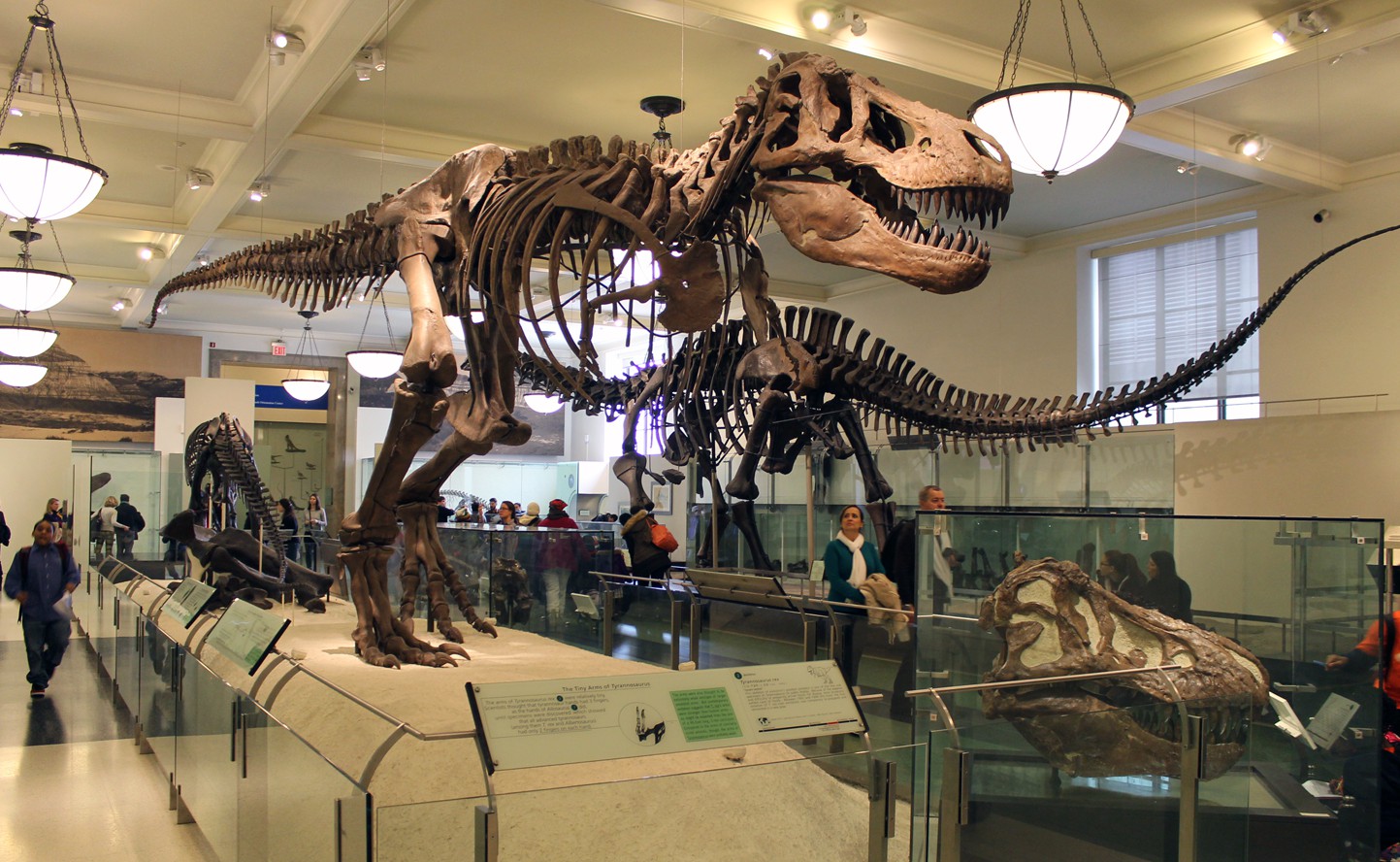
Arguably the most important mount added during the early 20th century mounting spree was the Tyrannosaurus rex. This specimen is no less than an icon, and has been a destination attraction in New York for longer than the Empire State Building. When the Tyrannosaurus was unveiled in 1915, it was a sensation, akin to mythical dragon made real. For a generation, AMNH was the only place in the world where visitors could stand in the presence of a T. rex, and to this day the image of the classic mount is quintessential to both paleontology and museums in general. For example, you may recognize it from the cover of a certain Michael Crichton novel.

Phase III: 1921 – 1939

map

In 1922, the 9th building in the AMNH complex was completed, and the paleontology exhibits expanded into what Osborn called the “Great Hall of Dinosaurs.” The largest dinosaur mounts – including Tyrannosaurus, “Brontosaurus”, “Trachodon”, and Allosaurus – were moved from the comparatively cramped Hall of Fossil Reptiles into this new space. The extra breathing room allowed for the mounts to be clustered into Jurassic and Cretaceous areas on opposite sides of the room. There were also a few new skeletons, including Leptoceratops, Thescelosaurus, and most significantly, Triceratops.

brontosaurus in great dinosaur hall

“Brontosaurus” in the Great Dinosaur Hall, around 1927. Photo courtesy of the AMNH Research Library.

Meanwhile, AMNH fossil collecting efforts had moved from the American West to Mongolia. The primary goal of Roy Chapman Andrews’ Central Asiatic Expeditions was to find evidence for Osborn’s pseudoscientific ideas about human ancestry, but no such remains were found. Instead, the expedition returned a wealth of new dinosaur fossils, including the first dinosaur nests ever found. Dispatches from the field also drummed up considerable publicity for the New York museum.

great dinosaur hall

Tyrannosaurus and Triceratops in the Great Dinosaur Hall, around 1927. Photo courtesy of the AMNH Research Library.

Osborn’s iron-fisted reign over American paleontology lasted until his death in 1933. Unfortunately for the Department of Vertebrate Paleontology, Osborn’s activities depended heavily on personal relationships with private donors. With Osborn out of the picture (and the Great Depression at its bottom), those donations dried up. Meanwhile, Osborn’s good standing in the scientific community had begun to wane, and his unorthodox anthropological ideas became something of a joke. The results of internal investigations into Osborn’s less-than-legitimate use of funds and favors during his time as president did not help matters. In 1942 the Department of Vertebrate Paleontology was dissolved. Paleontology work was folded into the Department of Geology with a much smaller budget and fewer staff. The Osborn-era fossil displays at AMNH remained largely unaltered in the years that followed, but only because of the lack of staff time, money, and interest.

Next week, we’ll wrap up this timeline, passing through the era of Edwin Colbert and into the present day. Stay tuned!

References

Brinkman, P.D. (2009). Dinosaurs, Museums, and the Modernization of American Fossil Preparation at the Turn of the 20th Century. Fossil Preparation: Proceedings of the First Annual Fossil Preparation and Collections Symposium 21-34.

Brinkman, P.D. (2010). The Second Jurassic Dinosaur Rush: Museums and Paleontology in America at the Turn of the 20th Century. Chicago, IL: The University of Chicago Press.

Dingus, L. (1996). Next of Kin: Great Fossils at the American Museum of Natural History. New York, NY: Rizzoli International Publications, Inc.

Haraway, D. (1984). Teddy Bear Patriarchy: Taxidermy in the Garden of Eden, New York City, 1908-1936. Social Text 11:20-64.

Hermann, A. (1909). Modern Laboratory Methods in Vertebrate Paleontology. Bulletin of the American Museum of Natural History 56:283-331.

Osborn, H.F. (1921). The Hall of the Age of Man in the American Museum. Nature 107:236-240.

Rainger, R. (1991). An Agenda for Antiquity: Henry Fairfield Osborn and Vertebrate Paleontology at the American Museum of Natural History, 1890-1935. Tuscaloosa, AL: The University of Alabama Press.

7 Comments

Filed under AMNH, anthropology, dinosaurs, exhibits, fossil mounts, mammals, museums, reptiles

The Carnegie Quarry Diaspora

About 150 million years ago, a severe drought ravaged the western interior of North America. In eastern Utah, malnourished dinosaurs gathered near a dwindling river. Unwilling or unable to leave the water source, they eventually died of thirst or disease. When rain finally returned to the region, three or four successive flash floods washed dozens of animal carcasses into a relatively small depositional area to the southeast. Today, this site is known as the Carnegie Quarry at Dinosaur National Monument, and it is one of the most incredible fossil sites in the world.

Dinosaur National Monument interns collect data on the quarry wall.

Dinosaur National Monument interns collect data on the quarry wall. Source

Today, a structure encompassing a 180-foot section of the deposit (less than half its total length) allows visitors to view nearly 1400 dinosaur bones in situ. However, the fossils on display at Dinosaur National Monument represent only a portion of the material found at the Carnegie Quarry. Between the site’s discovery in 1908 and the establishment of the quarry wall exhibit, more than 20 reasonably complete dinosaur skeletons and dozens more incomplete specimens were excavated and distributed to museums in the US and Canada. No less than eleven mounted skeletons have been created from this material, and they are all still on display today. Although they are thousands of miles from their place of discovery and exhibited in four different cities, these mounts all represent individuals that lived and died in the same environment. They may have even encountered each other in life!

The Discovery

Earl Douglass was already an established fossil hunter when the Carnegie Museum of Natural History hired him in 1902. Late in the 1909 field season, Douglass was prospecting near the confluence of the Green and Yampa Rivers when he spotted a series of sauropod vertebrae eroding out of the rocks. Once Douglass and his crew began excavating the fossils, it became apparent that they had not just one remarkably complete dinosaur, but several. Douglass called it a “beautiful sight,” and CMNH director William Holland could barely contain his glee in his reports back to the Pittsburgh museum. Under Douglass’s management, CMNH crews worked at what became known as the Carnegie Quarry for 13 years. The dinosaur fossils were jumbled and often overlaid one another, so the excavators had to work on multiple skeletons simultaneously. The especially hard sandstone also slowed their work, and the team regularly resorted to huge horse-drawn plows and even dynamite to reach the fossils. Eventually railway tracks were installed to help transport blocks of sandstone out of the quarry.

In 1915, Holland successfully petitioned Woodrow Wilson to preserve the site as a national monument. CMNH crews continued to excavate until early 1923. At that point, their primary benefactor Andrew Carnegie had died, and funding for field work was dwindling. Other museums collected from the quarry periodically in the years that followed, but Douglass’s idea to contain the remaining fossils in an on-site museum was not realized until 1958.

The Mounts

CMNH

CMNH Apatosaurus. Historic photo from McGinnis 1982; modern photo source.

Apatosaurus louisae – CM 3018

The CMNH Apatosaurus was the first dinosaur discovered at the Carnegie Quarry. After Douglass first spotted the articulated caudal vertebrae in August of 1909, his crew spent several months extracting the rest of the skeleton from the rocks. The excavation continued into early 1910, and by the time they were finished they had the most complete Apatosaurus ever found – a title the specimen holds to this day. Holland mounted the 77-foot skeleton alongside the museum’s Diplodocus in just three years, at the time a record for a sauropod mount.

Holland famously left his Apatosaurus headless for decades due to a disagreement with Henry Osborn of the American Museum of Natural History. Douglass recovered a skull that almost certainly belonged to the Apatosaurus, but Holland opted not to use it because it contradicted the sculpted head already in place on the AMNH Apatosaurus mount. After Holland’s death in 1932, museum staff quietly added a casted Camarasaurus skull as a placeholder. This was finally replaced with a proper Apatosaurus skull in 1979. More recently, the team at Phil Fraley Productions disassembled and restored the Apatosaurus, along with the rest of the classic CMNH dinosaurs. Since 2007, this specimen has been back on display in a more graceful modern pose.

Fancy fisheye photo.

AMNH Barosaurus. Source

Barosaurus lentus – AMNH 6341

When the CMNH team discovered this skeleton in 1912, they assumed it was yet another specimen of the well-known Diplodocus. It was harvested for parts, with portions sent to CMNH, the United States National Museum, and the University of Utah to supplement their displays. When the specimen turned out to be the more obscure sauropod Barosaurus, it languished in pieces for many years. Barnum Brown of AMNH was making a circuit of the fossil collections at various natural history museums when he rediscovered this specimen. Through a series of purchases and trades, the Barosaurus was reunited at AMNH in 1929.

Nevertheless, AMNH quickly abandoned plans to mount the Barosaurus – the museum already had a sauropod on display, and there wasn’t enough floor space for another one. It wouldn’t go on display until 1991, when Lowell Dingus conceived of the idea to mount the Barosaurus in a spectacular rearing pose as part of the renovation of the Theodore Roosevelt Rotunda. Peter May took on the project – one of the first mounts produced by his company Research Casting International. The resulting display, actually a cast, is the tallest free-standing dinosaur mount in the world.

ROM Barosaurus.

ROM Barosaurus. Source

Barosaurus lentus – ROM 3670

Douglass recovered a second partial Barosaurus skeleton in 1912, which consisted of a mostly complete torso and parts of each leg. It stayed in the CMNH collections for many years, until they traded it to the Royal Ontario Museum in 1962. ROM staff intended to mount the skeleton, but once again this was cancelled due to a lack of space. David Evans was developing a new ROM paleontology exhibit in 2007 when he learned that the museum had most of a Barosaurus sitting in its collections. With only weeks remaining before the exhibit’s opening, Evans tapped Research Casting International to mount the sauropod, supplemented with a replica neck and tail from the AMNH version.

Allosaurus fragilis – CM 11844

Several Allosaurus specimens are known from the Carnegie Quarry, but the one on display at CMNH is one of the largest. Douglass and his team excavated this 35-foot skeleton between 1913 and 1915. The mount was built in 1938. Although the specimen included a partial skull, the exhibit team swapped it with a cast of a more complete skull (also found in the Carnegie Quarry) from the collections of the University of Utah. This mount also includes casts of the arms of USNM 4734, an Allosaurus collected for O.C. Marsh.

Stegosaurus ungulatus – CM 11341

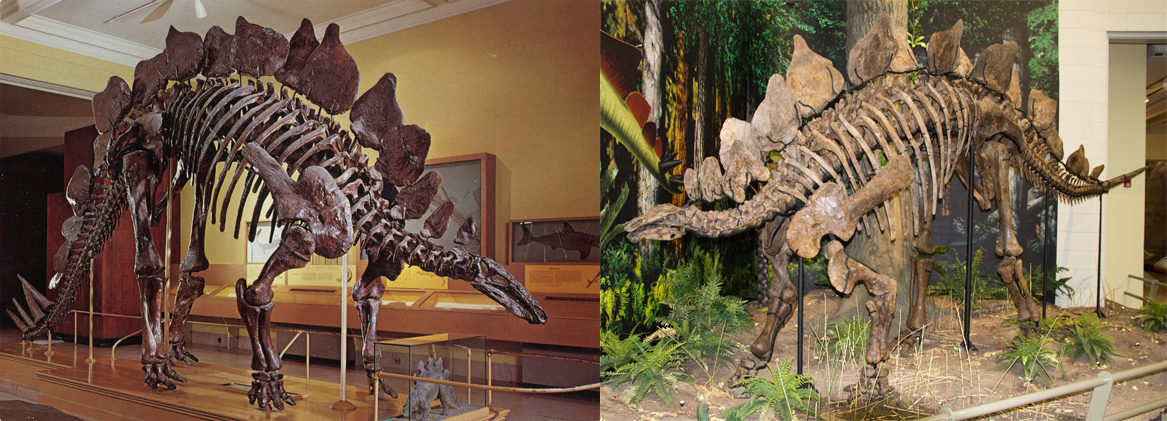
The CMNH Stegosaurus is a composite of several individuals excavated from the Carnegie Quarry between 1920 and 1922. Museum staff completed the 21 foot-long mount in 1940, using a skull cast from USNM 8612. Casts of this skeleton were distributed to several other museums at some point, one of which is on display at the University of Nebraska State Museum. Phil Fraley’s company remounted the CMNH original in 2007.

Carnegie Camarasaurus.

Carnegie Camarasaurus. Source

Camarasaurus lentus – CM 11338

This juvenile Camarasaurus is the most complete sauropod ever found. It is displayed as a relief mount almost exactly as it was discovered, with two exceptions. The left leg was swapped with a more complete one from another individual, and the tail was re-positioned to create a more aesthetically pleasing mount. Casts of this skeleton are displayed at museums throughout the United States, including Dinosaur National Monument, but the original is at CMNH. This specimen is also notable because its left scapula is preserved in its life position, making it a helpful model for skeletal reconstructions and exhibit mounts.

NMNH Camarasaurus. Photo by the author.

NMNH Camarasaurus. Photo by the author.

Camarasaurus lentus – USNM 13786

The second best Camarasaurus also comes from Carnegie Quarry, but it is a considerably larger individual. Only the tail and a few odds and ends were missing. CMNH kept the specimen for several years before trading it to USNM in 1933 for a set of Pliocene horse skeletons. Norman Boss prepared the specimen in full view of the public during the 1936 Texas Centennial Exposition – one of the first known examples of such an exhibit. The completed mount appeared at USNM in the 1950s, sporting the tail of another Camarasaurus. At over 30 feet long, this skeleton is one of the largest dinosaurs on display at the Smithsonian. Unfortunately, the death pose somewhat limits the effect. The Camarasaurus was taken off exhibit in late 2014 for conservation and remounting. When it returns, it will be standing on its feet for the first time in 150 million years, taking its rightful place as one of the museum’s most impressive dinosaurs.

DMNH Diplodocus. Source

DMNH Diplodocus. Source

Diplodocus longus – DMNH 1494

Since this Dipldodocus was found somewhat disarticulated, Douglass suggested that the carcass may have been twisted apart while rolling downstream. AMNH held on to this skeleton for some time before trading it to the Denver Museum of Nature and Science in 1936 for two mammoth skeletons. Preparator Phillip Reinheimer mounted the skeleton with the help of 40 workers assigned to the museum through the Works Progress Administration. Additional Diplodocus fossils collected by William DeWeese (actually the first dinosaur specimens acquired by the museum) were also used to complete the mount. The Diplodocus remained on view until 1989, when Ken Carpenter and others restored and remounted the sauropod, elevating its tail and making its neck sweep gracefully to the left. The improved mount has been on display since 1995.

CMNH Camptosaurus.

CMNH Camptosaurus. Historic photo from McGinnis 1982; modern photo source.

Camptosaurus aphanoecetes – CM 11337

Douglass found this controversial small ornithopod in 1922, and correctly matched it with an isolated leg several feet away. It was first identified as Camptosaurus medius, but in 2008 Ken Carpenter reassigned it to the new species C. aphanoecetes. A 2011 phylogenic study by Andrew McDonald moved this specimen to a new genus, Uteodon. Carpenter, however, asserts that McDonald’s analysis was based on an incorrectly associated Dryosaurus braincase.

CMNH staff assembled the fossils into a relief mount in 1940. The skull, hindfeet, and tail were all sculpted. During the 2007 renovation, the Phil Fraley Productions team extracted the fossils from the plaster slab, even managing to preserve the delicate ossified dorsal tendons. They then created a new, three-dimensional mount, which features a revised replica skull.

Modern photo by the author.

CMNH Dryosaurus. Historic photo from McGinnis 1982; modern photo by the author.

Dryosaurus altus – CM 3392

This Dryosaurus skeleton is the most complete of several collected at Dinosaur National Monument. The tail is missing, and given the completeness of the rest of the skeleton it may well have been destroyed when Douglass’s crew was blasting through rock to get to the bone layer. The Dryosaurus entered the CMNH collections in 1922, and was assembled as a 9 foot-long relief mount in 1940. In 2007, Fraley’s team removed the fossils from the plaster matrix, and just as they did with the Camptosaurus, constructed a standing mount. To date, this is the only mounted Dryosaurus specimen in the world. It is displayed alongside a juvenile Ceratosaurus cast acquired from Western Paleontological Laboratories.

National Museum of Natural History in Washington, DC.

NMNH Diplodocus. Photo by the author.

Diplodocus sp. – USNM 10865

The National Museum of Natural History’s Diplodocus was one of the last articulated skeletons removed from the Carnegie Quarry. When the CMNH crew closed up shop, Charles Gilmore of the Smithsonian moved in to recover one of the sauropod skeletons Douglass left behind. In 1923, Gilmore’s team excavated a partial Diplodocus, and also cherry-picked a few extra bones from an adjacent specimen. The process of mounting the skeleton at USNM took six years of continuous work, and Gilmore would later describe it as the most ambitious undertaking his department hadever attempted. The 70-foot Diplodocus mount was completed in 1931, and remained unchanged for more than 80 years. It was finally taken down in December 2014, and will return in a new pose in 2019.

Addendum: Mike Taylor recently called attention to a gorgeous map of the entire deposit prepared by Ken Carpenter, which was what prompted this post. Check it out here.

References

Carpenter, K. (2013). History, Sedimentology, and Taphonomy of the Carnegie Quarry, Dinosaur National Monument, Utah. Annals of the Carnegie Museum 81:3:153-232.

Dingus, L. (1996). Next of Kin: Great Fossils at the American Museum of Natural History. New York, NY: Rizzoli International Publications, Inc.

Gilmore, C.W. (1941). “A History of the Division of Vertebrate Paleontology in the United States National Museum.” Proceedings of the United States National Museum 90.

McGinnis, H.J. (1982). Carnegie’s Dinosaurs: A Comprehensive Guide to Dinosaur Hall at Carnegie Museum of Natural History, Carnegie Institute. Pittsburgh, PA: The Board of Trustees, Carnegie Institute.

15 Comments

Filed under AMNH, CMNH, collections, dinosaurs, DMNS, exhibits, field work, fossil mounts, history of science, museums, NMNH, ornithopods, sauropods, theropods, thyreophorans

Real or cast? If only it were that simple!

Norman Boss Brachyceratops courtesy Smithsonian archives

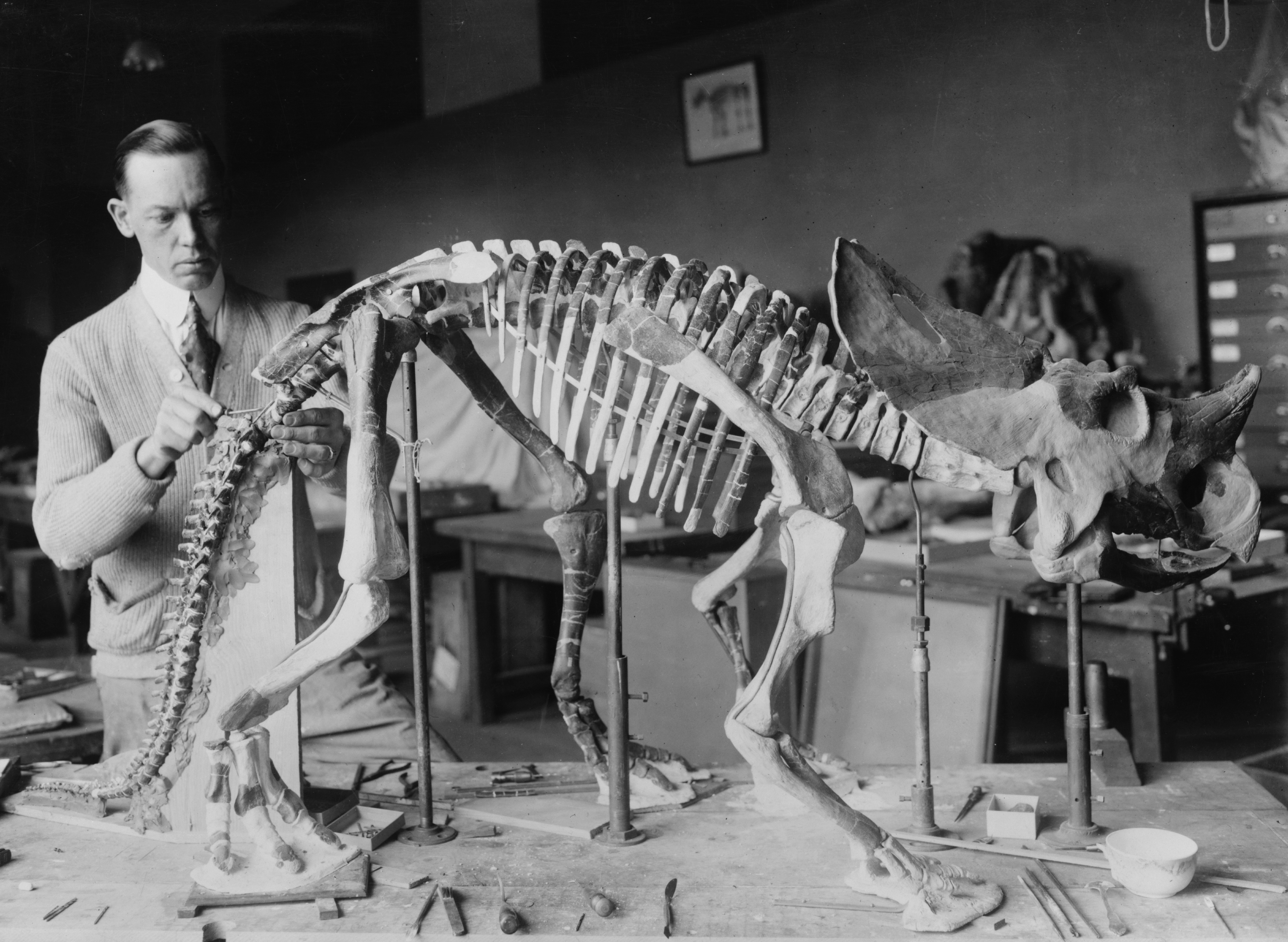
Norman Boss assembles  a “Brachyceratops” mount. White bones and portions thereof are sculpted. Image courtesy of the Smithsonian Institution Archives.

Back in January, London’s Natural History Museum incited a flurry of debate when it announced that Dippy, the Diplodocus skeleton that has graced the museum’s entrance hall for decades, will soon be retired and replaced with a blue whale. One of the recurring arguments in favor of the change has been that Dippy is not an original specimen – it’s a cast, or as some commentators have called it, “a fake.” As I argued last month, referring to a fossil cast in this way is a flagrant misrepresentation. An excellent post by Liz Martin covers this in more detail – “fake” implies deception, or something invented outright. Fossil casts are nothing of the sort. They are exact replicas of fossils, and they could not exist without the original specimens they are based on.

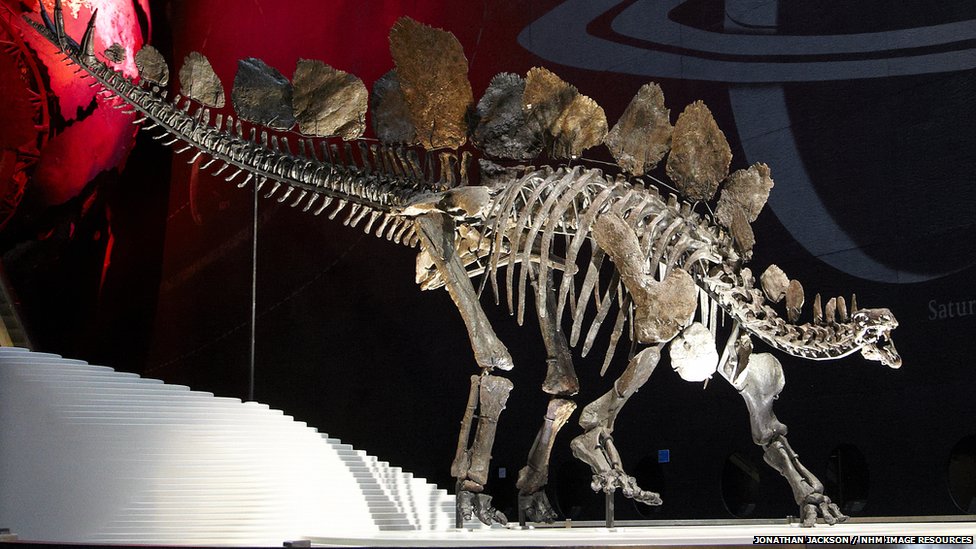
Nevertheless, the idea that fossil mounts are either original bones or casts is a bit of a false dichotomy. I’m as guilty as anyone of propagating this myth – it’s a simple way to assuage the fears of museum visitors that the fossil skeletons on display aren’t real. The truth is that most mounts include some amount of straight-up sculpted material. After all, the fossilized remains of vertebrate animals, particularly large ones, are almost never found articulated or anywhere near complete. The specimens chosen for museum mounts are among the absolute best available, but even they are not perfect. For instance, the NHM Dippy (actually one of many) is mostly a cast of a single Diplodocus specimen held at the Carnegie Museum of Natural History, but the forelimbs were reconstructed. When the mount was assembled, no Diplodocus forelimb material of comparable size was available, so Arthur Coggeshall and colleagues sculpted some based on smaller specimens.

Sculpted feet

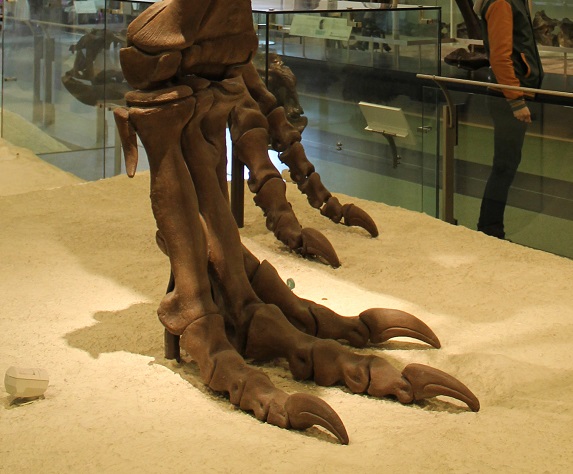
The sculpted feet of the AMNH Tyrannosaurus. Photo by the author.

From Hadrosaurus, the first mounted dinosaur skeleton, to modern reconstructions like Anzu, fossil mounts as we know them would not be possible without some amount of informed reconstruction. Take the iconic Tyrannosaurus rex mount at the American Museum of Natural History, assembled in 1915. The skeleton is a composite of two T. rex specimens, neither of which included any of the bones of the feet. Rather than creating a skeleton that stopped short at the ankles, Adam Herman sculpted a set of feet based on Allosaurus, another large meat-eating dinosaur. When Tyrannosaurus feet were eventually discovered, the allosaur-inspired feet turned out to be a little too bulky – tyrannosaurs actually had relatively long, gracile toes. But it’s not like T. rex turned out to have hooves or wheels. In most respects, from the basic three-toed arrangement to the shape and position of each individual bone, Hermann’s hypothesized tyrannosaur feet were spot-on. In fact, they were so close that the museum didn’t bother updating them when the skeleton was remounted in 1995.

The sculpted portions of fossil mounts aren’t wild speculation. They are very reasonable hypotheses based on a solid understanding of skeletal anatomy. As anatomist Georges Cuvier wrote in 1798:

Today comparative anatomy has reached such a point of perfection that, after inspecting a single bone, one can often determine the class, and sometimes even the genus of the animal to which it belonged…this is because the number, direction, and shape of the bones that compose each part of an animal’s body are always in a necessary relation to all the other parts, in such a way that – up to a point – one can infer the whole from any one of them and vice versa.

Cuvier’s principle of the correlation of parts – the idea that all backboned animals are built on the same basic body plan – is fundamental to the science of paleontology. If we have the right forelimb of an animal, we know that it had a mirror-image left forelimb. If we find a skeleton with it’s skull missing, we can still be confident that it had a head. What’s more, specialists can often recognize the group an animal belongs to (and sometimes the species) from just a few bones or teeth. Salamander vertebrae have a characteristic hourglass shape. Frog limb bones have “double-barreled” cavities in cross section. Marsupial teeth have a stylar shelf. New world monkeys have an extra premolar in each quadrant of the mouth. With enough specialized knowledge of related taxa, it is entirely possible to produce an educated reconstruction of most any animal from a minority of its skeleton.

How much is too much?

Argentinosaurus and Giganotosaurus at the Fernbank Museum of Natural History. Source

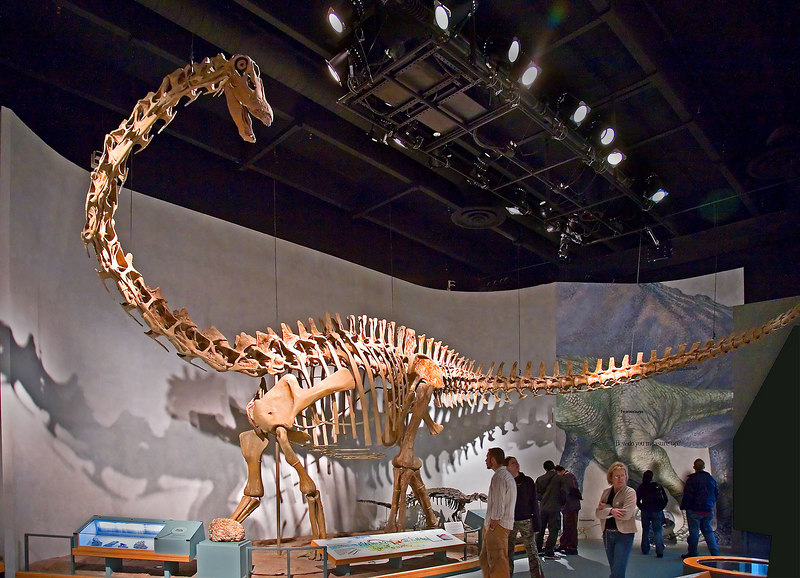
But as far as mounted skeletons in museums go, how far can we take this? Is it reasonable to build a standing mount when only 50% of the skeleton is definitively known? What about 30%? 10%? By bone count, that’s about the percentage of fossils ever found from the sauropod Argentinosaurus. And yet, the Fernbank Museum in Atlanta has a (rather spectacular) Argentinosaurus mount in its lobby. The whole thing is, of course, a fiberglass sculpture, dutifully based on better-known relatives. This mount is probably a fair reconstruction of what a complete Argentinosaurus skeleton would look like (although see this list of inaccuracies at Paleoking), but some still might consider it misleading. Your mileage may vary.

Museums generally do a good job labeling reconstructions. In particular, The Carnegie Museum and the Royal Ontario Museum are to be commended for posting charts alongside mounted skeletons that show which bones are original, which are casts, and which are reconstructions. In other cases, a little more transparency would not be unwelcome. For example, the four skulls below appear to include at least as much plaster reconstruction as bone, but they are all labeled as original specimens.

Photos by the author.

Four heavily-reconstructed fossil skulls at AMNH. Clockwise from top: Eryops, Indricotherium, Ophiacodon, and Triceratops. Photos by the author.

This is ultimately more of a philosophical question than a scientific one. Museum mounts, regardless of the amount of sculpted material, are usually well-supported reconstructions of the animal in question. If new information shows that a mount is wrong – as sometimes happens – staff are undoubtedly aware and will correct it as soon as funding and bureaucracy allow (granted, that can take decades). But as I’ve argued before, fossil mounts are unique among museum exhibits in that they are both the specimens and the interpretive context. They are hypotheses, but are presented (or at least understood) as straightforward truth. With this paradox in mind, how much is a museum ethically obligated to share about a mount’s creation? How can we do this without spurring visitors to use the dreaded f-word?

Comments are open, as always, and I’d be thrilled to hear what readers think.

11 Comments

Filed under AMNH, anatomy, dinosaurs, fossil mounts, mammals, museums, NHM, reptiles, sauropods, science communication, theropods

Framing Fossil Exhibits: Phylogeny

This is the third part of an on-again, off-again series about organizational and interpretive approaches in large-scale paleontology exhibits (see the introduction and walk through time entries). This time, I’ll be discussing exhibits arranged according to phylogenetics – that is, the evolutionary relationships among living things. Natural history museums have displayed specimens according to their place on the tree of life since the days of Charles Wilson Peale, and more than any other organizational scheme, phylogeny is the way biologists think about the living world. Perhaps unsurprisingly, this arrangement was more common in the past, when exhibits were typically designed by and for experts. Examples of these old-school displays include the fossil mammal gallery at the Peabody Museum of Natural History and the paleontology halls at the University of Kansas Natural History Museum (neither has been thoroughly overhauled since the 1950s).

peabody mammals

The jargon-heavy signage in the Peabody Museum’s classic fossil mammal exhibit is probably ignored by most visitors. Photo by the author.

Modern natural history museums rarely attempt phylogenetic exhibits. In vertebrate paleontology, an understanding of the evolutionary relationships of animals as identified via minute anatomical details is fundamental to our science. However, most people simply don’t think about the world in this way. For example, I was halfway through my first semester teaching an undergraduate anatomy course when I realized that most of the class didn’t really understand what a mammal is. The students were familiar with the word “mammal” and could provide some examples, but they couldn’t articulate what sets mammals apart from other animals, and the relationship of mammals to other vertebrates within the tree of life was all new to them. It’s easy to forget that even the most basic elements of evolutionary classification are specialized knowledge, even among biology students.

Describing the history of life on Earth chronologically is relatively easy—museum visitors intuitively understand the forward progression of time. But scientific classification (as opposed to colloquial categorization) requires a lot of explanation up front, and it’s easy to overwhelm an audience with jargon. While not impossible (see Neil Shubin’s masterful Your Inner Fish), it is very difficult to explain phylogeny to a general audience in a relatable and approachable way.

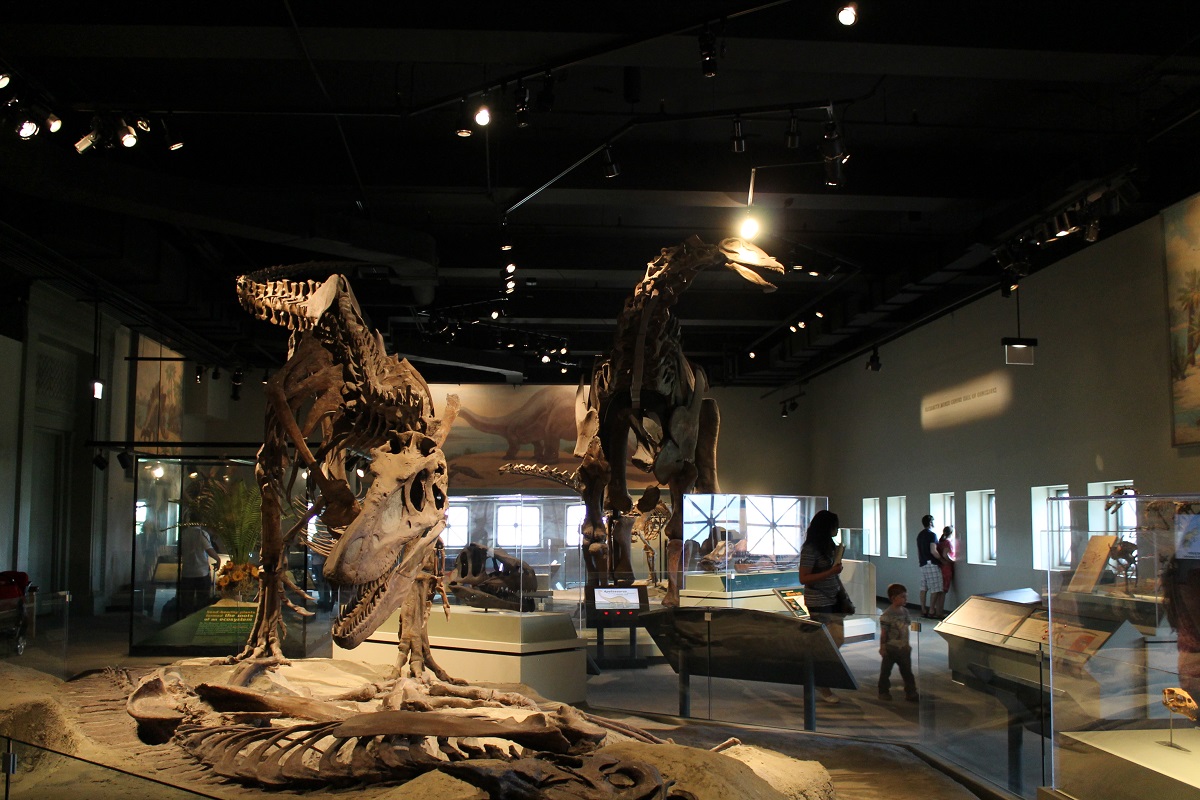
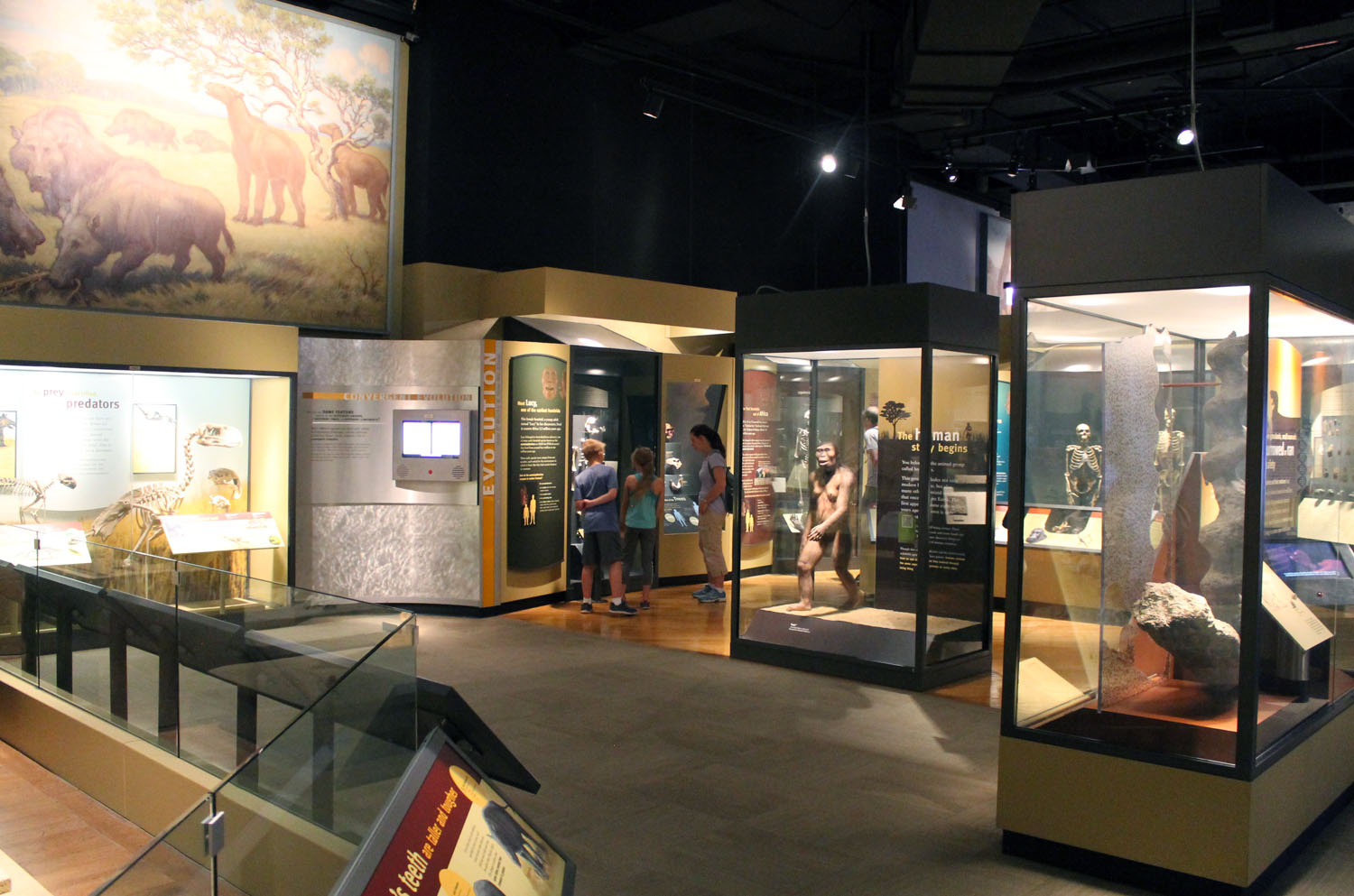
In 1995, the American Museum of Natural History attempted to do just that with the most recent renovation of its historic 4th floor fossil halls. This evolutionary arrangement was a major change for AMNH, since this space had a “walk through time” layout for most of the 20th century. In the accompanying book Discovering Dinosaurs in the American Museum of Natural History, curators Norell, Gaffney, and Dingus explain that phylogenetics (and the cladistic methodology in particular) is the only way to approach the study of prehistoric life in an objective way. Patterns of evolutionary relationships revealed by cladistic analyses are hard evidence in a field of study traditionally characterized by idle speculation. Norell and colleagues argue that the new exhibit arrangement shows visitors the credibility and scientific rigor behind modern paleontology.

4th floor of AMNH.

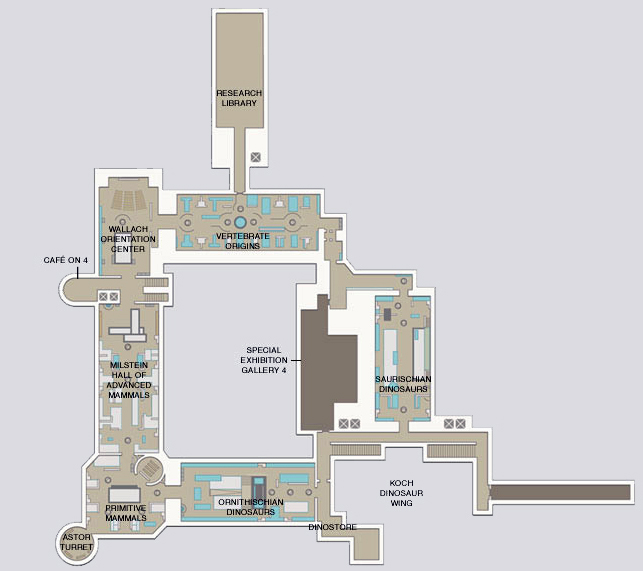
Map of the fossil halls on the 4th floor of AMNH. Source

Communicating the rigorous and trustworthy nature of scientific conclusions is a worthy goal, and the choice to ground the AMNH exhibit in this way seems almost prophetic given the litany of speculation-heavy paleontology “documentaries” that have proliferated in the years since it opened. Scientific rigor is definitely a running theme here – sign after sign explains that popularly depicted dinosaur behaviors like parental care and pack-hunting are largely untestable speculation. To a degree, this label copy takes the fun out of an undeniably fun subject, but I can appreciate the effort to legitimize paleontological science in the public eye. Overall, the AMNH exhibits represent an attempt to train visitors to look at fossils the way scientists do, and the phylogenetic layout is central to that goal.

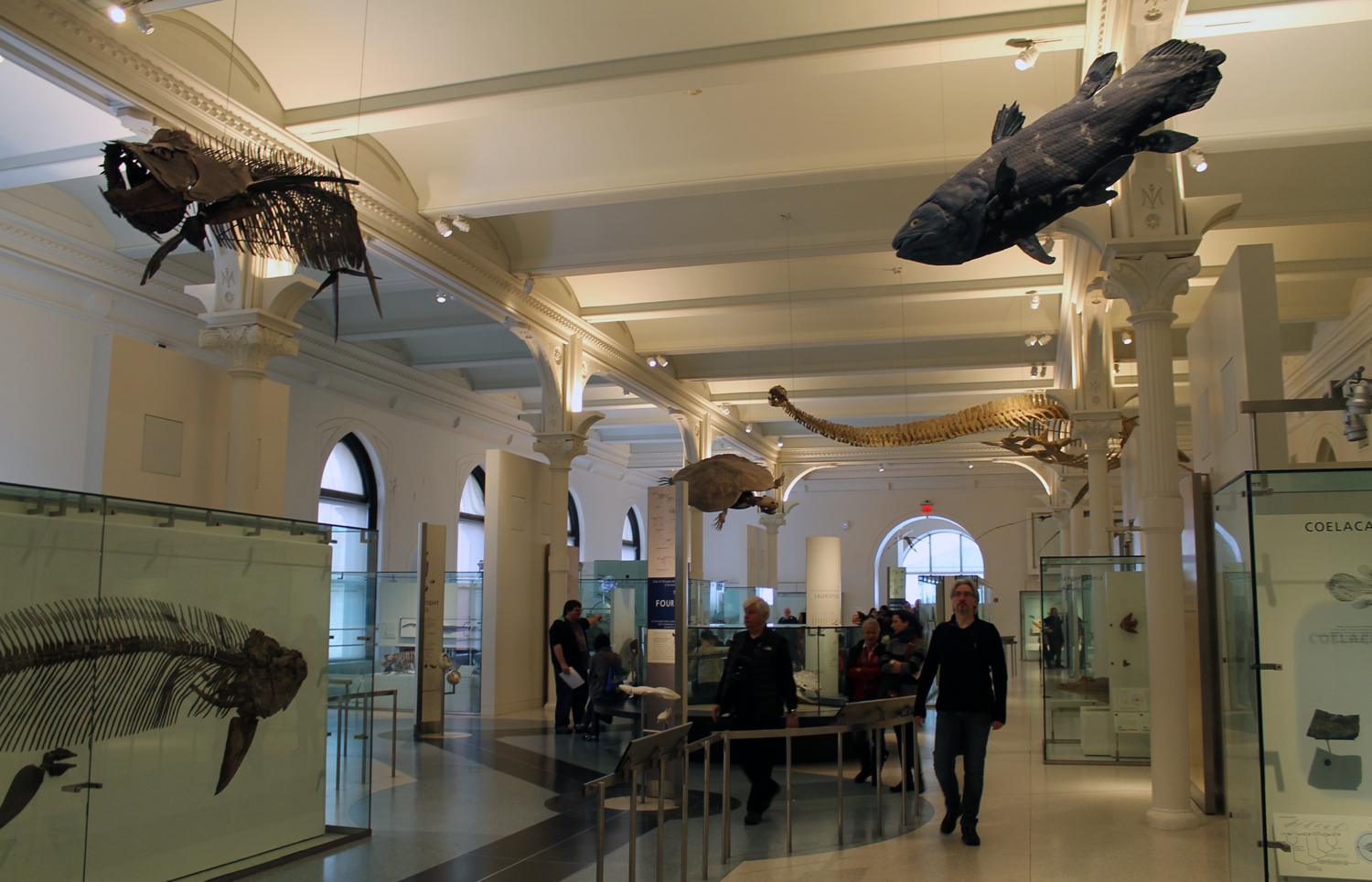
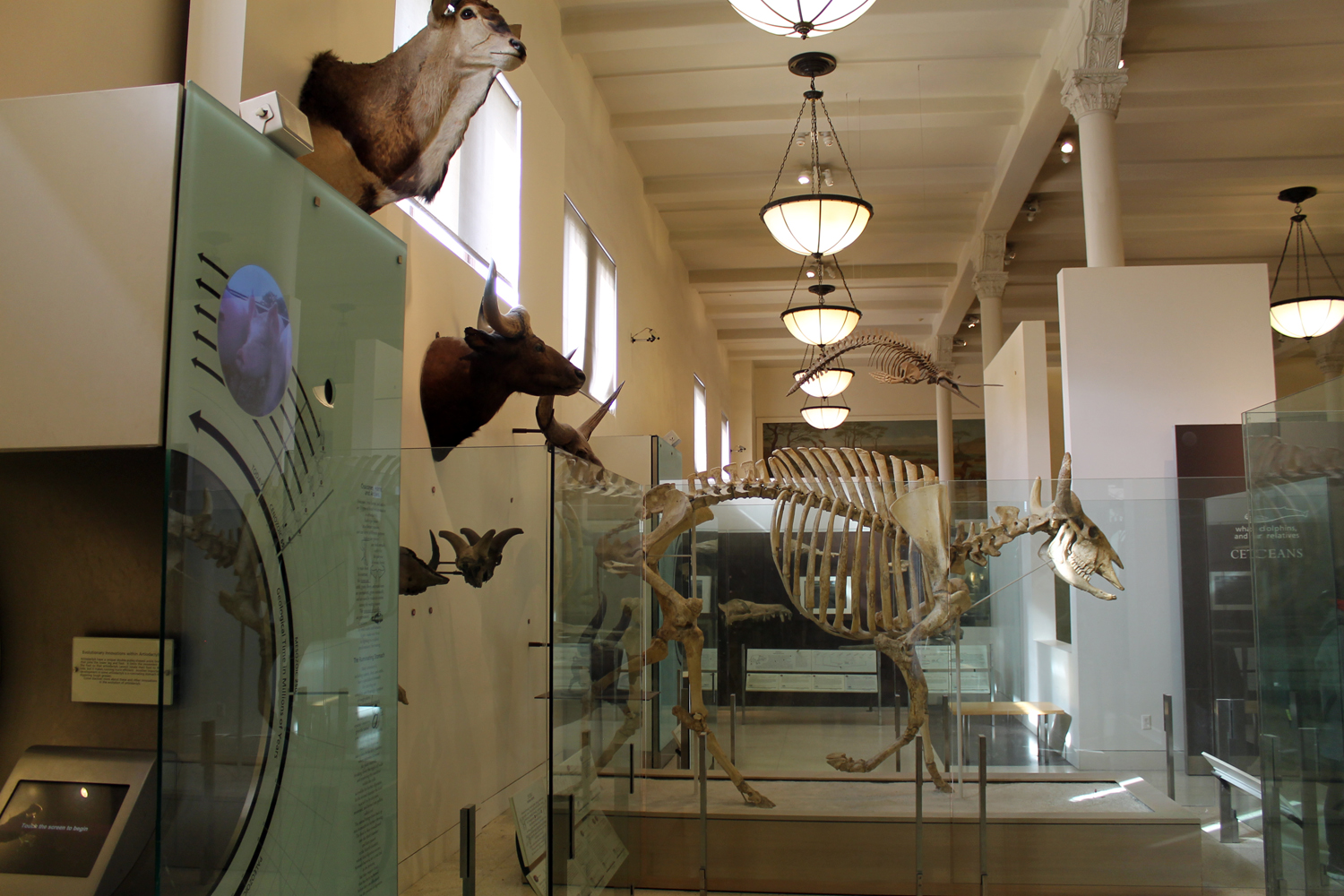
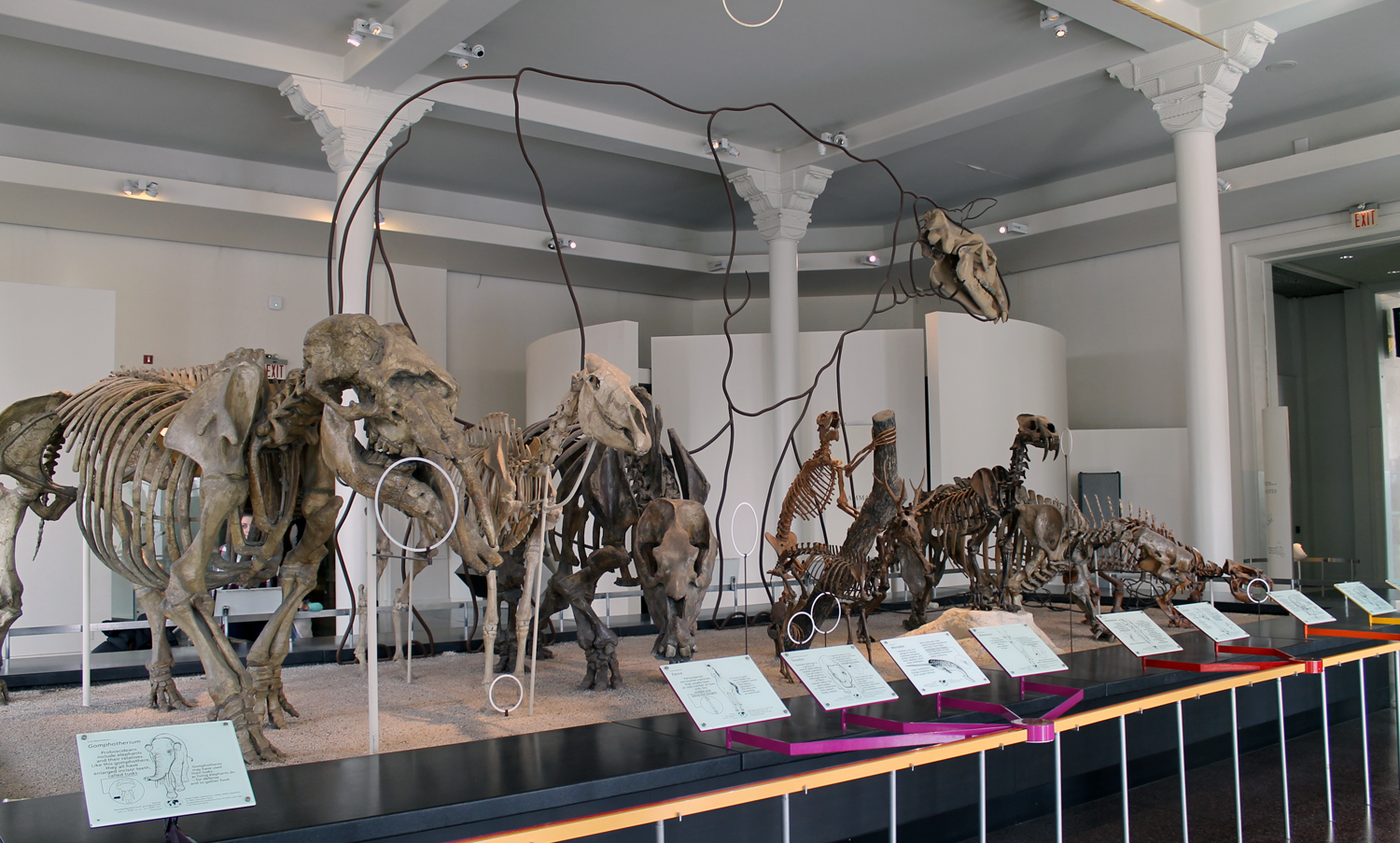
In the exhibit, visitors are meant to walk through a cladogram of chordates. You’ll pass through large halls dedicated to broad groups like saurischian dinosaurs and advanced mammals, while visiting smaller cul-de-sacs that  represent narrower clades like ornithomimids and testudines. A central black path guides you through the evolution of life, and centrally-situated pillars along your route identify major evolutionary innovations, such as jaws or the ability to reproduce on land. The insanely comprehensive vertebrate fossil collections at AMNH make this institution uniquely capable of putting so much diversity on display (although non-tetrapods are woefully underrepresented). Meanwhile, an open floor plan allows you to spend as much or as little time in each area as you wish, and ample natural lighting goes a long way toward making it possible to study specimens in detail.

follow the path for now

Pillars mark major evolutionary milestones in the Hall of Vertebrate Origins. Photo by the author.

path disappears among dinosaurs

The evolutionary pathway becomes considerably less obvious among the dinosaurs. Photo by the author.

Nevertheless, I agree with Riley Black that the AMNH fossil halls don’t do the best job communicating the story of vertebrate evolution to their core audience. The underlying purpose of any exhibit structure is to provide meaning and context for objects – to help visitors see them as more than neat things to look at. According to visitor surveys, the default mode of understanding for most people passing through a paleontology exhibit is what I’ve been calling “dinosaur pageantry.” After seeing the exhibit, most visitors will recall a list of cool skeletons they saw. A few might consider which ones are meat-eaters and which ones are plant-eaters, but without further prompting that’s all we can usually expect from non-specialists. It’s the museum’s job to give visitors the intellectual tools to contextualize those fossils in a more sophisticated way, but there’s a fine line to walk. Provide too little information and nobody learns anything, but provide too much and the content is ignored. Unfortunately, the AMNH exhibits fall into the “overkill” category.

As discussed, phylogeny is complicated, often counter-intuitive, and largely unfamiliar to many visitors. To overcome this, the AMNH designers rely on a fairly long orientation film, which introduces the concept of categorizing organisms based on shared derived characteristics. There are a few problems with this. First there’s the film itself, which dives right into the traits that characterize different groups – like the stirrup-shaped stapes of derived mammals and the temporal fenestrae of archosaurs – without explaining why these traits are significant. To a layperson, these probably seem like really inconsequential things to hang a whole group on. The video also presents a cladogram of vertebrates without explaining how to read it. As Torrens and Barahona demonstrate, interpreting a phylogenetic tree is a specialized skill that many natural history museum visitors lack. Second, I saw no incentive or instruction to actually start my visit to the 4th floor in the orientation hall. There are no less than four entrances to the fossil exhibits, so many visitors won’t know there is an orientation film (I sure didn’t) until they’re halfway through the galleries. Finally, there’s the reliance on media in general: do we really want visitors to spend even a portion of their time in an exhibit full of real fossils watching a video in a darkened room? Telling visitors what to think in a narrated video is easy, but it’s not nearly as meaningful as showing them the same concept with specimens (or better yet, coaxing them to reach conclusions themselves).

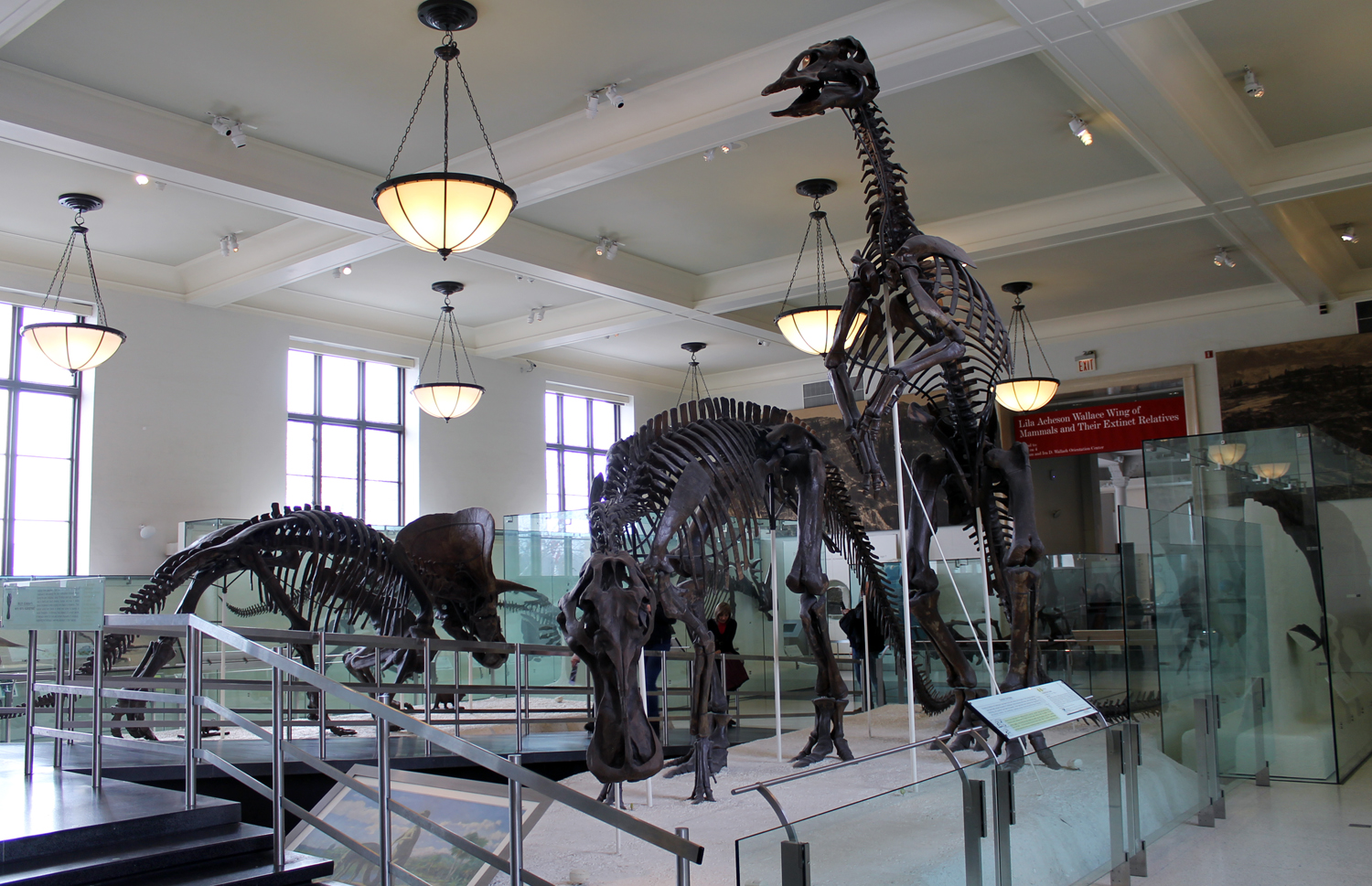
Hall of Saurischian Dinosaurs, American Museum of Natural History. Photo by the author.

Iconic mounts in the Hall of Saurischian Dinosaurs are iconic. Photo by the author.

Within the actual fossil halls, interpretation remains stubbornly unapproachable. For example, the sign introducing proboscidians tells visitors that this group is defined primarily by eye sockets located near the snout. An observant visitor might wonder why scientists rely on such an obscure detail, as opposed to the obvious trunks and tusks. There’s a good teaching moment there concerning why some characteristics might face more selection pressure (and thus change more radically) than others, but instead visitors are only offered esoteric statements. Relatedly, the exhibit does little to prioritize information. Most label text is quite small, and there’s a lot of it. Compare this to Evolving Planet at the Field Museum, where there is a clear hierarchy of headings and sub-headings. Visitors can read the main point of a display without even stopping, and parents can quickly find relevant information to answer their charges’ questions (rather than making something up).

Evolving Planet also compares favorably to the AMNH fossil halls in its informative aesthetics and spatial logic. At FMNH, walls and signs in each section are distinctly color-coded, making transitions obvious and intuitive. Likewise, consistent iconography  – such as the mass extinction zones – helps visitors match recurring themes and topics throughout the exhibit. AMNH, in contrast, has a uniform glass and white-walled Apple Store aesthetic. It’s visually appealing, but doesn’t do much to help visitors navigate the space in a meaningful way.

edentates aren't real

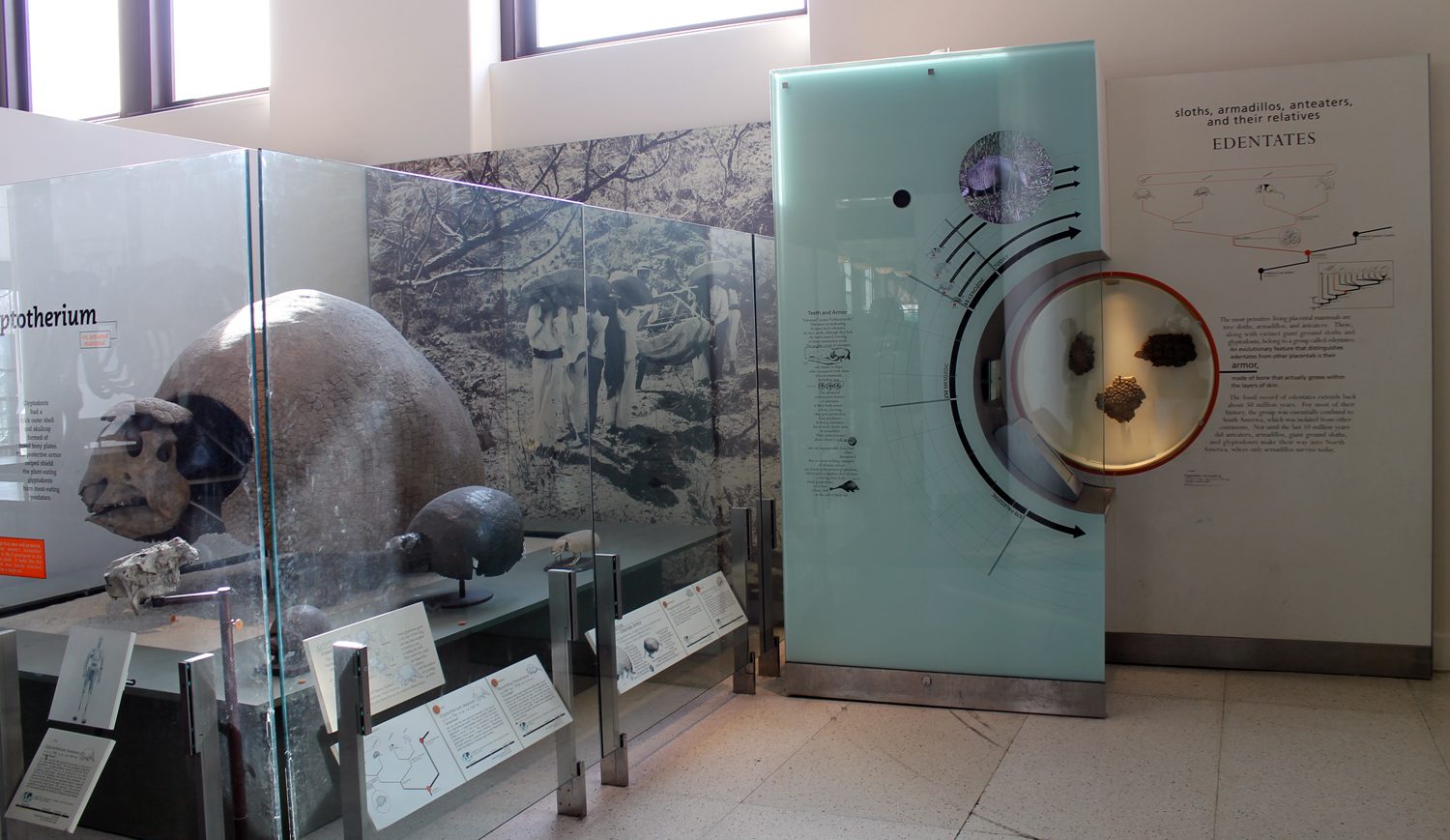
Phylogenetic interpretations change quickly – Edentata is no longer considered a natural group. Photo by the author.

The phylogenetic layout introduces a number of other unique interpretive challenges. Since there is no temporal axis,  it’s often unclear whether the lineage in a particular cul-de-sac cluster went extinct, continued on, or gave rise to another group elsewhere in the exhibit. Visitors that want to know which animals lived contemporaneously are out of luck. Meanwhile, the exhibit sometimes uses modern animal skeletons to fill out displays where fossil examples are limited, such as bats and primates. While these are labeled, the text is too small to be seen from a distance. The evolutionary organization is also burdened by the fact that phylogenetics is a fast-moving and often changing field of study. While the order of geologic time periods will never change, the 20 year-old displays at AMNH are already out of date in several details. For example, there is a cul-de-sac devoted to edentates, which is now considered polyphyletic, and a cladogram in the Hall of Saurischian Dinosaurs incorrectly places tyrannosaurids among the carnosaurs.

Cows and broken videos

Glass architecture lets visitors see through displays and get a sense of what lies beyond. Photo by the author.

Neat comparison of mammal teeth. Too bad there's no obvious label.

This display is a great example of the diversity in mammal teeth, but it’s a confusing centerpiece for the Hall of Primitive Mammals. Photo by the author.

The AMNH fossil exhibits excel in many respects, chiefly in the amazing diversity and quantity of specimens on display. The exhibit throws a lot of good science at visitors, but falters in explaining why it matters. The point of all this is not to nit-pick the design choices at AMNH, but to reiterate that phylogenetically-arranged fossil exhibits are really hard to pull off. This is not the most intuitive way to introduce the history of life, or even the process of evolution. With so much background to cover, perhaps a more structured and linear layout would be better. In fact, a lot of my issues with the AMNH fossil exhibits seem to stem from a disconnect between the phylogenetic interpretive content and the wide-open aesthetics. Open exhibits can be great, but in this case it hinders the learning opportunities for self-guided groups of visitors. It’s difficult to imagine a typical visitor, arriving with their family or another mixed-age group, having the patience to make sense of it all. Regrettably, such visitors default to the dinosaur pageantry level of understanding, making all the work invested in creating a meaningful exhibit space for naught.

References

Norell, M, Gaffney, E, and Dingus, L. (1995). Discovering Dinosaurs in the American Museum of Natural History. New York, NY: Alfred A. Knopf, Inc.

Torrens, E. and Barahona, A. (2012). Why are Some Evolutionary Trees in Natural History Museums Prone to Being Misinterpreted? Evolution: Education and Outreach 1-25.

14 Comments

Filed under AMNH, dinosaurs, exhibits, fish, FMNH, fossil mounts, mammals, museums, opinion, reptiles, reviews, systematics

Missourium: Hiding in Plain Sight

A while back I wrote about Albert Koch, the 19th century showman who made a tidy profit assembling and touring chimeric composites of fossil bones. Koch’s monsters – an exaggerated mastodon called “Missourium” and two alleged sea serpents made from whale fossils – were a hit with the public but an embarrassment to scientists. At the time, ideas like extinction and the great age of the Earth were very new, and Koch’s fraudulent commodification of fossil evidence made it harder for legitimate researchers to be taken seriously.

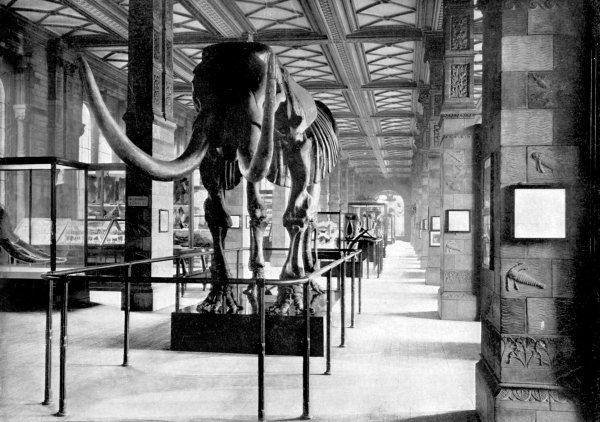
The mastodon once called Missourium in the Mammal hall. Source

Is this mastodon at NHM actually the legendary Missourium? Source

One thing I breezed over in the previous post was the eventual fate of Koch’s creations. It is widely reported that the whales (which Koch alternatively called “Hydrargos” and “Hydrarchos”) met rather dramatic ends: one perished in the Great Chicago Fire of 1871, while the other was purchased by the Royal Anatomical Museum in Munich Berlin and was subsequently blown up during World War II. But what about Missourium? Following Simpson, I wrote that the mount was sold to the British Museum (now the Natural History Museum), and left it at that.

However, Mike Taylor recently asked whether Missourium might still be on display in South Kensington today:

I didn’t know that the “Missourium” was sold to the British Museum! Do you know what they did with it? I don’t suppose anyone has the specimen number? Is it possible that they got rid of all the fakery and mounted it in the mammal hall, and that it stands there today under the shadow of the whale?(Link to comment)

After some very modest digging, I found that Mike’s hunch was exactly right. General googling revealed that several authors, including McMillian, Debus, and Fuller, had concluded that the NHM mastodon and Missourium were one and the same, but none of them offered a proper citation. While I have no reason to doubt these authors, I still wanted a primary source. I eventually found that in a 1991 article by NHM preparator William Lindsay, which details the process of moving the mastodon to its current home in the Mammals Gallery, and confirms its identity as a remounted Missourium.

An insane illsutration that accompanied Koch's traveling exhibit.

This insane illustration of Missourium in its natural habitat accompanied Koch’s traveling exhibit.

As far as we know, Koch retrieved all the fossils that made up Missourium from a single Benton County, Missouri spring in 1840 (Hoy confirmed the locality and found several additional bones in 1871). Koch used the bones of at least two individuals to assemble a chimeric super-mastodon, which he displayed in St. Louis. Most notably, Koch spliced a number of extra vertebrae into the spinal column, extending the mount’s length to 32 feet. To appeal to local audiences – and to differentiate his creation from Peale’s mastodon – Koch named the beast Missourium, and proclaimed it to be the skeleton of the biblical Leviathan. In 1841, Koch sold his St. Louis showroom and took Missourium on tour, eventually winding up in the Egyptian Hall of Piccadilly, London.

Local specialists, including Gideon Mantell, were initially impressed by the display. However, attitudes soured in February 1842 when Richard Owen presented a scathing critique of Koch’s work to the Geological Society of London. In his lecture, Owen made some cursory remarks about the inaccurately articulated skeleton, but he was primarily concerned with confirming that Missourium was nothing more than a run-of-the-mill American mastodon. Owen was a trendsetter, then as well as now, and for decades afterward his fellow naturalists took every opportunity to take Koch to task. For example, James Dana allowed that “the credit is due him of having performed a great service to science by his collections”, but tore into Koch’s publications to prove that he “was quite ignorant of geology and without scientific training.”

It is therefore ironic that Owen himself gave Koch one of the biggest paydays of his life when he bought Missourium on behalf of the British Museum. In exchange for the skeleton, Koch made off with a $2000 downpayment (about $65,000 today), plus $1000 a year for the rest of his life. It seems museums have been paying extortion prices for display-caliber fossils for a long time.

Armature

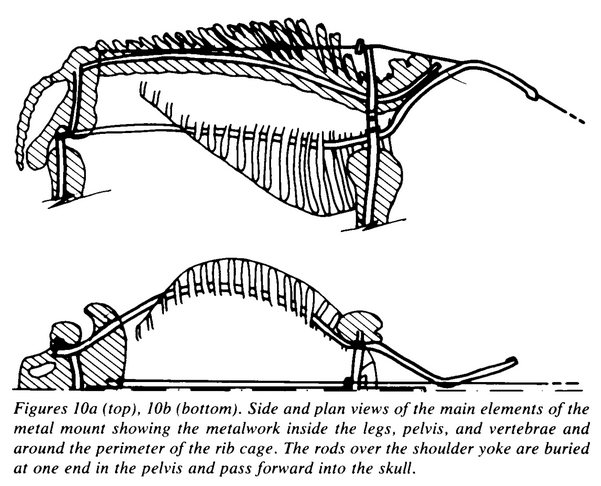
Diagram of the mastodon’s internal armature. Figure 10 of Lindsay 1991.

Museum technicians, including an individual named J. Flower, disassembled Missourium and rebuilt it into a proper mastodon. Reduced to a length of 20 feet, the remounted skeleton (now OR15913) was placed in the historic fossil mammals exhibit and remained there for almost 150 years. In 1991, the mastodon was selected for inclusion in the new Mammals Gallery at NHM, which combines both fossil and modern specimens. Although William Lindsay and colleagues had only limited time to restore and move the skeleton, they gained fascinating insight into 19th century mounting practices. As shown above, the internal metal armature was virtually identical to 20th century counterparts. A hand-wrought iron beam threaded through each vertebra provided the mount’s central anchor point. Four additional iron bars skewered the appendicular elements and connected to the vertebral beam inside the pelvis and under the shoulder girdle. An enlarged foramen magnum allowed the vertebral beam to enter the back of the skull, which turned out to be composed almost entirely of papier-mâché. A real palate and set of upper teeth were buried in the paper cranium, supported by a cradle of wood and copper wire. Amazingly, an 1881 issue of The Weekly Dispatch used in a cursory repair to the skull was still legible.

historic photo of mastodon

Missourium remounted as a standard mastodon in the historic fossil mammals hall. Source

As to be expected from anything on display for a century and a half, the mastodon was in rough shape. As usual, vibration damage was the primary culprit, and Lindsay discovered that the spongy bone in the femur and cervical vertebrae had been crushed beneath the weight of the iron armature. Although NHM staff weren’t able to completely disarticulate the skeleton, they separated it into seven pieces for transport. A coating of polyvinyl acetate was applied to consolidate the fragile fossils, and larger cracks were filled in with putty. Meanwhile, the deteriorating replica skull was retired and replaced with a glass-reinforced plastic cast. The original tusks are still included in the display, however, which is unusual among proboscidian mounts.

Missourium was the third mounted fossil skeleton ever assembled, after Bru’s Megatherium and Peale’s mastodon. Although they’ve each been reconfigured and restored at various points in time, all three specimens are still on exhibit today. While any object that has been on public display for 150 years (or more) is fascinating, I find it especially compelling that so few fossil mounts have ever been taken off exhibit. Public demand, institutional inertia, and the challenges of safely disarticulating a historic mount all contribute to the incredible longevity of these displays, but time inevitably takes its toll on fragile fossils. I can’t help but wonder how many more generations of visitors will be able to view the mastodon that was once Missourium before a mounted display becomes untenable.

References

British Museum (1904). The History of the Collections Contained in the Natural History Departments of the British Museum. London, UK: British Museum (Natural History) and Longmans and Co.

Dana, J.D. (1875). On Dr. Koch’s Evidence with regard to the Contemporaneity of Man and the Mastodon in Missouri. The American Journal of Science and Arts 9:335-346.

Hoy, P.R. (1871). Dr. Koch’s Missourium. The American Naturalist 5:3:147-148.

Lindsay, W. (1991). “Mammoth” Task. Curator 34:4:261-272.

Owen, R. (1842). Report on the Missourium now exhibiting at the Egyptian Hall, with an inquiry into the claims of the Tetracaudodon to generic distinction. Proceedings of the Geologic Society of London 3:3:82.

Simpson, G.G. (1942). The Beginnings of Vertebrate Paleontology in North America. Proceedings of the American Philosophical Society. 86:1:130-188.

7 Comments

Filed under anatomy, fossil mounts, history of science, mammals, museums, NHM

Installation art in the service of science

totes awesome

Unbridled awesome. Photo by the author.

Earlier this week, Dippy the Diplodocus gave me an opportunity to discuss mounted fossil skeletons as objects imbued with cultural and historical meaning. Today, I’d like to take that a step further and discuss them as art. Hold on tight, because it’s about to get interdisciplinary up in here.

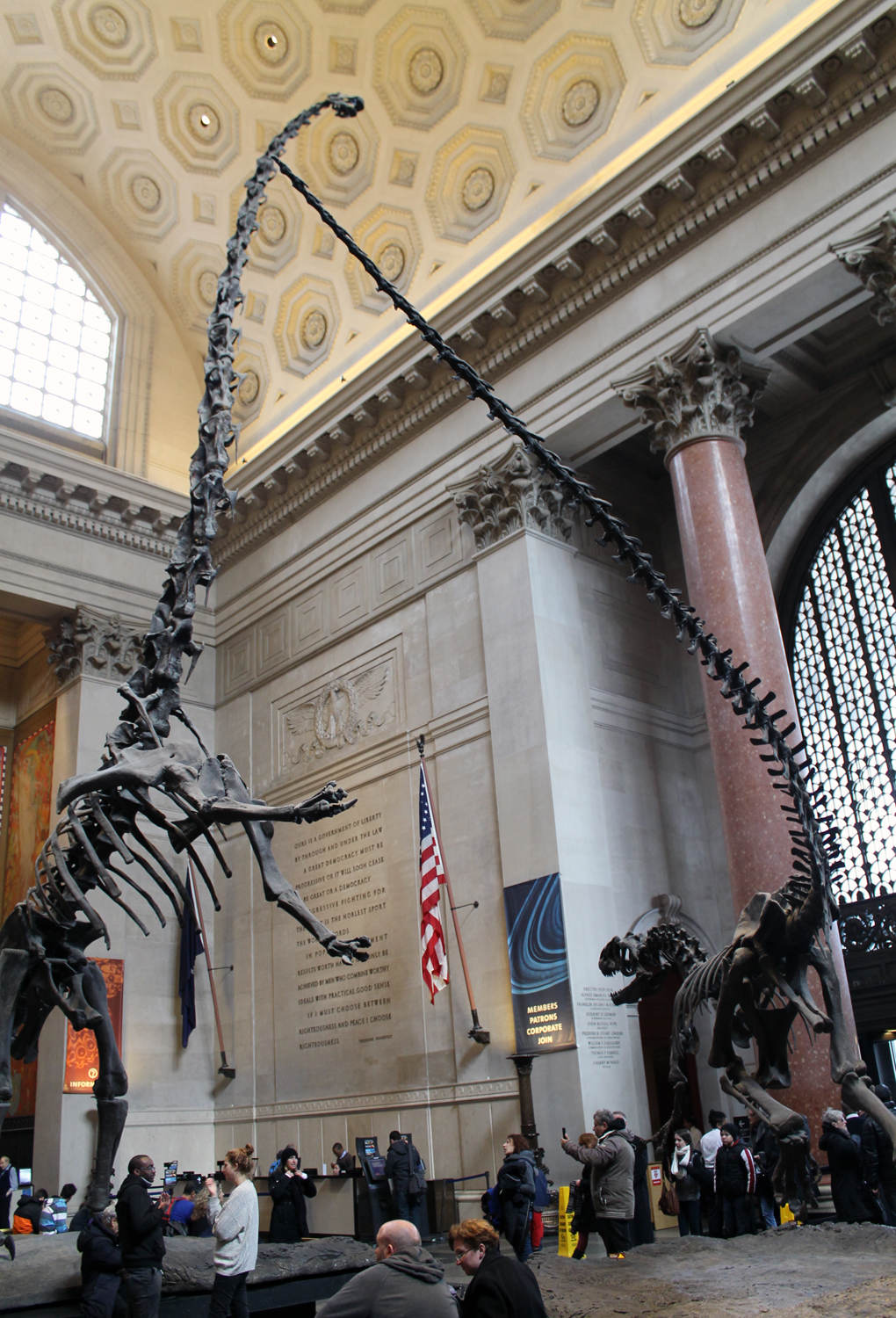
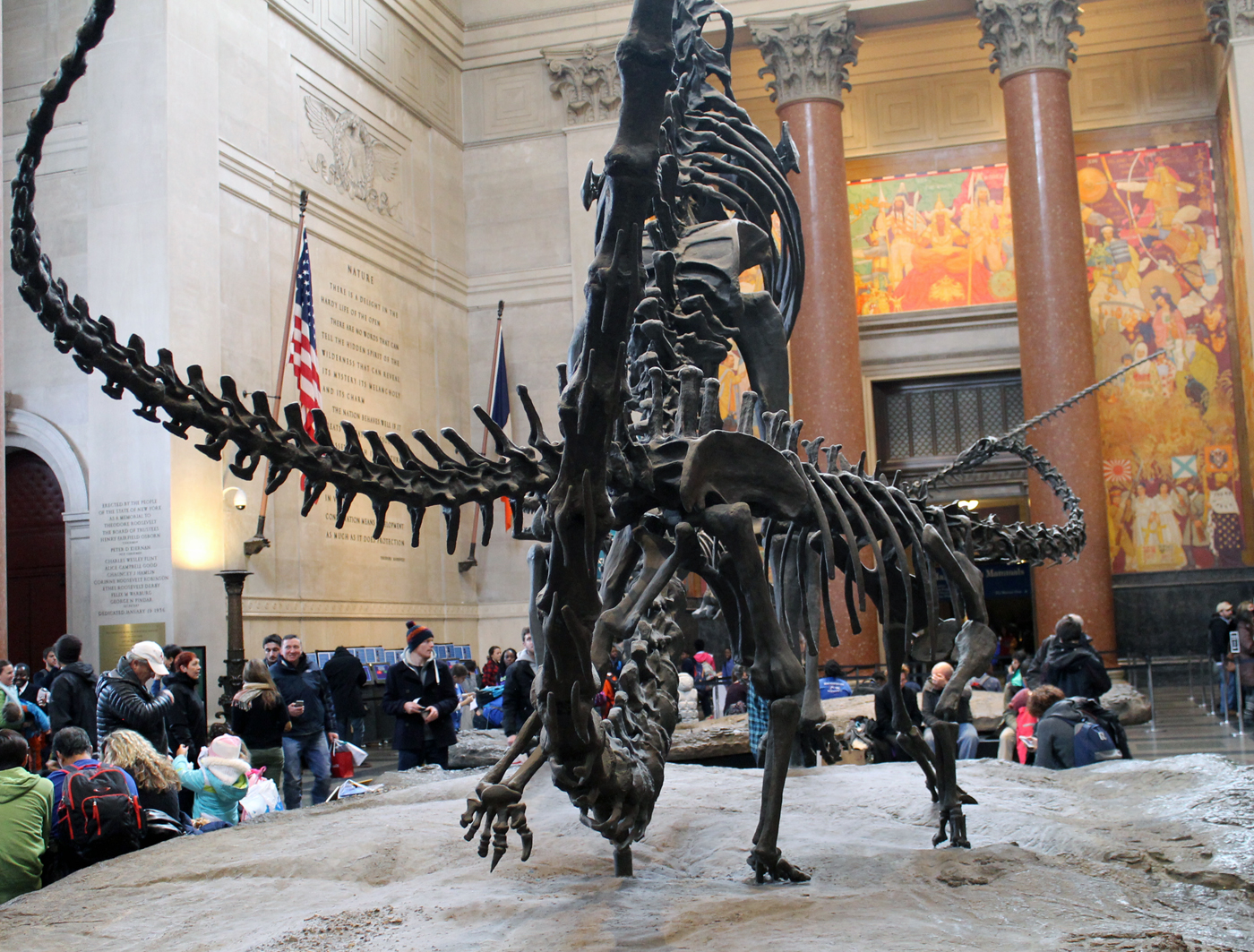
The Barosaurus and Allosaurus encounter at the American Museum of Natural History is one of the most amazing fossil displays in the world. Within the historic Theodore Roosevelt Rotunda, an adult Barosaurus skeleton rears to a height of fifty feet to protect its offspring from a charging Allosaurus. Although all three skeletons are glass-reinforced polyester and polyurethane foam casts (by necessity – it would be unwise to mount real fossil bones in such a precarious manner), they are based directly on real specimens. The adult Barosaurus is a cast of AMNH 6341, which was excavated by Earl Douglass at Dinosaur National Monument in 1923. The Allosaurus is a cast of DMNH 1483. The young Barosaurus is the most speculative of the lot and mostly consists of sculpted bones, but it includes casts of real juvenile sauropod vertebrae.

Looking past its physical properties, this display comes with an explicit pedagogical agenda. AMNH paleontologist Mark Norrell stated that the objective was “to imagine dinosaurs as living organisms, facing challenges similar to those that confront animals today.” When the exhibit was built in 1991, it was considered important to showcase what active, hot-blooded dinosaurs might be capable of. In this case, we have a portrayal of considerable speed and agility, as well as a suggestion of parental care and group living. The mount and its associated signage also invite visitors to consider the nature of the fossil record, and what questions paleontologists can and cannot definitively answer. We don’t know whether Barosaurus would have protected or even lived with its young. We don’t know if Allosaurus would have attempted to attack an animal more than three times its size. Even the ability of Barosaurus to rear up on two legs has been the subject of some debate. While not enormously far-fetched, this is still an imaginative reconstruction – one which challenges visitors to consider the evidence behind this and other displays throughout the museum.

However, even this sort of interpretation does not fully capture the experience of observing this tableau – there is something else going on here. The dynamic poses give the dinosaurs a startling presence, and it is scarcely possible not to imagine them as living animals. Visitors must consider what it would be like to encounter an Allosaurus charging at full speed, or to stand beneath a multi-ton sauropod. Standing in the center of the room, the viewer is literally surrounded by the mounts, and necessarily becomes a participant in the drama. Even if we ignore the representational identities of the dinosaurs and think of this display as a set of abstract shapes, it is still decisively monumental. The mise-en-scène draws the viewer’s eye around the room and up the neck of the Barosaurus, toward the vaulted ceiling. The scene can thus be described as a visual and physical intervention that draws each and every visitor that enters the rotunda into a shared performance.

Fancy fisheye photo.

The visitors themselves become part of the installation by providing a human scale. Source

As impressive as the mounts are on their own, they cannot be divorced from the Theodore Roosevelt Rotunda that surrounds them. Aesthetically, the grandiose nature of the skeletons compliments the neoclassical architecture. The site-specific composition also encourages visitors to look around the room and take note of structural elements they might have missed (e.g. the ceiling). But the room itself is far from a neutral exhibition space. It is a public monument to the first President Roosevelt, who Donna Haraway calls “the patron saint for the museum.” In addition to an array of canvases depicting scenes from Roosevelt’s public life,  quotations are etched into the walls under the headings Youth, Manhood, Nature, and The State. Roosevelt’s words, literally carved in stone, speak to his appreciation of the natural world, his support for what he called “the strenuous life”, and his belief in living honorably and compassionately. Were it not for the throngs of tourists, this space could be mistaken for a shrine.

There are a few possible ways to interpret  the relationship between the dinosaurs and the hall around them. We could cast the adult Barosaurus as Roosevelt’s idealized citizen. Rather than letting the Allosaurus pick off it’s more vulnerable companion, it stands its ground, for “the highest form of success comes not to the man who desires mere easy peace, but to the man who does not shrink from danger, from hardship, or from bitter toil.” Alternatively, we could follow Haraway and consider this space a monument to hyper-masculinity and paternalistic oppression. Haraway slams the Roosevelt Rotunda (which implies a male audience at the exclusion of others) and the adjacent Hall of African Mammals (which displays artificially-assembled nuclear families, always with a male leader) as products of the wealth and privilege of the early-20th century aristocracy. But if we assume – as many visitors apparently do – that the defending Barosaurus is female, the dinosaurs might be read as a direct critique of the institution’s history. While political and sociological readings probably didn’t come up much when these mounts were being constructed, intent isn’t the whole story. This is a public space, and visitors can and will make conscious and unconscious connections between the various objects on view. Besides, this wouldn’t be the first time fossils have been entwined with presidential politics.

Different

The fossils weren’t created to be displayed in this space, but the mounts were. Photo by the author.

A museum display always involves the staging or framing of the world. It is this infusion of creative choice that moves  fossil mounts beyond the realm of science and into art. As Polliquin puts it, a specimen from nature “permits or invites experience, wheras a work of art is intentionally made for an experience.” Whether they are composed of real fossils or casts thereof, fossil mounts are purposefully constructed to exist in the museum environment. Paradoxically, they are both the objects of scrutiny and the exhibit context. This is not something to hide or be ashamed of, but to celebrate. These mounts embody aesthetic  beauty, deep history, and rich culture, and these elements are just as important as their scientific value when we consider their role in the museological landscape.

References

Haraway, D. (1985). Teddy Bear Patriarchy: Taxidermy in the Garden of Eden, New York City, 1908-1936. Social Text 11:20-64.

Kohlstedt, S.G. (2005). “Thoughts in Things” Modernity, History, and North American Museums. Isis 96:4:586-601.

Lindsay, W., Larkin, N. and Smith, N. (1996). Displaying Dinosaurs at the Natural History Museum, London. Curator 39:4:262-279.

Norrell, M.A., Dingus, L.W. and Gaffney, E.S. (1991). Barosaurus on Central Park West. Natural History 100:12:36-41.

Polliquin, R. (2012). The Breathless Zoo: Taxidermy and the Cultures of Longing. University Park, PA: Pennsylvania State University Press.
Vogel, S. (1991). Always True to the Object, in Our Fashion. Exhibiting Cultures: The Poetics and Politics of Museum Displays. Washington, DC: Smithsonian Institution Press.

3 Comments

Filed under AMNH, dinosaurs, education, exhibits, fossil mounts, museums, paleoart, reptiles, sauropods, theropods

I Have Opinions About Dippy

1st cast in spot of honor

Dippy the Diplodocus has been at London’s Natural History Museum since 1905. Source

Historic fossil mounts are usually taken for granted. Classics like the the AMNH Tyrannosaurus (which turns 100 this year!) have been enjoyed by generations of visitors, and it seems out of the question that they might ever be retired from display. Such was the case with Dippy the Diplodocus at London’s Natural History Museum – this cast of the CMNH original has been at the museum since 1905, and has been the centerpiece of Hintze Hall since 1979. It was therefore something of a shock when the NHM announced on Thursday that plans are afoot to replace Dippy with a blue whale skeleton. For a few hours, at least, this was huge news. #Savedippy was trending internationally, memes were created, and petitions sprang up to keep the mount in place. To me, it was inspiring to see how much people care about this mounted skeleton. I’ve repeatedly argued on this blog that fossil mounts take on second lives in museums, and have cultural and historical meaning independent of their identities as scientific specimens. The outpouring of love for Dippy is as clear an example as I could ever hope for.

Things seemed to calm down once a few editorials in favor of the change made the rounds, most notably pieces at the Huffington Post, the Conversation, and the Telegraph. These authors make a strong case for the blue whale: it’s the largest animal to ever exist, but it’s on the brink of extinction. It reminds us of our role as stewards of the planet, and the impacts the choices we make today will have on future generations. Meanwhile, the opposition hasn’t offered much beyond “kids like dinosaurs.” Personally, I’m not steadfastly opposed to the change. A whale is an excellent symbol for the importance of protecting the natural world, and it certainly beats losing exhibit space to a new cafe or gift shop. I’ve also never been to the NHM, and my heart already belongs to another Diplodocus, so I don’t really have a dog in this fight. Still, Dippy is an irreplaceable monument deeply entrenched in history, and certainly deserves a thoughtful defense.

The MNH released this concept art of the new display. Source

Exhibit company Casson Mann prepared this concept art of the new display. Source

To review, the original Dippy fossils were collected in 1899 near Medicine Bow, Wyoming by a team funded by Andrew Carnegie. The Pittsburgh-based industrialist/philanthropist wanted to make a name for his newly-founded Carnegie Museum of Natural History by displaying the first-ever mounted skeleton of a sauropod dinosaur. The Diplodocus discovered by Carnegie’s team was (and still is) one of the most complete sauropod specimens ever found. Nevertheless, they lost the race to public display: the American Museum of Natural History unveiled its composite “Brontosaurus” mount in March of 1905*, while Carnegie was still waiting for his museum building to be finished. Not to be bested by the New York competition, Carnegie offered a complete plaster cast of the Diplodocus skeleton to King Edward VII. The replica now known as Dippy was on display in London before the end of the year. After completing a mount of the original fossils at CMNH in 1907, Carnegie went on to produce seven more Diplodocus casts, which he gifted to various European heads of state (read the full story here). In addition, at least four other Dippy replicas have been created since Carnegie’s death in 1919. Whether we consider all versions or just the London cast, Dippy the Diplodocus is among the most-viewed animal skeletons in the world. Its cultural impact, particularly in Europe, is astounding. More than any other specimen, it can be argued that this one made “dinosaur” a household word throughout the world.

*Natural history historian Ilja Nieuwland once commented that the first cast – the one still on display in London – was temporarily assembled in a Pittsburgh warehouse the Pittsburgh Exposition Society Hall in 1904. It could therefore be claimed that this was actually the first sauropod mount.

diplodocus_nocopyright

The Diplodocus cast in London debuted two years before the Pittsburgh original.

And yet, one of the recurring arguments to replace Dippy in the Hintze Hall is that it’s “just a copy” or worse, “a fake.” Of course, referring to a fossil cast in this way is a flagrant misrepresentation. Casts are exact replicas of real specimens, full stop. You can read about the reasons casts are made in the Fossil Mount FAQs, but suffice it to say that replicas like Dippy are just as useful to researchers as the originals they are based on in most respects – some have even been used for microscopic analysis. At the very least, it’s downright inflammatory to dismiss a cast as though it were a P.T. Barnum-era forgery.

But let’s say we don’t care about that, and we must adhere to a conception of authenticity that doesn’t allow for casts. Even then, this particular cast is a 109 year-old historic icon. Despite being made of plaster, this replica introduced the world to the immensity of deep time. Carnegie himself described it as way to foster international peace. It gave the multilingual troops in the first world war a shared word with which to refer to tanks. It was a harbinger of globalization and mass production. And yes, it has enchanted generation upon generation of schoolchildren. NHM director Michael Dixon said that the blue whale will bring the museum’s “societally relevant research” to the forefront, but you’d be hard-pressed to find a natural history specimen more societally relevant than Dippy.

Blue whale model at AMNH. Photo by the author.

Never let it be said that blue whales aren’t impressive. This model at AMNH is staggeringly huge. Photo by the author.

That brings me to the most irksome pro-whale argument. Michael Rundle contends that the whale “is “more profound than Dippy could ever be. We still share a planet, and a destiny, with this weightless behemoth.” It is true that blue whales are incredible, awe-inspiring animals, with a fate that depends directly on our own commitment to preservation. At the entrance to the NHM, the whale skeleton will be a powerful tool for educating audiences about the fragile condition of the world around us. But dinosaurs are just as relevant to ecological education. The best way to understand the modern biodiversity crisis is to look to the past. The fossil record lets us observe how organisms have responded to climate change, habitat loss, and invasive species over 4.5 billion years. In turn, this information helps us make informed choices about our future. A sauropod like Dippy is a particularly useful teaching tool. It could demonstrate how keystone herbivores can shape their environment. Or it could be compared to a mammoth or an elephant to show how different flora can lead to the evolution of completely different megaherbivores. The NHM’s rhetoric in favor of the whale unfortunately reinforces the idea that past life is dead, gone, and irrelevant. Nothing could be futher from the truth.

Plus, nothing’s cooler than a sauropod.

13 Comments

Filed under dinosaurs, exhibits, fossil mounts, history of science, mammals, museums, NHM, opinion, reptiles, sauropods, science communication

Framing Fossil Exhibits: A Walk Through Time

Half a year ago, I promised a series of posts comparing the common strategies for framing the history of life in museum exhibits. This post is the first step toward making good on that goal. Historically, fossil displays at major natural history museums amounted to little more than dinosaur pageant shows, and even today this is all many visitors want or expect. The challenge for exhibit creators is to contextualize the fossils as part of a greater narrative without being alienating, overwhelming, or perhaps worst of all, condescending. A large, permanent exhibit is an enormously time-consuming and expensive undertaking. The opportunity to build or thoroughly renovate an exhibition might occur only once in a generation, so there is exceptional pressure to produce something that succeeds and endures. Exhibits tend to be products of their time, however, and are strongly influenced both by contemporary scholarship and trends in museum theory.

One of the most enduring formats for exploring the fossil record is the “walk through time.” A chronological portrayal of the history of life is an obvious solution, and I don’t mean that in a disparaging way. Audiences are predisposed to understand the forward progression of time, so little up-front explanation is needed. It also helps that the geological timescale compartmentalizes the history of Earth into tidy units. Each Era, Period, or Epoch has a unique cast of characters and a few defining events that make it easy to sum up. There are plenty of examples of chronological fossil exhibits, including Prehistoric Journey at the Denver Museum of Nature and Science, The Third Planet at the Milwaukee Public Museum, and even traveling exhibits like Ultimate Dinosaurs. For this post, though, I’ll be using the Field Museum of Natural History’s “Evolving Planet” as my primary case study, since it so thoroughly embraces the “walk through time” format (and I have a good set of photos on hand to jog my memory).

Map of Evolving Planet. Source

Map of the Field Museum’s Evolving Planet galleries. Source

Evolving Planet is a 27,000 sq. ft. journey through the evolution of life. It opened in 2006, although it is notable that Evolving Planet relies heavily on the structure of the previous paleontology exhibit, “Life Over Time.” Major set pieces like the replicated Carboniferous coal swamp and the Apatosaurus mount remained in place while exhibit designers overhauled the aesthetics and narrative. The most important change is the explicit focus on evolution. Although evolution is key to all biological sciences and the evidence for it is overwhelming, many schools in the United States fail to teach evolution properly and at least a third of the population rejects it outright. As destinations for life-long learning, museums are well-poised to address this deficit in evolutionary understanding, and the Field Museum has enthusiastically risen to the occasion. Evolving Earth weaves the evidence for evolution into all aspects of the displays. The first thing visitors see is the thesis of the exhibit—everything that has ever lived is connected through and is the result of evolution—printed on an otherwise blank wall. Moving forward, visitors learn how evolution via natural selection works, and how we know. Along the way, common misconceptions, such as the idea that lineages improve over time, or that evolution is “just a theory” are proactively addressed and corrected.

eg

The thesis of Evolving Planet cannot be missed. Photo by the author.

This pedagogical approach defines a trend in exhibit design that began in earnest in the 1950s. Early natural history exhibits were designed by and for experts, combining expansive collections of carefully arranged specimens with a few “iconic” displays, such as dinosaur skeletons or taxidermy mounts. By the mid-20th century, however, visitor-centric ideas had begun to take root. Designers began to envision the routes visitors would travel through an exhibit space, and consider what they would look at first when entering a room, and why. Soon hierarchical signage (main ideas in big text, working down to sub-topics and specimen labels) became the norm. Exhibits were enriched with interpretive displays, like dioramas, and scholarly labels were replaced by conversational text and even multimedia. By the 1970s, most of the exhibit responsibilities once held by curators were now handled by exhibit designers and developers. No longer places to explore a collection and view objects at will, exhibits now had carefully structured narratives built around explicit educational goals. In the 80s and 90s, the very floorplans of new exhibits came to reflect this identity, as open halls were replaced with carefully directed switch-backing corridors.

Each geological time period in Evolving Planet is color-coded. Photo by the author.

Each geological time period in Evolving Planet is color-coded. Photo by the author.

Once we reach the Permian, the fossils can start to speak for themselves. Photo by the author.

Once we reach the Permian, the fossils can start to speak for themselves. Photo by the author.

Evolving Planet is, for better or worse, thoroughly rooted in the late 20th century tradition of exhibit design. As the map above shows, once visitors enter Evolving Planet, they are committed to a lengthy trek along a predetermined route. There are no shortcuts to the dinosaurs – you must traverse the entire history of life, starting with its origins in the Precambrian. Along the way, you’ll become familiar with the exhibit’s iconography. Every time you enter a new geologic period, you are greeted by a “Timeline Moment.” These include a chapter heading, a back-lit illustration, an update of where you are on the timeline, and a summation of the key evolutionary innovations and environmental changes of that age. All the walls and graphics in each section are also color-coded, making your progression to each new period very distinct. Finally, the path is occasionally interrupted by unmissable black and red area indicating that a mass extinction has occurred. The resulting experience feels like walking through a book. Information is relayed in a specific order, and visitors are expected to recall concepts that were introduced in previous sections.

A panoramic CGI recreation of the Burgess Shale fauna brings small, easily overlooked fossils to life.

A panoramic CGI recreation of the Burgess Shale fauna brings small, easily overlooked fossils to life. Photo by the author.

One challenge inherent to a chronological narrative of the history of life is that the physical evidence for early organisms simply isn’t very interesting to look at (for non-specialists, anyway). Large mounted skeletons of fossil vertebrates have a lot of presence, but they same can’t be said for stromatolites and wiggly-worm impressions. The designers of Evolving Planet address this problem in two ways. First, they built iconic contextual displays to stand in for fossils that aren’t suitably monumental on their own. The Cambrian section features a panoramic animated recreation of the Burgess Shale environment. Actual fossils are available, but the video is what makes visitors stop and take note. Likewise, the Carboniferous section is dominated by a walk-through diorama of a coal swamp, complete with life-sized giant millipedes and dragonflies. Like the predetermined pathway, these landmark displays are very much in keeping with late 20th century trends in exhibit design. It’s a conceptually odd but admittedly effective reversal of the classic museum: fabricated displays are supported by genuine specimens, instead of the other way around.

evolving earth

Mass extinction markers tell visitors to expect something different up ahead. Photo by the author.

The second strategy concerns the layout of Evolving Planet, which was inherited from the previous exhibit, Life Over Time. The space is shaped like a U, with switch-backing corridors flanking a more open dinosaur section in the middle. Curator Eric Gyllenhaal explained that “the heavy content, on the stuff that people were not familiar with, was the stuff that came first and came afterward, and that’s where we really got into the details of the evolutionary process” (quoted in Asma, pp. 226-227). Visitors are more focused and more inclined to read signs carefully early in the exhibit, so the developers used the introductory rooms to cover challenging concepts like the origins of life and the mechanisms of speciation. This is the “homework” part of the exhibit, and the narrow corridors and limited sightlines keep visitors engaged with the content, without being tempted to run ahead. Once visitors reach the Mesozoic and the dinosaurs, however, the space opens up. Among the dinosaur mounts, visitors are can choose what they wish to view, and in what order. This serves as a reward for putting up with the challenging material up front. The path tightens up again on the way out, but it’s not as pedagogically rigorous as the beginning of the exhibit. Some sections, like the human evolution displays, are actually cul-du-sacs that can be bypassed by visitors anxious to leave.

struggling to contain the dinosaurs

Although the dinosaurs get a third of the exhibit to themselves, the hall still struggles to contain them. Photo by the author.

The story of human evolution is relegated to a cul-de-sac late in the exhibit. Photo by the author.

The story of human evolution is relegated to a cul-de-sac late in the exhibit. Photo by the author.

Evolving Planet’s chronological narrative and linear structure complement each other nicely. The sequential path gives the exhibit designers significant control over the visitor’s learning experience, and when dealing with widely misunderstood concepts like evolution, the benefits are clear. The exhibit establishes clear learning goals, and designers can be reasonably confident that these goals are being met. Based on the other new permanent exhibitions at the Field Museum, I get the impression that the design team strongly favors linear exhibits. 2008’s “Ancient Americas”, for instance, closely mirrors Evolving Planet’s structure: a set path through a series of themed spaces, unified by consistent iconography. The designers are to be commended for absolutely owning this concept, and realizing it to its full potential.

Exhibit designers deliberately made the path to the exit much more obvious in the second half of Evolving Planet. Photo by the author.

Exhibit designers deliberately made the path to the exit much more obvious in the final stretch of Evolving Planet. Photo by the author.

The problem with a linear design, of course, is that it’s constraining.  All visitors enter with prior knowledge and a certain worldview or perspective, and are inclined to be more interested in some displays than others. Linear exhibits largely suppress this by forcing everyone through the same tube. Ironically, the strong emphasis on the sequence of geological time periods may also overstate their importance. While these divisions are defined based on real events like extinctions and faunal turnover, they are still human constructs with often messy borders. Relying too heavily on them understates the importance of long-term, short-term, and localized evolutionary events.

Museums should be educational, and exhibits should challenge visitors, particularly regarding the mechanisms of evolution and the scope and complexity of deep time. Still, there’s something to be said for free choice in elective education. Evolving Planet, and “walk through time” exhibits in general, skews more toward the former. It’s an effective option, but also a safe one. Next time, we’ll take a look at exhibits that frame paleontological science in less intuitive ways.

References

Asma, S.T. 2001. Stuffed Animals and Pickled Heads: The Culture and Evolution of Natural History Museums. New York, NY: Oxford University Press.

Diamond, J. and Evans, E.M. 2007. “Museums Teach Evolution.” Society for the Study of Evolution 61:6:1500-1506.

Marsh, D.E. 2014. From Extinct Monsters to Deep Time: An ethnography of fossil exhibits production at the Smithsonian’s National Museum of Natural History. http://circle.ubc.ca/handle/2429/50177

1 Comment

Filed under education, exhibits, FMNH, fossil mounts, museums, reviews, science communication

Dinosaurs on display in 2014

Instead of repeating last year’s navel-gazing, I’m going to try something a little more interesting with my obligatory year-in-review*. This post will recap 2014’s big events in museum paleontology – I’ve covered some of it before, but there’s plenty that I missed as well.

Out with the Old

artists conception

Concept art for the new NMNH fossil hall, opening 2019.

I don’t think it’s a stretch to say that the most important event in the world of fossil exhibits this year was the closing of the National Museum of Natural History’s east wing. This is the world’s most-visited natural history museum, and the fossil mounts on display here have been among the most widely-viewed anywhere. The east wing has been home to paleontology displays since the building opened more than a century ago, but until now it has never undergone a complete, wall-to-wall modernization. Since the halls closed in April, NMNH staff have made significant progress de-installing the old displays, including some mounted skeletons that have been on display for over 80 years. Over the next five years, this historic space will be restored to it’s original neo-classical glory, and eventually remade into a new chronicle of the history of life on Earth suitable for the 21st century.

NMNH was among the last of the classic American natural history museums to commit to a post-dinosaur renaissance overhaul (the American Museum of Natural History started the trend in 1995, followed by the Field Museum and the Carnegie Museum). All eyes are now on the Peabody Museum of Natural History, where the great hall of fossil reptiles still looks much as it did sixty years ago. A plan is in place for a $30 million renovation, and the museum is currently soliciting donations to fund the project. For now, however, New Haven is one of the last places in North America where visitors can still see early-20th century dinosaur mounts.

In With the New

Spinosaurus!

Spinosaurus at the National Geographic Explorer’s Hall. Photo by the author.

Several new temporary and traveling fossil exhibits opened in the United States this year. The biggest splash was made by “Spinosaurus: Lost Giant of the Cretaceous”, which I reviewed in September. Premiering at the National Geographic Explorer’s Hall in Washington DC, this exhibit is science outreach on a grand scale. It debuted alongside a technical paper by Nizar Ibrahim and colleagues that redescribed the well-known Spinosaurus as a short-legged analogue to early whales. While there has been some skepticism about the paper’s conclusions, credit must be given for such an ambitious public display of up-to-the-minute research. The exhibit, which includes a 50-foot reconstruction of a swimming Spinosaurus skeleton, will be on display in Washington through April 12. After that, it begins its world tour in Germany.

Washington, DC got a second new paleontology exhibit this Fall in the form of “The Last American Dinosaurs” at NMNH. Focusing on the North American ecosystem that existed just before the Cretaceous-Paleogene extinction event, this exhibit will serve as an interim dinosaur attraction while the main fossil hall is being renovated. The Last American Dinosaurs is more than a stopgap, however – it’s a remarkably well-crafted look at ecology and the phenomenon of extinction, both in the past and in the present.

Other 2014 fossil exhibits of note include “Tiny Titans: Dinosaur Eggs and Babies” at the Peabody Museum, and “Pterosaurs: Flight in the Age of Dinosaurs” at AMNH. Tiny Titans didn’t feature any show-stopping fossil mounts, but it was nevertheless a charming, kid-friendly exhibit focused on how different groups of dinosaurs raised their young. I thoroughly enjoyed it, particularly the gorgeous artwork by Luis Rey. I missed my chance to check out Pterosaurs (it closes this week), so if you were able to see it please share your thoughts!

Mount of the Year

Sophie the Stegosaurus at the Natural History Museum in London. Source

Sophie the Stegosaurus at the Natural History Museum in London. Source

What was the coolest mounted fossil skeleton created this year? For the runner up, I’d pick the aforementioned Spinosaurus. Created by RCI and Acme Design under the direction of Paul Sereno’s lab at the University of Chicago, this replica skeleton embodies both the possibilities and pitfalls of digital technology. The Spinosaurus mount is based on a digital composite of laser-scanned fossils held in at least three countries, as well as scaled-up bones from related animals like Suchomimus, and a fair amount of sculpted material. On one hand, it’s incredible that a unified vision of this animal can be willed into three-dimensional existence. However, one could reasonably voice concern about presenting a somewhat controversial hypothesis in a format that implies authenticity. Virtually all fossil mounts are composites to some degree, but it seems we’re still working out the limits of how far this concept can be taken.

In contrast, I have no reservations in granting Mount of the Year to Sophie the Stegosaurus. Unveiled on December 4th at London’s Natural History Museum, this is the most complete Stegosaurus specimen known and the first example of this species to be displayed in Europe. It’s also the first new dinosaur skeleton to be added to historic NHM exhibit halls in more than a century. After the museum purchased the skeleton from a private dealer in 2013, Paul Barrett and Charlotte Brassey have been carefully examining (and laser-scanning) every inch of it for the better part of the last year. New data on the biomechanics and behavior of Stegosaurus is due out soon, but for now the public can enjoy the 18-foot skeleton in a dramatic display at the museum. In addition to the impressive work creating a dynamic pose with nearly invisible supports, I’m particularly taken by NHM’s outreach efforts, which explain the importance of this skeleton for a broad range of audiences.

All in all, 2014 was a pretty good year for paleontology on display. While fossil exhibits remained stagnant for much of the 20th century, the last decade plus has seen an explosion of displays to feed the public’s insatiable appetite for dinosaurs. Perhaps in the future we will call this time the second golden age of fossil mounts!

*For the record, Dinosours! got about 26,000 visitors last year, many of which I owe to the good people at Love in the Time of Chasmosaurs and SV-POW. My review of the Spinosaurus exhibit was by far the most popular post, followed by the two-parter on Triceratops posture and the true story of the mismatched “Brontosaurus” skull.


1 Comment

Filed under AMNH, dinosaurs, exhibits, fossil mounts, museums, NMNH, opinion, theropods, thyreophorans

So long, Diplodocus

USNM 10865 in the Hall of Extinct Monsters, circa 1932. Photo courtesy of the Smithsonian Institution Archives.

USNM 10865, shortly after its introduction in 1931. Photo courtesy of the Smithsonian Institution Archives.

Since the National Museum of Natural History fossil halls closed for renovation this past April, I’ve made a habit of checking the webcam in Hall 2 every couple weeks or so. For a while, it didn’t look like much was happening – the first waves of de-installation occurred out of view, toward the back of the gallery. Eventually, however, the iconic dinosaur mounts started coming down. The Allosaurus vanished in mid-July. The Stegosaurus and Camptosaurus were gone in September. By late October, the exhibit team had started cutting back the elevated platform and surrounding walkway where most of the standing dinosaur mounts had stood. This was when the process got really interesting, because previous renovations to this space over the past century have always been additive. Old exhibit panels were boarded over and forgotten decades ago, and even some elements of the 1911 Hall of Extinct Monsters, such as the John Elliot fresco “Diana of the Tides”, are still buried in these walls. To hear about these time capsules of science history being unsealed over the past few months has been absolutely thrilling.

But when I checked the webcam last Tuesday, I was met with a slight sinking feeling. The Diplodocus, the centerpiece of this hall for the last 83 years, was gone.

Hall 2 at NMNH, as of December 23, 2014.

Hall 2 at NMNH, as of December 23, 2014. Source

After it was excavated from Dinosaur National Monument in 1923, USNM 10865 took Charles Gilmore, Norman Boss, Thomas Horne, and John Barrett nearly a decade to prepare and mount. Aside from an an adjustment to the neck supports in the early 80s (making it hang from the ceiling, rather than being propped up from the floor), the Diplodocus remained in place and unmodified for longer than the average American lifespan. Generations of visitors have gazed up at it, and those lucky enough to view it before 1963 were able to walk under it. This mount has unquestionably taken on a second life: it is an institutional and regional icon as much as it is a dinosaur that once roamed a Jurassic floodplain. And in three days, NMNH collections staff and specialists from Research Casting International cleared every trace of it – well over 200 individual bones – from the hall.

The Diplodocus, as it stood from 1963 through 1981. Image courtesy of the Smithsonian Institution Archives.

The Diplodocus, as seen from 1963 through 1981. Image courtesy of the Smithsonian Institution Archives.

I can’t help but feel a twinge of sadness to see the Diplodocus go. I’ve been visiting the sauropod since before I could talk. I knew it as a toddler, as a high school volunteer, as a fresh-out-of college-intern, and as a museum professional. Even though the fossil halls have been closed for months, I suppose it was comforting to know that the Diplodocus was still standing on the other side of those barriers. But now it’s actually gone, and that makes it really sink in that the NMNH fossil hall that I knew – the one that inspired and nurtured my life-long interest in paleontology, is gone for good.

An early sketch of

An early sketch of USNM 10865’s new home – anchoring the Jurassic ecosystem display.

Of course, the now-disarticulated Diplodocus fossils are in the best possible hands. The veteran team at RCI will conserve, restore, and eventually remount them in a stunning, dynamic pose. What’s more, the renovated fossil hall in which it will be reintroduced is going to be awesome – structurally, aesthetically, and pedagogically. It will contextualize classic specimens like the Diplodocus within a modern understanding of how the ancient past is connected to our present and future, while simultaneously honoring this space’s history and heritage. I can’t wait.

3 Comments

Filed under dinosaurs, exhibits, fossil mounts, history of science, museums, NMNH, sauropods