Category Archives: dinosaurs

A Game Changer?

Today, Google and 60 partner museums unveiled the new natural history arm of the Google Cultural Institute. Launched in 2011, the Cultural Institute is an effort to make culturally significant material accessible online. Up until this point, the primary focus has been on art and history. In conjunction with museums and other institutions around the world, Google has been uploading millions of images, archival documents, and virtual walkthroughs of significant places. The natural history project offers more of the same, but with 100% more dinosaurs.

I had no idea this was in the works, nor do I know much beyond what is said in the press release. After spending much of this morning exploring the site, however, you can color me impressed. The sheer amount of content is overwhelming: 300,000 annotated specimen photos, virtual walkthroughs of 50 museums, and 184 multimedia presentations on topics both general (cabinets of curiosities) and esoteric (native plants and fish of Korea). Unfortunately, accessing this content can be a bit of a chore. I was often confused by the user interface, and found many of the most interesting or useful items by accident.

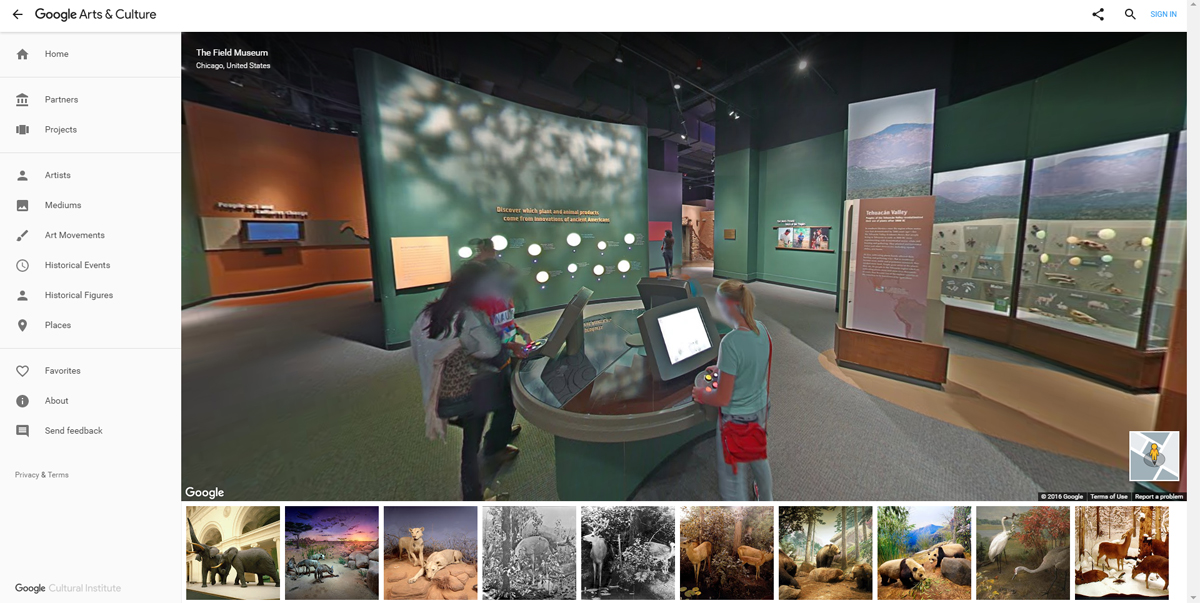
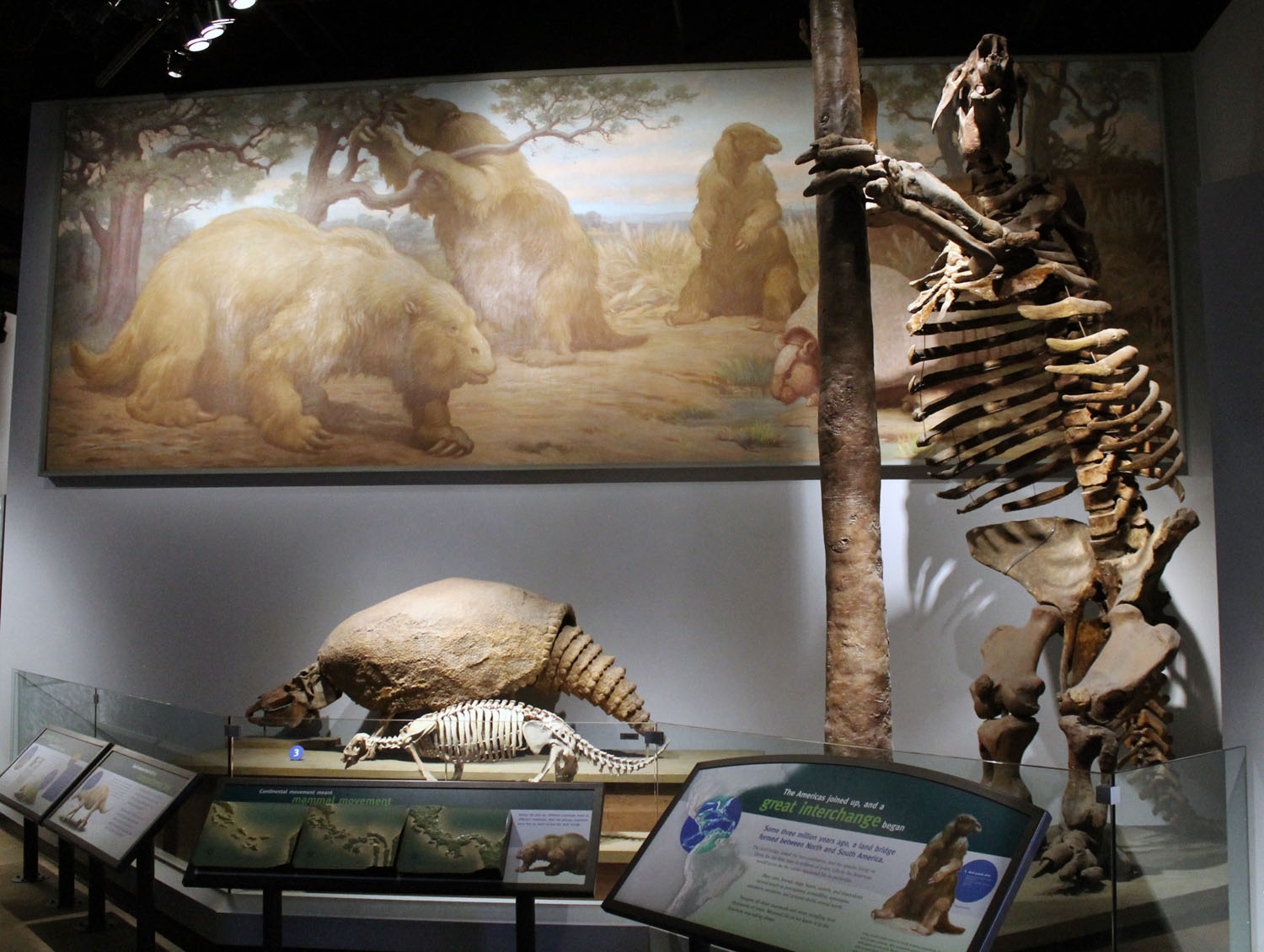
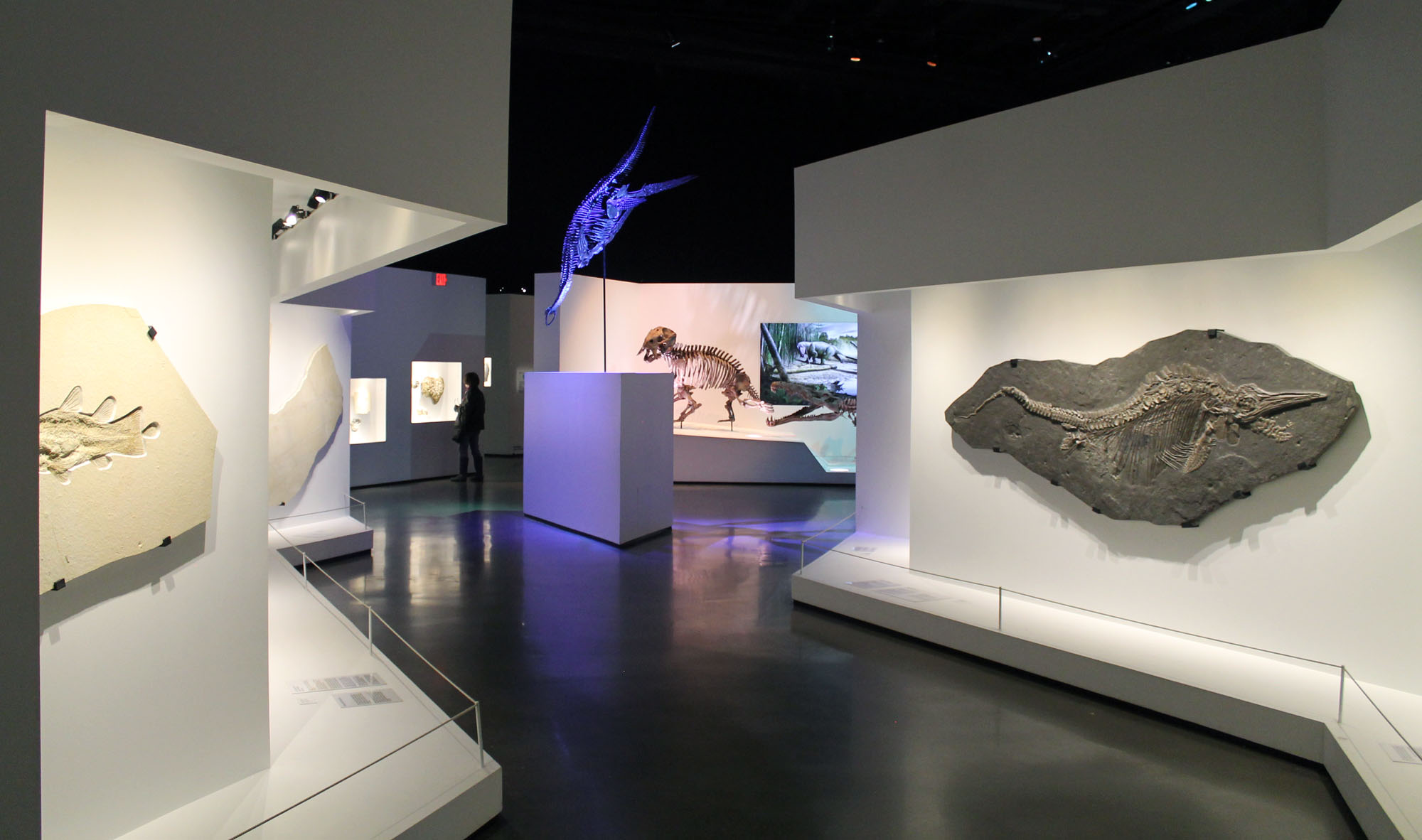
Somewhere in the Ancient Americas exhibit.

Somewhere in the Ancient Americas exhibit at the Field Museum of Natural History. Google Cultural Institute

For me, the museum walkthroughs are the clear highlight. Using Google’s Street View technology, users can explore the included museums and get surprisingly close to individual displays. Some of these “virtual tours” are frustratingly limited to a few corridors between exhibits, but others provide darn near the full experience of actually being there. Of the museum walkthroughs I’ve looked at so far, the National Museum of Natural History and Berlin’s Museum für Naturkunde are particular standouts in this regard. A handful of museums have had virtual tours available online since at least the early 2000s, but this is the first time I’ve seen the concept escape the gimmick stage and become something potentially useful.

The quality of the multimedia presentations (“virtual exhibits”, if you must) is a bit mixed. The best ones make specific use of the partner museums’ collections, highlighting the scientific, cultural, or historical significance of particular objects. These presentations provide curatorial expertise and novel insights that are not easily found elsewhere. Other presentations, however, are frustratingly generalized, and don’t include much content that one couldn’t get from skimming a Wikipedia article.

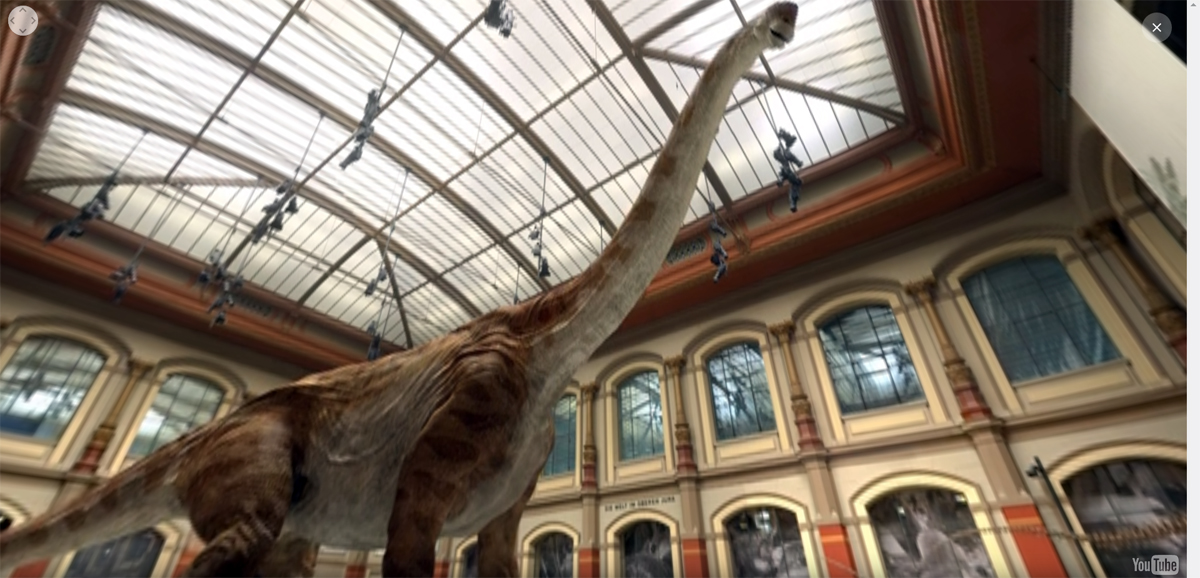
yawn, another cgi sauropod. I'd rather see the mount.

Yet another middling CGI dinosaur. Yay, I guess? Google Cultural Institute

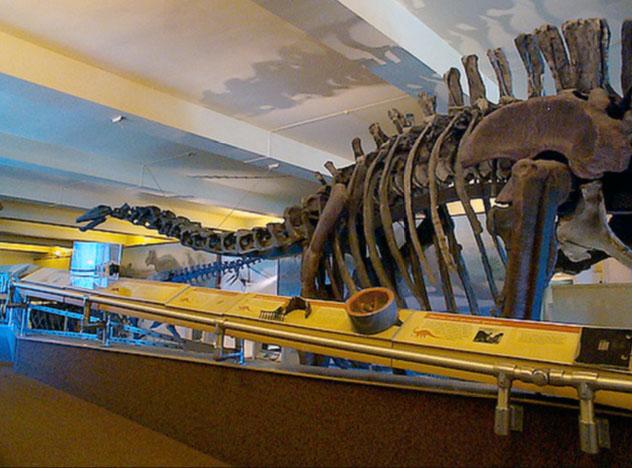
I would include the site’s flagship attractions – narrated 360-degree tours of selected exhibit halls – in the second camp. These three short videos each feature an exhibit that “comes to life” with the help of some acceptable-but-not-spectacular CGI. Take the video about the Giraffatitan at the Museum für Naturkunde. It’s awesome to be able to look all around the hall, but most of the video is taken up by an animated version of the dinosaur that doesn’t accomplish anything it’s Jurassic Park counterpart didn’t 23 years ago. The video starts to tell some interesting stories – convergent evolution between sauropods and giraffes, the rate of extinction caused by human activities far outpaces normal background extinction – but the goofy CGI Giraffatitan is very much in the way. Museums have so many strengths, so I’ll never understand the impulse to rely on things like animated dinosaurs that a) their audience can see elsewhere and b) Hollywood will always be able to do better.

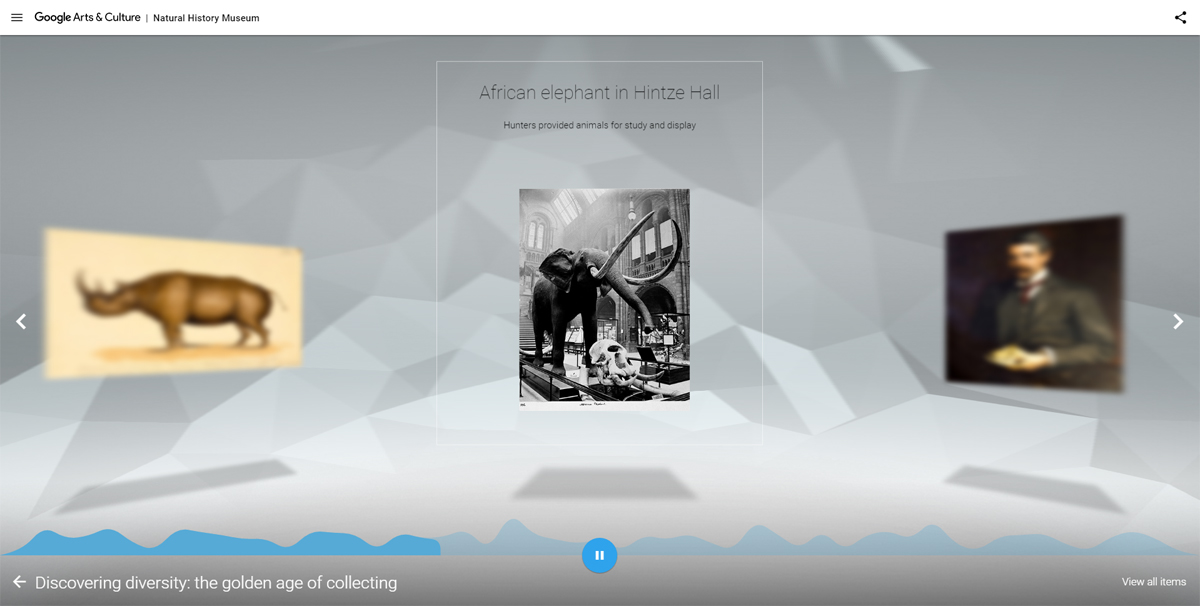
A great deal of content to be found by the bold.

A great deal of content can be found by the bold. Google Cultural Institute

All in all, the new natural history project at the Google Cultural Institute is a very impressive starting point. Nevertheless, my optimism is tempered by the fact that the web is littered with apps and mini-websites developed by museums, then almost immediately abandoned. Too often, digital projects are taken on without a clear idea of who will continue to update it, what need is being addressed, or even who the website or app is for. The real test will be whether Google and the partner museums will continue to support the Cultural Institute with new content. This has been a recurring problem with museums’ digital endeavors, but perhaps the collaboration with Google (and its extensive infrastructure) will help.

Moreover, accessibility is an admirable goal, but there is a very wide gap between putting stuff online and creating something that lots of people (teachers, students, people who don’t live near museums) actually want to use. I’m encouraged by the range of material on the Cultural Institute site. Some content is fairly general, perhaps suitable for a 3rd grade science report, while other content is far more in-depth. I will be very curious to see what the public ends up using, and for what purpose. It would also be neat to see if this ended up being the start of a truly global digital collection, useful for educators and researchers alike. We’ll see if the Cultural Institute ends up being the catalyst that finally makes digital museums happen!

3 Comments

Filed under collections, dinosaurs, education, exhibits, museums, sauropods, science communication

Meeting the Titanosaur

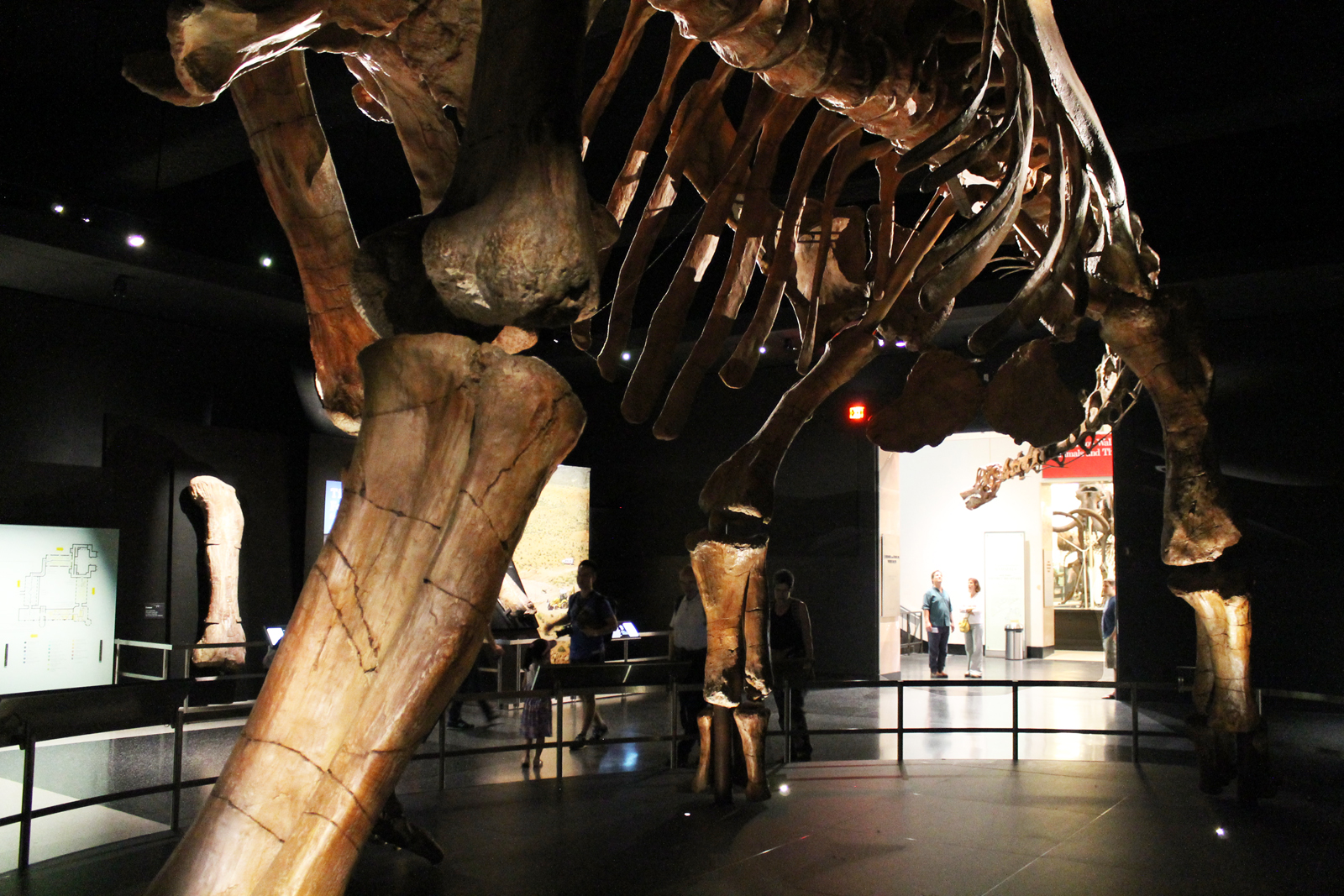
It be big

The titanosaur doesn’t photograph well. It must be experienced. Photo by the author.

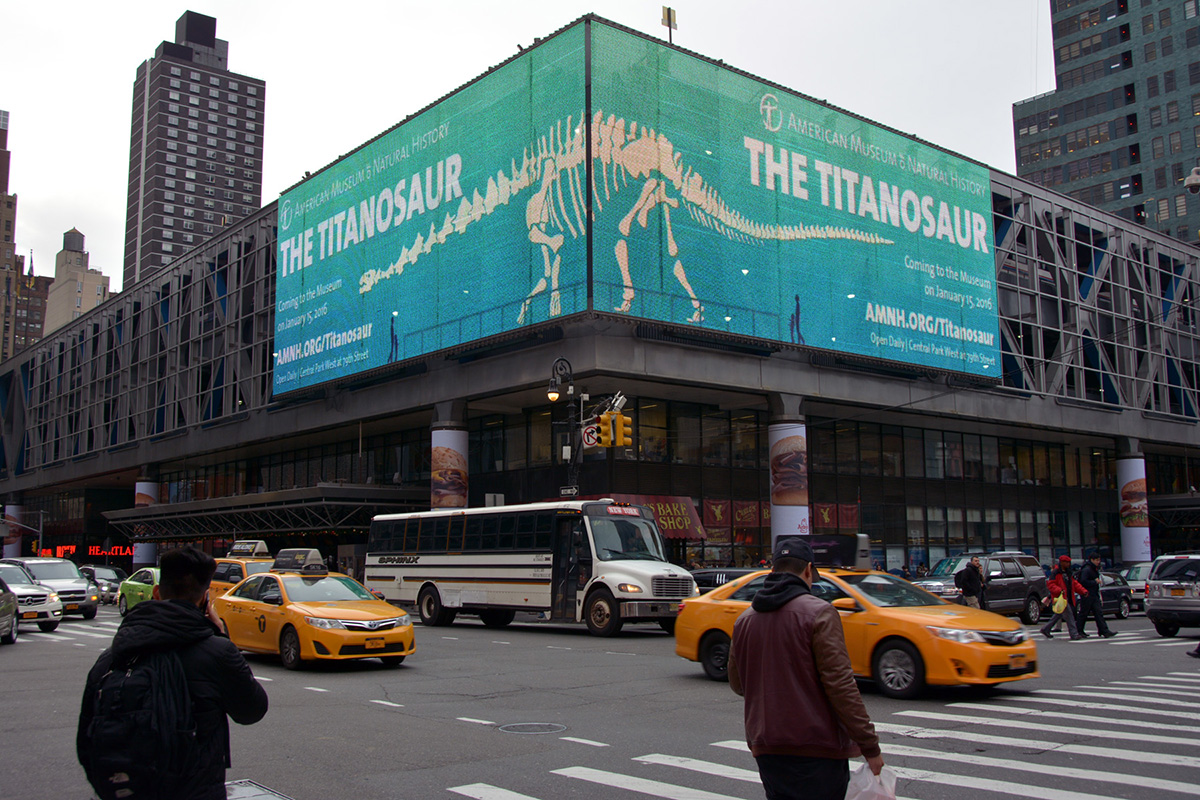
On January 15, the American Museum of Natural History unveiled the first new fossil mount to be added to their paleontology halls in 20 years. It is the reconstructed skeleton of an as-yet-unnamed titanosaur, an immense sauropod dinosaur that lived in Argentina during the mid-Cretaceous. The titanosaur is probably the most hyped-up fossil mount since Sue, at least in the United States (Sophie the Stegosaurus in the U.K. and Tristan the Tyrannosaurus in Germany received similar attention). This merits some discussion. The AMNH public relations staff pulled no punches in selling the titanosaur as a must-see exhibit. Huge advertisements appeared on buses and buildings around New York, including in Times Square. The legendary David Attenborough hosted a television special on the discovery of the fossils. Countless local and national news outlets were invited to the titanosaur’s unveiling earlier this year. But is this dinosaur really the find of the century?

Titanosaur was even advertised in times square. Source

One of the many titanosaur ads that showed up around New York City this past winter. Source

It depends. The titanosaur represents a species new to science, but it has not yet been formally published. The fossils were recovered in 2014 by José Luis Carballido and Diego Pol, paleontologists with the Egidio Feruglio Paleontology Museum (the AMNH connection is that Pol was a doctoral student of Paleontology Division Chair Mark Norell). Bones from at least six individuals of the same species were found, together representing 70% of the skeleton. However, AMNH staff have mostly avoided calling this animal the biggest dinosaur ever.

Indeed, declaring any dinosaur species to be the largest is a fool’s errand. We’ve known for some time that South American titanosaurs, as a group, are probably the biggest land animals that ever lived. Unfortunately, these giants are typically represented by only a few isolated bones. For an animal to become fossilized, it needs to be buried shortly after death. But it takes a lot more dirt to cover a large animal than a small one. A flood or landslide big enough to completely cover a sauropod over a hundred feet long would be an exceedingly rare event. More often, these animals were picked apart by scavengers for some time before a few of the more durable bones were buried and fossilized. For example, Argentinosaurus is known from about ten percent of the skeleton, and Puertasaurus is known from just four vertebrae. Paleontologists can use better-known relatives to produce reasonable reconstructions from even these limited remains, but any length estimate is a ballpark figure. Even among related animals, proportions can vary significantly. Consider, for example, the very long tail of a green iguana as compared to the stubby tail of a Galapagos land iguana. Carballido and Pol’s find stands out among other titanosaurs because two-thirds of the skeleton is known. hen the description is published, it will undoubtedly shed new light on the skeletal anatomy of this group. Still, the missing parts mostly come from the neck and tail, which will probably preclude a precise estimate of the animal’s total length.

*This level of completeness is not entirely unprecedented. Dreadnoughtus, described in 2014, is also about 70% complete.

he peekin

The titanosaur’s head and neck extend out of the room and into the corridor. Photo by the author.

We can’t say the AMNH titanosaur is absolutely the biggest known dinosaur, but what about the mount? At 122 feet, the reconstructed skeleton prepared by Research Casting International dwarfs AMNH’s resident sauropod, the 82-foot apatosaurine. It’s also a fair bit longer than the museum’s brain-breakingly huge blue whale model. AMNH is not the first museum to display a titanosaur, however. The Royal Ontario Museum has a 110-foot Futalognkosaurus, which the AMNH mount handily beats. But the new titanosaur is essentially the same size as the 123-foot Argentinosaurus at the Fernbank Museum of Natural History (duplicates also exist in Europe and South America). The difference, as mentioned, is that not a lot about Argentinosaurus is actually known, and the mount is almost entirely a sculpted reconstruction. By comparison, the AMNH titanosaur is largely composed of 3-D printed components based on scans of original fossils. “The biggest reconstructed skeleton of a reasonably well-known dinosaur” isn’t the catchiest headline, though.

Suffice it so say that on paper, the AMNH titanosaur isn’t a revolution for dinosaur science. When I went to see it last weekend, I expected to see a typical example of a well-studied group of dinosaurs. I was not prepared.

the bastard

The closest I can find to a full-body photo of the titanosaur. Source

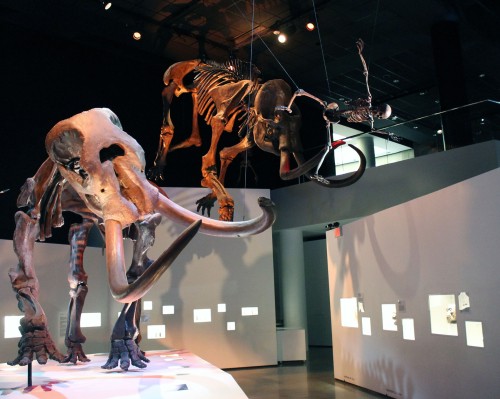
This bastard is BIG. I could go through a whole series of superlatives, but it’s impossible to describe the experience of sharing space with this magnificent skeleton. You cannot comprehend what a 122-foot dinosaur really is until you’ve experienced it. It helps that the titanosaur occupies a smallish, low-ceilinged room (a century ago, this was the infamous Hall of the Age of Man). It also helps that there are no long lines of sight into this space. You turn a corner and you are quite abruptly in the titanosaur’s presence. Regardless, the marketing line that was ubiquitous earlier this year – “everything else got a whole lot smaller” – rings unsettlingly true. Compared to the titanosaur, the mammoth and mastodon across the hall look like pipsqueaks. Even the AMNH blue whale, which usually requires a double-take, became a little easier to take in.

I’m no stranger to sauropods. I teach people about them at work all the time. But seeing the titanosaur in person was a revelation, and something I strongly recommend to anyone interested in the natural world. The titanosaur may not be the most important dinosaur discovery of our generation, but by giving it corporeal presence, AMNH created an incredible symbol. This is life at its limits, an embodiment of the incredible things the tetrapod body plan can do.

P.S.: If you’re concerned about the fate of the juvenile Barosaurus model that used to occupy this space, worry not. It now lives at the Cleveland Museum of Natural History, and will be on display at least through October of this year.

4 Comments

Filed under AMNH, dinosaurs, fossil mounts, museums, sauropods

Dispatch from SEAVP2016

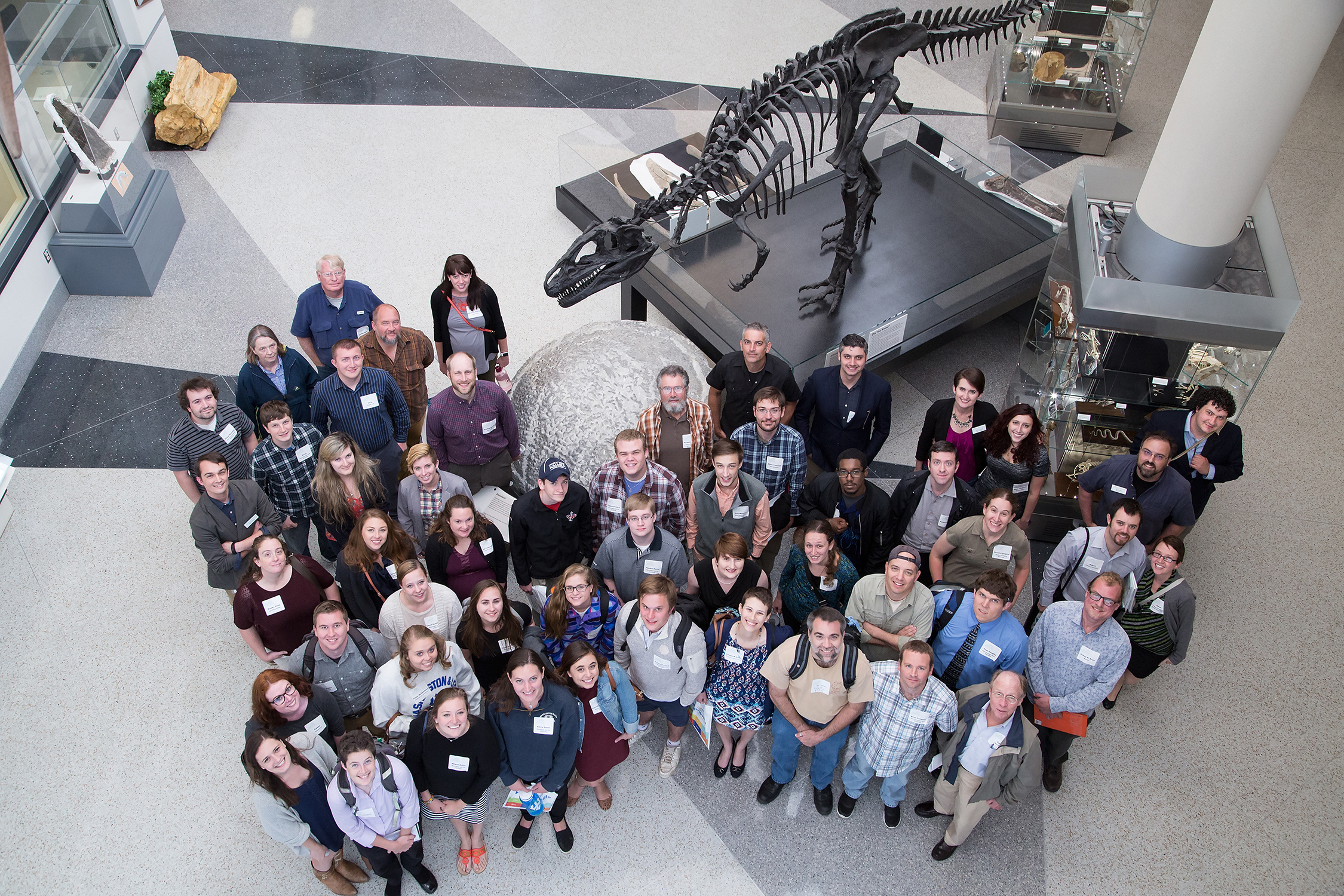
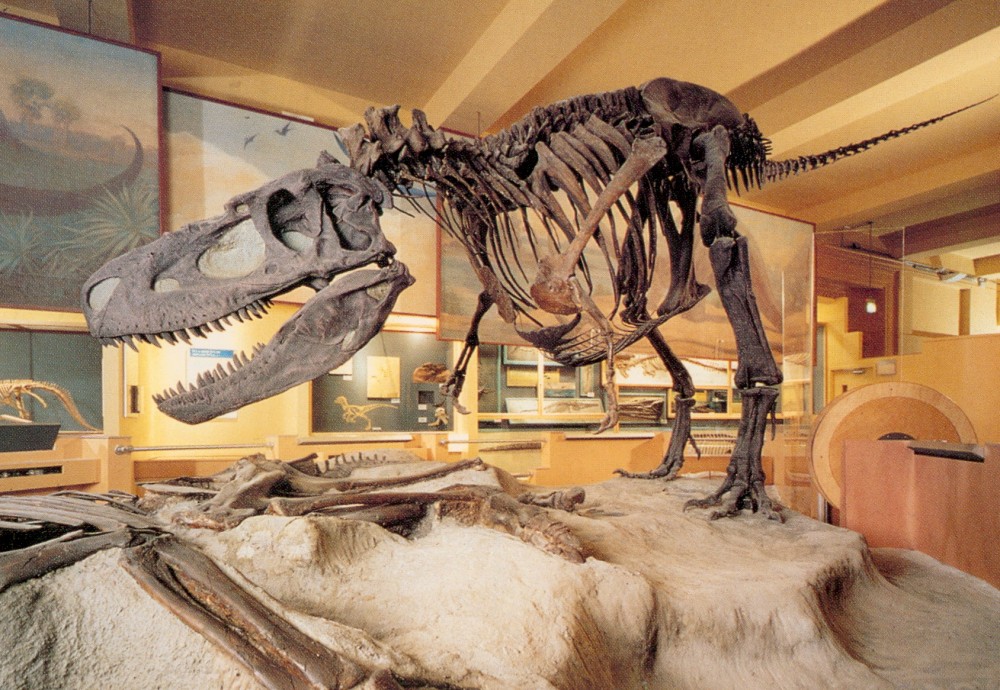
Wow, it’s been awhile. The real world has been keeping me busy, but I’ve been researching a couple new museum  history stories that I will write up with all haste. In the meantime, I’d like to share some brief thoughts on the Southeast Association of Vertebrate Paleontology conference at the Virginia Museum of Natural History, which I attended earlier this week. SEAVP has a reputation for being fairly laid back, even as gatherings of paleontologists go. No frantic networking or jostling to introduce oneself to celebrity researchers, just a bunch of enthusiastic people excited to share their work.

Acrocanthosaurus is photobombed by some legless mammal.

Acrocanthosaurus is photobombed by some legless mammal.

With 50-some attendees, nearly everyone was either speaking or presenting a poster. Miranda Armour-Chelu took on the challenge of reconstructing the taphonomic circumstances surrounding historically collected dugong fossils. Marcelo Kramer shared his adventures prospecting for Quaternary fossils in unexplored caves in northern Brazil. Julie Rej explained the difficulty of identifying Australian agamid fossils when most modern comparative collections in museums consist of pickled lizards, rather than bones. My own talk was a show-and-tell session of some of the cool new fossils discovered by visitors to Maryland’s Dinosaur Park. If I had to pick a standout session, it would be C.T. Griffin’s fascinating research comparing the growth trajectories of early dinosaurs to modern birds and crocodillians. Not as straightforward as one might expect.

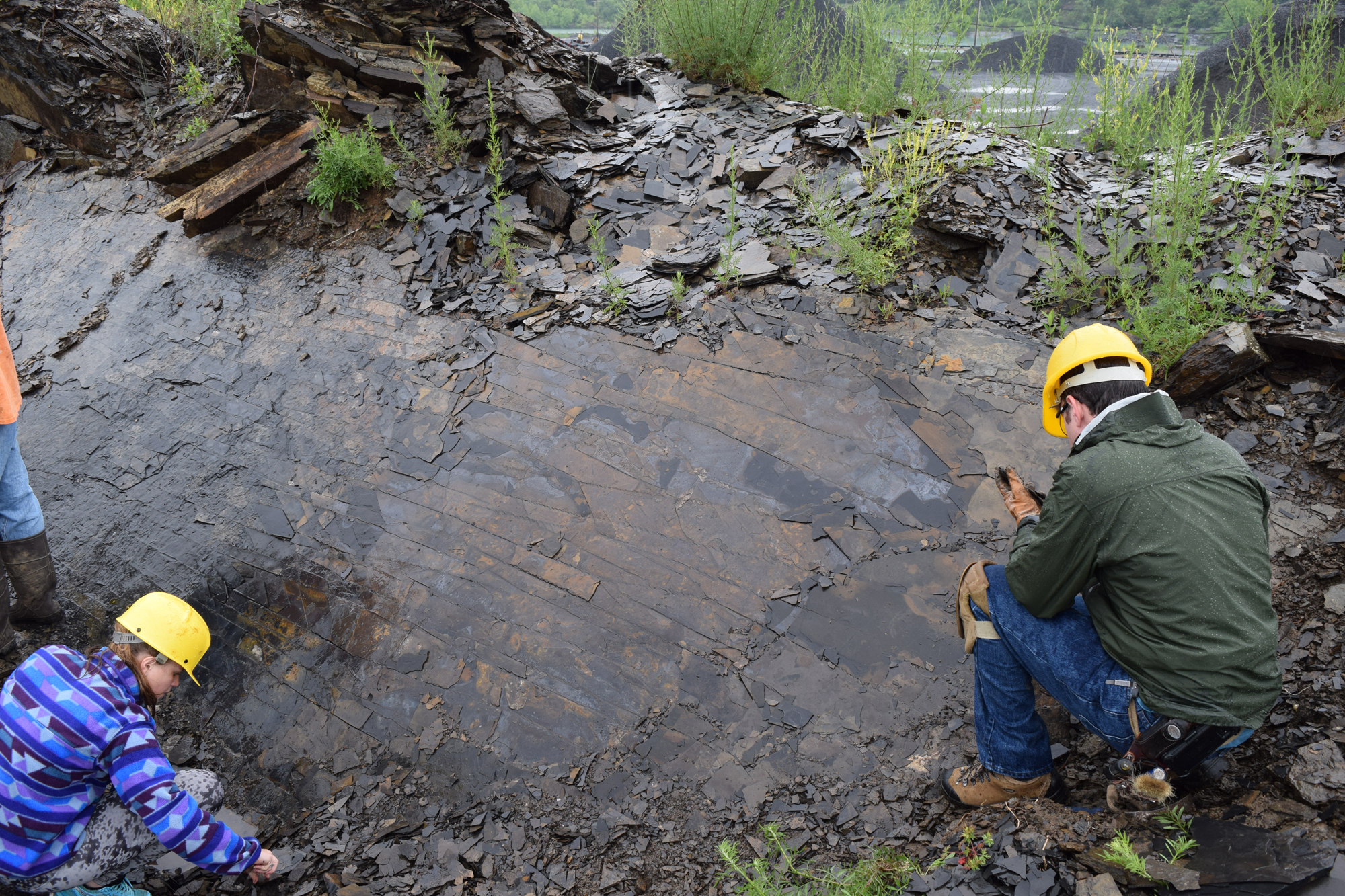
Splitting shale at the Solite Fossil Site.

Splitting shale at the Solite Fossil Site.

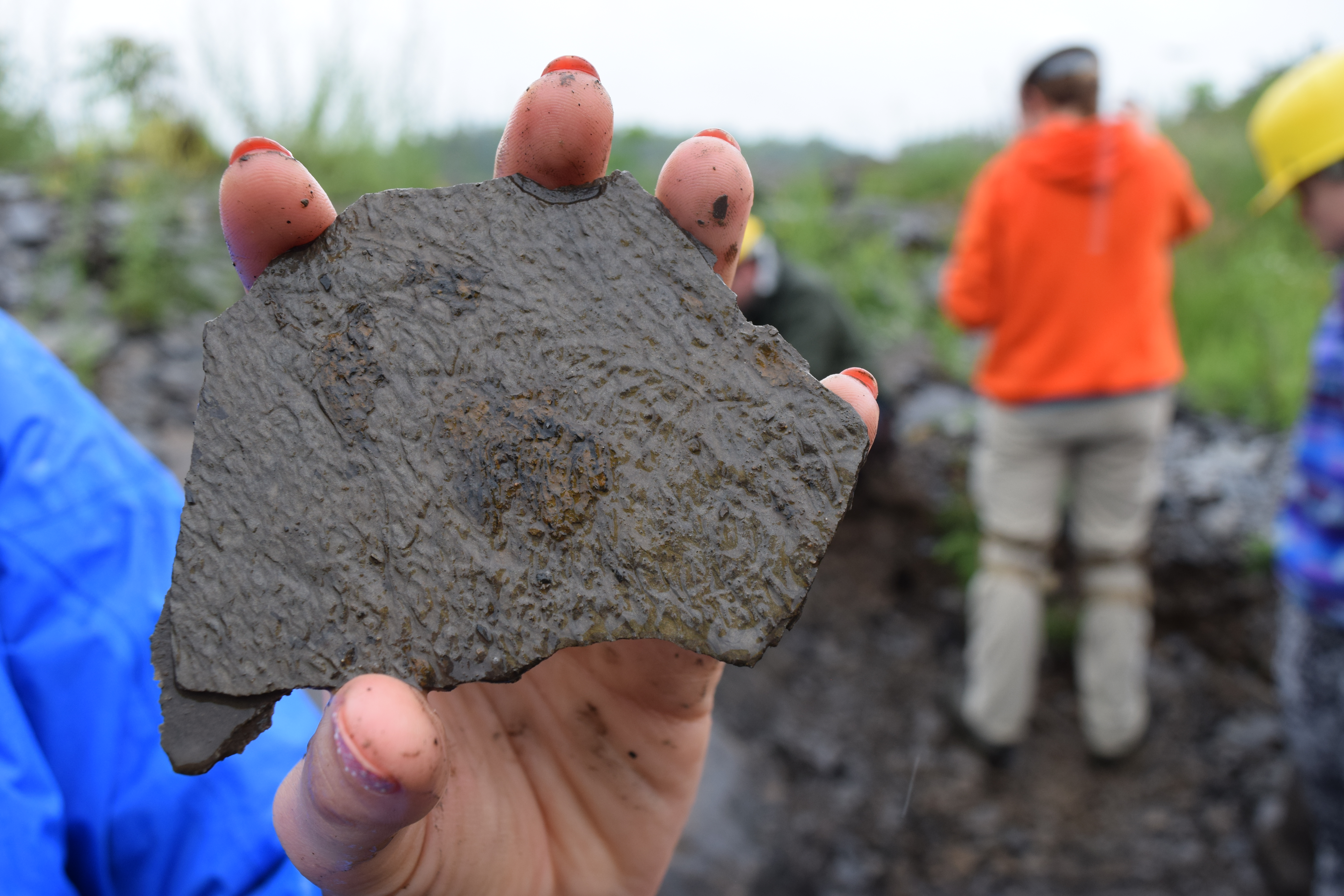
tanywhatsit

Max’s tanywhatsit fossil.

The following day, we visited the famed Solite Fossil Site, one of the most fossiliferous terrestrial Triassic localities in the world. These shales are best known for preserving an abundance of unique insects, but vertebrates and diagnostic plant fossils are also known. In particular, the site has produced hundreds of the tiny long-necked reptile Tanytrachelos. It only took 20 minutes for my colleague Max Bovis to find a “tany”, and an hour later he reportedly found a fossil fish. Both will be entered into the VMNH collection. We also visited Virginia Tech, where Michelle Stocker and Sterling Nesbit provided a tour of the paleobiology department facilities. We saw unique fossils from Ghost Ranch, New Mexico and the extant comparative specimen lab, but I was most envious of their 3-D printing set-up!

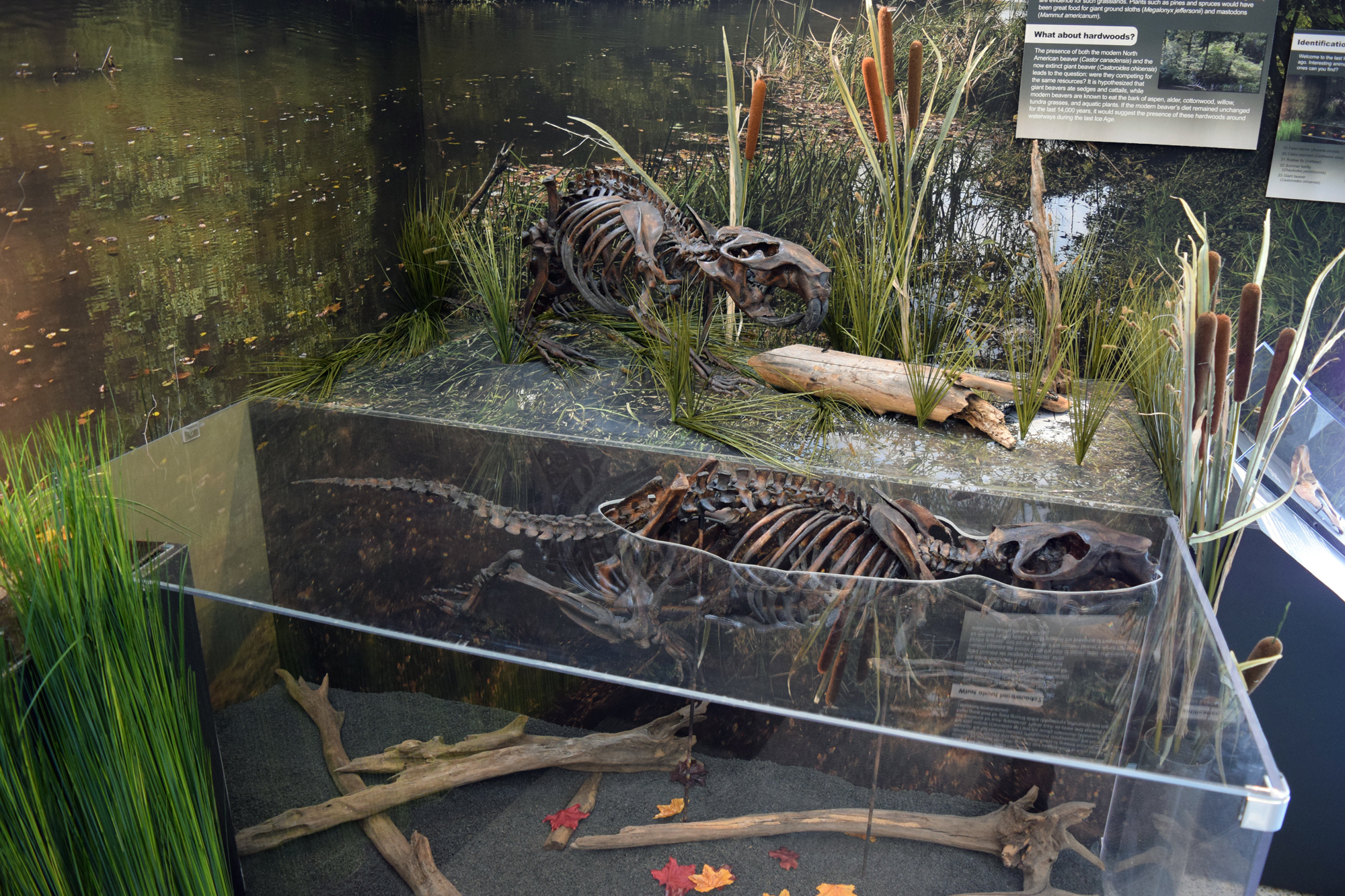
An immersive

An immersive habitat diorama featuring the Ice Age beaver Castoroides.

What of the exhibits at VMNH? They’re fantastic. Despite the museum’s small size, the production quality on all the displays is really top notch. The Uncovering Virginia hall highlights several fossil sites around the state, including the Ice Age mammals from Saltville, the coal seams of Grundy, and the aforementioned Solite quarry. In addition to original specimens and reconstructions of the excavations, there are a number of inspired hands-on activities. Visitors can put a whale jaw back together and articulate a femur with a pelvis, mirroring challenges actually faced by fossil preparators (nary a sandbox dig in sight!). I also liked a multimedia display where pressing a button (labeled “press here to go back in time”) pulls back an image of the Grundy coal mine and reveals a moving diorama of a Carboniferous coal swamp.

The central Hall of Ancient Life features local whale and Ice Age fossils, as well as some visiting dignitaries like a cast of Big Al the Allosaurus. Don’t forget to check out the second floor balcony, which contains Morrison Formation dinosaur bones and a secret Tenontosaurus mount.

aww

Group photo courtesy of Alex Hastings, VMNH.

All in all, an excellent conference – hats off to Alex Hatings, Christina Byrd, and everyone else involved in arranging it. I’m looking forward to next year’s meeting, which will be hosted by the Gray Fossil Site Museum in Tennessee!

3 Comments

Filed under citizen science, Dinosaur Park, dinosaurs, education, exhibits, field work, mammals, museums, reptiles, reviews

History of the Field Museum Fossil Halls – Part 2

Start with History of the Field Museum Fossil Halls – Part 1.

Where we left off, the fossil exhibits in Halls 37 and 38 at the Field Museum of Natural History had gone for decades without more than piecemeal improvements. In the meantime, the field of paleontology – and our understanding of dinosaurs in particular – had progressed by leaps and bounds. What’s more, standards for natural history exhibits had changed. Cases of specimens with esoteric labels written by curators past were no longer enough. Visitors expected exhibits that were relatable and accessible for children as well as interested adults, and multimedia and interactive elements had become standard. This combined with ever-growing public interest in all things prehistoric gave Field Museum staff serious incentive to start with a clean slate.

Phase III: Life Over Time

The end of the old fossil halls came not with a bang but with a whimper. In 1990, specimens started disappearing and areas were roped off without warning. Hundreds of specimens were relocated to Halls 25, 26, and 29 on the other side of the second floor, where they would be part of the exhaustive new exhibit “Life Over Time.” Meanwhile, Halls 37 and 38 became the home of the pacific islands exhibit and Ruatepupuke II, the Maori Meeting House.

life over time albertosaurus remount

Remounted Daspletosaurus in Life Over Time, then labeled Albertosaurus. Photo courtesy of the Field Museum Photo Archives.

As the name suggests, Life Over Time was a chronological journey through the history of life, from its origins around four billion years ago up to the last ice ages. Paleobotanist Peter Crane chaired the Geology Department during the development period, and geologist and children’s education specialist Eric Gyllenhaall oversaw the contractors and in-house staff that created the the exhibit itself. In total, the project took five years and cost $7 million.

Gyllenhaal and the rest of the team conceived of Life Over Time as a directed experience. The space was shaped like a U, with switch-backing corridors flanking a more open dinosaur section in the middle. With the exception of a shortcut between the Carboniferous and the Mesozoic, visitors had no choice but to walk through the exhibit chronologically, viewing the displays in the order the designers mandated. Since visitors tend to be more focused and more likely to read signs early in the exhibit, the designers deliberately used the introductory rooms to cover the most unfamiliar concepts. Displays on the origins of life and the evolution of aerobic respiration made up the “homework” part of the exhibit. After that, visitors were set free in the Mesozoic section, where open sight lines allowed people to choose what they wished to view, and in what order. This served as a reward for putting up with the more challenging material early on. Ultimately, what set Life Over Time apart from its predecessors was the focus on ideas rather than specimens. The fossils were meant to illustrate broader concepts like adaptation, extinction, and biogeography, and were in some ways subordinate to the hands-on activities and multimedia displays.

new triceratops

This cast of the AMNH Triceratops was a new addition to Life Over Time. Photo by Gary Todd.

Apatosaurus

In Life Over Time, visitors circled the dinosaurs on an elevated ramp before visiting them at ground level. Photo by Erik Peterson.

The process of developing Life Over Time was an occasionally tense give-and-take between the research staff (who traditionally had the last word on exhibit content) and the administrators, exhibit specialists, and educators (who had greater influence this time around). Looking back, it would seem that the curators lost more of these fights than they won. Life Over Time ended up with a decidedly kitschy tone, and was full of overtly silly elements. The exhibit entrance featured carnival-style banners advertising “Primordial Ooze” and “Dunkleosteus: Jaws of Death.” Further on, a mannequin dressed as a game show host invited visitors to spin the “Wheel of Adaptation.” There were Dial-A-Dinosaur phones, which visitors could pick up and listen to first-person accounts of life as a dinosaur. An animatronic puppet show explained the switch from aerobic to anaerobic life. Video “weather reports” with CBS anchor Bill Kurtis updated visitors on climate change over time. There was even a ridable trilobite on a spring.

This carnival-like atmosphere is particularly distinctive when compared to the present fossil halls at the American Museum of Natural History, which were developed at the same time. AMNH project director Lowell Dingus rejected contemporary trends in exhibit design, which, in his view, were pitched to “the lowest common denominator of visitor intellect.” Wishing to challenge audiences to think about fossils the way scientists do, Dingus created a phylogeny-based exhibit that emphasized empiricism and rigorous anatomical analysis over idle speculation. While it was certainly not devoid of informative content, Life Over Time was designed for a much younger audience, with particular attention paid to the under-five set. This marked contrast between the New York and Chicago exhibits speaks volumes about the differing influence of the scientific staff at the two museums, as well as the institutions’ overall priorities at the time.

Permian cluster

Postcard of the pelycosaur cluster in Life Over Time. These specimens were donated by the University of Chicago in the 1960s.

Happily, the Field Museum didn’t opt to replace its authentic mounted fossil skeletons with the roaring robots that were in vogue at the time. The classic fossil mounts were restored and rebuilt by Prehistoric Animal Structures, Inc., a Canadian company headed by Gilles Danis. A biologist by training and a veteran of the Royal Tyrell Museum, Danis led the process of disassembling, cleaning, and remaking the most significant mounts. The ApatosaurusDaspletosaurus, and Megathierum were all given more accurate and active poses: the Daspletosaurus now crouched over its Lambeosaurus prey with its tail held aloft, while the giant sloth stretched to its full height against a replica tree. Although it was completely rebuilt, the Apatosaurus retained its dragging tail in the new exhibit – an unusual choice for a 1990s reconstruction.

In addition to the classic mounts, Life Over Time featured a partial Parasaurolophus and a new cast of the AMNH Triceratops. The most substantial addition was a complete Brachiosaurus reconstruction. This 40 foot tall mount combined casts taken from the material Elmer Riggs collected at the turn of the century with sculpted elements prepared by Stephen Godfry.  Far too large for the second floor exhibit halls, the Brachiosaurus earned a place of honor in the central Stanley Field Hall. In order to comply with the fire code while allowing visitors to walk under the towering sauropod,  the torso was extended by adding two extra dorsal vertebrae (for a total of twelve). In an amusing twist, newer research shows that this vertebrae count – and the mount’s stretch limo proportions – is probably correct.

main hall brachiosaurus

The Brachiosaurus skeleton was tall enough to look over the second floor mezzanine. Source

Life Over Time opened to the public in June 1994 (the Brachiosaurus had been on display for a year prior). Nevertheless, it was the shortest-lived iteration of the Field Museum’s fossil displays, closing down after only ten years. Why didn’t it last? For one thing, the numerous interactive elements suffered more wear and tear than expected, and they broke frequently. Meanwhile, in-house evaluations showed that the exhibit’s intended messages were not coming across to most visitors. For example, Asma recalls a child frantically spinning the Wheel of Adaptation with all his might, completely oblivious to the information the display was meant to convey. Unfortunately, an interactive exhibit is not necessarily an educational one, and it can be very difficult to create a learning experience that accomplishes both goals.

Phase IV: Evolving Planet

There was one more reason the Field Museum needed to revisit its fossil displays: the sudden acquisition of Sue the Tyrannosaurus in 1997. The story of the four-way legal battle that preceded this has been told often (although not always fairly), so suffice it to say that few came out of that fight unscathed. The Field Museum entered the picture when landowner Maurice Williams, to whom the courts had awarded ownership of Sue, announced that the fossils would be placed on the auction block. Paleontologists initially worried that the priceless specimen would disappear into the hands of a wealthy collector, or end up in a crass display at a Las Vegas casino. Those fears were put to rest when the Field Museum won Sue with financial backing from McDonald’s and Disney. Including the auctioneer’s commission, the price was an astounding $8.36 million.

susan

Some obscure theropod. Photo by the author.

The Field Museum committed to a summer 2000 unveiling of Sue’s mounted skeleton. However, most of the bones was still buried in rock and plaster. The fossils had to be prepared and stabilized before they could be studied, and they had to be studied before they could be mounted. Most of this work was done on-site, in view of the public. The armature itself was created by Phil Fraley Productions, the same exhibit company that rebuilt the AMNH Tyrannosaurus. Field Museum administrators decided that Sue would replace the Brachiosaurus in the Stanley Field Hall, even though the sauropod had only been on display for seven years. According to Exhibit Project Manager Janet Hong, Sue was such a monumental exhibit that it really deserved pride of place. Meanwhile, the Brachiosaurus was relocated to O’Hare International Airport, while a weather-proof duplicate was placed outside the museum.

Sue was revealed to the public on May 17, 2000 with the literal raising of a curtain. A week-long series of celebrations and press junkets introduced Sue to Chicago, and it has been one of the city’s biggest attractions every since. All the publicity paid off, at least in the short term: Field Museum attendance soared that year from 1.6 million to 2.4 million. 16 years later, Sue’s new identity as a Chicago landmark seems to have all but eclipsed the legal dispute that was its original source of fame. Hong likens Sue to Chicago’s David, and even former Field Museum President John McCarter feels that he underestimated what a force Sue would be for the city.

Map of Evolving Planet. Source

Map of Evolving Planet. Source

The acquisition of Sue created a strong public association between the Field Museum and dinosaur research. This was ironic, because while the museum had hosted a talented array of paleontologists over the years, it had never employed a dinosaur specialist. Even Elmer Riggs, who collected the museum’s iconic sauropods at the turn of the century, was more interested in mammal evolution. In 2001, the Field Museum began a concerted effort to expand its vertebrate paleontology program, and make a name for itself as a hub for dinosaur science. Among the new hires were fossil preparator Akiko Shinya and paleontologist Peter Makovicky, who immediately began organizing expeditions to grow the museum’s collection.

The new emphasis on paleontology research brought greater expectations for the Field Museum’s interpretive efforts, and Life Over Time wasn’t doing the job. The initial plan was to merely refresh the decade-old exhibits, but ambitions grew and the renovation snowballed into something much more substantial. Project Manager Todd Tubutis and Content Specialist Richard Kissel spent five years overseeing the development of Life Over Time’s replacement, eventually titled “Evolving Planet.”

Once we reach the Permian, the fossils can start to speak for themselves. Photo by the author.

Each section of Evolving Planet is differentiated by its own color palate and ambient audio. In the Permian, olive green walls and signs are accompanied by the sounds of a windswept desert. Photo by the author.

w

Yes, of course this series needs another picture of the Apatosaurus. Photo by the author.

While the new exhibit uses the same space and directed, U-shaped layout as its predecessor, the end result is virtually unrecognizable. The hokey parts of Life Over Time are gone, replaced by all-new signs, labels, and interactives. New specimens include original Parasaurolophus, Rapetosaurus, and Arctodus mounts, plus casts of Stegosaurus and Deinonychus, all prepared by Research Casting International. An entire room is dedicated to fossils from Utah’s Green River Formation, acquired on a recent Field Museum collecting expedition. Phlesh Bubble Studios provided a panoramic CGI reconstruction of the Burgess Shale Fauna, while Karen Carr produced 150 original paintings to supplement the classic Charles Knight murals. These, in turn, were restored by Parma Conservation and are contextualized as the historic masterpieces they are. Nevertheless, Evolving Planet has a few holdovers from Life Over Time. The existing dinosaur mounts were not moved or changed, and major set pieces like the walk-through Carboniferous swamp diorama remain in place.

Timeline moments and consistent iconography

Repeating iconography keeps visitors engaged in story of life on Earth. Photo by the author.

Karen Carr art fills in gaps in classic Knight pieces

New artwork by Karen Carr fills gaps left by the classic Charles Knight murals. Photo by the author.

The interpretation in Evolving Planet arose from three main objectives. First, the exhibit needed to highlight the Field Museum’s own collections and the work of its in-house research staff. Second, it had to contextualize Sue and the environment they lived in. Finally, it had to effectively explain the process of evolution, and the evidence for it. Life Over Time had faltered here, and with the influence of the anti-science lobby increasing, it was crucial to get it right. Tubutis and Kissel accomplished this in part by facilitating closer collaboration between the exhibit designers and research staff. Evolving Planet weaves the evidence for evolution into all aspects of the displays. The first thing visitors see is the thesis of the exhibit – “everything that has ever lived is connected through and is the result of evolution” – printed on an otherwise blank wall. Moving forward, visitors learn how evolution via natural selection works, and how we know. Along the way, common misconceptions, such as the idea that lineages improve over time, or that evolution is “just a theory”, are proactively addressed and corrected.

The visual design of Evolving Planet deserves particular mention. The new exhibit subtly but effectively uses repeating iconography to guide visitors through the story being told. Every geological period is associated with a specific color scheme and soundscape, making visitors’ progression from one stage to another obvious and distinct. “Timeline Moments” at the beginning of each section update visitors on their progress, and ensure that they expect to see something new and different up ahead. Special symbols remind visitors of recurring themes, such as mass extinctions (or even the repeated evolution of saber-teeth). Lastly, variations in font and text size are cleverly employed to call attention to key words and phrases.

old riggs mounts, new sloth, charles knight

A new pose and context for Megatherium, along with historic Riggs mounts and Knight artwork. Photo by the author.

Evolving Planet opened on March 10, 2006. A decade later, this award-winning exhibition remains a favorite with scientists and educators alike. As Cleveland Museum of Natural History Educator Ashley Hall explains:

Evolving Planet is my all-time favorite museum exhibit. It is not only rich with some of the world’s best known fossil specimens, but provides label copy for visitors of all learning levels. You can visit multiple times and still learn something new. Museums provide visitors with unique settings for learning, and it is a museum’s job not to short-change, dumb down, or simplify information. Evolving Planet hits the nail on the head.

From its clear-as-day thesis to its poignant finish (a counter showing the number of species going extinct daily), Evolving Planet is ambitious but uncommonly relatable. It places familiar dinosaurs and mammoths in a broader evolutionary context, introducing visitors to the true breadth of deep time. And yet, the exhibit is also remarkable for its restraint. It doesn’t overwhelm casual visitors with specimens and facts, but instead sticks to a handful of broadly-applicable themes.

The Field Museum’s paleontology program spent its early years playing catch-up to peer institutions. While other American natural history museums were conducting yearly fossil-collecting expeditions and building collections of one-of-a-kind specimens, the Field Museum’s founding paleontologists struggled for basic resources and recognition within their institution. Today, the department’s public showroom is what Kissell describes as “one of, if not the, most comprehensive explanations of the history of life on Earth in any museum.” It would seem that the Field Museum has found its voice in the pantheon of great natural history museums.

Many thanks to Ashley Hall, Olivier Rieppel, Bill Simpson, and Devin Myers for sharing their time, expertise, and experiences when I was writing this post. Any factual errors are, of course, my own.

References

Asma, S.T. 2001. Stuffed Animals and Pickled Heads: The Culture and Evolution of Natural History Museums. New York, NY: Oxford University Press.

Dingus, L. 1996. Next of Kin: Great Fossils at the American Museum of Natural History. New York, NY: Rizzoli International Publications, Inc.

Fiffer, S. 2000. Tyrannosaurus Sue: The Extraordinary Saga of the Largest, Most Fought Over T. rex ever Found. New York, NY: W.H. Freeman and Company.

Glut, D.F. 2001. Remembering the Field Museum’s Hall 38. Jurassic Classics: A Collection of Saurian Essays and Mesozoic Musings. Jefferson, NC: McFarland.

Lee, B.M. 2005. The Business of Dinosaurs: The Chicago Field Museum’s Nonprofit Enterprise. Unpublished thesis, George Washington University.

Lelièvre, M A. 2006. Evolving Planet: Constructing the Culture of Science at Chicago’s Field Museum. Anthropologica 48: 2: 293-296.

Milner, R. 2012. Charles R. Knight: The Artist Who Saw Through Time. New York, NY: Abrams.

Tubitis, T.J. 2005. Revitalizing Life Over Time: A New Look for a Very Old Topic. In the Field 76: 2: 18.

1 Comment

Filed under dinosaurs, education, exhibits, FMNH, fossil mounts, history of science, paleoart

AMNH dinosaurs in vintage cartoons

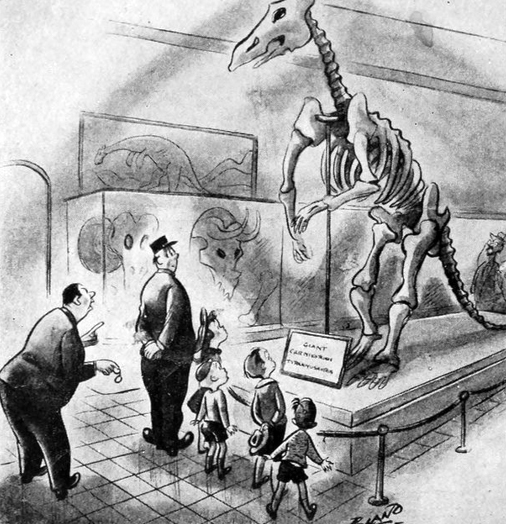
Today I happened upon a pair of wonderful vintage cartoons that simply must be shared. I found them in Edwin Colbert’s The Dinosaur Book: The Ruling Reptiles and Their Relatives, digitized here. The cartoons originally appeared in the New Yorker and the Saturday Evening Post, respectively.

original caption

Original caption: “And here is my first dinosaur – makes me feel like a kid again every time I look at it.”

The cartoons plainly depict the “Brontosaurus” and “Trachodon” (now labeled Apatosaurus and Anatotitan) skeletons at the American Museum of Natural History, and as representations of these mounts, they aren’t bad. At the time of the cartoons’ initial publications in 1939 and 1940, these and dozens of other fossil mounts had been on display at AMNH for over 30 years. They were iconic New York attractions, and the museum had rightly earned itself a reputation as the place to see dinosaurs.

original caption

Original caption: “I don’t mind you boosting your home state, Conroy, but stop telling the children that’s a California jack rabbit!”

Perhaps it’s unwise to interpret these images too literally, but I can’t help but wonder which version of the AMNH fossil halls the cartoonists intended to depict. Since 1922, the famous mounts had been housed in Henry Osborn’s Great Hall of Dinosaurs, but during the 1930s the dinosaur exhibits underwent a significant expansion. The dinosaurs were reshuffled into two halls, one representing the Jurassic and one the Cretaceous.

osborn era

The Great Hall of Dinosaurs as it appeared in the 1920s. Image courtesy of the AMNH Research Library.

brown's jurassic hall

The new Jurassic Hall opened around 1940. Photo from Dingus 1996.

The inclusion of a Stegosaurus with “Brontosaurus” and the ceratopsian skulls behind the “Trachodon” lead me to believe these are illustrations of the renovated halls, which would have been brand new at the time. But again, it’s just as likely that the cartoonists only intended to capture the general feel of these famous exhibits.

References

Colbert, E.H. 1945. The Dinosaur Book: The Ruling Reptiles and Their Relatives, 2nd Edition. New York, NY: The American Museum of Natural History/McGraw-Hill Book Company, Inc.

Dingus, L. (1996). Next of Kin: Great Fossils at the American Museum of Natural History. New York, NY: Rizzoli International Publications, Inc.

1 Comment

Filed under AMNH, dinosaurs, exhibits, fossil mounts, museums, ornithopods, paleoart, sauropods

Clash of the Texas Fossil Exhibits: PMNS

Life Then and Now

Life Then and Now at the Perot Museum of Nature and Science. Photo by the author.

In a recent interview at Love in the Time of Chasmosaurs, artist Brian Engh provided one of the best definitions of paleontology I’ve ever seen:

Paleontology is really just animals and plants doing animal and plant stuff, then dying and getting buried and all that stuff stacking up for unfathomable expanses of time.

This is how paleontology is portrayed in Life Then and Now, the fossil hall at the Perot Museum of Nature and Science. The exhibit clearly and cohesively portrays the world of the past as a collection of living ecosystems, and highlights both the fossil evidence and the means by which scientists interpret it. This is in stark contrast to the Morian Hall of Paleontology in Houston, which I found to emphasize style over substance. In the last post, I critiqued the Morian Hall’s art gallery format, arguing that it discouraged understanding and ultimately diminished the meaning and reality of the specimens on display. I was pleased that this discussion sparked lively conversations here and on twitter, but now it’s only fair that I follow up with an example of what I actually like to see in a natural history exhibit.

mosasaur and texas ornithiscians

The mid-Cretaceous, by land and by sea. Photo by the author.

The purpose of any exhibit structure is to provide meaning and context for objects – to help visitors see them as more than neat things to look at. It’s the museum’s job to give visitors the intellectual tools to contextualize displayed objects in a more sophisticated way. In terms of aesthetics and overall layout, this is clearly what the designers of Life Then and Now had in mind. The exhibit occupies a large, open, and well-lit space, with long sight lines around the room. There is a set of clear, over-arching themes, with individual stories playing back into the primary learning goals. Vignettes have large, informative headings that can be seen and understood on the move, but there is also plenty of detailed content for visitors who care to look more closely. Multimedia and interactives are deployed intelligently – they don’t exist for their own sake but cover content in novel and interesting ways.

All this serves to make the exhibit useful for visitors of a variety of ages and interest levels. For one thing, visitors are encouraged to engage with content at their own pace. They can see what the exhibit has to offer as soon as they enter the space, they can view specimens in whatever order interests them, and they always have a good idea of how much they’ve seen and how much there is left. Nevertheless, the core messages are never lost, even for fly-by visitors.  Most every display refers back to the exhibit’s key themes, and the main idea behind every vignette is visible from a distance. Meanwhile, the needs of advanced visitors are not forgotten. Specimens are not in cramped corners or obscured by dramatic lighting, but out in the open and visible from numerous angles.

benifet

One benefit of an open layout is that it encourages comparison. For example, why are these two megaherbivores shaped so differently? Photo by the author.

More specifically, the primary theme of Life Then and Now is that life of the past was not a pageant show of monsters but a set of living communities that operated under the same constraints that drive the evolution of plants and animals today. This is communicated by pairing fossil specimens with modern counterparts. Below, Pachyrhinosaurus and an extant moose both sport elaborate headgear used for competition and display. Elsewhere, extinct and extant animals illustrate intercontinental migration, herd living, adaptations for harsh climates, predator-and-prey arms races, and niche partitioning. Along the way, the process and mechanisms for evolution are brought up again and again. This hammers home the point that life is never static and always responding to environmental pressures, while simultaneously demonstrating that there is evidence for evolution everywhere you look. This is quite different from the Morian Hall, where I felt that the role of evolution in producing the variety of life on display was not made especially clear. The only thing missing from this presentation is a time axis. I wish the exhibit put more emphasis on the enormous expanses of time between the various fossil specimens on display, but I suppose it can be difficult to cover every angle.

vigniette

Visitors can see the main message of this vignette from a distance, or look more closely to find out more. Photo by the author.

Many, if not most of the vignettes also include the names and faces of the scientists involved in the discovery and interpretation of the specimens on display. This personalized approach matters for several reasons. It reminds visitors that science is a process, not a set of facts. It illustrates that there is more to a museum than its exhibits, and that the institution’s most important and unique resource is the in-house research staff who use the collections to create new knowledge. Finally, since the Perot Museum is generally pitched for younger visitors, it’s critical to show that science is done by real and diverse people, not caricatures in lab coats or pith helmets. A human face goes a long way toward making the process of doing science relatable (and for kids, something to aspire to).

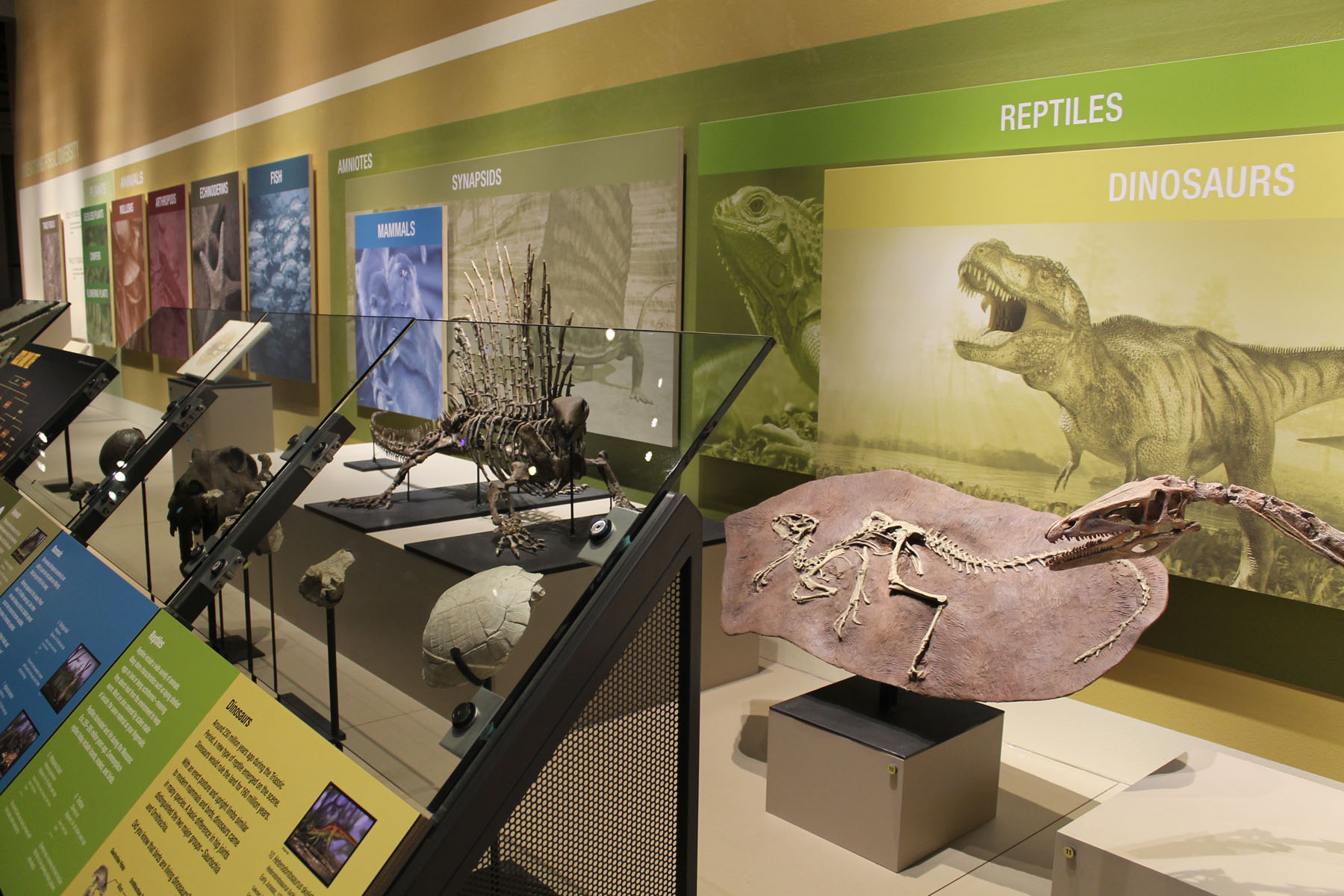
Other important stories are told around the perimeter of the exhibit space. Near the entrance, a remarkably concise display covers the definition of a fossil and brings order to the diversity of life on Earth. This is accomplished with a series of stacked boxes printed on the wall. The largest boxes are labeled Trace Fossils and Body Fossils. Within Body Fossils, there are Plants, Invertebrates, and Vertebrates. Within Vertebrates, there are Fish and Amniotes, and within Amniotes there are Synapsids and Reptiles. So it continues, eventually illustrating that dinosaur bones are only a small part of the huge range of living things that are found as fossils. Since visitor research has shown that cladograms are often counter-intuitive to non-specialists, it’s nice to see an attractive and accessible alternative.

layered boxes instead of cladogram

Colorful, stacked boxes offer a more accessible alternative to a cladogram. Photo by the author.

In another corner, there is a small display devoted to dinosaurs in popular culture. While some might call this a waste of space, I think it’s helpful to draw contrasts between popular images of dinosaurs and the real animals that were part of the history of life on our planet. This display acknowledges the relevance of roadside statues and Jurassic Park while plainly separating them from the rest of the science-driven exhibit.

Quite possibly the best part of Life Then and Now (well, aside from the Alamosaurus – sauropods upstage everything) is the Rose Hall of Birds on the mezzanine level. It’s remarkable enough that the bird displays merge seamlessly with (and are in fact a part of) the dinosaur exhibit. But the Hall of Birds goes further, covering flight adaptations like unidirectional airflow and pneumatic bones, and how they first evolved for different reasons in dinosaurs. This is content that I wasn’t introduced to until grad school, but it’s all explained succinctly here, in language that is probably accessible to interested elementary school students. For some reason, this exhibit also includes digitized versions of bird-related literature dating back to the middle ages. It’s wonderful to see historic natural history acknowledged and celebrated in this context!

bird evolution!

Bird evolution explained. Photo by the author.

While Life Then and Now is barely half the size of the Morian Hall, I think it provides a much richer educational experience. While the exhibit certainly doesn’t reject what visitors expect to see (fighting dinosaurs!), it uses preconceptions and existing knowledge to make a series of important points about biology and evolution. As such, it’s an ideal blend of fun and science, visually attractive but built from the ground up on solid evidence. I can’t recommend it enough.

If any readers have visited the Perot Museum and/or HMNS, what did you think? Please don’t hesitate to weigh in!

Leave a comment

Filed under dinosaurs, exhibits, fossil mounts, opinion, reviews, science communication

Clash of the Texas Fossil Exhibits: HMNS

Quetzalcoatlus

A standing Quetzalcoatlus skeleton is a sight to behold, but is that enough? Photo by the author.

Last week, I checked two major fossil exhibits off my must-see list – the Morian Hall of Paleontology at the Houston Museum of Natural Science, and Life Then and Now at the Perot Museum in Dallas. Although both exhibits opened the same year and cover the same basic subject matter, they are radically different in terms of aesthetics, design, and interpretation. Life Then and Now is unabashedly excellent and pretty much embodies everything I called a Good Thing in my series on paleontology exhibit design. I’ll be sure to discuss it in detail later on. Nevertheless, I’m itching to write about the HMNS exhibit first because it’s—in a word—weird. The Morian Hall essentially rejects the last quarter century of conventional wisdom in developing fossil displays, and for that matter, science exhibits of any kind.

The Morian Hall occupies a brand-new 36,000 square foot addition to HMNS, apparently the largest in the museum’s history. The first thing I noticed walking into the exhibit was that the space doesn’t look like any other science exhibit I’ve seen, past or present. Instead, it strongly resembles a contemporary art gallery, and this fossils-as-art aesthetic permeates every aspect of the exhibit design. Specimens are displayed against stark white backgrounds, with smaller fossils in austere wall cases and larger mounted skeletons on angular, minimalist platforms. Most objects are displayed individually, with lots of negative space between them. Interpretive labels, where present, are small and out of the way (and the text is all in Helvetica, because of course it is). There are no interactive components of any kind—no movies, no computer terminals, not even question-and-answer flip-up panels. The exhibit is defined by its own absence, the structural elements and labels fading into the background with the intent that nothing distract from the specimens themselves.

white walls and art gallery format

The HMNS paleontology exhibit looks and feels like a contemporary art gallery. Photo by the author.

For the benefit of those outside the museum field, I should clarify that for myself and many others trained in science and history museums, art museums are basically opposite world. In an art museum, objects are collected and displayed for their own sake. Each artwork is considered independently beautiful and thought-provoking, and curators often strive to reduce interpretation to the bare minimum. Some museums have gone so far as to forgo labels entirely, so that objects can be enjoyed and contemplated simply as they are. Not coincidentally, art museums have a reputation as being “highbrow” establishments that attract and cater to a relatively narrow group of people. People who do not fit the traditional definition of art museum visitor sometimes find these institutions irrelevant or even unwelcoming (more on that in a moment). This summation is hardly universal, but I would argue that the participatory, audience-centered art museum experiences created by Nina Simon and others are an exception that proves the rule.

Natural history museums are different. Collections of biological specimens are valuable because of what they represent collectively. These collections are physical representations of our knowledge of biodiversity, and we could never hope to understand, much less protect, the natural world without them. Each individual specimen is not necessarily interesting or even rare, but it matters because it is part of a larger story. It represents something greater, be it a species, a habitat, or an evolutionary trend. Likewise, modern natural history exhibits aren’t about the objects on display, but rather the big ideas those objects illustrate. Since the mid-2oth century, designers have sought to create exhibits that are accessible and meaningful learning experiences for the widest possible audience, and natural history museums are generally considered family-friendly destinations.

label your damn casts

You can tell Robert Bakker was involved because everyone is rearing. Photo by the author.

There is much to like in the Morian Hall of Paleontology. For one thing, the range of animals on display is incredible. I cherished the opportunity to stand in the presence of a standing Quetzalcoatlus, a Sivatherium, a gorgonopsid, and many other taxa rarely seen in museums. Other specimens are straight-up miracles of preservation and preparation, including a number of Eocene crabs from Italy. I also enjoyed that many of the mounts were in especially dynamic poses, and often interacting with one another. With fossil mount tableaus placed up high as well as at eye level, there was always incentive to look around and take in every detail.

Nevertheless, the art gallery aesthetic raised a number of red flags for me. To start, the minimalist design means that interpretation takes a serious hit. Although the exhibit is arranged chronologically, there are many routes through the space and the correct path is not especially clear. Meanwhile, there are no large headings that can be seen on the move—visitors need to go out of their way to read the small and often verbose text. All this means that the Morian Hall is an essentially context-free experience. Visitors are all but encouraged to view the exhibit as a parade of cool monsters, rather than considering the geological, climatic, and evolutionary processes that produced that diversity. There is an incredible, interrelated web of life through time on display in the Morian Hall, but I fear that most visitors are not being given the tools to recognize it. By decontextualizing the specimens, the exhibit unfortunately removes their meaning, and ultimately their reality*.

*Incidentally, most of the mounted skeletons are casts. This is quite alright, but I was very disappointed that they were not identified as such on accompanying labels.

gorgeous but what does it mean

This double-helix trilobite growth series is gorgeous—but what does it communicate, exactly? Photo by the author.

What’s more, the idealized, formal purity of the exhibit design echoes a darker era in the history of museums. It’s no secret that many of the landmark museums we know today were born out of 19th century imperialism. Colonial domination was achieved not only with military power, but through academia. When colonial powers took over another nation, they brought their archaeologists, naturalists, and ethnographers along to take control of the world’s understanding of that place, its environment, and its people. Museums were used to house and display natural and cultural relics of conquered nations, and to disseminate western scientists’ interpretation of these objects. Even today, it is all too common to see ethnographic objects displayed in austere exhibit spaces much like the Morian Hall of Paleontology. These displays erase the objects’ original cultural meaning. Dinosaurs don’t care about being silenced, of course, but it’s odd that HMNS would choose to bring back such loaded visual rhetoric.

Pretty ammonites with donor names prominently displayed send the wrong message. Photo by the author.

Pretty ammonites with donor names prominently displayed send the wrong message. Photo by the author.

My final concern with the art gallery format is the implication that fossils have monetary value. Fossils are priceless pieces of natural heritage, and they cannot be valued because they’re irreplaceable. While there is a thriving commercial market for rare fossils, a plurality of paleontologists do not engage with private dealers. Buying and selling significant fossils for private use is explicitly forbidden under the ethics statement of the Society of Vertebrate Paleontology, and it is institutional policy at many museums that staff never discuss the monetary value of fossil specimens.

The art world has its own rules and standards. The price tags of famous pieces, including what a museum paid to acquire them, are widely known. Private collectors are celebrated, even revered. In fact, it is common to see exhibits built around a particular individual’s collection. These exhibits are not about an artist or period but the fact that somebody purchased these objects, and has given (or merely loaned) them to the museum. Two rooms in the Morian Hall are actually just that: otherwise unrelated specimens displayed together because they were donated by a specific collector. By displaying specimens with the same visual language as art objects, the Morian Hall undermines the message that fossils should not be for sale. Not only is the private fossil trade legitimized, it communicates that the primary value of fossils is their aesthetic appeal. Like the lack of contextual signage, this serves to obscure the specimens’ scientific meaning. Fossils are precious remains of real organisms, clues about ecosystems from long ago and the making of the world as we know it today. But that information is only available if they are publicly accessible, not sitting on someone’s mantelpiece.

action!

A truly remarkable fossil mount tableau, in which a mastodon flings a human hunter while a mammoth is driven off a “cliff” in the background. Photo by the author.

Now hold on (regular readers might be saying), haven’t I argued repeatedly that fossil mounts should be considered works of art? Absolutely, and that is part of why I was taken aback by this exhibit. The difference is that while the Morian Hall displays fossils the way art is traditionally exhibited, it does not interpret them like art. When I call fossil mounts works of art, I mean that they have authorship and context. They have encoded and decoded meaning, as well as relationships with their viewers, creators, host institutions, and ultimately, the animals they represent. Calling something art is opening it up to discussion and deconstruction. The HMNS exhibits do the opposite.

For the last few decades, natural history museums have been opening windows onto the process of creating knowledge. Modern exhibits seek to show how scientists draw conclusions from evidence, and invite visitors to do the same. In the Morian Hall, those windows are closed. Specimens are meant to be seen as they are, reducing the experience to only the object and the viewer. But there is no “as they are” for fossils. Thousands of hours of fossil preparation and mount construction aside, every display in that exhibit is the result of literally centuries of research into geology, anatomy, and animal behavior. These are representations of real animals, but they also represent the cumulative interpretive work of a great many people. The display simply isn’t complete without their stories.

17 Comments

Filed under anthropology, dinosaurs, exhibits, fossil mounts, HMNS, mammals, museums, opinion, paleoart, reviews, science communication

History of the Field Museum Fossil Halls – Part 1

The Field Museum of Natural History (variously known as the Field Colombian Museum and the Chicago Museum of Natural History) was founded by wealthy philanthropists in the wake of the 1893 World’s Columbian Exposition in Chicago. It has since expanded into one of the largest natural history museums in the world, a destination attraction and a hub for ongoing research. What follows is a summary of the historic paleontology exhibits at the Field Museum – when and how they expanded and changed, when major specimens were added, and who spearheaded these efforts.

As with my previous overviews of fossil exhibits at AMNH and NMNH, please note that I will not be discussing field expeditions or research by museum staff in any detail, as these topics are well-explored elsewhere (see Paul Brinkman’s extensive work, for starters). My primary interest here is in the public-facing exhibits, and the people who created them.

Phase I: The Field Columbian Museum

The World’s Columbian Exposition was held in Chicago in 1893, principally as a celebration of the 400th anniversary of Christopher Columbus’s arrival in the Americas. Lasting six months and attended by 27 million people, the Exposition was monumental in size and scope. Years before it even opened, there was talk about using the Exposition displays to seed a new museum, which would rival the great natural history museums in New York and Washington, DC. Eager to establish an enduring cultural attraction in their city, a group of wealthy Chicagoans – including Marshall Field, who donated an unprecedented $1 million – contributed the necessary funds to buy up many of the Exposition’s exhibits and found the Field Columbian Museum.

As the largest and most elegant of the 200 temporary buildings constructed for the Exposition, the Palace of Fine Arts became the Field Museum’s home. Frederick Skiff served as the first director, acting as an intermediary between the board of trustees and the new curatorial staff, who would manage the collections and assemble the exhibits. Skiff hired geologist Oliver Farrington to curate the earth science collections, a diverse mix of minerals, gems, meteorites, fossils, and fabricated displays purchased from the Henry Ward Natural Sciences Establishment. With thousands of specimens to catalog, Farrington was soon overwhelmed. He repeatedly asked Skiff to hire a paleontology specialist to support him, but the board (composed of the businessmen who founded the museum) was uninterested in paying more salaries or acquiring new specimens.

fossils

The model icthyosaur and thousands of fossils in cases were among the specimens purchased from the Ward Natural Sciences Establishment after the World’s Columbian Exposition. Image courtesy of the Field Museum Photo Archives.

When the Field Columbian Museum opened on June 2nd, 1894, most the 5,000-piece fossil collection was on public display. In addition to the cases of as-yet unlabled invertebrates, plants, and other small fossils, the exhibit included several large reconstructions of prehistoric animals. As of opening day, a life reconstruction of a mammoth stood in the west court, while skeletons of MegalocerosScistopleurum, MegatheriumHadrosaurus, and a uintathere stood in halls 35 and 36. With the exception of the Megaloceros, these were all replicas of mounts from other institutions. The Hadrosaurus in particular was woefully outdated, considered by contemporary scholars to have “long since ceased to have any value except as a historic attempt” (Beecher 1901).

After completing his catalog of the earth science collections in 1896, Farrington continued to lobby for a dedicated staff paleontologist. The board paid no attention until 1897, when the American Museum of Natural History and the Carnegie Museum of Natural History announced ambitious plans to scour the western interior for fossils. So began what Brinkman calls the second Jurassic dinosaur rush – a frenzied race among leading American museums to be the first to collect and mount a sauropod dinosaur. Not wanting to be left behind by peer institutions, the trustees approved the conditional hiring of Elmer Riggs to collect dinosaurs for the Field Museum.

Hadrosaurus cast on display at the Field Museum. Field Museum Photo Archives.

Hadrosaurus stands among other fossil casts in the Field Columbian Museum. Image courtesy of the Field Museum Photo Archives.

Riggs and his classmate Barnum Brown cut their teeth in paleontology while studying under Samuel Wendell Williston at the University of Kansas. The two young men took part in an AMNH collecting expedition in 1896. Brown, who had quit his studies to work for the museum, quickly became a favorite at AMNH. Concerned about his own future, Riggs sent an unsolicited letter to Frederick Skiff, offering his skills as a fossil collector and preparator. The letter crossed Skiff’s desk at an opportune time, and in the summer of 1898 Riggs was paid a small stipend for a trial collecting trip with Farrington. The expedition was a success, and Riggs was hired as an Assistant Curator before the end of the year.

Riggs’ first three collecting seasons with the Field Museum were enormously successful. In addition to the holotype of Brachiosaurus, at the time the largest known dinosaur, Riggs collected a very-well-preserved back end of an Apatosaurus near Fruita, Colorado. Nevertheless, AMNH won the sauropod race when they completed their composite “Brontosaurus” mount in 1905. The Carnegie Museum had a Diplodocus on display in 1907, and was busy cranking out casts for European heads of state. While Riggs’ Apatosaurus was more complete than any single specimen the other museums had recovered, it was still only half a dinosaur. Riggs and Farrington repeatedly lobbied the board for funding to find more sauropod material with which to complete the skeleton, but the trustees had moved on to other things.

Riggs' Apatosaurus mount stood unfinished from 1908-1958. Photo from the Field Museum Library.

Riggs’ Apatosaurus mount stood unfinished from 1908-1958. Image courtesy of the Field Museum Photo Archives.

Plans were afoot to move the Field Museum to a new lakefront campus. However, when legal issues halted progress on the new building, Riggs was granted permission to mount the partial Apatosaurus in hall 35. The plaster casts previously displayed in this space were discarded, and unfortunately are now lost to history. A gas furnace was installed on the museum grounds, which Riggs and his small team used to shape massive steel I-beams for use in the armature. The teetering sauropod hindquarters was unveiled in 1908, but if Riggs hoped that the museum administrators would want to complete the mount once they saw how absurd the incomplete skeleton looked, he was out of luck.

Indeed, the years that followed were among the most frustrating of Riggs’ career. He received no funding to collect fossils after 1910, and could only look on enviously at the thriving paleontology research and exhibit programs at AMNH and the Carnegie Museum. The institutions in New York and Pittsburgh were headed by paleontologists, and bankrolled by wealthy fossil enthusiasts like J.P. Morgan and Andrew Carnegie. By comparison, the Field Museum was controlled by trustees with seemingly little interest in paleontology. Already paid less than the museum’s other curators, Farrington and Riggs were left with meager resources and little to do until the 1920s.

Phase II: Halls 37 and 38

The Palace of Fine Arts was intended to last six months, and after ten years it was in dire shape. The roof leaked constantly, putting exhibits and collections in danger, and fences had to be placed around the perimeter to protect visitors from falling brick. Before his death in 1906, Marshall Field worked with architect Daniel Burnham to design a new home for the museum. It took years to settle disputes over where to place the building, but ground was eventually broken off Lake Shore Drive in 1915. Completed in 1920, the new Field Museum of Natural History was a gleaming marble fortress, decorated inside and out with intricate neoclassical reliefs and statuary.

hall 37

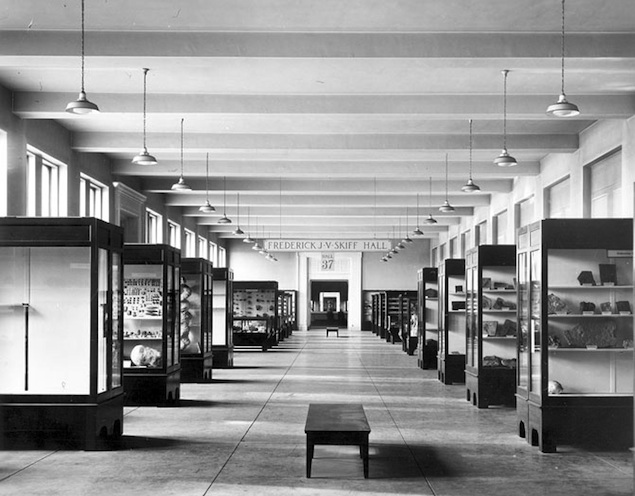
In the spirit of a classic cabinet of curiosity, some of the cases in Hall 37 contained over a thousand specimens apiece. Source

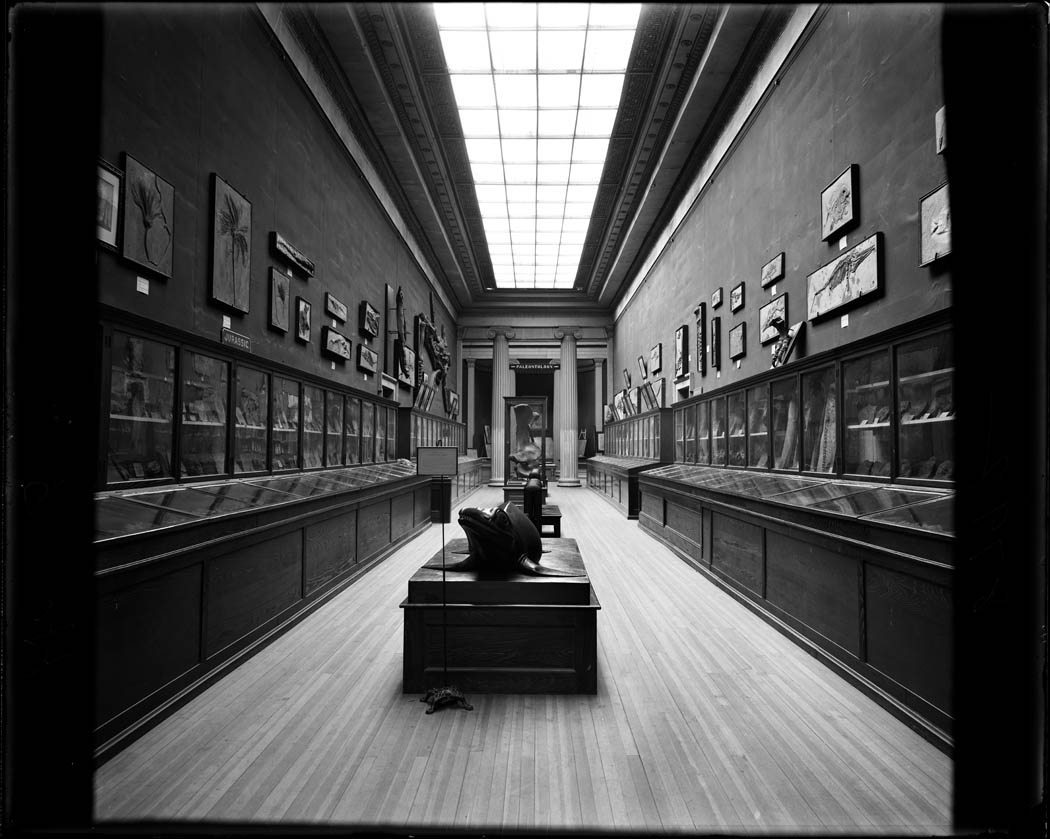
Exhibits and collections were transported by rail car, often without being removed from their display cases. Earth science exhibits found a new home on the west side of the upper level. Hall 37, an east-west facing gallery accessible directly off the west mezzanine, housed invertebrate and plant fossils. Hall 38, running north to south against the far west side of the building, contained vertebrate fossils. Although it was colloquially known as the “dinosaur hall”, this space never contained many dinosaurs. In the 1920s, the only dinosaurs to be found were the half-Apatosaurus, a Triceratops skull, an articulated “Morosaurus” (Camarasaurus) limb, and parts of Brachiosaurus. The bulk of the specimens on display were Cenozoic mammals, including horses, rhinos, camelids, and a mammoth and mastodon. There was also a life-sized “coal swamp” diorama behind a glass barrier, with large model insects suspended in flight.

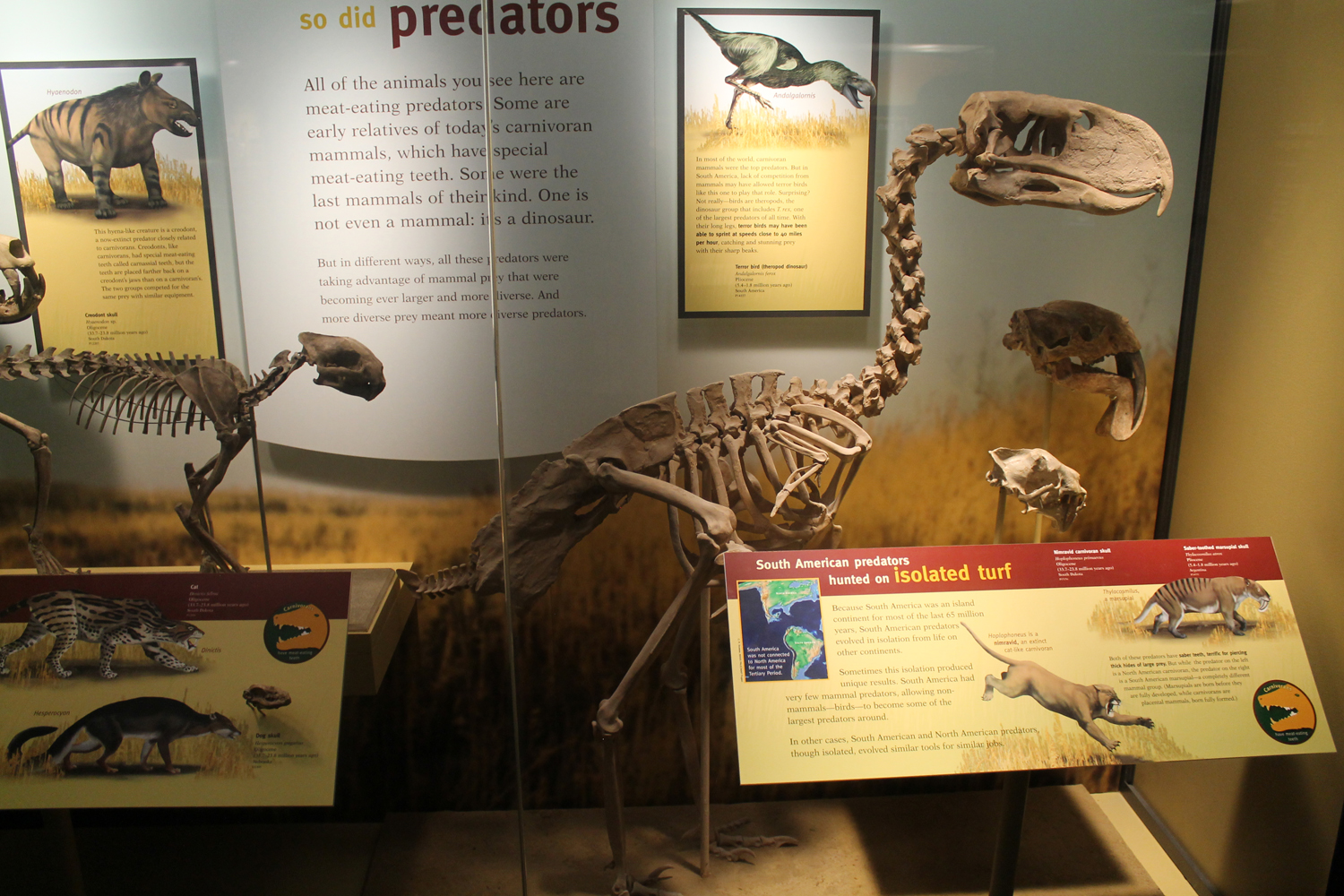
This comparatively modest exhibit was expanded significantly between 1922 and 1927, when Elmer Riggs was once again able to collect fossils in the field. Thanks to a bequest from Marshall Field’s grandson, Riggs traveled to Alberta, Argentina, and Bolivia, securing many unique specimens along the way. These included several new species, like the marsupial cat Thylacosmilus and the predatory bird Andalgalornis. A colossal Megatherium Riggs recovered in Argentina was immediately mounted for display, and became one of the most memorable elements of Hall 38.

hall 38

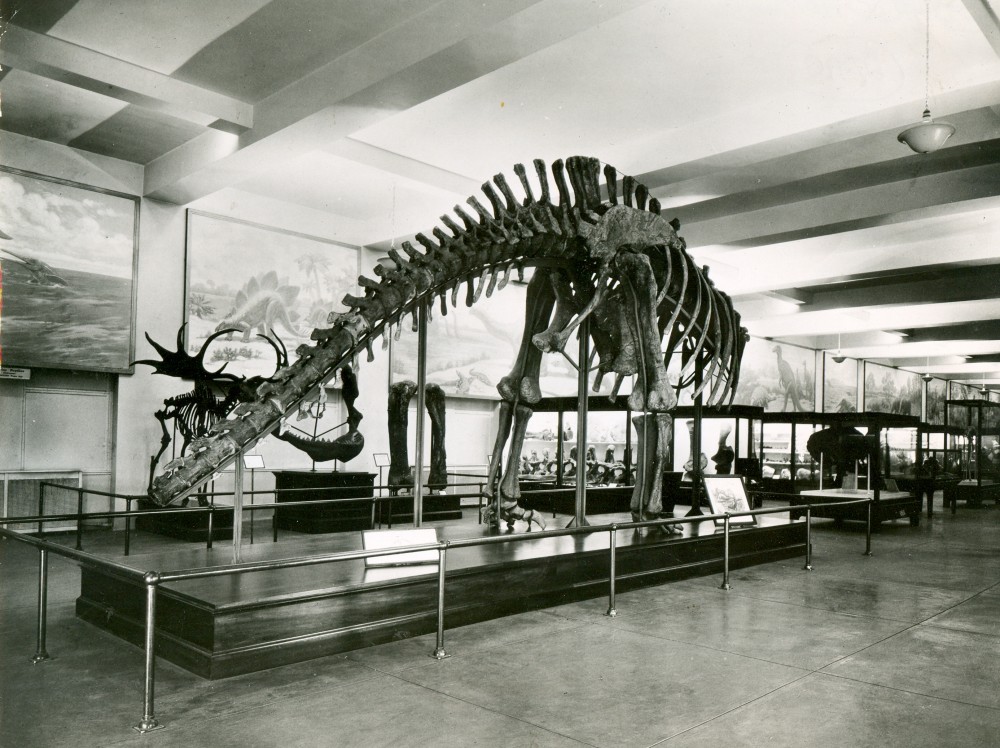
A postcard of the partial Apatosaurus at the south end of Hall 38. Image courtesy of the Field Museum Photo Archives.

A postcard of the north end of Hall 38, featuring a South American giant sloth and other Cenozoic mammals.

Megatherium at the north end of Hall 38. Image courtesy of the Field Museum Photo Archives.

Hall 38 also boasted a spectacular set of murals by Charles Knight. The undisputed master of paleontological reconstructions and wildlife art, Knight had a long working relationship with Henry Osborn, president of AMNH. Osborn had commissioned Knight to create many large and small paintings for his museum’s fossil exhibits, but the two frequently argued over Knight’s remuneration. For years, Osborn and Knight discussed a series of immense wall canvases illustrating the entire history of life. Osborn could never get the money together, however, and Knight refused to produce any concept sketches for fear that they would be turned over to a less-skilled artist. In 1926, the Field Museum’s board of trustees asked for a meeting with Knight about an identical project for their new fossil hall. The initial discussion did not go well, and Knight walked out when the trustees started making “suggestions” about the content, color, and composition of the proposed artwork. Knight was very talented, but also very particular. He gladly accepted anatomical expertise from scientists but would not suffer meddling with the artistic aspects of his work. Fortunately for both parties, Knight’s daughter/manager Lucy intervened, securing her father the biggest commission of his career.

Knight completed 28 murals for the Field Museum, the largest of them measuring 25 feet long and nine feet high. Subjects ranged from the Proterozoic primordial soup to an iconic standoff between Tyrannosaurus and Triceratops. These images were not only painstakingly researched reconstructions based on the latest fossil evidence, they were (and still are) gorgeous works of art in their own right. With Knight’s murals in place, the Field Museum finally had a world-class paleontology exhibit.

hall 38 mastodon

The mastodon in Hall 38, with fossil horses visible beyond. Image courtesy of the Field Museum Photo Archives.

Gorgo in Stanley Field Hall. Photo courtesy of Field Museum Photo Archives.

Gorgosaurus” in the Stanley Field Hall. Photo courtesy of Field Museum Photo Archives.

Riggs retired in 1942, leaving paleontology at the Field Museum to the next generation, among them Eugene Richardson, Brian Patterson, and Orville Gilpin. In 1951, Richardson oversaw a thorough modernization of Hall 37. The number of specimens on display was drastically reduced, making room for more accessible explanations of the fossils and ten new dioramas of Paleozoic marine life. The resulting exhibit was one of the most comprehensive displays of fossil invertebrates in the world.
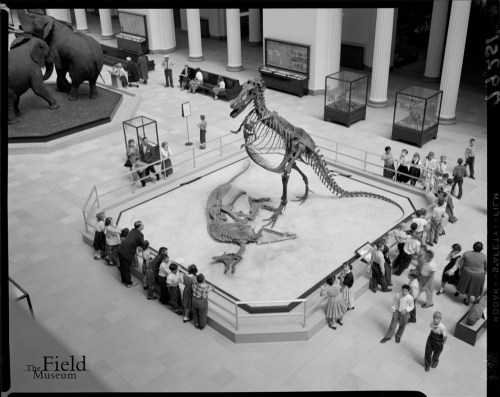
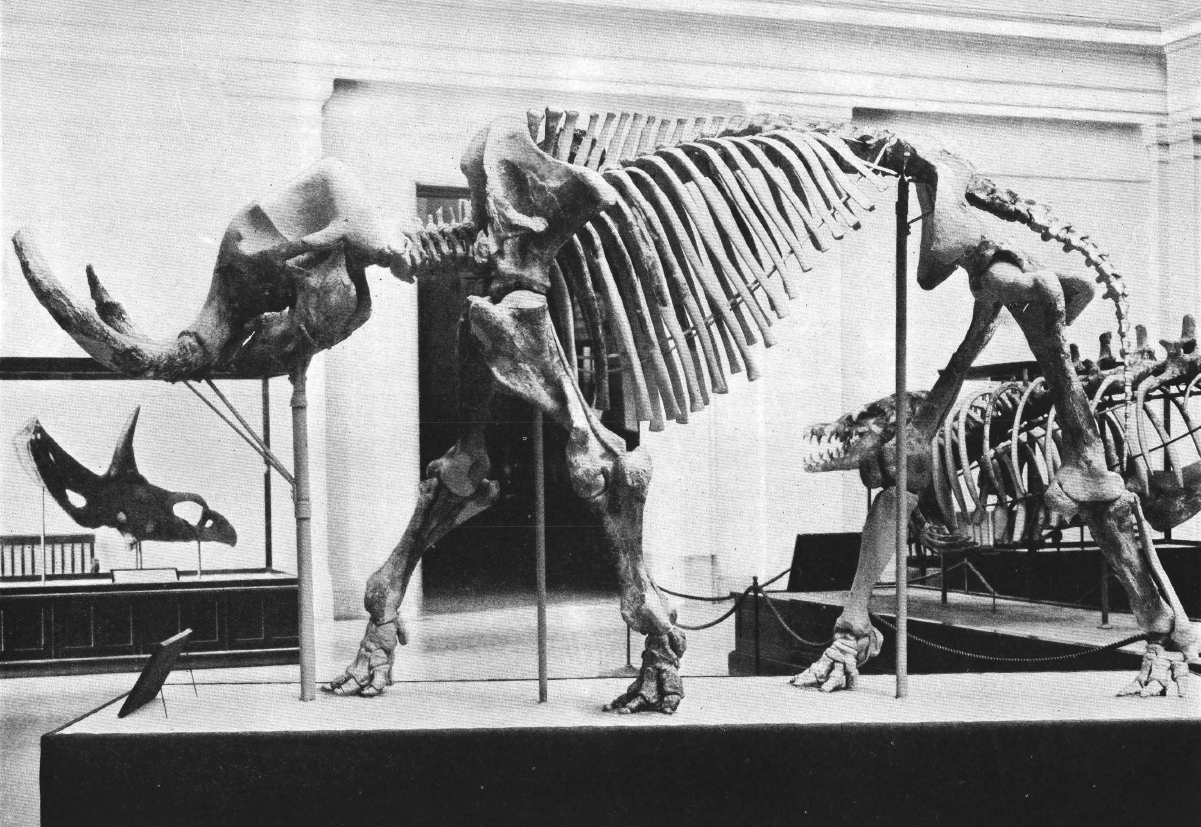
Although virtually no dinosaur research was done at the Field Museum between 1910 and the late 1990s, the 1950s saw the acquisition of two significant specimens for the benefit of the visiting public. In 1956, preparator Orville Gilpin assembled a Daspletosaurus (then called Gorgosaurus) for the central Stanley Field Hall. The skeleton was a surplus specimen from Barnum Brown’s years collecting along Alberta’s Red Deer River, and trustee Louis Ware spearheaded the effort to buy it from AMNH. Since the Daspletosaurus was acquired explicitly for display, Gilpin opted to skewer and otherwise permanently damage many of bones for the sake of an unobstructed, free-standing mount. In the mid 20th century, dinosaur fossils were thought of as display pieces first, and irreplaceable specimens second.

apatosaurus revised

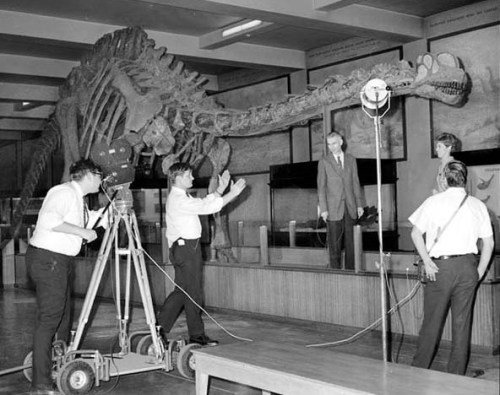
The newly-finished Apatosaurus serves as a backdrop for an educational video shoot. Source

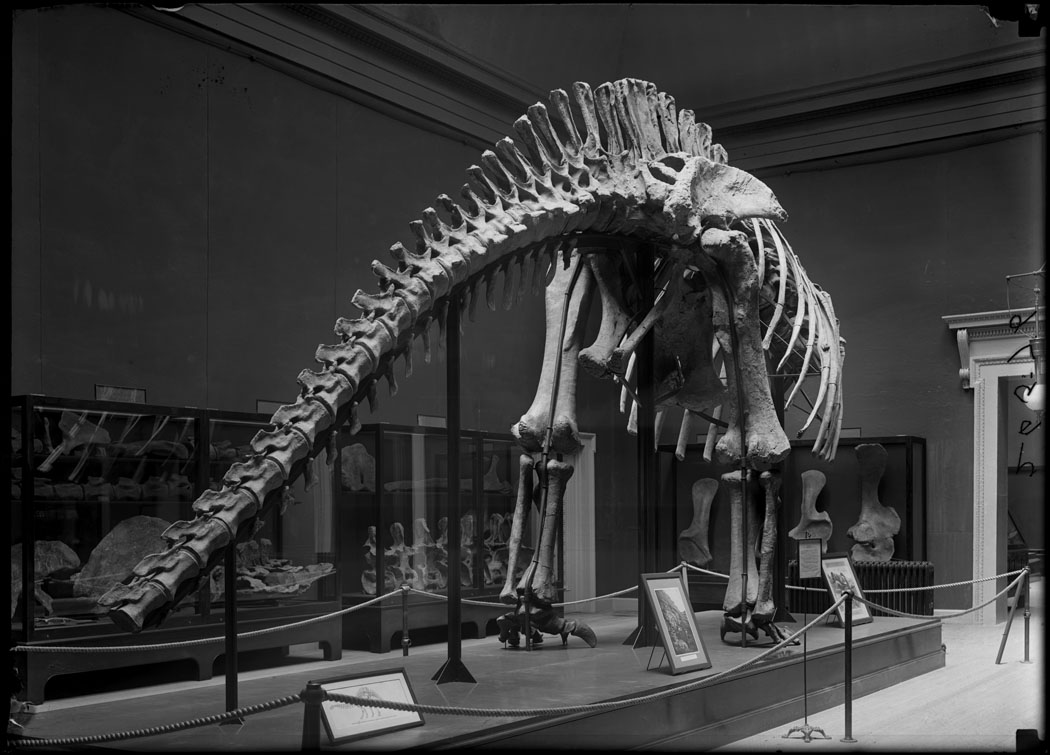
Two years after installing the Daspletosaurus, Gilpin finally completed Riggs’ partial Apatosaurus in Hall 38. When Edward Holt announced that he had discovered the front half of a sauropod near Green River, Utah, the Field Museum purchased the rights to excavate and display the find. Gilpin added the new fossils to the existing mount without dismantling Riggs’ heavy-duty armature. Relabeled “Brontosaurus” and erroneously given a casted Camarasaurus skull, the refreshed sauropod debuted in April 1958 – half a century after Riggs started the project.

The next three decades saw occasional piecemeal additions to the fossil halls. For example, the University of Chicago donated its entire geology collection to the Field Museum in 1965. This included a unique assortment of Permian amphibians and synapsids from the red beds of central Texas, many of them holotypes. Field Museum preparators remounted several of these specimens and integrated them into the exhibits. Nevertheless, Hall 38 never received a complete overhaul, and by the late 1980s it was quite dated. Not only were the fossil mounts in stiff, tail-dragging poses, but the stilted label copy written by curators past did not meet modern expectations for natural history exhibits. Even the vibrant Charles Knight murals looked tired behind years of accumulated dust and dirt. In short, the Field Museum was long overdue for a total re-imaging of its paleontology displays.

Next time, we’ll take a look at the Field Museum’s fossil exhibits from the 1990s onward. Stay tuned!

References

Beecher, C.E. 1901. The reconstruction of a Cretaceous dinosaur, Claosaurus annectens Marsh. Transactions of the Connecticut Academy of Arts and Sciences. 11: 311-324.

Brinkman, P.D. 2000. Establishing Vertebrate Paleontology at Chicago’s Field Colombian Museum: 1893-1898. Archives of Natural History 27: 1: 81-114.

Brinkman, P.D. 2o10. The Second Jurassic Dinosaur Rush: Museums and Paleontology in America at the Turn of the 20th Century. Chicago, IL: The University of Chicago Press.

Chicago Natural History Museum Bulletin. (March 1956). 27: 3.

Gilpin, O.L. 1959. A Freestanding Mount of Gorgosaurus. Curator 2: 2: 162-168.

Glut, D.F. 2001. Remembering the Field Museum’s Hall 38. Jurassic Classics: A Collection of Saurian Essays and Mesozoic Musings. Jefferson, NC: McFarland.

Lelièvre, M A. 2006. Evolving Planet: Constructing the Culture of Science at Chicago’s Field Museum. Anthropologica 48: 2: 293-296.

Milner, R. 2012. Charles R. Knight: The Artist Who Saw Through Time. New York, NY: Abrams.

Tubitis, T.J. 2005. Revitalizing Life Over Time: A New Look for a Very Old Topic. In the Field 76: 2: 18.

Williams, P.M. 1968. The Burham Plan and the Field Museum. Bulletin of the Field Museum of Natural History 39: 5: 8-12.

4 Comments

Filed under dinosaurs, exhibits, FMNH, fossil mounts, history of science, mammals, museums, reptiles, sauropods

Was the Hawkins Hadrosaurus real?

Photo from Weishampel and Young 1996.

Hadrosaurus at the Academy of Natural Sciences. Photo from Weishampel and Young 1996.

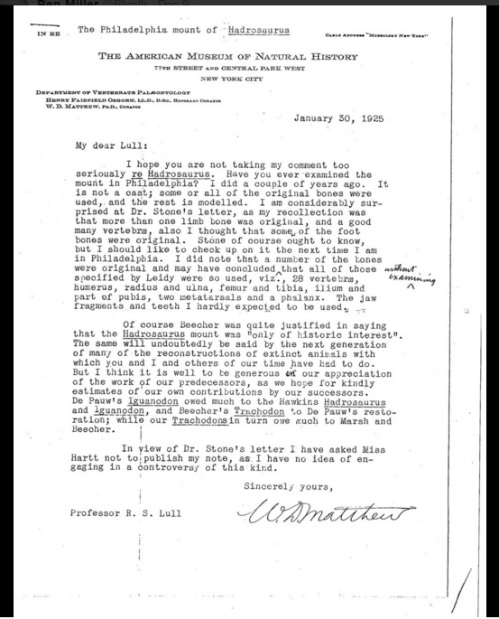
In the “Claosaurus” post earlier this week, I temporarily(?) lost my mind when I said that the Hadrosaurus Benjamin Waterhouse Hawkins assembled for the Academy of Natural Sciences was 100% plaster reconstruction. Thanks to John Sime, among others, for pointing out that this was incorrect. As usual, the truth is more complicated, and therefore much more interesting.

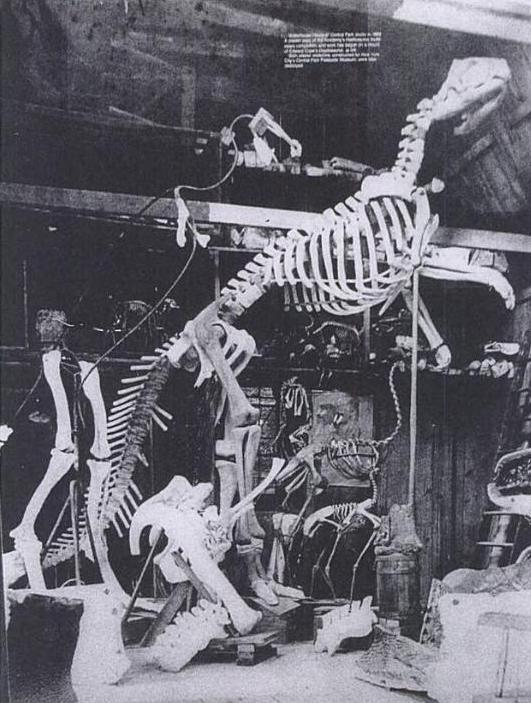
The Hadrosaurus project began when Hakwins was commissioned to create a series of life-sized prehistoric animals for display in New York City’s central park, under the direction of Joseph Leidy. The exhibition was cancelled when Hawkins’ on-site workshop was burned down by vandals, but he was able to salvage the Hadrosaurus skeleton for display at the Academy in Philadelphia. This reconstruction was based on little more than two limbs and a handful of vertebrae. It was a well-reasoned attempt – and it drew huge crowds – but it wasn’t long before new dinosaur finds rendered it obsolete. In 1901, Charles Beecher wrote that the Hadrosaurus mount had “long since ceased to have any value or interest except as a historical attempt.” No longer considered informative, the original Hadrosaurus was probably dismantled around the start of the 20th century. At least three plaster copies were distributed to other museums, but these were also discarded long ago.

There is no question that Hawkins’ reconstruction doesn’t reflect our present understanding of this animal, so in that sense it isn’t “real.” Still, it is of historic interest whether Hawkins used the handful of original Hadrosaurus fossils in the mount itself, or whether the entire display was fabricated. There is precedent for both posibilities: John Peale mounted an original mastodon skeleton in 1802, but the Smithsonian’s first attempts at Basilosaurus and Triceratops (1895 and 1900 respectively) included no real fossils. This question was actually up for discussion as early as 1926. Responding to an inquiry from Peabody Museum paleontologist Richard Lull, Academy of Natural Sciences curator Witmer Stone wrote that the Hadrosaurus mount was a complete reproduction. When Lull followed up with William Matthew of the American Museum of Natural History, however, Matthew recalled that “some or all of the original bones were used.”

The two letters reproduced below are in the collection of the Department of Vertebrate Paleontology Archives at the Peabody Museum of Natural History, and are shared with permission.

courtesy

Letter from Witmer Stone to Richard Lull, January 26, 1925. Courtesy of the Dept. of Vertebrate Paleontology Archives, Yale Peabody Museum of Natural History.

Courtesy

Letter from William Matthew to Richard Lull, January 30, 1925. Courtesy of the Dept. of Vertebrate Paleontology Archives, Yale Peabody Museum of Natural History.

A look at the original Hadrosaurus fossils, now cataloged as ANSP 10005, suggests that Matthew was correct. At least a couple of the bones appear to bear drill holes, a tell-tale sign that they were once fastened to an armature. Likewise, in a photograph of the mount in Hawkins workshop, the elements that were actually recovered – the left leg*, part of the pelvis, and a scattering of vertebrae – appear to be darker in color. This suggests that these are the real bones, and the rest of the skeleton is plaster…unless Hawkins painted plaster casts to demonstrate which elements had been found.

*Note that the image below has been flipped horizontally for some reason. In the original, the left side of the skeleton is facing the camera.

Hawkin's studio

Hadrosaurus in Hawkins’ studio. Image from Carpenter et al. 1994.

The answer to this little conundrum can be found in the official guidebook to the Academy of Natural Sciences, published in 1879. Apparently there were two versions of Hadrosaurus on display. The original 1868 mount did include the original fossils, but when the museum moved to a larger facility in 1876 (in part because of the spike in visitation caused by the Hadrosaurus exhibit) the mount was remade. The bones were not faring well in open air and were rapidly deteriorating, so they were retired to the collections and replaced with casts. Anyone who saw the Hadrosaurus before 1876 saw the fossils incorporated into the mount, and anyone who visited later saw a complete facsimile. Still, I’m pretty sure William Matthew was remembering incorrectly. He was born in 1871, so unless he was carefully observing the composition of the mount at age 5, he shouldn’t have seen the original version!

References

Beecher, C.E. 1901. The reconstruction of a Cretaceous dinosaur, Claosaurus annectens Marsh. Transactions of the Connecticut Academy of Arts and Sciences. Vol. 11, pp. 311-324.

Carpenter, K., Madsen, J.H. and Lewis, L. 1994. Mounting of Fossil Vertebrate Skeletons. Vertebrate Paleontological Techniques, Vol. 1. Cambridge, UK: Cambridge University Press.

Prieto-Márquez, A., Weishampel D.B., and Horner J.R. 2006. The dinosaur Hadrosaurus foulkii, from the Campanian of the East Coast of North America, with a re-evaluation of the genus. Acta Palaeontologica Polonica. Vol. 51, pp. 77-98.
Ruschenberger, W.S.W. and Tryon, G.W. 1879. Guide to the Museum of the Academy of Natural Sciences of Philadelphia. Philadelphia, PA: Academy of Natural Sciences.
Weishampel. D.B. and Young, L. 1996. Dinosaurs of the East Coast. Baltimore, MD: The Johns Hopkins University Press.

Leave a comment

Filed under dinosaurs, fossil mounts, history of science, museums, ornithopods

Beecher’s “Claosaurus”

Readers are likely aware that the Hadrosaurus Benjamin Waterhouse Hawkins created for the Academy of Natural Sciences was the first mounted dinosaur skeleton. It is less widely known, however, that this Hadrosaurus was a plaster facsimile, which included none of the actual fossils that inspired it. (edit: not quite, see comments). The title of first dinosaur mount composed of original fossils belongs to the Belgian Iguanodon assembled by Louis Dollo in 1891 (I should probably write about this eventually, but Fernanda Castano has an excellent account at Letters From Gondwana). So what was the first real fossil dinosaur mount on this side of the Atlantic? Glad you asked – that would be none other than the 1901 Edmontosaurus at the Peabody Museum of Natural History.

Edmontosaurus is surprisingly modern

The PMNH Edmontosaurus with Deinonychus and Centrosaurus. Photo by the author.

There are plenty of Edmontosaurus skeletons on display today, but the Yale mount is noteworthy because of its remarkably modern appearance. While the Hawkins Hadrosaurus and Dollo Iguanodon were upright tail-draggers, the Edmontosaurus could be mistaken for a mount constructed in the last quarter century. Its raised tail, horizontal posture, and energetic gait all reflect current thinking about dinosaur posture and locomotion. And yet, it was built at the turn of the century, back when paleontologists supposedly all thought of dinosaurs as lethargic lizards.

The Hawkins Hadrosarus and Dollo Iguanodon. Photos from

The Hawkins Hadrosarus and Dollo Iguanodon. Images from Paper Dinosaurs.

The scientist behind this mount was Charles Beecher. Born in Pennsylvania, Beecher studied at the University of Michigan before taking an Assistant of Paleontology position at Yale in 1888. He completed his PhD under Marsh, who apparently thought highly of him (and Marsh didn’t think highly of many people). Although his preferred research subjects were Paleozoic invertebrates, Beecher could be counted on to help prepare his mentor’s vast collection of dinosaur fossils, when needed. When Marsh died in 1899, Beecher succeeded him as the head of the Peabody Museum, and set himself the task of mounting one of the institution’s best dinosaur specimens for display.

Beecher selected YPM VP 2182 as the Peabody Museum’s first fossil mount because it was nearly complete and mostly articulated. Known to Marsh and Beecher as “Claosaurus” annectens*, this Edmontosaurus skeleton was collected in Wyoming by John Bell Hatcher (because of course it was). Beecher and assisting preparator Hugh Gibb attempted to preserve the fossils within their original matrix as much as possible. Since the specimen was somewhat laterally compressed, Beecher kept the right side mostly in situ and built up the left in high relief. The head and neck were technically never removed from their matrix block, but since the head was found curved under the body it had to be rotated into its life position. All told, only the right ribs, the corocoids, the final two-thirds of the tail, and some of the vertebral processes were reconstructed. No attempt was made to restore the ossified dorsal tendons, which were poorly preserved on this specimen.

woo

Beecher’s Edmontosaurus, ca. 1917. Source

The complete mount is 13 feet tall and 29 feet long, its tail extending past the edge of the 27 foot slab. For a few years, it was the largest fossil mount ever built. The slab itself is made up of original matrix blocks sealed together with a manufactured surface created from plaster, resin, and ground Laramie Formation sandstone. It was assembled in four pieces secured to wooden frames. These were designed to be separated and moved with relative ease, although PMNH staff have yet to try.

According to Beecher, he imbued the Edmontosaurus with its lively pose in order to preserve the in situ orientation of the pelvis and left femur. It is worth quoting Beecher’s 1901 description of the mount in full:

“It is intended that this huge specimen should convey to the observer the impression of the rapid rush of a Mesozoic brute. The head is thrown up and turned outward. The jaws are slightly separated. The forearms are balancing the sway of the shoulders. The left hind leg is at the end of the forward stride and bears the entire weight of the animal. The right foot has completed a step and has just left the ground preparatory to the forward swing. The ponderous and powerful tail is lifted free and doubly curved so as to balance the weight and compensate for the swaying of the body and legs. The whole expression is one of action and the spectator with little effort may endow this creature with many of its living attributes.”

Much like the AMNH Gorgosaurus, the Yale Edmontosaurus demonstrates that early 20th century paleontologists’ supposed aversion to energetic and agile dinosaurs has been grossly overstated. Beecher saw Edmontosaurus as a powerful, active animal, and actually criticized the earlier reconstructions by Hawkins and Dollo. He correctly pointed out that the back-swept ischia of ornithopod dinosaurs would not allow room for the drooping tails they had reconstructed, and also noted that fossilized dinosaur trackways never show the mark of a dragging tail.

In the great hall of dinosaurs

Edmontosaurus as presently displayed in the Great Hall of Dinosaurs. Source

Beecher died suddenly in January of 1904, and the Edmontosaurus display ended up being one of his final professional accomplishments. Despite the relative dearth of dinosaur material available at the time, Beecher’s careful and impartial study of the available evidence allowed him to reconstruct this animal in a way that is still considered accurate 114 years later. Beecher’s work shows us that old research isn’t necessarily outmoded. Good science can come from any age and any source, if one only takes the time to look.

*Today, the genus Claosaurus is reserved for Claosaurus agilis from Kansas. The referred species annectens has since been placed in Thespesius, Trachodon, Anatosaurus, and now Edmontosaurus.

References

Beecher, C.E. 1901. The reconstruction of a Cretaceous dinosaur, Claosaurus annectens Marsh. Transactions of the Connecticut Academy of Arts and Sciences. Vol. 11, pp. 311-324.

Jackson, R.T. 1904. Charles Emerson Beecher. The American Naturalist. Vol 38, No. 450.

Marsh, Othniel C. 1892. Restorations of Claosaurus and Ceratosaurus. American Journal of Science. Vol. 44, pp. 343-349.

5 Comments

Filed under dinosaurs, fossil mounts, history of science, museums, ornithopods, PMNH, reptiles