Category Archives: exhibits

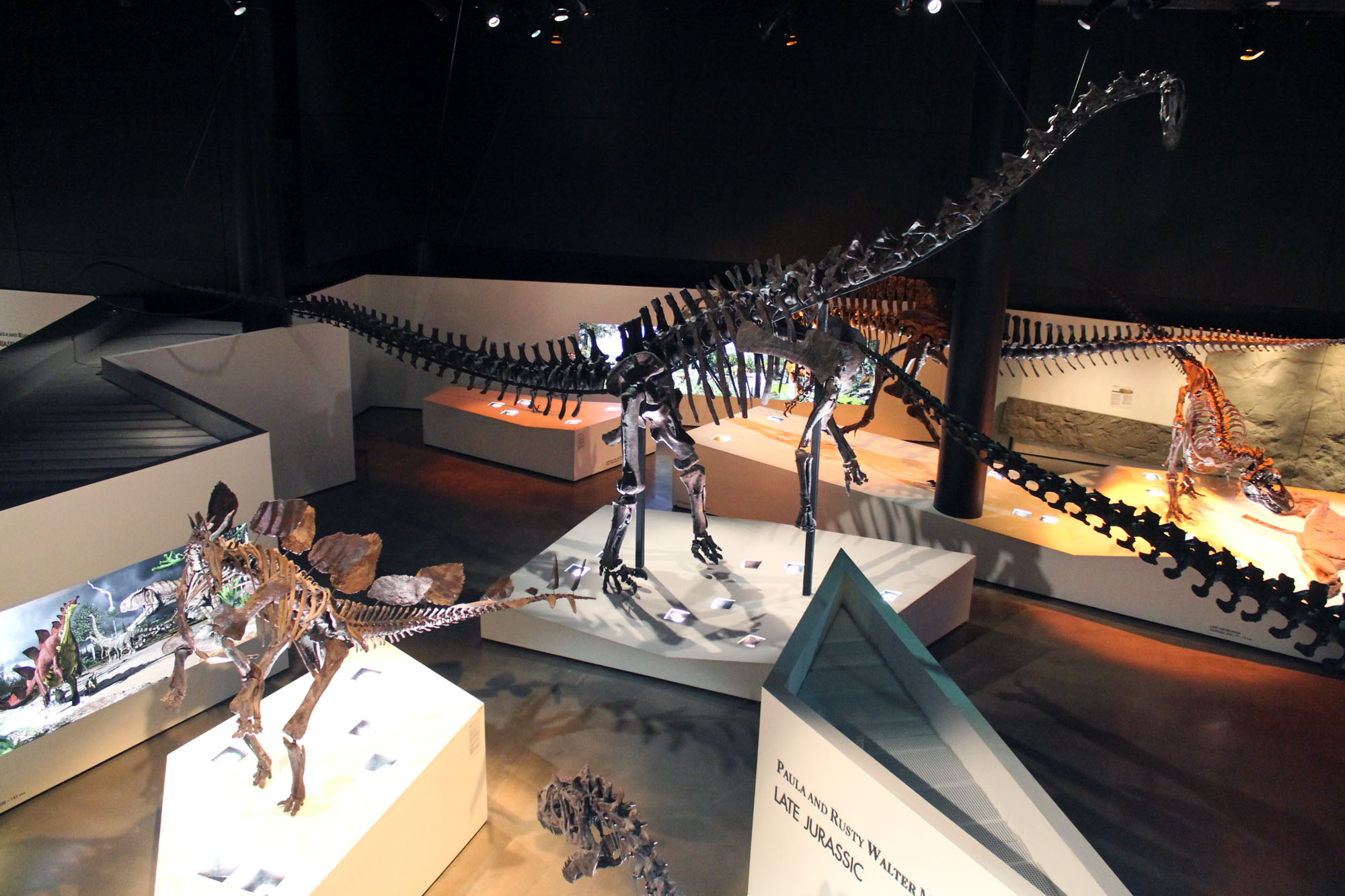
Clash of the Texas Fossil Exhibits: PMNS

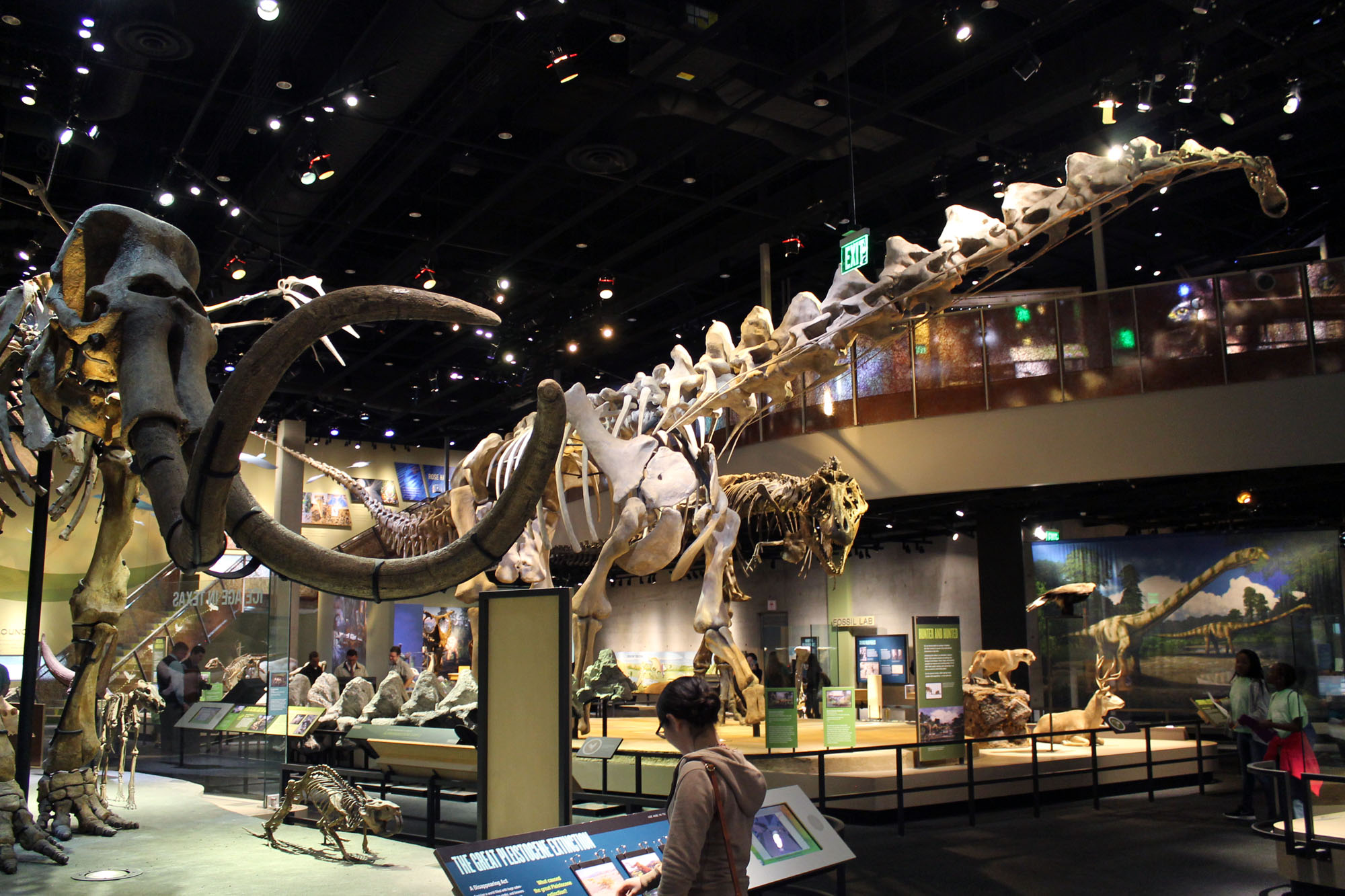
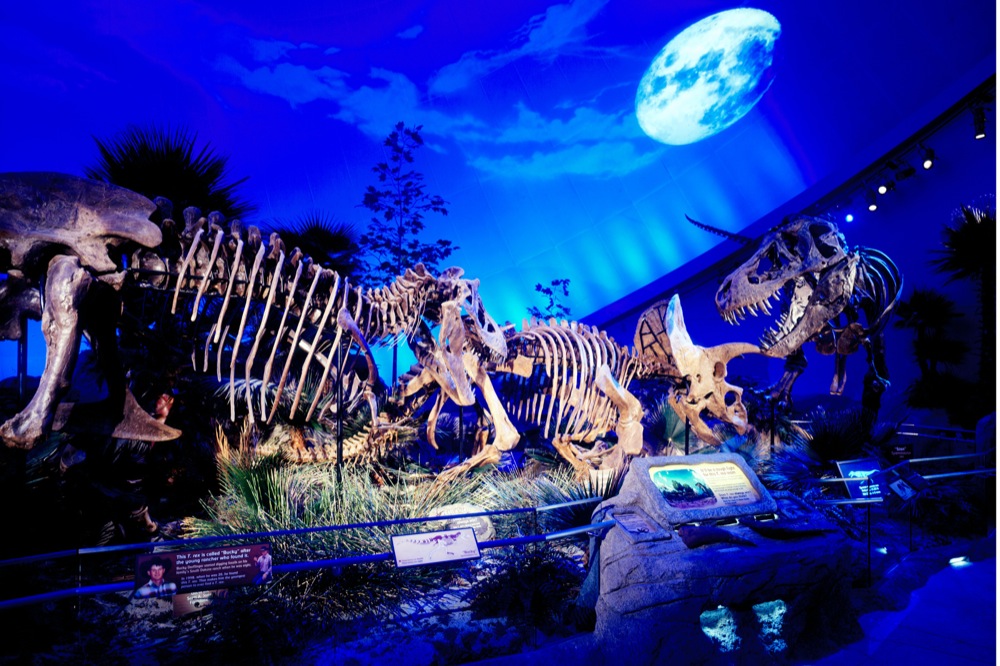
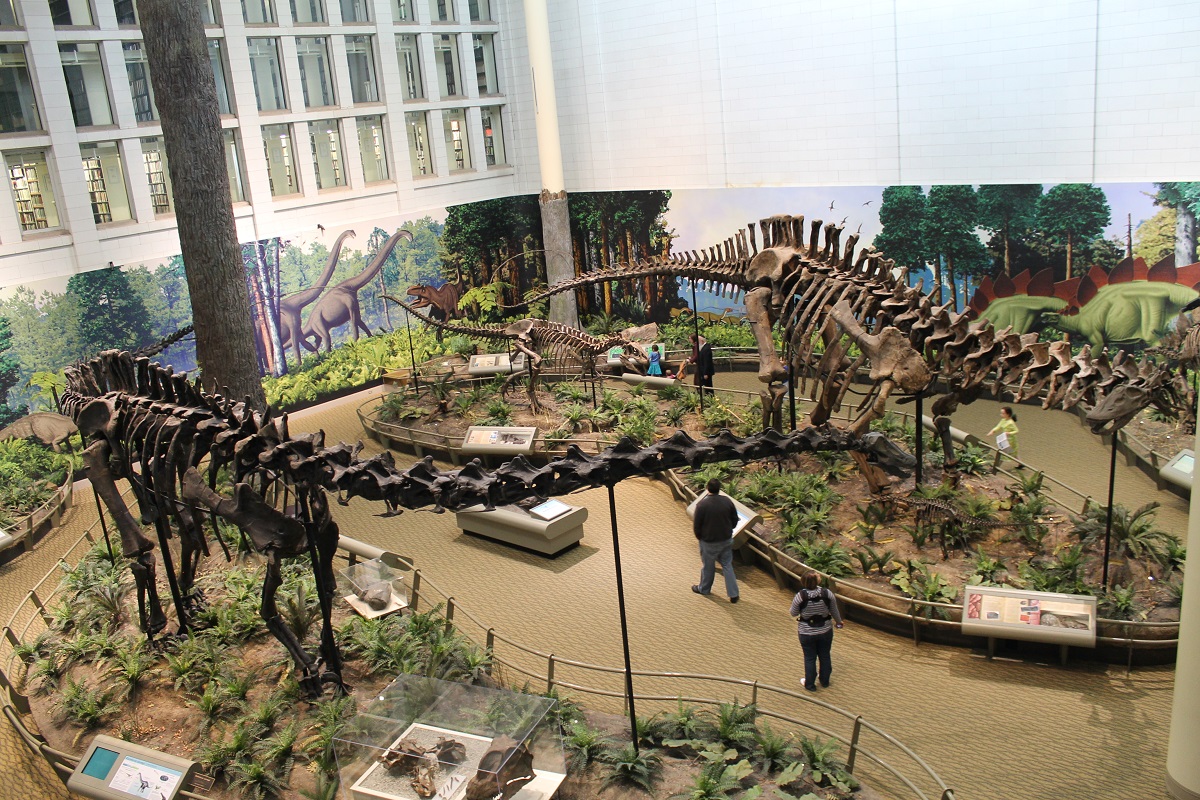
Life Then and Now

Life Then and Now at the Perot Museum of Nature and Science. Photo by the author.

In a recent interview at Love in the Time of Chasmosaurs, artist Brian Engh provided one of the best definitions of paleontology I’ve ever seen:

Paleontology is really just animals and plants doing animal and plant stuff, then dying and getting buried and all that stuff stacking up for unfathomable expanses of time.

This is how paleontology is portrayed in Life Then and Now, the fossil hall at the Perot Museum of Nature and Science. The exhibit clearly and cohesively portrays the world of the past as a collection of living ecosystems, and highlights both the fossil evidence and the means by which scientists interpret it. This is in stark contrast to the Morian Hall of Paleontology in Houston, which I found to emphasize style over substance. In the last post, I critiqued the Morian Hall’s art gallery format, arguing that it discouraged understanding and ultimately diminished the meaning and reality of the specimens on display. I was pleased that this discussion sparked lively conversations here and on twitter, but now it’s only fair that I follow up with an example of what I actually like to see in a natural history exhibit.

mosasaur and texas ornithiscians

The mid-Cretaceous, by land and by sea. Photo by the author.

The purpose of any exhibit structure is to provide meaning and context for objects – to help visitors see them as more than neat things to look at. It’s the museum’s job to give visitors the intellectual tools to contextualize displayed objects in a more sophisticated way. In terms of aesthetics and overall layout, this is clearly what the designers of Life Then and Now had in mind. The exhibit occupies a large, open, and well-lit space, with long sight lines around the room. There is a set of clear, over-arching themes, with individual stories playing back into the primary learning goals. Vignettes have large, informative headings that can be seen and understood on the move, but there is also plenty of detailed content for visitors who care to look more closely. Multimedia and interactives are deployed intelligently – they don’t exist for their own sake but cover content in novel and interesting ways.

All this serves to make the exhibit useful for visitors of a variety of ages and interest levels. For one thing, visitors are encouraged to engage with content at their own pace. They can see what the exhibit has to offer as soon as they enter the space, they can view specimens in whatever order interests them, and they always have a good idea of how much they’ve seen and how much there is left. Nevertheless, the core messages are never lost, even for fly-by visitors.  Most every display refers back to the exhibit’s key themes, and the main idea behind every vignette is visible from a distance. Meanwhile, the needs of advanced visitors are not forgotten. Specimens are not in cramped corners or obscured by dramatic lighting, but out in the open and visible from numerous angles.

benifet

One benefit of an open layout is that it encourages comparison. For example, why are these two megaherbivores shaped so differently? Photo by the author.

More specifically, the primary theme of Life Then and Now is that life of the past was not a pageant show of monsters but a set of living communities that operated under the same constraints that drive the evolution of plants and animals today. This is communicated by pairing fossil specimens with modern counterparts. Below, Pachyrhinosaurus and an extant moose both sport elaborate headgear used for competition and display. Elsewhere, extinct and extant animals illustrate intercontinental migration, herd living, adaptations for harsh climates, predator-and-prey arms races, and niche partitioning. Along the way, the process and mechanisms for evolution are brought up again and again. This hammers home the point that life is never static and always responding to environmental pressures, while simultaneously demonstrating that there is evidence for evolution everywhere you look. This is quite different from the Morian Hall, where I felt that the role of evolution in producing the variety of life on display was not made especially clear. The only thing missing from this presentation is a time axis. I wish the exhibit put more emphasis on the enormous expanses of time between the various fossil specimens on display, but I suppose it can be difficult to cover every angle.

vigniette

Visitors can see the main message of this vignette from a distance, or look more closely to find out more. Photo by the author.

Many, if not most of the vignettes also include the names and faces of the scientists involved in the discovery and interpretation of the specimens on display. This personalized approach matters for several reasons. It reminds visitors that science is a process, not a set of facts. It illustrates that there is more to a museum than its exhibits, and that the institution’s most important and unique resource is the in-house research staff who use the collections to create new knowledge. Finally, since the Perot Museum is generally pitched for younger visitors, it’s critical to show that science is done by real and diverse people, not caricatures in lab coats or pith helmets. A human face goes a long way toward making the process of doing science relatable (and for kids, something to aspire to).

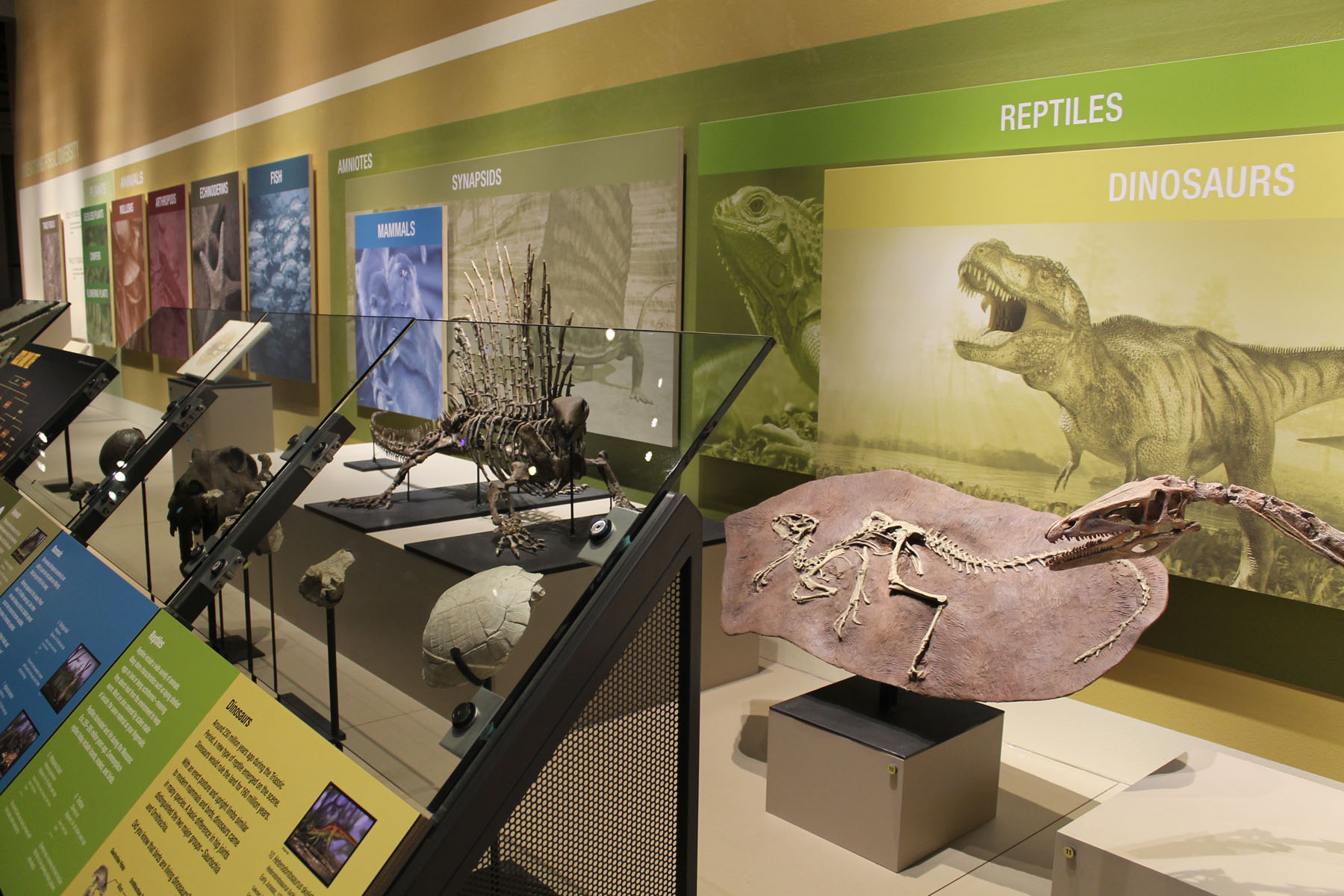
Other important stories are told around the perimeter of the exhibit space. Near the entrance, a remarkably concise display covers the definition of a fossil and brings order to the diversity of life on Earth. This is accomplished with a series of stacked boxes printed on the wall. The largest boxes are labeled Trace Fossils and Body Fossils. Within Body Fossils, there are Plants, Invertebrates, and Vertebrates. Within Vertebrates, there are Fish and Amniotes, and within Amniotes there are Synapsids and Reptiles. So it continues, eventually illustrating that dinosaur bones are only a small part of the huge range of living things that are found as fossils. Since visitor research has shown that cladograms are often counter-intuitive to non-specialists, it’s nice to see an attractive and accessible alternative.

layered boxes instead of cladogram

Colorful, stacked boxes offer a more accessible alternative to a cladogram. Photo by the author.

In another corner, there is a small display devoted to dinosaurs in popular culture. While some might call this a waste of space, I think it’s helpful to draw contrasts between popular images of dinosaurs and the real animals that were part of the history of life on our planet. This display acknowledges the relevance of roadside statues and Jurassic Park while plainly separating them from the rest of the science-driven exhibit.

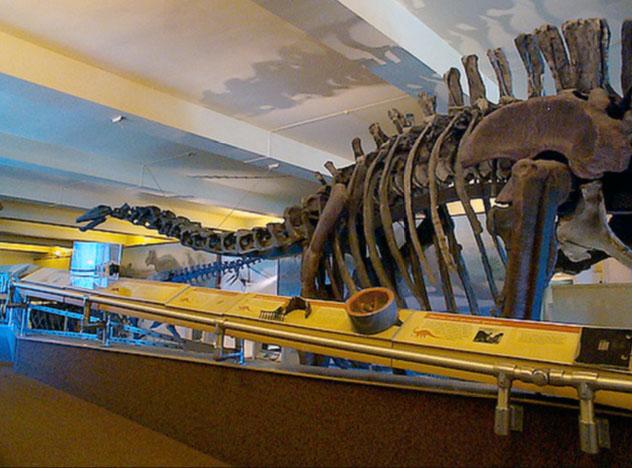
Quite possibly the best part of Life Then and Now (well, aside from the Alamosaurus – sauropods upstage everything) is the Rose Hall of Birds on the mezzanine level. It’s remarkable enough that the bird displays merge seamlessly with (and are in fact a part of) the dinosaur exhibit. But the Hall of Birds goes further, covering flight adaptations like unidirectional airflow and pneumatic bones, and how they first evolved for different reasons in dinosaurs. This is content that I wasn’t introduced to until grad school, but it’s all explained succinctly here, in language that is probably accessible to interested elementary school students. For some reason, this exhibit also includes digitized versions of bird-related literature dating back to the middle ages. It’s wonderful to see historic natural history acknowledged and celebrated in this context!

bird evolution!

Bird evolution explained. Photo by the author.

While Life Then and Now is barely half the size of the Morian Hall, I think it provides a much richer educational experience. While the exhibit certainly doesn’t reject what visitors expect to see (fighting dinosaurs!), it uses preconceptions and existing knowledge to make a series of important points about biology and evolution. As such, it’s an ideal blend of fun and science, visually attractive but built from the ground up on solid evidence. I can’t recommend it enough.

If any readers have visited the Perot Museum and/or HMNS, what did you think? Please don’t hesitate to weigh in!

Leave a comment

Filed under dinosaurs, exhibits, fossil mounts, opinion, reviews, science communication

Clash of the Texas Fossil Exhibits: HMNS

Quetzalcoatlus

A standing Quetzalcoatlus skeleton is a sight to behold, but is that enough? Photo by the author.

Last week, I checked two major fossil exhibits off my must-see list – the Morian Hall of Paleontology at the Houston Museum of Natural Science, and Life Then and Now at the Perot Museum in Dallas. Although both exhibits opened the same year and cover the same basic subject matter, they are radically different in terms of aesthetics, design, and interpretation. Life Then and Now is unabashedly excellent and pretty much embodies everything I called a Good Thing in my series on paleontology exhibit design. I’ll be sure to discuss it in detail later on. Nevertheless, I’m itching to write about the HMNS exhibit first because it’s—in a word—weird. The Morian Hall essentially rejects the last quarter century of conventional wisdom in developing fossil displays, and for that matter, science exhibits of any kind.

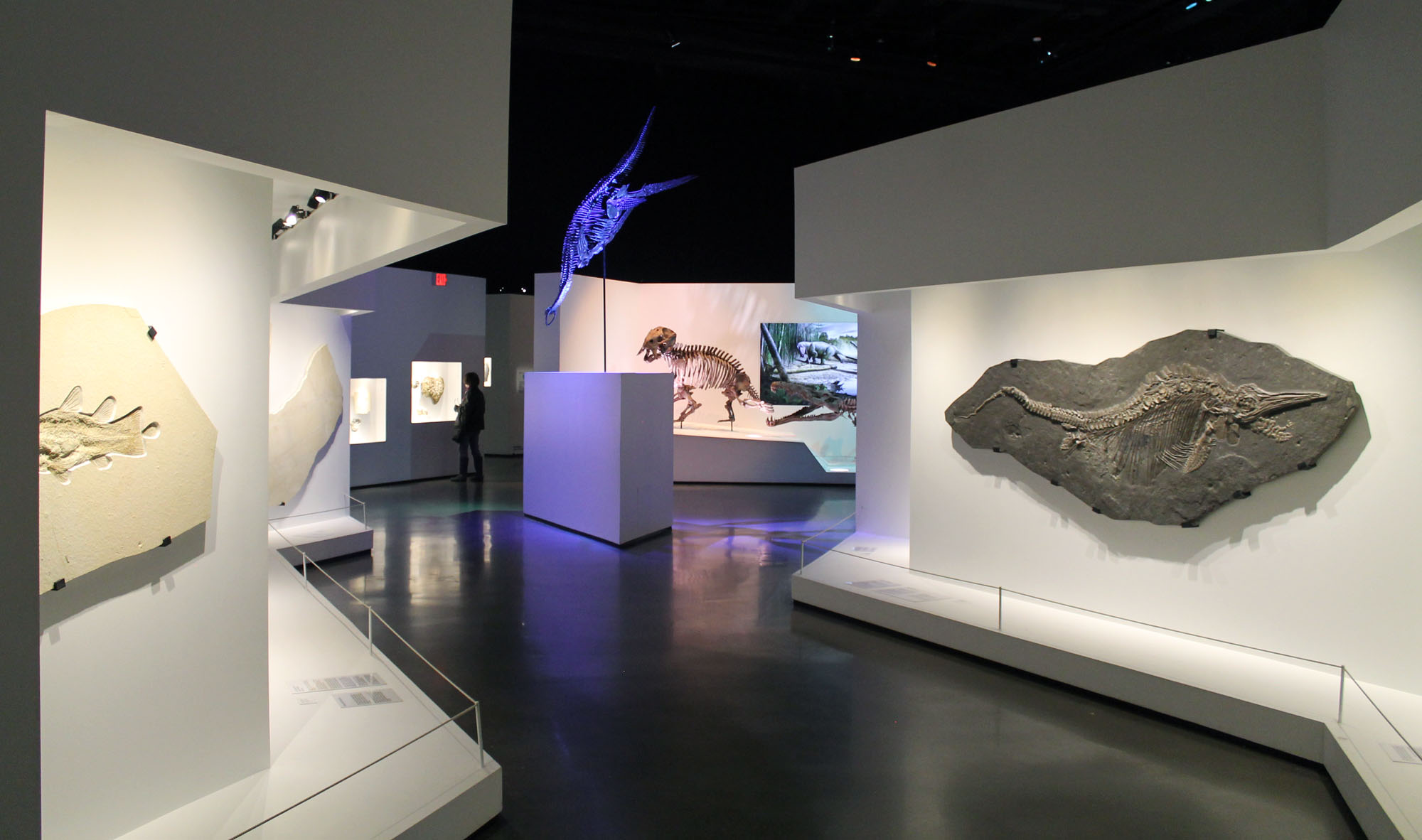
The Morian Hall occupies a brand-new 36,000 square foot addition to HMNS, apparently the largest in the museum’s history. The first thing I noticed walking into the exhibit was that the space doesn’t look like any other science exhibit I’ve seen, past or present. Instead, it strongly resembles a contemporary art gallery, and this fossils-as-art aesthetic permeates every aspect of the exhibit design. Specimens are displayed against stark white backgrounds, with smaller fossils in austere wall cases and larger mounted skeletons on angular, minimalist platforms. Most objects are displayed individually, with lots of negative space between them. Interpretive labels, where present, are small and out of the way (and the text is all in Helvetica, because of course it is). There are no interactive components of any kind—no movies, no computer terminals, not even question-and-answer flip-up panels. The exhibit is defined by its own absence, the structural elements and labels fading into the background with the intent that nothing distract from the specimens themselves.

white walls and art gallery format

The HMNS paleontology exhibit looks and feels like a contemporary art gallery. Photo by the author.

For the benefit of those outside the museum field, I should clarify that for myself and many others trained in science and history museums, art museums are basically opposite world. In an art museum, objects are collected and displayed for their own sake. Each artwork is considered independently beautiful and thought-provoking, and curators often strive to reduce interpretation to the bare minimum. Some museums have gone so far as to forgo labels entirely, so that objects can be enjoyed and contemplated simply as they are. Not coincidentally, art museums have a reputation as being “highbrow” establishments that attract and cater to a relatively narrow group of people. People who do not fit the traditional definition of art museum visitor sometimes find these institutions irrelevant or even unwelcoming (more on that in a moment). This summation is hardly universal, but I would argue that the participatory, audience-centered art museum experiences created by Nina Simon and others are an exception that proves the rule.

Natural history museums are different. Collections of biological specimens are valuable because of what they represent collectively. These collections are physical representations of our knowledge of biodiversity, and we could never hope to understand, much less protect, the natural world without them. Each individual specimen is not necessarily interesting or even rare, but it matters because it is part of a larger story. It represents something greater, be it a species, a habitat, or an evolutionary trend. Likewise, modern natural history exhibits aren’t about the objects on display, but rather the big ideas those objects illustrate. Since the mid-2oth century, designers have sought to create exhibits that are accessible and meaningful learning experiences for the widest possible audience, and natural history museums are generally considered family-friendly destinations.

label your damn casts

You can tell Robert Bakker was involved because everyone is rearing. Photo by the author.

There is much to like in the Morian Hall of Paleontology. For one thing, the range of animals on display is incredible. I cherished the opportunity to stand in the presence of a standing Quetzalcoatlus, a Sivatherium, a gorgonopsid, and many other taxa rarely seen in museums. Other specimens are straight-up miracles of preservation and preparation, including a number of Eocene crabs from Italy. I also enjoyed that many of the mounts were in especially dynamic poses, and often interacting with one another. With fossil mount tableaus placed up high as well as at eye level, there was always incentive to look around and take in every detail.

Nevertheless, the art gallery aesthetic raised a number of red flags for me. To start, the minimalist design means that interpretation takes a serious hit. Although the exhibit is arranged chronologically, there are many routes through the space and the correct path is not especially clear. Meanwhile, there are no large headings that can be seen on the move—visitors need to go out of their way to read the small and often verbose text. All this means that the Morian Hall is an essentially context-free experience. Visitors are all but encouraged to view the exhibit as a parade of cool monsters, rather than considering the geological, climatic, and evolutionary processes that produced that diversity. There is an incredible, interrelated web of life through time on display in the Morian Hall, but I fear that most visitors are not being given the tools to recognize it. By decontextualizing the specimens, the exhibit unfortunately removes their meaning, and ultimately their reality*.

*Incidentally, most of the mounted skeletons are casts. This is quite alright, but I was very disappointed that they were not identified as such on accompanying labels.

gorgeous but what does it mean

This double-helix trilobite growth series is gorgeous—but what does it communicate, exactly? Photo by the author.

What’s more, the idealized, formal purity of the exhibit design echoes a darker era in the history of museums. It’s no secret that many of the landmark museums we know today were born out of 19th century imperialism. Colonial domination was achieved not only with military power, but through academia. When colonial powers took over another nation, they brought their archaeologists, naturalists, and ethnographers along to take control of the world’s understanding of that place, its environment, and its people. Museums were used to house and display natural and cultural relics of conquered nations, and to disseminate western scientists’ interpretation of these objects. Even today, it is all too common to see ethnographic objects displayed in austere exhibit spaces much like the Morian Hall of Paleontology. These displays erase the objects’ original cultural meaning. Dinosaurs don’t care about being silenced, of course, but it’s odd that HMNS would choose to bring back such loaded visual rhetoric.

Pretty ammonites with donor names prominently displayed send the wrong message. Photo by the author.

Pretty ammonites with donor names prominently displayed send the wrong message. Photo by the author.

My final concern with the art gallery format is the implication that fossils have monetary value. Fossils are priceless pieces of natural heritage, and they cannot be valued because they’re irreplaceable. While there is a thriving commercial market for rare fossils, a plurality of paleontologists do not engage with private dealers. Buying and selling significant fossils for private use is explicitly forbidden under the ethics statement of the Society of Vertebrate Paleontology, and it is institutional policy at many museums that staff never discuss the monetary value of fossil specimens.

The art world has its own rules and standards. The price tags of famous pieces, including what a museum paid to acquire them, are widely known. Private collectors are celebrated, even revered. In fact, it is common to see exhibits built around a particular individual’s collection. These exhibits are not about an artist or period but the fact that somebody purchased these objects, and has given (or merely loaned) them to the museum. Two rooms in the Morian Hall are actually just that: otherwise unrelated specimens displayed together because they were donated by a specific collector. By displaying specimens with the same visual language as art objects, the Morian Hall undermines the message that fossils should not be for sale. Not only is the private fossil trade legitimized, it communicates that the primary value of fossils is their aesthetic appeal. Like the lack of contextual signage, this serves to obscure the specimens’ scientific meaning. Fossils are precious remains of real organisms, clues about ecosystems from long ago and the making of the world as we know it today. But that information is only available if they are publicly accessible, not sitting on someone’s mantelpiece.

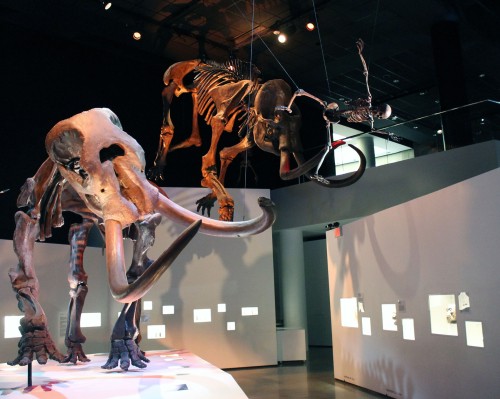
action!

A truly remarkable fossil mount tableau, in which a mastodon flings a human hunter while a mammoth is driven off a “cliff” in the background. Photo by the author.

Now hold on (regular readers might be saying), haven’t I argued repeatedly that fossil mounts should be considered works of art? Absolutely, and that is part of why I was taken aback by this exhibit. The difference is that while the Morian Hall displays fossils the way art is traditionally exhibited, it does not interpret them like art. When I call fossil mounts works of art, I mean that they have authorship and context. They have encoded and decoded meaning, as well as relationships with their viewers, creators, host institutions, and ultimately, the animals they represent. Calling something art is opening it up to discussion and deconstruction. The HMNS exhibits do the opposite.

For the last few decades, natural history museums have been opening windows onto the process of creating knowledge. Modern exhibits seek to show how scientists draw conclusions from evidence, and invite visitors to do the same. In the Morian Hall, those windows are closed. Specimens are meant to be seen as they are, reducing the experience to only the object and the viewer. But there is no “as they are” for fossils. Thousands of hours of fossil preparation and mount construction aside, every display in that exhibit is the result of literally centuries of research into geology, anatomy, and animal behavior. These are representations of real animals, but they also represent the cumulative interpretive work of a great many people. The display simply isn’t complete without their stories.

17 Comments

Filed under anthropology, dinosaurs, exhibits, fossil mounts, HMNS, mammals, museums, opinion, paleoart, reviews, science communication

History of the Field Museum Fossil Halls – Part 1

The Field Museum of Natural History (variously known as the Field Colombian Museum and the Chicago Museum of Natural History) was founded by wealthy philanthropists in the wake of the 1893 World’s Columbian Exposition in Chicago. It has since expanded into one of the largest natural history museums in the world, a destination attraction and a hub for ongoing research. What follows is a summary of the historic paleontology exhibits at the Field Museum – when and how they expanded and changed, when major specimens were added, and who spearheaded these efforts.

As with my previous overviews of fossil exhibits at AMNH and NMNH, please note that I will not be discussing field expeditions or research by museum staff in any detail, as these topics are well-explored elsewhere (see Paul Brinkman’s extensive work, for starters). My primary interest here is in the public-facing exhibits, and the people who created them.

Phase I: The Field Columbian Museum

The World’s Columbian Exposition was held in Chicago in 1893, principally as a celebration of the 400th anniversary of Christopher Columbus’s arrival in the Americas. Lasting six months and attended by 27 million people, the Exposition was monumental in size and scope. Years before it even opened, there was talk about using the Exposition displays to seed a new museum, which would rival the great natural history museums in New York and Washington, DC. Eager to establish an enduring cultural attraction in their city, a group of wealthy Chicagoans – including Marshall Field, who donated an unprecedented $1 million – contributed the necessary funds to buy up many of the Exposition’s exhibits and found the Field Columbian Museum.

As the largest and most elegant of the 200 temporary buildings constructed for the Exposition, the Palace of Fine Arts became the Field Museum’s home. Frederick Skiff served as the first director, acting as an intermediary between the board of trustees and the new curatorial staff, who would manage the collections and assemble the exhibits. Skiff hired geologist Oliver Farrington to curate the earth science collections, a diverse mix of minerals, gems, meteorites, fossils, and fabricated displays purchased from the Henry Ward Natural Sciences Establishment. With thousands of specimens to catalog, Farrington was soon overwhelmed. He repeatedly asked Skiff to hire a paleontology specialist to support him, but the board (composed of the businessmen who founded the museum) was uninterested in paying more salaries or acquiring new specimens.

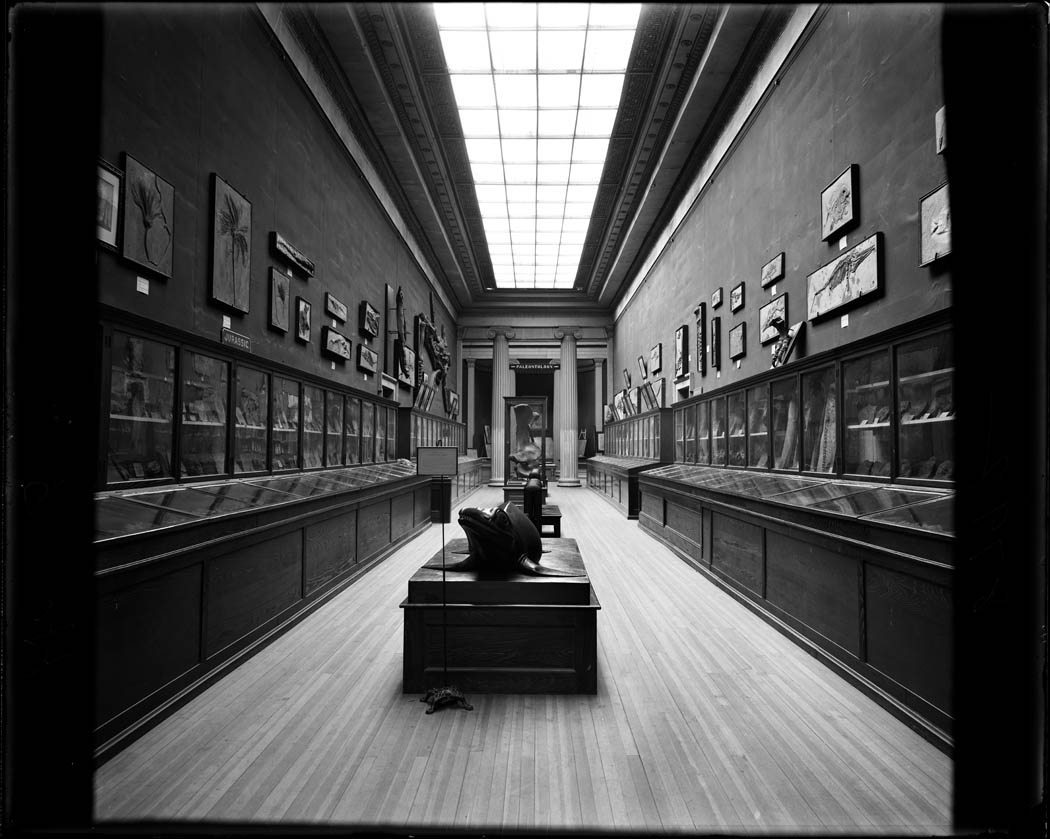
fossils

The model icthyosaur and thousands of fossils in cases were among the specimens purchased from the Ward Natural Sciences Establishment after the World’s Columbian Exposition. Image courtesy of the Field Museum Photo Archives.

When the Field Columbian Museum opened on June 2nd, 1894, most the 5,000-piece fossil collection was on public display. In addition to the cases of as-yet unlabled invertebrates, plants, and other small fossils, the exhibit included several large reconstructions of prehistoric animals. As of opening day, a life reconstruction of a mammoth stood in the west court, while skeletons of MegalocerosScistopleurum, MegatheriumHadrosaurus, and a uintathere stood in halls 35 and 36. With the exception of the Megaloceros, these were all replicas of mounts from other institutions. The Hadrosaurus in particular was woefully outdated, considered by contemporary scholars to have “long since ceased to have any value except as a historic attempt” (Beecher 1901).

After completing his catalog of the earth science collections in 1896, Farrington continued to lobby for a dedicated staff paleontologist. The board paid no attention until 1897, when the American Museum of Natural History and the Carnegie Museum of Natural History announced ambitious plans to scour the western interior for fossils. So began what Brinkman calls the second Jurassic dinosaur rush – a frenzied race among leading American museums to be the first to collect and mount a sauropod dinosaur. Not wanting to be left behind by peer institutions, the trustees approved the conditional hiring of Elmer Riggs to collect dinosaurs for the Field Museum.

Hadrosaurus cast on display at the Field Museum. Field Museum Photo Archives.

Hadrosaurus stands among other fossil casts in the Field Columbian Museum. Image courtesy of the Field Museum Photo Archives.

Riggs and his classmate Barnum Brown cut their teeth in paleontology while studying under Samuel Wendell Williston at the University of Kansas. The two young men took part in an AMNH collecting expedition in 1896. Brown, who had quit his studies to work for the museum, quickly became a favorite at AMNH. Concerned about his own future, Riggs sent an unsolicited letter to Frederick Skiff, offering his skills as a fossil collector and preparator. The letter crossed Skiff’s desk at an opportune time, and in the summer of 1898 Riggs was paid a small stipend for a trial collecting trip with Farrington. The expedition was a success, and Riggs was hired as an Assistant Curator before the end of the year.

Riggs’ first three collecting seasons with the Field Museum were enormously successful. In addition to the holotype of Brachiosaurus, at the time the largest known dinosaur, Riggs collected a very-well-preserved back end of an Apatosaurus near Fruita, Colorado. Nevertheless, AMNH won the sauropod race when they completed their composite “Brontosaurus” mount in 1905. The Carnegie Museum had a Diplodocus on display in 1907, and was busy cranking out casts for European heads of state. While Riggs’ Apatosaurus was more complete than any single specimen the other museums had recovered, it was still only half a dinosaur. Riggs and Farrington repeatedly lobbied the board for funding to find more sauropod material with which to complete the skeleton, but the trustees had moved on to other things.

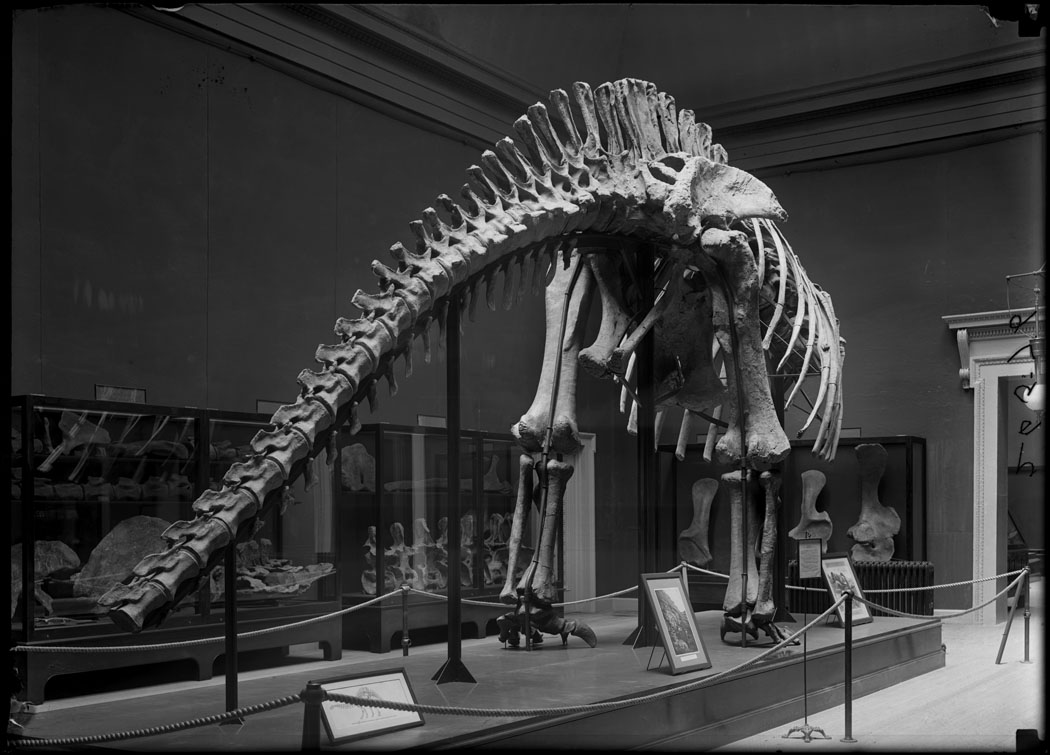
Riggs' Apatosaurus mount stood unfinished from 1908-1958. Photo from the Field Museum Library.

Riggs’ Apatosaurus mount stood unfinished from 1908-1958. Image courtesy of the Field Museum Photo Archives.

Plans were afoot to move the Field Museum to a new lakefront campus. However, when legal issues halted progress on the new building, Riggs was granted permission to mount the partial Apatosaurus in hall 35. The plaster casts previously displayed in this space were discarded, and unfortunately are now lost to history. A gas furnace was installed on the museum grounds, which Riggs and his small team used to shape massive steel I-beams for use in the armature. The teetering sauropod hindquarters was unveiled in 1908, but if Riggs hoped that the museum administrators would want to complete the mount once they saw how absurd the incomplete skeleton looked, he was out of luck.

Indeed, the years that followed were among the most frustrating of Riggs’ career. He received no funding to collect fossils after 1910, and could only look on enviously at the thriving paleontology research and exhibit programs at AMNH and the Carnegie Museum. The institutions in New York and Pittsburgh were headed by paleontologists, and bankrolled by wealthy fossil enthusiasts like J.P. Morgan and Andrew Carnegie. By comparison, the Field Museum was controlled by trustees with seemingly little interest in paleontology. Already paid less than the museum’s other curators, Farrington and Riggs were left with meager resources and little to do until the 1920s.

Phase II: Halls 37 and 38

The Palace of Fine Arts was intended to last six months, and after ten years it was in dire shape. The roof leaked constantly, putting exhibits and collections in danger, and fences had to be placed around the perimeter to protect visitors from falling brick. Before his death in 1906, Marshall Field worked with architect Daniel Burnham to design a new home for the museum. It took years to settle disputes over where to place the building, but ground was eventually broken off Lake Shore Drive in 1915. Completed in 1920, the new Field Museum of Natural History was a gleaming marble fortress, decorated inside and out with intricate neoclassical reliefs and statuary.

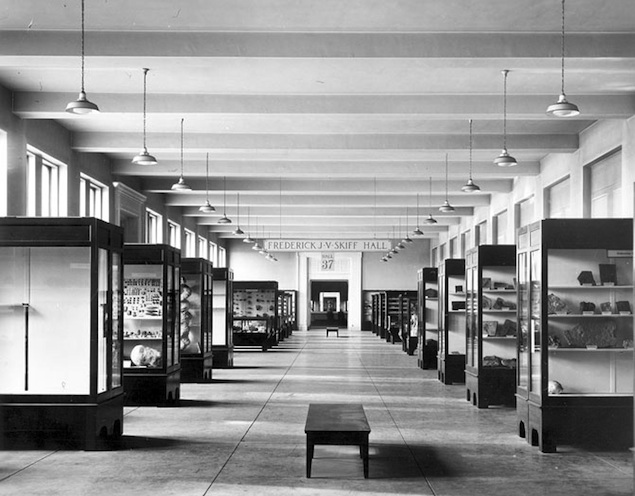
hall 37

In the spirit of a classic cabinet of curiosity, some of the cases in Hall 37 contained over a thousand specimens apiece. Source

Exhibits and collections were transported by rail car, often without being removed from their display cases. Earth science exhibits found a new home on the west side of the upper level. Hall 37, an east-west facing gallery accessible directly off the west mezzanine, housed invertebrate and plant fossils. Hall 38, running north to south against the far west side of the building, contained vertebrate fossils. Although it was colloquially known as the “dinosaur hall”, this space never contained many dinosaurs. In the 1920s, the only dinosaurs to be found were the half-Apatosaurus, a Triceratops skull, an articulated “Morosaurus” (Camarasaurus) limb, and parts of Brachiosaurus. The bulk of the specimens on display were Cenozoic mammals, including horses, rhinos, camelids, and a mammoth and mastodon. There was also a life-sized “coal swamp” diorama behind a glass barrier, with large model insects suspended in flight.

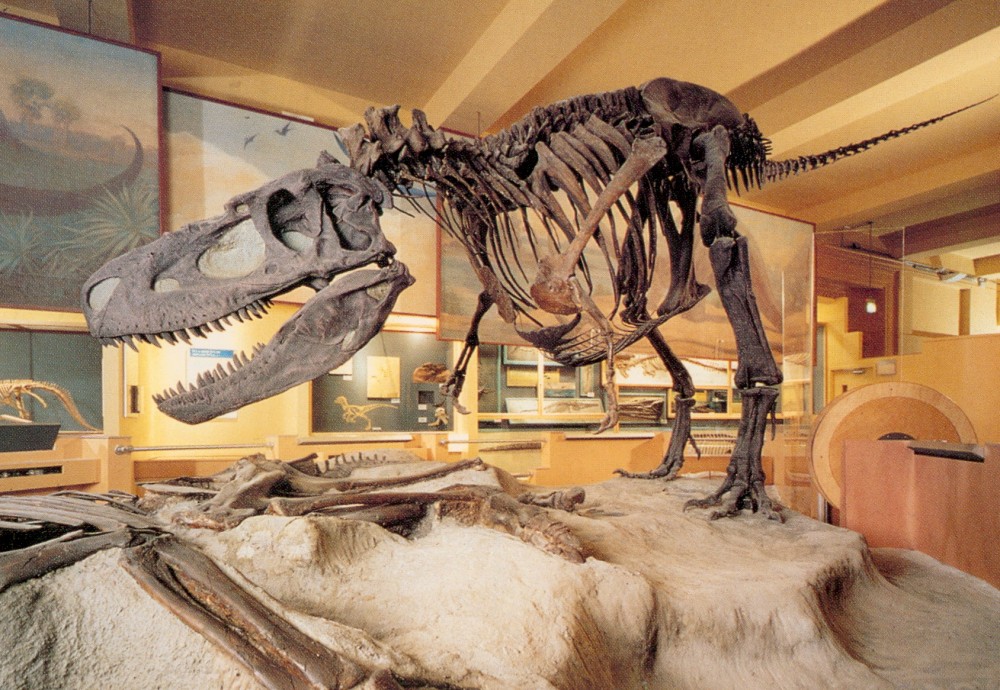
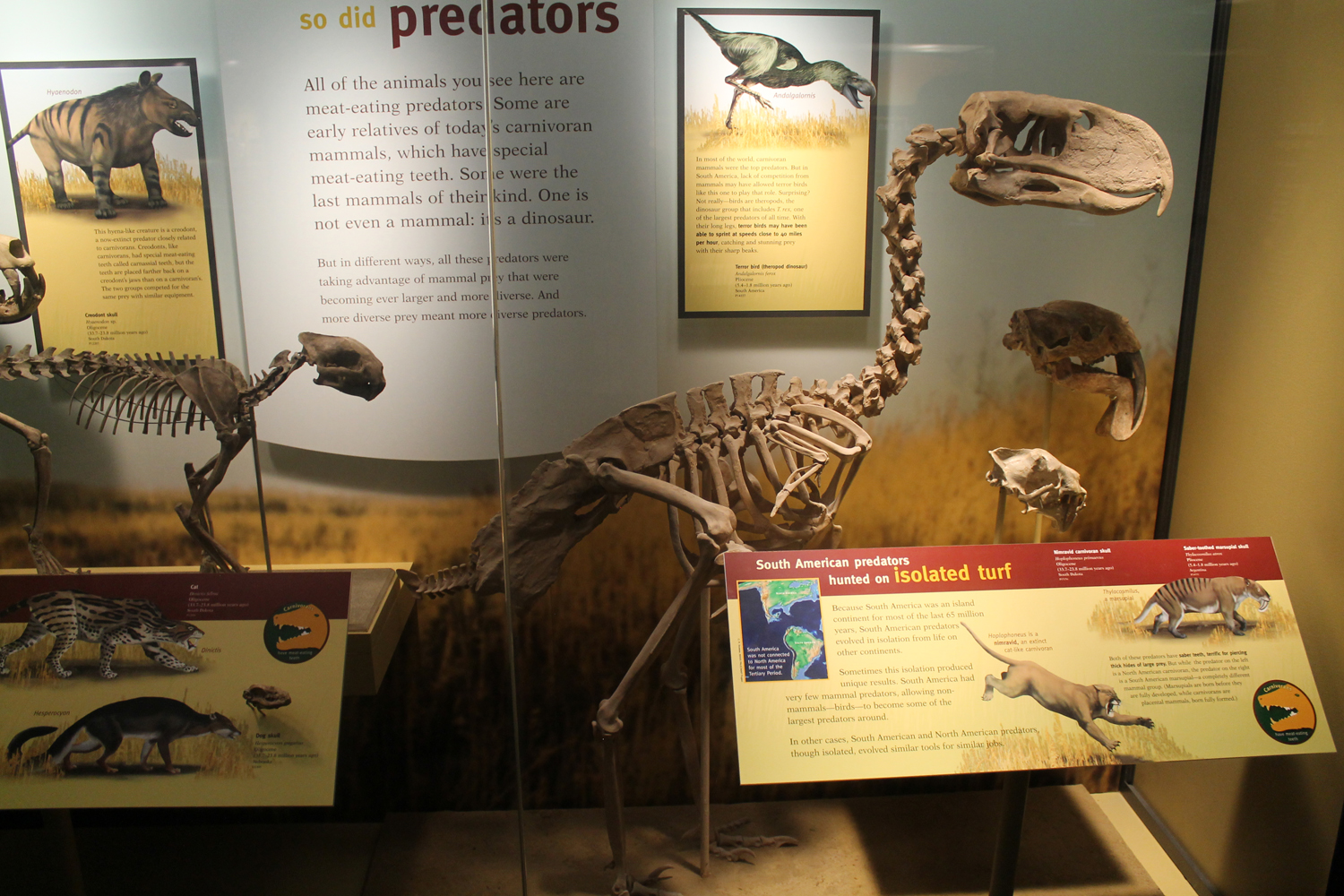
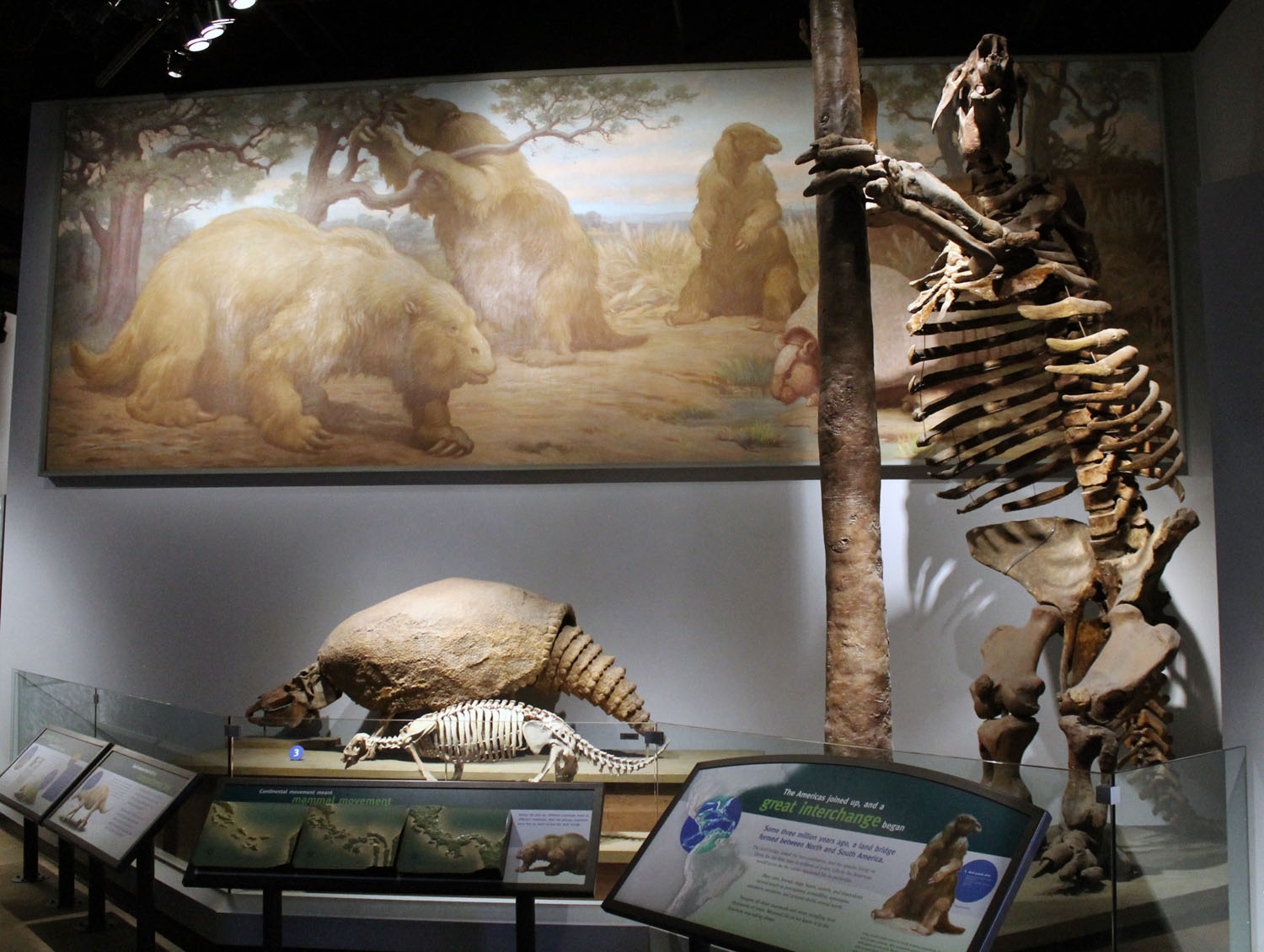
This comparatively modest exhibit was expanded significantly between 1922 and 1927, when Elmer Riggs was once again able to collect fossils in the field. Thanks to a bequest from Marshall Field’s grandson, Riggs traveled to Alberta, Argentina, and Bolivia, securing many unique specimens along the way. These included several new species, like the marsupial cat Thylacosmilus and the predatory bird Andalgalornis. A colossal Megatherium Riggs recovered in Argentina was immediately mounted for display, and became one of the most memorable elements of Hall 38.

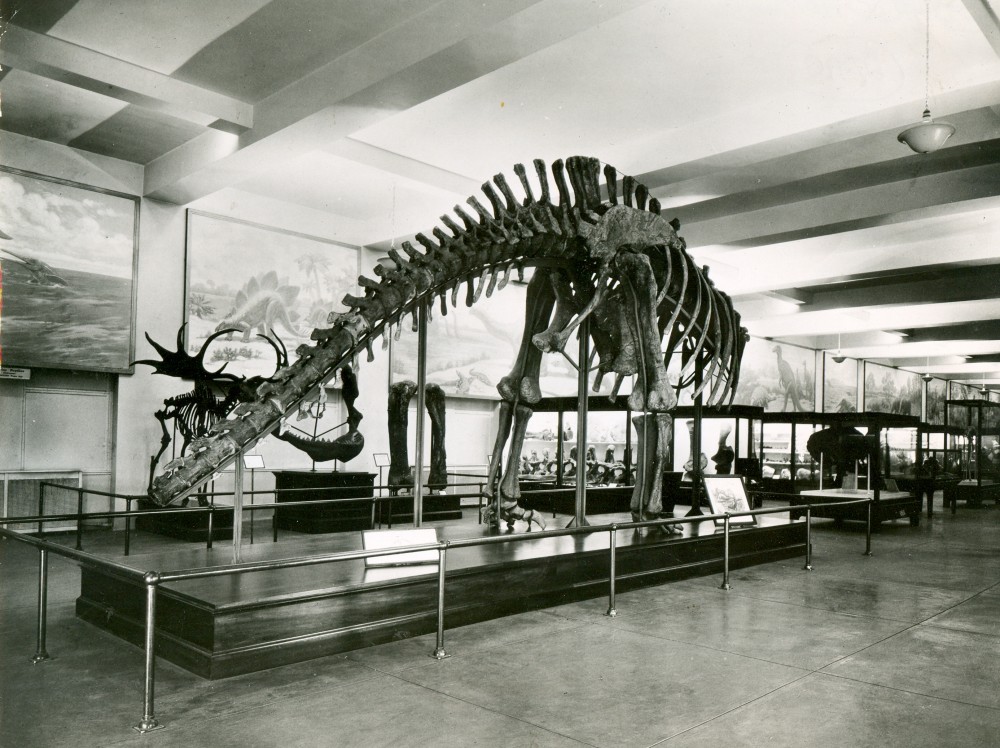
hall 38

A postcard of the partial Apatosaurus at the south end of Hall 38. Image courtesy of the Field Museum Photo Archives.

A postcard of the north end of Hall 38, featuring a South American giant sloth and other Cenozoic mammals.

Megatherium at the north end of Hall 38. Image courtesy of the Field Museum Photo Archives.

Hall 38 also boasted a spectacular set of murals by Charles Knight. The undisputed master of paleontological reconstructions and wildlife art, Knight had a long working relationship with Henry Osborn, president of AMNH. Osborn had commissioned Knight to create many large and small paintings for his museum’s fossil exhibits, but the two frequently argued over Knight’s remuneration. For years, Osborn and Knight discussed a series of immense wall canvases illustrating the entire history of life. Osborn could never get the money together, however, and Knight refused to produce any concept sketches for fear that they would be turned over to a less-skilled artist. In 1926, the Field Museum’s board of trustees asked for a meeting with Knight about an identical project for their new fossil hall. The initial discussion did not go well, and Knight walked out when the trustees started making “suggestions” about the content, color, and composition of the proposed artwork. Knight was very talented, but also very particular. He gladly accepted anatomical expertise from scientists but would not suffer meddling with the artistic aspects of his work. Fortunately for both parties, Knight’s daughter/manager Lucy intervened, securing her father the biggest commission of his career.

Knight completed 28 murals for the Field Museum, the largest of them measuring 25 feet long and nine feet high. Subjects ranged from the Proterozoic primordial soup to an iconic standoff between Tyrannosaurus and Triceratops. These images were not only painstakingly researched reconstructions based on the latest fossil evidence, they were (and still are) gorgeous works of art in their own right. With Knight’s murals in place, the Field Museum finally had a world-class paleontology exhibit.

hall 38 mastodon

The mastodon in Hall 38, with fossil horses visible beyond. Image courtesy of the Field Museum Photo Archives.

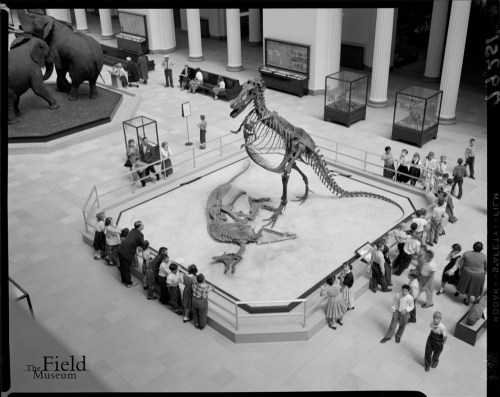
Gorgo in Stanley Field Hall. Photo courtesy of Field Museum Photo Archives.

Gorgosaurus” in the Stanley Field Hall. Photo courtesy of Field Museum Photo Archives.

Riggs retired in 1942, leaving paleontology at the Field Museum to the next generation, among them Eugene Richardson, Brian Patterson, and Orville Gilpin. In 1951, Richardson oversaw a thorough modernization of Hall 37. The number of specimens on display was drastically reduced, making room for more accessible explanations of the fossils and ten new dioramas of Paleozoic marine life. The resulting exhibit was one of the most comprehensive displays of fossil invertebrates in the world.

Although virtually no dinosaur research was done at the Field Museum between 1910 and the late 1990s, the 1950s saw the acquisition of two significant specimens for the benefit of the visiting public. In 1956, preparator Orville Gilpin assembled a Daspletosaurus (then called Gorgosaurus) for the central Stanley Field Hall. The skeleton was a surplus specimen from Barnum Brown’s years collecting along Alberta’s Red Deer River, and trustee Louis Ware spearheaded the effort to buy it from AMNH. Since the Daspletosaurus was acquired explicitly for display, Gilpin opted to skewer and otherwise permanently damage many of bones for the sake of an unobstructed, free-standing mount. In the mid 20th century, dinosaur fossils were thought of as display pieces first, and irreplaceable specimens second.

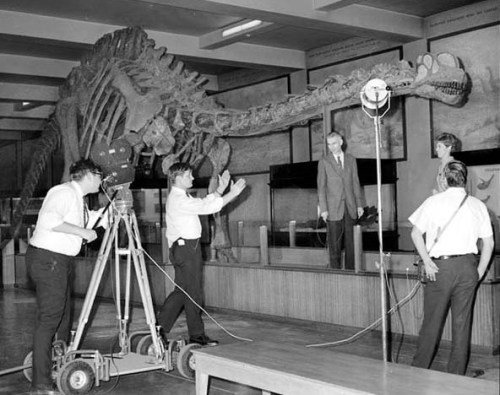
apatosaurus revised

The newly-finished Apatosaurus serves as a backdrop for an educational video shoot. Source

Two years after installing the Daspletosaurus, Gilpin finally completed Riggs’ partial Apatosaurus in Hall 38. When Edward Holt announced that he had discovered the front half of a sauropod near Green River, Utah, the Field Museum purchased the rights to excavate and display the find. Gilpin added the new fossils to the existing mount without dismantling Riggs’ heavy-duty armature. Relabeled “Brontosaurus” and erroneously given a casted Camarasaurus skull, the refreshed sauropod debuted in April 1958 – half a century after Riggs started the project.

The next three decades saw occasional piecemeal additions to the fossil halls. For example, the University of Chicago donated its entire geology collection to the Field Museum in 1965. This included a unique assortment of Permian amphibians and synapsids from the red beds of central Texas, many of them holotypes. Field Museum preparators remounted several of these specimens and integrated them into the exhibits. Nevertheless, Hall 38 never received a complete overhaul, and by the late 1980s it was quite dated. Not only were the fossil mounts in stiff, tail-dragging poses, but the stilted label copy written by curators past did not meet modern expectations for natural history exhibits. Even the vibrant Charles Knight murals looked tired behind years of accumulated dust and dirt. In short, the Field Museum was long overdue for a total re-imaging of its paleontology displays.

Next time, we’ll take a look at the Field Museum’s fossil exhibits from the 1990s onward. Stay tuned!

References

Beecher, C.E. 1901. The reconstruction of a Cretaceous dinosaur, Claosaurus annectens Marsh. Transactions of the Connecticut Academy of Arts and Sciences. 11: 311-324.

Brinkman, P.D. 2000. Establishing Vertebrate Paleontology at Chicago’s Field Colombian Museum: 1893-1898. Archives of Natural History 27: 1: 81-114.

Brinkman, P.D. 2o10. The Second Jurassic Dinosaur Rush: Museums and Paleontology in America at the Turn of the 20th Century. Chicago, IL: The University of Chicago Press.

Chicago Natural History Museum Bulletin. (March 1956). 27: 3.

Gilpin, O.L. 1959. A Freestanding Mount of Gorgosaurus. Curator 2: 2: 162-168.

Glut, D.F. 2001. Remembering the Field Museum’s Hall 38. Jurassic Classics: A Collection of Saurian Essays and Mesozoic Musings. Jefferson, NC: McFarland.

Lelièvre, M A. 2006. Evolving Planet: Constructing the Culture of Science at Chicago’s Field Museum. Anthropologica 48: 2: 293-296.

Milner, R. 2012. Charles R. Knight: The Artist Who Saw Through Time. New York, NY: Abrams.

Tubitis, T.J. 2005. Revitalizing Life Over Time: A New Look for a Very Old Topic. In the Field 76: 2: 18.

Williams, P.M. 1968. The Burham Plan and the Field Museum. Bulletin of the Field Museum of Natural History 39: 5: 8-12.

4 Comments

Filed under dinosaurs, exhibits, FMNH, fossil mounts, history of science, mammals, museums, reptiles, sauropods

Envisioning the Ice Age at NMNH

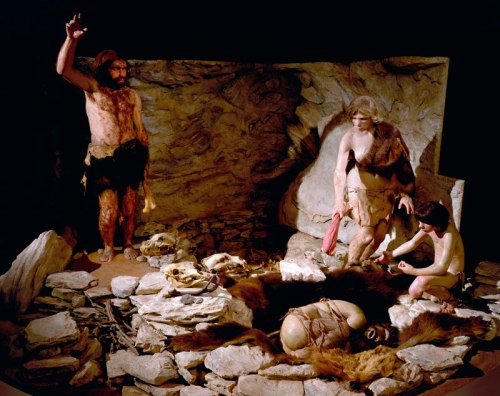
neanderthal diorama

The neanderthal burial diorama. Image from Ice Age Mammals and the Age of Man, 1974.

On September 13, 1974, the Hall of Ice Age Mammals and the Rise of Man opened in Hall 6 at the National Museum of Natural History. Part of the “third wave” of NMNH exhibits, the Ice Age Hall was the result of interdisciplinary collaboration and a new drive to create more accessible, visitor-centric museum experiences. Specifically, the exhibit was a response to increasing pressure for museums to become destination attractions, valuing visitors’ desire to be entertained above anything else. The Ice Age Hall was meant to prove that good science and the intrinsic value of specimens could, in fact, be applied in a way that would appeal to contemporary audiences. The curators, designers, educators, and artists involved with the project saw it as an important departure from old methodologies, and expected it to be a template for future exhibits. This transition did not necessarily come easily, but for 40 years the results spoke for themselves.

The Hall of Quaternary Vertebrates

wegegeg

Large fossil mounts in the short-lived Pleistocene Hall. Images courtesy of the Smithsonian Institution Archives.

Despite the fanfare accompanying the Ice Age Hall’s opening, NMNH regulars would be forgiven for noticing that much of the exhibit looked familiar. Just four years earlier, this same space saw the opening of the brand-new Hall of Quaternary Vertebrates. This was the fifth and final phase of a thorough re-imagining of the museum’s fossil displays that began in 1959. Under the guidance of exhibit designer Ann Karras, the loose arrangement of specimens that had characterized the east wing for half a century was replaced with a directed narrative of the biological and geological history of the Earth.

This new direction was motivated by complementary revolutions in the museum field and in paleontology. Museum workers shrugged off their “cabinet of curiosity” roots and embraced education-oriented exhibits. Designers began to envision the routes visitors would travel through an exhibit space, and consider how objects on display could contribute to holistic stories. Meanwhile, paleontologists moved their field away from purely descriptive natural history, exploring instead how the fossil record could inform our understanding of evolution and ecology. At NMNH, this change in ideology inspired paleontologists to break away from the Geology Department and form their own Department of Paleobiology. The common thread between both transitions was a focus on connections – bringing new meaning and relevance to disparate parts by placing them in a common narrative.

Piano wire barely visible. Photo from Marsh 2014.

Two dire wolves posed over a horse. This display didn’t make it into the Ice Age Hall. Source

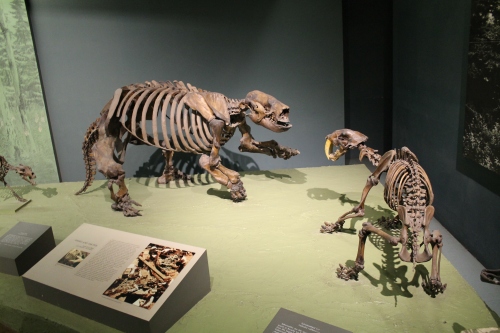
As Curator of Paleontology, C.L. Gazin oversaw most of the east wing modernization and designed the Tertiary Mammals exhibit in Hall 4 himself. Gazin retired in 1970, however, so responsibility for the unfinished Quaternary exhibit in Hall 6 went to new hire Clayton Ray, the Assistant Curator of Cenozoic Mammals. To fill out the Quaternary Hall, Ray arranged a number of trades with other museums. The Natural History Museum of Los Angeles County provided a saber toothed cat, two dire wolves, and the sheep-sized sloth Paramylodon (USNM 15164) from the La Brea tar pits, while the American Museum of Natural History was able to spare a bison “mummy” (USNM 26387) and a taxidermied musk ox. Ray also selected a complete set of mammoth bones from the AMNH collections, which were found during a gold mining operation near Fairbanks, Alaska. The bones were collected individually and belonged to an unknown number of individuals (they may well represent multiple species), but they were sufficient for preparator Leroy Glenn to construct a complete mounted skeleton.

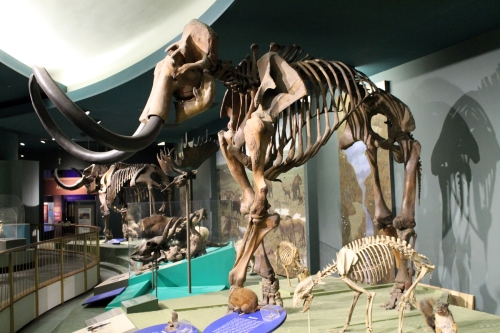
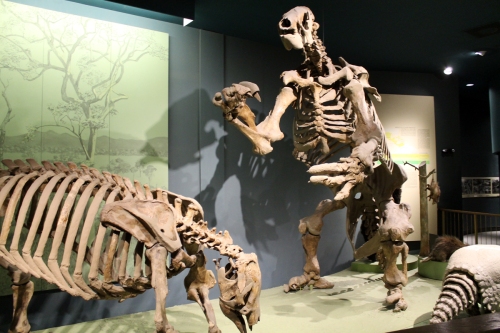
Ray placed the new mammoth (USNM 23792) alongside the Indiana mastodon (USNM 8204), which had been on display since 1904. The mammoth was so tall that it had less than an inch of clearance with the ceiling. The other big draw in  the Quaternary Hall was a pair of never-before-exhibited giant sloths (USNM 20867 and USNM 20872) assembled from material Gazin collected in Panama. Referred to as “megatheres” at the time, these sloths are actually Eremotherium, and they are composites of at least eight individuals. The giant sloths were positioned back-to-back on a central platform, accentuated by an illuminated opening in the ceiling. All four giant mammal skeletons were supplemented with 1/5th scale life restorations created by staff artist Vernon Rickman. Exhibits specialist Lucius Lomax came up with the idea to display the fossil mounts behind piano wire, stretched from the floor to the ceiling and arranged in rows. The Eremotherium platform alone required 500 strands – or about 6000 feet – of wire.

A New Vision

Chimera mammoth

The composite mammoth looms over other specimens along the right wall of the Ice Age Hall. Photo by the author.

Neither NMNH staff nor museum visitors were overjoyed with the Quaternary Hall as it stood in 1970. The piano wire Lomax had installed was a frequent cause for complaint: visitors would constantly pluck at the strings and occasionally break them. The wires also ruined photos. Automatic lenses would focus on the wire, so when visitors got their vacation pictures developed they would end up with a bunch of images of vertical strands with darkness beyond them. Nevertheless, the piano wire was really just a scapegoat for deep-seated disagreements over content between paleontology curators and exhibit designers. This apparently unsolvable clash of personalities contributed to the hall being closed indefinitely after just a couple years.

Paleontologist Porter Kier became Director of NMNH in 1973, and one of his first moves was to assemble a new team to reinvent the Quaternary Hall. Paleobotanist Leo Hickey, geologists Robert Emery and Thomas Simkin, and anthropologist William Fitzhugh conceived of an interdisciplinary exhibit that would explore the ice ages from multiple perspectives. Continental glaciation, the evolution and extinction of large mammals, and the rise of humans would all be presented in a single, holistic story. In what was at the time a novel development, the curators worked with Elaine Anderson and other “conceptualizers/writers” from the Office of Exhibits. The scientists conceived of the main ideas and ensured factual accuracy, but the Office of Exhibits ultimately wrote the label copy and oversaw the construction of the exhibition.

arch section

A statue of an archaeologist at work was a popular part of the exhibit. Image from Ice Age Mammals and the Emergence of Man, 1974.

To accommodate new content, the existing Quaternary Hall layout had to be completely gutted and replaced. Although Clayton Ray was conspicuously absent from the exhibit team, most of the modern and fossil animal specimens he had gathered were reused in different locations. The center of the exhibit became an enclosed theater with a video presentation about the advance and retreat of North American glaciers. The north end of the hall was overtaken by human evolution displays. Replica skulls and full-body illustrations showed the progression of hominids from australopithicines to modern humans, amusingly represented by a hippie. Vernon Rickman returned to create a life-sized diorama depicting a neanderthal burial ceremony. While directly based on excavations at Regourdou Cave in France, the scene was also inspired by the much-publicized Shanidar Cave site in Iraq, where neanderthals allegedly laid their dead to rest on a bed of freshly picked flowers. Finally, a cast of an engraved mammoth tusk, based on a 25,000 year old original from the Czech Republic, was added to the south entrance. This piece was meant to tie the exhibit’s narrative together, symbolizing “man’s emergence in the ice age as a dominant influence on other animals and his environment” (Ice Age Mammals and the Emergence of Man, 1974).

Vernon Rickman works on neanderthal models in 1973. Image Courtesy of the Smithsonian Institution archives.

Vernon Rickman works on neanderthal models in 1973. Image courtesy of the Smithsonian Institution Archives.

The Ice Age Hall was completed remarkably quickly. Kier pulled the team together in early 1974 and the new displays were designed, written, and fabricated by September. At least internally, a great deal of excitement accompanied the reopening of Hall 6. The Ice Age Hall was a serious departure from how exhibit work had traditionally been done at NMNH, but it also represented an attempt by the museum to stand its ground in the face of pressure to delve into “edutainment.” This was a trial run at developing a visitor-focused but science-driven exhibit, and everyone involved was anxious to see how the public would react.

Legacy of the Exhibit

Eremotherium today. Photo by the author.

Few visitors can help but stop in their tracks at the sight of the Eremotherium pair. Photo by the author.

In 1978, Robert Wolf and Barbara Tymitz published a “naturalistic/responsive” evaluation of the Ice Age Hall. Their groundbreaking and oft-cited methodology involved interviewing visitors and surreptitiously tracking them through the gallery space, seeking to understand how museumgoers were using and interpreting the “complex set of stimuli” presented by the exhibit. This document, and especially the taxonomy of visitor types it describes, may well have influenced the museum field more than the Ice Age Hall itself.

According to Wolf and Tymitz, the Ice Age Hall was largely successful. Visitors generally remembered the major topics under discussion, and frequently left more curious about natural history than when they entered. They also noticed the difference in layout from the rest of the museum, describing it as easier to navigate and understand. Not surprisingly, the mammoth, mastodon, Eremotherium, and neanderthal burial were the most popular and most photographed objects. In comparison, the carved mammoth tusk at the front of the hall recieved surprisingly little attention. This object was intended to be tie the entire exhibit together, but most people ignored it entirely. Likewise, the separation of North and South American animals via an architectural “land bridge” was completely lost on visitors. Wolf and Tymitz observed that visitors entering from the south paid more attention to the fossil mounts, while visitors entering from the north were drawn to the glacier theater. A lesson about the importance of sight lines and traffic flow lies therein.

La brea mounts. Photo by the author.

Paramylodon and Smilodon from the La Brea tar pits. Take a good look at the sloth, because it won’t be returning in 2019. Photo by the author.

After 40 years, not every element of the Hall of Ice Age Mammals and the Emergence of Man aged gracefully. Most obviously, the androcentric title and frequent use of the word “man” to describe humans throughout the label copy comes across as painfully dated. Displays that warned of another period of global cooling were removed (or at least stopped being lit) when anthropogenic warming emerged as a crucial public policy concern. The multimedia demonstration of continental glaciation was shut down by the early 2000s, and the human evolution corner was boarded up once the Hall of Human Origins opened in 2010. While the neanderthal diorama remained on display, recent research has shown that the affectionate burial it depicts is probably a misinterpretation. Ironically, the gradual removal of geology and anthropology components effectively turned the Ice Age Hall into the straightforward menagerie of Pleistocene animals that Ray initially envisioned.

The Ice Age Hall closed along with the rest of the NMNH fossil displays in April 2014. When the east wing reopens, many of the specimens will return restored and remounted, but in a different location. Since the new National Fossil Hall will be arranged in reverse chronological order, Hall 6 itself will house displays on the origins of life and an expanded FossiLab. Still, the Ice Age Hall experiment continues to leave its mark on the museum. The collaborative workflow and sharing of responsibilities between curators, educators, and exhibit specialists pioneered in the development of this exhibit remains standard practice today. The result has been ever more effective displays, providing solid scientific content to the widest possible audience.

References

Eschelman, R.E., Emry, R.J., Domning, D.P. and Bohaska, D.J. (2002). Biography and Bibliography of Clayton Edward Ray. Cenozoic Mammals of Land and Sea: Tributes to the Career of Clayon E. Ray. Emry, R.J., ed. Washington, DC: Smithsonian Contributions to Paleobiology.

Lay, M. (2013). Major Activities of the Division of Vertebrate Paleontology During the 1960s. http://paleobiology.si.edu/history/lay1960s.html

Marsh, D.E. (2014). From Extinct Monsters to Deep Time: An ethnography of fossil exhibits production at the Smithsonian’s National Museum of Natural History. http://circle.ubc.ca/handle/2429/50177

Sepkoski, D. (2012). Rereading the Fossil Record: The Growth of Paleobiology as an Evolutionary Discipline. Chicago, IL: The University of Chicago Press.

Smithsonian Institution. (1974). Ice Age Mammals and the Emergence of Man. Washington, DC: Elephant Press.

Wolf, R.L. and Tymitz, B.L. (1978). Whatever Happened to the Giant Wombat: An Investigation of the Impact of the Ice Age Mammals and the Emergence of Man Exhibit. Washington, DC: Smithsonian Institution.

Yochelson, E. (1985). The National Museum of Natural History: 75 Years in the Natural History Building. Washington, DC: Smithsonian Institution.

4 Comments

Filed under anthropology, education, exhibits, Extinct Monsters, fossil mounts, history of science, mammals, museums, NMNH, science communication

The Nation’s T. rex Revealed

The Nation's T. rex was temporarily assembled in the RCI workshop for inspection by Smithsonian staff. Source

The Nation’s T. rex was temporarily assembled in the RCI workshop for inspection by Smithsonian staff. Source

Yesterday, a press embargo lifted and the world got it’s first look at the pose the Nation’s T. rex will assume in the new fossil hall at the National Museum of Natural History. I don’t have much to add to the solid coverage at The Washington Post, NPR, and Smithsonian Magazine except holy crap, that’s awesome.

The photo above (by Nikki Kahn of The Washington Post) was taken when Smithsonian staff visited the Research Casting International workshop to inspect the mount’s progress. Located outside of Toronto, RCI is the industry leader in the art of creating mounted fossil skeletons, and their work is on display in museums all over the world. The Nation’s T. rex is one of 52 mounts the company will create for NMNH over the next three years.

Dr. Carrano gestures toward the awesomeness behind him.

Dr. Carrano gestures toward the awesomeness behind him. Source

The Nation’s T. rex (also known as Wankel Rex) is new to NMNH, but it is not a new specimen. It was discovered by Montana rancher Kathy Wankel in 1988 on land owned by the Army Corps of Engineers. The skeleton, which was for a time the most complete Tyrannosaurus known, was held in trust at the Museum of the Rockies until last April, when the Corps loaned the specimen to the Smithsonian for the next 50 years. This is the first time the original fossils have been displayed in a standing mount, but RCI has been producing casts of the specimen for years. Examples can be seen at the Great North Museum, the Royal Ontario Museum, the Perot Museum of Nature and Science, and even the Google Campus.

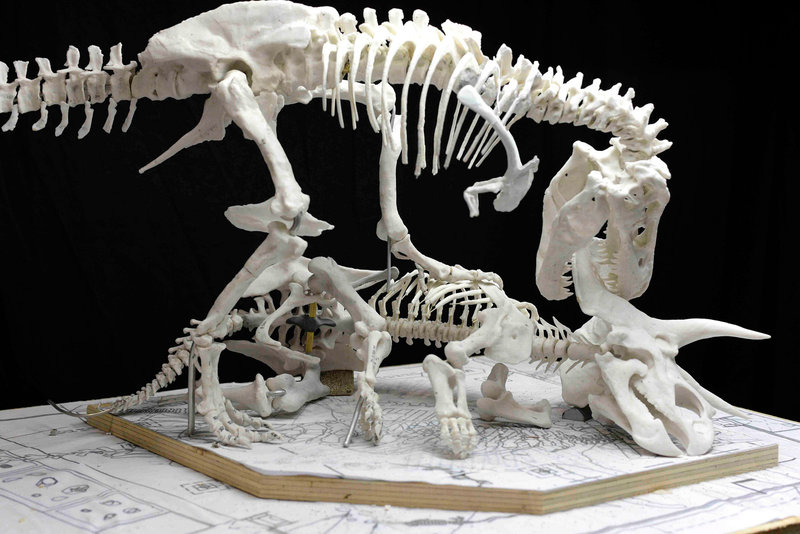
The Smithsonian team inspecting every inch of the 2,000 pound mount included Curator of Dinosauria Matt Carrano, Exhibit Project Manager Siobhan Starrs, and Preparator Steve Jabo. The violent scene, with the Tyrannosaurus preparing to decapitate its Triceratops prey, was first suggested by Carrano over two years ago. The inspiration came from research by Denver Fowler and colleagues, which proposed that Tyrannosaurus regularly dismembered Triceratops by pulling the head off by the frill. The dynamic pose sets the Nation’s T. rex apart from the more “regal” stances other museums have chosen for their Tyrannosaurus mounts, and also reminds visitors that this animal was a living, acting being within its environment.

A 3-D printed model of the skeleton was used to plan the pose. Source

The exhibit team used a 3-D printed model of the skeleton to plan the pose. Source

The tyrant king’s prey is none other than a cast of Hatcher, NMNH’s resident Triceratops. This composite skeleton was the first mounted Triceratops ever exhibited, and it has been on display in one form or another since 1905. An updated reproduction of Hatcher can be seen right now in The Last American Dinosaurs, but apparently this will be its last hurrah. As Carrano put it, “Hatcher’s done its duty.” Even relegated to the role of food, however, Hatcher is still an impressive beast. The skeleton is nearly as long as the Nation’s T. rex, and noticeably bigger than the Triceratops mounts at other major U.S. museums.

Hatcher Photo by the author.

Poor Hatcher knows nothing of his imminent demise at the claws of a 38-foot murderbird. Photo by the author.

The NMNH team had a few notes for RCI, both for the sake of accuracy and the sake of the exhibit. Carrano requested that the fibula be rotated slightly, while Starrs emphasized that the tail should be at least 10 feet off the ground, to prevent over-enthusiastic visitors from grabbing at it. The workshop visit was also an opportunity to explore how the mount would look among the other denizens of the National Fossil Hall. Hatcher and the Nation’s T. rex will be sharing space on the Creataceous platform with Edmontosaurus, Thescelosaurus, and the crocodile relative Champsosaurus, among others. Working out dynamic poses that also keep key lines of sight open is no easy task, and the gallery space needs to be planned down to the inch.

As is now industry standard, RCI’s armature is made up of intricate steel cradles that are custom fitted to hold each of the 150 real fossils in place. Unlike many historic mounts, no holes have been drilled in the bones and none of the delicate fossils are supporting the structure’s weight. Most bones can be removed individually, and with the right equipment, the entire mount can be assembled in just a few hours. As such, we can rest assured that this display will not only be incredibly cool, but the authentic 66 million-year-old fossils will be as safe as they could possibly be while on view for 7 million visitors per year.

5 Comments

Filed under dinosaurs, exhibits, fossil mounts, marginocephalians, museums, NMNH, theropods

See the Elephant

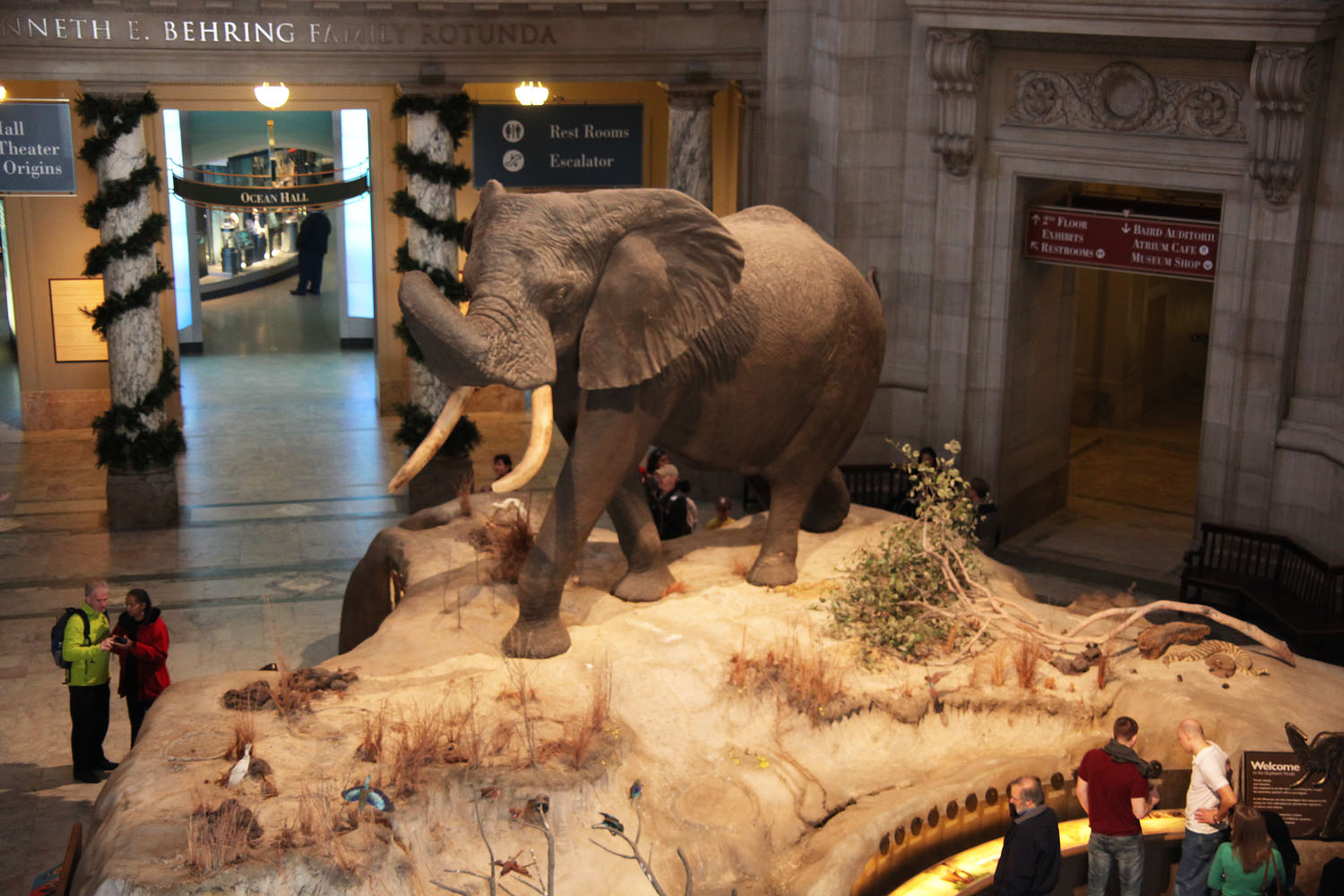
Fenykovi elephant at the National Museum of Natural History, September 2014. Photo by the author.

National Museum of Natural History rotunda, September 2014. Photo by the author.

The iconic Fénykövi elephant, the centerpiece of the National Museum of Natural History rotunda since 1959, received an update last week in the form of a new interpretive platform. Like the Barosaurus at the American Museum of Natural History and Máximo at the Field Museum, this African bush elephant is the first object most NMNH visitors see upon entering. With its ears forward and its trunk raised, the elephant stands over 13 feet tall—larger than any elephant known to be living today. But in spite of its inspiring presence as the symbol of the museum, this elephant has a problematic history that NMNH has long struggled to interpret.

Hungarian-born Josef J. Fénykövi shot the elephant in Angola in 1955. Fénykövi owned a ranch in the west African nation (at the time a Portuguese colony), where he spent several months each year hunting wildlife. After discovering the existence of an unusually large bull elephant in 1954, Fénykövi returned the following year equipped to track and kill what was thought to be the biggest land animal on the planet. Fénykövi and his team of guides located the giant elephant on November 13th, and eventually downed it after a full-day chase*. A truck filled with salt was required to keep the hide fresh during the hundred-mile journey from the kill site to the nearest train station in Kuito. Rather than keep the trophy for himself, Fénykövi decided to donate the animal to a museum. He offered it to the London Natural History Museum first, but the process was taking too long for his taste so he gave the elephant to the Smithsonian, instead. Later, an old-fashioned slug from a flintlock pistol found embedded in the elephant’s leg provided reason to believe the animal had been nearly 100 years old when Fénykövi killed it.

*Fénykövi’s account gives the impression that the guides did most of the work. They tracked the elephant’s prints and spoor on foot while Fénykövi followed in a jeep, and a man named Mario fired the shots that actually finished off the animal. 

The acquisition and subsequent exhibition of the Fénykövi elephant at NMNH gives us a great deal to unpack. The collection of animals for public display has fallen sharply out of favor over the past century. In the late 1800s, little worlds behind glass populated by taxidermy animals provided the increasingly urban public a window into the natural world they felt they had left behind. But even in Fénykövi’s day, popular opinion was beginning to turn against the practice. For most, this aversion to taxidermy begins and ends with the unpleasantness of being confronted with a dead animal. Some scholars rightly call attention to the imperialism and exoticism inherent in collecting animals from far-flung lands. This criticism is especially apt for Fénykövihis story contains more than a whiff of imperialist entitlement.

Fénykövi Elephant in the 1960s. Photo courtesy of the Smithsonian Institution Archives.

The Fénykövi Elephant in the 1960s. Photo courtesy of the Smithsonian Institution Archives..

The fact that the elephant was killed as a trophy complicates matters still further. It’s one thing for a museum to display an animal that was sacrificed for science—to better understand its biology or to contribute to a record of biodiversity. Displaying a trophy is quite another. While a typical museum taxidermy display represents the life of an animal, a trophy mount celebrates that animal’s death. As Poliquin explains, “trophies arouse negative reactions not simply because they are evidence that a human killed an animal…they are evidence of a human’s desire to kill an animal” (Poliquin 2010, 152). Indeed, it is arguably impossible to fully separate a trophy mount from the narrative of the creature’s demise.

For Fénykövi, the meaning of the elephant is obvious. It represented a specific, triumphant event in his life, an attempt to communicate something about himself through the death of animal. NMNH staff have faced the much greater challenge of interpreting Fénykövi’s trophy for the millions of visitors that enter the rotunda every year. For 60 years, they have struggled to present this animal, selfishly killed by a wealthy colonial, in a way that matched the museum’s conservation-oriented mission.

The elephant’s original context unfortunately left something to be desired. The traditional, circular pedestal in the center of the NMNH rotunda did not effectively distance the specimen from it’s origin as a trophy, and the museum was occasionally criticized for complicity with big-game hunting and the colonial agenda. Nevertheless, the elephant did eventually earn an identity as a symbol for the museum, largely separate from the man who killed it. Credit for this accomplishment goes to William Brown and Norman Deaton, who prepared and mounted the hide over sixteen months. Brown and Deaton managed to imbue this dead skin over a wood-and-plaster frame with an astonishing amount of life and character. The elephant holds court in the four-story rotunda, exuding confidence and power over its domain. It’s an unforgettable sight, and it almost makes one forget that this animal is only there because it lost a fight.

Words Source

The 1999 habitat diorama platform—my favorite iteration. Source

Still, it was clear by the 1990s that while the elephant was there to stay, it needed to be more thoughtfully contextualized. In 1999, NMNH replaced the old pedestal with a large, open diorama of the Angolan savanna, which brought the elephant three feet higher off the ground. The project was completed entirely by in-house staff, and was funded in part by a donation from Kenneth Behring (a big-game hunter, among other things). In the revised display, the elephant was the focal point of a story that encompassed every department at the museum. A jackal and an assortment of birds (a lilac-breasted roller, a carmine bee eater, and a white-backed vulture) joined the elephant on the platform, while Angolan grasses and trees completed the scene. Ants, flies, and dung beetles (pushing dung balls cast from examples collected at the National Zoo) abounded. A tin can implied to have been tied to a tree by a local herder represented Anthropology, and bones of the extinct proboscidian Palaeoloxodon recki covered Paleobiology. In short, this display elegantly introduced visitors to everything the museum has to offer, while reinforcing the breadth and significance of natural history collections.

The elephant’s platform has now been rebuilt once again. The elephant stands at the same height and at the same angle, but the footprint of the base has been cut back significantly. The savanna diorama is gone, replaced with a straight-edged marble pedestal. Light and dark marble stripes reflect the rotunda’s classic architecture, particularly the columns in front of each of the main halls. The compass rose on the rotunda floor, hidden since the elephant was first installed in 1959, is visible once again. It grounds the elephant display nicely, especially when viewed from the second floor. Finally, the new elephant platform now includes an information desk. It seems sensible to incorporate a bit of functionality into the display, and fortunately this addition does not noticeably detract from exhibit’s overall aesthetics.

Fénykövi elephant from above. Photo by the author.

The Fénykövi elephant from above. Photo by the author.

The interdisciplinary interpretation has been removed*, replaced by displays that focus on elephant behavior and the omnipresent threat of poaching. In fact, the only objects on display besides the elephant itself are three ivory sculptures that were seized by customs. The inclusion of these sculptures is a little strange, since it reinforces that ivory products are actually very pretty. Hopefully the adjacent message that elephant poaching has tripled since 1998—and that an elephant is killed for its tusks every 15 minutes—will be enough to convince visitors that it isn’t worth it.

*The one exception is a graphic that places modern elephants in their evolutionary and temporal context, featuring nearly photo-real artwork by Mauricio Anton. 

To its credit, the new display banishes Fénykövi from the elephant’s story—I didn’t see his name mentioned once. While I don’t think it’s possible (or more to the point, appropriate) to completely erase this specimen’s problematic history, it’s encouraging that it has taken on a second life as a cherished ambassador for its threatened species. I can think of no better outcome for an animal that was killed as a trophy.

What do you think of the new display? Which version do you like best?

References

Haraway, D. (1985). Teddy Bear Patriarchy: Taxidermy in the Garden of Eden, New York City, 1908-1936. Social Text 11:20-64.

Love, S. (1997). Curators as Agents of Change: An Insect Zoo for the Nineties. Exhibiting Dilemmas: Issues of Representation at the Smithsonian. Washington, DC: Smithsonian Institution Press.

Poliquin, R. (2010). The Breathless Zoo: Taxidermy and the Cultures of Longing. University Park, PA: Pennsylvania State University Press.

Smithsonian Institution. (2010). Explore Our Collections: Fénykövi Elephant. http://www.mnh.si.edu/onehundredyears/featured_objects/Fenykovi_elephant.html

6 Comments

Filed under exhibits, mammals, museums, NMNH, reviews

Framing Fossil Exhibits: Environmental Change

Over the past few months, I’ve been writing about the strengths and weaknesses of various large-scale paleontology exhibits from an educational standpoint. Check out the Introduction, Walk Through Time, Phylogeny, and Habitat Immersion posts if you’d like to catch up. I’ll wrap up this series for the time being with a look at two upcoming renovations of classic fossil displays, which appear to have converged on similar aesthetic, organizational, and interpretive approaches.

First up is the Peabody Museum of Natural History, where the Great Hall of Dinosaurs and adjacent Hall of Mammal Evolution have seen little modification since the 1950s. While the PMNH fossil galleries are fascinating as a time capsule of mid-century exhibit design, much of the content is rather dated and a thorough overhaul is sorely needed. PMNH staff started planning for the renovation in 2010, and I highly recommend Collections Manager Chris Norris’s blog posts on the process. Once the basic layout and concepts were in order, the museum hired the architectural firm Studio Joseph to prepare the images being used to promote the project. Fundraising is now underway, but an estimated completion date has yet to be announced.

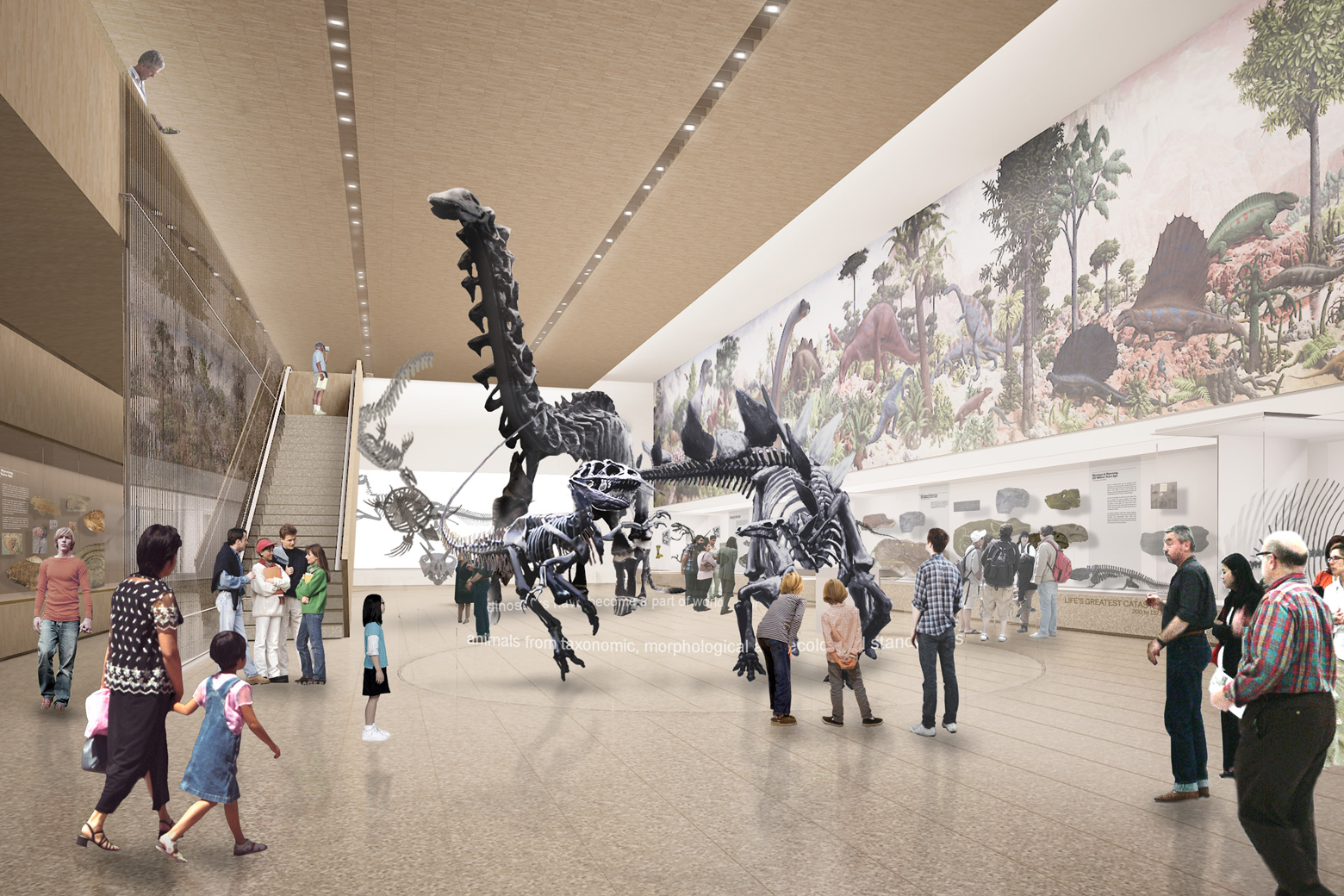
Great hall

Conceptual render of the Great Hall of Dinosaurs by Studio Joseph. Source

The big idea behind the new exhibit is the dynamic relationship between the biosphere and the Earth’s various other spheres (atmosphere, geosphere, hydrosphere, etc). The evolution of life on Earth did not occur in a vacuum, but as part of a continuously changing global system. This narrative does have a time axis – visitors will travel from the Permian at one end of the exhibit to the Quaternary at the other – but the precise divisions of geologic time are de-emphasized in favor of the broad environmental transitions that triggered evolutionary innovations. Examples might include the separation of continents during the Mesozoic, the diversification of flowering plants in the Cretaceous, or the massive climatic shift at the end of the Eocene. In this context, it’s more important that visitors understand (for example) that the Cenozoic was generally a transition from hot and wet to cold and dry (and the implications on mammalian evolution) than that they know the names and time spans of each epoch.

This approach contrasts sharply with traditional chronological exhibits, such as the Field Museum of Natural History’s “Evolving Planet.” The FMNH fossil galleries are extremely linear, and each geologic period is introduced with a set of easily-digested bullet points summarizing what happened during that time. Relatively tight spaces prevent visitors from seeing specimens from other time periods prematurely, and the galleries devoted to each period are color-coded to make them immediately distinct. According to Norris, this segmented presentation of the history of life obscures the large-scale transitions which transcend the somewhat arbitrary divisions of geologic time. As such, the new PMNH fossil halls will present the narrative holistically, encouraging visitors to track the underlying environmental trends that precipitated evolutionary change over time.

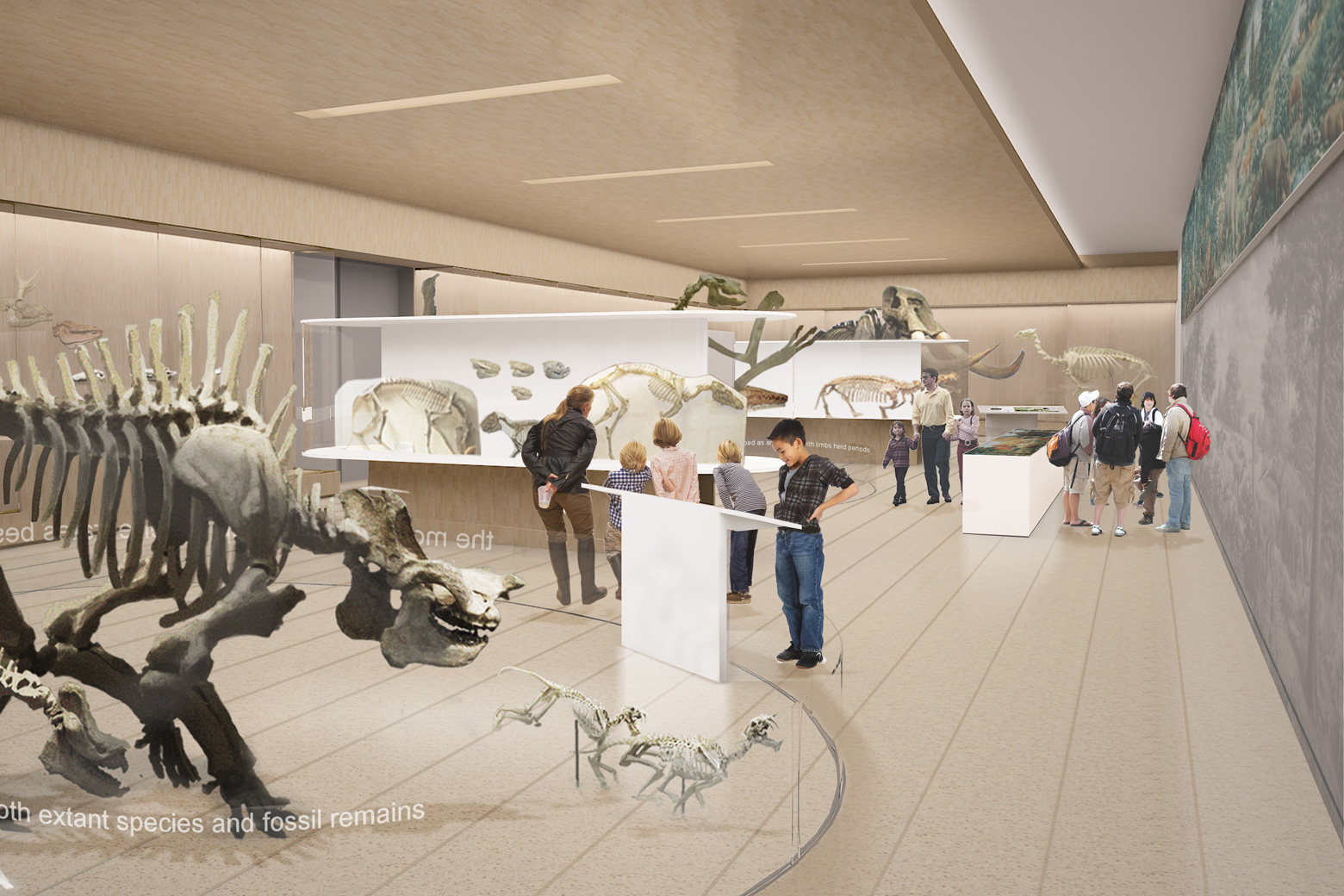
mammal hall concept art by Studio Joseph

Conceptual render of the Hall of Mammals by Studio Joseph. Source

As is immediately clear from the promotional images, the new exhibit will juxtapose a modern, wide-open aesthetic with elements of the museum’s past – specifically, the outdated but gorgeous Rudolph Zallinger murals. Both of these design elements tie directly to exhibit’s narrative themes. By breaking up the central dinosaur pedestal and eliminating the unsightly glass cases in the Mammal Hall, the exhibit designers have dramatically increased the available floor space and opened up new lines of sight. This should allow visitors to view each of the galleries comprehensively, rather than as a series of discreet segments. Meanwhile, the Zallinger murals will remain a celebrated part of the exhibits. These magnificent frescoes were painted between 1942 and 1967, and are among the most iconic images of prehistoric life ever created. Although the physiology of some of the animals is outdated, Zallinger was in other ways ahead of his time. Rather than giving the geologic periods hard borders, Zallinger artfully wove the sections together so that each one fades imperceptibly into the next. The viewer can see that the flora, fauna, and climate are changing over time, but it’s a gradient, not a ladder, which perfectly reflects the narrative of the new exhibit.

deinonychus close up by Studio Joseph

A conceptual render of Deinonychus and other Cretaceous fossils. Source

About 300 miles south of PMNH, the re-imagining of the fossil halls at the National Museum of Natural History is well underway. This building’s east wing has been home to paleontology displays since it opened in 1910 and has been updated several times, but this is the first time it has undergone a complete, wall-to-wall modernization. The old exhibits were formally closed on April 28th, 2014, and NMNH staff spent the following year removing thousands of specimens from the halls. With the fossils out of the way, the next step will be to restore the historic space to its original neoclassical glory. After that, the new exhibits and updated fossil mounts can be assembled in time for a 2019 re-opening.

Intriguingly, the planned design of the new National Fossil Hall is both thematically and aesthetically similar to the PMNH renovation, albeit on a grander scale. The National Fossil Hall’s narrative focus will be on large-scale environmental transitions over time, and how these changes drove the evolution of plants and animals. Like at PMNH, this will be accentuated by an open layout: false walls and barriers that have divided the space since the early 1960s will come down, allowing visitors to see clear across the spacious three-story hall. This airy aesthetic hearkens back to the Hall of Extinct Monsters, and like the restoration of the Zallinger murals at PMNH it represents an admirable celebration of the institution’s history.

concept art

Early conceptual render of the National Fossil Hall by Reich + Petch Source

One interpretive choice that will set the National Fossil Hall apart is the clustering of specimens on islands, or “pork chops”, as the were called early in development. Each pork chop represents North America at a particular period in time. While anchored by a few charismatic mounts, the pork chops will also include all manner of small animals, invertebrates, and plants that were part of that environment. In this way, the islands are self-contained mini exhibits, each one showing a complete ecosystem that existed at a particular time. Moving among the these displays, visitors should get a sense of how climate change and faunal interchange (among other phenomena) can completely transform an ecosystem over millions of years. They’ll also learn how certain organisms, like sauropods in the Jurassic or grass in the Neogene, can change landscapes and influence the evolution of contemporary plants and animals.

The emphasis on open spaces and freedom of movement is notable, because this is quite different from the linear exhibits of the late 20th century. In recent decades, exhibits have become increasingly structured, with specific learning goals and physical spaces designed to corral visitors through a carefully orchestrated narrative journey. Again, Evolving Planet at FMNH is an excellent example of this philosophy. The new National Fossil Hall is in some ways a push in the opposite direction – although it has a clear narrative and overarching message, visitors can roam through the exhibit as they please. I see the pork chop system as a way to have it both ways. Whether visitors work through the exhibit front to back or run straight to the T. rex in the center of the hall, then wander around at random, they’ll still be able to compare and contrast the different ecosystems and learn what the designers want them to learn.

A pork chop

Early concept art of the Jurassic “pork chop.” Image from The Last American Dinosaurs, NMNH.

More than anything else, what I expect to set the National Fossil Hall apart from peer exhibits will be its explicit connections to modern-day environmental crises. It’s worth quoting the Department of Paleobiology’s summary in full:

Visitors to the Museum will be able to explore how life, environments, and ecosystems have interacted to form and change our planet over billions of years. By discovering and harnessing the tools and methods paleobiologists use to study fossils, visitors will gain a deeper understanding of how the world works.

The distant past affects all of us today and will continue to do so in the future. How will climate change impact the natural world and our daily lives? How can we make informed choices about our ecosystems as individuals and as a species? How can we all become informed citizens of a changing planet?

We are in the midst of an extinction event of our own making. Anthropogenic climate change, habitat destruction, and invasive species are as dangerous as any asteroid, and will likely have profound effects on our own lives and livelihoods in the coming century. But while humans are undeniably the cause of the latest round of global changes, we also have the power to mitigate and manage their consequences. The study of fossils provides important contextual information – we can place modern organisms in an evolutionary context and understand their role in shaping the world as we know it, and we can see how organisms have responded to significant environmental overhauls in the distant past. The fossil record is in fact the only way to directly observe these things (as opposed to relying on models or actualistic experiments). As such, the new National Fossil Hall will make it clear that paleontology isn’t just about historical curiosity. The study of past life gives us a long view of the Earth’s biotic and abiotic systems, and helps us predict how they will respond to today’s environmental changes.

looking west

Concept drawing of the National Fossil Hall’s Cretaceous zone. In the old hall, the viewer would be standing at the base of the mezzanine stairs facing the rotunda. Source

With the modern climate crisis front and center, the new National Fossil Hall has the potential to be one of the most immediately relevant and important paleontology exhibits ever assembled*. This is significant, because as I lamented when I started this series, immediacy and relevance are not things that most museum visitors expect from fossil displays. While fossils, particularly the mounted skeletons of dinosaurs and other prehistoric animals, have been central to the identity of natural history museums since the late 19th century, most visitors don’t regard these exhibits as anything more than prehistoric pageantry. Visitor surveys consistently reveal that dinosaurs are seen as eye candy – monsters that might as well be from another planet. This is a shame, because dinosaurs and other prehistoric organisms were real parts of our own world, and we can learn much from them.

Reich

The new National Fossil Hall will be arranged in reverse chronological order – as visitors move accross the gallery, familiar elements of modern environments will be stripped away and the world will become an increasingly alien place. Source

And so we come full circle. What is the point of a museum exhibit**? Is it enough to provide visitors an opportunity to see cool objects and specimens? When we ask museumgoers what they want to see, they tell us “dinosaurs” or “fossils.” They don’t ask for compelling narratives or connections to big contemporary issues, and they don’t see their museum visit as an important way to bridge gaps in scientific literacy.

Still, it is of critical importance that we provide these narratives and connections. Even if we accept the fact that the very existence of a museum and the chance to see real specimens is a Good Thing, museums are still accountable to the public. Virtually all museums cite education as the primary purpose of their institution, and it’s imperative to live up to that. A museum should have a learning goal in mind, it should be able to prove that this message is coming across, and it should be able to articulate why its audience is better off for it. This is not necessarily easy – exhibits need to be relevant without being condescending or preachy. Exhibit designers need to understand their visitors as much as their content. They need to find a balance between feeding visitors information and providing a customizable experience for diverse audiences. As we have seen, not every exhibit succeeds, but my impression is that we’re getting better at it.

*It’s also notable that this climate change-focused exhibit will be on the national mall, given the ongoing politically-motivated opposition to climate science.

**Note that I’m referring specifically to public-facing exhibits. There are many good reasons why the ongoing maintenance of natural history collections is intrinsically valuable.

References

Marsh, D.E. (2014). From Extinct Monsters to Deep Time: An ethnography of fossil exhibits production at the Smithsonian’s National Museum of Natural History. http://circle.ubc.ca/handle/2429/50177

Weil, S.E. (2002). Making Musueums Matter. Washington, DC: Smithsonian Books.

Werning, S. (2013). Why Paleontology Is Relevant. The Integrative Paleontologists. http://blogs.plos.org/paleo/2013/02/19/why-paleontology-is-relevant

6 Comments

Filed under dinosaurs, education, exhibits, FMNH, museums, NMNH, opinion, PMNH, science communication

Framing Fossil Exhibits: Habitat Immersion

It’s time to revisit my sporadic series on organizational and interpretive approaches in large-scale paleontology exhibits. Check out the posts below if you’d like to catch up.

Introduction

Walk Through Time

Phylogeny

Phylogeny – Addendum

Today’s topic is immersive exhibits – walk-through artificial environments that realistically simulate the prehistoric world. There are plenty of examples, and notably most have been built in the last 30 years. The Cincinnati Museum Center has a reconstruction of the Ohio Valley during the Pleistocene. The centerpiece at the Sternberg Museum of Natural History is an indoor forest presided over by an animatronic Tyrannosaurus rex. Probably the most dramatic example is the DinoSphere at the Children’s Museum of Indianapolis. Here, a repurposed Imax theater contains a number of dynamically posed dinosaur skeletons standing among rocks and trees. The surround sound system provides a constant soundtrack of animal calls, while the projection screen shows the sky at different times of day on a 22-minute cycle. There are even periodic storms, complete with flashing lights and booming thunder.

Original Bucky skeleton paired with a Stan cast at the Children's Museum of Indianapolis. Source

Stan and Bucky  harass a Triceratops in the DinoSphere.

Exhibits like the DinoSphere and its kin are frequently derided as sensationalism with little educational value. These multi-million dollar special effects shows (which sometimes do not contain any genuine specimens at all) are plainly inspired by the successes of theme parks, and it’s easy to dismiss them as crass efforts to draw crowds with flashy gimmicks. Surely these exhibits are nothing more than misguided attempts to turn museums into entertainment, learning opportunities be damned?

Well, it depends. The role of spectacle in museums is a complex one, and arguably one that is impossible to decouple from the core identity of these institutions.  Going back to the enlightenment-era cabinets of curiosities from which modern natural history museums emerged, the public side of museums has always been about showing off the biggest, the rarest, or the most expensive. And this sensationalist modus operandi has often been reflected in the spaces where specimens are displayed. The Greco-Roman architecture of classic exhibit halls, for example, is no less artificial than the DinoSphere’s indoor thunderstorms, and serves pretty much the same purpose.

neoclassical

The neoclassical aesthetic of the Field Museum’s Stanley Field Hall was designed to impress—and is no less of a fabricated experience then the DinoSphere above. Photo by the author.

While spectacle in museums is nothing new, neither is its complicated relationship with education. Arresting displays have long been leveraged to imbue specimens with informative context. Take habitat dioramas populated by taxidermy animals, a longstanding staple of natural history museums. These little worlds behind glass first became popular in the mid 19th century, and were almost immediately controversial among museum workers. Paradoxically, dioramas provided visitors with a fuller appreciation of the ecosystems the animals lived in, but only by wrapping the specimens in a layer of theatrical artifice. The immersive fossil exhibits that have cropped up over the last few decades are essentially habitat dioramas on a larger scale, and exhibit designers are still wresting with the same issues their forebears did a century and a half ago. Which is more important in the context of public exhibits – an informative and meaningful narrative, or authenticity?

For me, spectacle and artifice are fine, even welcome, so long as they serve a purpose. In some cases, the spectacle exists to inform (as in a habitat diorama), in other cases the spectacle itself is the attraction. The robotic T. rex at the Natural History Museum in London and the neanderthal photo booth at the National Museum of Natural History come to mind as examples of the latter – they’re entertaining, but don’t facilitate any further reflection or inquiry. When implemented in a thoughtful and deliberate way, however, spectacle can be a powerful element in a museum educator’s toolkit.

Triassic horsetails

By design, the first big skeleton visitors see in Dinosaurs in Their Time isn’t a dinosaur – it’s the phytosaur Redondasaurus. Photo by the author.

Let’s look at one example of a habitat immersion exhibit that uses showy reconstructed environments to maximize its educational potential. Two years and $36 million in the making, “Dinosaurs in Their Time” at the Carnegie Museum of Natural History is, in my opinion, one of the absolute best paleontology exhibits in the world*. Whether you’re considering the scope and quality of the specimens on display, the aesthetics and layout, or the interpretive approach,  Dinosaurs in Their Time is a benchmark in natural history exhibit design. You can follow along with this nifty interactive map.

*To be absolutely fair, Dinosaurs in Their Time is focused exclusively on the Mesozoic, which makes it difficult to compare to larger exhibits that cover the entire history of life on Earth.

What makes Dinosaurs in Their Time so great? Let’s start by considering the layout. The new exhibit more than doubles the square footage of the old Carnegie dinosaur hall, and much of the interior is actually a former courtyard (incidentally, this reuse of an existing space helped the exhibit earn its LEED certification). This makes the gallery spacious and airy, with a high ceiling and  plenty of natural lighting. The exhibit is arranged chronologically, starting in the Triassic and ending in the Cretaceous, but there is plenty of space in which to roam. In fact, the pathway forms a sort of figure eight around the Apatosaurus and Diplodocus in the Jurassic zone and the Tyrannosaurus pair in the Cretaceous. This cyclical organization allows, if not encourages, visitors to view specimens from multiple perspectives, and lets each person traverse the exhibit at their own pace. It’s especially nice that the sauropods have enough room to breathe – too often, these immense skeletons are relegated to cramped quarters where it’s impossible to see them all at once.

jurassic overlook

Visitors can walk all the way around Apatosaurus and Diplodocus, and even view them from above. Photo by the author.

The open spaces and clear sight lines are nicely complemented by the reconstructed rocks and foliage that fill the exhibit, giving it a proper outdoor feel. Importantly, the flora isn’t just for show – it’s a critical component of the interpretation. “We’ve painstaking recreated the worlds of the dinosaurs,” curator Matt Lamanna explains in a Carnegie Magazine interview, “everything that is displayed together actually lived together.” One of the key themes in Dinosaurs in Their Time is that dinosaurs were but one part of rich ecosystems, which were just as complex as those of today. These animals shaped and were shaped by the world around them, and there is far more to paleontology than the pageant show of toothy monsters that many visitors have come to expect. Indeed, it’s more akin to reconstructing entire worlds.

The plurality of “worlds” is important, because Dinosaurs in Their Time also emphasizes the nigh-unfathomable time span of the Mesozoic. Over 185 million years, countless communities of organisms came and went, and once again the immersive aesthetic of the exhibit helps convey this. While the horsetail swamp of the Triassic area almost looks like an alien world, the Cretaceous is populated by flowers and deciduous trees much like those of today. In this exhibit, the fossil specimens aren’t in a neutral environment – the space itself is part of the narrative.

T. rex with flowers and magnolia.

Tyrannosaurus and Triceratops mounts stand among flowers and magnolias. Photo by the author.

The habitat immersion approach comes with yet another plus: it encourages exploration. From a tiny swimming Hyphalosaurus under the waterline of an artificial pond to a Rhamphorhynchus halfway up a tree, visitors are constantly rewarded for looking high and low. As Lamanna explains, “many visitors are repeat visitors, so we wanted to give them something new to discover every time they come back.” This is particularly beneficial for younger visitors. Rather than barreling through the exhibit in minutes, kids are encouraged to look for tiny details and learn things along the way.

Finally, the computer terminals throughout Dinosaurs in Their Time merit some discussion because they embody the same multi-tiered educational approach as the physical space around them. Dinosaurs in Their Time actually tells several stories simultaneously: there’s the ecology story, the deep time story, the history of the specimens on display, and even a meta-story of how the new exhibit was put together. Most visitors won’t be interested in every narrative, nor should they be. Rather than filling the walls with a dizzying array of signage, the exhibit designers consolidated the various narratives into space-efficient interactives. Visitors can choose which information they would like to see, and craft their experience in the exhibit to their tastes. This is technology used intelligently and purposefully, and something I hope to see other exhibits emulate in the future.

look closely

Sharp-eyed visitors are rewarded with hidden specimens, like this Rhamphorhynchus halfway up a tree. Photo by the author.

The purpose of any exhibit structure is to provide meaning and context for objects – to help visitors see them as more than neat things to look at. It’s the museum’s job to give visitors the intellectual tools to contextualize displayed objects in a more sophisticated way. Spectacle is one way to achieve that goal, and Dinosaurs in Their Time is a stellar example.

References

Love, S. (1997). Curators as Agents of Change: An Insect Zoo for the Nineties. Exhibiting Dilemmas: Issues of Representation at the Smithsonian. Washington, DC: Smithsonian Institution Press.

McGinnis, H.J. (1982). Carnegie’s Dinosaurs: A Comprehensive Guide to Dinosaur Hall at Carnegie Museum of Natural History, Carnegie Institute. Pittsburgh, PA: Board of Trustees, Carnegie Institute.

Polliquin, R. (2012). The Breathless Zoo: Taxidermy and the Cultures of Longing. University Park, PN: Pennsylvania State University Press

10 Comments

Filed under CMNH, dinosaurs, education, exhibits, fossil mounts, museums, opinion, science communication

Extinct Monsters: The Marsh Dinosaurs, Part III

allosaurus

A close-up of Allosaurus. Photo by the author.

Click here to start the NMNH series from the beginning.

Some time ago, I wrote about the O.C. Marsh dinosaurs at the National Museum of Natural History. These are the mounted skeletons made from the enormous collection of fossils Marsh accumulated while working for the United States Geological Survey – if you’d like, you can catch up with Part 1 (on Edmontosaurus and Triceratops) and Part 2 (on Camptosaurus, Ceratosaurus, and Stegosaurus). Looking back, I noticed that I never actually finished, so here are the two Marsh dinosaurs with as-yet untold stories.

The Thescelosaurus

The name Thescelosaurus neglectus means “neglected wonderful lizard”, because Smithsonian paleontologist Charles Gilmore found the original specimen at the bottom of a crate, more than 10 years after it arrived at NMNH. Still buried its its field jacket, this skeleton had been long overlooked by both Marsh and the museum staff. Nevertheless, Gilmore found that it was remarkably complete and that it represented a taxon new to science.

Gilmore's illustration

An illustration of the Thescelosaurus holotype prior to reconstruction. Source

Thescelosaurus at USNM.

Thescelosaurus as displayed after 1981. Photo by Chip Clark.

The specimen that would become the Thescelosaurus holotype (USNM 7757) was excavated by John Bell Hatcher and William Utterback in July of 1891, while they were collecting for Marsh in Niobrara County, Wyoming. 20 years later, Gilmore discovered that the skeleton was articulated and intact, save for the head, neck, and parts of the shoulder. He even found small patches of preserved skin on the tail and legs. According to Gilmore, the animal had been buried rapidly after death, since it showed no signs of dismemberment by scavengers.

After describing the fossils, Gilmore mounted the Thesclosaurus in relief on its left side. Other than the reconstructed skull (modeled after Hypsilophodon), the specimen was displayed almost exactly as it was found. This was important to Gilmore, because as he wrote in his published description, “I am…of the opinion that specimens so exhibited hold the attention of the average museum visitor far longer and arouse a keener interest in the genuineness of the specimen than does a skeleton that has been freed from the rock and mounted in an upright, lifelike posture.” Today at least, I suspect that the opposite is true –  visitors are generally more impressed by dynamic standing mounts than by reliefs that preserve death poses. Still, it’s fascinating to gain a small amount of insight into the motivations of a pioneering mount-maker.

Although it was first displayed in the Hall of Extinct Monsters, the Thescelosaurus was most prominently exhibited in the 1963 version of the NMNH fossil halls. Here, it joined the Edmontosaurus, Gorgosaurus, and partial Corythosaurus relief mounts along the south wall. In life, these animals were vastly removed from one another in time and space, but displayed together they almost appeared to be parts of a single quarry face. The Thescelosaurus moved to the north wall in 1981, unfortunately placed rather high and out of most visitors’ line of sight.

thescrci

Thescelosaurus cast in the RCI workshop. Source

thescrci2

Close-up of the new Thescelosaurus skull. Source

When the new National Fossil Hall opens in 2019, USNM 7757 will be replaced with a duplicate cast. The original bones will be moved to the collections, where they can be properly studied for the first time in a century. Already, technicians at Research Casting International have freed the skeleton’s left side, which had never been fully prepared. The exhibit replica assembled by RCI is beautiful, retaining the ossified tendons and cartilage impressions of the original. Mounted in a running pose, the new cast also features an updated head, based on Clint Boyd’s recent description of Thescelosaurus cranial anatomy.

The Allosaurus

Built in 1981, the Allosaurus fragilis (USNM 4734) was the last Marsh Collection dinosaur to be mounted, although bits and pieces have been on display at NMNH since 1920. There has been considerable interest in this individual recently, in part because Kenneth Carpenter and Gregory Paul proposed in 2010 that it become the neotype for Allosaurus – more on that in a moment. Others are interested in this specimen because of its unique pathologies. In addition to several broken and healed bones, the Allosaurus has a massive puncture wound on its left scapula, which nicely matches the diameter of a Stegosaurus tail spike.

Benjamin Mudge collected this specimen in 1877 near Cañon City, Colorado. Known as the Garden Park quarry, this site also produced the Stegosaurus, Camptosaurus, and Ceratosaurus on display at NMNH. Although the Smithsonian obtained the Allosaurus with the rest of the Marsh Collection around 1900, Gilmore did not look at it (or any of the theropod material) until at least 1911. All told, USNM 4734 consists of a partial skull and jaw, a complete set of presacral and sacral vertebrae, a few ribs, a pelvis, and virtually complete arms and legs. It would have had a tail as well, but Mudge’s crew accidentally threw the articulated tail over a cliff while excavating the skeleton. Norman Boss assembled a reconstructed skull, which was displayed through the 1970s. The articulated legs and feet were exhibited in a free-standing case until the late 1950s.

Reconstructed skull

Allosaurus skull  as reconstructed by Norman Boss. Image from Gilmore 1920.

This specimen’s taxonomic history merits some discussion. The holotype Marsh selected when naming Allosaurus (YPM 1930) is notoriously poor, consisting of a single phalanx, two dorsal centra, and a tooth. Dozens of very complete skeletons attributed to Allosaurus are now known, and most specialists basically agree on what an Allosaurus is, but the lack of a usable type with which to define the taxon has been an ongoing problem.

The far more complete USNM 4734 was recovered from the same quarry as the Allosaurus holotype, during the same 1877 field season. Marsh himself actually used this specimen, rather than his designated type, to illustrate subsequent publications on Allosaurus. In 1920, Gilmore flirted with the idea of nominating USNM 4734 as a neotype for Allosaurus, but for reasons that I find difficult to follow, he decided to lump both specimens into the older name Antrodemus valens. Joseph Leidy coined Antrodemus in 1870 based on a single caudal vertebra with no geologic provenance, so this move did little to fix the underlying issue. Nevertheless, Antrodemus remained a popular synonym for Allosaurus in some circles for several decades.

allosaurusskullprep

Arnold Lewis rebuilds the Allosaurus skull in 1979. Image from Thomson 1985.

When the NMNH fossil halls were renovated in 1981, the designers noticed that the exhibit badly needed a large theropod mount. Arnold Lewis was tapped to design and construct a complete mounted version of USNM 4734, with some assistance from Ken Carpenter. The tail was cast from a Brigham Young University specimen, but Lewis sculpted the belly ribs and sternum using an alligator skeleton as reference. The completed Allosaurus measures 17 feet from its grinning jaws to the tip of its tail, and a form-hugging armature makes it look particularly dynamic. This mount has been a favorite among visitors for more than 30 years, although the 2001 addition of a Stan the Tyrannosaurus cast has somewhat overshadowed the smaller theropod.

Allosaurus

The complete Allosaurus skeleton was finally exhibited in 1981. Photo by the author.

Technicians from Research Casting International took down the Allosaurus in the summer of 2014 as part of the current round of renovations. You can watch a video of the de-installation here. The skeleton will be remounted in a few years (crouching beside a nest mound), but Smithsonian researchers want to get a good look at it before that happens. In particular, curator Matt Carrano has been wondering for some time whether a partial jaw Marsh named “Labrosaurus ferox” actually belongs to this specimen. The “Labrosaurus” jaw, which has an unusual pathology caused by a bite or twisting force, came from the same quarry as USNM 4734, and appears to be the same portion of jaw that the more complete skeleton is missing. Time will tell whether Carrano’s hunch is correct. Meanwhile, Carpenter and Paul’s petition to replace the Allosaurus type with this more complete specimen from the same locality is still pending. We should expect to hear more about that soon, as well.

References

Carpenter, K., Madsen, J.H., and Lewis, L. (1994). Mounting of Fossil Vertebrate Skeletons. Vertebrate Paleontological Techniques. 285-322.

Gilmore, C. M. (1915). Osteology of Thescelosaurus, an ornithopodus dinosaur from the Lance Formation of Wyoming. Proceedings of the U.S. National Museum 49:2127:591–616.

Gilmore, C.M. (1920). Osteology of the Carnivorous Dinosauria in the United States National Museum with Special Reference to the Genera Antrodemus (Allosaurus) and CeratosaurusUnited States National Museum Bulletin 110:1-154.

Lee, J.J. (2014). The Smithsonian Disassembles its Dinosaurs. National Geographic Online.  http://news.nationalgeographic.com/news/2014/07/140731-dinosaur-hall-smithsonian-renovation-culture-science/

Paul, G.S. and Carpenter, K. (2010). Allosaurus Marsh, 1877 (Dinosauria, Theropoda): proposed conservation of usage by designation of a neotype for its type species Allosaurus fragilis Marsh, 1877. Bulletin of Zoological Nomenclature 67:1:53-56.

Thomson, P. (1985). Auks, Rocks, and the Odd Dinosaur: Inside Stories from the Smithsonian’s Museum of Natural History. New York, NY: Thomas Y. Crowell.

3 Comments

Filed under dinosaurs, exhibits, Extinct Monsters, fossil mounts, museums, NMNH, ornithopods, theropods

Permo-Triassic Synapsids at NMNH

Click here to start the NMNH series from the beginning.

In the middle decades of the 20th century, museum theory and paleontological science were undergoing complementary revolutions. Museum workers shrugged off their “cabinet of curiosity” roots and embraced visitor-centric, education-oriented exhibits. Designers began to envision the routes visitors would travel through an exhibit space, and consider how objects on display could contribute to holistic stories. Meanwhile, paleontologists like Stephen J. Gould and David Raup moved their field away from purely descriptive natural history, exploring instead how the fossil record could inform our understanding of evolution and ecology. The common thread between both transitions was a focus on connections – bringing new meaning and relevance to disparate parts by placing them in a common narrative.

Between 1953 and 1963, the Smithsonian implemented an institution-wide modernization program, transforming virtually every exhibit in the museum complex. The National Museum of Natural History began renovations to its classic fossil halls in 1959, and the new exhibits were emblematic of contemporary trends in both museum design and paleontology. The plan, as devised by exhibit designer Ann Karras, was to do away with the loose arrangement of specimens and turn the east wing into a guided narrative of the biological and geological history of Earth. Responsibility for selecting specimens and writing label copy in each of the four halls fell to a different curator. In Hall 2, which housed dinosaurs and fossil reptiles, that curator was Nicholas Hotton.

Layout of the USNM east wing, circa 1963.

Layout of the NMNH east wing as of 1963.

Hotton joined NMNH in 1959 as an Associate Curator of Paleontology. Entirely onboard with Karras’s vision and the paleobiology movement as a whole, Hotton described the old exhibits as “crowded” and “unorganized.” He thought NMNH had plenty of dinosaurs, but “mammal-like reptiles”* were sorely needed if Hall 2 was to tell the complete story of amniote evolution. Following that, Hotton’s mission over the next several years was to assemble a respectable collection of synapsid specimens for NMNH, and to incorporate them into a well-illustrated exhibit on the origins of mammals. This post highlights just a few of the specimens featured in Hotton’s version of Hall 2.

*In Hotton’s day, early mammalian relatives were usually called “mammal-like reptiles”, hence their inclusion in the fossil reptile exhibit. Today, most specialists prefer a more precise definition of reptiles that excludes synapsid (mammal-line) animals. In this post, I will be using the modern classification wherever possible. 

The Dimetrodon

Prior to 1960, the non-mammalian synapsid collections at NMNH were mostly limited to early Permian pelycosaurs. The most impressive of these was a Dimetrodon gigas collected in 1917 by independent fossil hunter Charles Sternberg. One of the best collectors of his day, Sternberg worked intermittently for E.D. Cope, O.C. Marsh, and various North American museums. In the summer of 1917, however, Sternberg was on a personal collecting trip with his son Levi. Their target was the Craddock Ranch bone bed of Baylor County, Texas, which was first explored in 1909 by a University of Chicago team. Sternberg was already quite familiar with this part of western Texas, having made some of the first thorough surveys of the Permian “red beds” in the 1880s, but the site itself was new to him. Nevertheless, Sternberg was extraordinarily successful that summer, collecting hundreds of fossils from a wide range of animals. He offered this bounty to the Smithsonian, and they purchased it from him immediately.

The Craddock Ranch fossils were particularly appealing because of their unique preservation. Buried in soft clay at the bottom of a shallow pond, the fossils could be removed from the ground with relative ease, and were largely free of encrusting matrix. Although few of the bones were articulated, many were identifiable. All told, the Sternberg collection included at least 35 skulls and partial skeletons from amphibians like Cardiocephalus, Diplocaulus, and Seymouria, plus hundreds of individual Dimetrodon bones, and a single articulated Dimetrodon specimen.

Note short tail

An early photograph of the Dimetrodon mount. Image from Gilmore 1919.

Dimetrodon first displaed on north wall

The Dimetrodon was first displayed on the north wall of the Hall of Extinct Monsters. Source

That Dimetrodon (USNM 8635) was the basis for a mount constructed by T.J. Horne. The articulated skeleton included a complete series of presacral vertebrae, the shoulder girdles, most of the forelimbs, and the left femur and tibia. The skull and jaw bones were found disarticulated, but bound together in the same mass of matrix as the skeleton. Horne added the pelvic bones and sacrum from smaller Dimetrodon specimens, and sculpted the rest of the missing material in plaster to complete the mount. Notably, his reconstructed tail was extremely short and stubby. Although the American Museum and Field Museum already had Dimetrodon mounts on display, the NMNH version stood out because of its open jaws, which Charles Gilmore said “gives the animal an appearance of angrily defying one who has suddenly blocked his path.”

Gilmore added the Dimetrodon to the Hall of Extinct Monsters in 1918. Like the other standing mounts constructed under Gilmore’s supervision, the skeleton was placed on a base textured and painted to resemble the rocks in which it was found. At this point in time, the NMNH fossil halls lacked any overarching organizational scheme, and interpretive content was minimal. Nevertheless, Gilmore displayed the Dimetrodon mount with both a small model and a 15-foot oil painting by Garnet Jex, which provided general audiences a better understanding of the animal’s life appearance.

dimetrodon

Dimetrodon in the 1963 fossil reptiles exhibit. Image courtesy of the Smithsonian Institution Archives.

Dimetrodon in 2014. Photo by the author.

Dimetrodon after the 1981 renovation. Photo by the author.

During the 1962 renovation, Hotton re-contextualized the classic Dimetrodon mount as a mammal ancestor. Unmissable orange arrows pointed to the specific anatomical traits that signify the animal’s kinship with mammals, including heterodont teeth and a single temporal fenestra. By design, visitors would pass Dimetrodon before visiting the true mammals in the adjacent hall.

The Dimetrodon skeleton itself was altered during the next renovation in 1981, when it was placed on a new, untextured base and given a longer replica tail. Contemporary staff also repainted the plaster sections to more closely resemble the original fossils – a surprising reversal of Gilmore and Horne’s original intention to make the reconstructed bones obvious to viewers.

The Thrinaxodon

Pelycosaurs like Dimetrodon represent the first major synapsid radiation, but by the middle Permian they were almost entirely replaced by therapsids. A more derived group which includes modern mammals, therapsids spread across the globe and became increasingly diverse as the Permian progressed. From weasel-sized burrowers to multi-ton herbivores, non-mammalian therapsids were among the first animal groups to conquer a wide range of terrestrial niches. Hotton wanted to tell this story in the modernized fossil exhibit, but there were hardly any non-mammalian therapsids in the NMNH collections. To correct this problem, Hotton took to the field for several months in 1960, and again in 1961. He joined James Kitching in exploring the Beafort Group rocks of South Africa, which were known to produce plentiful Permian and Triassic vertebrate fossils. Hotton returned to the museum with over 200 new specimens, the best of which were used in the renovated exhibit.

Hotton’s display of South African synapsids and amphibians. Note “Baby Doll” on the far left. Photo courtesy of the Smithsonian Institution Archives.

Thrinraxodon with Cynognathus skull

Thrinaxodon paired with Cynognathus skull. Photo by the author.

Hotton’s most prized find from South Africa was a gorgeously preserved and nearly complete Thrinaxodon liorhinus (USNM 22812). Hotton called this specimen “Baby Doll”, and while it was not prepared in time for Hall 2’s 1963 opening, it would later earn a spot of honor in the exhibit. Before that happened, though, Baby Doll was actually stolen by an over-enthusiastic volunteer. The FBI located and returned the fossil a year and a half later.

Since the 1980s, the Thrinaxodon has been displayed alongside the skull of Cynognathus crateronotus (USNM 22813), which Hotton collected on the same expedition. Both are members of the cynodont clade, which includes some of the closest relatives of modern mammals.

 The Daptocephalus

Less than a month after hall 2 reopened, Nicholas Hotton returned to South Africa. This time, he was accompanied by his spouse Ruth Hotton and their three young children. For seven months, the Hottons traveled among fossil sites on different ranches, camping most nights. They collected some 300 specimens for the Smithsonian, and Hotton’s biostratigraphic mapping of the Beaufort Group brought a measure of clarity to this region’s historically convoluted geology.

Ruth Hotton made one of the trip’s most impressive finds while prospecting in a dry riverbed with her daughter, Carol (who is now a paleobotanist at NMNH). Turning a corner, she stumbled upon a dicynodont skeleton, completely exposed and lying in the middle of the channel. One can only imagine the surprise and delight of finding an articulated fossil skeleton completely uncovered. If the Hottons had been there one season earlier or one season later, the river would have undoubtedly destroyed the fossils.

Daptocephalus on display. Photo by James Di Loreto, National Museum of Natural History.

Back at the museum, Nicholas Hotton prepared the specimen (USNM 299746) and determined it to be Daplocephalus leoniceps, one of the plethora of dicynodonts known from the Beaufort Group. Based on this classification, he reconstructed the damaged skull to resemble more complete Daplocephalus specimens, and added casts of Daplocephalus limbs.

The specimen was restored in 2019 and is now labeled Platypodosaurus. Photo by the author.

As it turns out, however, USNM 299749 is not a Daplocephalus—it is a somewhat distantly related dicynodont currently called Platypodosaurus. To varying degrees, fossil mounts are hypotheses made of bone and plaster. They are based on the best information available at the time, but sometimes they need to be corrected. The NMNH “Daplocephalus” had been mislabeled and erroneously reconstructed for many years, but the 2014 renovation of the NMNH fossil halls now presented an opportunity to deconstruct the specimen and study it up close. As of 2019, Platypodosaurus was back on display with a newly reconstructed skull and limbs.

Thanks to Christian Kammerer for kindly sharing images and insight on “Daptocephalus”!

References

Gilmore, C.W. (1919). A Mounted Skeleton of Dimetrodon gigas in the United States National Museum, with Notes on the Skeletal Anatomy. Proceedings of the United States National Museum 56:2300:525-539.

Kammerer, C. (2015). Personal communication.

Lay, M. (2013). Major Activities of the Division of Vertebrate Paleontology During the 1960s. http://paleobiology.si.edu/history/lay1960s.html

Marsh, D.E. (2014). From Extinct Monsters to Deep Time: An ethnography of fossil exhibits production at the Smithsonian’s National Museum of Natural History. http://circle.ubc.ca/handle/2429/50177

Sepkoski, D. (2012). Rereading the Fossil record: The Growth of Paleobiology as an Evolutionary Discipline. Chicago, IL: The University of Chicago Press.

4 Comments

Filed under exhibits, Extinct Monsters, field work, fossil mounts, history of science, mammals, museums, NMNH